Article

Characterization of Soil CO2 Flux from an Active Volcano Through Visibility Graph Analysis

by
Salvatore Scudero
1,*,
Marco Liuzzo
2,
Antonino D’Alessandro
1 and
Giovanni Bruno Giuffrida
3
1
Sezione Osservatorio Nazionale Terremoti, Istituto Nazionale di Geofisica e Vulcanologia (INGV), Via di Vigna Murata 605, 00143 Rome, Italy
2
Sezione di Palermo, Istituto Nazionale di Geofisica e Vulcanologia (INGV), Via Ugo La Malfa 153, 90146 Palermo, Italy
3
Sezione Osservatorio Etneo, Istituto Nazionale di Geofisica e Vulcanologia (INGV), Piazza Roma 2, 95125 Catania, Italy
*
Author to whom correspondence should be addressed.
Appl. Sci. 2026, 16(7), 3134; https://doi.org/10.3390/app16073134
Submission received: 17 February 2026 / Revised: 15 March 2026 / Accepted: 22 March 2026 / Published: 24 March 2026
(This article belongs to the Special Issue Advances in Geophysical Approaches in Volcanic and Geothermal Areas)

Abstract

The comprehension of the complex dynamics of degassing is critical for volcano monitoring and assessing volcanic hazards. In this study, we apply visibility graph analysis (VGA) to a decadal, high-resolution time series of daily soil CO2 flux recorded by a standardized monitoring network at Mt. Etna volcano (Italy). By mapping these time series into complex networks, we demonstrate that the connectivity degree distributions follow a power law described by the exponent γ , which reveals a self-similar behavior of gas emissions. We introduce the γ -deviation, namely the variation of the scaling exponent from its long-term site-specific baseline, as a novel proxy for degassing efficiency. The long-term baseline is interpreted as a site-specific measure of flux efficiency, while its variations are attributed to other factors, such as fluctuations in the sources or changes in the efficiency of fluids transport pathways. Our results identify a transition from a period of discordance across the monitoring sites (pre-2016) to a phase of network-wide concordance (after 2016). The striking correlation between topological γ -deviations and the established normalized network signal ( Φ n o r m ) validates the methodology, suggesting that VGA is able to capture the same underlying magmatic drivers. This study establishes VGA as a robust and reliable tool for medium- and long-term monitoring, potentially capable of identifying the occurrence of large-scale magmatic processes and refining the characterization of fluid transport dynamics in active volcanic systems.

1. Introduction

The study of volcanic gases is a fundamental tool for the investigation of magmatic processes in active volcanic systems because of their potential evolution into eruptive phenomena. For this reason, the monitoring of gas emissions is today considered a fundamental part of monitoring programs for active volcanoes around the world [1,2,3,4]. Among the volatiles present in magma, carbon dioxide is the most abundant after water; it is relatively straightforward to sample, and is the most widespread species in volcanic soils. In addition, there is a substantial scientific literature that establishes a correlation between the variability of emission rates and the eruptive state of volcanoes [5,6]. This correlation is also evident in the connection with degassing volcano-tectonic structures [7,8,9], thus establishing it as a fundamental geochemical parameter that requires monitoring.
In this work, visibility graph analysis (VGA) is applied for the first time to explore soil CO2 emission on an active volcano. Data come from a permanent monitoring network [10,11] installed on the slopes of the active Mount Etna volcano (Sicily, Italy). The advantage of exploiting this dataset is the possibility of analysing simultaneous measurements from a network that is homogeneous in terms of geological, volcanological, and environmental conditions, as well as the type of monitoring instrumentation [12].
In broad terms, the VGA method transforms a generic time series into a graph, so that the reciprocal “visibility” among the series’ values represents the connections among nodes [13]. The application of this method to the study of environmental and geophysical variables is quite recent [14]. Among the data analyzed with VGA, we list: pollutants like PM10 and PM2.5, ozone (O3), NO2, SO2, temperature, wind speed, streamflow, the solar cycle [15,16,17,18,19,20,21,22,23,24,25,26], and numerous examples in earthquake catalogs [27,28,29,30,31,32]. Within this overview, the application to CO2 emissions in an active volcanic environment represents a true novelty.
The main objective of this work is to check the suitability of the VG transformation for this type of data, and to verify whether certain features of the visibility networks could represent an effective tool for characterizing complex signals, such as soil CO2 flux time series. Validating the applicability of this approach will allow for the exploration of CO2 flux dynamics by assessing its temporal and spatial variations, as well as the relationship between soil gas emissions and active volcanic processes.

2. Data and Methods

The CO2 time series were recorded by a monitoring network of 14 sites located at Mt. Etna volcano (Table 1). These were placed to achieve uniform coverage around the flanks of the volcano. The analyzed time series cover a period of almost nine years, ranging from February 2011 to December 2019.
Raw time series were pre-processed before being converted into networks for their subsequent characterization. The pre-processing followed the well-established approach of [12,33] which was specifically developed to filter and homogenize measurements of soil CO2, and filled the data gaps in the Etna network. Details on the procedure can be found in the source papers; it is briefly described in the following list:
(i)
Reduction of flux series from hourly to daily measurements.
(ii)
Modeling the annual variations by means of running averages with different numbers of terms.
(iii)
Filtering daily flux series to remove seasonal signals.
(iv)
Normalization of each of the 14 CO2 flux series in the range φ [0, 1] as a preparatory step to combine them into a global, unique signal representative of the CO2 flux which describes the degassing state of the volcano. After this step, the physical unit of flux (kg · m2 · d−1) is dropped, and the normalized flux unit Φ n o r m [0, 1] is used.
(v)
Filling gaps (about 6%) with a combination of a linearly weighted moving average part and a white noise part. The imputation procedure is specifically tuned to the dataset, so that the statistical properties of time series remain unaltered. The resulting 14 series are composed of 3251 daily flux data points each.
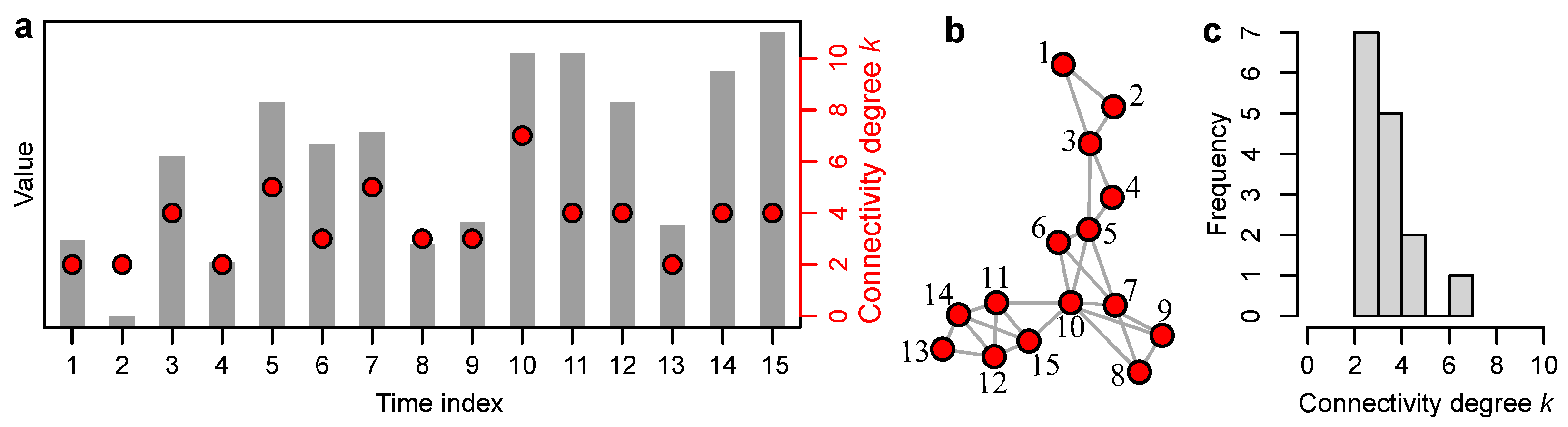
The time series were then converted into graphs using the method called “visibility graph analysis” (VGA). This method transforms a generic series into a graph on the basis of the relationships between the nodes of the series. The network resulting from the geometric transformation performed by the VGA method retains the properties of the original time series [27,34]. In particular, VGA is based on the reciprocal “visibility” [34] between two generic nodes (Figure 1). Using this representation, values in the time series can be described as nodes, and the connections between the various nodes represent their relationships. This technique has proven to be highly informative for studying many different environmental and geophysical observables [17,18,20,21,23,26,31,32,35,36].
Adopting the notation from [34], the visibility relationship is verified when all the intermediate observations ( t c , y c ) between two generic observations of a time series, ( t a , y a ) and ( t b , y b ), fulfil the following relationship:
y c < y b + ( y a y b ) t b t c t b t a
Therefore, the connectivity degree k is defined as the number of links that each observation i holds with all the other observations of the time series (i.e., network nodes)— k i = Σ a i j [14]. Since each observation has at least two connections with its adjacent observations, the minimum value the connectivity degree can assume is k = 2 (except for the two tip-observations). A node with a large value of k indicates that the corresponding observation is linked to many others and therefore represents a hub within the network.
Modifications of this method have been adopted, such as horizontal visibility graphs, which only consider horizontal “lines-of-sight” within the time series [37], the implementation of thresholds [38], and the definition of directional (forward or backward) criteria for mapping the time series [28,39,40]. In this work, we use the general, undirected notation proposed by [34]. The construction of a visibility graph from a time series can involve significant computational cost, especially for large time series, since VGA transformation has quadratic time complexity [41,42].
After converting the simulated catalogs into graphs, we evaluated the frequency distribution of the connectivity degree P ( k ) to investigate the nature of CO2 time series. In fact, if a time series shows scale-free fractal behavior, rather than periodic or random, then the tail region of the log–log plot of P ( k ) can be fitted with a power-law relation in the form P ( k ) k γ . The exponent γ also represents the slope of the straight line in the linearized relation [34,43]. The degree distribution is one of the most common metrics used to evaluate complex networks (ref. [13] and reference therein). The approach we propose was used by several authors to investigate complex networks with the objective of characterizing the structure and the properties of the original time series [16,18,20,21,22,25,26,34,36,44,45].
The reliability of power-law distributions was tested following the approach proposed by [46]. This is based on a goodness-of-fit test which measures the deviation between the observed data and the hypothesized power-law model. This distance is expressed as a p-value, defined as the fraction of modeled deviations that are larger than the empirical deviation. For p-values above given thresholds (e.g., ≥0.05) the difference between observations and model can be attributed to stochastic fluctuations, and the power-law distribution represents a likely fit for the data [46]. However, as the authors warn, this test should not be considered as a decisive evidence to prove, or discard, whether the power law is the best distribution to describe the data.

3. Results

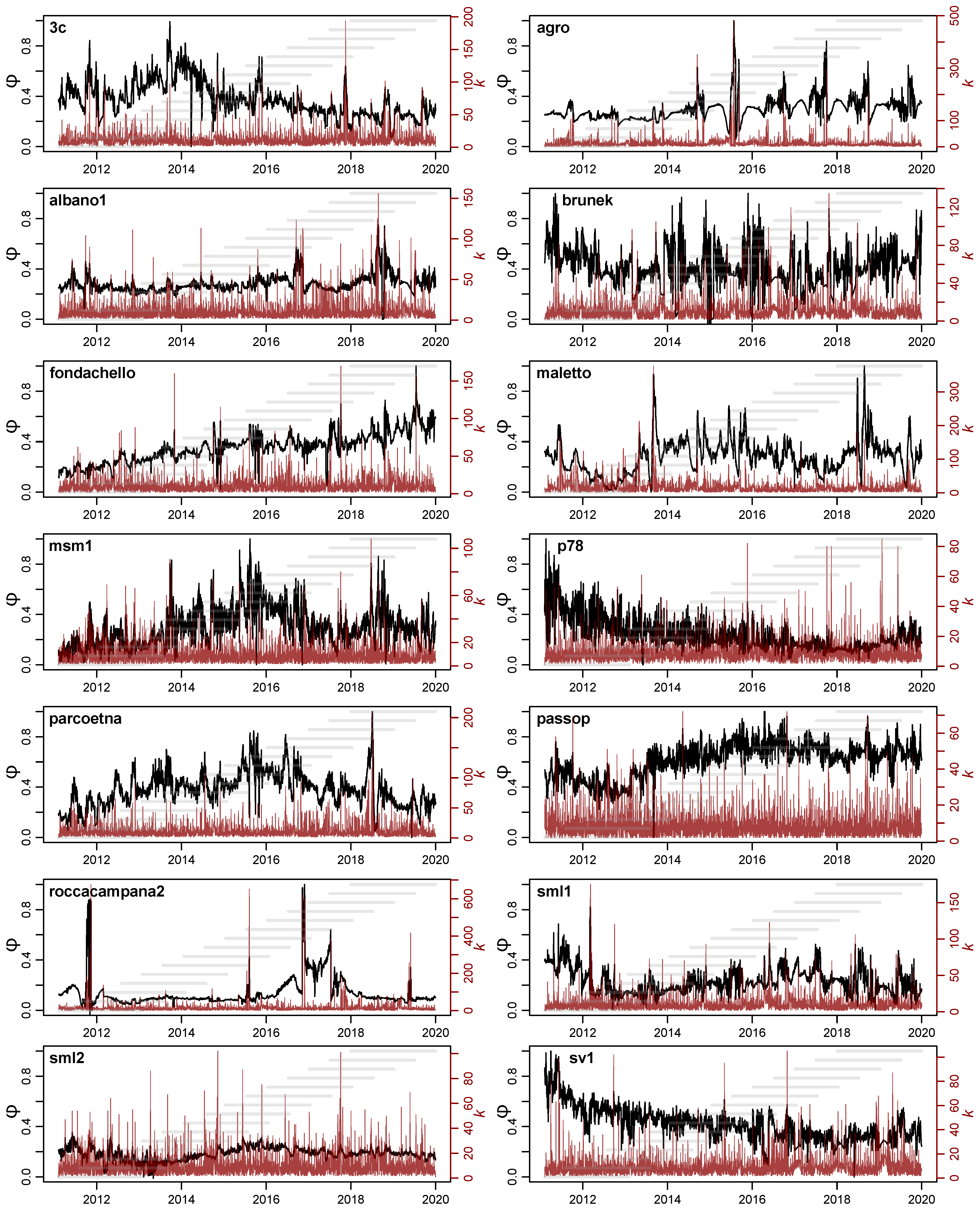
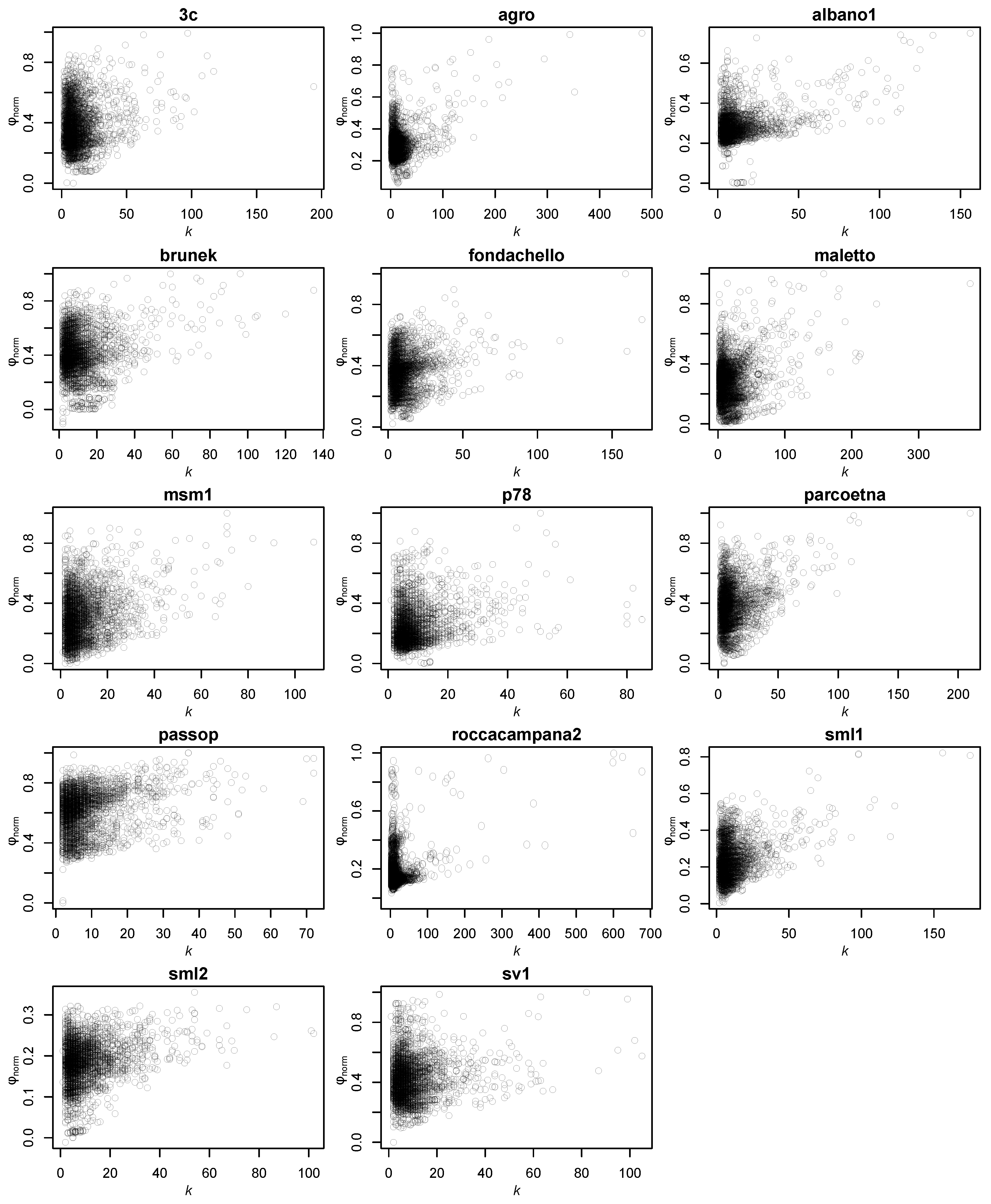
Results of the graph transformation of the normalized daily soil CO2 time series are shown in Figure 2, where they are displayed together with the corresponding connectivity degree k after the graph conversion. It might be expected that higher values in the series would also have higher k values, but they often exhibit a wide range of degree (Figure 3). Therefore, higher values of CO2 flux do not necessarily correspond to “hubs” in the VGA; rather, their values can span a broad range of k. This derives from the sequential order of observations within the time series [15,36] which reflects the time correlation of observations, such as, for instance, when two or more high values are located very close to each other (Figure 2). The patterns of the φ -k plots are quite similar, even though peak k values vary from about 70 at the “passop” site to about 700 at the “rocacampana2” site (Figure 3).
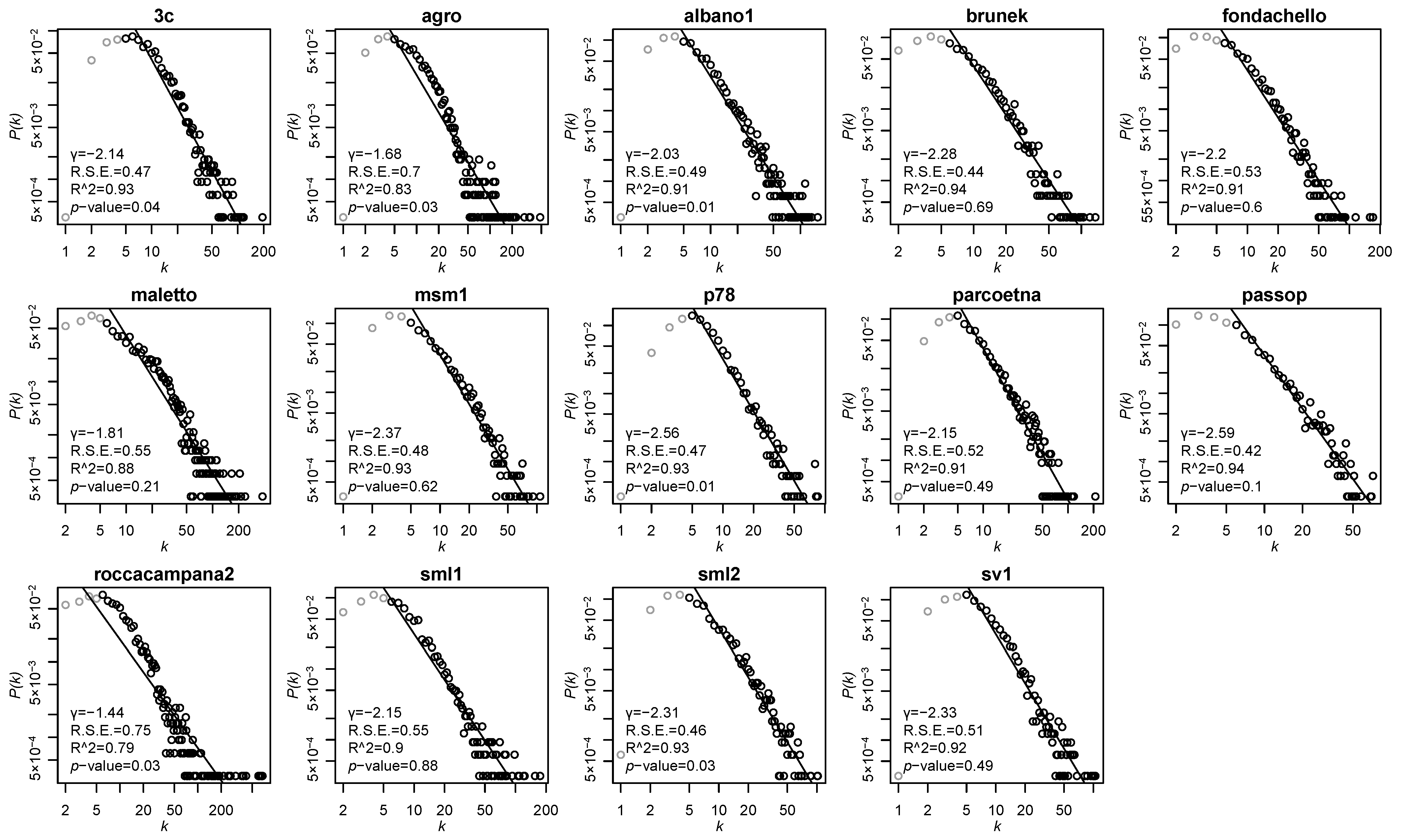
The distributions of connectivity degrees P(k) are analyzed to investigate the nature of CO2 flux time series (Figure 4). The greater the connectivity degree is, the lower the associated probability, because large degrees are exclusive to nodes with the highest values (i.e., hubs) due to their more probable high visibility. All time series have similar distributions, which, in a log–log plot, can be fairly approximated to a straight line. The regressions of k frequency distributions were calculated considering a minimum k threshold value because the power-law trend holds only for the tail region of the distribution. Such deviation from the trend is ascribable to edge effects (i.e., time series tips) or short-scale features within the time series. Regressions were performed for k 5 : this value minimizes the global residual error of regressions over the 14 time series. The calculated value of γ represents a scale-free parameter that describes the characteristics of each power-law distribution; in particular, it defines the relative proportion of low-k and high-k nodes within the network. Because the distributions have decreasing trends, γ -values are negative; however, for the sake of simplicity, in the description of the results and their following discussion, we consider their absolute values | γ | . A high γ -value indicates a higher fraction of low-k nodes than large-k ones; conversely, a low γ -value indicates a lower fraction of small-k nodes than large-k ones (Figure 4).
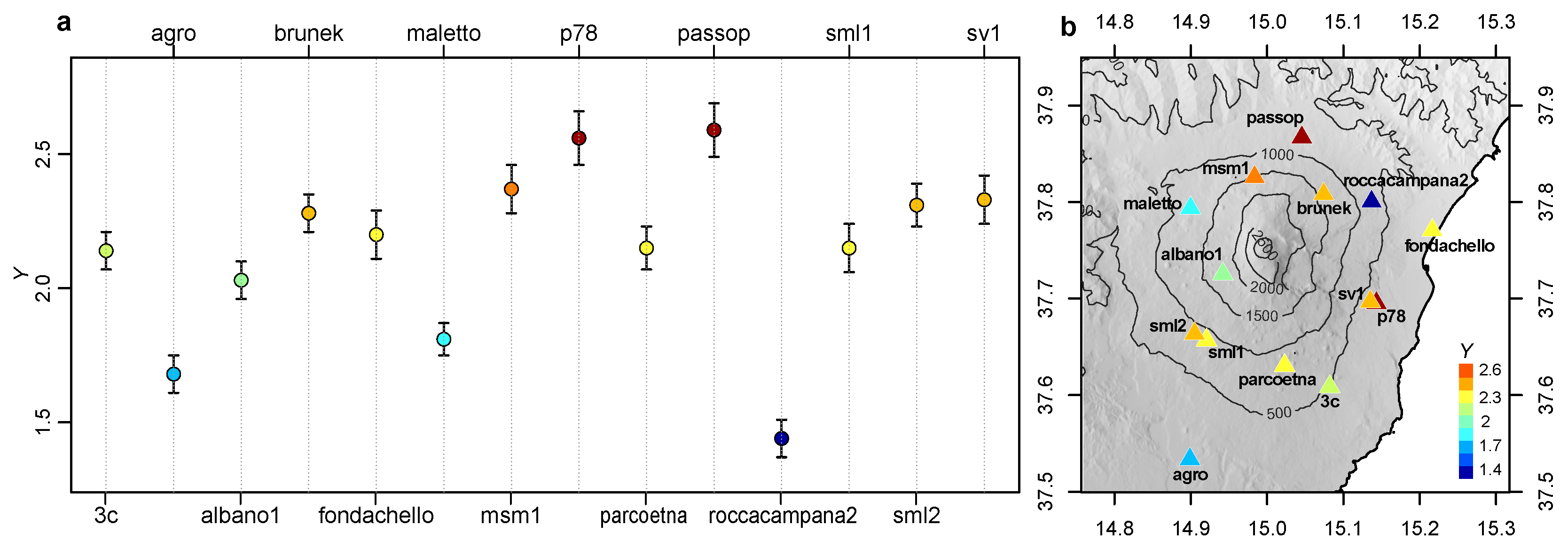
Metrics used to evaluate the regression (residual standard error, coefficient of determination, and p-value in Figure 4) together concur in indicating reliable estimations of the γ -values. At the “albano” and “p78” sites, the p-value = 0.01, below the threshold for accepting the power-law distribution; however, the corresponding coefficients of determination (0.91 and 0.93) suggest very good correlation for k 5 . The breakdown of the power law of these series may suggest a transition in the underlying physical mechanism of degassing. The joint evaluation of the available metrics (Table 1 and Figure 5a) enables us to provide reliable estimations of the γ -value, which ranges between 1.44 (at the “roccacampana” site) and 2.59 (at the “passop” site), with the associated standard error (S.E.) in the range between 0.07 and 0.1.
The spatial distribution of γ -values does not show evidence of a clear spatial correlation (Figure 5b); rather, the arrangement appears uneven.
To further investigate the characteristics of the CO2 flux time series and the dynamics of the volcanic system’s emissions, we examined both the temporal and spatial variations in γ -value.

3.1. Temporal Variability

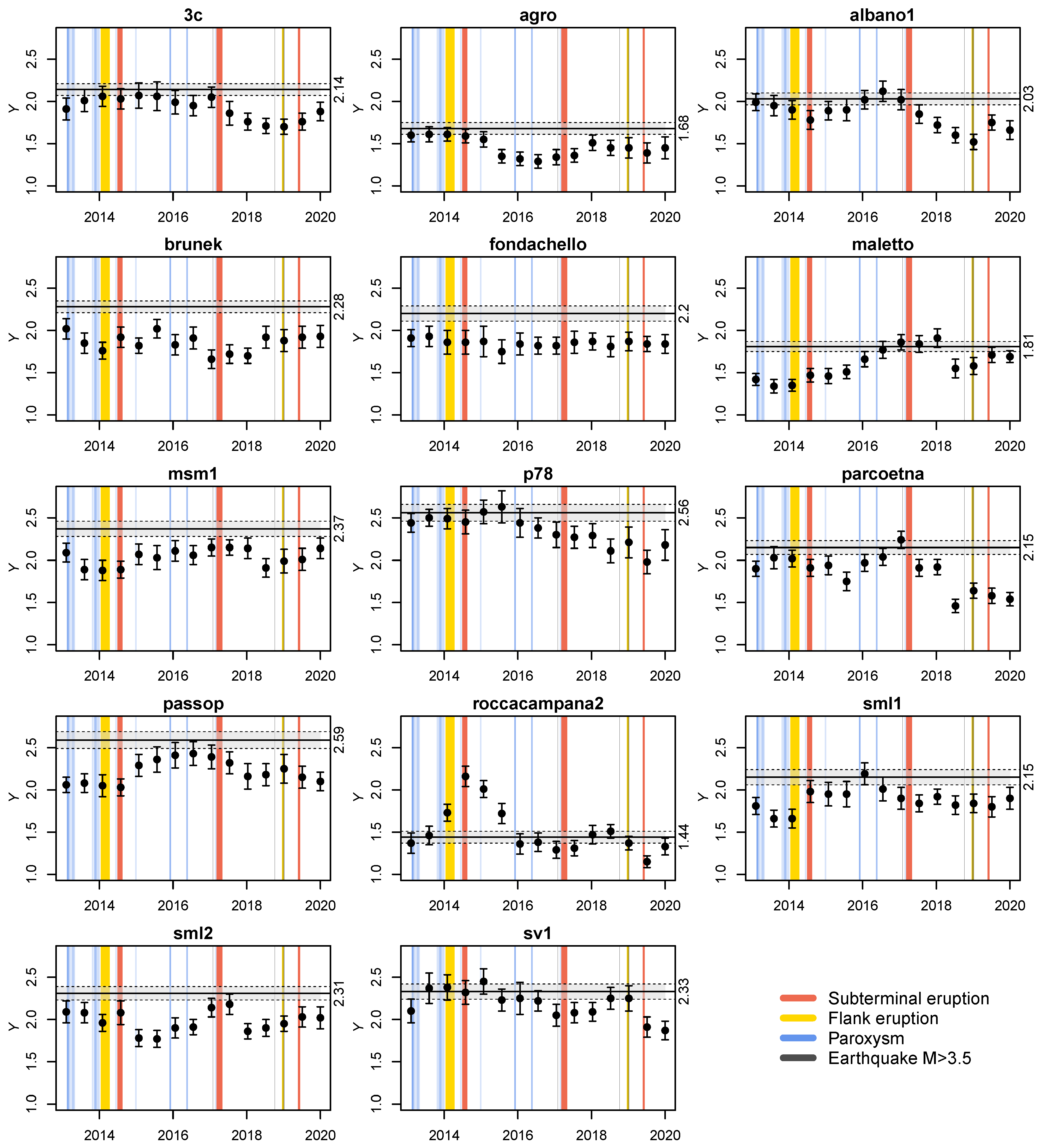
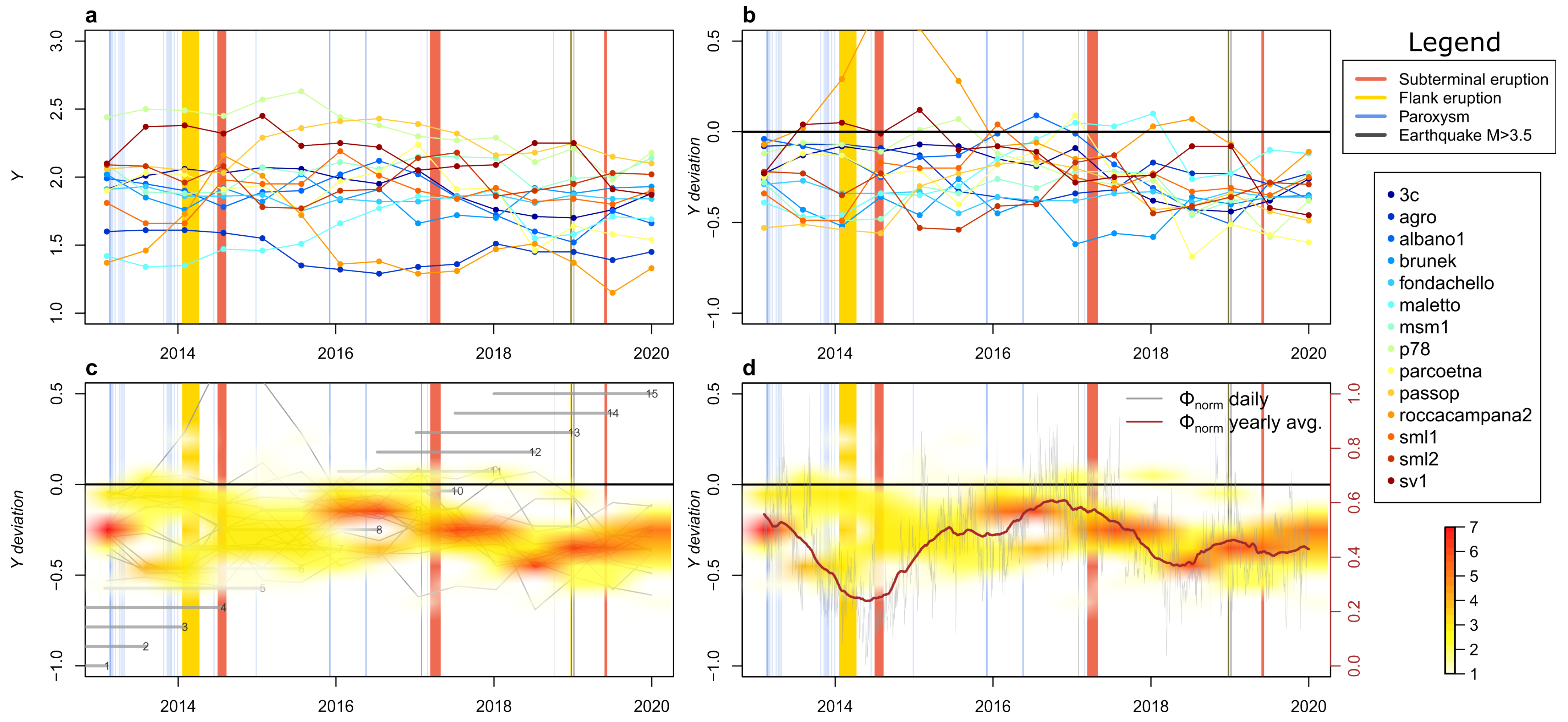
The proposed methodology (VGA conversion and power-law fitting of the degree distribution) was also applied to analyze temporal variations in CO2 signals at the monitoring sites. In particular, we considered 15 time windows (Table 2), each with a duration of two years and a 75% overlap (i.e., 6-month shift). With this windowing arrangement, we expected a certain degree of smoothing in the obtained values. In this way, we aimed to eliminate short-term transients attributable to local site effects and enhance long-period variations, which are more likely related to changes in the signal source shared among the monitoring sites or to major changes in the permeability of the system [12,33]. The ranges of the obtained values (Table 3) are comparable to those of the entire time series, with γ -values spanning from 1.15 to 2.63 (Figure 6 and Supplementary Material). At each site, variations are relatively limited; some of them appear to coincide with the occurrence of volcanic activity, although it is not possible to identify consistent trends across different sites (Figure 7a). Windowed γ -values are almost always lower (except at the “roccacampana” site) than the corresponding values calculated over the entire time series (Figure 6), suggesting that the latter act as upper thresholds for the windowed values. It is reasonable to assume that decadal values characterize the long-term flux conditions at each site, while relative variations are controlled by shorter-term dynamics. In this view, decadal γ -values can be used as reference values to compare γ variations across different sites (Figure 7b). The γ -deviation values generally range in the interval between −0.5 and 0. A common pattern clearly emerges when computing the heat map of the γ -deviation (Figure 7c,d). Values remain consistent at most of the sites, except during the period of 2014–2016 when values are spread over a wider interval.

3.2. Spatial Variability

The windowed γ -values (Table 3) were also mapped to obtain progressive spatial distributions. In particular, Kriging interpolation was computed by modeling the omnidirectional semivariograms to infer the interpolation parameters. Kriging was preferred over other interpolation methods because it provides the error estimation, which is essential for assessing the reliability of the modeled spatial distributions. For all computed spatial interpolations, Kriging predictions and their respective standards errors are displayed in the Supplementary Material. Interpolations were performed on a 3 × 3 km grid covering a surface of approximately 2600 km2; this grid represents a trade-off between over-fitting and resolution. Interpolations were masked in the portions where errors were greatest and then smoothed using a moving-window resampling technique. The 14 monitoring sites are homogeneously distributed over the Etna area, thereby enabling reliable interpolation over a roughly circular region that corresponds to the entire volcanic edifice of Mt. Etna.
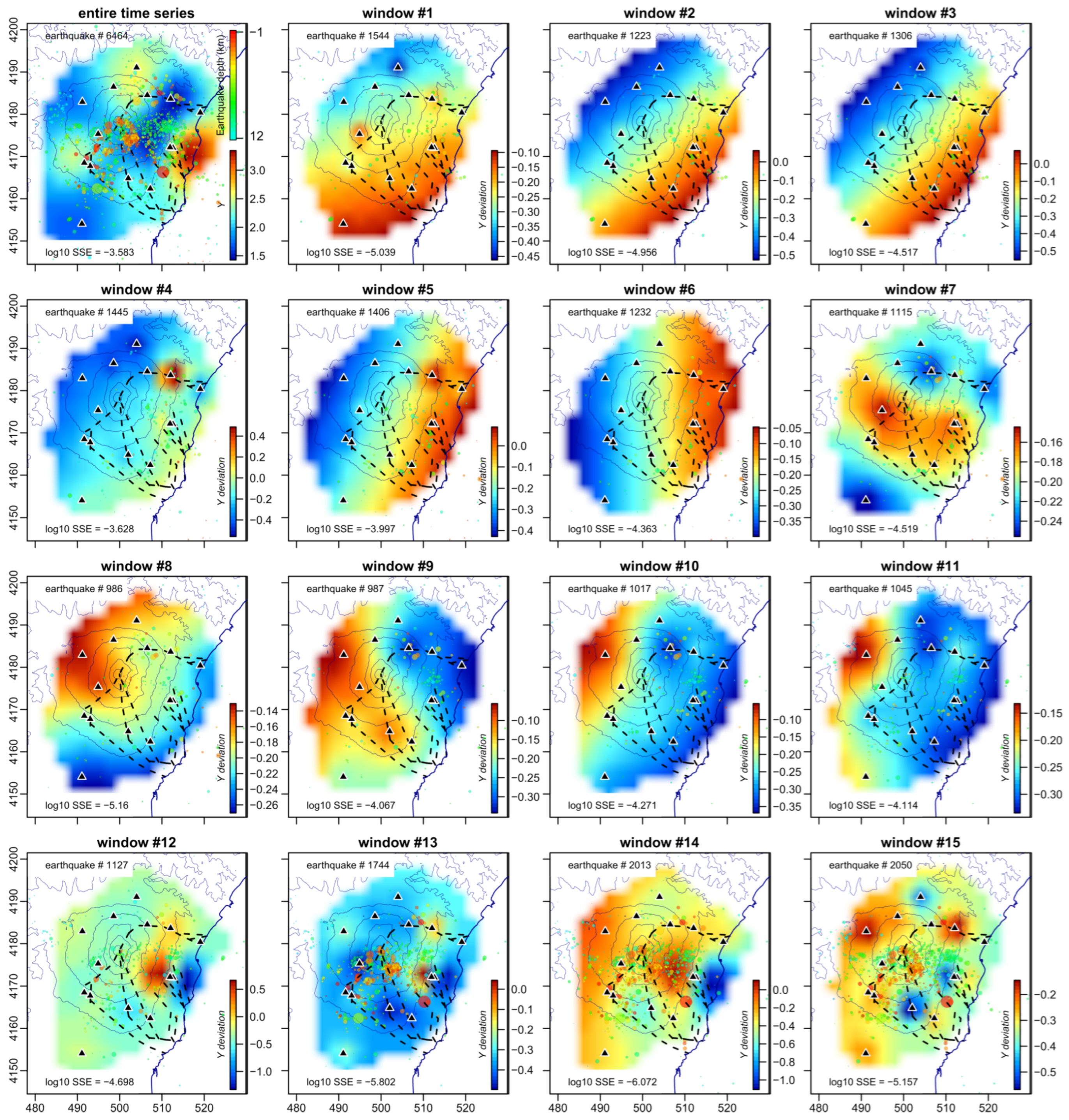
Spatial interpolations were calculated for the γ -values relative to the entire time series, and for the γ -deviations relative to the 15 time windows (Figure 8). Interpolations are displayed alongside the fault system affecting the eastern and southern flanks of Etna, which is recognized to interact with the flux dynamics as preferential emission zones [49,50,51]. Additionally, shallow seismicity is reported, which is often linked to the same volcanic and magmatic processes that control the soil CO2 flux dynamics at the surface [50,52,53,54,55,56].
As mentioned in the previous paragraph, the spatial pattern of the γ -values for the entire times series is irregular and characterized by small-scale variations (Figure 5b and Figure 8), while interpolations of the windowed γ -deviation generally show more regular patterns. In windows 1 to 6, higher γ -deviation marks the northwestern and western flanks, while lower deviations are concentrated exactly on the opposite flanks; the range of values is similar across all these windows. Window 7 marks a transition to windows 8 to 11, where only the northwestern portion of the area exhibits low deviation values; deviation becomes progressively larger in the eastern flank. In this case, the range of values also remains consistent across the windows. Finally, windows 12 to 15 are characterized by a greater spatial variability in γ -deviation values and by a progressive increase in the number of earthquakes (Figure 8).

4. Discussion

VGA is a recognized tool for the characterization of complex signals. In this work, we applied this technique for the first time to the study of soil CO2 flux time series, a key parameter in understanding magmatic processes on active volcanoes. In particular, we have robust evidence that VGA-converted soil CO2 time series recorded at Mt. Etna generally follow a power-law distribution. Because the graphs inherit the underlying structure of their source time series [34,37], we can infer that the properties observed in the graph can be traced back directly to the original observations. The main implication of a power-law distribution is that the observed quantity is scale-invariant, meaning the data exhibit a self-similar structure, regardless of the scale. Such behavior is observed in several natural (and other) phenomena [46,58,59,60,61,62], specific to complex systems with non-linear, irregular dynamics that repeat across different scales. However, it is advisable that this novel application of VGA be supported by a more established method. For this reason, we processed the soil CO2 time series, both the entire series and the windowed subsets, using fractal dimension (FD) analysis (see Supplementary Material). FD analysis captures the roughness (or smoothness) of a time series across scales by calculating the estimator D. We found that D-values are consistent with γ -values [63], supporting the idea that VGA is as robust as FD but provides unique topological insights. In fact, only the VGA suggests that the long-term γ -values represent an upper limit that can be considered as representative of the long-term behavior at each site (Figure S3).
Having established the degree distributions of the CO2 flux, we observe that the exponent γ differs significantly among the various monitoring sites (Figure 5a). The γ -value describes the proportion of nodes with large and small k-values: a higher proportion of small k-values with respect to higher k-values results in a higher γ -value, and vice versa.
It is important to note that the CO2 time series were recorded employing standardized uniform instrumentation (all of which was designed by INGV) and were pre-processed and filtered to remove high-frequency noise and seasonal signals. Furthermore, the monitoring stations are almost evenly distributed across the flanks of the volcano. Consequently, since the non-volcanic components of the signal were removed, leaving only the “meaningful” residual component [12,64,65], the observed differences in γ -values must result from some other factors worth investigating.
Understanding the variability in γ -values is of significant interest, as it may suggest a link to the factors controlling soil gas emissions. For this reason, we investigated the temporal and spatial variations of the γ exponent in more detail. The same degree distribution behavior persists when the signals are windowed; however, these windowed γ -values exhibit fluctuations and generally remain lower than the long-term γ at each monitoring site (Figure 6). Differences in γ -value between sites can be attributed to local conditions, as frequently observed in soil gas emission studies [3,12,65,66]; thus, long-term γ -values may be considered site-specific measures of the flux regime. The reduction in windowed γ -value is not attributable to the shorter length of the VGA-converted series, which remain scale-invariant, but rather to change occurring in the flux regime over the time. As reported by [33], at a yearly time scale, the processes controlling the dynamics of soil CO2 flux, and in particular its extreme values, differ from those operating over longer periods. Given that decadal values act as a baseline, temporal variations are expressed as γ -deviations.
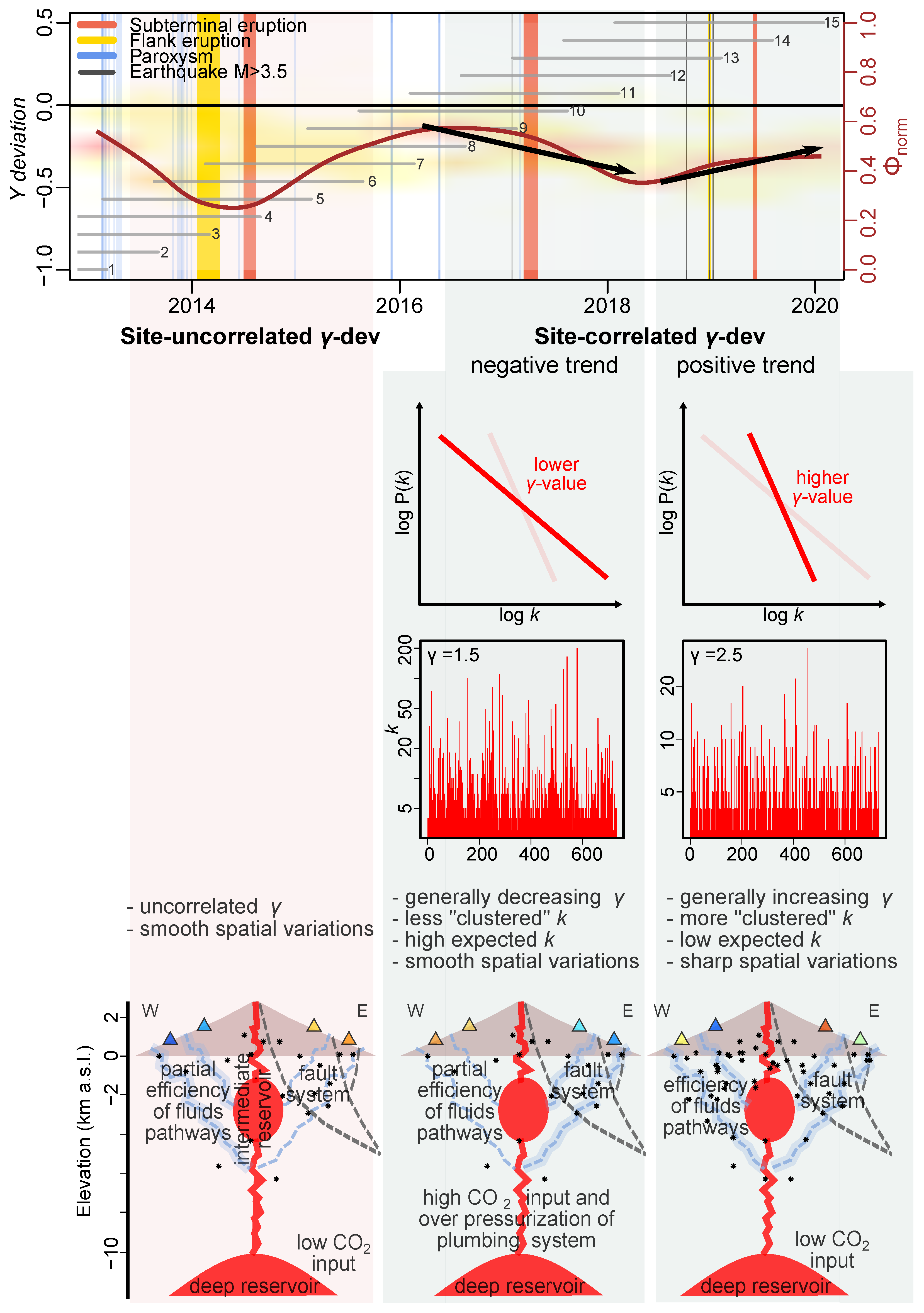
When combined, the temporal fluctuations of γ across the various monitoring sites show a certain concordance; namely, they assume similar values, which is particularly marked after 2016 (Figure 7c). The spatial arrangement of γ -values suggests the occurrence of periods characterized by smooth, large-scale variations that can be persistent over time, interspersed with periods of higher variability occurring over shorter time scales (Figure 8). The major changes in the spatial patterns (windows 1–6, 8–11, and 12–15) also correspond to significant changes in the γ -deviation trend: a dispersed signal (before 2016), a consistent increasing signal (2016–2018), and a consistent decreasing signal (after 2018) (Figure 7c). The homogeneous behavior on the western and northwestern flanks, in contrast to the more articulated behavior on the eastern flank, is well recognized. This difference results from the active fault system affecting the eastern and southern flanks [67,68] which regulates the release of underground fluids [33,50,51]. Interestingly, we also observe a strong correspondence between these variations and the trend of the entire-network signal Φ n o r m (Figure 7d).
The methodology developed by [12] to integrate time series data from the Etna soil CO2 network into a unified signal is well-established in the literature. This approach characterizes the state of the volcanic system on a broad scale and has provided a robust interpretive framework for assessing volcanic activity over the last ten years [33,54,55]. Therefore, the similar trends observed between these two metrics (time–space γ -deviation and Φ n o r m ) can be interpreted as a strong indication that they provide measurements of the same physical quantity: the shared CO2 source that simultaneously affects the majority of the sites.
Temporal variations in γ -deviation and changes in its spatial pattern can be interpreted together. When γ -deviations across all sites are discordant (windows 1–6), we observe smooth, large-scale spatial variations with lower deviations on the E and S flanks, the areas primarily influenced by the volcano’s structural system. Therefore, this discordance likely arises from a low-activity regime of the shared CO2 source (Figure 7d and Figure 9), rather than significant permeability changes along the transport pathways to the surface, as also suggested by other authors [33].
When γ -deviations across all sites converge into a concordant signal, we observe both decreasing and increasing trends. During the decreasing γ -deviation phase (windows 8–11), the γ -value at the single site generally decreases; consequently, the degree distributions become relatively less “clustered”, leading to a higher expected maximum flux value (Figure 9). Simultaneously, the spatial pattern is again characterized by smooth, large-scale variations, but with higher absolute deviation values on the E and S flanks. In this setting, the increased input from the shared CO2 source facilitates the upward migration of fluids and consequent gas discharge, resulting in anomalous CO2 flux behavior marked by extreme peaks and significant variability. The spatial pattern thus reflects the inherent efficiency of the structural pathway system (i.e., large-scale permeability), with higher flux concentrations on the E and S flanks [54,56]. In the increasing phase (windows 12–15), γ -values at single sites generally increase, and degree distributions become more “clustered”. Simultaneously, spatial patterns exhibit high short-scale variability, and the number of earthquakes clearly increases (Figure 9). Under these conditions, the system likely remains susceptible to fluid release; however, during periods of low volcanic degassing, as inferred from CO2 emission data, the overall effectiveness of this process appears tp be reduced (Figure 9).
In summary, regardless of the structural control of the efficiency of fluid emission pathways, the larger the negative γ -deviation from its long-term value, the more efficient the flux regime at a given site.

5. Conclusions

In this study, we employed visibility graph analysis (VGA) to investigate the structure and the spatio-temporal dynamics of a nine-year, high-resolution soil CO2 flux dataset recorded by a standardized monitoring network at the Mt. Etna active volcano. Because the topology of a VG inherits the features of its associated time series, it represents a tool for extracting potential additional information. The identified power-law trends in the connectivity degree distribution highlight self-similar behavior, suggesting that the mechanism that controls surface emissions is a complex physical system influenced by many different factors acting at different scales. The occurrence of these scaling properties allow us to exclude purely periodic effects or random noise as the primary controllers of flux dynamics. The main conclusions of this work can be summarized as follows:
  • The scaling exponent of the long-term power-law distribution (i.e., γ ) is a characteristic feature of each monitoring site, representing a stable, long-term threshold. Notably, while temporal fluctuations are observed within two-year windows, these windowed values remain essentially lower than the decadal γ -value. We conclude that the long-term degassing behavior at each site is primarily controlled by local conditions such as the permeability structure at the site (i.e., site-specific γ -value), while temporal variations are driven by other factors, such as fluctuations in the sources or episodic changes in the efficiency of fluid transport pathways.
  • Temporal changes in soil CO2 are not best described by absolute γ -value, but rather by variation from the corresponding long-term reference value (i.e., γ -deviation). In this context, γ -deviation can be interpreted as a site-specific measure of flux efficiency, as lower γ -values indicate less “clustered” time series (Figure 9). We identify a period during which γ -deviations are uncorrelated, followed by a period where these values are consistent, showing both negative and positive trends, across the majority of monitoring sites. The emergence of common patters in γ -deviation lends support to the hypothesis of a shared mechanism, identified as variability in the volcanic CO2 source, which is capable of exerting an effect on all flanks of the volcano simultaneously. These findings not only reinforce the validity of integrating multi-site data into a unified systemic degassing signal (i.e., Φ n o r m by [12]), but also establish that coupling Φ n o r m with the γ -value substantially refines the characterization of soil CO2 dynamics.
  • Even though spatial variations exhibit complex distributions around the volcano’s flanks, regular arrangements emerge, which contrast with periods characterized by short-scale, irregular variations. By synthesizing the spatial distributions of γ -deviation, volcanic activity, the pattern of the active lineaments, and seismicity, we propose a comprehensive interpretative model. This model is consistent with conclusions drawn by other authors utilizing the same dataset, indicating that the methodology proposed in this work provides coherent and robust results.
In conclusion, this study demonstrates that VGA, specifically through the investigation of degree distribution, is a robust and suitable method for characterizing the complexity of soil CO2 emission and exploring its underlying dynamics. Future works could be focused at investigate different time scales, both longer and shorter, as well periods characterized by specific volcanic activity. Moreover, the proposed method could potentially be applied to other volcanoes where data availability supports the characterization of temporal and/or spatial variations.

Supplementary Materials

The following supporting information can be downloaded at: https://www.mdpi.com/article/10.3390/app16073134/s1. Pages 2–16: Log-log plots of frequency distribution of the connectivity degree (k) for the VGA-converted time series at all observation sites and for all 15 time windows; Pages 17–18: Fractal Dimension Analysis; Pages 19–34: Kriging predictions.

Author Contributions

Conceptualization, A.D. and S.S.; methodology, S.S. and A.D.; formal analysis, S.S.; investigation, S.S. and M.L.; validation: M.L. and S.S.; data curation, G.B.G. and M.L.; writing—original draft preparation, S.S.; writing—review and editing, S.S., M.L., A.D. and G.B.G. All authors have read and agreed to the published version of the manuscript.

Funding

This research received no external funding.

Data Availability Statement

CO2 time series were retrieved from [10]. Data pre-processing followed the methods proposed by [12,33] specifically developed and validated for soil CO2 flux data from Etna monitoring sites. Data analyses were performed using R statistical software (version 4.2.2): visibility graph analysis was carried out with the ts2net package from [69]; power-law assessment with the poweRlaw package from [70]; and fractal dimension analysis with the fractaldim package from [71]. Processed data will be made available on request.

Acknowledgments

The authors thank the two anonymous reviewers for their valuable suggestions which contributed to improve this article.

Conflicts of Interest

The authors declare no conflicts of interest.

References

  1. Tilling, R. The critical role of volcano monitoring in risk reduction. Adv. Geosci. 2008, 14, 3–11. [Google Scholar] [CrossRef]
  2. Pallister, J.; McNutt, S.R. Synthesis of volcano monitoring. In The Encyclopedia of Volcanoes; Elsevier: Amsterdam, The Netherlands, 2015; pp. 1151–1171. [Google Scholar]
  3. Liuzzo, M.; Di Muro, A.; Giudice, G.; Michon, L.; Ferrazzini, V.; Gurrieri, S. New evidence of CO2 soil degassing anomalies on Piton de la Fournaise volcano and the link with volcano tectonic structures. Geochem. Geophys. Geosyst. 2015, 16, 4388–4404. [Google Scholar] [CrossRef]
  4. Liuzzo, M.; Di Muro, A.; Rizzo, A.L.; Caracausi, A.; Grassa, F.; Fournier, N.; Shafik, B.; Boudoire, G.; Coltorti, M.; Moreira, M.; et al. Gas geochemistry at Grande Comore and Mayotte volcanic islands (C0moros archipelago), Indian Ocean. Geochem. Geophys. Geosyst. 2021, 22, e2021GC009870. [Google Scholar] [CrossRef]
  5. Notsu, K.; Sugiyama, K.; Hosoe, M.; Uemura, A.; Shimoike, Y.; Tsunomori, F.; Sumino, H.; Yamamoto, J.; Mori, T.; Hernández, P. Diffuse CO2 efflux from Iwojima volcano, Izu-Ogasawara arc, Japan. J. Volcanol. Geotherm. Res. 2005, 139, 147–161. [Google Scholar] [CrossRef]
  6. Morita, M.; Mori, T.; Yokoo, A.; Ohkura, T.; Morita, Y. Continuous monitoring of soil CO2 flux at Aso volcano, Japan: The influence of environmental parameters on diffuse degassing. Earth Planets Space 2019, 71, 1–16. [Google Scholar] [CrossRef]
  7. Giammanco, S.; Gurrieri, S.; Valenza, M. Fault-controlled soil CO2 degassing and shallow magma bodies: Summit and lower east rift of Kilauea volcano (Hawaii), 1997. Pure Appl. Geophys. 2006, 163, 853–867. [Google Scholar] [CrossRef][Green Version]
  8. Cappelli, L.; Wallace, P.A.; Randazzo, A.; Kamau, P.; Njoroge, R.; Otieno, V.; Tubula, M.; Mariita, N.; Mangi, P.; Fontijn, K. Diffuse soil CO2 emissions at rift volcanoes: Structural controls and total budget of the Olkaria Volcanic Complex (Kenya) case study. J. Volcanol. Geotherm. Res. 2023, 443, 107929. [Google Scholar] [CrossRef]
  9. Liuzzo, M.; Di Muro, A.; Rizzo, A.L.; Grassa, F.; Coltorti, M.; Ader, M. The composition of gas emissions at Petite Terre (Mayotte, Comoros): Inference on magmatic fingerprints. Comptes Rendus. Géosci. 2022, 354, 1–24. [Google Scholar] [CrossRef]
  10. Giuffrida, G.B.; Liuzzo, M.; Gurrieri, S. Etna CO2 Soil Flux 2011–2020 (ECSF 2011–2020) [Data Set]. 2025. Available online: https://oedatarep.ct.ingv.it/records/z9jqe-mtp19 (accessed on 1 September 2025).
  11. Liuzzo, M.; Giuffrida, G.B.; Gurrieri, S. Etna CO2 Soil Flux During 2002–2010 (ECSF 2002–2010) [Data Set]. 2025. Available online: https://oedatarep.ct.ingv.it/records/03adr-hbp54 (accessed on 1 September 2025).
  12. Liuzzo, M.; Gurrieri, S.; Giudice, G.; Giuffrida, G. Ten years of soil CO2 continuous monitoring on Mt. Etna: Exploring the relationship between processes of soil degassing and volcanic activity. Geochem. Geophys. Geosyst. 2013, 14, 2886–2899. [Google Scholar] [CrossRef]
  13. Azizi, H.; Sulaimany, S. A review of visibility graph analysis. IEEE Access 2024, 12, 93517–93530. [Google Scholar] [CrossRef]
  14. Donner, R.V.; Donges, J.F. Visibility graph analysis of geophysical time series: Potentials and possible pitfalls. Acta Geophys. 2012, 60, 589–623. [Google Scholar] [CrossRef]
  15. Pierini, J.O.; Lovallo, M.; Telesca, L. Visibility graph analysis of wind speed records measured in central Argentina. Phys. A Stat. Mech. Its Appl. 2012, 391, 5041–5048. [Google Scholar] [CrossRef]
  16. Carmona-Cabezas, R.; Gómez-Gómez, J.; Ariza-Villaverde, A.B.; de Ravé, E.G.; Jiménez-Hornero, F.J. Can complex networks describe the urban and rural tropospheric O3 dynamics? Chemosphere 2019, 230, 59–66. [Google Scholar] [CrossRef]
  17. Carmona-Cabezas, R.; Gómez-Gómez, J.; de Ravé, E.G.; Jiménez-Hornero, F.J. Checking complex networks indicators in search of singular episodes of the photochemical smog. Chemosphere 2020, 241, 125085. [Google Scholar] [CrossRef]
  18. Carmona-Cabezas, R.; Gómez-Gómez, J.; Ariza-Villaverde, A.B.; de Ravé, E.G.; Jiménez-Hornero, F.J. Multiplex visibility graphs as a complementary tool for describing the relation between ground level O3 and NO2. Atmos. Pollut. Res. 2020, 11, 205–212. [Google Scholar] [CrossRef]
  19. Gómez-Gómez, J.; Carmona-Cabezas, R.; Sánchez-López, E.; Gutierrez de Rave, E.; Jiménez-Hornero, F.J. Analysis of air mean temperature anomalies by using horizontal visibility graphs. Entropy 2021, 23, 207. [Google Scholar] [CrossRef]
  20. Plocoste, T.; Carmona-Cabezas, R.; Jiménez-Hornero, F.J.; de Ravé, E.G. Background PM10 atmosphere: In the seek of a multifractal characterization using complex networks. J. Aerosol Sci. 2021, 155, 105777. [Google Scholar] [CrossRef]
  21. Plocoste, T.; Carmona-Cabezas, R.; Jiménez-Hornero, F.J.; de Ravé, E.G.; Calif, R. Multifractal characterisation of particulate matter (PM10) time series in the Caribbean basin using visibility graphs. Atmos. Pollut. Res. 2021, 12, 100–110. [Google Scholar] [CrossRef]
  22. Ying, N.; Duan, W.; Zhao, Z.; Fan, J. Complex networks analysis of PM2.5: Transport and clustering. Earth Syst. Dyn. Discuss. 2022, 13, 1029–1039. [Google Scholar] [CrossRef]
  23. Aranburu-Imatz, A.; Jiménez-Hornero, J.E.; Morales-Cané, I.; López-Soto, P.J. Environmental pollution in North-Eastern Italy and its influence on chronic obstructive pulmonary disease: Time series modelling and analysis using visibility graphs. Air Qual. Atmos. Health 2023, 16, 793–804. [Google Scholar] [CrossRef] [PubMed]
  24. Guo, C.; Wang, J.; Zhang, Y.; Zhang, H.; Yang, H. Ground air pollutants explanation based on multiple visibility graph of complex network by temporal community division. PLoS ONE 2024, 19, e0291460. [Google Scholar] [CrossRef]
  25. Flández, E.; Muñoz, V. A Prediction of Solar Cycle Maxima Using Visibility Graphs. Astrophys. J. 2025, 990, 21. [Google Scholar] [CrossRef]
  26. Vahab, S.; Alikkal, S.; Kunnummal, S.J.; Sankaran, A.; Salim, A.; Kalodi, H.S.; Sameer, M.R. Fractal complexity evaluation for the predictability assessment of daily streamflows of Indian river basins. Eur. Phys. J. Spec. Top. 2025. [Google Scholar] [CrossRef]
  27. Telesca, L.; Lovallo, M. Analysis of seismic sequences by using the method of visibility graph. Europhys. Lett. 2012, 97, 50002. [Google Scholar] [CrossRef]
  28. Khoshnevis, N.; Taborda, R.; Azizzadeh-Roodpish, S.; Telesca, L. Analysis of the 2005–2016 earthquake sequence in Northern Iran using the visibility graph method. Pure Appl. Geophys. 2017, 174, 4003–4019. [Google Scholar] [CrossRef]
  29. Azizzadeh-Roodpish, S.; Cramer, C.H. Visibility graph analysis of Alaska Crustal and Aleutian subduction zone seismicity: An investigation of the correlation between b value and k–M slope. Pure Appl. Geophys. 2018, 175, 4241–4252. [Google Scholar] [CrossRef]
  30. Kundu, S.; Opris, A.; Yukutake, Y.; Hatano, T. Extracting correlations in earthquake time series using visibility graph analysis. Front. Phys. 2021, 9, 656310. [Google Scholar] [CrossRef]
  31. Li, L.; Luo, G.; Liu, M. The K-M Slope: A Potential Supplement for b-Value. Seismol. Soc. Am. 2023, 94, 1892–1899. [Google Scholar]
  32. Scudero, S.; D’Alessandro, A. Investigating the universal character of k–M slope in earthquake catalogs from the Visibility Graph method. Sci. Rep. 2025, 15, 34264. [Google Scholar] [CrossRef] [PubMed]
  33. Scudero, S.; Liuzzo, M.; D’Alessandro, A.; Giuffrida, G.; Gurrieri, S. Revealing spatio-temporal variations of soil CO2 flux at Mt. Etna volcano. Results Earth Sci. 2024, 2, 100015. [Google Scholar] [CrossRef]
  34. Lacasa, L.; Luque, B.; Ballesteros, F.; Luque, J.; Nuno, J.C. From time series to complex networks: The visibility graph. Proc. Natl. Acad. Sci. USA 2008, 105, 4972–4975. [Google Scholar] [CrossRef]
  35. Telesca, L.; Lovallo, M.; Ramirez-Rojas, A.; Flores-Marquez, L. Investigating the time dynamics of seismicity by using the visibility graph approach: Application to seismicity of Mexican subduction zone. Phys. A Stat. Mech. Its Appl. 2013, 392, 6571–6577. [Google Scholar] [CrossRef]
  36. Carmona-Cabezas, R.; Ariza-Villaverde, A.B.; de Ravé, E.G.; Jiménez-Hornero, F.J. Visibility graphs of ground-level ozone time series: A multifractal analysis. Sci. Total Environ. 2019, 661, 138–147. [Google Scholar] [CrossRef]
  37. Luque, B.; Lacasa, L.; Ballesteros, F.; Luque, J. Horizontal visibility graphs: Exact results for random time series. Phys. Rev. E 2009, 80, 046103. [Google Scholar] [CrossRef] [PubMed]
  38. Gao, Z.K.; Cai, Q.; Yang, Y.X.; Dang, W.D.; Zhang, S.S. Multiscale limited penetrable horizontal visibility graph for analyzing nonlinear time series. Sci. Rep. 2016, 6, 35622. [Google Scholar] [CrossRef] [PubMed]
  39. Telesca, L.; Chen, C.c.; Lovallo, M. Investigating the relationship between seismological and topological properties of seismicity in Italy and Taiwan. Pure Appl. Geophys. 2020, 177, 4119–4126. [Google Scholar] [CrossRef]
  40. Telesca, L.; Thai, A.T.; Lovallo, M.; Cao, D.T. Visibility Graph Analysis of Reservoir-Triggered Seismicity: The Case of Song Tranh 2 Hydropower, Vietnam. Entropy 2022, 24, 1620. [Google Scholar] [CrossRef]
  41. Kamada, T.; Kawai, §. An algorithm for drawing general undirected graphs. Inf. Process. Lett. 1989, 31, 7–15. [Google Scholar] [CrossRef]
  42. Lan, X.; Mo, H.; Chen, S.; Liu, Q.; Deng, Y. Fast transformation from time series to visibility graphs. Chaos Interdiscip. J. Nonlinear Sci. 2015, 25, 083105. [Google Scholar] [CrossRef] [PubMed]
  43. Wen, T.; Chen, H.; Cheong, K.H. Visibility graph for time series prediction and image classification: A review. Nonlinear Dyn. 2022, 110, 2979–2999. [Google Scholar] [CrossRef]
  44. Mali, P.; Manna, S.; Mukhopadhyay, A.; Haldar, P.; Singh, G. Multifractal analysis of multiparticle emission data in the framework of visibility graph and sandbox algorithm. Phys. A Stat. Mech. Appl. 2018, 493, 253–266. [Google Scholar] [CrossRef]
  45. Vahab, S.; Sankaran, A. Multifractal applications in hydro-climatology: A comprehensive review of modern methods. Fractal Fract. 2025, 9, 27. [Google Scholar] [CrossRef]
  46. Clauset, A.; Shalizi, C.R.; Newman, M.E. Power-law distributions in empirical data. SIAM Rev. 2009, 51, 661–703. [Google Scholar] [CrossRef]
  47. Andronico, D.; Cannata, A.; Di Grazia, G.; Ferrari, F. The 1986–2021 paroxysmal episodes at the summit craters of Mt. Etna: Insights into volcano dynamics and hazard. Earth-Sci. Rev. 2021, 220, 103686. [Google Scholar] [CrossRef]
  48. ISIDe Working Group. Italian Seismological Instrumental and Parametric Database (ISIDe). 2007. Available online: https://terremoti.ingv.it/en/iside (accessed on 1 September 2025).
  49. Giammanco, S.; Gurrieri, S.; Valenza, M. Soil CO2 degassing along tectonic structures of Mount Etna (Sicily): The Pernicana fault. Appl. Geochem. 1997, 12, 429–436. [Google Scholar] [CrossRef]
  50. Giammanco, S.; Bellotti, F.; Groppelli, G.; Pinton, A. Statistical analysis reveals spatial and temporal anomalies of soil CO2 efflux on Mount Etna volcano (Italy). J. Volcanol. Geotherm. Res. 2010, 194, 1–14. [Google Scholar] [CrossRef]
  51. Sortino, F.; Giammanco, S.; Bonfanti, P.; Bottari, C. Stress-induced changes in hydrothermal gas discharges along active faults near Mt. Etna volcano (Sicily, Italy). Tectonophysics 2022, 836, 229388. [Google Scholar] [CrossRef]
  52. Gurrieri, S.; Liuzzo, M.; Giudice, G. Continuous monitoring of soil CO2 flux on Mt. Etna: The 2004–2005 eruption and the role of regional tectonics and volcano tectonics. J. Geophys. Res. Solid Earth 2008, 113, B09206. [Google Scholar] [CrossRef]
  53. Cannata, A.; Spedalieri, G.; Behncke, B.; Cannavò, F.; Di Grazia, G.; Gambino, S.; Gresta, S.; Gurrieri, S.; Liuzzo, M.; Palano, M. Pressurization and depressurization phases inside the plumbing system of Mount Etna volcano: Evidence from a multiparametric approach. J. Geophys. Res. Solid Earth 2015, 120, 5965–5982. [Google Scholar] [CrossRef]
  54. Gurrieri, S.; Liuzzo, M.; Giuffrida, G.; Boudoire, G. The first observations of CO2 and CO2/SO2 degassing variations recorded at Mt. Etna during the 2018 eruptions followed by three strong earthquakes. Ital. J. Geosci. 2021, 140, 95–106. [Google Scholar] [CrossRef]
  55. Paonita, A.; Liuzzo, M.; Salerno, G.; Federico, C.; Bonfanti, P.; Caracausi, A.; Giuffrida, G.; La Spina, A.; Caltabiano, T.; Gurrieri, S.; et al. Intense overpressurization at basaltic open-conduit volcanoes as inferred by geochemical signals: The case of the Mt. Etna December 2018 eruption. Sci. Adv. 2021, 7, eabg6297. [Google Scholar] [CrossRef]
  56. Carbone, D.; Cannavò, F.; Liuzzo, M.; Giuffrida, G.B.; Greco, F. Multiparameter insights into the months-long evolution of Mt. Etna discharge system prior to the December 2018 eruption. Earth-Sci. Rev. 2025, 272, 105341. [Google Scholar] [CrossRef]
  57. Azzaro, R.; Bonforte, A.; Branca, S.; Guglielmino, F. Geometry and kinematics of the fault systems controlling the unstable flank of Etna volcano (Sicily). J. Volcanol. Geotherm. Res. 2013, 251, 5–15. [Google Scholar] [CrossRef]
  58. Turcotte, D.L. Fractals and Chaos in Geology and Geophysics; Cambridge University Press: Cambridge, UK, 1997. [Google Scholar]
  59. Turcotte, D.L. Fractals and fragmentation. J. Geophys. Res. Solid Earth 1986, 91, 1921–1926. [Google Scholar] [CrossRef]
  60. Lacasa, L.; Luque, B.; Luque, J.; Nuno, J.C. The visibility graph: A new method for estimating the Hurst exponent of fractional Brownian motion. Europhys. Lett. 2009, 86, 30001. [Google Scholar] [CrossRef]
  61. Corral, Á.; González, Á. Power law size distributions in geoscience revisited. Earth Space Sci. 2019, 6, 673–697. [Google Scholar] [CrossRef]
  62. Scudero, S.; De Guidi, G.; Gudmundsson, A. Size distributions of fractures, dykes, and eruptions on Etna, Italy: Implications for magma-chamber volume and eruption potential. Sci. Rep. 2019, 9, 4139. [Google Scholar] [CrossRef]
  63. Higuchi, T. Relationship between the fractal dimension and the power law index for a time series: A numerical investigation. Phys. D Nonlinear Phenom. 1990, 46, 254–264. [Google Scholar] [CrossRef]
  64. Siino, M.; Scudero, S.; D’Alessandro, A. Stochastic models for radon daily time series: Seasonality, stationarity, and long-range memory detection. Front. Earth Sci. 2020, 8, 575001. [Google Scholar] [CrossRef]
  65. Scudero, S.; D’Alessandro, A.; Giuffrida, G.; Gurrieri, S.; Liuzzo, M. Wavelet-based filtering and prediction of soil CO2 flux: Example from Etna volcano (Italy). J. Volcanol. Geotherm. Res. 2022, 421, 107421. [Google Scholar] [CrossRef]
  66. Siino, M.; Scudero, S.; Cannelli, V.; Piersanti, A.; D’Alessandro, A. Multiple seasonality in soil radon time series. Sci. Rep. 2019, 9, 8610. [Google Scholar] [CrossRef]
  67. Mattia, M.; Bruno, V.; Caltabiano, T.; Cannata, A.; Cannavo, F.; D’Alessandro, W.; Di Grazia, G.; Federico, C.; Giammanco, S.; La Spina, A.; et al. A comprehensive interpretative model of slow slip events on M t. E tna’s eastern flank. Geochem. Geophys. Geosyst. 2015, 16, 635–658. [Google Scholar] [CrossRef]
  68. De Guidi, G.; Brighenti, F.; Carnemolla, F.; Imposa, S.; Marchese, S.A.; Palano, M.; Scudero, S.; Vecchio, A. The unstable eastern flank of Mt. Etna volcano (Italy): First results of a GNSS-based network at its southeastern edge. J. Volcanol. Geotherm. Res. 2018, 357, 418–424. [Google Scholar] [CrossRef]
  69. Ferreira, L.N. From time series to networks in R with the ts2net package. Appl. Netw. Sci. 2024, 9, 32. [Google Scholar] [CrossRef]
  70. Gillespie, C.S. Fitting heavy tailed distributions: The poweRlaw package. J. Stat. Softw. 2015, 64, 1–16. [Google Scholar] [CrossRef]
  71. Gneiting, T.; Ševčíková, H.; Percival, D.B. Estimators of fractal dimension: Assessing the roughness of time series and spatial data. Stat. Sci. 2012, 27, 247–277. [Google Scholar] [CrossRef]
Figure 1. Example of the conversion of a time series (a) into a graph (b) by means of the visibility graph method: lines between the nodes represent the connections established on the visibility criterion. The frequency distribution (c) of the number of connections for each observation (i.e., connectivity degree, k) is used to investigate the properties of the time series.
Applsci 16 03134 g001
Figure 2. Normalized daily soil CO2 time series ( φ ) from the 14 observation sites of Mt. Etna between 2011 and 2019 (black lines) and the time series of the connectivity degree (k) obtained by the visibility graph transformation (red lines). Background gray bars indicate the 15 time windows used to analyze temporal changes.
Applsci 16 03134 g002
Figure 3. Relationship between φ n o r m values and the corresponding connectivity degrees (k) from the VG conversion for all the sites.
Applsci 16 03134 g003
Figure 4. Log–log plots of frequency distribution of the connectivity degree (k) for the VGA-converted time series. Values of the exponent γ of the power-law fitting (for k 5 ), the residual standard error (R.S.E.), the coefficient of determination (R2), and the p-value of the goodness-of-fit test are reported for each plot.
Applsci 16 03134 g004
Figure 5. Values of the power-law fitting slope γ calculated for the entire time series (a) at each site, and their corresponding geographical locations (b).
Applsci 16 03134 g005
Figure 6. Plots of the values of the power-law fitting slopes ( γ ) for the VGA-converted windowed CO2 time series (Table 3). The horizontal gray lines indicate the value related to the entire time series (non-windowed signal). The colored background stripes refer to volcanic [47] or seismic [48] activity (see legend).
Applsci 16 03134 g006
Figure 7. (a): Comparison between windowed γ -values at all observation sites. (b): Comparison between the windowed γ -deviations from the long-term baselines (Figure 6) across all sites. (c) Heat map of deviations shown in (b), where the color scale represents the number of observations within intervals of 0.1 γ -deviation for each time window; background gray bars indicate the 15 time windows. (d): Daily and yearly average trends of the global Φ n o r m plotted over the same heat map as in (c); in all the plots, colored vertical stripes denote volcanic or seismic activity (see legend).
Applsci 16 03134 g007
Figure 8. Spatial interpolations of γ -values (upper-leftmost subplot) and their deviations (all other subplots). Maps refer to the entire time series (upper left corner) and to the 15 time windows. Topographic contour lines (thin continuous lines) are drawn at 500 m intervals. Thick dashed lines indicate the tectonic lineaments affecting the shallower portion of the volcanic edifice, drawn from [57]. Shallow (≤12 km) earthquakes are also shown [48]; colour legend in the first panel. Coordinate system: Projected UTM Zone 33N (length unit: km). See the text for further explanations.
Applsci 16 03134 g008
Figure 9. Interpretative model of CO2 degassing conditions. A period of uncorrelated γ -value at the monitoring sites is clearly distinct from a following period of concordance. The latter period consists of a phase characterized by a negative γ -deviation trend followed by a phase of positive trend. Illustrative charts of degree distribution, simulated k time series with low and high γ -values, and schematic illustrations for magmatic CO2 source and surface discharge (modified from [54]) are provided. Stars indicate the earthquakes, coloured triangles the flux at monitoring sites (color legend in Figure 5b). See the text for further explanation.
Applsci 16 03134 g009
Table 1. Locations of the soil CO2 monitoring sites at Mt. Etna volcano and results of the power-law fitting of the VGA-converted time series. Details are provided in the main text.
Site idNameLat. (°N)Lon. (°E)Elev. (m a.s.l.) γ γ S.E.p-Value
13c37.608615.08225182.140.070.043
2agro37.533614.89891221.680.070.028
3albano137.725314.942217242.030.070.010
4brunek37.808115.074214182.280.070.693
5fondachello37.770615.2167112.200.090.597
6maletto37.793614.899711921.810.060.207
7msm137.825814.983615352.370.090.624
8p7837.695315.14333242.560.100.011
9parcoetna37.630615.02318362.150.080.491
10passop37.866915.04567042.590.100.100
11roccacampana237.800315.13697361.440.070.025
12sml137.656914.92088782.150.090.881
13sml237.663614.90508552.310.080.026
14sv137.696715.13533782.330.090.488
Table 2. Details of the fifteen two-year time windows.
Window idStart Date (yyyy-mm-dd)End Date (yyyy-mm-dd)N. of Days
12011-02-062013-02-05730
22011-08-052013-08-04730
32012-02-012014-01-31730
42012-07-302014-07-30730
52013-01-262015-01-26730
62013-07-252015-07-25730
72014-01-212016-01-21730
82014-07-202016-07-19730
92015-01-162017-01-15730
102015-07-152017-07-14730
112016-01-112018-01-10730
122016-07-092018-07-09730
132017-01-052019-01-05730
142017-07-042019-07-04730
152017-12-312019-12-31730
Table 3. Results of power-law fitting slope γ of the degree distribution for the 15 time windows (w) at the 14 monitoring sites; γ -values relative to the entire flux series are reported for comparison.
Site id γ Seriesw1w2w3w4w5w6w7w8w9w10w11w12w13w14w15
12.141.912.012.062.032.072.061.991.952.051.861.761.711.701.761.88
21.681.601.611.611.591.551.351.321.291.341.361.511.451.451.391.45
32.031.991.951.901.781.891.902.022.122.021.851.721.601.521.751.66
42.282.021.851.761.921.822.021.831.911.661.721.701.921.881.921.93
52.201.911.931.861.861.871.751.841.821.821.861.871.811.871.841.84
61.811.421.341.351.471.461.511.661.771.861.841.911.551.581.711.69
72.372.091.891.881.892.072.032.112.062.152.152.141.911.992.012.14
82.562.442.502.492.452.572.632.442.382.302.272.292.112.211.982.18
92.151.902.032.021.911.941.751.972.042.241.911.921.461.641.581.54
102.592.062.082.052.032.292.362.412.432.392.322.162.182.252.152.10
111.441.371.461.732.162.011.721.361.381.291.311.471.511.371.151.33
122.151.811.661.661.981.951.952.192.011.901.841.921.821.841.801.90
132.312.092.081.962.081.781.771.901.912.142.181.861.901.952.032.02
142.332.102.372.382.322.452.232.252.222.052.082.092.252.251.911.87
Disclaimer/Publisher’s Note: The statements, opinions and data contained in all publications are solely those of the individual author(s) and contributor(s) and not of MDPI and/or the editor(s). MDPI and/or the editor(s) disclaim responsibility for any injury to people or property resulting from any ideas, methods, instructions or products referred to in the content.