Article

Decoupled Dual-Stage Generation to Balance Factuality and Empathy in Customer-Support Dialogue Systems


1
Department of English Linguistics and Language Technology, Hankuk University of Foreign Studies, Seoul 02450, Republic of Korea
2
Electronics and Telecommunications Research Institute, Daejeon 34129, Republic of Korea
*
Author to whom correspondence should be addressed.
These authors contributed equally to this work.
This study was conducted while the author was affiliated with ETRI.
Appl. Sci. 2026, 16(7), 3123; https://doi.org/10.3390/app16073123
Submission received: 11 March 2026 / Revised: 21 March 2026 / Accepted: 22 March 2026 / Published: 24 March 2026
(This article belongs to the Section Computing and Artificial Intelligence)

Featured Application

A practical framework for deploying factually grounded and empathetic dialogue agents in resource-constrained or on-premise customer-support environments using compact language models.

Abstract

In practical customer-support dialogue systems, responses must simultaneously deliver factually grounded information and context-appropriate empathy, yet existing single-stage generation models often exhibit specialization bias, favoring one objective at the expense of the other. To address this limitation, we propose a dual-stage generation framework that explicitly decouples factual grounding from empathetic modulation. Our primary configuration follows a fact-to-empathy order, in which the system first generates a fact-centric draft via structured query interpretation and optional retrieval-augmented generation, then applies empathy-aware tuning conditioned on inferred emotion type, intensity, and empathy necessity. To enable deployment in resource-constrained environments, only the query interpretation module is explicitly trained using knowledge distillation, allowing the overall system to operate with compact 4B–8B backbone language models. Furthermore, we construct a customer-support dialogue dataset designed to reflect realistic interactions involving both informational and emotional demands. Extensive experiments with compact models show that the proposed approach generally improves key dimensions of empathetic response quality while maintaining overall factual performance, thereby helping mitigate the representational entanglement empirically observed in single-stage baselines. Both quantitative metrics and scenario-based analyses confirm that decoupled generation enables a more balanced integration of factuality and empathy than single-stage generation. These results suggest that dual-stage generation provides a practical and extensible foundation for deployable, real-world customer-support dialogue systems.

1. Introduction

Intelligent chatbots have been widely adopted in customer support due to their scalability, rapid response, and 24 / 7 availability [1]. In practical customer-support environments, dialogue systems must coordinate two complementary yet distinct objectives: delivering factually grounded information and expressing context-appropriate empathy. User queries frequently combine requests for technical guidance with signals of emotional states such as dissatisfaction. Therefore, joint handling of these dimensions is essential for effective problem solving and user satisfaction.
Factual grounding enables accurate and reliable responses for efficient issue resolution. Simultaneously, empathetic expression contributes to perceived service quality and sustained engagement [2]. Prior work has shown that human-like conversational behavior emerges from the integration of multiple dialogue competencies, including knowledge grounding and emotional awareness [3]. In customer-support contexts, the absence of either capability can result in responses that are either technically correct but perceived as insensitive or empathetic but unhelpful in resolving the underlying issue.
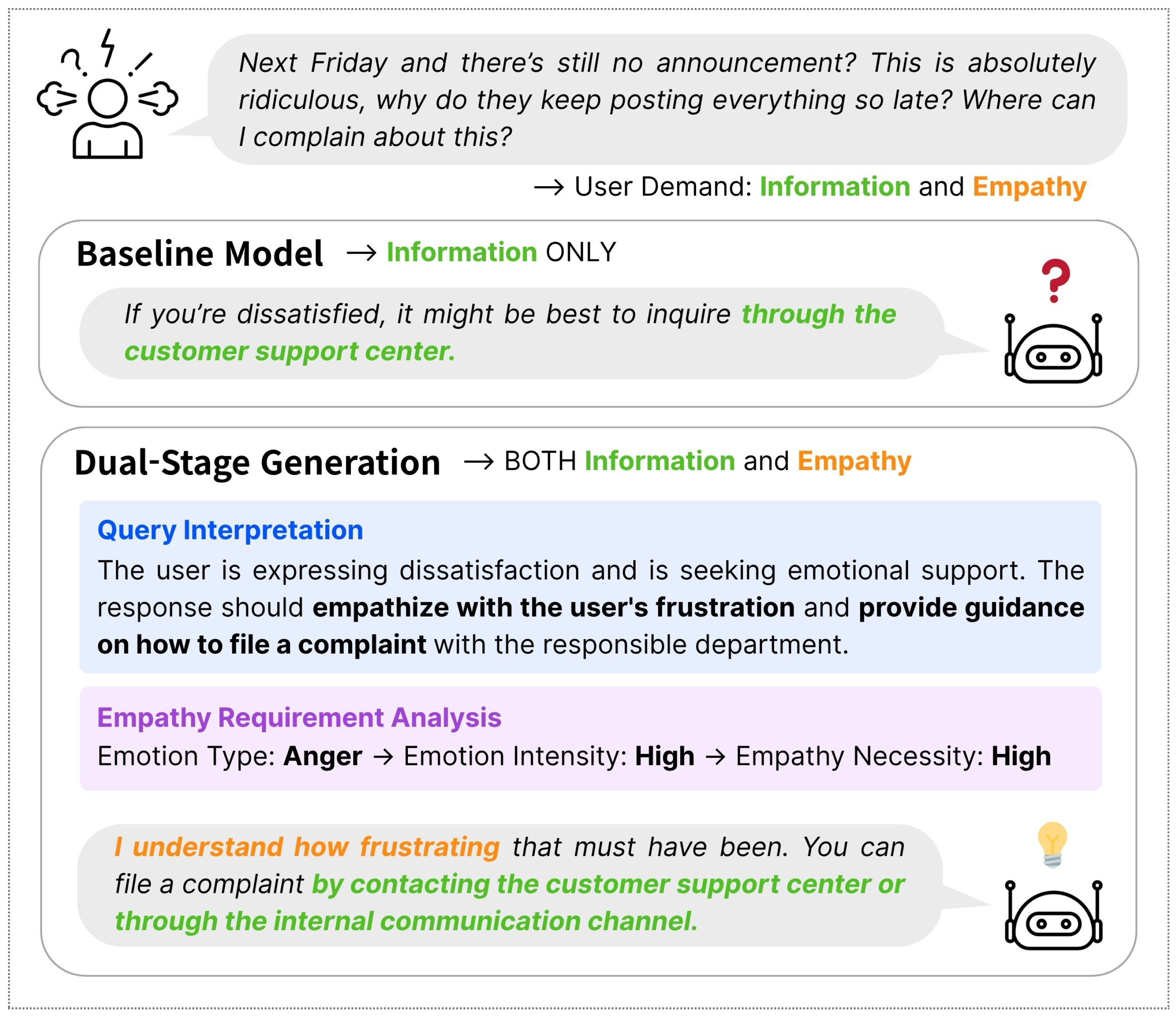
As illustrated in Figure 1, customer-support interactions often combine informational requests and emotional cues in real-world usage. However, many existing dialogue systems rely on single-stage generation that implicitly prioritizes a dominant objective [4]. As we will empirically demonstrate in Section 5.2, this design leads to pronounced specialization bias, where emphasizing one aspect limits cross-objective generalization. Consequently, responses may fail to address these integrated requirements effectively.
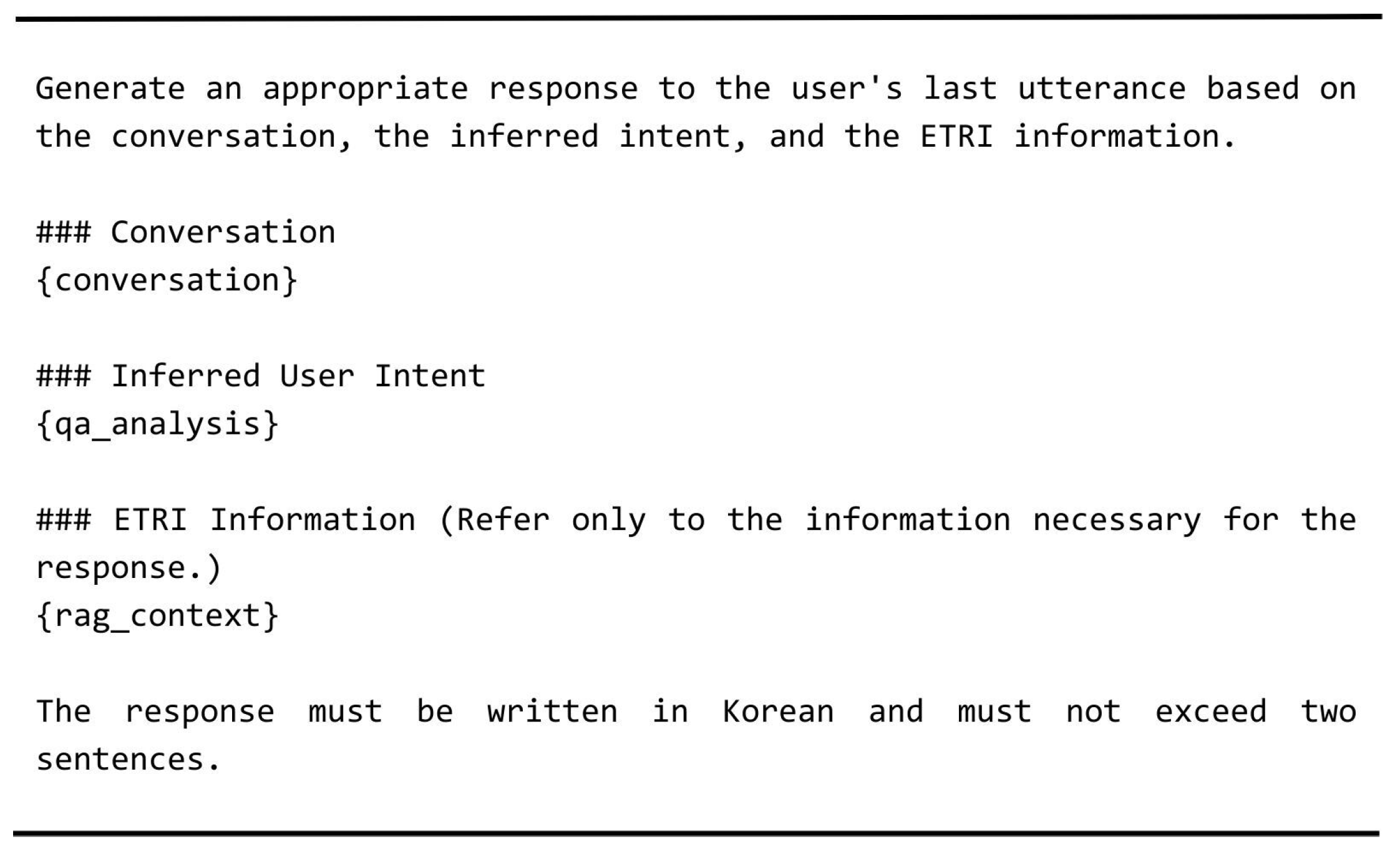
To address this limitation, we propose a dual-stage generation strategy that explicitly decouples factual grounding from empathetic expression. This approach is motivated by two observations: first, customer utterances commonly contain both informational and emotional components; second, jointly addressing factuality and empathy in a single generation stage can introduce representation-level interference between these objectives. In our framework, factual grounding and empathetic adjustment are handled in separate stages. The main configuration follows an F→E order, in which the system first performs fact-centric drafting—analyzing user intent and applying retrieval-augmented generation (RAG) when external knowledge is required—and then applies empathy-aware tuning. To examine the effect of stage ordering, we additionally evaluate the reverse E→F configuration as an order variation. Explicitly decoupling complex tasks into two-stage or dual-path architectures has proven highly effective across diverse domains [5,6,7].
The framework is designed with practical deployment constraints in mind. Customer-support systems are often deployed in on-premises or resource-constrained environments where large-scale models are infeasible [8,9]. Accordingly, we evaluate our approach using compact backbone language models (4B–8B) to reflect a realistic balance between capability and deployment efficiency. To further improve robustness, we apply knowledge distillation to enhance the reliability of the query interpretation module.
This work makes the following contributions. We first provide an empirical analysis of customer-support dialogues, revealing a tendency toward specialization in single-stage models. Through cross-domain evaluation and representation analysis, we demonstrate that prioritizing either factuality or empathy leads to imbalanced generalization across these two objectives. We then propose a dual-stage generation framework that explicitly separates factual grounding from empathetic adjustment. Finally, we demonstrate that stage ordering meaningfully affects the final response profile, with the final stage exerting a dominant influence on the factuality–empathy trade-off. These findings highlight a practical advantage of the proposed framework: although our primary design follows an F→E configuration, the framework can be reconfigured according to deployment priorities, offering a practical foundation for real-world customer-support dialogue systems.

2. Related Work

2.1. Dialogue Systems

Dialogue systems have progressed from rule-based and retrieval-based methods toward neural generative models that facilitate more flexible and natural response generation [10,11]. More recently, the adoption of large language models (LLMs) has significantly enhanced dialogue fluency and adaptability, enabling robust instruction following and open-ended generation in practical applications [12]. Across various studies of natural language processing [13,14,15], maintaining factual reliability has emerged as a crucial issue for effectively leveraging these conversational capabilities.
Extensive research has focused on incorporating external knowledge to improve the accuracy and reliability of generated responses. Prior studies have introduced structured pipelines for knowledge-grounded dialogue generation [16] and leveraged knowledge graphs or retrieval mechanisms to ensure factual consistency [17,18]. Furthermore, hybrid retrieval–generation approaches have been shown to effectively reduce hallucination and improve task performance [19]. Building on this line of work, recent studies have further refined conversational RAG by selectively invoking retrieval when needed and by more tightly coupling retrieval with response generation [20,21]. More broadly, recent work has explored retrieval strategies that incorporate relational information beyond flat passage-level matching, thereby improving robustness in knowledge-intensive settings [22].
Despite these advances in knowledge-grounded and retrieval-augmented dialogue systems, most existing approaches primarily focus on factual correctness and task completion. However, real-world interactions often require responses that reflect users’ emotional states while providing accurate information [23]. Recent studies on human–AI interaction suggest that conversational quality is also shaped by social–affective factors such as warmth, engagement, and responsiveness [24]. To address this, empathy-oriented dialogue systems have been actively studied. The EmpatheticDialogues dataset [25] has been instrumental in this field, enabling models to recognize and respond to user emotions [26,27,28]. Nevertheless, these systems are typically evaluated independently of factual knowledge requirements, limiting their applicability to information-intensive domains in which affective appropriateness and factual grounding must be achieved simultaneously.

2.2. The Customer-Support Domain

Customer support is a representative real-world application of dialogue systems that requires accurate and efficient problem resolution [29]. Recent studies have demonstrated that AI-powered chatbots can automate routine customer inquiries and improve service efficiency [1]. Much of the existing research in this domain has focused on improving response accuracy and knowledge utilization for customer inquiries [30]. Such approaches are effective for handling frequently asked questions and procedural inquiries.
However, customer interactions often involve frustration, dissatisfaction, or anxiety, making emotional responsiveness an important factor in service quality [31]. Empathetic chatbot responses have been shown to increase perceived warmth and customer satisfaction in service contexts [32]. In addition, recent studies on AI-driven customer-service chatbots highlight that personalization and empathetic response strategies are important design factors shaping customer satisfaction and the customer-service experience [2].
Although several studies in other high-stakes domains, such as healthcare, have explored balancing knowledge provision with emotional support [33,34], similar approaches remain limited in customer support settings. In practice, customer-support dialogues require factual guidance and empathetic responses to be integrated rather than treated as separate objectives. This gap motivates the development of dialogue systems that can dynamically integrate accurate information delivery with empathetic expression in customer support contexts. Our framework addresses this challenge by unifying knowledge-grounded response generation with empathy-aware interaction for more practical and user-centered customer-support systems.

3. Dual-Stage Generation

3.1. Task Formulation and Framework Overview

Customer-support dialogue generation requires simultaneously addressing users’ informational needs and emotional states within a single response. Given a conversational context C = [ u 1 , s 1 , u 2 , s 2 , , u n ] , where u i and s i denote user and system utterances, our goal is to generate an empathy-aware response R final that satisfies both requirements.
To this end, we propose a dual-stage generation framework that decomposes response generation into two sequential stages. In the first stage, the system produces an intermediate fact-centric output  R int that emphasizes factual grounding and correctness. In the second stage, this output is further refined through empathy-aware tuning to incorporate context-appropriate emotional alignment, yielding the final empathy-aware response R final .
A key component of the framework is a speech-act-based query interpretation module, which summarizes the user’s intent and essential response constraints (denoted as I). When necessary, the system retrieves supporting knowledge K from an internal knowledge base via RAG. Based on these components, let P F a c t and P E m p denote the conditional distributions corresponding to the fact-centric drafting and empathy-aware tuning stages, respectively. The overall process is formulated as follows:
R int P F a c t ( · C , I , K ) , R final P E m p ( · C , I , R int ) .
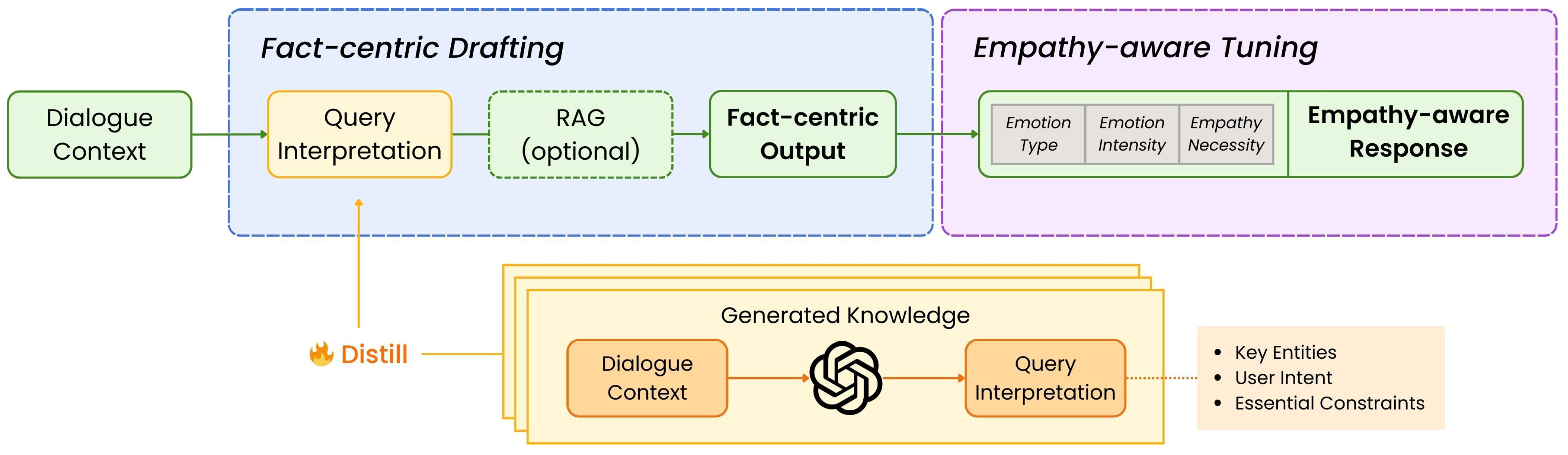
Figure 2 provides an overview of the proposed framework. The framework employs a single backbone language model throughout the generation pipeline while assigning stage-specific roles through structured prompting and supervised fine-tuning. Although the default configuration follows a fact-first, empathy-second order (F→E), the framework also supports an alternative empathy-first, fact-second order (E→F). This flexibility allows practitioners to choose the stage ordering that best aligns with their deployment priorities; we empirically compare the two configurations in Section 5.3. To ensure reproducibility, all prompt templates used in the framework are provided in Appendix A.1.

3.2. Fact-Centric Drafting and Empathy-Aware Tuning

The first stage, fact-centric drafting, focuses on generating an intermediate output R int with an emphasis on factual grounding. Given the dialogue context C, the model analyzes the user’s latest utterance u n to identify key entities and intent categories. Specifically, we classify user intents into four categories—fact verification, reasoning request, opinion request, and emotional support—by reformulating core concepts from speech-act theory [35,36] to reflect intent patterns observed in customer-support dialogues.
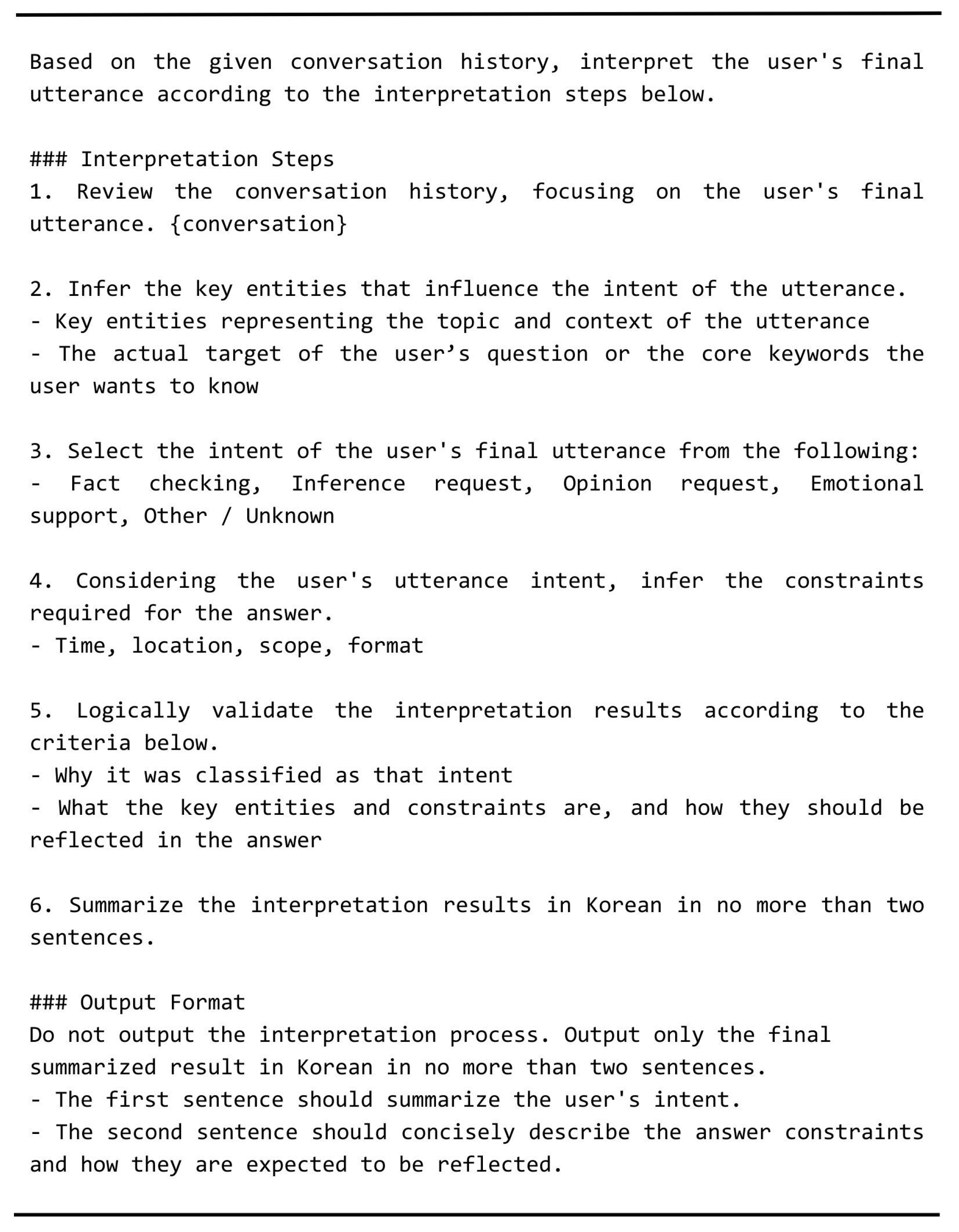
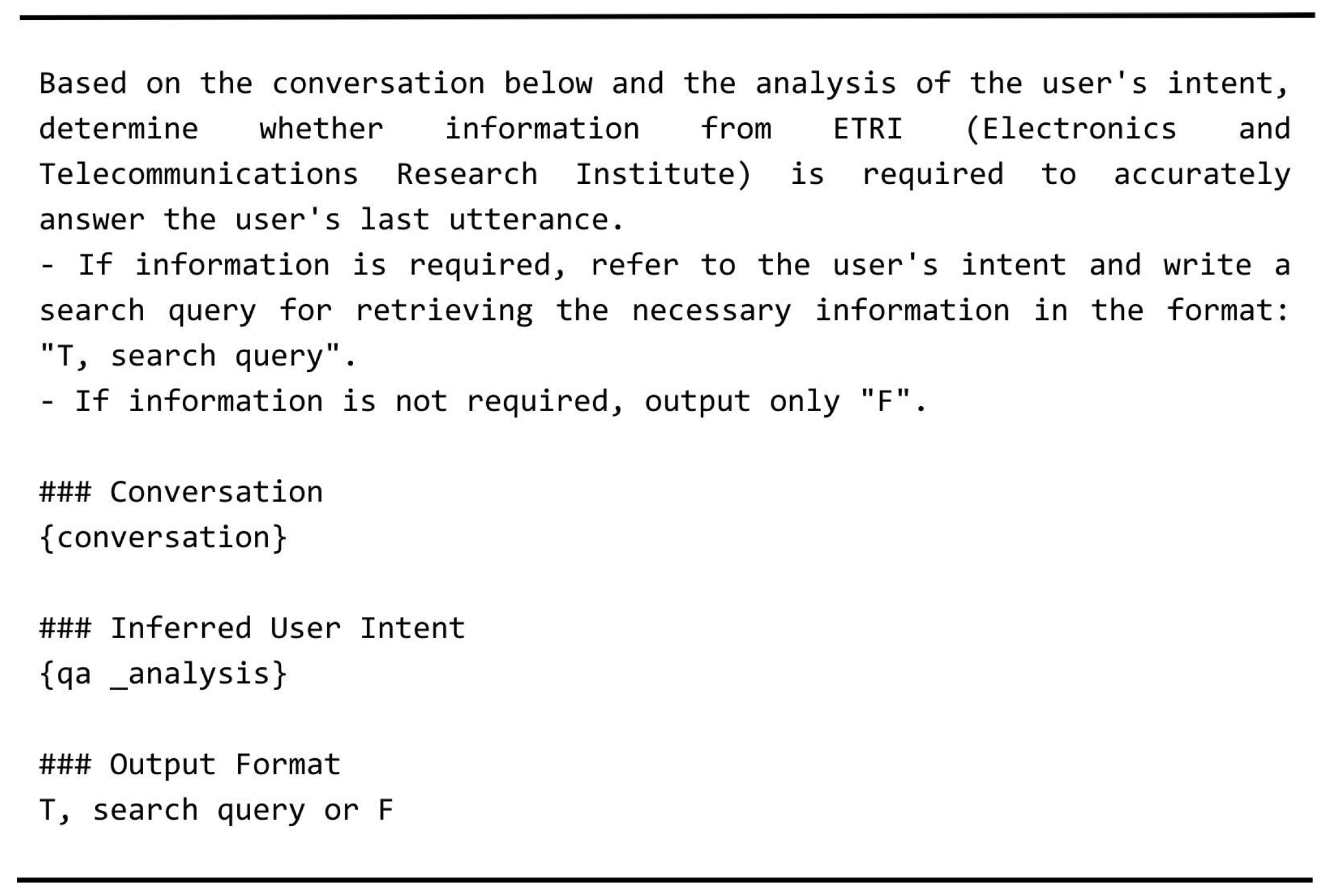
To constrain generation, the model produces a structured interpretation by extracting key entities, classifying user intent, inferring response constraints, and validating internal consistency—yielding a concise natural-language summary I that captures both the user’s intent and essential response constraints (see Figure A1 for the full prompt), as underspecified contextual constraints are known to contribute to factual inconsistencies when left implicit [37]. As part of this interpretation, a self-validation step prompts the model to justify the assigned intent category and verify the completeness of the extracted constraints before finalizing I. Based on I, a separate retrieval decision step determines whether external knowledge is required and, if so, generates a targeted search query (see Figure A2). The top-3 relevant passages are retrieved from an internal knowledge base via dense-vector similarity search and provided as additional context K for fact-centric drafting. Under the conditions C, I, and K, the model generates the fact-centric output R int .
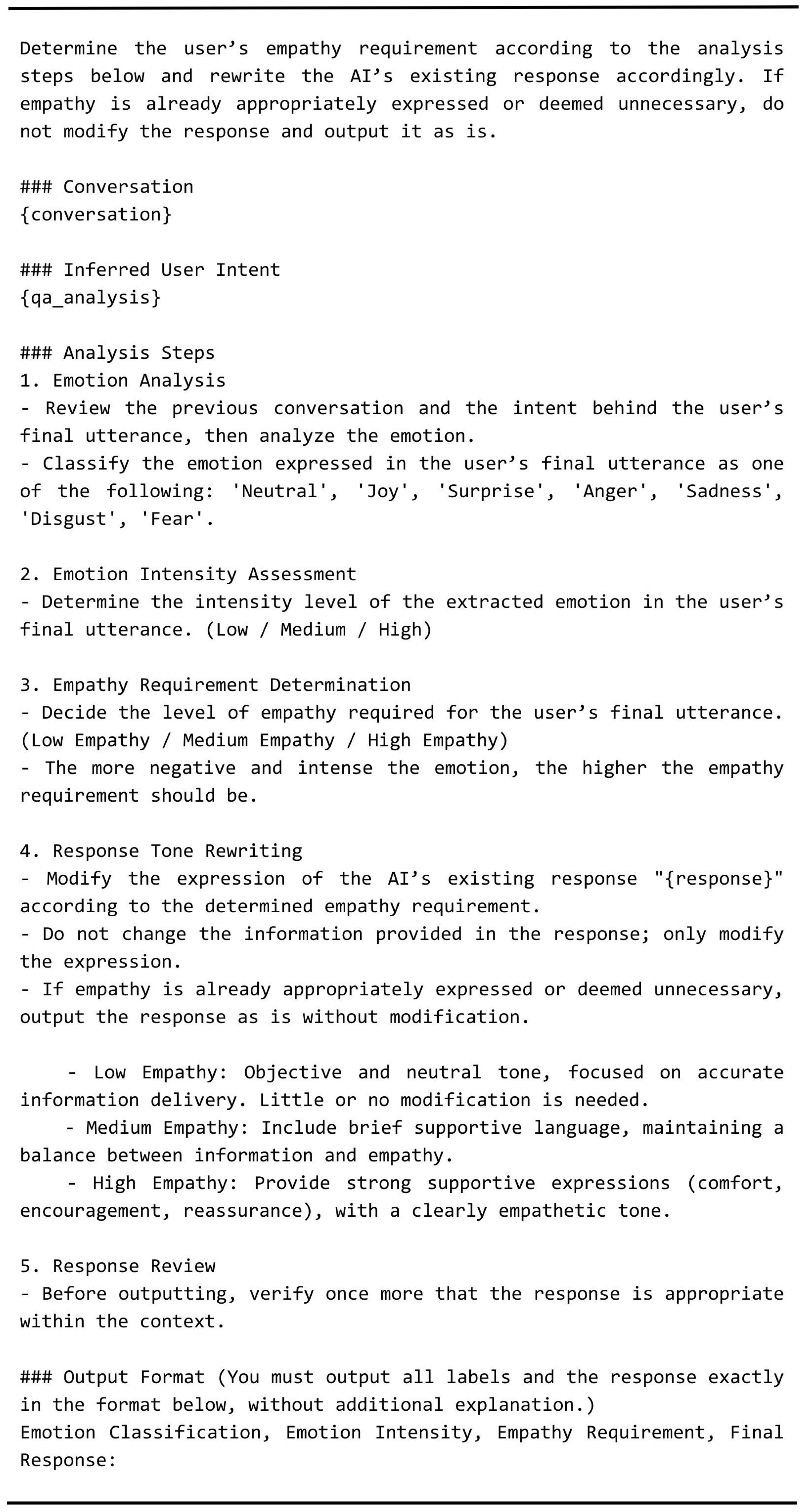
The second stage, empathy-aware tuning, refines R int into the final empathy-aware response R final . This stage begins with an empathy analysis that infers three variables: the emotion type e, defined according to Ekman’s seven basic emotions (neutral, joy, surprise, anger, sadness, disgust, and fear) [38]; the emotion intensity g; and the empathy necessity p, with both g and p assessed on a three-level scale (low, medium, or high). These variables are sequentially inferred by the backbone model through structured prompting (see Figure A4 for the full prompt). The model then rewrites only the emotional expression of R int according to the determined empathy level, with an explicit directive to preserve all informational content unchanged. A final response review step further verifies contextual appropriateness before output. By separating factual grounding from empathy modulation, the framework enables interpretable and fine-grained empathy control without compromising factual reliability.

3.3. Training of the Query Interpretation Module

To achieve strong performance with minimal computational overhead, the query interpretation module is specifically fine-tuned. Since the interpretation output I governs knowledge retrieval and response constraints, accurate interpretation is critical to the overall framework. We adopt a synthetic knowledge distillation in which a teacher model (GPT-4o [39]) generates high-quality interpretation output I and a compact student model ψ is trained via supervised fine-tuning to imitate the teacher’s reasoning process. Formally, the interpretation is represented as a token sequence I = ( i 1 , i 2 , , i T ) , and the student model is optimized using the standard autoregressive negative log-likelihood objective:
L KD = t = 1 T log P ψ ( i t i < t , C ) .
Through this distillation process, the student model learns to generate reliable interpretations while maintaining a compact model size, enabling efficient deployment in practical customer-support environments.

4. Dataset

4.1. Dataset Construction

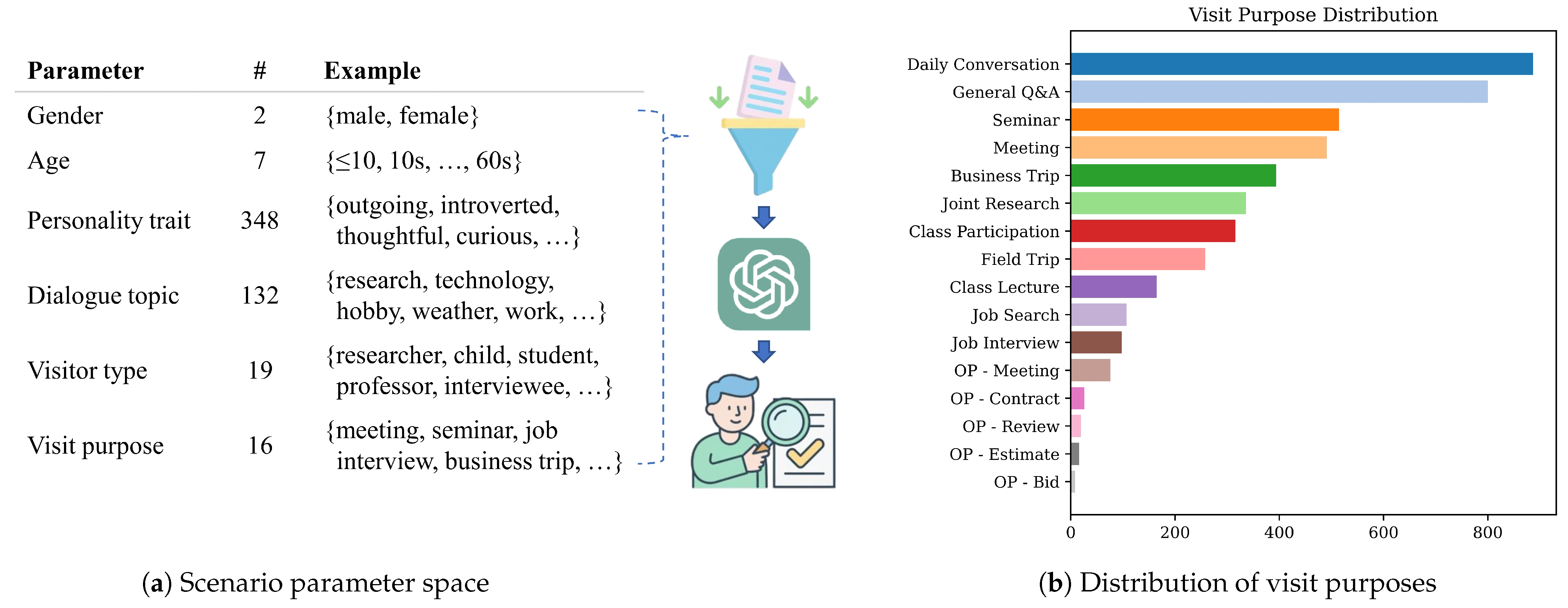
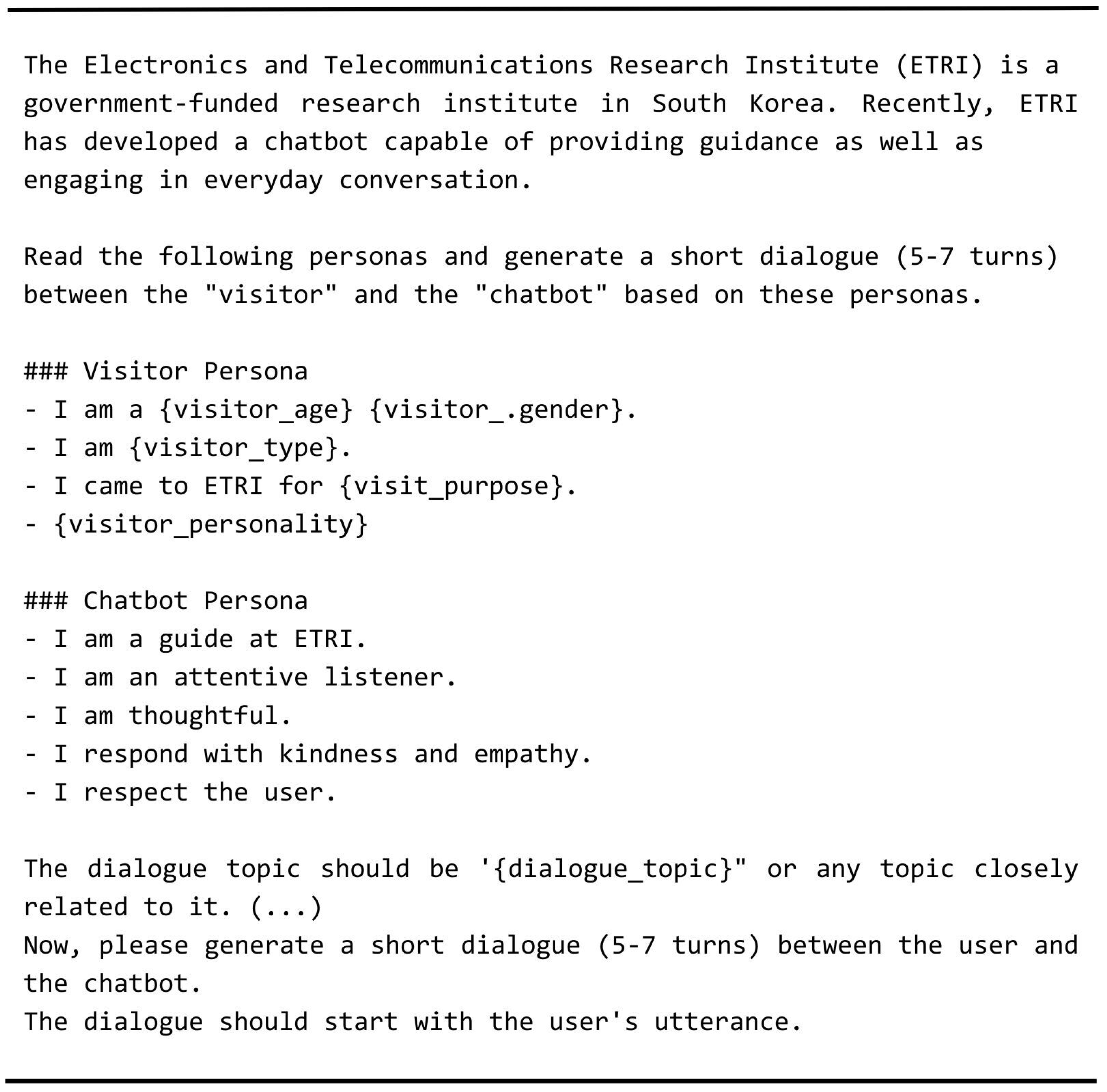
We construct a dialogue dataset to support the evaluation of our proposed framework, focusing on interactions between visitors and a guidance robot deployed at the Electronics and Telecommunications Research Institute (ETRI), a government-funded research institute in South Korea. The dataset reflects realistic visitor guidance scenarios grounded in ETRI’s actual facilities, services, and research activities. To obtain a sufficiently large and reliable corpus, dialogues are first generated in a semi-automatic manner using GPT-4o with controlled prompts and are subsequently refined through expert review. An overview of the data construction pipeline is illustrated in Figure 3.
We structure the scenario space by defining several key parameters, including gender, age, personality traits, dialogue topics, visitor types, and visit purposes. These parameters are combined to generate diverse dialogue scenarios. However, exhaustively generating dialogues for all possible parameter combinations is both inefficient and unrealistic, as many combinations rarely occur in real guidance situations. For example, a young child visiting for a simple tour is unlikely to engage in discussions related to workplace issues.
To address this issue, we introduce a filtering stage to remove implausible combinations. First, common-sense constraints are applied to certain visitor types (e.g., student visitors are restricted to the teenage age group, with visit purposes primarily limited to field trips). Next, for each combination of dialogue topic, visitor type, and visit purpose, the model is asked to assess its plausibility using a three-level scale: common, occasional, and rare. Here, common denotes scenarios frequently observed in real guidance interactions, occasional refers to plausible but less frequent cases, and rare indicates theoretically possible but highly unlikely situations. Combinations labeled as rare are discarded. Through this process, we retain 10,000 realistic and diverse scenario combinations.
Each utterance is annotated with the following attributes: (1) emotion type, categorized into seven classes following Ekman’s taxonomy; (2) a binary QA-type flag indicating whether the utterance involves ETRI-specific factual information; and (3) a search query when retrieval is required. The annotation guidelines were developed in consultation with ETRI domain experts and iteratively refined during the construction process.
Subsequently, two domain experts with experience in visitor guidance systems and human–robot interaction review and refine the generated dialogues following a structured guideline document that specifies annotation criteria, quality constraints (e.g., emotion-to-neutral ratio of approximately 70:30, factual QA turns limited to 20% of total turns), and preferred-response standards based on both factual accuracy and empathetic appropriateness. Dialogues that are redundant, inconsistent, or unnatural are removed. Rather than using the generated dialogues verbatim, the experts treat them as scenario seeds and rewrite each dialogue to ensure naturalness, coherence, and alignment with the actual guidance context of ETRI. They also insert appropriate question–answer utterances related to ETRI’s facilities, services, and research activities to better reflect realistic visitor interactions. In total, the final dataset consists of 4513 dialogues comprising 40,207 utterances.

4.2. Dataset Statistics

The dataset is split into training, validation, and test sets following an 80/10/10 ratio at the dialogue level. The training and validation sets are used to construct supervision data for training the query interpretation component. In contrast, the test set is explicitly designed to support comprehensive evaluation across diverse interaction conditions. Table 1 summarizes the overall statistics of the constructed dataset.
Specifically, the test set is constructed to evaluate model behavior across varying dialogue lengths. Instead of treating each dialogue as a single test case, we decompose it into multiple turn-level evaluation instances. For each instance, the context includes all utterances up to a given user turn, and the subsequent system response is used as the prediction target. This construction enables systematic assessment from short contexts to longer multi-turn interactions while maintaining a consistent evaluation objective.
Furthermore, test instances are categorized into two evaluation cases based on the emotion annotation of the reference system response. When the reference response emphasizes empathetic support, the corresponding instance is treated as an empathy-prioritized case, whereas instances whose reference responses focus on factual information delivery are categorized as factuality-prioritized cases. This separation enables targeted evaluation of empathetic response quality and factual correctness under controlled conditions.

5. Experiments

5.1. Experimental Setup

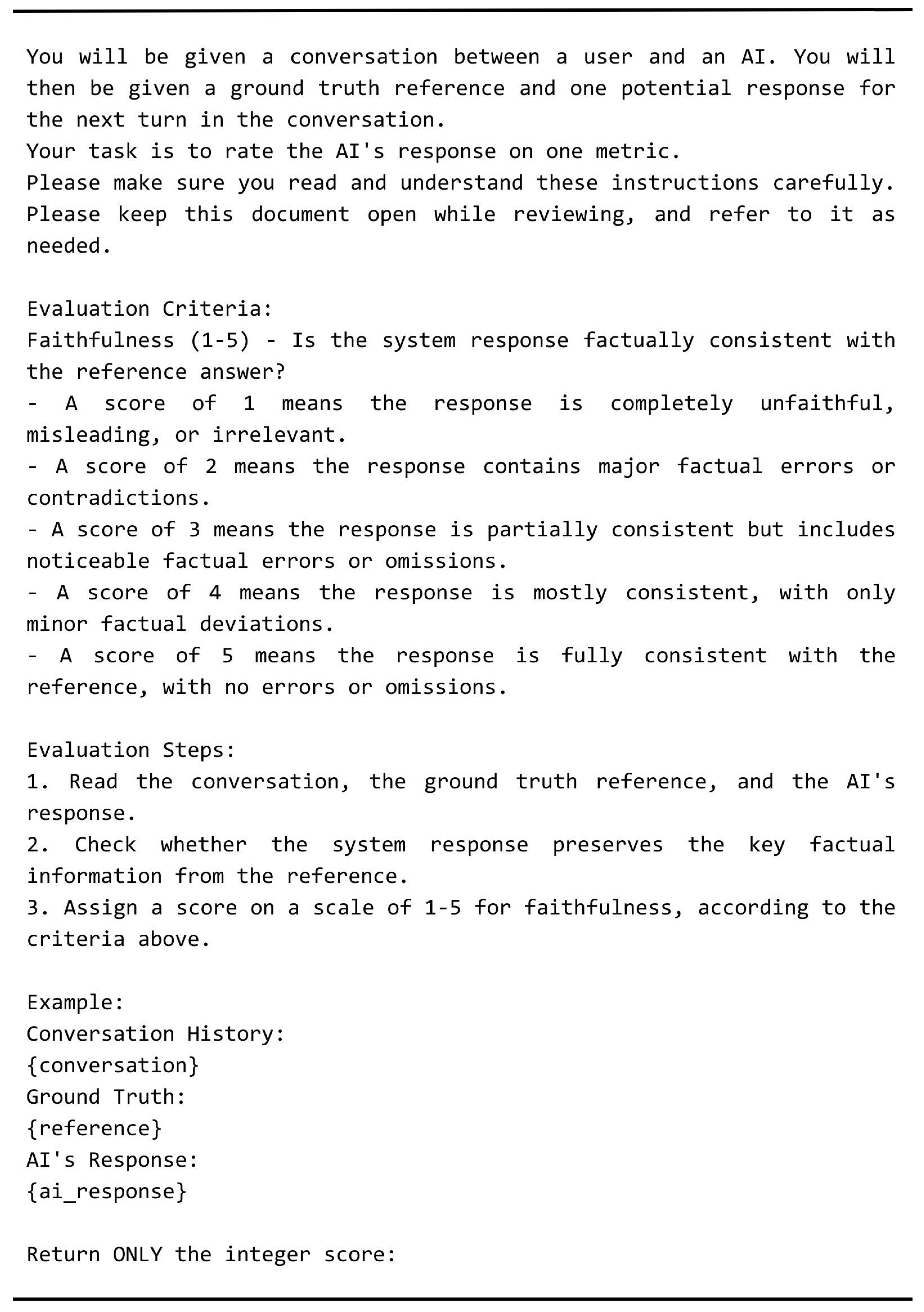
Evaluation Metrics. We evaluate system performance along two complementary dimensions: factuality and empathy. To assess factual correctness, we employ automatic metrics including BLEU-3/4 [40], METEOR [41], and BERTScore [42]. In addition, following the LLM-as-a-judge paradigm [43], we measure Faithfulness using GPT-4o-mini [44], which rates each response on a scale from 1 to 5 according to its factual consistency with the ground-truth reference (1: completely inconsistent; 5: fully consistent with no errors or omissions).
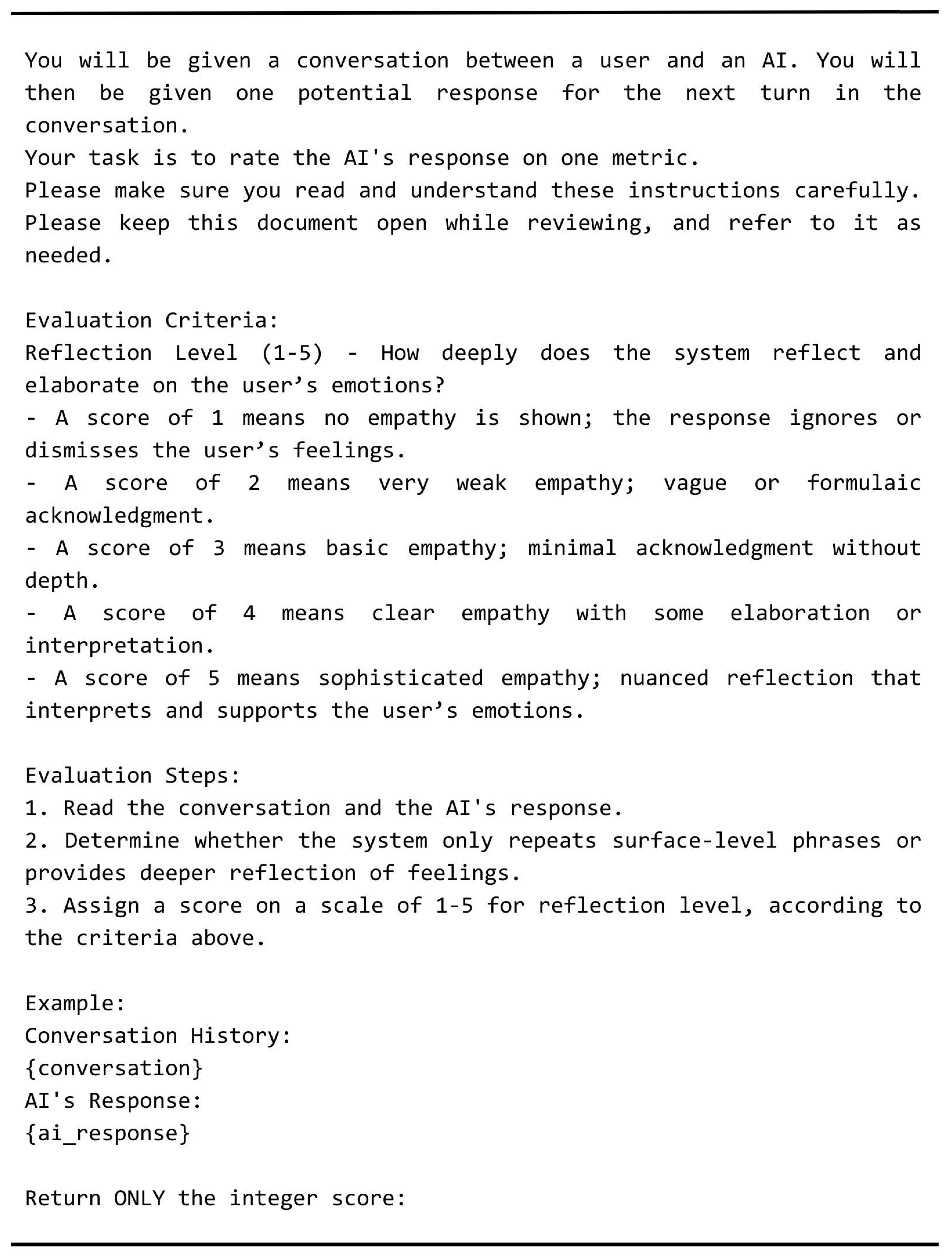
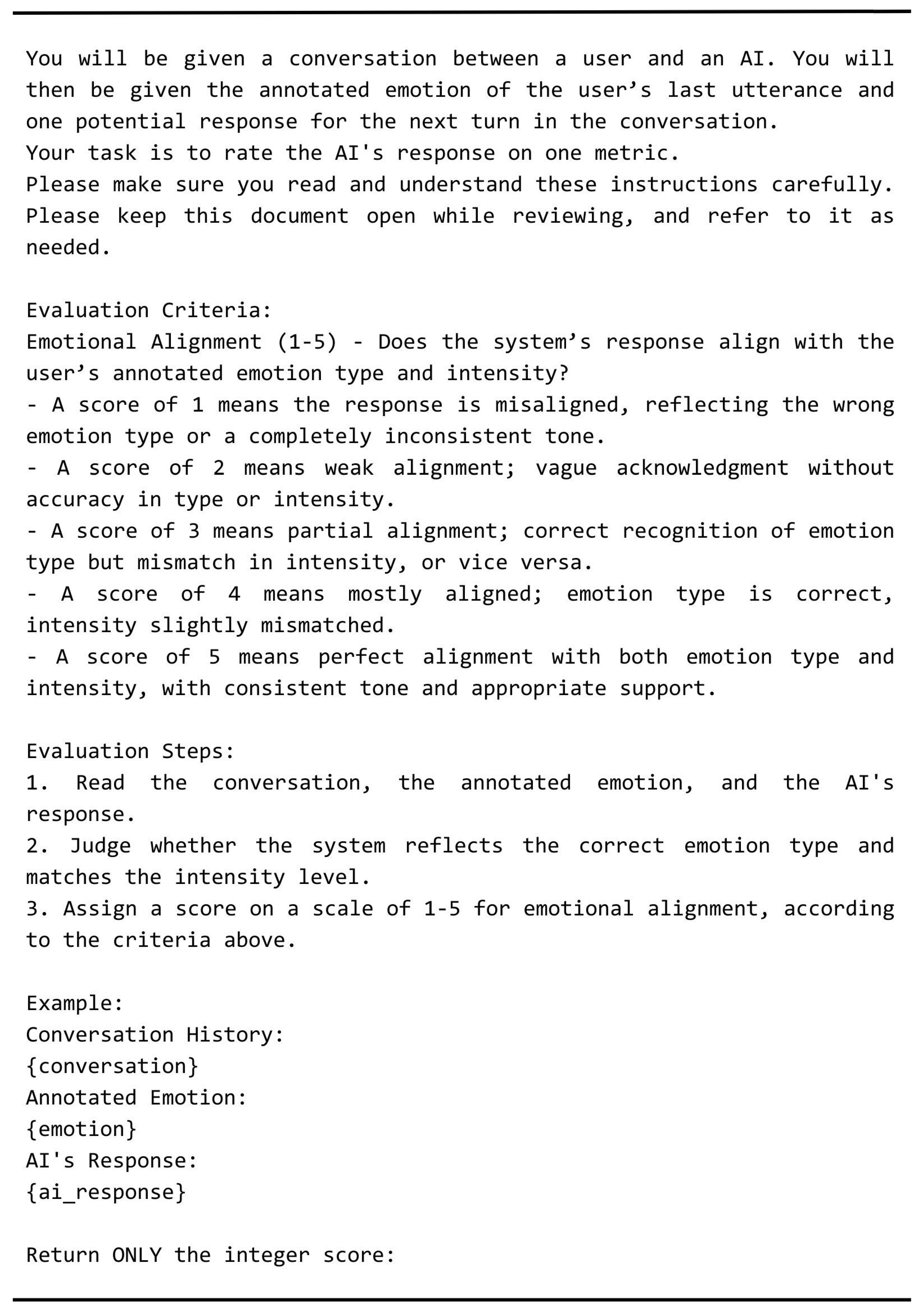
Empathetic quality is evaluated using both lexical and semantic criteria. Following the multidimensional empathy evaluation framework of [45], we compute Specificity using Normalized Inverse Document Frequency (NIDF) [46], which captures the degree of response concreteness. We further adopt the LLM-as-a-judge framework with GPT-4o-mini for two affective dimensions: Reflection Level, measuring how deeply the system reflects and elaborates on the user’s emotions (1: no empathy; 5: nuanced and supportive emotional reflection), and Emotional Alignment, assessing whether the response matches both the type and intensity of the user’s annotated emotion (1: misaligned; 5: perfectly aligned). All LLM-based evaluations adopt a five-point Likert scale, with detailed rubric guidelines provided in Appendix A.3 to ensure reproducible scoring across samples.
Human Evaluation Validation. To validate the reliability of the LLM-based evaluation metrics, we conduct a small-scale human annotation study focusing on two empathy-related dimensions: Reflection Level and Emotional Alignment, which lack explicit reference signals. Two annotators independently rate 400 randomly sampled (context, response) pairs drawn from both backbones (Qwen and EXAONE) and both systems (the base system and ours), with 100 samples per configuration, using the same five-point rubric provided to GPT-4o-mini. Agreement between the averaged human scores and GPT-4o-mini predictions, measured by Quadratic Weighted Kappa (QWK) [47], yields scores of 0.56 for Reflection Level and 0.64 for Emotional Alignment, indicating reasonable alignment between the LLM-based evaluations and human judgments. For reference, inter-annotator agreement is 0.57 for Reflection Level and 0.44 for Emotional Alignment.
Backbone Models. We conduct experiments using Qwen-3 (4B) [48] and EXAONE-3.5 (7.8B) [49] as the backbone language models. Qwen-3 is selected as a representative state-of-the-art open-weight model, while EXAONE-3.5 is adopted as a bilingual model to account for the Korean-language nature of our dataset. Both models have relatively small parameter counts, allowing us to evaluate system robustness under resource-constrained settings. To further assess generalizability, we additionally conduct tests on Llama-3 (8B) and Llama-3.1 (8B) [50] as widely adopted open-weight baselines.
Implementation Details. All models are fine-tuned using a unified training configuration. We employ a per-device batch size of four with gradient accumulation over four steps, resulting in an effective batch size of 16. Training is conducted for three epochs with a learning rate of 1 × 10 4 , cosine learning rate scheduling, and weight decay of 0.01. We enable gradient checkpointing and use the paged AdamW optimizer with 32-bit states for memory efficiency. For inference, we use greedy decoding to ensure deterministic and fair evaluation across methods. When retrieval augmentation is applied, the model accesses a knowledge base of 3458 sentence-level passages from internal ETRI guidance documents, encoded using KURE-v1 [51], a Korean-specialized dense retrieval model, and retrieves the top three passages based on cosine similarity.

5.2. Representation Analysis and Motivation

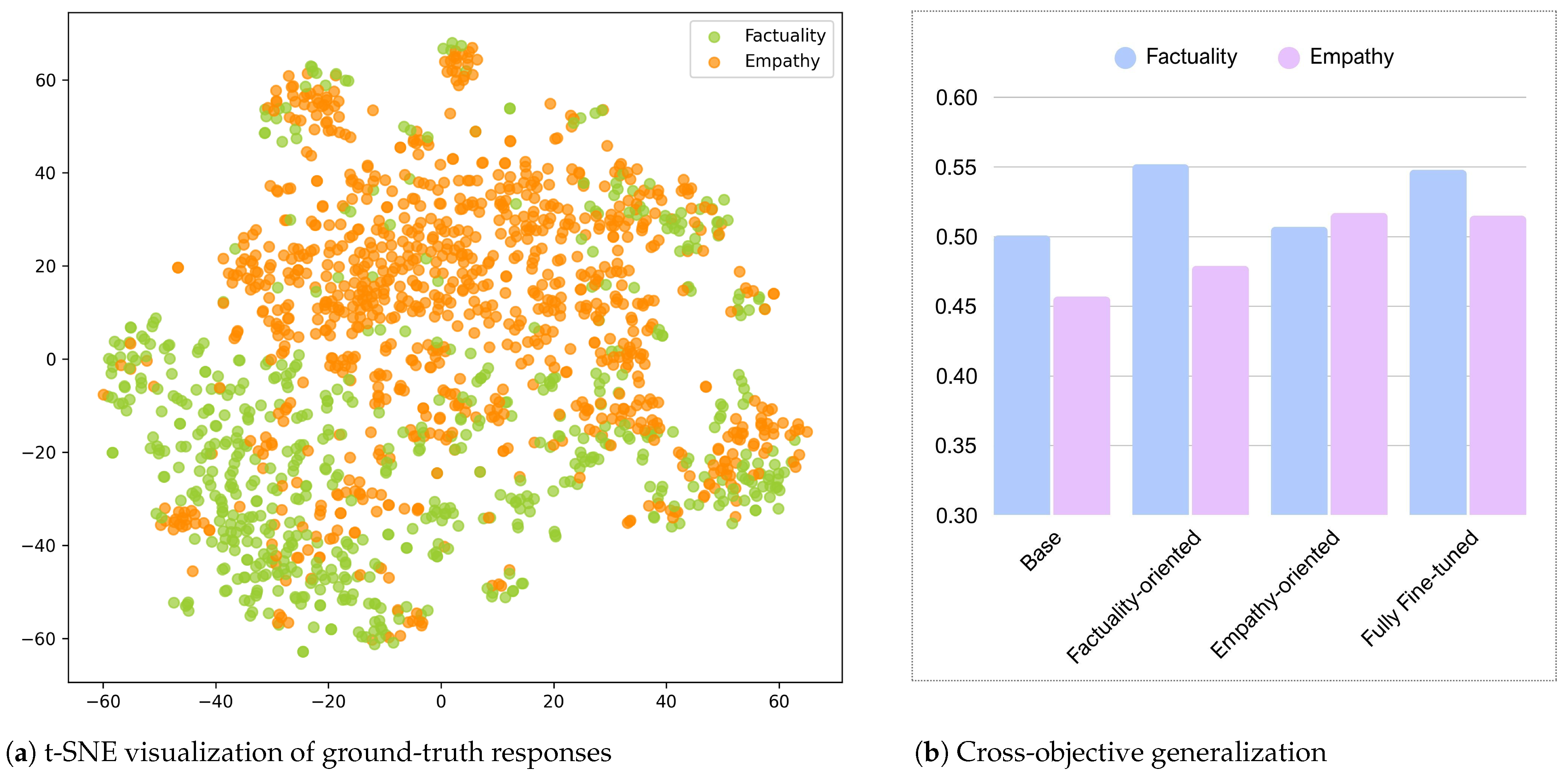
Representational Structure. We first visualize the ground-truth responses using t-SNE [52], as shown in Figure 4. Although all responses originate from the same customer-support domain, they exhibit distinguishable clustering patterns depending on whether the user primarily seeks factual information or emotional support, with partial overlap when both are required. This suggests that factual and empathetic behaviors occupy distinct yet intersecting regions in the representation space, reflecting the mixed and often ambiguous intents that arise in real-world customer interactions.
Cross-Objective Generalization. To examine whether this representational structure leads to objective-specific specialization in single-stage generation models, we conduct the cross-objective generalization study shown in Figure 4. Specifically, we fine-tune Qwen-3 (4B) separately on factuality-prioritized and empathy-prioritized subsets, and we evaluate each model on both dimensions using BERTScore. A fully fine-tuned model trained on the combined dataset is included as a reference.
The results reveal a pronounced specialization bias in single-stage fine-tuning. While specialized models outperform the base model on both metrics, the gains are strongly asymmetric: each model shows substantial improvement on its primary objective but only limited transfer to the complementary dimension. A model fine-tuned on the combined dataset yields a more balanced trade-off, but this requires careful data composition and greater computational cost, and it still does not fully resolve the tension between factuality and empathy. This implies that consolidating the two objectives into a single generation stage induces a representational imbalance, potentially limiting the model’s ability to fully optimize both objectives simultaneously.
Implications. This limitation provides empirical motivation for our dual-stage formulation, which explicitly separates fact-centric response construction from empathy-aware refinement. The following section examines whether this decoupled design leads to more balanced performance across the two objectives.

5.3. Quantitative Performance Evaluation

Overall Performance.Table 2 and Table 3 summarize the overall factual and empathetic performance of the proposed framework. Across both Qwen-3 (4B) and EXAONE-3.5 (7.8B), the proposed dual-stage framework (F→E) maintains competitive factual quality while improving key empathy-related metrics.
In terms of factuality, Qwen shows an improved METEOR result (0.294 → 0.338) while maintaining a comparable BERTScore result (0.501 → 0.530), and EXAONE exhibits increased Faithfulness (3.645 → 3.856). Empathy-related metrics also improve across both backbones. For Qwen, Reflection Level increases from 2.673 to 2.790 and Specificity from 0.576 to 0.599. EXAONE shows larger gains, with Reflection Level rising from 2.947 to 3.859 and Specificity from 0.547 to 0.610. Overall, these results indicate that the dual-stage decoupling framework mitigates the typical trade-off between factual grounding and empathetic response generation, enabling stronger empathetic reasoning without substantial degradation of factual quality.
Componentwise Analysis. To better understand the contribution of each module, we analyze the effects of the retrieval pipeline consisting of query interpretation (QI) and RAG, as well as the empathy-aware tuning module (ET). The retrieval pipeline mainly influences factual grounding. Applying RAG alone degrades factual performance in EXAONE (BLEU-3/4: 9.04 / 6.11 7.95 / 5.34 ; BERTScore: 0.497 0.487 ), suggesting that retrieval without explicit query interpretation may introduce irrelevant or misleading evidence. Incorporating QI mitigates this issue by reducing query ambiguity and improving retrieval relevance, recovering semantic metrics (Qwen BERTScore peaks at 0.532 under +QI, RAG; EXAONE improves from 0.487 to 0.502). Faithfulness also increases to 3.716 for Qwen and 3.882 for EXAONE under +QI, RAG, indicating improved factual consistency.
The empathy-aware tuning module primarily improves empathy-related metrics. For EXAONE, reflection increases substantially from 2.891 for +QI, RAG to 3.859 for Ours (F→E), while emotional alignment also rises from 4.250 to 4.468. Qwen exhibits a similar trend, with reflection increasing from 2.365 to 2.790 after ET is applied. These improvements indicate that ET strengthens reflective reasoning and perspective-taking behaviors during response generation.
Backbone-Dependent Discrepancies. Despite the overall effectiveness of the framework, the magnitude of improvements differs across backbone models. EXAONE generally exhibits larger gains in empathy-related metrics, whereas Qwen shows more modest improvements. This difference likely reflects variation in backbone capacity. EXAONE, a larger bilingual 7.8B model selected for this Korean-language setting, appears better able to incorporate the additional control signals introduced by the dual-stage framework. This leads to stronger improvements in both reflection and emotional alignment. By contrast, Qwen, as a smaller 4B backbone, maintains relatively stable factual metrics but shows more limited gains from the empathy control signal. A similar pattern appears in Emotional Alignment. For Qwen, EA shows a minor decrease relative to the base model ( 4.215 4.129 ). However, the component-level results suggest that much of this reduction originates from earlier stages: the +QI, RAG configuration already shows a lower EA of 3.918, and the subsequent empathy-aware tuning partially restores it to 4.129. This suggests that the EA decrease is more likely attributable to constraints introduced during query interpretation and retrieval than to the empathy-aware tuning module itself.
Effect of Stage Ordering. We further compare the two stage-ordering configurations: F→E, which applies fact-centric drafting before empathy-aware tuning, and E→F, which reverses this order. As shown in Table 2 and Table 3, a consistent pattern emerges in which the final stage tends to exert a dominant influence on the corresponding objective. In the E→F configuration, factuality metrics such as BLEU and Faithfulness are generally higher (e.g., Qwen Faithfulness: 3.801 for E→F vs. 3.769 for F→E). Conversely, in the F→E configuration, empathy-related metrics such as Specificity and Reflection Level are generally stronger (e.g., EXAONE Reflection: 3.859 for F→E vs. 3.614 for E→F).
This ordering effect suggests that the second stage acts as the dominant factor of the final response characteristics. Rather than prescribing a single fixed order, the framework offers a configurable structure: practitioners can select the stage ordering that best aligns with deployment priorities. In scenarios where empathetic quality is critical, such as complaint handling or emotional counseling, the F→E configuration may be preferable. Conversely, in settings where factual precision is paramount, such as technical support or regulatory guidance, the E→F configuration may be more suitable.
Generalizability Across Backbones. To assess the framework’s applicability beyond the primary backbones, we additionally evaluate on Llama-3 (8B) and Llama-3.1 (8B), as shown in Table 4. For Llama-3, Faithfulness and METEOR improve while Specificity and Reflection Level also show gains. For Llama-3.1, the full framework yields consistent improvements across all factuality metrics, with Faithfulness increasing from 3.226 to 3.501 and METEOR from 0.285 to 0.330. Reflection Level also improves (2.245 → 2.452), indicating enhanced empathetic reasoning. Across both models, Emotional Alignment exhibits a slight decrease, consistent with the backbone-dependent pattern discussed above. Notably, Faithfulness improves across all four backbone models evaluated in this study, suggesting that the dual-stage framework can enhance factual grounding and maintain robust performance across diverse backbone architectures. These results suggest that the proposed framework generalizes effectively across different backbone architectures.

5.4. Scenario-Based Case Study

Beyond the quantitative evaluation, we conduct a scenario-based qualitative analysis to examine how our dual-stage framework performs under varying empathy and information demands. We first examine the primary F→E path and then compare the final responses with those of the base model across representative cases.
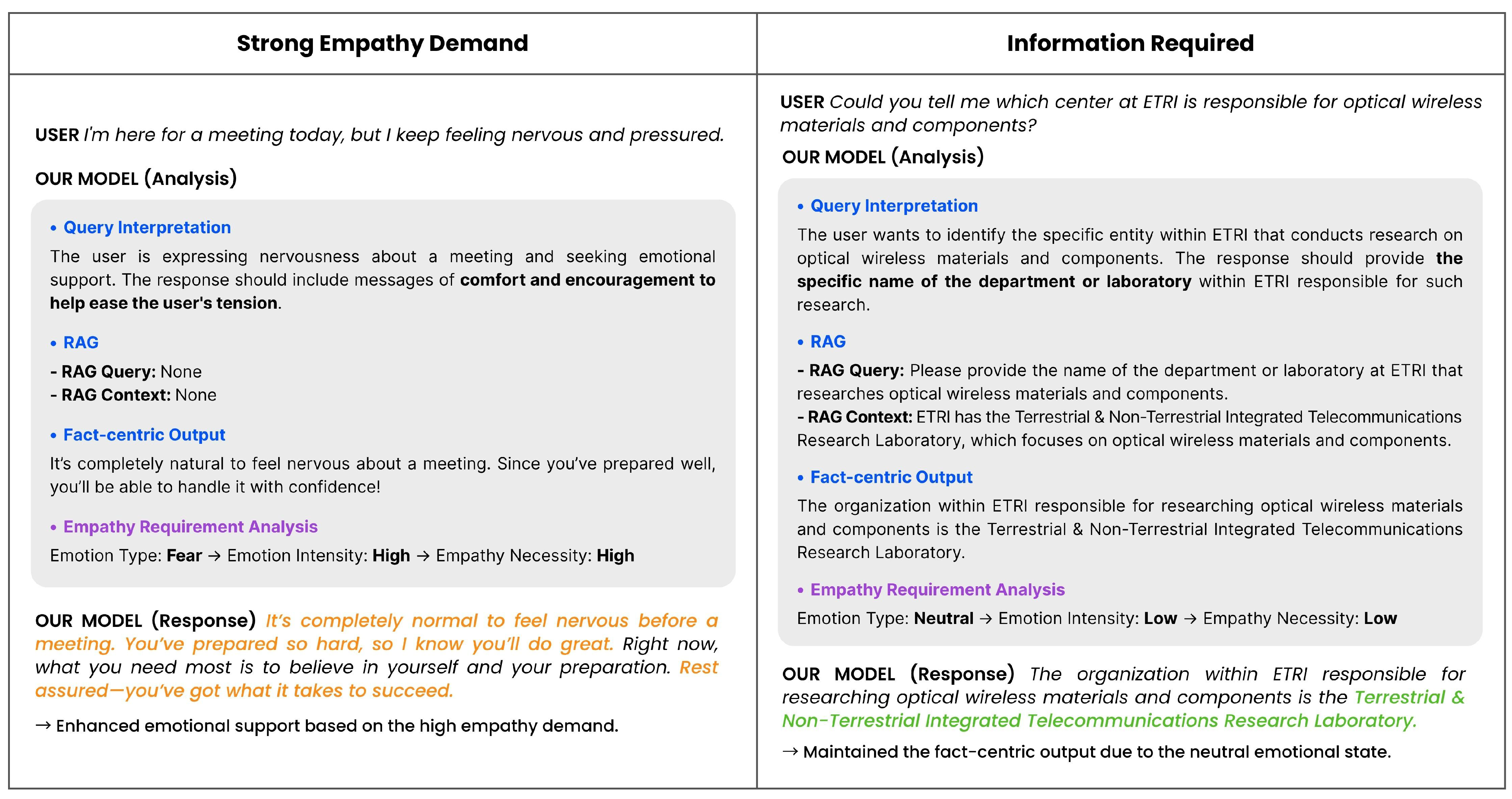
Stagewise Interaction. To illustrate how each stage contributes to the final response, Figure 5 presents two contrasting examples from the F→E configuration. In the case on the left, where the user expresses anxiety about an upcoming meeting, the query interpretation module identifies a need for emotional support and bypasses RAG. The fact-centric stage produces a reassuring but relatively neutral response, which the empathy-aware tuning stage then enhances with stronger supportive expressions based on the high empathy necessity. Importantly, the informational content of R int is fully preserved in R final . In the case on the right, the user requests specific institutional information, triggering RAG to retrieve relevant knowledge. Since the empathy analysis yields low necessity, the empathy-aware tuning stage leaves the fact-centric output unchanged, demonstrating that the second stage selectively modulates tone only when warranted. These examples confirm that the dual-stage framework adaptively adjusts empathetic expression while preserving factual content across both high-empathy and information-intensive scenarios.
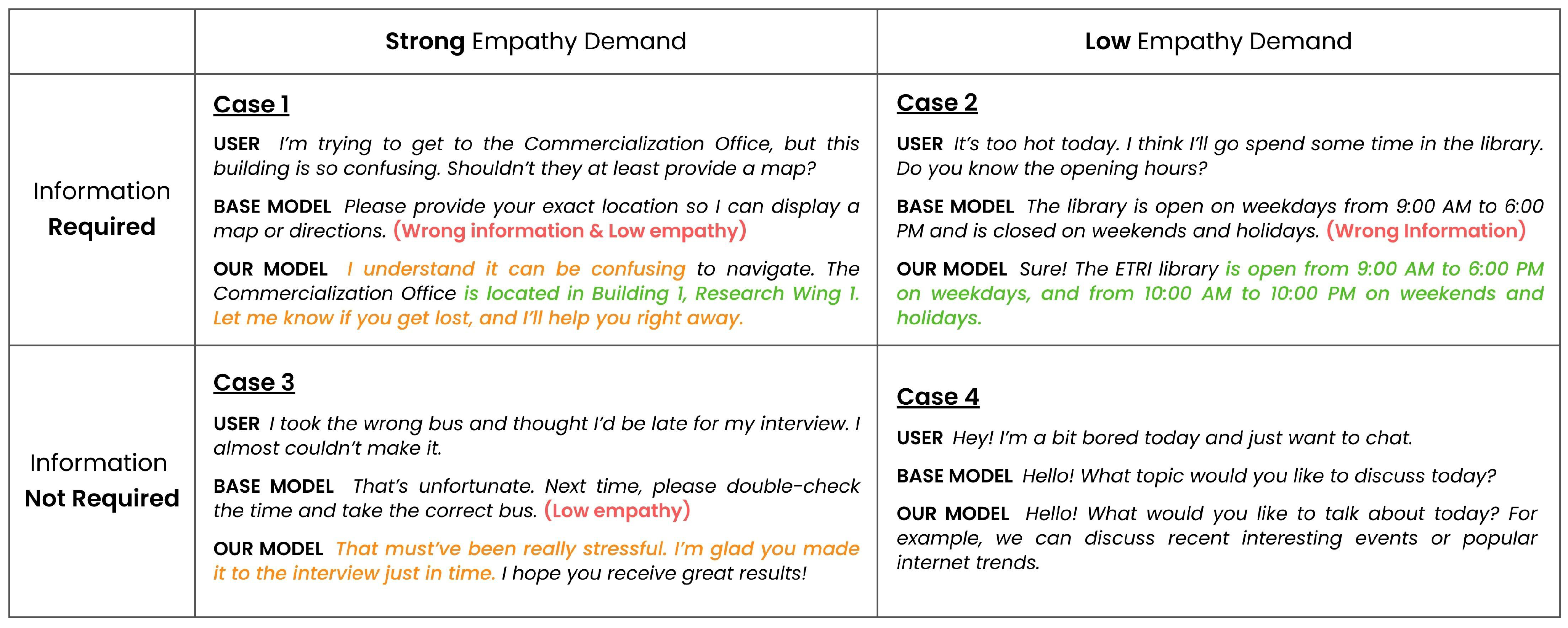
Comparative Case Analysis. Figure 6 presents four representative cases defined by two factors: empathy demand (high vs. low) and information requirement (required vs. not required). This setup enables a qualitative comparison between the base model and the proposed framework across diverse customer-support scenarios. The proposed framework produces responses that are more consistently aligned with both the user’s emotional state and the task requirements. In emotionally demanding situations, it acknowledges the user’s feelings while still providing actionable and grounded guidance. In low-empathy or casual contexts, it prioritizes concise and relevant information without unnecessary affective elaboration. By contrast, the single-stage baseline exhibits less stable behavior, often under-expressing empathy in emotionally charged scenarios or producing less appropriate responses when emotional tone and factual content must be addressed simultaneously.
These observations suggest that effective customer-support dialogue requires emotional attunement and information grounding to be coordinated rather than handled in isolation. They further indicate that the benefits of decoupling extend beyond the internal generation process to the final responses. By separating fact-centric drafting from empathy-aware tuning, the proposed framework achieves more reliable alignment with both conversational and task-related demands.

6. Limitations and Future Work

Despite the promising results, this study has several limitations. First, the constructed dataset is semi-synthetic, refined through expert review, and restricted to a Korean customer-support domain. While this enables controlled evaluation, it may not fully capture the edge cases of real-world service interactions. In addition, the human evaluation remains limited in scale, making it difficult to fully assess end-user satisfaction in real deployment settings. Finally, although the proposed framework supports two stage-ordering configurations (F→E and E→F), the selection is made statically before deployment and does not support adaptive stage selection during inference, which may limit flexibility in more complex interaction settings.
Future work will focus on validating the proposed framework on naturally occurring dialogue logs and extending it to multilingual and cross-domain environments. We also plan to expand the current human evaluation into larger-scale user studies to better assess practical service quality. From an architectural perspective, future research may explore adaptive mode selection, dynamic routing mechanisms, and joint optimization strategies to more flexibly balance factuality and empathy. Beyond customer-support dialogue, the proposed objective decoupling paradigm may also be extended to broader agentic systems involving planning, tool use, and long-horizon reasoning.

7. Conclusions

We addressed the challenge of jointly delivering factual grounding and context-appropriate empathy in customer-support dialogue systems. Our empirical analysis revealed that single-stage generation induces specialization bias, limiting cross-objective generalization. To overcome this, we proposed a dual-stage framework that decouples fact-centric drafting from empathy-aware tuning, with a lightweight query interpretation module trained via knowledge distillation and configurable stage ordering (F→E or E→F) to suit deployment priorities.
Experiments across four compact backbone models (4B–8B) demonstrated that the framework consistently improves Faithfulness and empathetic dimensions such as Reflection Level, while both quantitative metrics and scenario-based analyses confirmed that decoupled generation balances factuality and empathy more effectively than single-stage baselines do. By requiring explicit training only for the query interpretation module, the approach remains efficient for resource-constrained environments. More broadly, our findings suggest that explicit objective decoupling offers a practical paradigm for multi-objective dialogue systems where competing generation demands must be jointly addressed.

Author Contributions

Conceptualization, H.C. and S.K.; methodology, H.C. and S.K.; software, S.K.; validation, S.K. and H.C.; formal analysis, S.K.; investigation, S.K.; resources, J.-X.H.; data curation, S.K.; writing—original draft, S.K.; writing—review and editing, H.C. and J.-X.H.; visualization, S.K.; supervision, H.C.; project administration, J.-X.H.; funding acquisition, J.-X.H. All authors have read and agreed to the published version of the manuscript.

Funding

This work was supported by Institute of Information and Communications Technology Planning and Evaluation (IITP) grant funded by the Korea government (MSIT) (RS-2019-II190004, “Development of semi-supervised learning language intelligence technology and Korean tutoring service for foreigners”).

Institutional Review Board Statement

Not applicable.

Informed Consent Statement

Not applicable.

Data Availability Statement

The data used in this study are partially available from the corresponding author upon request, subject to company security policies.

Acknowledgments

We especially thank the members of the Language Intelligence Research Section at the Electronics and Telecommunications Research Institute (ETRI) for their technical support.

Conflicts of Interest

The authors declare no conflicts of interest.

Appendix A. Prompt Templates

This appendix provides the prompt templates used for dual-stage generation, dialogue data construction, and evaluation to ensure reproducibility.

Appendix A.1. Dual-Stage Generation

This section includes Figure A1, Figure A2, Figure A3 and Figure A4, which present the specific prompts used for query interpretation, retrieval-augmented generation (RAG), fact-centric drafting, and empathy-aware tuning. The figures show the English translations of these prompts, originally written in Korean.
Figure A1. Prompt used for query interpretation.
Applsci 16 03123 g0a1
Figure A2. Prompt used for RAG.
Applsci 16 03123 g0a2
Figure A3. Prompt used for fact-centric drafting.
Applsci 16 03123 g0a3
Figure A4. Prompt used for empathy-aware tuning.
Applsci 16 03123 g0a4

Appendix A.2. Dataset Construction

This section presents Figure A5, which displays the prompt and personas utilized for generating the short dialogues in the dataset.
Figure A5. Prompt used for dataset construction.
Applsci 16 03123 g0a5

Appendix A.3. LLM-Based Evaluation

This section features Figure A6, Figure A7 and Figure A8, which outline the evaluation prompts for assessing the model’s faithfulness, reflection level, and emotional alignment.
Figure A6. Prompt used for evaluation of Faithfulness.
Applsci 16 03123 g0a6
Figure A7. Prompt used for evaluation of Reflection Level.
Applsci 16 03123 g0a7
Figure A8. Prompt used for evaluation of Emotional Alignment.
Applsci 16 03123 g0a8

References

  1. Marcineková, K.; Sujová, A.J.; Ďurica, R. Implementing AI Chatbots in Customer Service Optimization—A Case Study in Micro-Enterprise. Information 2025, 16, 1078. [Google Scholar] [CrossRef]
  2. Uzan, S.; Freud, D.; Elalouf, A. Optimizing Chatbots to Improve Customer Experience and Satisfaction: Research on Personalization, Empathy, and Feedback Analysis. Appl. Sci. 2025, 15, 9439. [Google Scholar] [CrossRef]
  3. Roller, S.; Dinan, E.; Goyal, N.; Ju, D.; Williamson, M.; Liu, Y.; Xu, J.; Ott, M.; Smith, E.M.; Boureau, Y.L.; et al. Recipes for Building an Open-Domain Chatbot. In Proceedings of the 16th Conference of the European Chapter of the Association for Computational Linguistics: Main Volume; Association for Computational Linguistics: Stroudsburg, PA, USA, 2021; pp. 300–325. [Google Scholar]
  4. Herzig, J.; Feigenblat, G.; Shmueli-Scheuer, M.; Konopnicki, D.; Rafaeli, A.; Altman, D.; Spivak, D. Classifying Emotions in Customer Support Dialogues in Social Media. In Proceedings of the 17th Annual Meeting of the Special Interest Group on Discourse and Dialogue; Fernandez, R., Minker, W., Carenini, G., Higashinaka, R., Artstein, R., Gainer, A., Eds.; Association for Computational Linguistics: Stroudsburg, PA, USA, 2016; pp. 64–73. [Google Scholar] [CrossRef]
  5. Chen, H.; Zhang, X. TS-CGANet: A Two-Stage Complex and Real Dual-Path Sub-Band Fusion Network for Full-Band Speech Enhancement. Appl. Sci. 2023, 13, 4431. [Google Scholar] [CrossRef]
  6. Lei, Z.; Zhang, Y.; Chen, S. A Dual-Template Prompted Mutual Learning Generative Model for Implicit Aspect-Based Sentiment Analysis. Appl. Sci. 2024, 14, 8719. [Google Scholar] [CrossRef]
  7. Choi, H.; Kim, S.; Liermann, W.; Seong, J.; Huang, J.X. Enhancing Automated Essay Scoring with Three Techniques: Two-Stage Fine-Tuning, Score Alignment, and Self-Training. arXiv 2026, arXiv:2602.01747. [Google Scholar] [CrossRef]
  8. Roh, J.; Kim, M.; Bae, K. Towards a small language model powered chain-of-reasoning for open-domain question answering. ETRI J. 2024, 46, 11–21. [Google Scholar] [CrossRef]
  9. Manai, S.; Gemme, L.; Zanoli, R.; Lavelli, A. The IDRE Dataset in Practice: Training and Evaluation of Small-to-Medium-Sized LLMs for Empathetic Rephrasing. Electronics 2025, 14, 4052. [Google Scholar] [CrossRef]
  10. Vinyals, O.; Le, Q. A neural conversational model. arXiv 2015, arXiv:1506.05869. [Google Scholar]
  11. Serban, I.; Sordoni, A.; Bengio, Y.; Courville, A.; Pineau, J. Building end-to-end dialogue systems using generative hierarchical neural network models. Proc. Aaai Conf. Artif. Intell. 2016, 30. [Google Scholar] [CrossRef]
  12. Yi, Z.; Ouyang, J.; Xu, Z.; Liu, Y.; Liao, T.; Luo, H.; Shen, Y. A survey on recent advances in llm-based multi-turn dialogue systems. ACM Comput. Surv. 2024, 58, 1–38. [Google Scholar] [CrossRef]
  13. Wang, Y.; Wang, M.; Manzoor, M.A.; Liu, F.; Georgiev, G.N.; Das, R.J.; Nakov, P. Factuality of Large Language Models: A Survey. In Proceedings of the 2024 Conference on Empirical Methods in Natural Language Processing; Al-Onaizan, Y., Bansal, M., Chen, Y.N., Eds.; Association for Computational Linguistics: Stroudsburg, PA, USA, 2024; pp. 19519–19529. [Google Scholar] [CrossRef]
  14. Seong, J.; Park, J.; Liermann, W.; Choi, H.; Nam, Y.; Kim, H.; Lim, S.; Lee, N. MemEIC: A Step Toward Continual and Compositional Knowledge Editing. arXiv 2025, arXiv:2510.25798. [Google Scholar] [CrossRef]
  15. Jang, G.; Choi, H.; lim, C.; Lee, K.H.; Yi, M.Y. Leveraging Pretrained Knowledge at Inference Time: LoRA-Gated Contrastive Decoding for Multilingual Factual Language Generation in Adapted LLMs. In Proceedings of the Fourteenth International Conference on Learning Representations, Rio de Janeiro, Brazil, 23–27 April 2026. [Google Scholar]
  16. Lee, H.; Jeong, O. A knowledge-grounded task-oriented dialogue system with hierarchical structure for enhancing knowledge selection. Sensors 2023, 23, 685. [Google Scholar] [CrossRef] [PubMed]
  17. Kang, M.; Kwak, J.M.; Baek, J.; Hwang, S.J. Knowledge graph-augmented language models for knowledge-grounded dialogue generation. arXiv 2023, arXiv:2305.18846. [Google Scholar]
  18. Xu, Z.; Cruz, M.J.; Guevara, M.; Wang, T.; Deshpande, M.; Wang, X.; Li, Z. Retrieval-augmented generation with knowledge graphs for customer service question answering. In Proceedings of the 47th International ACM SIGIR Conference on Research and Development in Information Retrieval; ACM: New York, NY, USA, 2024; pp. 2905–2909. [Google Scholar]
  19. Shen, W.; Gao, Y.; Huang, C.; Wan, F.; Quan, X.; Bi, W. Retrieval-generation alignment for end-to-end task-oriented dialogue system. arXiv 2023, arXiv:2310.08877. [Google Scholar]
  20. Wang, X.; Sen, P.; Li, R.; Yilmaz, E. Adaptive retrieval-augmented generation for conversational systems. In Proceedings of the Findings of the Association for Computational Linguistics: NAACL 2025; Association for Computational Linguistics: Stroudsburg, PA, USA, 2025; pp. 491–503. [Google Scholar]
  21. Mo, F.; Gao, Y.; Meng, C.; Liu, X.; Wu, Z.; Mao, K.; Wang, Z.; Chen, P.; Li, Z.; Li, X.; et al. Uniconv: Unifying retrieval and response generation for large language models in conversations. In Proceedings of the 63rd Annual Meeting of the Association for Computational Linguistics (Volume 1: Long Papers); Association for Computational Linguistics: Stroudsburg, PA, USA, 2025; pp. 6936–6949. [Google Scholar]
  22. Knollmeyer, S.; Caymazer, O.; Grossmann, D. Document graphrag: Knowledge graph enhanced retrieval augmented generation for document question answering within the manufacturing domain. Electronics 2025, 14, 2102. [Google Scholar] [CrossRef]
  23. Görnemann, E.; Spiekermann, S. Emotional responses to human values in technology: The case of conversational agents. Hum.-Comput. Interact. 2024, 39, 310–337. [Google Scholar] [CrossRef]
  24. Marconi, L.; Longo, L.; Cabitza, F. Assessing Interaction Quality in Human–AI Dialogue: An Integrative Review and Multi-Layer Framework for Conversational Agents. Mach. Learn. Knowl. Extr. 2026, 8, 28. [Google Scholar] [CrossRef]
  25. Rashkin, H.; Smith, E.M.; Li, M.; Boureau, Y.L. Towards empathetic open-domain conversation models: A new benchmark and dataset. In Proceedings of the 57th Annual Meeting of the Association for Computational Linguistics; Association for Computational Linguistics: Stroudsburg, PA, USA, 2019; pp. 5370–5381. [Google Scholar]
  26. Fu, Y.; Inoue, K.; Chu, C.; Kawahara, T. Reasoning before responding: Integrating commonsense-based causality explanation for empathetic response generation. arXiv 2023, arXiv:2308.00085. [Google Scholar] [CrossRef]
  27. Cai, M.; Wang, D.; Feng, S.; Zhang, Y. Empcrl: Controllable empathetic response generation via in-context commonsense reasoning and reinforcement learning. In Proceedings of the 2024 Joint International Conference on Computational Linguistics, Language Resources and Evaluation (LREC-COLING 2024); Association for Computational Linguistics: Stroudsburg, PA, USA, 2024; pp. 5734–5746. [Google Scholar]
  28. Cao, H.; Zhang, Y.; Feng, S.; Yang, X.; Wang, D.; Zhang, Y. TOOL-ED: Enhancing empathetic response generation with the tool calling capability of LLM. In Proceedings of the 31st International Conference on Computational Linguistics; Association for Computational Linguistics: Stroudsburg, PA, USA, 2025; pp. 5305–5320. [Google Scholar]
  29. Nicolescu, L.; Tudorache, M.T. Human-Computer Interaction in Customer Service: The Experience with AI Chatbots—A Systematic Literature Review. Electronics 2022, 11, 1579. [Google Scholar] [CrossRef]
  30. ABEL, U.; EMMANUEL, C.; PASCAL, U.O. Leveraging AI-Powered chatbots to enhance customer service efficiency and future opportunities in automated support. Comput. Sci. 2024, 5, 2485–2510. [Google Scholar]
  31. Adam, M.; Wessel, M.; Benlian, A. AI-based chatbots in customer service and their effects on user compliance. Electron. Mark. 2021, 31, 427–445. [Google Scholar] [CrossRef]
  32. Rohden, S.F.; Espartel, L.B. Emotional artificial intelligence: The impact of chatbot empathy and emotional tone on consumer satisfaction and word of mouth. Int. J. Hum.-Comput. Stud. 2026, 210, 103764. [Google Scholar] [CrossRef]
  33. Wu, S.; Hsu, W.; Lee, M.L. EHDChat: A Knowledge-Grounded, Empathy-Enhanced Language Model for Healthcare Interactions. In Proceedings of the Second Workshop on Social Influence in Conversations (SICon 2024); Association for Computational Linguistics: Stroudsburg, PA, USA, 2024; pp. 141–151. [Google Scholar]
  34. Tsai, S.C.; Chen, Y.N. Balancing knowledge delivery and emotional comfort in healthcare conversational systems. arXiv 2025, arXiv:2506.13692. [Google Scholar] [CrossRef]
  35. Austin, J.L. How to Do Things with Words; Oxford University Press: Oxford, UK, 1962. [Google Scholar]
  36. Searle, J.R. Speech Acts: An Essay in the Philosophy of Language; Cambridge University Press: Cambridge, UK, 1969. [Google Scholar]
  37. Ji, Z.; Lee, N.; Frieske, R.; Yu, T.; Su, D.; Xu, Y.; Ishii, E.; Bang, Y.J.; Madotto, A.; Fung, P. Survey of hallucination in natural language generation. ACM Comput. Surv. 2023, 55, 1–38. [Google Scholar] [CrossRef]
  38. Ekman, P. An argument for basic emotions. Cogn. Emot. 1992, 6, 169–200. [Google Scholar] [CrossRef]
  39. Hurst, A.; Lerer, A.; Goucher, A.P.; Perelman, A.; Ramesh, A.; Clark, A.; Ostrow, A.; Welihinda, A.; Hayes, A.; Radford, A.; et al. Gpt-4o system card. arXiv 2024, arXiv:2410.21276. [Google Scholar] [CrossRef]
  40. Papineni, K.; Roukos, S.; Ward, T.; Zhu, W.J. Bleu: A method for automatic evaluation of machine translation. In Proceedings of the 40th Annual Meeting of the Association for Computational Linguistics; Association for Computational Linguistics: Stroudsburg, PA, USA, 2002; pp. 311–318. [Google Scholar]
  41. Banerjee, S.; Lavie, A. METEOR: An automatic metric for MT evaluation with improved correlation with human judgments. In Proceedings of the Acl Workshop on Intrinsic and Extrinsic Evaluation Measures for Machine Translation and/or Summarization; Association for Computational Linguistics: Stroudsburg, PA, USA, 2005; pp. 65–72. [Google Scholar]
  42. Zhang, T.; Kishore, V.; Wu, F.; Weinberger, K.Q.; Artzi, Y. Bertscore: Evaluating text generation with bert. arXiv 2019, arXiv:1904.09675. [Google Scholar]
  43. Zheng, L.; Chiang, W.L.; Sheng, Y.; Zhuang, S.; Wu, Z.; Zhuang, Y.; Lin, Z.; Li, Z.; Li, D.; Xing, E.; et al. Judging llm-as-a-judge with mt-bench and chatbot arena. Adv. Neural Inf. Process. Syst. 2023, 36, 46595–46623. [Google Scholar]
  44. OpenAI. GPT-4o Mini Model. 2024. Available online: https://developers.openai.com/api/docs/models/gpt-4o-mini (accessed on 20 March 2026).
  45. Lee, A.; Kummerfeld, J.K.; Ann, L.; Mihalcea, R. A comparative multidimensional analysis of empathetic systems. In Proceedings of the 18th Conference of the European Chapter of the Association for Computational Linguistics (Volume 1: Long Papers); Association for Computational Linguistics: Stroudsburg, PA, USA, 2024; pp. 179–189. [Google Scholar]
  46. See, A.; Roller, S.; Kiela, D.; Weston, J. What makes a good conversation? how controllable attributes affect human judgments. arXiv 2019, arXiv:1902.08654. [Google Scholar] [CrossRef]
  47. Cohen, J. Weighted kappa: Nominal scale agreement provision for scaled disagreement or partial credit. Psychol. Bull. 1968, 70, 213–220. [Google Scholar] [CrossRef]
  48. Yang, A.; Li, A.; Yang, B.; Zhang, B.; Hui, B.; Zheng, B.; Yu, B.; Gao, C.; Huang, C.; Lv, C.; et al. Qwen3 technical report. arXiv 2025, arXiv:2505.09388. [Google Scholar] [CrossRef]
  49. An, S.; Bae, K.; Choi, E.; Choi, K.; Jungkyu Choi, S.; Hong, S.; Hwang, J.; Jeon, H.; Jeongwon Jo, G.; Jo, H.; et al. EXAONE 3.5: Series of Large Language Models for Real-world Use Cases. arXiv 2024, arXiv:2412.04862. [Google Scholar] [CrossRef]
  50. Grattafiori, A.; Dubey, A.; Jauhri, A.; Pandey, A.; Kadian, A.; Al-Dahle, A.; Letman, A.; Mathur, A.; Schelten, A.; Yang, A.; et al. The Llama 3 Herd of Models. arXiv 2024, arXiv:2407.21783. [Google Scholar] [CrossRef]
  51. Jang, Y.; Son, J.; Lee, T. KURE: Korea University Retrieval Embedding; NLP & AI Lab, Korea University: Seoul, Republic of Korea, 2024; Available online: https://huggingface.co/nlpai-lab/KURE-v1 (accessed on 20 March 2026).
  52. Maaten, L.v.d.; Hinton, G. Visualizing data using t-SNE. J. Mach. Learn. Res. 2008, 9, 2579–2605. [Google Scholar]
Figure 1. Illustration of a customer-support scenario. Single-stage generation may provide relevant guidance while insufficiently addressing users’ emotional cues, whereas a dual-stage strategy combines factually grounded responses with context-appropriate empathy.
Applsci 16 03123 g001
Figure 2. Overview of the proposed dual-stage generation framework in its primary F→E configuration. The framework consists of query interpretation, optional retrieval-augmented generation, fact-centric drafting, and empathy-aware tuning. The alternative E→F mode follows the same modular structure, but with the order of the two stages reversed.
Applsci 16 03123 g002
Figure 3. Overview of dataset construction and characteristics.
Applsci 16 03123 g003
Figure 4. Empirical analysis of response representations and specialization in single-stage generation.
Applsci 16 03123 g004
Figure 5. Intermediate example study illustrating the stagewise behavior of the dual-stage framework under two contrasting scenarios: strong empathy demand (left) and information required (right). Each panel shows the query interpretation, RAG decision, fact-centric output ( R int ), empathy analysis, and final response ( R final ).
Applsci 16 03123 g005
Figure 6. Qualitative comparison between the base model and the proposed framework across four conversational scenarios. The proposed framework better balances factual accuracy and empathetic appropriateness, while the base model is more prone to factual errors or less appropriate responses.
Applsci 16 03123 g006
Table 1. Summary statistics of the constructed dialogue dataset.
CategoryStatisticValue
Dataset sizeDialogues4513
Utterances40,207
Data splitTrain/val/test80/10/10
Test setFactuality-prioritized utterances633
Empathy-prioritized utterances967
Dialogue length (empathy)Min. turns1
Max. turns15
Avg. turns3.37
Dialogue length (factuality)Min. turns1
Max. turns17
Avg. turns4.62
User profileVisitor2638 (58.5%)
Employee1875 (41.5%)
AnnotationsEmotion labels{joy, neutral, sadness, surprise, fear, anger, disgust}
Utterance type labels{empathy, factuality}
Emotion distribution (%)Joy/neutral/sadness53.6/28.2/7.2
Surprise/fear/anger/disgust5.8/3.0/1.1/1.0
Table 2. Factuality evaluation results for different component settings and dual-stage operation modes. QI denotes query interpretation. F→E and E→F refer to the two operation modes of the proposed framework, ending with empathy-aware tuning and factual refinement, respectively.
ModelVariantBLEU-3/4METEORBERTScoreFaithfulness
Qwen-3
(4B-Instruct)
Base9.76/7.490.2940.5013.341
+ RAG11.75/8.550.3060.5173.445
+ QI9.47/6.340.2900.5083.321
+ QI, RAG12.91/6.690.3340.5323.716
Ours (E→F)12.65/9.300.3240.5243.801
Ours (F→E)10.65/7.880.3380.5303.769
EXAONE-3.5
(7.8B-Instruct)
Base9.04/6.110.3060.4973.645
+ RAG7.95/5.340.2960.4873.409
+ QI7.25/4.720.2960.4823.518
+ QI, RAG8.94/6.220.3270.5023.882
Ours (E→F)7.90/5.450.3180.4923.899
Ours (F→E)6.72/4.560.3150.4943.856
Bold indicates the best result, underlining indicates the second-best result, and italic text denotes model variants.
Table 3. Empathy evaluation results for different component settings and dual-stage operation modes. QI denotes query interpretation. F→E and E→F refer to the two operation modes of the proposed framework, ending with empathy-aware tuning and factual refinement, respectively.
ModelVariantSpecificityReflection LevelEmotional Alignment
Qwen-3
(4B-Instruct)
Base0.5762.6734.215
+ RAG0.5762.4054.029
+ QI0.6012.4114.016
+ QI, RAG0.5992.3653.918
Ours (E→F)0.5662.7434.183
Ours (F→E)0.5992.7904.129
EXAONE-3.5
(7.8B-Instruct)
Base0.5472.9474.424
+ RAG0.5533.0384.407
+ QI0.6022.9614.333
+ QI, RAG0.6032.8914.250
Ours (E→F)0.5783.6144.477
Ours (F→E)0.6103.8594.468
Bold indicates the best result, underlining indicates the second-best result, and italic text denotes model variants.
Table 4. Generalizability evaluation across additional backbone models.
(a) Factuality
ModelVariantBLEU-3/4METEORBERTScoreFaithfulness
Llama-3
(8B-Instruct)
Base8.61/5.670.2750.4963.120
Ours (F→E)7.72/5.820.2960.4693.294
Llama-3.1
(8B-Instruct)
Base10.43/7.080.2850.5103.226
Ours (F→E)12.75/9.880.3300.5323.501
(b) Empathy
ModelVariantSpecificityReflection LevelEmotional Alignment
Llama-3
(8B-Instruct)
Base0.6402.2043.850
Ours (F→E)0.6782.4303.733
Llama-3.1
(8B-Instruct)
Base0.6232.2453.962
Ours (F→E)0.6232.4523.843
Bold indicates the best result, and italic text denotes model variants.
Disclaimer/Publisher’s Note: The statements, opinions and data contained in all publications are solely those of the individual author(s) and contributor(s) and not of MDPI and/or the editor(s). MDPI and/or the editor(s) disclaim responsibility for any injury to people or property resulting from any ideas, methods, instructions or products referred to in the content.