Article

Early Warning and Risk Assessment for Rainfall-Induced Shallow Loess Landslides

1
Shandong Provincial Territorial Spatial Ecological Restoration Center, Jinan 250014, China
2
School of Architecture, Engineering and Geomatics, Shandong University of Technology, Zibo 255049, China
*
Author to whom correspondence should be addressed.
Appl. Sci. 2026, 16(6), 3094; https://doi.org/10.3390/app16063094
Submission received: 9 January 2026 / Revised: 9 March 2026 / Accepted: 17 March 2026 / Published: 23 March 2026

Abstract

Rainfall-induced shallow loess landslides pose a significant threat to human life and property. Early warning and risk assessment of these landslides are critical prerequisites for engineering control and disaster loss reduction. The Transient Rainfall Infiltration and Grid-Based Regional Slope-Stability Model (TRIGRS)-Three-dimensional Slope Stability Analysis Tool (Scoops 3D) joint model can overcome the shortcomings of using a single TRIGRS model for hydrological analysis and a single Scoops 3D model for slope stability analysis. Landslide risk assessment based on expected economic loss, on the other hand, can overcome the issue of maintaining the risk level edge and sorting at the same level. In this paper, the TRIGRS model’s head pressures were put into the Scoops 3D model, with the southeast of Fangta, a town in Shaanxi province, China, as the study area. The relationship between the slope gradient and the number of grids in each stable grade was certified. The rainfall thresholds for landslides, based on both rainfall intensity and rainfall duration, were obtained by rerunning the TRIGRS-Scoops 3D joint model. The landslide range and land uses of each dangerous slope were determined by maximum likelihood classification, and then the expected economic loss was calculated. To verify the reliability of the TRIGRS-Scoops 3D joint model, the identified dangerous slopes were compared with the results from landslide susceptibility mapping. The results show that the unstable grids are concentrated within a slope gradient of 30° to 35°, and the landslide early warning levels are divided into Tier 3, Tier 2, and Tier 1 Warnings. The occurrence of shallow loess landslides is affected by both rainfall intensity and rainfall duration, and the combined effect should be considered in early warning. The distribution of both extreme susceptible grids and high susceptible grids across all 23 dangerous slopes demonstrates the reasonableness of the TRIGRS-Scoops 3D joint model. The landslide susceptible probability within some dangerous slopes exhibits spatial variability. The mapping relationship between the slope gradient and loess landslides is extremely complex. This paper can provide a theoretical basis for the early warning and risk management for rainfall-induced shallow loess landslides; the proposed method is also applicable to other regions with similar geological and meteorological conditions.

1. Introduction

Geological disasters are frequent, and ecological issues are prominent in loess areas [1,2]. The triggering factors for shallow loess landslides include rainfall [3], wildfires [4], earthquakes [5], and snowmelt [6], all of which are potential triggers for shallow loess landslides, with rainfall being the most significant. Extreme rainstorms have been occurring frequently in the Loess Plateau, China. Rainstorms in Shaanxi Province’s Suide, Zizhou, and Mizhi counties triggered many loess landslides in July 2021, causing silt dam damage, river blockages, serious soil erosion, and surface morphological damage [7]. In September 2024, persistent heavy rainfall that broke historical records triggered loess landslides and formed barrier lakes in Minhe County, Qinghai Province, resulting in three deaths and one injury [8]. Global warming has caused China’s precipitation line to move northward, and the changes in climate and underlying factors of the Loess Plateau are serious and are not slowing down. Rainfall-induced shallow loess landslides are becoming one of the most serious threats to human and property safety [9]. As a result, conducting their early warning and risk assessments can serve as a basis for disaster emergency response, as well as engineering mitigation, which is of great significance for enhancing regional disaster prevention capacity [10].
Landslide spatial prediction serves as the foundation for early warning, encompassing knowledge-driven qualitative analysis, math-driven quantitative analysis, and deterministic analysis based on physical and mechanical models [11]. Knowledge-driven qualitative analysis relies on expert experience. While it is relatively intuitive, the results are strongly influenced by subjectivity and exhibit low stability [12]. Math-driven quantitative analysis primarily involves landslide susceptibility mapping (LSM) [13]. It calculates the probability of landslide occurrence for each grid or slope unit within the study area based on data-driven models, considering factors such as topography, hydrology, geology, vegetation, meteorological, and human activity conditions. However, it struggles to account for the water infiltration process in rock and soil masses [14]. Deterministic analysis based on physical and mechanical models can fully consider the influence of the variabilities of the geotechnical parameters, rainfall processes, and moisture seepage on probability of landslide occurrence for individual slopes, usually use Shallow Landslide Stability Model (SHALSTAB), Stability Index MAPping Model (SINMAP), Transient Rainfall Infiltration and Grid-Based Regional Slope-Stability Model (TRIGRS) and Three-dimensional Slope Stability Analysis Tool (Scoops 3D) [15,16]. The application of SHALSTAB and SINMAP models is limited due to their weaknesses in sensitivity to parameters and assumptions regarding the sliding surface [17]. The prediction accuracy of the single TRIGRS model is relatively low because the gravity component of the rock and soil along the slope direction cannot be transmitted into the downstream adjacent rock and soil [18,19]. The Scoops 3D model cannot perform hydrological analysis on its own, but it is compatible with a variety of rainfall infiltration and hydrological models, and can simultaneously account for the complex distribution of pore water pressure and three-dimensional topographic conditions [20,21]. Loess has a loose structure and well-developed vertical joints, making it prone to forming steep slopes. Upon water saturation, the bonding force between particles weakens, leading to rapid structural failure and significant additional subsidence [22,23]. In addition, the terrain in loess regions is fragmented, characterized by numerous gullies and ravines, where the effect of gravity is particularly pronounced [24,25]. Therefore, it is necessary to consider both the influence of rainfall and the loess characteristics in the loess landslide study. The TRIGRS-Scoops 3D joint model can account for both the “rainfall-water infiltration” process and the influence of loess parameters [26,27]. However, there have been few studies using the joint model in the loess area recently.
The disaster capability of unstable slopes and vulnerability of the disaster-bearing bodies are involved in landslide risk assessment [28]. Disaster capability is the natural attribute of a hazard-pregnant environment; probability of occurrence and influence range are involved in the assessment of disaster capability, and it is dependent on factors like landslide volume, slope aspect, and terrain [29]. The vulnerability is the social attribute of disaster-bearing bodies, and it is measured by the total economic value and is dependent on the number and unit price of the disaster-bearing bodies [30]. Qualitative risk assessment has trouble with keeping the risk level edge, while quantitative risk assessment takes the expected economic loss as the most important result [31], which provides a direct and quantitative basis for the specific risk management and mitigation.
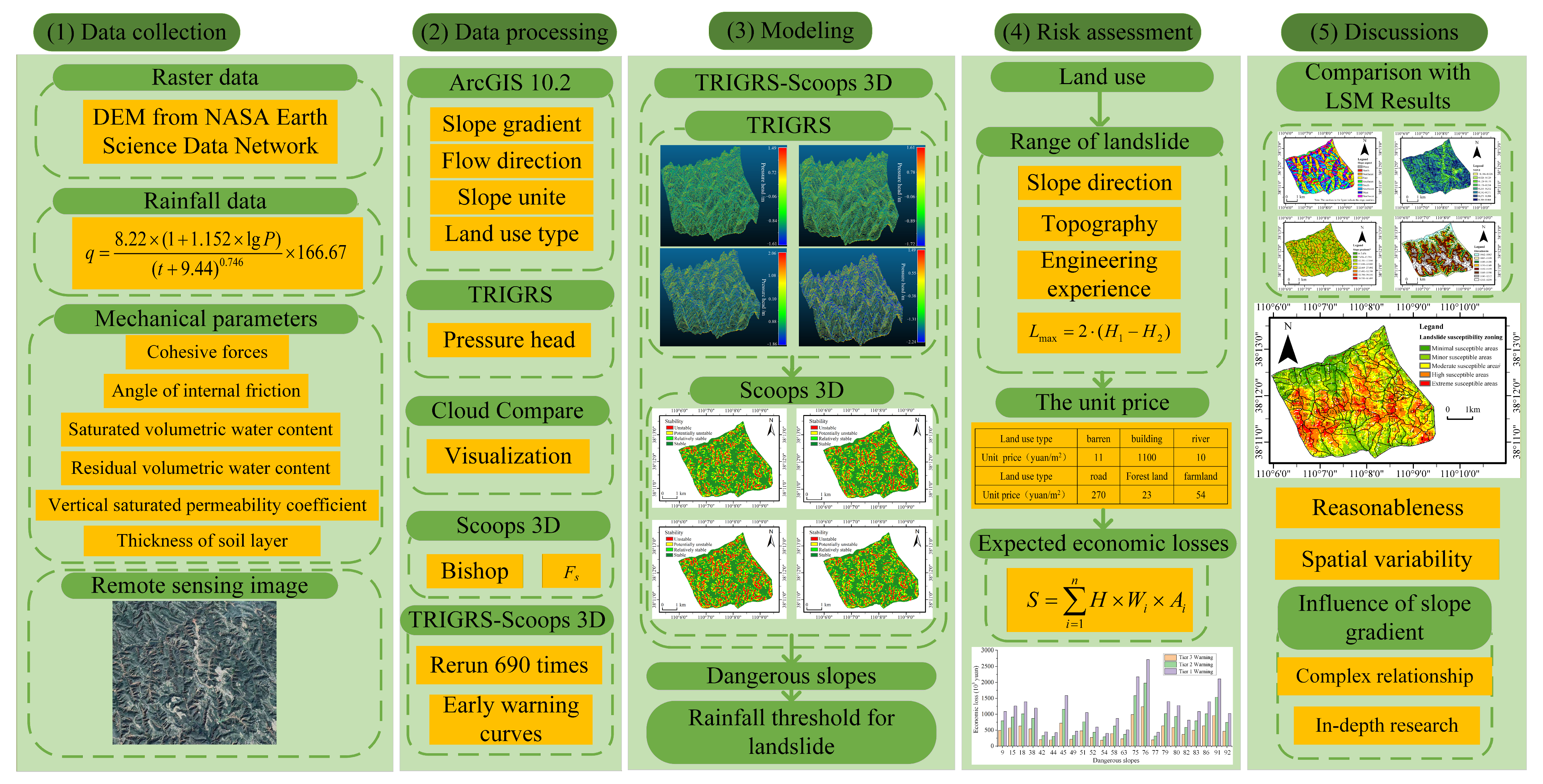
To incorporate the influences of both “rainfall-water infiltration” process and loess parameters in the early warning of shallow loess landslides [32], this paper proposes the TRIGRS-Scoops 3D joint model, specifically by feeding the head pressures calculated by the TRIGRS model into the Scoops 3D model, thereby achieving simultaneous analysis of water infiltration under varying rainfall conditions and slope stability analysis based on three-dimensional topography. The proportion of the unstable grids in the study area that were more than 25% were defined as dangerous slopes, and the spatial distribution of any dangerous slopes under the condition of the once-in-a-century rainfall was studied. Rainfall threshold curves for the different landslide warning grades based on rainfall intensity and rainfall duration were obtained and compared by a rerunning of the TRIGRS-Scoops 3D joint model. The landslide range and land uses of each slope were determined by maximum likelihood classification, and then the expected economic loss was calculated. To verify the reliability of the TRIGRS-Scoops 3D joint model, the identified dangerous slopes were compared with the results from LSM. The results can provide a basis for disaster emergency response, engineering mitigation, and land-use planning, and the methodology employed is also widely applicable to other loess-covered regions in China. The study flowchart is shown in Figure 1.

2. Study Area and Data

2.1. Study Area Overview

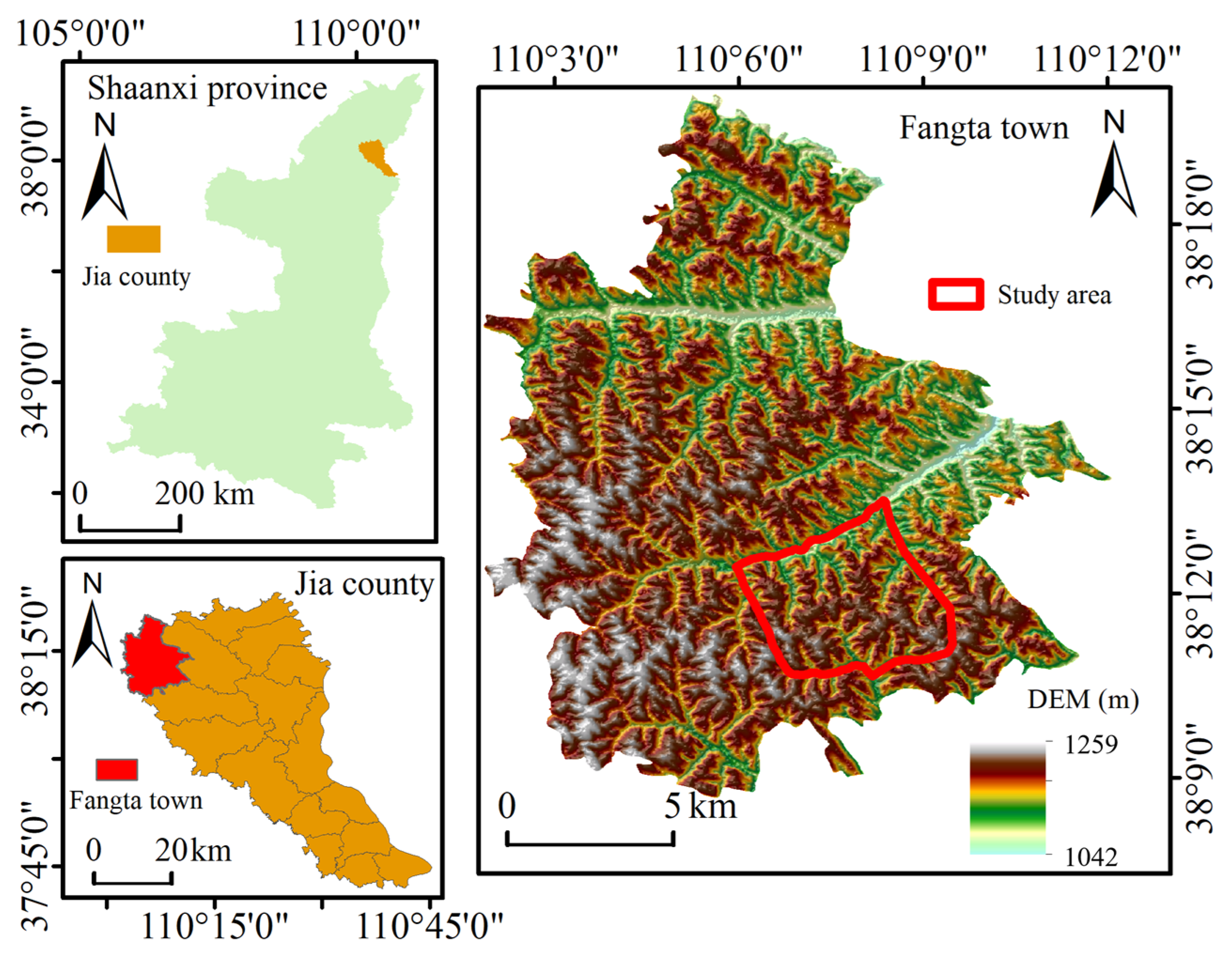
The study area is in the southeast of Fangta town, Jia county, Yulin city, Shaanxi province, and is in the south of the Maowusu desert. It is between 110°05′58″ E to 110°08′21″ E, 38°10′33″ N to 38°13′30″ N, with an area of 17.3 km2. The study area is in a temperate continental semi-arid monsoon climate, with an average precipitation of 405 mm over the 50 years, and is concentrated from June to September, with the highest values being in August. However, the average precipitation in the past 10 years has been more than 470 mm, and the pressure of an increasing trend of precipitation is obvious. The average annual temperature is 9.6 °C, with an average maximum of 16.6 °C and an average minimum of 3.8 °C. It features cold winters and hot summers, with a large diurnal temperature range. The frost-free period is approximately 150 days [33].
Tectonically, the study area is in the north-central part of the Shanbei Depression within the Ordos Platform of the North China Platform, adjacent to the Dongsheng Uplift to the northeast. Neotectonic movement is characterized by slow, large-scale uplift and subsidence. The stratigraphic sequence is dominated by thick Mesozoic and Paleozoic sedimentary rocks, overlain by extensive Cenozoic Quaternary loess. There is no record of magmatic rock formation. The terrain is highly dissected, featuring a crisscross network of gullies and alternating mounds and ridges, with elevations ranging from 1042 to 1259 m. No large-scale faults or folds have developed, and seismic activity is rare. The Jialu River flows through the study area. Influenced by the semi-arid climate, runoff exhibits significant seasonal and interannual variations, with water discharge highly concentrated during the flood season, leading to severe soil erosion [34]. The study area is shown in Figure 2.

2.2. Study Data

2.2.1. Slope Gradient

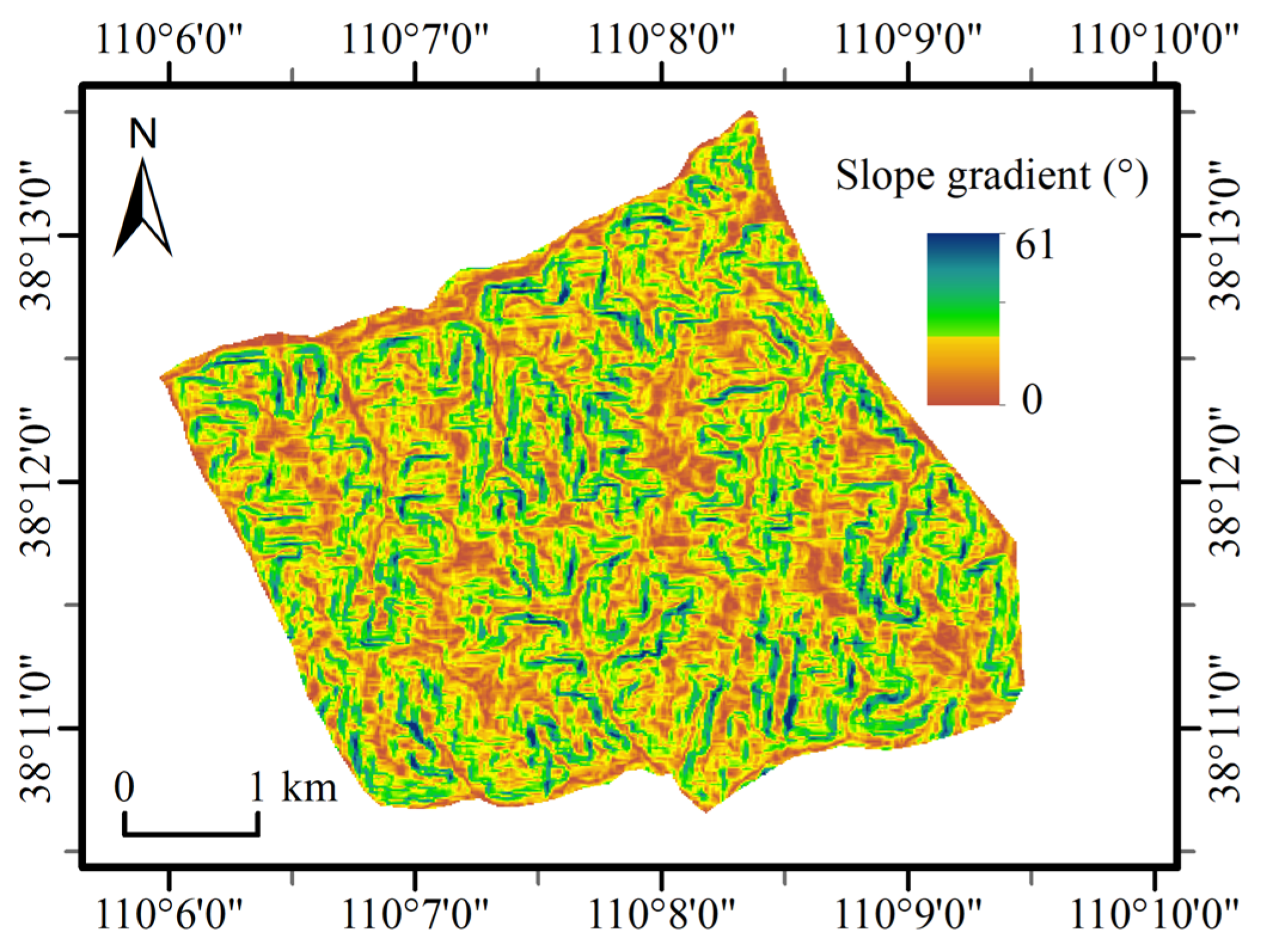
The slope gradient distribution of the study area was derived based on ArcGIS 10.2 by processing the Digital Elevation Model (DEM) provided by NASA, with the download link: https://www.nasa.gov/ (accessed on 16 October 2025). The study area was resampled to a resolution of 10 m × 10 m, yielding a total of 104,946 grids. The slope gradient distribution in the study area is shown in Figure 3.

2.2.2. Flow Direction

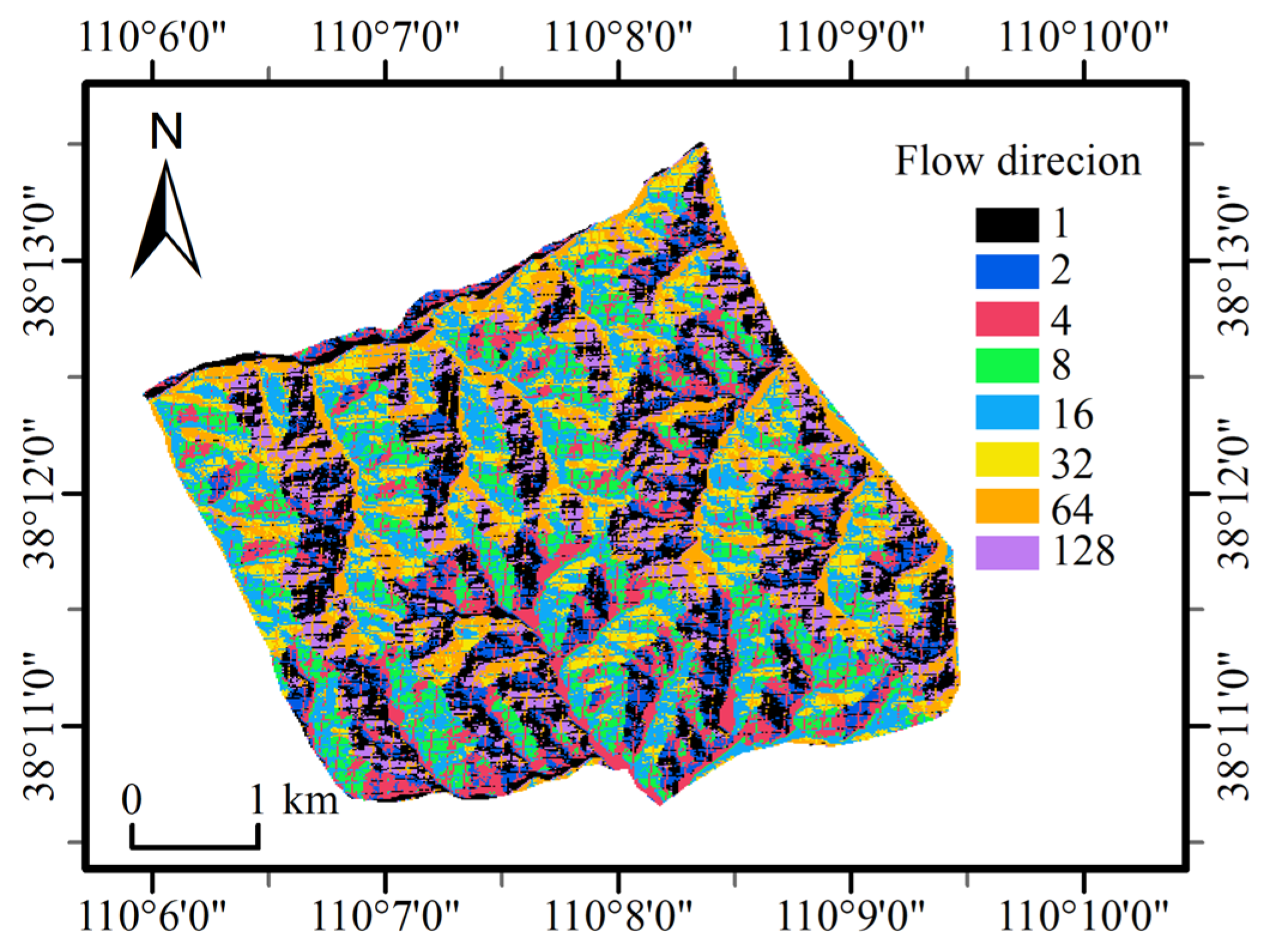
DEM was processed with depression detection based on ArcGIS 10.2, and the flow direction of each grid was extracted, combined with the TRIGRS model and the actual terrain. Compared with the multiple flow direction algorithm, the single flow direction algorithm is simple and suitable for steep terrain. It assumes that each grid cell has only one main flow direction, and the flow direction is usually determined from the lowest point of the DEM along the steepest downhill direction until it reaches the boundary of the basin [35]. The flow direction of each grid using the single flow direction algorithm is shown in Figure 4.

2.2.3. Slope Unit

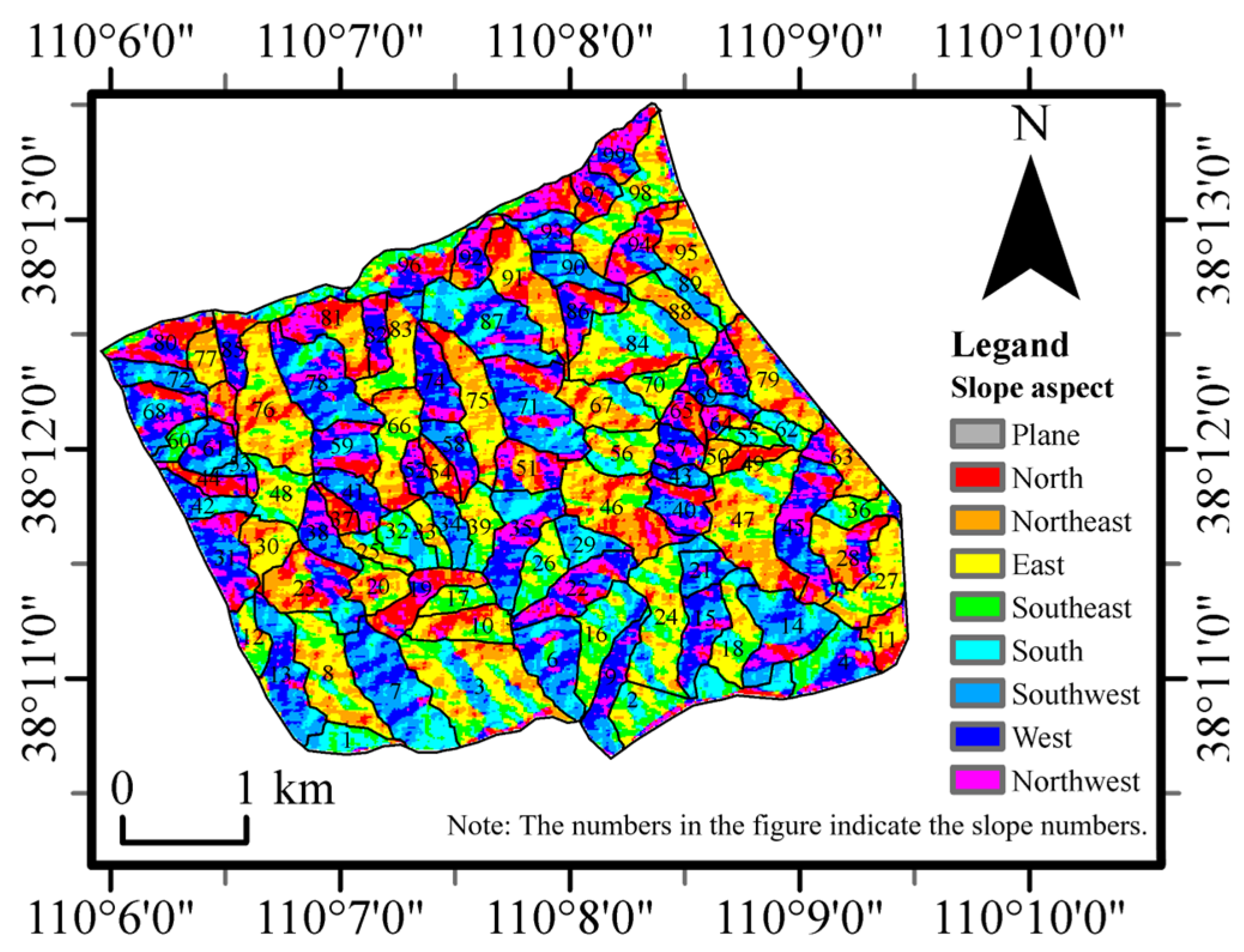
The slope unit was formed by the closure of the ridge line and the valley line. It can be regarded as the basic unit for landslide early warning and risk assessment. The hydrological analysis module of ArcGIS 10.2 was employed to extract the catchment basin corresponding to the positive and negative terrains. The original slope unit distribution was then obtained by using the catchment basin boundary as the valley line and the ridge line. Compared with the slope aspect map and the actual topography, the final slope unit distribution was obtained by readjusting the valley line and ridge line [36]. The 96 slope units and their slope aspects in the study area are shown in Figure 5.

2.2.4. The Thickness of the Loess

The study area is characterized by a high density of shallow landslides, with slip surfaces typically buried within 5 m depth [37]. This shallow failure mechanism is governed by the combined effects of well-developed vertical joint systems in the loess and the limited infiltration depth of intense rainfall. Vertical joints and fissures facilitate rapid preferential water flow, forming potential weak planes, while infiltration reduces soil shear strength. However, the wetting front under heavy rainfall seldom exceeds a few meters. Consequently, failure surfaces predominantly occur within shallow strata where moisture fluctuations are most pronounced, and soil strength is markedly degraded [38]. In the TRIGRS-Scoops 3D joint model, the soil thickness was accordingly set to 5 m.

2.2.5. Soil Parameter

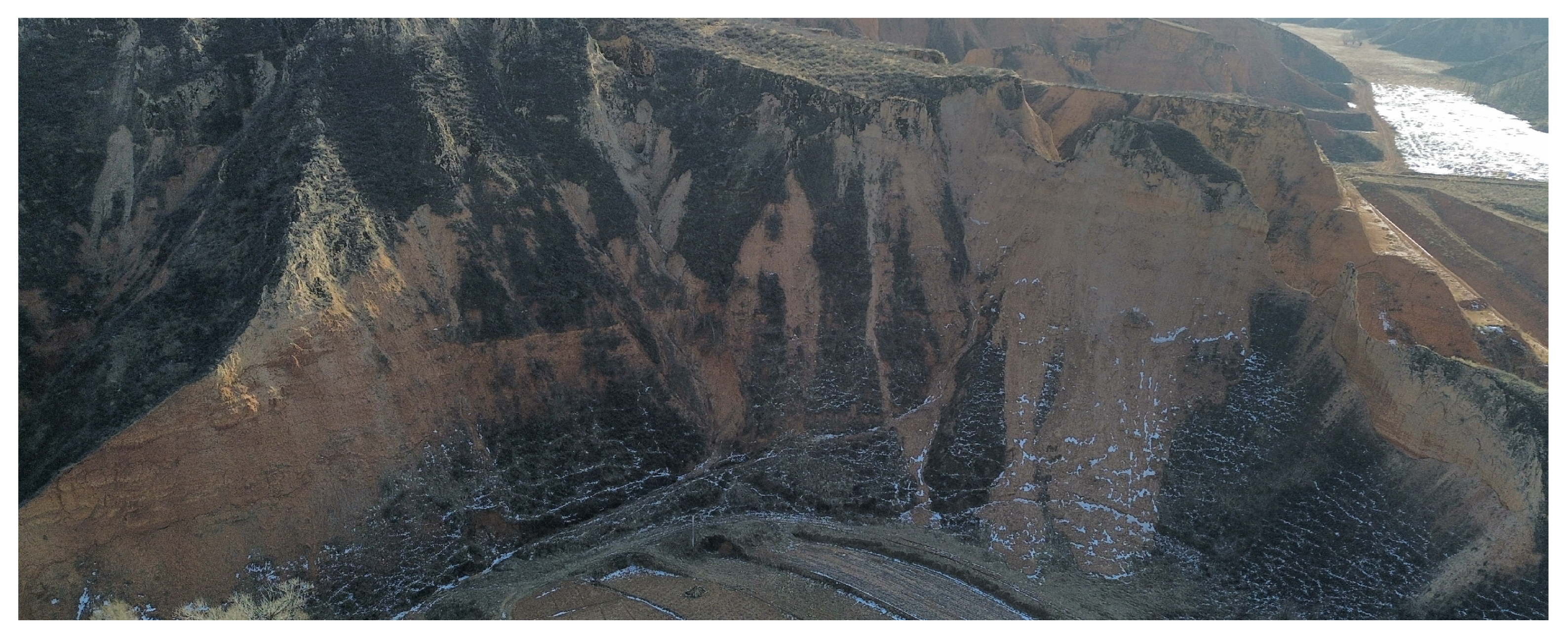
The loess exposed in the study area is the “Malan Loess”, which formed approximately 50,000 to 100,000 years ago. It is characterized by a loose structure and continuous depositions. Moreover, due to the relatively small extent of the study area, the variability of loess parameters is low. Thus, one representative slope was selected for parameter determination. This slope forms part of the 71# slope in Figure 5, with its central point located at coordinates 110°07′52.12″ E, 38°12′09.27″ N. It is approximately 550 m long and 120 m high, and experienced a shallow landslide triggered by heavy rainfall on 16 August 2024. The post-failure scene is shown in Figure 6.
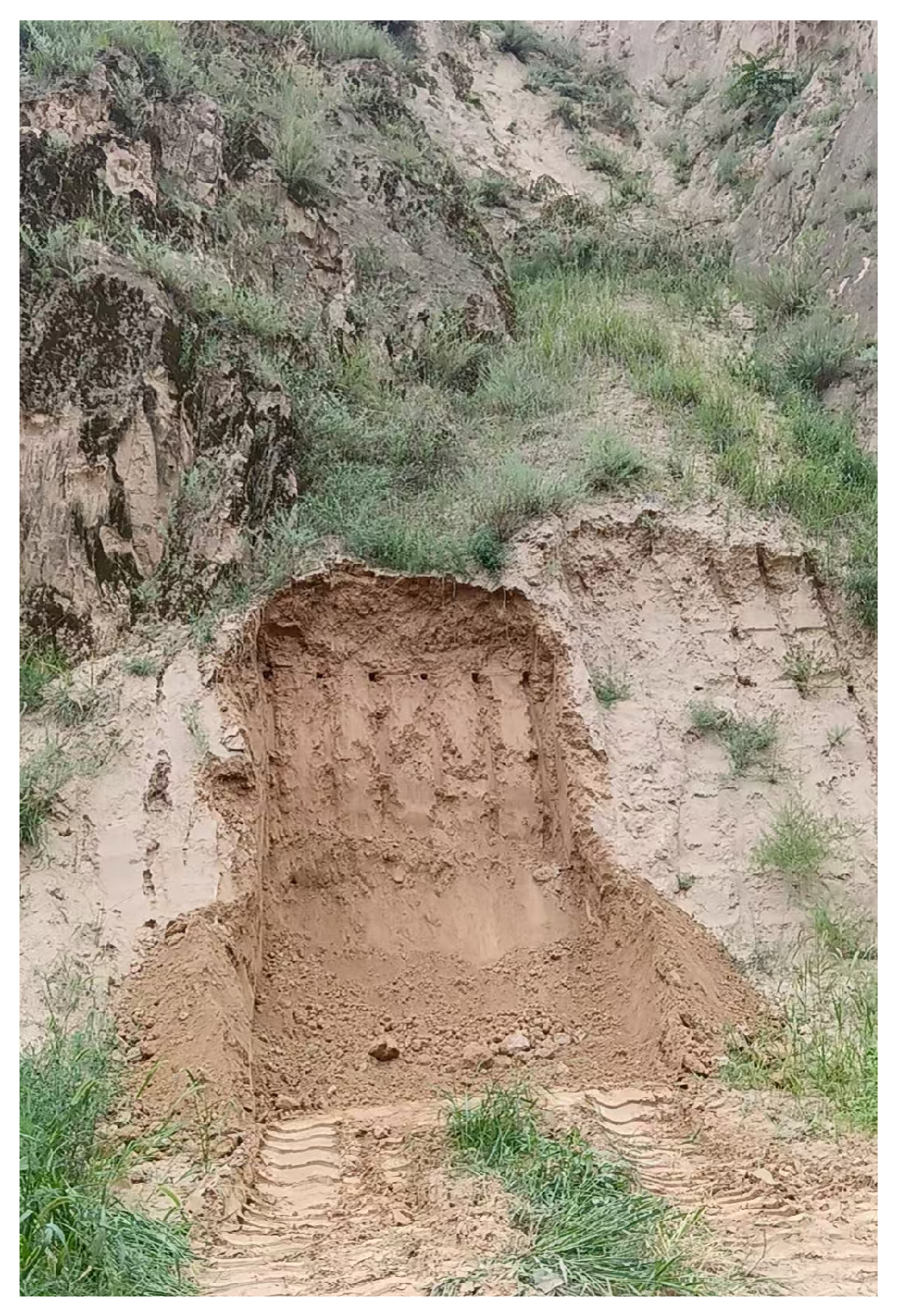
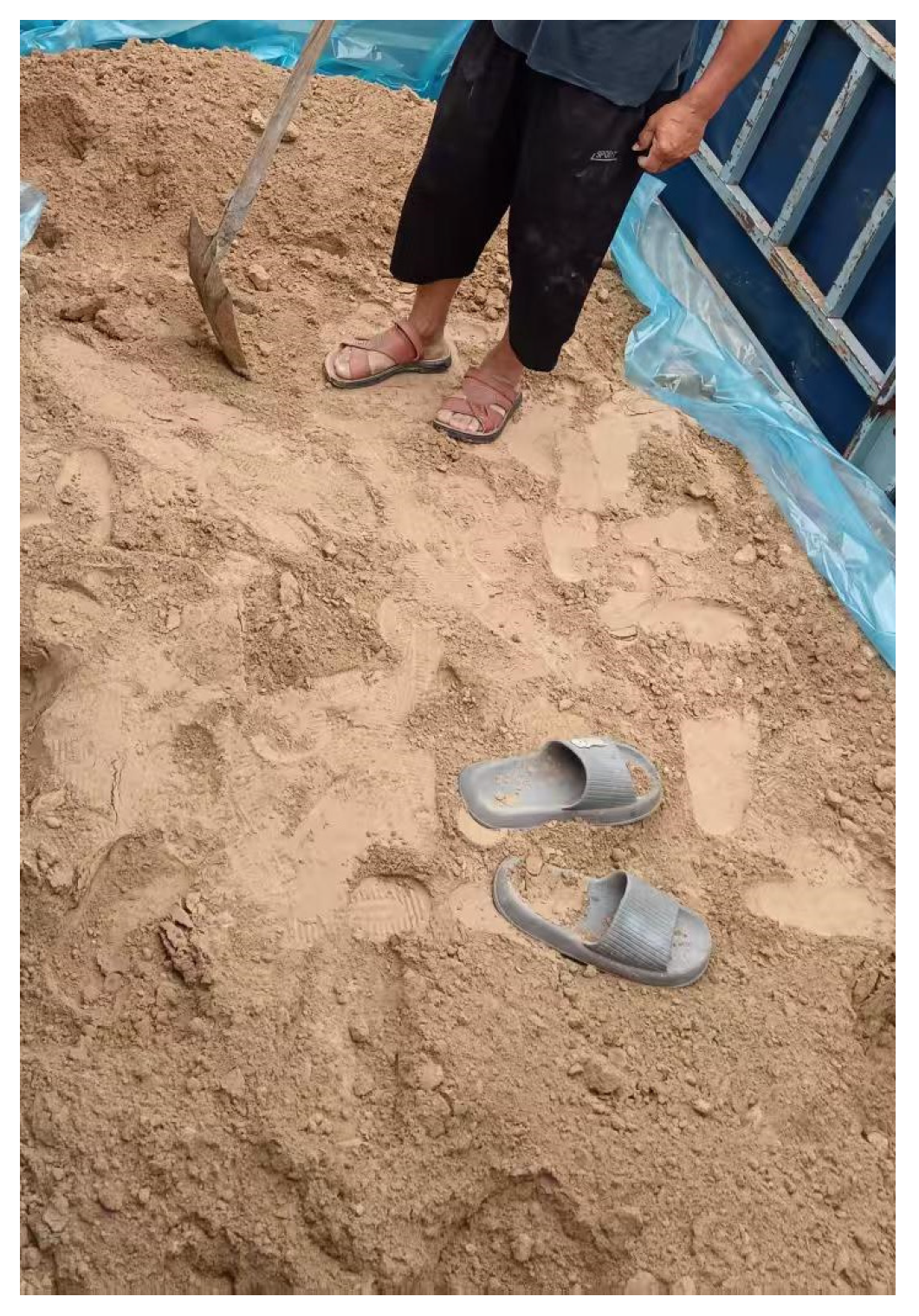
The natural density (ρ), natural moisture content (ρsat), liquid limit (wL), and plastic limit (wp) were measured on-site. The loess was transported to the laboratories in Shandong University of Technology, and geotechnical tests were employed to determine other parameters such as saturated volumetric water content (θs), residual volumetric water content (θr), saturated vertical permeability coefficient (KS), partial saturated soil unit weight (γps), cohesion (c), internal friction angle (φ) and saturated soil unit weight (γs) [39]. All the parameters were determined in accordance with the “Standard for Geotechnical Testing Method” (GB/T 50123-2019) [40], which is the most fundamental and widely adopted national standard for test methods in the field of geotechnical engineering in China [41]. The on-site measurement and sampling were conducted on 13 October 2025; the sampling location is shown in Figure 7, the loess transportation is shown in Figure 8, and the loess parameters are shown in Table 1.
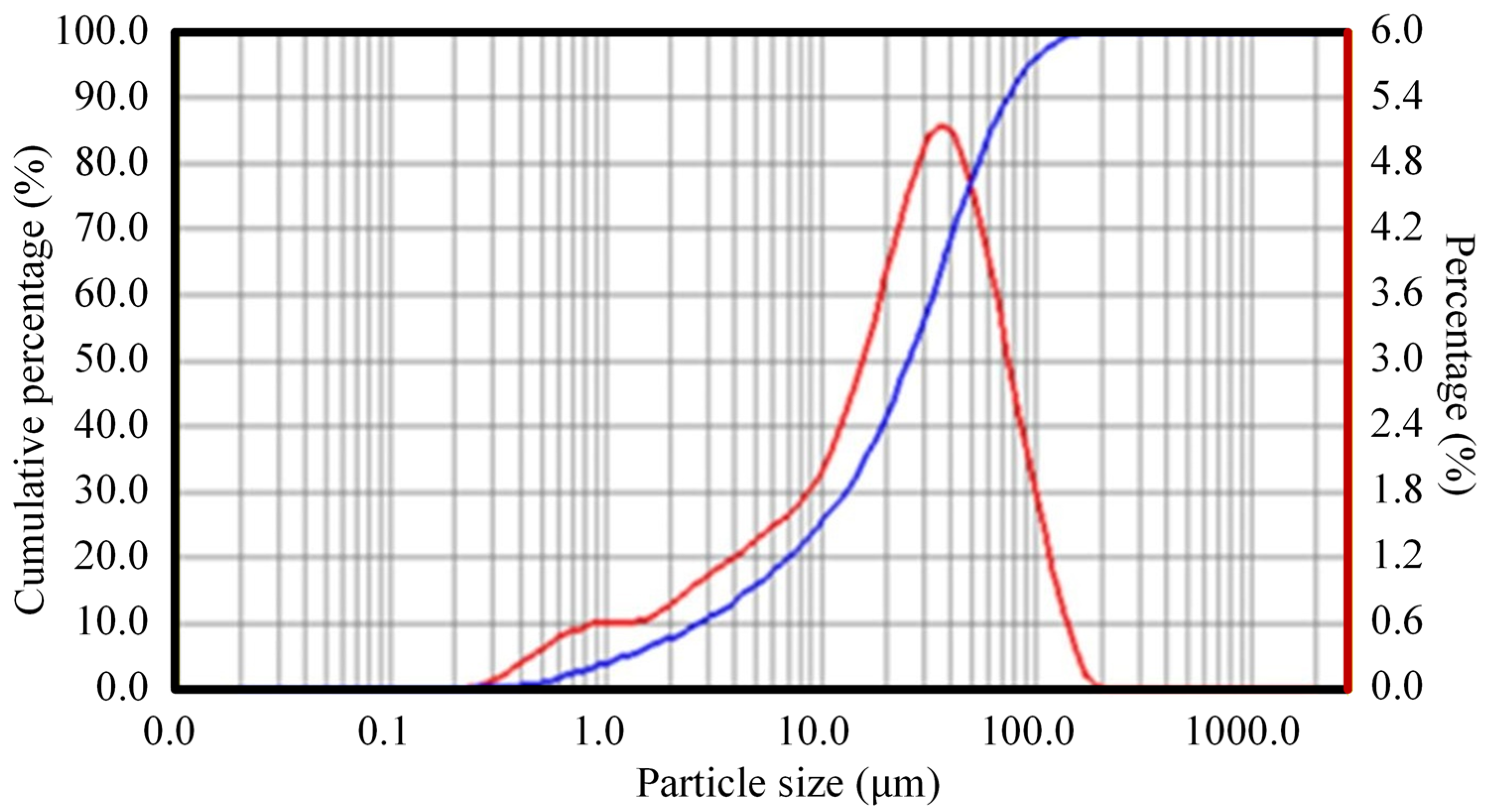
Through laser particle size analysis, the particle gradation and grain size of the loess were analyzed, as shown in Figure 9 and Table 2.

2.2.6. Rainfall Parameters

According to Mao et al. [42], the rainstorm intensity formula of Yulin city, Shaanxi province, is shown in Formula (1).
I = 1370.03 ( 1 + 1.152 lg P ) ( t + 9.44 ) 0.746
where I is the rainfall intensity (m/s), P is the rainfall return period (years), and t is the rainfall duration (min).
Based on Formula (1), the rainfall intensities with rainfall durations of 6 h, 12 h, 24 h, and 48 h under the once-in-a-century rainfall return period are 5.5 × 10⁻⁵ m/s, 3.3 × 10⁻⁶ m/s, 1.98 × 10⁻⁶ m/s, and 1.19 × 10⁻⁶ m/s, respectively.

3. Study Methodology

3.1. Early Warning for Shallow Loess Landslide

Head pressure at different depths calculated by the TRIGRS model was produced in the form of three-dimensional data represented by multiple vertical points [43]. The head pressure was led into the Scoops 3D model, and the Bishop rock-soil moment balance method was selected for stability prediction, as shown in Formula (2) [44].
F s = tan φ tan δ + c χ ψ Z , t γ w tan φ γ a Z sin δ cos δ
where Fs is the safety factor, γw is the water unit weight (kN/m3), γa is the natural soil bulk density (kN/m3), δ is the slope gradient (°), and ψ is the head pressure. Fs ≤ 1 indicates unstable, 1 < Fs ≤ 1.25 indicates potentially unstable, 1.25 < Fs ≤ 1.5 indicates relatively stable, and Fs > 1.5 indicates stable.
The rainfall intensity and rainfall duration were used as the variables for the early warning for shallow loess landslides, and the proportions of unstable grids reaching 25%, 40%, and 55% were the triggering conditions for the Tier 3, 2, and 1 Warnings, respectively.
Rerunning the TRIGRS-Scoops 3D joint model for 690 times, the rainfall intensities and rainfall durations of each grid were counted and fitted into rainfall threshold curves. The fitting method is shown in Formulas (3) and (4).
lg I = β lg t + lg η
I = η t β
where η and β are the fitting parameters.

3.2. Risk Assessment for Shallow Loess Landslide

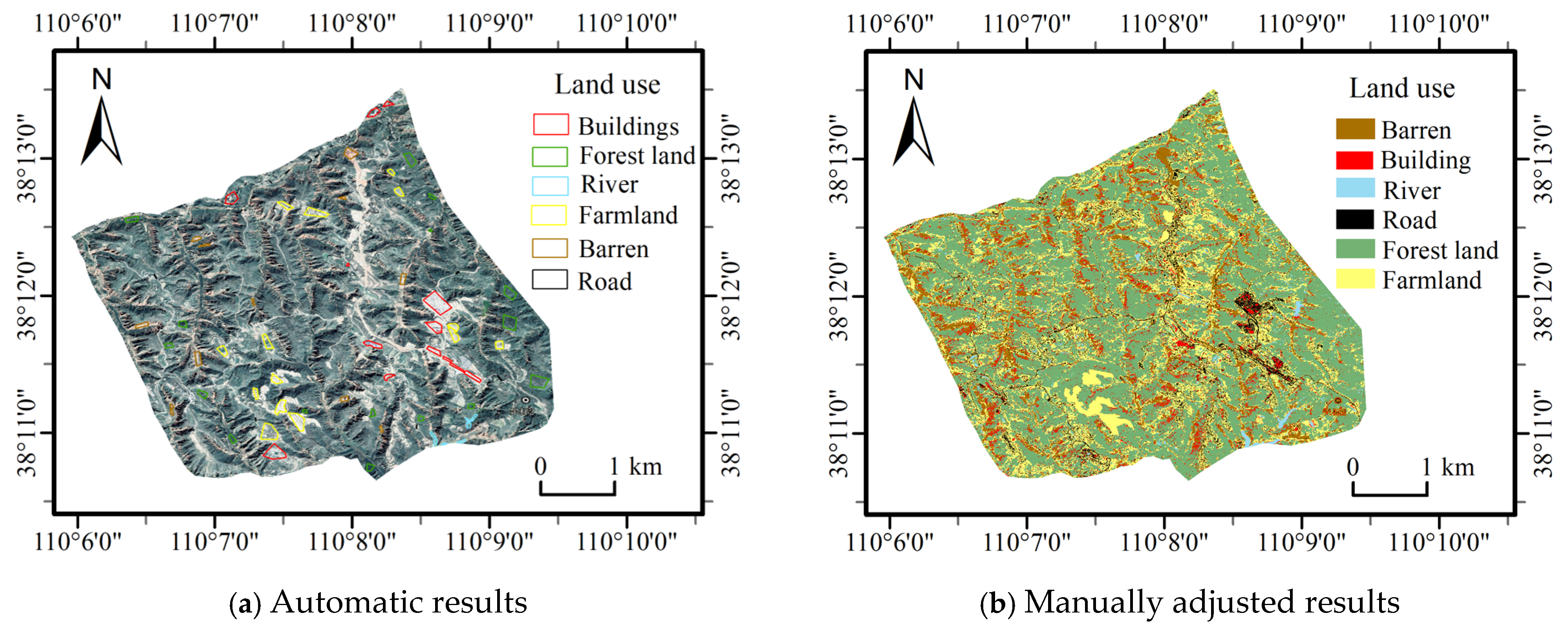
Land use of the Google Earth image in the study area was automatically divided into six types based on the maximum likelihood classifier of ArcGIS 10.2 [45]: barren, building, river, road, forest land, and farmland. According to the field survey, the automatic division results were manually adjusted.
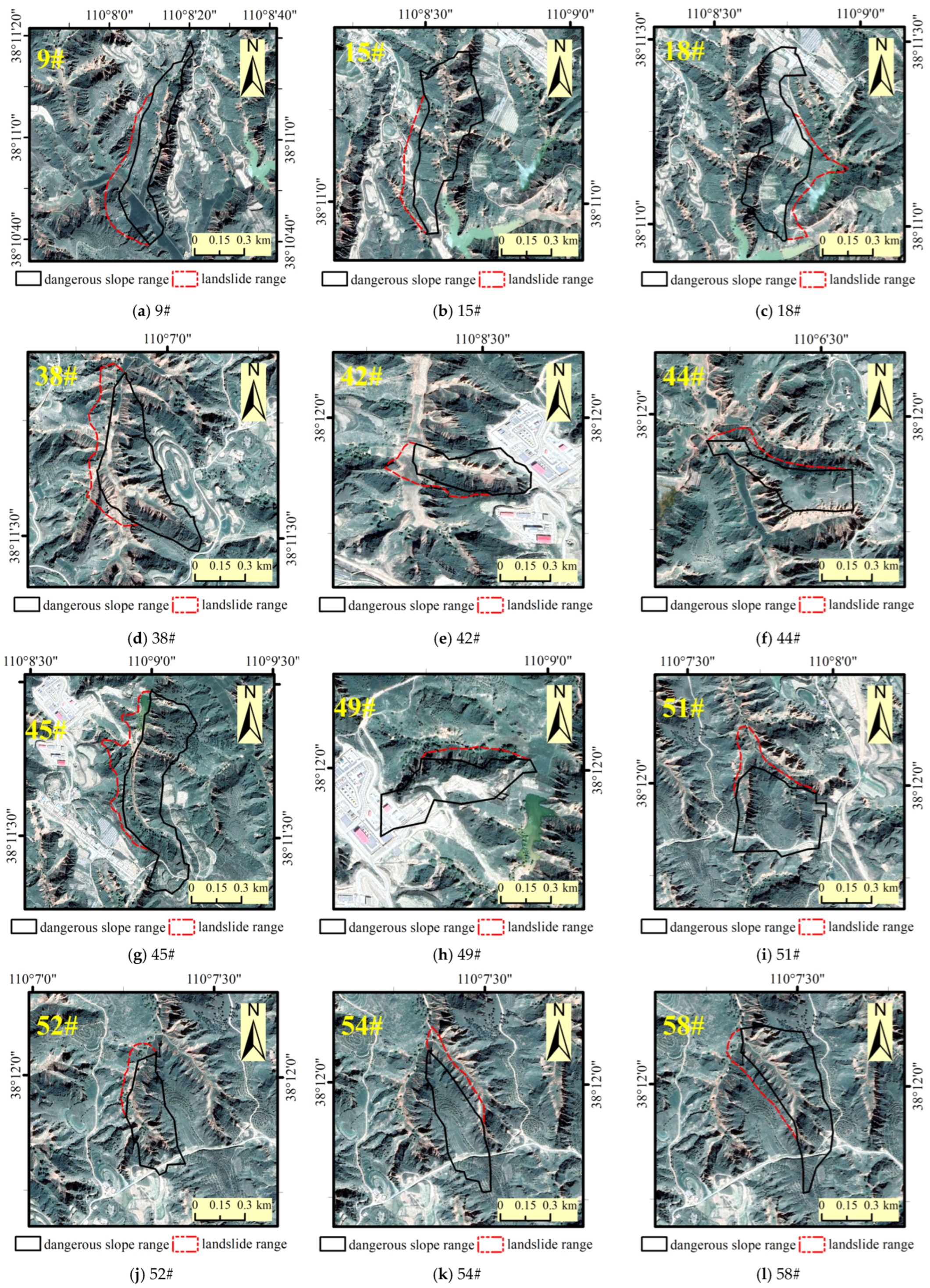
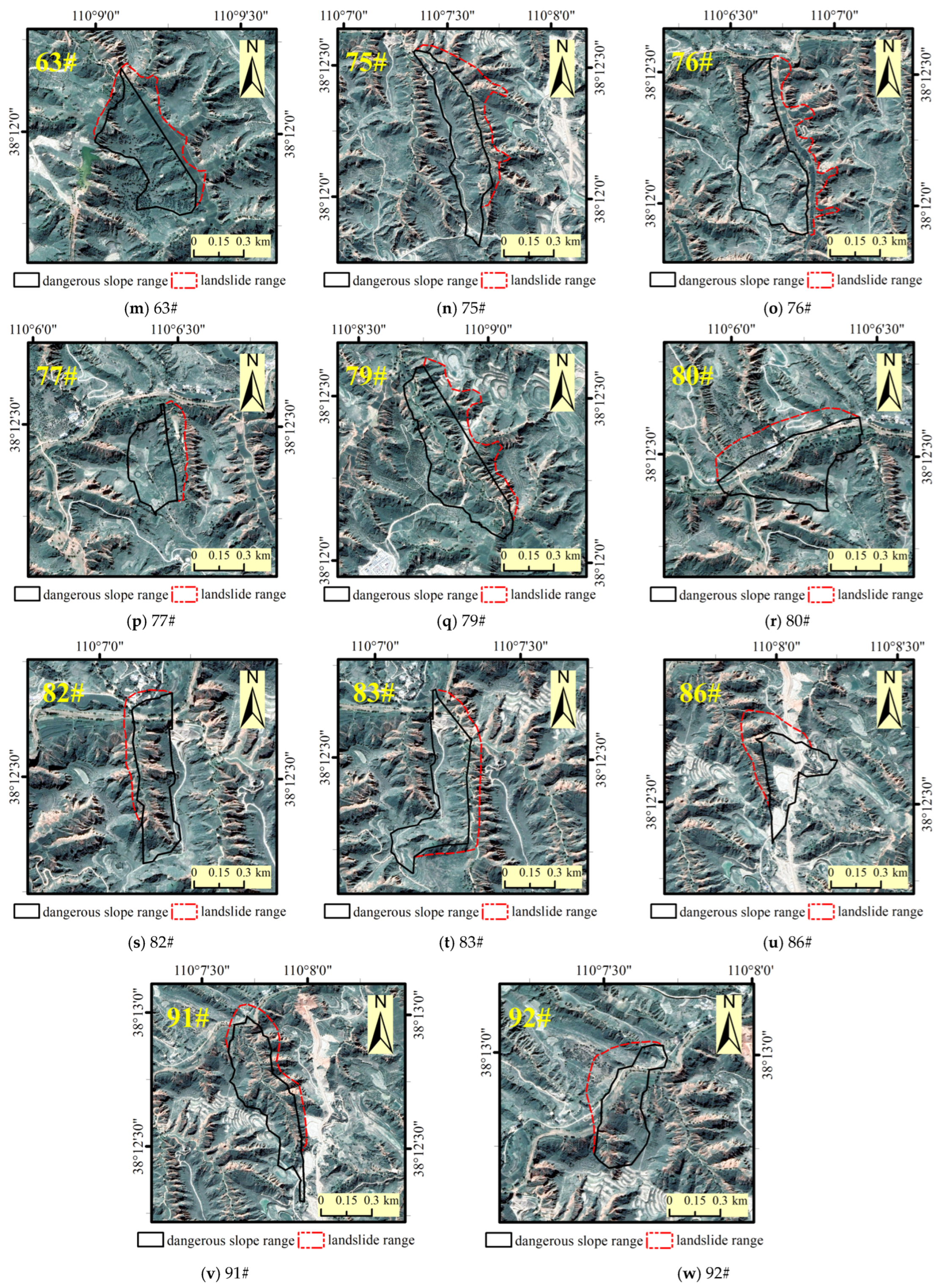
Landslide hazard mapping refers to determining the landslide ranges after the instability of dangerous slopes, including the influence range on both sides and the front coverage area [46]. The influence range on both sides is determined according to the slope aspect, topography, and engineering experience, and the front coverage area is calculated by the empirical formula [47], as shown in Formula (5).
L max = 2 ( H 1 H 2 )
where Lmax is the maximum slipping distance (m), H1 is the posterior border elevation (m), and H2 is the anterior border elevation (m).
With reference to the “Compensation Standard for Land Acquisition and Demolition of Key Construction Projects in Yulin City”, the unit price of each land use was assigned, as shown in Table 3.
The calculation method of the expected economic loss is shown in Formula (6).
S = i = 1 n H W i A i
where S is the expected economic loss (yuan), n is the number of land uses, and i is the i-th land use, Wi is the unit price (yuan/m2) of the i-th land use, and Ai is the area of the i-th land use. H is the early warning level coefficient; the Tier 3 Warning takes 25%, the Tier 2 Warning takes 40%, and the Tier 1 Warning takes 55%.

4. Study Results

4.1. Early Warning for Shallow Loess Landslide

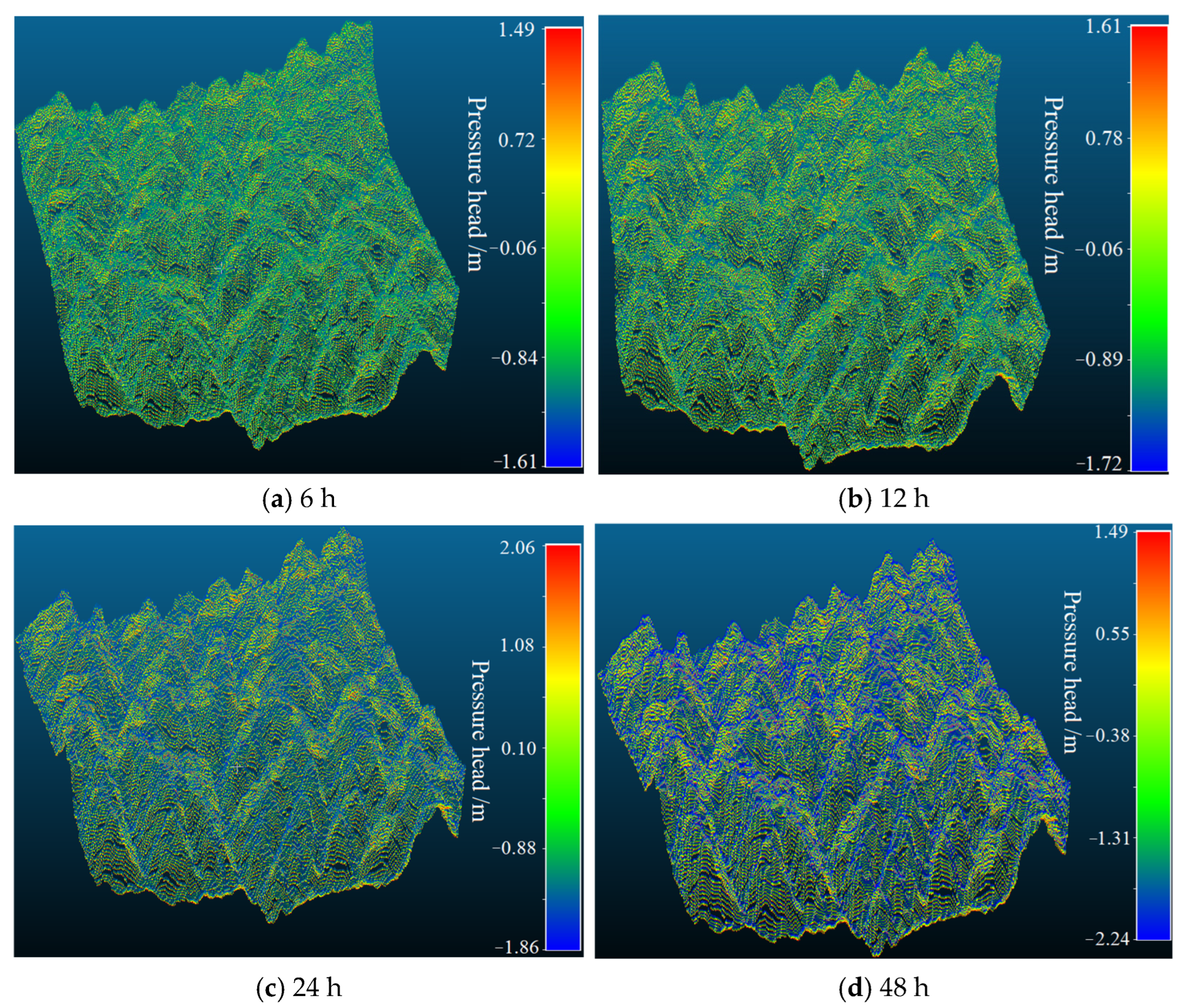
After visualization by Cloud Compare, the head pressures with rainfall durations of 6 h, 12 h, 24 h, and 48 h under the once-in-a-century rainfall return period of the study area are shown in Figure 10.
In Figure 10, the largest head pressures recorded with the rainfall durations of 6 h, 12 h, 24 h, and 48 h are 1.49 m, 1.61 m, 2.06 m, and 2.73 m, respectively.
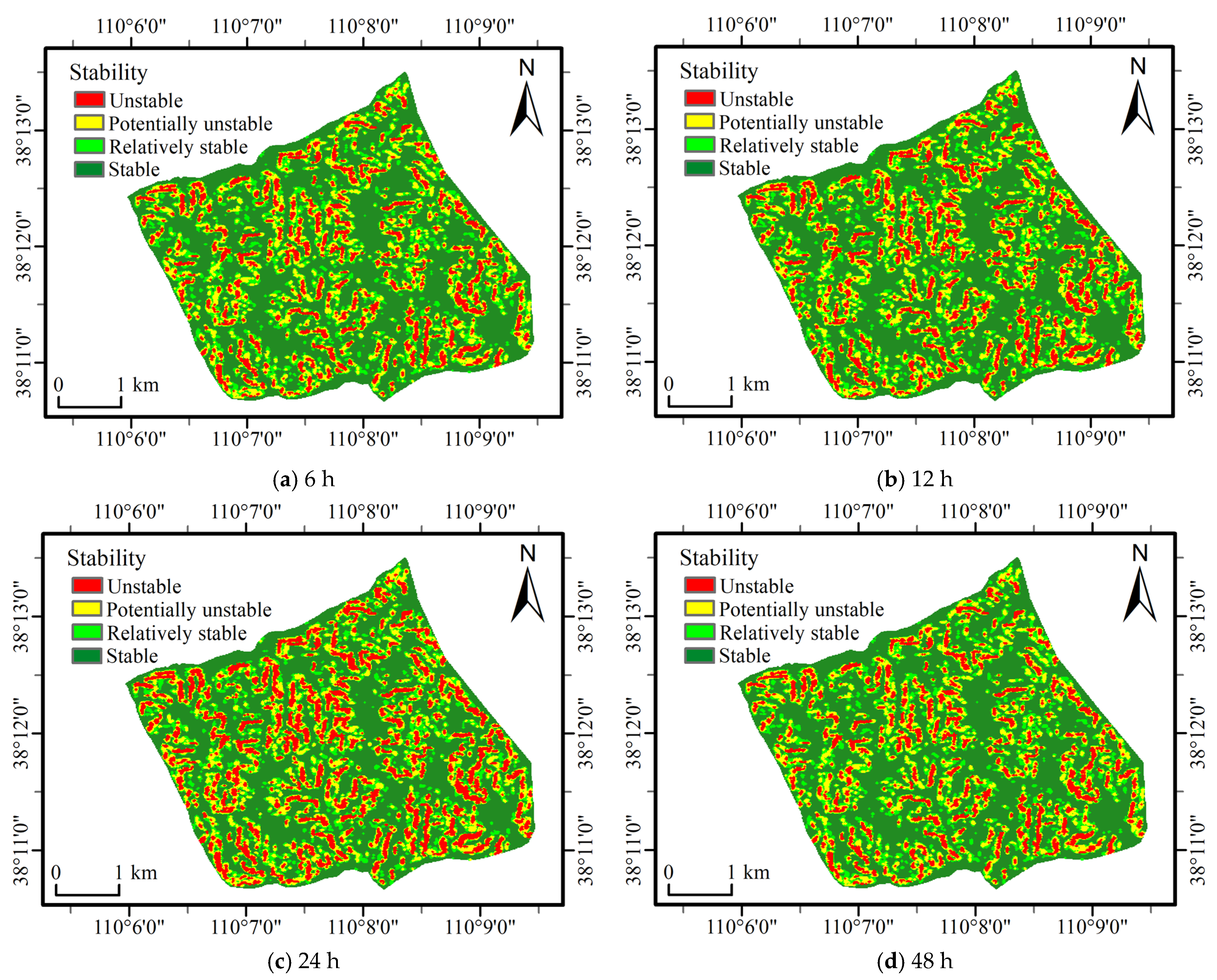
The slope stability prediction results of the study area are shown in Figure 11.
Under the once-in-a-century rainfall return period, the number for grids of each stable grade with rainfall durations of 6 h, 12 h, 24 h, and 48 h are shown in Table 4. The number of unstable grids is at its largest when the duration is 24 h, so a 24 h rainfall duration was defined as the extreme rainfall condition under the once-in-a-century rainfall return period.
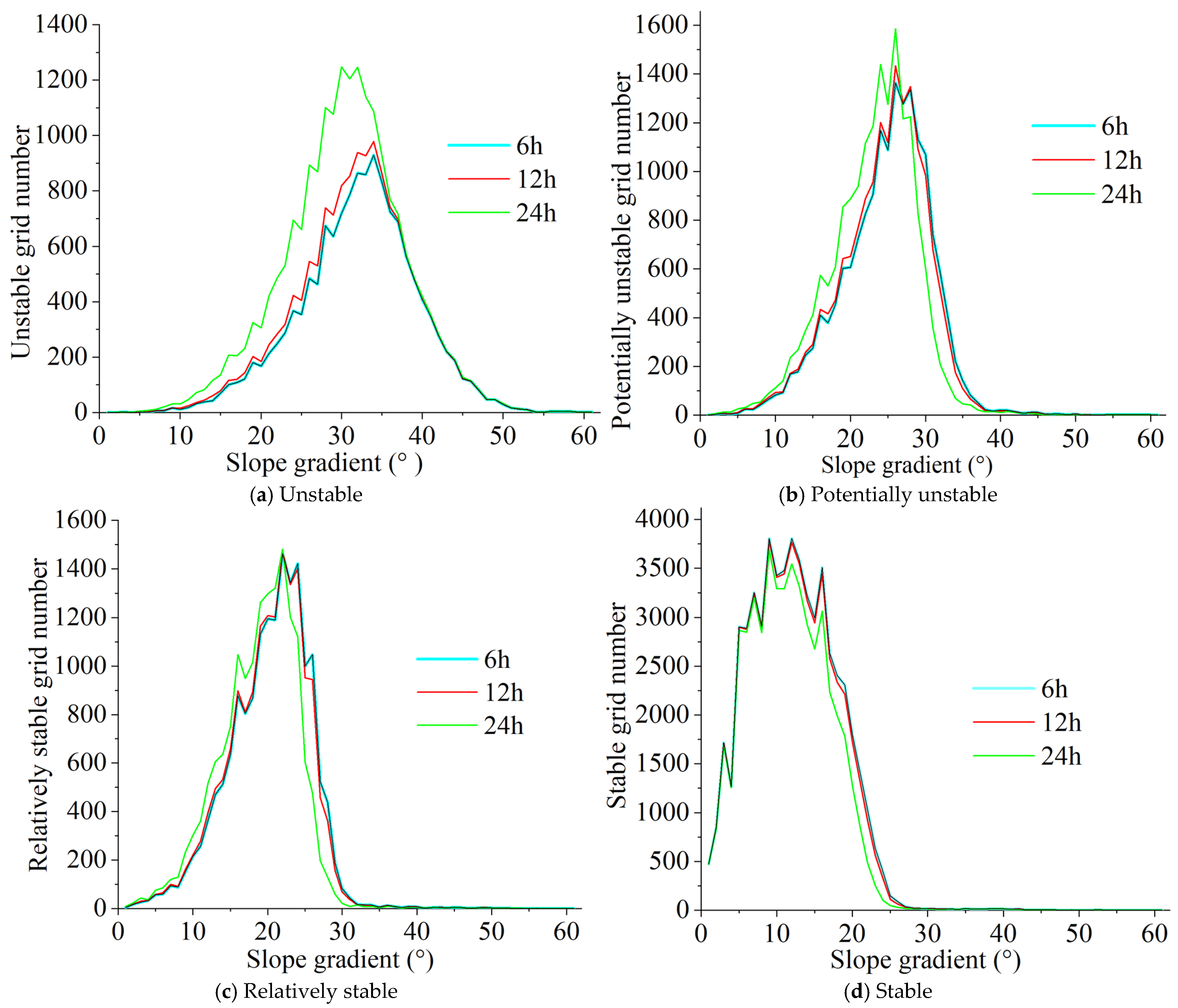
The relationship between the slope gradient and the number of grids of each stable grade is shown in Figure 12.
As shown in Figure 12, the unstable grids are concentrated within a slope gradient of 30° to 35°, the potentially unstable grids are concentrated within a slope gradient of 25° to 30°, and the stable grids are concentrated in a slope gradient of under 15°. The 23 slopes that reach the Tier 3 Warning under the extreme rainfall condition (9#, 15#, 18#, 38#, 42#, 44#, 45#, 49#, 51#, 52#, 54#, 58#, 63#, 75#, 76#, 77#, 79#, 80#, 82#, 83#, 86#, 91# and 92#) were defined as dangerous slopes with landslides.
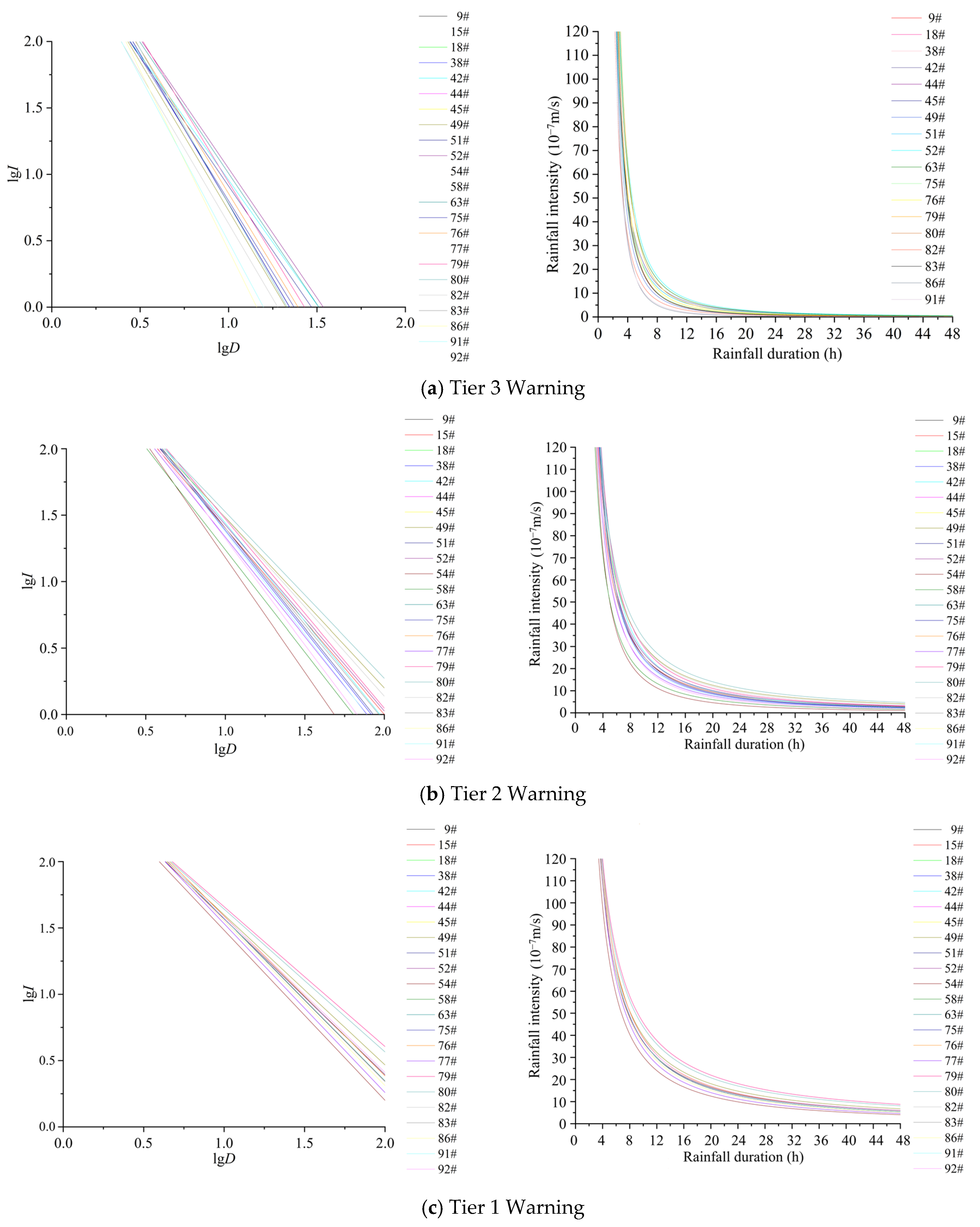
The rainfall threshold curves for the dangerous slopes are shown in Figure 13, and the fitting parameters η and β are shown in Table 5.
In the traversed rainfall range, all 23 dangerous slopes have reached the Tier 3, 2, and 1 Warnings. The 15#, 54#, 58#, 77#, and 92# slopes have reached the Tier 3 Warning in the natural state (no rainfall). The rainfall threshold curves for the Tier 2 and Tier 1 Warnings tend to shift towards the upper right, which signifies that the demand for rainfall is markedly higher than that observed in the Tier 3 Warning. At the same time, the 83# and 86# slopes are more likely to reach the Tier 3 Warning, and the 54# and 58# slopes are more likely to reach the Tier 2 and Tier 1 Warnings.

4.2. Risk Assessment for Shallow Loess Landslide

The land use division results are shown in Figure 14.
The areas of barren, building, river, road, forest land, and farmland in the study area are 1.68 km2, 1.02 km2, 0.20 km2, 0.84 km2, 8.72 km2, and 4.02 km2, accounting for 10.2%, 6.2%, 1.2%, 5.1%, 52.9% and 24.4% of the total land area, respectively.
Based on the maximum slipping distance, slope aspect, topography, and engineering experience, the landslide hazard mapping of the 23 dangerous slopes was carried out. The landslide ranges were counted based on ArcGIS 10.2, as shown in Figure 15 and Table 6.
The land uses of each landslide range are shown in Table 7.
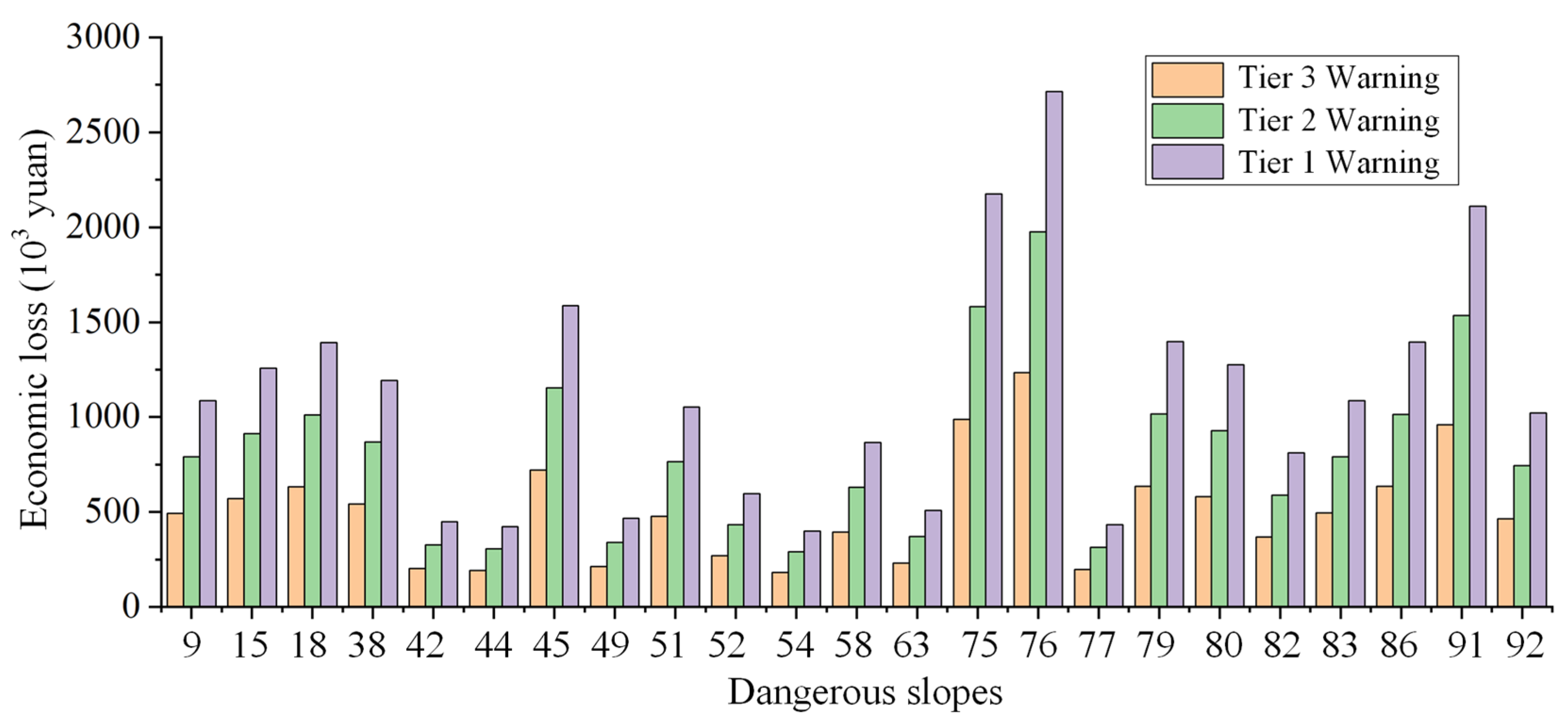
The calculation results of the expected economic loss are shown in Table 8 and Figure 16.
From Table 8 and Figure 16, the expected economic loss of the 76# slope is the highest, exceeding 20 million yuan under the Tier 1 Warning. The main reason is that the farmland and building areas within the landslide range are large, which are 124,779 m2 and 28,117 m2, respectively. The economic losses of the 75#, 91#, and 45# slopes are second, with more than 15 million yuan under the Tier 1 Warning. The 42#, 44#, 49#, 54#, and 77# slopes are smaller, less than 5 million yuan under the Tier 2 Warning. The main reason for this is that their landslide ranges are small, and most of these are barren.

5. Discussions

5.1. Comparison with Landslide Susceptibility Mapping Results

This paper identified 23 dangerous slopes based on the TRIGRS-Scoops 3D joint model. To verify its accuracy, LSM was also conducted, and the LSM results were compared with those obtained from the TRIGRS-Scoops 3D joint model. The study area in this paper and the study area of Ma et al. [48] are both covered by Quaternary loess, and the formation mechanisms and morphological characteristics of landslides are highly similar. Therefore, this paper adopts the LSM method like that of Ma et al. [48]. Due to space limitations, only the framework and results of LSM are presented here, as follows:
(1)
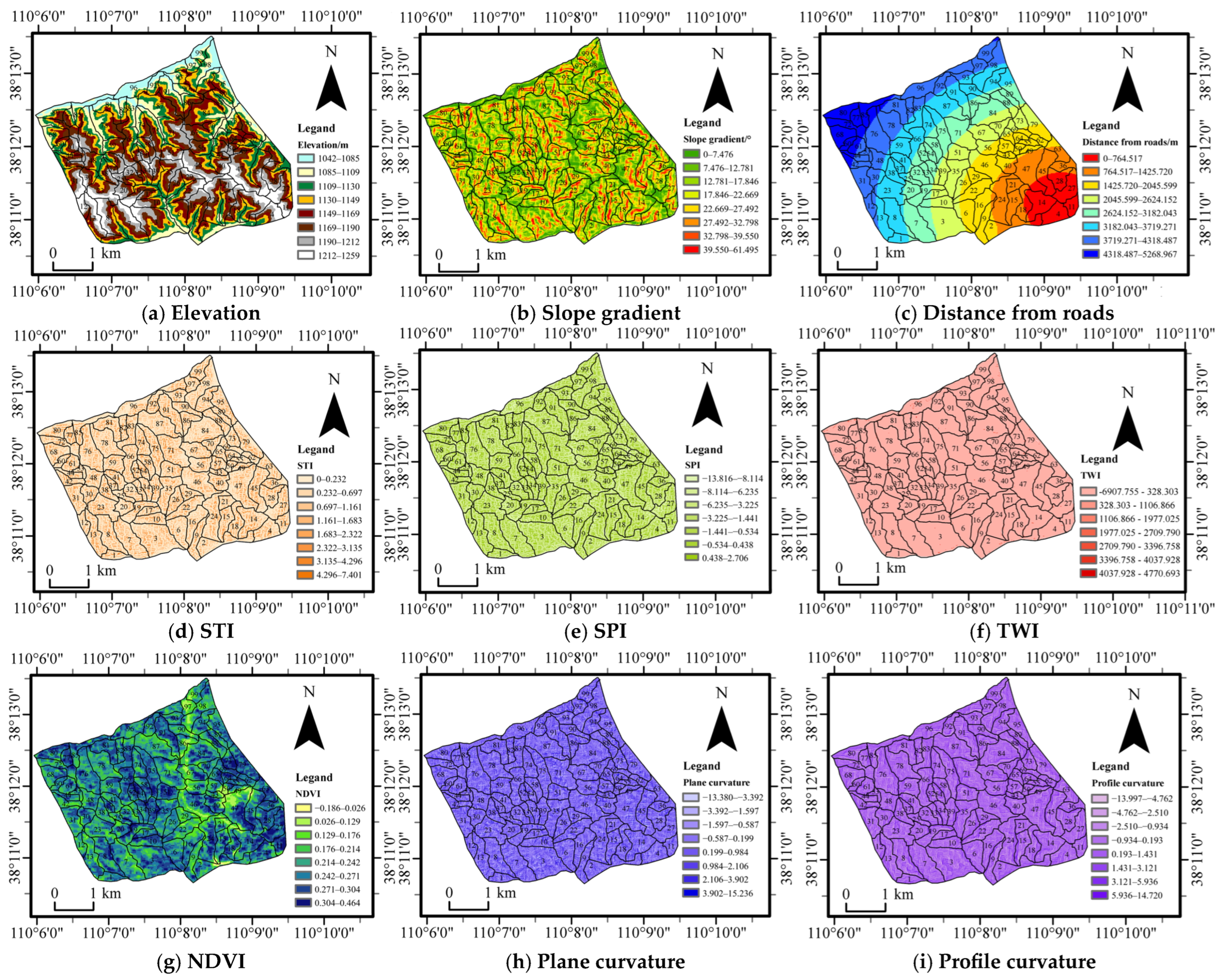
A total of 11 hazard factors were selected, including elevation, slope gradient, slope aspect, distance from roads, Sediment Transport Index (STI), stream power index (SPI), topographic wetness index (TWI), Normalized Difference Vegetation Index (NDVI), plane curvature, profile curvature, and land use. The classification of each hazard factor is shown in Table 9. Based on ArcGIS 10.2, classification maps of hazard factors were generated, as shown in Figure 17 (slope aspect and land use are shown in Figure 5 and Figure 14b, respectively).
(2)
A total of 246 landslides on the Loess Plateau were used to construct the training and validation sets [48]. Using the resampling function of ArcGIS 10.2, 6160 landslide grids of 10 m × 10 m were obtained. Meanwhile, 6160 non-landslide grids were randomly selected from non-landslide areas. 70% landslide grids (4312) and 70% non-landslide grids (4312) were selected as training samples, while 30% landslide grids (1848) and 30% non-landslide grids (1848) were validation samples. The Blending-XGBoost-CNN model was selected for landslide susceptibility modeling, in which the Blending framework was used to connect the XGBoost model and CNN model [49].
(3)
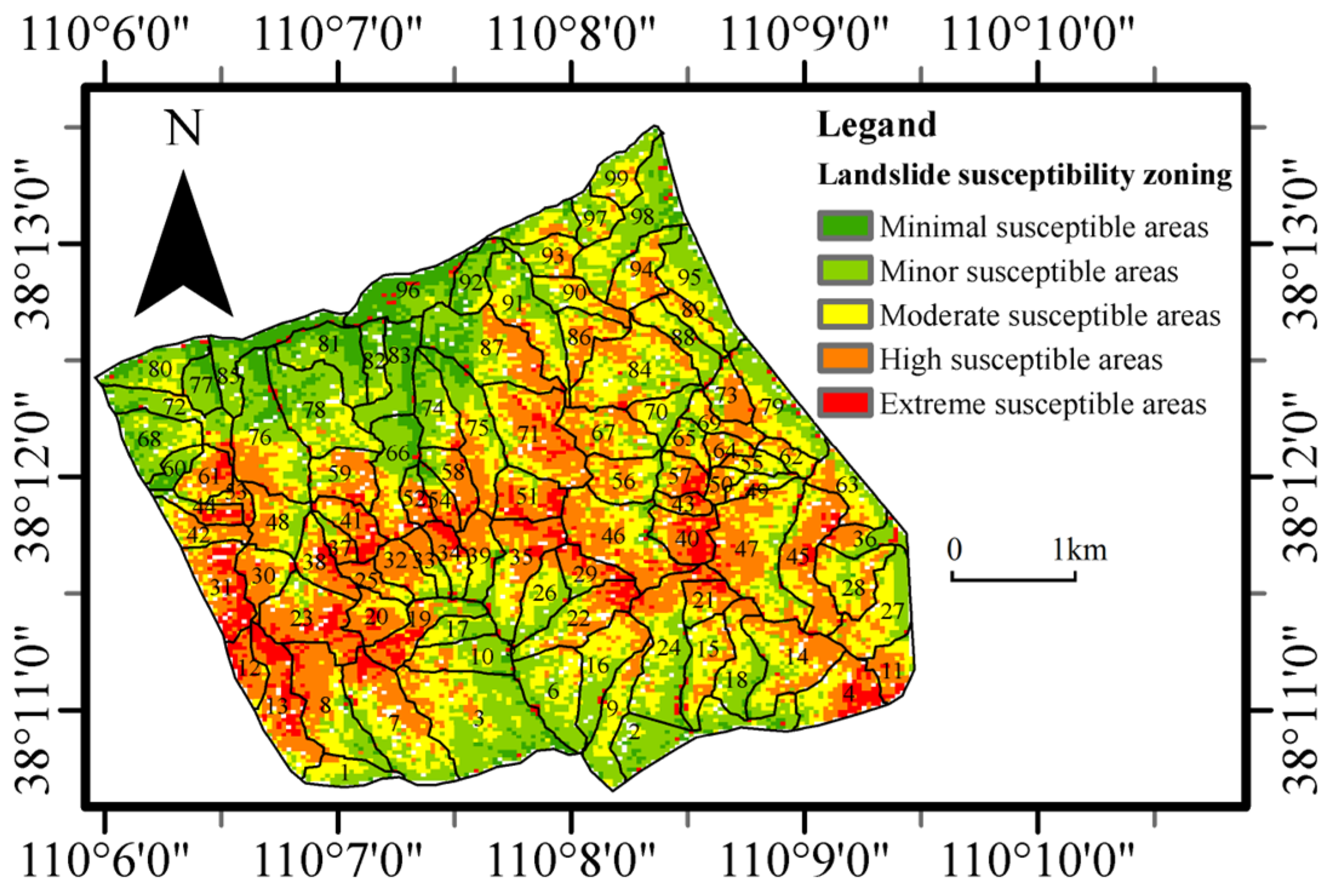
The study area was divided into five susceptible levels based on the landslide susceptibility probability, as shown in Figure 18. Specifically, extreme susceptible areas account for 5.78% of the total study area, high susceptible areas account for 10.54%, moderate susceptible areas account for 18.36%, minor susceptible areas account for 27.15%, and minimal susceptible areas account for 38.17%, respectively.
A comparison between Figure 18 and the calculation results of the TRIGRS-Scoops 3D joint model reveals the following:
(1)
The distribution of both extreme susceptible grids and high susceptible grids across all 23 dangerous slopes demonstrates the reasonableness of the TRIGRS-Scoops 3D joint model. For instance, the proportions of extreme susceptible grids and high susceptible grids in the 38# slope reached 38.15% and 49.64%, while in the 51# slope reached 34.27% and 52.19%, respectively.
(2)
The landslide susceptible probability within some dangerous slopes exhibits spatial variability. For example, although the proportions of extremely susceptible grids and highly susceptible grids in the 54# and 58# slopes are not high, they are concentrated on the eastern and southern sides. This is attributed to the large spatial scale of the slopes and the resulting differences in the microscopic hazard-pregnant environment. However, this does not reduce the probability of landslide occurrence under extreme rainfall conditions.

5.2. The Influence of Slope Gradient on Shallow Loess Landslides

The mapping relationship between the slope gradient and shallow loess landslides is extremely comple. Firstly, the higher the slope gradient, the more complex the internal stress state of the slope, the stronger the surface cutting, and the greater the probability of landslide occurrence [50]. This paper statistically analyzed the relationship between the number of grids of each stable grade and the slope gradient. The results show that the unstable grids in the study area are concentrated within a slope gradient of 30° to 35°, the potentially unstable grids are concentrated within the slope gradient of 25° to 30°, and the stable grids are concentrated in a slope gradient of below 15°. This is basically consistent with the existing studies, revealing that shallow loess landslides mostly occur in slope gradients of 30° to 40° [51]. Secondly, the intensity of rainfall infiltration is inversely proportional to the slope gradient [52]. Under heavy rainfall conditions, the smaller the slope gradient, the larger the runoff range, the smaller the flow rate, and the greater the infiltration volume [53,54]. For example, the gradient of the 54# and 58# slopes in the study area is lower than that of the surrounding slopes, and the rainfall infiltration is strong, which is the reason for its being easier to achieve the Tier 2 and 1 Warnings. Thirdly, steeper loess slopes generally have lower vegetation coverage, which reduces rainwater interception and further decreases slope stability. In future research, the author will elucidate the disaster mechanisms of shallow loess landslides from the following aspects: the influence of vegetation root models, spatial variability of loess parameters, slope scale, and crack development on the probability and scale of landslide occurrence under different slope gradient conditions.

6. Conclusions

In this paper, the head pressures calculated using the TRIGRS model were put into the Scoops 3D model, and shallow loess landslide spatial prediction in the study area was carried out, and the relationship between the slope gradient and the number of grids for each stable grade was certified. The rainfall thresholds for landslides, based on both the rainfall intensity and the rainfall duration, were obtained by rerunning the TRIGRS- Scoops 3D joint model. The landslide range and land uses of each dangerous slope were determined by maximum likelihood classification, and then the expected economic loss was calculated. To verify the reliability of the TRIGRS-Scoops 3D joint model, the identified dangerous slopes were compared with the results from LSM.
(1)
The unstable grids are concentrated within a slope gradient of 30° to 35°, the potentially unstable grids are concentrated in the slope gradient of 25° to 30°, and the stable grids are concentrated in a slope gradient of under 15°.
(2)
The rainfall threshold curves for the dangerous slopes were drawn, including 18 Tier 3 Warning curves, 23 Tier 2 Warning curves, and 23 Tier 1 Warning curves. The 15#, 54#, 58#, 77#, and 92# slopes reach the Tier 3 Warning in the natural state (no rainfall), and the 54# and 58# slopes are more likely to reach the Tier 2 and Tier 1 Warnings.
(3)
The expected economic loss of the 76# slope is the highest, exceeding 20 million yuan under the Tier 1 Warning. The 42#, 44#, 49#, 54#, and 77# slopes are smaller, less than 5 million yuan under the Tier 2 Warning.
(4)
The distribution of both extreme susceptible grids and high susceptible grids across all 23 dangerous slopes demonstrates the reasonableness of the TRIGRS-Scoops 3D joint model. The landslide susceptible probability within some dangerous slopes exhibits spatial variability.
(5)
The mapping relationship between the slope gradient and loess landslides is extremely complex. In future research, the author will elucidate the disaster mechanisms of shallow loess landslides from the following aspects: the influence of vegetation root models, spatial variability of loess parameters, slope scale, and crack development on the probability and scale of landslide occurrence under different slope gradient conditions.

Author Contributions

Conceptualization, F.G. and C.Y.; methodology, Y.M.; software, Q.W.; validation, J.H. and F.M.; formal analysis, J.G.; investigation, F.G.; resources, C.Y.; data curation, Q.W.; writing—original draft preparation, J.H.; writing—review and editing, F.M.; visualization, J.G.; supervision, C.Y.; project administration, Y.M.; funding acquisition, F.G. All authors have read and agreed to the published version of the manuscript.

Funding

This research was supported by the National Natural Science Foundation of China (Grant No. 51808327) and the Natural Science Foundation of Shandong Province (Grant No. ZR2019PEE016).

Data Availability Statement

The data that support the findings of this study are available from the corresponding author upon reasonable request. The data are not publicly available due to privacy and anonymity.

Conflicts of Interest

The authors declare no conflicts of interest.

References

  1. Zhang, Y.; Han, J.; Wang, X.; Jiang, D.; Li, J. Evaluation of loess collapsibility based on random field theory in Xi’an, China. Math. Probl. Eng. 2022, 1, 8665061. [Google Scholar] [CrossRef]
  2. Francisca, F.M.; Giomi, I.; Rocca, R.J. Inverse analysis of shallow foundation settlements on collapsible loess: Understanding the impact of varied soil mechanical properties during Wetting. Comput. Geotech. 2024, 167, 106090. [Google Scholar] [CrossRef]
  3. Roul, A.R.; Pradhan, S.P.; Panda, S.D. The relation between rainfall and landslides in India: An empirical approach for prediction of landslide. J. Earth Syst. Sci. 2025, 134, 97. [Google Scholar] [CrossRef]
  4. Lainas, S.; Sabatakakis, N.; Koukis, G. Rainfall thresholds for possible landslide initiation in wildfire-affected areas of western Greece. Bull. Eng. Geol. Environ. 2016, 75, 883–896. [Google Scholar] [CrossRef]
  5. Shao, X.; Ma, S.; Xu, C. Distribution and characteristics of shallow landslides triggered by the 2018 Mw 7.5 Palu earthquake, Indonesia. Landslides 2023, 20, 157–175. [Google Scholar] [CrossRef]
  6. Panzeri, L.; Mondani, M.; Papini, M.; Longoni, L. Snow melting experimental analysis on a downscaled shallow landslide: A focus on the seepage activity of the snow–soil system. Water 2025, 17, 597. [Google Scholar] [CrossRef]
  7. Zhuang, J.; Peng, J.; Du, C.; Zhu, Y.; Kong, J. Shallow-landslide stability evaluation in loess areas according to the Revised Infinite Slope Model: A case study of the 7.25 Tianshui sliding-flow landslide events of 2013 in the southwest of the Loess Plateau, China. Nat. Hazards Earth Syst. Sci. 2024, 24, 2615–2631. [Google Scholar] [CrossRef]
  8. Huang, Q.; Peng, J.; Fan, W.; Wang, X.; Zhu, W.; Xu, L.; Tang, Y.; Zhuang, J.; Leng, Y.; Ma, P.; et al. Challenges confronting and coping strategies for the governance of geohazard chains on the loess plateau. Bull. Natl. Nat. Sci. Found. China 2025, 39, 1030–1043. (In Chinese) [Google Scholar] [CrossRef]
  9. Zhang, J.; Qiu, H.; Tang, B.; Yang, D.; Liu, Y.; Liu, Z.; Zhu, Y. Accelerating effect of vegetation on the instability of rainfall-induced shallow landslides. Remote Sens. 2022, 14, 5743. [Google Scholar] [CrossRef]
  10. Zhang, S.Q.; Wang, Y.W.; Zhang, H.B.; Lyu, F.G.; Yang, T.Z.; Li, Y.B.; Yao, C.C. Investigating the Loess Plateau’s coevolution of precipitation and natural vegetation cover. Environ. Earth Sci. 2024, 83, 178. [Google Scholar] [CrossRef]
  11. Fang, Z.; Wang, J.; Wang, Y.; Du, B.; Liu, G. Improved landslide prediction by considering continuous and discrete spatial dependency. Landslides 2025, 22, 1107–1122. [Google Scholar] [CrossRef]
  12. Sim, K.B.; Lee, M.L.; RemenytePrescott, R.; Wong, S.Y. Perception on landslide risk in Malaysia: A comparison between communities and experts’ surveys. Int. J. Disaster Risk Reduct. 2023, 95, 103854. [Google Scholar] [CrossRef]
  13. Wang, G.; Chen, X.; Chen, W. Spatial prediction of landslide susceptibility based on GIS and discriminant functions. ISPRS Int. J. Geo-Inf. 2020, 9, 144. [Google Scholar] [CrossRef]
  14. Miah, M.D.; Subah, S.; Ali, Y. Leveraging remote sensing data with AHP and geospatial analysis for landslide susceptibility hotspot assessment in Bandarban of Bangladesh. Geohazard Mech. 2025, 3, 272–285. [Google Scholar] [CrossRef]
  15. Alvioli, M.; Baum, R.L. Parallelization of the TRIGRS model for rainfall-induced landslides using the message passing interface. Environ. Model. Softw. 2016, 81, 122–135. [Google Scholar] [CrossRef]
  16. Qiu, H.; Zhu, Y.; Zhou, W.; Sun, H.; He, J.; Liu, Z. Influence of DEM resolution on landslide simulation performance based on the Scoops3D model. Geomat. Nat. Hazards Risk 2022, 13, 1663–1681. [Google Scholar] [CrossRef]
  17. Melo, C.M.; Kobiyama, M.; Michel, G.P.; Brito, M.M. The relevance of geotechnical-unit characterization for landslide susceptibility mapping with SHALSTAB. GeoHazards 2021, 2, 383–397. [Google Scholar] [CrossRef]
  18. Yang, L.; Cui, Y.; Xu, C.; Ma, S. Application of coupling physics–based model TRIGRS with random forest in rainfall-induced landslide-susceptibility assessment. Landslides 2024, 21, 2179–2193. [Google Scholar] [CrossRef]
  19. Ma, S.; Shao, X.; Xu, C. Physically-based rainfall-induced landslide thresholds for the Tianshui area of Loess Plateau, China by TRIGRS model. Catena 2023, 233, 107499. [Google Scholar] [CrossRef]
  20. Palazzolo, N.; Peres, D.J.; Bordoni, M.; Meisina, C.; Creaco, E.; Cancelliere, A. Improving spatial landslide prediction with 3d slope stability analysis and genetic algorithm optimization: Application to the Oltrepò Pavese. Water 2021, 13, 801. [Google Scholar] [CrossRef]
  21. Mao, J.; Ma, X.; Wang, H.; Jia, L.; Sun, Y.; Zhang, B.; Zhang, W. Spatio-temporal prediction of three-dimensional stability of highway shallow landslide in Southeast Tibet based on TRIGRS and Scoops3D coupling model. Water 2024, 16, 1207. [Google Scholar] [CrossRef]
  22. Li, Z.; Ma, P.; Zhuang, J.; Mu, Q.; Kong, J.; Zhao, L.; Peng, J. Permeability characteristics, structural failure characteristics, and triggering process of loess landslides in two typical strata structures. Eng. Geol. 2024, 341, 107728. [Google Scholar] [CrossRef]
  23. Liu, W.; Bai, R.; Sun, X.; Yang, F.; Zhai, W.; Su, X. Rainfall-and irrigation-induced landslide mechanisms in loess slopes: An experimental investigation in Lanzhou, China. Atmosphere 2024, 15, 162. [Google Scholar] [CrossRef]
  24. Zhou, C.; Xia, Z.; Chen, D.; Miao, L.; Hu, S.; Yuan, J.; Huang, W.; Liu, L.; Ai, D.; Xu, H.; et al. Extreme rainfall events triggered loess collapses and landslides in Chencang District, Shaanxi, China, during June–October 2021. Water 2021, 16, 2279. [Google Scholar] [CrossRef]
  25. Hou, T.; Jiang, X.; Chen, Y. Mechanism of rainfall-induced toppling in loess collapses. Earth Surf. Process. Landf. 2024, 49, 2825–2839. [Google Scholar] [CrossRef]
  26. Rashid, B.; Iqbal, J.; Su, L.J. Landslide susceptibility analysis of Karakoram highway using analytical hierarchy process and scoops 3D. J. Mt. Sci. 2020, 17, 1596–1612. [Google Scholar] [CrossRef]
  27. Wang, Y.H.; Wang, L.Q.; Zhang, W.G.; Liu, S.L.; Sun, W.X.; Hong, L.; Zhu, Z.W. A physics-informed machine learning solution for landslide susceptibility mapping based on three-dimensional slope stability evaluation. J. Cent. South Univ. 2024, 31, 3838–3853. [Google Scholar] [CrossRef]
  28. Kachi, N.; Kajimoto, R.; Tsukahara, K.; Akiyama, Y. Consideration on disaster recovery system to improve resilience of frequent-landslide dangerous area. Procedia-Soc. Behav. Sci. 2016, 218, 181–190. [Google Scholar] [CrossRef]
  29. Caleca, F.; Tofani, V.; Raspini, F.; Segoni, S.; Casagli, N. Quantitative landslide risk assessment for Italy. Landslide 2025, 22, 3537–3559. [Google Scholar] [CrossRef]
  30. Talaei, R.; Samadov, S. Quantitative landslide risk analysis in the Hashtchin area (NW-Iran). Eur. J. Environ. Civ. Eng. 2018, 22, 883–909. [Google Scholar] [CrossRef]
  31. Biswakarma, P.; Joshi, V.; Abdo, H.G.; Almohamad, H.; Abdullah, A.D.A.; Al-Mutiry, M. An integrated quantitative and qualitative approach for landslide susceptibility mapping in West Sikkim district, Indian Himalaya. Geomat. Nat. Hazards Risk 2023, 14, 2273781. [Google Scholar] [CrossRef]
  32. Tang, Y.M.; Xue, Q.; Li, Z.G.; Feng, W. Three modes of rainfall infiltration inducing loess landslide. Nat. Hazards 2015, 79, 137–150. [Google Scholar] [CrossRef]
  33. Dong, C.; Zhang, D. A 40-year climatology of summer heavy hourly rainfall over mountainous Shanxi in China. Int. J. Climatol. 2022, 42, 1937–1953. [Google Scholar] [CrossRef]
  34. Luo, M.; Li, T. Spatial and temporal analysis of landscape ecological quality in Yulin. Environ. Technol. Innov. 2021, 23, 101700. [Google Scholar] [CrossRef]
  35. He, J.; Qiu, H.; Qu, F.; Hu, S.; Yang, D.; Shen, Y.; Zhang, Y.; Sun, H.; Cao, M. Prediction of spatiotemporal stability and rainfall threshold of shallow landslides using the TRIGRS and Scoops3D models. Catena 2021, 197, 104999. [Google Scholar] [CrossRef]
  36. Fárek, V.; Unucka, J. Results comparison of the flow direction and accumulation algorithms together with distributed rainfall-runoff models in Czech Switzerland National Park. In Surface Models for Geosciences; Springer International Publishing: Cham, Switzerland, 2015; pp. 87–98. [Google Scholar]
  37. Li, Y.; Shi, W.; Aydin, A.; Beroya-Eitner, M.A.; Gao, G. Loess genesis and worldwide distribution. Earth-Sci. Rev. 2020, 201, 102947. [Google Scholar] [CrossRef]
  38. Zhang, F.; Peng, J.; Zhang, Y.; Wang, Y.; Zhang, T. Prediction of static liquefaction landslides in loess: Integrating triaxial shear parameters into the sliding-block model. Eng. Geol. 2026, 363, 108549. [Google Scholar] [CrossRef]
  39. GB/T 50123-2019; Standard for Geotechnical Testing Method. China Planning Press: Beijing, China, 2019.
  40. Pan, L.; Zhu, J.G.; Zhang, Y.F. Evaluation of structural strength and parameters of collapsible loess. Int. J. Geomech. 2021, 21, 04021066. [Google Scholar] [CrossRef]
  41. Ranathunga, K.N.; Finke, P.A.; Yin, Q.; Yu, Y. Calibrating SoilGen2 for interglacial soil evolution in the Chinese Loess Plateau considering soil parameters and the effect of dust addition rhythm. Quat. Int. 2022, 607, 100–112. [Google Scholar] [CrossRef]
  42. Mao, M.; Wu, S.; Lei, Y. Variation characteristics of intensity error of new and old rainstorm in main cities of Shaanxi province. Shaanxi Water Resour. 2023, 1, 62–65. (In Chinese) [Google Scholar]
  43. Babu, K.J. Determination of nodal desirable pressure-heads of water distribution network. Urban Water J. 2020, 17, 871–883. [Google Scholar] [CrossRef]
  44. Sun, X.; Zeng, P.; Li, T.; Zhang, L.; Jimenez, R.; Dong, X.; Xu, Q. A Bayesian approach to develop simple run-out distance models: Loess landslides in Heifangtai Terrace, Gansu Province, China. Landslides 2023, 20, 77–95. [Google Scholar] [CrossRef]
  45. Ding, Y.N.; Li, D.Q.; Zarei, C.; Yi, B.L.; Liu, Y. Probabilistically quantifying the effect of geotechnical anisotropy on landslide susceptibility. Bull. Eng. Geol. Environ. 2021, 80, 6615–6627. [Google Scholar] [CrossRef]
  46. Cong, P.; Zhang, D.; Yi, M. Application of ArcGIS 3D modeling technology in the study of land use policy decision making in China. Sci. Rep. 2023, 13, 20695. [Google Scholar] [CrossRef]
  47. Tan, Z.; Yin, C.; Zhang, X.; Ma, X.; Liu, X.; Li, S. Stability Assessment of Shallow Soil Landslide and Activating Rainfall Threshold. Nat. Hazards Rev. 2024, 25, 04024004. [Google Scholar] [CrossRef]
  48. Ma, B.; Yin, C.; Gao, F.; Song, X.; Li, M. Landslide Susceptibility Mapping Using Remote Sensing Interpretation and a Blending-XGBoost-CNN Model. Appl. Sci. 2025, 15, 11969. [Google Scholar] [CrossRef]
  49. Yang, W.; Niu, R.; Si, R.; Li, J. Geological Hazard Susceptibility Analysis and Developmental Characteristics Based on Slope Unit, Using the Xinxian County, Henan Province as an Example. Sensors 2024, 24, 2457. [Google Scholar] [CrossRef] [PubMed]
  50. Zou, Q.; Jiang, H.; Cui, P.; Zhou, B.; Jiang, Y.; Qin, M.; Liu, Y.; Li, C. A new approach to assess landslide susceptibility based on slope failure mechanisms. Catena 2021, 204, 105388. [Google Scholar] [CrossRef]
  51. Li, Y.R.; Mo, P. A unified landslide classification system for loess slopes: A critical review. Geomorphology 2019, 340, 67–83. [Google Scholar] [CrossRef]
  52. Huang, S.P.; Chen, J.Y.; Xiao, H.L.; Tao, G.L. Test on rules of rainfall infiltration and runoff erosion on vegetated slopes with different gradients. Rock Soil Mech. 2023, 44, 3435–3447. [Google Scholar]
  53. Tao, G.; Feng, S.; Xiao, H.; Gu, K.; Wu, Z. Rainfall Infiltration Test and Numerical Simulation Analysis of a Large Unsaturated Soil Slope. J. Hydrol. Eng. 2024, 29, 04024020. [Google Scholar] [CrossRef]
  54. Ma, P.; Li, Z.; Zhuang, J.; Mu, Q.; Kong, J.; Peng, J. Failure mechanism of a loess-red silty clay interface landslide on the Heifangtai platform, China. Bull. Eng. Geol. Environ. 2025, 84, 424. [Google Scholar] [CrossRef]
Figure 1. Study flowchart.
Applsci 16 03094 g001
Figure 2. Study area.
Applsci 16 03094 g002
Figure 3. Slope gradient distribution in the study area.
Applsci 16 03094 g003
Figure 4. Flow direction distribution in the study area.
Applsci 16 03094 g004
Figure 5. Slope units and their slope aspects in the study area.
Applsci 16 03094 g005
Figure 6. Post-failure scene of the representative slope (taken on 4 December 2024).
Applsci 16 03094 g006
Figure 7. Sampling location.
Applsci 16 03094 g007
Figure 8. Loess transportation.
Applsci 16 03094 g008
Figure 9. Particle gradation of the loess.
Applsci 16 03094 g009
Figure 10. Head pressures with different rainfall durations under the once-in-a-century rainfall return period.
Applsci 16 03094 g010
Figure 11. Slope stability prediction results with different rainfall durations under the once-in-a-century rainfall return period.
Applsci 16 03094 g011
Figure 12. Relationship between the slope gradient and the number of grids of each stable grade.
Applsci 16 03094 g012
Figure 13. Rainfall threshold curves for landslides.
Applsci 16 03094 g013
Figure 14. Land use.
Applsci 16 03094 g014
Figure 15. Landslide hazard mapping.
Applsci 16 03094 g015aApplsci 16 03094 g015b
Figure 16. Expected economic losses.
Applsci 16 03094 g016
Figure 17. Classification maps of hazard factors.
Applsci 16 03094 g017
Figure 18. LSM results of the study area.
Applsci 16 03094 g018
Table 1. Loess parameters.
ParameterρρsatwLwp
Value1.45 g·cm−313.35%27.53%13.25%
ParameterθsθrKSγps
Value0.420.131.16 e−5 m/s17.8 kN/m3
Parametercφγs
Value3.25 kPa27.8°21.42 kN/m3
Table 2. Grain size distribution of the loess.
Particle size (μm)0.000–0.2200.220–0.4700.470–1.0051.005–2.1482.148–4.591
Content (%)0.000.833.194.146.71
Particle size (μm)4.591–9.8139.813–20.9720.97–44.8344.83–95.8195.81–204.8
Value (%)10.0217.8830.3622.334.54
Table 3. Unit price of each land use.
Land UseBarrenBuildingRiverRoadForest LandFarmland
Unit price (yuan/m2)111100102702354
Table 4. Number of grids of each stable grade with different rainfall durations under the once-in- a-century rainfall return period.
Rainfall Duration6 h12 h24 h48 h
Stable Grade
Unstable14,04715,08619,95414,043
Potentially unstable16,93017,02817,62416,917
Relatively stable16,73916,64816,23716,739
Stable57,23056,18451,13157,247
Table 6. The areas of each landslide range.
SlopeArea/km2SlopeArea/km2SlopeArea/km2SlopeArea/km2SlopeArea/km2
9#0.2444#0.0954#0.0977#0.1286#0.2
15#0.2145#0.3558#0.1379#0.3191#0.34
18#0.2149#0.0663#0.2180#0.2492#0.16
38#0.1651#0.1875#0.3882#0.11
42#0.0652#0.0876#0.5183#0.21
Table 7. The land uses of each landslide range.
SlopeBarren/m2Building/m2River/m2Road/m2Forest Land/m2Farmland/m2
9#14,29911,98616002931176,87228,461
15#31,20014,5525766982119,62834,361
18#953313,330399318,920111,06152,607
38#43,97915,369280449064,39930,060
42#14,693505765388926,18314,102
44#12,2024597200147250,37616,968
45#29,79417,14714,1596185230,93946,780
49#2810327948512,82827,68314,046
51#12,83811,8502495939125,18927,247
52#14,3357708311229038,83412,657
54#4512420257191563,62310,997
58#16,80110,645263340876,80121,490
63#855538823274651185,1997604
75#54,90824,497120810,835212,72977,479
76#49,83628,117347116,442290,315124,779
77#570835922469237683,92123,171
79#35,91213,83554927610184,75563,448
80#22,16313,22728548658135,87453,682
82#21,52410,536237258859,51915,517
83#26,03910,73525568138106,15655,877
86#30,46313,09232419,11461,03275,173
91#62,04225,57512637114180,36464,529
92#18,02111,988368362587,29540,951
Table 8. Expected economic loss under each landslide warning grade.
SlopeExpected Economic Loss/Million Yuan
Tier 3 WarningTier 2 WarningTier 1 Warning
9#4947901086
15#5719141257
18#63310121392
38#5438681194
42#203326448
44#192307422
45#72111541586
49#213340468
51#4787651052
52#271433596
54#181290399
58#394630866
63#231370508
75#98915832176
76#123419752715
77#197314432
79#63510161397
80#5809271275
82#368589810
83#4947911088
86#63410151395
91#96015352111
92#4657431022
Table 5. Parameters of rainfall threshold curves for landslides.
Tier 3 WarningTier 2 WarningTier 1 Warning
SlopeηβSlopeηβSlopeηβ
9#915.71−2.169#786.68−1.519#628.77−1.23
15#----15#633.74−1.4015#580.84−1.18
18#917.89−2.2418#786.68−1.5118#580.84−1.18
38#1075.45−2.2538#786.68−1.5138#639.26−1.27
42#681.95−1.8842#832.57−1.4842#639.26−1.27
44#769.22−2.2644#583.26−1.2844#524.17−1.08
45#951.35−2.4945#713.25−1.4545#580.84−1.18
49#917.89−2.2449#583.26−1.2849#537.64−1.13
51#716.09−1.9451#812.03−1.5151#560.47−1.18
52#987.92−1.9552#672.11−1.4052#556.90−1.18
54#----54#803.06−1.7254#583.26−1.28
58#----58#602.34−1.5458#628.20−1.24
63#954.71−1.9763#713.25−1.4563#580.84−1.18
75#915.71−2.1675#713.25−1.4575#628.20−1.24
76#1074.86−2.1876#787.77−1.4276#626.48−1.21
77#----77#677.42−1.5077#639.26−1.27
79#1349.34−2.1979#787.77−1.4279#518.23−1.05
80#1290.95−2.3380#598.49−1.2580#524.17−1.08
82#769.22−2.2682#666.25−1.3482#580.84−1.18
83#1083.60−2.2583#713.25−1.4583#560.47−1.18
86#1355.84−2.7086#833.24−1.6086#628.20−1.24
91#951.35−2.4991#837.68−1.5591#622.56−1.22
92#----92#833.24−1.6092#580.84−1.18
Table 9. Classification of each hazard factor.
Hazard FactorClassification
Elevation (m)1042–1085, 1085–1109, 1109–1130, 1130–1149, 1149–1169, 1169–1190, 1190–1212, 1212–1259.
Gradient (°)0–7.476, 7.476–12.781, 12.781–17.846, 17.846–22.669, 22.669–27.492, 27.492–32.798, 32.798–39.550, 39.550–61.495.
Slope aspectPlane, North, Northeast, East, Southeast, South, Southwest, West, Northwest.
Distance from road (m)0–764.517, 764.517–1425.720, 1425.720–2045.599, 2045.599–2624.152, 2624.152–3182.043, 3182.043–3719.271, 3719.271–4318.487, 4318.487–5268.967.
STI0–0.232, 0.232–0.697, 0.697–1.161, 1.161–1.683, 1.683–2.322, 2.322–3.135, 3.135–4.276, 4.276–7.401.
SPI−13.816–−8.114, −8.114–−6.235, −6.235–−3.255, −3.255–−1.441, −1.441–−0.534, −0.534–0.438, 0.438–2.706.
TWI−6907.755–328.303, 328.303–1106.866, 1106.866–1977.025, 1977.025–2709.790, 2709.790–3396.758, 3396.758–4037.928, 4037.928–4770.693.
NDVI−0.186–0.026, 0.026–0.129, 0.129–0.176, 0.176–0.214, 0.214–0.242, 0.242–0.271, 0.271–0.304, 0.304–0.464.
Profile curvature−13.997–−4.762, −4.762–−2.510, −2.510–−0.934, −0.934–0.193, 0.193–1.431, 1.431–3.121, 3.121–5.936, 5.936–14.720.
Plane curvature−13.380–−3.392, −3.392–−1.597, −1.597–−0.587, −0.587–0.199, 0.199–0.984, 0.984–2.106, 2.106–3.902, 3.902–15.236.
Land useBarren, Building, River, Road, Forest land, Farmland.
Disclaimer/Publisher’s Note: The statements, opinions and data contained in all publications are solely those of the individual author(s) and contributor(s) and not of MDPI and/or the editor(s). MDPI and/or the editor(s) disclaim responsibility for any injury to people or property resulting from any ideas, methods, instructions or products referred to in the content.