Early Warning and Risk Assessment for Rainfall-Induced Shallow Loess Landslides

Abstract
1. Introduction
2. Study Area and Data
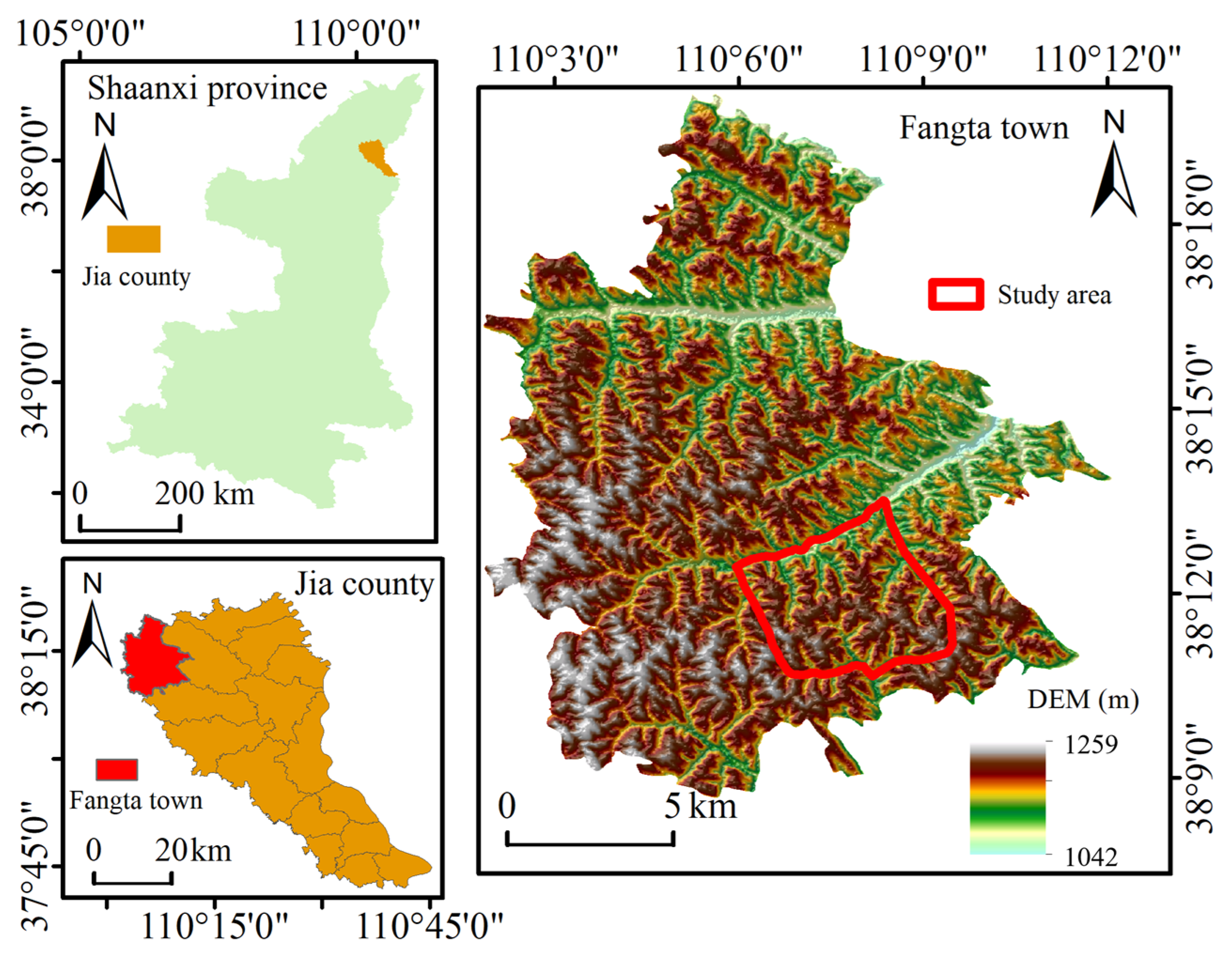
2.1. Study Area Overview
2.2. Study Data
2.2.1. Slope Gradient
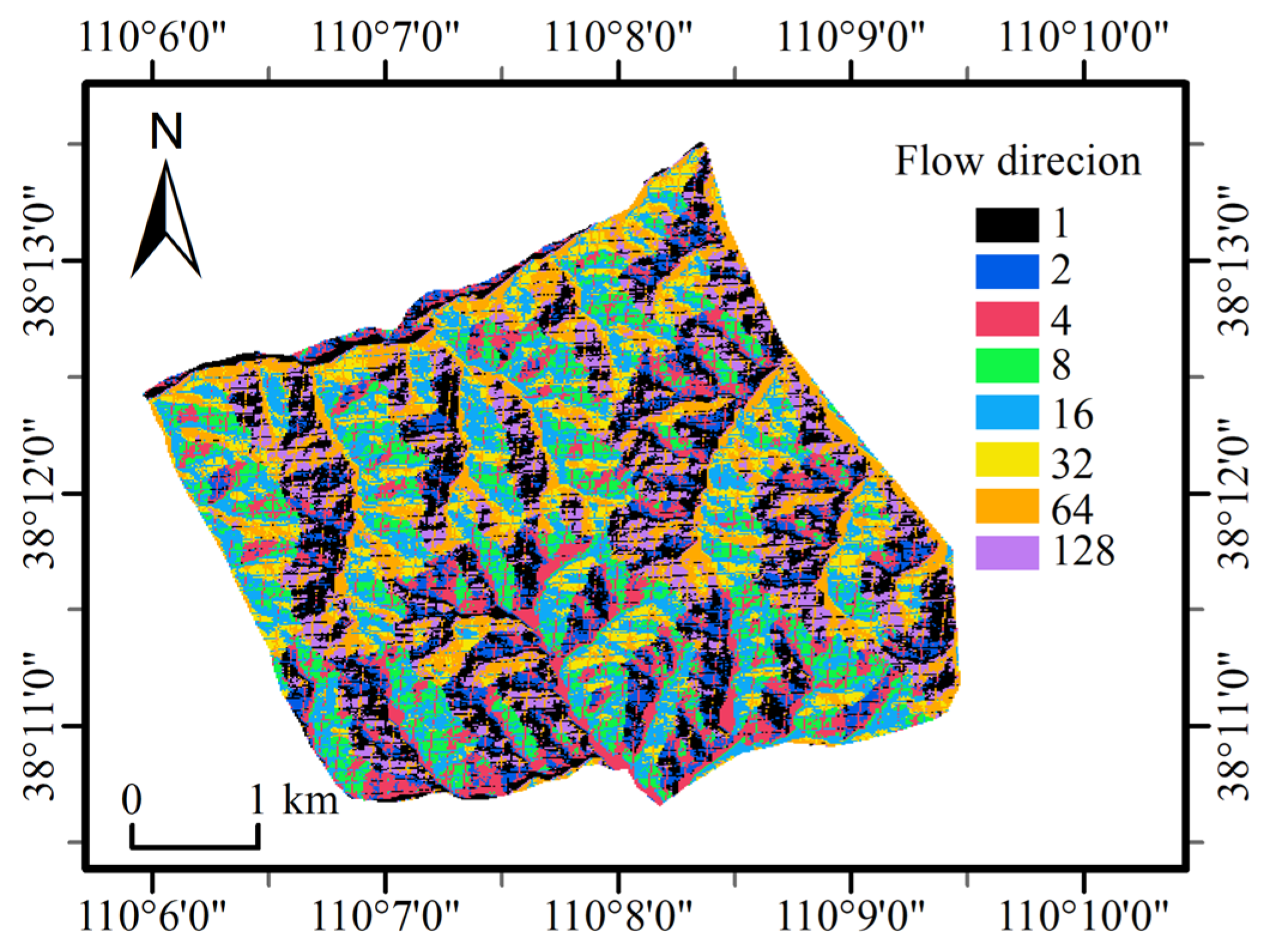
2.2.2. Flow Direction
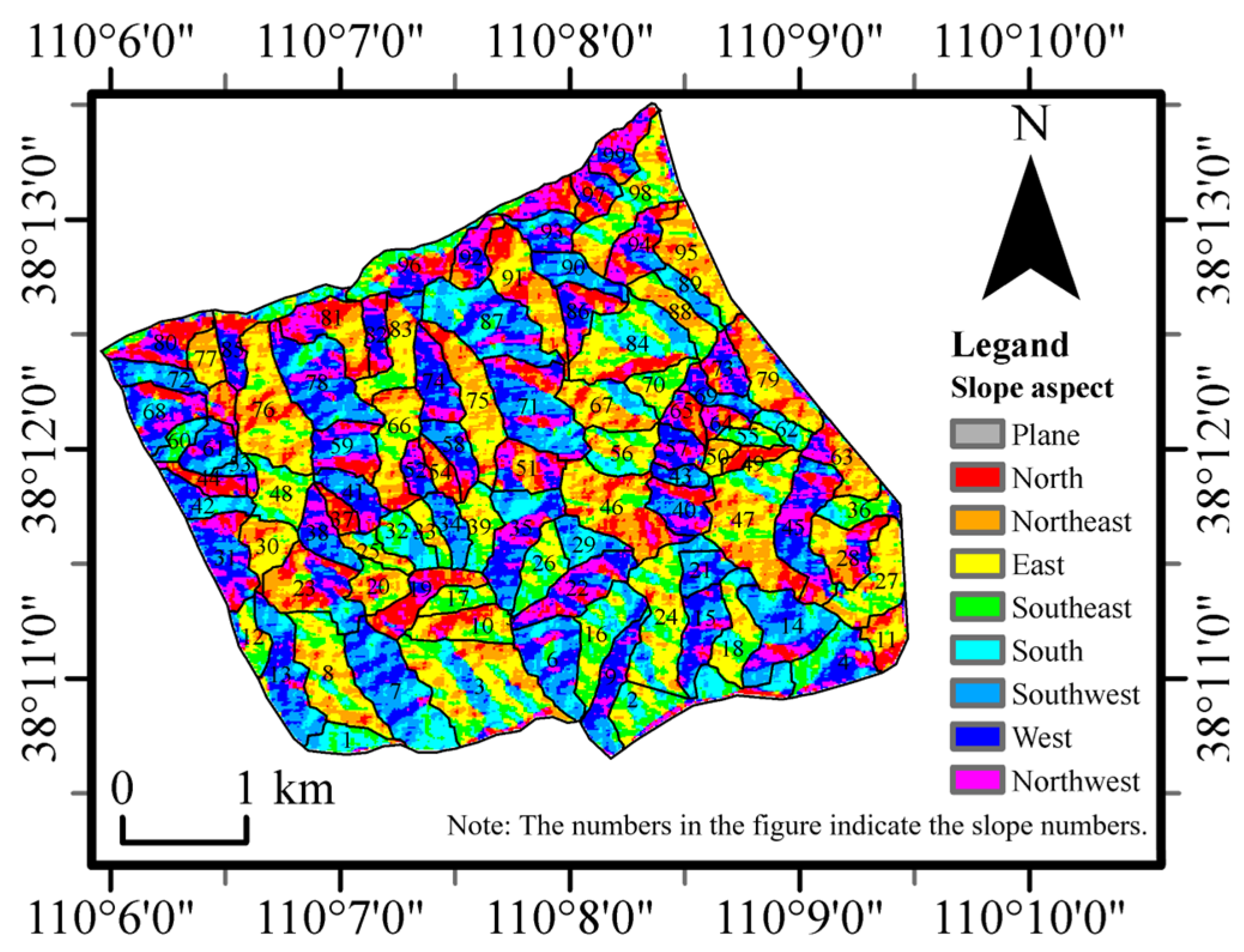
2.2.3. Slope Unit
2.2.4. The Thickness of the Loess
2.2.5. Soil Parameter
2.2.6. Rainfall Parameters
3. Study Methodology
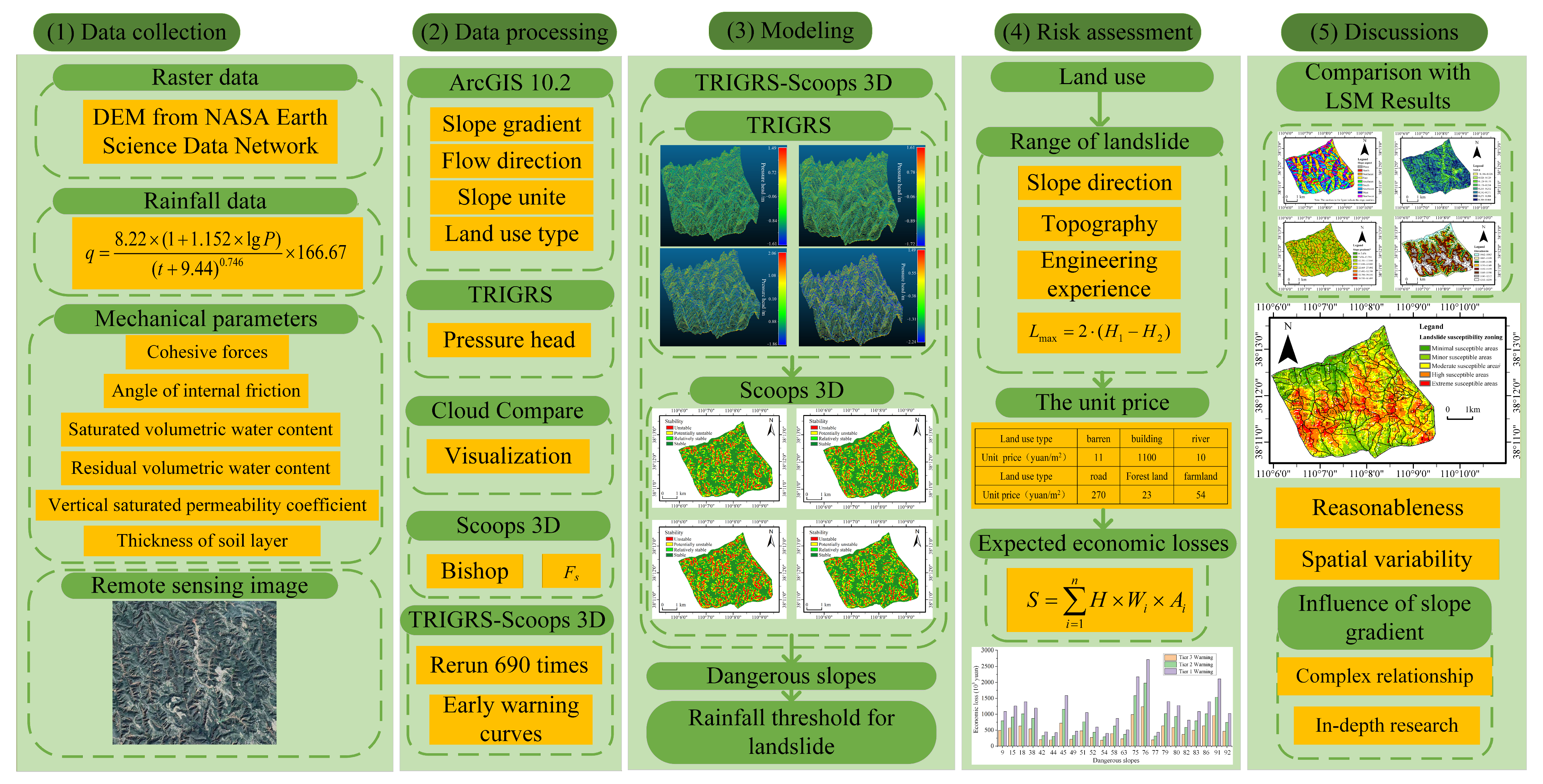
3.1. Early Warning for Shallow Loess Landslide
3.2. Risk Assessment for Shallow Loess Landslide
4. Study Results
4.1. Early Warning for Shallow Loess Landslide
4.2. Risk Assessment for Shallow Loess Landslide
5. Discussions
5.1. Comparison with Landslide Susceptibility Mapping Results
- (1)
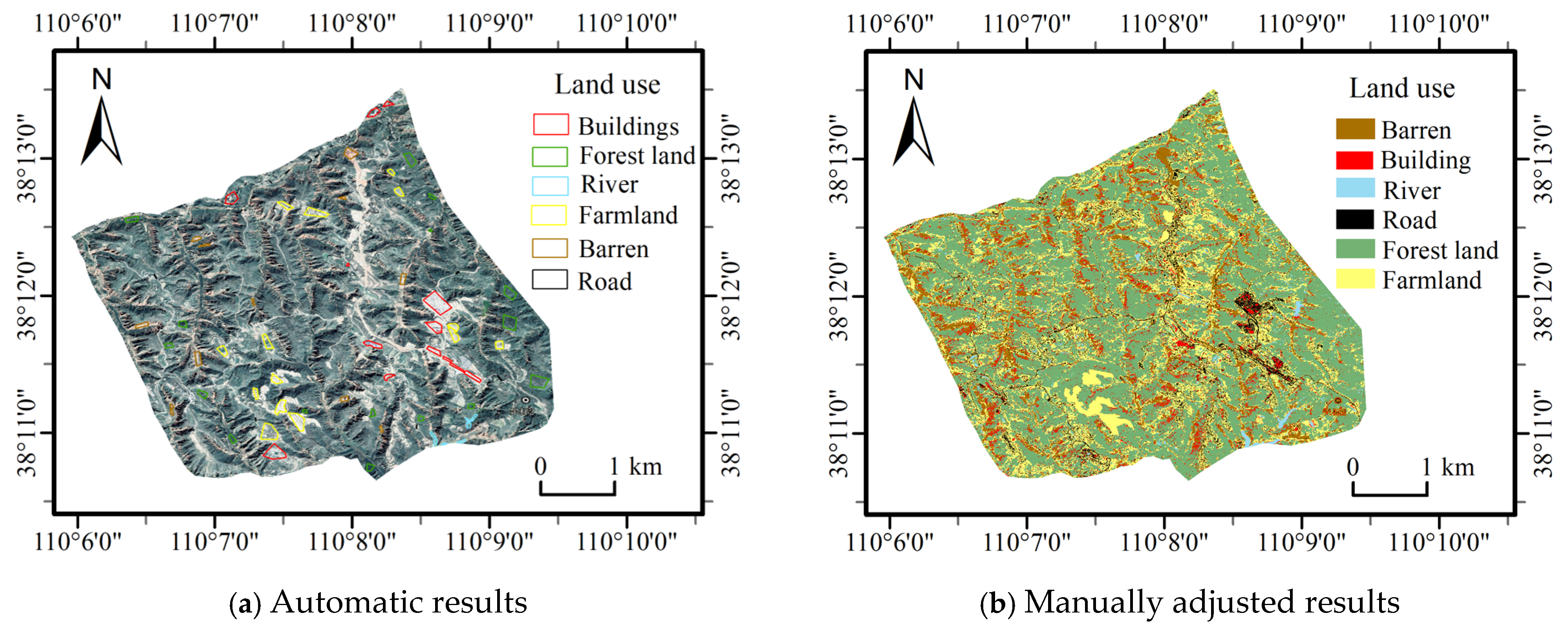
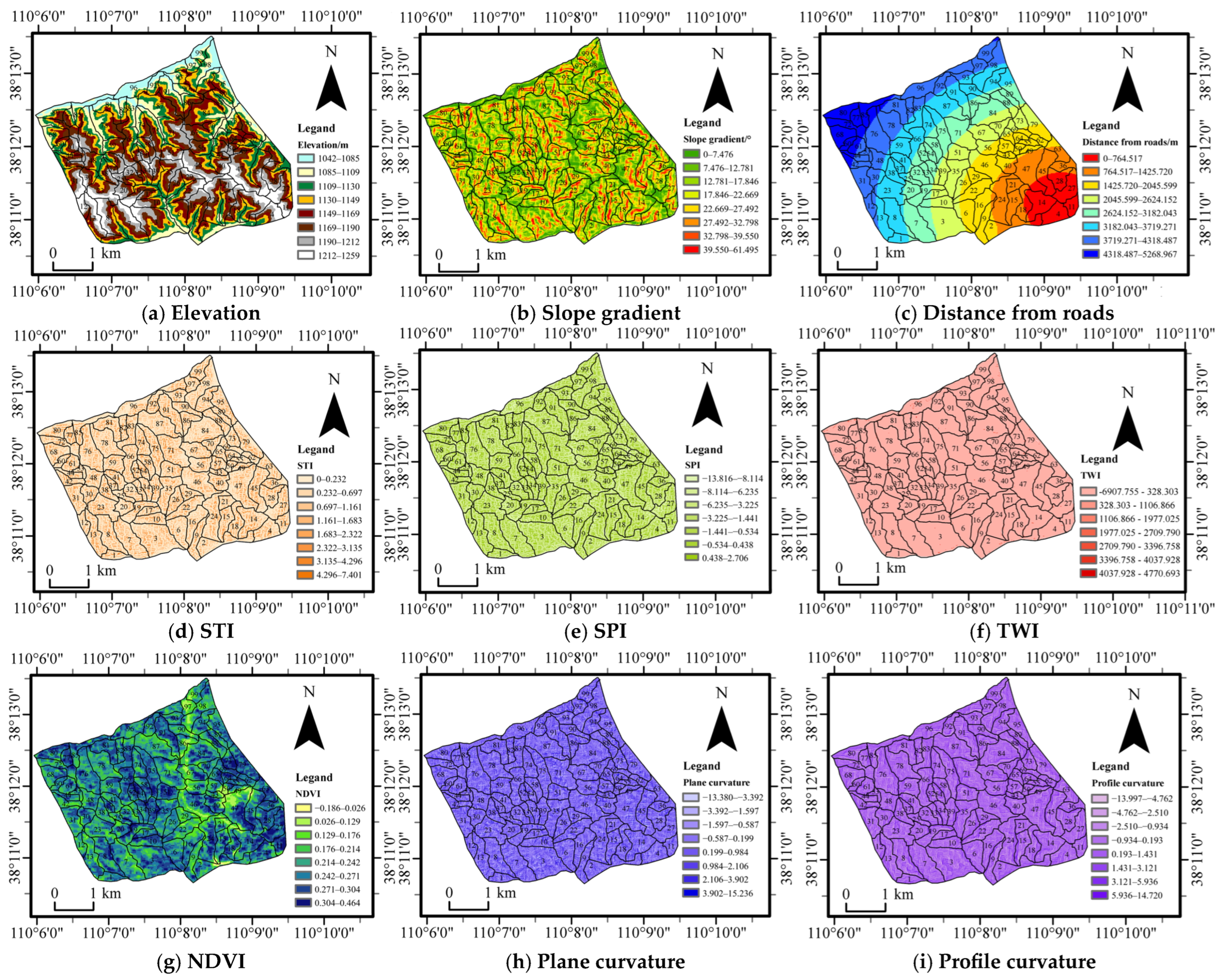
- A total of 11 hazard factors were selected, including elevation, slope gradient, slope aspect, distance from roads, Sediment Transport Index (STI), stream power index (SPI), topographic wetness index (TWI), Normalized Difference Vegetation Index (NDVI), plane curvature, profile curvature, and land use. The classification of each hazard factor is shown in Table 9. Based on ArcGIS 10.2, classification maps of hazard factors were generated, as shown in Figure 17 (slope aspect and land use are shown in Figure 5 and Figure 14b, respectively).
- (2)
- A total of 246 landslides on the Loess Plateau were used to construct the training and validation sets [48]. Using the resampling function of ArcGIS 10.2, 6160 landslide grids of 10 m × 10 m were obtained. Meanwhile, 6160 non-landslide grids were randomly selected from non-landslide areas. 70% landslide grids (4312) and 70% non-landslide grids (4312) were selected as training samples, while 30% landslide grids (1848) and 30% non-landslide grids (1848) were validation samples. The Blending-XGBoost-CNN model was selected for landslide susceptibility modeling, in which the Blending framework was used to connect the XGBoost model and CNN model [49].
- (3)
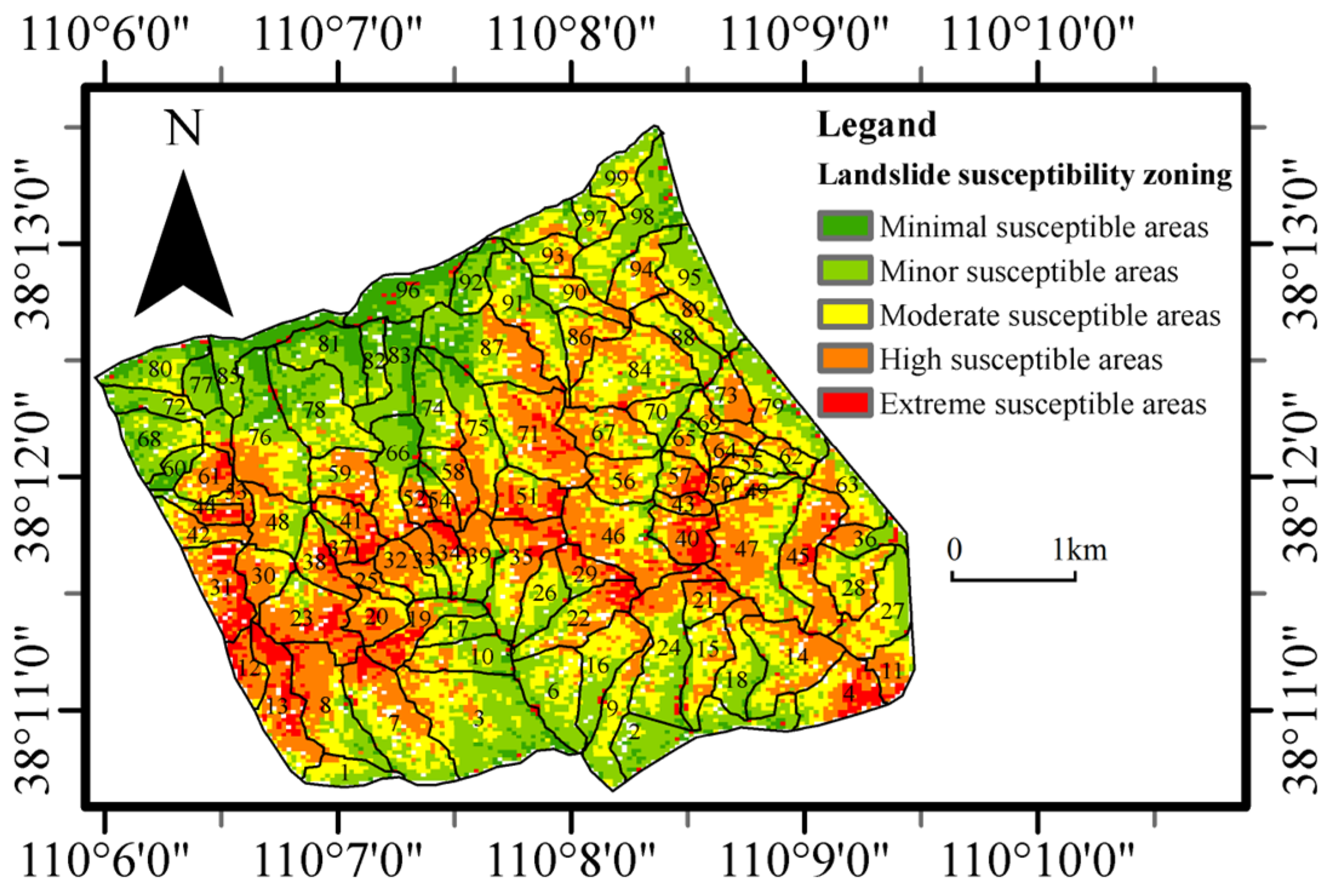
- The study area was divided into five susceptible levels based on the landslide susceptibility probability, as shown in Figure 18. Specifically, extreme susceptible areas account for 5.78% of the total study area, high susceptible areas account for 10.54%, moderate susceptible areas account for 18.36%, minor susceptible areas account for 27.15%, and minimal susceptible areas account for 38.17%, respectively.
- (1)
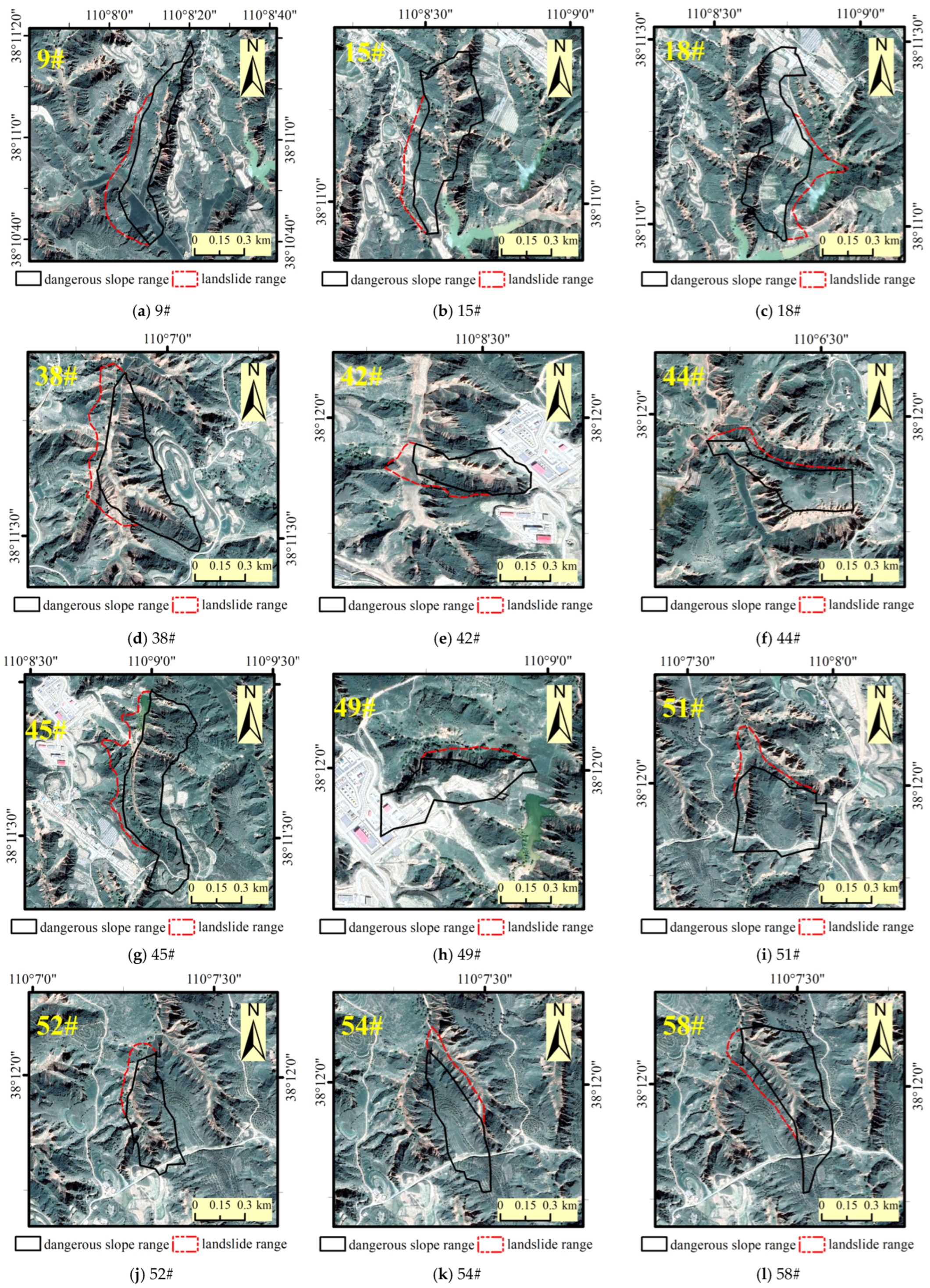
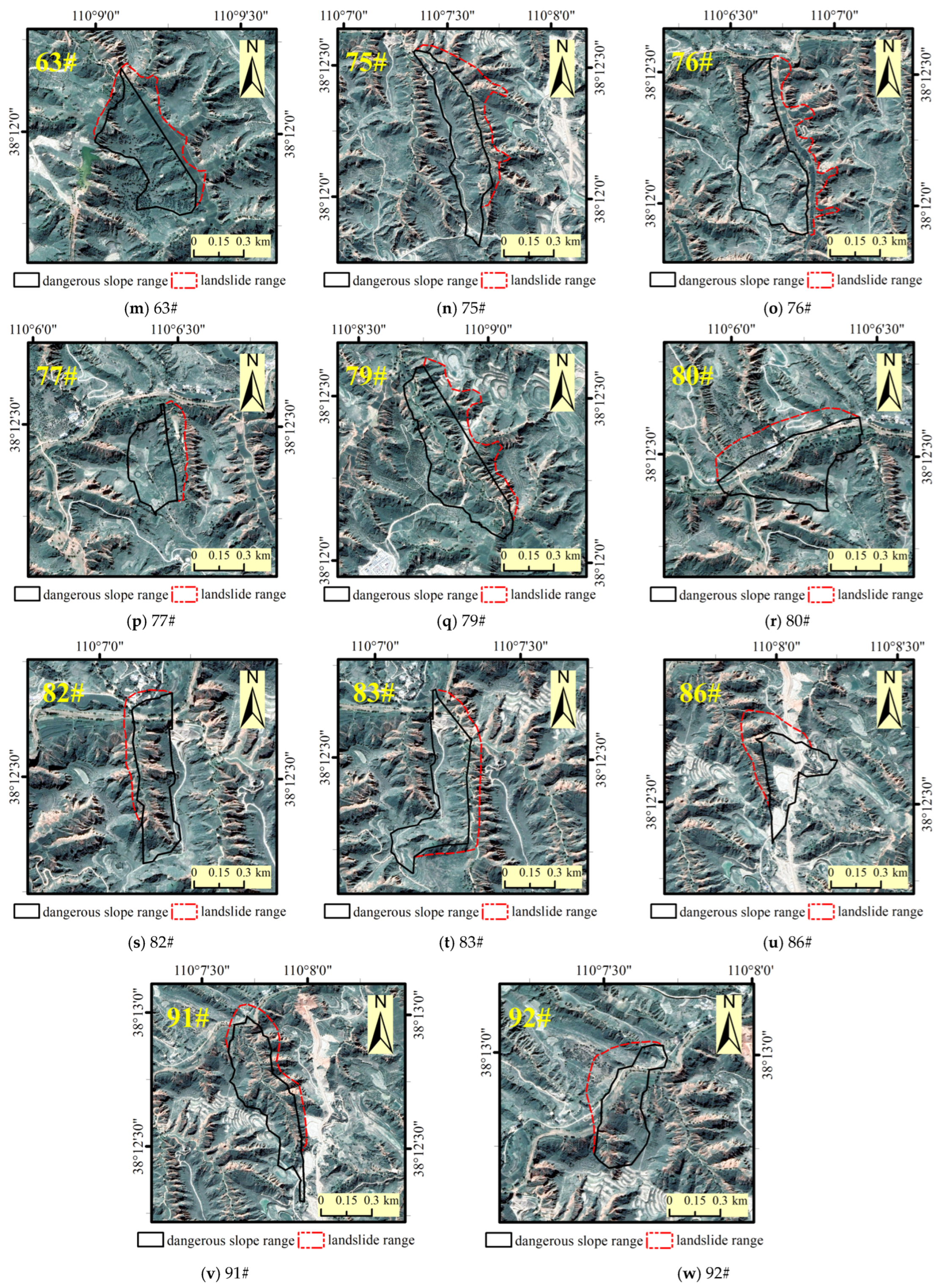
- The distribution of both extreme susceptible grids and high susceptible grids across all 23 dangerous slopes demonstrates the reasonableness of the TRIGRS-Scoops 3D joint model. For instance, the proportions of extreme susceptible grids and high susceptible grids in the 38# slope reached 38.15% and 49.64%, while in the 51# slope reached 34.27% and 52.19%, respectively.
- (2)
- The landslide susceptible probability within some dangerous slopes exhibits spatial variability. For example, although the proportions of extremely susceptible grids and highly susceptible grids in the 54# and 58# slopes are not high, they are concentrated on the eastern and southern sides. This is attributed to the large spatial scale of the slopes and the resulting differences in the microscopic hazard-pregnant environment. However, this does not reduce the probability of landslide occurrence under extreme rainfall conditions.
5.2. The Influence of Slope Gradient on Shallow Loess Landslides
6. Conclusions
- (1)
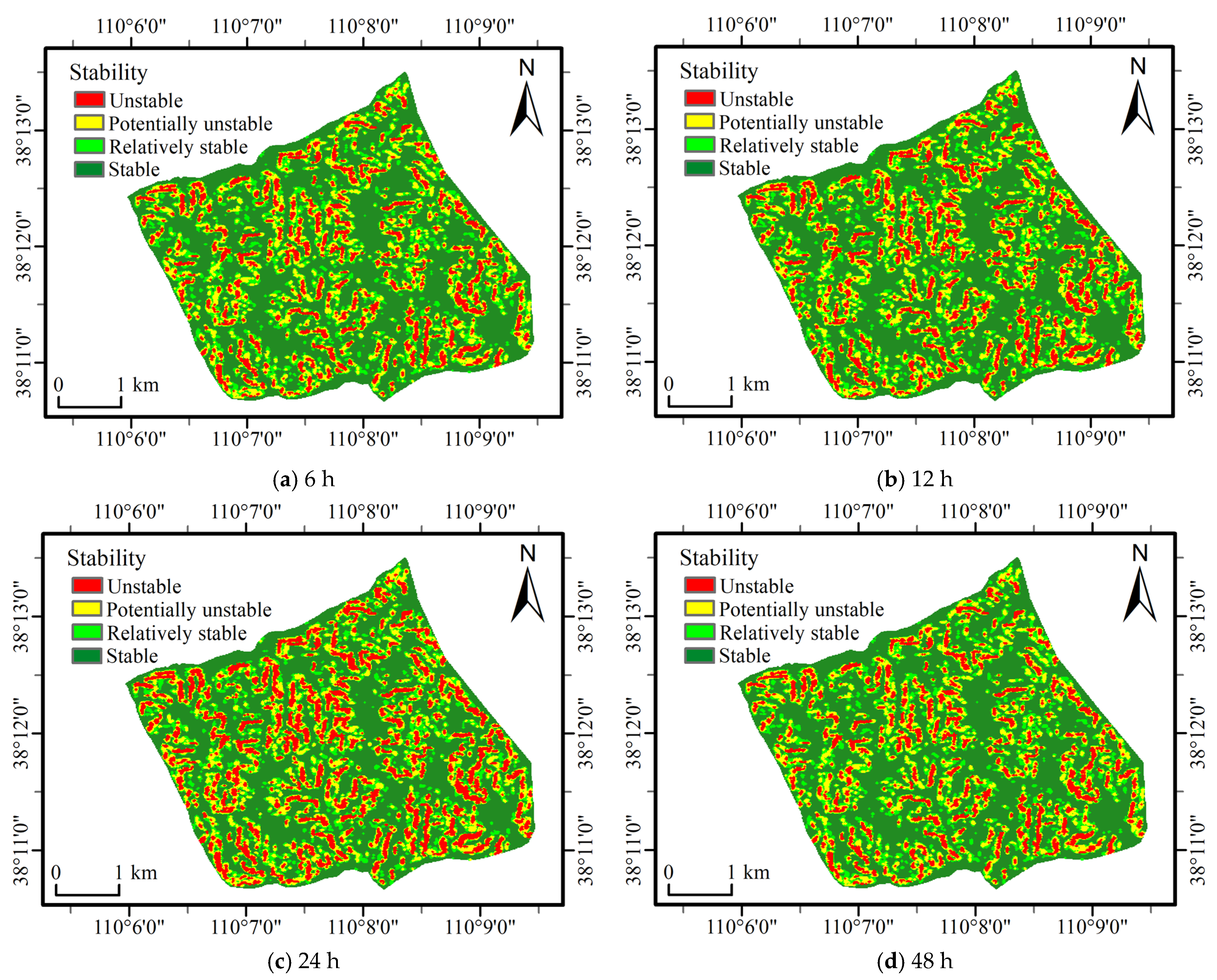
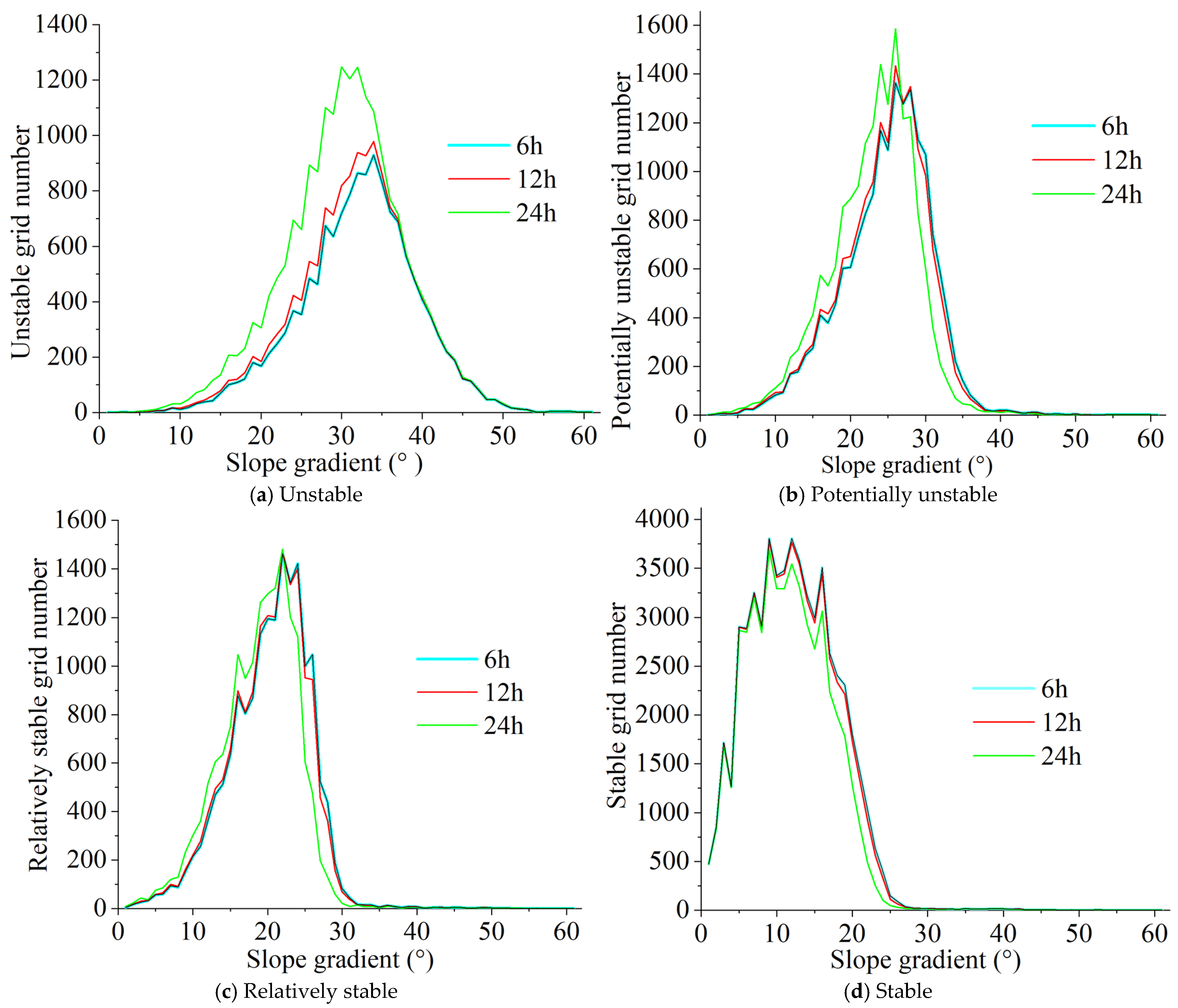
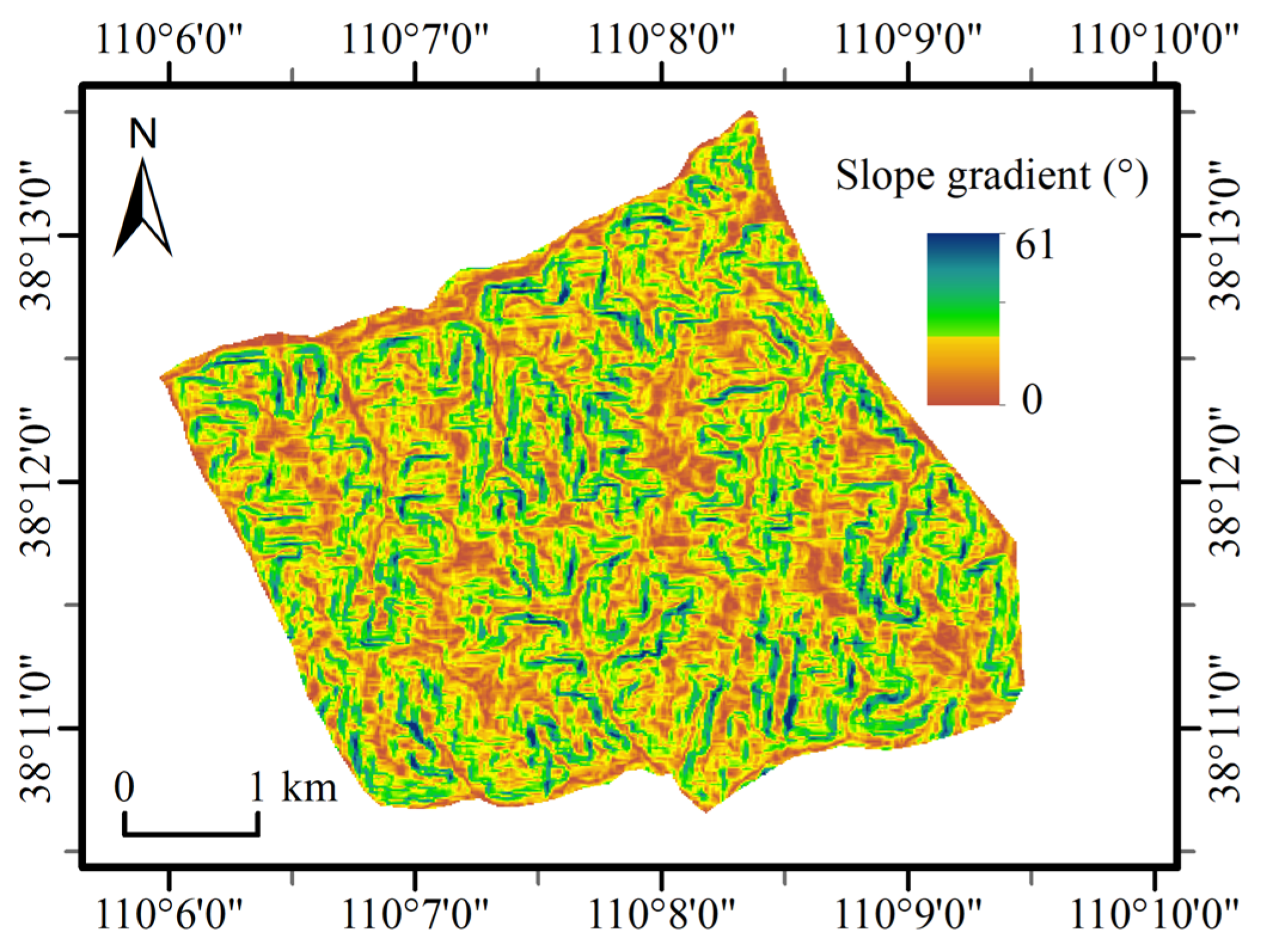
- The unstable grids are concentrated within a slope gradient of 30° to 35°, the potentially unstable grids are concentrated in the slope gradient of 25° to 30°, and the stable grids are concentrated in a slope gradient of under 15°.
- (2)
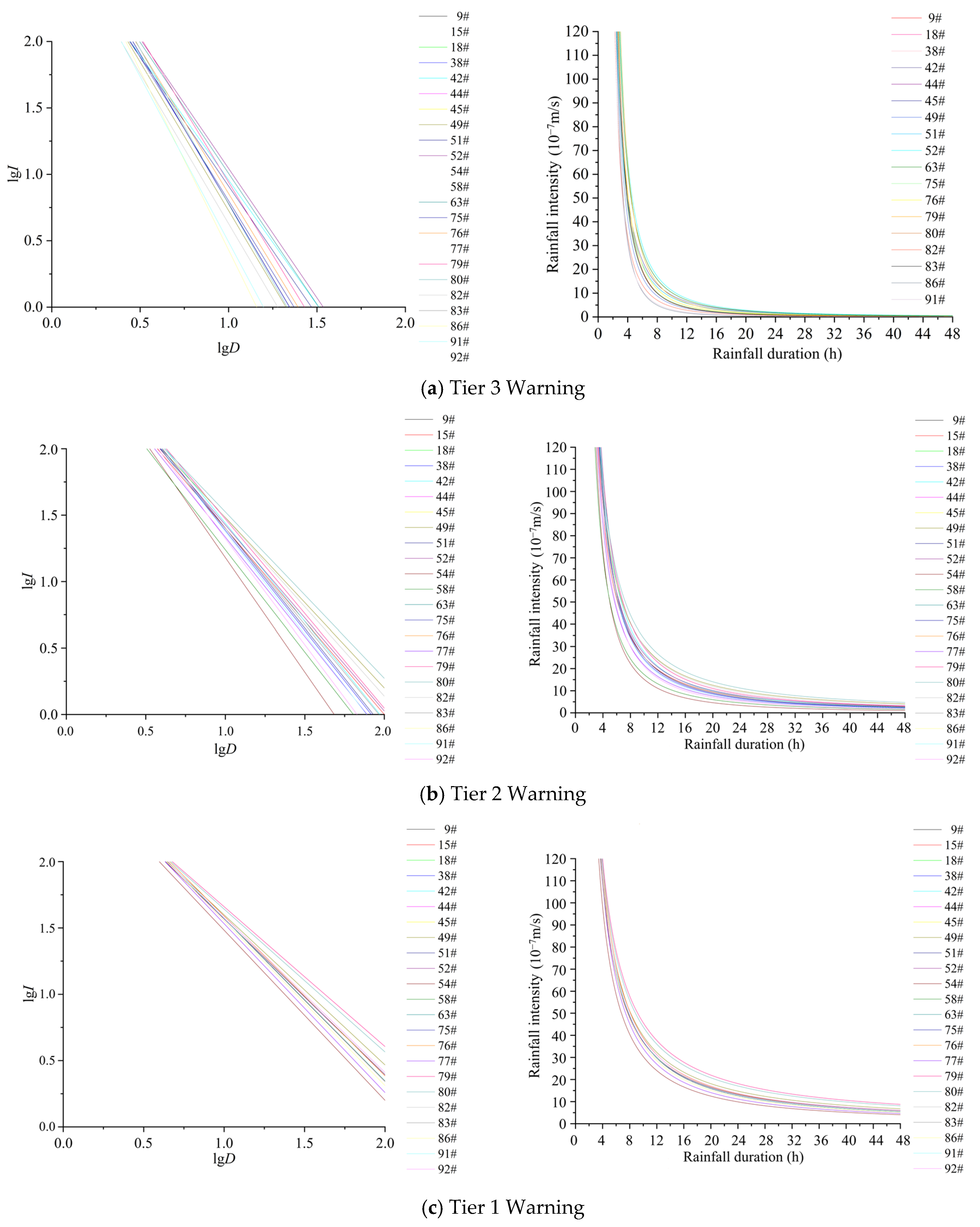
- The rainfall threshold curves for the dangerous slopes were drawn, including 18 Tier 3 Warning curves, 23 Tier 2 Warning curves, and 23 Tier 1 Warning curves. The 15#, 54#, 58#, 77#, and 92# slopes reach the Tier 3 Warning in the natural state (no rainfall), and the 54# and 58# slopes are more likely to reach the Tier 2 and Tier 1 Warnings.
- (3)
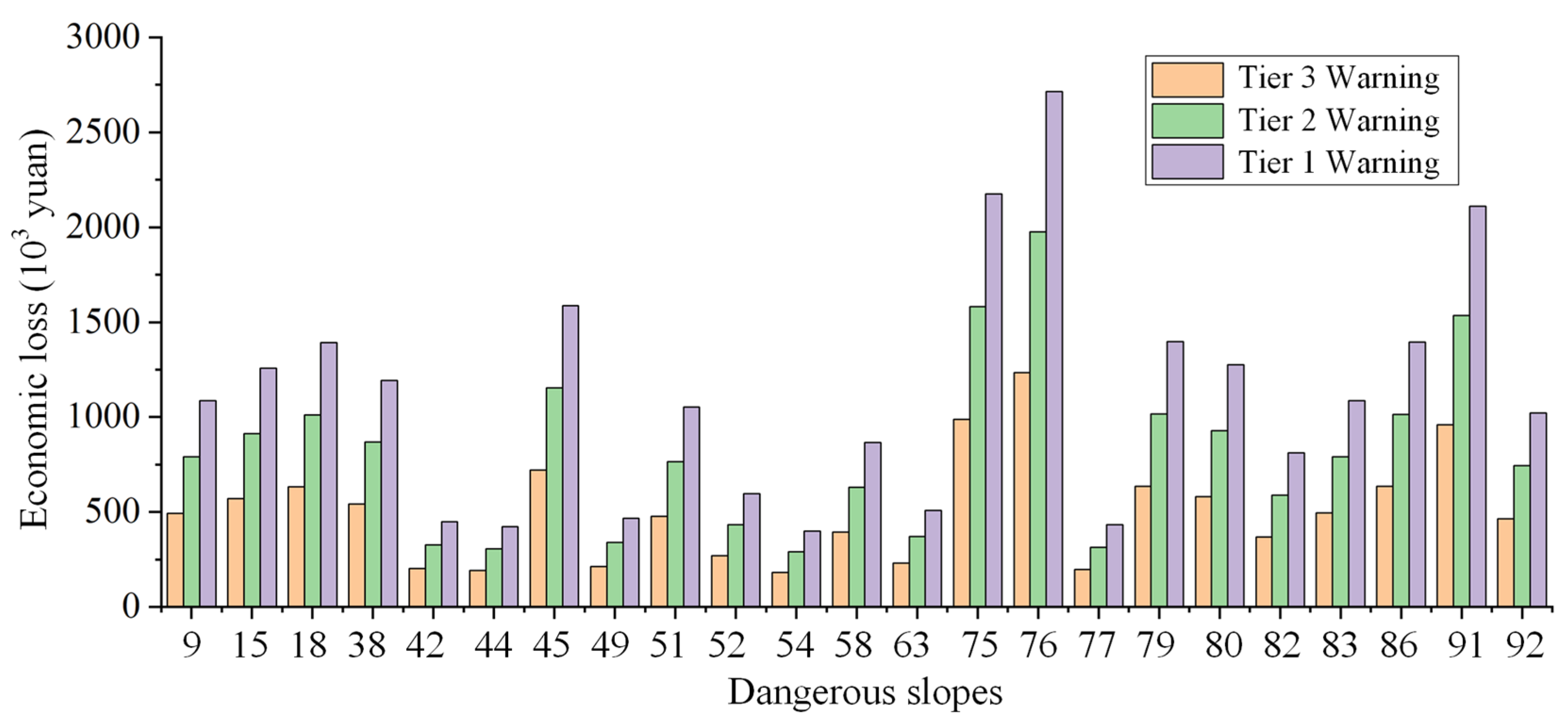
- The expected economic loss of the 76# slope is the highest, exceeding 20 million yuan under the Tier 1 Warning. The 42#, 44#, 49#, 54#, and 77# slopes are smaller, less than 5 million yuan under the Tier 2 Warning.
- (4)
- The distribution of both extreme susceptible grids and high susceptible grids across all 23 dangerous slopes demonstrates the reasonableness of the TRIGRS-Scoops 3D joint model. The landslide susceptible probability within some dangerous slopes exhibits spatial variability.
- (5)
- The mapping relationship between the slope gradient and loess landslides is extremely complex. In future research, the author will elucidate the disaster mechanisms of shallow loess landslides from the following aspects: the influence of vegetation root models, spatial variability of loess parameters, slope scale, and crack development on the probability and scale of landslide occurrence under different slope gradient conditions.
Author Contributions
Funding
Data Availability Statement
Conflicts of Interest
References
- Zhang, Y.; Han, J.; Wang, X.; Jiang, D.; Li, J. Evaluation of loess collapsibility based on random field theory in Xi’an, China. Math. Probl. Eng. 2022, 1, 8665061. [Google Scholar] [CrossRef]
- Francisca, F.M.; Giomi, I.; Rocca, R.J. Inverse analysis of shallow foundation settlements on collapsible loess: Understanding the impact of varied soil mechanical properties during Wetting. Comput. Geotech. 2024, 167, 106090. [Google Scholar] [CrossRef]
- Roul, A.R.; Pradhan, S.P.; Panda, S.D. The relation between rainfall and landslides in India: An empirical approach for prediction of landslide. J. Earth Syst. Sci. 2025, 134, 97. [Google Scholar] [CrossRef]
- Lainas, S.; Sabatakakis, N.; Koukis, G. Rainfall thresholds for possible landslide initiation in wildfire-affected areas of western Greece. Bull. Eng. Geol. Environ. 2016, 75, 883–896. [Google Scholar] [CrossRef]
- Shao, X.; Ma, S.; Xu, C. Distribution and characteristics of shallow landslides triggered by the 2018 Mw 7.5 Palu earthquake, Indonesia. Landslides 2023, 20, 157–175. [Google Scholar] [CrossRef]
- Panzeri, L.; Mondani, M.; Papini, M.; Longoni, L. Snow melting experimental analysis on a downscaled shallow landslide: A focus on the seepage activity of the snow–soil system. Water 2025, 17, 597. [Google Scholar] [CrossRef]
- Zhuang, J.; Peng, J.; Du, C.; Zhu, Y.; Kong, J. Shallow-landslide stability evaluation in loess areas according to the Revised Infinite Slope Model: A case study of the 7.25 Tianshui sliding-flow landslide events of 2013 in the southwest of the Loess Plateau, China. Nat. Hazards Earth Syst. Sci. 2024, 24, 2615–2631. [Google Scholar] [CrossRef]
- Huang, Q.; Peng, J.; Fan, W.; Wang, X.; Zhu, W.; Xu, L.; Tang, Y.; Zhuang, J.; Leng, Y.; Ma, P.; et al. Challenges confronting and coping strategies for the governance of geohazard chains on the loess plateau. Bull. Natl. Nat. Sci. Found. China 2025, 39, 1030–1043. (In Chinese) [Google Scholar] [CrossRef]
- Zhang, J.; Qiu, H.; Tang, B.; Yang, D.; Liu, Y.; Liu, Z.; Zhu, Y. Accelerating effect of vegetation on the instability of rainfall-induced shallow landslides. Remote Sens. 2022, 14, 5743. [Google Scholar] [CrossRef]
- Zhang, S.Q.; Wang, Y.W.; Zhang, H.B.; Lyu, F.G.; Yang, T.Z.; Li, Y.B.; Yao, C.C. Investigating the Loess Plateau’s coevolution of precipitation and natural vegetation cover. Environ. Earth Sci. 2024, 83, 178. [Google Scholar] [CrossRef]
- Fang, Z.; Wang, J.; Wang, Y.; Du, B.; Liu, G. Improved landslide prediction by considering continuous and discrete spatial dependency. Landslides 2025, 22, 1107–1122. [Google Scholar] [CrossRef]
- Sim, K.B.; Lee, M.L.; RemenytePrescott, R.; Wong, S.Y. Perception on landslide risk in Malaysia: A comparison between communities and experts’ surveys. Int. J. Disaster Risk Reduct. 2023, 95, 103854. [Google Scholar] [CrossRef]
- Wang, G.; Chen, X.; Chen, W. Spatial prediction of landslide susceptibility based on GIS and discriminant functions. ISPRS Int. J. Geo-Inf. 2020, 9, 144. [Google Scholar] [CrossRef]
- Miah, M.D.; Subah, S.; Ali, Y. Leveraging remote sensing data with AHP and geospatial analysis for landslide susceptibility hotspot assessment in Bandarban of Bangladesh. Geohazard Mech. 2025, 3, 272–285. [Google Scholar] [CrossRef]
- Alvioli, M.; Baum, R.L. Parallelization of the TRIGRS model for rainfall-induced landslides using the message passing interface. Environ. Model. Softw. 2016, 81, 122–135. [Google Scholar] [CrossRef]
- Qiu, H.; Zhu, Y.; Zhou, W.; Sun, H.; He, J.; Liu, Z. Influence of DEM resolution on landslide simulation performance based on the Scoops3D model. Geomat. Nat. Hazards Risk 2022, 13, 1663–1681. [Google Scholar] [CrossRef]
- Melo, C.M.; Kobiyama, M.; Michel, G.P.; Brito, M.M. The relevance of geotechnical-unit characterization for landslide susceptibility mapping with SHALSTAB. GeoHazards 2021, 2, 383–397. [Google Scholar] [CrossRef]
- Yang, L.; Cui, Y.; Xu, C.; Ma, S. Application of coupling physics–based model TRIGRS with random forest in rainfall-induced landslide-susceptibility assessment. Landslides 2024, 21, 2179–2193. [Google Scholar] [CrossRef]
- Ma, S.; Shao, X.; Xu, C. Physically-based rainfall-induced landslide thresholds for the Tianshui area of Loess Plateau, China by TRIGRS model. Catena 2023, 233, 107499. [Google Scholar] [CrossRef]
- Palazzolo, N.; Peres, D.J.; Bordoni, M.; Meisina, C.; Creaco, E.; Cancelliere, A. Improving spatial landslide prediction with 3d slope stability analysis and genetic algorithm optimization: Application to the Oltrepò Pavese. Water 2021, 13, 801. [Google Scholar] [CrossRef]
- Mao, J.; Ma, X.; Wang, H.; Jia, L.; Sun, Y.; Zhang, B.; Zhang, W. Spatio-temporal prediction of three-dimensional stability of highway shallow landslide in Southeast Tibet based on TRIGRS and Scoops3D coupling model. Water 2024, 16, 1207. [Google Scholar] [CrossRef]
- Li, Z.; Ma, P.; Zhuang, J.; Mu, Q.; Kong, J.; Zhao, L.; Peng, J. Permeability characteristics, structural failure characteristics, and triggering process of loess landslides in two typical strata structures. Eng. Geol. 2024, 341, 107728. [Google Scholar] [CrossRef]
- Liu, W.; Bai, R.; Sun, X.; Yang, F.; Zhai, W.; Su, X. Rainfall-and irrigation-induced landslide mechanisms in loess slopes: An experimental investigation in Lanzhou, China. Atmosphere 2024, 15, 162. [Google Scholar] [CrossRef]
- Zhou, C.; Xia, Z.; Chen, D.; Miao, L.; Hu, S.; Yuan, J.; Huang, W.; Liu, L.; Ai, D.; Xu, H.; et al. Extreme rainfall events triggered loess collapses and landslides in Chencang District, Shaanxi, China, during June–October 2021. Water 2021, 16, 2279. [Google Scholar] [CrossRef]
- Hou, T.; Jiang, X.; Chen, Y. Mechanism of rainfall-induced toppling in loess collapses. Earth Surf. Process. Landf. 2024, 49, 2825–2839. [Google Scholar] [CrossRef]
- Rashid, B.; Iqbal, J.; Su, L.J. Landslide susceptibility analysis of Karakoram highway using analytical hierarchy process and scoops 3D. J. Mt. Sci. 2020, 17, 1596–1612. [Google Scholar] [CrossRef]
- Wang, Y.H.; Wang, L.Q.; Zhang, W.G.; Liu, S.L.; Sun, W.X.; Hong, L.; Zhu, Z.W. A physics-informed machine learning solution for landslide susceptibility mapping based on three-dimensional slope stability evaluation. J. Cent. South Univ. 2024, 31, 3838–3853. [Google Scholar] [CrossRef]
- Kachi, N.; Kajimoto, R.; Tsukahara, K.; Akiyama, Y. Consideration on disaster recovery system to improve resilience of frequent-landslide dangerous area. Procedia-Soc. Behav. Sci. 2016, 218, 181–190. [Google Scholar] [CrossRef]
- Caleca, F.; Tofani, V.; Raspini, F.; Segoni, S.; Casagli, N. Quantitative landslide risk assessment for Italy. Landslide 2025, 22, 3537–3559. [Google Scholar] [CrossRef]
- Talaei, R.; Samadov, S. Quantitative landslide risk analysis in the Hashtchin area (NW-Iran). Eur. J. Environ. Civ. Eng. 2018, 22, 883–909. [Google Scholar] [CrossRef]
- Biswakarma, P.; Joshi, V.; Abdo, H.G.; Almohamad, H.; Abdullah, A.D.A.; Al-Mutiry, M. An integrated quantitative and qualitative approach for landslide susceptibility mapping in West Sikkim district, Indian Himalaya. Geomat. Nat. Hazards Risk 2023, 14, 2273781. [Google Scholar] [CrossRef]
- Tang, Y.M.; Xue, Q.; Li, Z.G.; Feng, W. Three modes of rainfall infiltration inducing loess landslide. Nat. Hazards 2015, 79, 137–150. [Google Scholar] [CrossRef]
- Dong, C.; Zhang, D. A 40-year climatology of summer heavy hourly rainfall over mountainous Shanxi in China. Int. J. Climatol. 2022, 42, 1937–1953. [Google Scholar] [CrossRef]
- Luo, M.; Li, T. Spatial and temporal analysis of landscape ecological quality in Yulin. Environ. Technol. Innov. 2021, 23, 101700. [Google Scholar] [CrossRef]
- He, J.; Qiu, H.; Qu, F.; Hu, S.; Yang, D.; Shen, Y.; Zhang, Y.; Sun, H.; Cao, M. Prediction of spatiotemporal stability and rainfall threshold of shallow landslides using the TRIGRS and Scoops3D models. Catena 2021, 197, 104999. [Google Scholar] [CrossRef]
- Fárek, V.; Unucka, J. Results comparison of the flow direction and accumulation algorithms together with distributed rainfall-runoff models in Czech Switzerland National Park. In Surface Models for Geosciences; Springer International Publishing: Cham, Switzerland, 2015; pp. 87–98. [Google Scholar]
- Li, Y.; Shi, W.; Aydin, A.; Beroya-Eitner, M.A.; Gao, G. Loess genesis and worldwide distribution. Earth-Sci. Rev. 2020, 201, 102947. [Google Scholar] [CrossRef]
- Zhang, F.; Peng, J.; Zhang, Y.; Wang, Y.; Zhang, T. Prediction of static liquefaction landslides in loess: Integrating triaxial shear parameters into the sliding-block model. Eng. Geol. 2026, 363, 108549. [Google Scholar] [CrossRef]
- GB/T 50123-2019; Standard for Geotechnical Testing Method. China Planning Press: Beijing, China, 2019.
- Pan, L.; Zhu, J.G.; Zhang, Y.F. Evaluation of structural strength and parameters of collapsible loess. Int. J. Geomech. 2021, 21, 04021066. [Google Scholar] [CrossRef]
- Ranathunga, K.N.; Finke, P.A.; Yin, Q.; Yu, Y. Calibrating SoilGen2 for interglacial soil evolution in the Chinese Loess Plateau considering soil parameters and the effect of dust addition rhythm. Quat. Int. 2022, 607, 100–112. [Google Scholar] [CrossRef]
- Mao, M.; Wu, S.; Lei, Y. Variation characteristics of intensity error of new and old rainstorm in main cities of Shaanxi province. Shaanxi Water Resour. 2023, 1, 62–65. (In Chinese) [Google Scholar]
- Babu, K.J. Determination of nodal desirable pressure-heads of water distribution network. Urban Water J. 2020, 17, 871–883. [Google Scholar] [CrossRef]
- Sun, X.; Zeng, P.; Li, T.; Zhang, L.; Jimenez, R.; Dong, X.; Xu, Q. A Bayesian approach to develop simple run-out distance models: Loess landslides in Heifangtai Terrace, Gansu Province, China. Landslides 2023, 20, 77–95. [Google Scholar] [CrossRef]
- Ding, Y.N.; Li, D.Q.; Zarei, C.; Yi, B.L.; Liu, Y. Probabilistically quantifying the effect of geotechnical anisotropy on landslide susceptibility. Bull. Eng. Geol. Environ. 2021, 80, 6615–6627. [Google Scholar] [CrossRef]
- Cong, P.; Zhang, D.; Yi, M. Application of ArcGIS 3D modeling technology in the study of land use policy decision making in China. Sci. Rep. 2023, 13, 20695. [Google Scholar] [CrossRef]
- Tan, Z.; Yin, C.; Zhang, X.; Ma, X.; Liu, X.; Li, S. Stability Assessment of Shallow Soil Landslide and Activating Rainfall Threshold. Nat. Hazards Rev. 2024, 25, 04024004. [Google Scholar] [CrossRef]
- Ma, B.; Yin, C.; Gao, F.; Song, X.; Li, M. Landslide Susceptibility Mapping Using Remote Sensing Interpretation and a Blending-XGBoost-CNN Model. Appl. Sci. 2025, 15, 11969. [Google Scholar] [CrossRef]
- Yang, W.; Niu, R.; Si, R.; Li, J. Geological Hazard Susceptibility Analysis and Developmental Characteristics Based on Slope Unit, Using the Xinxian County, Henan Province as an Example. Sensors 2024, 24, 2457. [Google Scholar] [CrossRef] [PubMed]
- Zou, Q.; Jiang, H.; Cui, P.; Zhou, B.; Jiang, Y.; Qin, M.; Liu, Y.; Li, C. A new approach to assess landslide susceptibility based on slope failure mechanisms. Catena 2021, 204, 105388. [Google Scholar] [CrossRef]
- Li, Y.R.; Mo, P. A unified landslide classification system for loess slopes: A critical review. Geomorphology 2019, 340, 67–83. [Google Scholar] [CrossRef]
- Huang, S.P.; Chen, J.Y.; Xiao, H.L.; Tao, G.L. Test on rules of rainfall infiltration and runoff erosion on vegetated slopes with different gradients. Rock Soil Mech. 2023, 44, 3435–3447. [Google Scholar]
- Tao, G.; Feng, S.; Xiao, H.; Gu, K.; Wu, Z. Rainfall Infiltration Test and Numerical Simulation Analysis of a Large Unsaturated Soil Slope. J. Hydrol. Eng. 2024, 29, 04024020. [Google Scholar] [CrossRef]
- Ma, P.; Li, Z.; Zhuang, J.; Mu, Q.; Kong, J.; Peng, J. Failure mechanism of a loess-red silty clay interface landslide on the Heifangtai platform, China. Bull. Eng. Geol. Environ. 2025, 84, 424. [Google Scholar] [CrossRef]







| Parameter | ρ | ρsat | wL | wp |
| Value | 1.45 g·cm−3 | 13.35% | 27.53% | 13.25% |
| Parameter | θs | θr | KS | γps |
| Value | 0.42 | 0.13 | 1.16 e−5 m/s | 17.8 kN/m3 |
| Parameter | c | φ | γs | |
| Value | 3.25 kPa | 27.8° | 21.42 kN/m3 |
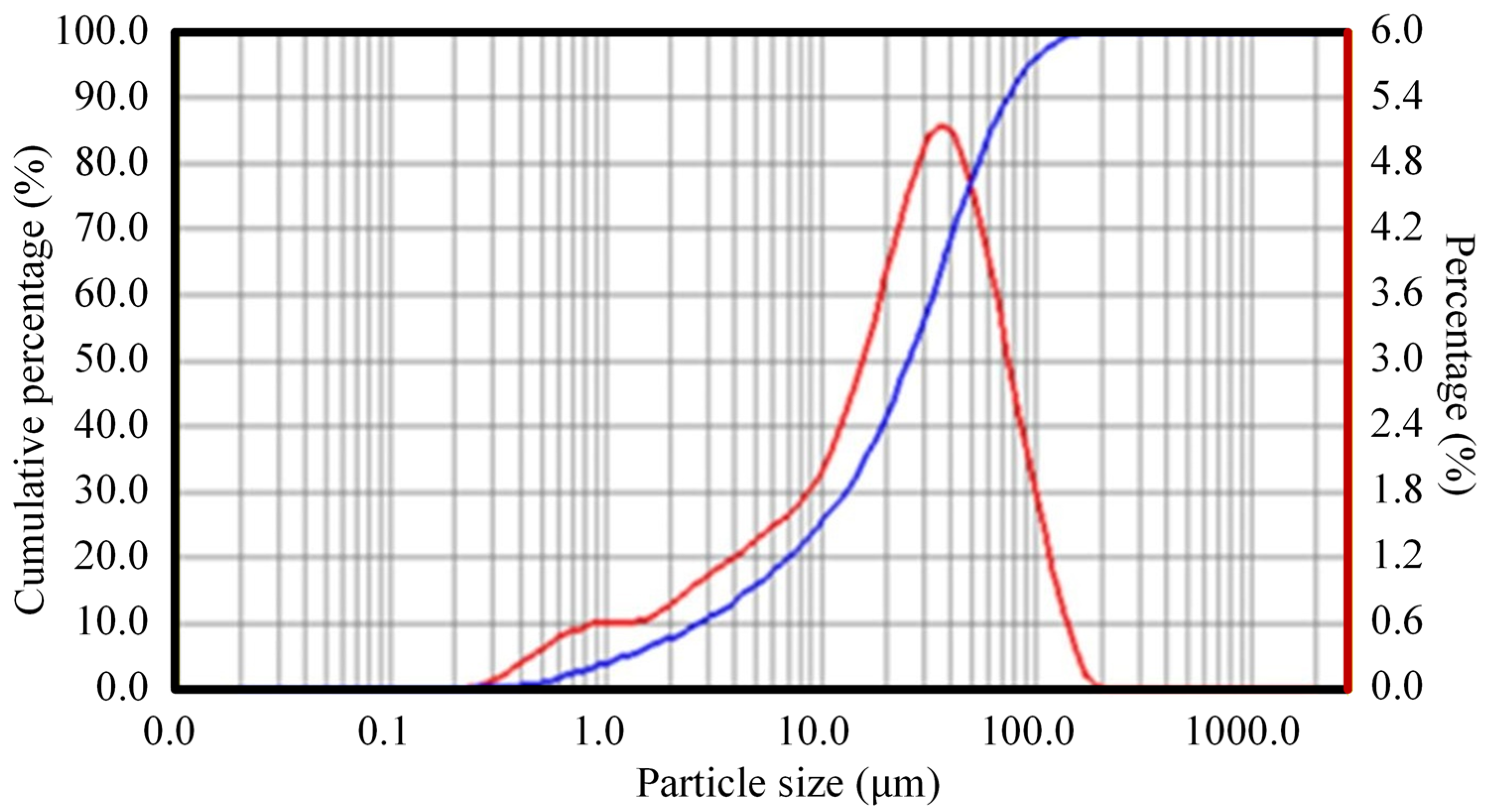
| Particle size (μm) | 0.000–0.220 | 0.220–0.470 | 0.470–1.005 | 1.005–2.148 | 2.148–4.591 |
| Content (%) | 0.00 | 0.83 | 3.19 | 4.14 | 6.71 |
| Particle size (μm) | 4.591–9.813 | 9.813–20.97 | 20.97–44.83 | 44.83–95.81 | 95.81–204.8 |
| Value (%) | 10.02 | 17.88 | 30.36 | 22.33 | 4.54 |
| Land Use | Barren | Building | River | Road | Forest Land | Farmland |
|---|---|---|---|---|---|---|
| Unit price (yuan/m2) | 11 | 1100 | 10 | 270 | 23 | 54 |
| Rainfall Duration | 6 h | 12 h | 24 h | 48 h |
|---|---|---|---|---|
| Stable Grade | ||||
| Unstable | 14,047 | 15,086 | 19,954 | 14,043 |
| Potentially unstable | 16,930 | 17,028 | 17,624 | 16,917 |
| Relatively stable | 16,739 | 16,648 | 16,237 | 16,739 |
| Stable | 57,230 | 56,184 | 51,131 | 57,247 |
| Slope | Area/km2 | Slope | Area/km2 | Slope | Area/km2 | Slope | Area/km2 | Slope | Area/km2 |
|---|---|---|---|---|---|---|---|---|---|
| 9# | 0.24 | 44# | 0.09 | 54# | 0.09 | 77# | 0.12 | 86# | 0.2 |
| 15# | 0.21 | 45# | 0.35 | 58# | 0.13 | 79# | 0.31 | 91# | 0.34 |
| 18# | 0.21 | 49# | 0.06 | 63# | 0.21 | 80# | 0.24 | 92# | 0.16 |
| 38# | 0.16 | 51# | 0.18 | 75# | 0.38 | 82# | 0.11 | ||
| 42# | 0.06 | 52# | 0.08 | 76# | 0.51 | 83# | 0.21 |
| Slope | Barren/m2 | Building/m2 | River/m2 | Road/m2 | Forest Land/m2 | Farmland/m2 |
|---|---|---|---|---|---|---|
| 9# | 14,299 | 11,986 | 1600 | 2931 | 176,872 | 28,461 |
| 15# | 31,200 | 14,552 | 576 | 6982 | 119,628 | 34,361 |
| 18# | 9533 | 13,330 | 3993 | 18,920 | 111,061 | 52,607 |
| 38# | 43,979 | 15,369 | 280 | 4490 | 64,399 | 30,060 |
| 42# | 14,693 | 5057 | 65 | 3889 | 26,183 | 14,102 |
| 44# | 12,202 | 4597 | 200 | 1472 | 50,376 | 16,968 |
| 45# | 29,794 | 17,147 | 14,159 | 6185 | 230,939 | 46,780 |
| 49# | 2810 | 3279 | 485 | 12,828 | 27,683 | 14,046 |
| 51# | 12,838 | 11,850 | 249 | 5939 | 125,189 | 27,247 |
| 52# | 14,335 | 7708 | 311 | 2290 | 38,834 | 12,657 |
| 54# | 4512 | 4202 | 57 | 1915 | 63,623 | 10,997 |
| 58# | 16,801 | 10,645 | 263 | 3408 | 76,801 | 21,490 |
| 63# | 8555 | 3882 | 3274 | 651 | 185,199 | 7604 |
| 75# | 54,908 | 24,497 | 1208 | 10,835 | 212,729 | 77,479 |
| 76# | 49,836 | 28,117 | 3471 | 16,442 | 290,315 | 124,779 |
| 77# | 5708 | 3592 | 2469 | 2376 | 83,921 | 23,171 |
| 79# | 35,912 | 13,835 | 5492 | 7610 | 184,755 | 63,448 |
| 80# | 22,163 | 13,227 | 2854 | 8658 | 135,874 | 53,682 |
| 82# | 21,524 | 10,536 | 237 | 2588 | 59,519 | 15,517 |
| 83# | 26,039 | 10,735 | 2556 | 8138 | 106,156 | 55,877 |
| 86# | 30,463 | 13,092 | 324 | 19,114 | 61,032 | 75,173 |
| 91# | 62,042 | 25,575 | 1263 | 7114 | 180,364 | 64,529 |
| 92# | 18,021 | 11,988 | 368 | 3625 | 87,295 | 40,951 |
| Slope | Expected Economic Loss/Million Yuan | ||
|---|---|---|---|
| Tier 3 Warning | Tier 2 Warning | Tier 1 Warning | |
| 9# | 494 | 790 | 1086 |
| 15# | 571 | 914 | 1257 |
| 18# | 633 | 1012 | 1392 |
| 38# | 543 | 868 | 1194 |
| 42# | 203 | 326 | 448 |
| 44# | 192 | 307 | 422 |
| 45# | 721 | 1154 | 1586 |
| 49# | 213 | 340 | 468 |
| 51# | 478 | 765 | 1052 |
| 52# | 271 | 433 | 596 |
| 54# | 181 | 290 | 399 |
| 58# | 394 | 630 | 866 |
| 63# | 231 | 370 | 508 |
| 75# | 989 | 1583 | 2176 |
| 76# | 1234 | 1975 | 2715 |
| 77# | 197 | 314 | 432 |
| 79# | 635 | 1016 | 1397 |
| 80# | 580 | 927 | 1275 |
| 82# | 368 | 589 | 810 |
| 83# | 494 | 791 | 1088 |
| 86# | 634 | 1015 | 1395 |
| 91# | 960 | 1535 | 2111 |
| 92# | 465 | 743 | 1022 |
| Tier 3 Warning | Tier 2 Warning | Tier 1 Warning | ||||||
|---|---|---|---|---|---|---|---|---|
| Slope | η | β | Slope | η | β | Slope | η | β |
| 9# | 915.71 | −2.16 | 9# | 786.68 | −1.51 | 9# | 628.77 | −1.23 |
| 15# | -- | -- | 15# | 633.74 | −1.40 | 15# | 580.84 | −1.18 |
| 18# | 917.89 | −2.24 | 18# | 786.68 | −1.51 | 18# | 580.84 | −1.18 |
| 38# | 1075.45 | −2.25 | 38# | 786.68 | −1.51 | 38# | 639.26 | −1.27 |
| 42# | 681.95 | −1.88 | 42# | 832.57 | −1.48 | 42# | 639.26 | −1.27 |
| 44# | 769.22 | −2.26 | 44# | 583.26 | −1.28 | 44# | 524.17 | −1.08 |
| 45# | 951.35 | −2.49 | 45# | 713.25 | −1.45 | 45# | 580.84 | −1.18 |
| 49# | 917.89 | −2.24 | 49# | 583.26 | −1.28 | 49# | 537.64 | −1.13 |
| 51# | 716.09 | −1.94 | 51# | 812.03 | −1.51 | 51# | 560.47 | −1.18 |
| 52# | 987.92 | −1.95 | 52# | 672.11 | −1.40 | 52# | 556.90 | −1.18 |
| 54# | -- | -- | 54# | 803.06 | −1.72 | 54# | 583.26 | −1.28 |
| 58# | -- | -- | 58# | 602.34 | −1.54 | 58# | 628.20 | −1.24 |
| 63# | 954.71 | −1.97 | 63# | 713.25 | −1.45 | 63# | 580.84 | −1.18 |
| 75# | 915.71 | −2.16 | 75# | 713.25 | −1.45 | 75# | 628.20 | −1.24 |
| 76# | 1074.86 | −2.18 | 76# | 787.77 | −1.42 | 76# | 626.48 | −1.21 |
| 77# | -- | -- | 77# | 677.42 | −1.50 | 77# | 639.26 | −1.27 |
| 79# | 1349.34 | −2.19 | 79# | 787.77 | −1.42 | 79# | 518.23 | −1.05 |
| 80# | 1290.95 | −2.33 | 80# | 598.49 | −1.25 | 80# | 524.17 | −1.08 |
| 82# | 769.22 | −2.26 | 82# | 666.25 | −1.34 | 82# | 580.84 | −1.18 |
| 83# | 1083.60 | −2.25 | 83# | 713.25 | −1.45 | 83# | 560.47 | −1.18 |
| 86# | 1355.84 | −2.70 | 86# | 833.24 | −1.60 | 86# | 628.20 | −1.24 |
| 91# | 951.35 | −2.49 | 91# | 837.68 | −1.55 | 91# | 622.56 | −1.22 |
| 92# | -- | -- | 92# | 833.24 | −1.60 | 92# | 580.84 | −1.18 |
| Hazard Factor | Classification |
|---|---|
| Elevation (m) | 1042–1085, 1085–1109, 1109–1130, 1130–1149, 1149–1169, 1169–1190, 1190–1212, 1212–1259. |
| Gradient (°) | 0–7.476, 7.476–12.781, 12.781–17.846, 17.846–22.669, 22.669–27.492, 27.492–32.798, 32.798–39.550, 39.550–61.495. |
| Slope aspect | Plane, North, Northeast, East, Southeast, South, Southwest, West, Northwest. |
| Distance from road (m) | 0–764.517, 764.517–1425.720, 1425.720–2045.599, 2045.599–2624.152, 2624.152–3182.043, 3182.043–3719.271, 3719.271–4318.487, 4318.487–5268.967. |
| STI | 0–0.232, 0.232–0.697, 0.697–1.161, 1.161–1.683, 1.683–2.322, 2.322–3.135, 3.135–4.276, 4.276–7.401. |
| SPI | −13.816–−8.114, −8.114–−6.235, −6.235–−3.255, −3.255–−1.441, −1.441–−0.534, −0.534–0.438, 0.438–2.706. |
| TWI | −6907.755–328.303, 328.303–1106.866, 1106.866–1977.025, 1977.025–2709.790, 2709.790–3396.758, 3396.758–4037.928, 4037.928–4770.693. |
| NDVI | −0.186–0.026, 0.026–0.129, 0.129–0.176, 0.176–0.214, 0.214–0.242, 0.242–0.271, 0.271–0.304, 0.304–0.464. |
| Profile curvature | −13.997–−4.762, −4.762–−2.510, −2.510–−0.934, −0.934–0.193, 0.193–1.431, 1.431–3.121, 3.121–5.936, 5.936–14.720. |
| Plane curvature | −13.380–−3.392, −3.392–−1.597, −1.597–−0.587, −0.587–0.199, 0.199–0.984, 0.984–2.106, 2.106–3.902, 3.902–15.236. |
| Land use | Barren, Building, River, Road, Forest land, Farmland. |
Disclaimer/Publisher’s Note: The statements, opinions and data contained in all publications are solely those of the individual author(s) and contributor(s) and not of MDPI and/or the editor(s). MDPI and/or the editor(s) disclaim responsibility for any injury to people or property resulting from any ideas, methods, instructions or products referred to in the content. |
© 2026 by the authors. Licensee MDPI, Basel, Switzerland. This article is an open access article distributed under the terms and conditions of the Creative Commons Attribution (CC BY) license.
Share and Cite
Gao, F.; Meng, Y.; Wang, Q.; He, J.; Meng, F.; Guo, J.; Yin, C. Early Warning and Risk Assessment for Rainfall-Induced Shallow Loess Landslides. Appl. Sci. 2026, 16, 3094. https://doi.org/10.3390/app16063094
Gao F, Meng Y, Wang Q, He J, Meng F, Guo J, Yin C. Early Warning and Risk Assessment for Rainfall-Induced Shallow Loess Landslides. Applied Sciences. 2026; 16(6):3094. https://doi.org/10.3390/app16063094
Chicago/Turabian StyleGao, Feng, Yonghui Meng, Qingbing Wang, Jing He, Fanqi Meng, Jian Guo, and Chao Yin. 2026. "Early Warning and Risk Assessment for Rainfall-Induced Shallow Loess Landslides" Applied Sciences 16, no. 6: 3094. https://doi.org/10.3390/app16063094
APA StyleGao, F., Meng, Y., Wang, Q., He, J., Meng, F., Guo, J., & Yin, C. (2026). Early Warning and Risk Assessment for Rainfall-Induced Shallow Loess Landslides. Applied Sciences, 16(6), 3094. https://doi.org/10.3390/app16063094