Article

Hydrodynamic Responses and Energy Harvesting of a Hemispherical Point-Absorber WEC in Uniform Current


1
Department of Naval Architecture and Ocean Engineering, College of Ocean Sciences, Gyeongsang National University, 11-Dong, 2 Tongyeonghaean-ro, Tongyeong-si 53064, Republic of Korea
2
Department of Naval Architecture and Ocean Engineering, Pusan National University, Busan 46241, Republic of Korea
*
Author to whom correspondence should be addressed.
Appl. Sci. 2026, 16(6), 3021; https://doi.org/10.3390/app16063021
Submission received: 24 February 2026 / Revised: 12 March 2026 / Accepted: 15 March 2026 / Published: 20 March 2026
(This article belongs to the Section Energy Science and Technology)

Abstract

This study investigates the hydrodynamic responses and energy harvesting performance of a hemispherical point-absorber wave energy converter (WEC) in uniform current. A frequency-domain Rankine source method (RSM) is developed to rigorously account for current-modified free-surface conditions, and an approximate free-surface Green-function method (AFSGM) is implemented to assess practical applicability under weak-current assumptions. The numerical settings for body, free-surface, and radiation-boundary discretizations are determined through convergence tests. Model validation is performed by comparing motion responses against published benchmark results under both zero-current and current conditions. The effects of current and motion constraints are examined for surge–heave free and heave-only cases. Results show that current can amplify the heave response and that surge freedom enhances heave motion through coupling effects, leading to increasing discrepancies between RSM and AFSGM as current strengthens. For heave-only motion, AFSGM provides practically acceptable predictions within   F r   0.045 , while noticeable differences appear near resonance beyond this range, for which RSM is recommended. Energy harvesting is evaluated using a linear PTO damping model, revealing that current alters the capture width ratio (CWR) and shifts the optimal PTO damping and frequency, indicating the necessity of considering current in performance assessment and PTO design.

1. Introduction

Greenhouse-gas emissions from the use of fossil fuels accelerate global warming and lead to serious environmental and societal impacts by altering the frequency and intensity of extreme weather events [1]. As part of efforts to mitigate these problems while achieving sustainable development, global investment and research and development in renewable energy have been increasing [2]. Among various renewable energy resources, ocean waves have received attention because they involve little direct environmental pollution during power generation and have a high energy density, and research and demonstration of wave energy technologies have been continuously conducted, particularly in Europe [3,4].
In general, wave power generation refers to a power generation approach that produces electrical energy from the energy associated with sea-surface elevation, through wave-induced fluid–structure interaction. Wave energy converters (WECs) can be classified, according to the energy conversion principle, into oscillating water column devices, overtopping devices, and wave-activated body devices [3]. Oscillating water column devices generate power by driving a turbine using the airflow produced by an oscillating water column. Overtopping devices generate power by utilizing the potential energy of seawater that overtops the device and drives a turbine. Finally, wave-activated body devices extract electrical power from floating bodies that move due to waves. The wave-activated body WEC considered in this study converts the kinetic energy of a floating body induced by wave energy into electrical energy using a linear generator. A linear generator consists of magnets and coils (a mover and a stator) and has been reported to have advantages in that it is relatively simple because it requires fewer auxiliary mechanical components, leading to lower construction and installation costs, and it can achieve relatively high energy efficiency compared with other approaches [5]. However, because moving parts are directly exposed to wave excitation forces, structural safety can be a disadvantage.
A point-absorber WEC extracts energy using the motion of a small floating body whose size is small relative to the incident wavelength, and it is known as one of the most common types among wave-activated body WECs; thus, extensive studies have been conducted since the 1970s. Because wave energy is often concentrated within a relatively narrow spectral band, a resonant point absorbs an effective energy conversion device whose resonance frequency can be tuned to the characteristic wave frequency, and has been proposed [6].
For hydrodynamic performance evaluation of a point-absorber WEC, frequency-domain analysis based on linear potential theory is widely used at the early design stage. Kim et al. [7] performed a numerical investigation of optimal geometric parameters of a hemispherical WEC using WAMIT, a free-surface Green-function-based code. Jeong et al. [8] estimated the performance of a WEC integrated with a breakwater using a Rankine source panel method. Heo et al. [9] optimized the power performance of a heaving point-absorber-type WEC installed on a parabolic breakwater by combining a Rankine source panel method with metaheuristic algorithms. In addition to conventional point-absorber studies, multi-body WEC systems have also been investigated to enhance energy absorption performance. Son et al. [10] validated and optimized a dual coaxial-cylinder wave-energy extractor by considering the coupled behavior of the hydrodynamics and the permanent magnet linear generator, and showed that geometric optimization and operating-condition tuning can significantly improve overall efficiency. Zhang et al. [11] proposed a triple coaxial-cylinder WEC with broader resonance characteristics and reported improved capture width in both regular and irregular waves compared with a dual-cylinder configuration. Furthermore, Wang et al. [12] examined the effect of mooring-line stiffness on a dual coaxial-cylinder WEC and showed that mooring stiffness can strongly influence the relative motion and energy extraction performance, highlighting the importance of restoring and mooring effects in WEC design and analysis.
Current is known to affect the motion response and hydrodynamic characteristics of a floating body in waves. Traditionally, linear potential methods treat current effects by assuming an equivalent steady towing of the body at the current speed [13]. In the presence of current, the wave frequency does not change, whereas the wavelength of the incident wave changes, which leads to differences from the body motion response in waves without current [14]. The characteristics of a point-absorber WEC driven by wave-induced motion can also be influenced by current.
The present study quantitatively examines the hydrodynamic responses and energy-harvesting performance of a hemispherical point-absorber WEC under a uniform current. To this end, a frequency-domain numerical solver based on the Rankine source method (RSM) is developed, in which current-modified free-surface boundary conditions are treated rigorously. In addition, an approximate free-surface Green-function method (AFSGM) is implemented for cases where the current is relatively weak, and its applicability is assessed by comparison with the RSM results. Convergence tests are conducted to establish suitable discretization criteria for the body surface, the free surface, and the radiation boundary. The effects of current and motion constraints are then investigated by comparing surge–heave free and heave-only conditions, with particular attention to coupling-induced response variations. Finally, energy harvesting is evaluated using a linear PTO damping model, and the resulting capture width ratio (CWR) as well as the optimal PTO damping and frequency are examined as functions of the current speed.

2. Mathematical Formulation and Numerical Model

2.1. Boundary Value Problem

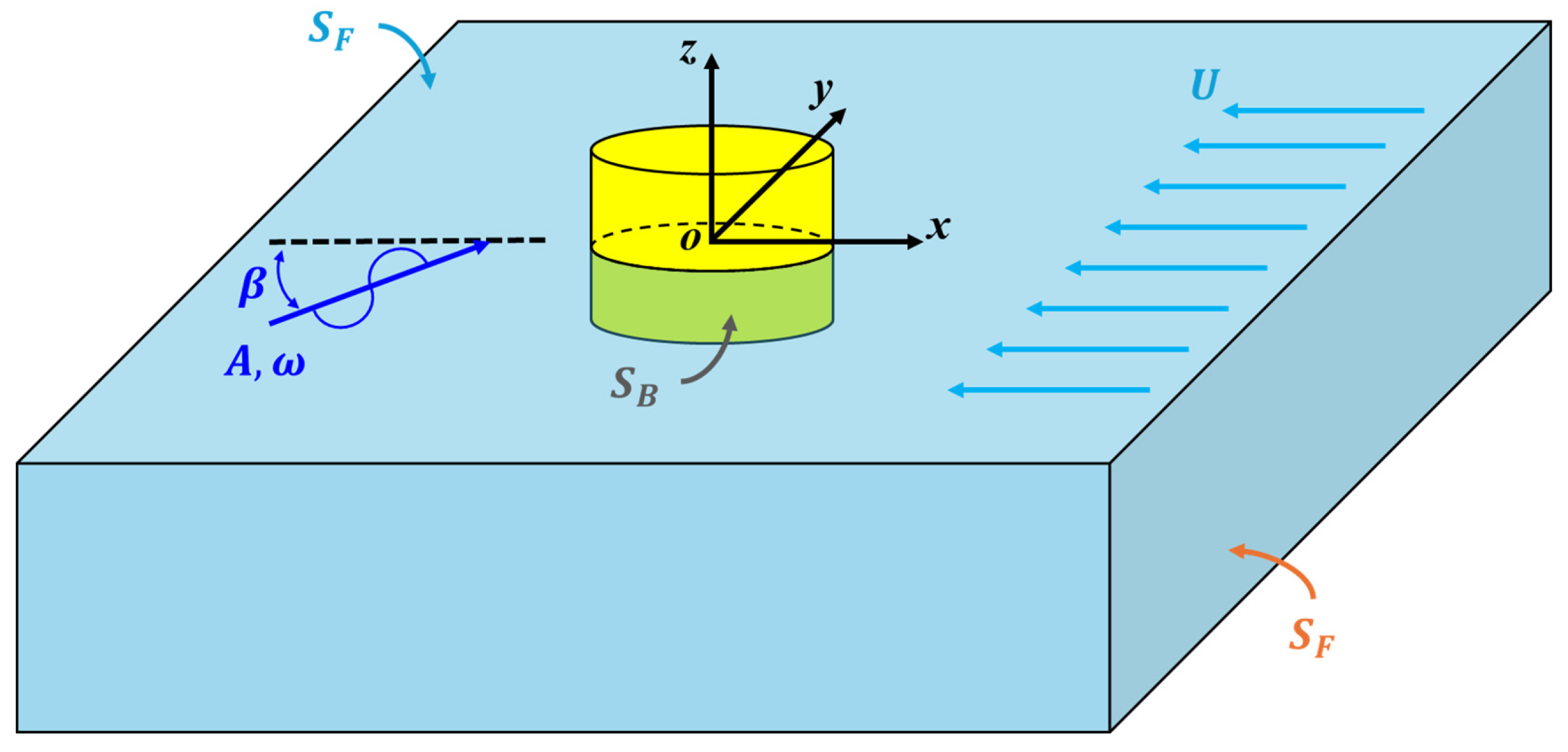
As shown in Figure 1, a wave energy converter (WEC) is considered in regular waves and a uniform current in infinite water depth. Here, A , ω , and β denote the incident-wave amplitude, wave frequency, and incident angle, respectively, and U represents a uniformly incoming current. The WEC is assumed to undergo harmonic motion in heave only about its mean position.
Under the assumptions of inviscid, incompressible, and irrotational flow, a velocity potential Ω exists and the fluid domain satisfies the Laplace equation
𝛻 2 Ω ( x , t ) = 0
Assuming that the wave amplitude of the disturbance induced by the body motion is small, a linearized boundary-value problem can be formulated. The velocity potential Ω is decomposed as
Ω ( x , t ) = Φ ( x ) + [ ( ζ 3 ϕ 3 ( x ) + A ( ϕ 0 ( x ) + ϕ 7 ( x ) ) ) ] e i ω t
where Φ is the steady velocity potential, ϕ 3 is the heave radiation potential, ϕ 0 is the incident-wave potential, and ϕ 7 is the diffraction potential. The steady velocity potential Φ represents the near-field modification of a uniform current and plays an important role in wave scattering around the WEC. The steady potential Φ is obtained by imposing rigid-wall condition Φ z = 0 at the mean free surface. It can be written as Φ = Φ D U x , where Φ D denotes the double-body disturbance potential. Here, i is the imaginary unit and ζ 3 is the complex heave amplitude. For a given frequency ω , the following relation holds:
ω = ω 0 U   k   c o s ( β )
where ω 0 is the angular frequency for U = 0 , and k ( = ω 0 2 / g ) is the wavenumber. Under deep-water conditions, the incident-wave potential is given by
ϕ 0 = i A g ω 0 e k ( z i [ x   c o s ( β ) + y   s i n ( β ) ] )
where g is the gravitational acceleration.
The linearized free-surface conditions accounting for the steady potential Φ are written as Equations (5) and (6) [15,16]:
g ϕ 3 z = ω 2 ϕ 3 2 i ω 𝛻 Φ · 𝛻 ϕ 3 𝛻 Φ · 𝛻 ( 𝛻 Φ · 𝛻 ϕ 3 ) 1 2 𝛻 ( 𝛻 Φ · 𝛻 Φ ) · 𝛻 ϕ 3 + Φ z z ( i ω ϕ 3 + 𝛻 Φ · 𝛻 ϕ 3 ) o n   S F
g ϕ 7 z = ω 2 ( ϕ 0 + ϕ 7 ) 2 i ω 𝛻 Φ · 𝛻 ( ϕ 0 + ϕ 7 ) 𝛻 Φ · 𝛻 ( 𝛻 Φ · 𝛻 ( ϕ 0 + ϕ 7 ) ) 1 2 𝛻 ( 𝛻 Φ · 𝛻 Φ ) · 𝛻 ( ϕ 0 + ϕ 7 ) + Φ z z ( i ω ( ϕ 0 + ϕ 7 ) + 𝛻 Φ · 𝛻 ( ϕ 0 + ϕ 7 ) ) g ϕ 0 z o n   S F
The linearized body boundary conditions at the mean position are given by Equations (7) and (8) [15,16]:
ϕ 3 n = i ω n 3 + m 3 o n   S B
ϕ 7 n = ϕ 0 n   o n   S B
where n 3 is the generalized normal component on the body surface, defined as the third component of the inward unit normal vector n on the body surface:
n = ( n 1 , n 2 , n 3 )
In Equation (7), m 3 is an m -term that describes the interaction between the steady and unsteady flows, defined as
( m 1 , m 2 , m 3 ) = ( n · 𝛻 ) 𝛻 Φ
To ensure uniqueness of the radiation and diffraction solutions, an appropriate radiation condition is required so that waves generated by the body propagate outward to the far field. In this study, the hybrid radiation technique proposed by Oh and Kim [16] is adopted, which combines the Sommerfeld radiation condition with a free-surface damping term. On the radiation boundary surface, the Sommerfeld radiation condition is imposed as
ϕ j n i ω 2 g ϕ j = 0 ( j = 3 , 7 ) o n   S R
The free-surface damping term is implemented by multiplying the ϕ x x term in the free-surface condition by a complex damping factor ( 1 + 0.1 i ) :
( ω 2 + i ω Φ z z ) ϕ + 2 i ω ( Φ x ϕ x + Φ y ϕ y ) + Φ x ( Φ x x ϕ x + ( 1 + 0.1 i ) Φ x ϕ x x + Φ y x ϕ y + Φ y ϕ y x ) + Φ y ( Φ x y ϕ x + Φ x ϕ x y + Φ y y ϕ y + Φ y ϕ y y ) + ϕ x ( Φ x Φ x x + Φ y Φ y x ) + ϕ y ( Φ x Φ x y + Φ y Φ y y ) Φ z z ( Φ x ϕ x + Φ y ϕ y ) + g φ z = 0 o n   S F
The complex damping coefficient ( 1 + 0.1 i ) was selected as an optimal value based on a comparison with the forward-speed oscillatory Green function in Oh and Kim [16].

2.2. Equation of Motion

According to Newton’s second law, the heave equation of motion of the WEC in the frequency domain is written as
[ ω 2 ( M + a 33 ) + i ω b 33 + C 33 ] ζ 3 = F 3 E + F P T O
where M is the mass and C 33 is the heave restoring coefficient. The quantities a 33 , b 33 , and F 3 E denote the heave added mass, radiation damping coefficient, and wave excitation force, respectively. These hydrodynamic quantities are obtained from the unsteady velocity potential derived from the boundary-value problem. Here, ζ 3 is the complex heave amplitude of the WEC.
The heave added mass and radiation damping are computed as
a 33 = ρ ω 2 R ( S B ( i ω ϕ 3 + 𝛻 Φ · 𝛻 ϕ 3 ) n 3 d s )
b 33 = ρ ω I ( S B ( i ω ϕ 3 + 𝛻 Φ · 𝛻 ϕ 3 ) n 3 d s )
and the wave excitation force is given by
F 3 E = ρ S B ( i ω ( ϕ 0 + ϕ 7 ) + Φ · ( ϕ 0 + ϕ 7 ) ) n 3 d s
The term F P T O represents the force induced by the power take-off (PTO) system. In this study, it is modeled as linear damping:
F P T O = b P T O · i ω ζ 3
where b P T O is the additional damping coefficient associated with the PTO system.
The time-averaged absorbed power P ¯ can be derived as
P ¯ = b P T O · ω 2 2 ζ 3 ζ 3
The energy capture performance of the WEC can be estimated using the capture width ratio (CWR) [17]. The CWR is defined as
C W R = P ¯ B · P w 100
where B denotes the actual physical width, taken here as the WEC diameter D , and P w is the wave power per unit crest width, expressed as
P w = 1 2 ρ g A 2 C g
where C g is the group velocity, defined as
C g = C g 0 + U
where C g 0 is the group velocity without current. Since the present study considers deep-water conditions, C g 0 is defined as one half of the phase velocity V P 0 .

2.3. Numerical Method

To solve the boundary-value problem described in Section 2.1, the Rankine source method is employed [16]. As the fundamental singularity for the boundary-value problem, a Rankine source is selected, which is distributed over the integration surfaces as given in Equation (22):
G ( x , ξ ) = { 1 4 π r 1 4 π r o n   S B , S R 1 4 π r o n   S F w h e r e r r = ( x ξ 1 ) 2 + ( y ξ 2 ) 2 + ( z ξ 3 ) 2
The indirect boundary integral equation is given by
ϕ ( x ) = S B + S F + S R σ ( ξ ) G ( x , ξ ) d S ( ξ )
For numerical computation, Equation (23) is applied to the mean wetted body surface S B , the free surface S F , and the radiation boundary surface S R . Discretizing Equation (24) yields.
ϕ ( x ) = j N σ j   G i j
By substituting the boundary conditions of the boundary-value problem into Equation (24), a system of linear equations can be assembled. The velocity potential is then computed using the source strengths obtained from the solution of the linear system. On the free surface, the raised panel method is applied to reduce the singular behavior of the source kernel.

2.4. Approximate Method for Small Current Speed

For an accurate evaluation of the hydrodynamic loads on a floating body in current, the free-surface boundary conditions in Equations (5) and (6) and the body boundary condition in Equation (7) must be satisfied. The Rankine source method introduced in Section 2.3 is flexible in handling the complex free-surface boundary conditions; however, because it distributes sources over the entire fluid-domain boundaries, it is relatively inefficient compared with the translating and pulsating Green function method, which distributes sources only on the body boundary. Nevertheless, the translating and pulsating Green function method suffers from numerical instability and difficulties in achieving convergence. To avoid these difficulties, many research groups adopt an approximate approach based on the pulsating Green function method.
Under the assumption ω U   / x , the free-surface condition in current can be approximated as
g ϕ z = ω 2 ϕ o n   S F
The pulsating Green function is given by Equation (26). Although it does not satisfy the exact free-surface condition in the presence of current, it satisfies Equation (25), and thus its use is justified.
G w ( x , ξ ) = 1 4 π r 1 4 π r ν 2 π G ^ ( R , z + ξ 3 ) w h e r e   r r = ( x ξ 1 ) 2 + ( y ξ 2 ) 2 + ( z ξ 3 ) 2 R 2 + ( z ξ 3 ) 2   ν = ω 2 g
The function G ^ represents the free-surface term and is detailed in Appendix A.
In addition, under the assumption of a small current speed, if Φ D = 0 is assumed so that Φ = U x , then m 3 = 0 and the body boundary condition can be approximated as
ϕ 3 n = i ω n 3 o n   S B
The hydrodynamic coefficients and wave excitation force are also approximated as
a 33 = ρ ω 2 R ( S B ( i ω ϕ 3 U ϕ 3 x ) n 3 d s )
b 33 = ρ ω I ( S B ( i ω ϕ 3 U ϕ 3 x ) n 3 d s )
F 3 E = ρ S B ( i ω ( ϕ 0 + ϕ 7 ) U ( ϕ 0 + ϕ 7 ) x ) n 3 d s
Similar to the formulation in Section 2.3, an indirect boundary integral equation for the pulsating Green function method can be formulated as
ϕ ( x ) = S B σ w ( ξ ) G w ( x , ξ ) d S ( ξ )
By applying the boundary conditions of the approximated boundary-value problem and discretizing the resulting equations, a linear system can be assembled to obtain σ w . The velocity potential can then be computed using the resulting σ w .
In this study, the approximate approach based on the pulsating Green function is referred to as the approximate free-surface Green function method (AFSGM), and its results are compared with those of the Rankine source method (RSM), which accounts for the exact free-surface conditions.

3. Numerical Results and Discussion

3.1. Numerical Model Setup

In Section 3.1, the numerical model is validated using a hemispherical WEC. The principal particulars of the hemisphere are summarized in Table 1.
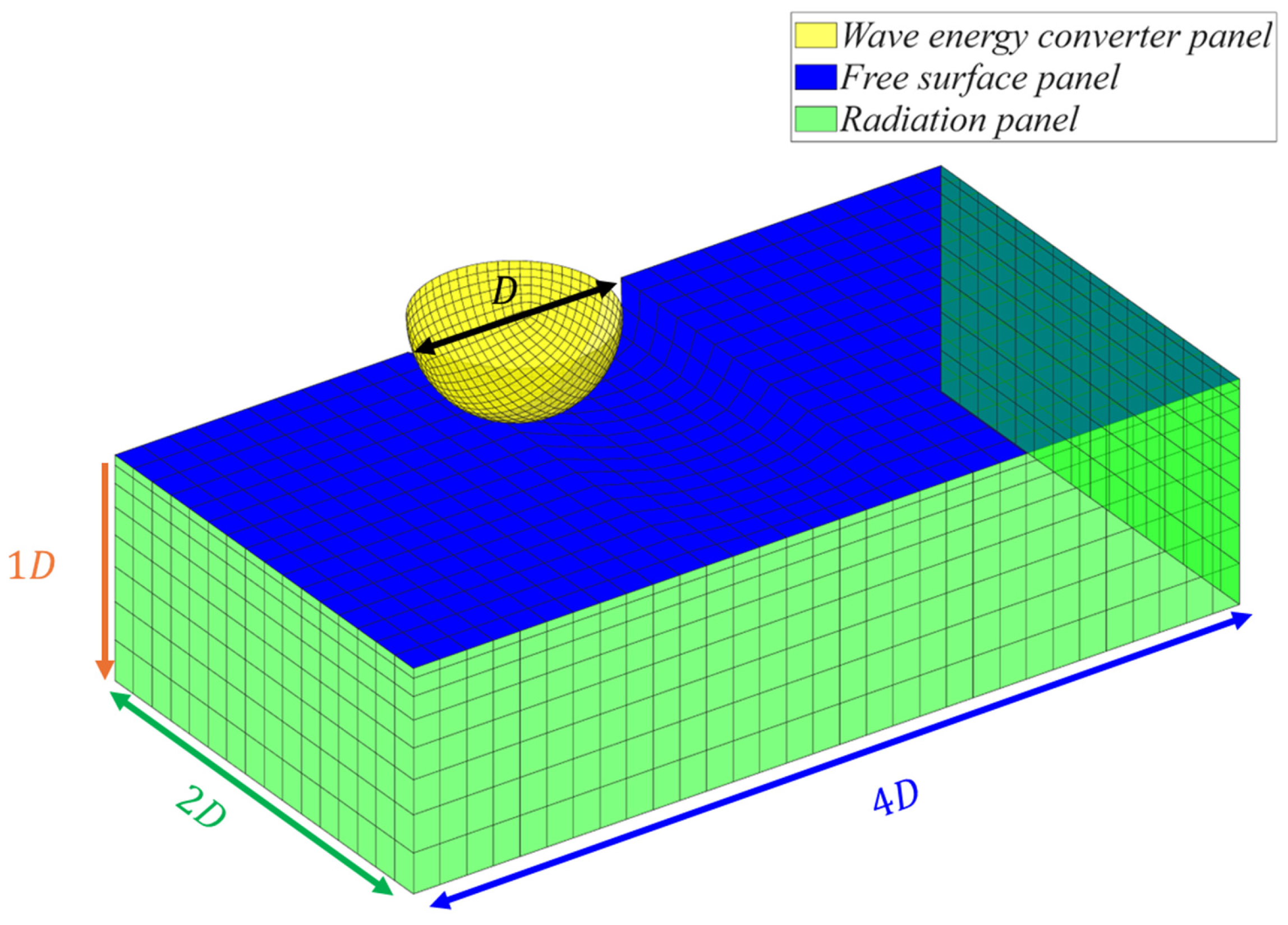
In this study, only the wave-heading case of β = 180 is considered, and the current is assumed to be either aligned with the wave direction ( U > 0 ) or opposed to it ( U < 0 ) . For computational efficiency, the image method is applied so that only half of the fluid domain is used in the Rankine source method (RSM), as discretized in Figure 2. The computational domain on the free surface is set to 4 D in the longitudinal direction and 2 D in the transverse direction, while the radiation boundary surface is extended to 1 D in the vertical (depth) direction. The free-surface panels are generated with an aspect ratio close to unity, and the radiation-boundary panels are arranged to be denser in the vicinity of the free surface.

3.2. Convergence Tests

Convergence tests were performed for the hemispherical WEC. In AFSGM, only the wetted body surface is discretized using panels, whereas in RSM, not only the body surface but also the free surface and the radiation boundary surface are discretized. The free surface and the radiation boundary surface are modeled using quadrilateral elements, and the element size is defined as Δ x . The panel density on the free surface and radiation boundary surface are defined by the ratio D / Δ x , where D is the WEC diameter. The numbers of free-surface panels N F S and radiation-boundary panels N R A D corresponding to D / Δ x are listed in Table 2.
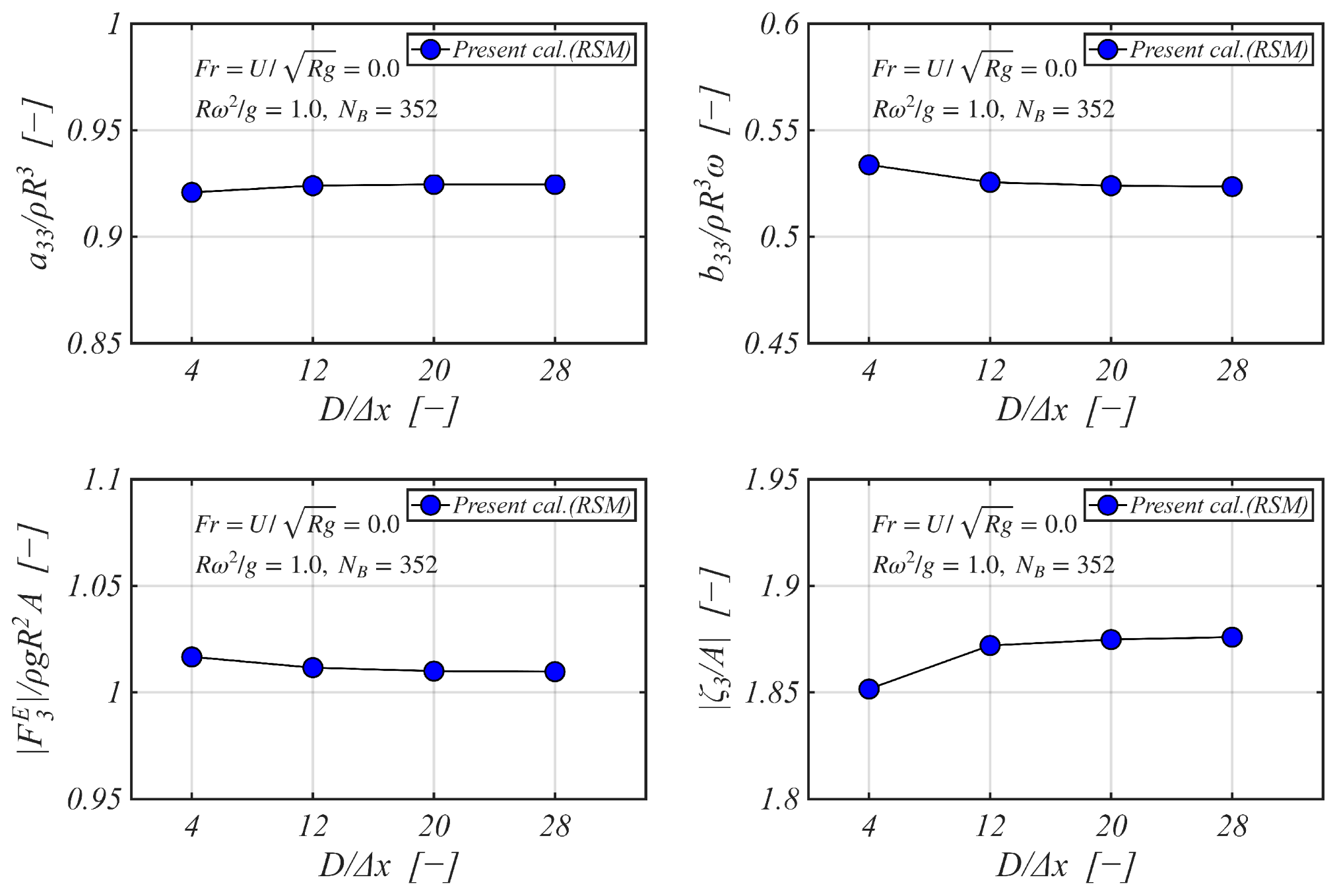
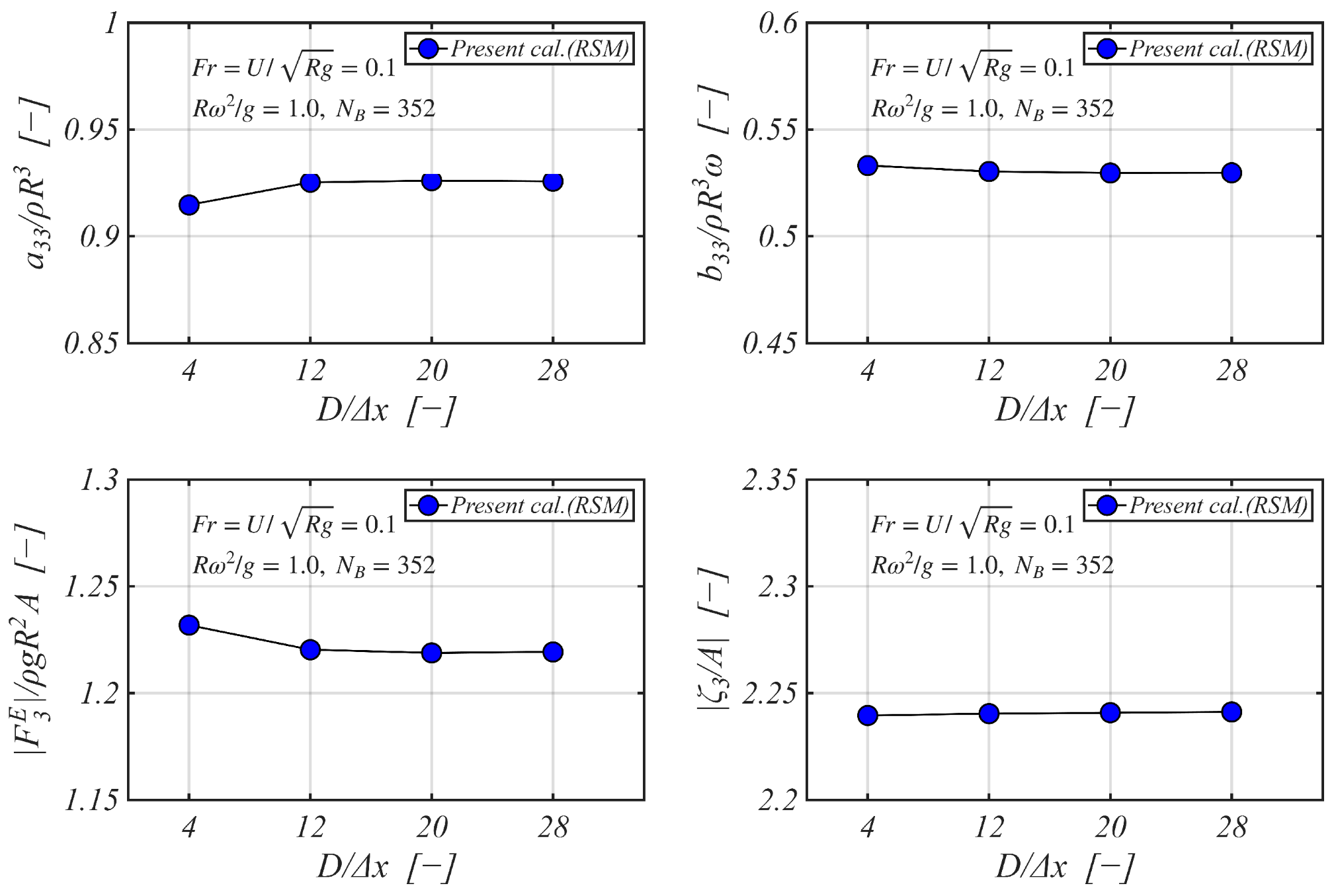
First, convergence tests with respect to the panel density on the free surface and the radiation boundary surface were conducted for RSM. The number of body panels was fixed at N B = 352 , and the current conditions of the Froude number F r ( = U / R g ) were set to 0.0 and 0.1. The incident-wave frequency was set to R ω 2 / g = 1.0 . The computations were carried out for D / Δ x = 4 , 12 , 20 , and 28, and the results are presented in Figure 3 and Figure 4. For both F r = 0.0 and 0.1, the numerical solutions showed a gradual convergence trend for D / Δ x 20 .
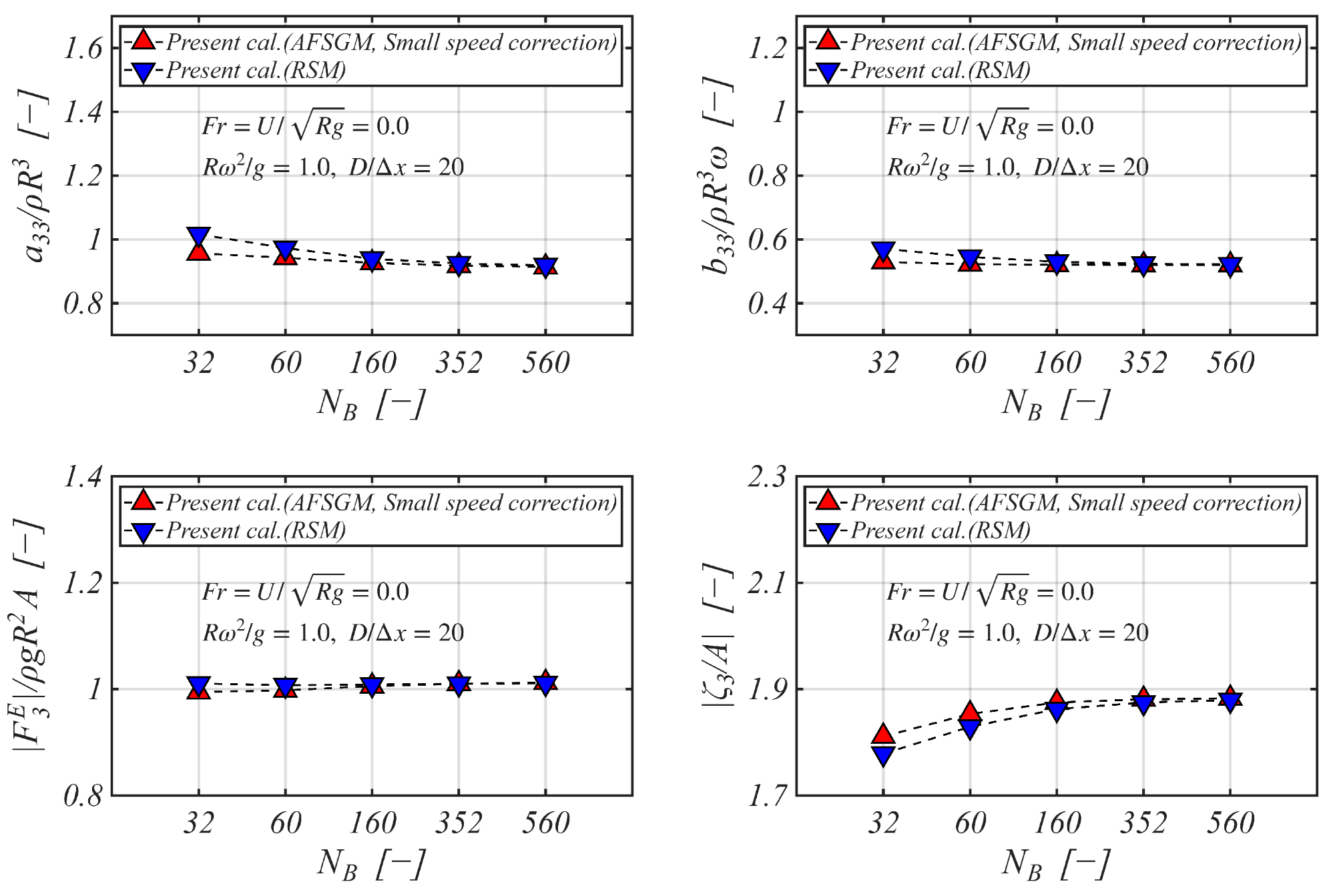
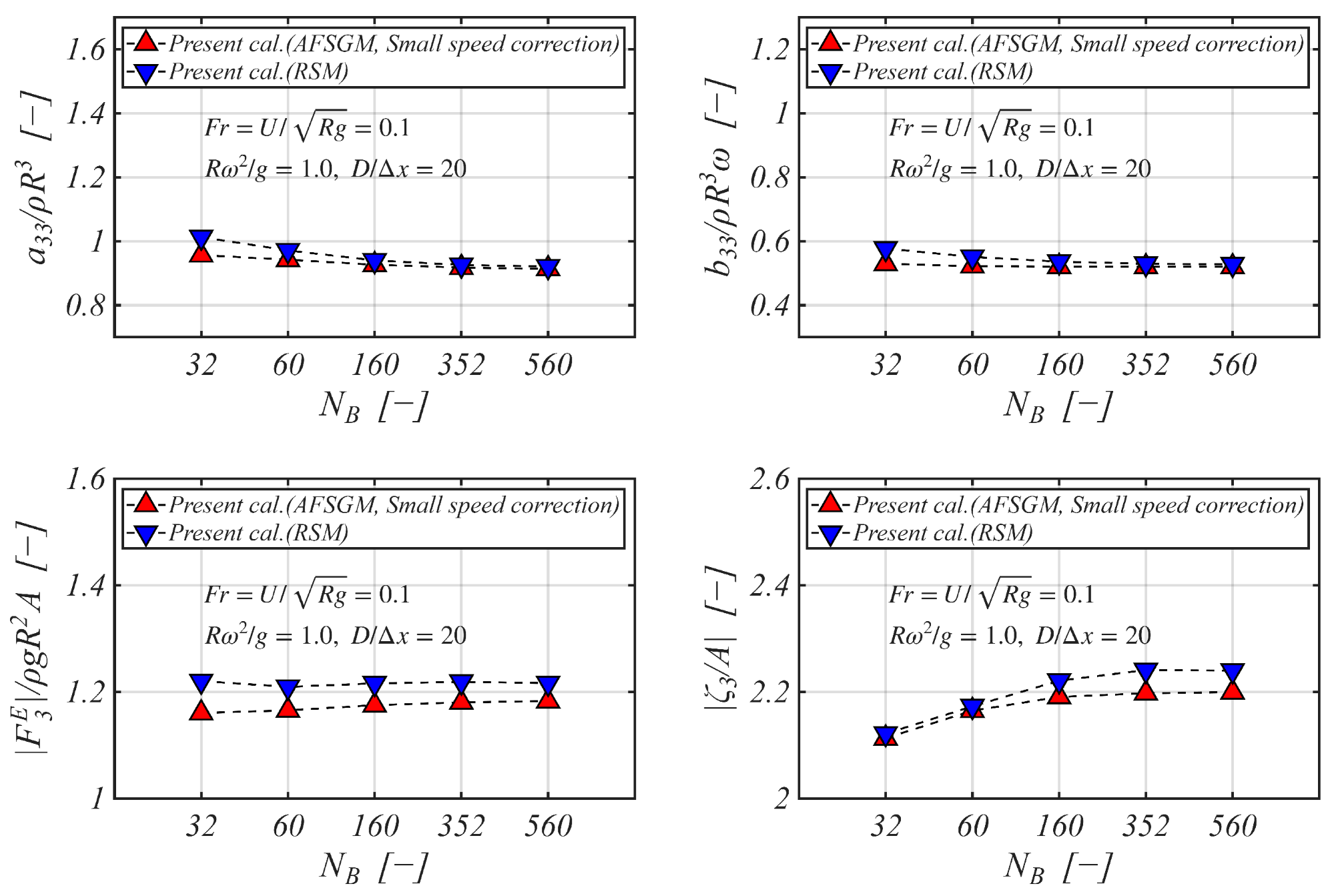
Next, convergence tests with respect to the number of body panels N B were performed for both RSM and AFSGM. For RSM, the free-surface and radiation-boundary discretization was fixed at D / Δ x = 20 . The current conditions were F r = 0.0 and 0.1, and the incident-wave frequency was set to R ω 2 / g = 1.0 . Based on the half-body discretization, computations were conducted for N B = 32 , 60 , 160 , 352 , and 560, and the results are shown in Figure 5 and Figure 6. For both F r = 0.0 and 0.1, gradual convergence was observed for N B 352 . In addition, while the AFSGM and RSM results converged to the same values for F r = 0.0 , the converged values differed between the two methods for F r = 0.1 , particularly for the wave excitation force F 3 E and the heave RAO ζ 3 / A . This difference is attributed to the fact that RSM applies the exact free-surface boundary condition, whereas AFSGM employs an approximation. The cause of this discrepancy is discussed in the Section 3.3.
Based on the above convergence tests, N B = 352 and D / Δ x = 20 were used in the subsequent computations.

3.3. Validation and Current Effects

In Section 3.3, the basic numerical model for a hemispherical WEC is validated by comparison with published results under zero-current conditions, and the validity of the current-included analysis is further assessed through comparison under current conditions. In addition, the prediction differences between RSM and AFSGM are analyzed to discuss the applicability range of AFSGM in current. For the motion calculations, the PTO damping coefficient b P T O is set to zero.
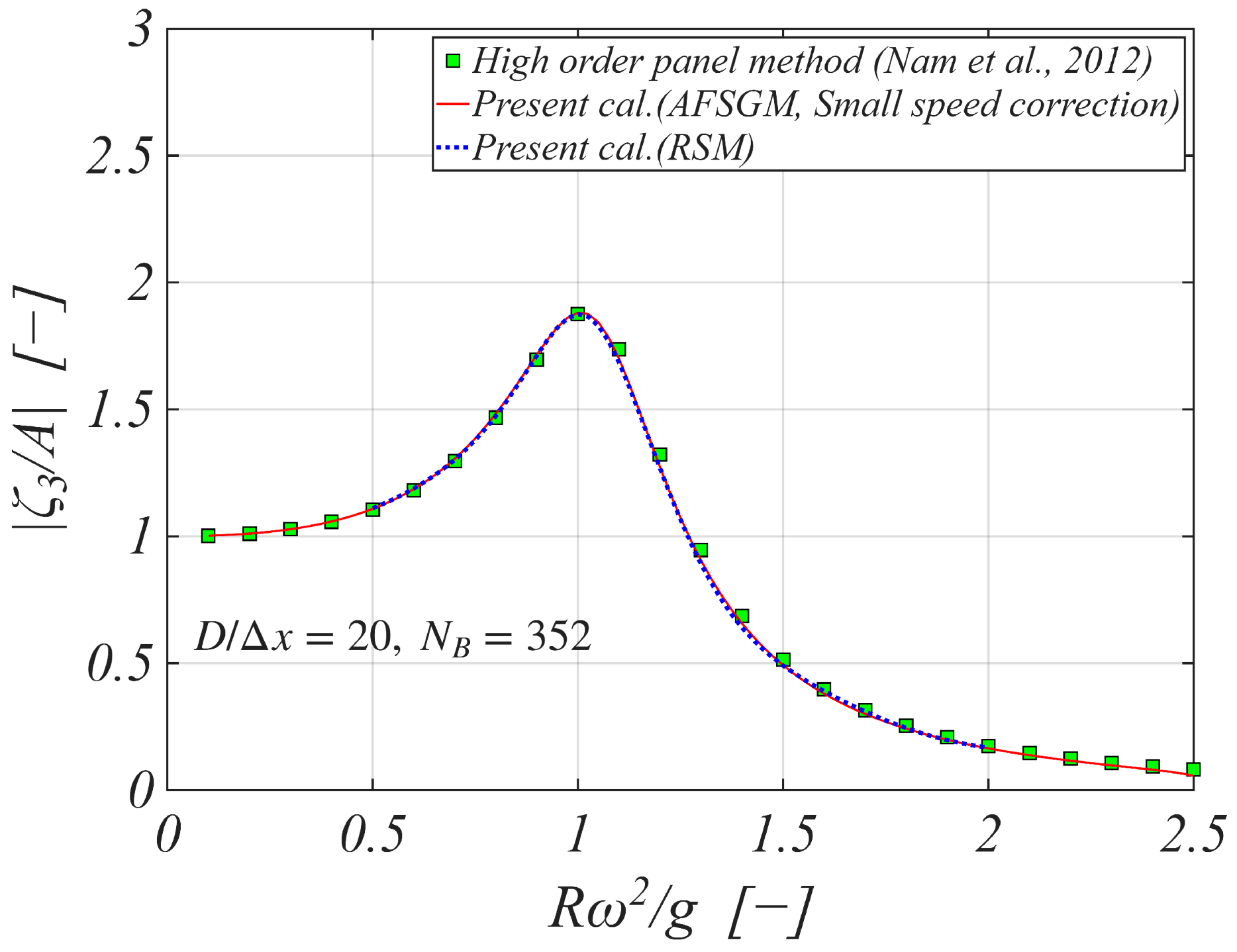
First, the heave RAO under zero-current conditions is presented in Figure 7. By comparing it with the results of Nam et al. [18], which were obtained using a pulsating Green-function-based high-order panel method, it is confirmed that both AFSGM and RSM agree well with Nam et al. [18]. Therefore, both methods are shown to reproduce the baseline hydrodynamic loads and motion responses appropriately in the absence of current.
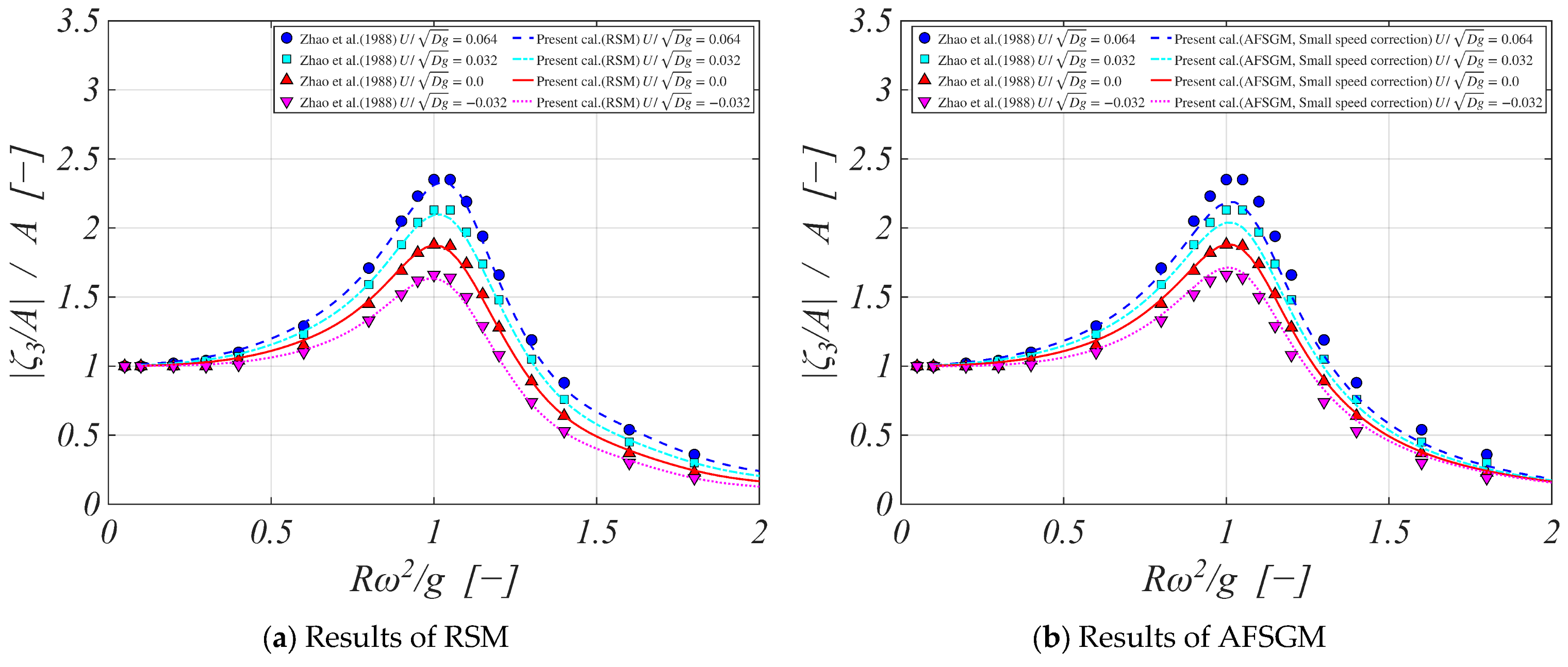
Subsequently, the heave motion RAO of the WEC under current conditions is shown in Figure 8. The current speed is prescribed using the nondimensional parameter U / D g of Zhao et al. [19], and computations are carried out for U / D g = 0.064 , 0.032 , 0.0 , and 0.032 . Following Zhao et al. [19], surge and heave are set free while pitch is constrained. The RSM results agree well with those of Zhao et al. [19], confirming the validity of the RSM analysis under current conditions. In contrast, AFSGM reproduces the increasing trend of the heave RAO with increasing current speed, but differences are observed in the magnitude of the increase compared with the published results and RSM. Therefore, in the following analysis, the RSM results validated against the literature are used as the reference to discuss the error characteristics and applicability of AFSGM.
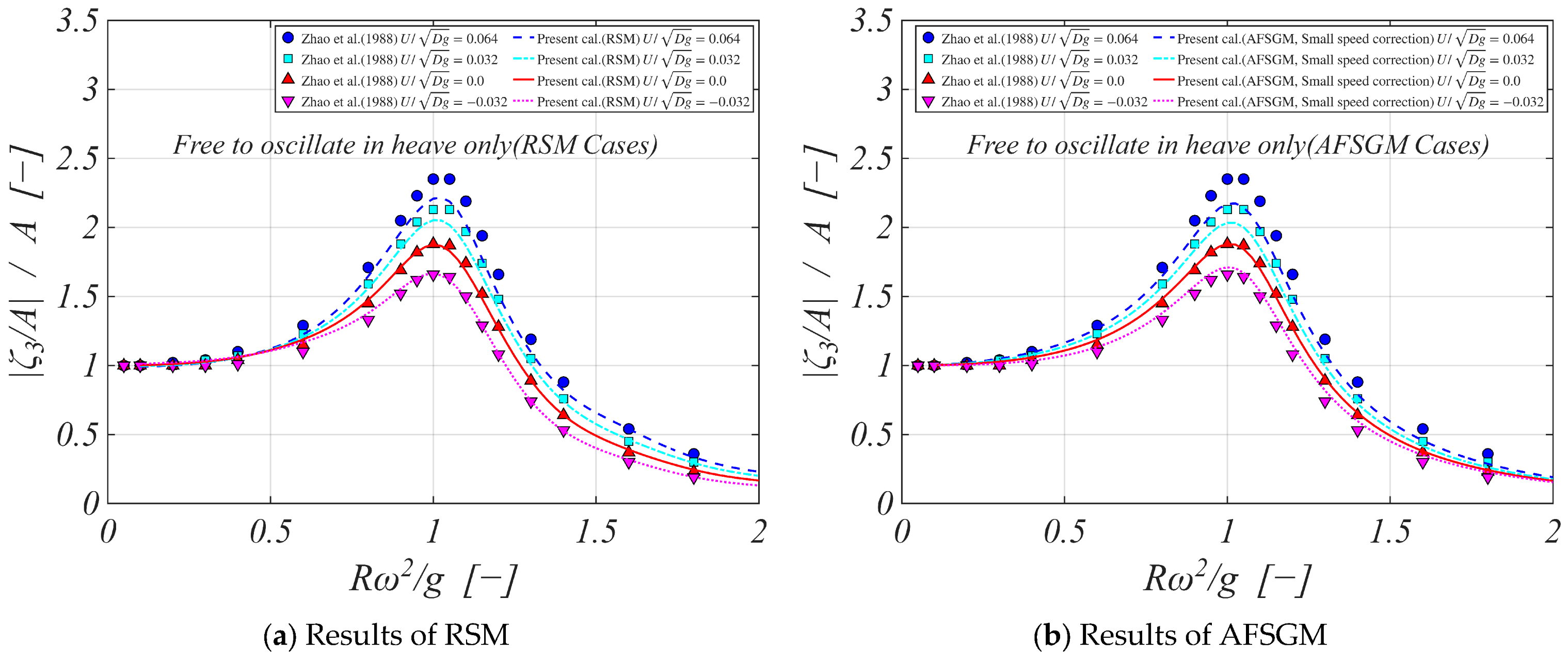
To examine the influence of motion constraints on the heave response under current conditions, additional computations are performed for the heave-only case, in which surge and pitch are constrained and only heave is free. The results are shown in Figure 9. In Figure 9, the RSM and AFSGM results for the heave-only condition are presented together with the results of Zhao et al. [19] for the surge–heave free condition as a reference. This is intended to provide a visual comparison indicating that allowing surge freedom can increase the heave response at the same current speed. As a result, for the heave-only condition (RSM and AFSGM), the heave RAO is generally reduced compared with the surge and heave free condition [19], because the surge–heave coupling pathway is removed. Furthermore, the reduction in the RAO when transitioning from the surge and heave free condition to the heave-only condition is larger in RSM than in AFSGM. This suggests that AFSGM may not capture the current dependence of the coupling coefficients effective in the surge-free condition a 13 , a 31 , b 13 , and b 31 as accurately as RSM.
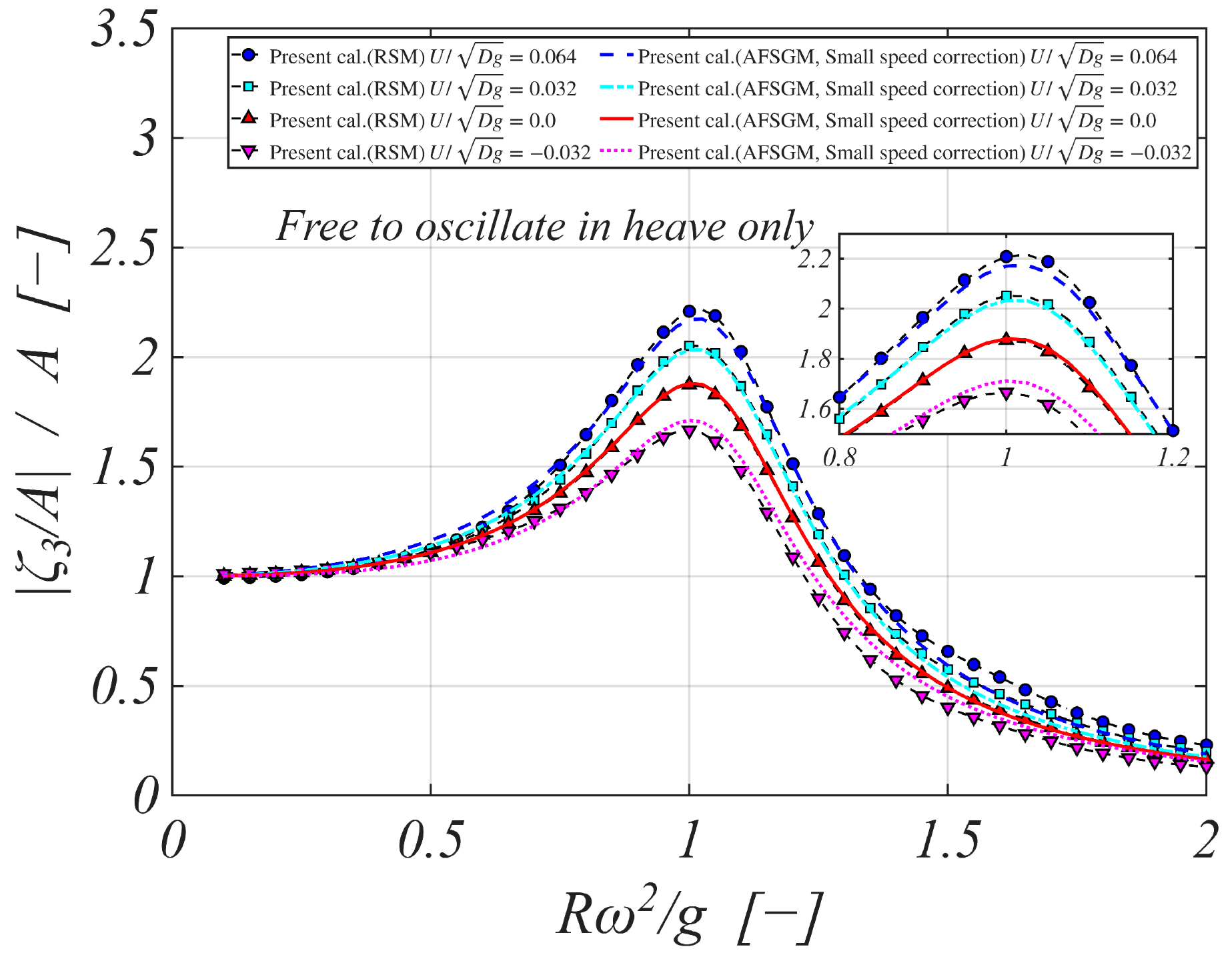
Figure 10 compares the heave RAOs predicted by RSM and AFSGM for various current speeds under the heave-only condition (surge and pitch constrained, heave free). For U D g   0.032 , the results of the two methods are almost identical, whereas for U / D g = 0.064 , a difference between RSM and AFSGM is observed near the resonance frequency. Note that U / D g = 0.032 corresponds to approximately F r ( = U / R g ) = 0.045 . Accordingly, for the heave-only motion condition, AFSGM is practically applicable within   F r   0.045 . However, for   F r   > 0.045 , even though the difference is not large, discrepancies appear in the vicinity of resonance; thus, RSM is recommended when more rigorous predictions are required.
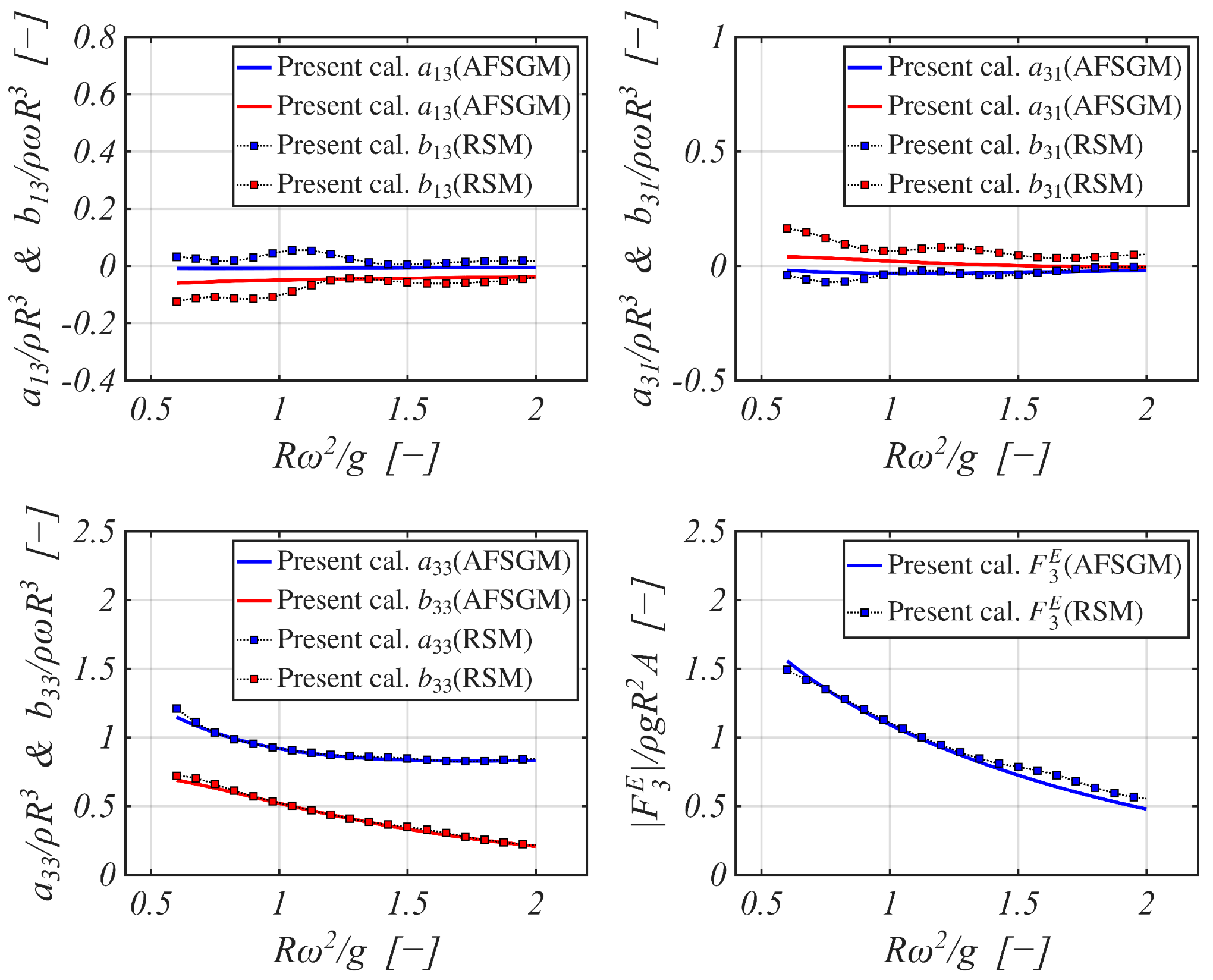
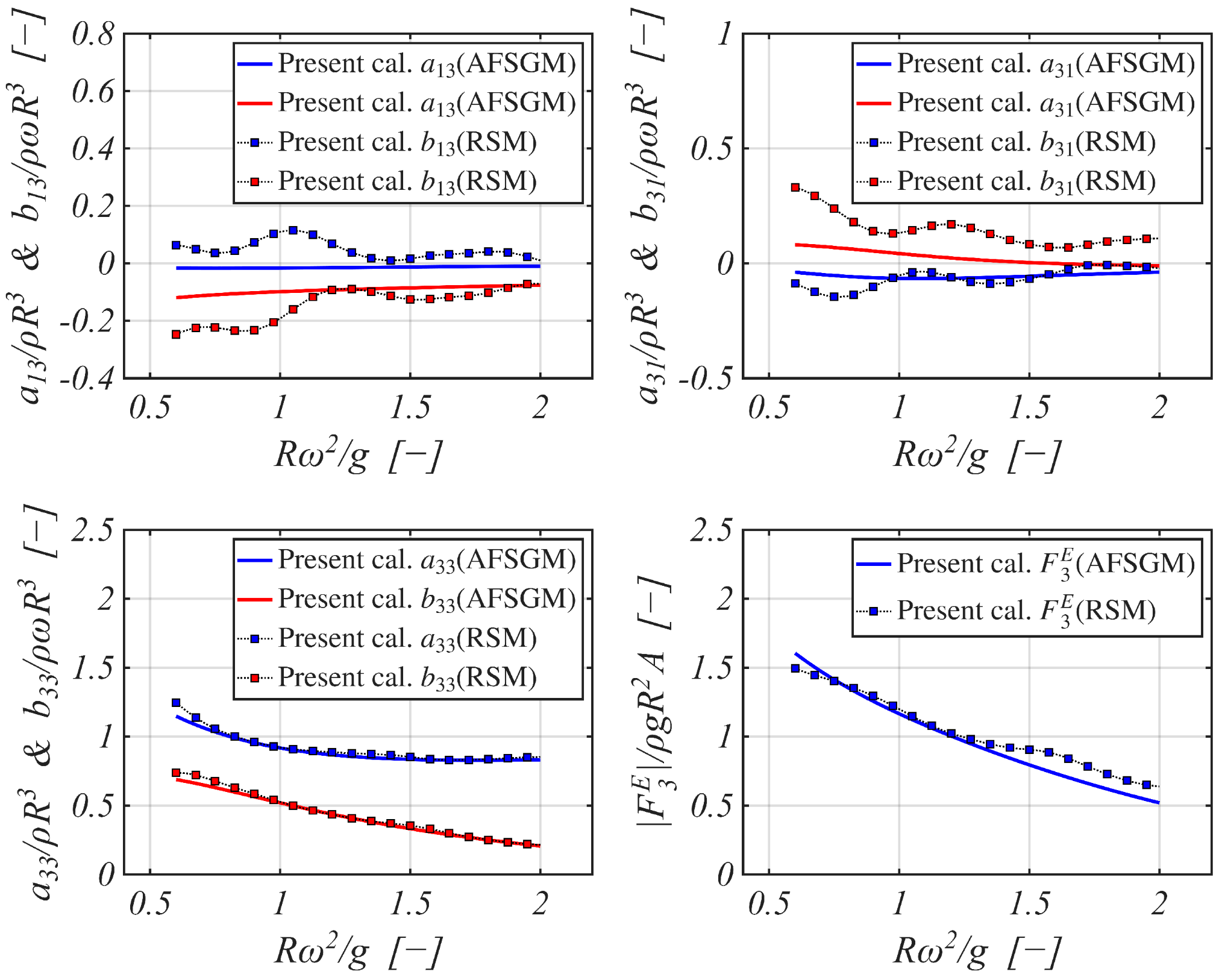
To investigate the causes of the response differences observed in Figure 8, Figure 9 and Figure 10 under current conditions, the hydrodynamic coefficients and wave excitation forces at U / D g = 0.032 and 0.064 are shown in Figure 11 and Figure 12. The off-diagonal hydrodynamic coefficients a 13 , a 31 , b 13 , a n d   b 31 exhibit more pronounced variations with current speed in RSM than in AFSGM, and the differences between the two methods become clearer as the current speed increases. Since these off-diagonal terms can influence the response through coupling pathways when surge is free, RSM is recommended for WEC analyses in which coupling effects are relevant, because it treats the free-surface boundary condition more rigorously. In particular, the observation that RSM shows an agreement trend with Zhao et al. [19] under increasing current speeds, whereas AFSGM shows differences in response magnitude, supports the need for rigorous analysis in regimes where coupling effects become significant.
In contrast, for the heave-only condition, the coupling terms do not directly enter the heave equation of motion, and the response is primarily governed by a 33 , b 33 , and F 3 E . In the present computational range, the RSM–AFSGM differences in a 33 , b 33 , and F 3 E are not as pronounced as those in the off-diagonal terms and, accordingly, the method-to-method differences in the heave-only response remain generally limited. Nevertheless, for higher current speeds (   F r   > 0.045 ) , differences are observed near resonance; therefore, the use of RSM is appropriate for conservative analyses or design applications.

3.4. Effects of Current on Wave Energy Harvesting

To evaluate the effects of current conditions on the energy capture performance, the time-averaged power absorbed by the PTO was calculated. In this study, the PTO force was modeled as a linear viscous damping term, as given in Equation (17). The time-averaged absorbed power is defined by Equation (18), and the capture width ratio (CWR) is defined by Equation (19). The WEC is assumed to be constrained to heave motion only. The current conditions of F r = 0.1 , 0, and 0.1 (0.31, 0.0, and 0.31   m /s) were considered, and a parametric study was conducted by varying the PTO damping b P T O from 0 to 8000 Ns/m with an increment of 400 Ns/m. The selected range of PTO damping was chosen with reference to Jeong et al. (2022) [8], which considered the same hemispherical geometry as that used in the present study. Since the added mass and radiation damping vary with current conditions, a single nondimensional damping parameter does not provide a fully consistent basis for comparison across all cases; therefore, the PTO damping is presented in dimensional form.
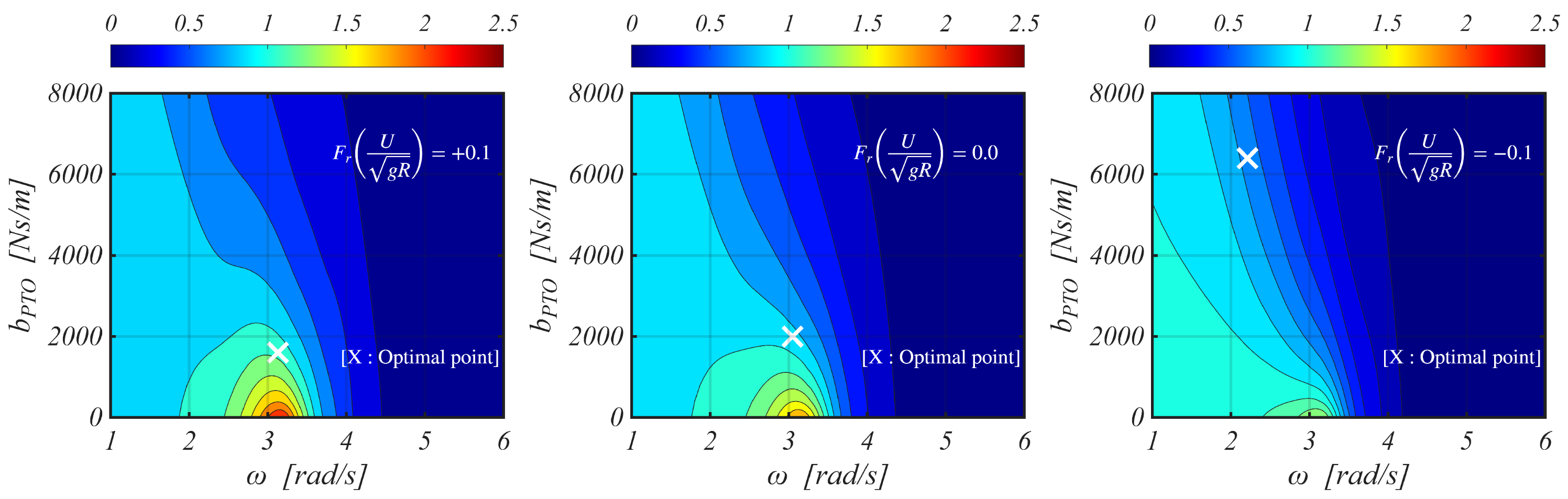
Figure 13 presents the contour map of the heave RAO as a function of the current speed and b P T O . In a result that is consistent with the Section 3.3, the heave RAO tends to increase as the current speed increases. In addition, as b P T O increases, the energy extraction (damping) by the PTO becomes stronger, which suppresses the resonant response and reduces the response in the resonance-frequency region.
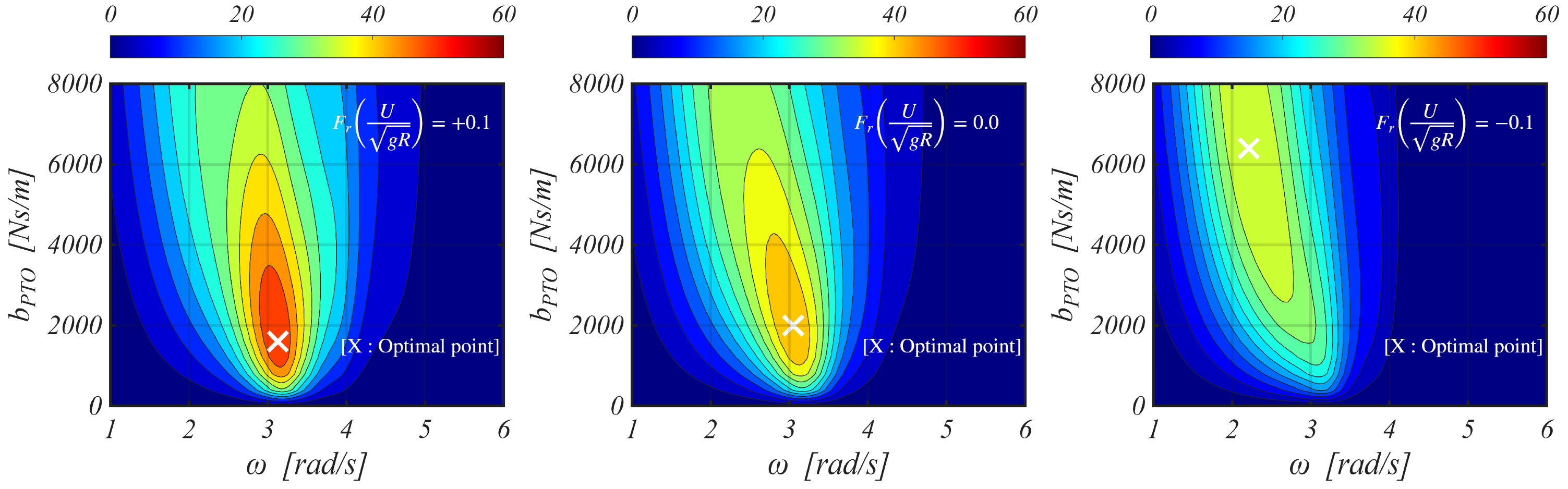
Figure 14 compares the CWR for different current speeds and, under the present conditions, the CWR shows an overall increasing trend for a following current ( F r > 0 ) . The values of b P T O and ω that maximize the CWR are defined as b P T O o p t and ω o p t , respectively, and are summarized in Table 3.
Compared with the zero-current case, C W R m a x increases by 8.9% at F r = 0.1 and decreases by 7.7% at F r = 0.1 . It is also confirmed that b P T O o p t and ω o p t vary depending on the presence of current. Therefore, current effects should be considered in WEC performance assessment and PTO design, and under the present conditions, the energy capture performance tends to improve for F r > 0 . However, in regions with strong currents, additional assessments are required to select appropriate operating conditions by considering potential increases in structural strength requirements and installation/operation costs.

4. Conclusions

This study investigated the hydrodynamic characteristics and energy capture performance of a hemispherical point-absorber wave energy converter (WEC) under current conditions. The present work was intended as an initial numerical study to identify the first-order influence of current on the behavior and energy capture characteristics of a point-absorber WEC within a simplified analysis framework. Accordingly, the present results should be interpreted as a first-step assessment of current-induced trends rather than a fully validated design prediction.
First, a numerical solver based on the Rankine source method (RSM) was developed to rigorously account for the free-surface boundary conditions in the presence of current. In addition, under the assumption that   U   / x   is relatively small compared with ω , an approximate approach based on the pulsating Green function (AFSGM) was formulated, and the applicability and prediction differences of the two methods were compared. Through convergence tests, appropriate discretization levels were selected for the number of body panels N B and the panel density on the free surface and radiation boundary surfaces ( D / Δ x ) .
To examine the motion responses of the hemispherical WEC with varying current speed, analyses were performed for the surge and heave free and heave-only conditions. In the heave-only condition, the heave RAO decreases compared with the surge and heave free condition, indicating that allowing surge freedom can increase the heave response. In addition, as the current increases, coupling effects among the degrees of freedom become more pronounced in the surge-free condition, suggesting that the current dependence of the coupling coefficients ( a 13 , a 31 , b 13 ,   a n d   b 31 ) may be evaluated differently by RSM and AFSGM. In contrast, because the coupling terms do not directly enter the equation of motion for the heave-only condition, the differences in the heave RAO between the two methods are generally limited. Under the present conditions, AFSGM was found to be practically applicable for the heave-only motion within   F r   0.045 , whereas differences were observed near the resonance frequency for   F r   > 0.045 ; therefore, RSM is recommended for more rigorous predictions.
In addition, the energy capture performance was evaluated under current conditions by applying a linear PTO damping model. The capture width ratio (CWR) showed an overall increasing trend for following current ( F r > 0 ) , and the optimal values b P T O o p t and ω o p t were shown to vary depending on the presence of current. This indicates that current effects should be considered in WEC performance assessment and PTO design. However, because the present analysis adopts a simplified linear PTO damping model in the frequency domain, PTO stiffness and reactive control were not considered. Therefore, the present results do not represent the fully optimized energy capture performance that may be achievable through resonance tuning and advanced PTO control strategies.
This study is limited by the assumption of potential flow, which does not account for viscous effects and vortex-induced losses. In particular, near the resonance frequency, the neglect of viscous damping may lead to overestimation of the motion response and power capture performance, and thus the quantitative results in this region should be interpreted with caution. Moreover, because the analysis is conducted in the frequency domain, the PTO force is modeled using linear viscous damping, and irregular sea states are not considered. In addition, the present model does not include mooring stiffness or other restoring effects, although these may influence the dynamic response and energy capture performance of the WEC. Furthermore, the current condition is assumed to be uniform, and therefore the present analysis does not represent the vertically sheared and spatially varying current fields commonly observed in real ocean environments. The validation of the present model is also limited to the benchmark cases available in the literature, and further validation under PTO-operating conditions using high-fidelity CFD and/or experiments is required for more reliable quantitative prediction. Future work will incorporate more realistic PTO modeling through time-domain analysis and will quantitatively evaluate current effects and energy capture performance under irregular sea conditions. Future studies should also consider viscous effects, mooring stiffness, reactive PTO control, vertically varying current profiles, and additional validation under actual energy extraction conditions.

Author Contributions

Conceptualization, S.O.; methodology, S.O.; software, S.O. and S.O.; validation, S.O.; formal analysis, S.O.; investigation, S.O.; resources, S.O.; data curation, S.O.; writing—original draft preparation, S.O.; writing—review and editing, S.O., E.S.K., J.-H.L., J.-c.L., S.-s.L., and S.-Y.H.; visualization, S.O.; supervision, E.S.K., J.-c.L., J.-H.L., S.-s.L., and S.-Y.H.; project administration, S.O. All authors have read and agreed to the published version of the manuscript.

Funding

This research was a part of the project titled ‘Training Blue Tech Leaders for Eco-Friendly Ships (No. RS-2025-02220459)’, funded by the Ministry of Oceans and Fisheries, Korea.

Data Availability Statement

The data is contained within the article.

Conflicts of Interest

The authors declare no conflicts of interest.

Appendix A

The free-surface term of the pulsating Green function can be expressed as follows [20]:
G ^ = 2 π 0 k s i n ( k ( z + ξ 3 ) ) + ν c o s ( k ( z + ξ 3 ) ) k 2 + ν 2 K 0 ( k R ) d k i π e ν ( z + ξ 3 ) H 0 ( 2 ) ( ν R )
where K 0 ( k R ) and H 0 ( 2 ) ( ν R ) denote the modified Bessel function of the second kind and the Hankel function of the second kind, respectively. Various studies have been conducted to compute the pulsating Green function efficiently.

References

  1. Lee, H.; Calvin, K.; Dasgupta, D.; Krinner, G.; Mukherji, A.; Thorne, P.; Trisos, C.; Romero, J.; Aldunce, P.; Barrett, K. IPCC, 2023: Climate Change 2023: Synthesis Report: A Report of the Intergovernmental Panel on Climate Change; Intergovernmental Panel on Climate Change: Geneva, Switzerland, 2023. [Google Scholar]
  2. International Renewable Energy Agency (IRENA). Renewable Energy Statistics 2024; International Renewable Energy Agency: Abu Dhabi, United Arab Emirates, 2024. [Google Scholar]
  3. Falnes, J.; Kurniawan, A. Ocean Waves and Oscillating Systems: Linear Interactions Including Wave-Energy Extraction; Cambridge university Press: Cambridge, UK, 2020; Volume 8, ISBN 1-108-48166-3. [Google Scholar]
  4. Cruz, J. Ocean Wave Energy: Current Status and Future Prespectives; Springer Science & Business Media: Berlin/Heidelberg, Germany, 2007; ISBN 3-540-74895-4. [Google Scholar]
  5. Wu, H.; Deng, W.; Yuan, Z. Numerical Investigation of the Effects of Wave–Current Interaction on the Dynamic Responses of a Floating Power Harvesting Platform. Phys. Fluids 2024, 36, 107115. [Google Scholar] [CrossRef]
  6. Budar, K.; Falnes, J. A Resonant Point Absorber of Ocean-Wave Power. Nature 1975, 256, 478–479. [Google Scholar] [CrossRef]
  7. Kim, S.-J.; Koo, W.; Heo, K.-U.; Heo, S. Numerical Study on Shape Optimization of a Heaving Hemisphere Wave Energy Converter. J. Korean Soc. Mar. Environ. Energy 2015, 18, 254–262. [Google Scholar] [CrossRef]
  8. Jeong, H.-J.; Kim, S.-J.; Koo, W. Hydrodynamic Analysis of a Breakwater-Integrated Heaving-Buoy-Type Wave Energy Converter with an Optimal Artificial Damping Scheme. Appl. Sci. 2022, 12, 3401. [Google Scholar] [CrossRef]
  9. Heo, S.; Koo, W.; Lee, O.-B. Optimization Analysis of a Heaving Point Absorber Wave Energy Converter in Wave Focusing Conditions near a Parabolic Vertical Wall. Ocean Eng. 2025, 331, 121342. [Google Scholar] [CrossRef]
  10. Son, D.; Belissen, V.; Yeung, R.W. Performance Validation and Optimization of a Dual Coaxial-Cylinder Ocean-Wave Energy Extractor. Renew. Energy 2016, 92, 192–201. [Google Scholar] [CrossRef]
  11. Zhang, X.; Guo, X.; Zhi, P.; Yeung, R.W. Performance Assessment of a Triple Coaxial-Cylinder Wave-Energy Converter (TCWEC). Renew. Energy 2024, 237, 121547. [Google Scholar] [CrossRef]
  12. Wang, L.; Son, D.; Yeung, R.W. Effect of Mooring-Line Stiffness on the Performance of a Dual Coaxial-Cylinder Wave-Energy Converter. Appl. Ocean Res. 2016, 59, 577–588. [Google Scholar] [CrossRef]
  13. Zhao, R.; Faltinsen, O.M. Interaction between Waves and Current on a Two-Dimensional Body in the Free Surface. Appl. Ocean Res. 1988, 10, 87–99. [Google Scholar] [CrossRef]
  14. Faltinsen, O.M.; Wang, J.; Xiang, X. Current–Wave Interaction with Large-Volume Structures. Phys. Fluids 2025, 37, 067111. [Google Scholar] [CrossRef]
  15. Nakos, D.E. Ship Wave Patterns and Motions by a Three Dimensional Rankine Panel Method. Ph.D. Thesis, Massachusetts Institute of Technology, Cambridge, MA, USA, 1990. [Google Scholar]
  16. Oh, S.; Kim, B. Hybrid Radiation Technique of Frequency-Domain Rankine Source Method for Prediction of Ship Motion at Forward Speed. Int. J. Nav. Archit. Ocean Eng. 2021, 13, 260–277. [Google Scholar] [CrossRef]
  17. Hagerman, G.; Bedard, R. Guidelines for Preliminary Estimation of Power Production by Offshore Wave Energy Conversion Devices; EPRI Report No. 297213; Electric Power Research Institute (EPRI): Palo Alto, CA, USA, 2003. [Google Scholar]
  18. Nam, B.W.; Kim, Y.; Yang, K.K.; Hong, S.Y.; Sung, H.G. Numerical Study on Wave-Induced Motion of Offshore Structures Using Cartesian-Grid Based Flow Simulation Method. J. Ocean Eng. Technol. 2012, 26, 7–13. [Google Scholar] [CrossRef][Green Version]
  19. Zhao, R.; Faltinsen, O.M.; Krokstad, J.; Aanesland, V. Wave-Current Interaction Effects on Large-Volume Structures. BOSS’88 1988, 623–638. [Google Scholar]
  20. Kashiwagi, M.; Takagi, K.; Yasushi, H.; Murai, M.; Yoshida, N. Practice: Hydrodynamics of Floating Bodies; Seizando Shoten Publishing Co., Ltd.: Tokyo, Japan, 2003. [Google Scholar]
Figure 1. Definition of the coordinate system.
Applsci 16 03021 g001
Figure 2. Discretization of the computational domain for the Rankine source method for the WEC.
Applsci 16 03021 g002
Figure 3. Convergence tests for hydrodynamic quantities and motion RAOs of the WEC with increasing D / x ( F r = 0.0 ).
Applsci 16 03021 g003
Figure 4. Convergence tests for hydrodynamic quantities and motion RAOs of the WEC with increasing D / x ( F r = 0.1 ).
Applsci 16 03021 g004
Figure 5. Convergence tests of hydrodynamic quantities and motion RAOs of the WEC with respect to body-panel discretization ( F r = 0.0 ).
Applsci 16 03021 g005
Figure 6. Convergence tests of hydrodynamic quantities and motion RAOs of the WEC with respect to body-panel discretization ( F r = 0.1 ).
Applsci 16 03021 g006
Figure 7. Heave motion RAOs of the WEC at zero current speed [18].
Applsci 16 03021 g007
Figure 8. Heave motion RAOs of the WEC at various current speeds, with surge and heave free.
Applsci 16 03021 g008
Figure 9. Heave motion RAOs of the WEC at various current speeds, with heave free.
Applsci 16 03021 g009
Figure 10. Comparison of heave RAOs of the wave energy converter at various current speeds between the RSM and AFSGM (heave-only condition).
Applsci 16 03021 g010
Figure 11. Hydrodynamic coefficients and exciting forces of the WEC at U / D g = 0.032 .
Applsci 16 03021 g011
Figure 12. Hydrodynamic coefficients and exciting forces of the WEC at U / D g = 0.064 .
Applsci 16 03021 g012
Figure 13. Heave RAO of the WEC with various PTO damping coefficient and various current speeds.
Applsci 16 03021 g013
Figure 14. CWR of the WEC with various PTO damping coefficient and various current speeds.
Applsci 16 03021 g014
Table 1. Principal particulars of the WEC.
Radius [m]1
Draft [m]1
∇ [m3]2.094
Table 2. Number of free-surface panels and radiation boundary-surface panels corresponding to D / x .
D / x N F S N R A D
4120124
1211281140
2031603180
2862166244
Table 3. Maximum CWR and corresponding optimal PTO parameters under following and opposing currents.
F r ( = U / R g ) C W R m a x [%] b P T O o p t [Ns/m] ω o p t [rad/s]
0.153.516003.13
044.620003.05
−0.136.964002.21
Disclaimer/Publisher’s Note: The statements, opinions and data contained in all publications are solely those of the individual author(s) and contributor(s) and not of MDPI and/or the editor(s). MDPI and/or the editor(s) disclaim responsibility for any injury to people or property resulting from any ideas, methods, instructions or products referred to in the content.