Article

Development and Validation of RP-HPLC Method for Simultaneous Assay and Dissolution Quantitative Analysis of Pitavastatin-Fenofibrate Complex Dual-Layered Tablets


1
Department of Biopharmaceutical Chemistry, Kookmin University, Seoul 02707, Republic of Korea
2
Biopharmaceutical Chemistry Major, School of Applied Chemistry, Kookmin University, Seoul 02707, Republic of Korea
3
Department of Pharmaceutical Engineering, Kookmin University, Seoul 02707, Republic of Korea
*
Author to whom correspondence should be addressed.
These authors contributed equally to this work.
Appl. Sci. 2026, 16(6), 2962; https://doi.org/10.3390/app16062962
Submission received: 6 February 2026 / Revised: 17 March 2026 / Accepted: 17 March 2026 / Published: 19 March 2026

Abstract

A robust and unified reversed-phase high-performance liquid chromatography (RP-HPLC) method was developed and validated for the simultaneous quantitative analysis of pitavastatin calcium and fenofibrate in dual-layer tablet formulations. Although individual analytical methods for each active pharmaceutical ingredient have been reported, a single analytical procedure applicable to both assay and dissolution testing of this fixed-dose combination has not been sufficiently established. In this study, a single RP-HPLC method was optimized to support both quality control purposes, thereby improving analytical efficiency and reducing method-related variability. Chromatographic separation was achieved using a C18 column (4.6 × 150 mm, 5 µm) under isocratic conditions, with a flow rate of 1.1 mL/min, an injection volume of 40 µL, and UV detection at 245 nm. The total run time was 10 min. The method was validated in accordance with ICH guideline Q2(R1) for system suitability, specificity, linearity and range, accuracy, precision (repeatability and intermediate precision), limits of detection and quantitation, and solution stability. Validation was conducted for both assay and dissolution samples using the same chromatographic conditions. The method demonstrated excellent linearity over the validated concentration ranges for both assay and dissolution analyses (r2 ≥ 0.99). Accuracy and precision results satisfied the predefined acceptance criteria for assay (98.0–102.0%) and dissolution-related quantification (95.0–105%), with relative standard deviation values not exceeding 2.0%. The method showed adequate sensitivity, specificity, and solution stability, confirming its suitability for routine analysis. Application of the validated method to finished dual-layer tablets demonstrated reliable assay results and clearly distinguished the rapid dissolution of pitavastatin calcium from the delayed dissolution behavior of fenofibrate. Overall, the developed RP-HPLC method provides a validated analytical platform capable of supporting both assay and dissolution testing of pitavastatin–fenofibrate dual-layer tablets. Beyond routine validation, the proposed analytical framework demonstrates how a single chromatographic condition can support multiple quality attributes, offering an analytically integrated approach for supporting multiple quality attributes in complex combination drug products.

1. Introduction

Dyslipidemia remains a major risk factor for cardiovascular disease, necessitating long-term pharmacotherapy aimed at controlling both cholesterol and triglyceride levels [1]. Statins and fibrates are widely prescribed either alone or in combination to address distinct lipid abnormalities [2]. Pitavastatin, a potent HMG-CoA reductase inhibitor, effectively reduces low-density lipoprotein cholesterol while exhibiting favorable pharmacokinetic characteristics and a relatively low potential for drug–drug interactions [3]. Fenofibrate, a peroxisome proliferator-activated receptor-α (PPAR-α) agonist, primarily lowers triglyceride levels and improves high-density lipoprotein cholesterol [4]. The complementary mechanisms of action of these two agents provide a strong pharmacological rationale for their combined use in patients with mixed dyslipidemia [5]. In recent years, combination drug products have gained increasing attention as a means to improve patient adherence, reduce pill burden, and enhance therapeutic outcomes [6,7]. Among various formulation strategies, dual-layered tablets offer a practical approach for the co-administration of active pharmaceutical ingredients (APIs) with markedly different physicochemical properties and release requirements [8,9,10,11]. In such systems, each layer can be individually optimized to achieve the desired drug content, release profile, and stability. While these systems improve therapeutic adherence and enable differentiated pharmacokinetic performance, they also introduce substantial analytical challenges. Dissolution testing is particularly important for multilayer fixed-dose combination tablets, where formulation architecture can significantly influence drug release behavior. In dual-layer tablet systems, each layer contains a different API and may exhibit distinct wetting, swelling, and disintegration behaviors upon contact with the dissolution medium (Figure 1). These sequential physical changes can lead to layer separation and differential drug release kinetics, thereby increasing the complexity of analytical evaluation. In particular, simultaneous quantification of multiple APIs exhibiting markedly different physicochemical characteristics under a single chromatographic condition remains difficult. Conventional quality control strategies frequently rely on separate analytical procedures for each component or for each test attribute, which increases analytical workload, regulatory complexity, and inter-method variability. Accordingly, the development of integrated analytical methodologies capable of supporting multi-attribute quality evaluation has emerged as an important topic in pharmaceutical analytical science [12,13,14,15]. From a quality control perspective, both assay and dissolution testing are essential for ensuring the safety, efficacy, and consistent performance of solid oral dosage forms, with dissolution testing increasingly recognized as a performance-related quality attribute within the quality-by-design (QbD) framework [16,17,18,19]. Dissolution testing evaluates the rate and extent of drug release from a dosage form into a dissolution medium under controlled experimental conditions and serves as a critical surrogate indicator of in vivo drug performance and batch-to-batch consistency. However, most reported analytical methods remain application-specific, rely on gradient elution, or require different detection strategies for assay and dissolution testing, thereby limiting routine applicability in quality control laboratories [20]. Achieving such methodological unification remains technically demanding. In the case of pitavastatin and fenofibrate, the challenge is compounded by their contrasting chemical properties: pitavastatin is relatively polar and readily soluble in aqueous-organic systems, whereas fenofibrate is highly lipophilic and poorly soluble in aqueous media. These differences can result in inadequate peak resolution, poor sensitivity for one component, or excessive run times when conventional chromatographic conditions are applied. Several analytical methods for the individual determination of pitavastatin or fenofibrate have been reported, including HPLC- and LC–MS-based approaches [21,22]. However, most of these methods focus on single-component analysis or are designed exclusively for either assay or dissolution testing. In statin-fibrate combinations, analytical complexity is further amplified because hydrophilic statins and lipophilic fibrates require conflicting chromatographic conditions. Previously reported methods primarily focus on achieving adequate separation efficiency and, therefore, often require gradient elution or multiple analytical procedures [23,24]. As a result, despite the growing prevalence of multilayer combination tablets, a simple analytical strategy capable of supporting both assay and dissolution testing within a single chromatographic framework remains insufficiently explored [25,26,27]. This limitation reduces their practicality for routine quality control of complex multilayer combination products. Consequently, there remains a clear need for a robust, validated RP-HPLC method that can accommodate the analytical demands imposed by complex combination products while maintaining regulatory compliance [19]. In many previously reported studies, assay and dissolution analyses are performed using separate chromatographic methods, which increases analytical complexity and operational workload in routine quality control laboratories. Moreover, conventional analytical approaches have primarily focused on assay or impurity-related analyses, whereas analytical strategies applicable to dissolution samples under the same chromatographic conditions have been less explored. Therefore, this study aimed to develop a simultaneous RP-HPLC analytical framework applicable to dissolution samples under a single isocratic chromatographic condition. This unified analytical strategy enables both assay and dissolution evaluations to be performed using a single chromatographic method, thereby reducing method switching and improving operational efficiency in routine quality control laboratories (Table S1, Supplementary Materials). In this context, the objective of the present study was to develop and validate a single, unified RP-HPLC method for the simultaneous quantitative analysis of pitavastatin and fenofibrate in complex dual-layered tablet formulations. The proposed method was designed to balance chromatographic performance with operational simplicity, enabling integrated evaluation of content uniformity and dissolution behavior under identical analytical conditions. Comprehensive method validation was performed in accordance with International Council for Harmonisation (ICH) guidelines, and the applicability of the method was demonstrated through its successful use in routine assay and dissolution evaluation of pitavastatin–fenofibrate dual-layered tablets [28]. The proposed approach provides a practical and efficient analytical solution for quality control and performance testing of complex combination drug products.

2. Materials and Methods

2.1. Materials

Pitavastatin calcium, used as an active pharmaceutical ingredient, was supplied by HL Genomics Co., Ltd. (Gyeonggi, Republic of Korea). Fenofibrate was obtained from IOL Chemicals and Pharmaceuticals Ltd. (Punjab, India). Mannitol was purchased from Roquette PTE Ltd. (Pas-de-Calais, France), and croscarmellose sodium was supplied by JRS Pharma (VIVASOL®, Rosenberg, Germany). Hydroxypropyl methylcellulose was obtained from Colorcon Asia Pacific Pte. Ltd. (Somerset Road, Singapore), and sodium lauryl sulfate was purchased from BASF (Kolliphor® SLS Fine, Ludwigshafen, Germany). Simethicone was supplied by Nensys Co., Ltd. (Gyeongsang, Republic of Korea), and magnesium stearate was obtained from Nitika Pharmaceutical Specialties Pvt. Ltd. (Maharashtra, India). Lactose monohydrate was purchased from DFE Pharma (Pharmatose® 200M, Goch, Germany), and crospovidone was obtained from BASF (Kollidon® CL, Ludwigshafen, Germany). Magnesium carbonate was supplied by Hebei Xingtai Metallurgy Magnesium Co., Ltd. (Xingtai, China), and povidone was purchased from BASF (Kollidon® 25, Ludwigshafen, Germany).
All other chemicals and reagents used in the study were of analytical grade or higher.

2.2. Analytical QTPP and Risk Assessment Approach

An analytical QTPP was established to define the desired performance characteristics of the RP-HPLC method [29,30]. Based on the QTPP, critical analytical attributes (CAAs) were identified. Risk assessment was subsequently performed using preliminary hazard analysis (PHA) and failure mode and effects analysis (FMEA) to identify potential critical method parameters (CMPs).

2.3. Instrumentation and Chromatographic Conditions

Simultaneous quantitative analysis of pitavastatin calcium and fenofibrate in dissolution samples was performed using reverse-phase high-performance liquid chromatography (Agilent 1260 Infinity II, Agilent Technologies, Santa Clara, CA, USA). Chromatographic separation was achieved on a Gemini® C18 column (4.6 × 150 mm, 5 µm, 110 Å; Phenomenex, Torrance, CA, USA). The column temperature was maintained at 40 °C to enhance mass transfer efficiency and ensure consistent chromatographic performance, particularly considering the relatively high organic solvent content of the mobile phase. Elevated temperature reduces mobile phase viscosity, thereby improving peak shape and retention reproducibility without compromising analyte stability. The detection wavelength and injection volume were set at 245 nm and 40 µL, respectively. The flow rate was 1.1 mL/min, and the total run time was 10 min. The selection of 245 nm as the detection wavelength was supported by comparative spectral analysis of both analytes (Figure S1, Supplementary Materials). Although fenofibrate exhibits its absorption maximum near 286 nm, both compounds showed adequate absorbance at 245 nm, enabling simultaneous and sensitive quantification.
The chromatographic separation was performed using a single premixed isocratic mobile phase. First, mobile phase A was prepared by mixing an aqueous acetic acid solution (1.0%, v/v; prepared by diluting 10 mL of glacial acetic acid to 1000 mL with water), methanol, and acetonitrile in a ratio of 35:60:5 (v/v/v), and sodium chloride was added to a concentration of 0.29 g/L. The final mobile phase used for all chromatographic analyses was then prepared by mixing mobile phase A with acetonitrile at a ratio of 70:30 (v/v), followed by filtration and degassing before use. Therefore, the final mobile phase composition was 24.5% aqueous acetic acid solution, 42.0% methanol, and 33.5% acetonitrile (v/v/v), with a final sodium chloride concentration of 0.203 g/L. The chromatographic method used a single premixed mobile phase reservoir and did not employ separate mobile phases or gradient mixing during analysis.
Samples were stored at room temperature prior to analysis, and chromatographic separation of each analyte was achieved using a consistent solvent composition to ensure reproducible retention times.
Dissolution rate (%) = [(Sample peak area/Sample concentration) × (Standard solution concentration/Standard solution peak area)] × 100

2.4. Preparation of Assay MV Standard Stock Solutions, Working Standard Solution, and Placebo Stock Solution

For assay analysis, standard stock solutions of pitavastatin calcium and fenofibrate were prepared separately. The pitavastatin calcium stock solution was prepared by accurately weighing 10 mg of pitavastatin calcium reference standard into a 100 mL volumetric flask. Methanol (10 mL) was added, and the mixture was subjected to ultrasonic treatment to facilitate dissolution of pitavastatin calcium. After cooling to room temperature, the solution was diluted to volume with mobile phase A to obtain a final concentration of 100 µg/mL as pitavastatin calcium. The fenofibrate stock solution was prepared by accurately weighing 80 mg of fenofibrate reference standard into a 50 mL volumetric flask, dissolving it in methanol, and diluting to volume to obtain a final concentration of 1600 µg/mL as fenofibrate. A mixed assay standard solution was prepared by accurately transferring 2.0 mL of the pitavastatin calcium stock solution and 10.0 mL of the fenofibrate stock solution into a 50 mL volumetric flask, followed by dilution to volume with mobile phase A. A placebo stock solution was prepared by accurately weighing excipients equivalent to two tablets according to the formulation composition, excluding pitavastatin calcium and fenofibrate. Methanol was added, and the mixture was diluted to a final volume of 200 mL to obtain the placebo stock solution. This placebo stock solution was used for the preparation of accuracy and precision samples in the assay method validation.

2.5. Preparation of Dissolution MV Standard Stock and Working Solutions

Standard stock solutions of pitavastatin calcium and fenofibrate were prepared separately. For the preparation of the pitavastatin calcium stock solution, 11.1 mg of pitavastatin calcium was accurately weighed, transferred to a 100 mL volumetric flask, dissolved in methanol, and diluted to volume to obtain a final concentration of 111 µg/mL. For the preparation of the fenofibrate stock solution, 88.9 mg of fenofibrate was accurately weighed, transferred to a 25 mL volumetric flask, dissolved in methanol, and diluted to volume to obtain a final concentration of 3556 µg/mL. A mixed working standard solution for system suitability and specificity was prepared by accurately transferring 2.0 mL of the pitavastatin calcium stock solution and 5.0 mL of the fenofibrate stock solution into a 100 mL volumetric flask, followed by dilution to volume with the dissolution medium. The resulting mixed standard solution contained pitavastatin calcium at a concentration of 2.22 µg/mL and fenofibrate at a concentration of 177.8 µg/mL. The solution was filtered through a 0.45 µm regenerated cellulose (RC) membrane filter prior to chromatographic analysis and was used as the working standard solution for dissolution testing. Quality control (QC) solutions were prepared by transferring 2.0 mL of the pitavastatin calcium stock solution, 5.0 mL of the fenofibrate stock solution, and an amount of placebo equivalent to one-ninth of a tablet into a 100 mL volumetric flask. The mixture was diluted to volume with the dissolution medium and stirred for 45 min to ensure the complete extraction of the active components. The resulting solution was filtered through a 0.45 µm RC membrane filter and used as the QC sample, containing pitavastatin calcium and fenofibrate at concentrations of 2.22 µg/mL and 177.8 µg/mL, respectively. The placebo used for QC preparation consisted of lactose monohydrate, D-mannitol, magnesium carbonate, povidone, crospovidone, magnesium stearate, croscarmellose sodium, sodium lauryl sulfate, simethicone, and hypromellose. Prior to chromatographic analysis, filter compatibility and system carryover were evaluated to ensure analytical reliability. Filter compatibility was assessed by comparing standard solutions before and after filtration through a 0.45 µm RC membrane filter. System carryover was evaluated by injecting a blank solution immediately after the highest calibration standard.

2.6. Preparation of Assay Sample Solutions

For assay determination, an appropriate number of pitavastatin–fenofibrate dual-layered tablets were accurately weighed and finely powdered. A portion of the powdered tablets equivalent to the labeled amount of pitavastatin calcium (2 mg) and fenofibrate (160 mg) was transferred into a volumetric flask. Methanol was added as the extraction solvent, and the mixture was subjected to sonication using an ultrasonic bath operating at 40 kHz for 5 min to ensure complete extraction of both active pharmaceutical ingredients from the tablet matrix. The temperature of the solution was maintained below 25 °C during sonication to prevent potential thermal degradation. After sonication, the solution was allowed to cool to room temperature and diluted to volume with methanol. The resulting sample solution was filtered through a 0.45 µm RC membrane filter to remove insoluble excipients prior to chromatographic analysis. The filtered assay sample solution was analyzed using the validated RP-HPLC method under the same chromatographic conditions applied to the standard solutions. All assay sample solutions were prepared freshly and analyzed within the validated solution stability period.

2.7. Dissolution Test Conditions and Sample Preparation

Dissolution testing of pitavastatin-fenofibrate dual-layered tablets was performed using a dissolution tester (Agilent 708-DS, Agilent Technologies, Santa Clara, CA, USA) according to the United States Pharmacopeia (USP) Apparatus II (paddle method). The dissolution medium consisted of 900 mL of purified water containing 0.05 M sodium lauryl sulfate, selected to ensure adequate solubilization of fenofibrate, a poorly water-soluble compound, and to maintain sink conditions. The test was conducted at 37 ± 0.5 °C with a paddle rotation speed of 75 rpm. Samples were withdrawn at 5, 10, 15, 30, 45, and 60 min and immediately filtered through a 0.45 µm RC membrane filter prior to analysis. An equal volume of fresh dissolution medium, pre-equilibrated to the same temperature, was added to each vessel after sampling to maintain a constant dissolution volume throughout the test. Filtered samples were analyzed directly or after appropriate dilution using the validated RP-HPLC method.

3. Method Validation (ICH Q2(R1))

The developed RP-HPLC method for the simultaneous quantitative analysis of pitavastatin calcium and fenofibrate was validated in accordance with ICH guideline Q2(R1) for analytical procedures. Validation parameters included system suitability, specificity, linearity and range, accuracy, precision (repeatability and intermediate precision), limits of detection (LOD) and quantitation (LOQ), and solution stability. The validation was conducted using both assay and dissolution samples to confirm the applicability of a single analytical procedure across the intended testing purposes.

3.1. System Suitability

System suitability was evaluated prior to analysis to ensure adequate chromatographic performance. Parameters, including peak area repeatability and retention time consistency, were assessed by repeated injections of the mixed standard solution. The relative standard deviation (RSD) of peak areas for both pitavastatin calcium and fenofibrate was within acceptable limits (≤2.0%), demonstrating satisfactory system performance for routine analysis.

3.2. Specificity

Specificity was evaluated by comparing chromatograms of blank solutions, placebo solutions, standard solutions, and sample solutions to assess potential interference at the retention times of pitavastatin calcium and fenofibrate.

3.3. Linearity and Range

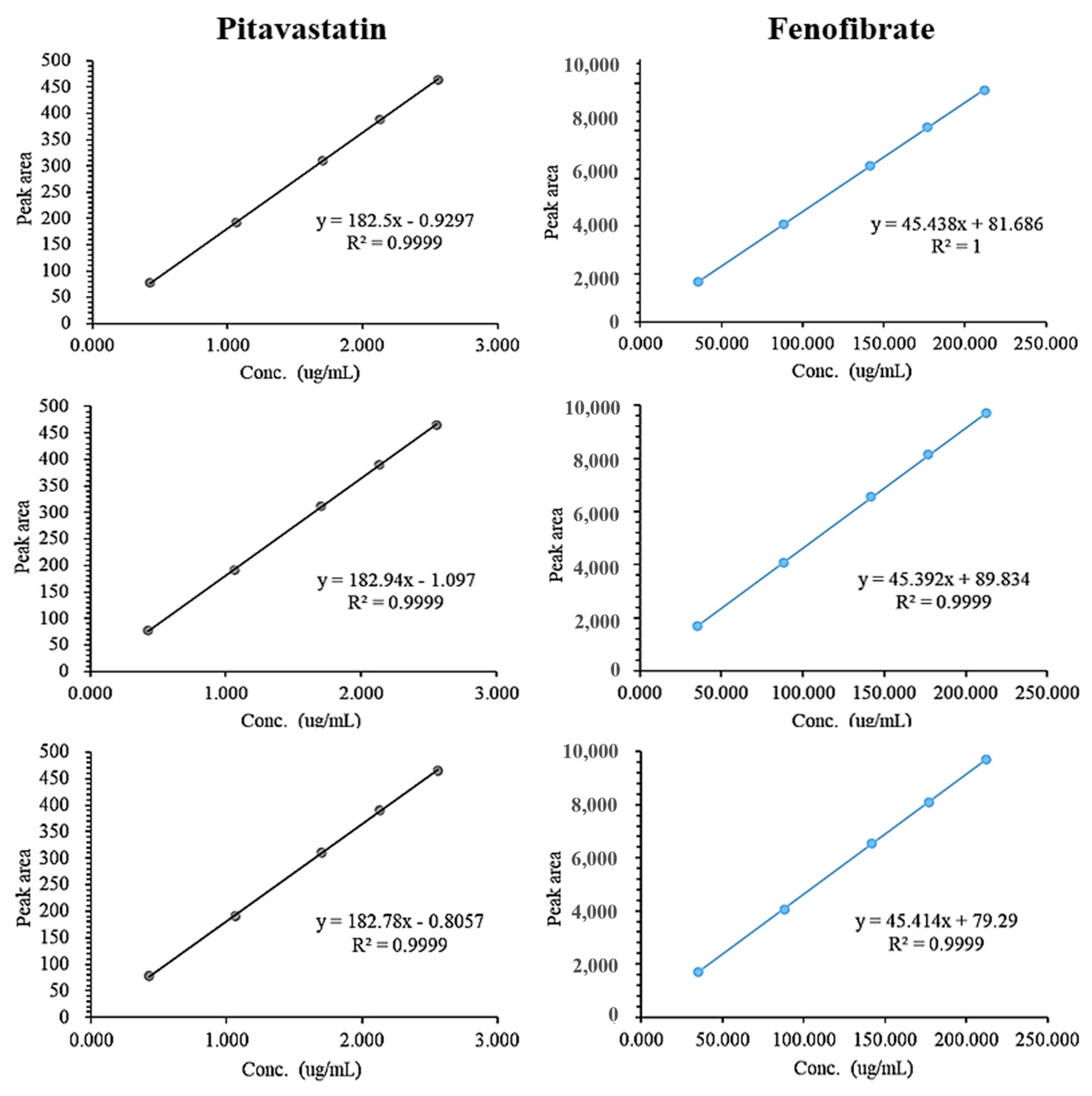
The range of the analytical procedure was defined as the interval between the upper and lower concentration levels of the analytes for which acceptable linearity, accuracy, and precision were demonstrated. For assay analysis, linearity and range were evaluated over concentration levels relevant to the content determination of the finished dosage form. Calibration solutions corresponding to 70–130% of the target assay concentration were prepared using five concentration levels. The final concentrations of pitavastatin calcium were 2.80, 3.20, 4.00, 4.60, and 5.20 µg/mL, while those of fenofibrate were 224.00, 256.00, 320.00, 384.00, and 416.00 µg/mL, respectively (Table 1). For dissolution analysis, considering the dissolution acceptance criteria, i.e., not less than 80% dissolution of pitavastatin calcium at 15 min and not less than 50% at 15 min and 80% at 45 min for fenofibrate, the analytical range was set to 20–120% of the target working concentration. Linearity was evaluated using five concentration levels corresponding to 20, 50, 80, 100, and 120% of the working standard concentration. The final concentrations of pitavastatin calcium were 0.44, 1.11, 1.78, 2.22, and 2.66 µg/mL, while those of fenofibrate were 35.56, 88.90, 142.24, 177.80, and 213.36 µg/mL, respectively (Table 2). For both assay and dissolution analyses, each concentration level was analyzed in triplicate. Calibration curves were constructed by plotting peak area against nominal concentration and evaluated by linear regression analysis. Linearity was assessed based on the coefficient of determination (R2), slope, intercept, and residual sum of squares. The acceptance criterion for linearity was a coefficient of determination of not less than 0.99.

3.4. Accuracy and Precision

Accuracy and precision were evaluated for assay and dissolution analyses using quality control (QC) samples prepared at concentration levels appropriate for each analytical purpose.
For assay analysis, accuracy was evaluated using QC samples prepared at three concentration levels corresponding to 70, 100, and 130% of the target assay concentration (Table 3). For dissolution analysis, accuracy was evaluated using QC samples prepared at three concentration levels corresponding to 20, 100, and 120% of the target working concentration (Table 4). QC samples were prepared in the presence of a placebo to assess potential matrix effects from formulation excipients, and each concentration level was analyzed in triplicate (n = 3). Accuracy was expressed as the mean percentage recovery of the measured concentration relative to the nominal (spiked) concentration.
Method precision (repeatability) was evaluated by analyzing six independently prepared QC samples at the 100% concentration level under the same analytical conditions (n = 6), and results were expressed as RSD (%).
Prior to accuracy evaluation, nominal concentrations were corrected using the potency of the reference standards. In the case of pitavastatin, the nominal concentrations expressed as pitavastatin calcium were additionally converted to pitavastatin free acid equivalents using the molecular weight correction factor (842.92/880.98). The corrected theoretical concentration was calculated as follows:
C o r r e t e d   c o n c e n t r a t i o n a s   p i t a v a s t a t i n                                                                                                                                                                         = N o m i n a l   c o n c e n t r a t i o n a s   p i t a v a s t a t i n   c a l c i u m × ( 842.92                                                                                                                                                         / 880.98 ) × ( R e f e r e n c e   s t a n d a r d   p o t e n c y ( 100.1 / 100 ) )
C o r r e t e d   c o n c e n t r a t i o n a s   F e n o f i b r a t e                                                                                                                                                                                     = N o m i n a l   c o n c e n t r a t i o n × ( R e f e r e n c e   s t a n d a r d   p o t e n c y   ( 99.7 / 100 ) )
Measured concentrations were obtained from the calibration curve using the equation (peak area − intercept)/slope.
The acceptance criteria for assay accuracy were defined as a mean recovery of 98.0–102.0% with an RSD not exceeding 2.0%, while the acceptance criteria for dissolution-related accuracy were defined as a mean recovery of 95.0–105.0% with an RSD not exceeding 2.0%. These criteria were established a priori based on the intended use of the analytical method and commonly accepted pharmaceutical quality control practices, in accordance with the recommendations of ICH Q2(R1).

Intermediate Precision

Intermediate precision was evaluated to assess the effect of typical variations within the laboratory. The study was performed by analyzing quality control samples at the target concentration under different conditions, including analysis on different days and/or by different analysts using the same RP-HPLC system. Each condition was evaluated in replicates. The intermediate precision was expressed as the relative standard deviation (RSD) of the measured peak areas for pitavastatin calcium and fenofibrate.

3.5. Limit of Detection and Limit of Quantitation

The limits of detection (LOD) and quantitation (LOQ) for pitavastatin calcium and fenofibrate were determined in accordance with ICH guideline Q2(R1). LOD and LOQ were calculated based on the standard deviation of the response (σ) and the slope (S) of the calibration curve using the equations LOD = 3.3 σ/S and LOQ = 10 σ/S. The standard deviation of the response was obtained from the residual standard deviation of the regression line, and the slope was derived from the calibration curve constructed over the validated concentration range.
L o D = 3.3     σ / S
L o Q = 10     σ / S

3.6. Solution Stability

Solution stability was evaluated to assess the stability of pitavastatin calcium and fenofibrate in standard and sample solutions over time under controlled conditions. The stability study was conducted by setting time as the variable factor, and the solutions were stored at room temperature (25 ± 2 °C/60 ± 5% relative humidity). The contents of pitavastatin calcium and fenofibrate in both standard and sample solutions were determined using the developed simultaneous RP-HPLC method at the initial 24 h and 48 h after preparation. The stability of the solutions was assessed by comparing the measured peak areas at each time point with those obtained at the initial time. The acceptance criteria for solution stability were defined as a recovery of 100 ± 5% for the peak areas of each analyte relative to the initial value and a relative standard deviation (RSD) of not more than 2.0%.

4. Results

4.1. Method Development Rationale

The development of a single RP-HPLC method capable of supporting both assay and dissolution analyses for pitavastatin–fenofibrate dual-layered tablets required careful consideration of the markedly different physicochemical properties of the two active pharmaceutical ingredients. Pitavastatin calcium exhibits relatively higher polarity and aqueous solubility, whereas fenofibrate is highly lipophilic and poorly soluble in aqueous media. These contrasting characteristics pose analytical challenges in achieving adequate retention, resolution, and sensitivity for both components under a unified chromatographic condition. Preliminary experiments using conventional aqueous–organic mobile phases resulted in either insufficient retention of pitavastatin calcium or excessive retention and peak broadening of fenofibrate. To address these limitations, an isocratic mobile phase system incorporating organic modifiers and ionic strength control was investigated. The inclusion of methanol and acetonitrile in optimized proportions enabled balanced elution strength for both analytes, while the addition of a low concentration of sodium chloride improved peak symmetry and reproducibility by stabilizing the ionic environment during chromatographic separation. An isocratic elution mode was selected in preference to gradient elution to ensure analytical simplicity, reproducibility, and compatibility with routine quality control testing. The use of a single isocratic condition allowed direct comparison between assay and dissolution samples without the need for re-equilibration steps or method switching, thereby minimizing analytical variability. The selected Gemini® C18 column provided sufficient hydrophobic interaction to retain fenofibrate while maintaining acceptable retention of pitavastatin calcium, resulting in well-resolved and symmetrical peaks within a practical run time. The detection wavelength of 245 nm was chosen based on the UV absorption characteristics of both analytes, providing adequate sensitivity for simultaneous quantification without compromising selectivity. The flow rate, column temperature, and injection volume were optimized to further enhance resolution and peak shape while maintaining robustness and throughput suitable for routine analysis. Overall, the finalized chromatographic conditions represent a deliberate balance between analytical performance and operational practicality. The method was specifically designed to accommodate the requirements of both assay and dissolution testing using a single validated procedure, thereby supporting efficient quality control and performance evaluation of pitavastatin-fenofibrate dual-layered tablets.

4.2. Analytical QTPP and Identification of CAAs

To support the development of the RP-HPLC method within the AQbD framework, an analytical QTPP was defined and used to identify the critical analytical attributes (CAAs) relevant to the simultaneous quantification of pitavastatin calcium and fenofibrate in dual-layer tablet formulations.
Based on the analytical QTPP, several analytical attributes potentially affecting chromatographic performance and quantitative reliability were identified as CAAs. Among these attributes, separation performance and accuracy of quantification were considered the most critical because inadequate chromatographic separation or inaccurate quantification would directly compromise the reliability of simultaneous determination of the two analytes.
Other attributes, including quantitative response, precision of measurement, analytical sensitivity, and sample solution stability, were considered moderately critical since they influence the robustness and reliability of the analytical method during routine analysis. The analytical QTPP elements and the identified CAAs are presented in Table 5.

4.3. Risk Assessment by PHA and FMEA

Following the identification of the CAAs, a risk assessment was conducted to evaluate analytical parameters that could potentially influence method performance. Preliminary hazard analysis (PHA) was first performed to qualitatively assess the potential impact of analytical parameters on the identified CAAs.
The PHA results indicated that several analytical parameters may influence one or more CAAs. In particular, mobile phase composition and detection wavelength showed the strongest potential influence on key analytical attributes, including separation performance, quantitative response, and analytical sensitivity. Other parameters, including flow rate, column temperature, and diluent composition, showed moderate or low potential influence depending on the specific analytical attribute (Table 6).
To further evaluate the relative importance of these parameters, failure mode and effects analysis (FMEA) was subsequently performed. The FMEA results showed that mobile phase composition exhibited the highest risk priority number (RPN = 80), followed by detection wavelength (RPN = 48). Column temperature and diluent composition showed moderate risk levels, whereas flow rate presented a relatively low risk under the selected chromatographic conditions (Table 6).
Based on the combined results of the PHA and FMEA evaluations, mobile phase composition and detection wavelength were identified as the most influential critical method parameters (CMPs) affecting chromatographic separation and quantitative performance.

4.4. Filter Compatibility and Carryover Evaluation

To assess potential adsorption of pitavastatin calcium and fenofibrate to the 0.45 µm RC membrane filter, standard solutions were analyzed before and after filtration. No difference in peak area or calculated concentration was observed between filtered and unfiltered samples, indicating the absence of analyte adsorption to the membrane filter (Table 7).
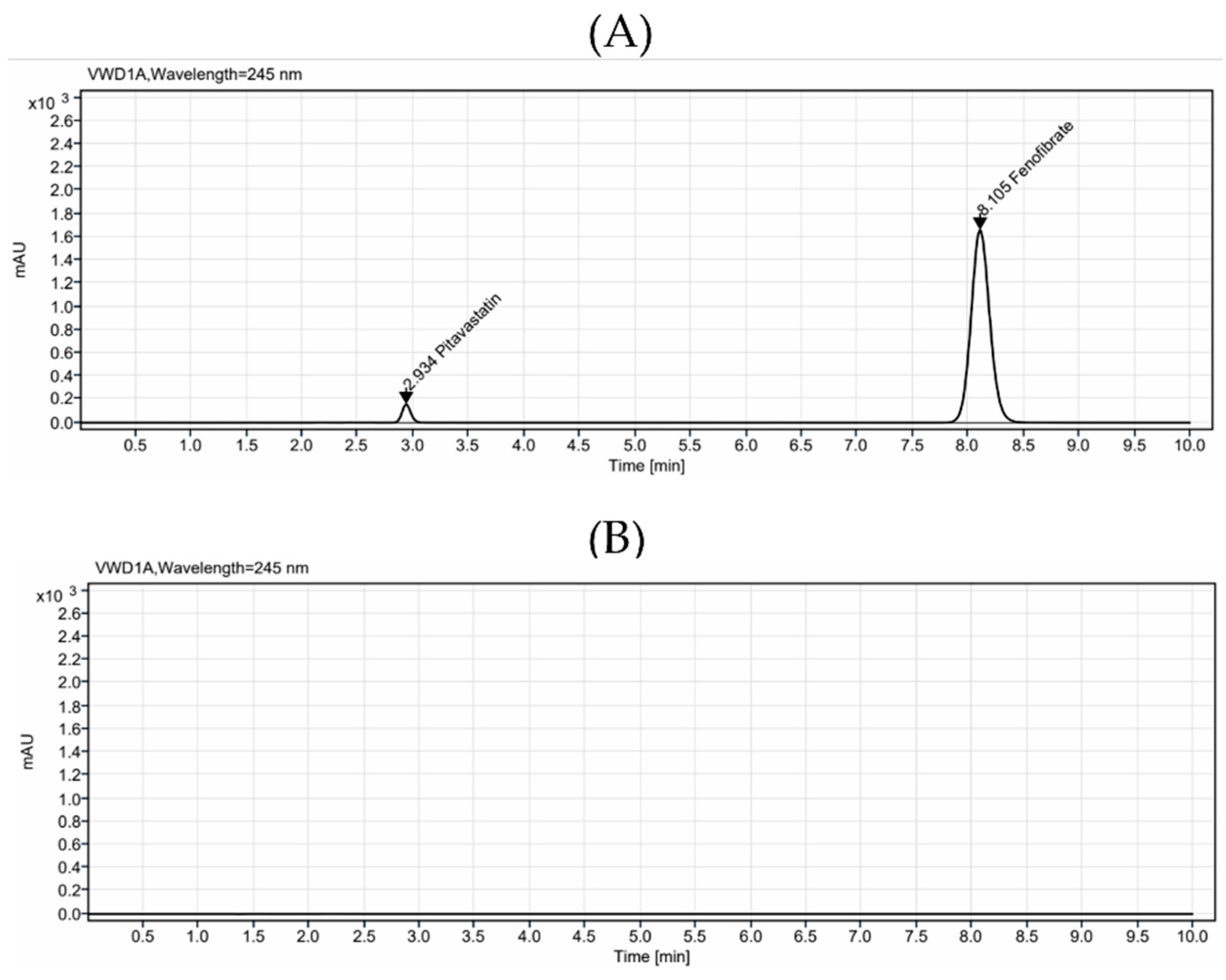
System carryover was evaluated by injecting a blank solution immediately after the highest calibration standard. No peaks corresponding to pitavastatin calcium or fenofibrate were detected in the blank chromatogram, confirming the absence of carryover under the applied chromatographic conditions (Figure 2).

4.5. System Suitability and Specificity Results

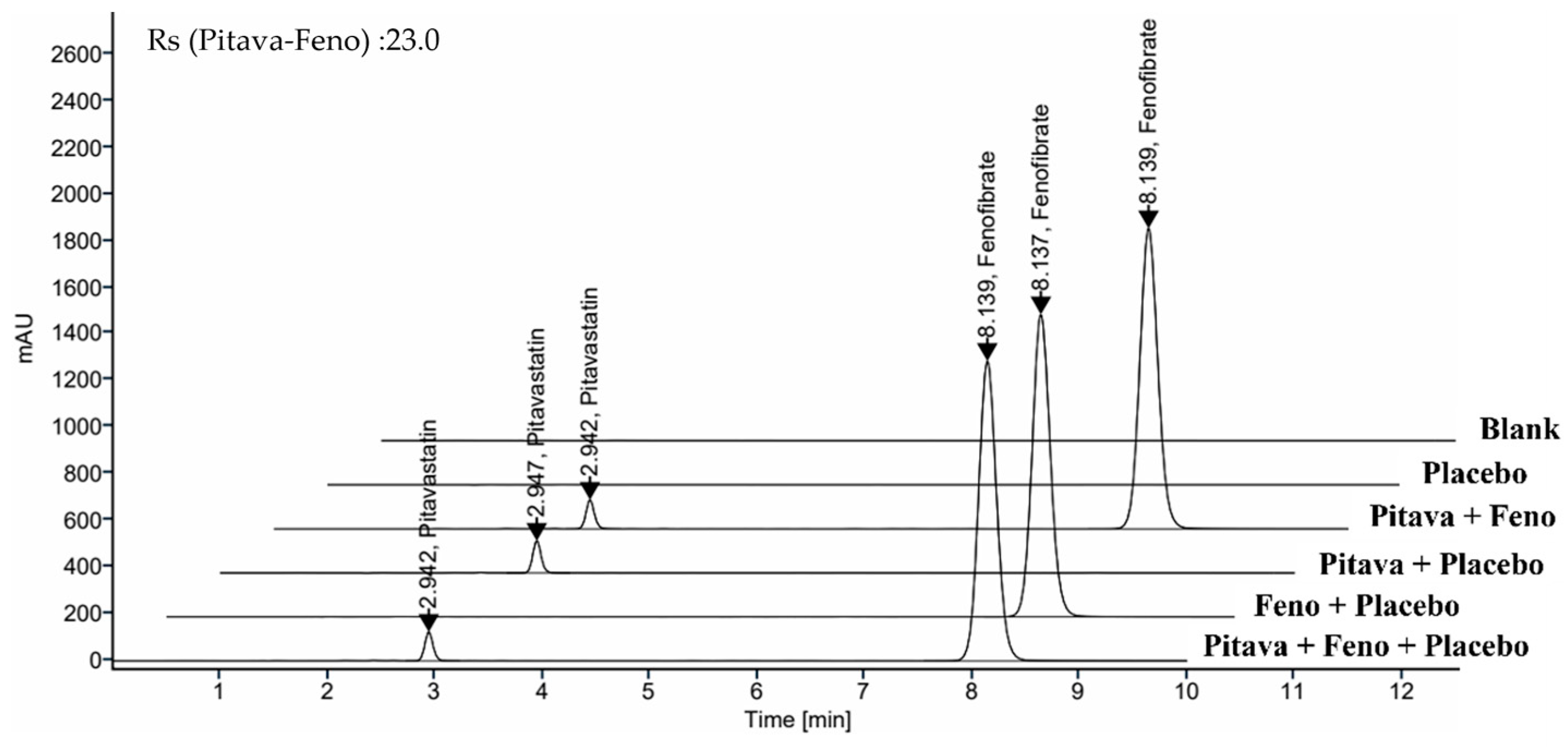
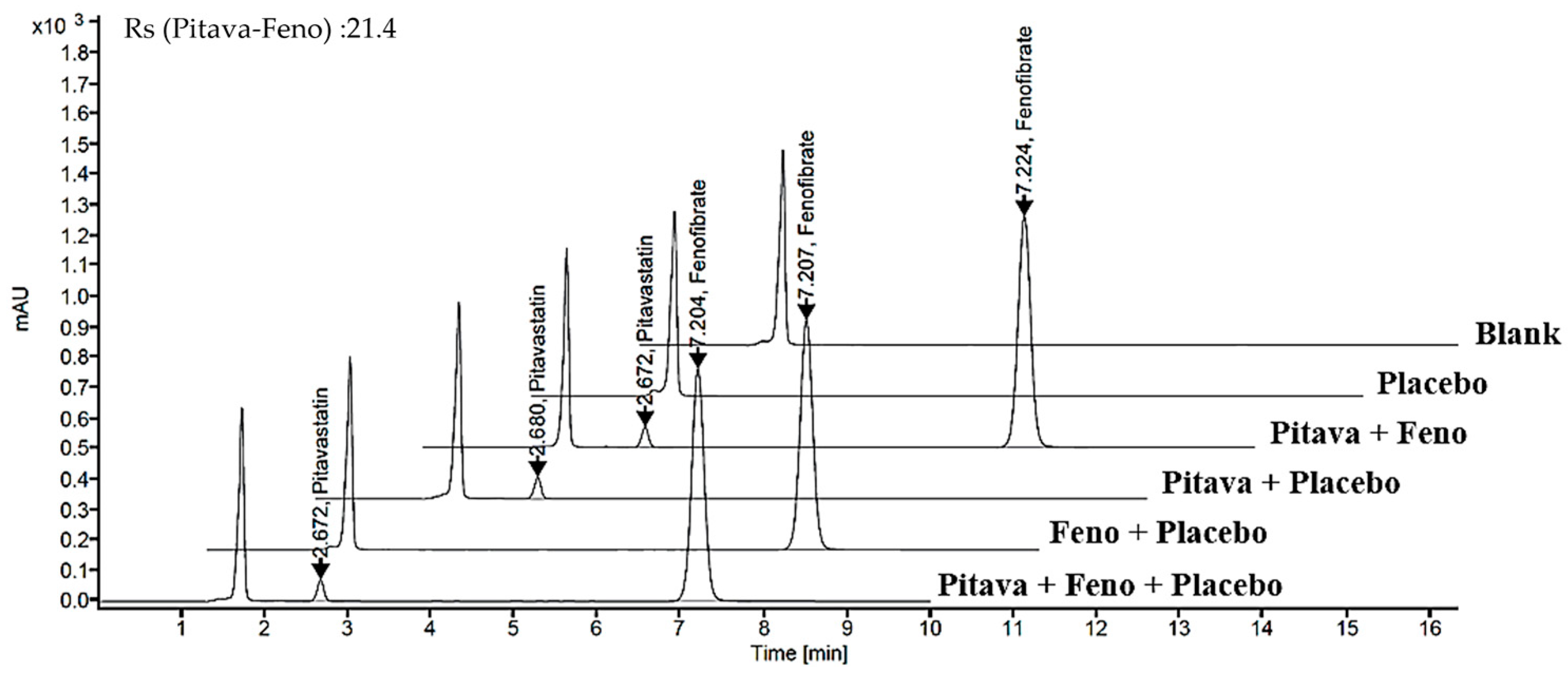
System suitability testing was performed to confirm that the chromatographic system provided consistent performance prior to sample analysis. Repeated injections of the mixed working standard solution showed stable retention times and reproducible peak responses for both pitavastatin calcium and fenofibrate. The relative standard deviation (RSD) of peak areas remained within the predefined acceptance criterion, demonstrating that the system was suitable for routine quantitative analysis (see Table 8 and Table 9).
Specificity was assessed to evaluate potential interference from formulation excipients and dissolution media. Chromatograms obtained from blank and placebo samples showed no peaks overlapping with the retention times of pitavastatin calcium and fenofibrate. In addition, the retention times of both analytes in assay and dissolution samples were consistent with those observed in the standard solutions. The analyte peaks were clearly separated from excipient-related signals, indicating that matrix components did not interfere with the quantitative determination (Figure 3 and Figure 4).
These results confirm that the developed RP-HPLC method possesses adequate specificity for the simultaneous quantitative analysis of pitavastatin calcium and fenofibrate in both assay and dissolution samples, even in the presence of complex excipient matrices associated with dual-layered tablet formulations.

4.6. Range and Linearity

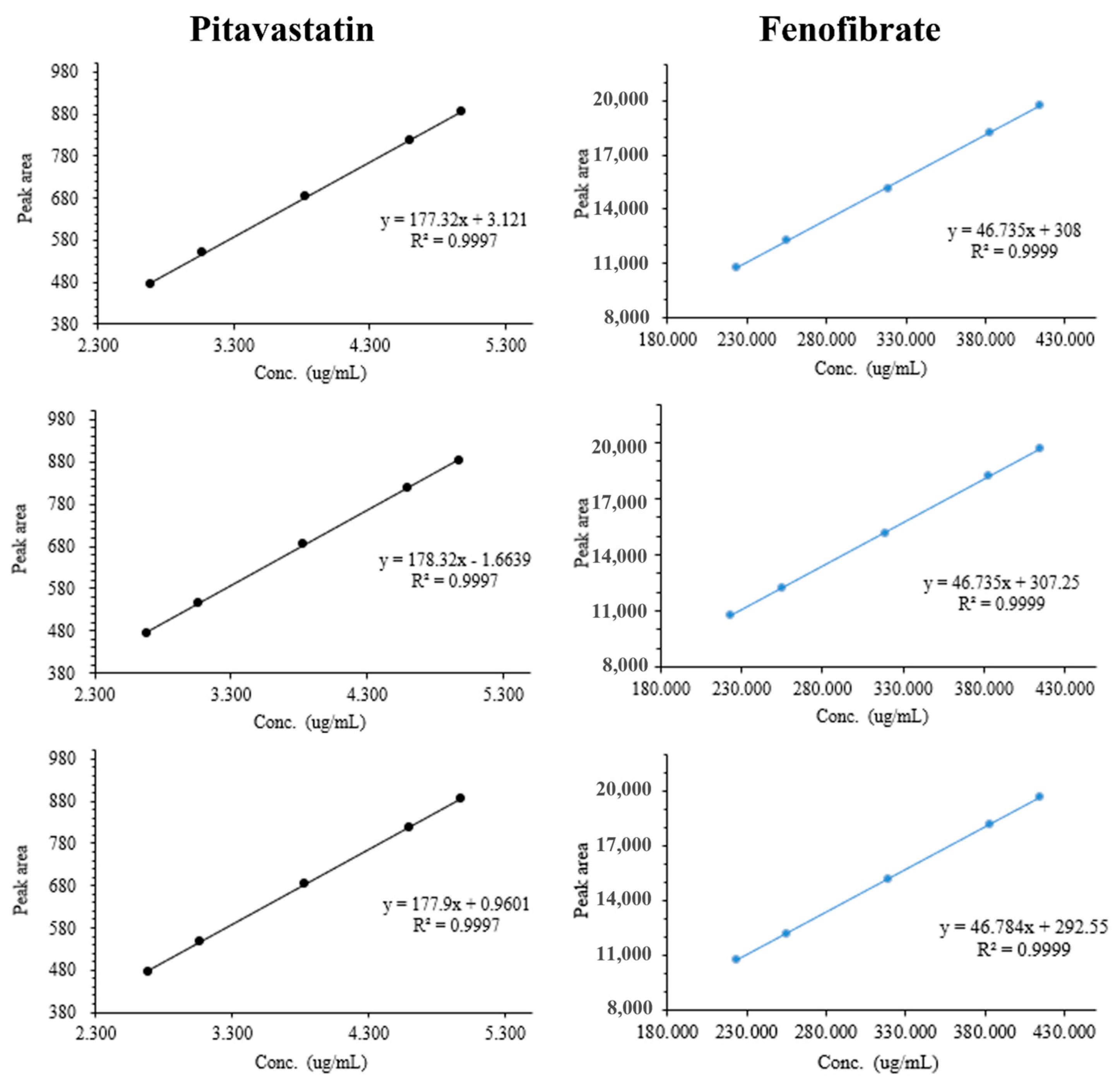
The range and linearity of the developed RP-HPLC method were evaluated separately for assay and dissolution analyses to confirm its suitability across the intended concentration levels for each application. For the assay analysis, linearity was assessed using five concentration levels based on the labeled content of the dosage form. Calibration curves were constructed over concentration ranges of 2.80–5.20 µg/mL for pitavastatin and 224.00–416.00 µg/mL for fenofibrate. Within these ranges, a linear relationship between peak area and nominal concentration was observed. Regression analysis satisfied the predefined acceptance criterion, with a correlation coefficient (r2 ≥ 0.99) defined in accordance with ICH guideline Q2(R1), confirming adequate linearity across the assay concentration range (Table 10 and Figure 5). For the dissolution analysis, linearity was evaluated over concentration levels corresponding to 20–120% of the target working concentration. The validated concentration ranges were 0.44–2.66 µg/mL for pitavastatin calcium and 35.56–213.36 µg/mL for fenofibrate. Calibration curves constructed within this range exhibited excellent linearity, with no significant deviation observed at either the lower or upper concentration limits. The regression results met the acceptance criterion of r2 ≥ 0.99 (Table 11 and Figure 6).
Overall, the method provided consistent and proportional analytical responses for both analytes across the validated ranges for assay and dissolution testing. These results demonstrate that the developed RP-HPLC method possesses an appropriate analytical range and linearity to support the simultaneous quantitative determination of pitavastatin calcium and fenofibrate under both assay and dissolution conditions.

4.7. Accuracy and Precision

The accuracy and precision of the developed RP-HPLC method were evaluated to confirm its reliability for the quantitative analysis of pitavastatin calcium and fenofibrate in both assay and dissolution samples. Accuracy was assessed as percent recovery, and precision was expressed as the relative standard deviation (RSD) of replicate measurements, in accordance with ICH guideline Q2(R1).
For the assay analysis, accuracy and precision were evaluated using quality control (QC) samples prepared at 70%, 100%, and 130% of the target assay concentration within the validated assay range. The mean recoveries for both pitavastatin and fenofibrate satisfied the predefined acceptance criterion of 98.0–102.0%, demonstrating adequate accuracy for assay determination (Table 12). Repeatability, evaluated at the 100% concentration level, showed low variability with RSD values within 2.0%, indicating consistent analytical performance (Table 13).
For the dissolution analysis, accuracy and precision were assessed using QC samples prepared at concentration levels corresponding to 20%, 100%, and 120% of the target working concentration. Accuracy was confirmed by mean recoveries within the acceptance criterion of 95.0–105% for both pitavastatin calcium and fenofibrate (Table 14). Precision, evaluated under repeatability conditions at the 100% concentration level, demonstrated RSD values not exceeding 2.0%, confirming satisfactory precision for dissolution-related quantification (Table 15).
Overall, these results confirm that the developed RP-HPLC method provides acceptable accuracy and precision for the simultaneous quantitative determination of pitavastatin calcium and fenofibrate in both assay and dissolution applications.

4.8. Intermediate Precision

Intermediate precision was evaluated to assess the reproducibility of the developed RP-HPLC method under normal laboratory conditions for both assay and dissolution analyses. The study was conducted on two different days using the same analytical procedure, instrument, and column. Quality control (QC) samples at the 100% concentration level were independently prepared and analyzed six times per day (n = 6) for each analysis day. Intermediate precision was expressed as the relative standard deviation (RSD, %) of the measured concentrations calculated from the combined results obtained on Day 1 and Day 2 (n = 12). For both assay and dissolution analyses, the RSD values for pitavastatin calcium and fenofibrate were within the predefined acceptance criterion of not more than 2.0%, demonstrating satisfactory inter-day reproducibility. The results confirm that the developed RP-HPLC method provides robust and reproducible quantitative performance under routine laboratory conditions for both assay and dissolution applications (Table 16 and Table 17).

4.9. Limit of Detection and Limit of Quantitation

The LOD and LOQ values for pitavastatin calcium and fenofibrate were calculated using the σ/S approach in accordance with ICH Q2(R1). The obtained LOQ values were sufficiently lower than the lowest concentration levels applied in both assay and dissolution analyses, demonstrating that the developed RP-HPLC method possesses adequate sensitivity for reliable quantitative determination of both analytes within the intended analytical range (Table 18 and Table 19). The difference in the calculated LOQ values for pitavastatin between assay and dissolution analyses mainly arises from the difference in the standard deviation of the intercept (σ) obtained from the respective calibration models. The assay calibration was performed at higher concentration levels relevant to content determination of the finished dosage form, whereas the dissolution calibration covered lower working concentrations. These differences in calibration ranges affect the regression parameters and consequently the calculated LOQ values according to the σ/S approach.

4.10. Solution Stability

Solution stability was evaluated to assess the stability of pitavastatin calcium and fenofibrate in both assay and dissolution samples under typical laboratory conditions. Standard solutions and sample solutions prepared for assay and dissolution analyses were stored at room temperature (25 ± 2 °C, 60 ± 5% RH) and analyzed at predetermined time points.
For both assay and dissolution samples, stability was assessed by comparing the measured concentrations at 24 and 48 h with those obtained at the initial time point. Solution stability was expressed as percent recovery relative to the initial value, and precision was evaluated using the relative standard deviation (RSD, %). The acceptance criteria for solution stability were predefined as a mean recovery within 95.0–105% and an RSD not exceeding 2.0%.
The results demonstrated that pitavastatin calcium and fenofibrate remained stable in both assay and dissolution sample solutions for up to 48 h under room temperature conditions, with all measured values satisfying the predefined acceptance criteria (Table 20 and Table 21). These findings indicate that the developed RP-HPLC method is suitable for routine quantitative analysis of both assay and dissolution samples without concern for solution instability during typical analytical timeframes.

4.11. Assay Results

The developed RP-HPLC method was applied to the assay determination of pitavastatin calcium and fenofibrate in the dual-layer tablet formulation to confirm its applicability for routine content analysis. Assay testing was conducted under the validated conditions, and sample solutions prepared from the finished dosage form were analyzed using the developed method.
The assay results showed that the contents of pitavastatin calcium in the reference and test products were 97.09% and 97.21% of the labeled claim, respectively. For fenofibrate, the assay values were 100.35% for the reference product and 100.02% for the test product. All assay results were within the predefined acceptance criteria for content determination (Table 22). The assay acceptance criteria for the finished product were defined as 90–110% of the labeled claim, in accordance with the MFDS (KFDA) guideline for fixed-dose combination (FDC) products such as dual-layer tablets.
The low variability between the reference and test products demonstrates that the developed RP-HPLC method provides consistent and reliable quantification of both active pharmaceutical ingredients in the presence of formulation excipients. These findings confirm the suitability of the method for routine assay analysis of pitavastatin calcium–fenofibrate dual-layer tablets.

4.12. Dissolution Results

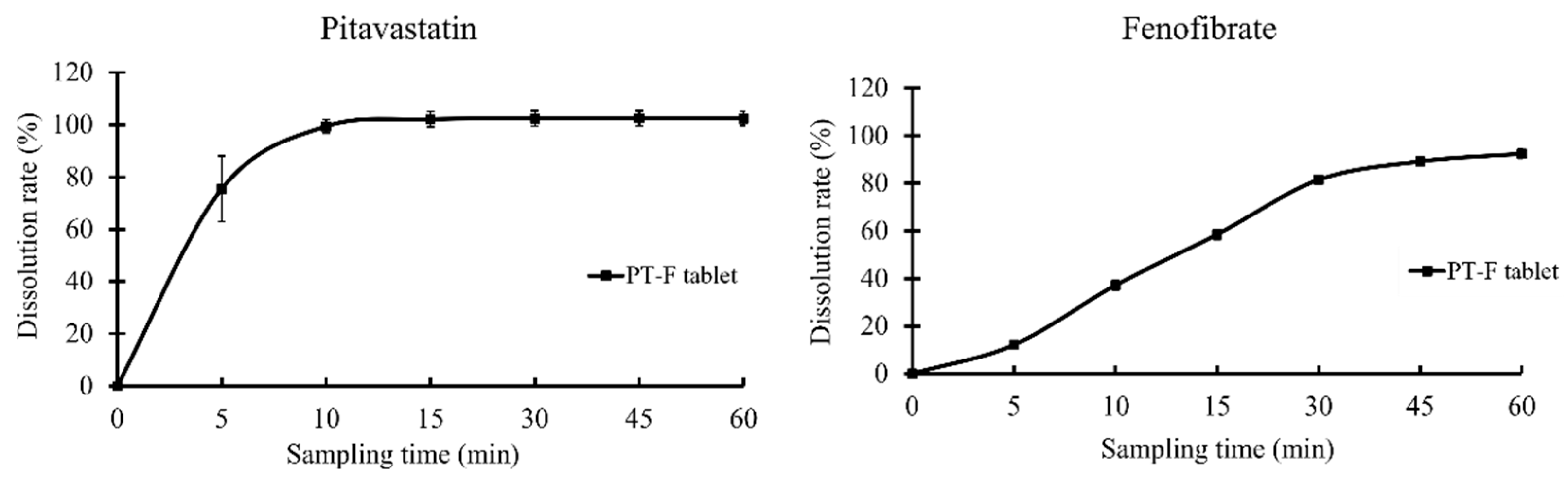
The developed RP-HPLC method was applied to the dissolution testing of pitavastatin calcium–fenofibrate dual-layer tablets to confirm its applicability for routine quantitative analysis of dissolution samples. Dissolution testing was performed under the predefined conditions, and samples collected at each time point were analyzed using the validated analytical method. Pitavastatin calcium exhibited rapid dissolution behavior, with more than 80% of the drug released within 15 min, which is consistent with the immediate-release characteristics of the corresponding layer. In contrast, fenofibrate showed a relatively slower dissolution profile, with more than 50% drug release observed at 15 min and more than 80% drug release achieved at 45 min (Figure 7). The dissolution behavior of both active pharmaceutical ingredients met the predefined dissolution specifications. The developed RP-HPLC method enabled reliable and simultaneous quantification of pitavastatin calcium and fenofibrate throughout the dissolution testing process without interference from excipients or the dissolution medium. These results demonstrate that the method is suitable for accurately capturing the distinct dissolution characteristics of the two layers within a single dosage form and can be effectively applied to routine dissolution analysis of dual-layer tablet formulations.

5. Discussion

The simultaneous analysis of multiple APIs with markedly different physicochemical properties remains a significant analytical challenge in pharmaceutical quality control. In the present study, a unified RP-HPLC method was successfully developed and validated for the simultaneous quantification of pitavastatin and fenofibrate in dual-layer tablet formulations. These two compounds exhibit substantially different physicochemical characteristics, including polarity and aqueous solubility. Pitavastatin is relatively polar and readily soluble in aqueous–organic systems, whereas fenofibrate is highly lipophilic and poorly soluble in aqueous media. Such differences frequently complicate chromatographic method development and often necessitate gradient elution or separate analytical procedures to achieve adequate separation and sensitivity.
Several analytical methods for the determination of pitavastatin or fenofibrate have previously been reported, including HPLC- and LC–MS-based approaches. However, most of these methods were developed either for single-component analysis or for simultaneous assay determination under specific chromatographic conditions. In many cases, assay and dissolution analyses are performed using different chromatographic methods or gradient elution programs. While such approaches can provide satisfactory separation performance, they may increase analytical complexity, solvent consumption, and overall analysis time in routine quality control laboratories. In addition, the use of multiple analytical methods may introduce inter-method variability and increase the operational burden associated with method validation and routine analysis.
In contrast, the present study demonstrates that both assay and dissolution analyses can be performed using a single isocratic RP-HPLC method under identical chromatographic conditions. Although the chromatographic separation itself does not rely on a fundamentally new principle, the analytical workflow presented here provides a practical solution for simplifying routine quality control operations. The use of a unified analytical method reduces the need for method switching between assay and dissolution testing, thereby improving operational efficiency and potentially decreasing solvent consumption and analytical turnaround time.
The developed method also exhibited satisfactory analytical performance in terms of linearity, accuracy, precision, and sensitivity in accordance with ICH Q2(R1) guidelines. The obtained LOD and LOQ values were sufficiently lower than the concentration ranges used in both assay and dissolution analyses, indicating adequate sensitivity for reliable quantitative determination. Furthermore, the method demonstrated stable chromatographic behavior and acceptable peak resolution for both analytes despite their contrasting physicochemical characteristics.
It is important to note that the primary contribution of this work lies not in introducing a fundamentally new chromatographic separation concept, but rather in demonstrating that a single analytical procedure can reliably support multiple quality control tests for a complex multilayer combination product. In pharmaceutical manufacturing environments where large numbers of samples must be analyzed routinely, such integration of analytical procedures may offer practical advantages in terms of method management, laboratory efficiency, and operational robustness.
Overall, the developed RP-HPLC method provides a practical and reliable analytical approach for the simultaneous evaluation of pitavastatin and fenofibrate in dual-layer tablet formulations. The unified analytical workflow presented in this study may facilitate more efficient quality control testing for complex fixed-dose combination products.
In addition to conventional chromatographic optimization, the present study also incorporated elements of an AQbD framework during method development. A QTPP was first established to define the intended performance characteristics of the analytical method, and CAAs related to chromatographic separation and quantitative reliability were subsequently identified. Risk assessment using PHA and FMEA was then conducted to evaluate analytical parameters that could potentially influence method performance.
Through this structured evaluation, mobile phase composition and detection wavelength were identified as CMPs with the greatest potential impact on chromatographic performance and quantitative reliability. Incorporation of this risk-based approach during method development supported the establishment of robust chromatographic conditions capable of simultaneously supporting assay and dissolution analysis under a single isocratic framework. These findings suggest that the application of AQbD principles can facilitate a more systematic development of analytical methods for complex fixed-dose combination products.

6. Conclusions

In this study, a single reversed-phase high-performance liquid chromatography (RP-HPLC) method was successfully developed and validated for the simultaneous quantitative analysis of pitavastatin calcium and fenofibrate in dual-layer tablet formulations. A key strength of the proposed method lies in its unified applicability to both assay and dissolution testing under identical chromatographic conditions, addressing an important analytical challenge associated with complex fixed-dose combination products.
The method was comprehensively validated in accordance with ICH Q2(R1) guidelines and demonstrated satisfactory system suitability, specificity, linearity, accuracy, precision, intermediate precision, sensitivity, and solution stability for both assay and dissolution samples. Importantly, the validated concentration ranges and acceptance criteria were appropriately differentiated to reflect the distinct analytical requirements of content determination and dissolution-related quantification.
Application of the method to finished dual-layer tablets confirmed reliable assay results and enabled clear discrimination between the rapid dissolution behavior of pitavastatin calcium and the delayed release characteristics of fenofibrate. These results demonstrate that the developed RP-HPLC method is capable of accurately capturing the distinct release profiles of multiple active pharmaceutical ingredients within a single dosage form without analytical interference.
Overall, the proposed method provides an efficient and practical analytical platform for routine quality control and performance evaluation of pitavastatin–fenofibrate dual-layer tablets. The ability to perform both assay and dissolution testing under identical chromatographic conditions may simplify analytical workflows and reduce operational complexity in pharmaceutical quality control laboratories.

Supplementary Materials

The following supporting information can be downloaded at: https://www.mdpi.com/article/10.3390/app16062962/s1, Figure S1. UV absorption spectra of pitavastatin and fenofibrate over the wavelength range of 200–400 nm; Table S1. Comparison of analytical strategies for pitavastatin–fenofibrate combination analysis.

Author Contributions

D.-H.K.: Conceptualization, Formal analysis, Methodology, Data curation, Validation, Writing—Original draft preparation. S.-E.L.: Formal analysis, Validation, Methodology, Formal analysis. J.-E.K.: Supervision, Project administration, Writing—Review and Editing, Funding acquisition. All authors have read and agreed to the published version of the manuscript.

Funding

This research was supported by the Industrial Strategic Technology Development Program (RS-2023-00235222, RS-2023-00230559, and RS-2024-00439266) funded by the Ministry of Trade, Industry and Energy (MOTIE, Republic of Korea).

Institutional Review Board Statement

Not applicable.

Informed Consent Statement

Not applicable.

Data Availability Statement

All data generated or analyzed in this study are included in this published article. Additional data are available from the corresponding author upon reasonable request.

Conflicts of Interest

The authors declare that they have no known competing financial interests or personal relationships that could have appeared to influence the work reported in this paper.

References

  1. ACCORD Study Group. Effects of combination lipid therapy in type 2 diabetes mellitus. N. Engl. J. Med. 2010, 362, 1563–1574. [Google Scholar] [CrossRef]
  2. Kajinami, K.; Takekoshi, N.; Saito, Y. Pitavastatin: Efficacy and safety profiles of a novel synthetic HMG-CoA reductase inhibitor. Cardiovasc. Drug Rev. 2003, 21, 199–215. [Google Scholar]
  3. Saito, Y. Critical appraisal of the role of pitavastatin in treating dyslipidemias and achieving lipid goals. Vasc. Health Risk Manag. 2009, 5, 921–936. [Google Scholar][Green Version]
  4. Staels, B.; Dallongeville, J.; Auwerx, J.; Schoonjans, K.; Leitersdorf, E.; Fruchart, J.-C. Mechanism of action of fibrates on lipid and lipoprotein metabolism. Circulation 1998, 98, 2088–2093. [Google Scholar] [CrossRef] [PubMed]
  5. Shek, A.; Ferrill, M.J. Statin—Fibrate combination therapy. Ann. Pharmacother. 2001, 35, 908–917. [Google Scholar]
  6. So-Jin, K.; Joo-Eun, K. The Development and Validation of Simultaneous Quantitative Analysis Reversed-phase High-performance Liquid Chromatography for Sitagliptin Phosphate Monohydrate and Dapagliflozin Propanediol Monohydrate Fixed-dose Combination Dual-layered Tablet. Curr. Pharm. Anal. 2023, 19, 423–431. [Google Scholar]
  7. So-Jin, K.; Joo-Eun, K. Development of clinically optimized sitagliptin and dapagliflozin complex tablets: Pre-formulation, formulation, and human bioequivalence studies. Pharmaceutics 2023, 15, 1246. [Google Scholar] [CrossRef]
  8. Xydakis, A.M.; Ballantyne, C.M. Combination therapy for combined dyslipidemia. Am. J. Cardiol. 2002, 90, 21–29. [Google Scholar] [CrossRef] [PubMed]
  9. Joo-Eun, K.; Young-Joon, P. QbD consideration for developing a double-layered tablet into a single-layered tablet with telmisartan and amlodipine. Pharmaceutics 2022, 14, 377. [Google Scholar]
  10. Seong-Ho, L.; Joo-Eun, K. Quality by design applied development of immediate-release rabeprazole sodium dry-coated tablet. Pharmaceutics 2021, 13, 259. [Google Scholar]
  11. Jae-Woon, S.; Hyung-Chul, K.; Do-Hyub, K.; Joon-Yong, A.; Young-Joon, P.; Joo-Eun, K. Quality-by-design applied development of tianeptine sodium sustained-release once-a-day dosing tablet. J. Pharm. Investig. 2025, 55, 497–519. [Google Scholar]
  12. Shamim, A.; Ansari, M.J.; Aodah, A.; Iqbal, M.; Aqil, M.; Mirza, M.A.; Iqbal, Z.; Ali, A. QbD-Engineered Development and Validation of a RP-HPLC Method for Simultaneous Estimation of Rutin and Ciprofloxacin HCl in Bilosomal Nanoformulation. ACS Omega 2023, 8, 21618–21627. [Google Scholar] [CrossRef]
  13. Pathak, V.K.; Chandra, P.; Singh, B. Quality by design based analytical (RP-HPLC) method development and validation of coenzyme q10 in single and combination with clomiphene citrate: An extensive review. Lett. Drug Des. Discov. 2026, 22, 100233. [Google Scholar] [CrossRef]
  14. Chae-won, J.; Ju-Hyun, Y.; Joo-Eun, K. Comparative evaluation and improvement of the analytical method for amiodarone hydrochloride: Replacing the pharmacopeial method with a validated RP-HPLC technique. Appl. Sci. 2026, 16, 1920. [Google Scholar] [CrossRef]
  15. Sang-Ho, L.; Jin-Ki, K.; Jun-Pil, J.; Dong-Jin, J.; Young-Joon, P.; Joo-Eun, K. Quality by design (QbD) application for the pharmaceutical development process. J. Pharm. Investig. 2022, 52, 649–682. [Google Scholar] [CrossRef]
  16. Dressman, J.J.; Kramer, J. Pharmaceutical Dissolution Testing; CRC Press: Boca Raton, FL, USA, 2005. [Google Scholar]
  17. Dickinson, P.A.; Lee, W.W.; Stott, P.W.; Townsend, A.I.; Smart, J.P.; Ghahramani, P.; Hammett, T.; Billett, L.; Behn, S.; Gibb, R.; et al. Clinical relevance of dissolution testing in quality by design. AAPS J. 2008, 10, 380–390. [Google Scholar] [CrossRef]
  18. McAllister, M.; Flanagan, T.; Boon, K.; Pepin, X.; Tistaert, C.; Jamei, M.; Abend, A.; Kotzagiorgis, E.; Mackie, C. Developing Clinically Relevant Dissolution Specifications for Oral Drug Products-Industrial and Regulatory Perspectives. Pharmaceutics 2019, 12, 19. [Google Scholar] [CrossRef]
  19. Duarte, J.G.; Duarte, M.G.; Piedade, A.P.; Mascarenhas-Melo, F. Rethinking Pharmaceutical Industry with Quality by Design: Application in Research, Development, Manufacturing, and Quality Assurance. AAPS J. 2025, 27, 96. [Google Scholar] [CrossRef]
  20. Horyn, M.; Piponski, M.; Kryskiw, L.; Rezk, M.R.; Zarivna, N.; Korobko, D.; Logoyda, L. QbD-driven RP-HPLC method for the simultaneous analysis of dihydropyridines calcium channel blockers in pharmaceuticals. BMC Chem. 2025, 19, 289. [Google Scholar] [CrossRef] [PubMed]
  21. AlKadi, H.; Alzier, A.; Mando, H.; Mando, Z.; Darwicha, J.A.; Allaf, A.W. Quantitative Determination of Pitavastatin in Tablets Using FTIR and RP-HPLC Analysis: A Comparative Study. Infect. Disord.-Drug Targets 2022, 22, 49–55. [Google Scholar] [CrossRef]
  22. Mehmood Yousaf, A.; Wuk Kim, D.; Choi, H.-G.; Oh, E. Validation of a highly sensitive RP-HPLC method for quantification of fenofibrate in pure and pharmaceutical dosage forms. Curr. Pharm. Anal. 2014, 10, 97–104. [Google Scholar] [CrossRef]
  23. Kukrety, A.; Kohli, K.; Singhal, M.; Dhal, C.; Chauhan, A.; Arora, P.K.; Singgh, R.M.; Saini, P.; Martur, S.C.; Singh, G.N. Development and Validation of a Sensitive Spectrophotometric Method for Simultaneous Estimation of Pitavastatin Calcium and Fenofibrate. Indian Drugs 2015, 52, 17–21. [Google Scholar] [CrossRef]
  24. Mohan, T.S.S.J.; Jogia, H.A.; Mukkanti, K. A New Ecological RP-HPLC Method for the Determination of Pitavastatin, Fenofibrate and Their Impurities in a Novel Fixed Dose Combination. Chromatographia 2022, 85, 177–191. [Google Scholar] [CrossRef]
  25. Bhinge, S.D.; Malipatil, S.M.; Jondhale, A.N.; Hirave, R.V.; Savali, A.S. A New Approach to the RP-HPLC Method for Simultaneous Estimation of Atorvastatin Calcium and Fenofibrate in Pharmaceutical Dosage Forms. E-J. Chem. 2012, 9, 1223–1229. [Google Scholar] [CrossRef]
  26. Patel, R.; Shah, J.; Patel, M. Analytical Quality by Design Based HPLC for Quantitative Analysis of Teneligliptin and Rosuvastatin Calcium Tablets in the Presence of Force Degradation Products. Sep. Sci. Plus 2025, 8, e202400229. [Google Scholar] [CrossRef]
  27. Wadhwa, K.; Rana, A.C. A review on liquid chromatographic methods for the bioanalysis of atorvastatin. Future J. Pharm. Sci. 2021, 7, 4. [Google Scholar] [CrossRef]
  28. ICHHT Guideline. Validation of analytical procedures: Text and methodology. Q2 (R1) 2005, 1, 5. [Google Scholar]
  29. Hyeon, A.K.; Joo-Eun, K. Development of Nafamostat Mesylate Immediate-Release Tablet by Drug Repositioning Using Quality-by-Design Approach. Pharmaceutics 2022, 14, 1219. [Google Scholar]
  30. Chae-Won, J.; Ju-Hyun, Y.; Joo-Eun, K. QbD-Based formulation development of amiodarone hydrochloride tablet. Pharmaceutics 2026, 18, 264. [Google Scholar]
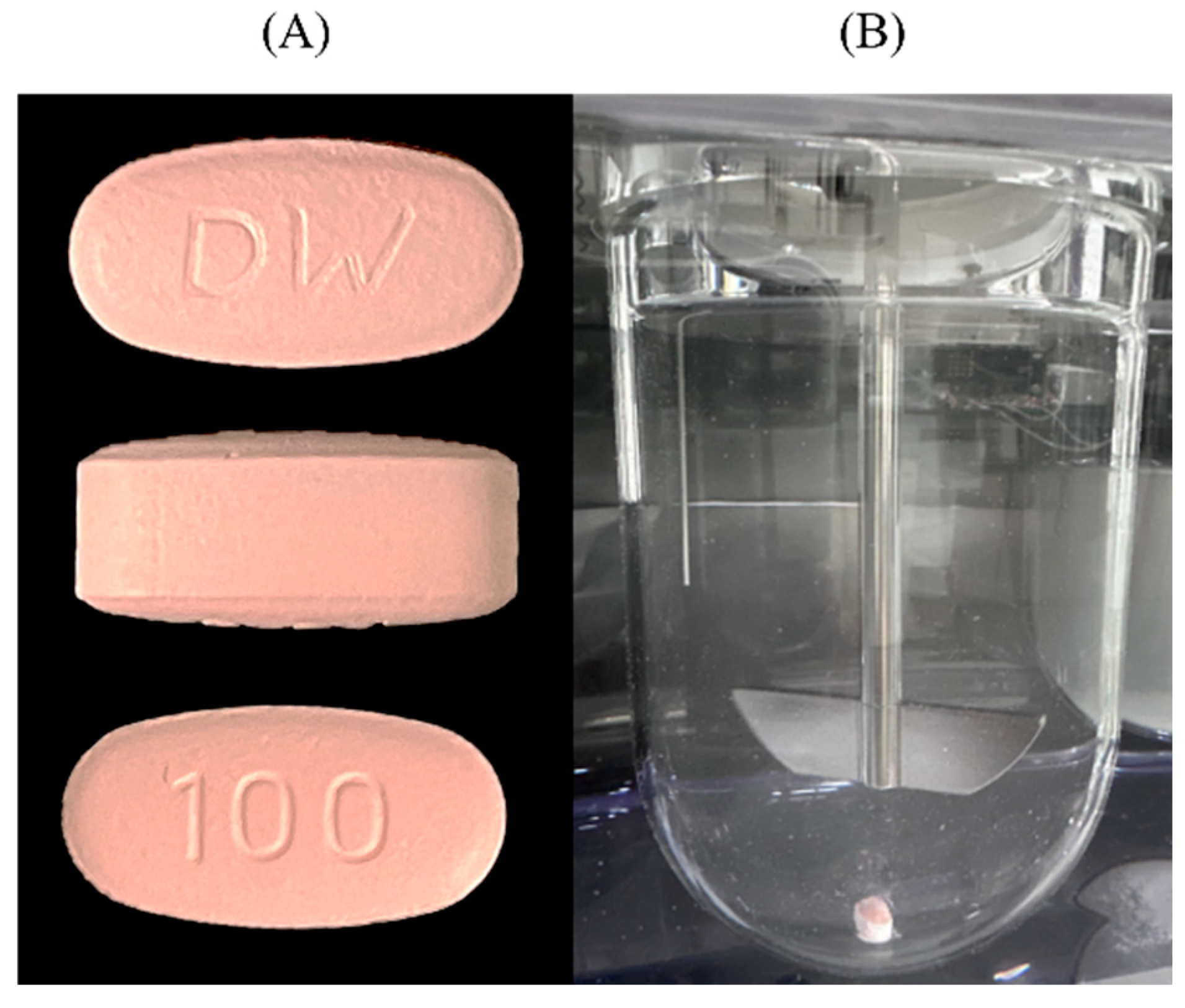
Figure 1. Photographs of (A) the pitavastatin–fenofibrate dual-layer tablet and (B) its dissolution behavior during dissolution testing.
Applsci 16 02962 g001
Figure 2. Chromatograms of (A) the highest calibration standard and (B) the subsequent blank injection showing no carryover of pitavastatin calcium and fenofibrate.
Applsci 16 02962 g002
Figure 3. Representative chromatograms demonstrating the specificity of the analytical method for the assay of pitavastatin calcium and fenofibrate.
Applsci 16 02962 g003
Figure 4. Representative chromatograms demonstrating the specificity of the analytical method for the dissolution analysis of pitavastatin calcium and fenofibrate.
Applsci 16 02962 g004
Figure 5. Results of the linearity test for assay of pitavastatin and fenofibrate.
Applsci 16 02962 g005
Figure 6. Results of the linearity test for dissolution of pitavastatin and fenofibrate.
Applsci 16 02962 g006
Figure 7. Dissolution profiles of pitavastatin and fenofibrate from the PT-F dual-layer tablet under the selected dissolution conditions.
Applsci 16 02962 g007
Table 1. Calibration levels for assay analysis.
Level
Compared to Concentration of Sample (%)
Pitavastatin Stock
Solution (mL)
Fenofibrate Stock
Solution
(mL)
Final Volume (mL)Pitavastatin Concentration (μg/mL)Fenofibrate Concentration (μg/mL)
701.47502.8224.0
801.68503.2256.0
1002.010504.0320.0
1202.412504.8384.0
1302.613505.2416.0
Table 2. Calibration levels for dissolution analysis.
Level
Compared to Concentration of Sample (%)
Pitavastatin Stock
Solution (mL)
Fenofibrate Stock
Solution
(mL)
Final Volume (mL)Pitavastatin Concentration (μg/mL)Fenofibrate Concentration (μg/mL)
200.411000.4435.56
5012.51001.1188.90
801.641001.78142.24
100251002.22177.80
1202.461002.66213.36
Table 3. Preparation of assay accuracy quality control (QC) samples for pitavastatin calcium and fenofibrate.
Level
Compared to Concentration of Sample (%)
Placebo Stock
Solution (mL)
Pitavastatin Stock
Solution (mL)
Fenofibrate Stock
Solution (mL)
Final Volume (mL)Pitavastatin Concentration (μg/mL)Fenofibrate Concentration (μg/mL)
7010.01.47.01002.8224.0
1002.010.01004.0320.0
1302.613.01005.2416.0
Table 4. Preparation of dissolution accuracy quality control (QC) samples for pitavastatin calcium and fenofibrate.
Level
Compared to Concentration of
Sample (%)
Placebo 1/9 Tablet Equivalent (mg)Pitavastatin Stock
Solution (mL)
Fenofibrate Stock
Solution (mL)
Final Volume (mL)Pitavastatin Concentration (μg/mL)Fenofibrate Concentration (μg/mL)
2044.20.41.01000.4435.56
10025.01002.22177.80
1202.46.01002.66213.36
Table 5. Analytical QTPP elements and identified CAAs.
Analytical QTPP
Elements
TargetIs This a CAA?Justification
Analytical purposeSimultaneous quantitative analysis of pitavastatin calcium and fenofibrate in dual-layer tablet formulations for assay and dissolution testingNoDefines the intended use of the analytical method within the quality control framework.
Analytical techniqueRP-HPLC method applicable to both assay and dissolution analysisNoSelection of an appropriate analytical technique capable of supporting routine QC testing.
Separation performanceBaseline separation of pitavastatin and fenofibrate peaks with resolution ≥ 2.0YesAdequate chromatographic separation is essential to ensure accurate quantification of both analytes without mutual interference.
Quantitative responseLinear detector response with correlation coefficient (r2) ≥ 0.99 across the analytical rangeYesEnsures proportional relationship between analyte concentration and detector response.
Accuracy of quantificationRecovery 98.0–102.0% (assay) and 95.0–105.0% (dissolution)YesEnsures closeness between measured and true values for reliable quantitative determination.
Precision of measurementRelative standard deviation (RSD) ≤ 2.0% for repeatability and intermediate precisionYesDemonstrates reproducibility and consistency of analytical measurements during routine use.
Analytical sensitivityLOD and LOQ sufficiently lower than the lowest concentration used in assay and dissolution testingYesEnsures reliable detection and quantification within the intended analytical range.
Sample solution stabilityStandard and sample solutions stable for at least 24 h at room temperatureYesEnsures integrity of analytes during analytical workflow and batch analysis.
Analysis throughputTotal chromatographic run time ≤ 10 minNoImproves laboratory productivity and analytical efficiency for routine QC applications.
Note: Critical analytical attributes were categorized according to their criticality level. High-critical attributes are highlighted in red, moderately critical attributes in orange, and non-critical attributes in green.
Table 6. PHA and FMEA results for analytical risk assessment.
PHA
CAAsMobile Phase CompositionFlow RateColumn
Temperature
Detection
Wavelength
Diluent
Composition
Separation
performance
HighMediumMediumLowMedium
Quantitative
Response
HighLowMediumHighMedium
Accuracy of quantificationMediumLowLowHighMedium
Precision of measurementMediumMediumMediumMediumLow
Analytical
Sensitivity
MediumLowLowHighLow
Sample solution stabilityLowLowLowLowMedium
FMEA
Unit OperationCMPsFailure Mode
(Critical Event)
Justification of Failure ModePSDRPN
Chromatographic separationMobile phase compositionIncorrect ratio of aqueous and organic componentsChanges in mobile phase composition may alter elution strength and chromatographic selectivity, potentially leading to inadequate resolution between pitavastatin and fenofibrate peaks.45480
Chromatographic separationFlow rateDeviation from optimal flow rateFlow rate variation may shift retention times and slightly affect chromatographic efficiency and reproducibility.23318
Chromatographic separationColumn temperatureTemperature fluctuationColumn temperature changes may affect analyte–stationary phase interactions and peak symmetry, influencing analytical reproducibility.33327
DetectionDetection wavelengthDeviation from optimized wavelengthIncorrect detection wavelength may reduce detector response and compromise analytical sensitivity and quantitative accuracy.44348
Sample preparationDiluent compositionInappropriate diluent compositionImproper diluent composition may affect analyte solubility and peak shape, particularly for poorly soluble fenofibrate.33327
Abbreviations: P, probability of occurrence; S, severity; D, detectability; RPN, risk priority number. Each parameter was scored on a 1–5 scale, and the RPN was calculated as P × S × D. Parameters with an RPN value ≥ 30 were considered high-risk factors and highlighted in red.
Table 7. Evaluation of filter compatibility using a 0.45 µm RC membrane filter.
SampleBefore FiltrationAfter FiltrationDifference (%)
Pitavastatin685.740684.9120.12
Fenofibrate15,198.28015,210.1050.08
Table 8. System suitability parameters for the assay of pitavastatin calcium and fenofibrate (n = 6).
ParameterPitavastatinFenofibrate
RT2.948.14
Peak area685.74015,198.280
SD0.448.91
RSD (%)0.060.06
TF1.111.08
Rs (Pitavastatin-Fenofibrate)23.0
Abbreviations: RT, retention time; SD, standard deviation; RSD, relative standard deviation; TF, tailing factor; Rs, resolution.
Table 9. System suitability parameters for the dissolution analysis of pitavastatin calcium and fenofibrate (n = 6).
ParameterPitavastatinFenofibrate
RT2.677.24
Peak area389.8068189.252
SD0.5611.67
RSD (%)0.140.14
TF0.961.00
Rs (Pitavastatin-Fenofibrate)21.4
Table 10. Results of the linearity for the assay of pitavastatin calcium and fenofibrate.
APIConcentration (%)Peak Area
Test 1Test 2Test 3
Pitavastatin70474.451474.451474.179
80550.417546.146549.111
100684.503685.255685.400
120817.845819.135818.898
130884.893883.487885.005
Slope177.32178.32177.90
Y-intercept3.12−1.660.96
R20.99970.99970.9997
Fenofibrate7010,747.44510,751.82110,766.877
8012,261.98712,254.10612,225.788
10015,164.73915,164.30515,172.829
12018,221.20218,220.53718,221.462
13019,697.05619,696.35219,705.597
Slope46.7446.7346.78
Y-intercept308.00307.25292.55
R20.99990.99990.9999
Table 11. Results of the linearity for dissolution of pitavastatin calcium and fenofibrate.
APIConcentration (%)Peak Area
Test 1Test 2Test 3
Pitavastatin2077.389478.144177.8939
50191.8377191.1034191.7871
80310.8667311.2473311.5363
100389.2522390.422390.2404
120464.5491465.6401465.3026
Slope182.50182.94182.78
Y-intercept−0.93−1.10−0.81
R20.99990.99990.9999
Fenofibrate201694.27541697.65631696.7741
504076.4814076.14154064.0532
806532.57636551.10626545.4691
1008141.26088138.71898095.8907
1209706.3629698.01129720.8589
Slope45.4445.3945.41
Y-intercept81.6989.8379.29
R21.00000.99990.9999
Table 12. Results of the accuracy and precision tests for assay of pitavastatin calcium and fenofibrate.
APILevel (%)Corrected Conc. (µg/mL)Found Conc. (µg/mL)Accuracy (%)Average (%)
Pitavastatin702.682.6599.0099.15
2.6699.27
2.6699.18
1003.833.85100.50100.55
3.86100.65
3.85100.50
1304.984.9699.6199.66
4.9799.73
4.9699.65
Grand average (%)99.79
Grand RSD (%)0.632
Fenofibrate70223.33222.7699.7599.83
223.34100.00
222.7399.73
100319.04318.1199.7199.75
318.4299.80
318.1699.72
130414.75415.07100.08100.06
414.87100.03
415.04100.07
Grand average (%)99.88
Grand RSD (%)0.163
Found conc. (µg/mL): (QC sample peak area − intercept)/slope; Accuracy: Found conc./Corrected conc. × 100; Precision (RSD): SD (Found concs.)/Average (Found concs.) × 100.
Table 13. Results of the precision test for assay of pitavastatin calcium and fenofibrate.
Number of
Determinations (n)
Recovery at 100% Level
(Pitavastatin, %)
Recovery at 100% Level
(Fenofibrate, %)
1
2
3
100.2899.57
100.2499.50
100.2699.57
4
5
6
100.2999.73
100.4099.70
100.3899.67
Grand average (%)100.3199.63
RSD (%)0.070.09
Table 14. Results of the accuracy tests for dissolution of pitavastatin calcium and fenofibrate.
APILevel (%)Corrected Conc. (µg/mL)Found Conc. (µg/mL)Accuracy (%)Average (%)
Pitavastatin200.430.4399.92100.37
0.43100.64
0.43100.53
1002.132.1399.9199.91
2.1399.98
2.1399.83
1202.562.59101.16101.38
2.59101.50
2.59101.47
Grand average (%)100.55
Grand RSD (%)0.69
Fenofibrate2035.3834.6397.8897.76
34.7998.32
34.3597.08
100176.91176.7499.9099.94
176.7499.90
176.94100.02
120212.29211.4699.6199.82
212.36100.03
211.9099.82
Grand average (%)99.17
Grand RSD (%)1.11
Table 15. Results of the precision test for dissolution of pitavastatin calcium and fenofibrate.
Number of
Determinations (n)
Recovery at 100% Level
(Pitavastatin, %)
Recovery at 100% Level
(Fenofibrate, %)
198.6899.61
298.8999.75
3100.0299.93
498.2399.69
599.84100.01
699.7999.76
Grand average (%)99.2499.79
RSD (%)0.750.15
Table 16. Results of the intermediate precision test for assay of pitavastatin calcium and fenofibrate.
Number of
Determinations (n)
Recovery at 100% Level
(Pitavastatin, %)
Recovery at 100% Level
(Fenofibrate, %)
Day 1Day 2Day 1Day 2
1
2
3
100.28100.4499.5799.83
100.24100.2599.5099.70
100.26100.3299.5799.79
4
5
6
100.29100.4199.7399.72
100.40100.3799.7099.68
100.38100.5599.6799.73
Grand average (%)100.31100.3999.6399.74
* RSD (%)0.090.09
* RSD (%) was calculated from the combined results of six replicate determinations performed on Day 1 and Day 2 (n = 12).
Table 17. Results of the intermediate precision test for dissolution of pitavastatin calcium and fenofibrate.
Number of
Determinations (n)
Recovery at 100% Level
(Pitavastatin, %)
Recovery at 100% Level
(Fenofibrate, %)
Day 1Day 2Day 1Day 2
1
2
3
98.68100.0699.6199.77
98.89100.4399.75100.32
100.0299.2099.9399.67
4
5
6
98.2398.9399.6999.70
99.84100.10100.01100.44
99.79100.4699.76100.75
Grand average (%)99.2499.8799.79100.11
* RSD (%)0.740.36
* RSD (%) was calculated from the combined results of six replicate determinations performed on Day 1 and Day 2 (n = 12).
Table 18. Detection and quantitation limits for assay of pitavastatin calcium and fenofibrate.
APIσSLoD (μg/mL)LoQ (μg/mL)
Pitavastatin2.3962177.8470.0440.135
Fenofibrate8.713746.7510.6151.864
Abbreviations: σ, standard deviation of intercept; S, mean of slope; LoD, limit of detection; LoQ, limit of quantitation.
Table 19. Detection and quantitation limits for dissolution of pitavastatin calcium and fenofibrate.
APIσSLoD (μg/mL)LoQ (μg/mL)
Pitavastatin0.1462182.7410.0030.008
Fenofibrate5.527345.4150.4021.217
Table 20. Results of solution stability tests for assay of pitavastatin calcium and fenofibrate.
APITimeStandard Peak AreaDifference (%)Sample Peak AreaDifference (%)
PitavastatinInitial686.672-687.111-
24 h686.7370.01675.770−1.65
48 h686.8290.02696.1741.32
FenofibrateInitial15,170.279-15,219.241-
24 h15,152.377−0.1215,141.325−0.51
48 h15,276.0960.7015,439.4721.45
Table 21. Results of solution stability tests for dissolution of pitavastatin calcium and fenofibrate.
APITimeStandard Peak AreaDifference (%)Sample Peak AreaDifference (%)
PitavastatinInitial390.850-388.474-
24 h389.7410.28387.9250.14
48 h392.4940.42390.7410.58
FenofibrateInitial8190.031-8129.578-
24 h8232.4580.528112.7150.21
48 h8293.0061.268193.0640.78
Table 22. Assay results of pitavastatin calcium and fenofibrate.
APIReferencePT-F Tablet
Peak AreaAssay (%)Peak AreaAssay (%)
Pitavastatin379.48697.09379.94697.21
Fenofibrate8218.696100.358191.669100.02
Acceptance criteria for assay: 90–110% of the labeled claim according to the MFDS (KFDA) guideline for fixed-dose combination products. Abbreviations: PT-F, Pitavastatin-Fenofibrate dual-layer tablet.
Disclaimer/Publisher’s Note: The statements, opinions and data contained in all publications are solely those of the individual author(s) and contributor(s) and not of MDPI and/or the editor(s). MDPI and/or the editor(s) disclaim responsibility for any injury to people or property resulting from any ideas, methods, instructions or products referred to in the content.