A Multivariate Time Series Prediction Model for TBM Excavation Parameters Using a Convolution–GRU–Attention Neural Network


Abstract
1. Introduction
2. Methodology
2.1. Convolution–GRU–Attention (CGA) Neural Network
2.1.1. CNN
2.1.2. GRU
2.1.3. Attention Mechanism
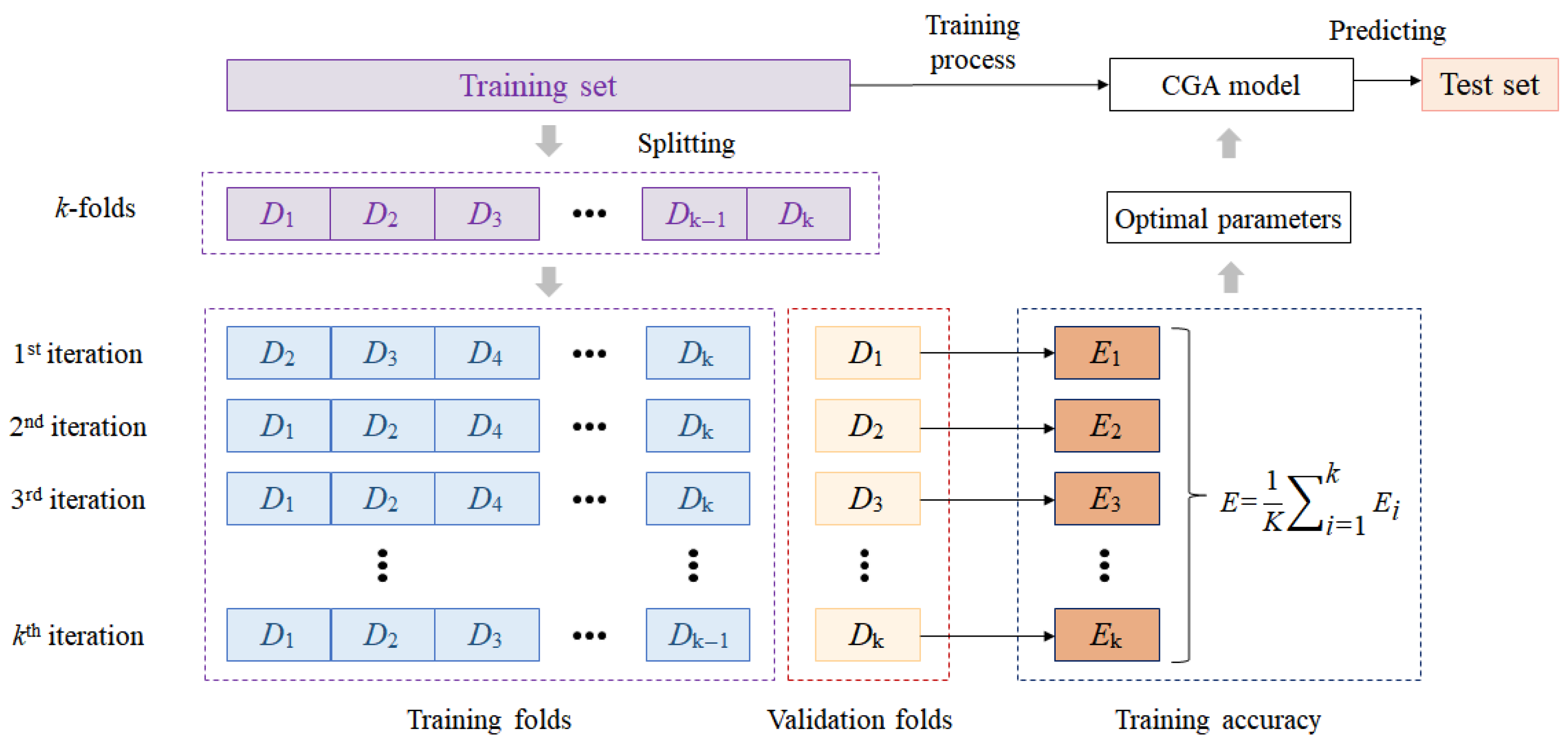
2.2. Model Training Method
3. Method Validation
3.1. Data and Preprocessing
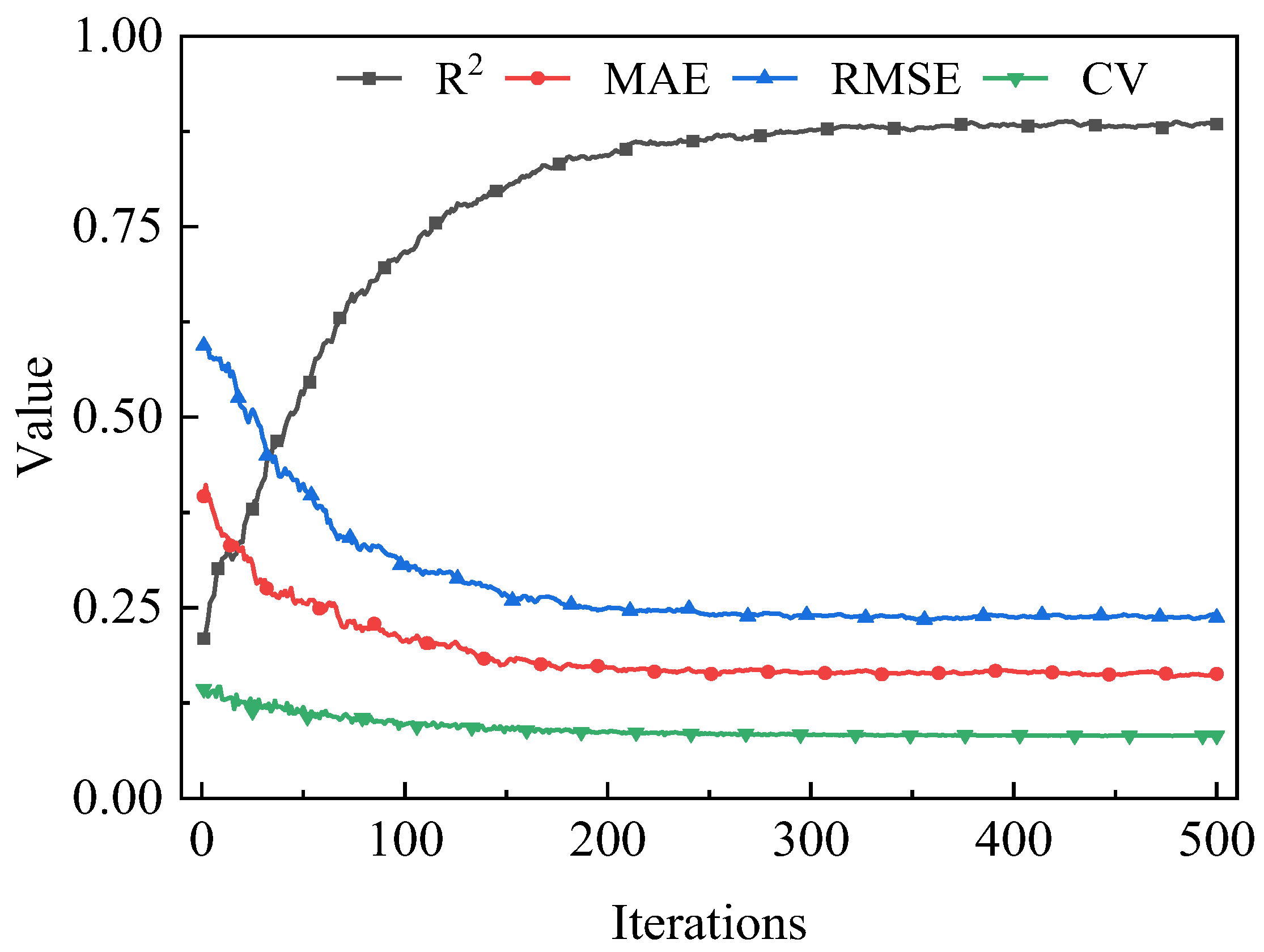
3.2. Model Training Process
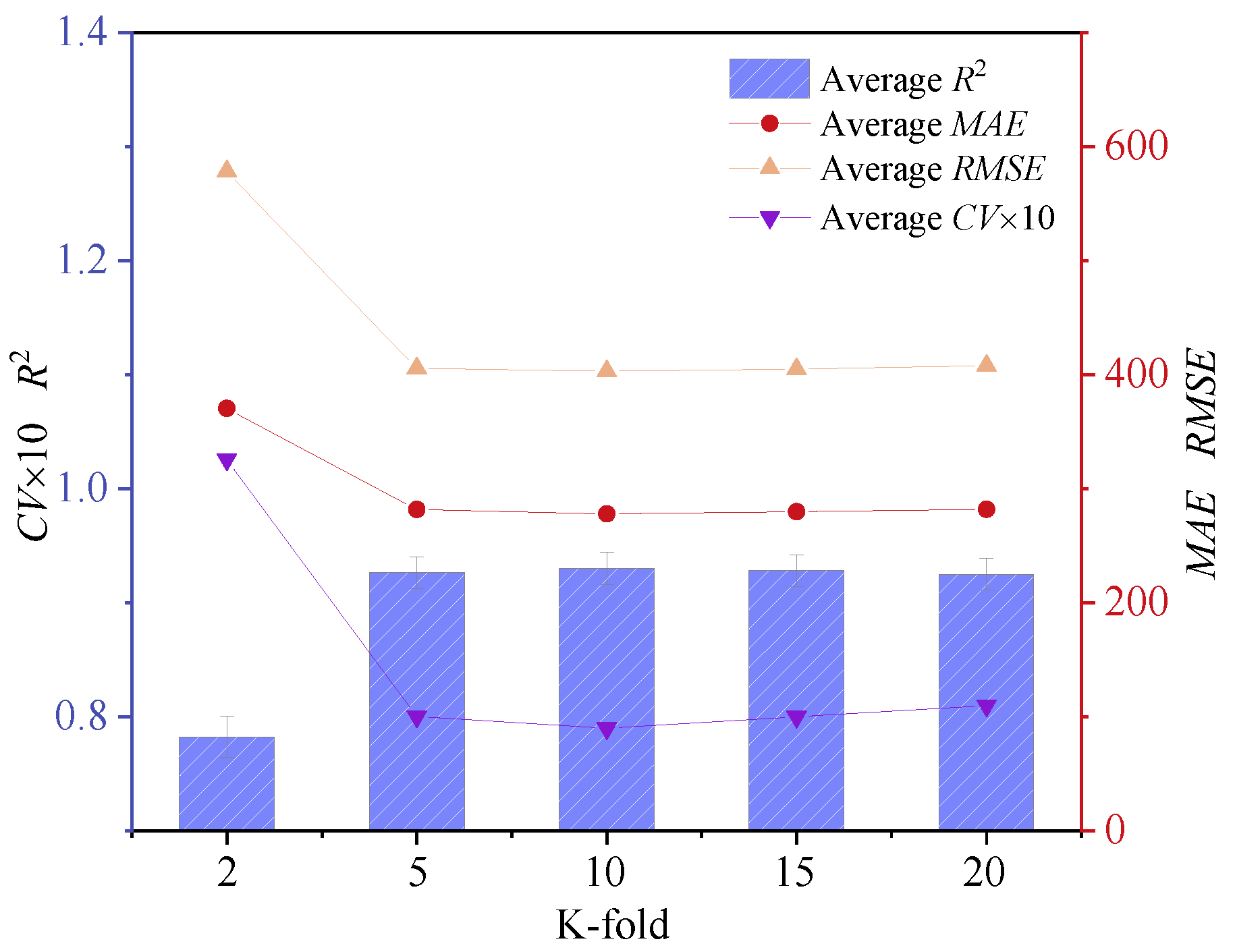
3.3. K-Fold Cross Validation
4. Prediction Results Analysis
4.1. Smoothing Processing
4.2. Prediction Methods Comparison
4.3. Rock Fragmentation Indices Analysis
5. Conclusions
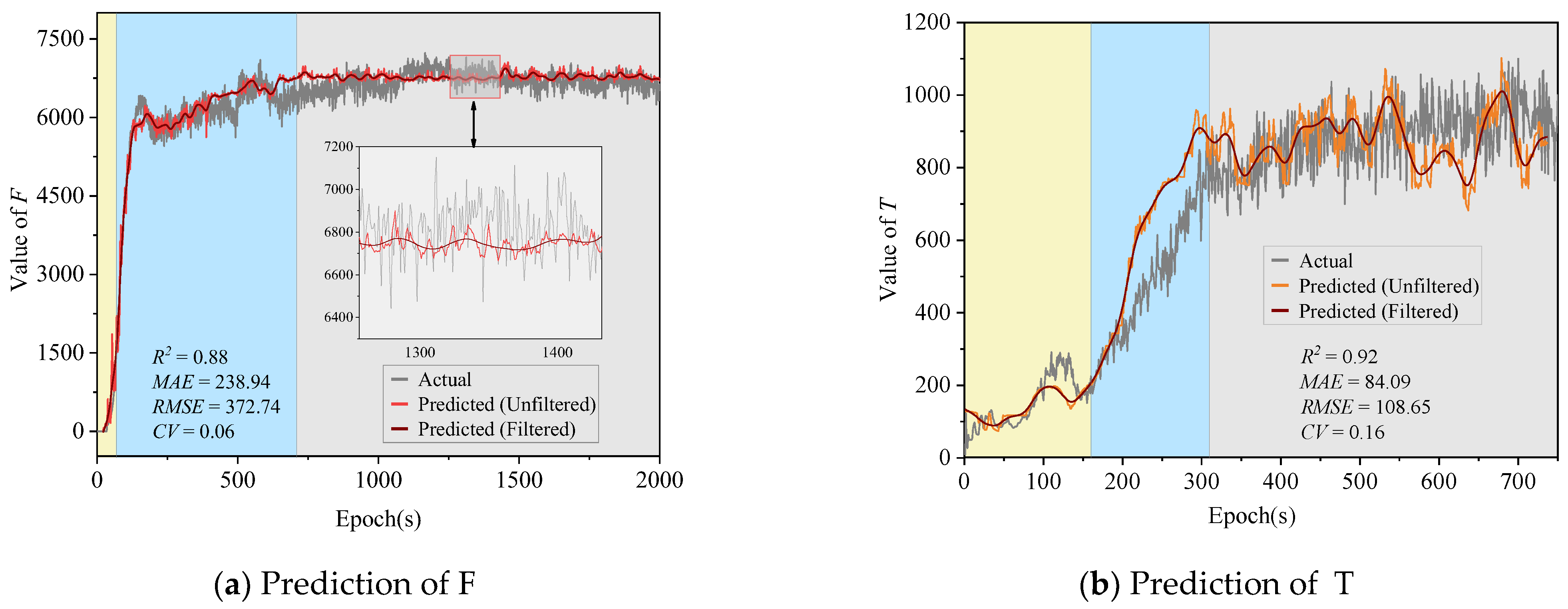
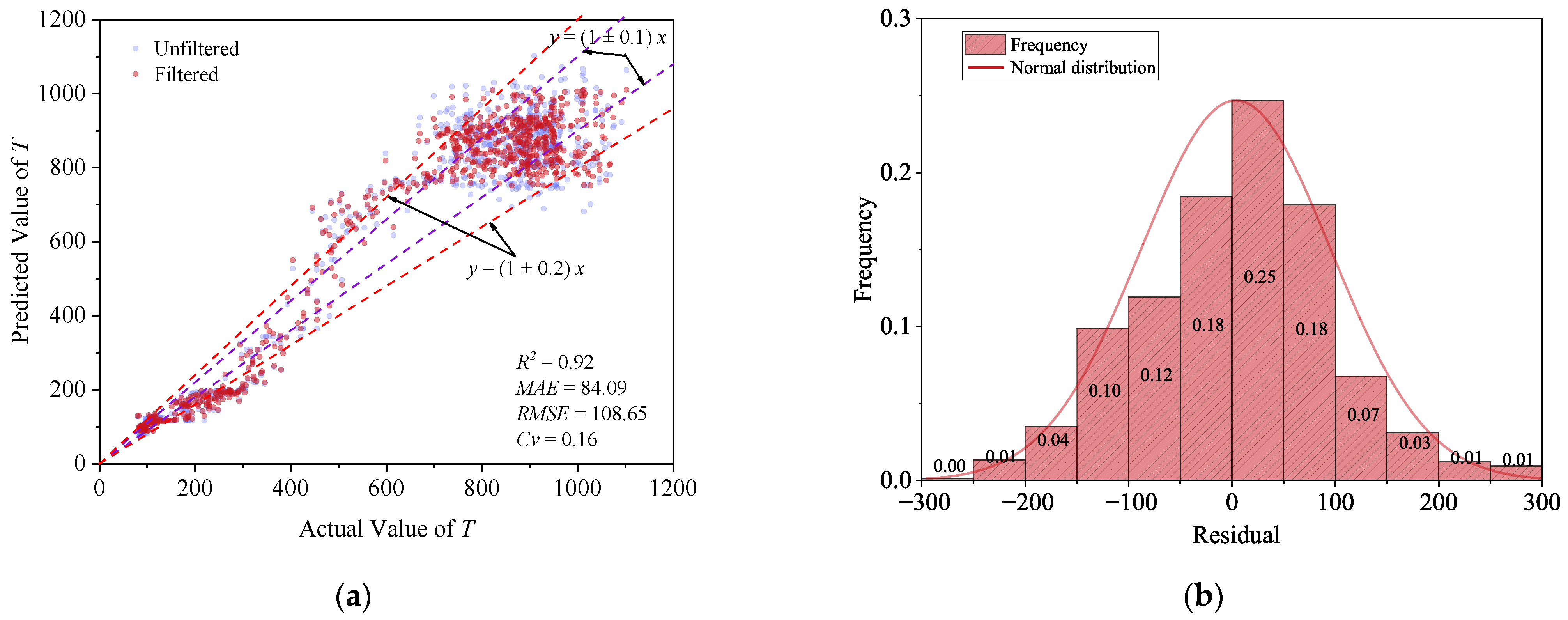
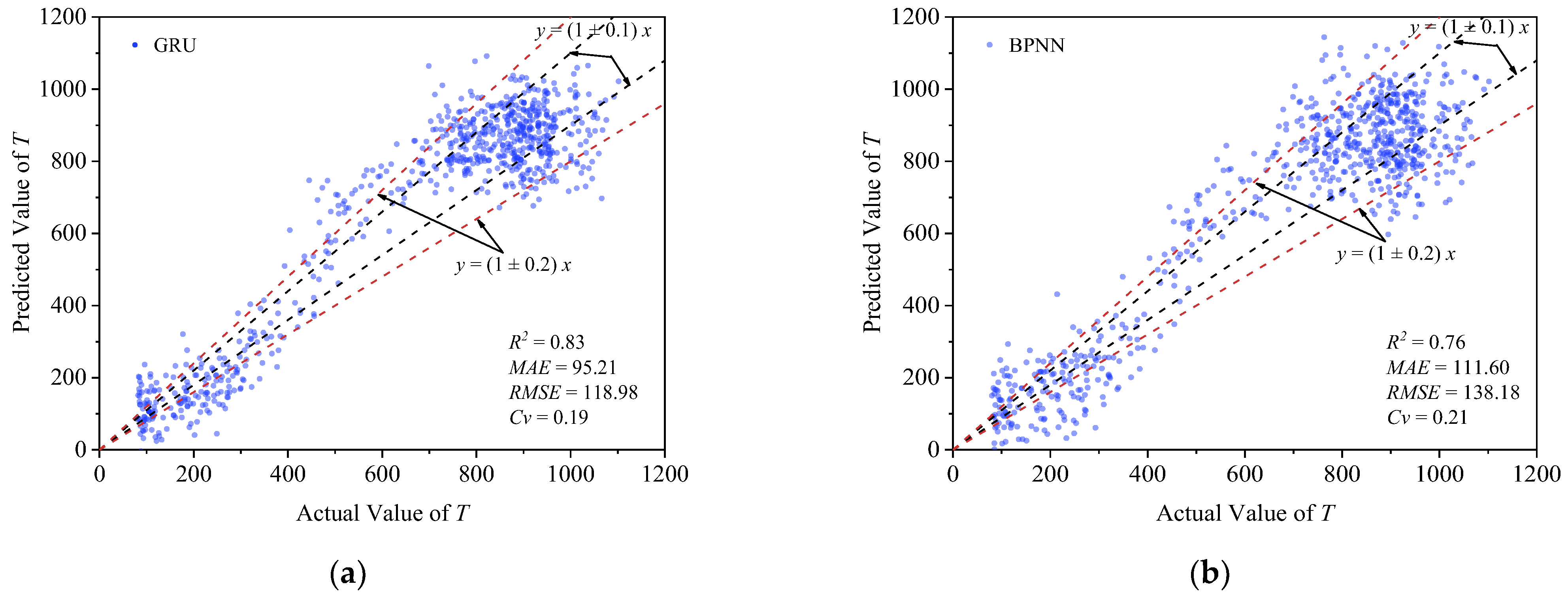
- The CGA model demonstrated superior predictive performance for TBM parameters like total thrust and cutterhead torque. The HP filter reduced noise in time series data, improving stability and error metrics (0.883 for total thrust, 0.923 for cutterhead torque) and outperforming traditional models like GRU and BPNN.
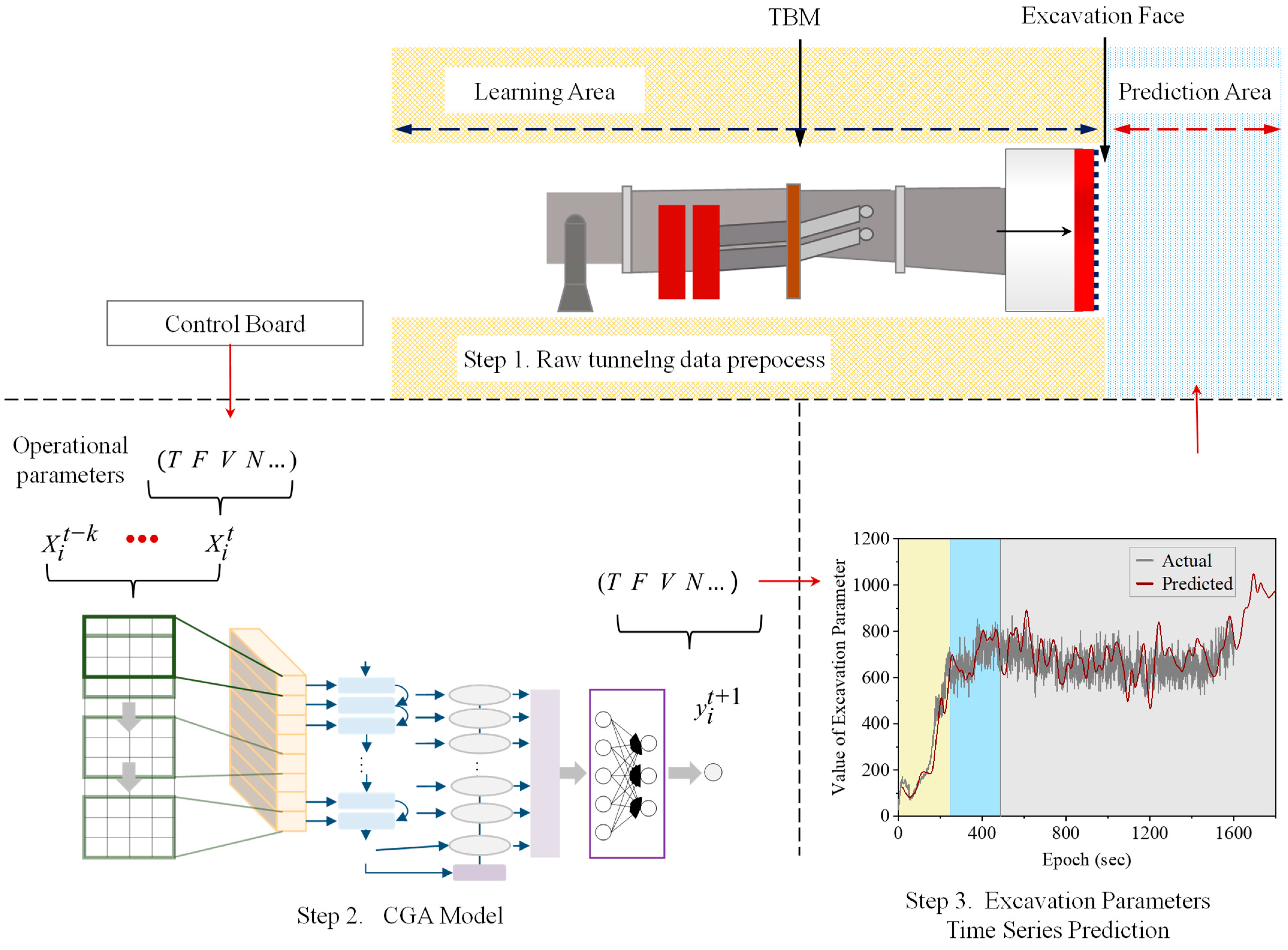
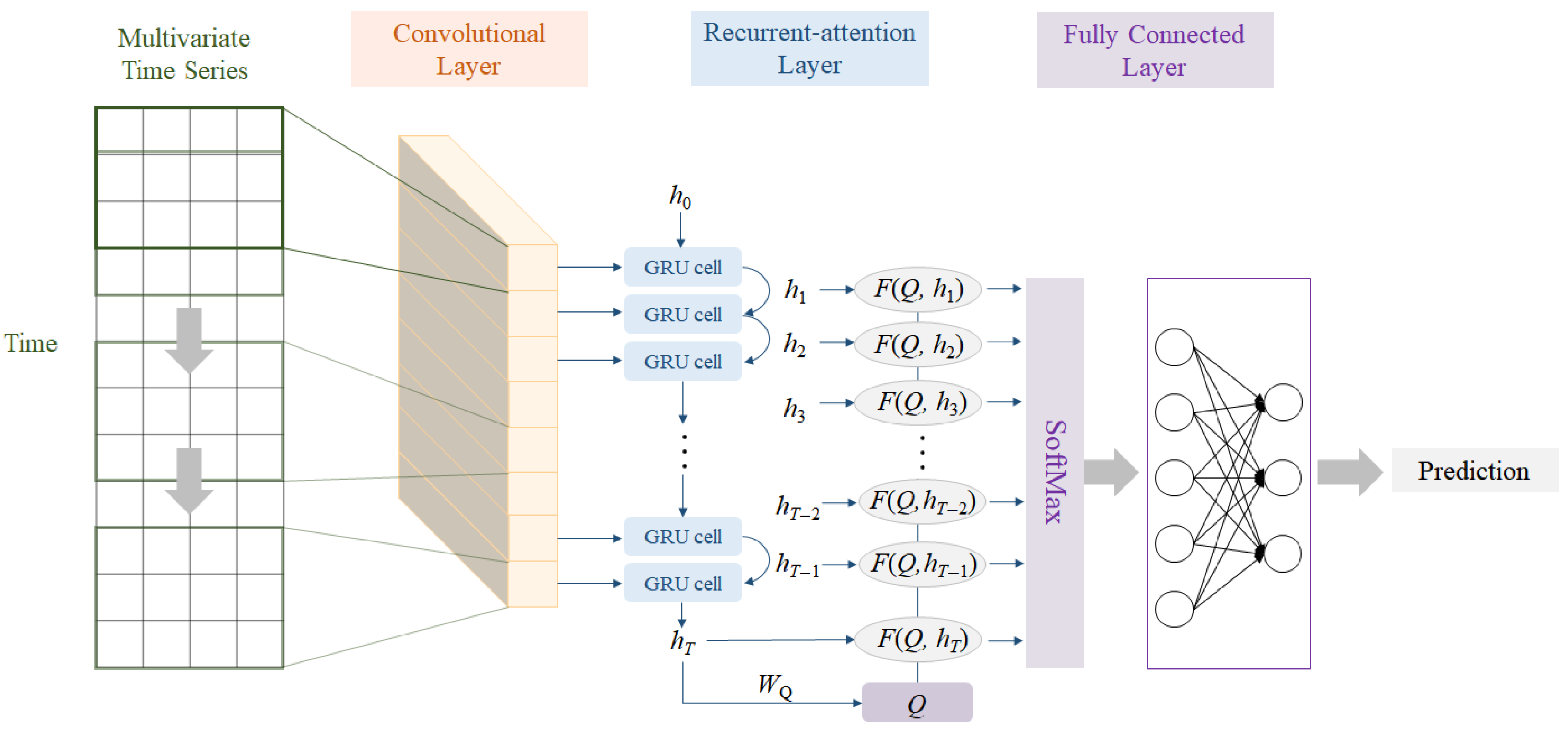
- The integration of convolutional feature extraction and GRU-based temporal modeling enables the CGA model to effectively capture both local temporal patterns and long-term dependencies in multivariate TBM operational data. The attention mechanism further enhances the model by adaptively focusing on the most informative time steps within the sequence.
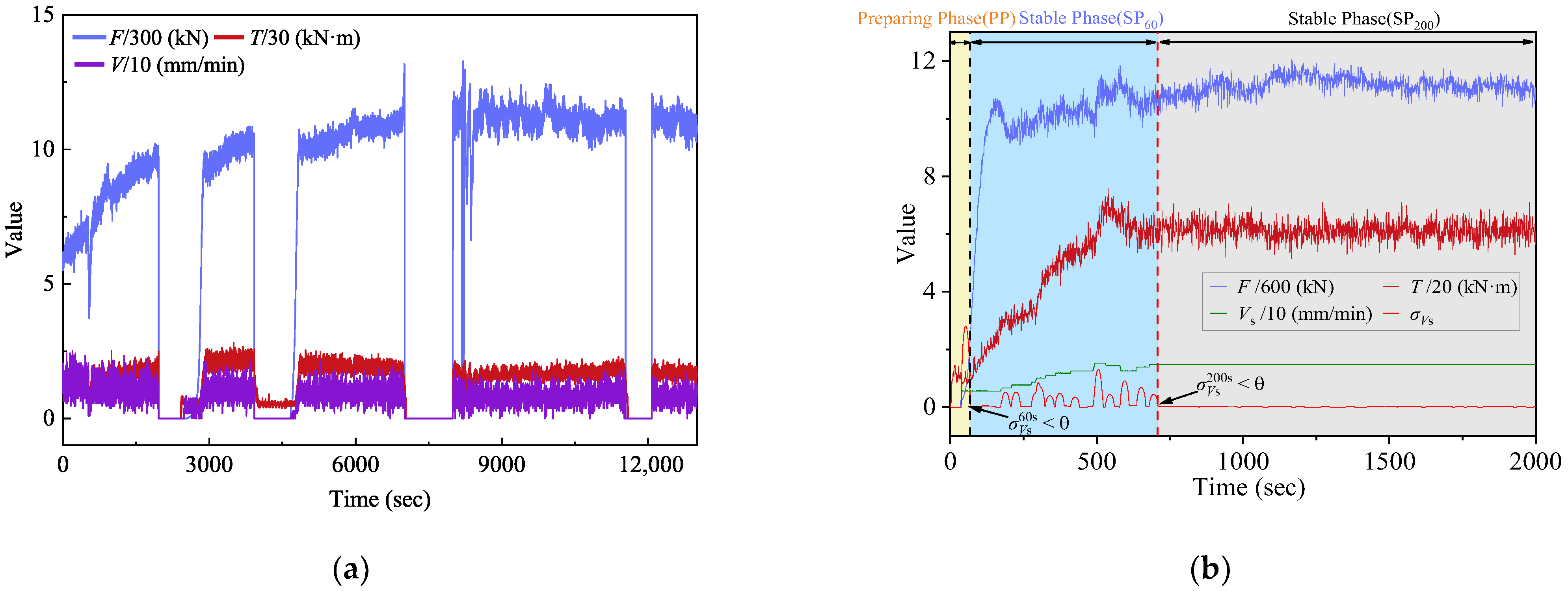
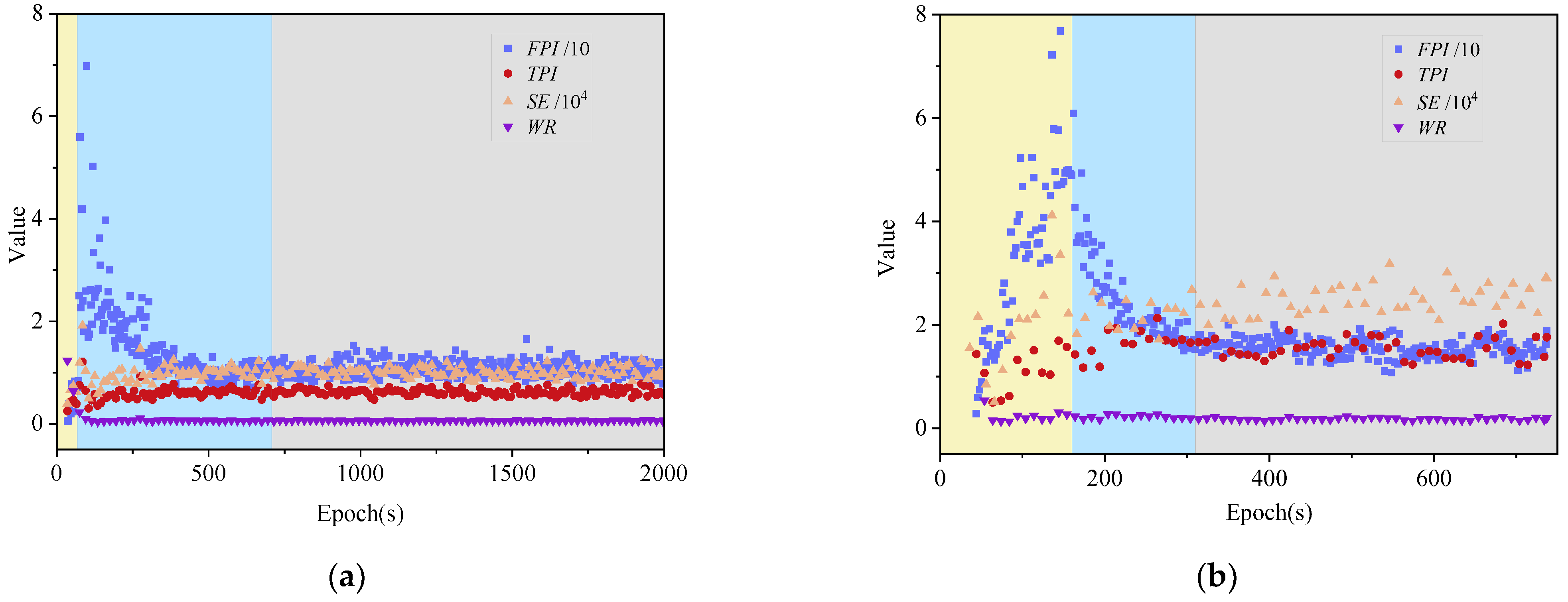
- By combining the predicted operational parameters with rock fragmentation indices (RFIs), the study provides a physically interpretable framework for analyzing TBM excavation behavior across different operational phases. The evolution of RFIs during preparation, transition, and stable excavation stages reflects changes in rock–machine interaction and excavation stability.
Author Contributions
Funding
Institutional Review Board Statement
Informed Consent Statement
Data Availability Statement
Conflicts of Interest
References
- Rostami, J. Hard Rock TBM Cutterhead Modeling for Design and Performance Prediction. Geomech. Tunn. 2008, 1, 18–28. [Google Scholar] [CrossRef]
- Wang, L.; Sun, W.; Long, Y.; Yang, X. Reliability-Based Performance Optimization of Tunnel Boring Machine Considering Geological Uncertainties. IEEE Access 2018, 6, 19086–19098. [Google Scholar] [CrossRef]
- Zhang, Q.; Huang, T.; Huang, G.; Cai, Z.; Kang, Y. Theoretical Model for Loads Prediction on Shield Tunneling Machine with Consideration of Soil-Rock Interbedded Ground. Sci. China Technol. Sci. 2013, 56, 2259–2267. [Google Scholar] [CrossRef]
- González, C.; Arroyo, M.; Gens, A. Thrust and Torque Components on Mixed-Face EPB Drives. Tunn. Undergr. Space Technol. 2016, 57, 47–54. [Google Scholar] [CrossRef]
- Qi, W.; Wang, L.; Zhou, S.; Kang, Y.; Zhang, Q. Total Loads Modeling and Geological Adaptability Analysis for Mixed Soil-Rock Tunnel Boring Machines. Undergr. Space 2022, 7, 337–351. [Google Scholar] [CrossRef]
- Kong, X.; Ling, X.; Tang, L.; Tang, W.; Zhang, Y. Random Forest-Based Predictors for Driving Forces of Earth Pressure Balance (EPB) Shield Tunnel Boring Machine (TBM). Tunn. Undergr. Space Technol. 2022, 122, 104373. [Google Scholar] [CrossRef]
- Maynar, M.; Rodríguez, L. Discrete Numerical Model for Analysis of Earth Pressure Balance Tunnel Excavation. J. Geotech. Geoenviron. Eng. 2005, 131, 1234–1242. [Google Scholar] [CrossRef]
- Qu, T.; Wang, S.; Fu, J.; Hu, Q.; Zhang, X. Numerical Examination of EPB Shield Tunneling–Induced Responses at Various Discharge Ratios. J. Perform. Constr. Facil. 2019, 33, 04019035. [Google Scholar] [CrossRef]
- Choi, S.; Lee, H.; Choi, H.; Chang, S.-H.; Kang, T.-H.; Lee, C. Numerical Analysis of EPB TBM Driving Using Coupled DEM-FDM Part II: Parametric Study. Tunn. Undergr. Space 2020, 30, 496–507. [Google Scholar]
- Choi, S.; Lee, H.; Choi, H.; Chang, S.-H.; Kang, T.-H.; Lee, C. Numerical Analysis of EPB TBM Driving Using Coupled DEM-FDM Part I: Modeling. Tunn. Undergr. Space 2020, 30, 484–495. [Google Scholar]
- Huang, H.; Chang, J.; Zhang, D.; Zhang, J.; Wu, H.; Li, G. Machine Learning-Based Automatic Control of Tunneling Posture of Shield Machine. J. Rock Mech. Geotech. Eng. 2022, 14, 1153–1164. [Google Scholar] [CrossRef]
- Gao, X.; Shi, M.; Song, X.; Zhang, C.; Zhang, H. Recurrent Neural Networks for Real-Time Prediction of TBM Operating Parameters. Autom. Constr. 2019, 15, 130–140. [Google Scholar] [CrossRef]
- Zhang, C.; Zhu, M.; Lang, Z.; Chen, R.; Cheng, H. Predictive Method of Soil Chamber Pressure Field for Shield Machines Based on Deep Learning. J. Geotech. Eng. (Chin.) 2024, 46, 307–315. [Google Scholar]
- Fu, K.; Xue, Y.; Qiu, D.; Shao, T.; Lan, G. Interval Prediction of TBM Tunneling Performance under Uncertainty Using the Successive Variational Mode Decomposition (SVMD)–Informer Model. Autom. Constr. 2026, 181, 106656. [Google Scholar] [CrossRef]
- Chung, J.; Gulcehre, C.; Cho, K.; Bengio, Y. Empirical Evaluation of Gated Recurrent Neural Networks on Sequence Modeling. arXiv 2014, arXiv:1412.3555. [Google Scholar] [CrossRef]
- Lai, G.; Chang, W.-C.; Yang, Y.; Liu, H. Modeling Long- and Short-Term Temporal Patterns with Deep Neural Networks. In Proceedings of the SIGIR ’18: The 41st International ACM SIGIR Conference on Research & Development in Information Retrieval, Ann Arbor, MI, USA, 8–12 July 2018. [Google Scholar]
- Kingma, D.; Ba, J. Adam: A Method for Stochastic Optimization. arXiv 2014, arXiv:1412.6980. [Google Scholar]
- Chen, Z.; Fan, L.; Zhang, Y.; Xiao, H.; Wang, L. Knowledge-Based and Data-Based Machine Learning in Intelligent TBM Construction. Tumu Gongcheng Xuebao/China Civ. Eng. J. 2024, 57, 1–12. [Google Scholar] [CrossRef]
- Yao, C.; Kong, X.; Tang, L.; Ling, X. An Unsupervised Deep Learning Surrounding Rock Perception Method for TBM Operational Parameter Multiobjective Optimization. Results Eng. 2025, 27, 106925. [Google Scholar] [CrossRef]
- Potdar, K.; Pardawala, T.; Pai, C. A Comparative Study of Categorical Variable Encoding Techniques for Neural Network Classifiers. Int. J. Comput. Appl. 2017, 175, 7–9. [Google Scholar] [CrossRef]
- Marcot, B.; Hanea, A. What Is an Optimal Value of k in K-Fold Cross-Validation in Discrete Bayesian Network Analysis? Comput. Stat. 2021, 36, 2009–2031. [Google Scholar] [CrossRef]
- Xu, C.; Liu, X.; Wang, E.; Wang, S. Prediction of Tunnel Boring Machine Operating Parameters Using Various Machine Learning Algorithms. Tunn. Undergr. Space Technol. 2021, 109, 103699. [Google Scholar] [CrossRef]
- Cogley, T.; Nason, J. Effects of the Hodrick-Prescott Filter on Trend and Difference Stationary Time Series Implications for Business Cycle Research. J. Econ. Dyn. Control 1992, 19, 253–278. [Google Scholar] [CrossRef]





| Hyper-Parameters | Symbol | Value | R2 | MAE | RMSE | CV |
|---|---|---|---|---|---|---|
| Learning rate | α | 5 × 10⁻⁴ | 0.864 | 0.183 | 0.261 | 0.096 |
| 10−3 | 0.883 | 0.165 | 0.239 | 0.082 | ||
| 2 × 10⁻³ | 0.876 | 0.172 | 0.248 | 0.087 | ||
| Batch size | B | 64 | 0.871 | 0.176 | 0.251 | 0.091 |
| 128 | 0.879 | 0.169 | 0.243 | 0.085 | ||
| 256 | 0.883 | 0.165 | 0.239 | 0.082 | ||
| Number of iterations | e | 300 | 0.883 | 0.165 | 0.239 | 0.082 |
| 600 | 0.886 | 0.162 | 0.236 | 0.079 | ||
| 1000 | 0.887 | 0.161 | 0.235 | 0.078 | ||
| Time series window | W | 10 | 0.857 | 0.192 | 0.274 | 0.101 |
| 20 | 0.883 | 0.165 | 0.239 | 0.082 | ||
| 30 | 0.878 | 0.170 | 0.245 | 0.086 | ||
| Convolution kernel size | K | 2 | 0.876 | 0.172 | 0.248 | 0.087 |
| 3 | 0.883 | 0.165 | 0.239 | 0.082 | ||
| 4 | 0.879 | 0.169 | 0.244 | 0.084 | ||
| Number of convolution kernels | Nk | 64 | 0.868 | 0.181 | 0.258 | 0.094 |
| 128 | 0.883 | 0.165 | 0.239 | 0.082 | ||
| 256 | 0.885 | 0.163 | 0.237 | 0.08 | ||
| Hidden state dimensions | C | 64 | 0.872 | 0.177 | 0.252 | 0.09 |
| 128 | 0.883 | 0.165 | 0.239 | 0.082 | ||
| 256 | 0.886 | 0.162 | 0.236 | 0.079 |
| λ | R2 | MAE | RMSE |
|---|---|---|---|
| 100 | 0.919 | 239.211 | 374.075 |
| 300 | 0.920 | 238.830 | 373.016 |
| 500 | 0.920 | 238.600 | 372.509 |
| 1000 | 0.921 | 238.224 | 371.788 |
| 2000 | 0.922 | 237.822 | 371.073 |
| 5000 | 0.923 | 237.322 | 370.219 |
| 10,000 | 0.924 | 236.984 | 369.684 |
| Model | F/(kN) | T/(kN·m) | ||||||
|---|---|---|---|---|---|---|---|---|
| R2 | MAE | RMSE | CV | R2 | MAE | RMSE | CV | |
| CGA with filter | 0.883 | 282.972 | 430.754 | 0.080 | 0.923 | 73.323 | 92.015 | 0.151 |
| CGA | 0.876 | 296.486 | 454.301 | 0.084 | 0.911 | 77.633 | 98.937 | 0.164 |
| GRU | 0.825 | 395.877 | 566.453 | 0.090 | 0.834 | 95.211 | 118.982 | 0.187 |
| BPNN | 0.750 | 408.170 | 586.875 | 0.093 | 0.759 | 111.592 | 138.177 | 0.214 |
Disclaimer/Publisher’s Note: The statements, opinions and data contained in all publications are solely those of the individual author(s) and contributor(s) and not of MDPI and/or the editor(s). MDPI and/or the editor(s) disclaim responsibility for any injury to people or property resulting from any ideas, methods, instructions or products referred to in the content. |
© 2026 by the authors. Licensee MDPI, Basel, Switzerland. This article is an open access article distributed under the terms and conditions of the Creative Commons Attribution (CC BY) license.
Share and Cite
Yao, C.; Kong, X.; Tang, L.; Ling, X.; Tang, W. A Multivariate Time Series Prediction Model for TBM Excavation Parameters Using a Convolution–GRU–Attention Neural Network. Appl. Sci. 2026, 16, 2964. https://doi.org/10.3390/app16062964
Yao C, Kong X, Tang L, Ling X, Tang W. A Multivariate Time Series Prediction Model for TBM Excavation Parameters Using a Convolution–GRU–Attention Neural Network. Applied Sciences. 2026; 16(6):2964. https://doi.org/10.3390/app16062964
Chicago/Turabian StyleYao, Changrui, Xiangxun Kong, Liang Tang, Xianzhang Ling, and Wenchong Tang. 2026. "A Multivariate Time Series Prediction Model for TBM Excavation Parameters Using a Convolution–GRU–Attention Neural Network" Applied Sciences 16, no. 6: 2964. https://doi.org/10.3390/app16062964
APA StyleYao, C., Kong, X., Tang, L., Ling, X., & Tang, W. (2026). A Multivariate Time Series Prediction Model for TBM Excavation Parameters Using a Convolution–GRU–Attention Neural Network. Applied Sciences, 16(6), 2964. https://doi.org/10.3390/app16062964