1. Introduction
Statistical Energy Analysis (SEA) is widely used for vibroacoustic prediction in the mid- to high-frequency range, where deterministic finite element (FE) simulations become increasingly expensive and sensitive to modeling uncertainties. SEA represents a built-up structure as an energy network of coupled subsystems, and its practical validity hinges on defining subsystems that are internally well mixed while remaining only weakly coupled to neighboring subsystems [
1,
2].
In industrial applications, SEA modeling is further challenged by increasing model size and configuration complexity, while practical issues such as confidentiality and limited data accessibility can also hinder method comparison and workflow transferability [
3,
4]. These conditions increase the need for modeling procedures that are repeatable and traceable. In addition, when built-up assemblies exhibit strong interconnections, the subsequent SEA description becomes more sensitive to how subsystems and their couplings are defined, so substructuring becomes a critical modeling step rather than a purely geometric convenience [
5].
Although substantial effort has been devoted to improving parameter acquisition and identification—such as modal density, loss factors, and coupling loss factors—these advances do not remove the practical bottleneck that subsystem boundaries are still frequently defined manually and subjectively in large FE assemblies [
6,
7,
8,
9,
10,
11]. For large shell-element models, manual substructuring remains labor-intensive, difficult to reproduce, and poorly scalable.
To support vibroacoustic modeling in the medium-frequency range, several FE-assisted SEA routes, including Virtual SEA (VSEA) and related implementation frameworks, have been developed [
12,
13,
14,
15]. Recent developments have also extended SEA-related methodologies toward model updating as well as uncertainty-aware formulations with interval and fuzzy parameters, indicating that the broader SEA framework continues to evolve beyond classical parameter estimation alone [
16,
17,
18]. In hybrid FE–SEA workflows, automated identification of model components has also been discussed as part of broader model-construction procedures [
19]. More generally, hybrid energy-based vibroacoustic modeling has also been discussed from broader methodological viewpoints, such as combined virtual and analytical SEA perspectives [
20]. However, these broader developments do not by themselves resolve how subsystem boundaries should be placed in large shell-element models, where the partitioning step often still relies heavily on manual judgment.
Among studies related to automated subsystem definition, one major line of work relies on response, modal, transfer, or energy information extracted from the analyzed structure. For example, automated or semi-automated partitioning ideas have been discussed in studies of structure-borne noise transmission and other complex medium-frequency structural analyses [
21,
22,
23]. A related line of work uses clustering or statistical classification based on modal, response, or other derived indicators to generate subsystem groupings for SEA-oriented modeling [
24,
25,
26]. Such approaches can be effective, but they usually depend on posterior dynamic information and additional modeling choices, which may complicate workflow standardization for large engineering models. Recent engineering-oriented studies have also reported automatic SEA subsystem identification and software implementation for large structural applications such as cruise ships, reflecting growing practical demand for automated front-end model construction [
27]. The proposed procedure is evaluated using cases of increasing complexity, from simplified verification examples to engineering-scale shell models. These engineering examples are selected in the broader context of vibroacoustic application classes for which SEA and related methods have been widely discussed in the literature [
28,
29,
30,
31,
32].
Motivated by these considerations, this study develops an automatic initial subsystem partitioning framework for shell FE models based on explicit prior attributes already contained in the FE definition. The main contributions of this work are threefold. First, the method unifies geometric discontinuity, thickness discontinuity, material/property discontinuity, and topological discontinuity within one adjacency-based decision and graph-cutting framework, so that subsystem boundaries can be generated automatically from explicit physical information already encoded in the shell FE model, without relying on posterior response-field analysis or manually prescribed boundaries. Second, the framework can be applied directly to existing large-scale and complex shell FE models without requiring additional response-feature construction or complex pre-partitioning, thereby providing a lightweight, repeatable, and practically executable automation path for SEA-related front-end modeling. Third, the obtained subsystems are intended as physically explicit initial subsystem definitions that provide a reliable boundary basis for higher-level statistical modeling objectives. When a coarser subsystem representation is required for a downstream model, further aggregation may be introduced as an optional modeling-oriented enhancement rather than as a prerequisite for the validity of the present method. Relative to manual substructuring, the present framework reduces the subjectivity of boundary assignment; relative to modal- or energy-driven routes, it provides a more direct FE-data-driven front-end path with lower preprocessing burden, rather than a denial of the physical meaning of those methods.
The remainder of this paper is organized as follows.
Section 2 presents the unified rule-based partitioning method and its implementation on shell FE adjacencies.
Section 3 then examines the method through progressively more complex cases, including fundamental discontinuity-oriented examples, complex coupled-discontinuity structures, and the engineering-scale Capesize bulk carrier model. Finally, the main findings and scope of the present framework are summarized in
Section 4.
2. Methods
This section presents an automatic partitioning procedure for shell FE models, in which subsystem boundaries are identified from explicit physical discontinuities represented in the mesh. The method is formulated for shell structures whose FE definition provides the geometric configuration, thickness assignment, material/property definition, and local topological connectivity. Under this setting, adjacent elements are examined to determine whether their shared adjacency is interrupted by geometric discontinuity, thickness discontinuity, material/property discontinuity, or topological discontinuity. Adjacencies that satisfy any of these discontinuity criteria are removed, and the remaining connected subsystems are taken as the partitioning result. The required inputs are therefore the element adjacency relation, element normal vectors, thickness data, property/material identifiers, and shared-edge topological information extracted directly from the shell FE model.
A shell FE mesh is represented by an undirected element adjacency graph
where each node
corresponds to a shell element and each edge
indicates that elements
i and
j share a common physical mesh edge. For each element
i, the FE model provides a unit normal vector
, thickness
, and identifiers
and
. For each adjacent pair
, a discontinuity flag
is evaluated. The procedure operates only on explicit descriptors already contained in the shell FE definition, namely element adjacency, element normals, thickness definitions, property/material identifiers, and local connectivity at shared mesh edges. Accordingly, subsystem boundaries are determined from physically interpretable discontinuity information directly available in the FE model. The adjacency is removed if any rule is triggered, resulting in a retained edge set
The resulting cut graph is
, and the SEA subsystems are defined as the connected components of
:
Because connectivity is defined strictly through shared mesh edges, each resulting subsystem is spatially connected by construction.
The overall discontinuity flag is defined by the logical union of the four rules:
where ∨ denotes the logical “or”. The four terms are specified as follows.
Geometric discontinuity captures fold lines and sharp edges. It is quantified using the dihedral angle between the normals of adjacent elements:
A geometric discontinuity is declared when the angle exceeds a prescribed threshold
. To ensure robustness against mesh variability,
is determined via an adaptive two-stage procedure. First, an initial global threshold is derived using Otsu’s method on the dihedral angle histogram to maximize the inter-class variance between “flat” and “folded” distributions. Second, this candidate value is validated against a sparsity constraint (cut ratio) and clamped within engineering safety limits to prevent spurious over-segmentation on smooth, high-curvature surfaces. For a fixed FE representation, this thresholding process is fully rule-defined: the same dihedral-angle distribution, sparsity check, and safety bounds produce the same
. The geometric threshold is therefore obtained automatically through a predefined decision procedure rather than adjusted manually on a case-by-case basis.
Thickness discontinuity detects abrupt thickness steps between adjacent shell elements. A dimensionless relative jump is defined as
The thickness discontinuity rule is then
where
reflects engineering-relevant thickness transitions, such as plating-to-reinforcement steps. Normalization by
makes the criterion insensitive to the absolute thickness scale.
Material/property discontinuity preserves interfaces where the constitutive definition changes. The FE identifiers are used directly:
This rule follows standard FE modeling semantics, in which PID and MID encode property and material subsystems defined in the model. Under consistent FE modeling of the same property partition, changes in PID or MID correspond to explicit engineering boundaries and are reproduced consistently by the present rule.
Topological discontinuity enforces segmentation at non-manifold connections, such as T-junctions or X-junctions typical in reinforced structures. Let
denote the total number of shell elements sharing the physical mesh edge associated with the graph edge
. Since
, the edge connects at least two elements, implying
. A topological discontinuity is declared when the edge represents a non-manifold junction:
This rule ensures that multi-branch junctions are explicitly treated as subsystem interfaces.
Given these four rules, each adjacency receives a unique binary decision . The retained edge set is therefore uniquely determined once the FE representation and the predefined rule set are fixed, and the final partition follows uniquely from the connected components of . No random initialization, probabilistic search, or competing multi-solution mechanism is involved in this procedure. Accordingly, repeated executions under the same FE representation and the same predefined rules produce the same partition result.
The identifiable range of discontinuities in the present framework is rule-dependent rather than characterized by a single absolute size scale. Geometric discontinuities are governed by the automatically determined angle threshold, thickness discontinuities by the relative thickness-jump criterion, material/property discontinuities by changes in PID or MID, and topological discontinuities by non-manifold shared-edge connectivity. Accordingly, the method detects physical discontinuities that are explicitly represented in the FE model and satisfy the corresponding rule conditions.
3. Case Studies and Results
This chapter validates the proposed physical discontinuity method in terms of the physical correctness of subsystem boundaries, applicability to complex structures, and engineering-scale feasibility through a tiered set of case studies. The case suite follows a three-level evidence chain: the mechanism-oriented verification cases (Case 1) examine whether each discontinuity rule isolates its intended boundary mechanism under controlled conditions; the complex-structure verification (Case 2) demonstrates interpretability under coupled discontinuities and consistency across mesh densities, while using an element-level modal-energy method as a cross-check rather than a strict benchmark; the engineering-scale verification (Case 3) demonstrates practical executability and output manageability on the Capesize bulk carrier ship model through computational and scale statistics.
3.1. Mechanism-Oriented Verification of Four Physical Discontinuity Types
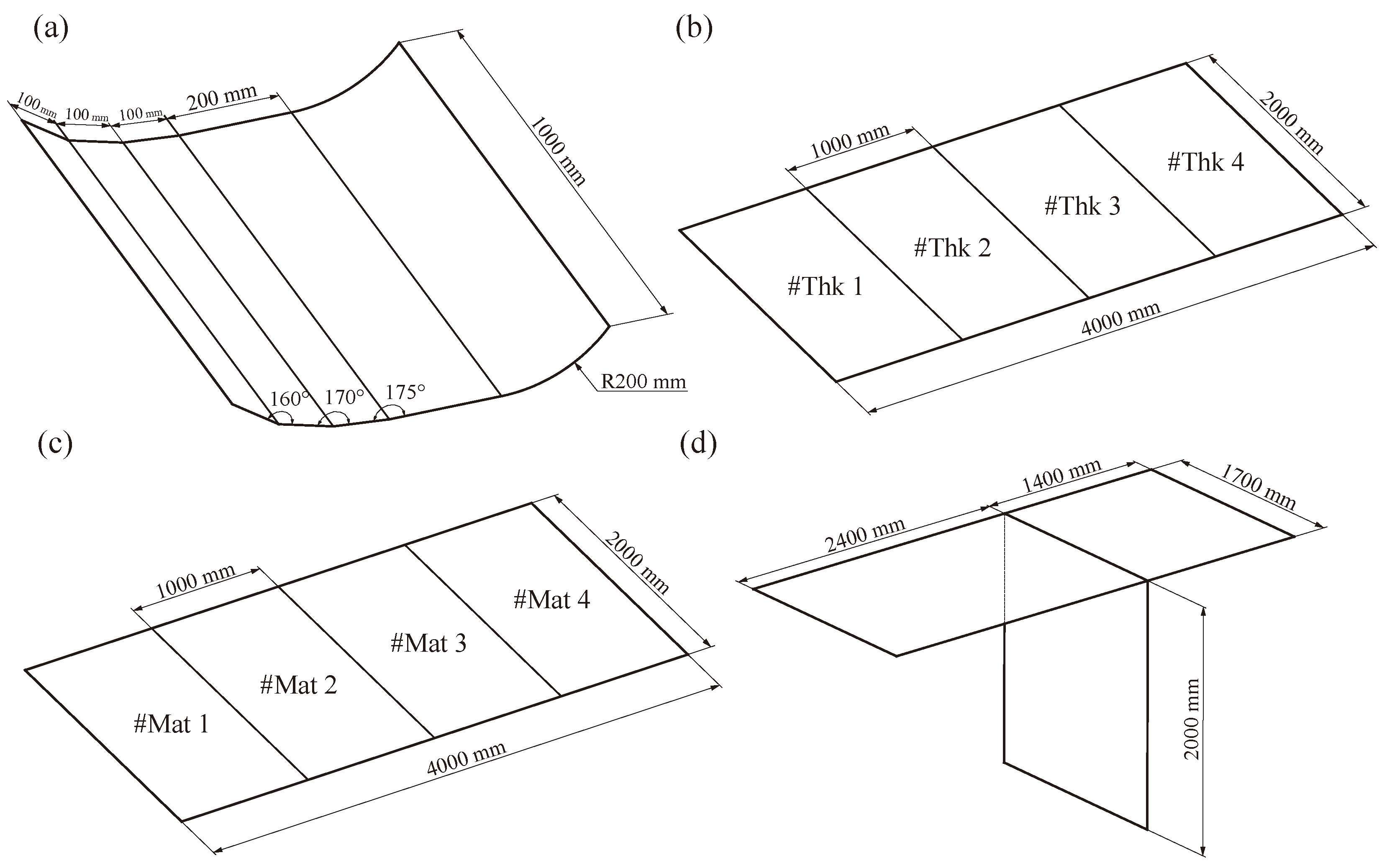
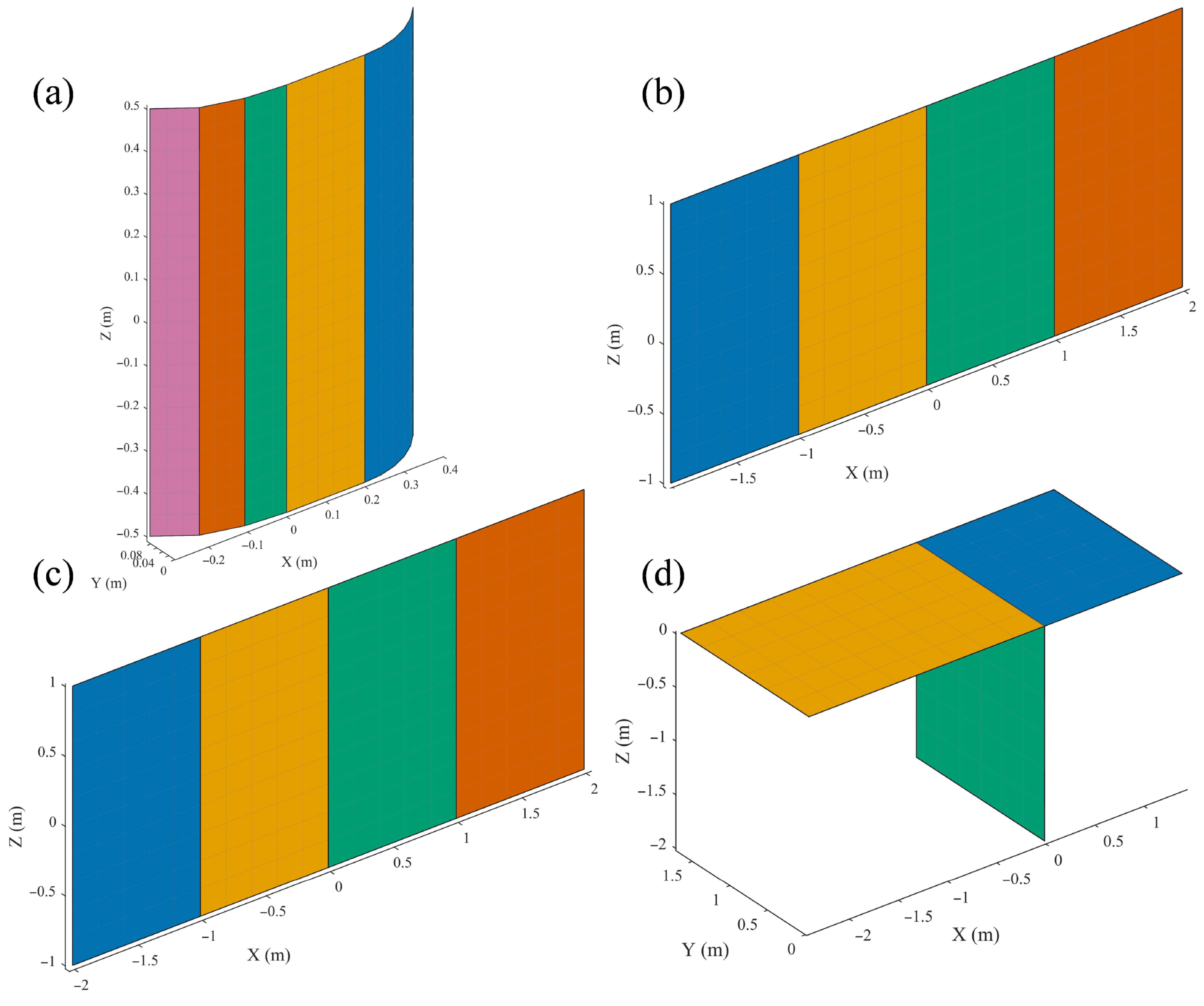
From a wave propagation perspective, SEA subsystem boundaries represent loci of impedance mismatch where vibrational energy is reflected, transmitted, or dissipated. In finite element shell models, these impedance discontinuities manifest explicitly as changes in material properties, thickness steps, geometric folds, or multi-branch junctions. Accordingly, Case 1 uses four controlled examples to verify whether each discontinuity rule can correctly isolate its corresponding explicitly defined boundary mechanism. The input definitions and corresponding partitioning results are presented in
Figure 1 and
Figure 2, respectively.
The geometric sensitivity of the algorithm is evaluated using the model in
Figure 1a. The structure features a multi-folded strip with a gradient of dihedral angles (175°, 170°, and 160°) and a curved panel connected via a tangential transition. As shown in
Figure 2a, the method successfully decomposes the structure into five distinct subsystems. It is worth noting that the dihedral-angle threshold
serves here as an engineering control here: it allows the algorithm to capture the designed shallow transition (175°) while including a protective treatment to filter spurious large angles arising from local normal-orientation inconsistencies on smooth surfaces. This indicates that the geometric rule balances sensitivity to salient engineering features with robustness to discretization noise.
In the absence of geometric folds, boundaries are defined by inherent physical attributes.
Figure 1b,c present planar models where the geometry is continuous, but the impedance is altered by thickness steps and material property changes, respectively. The algorithm correctly segments these models into rectangular subsystems (
Figure 2b,c), strictly aligning with the attribute interfaces. Unlike geometric features which may be subject to tuning, discontinuities triggered by thickness and material identifiers are treated as “hard boundaries”; the framework strictly preserves these interfaces, ensuring that regions with distinct mass or stiffness properties are maintained as separate energy storage entities.
Finally, topological complexity is demonstrated using a T-junction configuration (
Figure 1d), representative of stiffened marine structures where the mesh edge is shared by three elements (
). The topological discontinuity rule explicitly identifies this non-manifold condition. The resulting partition in
Figure 2d separates the assembly into three independent subsystems. Notably, this topological segmentation aligns perfectly with results obtained via spectral clustering on similar T-junction benchmarks [
25]. This consistency suggests that, for the present T-junction example, the explicit topological discontinuity captures a boundary location that is also highlighted by the response-based reference. In this sense, the topological rule provides a direct structural description of the junction without requiring posterior dynamic-field analysis. This result further shows that the topological rule preserves the explicit structural separation at the junction, which is important for subsequent subsystem-level modeling.
3.2. Complex-Structure Capability and Partition Consistency Across Mesh Densities
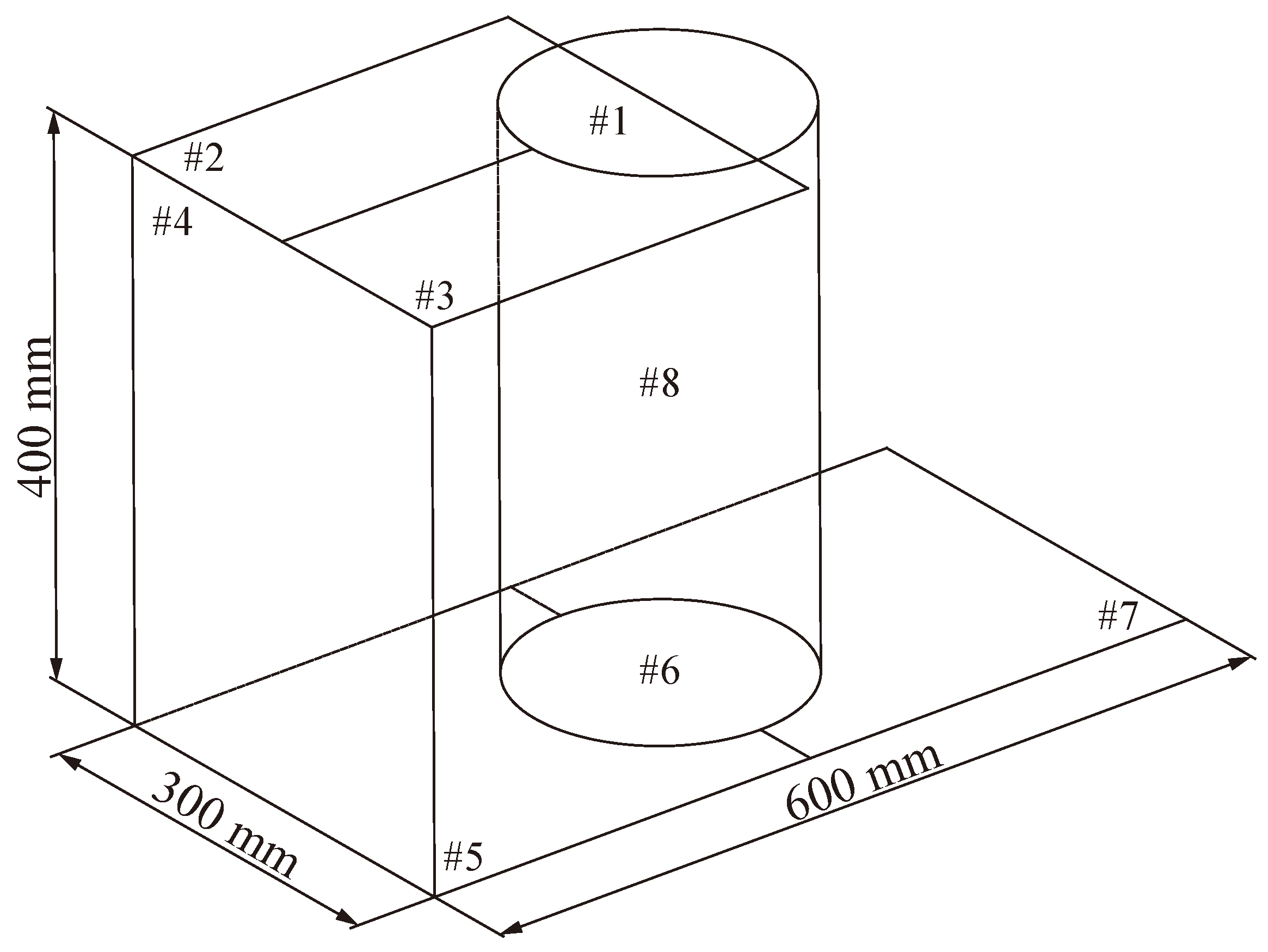
Following the fundamental verification, the method is applied to a representative complex shell assembly to evaluate the handling of coupled discontinuity mechanisms. As illustrated in
Figure 3, the structure serves as a simplified proxy for marine sheet metal assemblies, consisting of three main plates bent to form a C-shaped channel intersected by a vertical cylindrical rod. The model incorporates specific attribute definitions to test the simultaneous activation of multiple rules: distinct material properties are assigned to the cylinder cap (region #1) and top flange (region #2) to simulate non-geometric impedance mismatches; region #5 is assigned a unique shell thickness; and varying dihedral angles are present at the folded transitions (e.g., between regions #4 and #5). Additionally, the intersection between the vertical cylinder and the base plates forms a non-manifold T-junction, representing a topological discontinuity.
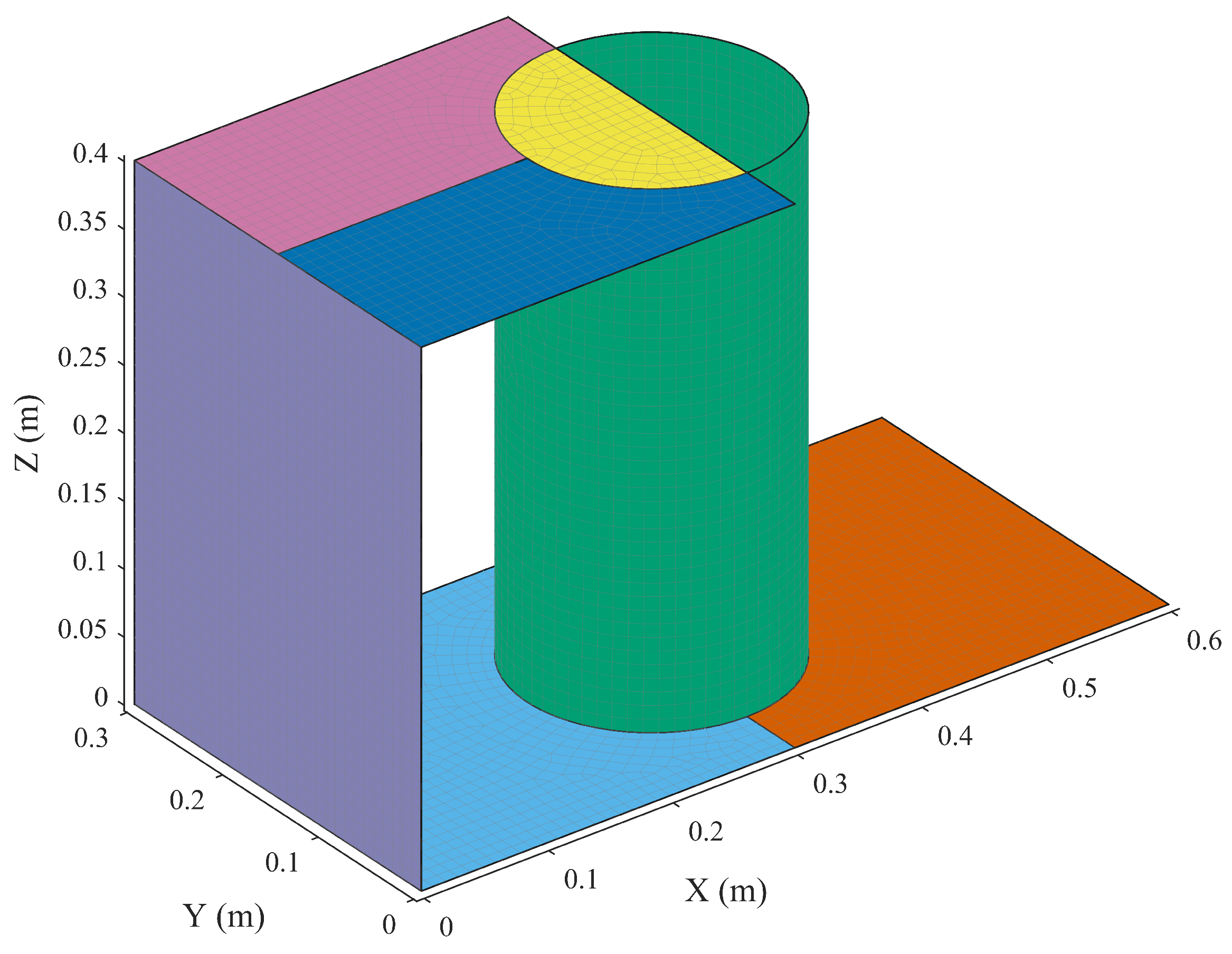
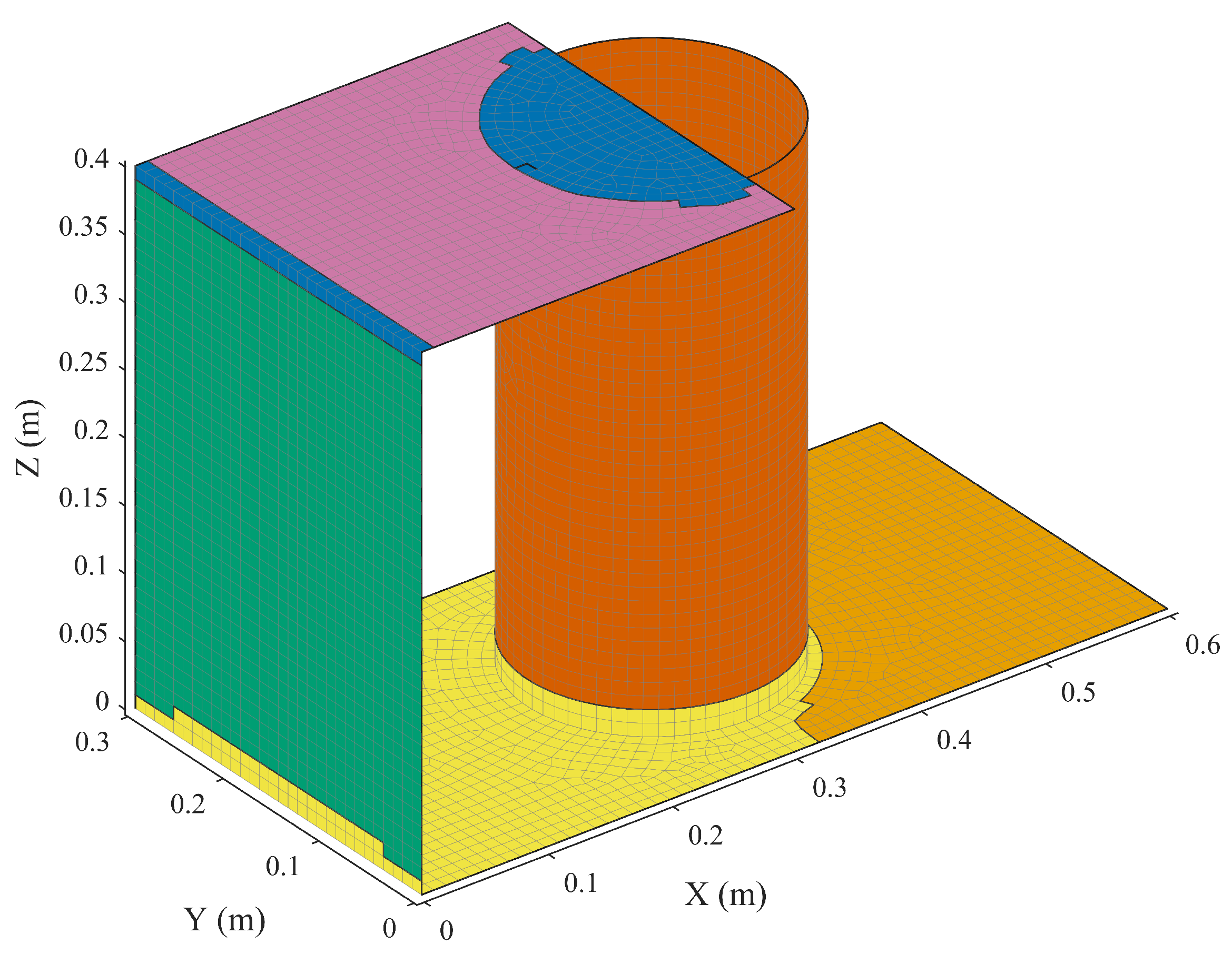
The partition produced by the physical discontinuity method is reported in
Figure 4. The results show that the algorithm decomposes the unified mesh into eight distinct subsystems aligned with the predefined physical boundaries. The interpretation of this partition is explicitly rule-based and auditable. Geometric boundaries are formed along the prominent folds of the C-channel where the dihedral-angle mismatch exceeds the threshold. Thickness-driven boundaries isolate region #5, reflecting the local change in stiffness and mass density. Material boundaries effectively separate the cylinder cap (#1) and flange (#2) from adjacent panels, despite these interfaces being geometrically smooth. Finally, the topological rule identifies the non-manifold connections at the cylinder base, preventing ambiguous region definitions at the junction. In this way, the partition is not described only in visual terms; rather, each highlighted boundary can be traced to a local and explicitly defined discontinuity trigger.
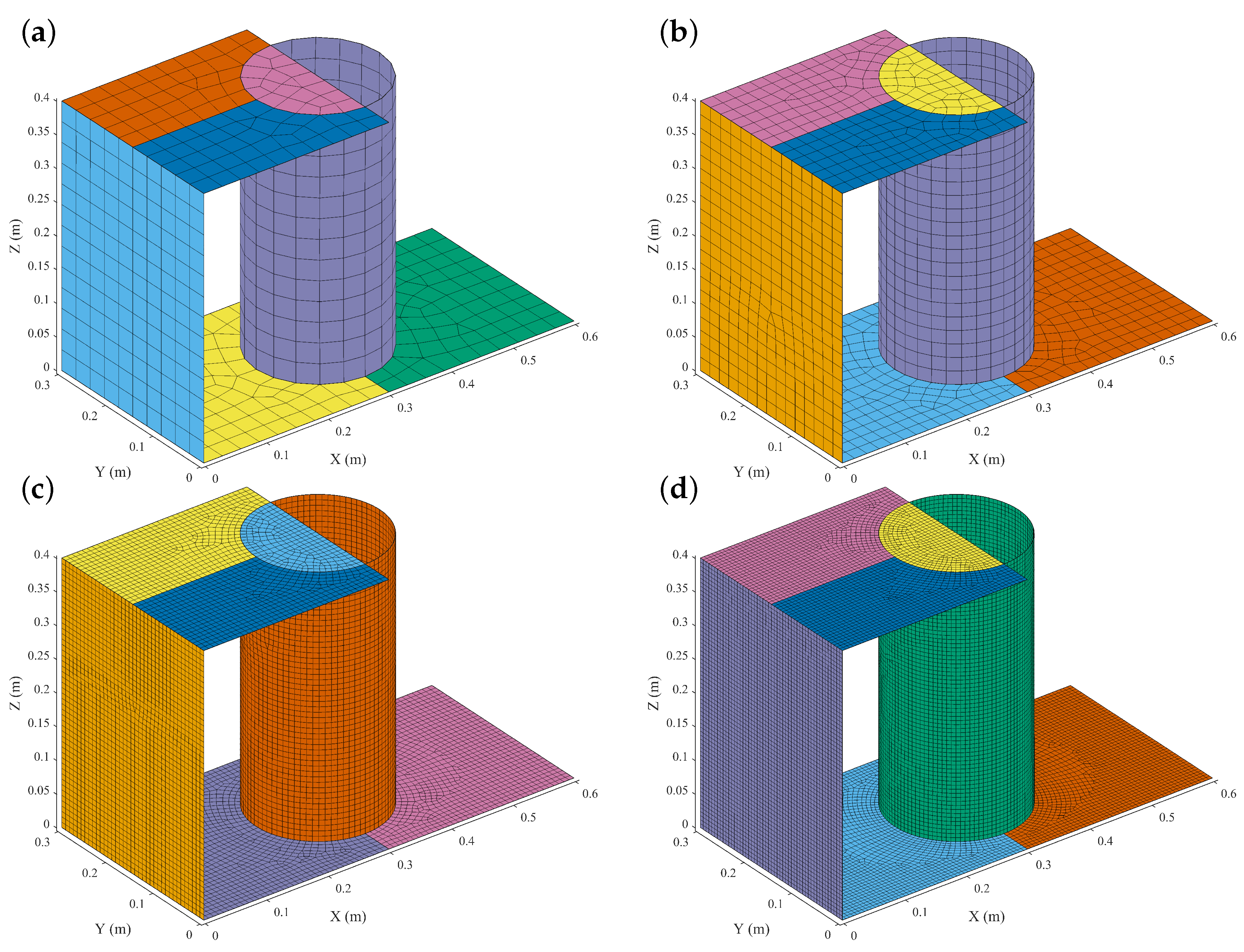
Mesh-density stability is examined by repeating the partition procedure on four meshes of increasing resolution (denoted A through D), while keeping the geometry and constitutive attributes consistent. The comparison in
Figure 5 indicates that the macroscopic subsystem architecture remains consistent across all resolutions. The boundaries in the finest discretization are high-resolution refinements of those in the coarsest mesh, with no fragmentation or topology changes. This behavior is consistent with the theoretical premise of an attribute-driven cut: since the underlying boundary semantics are defined by geometry, thickness, identifiers, and topology, mesh refinement changes only the sampling density of these semantics rather than introducing new boundary mechanisms. Accordingly, the tested cases indicate consistent partition behavior across the examined mesh densities, suggesting that the macroscopic partition structure is not sensitive to mesh refinement when the underlying geometry and FE attributes remain consistent.
This consistency can also be understood from the rule structure of the method. For a fixed geometric and attribute definition, the present framework does not infer subsystem boundaries from mesh density itself, but from explicit discontinuity conditions evaluated on local adjacencies. Under mesh refinement that preserves the same geometric configuration, thickness assignment, material/property partition, and topological connection semantics, the same types of discontinuity remain encoded in the FE model. In this sense, mesh refinement mainly changes the sampling resolution of the same physical boundaries rather than introducing new boundary mechanisms. Therefore, although local boundary discretization becomes finer, the macroscopic subsystem architecture is expected to remain low-sensitive to mesh refinement when the underlying physical definition is unchanged.
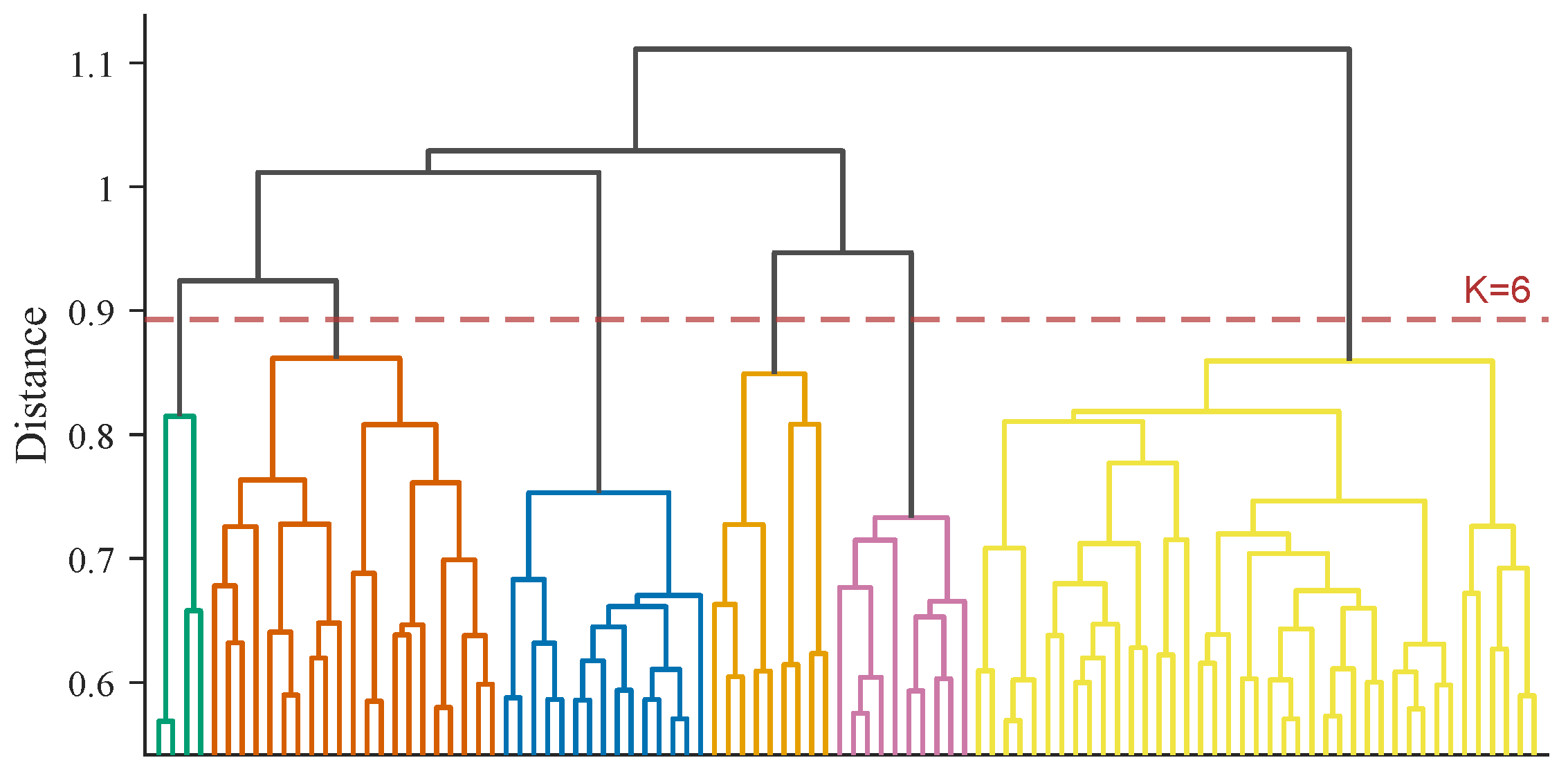
To contextually place the proposed method, this case further includes a modal-energy-based partition as a cross-check. The analysis was performed using a high-frequency bandwidth covering up to 200 modes, utilizing an element-level energy representation. The resulting energy distribution and clustering dendrogram are shown in
Figure 6 and
Figure 7, respectively.
The comparison underscores a distinction between response-based observation and rule-based structural partitioning. The energy-based result (
Figure 6) reflects the continuity of the structural response field, in which energy may spread across geometrically connected regions. By contrast, the proposed method identifies explicit boundaries encoded in the FE model through geometric, thickness, material/property, and topological discontinuities. The partial correspondence between the two results is therefore interpreted only as qualitative consistency between response concentration patterns and some explicitly defined structural interfaces, rather than as one-to-one validation that all detected boundaries behave as dominant impedance barriers.
In this sense, the two approaches address different questions: the energy-based method visualizes response redistribution in the analyzed configuration, whereas the present framework extracts explicit structural interfaces that can serve as initial partition boundaries for subsequent SEA-related modeling.
3.3. Engineering-Scale Validation on a Capesize Bulk Carrier
The feasibility of the proposed method at an industrial scale is evaluated using a finite element model of a Capesize dry bulk carrier. This structure represents a typical high-complexity marine application, characterized by a mix of heavy hull plates, reinforced bulkheads, and intricate stiffener arrangements. The primary objective of this case is to examine whether the attribute-driven substructuring framework can generate physically explicit initial partition results for SEA-related modeling without requiring the additional response-based preprocessing typically associated with energy- or modal-driven partitioning routes.
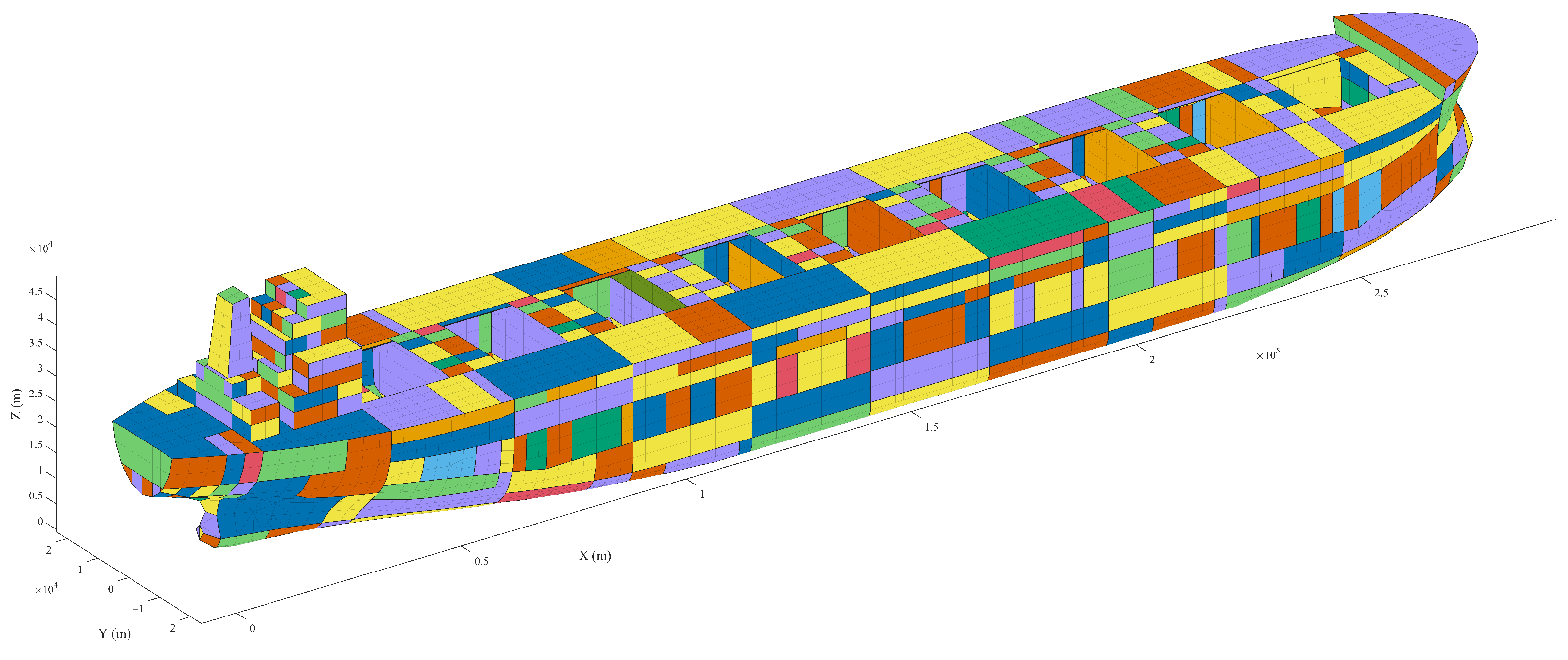
The resulting subsystem partition is visualized in
Figure 8. The partition result shows that the algorithm separates the global structure into functionally distinct components, isolating major deck panels, side shells, and transverse bulkheads based on their geometric and physical attributes. The partition strictly respects the topological connectivity of the finite element mesh.
The quantitative performance is summarized in
Table 1. The method identified 1525 subsystems from the 10,825-element model in 17.35 s. Prior to substructuring, the FE model underwent standard simplification to remove negligible artifacts. The resulting subsystem set therefore provides a fine-grained but physically explicit representation of the discontinuities retained in the simplified model. Although this granularity leads to a relatively large number of subsystems, it is consistent with the purpose of the present method, namely to preserve explicitly encoded physical boundaries at the initial substructuring stage rather than to compress subsystem number through prior manual merging. In this sense, the result is interpreted as an automatically generated and engineeringly usable initial subsystem definition for subsequent SEA-related modeling.
Crucially, this attribute-based approach offers distinct advantages over energy-based partitioning methods in this engineering context. At such a scale, modal energy-driven methods typically require the computation of a vast number of high-frequency modes and the definition of a priori energy integration blocks, imposing a significant computational and manual setup burden. Moreover, energy-based methods often struggle to resolve small but dynamically independent structures unless the analysis is extended to extremely high frequencies where local modes are fully excited. By contrast, the proposed physical discontinuity method relies solely on the intrinsic definition of the finite element model. It successfully identifies structural interfaces and distinct components using only FE-intrinsic information, showing that automatic initial partitioning of full-scale marine shell models is practically executable.
4. Conclusions
This study presented an automatic initial partitioning method for shell FE models based on explicit physical discontinuities already represented in the FE definition. By evaluating element adjacencies through Geometric discontinuity, Thickness discontinuity, Material/property discontinuity, and Topological discontinuity, the method generates partition boundaries directly from existing shell FE data and provides physically interpretable initial partitioning results for SEA-related modeling.
The method was examined through cases of increasing complexity. The basic examples showed that each discontinuity rule can isolate its corresponding boundary in a direct and interpretable manner, while the more complex shell assemblies showed that the same rule set remains applicable when multiple discontinuity types coexist in one structure. In the engineering-scale application, the full-scale Capesize bulk carrier model, containing 10,825 shell elements and 19,504 adjacency relations, was partitioned into 1525 subsystems in 17.35 s. These results indicate that the proposed procedure can be directly applied to large shell FE models and can automatically generate explicit initial partition boundaries from the physical information already encoded in the model.
Overall, the present work provides a unified route for transforming geometric, thickness, material/property, and topological information in shell FE models into subsystem partition boundaries. The resulting partitions provide an explicit boundary basis for subsequent SEA-related statistical modeling and offer a practical initial partitioning path for large and complex shell structures.