Review

Trends in Flight-Operated Small-Satellite Propulsion Technologies

Department of Plasma Power Plants, Bauman Moscow State Technical University, 2-ya Baumanskaya Street 5/1, 105005 Moscow, Russia
*
Author to whom correspondence should be addressed.
Appl. Sci. 2026, 16(6), 2939; https://doi.org/10.3390/app16062939
Submission received: 21 January 2026 / Revised: 2 March 2026 / Accepted: 5 March 2026 / Published: 18 March 2026
(This article belongs to the Section Aerospace Science and Engineering)

Abstract

The development and execution of prospective inner and outer space missions require focusing on the use of many small space vehicles operating in swarms with multiple informational, navigational, and mission-oriented interactions among themselves. Such missions involve providing communication and surveillance services, facilitating distributed material production in space, and conducting research expeditions to explore the resources and environments of new worlds. The cornerstone technology for operating distributed space systems is propulsion. Among a range of propulsion technologies—from using pressurized cold gases to implementing laser beams to generate thrust—certain methods stand out for application in small spacecraft. This paper provides a summary of space-operated propulsion, emphasizing the reasons for the more frequent adoption of one technology over another. The discussion on propulsion trends is complemented by examining the physical, engineering, production, operational, and societal rationale behind these choices. The findings reinforce the trend toward transitioning to fully electric satellites. This review serves as a means for reevaluating global propulsion trends and guiding the future development of inner and outer space propulsion-assisted economies effectively.

1. Introduction

Recent decades have witnessed profound transformations in the aerospace sector driven largely by the proliferation of small satellites [1,2,3,4]. These compact space vehicles, which typically weigh less than 500 kg, have revolutionized various fields of space exploration, including communication, remote sensing, and scientific research. Their affordability [5], adaptability [6], the resilience of the systems based on them [7,8], and their swift deployment capabilities [9,10] have positioned them as essential tools for governments, corporations, and research entities [11].
The evolution of small satellites has intensified scrutiny on their propulsion systems, especially in the last decade [12,13,14]. Propulsion plays a pivotal role in ensuring that the satellites achieve and maintain their designated orbits, execute maneuvers, and fulfill mission objectives efficiently [15,16,17]. Selecting the right propulsion technology for small satellites is a multifaceted task that demands thorough consideration of factors such as mission duration, orbital requirements, and maneuvering demands [18,19].
Propulsion systems are especially important for proliferated space systems, which are seen as the key means for the development and prosperity of space economies [20,21,22]. These systems should enable not only precise orbit maintenance but also allow for complex maneuvers necessary for different applications [23]. Additionally, these propulsion systems should be capable of being serviced in-orbit [24,25,26,27,28]. They should also control the thrust vector direction, enabling precise adjustment of direction and magnitude of thrust [29]. This feature enhances the overall performance and reliability of small satellites, ensuring they can effectively carry out their intended functions [30].
However, the use of propulsion systems on small satellites is associated with a number of fundamental limitations due to their small dimensions. The most significant limitation is the available electrical power. For example, for a CubeSat-class satellite in the 3U format located in low Earth orbit and equipped with a deployable solar power system consisting of seven solar panels with an energy conversion efficiency of about 30%, the peak-generated power per orbit is approximately 59 W [31]. Given a mass of such a satellite of around 4 kg, this allows estimating the upper limit of specific power for the energy system at about 15 W per kilogram. Note that there are experimental NASA systems capable of providing up to 200 W of power to a 3U satellite [32]. However, such solutions require complex, large-scale deployable structures, which have not been widely adopted due to constraints on mass, cost, and reliability. In contrast, full-sized spacecraft have significantly higher energy capabilities, achieving specific powers of about 25 W per kg, while the total generated power ranges from 10 to 20 kW [33]. This disparity in energy supply underscores the need for specialized solutions when selecting a propulsion system for small platforms.
Another challenge faced by small satellites involves difficulties in organizing the thermal stabilization of all structural elements and integrating the propulsion system with the satellite itself. Limited dimensions make it challenging to accommodate traditional heat dissipation systems used in larger satellites. Despite these challenges, successful engineering solutions have been implemented within several missions, exemplified by the Lunar IceCube mission, where a system of several small radiators was developed for component thermostabilization [34]. The integration of engines and satellite systems primarily hinges on minimizing losses in actuation systems. Small satellites demand compact and energy-efficient actuation systems. Similarly rigorous standards apply to pressure, temperature, flow-rate sensors, etc., ensuring appropriate control over the propulsion system’s operations. Contemporary solutions in this domain include specialized microsystems alongside algorithms for state estimation based on indirect parameters [35,36,37].
Presently, a broad spectrum of propulsion technologies exists. Nonetheless, a comprehensive analysis of their applicability aboard small satellites remains insufficient. This highlights the critical importance of reviewing the collective experience gained by various research entities concerning the implementation of such systems on small spacecraft.
This paper systematically reviews the trends and prospects of propulsion technologies for small satellites. Starting with an examination of the classification of space missions and highlighting the importance of propulsion for modern small-satellite missions, the discussion proceeds to analyze flight-operated propulsion systems, their merits and limitations, and their implications for small-satellite operations. The propulsion systems included in this review were chosen based on two primary criteria: the propulsion systems are specifically designed for operation aboard small satellites, and these systems have already been tested in space. The selected propulsion systems are categorized, according to the classical classifications, into three groups: chemical, electric, and alternative. Space tethers were excluded from this review because they do not appear suitable for dynamic maneuvering aboard small satellites. Experimental evidence and theoretical insights are emphasized, focusing on critical factors related to five rationales—physics, engineering, production, operational, and societal—to provide a structured evaluation framework revealing potential directions for prospective propulsion technologies applicable to small satellites for future research and development efforts.
This review serves as a tool for reevaluating global propulsion trends and guiding the future development of inner and outer space propulsion systems to assist in the effective development of space-related economies. Section 2 introduces the classification of space missions focused on small satellites, stressing that propulsion technologies constitute the most critical component of these missions. Section 3 discusses different propulsion technologies that have been deployed on board small satellites in space. Finally, Section 4 explores the various types of rationales driving the development, study, and operation of small-satellite propulsion systems, along with current trends and future perspectives in the field.

2. Space Missions of Small Satellites

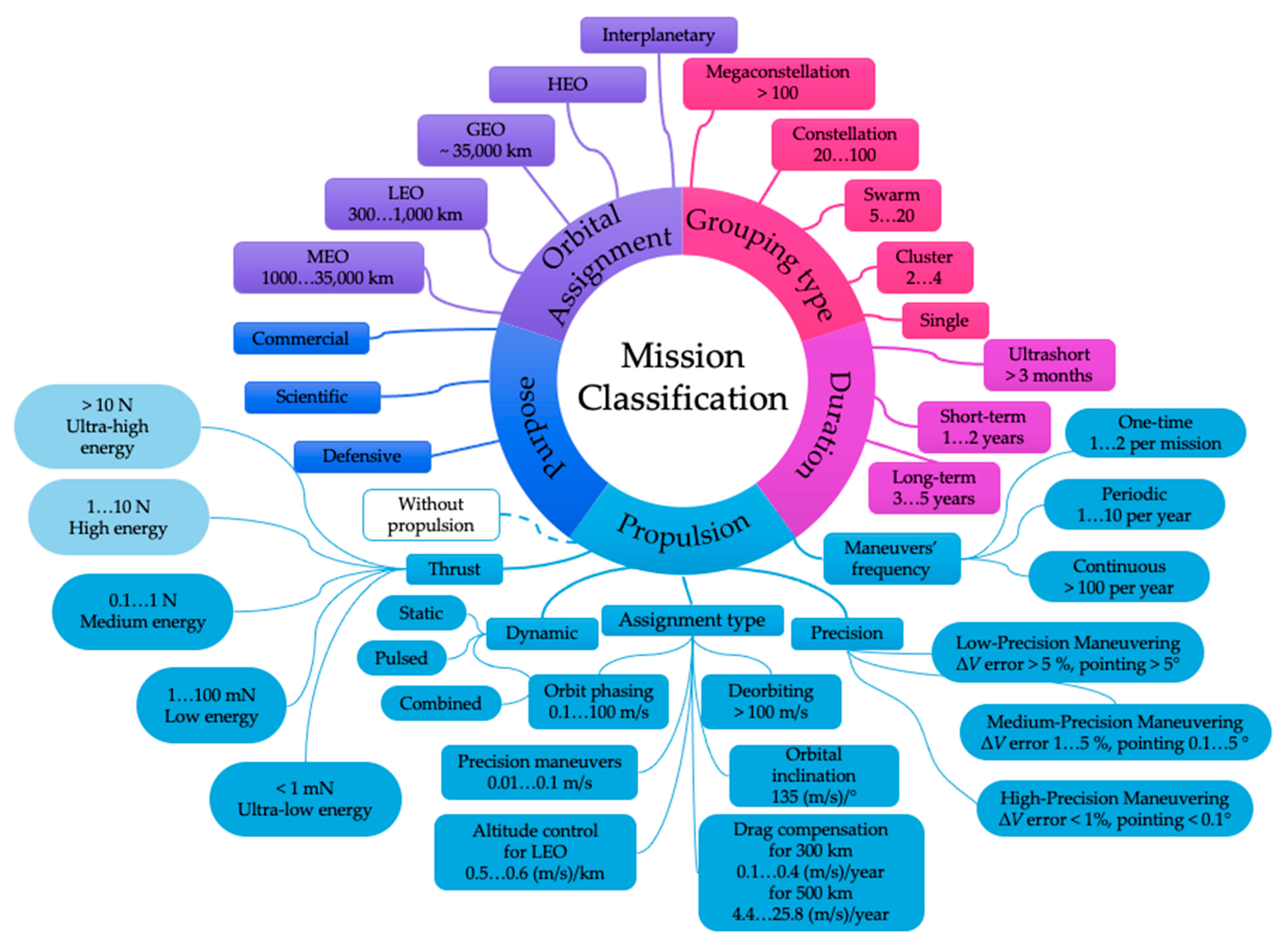
Modern space missions based on small satellites demonstrate considerable diversity in terms of purpose, orbital characteristics, and operational requirements. This highlights the necessity of introducing a classification framework for missions conducted by such platforms. It is proposed to categorize them into subclasses according to the following criteria: orbital destination, formation architecture, mission duration, functional objectives, and propulsion-related attributes. Figure 1 visually represents an expanded classification of space missions using small satellites.
The orbital destination defines basic energetic and temporal characteristics of the mission. Low Earth orbits (LEOs) are characterized by substantial resistance from residual atmosphere. Consequently, a propulsion system is required onboard to maintain altitude. The demand for characteristic velocity change (ΔV) increases exponentially with decreasing altitude to compensate for atmospheric drag. At altitudes between 350 and 450 km, annual ΔV amounts range from tens of meters per second, annually. Medium Earth orbits (MEOs) lack any remaining atmosphere but still require periodic adjustments to preserve navigation-related parameters. Thus, the necessary ΔV here depends heavily on the complexity of planned maneuvers in each mission. Geosynchronous orbit (GEO) demands extremely accurate positioning (within ±0.05°) and, consequently, requires significant ΔV (50 m/s annually) to counteract drifts from assigned positions. Highly elliptical orbits with large eccentricity necessitate regular corrections to maintain consistent periods of revolution. Interplanetary missions and deep-space operations impose the strictest requirements regarding ΔV increments, typically requiring more than 1 km/s.
The formation architecture dictates the scale of the system—from single satellites to megaconstellations comprising thousands of units. Single satellites critically depend on autonomous orbit management. Formations involving 2–10 satellites require precision in relative positional maneuvering among themselves. Constellations and megaconstellations prioritize standardized systems with highly reliable propulsion units.
Mission duration influences the choice of propulsion system type. Short-term missions (<3 months) may rely on passive means or low-specific-impulse propulsion systems (chemical rockets or cold gas thrusters). Mid-term missions (12–24 months) impose stricter specific-impulse requirements because of limited propellant storage volume in small satellites, making EP preferable. Long-term missions (over three years) demand even greater specific impulses and durability from propulsion systems. Alternatively, propelantless methods like solar sails might also be employed.
Functional objectives determine unique requirements for maneuver execution. Scientific missions, such as studying cosmic radiation effects on organisms in interplanetary space, generally involve standalone satellites requiring precise positioning and minimal disturbance for experiment integrity. Conversely, commercial missions often deploy groupings of satellites, for example, the HawkEye 360 mission to identify geolocation sources of radiofrequency emissions, emphasizing economic feasibility and reliability of propulsion units.
In addition to external factors, another subclassification is tied to internal factors, specifically related to specific impulse (Isp) and thrust performance of propulsion systems. Specific impulse governs the effectiveness of propellant usage. As highlighted earlier, for missions with restricted mass and volume of propellant storage and supply systems, especially critical in CubeSats, achieving high specific impulse is crucial to meeting cumulative ΔV needs. Ion thrusters like BIT-3 and NPT30-I2 exhibit very high specific impulses (2000–3000 s), which are suitable for missions requiring extensive ΔV, including interplanetary travel, orbit transitions, and long-term orbit maintenance. However, their further miniaturization for <6U platforms remains challenging due to requirements for cathode-neutralizers and complex ion-optical systems. Flights of Lunar IceCube (2022) and LunaH-Map (2022) [12] validated the functionality of ion thrusters onboard 6U CubeSats but revealed certain problems addressed later in subsequent chapters. Electrospray thrusters similarly feature high specific impulses (1000–5000 s), e.g., TILE and S-iEPS models, although their application is limited by contamination risks from droplets of propellant and emitter degradation over extended operation that can be critical for resilient space systems.
Thrust, another key parameter, determines the time needed to execute maneuvers and the ability to overcome disturbing forces. To promptly adjust orbits in LEO, it is desirable to deliver a thrust of at least 1–5 mN to offset atmospheric drag. Resistojets, exemplified by AQUARIUS and ARM-A, provide 1–20 mN of thrust, rendering them effective for quick orbit-correction and rendezvous tasks. Their simplicity and robustness were proven through successful flights, notably EQUULEUS (2022), which pioneered water-based resistojet-assisted orbit correction beyond LEO. Electrodeless plasma thrusters, such as BDEPT and Maxwell, could also serve similar purposes. BDEPT flight operations on HORS 1 (2023) verified its 2U model’s capability to generate up to 10 mN of thrust. On the other hand, previously mentioned high-specific-impulse engines (ion and electrospray types) suffer from much lower thrust levels (0.1–100 μN), limiting their suitability for rapid corrections. Nonetheless, their ultra-low thrust suits precision-positioning tasks well. Pulsed plasma thrusters, despite offering comparable thrust levels, benefit from simpler feeding mechanisms but fall behind in specific impulse.
Thus, analyzing various small-satellite mission requirements alongside existing propulsion characteristics leads to several conclusions. The broad spectrum of tasks performed by small satellites, ranging from massive communication constellations to unique scientific missions, necessitates diverse types of propulsion systems to be employed. Thruster selection should consider multiple factors simultaneously: specific impulse, thrust, accuracy of control, mass/volume constraints, total impulse, and operational lifetime. However, theoretical evaluations alone cannot substitute validation via actual space operation, where space effects arise that are overlooked in terrestrial testing. Therefore, systematic analysis of flight-experience-derived insights forms the basis for informed decision-making regarding optimal thruster choices—a subject further explored in the Section 3 of this study.

3. Space-Operated Small-Satellite Propulsion Technologies

3.1. Chemical Propulsion

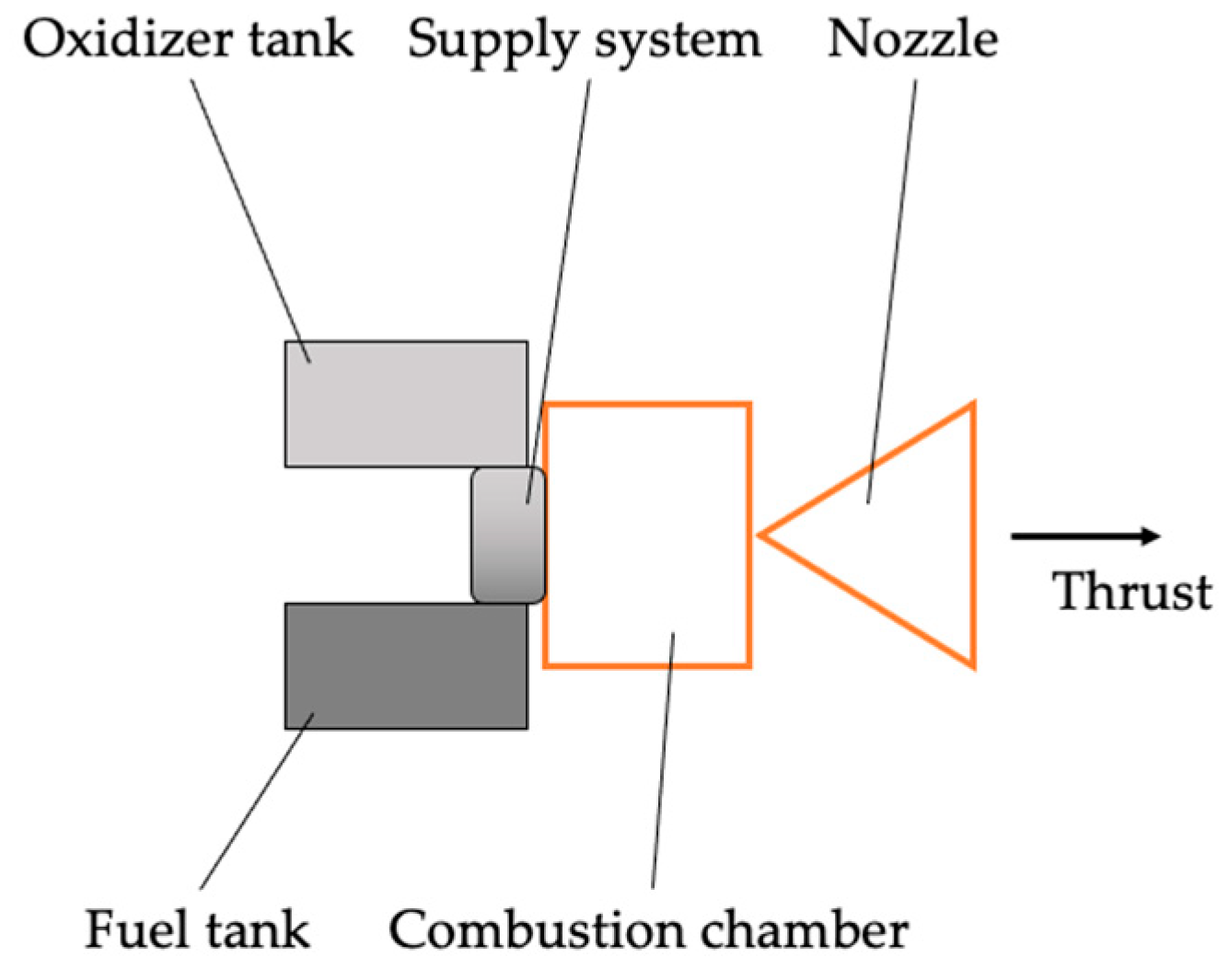
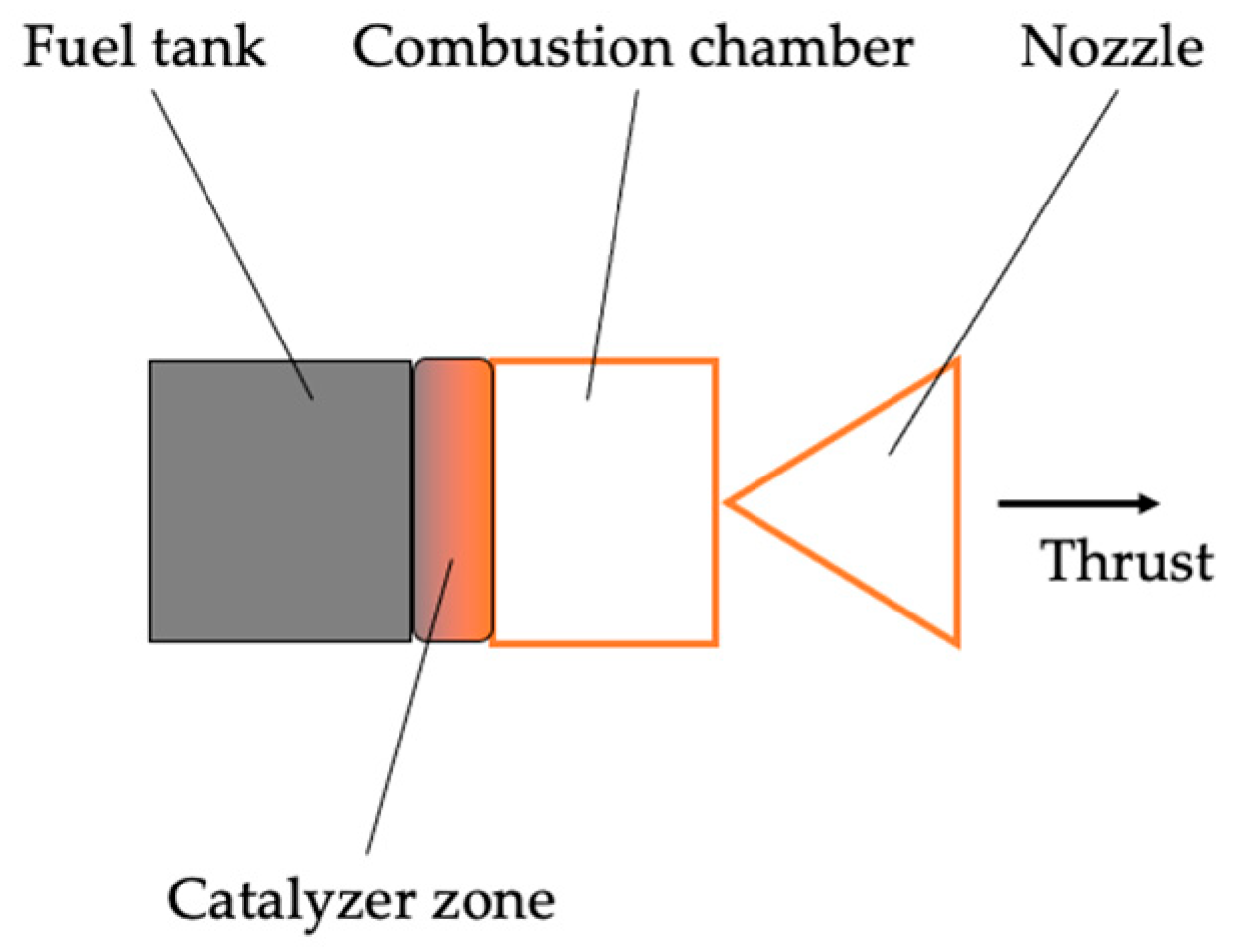
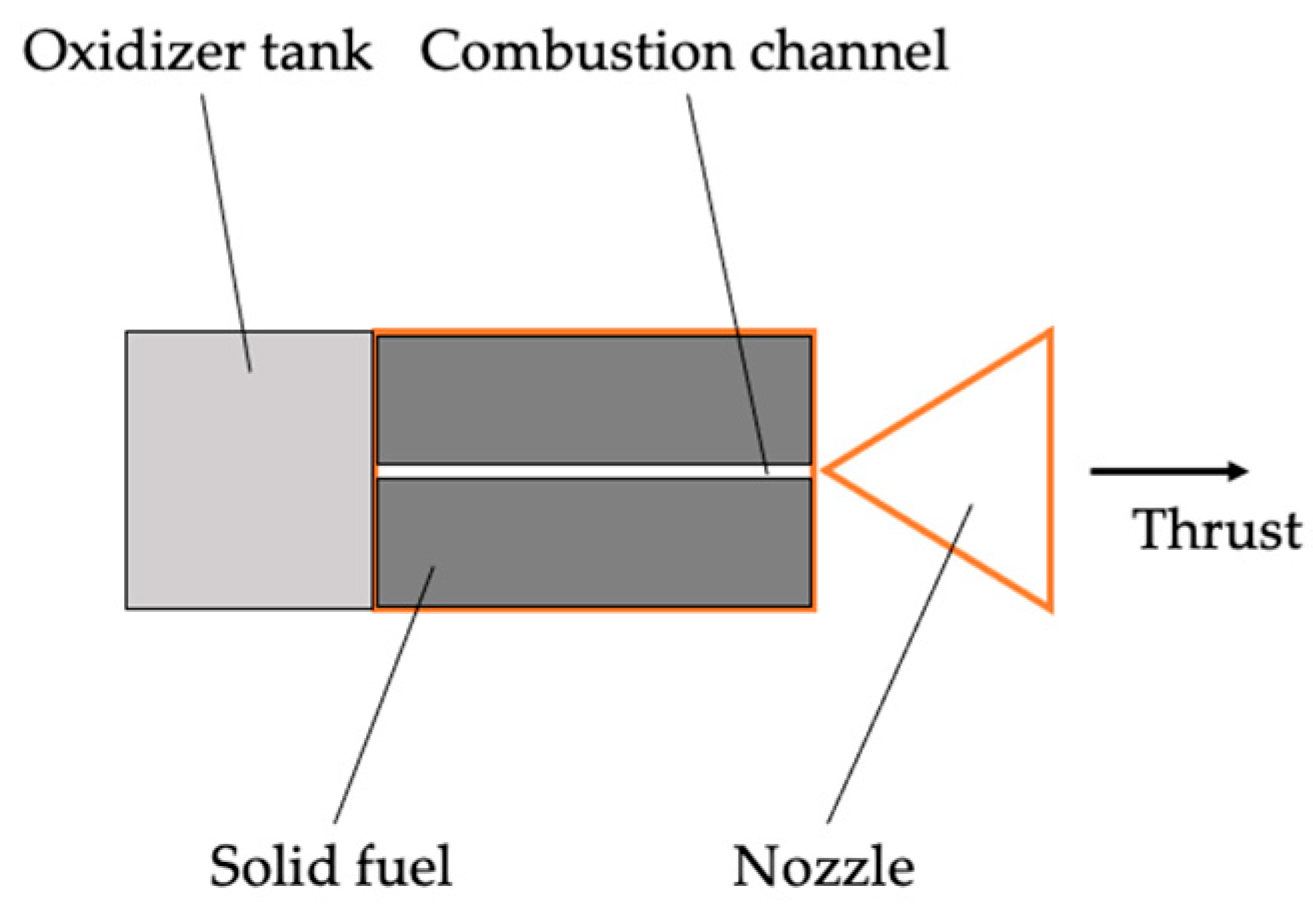
There are three main types of chemical propulsion—the monopropellant rocket (see Figure 2), the bi-propellant rocket (see Figure 3), and the hybrid rocket (see Figure 4) engines. The operation of chemical propulsion depends on the type of propellant being used. For single-component propellant engines (monopropellant rocket engines), thrust is generated through thermal decomposition and acceleration of the products in the nozzle. In this case, the propellant comes into contact with a catalyst inside the combustion chamber, leading to chemical breakdown, heat release, and formation of high-temperature gases. Under high pressure, these gases exhaust through the nozzle, generating thrust [38,39]. In two-component systems (bi-propellant rocket engines), it is required to use fuel and an oxidizer, which are stored onboard either in liquid or gaseous forms. These components mix in a specified ratio and ignite spontaneously when brought together, or they require external ignition devices. Combustion produces hot gas, which, under high pressure, is exhausted through the nozzle, generating thrust [38,39]. Chemical engines also encompass systems that utilize propellants in different states (hybrid rocket engines) [40].
Table 1 presents flight-operated chemical propulsion units suitable for small satellites. All mentioned engines typically have analogous versions within the same series, featuring larger sizes, higher thrust, and greater power outputs [36,37,38,39,40,41,42,43,44,45,46,47,48,49,50,51,52,53,54,55,56].
Analysis of missions using chemical propulsion (see Table 1) reveals the challenges associated with its widespread adoption on platforms of a size less than 6U [36,37,38,39,40,41,42,43,44,45,46,47,48,49,50,51,52,53,54,55,56]. The main reason lies in the low propellant storage density, constrained by the nature of propellants and the dimensions of satellite subsystems, combined with a low specific impulse (Isp), leading to restrictions on its applicability for short-term missions [39,40,57].
Bi-propellant propulsion systems rarely achieve a specific impulse exceeding 285 s [51], whereas modern electric propulsion systems reach values above 1500 s. Given equal masses of propellant for a chemical rocket and for electric propulsion, the latter would provide a characteristic velocity increase of more than five times. For CubeSats, where the propellant mass usually accounts for no more than 20% of the total vehicle mass, this disparity makes chemical propulsion units impractical for missions lasting longer than six months [18,19]. Exceptions include tasks requiring instant high thrust (>100 mN), such as rapid orbital correction after separation from the launcher or fast maneuvers to avoid space debris [30,31]. Additionally, propellants used in such systems often turn out to be toxic, complicating ground testing and necessitating careful selection of materials for propellant tanks [45,46,53].
Green monopropellant systems based on hydrogen peroxide (H2O2) and ammonium dinitramide (ADN) occupy a special niche [42,50]. The HyPer installation (Aerospace Corporation, Chantilly, VA, USA), which underwent 34 successful tests aboard the 12U Slingshot-1 satellite (2022), confirmed operational reliability with reduced toxicity compared to hydrazine [47,48]. Nevertheless, energy limitations persist: with Isp = 124 s and a propellant mass of 0.5 kg on a 19 kg platform, the achievable characteristic velocity reaches only 21.5 mm/s, which is insufficient for correcting orbits in LEO without continuous atmospheric drag compensation [47,48,51].
Hybrid architectures combining chemical and electric propulsion represent a promising path to overcome practical limitations of chemical rockets [39,40]. The most successful implementation has been the hybrid HIPS system on the CAPSTONE mission (2022), where eight monopropellant hydrazine rockets provided trajectory corrections toward the Moon and precise positioning on halo-orbit. Such a task would be unfeasible for purely electric systems given a solar array output below 100 W, thus defining a prospective niche for future development of chemical systems.
It is important to pay particular attention to failed missions, which highlight systemic scaling issues. The failure of the LFPS engine aboard Lunar Flashlight (2022) was caused by solid particles blocking the fuel line [46]. This problem becomes exacerbated during the miniaturization of fuel feed channels under strict mass limits for filtering components. Similarly, two out of four satellites in the Hiber constellation (2021) with bi-propellant PM200 engines experienced failures linked to uneven nitrous oxide vaporization in microgravity conditions, resulting in stoichiometric mixture imbalance. These cases emphasize how chemical processes stable at full-sized spacecraft scales become sensitive to technological peculiarities when transitioning to smaller vehicles [39,40,57].
In conclusion, bi-propellant and monopropellant chemical engines remain competitive for addressing short-duration LEO missions requiring initial orbital adjustment post-separation and tasks demanding high-thrust levels (>50 mN), such as towing space debris or fast maneuvering. Hybrid architectures stand out as they enable broader mission scopes, since chemical thrust complements electric propulsion systems for performing impulsive maneuvers while maintaining overall energy efficiency.

3.2. Cold Gas

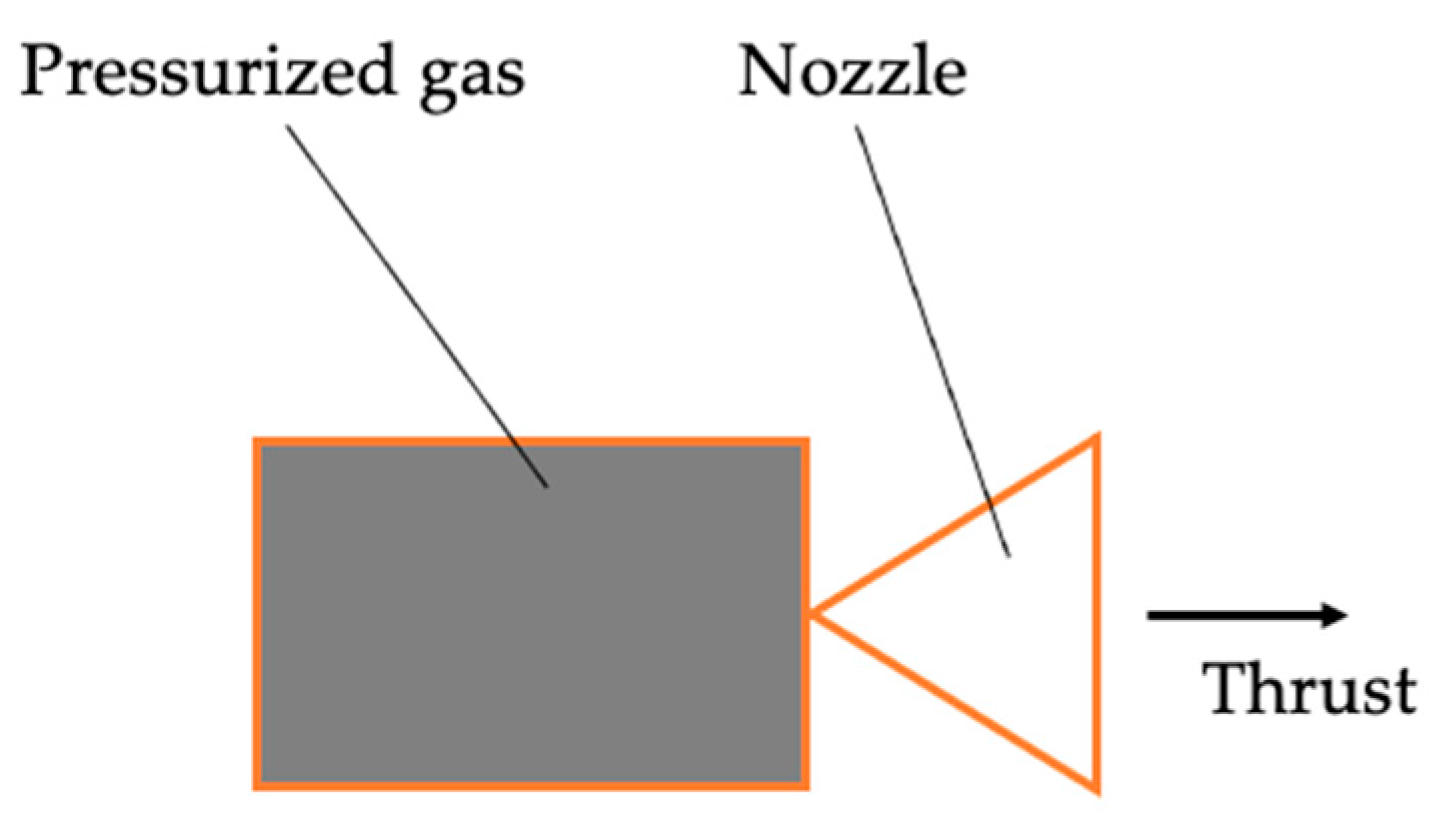
Cold gas thrusters are among the simplest and most reliable in operation, and they are widely used in space systems for orientation and stabilization, orbit correction, and other purposes. The operational principle of these thrusters is based on utilizing compressed gas energy. The schematic diagram of the cold gas thruster is depicted in Figure 5. In its simplest configuration, high-pressure gas is stored in a tank. Upon command, the valve connecting the fuel tank and nozzle opens, allowing the gas to pass through a filter designed to eliminate foreign particles before entering the nozzle. The gas exits through the nozzle, generating reactive thrust [57].
More complex systems include two tanks: one with liquid propellant and another intermediate tank that maintains part of the propellant in gaseous form. The propellant exhausts through the nozzle, with a hydraulic connection line to the tank, in which the propellant is in the gaseous state. Then, this tank is refilled with the propellant stored in a tank in which it is in liquid form [57]. Typically, the gas exiting the nozzle does not heat up, and hence, this type of thruster is called “cold.” However, there are systems that use “warm” gas. These systems have heaters installed, increasing the specific impulse of the thruster [57]. Currently, many models of cold gas thrusters have been operated in space. The flight-operated models of cold gas thrusters are presented in Table 2 [57,58,59,60,61,62,63,64,65,66,67,68,69,70,71,72,73,74,75,76,77,78,79,80,81].
Cold gas propulsion systems dominate in formation flying, rendezvous, and low-risk missions primarily due to their inherent advantages in safety, simplicity, reliability, and compatibility with mission requirements. Cold gas systems utilize gases stored at room temperature, eliminating the hazards associated with combustible liquids or corrosive chemicals found in other propulsion technologies. This reduction in hazard mitigates the risk of accidents during handling, integration, launch, and operation phases. Since they do not require ignition or combustion, the likelihood of failures is minimized. Low-risk missions typically prioritize reliability and predictability over raw performance metrics. By minimizing variables introduced by sophisticated hardware, cold gas systems ensure smooth execution of critical maneuvers within predefined margins of error. This makes them ideal candidates for applications where absolute certainty is more important than improvements in efficiency.
Some important notes should be made on propellant selection for the cold gas. In the cold gas, SF6, C4H10, R236fa, N2, and I2 are mostly used. Its predominant use is driven by several factors such as high storage density, performance characteristics, and relatively known procedures of handling on-ground and during operations [66,67,68,69,70,71,72,73,74,75,76,77,78,79,80,81].
The results presented in Table 2 for the period from 2000 to 2024 reveal similarities in the challenges faced by cold gas thrusters installed on small satellites compared to chemical ones [51,57,67]. Both systems share the characteristic of having a low specific impulse; for example, for cold gas thrusters, Isp ranges from 30 to 124 s [58,59,61,62,66]. When considering the limited mass of the propellant storage subsystem, this translates into a characteristic speed increment for most missions, amounting to less than 10 m/s over the entire lifetime of the mission [58,62,66]. However, the thrust delivered by these thrusters reaches dozens or even hundreds of mN [59,61,66,69], a level unattainable with electric propulsion systems with similar dimensions. These features render cold gas systems inadequate for tasks requiring significant expenditures of characteristic velocity (major changes in orbit or inclination angle, maintenance of highly elliptic orbits, interplanetary transfers, etc.) but retain their competitiveness in niches such as precise stabilization and orientation correction [57,62,66].
Special attention should be paid to the technological aspects of these systems. Cold gas thrusters can operate either on inert gases (nitrogen, argon, and xenon) [51,59,61,62,67] or active gases (butane, refrigerants, and iodine) [51,52]. Active gases provide higher storage density but show a tendency toward leakage due to their aggressive nature toward seals [63]. This phenomenon has been observed in incidents such as the malfunctions encountered on the OMOTENASHI and Starling SV-1 missions. Additionally, leaks occurred in the MarCO (notwithstanding the successful completion of the mission) and Bevo-2 [63] missions. Despite these leakage risks, active gases continue to be preferred for launches (based on collected statistics over the past 24 years, twice as many thrusters utilizing active gases have been launched) due to their convenient storage characteristics [57,58].
Additionally, it is worth noting a distinct category of cold gas thrusters incorporating MEMS technology [58]. This innovation allows for dry masses of the propellant storage subsystem to be reduced below 0.4 kg, with a typical unit size of 0.5U, while retaining conventional values for specific impulse and total impulse.
Thus, cold gas thrusters, akin to chemical systems, appear to be applicable for executing short-term missions in low Earth orbit with minimal ΔV requirements (orientation correction, de-clustering of satellite formations) [58,62].

3.3. Electric Propulsion

3.3.1. Electrostatic EP

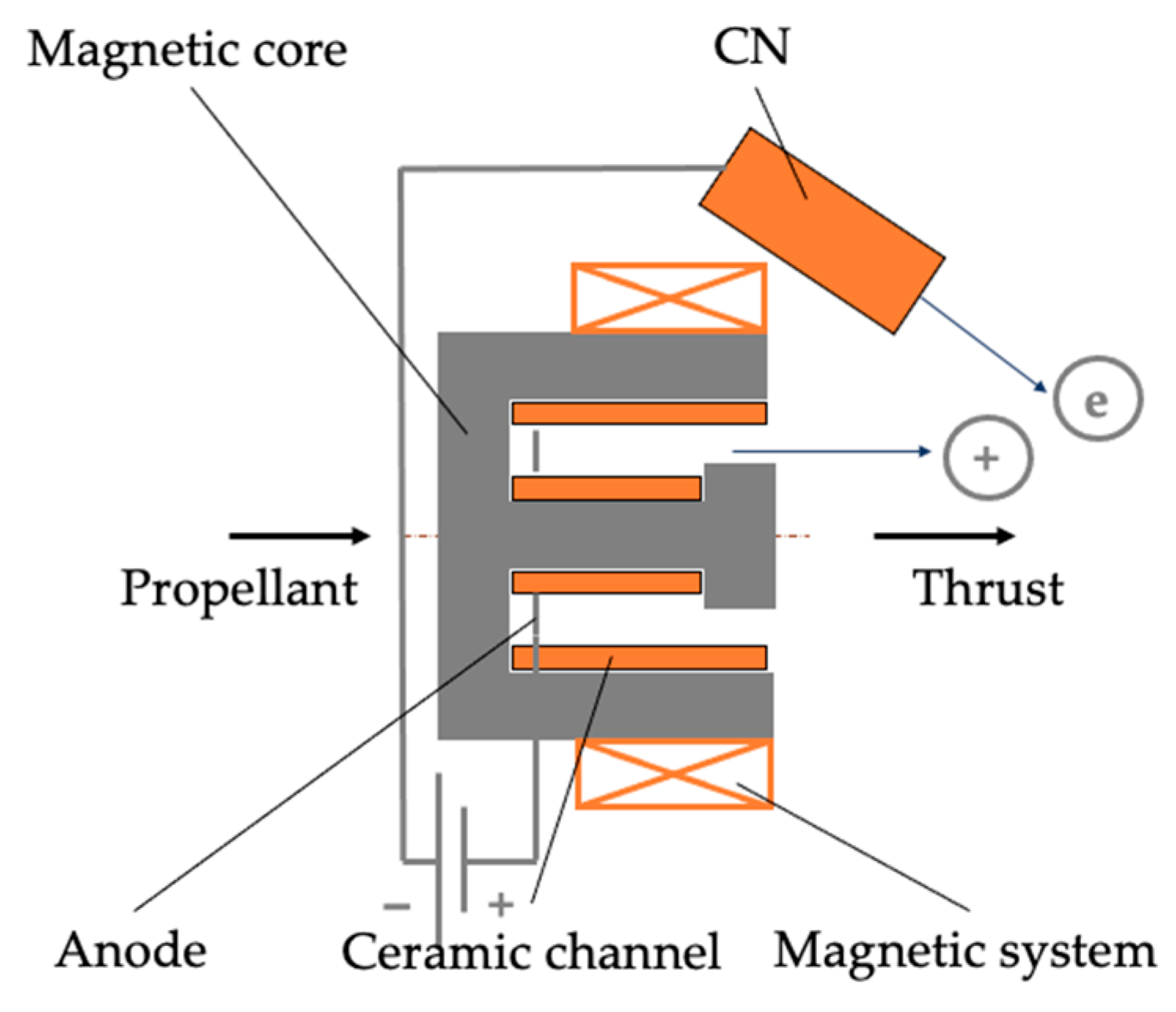
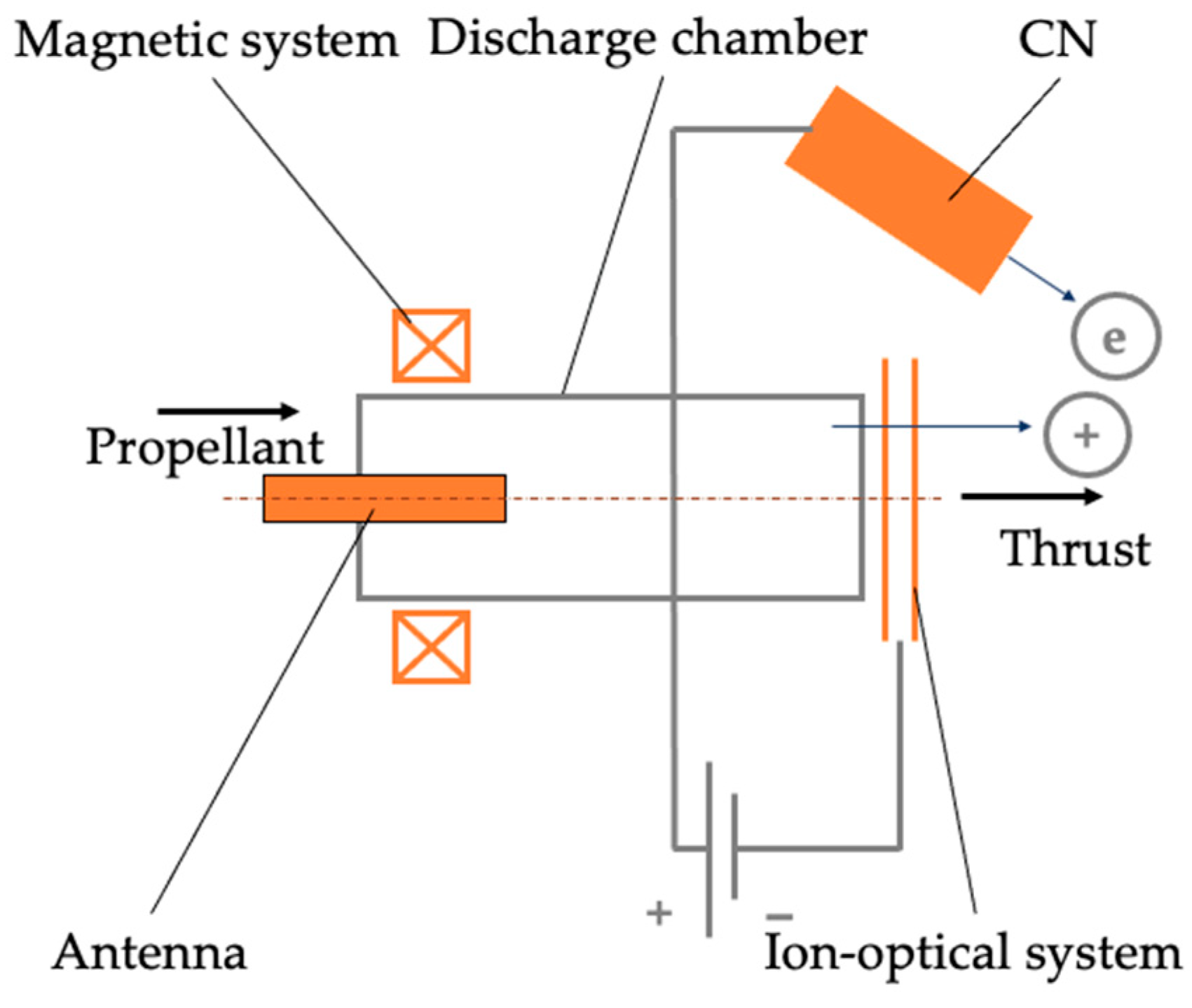
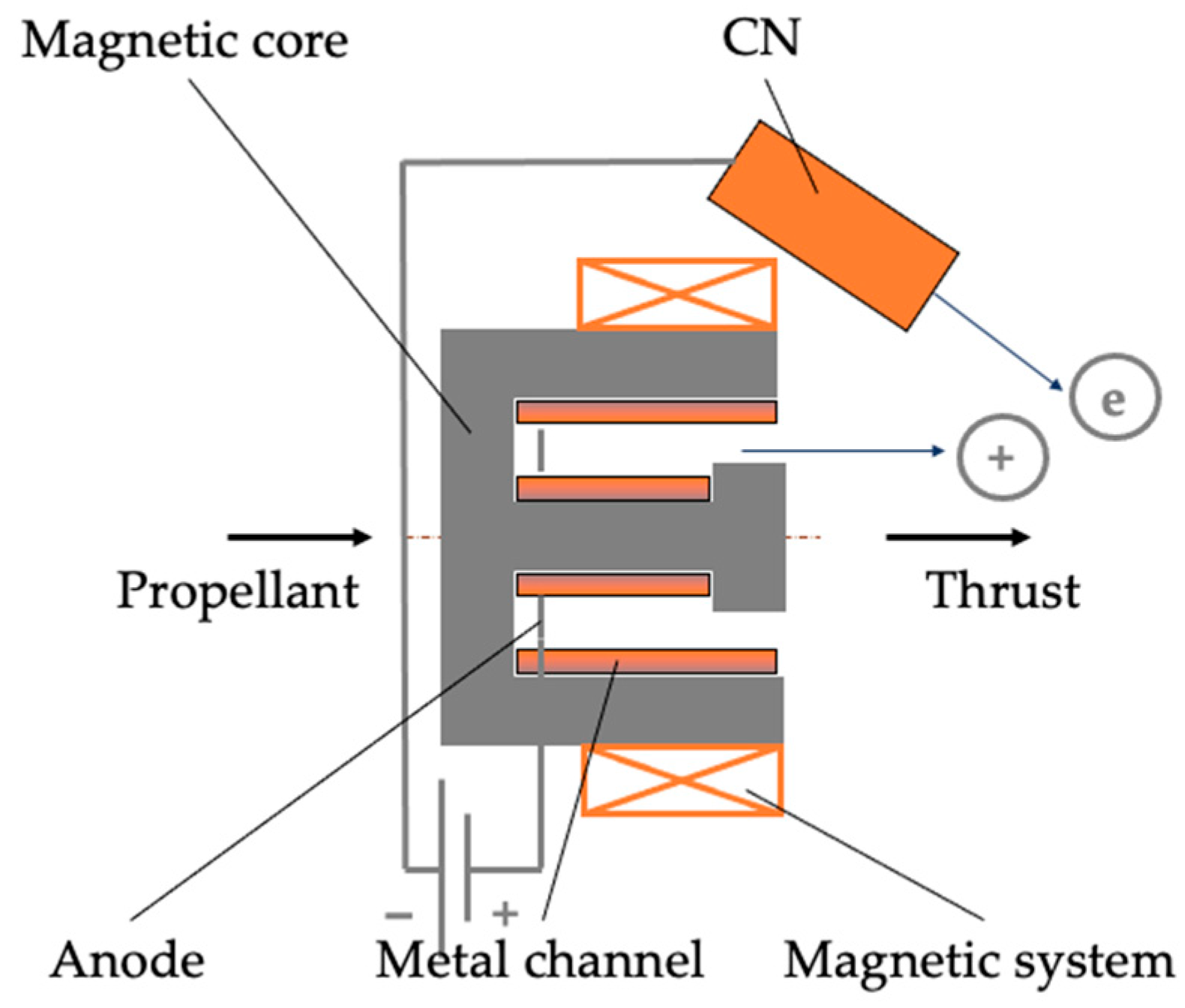
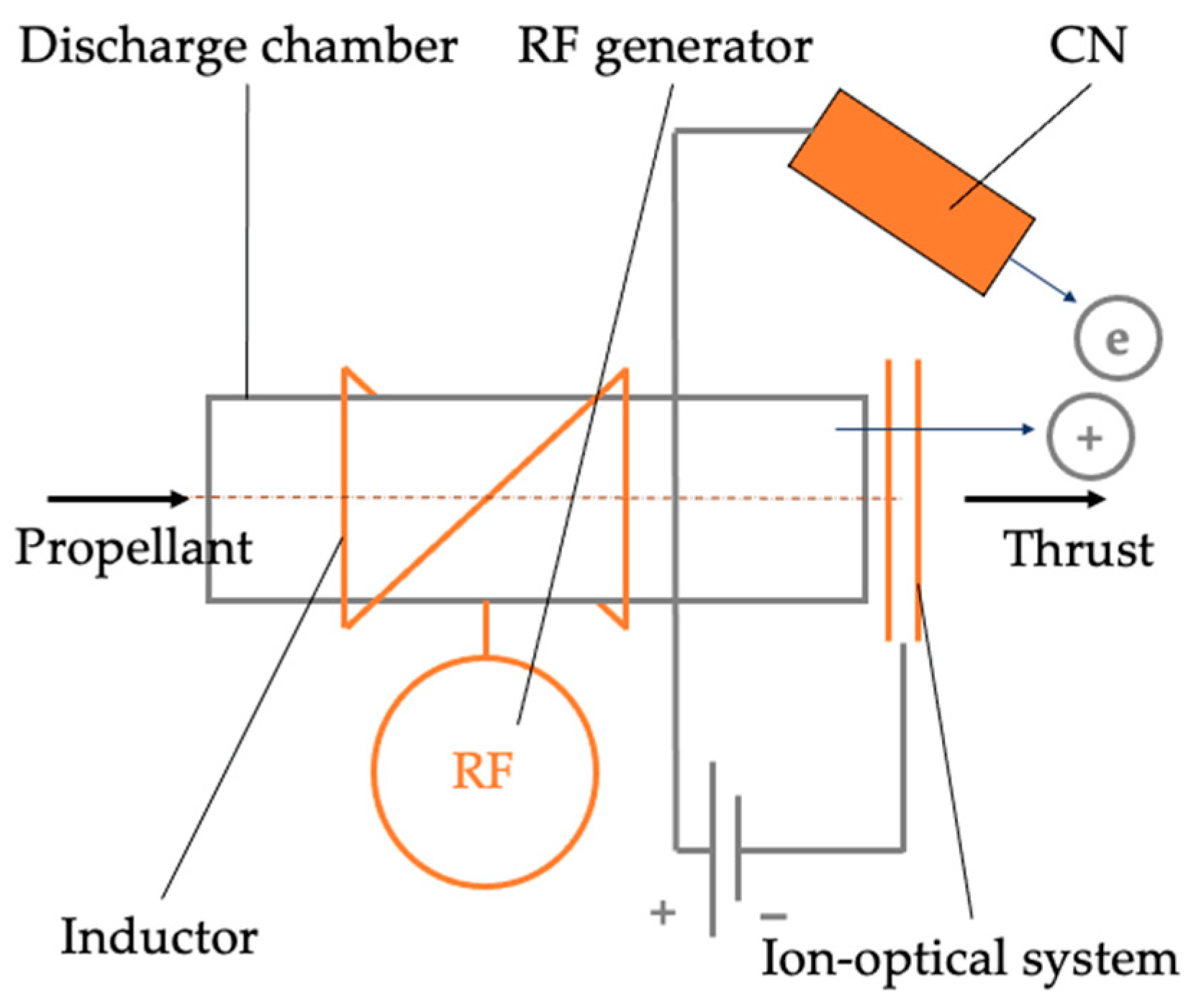
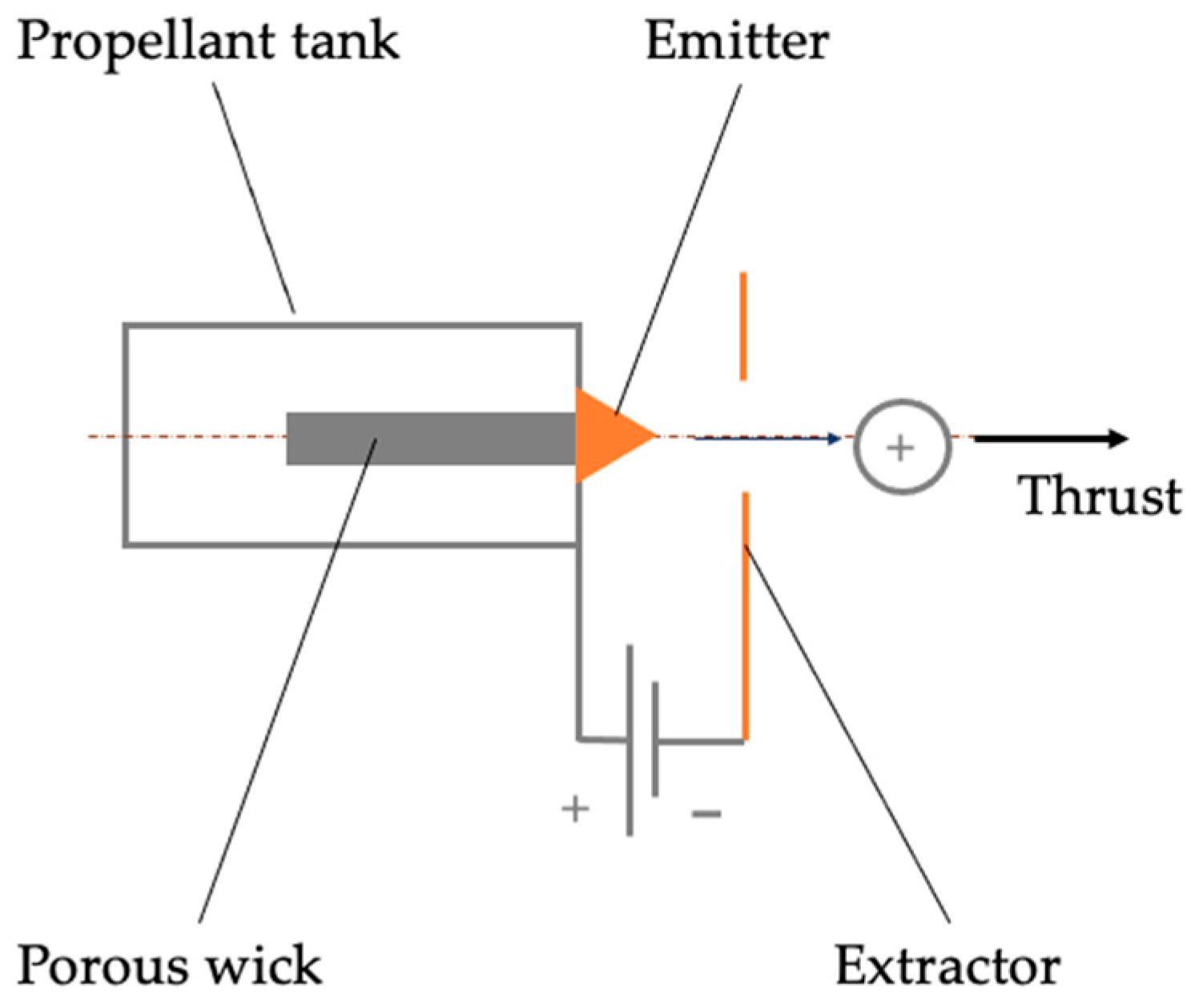
In the electrostatic type of electric propulsion, the energy supplied to the thruster is first used for ionizing the propellant, after which ions are accelerated by an electric field. Electrostatic-type electric propulsion includes Hall-effect (see Figure 6 and Figure 7), ion (see Figure 8 and Figure 9), and electrospray (see Figure 10) thrusters. Such types of propulsion often require a cathode-neutralizer that compensates for the positive charge accumulating on the spacecraft due to the exhaustion of ions. Therefore, developing these thrusters for satellites with a small form factor can become quite complex. Despite this complexity, there is a considerable number of electrostatic-type thrusters that have been flight-operated onboard small satellites. These thrusters are listed in Table 3 [82,83,84,85,86,87,88,89,90,91,92,93,94,95,96,97,98,99,100,101,102,103,104,105,106,107,108,109]. Due to the difficulty of downscaling electrostatic-type EP, especially Hall-effect thrusters, most of them are only applicable to satellites sized 6U or larger. However, thanks to extensive expertise with such propulsion units for full-sized spacecraft, some companies have successfully miniaturized them.
Unlike the previously discussed chemical rocket engines and cold gas thrusters, these electrostatic systems exhibit high specific impulse (Isp = 740–2300 s) and low thrust (approximately 10 mN). This combination allows for significant increases in characteristic velocity with minimal expenditure of propellant. For example, the BIT-3 engine manufactured by BUSEK, Natick, MA, USA reportedly achieves a velocity increment of approximately 2.39 km/s for satellites weighing less than 14 kg, far exceeding the capabilities of analogous cold gas and chemical engines.
One primary challenge facing these systems is scaling. Due to the underlying physics governing their efficiency, they require a minimum length for the acceleration region and a specific geometric ratio for the discharge chamber, physically limiting miniaturization efforts [86]. Consequently, most systems (MIPS, BIT-3, and MUSIC-SI) occupy more than 1.5U of volume and are predominantly suited for satellites in the 6U format and larger.
Similar to cold gas thrusters, developers face the dilemma of selecting either inert or chemically active propellants. Inert gases, such as xenon, offer high acceleration efficiency due to their high molecular mass but necessitate high-pressure tanks and elaborate storage systems [100,103]. Chemical actives, such as iodine (used in systems like NPT30-I2 and BIT-3), provide 30–40% higher storage density but require corrosion-resistant materials for the discharge chamber, seals, valves, etc. [87,88,91]. An alternative approach to chemically active substances emerged with the development of liquid indium-based systems (Enpulsion NANO/MICRO series), where direct evaporation occurs from the surface of the emitter, obviating the need for high-pressure tanks [94,95]. However, these thrusters require preheating to 156 °C to melt the indium, increasing energy consumption during startup [96].
Critical examination of unsuccessful and partially successful missions identifies systemic issues in technology adaptation. The orientation system failure onboard i-INSPIRE-II (2017) resulted from insufficient thrust (27 µN) relative to the satellite’s mass (2.1 kg)—the thrust-to-mass ratio proved inadequate to overcome disturbances in low Earth orbit. Similarly, the limited maneuverability of the system on CUAVA-2 (2024) stems from the absence of a cathode-neutralizer in the charge-exchange architecture, causing positive charging of the spacecraft body and impairing ion acceleration efficiency. These examples underline that established principles effective for larger satellites require fundamental modifications when adapted to the rigid mass-and-volume constraints imposed by CubeSats.
Electrostatic propulsion systems thus hold significant promise for long-duration missions in low Earth orbit (LEO), interplanetary journeys, and orbit correction tasks. However, their low thrust creates challenges in compensating for atmospheric drag in LEO environments, as illustrated by the case of i-INSPIRE-II (2017), where the thrust-to-mass ratio (27 µN for a 2.1 kg satellite) fell short [96]. In parallel, for chemical and cold gas engines, there is an observable trend toward exploring hybrid solutions. One illustrative concept is the Multi-Mode Thruster onboard M3 Sat, which integrates electrostatic acceleration with electrothermal heating [93,109].

3.3.2. Electromagnetic EP

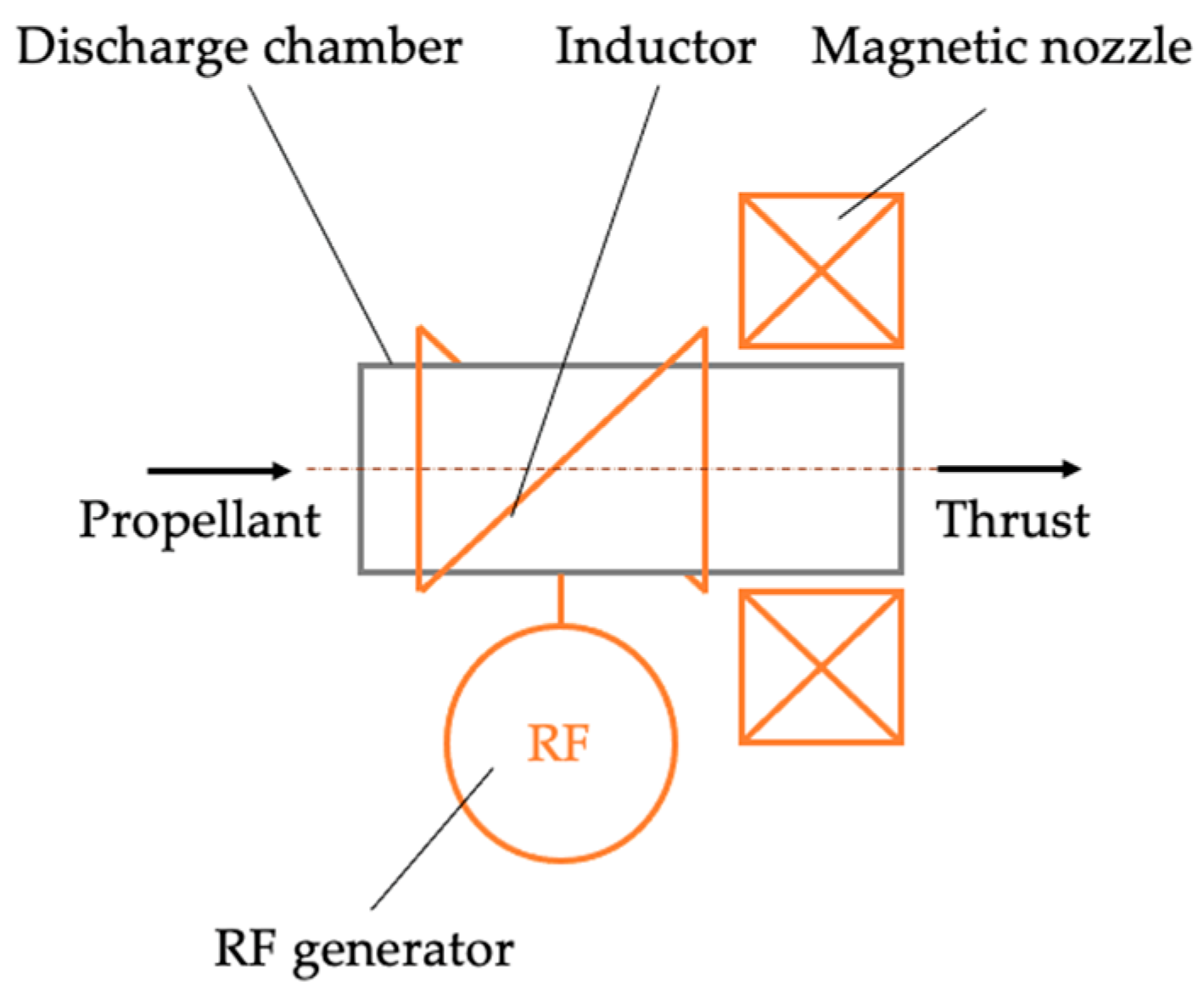
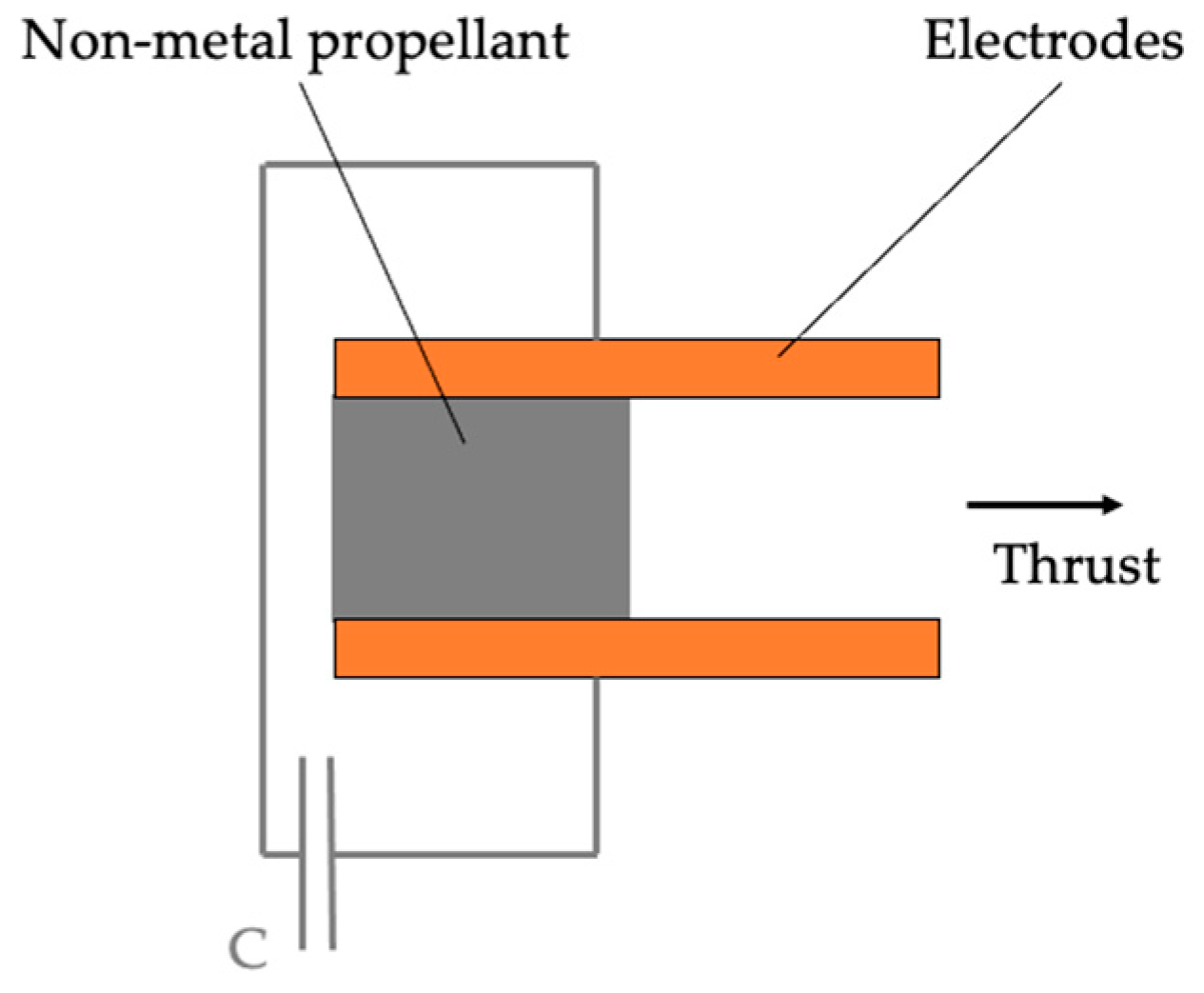
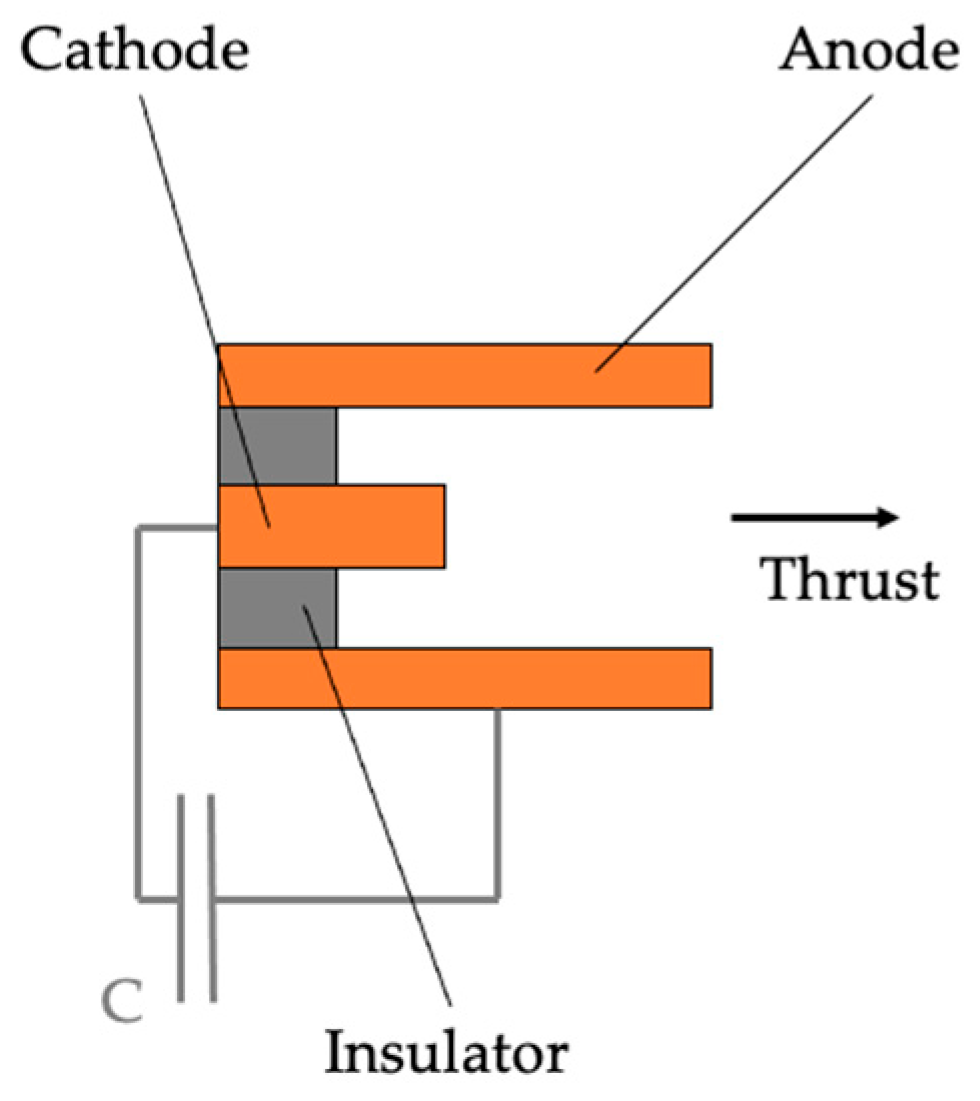
In electromagnetic-type electric propulsion, the ionized propellant is accelerated through effects of electron diamagnetism, extraction of ions by accelerated electrons, or plasma acceleration in crossed electromagnetic fields [110,111]. Such propulsion systems do not require cathode-neutralizers or auxiliary electrodes to function. Electromagnetic-type EP includes electrodeless plasma thrusters (see Figure 11), pulsed plasma thrusters (see Figure 12 and Figure 13), and vacuum arc thrusters. Characteristics of electromagnetic-type electric propulsion for small satellites are presented in Table 4 [110,111,112,113,114,115,116,117,118,119,120,121,122,123,124,125,126,127,128,129,130,131].
Unlike electrostatic systems, electromagnetic EP do not require a cathode-neutralizer, simplifying their structure, but they exhibit a wider variation in specific impulse, ranging from 300 s (classic pulsed plasma thrusters) to 4800 s (Poseidon M1.5 thruster).
A distinctive feature of this group of thrusters compared to other types of EP and chemical rocket engines is the possibility of using solid propellants (polytetrafluoroethylene, sulfur, and molybdenum), eliminating the need for complex gas storage and delivery systems [119,120,121,124,130]. This ensures compactness of the propulsion setup; for example, µCAT and PETRUS occupy less than 0.6U volume while providing a specific impulse of 600–3000 s [124,128]. However, the use of solid-fuel systems may be associated with inconsistency in thrust characteristics from activation to activation and limited resource life [119,120]. Successful examples of such thrusters, such as BDEPT (APS), Maxwell (Phase Four), and REGULUS-50-I2 (T4i), confirm the potential of electromagnetic EP for long-duration missions [105,112,113,114].
Electrodeless plasma thrusters deserve particular attention, as they are a subset of electromagnetic EP where the acceleration of the propellant is achieved exclusively through electromagnetic fields, without erosion-prone electrodes in the discharge zone. This architecture eliminates the primary cause of degradation in EP and enables compatibility with a wide range of gaseous propellants, including aggressive components. An example of such a thruster is the BDEPT and MTVEPT thrusters, which were successfully operated on the HORS 1 (2023) and HORS 3 (2024) satellites, respectively. Its unique feature is the capability for multidirectional thrust without movable components. Through rearranging the configuration of electromagnetic fields in the discharge chamber, directional control of the thrust vector in three-dimensional space is achieved. This method reduces the mass of the attitude control system compared to traditional schemes based on flywheels and cold gas thrusters. This improvement allows for a higher attainable increase in characteristic velocity (ΔV) within the limited power output of onboard solar arrays.
Thus, electromagnetic EP occupies a niche in tasks involving precise correction, atmospheric drag compensation, and long-duration missions with moderate requirements for characteristic velocity (ΔV < 500 m/s) on platforms up to 3U format and above. Like electrostatic EP, their application is limited to tasks requiring high thrust (>10 mN) or rapid maneuvers. However, their advantages, such as simplified propellant delivery systems and elimination of the cathode-neutralizer, make them competitive for missions under the tight mass and dimensional constraints of small satellites.

3.3.3. Electrothermal EP

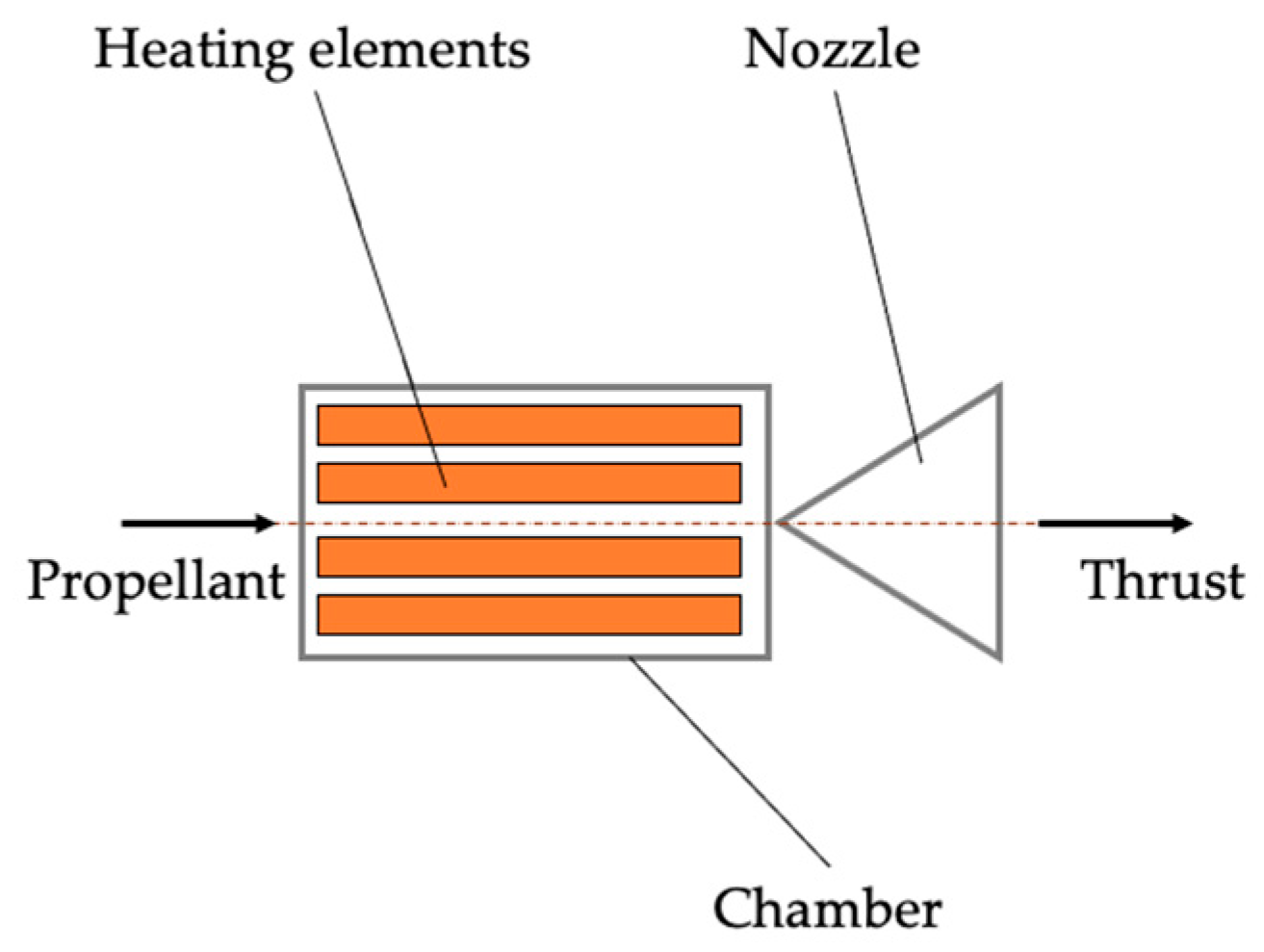
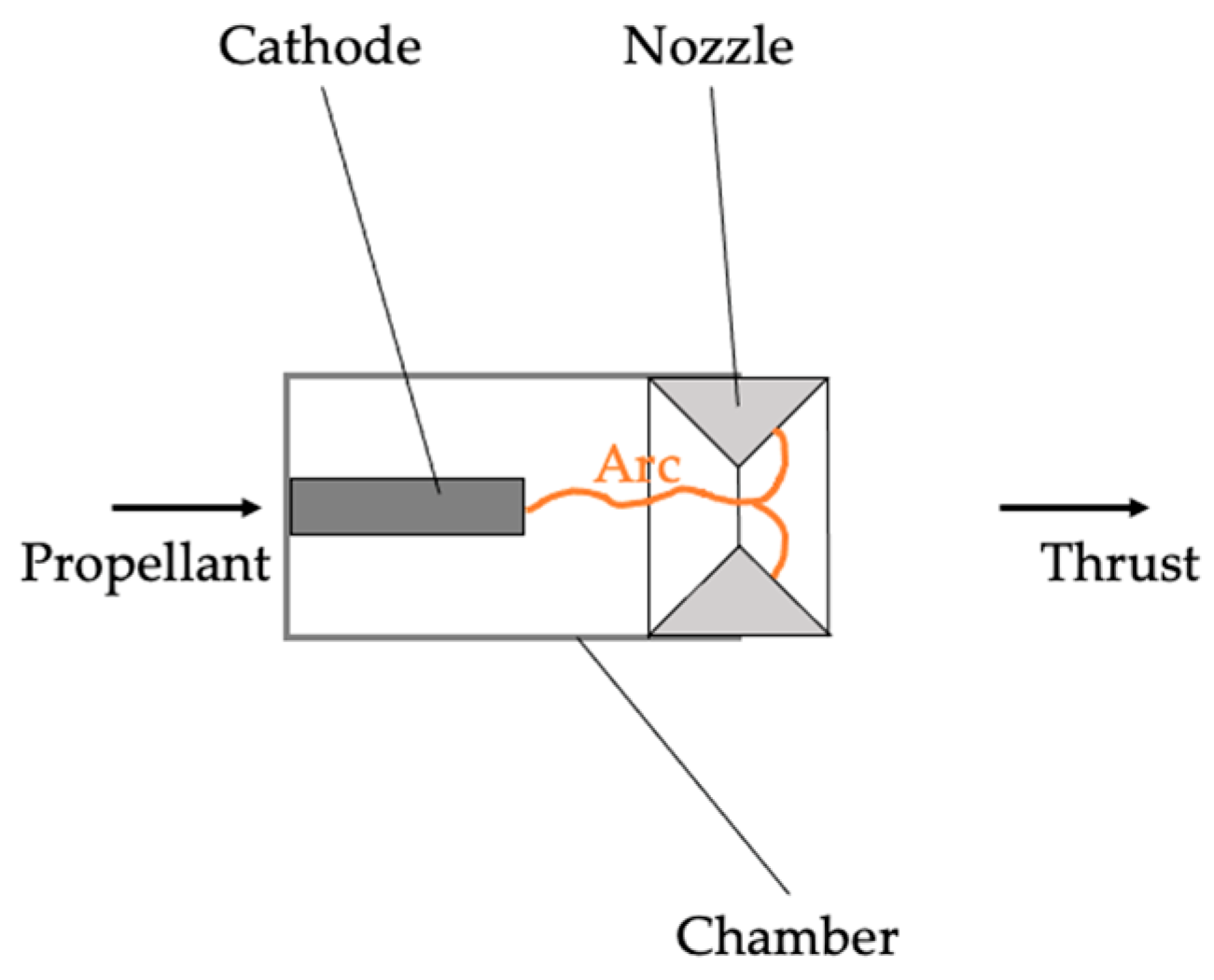
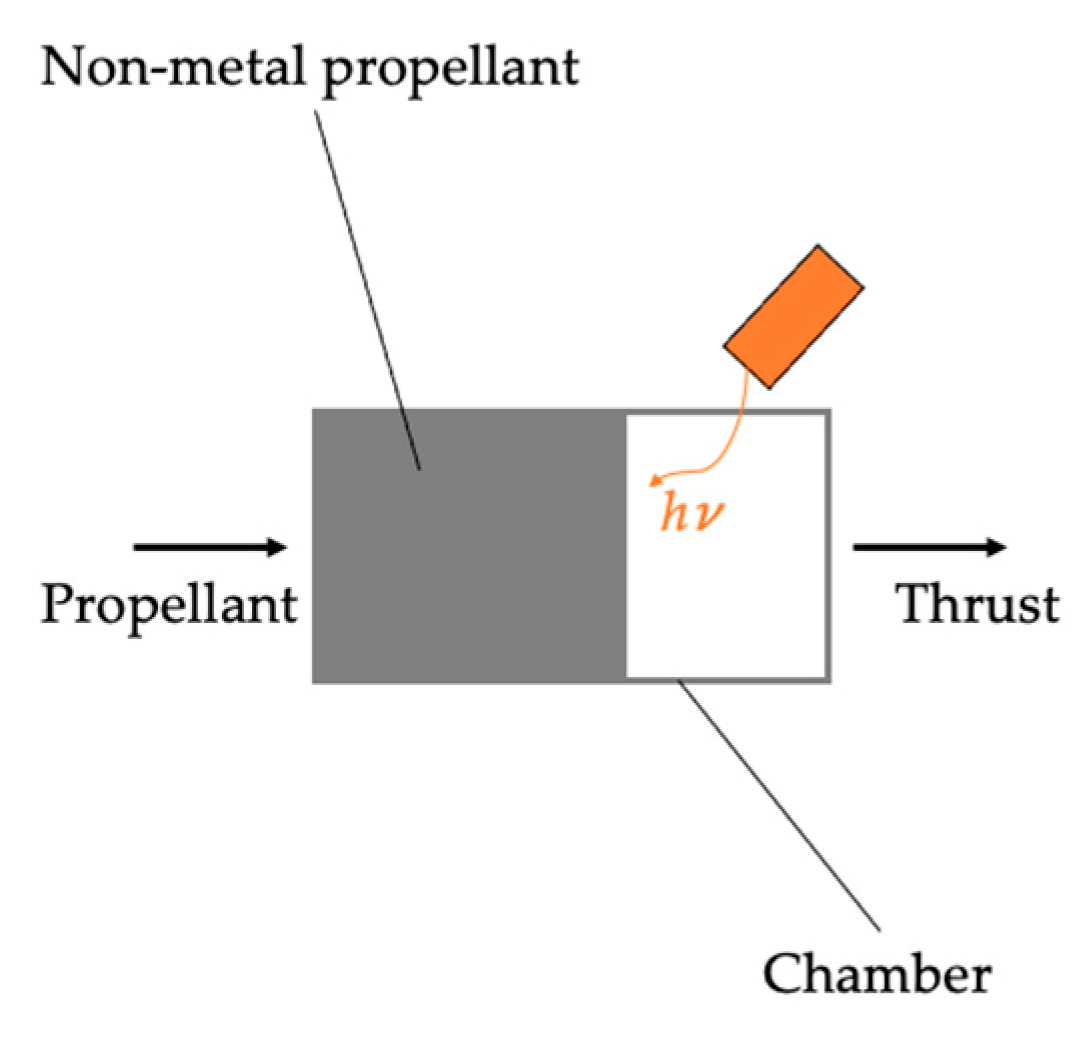
Electrothermal electric propulsion generates thrust by exhausting heated propellant, with heating performed by resistive heaters (resistojets) (see Figure 14), arc discharges (arcjets) (see Figure 15), electromagnetic waves, or laser beams (laser propulsion) (see Figure 16). Typically, inert gases are used as propellants, limiting performance mainly by the maximum wall temperature of the device [100]. Resistojets are best suited for small-satellite applications, given that most arcjets require power exceeding 300 W for proper operation [132,133,134]. Table 5 presents the flight-operated electrothermal electric propulsion units [132,133,134,135,136,137,138,139,140,141,142,143].
Electrothermal systems are usually compact (<2U), except for Bradford’s Comet thrusters, which may reach up to 24U in size. They deliver moderate thrust (in the tens of mN) at comparatively low specific impulse (<200 s). Consequently, electrothermal thrusters are commonly employed for short-duration maneuvers, such as final orbit insertion or deorbiting end-of-life satellites.
The electrothermal type of thrusters occupies an intermediate position between EP and cold gas thrusters and chemical rocket engines. They provide thrust in the order of tens of mN, possess compact dimensions (<2U), and simplify the architecture of the propellant storage and delivery system [132,133,134,136]. The specific impulse of such systems does not exceed 175 s, meaning that with a typical propellant mass of 0.5–2.5 kg, the achievable increase in characteristic velocity is limited to values of 5–20 m/s, which is insufficient for long-duration missions with high ΔV requirements [132].
A key trend evident in the development of electothermal EP is the widespread introduction of water as a “green” propellant. Systems such as AQUARIUS (University of Tokyo), ARM-A (Aurora), and PBR (Pale Blue) have shown operational reliability while completely excluding toxic components, simplifying ground testing, and lowering requirements for storage and delivery materials [139,140,141,142]. Particularly noteworthy is the Steam Thruster 1, which, by late 2023, had accumulated over 300 N·s of cumulative impulse across three units onboard PHI-Demo, demonstrating record-level failure-free operation for its class [143].
An intriguing direction in the development of these thrusters, similar to other types, except for electromagnetic ones, is the hybridization of architectures. For instance, the Arcjet PUC thruster (CU Aerospace/VACCO), utilizing microchannel discharges and SO2 as the working fluid, combines features of resistor jets and arcjets, achieving a specific impulse of 68 s with only 15 watts of power [93,135]. Such solutions help overcome the energy limitations of classical resistor jets without resorting to complex systems incorporating arc discharges, which require powers exceeding 300 W [132,133,134,135,136,137,138,139,140,141,142,143,144].
Thus, electothermal EP occupies a niche in tasks involving short maneuvers with moderate ΔV requirements (<50 m/s), aerodynamic drag compensation in low orbits, end-of-life deorbiting, and spacecraft orientation [132,136,139]. The absence of toxic components marks them as preferable for commercial small-satellite missions amidst tightening environmental regulations for ground operations and space activities.

3.4. Alternative Propulsion

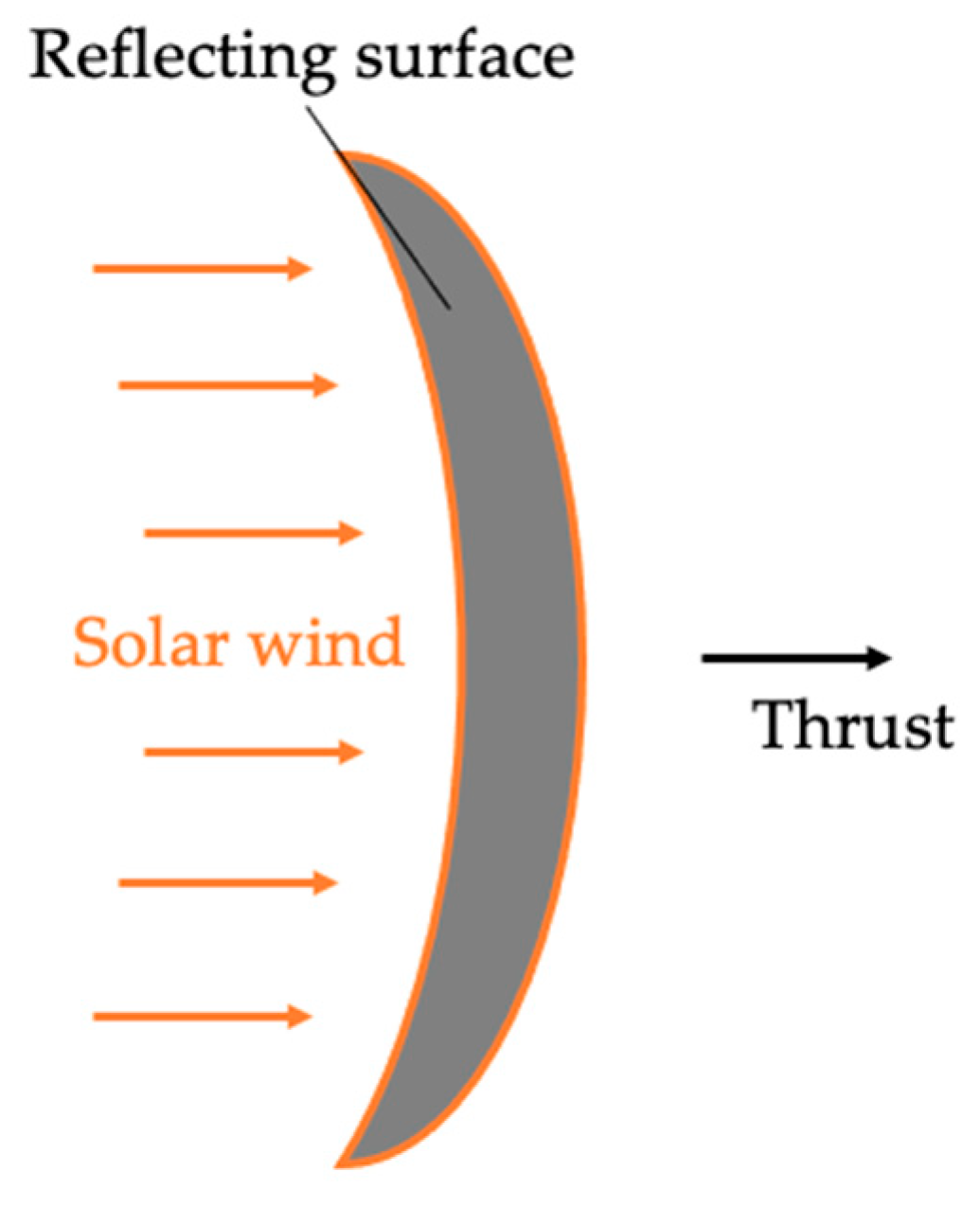
Propulsion systems based on solar sails utilize the effect of light pressure. Photons collide with the reflective surface of the sail, transferring kinetic energy to it. As a result of numerous collisions, the sail moves along the trajectory of the photon flow. The principal scheme of the solar sail propulsion is presented in Figure 17.
The theoretical concept of using a solar sail for movement in space was proposed by Tsander in 1924, although practical implementation of this technology only became feasible at the start of the 21st century. Solar sails do not consume any propellant. However, their thrust characteristics are extremely low, limiting their use to long-distance journeys of lightweight vehicles. For efficient operation, even small vehicles require a substantial sail area to capture sufficient sunlight for propulsion. Furthermore, the orientation of the sail relative to the Sun plays a crucial role. Maximum thrust occurs when the sail faces away from the Sun, aligning itself with the incoming photons. The force exerted on the sail acts perpendicular to its reflective surface, enabling directional control by adjusting the sail’s spatial orientation.
For more efficient conversion of solar pressure into motion, a high reflectivity coefficient of the sail’s working surface is necessary. Additionally, it must exhibit high strength and resilience against external space conditions. Considering the extensive area of the working surface, a framework that combines robustness with light weight is essential. The overall design of the propulsion system must inherently include folding capabilities because deploying an unfurled solar sail directly into orbit would be impractical given its substantial dimensions. Designing the thrust mechanism and engineering suitable materials for the active surface present significant challenges. Consequently, it was not until recent times that constructing and testing solar sails became viable within Earth’s orbit. In Table 6, characteristics of the flight-operated solar sails are presented [144,145,146,147,148,149,150,151,152,153].
Alternative propulsion systems considered in this section differ markedly from previously reviewed systems, as they entirely eliminate the need for propellant by harnessing photon pressure from solar radiation to accelerate the spacecraft [144,145,146,147,148,149,150,151,152,153]. However, this approach leads to drastically lower thrust generation, orders of magnitude weaker even than the weakest electrostatic EP. Consequently, solar sails prove effective solely in long-duration missions > 3 years, where accumulated ΔV can reach hundreds of meters per second without consuming mass [148,150,152].
To achieve ΔV comparable to EP, approximately 1 km/s, a sail area exceeding 100 m2 is required, with the satellite mass kept below 10 kg. This yields a fragile structure that is highly susceptible to micrometeoroid erosion and necessitates complex deployment mechanisms, as evidenced by partial failures in missions such as NEA Scout (2022) [150,151].
Promising directions for developing such systems lie in pursuing hybrid solutions with EP. For instance, coupling a solar sail with a water-based electothermal resistojet (as proposed in the ACS3 mission concept) permits the sail to perform primary acceleration while the electric motor handles precise trajectory correction maneuvers [152,153]. This approach compensates for the inability to move opposite to the solar flux direction and enhances maneuverability through minimal propellant reserves.

4. Discussion

The discussion begins by reviewing the operational characteristics of propulsion systems installed aboard small-form-factor satellites, particularly those used in CubeSats. Subsequently, various criteria are examined to evaluate current propulsion technologies, identify prevailing trends among operational systems, and forecast potential advancements in next-generation propulsion solutions.

4.1. Use of Different Propulsion System Types Aboard Civil Small Satellites

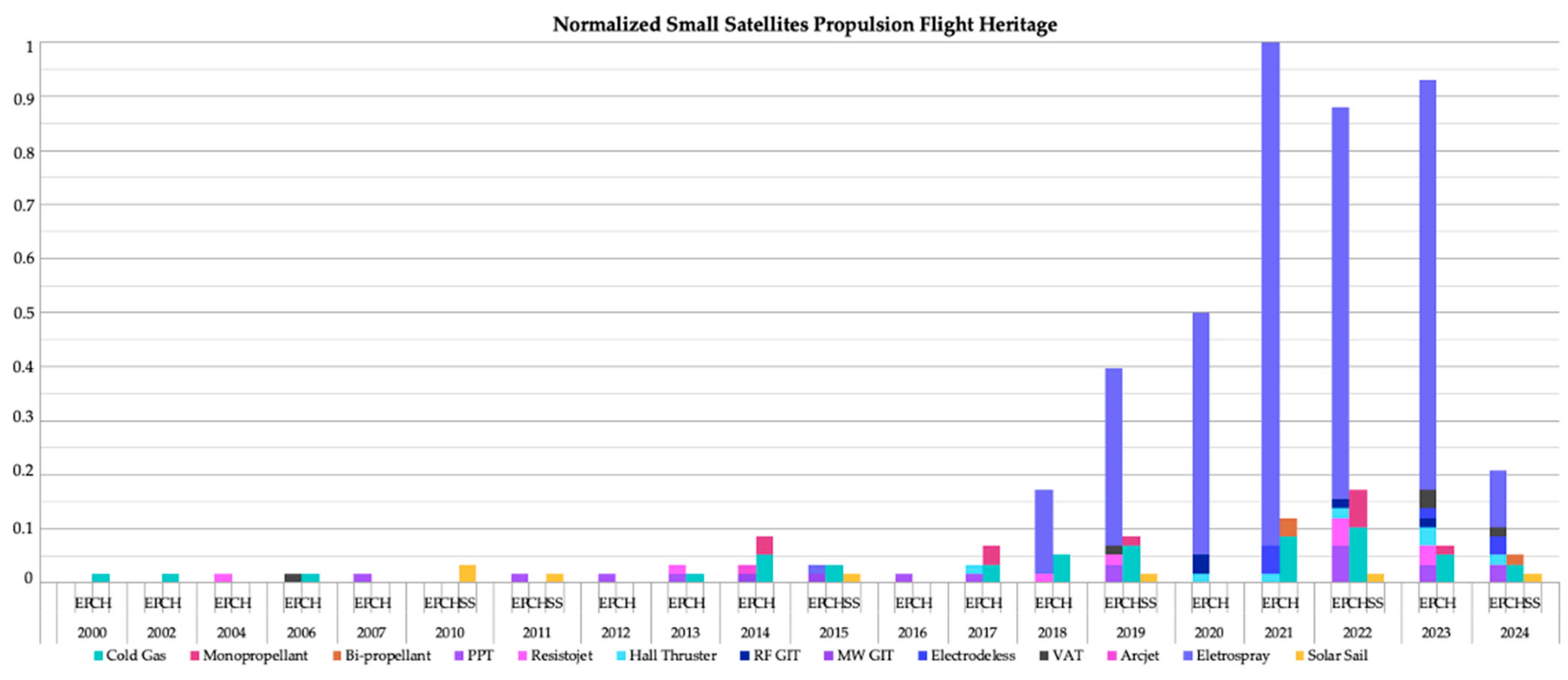
Figure 18 illustrates the normalized frequency of small-satellite missions employing diverse propulsion systems between 2000 and 2024. Over this period, there has been a notable rise in the number of small satellites utilizing propulsion technologies. This indicates an increasing focus on controllable small-satellite missions. Presently, such missions primarily involve communications and remote sensing applications. Future projections suggest continued growth in highly maneuverable small satellites, enabling services like orbital maintenance and contributing to resilient distributed space architectures.
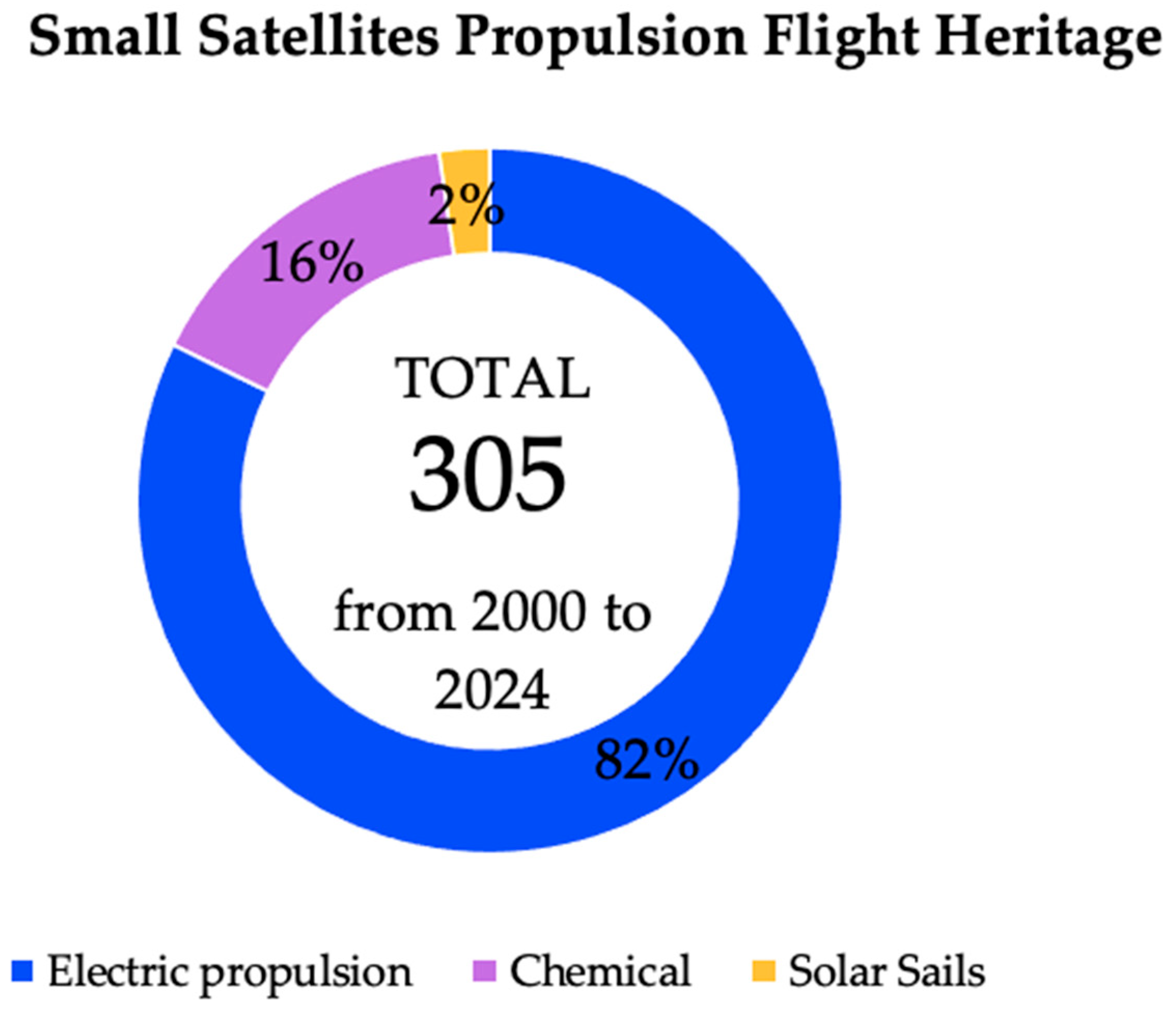
Figure 19 displays a pie chart showing the distribution of small-satellite missions that employed various propulsion systems. It emphasizes the predominance of electric propulsion technology, especially electrospray propulsion, accounting for 82% out of the 305 missions analyzed. These findings highlight the rising adoption of electric propulsion systems in small-satellite missions, attributed to their enhanced efficiency and extended service-free operational life spans [153].
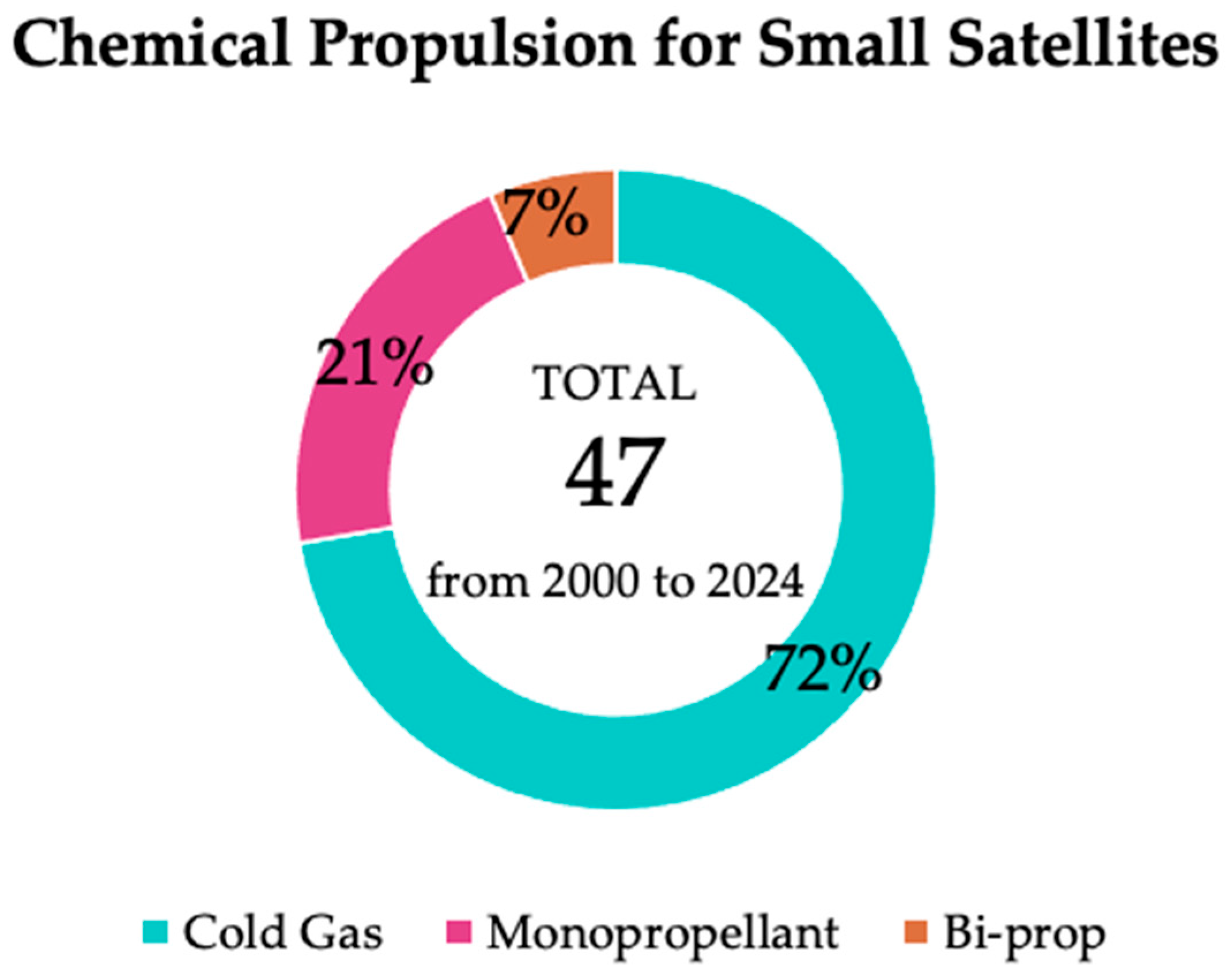
Figure 20 examines the distribution of chemical propulsion methods. Among civilian applications, cold gas propulsion prevails over other chemical options—monopropellants and bi-propellants follow closely behind. Its popularity stems from its inherent simplicity and dependability, making cold gas thrusters ideal for compact spacecraft designs, where minimizing mass and reducing complexity are crucial considerations.
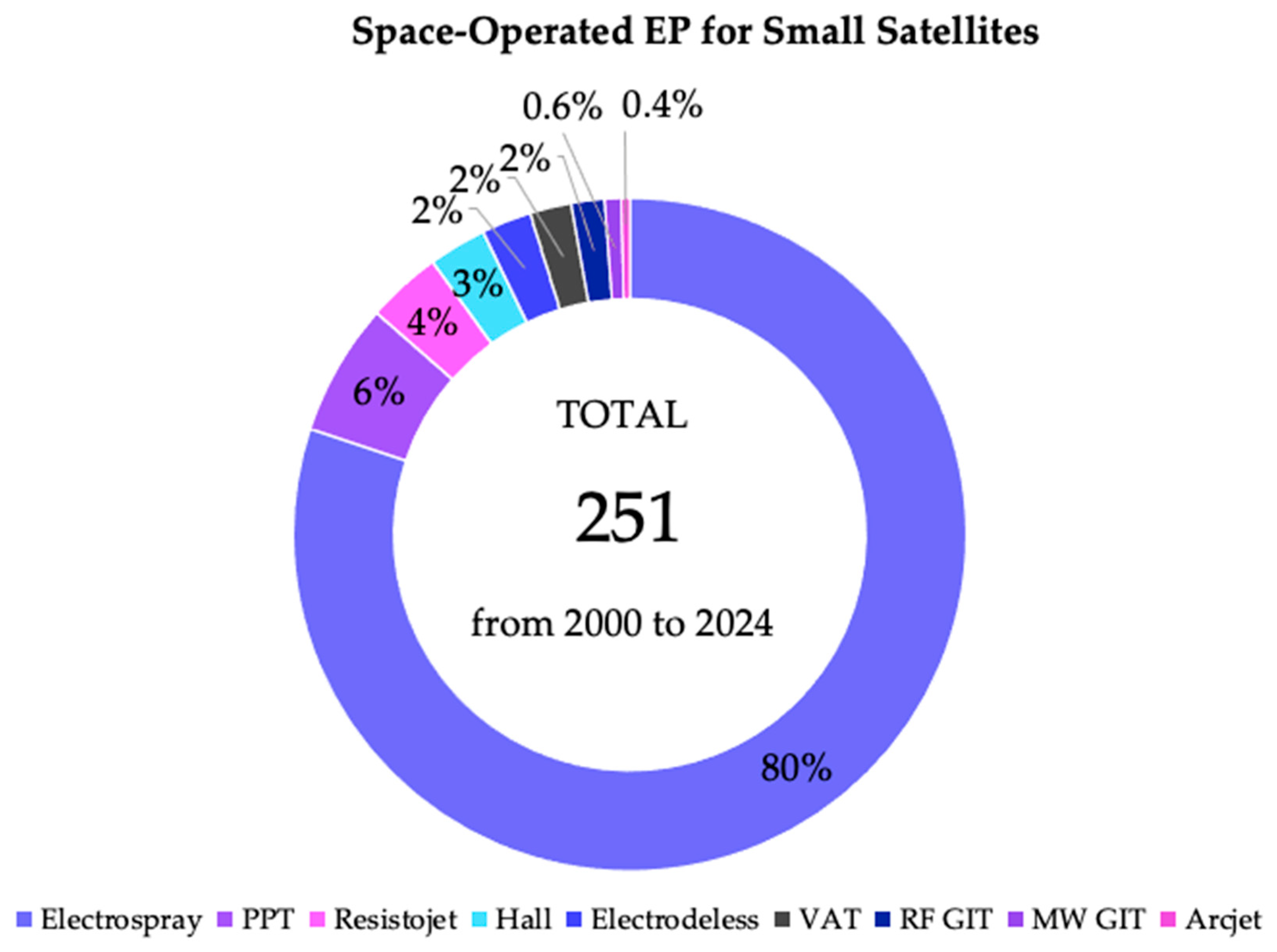
Figure 21 offers a comprehensive analysis of electric propulsion systems deployed in small-satellite missions, identifying electrospray propulsion as the leading option, complemented by PPT and resistojet systems. This insight underlines the ascendance of electric propulsion technologies, favored for their exceptional energy efficiency and extended functional lifespan, and thus proving indispensable for sustained deep-space exploration efforts [153,154,155,156,157].
Figure 18, Figure 19, Figure 20 and Figure 21 together illustrate the dynamic evolution of small-satellite propulsion systems, showcasing the growing prominence of electric propulsion, notably electrospray propulsion, in contemporary missions. This transition mirrors the escalating need for higher-efficiency and longer-lasting systems capable of sustaining the expanding intricacy and mission durations associated with distributed space networks reliant upon small satellites.

4.2. Evaluation Criteria

To facilitate a more in-depth examination of trends and prospects in small-satellite propulsion systems, an evaluation framework is proposed. This framework employs a tailored scoring system to evaluate multiple facets, including physics understanding, developmental complexity, operational reliability, material accessibility, production simplicity, scientific outreach, and educational opportunities. Numerical ratings ranging from +1 to −1 are allocated accordingly, denoting favorable, neutral, or adverse qualities, respectively. A detailed explanation of these evaluation metrics is outlined in Table 7.

4.3. Physics Rationale

The decision to choose a particular thruster system for a space mission can be based on evaluating the physics rationale based on three critical factors: the accurate understanding of physical processes, the detailed physics-based descriptions, and the rigorous testing validations. Each type of thruster offers distinct advantages and challenges. The summary of the discussion on the physics rationale for each type of propulsion systems based on the following criteria: process understanding, physics description, testing validation is presented in Table 8.
Physics understanding is not typically problematic for small-satellite chemical propulsion systems. Monopropellant/bi-propellant engines benefit from fully understood thrust mechanisms. Hybrid engines combine solid fuels with liquid oxidizers, offering flexible design possibilities, but face scaling challenges for miniature satellites. Cold gas for thrust generation utilizes pressurized gas that exhausts from the nozzle. Hall-effect thrusters are one of the best studied EP. Nonetheless, their requirements for dimensional ratios between their structural elements represent a constraint for the development of missions based on satellites with a small form factor [158]. The processes of the ion thrusters are also well-studied, but the development of these systems for small satellites requires the use of expensive materials and technological processing [159]. Pulsed plasma thrusters suffer from limited physics understanding of responsiveness [160]. Vacuum arc thrusters are also poorly understood from a physics point of view [161]. The key challenge for EPT is in understanding the processes of thrust generation since there are no well-established theories for their description [22].
The physics of processes in the resistojets is fully understood [162]. Arcjets’ physics of operation is fully understood [163]. The physics of the processes of laser propulsion is relatively well-understood, and there are several successful realizations of laser propulsion that can be operated onboard small satellites [164]. Solar sails exploit photon reflection off reflective surfaces to harness radiation pressure. These processes are well-studied, but the main limitation for these systems is the on-ground testing.

4.4. Engineering Rationale

When determining the appropriateness of different types of thrusters for modern small-satellite missions from an engineering viewpoint, four key criteria must be taken into account: developmental effort, testing effort, integration effort, and the capacity to realize thrust vectoring. Table 9 outlines a comparative analysis of each thruster type based on these factors.
Monopropellant rocket engines, complicated propellant formulas, or specialized hardware might lead to added engineering [165]. Bi-propellant rocket engines carry a high testing load because of complex fuel interactions, necessitating sophisticated simulations and expertise in fluid dynamics and thermochemistry [166]. Hybrid rocket engines have medium–high testing complexity, attributed to materials compatibility and ignition mechanisms introducing design challenges. Cold gas thrusters have low development effort, as their simple design reduces the requirements for testing facilities [167]. Miniaturized Hall-effect thrusters face high engineering barriers, driven by specialized magnets and electronics, increasing design challenges [168]. Miniaturized ion thrusters represent the peak of engineering difficulty, as advanced ion-optical systems and cathode-neutralizers demand intensive computational modeling and simulation before laboratory prototypes [169]. Electrospray thrusters have design challenges centered mostly on emitter array geometry and power circuits [170]. Pulsed plasma thrusters bear medium–high development costs, caused by achieving the wanted mode of operation—electromagnetic or thermal modes of operation—and eliminating electrode wear, posing significant engineering obstacles. In addition, PPT poses challenges with its integration into satellites of small form factor [171,172,173]. Vacuum arc thrusters have problems with managing metal vapor dynamics and cathode erosion [174]. Electrodeless plasma thrusters have engineering obstacles with the radiofrequency coupling efficient realization [175]. Resistojets have difficulties with the heating element design [176]. Arcjets face engineering obstacles related to the electrode erosion rates, nozzle throat geometry, and power regulation schemes [177]. Laser propulsion may have high engineering costs, but the overall developmental process is not complicated [178]. Solar sails claim high engineering complexity, requiring optimized reflector geometries and deployment mechanisms [179].
Addressing thrust-vectoring realization, monopropellant, bi-propellant, hybrid rocket engines, cold gas, resisitojets, and arcjets demonstrate good capacity for thrust-vectoring realization, as they have dense exhausting flows. Hall-effect and ion thrusters are practically costly, from the commercial and engineering points of view, and have opportunities for the realization of thrust-vectoring. Electrospray thrusters have a great opportunity for thrust-vectoring; for example, by implementing a sectioned emitter or using multi-emitter arrays, affording independent control over the thrust direction. Pulsed plasma thrusters have been demonstrated in orbit to have the capability for controlling the thrust vector direction by implementing the geometric approach for its realization. Electrodeless plasma thrusters have also been demonstrated to control the thrust vector direction in-orbit. Laser propulsion can realize the capability to control the thrust vector direction in several ways [12]. Solar sails’ structure can enable dynamic sailing feats, but only in the proximity to stars.

4.5. Operational Rationale

When evaluating propulsion systems for small-satellite missions from an operational standpoint, three critical attributes must be assessed: specific mass/volume per unit of thrust and specific impulse, specific impulse, and thrust adjustability. In Table 10, the comparison between different propulsion systems based on the assessment criteria proposed is presented.
It should be noted that for small-form-factor satellites, featuring limited volume and power availability, the specific impulse is one of the key characteristics that affect the maneuvers that the propulsion system can assist a spacecraft with. This characteristic directly affects all propulsion capabilities. The subsequent analysis relies upon information presented in Section 3 and mainly focuses on the discussion of the specific impulse of different propulsion technologies. Monopropellant rocket engines demonstrate satisfactory performance, characterized by a specific impulse of approximately 280 s, enabling fundamental maneuvering capacities. These engines display moderate modular properties and possess the ability to adjust power output within predetermined boundaries. Bi-propellant rocket engines yield superior specific impulse, varying between 300 and 450 s, facilitating broader operational ranges. This type of engine exhibits expansive throttling capabilities, thereby increasing its adaptability for dynamic space missions. Hybrid rocket engines have an Isp of 280–300 s, which is comparable to other chemical propulsion systems. However, they may encounter limitations in flexibility due to rigid output configurations. Cold gas thrusters underperform significantly among other propulsion systems, exhibiting a specific impulse of merely 100 s, which restricts their application predominantly to precise pointing tasks. Hall-effect thrusters generate flows with specific impulses that range from 500 to 1500 s for compact designs. Consequently, these systems prove advantageous for deep-space explorations, despite having limited adjustment scope. Ion thrusters surpass all other systems, boasting an exceptionally high specific impulse above 3000 s. Electrospray thrusters stand out with specific impulse levels extending from 1000 to 5000 s, providing unequaled accuracy via independently adjustable emitters. Pulsed plasma thrusters deliver mediocre results, achieving specific impulse values ranging from 100 to 300 s. Although modifications are possible through varied frequencies, such changes lead only to tolerable outcomes rather than remarkable achievements. Vacuum arc thrusters function suboptimally, producing a specific impulse of about 1200 s. Electrodeless plasma thrusters correspond closely to Hall-effect thrusters, considering compact design performance, offering acceptable specific impulse rates between 500 and 1200 s. Resistojets and arcjets fall short in comparison, yielding specific impulse outputs confined to the range of 100–300 s. Their functionality resembles binary switches, lacking subtle control mechanisms.

4.6. Production Rationale

From a production perspective, the selection of propulsion systems for small-satellite missions pivots around three core criteria: material availability, production processes, and storage simplicity. The summary of the discussion on the production rationale for each type of propulsion system based on the following proposed criteria for this rationale is presented in Table 11.
Material availability plays a crucial role in determining manufacturability. Monopropellant rocket engines utilize commonly accessible chemicals such as hydrazine and hydrogen peroxide. Hybrid rocket engines employ readily obtainable materials like paraffin wax and nitrous oxide. Cold gas, Hall-effect, ion, and electrodeless plasma thrusters have the advantage of being able to use widely available gases, including nitrogen and argon. The complexity involved in production varies considerably across different types of propulsion systems. For instance, monopropellant rocket engines depend on conventional manufacturing techniques, such as machining and welding, whereas bi-propellant rocket engines necessitate sophisticated fabrication processes along with rigorous sealing verifications. Regarding storage requirements, there exist notable differences among various systems. While cold gas thrusters allow safe storage in pressurized containers, bi-propellant rocket engines might entail demanding cryogenic storage conditions. Ultimately, propulsion systems employing solid-state propellants and incorporating minimal electronics excel in terms of material accessibility, simplified manufacturing procedures, and reduced storage demands when compared to more advanced alternatives [180].

4.7. Societal Rationale

From a societal perspective, the selection of thruster systems for small-satellite missions rests on three essential criteria: historical legacy, scientific prevalence, and educational outreach. Historical legacy refers to the chronology and maturity of the technology. Scientific prevalence signifies the pervasiveness of the technology studied and developed across the world. Educational accessibility relates to how widespread the educational programs that cover the study and development of the distinct technology are. The societal rationale assessment is presented in Table 12.
Monopropellant rocket engines and bi-propellant rocket engines trace their lineage back to early space pioneers, establishing reliable reputations for key missions. They enjoy widespread scientific dissemination and educational accessibility. Hybrid rocket engines represent an innovative shift, rising in importance recently, and are accompanied by noteworthy accomplishments. Cold gas thrusters originate from earlier eras, favored for their simplicity and reliability. These propulsion systems share similarities with monopropellant and bi-propellant rockets in terms of scientific prevalence and educational availability. Hall-effect thrusters emerged in the Soviet Union during the 1960s, later spreading globally and becoming integral components in numerous exploration missions. Among electric propulsion technologies, Hall-effect thrusters hold the longest developmental and operational history. Physicist Morozov initiated investigations into applying the Hall effect to propulsion systems in the mid-twentieth century, leading to prototype creation in the 1950s. Development intensified in the 1960s, with successful space testing occurring in the 1970s. Nowadays, Hall-effect thrusters serve as vital tools in space exploration, powering both communication satellites and deep-space probes. Ion thrusters experienced gradual evolution prior to their demonstration aboard NASA’s Deep Space 1 mission. Electrospray thrusters constitute emerging players garnering influence within academic communities. Despite this, the space propulsion sector has provided numerous units to support small-satellite missions. Pulsed plasma thrusters arose in the 1960s, experiencing cautious resurgence in contemporary times, undergoing active terrestrial study and space-based experimentation. Historically, vacuum arc thrusters remained largely dormant before recent activation beyond laboratory confines and transition towards flight operation tests. Electrodeless plasma thrusters stemmed from radiofrequency plasma sciences, gradually accumulating supporters. Thrust-vectoring thruster developments based on this technology have reached continuous space operations. Resistojets and Arcjets derive from older methodologies and continue to undergo steady investigation and refinement. Laser propulsion is being developed continuously. Remarkably, laser propulsion intended for small satellites once approached initial flight testing, aborted by an ill-fated space vehicle malfunction, causing the mission’s demise in the Atlantic Ocean. Solar sails have fascinated humanity for centuries, transforming into practical realities in modern times.
To summarize, monopropellant rockets, bi-propellant rockets, cold gas, Hall-effect, ion, pulsed plasma thrusters, resistojets, and arcjets dominate current practices, sustained by robust historical foundations, ubiquitous scholarship, and inclusive teaching. Particularly, monopropellant and bi-propellant rockets, Hall-effect, ion, and electrospray thrusters attract substantial investment and are readily accessible for study. Alternatively positioned technologies such as vacuum arc thrusters, laser propulsion, and solar sails struggle incrementally, hindered by obscurity. The scientific community, pursuing innovation, focuses increasingly on hybrid propulsion systems and electrosprays, uncovering promising opportunities.

4.8. Trends and Perspectives in Propulsion Systems for Small Satellites

The overall scores based on multiple rationales for small-satellite propulsion technologies are presented in Table 13.
Table 7 indicates that cold gas propulsion and electrosprays lead in overall development and utilization rationale among chemical and electric propulsion systems used in small satellites. Their popularity arises mainly because they are simple, reliable, and suitable for very small-sized satellites. This conclusion matches the data showing predominance of certain propulsion technologies in chemical (Figure 20) and electric (Figure 21) propulsion.
Other important electric propulsion candidates include resistojets and arcjets, which score highly. They offer accurate control over trajectory corrections and efficient energy consumption. However, according to Section 4.1, these technologies are not frequently adopted on small satellites. One explanation could be that they generate excess heat, requiring extra cooling systems, and making them impractical for small satellites.
Certain propulsion technologies lag far behind others. As shown in Table 7, solar sails earn only four points, highlighting their limited usefulness given current constraints and difficulties in deploying them. Pulsed plasma thrusters similarly score low, indicating problems with integration and effectiveness on small satellites. Vacuum arc thrusters perform the worst, receiving zero points, revealing major technical issues.
Emerging technologies show future potential despite initially low scores. Examples include hybrid rockets, planar Hall-effect thrusters, and laser-based propulsion. Hybrid rockets merge solid fuels with liquid propellants, combining the benefits of each approach. Planar Hall-effect thrusters can fit into compact volumes while maintaining high performance. Laser-driven systems efficiently convert light energy into motion, potentially surpassing conventional propulsion methods in terms of thrust efficiency.
Interestingly, there are no distinctive differences between the propulsion systems for commercial use and for scientific operations. The only two differences are that for the commercial operations, the industry primarily uses the propulsion systems with the highest flight heritage, for example, Hall-effect thrusters, and is looking for the use of a low-cost propellant substance, such as argon, considering EP. Governmental missions are not considered in this review, as they are dual-use missions. Looking ahead, several clear trajectories emerge concerning propulsion development pathways for small satellites. Ongoing refinements will focus heavily on shifting space missions from static to dynamic ones, requiring propulsion systems that can significantly increase the maneuverability of satellites. The development of such propulsion technologies requires the reconsideration of conventional schemes and the combination of several propulsion technologies in a single device. A promising direction for the development of propulsion systems on small satellites is the creation of hybrid systems that integrate multiple types of engines into a single module to cover a wide range of maneuvering tasks within a single mission. This necessitates developments aimed at increasing the energy efficiency of engines to enable their combination under strict energy capacity constraints.

Author Contributions

Conceptualization, A.S., D.F. and D.E.; methodology, A.S. and D.F.; validation, A.S., D.F. and D.E.; formal analysis, A.S., D.F., D.E. and V.D.; investigation, A.S., D.F. and D.E.; resources, A.S. and D.F.; data curation, D.F. and D.E.; writing—original draft preparation, A.S., D.F., D.E. and V.D.; writing—review and editing, A.S.; visualization, A.S. and D.F.; supervision, A.S. and D.F.; project administration, A.S. and D.F.; funding acquisition, A.S. and D.F. All authors have read and agreed to the published version of the manuscript.

Funding

This work was performed following the government task ordered by the Ministry of Science and Higher Education of the Russian Federation (FSFN-2024-0007).

Data Availability Statement

The data used in this research can be made available upon request from the corresponding author.

Conflicts of Interest

The authors declare no conflicts of interest.

Abbreviations

The following abbreviations are used in this manuscript:
CHChemical propulsion
EPElectric propulsion
EPTElectrodeless plasma thruster
HETHall-effect thruster
ITIon thruster
LEOLow Earth orbit
MWMicrowave
NORADNorth American Aerospace Defense Command
PAPolyamide
PETPolyethylene terephthalate
POMPolyoxymethylene
PPTPulsed plasma thruster
PSPropulsion system
RFRadiofrequency
SSSolar sail
VATVacuum arc thruster

References

  1. Chintalapati, B.; Precht, A.; Hanra, S.; Laufer, R.; Liwicki, M.; Eickhoff, J. Opportunities and challenges of on-board AI-based image recognition for small satellite Earth observation missions. Adv. Space Res. 2025, 75, 6734–6751. [Google Scholar] [CrossRef]
  2. Weston, S.V.; Burkhard, C.D.; Stupl, J.M.; Ticknor, R.L.; Yost, B.D.; Austin, R.A.; Galchenko, P.; Newman, L.K.; Soto, L.S.S. State-of-the-Art Small Spacecraft Technology; NASA: Washington, DC, USA, 2024. Available online: https://www.nasa.gov/wp-content/uploads/2024/03/soa-2023.pdf (accessed on 21 January 2026).
  3. Turan, E.; Speretta, S.; Gill, E. Autonomous navigation for deep space small satellites: Scientific and technological advances. Acta Astronaut. 2022, 193, 56–74. [Google Scholar] [CrossRef]
  4. Marrero, L.M.; Merlano-Duncan, J.C.; Querol, J.; Kumar, S.; Krivochiza, J.; Sharma, S.K.; Chatzinotas, S.; Camps, A.; Ottersten, B. Architectures and synchronization techniques for distributed satellite systems: A survey. IEEE Access 2022, 10, 45375–45409. [Google Scholar] [CrossRef]
  5. Sweeting, M.N. Modern small satellites—Changing the economics of space. Proc. IEEE 2018, 106, 343–361. [Google Scholar] [CrossRef]
  6. Ekpo, S.C.; George, D. A system engineering analysis of highly adaptive small satellites. IEEE Syst. J. 2012, 7, 642–648. [Google Scholar] [CrossRef]
  7. Yang, J.; Li, D.; Jiang, X.; Chen, S.; Hanzo, L. Enhancing the resilience of low earth orbit remote sensing satellite networks. IEEE Netw. 2020, 34, 304–311. [Google Scholar] [CrossRef]
  8. Lowe, C.J.; Macdonald, M. Space mission resilience with inter-satellite networking. Reliab. Eng. Syst. Saf. 2020, 193, 106608. [Google Scholar] [CrossRef]
  9. Crisp, N.H.; Smith, K.; Hollingsworth, P. Launch and deployment of distributed small satellite systems. Acta Astronaut. 2015, 114, 65–78. [Google Scholar] [CrossRef]
  10. Sauder, J.; Gebara, C.; Reddy, N.H.; García-Mora, C.J. A framework for small satellite deployable structures and how to deploy them reliably. Commun. Eng. 2024, 3, 72. [Google Scholar] [CrossRef]
  11. Yaqoob, M.; Lashab, A.; Vasquez, J.C.; Guerrero, J.M.; Orchard, M.E.; Bintoudi, A.D. A comprehensive review on small satellite microgrids. IEEE Trans. Power Electron. 2022, 37, 12741–12762. [Google Scholar] [CrossRef]
  12. Shumeiko, A.; Telekh, V.; Ryzhkov, S. Thrust-vectoring schemes for electric propulsion systems: A review. Chin. J. Aeronaut. 2025, 38, 103401. [Google Scholar] [CrossRef]
  13. Levchenko, I.; Baranov, O.; Pedrini, D.; Riccardi, C.; Roman, H.E.; Xu, S.; Lev, D.; Bazaka, K. Diversity of physical processes: Challenges and opportunities for space electric propulsion. Appl. Sci. 2022, 12, 11143. [Google Scholar] [CrossRef]
  14. Liu, H.; Niu, X.; Zeng, M.; Wang, S.; Cui, K.; Yu, D. Review of micro propulsion technology for space gravitational waves detection. Acta Astronaut. 2022, 193, 496–510. [Google Scholar] [CrossRef]
  15. Shumeiko, A.I.; Telekh, V.D.; Mayorova, V.I. Development of a novel wave plasma propulsion module with six-directional thrust vectoring capability. Acta Astronaut. 2022, 191, 431–437. [Google Scholar] [CrossRef]
  16. Lee, D.; Ahn, J. Optimal multitarget rendezvous using hybrid propulsion system. J. Spacecr. Rocket. 2023, 60, 689–698. [Google Scholar] [CrossRef]
  17. Balakrishnan, S.; Gurfil, P. Pulsed feedback control for directional rendezvous on eccentric orbits under propulsion constraints. Acta Astronaut. 2025, 238, 1146–1157. [Google Scholar] [CrossRef]
  18. Blondel-Canepari, L.; Sarritzu, A.; Pasini, A. A holistic approach for efficient greener in-space propulsion. Acta Astronaut. 2024, 223, 435–447. [Google Scholar] [CrossRef]
  19. Sippel, M.; Wilken, J. Selection of propulsion characteristics for systematic assessment of future European RLV-options. CEAS Space J. 2025, 17, 89–111. [Google Scholar] [CrossRef]
  20. Shumeiko, A.; Andronov, A.; Pashaev, A.; Savelev, P.; Telekh, V. Starting modes of multidirectional electrodeless plasma thruster with closed ring-shaped gas discharge chamber. Sci. Rep. 2025, 15, 41032. [Google Scholar] [CrossRef]
  21. Savelev, P.; Shumeiko, A.; Telekh, V. Wire-based solid-state propellant management system for small form-factor space propulsion. Inventions 2025, 10, 75. [Google Scholar] [CrossRef]
  22. Andronov, A.; Shumeiko, A.; Pashaev, A.; Tsygankov, P.; Kovalev, S.; Telekh, V. Plume characterization of electrodeless plasma thruster with configurable exhaust. Symmetry 2025, 17, 661. [Google Scholar] [CrossRef]
  23. Shumeiko, A.; Telekh, V. Direct thrust measurements of 2U-sized bi-directional wave plasma thruster. AIP Adv. 2023, 13, 085106. [Google Scholar] [CrossRef]
  24. Liu, C.; Xu, J.; Yue, X. RBF neural network-based cooperative electromagnetic takeover control for large-scale failed spacecraft. IEEE Trans. Aerosp. Electron. Syst. 2025, 62, 506–515. [Google Scholar] [CrossRef]
  25. Shi, K.; Liu, X.; Zhi, Y.; Liu, C. Integrated hippopotamus and whale optimizations-based impedance control for spacecraft electromagnetic separation. Adv. Space Res. 2025. [Google Scholar] [CrossRef]
  26. Liu, C.; Shu, M.; Shi, K.; Yue, X. Dual hybrid non-fragile control for integrated electromagnetic docking and separation of spacecraft. Acta Astronaut. 2025, 240, 106–114. [Google Scholar] [CrossRef]
  27. Liu, C.; Yue, X.; Zhang, J.; Shi, K. Active disturbance rejection control for delayed electromagnetic docking of spacecraft in elliptical orbits. IEEE Trans. Aerosp. Electron. Syst. 2021, 58, 2257–2268. [Google Scholar] [CrossRef]
  28. Shi, K.; Liu, C.; Sun, Z.; Yue, X. Coupled orbit-attitude dynamics and trajectory tracking control for spacecraft electromagnetic docking. Appl. Math. Model. 2022, 101, 553–572. [Google Scholar] [CrossRef]
  29. Shumeiko, A.; Telekh, V.; Ryzhkov, S. Starting modes of bidirectional plasma thruster utilizing krypton. Symmetry 2023, 15, 1705. [Google Scholar] [CrossRef]
  30. Shumeiko, A.I.; Jarrar, F.S.; Swei, S.S. Advanced wave plasma thruster with multiple thrust vectoring capability. In Proceedings of the AIAA SCITECH 2022 Forum, San Diego, CA, USA, 3–7 January 2022; AIAA: San Diego, CA, USA, 2022; p. 2190. [Google Scholar]
  31. Endurosat. 3U CubeSat Solar Panel; Satsearch: Noordwijk, The Netherlands, 2025; Available online: https://satsearch.co/products/endurosat-3u-cubesat-solar-panel (accessed on 21 January 2026).
  32. Kozlov, R.V.; Bukreev, V.G.; Lelekov, A.T. Optimization Technique for Energy-Mass Characteristics of the EPS of a Geostationary Spacecraft. TUSUR J. 2021, 24, 83–90. [Google Scholar] [CrossRef]
  33. Reed, K.; Willenberg, H.J. Early commercial demonstration of space solar power using ultra-lightweight arrays. Acta Astronaut. 2009, 65, 1250–1260. [Google Scholar] [CrossRef]
  34. Yendler, B. Lunar IceCube: Development of Thermal Management System. In Proceedings of the 35th Annual Small Satellite Conference; SSC21-P2-20; DigitalCommons@USU: Logan, UT, USA, 2021. [Google Scholar]
  35. Alves, B.; Sousa, R.; Coelho, R.; Oliveira, G.; Cacho, L.; Gatões, D.; Teixeira, R.; Almeida, J.R.; Ferreira, P.; Faria, R.; et al. Integration of Shape Memory Alloy Actuators into Sintered Aluminum Structures via Material Extrusion for Aerospace Applications. Actuators 2025, 14, 305. [Google Scholar] [CrossRef]
  36. Alves, B.; Sousa, R.; Coelho, R.; Oliveira, G.; Cacho, L.; Gatões, D.; Teixeira, R.; Almeida, J.R.; Ferreira, P.; Faria, R.; et al. Enabling Sensor-Integrated and Sustainable Aerospace Structures Through Additively Manufactured Aluminium Mechanisms for CubeSats. Sensors 2026, 26, 281. [Google Scholar] [CrossRef] [PubMed]
  37. Shumeiko, A. Multiple Spark Plugs Approach for Pulsed Plasma Thrusters Assisting Resilient Proliferated Space Systems. Aerospace 2026, 13, 228. [Google Scholar] [CrossRef]
  38. Katkuri, V.; Puchakayala, P.K. Micro-propulsion for space applications: A review of traditional and innovative systems. Int. J. Innov. Sci. Mod. Eng. 2018, 6, 67–76. [Google Scholar]
  39. Belyaev, N.M.; Uvarov, E.I. Calculation and design of reactive control systems for spacecraft. Sov. Rocket. 1974, 247. Available online: https://raketoff.wrk.ru/raketoff/Proektirovanie_reaktivnyh_sistem.pdf (accessed on 21 January 2026).
  40. DeGroot, W.; Steve, O. Chemical Microthruster Options. In Proceedings of the Joint Propulsion Conference, Lake Buena Vista, FL, USA, 1–3 July 1996; AIAA: Lake Buena Vista, FL, USA, 1996; pp. 1–20. [Google Scholar]
  41. Janson, S.; Welle, R.; Rose, T.; Rowen, D.; Hardy, B.; Dolphus, R.; Doyle, P.; Faler, A.; Chien, D.; Chin, A.; et al. The NASA Optical Communications and Sensor Demonstration Program: Initial Flight Results. In Proceedings of the 29th Annual Small Satellite Conference, Logan, UT, USA, 6–11 August 2016; SSC16-III-03; DigitalCommons@USU: Logan, UT, USA, 2016. [Google Scholar]
  42. Gangestad, J.W.; Venturini, C.C.; Hinkley, D.A.; Kinum, G. A Sat-to-Sat Inspection Demonstration with the AeroCube-10 1.5U CubeSats. In Proceedings of the 35th Annual Small Satellite Conference, Logan, UT, USA, 7–12 August 2021; SSC21-I-1; DigitalCommons@USU: Logan, UT, USA, 2021. [Google Scholar]
  43. Porter, A.; Freedman, M.; Grist, R.; Wesson, C.; Hanson, M. Flight Qualification of a Water Electrolysis Propulsion System. In Proceedings of the 35th Annual Small Satellite Conference, Logan, UT, USA, 7–12 August 2021; SSC21-XI-06; DigitalCommons@USU: Logan, UT, USA, 2021. [Google Scholar]
  44. Kilcoin, M.; Cavender, D.; Hasanof, T.; Zaluki, M.; McKechnie, T.; Sedano, C.; Williams, H. Development of ASCENT Propellant Thrusters and Propulsion Systems. In Proceedings of the 36th Annual Small Satellite Conference, Logan, UT, USA, 6–11 August 2022; SSC22-X-08; DigitalCommons@USU: Logan, UT, USA, 2022. [Google Scholar]
  45. Smith, S.; Cheek, N.; Burnside, C.; Baker, J.; Adell, P.; Picha, F.; Kowalkowski, M.; Lightsey, G. The Journey of the Lunar Flashlight Propulsion System from Launch through End of Mission. In Proceedings of the 37th Annual Small Satellite Conference, Logan, UT, USA, 5–10 August 2023; SSC23-VI-03; DigitalCommons@USU: Logan, UT, USA, 2023. [Google Scholar]
  46. Galvin, M.; Rhodes, B.L.; Smolke, J.; Burrell, D.; Harpenau, A.; Hinkley, D. HyPer—The On-Orbit Campaign of a Green Monopropellant for Small Satellite Propulsion. In Proceedings of the AIAA SCITECH 2024 Forum, Orlando, FL, USA, 8–12 January 2024; AIAA 2024-1835; AIAA: Orlando, FL, USA, 2024. [Google Scholar]
  47. Rhodes, B.L.; Piechowski, M.; Hinkley, D.; Ulrich, E.R. HyPer—A Green Monopropellant for Small Satellite Propulsion. In Proceedings of the 35th Annual Small Satellite Conference, Logan, UT, USA, 7–12 August 2021; SSC21-XI-02; DigitalCommons@USU: Logan, UT, USA, 2021. [Google Scholar]
  48. Nishikizawa, S.; Sahara, H.; Miyashita, N.; Kuramoto, Y. Development of Mono-Propellant Propulsion System for a Japanese Microsatellite “Hodoyoshi-1”. In Proceedings of the 48th AIAA/ASME/SAE/ASEE Joint Propulsion Conference, Atlanta, GA, USA, 30 July–1 August 2012; AIAA 2012-3757; AIAA: Atlanta, GA, USA, 2012. [Google Scholar]
  49. Walter, C. Development and Definition of a CubeSat Demonstrator for a Water Propulsion System. Ph.D. Thesis, University of Stuttgart, Stuttgart, Germany, 2021. [Google Scholar]
  50. Hsu, A.; Dragnea, H.; Schilling, J.; Doumitt, A. 2023 Small Satellite Propulsion Technologies Compendium; DISTRO A Version 1.41; The Aerospace Corp.: Chantilly, VA, USA, 2025; Available online: https://aerospace.org/sites/default/files/2024-02/20231218%20Small%20Satellite%20Propulsion%20Survey_DISTRO_A.pdf (accessed on 21 February 2025).
  51. Weston, S.V.; Burkhard, C.D.; Stupl, J.M.; Ticknor, R.L.; Yost, B.D.; Austin, R.A.; Galchenko, P.; Newman, L.K.; Soto, L.S.S. State-of-the-Art Small Spacecraft Technology; NASA Publication No. SP-416; NASA: Washington, DC, USA, 2025. Available online: https://www.nasa.gov/wp-content/uploads/2025/02/soa-2024.pdf (accessed on 21 January 2026).
  52. Gardner, T. CAPSTONE: A CubeSat Pathfinder for the Lunar Gateway Ecosystem. In Proceedings of the 35th Annual Small Satellite Conference, Logan, UT, USA, 6–11 August 2022; SSC21-II-06; DigitalCommons@USU: Logan, UT, USA, 2022. [Google Scholar]
  53. Di Tana, V.; Cotugno, B.; Simonetti, S.; Mascetti, G.; Scorzafava, E.; Pirrotta, S. ArgoMoon: There is a Nano-Eyewitness on the SLS. IEEE Aerosp. Electron. Syst. Mag. 2019, 34, 30–36. [Google Scholar] [CrossRef]
  54. JinTa Nanosatellite Information. Available online: https://www.nanosats.eu/sat/jinta (accessed on 21 February 2025).
  55. Dawn Aerospace Green Propulsion Information. Available online: https://www.dawnaerospace.com/green-propulsion (accessed on 21 February 2025).
  56. Cheah, K.H.; Ganani, C.; Lemmer, K.; Cervone, A. Cold gas microthruster. In Space Micropropulsion for Nanosatellites: Progress, Challenges, and Future Directions, Amsterdam, The Netherlands, 19–25 March 2022; Elsevier: Amsterdam, The Netherlands, 2022; pp. 23–39. [Google Scholar]
  57. Hart, S.T.; Lightsey, E.G. Improvements on Two-Phase Cold Gas Propulsion Systems for Small Spacecraft. In Proceedings of the American Astronomical Society Guidance Navigation and Control Conference, Washington, DC, USA, 2–8 February 2023; AAS 23-174; American Astronomical Society: Washington, DC, USA, 2023. [Google Scholar]
  58. Hinkley, D. A Novel Cold Gas Propulsion System for Nanosatellites and Picosatellites. In Proceedings of the 22nd AIAA/USU Conference on Small Satellites, Logan, UT, USA, 11–14 August 2008; SSC08–VII–7; DigitalCommons@USU: Logan, UT, USA, 2008. [Google Scholar]
  59. Guo, J.; Bouwmeester, J.; Grill, E. In-orbit results of Delfi-n3Xt: Lessons learned and moving forward. Acta Astronaut. 2016, 121, 39–50. [Google Scholar] [CrossRef]
  60. Bonin, G.; Roth, N.; Armitage, S.; Newman, J.; Risi, B.; Zee, R.E. CanX–4 and CanX–5 Precision Formation Flight: Mission Accomplished! In Proceedings of the 29th Annual AIAA/USU Conference on Small Satellites; SSC15-I-4; DigitalCommons@USU: Logan, UT, USA, 2015. [Google Scholar]
  61. Manzoni, G.; Brama, Y.L. Cubesat Micropropulsion Characterization in Low Earth Orbit. In Proceedings of the 29th Annual AIAA/USU Conference on Small Satellites, Logan, UT, USA, 8–13 August 2015; SSC15-IV-5; DigitalCommons@USU: Logan, UT, USA, 2015. [Google Scholar]
  62. Skidmore, L.; Lightsey, E.G. Design of a Cold Gas Propulsion System for the SunRISE Mission. Master’s Thesis, Georgia Institute of Technology, Atlanta, GA, USA, 2021. [Google Scholar]
  63. Spiegel, I.A.; Zhou, B.; Fox, B.; DiMatteo, J.; Goodloe, R. CubeSat Proximity Operations Demonstration (CPOD) Mission Results. In Proceedings of the 37th Annual Small Satellite Conference, Logan, UT, USA, 5–10 August 2023; SSC23-XI-01; DigitalCommons@USU: Logan, UT, USA, 2023. [Google Scholar]
  64. Zhang, H.Y.; Liu, J.P.; Hu, S.G.; Yin, J.H.; Zhong, Y.; Li, Z.; Yang, S.Q. A high resolution and wide range valve for micronewton cold gas thrusters. Rev. Sci. Instrum. 2024, 95, 024501. [Google Scholar] [CrossRef]
  65. Gibbon, D.M. Low Cost Butane Propulsion Systems for Small Spacecraft. In Proceedings of the 15th Annual AIAA/USU Conference on Small Satellites, Logan, UT, USA, 7–12 August 2001; SSC01-XI-1; DigitalCommons@USU: Logan, UT, USA, 2001. [Google Scholar]
  66. Lemmer, K. Propulsion for CubeSats. Acta Astronaut. 2017, 134, 231–243. [Google Scholar] [CrossRef]
  67. Dalbins, J.; Allaje, K.; Ehrpais, H.; Iakubivskyi, I.; Ilbis, E.; Janhunen, P.; Kivastik, J.; Merisalu, M.; Noorma, M.; Pajusalu, M.; et al. Interplanetary Student Nanospacecraft: Development of the LEO Demonstrator ESTCube-2. Aerospace 2023, 10, 503. [Google Scholar] [CrossRef]
  68. Cubsat-Propulsion.com. X13003000-01 RCM Technical Documentation. Available online: https://cubesat-propulsion.com/wp-content/uploads/2022/04/X13003000-01_RCM_2016update.pdf (accessed on 21 January 2026).
  69. Piergentili, F.; Balucani, M.; Crescenzi, R.; Piattoni, J. MEMS cold gas microthruster on Ursa Maior Cubesat. In Proceedings of the 64th International Astronautical Congress; IAC-13,C4,5,1,x17444; IAF: Paris, France, 2013. [Google Scholar]
  70. Gomspace.com. Gomspace Nanoprop Product Description. Available online: https://gomspace.com/products/ (accessed on 21 January 2026).
  71. EO Portal. Armadillo Spacecraft Details. Available online: https://www.eoportal.org/satellite-missions/armadillo#spacecraft (accessed on 21 January 2026).
  72. Radke, C.D.; Atwell, M.; Studak, B. Design, Development, and Certification of the Seeker Robotic Free Flier Propulsion System. In Proceedings of the AIAA Propulsion and Energy 2019 Forum, Indianapolis, IN, USA, 19–22 August 2019; AIAA 2019-3956; AIAA: Indianapolis, IN, USA, 2019. [Google Scholar]
  73. NanoSats Database. Tianyuan-1 Satellite Information. Available online: https://www.nanosats.eu/sat/tianyuan-1 (accessed on 21 January 2026).
  74. Abramenkov, G.V.; Vertakov, N.M.; Dronov, P.A.; Kaplin, M.A.; Pridannikov, S.Y.u. Rocket Engines of JSC “OKB ‘Fakel’” for Spacecraft Experience of Flight Application and New Developments. Space Eng. Technol. 2023, 4, 36–55. [Google Scholar]
  75. EO Portal. Argomoon Sensor Complement. Available online: https://www.eoportal.org/satellite-missions/argomoon#sensor-complement (accessed on 21 January 2026).
  76. Lightsey, E.G.; Stevenson, T.; Sorgenfrei, M. Development and Testing of a 3-D Printed Cold Gas Thruster for an Interplanetary CubeSat. Proc. IEEE 2018, 106, 379–390. [Google Scholar] [CrossRef]
  77. Cubsat-Propulsion.com. VACCO Micro-Propulsion Systems Summary. Available online: https://www.cubesat-propulsion.com/wp-content/uploads/2018/09/VACCO-Micro-Propulsion-Systems-Summary-web2-Sept2018.pdf (accessed on 21 January 2026).
  78. Stevenson, T. Flight Results and Lessons Learned from the Starling Propulsion System. In Proceedings of the 38th Annual Small Satellite Conference, Logan, UT, USA, 3–8 August 2024; SSC24-VII-01; DigitalCommons@USU: Logan, UT, USA, 2024. [Google Scholar]
  79. SpacePi.Space. Politeh-Yunivers-3 Satellite Information. Available online: https://en.spacepi.space/satellites/politeh-yunivers-3 (accessed on 21 January 2026).
  80. NanoSats Database. Juventas Satellite Information. Available online: https://www.nanosats.eu/sat/juventas (accessed on 21 January 2026).
  81. Klesh, A.T.; Baker, J.; Krajevski, J. MarCO: Flight Review and Lessons Learned. In Proceedings of the 33rd Annual AIAA/USU Conference on Small Satellites, Logan, UT, USA, 3–9 August 2019; DigitalCommons@USU: Logan, UT, USA, 2019. [Google Scholar]
  82. Dotto, E.; Zinzi, A. Author Correction: Impact Observations of Asteroid Dimorphos via Light Italian CubeSat for Imaging of Asteroids (LICIACube). Nat. Commun. 2023, 14, 3055. [Google Scholar] [CrossRef] [PubMed]
  83. Napoli, M.; Kong, C.; Homan, J.; Fusco, J.; Nakamura, R.; Padgen, M.; Wu, S.; Shih, P.; Hejase, M.; Benton, J.; et al. Biosentinel: Mission Summary and Lessons Learned From the First Deep Space Biology CubeSat Mission. In Proceedings of the 37th Annual Small Satellite Conference, Logan, UT, USA, 5–10 August 2023; SSC23-I-02; DigitalCommons@USU: Logan, UT, USA, 2023. [Google Scholar]
  84. Hashimoto, T.; Kikuchi, J.; Hirasawa, R.; Miyoshi, K.; Torii, W.; Morishita, N.; Bando, N.; Tomiki, A.; Nakajima, S.; Otsuki, M.; et al. Lessons Learned from CubeSat Moon Lander OMOTENASHI. In Proceedings of the 30th IAA Symposium on Small Satellite Missions, Baku, Azerbaijan, 2–6 October 2023; IAC-23,B4,8,2,x76126; IAF: Baku, Azerbaijan, 2023. [Google Scholar]
  85. Mazouffre, S. Electric Propulsion for Satellites and Spacecraft: Established Technologies and Novel. Plasma Sources Sci. Technol. 2016, 25, 033002. [Google Scholar] [CrossRef]
  86. ThrustMe. NPT30 Ion Thruster Product Information. Available online: https://www.thrustme.fr/products/npt30 (accessed on 21 January 2026).
  87. Martinez, D.R.; Aanesland, A. Development and testing of the NPT30-I2 iodine ion thruster. In Proceedings of the 36th International Electric Propulsion Conference (IEPC), Vienna, Austria, 15–20 September 2019. [Google Scholar]
  88. Busek Company Website. Available online: https://www.busek.com/ (accessed on 21 January 2026).
  89. Aurora PT Website. Available online: https://aurorapt.fi (accessed on 21 January 2026).
  90. Tsay, M.; Frongillo, J.; Hohman, K. LunarCube. In Proceedings of the 29th AIAA/USU Conference on Small Satellites, Logan, UT, USA, 8–13 August 2015; pp. 1–8. [Google Scholar]
  91. ExoTerra Corp Website. Available online: https://exoterracorp.com (accessed on 21 January 2026).
  92. Exotrail Products Page. Available online: https://www.exotrail.com/ (accessed on 21 January 2026).
  93. Enpulsion Website. Available online: https://www.enpulsion.com (accessed on 21 January 2026).
  94. Krejci, D.; Reissner, A.; Seifert, B. Demonstration of the IFM nano feeP thruster in low earth orbit. In Proceedings of the 4S Symposium, Sorrento, Italy, 28 May–1 June 2018; pp. 1–12. [Google Scholar]
  95. Enpulsion. White Paper on Indium-Based FEED Propulsion Systems. Available online: https://www.enpulsion.com/white-paper/flight-heritage-of-indium-based-feep-propulsion-systems-across-different-applications-and-orbits-in-space-cleaning-of-extractor-electrode (accessed on 21 January 2026).
  96. Morpheus Space Website. Available online: https://www.morpheus-space.com (accessed on 21 January 2026).
  97. Bock, D.; Spethmann, A.; Trottenberg, T. In-plume thrust measurement of nanofeep thruster with a force-measuring probe using laser interferometry. In Proceedings of the 35th International Electric Propulsion Conference (IEPC), Atlanta, GA, USA, 8–12 October 2017; pp. 1–9. [Google Scholar]
  98. Kramer, A.; Bangert, P.; Schilling, K. Hybrid attitude control on board UWE-4 using magnetorquers and the electric propulsion system NanoFEEP. In Proceedings of the 33rd Annual AIAA/USU Conference on Small Satellites, Logan, UT, USA, 3–8 August 2019; pp. 1–8. [Google Scholar]
  99. EO Portal Directory. Hodoyoshi-3-4 Satellite Mission Overview. Available online: https://directory.eoportal.org/satellite-missions/hodoyoshi-3-4#hodoyoshi-4 (accessed on 21 January 2026).
  100. Takegahara, H.; Kuninaka, H.; Funaki, I. Overview of electric propulsion research activities in Japan. In Proceedings of the Joint Conference of 30th International Symposium on Space Technology and Science and 34th International Electric Propulsion Conference, Kobe, Japan, 4–10 July 2015. [Google Scholar]
  101. ResearchGate Publication. Available online: https://www.researchgate.net/publication/290633967_I-INSPIRE_II_University_of_Sydney&#39;s_2nd_generation_nanosatellite_for_initial_integrated_nano_spectrograph_propulsion_imager_and_radiation_explorer (accessed on 21 January 2026).
  102. Gurciullo, A.; Jarrige, J.; Lascombes, P. Experimental performance and plume characterisation of a miniaturised 50 W Hall thruster. In Proceedings of the 36th International Electric Propulsion Conference (IEPC), Vienna, Austria, 15–20 September 2019; pp. 1–13. [Google Scholar]
  103. NanoSats Database. OrbAstro Strider Satellite Information. Available online: https://www.nanosats.eu/sat/orbastro-strider (accessed on 21 January 2026).
  104. Robin, M.; Brogan, T.; Cardiff, E. An ammonia microresistojet (MRJ) for micro satellites. In Proceedings of the 44th AIAA/ASME/SAE/ASEE Joint Propulsion Conference & Exhibit, Hartford, CT, USA, 21–23 July 2008. Paper #5288. [Google Scholar]
  105. Krejci, D.; Mier-Hicks, F.; Fucetola, C. Design and characterization of a scalable ion electrospray propulsion system. In Proceedings of the 34th International Electric Propulsion Conference (IEPC), Kobe-Hyogo, Japan, 4–10 July 2015; pp. 1–11. [Google Scholar]
  106. Schroeder, M.; Womack, C.; Gagnon, A. Maneuver planning for demonstration of a low-thrust electric propulsion system. In Proceedings of the Virtual Talk at Small Sat Conference, Logan, UT, USA, 1–6 August 2020; Paper SSC20-VII-02; DigitalCommons@USU: Logan, UT, USA, 2020. [Google Scholar]
  107. Accion Systems TILE 3 Datasheet. Available online: https://catalog.orbitaltransports.com/content/brands/accion/Accion%20Systems%20TILE%203%20Datasheet_Nov%202020.pdf (accessed on 21 January 2026).
  108. NanoSats Database. M3SAT Satellite Information. Available online: https://www.nanosats.eu/sat/m3sat (accessed on 21 January 2026).
  109. Yost, B.; Weston, S. State-of-the-Art Small Spacecraft Technology; NASA/TP-20240001462; NASA: Washington, DC, USA, 2023.
  110. Accion Systems Website. Available online: https://greentownlabs.com/members/accion-systems-6/ (accessed on 21 January 2026).
  111. Space Propulsion Committee Brief. Available online: https://www.iafastro.org/assets/files/publications/committeebrief/2024/Space_Propulsion_Committee_Brief_2024.pdf (accessed on 21 January 2026).
  112. T4 Innovation Website. Available online: https://www.t4innovation.com (accessed on 21 January 2026).
  113. Bellomo, N.; Magarotto, M.; Manente, M. Design and in-orbit demonstration of REGULUS, an iodine electric propulsion system. CEAS Space J. 2022, 14, 79–90. [Google Scholar] [CrossRef]
  114. Phase Four Website. Available online: https://www.phasefour.io (accessed on 21 January 2026).
  115. Levchenko, I.; Keidar, M.; Cantrell, J.; Wu, Q. Explore space using swarms of tiny satellites. Nature 2018, 562, 185–187. [Google Scholar] [CrossRef]
  116. Manente, M.; Trezzolani, F.; Magarotto, M. REGULUS: A propulsion platform to boost small satellite missions. Acta Astronaut. 2019, 157, 241–249. [Google Scholar] [CrossRef]
  117. Kenyon, S.; Bridges, D. STRAND-1: Use of a $500 smartphone as the central avionics of a nanosatellite. In Proceedings of the 62nd International Astronautical Congress, Cape Town, South Africa, 3–7 October 2011. [Google Scholar]
  118. Doe, J.; Smith, J. An analysis of space propulsion systems. Acta Astronaut. 2019, 160, 123–135. [Google Scholar] [CrossRef]
  119. FHWN Presentation PDF. Available online: https://cubesat.fhwn.ac.at/wp-content/uploads/2020/09/IAC-18B433x45633.pdf (accessed on 21 January 2026).
  120. Northway, P.; Aubuchon, C.; Mellema, H.; Winglee, R.; Johnson, I. Pulsed Plasma Thruster Gains in Specific Thrust for CubeSat Propulsion. In Proceedings of the AIAA Propulsion and Energy Forum; AIAA 2017-5040; AIAA: Atlanta, GA, USA, 2017. [Google Scholar] [CrossRef]
  121. MILES Space Website. Available online: https://www.miles-space.com/#m15 (accessed on 21 January 2026).
  122. SpacePi.Space. VerA Impulsnyj Plasmennyj Engine Information. Available online: https://spacepi.space/catalog/payloads/ablyaczionnyj-impulsnyj-plazmennyj-dvigatel-vera (accessed on 21 January 2026).
  123. Schäfer, F.; Herdrich, G.; Balagurin, O. Flight results of the miniature 1J pulsed plasma thruster PETRUS. In Proceedings of the Aerospace Europe Conference (EUCASS) (10th EUCASS, 9th CEAS), Lausanne, Switzerland, 9–13 July 2023. [Google Scholar] [CrossRef]
  124. CU Aerospace Website. Available online: https://www.cuaerospace.com (accessed on 21 January 2026).
  125. Woodruff, C.; King, D.; Burton, R. Fiber-fed pulsed plasma thruster (FPPT) for small satellites. In Proceedings of the 36th International Electric Propulsion Conference (IEPC), Vienna, Austria, 15–20 September 2019. [Google Scholar]
  126. Small Sat Digital Commons Article. Available online: https://digitalcommons.usu.edu/cgi/viewcontent.cgi?article=1894&&context=smallsat (accessed on 21 January 2026).
  127. Hurley, S.; Teel, G.; Lukas, J. Thruster subsystem for the United States Naval Academy’s (USNA) Ballistically Reinforced Communication Satellite (BRICSat-P). Trans. Jpn. Soc. Aeronaut. Space Sci. Aerosp. Technol. 2016, 14, 157–163. [Google Scholar] [CrossRef]
  128. Keidar, M.; Zhuang, T.; Shashurin, A. Electric propulsion for small satellites. Plasma Phys. Control. Fusion 2014, 57, 014005. [Google Scholar] [CrossRef]
  129. Benchmark Space Systems Electric Propulsion Product Line. Available online: https://www.benchmarkspacesystems.com/products/electric-propulsion (accessed on 21 January 2026).
  130. Neumann Drive Datasheet, September 2023. Available online: https://neumannspace.com/wp-content/uploads/2023/09/Neumann-Drive-Datasheet_Sept-2023.pdf (accessed on 21 January 2026).
  131. Dropmann, M.; Ehresmann, M.; Pagan, A.S. Low-power arcjet application for end-of-life satellite servicing. In Proceedings of the 7th European Conference on Space Debris, Darmstadt, Germany, 18–21 April 2017; pp. 1–7. [Google Scholar]
  132. Herdrich, G.; Bauder, U.; Boxberger, A. Overview on electric propulsion development at IRS. In Proceedings of the 32nd International Electric Propulsion Conference, Wiesbaden, Germany, 11–15 September 2011; pp. 1–17. [Google Scholar]
  133. Wollenhaupt, B.L.; Hammer, A.; Herdrich, G. A very low power arcjet (VELARC) for small satellite missions. In Proceedings of the 32nd International Electric Propulsion Conference, Wiesbaden, Germany, 11–15 September 2011; pp. 1–11. [Google Scholar]
  134. Carroll, D.L.; Cardin, J.M.; Burton, R.L. Propulsion Unit for CubeSats (PUC). In Proceedings of the 62nd JANNAF Propulsion Meeting, Nashville, TN, USA, 1–4 June 2015; pp. 1–18. [Google Scholar]
  135. Bradford Space Website. Available online: https://www.bradford-space.com (accessed on 21 January 2026).
  136. Lee, R.; Bauer, A.; Killingsworth, M.; Lilly, T.; Duncan, J.; Ketsdever, A. Free molecule microresistojet performance using water propellant for nanosatellite applications. J. Spacecr. Rocket. 2008, 45, 264–269. [Google Scholar] [CrossRef]
  137. Sarda, K.; Roth, N.; Zee, R.E. Making the invisible visible: Precision RF-emitter geolocation from space by the HawkEye 360 pathfinder mission. In Proceedings of the 32nd Annual AIAA/USU Conference on Small Satellite, Logan, UT, USA, 6–9 August 2018; pp. 1–11. [Google Scholar]
  138. Asakawa, J.; Koizumi, H.; Nishii, K. Fundamental ground experiment of a water resistojet propulsion system: AQUARIUS installed on a 6U CubeSat: EQUULEUS. Trans. Jpn. Soc. Aeronaut. Space Sci. Aerosp. Technol. Jpn. 2018, 16, 427–431. [Google Scholar] [CrossRef]
  139. Equuleus Project Report. Available online: https://www.jstage.jst.go.jp/article/tastj/18/4/18_18.141/_pdf (accessed on 21 January 2026).
  140. Pale Blue Co. Product Specifications: AQUARIUS Water Resistojet Propulsion System. Available online: https://pale-blue.co.jp/product/pbr-10/ (accessed on 21 January 2026).
  141. Pale Blue Co. News Release: Equuleus Mission Update. Available online: https://pale-blue.co.jp/news/578/ (accessed on 21 January 2026).
  142. DigitalCommons USU Repository. Small Satellite Conference Abstract. Available online: https://digitalcommons.usu.edu/smallsat/2024/all2024/102/ (accessed on 21 January 2026).
  143. Mori, O.; Sawada, H.; Funase, R.; Morimoto, M.; Endo, T.; Yamamoto, T.; Tsuda, Y.; Kawakatsu, Y.; Kawaguchi, J.; Miyazaki, Y.; et al. First solar power sail demonstration by IKAROS. Trans. Jpn. Soc. Aeronaut. Space Sci. Aerosp. Technol. Jpn. 2010, 8, To_4_25–To_4_31. [Google Scholar] [CrossRef]
  144. Tsuda, Y.; Mori, O.; Funase, R.; Sawada, H.; Yamamoto, T.; Saiki, T.; Endo, T.; Yonekura, K.; Hoshino, H.; Kawaguchi, J. Achievement of IKAROS—Japanese deep space solar sail demonstration mission. Acta Astronaut. 2013, 82, 183–188. [Google Scholar] [CrossRef]
  145. Nguyen, L.; McConel, Z.; Medina, K.A.; Lake, M.S. Solar cruiser TRAC boom development. In Proceedings of the AIAA SCITECH 2023 Forum, National Harbor, MD, USA, 23–27 January 2023; AIAA: National Harbor, MD, USA, 2023; pp. 1–16. [Google Scholar] [CrossRef]
  146. Vulpetti, G.; Johnson, L.; Matloff, G.L. The NanoSAIL-D2 NASA mission. In Solar Sails: A Novel Approach to Interplanetary Travel; Springer: New York, NY, USA, 2015; pp. 16–178. [Google Scholar] [CrossRef]
  147. Ridenoure, R.; Munakata, R.; Wong, S. Lightsail program status: One down, one to go. In Proceedings of the 29th Annual AIAA/USU Conference on Small Satellites, Logan, UT, USA, 8–13 August 2015; SSC15-V-3; DigitalCommons@USU: Logan, UT, USA, 2015. [Google Scholar]
  148. Spencer, D.A. The LightSail 2 solar sailing technology demonstration. Adv. Space Res. 2022, 67, 2878–2889. [Google Scholar] [CrossRef]
  149. Lockett, T.R.; Castillo-Rogez, J.; Johnson, L.; Matus, J.; Lightholder, J.; Marinan, A.; Few, A. Near-Earth asteroid scout flight mission. IEEE Aerosp. Electron. Syst. Mag. 2020, 35, 20–29. [Google Scholar] [CrossRef]
  150. McNutt, L.; Johnson, L.; Kahn, P.; Castillo-Rogez, J.; Frick, A. Near-earth asteroid (NEA) scout. In Proceedings of the AIAA Space 2014 Conference and Exposition, San Diego, CA, USA, 4–7 August 2014; AIAA: San Diego, CA, USA, 2014; p. 4435. [Google Scholar]
  151. Wilkie, W.K. Overview of the NASA advanced composite solar sail system (ACS3) technology demonstration project. In Proceedings of the AIAA Scitech 2021 Forum, Vitually, 11–15 August 2021; p. 1260. [Google Scholar]
  152. Wilkie, K.; Fernandez, J. Advanced composite solar sail system (ACS3) mission update. In Proceedings of the 6th International Symposium on Space Sailing, New York, NY, USA, 5–9 June 2023; NASA: New York, NY, USA, 2023. [Google Scholar]
  153. Lev, D.; Myers, R.M.; Lemmer, K.M.; Kolbeck, J.; Koizumi, H.; Polzin, K. The technological and commercial expansion of electric propulsion. Acta Astronaut. 2019, 159, 213–227. [Google Scholar] [CrossRef]
  154. Miao, X.; Zhang, H.; Wang, Q.; Xia, Y.; Sun, W. Optimum design of nuclear electric propulsion spacecraft for deep space exploration. Energy Rep. 2022, 8, 9629–9641. [Google Scholar] [CrossRef]
  155. Wei, S.S.; Li, M.C.; Lai, A.; Chou, T.H.; Wu, J.S. A review of recent developments in hybrid rocket propulsion and its applications. Aerospace 2024, 11, 739. [Google Scholar] [CrossRef]
  156. Glaser, C.; Hijlkema, J.; Anthoine, J. Bridging the technology gap: Strategies for hybrid rocket engines. Aerospace 2023, 10, 901. [Google Scholar] [CrossRef]
  157. Meinhold, R. High pressure cold gas thruster technology. In Proceedings of the AIAA SCITECH 2025 Forum, Orlando, FL, USA, 6–10 January 2025; AIAA: Orlando, FL, USA, 2025; p. 0300. [Google Scholar]
  158. Bapat, A.; Salunkhe, P.B.; Patil, A.V. Hall-effect thrusters for deep-space missions: A review. IEEE Trans. Plasma Sci. 2022, 50, 189–202. [Google Scholar] [CrossRef]
  159. Polk, J.E.; Goebel, D.M.; Snyder, J.S.; Schneider, A.C.; Johnson, L.K.; Sengupta, A. A high power ion thruster for deep space missions. Rev. Sci. Instrum. 2012, 83, 073306. [Google Scholar] [CrossRef]
  160. Zhang, Z.; Schäfer, F.; Ali, M.R.; Ling, W.Y.L.; Liu, X. Vector-time-resolved in-plume plasma current density flux measurement in a pulsed plasma thruster. Acta Astronaut. 2025, 226, 1–10. [Google Scholar] [CrossRef]
  161. Huang, P.H.; Li, Y.H. Optimization of vacuum arc thruster efficiency through inductive energy storage circuit control. Acta Astronaut. 2026, 242, 32–47. [Google Scholar] [CrossRef]
  162. Moriai, I.; Fujimori, A.; Sekine, H.; Koizumi, H.; Akiyama, M.; Nomura, S.; Murohara, M.; Matsuura, M.; Arai, T.; Aizawa, N.; et al. A water resistojet propulsion system on a 6U CubeSat EQUULEUS: Demonstration of reaction control in deep space. Acta Astronaut. 2025, 227, 114–125. [Google Scholar] [CrossRef]
  163. Wang, Y.; Zhu, Y.; Ding, Y. Research on the ignition characteristics and discharge performance of LaB6/W composite cathode arcjet thruster. Acta Astronaut. 2025, 235, 69–82. [Google Scholar] [CrossRef]
  164. Phipps, C.; Luke, J. Diode laser-driven microthrusters: A new departure for micropropulsion. AIAA J. 2002, 40, 310–318. [Google Scholar] [CrossRef]
  165. Nosseir, A.E.; Cervone, A.; Pasini, A. Review of state-of-the-art green monopropellants: For propulsion systems analysts and designers. Aerospace 2021, 8, 20. [Google Scholar] [CrossRef]
  166. Chaudhary, A.; Bindra, B.K.; Singh, V.; Singh, P.; Kumar, R. Experimental design, fabrication, and validation of a small-scale liquid bipropellant rocket engine. In Proceedings of the AIAA SCITECH 2025 Forum, Orlando, FL, USA, 6–10 January 2025; AIAA: Orlando, FL, USA, 2025; p. 0128. [Google Scholar]
  167. Aqailan, M.; Huh, J. Vortex cooled thermoplastic chamber thruster for potential application to polymer based 3D printed space propulsion systems. Sci. Rep. 2025, 15, 29811. [Google Scholar] [CrossRef]
  168. Blakeman, R.; Fernandez-Tous, M. Historical development, technology, and applications of hall effect thrusters. In Proceedings of the AIAA SCITECH 2026 Forum, Orlando, FL, USA, 12–16 January 2026; AIAA: Orlando, FL, USA, 2026; p. 1534. [Google Scholar]
  169. Alifano, F.; Panelli, M.; Battista, F. Preliminary design tool for medium-low-power gridded ion thrusters. Appl. Sci. 2023, 13, 5600. [Google Scholar] [CrossRef]
  170. Mallalieu, P.; Jugroot, M. Multimodal electrospray thruster for small spacecraft: Design and experimental characterization. J. Electr. Propuls. 2024, 3, 12. [Google Scholar] [CrossRef] [PubMed]
  171. Dosbolayev, M.; Igibayev, Z.; Ussenov, Y.; Suleimenova, A.; Aldabergenova, T. Study of the design and characteristics of a modified pulsed plasma thruster with graphite and tungsten trigger electrodes. Appl. Sci. 2025, 15, 10767. [Google Scholar] [CrossRef]
  172. Organski, L.; Jeffers, B.; Gresham, P.; Kucharewicz, A.; Shashurin, A. Low-voltage operation mode of ASCENT-propelled pulsed plasma thruster. AIP Adv. 2025, 15, 025007. [Google Scholar] [CrossRef]
  173. Barquero, S.; Navarro-Cavallé, J.; Merino, M. Pulsed plasma thruster exhaust reconstruction. Plasma Sources Sci. Technol. 2024, 33, 045007. [Google Scholar] [CrossRef]
  174. Kühn, M.; Schein, J. Development of a high-reliability vacuum arc thruster system. J. Propuls. Power 2022, 38, 752–758. [Google Scholar] [CrossRef]
  175. Zhang, J.; Sun, B.; Lu, C.; Xia, G.; Chen, C. Energy coupling mechanism of electrodeless plasma thruster with rotating electric field. AIAA J. 2023, 61, 1939–1953. [Google Scholar] [CrossRef]
  176. Turner, D.; Howie, R.; Bland, P. The development of a next-generation latticed resistojet thruster for CubeSats. Aerospace 2024, 11, 714. [Google Scholar] [CrossRef]
  177. Takahashi, T.; Kinefuchi, K. Low power arcjet thruster using LaB6 hollow cathode. Acta Astronaut. 2023, 206, 89–99. [Google Scholar] [CrossRef]
  178. Ye, J.; Wang, S.; Chang, H.; Hong, Y.; Li, N.; Zhou, W.; Xing, B.; Du, B.; Xie, C. Development of a laser micro-thruster and on-orbit testing. Aerospace 2023, 11, 23. [Google Scholar] [CrossRef]
  179. Probst, A.; Anderson, T.; Farrish, A.O.; Kjellstrand, C.B.; Newheart, A.M.; Thaller, S.A.; Young, S.; Rankin, K.; Akhavan-Tafti, M.; Chartier, A.; et al. Sun sailing polar orbiting telescope (SunSPOT): A solar polar imaging mission design. Adv. Space Res. 2022, 70, 510–522. [Google Scholar] [CrossRef]
  180. Levchenko, I.; Baranov, O.; Keidar, M.; Riccardi, C.; Roman, H.E.; Xu, S.; Alexander, K. Additive technologies and materials for the next-generation CubeSats and small satellites. Adv. Funct. Mater. 2024, 34, 2407602. [Google Scholar] [CrossRef]
Figure 1. Extended classification of space missions based on small satellites. LEO—low Earth orbit; MEO—medium Earth orbit; GEO—geostationary Earth orbit; HEO—highly elliptical orbit.
Applsci 16 02939 g001
Figure 2. Monopropellant rocket engine scheme. In this type of propulsion, fluidic propellant is chemically activated by a catalyzer, is heated in a combustion chamber, and exhausts through a nozzle, generating thrust.
Applsci 16 02939 g002
Figure 3. Bi-propellant rocket engine scheme. In this type of propulsion, oxidizer and fuel are injected into the combustion chamber, activating a thermal chemical reaction, and then the heated fluid exhausts through a nozzle, generating thrust.
Applsci 16 02939 g003
Figure 4. Hybrid rocket engine scheme. In this type of propulsion, the oxidizer is injected into the combustion channel, activating the solid fuel and starting the thermal chemical reaction, and then the heated fluid exhausts through the nozzle, generating thrust.
Applsci 16 02939 g004
Figure 5. Cold gas scheme. In this type of propulsion, pressurized gas is released by means of valves, and it exhausts through a nozzle, generating thrust. In some modifications, pressurized gas is heated before or during release. In this case, the thruster is called a warm gas thruster.
Applsci 16 02939 g005
Figure 6. Stationary plasma thruster scheme. CN—cathode-neutralizer. In this type of propulsion, propellant is injected to circular channel where it is ionized by trapped close-drifting electrons, and then ions of propellant are accelerated by means of potential difference established between anode and negative space charge established at exhaust region of thruster. Exhausted ion flow is neutralized by negative space charge generated by cathode-neutralizer. In SPT, walls of discharge channel are made of ceramic material.
Applsci 16 02939 g006
Figure 7. Thruster with anode layer scheme. CN—cathode-neutralizer. In this type of propulsion, like in SPT, propellant is injected into a circular channel where it is ionized by trapped close-drifting electrons, and then ions of propellant are accelerated by means of a potential difference established between anode and negative space charge established at the exhaust region of the thruster. Exhausted ion flow is neutralized by the negative space charge generated by the cathode-neutralizer. In TAL, the walls of the discharge channel are made of metal that allows for the control of thrust and, specifically, a broader range of parameters.
Applsci 16 02939 g007
Figure 8. RF-type ion thruster scheme. CN—cathode-neutralizer. In this type of propulsion, propellant is injected into a gas discharge chamber where it is ionized by electrons to which energy is transferred from electromagnetic fields induced by the inductor, and the energy is then transferred from field to ions. Then, ions are extracted and accelerated by an ion-optical system, generating thrust. Exhausted ions flow is neutralized by a negative space charge generated by cathode-neutralizer.
Applsci 16 02939 g008
Figure 9. Microwave-type ion thruster scheme. CN—cathode-neutralizer. In this type of propulsion, propellant is injected into a gas discharge chamber where it is ionized by electrons to which energy is transferred from microwave fields induced by an antenna, and then energy is transferred from the field to ions. Then, ions are extracted and accelerated by an ion-optical system, generating thrust. Exhausted ion flow is neutralized by a negative space charge generated by a cathode-neutralizer.
Applsci 16 02939 g009
Figure 10. Electrospray thruster scheme. Cathode-neutralizer is not shown. In this type of propulsion, propellant is delivered to the emission region from the tank by means of a porous material. When high voltage is applied to the extractor, propellant is extracted from the emitter and is accelerated, generating thrust. Negative space charge generated in the processes of ion extraction is removed by means of a cathode-neutralizer emitting electrons.
Applsci 16 02939 g010
Figure 11. Helicon plasma thruster scheme. In this type of propulsion, propellant is injected into a gas discharge chamber where it is ionized by electrons to which energy is transferred from electromagnetic fields induced by an inductor, and which then transfer energy from the field to ions. Then, ions are extracted and accelerated, and they generate thrust by multiple mechanisms resulting from interactions between fields in the plasma bulk and a constant axial magnetic field generated by a magnetic nozzle. From this thruster, neutral plasma flow is exhausted.
Applsci 16 02939 g011
Figure 12. Ablative pulsed plasma thruster scheme. In this type of propulsion, non-metal propellant is ablated and accelerated by multiple mechanisms resulting from electromagnetic fields generated by electrodes. From this thruster, neutral plasma flow is exhausted.
Applsci 16 02939 g012
Figure 13. Ablative pulsed plasma thruster of coaxial geometry scheme. In this type of propulsion, non-metal propellant is ablated and accelerated by multiple mechanisms resulting from electromagnetic fields generated by electrodes. From this thruster, neutral plasma flow is exhausted.
Applsci 16 02939 g013
Figure 14. Resistojet scheme. In this type of propulsion, propellant is heated by heating elements and then exhausts through the nozzle, generating thrust.
Applsci 16 02939 g014
Figure 15. Arcjet scheme. In this type of propulsion, propellant is heated by arc discharges generated between the cathode and anode, and it exhausts through the nozzle, generating thrust.
Applsci 16 02939 g015
Figure 16. Laser propulsion system scheme. In this type of propulsion, propellant is heated by laser beams and then exhausts through the nozzle, generating thrust. Propellant can be in either fluid or solid states of matter.
Applsci 16 02939 g016
Figure 17. Solar sail scheme. In this type of propulsion, radiation pressure from the star affects the large reflecting surface, generating thrust.
Applsci 16 02939 g017
Figure 18. Normalized distribution of use of propulsion systems aboard civil small satellites over the period from 2000 to 2024. EP—electric propulsion; CH—chemical propulsion and cold gas; SS—solar sail.
Applsci 16 02939 g018
Figure 19. Distribution of propulsion system types used aboard small satellites in the period from 2000 to 2024.
Applsci 16 02939 g019
Figure 20. Distribution of chemical propulsion types used aboard small satellites in the period from 2000 to 2024.
Applsci 16 02939 g020
Figure 21. Distribution of electric propulsion types used aboard small satellites in the period from 2000 to 2024. PPT—pulsed plasma thruster; VAT—vacuum arc thruster; RF GIT—radiofrequency gridded ion thruster; MW GIT—microwave gridded ion thruster.
Applsci 16 02939 g021
Table 1. Flight-operated chemical rocket engines.
PSEntityPropellantP, WT, NIsp, sIt, kN·sSizeMass, kgMissions (Year)NORAD IDRef.
MPS ØUTokyo, Tokyo, JapanH2O2-0.5<80---Hodoyoshi-1/Hodoyoshi-3 (2014)40299/40015[49]
EPSS C1K NanoAvionics, Vilmius, LithuaniaADN7.5<0.32140.41.3U1 *Lituanica-2 (2017)42768[50]
Steam Propulsion The Aerospace Corp., Chantilly, VA, USAH2O120.00470-<1U-Aerocube 7 (2017), Aerocube 10 (2019)40966, 44485[42]
PM200 Dawn Aerospace, Delft, The NetherlandsN2O + C3H6120.52850.851U1.1 *
1.4 **
Hiber-4 (2021)47541[51]
HYDROS-C Tethers Unlimited, Bothell, WA, USAH2O<25>1.2<241<3.382U2.7 **PTD-1 (2021)47482[44,52]
LFPS NASA MSFC, Huntsville, AL, USAASCENT<470.1<200<3.52.4U5.5 **Lunar Flashlight (2022)54697[45,52]
Monopropellant CubeSat System Stellar Exploration, San Luis Obispo, CA, USAHydrazine-0.25200---NASA Capstone (2022)52914[53]
ArgoMoon Hybrid MiPS XECAPS, Solna, SwedenLMP-103S201001900.7831.3U1.43 *
2.07 **
ArgoMoon (2022)55907[54]
HyPer The Aerospace Corp., Chantilly, VA, USAH2O2--<124-0.25U-Slingshot-1 (2022)52947[55]
HAN-based propulsion unit ØHunan Hangsheng Satellite Technology, Changsha, ChinaHAN------Jinta (2023)56169[55]
CubeDrive 0.8U Dawn Aerospace, Delft, The NetherlandsN2O + C3H6150.49…1.35<2480.40.8U1.051 *
1.250 **
SC1 (2024)62388[56]
* Dry mass. ** Wet mass. PS distinct operating parameters, which are available in open information sources. PS demonstrated in orbital flights, but data on its characteristics varies in different sources. Ø PS demonstrated in orbital flights, but there is no open data on its characteristics. X Propulsion systems that have been launched into space but have failed to successfully demonstrate their functionality in orbital conditions for various reasons.
Table 2. Flight-operated cold gas thrusters.
PSEntityPropellantP, WT, mNIsp, sIt, N·sSizeMass, kgMissions (Year)NORAD IDRef.
SNAP-1 SSTL, Surrey, UKC4H10154643-<1U0.5SNAP-1 (2000)26386[66]
MEPSI The Aerospace Corp., Chantilly, VA, USAXe-10030-~1U0.188STS-11 (2002), STS-11 (2006)27556, 29647[59,67]
T3 µPS TU Delft, Delft, The NetherlandsN2106>30-0.25U0.2Delfi-n3Xt (2013)39428[51,67]
CNAPS UTIAS, North York, ON, CanadaSF6312.5…50451002U0.26CanX-4/CanX-5 (2014)40056, 40055[51,61,67]
POPSAT-HIP1 Microspace Rapid, SingaporeAr20.1…0.3320.61U-POPSAT-HIP1 (2014)40028[62]
NanoProp CGP3GomSpace, Aalborg East, DenmarkC4H102160…110400.5U0.35 **TW-1 (2015), Astrocast-0301 (2021), Astrocast-0205 (2022), ESTCube-2 (2023)40928, 54370, 48960[52,68]
Bevo-2 Cold Gas PS XGeorgia Tech SSDL, Atlanta, GA, USAR236fa-110…15065…8958…80-0.31 *
0.4 **
Bevo-2 (2015)41314[63]
NASA C-POD MiPS VACCO, South El Monte, CA, USAR236fa510401740.8U1.3 **NanoACE (2017), CPOD A/B (2022)42844[69]
MEMS cold gas microthruster CRAS, Hants, UKN2<11--0.5U0.118 *Ursa Maior (2017)42776[70]
MarCO MiPS VACCO, South El Monte, CA, USAR236fa0.525427552.5U3.49 **MarCO-A/MarCO-B (2018)43596/43597[69]
NanoProp 6UGomSpace, Aalborg East, DenmarkC4H102160…11080200 × 100 × 50 mm30.9 **GOMX-4B (2018)43196[71]
I2T5 ThrustMe, Verrieres-le-Buisson, FranceI25<0.35-750.5U0.9 **Xiaoxiang 1-08 (2019), NAPA-2 (2021), Robusta-3A (2024)44706, 48963, 60243[52]
Cold gas thruster UT Austin, Austin, TX, USAR236-fa-110…17065…100-<1U-Armadillo (2019)44352[72]
seeker
Robotic free flyer propulsion system Ø
NASA, Washington, DC, USAGN2-100--1.25U-Seeker (2019)44533[73]
NEA scout propulsion systemVACCO, South El Monte, CA, USAR236fa<5525405002U1.26 *
2.5 **
LiciaCube (2021)-[51,70]
ASCENT cold gas PS ØGeorgia Tech SSDL, Atlanta, GA, USA-------ASCENT (2021)51287[63]
Tianyuan cold gas thruster ØNUST, Nanjing, China-------Tianyuan-1 (2021)49315[74]
GDUEDB Fakel, Kaliningrad, RussiaN2951.9…96.570…120 163 × 95 × 75 mm31.1Geoskan Edelweis (2022)53385[75]
ArgoMoon MiPS XVACCO, South El Monte, CA, USAR134aРазогрев 20
Работа 4,3
25-721.3U1.43 *
2.07 **
ArgoMoon (2022)55907[76]
BioSentinel propulsion systemGeorgia Tech SSDL, Atlanta, GA, USAR236fa440…7041…4779.82U1.28 **BioSentinel (2022)55906[52,77]
OMOTENASHI propulsion system XVACCO, South El Monte, CA, USAR236fa-25-5841.7U1.62 *OMOTENASHI (2022)99045[78]
HamletNASA ARC, Moffett Field, CA, USAR236fa-2…1242-2U1.47 *
2.45 **
Starling 6U (2023)57388[79]
Politekh Univers-3 ØSPbPU, Saint-Petersburg, RussiaR11------Politekh Univers-3 (2023)57191[80]
Cold gas propulsion system ØGomSpace, Aalborg East, Denmark-----2U-Juventas (2024)-[81]
* Dry mass. ** Wet mass. PS distinct operating parameters, which are available in open information sources. PS demonstrated in orbital flights, but data on its characteristics varies in different sources. Ø PS demonstrated in orbital flights, but there is no open data on its characteristics. X Propulsion systems that have been launched into space but have failed to successfully demonstrate their functionality in orbital conditions for various reasons.
Table 3. Flight-operated electrostatic-type EP.
PSEntityPropellantP, WT, mNIsp, sIt, kN·sSizeMass, kgMissions (Year)NORAD IDRef.
MIPS MicrowaveUTokyo, Tokyo, JapanXe270.21740-340 × 260 × 160 mm38.1HODOYOSHI-4 (2014)40011[100]
I-COUPS ECRUTokyo, Tokyo, JapanXe<38<0.351000-3U9.5 **PROCYON (2014)40322[101]
NPT30-I2 ThrustMe, Verrieres-le-Buisson, FranceI2<65<2.1<25005.596 × 96 × 106 mm31.2 **Hisea-1 (2020), BEIHANGKONGSHI-1 (2020), NorSat-TD (2023)47297, 46838, 56194[87,88]
BIT-3 Busek, Natick, MA, USAI2<80<1.25<230031.7180 × 88 × 102 mm31.5 *
2.9 **
Lunar IceCube (2022), LunaH-Map (2022)55903[89,91,93]
Charge Exchange Thruster University of Sydney, Sydney, AustraliaXe30.027--100 × 90 × 37 mm30.35i-INSPIRE II (2017), CUAVA-2 (2024)42731, 60527[102]
ExoMG-nano Exotrail, Massy, FranceXe60<3800<52.5U<2.3 *M6P (2020), ARTHUR (2021), ELO3 (2023), ELO4 (2023)44109, 48953, 56216, 56990[103]
MUSIC-SI Aliena, SingaporeXe100<0.25<2000151.5U2 **NuX-1 (2022)51073[104]
MUSIC Hot Mode Aliena, SingaporeXe<10031000154U5 **ORB-12 Strider (2023)57483[104]
NANO Enpulsion, Schwechat, AustriaIn<400.223500<120.8U0.9 **
0.6 *
Flock 3p (2018), NetSat (2020) NEPTUNO (2021) ***43119, 46504, 48966[94,95]
NanoFEEP (GO-2) Morpheus Space, El Segundo, CA, USAIn<30.04<60003.490 × 25 × 43 mm30.16 *
0.17 **
UWE-4 (2018) ***43880[97,98,99]
MICRO R3 ●Enpulsion, Schwechat, AustriaIn30…120<1.3<4500>5140 × 120 × 133 mm33.9 **
2.6 *
GMS-T (2021) ***47346[94]
NANO AR3 ▲Enpulsion, Schwechat, AustriaIn45<0.35<6000>51U1.4 **
1.2 *
AMS (2022), GS-1 (2023) ***52745, 56372[105]
S-iEPSMIT, Cambridge, MA, USAIonic liquid1.50.075<1150-96 × 96 × 21 mm30.095 *AeroCube-8 (2015)41852[106]
TILE 2 Espace, Hull, CA, USAIonic liquid80.051800-0.5U0.48Irvine 01 (2018), Irvine 02 (2018), BeaverCube (2021)43693, 43789, 53768[107]
TILE-3 ØAccion, Washungton, DC, USAIonic liquid200.4516500.7551U2 **D2/AtlaCom-1 (2021)48922[108]
Multi-Mode Thruster ØMissouri S&T’s Aerospace Plasma Lab, Rolla, MO, USAIonic liquid-0.25800---M3 Sat (2024)-[109]
* Dry mass. ** Wet mass. *** Missions provided for reference. PS distinct operating parameters, which are available in open information sources. PS demonstrated in orbital flights, but data on its characteristics varies in different sources. Ø PS demonstrated in orbital flights, but there is no open data on its characteristics.
Table 4. Flight-operated electromagnetic-type EP.
PSEntityPropellantP, WT, mN (Ibit, µN·s)Isp, sIt, kN·sSizeMass, kgMissions (Year)NORAD IDRef.
Maxwell Phase Four, Hawthorne, CA, USAXe3305.2750-220 × 120 × 240 mm38.4 **Transporter-1 (2021), Transporter-2 (2021)48913, 48912[105,115]
REGULUS-50-I2 T4i, Padova, ItalyI2500.6<70031.5U2.5UniSat (2021), NorthStar Earth&Space (2024)47945[113,114,117]
BDEPT APS, Moscow, RussiaKr<120<10<140012U3.2HORS 1 (2023), HORS 3 (2024)57188, 61753[12]
MPACS ØBusek, Natick, MA, USAPTFE<5(80)827-1U-FalconSat3 (2007)30776[105]
PROITERES Osaka Sangyo University, Osaka, JapanPTFE5(2.47)3405 N s100 × 100 × 50 mm30.71PROITERES-1 (2012)38756[105]
PPT XSSTL, Surrey, USA-1.5(0.9)1340-0.25U-STRaND-1 (2013)39090[118]
PPT Kyushu Institute of Technology, Fukuoka, JapanPTFE2.3(25)676-0.7U-Aoba-Velox-III (2016), Aoba-Velox-IV (2019)41935, 43940[119]
PPT University of Vienna, Vienna, AustriaPTFE-(2.2)6005.7--PEGASUS (2017)42784[120]
PPT University of Washington, Seattle, WA, USAS8--1200-0.6U-HuskySat-1 (2019)45119[121]
Poseidon M1.5 Miles Space, Tampa, FL, USA-1.537.54800-1U-Miles (2022)-[122]
VERA STAR, Moscow, RussiaPOM5(30)620> 15083 × 83 × 55 mm3< 0.5CUBESX-HSE-2 (2022)53383[123]
PETRUS University of Stuttgart, Stuttgart, GermanyPTFE<1(10)6993.384 × 84 × 15 mm30.42GreenCube (2022), SONATE-2 (2024)53106, 59112[124]
FPPT CU Aerospace, Boulder, CO, USAPTFE48(240)350055001.7U1.975 *
2.8 **
DUPLEX (2023)-[125,126]
µVAT XUniversity of Illinois in Urbana-Champaign, Urbana, IL, USAAl4(54)--0.4U0.15Illinois Observing NanoSatellite (2006)-[127]
μCAT GWUGeorge Washington University, Washington, DC, USANi<10(50)3000-0.5U-BRICSat-P 2015 CANYVAL-X Tom (2018), BRICSat 2 (2019)40655, 43136, 44355[128,129]
XANTUS Benchmark Space Systems, Burlington, VT, USAMo<100(10)1764500094 × 94 × 60 mm30.85 *
1.4 **
RROCI (2023), RROCI-2 (2024)55081, 59106

[130]
Neumann Drive ND-15 Neumann Space, Kent Town, Australia-<24(45)<2000> 880150 × 100 × 97 mm31.9 **SpIRIT (2023)58468[131]
* Dry mass. ** Wet mass. PS distinct operating parameters, which are available in open information sources. PS demonstrated in orbital flights, but data on its characteristics varies in different sources. Ø PS demonstrated in orbital flights, but there is no open data on its characteristics. X Propulsion systems that have been launched into space but have failed to successfully demonstrate their functionality in orbital conditions for various reasons.
Table 5. Flight-operated electrothermal EP.
PSEntityPropellantP, WT, mNIsp, sIt, N·sSizeMass, kgMissions (Year)NORAD IDRef.
FMMR XAFRL, Wright-Patterson Air Force Base, OH, USA-20.1380 1U-3CS (2004)43728, 41732[137]
WARP-DRiVE XSSTL, Surrey, UKC4H107---0.25U-STRaND-1 (2013)39090[105]
Arcjet
PUC
CU Aerospace, Boulder, CO, USASO2154.5681840.25U0.72 **8 PS for U.S.A. Air Force (2014)-[93,135]
Comet-1000 Bradford Space, Heerle, The NetherlandsH2O551717511502.3U1.5 **HawkEye 360 (2018)47505[93,136,138]
AQUARIUS 1U University of Tokyo, Tokyo, JapanH2O18<470<2501U1.2 **
0.8 *
AQT-D (2019), OPTIMAL-1 (2022)44791, 99207[139]
AQUARIUS University of Tokyo, Tokyo, JapanH2O<20<10<91-2.5U1.3 *
2.5 **
EQUULEUS (2022)55183[140]
ARM-A Aurora, Manassas, VA, USAH2O<20<4100700.3U0.28 **AuroraSat-1 (2022)52427[90,92]
PBR-10 Pale Blue, Chiba, JapanH2O15<1-<550.5U0.575 **ArkEdge Space 6U CubeSat-[141]
PBR-20 Pale Blue, Chiba, JapanH2O<30<7>60<1701.25U1.5 **SPHERE-1 EYE (2023)55072[142]
Steam Thruster 1 SteamJet Space Systems, Birmingham, UKH2O<205172<1002U1 *
1.7 **
PHI-Demo (2023)57181[143]
* Dry mass. ** Wet mass. PS distinct operating parameters, which are available in open information sources. PS demonstrated in orbital flights, but data on its characteristics varies in different sources. X Propulsion systems that have been launched into space but have failed to successfully demonstrate their functionality in orbital conditions for various reasons.
Table 6. Flight-operated solar sails onboard small satellites.
PSSizeDeploymentArea, m2Mass, kgMaterialLaunch DateDestinationNORAD IDRef.
IKAROSSquare, 14 m × 14 mSpinning196310PA21 May 2010Venus36577[144,145]
NanoSail-D2Square, 3.75 m × 3.75 mSpinning144PET/Al20 November 2010LEO37361[146,147]
LightSail 2Square, 5.6 m × 5.6 mSpinning32.64.93PET/Al25 June 2019LEO44420[148,149]
NEA-ScoutSquareDeploying rod8612PET/Al16 November 2022LEO-[150,151]
ACS3Square, 9.9 m × 9.9 mDeploying rod809PET/Al23 April 2024LEO59588[152,153]
Table 7. Explanation of scores used.
ScoreDescription
+1Highly understood physics processes, simplicity of development and testing, operational confidence, materials availability, ease of production processes, scientifically widespread, and educationally widely available
0Partially understood physics processes, relatively complex development and testing, operational uncertainty, limited material availability, challenging production processes, limited scientific dissemination, and limited educational accessibility
−1Poorly understood physics processes, significantly complex development and testing, persisting operational challenges, scarce material availability, challenging production processes, restricted scientific dissemination, and restricted educational accessibility
Table 8. Physics rationale of trends in propulsion technologies for small satellites.
Propulsion TypeProcesses UnderstandingPhysics DescriptionTesting ValidationOverall Score
Monopropellant rocket1113
Bi-propellant rocket1113
Hybrid rocket0011
Cold gas1113
HET0112
IT1111
Electrospray1113
PPT0000
VAT0000
EPT0011
Resistojet1113
Arcjet1113
Laser propulsion1113
Solar sail1113
Table 9. Engineering rationale of trends in propulsion technologies for small satellites.
Propulsion TypeDevelopment EffortTesting EffortIntegration EffortTVC RealizationOverall Score
Monopropellant rocket10012
Bi-propellant rocket10012
Hybrid rocket00012
Cold gas11114
HET01001
IT01001
Electrospray01113
PPT00−10−1
VAT00−1−1−2
EPT01113
Resistojet10012
Arcjet10012
Laser propulsion01113
Solar sail1−1011
Table 10. Operational rationale of trends in propulsion technologies for small satellites.
Propulsion TypeSpecific Mass/VolumeSpecific ImpulseThrust AdjustabilityOverall Score
Monopropellant rocket1−100
Bi-propellant rocket1−100
Hybrid rocket1−111
Cold gas1−111
HET0011
IT1102
Electrospray0112
PPT0000
VAT0000
EPT1012
Resistojet1012
Arcjet1012
Laser propulsion1102
Solar sail−10−1−2
Table 11. Production rationale of trends in propulsion technologies for small satellites.
Propulsion TypeMaterials AvailabilityProcesses of ProductionStorage SimplicityOverall Score
Monopropellant rocket1102
Bi-propellant rocket1102
Hybrid rocket1001
Cold gas1102
HET0000
IT0000
Electrospray1012
PPT1012
VAT1012
EPT1102
Resistojet1102
Arcjet1102
Laser propulsion1001
Solar sail1012
Table 12. Societal rationale of trends in propulsion technologies for small satellites.
Propulsion TypeHistorical LegacyScientific PrevalenceEducational OutreachOverall Score
Monopropellant rocket1113
Bi-propellant rocket1113
Hybrid rocket0000
Cold gas1113
HET1113
IT1113
Electrospray0000
PPT1113
VAT0000
EPT1001
Resistojet1113
Arcjet1113
Laser propulsion0000
Solar sail0000
Table 13. Overall development and rationales for propulsion technologies for small satellites.
Propulsion TypeOverall Score
Monopropellant rocket10
Bi-propellant rocket10
Hybrid rocket5
Cold gas13
HET7
IT7
Electrospray10
PPT4
VAT0
EPT9
Resistojet12
Arcjet12
Laser propulsion9
Solar sail4
Disclaimer/Publisher’s Note: The statements, opinions and data contained in all publications are solely those of the individual author(s) and contributor(s) and not of MDPI and/or the editor(s). MDPI and/or the editor(s) disclaim responsibility for any injury to people or property resulting from any ideas, methods, instructions or products referred to in the content.