1. Introduction
Rice (
Oryza sativa L.) is one of the most important staple crops worldwide, feeding more than half the global population and providing about 20% of the total dietary energy supply [
1]. However, global rice production is severely constrained by multiple biotic stresses, among which rice blast, caused by the fungus
Magnaporthe oryzae (formerly
Pyricularia oryzae), is considered the most destructive [
2]. The disease occurs in almost all rice-growing regions, causing annual yield losses of 10–30%, and in epidemic years, losses can reach up to 100% [
3,
4].
Pyricularia symptoms appear on leaves, collars, nodes, necks, and panicles, reducing grain weight and inducing partial or total sterility [
5,
6].
Chemical control remains the primary strategy to manage
Pyricularia disease. However, continuous fungicide uses increases production costs, environmental risks, and pathogen resistance [
7]. Moreover, within the European Union, several active substances have been progressively restricted or banned due to their environmental and toxicological profiles, including the non-authorization of tricyclazole for rice cultivation [
8,
9]. This regulatory trend underscores the urgent need to develop and adopt safer, more sustainable alternatives. In this context, the search for sustainable alternatives has turned attention to the role of silicon (Si), a quasi-essential element for rice, in enhancing disease resistance. Rice is a Si accumulator, storing up to 10% of its shoot dry weight as amorphous silica gel [
10,
11]. The relationship between Si and
Pyricularia resistance has been recognized since the early 20th century, when Onodera (1917) [
12] and Kawashima (1927) [
13] demonstrated that Si-deficient rice plants were more susceptible to
Pyricularia infection.
In agricultural practice, silicon is supplied mainly as soluble silicates (e.g., potassium or sodium silicate) or as stabilized silicic acid formulations, whose chemical form determines stability and plant availability [
14,
15]. Foliar silicon fertilizers typically contain 1–5% soluble Si (expressed as Si or SiO
2-equivalent) and are applied at concentrations ranging approximately from 1 to 10 g Si L
−1 depending on the agronomic objective [
16] (Buck et al., 2008). Some commercial products also include complementary micronutrients, and synergistic effects between silicon and manganese in enhancing rice
Pyricularia resistance have been reported [
17,
18]. In the present study, treatments were based on a foliar formulation containing 3% soluble silicon, applied alone or combined with a manganese source (6%), consistent with commercially available soluble Si fertilizers.
Silicon contributes to disease suppression through both physical and biochemical mechanisms. Physically, Si accumulates in epidermal cell walls, forming a double cuticle layer with silica that reinforces mechanical resistance and hinders fungal penetration [
19,
20]. Biochemically, Si induces defence-related responses, such as the activation of peroxidases, β-1,3-glucanases, and pathogenesis-related proteins, and the accumulation of phytoalexins [
21,
22]. It also modulates the expression of genes associated with oxidative stress and signalling pathways, leading to more efficient and targeted responses against
M. oryzae [
18,
23].
Field studies have shown that Si application can reduce leaf and neck
Pyricularia incidence by up to 50%, with effectiveness comparable to that of fungicides under moderate disease pressure [
18,
24]. Moreover, Si supplementation enhances general plant vigour, photosynthetic capacity, and spikelet fertility [
25,
26]. These findings suggest that Si is a structural element and a modulator of rice defence physiology.
Similarly, manganese (Mn) serves as a crucial cofactor for enzymes like peroxidases that are essential for the synthesis of lignin and phenolic compounds [
27]. High Mn concentrations have been shown to significantly reduce
Pyricularia lesion size and disease progression. When combined, silicon modulates Mn tissue concentration to prevent toxicity while ensuring robust suppression of
P. oryzae regardless of foliar Mn levels [
17]. Furthermore, the increased Mn uptake characteristic of flooded environments is a key factor in the superior
Pyricularia resistance of irrigated rice compared to upland varieties [
28].
In the context of precision agriculture, recent technological advances have enabled more targeted and efficient crop input delivery systems, with particular emphasis on aerial application platforms. Unmanned aerial vehicles (UAVs) are increasingly employed as spraying tools for the application of fertilizers, micronutrients and biostimulants, offering operational advantages such as rapid deployment, reduced soil compaction, and improved accessibility under adverse field conditions [
29]. Compared to conventional ground-based equipment, UAV spraying systems allow for flexible and timely foliar applications, which is especially relevant during critical phenological stages. However, the effectiveness of UAV-based applications depends strongly on flight parameters, nozzle configuration and droplet characteristics, which directly influence spray deposition, canopy penetration and drift potential [
30]. Consequently, recent research has focused on optimizing UAV spraying performance to enhance deposition uniformity while minimizing off-target losses, supporting their integration as precise and sustainable input application tools in modern crop management strategies [
31].
Beyond UAV platforms, silicon and manganese can also be applied through soil incorporation of silicate amendments, fertigation systems, conventional tractor-mounted boom sprayers, or manned aerial spraying. Soil application provides longer-term Si availability but requires higher doses and offers limited flexibility once incorporated [
14]. Fertigation enables uniform distribution through irrigation water but may be constrained by solubility and stability of certain Si formulations [
10]. Conventional boom sprayers allow higher spray volumes and good canopy coverage, although field accessibility and soil compaction may limit their use in flooded rice systems [
32]. Manned aerial spraying offers high operational capacity over large areas but may increase drift risk compared to low-altitude UAV applications [
33]. In contrast, UAV spraying operates at lower heights and speeds, potentially improving target specificity while being limited by payload capacity and battery autonomy [
29].
Despite evidence regarding the capacity of silicon to mitigate rice
Pyricularia, there is still a lack of field-scale validation under Mediterranean rice-growing conditions to determine whether foliar Si applications—either alone or combined with Mn and delivered via UAVs—consistently reduce the disease and improve yield. Furthermore, it remains to be determined whether these effects can be reliably monitored using Sentinel-2 data. Multispectral satellite data is a valuable tool for enhancing crop management and promoting environmental sustainability in agriculture. The use of reflectance bands and vegetation indices facilitates early detection of the fungus and is therefore a useful tool for verifying the effectiveness of the treatments applied [
34,
35], as in the case study.
Based on these premises, the working hypothesis is that foliar application of silicon and/or Mn via UAV technology will reduce M. oryzae severity and increase rice crop productivity. Additionally, it is hypothesized that Sentinel-2-derived vegetation indices may reflect crop physiological and sanitary dynamics across seasons, allowing evaluation of their sensitivity to both treatment effects and interannual variability throughout the phenological cycle. So, the present study evaluates the application of a Si-based product in rice to determine its effect on resistance to Magnaporthe oryzae. By integrating this approach into rice production, the research aims to promote a sustainable alternative to chemical control, while enhancing yield performance and mitigating yield losses in the most susceptible crop varieties.
2. Materials and Methods
2.1. Study Area
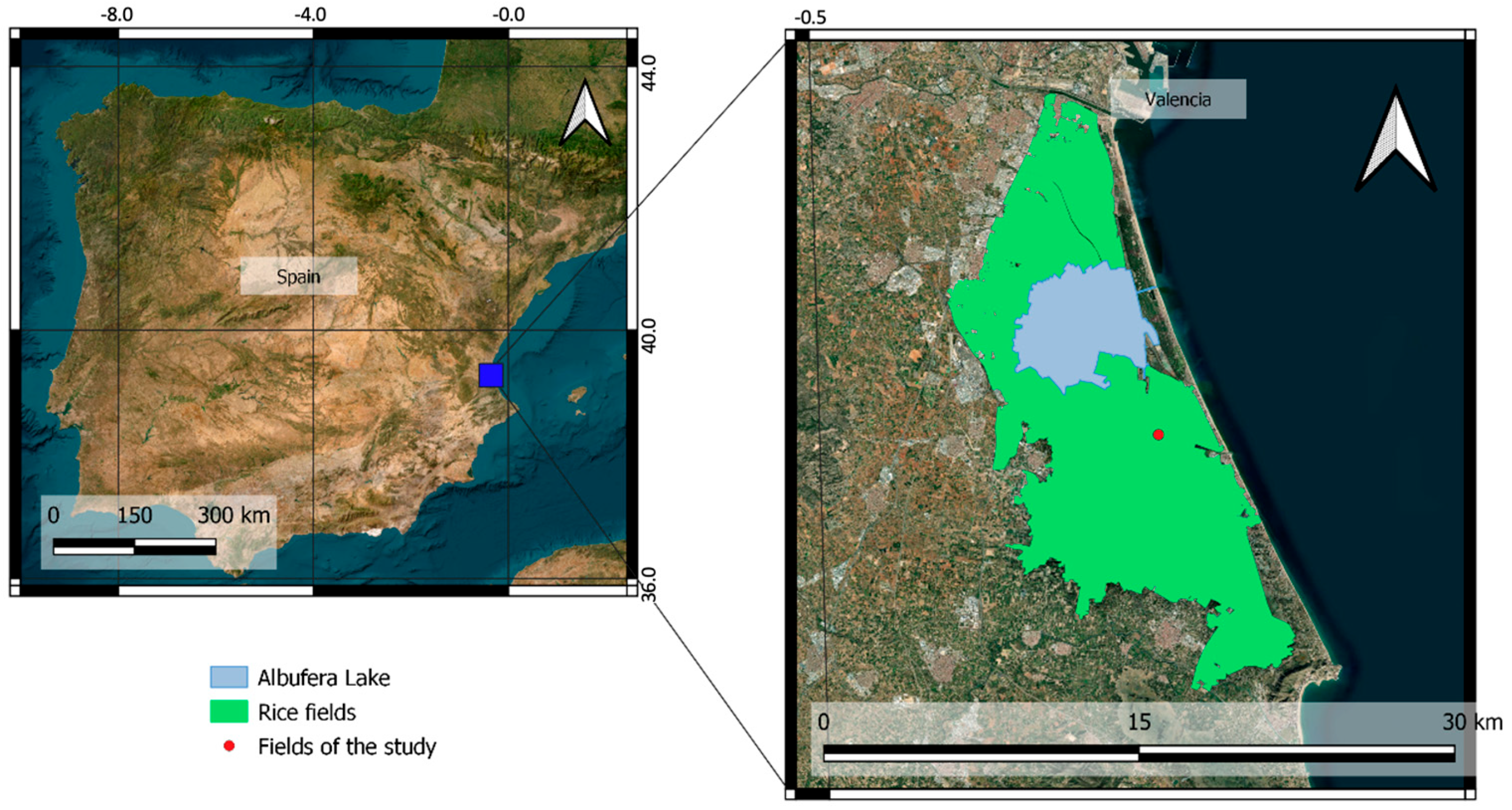
The study was carried out during two consecutive rice-growing seasons, 2024 and 2025, in a field located within the Albufera Natural Park, Valencia, Spain (39°16′60″ N, 0°22′0.01″ W) (
Figure 1). The Albufera wetland complex covers approximately 211 km
2 and is bordered by the Júcar River to the south and the Turia River to the north. The surrounding plain constitutes a highly homogeneous rice cultivation area, extending over roughly 10 × 20 km
2 of continuous paddy fields.
The regional climate is classified as subtropical Mediterranean [
36], characterized by hot and dry summers and mild winters. Soils are mainly sandy loam, with a pH of 7.8, 3.0% organic matter, and an electrical conductivity (EC) of 3.2 dS·m
−1. Irrigation water is supplied from the Albufera lake and exhibits a neutral pH (7.5) and non-saline conditions (EC = 3.2 dS·m
−1).
Water management is based on continuous flooding up to a depth of 15 cm throughout most of the growing season, except for three traditional drainage periods to allow for agronomic practices such as top-dressing fertilization, herbicide and pesticide applications, and harvesting [
37].
2.2. Variety
The rice variety studied was
Oryza sativa L. cv. ‘Bomba’, a traditional Spanish cultivar characterized by its short, round, and pearly grains. This variety is highly appreciated in culinary applications due to its elevated starch content, which contributes to a distinctive texture highly valued by the agri-food industry [
38].
‘Bomba’ is known to be highly susceptible to rice blast disease (
Pyricularia oryzae Cav.) [
39], one of the most damaging fungal pathogens affecting rice worldwide [
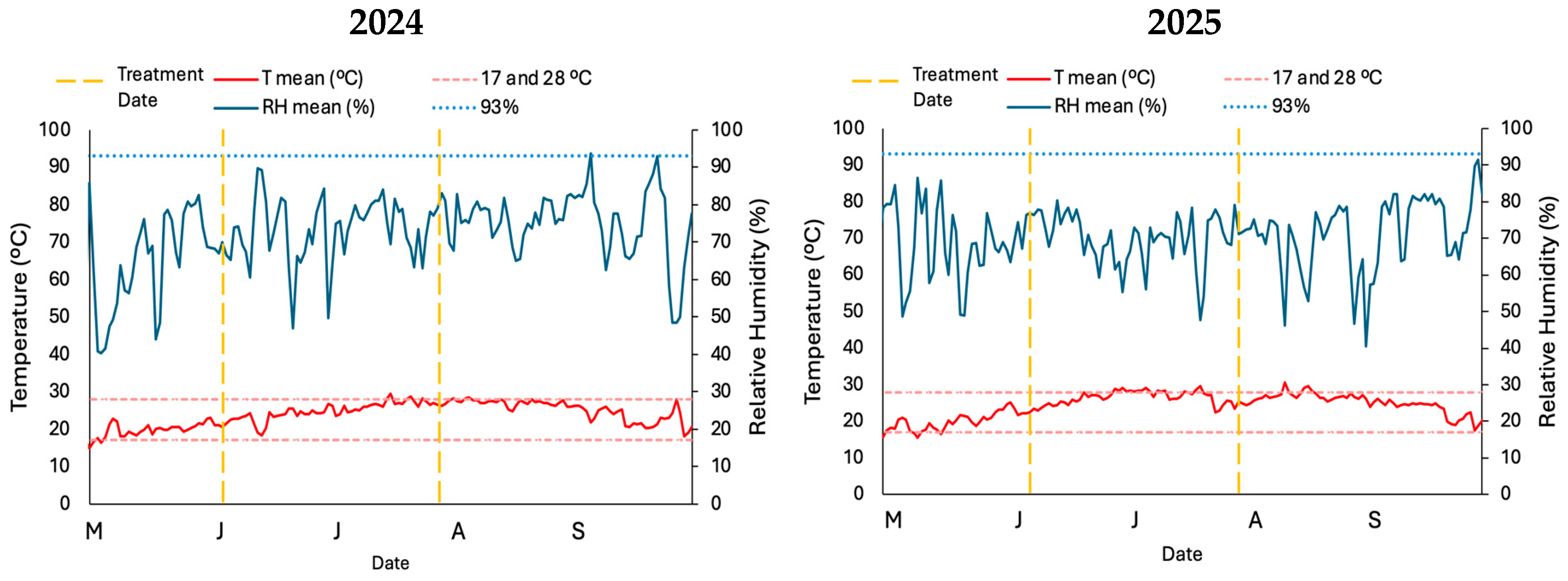
40]. The disease typically develops under warm and humid conditions, particularly when daily mean temperatures range between 17 and 28 °C and relative humidity exceeds 93% for prolonged periods (
Figure 2) [
41]. These conditions frequently occur in the Albufera region during the early tillering to panicle initiation stages, favouring the onset of primary infections.
Rice was sown on 8 of May 2024 and 11 of May 2025 (0 DAS, days after sowing), with a seeding rate of 190 kg·ha−1. Harvesting for all seasons took place approximately 110 DAS, 2 of September 2024 and 29 August 2025.
Phenological stages were classified following the BBCH scale (Biologische Bundesanstalt, Bundessortenamt und Chemische Industrie) [
42] (
Figure 3).
2.3. Experiment Setup
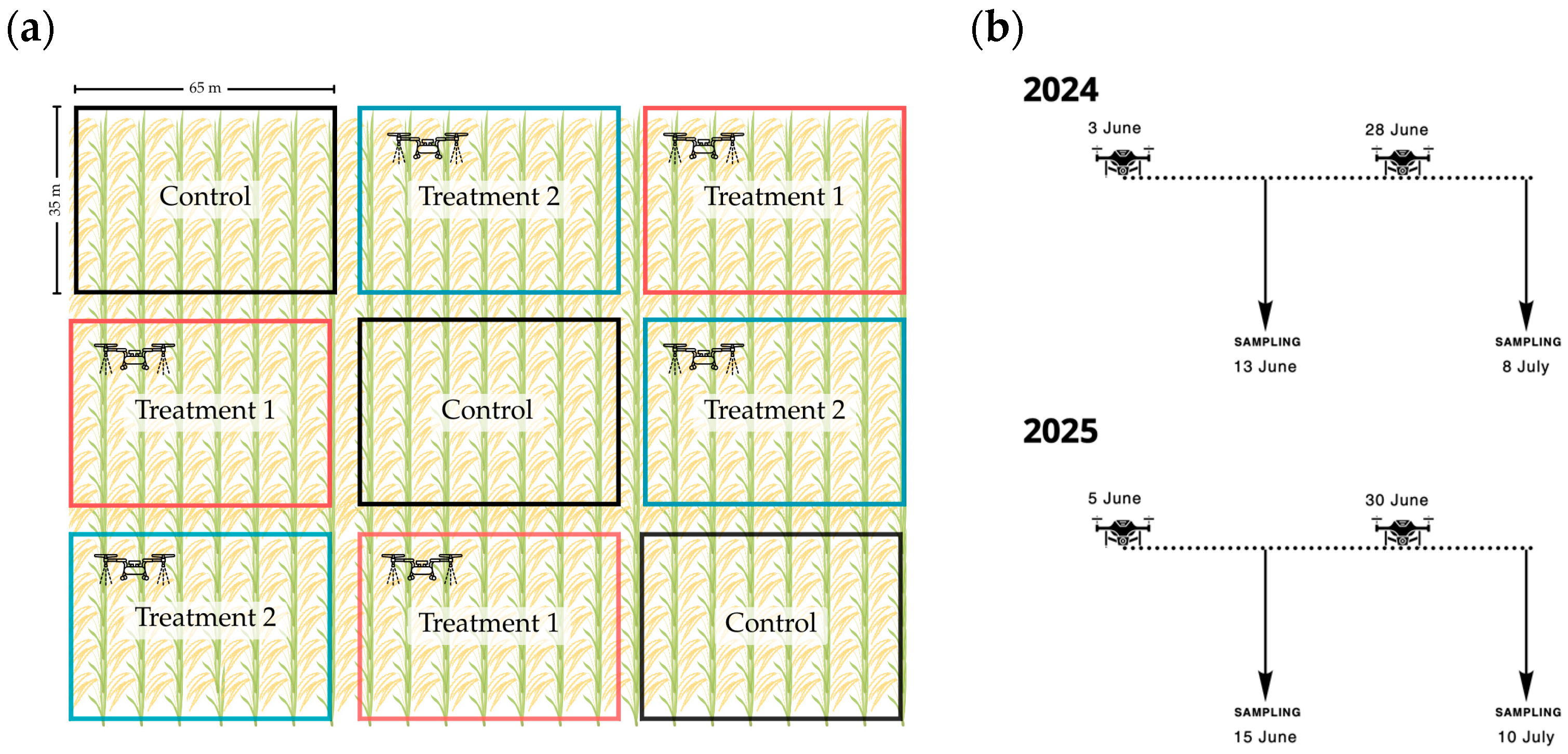
Foliar silicon applications were carried out using commercial formulations approved for foliar fertilization. Three distinct treatments were established to evaluate the effect of foliar silicon application, alone or in combination with manganese, under field conditions (
Table 1;
Figure 4a). The control treatment corresponded to the conventional management of the field, in which no foliar applications were performed using unmanned aerial vehicles (UAVs), and crop protection and nutrition followed standard local agronomic practices.
Treatment 1 consisted of a foliar application of silicon using a commercial formulation approved for foliar fertilization. The product contained 3% soluble silicon, and it was applied at a rate equivalent to 250 g of Si per hectare per application. This treatment was designed to assess the effect of silicon alone on rice performance and disease resistance under practical field conditions.
Treatment 2 was conducted under the same application protocol as Treatment 1, maintaining identical silicon concentration, formulation, and application rate. In addition to silicon, manganese was included in the spray solution using a manganese-containing formulation of 6%. This treatment aimed to evaluate the potential synergistic effects of silicon and manganese, considering the role of manganese in plant defence responses, enzyme activation, and stress tolerance. All foliar applications were carried out under comparable environmental conditions to minimize variability between treatments.
The treatments were carried out using a drone on the dates specified in
Figure 4b, and sampling was conducted before and after each application, as detailed in
Table 1. The unmanned aerial vehicle (UAV) used in this study was an EAVision model J100 (EAVision Agricultural Technology Co., Ltd., Hangzhou, China) [
43], a multifunctional agricultural spraying drone designed for field applications under real crop conditions.
The field experiment was conducted using a randomized complete block design with 3 replicated plots per treatment, each plot considered as an independent experimental unit for both agronomic measurements and remote sensing data.
The UAV was equipped with an integrated liquid spraying system, including a storage tank with a capacity of approximately 45 L, a liquid circulation system, an electric pump, electronic control units, valves, and multiple spray components. The platform incorporated an intelligent autonomous navigation system, supported by binocular vision and/or a LiDAR-based sensor suite, enabling real-time obstacle avoidance, terrain following, and adaptive flight control without the need for prior field mapping. These features allow uniform spray application over complex crop structures and uneven terrain.
The UAV was operated in autonomous spraying mode for foliar treatment application. All operational parameters were configured according to manufacturer recommendations and adapted to the experimental field conditions. The main technical specifications of the UAV used in this study are summarized in
Table 2.
The spray application parameters adopted during the UAV operations are summarized in
Table 3. Flight height, forward speed, and application rate were selected according to manufacturer recommendations and adapted to the field conditions to ensure uniform foliar coverage.
2.4. Satellite Data Using Sentinel-2
Satellite imagery was obtained from the Multispectral Instrument (MSI) onboard (European Space Agency, Paris, France) the Sentinel-2A and Sentinel-2B satellites, corresponding to tile T30SYJ. The Sentinel-2 constellation provides multispectral observations of the Earth’s surface across 10 distinct spectral bands. In this study, both the high-resolution bands (10 m) and the medium-resolution bands (20 m) were analysed to characterize spectral responses relevant to rice monitoring (
Table 4).
Cloud-free acquisition dates were identified using the Copernicus Browser platform [
44]. The corresponding Sentinel-2 images were subsequently downloaded and processed within the Google Earth Engine environment [
45] from sowing to harvest during the 2024–2025 growing seasons. Image selection was standardized across all years, aligning acquisition dates according to days after sowing (DAS) crop phenology (
Figure 3) and sampling dates (
Table 5). All processed scenes corresponded to Level-2A products, providing surface reflectance data.
Four commonly applied vegetation indices (VIs) in
Pyricularia rice detection [
29], the Normalized Difference Vegetation Index (NDVI), Ratio Vegetation Index (RVI), Normalized Difference Red Edge Index (NDRE) and Inverted Red-Edge Chlorophyll Index (IRECI), were evaluated. The equations are in
Table 6 where all variables denote surface reflectance in the corresponding spectral bands.
Taking into account the spectral characteristics of vegetations across different wavelengths, we evaluated the linear correlation between each vegetation index and the corresponding spectral bands for the dates when the crop fully covered the soil surface [
50,
51].
The temporal evolution of the NDVI was employed as an indicator of the crop’s phenological stages, following the approach proposed by Mosleh et al. (2015) [
52]. Finally, the mean values of each vegetation index (VI) were compared between the three different treatments of the experiment areas for the selected dates.
2.5. Field Measurements
2.5.1. Determination of Agronomic and Morphological Parameters
The plant LAI of each field sample collected was measured on the specified dates throughout the crop cycle. Measurements were performed within a 0.25 m
2 sampling area randomly selected inside each plot, maintaining a 10 m buffer from the field borders to avoid edge effects, with three subsamples per replication (n = 27). In addition, the marketable grain yield (kg·ha
−1) corresponding to each replication was recorded at the final sampling date. The sampling dates are detailed in
Figure 4b.
The concentrations of essential nutrients such as nitrogen (N), phosphorus (P), potassium (K), calcium (Ca), magnesium (Mg), sulphur (S), manganese (Mn), zinc (Zn), boron (Bo), sodium (Na), iron (Fe), cobalt (Co), aluminium (Al), carbon (C) and silicon (Si) were determined using samples randomly collected per treatment on the dates indicated in
Figure 4b.
Nitrogen content was determined using the Kjeldahl method following AOAC Official Method 984.13 [
53], including sample drying, grinding, acid digestion, distillation, and titration as prescribed. The remaining mineral nutrients were quantified according to AOAC Official Method 985.01 [
53], which includes wet digestion of the powdered leaf material and subsequent elemental determination using atomic absorption spectroscopy (AAS), in accordance with the standardized analytical conditions described in the method.
2.5.2. Evaluation of Pyricularia Infestation
To evaluate the infestation of
Pyricularia oryzae, the following parameters were considered: leaf incidence, leaf severity (percentage of affected area), panicle infestation percentage, neck panicle infection percentage, and the percentage of affected nodes, as defined by the International Rice Research Institute (IRRI) [
54] and following the sampling of PII (Pyricularia infestation index) in previous studies [
55].
2.5.3. Yield Data
Yield data was obtained using the Yield Trakk system 4.04.51, a monitoring software developed by Topcon (Topcon, Tokyo, Japan) [
56]. This system measures yield in real time as the harvester operates in the field. The cutting width of the harvester was 7.6 m, providing continuous yield data approximately every meter. Data were processed according to Fita et al., 2025 [
57].
2.6. Software
Processing of satellite images obtained from Google Earth Engine (GEE) [
45] for Sentinel-2 was carried out using QGIS 3.10.14 software [
58]. The statistical analyses were performed using the Scikit-learn library in Python 3.9 [
59].
2.7. Statistics
To assess the separation of means across the different levels of the studied factor, the ANOVA assumptions were evaluated. Furthermore, the LSD test was calculated and used at the statistical level to separate means only when the factor under study yielded a statistically significant F-Snedecor test value (p < 0.05).
Experiments and statistical evaluations were conducted in a Python 3.9 environment. The effects of the studied factors on physiological, spectral, nutritional, sanitary, and yield parameters were evaluated by an analysis of variance (ANOVA) using a factorial design. The main factors considered were year, treatment, and their interaction (year × treatment). When appropriate, mean separations were performed using the least significant difference (LSD) test at a significance level of p ≤ 0.05. Prior to analysis, data were checked for normality and homogeneity of variances, and no data transformation was required. Results are presented as mean values, and statistically significant differences among treatments are indicated by different letters.
3. Results
3.1. Satellite Data
To evaluate the effectiveness of the treatments in rice plant cultivation, multispectral satellite data was used. Regarding the reflectance values of the spectral bands B4 and B8 evaluated at 35 and 60 DAS,
Table 7 presents the mean values obtained for each of the studied factors. An analysis of variance indicated that the year factor had a statistically significant effect (
p < 0.01) on both bands at both evaluation times, explaining a high proportion of the total variability and highlighting clear differences between the two study years in crop spectral response.
In contrast, the treatment factor did not show a statistically significant effect on B4 or B8 reflectance values at either 35 or 60 DAS. Similarly, the year × treatment interaction was not statistically significant in any case, indicating that the observed spectral response was mainly determined by the year of cultivation, which is influenced by the climate conditions of the season, rather than by the combination of both factors.
Overall, most of the explained variability corresponded to the year factor, with very high sums of squares, particularly for band B4 at 35 DAS and band B8 at 35 DAS. Conversely, the residual showed relatively high values in some variables, especially for B4 reflectance at 60 DAS and B8 reflectance at 60 DAS, ranging from 53.85 to 64.74, indicating considerable unexplained variability at these stages of crop development.
Thus, differences in B4 and B8 reflectance are mainly associated with the year of cultivation, while applied treatments do not induce significant changes in spectral response, with high residual variability observed at 60 DAS.
Regarding the vegetation indices NDVI, RVI, NDRE, and IRECI evaluated at 35 and 60 DAS, the mean values are presented in
Table 8. An analysis of variance revealed that the year factor had a statistically significant effect (
p < 0.01) on NDVI, RVI, and NDRE at 35 DAS, whereas no significant effects of this factor were detected for any index at 60 DAS or for IRECI at either evaluation date.
The treatment factor did not show a statistically significant effect on any of the analysed vegetation indices at either 35 or 60 DAS, indicating that applied treatments did not generate detectable differences in crop spectral response as expressed by these indices. Similarly, the year × treatment interaction was not significant for most indices and evaluation times, although a statistically significant effect (p < 0.01) was observed for NDRE at 60 DAS and for IRECI at 35 DAS, suggesting a punctual response dependent on factor combination.
In general, most of the variability explained in NDVI, RVI, and NDRE at 35 DAS corresponded to the year factor, with very high values of explained variance, particularly for NDVI and RVI, exceeding 96%. However, for indices evaluated at 60 DAS and for IRECI at both evaluation times, the variability associated with the studied factors was low.
In this context, the residual showed high values, especially at 60 DAS, ranging from 47.08 to 92.96, indicating high unexplained variability during these stages of crop development.
Therefore, differences in vegetation indices mainly occur at early crop stages and are primarily associated with the year of study, while treatments do not induce significant changes in spectral response, with high residual variability observed at 60 DAS.
3.2. Agronomic and Morphological Parameters
As agronomic and morphological parameters were evaluated at 35 and 60 days after sowing (DAS), the mean values of the leaf area index (LAI) are presented in
Table 9. An analysis of variance showed that the year factor did not exert a statistically significant effect on the LAI at either evaluation date at both 35 and 60 DAS. The treatment factor showed a statistically significant effect (
p < 0.01) on the LAI at both 35 and 60 DAS. The year × treatment interaction did not show a statistically significant effect on LAI at 35 DAS.
In general terms, the variability explained by the main factors and their interaction was moderate for the LAI. This indicates a high level of unexplained variability, suggesting the influence of additional factors not considered in the experimental model. Therefore, it can be concluded that treatments mainly influence crop leaf development, which is strongly conditioned by the year of cultivation and by the year × treatment interaction, with a high associated residual variability.
Regarding macronutrient concentrations (N, P, K, Ca, Mg, and S) evaluated at 35 and 60 DAS, the mean values are presented in
Table 10. An analysis of variance showed that the year factor had a statistically significant effect (
p < 0.01) on most macronutrients, particularly on N and K concentrations at both evaluation times and on Mg, explaining a high proportion of total variability. In contrast, no statistically significant differences associated with the year factor were detected for Ca or S at either evaluation time.
The treatment factor showed a statistically significant effect (p < 0.01) mainly on K and S concentrations, especially at 60 DAS, whereas its effect on the remaining macronutrients was limited or not significant. These results indicate that crop nutritional response to treatments is element- and stage-specific.
The year × treatment interaction was statistically significant (p < 0.01) for several macronutrients, particularly N, K, Mg, and S, indicating that crop nutritional response depends on the combination of both factors. A detailed analysis of this interaction at 60 DAS revealed clear differences among treatments within each year, especially for N, K, and S concentrations, as reflected by LSD comparisons.
Overall, the variability explained by main factors and their interaction was moderate for most nutrients. However, the residual showed high values for several macronutrients, especially for Ca and S at 35 DAS and for N at 35 DAS, ranging from 39.22 to 82.07, indicating high unexplained variability and suggesting the influence of other unconsidered factors.
Thus, macronutrient concentrations are mainly conditioned by the year of cultivation and, to a lesser extent, by applied treatments, with the interaction between both factors being relevant for specific nutrients and generally high residual variability, particularly at early crop stages.
Regarding micronutrient concentrations (Fe, Mn, Zn, B, Na, Si, C, Co, and Al) evaluated at 35 and 60 DAS, the mean values are presented in
Table 11. An analysis of variance showed that the year factor had a statistically significant effect (
p < 0.01) on most of the analysed micronutrients, particularly Fe, Mn, Zn, Na, Si, C, and Al at both evaluation times, highlighting clear differences between the two study years in crop nutritional status. In contrast, the effect of year was limited or not significant for B and Co at some evaluation times.
The treatment factor showed a statistically significant effect (p < 0.01) on several micronutrients, particularly Zn, Na, Si, C, and Al, indicating that applied treatments differentially affect nutrient uptake and accumulation. However, for Fe and Mn, treatment effects were more limited or not significant at certain evaluation times.
The year × treatment interaction was statistically significant (p < 0.01) for a wide range of micronutrients, including Fe, Zn, B, Na, Si, C, and Al, demonstrating that crop micronutrient response depends on the combination of both factors. A detailed interaction analysis revealed clear differences among treatments within each year, especially at 60 DAS, as reflected by LSD comparisons for B, Na, C, and Si.
Overall, a substantial proportion of total variability was explained by main factors and the year × treatment interaction. Nevertheless, the residual showed high values for several micronutrients, particularly Fe, Mn, Zn, and Al, ranging from 25.30 to 57.81, indicating high unexplained variability and suggesting the influence of additional factors not included in the experimental design.
Therefore, micronutrient concentrations are mainly conditioned by the year of cultivation, with a relevant contribution of treatments and their interaction for specific elements, and generally high residual variability, especially for metallic micronutrients.
3.3. Pyricularia Infestation
For the
Pyricularia infestation index (PII) evaluated at 35 and 60 DAS, the mean values are presented in
Table 12. An analysis of variance showed that the year factor had a statistically significant effect (
p < 0.01) on PII at both evaluation times, indicating clear differences in infestation intensity between the two study years.
The treatment factor also showed a statistically significant effect (p < 0.01) on PII at both 35 and 60 DAS, highlighting the effect of treatments in reducing Pyricularia infestation. In this regard, lower disease incidence was observed in Si and, especially, Si + Mn treatments compared to the control.
The year × treatment interaction was statistically significant (p < 0.01) only at 35 DAS, indicating that treatment efficacy against infestation depends on the year during early crop development stages. A detailed analysis of this interaction for blast incidence at 35 DAS revealed clear differences among treatments within each year, as reflected by LSD comparisons.
Overall, a substantial proportion of the total PII variability was explained by the year and treatment factors, as well as by their interaction at 35 DAS. However, the residual showed high values, especially at 60 DAS, ranging from 1.70 to 25.93, indicating considerable unexplained variability at later crop stages.
Thus, Pyricularia infestation is strongly conditioned by the year of cultivation and applied treatments, with greater efficacy of Si and Si Mn treatments in reducing infestation, particularly at early crop stages, and higher residual variability at later stages.
3.4. Yield Data
For crop yield, the mean values are presented in
Table 13. An analysis of variance indicated that the year factor did not exert a statistically significant effect on yield, suggesting a similar productive response in both study years.
In contrast, the treatment factor showed a statistically significant effect (p < 0.01) on yield, explaining most of the observed total variability. In this sense, Si and, especially, Si Mn treatments showed significantly higher yield values than the control, highlighting a positive effect of these treatments on crop productivity. The year × treatment interaction did not show a statistically significant effect on yield, indicating that yield response to treatments was consistent across both study years.
Overall, the variability associated with the treatment factor was very high, whereas that corresponding to the year factor and the interaction was negligible. The residual showed a low value (6.06), indicating low unexplained variability and an adequate explanation of yield by the considered factors.
Therefore, crop yield is mainly determined by applied treatments, without influence of the year of cultivation, and with low associated residual variability.
The obtained results indicate that crop response was conditioned by a combination of physiological, nutritional, spectral, and sanitary factors, with a variable influence of the year of cultivation, applied treatments, and their interactions depending on the evaluated parameter and crop stage. This interannual variability is likely associated with differences in environmental conditions, particularly temperature and relative humidity, which are known to directly influence both crop development and the epidemiology of fungal diseases.
Physiological and early development parameters showed limited responses to year and treatment at early stages, whereas at later stages, a significant influence of the year and the year × treatment interaction was detected, sometimes accompanied by high residual variability, suggesting the involvement of additional factors not considered in the experimental model. Such factors may include year-specific climatic conditions that modulate plant growth dynamics and stress responses.
Regarding spectral response, both individual bands and vegetation indices showed a clear influence of the year at early crop stages, while treatments did not generate significant differences. At later stages, the high residual variability observed indicates a reduced explanatory capacity of the studied factors on canopy spectral signal, potentially linked to heterogeneous crop responses under varying temperature and humidity regimes between growing seasons.
Crop nutritional status was strongly conditioned by the year, especially for micronutrients, although treatments and the year × treatment interaction contributed significantly for specific elements, revealing differential responses in nutrient uptake and accumulation. Nevertheless, high residual values were recorded for several nutrients, reflecting high heterogeneity in nutritional response, which may also be influenced by environmentally driven variations in nutrient availability and plant demand.
From a sanitary perspective, the Pyricularia infestation index was significantly influenced by both year and treatments, with a clear reduction of infestation in Si and Si + Mn treatments, particularly at early crop stages, although with higher residual variability at later stages. Differences in temperature and relative humidity between years likely affected disease pressure, thereby modulating the apparent effectiveness of the treatments without negating their protective role.
Finally, yield was not affected by the year of cultivation but showed a highly significant response to treatments, highlighting the positive effect of Si and, especially, Si + Mn, with low residual variability, indicating a consistent and well-explained productive response. This suggests that, despite interannual climatic variability and its influence on disease development, the treatments maintained their effectiveness, with differences between years reflecting variations in environmental pressure rather than inconsistencies in treatment performance.
Overall, the results indicate that silicon-based treatments, particularly in combination with Mn, improve crop productivity and sanitary performance, while physiological, nutritional, and spectral responses are more strongly conditioned by the year and show higher unexplained variability at certain stages of the crop cycle.
4. Discussion
The present study demonstrates that rice performance was influenced by both interannual variability and silicon-based treatments, with their relative contribution depending on the trait evaluated. While several physiological, spectral, and nutritional parameters were strongly conditioned by the year of cultivation, silicon treatments, particularly in combination with Mn, consistently improved disease resistance and grain yield, highlighting the agronomic relevance of Si in rice systems.
Rice physiological development showed limited sensitivity to treatments at early stages, whereas differences became more evident at later stages of growth [
60,
61]. The absence of a consistent year effect on LAI suggests that early canopy expansion in rice was relatively stable across seasons [
62,
63]. These responses are consistent with previous findings indicating that rice growth and tiller survival are highly sensitive to interannual variability in temperature, radiation, and water availability [
64,
65].
The significant year × treatment interaction observed at later stages suggests that silicon effectiveness in rice is strongly context-dependent, reinforcing the concept that Si acts mainly as a stress-alleviating element rather than a direct growth stimulant [
66]. This behaviour is well documented in rice, where Si accumulation enhances plant resilience under biotic and abiotic stress conditions [
67]. This protective effect, comparable to that of a fungicide, is consistent with studies demonstrating that Si actively stimulates induced defences in rice following infection with
Pyricularia oryzae. Such a response includes an increase in the synthesis of diterpenoid phytoalexins [
30], thereby reinforcing the resilient capacity of the crop. The relatively high residual variability for biomass-related parameters further suggests that spatial heterogeneity and micro-environmental factors typical of field-grown rice systems may have contributed to unexplained variation.
Spectral bands and vegetation indices were mainly influenced by the year factor, particularly at early growth stages, reflecting the strong dependence of rice canopy reflectance on environmental conditions. The absence of consistent treatment effects on spectral parameters suggests that silicon-induced physiological changes were not sufficiently large to be captured by broadband vegetation indices under field conditions [
62,
66,
68]. This result is in line with previous studies indicating that spectral indices are often more responsive to environmental drivers than to moderate agronomic treatments [
69,
70].
The high residual variability observed at 60 DAS for several vegetation indices is likely associated with canopy saturation effects, which are particularly relevant in rice due to rapid canopy closure and a high LAI [
71]. At 60 DAS, reflectance integrates the effects of multiple factors, such as topography, soil moisture, and the management practices applied during earlier growth stages. Therefore, reflectance values measured in the later phases (reproductive stage) represent the cumulative outcome of these previous conditions [
72].
NDVI and related indices are known to lose sensitivity under dense rice canopies, reducing their capacity to discriminate treatment effects at later stages. This limitation may explain the weak explanatory power of the experimental factors for spectral parameters during advanced stages of rice development [
62,
70].
Rice nutritional status was strongly influenced by the year of cultivation, especially for micronutrients, reflecting the sensitivity of nutrient uptake and translocation to environmental conditions such as redox dynamics, soil moisture, and temperature in flooded or intermittently flooded systems [
64,
73]. Silicon has been shown to interact with nutrient uptake and distribution in rice by modifying root physiology, transpiration patterns, and nutrient mobility [
63,
65]. The significant effects of treatments on selected nutrients (e.g., K, S, Zn, Si) and the frequent year × treatment interactions suggest that silicon-mediated nutritional responses in rice are highly environment-dependent [
74,
75]. No deficiencies in macro- or micronutrients were detected in the crop in either year. The observed differences in nutrient concentrations were primarily associated with differences in growth dynamics across years. These findings align with previous studies reporting that Si enhances nutrient use efficiency in rice primarily under specific stress or management conditions rather than uniformly across environments [
76,
77]. The elevated residual variability observed for several nutrients further highlights the complexity of rice nutrient dynamics under field conditions, where multiple interacting processes operate simultaneously [
67].
The reduction in the Pyricularia infestation index under silicon and particularly Si + Mn treatments is one of the most consistent outcomes of this study, as evidenced by field data showing a suppression of leaf blast by 77.93% and panicle blast by 62.37% [
74]. The consistency of PII reduction across the Si and Si + Mn treatments at 35 and 60 DAS corroborates the hypothesis of sustained disease protection, outperforming the results observed in the control group. This high level of consistency is attributed to the synergistic effect between silicon and micronutrients like manganese (Mn)—found in high concentrations in fertilizers such as Multimolig-M—which enhances the plant’s metabolic robustness and structural resistance to pathogen penetration [
75]. The increasing Mn availability supports the results, which reinforces rice resistance against
M. oryzae. Such a response is associated with Mn-dependent redox metabolism (via Mn-SOD/H
2O
2) and defence mechanisms based on tissue lignification [
78]. Since Mn was integrated into the evaluated foliar treatment, the interpretation should focus on the Si × Mn nutritional interaction rather than being attributed to a specific formulation. Thus, it enhances the applicability of the findings to similar compounds while maintaining the rigor regarding the mechanisms of structural reinforcement and redox-based defence.
Furthermore, this integrated nutritional approach provides a degree of bioprotection comparable to the application of conventional fungicides, primarily because silicon actively modulates the rice plant’s defence response at a transcriptional level [
67]. Rice blast is known to be highly responsive to silicon nutrition, as silicon accumulation in rice tissues enhances both physical barriers and induced defence responses against
Magnaporthe oryzae [
60,
61].
The differences observed between silicon-based treatments, as well as those relative to the control plots, can be largely attributed to interannual climatic variability, particularly differences in temperature and relative humidity that directly modulate disease pressure. Rice blast development is strongly favoured under warm temperatures and prolonged leaf wetness or high relative humidity, conditions that are considered optimal for
Pyricularia oryzae infection and epidemic development [
41]. Consequently, variations in climatic conditions between growing seasons likely influenced the intensity of pathogen pressure, thereby affecting the apparent magnitude of treatment efficacy without compromising their protective effect.
The significant year effect on blast severity confirms that disease pressure in rice is strongly modulated by environmental conditions, particularly humidity and temperature [
60,
64]. The early year × treatment interaction indicates that silicon effectiveness in blast suppression is highly environment-dependent, influenced by the distinct climatic and seasonal conditions of each growing cycle [
74]. This observation is consistent with research showing that silicon-mediated resistance is most effective during early infection stages, as the element manifests its protective effect before or immediately after the penetration peg of
Magnaporthe oryzae attempts to enter the epidermis [
18,
77]. This efficacy is further supported by transcriptomic data demonstrating that silicon preconditions the rice plant to react to stress by differentially regulating 221 genes—including peroxidase precursors and pathogenesis-related proteins—even before the plant is challenged by the pathogen [
67]. The higher residual variability at later stages likely reflects heterogeneous disease progression and spatial variability in inoculum pressure, a phenomenon supported by findings that panicle resistance is significantly more unstable than leaf resistance and often acts as a site for new pathogen race evolution [
79]. Additionally, shifts in genotype performance across different field conditions suggest that variations in the pathogen population and inconsistent infection patterns can lead to erratic statistical estimates during the final stages of the disease cycle [
18].
A close relation was observed between the treatment that yielded gains and the notable reduction in PII during the early and mid-season. This finding suggests a direct link between crop health and final productivity: an improved sanitary status leads to higher yields. Furthermore, the efficacy of the treatment against PII varied by year at 35 DAS but not at 60 DAS, indicating the need to prioritize early preventive application windows and to standardize UAV application technology to ensure consistent results across seasons.
Despite strong year effects on many intermediate traits, rice yield was primarily driven by treatment effects, with silicon and especially silicon + Mn treatments producing significantly higher yields and low residual variability [
71]. This finding supports extensive evidence that silicon fertilization increases rice yield by improving stress tolerance, reducing disease severity, and stabilizing physiological performance under variable conditions [
54,
55,
59]. The consistency of yield response across years suggests that, although climatic conditions influenced disease development and treatment performance at intermediate stages, silicon-based treatments remained effective under contrasting environmental scenarios.
The absence of a year × treatment interaction for yield indicates that the positive effect of silicon-based treatments on rice productivity was consistent across years, highlighting their potential as a robust management strategy in rice cultivation [
63,
64]. This stability is particularly relevant under climate variability, where silicon has been proposed as a tool to buffer environmental stress and maintain yield levels, acting as a ‘quasi-essential’ element that significantly enhances plant fitness primarily under adverse conditions [
77]. Field studies demonstrate that silicon provides a bioprotective synergy that stabilizes grain production against seasonal fluctuations and resource limitations, potentially increasing yields by over 70% in high-stress environments [
74,
76]. Furthermore, by optimizing canopy architecture and reinforcing structural integrity, silicon facilitates drought tolerance and lodging resistance, ensuring sustainable productivity despite unpredictable climatic events [
18,
66,
75].
Taken together, the results indicate that silicon-based treatments, especially when combined with Mn, improve rice performance mainly through enhanced blast resistance and yield stabilization, rather than through large modifications of early physiological or spectral traits. While many physiological and nutritional responses were strongly conditioned by the year and exhibited high unexplained variability, yield response remained stable and treatment-driven, underscoring the agronomic value of silicon fertilization in rice systems.
5. Conclusions
The results of two years of experiments in the Albufera Natural Park of Valencia (2024–2025) have shown that the foliar application of Si via UAVs has significantly improved the control of rice blast incidence and has contributed positively to the increase of productivity in rice cultivation. At the same time, monitoring the disease incidence and the crop’s productive response has been possible using satellite images. However, interannual variability highlights its dependence on the specific conditions of each year. The agronomic determinations in the experimental plots showed a significant influence of the Si applications on the Pyricularia infestation index (PII) at both 35 and 60 DAS, especially in combination with Mn. The interaction between the treatment and the year revealed that the influence of applications can be determinant at the beginning of the rice growing season. Applications containing Mn can maintain a protective effect during the last phenological stages of the crop.
Foliar nutrition with Si and Mn not only reinforced the bioprotective effect on disease incidence, but also had a positive effect on the total yield in rice cultivation, with values of 4328 kg ha−1 in the fields treated with Si and 3958.5 kg ha−1 in the parcels with Si and Mn, significantly higher than the 1717 kg ha−1 of the control fields. With these results and without confirmation of a significant interaction between treatment and year, a positive effect of foliar Si nutrition on plant performance and rice crop productivity across different growing seasons is evident, this benefit being reinforced by complementary Mn nutrition. Although the agronomic effects were manifested over the two years studied, the monitoring of disease incidence and crop behaviour through reflectance and vegetation indices (NDVI, RVI, NDRE and IRECI) obtained from Sentinel-2 images was influenced by interannual variability, resulting in a significantly elevated effect on the total variance of the system. For future research, the database could be expanded and positive results obtained in detection, similar to the results already obtained and published by this research group in the segregation of disease incidence, both at intra-plot and inter-plot levels.
The transfer of the results of this work to the rice industry is evidenced by the ease of scaling up due to its ease of application, both through the use of UAVs and through the preparation of commercial formulations based on Si and Mn, elements readily available for the foliar fertilizer industry and non-patentable. In addition, the possibility of monitoring the effects of nutrition using satellite data tools improves decision making in implementing cultural practices. Therefore, the operational advantage for farmers is evident, as integrated rice blast management tools facilitate the agronomic management of rice cultivation. Future work could focus on the discrimination study using satellite images, supported by broader time series and generated from both satellite sensors and those installed on drones. In this way, advances would aim to facilitate decision making in agricultural systems to improve productivity and the efficient use of production inputs, and to reduce environmental impact.




 ,
,