Article

Structural Efficiency and Dynamic Stability of Thin-Walled Steel Profiles: A Finite Element Analysis Perspective


1
Department of Machine and Metal Technologies, Turgutlu Vocational School, Manisa Celal Bayar University, Manisa 45400, Turkey
2
Faculty of HFT Technology, Department of Mechanical Engineering, Manisa Celal Bayar University, Manisa 45400, Turkey
*
Author to whom correspondence should be addressed.
Appl. Sci. 2026, 16(6), 2846; https://doi.org/10.3390/app16062846
Submission received: 12 February 2026 / Revised: 12 March 2026 / Accepted: 13 March 2026 / Published: 16 March 2026
(This article belongs to the Section Mechanical Engineering)

Featured Application

This study presents a performance-oriented approach for the selection of thin-walled steel profiles in lightweight structural systems subjected to combined static and dynamic loading. The findings provide a comparative evaluation of the deformation, deflection, force distributions, and modal characteristics of C-, M-, U-, and Z-section profiles. The results support performance-based structural design, enabling the development of safer, more robust, and weight-efficient steel structural systems.

Abstract

Cold-formed thin-walled steel profiles are among the principal load-carrying components of lightweight steel structures, and their cross-sectional geometry plays a significant role in structural performance. C-, M-, U-, and Z-profiles are widely preferred in lightweight structural applications. This study presents a finite element-based, performance-oriented comparison of C-, M-, U-, and Z-section thin-walled steel profiles with comparable overall geometric dimensions. Directional deformation and deflection were investigated under different loading and boundary conditions. Modal analyses were also carried out to examine the natural vibration characteristics of the profiles. The results indicate that the C-section exhibited the lowest directional deformation, demonstrating the highest stiffness among the investigated profiles. In contrast, the Z-section exhibits greater lateral stiffness due to its asymmetric cross-sectional geometry. The findings demonstrate that cross-sectional geometry significantly influences the bending stiffness, torsional sensitivity, and vibration characteristics of thin-walled steel profiles. Overall, the results present a comparative assessment of commonly used thin-walled steel profiles and provide a numerical reference for selecting suitable profile geometries in lightweight structural applications.

1. Introduction

Thin-walled beams and tubes are fundamental structural components widely employed in various engineering applications, including mechanical, aerospace, marine, and construction engineering [1]. These structural members are commonly adopted in industrial buildings, warehouse structures, bridges, steel construction systems, prefabricated structural frameworks, automotive applications, and machinery manufacturing. The application of steel profiles, particularly in thin-walled steel structural systems, has increased considerably in recent years due to their high structural efficiency and favorable strength-to-weight ratio [2].
Thin-walled steel members are generally produced through cold-forming processes, which enable the fabrication of structural components with high dimensional accuracy and superior surface quality. Due to their thin wall thickness and diverse cross-sectional geometries, thin-walled steel members are widely employed in numerous structural engineering applications. Furthermore, galvanized coatings enhance the corrosion resistance and long-term durability of these structural elements [3,4].
With the advancement of modern manufacturing technologies and increasing industrial demand, cold-formed structural profiles such as C-, U-, and I-sections have become widely adopted structural elements in lightweight steel construction systems [5]. Profiles used in thin-walled steel systems exhibit various geometric configurations depending on structural design requirements. These profiles, commonly denoted as C-, U-, and Σ, are manufactured using cold-forming techniques, and each profile type exhibits distinct structural characteristics and application-specific performance [6]. Consequently, a comprehensive understanding of the mechanical properties and structural response of these profiles under external loading conditions is essential for the safe and efficient design of steel structures [7].
C-, M-, U-, and Z-section thin-walled profiles generally possess relatively high slenderness ratios and may exhibit complex structural responses under external loading conditions. Due to their open cross-sectional geometry, bending and torsional effects may occur simultaneously, leading to the development of significant warping deformations within the cross-section. Warping effects in open thin-walled members may produce both in-plane and out-of-plane deformation components, which significantly influence the overall structural response. Consequently, the analysis of such structural members requires advanced analytical formulations and numerical simulation techniques [1,8].
The classical Euler–Bernoulli beam theory is one of the most widely adopted analytical approaches for describing the bending behavior of slender beam elements in engineering structures [9,10]. This theory assumes that cross-sections remain plane and perpendicular to the neutral axis during deformation, while neglecting transverse shear deformation effects [11]. However, for thin-walled open sections, torsional resistance is generally limited, and the eccentricity between the centroid and the shear center may induce flexural-torsional coupling effects. Under such circumstances, classical Euler–Bernoulli beam theory may not fully capture the complete structural response of these members [10,12]. To address these limitations, more advanced theoretical approaches have been developed. Vlasov’s thin-walled beam theory describes the torsional behavior of open thin-walled sections by considering both Saint–Venant torsion and warping torsion mechanisms. According to this theory, the torsional response of thin-walled members consists of the combined effects of shear stresses generated by Saint–Venant torsion and additional stiffness contributions resulting from restrained warping deformation [13]. When loads are applied away from the shear center, a torsional moment and a bimoment may develop within the structural member. As the eccentricity between the load application line and the shear center increases, the magnitude of the bimoment increases and may significantly influence the load-carrying behavior of the structural element [2].
In addition to these analytical approaches, deformation mechanisms in thin-walled beams that cannot be fully represented by classical beam theory can be explained using Generalized Beam Theory (GBT). GBT provides an advanced analytical framework capable of representing bending, torsion, and cross-sectional deformation modes in thin-walled members, and it is frequently combined with finite element analysis to investigate complex structural behavior [1].
Finite element analysis (FEA) has become a powerful and cost-effective numerical approach for investigating the structural behavior of materials and engineering systems, providing an efficient alternative and complement to experimental testing [14]. In recent years, computer-aided numerical simulations have become an important research tool for analyzing structural responses such as stress, strain, deflection, deformation, and vibration induced by external forces in mechanical systems. Structural analysis software such as ANSYS enables accurate numerical evaluation of these responses during the design stage and provides an efficient computational framework for investigating complex structural behavior with high accuracy [15].
Several studies reported in the literature have investigated the structural and dynamic behavior of thin-walled members. Iandiorio and Salvini [1] developed a geometrically nonlinear shell theory to examine the behavior of open and closed thin-walled tubular shells subjected to large displacements and rotations, and validated their results using finite element simulations. Atya et al. [16] investigated the compressive and bending capacities of cold-formed channel and Z-sections using validated finite element models and evaluated the influence of parameters such as member length, section ratios, plate thickness, and yield strength on structural capacity. Papangelis [17] derived analytical expressions for torsional rotation, bimoment, sectorial coordinates, and longitudinal stresses in thin-walled channel sections subjected to uniformly distributed loads and validated the analytical predictions using finite element analysis. Xia et al. [8], conducted parametric studies using validated shell finite element models to investigate the torsional capacity and flexural-torsional interaction of thin-walled C- and Z-sections. Mohamed et al. [18] examined the influence of perforations on the load-carrying capacity and strength-to-weight ratio of cold-formed steel cantilever beams, with particular emphasis on C-shaped sections.
The dynamic behavior of thin-walled members has also been investigated in several studies. Yunjie et al. [10] developed a model that combines Timoshenko and Vlasov beam theories to investigate the dynamic response of thin-walled beams subjected to axial loading. In their formulation, the coupled effects of bending, torsion, and axial vibration were considered to accurately represent the dynamic behavior of the beams. Sahraei et al. [19] developed a finite element formulation to examine the free vibration characteristics and dynamic behavior of thin-walled members with asymmetric cross-sections. Their model incorporates shear deformation, warping effects, and inertial coupling, enabling a more comprehensive representation of the dynamic response of such structural elements. Nkounhawa et al. [20] investigated the free vibration characteristics of simply supported thin rectangular plates using finite element simulations in ANSYS and compared the obtained natural frequencies with analytical predictions. Adavadkar and Admuthe [21] investigated the static response of rectangular plates using a finite element model implemented in ANSYS. Stress distribution, deformation behavior, and other structural responses were evaluated under various boundary conditions and loading configurations.
Despite the research conducted on thin-walled steel members, most studies have focused on cross-sectional geometries and specific loading conditions. Comparative studies evaluating different thin-walled profile geometries under boundary conditions and numerical modeling approaches are relatively limited. Studies that simultaneously examine deformation characteristics, deflection behavior, structural performance at the lattice system, and modal response for different thin-walled steel profile types are scarce in the existing literature. Therefore, this study presents a comprehensive comparison of the static and dynamic structural behavior of thin-walled steel profiles and illustrates the influence of cross-sectional geometry on structural stiffness, torsional sensitivity, and natural vibration characteristics. Furthermore, this study contributes to the literature by providing a unified numerical framework for evaluating the static and dynamic performance of commonly used thin-walled steel profiles.

2. Materials and Methods

2.1. Analysis Model

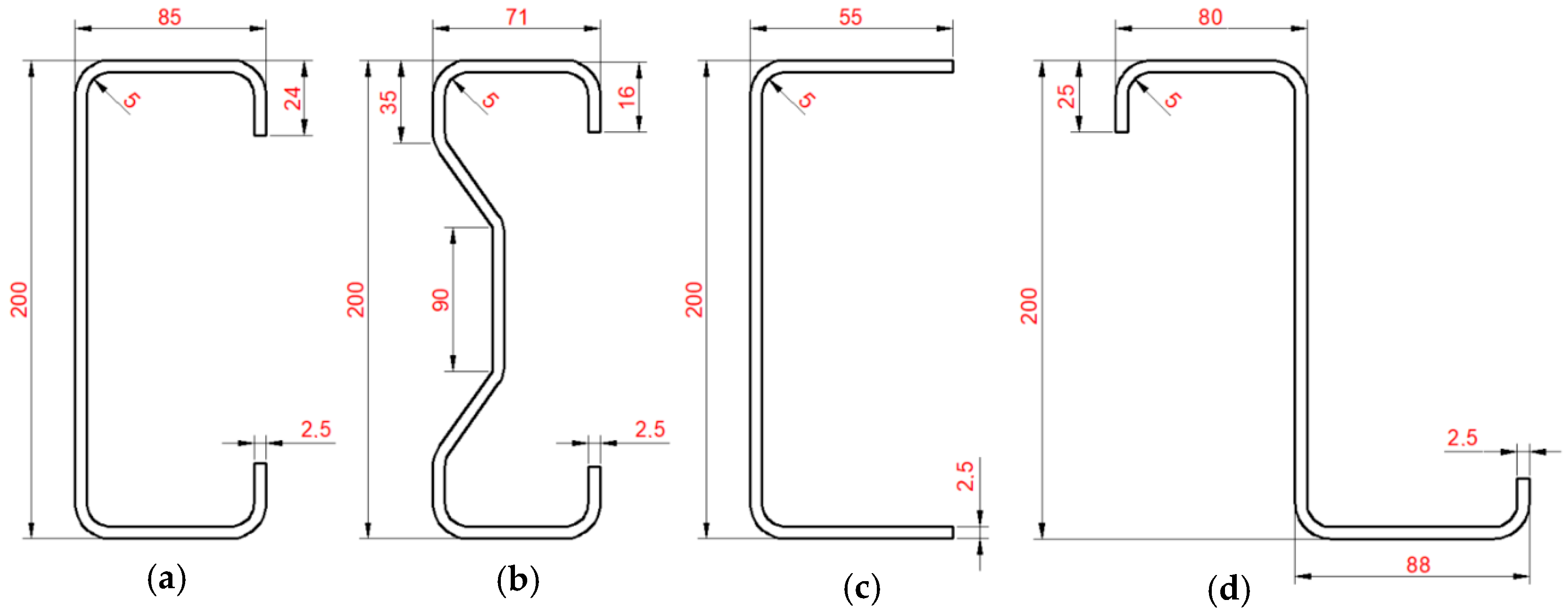
In this study, thin-walled steel profiles with C-, M-, U-, and Z-sections, which are widely used in structural applications due to their high strength-to-weight ratio and load-bearing capacity, were analyzed using the finite element method (FEM). The numerical analyses were carried out using ANSYS 2024 R1 software [22]. Profile geometries were created in the ANSYS DesignModeler program using the Concept > Lines from Sketches > Cross-Section definition approach. For each profile, the cross-sectional area, moments of inertia, and other relevant sectional properties were calculated based on the cross-section definition. Profile types and cross-sectional dimensions used in the analysis are given in Figure 1. To compare the structural responses, including deflection and deformation behaviors, commercially produced profiles with a width of 200 mm and a wall thickness of 2.5 mm were selected. The geometric and physical properties of the profiles used in the analysis are presented in Table 1.
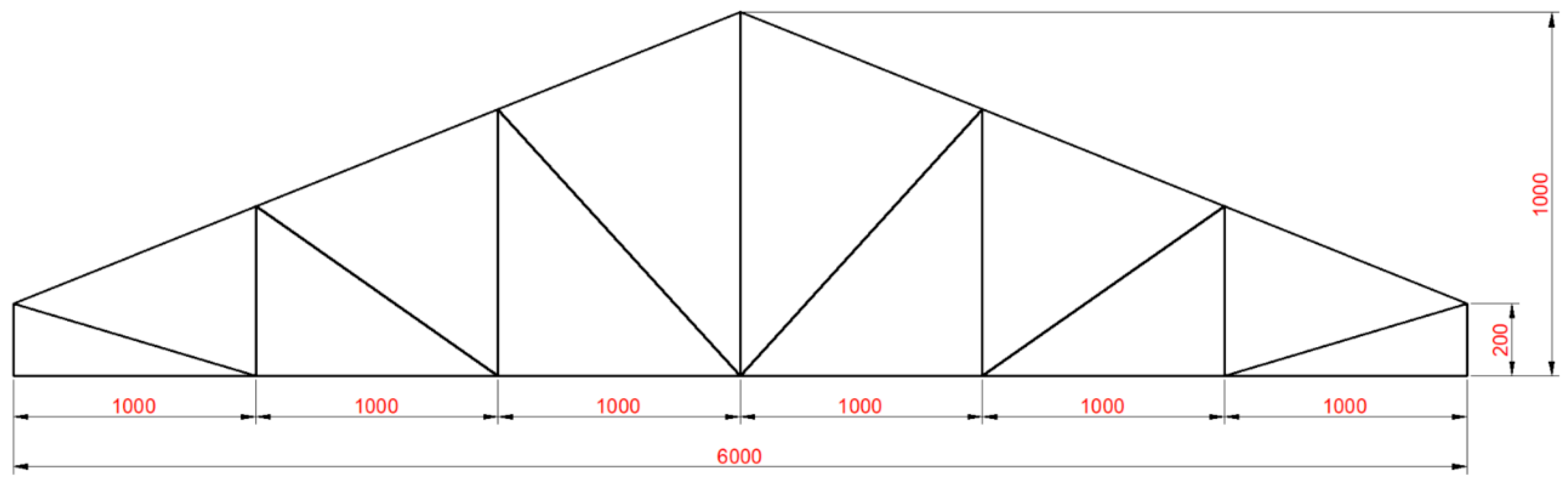
In addition, the behavior of the profiles whose deflection and deformation behavior were investigated using the finite element method was further evaluated within a representative triangular lattice structure. The structural responses of the profiles were compared in terms of directional deformation, total bending moment, total shear force, and axial force. The dimensions and geometric characteristics of the designed triangular lattice structure are given in Figure 2 and Table 2.

2.2. Theoretical Foundations

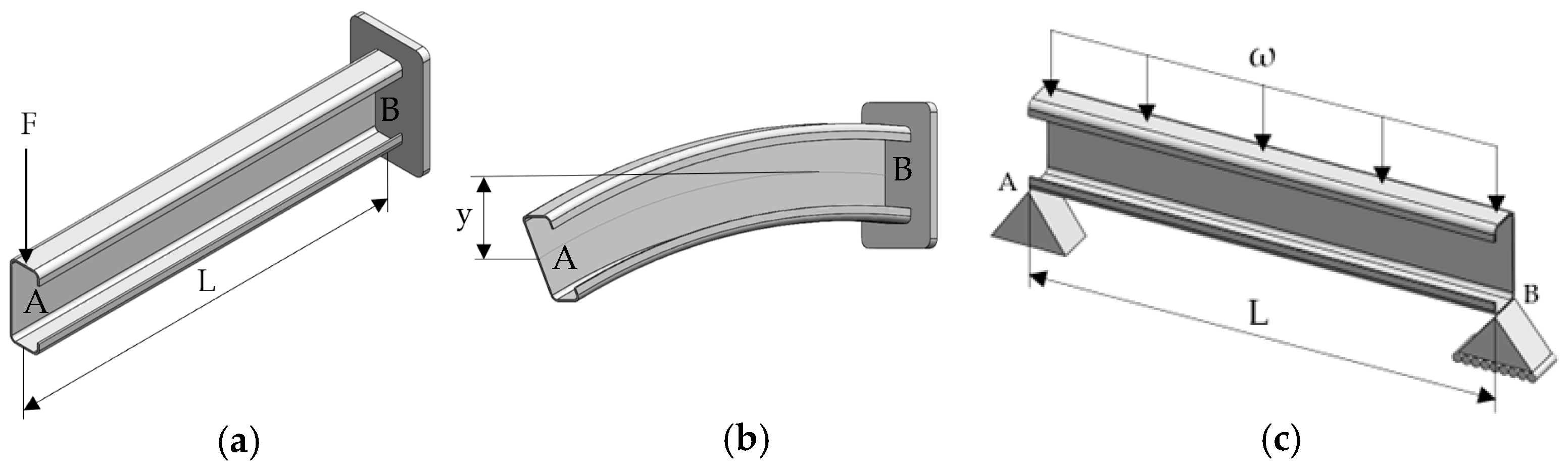
The following theoretical formulations are used to support the numerical analyses conducted in this study. Figure 3a illustrates a cantilever beam AB of uniform cross-section subjected to a concentrated load F at the free end A. The maximum deflection occurs at the free end, denoted by y (Figure 3b) [23].
The maximum deflection at the free end is given by [23]:
y = F L 3 3 E I
Figure 3c represents the simply supported prismatic beam AB carrying a uniformly distributed load ω per unit length. The maximum deflection occurs at the midpoint x = L / 2 and is expressed as [23]:
y m a x = 5 ω L 4 384 E I
Euler–Bernoulli theory neglects transverse shear deformation. When shear effects become significant, the structural response is described using Timoshenko beam theory, in which the transverse displacement w x and cross-sectional rotation ϕ x are treated as independent field variables. The static equilibrium and constitutive relations for a prismatic beam are expressed as [24,25,26]:
d d x κ G A w ϕ + q x = 0
d d x E I ϕ + κ G A w ϕ = 0
where G is the shear modulus, A is the cross-sectional area, and κ is the shear correction factor. For uniform cross-sections ( E I and κ G A constant), Equations (3) and (4) reduce to
κ G A w ϕ + q x = 0
E I ϕ + κ G A w ϕ = 0
In torsion-dominated cases, bending-based formulations are insufficient to represent the structural response. Therefore, the analysis is carried out within the Saint–Venant torsion framework, which assumes unrestrained warping and a constant twist rate along the member. The torsional equilibrium equation is expressed as [10,13,17,27,28]:
d T d x + m x = 0
together with constitutive relation
T x = G J θ x
where T x is the internal torque, m x is the distributed torsional moment per unit length, J is the torsional constant, and θ x is the twist angle.
For m x = 0 , Equations (7) and (8) yields
G J θ x = 0
For a constant distributed torsional moment m t , combining Equations (7) and (8) gives
G J θ x + m t = 0
Under boundary conditions θ 0 = θ L = 0 , the twist distribution becomes
θ x = m t 2 G J L x x 2
and the maximum twist at midspan is
θ m a x = m t L 2 8 G J
For open thin-walled sections, torsion induces longitudinal warping displacements and associated normal stresses that cannot be represented by Saint–Venant torsion alone. Therefore, the torsional response is described using Vlasov thin-walled beam theory. The total torsional moment consists of Saint–Venant and warping contributions [10,17,27,28,29]:
T x = G J θ x E I ω θ x
where G J is the Saint–Venant torsional rigidity and E I ω represents the warping rigidity. The bimoment associated with restrained warping is defined as
B x = E I ω θ x
The torsional equilibrium condition is
d T d x + m x = 0
Substituting the generalized torsional moment expression into the equilibrium relation yields the governing Vlasov torsion equation reduces to
G J θ x E I ω θ x + m x = 0
For the loading condition considered in the present study m x = 0 , the equation reduces to
G J θ x E I ω θ x = 0
Performing a free vibration analysis is an essential initial step for any structure before proceeding with linear or nonlinear analyses involving external, time-dependent loading conditions [30]. Modal analysis is the primary method used to identify the vibration characteristics of engineering structures. This technique determines the mode shapes, natural frequencies, and damping ratios of a system. The Euler–Bernoulli beam theory is commonly used as a mathematical model to investigate dynamic properties such as natural frequencies and mode shapes [31]. The natural angular frequency is [19]:
ω n = β n L 2 E I ρ A
where ω n is the natural angular frequency (rad/s), L is the beam length, E is Young’s modulus, I is the moment of inertia, ρ is the material density, and A is the cross-sectional area. β n is the modal coefficient determined by the boundary conditions of the cantilever beam ( β 1 = 1.875 , β 2 = 4.694 , β 3 = 7.855 , …, etc.) [19]. Finally, natural frequency is obtained from the natural angular frequency as [31]:
f n = ω n 2 π
where f n is the natural frequency in hertz (Hz) and ω n is the natural angular frequency [19]. Combining Equations (18) and (19) yields
f n = 1 2 π β n L 2 E I ρ A

2.3. Material Assignment

S350 GD sheet metal, which is widely used in industry, was preferred as the profile material for the analysis. The mechanical and physical properties of S350 GD steel are given in Table 3.

2.4. Finite Element Model and Meshing

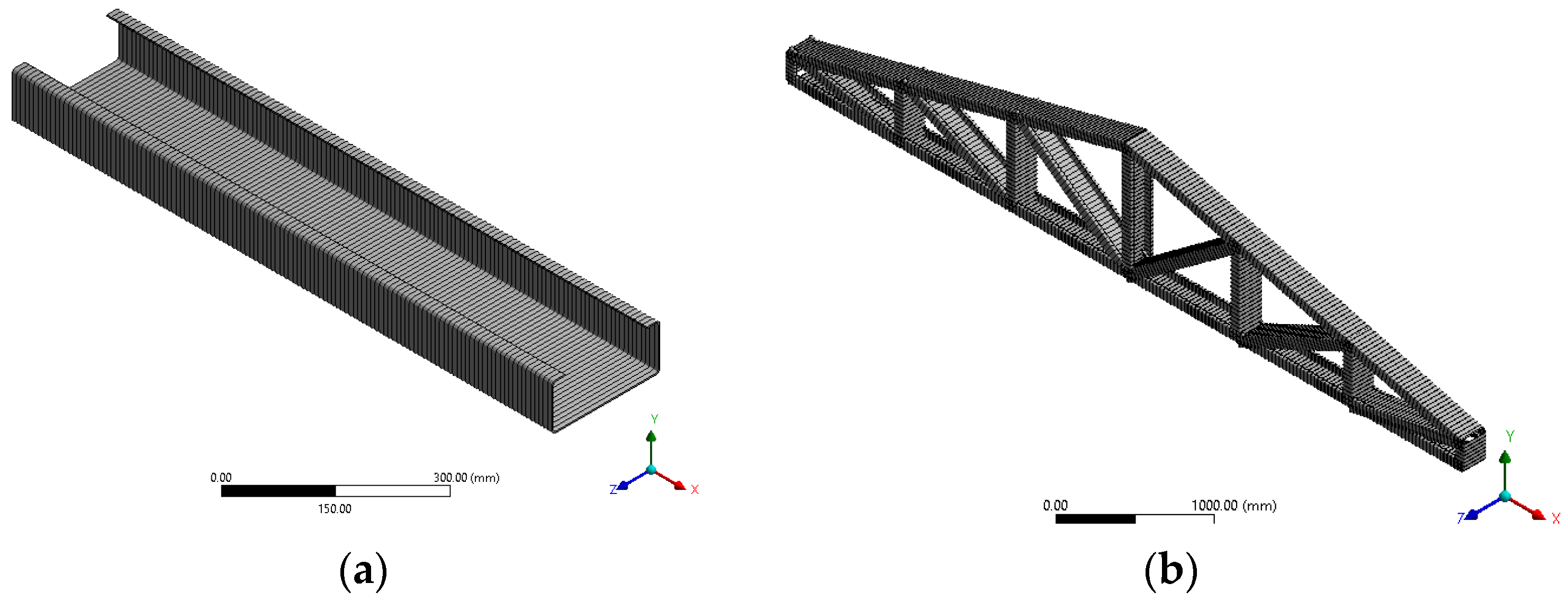
The meshing process involves discretizing geometry into finite elements of appropriate size and type. Mesh quality plays a critical role in the accuracy and reliability of finite element analysis, as it enables complex physical behavior to be represented numerically [33]. Following load application, stress and strain responses are computed at the nodal points of these elements [34]. The profiles were modeled in the ANSYS MAPDL environment using the BEAM188 formulation, which is a three-dimensional beam element. BEAM188 has three translations (UX, UY, UZ) and three rotational (ROTX, ROTY, ROTZ) degrees of freedom at each node. For the baseline configuration, each profile was discretized using 500 BEAM188 elements and 1001 nodes (Figure 4a), resulting in a total of 6006 degrees of freedom (DOF). The triangular lattice system was discretized into 22,742 finite elements and 45,473 nodes (Figure 4b).
To verify mesh convergence with respect to the directional deformation, a mesh convergence study was performed for the C-section under static loading conditions. The element sizes varied from 1 to 64 mm, and the results were compared based on the directional deformation values. As presented in Table 4, the relative difference in directional deformation was below 0.229% for the 32-element mesh and decreased to 0.028% for the 63-element mesh. The percentage difference was 0.012% for the 250-element model and 0.0015% for the 500-element model.
These results demonstrate asymptotic convergence of the numerical solution, indicating that the results become largely mesh-independent beyond 250 elements. Accordingly, an element size of 2 mm (500-element mesh) was selected as an appropriate compromise between computational efficiency and numerical accuracy.

2.5. Finite Element Analysis Conditions

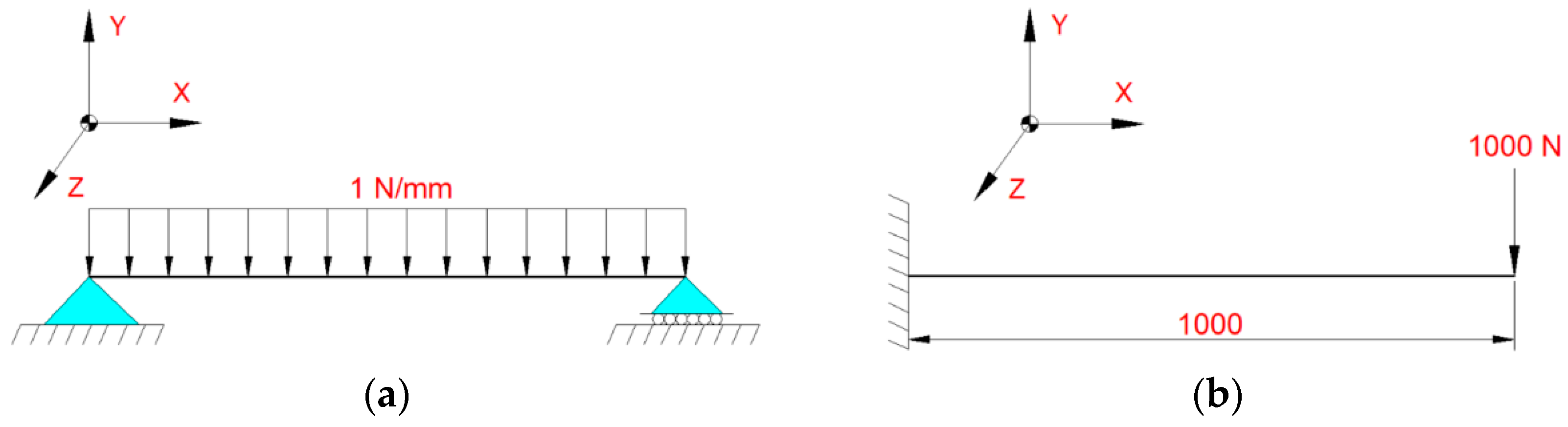
The analyses were performed assuming linear elastic material behavior and geometric linearity, with the large deflection effects deactivated. The global system of equations was solved using the sparse direct solver in ANSYS MAPDL, assuming symmetric matrices. To investigate the directional deformation behavior of the C-, M-, U-, and Z-section profiles, a uniformly distributed load of 1 N/mm (Figure 5a) and a concentrated load of 1000 N were applied along both the centroidal axis and the shear center line of the cross-section. For deflection analysis, the profiles were modeled as cantilever beams, fixed at one end and subjected to a concentrated load of 1000 N applied at the free end, as shown in Figure 5b. In the cantilever analysis, one end of the member was defined as a fixed support, and all translational and rotational degrees of freedom (UX, UY, UZ, ROTX, ROTY, ROTZ) were constrained. The opposite end was left completely free. In the simply supported analyses, one end was defined as a remote displacement, and all translational and rotational degrees of freedom (UX, UY, UZ, ROTX, ROTY, ROTZ) were constrained. At the opposite end, the rotational degrees of freedom and the translational degrees of freedom in the Y and Z directions (UY and UZ) were left unconstrained, while the displacement in the X direction (UX) was constrained. In both loading conditions, the loads were applied independently in the Y and Z directions to investigate direction-dependent structural responses. The resulting deformation and deflection responses along both axes were compared to evaluate the influence of cross-sectional geometry.
Additionally, 1 N/mm and 1000 N loads were selected as reference levels to enable the comparative evaluation of the structural behavior of different cross-sectional types, and do not represent ultimate loading conditions or specific service states. The analyses were performed under linear elastic conditions, and the structural response was therefore proportional to the applied load. Accordingly, the results were evaluated in terms of relative stiffness and deformation characteristics.
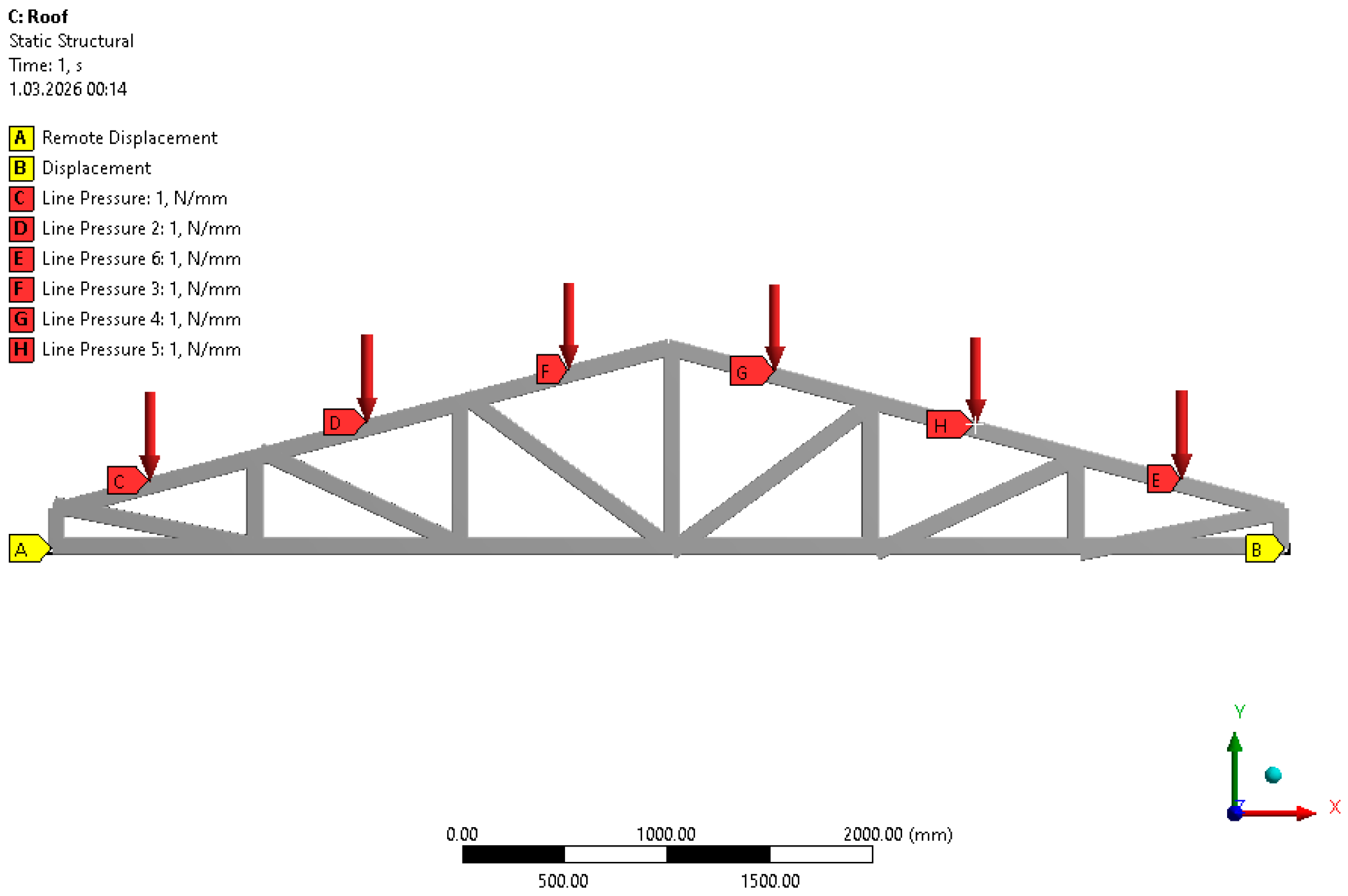
The triangular lattice structure was analyzed under a uniformly distributed load of 1 N/mm for models incorporating different cross-sectional profiles. At one end, a remote displacement (UX, UY, UZ, ROTX, ROTY, ROTZ = 0) boundary condition was applied. At the opposite end, a simply supported boundary condition (Displacement) was defined by restraining UY, UZ, ROTX, ROTY, ROTZ, while UX was unconstrained. The structural response of the lattice system was evaluated in terms of directional deformation, total deformation, and the distributions of bending moment, shear force, and axial force. The applied boundary conditions and loading configuration for the triangular lattice system are illustrated in Figure 6.
To evaluate the deformation characteristics of the C-, M-, U-, and Z-section profiles in terms of their natural frequencies and mode shapes, the 1000 mm-long profiles were fixed at one end and analyzed using modal analysis. Modal analyses were performed using a linear eigenvalue extraction procedure. The reported mode shapes correspond to normalized eigenvectors generated by ANSYS and represent relative deformation patterns rather than physical displacement amplitudes. For each profile, the first six vibration modes were extracted, and the corresponding total deformation amplitudes associated with each mode were determined.

2.6. Limitations of the Numerical Model

In the study, the finite element analyses were performed assuming linear elastic material behavior and geometric linearity. Large displacement effects, material nonlinearities, and geometric imperfections were not considered in the analysis. Moreover, local buckling phenomena in thin-walled structures were not evaluated through separate nonlinear buckling analysis. The cross-sectional profiles were modeled as full cross-sections, and perforated sections were not analyzed. Additionally, residual stresses resulting from cold-forming processes and manufacturing tolerances were not included in the numerical analysis. The connection areas were assumed to behave ideally, and joint flexibility, slip, and contact nonlinearities were not modeled. The modal analyses were carried out using an undamped eigenvalue problem. Damping effects and forced dynamic response behavior were not considered in the study.

3. Results and Discussion

3.1. Directional Deformation Results of Simply Supported Profiles

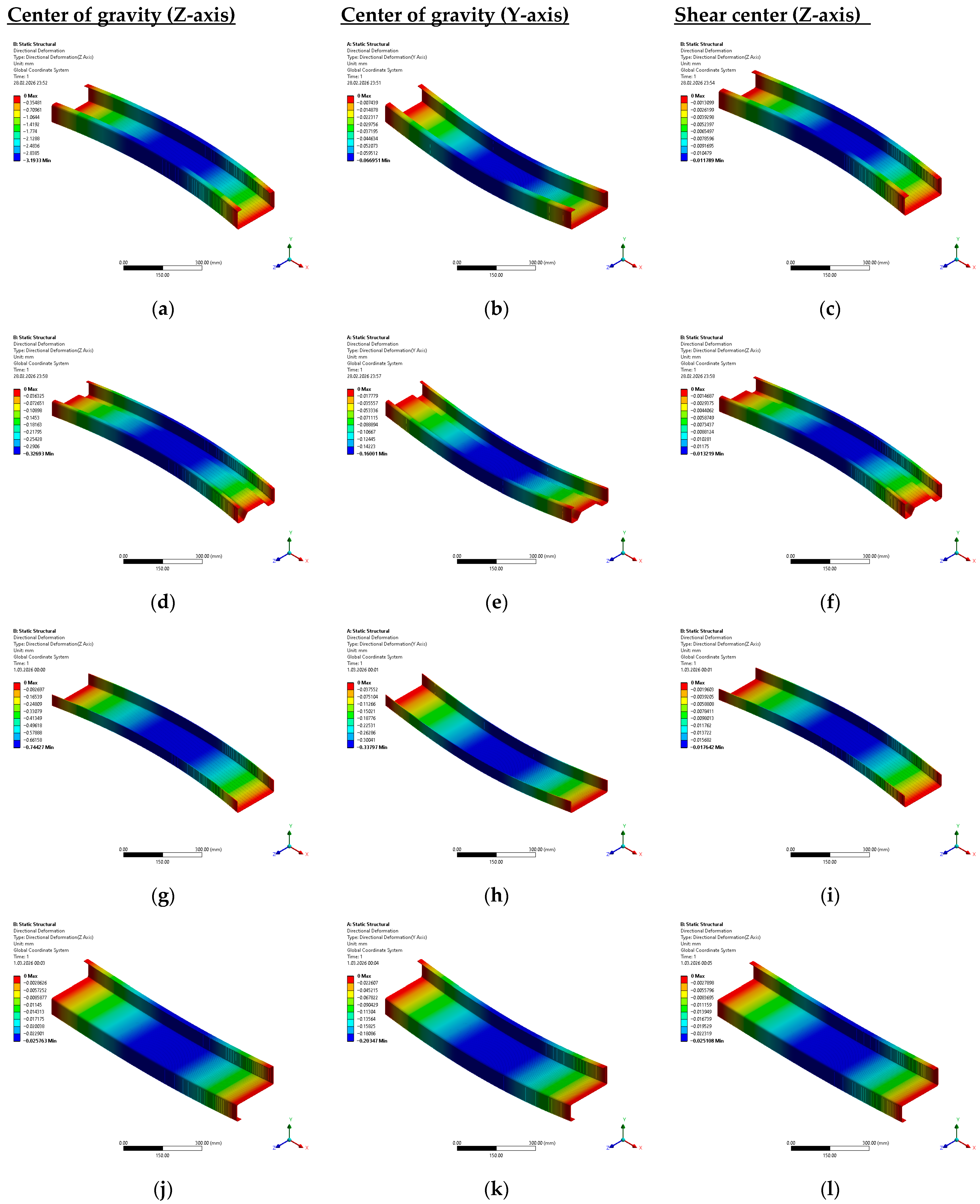
In structural design, performance characteristics include axial forces, shear forces, bending moments, deflections, and support reactions. Accordingly, structural analysis typically involves the determination of these response quantities under specified loading conditions [35]. The directional deformation responses obtained from the application of a uniformly distributed load of 1 N/mm along the centroidal axis and shear center line of the C-, M-, U-, and Z-section profiles are presented in Figure 7. The deformation magnitudes derived from the numerical analyses are summarized in Table 5.
To evaluate the accuracy of the finite element model, a theoretical calculation was carried out for the C-section profile. The maximum deflection of a simply supported beam subjected to a uniform load was calculated using classical Euler–Bernoulli beam theory. For a beam under a uniformly distributed load ω , the maximum midspan deflection is given in Equation (2). Substituting the numerical values into Equation (2) for the Y-axis direction, considering the load applied at the CG line:
y m a x = 5 ω L 4 384 E I = 5 × 1 × 1000 4 384 × 2.05 × 10 5 × 9.7187 × 10 5 = 0.0654   mm
When theoretical value is compared with the corresponding FEM result, the percentage error is calculated as:
Error   ( % ) = y F E M y t h y t h × 100 = 0.066951 0.0654 0.0654 × 100 = 2.37
The obtained theoretical value is consistent with the theoretical results reported in Table 5, confirming the validity of the bending formulation for the simply supported under uniformly distributed loading.
The moment of inertia represents the resistance of a structural member to bending about a specific axis [7]. A higher moment of inertia increases the resistance to bending deformation. Among the investigated profiles, the C-section exhibits the highest moment of inertia (Table 1). Accordingly, the directional deformation results presented in Table 5 and Figure 7 indicate that the smallest deformation under loading in the Y-direction applied along the centroidal axis occurs in the C-section profile, with a value of −0.066951 (Figure 8b). In contrast, the Z-section exhibits the largest deformation response, particularly in the Y direction. This behavior arises from the non-coincidence of the centroid and the shear center, which induces additional torsional effects under transverse loading. This phenomenon is commonly referred to as the Wagner effect [36]. Under this configuration, the applied load generates not only bending but also a torsional component due to the centroid-shear center eccentricity.
For the Z-section, the open and monosymmetric geometry results in a centroid-shear center offset. Consequently, transverse loading applied through the centroid generates an additional torsional moment, leading to flexural-torsional coupling. Thin-walled beam formulations show that the shear center eccentricity activates torsional response in open sections, producing a torsional component even under bending-dominated loading conditions [37].
In such open thin-walled sections, torsion cannot be described solely by Saint–Venant uniform torsion. Restrained warping induces longitudinal normal stresses and introduces an additional stiffness contribution associated with warping rigidity E I ω . Therefore, the torsional response is governed not only by the Saint–Venant term G J , but also by the warping stiffness component E I ω , as described in thin-walled beam formulations [28].
Accordingly, the directional displacement observed in the Z-profile cannot be characterized exclusively by the bending rigidity E I . Instead, the response is governed by the combined effects of bending stiffness E I , shear stiffness κ G A , Saint–Venant torsional rigidity G J , and warping rigidity E I ω . In contrast, for the C-, M-, and U-section profiles, the applied loading configuration does not activate significant flexural-torsional interaction. As a result, the deformation response remains predominantly bending-controlled, explaining the agreement between Euler–Bernoulli predictions and FEM results for these sections.
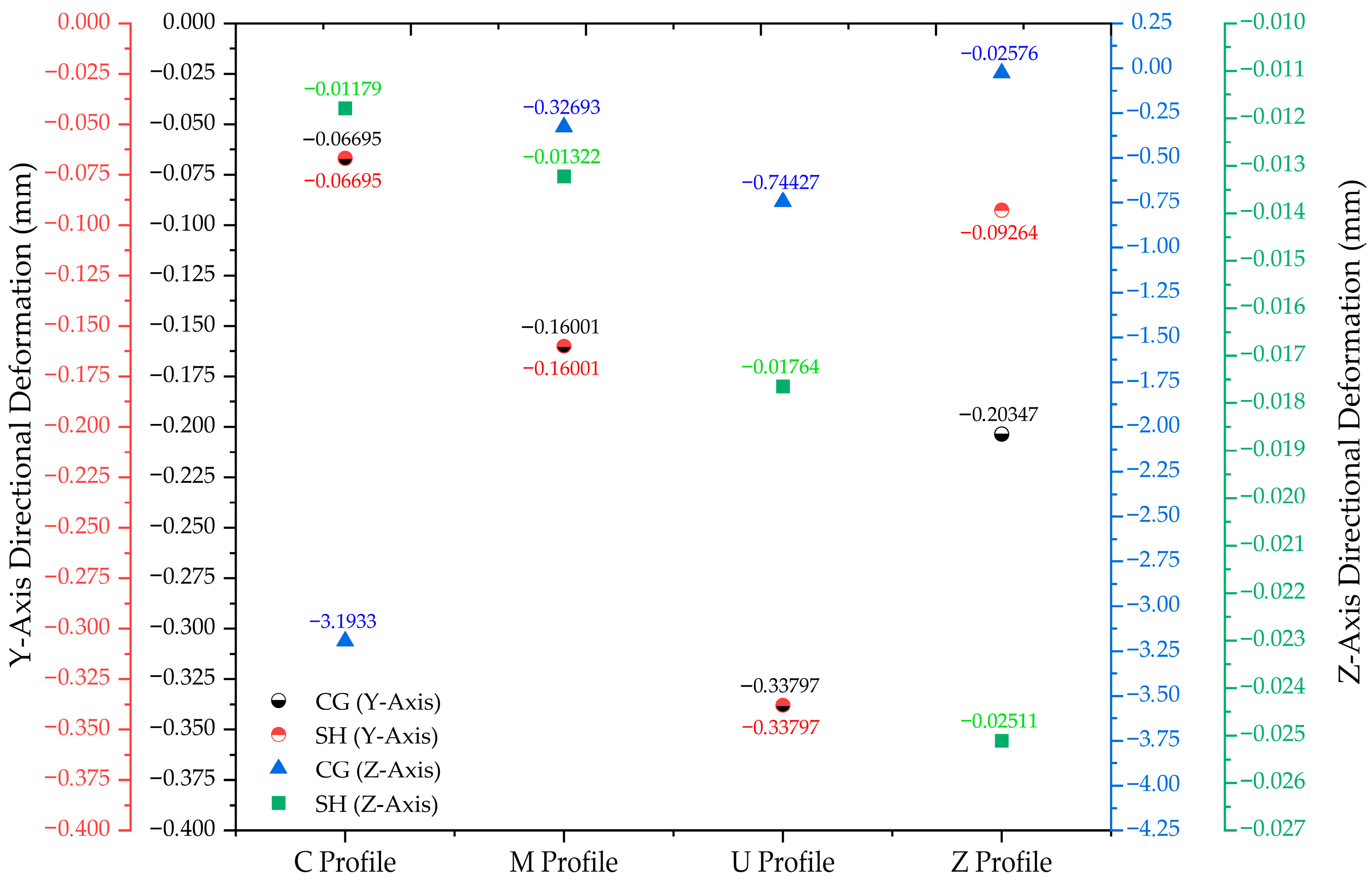
The FEM results presented in Table 5 show that, under loading applied from the centroid (CG) in the Y direction, the displacements for the C-, M-, and U-section profiles are −0.066951 mm (Figure 8b), −0.16001 mm (Figure 8e), and −0.33797 mm (Figure 8h), respectively. These results clearly indicate that deformation increases as the sectional stiffness decreases. When the load is applied through the shear center (SH), identical results are obtained because CGz and SHz coincide at the same Z coordinate (CGz = SHz = 100 mm). Consequently, no eccentricity exists between the load application line and the cross-section in the Z direction, and therefore no torsional moment is generated, resulting in a purely bending-controlled response. For the Z-section profile, however, the cross-sectional asymmetry produces bending-torsion coupling. Under CG loading, the FEM displacement in the Y direction is −0.20347 mm (Figure 8k), whereas the theoretical displacement is y t h = 0.0384   mm . The eccentricity in the Z-section ( C G z S H z = 12.05   m m ) generates a torsional moment of J X = 6012.9   N · m m in the FEM analysis. Consequently, torsional deformation introduces an additional lateral displacement of Y Z = 0.04329   mm in addition to the bending deflection. When the load is applied along the shear center, the torsional component disappears, and the resulting Y-direction deflection becomes −0.09264 mm, with a corresponding lateral displacement Y Z = 0.034771   mm . According to Saint–Venant torsion theory, the relation T = G J θ and the derived maximum twist angle θ m a x , under uniformly distributed torsional loading, are consistent with the value obtained from ANSYS with θ m a x = 0.52696 ° (=0.0092 rad).
For loading applied from the centroid in the Z-direction, the Z-direction displacements are −3.1933 mm (Figure 8a), −0.32693 mm (Figure 8d), and −0.74427 mm (Figure 8g) for the C-, M-, and U-section profiles, respectively. A comparison between FEM results and theoretical predictions shows that the error ratios in the Y direction under CG loading are 2.37%, 0.95%, and 0.47% for the C-, M-, and U-section profiles, respectively. In the Z direction, the corresponding error ratios are 0.42%, 4.12%, and 2.52%. For SH loading in the Z direction, the error ratios are 1.64%, 0.17%, and 0.09%, respectively.

3.2. Deflection Analysis Results of Cantilever Beam Profiles

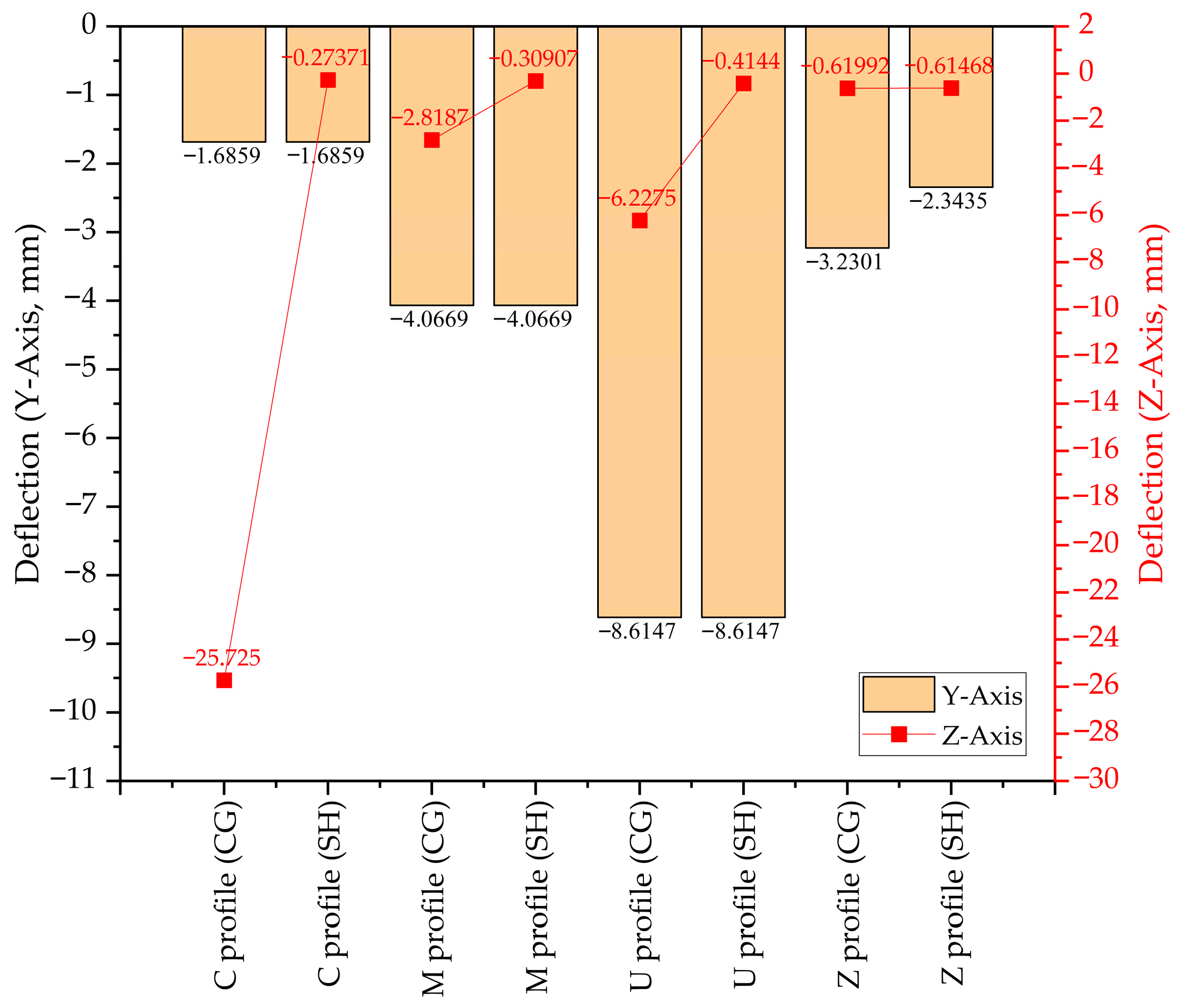
For structural elements subjected to external loading, limiting elastic deformation is essential to ensure safe load-carrying performance without structural damage. Deflection is defined as the displacement induced by bending in a beam fixed at one end and subjected to an applied load [7]. The deflection responses obtained from the application of a 1000 N concentrated load at the free end of the C-, M-, U-, and Z-section profiles along the centroidal axis are presented in Figure 9, while the corresponding deflection magnitudes are summarized in Table 6.
To evaluate the accuracy of the finite element model, a theoretical calculation was performed for the C-section profile. For a cantilever beam subjected to a concentrated load F applied at the free end, the maximum deflection occurs at the tip and is given by Equation (1). Substituting the corresponding numerical parameters into Equation (1) for the Y-axis loading, and assuming that the concentrated load is applied along the CG axis of the section, the resulting deflection is expressed as follows:
y = F L 3 3 E I = 1000 × 1000 3 3 × 2.05 × 10 5 × 9.7187 × 10 5 = 1.6731   mm
The percentage error relative to the FEM result is calculated as:
Error   ( % ) = y F E M y t h y t h × 100 = 1.6859 1.6731 1.673 × 100 = 0.77
The theoretical and FEM results show good agreement, with a relative error of approximately 0.77%, confirming the validity of the Euler–Bernoulli bending formulation for a cantilever beam subjected to an end load.
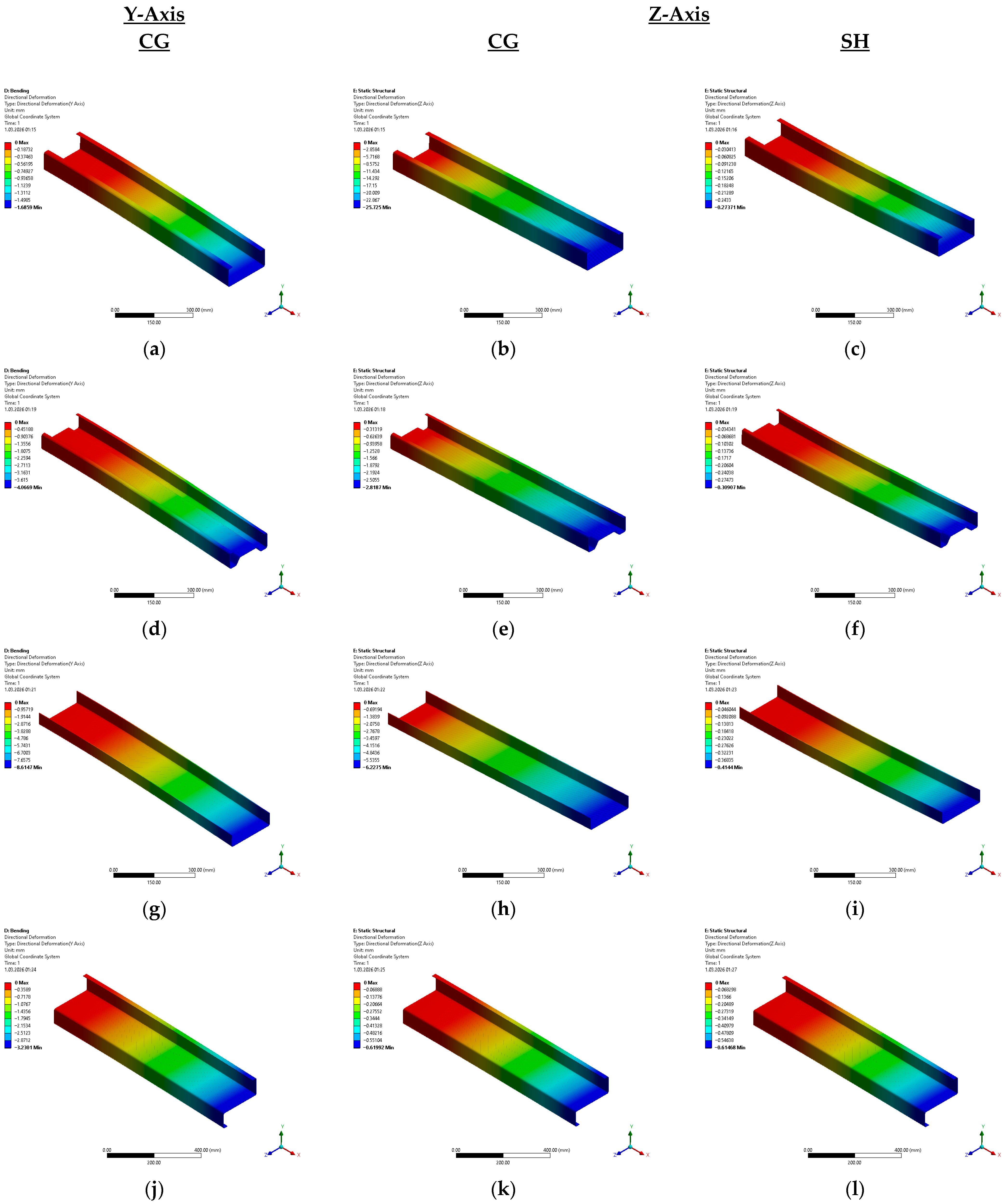
When the deflection values presented in Table 6 are examined, the C-section profile exhibits the smallest deflection under Y-direction loading applied through the CG-SH line, with a value of −1.6859 mm (Figure 10a). In contrast, the U-section profile exhibits the largest deflection, reaching −8.6147 mm (Figure 10h). Because all translational and rotational degrees of freedom are constrained at the fixed end of the cantilever beam, bending and torsional effects are directly transferred to the free end. For the C-, M-, and U-section profiles, the agreement between the FEM displacements y F E M and y t h values in the Y direction indicates that the bending behavior is accurately represented by classical Euler–Bernoulli beam theory. The identical Y-direction deflections obtained for CG and SH loading further confirm that the bending moment is governed primarily by the bending rigidity E I .
When the load is applied from the centroid in the Z direction, the eccentricity between the centroid and shear center produces a torsional moment. In this case, the relation T = F e applies. For the C-section profile, the eccentricity is calculated as e = C G y S H y = 26.717 37.861 = 64.578   mm and the resulting torsional moment becomes T = F e = 1000 × 64.578 = 64578   N · mm . Similar behavior is observed in the other profiles. The torsional moment is 19,786 N·mm for the M-section profile and 26,774 N·mm for the U-section profile, and these values are consistent with the theoretical predictions.
For open thin-walled sections, the general Vlasov torsion formulation reduces to Saint–Venant torsion when warping is unrestrained. The free-end twist is therefore expressed as [38]:
θ L = T L G J
Using this relation, the twist angle for the C-section profile is calculated as θ L = 0.394   rad . The lateral displacement in the Z-direction caused by torsion can be estimated as, y t h = e θ L which gives y t h = 64.578 × 0.3941 = 25.452   mm . For SH loading, the Z-direction deflection is −0.27371 mm. For the M-, and U-section profiles, the Z-direction deflections under CG loading are −2.8187 mm (Figure 10e) and −6.2275 mm (Figure 10i), respectively, whereas under SH loading they become −0.309 mm and −0.414 mm. These results indicate that eccentric loading in a cantilever beam increases the torsional moment and converts the torsional rotation into lateral displacement at the free end. Due to the asymmetric geometry of the Z-section profile, CG loading produces bending moments of 12,050 N·mm about the Z axis and 928.28 N·mm about the Y-axis. This demonstrates that bending and torsional stiffness are coupled. According to Vlasov thin-walled beam theory, torsion in open sections is expressed as Equation (13). Because warping is restrained at the fixed end, warping stresses develop. As a result, the Y-direction deflections under CG and SH loading differ for the Z-section profile, yielding −3.2301 mm and −2.3435 mm, respectively.
According to the analysis results, the C-section profile shows 2.43 times smaller deflection in the Y-direction than the M-section profile and 5.11 times smaller deflection than the U-section profile. The obtained deflection values show agreement with the corresponding moments of inertia of the profiles. Accordingly, the C- and Z-sections exhibit lower bending responses under applied loading compared to the other profiles, indicating superior load-carrying capacity. In particular, the displacement of the Z-section in the Z-direction is lower than that observed for the remaining profiles, which is attributed to its higher moment of inertia about this axis. These results highlight the significant influence of cross-sectional geometry and shear center eccentricity on the coupled bending-torsion response of thin-walled steel profiles.

3.3. Analysis Results of Simply Supported Triangle Lattice Structure

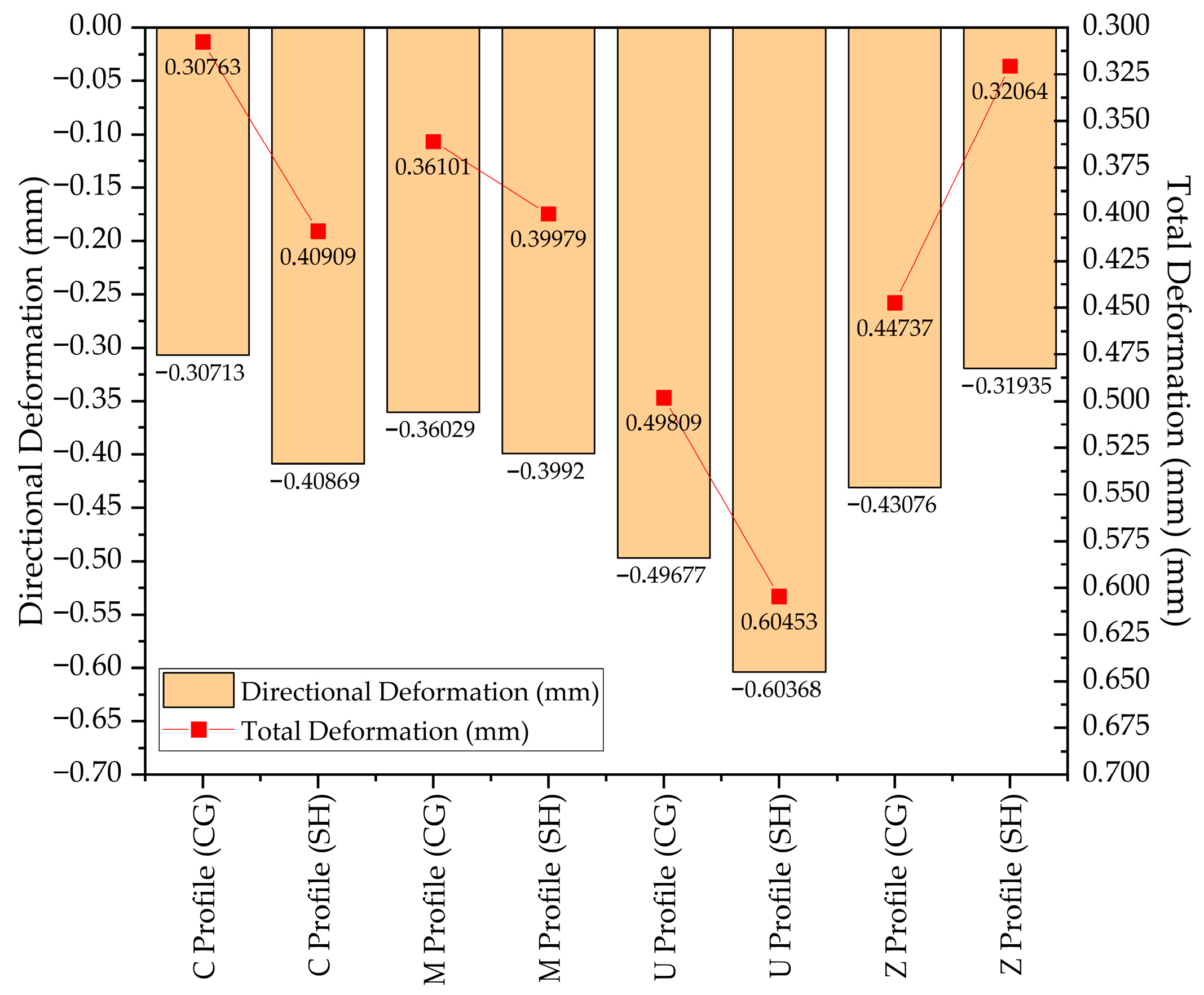
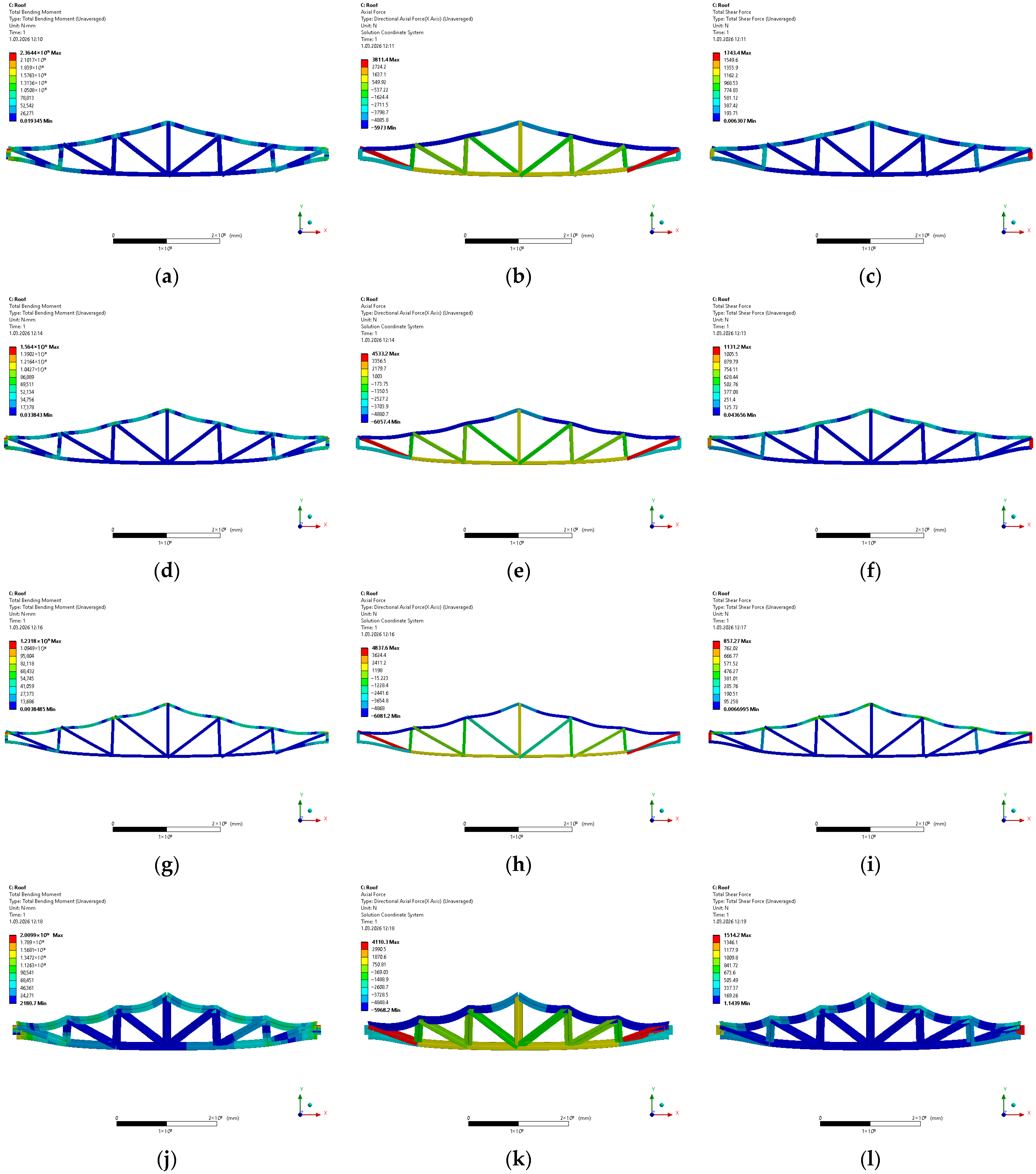
Frames are among the most used structural systems. The members of a rigid frame are subjected to bending moments, shear forces, and axial loads (either compression or tension) under external loading conditions [35]. Figure 11 and Table 7 summarize the structural response of the lattice structures composed of C-, M-, U-, and Z-section profiles.
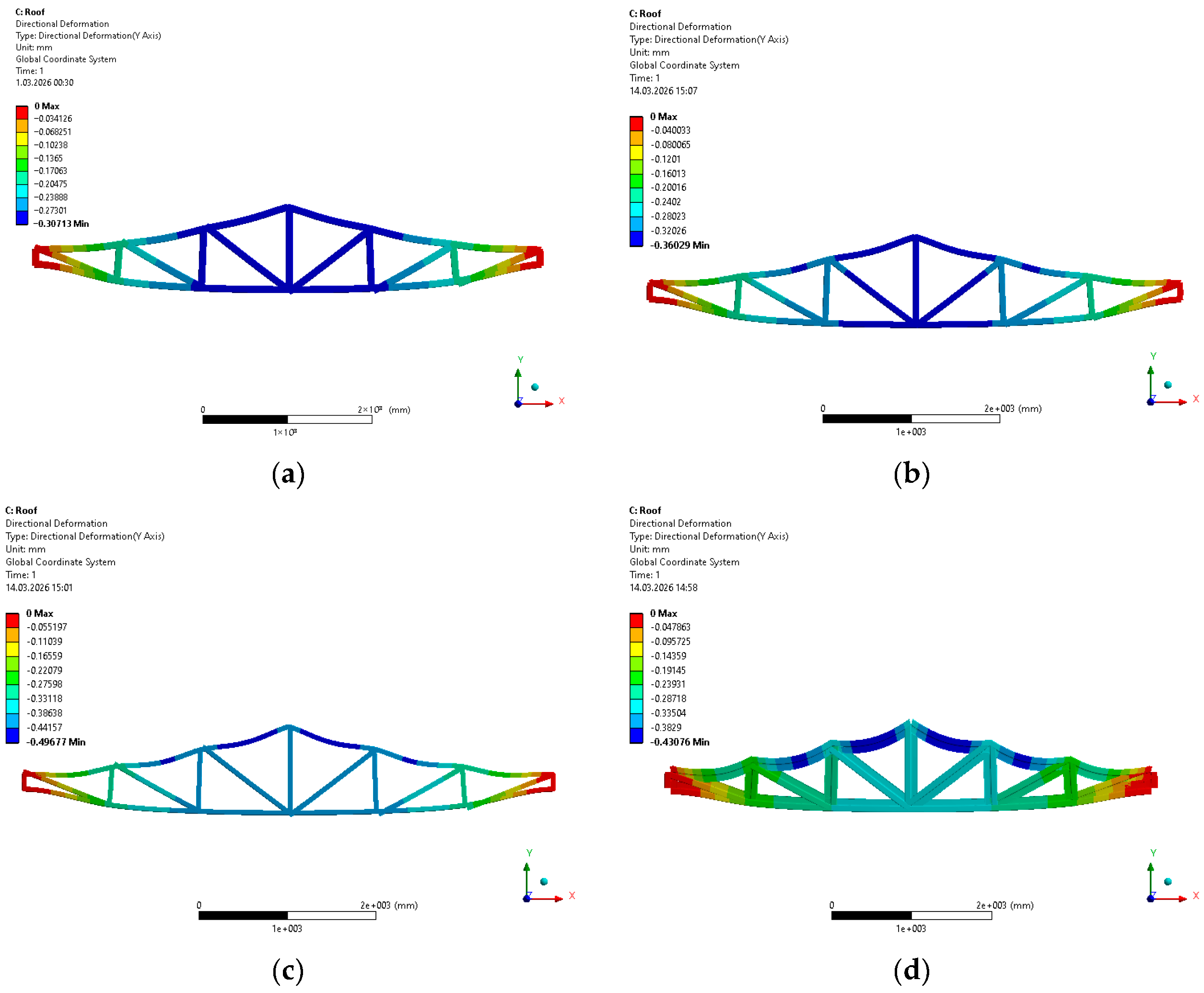
When Table 7 is examined, the maximum Y-direction displacements under CG loading are obtained as 0.30763 mm for the C-section profile (Figure 12a), 0.36101 mm for the M-section profile (Figure 12b), 0.49809 mm for the U-section profile (Figure 12c), and 0.43076 mm for the Z-section profile (Figure 12d). The largest displacement is observed in the U-section profile, which is approximately 61.9% higher than that of the C-section profile. This behavior is directly related to the bending stiffness (EI) of the sections and is consistent with Euler–Bernoulli beam theory. When the load is applied from the shear center (SH), the displacement of the C-section profile increases from 0.30763 mm to 0.40909 mm, corresponding to an increase of approximately 32.9%. Similarly, the displacement of the U-section profile increases from 0.49809 mm to 0.60453 mm, representing an increase of 21.3%. In contrast, the Z-section profile exhibits a reduction in Y-direction displacement to 0.32064 mm under SH loading, corresponding to a decrease of 25.6%.
These results indicate that the observed differences arise from flexural-torsional coupling induced by the torsional moment generated by the eccentricity between the load application line and the centroid of the cross-section.
The directional deformation behavior of the lattice structure, total bending moment, total shear force, and axial forces distributions of the lattice structures composed of C-, M-, U-, and Z-section profiles under a uniformly distributed load of 1 N/mm are presented in Figure 12 and Figure 13. The bending moment at any section of a beam is equal in magnitude and opposite in direction to the algebraic sum of the moments of all external loads and support reactions acting about the centroid of the cross-section. This fundamental principle governs the development of internal bending moments under applied loading and forms the basis for the structural analysis and design of beam elements [35]. When the analysis results presented in Table 7 of C-, M-, U, and Z-section profile lattice structures are evaluated in terms of total bending moment, it is observed that the C-section profile had the highest bending moment, reaching 2.3644 × 10⁵ N·mm (Figure 13a). In contrast, the U-section profile shows the lowest bending moment, with a value of 1.2318 × 10⁵ N·mm (Figure 13c).
The shear force of a beam is equal in magnitude and opposite in direction to the algebraic sum of the components of all external loads and support reactions acting perpendicular to the beam axis [35]. This relationship is fundamental in analyzing shear forces, allowing engineers to assess how internal forces are distributed along the beam and ensuring structural safety and performance. For the lattice structure composed of C-section profiles subjected to 1 N/mm uniformly distributed load, the total shear force was calculated as 1743.4 N (Figure 13c). In terms of the highest total shear force, the C-section profile is followed by the Z-section profile, which exhibits a value of 1514.2 N (Figure 13l). The lowest total shear force occurs in the U-section profile, with a value of 857.27 N (Figure 13i). The axial force in a beam is equal in magnitude and opposite in direction to the algebraic sum of the components of all external loads and support reactions acting parallel to the beam axis [35]. This principle is essential for understanding how axial loads influence the structural behavior of beam elements and for evaluating their load-carrying capacity. The analysis results indicate that the C-section profile exhibits the highest axial force, reaching 3811.4 N (Figure 13b). The deformation behavior observed for the C-section profile indicates that, under the considered loading conditions, it provides greater bending moment resistance and higher structural rigidity compared with the other investigated profiles.

3.4. Analysis Results of the Modal Analysis

Vibrations arise in many mechanical and structural systems due to various structural and operational factors. For such systems to operate safely and efficiently, it is essential to determine the natural frequencies and mode shapes, which govern the dynamic response of the structure. Identifying these dynamic characteristics enables the control of unwanted vibrations within acceptable limits and prevents resonance-related performance problems [21]. Modal analysis is widely employed to determine the natural frequencies and corresponding mode shapes of structural systems, allowing the dynamic behavior of structures to be accurately evaluated. This approach provides critical information about the vibration characteristics of a system and enables the identification of resonance frequencies. The resonance frequency represents the frequency at which the vibration amplitude of a dynamic system increases significantly, while the mode represents the deformation shape assumed by the structure when vibrating at a specific natural frequency [15].
Modal parameters characterize the inherent dynamic properties of structural systems and are commonly used as reference indicators for assessing structural integrity and damage sensitivity [39]. Accordingly, a modal analysis was conducted to determine the vibration characteristics of the C-, M-, U-, and Z-section profiles. Mode shapes were extracted using the default mass-normalization method implemented in ANSYS. Natural frequencies were obtained by using the Block Lanczos eigenvalue extraction method, as given in Equation (26). Where K and M represent global stiffness and mass matrices, respectively [40].
K ω 2 M ϕ = 0
The circular frequencies ω were converted to natural frequencies using Equation (19) [20]. The natural frequencies corresponding to the first six vibration modes were obtained for each profile; the resulting frequency values and modal classification based on participation factors are presented in Table 8. Additionally, a summary of the participation factors obtained from the modal analysis results is presented in Table A1, Table A2 and Table A3 in Appendix A.
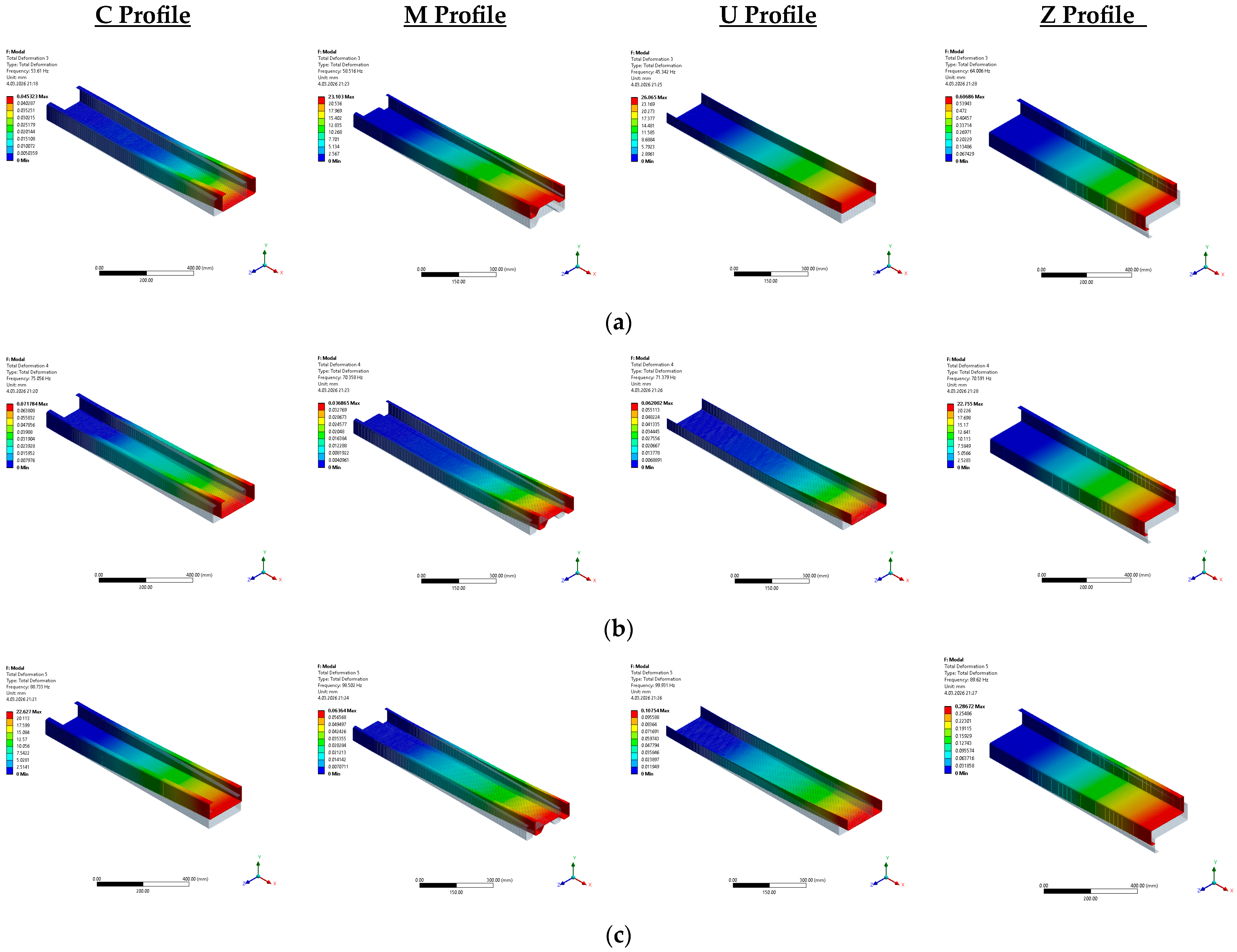
According to the participation factor analysis presented in Table 8, the first vibration modes of the C-, M-, and U-sections are predominantly characterized by Z-direction bending associated with rotation about the Y-axis. This indicates that, within the obtained frequency range, the structural responses of these profiles are primarily governed by lateral bending deformation. A transition from Z-direction bending to Y-direction bending is observed at higher modes. For the C-section, this transition occurs in the fifth mode, whereas for the M and U-sections, it appears in the third mode.
Unlike the other sections, the Z-section exhibits Z-direction bending behavior in the first three modes. However, at higher modes, combined bending and torsional deformations begin to occur. In particular, the fourth mode shows high participation factor values associated with rotations between both the Z-axis and the Y-axis, indicating the presence of coupled bending-torsion behavior. This phenomenon arises from the asymmetric geometry of the Z-section and the eccentricity between the centroid and the shear center.
The obtained results indicate that open thin-walled C-, M-, and U-sections exhibit predominantly bending-dominated behavior in the lower vibration modes, whereas the Z-section becomes more sensitive to bending-torsion interaction at higher modes due to its geometric asymmetry.
The relative deformation amplitudes of the normalized mode shapes for different vibration modes are summarized in Table 9, while the corresponding mode shapes (Mode 3, Mode 4, and Mode 5) are illustrated in Figure 14.

3.5. Static and Dynamic Performance Comparison of the Profiles

To evaluate the structural efficiency of the C-, M-, U-, and Z-section profiles, the mass–stiffness and frequency–mass performance ratios were comparatively assessed. The equivalent stiffness of the sections was calculated using the directional deformation values obtained from the analyses. The stiffness value was determined using Equation (27) [41].
k = F y m a x
which represents the ratio of the applied load (F) to the resulting maximum displacement y m a x .
The obtained stiffness values were then normalized by the profile weights, and the stiffness performance per unit mass was expressed using the stiffness-to-weight ratio k / W . In addition, the first natural frequency (Mode 1) obtained from the modal analysis was related to the profile weights, and the frequency-to-mass ratio f 1 / W was calculated. In this way, the influence of cross-sectional geometry on bending stiffness, mass efficiency, and dynamic behavior was evaluated simultaneously. The mass–stiffness ratios obtained for the CG and SH loading lines are presented in Table 10 and Table 11.
When Table 10 and Table 11 are examined, it is observed that under loading applied along the CG line, the C-section profile provides the highest stiffness-to-mass ratio in the Y direction with a value of 1915.79 kY/W, indicating that it is the most efficient section in terms of bending stiffness. In contrast, the highest stiffness-to-mass ratio in the Z direction is obtained for the Z-section profile, with a value of 4978.21 kZ/W. This result indicates that the asymmetric geometry of the section significantly enhances the lateral stiffness. The U-section profile, on the other hand, exhibits the lowest structural efficiency in the Y direction with a value of 503.18 kY/W. When the load is applied along the SH line, the elimination of torsional effects leads to a significant increase in stiffness values in the Z direction. The C and M-section profiles show high stiffness performance per unit mass in the Z direction, with values of 10,879.98 kZ/W and 10,369.35 kZ/W, respectively. Although the U-section profile exhibits relatively lower performance in the Y direction, it provides a high stiffness-to-mass ratio in the Z direction, reaching 9639.35 kZ/W. These results indicate that applying the load closer to the shear center can significantly reduce torsion-induced deformations in open thin-walled sections, thereby improving structural efficiency. Accordingly, when selecting a cross-section, the balance between static stiffness, mass efficiency, and torsional effects associated with the load application location should be carefully considered.
The frequency–mass ratio results are presented in Table 12. The U-section profile exhibits the highest frequency–mass ratio with a natural frequency of 14.273 Hz and an f1/W value of 2.43. In comparison, the M- and Z-section profiles show lower frequency–mass ratios with values of 1.93 f1/W and 1.64 f1/W, respectively, while the C-section profile has the lowest ratio with 1.37 f1/W. These results indicate that sections with lower mass can generate higher natural frequencies per unit mass, which may provide advantages in terms of dynamic performance in lightweight structural systems. The findings also demonstrate that cross-sectional geometry and mass distribution have a significant influence on the natural frequency behavior of thin-walled profiles.
Overall, the obtained results show that the structural performance of open thin-walled profiles varies depending on cross-sectional geometry, loading direction, and mass distribution. The C-section, providing the highest stiffness–mass ratio in the Y direction, emerges as an advantageous option in terms of bending stiffness. In contrast, the Z-section, due to its asymmetric cross-sectional geometry, exhibits high lateral stiffness in the Z-direction, making it more suitable for applications where lateral loads are dominant. The U-section, with its lower unit weight and higher frequency–mass ratio, offers advantages in lightweight structural systems and applications where dynamic performance is critical. Finally, the M-section, which exhibits a more balanced stiffness distribution, can be considered an alternative profile for structural systems subjected to multiple loading conditions acting simultaneously.

4. Conclusions

In this study, the structural behavior of C-, M-, U-, and Z-section thin-walled steel profiles commonly used in engineering applications was investigated using finite element analysis implemented in ANSYS. The profiles were comparatively evaluated in terms of directional deformation, deflection behavior, internal force distribution, lattice structural response, and modal characteristics. The main findings of the present study are summarized as follows:
The U-section profile was identified as the lightest section with a weight of 5.8803 kg/m, while the C-and Z-section profiles exhibited the highest weights (7.7964 kg/m). The C-section profile possesses the highest moment of inertia (6.2313 × 106 mm4), which results in superior bending stiffness compared with the other sections.
The directional deformation analysis indicates that the C-section profile exhibits the lowest deformation (−0.066951 mm), whereas the U-section profile shows the highest deformation (−0.33797 mm). Deformations are significantly larger under Z-direction loading. The C-section profile exhibits a deformation of −3.1933 mm in the Z direction, which reflects the lower bending stiffness about the Z-axis.
The C-section profile exhibited the smallest deflection in the Y direction (−1.6859 mm), confirming its superior bending rigidity. In contrast, the U-section profile exhibited the largest deflection (−8.6147 mm) due to its lower bending stiffness. The Z-section demonstrated reduced deformation in the Z direction because of its higher moment of inertia about this axis.
For the triangular lattice structures, the lattice constructed using the U-section was the lightest configuration (133.7 kg), whereas the C- and Z-section lattices were the heaviest (177.26 kg). The C-section lattice exhibited the smallest deformation and the highest bending moment, shear force, and axial force values, indicating the highest overall structural rigidity among the investigated structures.
The C-section lattice exhibited the smallest deformation (−0.30763 mm) and the highest internal force capacity, with a maximum bending moment of 2.3644 × 10⁵ N·mm, an axial force of 3811.4 N, and a total shear force of 1743.4 N, indicating the highest overall structural rigidity.
The modal analysis results indicate that the vibration behavior of the investigated profiles is dominated by bending modes at lower frequencies. The U-section exhibited the highest frequency–mass ratio (2.43 f1/W) with a natural frequency of 14.273 Hz. In contrast, the C-section exhibits the lowest frequency–mass ratio (1.37 f1/W) due to its higher mass and stiffness characteristics.
Overall, cross-sectional geometry plays a critical role in governing the stiffness, mass efficiency, and dynamic behavior of thin-walled structural systems and should be carefully considered during section selection and structural design.

Author Contributions

G.S.: Methodology, software, validation, investigation, resources, data curation, writing—original draft preparation, writing—review and editing, visualization and supervision. S.K.: Investigation, resources, data curation, writing—original draft preparation, writing—review and editing. All authors have read and agreed to the published version of the manuscript.

Funding

This research received no external funding.

Institutional Review Board Statement

Not applicable.

Informed Consent Statement

Not applicable.

Data Availability Statement

Data will be available upon reasonable request.

Conflicts of Interest

The authors declare that they have no known competing financial interests or personal relationships that could have appeared to influence the work reported in this paper.

Abbreviations

The following abbreviations are used in this manuscript:
ANSYSEngineering simulation and finite element analysis software
FEAFinite Element Analysis
FEMFinite Element Method
MAPDLMechanical APDL solver used in ANSYS
CGCenter of gravity (centroid) of the cross-section
SHShear center of the cross-section
DOFDegree of freedom
GBTGeneralized Beam Theory
ACross-sectional area (mm2)
EElasticity modulus (MPa)
EIBending rigidity (N·mm2)
EIωWarping rigidity (N·mm4)
FApplied force (N)
GShear modulus of the material (MPa)
GJSaint–Venant torsional rigidity (N·mm2)
N Newton
ISecond moment of area (mm4)
JPolar moment of inertia (mm4)
KGlobal stiffness matrix
LLength of the beam (mm)
WWeight (kg)
UX, UY, UZTranslational degrees of freedom in X, Y, and Z directions
ROTX, ROTY, ROTZRotational degrees of freedom about X, Y, and Z axes
T(x)Internal torsional moment (N·mm)
VShear force
fnNatural frequency (Hz)
y, ymaxDeflection and maximum deflection (mm)
yFEMDeflection obtained from finite element analysis (mm)
ythTheoretical deflection (mm)
ρDensity of material (kg/m3)
ωDistributed load per unit length (N/mm)
ωnNatural angular frequency (rad/s)
βnModal coefficient determined by boundary conditions
κShear correction factor
ρMaterial density (kg/m3)
θ(x)Twist angle along the beam (rad)
θmaxMaximum twist angle (rad)
θLTwist angle at the free end (rad)

Appendix A

Table A1. Participation factor of profiles in modal analysis.
Cross
Section
ModeFrequency (Hz)X
Direction
Y
Direction
Z
Direction
Rotation XRotation YRotation Z
C-Section110.719~0~00.0480928.4957−30.626~0
232.157~0~00.0158792.83393.5028~0
353.61~0~0−0.009668−1.69951.2701~0
475.056~0~00.00673991.21390.71659~0
588.733~00.06912~0~0~050.31
696.504~0~0−0.0054201−0.944080.44222~0
M-Section114.07~0~00.0190266.3171−12.119~0
242.211~0~00.00616122.10611.4644~0
358.516~00.067655~0~0~049.191
470.358~0~0−0.0038632−1.26350.53907~0
598.502~0~00.00255050.902490.365~0
6126.65~0~0−0.0022304−0.701920.24394~0
U-Section114.273~0~00.0231355.536−14.737~0
242.82~0~00.00748691.84621.7839~0
345.342~00.060039~0~0~043.638
471.379~0~0−0.0047−1.10740.65731~0
599.931~0~00.00309440.790960.44862~0
6128.49~0~0−0.0027184−0.615160.30136~0
Z-Section112.799~0−0.010972−0.000928947.11420.60077−7.0095
238.396~0−0.00265370.0000975642.3727−0.334911.4392
364.006~00.00370460.00082779−1.4226−0.509631.4254
470.591~00.0628810.0270710.042936−19.6945.739
589.62~00.00237540.00050208−1.0162−0.267230.47079
6115.22~0−0.00095900.0000225350.79053−0.0704470.067838
Table A2. Effective mass of profiles in modal analysis.
Cross
Section
ModeFrequency (Hz)X
Direction (tonne)
Y
Direction (tonne)
Z
Direction (tonne)
Rotation X (tonne)Rotation Y (tonne)Rotation Z (tonne)
C-Section110.719~0~00.002312872.177937.95~0
232.157~0~0~08.030912.27~0
353.61~0~0~02.88831.6131~0
475.056~0~0~01.47350.5135~0
588.733~00.0047776~0~0~02531.1
696.504~0~0~00.891290.19556~0
M-Section114.07~0~0~039.905146.88~0
242.211~0~0~04.43582.1446~0
358.516~00.0045772~0~0~02419.7
470.358~0~0~01.59640.29059~0
598.502~0~0~00.814490.13322~0
6126.65~0~0~00.492690.059506~0
U-Section114.273~0~0~030.648217.19~0
242.82~0~0~03.40833.1823~0
345.342~00.0036046~0~0~01904.3
471.379~0~0~01.22620.43206~0
599.931~0~0~00.625610.20126~0
6128.49~0~0~00.378420.090821~0
Z-Section112.799~0~0~050.6120.3609249.134
238.396~0~0~05.62980.112162.0714
364.006~0~0~02.02390.259732.0317
470.591~00.0039541~0~0387.692092.1
589.62~0~0~01.03270.0714090.22164
6115.22~0~0~00.62494~0~0
Table A3. Cumulative effective mass ratio of profiles in modal analysis.
Cross
Section
ModeFrequency (Hz)X
Direction
Y
Direction
Z
Direction
Rotation XRotation YRotation Z
C-Section110.719~0~00.846180.844560.98468~0
232.157~0~00.938430.938530.99756~0
353.61~0~00.972630.972330.99926~0
475.056~0~00.989250.989570.99979~0
588.7330.9999210.989250.989570.999791
696.504111111
M-Section114.07~0~00.849040.844650.98242~0
242.211~0~00.938070.938540.99677~0
358.5160.004472510.938070.938540.996771
470.3580.004472510.973070.972330.998711
598.5020.02370510.988330.989570.99961
6126.65111111
U-Section114.273~0~00.849110.844610.98233~0
242.82~0~00.938040.938540.99672~0
345.3420.004589110.938040.938540.996721
471.3790.004589410.973090.972330.998681
599.9310.02004210.988280.989570.999591
6128.49111111
Z-Section112.799~00.0293510.00117460.844590.000929020.022901
238.396~00.0310680.00118760.938530.00121770.023866
364.006~00.0344140.00212040.972310.00188630.024813
470.5910.0493780.99840.999660.972340.99980.99989
589.620.0863120.9997810.989570.999991
6115.22111111

References

  1. Iandiorio, C.; Salvini, P. A geometrically nonlinear shell theory for thin-walled tubes and beams subjected to large displacements and cross-section deformation. Thin-Walled Struct. 2025, 216, 113583. [Google Scholar] [CrossRef]
  2. Fenkli, M.; Ünal, A. Light steel construction systems. Int. J. Sustain. Eng. Technol. 2023, 1, 76–87. [Google Scholar]
  3. Tartar, A.; Işık, B. Light steel construction system and design possibilities. In Proceedings of the II Structural Steel Week, Istanbul, Turkey, 14–18 October 2002; pp. 64–66. [Google Scholar]
  4. İpekçi, Z.; Kavraz, M. Effects of height on weight of lattice beams with triangular and crescent head types. J. Yalvaç Acad. 2022, 7, 1–16. [Google Scholar]
  5. Piroğlu, F.; Uzgider, E.; Vural, M.; Çağlayan, Ö.B. Construction steel and important structural features from the past to the present. Turk. Eng. News 2003, 426, 43–46. [Google Scholar]
  6. Tunca, O.; Erdal, F.; Sağsöz, A.E.; Çarbaş, S. Structural properties of cold formed steel profiles. In Proceedings of the 7th International Steel Structures Symposium, Gaziantep, Turkey, 26–27 October 2017; pp. 234–241. [Google Scholar]
  7. Korucu, S.; Gök, K.; Tümsek, M.; Soy, G.; Gök, A. Analysis with theoretical and numerical methods of bending stress and deflection value of beams with different profiles. Dokuz Eylul Univ. Fac. Eng. J. Sci. Eng. 2019, 21, 469–482. [Google Scholar] [CrossRef]
  8. Xia, Y.; Glauz, R.S.; Schafer, B.W.; Seek, M.; Blum, H.B. Cold-formed steel strength predictions for torsion and bending–torsion interaction. Thin-Walled Struct. 2024, 195, 111367. [Google Scholar] [CrossRef]
  9. Nastasescu, V.; Zisopol, D.G.; Badea, M. A new approach to the beam calculus made of functionally graded materials. In Proceedings of the International Conference on Engineering, Technology and Applied Science Innovations; Pylarinos, G., Antonopoulos, C.P., Syrrokostas, G., Apostolopoulos, P., David, S., Eds.; ACSIS: Singapore, 2025; pp. 47–52. [Google Scholar] [CrossRef]
  10. Yu, Y.; Wei, H.; Zheng, B.; Tian, D.; He, L. Integrated dynamic analysis of thin-walled beams: Coupled bidirectional bending, torsion, and axial vibrations under axial loads. Appl. Sci. 2024, 14, 11390. [Google Scholar] [CrossRef]
  11. Zhang, W.; Gardner, L.; Wadee, M.A.; Zhang, M. Analytical solutions for the inelastic lateral-torsional buckling of I-beams under pure bending via plate-beam theory. Int. J. Steel Struct. 2018, 18, 1440–1463. [Google Scholar] [CrossRef]
  12. Latalski, J.; Zulli, D. Generalized beam theory for thin-walled beams with curvilinear open cross-sections. Appl. Sci. 2020, 10, 7802. [Google Scholar] [CrossRef]
  13. Bian, G.; Peterman, K.D.; Torabian, S.; Schafer, B.W. Torsion of cold-formed steel lipped channels dominated by warping response. Thin-Walled Struct. 2016, 98, 565–577. [Google Scholar] [CrossRef]
  14. Elbelbisi, A.; Knight, J.; Saffarini, M.H.; Chen, Z.; Elsisi, A.; Salim, H.; Bowman, A.; Elemam, H. Experimental and computational study on strain localization of laminated glass polymeric interlayer materials. J. Mater. Res. Technol. 2024, 31, 2279–2295. [Google Scholar] [CrossRef]
  15. Çetinkaya, M.B.; İşci, M. ANSYS based analysis of multi-level parabolic leaf spring systems. Alex. Eng. J. 2023, 73, 109–121. [Google Scholar] [CrossRef]
  16. Atya, S.E.; Abdelrahman, A.H.A.; Salem, F.A.; Mahmoud, N.S.; Ghannam, M. Numerical investigation and design of cold-formed steel channel and Z-sections undergoing local and global interactive buckling. Int. J. Steel Struct. 2024, 24, 1251–1264. [Google Scholar] [CrossRef]
  17. Papangelis, J. On the stresses in thin-walled channels under torsion. Buildings 2024, 14, 3533. [Google Scholar] [CrossRef]
  18. Yehia, M.M.; Gaawan, S.M.; Elwan, R.; Shahin, O.R.; El-Sayad, W.Z. Structural performance evaluation of cold formed steel cantilever beams with varying perforation patterns. Alex. Eng. J. 2024, 91, 204–221. [Google Scholar] [CrossRef]
  19. Sahraei, A.; Pezeshky, P.; Sasibut, S.; Rong, F.; Mohareb, M. Finite element formulation for the dynamic analysis of shear deformable thin-walled beams. Thin-Walled Struct. 2022, 173, 108989. [Google Scholar] [CrossRef]
  20. Nkounhawa, P.K.; Ndapeu, D.; Kenmeugne, B.; Beda, T. Analysis of the behavior of a square plate in free vibration by FEM in ANSYS. World J. Mech. 2020, 10, 11–25. [Google Scholar] [CrossRef]
  21. Adavadkar, B.; Admuthe, A. Modal analysis of cantilever beam using analytical and finite element method. J. Emerg. Technol. Innov. Res. 2021, 8, 566–573. [Google Scholar]
  22. ANSYS Inc. ANSYS Mechanical User Documentation; ANSYS Inc.: Canonsburg, PA, USA, 2024. [Google Scholar]
  23. Beer, F.P.; Johnston, E.R.; DeWolf, J.T.; Mazurek, D.F. Mechanics of Materials, 7th ed.; McGraw-Hill Education: New York, NY, USA, 2015; pp. 600–607. [Google Scholar]
  24. Hutchinson, J.R. Shear coefficients for Timoshenko beam theory. J. Appl. Mech. 2001, 68, 87–92. [Google Scholar] [CrossRef]
  25. Yu, Y.; Tian, D.; Wei, H.; He, L.; Zheng, B. Coupled bidirectional bending and torsional vibrations of axially loaded non-symmetrical thin-walled Timoshenko–Ehrenfest beams. Arch. Appl. Mech. 2025, 95, 248. [Google Scholar] [CrossRef]
  26. Kosmatka, J.B. An improved two-node finite element for stability and natural frequencies of axial-loaded Timoshenko beams. Comput. Struct. 1995, 57, 141–149. [Google Scholar] [CrossRef]
  27. Hjaji, M.A.; Nagiar, H.M.; Krar, M.M.; Allaboudi, E.G. Exact finite beam element for open thin-walled doubly symmetric members under torsional and warping moments. J. Struct. Eng. Appl. Mech. 2021, 4, 267–281. [Google Scholar] [CrossRef]
  28. Wang, Z.-Q.; Zhao, J.-C. Restrained torsion of thin-walled beams. J. Struct. Eng. 2014, 140, 04014089. [Google Scholar] [CrossRef]
  29. Chen, Z.; Huang, Z.; Guo, Y.; Li, G. Prediction of mechanical properties of thin-walled bar with open cross-section under restrained torsion. Coatings 2022, 12, 562. [Google Scholar] [CrossRef]
  30. Meghana Reddy, E.; Srujana, N.; Bhavani, T. An iterative procedure to determine natural frequencies and mode shapes from discrete and continuous approaches. In Sustainability Trends and Challenges in Civil Engineering; Lecture Notes in Civil Engineering; Springer: Singapore, 2022; pp. 507–524. [Google Scholar] [CrossRef]
  31. Abdulrazzaq, T.K.; Ali, Y.H.; Sultan, J.N.; Waddullah, H.M. Effect of the cross-sectional shape on the dynamic response of a cantilever steel beam using three modal analysis methods. Math. Model. Eng. Probl. 2024, 11, 664–672. [Google Scholar] [CrossRef]
  32. Mucha, J.; Witkowski, W. The experimental analysis of the double joint type change effect on the joint destruction process in uniaxial shearing test. Thin-Walled Struct. 2013, 66, 39–49. [Google Scholar] [CrossRef]
  33. Altın, M.; Yücesu, H.S. The effect of aluminum foam material on the energy absorption capacity of different geometric structure crash boxes. J. Polytech. 2018, 22, 141–148. [Google Scholar] [CrossRef]
  34. Dahmani, L.; Khennane, A.; Kaci, S. Crack identification in reinforced concrete beams using ANSYS software. Strength Mater. 2010, 42, 232–240. [Google Scholar] [CrossRef]
  35. Kassimali, A. Structural Analysis, 5th ed.; Cengage Learning: Stamford, CT, USA, 2015. [Google Scholar]
  36. Mudenda, K.; Kabani, M. A proposed approach for obtaining the shear centre and monosymmetry constant for an I-section beam with a welded channel cap. Int. J. Steel Struct. 2020, 20, 1796–1809. [Google Scholar] [CrossRef]
  37. Gotluru, B.P.; Schafer, B.W.; Peköz, T. Torsion in thin-walled cold-formed steel beams. Thin-Walled Struct. 2000, 37, 127–145. [Google Scholar] [CrossRef]
  38. Mohareb, M.; Nowzartash, F. Exact finite element for nonuniform torsion of open sections. J. Struct. Eng. 2003, 129, 215–223. [Google Scholar] [CrossRef]
  39. Masciotta, M.G.; Pellegrini, D. Investigating the relation between complex mode shapes and local damage for structural assessment. J. Phys. Conf. Ser. 2024, 2647, 192024. [Google Scholar] [CrossRef]
  40. Marzuki, M.A.B.; Halim, M.H.A.; Mohamed, A.R.N. Determination of natural frequencies through modal and harmonic analysis of space frame race car chassis based on ANSYS. Am. J. Eng. Appl. Sci. 2015, 8, 538–548. [Google Scholar] [CrossRef]
  41. Budynas, R.G.; Nisbett, J.K. Shigley’s Mechanical Engineering Design, 10th ed.; McGraw-Hill Education: New York, NY, USA, 2015. [Google Scholar]
Figure 1. Profile types and cross-sectional dimensions used in the analysis: (a) C-section; (b) M-section; (c) U-section; (d) Z-section.
Applsci 16 02846 g001
Figure 2. Dimensions of an example triangle lattice structure.
Applsci 16 02846 g002
Figure 3. (a) Cantilever beam with end load; (b) Deformed shape and boundary conditions; (c) Simply supported beam with a uniformly distributed load [23].
Applsci 16 02846 g003
Figure 4. (a) Mesh images of C-section profiles and (b) triangular lattice structure.
Applsci 16 02846 g004
Figure 5. (a) Analysis conditions for deformation and (b) deflection behavior of profiles.
Applsci 16 02846 g005
Figure 6. Analysis conditions for the triangular lattice system.
Applsci 16 02846 g006
Figure 7. Results of directional deformation of simply supported profiles.
Applsci 16 02846 g007
Figure 8. Directional deformation results of the profiles in the direction of Z and Y axes: (ac) C-section profile; (df) M-section profile; (gi) U-section profile; (jl) Z-section profile.
Applsci 16 02846 g008
Figure 9. Deflection analysis results of C-, M-, U- and Z-section profiles.
Applsci 16 02846 g009
Figure 10. Deflection of the profiles in the Y-Axis (CG line) and Z-Axis (CG and SH line): (ac) C-section profile; (df) M-section profile; (gi) U-section profile; (jl) Z-section profile.
Applsci 16 02846 g010
Figure 11. Analysis results of C-, M-, U-, and Z-section profile lattice structures.
Applsci 16 02846 g011
Figure 12. Directional deformation images of lattice structures: (a) C-; (b) M-; (c) U-; (d) Z-section profile.
Applsci 16 02846 g012
Figure 13. Total bending moment, axial force, and total shear force images of lattice structures: (ac) C-section profile; (df) M-section profile; (gi) U-section profile; (jl) Z-section profile.
Applsci 16 02846 g013
Figure 14. Relative deformation amplitudes of profiles: (a) Mode 3; (b) Mode 4; (c) Mode 5.
Applsci 16 02846 g014
Table 1. Physical properties of the profiles used in the analysis.
Profile Type/FeaturesC-SectionM-SectionU-SectionZ-Section
Weight (kg/m)
Cross-Sectional Area (mm2)
Moment of Inertia (Iyy, mm4)
7.79647.29545.88037.7964
993.17951.28749.09993.17
6.2313 × 1065.4982 × 1064.091 × 1066.2071 × 106
Moment of Inertia (Izz, mm4)
Polar Moment of Inertia (J, mm4)
9.7187 × 1054.0113 × 1051.8912 × 1051.603 × 106
2078.1 1978.41564.12077.1
Warping constant (Iw, mm6)7.9638 × 1094.6429 × 1091.2957 × 1091.0591 × 1010
Center of gravity (CGy, mm)
Center of gravity (CGz, mm)
Shear Center (SHy, mm)
Shear Center (SHz, mm)
26.71727.20310.9073.3154
10010010098.011
−37.8617.4166−15.8674.2417
10010010085.961
Table 2. Physical properties of an example triangle lattice structure.
Lattice Structure/FeatureC-SectionM-SectionU-SectionZ-Section
Volume (mm3)2.2581 × 1072.113 × 1071.7032 × 1072.2581 × 107
Weight (kg)177.26165.87133.7177.26
Cross-sectional area (mm2)993.17 929.35749.09993.17
Table 3. Mechanical and physical properties of S350 GD sheet metal [32].
PropertiesValue
Density (kg/m3)7850
Elasticity Modulus (MPa)2.05 × 10⁵
Yield Strength (MPa)358
Tensile Strength (MPa)424
Poisson’s Ratio0.3
Table 4. Mesh convergence for the Z-direction deformation (SH) of the C-section profile.
Element Size (mm)ElementDirectional Deformation∆ (mm)∆ %
6416−0.066747--
3232−0.0669000.0001530.229%
1663−0.0669180.0000190.028%
8125−0.0669420.0000240.036%
4250−0.0669500.0000080.012%
2500−0.0669510.0000010.0015%
11000−0.0669510.0000000.000%
Table 5. Directional deformation results of simply supported profiles.
Profile Cross Section/Force Applied LineDirectional Deformation
(Y Axis, mm)
Directional Deformation
(Z Axis, mm)
(CG)(SH)(CG)(SH)
yFEMythyFEMyth
C-Section−0.066951−0.0654−0.066951−3.1933−3.18−0.011789
M-Section−0.16001−0.1585−0.16001−0.32693−0.314−0.013219
U-Section−0.33797−0.3364−0.33797−0.74427−0.726−0.017642
Z-Section−0.20347−0.0384−0.09264−0.025763−0.002−0.025108
Table 6. Deflection analysis results of C-, M-, U-, and Z-section profiles.
ProfileLoad LineDeflection
(Y-Axis, mm)
Torsional Moment (Y-Axis, N·mm)Deflection
(Z-Axis, mm)
Torsional Moment
(Z-Axis, N·mm)
Y-DirectionZ-DirectionX-DirectionZ-DirectionY-DirectionX-Direction
yFEMythyFEMyth
C-SectionCG−1.6859−1.673~0~0−25.725−25.45~0−64,578
SH−1.6859−1.673~0~0−0.27371−0.274~0~0
M-SectionCG−4.0669−4.054~0~0−2.8187−2.51~0−19,786
SH−4.0669−4.054~0~0−0.30907−0.309~0~0
U-SectionCG−8.6147−8.598~0~0−6.2275−5.81~0−26,774
SH−8.6147−8.598~0~0−0.4144−0.414~0~0
Z-SectionCG−3.2301−3.10−0.9582812,050−0.61992−0.615−0.95828926.28
SH−2.3435−2.34−0.89013~0−0.61468−0.615−0.89013~0
Table 7. Analysis results of C-, M-, U and Z-section profile lattice structures.
Lattice StructureApplied LineDirectional Deformation
(Y-Axis, mm)
Total
Deformation (mm)
Total Bending
Moment
(Max, N·mm)
Axial Force
(X-Axis, Max, N)
Total Shear Force
(Max, N)
C ProfileCG−0.307130.307632.3644 × 1053811.41743.4
SH−0.408690.409095.3858 × 1052977.53061.8
M ProfileCG−0.360290.361011.564 × 1054533.21131.2
SH−0.39920.399792.5565 × 10544761579.6
U ProfileCG−0.496770.498091.2318 × 1054837.6857.27
SH−0.603680.604532.7237 × 10548671785.6
Z ProfileCG−0.430760.447372.0099 × 1054110.31514.2
SH−0.319350.320642.1066 × 1054030.61474.2
Table 8. Natural frequencies of profiles and modal classification based on participation factors.
ProfileModeFrequency (Hz)Mode TypeDominant DOF
C-Section110.719Z bending←→ + ROTY 1 (−30.626)
232.157Z bending←→ + ROTY 1 (3.503)
353.61Z bending←→ + ROTY 1 (1.270)
475.056Z bending←→ + ROTY 1 (0.717)
588.733Y bending↑↓ + ROTZ 1 (50.31)
696.504Z bending←→ + ROTY (0.442)
M-Section114.07Z bending←→ + ROTY 1 (−12.119)
242.211Z bending←→ + ROTY 1 (1.464)
358.516Y bending↑↓ + ROTZ 1 (49.191)
470.358Z bending←→ + ROTY 1 (0.539)
598.502Z bending←→ + ROTY (0.365)
6126.65Z bending←→ + ROTY (0.244)
U-Section114.273Z bending←→ + ROTY 1 (−14.737)
242.82Z bending←→ + ROTY 1 (1.784)
345.342Y bending↑↓ + ROTZ 1 (43.638)
471.379Z bending←→ + ROTY 1 (0.657)
599.931Z bending←→ + ROTY (0.449)
6128.49Z bending←→ + ROTY (0.301)
Z-Section112.799Z bending←→ + ROTY 1 (0.601)
238.396Z bending←→ + ROTY 1 (−0.335)
364.006Z bending←→ + ROTY 1 (−0.510)
470.591Coupled bending-torsionROTZ 1 (45.739)
589.62Z bending←→ + ROTY (−0.267)
6115.22Coupled bending-torsionROTX 1 (0.791)
1 Dominant degree of freedom determined from the participation factor magnitude.
Table 9. Relative deformation amplitudes of normalized mode shapes.
Mod Shapes/
Profile Cross-Section
Relative Deformation Amplitudes
C ProfileM ProfileU ProfileZ Profile
Mode 10.0309950.0238470.0399890.095174
Mode 20.0850470.0670010.112630.359
Mode 30.04532323.10326.0650.60686
Mode 40.0717840.0368650.06200222.755
Mode 522.6270.063640.107540.28672
Mode 60.0547430.0539720.0917020.05678
Table 10. Mass–Stiffness ratio of CG line.
ProfileWeight (kg/m)Directional Deformation
(Y-Axis, mm)
Bending Stiffness
(N/mm)
Stiffness-to-Weight RatioDirectional Deformation
(Z-Axis, mm)
Transverse Stiffness (N/mm)Stiffness-to-Weight Ratio
WCGYCGY, kYCGY, kY/WCGZCGZ, kZCGZ, kZ/W
C-Section7.79640.06695114,936.301915.793.1933313.1640.17
M-Section7.29540.1600106249.61856.650.326933058.76419.27
U-Section5.88030.3379702958.84503.180.744271343.60228.49
Z-Section7.79640.2034704914.73630.380.02576338,815.364978.21
Table 11. Mass–Stiffness ratio of SH line.
ProfileWeight
(kg/m)
Directional Deformation
(Y-Axis, mm)
Bending Stiffness
(N/mm)
Stiffness-to-Weight RatioDirectional Deformation
(Z-Axis, mm)
Transverse Stiffness (N/mm)Stiffness-to-Weight Ratio
WSHYSHY, kYSHY, kY/WSHZSHZ, kZSHZ, kZ/W
C-Section7.79640.06695114,936.301915.790.01178984,824.8410,879.98
M-Section7.29540.1600106249.61856.650.01321975,648.6910,369.35
U-Section5.88030.3379702958.84503.180.01764256,682.929639.35
Z-Section7.79640.09264010,794.471384.550.02510839,827.945108.81
Table 12. The frequency–mass ratio results of profiles.
ProfileW (kg/m)f1 (Hz)f1/W
C-Section7.796410.7191.37
M-Section7.295414.071.93
U-Section5.880314.2732.43
Z-Section7.796412.7991.64
Disclaimer/Publisher’s Note: The statements, opinions and data contained in all publications are solely those of the individual author(s) and contributor(s) and not of MDPI and/or the editor(s). MDPI and/or the editor(s) disclaim responsibility for any injury to people or property resulting from any ideas, methods, instructions or products referred to in the content.