1. Introduction
Laparoscopic surgery is a frequently selected medical practice worldwide. The integration of surgical robots into operating rooms has led to significant advancements in surgical interventions, primarily due to the enhanced precision afforded by these robotic systems, thereby enhancing the efficacy and safety of surgical procedures. The key factors that enable the application of robotic systems for interventional medical procedures have been discussed in [
1]. Four classes of surgical robots have been discussed concerning their features, modules, technical challenges and clinical applications. Their benefits and limitations as well as the trends and opportunities of each class have also been presented. The evolution, current status, and limitations of artificial intelligence and robotic surgery in clinical practice have also been discussed in [
2,
3]. In conventional surgery, the causes of reduced efficacy include excessive tissue removal in the area of intervention, as well as inaccuracies resulting from the surgeon’s hands shaking due to fatigue or performing non-intuitive mirror movements to move the effector visible through the endoscopic camera, among other factors. In laparoscopic surgery, several small trocar holes are created in a patient’s abdominal wall for long thin instruments to pass through and operate inside. The surgical tool is attached to a long and thin shaft used to penetrate the skin through a small opening called the trocar, or the incision point. Usually, those tools are cable-driven, but hydraulic-driven systems are also being developed for soft robots operating with soft grasper systems [
4]. The primary challenge in the technical implementation of robots dedicated to minimally invasive surgical procedures involves the positioning of the surgical instrument in RCM (remote center of motion) mode [
5]. Specifically, the RCM should be set to the center position of the trocar, which constrains the instrument’s motion. Upon analysis, the existing commercial and research-generated designs of mechanisms that provide positioning in RCM mode can be classified into the following three groups [
6]: (1) using dedicated mechanisms, such as the spherical mechanism [
7] or parallelogram [
8]; (2) positioning by software control using inverse kinematics with applied motion constraints [
9]; and (3) hybrid methods, combining features of the two methods mentioned above. In the process of designing a surgical robot system, it is imperative to consider, in addition to position control with fixed-point constraints, the awareness of zones within a given workspace in which movements can be performed with a certain degree of precision (i.e., the assessment of manipulability) [
10,
11].
This article presents the manipulability analysis carried out for the open four-DoF kinematic chain planar mechanism. Manipulability is an essential metric that allows for the determination of crucial design parameters for surgical robotic systems under high-precision constraints, such as the positioning of the system in relation to the task. Optimal placement in terms of manipulability serves to increase the accuracy and efficacy of the medical procedures. The analysis took into account the optimization of the position of the end-effector with the given constraints. The findings of this study will be instrumental in the design of tools and robotic position control, as well as the optimal placement of the trocar in relation to the robot system base frame, which is of paramount importance in the preoperative planning stage. The structure of the paper is as follows: the Methods Section will discuss the kinematic model of the system adopted for the study from the perspectives of forward and inverse kinematics. The study will also delineate the theoretical underpinnings for calculating manipulability and the optimization method employed. The Results and Discussion Section will present a selection of the findings from the analysis that was conducted and a discussion of them. Finally, the Conclusions Section will review the obtained results and the validity of the adopted methodology.
2. Related Work
Recent research in robotic minimally invasive surgery has increasingly focused on enforcing the RCM constraint, improving dexterity through constrained inverse kinematics, and optimizing robot kinematic design for enhanced performance in confined surgical workspaces.
Ensuring accurate RCM behavior is a fundamental requirement in laparoscopic robotic systems. Classical mechanical RCM mechanisms, such as spherical and parallelogram-based linkages, remain widely used due to their intrinsic safety and accuracy [
12]. However, their limited flexibility and workspace constraints have motivated the development of software-based RCM enforcement strategies.
Over the past decade, research has increasingly adopted control-based RCM enforcement using constrained inverse kinematics and null-space projection methods [
13,
14]. Task-priority and null-space formulations capable of handling holonomic motion constraints in redundant manipulators were demonstrated [
15,
16]. Building upon these foundations, recent surgical robotics studies have integrated RCM constraints into real-time inverse kinematics solvers to achieve stable trocar-based motion while maintaining dexterity [
17]. Most recent contributions have focused on dynamic and adaptive RCM handling. A novel formulation to control a surgical robot at the kinematic level was proposed [
9]. A minimal constrained Jacobian matrix was derived that considers the RCM constraint in the representation of the task Jacobian, and the tool’s endpoint is controlled by employing this matrix in a closed-loop inverse kinematic controller to follow a desired trajectory. The associated kinematic formulation of the RCM constraint has been implemented in torque-controlled robots [
18] with the utility for the calculation of null-space projectors, allowing to apply additional lower-priority tasks as needed. In addition, a formalization of the RCM constraint that explicitly models the translational motion along the link axis in order to allow direct control of a variable representing the link penetration into the patient’s body was developed in [
5]. In this formalism, only the position of the tool insertion point was required, minimizing the knowledge of the trocar geometry. An RNN-based approach with a simplified neural network architecture was proposed to solve the redundancy resolution issue with RCM constraints, and a dynamic optimization formulation containing the RCM constraints was also investigated [
19]. Deep learning has also been used in developing a human–machine collaborative decision-making approach for autonomous robot-assisted soft tissue manipulation, focusing on learning initial grasp-point selection strategies. This algorithm was used to identify the grasp points conducive to executing manipulation tasks, enhancing the autonomy of the robot during surgical procedures [
20].
Manipulability analysis has long been used to quantify the dexterity and motion capability of robotic manipulators. Yoshikawa’s manipulability index [
21] remains a standard measure for identifying singular configurations and guiding robot design. In the last decade, several works have extended manipulability concepts to constrained and redundant robotic systems, providing mathematical tools to analyze effective Jacobians under motion constraints [
22].
Recent studies have incorporated manipulability optimization directly into constrained inverse kinematics and hierarchical control frameworks. A manipulability maximization method within a hierarchical quadratic programming (HQP) framework to improve dexterity while respecting joint limits and the RCM constraint, showing significant increases in manipulability performance, was presented [
23]. Similar task-priority control methods have been applied in surgical robotics to improve dexterity near the RCM while ensuring safe trocar-based motion. These developments demonstrate that manipulability optimization is increasingly viewed as an online control objective rather than only an offline design metric.
Despite these advances, most existing studies focus on optimizing robot posture for a fixed mechanical design or a fixed trocar position. The combined influence of robot anatomy and RCM placement on constrained manipulability has received comparatively little attention, particularly in the context of preoperative planning and robot design.
Optimization methods have become essential tools in robotic system design and surgical setup planning. Gradient-based and exhaustive search techniques are commonly used for low-dimensional design problems, while evolutionary and genetic algorithms have gained popularity for high-dimensional nonlinear optimization in robotic kinematic synthesis. The optimum location for port placement for a cholecystectomy, using the operational workspace as the evaluation index, was developed in [
24]. The index was designed to evaluate whether the robot can reach all the required targets and poses through a single trocar port. The optimization of the optimal link lengths of a triangle mechanism that has high stiffness for minimally invasive surgery was developed in [
25].
More recent works have employed evolutionary algorithms to optimize robot kinematic parameters for improved dexterity in constrained environments. However, many of these approaches treat robot design and surgical setup as separate problems rather than addressing their coupled effect on kinematic performance.
In contrast to the existing literature, the present paper provides a unified manipulability-based framework that jointly considers RCM placement and robot anatomical parameters. By explicitly incorporating the RCM constraint into the manipulability formulation and evaluating minimum manipulability over a clinically relevant workspace, the proposed approach bridges robot kinematic design and preoperative surgical planning. Furthermore, the investigation of three complementary optimization scenarios—fixed anatomy with variable RCM, fixed RCM with variable anatomy, and simultaneous optimization using genetic algorithms—extends the current methodologies beyond isolated design or control optimization.
3. Methods
In this paper, we are considering a simplified planar version of a serial robot manipulator operating a surgical tool in keyhole laparoscopic surgery. The entry point, commonly referred to as the remote center of motion (RCM), imposes constraints that disallow the lateral motion of the shaft. In this paper, a manipulability-based approach is used in order to assess the best position of the RCM relative to the robot base.
3.1. Kinematics Model
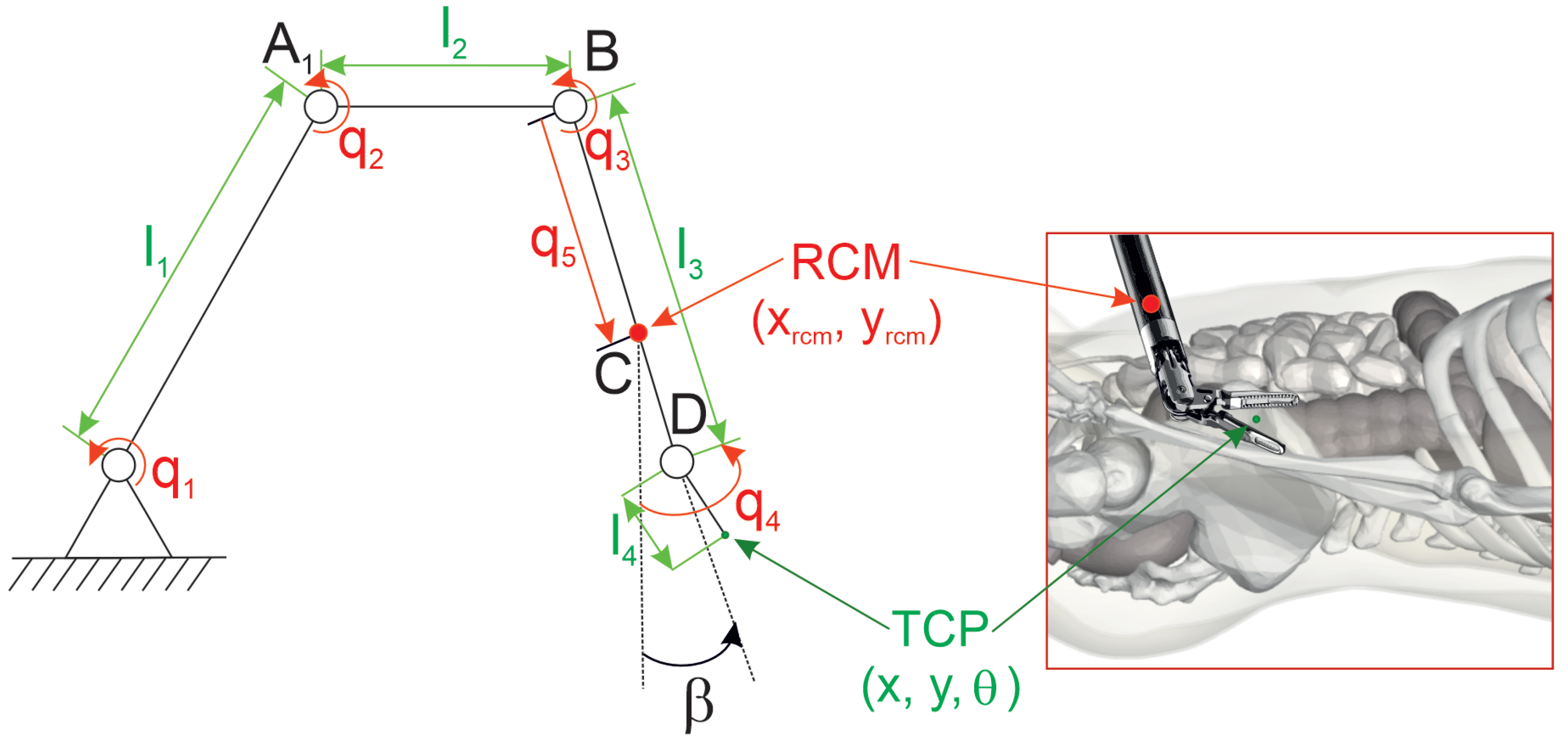
The simplified kinematic chain consists of a 3R serial manipulator holding in series a 1-DoF surgical tool with a revolute joint. The kinematic chain diagram with labels is shown in
Figure 1.
Forward kinematics. The forward kinematics task formulation for the considered robot can be stated as a problem of finding the end-effector position and orientation based on the kinematic chain configuration. Let us denote the robot configuration as
, where
correspond to the robot arm configuration,
to the tool joint configuration, and
is the additional virtual prismatic joint used to model the RCM point position on the tool shaft. Since the system operates in
, the forward kinematics model of the robot system can be formulated as
where
,
,
and
denote the lengths of corresponding manipulator links.
Additionally, we can consider the RCM point position as a function of configuration variables:
Inverse kinematics. In inverse kinematics problems, we aim to compute the robot chain configuration for which a desired robot end-effector pose is achieved.
The additional complication in our case is the necessity of meeting the RCM constraint, i.e., ascertaining that the tool shaft (link 3) passes through a point .
For the considered kinematic chain it is possible to derive the IK solution (incorporating the RCM constraint) analytically considering that it exhibits no redundancy. The wrist position, indicated as point
D in
Figure 1, can be computed as
Next, the angle
is calculated as
The joint position
B is then found as
Joint
A may be located in two positions due to link 1. and link 2. length constraints. The position of
A is solved as
The configuration variables
are calculated as
The IK problem has two solutions for this robot, which can be separated according to sign on
: (a) elbow-down posture for
, and (b) elbow-up posture for
. The expressions for IK solution are provided in attached source code (
https://gitlab.com/kair_robotics/mapolsrm, accessed on 12 March 2026).
3.2. Manipulability
In order to evaluate the RCM point placement we propose to use manipulability index [
21], computed as
. The eigenvalues of
define the principal axes of the manipulability ellipsoid, and their ratio provides a measure of directional velocity transmission capability. Highly anisotropic ellipsoids correspond to configurations where motion is amplified in some Cartesian directions and severely limited in others. In order to capture the influence of the RCM constraint on the manipulability of the system, we use the effective Jacobian
computed through projecting the unconstrained robot Jacobian
J onto the null-space of the constraint Jacobian
[
13]:
Since the RCM constraint removes one degree of freedom, the effective Jacobian becomes rank-reduced compared to the unconstrained case, which fundamentally reshapes the manipulability ellipsoid and shifts singular configurations. Our constrained manipulability index
is calculated as
. We compute our manipulability objective
W as a function of the RCM constraint position
by considering the minimal value of index
achieved in a desired workspace of the system operating with that position of the constraint. In this paper
is considered constant and equal to
, corresponding to the tool end-effector pointing vertically downwards. The desired workspace is defined as a grid of points spanning a cube with corner coordinates
,
relative to the RCM constraint frame, with the resolution of
. Thus, the manipulability objective is defined as
for every point
sampled in the desired workspace with a prespecified resolution.
3.3. Optimization
The optimal RCM point was found by discretizing the
domain and finding the position of the RCM by a brute force method that maximize the manipulability
considering that
.
3.4. Sensitivity Analysis for the Manipulability Objective
Since the manipulability objective is evaluated numerically over a discretized representation of the task workspace and depends on both design and setup parameters, a sensitivity analysis is performed to assess the robustness of the obtained results. First, the influence of workspace discretization was examined by varying the sampling resolution in range of 10 mm to 5 mm. The resulting optimal RCM positions exhibited negligible displacement, while the corresponding minimum constrained manipulability values changed only marginally, indicating that the selected resolution provides sufficient numerical accuracy for the considered workspace.
The robustness of the optimized RCM placement with respect to trocar positioning errors is also investigated. Small perturbations of the RCM location in the order of a few millimeters resulted in limited variations in the minimum manipulability index, confirming that the proposed optimization framework yields solutions that remain stable under clinically realistic placement inaccuracies. Finally, the effect of relaxing the tool orientation constraint was evaluated by introducing moderate deviations from the nominal orientation . The overall distribution of high-manipulability regions in the workspace remains consistent, while slight improvements in absolute manipulability values will be observed, reflecting the expected increase in available degrees of freedom.
These observations will demonstrate that the proposed manipulability-based optimization is not overly sensitive to numerical discretization choices or small setup uncertainties and therefore provides reliable guidance for both robot design and preoperative planning.
4. Results and Discussion
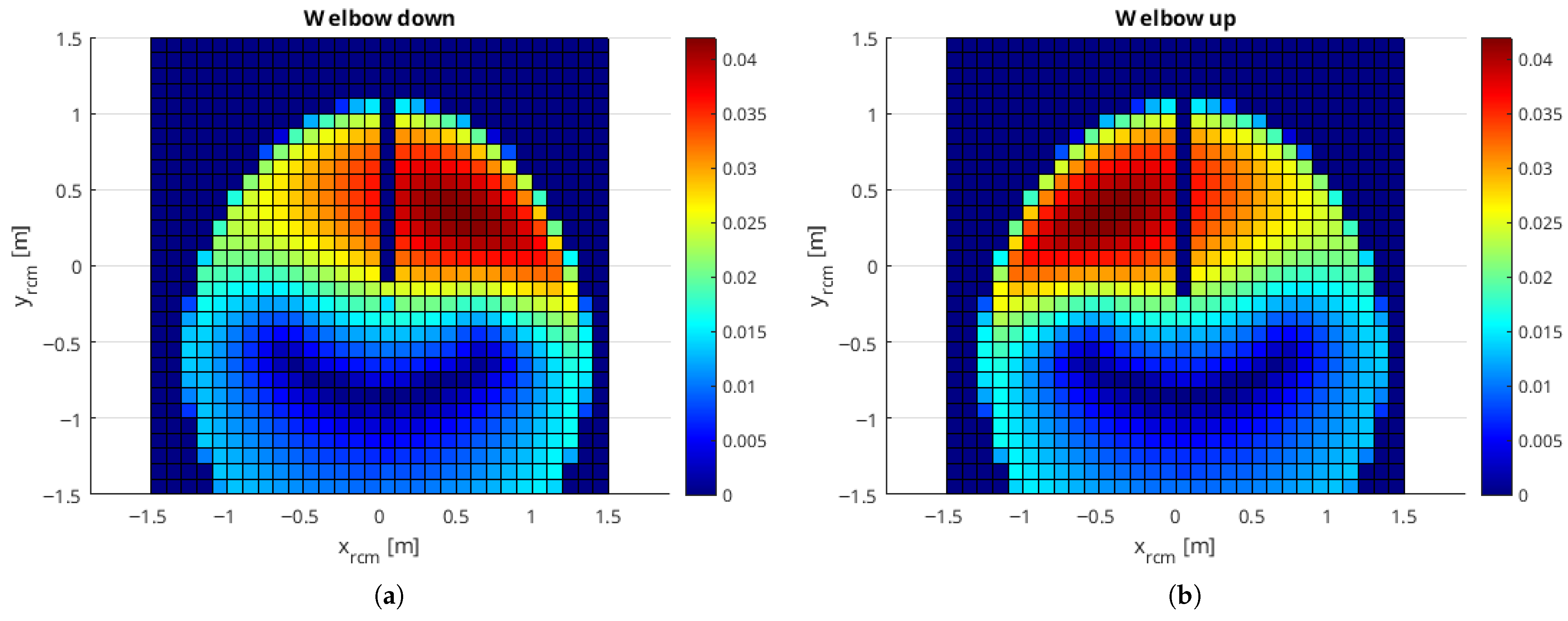
The manipulability analysis of the simplified surgical robot system is shown in
Figure 2. The figure presents manipulability achieved according to the RCM constraint location in the workspace of the robot for two postures (i.e., solutions of the IK problem).
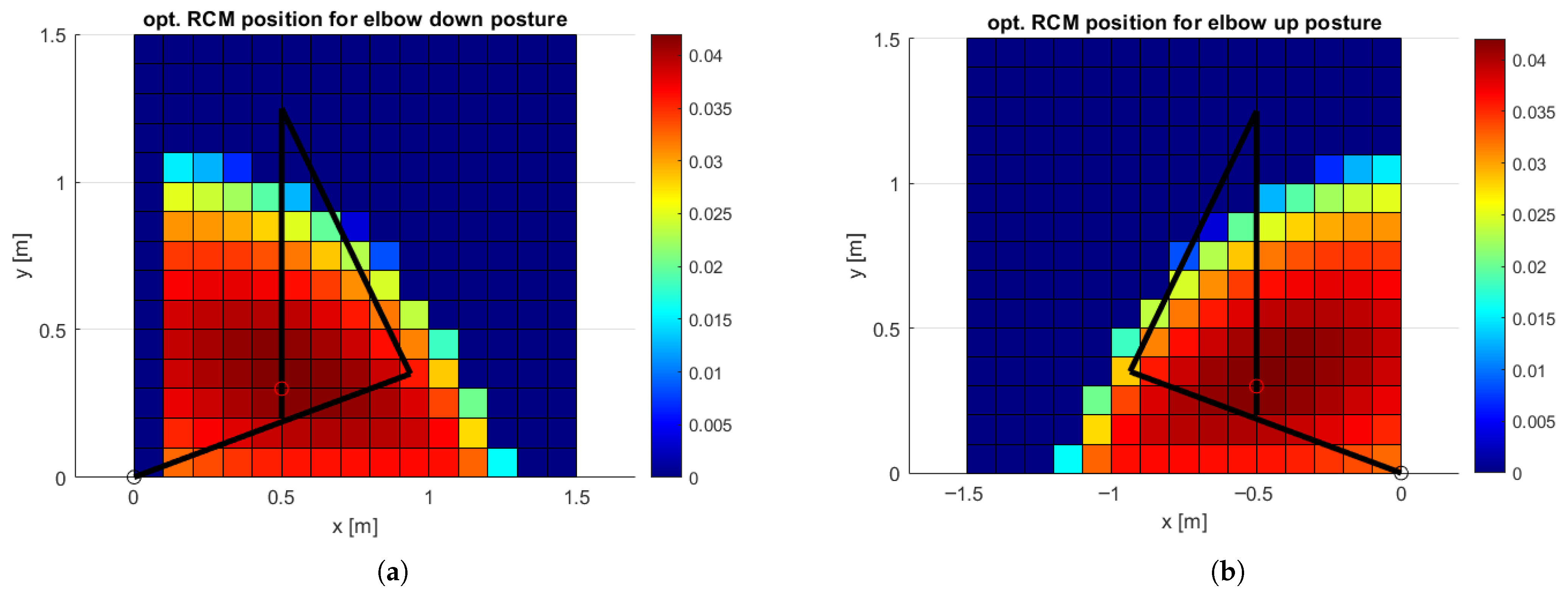
We first consider the best RCM position while assuming the downward vertical orientation of the trocar (i.e.,
) with grid resolution equal to
. The solutions for these cases are shown in
Figure 3. The following best RCM locations were found for elbow-down posture of the robot system:
and for elbow-up posture the following:
The two solutions are symmetric, and they have the same maximum value (0.042) for manipulability. The size of the surface where the manipulability objective is high (highlighted with red colors in
Figure 2 and
Figure 3) is the same.
While the two distinct solution domains present no advantage over each other in terms of the manipulability index, in practice, a selection between them would have been made where other factors, such as collision avoidability and need to access the patient, would affect the choice. Such conditions, while important, are out of the scope of the kinematic analysis and not considered in this paper.
In
Table 1 and
Table 2 the results of the sensitivity analysis are shown for elbow-down and elbow-up postures, respectively. The resolution is changing from 10 mm to 5 mm with a step of 1 mm. In the second column the value of maximum W is shown and, in the last two columns, the position of the RCM in X and Y directions for the maximum W. As can be seen the maximum value of the manipulability is not affected by the change in the resolution. However, the RCM position is slightly different. The X coordinate deviates from 0.48 m to 0.53 m and the Y coordinate from 0.25 to 0.3 m for elbow-down posture. In the case of elbow-up posture the deviations for X and Y coordinates are from −0.54 m to −0.48 m and 0.26 m to 0.3 m, respectively. These small displacements of the trocar position will not significantly affect the dexterity of the robot. This is also justified by the continuity of the manipulability index shown in
Figure 2a,b, ranging from 0.4 to 0.6 (−0.6 to −0.4) for
and 0.25 to 0.35 for
for elbow-down (elbow-up) posture. The provided displacement values represent the variation in the suggested RCM position obtained in the optimization problem resolution and do not reflect any tracking errors expected during the operation of the system. The tracking and positioning precision need to be achieved with a proper tuning of the control system, which is not in the scope of our current work. In
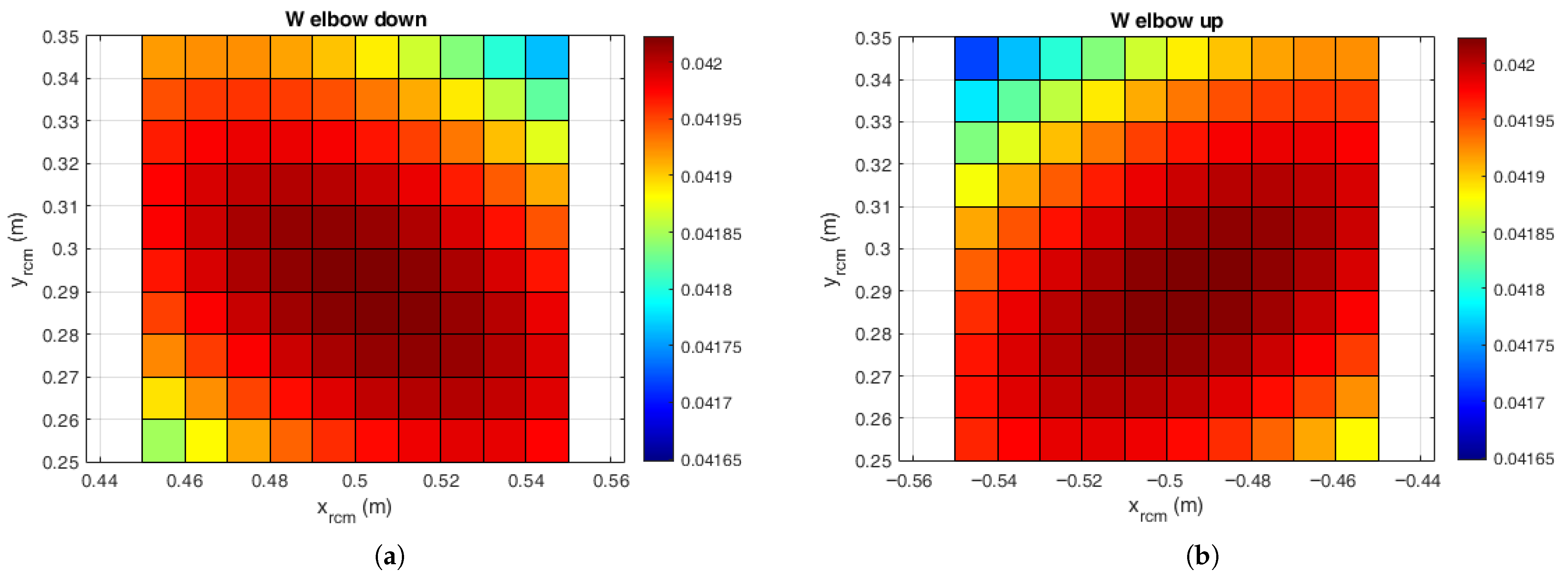
Figure 4a,b the sensitivity of the manipulability objective to small perturbations in the RCM position is shown for elbow-down and elbow-up postures, respectively. The results are shown for a displacement of the RCM point by
mm in both directions around the best solution. Note that the color map is different from the one shown in
Figure 2 in order to highlight the small changes in the manipulability value. The maximum change in manipulability is less than 1% in both cases, showing that small perturbations in the RCM position will not significantly affect the performance of the robot.
In
Table 3 and
Table 4 the change in the maximum manipulability by varying
by
with a step of
is shown for the postures of elbow-down and elbow-up, respectively. The values of the maximum manipulability are determined in the best locations of RCM shown in (
15) and (
16). It can be seen that the manipulability increases when the angle of the tool is misaligned with the vertical axis in both postures. The manipulability increase is about 1.6% in both cases, showing that, the larger the deviation, the better the performance of the robot.
It should be emphasized that the position deviations obtained in the sensitivity analysis do not represent the constraint violations observed during the movement but merely the dependence of the optimized results on the optimization meta-parameters.
The manipulability objective
W obtained through the exploration of the task workspace, along with the sensitivity analysis, offers a lower-bound estimate on the kinematic performance of the robot on a range of trajectories with fixed orientation executed in that workspace. In laparoscopic surgery, it is expected that the effector orientation deviates moderately from the initial angle, and the sensitivity analysis (see
Table 3 and
Table 4) shows that the objective does not degrade for such angular deviations. Therefore, the results can be used to select the optimal task position in the kinematic sense, and the analysis only needs to be performed once per kinematic structure of the system, assuming a certain threshold on the end-effector orientation relative to the task frame.
5. Conclusions
In this work we have presented the manipulability analysis of the kinematic chain of a manipulator with a surgical instrument attached to it. The analysis is simplified to a planar problem with imposed constraints on the workspaces, optimized for special positions resulting from the solution of a forward and inverse kinematics task. Knowing the best manipulability areas, it is possible to assess the availability of the working space in the operating environment constrained by the trocar, the manipulation space in the abdomen, and the positioning at the RCM point in the preoperative planning phase. These aspects fundamentally influence the choice regarding the number and position of trocars while reducing the risk of possible blockage of the manipulator, which may move near a singular point or collide with another cooperating arm. In this way, the precision of the movements of the tool can be increased, which directly translates into increased quality and precision of the procedure. By reducing the problem to the planar system of the 3R manipulator, it is possible to obtain valuable information about the entire space quickly, provided that a series of analyses are carried out that reduce the problem to a plane and produce a global three-dimensional result. The sensitivity analysis showed that any perturbation in the RCM position will not significantly change the performance of the robot. In addition, any deviation in the tool orientation will slightly increase the total performance. In future work, the proposed manipulability index optimization methodology can be further extended to the analysis of spatial kinematic chain laparoscopic robots as well as systems with variable anatomy. Since kinematic analysis does not capture all task constraints, work on collision avoidance, statics and dynamics and ergonomy would be of paramount importance in further research.




 ,
,