Article

The Influence of Pantograph Arcing on the Current Collection of Electrified Trains Under Different Air Pressures

1
Standards & Metrology Research Institute, China Academy of Railway Sciences Corporation Limited, Beijing 100015, China
2
High-Speed Pantograph-Catenary Relationship Laboratory, National Engineering Research Center of System Technology for High-Speed Railway and Urban Rail Transit, Beijing 100015, China
3
School of Electrical Engineering, Xipu Campus, Southwest Jiaotong University, Chengdu 611756, China
*
Author to whom correspondence should be addressed.
Appl. Sci. 2026, 16(6), 2829; https://doi.org/10.3390/app16062829
Submission received: 10 February 2026 / Revised: 8 March 2026 / Accepted: 9 March 2026 / Published: 16 March 2026
(This article belongs to the Special Issue Railway Vehicle Dynamics: Advances and Applications)

Abstract

As well as the off-line phenomenon between the pantograph strip and the contact wire that occurs frequently, the current collection quality of trains is potential under threat. Pantograph arcing can bring about overvoltage and harmonics in the traction circuit, which can seriously threaten the construction’s strength and efficiency of current collection. Meanwhile, the electrified railway might meet very complex environments, including the various routes under different air pressures. When the train runs in a medium- or low-pressure area, the reduction in air pressure may result in significant differences in the dynamic evolution characteristics of pantograph arcing. So it is necessary to carry out a detailed study on the influence of pantograph arcing on the current collection of electrified trains in a low-pressure environment. In this paper, we proposed an improved pantograph arcing model suitable for medium-to-low-pressure regions, with the pressure parameters taken into consideration. Furthermore, we examined the influence of pantograph arcing under medium-to-low-pressure environments on the traction power supply system. The arcing dynamics, including the arc duration, the current zero-crossing, and the arcing-released energy at different air pressures were compared. The overvoltage and the harmonic distribution of the traction drive system were also analyzed. This work may be helpful for the design and maintenance of electrified railways under medium-to-low-pressure environments.

1. Introduction

In electrified railways, the pantograph–catenary (PC) system is fundamental to power transmission and is widely recognized as a critical factor in the advancement of high-speed train technology [1,2]. During train operation, contact loss between the pantograph strip and the contact wire—often accompanied by pantograph arcing—is an unavoidable phenomenon. This off-line behavior is induced by multiple factors, including contact wire rigidity, pantograph vibration, and track irregularities [3,4].
Pantograph arcing has two principal detrimental effects. First, it accelerates the wear of both the contact wire and pantograph strip due to thermal ablation. Second, it introduces overvoltages and harmonics that can compromise traction power system stability [5,6]. As train speeds and traction power continue to increase, the frequency and severity of off-line events have grown, deteriorating current collection quality. For instance, higher operational speeds amplify mechanical vibrations, increase dynamic variations in contact force, and lead to more frequent and prolonged contact losses [7,8,9].
As electrified railways expand into complex environments, trains are increasingly exposed to medium- and low-pressure regions, such as high-altitude routes, where atmospheric pressure is significantly lower than at sea level [10]. Air pressure is a key determinant of dielectric strength and arc behavior. Previous research has demonstrated that lower air pressure reduces the breakdown voltage of air gaps, alters arc column dynamics, and affects energy distribution during arcing [11,12,13]. These studies establish that pressure fundamentally influences arc ignition and sustainment. However, they focus primarily on fundamental arc physics in controlled laboratory settings rather than on system-level impacts on operating trains.
Research on electrical arcs in power systems generally falls into two categories. The first focuses on arc-induced material degradation through experimental observation and magnetohydrodynamic simulation [14,15]. These investigations have been conducted in switchgear interruption, where arc–electrode interaction determines contact erosion rates and dielectric recovery [16,17,18,19]; in welding and spraying processes [20,21]; and in pantograph–catenary fault analysis to assess material loss under arcing conditions [22,23,24,25]. While valuable for understanding contact erosion, these studies do not address system-level electrical effects on power quality or traction performance.
The second category involves black-box arc models—such as those of Cassie, Mayr, and Habedank [26,27,28]—developed to simulate arc–circuit interactions. The Cassie model applies to high-current arcs where arc voltage remains relatively constant, while the Mayr model suits low-current regimes near current zero where thermal inertia dominates. The Habedank model combines both approaches for wider current ranges. However, these models are calibrated for controlled laboratory conditions and have not been adapted to the specific dynamics of pantograph arcing, particularly under the dual influences of reduced atmospheric pressure and high-speed air flow from train motion.
Despite progress in understanding both arc physics and material effects, no systematic investigation has addressed how pantograph arcing under medium-to-low-pressure conditions affects the real-time current collection quality of operating electrified trains, particularly regarding its interaction with the complete traction power system. This gap is critical because pressure-dependent changes in arc duration, energy release, and extinction behavior directly influence overvoltage generation, harmonic distortion, and system protection coordination—factors essential for reliable high-speed railway operation at high altitudes.
In this work, we first developed an improved pantograph arcing model suitable for medium-to-low-pressure regions, with the pressure parameters (0.5 atm~1.0 atm) taken into consideration. Furthermore, we examined the influence of pantograph arcing under medium-to-low-pressure environments on the traction power supply system. The arcing dynamics, including the arc duration, the current zero-crossing, and the arcing-released energy at different air pressures was compared. The overvoltage and the harmonic distribution of the traction drive system was also analyzed. This work may be helpful for the design and maintenance of electrified railways under medium-to-low-pressure environments.

2. Modeling of Pantograph Arcing Under Medium-to-Low-Pressure Environments

The traditional Cassie and Mayr models assume that the voltage gradient U and dissipated power Po of an arc are constants, respectively, which can only describe the static characteristics of the arc at a certain stage but not reflect the dynamic characteristics. Pantograph arcing is completely exposed to the atmospheric environment, and its shape and characteristics become more complex with differences in train running speed, PC off-line time, PC gap and atmospheric environment. Some railways are located in the environment of medium-to-low pressure, and the electrical characteristics of pantograph arcing need to be further explored. In addition, the strong air flow brought by the wind of the running train produces the effect of transverse arc blowing, which makes the convection heat exchange of the arc more obvious, affects the re-ignition and extinction process of the arc, and thus affects the stable current collection of the high-speed train’s PC system. The above factors lead to the fact that the U and Po of pantograph arcing are no longer constants, but variables affected by these factors. Based on the Mayr model and considering the influencing factors of pantograph arcing under low-pressure environments, the dissipated power of the arc is deduced in this paper.
In the process of stable arcing, the input power of the arc is mainly distributed to the surrounding air through conduction, radiation and convection. When the train runs at high speed, pantograph arcing is blown by strong air flow, and the main heat dissipation mode is convective heat dissipation. During train operation, pantograph arcing is elongated, making its length much larger than its diameter. Therefore, only convective heat dissipation caused by transverse arc blowing [1] is considered in this paper, which can be expressed as
P o = k v d l T 0 T a C d T
where the arc dissipation power coefficient k is 7 according to the experimental results in [29]; Ta is the average arc temperature, K; T0 presents the air temperature, which is equal to the initial arcing temperature (4000 K); v is the train running speed, cm/s; d is the diameter of the arc column, cm; L is the arc length, cm; and C is the specific heat capacity of fluid medium per unit volume, J/(cm3·K).
Ta and C can be expressed by the air pressure p as follows [1,11,13]:
T a = 42.39 p + 5813
c = 1.39 × 10 3 p + 0.27 T
Arc diameter d, initial current I0 and arc length l can be calculated respectively as follows [1,26,28]:
d = 0.26 I
I 0 = 0.36 v + 2.01
l = 1.535 × 10 4 v 2 0.0505 v + 5.842
Substituting Formulas (2)~(6) into Formula (1) obtains the following:
P o = ( 4.67 × 10 3 v 7 2 1.53 v 5 2 + 177.22 v 3 2 ) ( 3.71 × 10 8 p 3 + 2.95 × 10 6 p 2 + 2.49 × 10 3 p + 0.1 ) 1
Therefore, the improved arc model equation derived from the above formula is as follows:
1 g d g d t = 1 τ u i P o 1 = 1 τ ( 3.71 × 10 8 p 3 + 2.95 × 10 6 p 2 + 2.49 × 10 3 p + 0.1 ) 1 u i ( 4.67 × 10 3 v 7 2 1.53 v 5 2 + 177.22 v 3 2 ) 1
where u and i are the instantaneous values of arc voltage and current; v is the running speed of the train, cm/s; p is the atmospheric pressure, which is set as 1.0 atm, 0.8 atm, 0.7 atm and 0.5 atm according to the pressure data along the typical medium-to-low-pressure railway [11]; g is the arc conductance, and the initial arc conductance g0 is 104 S; and the arc time constant τ is 10−4 s [29].

3. Modeling and Verification of Traction Drive System

In order to describe the electrical characteristics of pantograph arcing accurately, the equivalent model and parameters of the actual traction drive system are used in the simulation, as shown in Figure 1. US, RS, and IS are the equivalent power supply, resistance and inductance of the traction transformer respectively. The traction network part includes the contact wire and messenger wire, and considering the influence of the rail and earth, it is equivalent to a π circuit. RC and LC are the equivalent resistance and inductance of the catenary respectively, and CC is the equivalent capacitance of the catenary to ground. The traction drive part includes the vehicle transformer, traction converter, traction motor, leakage inductance LN at the input side of the traction converter and support capacitance CD of the DC link. A pantograph arcing model is added between the traction network part and the traction drive part. The simulation parameters of each part are shown in Table 1.
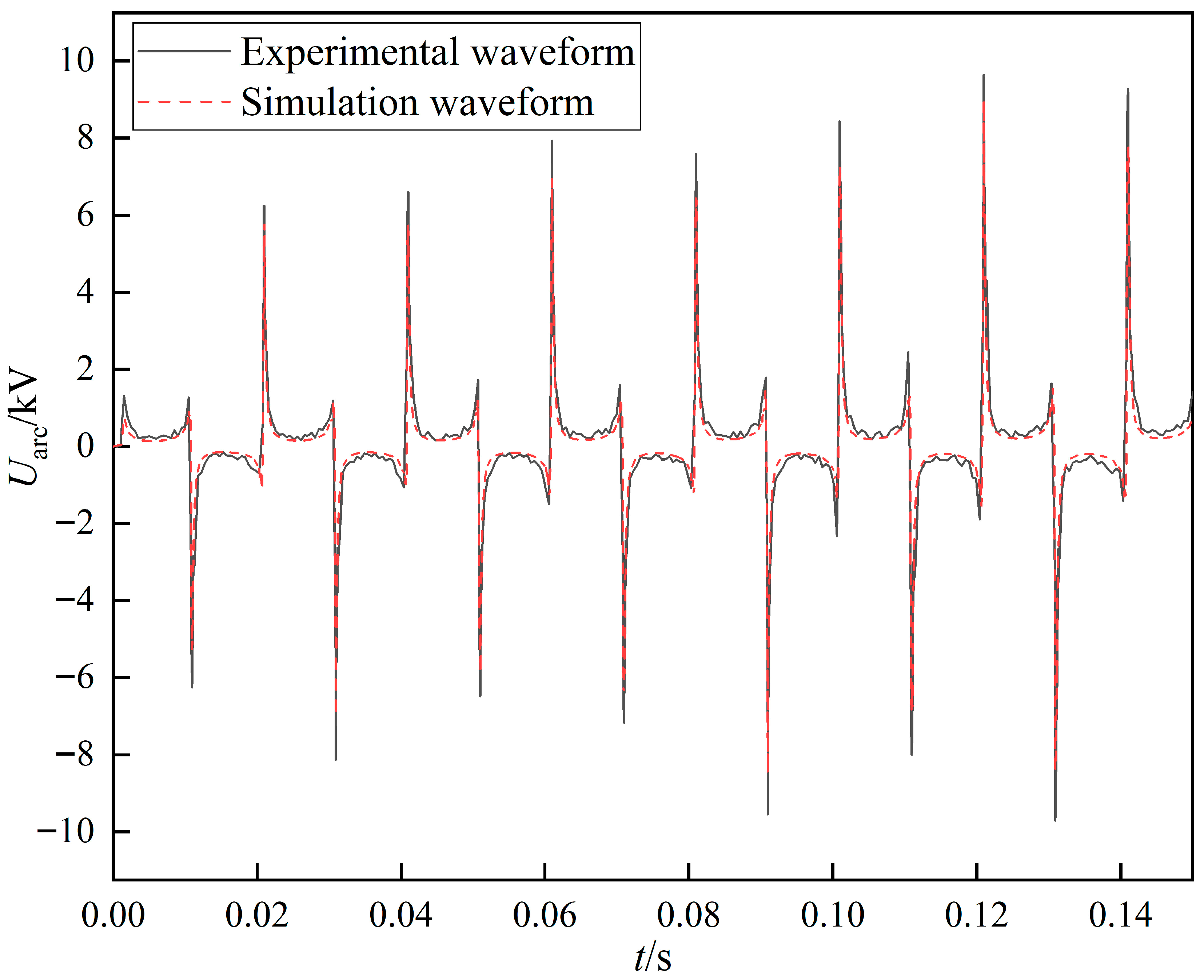
According to Formula (8), the pantograph arcing model is established in Matlab/Simulink R2025a. Taking the air pressure p = 1.0 atm and the vehicle speed v = 100 km/h, the pantograph arcing voltage waveform at atmospheric pressure is simulated. In order to verify the accuracy of the model, the simulation waveform is compared with the experimental waveform [29], as shown in Figure 2. Copper electrodes and an external wind source are used to generate arc plasma and simulate the transverse arc blowing effect of air flow, respectively, in ref. [29], where the power supply voltage is 10 kV, the frequency is 50 Hz, and the electrode gap is 6.5 mm. It can be found in Figure 2 that due to the influence on the shape and material heterogeneity of the two electrodes and the constantly changing distance, the actual arc voltage waveform jitters to a certain extent, resulting in the simulation waveform not being completely consistent with the experimental waveform. Nevertheless, the simulation waveform of the pantograph arcing voltage at atmospheric pressure is consistent with the variation trend of the experimental waveform with time. With the increase in arcing time, the peak voltage of them both increase. And the stable arcing voltage is also close (the maximum stable arcing voltage in the experiment is about 0.6 kV, while the simulation result is 0.542 kV). Thus, the characteristic of the simulated arc waveform is consistent with the actual pantograph arcing, which effectively verifies the correctness of the simulation model in this paper.
Direct experimental validation under reduced pressure (0.5–0.9 atm) is not yet available due to experimental limitations. However, the model’s pressure-dependent parameters are derived from physical principles: convective cooling scales with air density ( ρ p ), providing a theoretical basis for extrapolation. The predicted trends—longer arc duration, delayed current-zero crossing, and faster overvoltage rise at lower pressure—are qualitatively consistent with published low-pressure arc observations, indicating that the model captures the dominant physics. Direct experimental validation across the full pressure range remains a priority for future work.

4. Analysis of Arc Characteristics

4.1. Electrical Characteristics

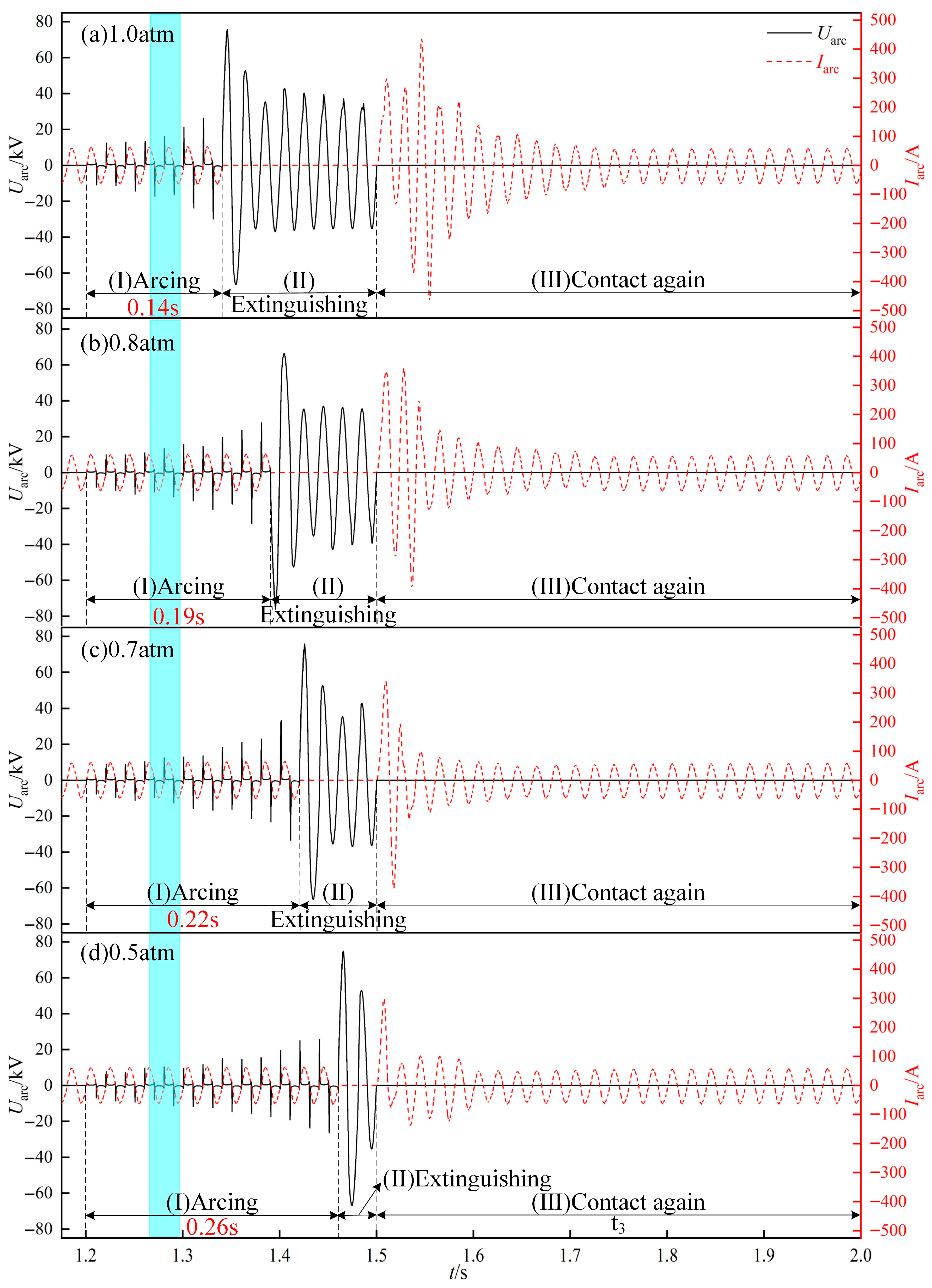
The primary PC off-line process can be divided into two stages: (I) stable arcing stage: at this stage, the arc continues to burn for a short time; (II) arc extinguishing stage: during the off-line process, the arc dissipation power increases gradually, so that the arc is extinguished and the train loses current due to insufficient input energy at the later stage of the PC off-line process. In order to investigate the change trend of various parameters in the traction drive circuit from transient to steady state with the PC off-line time after the arc is extinguished, the PC off-line time is increased on the basis of (II), which is called (III) contact again stage of PC, as shown in Figure 3.
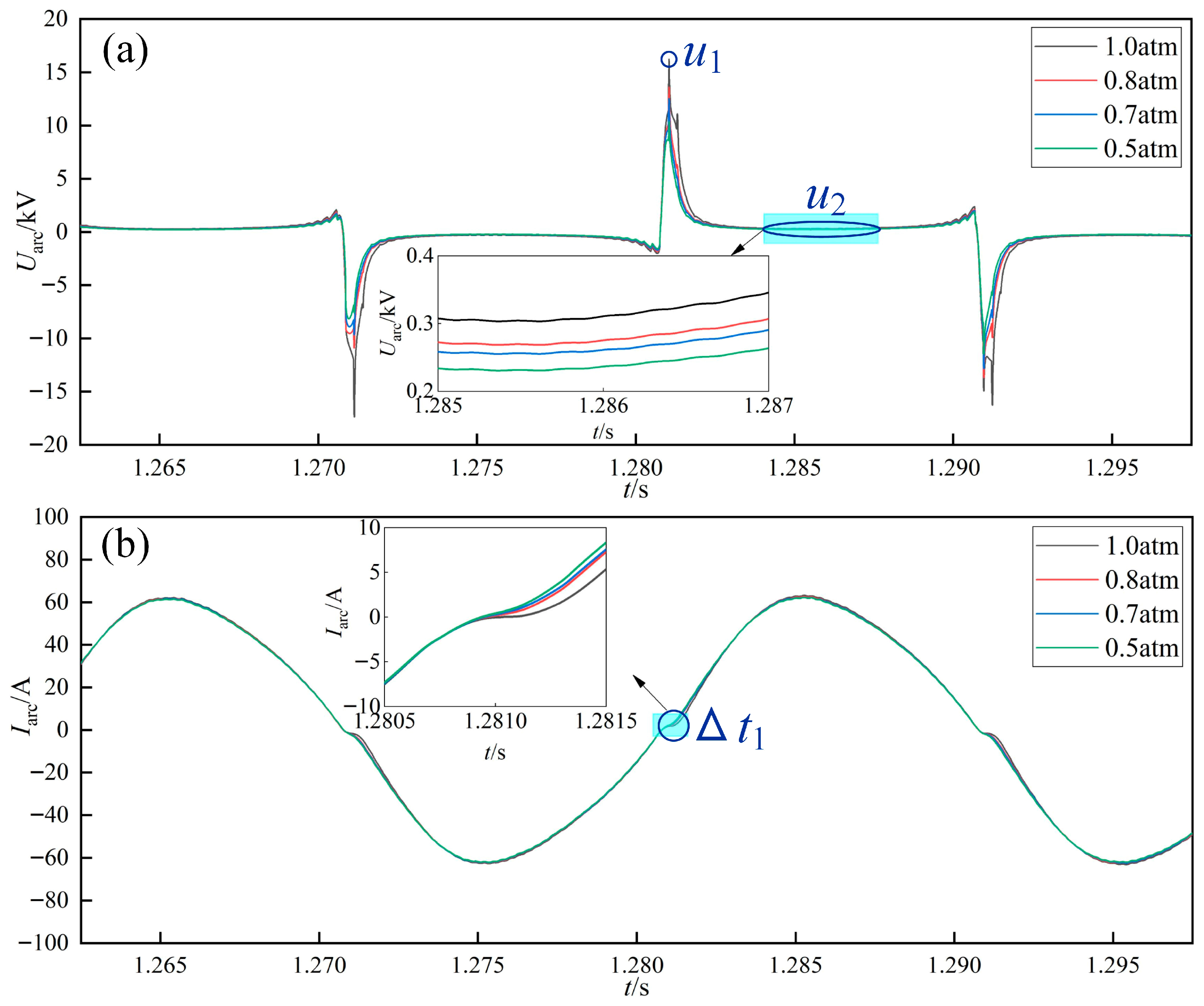
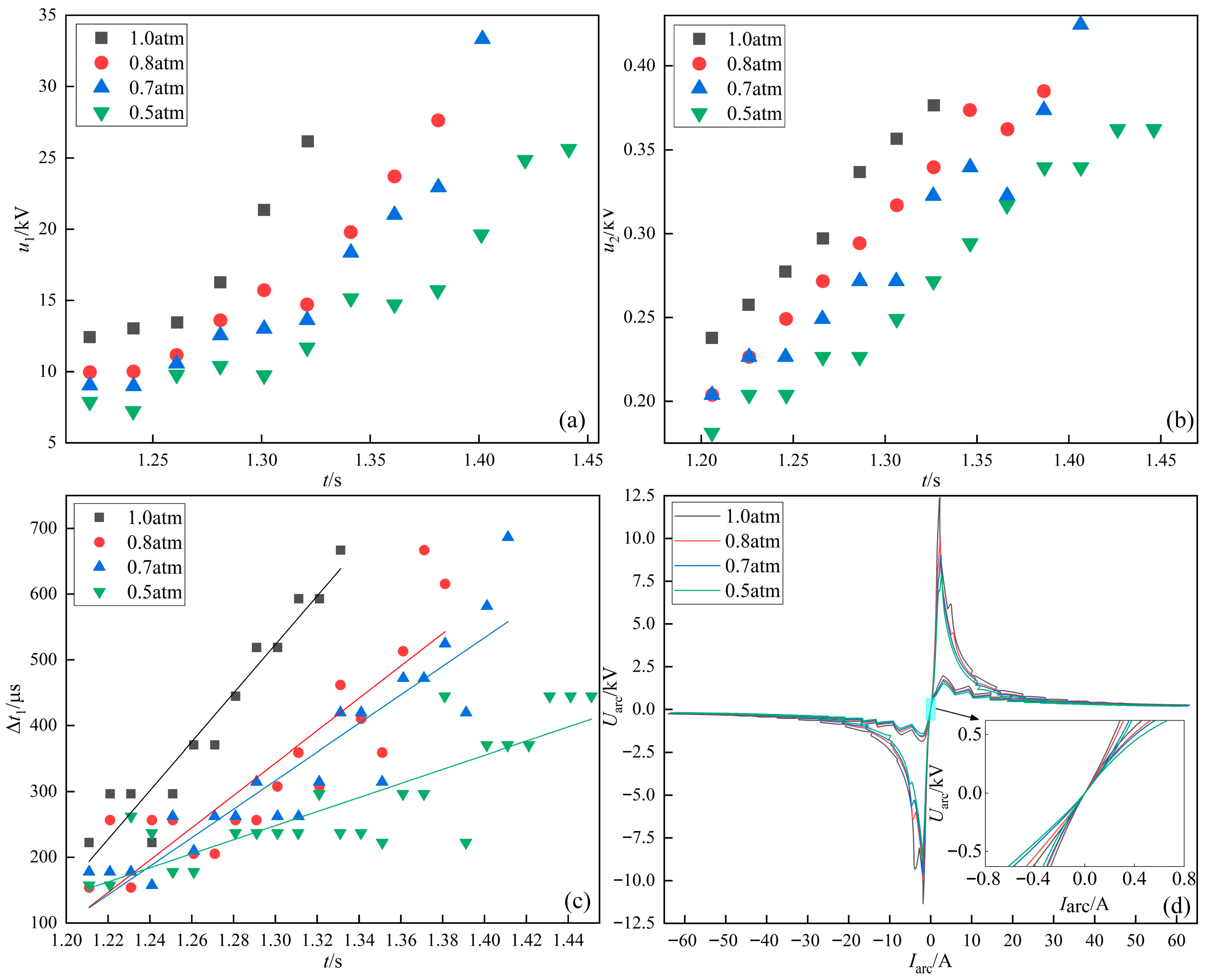
Considering that the train running speed is 200 km/h, the voltage and current waveforms of the PC system at the air pressure levels of 1.0 atm, 0.8 atm, 0.7 atm and 0.5 atm are shown in Figure 3a, Figure 3b, Figure 3c and Figure 3d respectively. It can be found that the voltage and current waveforms of the PC system exhibit different characteristics throughout the calculated time of 800 ms. At stage (I), pantograph arcing is generated. In order to observe the voltage and current characteristics of pantograph arcing of the current zero-crossing moment more clearly, the blue area is enlarged, as shown in Figure 4. Among them, u1, u2, and Δt1 represent arcing spike voltage, stable arcing voltage and arc current zero-crossing time respectively. It can be found that the arc voltage shows an upward trend as a whole with the increase in time. In order to further analyze the influence of air pressure on the electrical characteristics of pantograph arcing, u1, u2, and Δt1 at the air pressure levels of 1.0 atm, 0.8 atm, 0.7 atm and 0.5 atm are extracted in Figure 5a–c, and the corresponding curves are drawn.
As shown in Figure 5a,b, at the same air pressure level, u1 and u2 both increase with the increase in time. For instance, u1 at the air pressure level of 1.0 atm increases from 12.42 kV to 26.17 kV and u2 increases from 0.214 kV to 0.38 kV within the corresponding arc duration. At the same arcing moment, u1 and u2 reduce with the decrease in air pressure. Taking 1.3 s as an example, when the air pressure is 0.8 atm, 0.7 atm and 0.5 atm, u1 decreases by 26.42%, 39.09% and 54.41% respectively compared with 1.0 atm, while u2 decreases by 11.11%, 23.81% and 30.16% respectively. To sum up, the pantograph arcing voltage decreases with the decrease in air pressure. This is mainly because the lower the air pressure, the lower the dissipated power, which reduces the heat loss of the arc. And the input power that needs to be compensated by the power supply to maintain the thermal balance of the arc is also reduced accordingly, so as to reduce the arc voltage. From another point of view, it is also means that the maintenance ability of the arc is enhanced with the decrease in air pressure, which will make the arc more difficult to extinguish and seriously threaten the safe and stable operation of the train. This will be discussed in detail in the next section.
As can be seen from Figure 5c, with the decrease in air pressure, the zero-crossing time of the arc current decreases at the same arcing moment. Taking the arcing moment of 1.3 s as an example, when the air pressure level is 1.0 atm 0.8 atm, 0.7 atm and 0.5 atm, the zero-crossing time is 518.70 μs, 307.85 μs, 262.24 μs, and 237.12 μs respectively. With the increase in arcing time, the growth rate of the zero-crossing time at medium-to-low-pressure decreases. The above phenomenon means that with the decrease in air pressure, the arc duration in the current zero-crossing stage becomes shorter, and the power required to reignite the arc decreases, which further confirms that the maintenance ability of the arc is enhanced.
The volt-ampere characteristic curve of pantograph arcing in one cycle (1.22~1.24 s) is shown in Figure 5d. It can be found that there is a highly nonlinear relationship between pantograph arcing voltage and current, and the arc resistance is equal to the ratio of the instantaneous value of arc voltage and current. After the pantograph arc is formed, the arc resistance decreases rapidly and the current begins to increase gradually. When the arc current reaches the maximum value, the arc resistance rises slowly and the current drops. The volt-ampere characteristic curve of pantograph arcing is approximately a hysteresis loop. To compare the effect of air pressure on arc resistance in the arc zero-crossing stage, the volt-ampere characteristics of the current zero-crossing area are amplified, as shown in the blue area of Figure 5d. It can be found that the lower the air pressure, the smaller the slope of the curve (arc resistance) in the current zero-crossing region

4.2. Electrical Characteristics

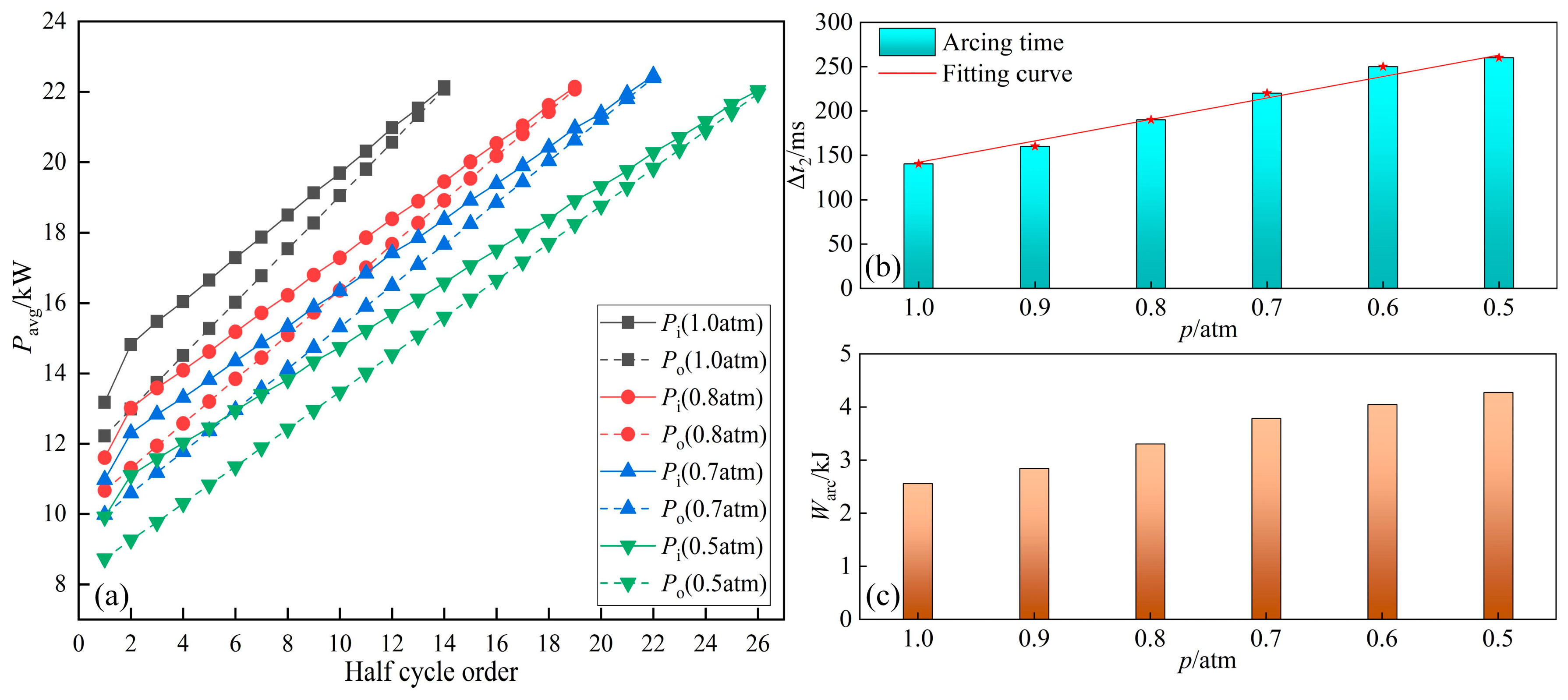
The arc duration at different air pressure levels is calculated by simulation, as shown in Figure 6b. It can be found that when the air pressure level decreases from 1.0 atm to 0.5 atm, the arc duration increases from 140 ms to 260 ms. More specifically, when the air pressure level is 0.8 atm, 0.7 atm and 0.5 atm, the arc duration increases by 35.71%, 57.14% and 85.71% compared with 1.0 atm respectively. Obviously, the arc duration increases significantly with the decrease in air pressure. Through data fitting, it is concluded that the relationship between arc duration and air pressure is approximately a linear function as shown in Formula (9).
t = 242.31 p + 384.23
where t is the arc duration in cm and p is the air pressure in atmospheres.
Whether the arc can burn continuously in the PC disconnection process can be judged by the competition between the input power Pi and the dissipated power Po of the arc. When Pi > Po, the arc keeps burning, and the extra power is used to increase the diameter, length and temperature of the arc. When Pi = Po, the arc burns stably, and the arc diameter, length and temperature remain unchanged. When Pi < Po, the input power provided by the external power supply cannot continue to supply the power that is released when the arc continues to burn, resulting in the extinction of the arc.
As there will be a voltage and current zero-crossing phenomenon every half-cycle (10 ms) for the AC arc, the average Pi and Po of the arc in each half-cycle at different air pressure levels are calculated according to Formulas (7) and (10). Through the comparison between them, the variation trend of arc duration with speed is analyzed. Figure 6a shows the growth trend of the average Pi and Po of the arc over time at four pressure levels of 1.0 atm, 0.8 atm, 0.7 atm and 0.5 atm. As can be seen from Figure 6a, with the increase in arc duration, the average Pi and Po of the arc increase, but the growth rate of Po is greater than that of Pi. And the lower the air pressure level is, the slower the average Pi and Po of the arc increase with the arcing time. This is mainly because the lower the air pressure is, the lower the average temperature of the arc is, which will weaken the convective heat dissipation of the arc, resulting in the slower rate of dissipation power with the increase in arc duration and the corresponding slow increase of the input power. Therefore, the lower the air pressure is, the more half-cycles there are and the greater the average input power is than the dissipated power, that is, the longer the arc duration.
P i = 2 T t t + T 2 u ( t ) i ( t ) d t
W o = t t 0 t P o ( t ) d t
In order to further analyze the impact of longer arc duration in low-pressure environments, the total energy output by the arc from starting moment t0 to extinguishing moment t at different pressure levels is calculated according to Formula (11), as shown in Figure 6c. As the air pressure decreases, the total energy W o released during the arcing process exhibits a monotonically increasing trend. Compared with the value at 1.0 atm (2.56 kJ), when the pressure drops to 0.8 atm, 0.7 atm, and 0.5 atm, W o increases to 3.33 kJ, 3.79 kJ, and 4.27 kJ, respectively, corresponding to increases of 29.13%, 47.87%, and 66.95%. Part of the energy released by the arc is used to continuously increase its own diameter and length, and the other part is outward through thermal radiation, electromagnetic radiation, etc., which will aggravate the erosion of the electrode materials by the arc [1]. Therefore, at medium-to-low pressure, the electrode will be seriously affected due to the longer-duration erosion of the arc, which may cause the electrode of the PC system to fracture and swap blocks [2] and seriously affect the safe and stable operation of high-speed trains. Thus, more attention should be paid to the construction and operation of the medium-to-low-pressure routes.
This section analyses the arc characteristics of pantograph arcs. Research indicates that as ambient atmospheric pressure decreases, the electrical properties of the arc undergo significant changes: both the arc-initiation peak voltage (u1) and steady-state arc voltage (u2) decrease, while the current zero-crossing time (Δt1) shortens. Concurrently, the slope of the arc’s voltage–current characteristic curve in the zero-crossing region (i.e., the equivalent resistance) diminishes. Collectively, these phenomena indicate enhanced arc maintenance capability under low-pressure conditions. The fundamental cause lies in atmospheric pressure reduction diminishing convective heat dissipation, thereby lowering arc dissipation power. Regarding arc-burning characteristics, low pressure markedly prolongs arc duration and increases total arc-released energy (Wo). Arc duration exhibits an approximate linear inverse relationship with atmospheric pressure; for instance, when pressure decreases from 1.0 atm to 0.5 atm, arc duration increases from 140 ms to 260 ms. The heightened arc energy intensifies its erosive effects on pantograph and catenary electrode materials, posing a severe threat to the safety of current collection systems on high-altitude (low-to-medium-pressure) lines.

5. Influence of Pantograph Arcing on Traction Drive System

5.1. Overvoltage

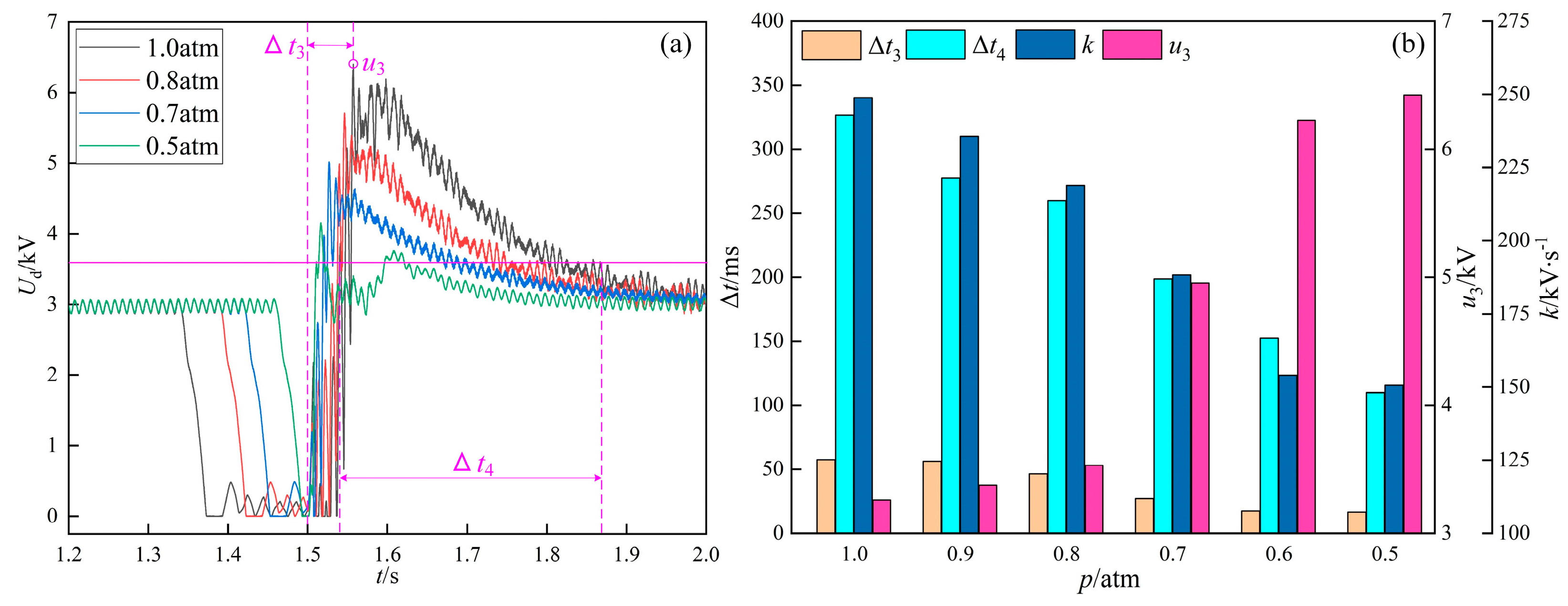
The influence of pantograph arcing on the traction drive system under a low-pressure environment is analyzed, considering the starting time of motor and the fact that the PC disconnection time and recontact time are set as 1.2 s and 1.5 s respectively in this paper. The DC side voltage of rectifier Ud with time at different air pressures is simulated, as shown in Figure 7a. u3 represents the peak overvoltage at the DC link, Δt3 denotes the rise time to reach this peak, and Δt4 indicates the duration during which the voltage exceeds the maximum allowable limit (3.6 kV).
During continuous arc burning, the DC-link voltage remains stable at approximately 3 kV. Upon arc extinction, the voltage drops rapidly to zero across all pressure levels, causing instantaneous power interruption. After pantograph recontact, an overvoltage appears in the DC link, reaching its peak value u3 within Δt3. Subsequently, the overvoltage decays exponentially toward the steady-state value of 3 kV.
The maximum voltage allowed by the DC link supporting the capacitor of the traction converter is 1.2 times the rated voltage (3 KV), i.e., 3.6 kV. Exceeding this value will lead to protection locking of the traction converter, increase the control difficulty of the converter, and even lead to the isolation of the converter module, affecting the current collection quality of the train. It can be found in Figure 7b that u3 increases with the decrease in air pressure; under atmospheric pressures of 0.7 atm and 0.5 atm, the overvoltage peaks (4.93 kV and 6.40 kV respectively) significantly exceed the permissible voltage threshold of 3.6 kV for the DC busbar, presenting a clear risk of insulation breakdown. At 1.0 atm and 0.8 atm, the peak voltages (3.26 kV and 3.51 kV respectively) do not exceed the threshold, but the time to reach the peak overvoltage Δt3 becomes shorter; that is, the growth rate k becomes faster, rising from 111.35 kV·s−1 at 1.0 atm to 249.74 kV·s−1 at 0.5 atm, resulting in faster protection locking of the traction converter. In addition, at medium-to-low pressure, the time when the DC side overvoltage exceeds the maximum allowable voltage (Δt4) is relatively short, and the insulation impact on the converter is relatively weak.

5.2. Harmonic

As a highly non-time-varying nonlinear load, the voltage–current hysteresis characteristics of the electric arc constitute the fundamental cause of harmonic injection into the traction network. The spectral characteristics and amplitude of harmonics are directly influenced by the dynamic resistance variation process of the arc, particularly its nonlinear behavior near current zero-crossing points. Consequently, the influence of air pressure on arc electrical parameters—such as voltage, zero-crossing time, and equivalent resistance—revealed in Section 4 constitutes the intrinsic physical mechanism explaining the variation in harmonic distribution with air pressure discussed herein.
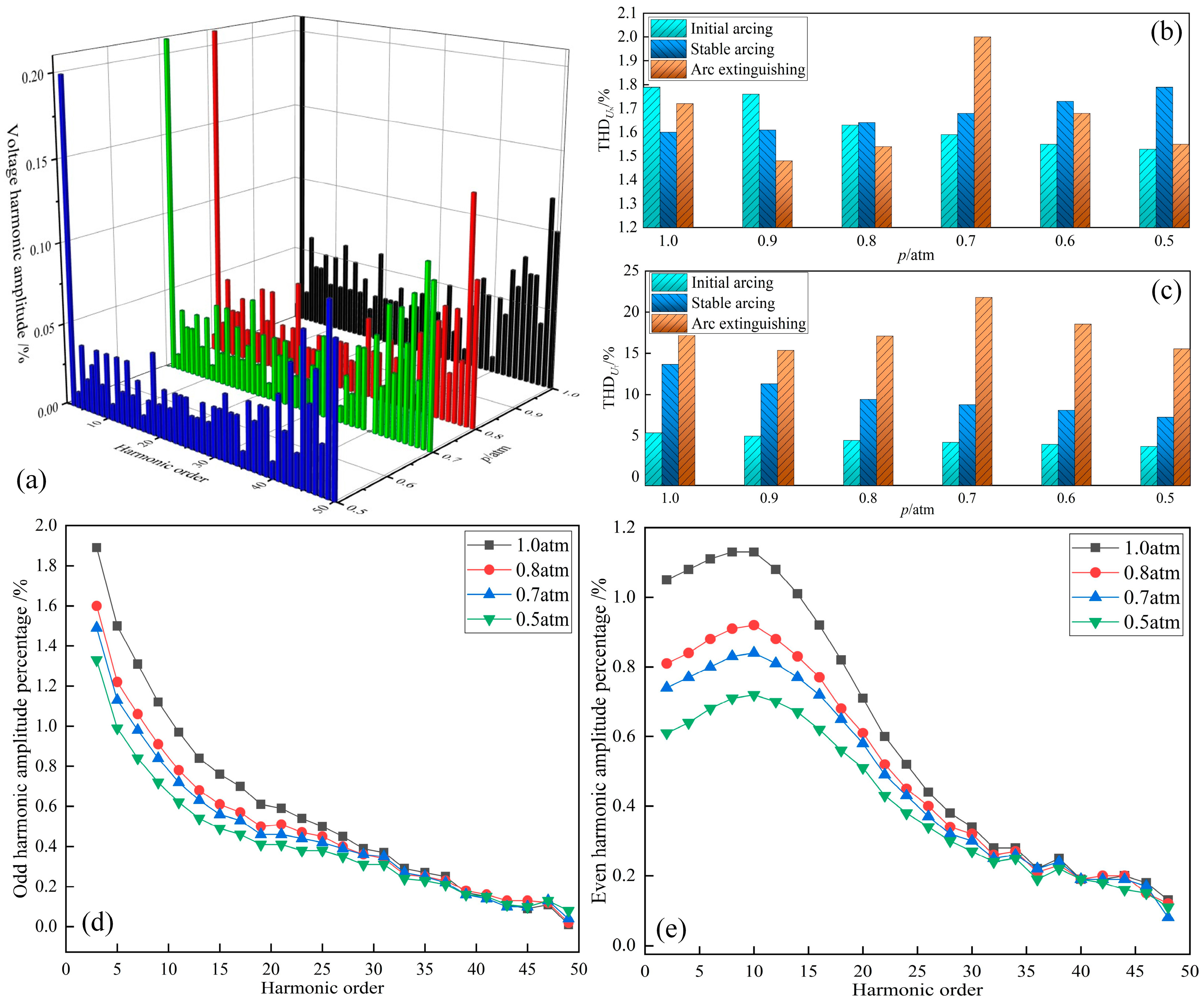
In order to further analyze the impact of pantograph arcing on train current collection quality in medium-to-low-pressure environments, the harmonic distribution characteristics of a traction drive system are simulated in this paper. The harmonic distribution and total harmonic distortion (THD) of catenary voltage UN and vehicle transformer input voltage UT at different air pressures are shown in Figure 8. And the distribution of each harmonic of UN at the initial arcing stage (1.2~1.22 s) is shown in Figure 8a. Generally speaking, the harmonic distribution range of UN is large and the amplitude percentage of each harmonic is relatively small. Furthermore, when the order is less than 50, the harmonics of UN are mainly odd harmonics, and the variation amplitude of each harmonic component with air pressure is small. The distribution of each harmonic of UT at the initial arcing stage (1.2~1.22 s) is shown in Figure 8d,e. It can be found that the harmonics of the UT are mainly distributed within the 30th order, and with the increase in the harmonic order, the odd harmonic component decreases gradually and the even harmonic component increases initially and then decreases. Moreover, each harmonic component decreases with the decrease in air pressure.
Taking the initial arcing stage (1.2~1.22 s), the stable arcing stage (1.3~1.32 s) and the arc extinguishing stage (the previous cycle of extinction time) as examples, the distortion of UN and UT at different air pressures is further analyzed in this paper. The THD of the voltage in the above three stages is calculated according to Formula (12), and the corresponding curves are drawn, as shown in Figure 8b,c.
THD U = 100 U 1 % h = 2 M U h 2
where U1 is the fundamental amplitude of voltage and Uh is the h-th harmonic amplitude of voltage, h = 1, 2, …, M.
As can be seen from Figure 8b,c, at the initial arcing stage, the THD of UN and UT decreases with the decrease in air pressure. At the stable arcing stage, the THD of UN increases, but the THD of UT decreases with the decrease in air pressure. At the arc extinguishing stage, the THDs of UN and UT present the same fluctuation trend, which decreases initially, then increases and decreases finally with the decrease in air pressure. And the peaks of both appear at 0.7 atm, which are 2.01% and 21.79% respectively. The distortion of the input voltage waveform will increase the loss of the vehicle transformer, then increase the difficulty of traction converter control and deteriorate the converter quality.
This section investigates the impact of pantograph arcs on traction drive systems. Regarding overvoltages, operational overvoltages occur on the DC side when the pantograph re-closes after arc extinction. Although the overvoltage peak (u3) decreases at low pressure, its rise rate (k) increases sharply (e.g., from 111.35 kV·s−1 at 1.0 atm to 249.74 kV·s−1 at 0.5 atm). This may trigger faster protection actions in traction converters, increasing control complexity. Regarding harmonic effects, arcing deteriorates the power quality of both the overhead contact line voltage (UN) and the vehicle-to-network input voltage (UT). Harmonic distribution analysis indicates that UN primarily exhibits low-order odd harmonics, whereas UT displays both odd and even harmonics. The total harmonic distortion (THD) is influenced by both atmospheric pressure and the arc-burning phase, exhibiting complex variation patterns. For instance, during the arc extinction phase, both UN and UT THD peak at 0.7 atm. Voltage waveform distortion increases transformer losses and deteriorates the operating conditions of traction converters.

6. Conclusions

The characteristics of pantograph arcing under medium-to-low-pressure conditions was investigated, and the impact of pantograph arcing on the current collection quality of trains was also studied. The major conclusions are summarized as follows:
(1) The electrical characteristics of pantograph arcing are closely related to the air pressure. The arcing spike voltage and stable arcing voltage exhibit a decreasing trend with the decrease in air pressure. For the environment air pressure decrease from 1.0 atm to 0.5 atm, the arcing spike voltage and arcing stable voltage decrease by 54.41% and 30.16% respectively. Meanwhile, the zero-crossing time of the arc current also decreases. Both of the above trends may result in a higher probability of arcing re-ignition and existence.
(2) The arc duration was found to have a strong correlation with the air pressure. With the decrease in the air pressure, the arc duration stretches. When the air pressure is 0.8 atm, 0.7 atm and 0.5 atm, the arc duration increases by 35.71%, 57.14% and 85.71% respectively. Compared with the case of 1.0 atm, the total energy released in the arcing process increases by 29.13%, 47.87% and 66.95% respectively, which intensifies the erosion of the electrode materials of the PC system.
(3) With the decrease in air pressure, the peak overvoltage of the DC side of the traction converter decreases, but the growth rate becomes larger. The voltage waveform of the catenary is generally less affected by air pressure, and each harmonic component is almost unchanged with the decrease in air pressure. Each harmonic component of the transformer input voltage UT decreases with the decline in air pressure. The THD of UT may reach as high as 21.79%, which possibly has the most serious negative impact on the current collection quality of the train. In contrast to classical Cassie–Mayr arc models, which are primarily calibrated for controlled laboratory conditions and do not account for pressure variations, the proposed model explicitly incorporates atmospheric pressure effects into the arc dynamics. This enables a more realistic analysis of pantograph arcing behavior under the actual operating conditions encountered in medium- and high-altitude railway lines, where reduced pressure significantly influences arc duration, energy release, and system-level power quality.

Author Contributions

Writing—original draft preparation, T.X.; methodology, Q.X.; writing—review and editing, L.P.; visualization, Q.Y.; data curation, H.Z.; validation, K.Z.; project administration, W.W. All authors have read and agreed to the published version of the manuscript.

Funding

This research was funded by the Research project of the Chinese Academy of Railway Sciences, grant number 2024YJ281, and the project of the China Railway Group, grant number L2025G002.

Institutional Review Board Statement

Not applicable.

Informed Consent Statement

Not applicable.

Data Availability Statement

The original contributions presented in this study are included in the article. Further inquiries can be directed to the corresponding author.

Acknowledgments

The authors have reviewed and edited the output and take full responsibility for the content of this publication.

Conflicts of Interest

Authors Tong Xing, Like Pan and Qun Yu were employed by the company China Academy of Railway Sciences Corporation Limited. The remaining authors declare that the research was conducted in the absence of any commercial or financial relationships that could be construed as a potential conflict of interest.

References

  1. Wu, G.; Gao, G.; Wei, W.; Yang, Z. (Eds.) The Electrical Contact of the Pantograph-Catenary System Theory and Applications; Springer Press: Singapore, 2019; Available online: https://link.springer.com/book/10.1007/978-981-13-6589-8 (accessed on 12 April 2022).
  2. Wu, G.; Zhou, Y.; Gao, G.; Wu, J.; Wei, W. Arc erosion characteristics of Cu-impregnated carbon materials used for current collection in high-speed railways. IEEE Trans. Compon. Packag. Manuf. Technol. 2018, 8, 1014–1023. [Google Scholar] [CrossRef]
  3. Fan, F.; Wank, A.; Seferi, Y.; Stewart, B.G. Pantograph Arc Location Estimation Using Resonant Frequencies in DC Railway Power Systems. IEEE Trans. Transp. Electrif. 2021, 7, 3083–3095. [Google Scholar] [CrossRef]
  4. Leva, S.; Paolo, A.; Colombaioni, P. Dynamic analysis of a high-speed train. IEEE Trans. Veh. Technol. 2008, 57, 107–119. [Google Scholar] [CrossRef]
  5. Lv, X.; Wang, X.; Che, Y.; Fu, R. Eigenvalue-Based Harmonic Instability Analysis of Electrical Railway Vehicle-Network System. IEEE Trans. Transp. Electrif. 2019, 5, 727–744. [Google Scholar] [CrossRef]
  6. Lee, S.; Kim, J.; Jung, H. Analysis of catenary voltage of an AT-fed ac HSR system. IEEE Trans. Veh. Technol. 2004, 53, 1856–1862. [Google Scholar] [CrossRef]
  7. Xu, Z.; Song, Y.; Liu, Z. Effective Measures to Improve Current Collection Quality for Double Pantographs and Catenary Based on Wave Propagation Analysis. IEEE Trans. Veh. Technol. 2020, 69, 6299–6309. [Google Scholar] [CrossRef]
  8. Ronanki, D.; Singh, S.; Williamson, S. Comprehensive Topological Overview of Rolling Stock Architectures and Recent Trends in Electric Railway Traction Systems. IEEE Trans. Transp. Electrif. 2018, 3, 724–738. [Google Scholar] [CrossRef]
  9. Ronanki, D.; Williamson, S. Modular Multilevel Converters for Transportation Electrification: Challenges and Opportunities. IEEE Trans. Transp. Electrif. 2018, 4, 399–407. [Google Scholar] [CrossRef]
  10. Bruni, S.; Bucca, G.; Carnevale, M.; Collina, A.; Facchinetti, A. Pantograph–catenary interaction: Recent achievements and future research challenges. Int. J. Rail Transp. 2018, 6, 57–82. [Google Scholar] [CrossRef]
  11. Xu, Z.; Gao, G.; Wei, W.; Yang, Z.; Xie, W.; Dong, K.; Ma, Y.; Yang, Y.; Wu, G. Characteristics of pantograph-catenary arc under low air pressure and strong airflow. High Volt. 2021, 7, 369–381. [Google Scholar] [CrossRef]
  12. Bian, X.; Meng, X.; Wang, L.; Macalpine, J.M.K.; Guan, Z.; Hui, J. Negative Corona Inception Voltages in Rod-plane Gaps at Various Air Pressures and Humidities. IEEE Trans. Dielectr. Electr. Insul. 2011, 18, 613–619. [Google Scholar] [CrossRef]
  13. Wang, W.; Wu, Y.; Rong, M.; Yang, F. Theoretical computation studies for transport properties of air plasmas. ACTA Phys. Sin. 2012, 61, 105201. [Google Scholar] [CrossRef]
  14. Xie, W.; Wu, G.; Yang, Z.; She, P.; Wang, H.; Zuo, H.; Wei, W.; Gao, G.; Tu, C. Study on the erosion characteristics of copper-carbon electrode pairs by DC air arc. High Volt. 2021, 6, 674–683. [Google Scholar] [CrossRef]
  15. Zöhrer, S.; Golizadeh, M.; Koutná, N.; Holec, D.; Anders, A.; Franz, R. Erosion and cathodic arc plasma of Nb–Al cathodes: Composite versus intermetallic. Plasma Sci. Technol. 2020, 29, 025022. [Google Scholar] [CrossRef]
  16. Ma, R.; Rong, M.; Yang, F.; Wu, Y.; Sun, H.; Yuan, D.; Wang, H.; Niu, C. Investigation on Arc Behavior During Arc Motion in Air DC Circuit Breaker. IEEE Trans. Plasma Sci. 2013, 41, 2551–2560. [Google Scholar] [CrossRef]
  17. Huang, X.; Zhao, L.; Bai, X.; Wang, Z.; Ning, W.; Wang, L.; Ren, J. Study on the influence of metal particles on the characteristics of high-current vacuum arc plasma. J. Phys. D-Appl. Phys. 2020, 53, 425206. [Google Scholar] [CrossRef]
  18. Zhao, L.; Chen, W.; Huang, X.; Ren, J.; Ning, W.; Wang, L.; Zhuang, H.; Wu, Q. Numerical investigation on the influence of metal particles on the characteristics of a high-current vacuum arc. J. Phys. D-Appl. Phys. 2021, 54, 295502. [Google Scholar] [CrossRef]
  19. Verite, J.; Boucher, T.; Comte, A.; Delalondre, C.; Simonin, O. Arc modelling in circuit breakers: Coupling between electromagnetics and fluid mechanics. IEEE Trans. Magn. 1995, 31, 1843–1848. [Google Scholar] [CrossRef]
  20. Cho, D.; Lee, S.; Na, S. Characterization of welding arc and weld pool formation in vacuum gas hollow tungsten arc welding. J. Mater. Process. Technol. 2013, 213, 143–152. [Google Scholar] [CrossRef]
  21. Li, T.; Yang, X.; Chen, L. Arc behaviour and weld formation in gas focusing plasma arc welding. Sci. Technol. Weld. Join. 2020, 25, 329–335. [Google Scholar]
  22. Midya, S.; Bormann, D.; Schutte, T.; Thottappillil, R. Pantograph arcing in electrified railways-mechanism and influence of various parameters-part II: With AC traction power supply. IEEE Trans. Power Deliv. 2009, 24, 1940–1950. [Google Scholar] [CrossRef]
  23. Wei, W.; Wu, J.; Gao, G.; Gu, Z.; Liu, X.; Zhu, G.; Wu, G. Study on pantograph arcing in a laboratory simulation system by high-speed photography. IEEE Trans. Plasma Sci. 2016, 44, 2438–2455. [Google Scholar] [CrossRef]
  24. Gao, G.; Hao, J.; Wei, W.; Hu, H.; Zhu, G.; Wu, G. Dynamics of pantograph-catenary arc during the pantograph lowering process. IEEE Trans. Plasma Sci. 2016, 44, 2715–2723. [Google Scholar] [CrossRef]
  25. Yang, Z.; Xu, P.; Wei, W.; Gao, G.; Zhou, N.; Wu, G. Influence of the Crosswind on the Pantograph Arcing Dynamics. IEEE Trans. Plasma Sci. 2020, 48, 2822–2830. [Google Scholar] [CrossRef]
  26. Wang, Y.; Liu, Z.; Mu, X.; Huang, K.; Wang, H.; Gao, S. An extended habedank’s equation-based EMTP model of pantograph arcing considering pantograph-catenary interactions and train speeds. IEEE Trans. Power Deliv. 2016, 31, 1186–1194. [Google Scholar] [CrossRef]
  27. Liu, Z.; Zhou, H.; Huang, K.; Song, Y.; Zheng, Z.; Cheng, Y. Extended black-box model of pantograph-catenary detachment arc considering pantograph-catenary dynamics in Electrified railway. IEEE Trans. Ind. Appl. 2019, 55, 776–785. [Google Scholar] [CrossRef]
  28. Liu, Y.; Chang, G.; Huang, H. Mayr’s Equation-Based Model for Pantograph Arc of High-Speed Railway Traction System. IEEE Trans. Power Deliv. 2010, 25, 2025–2027. [Google Scholar] [CrossRef]
  29. Gao, G.; Zhang, T.; Wei, W.; Hu, Y.; Wu, G.; Zhou, N. A pantograph arcing model for electrified railways with different speeds. Proc. Inst. Mech. Eng. Part F J. Rail Rapid Transit 2017, 232, 1731–1740. [Google Scholar] [CrossRef]
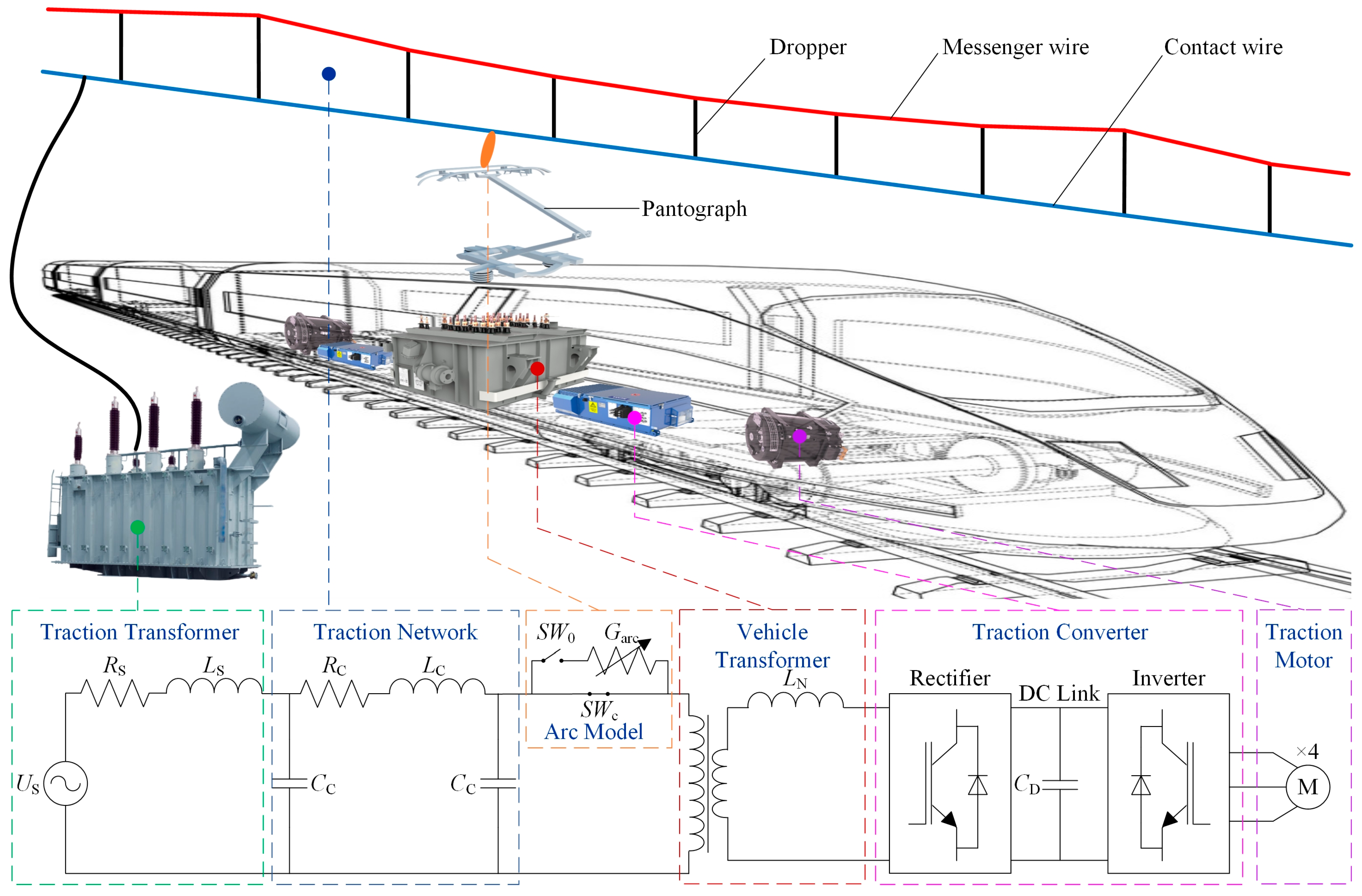
Figure 1. Equivalent circuit of traction drive system.
Applsci 16 02829 g001
Figure 2. Comparison of measured and simulated voltage waveforms of pantograph arcing.
Applsci 16 02829 g002
Figure 3. Schematic diagram of the dynamic process of the pantograph–catenary off-line arc. (I) Arcing phase, (II) extinguishing phase, and (III) contact again phase. (a) 1.0 atm; (b) 0.8 atm; (c) 0.7 atm; (d) 0.5 atm.
Applsci 16 02829 g003
Figure 4. Arc voltage and current waveforms with partially enlarged part of the current zero-crossing moment. (a) Arc voltage; (b) Arc current.
Applsci 16 02829 g004
Figure 5. Arc electrical characteristics: (a) arcing spike voltage; (b) stable arcing voltage; (c) zero-crossing time; (d) volt-ampere characteristic curve.
Applsci 16 02829 g005
Figure 6. Arcing characteristics at different air pressures: (a) average power; (b) arc duration; (c) arc-released energy.
Applsci 16 02829 g006
Figure 7. DC side voltage of rectifier: Δt3, the time to reach the peak overvoltage; Δt4, the maximum allowable voltage; k, the growth rate; u3, the peak overvoltage. DC side voltage of rectifier under different atmospheric pressures (a) DC side voltage of rectifier during arc ignition; (b) DC side voltage of rectifier parameters.
Applsci 16 02829 g007
Figure 8. Harmonic distribution of traction drive system: (a) harmonic distribution of UN; (b) THD of UN; (c) THD of UT; (d) harmonic distribution of UT (odd); (e) harmonic distribution of UT (even).
Applsci 16 02829 g008
Table 1. Simulation parameters of traction drive system [8,9,29].
PartsParameters
Traction TransformerUS = 27.5 kV, RS = 0.14 Ω, LS = 3.16 mH
Traction NetworkRC = 2.95 Ω, LC = 23.5 mH, CC = 0.081 μF
Vehicle Transformer (ATM9)SN1 = 3060 kVA, SN2 = 2570 kVA, U1N = 25 kV
RectifierU2N = 1.5 kV, f = 50 Hz, LN = 2 mH
DC LinkPin = 1285 kW (U = 1500 V, I = 857 A), Po = 1296 kW
Inverter(Ud = 3000 V, Id =432 A), η > 97.5%, fc = 1250 Hz
Traction Motor (MT250)CD = CD1 + CD2, CD1 = CD2 = 0.016 F
Disclaimer/Publisher’s Note: The statements, opinions and data contained in all publications are solely those of the individual author(s) and contributor(s) and not of MDPI and/or the editor(s). MDPI and/or the editor(s) disclaim responsibility for any injury to people or property resulting from any ideas, methods, instructions or products referred to in the content.