Semantic Divergence in AI-Generated and Human Influencer Product Recommendations: A Computational Analysis of Dual-Agent Communication in Social Commerce


Abstract
1. Introduction
2. Theoretical Background and Literature Review
2.1. AI in Advertising and Product Recommendation
2.2. Trust and Information Source Selection
2.3. Information Processing Differences Between AI and Humans
2.4. Influencer Marketing in Social Commerce
2.5. Integrative Theoretical Framework
3. Hypotheses Development
- (1)
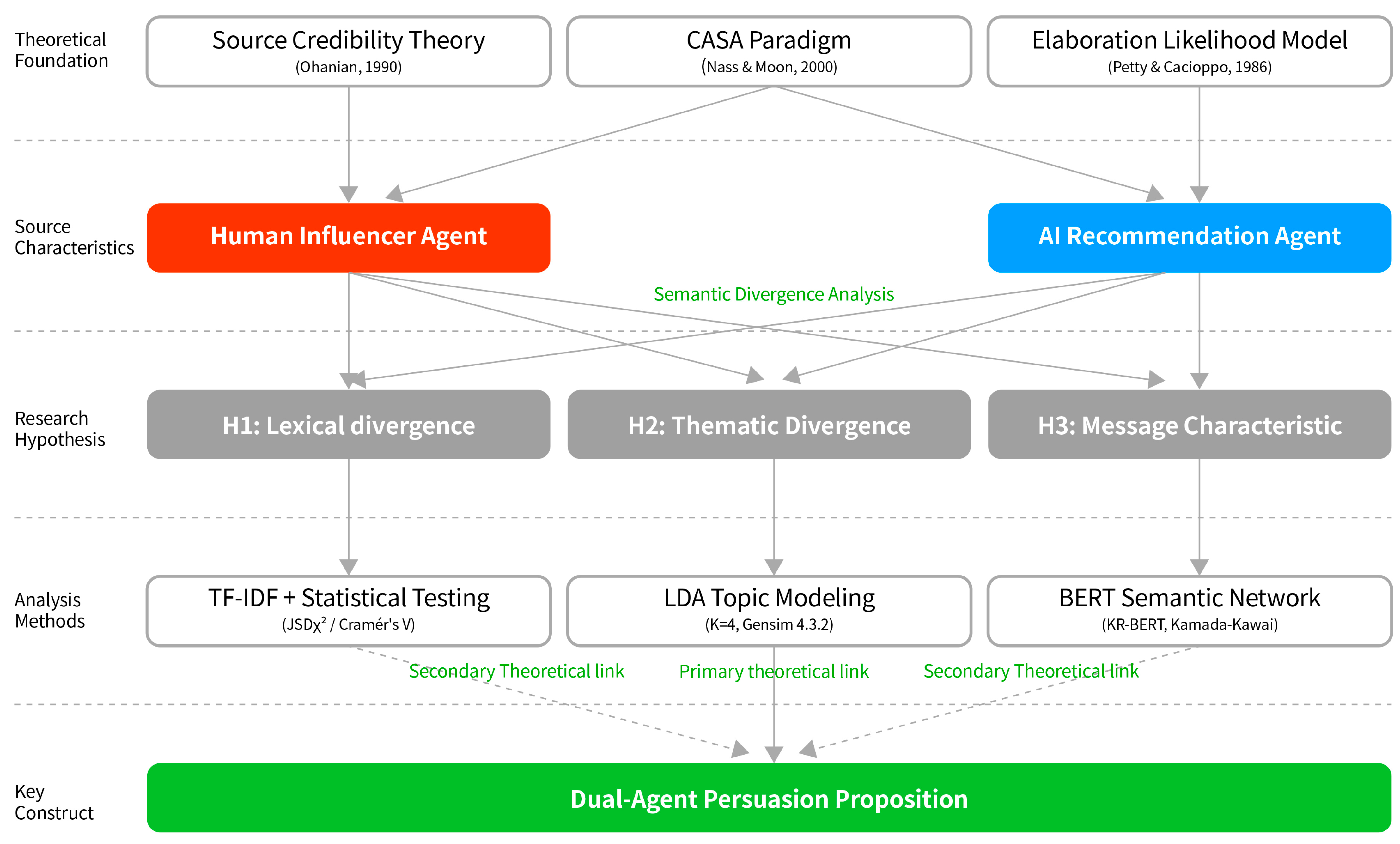
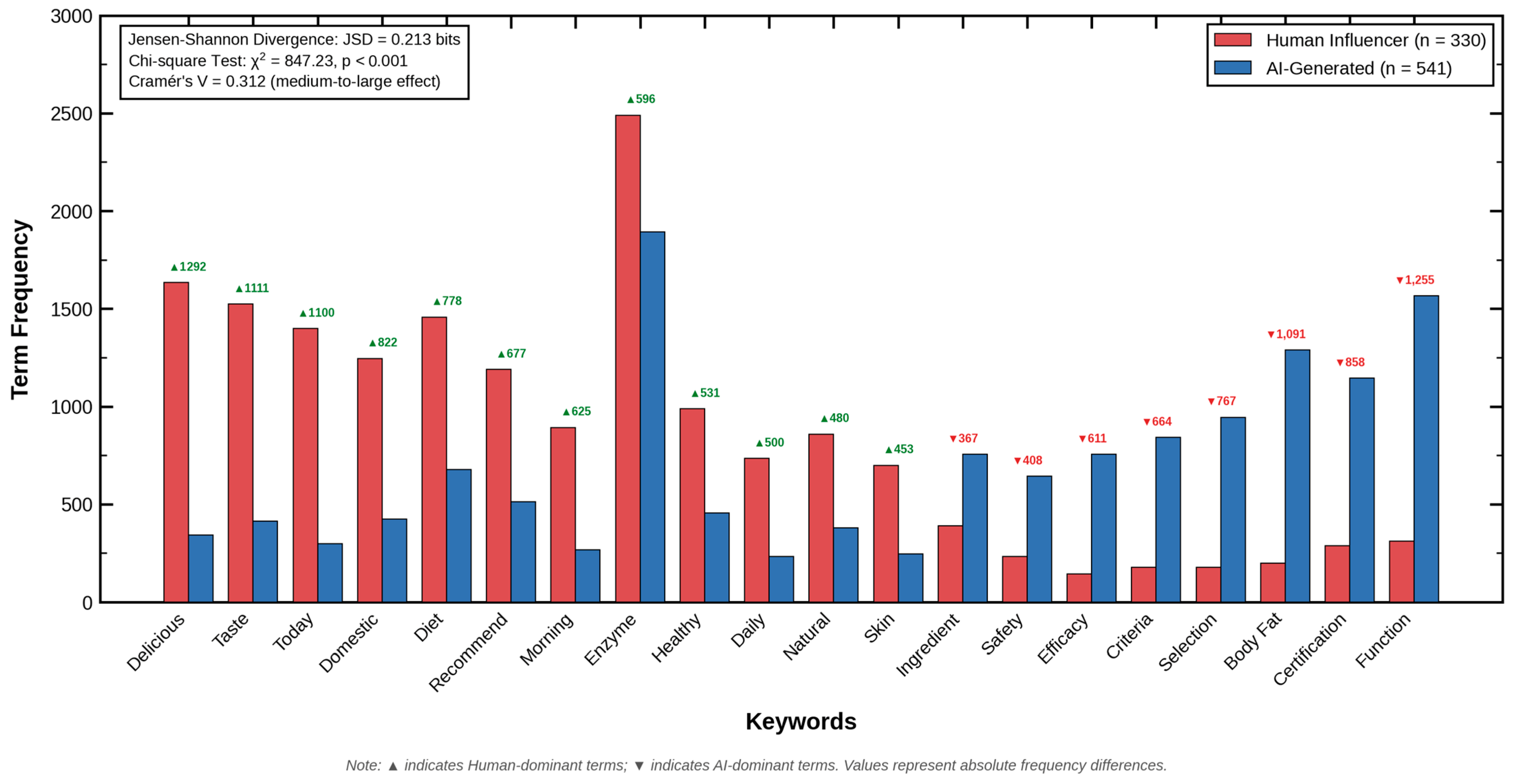
- H1 (Language Use Divergence): AI-generated product recommendations will exhibit significantly different vocabulary and keyword emphasis compared to human influencer recommendations, even when addressing the same product category. Specifically, AI text will emphasize functional, technical, and evaluative terms (e.g., mechanisms, criteria, certifications), whereas human text will emphasize experiential, sensory, and social terms (e.g., taste, gift, today).
- (2)
- H2 (Content Structure Divergence): The thematic content structure of AI versus human recommendations will differ systematically. AI content will organize around information utility themes (mechanisms, selection criteria, objective facts), while human content will organize around personal experience and social themes (experiential reactions, lifestyle integration, relational consumption such as gift-giving).
- (3)
- H3 (Message Characteristic Divergence): The linguistic patterns of AI-generated recommendations will exhibit message characteristics typically associated with central-route argumentation—emphasizing substantive evidence, functional mechanisms, and systematic evaluation criteria—whereas human influencer recommendations will exhibit message characteristics typically associated with peripheral-route cues—emphasizing experiential narratives, sensory descriptions, and heuristic social signals. This divergence reflects the distinct credibility construction strategies each source type employs: AI leveraging perceived expertise and objectivity through comprehensive information coverage, and humans leveraging perceived authenticity and trustworthiness through parasocial connection and personal testimony.
4. Methodology
4.1. Research Design Overview
4.2. Product Category Selection Rationale
4.3. Data Collection
4.4. Analytical Methods
4.4.1. Term Frequency and TF-IDF Analysis
4.4.2. Topic Modeling (LDA)
4.4.3. BERT-Based Semantic Embedding Analysis
4.4.4. Comparative Statistical Measures
4.5. Methodological Considerations: Genre Comparability and Ecological Validity
5. Results
5.1. Term Frequency Analysis
5.2. Probability Distribution Construction and Statistical Analysis
5.2.1. Jensen–Shannon Divergence (JSD)
5.2.2. Chi-Square Test for Independence
5.2.3. Effect Size: Cramér’s V
5.2.4. Per-Keyword Chi-Square Contributions
5.2.5. Standardized Residuals
5.3. Topic Modeling (LDA) Results
5.4. BERT-Based Semantic Network Analysis
6. Discussion
6.1. Interpretation of Findings
6.2. Theoretical Contributions
6.3. Managerial Implications
6.4. Limitations and Future Research
7. Conclusions
7.1. Summary of Findings
7.2. Implications for Practice and Policy
7.3. Concluding Remark
Author Contributions
Funding
Institutional Review Board Statement
Informed Consent Statement
Data Availability Statement
Conflicts of Interest
References
- Pham, V.K.; Pham Thi, T.D.; Duong, N.T. A study on information search behavior using AI-powered engines: Evidence from chatbots on online shopping platforms. SAGE Open 2024, 14, 21582440241300007. [Google Scholar] [CrossRef]
- De Bruyn, A.; Viswanathan, V.; Beh, Y.S.; Brock, J.K.-U.; von Wangenheim, F. Artificial intelligence and marketing: Pitfalls and opportunities. J. Interact. Mark. 2020, 51, 91–105. [Google Scholar] [CrossRef]
- Huang, M.-H.; Rust, R.T. A strategic framework for artificial intelligence in marketing. J. Acad. Mark. Sci. 2021, 49, 30–50. [Google Scholar] [CrossRef]
- Davenport, T.; Guha, A.; Grewal, D.; Bressgott, T. How artificial intelligence will change the future of marketing. J. Acad. Mark. Sci. 2020, 48, 24–42. [Google Scholar] [CrossRef]
- Campbell, C.; Sands, S.; Ferraro, C.; Tsao, H.-Y.; Mavrommatis, A. From data to action: How marketers can leverage AI. Bus. Horiz. 2020, 63, 227–243. [Google Scholar] [CrossRef]
- Jin, S.V.; Muqaddam, A.; Ryu, E. Instafamous and social media influencer marketing. Mark. Intell. Plan. 2019, 37, 567–579. [Google Scholar] [CrossRef]
- Duan, Y.; Edwards, J.S.; Dwivedi, Y.K. Artificial intelligence for decision making in the era of Big Data—Evolution, challenges and research agenda. Int. J. Inf. Manag. 2019, 48, 63–71. [Google Scholar] [CrossRef]
- Li, H. Special section introduction: Artificial intelligence and advertising. J. Advert. 2019, 48, 333–337. [Google Scholar] [CrossRef]
- Malthouse, E.C.; Copulsky, J.R. Artificial intelligence ecosystems for marketing communications. Int. J. Advert. 2023, 42, 128–140. [Google Scholar] [CrossRef]
- Nass, C.; Moon, Y. Machines and mindlessness: Social responses to computers. J. Soc. Issues 2000, 56, 81–96. [Google Scholar] [CrossRef]
- Jakesch, M.; Hancock, J.T.; Naaman, M. Human heuristics for AI-generated language are flawed. Proc. Natl. Acad. Sci. USA 2023, 120, e2208839120. [Google Scholar] [CrossRef]
- Petty, R.E.; Cacioppo, J.T. The Elaboration Likelihood Model of persuasion. Adv. Exp. Soc. Psychol. 1986, 19, 123–205. [Google Scholar] [CrossRef]
- Luo, X.; Tong, S.; Fang, Z.; Qu, Z. Frontiers: Machines vs. humans: The impact of artificial intelligence chatbot disclosure on customer purchases. Mark. Sci. 2019, 38, 937–947. [Google Scholar] [CrossRef]
- Brand, J.; Israeli, A.; Ngwe, D. Using GPT for market research. Harv. Bus. Sch. Work. Pap. 2023. [Google Scholar] [CrossRef]
- Haleem, A.; Javaid, M.; Qadri, M.A.; Singh, R.P.; Suman, R. Artificial intelligence (AI) applications for marketing: A literature-based study. Int. J. Intell. Netw. 2022, 3, 119–132. [Google Scholar] [CrossRef]
- Arango, L.; Singaraju, S.P.; Niininen, O. Consumer responses to AI-generated charitable giving ads. J. Advert. 2023, 52, 486–503. [Google Scholar] [CrossRef]
- Kietzmann, J.; Paschen, J.; Treen, E. Artificial intelligence in advertising: How marketers can leverage artificial intelligence along the consumer journey. J. Advert. Res. 2018, 58, 263–267. [Google Scholar] [CrossRef]
- Longoni, C.; Bonezzi, A.; Morewedge, C.K. Resistance to medical artificial intelligence. J. Consum. Res. 2019, 46, 629–650. [Google Scholar] [CrossRef]
- Narayanan, S.; Yu, G.; Ho, C.J.; Yin, M. How does value similarity affect human reliance in AI-assisted ethical decision making? In Proceedings of the 2023 AAAI/ACM Conference on AI, Ethics, and Society; Association for Computing Machinery: New York, NY, USA, 2023; pp. 49–57. [Google Scholar]
- Mazzù, M.F.; Andria, A.; Baccelloni, A.; De Angelis, M. The impact of humans vs. AI recommendation on consumer reactions to products exposure. Electron. Commer. Res. 2025. [Google Scholar] [CrossRef]
- Chatterjee, S.; Chaudhuri, R.; Vrontis, D. AI and digitalization in relationship management: Impact of adopting AI-chatbots on customer engagement. J. Theor. Appl. Electron. Commer. Res. 2024, 19, 1441–1463. [Google Scholar] [CrossRef]
- Davenport, T.H. The AI Advantage: How to Put the Artificial Intelligence Revolution to Work; MIT Press: Cambridge, MA, USA, 2018. [Google Scholar]
- Wang, Y.; Zheng, Y.; Xu, C.; Yin, H.; Hung, N.Q.V.; Li, X.; Aggarwal, C.C. A survey on trustworthy recommender systems. ACM Trans. Recomm. Syst. 2024, 3, 13. [Google Scholar] [CrossRef]
- Sun, L.; An, Y.; Song, X.; Liu, J. Human vs. AI in creative contests: A study on the effectiveness of advertisement copy generated by Chinese large language models. Electron. Commer. Res. 2025. [Google Scholar] [CrossRef]
- Dwivedi, Y.K.; Kshetri, N.; Hughes, L.; Slade, E.L.; Jeyaraj, A.; Kar, A.K.; Baabdullah, A.M.; Koohang, A.; Raghavan, V.; Ahuja, M.; et al. Opinion paper: “So what if ChatGPT wrote it?” Multidisciplinary perspectives on opportunities, challenges and implications of generative conversational AI for research, practice and policy. Int. J. Inf. Manag. 2023, 71, 102642. [Google Scholar] [CrossRef]
- Lou, C.; Yuan, S. Influencer marketing: How message value and credibility affect consumer trust of branded content on social media. J. Interact. Advert. 2019, 19, 58–73. [Google Scholar] [CrossRef]
- Kim, D.Y.; Kim, H.-Y. Trust me, trust me not: A nuanced view of influencer marketing on social media. J. Bus. Res. 2021, 134, 223–232. [Google Scholar] [CrossRef]
- Korea Health Industry Development Institute. Inner Beauty Market Trend Report; KHIDI: Cheongju, Republic of Korea, 2023. [Google Scholar]
- Park, J.; Hyun, H.; Thavisay, T. A study of antecedents and outcomes of social media WOM towards luxury brand purchase intention. J. Retail. Consum. Serv. 2021, 58, 102272. [Google Scholar] [CrossRef]
- Ohanian, R. Construction and validation of a scale to measure celebrity endorsers’ perceived expertise, trustworthiness, and attractiveness. J. Advert. 1990, 19, 39–52. [Google Scholar] [CrossRef]
- Lou, C.; Kiew, S.T.J.; Chen, T.; Lee, T.Y.M.; Ong, J.E.C.; Phua, Z. Authentically fake? How consumers respond to the influence of virtual influencers. J. Advert. 2023, 52, 540–557. [Google Scholar] [CrossRef]
- Schouten, A.P.; Janssen, L.; Verspaget, M. Celebrity vs. influencer endorsements in advertising: The role of identification, credibility, and product-endorser fit. Int. J. Advert. 2020, 39, 258–281. [Google Scholar] [CrossRef]
- Jadhav, S.; Salave, S.; Rana, D.; Benival, D.; Pardeshi, N.A.; Nagaraja, S.; Dwivedi, P.; Bhattacharya, J. Factors governing consumers buying behavior concerning nutraceutical product. Food Sci. Nutr. 2023, 11, 4988–5003. [Google Scholar] [CrossRef] [PubMed]
- Dhar, R.; Wertenbroch, K. Consumer choice between hedonic and utilitarian goods. J. Mark. Res. 2000, 37, 60–71. [Google Scholar] [CrossRef]
- Salton, G.; Buckley, C. Term-weighting approaches in automatic text retrieval. Inf. Process. Manag. 1988, 24, 513–523. [Google Scholar] [CrossRef]
- Blei, D.M.; Ng, A.Y.; Jordan, M.I. Latent Dirichlet Allocation. J. Mach. Learn. Res. 2003, 3, 993–1022. [Google Scholar]
- Mikolov, T.; Sutskever, I.; Chen, K.; Corrado, G.S.; Dean, J. Distributed representations of words and phrases and their compositionality. In Advances in Neural Information Processing Systems 26; Curran Associates: Red Hook, NY, USA, 2013; pp. 3111–3119. [Google Scholar]
- Levy, O.; Goldberg, Y. Linguistic regularities in sparse and explicit word representations. In Proceedings of the 18th Conference on Computational Natural Language Learning (CoNLL), Baltimore, MD, USA, 26–27 June 2014; Association for Computational Linguistics: Baltimore, MD, USA, 2014; pp. 171–180. [Google Scholar] [CrossRef]
- Reimers, N.; Gurevych, I. Sentence-BERT: Sentence embeddings using Siamese BERT-networks. In Proceedings of the 2019 Conference on Empirical Methods in Natural Language Processing (EMNLP-IJCNLP), Hong Kong, China, 3–7 November 2019; Association for Computational Linguistics: Hong Kong, China, 2019; pp. 3982–3992. [Google Scholar] [CrossRef]
- Devlin, J.; Chang, M.-W.; Lee, K.; Toutanova, K. BERT: Pre-training of deep bidirectional transformers for language understanding. In Proceedings of the 2019 Conference of the North American Chapter of the Association for Computational Linguistics (NAACL-HLT), Minneapolis, MN, USA, 2–7 June 2019; Association for Computational Linguistics: Minneapolis, MN, USA, 2019; pp. 4171–4186. [Google Scholar] [CrossRef]
- Bommasani, R.; Hudson, D.A.; Adeli, E.; Altman, R.; Arber, S.; von Arx, S.; Bernstein, M.S.; Bohg, J.; Bosselut, A.; Brunskill, E.; et al. On the opportunities and risks of foundation models. arXiv 2021, arXiv:2108.07258. [Google Scholar] [CrossRef]
- Shannon, C.E. A mathematical theory of communication. Bell Syst. Tech. J. 1948, 27, 379–423. [Google Scholar] [CrossRef]
- Lin, J. Divergence measures based on the Shannon entropy. IEEE Trans. Inf. Theory 1991, 37, 145–151. [Google Scholar] [CrossRef]
- Pearson, K. On the criterion that a given system of deviations from the probable in the case of a correlated system of variables is such that it can be reasonably supposed to have arisen from random sampling. Lond. Edinb. Dublin Philos. Mag. J. Sci. 1900, 50, 157–175. [Google Scholar] [CrossRef]
- Cohen, J. Statistical Power Analysis for the Behavioral Sciences, 2nd ed.; Lawrence Erlbaum Associates: Hillsdale, NJ, USA, 1988. [Google Scholar]
- Cramér, H. Mathematical Methods of Statistics; Princeton University Press: Princeton, NJ, USA, 1946. [Google Scholar]
- Agresti, A. Categorical Data Analysis, 3rd ed.; Wiley: Hoboken, NJ, USA, 2013. [Google Scholar]
- Efron, B.; Tibshirani, R.J. An Introduction to the Bootstrap; Chapman and Hall/CRC: Boca Raton, FL, USA, 1993. [Google Scholar]
- Reeves, B.; Nass, C. The Media Equation: How People Treat Computers, Television, and New Media Like Real People and Places; CSLI Publications: Stanford, CA, USA, 1996. [Google Scholar]
- Jia, W.; Kim, J.; Kim, M. AI-generated content detection and linguistic characteristics of machine-produced text. Expert Syst. Appl. 2024, 238, 121756. [Google Scholar] [CrossRef]
- Castelo, N.; Schmitt, B.; Sarvary, M. Human or robot? Consumer responses to radical cognitive enhancement products. J. Assoc. Consum. Res. 2019, 4, 217–230. [Google Scholar] [CrossRef]
- Mikalef, P.; Gupta, M. Artificial intelligence capability: Conceptualization, measurement calibration, and empirical study on its impact on organizational creativity and firm performance. Inf. Manag. 2021, 58, 103434. [Google Scholar] [CrossRef]
- Ozdemir, O.; Kolfal, B.; Messinger, P.R.; Rizvi, S. Human or virtual: How influencer type shapes brand attitudes. Comput. Hum. Behav. 2023, 145, 107771. [Google Scholar] [CrossRef]




| Metric | Symbol | Value | Interpretation | Reference |
|---|---|---|---|---|
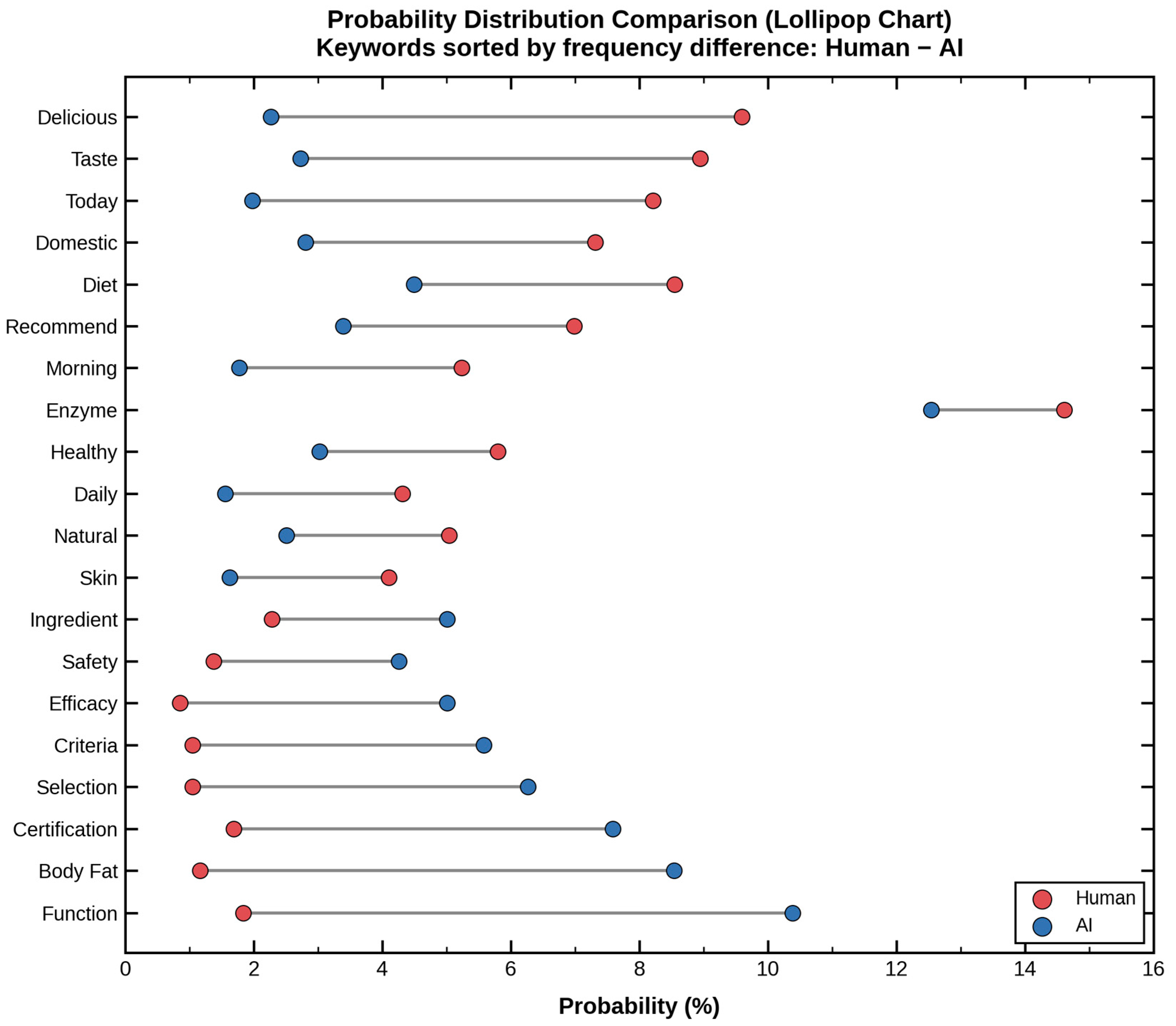
| Jensen–Shannon Divergence | JSD | 0.213 bits | Moderate divergence | 0: identical, 1: maximum |
| Chi-square statistic | χ2 | 847.23 | Highly significant | Critical value: 66.34 (α = 0.001) |
| Degrees of freedom | df | 49 | — | (rows − 1) × (cols − 1) |
| p-value | p | <0.001 | Reject null hypothesis (H0) | α = 0.001 |
| Cramér’s V | V | 0.312 | Medium-to-large effect | Small: 0.1, Medium: 0.3, Large: 0.5 |
| Human corpus tokens | n1 | 17,031 | 330 Instagram posts | — |
| AI corpus tokens | n2 | 15,091 | 541 AI responses | — |
| Topic | Human Theme | Human Top Keywords | AI Theme | AI Top Keywords |
|---|---|---|---|---|
| Topic 1 | Experiential Response | enzyme, protein, fat, taste, skin | Perceived Effects | enzyme, intake, consumer, change, skin |
| Topic 2 | Quality & Safety | domestic, activity, fermentation, additives, digestion | Selection Criteria | ingredients, certification, selection, fermentation, routine |
| Topic 3 | Diet & Taste | diet, enzyme, snack, taste, product | Digestive Function | protein, digestion, body, decomposition, improvement |
| Topic 4 | Gift Consumption | dietary fiber, nutrition, gift, health, interest | Ingredient Awareness | inner beauty, function, effect, skin, ingredient importance |
| Metric | Human Influencer | AI-Generated | Interpretation |
|---|---|---|---|
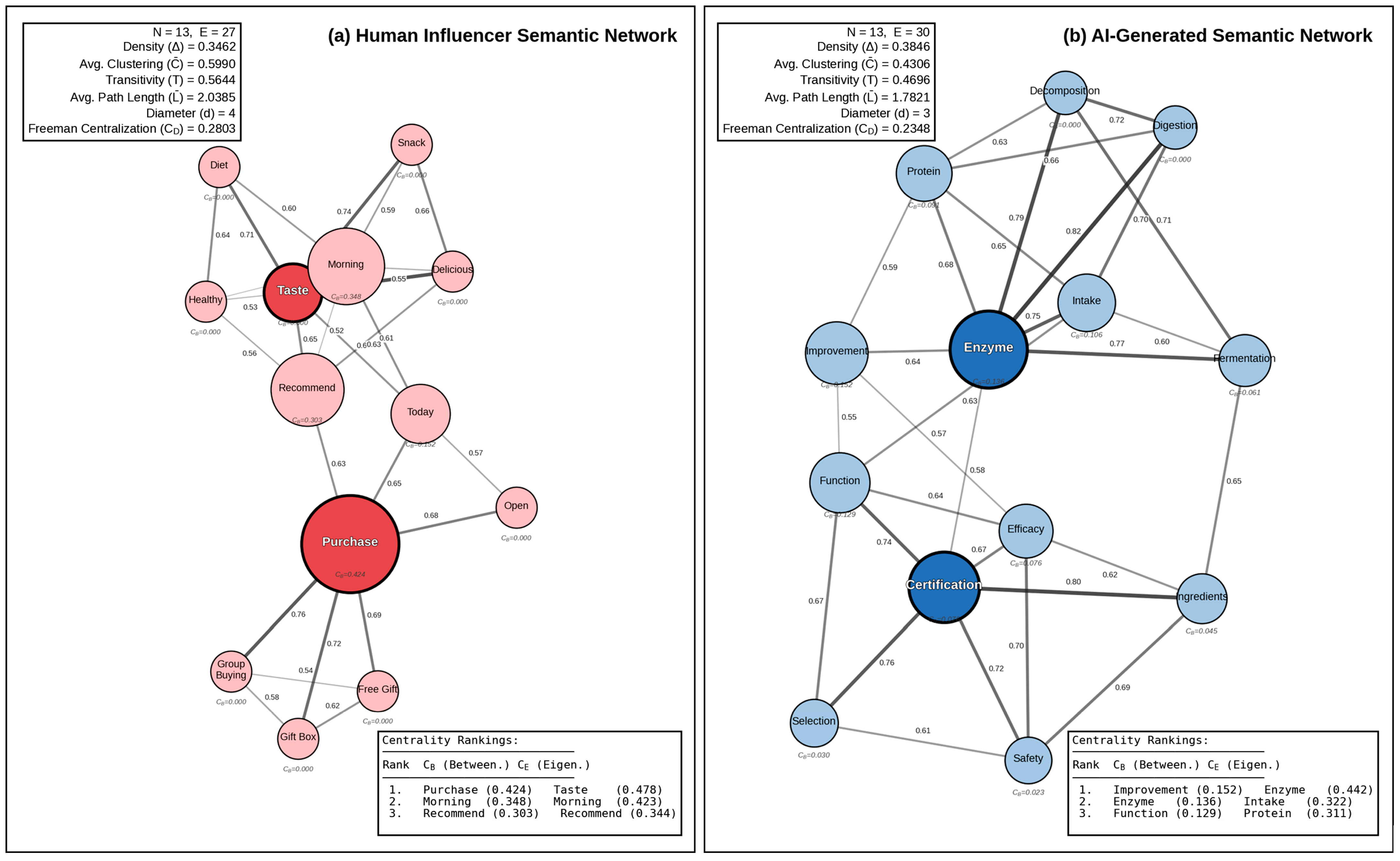
| Network centralization (C_D) | 0.2803 | 0.2348 | Human higher (single dominant bridge node) |
| Network density (Δ) | 0.3462 | 0.3846 | AI more uniformly connected |
| Avg. clustering (C−) | 0.5990 | 0.4306 | Human more locally clustered |
| Transitivity (T) | 0.5644 | 0.4696 | Human higher transitivity |
| Avg. path length (L−) | 2.0385 | 1.7821 | AI more compact |
| Diameter (d) | 4 | 3 | AI shorter max distance |
| Cross-corpus cos: “Enzyme” | — | — | 0.61 |
| Cross-corpus cos: “Skin” | — | — | 0.58 |
| Adj. Rand index (LDA–BERT) | 0.72 | 0.78 | Strong convergent validity |
| Dimension | Human Influencer | AI Recommender |
|---|---|---|
| Consumer Perspective | Experience-sharing agent emphasizing intake experience and emotional reactions | Information-seeking agent focused on product function, ingredients, and effects |
| Keyword Orientation | Taste, intake sensation, satisfaction, recommendation, value-for-money | Function, ingredients, certification, selection, improvement |
| Expression Style | Emotional, narrative-driven language (“What & Feel” oriented) | Neutral, functional, semantic language (“Why & How” oriented) |
| User Goal | Experience sharing and social validation (“I tried this and here’s how it felt …”) | Rational decision support (“Which product is right for me?”) |
| Review videos, SNS reviews, viral content (experience-driven) | Functional descriptions, ingredient-focused blogs, consultation content (information-driven) | |
| ELM Message Characteristics | Peripheral-route message characteristics (heuristic cues, sensory empathy) | Central-route message characteristics (cognitive judgment, evidence-based reasoning) |
Disclaimer/Publisher’s Note: The statements, opinions and data contained in all publications are solely those of the individual author(s) and contributor(s) and not of MDPI and/or the editor(s). MDPI and/or the editor(s) disclaim responsibility for any injury to people or property resulting from any ideas, methods, instructions or products referred to in the content. |
© 2026 by the authors. Licensee MDPI, Basel, Switzerland. This article is an open access article distributed under the terms and conditions of the Creative Commons Attribution (CC BY) license.
Share and Cite
Lee, W.-C.; Lee, J.-S.; Suh, J. Semantic Divergence in AI-Generated and Human Influencer Product Recommendations: A Computational Analysis of Dual-Agent Communication in Social Commerce. Appl. Sci. 2026, 16, 2816. https://doi.org/10.3390/app16062816
Lee W-C, Lee J-S, Suh J. Semantic Divergence in AI-Generated and Human Influencer Product Recommendations: A Computational Analysis of Dual-Agent Communication in Social Commerce. Applied Sciences. 2026; 16(6):2816. https://doi.org/10.3390/app16062816
Chicago/Turabian StyleLee, Woo-Chul, Jang-Suk Lee, and Jungho Suh. 2026. "Semantic Divergence in AI-Generated and Human Influencer Product Recommendations: A Computational Analysis of Dual-Agent Communication in Social Commerce" Applied Sciences 16, no. 6: 2816. https://doi.org/10.3390/app16062816
APA StyleLee, W.-C., Lee, J.-S., & Suh, J. (2026). Semantic Divergence in AI-Generated and Human Influencer Product Recommendations: A Computational Analysis of Dual-Agent Communication in Social Commerce. Applied Sciences, 16(6), 2816. https://doi.org/10.3390/app16062816