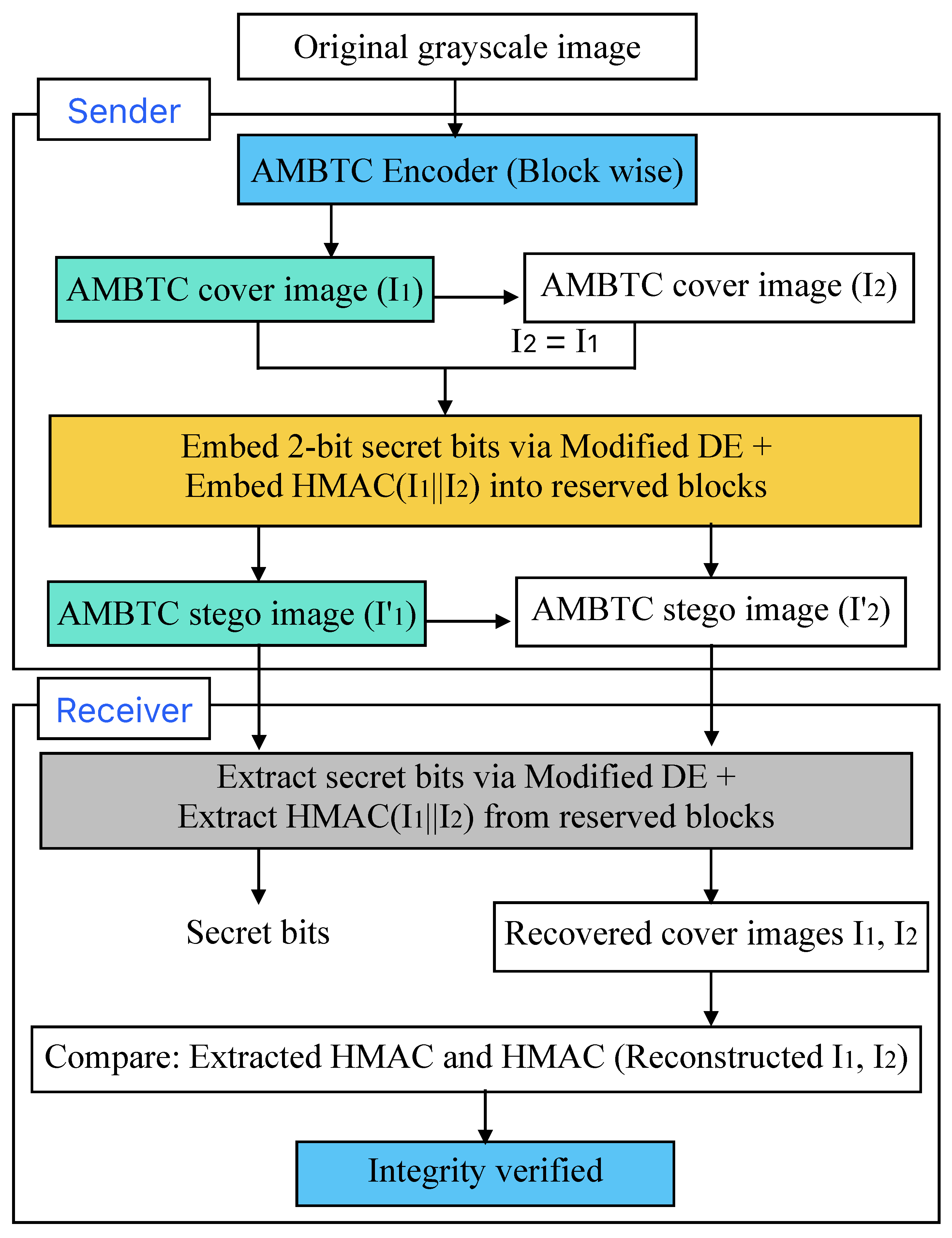
This section presents the experimental evaluation of the proposed reversible data hiding scheme using twin AMBTC-decoded images. The performance is assessed in terms of embedding capacity (bits per pixel), visual quality (PSNR), and the effectiveness of the optional HMAC-based authentication mechanism.
4.1. Experimental Setup
The proposed reversible data hiding scheme was implemented in Python 3.13.7 (Python Software Foundation, Wilmington, DE, USA) and executed on a MacBook equipped with an Apple M3 pro processor (Apple Inc., Cupertino, CA, USA) and 16 GB of unified memory. All computations, including AMBTC encoding/decoding, data embedding and extraction, and HMAC authentication, were performed in this environment without hardware acceleration.
A set of ten standard
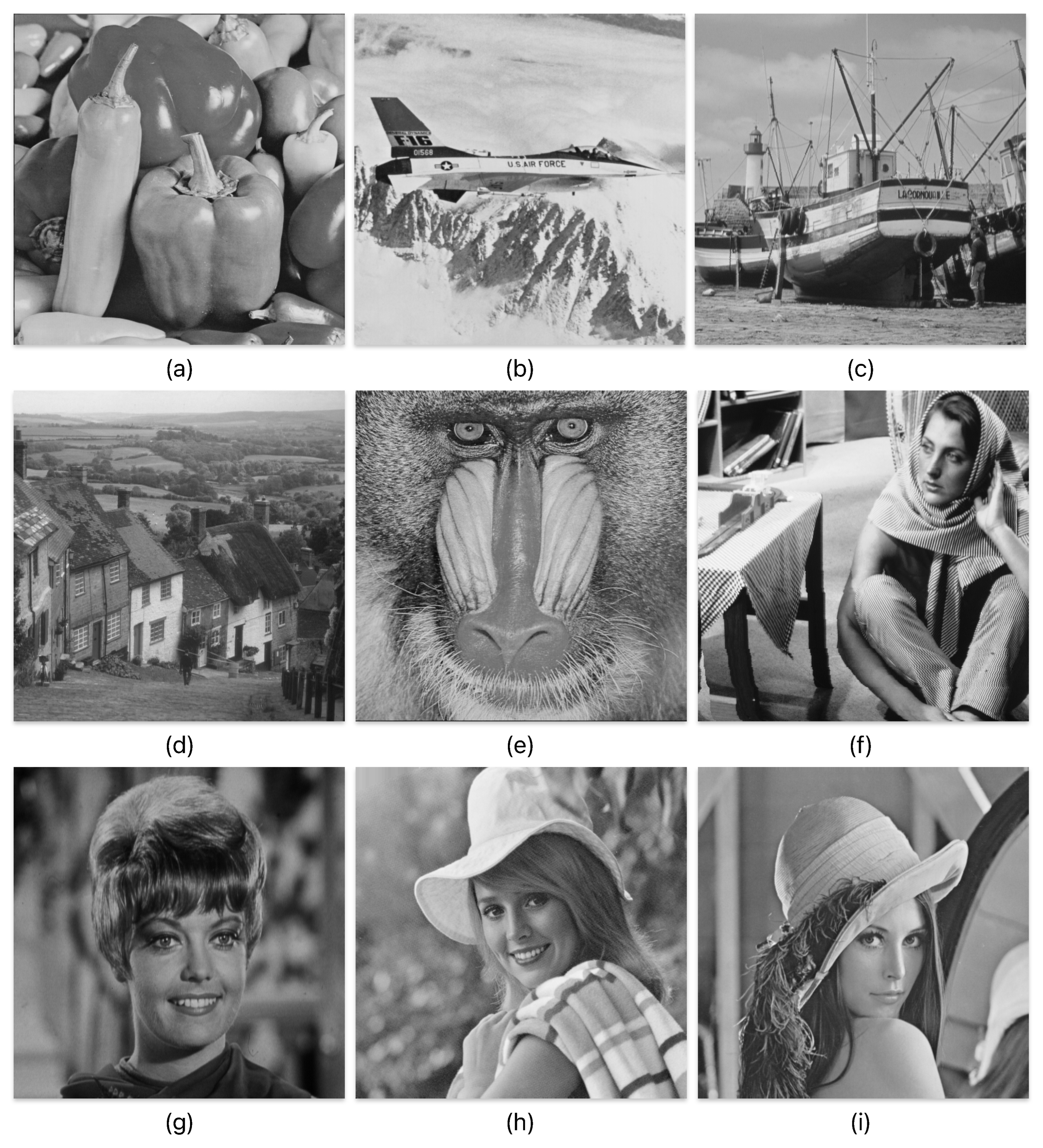
grayscale test images was used for evaluation: Peppers, Airplane, Boat, Goldhill, Baboon, Barbara, Zelda, Elaine, Tiffany, and Lena.
Figure 2 displays nine representative examples (excluding Tiffany due to space), whereas all ten images are included in
Table 2,
Table 3 and
Table 4 and
Figure 3. These images are widely adopted in the image processing literature and provide a balanced range of smooth, textured, and complex patterns for assessing visual quality and robustness.
Each image was first encoded and decoded using the AMBTC (Absolute Moment Block Truncation Coding) method to generate two visually identical images composed of non-overlapping blocks. The reversible data embedding process was then applied to these twin images, embedding a randomly generated binary bitstream with varying bit-lengths or adaptively assigned based on distortion constraints.
During the embedding process, pixel overflow and underflow conditions (see Equation (
12)) were strictly enforced to ensure lossless reversibility. The final two blocks of
were reserved for embedding a 64-bit HMAC computed using SHA-256, following the procedure described in
Section 3.4. At the receiver side, data extraction, image recovery, and authentication were performed as detailed in Algorithm 1.
4.2. Performance Metrics
The performance of the proposed AMBTC-based dual-image reversible data hiding method was evaluated using the following standard metrics:
Peak Signal-to-Noise Ratio (PSNR): PSNR was used to quantify the distortion introduced by the embedding process. Specifically, each stego image (
,
) was compared with its corresponding cover image (
,
). PSNR is defined as
where MSE denotes the mean squared error between a cover image and its corresponding stego image. Higher PSNR values indicate less visual distortion; values above 40 dB (
) are generally considered visually imperceptible.
Structural Similarity Index Measure (SSIM): In addition to PSNR, the Structural Similarity Index Measure (SSIM) was used to assess the perceptual similarity between each cover image and its corresponding stego image. Given a cover image
X and a stego image
Y, the SSIM value is defined as
where
and
denote the mean intensities of
X and
Y,
and
are their variances, and
is the covariance between them. The constants
and
are used to stabilize the division when the denominators are small, and are set to
and
in our experiments. The SSIM values range from 0 to 1, with values closer to 1 indicating higher structural similarity and better visual quality.
Embedding Rate (bits per pixel, bpp): Embedding capacity was measured in terms of bits per pixel. Since two stego images are generated, the embedding rate was computed as
where
is the size of each cover image. This definition reflects the effective payload per pixel across the dual-image framework.
Authentication Accuracy: The reliability of integrity verification was evaluated using the proposed HMAC-based authentication mechanism. During extraction, the embedded HMAC is compared against a recomputed HMAC from the recovered stego images. A match indicates that the images were not tampered with, while a mismatch signifies tampering.
Table 2 presents a comparison of the maximum embedding ratio (MER, in bpp) between the proposed method and six representative schemes from the literature: Lee and Huang [
16], Liu and Chang [
20], Lin et al. [
21], Chen and Hong [
22], Lee and Chan [
24], and Kim [
30]. For all ten standard
grayscale test images, the proposed method consistently achieves a MER of 2.00 bpp, which is the highest among all compared approaches. The second-highest MER is reported by Lee and Chan [
24] at 1.56 bpp, followed by Chen and Hong [
22] with 1.14 bpp, Lee and Huang [
16] with 1.09 bpp, Lin et al. [
21] with 1.07 bpp, and Liu and Chang [
20] with 1.00 bpp (0.99 bpp for Elaine). The lowest MER is observed in Kim [
30] at 0.56 bpp. The results demonstrate that the proposed dual-image AMBTC-based embedding strategy not only increases the payload significantly but also maintains consistent capacity regardless of image texture complexity, owing to its systematic use of
pixel pair structures and overflow/underflow avoidance.
Table 3 presents the objective quality evaluation of the proposed adaptive dual-image reversible data hiding scheme for ten standard
grayscale test images. Four embedding orders
were examined, corresponding to payload capacities ranging from
bpp to approximately
bpp. For each configuration, both the structural similarity index (SSIM) and peak signal-to-noise ratio (PSNR) were computed separately for the two marked images
and
.
As expected, increasing k increases the embedding capacity but also leads to a gradual degradation in visual quality. At (0.5 bpp), the proposed method achieves extremely high fidelity, with mean SSIM exceeding 0.999 for both images and PSNR values above 54 dB. This indicates that the distortion introduced is imperceptible to the human visual system. When k is increased to 2 (1.0 bpp), visual quality remains very high, with mean SSIM above 0.994 and PSNR above 45 dB, a range generally considered visually lossless under typical viewing conditions. These two configurations therefore offer the best balance between capacity and visual fidelity for applications where imperceptibility is critical.
At higher embedding orders, quality degradation becomes more apparent. For (approximately 1.5 bpp), mean SSIM decreases to about 0.976 and PSNR to 38.8 dB, where some degradation can be detected in highly textured regions. At (about 1.9 bpp), SSIM drops to roughly 0.92 and PSNR to 32.3 dB, making the changes visually noticeable in texture-rich areas such as Baboon and Airplane. Conversely, smooth images such as Barbara, Lena, and Elaine maintain relatively higher quality under the same payload due to the reduced impact of pixel modifications in low-frequency regions.
An important observation is the near-identical performance between and across all configurations: the differences in SSIM and PSNR values are negligible. This symmetry confirms that the embedding process affects both marked images uniformly, which is essential for fairness and robustness in dual-image reversible data hiding systems. The consistency in quality between the two images also ensures that either can be used independently for data extraction and image recovery without introducing bias.
In summary,
Table 3 demonstrates that the proposed method provides scalable control over the trade-off between capacity and quality via the parameter
k. For scenarios prioritizing imperceptibility,
or
is recommended. For applications where maximum embedding capacity is required,
can be used at the cost of some visible degradation. These results confirm the flexibility and robustness of the proposed approach in balancing payload size and visual quality.
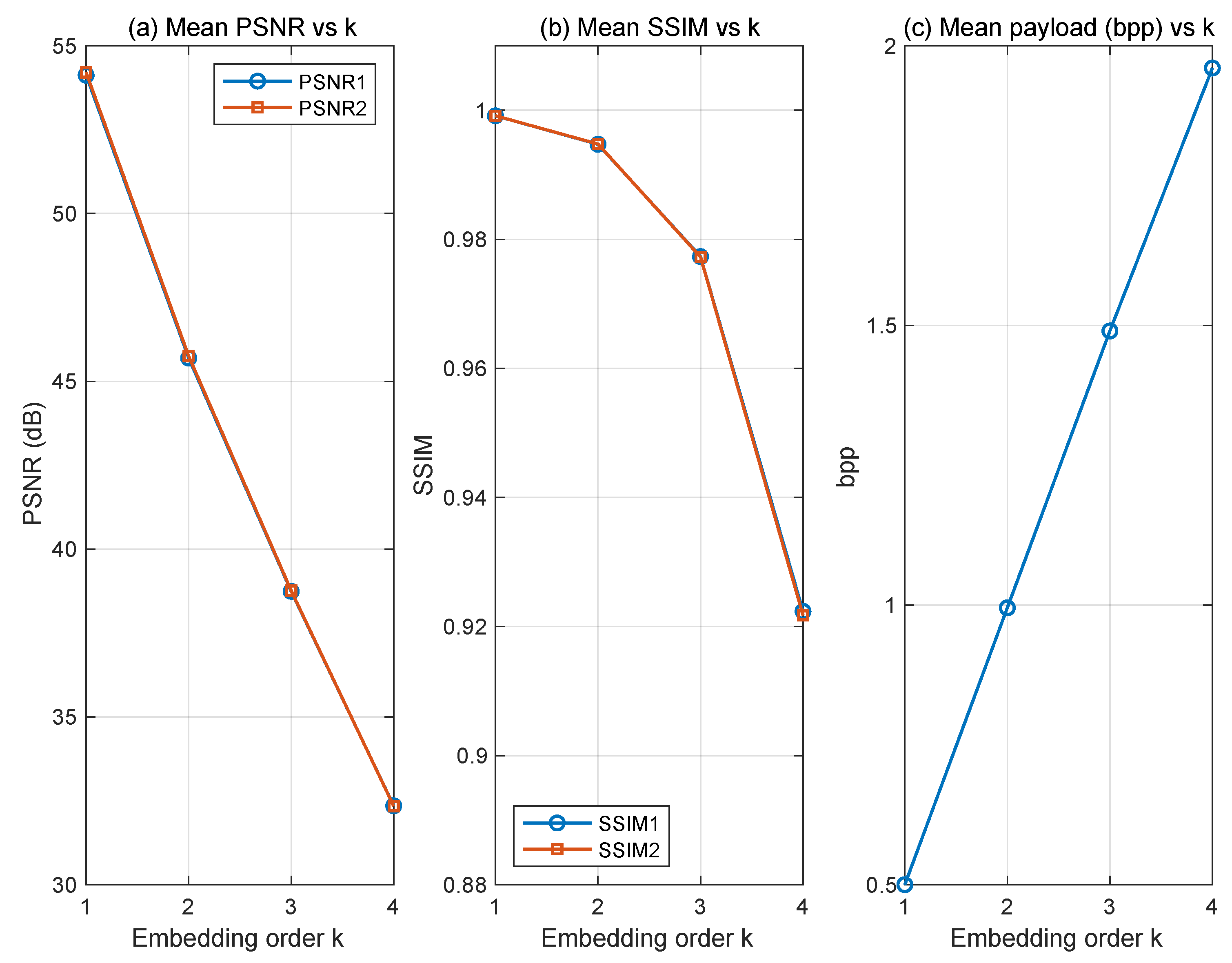
Figure 3 illustrates the effect of varying the embedding order
k on the visual quality and payload capacity of the proposed AMBTC-based dual-image reversible data hiding scheme. Subfigure (a) shows that the mean PSNR of both marked images,
and
, remains above 45 dB when
, indicating near-lossless quality. When
, PSNR drops to around 38.7 dB, which is still acceptable for many applications, but a more noticeable degradation can be observed at
where PSNR is close to 32 dB. A similar trend is observed in Subfigure (b), where the SSIM metric remains above 0.99 for
, decreases slightly at
, and drops more significantly at
. These results confirm that small
k values preserve higher visual fidelity, while larger
k values trade quality for increased embedding capacity. Finally, Subfigure (c) demonstrates the expected growth of embedding capacity with
k. For instance,
yields an average payload of 0.5 bpp, whereas
achieves nearly 2.0 bpp. This highlights the flexibility of the proposed method, allowing users to balance between capacity and quality according to application requirements.
As shown in
Figure 3, the PSNR and SSIM values decrease gradually as the embedding order
k increases, whereas the payload capacity increases almost linearly with
k. This clearly illustrates the trade-off between image quality and embedding capacity in the proposed scheme.
Table 4 compares the maximum embedding capacity (in bpp) and reconstruction quality (PSNR) of several representative dual-image reversible data hiding (DIRDH) methods and the proposed scheme. Overall, the proposed method achieves two distinct operating modes depending on the embedding factor
k.
For , the proposed scheme provides a payload of bpp, which is lower than most existing methods. However, the corresponding image quality is remarkably high, reaching an average PSNR of approximately dB across the four test images. This demonstrates that the scheme can achieve near-lossless stego-image quality while maintaining reversibility.
For
, the embedding capacity increases to
bpp, comparable to many conventional dual-image schemes such as Chang et al. [
14], Chang et al. [
17], and Kim et al. [
35]. However, the PSNR decreases to about
dB, reflecting the trade-off between capacity and quality.
It is worth noting that Kim (2022) [
30], which is the only existing AMBTC-based dual reversible data hiding method, achieves a payload of only
–
bpp, but with relatively high image quality (PSNR
dB). Therefore, in terms of fair comparison, the proposed method at
offers a similar PSNR to Kim (2022) [
30] while slightly improving embedding efficiency to
bpp. Moreover, by allowing flexible control via the parameter
k, the proposed scheme extends beyond Kim’s method by supporting higher payloads (
bpp) at acceptable visual quality.
These results highlight the adaptability of the proposed AMBTC-based DIRDH framework: it can operate either in a high-quality, low-capacity mode or in a high-capacity, moderate-quality mode. Among AMBTC-based schemes, the proposed method represents a more versatile and tunable design, making it well-suited for applications where trade-offs between capacity and image fidelity must be carefully balanced.
4.3. Authentication Experiment
To further evaluate the reliability of the proposed dual-image AMBTC-based RDH scheme, we conducted an authentication experiment using an HMAC-based integrity check. The HMAC value was generated over the stego images after data embedding, following the procedure described in
Section 3.4. During extraction, the embedded HMAC was retrieved and compared against a newly computed HMAC from the received image.
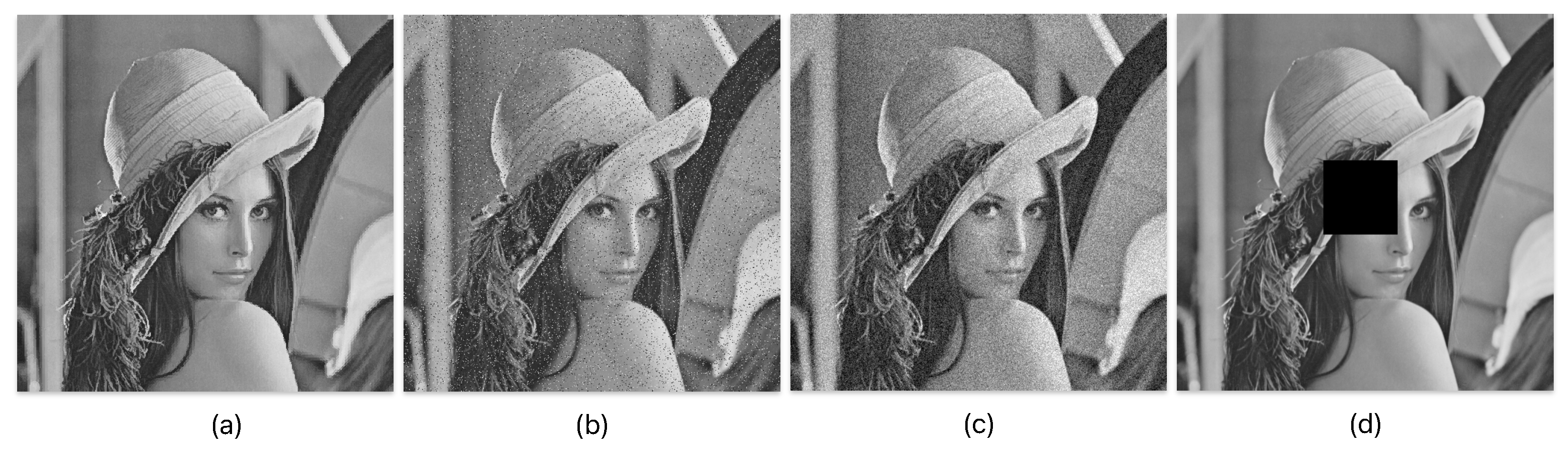
For the experiment, the Lena image was selected as the cover image. We considered four cases: (i) no tampering, (ii) pixel modification in 10% of the image, (iii) Gaussian noise addition, and (iv) cropping attack.
Figure 4 illustrates the tampered Lena images used in the simulation.
Table 5 shows the authentication results. When the image was not tampered, the retrieved HMAC matched the recomputed one, and the result was “Pass”. For all tampered cases, the HMAC values did not match, leading to a “Fail” result.
The results confirm that the proposed scheme can reliably detect tampering of the stego image. It should be noted that the HMAC-based authentication only indicates whether tampering has occurred, without localizing the exact regions of modification.
Table 6 summarizes the authentication results and quality degradation under several representative tampering scenarios on the Lena stego images. In the absence of any modification, the HMAC values computed at the receiver perfectly match the embedded HMAC, and the PSNR and SSIM between the original and received stego images are ideal (
,
), indicating lossless reversibility. In contrast, random pixel modification and additive Gaussian noise significantly reduce both PSNR and SSIM, and the corresponding HMAC comparison consistently fails, which allows the proposed method to reliably detect such tampering. The cropping case causes the most severe degradation (PSNR
dB, SSIM
) and is likewise flagged as “Verification failed”.
These results confirm that the proposed HMAC-based authentication mechanism is highly sensitive to various types of distortions, including sparse pixel changes, noise addition, and geometric cropping. Once tampering occurs, however, the original cover images and embedded payload can no longer be recovered exactly; in this situation, the framework is designed to provide tampering detection only, rather than approximate data reconstruction. Extending the system with redundancy or error-correcting codes to enable partial recovery under such attacks is left as an interesting direction for future work.