All articles published by MDPI are made immediately available worldwide under an open access license. No special
permission is required to reuse all or part of the article published by MDPI, including figures and tables. For
articles published under an open access Creative Common CC BY license, any part of the article may be reused without
permission provided that the original article is clearly cited. For more information, please refer to
https://www.mdpi.com/openaccess.
Feature papers represent the most advanced research with significant potential for high impact in the field. A Feature
Paper should be a substantial original Article that involves several techniques or approaches, provides an outlook for
future research directions and describes possible research applications.
Feature papers are submitted upon individual invitation or recommendation by the scientific editors and must receive
positive feedback from the reviewers.
Editor’s Choice articles are based on recommendations by the scientific editors of MDPI journals from around the world.
Editors select a small number of articles recently published in the journal that they believe will be particularly
interesting to readers, or important in the respective research area. The aim is to provide a snapshot of some of the
most exciting work published in the various research areas of the journal.
This paper presents a thermodynamic analysis of free-turbine turboshaft engines, focusing on the quantitative distribution of turbine power and related energy parameters between the gas generator turbine and the free power turbine. The study is based on an analytical calculation model combining catalog specifications and validated experimental data, applied to a series of turboshaft engines from different manufacturers with similar free-turbine architectures and power classes ranging from approximately 960 kW to 2100 kW. The comparative analysis is conducted at take-off conditions for the engine series, while a detailed regime-dependent investigation from idle to take-off is performed for the TV2-117A reference engine. The results indicate that, at take-off, the gas generator turbine typically absorbs between 55% and 66% of the total turbine power to drive the compressor, whereas the free power turbine delivers the remaining 34% to 45% as usable shaft output. For all analyzed engines, the total actual specific enthalpy drop of the expansion process exceeds 98% of the available thermal potential, demonstrating efficient turbine energy utilization. Total turbine temperature drops are found to range between approximately 335 K and 565 K, depending on engine power class and cycle characteristics. In the case of the TV2-117A engine, the gas generator turbine power share decreases from about 75% at idle to roughly 65% at take-off, confirming a clear regime-dependent redistribution of expansion work. Thermal efficiency values at take-off vary between approximately 23% and 31% across the analyzed engine series. Unlike previous studies primarily focused on single-engine modeling or control strategies, this work introduces a unified and experimentally validated multi-engine thermodynamic framework that quantifies internal turbine power distribution patterns and provides transferable design-oriented benchmarks for free-turbine turboshaft engines.
Gas turbine engines represent one of the most widely used propulsion and power-generation technologies due to their high power-to-weight ratio, operational reliability, and capability to convert thermal energy into mechanical or propulsive power across a broad range of aerospace [1] and industrial applications [2].
A free turbine turboshaft is a gas turbine engine that is designed and optimized to produce shaft power, unlike jet engines that produce jet thrust [3].
Free-turbine turboshaft engines represent a specialized class of gas turbines designed to convert combustion energy primarily into shaft power rather than jet thrust. These engines are widely used in helicopter propulsion systems due to their ability to provide high power-to-weight ratios and flexible power transmission through gearboxes [4].
Turboshaft engines are also employed in auxiliary power units (APUs) used in aircraft to supply electrical power and pneumatic energy for onboard systems during ground operations and certain flight phases [5].
More broadly, gas turbines configured for shaft power production are applied in various industrial and mechanical drive applications where efficient conversion of thermal energy into mechanical work is required [6].
Because of these characteristics, turboshaft engines play a critical role in modern rotorcraft propulsion systems, where reliable and efficient power generation is essential for flight performance and operational safety [7].
A defining feature of these engines is the mechanical decoupling of the gas generator and the power turbine, which permits independent rotational speeds and optimized matching between the engine core and load requirements. This architecture enhances operational flexibility, improves dynamic response, and supports efficient operation across a wide range of flight and load conditions [8].
According to gas turbine theory, the free turbine turboshaft runs on the Brayton cycle, which is the basic thermodynamic cycle behind the working of a jet engine [9].
Understanding the distribution of power between the gas generator turbine and the free power turbine is essential for engine performance analysis, design optimization, and component life prediction. In free-turbine configurations, the gas generator turbine drives the compressor and supplies the working fluid for the engine cycle, while the free power turbine extracts the remaining expansion energy to produce useful shaft power [10]. Previous studies have shown that the distribution of turbine work between these stages plays a significant role in the operational behavior of turboshaft engines, influencing parameters such as shaft speed regulation, engine stability, and off-design performance under variable operating conditions [11]. More broadly, the allocation of expansion work within gas turbine cycles directly affects overall thermodynamic efficiency, component loading, and the effectiveness of energy conversion processes within the turbine system [12]. Recent research has begun to leverage advanced modeling and control techniques to enhance the accuracy and adaptability of turboshaft engine simulations and performance prediction. For example, ref. [13] developed a detailed numerical model of a free power turbine engine in a MATLAB (2024b) environment that integrates precise engine geometry and component maps for performance analysis under design and off-design conditions, demonstrating high agreement with empirical data and enabling deeper insight into component interactions across operational regimes. Similarly, machine learning techniques such as neuro-fuzzy control and neural network approximation have been proposed to improve energy characteristic regulation and predictive modeling of turboshaft engine behavior in real time, with reported accuracies up to 99% for parameter estimation and dynamic response optimization.
From a broader propulsion systems perspective, robust engine models are recognized as foundational for rotorcraft design, operational planning, and maintenance scheduling. Recent work highlights that accurate engine performance modeling is central not only for optimizing thrust and fuel consumption but also for ensuring safety and reliability in critical flight phases like take-off, hover, and high-altitude operation—regimes where turboshaft performance margins are tightly constrained by thermodynamic and control system limits [14].
However, a number of recent studies illustrate both progress in component-level analysis and the continuing lack of systematic, multi-engine quantitative data on turbine stage behavior. For example, ref. [15] introduced a two-dimensional throughflow simulation method for an entire turboshaft engine, demonstrating consistency in predictions of shaft power, specific fuel consumption, inlet airflow, and compressor pressure ratios, but underscoring the need for detailed models when stage-level data are not available from manufacturers. Ref. [16] developed a neuro-fuzzy control strategy for helicopter turboshafts that achieves up to 99.3% accuracy in controlling power dynamics by regulating free turbine rotor speed and fuel consumption across transient regimes, highlighting the complexity of capturing internal turbine interactions without rich data sets. Complementary research on gas-generator rotor RPM control [17] shows that advanced controllers can reduce overshoot by a factor of nearly five compared to classical PID controllers and shorten transient times, but again relies on specialized models rather than standardized component performance metrics. Together, these works emphasize that while sophisticated analytical and control tools exist, publicly available manufacturer data remain limited to aggregate figures, and comparable, stage-level distributions of power, enthalpy, and efficiency across multiple turboshaft designs are still rarely reported in the available literature. Because gas turbines are complex nonlinear systems affected by time-varying and noisy measurements, advanced online identification methods such as forgetting-factor-regularized extreme learning machines are required to achieve accurate and robust performance modeling [18].
Improved understanding of turbine power split and energy pathways underpins efforts to reduce fuel burn, lower environmental impact, and extend component lifetimes in emerging propulsion concepts [19].
Recent studies on turboshaft engines have applied detailed thermodynamic and exergy analyses to assess performance variations with operating conditions and design parameters, including environmental impacts and optimal component behavior [20]; investigated the effects of turbine cooling and operational parameters on energy/exergy distribution and efficiency [21]; and conducted comparative performance simulations of new turboshaft designs against competitor engines to evaluate thermodynamic cycle outcomes across design and off-design regimes [22].
Despite growing interest in modeling and control methodologies, there remains a notable gap in systematic, multi-engine quantitative comparisons of internal turbine power distribution, enthalpy changes, and efficiency metrics across representative turboshaft designs. Publicly available manufacturer data often provide only aggregate performance figures such as installed shaft power and specific fuel consumption, without detailed stage-level allocation or enthalpy profiles. This limits the ability of designers and researchers to benchmark across engine families or to derive transferable insights for design innovation.
Despite the significant progress reported in the recent literature, most existing studies focus either on single-engine numerical modeling, component-level performance evaluation, or advanced control strategies. While these contributions provide valuable insights into dynamic behavior and regulation techniques, they generally lack a unified, cross-manufacturer comparative framework capable of quantifying internal turbine power distribution patterns as a function of power class and operating regime. In particular, stage-level energy allocation and the variation in turbine work split between gas generator and free power turbines are rarely addressed in a systematic multi-engine context. Consequently, transferable thermodynamic benchmarks and generalized distribution laws for free-turbine turboshaft architectures remain insufficiently documented in the available literature.
Given this context, the present study aims to bridge this gap by developing a consistent analytical methodology applicable to multiple turboshaft engines with similar architecture but different power levels. By integrating manufacturer data, thermodynamic modeling, and experimental validation, the work seeks not only to compare individual engines but to extract generalized energy-distribution trends and design-relevant patterns characteristic of modern free-turbine systems.
2. Materials and Methods
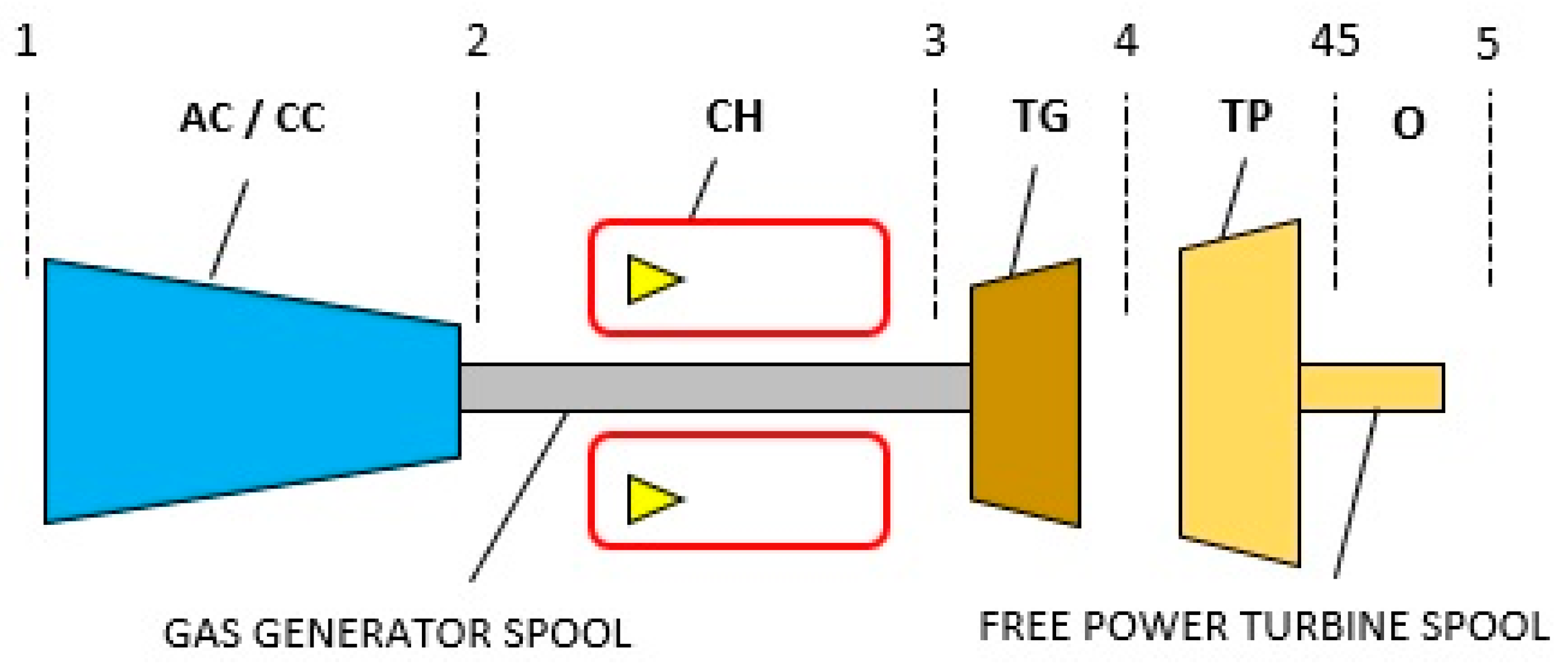
The thermodynamics research study of free turbine turboshaft engines is performed on a series of turboshaft models, from different engine manufacturers such as General Electric (USA), Turbomeca (France), Rolls-Royce (UK), Honeywell (USA) and Klimov (Russia). The engines have almost the same spool design and different power classes, but similar spool configurations with the TV2-117 turboshaft, which is the reference engine of the study. So, the spool configuration of turboshafts is one spool for the gas generator module and one spool for the free turbine module. Performing the study involves identifying certain engine main parameters, such as air mass flow () and overall pressure ratio (), and performance parameters, such as shaft power (SP) and specific fuel consumption (SFC). Table 1 presents the engine data at take-off regime for a series of free-turbine turboshaft models [23].
With this data specification, a model calculation can be used to calculate the power distribution between the gas generator, free-turbine, and other particular turbine parameters, such as temperature, enthalpy ratio and difference. For the turboshaft engine series, a comparative study is performed only at the take-off regime, because the data specification was found only at this regime; however, in the case of TV2-117A, the study was performed for various working regimes from idle to take-off.
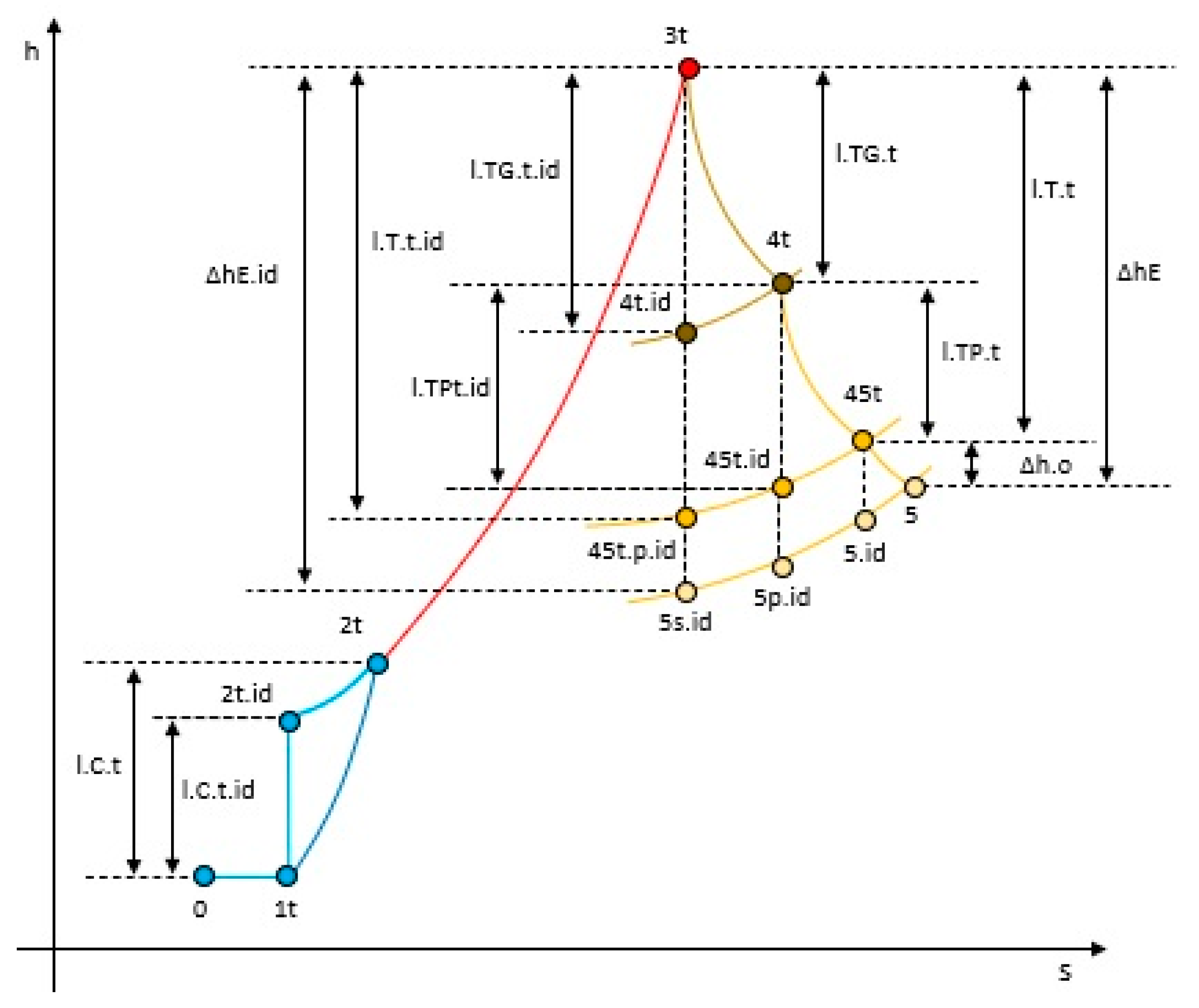
The calculation model for the thermodynamics research study is based on the real Bryton cycle [24], shown in Figure 1, which is the reference cycle that describes the thermodynamic process in gas turbine engines. The thermodynamic cycle is defined by a total expansion process, which means the outlet static pressure of the turbine power is almost at atmospheric pressure, and the outlet static pressure of engine exhaust is equal to an atmospheric pressure p0 = 1.01325 bar a.
According to the spool configuration of the turboshaft models, shown in Figure 2, a general model of the engine main stations is established [24], marked with numbers from 1 to 5, which represent the thermodynamic reference calculation points of the real Brayton cycle shown in Figure 1. The reference calculation points of the real Brayton cycle, corresponding to the marked engine main stations, are described using total and ideal thermodynamic parameters. Therefore, the parameters are expressed using the total notation (t) and the ideal notation (id).
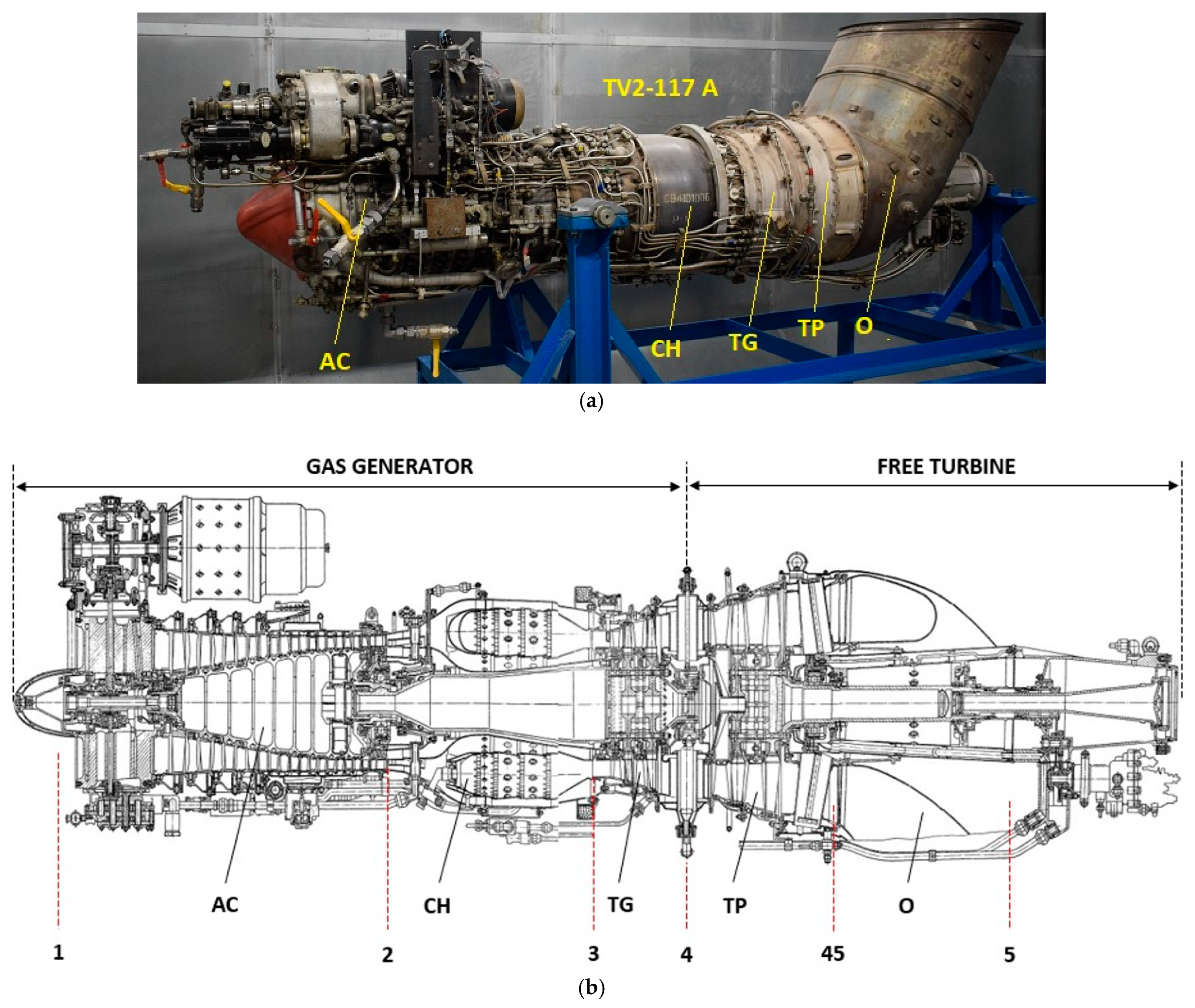
In the case of the TV2-117A free turbine turboshaft used for the thermodynamics research study, engine data from previous work [25,26] were used, from which a reliable experimental database was established. The gas generator module of the TV2-117A, shown in Figure 3, has an engine that comprises a multi-stage axial compression system with variable stator vanes implemented in selected stages, followed by an annular combustor and a two-stage axial turbine that drives the compressor. Power extraction is accomplished by a mechanically independent power turbine, consisting of two axial stages coupled to a transmission unit. For operating conditions other than idle, the engine follows a constant-speed free-turbine control philosophy, whereby a dedicated speed governor regulates fuel flow through the main fuel pump to maintain a fixed power turbine rotational speed. Under take-off conditions [23], the engine achieves an overall pressure ratio of approximately 6.6 with an air mass flow rate close to 8.4 kg/s; at nominal rotational speed, the gas generator operates at about 21,000 rpm, while the free power turbine reaches roughly 12,000 rpm.
The engine data at various regimes from TV2-117A free turbine turboshaft testing are presented in Table 2.
The engines are from different manufactures, such as Safran (Turbomeca), Rolls-Royce, General Electric, Honeywell, MTU, Klimov, and according to the International Air Transport Association, the turboshafts use different kerosine-type fuels [27,28]. The most used kerosine-type fuels are ASTM D 1655 Aviation Turbine Fuels, such as Jet A and Jet A-1, and Russian kerosine-type fuels, such as T-1 and TS-1. The primary physical difference between the ASTM D 1655 Aviation Turbine Fuels and Russian kerosine is the freeze point and the net heat of combustion, or the lower heating value (LHV). Usually, for the Jet A and Jet A-1, the lower heating value is 42,800/42,900 kJ/kg, and for T-1 and TS-1, it is 43,100 kJ/kg [29,30].
As mentioned above, the calculation model is applied to determine power distribution between engine turbines, particular turbine ratios and differences in temperature and enthalpy, engine performance as specific actual work, and thermal efficiency based on engine data at take-off regime for the turboshaft series. The calculation is performed using polynomial temperature functions for the enthalpy and entropy of air and gases [24,25].
In the case of air and gases (for ideal combustion), enthalpy and entropy have the following forms:
The air/gas enthalpy and entropy polynomial forms and coefficients were presented in a previous research paper [31].
In the case of gas (for real combustion), the enthalpy and entropy have the following forms:
where the mass participation is represented by , depending on air excess and air fuel ratio .
The air enthalpy polynomial coefficients are presented in Table 3, and the air entropy polynomial coefficients are presented in Table 4.
The gas enthalpy polynomial coefficients for an ideal stoichiometric combustion are presented in Table 5.
In the case of the turboshaft engine series, the calculation model, as presented here, is directly applicable to the input data from Table 1 for this engine series and is based on a series of mathematical relationships between the engine’s thermodynamic parameters. Additionally, the calculation model requires other parameters or coefficients [32], which are defined by standard values. The additional parameters include the gas constant for air (), gas constant for gases (), compressor total adiabatic efficiency (), GG turbine total adiabatic efficiency (), TP total adiabatic efficiency (), and combustion efficiency (), while the coefficients include the intake total pressure loss () and combustor chamber total pressure loss () used in the calculation model. These additional parameters and coefficients, along with their values, are shown in Table 6. The standard atmospheric conditions are: and .
Thus, the calculation model for the turboshaft engine series is based on a series of equations, as follows:
Compressor inlet total temperature and total specific enthalpy:
Compressor inlet and outlet total pressure:
Compressor inlet and ideal outlet total specific entropy:
Calculations were performed in Mathcad, employing the root function to find temperatures from the entropy or enthalpy polynomials, as follows:
Compressor ideal outlet total temperature:
Compressor ideal outlet total specific enthalpy and total specific work (ideal and actual)
Compressor outlet total specific enthalpy, total temperature, and total specific entropy:
Fuel flow rate, gas flow rate, fuel flow coefficient, and air excess ratio
GG turbine inlet total specific enthalpy and inlet total temperature:
GG turbine inlet total pressure and total specific entropy:
GG turbine total specific actual work, outlet total specific enthalpy, and outlet total temperature:
GG turbine total specific ideal work, outlet total ideal specific enthalpy, and outlet ideal total temperature:
GG turbine total expansion ratio, outlet total pressure, and outlet total specific entropy:
Free turbine total specific actual work, outlet total specific enthalpy, and outlet total temperature:
Free turbine total specific ideal work, outlet total ideal specific enthalpy, and ideal total temperature:
Free turbine total expansion ratio and outlet total pressure:
Total expansion ratio of the entire turbine and total actual specific work:
Free turbine outlet total actual, ideal specific entropy and ideal total temperature:
Total specific ideal work of the entire turbine and total adiabatic efficiency:
Exhaust outlet pressure:
Ideal exhaust outlet temperature:
Total ideal specific enthalpy at engine exhaust outlet:
Engine exhaust velocity, adiabatic index, and Mach number:
Compressor and turbine power, expansion process power, and thermal efficiency:
Based on the calculation model, various ratios and differences between key engine parameters and performance are computed to obtain the actual values required for the analysis. The analysis data are presented through the following set of specific parameters:
Ideal and actual total specific enthalpy differences in the expansion process:
Turbine, engine exhaust and expansion process actual temperature differences:
Combustor chamber and turbine actual temperature ratios in the expansion process:
Total specific ideal and actual ratio enthalpies of the expansion process:
Turbine power ratios:
Performance ratio relative to turbine stages:
In the case of the TV2-117 engine, the calculation model uses the same computational relationships but employs the experimental values presented in Table 2 as input data, which differ from those listed in Table 1. Therefore, the calculation procedure is not identical to that used for the turboshaft engine series. Also, in this case, the calculation model requires additional parameters and coefficients. As such, the total adiabatic efficiency of the compressor, the gas generator turbine, and the entire turbine will be calculated. The additional parameters and coefficients used in the calculation model, along with their values for the TV2-117 engine, are shown in Table 7.
In the case of the TV2-117 engine, the calculation model is described by the calculated parameters in the indicated order:
In both cases, the calculation model assumes an engine exhaust efficiency of . In the case of Klimov turboshaft engine models, the lower heating value used in the calculations is 43,100 kJ/kg, while for the other turboshaft engine models it is 42,800 kJ/kg. In the case of the TV2-117A testing application, considering that the engine was not tested with T-1 or TS-1 fuel and Jet A-1 fuel was used, the lower heating value used in the calculations is 42,900 kJ/kg.
3. Results
In the case of the turboshaft engine models, the data results were obtained following the application of the calculation model. These results are organized into tables, grouped into specific series, and present the actual values of certain key engine parameters, coefficients, and performance for each engine. Given the large volume of data obtained from the calculations, it is impractical to present all the results. Therefore, only selected data are shown in the tables. This approach avoids the duplication of results and provides the relevant data from which other specific engine parameters can be easily determined. For the TV2-117A, the data results were obtained using the calculation model, adapted according to the experimental data in Table 2. These results also present actual values for each working regime, covering the same parameters, ratios, differences, and performance established for the turboshaft engine models. This consistency allows for a comprehensive comparison and analysis of the performance across different engine models and operating conditions. From a data sorting perspective, four sets of data results were obtained, which are presented in Table 8, Table 9, Table 10, Table 11, Table 12, Table 13, Table 14 and Table 15.
Table 8 presents the first series of calculated results for the analyzed free-turbine turboshaft engines at take-off operating conditions. The table summarizes the main power-related and thermodynamic quantities obtained from the analytical calculation model, including the power produced by the gas generator turbine and the free power turbine, the total turbine power, engine output power, and selected enthalpy-based parameters of the expansion process. These results provide a consistent quantitative basis for comparing the internal power distribution and energy conversion characteristics across turboshaft engines from different manufacturers but with similar free-turbine architectures.
Table 8.
The first series of data results, at take-off regime, for turboshaft models.
Table 8.
The first series of data results, at take-off regime, for turboshaft models.
No.
Engine Model
kW
kW
kW
kW
kW
kJ/kg
kJ/kg
kJ/kg
kJ/kg
kJ/kg
kJ/kg
1
MTR390-2C
1233.451
958.0
2191.451
44.352
2235.803
1590.664
376.682
292.563
669.245
13.545
682.790
2
TURMO III C3
1367.052
1104.0
2471.052
58.853
2529.905
1280.300
227.369
183.618
410.987
9.789
420.776
3
TV2-117
2119.778
1118.0
3237.778
42.474
3280.252
1095.242
248.961
131.306
380.267
4.989
385.256
4
T800-LHT-801
1847.957
1166.0
3013.957
66.316
3080.273
1493.851
408.962
258.042
667.004
14.676
681.680
5
MAKILA 1A1
1840.831
1357.0
3197.831
39.318
3237.149
1429.251
328.086
241.854
569.940
7.007
576.947
6
T-58 GE-16
1851.973
1394.0
3245.973
57.881
3303.854
1369.018
288.252
216.970
505.222
9.009
514.231
7
RTM-322 01/8
2361.096
1566.0
3927.096
55.145
3982.241
1498.779
402.457
266.929
669.386
9.400
678.786
8
MAKILA 2A
1928.903
1567.0
3495.903
50.668
3546.571
1538.990
342.974
278.625
621.599
9.009
630.608
9
TV3-117 VMA
3026.38
1633.0
4659.380
63.164
4722.544
1222.456
320.594
172.989
493.583
6.692
500.275
10
VK2500
2990.609
1765.0
4755.609
31.712
4787.321
1210.861
316.867
187.009
503.876
3.360
507.236
11
TV7-117V
4012.618
2088.0
6100.618
105.415
6206.033
1400.151
428.934
223.200
652.134
11.268
663.402
The results in Table 8 indicate noticeable differences in the absolute levels of turbine power and specific enthalpy variations among the considered engines, reflecting variations in engine size, overall pressure ratio, and mass flow rate. For all models, the gas generator turbine delivers a substantial share of the total turbine power to drive the compressor, while the remaining power is extracted by the free power turbine to provide usable shaft output. The calculated values of total specific enthalpy drop and expansion work highlight the influence of engine design and power class on the thermodynamic utilization of the expansion process at take-off.
Table 9 presents the second series of calculated results for the analyzed free-turbine turboshaft engines at take-off conditions, focusing on temperature-related parameters of the thermodynamic cycle. The table includes characteristic total temperatures at key engine stations, as well as the actual temperature drops associated with the gas generator turbine, the free power turbine, the onboard power extraction, and the overall expansion process. These quantities characterize the thermal behavior of the turbine stages and provide insight into how the available thermal energy is distributed and converted into mechanical work at take-off.
Table 9.
The second series of data results, at take-off regime, for turboshaft models.
Table 9.
The second series of data results, at take-off regime, for turboshaft models.
No.
Engine Model
kg/s
-
K
K
K
K
K
K
K
K
K
1
MTR390-2C
0.0745
2.948
651.2
1424.2
305.7
247.5
11.8
553.2
565.0
634.6
646.1
2
TURMO III C3
0.1125
3.601
509.9
1178.2
190.7
158.9
8.6
349.6
358.2
398.3
407.0
3
TV2-117
0.1145
5.037
530.6
1028.9
216.8
118.4
4.5
335.2
339.7
381.6
386.2
4
T800-LHT-801
0.0886
3.430
681.1
1351.4
337.6
223.3
13.1
560.9
574.0
639.7
652.3
5
MAKILA 1A1
0.1108
3.407
605.7
1298.9
271.5
208.4
6.1
479.9
486.0
550.9
557.0
6
T-58 GE-16
0.1248
3.464
568.0
1250.2
239.7
187.3
7.9
427.0
434.9
490.8
498.7
7
RTM-322 01/8
0.1167
3.382
675.1
1355.0
331.8
230.7
8.3
562.5
570.8
637.7
645.8
8
MAKILA 2A
0.1241
3.043
619.7
1384.0
279.6
236.4
7.8
516.0
523.8
592.3
600.0
9
TV3-117 VMA
0.1399
4.564
598.6
1134.9
274.7
154.6
6.1
429.3
435.4
487.7
493.7
10
VK2500
0.1381
4.624
595.1
1125.4
271.9
167.7
3.1
439.6
442.7
488.9
492.0
11
TV7-117V
0.1549
4.078
699.6
1279.7
360.4
197.4
10.2
557.8
568.0
632.1
642.0
The results summarized in Table 9 show that the magnitude of temperature drops across the turbine stages varies significantly among the considered engines, reflecting differences in cycle pressure ratios, turbine loading, and mass flow rates. In all cases, the largest contribution to the total temperature decrease occurs across the combined turbine expansion, while the relative shares of the gas generator turbine and the free power turbine depend on the specific engine configuration and power class. These temperature-based indicators highlight the diversity of thermal utilization strategies across turboshaft designs and serve as a foundation for the comparative graphical analysis presented in the following figures, where relative trends and normalized values are discussed in greater detail.
Table 10 presents the third series of calculated results for the free-turbine turboshaft engines at take-off conditions, focusing on efficiency parameters, pressure levels, mass flow characteristics, and global performance indicators. The table includes total adiabatic efficiencies of the compressor, gas generator turbine, and free power turbine, as well as characteristic pressure ratios, mass flow parameters, and the resulting engine thermal efficiency. These parameters provide a consolidated view of component-level and overall performance characteristics derived from the analytical calculation model.
Table 10.
The third series of data results, at take-off regime, for turboshaft models.
Table 10.
The third series of data results, at take-off regime, for turboshaft models.
Imposed Values
Calculated Values
No.
Engine Model
-
-
-
kJ/kg
Bar a
-
-
-
kg/s
-
%
1
MTR390-2C
0.86
0.86
0.84
372.916
12.393
3.414
3.382
11.544
3.275
0.270
30.04
2
TURMO III C3
0.87
0.87
0.85
225.095
5.624
2.342
2.268
5.313
6.012
0.235
22.93
3
TV2-117
0.87
0.87
0.84
246.472
6.357
3.015
2.026
6.109
8.514
0.185
22.66
4
T800-LHT-801
0.87
0.86
0.85
404.873
14.776
4.228
3.219
13.609
4.519
0.297
30.73
5
MAKILA 1A1
0.86
0.86
0.85
324.805
9.914
3.213
2.95
9.479
5.611
0.200
28.61
6
T-58 GE-16
0.86
0.86
0.85
285.37
8.007
2.864
2.65
7.589
6.425
0.227
26.09
7
RTM-322 01/8
0.87
0.87
0.84
398.432
14.159
4.017
3.329
13.372
5.867
0.236
31.35
8
MAKILA 2A
0.86
0.86
0.84
339.544
10.595
3.127
3.218
10.062
5.624
0.220
29.51
9
TV3-117 VMA
0.87
0.87
0.85
317.389
9.632
3.737
2.456
9.178
9.440
0.212
27.08
10
VK2500
0.89
0.89
0.86
313.698
9.730
3.592
2.625
9.431
9.438
0.152
29.66
11
TV7-117V
0.87
0.87
0.85
424.645
16.374
5.019
3.038
15.249
9.355
0.273
31.28
The results in Table 10 indicate that, despite differences in engine size and power class, the calculated adiabatic efficiencies of the main components remain within relatively narrow ranges across the analyzed turboshaft models, suggesting comparable levels of aerodynamic and thermodynamic maturity. Variations in pressure ratios and mass flow parameters reflect differences in cycle design and operating conditions, which in turn influence the overall thermal efficiency of the engines. The combined presentation of component efficiencies and global performance metrics facilitates a consistent comparative framework, while a more detailed interpretation of efficiency trends and their correlation with power and temperature distributions is deferred to the subsequent graphical analysis.
Table 11 presents the fourth series of calculated results for the analyzed free-turbine turboshaft engines at take-off conditions, focusing on turbine stage-level characteristics. The table summarizes the number of stages for the gas generator turbine and the free power turbine, along with the corresponding power contribution, specific work, and temperature drop per turbine stage. By normalizing these parameters at the stage level, the table enables a clearer comparison of how the expansion process is distributed within the turbine modules of different turboshaft designs.
Table 11.
The fourth series of data results at take-off regime, for turboshaft models.
Table 11.
The fourth series of data results at take-off regime, for turboshaft models.
No.
Engine Model
-
-
kW
kW
kJ/kg
kJ/kg
K
K
K
1
MTR390-2C
2
1
616.7
958.0
188.34
292.56
152.9
247.5
184.4
2
TURMO III C3
1
2
1367.1
552.0
227.37
91.81
190.7
79.5
116.5
3
TV2-117
2
2
1059.9
559.0
124.48
65.65
108.4
59.2
83.8
4
T800-LHT-801
2
2
924.0
583.0
204.48
129.02
168.8
111.7
140.2
5
MAKILA 1A1
2
2
920.4
678.5
164.04
120.93
135.8
104.2
120.0
6
T-58 GE-16
2
2
926.0
697.0
144.13
108.49
119.9
93.7
106.8
7
RTM-322 01/8
2
2
1180.5
783.0
201.23
133.46
165.9
115.4
140.6
8
MAKILA 2A
2
2
964.5
783.5
171.49
139.31
139.8
118.2
129.0
9
TV3-117 VMA
2
2
1513.2
816.5
160.30
86.49
137.4
77.3
107.3
10
VK2500
2
2
1495.3
882.5
158.43
93.50
136.0
83.9
109.9
11
TV7-117V
2
2
2006.3
1044.0
214.47
111.60
180.2
98.7
139.5
The data in Table 11 show that, although many of the analyzed engines employ similar numbers of turbine stages, the power, specific work, and temperature drop per stage vary noticeably across models. These differences reflect variations in turbine loading strategies, cycle pressure ratios, and overall engine power class. The stage-level representation highlights how different design choices lead to distinct distributions of expansion work between turbine stages, providing additional insight beyond total turbine performance. A more detailed assessment of these trends and their implications for turbine design and efficiency is addressed in the subsequent graphical analysis based on normalized and percentage values.
Table 12 presents the first series of calculated results for the TV2-117 free-turbine turboshaft engine, covering multiple operating regimes from idle to take-off. The table summarizes the distribution of power between the gas generator turbine and the free power turbine, together with the corresponding total turbine power, engine output power, and selected enthalpy-based parameters of the expansion process. Unlike the previous tables, which focus on a comparative analysis across different engine models at take-off, Table 12 provides a regime-dependent perspective for a single reference engine supported by experimental data.
Table 12.
The first series of data results for the TV2-117 turboshaft.
Table 12.
The first series of data results for the TV2-117 turboshaft.
No.
kW
kW
kW
kW
kW
kJ/kg
kJ/kg
kJ/kg
kJ/kg
kJ/kg
kJ/kg
1
169.307
55.9
225.207
0.731
225.938
802.099
85.393
28.194
113.587
0.369
113.956
2
612.524
184.7
797.224
6.504
803.728
912.515
150.570
45.403
195.973
1.598
197.571
3
739.949
248.1
988.049
8.262
996.311
936.098
163.973
54.979
218.952
1.830
220.782
4
952.994
374.6
1327.594
16.020
1343.614
982.535
182.888
71.889
254.777
3.074
257.851
5
1144.143
497.0
1641.143
26.463
1667.606
1027.629
198.648
86.290
284.938
4.594
289.532
6
1349.086
622.1
1971.186
31.191
2002.377
1082.625
215.497
99.371
314.868
4.983
319.851
7
1503.613
745.2
2248.813
44.119
2292.932
1121.976
225.300
111.661
336.961
6.610
343.571
8
1669.811
868.8
2538.611
57.340
2595.951
1169.591
236.380
122.988
359.368
8.117
367.485
9
1833.409
985.4
2818.809
73.537
2892.346
1213.897
247.272
132.900
380.172
9.918
390.090
10
1884.712
1027.5
2912.212
87.503
2999.715
1228.094
249.803
136.187
385.990
11.597
397.587
The results in Table 12 show a progressive increase in turbine power, specific enthalpy drop, and engine output as the operating regime advances from idle toward take-off. The relative contribution of the gas generator turbine and the free power turbine evolves with engine speed and fuel flow, reflecting the dynamic redistribution of expansion work required to sustain compressor operation while delivering increasing shaft power. These trends illustrate the sensitivity of internal power distribution to operating regime and establish a consistent baseline for analyzing the regime-dependent behavior of the TV2-117 engine, which is further explored through the corresponding graphical representations.
Table 13 presents the second series of calculated results for the TV2-117 free-turbine turboshaft engine, focusing on temperature-related parameters across multiple operating regimes, from idle to take-off. The table includes characteristic total temperatures at key engine stations, as well as the actual temperature drops associated with the gas generator turbine, the free power turbine, onboard power extraction, and the overall expansion process. These parameters describe the thermal evolution of the engine as a function of operating regime.
Table 13.
The second series of data results for the TV2-117 turboshaft.
Table 13.
The second series of data results for the TV2-117 turboshaft.
No.
kg/s
-
K
K
K
K
K
K
K
K
K
1
0.0267
5.031
378.4
772.6
77.3
25.8
0.4
103.1
103.5
125.1
125.5
2
0.0450
6.132
442.3
872.6
134.6
41.4
1.5
176.0
177.5
220.5
222.0
3
0.0486
6.300
455.5
893.6
146.2
50.1
1.7
196.3
198.0
239.7
241.3
4
0.0598
5.913
474.1
933.6
161.8
65.2
2.8
227.0
229.8
272.9
275.7
5
0.0746
5.228
489.6
971.4
174.3
77.8
4.2
252.1
256.3
300.2
304.4
6
0.0783
5.417
506.3
1019.0
187.6
89.1
4.5
276.7
281.2
329.6
334.1
7
0.0878
5.148
516.0
1051.9
194.9
99.5
6.0
294.4
300.4
351.7
357.6
8
0.0971
4.925
527.0
1091.7
203.1
108.9
7.2
312.0
319.2
374.4
381.7
9
0.1076
4.663
537.6
1128.0
210.9
116.9
8.8
327.8
336.6
394.2
402.9
10
0.1088
4.692
540.5
1140.0
212.7
119.6
10.3
332.3
342.6
400.5
410.7
The data in Table 13 indicate a systematic increase in turbine temperature drops and total expansion temperature differences with rising engine load and gas generator speed. As the operating regime advances toward take-off, higher turbine inlet temperatures lead to increased thermal energy availability, which is progressively converted into mechanical work by the turbine stages. The relative evolution of temperature drops across the gas generator turbine and the free power turbine highlights the regime-dependent redistribution of thermal energy within the engine. These results provide a consistent thermal context for interpreting the power and efficiency trends discussed later using the corresponding graphical representations.
Table 14 presents the third series of calculated results for the TV2-117 free-turbine turboshaft engine, covering multiple operating regimes from idle to take-off, with emphasis on component efficiencies, pressure levels, mass flow characteristics, and global performance indicators. The table includes the total adiabatic efficiencies of the compressor, gas generator turbine, and free power turbine, together with characteristic pressure ratios, gas mass flow parameters, exhaust Mach number, and the resulting engine thermal efficiency. These parameters provide an integrated view of how component-level performance evolves with operating regime.
Table 14.
The third series of data results for the TV2-117 turboshaft.
Table 14.
The third series of data results for the TV2-117 turboshaft.
No.
-
-
-
kJ/kg
Bar a
-
-
-
kg/s
-
%
1
0.826
0.822
0.808
84.539
1.992
1.645
1.192
1.961
1.983
0.051
4.88
2
0.802
0.785
0.797
149.064
3.128
2.337
1.31
3.061
4.068
0.104
9.56
3
0.823
0.812
0.789
162.333
3.401
2.402
1.384
3.324
4.513
0.111
11.89
4
0.836
0.828
0.807
181.059
3.922
2.512
1.516
3.809
5.211
0.143
14.60
5
0.844
0.839
0.818
196.662
4.377
2.590
1.629
4.219
5.760
0.174
15.52
6
0.844
0.837
0.820
213.342
4.802
2.688
1.72
4.622
6.260
0.178
18.51
7
0.842
0.833
0.828
223.047
5.196
2.739
1.812
4.964
6.674
0.203
19.78
8
0.838
0.826
0.829
234.016
5.559
2.800
1.886
5.279
7.064
0.221
20.86
9
0.837
0.823
0.826
244.799
5.887
2.850
1.947
5.549
7.415
0.242
21.35
10
0.835
0.819
0.833
247.305
6.014
2.863
1.966
5.627
7.545
0.260
21.91
The results summarized in Table 14 show a gradual improvement in component efficiencies and overall thermal efficiency as the engine transitions from low-power regimes toward take-off. The increase in pressure ratios and mass flow parameters reflects the rising energy level of the thermodynamic cycle and the enhanced utilization of available thermal energy. Variations in exhaust Mach number and turbine expansion coefficients further illustrate the changing flow conditions associated with increasing load. Together, these results highlight the strong coupling between operating regime, component performance, and global engine efficiency, while a more detailed interpretation of these trends is deferred to the graphical analysis presented later.
Table 15 presents the fourth series of calculated results for the TV2-117 free-turbine turboshaft engine, focusing on turbine stage-level characteristics across multiple operating regimes from idle to take-off. The table summarizes the gas generator speed, the number of stages of the gas generator turbine and free power turbine, together with the corresponding power contribution, specific work, and temperature drop per turbine stage. This stage-based representation provides a detailed view of how the expansion process is distributed within the turbine modules as engine operating conditions vary.
Table 15.
The fourth series of data results for the TV2-117 turboshaft.
Table 15.
The fourth series of data results for the TV2-117 turboshaft.
No.
-
-
-
kW
kW
kJ/kg
kJ/kg
K
K
K
1
64.80
2
2
84.65
27.95
42.70
14.10
38.7
12.9
25.8
2
84.30
2
2
306.26
92.35
75.29
22.70
67.3
20.7
44.0
3
86.50
2
2
369.97
124.05
81.99
27.49
73.1
25.1
49.1
4
89.40
2
2
476.50
187.30
91.44
35.94
80.9
32.6
56.8
5
91.70
2
2
572.07
248.50
99.32
43.15
87.2
38.9
63.0
6
93.80
2
2
674.54
311.05
107.75
49.69
93.8
44.6
69.2
7
95.50
2
2
751.81
372.60
112.65
55.83
97.5
49.8
73.6
8
97.00
2
2
834.91
434.40
118.19
61.49
101.6
54.5
78.0
9
98.40
2
2
916.70
492.70
123.64
66.45
105.5
58.5
82.0
10
99.11
2
2
942.36
513.75
124.90
68.09
106.4
59.8
83.1
The data in Table 15 show a consistent increase in power output, specific work, and temperature drop per turbine stage with rising gas generator speed and engine load. While the number of turbine stages remains constant, the loading of each stage intensifies as the engine approaches take-off conditions, reflecting the higher thermal energy available for conversion. These results highlight the regime-dependent nature of turbine stage operation and complement the total and normalized analyses presented in the preceding tables. A more detailed discussion of stage-level trends and their implications for turbine design and durability is provided in the subsequent graphical analysis.
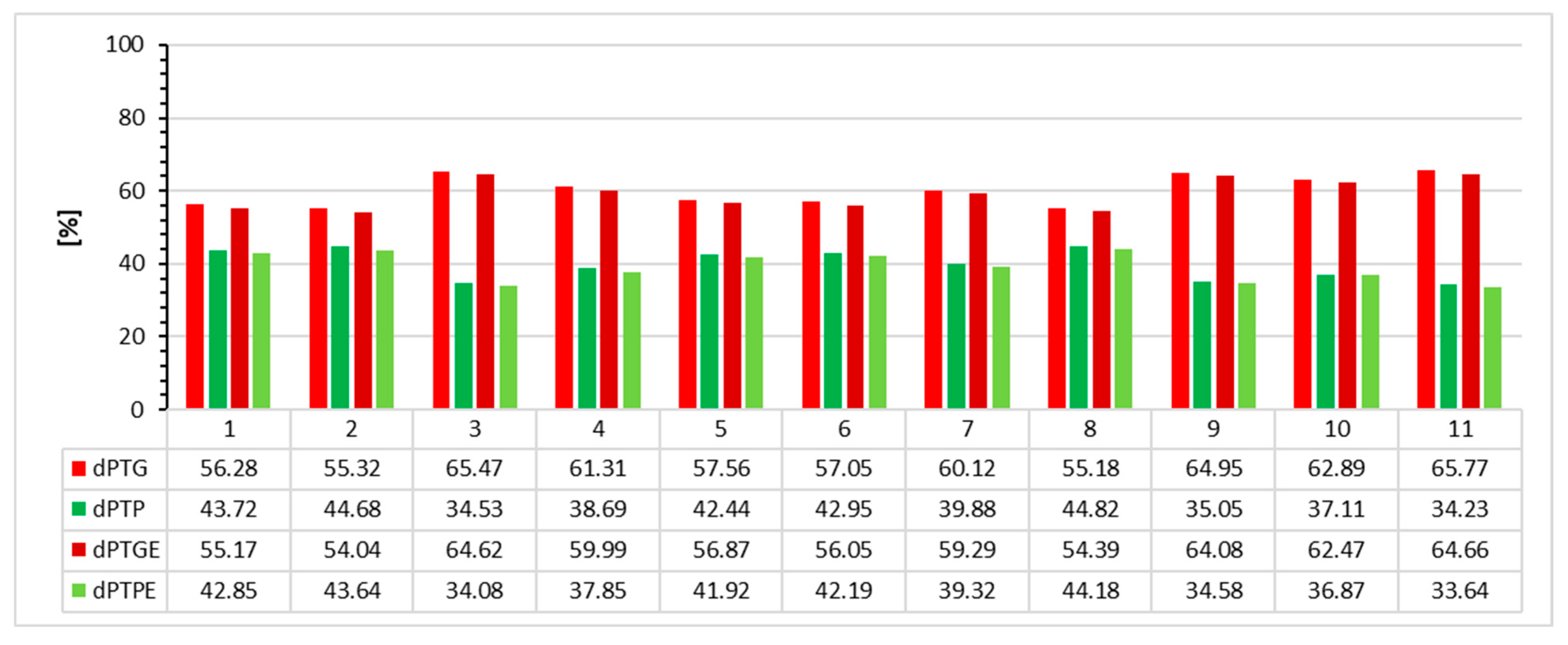
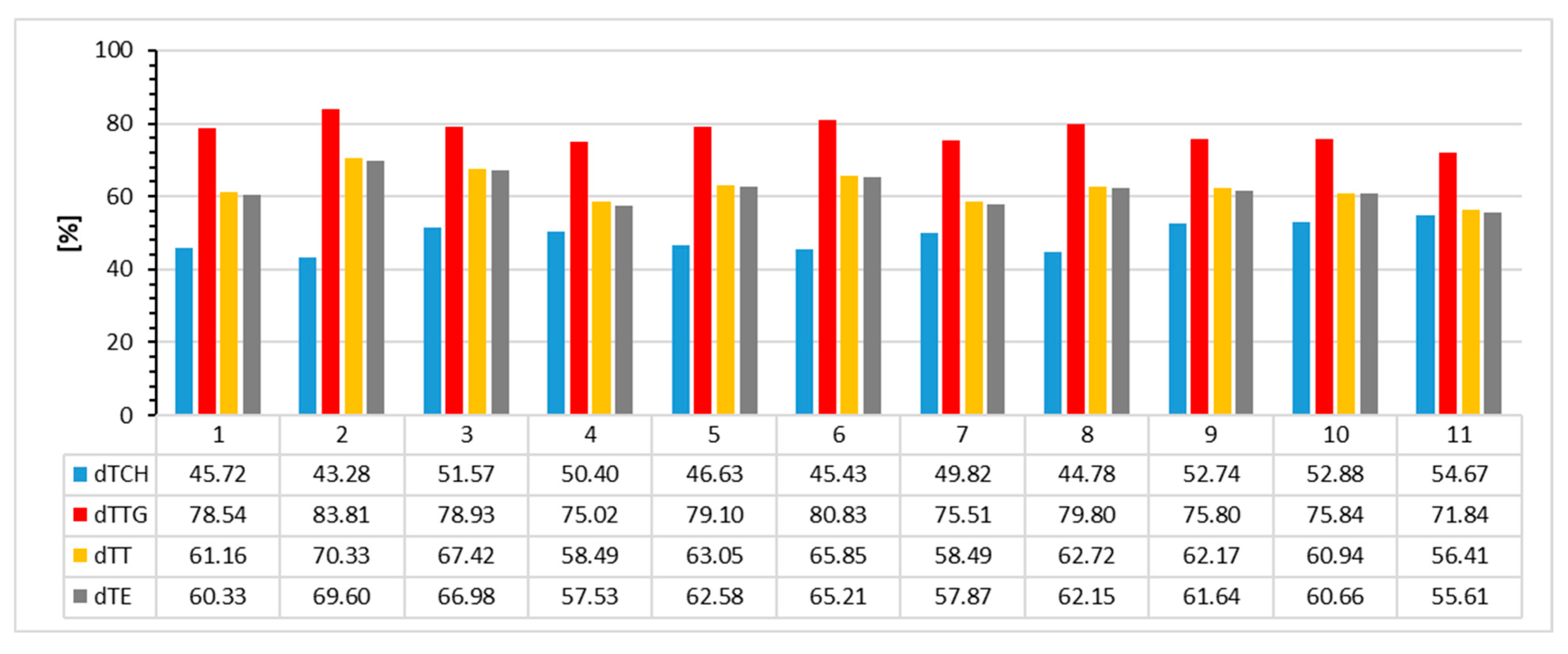
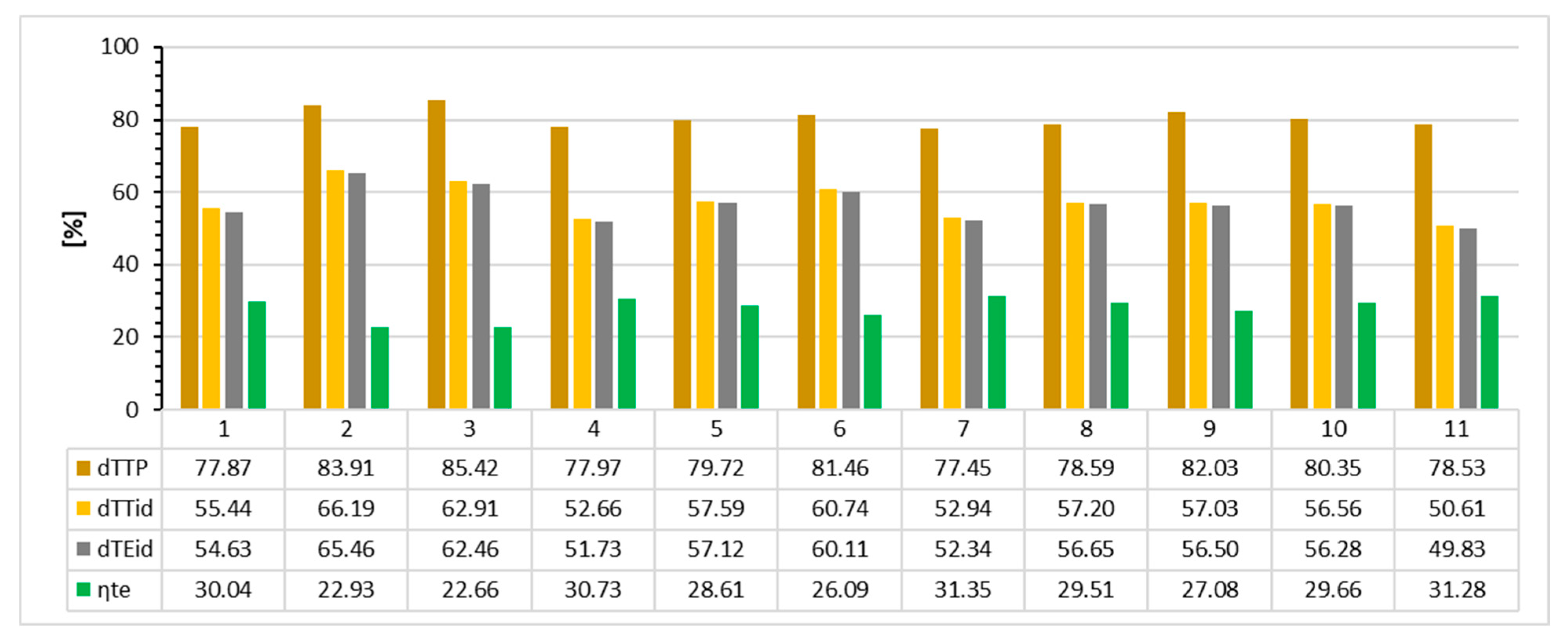
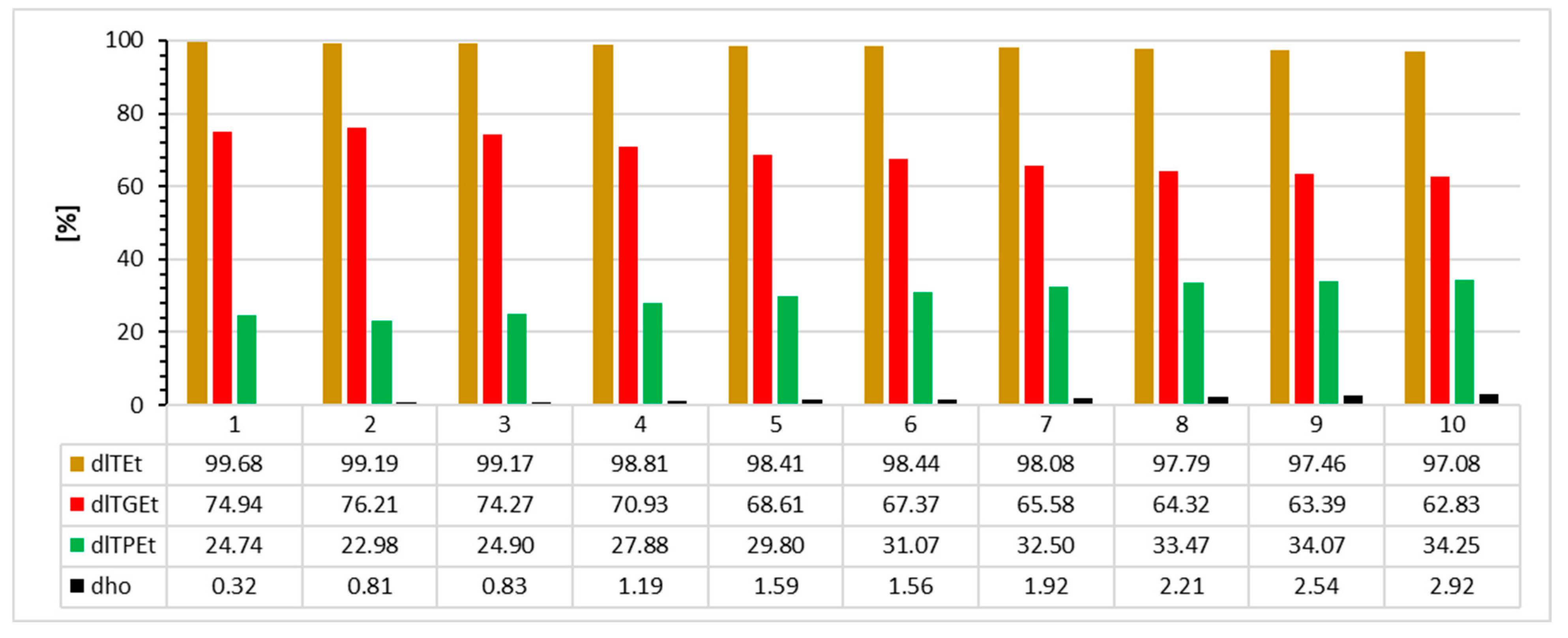
To expand the volume of the presented data without duplication and provide a clearer comparison of values, the following charts from Figure 4, Figure 5, Figure 6, Figure 7, Figure 8, Figure 9 and Figure 10 show selected results from Table 8, Table 9, Table 10, Table 11, Table 12, Table 13, Table 14 and Table 15. These charts offer a visual representation of key performance and parameters, making it easier to compare and analyze the data across different turboshaft engine models and at different operating regimes in the case of TV2-117A testing application.
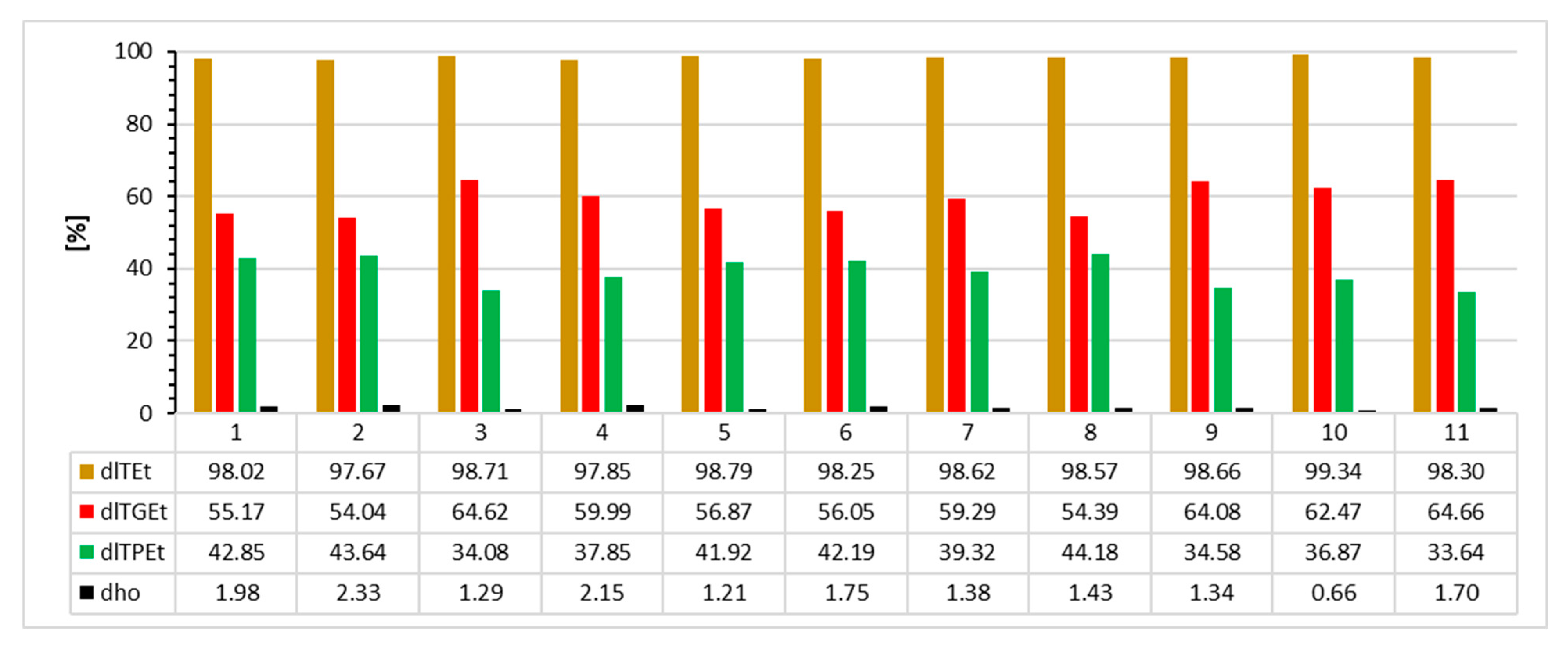
Figure 4 illustrates the percentage distribution of the actual specific work and enthalpy components associated with the turbine expansion process for the analyzed turboshaft engines at take-off conditions.
Figure 4.
Percentage values of the actual ratios of specific work and enthalpy for turboshaft models.
Figure 4.
Percentage values of the actual ratios of specific work and enthalpy for turboshaft models.
Figure 4 highlights the relative contribution of the total actual specific work and enthalpy components to the expansion process across the investigated turboshaft models. For all engines, the total actual specific enthalpy drop of the expansion process remains consistently high, with values close to 98–99%, indicating that the dominant portion of the available thermal energy is effectively utilized within the turbine system at take-off.
The distribution between the gas generator turbine and the free power turbine shows more pronounced variability. The contribution associated with the gas generator turbine generally ranges between approximately 54% and 65%, reflecting the energy required to sustain compressor operation and auxiliary loads. In contrast, the share corresponding to the free power turbine spans a wider interval, from roughly 33% to 44%, depending on engine design and power class. This variation underscores differences in cycle architecture, overall pressure ratio, and turbine loading strategies among the analyzed engines.
The comparatively small percentage associated with onboard power extraction losses remains below 3% for all models, indicating that accessory power demands have a limited influence on the overall energy balance of the expansion process at take-off. Engines with higher installed power tend to exhibit a slightly larger proportion of enthalpy allocated to the gas generator turbine, while the relative contribution of the free power turbine decreases accordingly, suggesting a design emphasis on higher compressor work and mass flow capability.
Overall, the normalized representation in Figure 4 facilitates a direct comparison of thermodynamic energy allocation across different turboshaft engines, revealing both common trends inherent to free-turbine architectures and design-specific differences that influence how expansion work is partitioned between turbine modules. These observations form the basis for the subsequent analysis of power ratios and temperature distributions presented in the following figures.
Figure 5 presents the percentage distribution of the actual turbine power between the gas generator turbine and the free power turbine for the analyzed turboshaft engines at take-off conditions.
Figure 5.
Percentage values of the actual power ratios for turboshaft models.
Figure 5.
Percentage values of the actual power ratios for turboshaft models.
Figure 5 provides a clear quantitative comparison of how the total turbine power is partitioned between the gas generator turbine and the free power turbine across the investigated turboshaft models. For all engines, the gas generator turbine accounts for the dominant share of the total turbine power, typically ranging between approximately 55% and 66%. This reflects the substantial power demand required to drive the compressor and support the core engine processes at take-off.
The free power turbine consistently extracts the remaining fraction of the available turbine power, with values generally between 34% and 45%, depending on engine configuration and power class. Engines characterized by higher overall pressure ratios and larger compressor work requirements tend to allocate a higher proportion of turbine power to the gas generator, resulting in a comparatively lower share available for shaft output. Conversely, engines optimized for higher shaft power extraction exhibit a more balanced distribution between the two turbine modules.
The relatively narrow dispersion of power ratios among the different models highlights a common design philosophy inherent to free-turbine turboshaft engines, where the balance between gas generator power and free turbine power is tightly constrained by thermodynamic cycle requirements and mechanical coupling considerations. Small deviations from the average trend can be attributed to differences in spool configuration, number of turbine stages, and engine power rating.
Overall, Figure 5 confirms that, despite variations in engine size and manufacturer, free-turbine turboshaft engines exhibit comparable power-splitting behavior at take-off. This normalized power-based representation complements the enthalpy-based analysis presented in Figure 4 and provides a direct link between thermodynamic energy conversion and usable shaft power output, serving as a foundation for the subsequent analysis of temperature ratios and efficiency trends.
Figure 6 illustrates the percentage values of the actual temperature ratios associated with the turbine expansion process for the analyzed turboshaft engines at take-off conditions.
Figure 6.
Percentage values of the actual temperature ratios for turboshaft models.
Figure 6.
Percentage values of the actual temperature ratios for turboshaft models.
Figure 6 presents a comparative view of how the total temperature drop of the expansion process is distributed among the gas generator turbine, the free power turbine, and the overall turbine system. For all analyzed engines, the total expansion temperature ratio remains dominant, confirming that the major portion of the available thermal potential is converted within the turbine stages at take-off.
The contribution of the gas generator turbine to the total temperature drop is generally higher than that of the free power turbine, reflecting its primary role in providing the energy required to drive the compressor and sustain core engine operation. The relative share associated with the gas generator turbine typically exceeds 50% of the total temperature decrease, while the free power turbine accounts for a smaller but still significant fraction, varying according to engine design and loading strategy.
Differences among engine models are evident in the relative magnitude of these temperature ratios. Engines with higher compressor pressure ratios and greater mass flow rates tend to exhibit increased temperature drops across the gas generator turbine, indicating higher turbine loading. In contrast, engines optimized for higher shaft power extraction show comparatively larger temperature drops across the free power turbine, consistent with a greater allocation of thermal energy to usable output power.
The normalized temperature-based representation emphasizes the thermal balance inherent to free-turbine architectures and highlights how design choices influence the internal redistribution of thermal energy at take-off. These results complement the power-based analysis in Figure 5 and provide essential context for interpreting the combined temperature and efficiency trends discussed in the subsequent figure.
Figure 7 presents the percentage values of the actual temperature ratios of the turbine expansion process together with the corresponding thermal efficiency for the analyzed turboshaft engines at take-off conditions.
Figure 7.
Percentage values of the actual temperature ratios and thermal efficiency for turboshaft models.
Figure 7.
Percentage values of the actual temperature ratios and thermal efficiency for turboshaft models.
Figure 7 correlates the distribution of turbine temperature ratios with the overall thermal efficiency of the analyzed turboshaft engines, providing an integrated view of thermal energy utilization at take-off. The results indicate that engines exhibiting a more balanced distribution of temperature drops between the gas generator turbine and the free power turbine tend to achieve higher thermal efficiency values.
The thermal efficiency generally increases with the magnitude of the total expansion temperature ratio, reflecting more effective conversion of the available thermal energy into useful mechanical work. Engines characterized by higher gas generator turbine temperature ratios typically show increased compressor work capability, but this does not always translate directly into higher overall efficiency, as excessive thermal loading of the gas generator can limit the energy available for shaft power extraction.
Conversely, engines in which a slightly larger fraction of the total temperature drop occurs across the free power turbine tend to demonstrate improved thermal efficiency, as a greater portion of the expansion work is converted into usable output power. This trend highlights the importance of optimizing the internal thermal balance between turbine modules rather than maximizing the performance of a single component.
The combined representation in Figure 7 underscores the close coupling between temperature distribution and global engine efficiency in free-turbine turboshaft architectures. These observations support the need for detailed thermodynamic analyses of turbine temperature ratios when assessing performance trade-offs and provide a direct link between the results presented in Figure 4, Figure 5 and Figure 6 and the efficiency-based conclusions discussed in the following sections.
Figure 8 illustrates the percentage distribution of the actual specific work and enthalpy ratios for the TV2-117 free-turbine turboshaft engine over multiple operating regimes, from idle to take-off.
Figure 8.
Percentage values of the actual ratios of specific work and enthalpy for the TV2-117 turboshaft.
Figure 8.
Percentage values of the actual ratios of specific work and enthalpy for the TV2-117 turboshaft.
Figure 8 highlights the evolution of the internal energy distribution of the turbine expansion process for the TV2-117 engine as a function of operating regime. Across all regimes, the total actual specific enthalpy ratio of the expansion process remains dominant, indicating that the majority of the available thermal energy is consistently involved in the turbine work, even at low power settings.
As the engine transitions from idle toward take-off, the relative contribution of the gas generator turbine to the total specific work increases progressively. This behavior reflects the growing power demand required to drive the compressor at higher rotational speeds and pressure ratios. In parallel, the share of specific work associated with the free power turbine also increases, but at a different rate, illustrating the dynamic redistribution of expansion work as shaft power demand rises.
At low operating regimes, a larger fraction of the available energy is allocated to sustaining core engine operation, while the free power turbine contribution remains comparatively limited. As the operating regime approaches take-off, the balance shifts toward a more pronounced contribution from the free power turbine, enabling increased usable shaft power output. The onboard power extraction losses remain marginal throughout all regimes, confirming their limited impact on the overall energy balance.
Overall, Figure 8 demonstrates the strong dependence of specific work and enthalpy partitioning on operating regime for a free-turbine turboshaft engine. The normalized representation provides a clear illustration of how the internal thermodynamic balance evolves from idle to maximum power, forming the basis for the subsequent analysis of power ratios and temperature distributions for the TV2-117 engine.
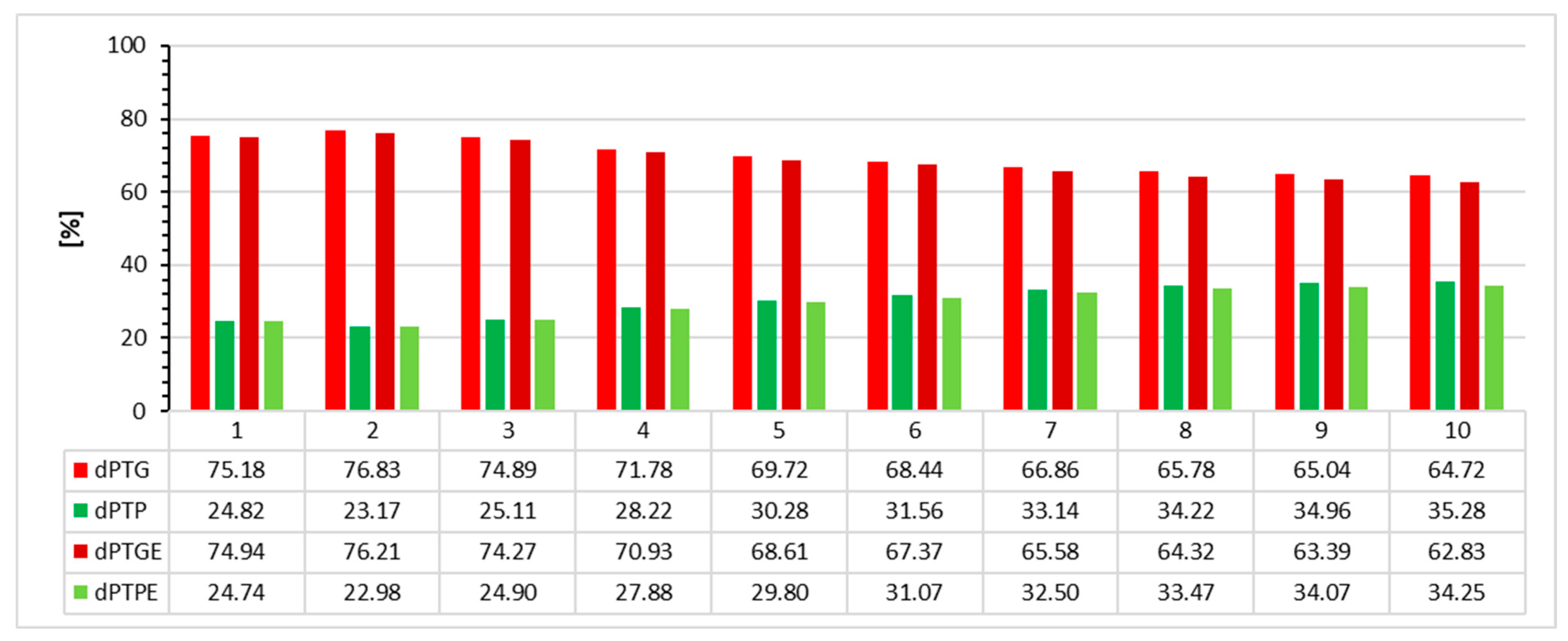
Figure 9 presents the percentage distribution of the actual turbine power between the gas generator turbine and the free power turbine for the TV2-117 free-turbine turboshaft engine across multiple operating regimes, from idle to take-off.
Figure 9.
Percentage values of the actual power ratios for the TV2-117 turboshaft.
Figure 9.
Percentage values of the actual power ratios for the TV2-117 turboshaft.
Figure 9 illustrates how the turbine power split in the TV2-117 engine evolves with increasing operating regime. At low power settings, the gas generator turbine accounts for the dominant share of the total turbine power, reflecting the priority of maintaining compressor operation and core engine stability. Under these conditions, the free power turbine extracts a comparatively smaller fraction of the available power, resulting in limited shaft output.
As engine speed and fuel flow increase, the proportion of power delivered by the free power turbine rises steadily. This trend indicates that an increasing share of the expansion work becomes available for useful shaft power as the engine approaches higher load conditions. Simultaneously, the relative contribution of the gas generator turbine decreases slightly in percentage terms, even though its absolute power output continues to increase.
Near take-off conditions, the power distribution approaches a stable balance, with the gas generator turbine and free power turbine contributing approximately two-thirds and one-third of the total turbine power, respectively. This behavior confirms the characteristic power-splitting mechanism of free-turbine turboshaft engines and aligns closely with the comparative results obtained for other engines in the study.
The regime-dependent power redistribution observed in Figure 9 highlights the adaptive nature of the free-turbine architecture, which allows efficient power extraction over a wide operating range. These results provide a direct link between the thermodynamic analysis and the operational flexibility of the TV2-117 engine and serve as a foundation for the subsequent examination of temperature ratios and efficiency trends.
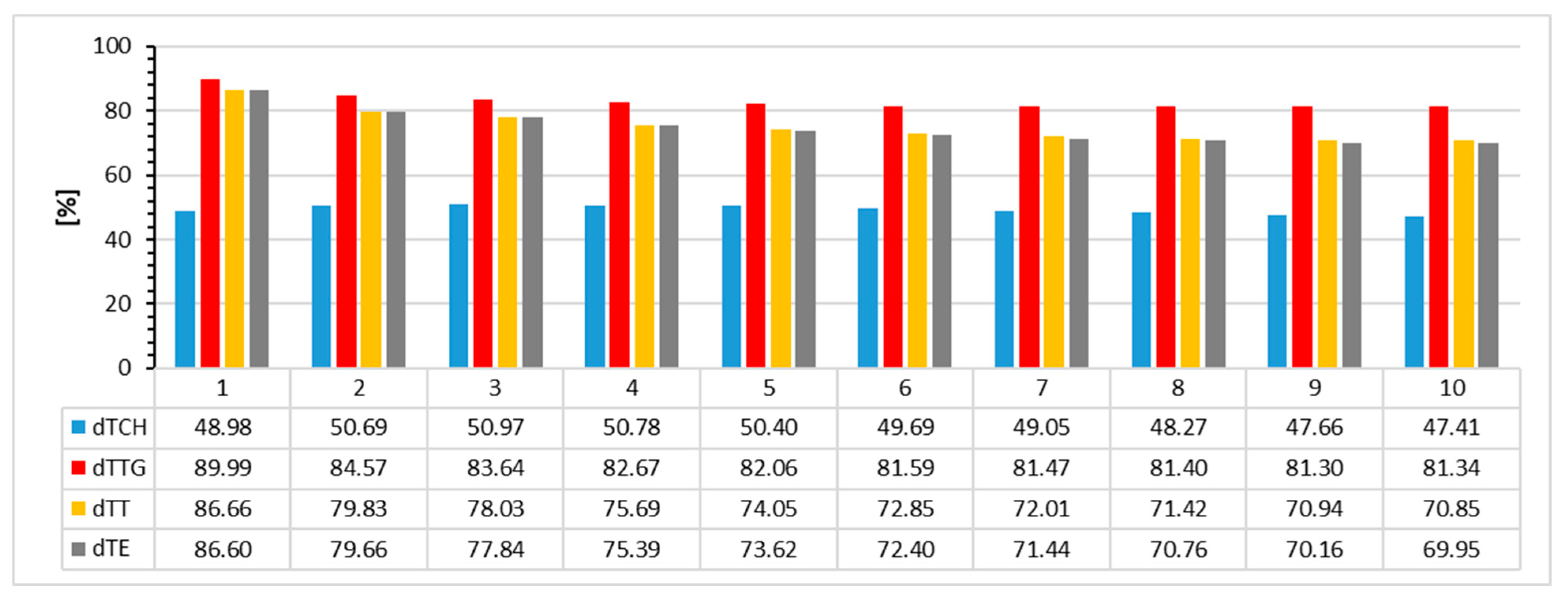
Figure 10 illustrates the percentage values of the actual temperature ratios associated with the turbine expansion process for the TV2-117 free-turbine turboshaft engine across multiple operating regimes, from idle to take-off.
Figure 10.
Percentage values of the actual temperature ratios for the TV2-117 turboshaft.
Figure 10.
Percentage values of the actual temperature ratios for the TV2-117 turboshaft.
Figure 10 shows the evolution of temperature ratio distribution within the turbine system of the TV2-117 engine as the operating regime increases. At low power settings, the total temperature drop of the expansion process is relatively small, reflecting the limited thermal energy available for conversion into mechanical work. Under these conditions, the temperature drop across the gas generator turbine dominates, as the primary requirement is to sustain compressor operation.
As the engine transitions toward higher regimes, the total expansion temperature ratio increases progressively, indicating a substantial rise in turbine inlet temperature and available thermal energy. The relative contribution of the free power turbine to the overall temperature drop becomes more pronounced, reflecting the increasing role of shaft power extraction at higher loads.
The gas generator turbine maintains a significant share of the temperature drop throughout all regimes; however, its relative dominance decreases slightly at higher power settings as a larger fraction of the thermal energy is transferred to the free power turbine. The onboard power extraction contribution remains negligible across the entire operating range, confirming its minor influence on the thermal balance.
Overall, the trends observed in Figure 10 highlight the regime-dependent redistribution of thermal energy within the turbine system of the TV2-117 engine. The normalized temperature-based representation provides a clear illustration of how the internal thermal structure evolves from idle to take-off, supporting the interpretation of power and efficiency trends discussed in the subsequent figure.
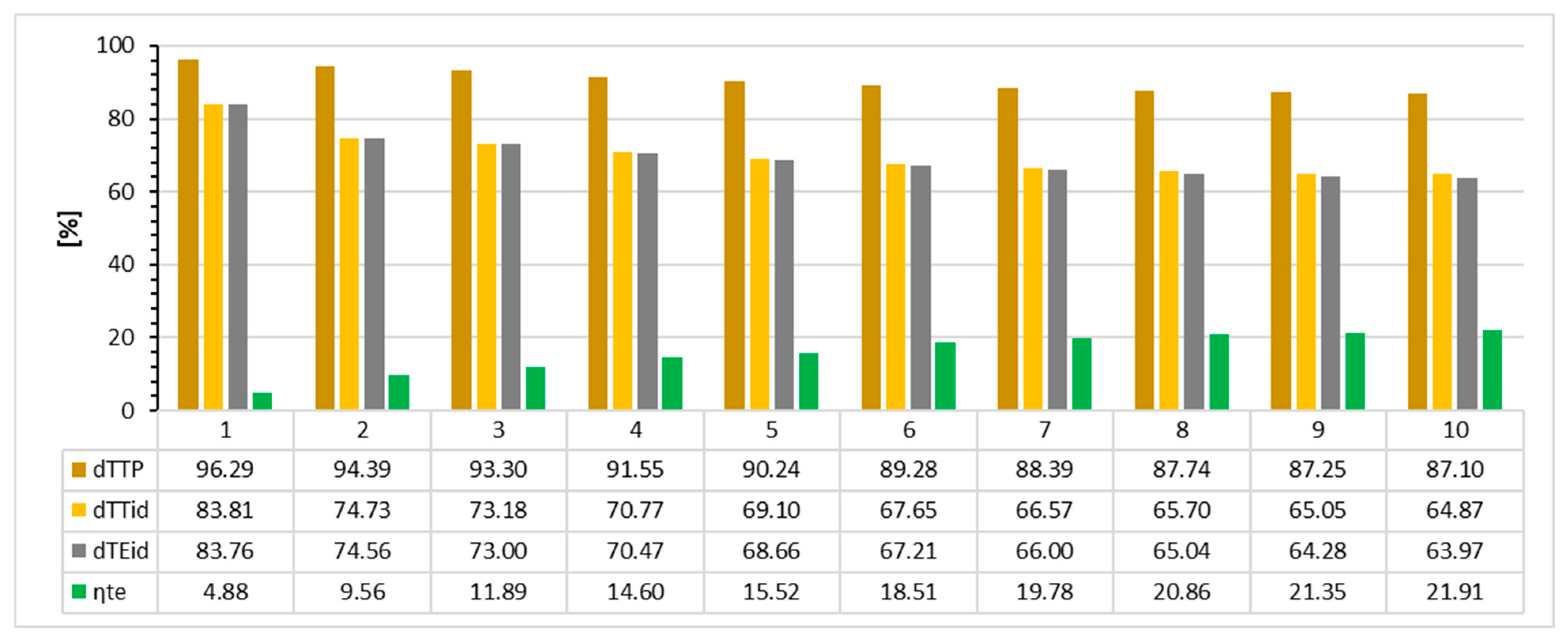
Figure 11 presents the percentage values of the actual temperature ratios of the turbine expansion process together with the corresponding thermal efficiency for the TV2-117 free-turbine turboshaft engine across multiple operating regimes, from idle to take-off.
Figure 11 correlates the evolution of turbine temperature ratios with the overall thermal efficiency of the TV2-117 engine as the operating regime increases. At low power settings, the thermal efficiency is relatively low, reflecting limited turbine inlet temperatures, reduced expansion work, and a higher proportion of energy consumed in sustaining core engine operation rather than producing useful shaft power.
As the operating regime advances, the thermal efficiency increases steadily, driven by higher turbine inlet temperatures and a more effective utilization of the available thermal energy. This improvement is accompanied by a gradual redistribution of the temperature drop from the gas generator turbine toward the free power turbine, indicating that a growing fraction of the expansion work is converted into usable output power.
Near take-off conditions, the thermal efficiency reaches its maximum value, corresponding to a more balanced temperature distribution between the turbine modules and a higher overall expansion effectiveness. The stabilization of temperature ratios at high regimes suggests that the engine approaches an optimal operating point in terms of thermal energy conversion and power extraction.
The combined representation in Figure 11 highlights the strong coupling between temperature distribution and thermal efficiency in a free-turbine turboshaft engine. These results reinforce the conclusions drawn from the preceding figures and demonstrate the importance of regime-dependent thermodynamic analysis when evaluating turboshaft engine performance and design trade-offs.
To assess the predictive capability of the proposed thermodynamic model, a detailed comparison was performed between calculated and experimental results for the TV2-117A engine across the investigated operating regimes. The deviation in gas generator turbine power remained within approximately 3–5%, while the free power turbine power showed discrepancies below 4% over the full load range. The total turbine temperature drop exhibited differences generally limited to 10–15 K, corresponding to relative deviations below 3%. At take-off, the calculated thermal efficiency differed from the experimental estimation by less than one percentage point.
The remaining discrepancies can be attributed to several factors. First, the model assumes uniform component efficiencies and simplified real-gas behavior based on polynomial thermodynamic functions, whereas actual engine operation involves secondary losses, cooling flows, and non-uniform temperature fields. Second, boundary conditions such as inlet pressure recovery and combustor pressure loss were introduced as constant coefficients, while in reality they vary with regime. Third, measurement uncertainty in temperature, pressure, and fuel flow rate—particularly at high turbine inlet temperatures—may contribute to cumulative deviations in calculated enthalpy and efficiency. Finally, material property variations and fuel lower heating value tolerances may introduce minor systematic differences.
Overall, the relatively small magnitude of deviations confirms that the adopted analytical framework captures the dominant thermodynamic mechanisms governing turbine power distribution and expansion behavior in free-turbine turboshaft engines.
4. Discussion
For the validation of the calculation model, the calculated values of the gas temperatures at the turbine inlet were verified using the online interface of the NASA computer program CEA (Chemical Equilibrium with Applications) CEARUN, which calculates chemical equilibrium compositions and thermodynamic properties of complex mixtures [33].
The verification was performed for the TV2-117A engine, and the results are presented in Table 16.
Using the CEARUN online computer program, under the same conditions from the model calculation, such as outlet compressor temperature and fuel temperature , the results indicate that GG turbine inlet total temperature instead of (from Table 9), which is from the model calculation. Therefore, to compare the data, differences and percentage ratios are calculated using the following mathematical relations:
With an error of 1.01%, it can be concluded that the calculation model is nearly validated and can be applied to other turboshaft engine models.
In the case of turbine power distribution, which is the main study parameter, the TV2-117 engine model shows that the power of the gas generator turbine and the free turbine, calculated using data from Jane’s Aero-Engines presented in Table 1, according to data form Figure 5, are 65.47% and 34.53%. Based on calculations using experimental data, the values are 64.72% and 35.28%, according to data form Figure 9 at maximum regime. To compare the data, differences are calculated. This results in a difference of 0.75% for both the gas generator turbine and the free turbine.
This 0.75% value demonstrates that the turbine power distribution in the takeoff regime is very close, even though there are differences between the data in Table 1 and the experimental data.
Beyond the quantitative trends observed in the presented figures, the results highlight several broader implications for the design and operation of free-turbine turboshaft engines. The relatively narrow range of power and temperature distribution ratios across engines from different manufacturers suggests the existence of inherent thermodynamic constraints imposed by the free-turbine architecture and the Brayton cycle. While individual design choices—such as compressor pressure ratio, turbine stage loading, and mass flow capacity—introduce measurable variations, the overall balance between gas generator and free power turbine remains governed by fundamental cycle requirements. This observation indicates that significant gains in shaft power or thermal efficiency are unlikely to be achieved through isolated component optimization alone, but rather through coordinated improvements at the system level, including advanced turbine aerodynamics, improved cooling strategies, and optimized control of operating regimes. Furthermore, the regime-dependent analysis of the TV2-117 engine demonstrates that the internal redistribution of power and thermal energy is highly sensitive to engine loading, underscoring the importance of accurate off-design modeling for performance prediction, control strategy development, and component life assessment. These findings reinforce the need for detailed thermodynamic studies that move beyond aggregate performance indicators and provide deeper insight into internal energy pathways, particularly in the context of emerging propulsion concepts that demand higher efficiency, reduced fuel consumption, and extended operational durability.
The engine is primarily designed for take-off conditions, where the main technical objective is to deliver maximum power. In this regime, achieving high thermal efficiency is desirable, but the primary focus is on power output. The idle regime, in contrast, is an operational condition mainly used for engine warm-up or low-power operation on the ground. Under idle conditions, the power delivered to the free turbine is significantly lower than that delivered to the gas generator turbine, because the latter must drive the compressor. Consequently, approximately 75% of the total turbine power is allocated to the gas generator at idle, with only a small fraction available at the free turbine for shaft work.
5. Conclusions
This study presented a unified thermodynamic analysis of eleven free-turbine turboshaft engines in the 960–2100 kW class, combining analytical modeling with manufacturer data and experimental validation using the TV2-117A engine. The comparison between simulation and experimental results across operating regimes confirmed the predictive capability of the real Brayton-cycle-based model. For the TV2-117A engine, deviations remained below approximately 3–5% for turbine power distribution, within 10–15 K for total turbine temperature drops, and below one percentage point for thermal efficiency at take-off. These results demonstrate that the adopted framework reliably reproduces internal power split, enthalpy evolution, and global performance trends, supporting its applicability to comparative multi-engine studies where detailed stage-level data are not publicly available.
Beyond numerical validation, the cross-engine analysis reveals consistent thermodynamic patterns characteristic of free-turbine architectures. At take-off, the gas generator turbine absorbs 55–66% of total turbine power, while the free power turbine delivers 34–45% as useful shaft output. The results indicate a quasi-linear dependence between the gas generator turbine power fraction and compressor specific work, confirming that internal turbine power distribution is primarily governed by compressor energy demand rather than nominal engine power. This relationship provides a transferable design guideline for preliminary matching and cycle sizing in 1–2 MW class turboshaft engines.
The regime-dependent investigation further shows that turbine power allocation is strongly load-sensitive: for the TV2-117A engine, the gas generator share decreases from approximately 75% at idle to about 65% at take-off, reflecting intrinsic matching characteristics of mechanically decoupled free-turbine systems. Moreover, although total turbine temperature drops range from roughly 335 K to 565 K across the analyzed engines, higher expansion intensity does not produce proportional increases in thermal efficiency, which remains within 23–31% at take-off. This behavior suggests the existence of a thermodynamic saturation region under current component efficiency levels (, ), indicating that further efficiency improvements are more likely to result from component-level advancements than from increased expansion alone.
Overall, the study establishes experimentally supported quantitative benchmarks for turbine power distribution, temperature-drop ranges, and efficiency levels in modern free-turbine turboshaft engines. By integrating multi-engine comparison with validated analytical modeling, it provides both a predictive thermodynamic framework and generalized energy-distribution laws with direct relevance for preliminary design, cycle optimization, and performance assessment of contemporary turboshaft architectures.
The results obtained in this study are applicable to free-turbine turboshaft engines with architectures similar to those analyzed, particularly under steady-state operating conditions and using conventional aviation kerosene fuels. The proposed thermodynamic framework can support preliminary performance assessment and comparative analysis of turbine power distribution. However, the results are subject to limitations associated with the simplifying assumptions of the analytical model, such as constant component efficiencies and simplified combustion modeling, and should therefore be interpreted as representative thermodynamic trends rather than exact predictions for all engine configurations.
Author Contributions
Conceptualization, R.M.C., T.L.G. and G.C.; Methodology, R.M.C. and G.C.; Software, R.M.C. and G.C.; Validation, R.M.C. and G.C.; Formal analysis, R.M.C., T.L.G. and G.C.; Investigation, R.M.C. and G.C.; Writing—original draft preparation, R.M.C. and G.C.; Writing—review and editing, R.M.C., T.L.G. and G.C.; Visualization, R.M.C., T.L.G. and G.C.; Supervision, R.M.C. and T.L.G. All authors have read and agreed to the published version of the manuscript.
Funding
This research received no external funding.
Institutional Review Board Statement
Not applicable.
Informed Consent Statement
Not applicable.
Data Availability Statement
The original contributions presented in this study are included in the article. Further inquiries can be directed to the corresponding author.
Conflicts of Interest
The authors declare no conflicts of interest.
Abbreviations
The following abbreviations are used in this manuscript:
Nomenclature
Description
Engine shaft power
Specific fuel consumption
Gas Generator (GG) shaft speed
Fuel flow
Fuel flow coefficient
Air excess
Mass air flow
Gas flow
Overall total pressure ratio
GG turbine total pressure ratio
TP total pressure ratio
Turbine total pressure ratio
Compressor total adiabatic efficiency
GG turbine total adiabatic efficiency
TP total adiabatic efficiency
Turbine total adiabatic efficiency
Combustion efficiency
Mechanical efficiency
Intake total pressure loss
Combustor chamber total pressure loss
Total temperature of station “i”
Total pressure of station “i”
Air enthalpy polynomial function
Air entropy polynomial function
Ideal gas enthalpy polynomial function
Ideal gas entropy polynomial function
Ideal gas mass participations
Air excess mass participations
Gas enthalpy and entropy polynomial coefficients
Compressor total specific ideal work
Compressor total specific actual work
Turbine total specific ideal work
Turbine total specific actual work
GG turbine total specific ideal work
GG turbine total specific actual work
TP total specific ideal work
TP total specific actual work
Total specific enthalpy of station “i”
Total specific ideal f entropy of station “i”
Compressor power
GG turbine power
TP power
Fuel lower heating value
Thermal efficiency
Engine exhaust outlet actual velocity
Engine exhaust outlet ideal velocity
Engine exhaust efficiency
Gas heat capacity at constant pressure
Gas constant for air
Gas constant for gases
Air temperature
Gas temperature
Gas adiabatic coefficient
Engine exhaust Mach number
GG Turbine Stage
TP Stage
References
Farokhi, S. Aircraft Propulsion, 2nd ed.; Wiley: Hoboken, NJ, USA, 2014; ISBN 9781118806777. [Google Scholar]
Kothari, D.; Subbarao, P. Power Generation. In Springer Handbook of Mechanical Engineering; Grote, K.H., Antonsson, E., Eds.; Springer Handbooks; Springer: Berlin/Heidelberg, Germany, 2009. [Google Scholar] [CrossRef]
Bathie, W.W. Fundamentals of Gas Turbines; Iowa State University of Science and Technology: Ames, IA, USA, 1984. [Google Scholar]
Günaltılı, E. Performance analysis of helicopter turboshaft engines: The case of agusta A119 PT6B-37. Aerosp. Res. Lett. (ASREL)2025, 4, 109–131. [Google Scholar] [CrossRef]
Ahmed, U.; Ali, F.; Jennions, I. A review of aircraft auxiliary power unit faults, diagnostics and acoustic measurements. Prog. Aerosp. Sci.2021, 124, 100721. [Google Scholar] [CrossRef]
Soares, C. (Ed.) Chapter 1—Gas Turbines: An Introduction and Applications. In Gas Turbines, 2nd ed.; Butterworth-Heinemann: Oxford, UK, 2015; pp. 1–40. [Google Scholar] [CrossRef]
Mattingly, J.D. Elements of Gas Turbine Propulsion; AIAA Education Series; American Institute of Aeronautics and Astronautics: Reston, VA, USA, 2006. [Google Scholar]
Yang, Y.; Nikolaidis, T.; Jafari, S.; Pilidis, P. Gas turbine engine transient performance and heat transfer effect modelling: A comprehensive review, research challenges, and exploring the future. Appl. Therm. Eng.2024, 236, 121523. [Google Scholar] [CrossRef]
Rogers, G.F.C.; Saravanamuttoo, H.I.H.; Mayhew, Y.R. Gas Turbine Theory, 4th ed.; Longman, Group Limited: London, UK, 1996. [Google Scholar]
Walsh, P.P.; Fletcher, P. Gas Turbine Performance, 2nd ed.; Blackwell Science Ltd a Blackwell Publishing Company: New York, NY, USA, 2004. [Google Scholar]
Misté, G.A.; Benini, E. Performance of a turboshaft engine for helicopter applications operating at variable shaft speed. In Proceedings of the ASME 2012 Gas Turbine India Conference GTINDIA2012, Mumbai, Maharashtra, India, 1 December 2012. [Google Scholar]
Bhargava, R.K.; Bianchi, M.; De Pascale, A.; Negri di Montenegro, G.; Peretto, A. Gas Turbine Based Power Cycles—A State-of-the-Art Review. In Challenges of Power Engineering and Environment; Cen, K., Chi, Y., Wang, F., Eds.; Springer: Berlin/Heidelberg, Germany, 2007. [Google Scholar] [CrossRef]
Jakubowski, R.; Jakliński, P. A Practical Approach to Modeling and Performance Analysis of a Turboshaft Engine Using Matlab. Appl. Sci.2024, 14, 11373. [Google Scholar] [CrossRef]
Ugolini, A.R.; Tucci, F.A.; Paniccia, D.; Capone, L.; Tanelli, M. Helicopter turboshaft modeling via mixtures of experts. Mach. Learn. Appl.2026, 23, 100835. [Google Scholar] [CrossRef]
Zhang, S.; Ma, A.; Zhang, T.; Ge, N.; Huang, X. A Performance Simulation Methodology for a Whole Turboshaft Engine Based on Throughflow Modelling. Energies2024, 17, 494. [Google Scholar] [CrossRef]
Vladov, S.; Bulakh, M.; Czyżewski, J.; Lytvynov, O.; Vysotska, V.; Vasylenko, V. Method for Helicopter Turboshaft Engines Controlling Energy Characteristics Through Regulating Free Turbine Rotor Speed and Fuel Consumption Based on Neural Networks. Energies2024, 17, 5755. [Google Scholar] [CrossRef]
Yang, R.; Liu, Y.; He, X.; Liu, Z. Gas Turbine Model Identification Based on Online Sequential Regularization Extreme Learning Machine with a Forgetting Factor. Energies2023, 16, 304. [Google Scholar] [CrossRef]
Soleimani, M.; Irani, F.N.; Yadegar, M.; Meskin, N. Comprehensive review of gas turbine fault diagnostic strategies. Appl. Energy2025, 401, 126801. [Google Scholar] [CrossRef]
Aygun, H. Thermodynamic, environmental and sustainability calculations of a conceptual turboshaft engine under several power settings. Energy2022, 245, 123251. [Google Scholar] [CrossRef]
Siyahi, M.; Siyahi, H.; Fallah, M.; Mohammadi, Z. Thermodynamic Optimization and Energy-Exergy Analyses of the Turboshaft Helicopter Engine. Int. J. Thermodyn.2024, 27, 15–25. [Google Scholar] [CrossRef]
He, D.; Zhang, R.; Wen, C.; Teng, J. Performance Simulation of Thermodynamic Design for a New Turboshaft Engine. J. Phys. Conf. Ser.2023, 2658, 012048. [Google Scholar] [CrossRef]
Gunston, B. (Ed.) Jane’s Aero-Engines Issues 20–2006; Jane’s Information Group: Coulsdon, UK, 2006. [Google Scholar]
Catana, R.M.; Dediu, G. Analytical Calculation Model of the TV3-117 Turboshaft Working Regimes Based on Experimental Data. Appl. Sci.2023, 13, 10720. [Google Scholar] [CrossRef]
Catana, R.M.; Dediu, G.; Tarabic, C.M. Studies and Experimental Research in the Evaluation of TV2-117A Turboshaft Engine Working Regimes. Appl. Sci.2022, 12, 3703. [Google Scholar] [CrossRef]
Catana, R.M.; Dediu, G.; Tarabic, C.M. Experimental Research of a Particular Free Power Turbine Application, Tehnički vjesnik/Technical Gazette. Teh. Vjesn.2021, 28, 1105–1110. [Google Scholar] [CrossRef]
ASTM D1655-22a; Standard Specification for Aviation Turbine Fuels. ASTM International: West Conshohocken, PA, USA, 2022. Available online: https://www.astm.org/d1655-22a.html (accessed on 10 January 2026).
Catana, R.M.; Dediu, G.; Tarabic, C.M.; Serbescu, H.M. Performance Calculations of Gas Turbine Engine Components Based on Particular Instrumentation Methods. Appl. Sci.2021, 11, 4492. [Google Scholar] [CrossRef]
Catana, R.M.; Cican, G.; Badea, G.-P. Thermodynamic Analysis and Performance Evaluation of Microjet Engines in Gas Turbine Education. Appl. Sci.2024, 14, 6754. [Google Scholar] [CrossRef]
NASA Glenn Research Center. CEARUN—Chemical Equilibrium with Applications (CEA) Web Interface. Available online: https://cearun.grc.nasa.gov/ (accessed on 10 January 2026).
Figure 1.
Turboshaft real cycle diagram. The compression process is represented in blue, the combustion process in red, and the expansion and exhaust processes in yellow.
Figure 1.
Turboshaft real cycle diagram. The compression process is represented in blue, the combustion process in red, and the expansion and exhaust processes in yellow.
Figure 2.
Turboshaft engine main stations. These main engine stations are defined by the cross-sections at the inlet and outlet of the engine’s primary components: the compressor (C), combustor chamber (CH), gas generator turbine (TG), and free power turbine (TP). The compressor (C) can be configured as an axial compressor (AC), a centrifugal compressor (CC), or a combined axial–centrifugal configuration (AC/CC). In this case, station 1 is the compressor (C) inlet, station 2 is the compressor (C) outlet, station 3 is the gas generator turbine (TG) inlet, station 4 is the gas generator turbine (TG) outlet and also the free power turbine (TP) inlet, station 45 is free power turbine (TP) outlet, and station 5 is the engine exhaust outlet (O).
Figure 2.
Turboshaft engine main stations. These main engine stations are defined by the cross-sections at the inlet and outlet of the engine’s primary components: the compressor (C), combustor chamber (CH), gas generator turbine (TG), and free power turbine (TP). The compressor (C) can be configured as an axial compressor (AC), a centrifugal compressor (CC), or a combined axial–centrifugal configuration (AC/CC). In this case, station 1 is the compressor (C) inlet, station 2 is the compressor (C) outlet, station 3 is the gas generator turbine (TG) inlet, station 4 is the gas generator turbine (TG) outlet and also the free power turbine (TP) inlet, station 45 is free power turbine (TP) outlet, and station 5 is the engine exhaust outlet (O).
Disclaimer/Publisher’s Note: The statements, opinions and data contained in all publications are solely those of the individual author(s) and contributor(s) and not of MDPI and/or the editor(s). MDPI and/or the editor(s) disclaim responsibility for any injury to people or property resulting from any ideas, methods, instructions or products referred to in the content.
Catană, R.M.; Cican, G.; Grigorie, T.L.
Turbine Power Distribution and Energy Pathways in Free-Turbine Turboshaft Engines: A Comparative Thermodynamic Study. Appl. Sci.2026, 16, 2814.
https://doi.org/10.3390/app16062814
AMA Style
Catană RM, Cican G, Grigorie TL.
Turbine Power Distribution and Energy Pathways in Free-Turbine Turboshaft Engines: A Comparative Thermodynamic Study. Applied Sciences. 2026; 16(6):2814.
https://doi.org/10.3390/app16062814
Chicago/Turabian Style
Catană, Răzvan Marius, Grigore Cican, and Teodor Lucian Grigorie.
2026. "Turbine Power Distribution and Energy Pathways in Free-Turbine Turboshaft Engines: A Comparative Thermodynamic Study" Applied Sciences 16, no. 6: 2814.
https://doi.org/10.3390/app16062814
APA Style
Catană, R. M., Cican, G., & Grigorie, T. L.
(2026). Turbine Power Distribution and Energy Pathways in Free-Turbine Turboshaft Engines: A Comparative Thermodynamic Study. Applied Sciences, 16(6), 2814.
https://doi.org/10.3390/app16062814
Note that from the first issue of 2016, this journal uses article numbers instead of page numbers. See further details here.
Article Metrics
No
No
Article Access Statistics
For more information on the journal statistics, click here.
Multiple requests from the same IP address are counted as one view.
Catană, R.M.; Cican, G.; Grigorie, T.L.
Turbine Power Distribution and Energy Pathways in Free-Turbine Turboshaft Engines: A Comparative Thermodynamic Study. Appl. Sci.2026, 16, 2814.
https://doi.org/10.3390/app16062814
AMA Style
Catană RM, Cican G, Grigorie TL.
Turbine Power Distribution and Energy Pathways in Free-Turbine Turboshaft Engines: A Comparative Thermodynamic Study. Applied Sciences. 2026; 16(6):2814.
https://doi.org/10.3390/app16062814
Chicago/Turabian Style
Catană, Răzvan Marius, Grigore Cican, and Teodor Lucian Grigorie.
2026. "Turbine Power Distribution and Energy Pathways in Free-Turbine Turboshaft Engines: A Comparative Thermodynamic Study" Applied Sciences 16, no. 6: 2814.
https://doi.org/10.3390/app16062814
APA Style
Catană, R. M., Cican, G., & Grigorie, T. L.
(2026). Turbine Power Distribution and Energy Pathways in Free-Turbine Turboshaft Engines: A Comparative Thermodynamic Study. Applied Sciences, 16(6), 2814.
https://doi.org/10.3390/app16062814
Note that from the first issue of 2016, this journal uses article numbers instead of page numbers. See further details here.