1. Introduction
Remaining useful life (RUL) prediction plays a crucial role in maintenance planning for safety-critical systems such as electronic components and engines [
1]. Its accurate estimation helps to reduce unexpected failures, optimize maintenance schedules, and extend asset life. However, due to the proprietary nature of industrial data, privacy concerns become a significant challenge in developing robust RUL prediction models. The estimation of RUL can be formulated as a regression task where time-series sensor data is mapped to the predicted remaining lifetime [
2]. Traditional physics-based and statistical models require detailed knowledge of system degradation, which is often unavailable or costly to obtain. Recent advances in machine learning have enabled data-driven RUL prediction; however, the need for large, diverse datasets remains a key bottleneck, particularly in the heterogeneous domain of electronic component manufacturing. While individual manufacturers differentiate themselves through proprietary designs, materials, and process parameters, many electronic components share common physical principles, architectures, and failure mechanisms. Accordingly, if distinct manufacturers were willing and able to share component characterization and degradation data, the aggregated knowledge could benefit all participating parties. A combined dataset would not only increase data volume but also expand variability across operating conditions, design configurations, and usage profiles. Consequently, machine learning models trained on such enriched datasets would be better positioned to generalize and deliver more reliable RUL predictions for electronic components across diverse application contexts.
Ensuring continuous operation of engineered systems is a major challenge in their deployment and use. A key requirement for addressing this challenge is the ability to accurately assess the system’s health state at any given time. As the complexity of modern safety-critical products and assets has increased, an engineering discipline and research area dedicated to the systematic evaluation of system degradation has emerged, known as prognostics and health management (PHM). PHM aims to estimate the state of health of a system and to develop actionable maintenance plans based on these estimates. State-of-health estimation can be performed in several ways, one of the most common being the estimation of the RUL. RUL is defined as the remaining operational time of an asset until a specified failure criterion is reached. RUL estimation can be carried out using a variety of approaches, including statistical analysis, simulation, and physics- or model-based methods.
Due to recent advancements, it is common to use machine learning to predict RUL. Indeed, when one has access to full run-to-failure (RTF) trajectories, RUL prediction is conveniently described as a supervised machine learning problem, where a mapping is learned from system measurements over time (usually time series) to the corresponding RUL. The main challenge with this approach is to gather a sufficient amount of training data so that the model can attain acceptable performance. As noted, training data must contain full RTF trajectories, which can be difficult, expensive and risky to collect. For safety-critical assets, examples of RTF histories are rare or non-existent. This means that existing data need to be leveraged efficiently. To this end, multiple solutions have been suggested, ranging from unsupervised machine learning methods to relying on synthetic data.
One promising approach is to use data from multiple actors to train the models, thereby increasing the training data size. However, simply pooling data from actors is often infeasible, due to e.g., privacy, data governance, and intellectual property issues [
3]. To overcome this challenge, distributed machine learning methods can be used, such as federated learning (FL). In FL, actors (or clients in FL terminology) do not share training data among themselves; only model updates are shared. In this way, data sharing issues are ameliorated while still enabling the model to train on a larger set of samples, in a collaborative manner [
4].
Federated learning has been explored for RUL estimation [
5,
6,
7]. But FL alone does not guarantee privacy, since portions of data can be extracted from the shared model to which all parties can gain access. Differential privacy (DP) is a possible solution to make a private system even more private.
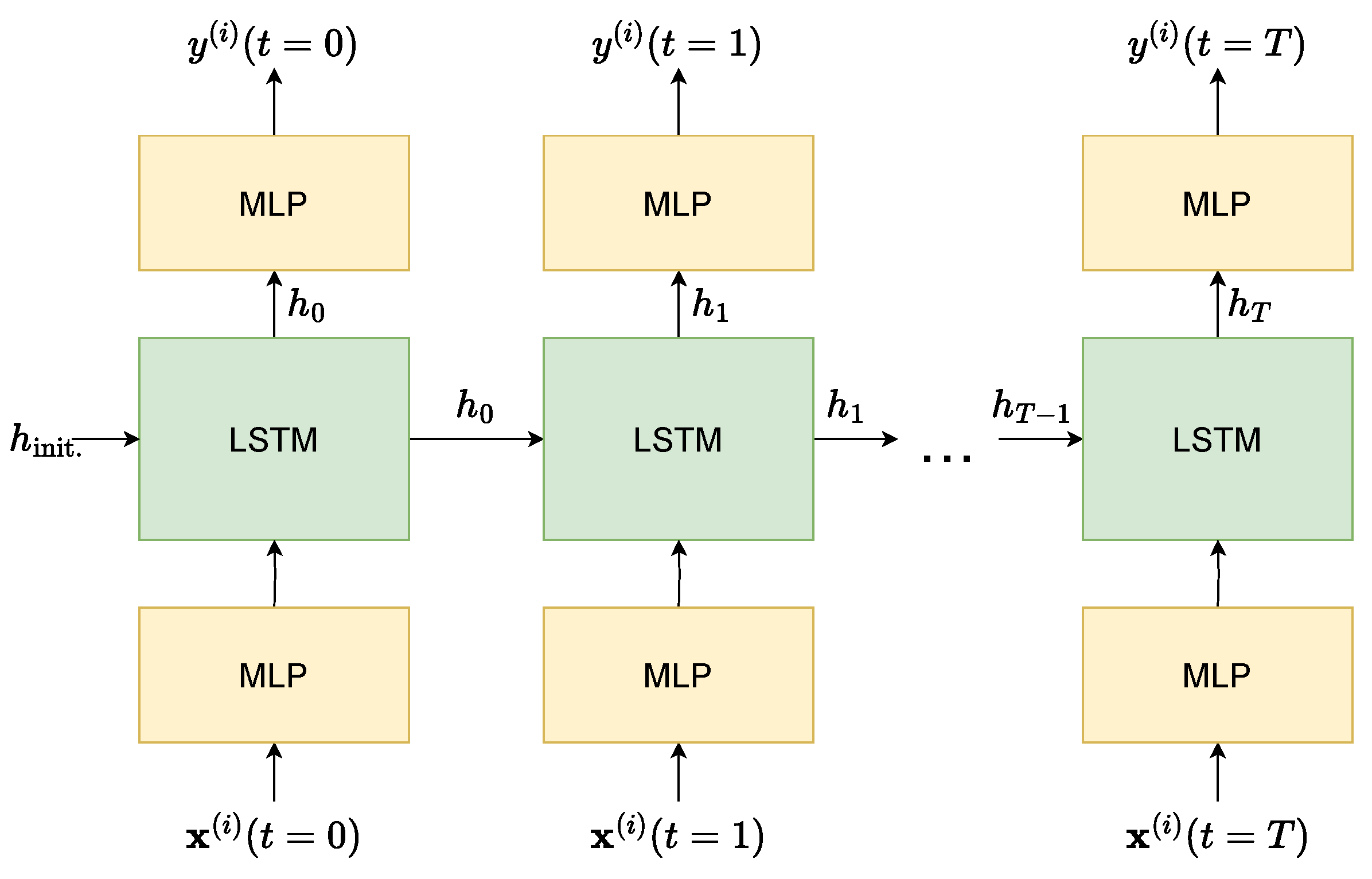
In this paper we develop an implementation for privacy-preserving RUL estimation leveraging FL and DP, discuss challenges and solutions that arise in the implementation using the Opacus DP library, and analyze the privacy–utility trade-off that results from applying DP. While this study utilizes laboratory data, these serve as proxies for real-world monitoring telemetry from power electronics. Such data are inherently sensitive as they capture the precise usage profiles and operational stress of the devices. If an adversary were to gain insight into how these devices are utilized, the consequences are twofold. From a user privacy perspective, such as in heavy electric vehicle operations, revealing load profiles can expose driving patterns, schedules, and locations. More critically, from an industrial perspective, these data often contain intellectual property. If the attacker is a competitor, inferring the usage profile can reveal proprietary control strategies or specific configuration parameters, potentially leading to a loss of competitive advantage and economic losses. Work operates under an honest-but-curious threat model, where the server and clients strictly adhere to the training protocol but analyze all incoming information (gradients, updates, side-channels) to infer private data. DP serves as a robust defense in this setting. DP does not guarantee correctness against such malicious actors; however, we argue that the honest-but-curious model is the most realistic assumption for the power electronics monitoring domain. In this context, participants are likely to be industrial entities or grid operators within a consortium; they share a strong economic incentive to collaborate on a high-performing RUL model (disincentivizing malicious destruction) but remain business competitors with a potential incentive to glean proprietary insights from one another (incentivizing curiosity). Thus, DP provides the necessary assurance to enable collaboration among competitors.
3. Datasets
For testing our MLP-LSTM-MLP model, we utilized the NASA open-source database C-MAPSS [
21], which provides sequential data from aircraft engine sensor measurements. This dataset is widely regarded for its reliability and comprehensiveness in capturing degradation patterns and operational behaviors of complex systems under varying conditions. On the other hand, for our ConvGRU model, we employed the MOSFET database, which is a closed-source dataset [
22,
23]. The MOSFET database comprises proprietary experimental data collected from 3.3 kV SiC (Silicon Carbide) MOSFETs under carefully controlled electrical and thermal stress tests. Similar to C-MAPSS, the MOSFET dataset provides sequential degradation data over time, which can be used to assess the RUL of power semiconductor devices by tracking the progression of key indicators such as threshold voltage and on-resistance under stress.
3.1. C-MAPSS Dataset
The Commercial Aero-Propulsion System Simulation (C-MAPSS) dataset features comprehensive RTF trajectories collected from simulated degradation of turbofan jet engines, initially presented and developed by [
21]. The dataset consists of simulated flight cycles with data recorded from 24 sensors. In our experiments to train the model, we use 18 parameters: the cycle index (from which the already lived life and sequence length can be derived), followed by 21 sensor measurements, including total temperature measurements at multiple compressor/turbine stages, pressure measurements, fan and core rotational speeds, fuel flow, and bleed enthalpy. Detailed sensor descriptions are provided in the original NASA C-MAPSS documentation.
The dataset consists of four subsets (FD001, FD002, FD003, and FD004) comprising a variety of operating conditions and fault modes. In addition, for each subset, a data split is provided for model development purposes, ensuring users have the same samples in training and testing. In
Table 1 the dataset is summarized, including training/testing split, number of operating conditions, and fault mode.
3.2. SiC MOSFET Dataset
The SiC MOSFET dataset was developed in response to the growing complexity of modern electronics and the lack of monitoring capabilities for such components. To ensure the safety and reliability of electronics components, proper prognostics and health monitoring systems need to be implemented. Gathering real-world degradation data from electronics components is often difficult and costly, leading to a scarcity of such data. To address this challenge, the SiC MOSFET dataset was developed, to promote research in PHM for electronics and drive innovation in RUL prediction for power electronics.
The dataset consists of RTF trajectories of 33 wire-bonded SiC MOSFETs. In particular, the devices were subjected to accelerated aging through power cycling, which involves heating the devices by passing a current for some specified duration (ON time), and subsequently cooling the devices by stopping the current for some other duration (OFF time). This heating/cooling cycle causes stress and fatigue in the devices and eventually leads to failure, mainly related to bond wire fatigue modes [
24]. Further details of the SiC MOSFET dataset can be found in the paper introducing the dataset, and it is used for RUL prediction [
6].
The three main factors determining degradation acceleration are the current and the ON/OFF time durations. A higher current passed through the SiC MOSFET means more heat is generated (larger temperature swings), which in turn decreases the time to failure. Similarly, longer ON duration led to shorter lifespans. The settings for the four experiment rounds are presented in
Table 2.
From the MOSFET dataset, we use 19 features, including the cycle index, end voltage, end resistance, differential resistance, cleaned differential resistance, minimum and maximum temperature values, two sets of block temperature measurements, water inlet and outlet temperature statistics, mean block temperature, voltage derived from mean block temperature, differential voltage, and cleaned differential voltage. These feature sets collectively capture the operational and degradation characteristics required for remaining useful life prediction.
4. Related Work
Accurate RUL prediction for safety-critical systems has advanced significantly through data-driven machine learning methods, particularly deep learning applied to time-series degradation data [
25]. Federated learning (FL) has emerged as a promising approach for industrial prognostics by allowing collaborative model training through the exchange of model updates instead of raw data [
26]. However, FL alone does not provide formal privacy guarantees and remains vulnerable to privacy attacks, motivating its integration with differential privacy (DP) to create Differentially Private Federated Learning (DP-FL). This section reviews related work on RUL prediction from three perspectives: (i) the integration of DP with FL, (ii) FL-based RUL prediction, and (iii) DP-based approaches.
Differential privacy has been extensively studied in the context of federated learning [
27,
28,
29,
30], yet few works apply differentially private FL to RUL prediction tasks. Namatevs et al. [
31] surveyed DP mechanisms across machine learning paradigms, including FL, emphasizing that while DP definitions provably limit information leakage, real-world implementations often contain subtle vulnerabilities that require pre-deployment auditing using attack-based schemes to verify
-differential privacy guarantees. Sudars et al. [
32] empirically demonstrated gradient inversion attacks on transformer-based models in FL settings with time-series data, successfully reconstructing sensitive signals from shared gradients. This vulnerability to gradient-based leakage motivates the use of differential privacy mechanisms to mitigate information exposure during collaborative model training. Incorporating differential privacy mechanisms such as DP-SGD into this process adds calibrated noise to gradients or updates, providing formal privacy guarantees in terms of differential privacy parameters, although the practical privacy–utility trade-off depends on the noise scale.
To our knowledge, only two studies explicitly combine FL and deep learning for RUL estimation. Wang et al. [
33] proposed a federated state-of-health evaluation framework based on Transformer-LSTM models, incorporating three personalization strategies to address data heterogeneity between distributed data sources. The authors applied the Gaussian mechanism for DP during local training, achieving privacy budgets with
, which is consistent with trends reported in the broader differentail privacy literature, where
values occasionally exceed 10 [
12]. Zhu et al. [
34] proposed a collaborative federated health prognostic framework employing client-level DP-SGD, augmented with dynamic weighting and an attention mechanism to capture inter-feature correlations. In their approach, each FL client applies DP-SGD to provide differential privacy guarantees. However, ref. [
34] do not report comparative results across different privacy budgets, as their evaluation is restricted to a single DP-SGD configuration.
More broadly, most FL-based RUL studies prioritize privacy through mechanisms such as parameter sharing or secure aggregation, rather than through explicit differential privacy guarantees [
7]. Altinpulluk et al. [
35] introduced a federated learning framework for diagnosis, prognosis, and RUL estimation that relies exclusively on model parameter sharing without raw data exchange. While privacy-preserving by design, this approach does not incorporate differential privacy mechanisms. López et al. [
36] proposed the FedHEONN model, which combines federated learning with homomorphic encryption to enable computations on encrypted model parameters, thereby enhancing privacy while preserving prediction accuracy. Zhong et al. [
37] presented an FL-based RUL prediction framework using a denoising recursive autoencoder–transformer (DRAT) architecture for accurate estimation without centralizing client data, relying on standard FL principles—local training and parameter sharing—without DP mechanisms such as noise injection or
-based guarantees. Ma et al. [
38] proposed a privacy-preserving federated semi-supervised learning framework for collaborative RUL prediction that uses the semi-supervised learning framework for collaborative RUL prediction that leverages FL safeguards and secure aggregation, but similarly omits explicit differential privacy integration.
Beyond primary applications, the NASA C-MAPSS jet engine dataset has been explored in the context of federated learning [
5,
39,
40]. However, to the best of our knowledge, no existing studies investigate the incorporation of explicit differential privacy mechanisms into machine learning models trained on the C-MAPSS dataset. Arunan et al. [
41] proposed FedMA, a federated learning framework for industrial prognostics that enables heterogeneous edge devices to collaboratively predict equipment health through matched feature extraction. Validated on the C-MAPSS dataset and related multivariate time-series benchmarks, their approach improves robustness and generalization while avoiding raw data sharing.
Existing literature on MOSFET RUL prediction predominantly relies on centralized modeling approaches without incorporating FL frameworks. Wu et al. [
42] proposed a non-linear Wiener process-based model specifically for SiC MOSFET RUL prediction that explicitly accounts for uncertainty in the failure threshold through maximum likelihood estimation and first hitting time distributions. Lv et al. [
43] introduced the GTLMSM model—a linear multi-fractional Lévy stable motion driven by GRU-based similarity transfer—to predict MOSFET RUL by capturing non-Gaussian heavy-tailed noise, long-range dependence, and multifractal degradation dynamics in power electronic devices. To the best of our knowledge, no recent studies have explicitly integrated SiC MOSFET degradation datasets into federated learning frameworks to enable collaborative RUL prediction while preserving data locality and client confidentiality.
5. Methods
This work aims to enhance the privacy guarantees of an existing FL-based RUL prediction framework, building on previous studies using the C-MAPSS dataset [
5] and a SiC MOSFET dataset. Specifically, differential privacy is incorporated into the FL training process, and the impact of key hyperparameters is systematically analyzed to balance formal
guarantees against predictive performance, with comparisons to non-private FL baselines.
Building upon previous work on FL-based RUL estimation [
5], we extended the framework by introducing DP features. While the FL models already benefit from the inherent privacy advantages of federated learning, the addition of DP further strengthens their resistance to privacy attacks. The FL framework implements two models: MLP-LSTM-MLP [
44], which is used for the C-MAPSS dataset, and Convolutional Gated Recurrent Unit (ConvGRU) [
45], used for the SiC MOSFET dataset.
To incorporate DP functionality into them, we employed the Opacus library. We adopt the Gaussian mechanism for DP, as it provides a practical balance between theoretical guarantees and empirical stability when training deep neural networks. The Gaussian mechanism is particularly well-suited for gradient-based learning frameworks, since it integrates smoothly into stochastic optimization and ensures more reliable privacy accounting under composition [
46].
Although Opacus is designed to be readily integrable with a wide range of deep learning models, it could not be directly applied to our ConvGRU architecture, requiring the development of customized adaptations to ensure compatibility. Unlike other types of networks, ConvGRU architectures combine recurrent gating mechanisms with convolutional operations, leading to complex tensor layouts when hidden states are carried across time steps, and gradient dependencies across temporal and spatial dimensions. This structure breaks the layer-wise symmetry and per-sample independence assumed by differential privacy frameworks, making standard per-sample gradient computation non-trivial.
5.1. MLP-LSTM-MLP Model
The model is based on the Long Short-Term Memory (LSTM) network [
47] that is a type of recurrent neural network (RNN) designed to model sequential data while mitigating the vanishing and exploding gradient problems that standard RNNs often face. The gating structure allows LSTMs to maintain long-term dependencies and selectively remember or forget information over extended sequences. LSTMs are particularly effective for time-series forecasting, for example, remaining useful life estimation in engineering systems.
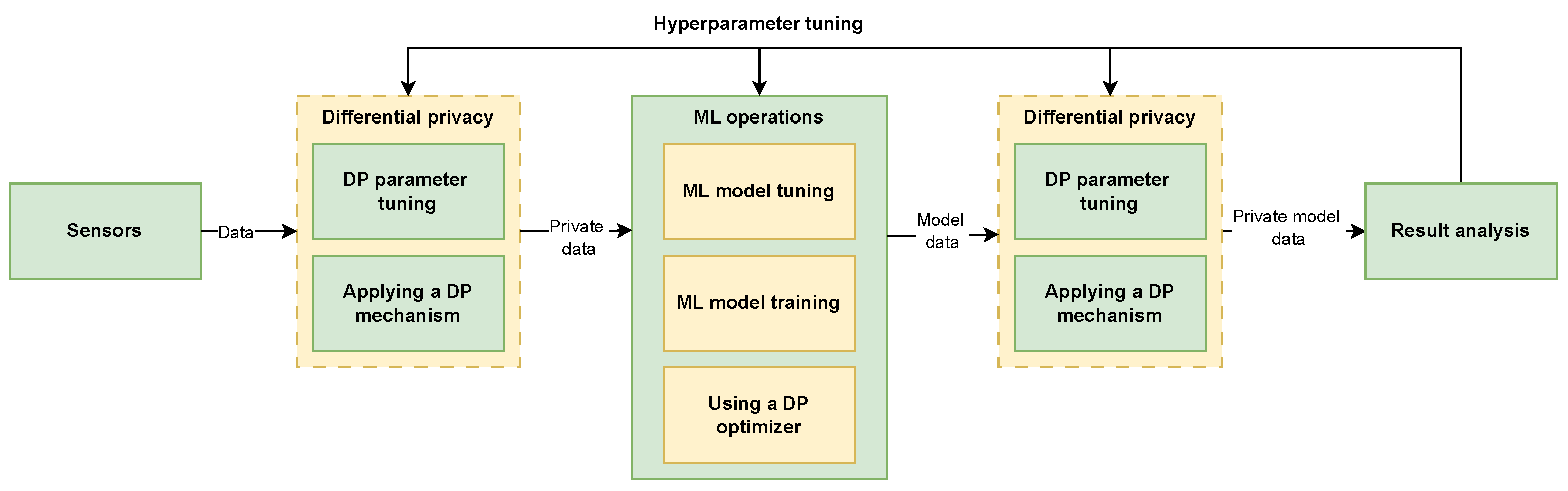
The MLP-LSTM-MLP model consists of three main components: an initial MLP, an LSTM and a final MLP, which outputs the predicted RUL.
The initial MLP embeds the multivariate time-series data through a non-linear mapping, which is subsequently passed to the LSTM model. The LSTM learns to capture time-dependent features in the data and outputs a final hidden state, which is fed into the final MLP. Finally, the last MLP maps the hidden state of the LSTM to a RUL prediction, one prediction per time step. In
Figure 2 the MLP-LSTM-MLP architecture is shown schematically.
5.2. ConvGRU Model
The ConvGRU architecture [
45] is an extension of the standard Gated Recurrent Unit (GRU) [
48] that integrates convolutional operations to better handle spatiotemporal data. Unlike traditional GRUs, which use fully connected layers to process sequential inputs, ConvGRUs replace these with convolutional layers, allowing the network to capture local spatial correlations while maintaining temporal dependencies. The architecture consists of a series of recurrent units where each unit has reset and update gates, similar to a standard GRU, but the operations inside the gates are convolutional rather than linear. This enables the model to process sequences of multidimensional inputs, such as images, videos, or sensor arrays, while preserving spatial structure across time [
49].
ConvGRU networks are typically composed of stacked ConvGRU layers, followed by additional convolutional or fully connected layers depending on the task. The convolutional kernels extract spatial features, while the recurrent gating mechanisms manage temporal dynamics, allowing the network to remember or forget information as needed. Regularization techniques such as dropout and gradient clipping are applied during training to improve generalization and stability. ConvGRUs are particularly well-suited for tasks where both spatial and temporal patterns are important, for example, remaining useful life estimation from sequences of sensor readings.
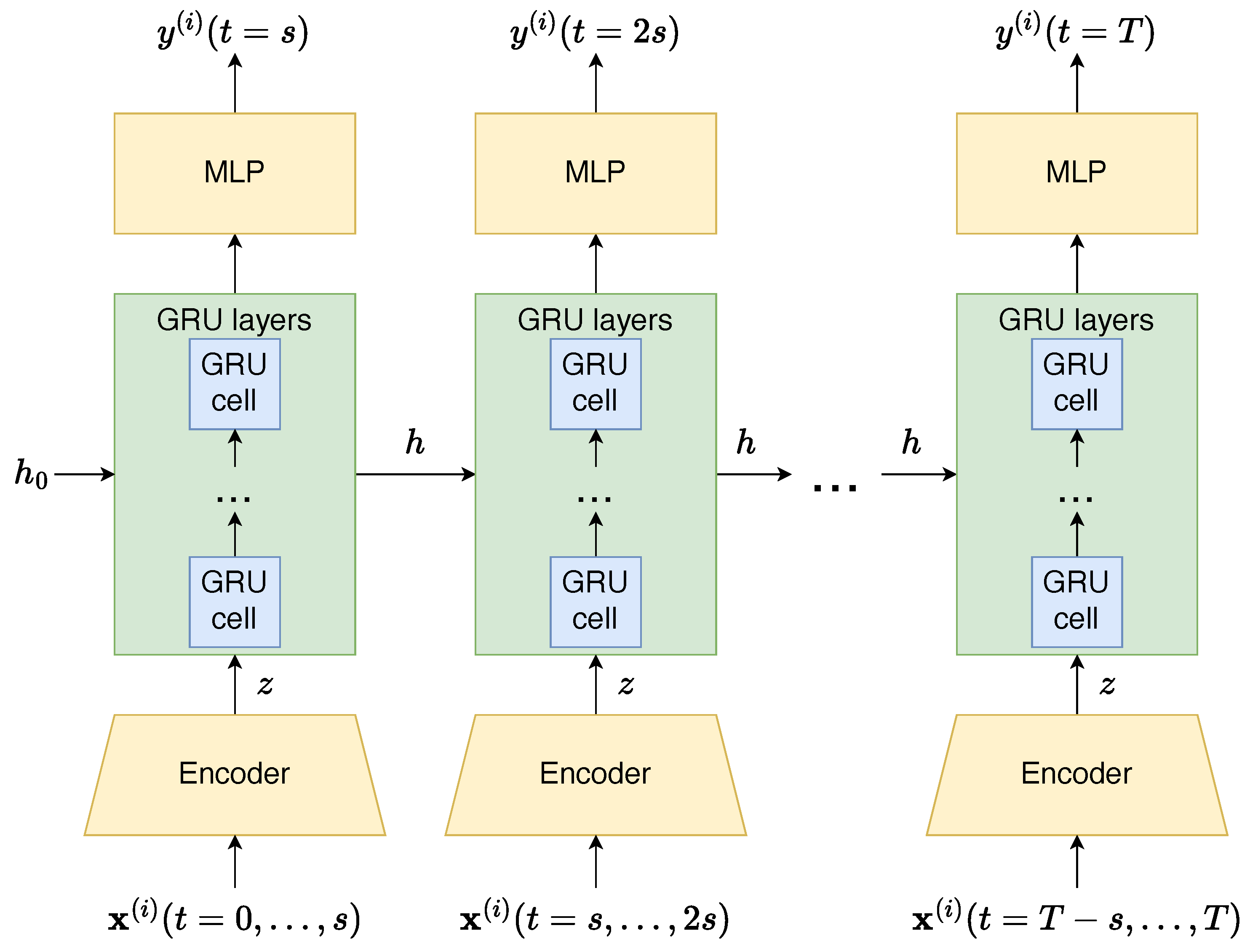
The ConvGRU model, shown in
Figure 3, consists of three main parts: a 1D-CNN encoder, several GRU layers, and a final RUL output layer. The encoder takes as input a sequence of time series of predetermined length and maps the input to a lower dimensional encoding, while still preserving important features. After each convolutional layer, the ELU activation function [
50] is applied to introduce non-linearity to the transformations. The ELU activation is defined as follows:
where
. This encoding,
z, is subsequently passed to the GRU layers. Each GRU layer consists of several GRU cells, which are specialized neural networks for temporal data. The final layer is an MLP that outputs a single number for each time step, interpreted as the predicted RUL.
5.3. Differential Privacy for MLP-LSTM-MLP Model
For the MLP-LSTM-MLP model, we used the standard privacy engine provided by the Opacus library. By using this tool we created the
-private counterparts of the model, including the optimizer and the data loader to be used in the private training procedure. We applied the function
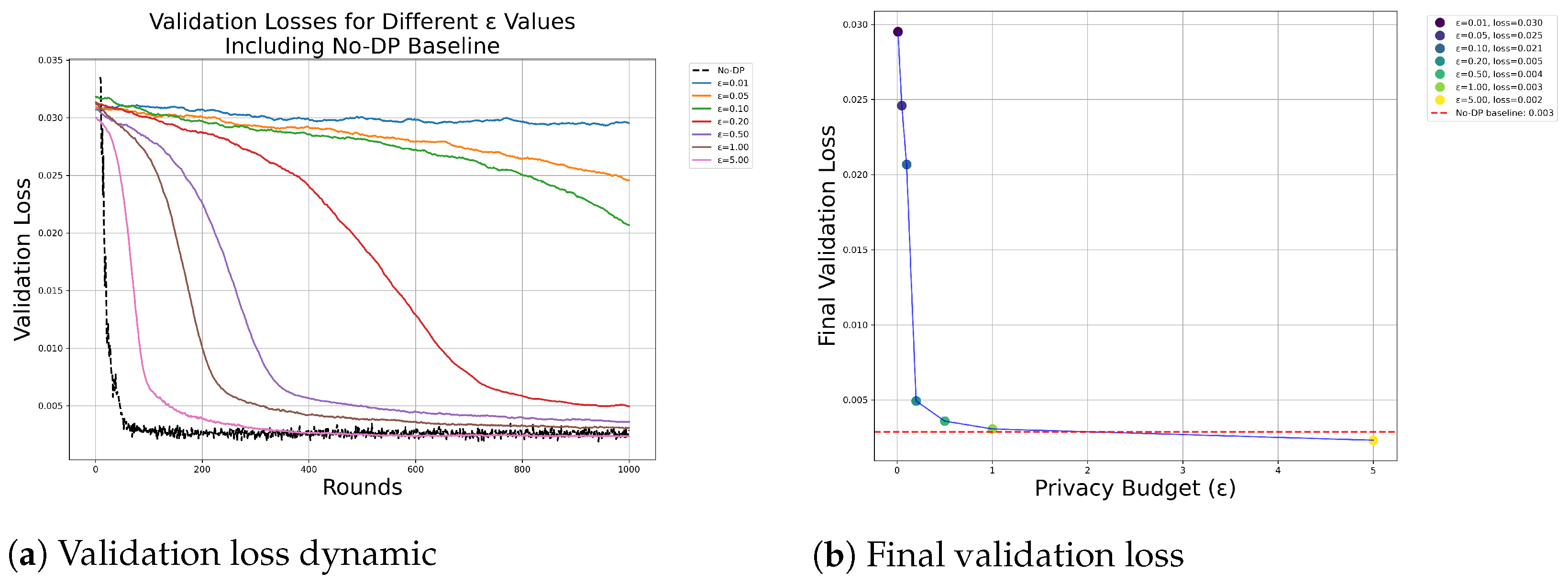
make_private_with_epsilon of the Opacus library, which utilizes the provided epsilon value to compute the magnitude of Gaussian noise added to the gradients during each training epoch. We tested multiple epsilon values to identify the optimal balance between model accuracy and privacy protection; see
Section 6.1. Vanilla training parameters such as learning rate, batch size, gradient clipping limit, and weight decay remained constant just like for the non-private training because a better configuration for these parameters was not found. It was possible to configure other parameters as well, but as these parameters were found to impact the model results the most, they were left out for future work.
To follow the privacy guarantees we have to set , so we configured the delta parameter to be .
5.4. MLP-LSTM-MLP Model Correlation Analysis
If a single input parameter has a stronger influence on the output prediction than others, it is less protected. Differential privacy reduces the influence of individual parameters, ideally leading to a balanced contribution of all inputs. Otherwise, strong output dependence may allow sensitive input parameters to be inferred, which DP is designed to prevent.
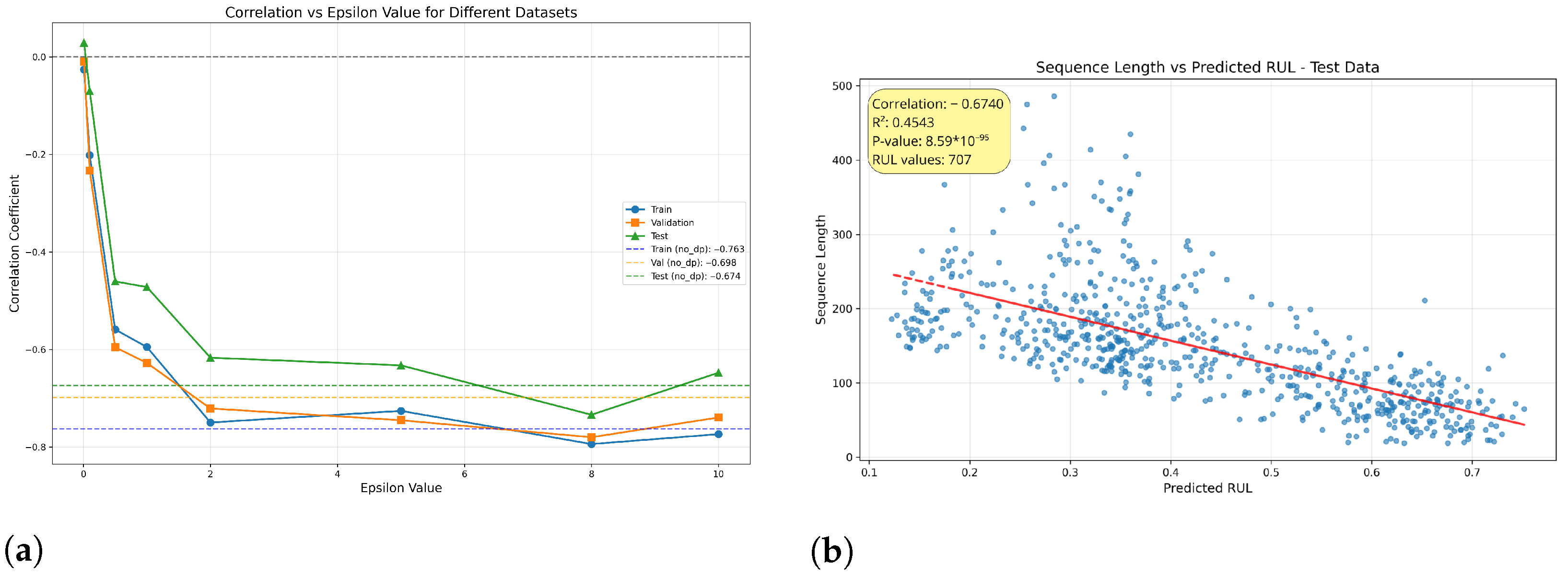
To assess the impact of DP on an individual input parameter, we analyze the already lived life (input length). Systems with equivalent operational lifetimes are generally regarded as similar. For instance, if multiple systems of the same type are used, it is expected that their lifetimes will be comparable. The CMAPSS database comprises sensor measurements of engines, and the model predicts RUL. Consequently, it is reasonable to assume that a key parameter is the number of cycles the engine has already completed, making the correlation between this parameter and the final RUL prediction an important aspect of analysis.
In RUL prediction, one parameter that plays a dominant role is the already lived life of a component. Since this feature is strongly correlated with the target variable, it introduces a risk, where the model might rely excessively on it rather than learning generalizable degradation patterns. To mitigate this, the parameter can be clipped, limiting its maximum contribution during training and thus preventing it from dominating the learning process. However, this introduces a trade-off between model accuracy and privacy. The model’s accuracy can be evaluated through validation loss, while the level of privacy preservation can be estimated by analyzing the correlation between the model’s outputs and the already lived life parameter.
5.5. Differential Privacy for ConvGRU Model
To obtain a differentially private ConvGRU model, we adopted a more customized approach while leveraging the full functionality of the Opacus library. Although the standard Opacus training pipeline was preserved, limitations were encountered when applying the clip_and_accumulate function to the ConvGRU architecture.
The ConvGRU model operates on input data shaped as [batch, sequence_len, input_size], and due to varying patch sizes across its layers, the gradient tensors exhibit inconsistent dimensions. Specifically, our model consists of 20 layers, where the first 14 layers have gradient tensors with a first-dimension size of 1, while the remaining layers have only one dimension of size 127. This variability in tensor sizes poses a challenge when using the Opacus v1.5.3 library, as its clip_and_accumulate function relies on PyTorch’s stack method, which requires all tensors to be of equal size.
The original Opacus
clip_and_accumulate implementation assumes all per-sample gradients can be stacked into a single tensor before computing per-sample
norms. This fails with models that have heterogeneous parameter shapes, which is our case, where stacking tensors of incompatible dimensions raises shape mismatch errors. Mathematically, the original implementation constructs a single vector whose length equals the total number of trainable parameters in the network by concatenating all
, and then computes
on that vector. This is equivalent to stacking all parameter gradients into one tensor per sample. When parameter tensors have different shapes (e.g., conv filters vs. linear weights vs biases), stacking them in a uniform way is not supported. Therefore, the “stack then norm” approach is not usable for models with heterogeneous parameter dimensions. The key identity is that the squared L2 norm of the concatenated vector equals the sum of the squared L2 norms of the blocks:
Our approach involves, for each parameter block
p and each sample
i, computing
. We then sum over all parameter blocks
and take the square root over result
, and finally compute
without ever forming the full vector
.
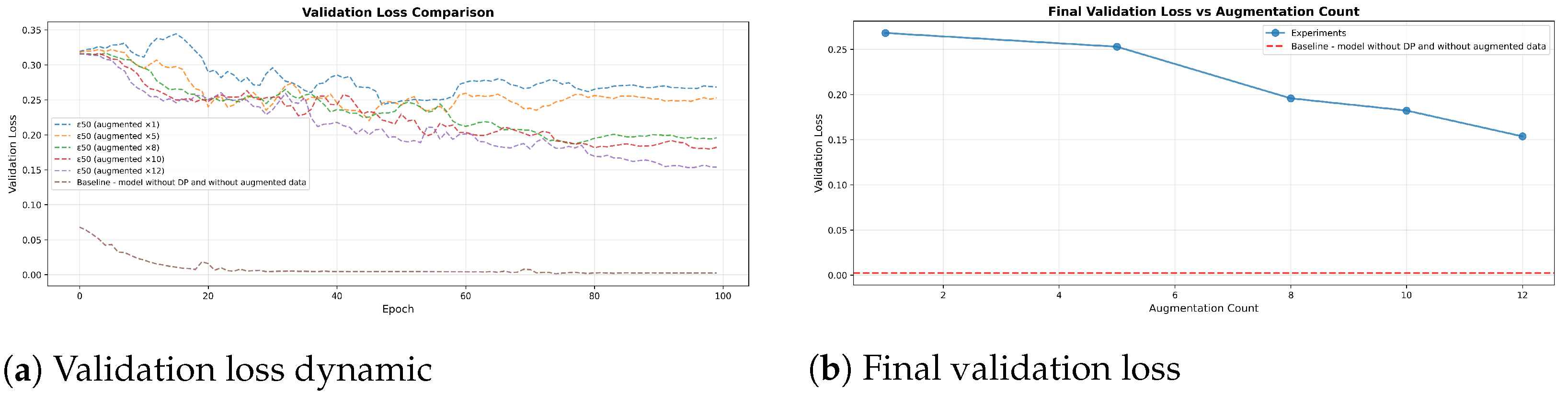
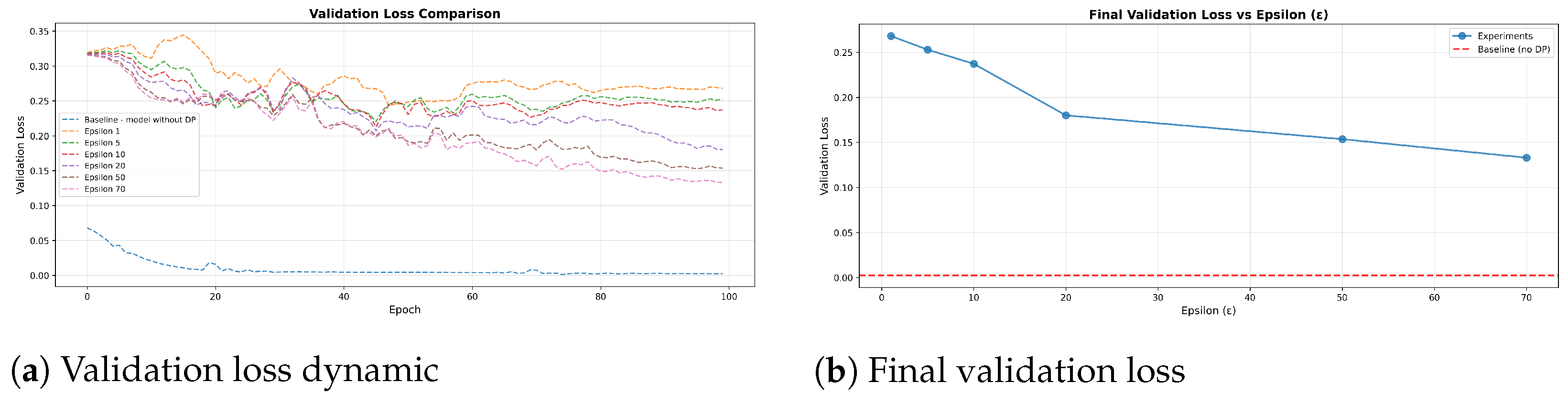
After adapting Opacus to our model, we observed that a significantly larger amount of noise is required compared to the MLP-LSTM-MLP model to achieve differential privacy. Even with , the model converges slowly. This behavior can be attributed to the limited size of the training dataset.
Specifically, data are available from four clients. The first client covers six devices, of which only three are used for training. Each of the remaining three clients covers ten devices, with six devices per client used for training. As a result, the effective training set is small. This directly affects the target
parameter, which has to be smaller than
, where
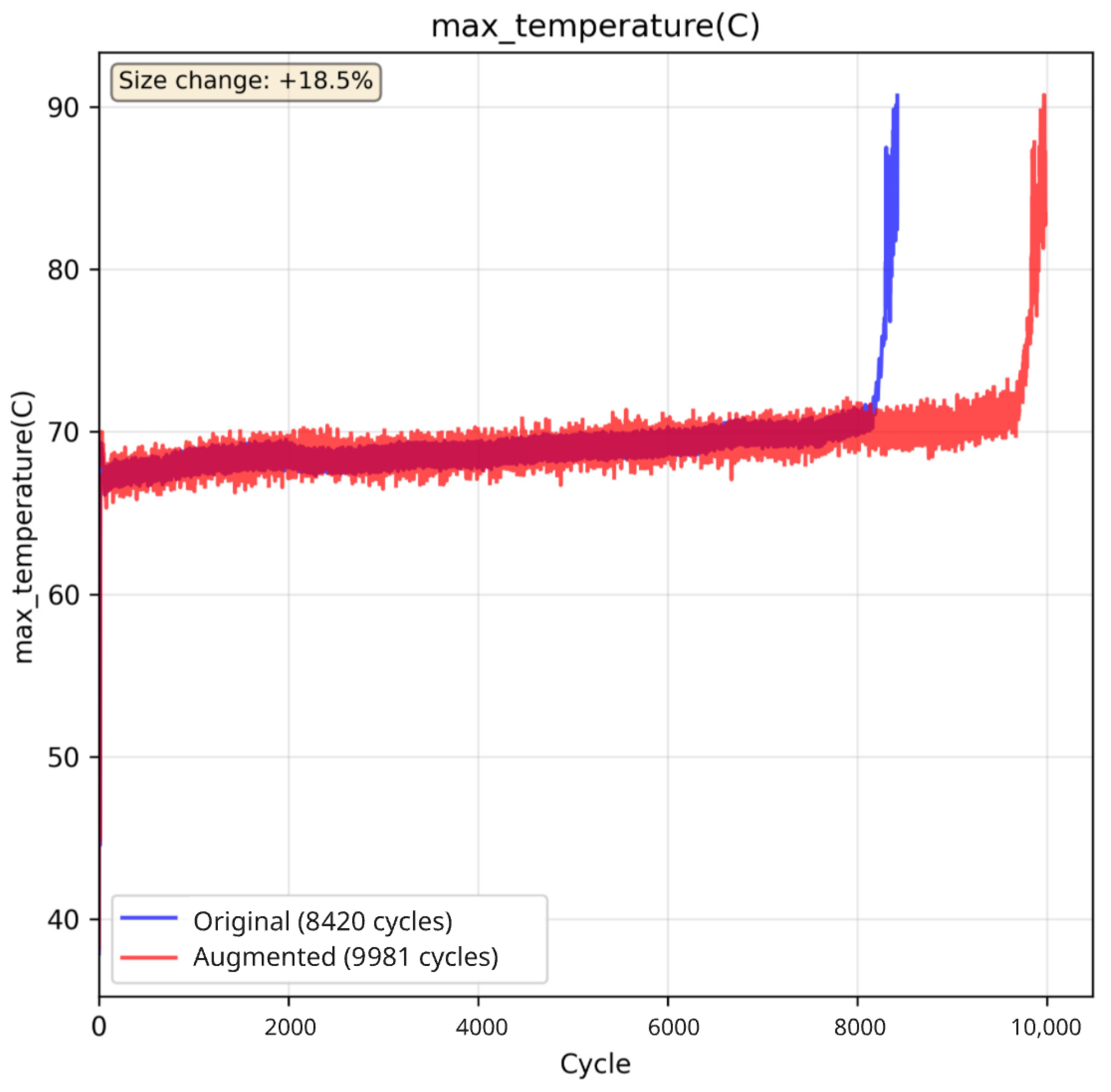
n denotes the number of training samples. In our case, n = 21. To mitigate the data scarcity issue, we augmented the dataset using synthetic data generated via simple noise-based augmentation techniques. After analyzing the dataset parameters—namely voltage, resistance, and temperature measurements—we observed that rapid variations in the signals predominantly occur toward the end of the device lifetime. This behavior can be seen in
Figure 4, which shows an example of the temperature parameter of the original and augmented time-series data.
We augmented MOSFET device data using four noise mechanisms applied sequentially. First, cycle noise optionally modifies dataset size by averaging groups of adjacent cycles, with a random size change between −20% and +20% per augmented copy. This preserves temporal relationships by recalculating consumed_life based on the new cycle numbers. Second, Gaussian noise is added to measurement columns (temperature, voltage, resistance) at 20% of each column’s standard deviation. Third, Gaussian noise is applied to derived/cleaned columns at 10% of each column’s standard deviation. Fourth, displacement noise shifts the last valid value of each column by a single random value (drawn from a normal distribution with standard deviation equal to 2× the average column standard deviation) and proportionally adjusts intermediate values to maintain the trajectory shape, keeping the first value unchanged. The same displacement value is applied across all columns to preserve inter-feature relationships. Identifier columns (cycle, device_number) are excluded from noise addition, and consumed_life is recalculated to maintain monotonicity and validity constraints. This approach increases dataset diversity while preserving the underlying degradation patterns, enabling training on larger datasets without manual data collection.
The dataset was augmented using the factors of 1, 5, 8, 10, 12. Based on these experiments, Opacus-based differential privacy was applied to the dataset augmented by a factor of 12, and the corresponding privacy budgets (epsilon) were evaluated.
5.6. Training and Evaluation
All models were trained for 1 local epoch for each client across 1000 rounds. To enhance model privacy, differential privacy introduces noise to the gradients during training. While this noise injection improves privacy, it simultaneously reduces training effectiveness, as reflected in higher final training loss values. For our experiments, we measured this effect after a fixed training period of 1000 epochs—where a higher final training loss indicates less effective training.
It is important to note that less effective training does not automatically guarantee improved privacy. The primary objective of implementing DP remains to increase the model’s privacy, not merely to affect training efficiency.
To evaluate the training progress of our MLP-LSTM-MLP models using different epsilon values, we monitored the changes in the validation curve across epochs. We selected epoch 1000 as the stopping point for training. For the purposes of DP implementation, the target delta is set to to control the influence of individual gradients during training, where n is the size of the dataset. To study the impact of varying privacy levels on model performance, we experimented with multiple epsilon values. By systematically adjusting the epsilon parameter, which governs the trade-off between privacy and utility, we were able to observe how different levels of DP affect the training dynamics and model accuracy.
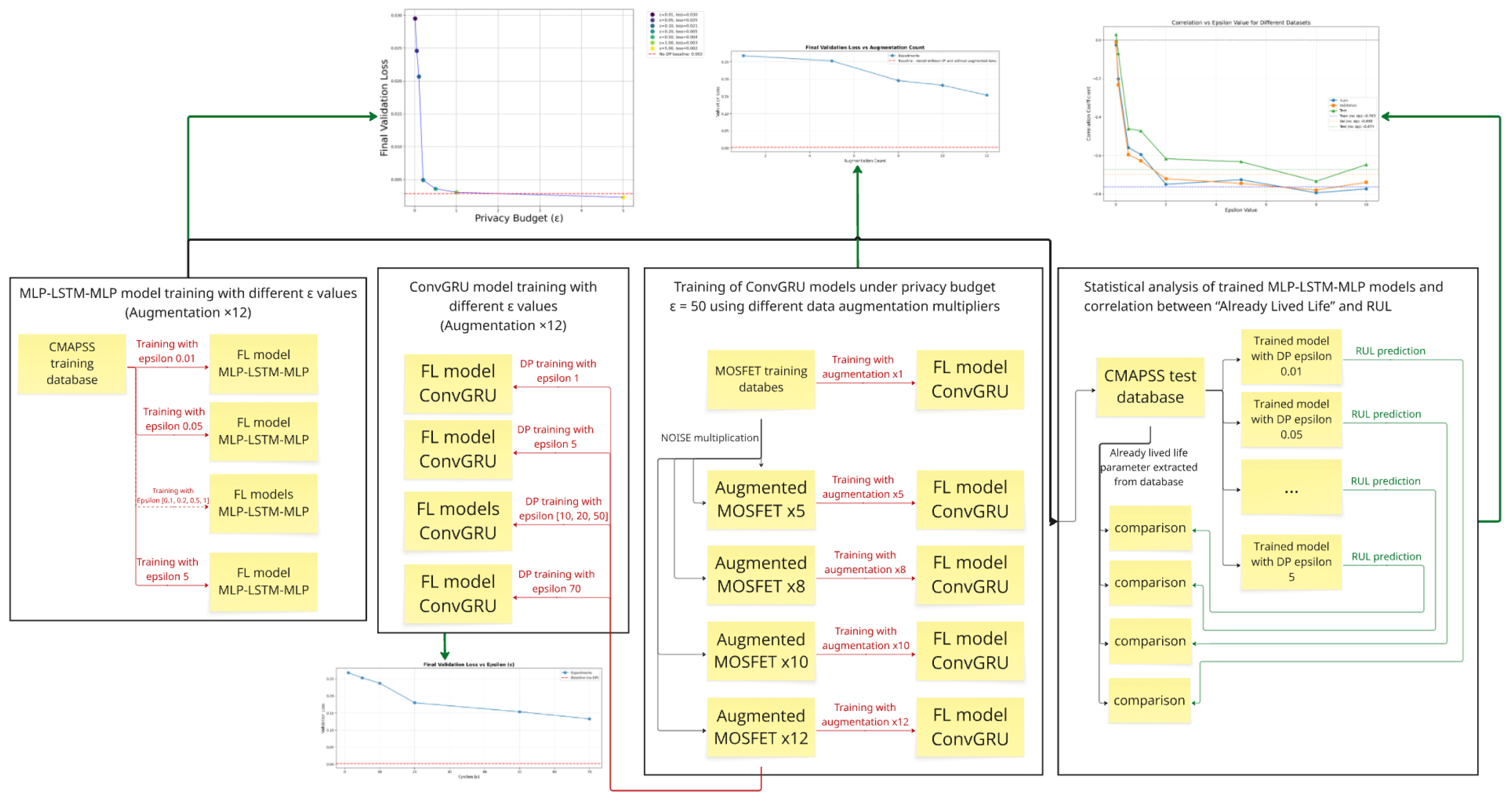
Figure 5 shows the overall schematic representation of all experiments and results. Red arrows represent the training process, green arrows indicate the results, and black arrows denote the overall connections between the blocks. The configuration options for training are given in
Table 3.
7. Discussion
The purpose of this paper is to examine how differential privacy can further strengthen the protection of models already trained within a federated learning framework. Through the use of the Opacus library, we successfully integrated DP into both our MLP-LSTM-MLP and ConvGRU models. To the best of our knowledge, this study is the first to implement differential privacy within a federated learning framework for RUL prediction on the C-MAPSS and SiC MOSFET datasets. While the MLP-LSTM-MLP model benefited from the streamlined make_private_with_epsilon function, the ConvGRU model required a more customized approach using core Opacus functionalities. The need for a manual approach to implement DP for our ConvGRU model stems from the unique structure of the data and the model it processes.
The MLP–LSTM–MLP experiments demonstrate that the functional dependence between the predicted RUL and the “already lived life” input parameter decreases under stronger differential privacy constraints. Although the MLP-LSTM-MLP model achieved reasonable privacy of one input parameter with privacy budget values ranging from 0.01 to 5, the ConvGRU model required higher epsilon values to reach comparable utility. This discrepancy can be attributed to several factors: ConvGRU architecture has more trainable parameters compared to MLP-LSTM-MLP, higher gradient magnitudes, and relatively small dataset size for DP implantation. Together, these characteristics increase the model’s sensitivity to noise injection.
For an epsilon value less than 0.2, the final validation loss is significantly higher, suggesting insufficient model convergence. Consequently, during inference, the model’s predictions are likely to be unreliable. Based on the validation loss and the correlation analyses presented in this study, an acceptable epsilon range lies between 0.2 and 1.0. Within this interval, the models maintain acceptable validation performance while reducing the functional dependence between the predicted RUL and the already lived life input parameter.
Although federated learning provides a baseline level of privacy, certain parameters—such as the already lived life—remain highly informative and therefore vulnerable, as they naturally serve as strong predictors in remaining useful life estimation. As a result, these models still require additional monitoring of sensitive parameters and stronger privacy mechanisms to prevent unintended information leakage. By progressively decreasing the privacy budget , we imposed stronger privacy guarantees and reassessed the parameter’s influence under increasing noise. This analysis indicates that values in the range of 0.2 to 1 provide the most effective trade-off between privacy preservation and predictive performance. Differential privacy, clipping, accounting, and noise jointly prevent any single parameter from dominating the prediction correlation. This ensures that no individual feature disproportionately influences the model’s output.




 ,
,