Article

The Mechanical Behavior and Segmentation Optimization of Prefabricated Lining for Railway Tunnels: A Case Study of the Yongfengcun Tunnel in China


1
College of Civil Engineering, Fuzhou University, Fuzhou, 350108, China
2
Fujian Rongsheng Construction and Development Co., Ltd., Fuzhou 350001, China
3
Fujian Provincial Erjian Construction Group Corp. Ltd., Fuzhou 350001, China
*
Author to whom correspondence should be addressed.
Appl. Sci. 2026, 16(6), 2766; https://doi.org/10.3390/app16062766
Submission received: 5 February 2026 / Revised: 10 March 2026 / Accepted: 11 March 2026 / Published: 13 March 2026
(This article belongs to the Special Issue Advances in Smart Underground Construction and Tunneling Design)

Abstract

Prefabricated lining is increasingly used in railway tunnels due to its advantages of environmental friendliness, high construction efficiency, and convenience. However, the existence of block joints weakens structural integrity, and the segmentation optimization of prefabricated lining remains a challenge especially for irregular lining. Based on the Yongfengcun tunnel in the Fuzhou Ganghou Railway Project, the nonlinear mechanical behaviors of joint stiffness were investigated under axial force, bending moment and shear force. A beam–spring model was established by considering the bending and shearing stiffness of block joints, and the mechanical behaviors were analyzed efficiently by Python 3.9 and ABAQUS 2025 for 572 segmentation schemes. Based on a Delphi questionnaire, three key indicators including horizontal convergence, bending moment amplitude and length variance were selected as independent optimization objectives. The stable Pareto frontier was obtained using the NSGA-II algorithm. Application in the Yongfengcun tunnel fully verified the effectiveness of the method.

1. Introduction

Prefabricated structures, due to their advantages of high construction efficiency and environmental friendliness, have been widely applied in above-ground buildings like housing and bridges [1]. With the rapid growth of underground space development in China, prefabricated structures have also been used in underground projects such as shield tunnels, utility tunnels and metro stations [2,3,4]. However, there remains a limited number of studies on prefabricated highway and railway tunnels with irregular cross-sections.
The block joints of prefabricated lining are a significant weakness, and the nonlinear bending and shearing stiffness of block joints requires careful study. Wang et al. [5] proposed a four-stage analytical model to describe the bending stiffness of block joints, by considering the influence of axial force and bending moment. Qiu et al. [6] analyzed the mechanical behavior of block joints for a large-section shield tunnel and established a bending mechanical model to characterize the entire failure process of block joints. Majdi et al. [7] studied the moment–rotation characteristics of different joint types through numerical simulations and revealed the mechanical behavior of block joints during the whole deformation process. Guo et al. [8] explored the three-stage deformation characteristics, loading direction effects, and damage modes of circumferential joints through shearing experiments and numerical simulations, revealing the differentiated stress patterns of oblique bolts under different shear directions. Liu et al. [9] analyzed the deformation modes, bearing capacity differences, failure modes and parameter sensitivity at various stages by conducting shearing tests on circumferential joints, proposing the primary crack shear coefficient to evaluate the residual shear performance of joints. Kong et al. [10] studied the mechanical behavior, crack evolution and ultimate bearing capacity of four joint types (CR-joint, I-joint, Z-joint, and V-joint) using experiments and numerical simulations, demonstrating that different joints exhibit distinct effects on the transfer of internal forces and failure modes in lining structures.
The mechanisms of prefabricated lining are significantly affected by the nonlinear mechanical behavior of block joints, and segmentation optimization is an important issue in the design of prefabricated lining, which should be based on the uniform strength criteria, analytical redistribution method of internal forces, and a hybrid analytical–numerical approach. Christian Iandiorio et al. [11] derived the uniform strength shape formula of beams based on the Timoshenko beam model, established the nonlinear relationship between the beam node force and displacement, transformed the optimization problem into a problem of solving the zero point of nonlinear equations, and realized the uniform strength shape optimization of statically indeterminate frame and lattice structures. Wang et al. [12] delineated the three-phase progressive failure process of segment lining, established the criteria for determining critical instability, and revealed the impact of internal force distribution on structural critical instability under various operational conditions through experiments. Liu et al. [13] derived analytical solutions for the internal forces of three types of segments, aiming to accurately calculate segment lining forces under assembly deviations, and validated the effectiveness of the analytical model through experiments. Mu et al. [14] systematically analyzed the deformation characteristics of segments under positive and negative bending moments based on a 3D numerical model and full-scale test and summarized the analytical redistribution rules of internal forces between segments. Lopez et al. [15] derived the uniform strength shape formula for beams based on the Timoshenko beam theory and performed numerical refinement optimization of three-dimensional stress-critical regions through a combination of a biological growth method and mesh deformation technique.
The aforementioned studies concerning prefabricated linings mainly focused on circular tunnels. For railway tunnels with a horseshoe-shaped cross-section, the mechanical behavior of block joints and overall prefabricated lining is quite different from conventional circular tunnels. Block joints of circular tunnels are primarily subjected to bending moment and axial force; in contrast, horseshoe-shaped tunnels, due to their inverted arch design, exhibit significant shear forces at inverted block joints (combined compression–shear effects) [16,17]. Therefore, there is an urgent need to re-investigate the mechanical behavior of block joints and prefabricated linings and to develop an optimal segmentation scheme for railway tunnels with horseshoe-shaped cross-sections. The rest of this paper is structured as follows. Firstly, the engineering background and structure of prefabricated linings are introduced. The nonlinear mechanical behavior of joint stiffness is carefully studied through refined numerical simulation. Then, a beam–spring model incorporating nonlinear joint stiffness is established for the prefabricated lining, and the mechanical behavior is analyzed efficiently by Python3.9 and ABAQUS for 572 segmentation schemes. Finally, a multi-objective optimization algorithm (NSGA-II) is applied to optimize the segmentation scheme for the prefabricated lining of railway tunnels.

2. Engineering Background

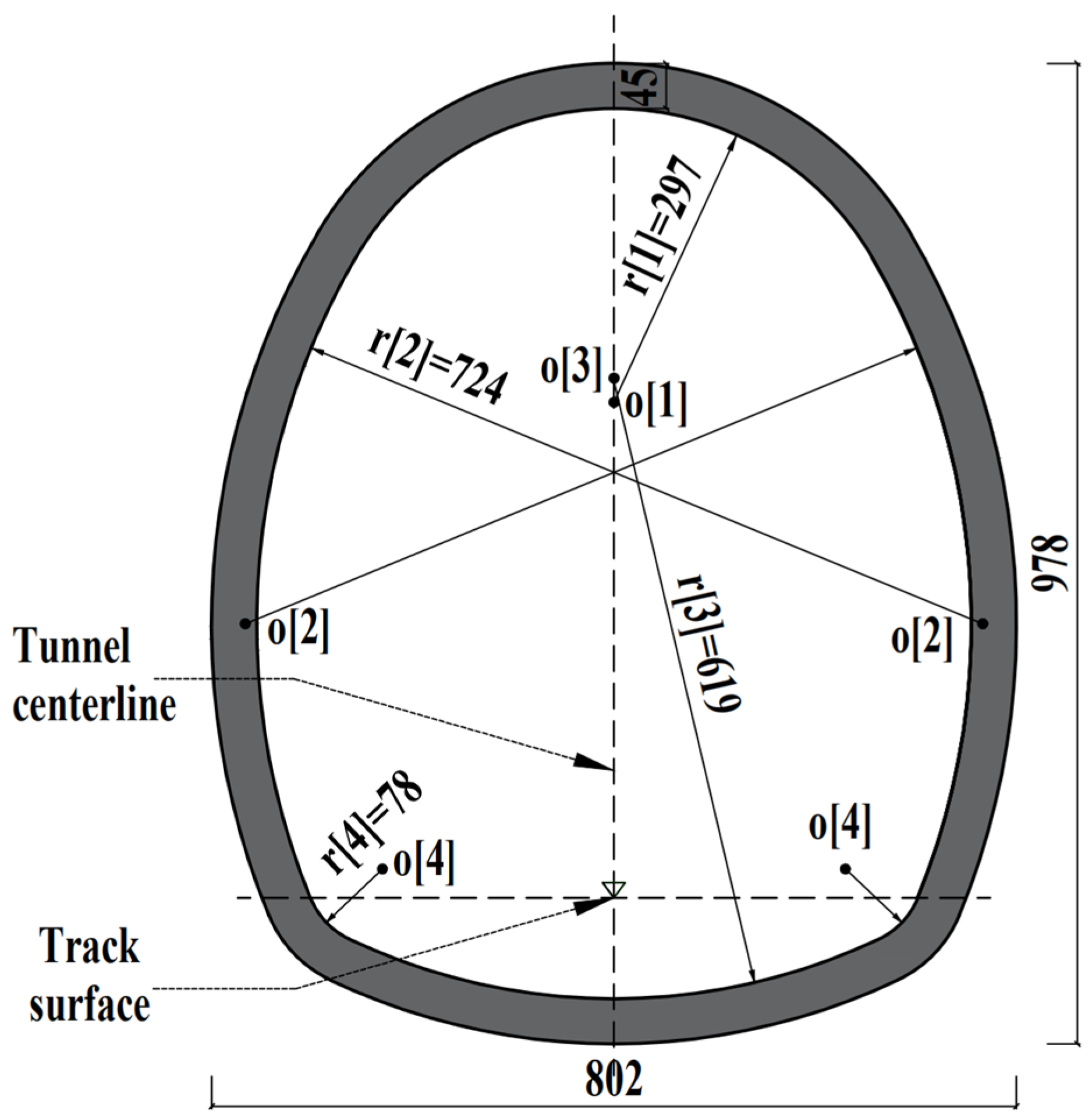
The Yongfengcun tunnel is located on the Fuzhou Ganghou Railway in Fujian Province in China. The total length of the tunnel is 890 m, including an open-cut interval of 100 m. The tunnel is horseshoe-shaped with a maximum burial depth of 43 m, and the cross-section is shown in Figure 1. The inner contour is composed of the crown arc with a radius of 2.97 m, the inverted arc with a radius of 6.19 m, and the sidewall arc with a radius of 7.24 m. The thickness of the second lining is 45 cm, and the maximum excavation width and height are 8.02 m and 9.78 m, respectively. The ground mainly consists of strongly to slightly weathered granite, with its classification ranging from grade IV to grade III. At the tunnel entrance and tunnel exit, the ground mainly consists of silty clay intercalated with gravel and residual sandy clay, which is classified as grade V.
The backfilling area, which is 15 m high, will be covered above the open-cut tunnel to serve as the subgrade of another municipal road, after the Yongfengcun tunnel is completed. The prefabricated lining, which consists of two invert blocks, two crown blocks and two sidewall blocks, is employed for the open-cut tunnel. The blocks are connected to each other by 12 bolts to form one single prefabricated lining that is 1.2 m wide, and the prefabricated linings are connected sequentially to form the open-cut tunnel with a length of 100 m.

3. The Mechanical Behavior of Block Joints

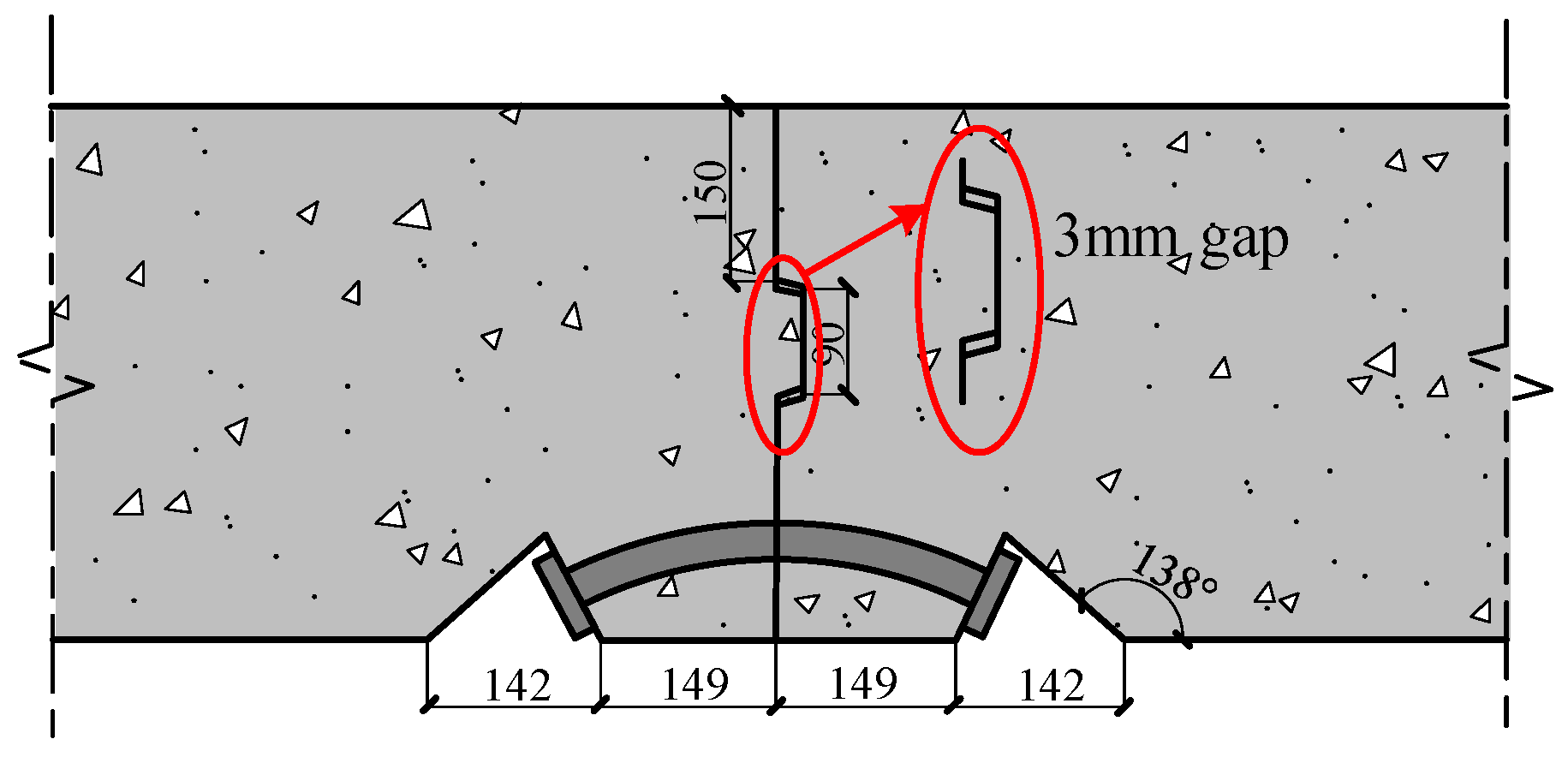
The mechanical behavior of prefabricated lining is closely related to the bending stiffness and the shearing stiffness of block joints. Based on previous studies [5,18], the joint stiffness is affected by the internal force of block joints, so the nonlinear effect of joint stiffness needs to be considered. The detailed structure of block joints is shown in Figure 2. The height of the concave–convex tenon is 90 mm, and there is a 3 mm gap between tenons. The strength of the concrete is grade C50, and a curved steel bolt with a diameter of 30 mm and specification of grade 5.8 is used for connecting the blocks. During the lining design stage, a refined numerical model is used to analyze the mechanical behavior of block joints under different loading conditions.

3.1. The Numerical Model of Block Joints

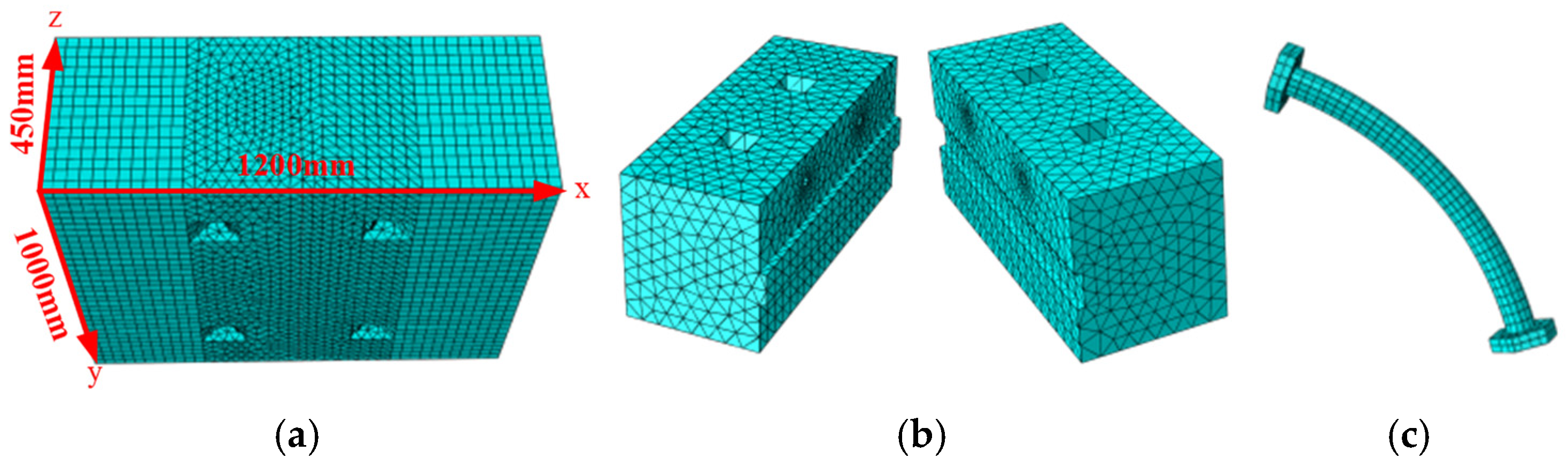
The block joint is simplified from an arc shape to a straight shape, since the curvature of horseshoe-shaped tunnels is relatively small. Waterproof gaskets, cushioning and reinforcement have little impact on joint stiffness compared with steel bolts and tenons and thus are not considered in the numerical model. The numerical model of block joints is shown in Figure 3, with its overall dimensions being 1200 mm × 1000 mm × 450 mm (X × Y × Z). Considering the stress concentration near the bolt holes and tenons, the part near the joint is meshed by quadratic integrated tetrahedral elements (C3D10HS); the steel bolts and the remaining parts are meshed by hexahedral integration elements (C3D8R).
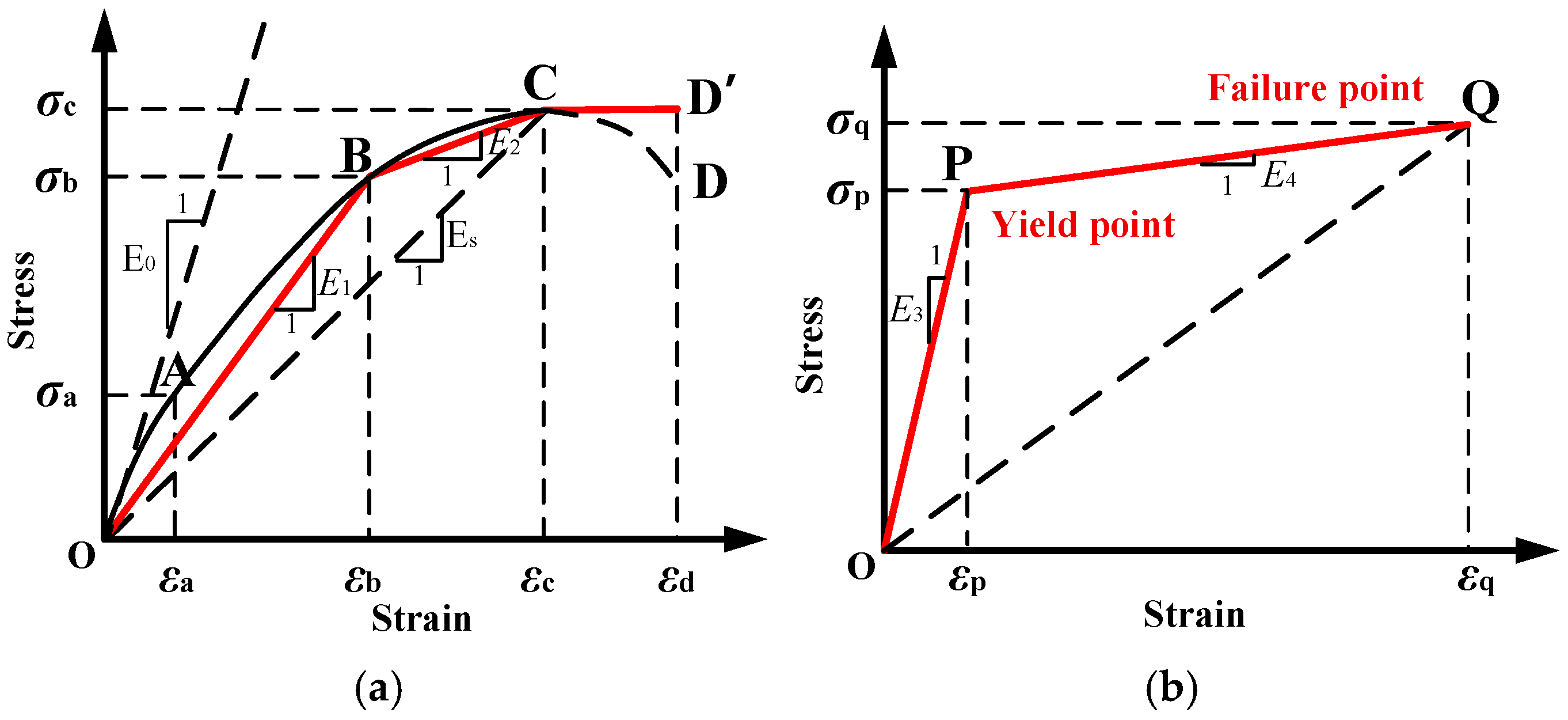
The Mises kinematic hardening constitutive model is adopted for the concrete block, and the relevant model parameters are calculated according to the trilinear simplification proposed by Zhang et al. [5]. The initial stress–strain relationship of the concrete is determined through experimental data and is the black curve OABCD shown in Figure 4a. The finite element model employs multi-segment linear approximation OABCD’ (indicated by the red line in Figure 4a). The concrete constitutive model consists of three distinct phases. The first phase is an elastic stage with elastic modulus E1. The second phase is a plastic stage characterized by strain-hardening modulus E2. The third stage is a plastic flow stage (concrete failure stage), in which the stress does not increase but the strain increases continuously. According to the trilinear simplification and the relevant Chinese Code [19], the mechanical parameters of C50 concrete are specified as E1 = 35.0 GPa, σb = 23.1 MPa, E2 = 14.5 GPa, σc = 42.5 MPa, and Poisson’s ratio μc = 0.167.
The bilinear hardening constitutive model, which includes an elastic stage and plastic stage, is adopted for the steel bolt, as shown in Figure 4b. The mechanical parameters are specified as follows: E3 = 210 GPa, E4 = 20 GPa, σp = 400 MPa, σq = 500 MPa, and Poisson’s ratio μs = 0.3.
The surface-to-surface contacts among concrete blocks and steel bolts are detected automatically in ABAQUS. The hard contact is employed for the normal direction, and the frictional contact with a friction coefficient of 0.3 is employed for the tangential direction.

3.2. The Numerical Model of Block Joints

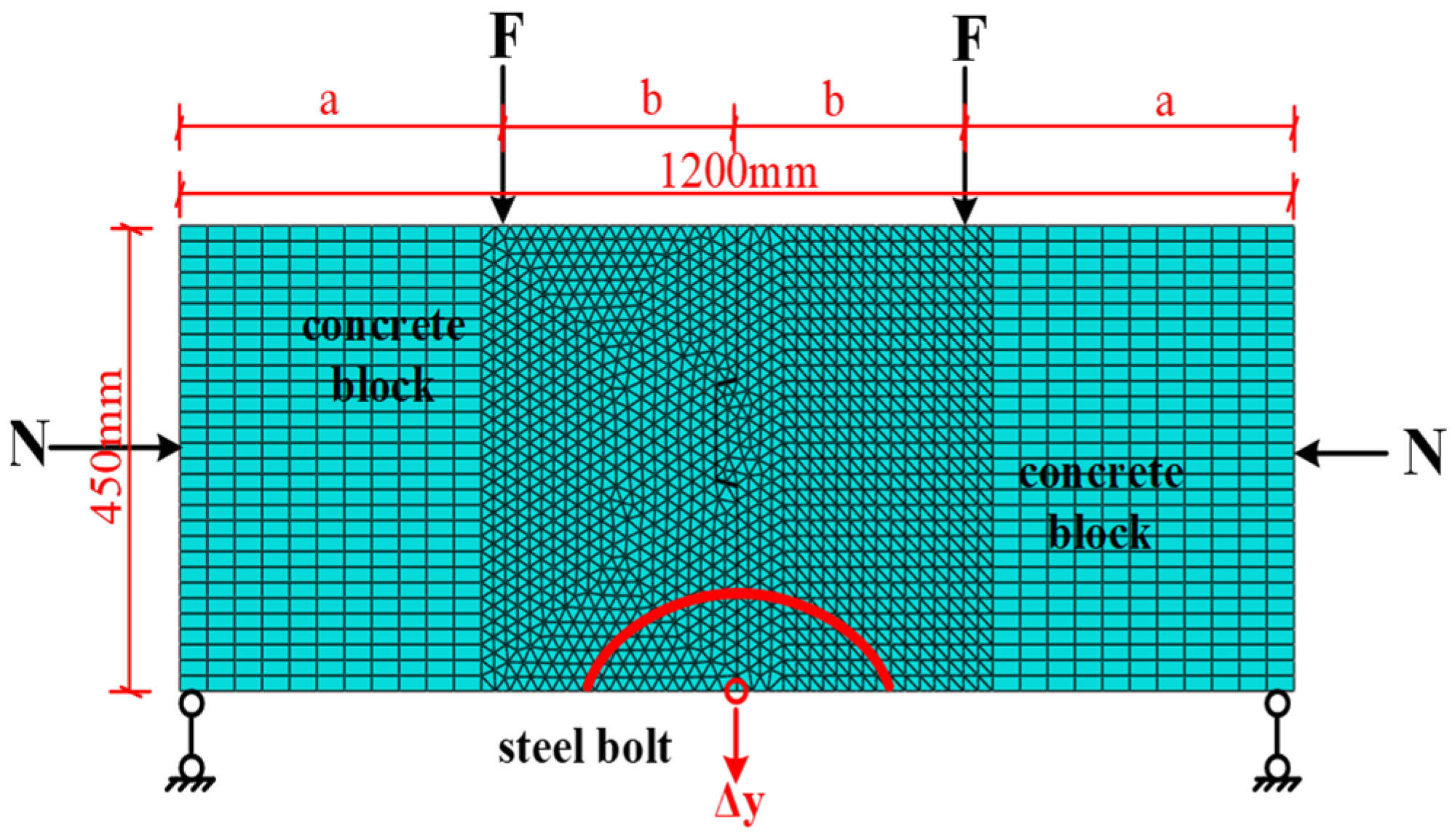
A four-point bending beam test is adopted to simulate the mechanical behavior of block joints under axial force and bending moment. Two vertical constraints are applied at the bottom of both ends, a pair of axial forces N are applied from both ends, and a pair of vertical loads F are applied on the upper surface. The distance from the vertical load to both ends (denoted as a) is 350 mm, the distance from the vertical load to the middle (denoted as b) is 250 mm, and the bending moment M is calculated by the multiplication of F and a.
Different combinations of axial force and bending moment are achieved by changing the values of F and N. The axial force ranges from 500 kN to 2000 kN, with an increasing interval of 250 kN. For each axial force, the bending moment increases with an interval of 25 kN∙m until the concrete block or steel bolt fails. The loading process that is shown in Figure 5 (i.e., the bottom side under tension) is defined as the positive bending condition and vice versa as the negative bending condition.
The monitoring points are arranged on the bottom surface to measure the vertical displacement Δy during the loading process, so that the joint rotation angle θ is calculated as Equation (1):
θ = arctan 2 Δ y a + b
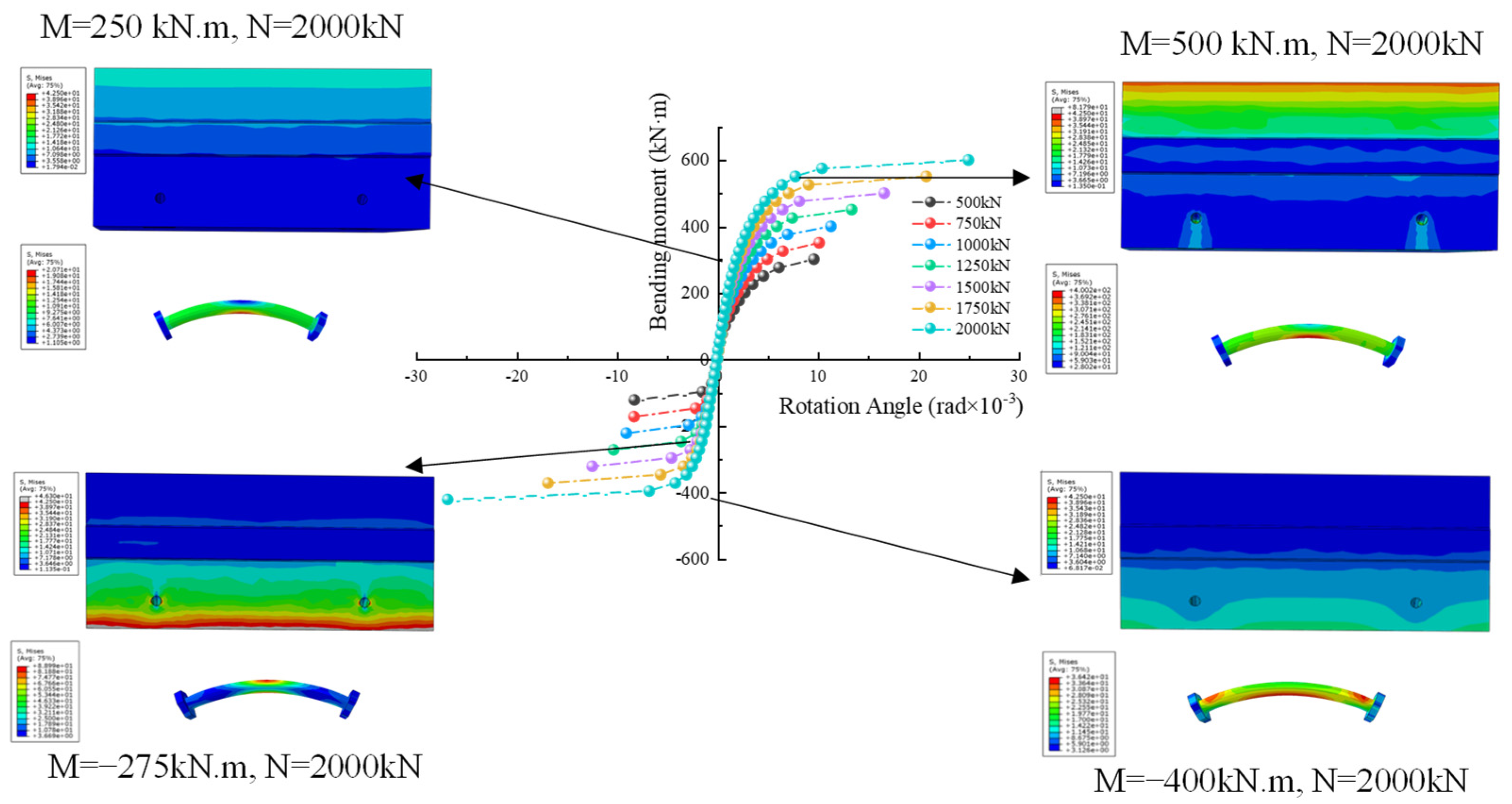
The variation in rotation angle with bending moment under different axial forces is shown in Figure 6. Given a specific axial force, the rotation angle increases linearly with a rapid increment in bending moment in the elastic stage. When the concrete block or steel bolt enters its plastic stage, the rotation angle increases rapidly with a small increment in bending moment, until the failure of the whole block joint. Axial force restrains the rotation deformation of block joints and enhances the bending capacity of the block joint. The variation in rotation angle with bending moment is nearly identical under the positive and negative bending condition. However, the specific failure values differ under positive and negative bending moment loading. For instance, given the axial force N = 2000 kN, the ultimate joint bending capacities are 600 kN·m and −425 kN·m, respectively, under positive and negative bending conditions. The Mises stress contour of four representative loading cases is plotted to show the stress states of the concrete segments and steel bolts.
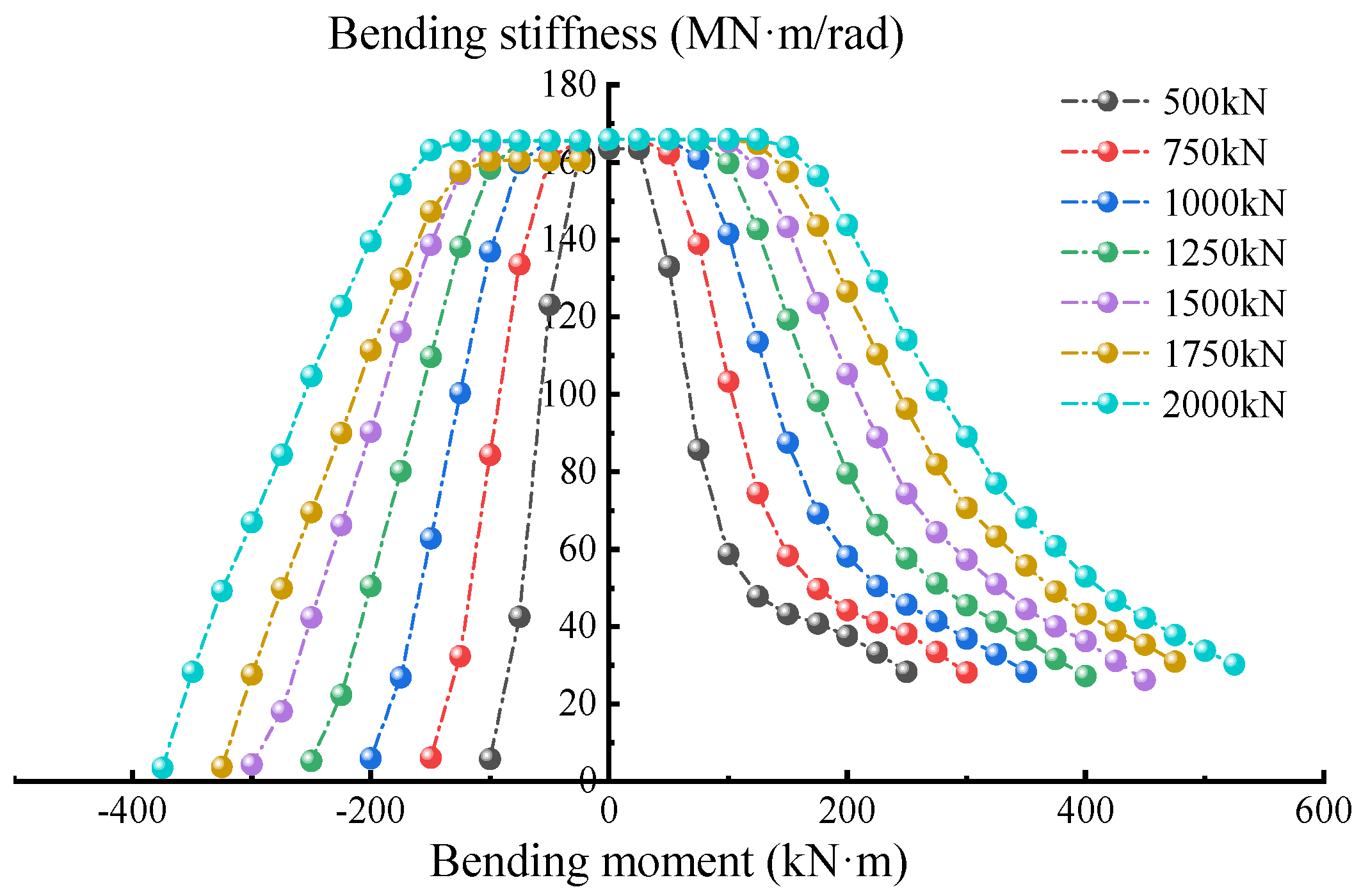
Furthermore, the bending stiffness (denoted as Kθ) is defined by the ratio between the bending moment and rotation angle. The variation in bending stiffness with bending moment under different axial forces, as shown in Figure 7, develops from the elastic stage to the plastic stage. Given the axial force N = 2000 kN, the bending stiffness remains constant at 170 MN·m/rad in the elastic stage. As the concrete block and steel bolt yield progressively according to the stress states shown in Figure 6, the bending stiffness decreases continuously from 170 MN·m/rad to 35 MN·m/rad in the plastic stage for the positive bending moment case. However, the joint bending stiffness continuously decreases to nearly 0 until failure for the negative bending moment case. The difference depends on whether the steel bolts contribute to the joint stiffness after concrete failure. The steel bolts still contribute to joint stiffness after concrete compressive failure because they are in the tensile region. However, the steel bolts together with concrete are in the compressive region under the negative bending moment loading case. No tensile region can exist in such a condition, thus leading to a smaller joint bending stiffness.
The bending stiffness of block joints is closely related to axial force and bending moment. The empirical formula for the bending stiffness of block joints is further fitted by Equation (2), according to the numerical simulation results.
K θ = 0.4 M + 0.07 N + 85.45         ( Positive   shearing   condition ) 0.91 M + 0.14 N + 67.79           ( Negative   shearing   condition )
In Equation (2), the units of bending stiffness Kθ, bending moment M and axial force N are MN·m/rad, kN·m and kN, respectively. The determination coefficient R2 of the fitting formula is 0.94 and 0.91 for positive and negative bending conditions.

3.3. The Shearing Stiffness of the Block Joint

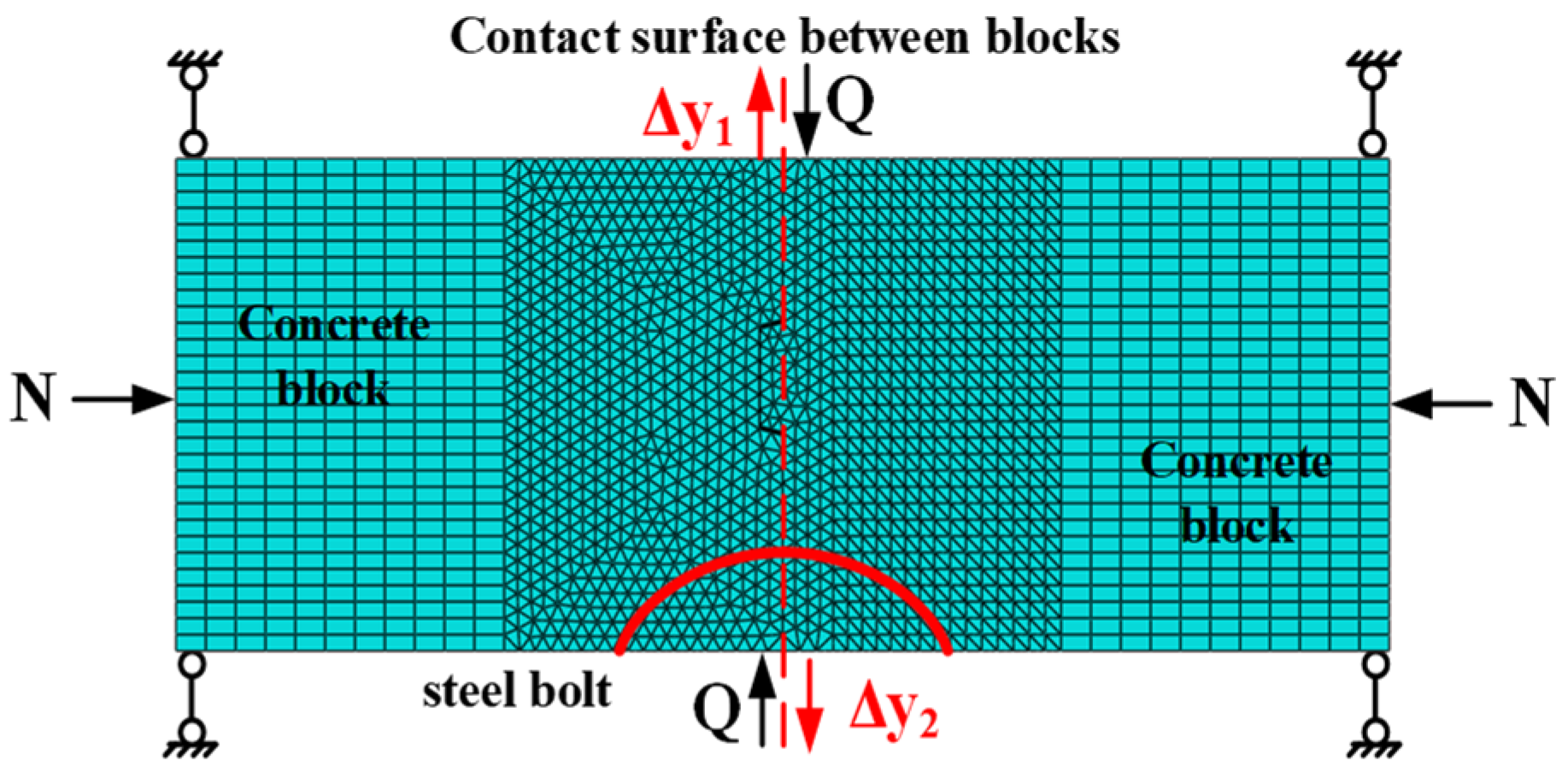
Numerical simulations are also conducted to study the shearing stiffness of the block joint. The overall meshing, the constitutive model with mechanical parameters identical to those in Section 3.2, and the boundary condition and the loading process are shown in Figure 8. For each axial force, the shear force increases with an interval of 30 kN until the concrete block or steel bolt fails.
The monitoring points are arranged at the upper surface and the bottom surface, to measure the vertical displacement Δy1 and Δy2 during the loading process, so that the dislocation between blocks δ can be calculated by Equation (3). And the shearing stiffness (denoted as KS) is defined by the ratio between shear force and dislocation.
δ = Δy1 − Δy2
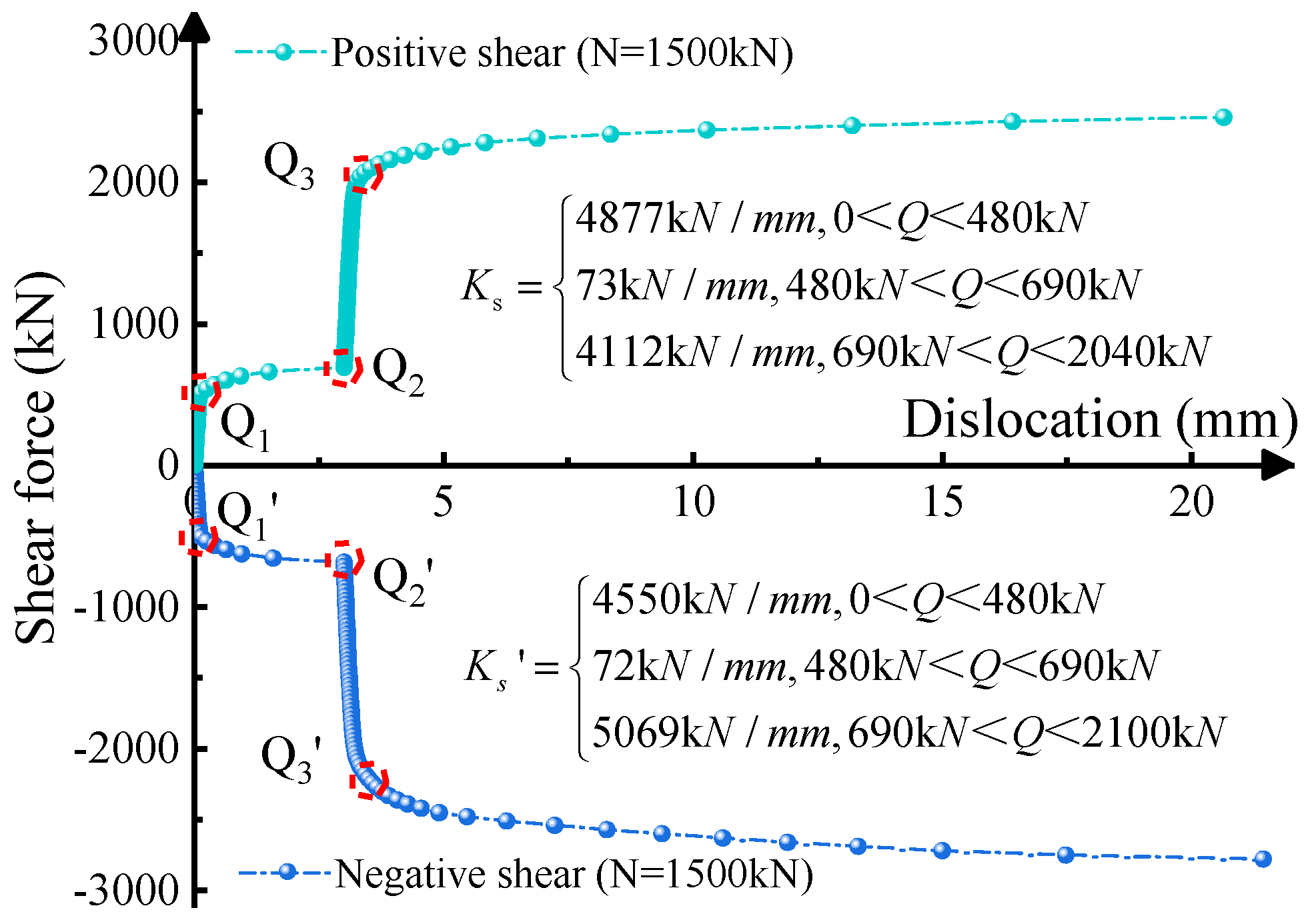
Given the axial force N = 1500 kN, the variation in dislocation with shear force is shown in Figure 9, which can be divided into four stages. (1) Friction stage (0 < Q < Q1): The joint surfaces have a minimal dislocation δ not exceeding 0.1 mm. The shearing stiffness of block joints is notably high during this stage, and its shear capacity is primarily provided by the static friction force between contact surfaces. (2) Sliding stage (Q1 < Q < Q2): The shear force progressively increases and overcomes static friction, causing significant mutual displacement of contact surfaces. The steel bolt begins to bear the load and gradually yields. Compared to the friction phase, the shear stiffness is markedly reduced during the sliding phase. (3) Interlocking stage (Q2 < Q < Q3): The dislocation δ reaches mortise-and-tenon clearance when the shear force reaches Q2. The engagement mechanism increases both contact area and friction, resulting in a significant rise in shearing stiffness. (4) Failure stage (Q3 < Q): The shear force progressively increases until it causes severe damage to the steel bolts and mortise-and-tenon joints, resulting in reduced shearing stiffness. As the shear force values corresponding to this stage are extremely rare in practical engineering applications, they are not considered.
The bearing capacity of block joints varies under positive and negative shear conditions, particularly during the third and fourth stages. The negative shear condition requires greater shear force to achieve the same dislocation as the positive condition under constant axial force, demonstrating superior bearing capacity. This is because the direction of shear force in negative shear opposes the steel bolt’s bending direction. The negative bending moment enhances joint stiffness, suppresses slip and uneven deformation on the joint surface, increases contact friction, and consequently improves shear resistance. A positive shear force of 2500 kN can achieve a dislocation of 20 mm, whereas a negative shear force of 3000 kN is required to reach the same dislocation.
The variation in dislocation and shearing stiffness under the negative shearing condition is basically identical to its counterpart under the positive shearing condition. Given the axial force N = 1500 kN, Q1, Q2, Q3, Q1′, Q2′, and Q3′ are 510 kN, 690 kN, 2100 kN, −510 kN, −690 kN, and −2100 kN, respectively, corresponding to shearing stiffnesses of KS1 = 4877 kN/mm, KS2 = 73 kN/mm, KS3 = 4112 kN/mm, KS1′ = 4550 kN/mm, KS2′ = 72 kN/mm and KS3′ = 5069 kN/mm.
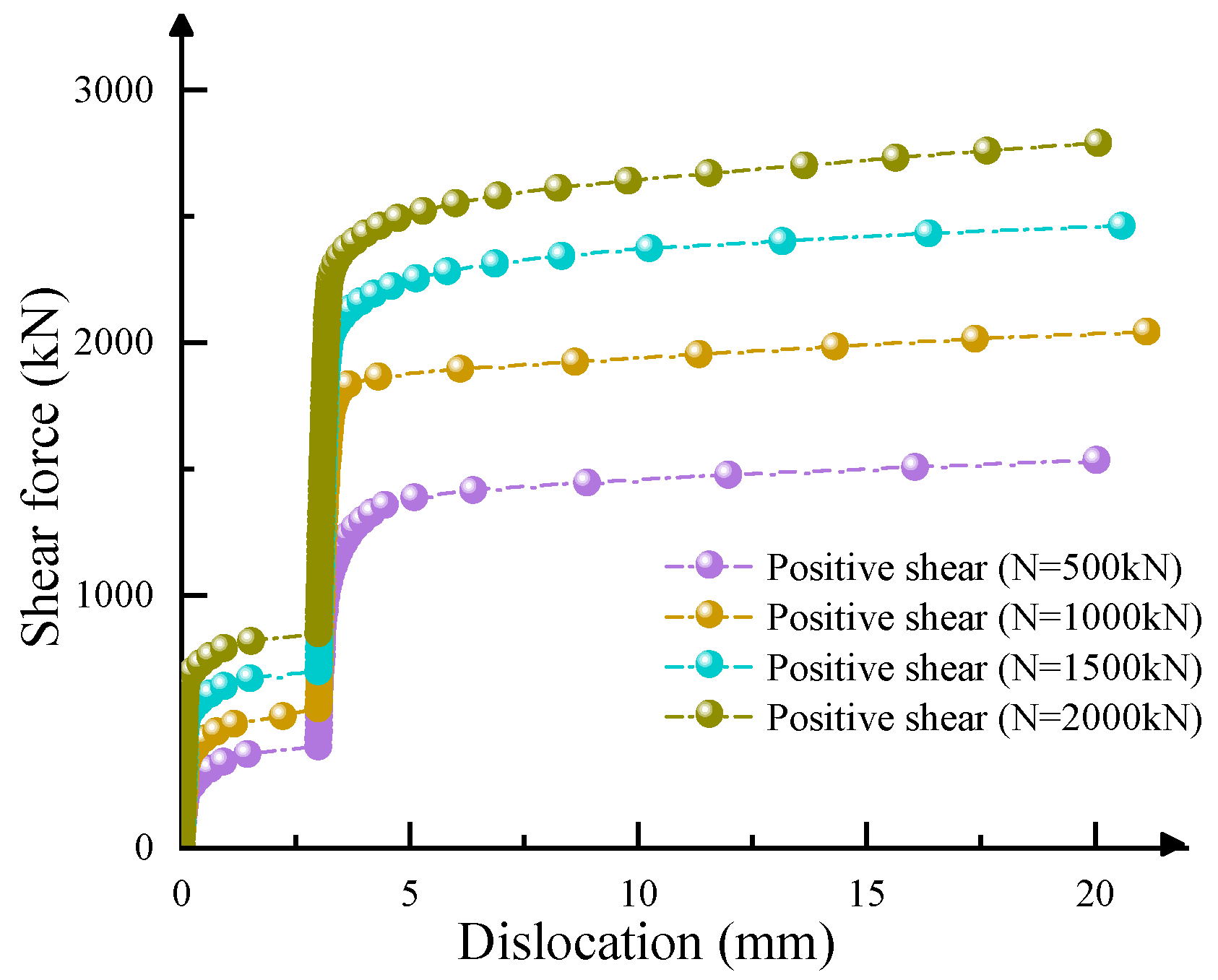
Since the variation in dislocation δ is nearly identical under both positive and negative shear conditions, only the positive shear condition is presented in Figure 10. The block joints exhibit similar deformation characteristics across stages under different axial forces but demonstrate varying bearing capacities. The impact of axial force on shear stiffness primarily manifests as differing thresholds at each stage, attributable to its influence on static friction at joint surfaces. Specifically, lower axial forces result in reduced static friction, causing block joints to enter the second stage earlier. This further diminishes the subsequent bearing capacity, leading to correspondingly reduced shear forces at the same dislocation level.
For the convenience of further applications, the shearing stiffness under different stages and different axial forces is listed in Table 1.

4. The Mechanical Behavior of Prefabricated Lining

4.1. Calculation Diagram

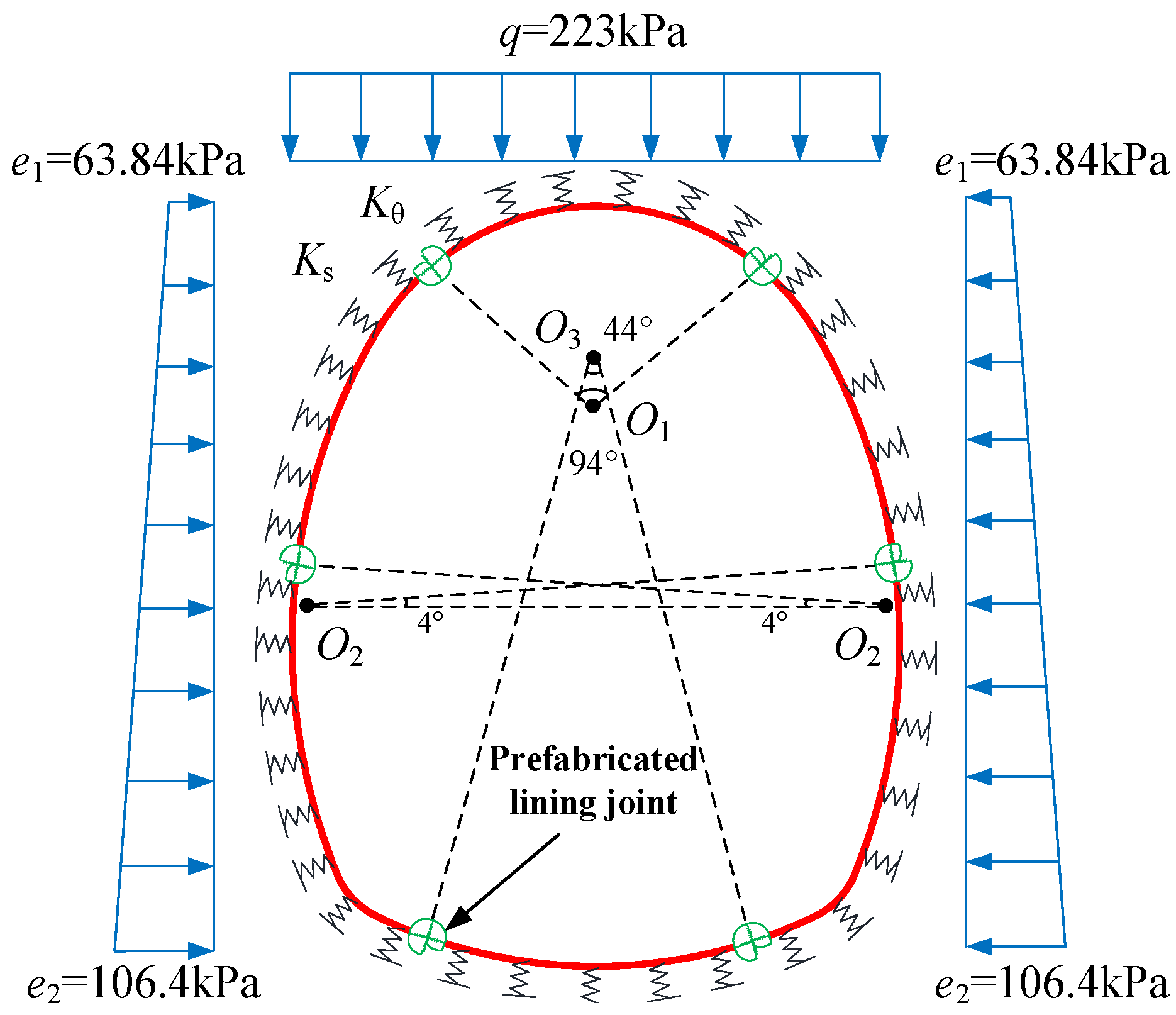
A beam–spring model with ground pressure and foundation springs is used to calculate the mechanical behavior of prefabricated lining. The beam elements and the spring elements denote the concrete blocks and the block joints, respectively. The bending capacity of block joints is denoted by the bending stiffness Kθ of the spring element, which is fitted by Equation (2) according to different internal forces of M and N. The shearing capacity of block joints is denoted by the shearing stiffness KS of the spring element, which is listed in Table 1 according to different internal forces of Q and N.
According to the Chinese Code for the design of railway tunnels [20] and the design document of Yongfengcun tunnel [21], the horizontal and vertical ground pressures around the shallow-buried tunnels with a classification of grade V are calculated. The reaction spring is employed to simulate the ground–structure interaction, while the spring stiffness is determined by the reaction coefficient of the ground. The physical and mechanical parameters of the surrounding ground are listed in Table 2.
The vertical ground pressure q and the horizontal ground pressure e are determined by Equation (4) and Equation (5), respectively. Here, γ, λ and θ are the unit weight (kN/m3), the lateral pressure coefficient and the internal friction angle (°) of the surrounding ground, respectively. B is the tunnel span (m), and h is the cover depth from the ground surface to the calculation point of the tunnel lining.
q = γ h ( 1 λ h tan θ B )
e = γ h λ
As shown in Figure 11, the vertical ground pressure is uniformly distributed, with its magnitude being 223 kPa; the horizontal ground pressure is trapezoidally distributed, with its magnitude being 106.4 kPa at the invert and 63.84 kPa at the crown.
The space between blocks is block of joint, and the objects evenly distributed on surface of prefabricated lining are formation reaction springs in Figure 11.

4.2. Mechanical Behavior Analyses by ABAQUS

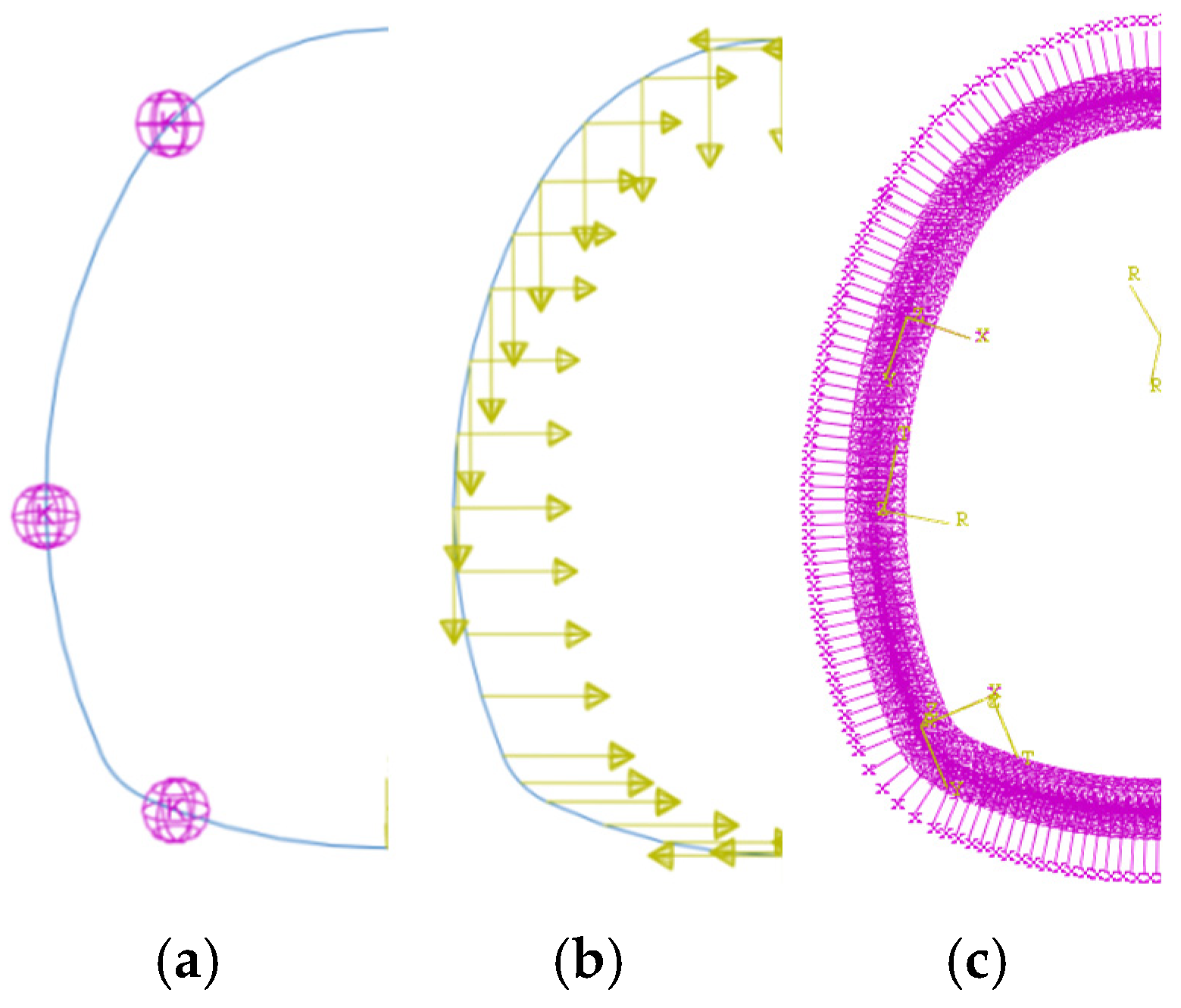
The beam–spring model, as shown in Figure 12a, is established in ABAQUS based on the calculation diagram. The ground pressure and the formation reaction spring are applied along the beam–spring model, as illustrated in Figure 12b,c. Notice that only the left-half part is presented here due to its symmetry. The nonlinear stiffness of block joints is customized according to Equation (2) and Table 1, and the mechanical behaviors of prefabricated lining are solved automatically by ABAQUS.
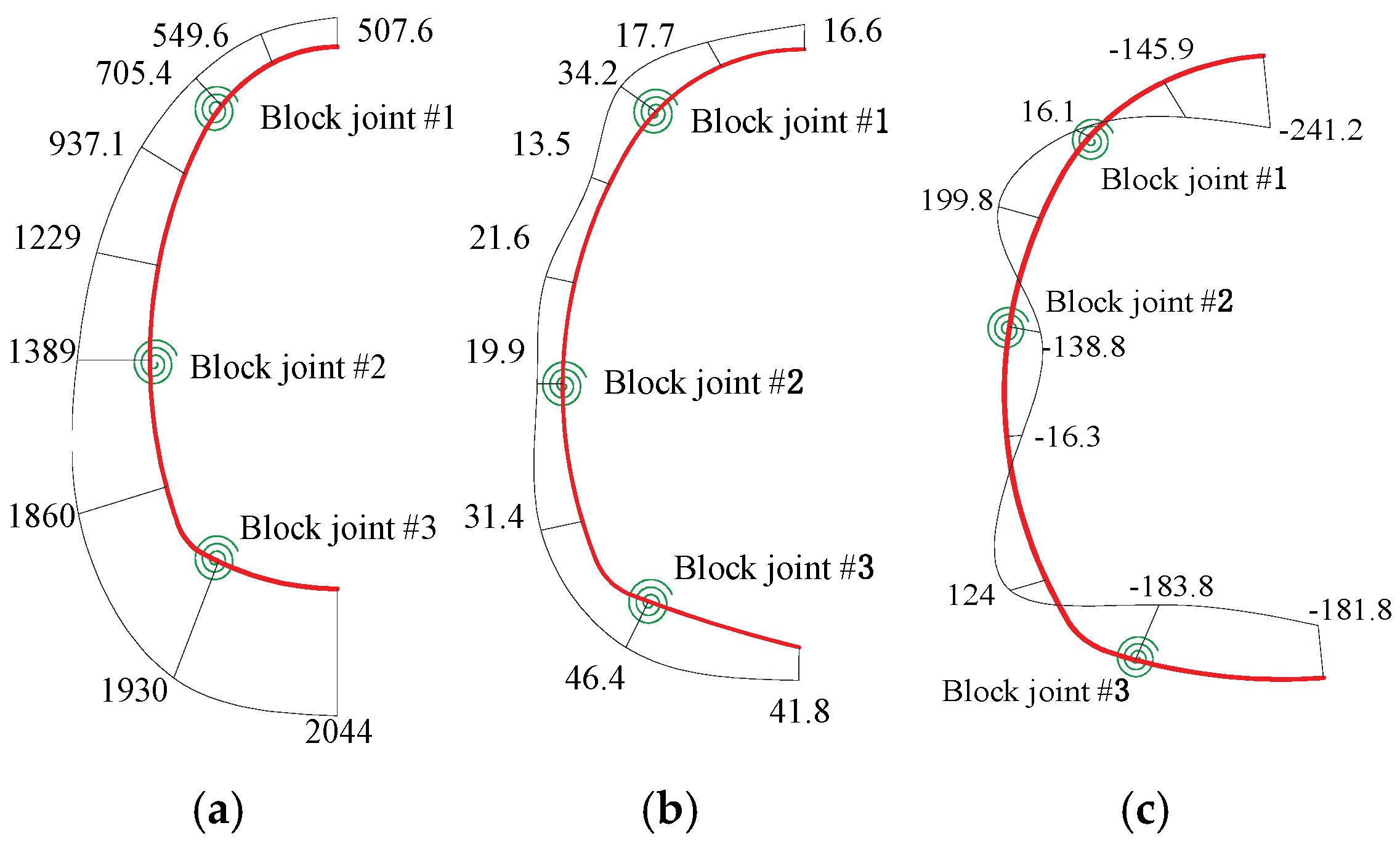
The distributions of axial force, shear force and bending moment along the prefabricated lining are shown in Figure 13a–c, respectively. The distribution of axial force increases gradually from the crown to invert, with its maximum of 2044 kN at the center of the invert. The distribution of shear force is relatively uniform along the prefabricated lining, with its maximum of 46.4 kN at block joint #3 (between the invert and sidewall).
On the other hand, the distribution of the bending moment is more complex: the negative bending condition (tension inside) appears on the crown, invert and sidewall, while the positive bending (tension outside) appears on the shoulder and wall foot. The bending moment at block joint #1, #2 and #3 is 16.1 kN·m, −16.3 kN·m and −183.8 kN·m, respectively.

4.3. Validation of Beam–Spring Model

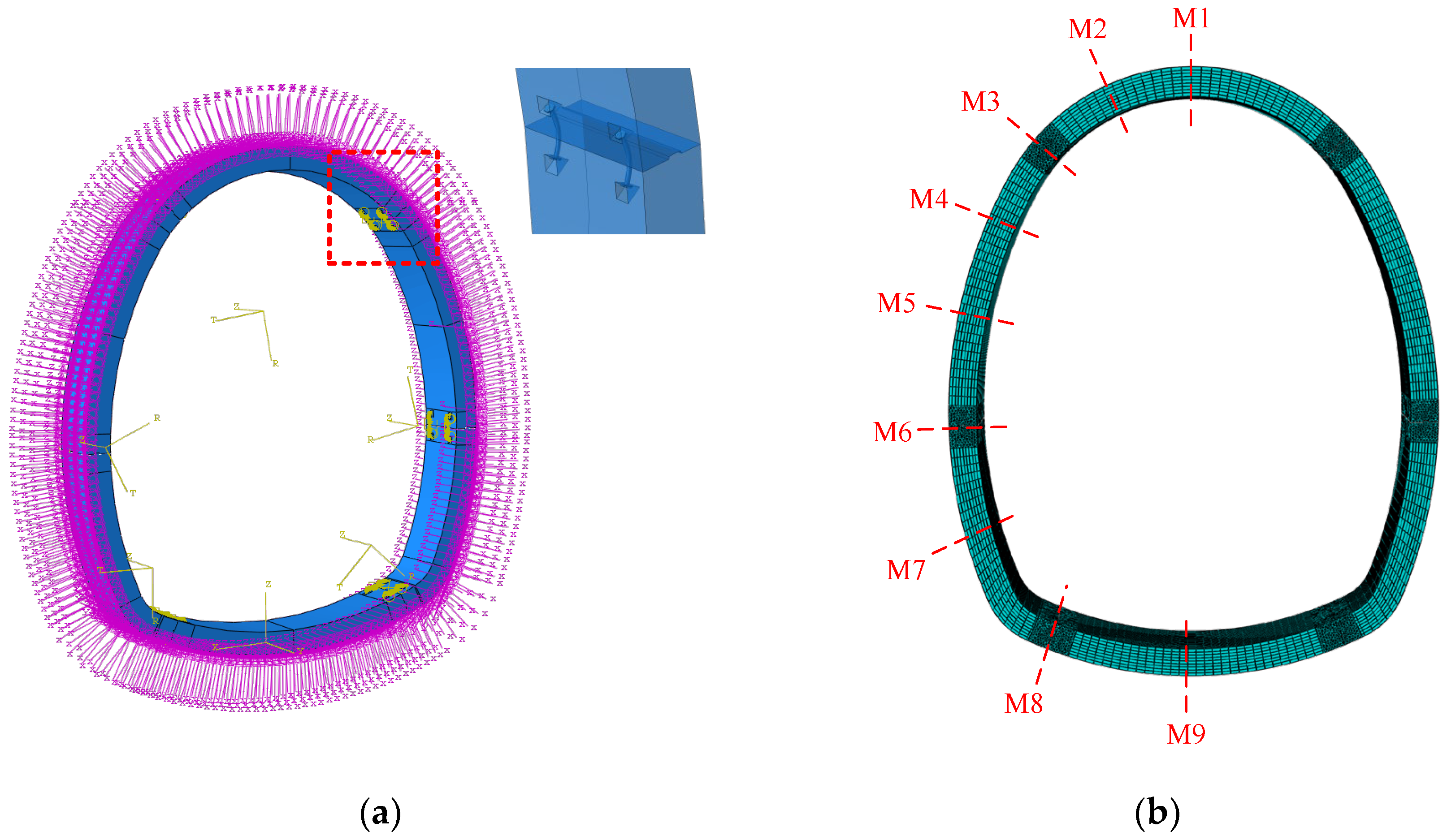
A 3D refined model (Figure 14a) is established to validate the stiffness iteration algorithm, with identical geometry, contact and mesh settings to Section 3. Axial force and bending moment are sampled uniformly from nine sections of the semicircle due to symmetry, as shown in Figure 14b.
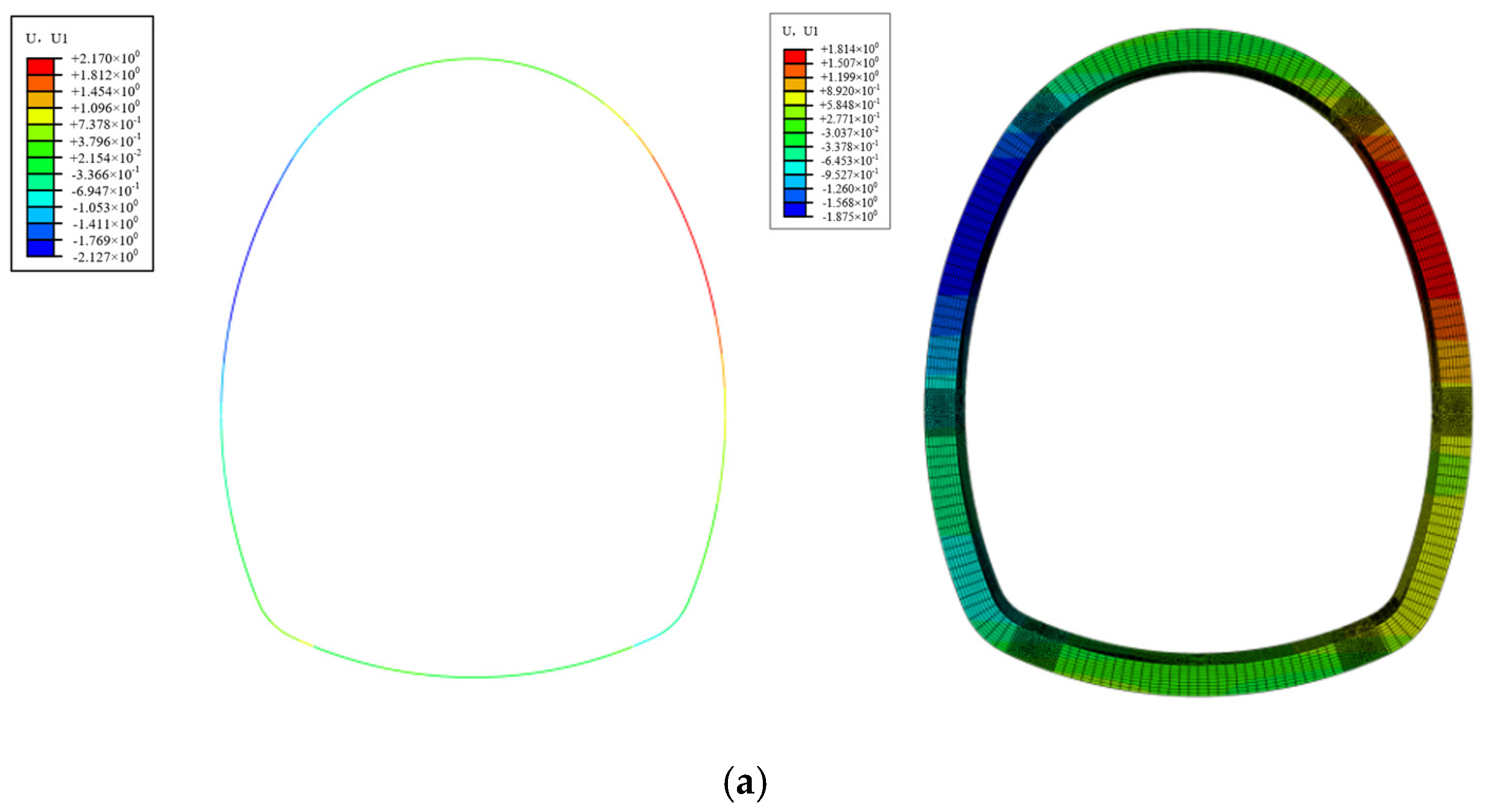
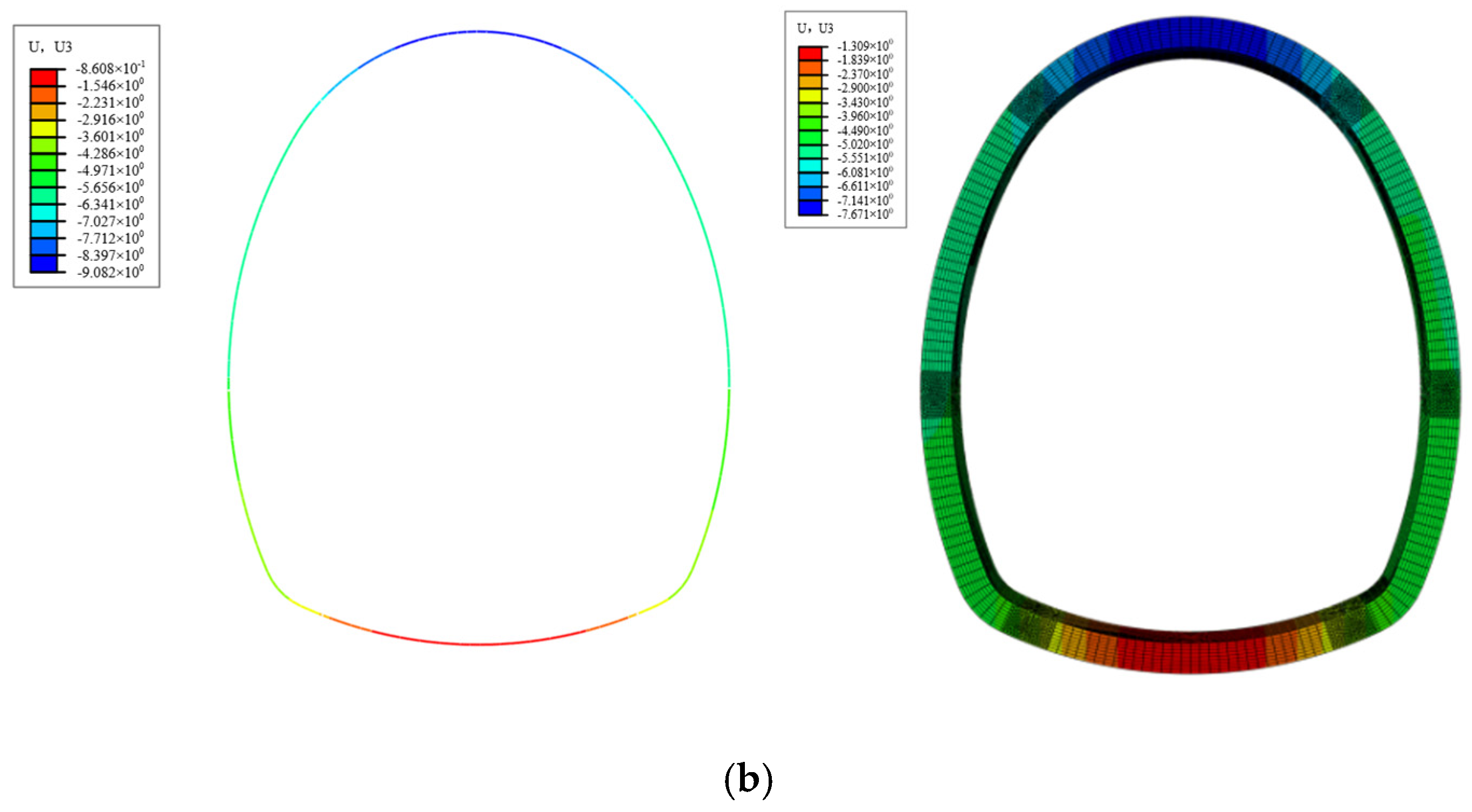
The deformation of the 3D refined model and beam–spring model shows the same variation pattern, as shown in Figure 15. The sidewall arc on both sides expands outward and the crown arc settles. The maximum horizontal displacement of the two models is located at the sidewall arcs: for the 3D refined model it is 1.9 mm, and for the beam–spring model it is 2.1 mm, with a difference of 13.9%. The maximum crown arc settlement of the 3D refined model is 7.7 mm and that of the beam–spring model is 9.1 mm, with a difference of 10.2%.
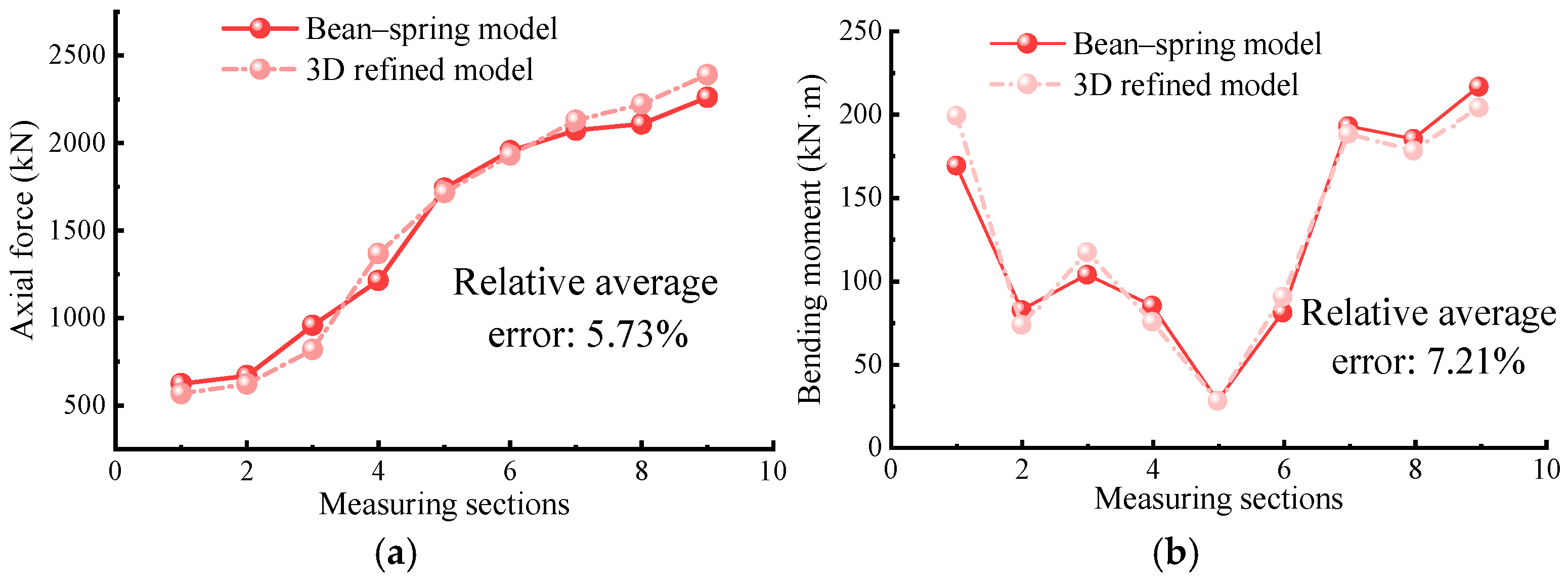
The axial force and bending moment of the different monitoring points are compared, as shown in Figure 15. Among them, the maximum relative error of axial force is 10.4%, which is located at monitoring point 3, with 1551 kN for the 3D refined model and 1389 kN for the beam–spring model (Figure 16a). The maximum relative error of the bending moment is 14.3%, which is located at monitoring point 1, with 13.8 kN·m for the 3D refined model and 16.1 kN·m for the beam–spring model (Figure 16b). Overall, both relative average errors are not more than 10%, which shows that the beam–spring model of dynamic stiffness can improve calculation efficiency while ensuring calculation accuracy.

5. Segmentation Optimization for Prefabricated Lining

5.1. Parametric Modeling and Mechanical Behavior Analysis Based on Python

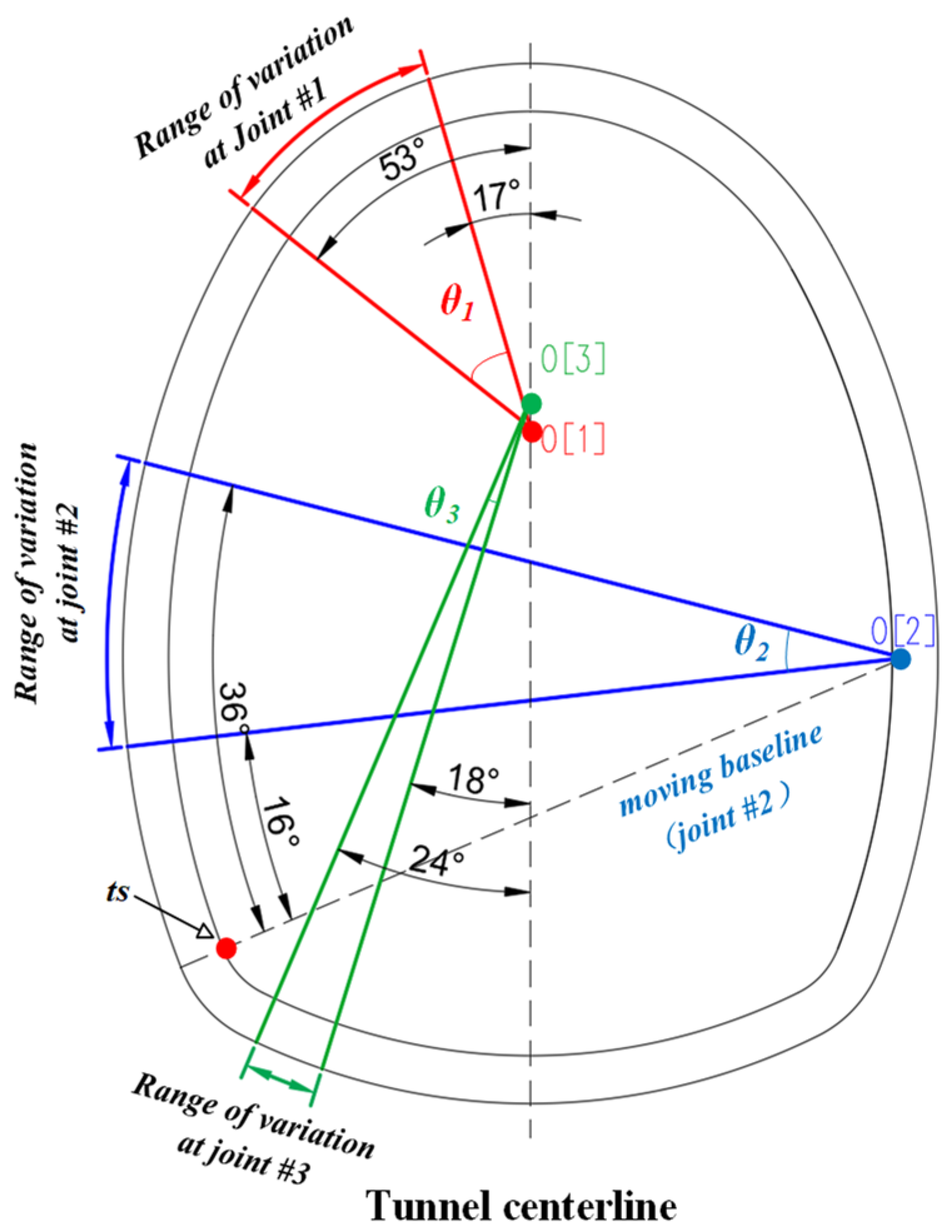
Similarly, changing the positions of joints #1, #2, and #3 can generate more segmentation schemes in Figure 17. The angle between the radius of joint #1 and the tunnel centerline is defined as θ1, whose reasonable range is set to 17° to 53°. The line connecting base point ts (i.e., the intersection between the inner contour and track surface) and joint #2 center O2 is defined as the moving baseline. And the angle between the radius of joint #2 and the moving baseline is defined as θ2, whose reasonable range is set to 16° to 36°. The angle between the radius of joint #3 and the tunnel centerline is defined as θ3, whose reasonable range is set to 18° to 24°. θ1, θ2, and θ3 are changed with an interval of 2°, so that 572 different segmentation schemes are obtained.
Secondary customization of ABAQUS based on Python3.9 was employed to realize parametric modeling and mechanical behavior analysis of prefabricated lining for railway tunnels. Specifically, the geometric meshing, material definition, and ground pressure loading were conducted automatically by the Python script (.rpy file) to generate 572 segmentation schemes (.inp file), which were then submitted and analyzed by ABAQUS solver. Then, the analysis results were recorded in .odb files.
Through a Delphi questionnaire, the horizontal convergence, the bending moment amplitude and the length variance among the blocks were determined as key indicators to measure the merits and demerits of segmentation schemes.
Both the horizontal convergence (i.e., horizontal displacement along the springline) and bending moment amplitude (i.e., the range of positive and negative bending moments along the prefabricated lining) can be obtained directly from the .odb file. The length of each block can be obtained directly from the geometric parameters, and the length variance among blocks can also be calculated (see details in Section 5.2). The three key indicators presented above should be normalized to a [0, 1] interval using the Min-Max Normalization method, as shown in Table 3, to eliminate the dimensional and numerical influences among them.

5.2. Multi-Objective Decision-Making Based on NSGA-II

The 572 segmentation schemes obtained by numerical simulation were not guaranteed to reach the optimal solutions. Therefore, the multi-objective optimization algorithm was introduced to explore the solution space efficiently with an adaptive search strategy and to generate the corresponding Pareto frontier to determine the optimal segmentation schemes.
According to Table 3, the empirical formula for function #1 (i.e., normalized horizontal convergence) and function #2 (i.e., normalized bending moment amplitude) were fitted as Equation (6) and Equation (7), respectively. Denoting x1, x2, x3, x4 as the lengths of the crown block, shoulder block, sidewall block, and invert block, and Lmax and μ as the maximum length and the average length among all blocks, function #3 (i.e., length variance) can be calculated by Equation (8).
f 1 = ( 1.18 θ 3 3.77 θ 2 0.36 θ 1 + 345.45 ) / 1000
f 2 = ( 10.79 θ 3 5.58 θ 2 0.08 θ 1 + 658.49 ) / 1000
f 3 = ( ( x 1 μ ) 2 + ( x 2 μ ) 2 + ( x 3 μ ) 2 + ( x 4 μ ) 2 ) / 4 L max
x 1 = 2 θ 1 π × 6417 180 x 2 = ( 52.5 θ 2 ) π × 7465 180 + ( 60 θ 1 ) π × 6417 180 x 3 = ( 25.3 θ 3 ) π × 3199 180 + θ 2 π × 7465 180 + 741.3 x 4 = 2 θ 3 π × 3199 180 μ = ( x 1 + x 2 + x 3 + x 4 ) / 4
Then the multi-objective optimizer was employed to autonomously explore the solution space, find out the Pareto frontier and determine the optimal solution.
The NSGA-II algorithm, proposed by Deb et al. [22], employs the strategies of fast non-dominant sort, crowding distance assignment and elitism, which can significantly improve the calculation efficiency and distribution uniformity of the Pareto frontier.
The population (i.e., the set of all feasible solutions in a current generation) is sorted via a non-dominant strategy to yield the Pareto frontier (i.e., the solutions not dominated by others). The crowding distance between individuals in same layer is calculated to quantify the sparsity around it. The individuals with a small layer and large distance are selected to form an elite parent generation, which then undergoes crossover and mutation to form new offspring generation. The elite parent generation and their offspring generation are merged and then undergo the next iteration to approach the uniformly distributed Pareto frontier efficiently.
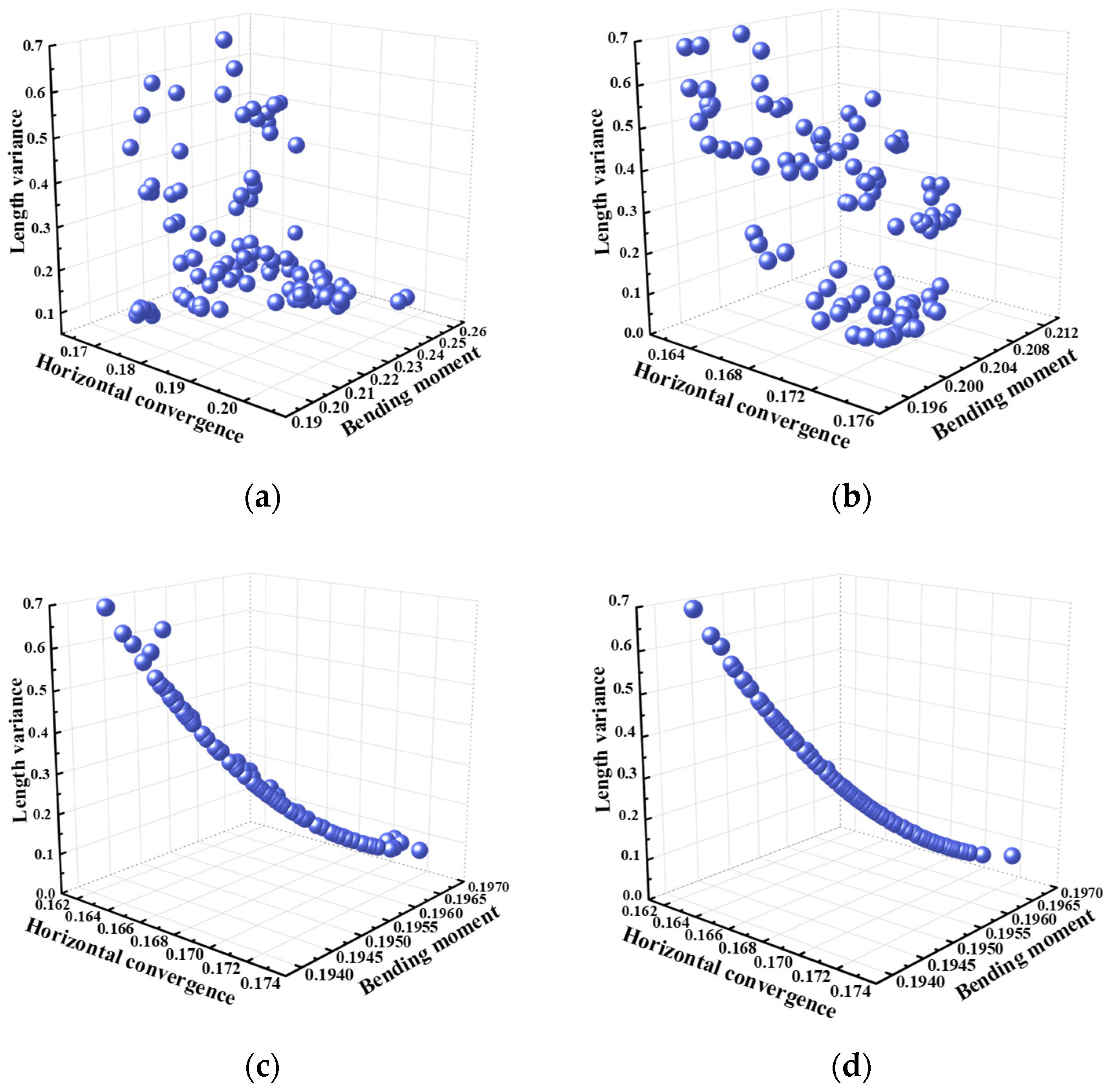
The population (pop) and iteration (gen) were set to 100 and 30, and the population of the 1st generation was initialized randomly. Functions #1, #2 and #3 were obtained and updated after each iteration step. Specifically, the typical Pareto frontiers in iterative step1, step5, step15, and step30 are plotted in Figure 18.
The initial solution set exhibits a scattered distribution in Figure 18a, spanning multiple Pareto frontiers. At the fifth iteration, numerous solutions with Pareto frontiers other than 1 remain in Figure 18b, where the solution set is primarily filtered based on Pareto frontier levels. At the fifteenth iteration, all points in the solution set achieve Pareto frontier levels of 1 (Figure 18c), though the solution distribution remains uneven with an irregular curve, marking the onset of the crowding distance’s filtering effect. Ultimately, the crowding degree significantly decreases, and the solution set achieves uniform distribution by the thirtieth iteration in Figure 18d. This confirms completion of the iterative process, with the resulting Pareto front representing the optimal solution under the trade-offs of prefabricated lining.
Specially, each point on the Pareto frontier represents an optimal segmentation scheme, which is not the optimization of a single objective but the optimal balance of three objectives under feasible engineering constraints.

5.3. Optimization Results of Tunnel Lining Segmentation

Through the Delphi expert consultation (n = 15), the Kendall’s coefficient of concordance was decided to be W = 0.72 (χ2 = 23.4; df = 2, p = 0.003). The standard deviations of the weights for each objective converged to 0.07 (horizontal convergence), 0.06 (weight variance), and 0.05 (maximum bending moment), as seen in Table 4. The results fulfill the consensus criteria (standard deviation ≤ 0.08 and divergence ≤ 25%), where divergence d is defined as the ratio of SD to mean.
In the final round of data, two samples exceeding ±2σ were excluded. The number of valid samples in the final round was 13, and Kendall’s W-test passed significance verification (p < 0.01). The weights of the optimization objectives were finally determined as follows: horizontal convergence (0.4), weight variance (0.4), and maximum bending moment (0.2). The objective function is shown in Equation (10).
f = 0.4 f 1 + 0.4 f 2 + 0.2 f 3
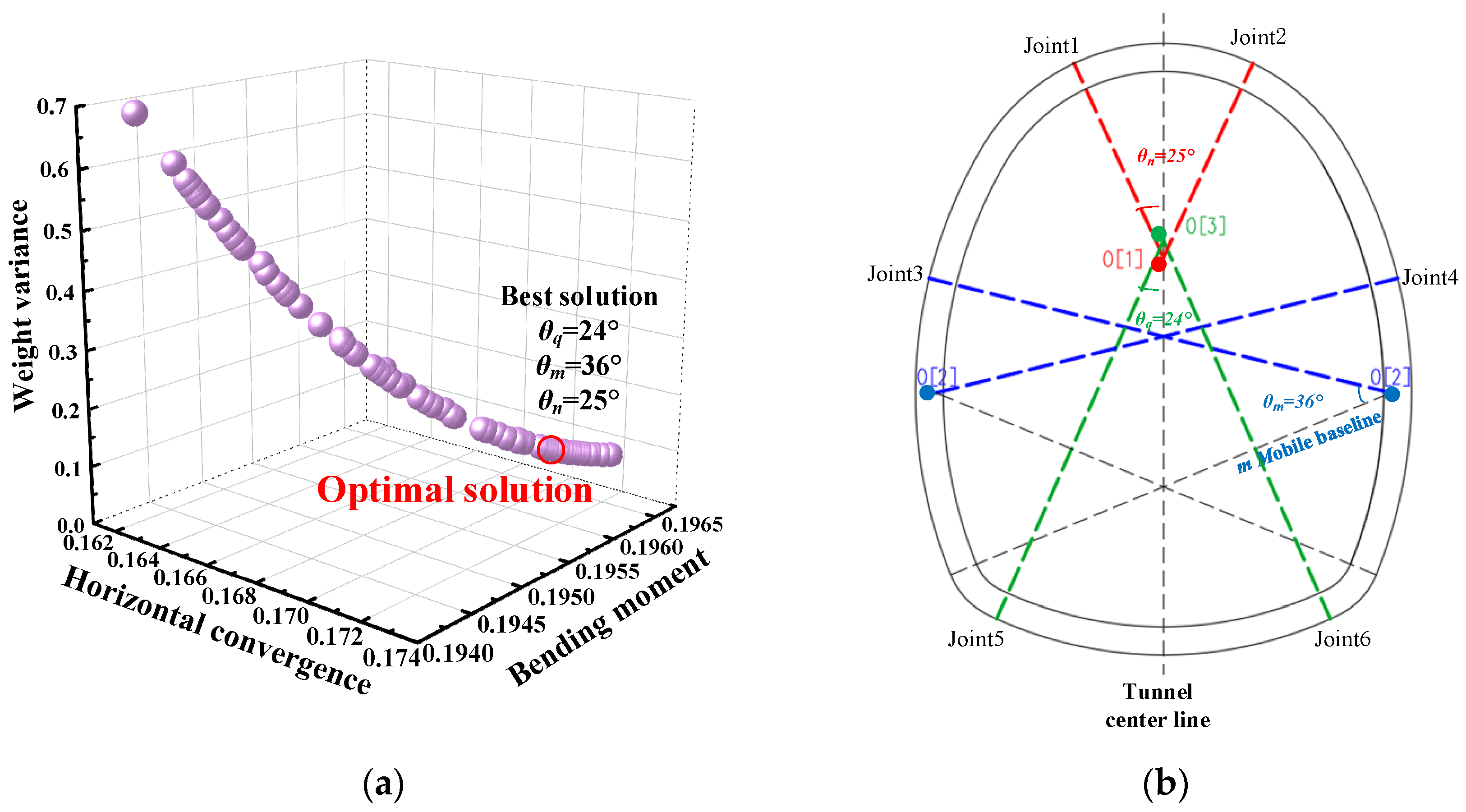
By linearly weighting the multi-objective functions into a single-objective composite function, the best solution for this project can be calculated, which minimizes the value of f in Equation (8). The best solution is related to the assigned weights. For the optimization of prefabricated lining segmentation, the best values of θq, θm, and θn are 24°, 36°, and 25°, respectively. The comprehensive objective decision-making and the corresponding segmentation scheme are shown in Figure 19.
It should be noted that another appropriate segmentation scheme can be selected from the Pareto frontier according to the requirements in the engineering design. For example, when structural deformation needs to be strictly controlled, priority should be given to the selection of design parameters that meet this requirement. This two-stage strategy of “first systematic optimization, then dynamic decision-making” not only preserves the guiding advantage of the weighting method but also inherits the flexibility of the Pareto approach.

6. Conclusions and Limitations

Based on the Yongfengcun tunnel in Fuzhou Ganghou Railway Project, the nonlinear mechanical behaviors of joint stiffness were investigated under axial force, bending moment and shear force. A beam–spring model incorporating nonlinear joint stiffness was established for the prefabricated lining, and the mechanical behaviors were analyzed efficiently by Python3.9 and ABAQUS for 572 segmentation schemes. Finally, a multi-objective optimization algorithm (NSGA-II) was applied to optimize the segmentation scheme for the prefabricated lining of railway tunnels. Some conclusions are drawn as follows:
(1)
The bending stiffness of block joints can be divided into two stages under axial force and bending moment. The bending stiffness remains constant at 170 MN·m/rad in the elastic stage and drops significantly to 35 MN·m/rad in the plastic stage, with the concrete block and steel bolt yielding progressively.
(2)
The shearing stiffness of block joints can be divided into four stages (i.e., friction, sliding, interlocking and failure) under axial force and shear force. The existence of axial force significantly increases the friction between interfaces, thus enhancing the thresholds and shearing stiffness at various shearing stages, which results in the nonlinear behavior of shearing stiffness.
(3)
Through a Delphi questionnaire, horizontal convergence, bending moment amplitude, and length variance were selected as three key indicators for optimization objectives. The NSGA-II algorithm was employed for multi-objective optimization to obtain a stable and uniform Pareto frontier (i.e., the optimal solution for the segmentation scheme).
The key contributions of this study to tunnel design are described as follows:
(1)
Through research on unconventional tunnels (horseshoe-shaped), a refined numerical model was established to investigate the nonlinear variation in block joints under different axial forces and bending moments. A beam–spring model and stiffness iteration method were employed to solve the internal forces and deformations of prefabricated tunnel lining, with results validated against calculations of a 3D solid model. Compared to the 3D solid model results, the beam–spring model demonstrated a relative error of less than 15% in tunnel lining internal forces and deformations. This indicates that the beam–spring model based on nonlinear joint stiffness achieves high computational accuracy while simplifying the calculation.
(2)
Based on the multi-objective genetic algorithm (NSGA-II), the maximum horizontal convergence, weight variance and bending moment amplitude were taken as the optimization objectives, and the elite strategy was introduced to accelerate the convergence of iteration. Furthermore, the Delphi method was used to determine the weight of each objective assigned to this project, and the optimal solution was obtained.
The limitations of this study are as follows:
(1)
The empirical formula for the bending and shearing stiffness of block joints for prefabricated lining is not applicable to other projects due to the limited range of axial force and size effect.
(2)
The study focuses on stress and deformation characteristics of block joints and single-ring lining, and the mechanism of lining and block joints in the longitudinal direction needs further study for multi-ring tunnel lining.

Author Contributions

Z.G., J.S. and Q.F. conceived the study and were responsible for the design and development of the data analysis. Z.G., G.Z. and FC were responsible for data collection and analysis. Z.G., G.Z. and Q.F. were responsible for data interpretation. Z.G., G.Z. and F.C. conducted the finite element simulation. G.Z. wrote the first draft of the article. Z.G., Q.F. and J.S. reviewed the manuscript. F.C. designed the Delphi questionnaire. Z.G. and J.S. acquired the funding. All authors have read and agreed to the published version of the manuscript.

Funding

This research was funded by the Natural Science Foundation of China (No. 52278399; No. 52408418).

Institutional Review Board Statement

Not applicable.

Informed Consent Statement

Not applicable.

Data Availability Statement

The original contributions presented in this study are included in the article. Further inquiries can be directed to the corresponding author.

Acknowledgments

The authors are grateful to Yike Xie for providing the technical support.

Conflicts of Interest

Author Fengjin Chen was employed by the company Fujian Rongsheng Construction and Development Co., Ltd., Author Qi Feng was employed by the company Fujian Provincial Erjian Construction Group Corp. Ltd. The remaining authors declare that the research was conducted in the absence of any commercial or financial relationships that could be construed as a potential conflict of interest.

References

  1. Yang, X.R.; Lin, F. Research and application of prefabrication and assembly construction technology for metro station structures. In Expanding Underground—Knowledge and Passion to Make a Positive Impact on the World; CRC Press: Boca Raton, FL, USA, 2023. [Google Scholar]
  2. Yang, X.R.; Lin, F. Research on prefabricated metro station structure and key assembly technologies. Tunn. Undergr. Space Technol. 2024, 153, 106029. [Google Scholar] [CrossRef]
  3. Wang, L.; Chen, X.S.; Su, D.; Zhou, W.P.; Sun, B.; Pan, J.Y.; Wu, Y.Z.; Feng, M. Construction of a super-large prefabricated rectangular tunnel beneath a box culvert using pipe jacking: A case study. Tunn. Undergr. Space Technol. 2024, 152, 105913. [Google Scholar] [CrossRef]
  4. Liu, X.; Feng, K.; He, C.; Zhang, H.H. Quantitative Evaluation Index for Analysis of Assembly Effect on Shield Tunnel Segment Structures. KSCE J. Civ. Eng. 2022, 26, 4117–4127. [Google Scholar] [CrossRef]
  5. Wang, F.; Shi, J.K.; Huang, H.W.; Zhang, D.M. Modified analytical solution of shield tunnel lining considering nonlinear bending stiffness of longitudinal joint. Tunn. Undergr. Space Technol. 2020, 106, 103625. [Google Scholar] [CrossRef]
  6. Qiu, Y.; Hu, X.Y.; Walton, G.; He, C.; He, C.; Ju, J. Full scale tests and a progressive failure model to simulate full mechanical behavior of concrete tunnel segmental lining joints. Tunn. Undergr. Space Technol. 2021, 110, 103834. [Google Scholar] [CrossRef]
  7. Majdi, A.; Ajamzadeh, H.; Nadimi, S. Investigation of moment-rotation relation in different joint types and evaluation of their effects on segmental tunnel lining. Arab. J. Geoences 2017, 9, 512. [Google Scholar] [CrossRef]
  8. Guo, W.Q.; Feng, K.; Zhou, Y.L.; Lu, X.Y.; Qi, M.L.; He, C.; Xiao, M.Q. Experimental and numerical investigation on the shear behavior and damage mechanism of segmental joint under compression-shear load. Tunn. Undergr. Space Technol. 2023, 139, 105238. [Google Scholar] [CrossRef]
  9. Liu, X.H.; Zhang, J.X.; Feng, K.; Xue, H.Y.; Jin, Z.Y.; He, C. Shear deformation characteristics and failure mechanisms of tunnel segment inter-ring joints: Numerical and experimental study. Eng. Fail. Anal. 2024, 158, 108045. [Google Scholar] [CrossRef]
  10. Kong, C.; Gao, X.Q.; Wang, F.; Wang, H.Y.; Li, H.M.; Zhao, X.Y.; Liu, J.H.; Zhang, Y.C.; Luo, Y.F. Analysis of mechanical properties and joint selection for secondary linings in drill and blast tunnels with prefabricated invert arch: Case study of a single-line railway tunnel. Tunn. Undergr. Space Technol. 2024, 144, 105560. [Google Scholar] [CrossRef]
  11. Iandiorio, C.; Milani, D.; Salvini, P. Optimal Uniform Strength Design of Frame and Lattice Structures. Comput. Struct. 2024, 301, 107430. [Google Scholar] [CrossRef]
  12. Wang, S.M.; Wang, X.M.; Chen, B.; Fu, Y.B.; Jian, Y.Q.; Lu, X.X. Critical state analysis of instability of shield tunnel segment lining. Tunn. Undergr. Space Technol. Inc. Trenchless Technol. Res. 2020, 96, 103180. [Google Scholar] [CrossRef]
  13. Liu, M.B.; Liao, S.M.; Xu, J.; Men, Y.Q. Analytical solutions and in-situ measurements on the internal forces of segmental lining produced in the assembling process. Transp. Geotech. 2021, 27, 100478. [Google Scholar] [CrossRef]
  14. Mu, H.X.; Feng, K.; Yang, S.Y.; Li, J.Q.; Tang, R.Y.; Guo, W.Q.; Zhou, Y.L.; He, C. Investigation on internal force transmission and failure characteristics of segmental linings for super-large cross-section shield tunnels. Structures 2025, 74, 108564. [Google Scholar] [CrossRef]
  15. Lopez, A.; Iandiorio, C.; Milani, D.; Salvini, P.; Biancolini, M.E. Shape Optimization of Frame Structures Through a Hybrid Two-Dimensional Analytical and Three-Dimensional Numerical Approach. Eng. Proc. 2025, 85, 44. [Google Scholar] [CrossRef]
  16. Wang, C.; Song, M.; Zhu, M.; Chen, X.S.; Bao, X.H. The Effect of Asynchronous Grouting Pressure Distribution on Ultra-Large-Diameter Shield Tunnel Segmental Response. Mathematics 2023, 11, 4502. [Google Scholar] [CrossRef]
  17. Ai, X.F.; Qiu, W.G.; Chen, J.H.; Rai, P.; Zheng, Y.C.; Hu, H. Experimental investigation of mechanical behavior of horseshoe-shaped segmental tunnel linings. Sci. Rep. 2024, 14, 31724. [Google Scholar] [CrossRef] [PubMed]
  18. Guo, X.Y.; Xu, Z.; Cai, Q.P.; Chen, C.J. Longitudinal Nonlinear Equivalent Continuous Model for Shield Tunnel under Coupling of Longitudinal Axial Force and Bending Moment. Appl. Sci. 2024, 14, 6261. [Google Scholar] [CrossRef]
  19. GB 50010-2010; Code for Design of Concrete Structures. Ministry of Housing and Urban-Rural Development of the People’s Republic of China: Beijing, China; China Architecture & Building Press: Beijing, China, 2011.
  20. TB 10003-2016; Code for Design of Railway Tunnels. National Railway Administration of the People’s Republic of China: Beijing, China; China Railway Publishing House: Beijing, China, 2016.
  21. China Railway Siyuan Survey and Design Group Co., Ltd. Design Document of Yongfengcun Tunnel; China Railway Siyuan Survey and Design Group Co., Ltd.: Wuhan, China, 2023. [Google Scholar]
  22. Deb, K.; Pratap, A.; Agrawal, S.; Meyarivan, T. A fast and elitist multiobjective genetic algorithm: NSGA-II. IEEE Trans. Evol. Comput. 2002, 6, 182–197. [Google Scholar] [CrossRef]
Figure 1. The lining cross-section of the railway tunnel (unit: cm).
Applsci 16 02766 g001
Figure 2. The detailed structure of block joints (unit: mm).
Applsci 16 02766 g002
Figure 3. The numerical model of a block joint: (a) block joint; (b) concave–convex tenon; (c) steel bolt.
Applsci 16 02766 g003
Figure 4. Constitutive model and parameters of: (a) concrete block; (b) steel bolt.
Applsci 16 02766 g004
Figure 5. The loading process under axial force and bending moment (positive bending condition).
Applsci 16 02766 g005
Figure 6. The variation in rotation angle and joint stress state with bending moment.
Applsci 16 02766 g006
Figure 7. The two stages of bending stiffness.
Applsci 16 02766 g007
Figure 8. The loading process under axial force and shear force (positive shearing condition).
Applsci 16 02766 g008
Figure 9. The variation in dislocation with shear force (N = 1500 kN).
Applsci 16 02766 g009
Figure 10. The variation in shear force with dislocation under different axial forces.
Applsci 16 02766 g010
Figure 11. The calculation diagram of the beam–spring model.
Applsci 16 02766 g011
Figure 12. (a) Beam–spring model; (b) ground pressure; (c) formation reaction spring.
Applsci 16 02766 g012
Figure 13. The distributions of internal force along the prefabricated lining: (a) axial force; (b) shear force; (c) bending moment.
Applsci 16 02766 g013
Figure 14. The numerical model: (a) 3D FE model; (b) layout of monitoring blocks; M1 to M9 stands for the 9 numerical monitoring sections.
Applsci 16 02766 g014
Figure 15. Displacement contour in beam–spring model and 3D refined model: (a) horizontal; (b) vertical.
Applsci 16 02766 g015aApplsci 16 02766 g015b
Figure 16. Comparison of internal forces in different models: (a) beam–spring model; (b) 3D model.
Applsci 16 02766 g016
Figure 17. The variation range of block joints.
Applsci 16 02766 g017
Figure 18. The Pareto frontier in different iterative steps: (a) gen = 1; (b) gen = 5; (c) gen = 15; (d) gen = 30.
Applsci 16 02766 g018
Figure 19. The optimization results of tunnel segmentation: (a) Pareto solution; (b) block scheme.
Applsci 16 02766 g019
Table 1. The shearing stiffness of block joints under different axial forces.
Loading ProcessAxial Force (kN)Shearing Stiffness (kN/mm)
Friction StageSliding StageInterlocking Stage
Positive shearing5002081712309
10003130723597
15004877734112
20006165824741
Negative shearing5001928722943
10003264724193
15004550725069
20005909725761
Table 2. The physical and mechanical parameters of the surrounding ground.
ParameterValue
unit weight γ/(kN/m3)18.5
elastic modulus E/(GPa)1
Poisson’s ratio μ0.4
internal friction angle θ/(°)25
cohesion c/(MPa)0.1
reaction coefficient of foundation K0/(MPa/m)300
Table 3. Three key indicators for each segmentation scheme.
Independent VariableHorizontal ConvergenceBending Moment AmplitudeLength Variance
No.θ3θ2θ1mmNormalizationkN·mNormalizationmm2Normalization
11816532.4310.243361.30.36118,914,9790.956
21816502.4140.241360.40.36016,226,3830.820
31816472.4060.241359.80.36013,895,2760.702
……
5702436231.7920.178201.60.2029,055,0730.458
5712436201.8000.179202.00.2029,999,7430.505
5722436171.7150.180202.30.20211,301,9030.571
Table 4. Delphi expert consensus results on optimization objective weights.
Abnormal (Eliminated)First-Round Mean Value (SD)Final-Round Mean Value (SD)Degree of Divergence Reduction
Horizontal convergence0.38 (0.12)0.40 (0.07)41.7% ↓*
Weight variance0.35 (0.15)0.40 (0.06)60.0% ↓
Maximum bending moment 0.27 (0.10)0.20 (0.05)50.0% ↓
* ↓ indicates that the degree of divergence has decreased compared to before optimization.
Disclaimer/Publisher’s Note: The statements, opinions and data contained in all publications are solely those of the individual author(s) and contributor(s) and not of MDPI and/or the editor(s). MDPI and/or the editor(s) disclaim responsibility for any injury to people or property resulting from any ideas, methods, instructions or products referred to in the content.