Spatial Heterogeneity of O2H-Induced Efficiency Gains in Chain Retail Space: Evidence from Tianjin, China


Abstract
1. Introduction
2. Literature Review
2.1. Approaches to Measuring Time Efficiency
2.2. Spatial Heterogeneity of O2O/O2H Effects
3. Materials and Methods
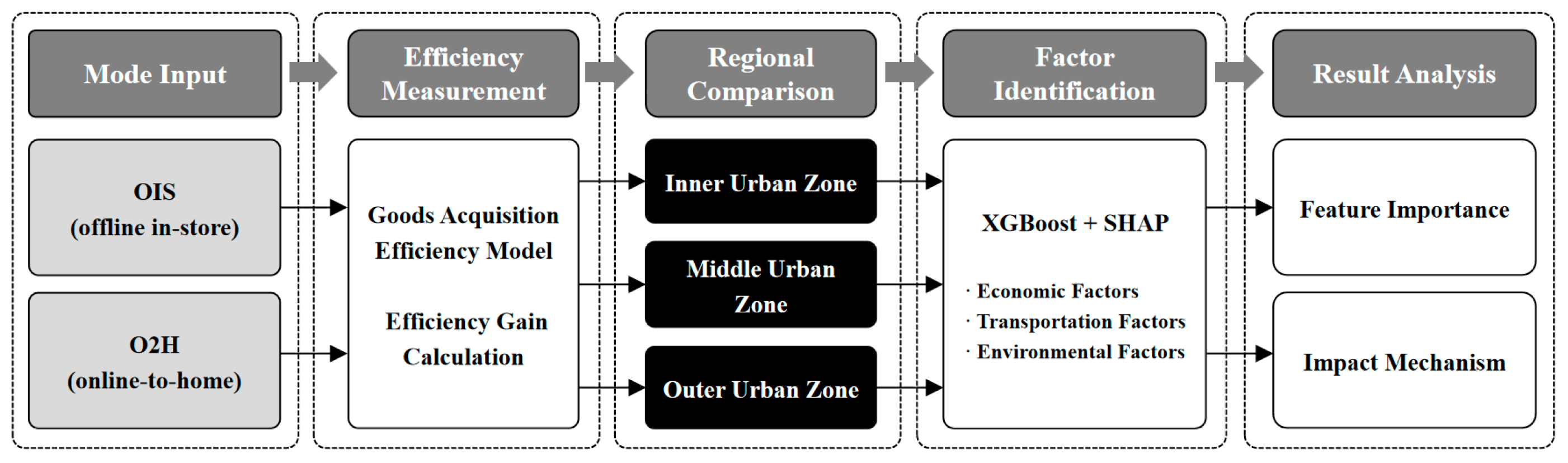
3.1. Research Design
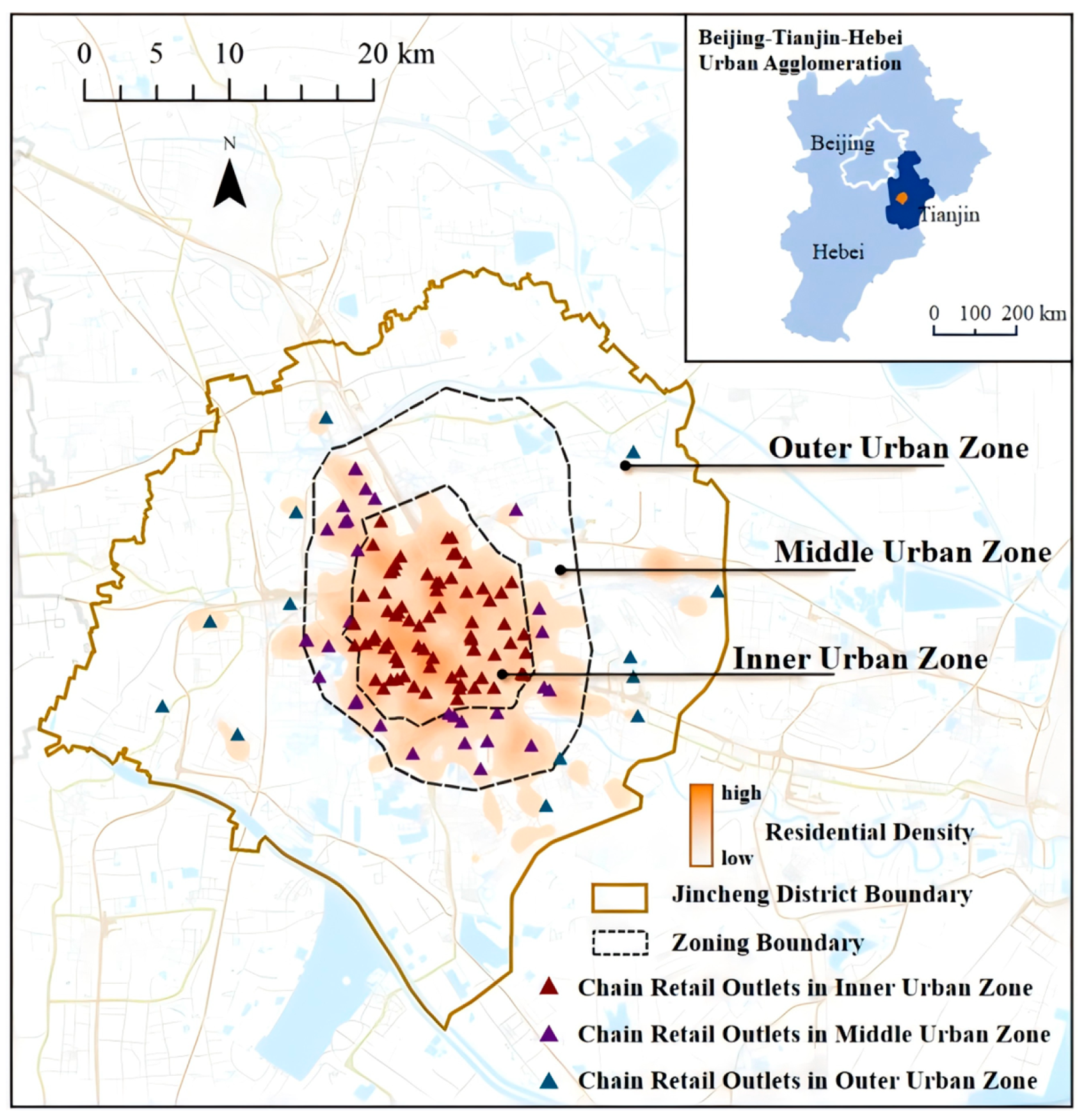
3.2. Study Area and Research Objects
3.3. Data Sources
3.4. Methods
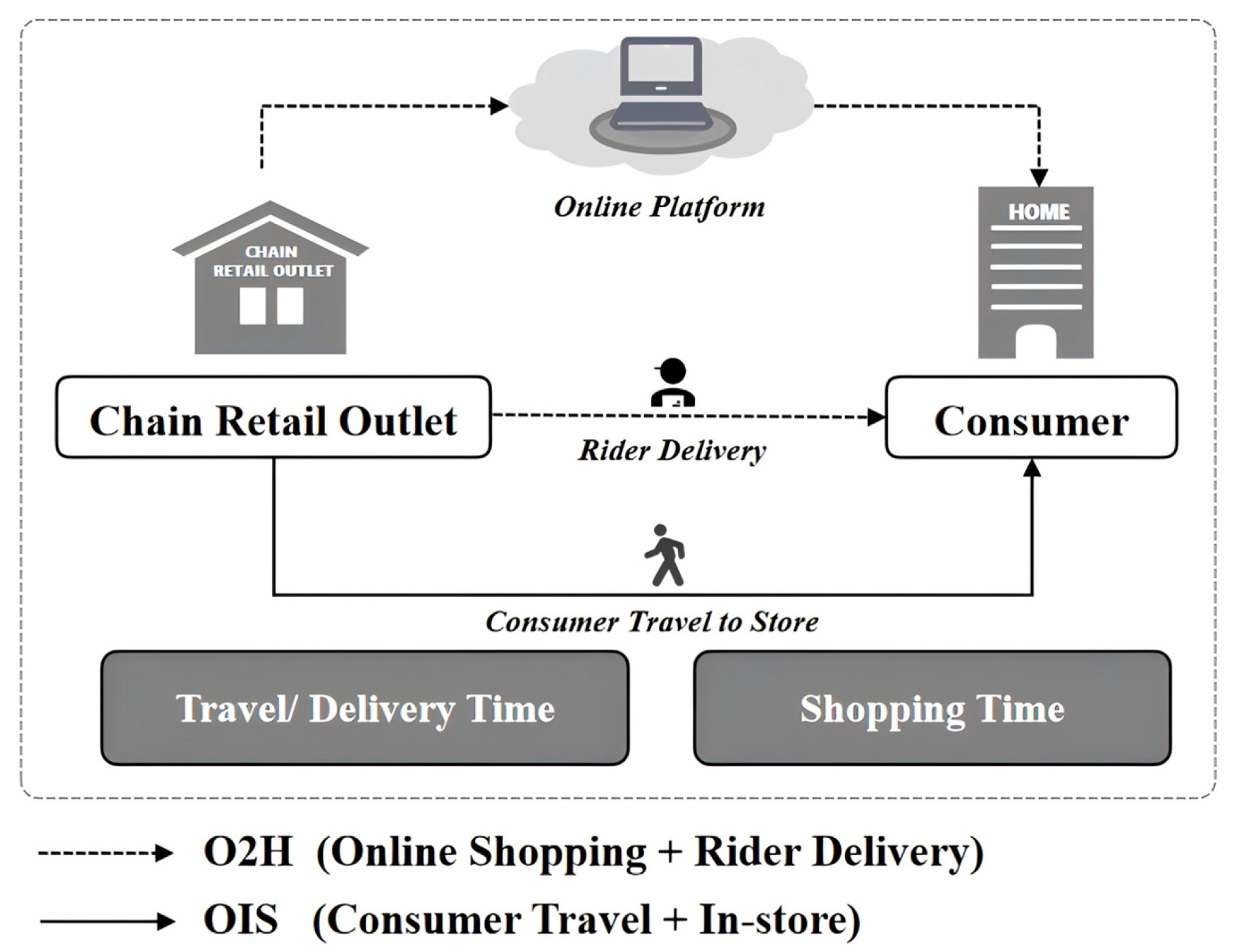
3.4.1. Goods Acquisition Efficiency Model
3.4.2. XGBoost Model
3.4.3. SHAP Analysis
4. Results
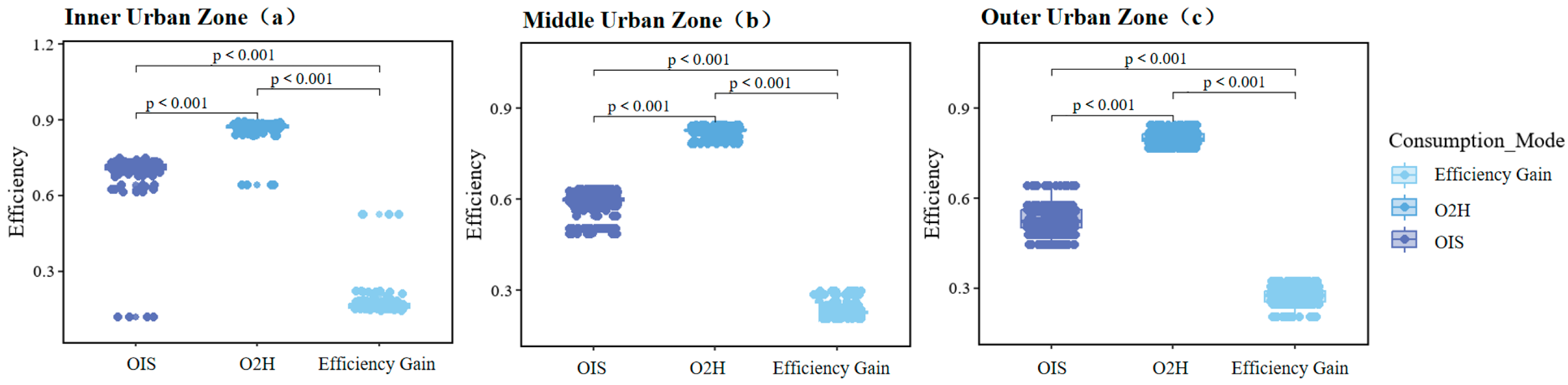
4.1. Efficiency Comparison Across Regions
4.2. Efficiency Gain Spatial Distribution
4.2.1. Spatial Pattern of Efficiency Gains
4.2.2. Robustness Check
4.3. Feature Importance Analysis
4.3.1. XGBoost Model Fitting Result
4.3.2. Feature Importance Results
4.4. SHAP Dependence Analysis
4.4.1. Overall Distribution of Feature Contributions
4.4.2. Influence Patterns of Key Features
5. Discussion
5.1. Explaining Regional Differences in Efficiency Gains
5.2. Implications for Retail Network Configuration
- (1)
- Inner Urban Zone: Stabilize store layout and reinforce “experience + instant acquisition”
- (2)
- Outer Urban Zone: Build a hybrid fulfillment system of “stores + micro-fulfillment centers”
- (3)
- Middle Urban Zone: Adopt a “flexible store strategy” tailored to local characteristics
- (4)
- Implications for urban planning: O2H may accelerate spatial decentralization
6. Conclusions
- (1)
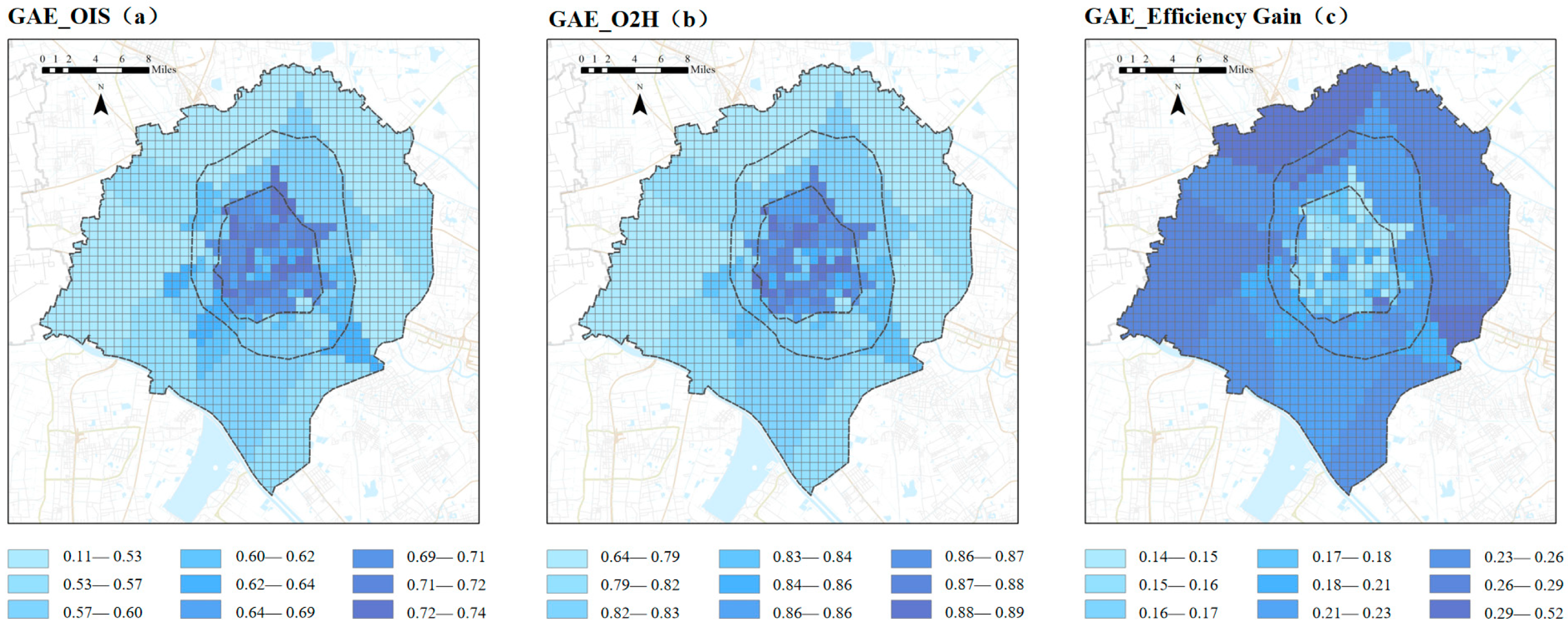
- O2H-induced efficiency gains exhibit a concentric pattern—low in the core and high in the periphery. The Inner Urban Zone records an efficiency gain of 0.18, the Middle Urban Zone 0.20, and the Outer Urban Zone 0.26. Well-developed retail provision in the inner city leaves limited room for O2H to improve efficiency; weaker provision in peripheral areas allows instant delivery to fill a substantial time-efficiency gap.
- (2)
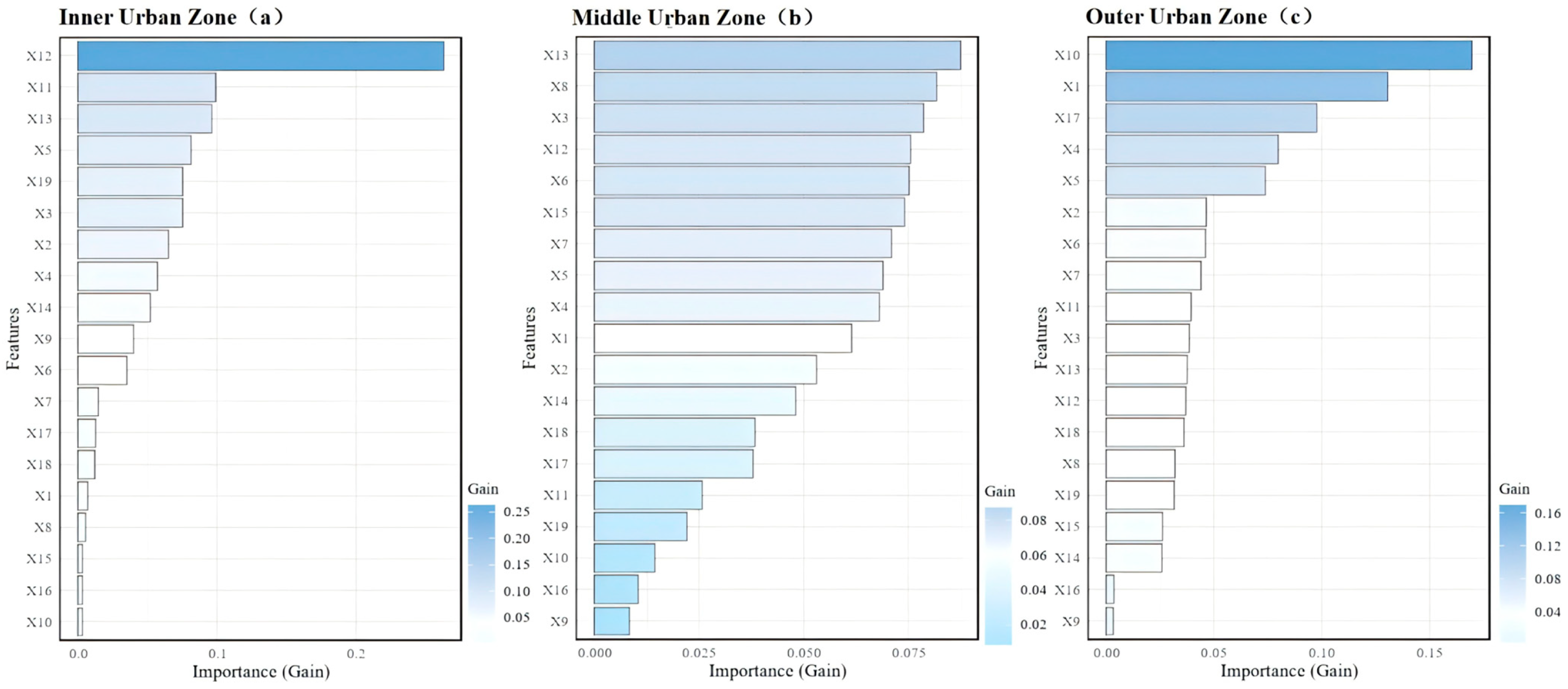
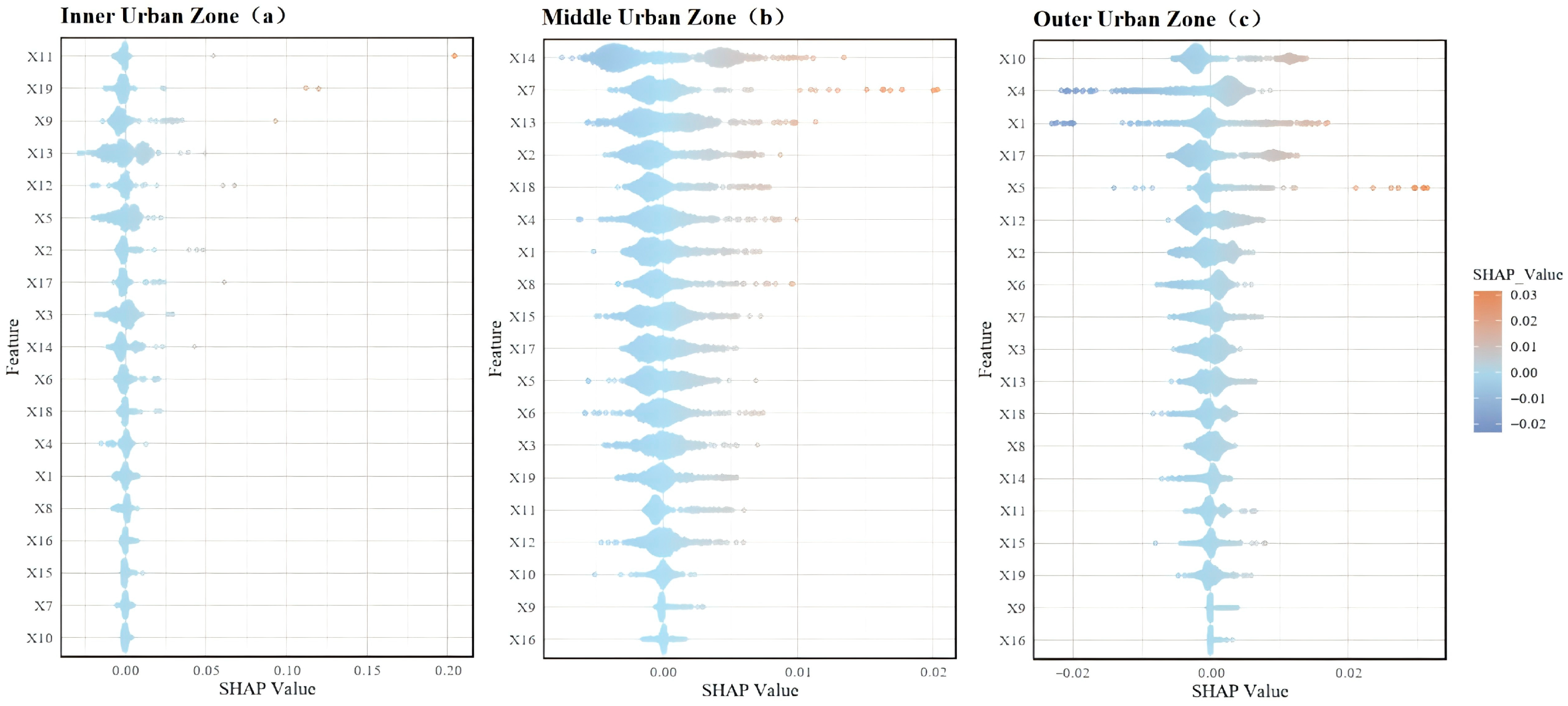
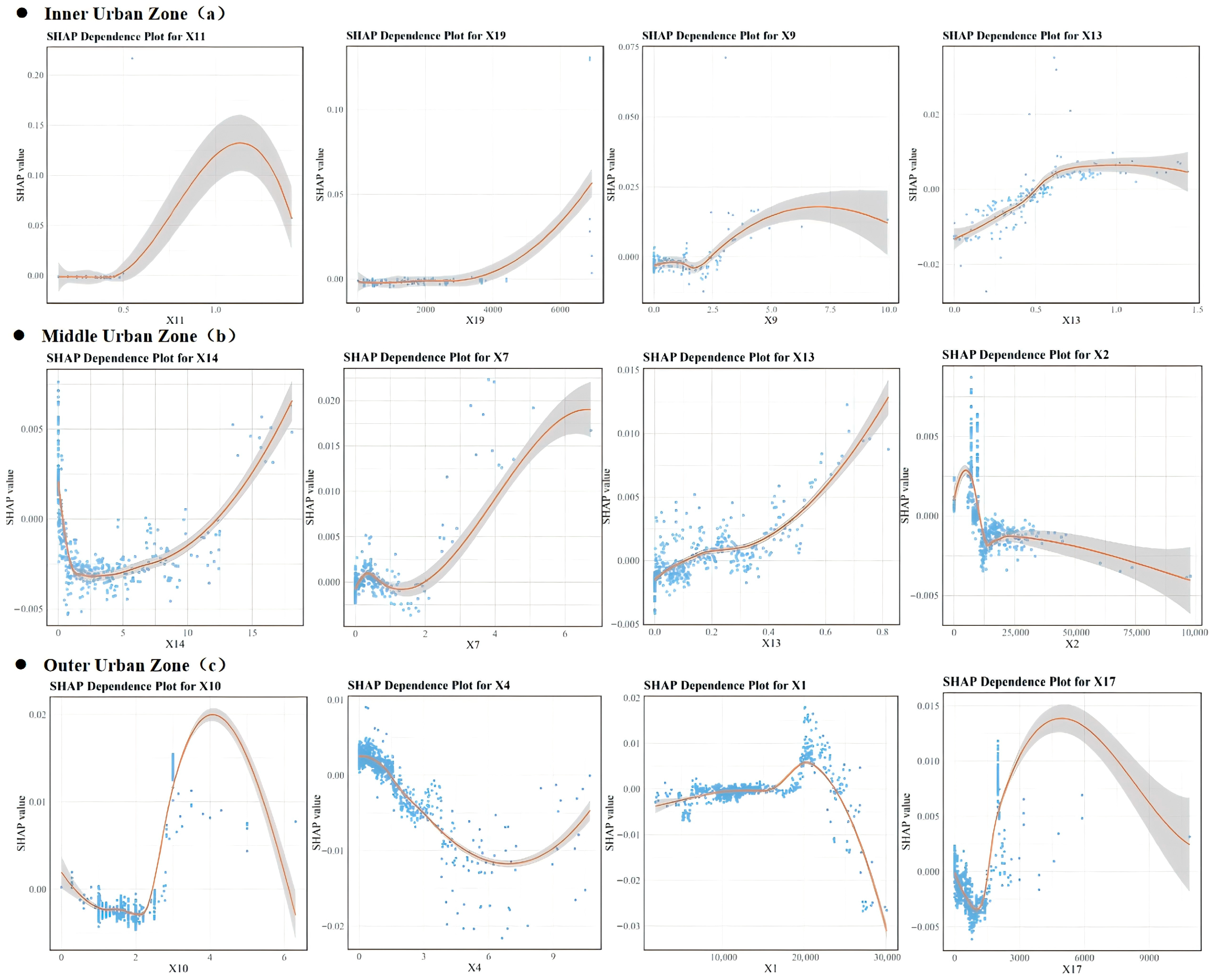
- Key factors associated with efficiency gains differ markedly across zones. Environmental attributes (green space coverage, park count, sidewalk density) predominate in the Inner Urban Zone, while transportation and economic factors (bus route density, floor area ratio, economic level) dominate in the Outer Urban Zone. These findings provide quantitative references for zone-specific store network configuration.
- (3)
- O2H and OIS exhibit a complementary relationship across zones. In the Inner Urban Zone, OIS remains time-competitive, and physical stores can maintain relative stability. In the Outer Urban Zone, O2H’s supplementary role is pronounced; stores may strengthen delivery fulfillment capacity or transition toward micro-fulfillment functions.
Author Contributions
Funding
Data Availability Statement
Acknowledgments
Conflicts of Interest
References
- Soe, A.C.; Ketkaew, C. Understanding Consumer Responses to Carbon Footprint Product Labels: A Multi-Group Analysis of Online and Offline Shopping Engagement in Retail Contexts. Digit. Bus. 2025, 5, 100158. [Google Scholar] [CrossRef]
- Chen, K.; Zhang, Q.; Wang, S. Online Coupon and Offline Service Efforts in Omnichannel Retailing with Cross-Channel Effect. Omega 2026, 138, 103423. [Google Scholar] [CrossRef]
- Gürbüz, E.; Büyükvadı, A. Avoidance Behavior and Online versus Offline Shopping Intentions: The Moderating Role of COVID-19–Related Avoidance. SAM Adv. Manag. J. 2025, 90, 397–420. [Google Scholar] [CrossRef]
- Hagström, R.; Stenius, M.; Eriksson, N. Online Grocery Shopping (OGS) as Scripted Behavior: Insights on Shopping Routines of Households with Children. Br. Food J. 2025, 127, 484–499. [Google Scholar] [CrossRef]
- Chowdhury, S.S.; Fatmi, M.R.; Orvin, M.M. Spatial Dynamics of Home Delivery and Pick-up in Online Shopping. Travel Behav. Soc. 2026, 42, 101127. [Google Scholar] [CrossRef]
- Liao, S.; Chen, Y.; Lin, Y. Mining Customer Knowledge to Implement Online Shopping and Home Delivery for Hypermarkets. Expert Syst. Appl. 2011, 38, 3982–3991. [Google Scholar] [CrossRef]
- Chevallier, L.B.; Motte-Baumvol, B.; Aguiléra, A. Online Shopping and Mobility: Exploring the Determinants of Final Delivery Solutions by French Households. Transp. Res. Procedia 2025, 82, 1151–1166. [Google Scholar] [CrossRef]
- Bönisch, L.; Von Behren, S.; Chlond, B.; Vortisch, P. Home Deliveries and Their Impacts on Travel: Capturing Shopping Behavior and Attitudes towards Shopping in a Travel Behavior Skeleton Approach. Transp. Res. Procedia 2024, 76, 409–428. [Google Scholar] [CrossRef]
- Guy, C.M. Classifications of Retail Stores and Shopping Centres: Some Methodological Issues. GeoJournal 1998, 45, 255–264. [Google Scholar] [CrossRef]
- Verma, R.; Chiara, G.D.; Goodchild, A. Does Proximity Matter in Shopping Behavior? Transp. Res. Part A Policy Pract. 2025, 196, 104471. [Google Scholar] [CrossRef]
- Teller, C.; Reutterer, T. The Evolving Concept of Retail Attractiveness: What Makes Retail Agglomerations Attractive When Customers Shop at Them? J. Retail. Consum. Serv. 2008, 15, 127–143. [Google Scholar] [CrossRef]
- Huff, D.L. A Probabilistic Analysis of Shopping Center Trade Areas. Land Econ. 1963, 39, 81. [Google Scholar] [CrossRef]
- Fotheringham, A.S. A New Set of Spatial-Interaction Models: The Theory of Competing Destinations. Environ. Plan. A 1983, 15, 15–36. [Google Scholar] [CrossRef]
- Hübner, A.H.; Kuhn, H.; Wollenburg, J. Last Mile Fulfilment and Distribution in Omni-Channel Grocery Retailing: A Strategic Planning Framework. Int. J. Retail Distrib. Manag. 2016, 44, 228–247. [Google Scholar] [CrossRef]
- Agatz, N.A.H.; Fleischmann, M.; Van Nunen, J.A.E.E. E-Fulfillment and Multi-Channel Distribution—A Review. Eur. J. Oper. Res. 2008, 187, 339–356. [Google Scholar] [CrossRef]
- Côté, J.-F.; Mansini, R.; Raffaele, A. Multi-Period Time Window Assignment for Attended Home Delivery. Eur. J. Oper. Res. 2024, 316, 295–309. [Google Scholar] [CrossRef]
- Lee, J.; Won, J.; Lee, D.; Kwak, K.T. Customer Shopping Experience in a South Korea’s Government-Run Home Shopping Channel for Small and Medium Enterprises Based on Critical Incident Technique and Unsupervised Machine Learning Analysis. Telemat. Inform. 2022, 68, 101777. [Google Scholar] [CrossRef]
- Agatz, N.; Campbell, A.; Fleischmann, M.; Savelsbergh, M. Time Slot Management in Attended Home Delivery. Transp. Sci. 2011, 45, 435–449. [Google Scholar] [CrossRef]
- Lin, I.I.; Mahmassani, H.S. Can Online Grocers Deliver?: Some Logistics Considerations. Transp. Res. Rec. J. Transp. Res. Board 2002, 1817, 17–24. [Google Scholar] [CrossRef]
- Samani, A.R.; Talebian, A.; Mishra, S.; Golias, M. Evaluating Consumer Shopping, Delivery Demands, and Last-Mile Preferences: An Integrated MDCEV-HCM Approach. Transp. Res. Part E Logist. Transp. Rev. 2025, 197, 104067. [Google Scholar] [CrossRef]
- Elms, J.; De Kervenoael, R.; Hallsworth, A. Internet or Store? An Ethnographic Study of Consumers’ Internet and Store-Based Grocery Shopping Practices. J. Retail. Consum. Serv. 2016, 32, 234–243. [Google Scholar] [CrossRef]
- Zhang, Y.; Cui, S.; Zhong, Y.; Huang, W. Spatial Patterns and Influencing Factors of Takeaway Consumption in 56 Cities in China. J. Clean. Prod. 2024, 465, 142712. [Google Scholar] [CrossRef]
- Zhang, F.; Ji, Y.; Lv, H.; Ma, X.; Kuai, C.; Li, W. Investigating Factors Influencing Takeout Shopping Demand under COVID-19: Generalized Additive Mixed Models. Transp. Res. Part D Transp. Environ. 2022, 107, 103285. [Google Scholar] [CrossRef] [PubMed]
- Hu, R.; Dong, S.; Zhao, Y.; Hu, H.; Li, Z. Assessing Potential Spatial Accessibility of Health Services in Rural China: A Case Study of Donghai County. Int. J. Equity Health 2013, 12, 35. [Google Scholar] [CrossRef]
- Chuang, Y.-F.; Huang, C.-W.; Hsieh, C.-H. Timeliness and Fairness: The Practical Model of Healthcare Emergency Logistics during the Pandemic—A Case of Taiwan. Res. Transp. Bus. Manag. 2026, 64, 101522. [Google Scholar] [CrossRef]
- Luo, W.; Qi, Y. An Enhanced Two-Step Floating Catchment Area (E2SFCA) Method for Measuring Spatial Accessibility to Primary Care Physicians. Health Place 2009, 15, 1100–1107. [Google Scholar] [CrossRef]
- Salonen, A.; Mero, J.; Munnukka, J.; Zimmer, M.; Karjaluoto, H. Digital Content Marketing on Social Media along the B2B Customer Journey: The Effect of Timely Content Delivery on Customer Engagement. Ind. Mark. Manag. 2024, 118, 12–26. [Google Scholar] [CrossRef]
- Gui, J.; Liu, H. Data-Driven Resource Allocation for Ensuring Remote Data Collection Timeliness in Integrated Ground-Air-Space Networks. Comput. Netw. 2025, 272, 111715. [Google Scholar] [CrossRef]
- Peng, C.; Xu, C.; Wang, C.; Tong, H.; Ren, W. Efficient Calibration of High-Dimensional Dynamic OD Matrix in Metropolitan Networks: Combining Dimensionality Reduction and Bagging-Based Metamodel. Transp. A Transp. Sci. 2025, 1–26. [Google Scholar] [CrossRef]
- Geurs, K.T.; Van Wee, B. Accessibility Evaluation of Land-Use and Transport Strategies: Review and Research Directions. J. Transp. Geogr. 2004, 12, 127–140. [Google Scholar] [CrossRef]
- Wang, R.; Guo, Q.; Dai, S.; Deng, L.; Xiao, Y.; Jia, C. An OD Time Prediction Model Based on Adaptive Graph Embedding. Phys. A Stat. Mech. Its Appl. 2025, 657, 130217. [Google Scholar] [CrossRef]
- Zeng, W.; Fu, C.-W.; Arisona, S.M.; Erath, A.; Qu, H. Visualizing Mobility of Public Transportation System. IEEE Trans. Visual. Comput. Graph. 2014, 20, 1833–1842. [Google Scholar] [CrossRef] [PubMed]
- Ma, Y.; Xu, M.; Qin, X.; Zeng, Y. Dynamic Isochrones Development and Analysis for the Time-Effective Performances Evaluation of Road Networks. J. Urban Manag. 2025, 14, 1311–1327. [Google Scholar] [CrossRef]
- Kelobonye, K.; Zhou, H.; McCarney, G.; Xia, J. (Cecilia) Measuring the Accessibility and Spatial Equity of Urban Services under Competition Using the Cumulative Opportunities Measure. J. Transp. Geogr. 2020, 85, 102706. [Google Scholar] [CrossRef]
- Chen, Y.; Jia, S.; Xu, Q. Evaluating the Accessibility and Equity of Key Amenities in the X-Minute and Y-Monetary-Cost City: A Double-Threshold Cumulative Opportunity Measure. J. Public Transp. 2025, 27, 100128. [Google Scholar] [CrossRef]
- Tomasiello, D.B.; Herszenhut, D.; Oliveira, J.L.A.; Braga, C.K.V.; Pereira, R.H.M. A Time Interval Metric for Cumulative Opportunity Accessibility. Appl. Geogr. 2023, 157, 103007. [Google Scholar] [CrossRef]
- Dalvi, M.Q.; Martin, K.M. The Measurement of Accessibility: Some Preliminary Results. Transportation 1976, 5, 17–42. [Google Scholar] [CrossRef]
- Liu, X.; Ben Liu, Q. Superior Medical Resources or Geographic Proximity? The Joint Effects of Regional Medical Resource Disparity, Geographic Distance, and Cultural Differences on Online Medical Consultation. Soc. Sci. Med. 2024, 350, 116911. [Google Scholar] [CrossRef]
- Chawla, U.; Verma, B.; Mittal, A. Resistance to O2O Technology Platform Adoption among Small Retailers: The Influence of Visibility and Discoverability. Technol. Soc. 2024, 76, 102482. [Google Scholar] [CrossRef]
- Langford, M.; Higgs, G.; Fry, R. Multi-Modal Two-Step Floating Catchment Area Analysis of Primary Health Care Accessibility. Health Place 2016, 38, 70–81. [Google Scholar] [CrossRef]
- Páez, A.; Scott, D.M.; Morency, C. Measuring Accessibility: Positive and Normative Implementations of Various Accessibility Indicators. J. Transp. Geogr. 2012, 25, 141–153. [Google Scholar] [CrossRef]
- Li, W.; Guan, H.; Qin, W.; Ji, X. Collective and Individual Spatial Equity Measure in Public Transit Accessibility Based on Generalized Travel Cost. Res. Transp. Econ. 2023, 98, 101263. [Google Scholar] [CrossRef]
- Ben-Akiva, M.; Bierlaire, M. Discrete Choice Methods and Their Applications to Short Term Travel Decisions. In Handbook of Transportation Science; Hall, R.W., Ed.; International Series in Operations Research & Management Science; Springer: Boston, MA, USA, 1999; Volume 23, pp. 5–33. ISBN 978-1-4613-7370-4. [Google Scholar]
- Xu, J.; Nair, D.J. Pre-Disaster Evacuation Network Design with Uncertain Demand and Behavioural Choices: A Bi-Criteria Generalized Cost Perspective. Transp. Res. Interdiscip. Perspect. 2024, 26, 101186. [Google Scholar] [CrossRef]
- Anelli, F.; Ciaramelli, E.; Arzy, S.; Frassinetti, F. Prisms to Travel in Time: Investigation of Time-Space Association through Prismatic Adaptation Effect on Mental Time Travel. Cognition 2016, 156, 1–5. [Google Scholar] [CrossRef]
- Chen, H.-P.; Li, Z.-C.; Chen, B.Y. Probabilistic Space-Time Prisms in Road Networks with Travel Time Uncertainties. J. Transp. Geogr. 2026, 131, 104544. [Google Scholar] [CrossRef]
- Zheng, R.; Wang, C.; Yin, S. Estimating Carbon Emissions from In-Store Shopping and Timely Home Delivery of Fresh Produce: Evidence from China. J. Clean. Prod. 2025, 501, 145222. [Google Scholar] [CrossRef]
- Li, Z.; Chen, X.; Li, S. Delivery Timeliness Disclosure Strategy in Platform-Based Instant Retail Industries: Understanding the Effect of Consumer Loss Aversion. Transp. Res. Part E Logist. Transp. Rev. 2025, 201, 104288. [Google Scholar] [CrossRef]
- Jevremović, S.; Arnaut, F.; Mickovski Katalina, N.; Kolarski, A.; Vasiljević, Z.; Medarević, A. Potential Spatial Accessibility to Primary Percutaneous Coronary Intervention (pPCI) Facilities in the Republic of Serbia for the Year 2030. Urban Sci. 2025, 9, 355. [Google Scholar] [CrossRef]
- Hu, J.; Cheng, Z.; Zhong, G.; Huang, Z. A Calculation Method and Its Application of Bus Isochrones. J. Transp. Syst. Eng. Inf. Technol. 2013, 13, 99–104. [Google Scholar] [CrossRef]
- Deboosere, R.; El-Geneidy, A. Evaluating Equity and Accessibility to Jobs by Public Transport across Canada. J. Transp. Geogr. 2018, 73, 54–63. [Google Scholar] [CrossRef]
- Wu, H.; Levinson, D. Optimum Stop Spacing for Accessibility. Eur. J. Transp. Infrastruct. Res. 2021, 21, 1–18. [Google Scholar] [CrossRef]
- Liu, L.; Wang, F. Reconciling 2SFCA and i2SFCA via Distance Decay Parameterization. Int. J. Geogr. Inf. Sci. 2025, 1–18. [Google Scholar] [CrossRef]
- Chen, X.; Jia, P. A Comparative Analysis of Accessibility Measures by the Two-Step Floating Catchment Area (2SFCA) Method. Int. J. Geogr. Inf. Sci. 2019, 33, 1739–1758. [Google Scholar] [CrossRef]
- Drezner, T.; Drezner, Z.; Zerom, D. Facility Dependent Distance Decay in Competitive Location. Netw. Spat. Econ. 2020, 20, 915–934. [Google Scholar] [CrossRef]
- Zhao, H.; Yan, L. Improve the Firefly Algorithm to Solve the Order Batching Problem of the “Cargo-to-Picker” Picking System. In Proceedings of the 2024 IEEE 6th International Symposium on Robotics & Intelligent Manufacturing Technology (ISRIMT), Changzhou, China, 20–22 September 2024; pp. 370–373. [Google Scholar]
- Kazem, A.A.L.; Hasan, B.A. Testing the Rule of the Earliest Due Date (EDD) in Achieving the Priority of Delivery: A Case Study in the Directorate of Printing Press for the Iraqi Media Network. J. Tech. 2022, 4, 109–114. [Google Scholar] [CrossRef]
- Wei, Z.; Huang, W.; Tang, Q.; Xie, R. Spatial Heterogeneities of O2O Retail Space in Urban China under Digital Transformation: Evidence from Guangzhou, China. Chin. Geogr. Sci. 2025, 35, 963–981. [Google Scholar] [CrossRef]
- Wei, Z.; Tang, Q.; Zhen, F. Spatial and Social Heterogeneities of Residents’ Online Shopping Behaviors within a Large Chinese City: The Case of Weifang. Appl. Geogr. 2024, 167, 103289. [Google Scholar] [CrossRef]
- Kong, Y.; Zhen, F.; Ubul, E.; Zhang, S.; Luan, H. Spatial and Socioeconomic Disparities in the Availability of Healthy Food via Online Food Delivery Services in Nanjing, China: An Analysis Based on Absolute and Relative Measures. Health Place 2025, 95, 103546. [Google Scholar] [CrossRef]
- Gao, F.; Liao, S.; Jiao, Z.; Hu, Z.; Liu, Y.; Li, H.; Wu, J.; Chen, W.; Li, G. Location Differs between Traditional and New Retail: A Comparison Analysis of Starbucks and Luckin Coffee in China Using Machine Learning. Cities 2025, 158, 105668. [Google Scholar] [CrossRef]
- Li, L.; Feng, R.; Xi, J.; Wang, F. Spatial Drivers and Effects of Urban Food Accessibility: Comparison of Conventional and Online-to-Offline Services. Appl. Geogr. 2023, 152, 102894. [Google Scholar] [CrossRef]
- Li, L.; Wang, D. Do Neighborhood Food Environments Matter for Eating through Online-to-Offline Food Delivery Services? Appl. Geogr. 2022, 138, 102620. [Google Scholar] [CrossRef]
- Cheng, L.; Zhang, J.; Su, J.; Yin, H.; Kong, F.; Li, Z. Accessibility and Fairness of Community Retailing under Offline and Online Scenarios. Prog. Geogr. 2022, 41, 2297–2310. [Google Scholar] [CrossRef]
- Tianjin Municipal Planning and Natural Resources Bureau. Jincheng Overall Urban Design (2021–2035); Tianjin Municipal Planning and Natural Resources Bureau: Tianjin, China, 2021.
- Han, D.; Yang, X.; Cai, H.; Xu, X.; Qiao, Z.; Cheng, C.; Dong, N.; Huang, D.; Liu, A. Modelling Spatial Distribution of Fine-Scale Populations Based on Residential Properties. Int. J. Remote Sens. 2019, 40, 5287–5300. [Google Scholar] [CrossRef]
- Xu, X. China Population Spatial Distribution Kilometer Grid Dataset. Available online: https://www.resdc.cn/DOI/doi.aspx?DOIid=32 (accessed on 12 April 2024).
- Dong, Y. The Influence of Land-Use on Travel Pattern of Shopping-Mall in West-District of Hangzhou. Master’s Thesis, Zhejiang University, Hangzhou, China, 2013. [Google Scholar]
- Chen, T.; Guestrin, C. XGBoost: A Scalable Tree Boosting System. arXiv 2016, arXiv:1603.02754. [Google Scholar] [CrossRef]
- Chen, X. Consumer Online Shopping Behavior Prediction Based on Machine Learning Algorithm. Procedia Comput. Sci. 2025, 262, 1395–1401. [Google Scholar] [CrossRef]
- Farag, S.; Krizek, K.J.; Dijst, M. E-shopping and Its Relationship with In-store Shopping: Empirical Evidence from the Netherlands and the USA. Transp. Rev. 2006, 26, 43–61. [Google Scholar] [CrossRef]
- Farag, S.; Schwanen, T.; Dijst, M.; Faber, J. Shopping Online and/or in-Store? A Structural Equation Model of the Relationships between e-Shopping and in-Store Shopping. Transp. Res. Part A Policy Pract. 2007, 41, 125–141. [Google Scholar] [CrossRef]
- Farag, S.; Weltevreden, J.; Van Rietbergen, T.; Dijst, M.; Van Oort, F. E-Shopping in the Netherlands: Does Geography Matter? Environ. Plan. B Plan. Des. 2006, 33, 59–74. [Google Scholar] [CrossRef]
- Arranz-López, A.; Blitz, A.; Elizondo-Candanedo, R.F.; Lanzendorf, M. The Connections between E-Shopping and Sustainable Transport Choices—Comparing Urban and Rural Environments. J. Transp. Geogr. 2024, 117, 103898. [Google Scholar] [CrossRef]
- Jones, C. Reframing the Intra-Urban Retail Hierarchy. Cities 2021, 109, 103037. [Google Scholar] [CrossRef]
- Peterson, M.; McGee, J.E. Survivors of “W-day”: An Assessment of the Impact of Wal-mart’s Invasion of Small Town Retailing Communities. Int. J. Retail Distrib. Manag. 2000, 28, 170–180. [Google Scholar] [CrossRef]
- Burt, S.; Sparks, L. The Implications of Wal-Mart’s Takeover of ASDA. Environ. Plan A 2001, 33, 1463–1487. [Google Scholar] [CrossRef]
- Jebarajakirthy, C.; Das, M.; Shah, D.; Shankar, A. Deciphering In-Store-Online Switching in Multi-Channel Retailing Context: Role of Affective Commitment to Purchase Situation. J. Retail. Consum. Serv. 2021, 63, 102742. [Google Scholar] [CrossRef]
- Mateos-Mínguez, P.; Arranz-López, A.; Soria-Lara, J.A. Analysing the Spatial Impacts of Retail Accessibility for E-Shoppers’ Groups. Transp. Res. Procedia 2022, 60, 544–551. [Google Scholar] [CrossRef]
- Maat, K.; Konings, R. Accessibility or Innovation? Store Shopping Trips versus Online Shopping. Transp. Res. Rec. J. Transp. Res. Board 2018, 2672, 1–10. [Google Scholar] [CrossRef]
- Titiloye, I.; Al Adib Sarker, M.; Asgari, H.; Jin, X. Online and In-Store Shopping Interactions for Non-Essential Experience Goods. Comput. Urban Sci. 2023, 3, 29. [Google Scholar] [CrossRef]
- Shi, K.; De Vos, J.; Yang, Y.; Witlox, F. Does E-Shopping Replace Shopping Trips? Empirical Evidence from Chengdu, China. Transp. Res. Part A Policy Pract. 2019, 122, 21–33. [Google Scholar] [CrossRef]
- Luo, X.; Zhang, Y.; Zeng, F.; Qu, Z. Complementarity and Cannibalization of Offline-to-Online Targeting: A Field Experiment on Omnichannel Commerce. MIS Q. 2020, 44, 957–982. [Google Scholar] [CrossRef]
- Chen, Y.; Hu, X.; Li, S. Complementarity between Online and Offline Channels for Quality Signaling. J. Econ. 2021, 135, 49–74. [Google Scholar] [CrossRef]
- Neslin, S.A. The Omnichannel Continuum: Integrating Online and Offline Channels along the Customer Journey. J. Retail. 2022, 98, 111–132. [Google Scholar] [CrossRef]
- Etminani-Ghasrodashti, R.; Hamidi, S. Online Shopping as a Substitute or Complement to In-Store Shopping Trips in Iran? Cities 2020, 103, 102768. [Google Scholar] [CrossRef]
- Martín-Herrán, G.; Sigué, S.-P. Is Multichannel Retail Marketing Integration a Panacea? J. Oper. Res. Soc. 2025, 76, 1630–1648. [Google Scholar] [CrossRef]
- Li, E.; Dijst, M.; Yang, Y.; Shi, K.; Witlox, F. Revisiting the Effects of E-Shopping on Shopping Trips: Empirical Evidence from Chengdu, China. Res. Transp. Bus. Manag. 2025, 63, 101496. [Google Scholar] [CrossRef]
- Dias, F.F.; Lavieri, P.S.; Sharda, S.; Khoeini, S.; Bhat, C.R.; Pendyala, R.M.; Pinjari, A.R.; Ramadurai, G.; Srinivasan, K.K. A Comparison of Online and In-Person Activity Engagement: The Case of Shopping and Eating Meals. Transp. Res. Part C Emerg. Technol. 2020, 114, 643–656. [Google Scholar] [CrossRef]
- Piotrowicz, W.; Cuthbertson, R. Introduction to the Special Issue Information Technology in Retail: Toward Omnichannel Retailing. Int. J. Electron. Commer. 2014, 18, 5–16. [Google Scholar] [CrossRef]
- Verhoef, P.C.; Kannan, P.K.; Inman, J.J. From Multi-Channel Retailing to Omni-Channel Retailing. J. Retail. 2015, 91, 174–181. [Google Scholar] [CrossRef]
- Lim, S.F.W.T.; Jin, X.; Srai, J.S. Consumer-Driven e-Commerce: A Literature Review, Design Framework, and Research Agenda on Last-Mile Logistics Models. Int. J. Phys. Distrib. Logist. Manag. 2018, 48, 308–332. [Google Scholar] [CrossRef]



| Category | Method | Measurement Focus | Application Context |
|---|---|---|---|
| Time-based Accessibility | OD shortest time [29,30,31], Isochrone [30,32,33] | Minimum travel time from origin to destination | Public service allocation; facility siting |
| Cumulative opportunity [34,35,36,37] | Number of facilities reachable within a time threshold | Employment accessibility; retail coverage | |
| Gravity/Potential model [38,39] | Facility attractiveness weighted by distance decay | Commercial center catchment | |
| 2SFCA and variants (with decay) [40,41] | Supply-demand matching efficiency | Healthcare resources; elderly care facilities | |
| Fulfillment Timeliness | Generalized cost [42,43,44] | Composite cost of time, expense, and experience | Travel mode choice |
| Space-Time Prism [45,46] | Feasible activity space under spatiotemporal constraints | Activity-travel behavior | |
| Delivery timeliness performance [47,48] | On-time rate; delay duration | E-commerce logistics; instant delivery |
| Variable Type | Variable Name | Calculation Method | Data Source | Processing |
|---|---|---|---|---|
| Environmental factors | Efficiency gain (Y) | GAE(O2H) − GAE(OIS) | - | - |
| Environmental factors | Economic level (X1) | Total GDP within 1 km × 1 km grid | RESDC, CAS [66,67] | Z-score |
| Consumption level (X2) | Mean housing price at township/subdistrict level | Lianjia.com https://tj.lianjia.com (Accessed on 12 April 2024) | Z-score | |
| Environmental factors | Road network density (X3) | Mean road density at township/subdistrict level | ArcGIS 10.8 extraction | - |
| Bus route density (X4) | Mean bus route density at township/subdistrict level | ArcGIS 10.8 extraction | - | |
| Metro line density (X5) | Mean metro line density at township/subdistrict level | ArcGIS 10.8 extraction | - | |
| Bus stop count (X6) | Number of bus stop POIs at township/subdistrict level | Amap API | - | |
| Metro network density (X7) | Mean metro network density at township/subdistrict level | ArcGIS 10.8 extraction | - | |
| Primary road density (X8) | Mean primary road density at township/subdistrict level | ArcGIS 10.8 extraction | - | |
| Sidewalk density (X9) | Mean sidewalk density at township/subdistrict level | ArcGIS extraction | - | |
| Environmental factors | Floor area ratio (X10) | Mean FAR at township/subdistrict level | ArcGIS 10.8 extraction | - |
| Green space coverage (X11) | Mean green coverage at township/subdistrict level | ArcGIS 10.8 extraction | Z-score | |
| Healthcare facility count (X12) | Number of healthcare POIs at township/subdistrict level | Amap API | - | |
| Park count (X13) | Number of park POIs at township/subdistrict level | Amap API | - | |
| Residential community count (X14) | Number of residential community POIs at township/subdistrict level | Amap API | - | |
| Educational facility count (X15) | Number of school POIs at township/subdistrict level | Amap API | - | |
| Commercial facility count (X16) | Number of commercial center POIs at township/subdistrict level | Amap API | - | |
| Parking space count (X17) | Number of parking POIs at township/subdistrict level | Amap API | - | |
| Residential building count (X18) | Mean number of residential buildings at township/subdistrict level | ArcGIS 10.8 extraction | Z-score | |
| Household count (X19) | Mean number of households at township/subdistrict level | ArcGIS 10.8 extraction | Z-score |
| Mode | Travel | Shopping (Offline) | Delivery | Shopping (Online) |
|---|---|---|---|---|
| OIS | 0.370 | 0.63 | - | - |
| O2H | - | - | 0.381 | 0.619 |
| Urban Zone | n_estimators | learning_rate | max_depth | subsample | colsample_bytree | reg_lambda (L2) |
|---|---|---|---|---|---|---|
| Inner Urban Zone | 1000 | 0.01 | 10 | 0.8 | 0.8 | 0.2 |
| Middle Urban Zone | 500 | 0.02 | 6 | 0.3 | 0.3 | 1.0 |
| Outer Urban Zone | 1000 | 0.01 | 10 | 0.5 | 0.5 | 0.2 |
| Urban Zone | Efficiency Gain (Entropy Weight) | Time Saving Ratio/% |
|---|---|---|
| Inner Urban Zone | 0.18 | 56.8 |
| Middle Urban Zone | 0.2 | 62.6 |
| Outer Urban Zone | 0.26 | 69.6 |
| Inner Urban Zone | Middle Urban Zone | Outer Urban Zone | ||||||||||
|---|---|---|---|---|---|---|---|---|---|---|---|---|
| Metric | MAE | RMSE | MAPE | R2 | MAE | RMSE | MAPE | R2 | MAE | RMSE | MAPE | R2 |
| Training | 0.000 | 0.001 | 0.003 | 1.000 | 0.003 | 0.005 | 0.051 | 0.923 | 0.002 | 0.003 | 0.041 | 0.988 |
| Test set | 0.014 | 0.023 | 0.028 | 0.864 | 0.009 | 0.013 | 0.034 | 0.509 | 0.007 | 0.012 | 0.045 | 0.719 |
| Zone | Moran’s I | p-Value | Spatial Autocorrelation |
|---|---|---|---|
| Inner Urban Zone | 0.002 | 0.281 | Not significant |
| Middle Urban Zone | 0.398 | <0.001 | Significant |
| Outer Urban Zone | 0.141 | <0.001 | Significant |
Disclaimer/Publisher’s Note: The statements, opinions and data contained in all publications are solely those of the individual author(s) and contributor(s) and not of MDPI and/or the editor(s). MDPI and/or the editor(s) disclaim responsibility for any injury to people or property resulting from any ideas, methods, instructions or products referred to in the content. |
© 2026 by the authors. Licensee MDPI, Basel, Switzerland. This article is an open access article distributed under the terms and conditions of the Creative Commons Attribution (CC BY) license.
Share and Cite
Zhang, Y.; Zhang, H.; Shang, X.; Dong, H.; Wang, C.; Li, Y. Spatial Heterogeneity of O2H-Induced Efficiency Gains in Chain Retail Space: Evidence from Tianjin, China. Appl. Sci. 2026, 16, 2761. https://doi.org/10.3390/app16062761
Zhang Y, Zhang H, Shang X, Dong H, Wang C, Li Y. Spatial Heterogeneity of O2H-Induced Efficiency Gains in Chain Retail Space: Evidence from Tianjin, China. Applied Sciences. 2026; 16(6):2761. https://doi.org/10.3390/app16062761
Chicago/Turabian StyleZhang, Yuxue, He Zhang, Xuefeng Shang, Hongjie Dong, Chao Wang, and Yantong Li. 2026. "Spatial Heterogeneity of O2H-Induced Efficiency Gains in Chain Retail Space: Evidence from Tianjin, China" Applied Sciences 16, no. 6: 2761. https://doi.org/10.3390/app16062761
APA StyleZhang, Y., Zhang, H., Shang, X., Dong, H., Wang, C., & Li, Y. (2026). Spatial Heterogeneity of O2H-Induced Efficiency Gains in Chain Retail Space: Evidence from Tianjin, China. Applied Sciences, 16(6), 2761. https://doi.org/10.3390/app16062761