Article

Aerodynamic Optimization of Shroudless Cooling Centrifugal Fan Blades for Motors Using a GA-Kriging Model

1
College of Mechanical Engineering, Zhejiang University of Technology, 18 Chaowang Road, Hangzhou 310032, China
2
Institue of Innovation Research of Shengzhou, Zhejiang University of Technology, Shengzhou 312400, China
*
Author to whom correspondence should be addressed.
Appl. Sci. 2026, 16(6), 2651; https://doi.org/10.3390/app16062651
Submission received: 3 February 2026 / Revised: 5 March 2026 / Accepted: 7 March 2026 / Published: 10 March 2026
(This article belongs to the Section Energy Science and Technology)

Abstract

Large-scale backward-curved centrifugal fans without volutes are extensively employed in enclosed air-cooled electric motors owing to their exceptional heat dissipation performance. This category of fans features substantial blade dimensions and a multitude of optimization parameters, which introduce challenges such as diminished predictive accuracy in high-dimensional optimization spaces. To address these issues, this paper proposes a blade optimization design methodology based on a GA-Kriging surrogate model. Sobol’s global sensitivity analysis is first employed to reduce model dimensionality. Subsequently, a high-fidelity aerodynamic performance prediction model is constructed through the integration of a Genetic Algorithm (GA) and a Kriging model. A constrained optimization is then conducted with volumetric flow rate and static pressure as the design objectives, and shaft power along with geometric point coordinates as the constraints. Experimental test results demonstrate that the fan optimized via the surrogate model, while maintaining low prediction error, achieves a 14% increase in volumetric flow rate and a 20% improvement in static pressure. This outcome indicates a significant enhancement in the overall aerodynamic performance.

1. Introduction

Research Background and Significance

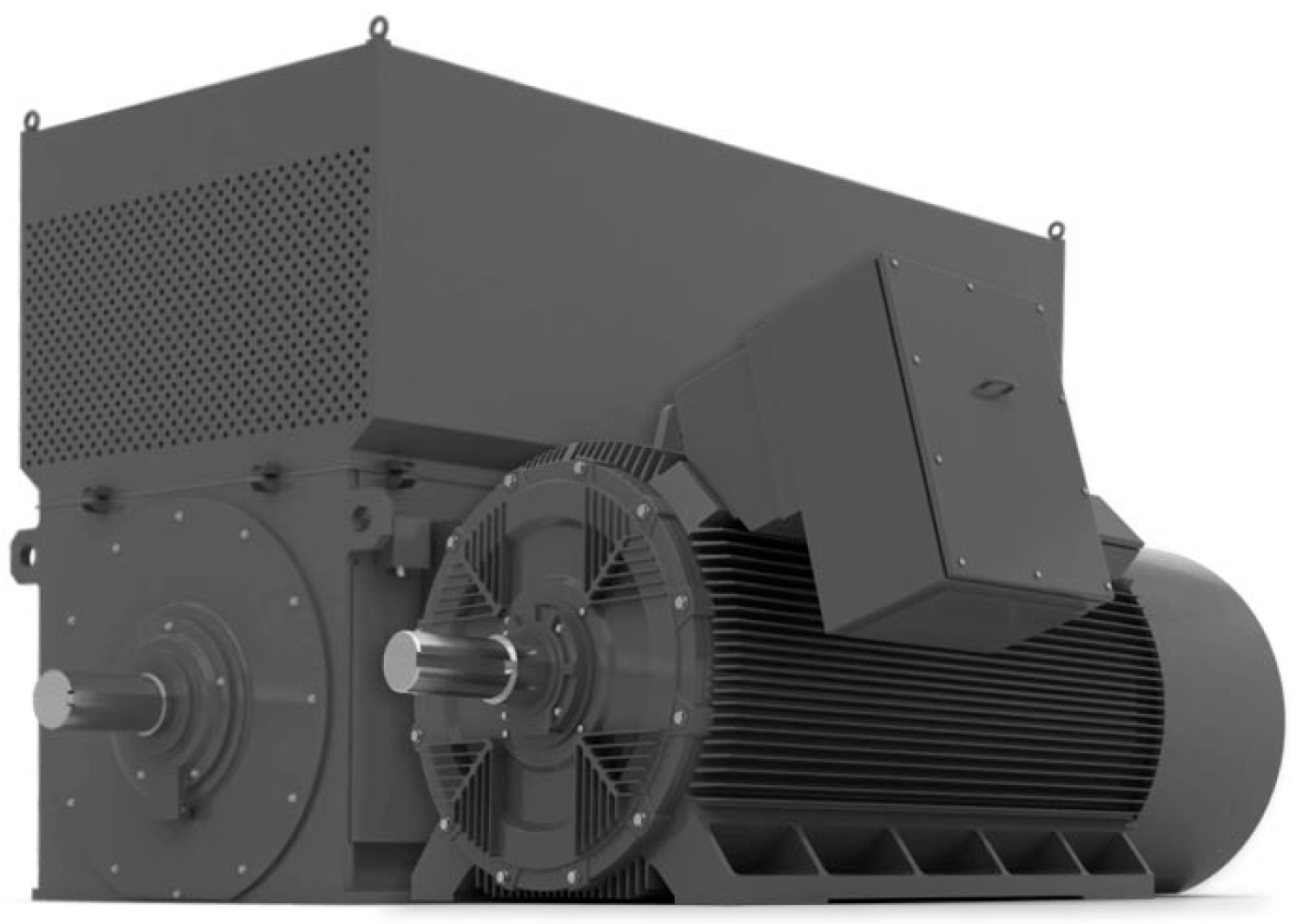
Box-type explosion-proof motors are critical power equipment in industries such as petrochemicals, coal mining, and natural gas, meeting global energy demands while addressing environmental challenges [1]. During operation, heat is generated in the stator windings, rotor, and bearings due to electrical currents and friction [2]. Excessive temperatures can shorten the motor’s lifespan, making a well-designed cooling environment essential. As illustrated in Figure 1, within a totally-enclosed fan-cooled (TEFC) asynchronous motor, a centrifugal fan is employed for cooling purposes. Driven by the motor shaft, the fan impeller rotates to dissipate heat from the heat exchanger [3]. The performance of these fans directly influences temperature rise control and the motor’s operational longevity. However, traditional blade designs often face issues such as airflow separation and vortex losses, resulting in insufficient air volume and static pressure, which compromise cooling effectiveness. Optimizing the design of centrifugal fan blades is therefore urgently needed. Yet, challenges like large blade dimensions, complex optimization parameters, and the need for high-dimensional prediction accuracy complicate the design process. Enhancing blade design can significantly improve heat dissipation efficiency, reduce energy consumption, and ensure thermal stability and extended service life.
In recent years, numerous scholars, both domestic and international, have conducted research on centrifugal fan impellers for large-scale industrial applications and have developed various methods to optimize them. Jian Lei et al. [4] utilized Bézier curves to optimize the design of blades with varying chord lengths, effectively improving the outlet flow field and enhancing the aerodynamic performance of centrifugal fans. Other scholars have proposed novel research methods in the field of bionic blades. Wenping Shao et al. [5], for instance, designed a new blade structure by coupling an improved airfoil profile at the mid-arc section, increasing the efficiency of a cotton picker’s centrifugal fan from 60.3% to 64.8%. Zhou et al. [6] optimized centrifugal fan blades based on the Hicks-Henne function combined with the NSGA-II algorithm, targeting efficiency and flow rate. Experimental verification confirmed that this approach effectively improved efficiency and reduced the energy consumption of the ventilation unit. Furthermore, some scholars have researched and advanced the application of CST (Class-Shape Transformation) airfoil functions for centrifugal fan blades. Shuiqing Zhou et al. [7] employed a perturbed CST function along with an RBF (Radial Basis Function) surrogate model to parametrically optimize the blades of a centrifugal fan for an air conditioning system. This work provided a new perspective for the efficient and energy-saving design of blades with fewer parameters. Although airfoil functions offer reference value in blade parametric design, they face challenges such as high dependency on samples, dispersed optimization directions, and limited performance potential.
With the advancement of machine learning and artificial intelligence, neural networks have demonstrated substantial potential in blade optimization design. When combined with Design of Experiments (DOE) methods, they can effectively conduct optimization predictions and significantly reduce computational costs. Lei Zhang [8] focused on the G4-73 backward-inclined centrifugal fan, establishing a performance prediction and optimization model by integrating orthogonal design, a Backpropagation (BP) neural network, and a genetic algorithm. Experimental results indicated that the new impeller significantly enhanced total pressure and efficiency, while also achieving noise reduction and a broadening of the high-efficiency operating range under most conditions. Research has also been conducted on Multilayer Perceptron (MLP) neural networks in the field of blade optimization. Yan Niu et al. [9], taking a compressor as the research object, combined machine learning models to predict the aerodynamic characteristics on the blade surface. However, such machine learning model predictions require extensive databases for training. The Kriging surrogate model, as an efficient surrogate modeling technique, is widely applied in fan optimization. It constructs a high-precision response surface using a small number of sample points, markedly decreasing computational load while enabling multi-objective optimization. Meng et al. [10] employed an adaptive Kriging surrogate model combined with Latin Hypercube Sampling (LHS) and the NSGA-II algorithm for the multi-objective optimization of centrifugal fan volute geometric parameters, with aerodynamic efficiency and total pressure as the optimization objectives. This approach effectively enhanced the overall fan performance. Ruan et al. [11] focused on the centrifugal fan used in a camellia oleifera shaking machine. They constructed a Kriging surrogate model to predict airflow rate (Q) and total efficiency (η) and performed optimization using a multi-objective particle swarm optimization algorithm. Cadirci and Sezer-Uzol [12] proposed a parameterized optimization model for centrifugal fan impellers utilizing Kriging combined with a Simulated Annealing algorithm. Their method constructed the Kriging surrogate surface with only a limited number of CFD simulations, optimized parameters such as blade inlet and outlet angles, and achieved efficient global search. This work demonstrated the potential of Kriging in centrifugal fan impeller optimization at an early stage. The aforementioned studies collectively demonstrate the accuracy and robustness of the Kriging model in multi-objective fan optimization. Its high accuracy in fitting nonlinear responses, its capability to adapt to uncertainty and noise, and its effective coupling with global optimization algorithms make it particularly well-suited for multi-objective, high-dimensional optimization problems involving complex geometries such as blades, impellers, and volutes. Compared to BP neural networks or MLP, Kriging achieves higher prediction accuracy when the sample size is limited.
In summary, while existing research has yielded significant achievements in areas such as the bionic design of small centrifugal fan blades, airfoil-function-based design, and optimization combining neural networks with CFD, studies on centrifugal fan blades for large-sized explosion-proof motors operating under volute-free conditions remain relatively scarce. Consequently, achieving high static pressure and large airflow volume across a wide power range, thereby enhancing the aerodynamic efficiency of centrifugal fans, remains a critical and unresolved challenge.
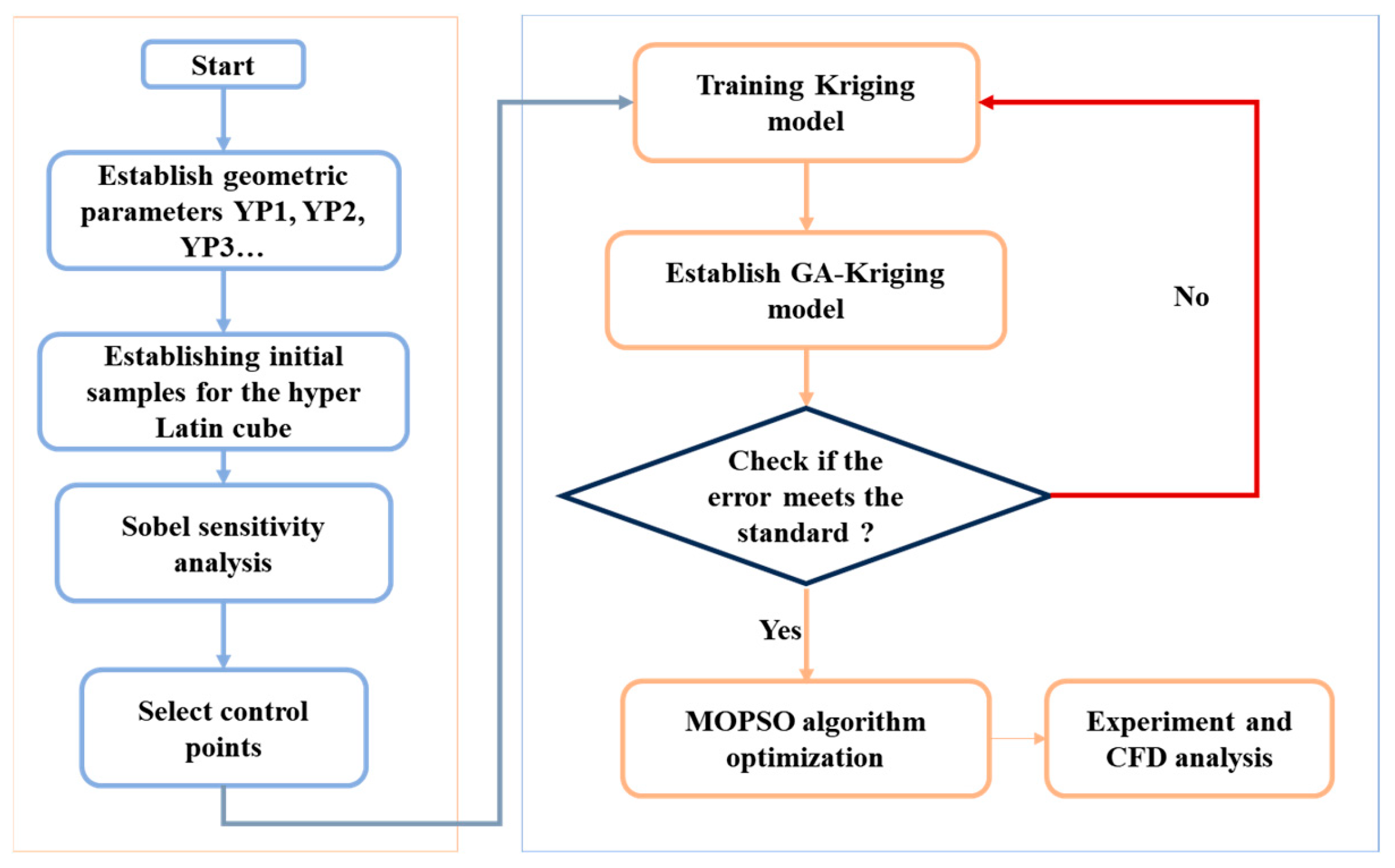
Addressing the aforementioned needs, this paper proposes an optimization design scheme. First, the LEM-CST function is employed to fit the prototype blade profile of the fan, establishing a parameterized blade model defined by 20 control points. Second, an initial sample set is generated via Latin Hypercube Sampling (LHS), based on which control parameter sensitivity is calculated and analyzed to screen for the 5 most influential control points. Third, a GA-Kriging prediction model is constructed by integrating a Genetic Algorithm (GA). Taking the coordinates of the control points as variables and constraining the power range, objective functions targeting airflow volume and noise are formulated. A Multi-Objective Particle Swarm Optimization (MOPSO) algorithm is then applied to perform multi-objective optimization until convergence is achieved. Finally, the blade is redesigned based on the optimized geometry, and its performance is analyzed through theoretical calculations and experimental validation. This research provides a novel approach for the efficient design of air-cooling systems in explosion-proof motors. This research provides: (1) A novel parameterization strategy for large-scale volute-free fan blades; (2) A hybrid AI-driven optimization framework combining sensitivity analysis and multi-objective algorithms; (3) Experimental evidence supporting computational predictions for industrial applications.

2. LEM-CST Function-Based Blade Modeling for Multi-Arc Profiles

2.1. Geometric Model

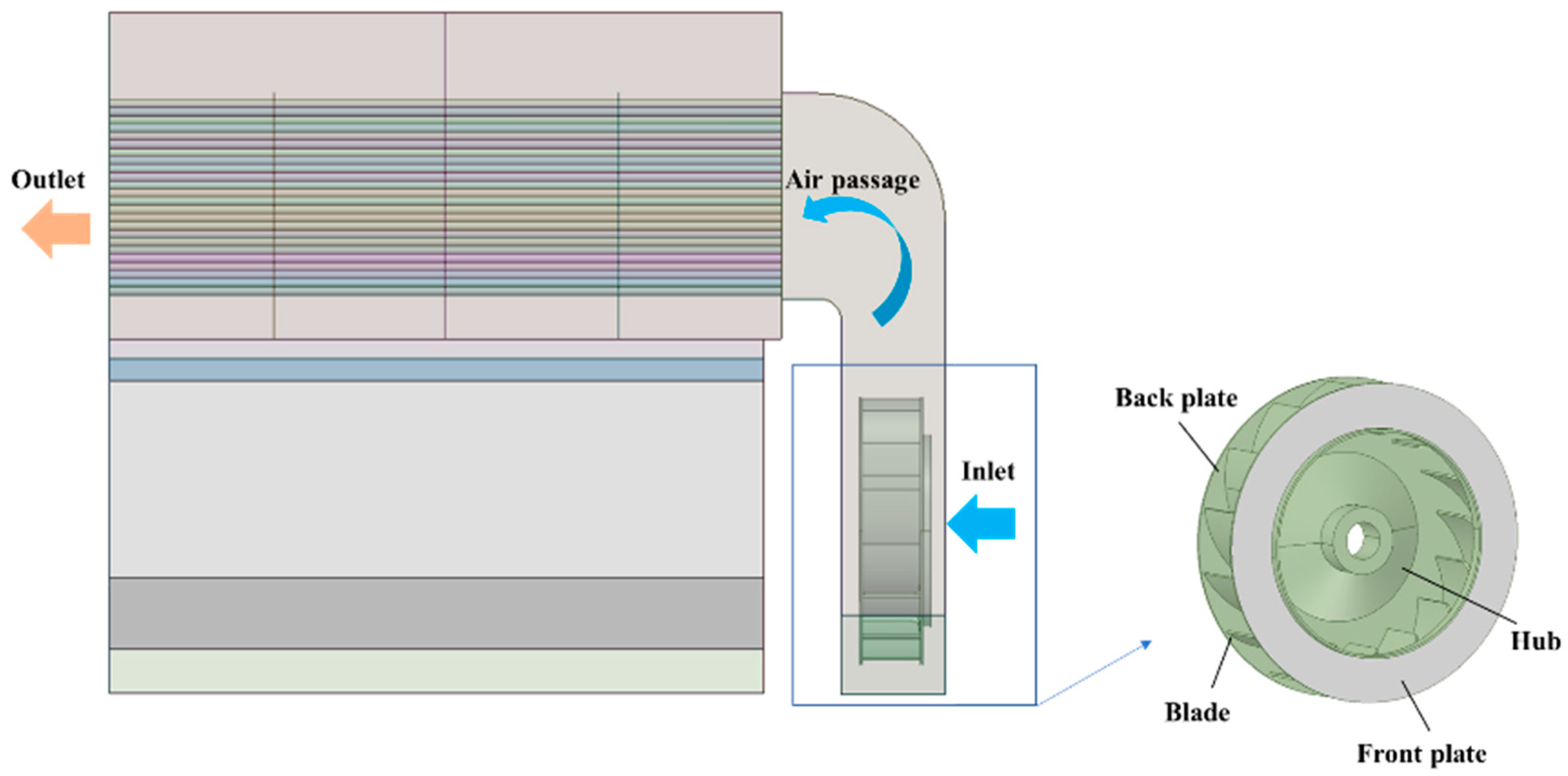
In this study, a cooling centrifugal fan for a box-type asynchronous motor is selected as the research object. The fan assembly consists of a flow passage, impeller, hub, front disk, and back disk, while the impeller employs large backward-curved blades as the primary aerodynamic elements. The prototype impeller adopts a constant-thickness circular-arc blade profile, which serves as the baseline configuration. The structural layout of the flow passage and the impeller geometry are presented in Figure 2, respectively. The fan operates at a rated rotational speed of 1485 rpm, and its principal geometric parameters and performance specifications are summarized in Table 1.
This study takes a large-scale industrial centrifugal cooling fan as the research object. The centrifugal fan consists of a flow passage, an impeller, a hub, a front shroud, and a rear shroud. The impeller is equipped with backward-curved blades, and the original blade profile is an equal-thickness circular-arc blade. The overall structure of the centrifugal fan and the impeller configuration are shown in Figure 2. The rotational speed of the centrifugal fan is 1485 rpm, and the detailed geometric parameters and performance data are listed in Table 1. During operation, the motor drives the shaft bearings to rotate, which in turn drives the centrifugal fan to draw external air into the flow passage. The airflow is then discharged through the outlet to provide cooling for the heat exchanger. Since the flow passage is relatively wide and its structure remains unchanged, it is not described in detail in this study. The impeller is located at the lower end of the flow passage and is required to introduce external cooling air into the heat exchanger within a specified power range to achieve effective heat dissipation. Therefore, this study focuses on the optimization design of the blade profile of the centrifugal fan. The impeller height, inlet and outlet radii, and blade number can be determined using well-established design methods and are not the main focus of this work.

2.2. Numerical Methodology

For the numerical simulation of the blade, the commercial CFD software ANSYS Fluent 19.0 is employed to perform computational fluid dynamics (CFD) analysis of the internal flow characteristics within the fan, aiming to obtain the flow field distribution under steady-state operating conditions. Given the presence of significant streamline curvature, flow separation, and pronounced near-wall boundary layer effects in the vicinity of the fan blades, the Shear Stress Transport k-ω (SST k-ω) turbulence model is adopted for the simulations [13]. The SST k-ω model, rooted in the Reynolds-Averaged Navier–Stokes (RANS) framework, achieves turbulence closure by solving the transport equations for turbulent kinetic energy (k) and specific dissipation rate (ω). This model is well-suited for steady-state turbulent flow problems involving strong adverse pressure gradients, flow separation, reattachment, and complex curvature. To balance computational efficiency with accuracy, a second-order upwind discretization scheme is applied to the convective terms. This approach ensures solution accuracy while effectively mitigating numerical diffusion and enhancing simulation stability. Although the SST k-ω model imposes stringent requirements on near-wall grid resolution, it demonstrates robust overall convergence characteristics, enabling the acquisition of comprehensive aerodynamic performance data for the fan across various operating conditions within a computationally feasible timeframe. The transport equations for turbulent kinetic energy (k) (Equation (1)) and specific dissipation rate (ω) (Equation (2)) for the SST k-ω model are presented as follows [14,15]:
( ρ k ) t + ( ρ k u j ) x j = x j μ + μ t σ k k x j + P k β * ρ k ω
( ρ ω ) t + ( ρ ω u j ) x j = x j μ + μ t σ ω ω x j + α ω k P k β ρ ω 2 + 2 ( 1 F 1 ) ρ σ ω 2 ω k x j ω x j
where ρ is the fluid density, ω is the mean velocity component, and μt is the turbulent (eddy) viscosity, which is determined by the following expression:
μ t = ρ k max ( ω , F 2 S a 1 )
where S = 2 S i   S ij j is the modulus of the strain rate tensor, a1 = 0.31 is the Bradshaw constant.
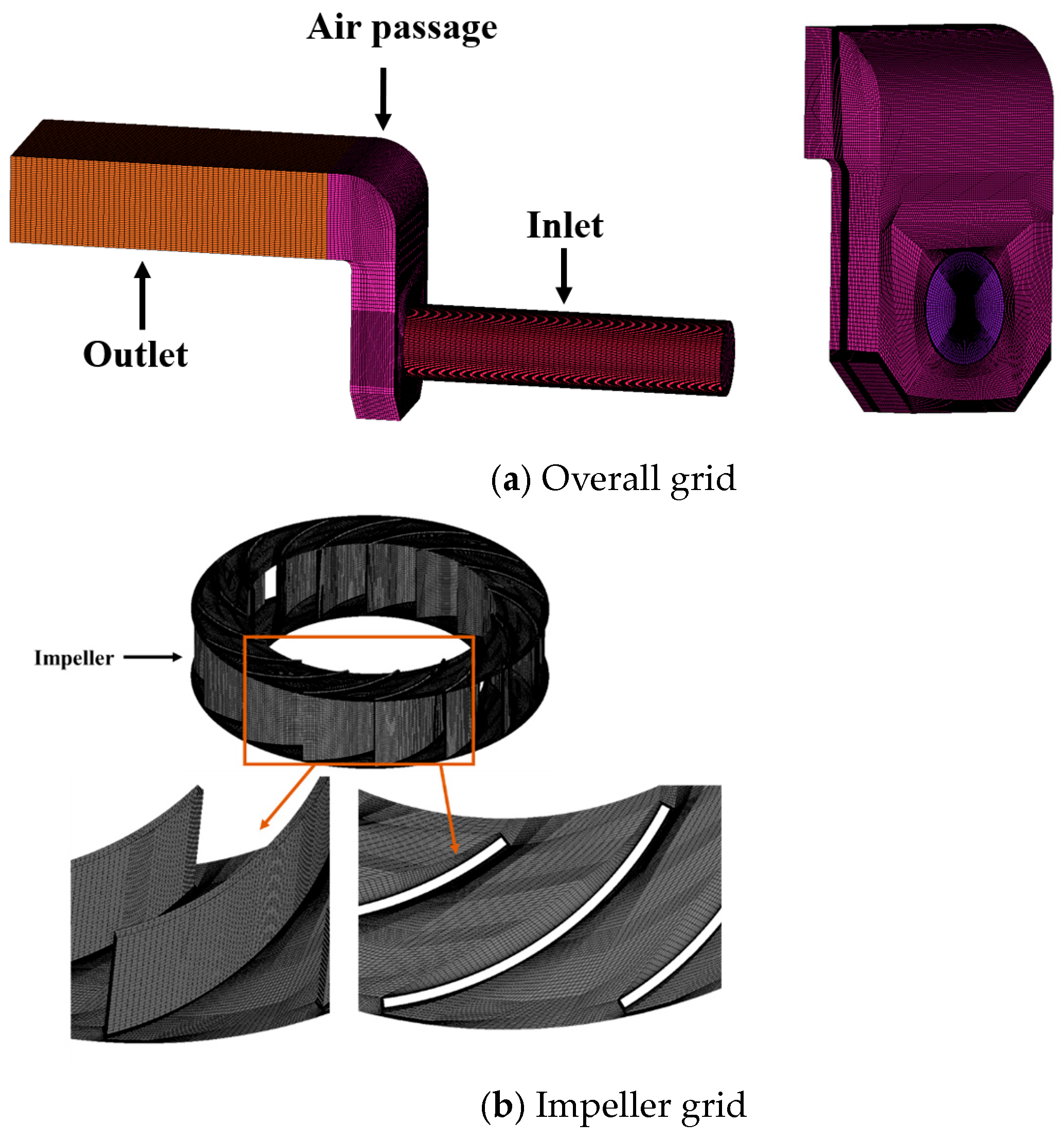
In this study, the entire computational domain is discretized using a structured mesh. To ensure fully developed flow at the outlet and inlet sides, the outlet and inlet boundaries are extended. The boundary layer mesh around the blades is refined, with the y+ value maintained between 0.1 and 1, in order to ensure computational accuracy and stability for the rotating components. Structured meshes offer high grid quality and low numerical dissipation. Furthermore, grid refinement is appropriately applied in critical regions, such as the interface between the impeller flow passages, to capture flow field details and enhance computational accuracy, as illustrated in Figure 3a,b.
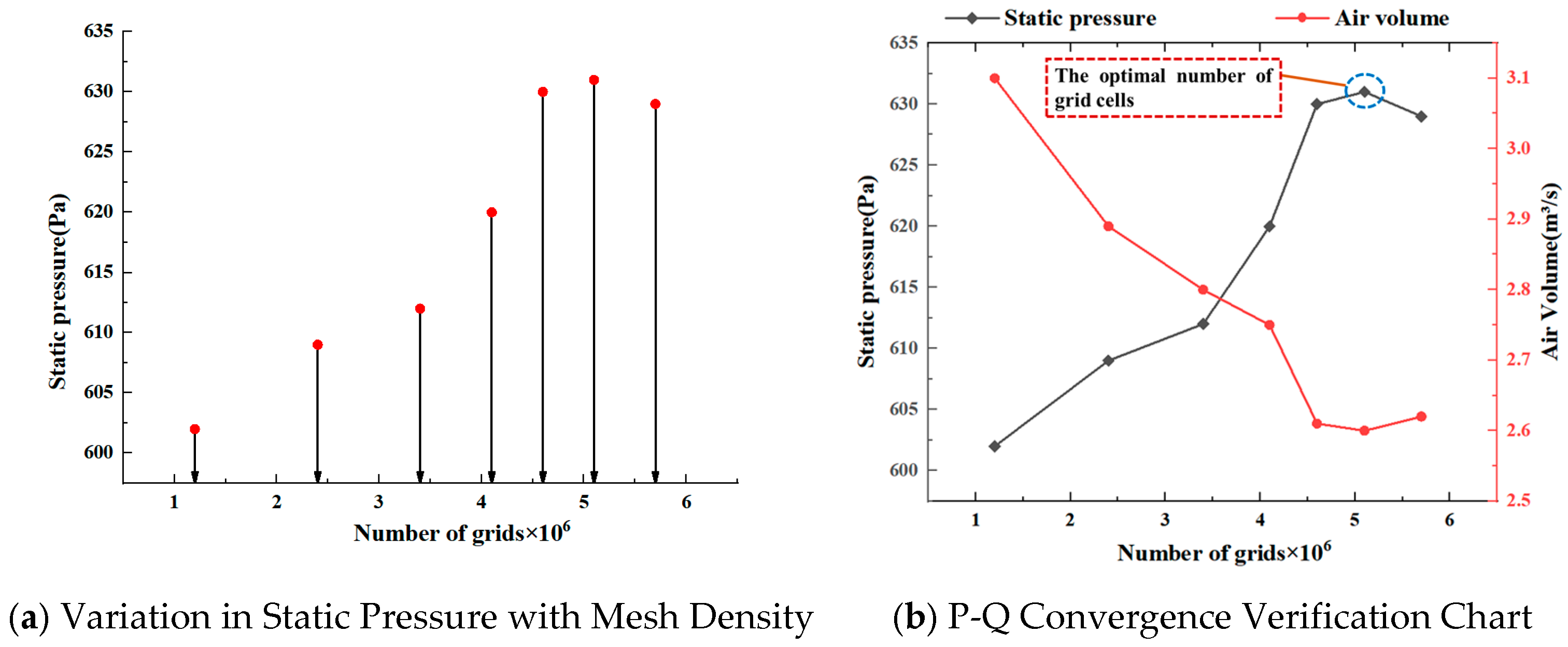
The selection of an appropriate mesh size is of critical importance for numerical simulations [16]. An insufficient number of grid elements may lead to reduced accuracy, while an excessively large mesh results in unnecessary computational cost and resource consumption. In this study, the influence of mesh resolution on computational accuracy was systematically evaluated.
Seven cases with different mesh sizes were tested, and the results are presented in Figure 4a,b. When the mesh number reached approximately 5.5 × 10⁶, both the outlet flow rate and static pressure exhibited negligible variation and gradually stabilized. Therefore, in order to balance computational accuracy and efficiency, a mesh size of approximately 5.5 × 10⁶ elements was adopted for the subsequent simulations, This confirms the grid-independence of the numerical model.

2.3. Numerical Simulation of the Prototype Model

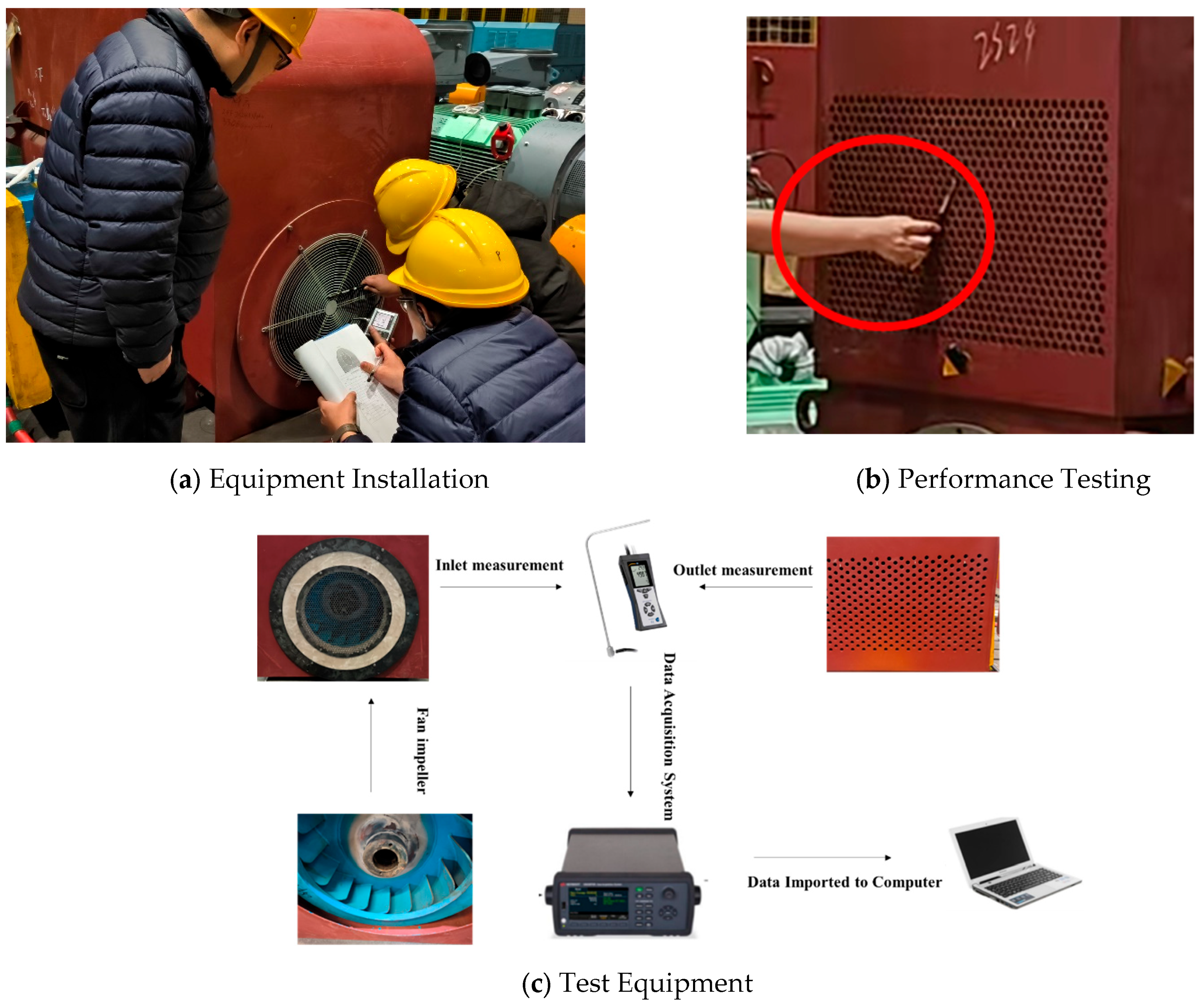
The schematic diagram of the experimental system is shown in Figure 5a–c. The centrifugal fan is installed externally to the motor cooler. It draws ambient air axially, which is then radially accelerated by the impeller before entering the cooler’s air duct and proceeding to the outlet side. To achieve precise measurement of aerodynamic parameters at the inlet and outlet, mounting points for static pressure taps and insertion ports for Pitot tubes are reserved on the fan’s inlet and outlet. A Pitot tube traverse measurement is performed across the inlet and outlet cross-sections to obtain spatially averaged flow rate and static pressure.
The measuring instrument employed is a handheld digital differential pressure manometer with a Pitot tube assembly imported from the German company Testo. This instrument is a high-precision, temperature-compensated micro-differential pressure gauge. It supports direct reading of differential pressure (ΔP) and static pressure (P), and calculates air velocity and flow rate (Q) via the optional Pitot tube.
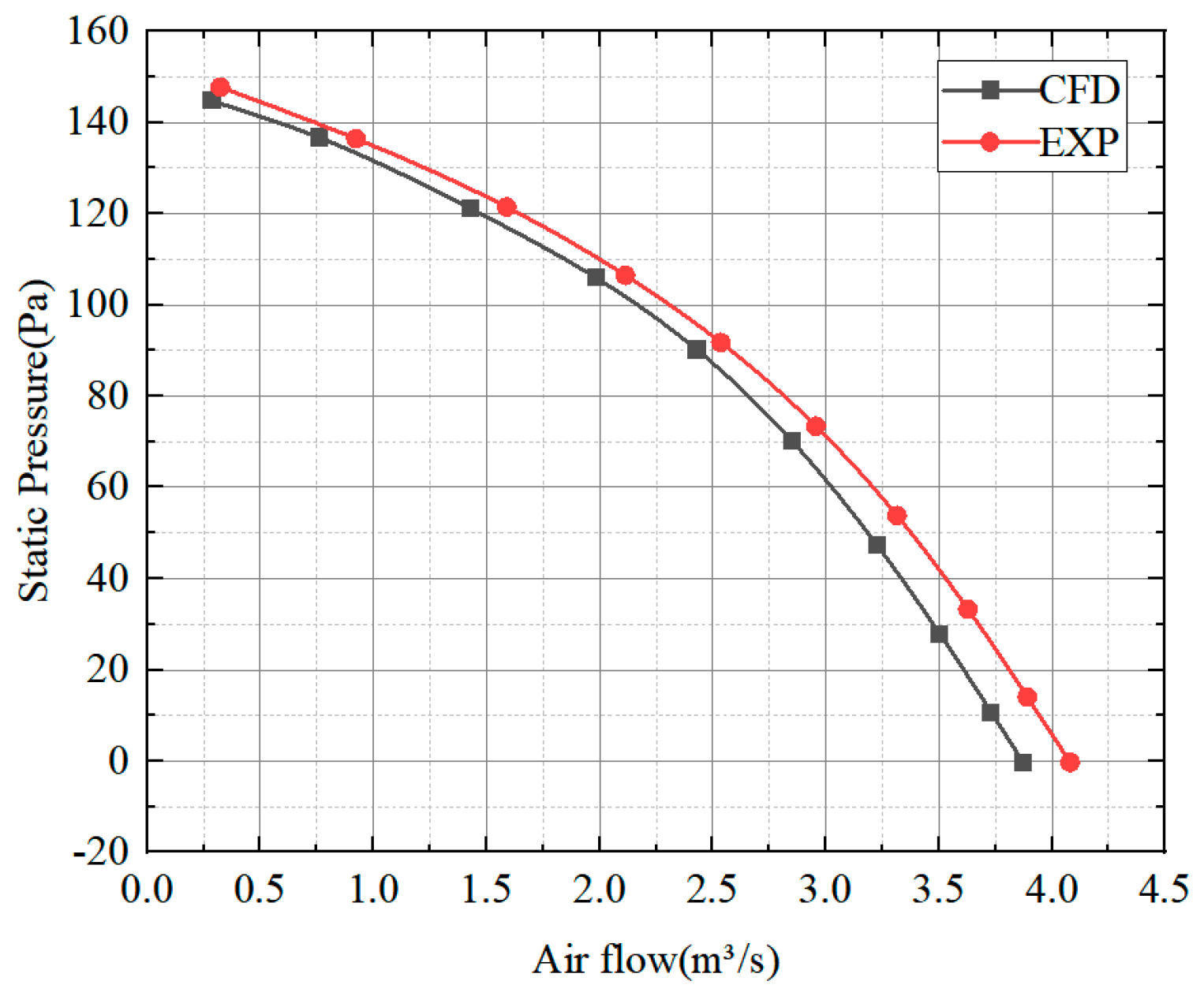
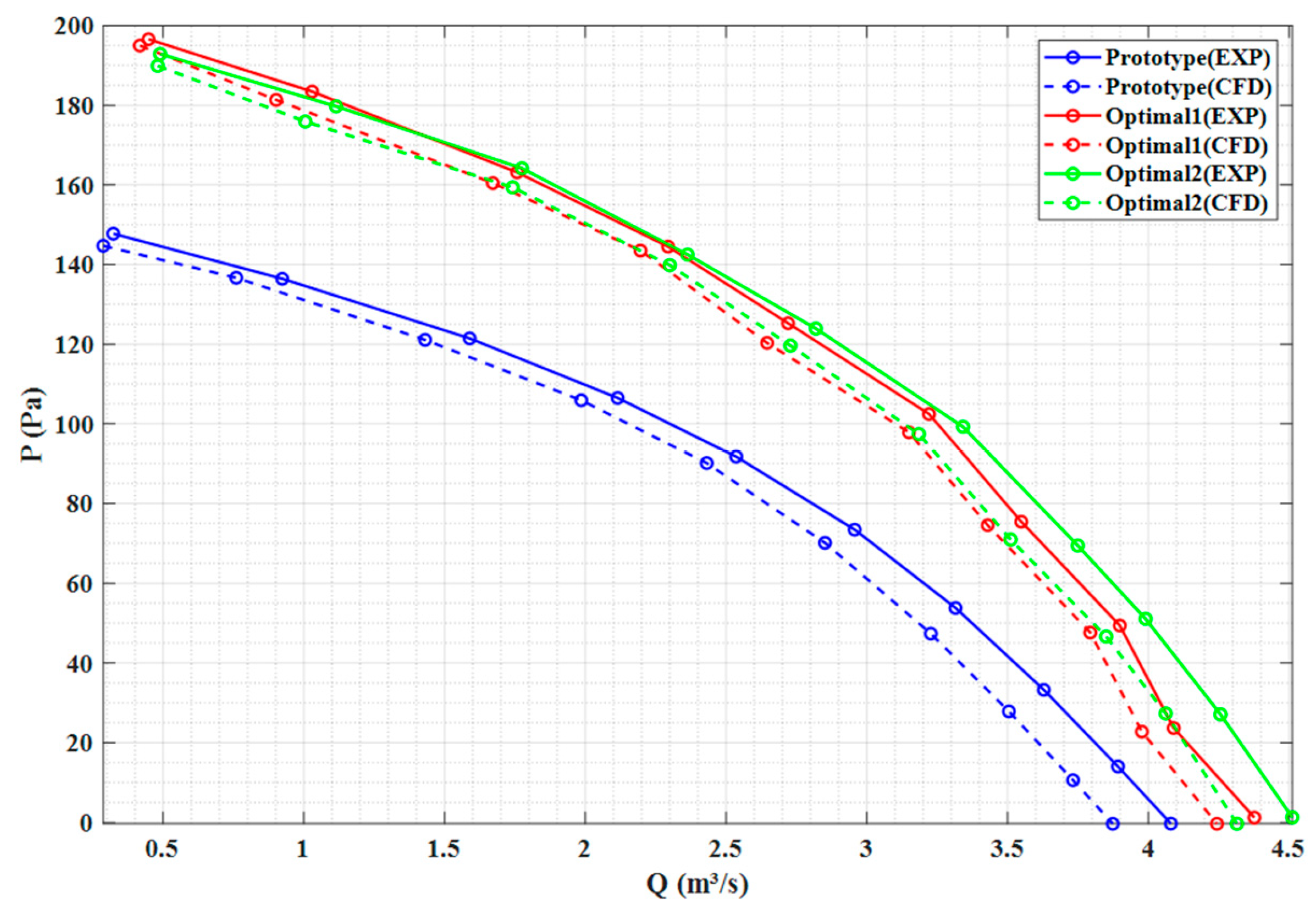
To validate the accuracy of the numerical simulation method, this paper conducts a comparative analysis between the CFD simulation results of the prototype centrifugal fan and the actual experimental data. As shown in Figure 6, by comparing the performance parameters of the fan under different operating conditions, it is found that the overall trend of the flow rate-pressure (P-Q) performance curve from the numerical simulation is consistent with that from the experiment. The relative error between the simulated and measured values at key operating points is controlled within 4%. These results indicate that the adopted numerical simulation method possesses high accuracy, providing a reliable data foundation for the subsequent optimization analysis.

2.4. Parametric Modeling Using LEM-CST Functions

In this paper, the LES-CST (Leading Edge Shape-Class Shape Transformation) function is adopted as the parametric design method for segmented arc blades [17,18]. The overall methodological framework is depicted in Figure 7. Compared to traditional methods such as CST, B-spline, and Hicks-Henne functions, the LES-CST function offers advantages of fewer parameters and higher computational efficiency. It demonstrates superior performance, particularly in controlling the curvature changes within the airflow regions at the blade inlet and outlet, making it particularly well-suited for the aerodynamic optimization design of backward-curved centrifugal fan blades [19].
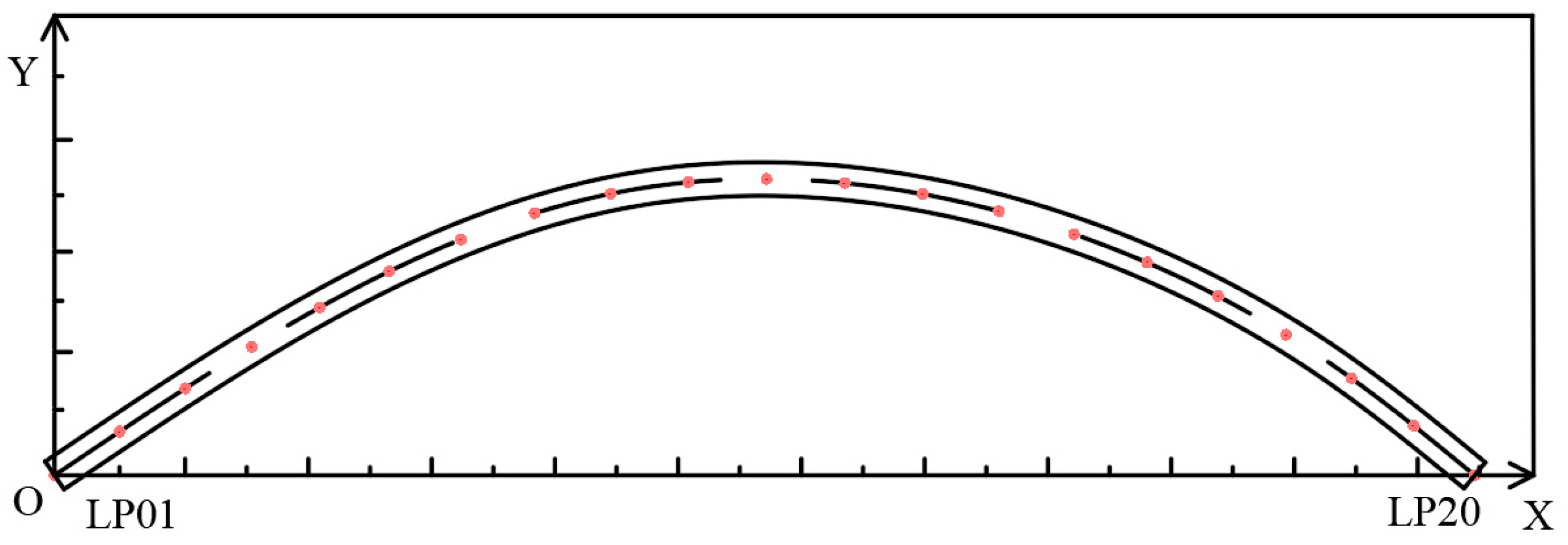
To control the number and range of parameters, this study first selects 20 equally spaced coordinate points as design variables [16]. The coordinate ranges for each point are specified in Table 2. As shown in Figure 8 these control points correspond to key locations along the blade’s mean camber line, such as the leading edge, intermediate points, and trailing edge. By adjusting the coordinates and corresponding weighting parameters of these points, the shape of the blade’s mean camber line can be precisely defined. The LES-CST method constructs the geometric profile of the blade through the combination of a Class Function and a Shape Function, incorporating a leading edge correction term. Its mathematical expression is given as follows [20]:
Z ( ψ ) = C ( ψ ) S ( ψ ) + k ψ 0.5
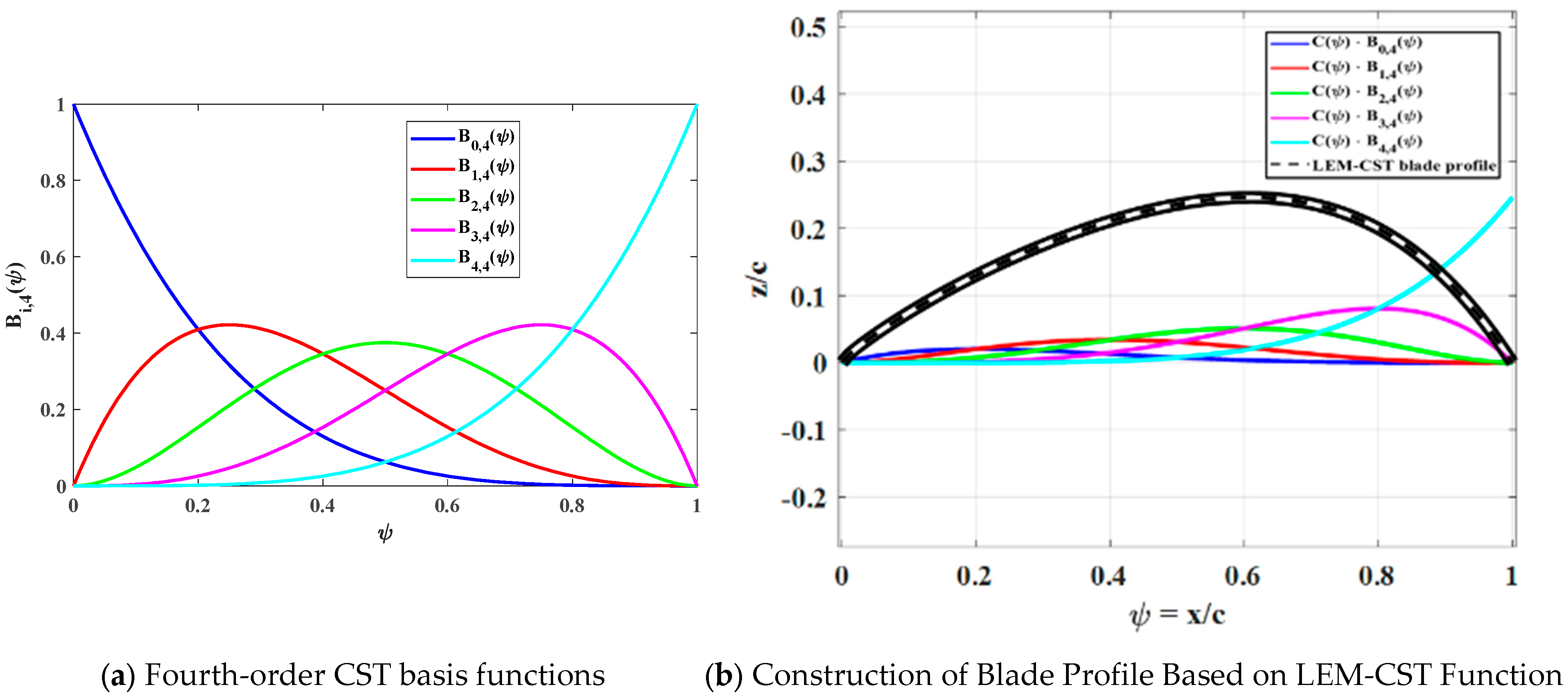
where ψ = x / c [ 0 , 1 ] denotes the normalized chordwise coordinate, C ( ψ ) represents the class function (typically set as C (ζ) = ζ0.5(1 − ζ)0.5 for round-nosed airfoils), and S ( ψ ) = i = 0 n A i B i , n ( ψ ) is the shape function constructed via n-th order Bernstein polynomials B i , n ( ψ ) with weighting coefficients A i . The term k ψ 0.5 introduces a leading-edge modification to enhance curvature control in the leading-edge region. The weighting coefficients Ai are directly correlated with the coordinates of key control points. Optimization of these coefficients enables precise fitting and control of the blade median axis, as demonstrated in Figure 9a,b.
The constraint ranges for the yₙ coordinates are specified in the table below:
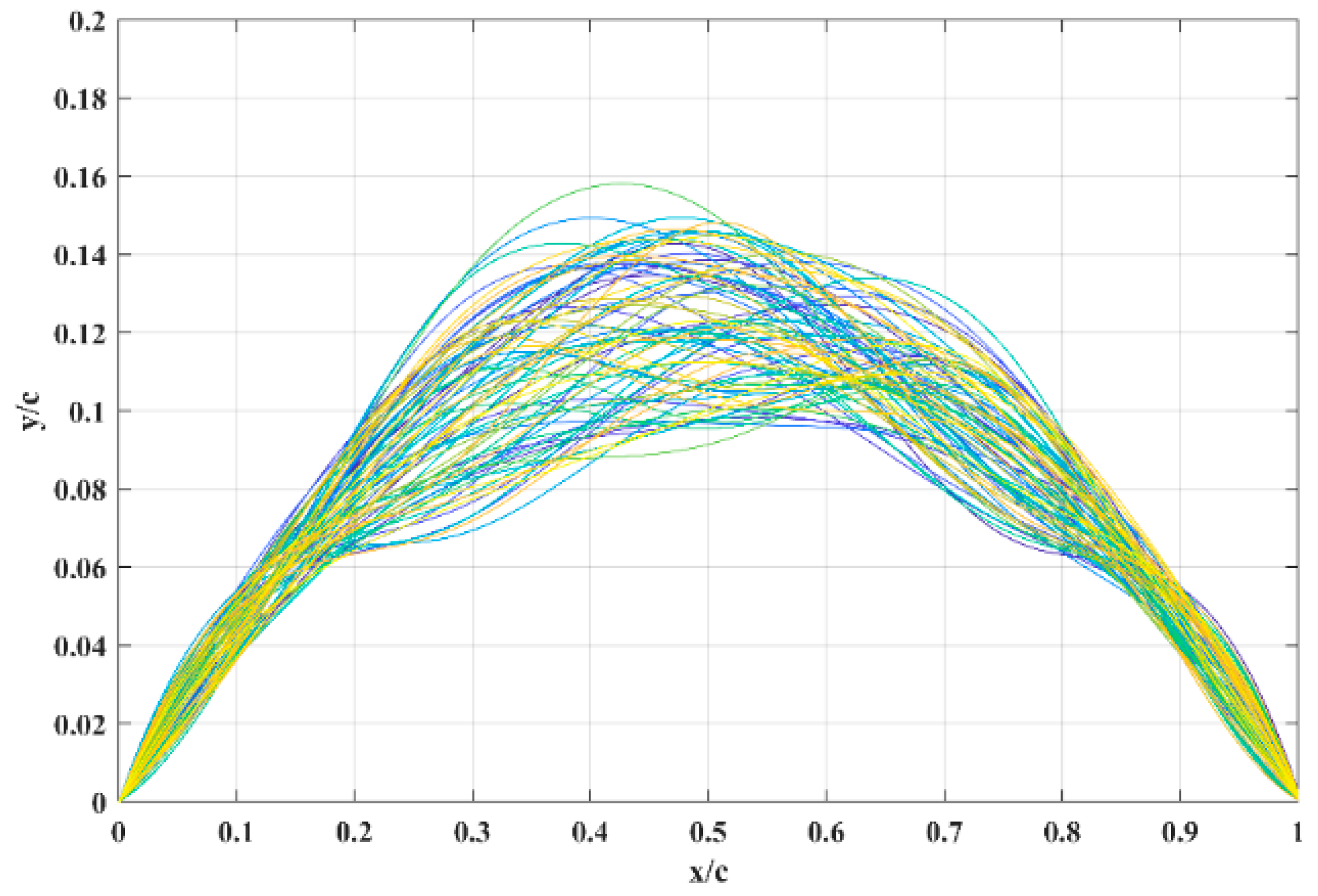
Subsequently, the Optimum Latin Hypercube Sampling (OLHS) method was employed to randomly sample the control points of the blade parameterization functions [21]. The distribution of the sampled data is shown in Figure 10. By continuously adjusting the shape coefficients of the control points, a total of 120 high-quality sample configurations were generated.

2.5. Sensitivity Analysis of Control Points

To identify the most influential parameters among the 20 blade profile control points on the performance indicators, this study employs Sobol’- global sensitivity analysis method to quantitatively assess the impact of each control point parameter on airflow volume (Q) and static pressure (P) [22]. This method, based on variance decomposition theory [23], evaluates the importance of each control point by quantifying the contribution of input parameter uncertainty to the variance of the output response. The analysis employs quasi-random Sobol sequences to generate two independent input sample matrices, A and B (dimension: N × 20), where N = 120 is the sample size. To calculate the sensitivity index for the i th control point, a hybrid matrix is constructed by replacing the i th column of matrix A with the i th column of matrix B. The performance response values for all sample matrices are computed via the numerical model, yielding YA = f(A), YB = f(B) and YABi = f(ABi). The first-order sensitivity index (Si) and the total sensitivity index (STi), representing the independent influence of each control point on the performance indicators and its interactive influence with other control points, respectively, are then calculated using Equations (5) and (6):
S i = 1 N j = 1 N Y A ( j ) Y A B i ( j ) ( 1 N j = 1 N Y A ( j ) ) V a r ( Y A )
S T i = 1 1 N j = 1 N Y B ( j ) Y A B i ( j ) ( 1 N j = 1 N Y A ( j ) ) V a r ( Y A )
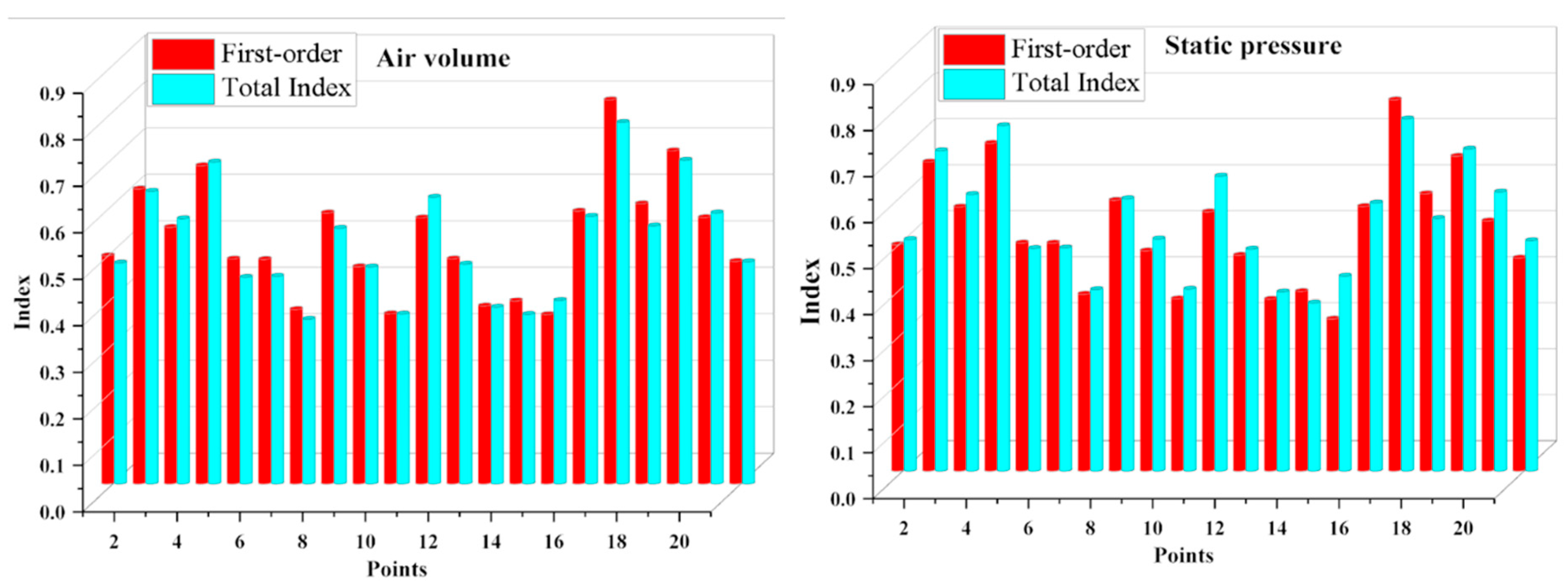
In the equations, Var(YA) represents the sample variance of YA. The first-order index Si reflects the contribution of control point i alone to the output variance, while the total index STi reflects the overall contribution of control point i and all its interaction effects to the output variance. The analysis results are shown in Figure 11. The results indicate that the sensitivity indices for control points 2, 4, 11, 17, and 19 are significantly higher than those for the other control points, suggesting that these locations have a dominant influence on the blade’s aerodynamic performance. Consequently, these five control points are selected as the design variables for the subsequent blade profile optimization process.

3. Kriging Surrogate Model

3.1. Kriging Regression Surrogate Model

Kriging (also known as Gaussian Process Regression, GPR) is an interpolation method and surrogate modeling technique based on spatial statistics [23]. It assumes that the response function to be predicted follows a Gaussian process distribution. This model performs optimal unbiased estimation for unknown points by leveraging the spatial correlation among known sample points, while simultaneously providing a prediction mean and an uncertainty measure. The core of the Kriging model lies in using a kernel function (covariance function) to describe the spatial correlation between input points, with the squared exponential kernel being the most commonly used.
Given the training samples X and the corresponding response values y, the predicted mean and variance for a new point x* are given as follows [24,25]:
Predicted mean:
y ^ ( x * ) = k ( x * , X ) ( K + σ n 2 I ) 1 y
Predicted variance:
Var ( y ^ ( x * ) ) = k ( x * , x * ) k ( x * , X ) ( K + σ n 2 I ) 1 k ( x * , X )
95% confidence interval width:
CI 95 % ( x * ) = 3.92 × σ ( x * )
Relative uncertainty (Coefficient of Variation):
CV ( x * ) = σ ( x * ) y ^ ( x * ) × 100 %
where K is the kernel matrix between training samples, k ( x * , X ) is the kernel vector between the new point and the training samples, and is the noise variance. The squared exponential kernel function is given by:
k ( x i , x j ) = σ f 2 e x p ( x i x j 2 2 l 2 )
The advantage of Kriging lies in its rigorous probabilistic foundation, making it particularly well-suited for surrogate modeling of engineering problems characterized by small sample sizes, high dimensionality, and nonlinearity. In this study, a Genetic Algorithm (GA) is employed to optimize the kernel function’s hyperparameters—namely, the length scale l , the signal standard deviation σ f , and the noise standard deviation σ n to further enhance the model’s predictive accuracy and generalization capability for the fan’s PQ (pressure-flow rate) performance.

3.2. Optimization Objectives and Constraints

This paper integrates a Genetic Algorithm (GA), a Multi-Objective Particle Swarm Optimization (MOPSO) algorithm, and a Computational Fluid Dynamics (CFD) solver to establish an optimization framework. Specifically, FLUENT is first employed for CFD simulations to generate sample data. This data is then imported into the MATLAB 2020b environment, where a Kriging surrogate model—whose hyperparameters are optimized by the GA—is constructed and utilized for performance prediction. Finally, the MOPSO algorithm is applied to perform the multi-objective optimization. Using the five Y-coordinates of the blade as the input layer variables, with constraints as shown in Equation (14) applied to the minimum and maximum values of each coordinate respectively, the final output power must not exceed 1.5 times the prototype shaft power P0. The prototype shaft power is defined as P 0 = m ˙ Δ p t ρ η 0 , where m ˙ is the mass flow rate, Δ p t is the total pressure difference between the fan inlet and outlet, ρ is the air density, and η 0 is the prototype total efficiency. The optimization objective is to use the airflow rate Q and the static pressure Ps at the operating point as the output variables, as formulated in Equation (13).
The Genetic Algorithm (GA) is employed to optimize the key hyperparameters of the Kriging model, specifically the length scale l , the signal standard deviation σ f , and the noise standard deviation σ n . To improve numerical stability, all input parameters are normalized to the interval [0,1].
The fitness function for the GA is the weighted mean squared error of the test set:
f = 0.2 × MSE Q + 0.8 × MSE P
Finally, the optimized Kriging prediction model is utilized to establish a mapping that captures the complex nonlinear relationship between blade profile variations and the airflow rate Q and static pressure P.
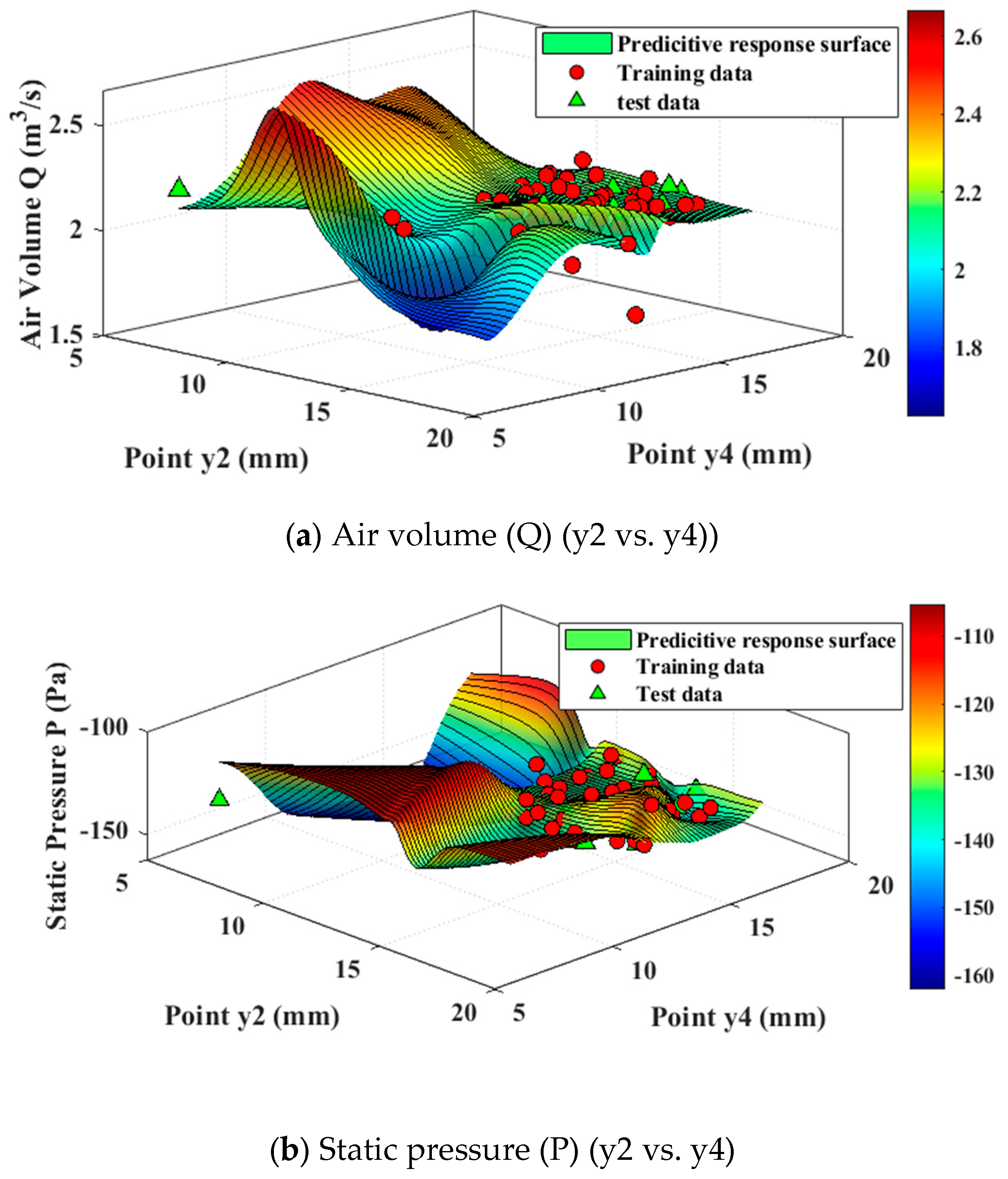
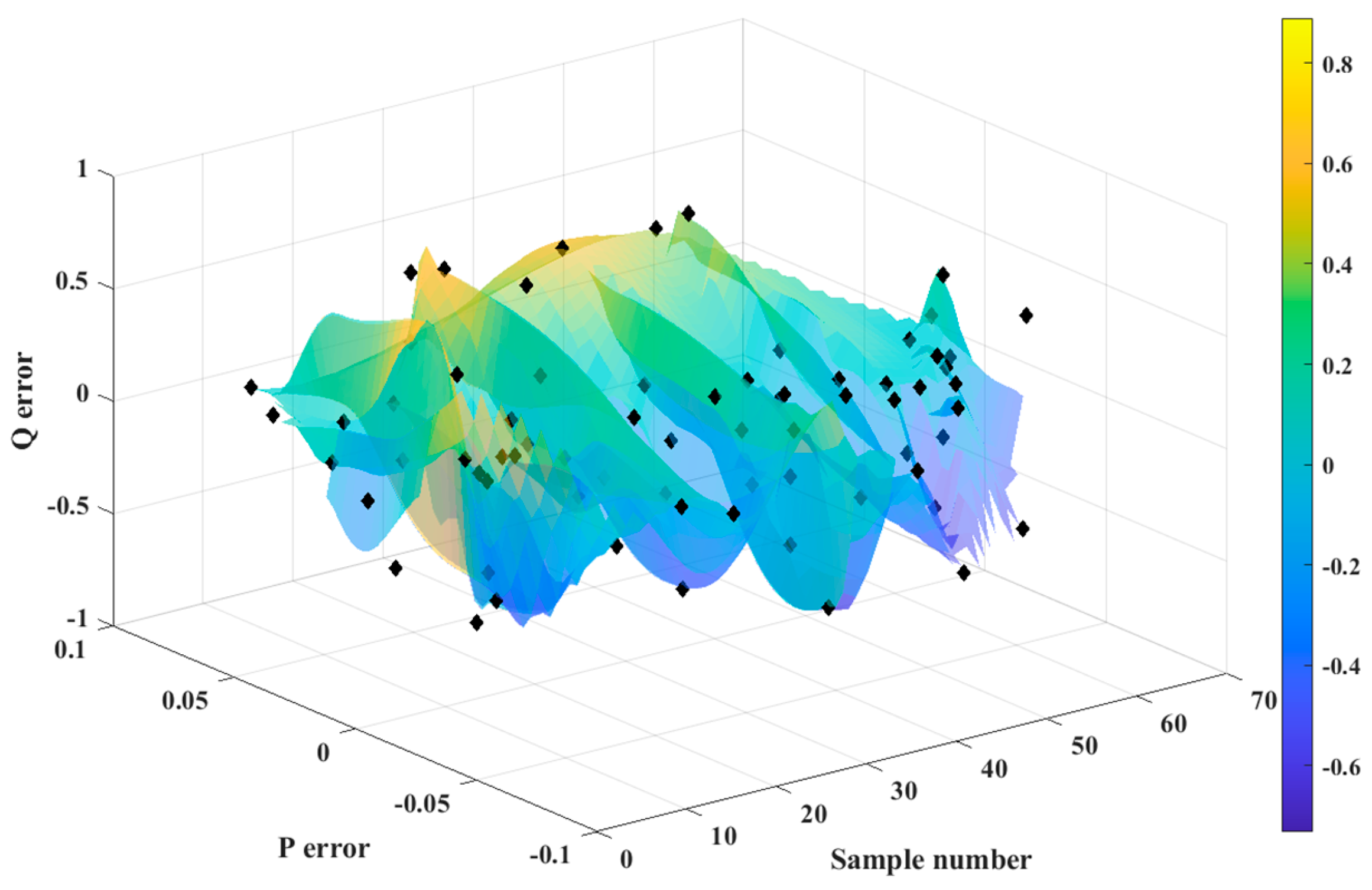
In this study, 120 sample sets are used as the training set, and 60 sample sets as the test set. Using the coordinates y2 and y4 as the x- and y-axes, and the airflow rate Q and static pressure P as the z-axes respectively, predictive response surfaces are constructed, as illustrated in Figure 12a,b. Specifically, Figure 12a represents the predicted relationship between the coordinate points (y2, y4) and the airflow rate Q, while Figure 12b represents the relationship with static pressure P. Figure 13 displays the prediction error response surfaces for Q and P on the test set. The mean squared error (MSE) for the airflow rate Q on the training set is 0.0007, and the MSE for static pressure P is 0.85. Table 3 presents the quantification results of prediction uncertainty for the Kriging model on the test set. The average relative uncertainty for airflow rate Q is 3.12%, and 4.45% for static pressure P. These results demonstrate that the Kriging model performs excellently under small-sample conditions, exhibiting particularly high confidence in predicting both airflow rate and static pressure.
Objective function:
max ( Q ( y 2 , y 4 , y 11 , y 17 , y 19 , y 20 ) ) max ( P ( y 2 , y 4 , y 11 , y 17 , y 19 , y 20 ) )
constrained condition:
y 0 = 0 3 y 2 32 6 y 4 44 12 y 11 58 7 y 17 44 3 y 19 30 y 20 = 0 P 1.5 P 0
Particle swarm optimization (PSO) is an evolutionary algorithm based on swarm intelligence, inspired by the foraging behavior of bird flocks. In PSO, each “particle” represents a potential solution in the search space. During the optimization process, the velocity and position of each particle are continuously updated according to its individual best position and the global best position of the swarm, enabling iterative convergence toward the optimal solution. Compared with traditional optimization methods, PSO exhibits strong global search capability, simple implementation, and a relatively small number of control parameters, making it particularly effective for solving nonlinear, high-dimensional, and multimodal optimization problems [26].
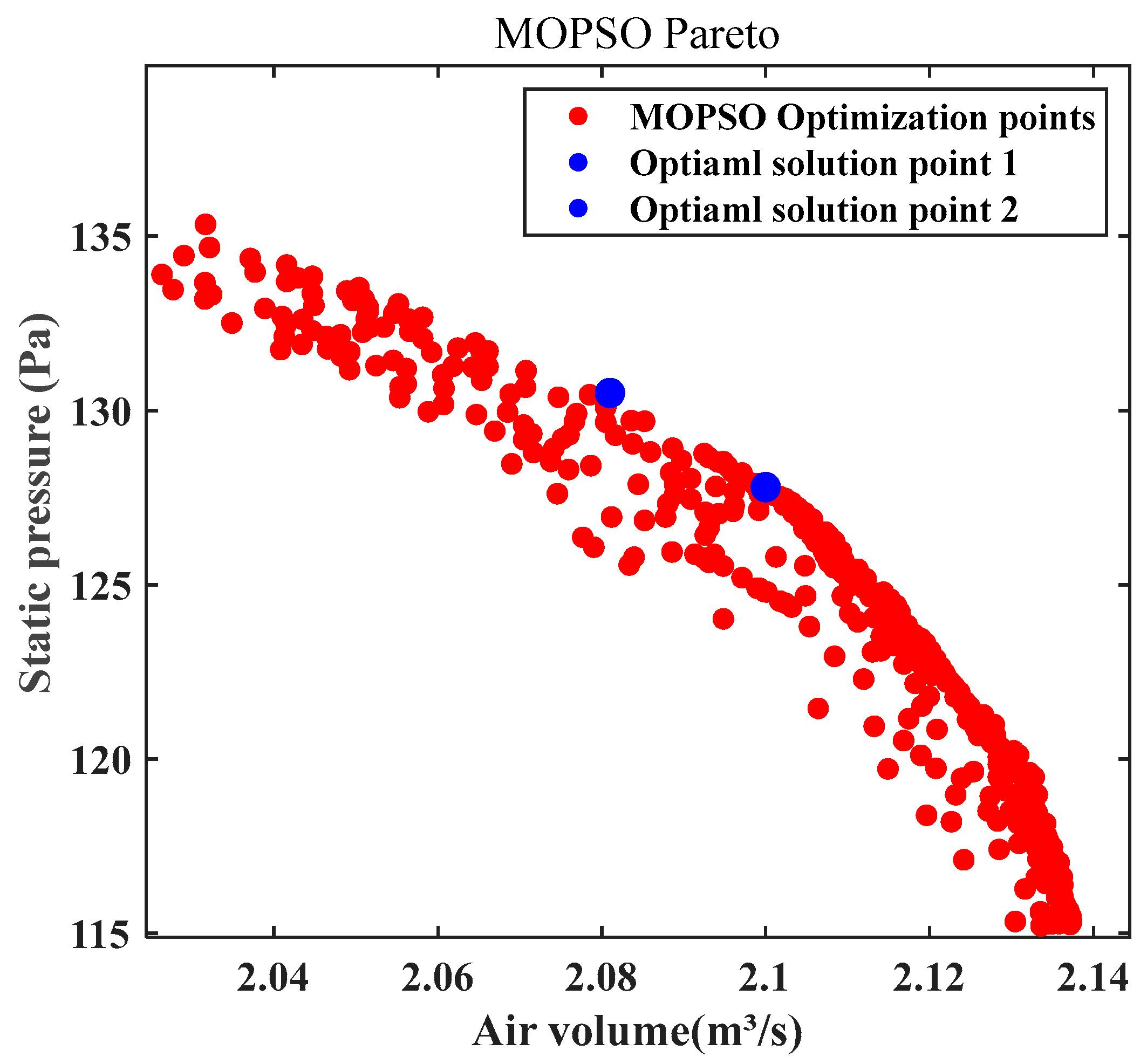
For the multi-objective problem of air volume Q and static pressure P, the MOPSO algorithm achieves simultaneous optimization of the two objectives by introducing the Pareto optimal solution set (Pareto Front) and an external elite archive mechanism. In this study, five control points of the blade profile yn are selected as design variables, while the air volume Q and static pressure P are taken as dual objective functions. Under the power constraint Ƥ0, MOPSO is performed. The algorithm is configured as follows: the swarm size is set to 300, the maximum number of generations is 150, and both inertia weight and acceleration coefficients are updated using a linearly decreasing strategy. The Pareto front solutions are filtered and preserved using the crowding distance method to maintain the diversity and uniformity of the Pareto solution set.
Figure 14 presents the optimization outcomes, revealing a well-distributed non-dominated solution set that constitutes the final Pareto Front. Significantly, selected solutions demonstrate concurrent enhancement exceeding 20% in static pressure and 14% in air volume, while constraining shaft power consumption within 150% of the prototype’s baseline value (P0). Two optimal solutions residing on the convex region of the Pareto frontier were selected as final configurations, achieving an optimal balance between aerodynamic performance and energy efficiency.

4. Numerical Simulation and Experimental Validation

Analysis of Numerical Results
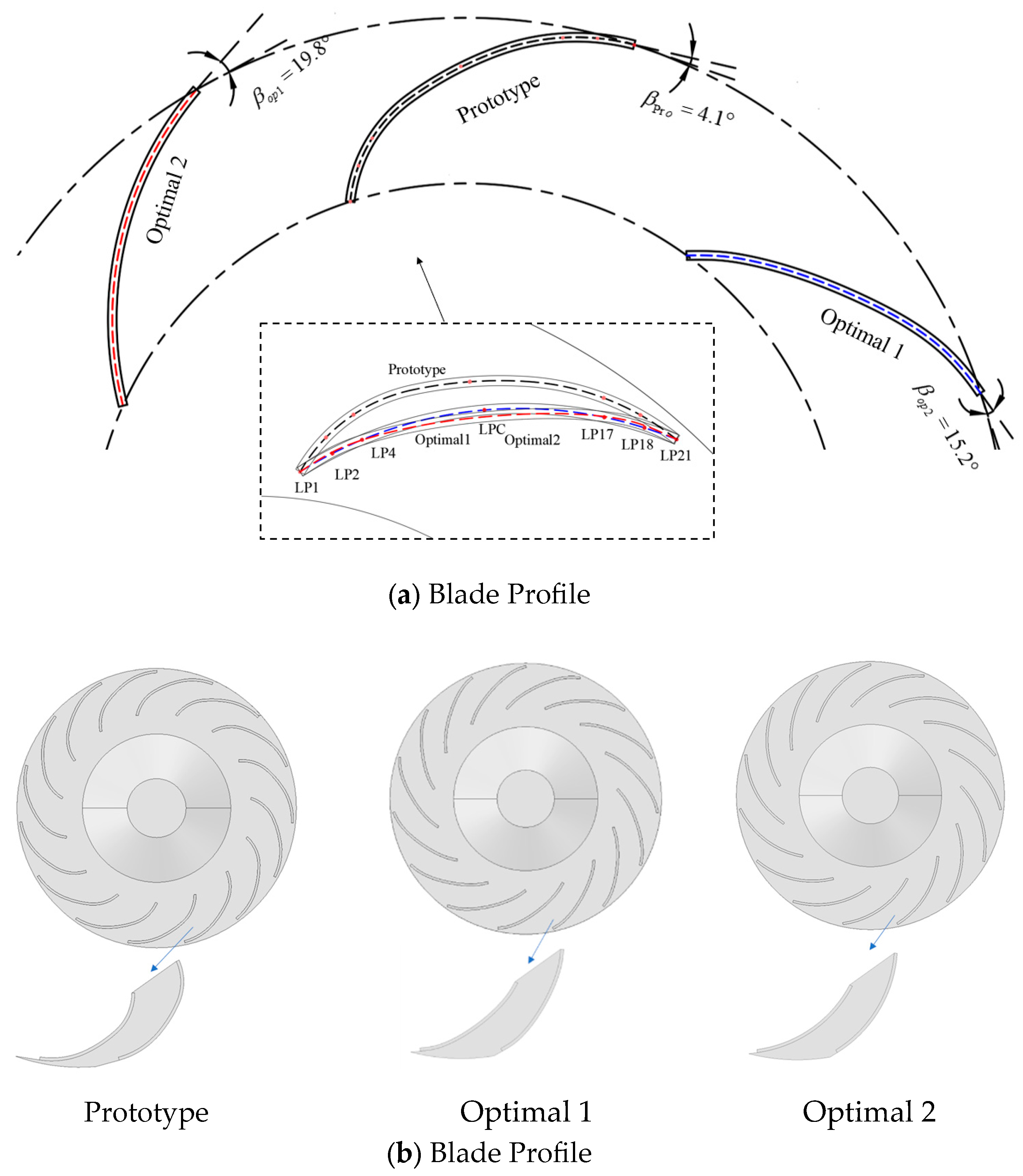
Two optimal solutions (Optimal 1 and Optimal 2) were selected for comparative analysis with the prototype. After normalizing the y-coordinates of their corresponding control points, the relevant parameters are summarized in Table 4. To visually demonstrate geometric changes, the blade profiles of the prototype and optimized designs are compared in Figure 15a,b. The optimized profiles exhibit smoother overall contours and significantly reduced local curvature compared to the prototype, eliminating abrupt curvature changes and sharp convex features observed in the original design. The modified profiles show more gradual convexity, which helps reduce flow separation risks and energy loss, thereby enhancing flow stability and aerodynamic performance within the fan.
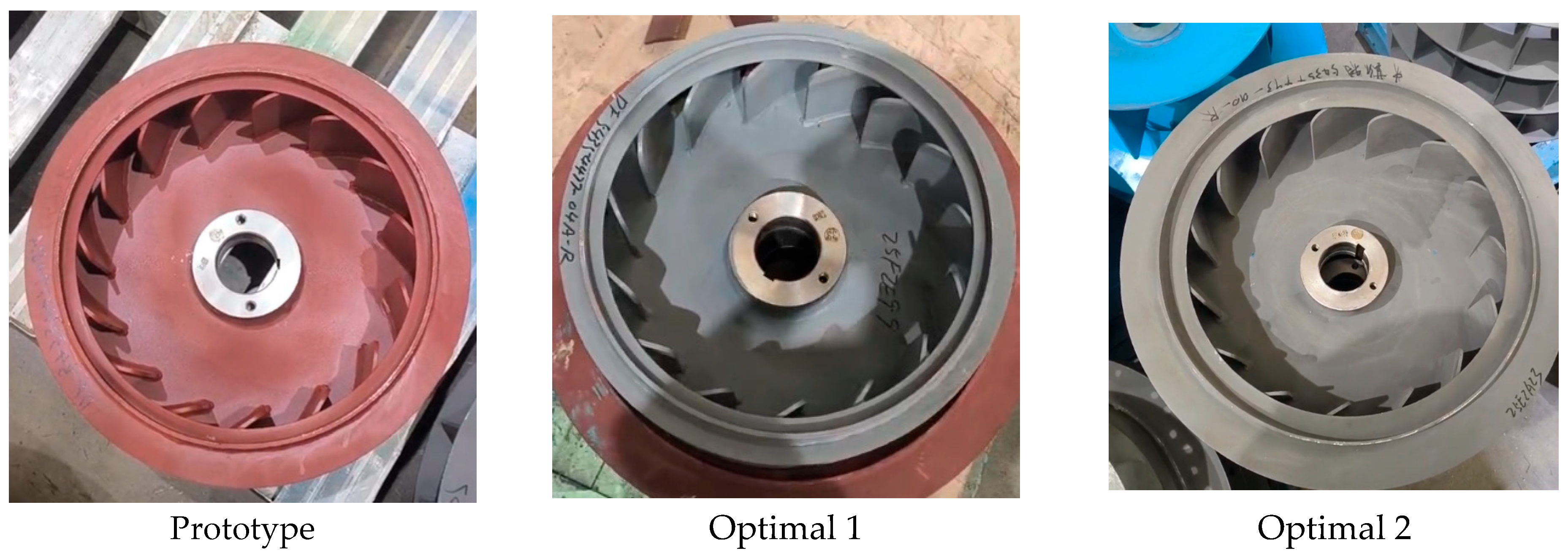
Finally, these two optimized impellers were fabricated as prototypes and subjected to performance testing. After installation, their actual performance was validated, as shown in Figure 16. The P-Q curves from numerical simulations and experimental tests are plotted in Figure 17, with the key parameters under standard operating conditions detailed in Table 5, demonstrating that both Optimal 1 and Optimal 2 exhibit superior performance compared to the prototype design, particularly in pressure-flow characteristics. Meanwhile, the maximum error between experimentally measured data and simulation predictions remained within 4%, confirming the reliability of the simulation model.
To further evaluate the performance improvements achieved by the optimized impellers, a comparative analysis between the optimized designs and the prototype was conducted based on numerical simulation results. The comparison focuses on flow field characteristics, radial velocity distribution, pressure field, and vorticity, providing both qualitative and quantitative assessments.
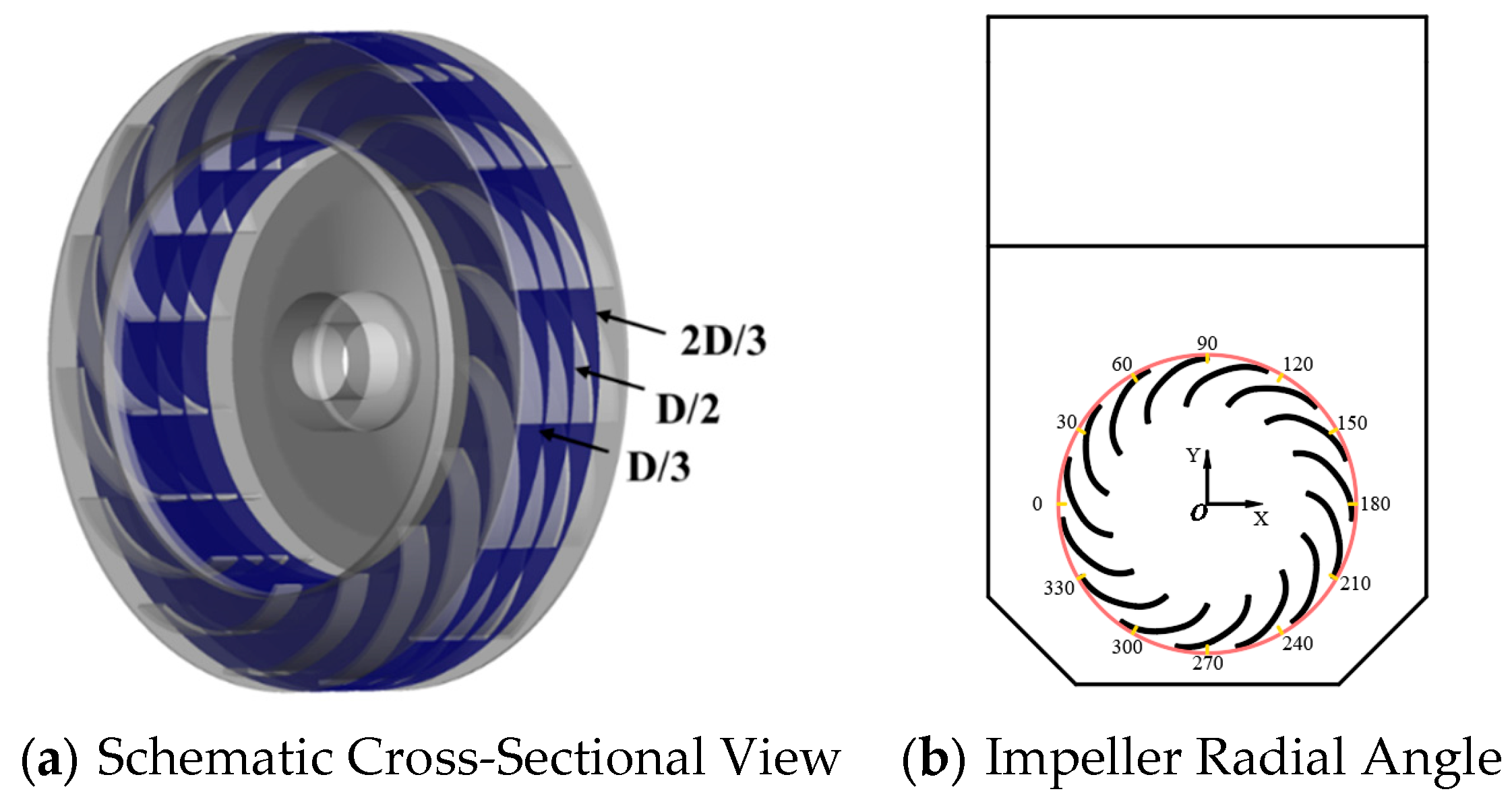
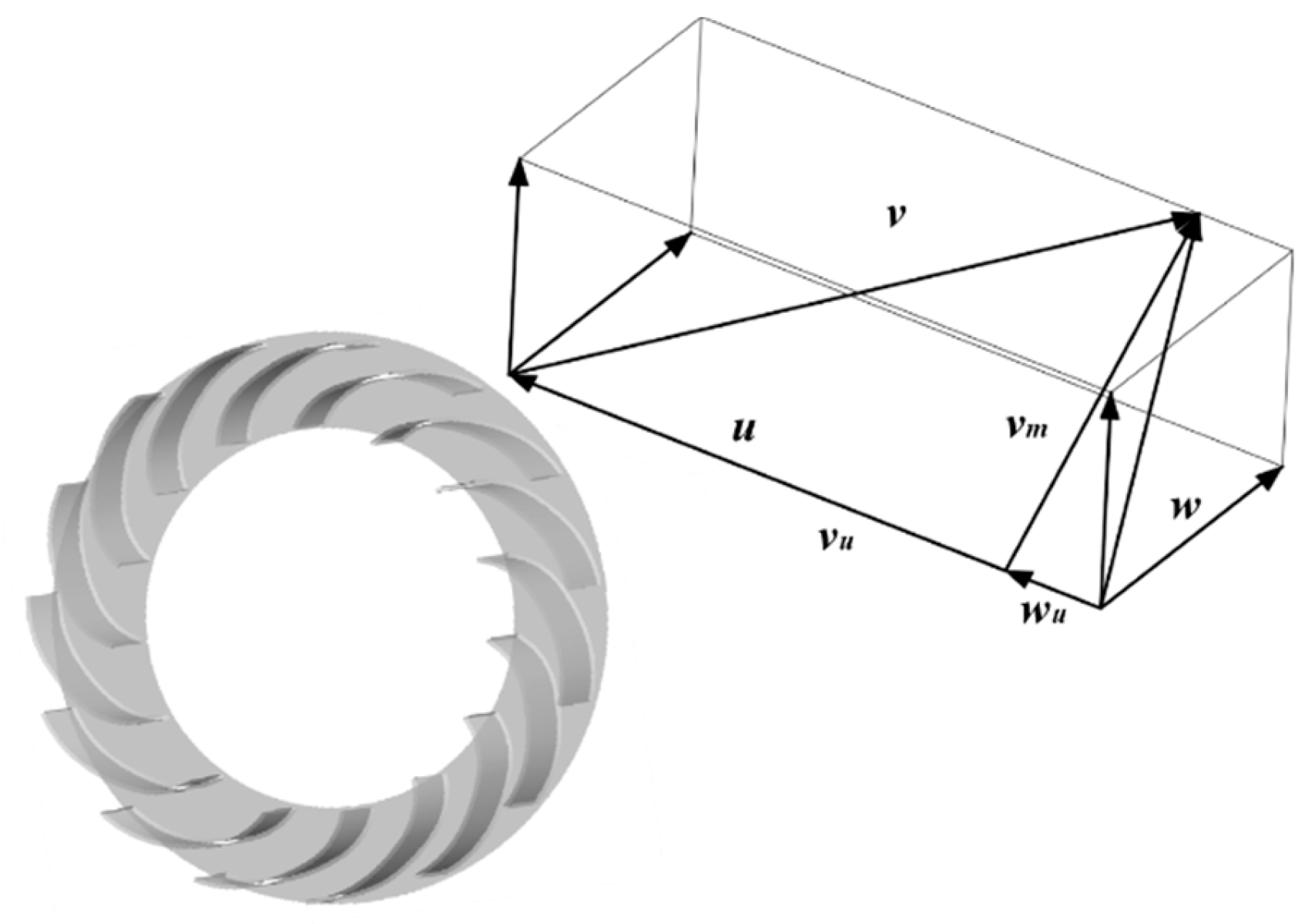
To clearly and comprehensively illustrate the internal flow structures, Figure 18 presents schematic diagrams of the two-dimensional impeller flow-field sections and the radial angular positions of the impeller. The two-dimensional sections were extracted at 1/3, 1/2, and 2/3 of the blade height from the front shroud to the rear shroud, as indicated in Figure 18a. In addition, to facilitate a detailed comparison of the outlet flow characteristics, the velocity triangles at the impeller outlet were decomposed for both the prototype and the optimized impellers. Figure 19 shows the orthogonal decomposition of the velocity triangles at the impeller outlet.
Variations in the blade profile parameters have a significant influence on the inlet and outlet flow characteristics. Since the inlet and outlet flow rates are nearly identical, the present analysis mainly focuses on the outlet flow for a detailed investigation.
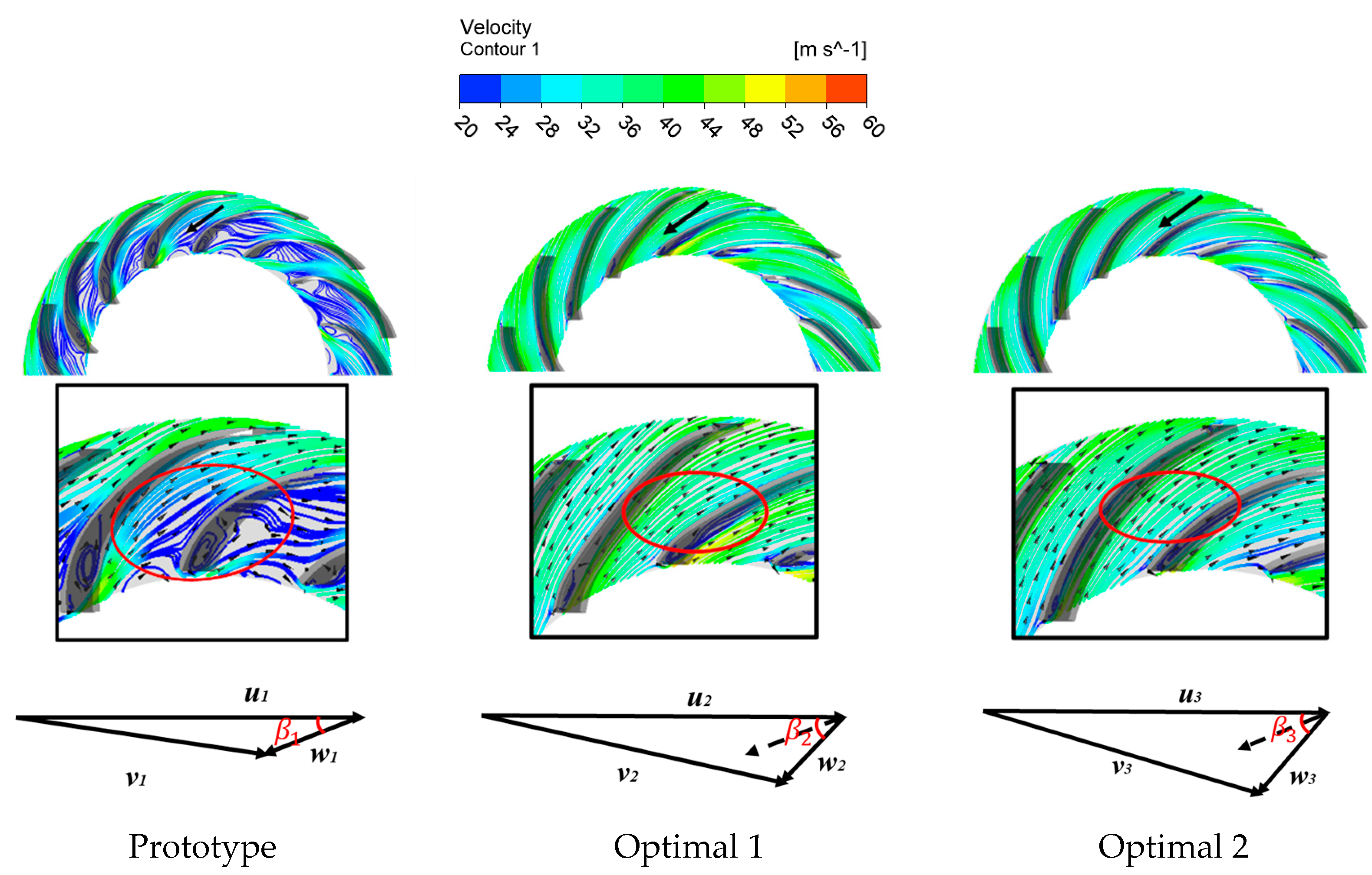
Figure 20 provides a comparative analysis of the velocity triangles at the impeller outlet. In the prototype blade, the direction of the outlet velocity does not align with the blade arrangement, resulting in significant flow separation and vortex formation. The modified blades, through optimized blade angles, exhibit increases in the outlet flow angle of 11.1° and 15.7° for Optimal 1 and Optimal 2, respectively. This adjustment leads to a more rational outlet velocity triangle, an enlarged β angle, and an alignment of the flow direction with the blades. Consequently, the flow field within the passages becomes more uniform, the flow velocity increases, and energy losses are reduced, culminating in a significant improvement in the fan’s aerodynamic performance.
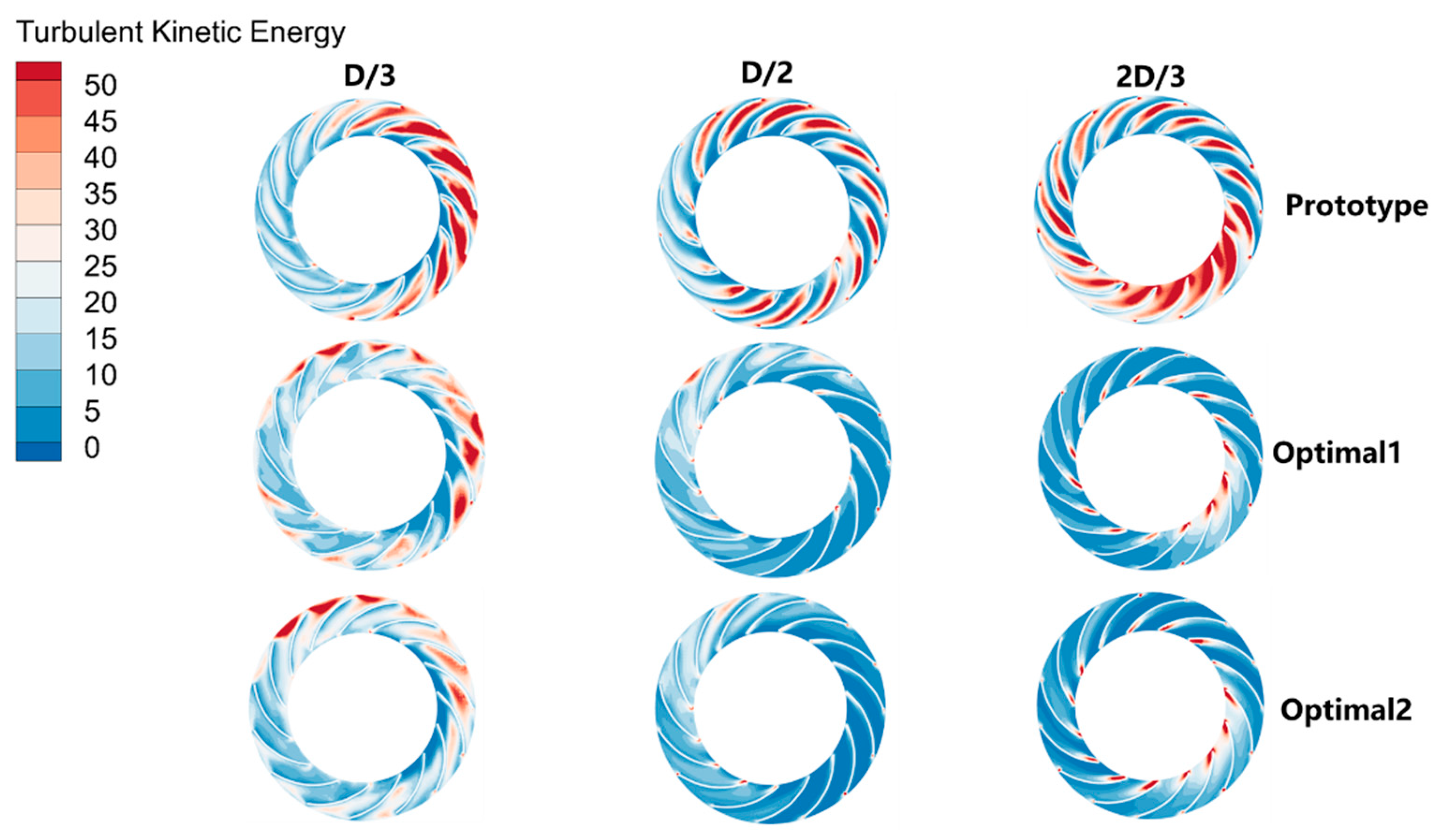
To quantitatively evaluate the turbulent characteristics of different impellers within the flow passage, three representative sections along the blade height direction were selected at the lower (D/3), middle (D/2), and upper (2D/3) positions to compare the distributions of turbulent kinetic energy (TKE), as shown in Figure 21. Turbulent kinetic energy is an important indicator for characterizing flow-field fluctuation intensity, reflecting the contribution of turbulence to energy dissipation and flow instability. In general, lower TKE levels indicate more stable flow structures and reduced energy losses, whereas regions with high TKE are usually associated with flow separation and reattachment within blade passages, which may lead to local blockage and efficiency degradation.
The results show that all three impellers exhibit the lowest TKE levels at the mid-span section (D/2), indicating relatively stable flow and reduced energy loss at this location. In contrast, higher TKE intensities are observed near the blade tip and hub regions, suggesting that these areas are more prone to flow separation and the development of strong three-dimensional secondary flow structures. Compared with the prototype, both Optimal 1 and Optimal 2 demonstrate significantly reduced TKE levels at the D/2 and 2D/3 sections. In particular, near the blade tip region, both the extent and magnitude of high-TKE zones are noticeably diminished. These results indicate that the optimized impellers are more effective in suppressing tip leakage flow and passage vortices, thereby reducing flow separation and energy dissipation, which contributes positively to the improvement of overall aerodynamic efficiency.
Upon completing the steady-state simulation of the internal flow within the impeller, this study further introduces the Large Eddy Simulation (LES) method to analyze the transient, unsteady vortex dynamics characteristics. The converged flow field from the aforementioned RANS steady-state calculation serves as the initial condition for the LES. The WALE (Wall-Adapting Local Eddy-viscosity) subgrid-scale model is employed to model the subgrid-scale stresses. This model automatically approaches zero eddy viscosity in the near-wall region without requiring additional damping functions, making it well-suited for flows with strong shear and curvature, as commonly encountered in rotating machinery. The time step is controlled based on the Courant–Friedrichs–Lewy (CFL) number, corresponding to Δt ≈ 5.0 × 10⁻⁵ s. This time step ensures the stability of the convective terms and is capable of capturing the blade passing frequency and high-frequency vortex structures.
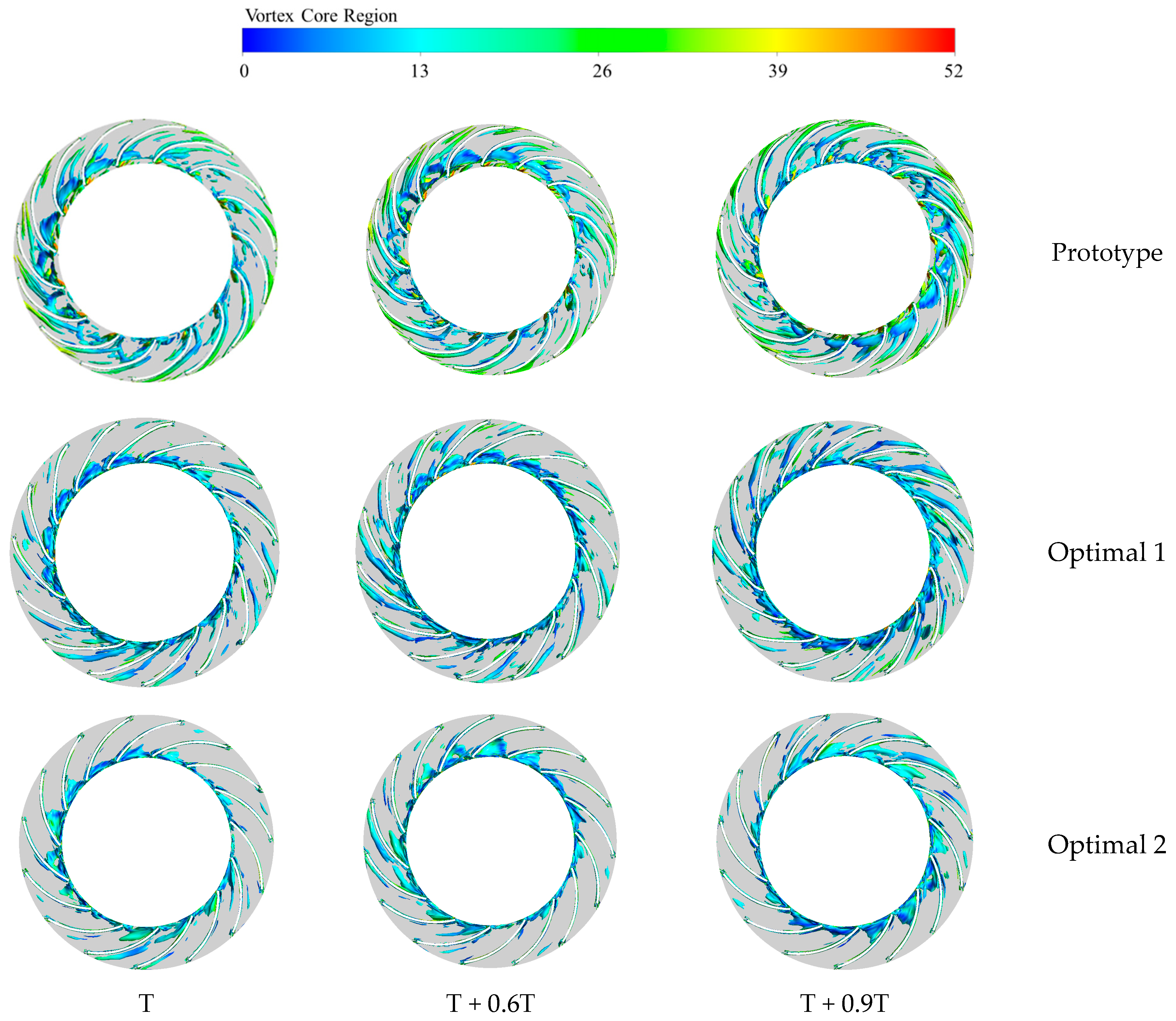
High-turbulence regions within the blade-to-blade passages are closely associated with secondary flows, wake interactions, and the unstable development of near-wall shear layers. In this study, the Q-criterion was employed to visualize and identify vortex structures in the impeller flow passages by comparing the relative magnitudes of local fluid rotation and strain rates. The Q-criterion is defined as Q = 1/2 (|Ω|2 − |S|2) and is well suited for the identification of complex three-dimensional shear flows and vortex systems [27,28].
The blade-to-blade passage of the centrifugal fan was selected as the primary region for analysis. Vortex structures were extracted using the Q-criterion at three representative time instants, as shown in Figure 22. At time T, the vortex intensity is relatively weak. As time progresses, the vortex intensity increases and reaches its maximum at T = T + 0.6T. A comparison of the vortex structures of the three centrifugal fan designs at T = T + 0.6T indicates that the prototype exhibits large-scale turbulent vortex structures within the blade passages, mainly concentrated near the pressure side of the blades. These vortices cause significant energy loss in the passage flow and severely affect the outlet flow velocity.
For Optimal 1, the vortex structures are noticeably reduced, with only a limited number of vortices concentrated near the trailing edge on the pressure side. Compared with Optimal 1, Optimal 2 shows a further reduction in vortex intensity and extent, exhibiting more stable flow characteristics in both the inlet and outlet trailing-edge regions. These results demonstrate that the optimized blade designs effectively suppress unsteady vortex structures within the flow passages.
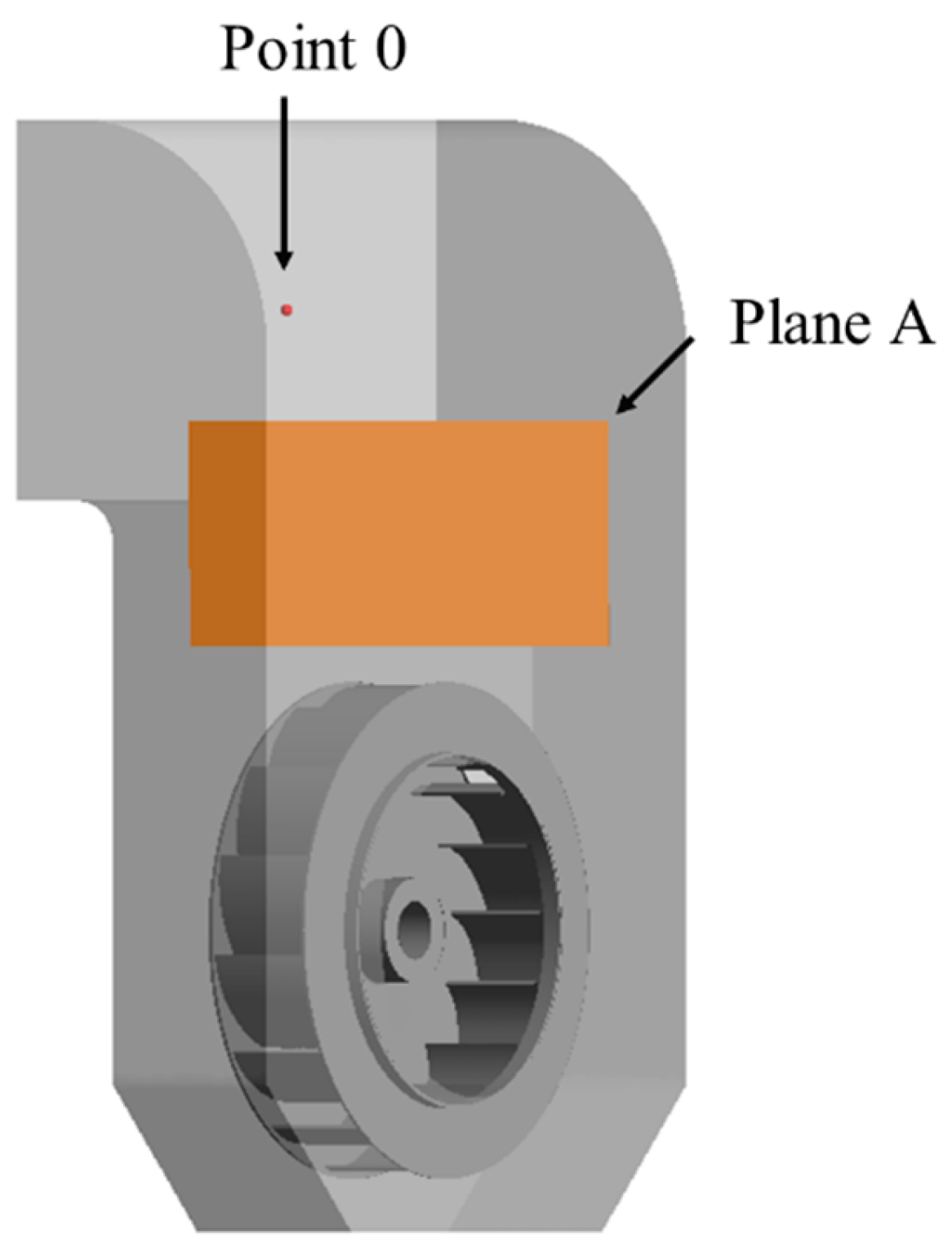
To further examine the pressure characteristics within the centrifugal fan flow passage, the pressure at the outlet monitoring point and the pressure distribution on a representative flow-passage section were analyzed, as shown in Figure 23. Point 0 denotes the pressure monitoring location at the outlet, while Plane A represents the selected flow-passage cross-section.
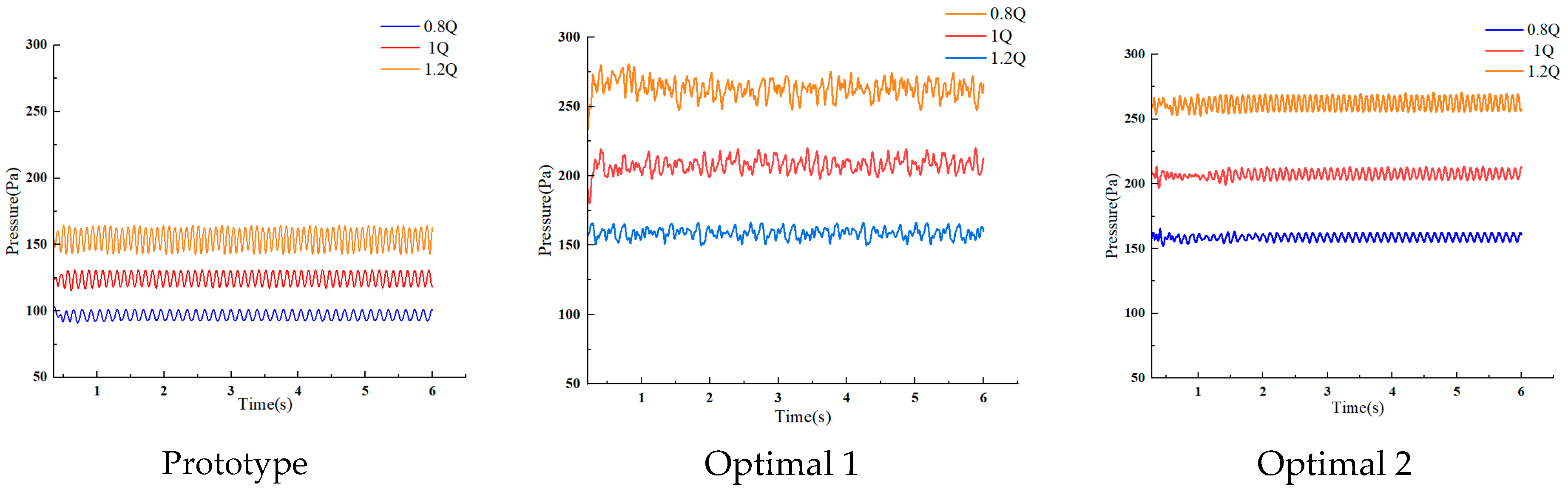
Figure 24 presents the time histories of pressure fluctuations at the outlet monitoring point (Point 0) under different flow rate conditions. The pressure signals exhibit a nearly sinusoidal periodic fluctuation pattern. At operating conditions of 0.8Q, Q, and 1.2Q, both optimized designs (Optimal 1 and Optimal 2) show significantly higher pressure amplitudes than the prototype impeller, indicating improved flow stability and more effective energy transfer.
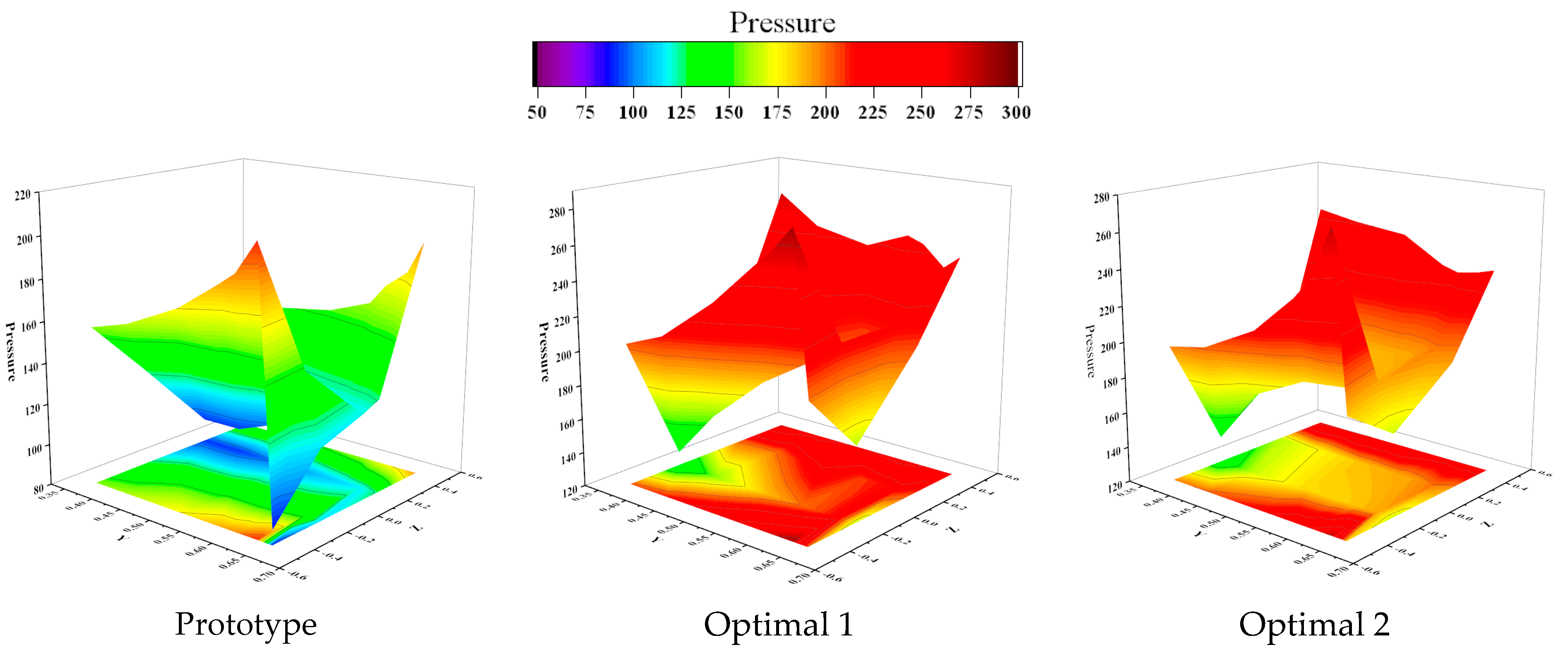
Figure 25 shows the projected pressure distribution on the flow-passage section Plane A. The results indicate that the dominant pressure gradient range for Optimal 1 and Optimal 2 lies between 130 and 300 Pa, which is substantially higher than that of the prototype, ranging from 80 to 195 Pa. This further demonstrates that the optimized impellers are capable of providing higher static pressure levels under identical flow rate conditions.
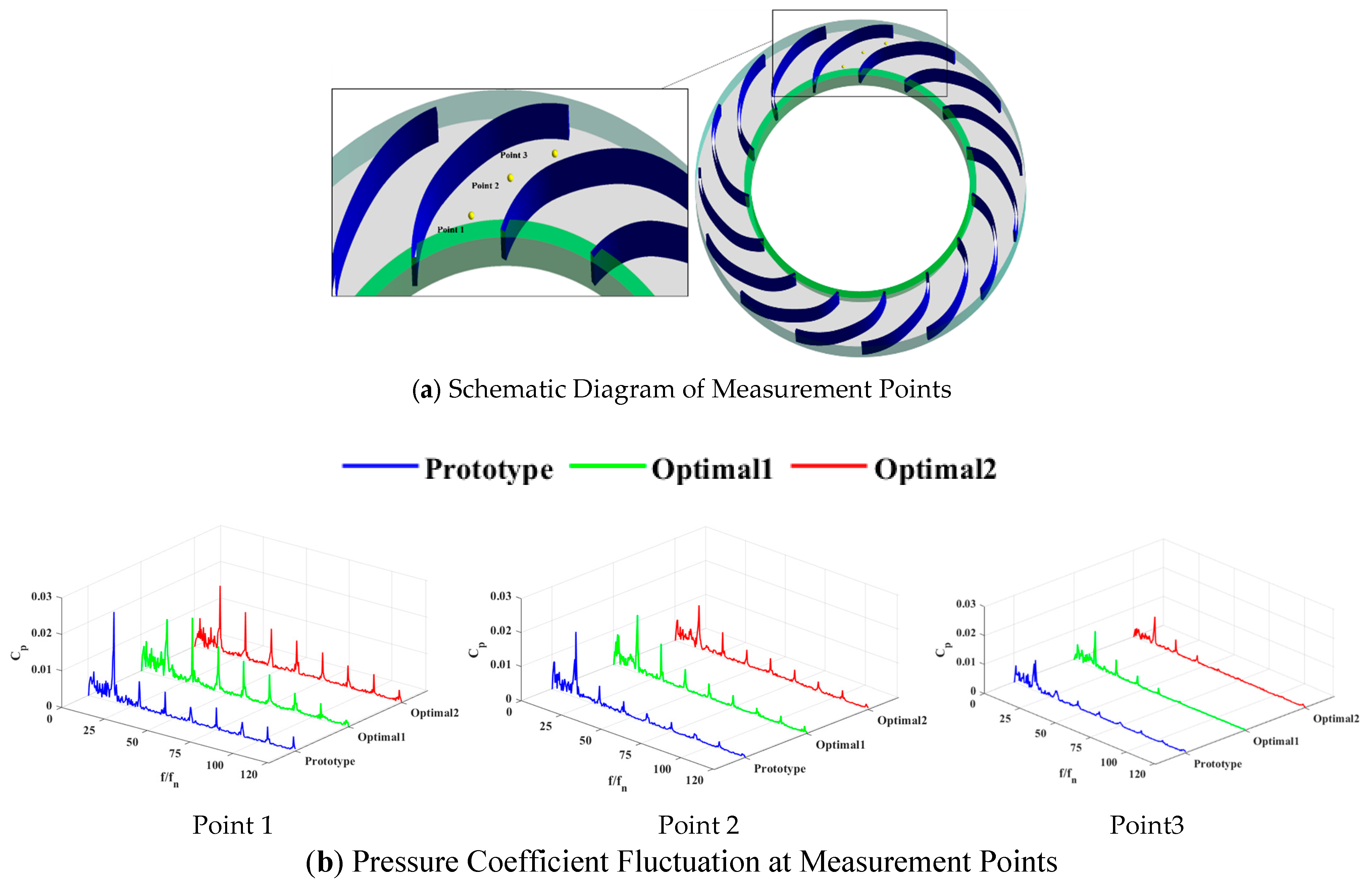
To further investigate the pressure fluctuation characteristics within the flow passage, three monitoring points (Point 1, Point 2, and Point 3) were arranged along the impeller passage, as illustrated in Figure 26a. The results indicate that the prototype impeller exhibits relatively large fluctuations in the pressure fluctuation coefficient in the low-frequency range. In particular, pronounced oscillations are observed in the frequency band of 1–2 kHz, suggesting that the aerodynamic resistance acting on the blade passages is strongly influenced by static pressure disturbances.
Under identical rotational speed and operating conditions, both optimized designs (Optimal 1 and Optimal 2) achieve significantly higher outlet static pressure than the prototype, indicating enhanced energy conversion capability. Correspondingly, the amplitude of the pressure coefficient spectra for the optimized designs is markedly higher than that of the prototype in the low-frequency range of f/fn = 10–60. This indicates stronger unsteady pressure fluctuations in the optimized impellers.
These results suggest that while the optimized designs effectively improve aerodynamic performance, they also intensify blade–passage interaction effects, leading to an increase in flow-induced pressure pulsation levels.

5. Conclusions

This study focuses on the optimization design of large-scale blades for a volute-free motor-cooled centrifugal fan. By combining Sobol sensitivity analysis with a GA-Kriging model, the blade geometry was optimized, and the flow-field characteristics of the optimized blades were systematically investigated through both experimental testing and numerical simulations. The main conclusions are summarized as follows:
By integrating Optimum Latin Hypercube Sampling (OLHS) with Sobol sensitivity analysis, the key control parameters of the centrifugal fan blade profile were effectively identified. On this basis, a GA-Kriging aerodynamic prediction model was established, achieving a mean squared error (MSE) ranging from 0.0006 to 0.85 under different test conditions. Furthermore, a multi-objective particle swarm optimization (MOPSO) algorithm was employed to perform the coordinated optimization of volume flow rate and static pressure. As a result, the aerodynamic performance of the volute-free centrifugal fan blades was significantly improved, with the optimized designs exhibiting an increase of approximately 14% in volume flow rate and 20% in static pressure compared with the prototype.
1. Both Optimal 1 and Optimal 2 exhibited superior aerodynamic performance compared to the prototype impeller while maintaining shaft power within 1.5 times the prototype value. The optimized designs demonstrated significant advantages in total pressure rise and efficiency improvement, indicating enhanced energy conversion and fluid guidance capabilities.
2. Flow field simulations further revealed the mechanism behind the optimization effects. Turbulent kinetic energy distributions and Q-criterion vortex structures showed that the optimized blades effectively suppressed inter-blade vortices and secondary flows, reducing turbulence intensity and improving pressure gradient distribution within the flow passage. Analysis of static pressure distribution and pressure pulsations confirmed substantially improved energy utilization in the modified designs compared to the prototype.
The results of this study demonstrate that, by employing a multi-objective optimization approach based on Sobol sensitivity analysis and the GA-Kriging surrogate model, the aerodynamic performance of large-scale centrifugal fans for explosion-proof motor cooling can be significantly improved under the constraint of shaft power, enhancing airflow efficiency and thereby effectively improving motor cooling effectiveness. This method provides a novel technical pathway and feasible route for the efficient design optimization of large-sized centrifugal fan blades, offering important theoretical and engineering application value. However, this study did not conduct a systematic investigation of noise performance and vibration. Future work should focus on aeroacoustic coupled analysis (using the FW-H acoustic analogy method), fluid–structure interaction simulations, and experimental validation, while incorporating noise and vibration constraints into the multi-objective optimization framework. This will enable synergistic optimization of aerodynamic performance, noise control, and structural reliability, thereby providing a more comprehensive technical foundation for the low-noise, high-efficiency, and reliable design of large-scale explosion-proof motor cooling fans.

Author Contributions

Conceptualization, H.Z.; Methodology, H.Z. and S.Z.; Software, H.Z. and Z.M.; Validation, H.Z. and Z.M.; Formal analysis, H.Z.; Investigation, H.Z. and Z.W.; Resources, H.Z. and Z.W.; Data curation, H.Z.; Writing—original draft, H.Z.; Writing—review & editing, H.Z. and S.Z.; Visualization, H.Z.; Project administration, S.Z.; Funding acquisition, S.Z. All authors have read and agreed to the published version of the manuscript.

Funding

This research received no external funding.

Institutional Review Board Statement

Not applicable.

Informed Consent Statement

Not applicable.

Data Availability Statement

The data presented in this study are available on request from the corresponding author. The data are not publicly available due to privacy agreements.

Conflicts of Interest

The authors declare no conflicts of interest.

References

  1. Ge, B.; Zhang, J.; Dajun, T. Temperature prediction and cooling structure optimization of explosion-proof high pressure water-cooled double speed motor. Energy Rep. 2022, 8, 3891–3901, ISSN 2352–4847. [Google Scholar] [CrossRef]
  2. Wang, Q.; Wu, Y.; Niu, S.; Zhao, X. Advances in Thermal Management Technologies of Electrical Machines. Energies 2022, 15, 3249. [Google Scholar] [CrossRef]
  3. Song, H.; Huang, X.; Qiu, H.; Han, W.; Zhang, Y.; Wang, S.; Xie, W. Flow–thermal analysis of ventilation and cooling capacity of centrifugal fans with splitter blades in high-voltage asynchronous motors. Int. J. Fluid Eng. 2025, 2, 044302. [Google Scholar] [CrossRef]
  4. Lei, J.; Cui, Q.; Qin, G. Performance improvement of multi-blade centrifugal fan based on impeller outlet flow control. Phys. Fluids 2024, 36, 095181. [Google Scholar] [CrossRef]
  5. Shao, W.; Feng, J.; Zhang, F.; Wang, S.; Li, Y.; Lv, J. Aerodynamic performance optimization of centrifugal fan blade for air system of self-propelled cotton-picking machine. Agriculture 2023, 13, 1579. [Google Scholar] [CrossRef]
  6. Zhou, S.; Zhou, H.; Yang, K.; Dong, H.; Gao, Z. Research on blade design method of multi-blade centrifugal fan for building efficient ventilation based on Hicks-Henne function. Sustain. Energy Technol. Assess. 2021, 43, 100971. [Google Scholar] [CrossRef]
  7. Zhou, S.; Yang, K.; Zhang, W.; Zhang, K.; Wang, C.; Jin, W. Optimization of Multi-Blade Centrifugal Fan Blade Design for Ventilation and Air-Conditioning System Based on Disturbance CST Function. Appl. Sci. 2021, 11, 7784. [Google Scholar] [CrossRef]
  8. Zhang, L.; Wang, S.; Hu, C.; Zhang, Q. Multi-objective optimization design and experimental investigation of centrifugal fan performance. Chin. J. Mech. Eng. 2013, 26, 1267–1276. [Google Scholar] [CrossRef]
  9. Li, Y.; Zhang, W.; Wang, J.; Chen, H. Aerodynamic force prediction of compressor blade surfaces based on machine learning. J. Turbomach. 2023, 145, 081005. [Google Scholar] [CrossRef]
  10. Meng, F.; Zhang, Z.; Wang, L. Volute Optimization Based on Self-Adaption Kriging Surrogate Model. Int. J. Chem. Eng. 2022, 2022, 6799201. [Google Scholar] [CrossRef]
  11. Ruan, C.; Chen, Y.; Zheng, L.; Guo, B.; Chen, J.; Yang, J.; Chen, S. Optimization of centrifugal fan for oolong tea shaking machine based on Kriging model and multi-objective particle swarm algorithm. Sci. Rep. 2026, 16, 2737. [Google Scholar] [CrossRef] [PubMed]
  12. Cadirci, S.; Selenbas, B.; Gunes, H. Optimization of a centrifugal fan impeller using kriging simulated annealing. In Proceedings of the ASME International Mechanical Engineering Congress and Exposition, Denver, CO, USA, 11–17 November 2011; Volume 54921, pp. 991–997. [Google Scholar]
  13. Menter, F.R. Two-equation eddy-viscosity turbulence models for engineering applications. AIAA J. 1994, 32, 1598–1605. [Google Scholar] [CrossRef]
  14. Versteeg, H.K. An Introduction to Computational Fluid Dynamics the Finite Volume Method, 2/E; Pearson Education India: Noida, India, 2007. [Google Scholar]
  15. Ullah, T.; Ahmad, F.; Siddiqi, M.U.R.; Khan, A.; Hanif, M.I.; Irfan, M.; Ali, S. Blade meridional profile optimization for novel high-pressure ratio centrifugal compressor design using numerical simulations. In Proceedings of the 2020 3rd International Conference on Computing, Mathematics and Engineering Technologies (iCoMET), Sukkur, Pakistan, 29-30 January 2020; IEEE: New York, NY, USA, 2020; pp. 1–9. [Google Scholar]
  16. Khan, A.; Irfan, M.; Niazi, U.M.; Shah, I.; Legutko, S.; Rahman, S.; Alwadie, A.S.; Jalalah, M.; Glowacz, A.; Khan, M.K.A. Centrifugal compressor stall control by the application of engineered surface roughness on diffuser shroud using numerical simulations. Materials 2021, 14, 2033. [Google Scholar] [CrossRef] [PubMed]
  17. Martin, O.; Yao, H.-D.; Davidson, L. Tonal noise of voluteless centrifugal fan generated by turbulence stemming from upstream inlet gap. Phys. Fluids 2021, 33, 075110. [Google Scholar] [CrossRef]
  18. Rawaa, S.; Mohammadian, A.; Gildeh, H.K. A comparison of standard k–ε and realizable k–ε turbulence models in curved and confluent channels. Environ. Fluid Mech. 2019, 19, 543–568. [Google Scholar]
  19. He, W.; Liu, X. Improved aerofoil parameterisation based on class/shape function transformation. Aeronaut. J. 2019, 123, 310–339. [Google Scholar] [CrossRef]
  20. Masters, D.A.; Taylor, N.J.; Rendall, T.C.S.; Allen, C.B.; Poole, D.J. Geometric comparison of aerofoil shape parameterization methods. AIAA J. 2017, 55, 1575–1589. [Google Scholar] [CrossRef]
  21. Liu, Z.; Yang, M.; Li, W. A Sequential Latin Hypercube Sampling Method for Metamodeling. In Theory, Methodology, Tools and Applications for Modeling and Simulation of Complex Systems; Springer: Singapore, 2016. [Google Scholar]
  22. Wan, Z. Global sensitivity evolution equation of the Fréchet-derivative-based global sensitivity analysis. Struct. Saf. 2024, 106, 102413. [Google Scholar] [CrossRef]
  23. Lund, A.; Dyke, S.J.; Song, W.; Bilionis, I. Global sensitivity analysis for the design of nonlinear identification experiments. Nonlinear Dyn. 2019, 98, 375–394. [Google Scholar] [CrossRef]
  24. Sacks, J.; Welch, W.J.; Mitchell, T.J.; Wynn, H.P. Design and analysis of computer experiments. Stat. Sci. 1989, 4, 409–423. [Google Scholar] [CrossRef]
  25. Kleijnen, J.P.C. Kriging metamodeling in simulation: A review. Eur. J. Oper. Res. 2009, 192, 707–716. [Google Scholar] [CrossRef]
  26. Lu, Y.; Li, B.; Liu, S.; Zhou, A. A population cooperation based particle swarm optimization algorithm for large-scale multi-objective optimization. Swarm Evol. Comput. 2023, 83, 101377. [Google Scholar] [CrossRef]
  27. Zhou, H.; Cai, G.; Zhang, J.; Zhang, M.; He, B. Research of wall roughness effects based on Q criterion. Microfluid. Nanofluidics 2017, 21, 114. [Google Scholar] [CrossRef]
  28. Meneveau, C.; Lund, T.S.; Cabot, W.H. A Lagrangian dynamic subgrid-scale model of turbulence. J. Fluid Mech. 1996, 319, 353–385. [Google Scholar] [CrossRef]
Figure 1. Box-type Asynchronous Motor.
Applsci 16 02651 g001
Figure 2. Overall structure of the box-type motor and configuration of the centrifugal fan.
Applsci 16 02651 g002
Figure 3. Grid division diagram.
Applsci 16 02651 g003
Figure 4. Grid independence verification.
Applsci 16 02651 g004
Figure 5. Experimental Test.
Applsci 16 02651 g005
Figure 6. Comparison of CFD results with experimental data.
Applsci 16 02651 g006
Figure 7. Flowchart of the optimization algorithm.
Applsci 16 02651 g007
Figure 8. Multi-Segment Circular Arc Fitting via LEM-CST Functions.
Applsci 16 02651 g008
Figure 9. Blade Profile Construction Using LEM-CST Functions.
Applsci 16 02651 g009
Figure 10. Initial Sample Values.
Applsci 16 02651 g010
Figure 11. Sensitivity Magnitude of Control Points.
Applsci 16 02651 g011
Figure 12. Training and Predicted Response Surfaces of the GA-MLP Model.
Applsci 16 02651 g012
Figure 13. Prediction Errors of the GA-Kriging Model.
Applsci 16 02651 g013
Figure 14. Pareto Front.
Applsci 16 02651 g014
Figure 15. Comparison of Impeller Blade Profiles.
Applsci 16 02651 g015
Figure 16. Experimental Testing.
Applsci 16 02651 g016
Figure 17. Aerodynamic Performance Testing and Numerical Simulation.
Applsci 16 02651 g017
Figure 18. Schematic of Impeller Cross-Section and Radial Velocity Development.
Applsci 16 02651 g018
Figure 19. Schematic Diagram of Blade Exit Velocity Triangle.
Applsci 16 02651 g019
Figure 20. Comparison of Impeller Exit Velocity Triangles.
Applsci 16 02651 g020
Figure 21. Turbulent Kinetic Energy (TKE) Distribution at Cross-Sections.
Applsci 16 02651 g021
Figure 22. Q-Criterion Vorticity in Impeller Flow Passage at Different Time Instants.
Applsci 16 02651 g022
Figure 23. Pressure measurement point (Point 0) and flow passage cross-section (Plane A).
Applsci 16 02651 g023
Figure 24. Time-Varying Pressure at Outlet Measurement Point under Different Flow Rates.
Applsci 16 02651 g024
Figure 25. Pressure Distribution on Flow Passage Cross-Section.
Applsci 16 02651 g025
Figure 26. Pressure Coefficient Fluctuation Spectrum at Measurement Points 1, 2, and 3.
Applsci 16 02651 g026
Table 1. Design specifications of the impeller for the box-type asynchronous centrifugal fan.
ParameterValue
Impeller height, H (mm)150
Hub height, L (mm)70
Impeller inlet radius, R1 (mm)433.92
Impeller outlet radius, R2 (mm)625.31
Outlet blade height, H1(mm)140
Impeller inlet angle, α (°)141.8
Impeller outlet angle, β (°)19.84
Number of blades15
Shaft speed (rpm)1485
Working mediumAir
Inlet total pressure, Pin (Pa)120
Ambient temperature, T (°C)25
Table 2. Constraint Ranges for yₙ Coordinates.
VariableRange (mm)
y1(5, 13)
y2(12, 21)
y3(14, 23)
y4(12, 21)
y5(5, 13)
y16(12, 21)
y17(14, 23)
y18(12, 21)
y19(5, 13)
y20(5, 13)
Table 3. Uncertainty Quantification for Ensemble Learning (n = 20).
MetricQ (m3/s)P (Pa)
Average Predicted Value on Test Set( y ^ ˉ )2.123130.213
Average Standard Deviation on Test Set ( σ ˉ )0.04131.0796
Average 95% Confidence Interval Width (Cl)0.1402.32
Average Relative Uncertainty(CV)3.12%4.45%
Table 4. Normalized y-Coordinates of Prototype and Optimized Designs.
y1y2y3y4y5
Prototype0.100.160.200.130.08
Optimal 10.050.080.120.080.05
Optimal 20.050.070.100.080.05
Table 5. Experimental Test Data.
PsP (Pa)Q (m3/s)
Prototype3.35 kw1041.9
Optimal 13.56 kw1302.21
Optimal 23.45 kw1322.18
Disclaimer/Publisher’s Note: The statements, opinions and data contained in all publications are solely those of the individual author(s) and contributor(s) and not of MDPI and/or the editor(s). MDPI and/or the editor(s) disclaim responsibility for any injury to people or property resulting from any ideas, methods, instructions or products referred to in the content.