Article

Model to Assess the Intelligence Level of Buildings in the Hotel Industry by Applying Integrated Fuzzy Shannon Entropy and Fuzzy Multi-Objective Optimization on the Basis of Ratio Analysis

by
Seyed Morteza Hatefi
1,
Jolanta Tamošaitienė
2,*,
Pardis Roshanayee
1 and
Ulrike Quapp
2
1
Department of Civil Engineering, Faculty of Engineering, Shahrekord University, Rahbar Boulevard, Shahrekord P.O. Box 115, Iran
2
Faculty of Civil Engineering, Vilnius Gediminas Technical University, Saulėtekio al. 11, LT-10223 Vilnius, Lithuania
*
Author to whom correspondence should be addressed.
Appl. Sci. 2026, 16(6), 2652; https://doi.org/10.3390/app16062652
Submission received: 19 December 2025 / Revised: 6 February 2026 / Accepted: 11 February 2026 / Published: 10 March 2026
(This article belongs to the Special Issue Digital Twin and AI in Construction and Urban Sustainability)

Abstract

The rapid evolution of smart building technologies has transformed the hotel industry, necessitating structured methodologies for evaluating building intelligence. This research, dedicated to engineering problems, proposes an integrated decision-making model that combines fuzzy Shannon entropy and fuzzy multi-objective optimization on the basis of ratio analysis (MOORA) to assess the intelligence level of buildings within the hospitality sector. The model systematically determines the relative importance of intelligence criteria, including engineering, environmental, economic, social and cultural, technological, and energy conservation criteria. By leveraging fuzzy Shannon entropy, the framework objectively assigns weights to criteria based on information distribution, minimizing subjective biases in evaluation. Fuzzy MOORA is then applied to rank alternative intelligent buildings in hotels, ensuring an accurate comparative assessment. The proposed model is tested on real-world hotel data, demonstrating its effectiveness in identifying optimal intelligent building configurations. The results of applying fuzzy Shannon entropy reveal that human comfort, the emission of greenhouse gases (pollution), and system integration are the most important sub-criteria. Finally, by applying the importance of the criteria in the fuzzy MOORA model, the intelligence levels of hotels are evaluated. The results show that the Parsian Kowsar, Piroozy and Sepahan Hotels are the best hotels based on the intelligent building criteria.

1. Introduction

The increasing progress of technology and the unprecedented growth of public awareness have highlighted the importance of management, control, and security in societies. All humans seek a modern habitat that offers maximum security and is under their direct control. Modern buildings can be constructed by incorporating smart-home technology, introducing different solutions, and establishing computer networks and necessary facilities. This system has become an integral part of human life [1]. A smart home is a set of technologies and services that improve the quality of life while reducing energy consumption in the home network. The smart building system has introduced the concept of managing the network of devices and equipment in the home for more than a decade. A smart building is a building in which all the internal components interact with each other through an integrated medium that is logically compatible with the environment [2]. In other words, smart building designers integrate four key elements, namely systems, structure, services, and dynamic and cost-effective environmental management, which lead to greater comfort, convenience, and security for building users. Also, nowadays, most modern public and residential buildings are planned with the aim of reducing costs by reducing energy consumption. Improving energy conservation strategies and using sustainable design approaches are essential factors in the development of this field [3]. There is a positive correlation between the level of building intelligence (BMS/BAS implementation) and energy efficiency, meaning smarter buildings generally consume less energy. This efficiency stems from real-time optimization of major energy loads, like air-conditioning (HVAC) and lighting, based on occupancy and environmental data, thereby eliminating wasteful operation inherent in fixed-schedule systems. This concept is strongly supported by research showing how IoT integration empowers data-driven automation for significant energy savings [4].
Intelligent buildings in hotels are designed to improve efficiency, sustainability, and guest experience by integrating advanced technologies such as the Internet of Things (IoT), artificial intelligence (AI), big data analytics, and automation systems. These smart infrastructures are becoming essential as hotels strive to enhance operational efficiency, reduce energy consumption, and provide a personalized experience for guests [5,6,7,8,9]. Hotels represent one of the most complex building types, as they simultaneously function as residential, commercial, and service-oriented facilities. Intelligent building solutions enable hotels to optimize heating, ventilation, and air-conditioning (HVAC) systems, lighting, security, and water management through real-time monitoring and adaptive control. These technologies not only contribute to reduced energy consumption and greenhouse gas emissions but also improve guest satisfaction, safety, and overall operational performance. As a result, assessing the intelligence level of hotel buildings has become a critical task for hotel managers, investors, designers, and policymakers. However, the assessment of intelligent buildings in hotels is inherently a multi-criteria decision-making (MCDM) problem. It involves diverse and often conflicting criteria, including technical performance, energy efficiency, environmental impact, economic feasibility, system reliability, and user comfort. Moreover, many of these criteria are qualitative in nature and depend on expert judgments, which are usually expressed using linguistic terms and are subject to uncertainty and vagueness. Conventional evaluation methods are limited in their ability to handle such imprecise information and may lead to biased or unreliable results.
To overcome these limitations, fuzzy set theory has been widely integrated with MCDM methods to model uncertainty and capture the ambiguity inherent in human judgments. In this context, fuzzy Shannon entropy is an effective objective weighting technique that quantifies the degree of dispersion and information content of criteria based on fuzzy evaluations, reducing reliance on subjective weight assignment. Meanwhile, fuzzy MOORA (multi-objective optimization on the basis of ratio analysis) provides a robust ranking mechanism by simultaneously considering benefit and cost criteria and preserving proportional relationships among alternatives under a fuzzy environment. The combination of fuzzy Shannon entropy and fuzzy MOORA offers a coherent and mathematically consistent framework for intelligent building assessment under uncertainty.
Despite the growing body of literature on intelligent buildings and smart hotels, existing studies often focus on isolated performance dimensions or rely heavily on subjective weighting approaches. Moreover, limited attention has been given to the integrated application of objective fuzzy weighting and fuzzy ranking techniques specifically for assessing intelligent building performance in the hotel industry. This research gap highlights the need for a comprehensive, data-driven, and uncertainty-aware evaluation framework tailored to hotel buildings. The main contributions and novelty of this study are threefold.
First, this paper develops a comprehensive evaluation framework for assessing intelligent building performance in hotels by systematically identifying and structuring relevant technical, environmental, economic, and user-oriented criteria.
Second, an integrated fuzzy MCDM approach combining fuzzy Shannon entropy and fuzzy MOORA is proposed, in which fuzzy Shannon entropy objectively determines criteria weights based on information content, while fuzzy MOORA effectively ranks hotel alternatives by considering both benefit and cost criteria under uncertainty.
Third, the proposed framework enhances decision transparency and reliability by minimizing subjective bias and explicitly addressing uncertainty in expert evaluations, thereby providing practical decision support for hotel managers and policymakers aiming to improve building intelligence and sustainability.
The results of this study contribute to the literature on intelligent building assessment and smart hotel management by offering a novel, objective, and fuzzy-based decision-making framework. Furthermore, the proposed approach can be extended to other service-oriented or energy-intensive building types, supporting broader applications in sustainable building performance evaluation.

1.1. Related Works

The literature related to this study spans two closely connected research streams: intelligent building concepts and technologies and methods for assessing intelligent building performance. To provide a structured and comprehensive review, this section is organized into two subsections. The first subsection reviews the foundational concepts, key dimensions, and technological components of intelligent buildings, establishing the theoretical background of building intelligence. The second subsection focuses on existing approaches for assessing intelligent buildings, with particular emphasis on applications in the hotel industry, including multi-criteria and fuzzy-based evaluation methods. This structure enables a clear progression from general concepts to sector-specific assessment practices and helps identify the research gaps addressed in this study.

1.1.1. Intelligent Building

Several studies have focused on effectively designed hardware, components, sensors, and new technologies for intelligent building management. Liu et al. [10] reviewed 181 studies to explore how blockchain can enhance areas like smart contracts, BIM, and supply chains in construction. The study highlighted research gaps and suggested future directions focusing on cost–benefit analysis, project delivery integration, and synergy with digital technologies. Pan et al. [11] systematically reviewed 97 journal articles to examine the application of AI and robotics in prefabricated and modular construction using a concept–methodology–value framework. It outlined five key future research directions: integrated AI-robotics for large-scale modularization, multidimensional project management, intelligent post-construction management, interdisciplinary interoperability, and moving beyond purely technical solutions. Yang and Peng [12] stated that the concept of intelligent buildings has not been accepted as quickly and widely as expected. One of the reasons for this is the lack of information and knowledge support from all the professionals involved in the design phase of a project. Their study provides a brief overview of recent developments in IB technologies and discusses ways to complement the decision-making process by adopting two methods for the economic and technical aspects of IB applications. Larbi et al. [13] applied multi-criteria decision-making techniques to map and evaluate barriers to digital technology adoption in construction, revealing political barriers as root causes and economic barriers as highly impactful. The study identified top-level management support as the most effective, cost-efficient, and feasible strategy to accelerate digital transformation in the industry. Liu et al. [14] extended the technology acceptance model (TAM) to better understand user acceptance of smart construction systems, particularly in prefabricated housing. The study highlighted that users’ attitudes and perceptions of usefulness evolve over time, necessitating a dynamic approach to technology adoption in construction. Li et al. [15] systematically reviewed several papers to assess the application of laser scanning technology (LST) in smart construction. The authors also highlighted the transformative impact of LST on smart construction and proposed future research directions to enhance its application in modern construction practices.
Kua and Lee [16] presented the idea of linking smart projects and buildings with total sustainability in their research. The research by Wang et al. [17] examined the frustrating problems of building automation and control system integration and interoperability and presented two possible solutions based on a hierarchical architecture. Rutishauser et al. [18] described a multi-agent framework for intelligent building control deployed in a commercial building equipped with sensors and actuators. Wong and Li [19] stated that with the availability of numerous smart building components or products in the market, the decision to choose between them becomes important and vital. The research presented the development of a conceptual model for the selection of smart building systems, which aims to help decision-makers choose the most appropriate combination of smart building components. Wong and Li [20] described a framework for the integration of heterogeneous building automation systems (BAS) on the Internet. It combines the proposed framework (OLE for process control) and web services to integrate data and services on the Internet. Braun [21] stated that his research has provided a vision for intelligent equipment. A factory-integrated chip can contain detailed information necessary for installation, commissioning, operation, maintenance, warranty, and repair and can be accessed from a local computer or handheld device via a USB or wireless connection. Various design parameters of the school building, such as the orientation and layout of the building, covering features, air quality inside the building, and daylighting systems, were examined as part of the design evaluation and optimization process. Dibley et al. [22] stated that their research presented a cost-effective hardware design for a multipurpose sensor unit (ZigBee) that compactly integrates several types of sensors. Together with a multi-agent software framework, the application support defined in the study can provide real-time intelligent building monitoring and diagnosis. Ghaffarian Hoseini [23] discussed the concept of combining intelligent building systems and principles to reduce environmental damage and, at the same time, improve ecosystem services. Mohammed et al. [24] evaluated an optimized model for heating, ventilation, and HVAC and obtained optimal values using a genetic algorithm. Pan et al. [11] designed and implemented a fully adjustable intelligent control system for building heating using a multilayer control system consisting of small personal computers and cloud computing resources. Dai et al. [25] proposed an open-source tool called BuildingGym for training reinforcement learning (RL) control strategies to handle common challenges in building energy management. The intelligence level of building control systems utilizing RL was evaluated by their effectiveness in training control strategies within a flexible, research-friendly framework [25]. Intelligence was quantified by the performance of the built-in RL algorithms when tasked with optimizing energy management objectives. This was specifically demonstrated through strong performance in managing both constant and dynamic cooling load management [25].

1.1.2. Intelligent Building Assessment Methods

A part of the literature on intelligent buildings is devoted to the assessment of intelligent buildings. In this line of research, some studies have applied multi-criteria decision-making methods to assess intelligent buildings. For instance, Chen et al. [26] presented a multi-criteria decision-making model to evaluate the energy efficiency of intelligent buildings. A decision-making model named IBAssessor was developed based on the analytical network process (ANP) method for IB assessment. To do so, a set of lifetime performance indicators and a new quantitative approach called the energy-time index (ETI) were used. Tabrizi et al. [27] explored the application of multi-criteria fuzzy logic to evaluate and optimize school building design. Kaya and Kahraman [28] applied AHP and TOPSIS under a fuzzy environment to handle uncertainty in expert evaluations and compared the ranking results of three intelligent building alternatives in a business center in Istanbul. Szász and Husi [29] introduced a basic IB development model built on four main pillars: residents, information, energy and adaptability. This specific IB approach is tailored for the Central European region, considering its geographical, climatic and sociological characteristics and possibilities. Azari et al. [30] introduced a comprehensive multi-criteria decision-making framework including 68 sub-factors for the selection of smart buildings. In their research, eight high-quality environmental modules, including environmental and energy indicators, space flexibility, cost-effectiveness, user comfort, work efficiency, safety, culture, and technological factors, were used as the main factors. Omar [31] explored the concept of intelligent buildings, emphasizing their role in energy efficiency, sustainability, and technological integration. The study highlighted the lack of a unified definition for intelligent buildings and proposed a multi-criteria framework to systematically assess them. Hatefi [32] introduced an integrated AHP method and preference degree approach (PDA) under fuzzy environments to evaluate smart buildings. Yang et al. [12] presented a decision-making framework for optimizing intelligent building management systems using activity-based costing and resource constraints. The authors highlighted that integrating activity-based costing with resource constraints improves financial transparency, operational efficiency, and sustainability in intelligent building management. Their proposed model provides a data-driven approach for decision-makers in the smart building industry.
Assessing intelligent buildings in hotels is crucial for enhancing operational efficiency, sustainability, and guest experience. There are some key reasons that show why intelligent building assessment in hotels is important: hotels consume significant amounts of energy for heating, cooling, and lighting. Intelligent building assessments help optimize energy use through smart automation and reduce costs and environmental impact. Smart technologies improve comfort by adjusting room temperature, lighting, and security based on guest preferences [5,33,34,35]. Automated maintenance and predictive analytics reduce downtime and repair costs. Research suggests that intelligent buildings reduce operational expenses by optimizing resource allocation. Hotels benefit from intelligent surveillance, access control, and emergency response systems. Assessments ensure these technologies function effectively to protect guests and staff [36,37]. Intelligent buildings enable dynamic space management, allowing hotels to optimize occupancy rates and event planning [38]. Liu et al. [39] explored the factors influencing tourists’ adoption of smart hospitality beyond the traditional technology acceptance model. The study conceptualized smart hospitality and examined its relationship with perceived usefulness, ease of use, hotel image, and tourists’ behavioral intentions. Using a sample of 348 respondents in Macau, Liu et al. [39] applied partial least squares path modeling to test their proposed framework. Zhou and Kim [40] analyzed the quality attributes of smart hotels in China using the SERVQUAL-IPA model. The study identified six key quality factors: tangibles, reliability, assurance, responsiveness, empathy, and playfulness. The authors concluded that smart devices should assist customers in emergency situations. Mousavi [41] presented a localized assessment model for evaluating the sustainability of hotel buildings in Northern Cyprus. The study synthesized sustainable building evaluation criteria and various sustainability measurement methods to develop a flexible model adaptable to different regional conditions. Liu et al. [42] provided a bibliometric analysis of smart hotel research, examining 613 publications from the Web of Science database to track scholarly trends and developments. It explored how AI, IoT, cloud computing, and big data are shaping smart hotels to enhance customer experiences and operational efficiency. Akel et al. [43] examined the criteria for green and smart hotels from the perspective of hotel managers, focusing on sustainability and technological integration. The study employed semi-structured interviews with hotel managers and applied the stepwise weight assessment ratio analysis (SWARA) method to evaluate key factors influencing eco-friendly and smart hotel practices. Bašić et al. [44] presented a comprehensive evaluation of wireless personal area network technologies used in IoT-enabled smart buildings, particularly within the context of the tourism sector. The authors employed multi-criteria decision analysis to systematically compare various wireless technologies (such as Zigbee, Bluetooth, 6LoWPAN, etc.) based on key performance indicators, including energy efficiency, scalability, data rate, latency, and cost. Zhou et al. [45] proposed an integrated decision-making framework combining triangular fuzzy quality function deployment (QFD) and MCDM methods to evaluate green building design schemes in hotels. The approach aimed to systematically incorporate customer requirements and translate them into technical attributes while handling uncertainty and imprecision through fuzzy logic.
The aforementioned studies indicate that research related to intelligent building assessment in hotels is very rare. To fill this gap, this paper proposes a model to assess the intelligence level of buildings in the hotel industry by applying the integrated fuzzy Shannon entropy and fuzzy MOORA methods. Fuzzy Shannon entropy and fuzzy MOORA are powerful tools for assessing intelligent buildings, particularly in decision-making and performance evaluation. Intelligent hotels operate in dynamic environments where factors like energy consumption, occupancy rates, and environmental conditions fluctuate. Fuzzy Shannon entropy quantifies uncertainty, allowing for more precise evaluations of building efficiency. Furthermore, assessing intelligent buildings of hotels requires considering multiple factors, such as energy efficiency, automation, security, sustainability, and so on. Fuzzy MOORA simplifies complex decision-making by ranking intelligent buildings based on multiple criteria. For complex decision-making, the combination with other MCDM methods is also possible [46,47]. Fuzzy Shannon entropy is an extension of Shannon’s entropy, incorporating fuzzy logic to quantify uncertainty in decision-making. Hosseinzadeh Lotfi & Fallahnejad [48] developed fuzzy Shannon entropy in cases where data is in the form of intervals or fuzzy numbers. It is widely used in MCDM, particularly in scenarios where expert opinions introduce vagueness. This method assigns weights based on information distribution, reduces subjective bias, uses fuzzy logic to process vague or imprecise expert evaluations, ensures balanced weight allocation across multiple criteria, and works well with other MCDM methods like fuzzy MOORA for structured ranking [48]. This method is applied to extract the weight of evaluation criteria in various fields. For instance, fuzzy Shannon entropy is employed to derive weights of criteria for evaluating investment potential of tourism centers [49], risk assessment in mass housing projects [50], and water resource management scenarios [51].
The fuzzy MOORA method is an extension of the MOORA technique, specifically addressing decision-making scenarios where performance ratings are expressed as intervals rather than precise values [52]. The MOORA method is widely used in multi-criteria decision-making for ranking alternatives based on normalized ratios. The fuzzy adaptation of MOORA incorporates fuzzy logic to handle uncertainty in decision-making, making it more effective in scenarios where expert opinions involve vagueness. Fuzzy MOORA ensures accurate prioritization of alternatives in complex decision-making environments. It requires fewer calculations compared to other optimization models and uses fuzzy logic to process vague or imprecise expert evaluations [53]. Fuzzy MOORA has been applied to solve MCDM problems in various fields. For instance, the application of this method to hotel selection can be seen in Gürbüz and Erdinç [54]. Singh et al. [55] provided a comprehensive literature review on the MOORA method and its fuzzy adaptations. The study examined MOORA applications across different fields, including engineering, construction, transportation, and manufacturing. The authors discussed how fuzzy logic enhances MOORA’s ability to handle uncertainty in decision-making. Furthermore, fuzzy MOORA was applied for contractor ranking [56], multiple criteria assessment of alternative building designs [57], risk assessment in pipeline construction [58], and housing selection problems [59].
As mentioned earlier, the intelligent operation of hotels involves complex, dynamic decision-making processes, where environmental conditions and operational parameters evolve over time. Recognizing this inherent sequential and uncertain nature, researchers have explored advanced frameworks such as fuzzy Markov decision processes (FMDPs) to achieve long-term optimization. FMDPs provide a robust methodology for modeling and solving sequential decision problems under fuzzy uncertainty, offering a principled way to manage evolving states and optimize operational strategies across multiple stages [60,61,62]. These dynamic models are particularly valuable for capturing the intricate interdependencies and temporal evolution characteristic of environments like smart hotels [63,64]. While FMDPs represent a sophisticated approach to dynamic optimization, their effective implementation often relies on a clear understanding of initial priorities and feature significance, which can be established through static analytical methods. Therefore, our study leverages static fuzzy MCDM techniques, such as fuzzy Shannon entropy and fuzzy MOORA, to establish a foundational baseline and benchmark the intrinsic importance of various intelligent features. This preliminary static analysis provides the crucial interpretability and foundational weighting necessary for future, more dynamic sequential modeling efforts, including those employing FMDPs [65,66].
The rest of the paper is organized as follows. An integrated model of the fuzzy Shannon entropy and fuzzy MOORA is described in detail in Section 2. A real case study is presented in Section 3, in which 5 hotels, 6 main criteria, and 45 sub-criteria are used to assess intelligent buildings in hotels. The results of applying fuzzy Shannon entropy and fuzzy MOORA are reported in Section 4. A sensitivity analysis and related discussions are presented in Section 5. Finally, the concluding remarks are discussed in Section 6.

2. Integrated Model of Fuzzy Shannon Entropy and Fuzzy MOORA

This paper applies fuzzy Shannon entropy and fuzzy MOORA for intelligent building assessment in hotels. Fuzzy Shannon entropy is used to determine the weight of criteria objectively, reducing bias in decision-making. The weights obtained in this method are used in the fuzzy MOORA method. Fuzzy MOORA is a multi-objective optimization method that ranks alternatives based on normalized ratios, making it effective for intelligent building assessments. Finally, the buildings are evaluated by intelligence criteria. These methods are explained in detail.

2.1. Fuzzy Shannon Entropy

Shannon entropy is a method to measure the weight of criteria based on the degree of dispersion. Before applying fuzzy Shannon entropy, data on the assessment of alternatives with respect to the criteria are collected based on experts’ opinions. Expert judgments often involve uncertainty, imprecision, and subjectivity. Fuzzy logic provides a structured approach to transform these subjective opinions into quantifiable fuzzy data, allowing for more robust decision-making. Expert opinions typically come in the form of linguistic assessments. These qualitative terms can be mapped onto fuzzy numbers, such as triangular fuzzy numbers, to represent their degree of uncertainty. Table 1 is used to convert expert judgments to the corresponding fuzzy triangular numbers.
In a typical fuzzy multi-criteria decision-making problem, the objective is to evaluate and rank a finite set of alternatives based on multiple, and often conflicting, criteria under conditions of uncertainty and vagueness. Let A = { A 1 , A 2 , , A m } be a set of alternatives and C = { C 1 , C 2 , , C n } be a set of criteria. Due to the inherent ambiguity in human judgments, especially in complex assessment environments, the performance of each alternative with respect to each criterion is expressed using fuzzy numbers. In this study, experts’ evaluations are modeled by fuzzy values and organized into a fuzzy decision matrix ( X ~ ) as follows:
X ~ = [ x ~ 11 x ~ 12 x ~ 1 j x ~ 1 n x ~ 21 x ~ 22 x ~ 2 j x ~ 2 n x ~ i 1 x ~ i 2 x ~ i j x ~ i n x ~ m 1 x ~ m 2 x ~ m j x ~ m n ]
where x ~ i j denotes the i th row and j th column of the fuzzy decision matrix X ~ . Notation x ~ i j shows the rating of alternative i with respect to criterion j. Fuzzy Shannon entropy is employed to quantify the amount of information contained in each criterion based on the normalized fuzzy decision matrix. The entropy values are subsequently transformed into objective bounded weights, which reflect the relative importance of criteria while preserving the uncertainty embedded in expert judgments. Finally, these bounded weights are converted to deterministic values. Finally, the deterministic weights of the criteria, denoted by { w 1 , w 2 , , w n } , are used to weight the normalized fuzzy decision matrix in the fuzzy MOORA method. This standardized formulation of the fuzzy MCDM problem provides a consistent mathematical foundation for the proposed methodology and facilitates a clear understanding of the fuzzy Shannon entropy weighting process, whose steps are as follows [48].
Step 1: Convert fuzzy data to interval data using alpha cut sets:
In the first step, the fuzzy elements of the decision matrix are converted to interval data using the concept of α-cut sets. An alpha-level set of the fuzzy variable x ~ i j comprises elements associated with x ~ i j , where the membership degree of each element is at least equal to alpha. Put simply, it represents the subset of values within the fuzzy variable that meet or exceed the given membership threshold.
( x ~ i j ) α = { x i j R | μ x ~ i j ( x i j ) α }
The alpha-level set of the fuzzy variable x ~ i j can be represented in an interval form as follows:
[ x i j l , x i j u ] = [ ( x ~ i j ) α L , ( x ~ i j ) α U ] = [ m i n x ~ i j { x i j R | μ x ~ i j ( x i j ) α } , m a x x ~ i j { x i j R | μ x ~ i j ( x i j ) α } ]
where x i j l is the lower bound of the interval at level α and x i j u is the upper bound of the interval at level α. This notation captures the range of values within the fuzzy set where membership degrees are greater than or equal to α. It provides a structured representation of fuzzy uncertainty in decision-making applications. Moreover, the α-cut level is 0 < α ≤ 1 and by placing different values for it, fuzzy data is converted to the corresponding intervals based on Equation (2).
Step 2: Normalized values P i j l and P i j u are calculated as follows:
p i j l = x i j l i = 1 m x i j u , p i j u = x i j u i = 1 m x i j u i = 1 , 2 , , m ,   j = 1 , 2 , , n
Step 3: The lower bound and upper bound of the entropy interval can be calculated using the following relations:
h j l = min { h 0 i = 1 m p i j l × L n p i j l ,   h 0 i = 1 m p i j u × L n p i j u } , j = 1 , 2 , , n h j u = max { h 0 i = 1 m p i j l × L n p i j l ,   h 0 i = 1 m p i j u × L n p i j u } , j = 1 , 2 , , n
where h j l and h j u represent the lower bound and upper bound of the interval entropy, respectively. These values define the range within which the entropy measure fluctuates, helping quantify the uncertainty or importance of a given criterion in fuzzy decision-making models. h 0 is h 0 = 1 l n ( m ) and m is the number of alternatives. If p i j l = 0 or p i j u = 0 , then p i j l × L n   p i j l or p i j u × L n   p i j u are assumed to be zero.
Step 4: The lower limit and upper limit of the degree of diversification of each index are calculated as follows:
d j l = 1 h j u ,   d j u = 1 h j l , j = 1 , 2 , , n
Step 5: The upper bound and lower bound for the weight of each criterion are calculated through the following relations:
w j l = d j l s = 1 n d s u , j = 1 , 2 , , n w j u = d j l s = 1 n d s l , j = 1 , 2 , , n
where w j l and w j u represent the lower and upper bounds of the interval weight of criterion j , respectively.

2.2. Fuzzy MOORA

The MOORA method, introduced by Brauers and Zavadskas [67] is a relatively recent approach to multi-criteria decision-making. Despite being a newly proposed technique, MOORA has been successfully applied to various economic, managerial, and construction-related problems. Stanujkic [52] presented an enhancement to the MOORA method, specifically addressing decision-making problems where performance ratings are expressed as intervals. Furthermore, Stanujkic et al. [68] developed an extension to the MOORA method based on interval-valued triangular fuzzy numbers. The steps for implementing fuzzy MOORA based on Stanujkic et al. [68] and Stanujkic [52] are as follows:
Step 1: First, a fuzzy decision matrix ( X ~ ) is prepared based on the opinions of key decision-makers, where each criterion is measured using a triangular membership function. Suppose x ~ i j = ( x i j L ,   x i j M ,   x i j U ) denotes the performance rating of alternative i with respect to criterion j, which is in the form of a fuzzy triangular number. Notations x i j L , x i j M , and x i j U denote the lower bound, the mid-value, and the upper bound of the fuzzy triangular number. Furthermore, there are m alternatives and n criteria. The fuzzy decision matrix can be written as follows:
X ~ = [ [ x 11 L , x 11 M , x 11 U ] [ x 12 L , x 12 M , x 12 U ] [ x 1 n L , x 1 n M , x 1 n U ] [ x 21 L , x 21 M , x 21 U ] [ x 22 L , x 22 M , x 22 U ] [ x 1 j L , x 1 j M , x 1 j U ] [ x m 1 L , x m 1 M , x m 1 U ] [ x m 2 L , x m 2 M , x m 2 U ] [ x m n L , x m n M , x m n U ] ]
Step 2: Using the vector normalization procedure, the fuzzy decision matrix created in step 1 is normalized. To do so, the following equations are used:
r i j L = x i j L i = 1 m [ ( x i j L ) 2 + ( x i j M ) 2 + ( x i j U ) 2 ] , r i j M = x i j M i = 1 m [ ( x i j L ) 2 + ( x i j M ) 2 + ( x i j U ) 2 ] , r i j U = x i j U i = 1 m [ ( x i j L ) 2 + ( x i j M ) 2 + ( x i j U ) 2 ] ,
where r i j L denotes the lower bounds of the normalized performance ratings, r i j M denotes the mid-values of the normalized performance ratings, and r i j U denotes the upper bounds of the normalized performance ratings.
Step 3: The normalized fuzzy decision matrix is weighted by the following equations. To calculate the weighted normalized ratings, in the case of triangular fuzzy numbers, the following formulas are used:
v i j L = w j × r i j L , v i j M = w j × r i j M , v i j U = w j × r i j U ,
Step 4: In this step, the overall ratings of beneficial and non-beneficial criteria for each alternative are calculated. The overall ratings for the beneficial criteria can be calculated as follows:
s i + L = j = 1 n v i j L |   j J m a x s i + M = j = 1 n v i j M |   j J m a x s i + U = j = 1 n v i j U |   j J m a x ,
where s i + L , s i + M , and s i + U are the lower bound, the mid-value and the upper bound of the overall ratings for the beneficial criteria, and J m a x denotes the set of beneficial criteria. Furthermore, the overall ratings for the non-beneficial criteria can be calculated as follows:
s i L = j = 1 n v i j L |   j J m i n s i M = j = 1 n v i j M |   j J m i n s i U = j = 1 n v i j U |   j J m i n
where s i L , s i M , and s i U are the lower bound, the mid-value, and the upper bound of the overall ratings for the non-beneficial criteria, and J m i n denotes the set of non-beneficial criteria.
Step 5: In this step, the overall performance index of each alternative is calculated. After completing the previous steps, the overall performance ratings derived from benefit and cost criteria are expressed as a fuzzy number. Consequently, using Formula (11), a crisp-valued overall performance index s i is determined for each alternative through the following equation.
s i ( s i + , s i ) = 1 3 [ ( s i + L s i L ) 2 + ( s i + M s i M ) 2 + ( s i + U s i U ) 2 ] ,
Step 6: The overall performance indexes are sorted in descending order, ranking alternatives from best to worst. The option with the highest overall performance index is considered the most preferable choice.
Despite the initial evaluations being converted into fuzzy triangular numbers constrained within a uniform scale presented in Table 1 (e.g., [0, 100]), the normalization step is rigorously maintained throughout the analysis for methodological integrity. This standardization is crucial for two core components: fuzzy Shannon entropy and fuzzy MOORA. For the entropy calculation, normalization ensures that the resulting dispersion measure accurately reflects the relative information content across criteria within the fuzzy domain, preventing any undue influence from the absolute position of the transformed values in the [0, 100] range. Furthermore, the fuzzy MOORA technique necessitates a strictly standardized input matrix (typically [0, 1]) for its ratio analysis phase. Retaining this normalization step aligns the implementation with established theoretical frameworks, thereby guaranteeing the robustness and comparability of the final aggregated performance scores.

3. Case Study

Isfahan, known for its rich architectural heritage, is increasingly embracing intelligent building technologies in its hospitality sector. Hotels in the city are integrating smart systems to enhance energy efficiency, sustainability, and guest experience. Additionally, the Isfahan Hotels and Hospitality Academy is working on engineering solutions to enhance smart building designs. Smart hotels enhance tourism appeal and increase revenue while significantly reducing operational costs. Key benefits include lower manpower requirements, energy efficiency, improved staff performance, enhanced security, guest comfort, and reduced maintenance expenses. Implementing intelligent technologies is crucial for achieving these advantages. As Isfahan province, a major tourism hub, seeks global tourism marketing and improved infrastructure, hotel construction must align with international standards. In this study, five well-known hotels in Isfahan are selected as a case study for assessing their building intelligence levels. These hotels are considered as five alternatives in the case study and are shown in Table 2.

Intelligent Building Criteria

Intelligent building criteria play a crucial role in enhancing efficiency, sustainability, and occupant experience in modern structures. These criteria define the engineering, environmental, economic, social and cultural, technological, and energy efficiency and sustainability standards that ensure buildings function optimally while adapting to evolving needs. The intelligent building criteria used in this study are those considered in Hatefi [32], Hatefi et al. [49], and Akel et al. [43]. They are presented in Table 3. In this study, the level of intelligence within HVAC systems is directly addressed through key performance indicators. Specifically, we evaluate C13 (working efficiency) and C14 (responsiveness), where advanced intelligence (as categorized in C53) enables features like demand-controlled ventilation and predictive optimization. This application of AI directly translates into significant reductions in C21 (energy consumption) while rigorously maintaining C42 (human comfort) and C26 (indoor environmental quality), demonstrating a positive correlation between the degree of HVAC system intelligence and overall building performance.
Distributing questionnaires and collecting data from hotel managers and experts to assess hotel intelligence levels involves several steps. The process typically starts with designing a questionnaire using rating scale question types according to Table 1. The questionnaires are then distributed, which can be done through online platforms, email, or direct distribution. The expert panel consisted of ten professionals selected based on their expertise in smart building technologies, hotel facility management, sustainable construction, and architectural design. The selection criteria included at least five years of professional or academic experience in these domains, along with demonstrated involvement in projects or research related to intelligent building evaluation. Participation was voluntary and independent; none of the experts was affiliated with the same hotel or had hierarchical relationships that could influence judgment. Their roles were confined to providing assessments through the questionnaire, and they had no influence on subsequent data analysis or interpretation. The people who filled out the questionnaire are hotel managers, business owners, information technology (IT) professionals, and tourism industry experts. These people have knowledge and experience in hotel management, smart technologies, and tourism and can provide valuable opinions and insights on smart hotels. After distributing the questionnaires, experts completed the questionnaires, and the opinions of these experts were used in this research to implement the fuzzy Shannon entropy and fuzzy MOORA methods.
The questionnaire was designed to evaluate the five mentioned hotels based on the smart building criteria reported in Table 3. Respondents used a set of linguistic terms to express their evaluations, which were later converted into triangular fuzzy numbers (TFNs). The mapping between linguistic terms and TFNs is now clearly shown in Table 1. After each expert’s responses were converted into corresponding TFNs using the linguistic–fuzzy mapping table, the resulting fuzzy data were entered into Microsoft Excel. The arithmetic mean across all experts’ evaluations was then computed to obtain the aggregated fuzzy decision matrix used in the subsequent fuzzy Shannon entropy and fuzzy MOORA analyses. Since all calculations were performed using standard Excel functions and the aggregation process followed a straightforward arithmetic averaging procedure, the method can be easily reproduced without requiring additional pseudo-code or supplementary files.

4. Results

After collecting the experts’ opinions through the questionnaire, they were transformed into triangular fuzzy numbers using Table 1. To obtain the fuzzy decision matrix, the experts’ opinions were aggregated using the arithmetic mean. The fuzzy decision matrix is reported in Table 4. This matrix was used to implement the fuzzy Shannon entropy method and the fuzzy MOORA method. For this purpose, first, using the fuzzy Shannon entropy method, the weights of the intelligent building criteria were extracted from the fuzzy decision matrix, and then, using the weights in the fuzzy MOORA method, the smart buildings in hotels were evaluated and prioritized.
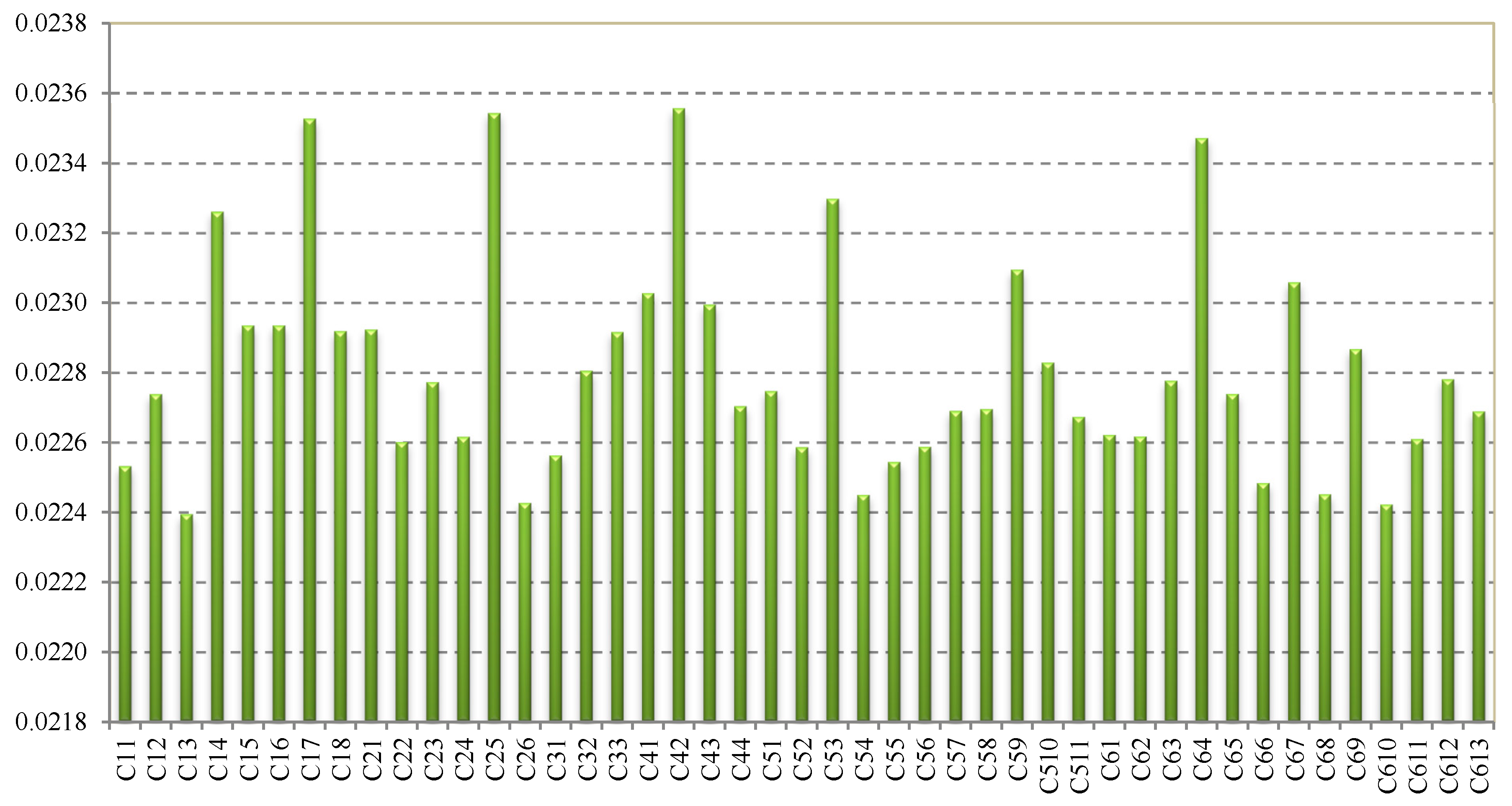
The results of implementing the fuzzy Shannon entropy method on the fuzzy decision matrix are reported in Table 5. For this purpose, first, fuzzy triangular elements of the decision matrix were converted to the interval elements based on Formula (1). To do so, we set α = 0.5 . Then, the normalized values were calculated using Equation (3). After that, using Equation (4), the upper and lower bounds of the entropy were calculated and are reported in the second row of Table 5. The lower and upper bounds of the degree of diversification are reported in the third row of Table 4, which were obtained using Formula (5). The lower and upper bounds of the weights of the criteria were calculated using Equation (6) and are reported in the fourth row of this table. Finally, equation w j = w j l + w j u 2 was used to calculate the deterministic weights of the criteria. The last row of Table 5 shows the weights of the intelligent building criteria. Furthermore, the weights of the criteria are depicted in Figure 1. According to Figure 1, the most important criterion for evaluating intelligent buildings is the human comfort (C42) criterion with a weight of 0.0236. This criterion belongs to the group of social and cultural (C4) criteria. The second most important criterion is the emission of greenhouse gases (pollution) (C25) with a weight of 0.02354, and the third most important criterion among the criteria is system integration (C17) with a weight of 0.02353. These criteria belong to the groups of environmental (C2) and engineering (C1) criteria, respectively. Using the heat capacity of the mass of materials (C64), using advanced artificial intelligence (C53), and responsiveness (C14) are ranked fourth through sixth, respectively. As can be seen in Figure 1, these six criteria are by far the most important criteria for evaluating smart buildings.
The first step of applying fuzzy MOORA is providing the fuzzy decision matrix. To do so, the fuzzy decision matrix reported in Table 4 was used. In the second step, the normalized fuzzy decision matrix was calculated based on Formula (4), which is reported in Table 6. As mentioned earlier, the elements of this matrix are in the form of fuzzy triangular numbers. According to the third step, the weighted normalized fuzzy decision matrix was obtained based on Formula (8). To weight the normalized fuzzy decision matrix, the weights of the criteria extracted by implementing fuzzy Shannon entropy were employed in this step. The overall ratings of alternatives with respect to beneficial and non-beneficial criteria were calculated based on Formulations (9) and (10) in the fourth step. For applying the fourth step of the fuzzy MOORA, the criteria presented in Table 3 should be divided into two groups of beneficial and non-beneficial criteria. Higher values of non-beneficial criteria are worse (more costly, more polluting, less efficient). They are usually minimized. Non-beneficial criteria are values you generally want to minimize because higher numbers indicate worse performance, higher cost, or greater negative impact. Higher energy consumption (C21) means more resources consumed and higher operating costs; it also increases environmental impact. Higher emissions of greenhouse gases (C25) contribute to pollution and climate impact, often with regulatory and societal costs. Higher upfront investment or initial costs (C32) reduce the desirability of a project, especially if returns are uncertain. Operating and maintenance costs (C32) accumulate over time; higher values reduce total profitability or feasibility. Regarding life cycle costs (C33), higher total costs over the life cycle reflect poorer economic efficiency and return on investment. According to these reasons, energy consumption (C21), emission of greenhouse gases (pollution) (C25), initial costs, operating and maintenance costs (C32), and life cycle costing (C33) were considered as non-beneficial criteria, and the remaining criteria were employed as beneficial criteria. The overall ratings of beneficial and non-beneficial criteria are reported in the second and third columns of Table 6.
In the last step of fuzzy MOORA, the overall performance index for each alternative was calculated based on the overall ratings of alternatives with respect to beneficial and non-beneficial criteria. The overall performance index was obtained based on Formulation (11) and is reported in Table 7. Intelligent building alternatives were prioritized based on this index. The ranking of alternatives is reported in the last column of Table 7. The results reveal that the Parsian Kowsar Hotel is the best hotel based on the intelligent building criteria. The Parsian Kowsar Hotel in Isfahan is a five-star international hotel located on an 11,000 square-meter plot of land. It is situated on the Zayanderud River, near the historic Si-o-se-pol Bridge. This prime location offers guests scenic views and convenient access to a significant historical landmark in Isfahan. The second rank among hotels based on the level of building intelligence is assigned to the Piroozy Hotel. In addition to the fact that this hotel has a good level of building intelligence, it is a 4-star hotel located in the heart of Isfahan, Iran, and is close to the city’s recreational and historical centers. The Sepahan Hotel is identified as the third smartest hotel among the studied hotels. The Sepahan Hotel in Isfahan is centrally located, offering easy access to historical sites like Naqsh-e Jahan Square, Zayanderud River, and Si-o-se-pol Bridge. This prime location makes it a convenient base for exploring the city’s attractions. Finally, Isfahan Hotel and Parsian Suite Hotel are determined to be the fourth and fifth smart hotels, respectively.

5. Discussion

5.1. Sensitivity Analysis Across Multiple α-Cuts

A critical validation step in any fuzzy decision-making process involves analyzing the robustness of the results against variations in the aggregation parameter. Initially, we set the α-cut value to α = 0.5. This choice is conventional in fuzzy set theory, as it represents the midpoint consensus, providing a balanced perspective by equally weighting the lower and upper bounds of the membership function. This neutral setting allows for a non-biased initial benchmark of the features derived from the fuzzy Shannon entropy and the resulting trade-offs identified by fuzzy MOORA.
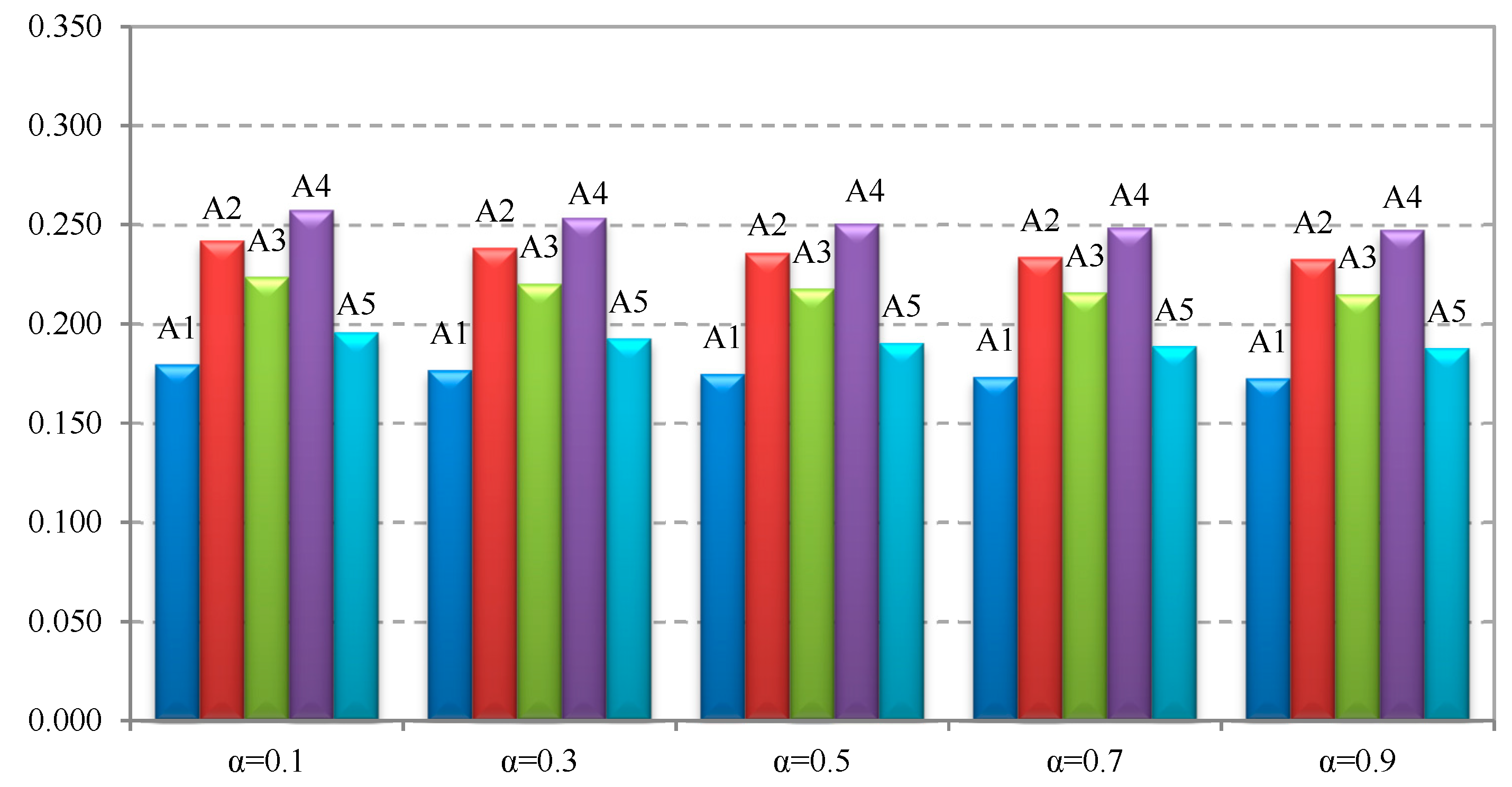
To rigorously test the stability of our results and validate the proposed ranking, we conducted an extensive sensitivity analysis by re-evaluating the fuzzy Shannon entropy and fuzzy MOORA scores using five distinct α values: 0.1, 0.3, 0.5, 0.7, and 0.9. The resulting rankings, summarized in Table 8 and Figure 2, demonstrate the high stability and consistency of the proposed solution structure. The consistent ranking order observed across all tested α values confirms that the relative performance and strategic prioritization derived from our model are not sensitive to the initial choice of the α-cut. This finding underscores the inherent resilience and reliability of the evaluated smart hotel configurations under both cautious (α = 0.1) and highly confident (α = 0.9) decision-making scenarios. This robust performance validates the weights derived through the fuzzy Shannon entropy and strengthens the validity of the final selection provided by the fuzzy MOORA method for deployment in dynamic hotel environments.

5.2. Discussion of Managerial Implications

The findings yield direct, actionable implications for the management teams of Isfahan’s hospitality sector, particularly concerning strategic investment in smart building technology. The overriding importance assigned to human comfort (C42)—even slightly outweighing critical metrics like pollution reduction (C25) and system integration (C17)—signals that guest-centric features must be the primary focus for any intelligent building upgrade or development project. Managers should view spending on advanced HVAC control, personalized environment settings, and ergonomic design not as a mere luxury but as the most heavily weighted criterion for achieving the highest smart building score. Consequently, the superior ranking of the Parsian Kowsar Hotel suggests that its current technological deployment or design inherently aligns best with this critical balance of social, environmental, and engineering criteria. For competing hotels like Piroozy and Sepahan, the results highlight specific areas for targeted improvement: since both possess excellent geographic locations, their path to higher ranking lies in closing the gap on the top six weighted criteria, particularly by integrating high-performance solutions that demonstrably enhance human comfort and system interoperability.

6. Conclusions

Assessing a hotel’s intelligence level is essential for understanding how well it is positioned to meet modern guest expectations, operate efficiently, and remain competitive in a technology-driven hospitality industry. It is not just about having smart gadgets; it is about integrating systems intelligently to improve both service and performance. Advantages of building intelligence include increasing its financial value, making the building luxurious and modern, reducing energy consumption, increasing the level of comfort and well-being of residents, increasing security, the ability to coordinate and integrate equipment, improving system performance, and monitoring capabilities. This paper applied fuzzy Shannon entropy and fuzzy MOORA methods to prioritize five well-known hotels in Isfahan based on the intelligent building criteria. The importance of intelligent building criteria was calculated by applying the fuzzy Shannon entropy method. The results of employing this method showed that human comfort (C42), the emission of greenhouse gases (pollution) (C25), and system integration (C17) are the most important criteria among the intelligent building criteria in hotels. After determining the importance of the criteria and applying their weights in the process of fuzzy MOORA calculations, the level of intelligence of hotels was evaluated. The results of the implementation of this method revealed that Parsian Kowsar Hotel has a higher level of intelligence than others. After that, Piroozy Hotel was ranked second, and Sepahan Hotel was ranked third.
The limitation of the study lies in its narrow scope and methodological constraints. Since the model was applied to only five hotels in a specific regional context, the findings may not be easily generalized to the broader hospitality sector or international settings. Future research should expand the scope of case studies beyond the small sample of five hotels analyzed in this study. Applying the proposed fuzzy Shannon entropy–MOORA framework to a larger and more diverse dataset of hotels, including different categories (luxury, mid-scale, and budget) and geographic regions, would improve the generalizability and robustness of the results. Cross-country or cross-cultural comparative studies could further validate whether the criteria weights and rankings remain consistent under different regulatory, technological, and environmental conditions. Additionally, longitudinal studies that track hotels over time would help to capture how intelligent building performance evolves with new investments, renovations, and technological upgrades. By broadening the dataset and diversifying the contexts of application, future research can strengthen the reliability and applicability of the decision-making model for stakeholders across the global hospitality industry.

Author Contributions

Conceptualization, S.M.H. and P.R.; methodology, S.M.H.; validation, S.M.H. and P.R.; formal analysis, S.M.H. and J.T.; investigation, S.M.H., J.T. and P.R.; resources, P.R.; data curation, P.R.; writing—original draft preparation, S.M.H., J.T. and U.Q.; writing—review and editing, S.M.H., J.T. and U.Q.; supervision, S.M.H.; project administration, U.Q.; funding acquisition, U.Q. All authors have read and agreed to the published version of the manuscript.

Funding

This research work was supported by the [ŠMSM, LT] under the project “Civil Engineering Research Centre” [agreement No. S-A-UEI-23-5].

Data Availability Statement

The data presented in this study are available on request from the corresponding author.

Conflicts of Interest

The authors declare no conflicts of interest.

References

  1. Delavar, T.; Borgentorp, E.; Junnila, S. The Smart Buildings Revolution: A Comprehensive Review of the Smart Readiness Indicator Literature. Appl. Sci. 2025, 15, 1808. [Google Scholar] [CrossRef]
  2. Ogwu, I.; Long, Z.; Lee, D.; Zhang, X.; Zhang, W.; Okonkwo, M. Fundamental Issues in the Qualification of Smart and Intelligence in Building Materials Discourse: A Systematic Review. Buildings 2021, 11, 558. [Google Scholar] [CrossRef]
  3. Aliero, M.S.; Asif, M.; Ghani, I.; Pasha, M.F.; Jeong, S.R. Systematic Review Analysis on Smart Building: Challenges and Opportunities. Sustainability 2022, 14, 3009. [Google Scholar] [CrossRef]
  4. Sivasankari, N.; Rathika, P. IoT driven building automation systems: A review on energy efficiency, occupant comfort, and sustainability. J. Build. Eng. 2025, 104, 112347. [Google Scholar] [CrossRef]
  5. Leung, R. Hospitality technology progress towards intelligent buildings: A perspective article. Tour. Rev. 2021, 76, 69–73. [Google Scholar] [CrossRef]
  6. Yu, Y. Hotel Intelligent System Design Based on Machine Learning Technology. In Application of Intelligent Systems in Multi-Modal Information Analytics. ICMMIA 2022. Lecture Notes on Data Engineering and Communications Technologies; Sugumaran, V., Sreedevi, A.G., Xu, Z., Eds.; Springer: Cham, Switzerland, 2022; Volume 138. [Google Scholar]
  7. Gao, X.; Pishdad-Bozorgi, P.; Shelden, D.R.; Tang, S. Internet of Things Enabled Data Acquisition Framework for Smart Building Applications. J. Constr. Eng. Manag. 2021, 147, 04020169. [Google Scholar] [CrossRef]
  8. Liu, X.; Wider, W.; Fauzi, M.A.; Jiang, L.; Udang, L.N.; Hossain, S.F.A. The evolution of smart hotels: A bibliometric review of the past, present and future trends. Heliyon 2024, 10, e26472. [Google Scholar] [CrossRef]
  9. Villani, L.; Casciola, M.; Astiaso Garcia, D. Integrated Technologies for Smart Building Energy Systems Refurbishment: A Case Study in Italy. Buildings 2025, 15, 1041. [Google Scholar] [CrossRef]
  10. Liu, H.; Han, S.; Zhu, Z. Blockchain Technology toward Smart Construction: Review and Future Directions. J. Constr. Eng. Manag. 2023, 149, 03123002. [Google Scholar] [CrossRef]
  11. Pan, M.; Yang, Y.; Zheng, Z.; Pan, W. Artificial Intelligence and Robotics for Prefabricated and Modular Construction: A Systematic Literature Review. J. Constr. Eng. Manag. 2022, 148, 03122004. [Google Scholar] [CrossRef]
  12. Yang, J.; Peng, H. Decision support to the application of intelligent building technologies. Renew. Energy 2001, 22, 67–77. [Google Scholar] [CrossRef]
  13. Larbi, J.A.; Tang, L.C.M.; Antwi-Afari, P.; Ng, S.T. Determining the Optimal Strategy for the Adoption of Digital Technologies in the Construction Industry: Multicriteria Decision-Making Process. J. Constr. Eng. Manag. 2025, 151, 04025168. [Google Scholar] [CrossRef]
  14. Liu, D.; Lu, W.; Niu, Y. Extended Technology-Acceptance Model to Make Smart Construction Systems Successful. J. Constr. Eng. Manag. 2018, 144, 04018035. [Google Scholar] [CrossRef]
  15. Li, C.Z.; Gao, T.; Chen, Z.; Wu, H.; Deng, Y.; Tam, V.W.Y.; Le, K.N. Exploring the Power of Laser Scanning Technology toward Smart Construction: Status Quo, Challenges, and Future Directions. J. Constr. Eng. Manag. 2025, 151, 03125004. [Google Scholar] [CrossRef]
  16. Kua, H.W.; Lee, S.E. Demonstration intelligent building—A methodology for the promotion of total sustainability in the built environment. Build. Environ. 2002, 37, 231–240. [Google Scholar] [CrossRef]
  17. Wang, S.; Xu, Z.; Li, H.; Hong, J.; Shi, W.Z. Investigation on intelligent building standard communication protocols and application of IT technologies. Autom. Constr. 2004, 13, 607–619. [Google Scholar] [CrossRef]
  18. Rutishauser, U.; Joller, J.; Douglas, R. Control and learning of ambience by an intelligent building. IEEE Trans. Syst. Man Cybern. Part A Syst. Hum. 2004, 35, 121–132. [Google Scholar] [CrossRef]
  19. Wong, J.; Li, H. Development of a conceptual model for the selection of intelligent building systems. Build. Environ. 2006, 41, 1106–1123. [Google Scholar] [CrossRef]
  20. Wong, J.K.; Li, H. Application of the analytic hierarchy process (AHP) in multi-criteria analysis of the selection of intelligent building systems. Build. Environ. 2008, 43, 108–125. [Google Scholar] [CrossRef]
  21. Braun, J.E. Intelligent building systems-past, present, and future. In 2007 American Control Conference; IEEE: New York, NY, USA, 2007; pp. 4374–4381. [Google Scholar]
  22. Dibley, M.; Li, H.; Rezgui, Y.; Miles, J. Cost effective and scalable sensor network for intelligent building monitoring. Int. J. Innov. Comput. Inf. Control 2012, 8, 8415–8433. [Google Scholar]
  23. Ghaffarian Hoseini, A. Ecologically sustainable design (ESD): Theories, implementations and challenges towards intelligent building design development. Intell. Build. Int. 2012, 4, 34–48. [Google Scholar] [CrossRef]
  24. Mohammed, S.A.; Awad, O.A.; Radhi, A.M. Optimization of energy consumption and thermal comfort for intelligent building management system using genetic algorithm. Indones. J. Electr. Eng. Comput. Sci. 2020, 20, 1613–1625. [Google Scholar] [CrossRef]
  25. Dai, X.; Chen, R.; Guan, S.; Li, W.-T.; Yuen, C. BuildingGym: An open-source toolbox for AI-based building energy management using reinforcement learning. Build. Simul. 2025, 18, 1909–1927. [Google Scholar] [CrossRef]
  26. Chen, J.J.; Lan, C.H.; Jeng, M.S.; Xu, T. The development of fan filter unit with flow rate feedback control in a cleanroom. Build. Environ. 2007, 42, 3556–3561. [Google Scholar] [CrossRef]
  27. Tabrizi, E.A.; Al-Hussein, M.; Inyang, N. Multi-criteria Design Evaluation and Optimization of School Buildings Using Artificial Intelligent Approaches. In Proceedings of the Construction Research Congress, West Lafayette, Indiana, 21–23 May 2012; American Society of Civil Engineers (ASCE): Reston, VA, USA, 2012; 10p. [Google Scholar]
  28. Kaya, İ.; Kahraman, C. A comparison of fuzzy multicriteria decision making methods for intelligent building assessment. J. Civ. Eng. Manag. 2014, 20, 59–69. [Google Scholar] [CrossRef]
  29. Szász, C.; Husi, G. The intelligent building definition: A central-European approach. In Proceedings of the 2014 IEEE/SICE International Symposium on System Integration, Tokyo, Japan, 14–17 December 2014; IEEE: New York, NY, USA, 2014; pp. 216–221. [Google Scholar]
  30. Azari, K.T.; Asadian, E.; Ardebili, A.V. Evaluation of multicriteria selection factors of intelligent buildings. In Proceedings of the 2nd International Congress of Technology, Management and Social Sciences, Kuala Lumpur, Malaysia, 29–30 August 2016. [Google Scholar]
  31. Omar, O. Intelligent building, definitions, factors and evaluation criteria of selection. Alex. Eng. J. 2018, 57, 2903–2910. [Google Scholar] [CrossRef]
  32. Hatefi, S.M. Intelligent building assessment based on an integrated model of fuzzy analytic hierarchy process and fuzzy preference degree approach (FAHP-FPDA). Iran Univ. Sci. Technol. 2019, 9, 79–92. [Google Scholar]
  33. Arıkan Kargı, V.S.; Cesur, F. Renewable Energy Technology Selection for Hotel Buildings: A Systematic Approach Based on AHP and VIKOR Methods. Buildings 2024, 14, 2662. [Google Scholar] [CrossRef]
  34. Riantini, L.S.; Machfudiyanto, R.A.; Rachmawati, T.S.N.; Rachman, M.D.A.; Fachrizal, R.; Shadram, F. Energy Efficiency Analysis of Building Envelope Renovation and Photovoltaic System in a High-Rise Hotel Building in Indonesia. Buildings 2024, 14, 1646. [Google Scholar] [CrossRef]
  35. Zhang, J.; Yuan, C.; Yang, J.; Zhao, L. Research on Energy Consumption Prediction Models for High-Rise Hotels in Guangzhou, Based on Different Machine Learning Algorithms. Buildings 2024, 14, 356. [Google Scholar] [CrossRef]
  36. Serrano, W. iBuilding: Artificial intelligence in intelligent buildings. Neural Comput. Appl. 2022, 34, 875–897. [Google Scholar] [CrossRef]
  37. Zhou, B.; Tian, T.; Hon, A. The Impact of Intelligent Services on Customer Satisfaction in the China Hotel Industry. J. China Tour. Res. 2025, 1, 1938–8160. [Google Scholar] [CrossRef]
  38. Leonidis, A.; Korozi, M.; Margetis, G.; Grammenos, D.; Stephanidis, C. An Intelligent Hotel Room. In Ambient Intelligence. AmI 2013. Lecture Notes in Computer Science; Augusto, J.C., Wichert, R., Collier, R., Keyson, D., Salah, A.A., Tan, A.H., Eds.; Springer: Cham, Switzerland, 2013; p. 8309. [Google Scholar] [CrossRef]
  39. Liu, Y.; Henseler, J.; Liu, Y. What makes tourists adopt smart hospitality? An inquiry beyond the technology acceptance model. Digit. Bus. 2022, 2, 100042. [Google Scholar] [CrossRef]
  40. Zhou, L.; Kim, J. An Evaluation of Quality Attributes of Smart Hotel by Using SERVQUAL-IPA Model: Focused on China’s Hotel Market. J. Soc. Korea Ind. Syst. Eng. 2024, 47, 141–151. [Google Scholar] [CrossRef]
  41. Mousavi, S.A. Sustainable Hotel Building Local Assessment Model: A Case of Northern Cyprus. Sustainability 2022, 14, 12752. [Google Scholar] [CrossRef]
  42. Liu, G.; Ma, Z.; Li, J.; Li, S.; Zhou, X.; Song, Y. Framework of Digital Lean Construction and Implementation of Its Management Platform for the Construction Phase. J. Constr. Eng. Manag. 2024, 150, 04024051. [Google Scholar] [CrossRef]
  43. Akel, G.; Noyan, E. Exploring the criteria for a green and smart hotel: Insights from hotel managers’ perspectives. J. Hosp. Tour. Insights 2024, 7, 2992–3012. [Google Scholar] [CrossRef]
  44. Bašić, A.; Viduka, D.; Kraguljac, V.; Lavrnić, I.; Jevremović, M.; Balaban, P.; Sajfert, D.; Gligorijević, M.; Barzut, S. Multi-Criteria Decision Analysis of Wireless Technologies in WPANs for IoT-Enabled Smart Buildings in Tourism. Buildings 2024, 14, 3275. [Google Scholar] [CrossRef]
  45. Zhou, H.; Tian, G.; Zhang, T.; Zhang, X.; Pham, D.T.; Xiu, X.; Feng, Y.; Li, H. Triangular Fuzzy QFD–MCDM Combination Approach for Green Building Design Scheme Evaluation. Buildings 2024, 14, 520. [Google Scholar] [CrossRef]
  46. Wang, Y.; Li, J. Multi-criteria decision-making for green maritime transportation: A hybrid Fuzzy AHP-MOORA approach to reduce marine pollution. Mar. Pollut. Bull. 2025, 216, 118023. [Google Scholar] [CrossRef]
  47. Mahapatra, B.S.; Debashis, G.; Pamucar, D.; Mahapatra, G.S. Dynamic group decision-making for enterprise resource planning selection using two-tuples Pythagorean fuzzy MOORA approach. Expert Syst. Appl. 2025, 263, 125675. [Google Scholar] [CrossRef]
  48. Hosseinzadeh, L.F.; Fallahnejad, R. Imprecise Shannon’s Entropy and Multi Attribute Decision Making. Entropy 2010, 12, 53. [Google Scholar] [CrossRef]
  49. Hatefi, S.M.; Koohi Habibi, N.; Abdollahi, E. Evaluating investment potential tourism centers using integrated model of fuzzy Shannon’s entropy and fuzzy ARAS method. Tour. Manag. Stud. 2019, 14, 269–302. [Google Scholar] [CrossRef]
  50. Hatefi, S.M.; Ahmadi, H.; Tamošaitienė, J. Risk Assessment in Mass Housing Projects Using the Integrated Method of Fuzzy Shannon Entropy and Fuzzy EDAS. Sustainability 2025, 17, 528. [Google Scholar] [CrossRef]
  51. Fattahian Dehkordi, M.; Hatefi, S.M.; Tamošaitienė, J. An Integrated Fuzzy Shannon Entropy and Fuzzy ARAS Model Using Risk Indicators for Water Resources Management under Uncertainty. Sustainability 2025, 17, 5108. [Google Scholar] [CrossRef]
  52. Stanujkic, D. An extension of the ratio system approach of MOORA method for group decision-making based on interval-valued triangular fuzzy numbers. Technol. Econ. Dev. Econ. 2015, 22, 122–141. [Google Scholar] [CrossRef]
  53. Hosseinzadeh Lotfi, F.; Allahviranloo, T.; Pedrycz, W.; Shahriari, M.; Sharafi, H.; Razipour GhalehJough, S. The Multi-Objective Optimization Ratio Analysis (MOORA) in Uncertainty Environment. In Fuzzy Decision Analysis: Multi Attribute Decision Making Approach. Studies in Computational Intelligence; Springer: Cham, Switzerland, 2023; p. 1121. [Google Scholar] [CrossRef]
  54. Gürbüz, F.; Erdinç, G. Selecting the Best Hotel Using the Fuzzy-MOORA Method with a New Combined Weight Approach. In Proceedings of the 2018 2nd International Symposium on Multidisciplinary Studies and Innovative Technologies (ISMSIT), Ankara, Turkey, 19–21 October 2018; IEEE: New York, NY, USA, 2018; pp. 1–8. [Google Scholar] [CrossRef]
  55. Singh, R.; Pathak, V.K.; Kumar, R.; Dikshit, M.; Aherwar, A.; Singh, V.; Singh, T. A historical review and analysis on MOORA and its fuzzy extensions for different applications. Heliyon 2024, 10, e25453. [Google Scholar] [CrossRef]
  56. Brauers, W.K.M.; Zavadskas, E.K.; Turskis, Z.; Vilutiene, T. Multi-objective contractor’s ranking by applying the MOORA method. J. Bus. Econ. Manag. 2008, 9, 245–255. [Google Scholar] [CrossRef]
  57. Zavadskas, E.K.; Antucheviciene, J.; Šaparauskas, J.; Turskis, Z. MCDM methods WASPAS and MULTIMOORA: Verification of robustness of methods when assessing alternative solutions. Econ. Comput. Econ. Cybern. Stud. Res. 2013, 47, 1–16. [Google Scholar]
  58. Mete, S. Assessing occupational risks in pipeline construction using FMEA-based AHP-MOORA integrated approach under Pythagorean fuzzy environment. Hum. Ecol. Risk Assess. Int. J. 2019, 25, 1645–1660. [Google Scholar] [CrossRef]
  59. Kizielewicz, B.; Bączkiewicz, A. Comparison of Fuzzy TOPSIS, Fuzzy VIKOR, Fuzzy WASPAS and Fuzzy MMOORA methods in the housing selection problem. Procedia Comput. Sci. 2021, 192, 4578–4591. [Google Scholar] [CrossRef]
  60. Gao, X.; Pan, L.; Pelusi, D.; Deng, Y. Fuzzy Markov Decision-Making Model for Interference Effects. IEEE Trans. Fuzzy Syst. 2023, 31, 199–212. [Google Scholar] [CrossRef]
  61. Wang, Y.; Li, H. Sequential fuzzy decision-making for building energy management under uncertainty using adaptive FMDPs. Appl. Soft Comput. 2024, 135, 109945. [Google Scholar]
  62. Tavakoli, M.; Tajally, A.; Ghanavati-Nejad, M.; Jolai, F. A Markovian-based fuzzy decision-making approach for the customer-based sustainable-resilient supplier selection problem. Soft Comput. 2023, 18, 15153–15184. [Google Scholar] [CrossRef]
  63. Kumar, S.; Singh, R. Decision-making in uncertain environments: A review of fuzzy Markov decision processes and applications. Fuzzy Sets Syst. 2021, 413, 10–30. [Google Scholar]
  64. Chen, Y.; Liu, J. Long-term optimization of smart building operations using fuzzy dynamic programming models. Energy Build. 2025, 277, 112377. [Google Scholar]
  65. Huang, J.J.; Chen, C.Y. Integrating the coupled Markov chain and fuzzy analytic hierarchy process model for dynamic decision making. Axioms 2024, 13, 95. [Google Scholar] [CrossRef]
  66. Kaya, İ.; Çolak, M.; Terzi, F. A comprehensive review of fuzzy multi criteria decision making methodologies for energy policy making. Energy Strategy Rev. 2019, 24, 207–228. [Google Scholar] [CrossRef]
  67. Brauers, W.K.M.; Zavadskas, E.K. The MOORA Method and Its Applications to Privatization in a Transition Economy. Control Cybern. 2006, 35, 445–469. [Google Scholar]
  68. Stanujkic, D.; Magdalinovic, N.; Stojanovic, S.; Jovanovic, R. Extension of ratio system part of MOORA method for solving decision-making problems with interval data. Informatica 2012, 23, 141–154. [Google Scholar] [CrossRef]
Figure 1. Weights of criteria.
Applsci 16 02652 g001
Figure 2. Results of the fuzzy MOORA method under different α values.
Applsci 16 02652 g002
Table 1. Linguistic variables and the respective triangular fuzzy numbers.
Linguistic VariablesCorresponding Triangular Fuzzy Number
Very low(0, 0, 20)
Low(0, 20, 40)
Medium(30, 50, 70)
Much(60, 80, 100)
Very much(80, 100, 100)
Table 2. Hotel names (alternatives).
AlternativesTitle Names
A1Parsian Suit Hotel
A2Piroozy Hotel
A3Sepahan Hotel
A4Parsian Kowsar Hotel
A5Isfahan Hotel
Table 3. Evaluation criteria for intelligent buildings.
CriteriaSub-Criteria
Engineering (C1)Performance (C11)
Safety and structure (C12)
Working efficiency (C13)
Responsiveness (C14)
Office automation (C15)
Power supply (C16)
System integration (C17)
Acoustic and anti-vibration system (C18)
Environmental (C2)Energy consumption (C21)
Water and water conservation (C22)
Materials used, durability and waste (C23)
Land use and location selection (C24)
Emission of greenhouse gases (pollution) (C25)
Indoor environmental quality (C26)
Economic (C3)Economic performance and affordability (C31)
Initial costs, operating and maintenance costs (C32)
Life cycle costing (C33)
Social and Cultural (C4)Functionality, usability and aesthetic aspects (C41)
Human comfort (C42)
Health and hygiene (C43)
Architectural considerations—integration of cultural heritage and compatibility with local heritage value (C44)
Technology (C5)Work efficiency (C51)
Using advanced systems (C52)
Using advanced artificial intelligence (C53)
Telecommunications and data systems connectivity (C54)
Security monitoring and access control system (C55)
Addressable fire detection and notification system (C56)
Digital addressable lighting control system (C57)
Application used for programming and hardware configuration (C58)
Communication platform between smart system equipment (C59)
Flexibility, the type of change by upgrading, optimizing and updating hardware and software in intelligent systems (C510)
After-sales support services and maintenance and repairs of intelligent systems (C511)
Energy conservation and compliance with green and sustainable building standards (C6)Diversity and variety of uses compared to nearby buildings (C61)
Adaptation of building architecture to the specific climate of the region (C62)
Using more vegetation on the roof, facades and floors of spaces (C63)
Using the heat capacity of the mass of materials (C64)
Choosing a color suitable for the climate of the region (C65)
Type, material, dimensions and suitable location for windows and doors (C66)
Appropriate use of shades to reduce energy consumption (C67)
Revival of cultural identity and use of labor and local construction methods (C68)
Design with the lowest ratio of outer surface to building volume (C69)
The high ratio of the area to the perimeter of the building (C610)
Appropriate design of spaces inside the building to take advantage of natural factors, heat, sun and natural light (C611)
Using durable, natural, eco-friendly, non-toxic, suitable and recyclable building materials (C612)
Simultaneous attention to all the aforementioned principles (C613)
Table 4. Fuzzy decision matrix.
C11C12C13C14C15C16C17C18
A1(64, 84, 100)(36, 56, 76)(54, 74, 94)(12, 32, 52)(30, 50, 70)(30, 50, 70)(24, 40, 60)(24, 44, 64)
A2(52, 72, 88)(40, 60, 76)(50.70, 82)(62, 82, 94)(56, 76, 88)(46, 66, 82)(44, 64, 76)(40, 60, 76)
A3(36, 56, 76)(42, 62, 82)(48, 68, 88)(48, 68, 88)(48, 68, 88)(52, 72, 88)(68, 88, 100)(44, 64, 76)
A4(70, 90, 94)(50, 70, 82)(50, 66, 78)(70, 90, 94)(76, 96, 100)(50, 70, 82)(72, 92, 100)(56, 76, 88)
A5(42, 62, 82)(48, 68, 88)(46, 66, 82)(48, 68, 88)(30, 50, 70)(36, 56, 76)(18, 38, 58)(42, 62, 82)
C21C22C23C24C25C26C31C32
A1(30, 50, 70)(48, 68, 88)(36, 56, 76)(40, 60, 76)(24, 44, 64)(46, 66, 82)(36, 56, 76)(36, 56, 76)
A2(46, 66, 82)(52, 72, 88)(68, 88, 100)(62, 82, 94)(34, 54, 70)(52, 72, 88)(62, 82, 94)(62, 82, 94)
A3(36, 56, 76)(40, 60, 76)(40, 60, 76)(70, 90, 94)(30, 50, 70)(58, 78, 94)(48, 68, 88)(36, 56, 76)
A4(60, 80, 88)(70, 90, 94)(76, 96, 100)(72, 92, 100)(66, 86, 94)(56, 76, 88)(54, 74, 82)(66, 86, 94)
A5(36, 56, 76)(36, 56, 76)(36, 52, 72)(28, 44, 60)(24, 44, 64)(42, 62, 82)(40, 56, 72)(36, 56, 76)
C33C41C42C43C44C51C52C53
A1(30, 50, 70)(28, 40, 56)(18, 30, 50)(24, 44, 64)(24, 44, 64)(34, 54, 70)(34, 50, 66)(30, 46, 66)
A2(66, 86, 94)(56, 76, 88)(58, 78, 94)(62, 82, 94)(62, 82, 94)(52, 72, 88)(58, 78, 94)(36, 56, 76)
A3(54, 74, 94)(40, 60, 76)(68, 88, 100)(62, 82, 94)(52, 72, 88)(36, 56, 76)(52, 72, 88)(24, 40, 60)
A4(72, 92, 100)(66, 86, 94)(38, 54, 66)(62, 82, 94)(70, 90, 94)(62, 82, 94)(66, 86, 94)(60, 80, 88)
A5(30, 46, 66)(30, 46, 66)(30, 46, 66)(30, 50, 70)(46, 66, 82)(48, 68, 88)(42, 62, 82)(36, 56, 76)
C54C55C56C57C58C59C510C511
A1(48, 68, 88)(54, 74, 94)(40, 60, 76)(30, 50, 70)(30, 46, 66)(18, 34, 54)(24, 40, 60)(48, 68, 88)
A2(58, 78, 94)(66, 86, 94)(62, 82, 94)(52, 72, 88)(62, 82, 94)(58, 78, 94)(62, 82, 94)(56, 72, 84)
A3(46, 66, 82)(52, 72, 88)(46, 66, 82)(50, 70, 82)(52, 72, 88)(52, 72, 88)(52, 72, 88)(40, 56, 72)
A4(66, 86, 94)(62, 82, 94)(72, 92, 100)(62, 82, 94)(56, 76, 88)(54, 74, 82)(70, 90, 94)(66, 86, 94)
A5(42, 62, 82)(30, 50, 70)(36, 56, 76)(42, 62, 82)(42, 62, 82)(42, 62, 82)(42, 62, 82)(30, 46, 66)
C61C62C63C64C65C66C67C68
A1(38, 50, 62)(34, 50, 66)(34, 54, 70)(18, 34, 54)(36, 56, 76)(54, 74, 94)(18, 38, 58)(42, 62, 82)
A2(58, 78, 94)(52, 72, 88)(52, 72, 88)(46, 66, 82)(46, 66, 82)(40, 60, 76)(58, 78, 94)(56, 76, 88)
A3(42, 58, 78)(42, 58, 78)(34, 50, 66)(36, 56, 76)(56, 76, 88)(52, 72, 88)(46, 66, 82)(42, 62, 82)
A4(62, 82, 94)(60, 80, 88)(50, 66, 78)(66, 86, 94)(70, 90, 94)(70, 90, 94)(60, 80, 88)(64, 80, 84)
A5(42, 62, 82)(48, 68, 88)(36, 56, 76)(30, 50, 70)(30, 50, 70)(42, 62, 82)(42, 62, 82)(42, 62, 82)
C69C610C611C612C613
A1(30, 50, 70)(46, 66, 82)(34, 50, 66)(34, 50, 66)(40, 56, 72)
A2(62, 82, 94)(62, 82, 94)(56, 76, 88)(52, 72, 88)(56, 76, 88)
A3(42, 62, 82)(42, 62, 82)(52, 72, 88)(62, 82, 94)(48, 64, 84)
A4(62, 82, 94)(60, 76, 84)(70, 90, 94)(66, 86, 94)(62, 82, 94)
A5(36, 56, 76)(42, 62, 82)(36, 56, 76)(30, 46, 66)(30, 50, 70)
Table 5. The results of fuzzy Shannon entropy.
C11C12C13C14C15C16C17
[ h j l , h j u ] (0.543, 0.607)(0.534, 0.609)(0.546, 0.609)(0.525, 0.598)(0.532, 0.603)(0.533, 0.608)(0.519, 0.594)
[ d j l , d j u ] (0.393, 0.457)(0.391, 0.466)(0.391, 0.454)(0.402, 0.475)(0.397, 0.468)(0.392, 0.467)(0.406, 0.481)
[ w j l , w j u ] (0.019, 0.026)(0.019, 0.027)(0.019, 0.026)(0.019, 0.027)(0.019, 0.027)(0.019, 0.027)(0.019, 0.028)
w j 0.02250.02270.02240.02330.02290.02280.0235
C18C21C22C23C24C25C26
[ h j l , h j u ] (0.530, 0.607)(0.529, 0.607)(0.540, 0.607)(0.538, 0.603)(0.545, 0.601)(0.512, 0.602)(0.545, 0.609)
[ d j l , d j u ] (0.393, 0.470)(0.393, 0.471)(0.393, 0.460)(0.397, 0.462)(0.399, 0.455)(0.398, 0.488)(0.391, 0.455)
[ w j l , w j u ] (0.019, 0.027)(0.019, 0.027)(0.019, 0.026)(0.019, 0.027)(0.019, 0.026)(0.019, 0.028)(0.019, 0.026)
w j 0.02290.02290.02260.02280.02260.02350.0224
C31C32C33C41C42C43C44
[ h j l , h j u ] (0.542, 0.607)(0.535, 0.606)(0.534, 0.601)(0.532, 0.600)(0.519, 0.593)(0.531, 0.602)(0.540, 0.604)
[ d j l , d j u ] (0.393, 0.458)(0.394, 0.465)(0.399, 0.466)(0.400, 0.468)(0.407, 0.481)(0.398, 0.469)(0.396, 0.460)
[ w j l , w j u ] (0.019, 0.026)(0.019, 0.027)(0.019, 0.027)(0.019, 0.027)(0.019, 0.028)(0.019, 0.027)(0.019, 0.026)
w j 0.02260.02280.02290.02300.02360.02300.0227
C51C52C53C54C55C56C57
[ h j l , h j u ] (0.536, 0.607)(0.542, 0.606)(0.519, 0.604)(0.545, 0.608)(0.543, 0.606)(0.542, 0.606)(0.538, 0.607)
[ d j l , d j u ] (0.393, 0.464)(0.394, 0.458)(0.396, 0.481)(0.392, 0.455)(0.394, 0.457)(0.394, 0.458)(0.393, 0.462)
[ w j l , w j u ] (0.019, 0.027)(0.019, 0.026)(0.019, 0.028)(0.019, 0.026)(0.019, 0.026)(0.019, 0.026)(0.019, 0.027)
w j 0.02270.02260.02330.02240.02250.02260.0227
C58C59C510C511C61C62C63
[ h j l , h j u ] (0.516, 0.600)(0.537, 0.606)(0.544, 0.608)(0.528, 0.603)(0.544, 0.609)(0.533, 0.605)(0.545, 0.609)
[ d j l , d j u ] (0.400, 0.484)(0.394, 0.463)(0.392, 0.456)(0.397, 0.472)(0.391, 0.456)(0.395, 0.467)(0.391, 0.455)
[ w j l , w j u ] (0.019, 0.028)(0.019, 0.027)(0.019, 0.026)(0.019, 0.027)(0.019, 0.026)(0.019, 0.027)(0.019, 0.026)
w j 0.02350.02270.02250.02310.02250.02290.0224
C611C612C613
[ h j l , h j u ] (0.542, 0.605)(0.538, 0.602)(0.538, 0.606)
[ d j l , d j u ] (0.395, 0.458)(0.398, 0.462)(0.394, 0.462)
[ w j l , w j u ] (0.019, 0.026)(0.019, 0.027)(0.019, 0.027)
w j 0.02260.02280.0227
Table 6. Normalized fuzzy decision matrix.
C11C12C13C14
A1(0.225, 0.295, 0.351)(0.144, 0.224, 0.304)(0.201, 0.275, 0.350)(0.044, 0.117, 0.191)
A2(0.183, 0.253, 0.309)(0.160, 0.240, 0.304)(0.186, 0.261, 0.305)(0.227, 0.301, 0.344)
A3(0.126, 0.197, 0.267)(0.168, 0.248, 0.328)(0.179, 0.253, 0.328)(0.176, 0.249, 0.323)
A4(0.246, 0.316, 0.330)(0.200, 0.280, 0.328)(0.186, 0.246, 0.290)(0.257, 0.330, 0.344)
A5(0.147, 0.218, 0.288)(0.192, 0.272, 0.353)(0.171, 0.246, 0.305)(0.176, 0.249, 0.323)
C15C16C17C18
A1(0.111, 0.185, 0.259)(0.121, 0.202, 0.282)(0.092, 0.153, 0.229)(0.099, 0.182, 0.265)
A2(0.207, 0.281, 0.326)(0.186, 0.266, 0.331)(0.168, 0.244, 0.290)(0.166, 0.248, 0.315)
A3(0.178, 0.252, 0.326)(0.210, 0.290, 0.355)(0.259, 0.336, 0.381)(0.182, 0.265, 0.315)
A4(0.281, 0.356, 0.370)(0.202, 0.282, 0.331)(0.275, 0.351, 0.381)(0.232, 0.315, 0.364)
A5(0.111, 0.185, 0.259)(0.145, 0.226, 0.307)(0.069, 0.145, 0.221)(0.174, 0.257, 0.339)
C21C22C23C24
A1(0.123, 0.205, 0.287)(0.177, 0.251, 0.325)(0.129, 0.201, 0.273)(0.140, 0.209, 0.265)
A2(0.188, 0.270, 0.336)(0.192, 0.266, 0.325)(0.244, 0.316, 0.359)(0.216, 0.286, 0.328)
A3(0.147, 0.229, 0.311)(0.148, 0.222, 0.281)(0.143, 0.215, 0.273)(0.244, 0.314, 0.328)
A4(0.246, 0.328, 0.360)(0.259, 0.332, 0.347)(0.273, 0.344, 0.359)(0.251, 0.321, 0.349)
A5(0.147, 0.229, 0.311)(0.133, 0.207, 0.281)(0.129, 0.187, 0.258)(0.098, 0.153, 0.209)
C25C26C31C32
A1(0.106, 0.195, 0.283)(0.167, 0.239, 0.297)(0.137, 0.213, 0.289)(0.135, 0.211, 0.286)
A2(0.150, 0.239, 0.310)(0.188, 0.261, 0.319)(0.235, 0.311, 0.357)(0.233, 0.309, 0.354)
A3(0.133, 0.221, 0.310)(0.210, 0.283, 0.341)(0.182, 0.258, 0.334)(0.135, 0.211, 0.286)
A4(0.292, 0.381, 0.416)(0.203, 0.275, 0.319)(0.205, 0.281, 0.311)(0.248, 0.324, 0.354)
A5(0.106, 0.195, 0.283)(0.152, 0.225, 0.297)(0.152, 0.213, 0.273)(0.135, 0.211, 0.286)
C44C51C52C53
A1(0.087, 0.159, 0.231)(0.130, 0.206, 0.267)(0.124, 0.183, 0.241)(0.132, 0.203, 0.291)
A2(0.224, 0.296, 0.339)(0.198, 0.274, 0.335)(0.212, 0.285, 0.344)(0.159, 0.247, 0.336)
A3(0.188, 0.260, 0.318)(0.137, 0.213, 0.290)(0.190, 0.263, 0.322)(0.106, 0.177, 0.265)
A4(0.253, 0.325, 0.339)(0.236, 0.312, 0.358)(0.241, 0.314, 0.344)(0.265, 0.353, 0.388)
A5(0.166, 0.238, 0.296)(0.183, 0.259, 0.335)(0.154, 0.227, 0.300)(0.159, 0.247, 0.336)
C54C55C56C57
A1(0.171, 0.242, 0.313)(0.190, 0.260, 0.330)(0.144, 0.216, 0.273)(0.114, 0.189, 0.265)
A2(0.206, 0.277, 0.334)(0.232, 0.302, 0.330)(0.223, 0.295, 0.338)(0.197, 0.273, 0.333)
A3(0.164, 0.235, 0.292)(0.183, 0.253, 0.309)(0.165, 0.237, 0.295)(0.189, 0.265, 0.310)
A4(0.235, 0.306, 0.334)(0.218, 0.288, 0.330)(0.259, 0.331, 0.359)(0.235, 0.310, 0.356)
A5(0.149, 0.220, 0.292)(0.105, 0.176, 0.246)(0.129, 0.201, 0.273)(0.159, 0.235, 0.310)
C58C59C510C511
A1(0.112, 0.172, 0.247)(0.070, 0.133, 0.211)(0.088, 0.146, 0.219)(0.184, 0.261, 0.338)
A2(0.232, 0.307, 0.352)(0.226, 0.304, 0.367)(0.226, 0.299, 0.343)(0.215, 0.276, 0.322)
A3(0.195, 0.269, 0.329)(0.203, 0.281, 0.343)(0.190, 0.263, 0.321)(0.153, 0.215, 0.276)
A4(0.210, 0.284, 0.329)(0.211, 0.289, 0.320)(0.256, 0.329, 0.343)(0.253, 0.330, 0.361)
A5(0.157, 0.232, 0.307)(0.164, 0.242, 0.320)(0.)153, 0.226, 0.299)(0.115, 0.176, 0.253)
C61C62C63C64
A1(0.145, 0.190, 0.236)(0.131, 0.193, 0.254)(0.144, 0.229, 0.296)(0.076, 0.143, 0.227)
A2(0.221, 0.297, 0.358)(0.200, 0.278, 0.339)(0.220, 0.305, 0.373)(0.193, 0.277, 0.344)
A3(0.160, 0.221, 0.297)(0.162, 0.224, 0.301)(0.144, 0.212, 0.279)(0.151, 0.235, 0.319)
A4(0.236, 0.312, 0.358)(0.231, 0.308, 0.339)(0.212, 0.279, 0.330)(0.277, 0.361, 0.395)
A5(0.160, 0.236, 0.312)(0.185, 0.262, 0.339)(0.152, 0.237, 0.322)(0.126, 0.210, 0.294)
C65C66C67C68
A1(0.136, 0.211, 0.287)(0.193, 0.265, 0.337)(0.070, 0.147, 0.225)(0.157, 0.232, 0.307)
A2(0.174, 0.249, 0.309)(0.143, 0.215, 0.272)(0.225, 0.302, 0.364)(0.210, 0.285, 0.330)
A3(0.211, 0.287, 0.332)(0.186, 0.258, 0.315)(0.178, 0.256, 0.318)(0.157, 0.232, 0.307)
A4(0.264, 0.340, 0.355)(0.251, 0.322, 0.337)(0.232, 0.310, 0.341)(0.240, 0.300, 0.315)
A5(0.113, 0.189, 0.264)(0.150, 0.222, 0.294)(0.163, 0.240, 0.318)(0.157, 0.232, 0.307)
C69C610C611C612
A1(0.114, 0.189, 0.265)(0.169, 0.243, 0.302)(0.126, 0.186, 0.245)(0.128, 0.188, 0.248)
A2(0.235, 0.311, 0.356)(0.228, 0.302, 0.346)(0.208, 0.283, 0.327)(0.195, 0.270, 0.330)
A3(0.159, 0.235, 0.311)(0.155, 0.228, 0.302)(0.193, 0.268, 0.327)(0.233, 0.308, 0.353)
A4(0.235, 0.311, 0.356)(0.221, 0.280, 0.309)(0.260, 0.335, 0.349)(0.248, 0.323, 0.353)
A5(0.136, 0.212, 0.288)(0.155, 0.228, 0.302)(0.134, 0.208, 0.283)(0.113, 0.173, 0.248)
C613
A1(0.154, 0.215, 0.277)
A2(0.215, 0.292, 0.338)
A3(0.184, 0.246, 0.323)
A4(0.238, 0.315, 0.361)
A5(0.115, 0.192, 0.269)
Table 7. The results of the fuzzy MOORA method.
Alternative ( s i + L , s i + M , s i + U ) ( s i L , s i M , s i U ) S i Rank
A1(0.122, 0.186, 0.252)(0.011, 0.018, 0.026)0.1755
A2(0.193, 0.263, 0.314)(0.019, 0.026, 0.031)0.2362
A3(0.169, 0.238, 0.296)(0.014, 0.021, 0.029)0.2183
A4(0.222, 0.291, 0.321)(0.024, 0.031, 0.034)0.2511
A5(0.133, 0.202, 0.271)(0.011, 0.018, 0.026)0.1904
Table 8. The overall performance index under different α values.
Alternativeα = 0.1α = 0.3α = 0.5α = 0.7α = 0.9Rank
A10.1800.1770.1750.1740.1735
A20.2420.2390.2360.2340.2332
A30.2240.2200.2180.2160.2153
A40.2570.2540.2510.2490.2481
A50.1960.1930.1900.1890.1884
Disclaimer/Publisher’s Note: The statements, opinions and data contained in all publications are solely those of the individual author(s) and contributor(s) and not of MDPI and/or the editor(s). MDPI and/or the editor(s) disclaim responsibility for any injury to people or property resulting from any ideas, methods, instructions or products referred to in the content.