1. Introduction
The borehole-to-surface electromagnetic (BSEM) method establishes a power supply path using the metal casing of the target well as the carrier, transmits low-frequency electromagnetic signals downhole, and deploys an observation network on the ground to carry out multi-component surface observations of electromagnetic responses [
1,
2,
3,
4]. The layout method of the field source device in the BSEM method has a decisive influence on the current density distribution in deep reservoirs, and whether the signal can be transmitted to the target layer is the core key to achieving high-precision dynamic monitoring of underground reservoirs, which can greatly improve the accuracy of deep exploration and monitoring [
5,
6,
7,
8,
9]. The field source devices in the BSEM method are mainly divided into two categories [
10]: the first category uses the metal well casing as the excitation carrier, including two working modes, inter-well or remote power supply, and vertical bipolar power supply at different depths in the same target well, relying on the receiving equipment deployed on the ground to complete the collection of electromagnetic response signals; the second category is to directly arrange the excitation source in the open hole or cased well, using point sources or line sources as excitation units to realize the synchronous collection of surface electric and magnetic field signals. As an important geophysical method to break through the bottleneck of the deep exploration of traditional surface electromagnetic methods, BSEM imaging technology has been widely applied in engineering scenarios such as deep metal ore exploration [
11], dynamic monitoring of oilfield water and gas injection [
5,
6,
7,
8,
12,
13], and dynamic monitoring of horizontal well hydraulic fracturing [
14,
15,
16,
17,
18,
19,
20,
21,
22].
The Finite Volume Method (FVM) is an efficient numerical simulation method for the BSEM method, and the cylindrical grid has become the preferred scheme for the discretization format in this method because it can accurately adapt to the axisymmetric geometric characteristics of a well [
23,
24]. Traditional Cartesian grids face the problems of excessive grid quantity and low computational efficiency when simulating slender cylindrical casings, while cylindrical grids can naturally match the wellbore geometry, greatly reducing the number of discrete elements, making them an ideal choice for solving the problem of electromagnetic simulation of steel cased wells [
25,
26,
27,
28]. The cylindrical grid divides the computational domain into three-dimensional control volumes, with radial, azimuthal, and vertical components centered on the wellbore axis, and obtains discrete solutions by solving the control equations, which can fit the irregular contour shapes of the wellbore and casing with high precision [
25]. The cylindrical grid can achieve high-precision grid refinement in the area near the wellbore, forming a reasonable balance with the sparse grid simplification of the far-field formation, which not only ensures computational accuracy in key areas but also takes into account the overall simulation efficiency, while strictly maintaining the radial integral conservation property. The cylindrical staggered grid (Yee grid with cylindrical coordinates) is based on the cylindrical grid. By arranging electric and magnetic field sampling points, it further adapts to the cylindrical geometry of the wellbore and casing, significantly reducing discretization error at the boundary, and can accurately capture the electromagnetic field’s characteristics at key positions such as the casing wall and the casing–formation interface, reflecting the adaptability advantage of the cylindrical grid in BSEM numerical simulation [
2,
25,
26,
29,
30,
31,
32,
33,
34,
35,
36].
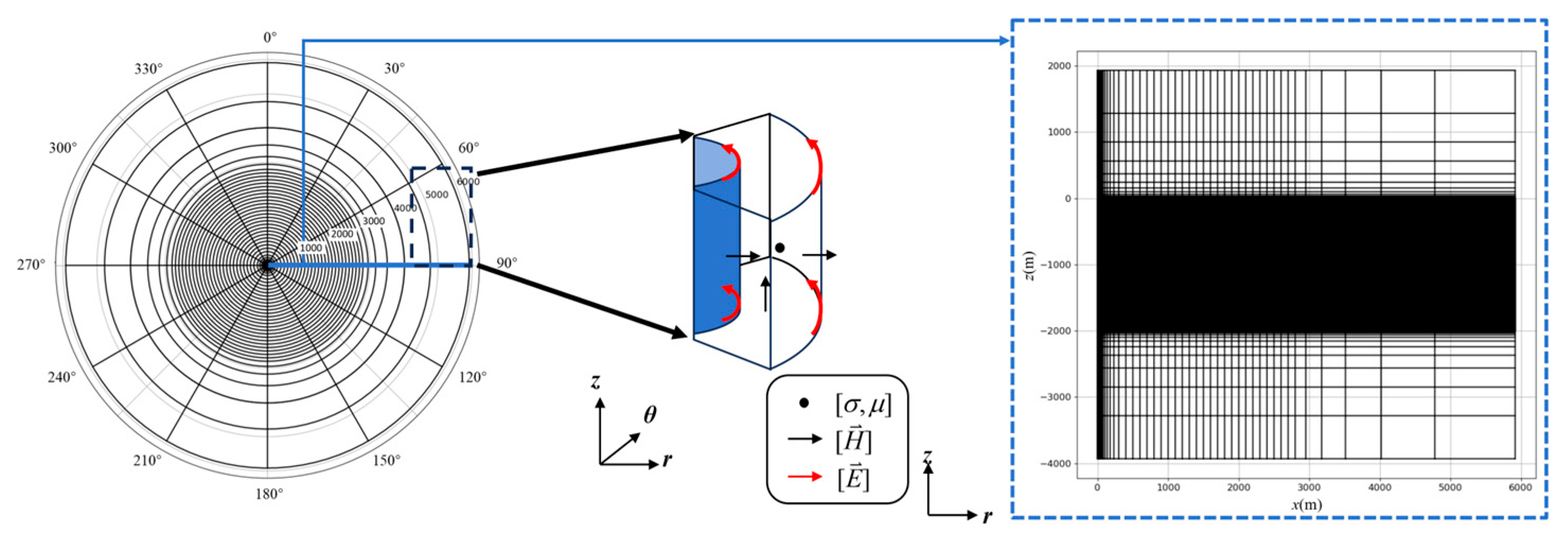
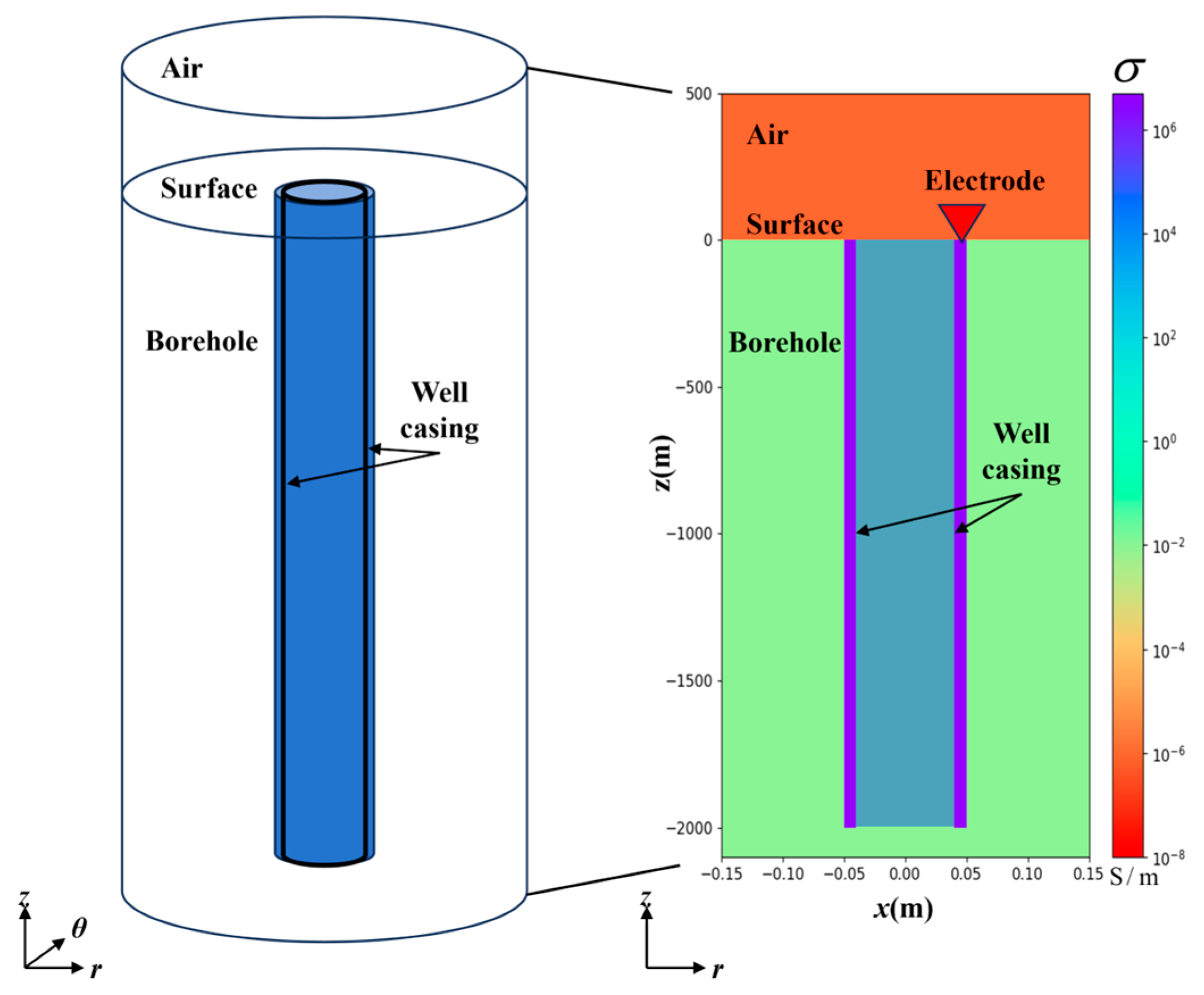
The metal well casing, in the BSEM method (
Figure 1), has a complex dual influence on the surface electromagnetic response: it not only attenuates and interferes with the excited signals but also can be used as an electrode extending to the deep target layer, enhancing the excitation effect on deep targets and improving the ability to identify weak signals caused by underground dynamic changes [
37,
38]. Many existing studies have verified the effectiveness of applying direct current (DC)-method observations and time-domain or frequency-domain BSEM methods in cased well environments through numerical simulations and actual measurement data [
39,
40,
41,
42,
43,
44,
45,
46,
47,
48,
49,
50,
51,
52]. By accurately characterizing the geometric shape and physical properties of the metal well casing, optimizing the matching relationship between the excitation source and the casing, the computational efficiency can be improved on the premise of ensuring the computational accuracy of the target area, thereby improving the inversion accuracy of underground dynamic monitoring targets [
4,
37,
38,
39].
However, at present, there are still many limitations in the FVM numerical simulation of the BSEM method under cased well environments. The core issues lie in the insufficient in-depth adaptation of the explicit modeling of metal casings, the low matching degree between field source simulations and actual working conditions, and the inadequate ability to accurately characterize and define the boundaries of effective detection depth under different conditions [
25,
26]. Specifically, the main limitations are reflected in the following aspects: there is a lack of systematic sorting-out of field source coupling mechanisms and targeted simulation schemes, as well as insufficient summary of modeling methods for the electromagnetic responses of different casings; moreover, the existing simulations have poor adaptability to actual working conditions and are ill-equipped to take into account actual, complex conditions such as casing eccentricity and axial formation heterogeneity; there is a lack of mature schemes suitable for actual scenarios in the cylindrical grid layering strategy and radial refinement gradient design, and the simulation accuracy of the electromagnetic response of the interaction between well casings and formations is insufficient [
39,
41,
42,
43,
44,
45]. These shortcomings further restrict the achievement of the expected interpretation accuracy of this method in dynamic monitoring scenarios such as oil and gas exploration. Solving the above problems will provide simulation method support for the optimized surface layout of field sources and time-lapse monitoring, and will improve the numerical simulation accuracy of the BSEM method.
2. Forward Modeling Method
The Finite Volume Method (FVM) divides the computational domain into non-overlapping control volume elements and obtains discrete equations by integrating the governing differential equations within each element [
4,
24,
25]. Its core advantage is that the integral conservation of dependent variables is satisfied for any control volume—this is superior to the Finite Difference Method (FDM), which only achieves approximate conservation under fine grids. Even under coarse grids, the FVM can still guarantee conservation, thus enabling more flexible grid division. The staggered grid (Yee grid), commonly used in the FVM, is a classic grid form for electromagnetic field simulation. Extended from the tensor-product Cartesian grid, the spatial sampling points of electric and magnetic field components are arranged in a staggered manner, so that each field component is surrounded by four different field components, which is more consistent with physical laws [
24]. The Yee grid facilitates divergence calculation, can accurately simulate the propagation and scattering characteristics of electromagnetic fields, and is widely used in the Finite Difference Method and Finite Element Method [
4]. After optimization, it can be adapted to BSEM imaging technology to achieve efficient computation.
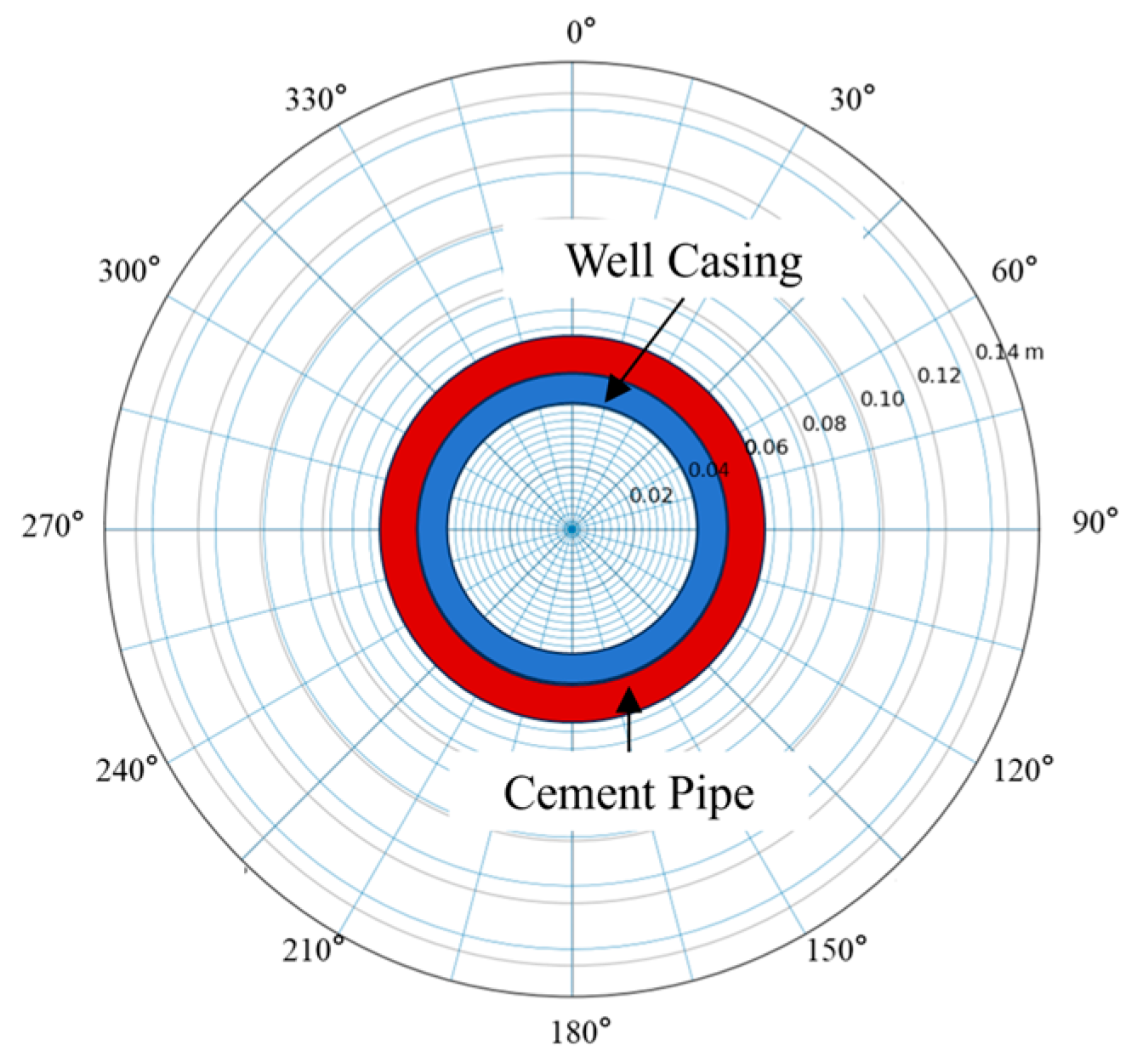
In the cylindrical coordinate system, a three-dimensional grid division method for cylinders is mainly adopted for cased wells (
Figure 2) to simulate the real situation of vertical well casings [
24]. Considering the discretization principles of field quantities and medium parameters for Yee cells, the grid division defines conductivity and permeability at the grid center, arranges electric field components at the grid edges, and places magnetic field components at the grid faces; meanwhile, the outer region is divided into relatively sparse grids to calculate the electromagnetic response of the well casing in the formation [
4].
The observation approach of frequency-domain borehole-to-surface electromagnetics (BSEM) is analogous to that of the frequency-domain Controlled-Source Electromagnetic (CSEM) method. Based on Faraday’s Law and Ampère’s Law, the electromagnetic field in the CSEM method is governed by the quasi-static Maxwell’s equations, with the influence of displacement current neglected [
4,
7]. The quasi-static Maxwell’s equations are as follows:
where
denotes the electric field strength in units of V/m;
denotes the magnetic field strength in units of A/m;
represents the angular frequency in units of rad/s;
is the current density of the externally applied field source in units of A/m
2;
refers to the magnetic permeability, defined as
, where
is the relative magnetic permeability and
is the magnetic permeability of free space;
is the electrical conductivity, with units of S/m. Conduction current
obeys Ohm’s Law:
Using Equation (5) and Stokes’ Theorem, we can derive the weak formulations [
24] of Equations (1) and (2):
where
denotes the cross-sectional area of the control volume on the XOZ plane. Using the first equation in Equation (7), the curl operator can be approximated as the line integral of the field along a closed path, normalized by the area
. From the second equation in Equation (7), it can be seen that the line integral of
along the closed loop is equal to the surface integral of the current density within the loop. Assuming that the electric field in the Y-direction is uniform inside the control volume, analogous to a parallel circuit, the total current density in the Y-direction, excluding the external source, is equal to the sum of that in the four surrounding cells:
where
is the average electrical conductivity,
is the electrical conductivity in the
i-th cell, and
is the cross-sectional area of the
i-th cell. This can be simplified to a large-scale linear system of equations:
The calculation formula for the observation data
at an arbitrary position can be expressed as
where
is a sparse matrix.
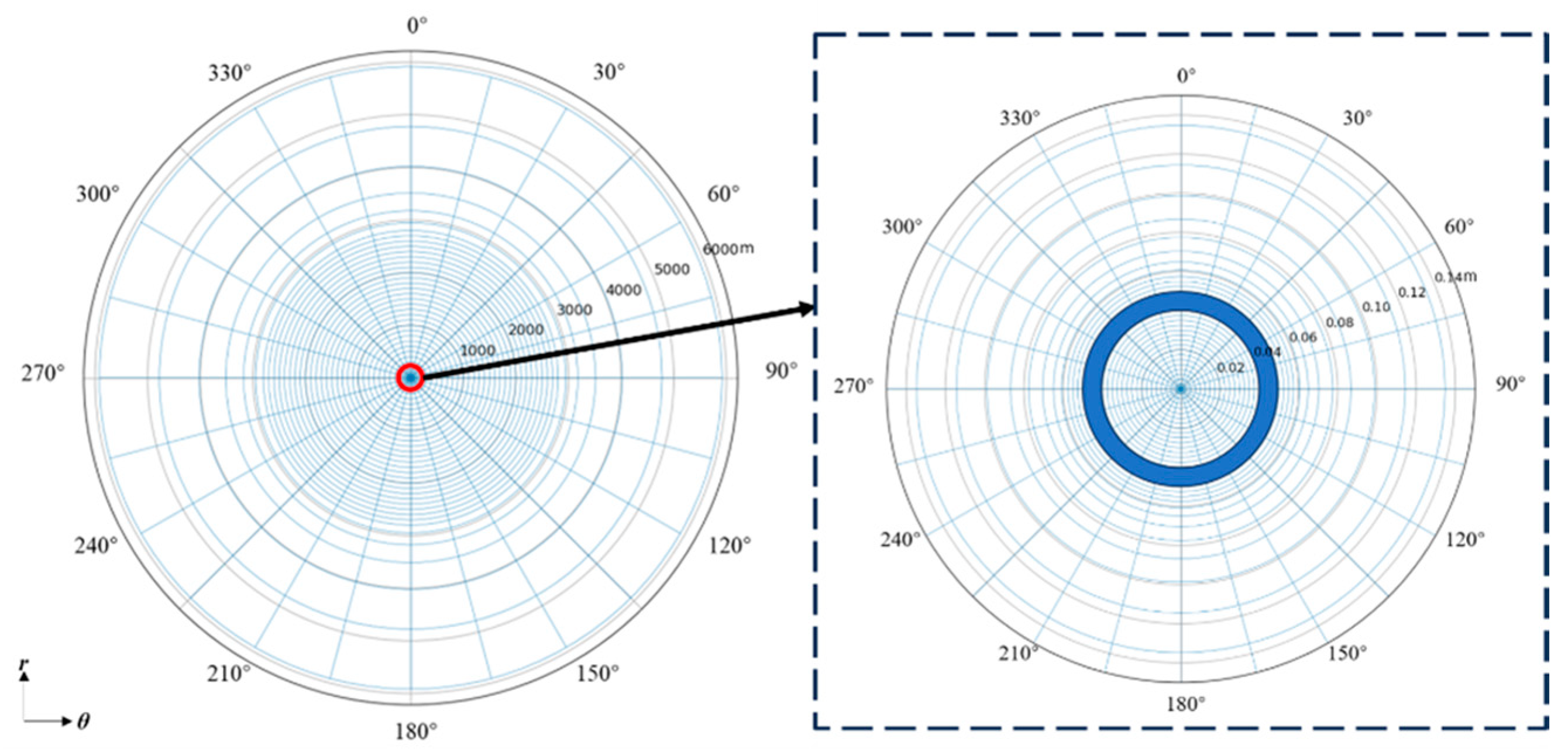
In the cylindrical coordinate system, a 3D cylindrical meshing scheme was established for the cased well model (
Figure 3) to accurately simulate the actual working conditions of vertical well casings.
Fine discretization was adopted for the core region of the cylindrical grid, while sparse discretization was applied to the outer formation region, and numerical calculations of the electromagnetic response of the well casing in the formation were conducted on the basis of this grid. The cylindrical grid in the cylindrical coordinate system enables high-precision numerical simulation of the well casing model, which can be used to systematically investigate the electromagnetic excitation laws of the well casing in underground formations under the excitation of electromagnetic sources, as well as its influence mechanism on the surface electromagnetic response.
3. Steel Casing in the Borehole-Surface Observation System
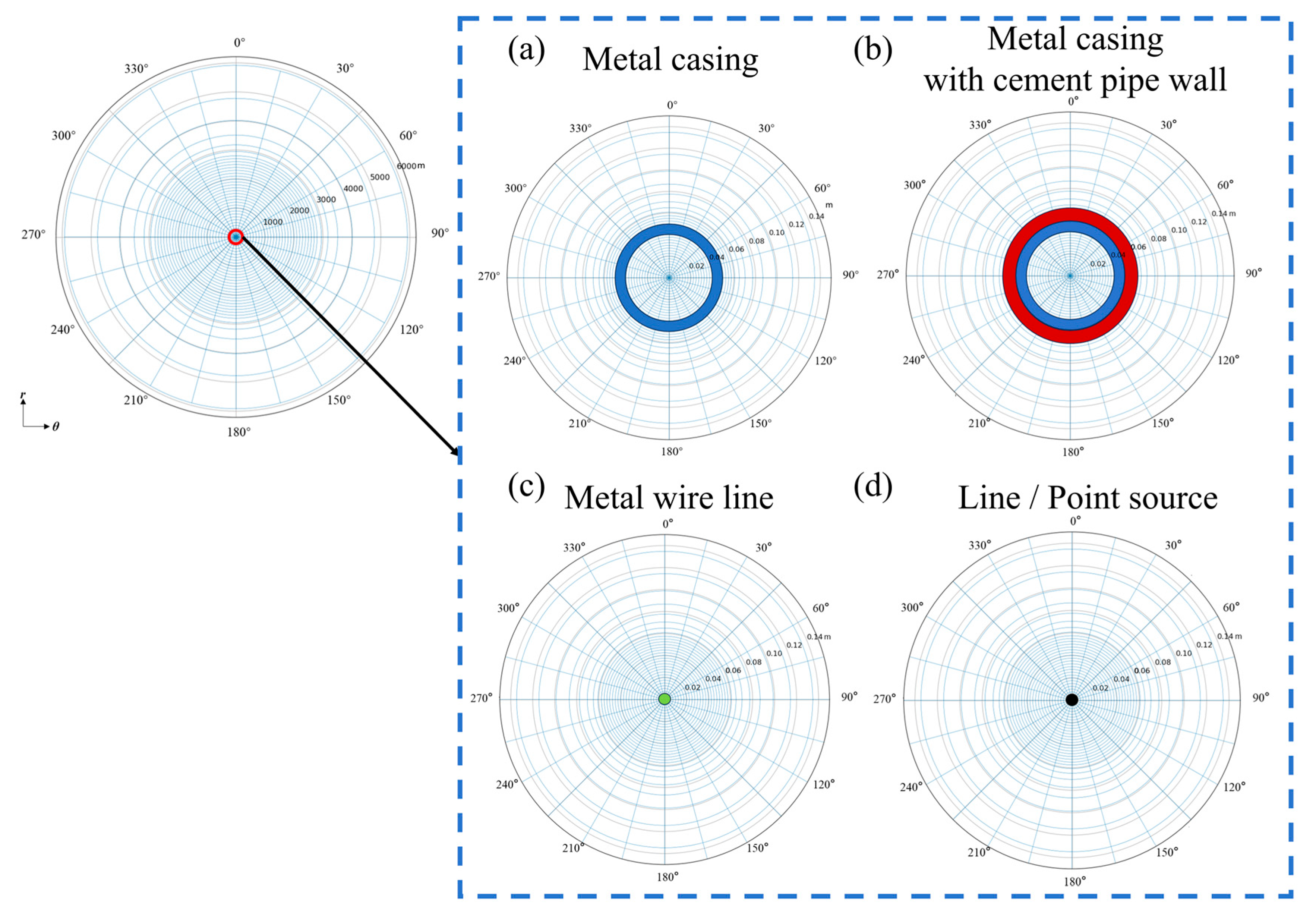
Considering the actual conditions of metal casings, three models are employed to simulate metal casings: the cased well model (
Figure 4), the long conductive wire model, and the line source model. The cased well model comprehensively accounts for the internal medium and overall structure of cased wells; the long conductive wire model regards the entire metal cased well as a highly conductive body; and the line source model treats the whole metal casing as a transmitting source. Based on the cylindrical grid division method of the 3D Finite Volume Method (FVM), well simulations are performed for each of these three modeling approaches.
In practical scenarios, it is necessary to consider not only the influence of metal casings but also that of cement sheaths. Therefore, for cased wells in the cylindrical coordinate system, highly conductive metal casings and high-resistivity cement sheaths are separately configured, so as to investigate the amplification effect of metal casings on signals and the shielding effect of cement sheaths on electromagnetic waves.
The average resistivity of the cylindrical body can be calculated by the following formula:
where the electrical conductivity of the steel casing can be simulated by summing the products of the casing’s cross-sectional area (
) and its internal electrical conductivity (
).
In the setting of electrical resistivity, the casing can be regarded as a long conductor with integrated conductive characteristics, and the electrical conductivity of the casing is obtained by the product of its cross-sectional area and a fixed electrical conductivity:
In simulations based on the cylindrical coordinate system, the casing is simplified to a long linear conductor and incorporated into the simulation calculations. This paper simulates two cases (the cased well model and the long conductive wire model) in the cylindrical coordinate system, and conducts a comparative analysis of the simulation results.
3.1. Comparison of Steel Casing Simulation Methods
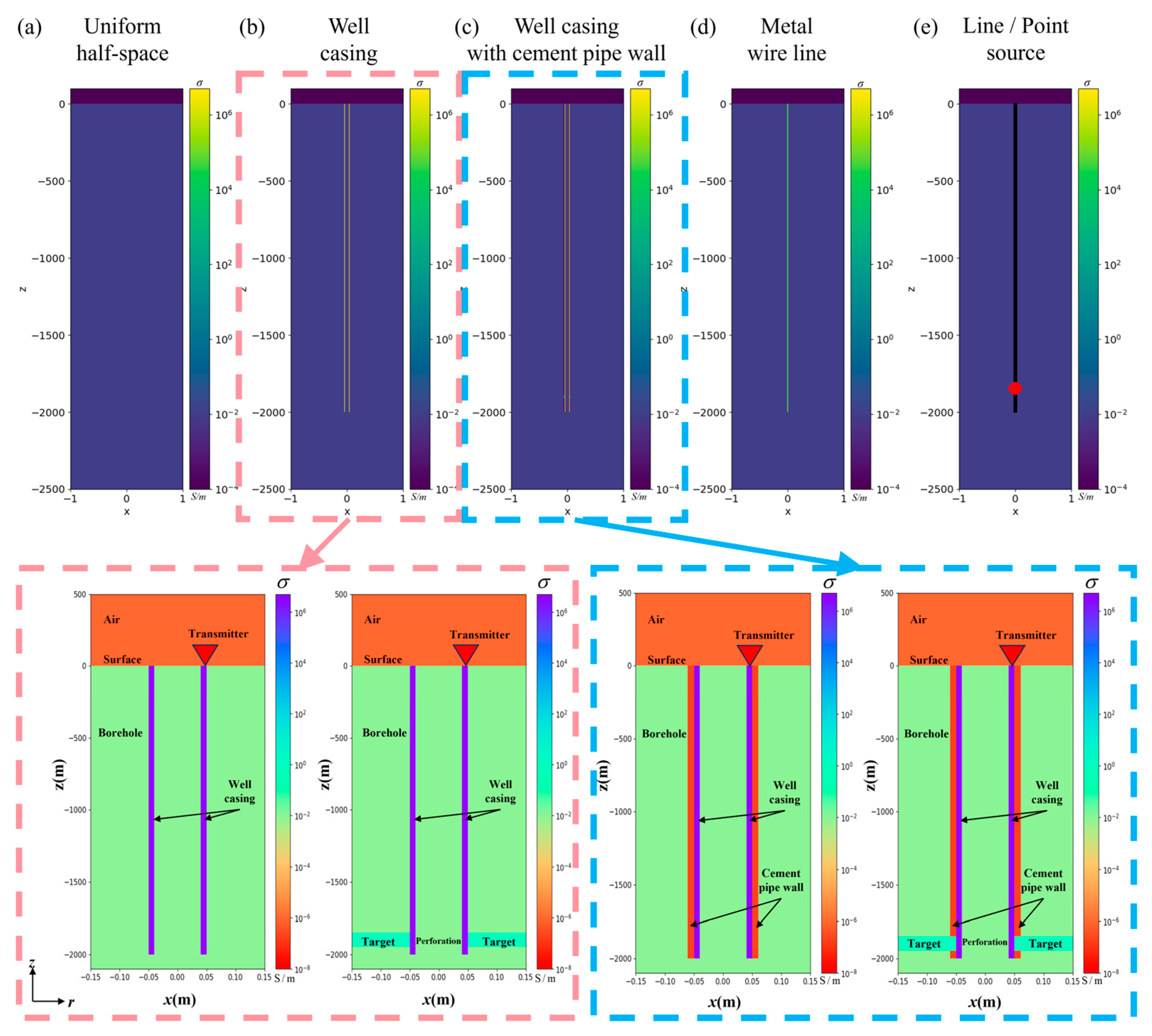
We conduct a comparative validation of three simulation approaches for cased wells: the cased well model, the metal well line model, and the line source model, with the model configurations illustrated in
Figure 5 and
Figure 6. All models in this study focus on vertical well scenarios, where the length of the well casing or line source is uniformly set to 2000 m. For the cased well model, a 1 cm-thick metal casing is configured, with its electrical resistivity set to 5 × 10
6 S/m. For the cased well model with a cement pipe wall, an additional 1 cm-thick cement sheath is arranged around the outer surface of the metal casing. The metal well line model incorporates a 2000 m-long conductive wire at its center, whose electrical resistivity is set to approximately 1500 S/m in accordance with Equation (12), while the line current source model is configured as a 2000 m-long vertical line source. By subtracting the surface receiver responses of these four models from those of the homogeneous half-space model with a surface source (background response), the influence of the metal casing or line source on surface electromagnetic responses can be quantified.
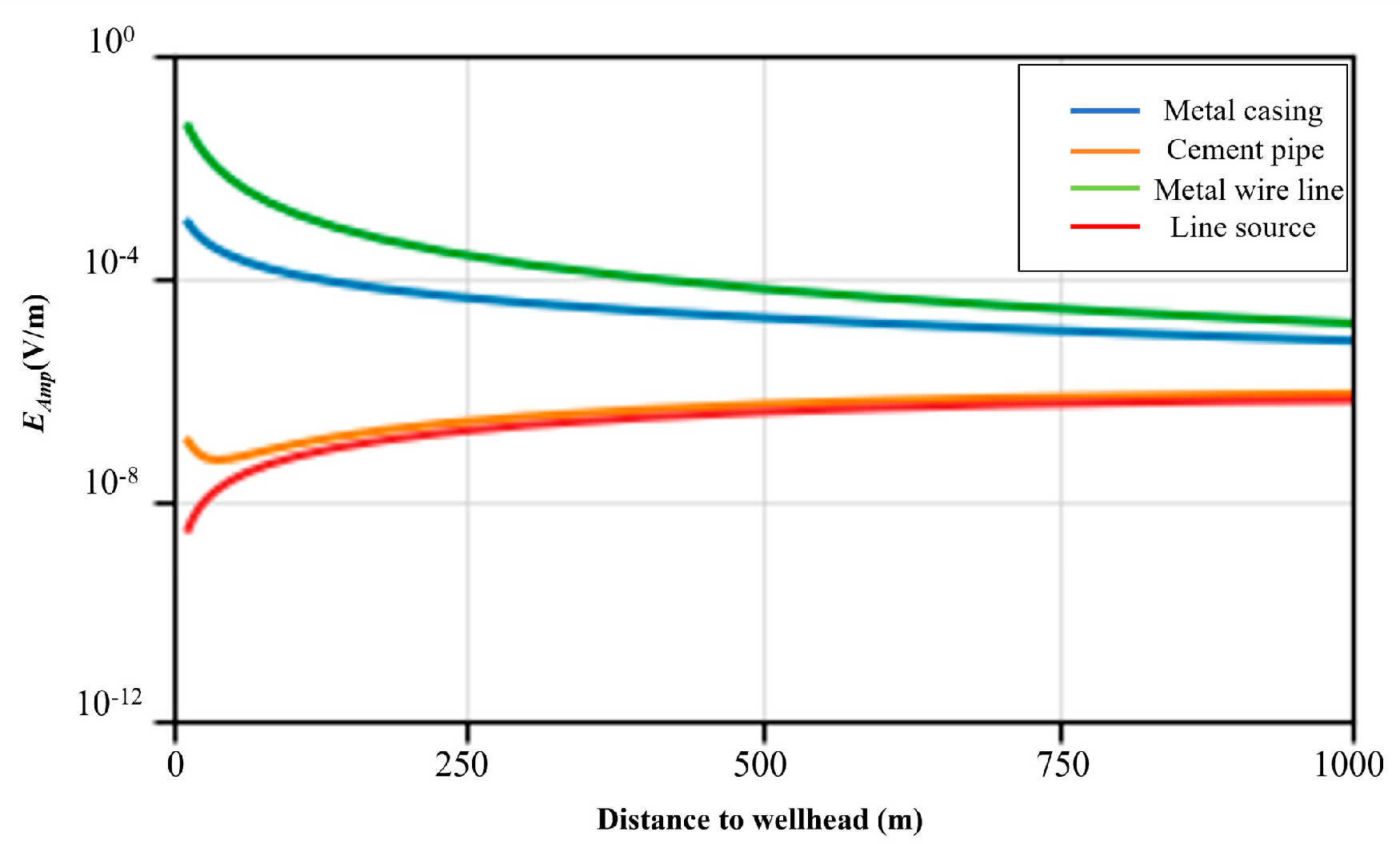
Figure 7 presents a comparison of the surface-received responses obtained by different simulation methods. The blue curve represents the surface electric field amplitude of the cased well model without a cement sheath, the orange curve denotes that of the cased well model with a cement pipe wall, the green curve stands for that of the simplified long conductive wire model, and the red curve corresponds to that of the line current source model. From the comparison of electric field amplitudes in the figure, it can be seen that the long conductive wire model yields the largest surface electric field amplitude response, followed by the metal casing model; the surface electric field amplitudes of the cased well model with a cement pipe wall and the line current source model are the most similar.
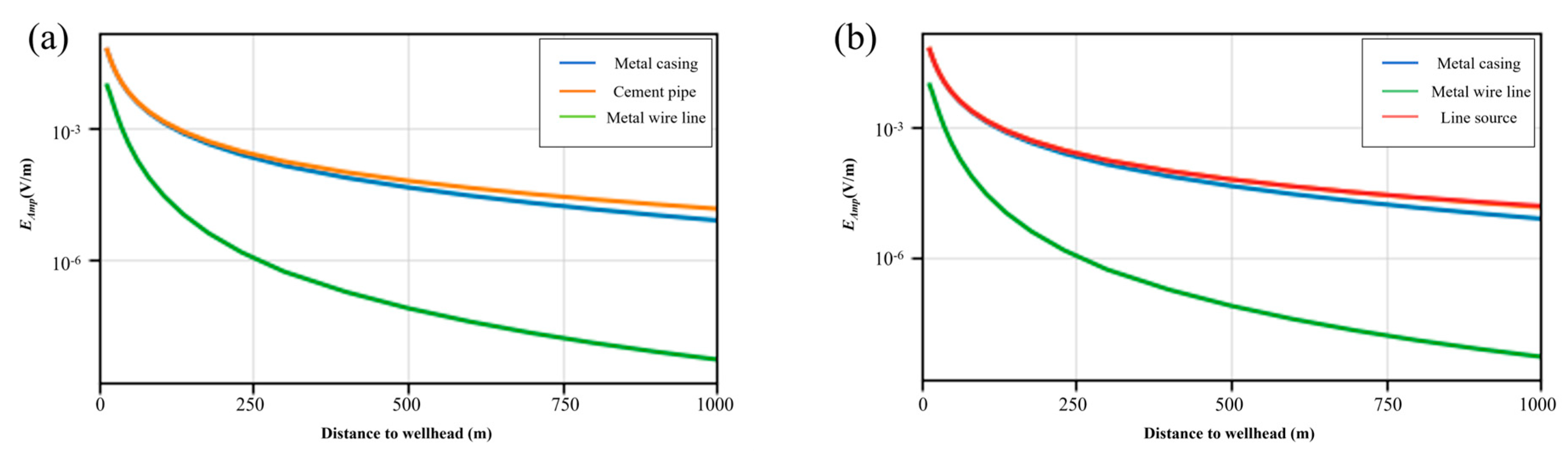
Figure 8a,b both present the results with the background value removed; these are derived from
Figure 7. Since the red curve overlaps with the orange curve, the results are thus presented in two separate subfigures. A comparison of the two subfigures reveals that there is a significant discrepancy between the simulation results of the long conductive wire model and those of the actual well casing model. In contrast, the results of the cased well model with a cement sheath and the line current source model almost completely coincide. Additionally, the cement sheath exerts a slight influence on the surface response after the background value is removed, which is, however, almost negligible.
3.2. Distribution of Underground Currents
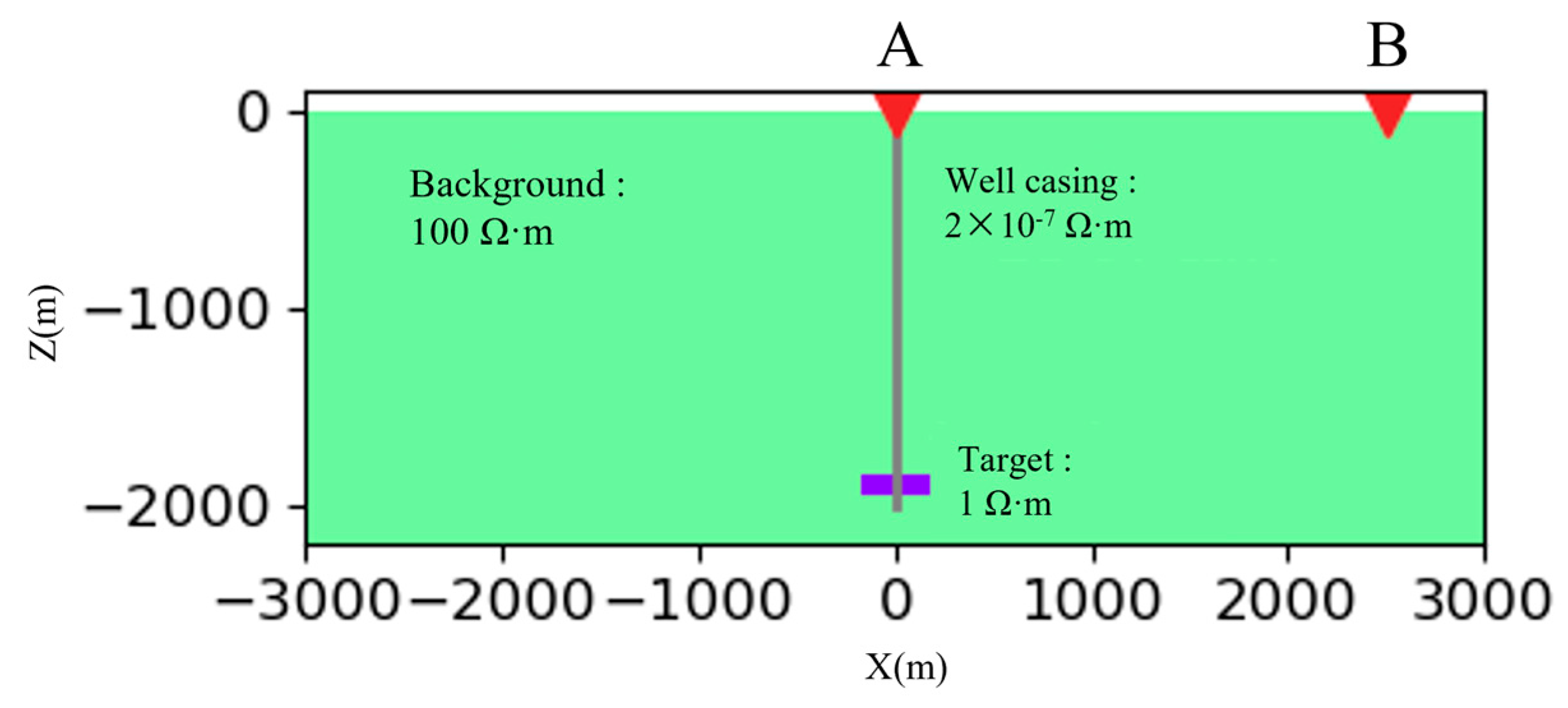
Based on the actual borehole-to-surface observation system, a homogeneous half-space model is established (
Figure 9). The exposed part of the borehole at the surface is connected to electrode A, and electrode B is placed at a distance of 2500 m in the 90° azimuth of the surface annular survey loop, with the transmitting current set to 1 A. The resistivity of the air layer is set to 1 × 10
6 Ω·m, and the background resistivity is set to 100 Ω·m. A low-resistivity anomalous body is configured with a resistivity of 1 Ω·m and a depth ranging from 1850 m to 1950 m. Grid division is performed in the cylindrical coordinate system to obtain the simulation results of the well casing, which are then compared with those of the point current source to analyze and discuss the accuracy of the simulation methods.
For the homogeneous half-space model without a metal casing, a current source is deployed on the surface in this study, and forward simulations are conducted for two working conditions with and without a low-resistivity anomalous body, respectively.
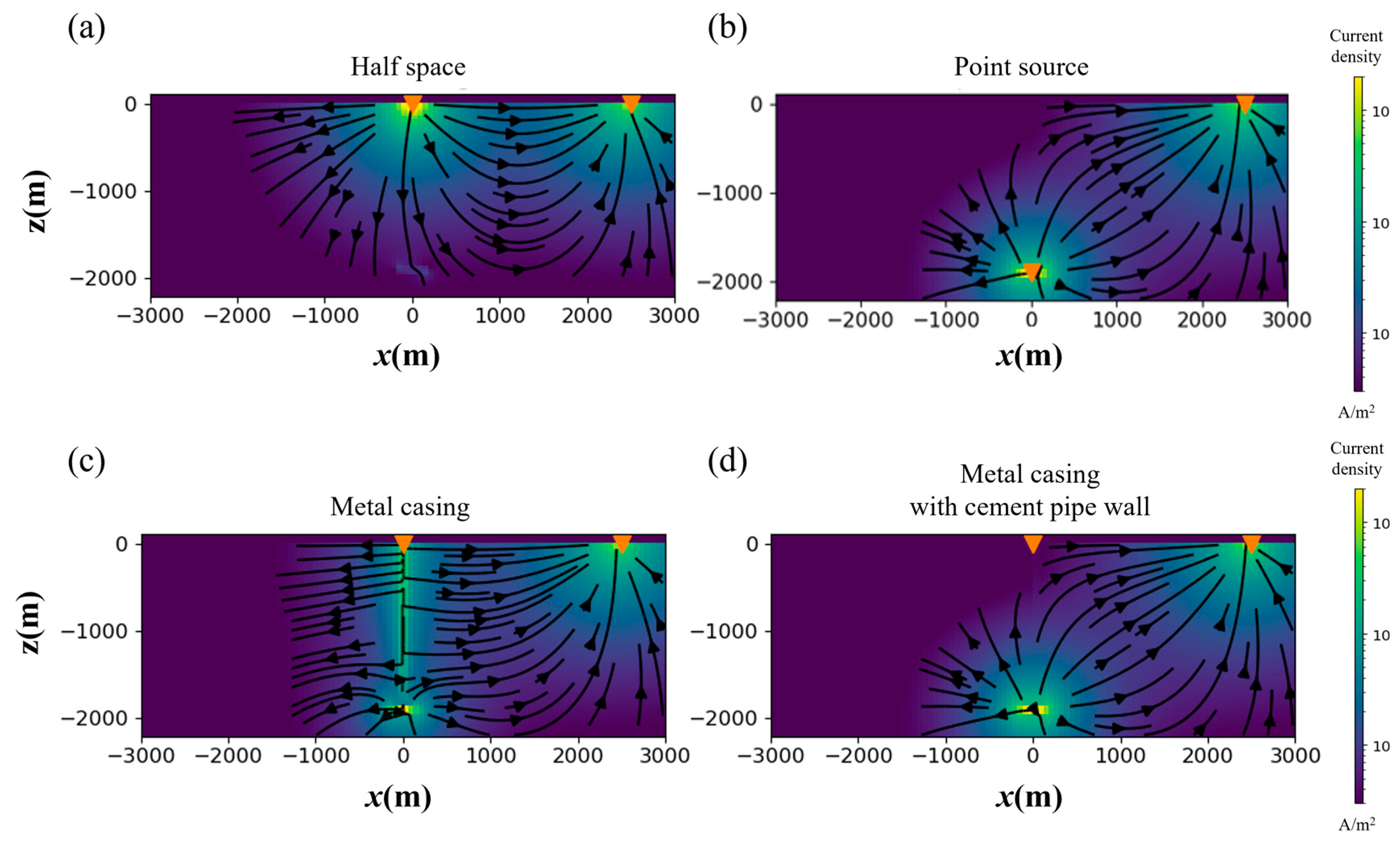
Figure 10 shows the XOZ section of the current density distribution, where
Figure 10a presents the characteristics of the current density distribution in the presence of a low-resistivity anomalous body. As can be seen from the figure, the current density in the underground low-resistivity anomalous area increases significantly, and the current lines exhibit an obvious deflection trend, converging preferentially in the area of the low-resistivity anomalous body. This phenomenon fully reflects that the surface current source has a significant excitation effect on underground low-resistivity anomalous bodies.
To investigate the influence of the cement sheath on the detection effect of metal-cased wells, two scenarios with and without a cement sheath around the metal casing are simulated for the homogeneous half-space model containing a low-resistivity anomalous body. A comparison of the simulation results under different scenarios shows that the current density in the deep target low-resistivity body area increases significantly in all cases, exhibiting a strong current gathering effect. A comparison of
Figure 10a,c reveals that the metal casing has a significant excitation effect on the target low-resistivity body in the deep formation, which is also the main source of abnormal signals in surface monitoring responses.
Figure 10c and
Figure 10d correspond to the current density distribution under the two working conditions of metal casing without and with a cement sheath, respectively. A direct comparison of the two figures demonstrates the obvious current-blocking effect of the cement sheath: after the current is conducted along the metal casing to the low-resistivity anomalous body in the deep formation, most of the current lines gather inside the deep target low-resistivity body, and almost no leakage current penetrates the high-resistivity cement sheath.
Figure 10b shows the comparison of the current density distribution under the action of a point current source. A comparison of
Figure 10b,d indicates that both the point current source and the metal-cased well with a cement sheath can achieve a favorable excitation effect on the target low-resistivity body. Although the point current source excites directly at the depth of the target body, while the current in
Figure 10d must be conducted to the target body along the metal casing before excitation, the characteristics of their current density distribution are basically consistent. Based on this, the point current source method can be adopted for the simplified simulation of metal-cased wells with cement sheaths, providing a convenient and reliable simplified scheme for subsequent forward calculations.
4. Analysis of Surface Signal Validity
In recent years, the application scenarios of the borehole-to-surface electromagnetic method have been continuously expanded, ranging from the monitoring of low-resistivity targets, such as detailed exploration of metallic minerals and oilfield water injection monitoring, to the monitoring of underground CO2 injection and storage overseas, and it can also be applied to the time-lapse monitoring of hot dry rock reservoirs. This method features the advantages of low construction cost and feasibility for multiple observations over a long time span, and the effectiveness of its surface observation can be verified by conducting forward simulations for scenarios such as water injection and gas injection.
Downhole water and gas injection is a dynamic migration process, in which the oil–gas–water system is in a dynamic equilibrium state with the coexistence of an oil phase, an oil–water transition phase and a water phase. After permeating through the reservoir, oil and gas components migrate to trap areas driven by formation water, thus forming oil and gas reservoirs. During oil–water displacement, pore water is displaced to the periphery of oil and gas reservoirs and forms a water rim. The oil–water transition zone exhibits vigorous geochemical reactions and eventually reaches a dynamic equilibrium. The concentration of oilfield water components around oil and gas reservoirs changes regularly with the distance from the reservoir center, and the significant difference in electrical properties between oil and water provides a fundamental basis for the borehole-to-surface electromagnetic method to identify the oil-water interface.
The core of petrophysical analysis of oil and gas reservoirs lies in the study of the physical properties of oil, gas and water. These three substances are non-magnetic, with their density and velocity differences varying with the ambient conditions, while their electrical property differences are extremely prominent: groundwater shows low resistivity, and oil and gas are electrical insulators, which serves as the core basis for borehole-to-surface electromagnetic monitoring. Downhole fluid injection operations will break the original geophysical equilibrium of the formation and form electrical anomalous zones. In summary, it is necessary to conduct borehole-to-surface electromagnetic monitoring simulations for different injected fluids to analyze the excitation effect of well casings on target bodies and the response performance of surface monitoring. Borehole-to-surface electromagnetic simulations are carried out for water and gas with distinct resistivity characteristics, and the excitation effect of well casings on target bodies and the response performance of surface monitoring are further analyzed in combination with various practical application scenarios.
4.1. Dynamic Monitoring Simulation
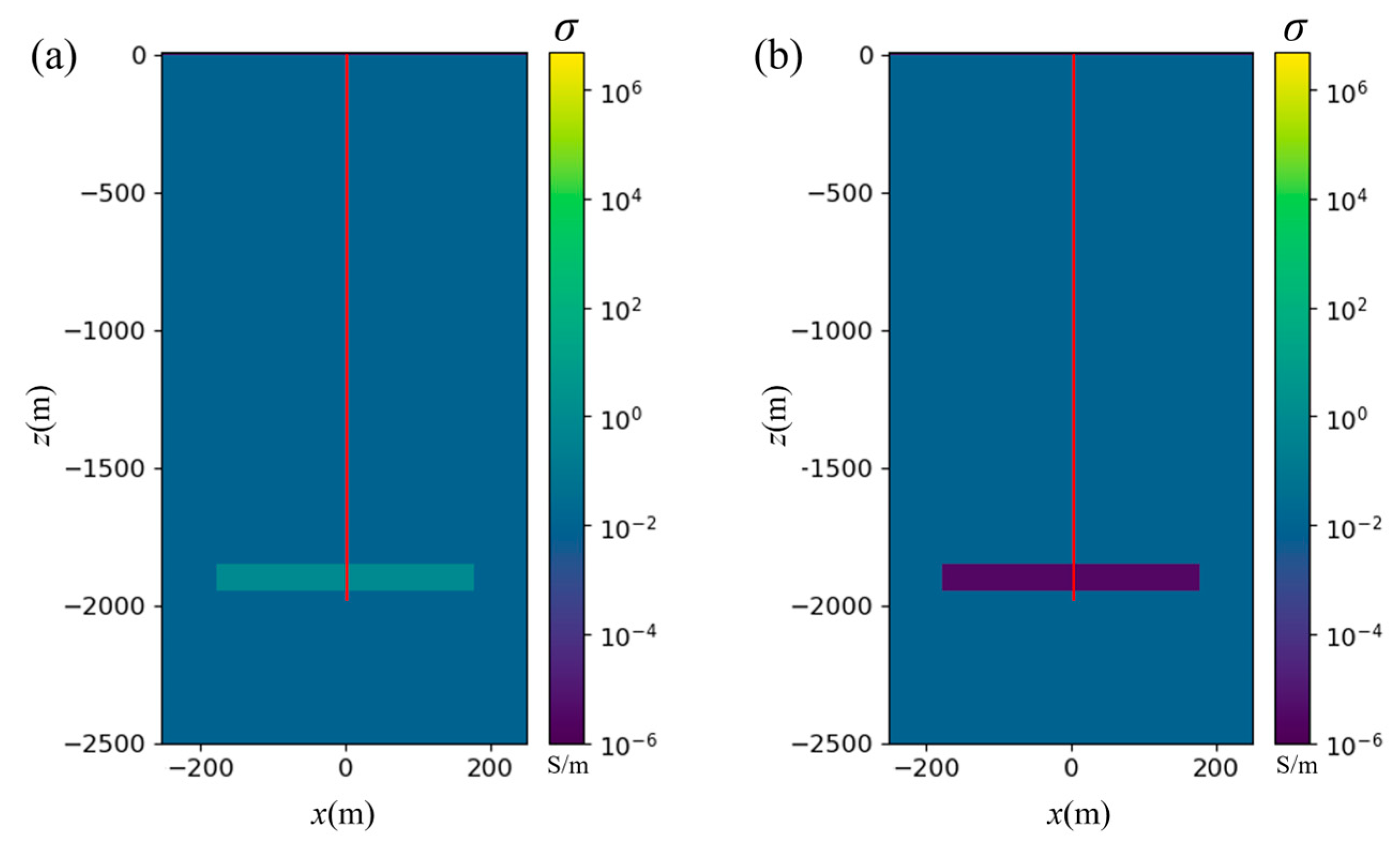
Water injection technology, a commonly used method for secondary oil recovery in oilfields, is crucial to oilfield development. As formation pressure gradually declines with oil and gas production, water injection can effectively supplement formation energy, maintain or restore formation pressure, and ensure the continuous and stable production of oil and gas. It also increases the pressure of formation fluids to drive the flow of oil and gas toward production wells and improve oil and gas recovery efficiency. After the completion of water injection operations, it is necessary to determine the water flooding front to guide field production, and the borehole-to-surface electromagnetic technology is an effective method for this purpose. A water injection borehole-to-surface observation model was designed for the actual water injection operation conditions of cased wells (
Figure 11a), in which the resistivity of the air layer was set to 1 × 10
6 Ω·m and the background resistivity to 100 Ω·m. The resistivity of the injected water (saline water with a 10% NaCl concentration) was set to 1 Ω·m, with its depth controlled in the range of 1850–1950 m. An actual well casing model without a cement sheath was adopted for the simulation, and low-frequency signals at 0.5 Hz were used for transmission.
Gas injection in oilfields is another important oil and gas production technology, whose main functions include maintaining formation pressure, improving recovery efficiency, reducing residual oil, and achieving environmental and economic benefits. By injecting gases such as carbon dioxide and nitrogen, the viscosity of crude oil can be reduced and its fluidity enhanced, enabling more effective displacement of residual oil. This technology is particularly suitable for low-permeability or ultra-low-permeability oilfields. Furthermore, underground CO
2 storage [
53], energy conservation and emission reduction can be achieved in some cases, endowing the technology with significant environmental benefits. A borehole-to-surface observation model with a high-resistivity target was established for the actual gas injection conditions of cased wells, as shown in
Figure 11b. The resistivity of the gas (high-resistivity target) was set to 3 × 10
4 Ω·m, with all other model parameters consistent with those in
Figure 11a.
Simulations were conducted for cases with and without well casings, respectively.
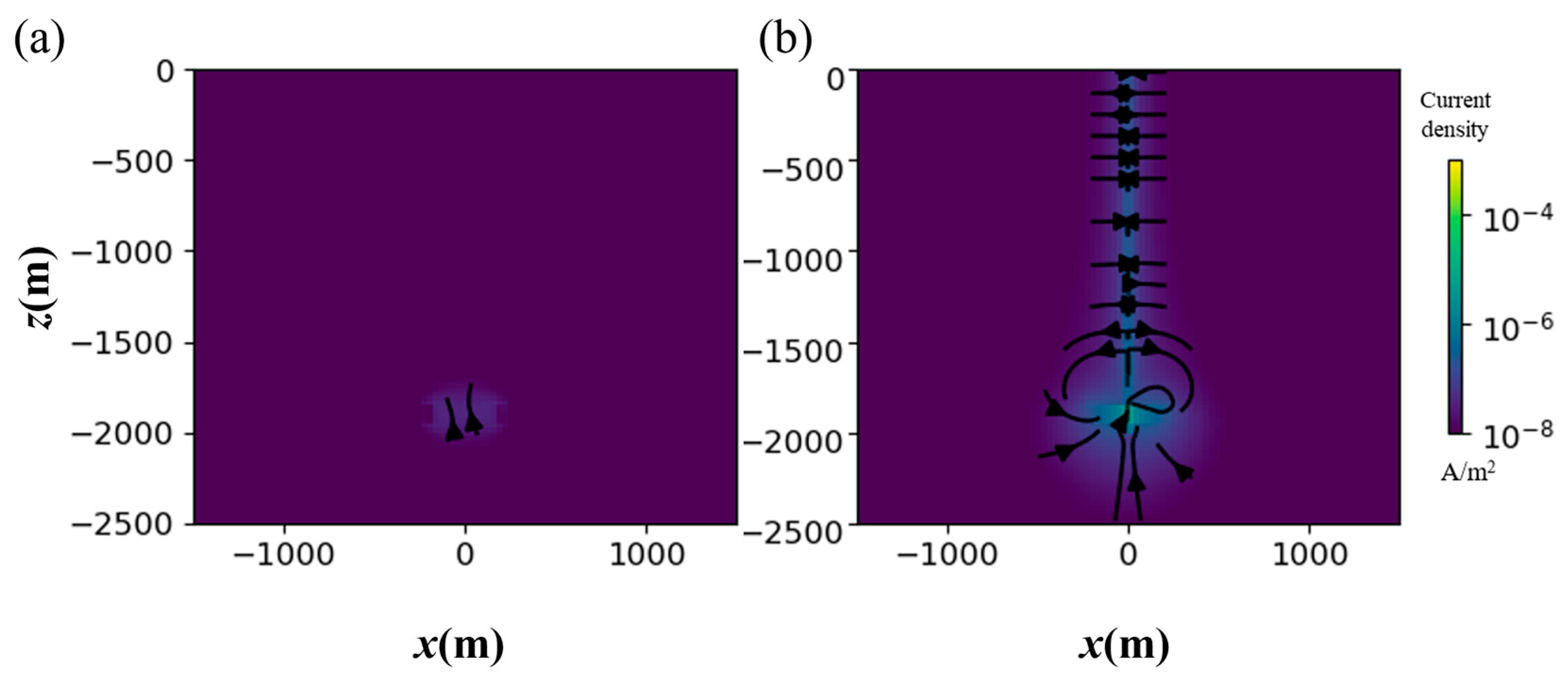
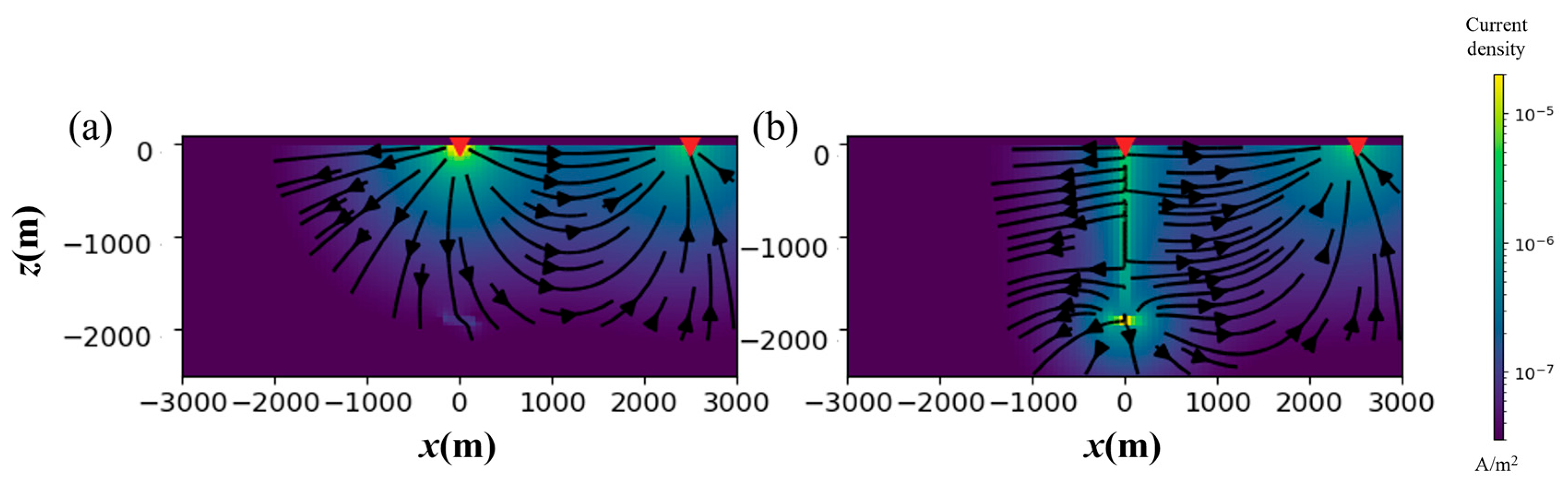
Figure 12 shows the current density distribution of the injected water in the XOZ section. A comparison of
Figure 12a,b reveals that the well casing exerts a significant excitation effect on the injected water; the current density inside the injected water is significantly higher than that in other areas, exhibiting an obvious current absorption effect.
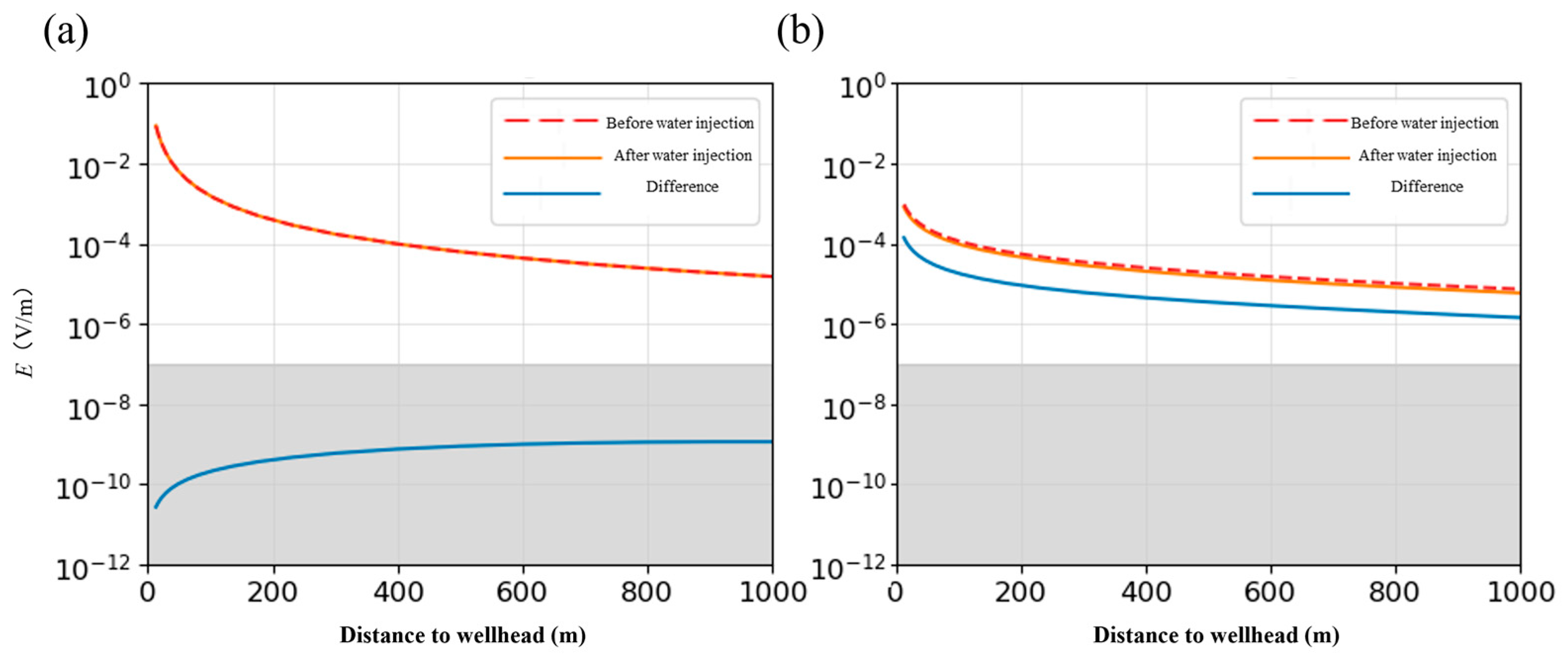
Figure 13 illustrates the relationship between the surface electric field and the radial distance from the wellbore, where
Figure 13a corresponds to the case without a well casing and
Figure 13b to that with a well casing. The red dashed line represents the surface electric field response before water injection, the yellow solid line represents the response after water injection, and the blue solid line represents the differential electric field value (anomalous value). A comparison of the two subfigures in
Figure 13 shows that, under the excitation effect of the metal well casing, the effective signal response observed on the surface is significantly higher than the noise level (the electric field value in the gray area is less than 1.5 × 10
−7 V/m). The metal well casing not only guides the current to a depth of approximately 2000 m but also amplifies the differential electric field response of the anomalous body on the surface (the blue line), making it fall within the detectable precision range of the instrument.
Figure 14 shows the current density distribution of the injected gas in the XOZ section. A comparison of
Figure 14a,b reveals that the metal well casing can still guide the current to the target layer at a depth of approximately 2000 m, while the current density inside the high-resistivity target body is significantly lower than that in other areas.
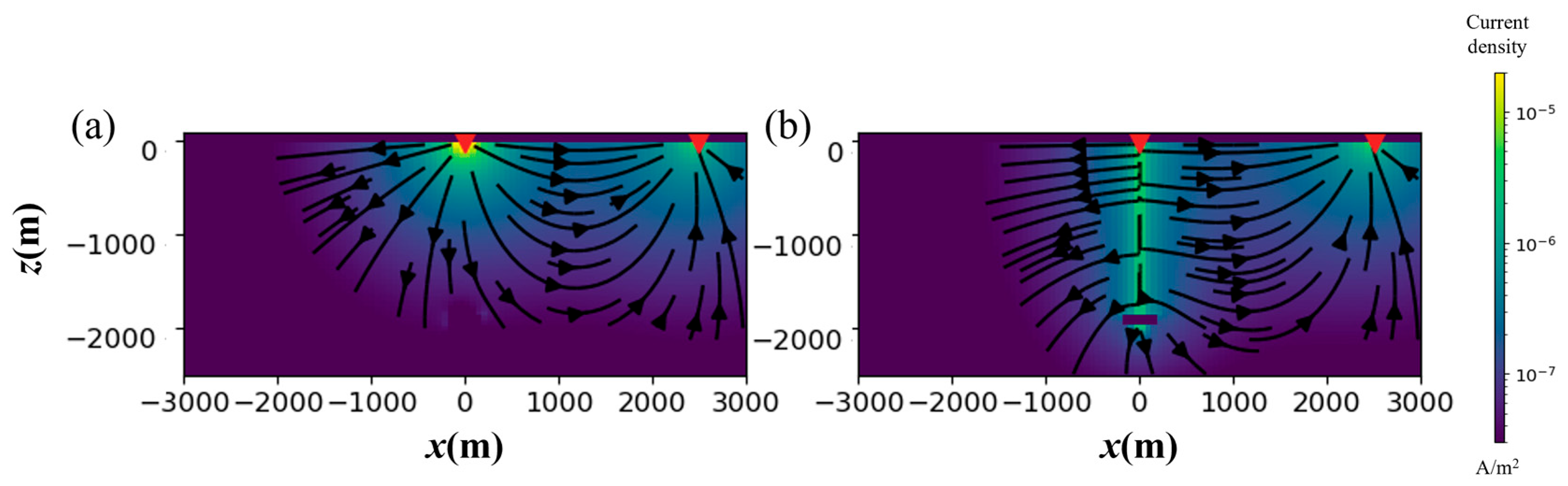
Figure 15 shows the current density distribution of the injected gas in the XOZ section (without a return electrode). A comparison of
Figure 14 and
Figure 15 reveals that the selection of the return electrode exerts a significant influence on the monitoring effect of high-resistivity target bodies. Therefore, for gas monitoring, the position of the surface electrode B needs to be confirmed in advance through simulation or field monitoring experiments.
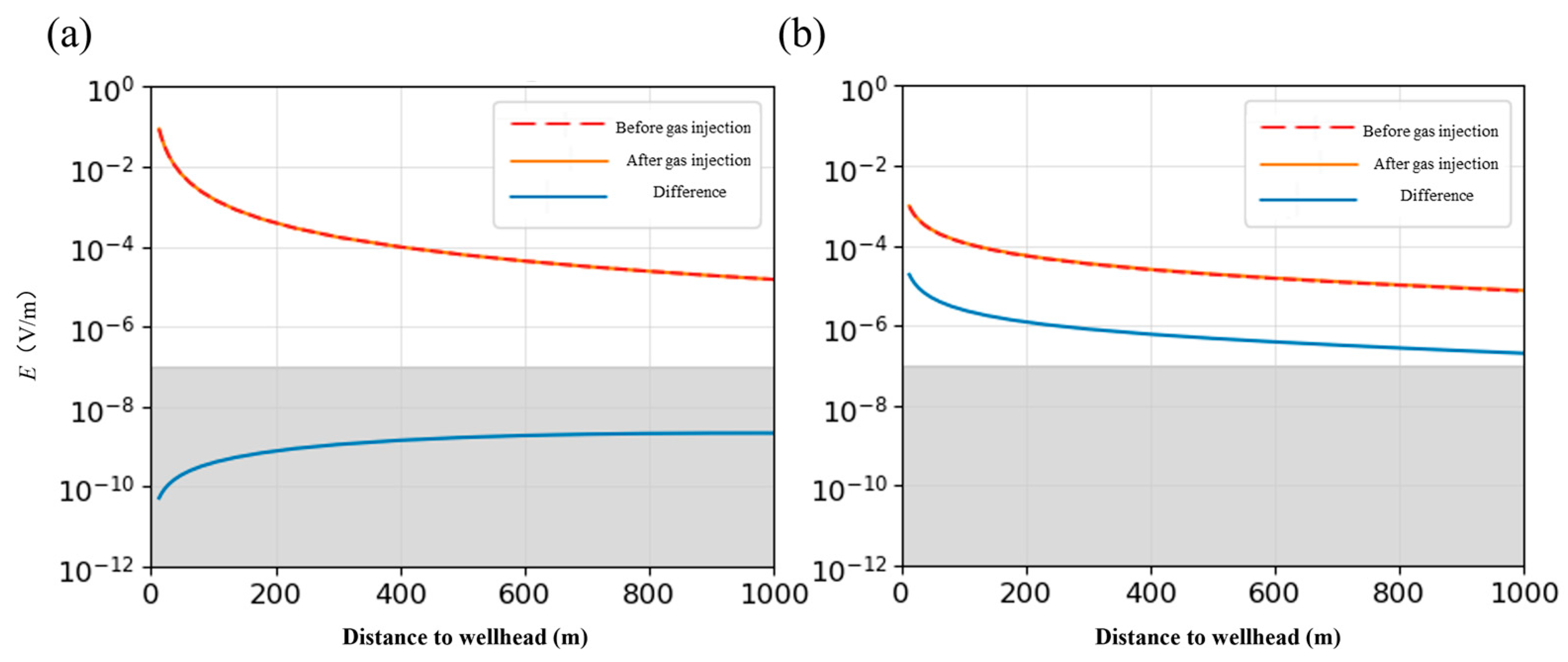
Figure 16 shows the relationship between the surface received electric field and the radial distance from the wellbore, where
Figure 16a corresponds to the case without a well casing and
Figure 16b to that with a well casing. The red dashed line represents the surface electric field response before gas injection, the yellow solid line represents the response after gas injection, and the blue solid line represents the differential electric field value (anomalous value). A comparison of the two subfigures in
Figure 16 reveals that under the excitation effect of the metal well casing, the effective signal response of gas injection observed on the surface is also higher than the noise level (the gray area). Although the injected gas is a high-resistivity anomalous body, the metal well casing can effectively amplify the differential electric field response of the anomalous body on the surface (the blue solid line). Borehole-to-surface electromagnetic detection relies on the excitation source inside the wellbore to radiate electromagnetic signals to underground formations. The vertical depth of wellbore extension directly determines the underground layout position of the excitation source, and thus affects the formation range and propagation distance that electromagnetic signals can effectively penetrate.
4.2. Electromagnetic Multi-Component Response
The underground resistivity of the homogeneous half-space model is set to 100 Ω·m, and the resistivity of the air layer to 1 × 10
8 Ω·m. Based on this model, a vertical electric dipole is deployed along the
Z-axis with a dipole length of 1500 m, ranging from 0 m to −1500 m; the transmitting current is set to 10 A and the frequency to 1 Hz.
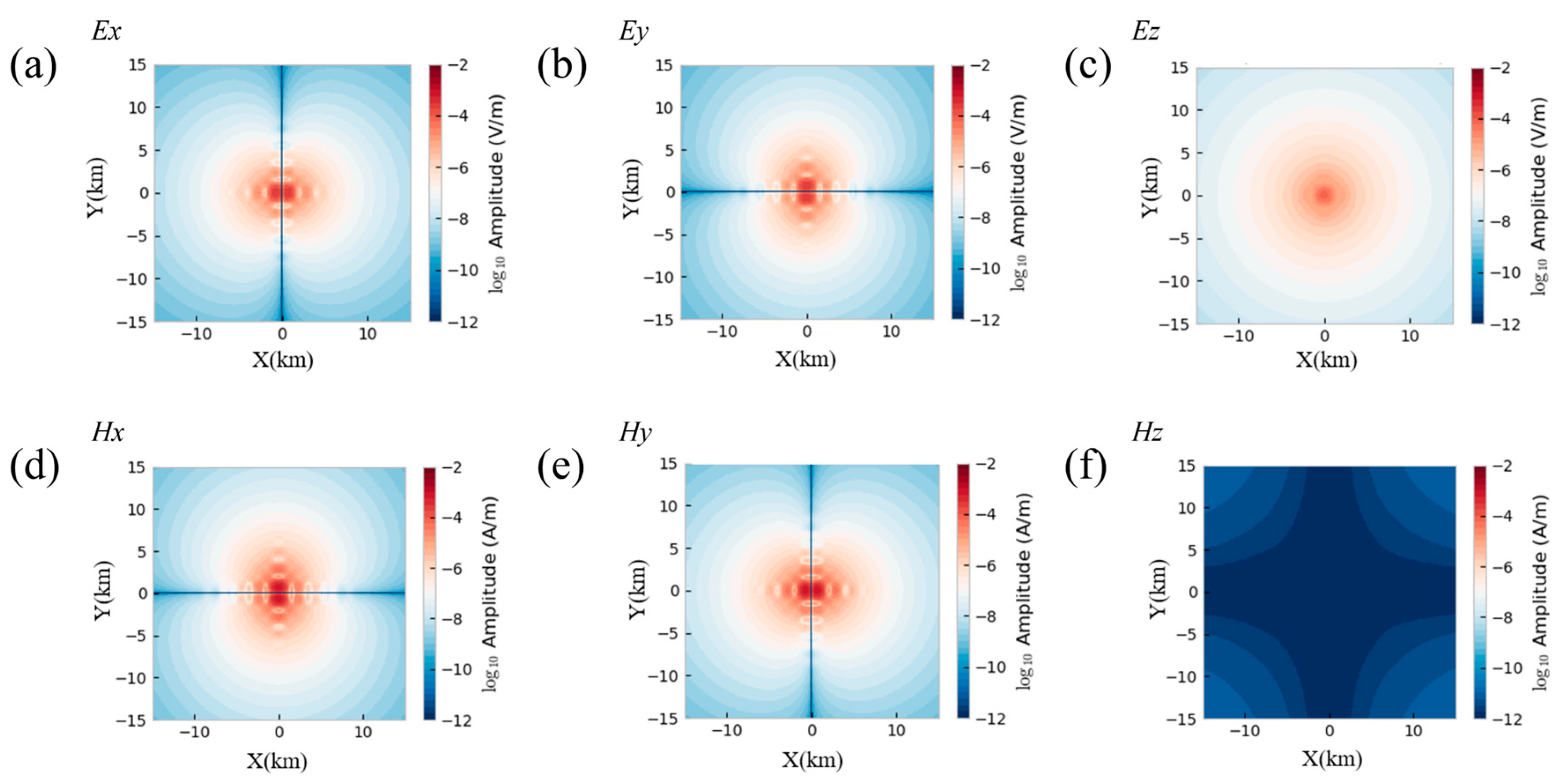
Figure 17 presents the surface received simulation results of the underground vertical electric dipole, where
Figure 17a–c are the contour maps of the three components (Ex, Ey, Ez) of the surface received electric field, and
Figure 17d–f are those of the three components (Hx, Hy, Hz) of the surface-received magnetic field. It can be seen from the amplitude distribution of each electromagnetic field component on the surface shown in
Figure 17 that the Ex, Ez and Hy components exhibit better detection performance for surface observation.
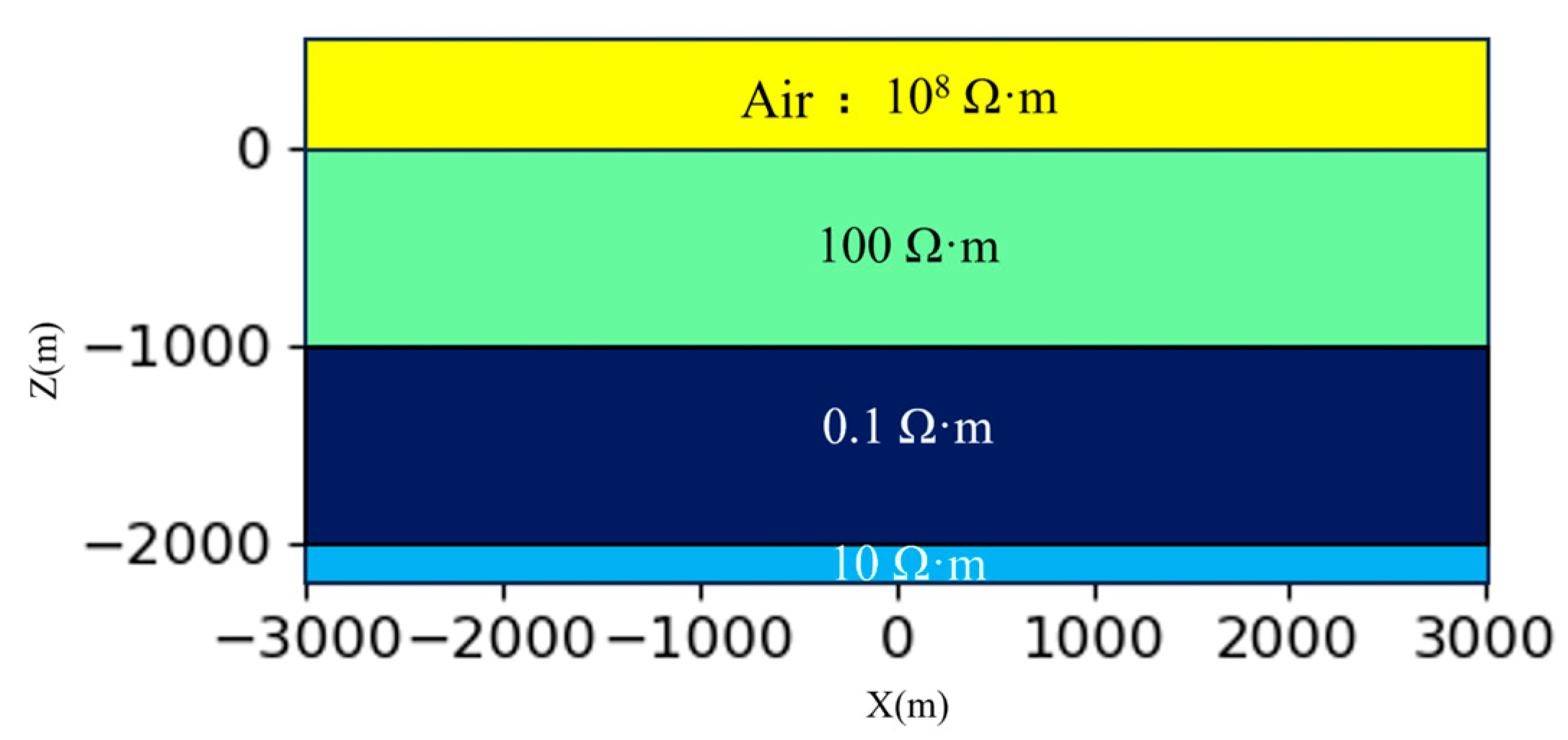
A three-layer homogeneous half-space model is established (
Figure 18) to investigate the propagation characteristics of the vertical electric dipole in the formation. The resistivity of the air layer is set to 1 × 10
8 Ω·m; the formation from 0 m to 1000 m is set to 100 Ω·m, that from 1000 m to 2000 m to 0.1 Ω·m, and the formation below 2000 m to 10 Ω·m. The vertical electric dipole is deployed along the
Z-axis with a dipole length of 1500 m, ranging from 0 m to −1500 m. The transmitting current is set to 500 A, and the transmitting frequencies are set to 5 Hz, 1 Hz and 0.125 Hz, respectively.
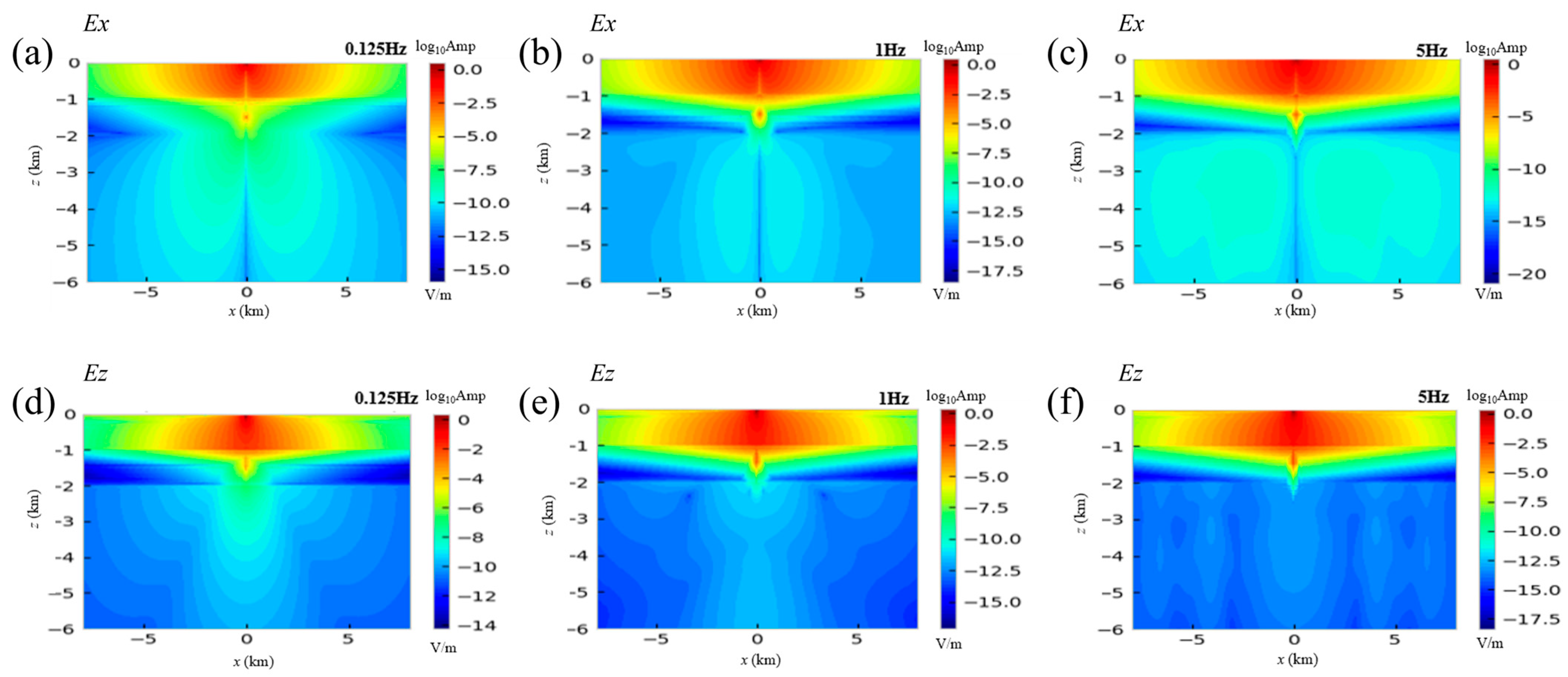
The distribution patterns of the Ex and Ez components from the calculation results of the vertical electric dipole obtained by the adopted 3D simulation method are shown in
Figure 19.
Figure 19a–c are the vertical (XOZ) slices of Ex at 0.125 Hz, 1 Hz and 5 Hz, respectively, and
Figure 19d–f are those of Ez at the corresponding frequencies. It can be seen from
Figure 19 that the measured electric field undergoes a transition from rapid to slow variation from the surface to the deep formations. The Ez component exhibits a tendency to decrease with increasing depth, with its amplitude attenuating rapidly at larger
X-axis distances and decreasing significantly compared with that near the dipole. In contrast, the Ex component shows a slow, gradual increase at higher frequencies, with only a slight variation in amplitude at larger distances relative to that near the dipole; at lower frequencies, however, it changes more rapidly with the increase in distance. When observed at the well scale, effective signals of both components can be received on the surface.
5. Conclusions
This study focuses on borehole-to-surface electromagnetic imaging technology, with an in-depth analysis and discussion of the 3D forward simulation algorithm, the influence of cased wells, and the characteristics of surface responses. Forward simulation and response analysis were carried out based on the 3D finite volume forward algorithm in the frequency domain, which verifies the effectiveness and reliability of this technology. The algorithm was applied to the simulation of downhole water and gas injection monitoring scenarios, confirming that it is an efficient method for underground dynamic monitoring and demonstrating its broad prospects in the dynamic monitoring of deep downhole formations. The main research conclusions are as follows:
The 3D finite volume method was adopted to simulate the borehole-to-surface observation system. The actual working conditions of metal casings in vertical wells were simulated using cylindrical coordinate grids, and combined with the setup of high-resistivity cement well walls, the correctness of the point source simulation method and the line source simulation method was verified.
Aiming at scenarios such as water injection, gas injection, gas storage operation, and fracturing construction, the monitoring effectiveness of the borehole-to-surface electromagnetic method was verified by constructing borehole-to-surface observation modes and conducting forward numerical simulations. This method exhibits excellent performance in dynamic monitoring, and the surface differential potential can effectively reflect the distribution of low-resistivity and high-resistivity bodies, providing a scientific basis and practical guidance for the rational setup of the monitoring system. Among them, in gas injection monitoring, the selection of the return electrode has a significant impact on the monitoring effect of high-resistivity target bodies, and the position of the surface electrode B needs to be confirmed in advance through simulation or field monitoring experiments.
The effective detection depth of borehole-to-surface electromagnetics is closely related to the vertical depth of wellbore extension. Borehole-to-surface electromagnetic detection relies on the excitation source inside the wellbore to radiate electromagnetic signals to underground formations; the vertical depth of wellbore extension directly determines the underground layout position of the excitation source, and thus affects the formation range and propagation distance that electromagnetic signals can effectively penetrate. In general, the deeper the wellbore extends, the wider the range of deep formation areas that the excitation source can reach, and the effective detection depth of borehole-to-surface electromagnetics increases accordingly, enabling the detection of the electrical characteristics of deeper underground media.
For deviated and horizontal wells, the electromagnetic response can be calculated using a hybrid grid scheme, where a cylindrical grid is applied to the wellbore region, and hexahedral or tetrahedral grids are used for other domains. This constitutes a direction for our future research. The proposed method is mainly applied to onshore wells and has not yet been employed in offshore scenarios. Future work may also include investigations into excitation in offshore wells.




 ,
,