Article

Underwater Image Enhancement Based on Multi-Scale Fusion and Detail Sharpening

Naval University of Engineering, Wuhan 430033, China
*
Authors to whom correspondence should be addressed.
Appl. Sci. 2026, 16(6), 2644; https://doi.org/10.3390/app16062644
Submission received: 18 January 2026 / Revised: 28 February 2026 / Accepted: 6 March 2026 / Published: 10 March 2026

Abstract

To address the issues of color cast, insufficient contrast, and detail loss in underwater optical images, this paper proposes an underwater image enhancement method based on multi-scale fusion and detail sharpening. The algorithm first applies an improved Gray World White Balance method with color compensation to perform color correction on the original underwater image. Subsequently, two processed images are generated for fusion: the first image is obtained by applying a Particle Swarm Optimization-enhanced Contrast Limited Adaptive Histogram Equalization (CLAHE) algorithm to the color-corrected image to enhance contrast; the second image is produced by applying an adaptive gamma correction algorithm to improve uneven illumination regions. These two images are then fused using a multi-scale fusion strategy. Finally, a weighted multi-scale detail sharpening technique is employed to further enhance the texture details of the fused image, yielding the final enhanced result. The performance of the proposed method is evaluated using no-reference underwater image quality metrics: the Underwater Image Quality Measure (UIQM) and the Patch-based Contrast Quality Index (PCQI), and tested on the open-source dataset from Nanyang Technological University. Experimental results demonstrate that the proposed method leads to an improvement in underwater image quality in both qualitative and quantitative assessments.

1. Introduction

In the underwater structural damage inspection of ship equipment, close-range exploration and image acquisition of key components such as the hull and propeller are typically carried out by professional personnel or underwater robots. However, during the image acquisition process, light waves are affected by scattering and absorption in water, leading to widespread issues in the images such as color distortion, reduced contrast, and detail loss. To improve image quality, enhancement processing of the raw captured images is usually required.
At present, underwater image enhancement methods can be divided into two major categories: deep learning-based methods and non-deep learning-based methods [1]. Among them, deep learning-based image enhancement approaches have advanced rapidly in recent years [2,3,4]. However, they face challenges such as high data dependence, limited generalization capability, and significant computational costs, making them unsuitable for application scenarios with limited image availability, such as ship structural damage inspection. Therefore, non-deep learning methods hold greater application potential in such scenarios. Among these, physics model-based methods and histogram-based methods are two widely used techniques, yet both possess inherent limitations, prompting extensive research efforts to build upon them.
In physics model-based methods, HE et al. proposed the Dark Channel Prior (DCP) method [5], which addresses the challenge of single-image dehazing through a statistical prior model. Building upon DCP, DREWS et al. introduced the Underwater Dark Channel Prior (UDCP) method [6], which adapts and optimizes the approach for underwater optical characteristics to mitigate the severe limitations of directly applying DCP in underwater scenarios. Y. Peng et al. further proposed the Generalization of the Dark Channel Prior (GDCP) [7], which overcomes the constraints of DCP by enhancing adaptability to complex scenes and improving the robustness of restoration effects. However, such methods often suffer from insufficient color correction and artifacts. In histogram-based methods, the Histogram Equalization (HE) method [8] incorporates probability and statistical theory into image enhancement, using a mathematical model to improve image contrast. Its improved variant, Contrast Limited Adaptive Histogram Equalization (CLAHE) [9,10], is widely applied for enhancing contrast while suppressing background noise amplification compared to HE. Nonetheless, such methods may lead to issues like blurred detail edges.
To address the inherent limitations of both types of methods, fusion-based approaches have been extensively proposed. These methods aim to integrate the advantages of multiple images or diverse processing results from a single image, overcoming the limitations of individual methods or single inputs, thereby generating an output image superior in visual quality or informational completeness to any single source. Ancuti et al. proposed a Fusion algorithm [11] that derives input images and corresponding weight maps solely from the degraded image itself, leveraging the advantages of multiple enhanced versions through fusion. Subsequently, they introduced the Color Balance and Fusion (CBF) algorithm [12], which further improves underwater image correction, but produces images with low saturation. Muniraj et al. used color compensation, Retinex theory, and CLAHE to correct the image color and enhance contrast [13]; however, the resulting images exhibited blurred details and halo artifacts. Zhang W et al. proposed the ACCC algorithm, which demonstrated some capability in correcting blue and green color casts, but its results still suffer from low contrast and significant loss of color information, which compromises overall color richness [14]. Wang et al. proposed the Multi-scale Adaptive Multi-weight Fusion (MAMF) [15] algorithm, which adopts a “fusion–decomposition–refusion” strategy to address issues of unnatural appearance and blurred details. However, the shortcoming is that some noise is amplified during the detail texture enhancement process.
To address the limitations of the above fusion algorithm, this paper proposes an underwater image enhancement algorithm based on a fusion strategy, which integrates color correction, a color-compensated Gray World White Balance [16,17], adaptive gamma correction [18], an improved CLAHE algorithm, multi-scale fusion, and detail sharpening. The main contributions of the proposed method are as follows:
I.
Adaptive gamma correction is used to address uneven illumination;
II.
An improved CLAHE enhances local contrast while suppressing noise;
III.
Multi-scale fusion combines complementary information from different processed images;
IV.
Weighted multi-scale detail sharpening recovers lost textures.
Compared to existing fusion algorithms, the underwater images processed by the proposed method can achieve higher image quality assessment scores.

2. Proposed Algorithm

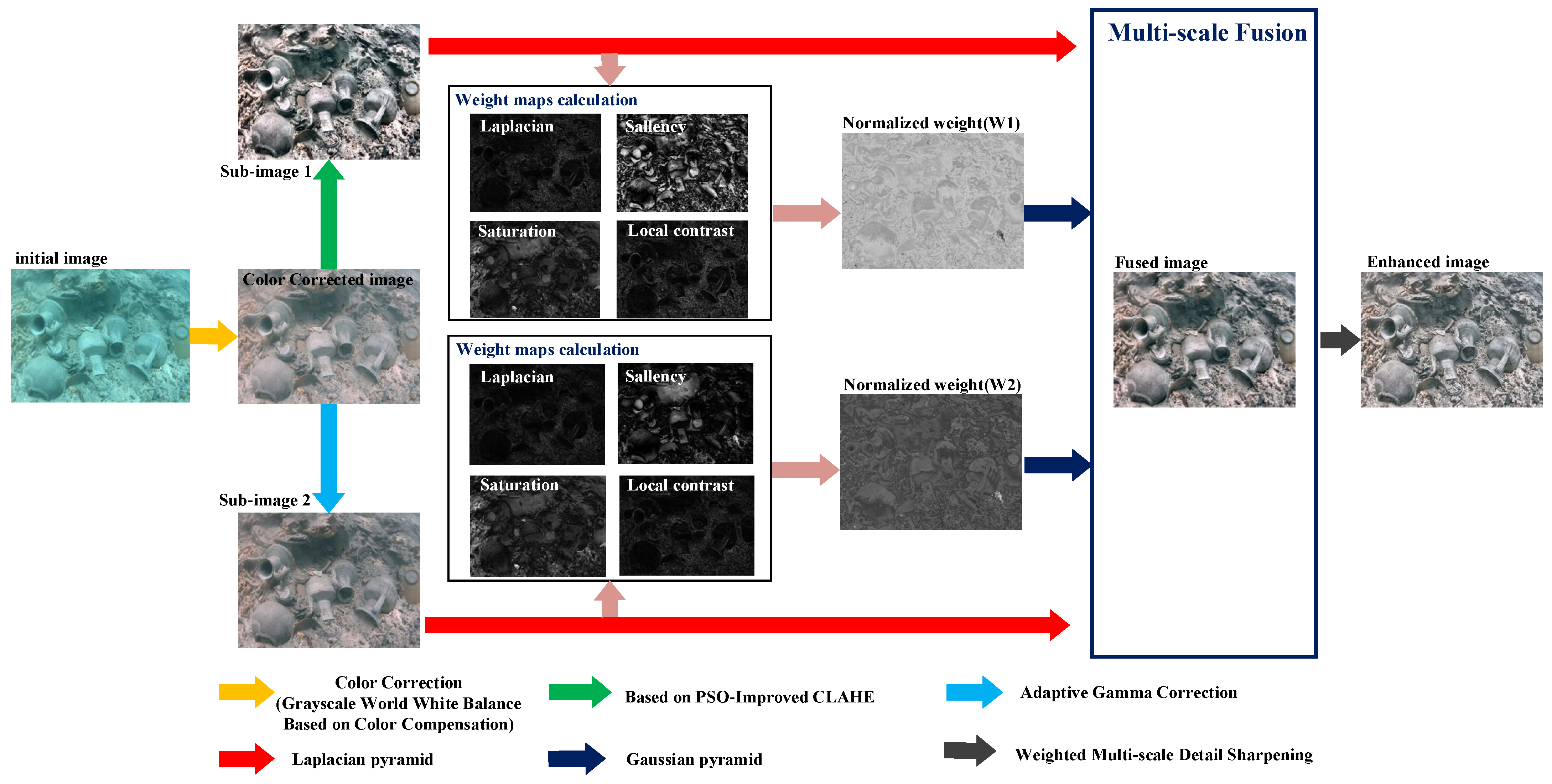
In this section, the proposed underwater image enhancement method is elaborated in detail. The proposed algorithm begins by applying a color-compensated Gray World White Balance to the original underwater image for color correction. Then, two sub-images are generated for fusion:
Sub-image 1: The color-corrected image is processed by an improved CLAHE algorithm based on the Particle Swarm Optimization (PSO) algorithm [19,20].
Sub-image 2: The same color-corrected image undergoes adaptive gamma correction [21] to improve illumination uniformity.
To determine the contribution of each sub-image during fusion, four types of weight maps are computed for both images: Laplacian contrast weight, local contrast weight, saliency weight, and saturation weight. These weights are normalized and used in a multi-scale fusion framework. Finally, the fused image is subjected to weighted multi-scale detail sharpening to enhance texture details, producing the final enhanced image. Figure 1 illustrates the overall pipeline.

2.1. Underwater Image Color Correction

Due to the differential absorption and scattering of light at various wavelengths by water, underwater images typically exhibit the green, blue–green, or blue tint—manifesting as color distortion. The Gray World White Balance method can partially mitigate the blue cast in underwater images. However, it often fails when processing images with imbalanced color channel contributions, as the inaccurate weighting calculation leads to overcompensation. Specifically, when the red channel, the blue channel, or both have disproportionately low intensities, the algorithm excessively amplifies these channels—particularly the red channel—resulting in severe color distortion and artifacts. To address this, we propose an improved Gray World White Balance with a pre-compensation mechanism.
Color Compensation: First, calculate the average intensity of each color channel in the underwater image I . The color channels corresponding to the maximum, median, and minimum average pixel values are defined as the maximum color channel I max , the median color channel I mid I m i d , and the minimum color channel I min , respectively [22]. Compensation is then applied to I mid and I min using I max . The compensation values for the median and minimum color channels are given as follows:
Δ I mid ( x ) = α ( I ¯ max I ¯ mid ) ( I ¯ max + I ¯ mid ) ( 1 I mid ( x ) ) I max ( x )
Δ I min ( x ) = β ( I ¯ max I ¯ min ) ( I ¯ max + I ¯ min ) ( 1 I min ( x ) ) I max ( x )
where α is the compensation coefficient for the median color channel, and β is the compensation coefficient for the minimum color channel. The median and minimum color channel values of the compensated image are respectively given by
I mid = I mid + Δ I mid ( x )
I min = I min + Δ I min ( x )
where I max z , I midz and I min z denote the total pixel values of the image in the red, green, and blue channels, respectively. Δ I mid ( x ) and Δ I min ( x ) denote the compensation values for the median and minimum color channels of the image, respectively. I ¯ max , I ¯ mid and I ¯ min represent the average pixel values of the maximum, median, and minimum color channels of the image, respectively. Using Equations (3) and (4), the compensated color channel values can be obtained, and then the color-compensated image I can be obtained.
Gray World White Balance: Calculate the average grayscale values of the I R , I G and I B components of the color-compensated image I to obtain the gray level. Then, calculate the mean pixel values of each color channel, denoted as I ¯ R , I ¯ G and I ¯ B respectively. Divide the grayscale value K by the mean of each color channel to obtain the corresponding channel weights. Finally, multiply the original channel values by their respective weights to obtain the adjusted channel values, as shown in the following equation:
W R = K I ¯ R , W G = K I ¯ G , W B = K I ¯ B I R = W R I R , I G = W G I G , I B = W B I B
Combine the adjusted color channels to obtain the color-corrected image I .

2.2. Acquisition of Fused Sub-Images

Sub-image 1: CLAHE requires manual setting of the local block size (tile size) and contrast clipping limit (clip limit), making it difficult to find a globally optimal parameter configuration. In this paper, we improve CLAHE by employing the Particle Swarm Optimization (PSO) algorithm. Specifically, the underwater image contrast measure (UIConM) [23,24] is used as the objective function for PSO to automatically optimize the combination of block size and clip limit parameters.
As described in reference [24], the contrast is measured by applying the logAMEE measure on the intensity image, as shown in
U I C o n M = log AMEE ( I n t e n s i t y )
The logAMEE in
log AMEE = 1 k 1 k 2 l = 1 k 1 k = 2 k 2 I max , k , l Θ I min , k , l I max , k , l I min , k , l × log I max , k , l Θ I min , k , l I max , k , l I min , k , l
where image is divided into k 1 k 2 blocks, and , and Θ are the PLIP operations. In this paper, the image I in Equation (7) should be substituted with the color-corrected image I after it has been processed by CLAHE using different local block sizes and contrast clipping limits. In underwater environments, lighting is often insufficient. Agaian measure of enhancement by entropy (logAMEE) utilizes logarithmic transformation and PLIP operations to enhance the sensitivity of contrast evaluation in low-illumination areas.
The specific steps for parameter optimization based on PSO are as follows:
Step 1: Initialize a swarm of particles in PSO, where the position of each particle is randomly set as [tile_size, clip_limit], “tile_size” and “clip_limit”, representing the block size and contrast clipping limit corresponding to that particle, respectively.
Step 2: For each particle, the input image (color-corrected image I ) is processed using CLAHE with the parameters corresponding to its position;
Step 3: Calculate the UIConM of the processed image using Equations (6) and (7) and use it as the fitness value for that particle;
Step 4: Update the personal best position P b e s t of each particle and the global best position G b e s t of the entire swarm;
Step 5: Update the velocity and position of all particles according to the following equations:
v i t + 1 = ω v i t + c 1 r 1 ( P b e s t i t x i t ) + c 2 r 2 ( G b e s t i t x i t )
x i t + 1 = x i t + v i t + 1
where parameters are defined as follows:
  • t : current iteration number;
  • v i : the velocity of the particle in the search space;
  • x i : the position of the particle in the search space;
  • w : inertia weight;
  • c 1 , c 1 : weighting factor;
  • r 1 , r 2 : random numbers, uniformly distributed in the interval [0, 1];
  • P b e s t i t : the best position found by the particle up to the current iteration;
  • G b e s t i t : the best position found by the entire swarm up to the current iteration.
Step 6: Repeat steps 2–5 until the maximum number of iterations is reached or convergence is achieved.
Step 7: Output the parameter combination corresponding to the global best G b e s t and the processed image, which is sub-image 1.
To avoid the PSO optimization process from falling into local optima, an adaptive strategy is introduced for calculating the inertia weight, which is computed using the following equation:
w = w start ( w start w end ) × ( i t e r / max _ i t e r )
in which w start and w end represent the initial and final values of the inertia weight during the iterative process, respectively. max _ i t e r represents the maximum number of iterations, and i t e r represents the number of iterations.
Moreover, when the global optimum has not been updated for several consecutive generations, random perturbations are added to a subset of particles (e.g., 30%) to help escape from local optima.
Sub-image 2: This step aims to enhance image brightness through adaptive gamma correction. During the preprocessing stage, the color-corrected image I is first converted from the RGB color space to the HSV color space. This conversion decouples the luminance component (V) from chromatic information (H and S), thereby establishing a foundation for subsequent independent luminance manipulation and effectively avoiding color distortion that may arise from directly operating in the RGB color space.
In the HSV space, brightness enhancement is achieved by processing only the V (value) channel. Compared to low-light enhancement methods in the RGB space—which require simultaneous adjustment of all three R, G, and B channels—this approach significantly reduces computational complexity. The adaptive gamma parameter γ is computed as follows:
γ = exp ( D ( I V ) c I ¯ V D ( I V ) )
I out _ V = ( I ) γ
where I V is color correction image I of the V channel value, I ¯ V is the mean pixel value of the V channel of I V , D ( I V ) is the variance of I V , and c is an estimated tuning parameter. Compute the value of γ , substitute it into Equation (12) to obtain the gamma-corrected output I out _ V for the V channel, then combine I out _ V with the original H and S channels in the HSV color space, and finally, convert the result back to the RGB color space to obtain sub-image 2.

2.3. Image Fusion

The weights for sub-image 1 and sub-image 2 are extracted separately. In this paper, the following four types of weights are employed: Laplacian contrast weight, local contrast weight, saliency weigh, and saturation weight. The extracted weights are normalized, and the images are then fused using a multi-scale fusion algorithm.

Weight Calculation

Laplacian Contrast Weight: The Laplacian filter can emphasize high-frequency components in an image (such as edges and noise) while suppressing low-frequency components (such as smooth backgrounds and gradually varying textures). In other words, it enhances regions with abrupt intensity changes and attenuates areas with gradual intensity variations, thereby achieving detail enhancement. The Laplacian operator is expressed as follows:
2 f ( x , y ) = 2 f ( x , y ) x 2 + 2 f ( x , y ) y 2
First, compute the grayscale version of the image and feed it into the Laplacian filter. Then, take the absolute value of the filter output to obtain the Laplacian contrast weight.
Local Contrast Weight: The local contrast weight W L C serves to enhance the representation of local contrast. In image processing, it dynamically adjusts contrast by analyzing luminance differences within local neighborhoods, thereby improving the visual quality of specific regions. Its underlying principle is to compute weights based on local neighborhood information around each pixel. The following equation defines the computation of the local contrast weight:
W LC ( x , y ) = I k I ω h c k
where I k denotes the input luminance channel, and I ω h c k denotes the low-pass filtered version of the input luminance channel. Take the grayscale of the input image, and substitute both the grayscale image and its filtered result into Equation (14); then, compute the ℓ2-norm (Euclidean norm) to obtain the local contrast weight.
Saliency weight: The saliency weight aims to recover or enhance objects or regions that have become indistinct due to adverse environmental conditions—such as underwater light attenuation, scattering, and low contrast. To compute the saliency weight, the input image is first converted from the RGB color space to the LAB color space, and the I L , I A , and I B channel values are extracted. The saliency weight is then calculated based on these channels.
W S = ( I L k I ¯ L ) 2 + ( I A k I ¯ A ) 2 + ( I B k I ¯ B ) 2
where, I L k , I A k and I B k denote the pixel values of the image in the L, A, and B channels, respectively, and where I ¯ L , I ¯ A and I ¯ B denote the corresponding mean pixel values of the L, A, and B channels, respectively.
Saturation Weight:
W Sat = 1 3 ( I R k I L k ) 2 + ( I G k I L k ) 2 + ( I B k I L k ) 2
where I R k , I G k and I B k denote the pixel values of the image at location k in the red, green, and blue channels of the RGB color space, respectively, and I L k represents the pixel value at location k in the luminance channel of the LAB color space.
Multi-scale Fusion: The four types of weights for fused image 1 and fused image 2 are computed separately and then normalized [25], as shown in the following equation:
W 1 = ( W Lap 1 + W LC 1 + W S 1 + W Sat 1 ) / ( W Lap 1 + W LC 1 + W S 1 + W Sat 1 + W Lap 2 + W LC 2 + W S 2 + W Sat 2 ) W 2 = ( W Lap 2 + W LC 2 + W S 2 + W Sat 2 ) / ( W Lap 1 + W LC 1 + W S 1 + W Sat 1 + W Lap 2 + W LC 2 + W S 2 + W Sat 2 )
where W 1 and W 2 are the normalized weights of the two images, respectively, which are ultimately used in a multi-scale fusion algorithm to fuse the images. Each input image (sub-image 1, sub-image 2) is decomposed by a Laplacian pyramid and defined as L l { I in k ( x , y ) ; and W ¯ k is decomposed by a Gaussian pyramid and defined as G l { W ¯ k ( x , y ) } . Subsequently, image-weight fusion is performed at each pyramid level to obtain the fused result as
I l ( x , y ) = k = 1 K G l { W ¯ k ( x , y ) } L l { I in k ( x , y ) }
at each pixel, where I l ( x , y ) is the Laplacian pyramid of the fusion image. The enhanced image is obtained by summing the fused contribution of all levels
I fused ( x , y ) = l U I l
where I fused ( x , y ) is the final output image after fusion, and U I l represents the upsampling operator with factor d = 2 l 1 .

2.4. Weighted Multi-Scale Detail Sharpening

To sharpen the details of the fused image, this paper proposes a weighted multi-scale detail sharpening method. Specifically, image details are extracted at multiple scales, and these details are then enhanced to achieve a sharpening effect. Since fine scales preserve more high-frequency details while suppressing noise, and coarse scales retain fewer details but yield smoother representations, the proposed method introduces a weighting strategy that assigns different importance to details at different scales. This enables a balanced trade-off between edge enhancement and noise suppression, achieving their coordinated optimization.
Gaussian kernels of different scales are used to blur the fused image, and this blurring process is defined as
I blur n ( i , j ) = G kernel n ( i , j ) I fused ( i , j )
where G n ( x , y ) = 1 2 π σ n 2 exp ( ( x 2 + y 2 ) / ( 2 σ n 2 ) ) denotes the Gaussian kernel function. From Equation (20), N blurred images corresponding respectively to N scale-specific Gaussian kernels can be obtained. These blurred images are then assigned different weights according to the scale-dependent detail significance and combined via a weighted average to produce a single integrated blurred image, as shown in the following equation:
I blur _ out = n = 1 N ( I blur n × W n ) n = 1 N ( W n )
where n = 1 N ( W n ) = 1 . In this paper, N is set to 3, meaning that three different scales are selected. Three different weights are selected for these three scales, corresponding to the small, medium, and large scales as 0.6, 0.3, and 0.1, respectively. The input image I fused and the blurred image I blur _ out are then converted into the LAB color space. Sharpening is applied to the L channel by subtracting the L channel of the blurred image I blur _ out from that of the input image I fused to obtain a texture (detail) image. A linear stretching operation is further introduced to enhance the contrast of the extracted details, as shown in the following equation:
I sharp L = I fused L + T I fused L I blur _ out L × η
where T denotes the linear stretching operation, and η is a parameter controlling the degree of linear stretching. The value of η directly affects the sharpening intensity: if η is too small, the sharpened image appears undersaturated; if η is too large, the image becomes oversaturated. η was set to 1.5 based on extensive statistical analysis. Finally, the sharpened L channel I sharp L is combined with the A and B channels of the input image I fused to produce the final enhanced image I final .

3. Results

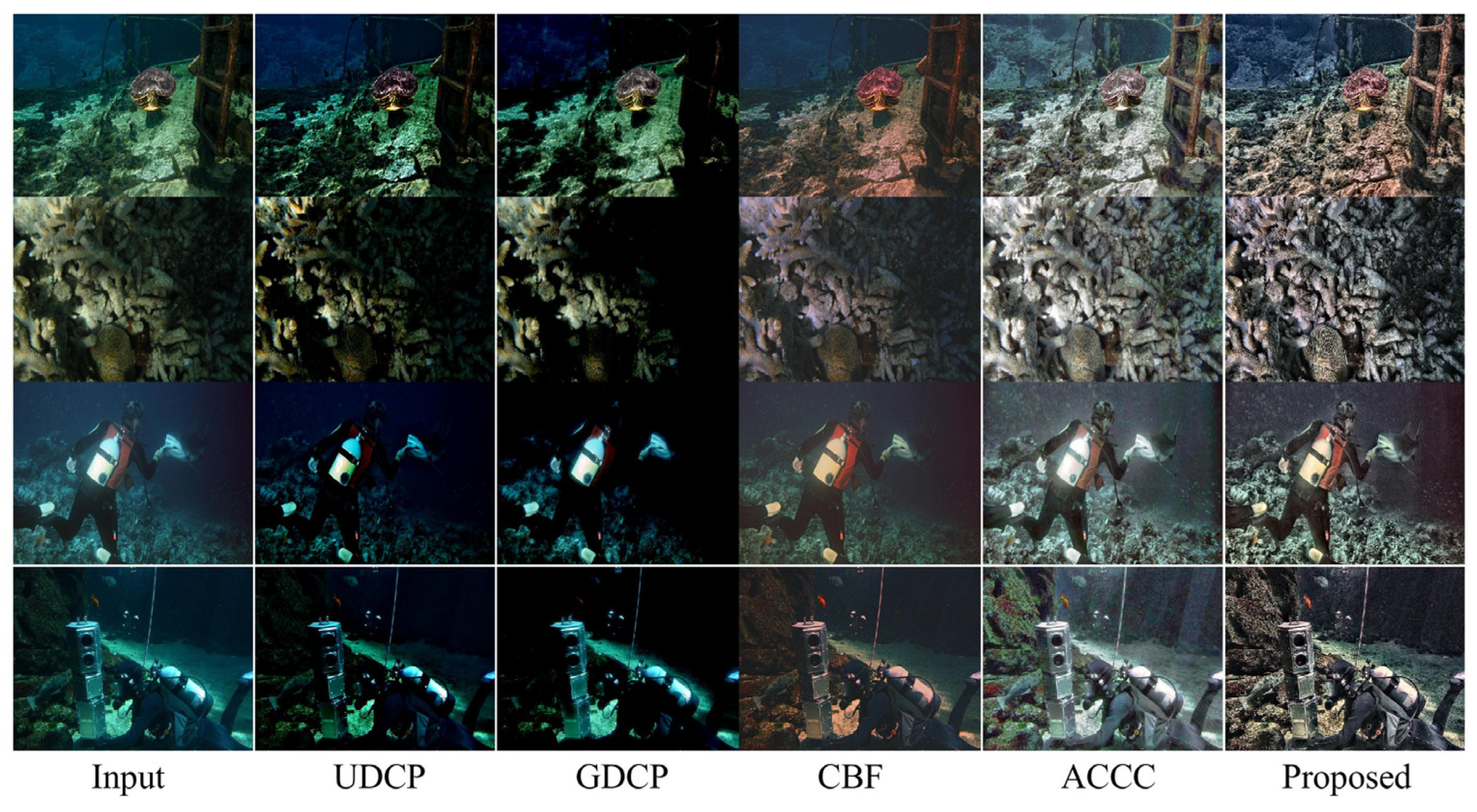
To verify the effectiveness of the proposed algorithm, we select UDCP, GDCP, CBF, and ACCC as baseline methods for comparative evaluation. The experiments are conducted on the open-source datasets UIEB and UCCS. Both subjective and objective evaluations are performed on these selected images.
To verify the performance of the proposed method in enhancing underwater images, objective evaluation is conducted alongside subjective assessment by employing three no-reference image quality metrics: the Underwater Color Image Quality Evaluation (UCIQE) [25], the Underwater Image Quality Measure (UIQM) and the Patch-based Contrast Quality Index (PCQI) [26].
UCIQE is a linear weighted combination of the standard deviation of chroma, the contrast measure, and the mean saturation. A higher UCIQE value indicates a better visual quality of the image. The UCIQE is computed as follows:
U C I Q E = c 1 × σ c + c 2 × c o n l + c 3 × μ s
in which σ c , c o n l and μ s represent the standard deviation of chroma, the contrast measure, and the mean saturation, respectively. c 1 = 0.4680 , c 2 = 0.2745 , c 3 = 0.2576 .
UIQM linearly combines multiple perceptual attributes of underwater images—namely, sharpness (Underwater Image Sharpness Measure, UISM), contrast (Underwater Image Contrast Measure, UIConM), and colorfulness (Underwater Image Colorfulness Measure, UICM)—to evaluate image quality. It is a no-reference image quality assessment metric specifically designed for underwater scenes, defined as
U I Q M = c 1 × U I C M + c 2 × U I S M + c 3 × U I C o n M
where c 1 , c 2 and c 3 are weighting coefficients, typically set as c 1 = 0.0282 , c 2 = 0.2953 and c 2 = 3.5753 . A higher UIQM value indicates a better image quality in terms of sharpness, contrast, and colorfulness.
PCQI (Patch-based Contrast Quality Index) evaluates the perceived contrast of an image on a patch-by-patch basis, reflecting human sensitivity to local contrast variations. It is defined as
P C Q I = 1 M i = 1 M q i ( X I , Y i ) q c ( X I , Y i ) q s ( X I , Y i )
In the above equation, M denotes the total number of image patches, and q i , q c and q s represent three comparison functions corresponding to mean intensity, signal contrast (or signal strength), and structural similarity, respectively. A higher PCQI value indicates better image contrast.

3.1. Evaluation on UIEB and UCCS

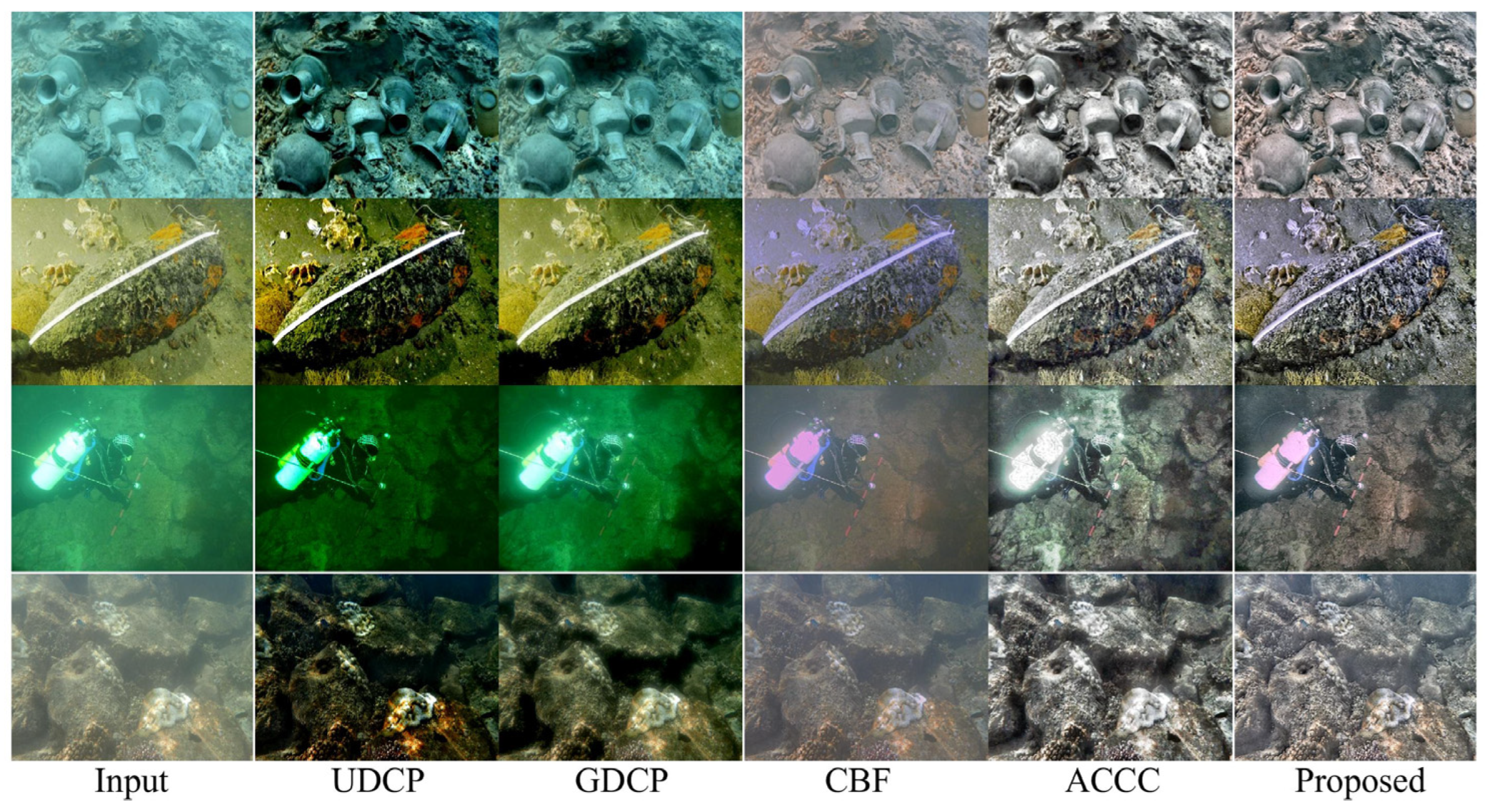
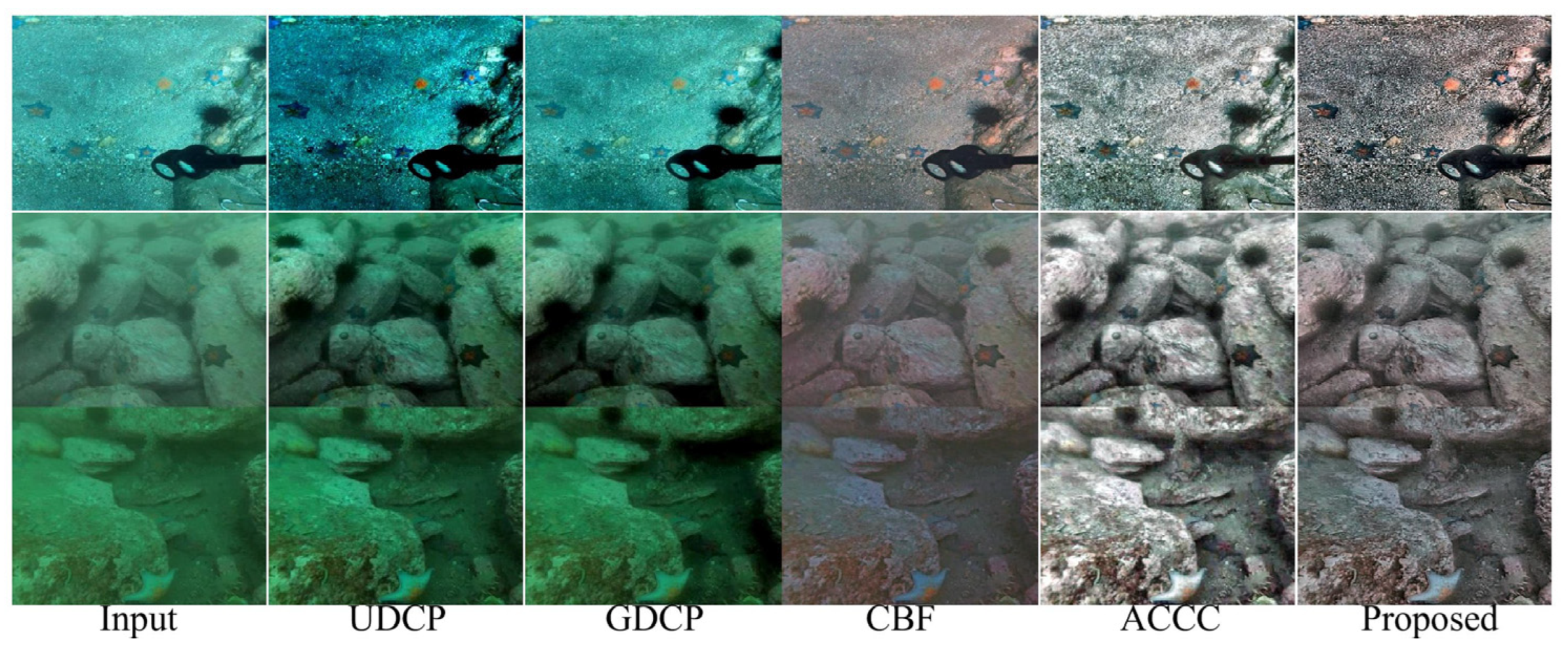
The UIEB and UCCS datasets encompass underwater images with various types of degradation. Based on visual characteristics, we selected several representative samples from UIEB, including images with a blueish color, yellowish color, greenish color and heavy haze. Figure 2 shows the enhancement results of these images produced by different methods; due to space limitations, only representative examples are presented. The UCCS dataset contains three subsets, which contain 100 underwater images of blue, green, and blue–green scenes, respectively. The enhancement results of randomly selected three sample images are shown in Figure 3.
From the visual results, it can be observed that the UDCP algorithm enhances image details and contrast but fails to remove color casts; the GDCP algorithm’s capability in contrast enhancement is significantly weaker than that of UDCP; and the CBF algorithm effectively corrects color bias but produces images with low saturation. Although the ACCC algorithm demonstrates some capability in correcting blue and green color casts, its results still suffer from low contrast and significant loss of color information, which compromises overall color richness. The proposed algorithm achieves a balanced enhancement across multiple aspects: it not only corrects color distortion and eliminates color casts but also simultaneously improves overall contrast and strengthens fine details. As a result, the enhanced images exhibit more natural color reproduction and contrast levels that closely align with human visual perception.
Table 1 presents the objective comparison results of the enhanced images obtained by the proposed algorithm and baseline methods on the UIEB dataset (100 images) in terms of UCIQE, UIQM, and PCQI metrics. The metric values reported in the table are obtained by computing each metric on the selected 100 samples individually and then taking the mean. As shown in Table 1, the proposed algorithm achieves the highest UIQM and PCQI values, improving by 8.6% and 3.5%, respectively, compared to the ACCC algorithm, which achieves the second-highest values. However, its UCIQE value is only higher than that of the CBF algorithm, showing a reduction of 2.8% compared to ACCC. Table 2 presents the objective comparison results of the enhanced images obtained by the proposed algorithm and baseline methods on the UCCS dataset in terms of UCIQE, UIQM, and PCQI metrics: Across the three subsets, the proposed algorithm achieves the highest UIQM and PCQI values. For the blue-background subset, its UIQM and PCQI values are improved by 6.8% and 1.6%, respectively, compared to the ACCC algorithm, which achieves the second-highest values, while the UCIQE value is increased by 5.4%. For the blue–green background subset, its UIQM and PCQI values are improved by 9.2% and 1.9%, respectively, compared to ACCC, while the UCIQE value is reduced by 5.3% compared to ACCC. For the green-background subset, its UIQM and PCQI values are improved by 9.6% and 2.2%, respectively, compared to ACCC, while the UCIQE value is reduced by 15.2% compared to ACCC. Upon analysis, the proposed method achieves greater improvements in contrast and structural clarity, thus yielding higher UIQM and PCQI values. However, the color correction process may introduce slight red artifacts, and since UCIQE assigns a higher weight to chrominance, this affects these metrics. Nevertheless, the proposed method contributes to an enhancement in image contrast and detail preservation while also leading to an improvement in color casts.

3.2. Detail-Preserving Analysis

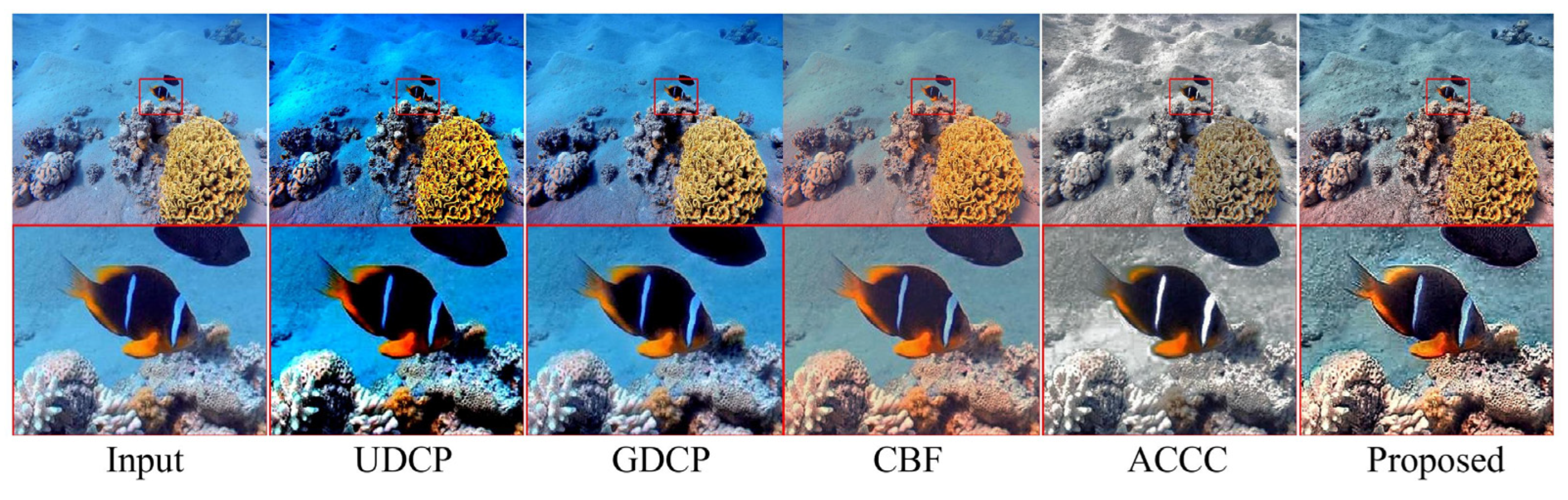
Existing underwater image enhancement methods often suffer from excessive smoothing, which leads to the loss of image details. To demonstrate the advantage of our approach, we select a representative image from the UIEB dataset and compare our proposed method with baseline methods, as shown in Figure 4. The regions enclosed by red boxes in the enhanced results are enlarged to produce close-up views. As can be observed in these magnified regions—particularly the fish tail and the coral beneath it—the image enhanced by our method exhibits higher visibility and more pronounced details compared to other methods.

3.3. Weaker Illumination Analysis

Some underwater images with extremely low-light conditions were selected from the UIEB dataset and processed using both the proposed method and baseline methods, as shown in Figure 5, followed by qualitative analysis. In extremely low-light or near-dark environments (where structural information is severely lacking), our proposed method achieves enhanced results with better contrast than the ACCC method, yet exhibits red artifacts. This represents a direction for our subsequent in-depth research and improvement.

4. Discussion

The runtime of the proposed method was evaluated on a standard platform (Intel(R) Core(TM) i5-13420H CPU @ 2.1 GHz, 24 GB RAM, without GPU acceleration) and compared with representative baseline methods, including ACCC and CBF. A total of 50 test images with a resolution of 640 × 480 (a typical resolution commonly used in underwater robotic systems) were selected for the experiments. The average processing times obtained are as follows: the proposed method takes 1.04 s per image, while ACCC takes 1.05 s, CBF takes 0.25 s, GDCP takes 0.07 s, and UDCP takes 0.09 s. The experimental results indicate that the computational speed of the proposed method is nearly identical to that of ACCC but slower compared to other lightweight methods. However, our method achieves a superior performance in terms of visual quality and quantitative metrics, making it suitable for non-real-time or offline scenarios (such as post-mission analysis in underwater exploration tasks). An analysis of the time consumption reveals that the computational complexity primarily stems from PSO parameter optimization and multi-scale pyramid decomposition. To enable real-time applications, our algorithm can be optimized in the future by reducing the PSO population size or employing fixed-parameter approximations.
In addition, as discussed in Section 3.3, the proposed method exhibits red artifacts when enhancing underwater images under extremely low-light conditions. Both of these aspects represent directions for our subsequent in-depth research and improvement.

5. Conclusions

This paper proposes an underwater image enhancement algorithm based on multi-scale fusion and detail sharpening. The method first performs color correction on the original underwater image using a color-compensated Gray World White Balance approach. Subsequently, two processed images are generated for fusion: (1) the first image is enhanced in contrast using a Particle Swarm Optimization (PSO)-improved Contrast Limited Adaptive Histogram Equalization (CLAHE) algorithm; (2) the second image is processed with an adaptive gamma correction algorithm to address uneven illumination. These two images are then fused using a multi-scale fusion strategy. Finally, a weighted multi-scale detail sharpening technique is applied to further enhance the texture details of the fused image.
We conducted experiments on the public datasets UIEB and UCCS. The results demonstrate that, compared with the original underwater images and those enhanced by other methods, the images processed by our algorithm exhibit improved contrast, recovered lost texture details, and a certain degree of color cast correction. Quantitative evaluations using underwater image quality assessment metrics—UCIQE, UIQM, and PCQI—also confirm that our method yields a superior image quality. However, the proposed method still has some limitations that require further optimization: enhanced images exhibit red artifacts under extremely low-light conditions, and the computational efficiency needs to be further improved to reduce runtime, aiming for real-time applications.

Author Contributions

Conceptualization, H.C. and Z.L.; methodology, H.C.; software, H.C.; validation, H.C., Y.L. and J.H.; formal analysis, Z.L.; investigation, Q.W.; re-sources, J.H.; data curation, Q.W.; writing—original draft preparation, H.C.; writing—review and editing, H.C.; visualization, Y.L.; supervision, Z.L.; project administration, Y.L.; funding acquisition, Y.L. All authors have read and agreed to the published version of the manuscript.

Funding

This research was funded by the National Defense Research and Development Program, grant number 2025705030, and the Autonomous Research Project of the Naval University of Engineering, grant number 202550H040.

Data Availability Statement

The datasets cited in the manuscript include the public datasets: UIEB and UCCS. The download link for the UIEB dataset is https://github.com/JJsnowx/UIEB_Dataset (accessed on 17 January 2026). The download link for the UIEB dataset is https://github.com/dlut-dimt/Realworld-Underwater-Image-Enhancement-RUIE-Benchmark/tree/master/UCCS (accessed on 17 January 2026).

Conflicts of Interest

The authors declare no conflict of interest.

References

  1. Deluxni, N.; Sudhakaran, P.; Kitmo; Ndiaye, M.F. A Review on Image Enhancement and Restoration Techniques for Underwater Optical Imaging Applications. IEEE Access 2023, 11, 111715–111737. [Google Scholar] [CrossRef]
  2. Cherian, A.K.; Venugopal, J.; Abishek, R.; Jabbar, F. Survey on Underwater Image Enhancement using Deep Learning. In Proceedings of the 2022 International Conference on Computing, Communication, Security and Intelligent Systems (IC3SIS), Kochi, India, 23–25 June 2022. [Google Scholar]
  3. Elmezain, M.; Saad Saoud, L.; Sultan, A.; Heshmat, M.; Seneviratne, L.; Hussain, I. Advancing Underwater Vision: A Survey of Deep Learning Models for Underwater Object Recognition and Tracking. IEEE Access 2025, 13, 17830–17867. [Google Scholar] [CrossRef]
  4. Hongchun, Y.; Bo, Z.; Xin, C. Underwater Image Enhancement Algorithm Combining Transformer and Generative Adversarial Network. Infrared Technol. 2024, 46, 975–983. [Google Scholar]
  5. He, K.; Sun, J.; Tang, X. Single image haze removal using dark channel prior. IEEE Trans. Pattern Anal. Mach. Intell. 2010, 33, 2341–2353. [Google Scholar] [CrossRef] [PubMed]
  6. Drews, P.L.J.; Nascimento, E.R.; Botelho, S.S.C.; Campos, M.F.M. Underwater depth estimation and image restoration based on single images. IEEE Comput. Graph. Appl. 2016, 36, 24–35. [Google Scholar] [CrossRef] [PubMed]
  7. Peng, Y.; Cao, K.; Cosman, P.C. Generalization of the dark channel prior for single image restoration. IEEE Trans. Image Process. 2018, 27, 2856–2868. [Google Scholar] [CrossRef] [PubMed]
  8. Hummel, R. Image enhancement by histogram transformation. Comput. Graph. Image Process. 1977, 6, 184–195. [Google Scholar] [CrossRef]
  9. Zuiderveld, K. Contrast limited adaptive histogram equalization. In Graphics Gems; Academic Press: Cambridge, MA, USA, 1994; pp. 474–485. [Google Scholar]
  10. Amalia, N.A.; Afira, A.; Ulfa, M.; Muchtar, K. Utilizing Edge Device and Streamlit for Comparative Evaluation of CLAHE-Based Underwater Image Enhancement Techniques. In Proceedings of the 2024 IEEE 13th Global Conference on Consumer Electronics (GCCE), Kitakyushu, Japan, 29 October–1 November 2024. [Google Scholar]
  11. Ancuti, C.; Ancuti, C.O.; Haber, T.; Bekaert, P. Enhancing underwater images and videos by fusion. In Proceedings of the 2012 IEEE Conference on Computer Vision and Pattern Recognition, Providence, RI, USA, 16–21 June 2012. [Google Scholar]
  12. Ancuti, C.O.; Ancuti, C.; De Vleeschouwer, C.; Bekaert, P. Color Balance and Fusion for Underwater Image Enhancement. IEEE Trans. Image Process. 2018, 27, 379–393. [Google Scholar] [CrossRef] [PubMed]
  13. Muniraj, M.; Dhandapani, V. Underwater image enhancement by color correction and color constancy via Retinex for detail preserving. Comput. Electr. Eng. 2022, 100, 107909. [Google Scholar] [CrossRef]
  14. Zhang, W.; Wang, Y.; Li, C. Underwater Image Enhancement by Attenuated Color Channel Correction and Detail Preserved Contrast Enhancement. IEEE J. Ocean. Eng. 2022, 47, 718–735. [Google Scholar] [CrossRef]
  15. Wang, S.; Chen, Z.; Wang, H. Multi-weight and multi-granularity fusion of underwater image enhancement. Earth Sci. Inform. 2022, 15, 1647–1657. [Google Scholar] [CrossRef]
  16. Wibisono, I.S.; Andono, P.N.; Syukur, A.; Pujiono. Image Improvement of Underwater Objects Using the Lucy-Richardson Method with the White Balancing Technique with the Gray World Model. In Proceedings of the 2024 International Seminar on Application for Technology of Information and Communication (iSemantic), Semarang, Indonesia, 21–22 September 2024. [Google Scholar]
  17. Sanila, K.H.; Balakrishnan, A.A.; Supriya, M.H. Underwater Image Enhancement Using White Balance, USM and CLHE. In Proceedings of the 2019 International Symposium on Ocean Technology (SYMPOL), Ernakulam, India, 11–13 December 2019. [Google Scholar]
  18. Mishra, P.K.; Patni, J.C.; Saini, S.; Kishore, J.; Baloni, D.; Verma, S. Adaptive Gamma Correction with Unsharp Masking and Gaussian filter for Image Contrast Enhancement. In Proceedings of the 2024 International Conference on Automation and Computation (AUTOCOM), Dehradun, India, 14–16 March 2024. [Google Scholar]
  19. Jain, N.K.; Nangia, U.; Jain, J. A Review of Particle Swarm Optimization. J. Inst. Eng. (India) Ser. B 2018, 99, 407–411. [Google Scholar] [CrossRef]
  20. Peishuo, W.; Jialiang, Z.; Zhihao, Z.; Jinfu, L. Adaptive Particle Swarm Optimization and Its Application Model. In Proceedings of the 2024 5th International Conference on Computer Engineering and Application (ICCEA), Hangzhou, China, 21 September 2024. [Google Scholar]
  21. Incekara, A.H.; Seker, D.Z. Investigating the Distinctive Character of Intensity Values in Spatially Enhancement of Historical Aerial Photographs Using Adaptive Gamma Correction. IEEE Geosci. Remote Sens. Lett. 2025, 22, 1–5. [Google Scholar] [CrossRef]
  22. Xiaohong, Y.; Guangxin, W.; Guangqi, J.; Yafei, W.; Zetian, M.; Xianping, F. A natural based fusion strategy for underwater image enhancement. Multimed. Tools Appl. 2022, 81, 30051–30068. [Google Scholar]
  23. Guo, J. Underwater Image Quality Evaluation based on Human Visual System. In Proceedings of the 2021 International Conference on Big Data, Artificial Intelligence and Risk Management (ICBAR), Shanghai, China, 5–7 November 2021. [Google Scholar]
  24. Panetta, K.; Gao, C.; Agaian, S. Human-Visual-System-Inspired Underwater Image Quality Measures. EEE J. Ocean. Eng. 2016, 41, 541–551. [Google Scholar] [CrossRef]
  25. Miao, Y.; Sowmya, A. An Underwater Color Image Quality Evaluation Metric. IEEE Trans. Image Process. 2015, 24, 6062–6071. [Google Scholar] [CrossRef]
  26. Wang, S.; Ma, K.; Yeganeh, H.; Wang, Z.; Lin, W. A Patch-Structure Representation Method for Quality Assessment of Contrast Changed Images. IEEE Signal Process. Lett. 2015, 22, 2387–2390. [Google Scholar] [CrossRef]
Figure 1. Algorithm flowchart.
Applsci 16 02644 g001
Figure 2. Evaluation on UIEB. “Input”: four raw underwater images sampled from UIEB. From top to bottom are images with bluish color, yellowish color, greenish color and heavy haze, respectively.
Applsci 16 02644 g002
Figure 3. Evaluation on UCCS. “Input”: three raw underwater images sampled from UCCS. From top to bottom are the images selected from the subsets Blue, Green, and Blue–green of UCCS, respectively.
Applsci 16 02644 g003
Figure 4. Visual results of detail preserving.
Applsci 16 02644 g004
Figure 5. Comparison of image enhancement performance with extremely low-light conditions across different algorithms.
Applsci 16 02644 g005
Table 1. Quantitative scores in terms of the average values of UCIQE, UIQM and PCQI of different methods on UIEB.
MethodsUCIQEUIQMPCQI
UDCP0.5633.8410.670
GDCP0.5263.6360.602
CBF0.4403.6830.540
ACCC0.5354.5940.910
Proposed0.5204.9910.942
Table 2. Quantitative scores in terms of the average values of UCIQE, UIQM and PCQI of different methods on UCCS.
MethodsBlueBlue–GreenGreen
UCIQEUIQMPCQIUCIQEUIQMPCQIUCIQEUIQMPCQI
UDCP0.5594.5010.7120.5183.5020.8550.4443.1950.773
GDCP0.4984.2380.5620.4873.2990.7220.4423.0150.708
CBF0.4634.3270.5440.4283.3680.6740.4003.2800.709
ACCC0.5315.0820.9190.5234.3420.9320.5194.3220.891
Proposed0.5605.4270.9340.4954.7420.9500.4404.7370.911
Disclaimer/Publisher’s Note: The statements, opinions and data contained in all publications are solely those of the individual author(s) and contributor(s) and not of MDPI and/or the editor(s). MDPI and/or the editor(s) disclaim responsibility for any injury to people or property resulting from any ideas, methods, instructions or products referred to in the content.