Article

Multi-Objective Optimization and Entropy-Weighted Technique for Order of Preference by Similarity to Ideal Solution Decision Making for Cotton Sliver Drawing Process Based on Particle Swarm Optimization–Backpropagation Neural Network and Non-Dominated Sorting Genetic Algorithm II


College of Mechanical Engineering, Zhejiang Sci-Tech University, No. 928, 2nd Street, Xiasha Higher Education Park, Hangzhou 310018, China
*
Author to whom correspondence should be addressed.
Appl. Sci. 2026, 16(6), 2636; https://doi.org/10.3390/app16062636
Submission received: 3 February 2026 / Revised: 2 March 2026 / Accepted: 6 March 2026 / Published: 10 March 2026

Abstract

In recent years, vortex spinning has garnered significant attention owing to its high efficiency and superior yarn quality. However, the drafting process involves multiple interrelated parameters, and different combinations of parameters can considerably influence subsequent spinning performance. To address this, the present study introduces a novel hybrid optimization algorithm to enhance spinning quality by rationalizing the coordination of drafting parameters. First, orthogonal experiments were conducted with the draft ratio and roller center distance as variables, using the mean grayscale value and grayscale standard deviation of the post-experiment silver images as multi-objective functions to evaluate drafting effectiveness. Subsequently, a regression model between drafting parameters and drafting outcomes was constructed using the Particle Swarm Optimization–Backpropagation Neural Network (PSO-BP) algorithm, followed by multi-objective optimization via the Non-dominated Sorting Genetic Algorithm II (NSGA-II) genetic algorithm to obtain a Pareto-optimal solution set. Finally, the entropy-weighted Technique for Order of Preference by Similarity to Ideal Solution (TOPSIS) method was applied to comprehensively evaluate the Pareto-optimal set and determine the optimal combination of process parameters. The results demonstrate that, under the optimal parameter combination, the deviation between the measured quality indicators of the drafted sliver and the predicted values remains within 6%, confirming the effectiveness of the proposed model as a viable approach for optimizing drafting parameter configurations.

1. Introduction

1.1. Research Background

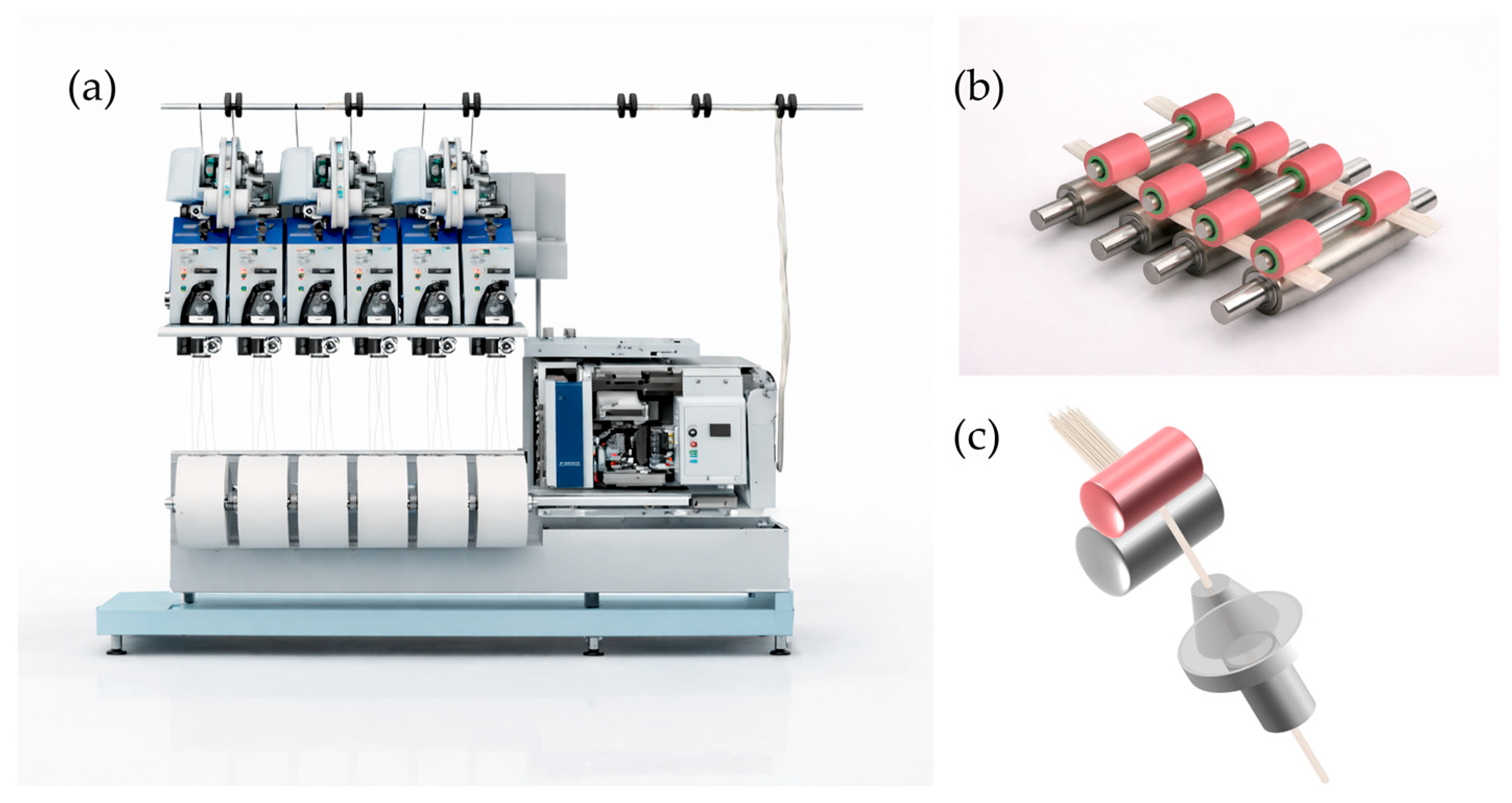
The textile industry constitutes a vital cornerstone of human civilisation, serving as a pivotal pillar for socio-economic development and safeguarding public welfare [1]. It fulfils multiple functions: meeting global apparel consumption, supplying industrial textiles, and facilitating international trade. As shown in Figure 1, among diverse spinning techniques, vortex spinning has emerged as a significant choice within modern spinning systems due to its exceptional yarn quality and remarkably high spinning efficiency [2,3,4]. Within vortex spinning machines, process parameters in the drafting zone play a vital role in yarn quality [5]. Consequently, the rational configuration of these parameters remains a central focus of textile process research [6,7].

1.2. Literature Review

1.2.1. Optimization Study of Draw Zone Parameters

Traditional studies on the drafting zone predominantly employ the tracer fibre method, analysing the distribution of fibres at variable speed points within the zone to explore process parameter optimization [8,9]. However, this approach necessitates interrupting normal drafting operations to obtain samples, readily disrupting fibre motion states and introducing experimental errors. Furthermore, the lengthy experimental cycle hinders systematic and efficient quantitative analysis.

1.2.2. Application of Artificial Neural Networks in Yarn Quality Prediction

To address these limitations, researchers have turned to artificial neural networks (ANNs) to analyse the mechanisms by which drafting parameters influence yarn quality. ANNs, computational architectures inspired by biological neural systems, simulate information processing through interconnected artificial neurons, enabling distributed representation and the learning of complex nonlinear relationships [10]. Given yarn quality’s inherent complexity, ANN models have emerged as an effective approach for predicting yarn performance [11]. Notably, Farooq and Cherif constructed a neural network model based on the Levenberg–Marquardt algorithm and Bayesian regularisation. By precisely mapping the complex nonlinear relationship between core draw parameters of the draw frame and yarn quality indicators, they achieved high-precision prediction of sliver evenness, yarn strength, and elongation in cotton/polyester blended systems [12]. Abd-Ellatif addressed the challenge of optimising the self-adjusting level point in draw frames by constructing a multilayer feedforward neural network model. This model utilised fibre drafting process parameters and sliver quality as inputs, with optimal Leveling Adjustment Point values as outputs. Performance comparisons against regression models demonstrated the feasibility of neural networks for optimising automatic levelling parameters [13]. Farooq et al. constructed a backpropagation (BP) neural network model using ring spinning drafting parameters as inputs and yarn quality as outputs. Their research indicated that neural networks can accurately predict yarn quality [14]. Elhamied et al. performed image processing on yarns to extract features, feeding these into a multilayer backpropagation neural network to establish a general predictive framework for ring-spun and compact yarn performance. Their research demonstrated that employing a multilayer network architecture enhances model performance, thereby achieving superior parameter modeling [15].
While most of the aforementioned studies utilise neural networks to construct yarn quality prediction models, the training process often encounters the issue of gradient descent becoming trapped in suboptimal local solutions. To address this, Zhang et al. proposed using a particle swarm optimisation (PSO) algorithm to refine the BP neural network model, thereby enhancing prediction accuracy for yarn strength—a limitation of traditional neural networks [16]. However, this approach focused solely on single-indicator prediction for yarn strength, without extending to multi-objective prediction and optimisation.

1.2.3. Application of Multi-Objective Optimization in Yarn Quality Optimization

To address multi-objective yarn optimisation, some researchers have introduced genetic algorithms as a solution [17]. Das et al. proposed a hybrid architecture: first establishing a nonlinear mapping between fibre and yarn quality via ANNs, then employing a genetic algorithm (GA) to reverse-search for optimal fibre parameter combinations satisfying target yarn quality [18]. Addressing the complex nonlinear relationship between fibre properties and yarn quality, Majumdar et al. employed ANNs and GAs to establish separate prediction models for cotton yarn performance and optimisation models for cotton fibre properties. This approach enabled the prediction of yarn strength and unevenness, achieving reverse-engineered optimisation of yarn performance [19]. Ghosh et al. achieved dual-objective synergistic optimisation of maximising yarn strength and minimising raw material costs by constructing an ANN-NSGA-II hybrid model [20]. Barzoki et al. employed an ANN-NSGA-II hybrid model to achieve synergistic optimisation of maximising strength and abrasion resistance while minimising hairiness in core-spun yarns from rotor spinning [21]. Amiri et al. combined Response Surface Methodology (RSM) experimental design, ANN modeling, and GA optimisation to refine draw zone parameters in ring spinning machines, thereby reducing unevenness and defect indices in polyester yarns [22].

1.3. Limitations and Challenges of the Current Study

In the aforementioned studies, although the integration of ANNs with advanced algorithms (such as PSO and NSGA-II) has significantly enhanced yarn quality prediction and multi-objective optimisation capabilities, the following limitations persist: Firstly, spinning process parameters are typically categorised into draw zone and spinning zone parameters. Existing research predominantly addresses these categories in a combined manner, failing to clearly elucidate the independent influence mechanisms of parameters from different process stages on yarn performance. Secondly, most studies employ multi-objective algorithms like NSGA-II solely to obtain Pareto solution sets, lacking decision-making methods for selecting optimal process parameters from these sets. Finally, multi-objective optimisation often addresses ‘weak conflicts’ between indicators such as yarn evenness, strength, and hairiness, failing to resolve ‘strong conflict’ multi-objective problems.

1.4. Research Objectives and Contributions

In the vortex spinning draw process, achieving higher yarn counts necessitates substantial drawing forces to reduce sliver thickness. However, excessive drawing forces deteriorate sliver evenness, subsequently impairing spinning efficiency when the sliver enters the spinning zone. This demonstrates a process conflict between ‘increasing yarn fineness’ and ‘improving sliver evenness’. Therefore, to clearly elucidate the independent influence mechanisms of draw process parameters on yarn properties, this study constructed a BP neural network prediction model based on the characteristics of the vortex spinning process. This model uses draw ratio (front/middle/rear zones) and roller centre distance (front/middle/rear zones) as input variables, with sliver evenness and thickness as output indicators. To enhance model accuracy, the particle swarm optimisation (PSO) algorithm was employed to refine the network’s initial weights and thresholds. Furthermore, a multi-objective optimisation framework was established based on this model, targeting both ‘maximising yarn evenness’ and ‘minimising sliver thickness’. The NSGA-II algorithm was utilised to identify the Pareto optimal solution set. Finally, the entropy-weighted TOPSIS method objectively selects the globally optimal combination of process parameters from the Pareto optimal solutions. This provides an objective decision-making approach for configuring draw process parameters when spinning high-count yarns.
In summary, the contributions of this paper are reflected in the following aspects: (1) Introducing neural network models into the modeling of draw process parameters to establish a nonlinear mapping relationship between draw zone process parameters and sliver quality. (2) Constructing a hybrid optimization algorithm combining PSO-BP, NSGA-II, and entropy-weighted TOPSIS to optimize combinations of draw process parameters. (3) Providing a systematic solution for subsequent research on draw zone parameter optimization.

2. Materials and Methods

2.1. Methods for Obtaining Information About Cotton Strips

Spinning high-count yarns while maintaining quality imposes stringent demands on the process. As the pivotal stage, the drafting zone’s process parameters directly dictate fibre arrangement. Greater uniformity in fibre distribution within this zone and reduced sliver thickness post-drafting enable higher yarn counts, alongside improved yarn evenness and a reduced hairiness index.
Previous studies typically employed yarn evenness testers to evaluate drafting efficacy based on post-spinning yarn parameters. However, spinning frames are conventionally divided into drafting and spinning zones. Directly analysing yarn that has passed through the spinning zone fails to clearly reveal the independent influence of the drafting stage on yarn properties. This paper proposes a cotton sliver information acquisition system. This system captures post-drawing silver images as a means of obtaining metrics. When white slivers are placed under a blue shadowless light source, uneven brightness resulting from non-uniform sliver distribution can be clearly captured. However, given the limited contribution of colour image information to silver morphology detection and the significant computational complexity introduced by RGB tri-channel data, this paper employs a greyscale conversion method. This maps the original image from the RGB colour space to a single-channel greyscale space, thereby enhancing image processing efficiency [23].
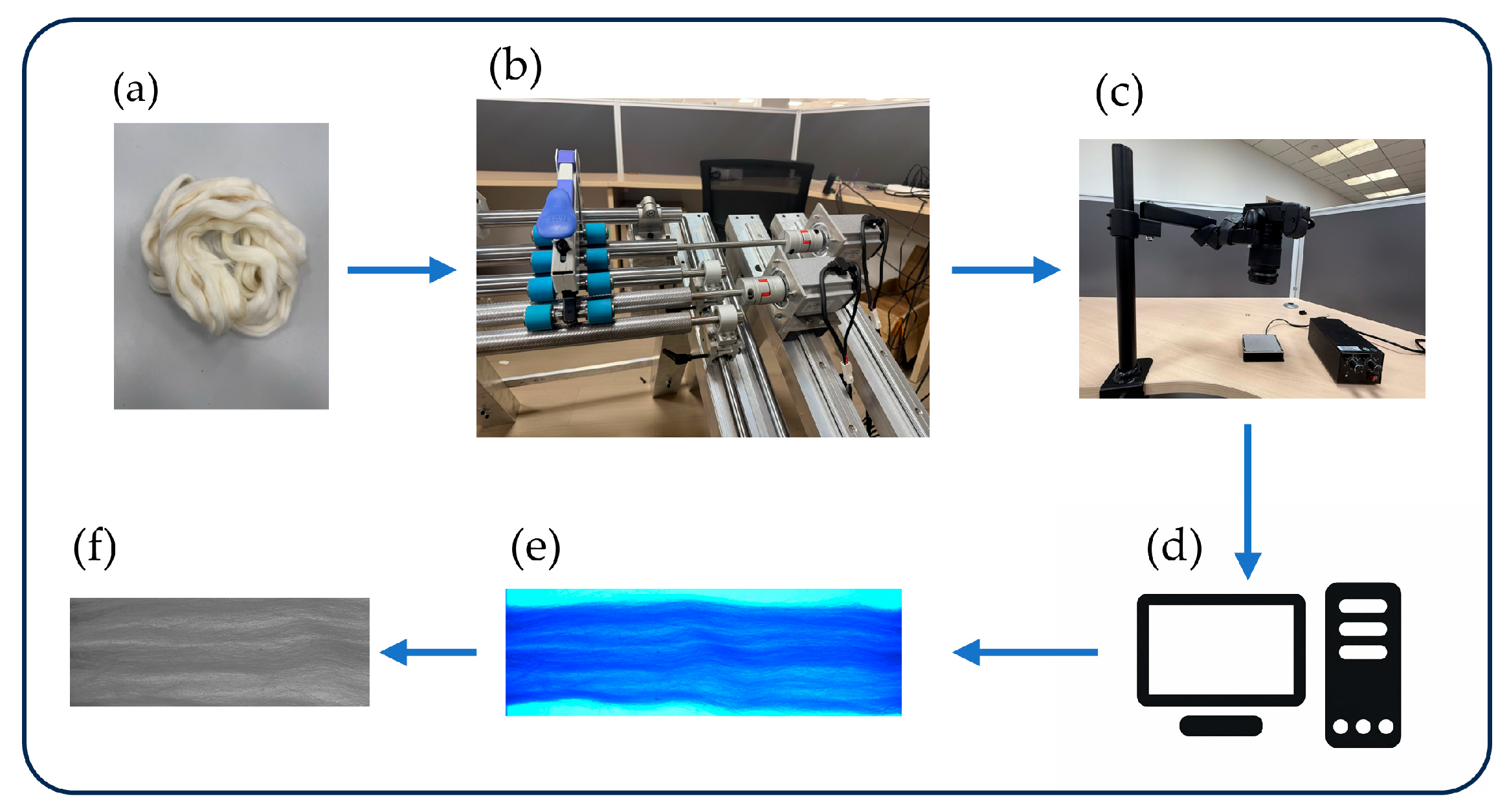
As shown in Figure 2, after completing the draw-in test, the cotton sliver is first placed on the blue shadowless light source platform for image capture using an industrial camera. Next, unnecessary parts are cropped to retain only the main body of the cotton sliver. The cropped image undergoes grayscale processing, and, finally, a 900-pixel by 300-pixel area at the image center is selected as the detection region to obtain key metric information. Upon conversion to greyscale, the light–dark variations resulting from uneven cotton strand distribution become visually discernible. The magnitude of the standard deviation in greyscale values reflects the dispersion of brightness within the image, thereby enabling the characterisation of strand distribution uniformity through this metric. Concurrently, the mean grey value represents the overall brightness of the image, thus serving as an indicator of the cotton sliver’s thickness.

2.1.1. Fiber Distribution Uniformity

Standard deviation is a core metric for measuring the dispersion of data, calculated as follows:
σ = 1 i × j i = 1 m j = 1 n ( a i j μ ) 2   ,   i = 1,2 , , m ,   j = 1,2 , , n
where σ is the standard deviation of the image, μ is the mean gray value of the image, i is the number of rows in the image pixel matrix, j is the number of columns in the image pixel matrix, and a i j is the gray value at row i and column j .
In image analysis, the dispersion of gray values can be assessed by calculating the standard deviation of the gray-level histogram. A smaller standard deviation indicates a more concentrated distribution of gray values and higher uniformity in fiber distribution. Therefore, this study employs standard deviation as a quantitative metric for fiber distribution uniformity, with minimizing standard deviation serving as one of the optimization objectives.

2.1.2. Cotton Strip Thickness

An image is composed of a pixel matrix, where the grayscale value of each pixel represents the brightness information at that point. The thickness of the stripes can be quantified by averaging the grayscale values of all pixels across the entire image, calculated as follows:
μ = 1 i × j i = 1 m j = 1 n a i j ,   i = 1,2 , , m ,   j = 1,2 , , n
where μ is the average grayscale value of the image, i is the number of rows in the image pixel matrix, j is the number of columns in the image pixel matrix, and a i j is the gray value at row i and column j .
Therefore, this study employs the average gray value as a quantitative indicator for cotton strip thickness, with minimizing the average gray value serving as one of the optimization objectives.

2.2. Orthogonal Experimental Design

The draw process parameter system is complex, with multiple coupling relationships between parameters. Different parameter combinations exhibit nonlinear effects on the final yarn quality. To efficiently construct training samples for neural networks, this study employs an orthogonal experimental design methodology. By scientifically arranging multi-factor and multi-level experimental combinations, the entire parameter space is covered with minimal experimentation, ensuring the representativeness and diversity of the sample set [24]. The pre-drawing zone serves as the primary stretching area, tasked with refining and elongating the sliver. Consequently, its draw ratio spans a broad range, typically not exceeding 50× in practical applications, and is thus divided into nine levels in the setting process. The intermediate drawing zone primarily functions as a transitional area for further refining the sliver. Its draw ratio is relatively small with a narrower range, hence allocated five levels. The post-drawing zone, functioning as a pre-stretch section, primarily adjusts the cotton sliver’s tension to ensure the yarn maintains optimal tension—neither too tight nor too loose—preventing uneven tension or breakage during subsequent spinning processes. Consequently, the post-drawing zone typically employs a smaller draw ratio and is divided into five levels. Finally, given the limited range of roller center distance parameters, these are also allocated across five levels. Consequently, an L 81 ( 9 1 × 5 8 ) orthogonal array was selected to design 81 drawing parameter combinations for the drawing zone. The factor levels for the orthogonal experiment are shown in Table 1.

2.3. Multi-Objective Optimisation Algorithm

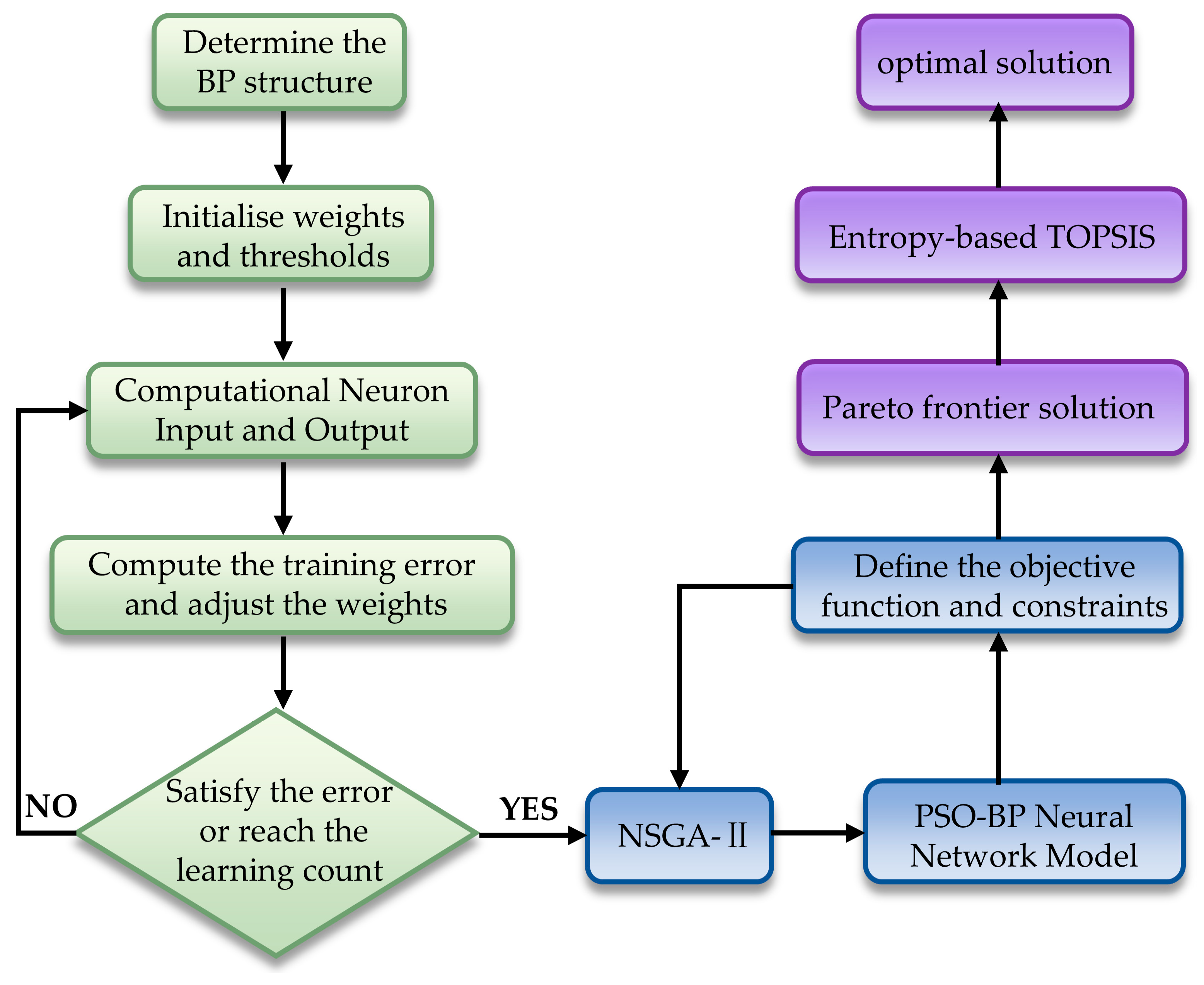
This paper proposes a multi-objective optimisation model integrating PSO-BP neural networks, NSGA-II genetic algorithms, and entropy-weighted TOPSIS decision-making to solve the optimal configuration problem of draw process parameters. Using draw ratio and roller centre distance within the draw zone as inputs, and sliver evenness and thickness as outputs, a BP neural network model is constructed. Simultaneously, the PSO algorithm is employed to globally optimise the weights of the BP neural network, thereby enhancing prediction accuracy. Furthermore, owing to the process conflict between ‘increasing yarn fineness’ and ‘improving sliver evenness’, a genetic algorithm (NSGA-II) was employed. This algorithm optimised towards minimising sliver thickness and maximising sliver evenness to obtain a set of Pareto optimal solutions. Finally, the entropy-weighted TOPSIS method is introduced to select the optimal combination of process parameters with the best overall performance from the Pareto solution set, based on objective weighting criteria. Figure 3 illustrates the overall workflow of this multi-objective optimisation framework.

2.3.1. PSO-BP Neural Network Model

BP neural networks are a type of multilayer recurrent neural network trained via the error backpropagation algorithm. They form one of the foundational architectures of deep learning and are widely employed in tasks such as regression prediction [25]. The gradient of the loss function is computed relative to each neuron, and weights are updated during the gradient BP error process. This iteration continues until convergence is achieved [26]. The weight iteration formula is as follows:
ω i j n = η E ω i j n + α ω i j n 1 , n N + ,   i = 1,2 , , m ,   j = 1,2 , , n
Here, ω i j n denotes the weight update for the nth iteration, E represents the loss function, η is the learning rate, and α ω i j n 1 constitutes the momentum term. α is the momentum coefficient. The index n belongs to the set of positive integers N + , representing the iteration number.
The BP neural network comprises an input layer, a hidden layer, and an output layer, wherein the hidden layer is typically derived from empirical formulas:
L = m + n + a
Here, L denotes the number of neurons in the hidden layer, m denotes the number of neurons in the input layer, and n denotes the number of neurons in the output layer. a is any constant between 1 and 10 inclusive.
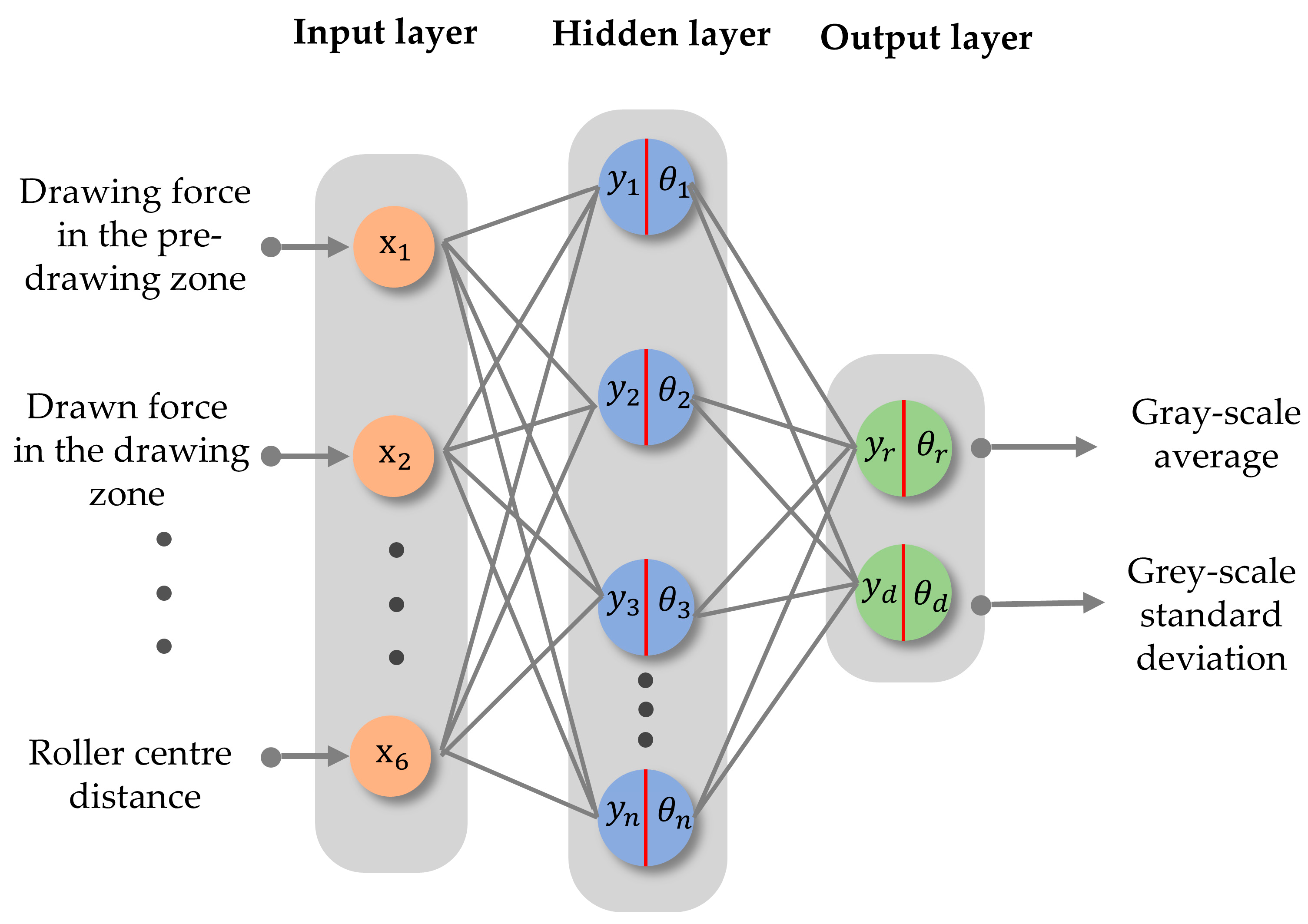
In this study, draw forces within the pre-drawing, drawing, and post-drawing zones, along with the centre distance between rollers, were employed as input variables. The collected mean grey values and standard deviation of grey values served as evaluation metrics to establish a regression model, the structure of which is illustrated in Figure 4.

2.3.2. NSGA-II Multi-Objective Optimisation

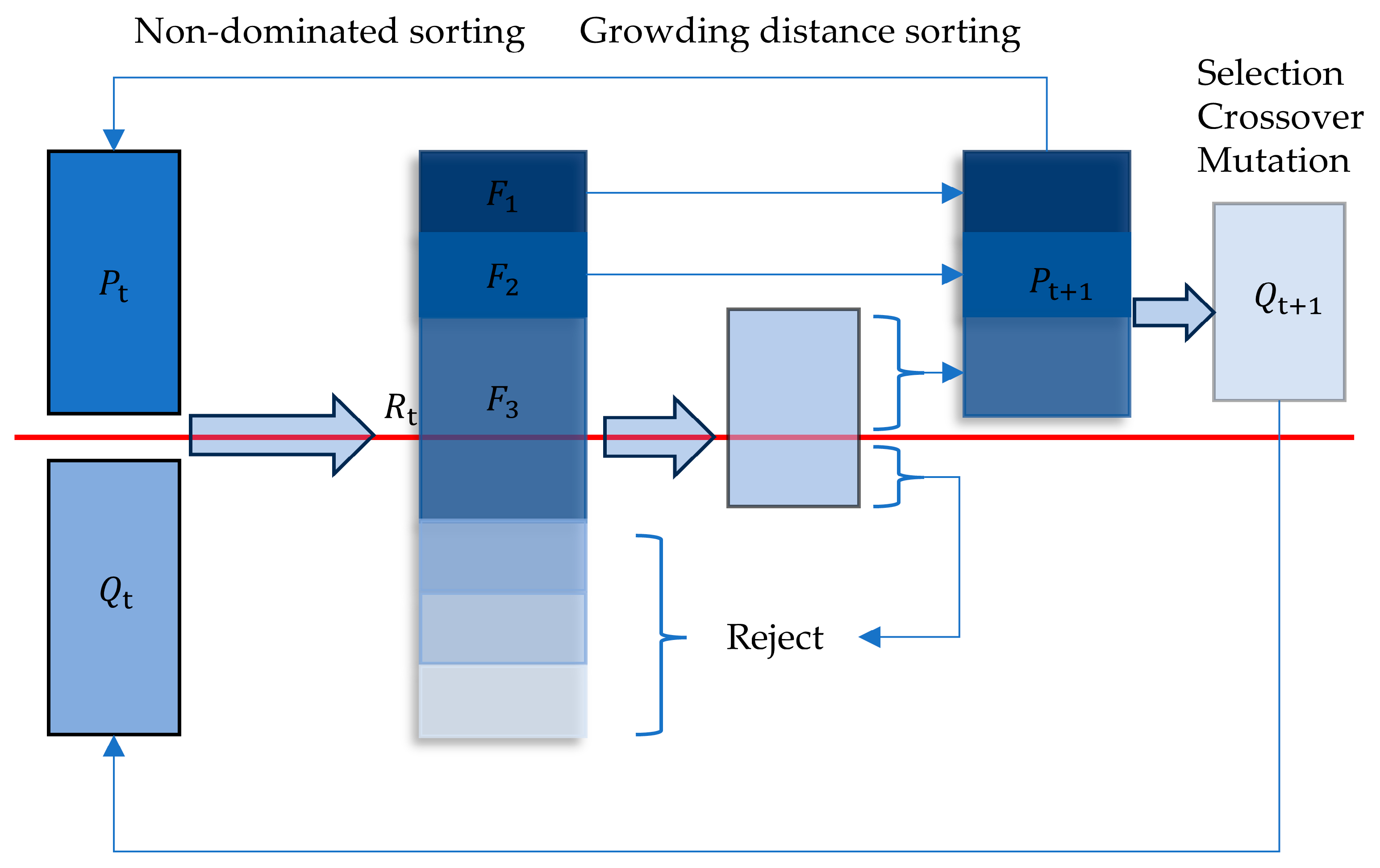
NSGA-II was originally proposed by K. Deb. This method incorporates a rapid non-dominated sorting mechanism during iteration, combined with an elite retention strategy and a more efficient crowding distance calculation approach. This accelerates the convergence process and enhances convergence efficiency while maintaining the diversity of the population solutions [27,28]. Consequently, this algorithm is widely adopted and demonstrates high applicability when addressing multi-objective or highly complex optimisation tasks [29,30,31]. The overall principle of NSGA-II is illustrated in Figure 5.

2.3.3. Entropy-Weighted TOPSIS Algorithm

In this study, the average gray value and standard deviation of gray values after drawing are used as two indicators to evaluate drawing effectiveness. However, due to differences in their numerical ranges and magnitudes, the entropy weighting method is employed to assign objective weights to these indicators, thereby eliminating subjective weighting biases. Subsequently, the TOPSIS method is applied to calculate their adherence progress and rank the schemes to derive the optimal solution.
As an objective weighting method grounded in information entropy theory, the entropy weighting method quantifies the information entropy of indicator observations to analyze their inherent information content, thereby determining the weight coefficients for each indicator. A smaller variation in data within an indicator indicates higher information entropy, while greater variation signifies lower information entropy. A higher information entropy indicates that the indicator provides less information for distinguishing between proposals, warranting a lower weight; conversely, a lower information entropy signifies that the indicator provides more information for differentiation, justifying a higher weight.
This method exhibits notable objectivity and mathematical rigor, effectively mitigating subjective interference from human factors in weight allocation [32,33].
Given m objects to evaluate, each with n assessment indicators, the calculation steps are as follows [34]:
  • Establish an evaluation matrix Xmn
    X = x 11 x 12 x 1 n x 21 x 22 x 2 n x m 1 x m 2 x m n
Standardize the data using the range method.
z i j = x i j x j min x j max x j min ,   i = 1,2 , , m ,   j = 1,2 , , n
z i j = x j max x i j x j max x j min ,   i = 1,2 , , m ,   j = 1,2 , , n
Equation (6) is a positive indicator, meaning that higher values of z i j are considered better. Equation (7) is a negative indicator, where lower values of z i j are preferred. x i j is the value in row i and column j and x j max and x j min represent the maximum and minimum values in column j , respectively.
The standardized matrix Z at this point is as follows:
Z = z 11 z 12 z 1 n z 21 z 22 z 2 n z m 1 z m 2 z m n
2.
Calculate the proportion Pij that the value of the i-th object under the j-th indicator accounts for in that indicator:
P i j = z i j / i = 1 n z i j ,   i = 1,2 , , m ,   j = 1,2 , , n
3.
Calculate the entropy value E j for the j-th indicator, where when P i j = 0 , P i j l n P i j = 0 :
E j = 1 ln n i = 1 n P i j l n P i j ,   j = 1,2 , , m
4.
Calculate the coefficient of variation G j for the j-th indicator:
G j = 1 E j ,   j = 1,2 , , m
5.
Calculate the weight W j for the j-th indicator:
F i = j = 1 m ω j z i j ,   i = 1,2 , , m ,   j = 1,2 , , n
After obtaining the weight values for each cotton strip indicator, the optimal solution and the least desirable solution are determined by constructing a weighted matrix with the objectives of “maximizing cotton strip uniformity” and “minimizing cotton strip thickness.” The proximity score is then calculated by measuring the distance between these two solutions, ultimately yielding the optimal solution based on the proximity score magnitude.
TOPSIS is a classic multi-criteria decision-making method that addresses multi-objective decision analysis by ranking alternatives based on their relative proximity to the ideal solution [35,36]. The specific steps are as follows [37]:
  • Construct a weighted matrix Z * :
    Z i j = w j × z i j ,   i = 1,2 , , m ,   j = 1,2 , , n
    Z * = ω 1 × z 11 ω 2 × z 12 ω m × z 1 m ω 1 × z 21 ω 2 × z 22 ω m × z 2 m ω 1 × z n 1 ω 2 × z n 2 ω m × z n m
    where Z is a weighted decision matrix.
Equation (13) defines the weighting operation, applying a weight w j to each standardized metric, where w j represents the weight assigned to each metric.
Equation (14) combines all weighted data into a weighted decision matrix Z * , preparing for subsequent ideal solution calculations.
2.
Determine the positive ideal solution and the negative ideal solution:
Z + = ( Z 1 + , Z 2 + , , Z m + )
Z = ( Z 1 , Z 2 , , Z m )
Here, Z + and Z represent the ideal solution and negative ideal solution vectors, respectively, defined by selecting the optimal and worst values for each indicator.
3.
Calculate the distance between the computational object and both the positive ideal solution and the negative ideal solution:
D i + = j = 1 m ( Z j + z i j * ) 2 ,   i = 1,2 , , m
D i = j = 1 m ( Z j z i j * ) 2 ,   i = 1,2 , , m
Equations (17) and (18) quantify the quality of solutions by calculating the distance between each decision object and both the ideal solution and the negative ideal solution, thereby providing a foundation for subsequent relative proximity calculations.
4.
Calculate relative proximity:
S i = D i D i + + D i ,   i = 1,2 , , m
The relative proximity S i indicates how close the solution is to the positive ideal solution. The higher the value, the better the solution.

3. Results and Discussion

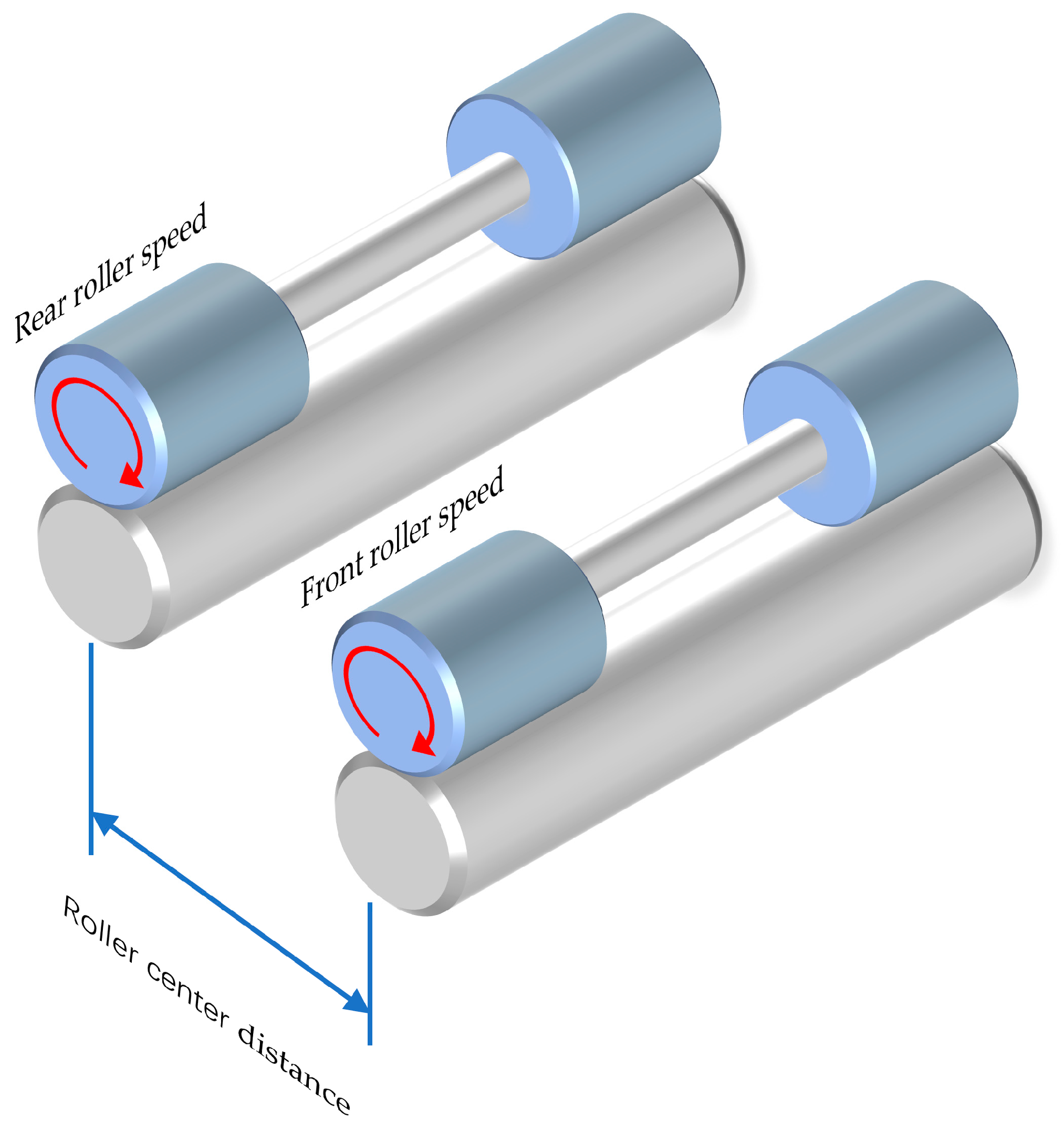
As shown in Figure 6, the draw ratio is the ratio of the rotational speeds of the front and rear rollers, while the roller center distance is the distance between the midpoints of the front and rear rollers. Both are core process parameters in the draw zone. To investigate the individual effects of these process parameters on draw performance, this section conducts single-factor experiments and analyzes the results.

3.1. Process Parameters Affecting Cotton Swabs

3.1.1. Effect of Draw Ratio on Cotton Sliver Drawing

Draw ratio is one of the key parameters in the draw zone. It generates drawing force by setting the speed difference between the front and rear rollers, which applies tensile stress to the sliver, thereby refining and elongating the fibers within it. To investigate the effect of draw ratio on fiber drawing, draw experiments were conducted with stepwise adjustments to the roller center distance while strictly maintaining the fixed roller center distance. A vision system was used to collect post-drawing cotton sliver metrics.
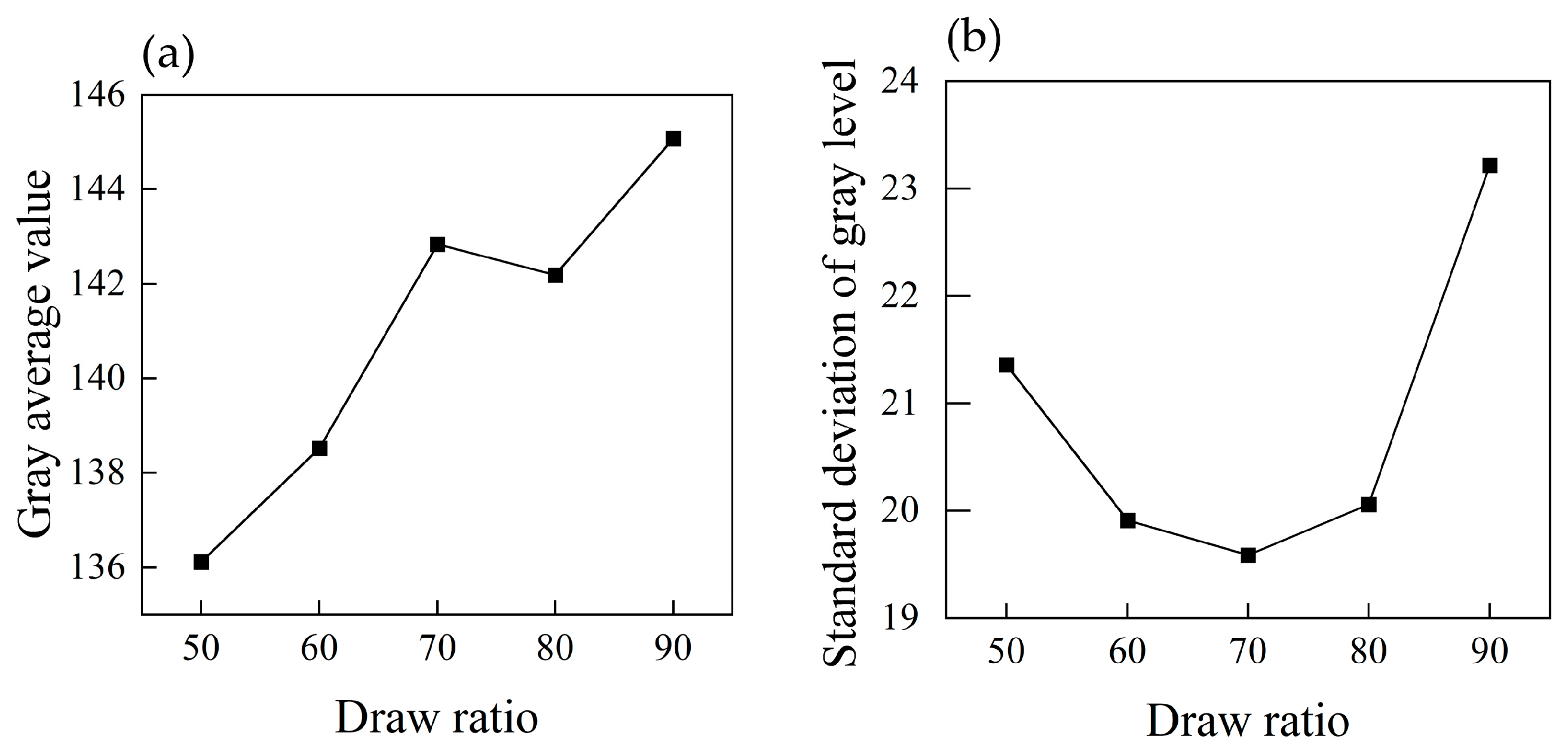
As shown in Figure 7a, under constant roller center distance parameters, increasing the draw ratio generally maintains an upward trend in the average gray value of the cotton sliver image. As depicted in Figure 7b, when the draw ratio increased from 50 to 70 times, the standard deviation of the cotton sliver’s grayscale exhibited an upward trend. This indicates that as the draw ratio increases, the fiber bundles are sufficiently refined, effectively enhancing sliver evenness. When the draw ratio gradually increased from 70 to 90 times, the gray standard deviation began to rise, and the silver uniformity started to deteriorate.
The results indicate that a reasonable increase in draw ratio can effectively enhance fiber control, reduce the proportion of stray fibers, and concentrate the variable speed zone of fibers, thereby improving sliver uniformity. However, excessively increasing the draw ratio, while effectively reducing flyaway fibers, leads to increased spacing between fibers. This results in an uneven distribution of the silver after drawing.

3.1.2. Effect of Roller Center Distance on Cotton Sliver Drawing

The roller center distance is one of the critical parameters within the drafting zone, directly influencing the uniformity and thickness of the drafted sliver. To investigate the effect of roller center distance on fiber drafting performance, drafting experiments were conducted with stepwise adjustments to the roller center distance while strictly maintaining a constant drafting ratio. An image acquisition system was used to collect silver metrics post-drafting.
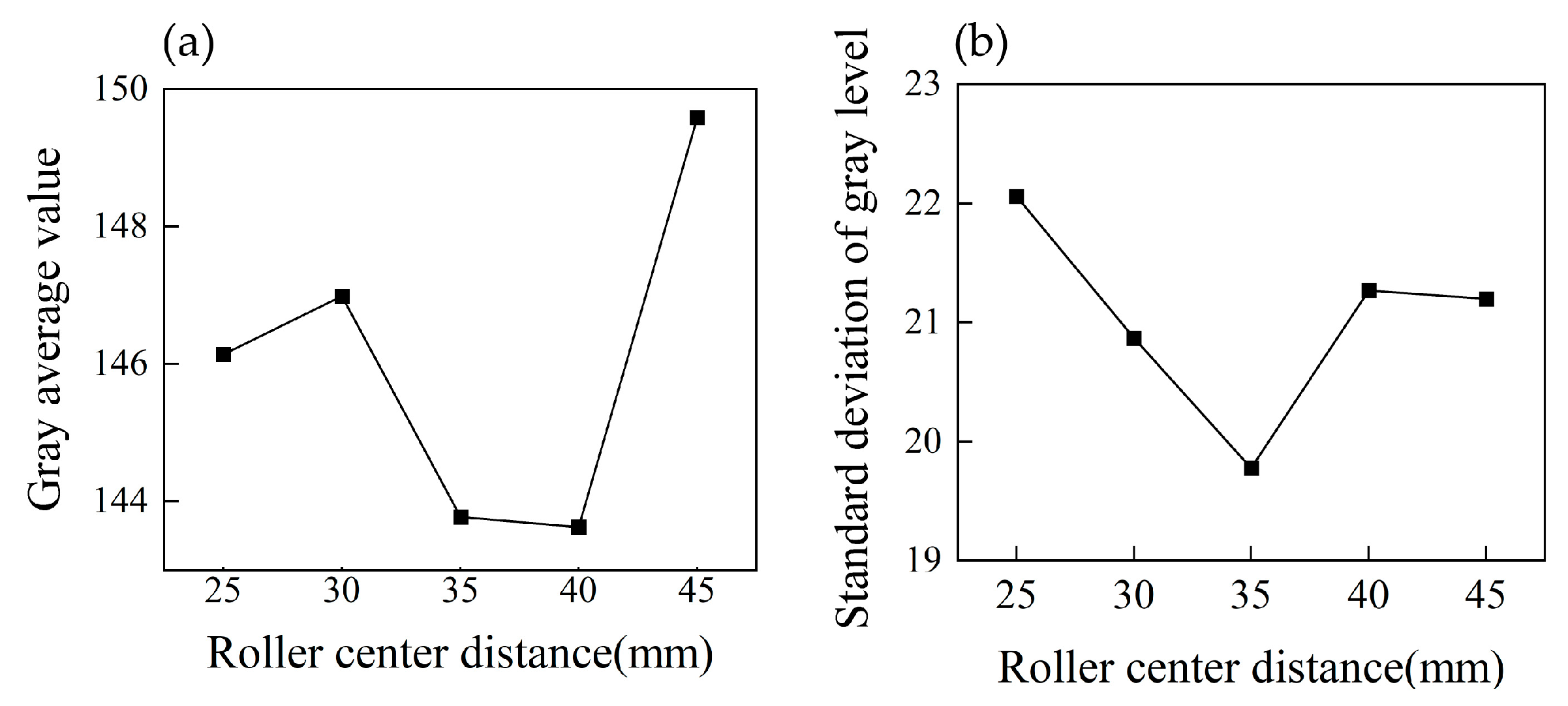
The experimental results are shown in Figure 8a. Under a constant total draw ratio, altering only the roller center distance causes the average gray value of the sliver image to fluctuate within a certain range. The standard deviation of the cotton sliver grayscale, as shown in Figure 8b, gradually decreased as the roller center distance increased from 25 mm to 35 mm. However, when the center distance continued to increase, the standard deviation began to rise gradually and eventually stabilized.
The results indicate that in the first experiment, with the roller center distance set at 25 mm and the average fiber length of the experimental material therefore being 25 mm, fibers shorter than 25 mm within the sliver were simultaneously gripped by the jaws of both front and rear rollers during drafting, causing a sharp increase in drafting force. Conversely, fibers longer than 25 mm experienced normal drafting forces. This disparity in forces created tension differences, resulting in uneven stress distribution within the sliver and consequently leading to non-uniform fiber distribution. In the third experiment, with a roller center distance of 35 mm, the silver evenness was optimal. Thus, an appropriate roller center distance effectively enhances fiber control, reduces the proportion of loose fibers, concentrates the fiber acceleration point, and improves sliver evenness. In the fourth and fifth experiments, excessively large roller center distances weakened fiber control, significantly increasing the proportion of stray fibers. According to draw theory, draw forces further worsened the distance between the stray fibers and controlled fibers, dispersing fiber acceleration points and ultimately degrading sliver evenness. Therefore, the distance between rollers is directly related to the length of the sliver fibers. By reasonably setting the distance between rollers, the uniformity of the sliver can be effectively improved.

3.1.3. Causes of Uneven Cotton Sliver Dryness

Analysis of process parameters reveals that when the roller center distance is not set appropriately based on the fiber configuration of the incoming sliver, both excessively large and excessively small roller center distances adversely affect the evenness of the drawn sliver. Furthermore, when the draw force distribution within the draw zone is improper, fibers cannot be effectively controlled, leading to scattered speed variation points and further exacerbating sliver unevenness. Therefore, for cases where improper settings of drafting force and roller center distance cause sliver unevenness, the degree of unevenness dynamically changes with the adjustment of drafting process parameters. Consequently, such causes of silver unevenness can be categorized as dynamic unevenness.
The silver used in the experiment was formed by combining, drawing, and blending individual fiber bundles through the drawing process. During this process, random gaps of varying sizes can form between fiber bundles. Furthermore, while ideally the fibers within a sliver should be of uniform length, in reality fiber lengths exhibit random variation and cannot be standardized.
From a manufacturing perspective, the draw frame process performs preliminary stretching to elongate fibers. Ideally, fibers would be fully straightened, of equal length, and uniformly distributed throughout the sliver. However, during actual spinning, fibers are not in a perfectly straightened, ideal state. Instead, a significant number of fibers exhibit hooks, and their distribution within the sliver is random. Therefore, we refer to this inherent characteristic as static sliver unevenness.
We categorize the factors causing silver evenness variation into the two major types mentioned above. During the specific drawing process, dynamic sliver variation dominates. This means that setting reasonable drawing process parameters can effectively reduce the impact of static sliver variation, while unreasonable parameters will further exacerbate the inherent static variation. Therefore, the proper setting of drawing process parameters is particularly crucial.

3.2. PSO-BP Prediction Results

In this subsection, we constructed a PSO-BP-based prediction model using data exclusively from the orthogonal experiment L 81 described above. Grayscale processing was employed to extract key information about the cotton sliver, with the grayscale mean and standard deviation of the extracted sliver data serving as the output layer for the PSO-BP model. The input layer comprised the draw ratios and roller center distances for the front, middle, and rear zones of the experimental parameters.
Since this study uses the draw ratios and roller center distances within the three draw zones as the input layer, and the average grayscale value and grayscale variance as the output layer, the BP neural network model structure consists of six input layer nodes and two output layer nodes. Based on the empirical Formula (2), the number of hidden layer nodes is set to six.
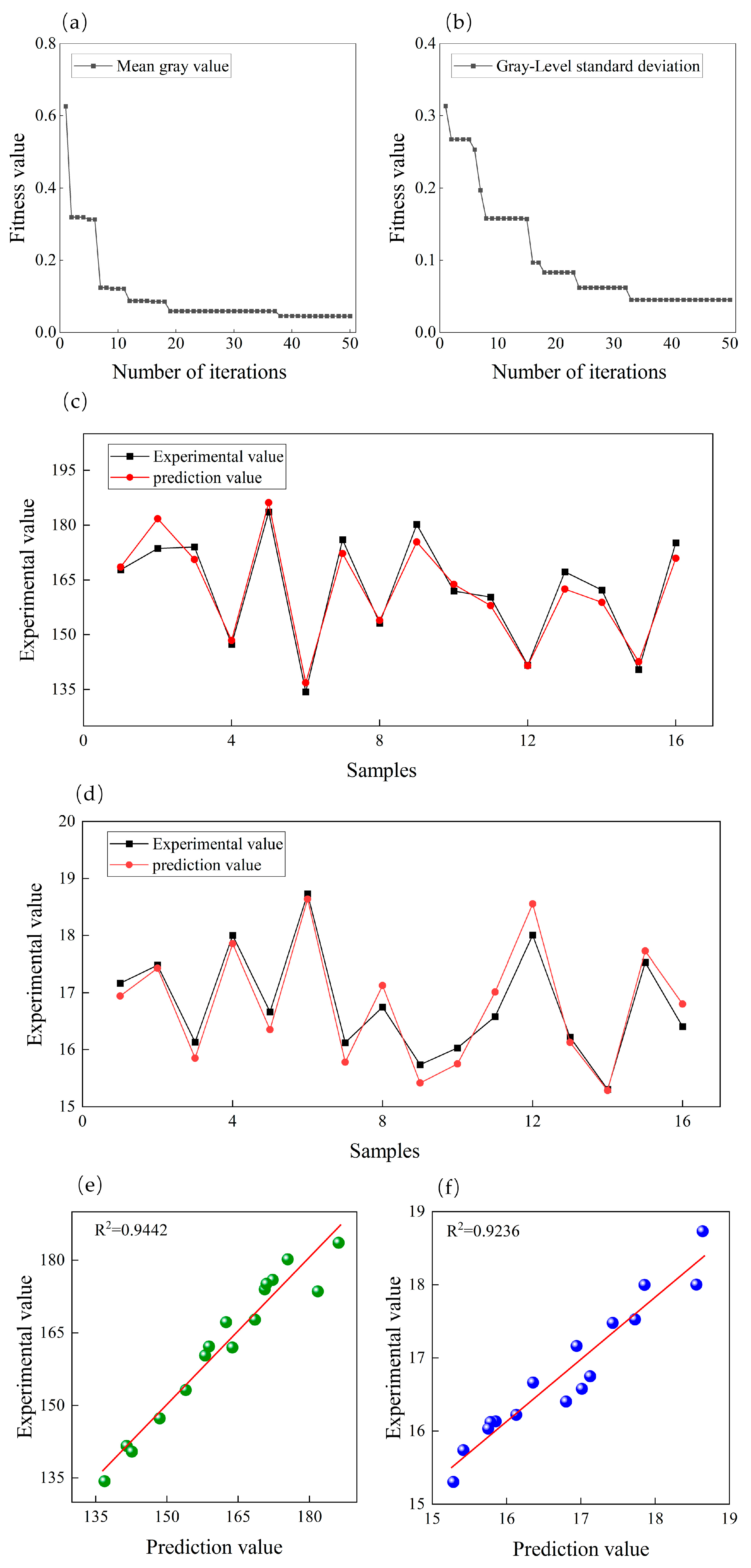
To address the tendency of BP neural networks to converge to local optima during training, this study employed the PSO algorithm to optimize the network model’s weight values. The parameter settings are shown in Table 2. Figure 9a,b display the convergence curves of the fitness values for the grayscale mean and grayscale standard deviation during PSO iterations. Both fitness values rapidly decrease in the early stages of iteration, indicating the algorithm’s strong global exploration capability and ability to quickly approach the neighborhood of the optimal solution. As iterations increased, the rate of change in fitness values gradually decreased. The fitness values of the grayscale mean stabilized at the lowest level after 38 iterations, while those of the grayscale standard deviation stabilized after 32 iterations. At this point, the algorithm converged to the globally optimal weight combination.
The coefficient of determination R2 for PSO-BP ranges from [0, 1], with values closer to 1 indicating higher prediction accuracy of the surrogate model [38]. As shown in Figure 9c,d, the 16 randomly selected validation samples exhibit a degree of overlap with the PSO-BP predictions. Although some test sample groups show errors relative to the predicted values, the results remain within an acceptable range. As shown in Figure 9e,f, the R2 values for the grayscale mean and grayscale standard deviation are 0.9442 and 0.9236, respectively. The data points are distributed closely around the regression line. These results indicate that the drawn PSO-BP neural network model possesses high predictive accuracy and reliability, making it suitable for subsequent analysis and optimization.
All experiments were conducted on a computer equipped with an AMD Ryzen 7 5800H processor, 16 GB of memory, and an NVIDIA GTX 3060 GPU. The software environment included MATLAB, where the neural network model was implemented using MATLAB version 2020b and combined with custom code for particle swarm optimization.

3.3. Multi-Objective Optimization

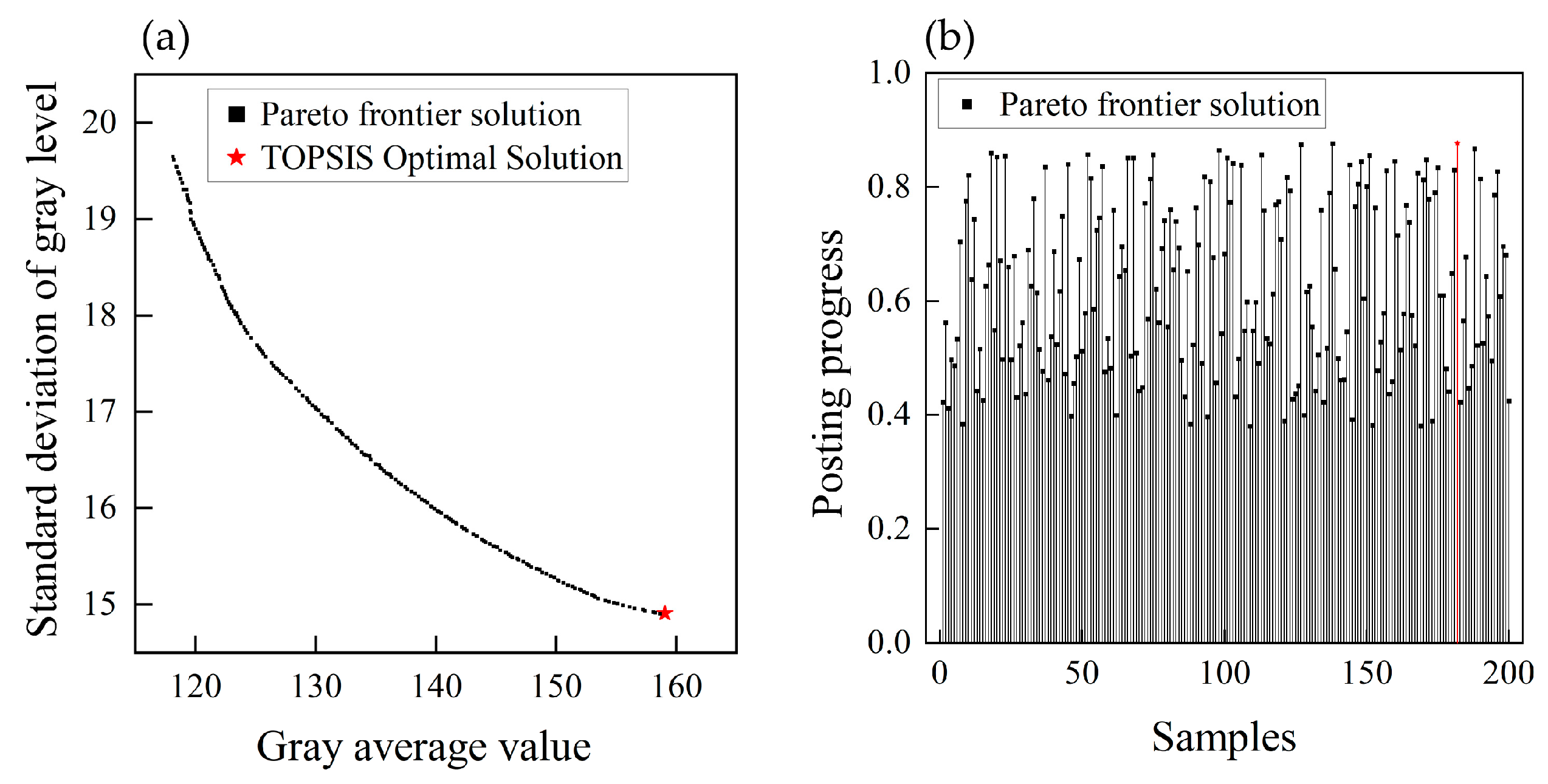
This section employs NSGA-II for multi-objective optimization of drawing zone process parameters, with the following settings: an initial population of 100 individuals, 200 iterations, a crossover probability of 0.9, and a mutation probability of 0.1. After 200 generations of iterative computation, a smooth curve composed of Pareto solutions was ultimately obtained. As shown in Figure 10, initially, both the mean gray value and standard deviation of gray values can be optimized simultaneously in one direction. However, after reaching a certain point, these two parameters become mutually restrictive: increasing the mean gray value leads to an increase in the standard deviation of gray values. Each individual on the Pareto frontier is non-dominated. In practice, selecting the optimal solution often relies on experience and personal preferences, making this method subjective and unable to guarantee the optimal solution. To address this issue, the entropy weight method is employed to determine the optimal solution.
To determine the optimal solution for drafting-zone process parameters from the Pareto front, this study performs decision analysis using the entropy-weighted TOPSIS method. First, a decision matrix containing 200 non-dominated solutions is constructed, and the weights of each objective indicator are calculated based on information entropy theory to objectively reflect their relative importance. Next, the decision matrix is subjected to weighted normalization, on the basis of which the ideal solution and the negative ideal solution are identified. As shown in Figure 10a, the Euclidean distances between each Pareto solution and both the ideal and negative ideal solutions are then computed, and the relative closeness is obtained accordingly. Among all candidates, the 182nd solution exhibits the highest relative closeness and is therefore nearest to the ideal solution, indicating the best overall performance. Hence, it is selected as the optimal combination of drafting process parameters, which are listed in Table 3.
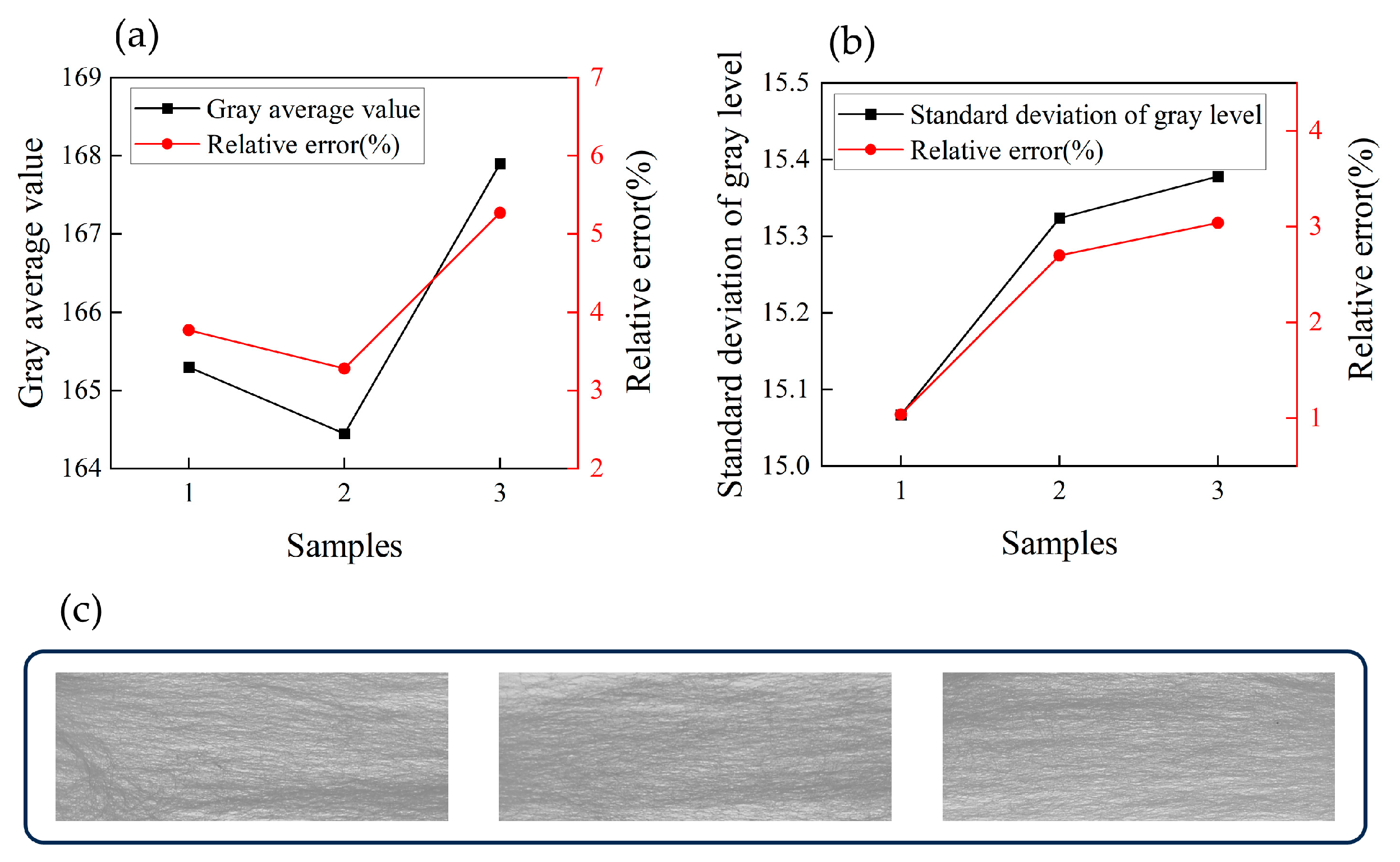
To validate the reliability of the optimal solution obtained by the multi-objective algorithm, three parallel experiments were conducted using the process parameters from the optimal solution as experimental conditions. The resulting test images are shown in Figure 11c, while the experimental data are presented in Figure 11a,b. The experiments demonstrated that all measured values fell within the 94% confidence interval of the predicted ranges for each parameter. This validated the effectiveness and reliability of the NSGA-II coupled with the entropy-weighted TOPSIS method for multi-objective optimization design of drawing process parameters.

4. Conclusions

This paper proposes a hybrid algorithm integrating the NSGA-II multi-objective genetic algorithm with the entropy-weighted TOPSIS decision method based on the PSO-BP neural network model. Aiming to maximize silver uniformity and minimize thickness, it optimizes drafting ratio and roller center distance to achieve optimal process parameter combinations. Its key conclusions are summarized as follows:
(1)
An image-based cotton sliver quality evaluation method is proposed, utilizing the average grayscale value to represent sliver thickness and quantifying sliver uniformity through grayscale standard deviation.
(2)
Based on experimental data obtained through orthogonal experiments, a PSO-BP neural network model is established to predict cotton sliver drafting performance. The results demonstrate that the model possesses reasonable predictive accuracy.
(3)
Based on the causes of silver distribution non-uniformity, it was categorized into static and dynamic types for analysis. By applying the entropy weighting method and TOPSIS decision method, the optimal values for the draw ratio of the front zone, middle zone, and rear zone, as well as the center distances of the front, middle, and rear rollers, were determined to be 33.38, 1.46, 2.24, 30.08 mm, 33.58 mm, and 35.30 mm, respectively, achieve a favorable balance between the average gray value and the standard deviation of gray values.
However, the aforementioned research still has some limitations. This paper demonstrates the method’s validity solely through optimal process parameter combinations derived from the model and corresponding experiments. While this optimization process provides technical guidance for dump truck development and design, its full optimization potential remains untapped.
Therefore, future research should compare this method with other optimization approaches to prove its superiority. Additionally, different optimization algorithms will be employed to seek Pareto solutions, and extensive sensitivity analyses will be conducted to achieve better drawing effects.

Author Contributions

Conceptualization, L.P. and Z.W.; methodology, Z.W. and Y.Q.; software, Z.W.; validation, L.P.; formal analysis, J.L. and L.P.; investigation, Y.Q. and L.P.; resources, L.P. and X.R.; data curation, Z.W.; writing—original draft preparation, Z.W.; writing—review and editing, L.P. and Y.Q.; visualization, X.R.; supervision, J.L.; project administration, J.L.; funding acquisition, L.P. and X.R. All authors have read and agreed to the published version of the manuscript.

Funding

This research was funded by the National Key Research and Development Program of China (Grant No. SQ2023YFB3200093), Zhejiang Provincial Science and Technology Program Projects (Grant No. 2024C01133), and the Zhejiang “Jianbing Lingyan + X” Research and Development Program (Grant No. 2024SJCZX0027).

Data Availability Statement

The original contributions of the study are included in the article, and further inquiries can be directed to the corresponding author.

Conflicts of Interest

The authors declare no conflict of interest.

References

  1. Welters, L.; Lillethun, A. Introduction to focused issue: History of textiles and fashion. Cloth. Text. Res. J. 2020, 38, 227–239. [Google Scholar] [CrossRef]
  2. Behera, B.K. Comparative studies on ring, compact and vortex yarns and fabrics. J. Text. Sci. Fash. Technol. 2020, 6, 1–14. [Google Scholar] [CrossRef]
  3. Pei, Z.; Wang, X.; Li, Z.; Xiao, L.; Bai, T.; Chen, G. Effect of process and nozzle structural parameters on the wrapping quality of core-spun yarns produced on a modified vortex spinning system. Text. Res. J. 2021, 91, 1841–1856. [Google Scholar] [CrossRef]
  4. Li, M.; Yu, C.; Shang, S. Effect of vortex tube structure on yarn quality in vortex spinning machine. Fibers Polym. 2014, 15, 1786–1791. [Google Scholar] [CrossRef]
  5. Caldas, P.; Sousa, F.; Pereira, F.; Lopes, H.; Machado, J. Automatic system for yarn quality analysis by image processing. J. Braz. Soc. Mech. Sci. Eng. 2022, 44, 565. [Google Scholar] [CrossRef]
  6. Quan, J.; Cheng, L.; Xue, W.; Zhang, R. Comparative analysis of novel drafting devices and traditional roller drafting device in ring spinning on the acceleration point distribution and yarn properties. J. Text. Inst. 2021, 112, 1965–1973. [Google Scholar] [CrossRef]
  7. Sun, N. Simulation on the fiber arrangement and distribution in the drafting zone. Text. Res. J. 2022, 92, 1113–1125. [Google Scholar] [CrossRef]
  8. Shen, Y.; Ni, J.; Yang, J.; Yu, C. Study on the testing of the accelerated point of the floating fiber in the roller drafting process with an improved method. Text. Res. J. 2022, 92, 168–179. [Google Scholar] [CrossRef]
  9. Mupfudze, K.D.; Cao, Q.; Shen, Y.; Sun, N.; Yu, C. Fiber motion and the accelerated point distribution in roller drafting. Text. Res. J. 2019, 89, 1224–1236. [Google Scholar] [CrossRef]
  10. Shalev-Shwartz, S.; Ben-David, S. Understanding Machine Learning: From Theory to Algorithms; Cambridge University Press: Cambridge, UK, 2014. [Google Scholar]
  11. Majumdar, A.; Bhattacharyya, R.; Yadav, V.S. Deep Learning Applications in Textile Industry: A Systematic Review of Current Status and Delineating Future Research Agenda. Arch. Comput. Methods Eng. 2025, 32, 1–23. [Google Scholar] [CrossRef]
  12. Farooq, A.; Cherif, C. Development of prediction system using artificial neural networks for the optimization of spinning process. Fibers Polym. 2012, 13, 253–257. [Google Scholar] [CrossRef]
  13. Abd-Ellatif, S.A.M. Optimizing sliver quality using artificial neural networks in ring spinning. Alex. Eng. J. 2013, 52, 637–642. [Google Scholar] [CrossRef]
  14. Farooq, A.; Khan, N.; Irshad, F.; Nasïr, U. Predictive modeling of yarn quality at ring spinning machine using resilient back propagation neural networks. Text. Appar. 2023, 33, 9–14. [Google Scholar] [CrossRef]
  15. Abd-Elhamied, M.R.; Hashima, W.A.; ElKateb, S.; Elhawary, I.; El-Geiheini, A. Prediction of cotton yarn’s characteristics by image processing and ANN. Alex. Eng. J. 2022, 61, 3335–3340. [Google Scholar] [CrossRef]
  16. Zhang, B.; Song, J.; Zhao, S.; Jiang, H.; Wei, J.; Wang, Y. Prediction of yarn strength based on an expert weighted neural network optimized by particle swarm optimization. Text. Res. J. 2021, 91, 2911–2924. [Google Scholar] [CrossRef]
  17. Marwala, T.; Leke, C.A. Handbook of Machine Learning: Volume 2: Optimization and Decision Making; World Scientific Pub Co Pte Ltd.: Singapore, 2019. [Google Scholar]
  18. Das, S.; Ghosh, A.; Majumdar, A.; Banerjee, D. Yarn engineering using hybrid artificial neural network-genetic algorithm model. Fibers Polym. 2013, 14, 1220–1226. [Google Scholar] [CrossRef]
  19. Majumdar, A.; Jindal, A.; Arora, S.; Bajya, M. Hybrid neuro-genetic machine learning models for the engineering of ring-spun cotton yarns. J. Nat. Fibers 2022, 19, 15164–15175. [Google Scholar] [CrossRef]
  20. Dashti, M.; Derhami, V.; Ekhtiyari, E. Yarn tenacity modeling using artificial neural networks and development of a decision support system based on genetic algorithms. J. AI Data Min. 2014, 2, 73–78. [Google Scholar]
  21. Kheirkhah Barzoki, P.; Vadood, M.; Johari, M.S. Multi-objective optimization of rotorcraft compact spinning core-spun yarn properties. J. Text. Polym. 2018, 6, 47–53. [Google Scholar]
  22. Savadroodbari, H.A.; Razbin, M.; Hasani, M.R.; Johari, M.S. Tuning drafting zone parameters for polyester yarn within a ring spinning system: Modeling and optimization. J. Text. Inst. 2025, 116, 1147–1160. [Google Scholar] [CrossRef]
  23. Ma, B. Research on Barcode Quality Inspection Based on Image Processing. Master’s Thesis, Jiangnan University, Wuxi, China, 2024. [Google Scholar] [CrossRef]
  24. Jiaqiang, E.; Han, D.; Qiu, A.; Zhu, H.; Deng, Y.; Chen, J.; Zhao, X.; Zuo, W.; Wang, H.; Chen, J.; et al. Orthogonal experimental design of liquid-cooling structure on the cooling effect of a liquid-cooled battery thermal management system. Appl. Therm. Eng. 2018, 132, 508–520. [Google Scholar] [CrossRef]
  25. Zhang, S.; Ou, J. BP-PSO-based intelligent case retrieval method for high-rise structural form selection. Sci. China Technol. Sci. 2013, 56, 940–944. [Google Scholar] [CrossRef]
  26. Zheng, K.; Yao, C.; Mou, G.; Xiang, H. Prediction of weld bead formation of duplex stainless steel fabricated by wire arc additive manufacturing based on the PSO-BP neural network. J. Mar. Sci. Appl. 2023, 22, 311–323. [Google Scholar] [CrossRef]
  27. Kalyanmoy, D. A fast and elitist multiobjective genetic algorithm: NSGA-II. IEEE Trans. Evol. Comput. 2002, 6, 182–197. [Google Scholar] [CrossRef]
  28. Benturki, M.; Dizene, R.; Ghenaiet, A. Multi-objective optimization of two-stage centrifugal pump using NSGA-II algorithm. J. Appl. Fluid Mech. 2018, 11, 929–943. [Google Scholar] [CrossRef]
  29. Rao, T.B.; Rao, C.; Baki, N. Multi-objective optimisation of friction stir welding parameters: Integration of FEM and NSGA-II. Int. J. Manuf. Res. 2021, 16, 82–101. [Google Scholar] [CrossRef]
  30. Vargas, D.E.; Lemonge, A.C.; Barbosa, H.J.; Bernardino, H.S. Solving multi-objective structural optimization problems using GDE3 and NSGA-II with reference points. Eng. Struct. 2021, 239, 112187. [Google Scholar] [CrossRef]
  31. Jiang, R.; Ci, S.; Liu, D.; Cheng, X.; Pan, Z. A hybrid multi-objective optimization method based on NSGA-II algorithm and entropy weighted TOPSIS for lightweight design of dump truck carriage. Machines 2021, 9, 156. [Google Scholar] [CrossRef]
  32. Zhang, X.; Guo, F.; Li, B.; Liu, W.; Zhang, K.; Liu, Z. Comprehensive analysis of compatibility and low-temperature rheological properties of SBS modified asphalt binder using entropy weight-TOPSIS method. Constr. Build. Mater. 2024, 457, 139364. [Google Scholar] [CrossRef]
  33. Liu, X.; Yang, Y.; Jiang, J. The behavioral TOPSIS based on prospect theory and regret theory. Int. J. Inf. Technol. Decis. Mak. 2023, 22, 1591–1615. [Google Scholar] [CrossRef]
  34. Peng, N.; Zhang, C.; Zhu, Y.; Zhang, Y.; Sun, B.; Wang, F.; Huang, J.; Wu, T. A vulnerability evaluation method of earthen sites based on entropy weight-TOPSIS and K-means clustering. Heritage Sci. 2024, 12, 161. [Google Scholar] [CrossRef]
  35. Tzeng, G.-H.; Huang, J.-J. Multiple Attribute Decision Making: Methods and Applications; CRC press: Boca Raton, FL, USA, 2011. [Google Scholar]
  36. Chen, P. Effects of the entropy weight on TOPSIS. Expert Syst. Appl. 2021, 168, 114186. [Google Scholar] [CrossRef]
  37. Li, Z.; Luo, Z.; Wang, Y.; Fan, G.; Zhang, J. Suitability evaluation system for the shallow geothermal energy implementation in region by Entropy Weight Method and TOPSIS method. Renew. Energy 2022, 184, 564–576. [Google Scholar] [CrossRef]
  38. Jiang, R.; Liu, D.; Wang, D. Multi-objective optimization of vehicle dynamics performance based on entropy weighted TOPSIS method. J. Mech. Eng. 2018, 54, 150–158. [Google Scholar] [CrossRef]
Figure 1. (a) Overall structure of the vortex spinning system. (b) Draw zone of the vortex spinning system. (c) Spinning zone of the vortex spinning system.
Applsci 16 02636 g001
Figure 2. (a) Combed sulfur-treated cotton. (b) Draw-in testing platform. (c) Image acquisition equipment. (d) Computer. (e) Acquired cotton slivers. (f) Grayscale processing of cotton slivers.
Applsci 16 02636 g002
Figure 3. Overall flowchart of the multi-objective optimisation framework.
Applsci 16 02636 g003
Figure 4. PSO-BP model structure diagram.
Applsci 16 02636 g004
Figure 5. Schematic diagram of the NSGA-II algorithm.
Applsci 16 02636 g005
Figure 6. Schematic diagram of the drawing process.
Applsci 16 02636 g006
Figure 7. (a) Comparison of gray average value versus draw ratio. (b) Comparison of the standard deviation of gray level versus draw ratio.
Applsci 16 02636 g007
Figure 8. (a) Comparison of gray average value versus roller center distance. (b) Comparison of the standard deviation of gray level versus roller center distance.
Applsci 16 02636 g008
Figure 9. (a) Iterative fitness curve of grayscale mean. (b) Iterative fitness curve of grayscale standard deviation. (c) Comparison plot of sample values vs. predicted values for grayscale mean. (d) Comparison plot of sample values vs. predicted values for grayscale standard deviation. (e) Scatter plot fitting for grayscale mean. (f) Scatter plot fitting for grayscale standard deviation.
Applsci 16 02636 g009
Figure 10. (a) Data plot of Pareto-front solutions. (b) Relative closeness of the Pareto solution set.
Applsci 16 02636 g010
Figure 11. (a) Relative error diagram of gray average value. (b) Relative error diagram of the standard deviation of gray level. (c) Test image.
Applsci 16 02636 g011
Table 1. Orthogonal experimental factor level table.
FatorDraw Ratio (Ratio)Roller Centre Distance (mm)
Level AheadMiddleBehindAheadMiddleBehind
11011252525
2151.251.5303030
3201.52353535
4251.752.5404040
53023454545
635
740
845
950
Table 2. PSO-BP parameter table.
ParameterNumerical Value
Maximum number of iterations50
Number of particles100
Maximum inertia weight0.9
Minimum inertia weight0.4
Individual learning factor1.0
All learning factors1.0
Table 3. Parameter set of the Pareto-optimal solution for the drafting processes.
Parameter CategoryParameter NameNumerical Value
Draw ratioFront zone draft ratio33.38
Middle zone draft ratio1.46
Rear zone draft ratio2.24
Roller center distance (mm)Front zone roller center distance30.08
Middle zone roller center distance33.58
Rear zone roller center distance35.30
Grayscale indicatorGray average value159.06
Standard deviation of gray level14.91
Disclaimer/Publisher’s Note: The statements, opinions and data contained in all publications are solely those of the individual author(s) and contributor(s) and not of MDPI and/or the editor(s). MDPI and/or the editor(s) disclaim responsibility for any injury to people or property resulting from any ideas, methods, instructions or products referred to in the content.