Article

Cytocompatibility and Antibacterial Evaluation of Plant-Mediated Copper Oxide Nanoparticles Synthesized from Ginger, Garlic, and Red Onion Extracts Versus Synthetic Copper Oxide for Biomedical Applications


by
Muna M. Kareem
*,
Hussain A. Jaber
and
Basma A. Al-Ghali
Department of Biomedical Engineering, College of Engineering, Al-Nahrain University, Baghdad 10070, Iraq
*
Author to whom correspondence should be addressed.
Appl. Sci. 2026, 16(5), 2606; https://doi.org/10.3390/app16052606
Submission received: 11 January 2026 / Revised: 15 February 2026 / Accepted: 20 February 2026 / Published: 9 March 2026
(This article belongs to the Section Biomedical Engineering)

Abstract

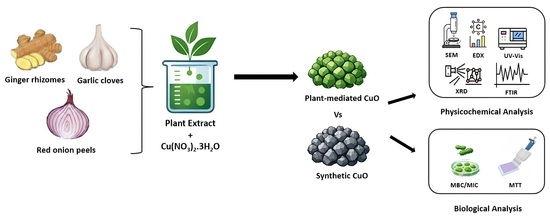
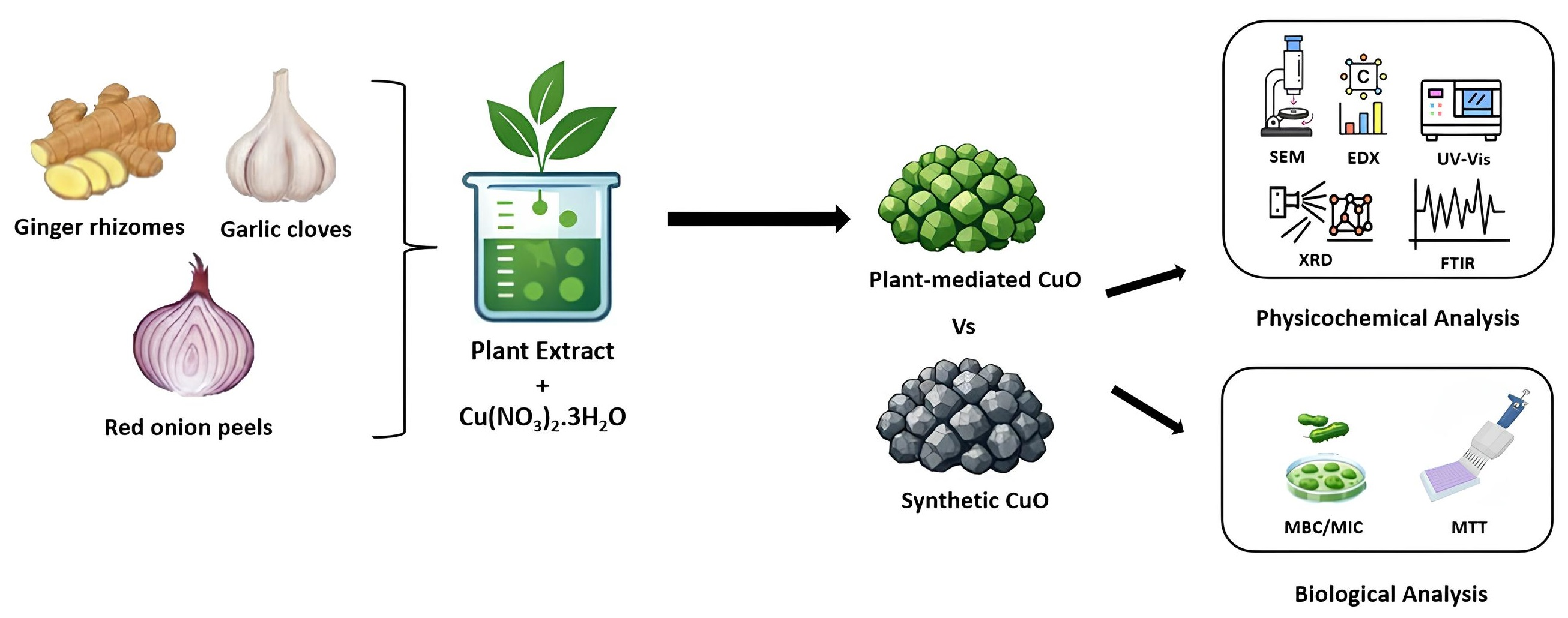
Green-synthesis routes for producing CuO nanoparticles offer a simplified, sustainable, and low-cost replacement for conventional chemical methods, eliminating the need for harsh chemicals and providing an easily scalable process for industrial-level production. Although numerous studies have investigated synthesizing CuO nanoparticles from single plant extracts, comparative assessments of multi-plant-mediated CuO nanoparticles alongside synthetic CuO remain limited. In this work, CuO nanoparticles were green-synthesized from three different plant sources, namely ginger, red onion peels, and garlic, and their physicochemical and biological properties were tested against the synthetic CuO. All plant extracts produced pure-phased monoclinic CuO nanoparticles as confirmed by UV–Vis, XRD, FTIR, and SEM/EDX analyses. SEM showed distinct nanoparticle morphologies, with CuO from ginger extract exhibiting uniform nanocubes, while nanoparticles from red onion and garlic extracts exhibited more aggregated and irregular structures. Their crystallite sizes were 8–9 nm lower than the ~11 nm observed for the synthetic CuO, highlighting the phytochemical role in shaping the nanoparticles’ morphology. The antibacterial efficacy against S. aureus and E. coli showed that ginger-derived and synthetic CuO had the strongest bacterial inhibition and bactericidal potency compared to onion- and garlic-derived CuO samples. However, synthetic CuO had the highest cytotoxicity risk, hindering its suitability for biological uses, while CuO-ginger maintained good cell viability at moderate concentrations. CuO-onion and CuO-garlic gave lower antibacterial cytocompatibility performance due to their thicker capping layers, which led to decreased Cu2+ release and ROS production. Ginger-derived CuO achieved an optimal trade-off between antibacterial and cytotoxic efficiency, highlighting its prospects as a candidate for biomedical applications.

Graphical Abstract

1. Introduction

The necessity of creating safe and potent nanomaterials for biomedical and environmental applications has promoted the exploration of alternative methods for nanoparticle synthesis beyond conventional chemical methods. Metal oxide nanoparticles have proven to be valuable materials stemming from their tailored physicochemical properties and diverse functionality in environmental, pharmaceutical, and biomedical applications. Of these, copper oxide (CuO) nanoparticles have attracted considerable research focus due to their distinct optical, physical and biological features in addition to their established diverse therapeutic potential [1,2]. Owing to their documented antibacterial properties, CuO nanoparticles have become prominent materials in nanomedicine research, particularly in managing infectious diseases. They have been utilized in bioactive wound dressings due to their wide-ranging activity against diverse bacterial strains, as they function as stable and efficient antimicrobial agents [3]. The properties of CuO nanoparticles are mainly dependent on their particle size and morphology as well as the surface chemistry, which, in turn, are highly affected by the synthesis method. Traditional chemical and physical routes are effective for producing CuO nanoparticles; however, they usually require elevated temperature and energy and the use of toxic reagents, which limit their biomedical applicability and pose significant risk to the environment due to the toxic byproduct generated. Consequently, increased attention has been devoted to sustainable synthesis methods that can produce nanoparticles with tailored features while reducing their biological and environmental risks [4,5].
Green-synthesis has established itself as a valuable substitute for the conventional chemical routes, using natural resources as reducing and stabilizing agents. These resources include plant extracts, biomolecules, and microorganisms. Notably, fabrication of CuO using plant extracts offers a highly efficient and reproducible route as they are abundant in bioactive compounds, including polyphenols, sugars, organic acids, proteins and phenolic acids, which help control the reduction and capping of metal ions into nanoparticles. In addition, this route is sustainable and non-hazardous, making it ideal for scalable, eco-friendly production [1,6]. Green CuO nanoparticles offer a distinct advantage over using the plant extract alone, as the bioactive compounds of plants provide a dual role as reducing and capping agents, resulting in nanoparticles with high surface reactivity. Unlike raw extracts, these nanoparticles offer a high surface-to-volume ratio that improves the stability and bioavailability of phytochemicals. The resulting synergy between the inorganic CuO core and the organic capping agents enhances the overall therapeutic efficiency and makes these nanoparticles superior to the raw plant extracts for biomedical applications, such as antimicrobial wound dressings [7]. Many plant extracts have been explored for CuO production, such as ginger extract [6], onion peel extract [8,9], garlic extract [10,11], Balanites aegyptiaca stem bark extract [1], aloe vera leaf extract [12,13], Centella asiatica leaf extract [14], Carica papaya leaf extract [15] and Gloriosa superba L. extract [16]. The extract type, in addition to other experimental settings such as the metal salt-to-extract ratio, synthesis duration, and reaction temperature, has proved to significantly affect the resulting nanoparticle morphology and functionality. Among these plant sources, ginger, red onion peel, and garlic are widely researched due to their abundance and distinct phytochemicals and biological capabilities. Ginger (Zingiber officinale Roscoe) is rich in phenolic compounds, such as gingerols and shogaols, which have potent reducing and antioxidant features [6,17,18]. Red onion peel (Allium cepa L.) is a plentiful bio-waste that contains high amounts of flavonoids, such as quercetin and anthocyanins, as well as sulfur-containing compounds, making it an effective, sustainable stabilizing agent with strong antioxidant activity [8,19,20]. Garlic (Allium sativum L.) is known for containing high levels of organosulfur compounds such as allicin, which exhibit strong reducing capacity and intrinsic antimicrobial efficacy [21,22]. The diversity of the bioactive constituents within these plants allows for a comparative assessment to investigate the difference in CuO particle formation and subsequent biological behavior. Despite the growing number of publications on CuO nanoparticle fabrication via green-synthesis routes, direct systematic comparisons with chemically synthesized CuO remain largely unexplored. From a biomedical engineering perspective, precise control of nanoparticle synthesis routes is essential to achieve a balance between antibacterial performance and cytocompatibility required for biomedical surface-related applications, such as antibacterial coatings, implant interfaces and device-contacting surfaces. Therefore, this study describes the green production of CuO nanoparticles from three commonly employed plant extracts, namely ginger, red onion peel, and garlic, using a unified synthesis protocol and directly compares their structural and biological characteristics with those of commercially available synthetic CuO nanoparticles to establish their biomedical potentials.

2. Materials and Methods

2.1. Materials

Fresh garlic cloves (Allium sativum), fresh ginger rhizomes (Zingiber officinale) and red onion (Allium cepa) were collected from the local market in Baghdad, Iraq. Synthetic copper (II) oxide (CuO) nanoparticles of 99% purity and a particle size range of 30–50 nm were purchased from Hongwu Enterprise Group, Guangzhou, China. Analytical grade copper (II) nitrate trihydrate (Cu(NO3)2.3H2O) was obtained from Central Drug House (CDH), New Delhi, India.

2.2. Preparation of Plant Extracts

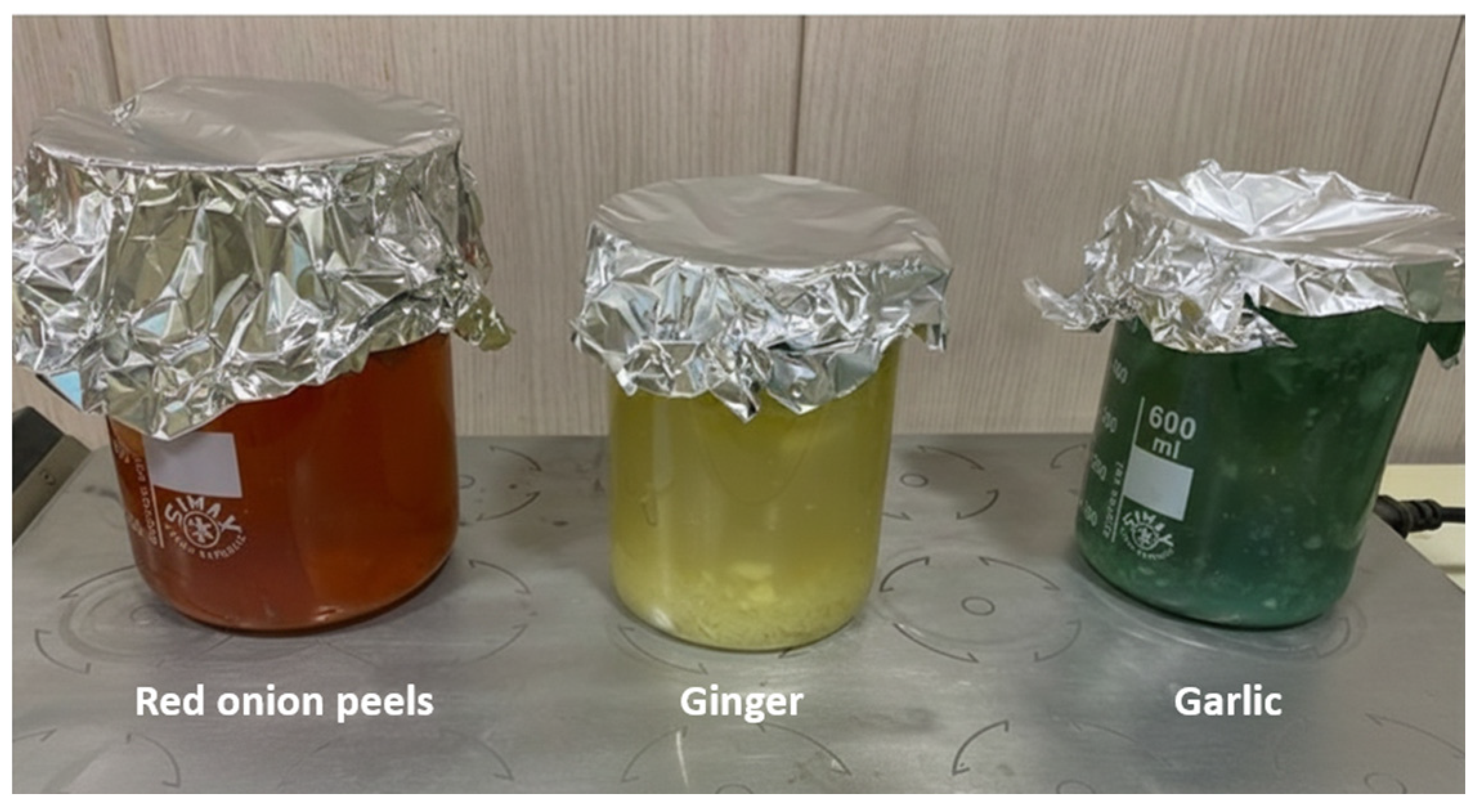
Garlic cloves, ginger rhizomes and the dry outer shell (peel) of red onion were repeatedly rinsed with deionized water to eliminate surface impurities and then cut into small fragments (~5 mm). The plants pieces were then dried at 50–60 °C for 24 h before grinding them into a fine powder using a sterile grinder and then sieved to obtain a uniform particle size. To create the aqueous extraction, 10 g of each plant powder was separately dispersed into 100 mL of deionized water and thermally treated at 80 °C for the duration of 30 min under constant magnetic stirring (Figure 1). After cooling, the aqueous extraction was filtered and preserved at 4 °C until use.

2.3. Fabrication of Green-Mediated CuO Nanoparticles

To prepare the nanoparticles, 50 mL of each plant-derived extract was separately introduced to 0.1 M of Cu(NO3)2.3H2O solution (prepared by dissolving 1.208 g of copper nitrate trihydrate in 50 mL of deionized water). The reaction was carried out under continuous stirring at 60–70 °C for 1 h until the color of the mixture changed to dark yellow. The mixtures were then subjected to centrifugation at 10,000 rpm for 15 min, and the resulted CuO nanoparticle sediments were collected and washed with water and ethanol before drying in a hot-air oven set to 80 °C for a duration of 24 h. Finally, the nanoparticle sediments from the plant extracts were calcinated in a muffle furnace at 400 °C for 3 h and left to cool in the furnace before storing them in airtight containers.

2.4. CuO Nanoparticle Characterization

2.4.1. Optical Properties (UV–Vis)

A UV-1900i Plus UV–Vis Spectrophotometer (Shimadzu, Kyoto, Japan) was used to verify the fabrication of CuO nanoparticles and measure their optical characteristics by dispersing them in deionized water and recording the resulted spectrum. Spectral measurements were performed over the 200 to 1100 nm region.

2.4.2. Phase Purity and Crystallographic Structure (XRD)

To verify the phase composition and estimate the average crystallite size of the plant-mediated and synthetic CuO nanoparticles, an X-ray diffractometer (Philips PW1730, Amsterdam, The Netherlands) was used under CuKα radiation with a wavelength of 0.15406 Å and scan range of 10 to 80° 2θ.

2.4.3. Surface Chemistry (FTIR)

The surface groups of the nanoparticles were analyzed using Fourier transform infrared (FTIR) spectroscopy (Shimadzu, Kyoto, Japan). Measurements were performed in transmission mode within the 4000–400 cm−1 wavenumber region. For each sample, 32 scans were accumulated and averaged at 4 cm−1 resolution to optimize the result accuracy.

2.4.4. Morphology and Elemental Analysis (SEM/EDX)

The morphology of the synthetic and plant-mediated CuO nanoparticles were examined via a Hitachi SM-50 scanning electron microscope (Hitachi High-Tech Corporation, Tokyo, Japan) using ETD-SE mode at various magnification levels. The microscopy is integrated with an energy dispersive X-ray (EDX) detector for analyzing the elemental constituents. Images were captured at an accelerating potential of 2 kV and a fixed working distance (WD) of 6.5 mm.

2.4.5. Antibacterial Potency (MIC/MBC)

The antibacterial efficacy of the plant-mediated and synthetic CuO nanoparticles was evaluated against two bacterial strains, Gram-positive Staphylococcus aureus (S. aureus) and Gram-negative Escherichia coli (E. coli), using the minimum inhibitory concentration (MIC) test measured via the broth microdilution method (BMD). At first, the bacterial species were activated on Muller Hinton Agar (MHA) and diluted with saline to the 0.5 McFarland standard, which is approximately equal to 1.5 × 10⁸ CFU/mL. Then, 100 μL of Muller Hinton Broth (MHB) was added to each plate of a sterile 96-well microtiter plate (MTP), followed by adding 100 μL of CuO nanoparticles into the first plate of each column (concentration = 1000 μg/mL). Thereafter, two-fold serial dilutions were prepared across the wells, resulting in eight descending concentrations, starting from 1000 μg/mL in the first well and descending by half in each subsequent well. Following the completion of the dilutions, 10 μL of bacterial culture was dispensed into each well, and the MTP was incubated at 37 °C for 24 h. After incubation, bacterial growth was initially inspected visually to detect any bacterial turbidity, and then, resazurin indicator dye was added to the wells. The violet–blue color indicates no bacterial growth, while the pink color indicates bacterial viability. The MIC value was determined as the smallest concentration of nanoparticles needed to completely suppress bacterial proliferation.
To measure the minimum bactericidal concentration (MBC), which is the smallest concentration needed to prevent any bacterial colony formation on the agar surface, samples taken from wells with no visible bacterial growth were subcultured in new MHA plates and incubated at 37 °C for 24 h, and then, the plates were observed for bacterial growth.

2.4.6. In Vitro Cytotoxicity (MTT)

Cellular toxicity of the plant-mediated and synthetic CuO nanoparticles was assessed using the MTT assay performed on L292 mouse fibroblast cells. At first, the cells were seeded into 96-well microplates at a density of 1 × 10⁴ cells/well and incubated at 37 °C and 5% CO2 for 24 h. Then, the spent medium was aspirated and replaced with a fresh medium containing the CuO nanoparticle suspension at varying concentrations (0, 10, 25, 50, 100, 250, 500, and 1000 μg/mL), and cells were incubated for another 24 h. All experiments were performed in triplicate, with eight wells assigned for each concentration. Following that, the culture medium was aspirated, and 100 μL of MTT solution (0.5 mg/mL in DMEM) was dispensed into each well and incubated for 4 h at 37 °C in a dark place. The solution was then discarded, and 100 μL was added in order to dissolve the resulted purple formazan crystals, followed by gentle shaking for 20 min in the dark. Finally, the absorbance was recorded at 570 nm with a microplate reader. The percentage of viable cells was expressed relative to the control sample without treatment, and data are reported as the mean value with the standard deviation from three replicates. Statistical analysis was performed using one-way ANOVA, with p < 0.05 considered significant.

3. Results

3.1. UV–Vis

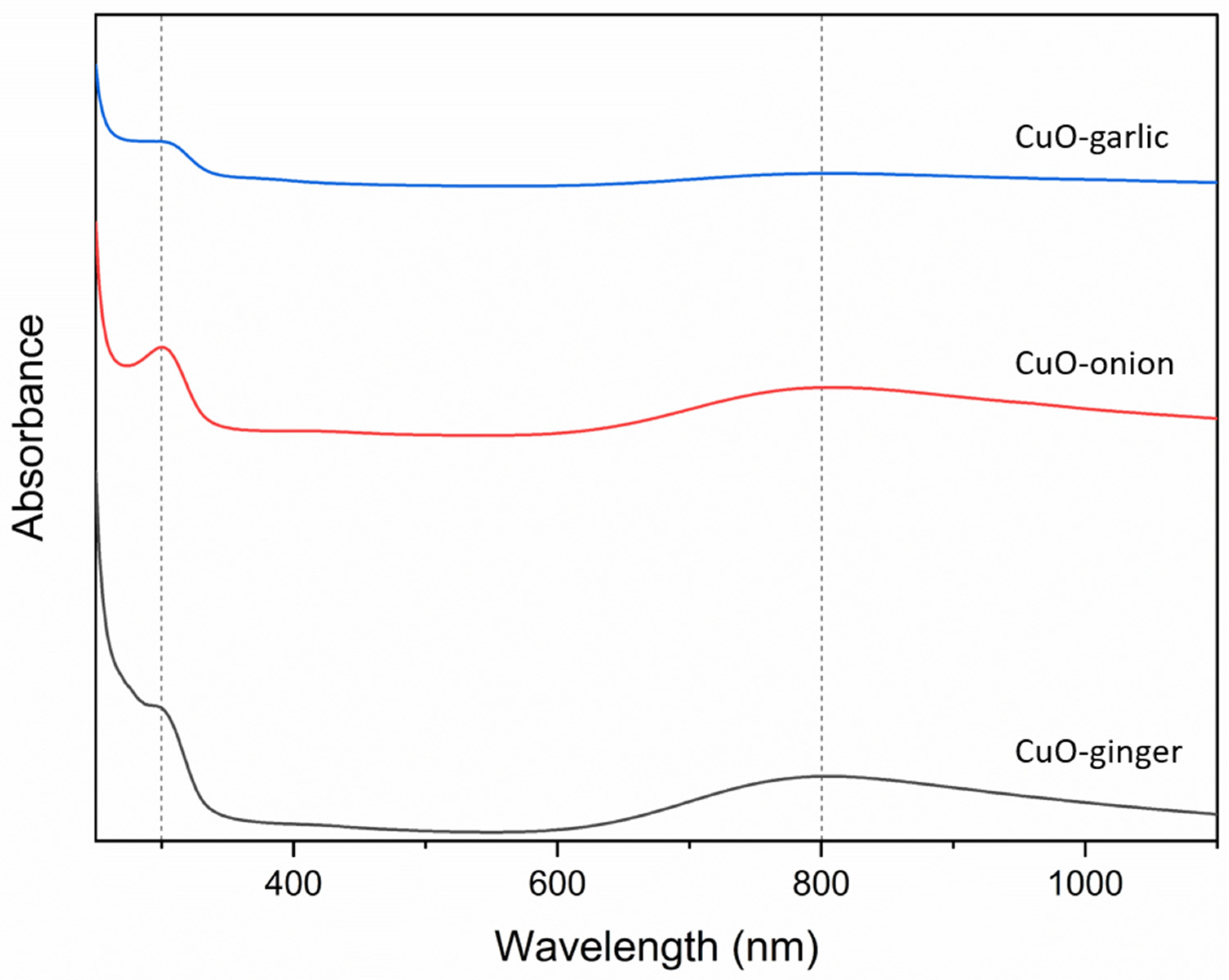
UV–Vis spectroscopy was employed to confirm the success of CuO nanoparticle formation from the three plant extracts. Figure 2 displays the absorption spectra of the three plant-mediated CuO nanoparticles. All formulations exhibited a strong, characteristic absorbance peak in the ultraviolet region, appearing at wavelengths of 293 nm, 298 nm, and 301 nm for CuO-ginger, CuO-garlic, and CuO-onion, respectively, and corresponding to the surface plasmon resonance peak (SPR) phenomenon of CuO nanoparticles [23,24]. An additional secondary weak absorption peak appeared at the visible to near-infrared region (~800 nm), which is likely associated with the d-d transitions of Cu2+ ions and could be a result of trace amounts of unreacted precursor of defects within the structure of the nanoparticles [25].

3.2. XRD

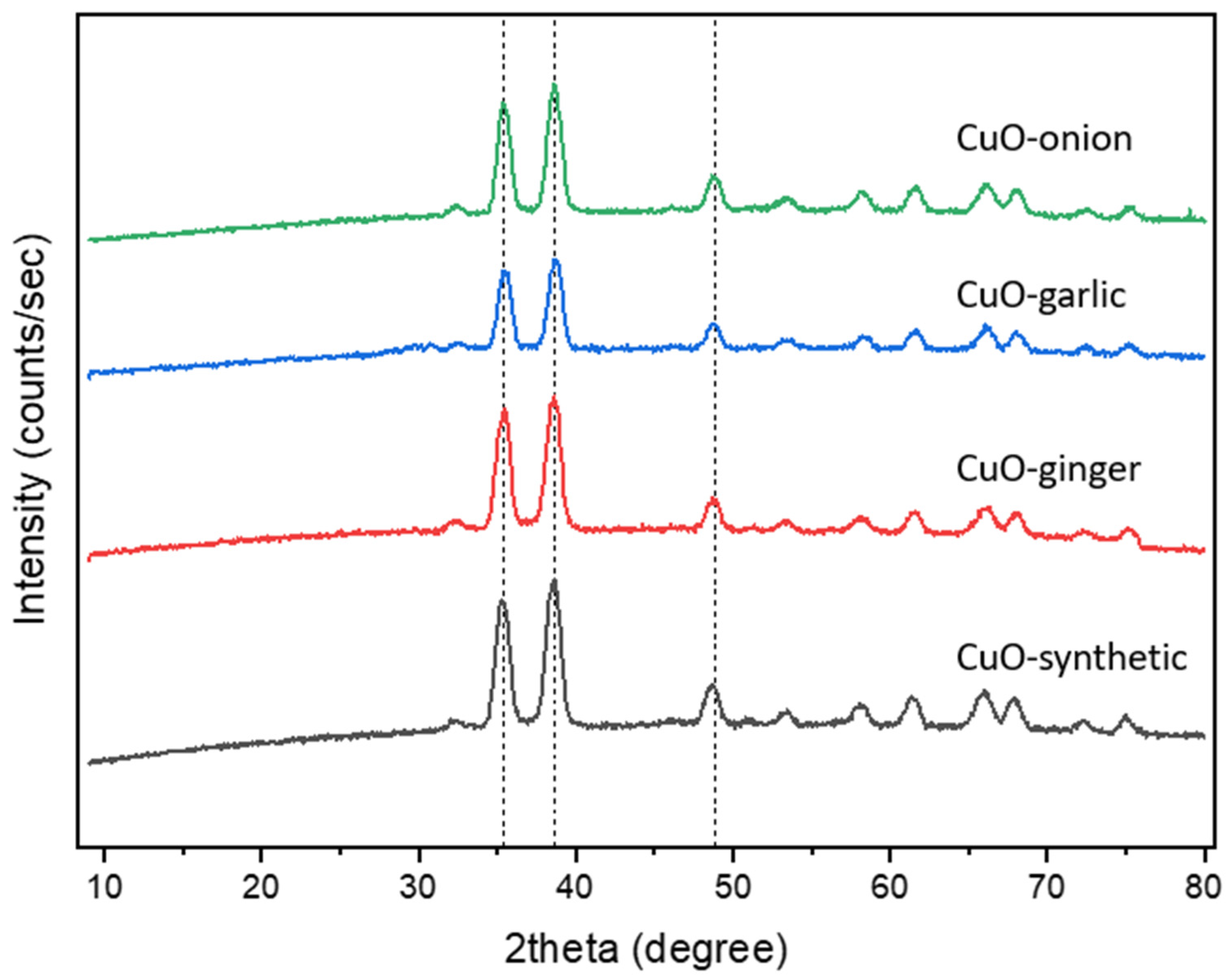
The XRD patterns of the plant-mediated and synthetic CuO nanoparticles are shown in Figure 3. All samples showed distinct, sharp peaks, which confirms the crystalline structure of all tested samples. The peaks of all patterns were matching precisely with the standard diffraction data of the monoclinic phase of CuO (Tenorite structure) (JCPDS card no. 4801548), with no additional peaks corresponding to other phases such as Cu2O or metallic Cu, which confirms the purity of all plant-mediated and synthetic nanoparticles. The primary diffraction peaks were noticed at 2θ of approximately 35.5°, 38.6° and 48.7°, which corresponds to the crystal planes of 1 ¯ 11 , 111, and 2 ¯ 02 , respectively, and belongs to the monoclinic CuO structure.
The crystallite size of each CuO sample was determined from the peak width of the major diffraction peak (~38.6°) at half maximum (β) using the Debye–Scherrer equation:
D = K λ β cos θ  
D refers to the size of the crystallite, K is a sharp factor (taken as 0.9), λ is the X-ray wavelength (Cu kα = 0.15406 nm), β is the full width at half-maximum (FWHM) of the diffraction peak in radians, and θ is the Brag angle. The calculated crystallite sizes are summarized in Table 1.
These results indicated that the plant-mediated CuO nanoparticles had a smaller crystallite size in the range of 8 to 9 nm, aligning with the broader diffraction peaks seen in the XRD patterns (Figure 3), while the synthetic CuO had a slightly larger crystallite size of about 11 nm. The smaller crystallite size of the plant-mediated CuO nanoparticles suggests that the phytochemicals in the plant extracts influence crystallite growth through the biomolecular capping and reduction mechanism [26,27].

3.3. FTIR

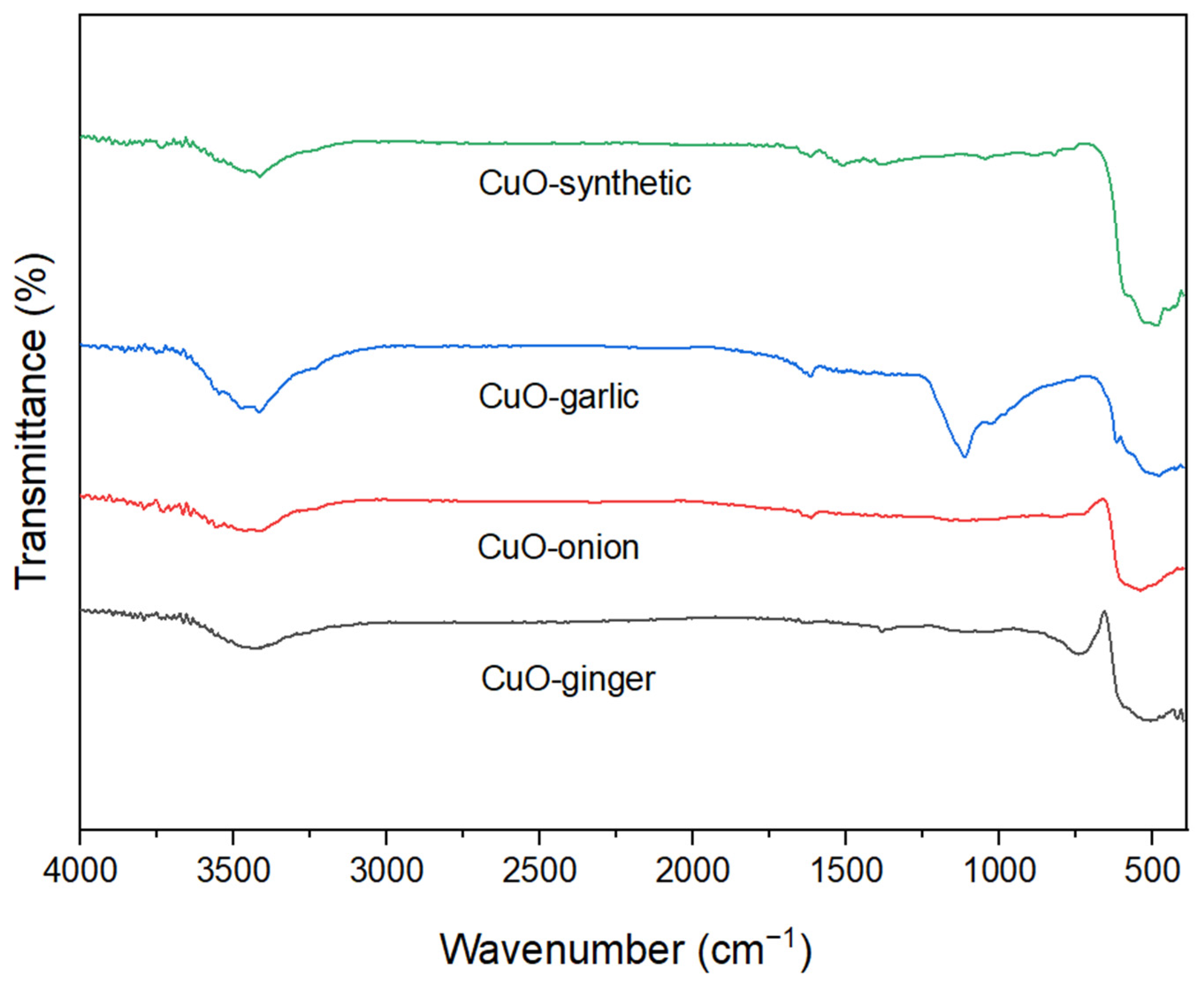
FTIR was conducted to assign the characteristic absorption peaks of the plant-mediated CuO nanoparticles and compare it to the synthetic one. The resulted vibrational profiles of all CuO samples are shown in Figure 4. The spectra of the three plant extract CuO nanoparticles showed a broad band at approximately 3400 cm−1, assigned to O–H stretching from phenols and alcohols in the plant extracts [2,5], while its presence in the synthetic CuO could be the result of absorbed moisture [2,28]. Peaks at 1600–1700 cm−1 corresponding to C=O stretching/amide I are typically related to the plant-mediated organic compounds; however, they may also appear in the synthetic CuO due to the absorbed atmospheric organics or residual surface-bound species. The distinct peak at ~1112 cm−1 in CuO-garlic is likely due to C–O/C–O–C groups or organosulfur vibrations (S=O/C–S) specific to garlic, since it is absent from the synthetic and the other green-synthesized CuO samples. Peaks between 400 and 600 cm−1 corresponding to the CuO vibrational bands represent the main evidence confirming the effective production of monoclinic CuO nanoparticles in all green types [23,29]. CuO-garlic had the strongest CuO absorption, while CuO-ginger had the cleanest spectrum, with fewer peaks associated with organic residues, which shows the variance in the phytochemical composition of the three plant extracts. These results confirm that the biomolecules from the ginger, garlic, and onion extracts functioned as the primary driver in reducing Cu2+ and stabilizing the resulting nanoparticles, while the detection of CuO vibration verified the formation of the metal oxide phase.

3.4. SEM/EDX

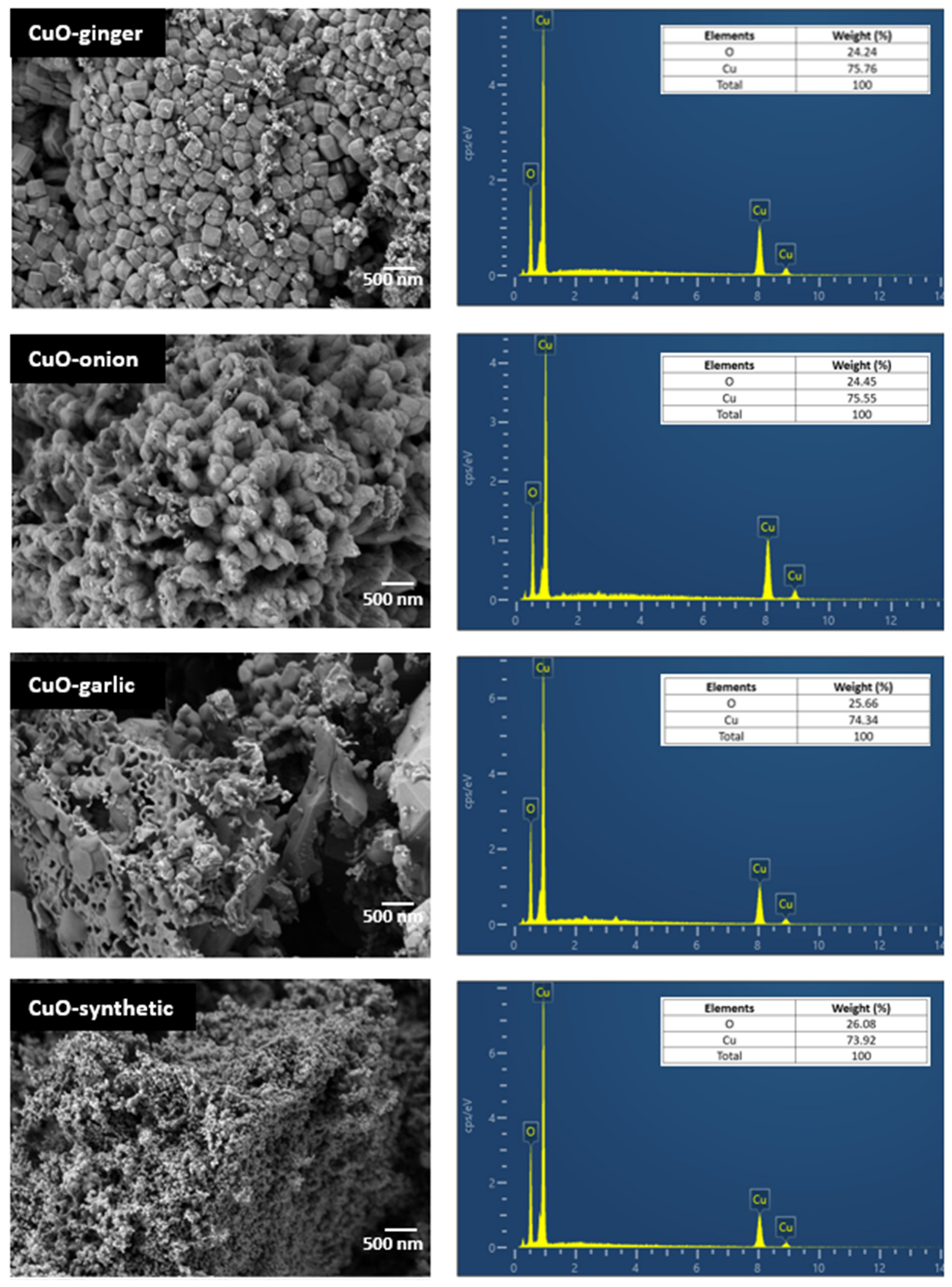
The morphology of plant-mediated and synthetic CuO nanoparticles, along with their EDX analysis, is shown in Figure 5. It can be noticed that the surface morphology of the nanoparticles has varied distinctly according to the plant extract and the fabrication method used. The CuO-ginger sample showed uniformly distributed nanocube-like particles with sharp edges and a close-packed arrangement, which indicate the controlled nucleation and growth influenced by the ginger phytochemicals. On the other hand, the CuO-onion sample displayed more aggregated, rounded clusters of ill-defined particles. This may indicate the rapid bioreduction caused by the flavonoids and sulfur compounds from the onion. The CuO-garlic sample exhibited irregular, highly porous structures with fragmented and sheet-like shapes, indicating fast reduction and particle fusion driven by the garlic organosulfur constituents. These observations confirm that the plant extract modulates the nanoparticle morphology during the synthesis process. By contrast, the synthetic CuO sample showed a dense granular texture with relatively uniform particle distribution; however, it lacked the faceted geometry noticed in the CuO-ginger sample.
EDX analysis verified the effective formation of pure CuO nanoparticles in all samples, with only copper (Cu) and oxygen (O) peaks detected in each spectrum, and no evidence of residual impurities from plant metabolites was observed.

3.5. MIC and MBC

The MIC and MBC results shown in Table 2 demonstrate clear differences in the inhibitory and bactericidal potency of the four CuO nanoparticle types (CuO-ginger, CuO-garlic, CuO-onion, and CuO-synthetic) against Gram-positive S. aureus and Gram-negative E. coli.
Generally, S. aureus exhibited higher sensitivity to all CuO nanoparticles compared to E. coli, which showed higher resistance. This is consistent with previous studies and is linked to the protective outer sheath in the Gram-negative bacteria that reduces nanoparticle penetration and ion intrusion inside the bacteria [30,31]. CuO-ginger nanoparticles produced the strongest antibacterial inhibition and bactericidal effect among the three plant-mediated nanoparticles, with MIC values of 250 μg/mL and 500 μg/mL against S. aureus and E. coli, respectively, and an MBC value of 500 μg/mL against both bacterial strains. These superior activity results are in agreement with the literature and derive from the phytochemical composition of the ginger, which contains gingerols and shogaols that can enhance the nanoparticles’ stability and improve reactive oxygen species (ROS) production, leading to higher antibacterial potency [18,32]. On the other hand, CuO-garlic and CuO-onion showed a similar antibacterial response, with values of 500 μg/mL and 1000 μg/mL for the MIC and MBC tests against S. aureus and E. coli, respectively. This could be attributed to the thicker organic capping from the plants’ organics, which can limit Cu2+ and ROS production. In contrast, synthetic CuO nanoparticles gave the highest overall antibacterial inhibition, with MIC values of 250 μg/mL for both bacterial strains and MBC values of 500 and 1000 μg/mL against S. aureus and E. coli, respectively. This could be related to the higher purity and decreased surface organic coverage of the synthetic CuO, leading to greater surface reactivity and enhanced antibacterial efficiency [33].

3.6. MTT Assay

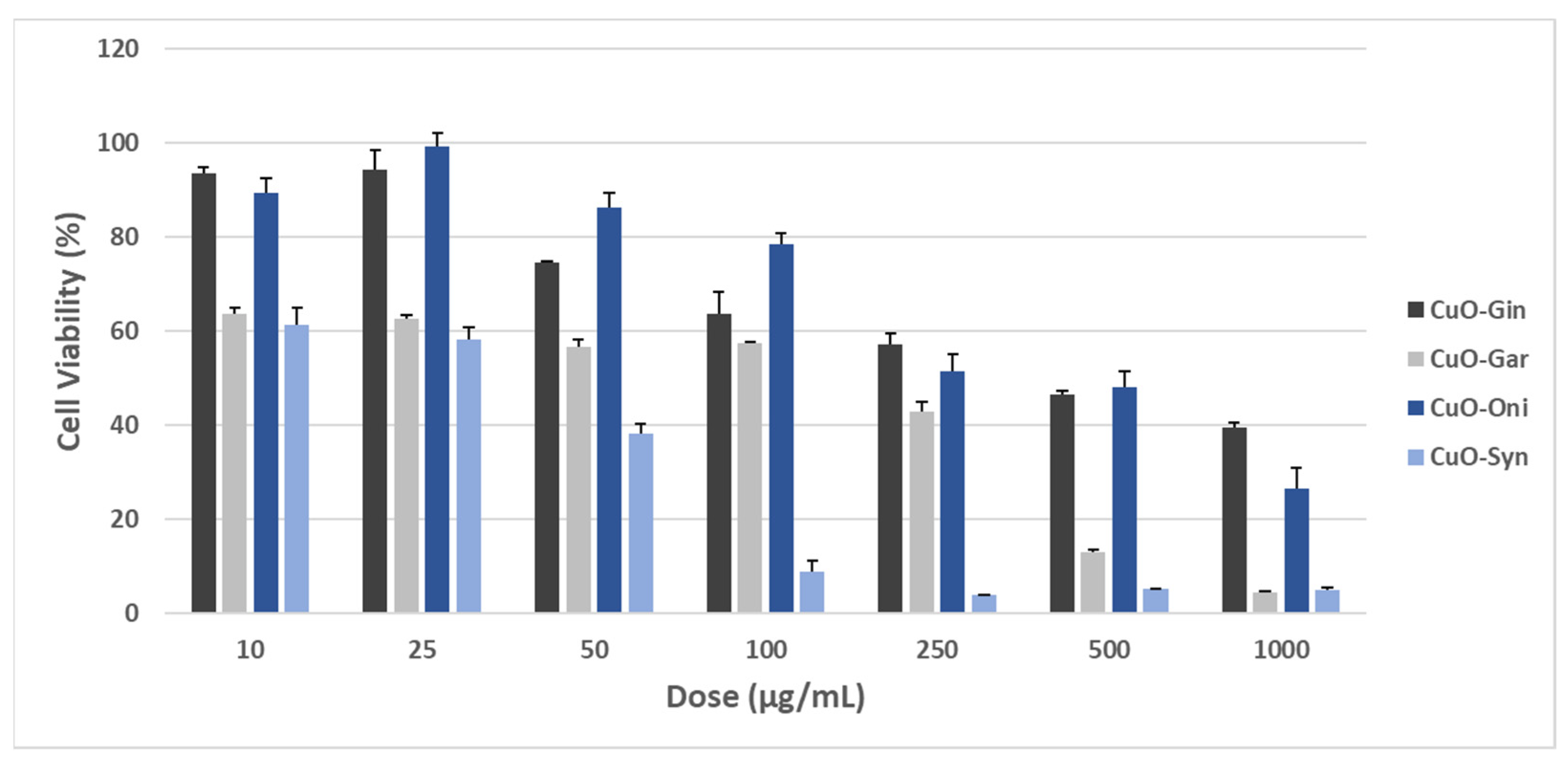
The impact of the three plant-mediated CuO nanoparticles and the synthetic nanoparticles on the survival rate of L292 mouse fibroblast cells is shown in Figure 6. The four types of CuO exhibited a dose-dependent decline in cell viability, but the intensity of the cytotoxic effect strongly depended on the specific formulation or type of CuO nanoparticles. CuO-ginger and CuO-onion showed the lowest cytotoxicity among the four formulations and maintained cell viability above 75% at doses less than 100 μg/mL. At higher doses, the viability percentages dropped significantly to less than 50% and reached 39.5 and 26.6% at 1000 μg/mL for CuO-ginger and CuO-onion, respectively. A pairwise statistical comparison showed no significant difference between the cell viability of these two types of CuO at four of the seven tested concentrations (p > 0.05) (Table 3).
On the other hand, CuO-garlic showed significantly higher cytotoxicity than the other plant-mediated nanoparticles (p < 0.001), with cell viability dropping faster even at low doses. CuO-synthetic was the most cytotoxic of all formulations, with cell viability of only 38.1% at 50 μg/mL concentration and 4.8% at 1000 μg/mL concentration.

4. Discussion

Plant-mediated CuO nanoparticles were synthesized using extracts of ginger, red onion peels, and garlic, and their properties were compared to those of synthetic CuO. All characterization tests verified the effective biogenic synthesis of pure CuO nanoparticles from the three plant extracts, with UV–Vis peaks around 293–301 nm, matching with the reported CuO values [23,24,34]. The additional broad peak at approximately 800 nm in ginger and onion samples suggests higher crystallinity and increased nanoparticle output compared to garlic. The purity of the plant-mediated samples was further verified by XRD, where the samples produced smaller crystallite sizes (8–9 nm) than the synthetic CuO (~11 nm) as a result of the size-limiting effect of the plant phytochemicals. The smaller crystallites may contribute to the enhanced antibacterial performance of the plant-mediated samples, especially the ginger-mediated, compared to the synthetic CuO. Importantly, XRD provides crystallite size rather than the overall particle size, which might be larger due to particle aggregation. TEM or DLS analysis could provide quantitative particle size distribution and will be considered in future work. FTIR analysis, on the other hand, confirmed the role of polyphenols, proteins, and sulfur-based constituents in the bioreduction of metal cations and surface capping of the obtained nanoparticles, while the presence of CuO vibrations between 400 and 600 cm−1 supported successful CuO formation. The antibacterial test showed that CuO-ginger and CuO-synthetic had the strongest bactericidal effects. These antibacterial behaviors could be the result of the relatively smaller crystallite size and cleaner surfaces of CuO-ginger, which enhanced ROS generation and membrane interaction, while CuO-synthetic had high purity and minimal organic capping, thus improving antibacterial potency. In contrast, CuO-garlic and CuO-onion exhibited lower antibacterial potency and required higher concentrations for bacterial inhibition or killing. CuO-garlic showed porous and irregular morphology in the SEM images, whereas CuO-onion exhibited a dense and more compact structure with limited incidental voids. Despite these morphological features, their antibacterial performance was lower than CuO-ginger. This is likely due to the thicker organic capping layer attributed to the high concentrations of flavonoids, such as quercetin, within the onion extract and sulfur-rich compounds, such as allicin, in garlic. These layers can restrict Cu2+ ion liberation and ROS generation, thus decreasing antibacterial potency [33,35,36,37,38]. However, ROS generation and Cu2+ release were not directly measured in this study; these mechanisms were proposed based on the literature and observed antibacterial trends. Additionally, particle aggregation in these samples may reduce the effective surface area interacting with bacterial membranes, thus attenuating antibacterial efficacy despite the favorable morphology. In particular, the apparent pores between the CuO-garlic aggregates are not necessarily associated with accessible functional reactive sites, as the dense organic capping and nanoparticle clustering may shield active sites from direct bacterial contact.
Despite the relatively high values of the MIC and MBC obtained in this study, similar concentration ranges have been reported for CuO nanoparticles manufactured through green, chemical, or hybrid routes. Previous studies revealed that biogenic CuO nanoparticles often exhibit differential antibacterial performance against various strains, with MIC values ranging from tens to several hundreds of μg/mL, with some exceeding 1000 μg/mL, particularly against Gram-negative strains [39,40,41]. For example, CuO nanoparticles synthesized using Aerva javanica leaf extract showed MIC and MBC values of 128–256 μg/mL against multiple bacterial strains [41]. In another study, gum karaya-mediated CuO nanoparticles produced MIC and MBC values of 103–135 μg/mL for S. aureus and E. coli [39]. Chemically synthesized CuO nanoparticles have been reported to produce MIC/MBC values ranging from 20 μg/mL to 1250 μg/mL [42,43]. Antibacterial sensitivity against bacterial strains has been found to be dependent on variations in bacterial cell wall architecture, surface chemistry, and nanoparticle size, with smaller particle sizes exhibiting higher antibacterial sensitivity [39]. These observations indicate that the antibacterial performance exhibited in the present study aligns with previously reported biogenic CuO nanoparticles, demonstrating comparable antibacterial efficacy despite differences in plant source and synthesis protocols. Nevertheless, the absence of antibiotic and raw plant-extract controls represents a limitation of the current study and should be addressed in future investigations.
The MTT assay results correlate with the MBC/MIC findings; however, they reveal an important discrepancy. CuO-ginger and CuO-onion maintained high cell viability at low to moderate doses and reflect better cytocompatibility compared to CuO-garlic, which might be due to stabilizing phytochemical caps that controlled reactivity. CuO-garlic produced lower cell viability compared to the other plant-derived CuO samples, and the viability dropped significantly to less than 20% at high doses (>250 μg/mL). Correlating this result with the reduced antibacterial potency implies that reactive surface features (such as porosity or high surface area) or specific organosulfur interactions may increase cellular damage. In contrast, CuO-synthetic exhibited the highest cytotoxicity, reducing cell viability to less than 40% at a 50 μg/mL dose. Therefore, while synthetic CuO is highly antibacterial, it is also the most cytotoxic. ICP analysis of Cu2+ was not performed in this study; however, the observed differences in cytotoxicity between the nanoparticles provide useful early-stage findings, and future studies could incorporate quantitative ion release assessments to better understand these effects.
In summary, CuO-ginger offers the most favorable balance between relative antibacterial performance and cytocompatibility among the plant-derived samples, as it combines potent antibacterial performance with low cytotoxicity at low to moderate doses. In contrast, CuO-synthetic has strong antibacterial activity but causes high cytotoxic risk and thus is likely unsuitable for applications requiring host-cell compatibility. Onion- and garlic-derived CuO nanoparticles demonstrate how plant-specific phytochemicals can modulate both antibacterial efficiency and biological safety, leading to the mixed results observed.

5. Conclusions

This study revealed that ginger, red onion peels, and garlic extracts can be successfully used to green-synthesize phase-pure CuO nanoparticles with structural and compositional properties comparable to the synthetic CuO. UV–Vis, XRD, FTIR and SEM analyses confirmed that the plant-mediated nanoparticles produced smaller crystallite sizes (8–9 nm) and unique surface morphologies due to phytochemical capping, with ginger-mediated CuO forming uniform nanocubes and onion- and garlic-mediated CuO showing more aggregated and irregular shapes. The surface biomolecules affected nanoparticle morphology in addition to antibacterial activity and cell viability. Overall, CuO-ginger exhibited an optimal balance between antibacterial potency and cytocompatibility, showing notable inhibition/bactericidal activity (MIC 500 μg/mL and MBC 250 μg/mL), particularly against E. coli, while preserving cell viability above 60% at moderate doses. On the other hand, CuO-onion and CuO-garlic showed weaker antibacterial performance due to thicker organic capping in addition to increased particle aggregation. Synthetic CuO exhibited high antibacterial efficiency but also showed high cytotoxicity (cell viability < 40% at 50 μg/mL), which may limit its use in biological applications. Generally, these results highlight the potential of CuO nanoparticle production via green-synthesis routes at the early in vitro evaluation stage due to their biologically active surfaces that improve antibacterial activity while minimizing cytotoxicity. Specifically, ginger-derived CuO shows promise as a candidate for further biological studies where balanced antibacterial activity and cytocompatibility are desirable.

Author Contributions

Conceptualization, M.M.K., H.A.J. and B.A.A.-G.; methodology, M.M.K.; validation, M.M.K., H.A.J. and B.A.A.-G.; formal analysis, M.M.K. and H.A.J.; investigation, M.M.K. and H.A.J.; resources, M.M.K. and B.A.A.-G.; data curation, M.M.K.; visualization, M.M.K. and H.A.J.; writing—original draft preparation, M.M.K.; writing—review and editing, M.M.K., H.A.J. and B.A.A.-G. All authors have read and agreed to the published version of the manuscript.

Funding

This research received to external funding.

Institutional Review Board Statement

Not applicable.

Informed Consent Statement

Not applicable.

Data Availability Statement

The original contributions presented in this study are included in the article. Further inquiries can be directed to the corresponding author.

Conflicts of Interest

The authors declare no conflicts of interest.

Abbreviations

The following abbreviations are used in this manuscript:
CuOCopper Oxide
UV–VisUltraviolet–Visible Spectroscopy
XRDX-ray Diffraction
FTIRFourier Transform Infrared Spectroscopy
SEMScanning Electron Microscope
EDXEnergy-Dispersive X-ray
MICMinimum Inhibitory Concentration
MBCMinimum Bactericidal Concentration

References

  1. Teklu, B.; Kumari, S.; Vidavalur, S. Results in Chemistry Green synthesis of copper oxide nanoparticles using Balanites aegyptiaca stem bark extract and investigation of antibacterial activity. Results Chem. 2023, 6, 101152. [Google Scholar] [CrossRef]
  2. Manasa, D.J.; Chandrashekar, K.R.; Kumar, D.J.M.; Niranjana, M. Mussaenda frondosa L. mediated facile green synthesis of Copper oxide nanoparticles—Characterization, photocatalytic and their biological investigations. Arab. J. Chem. 2021, 14, 103184. [Google Scholar] [CrossRef]
  3. Devaraji, M.; Thanikachalam, P.V.; Elumalai, K. The potential of copper oxide nanoparticles in nanomedicine: A comprehensive review. Biotechnol. Notes 2024, 5, 80–99. [Google Scholar] [CrossRef]
  4. Modan, E.M.; Schiopu, A.; Moga, S.G.; Negrea, D.A.; Istrate, D.; Ciuca, I.; Oproescu, M. Advanced Copper Oxide Chemical and Green Synthesis: Characterization and Antibacterial Evaluation. Crystals 2025, 15, 7. [Google Scholar] [CrossRef]
  5. Sabeena, G.; Rajaduraipandian, S.; Pushpalakshmi, E.; Alhadlaq, H.A.; Mohan, R.; Annadurai, G.; Ahamed, M. Green and chemical synthesis of CuO nanoparticles: A comparative study for several in vitro bioactivities and in vivo toxicity in zebrafish embryos. J. King Saud Univ.-Sci. 2022, 34, 102092. [Google Scholar] [CrossRef]
  6. Ali, E.M.; Abdalameer, N. Green reduction approach for the synthesis of copper oxide nanoparticles using ginger extract and evaluation of their free radical scavenging activity. Eur. Phys. J. Plus 2025, 140, 928. [Google Scholar] [CrossRef]
  7. Martínez-Cabanas, M.; López-García, M.; Rodríguez-Barro, P.; Vilariño, T.; Lodeiro, P.; Herrero, R.; Barriada, J.L.; de Vicente, M.E.S. Antioxidant capacity assessment of plant extracts for green synthesis of nanoparticles. Nanomaterials 2021, 11, 1679. [Google Scholar] [CrossRef]
  8. Darweesh, M.A.; Emam, S.M.; Wahba, A.M.; Ayad, M.I.; El-nahass, M.N.; Abd-elhamied, A.S.; Hammad, W.A. Results in Chemistry Onion Peel Extract/Copper Oxide Nanoparticles as Corrosion Inhibitors for Carbon Steel in Hydrochloric Acid: Extraction, Characterization, Electrochemical Study, and Theoretical Explorations. Results Chem. 2024, 9, 101626. [Google Scholar] [CrossRef]
  9. Sood, A.; Sharma, D.; Arora, P. Green synthesis of copper oxide via onion (Allium cepa) peel extract and evaluation of its antioxidant activity. Int. J. Green Pharm. 2022, 16, 392–396. [Google Scholar]
  10. Kumar, A.; Sofi, A.H.; Hamza, B.; Rubab, S.; Shah, M.A. Eco-friendly synthesis of antibacterial CuO nanoparticles using garlic bulb extract. Green Mater. 2024, 13, 111–120. [Google Scholar] [CrossRef]
  11. Din, M.I.; Yamin, A.; Hussain, Z.; Khalid, R. Investigation of biologically synthesized stable copper oxide nanoparticles using Allium sativum extract by photocatalysis of methylene blue. Inorg. Nano-Metal Chem. 2022, 54, 201–208. [Google Scholar] [CrossRef]
  12. Jabeen, S.; Siddiqui, V.U.; Bala, S.; Mishra, N.; Mishra, A.; Lawrence, R.; Bansal, P.; Khan, A.R.; Khan, T. Biogenic Synthesis of Copper Oxide Nanoparticles from Aloe vera: Antibacterial Activity, Molecular Docking, and Photocatalytic Dye Degradation. ACS Omega 2024, 9, 30190–30204. [Google Scholar] [CrossRef]
  13. Govindhan, M. Eco-friendly photothermal synthesis of CuO nanoparticles mediated by aloe vera for sunlight photocatalytic activity. J. Environ. Chem. Eng. 2025, 13, 120346. [Google Scholar] [CrossRef]
  14. Joy Prabu, H.; Varghese, R.; Johnson, I.; John Sundaram, S.; Dhayal Raj, A.; Rajagopal, R.; Kuppusamy, P.; Sathya, R.; Kaviyarasu, K. Laser induced plant leaf extract mediated synthesis of CuO nanoparticles and its photocatalytic activity. Environ. Res. 2022, 212, 113295. [Google Scholar] [CrossRef]
  15. Aswini, R.; Jothimani, K.; Kannan, K.; Pothu, R.; Shanmugam, P.; Boddula, R.; Radwan, A.B.; Periyasami, G.; Karthikeyan, P.; Al-Qahtani, N. Carica Papaya leaf-infused metal oxide nanocomposite: A green approach towards water treatment and antibacterial applications. Environ. Geochem. Health 2024, 46, 334. [Google Scholar] [CrossRef]
  16. Naika, H.R.; Lingaraju, K.; Manjunath, K.; Kumar, D.; Nagaraju, G.; Suresh, D.; Nagabhushana, H. Green synthesis of CuO nanoparticles using Gloriosa superba L. extract and their antibacterial activity. J. Taibah Univ. Sci. 2015, 9, 7–12. [Google Scholar] [CrossRef]
  17. Tiki, Y.L.; Tolesa, L.D.; Tiwikrama, A.H.; Chala, T.F. Ginger (Zingiber officinale)-Mediated Green Synthesis of Silver-Doped Tin Oxide Nanoparticles and Evaluation of Its Antimicrobial Activity. ACS Omega 2024, 9, 11443–11452. [Google Scholar] [CrossRef]
  18. Ghasemzadeh, A.; Jaafar, H.Z.E.; Baghdadi, A.; Tayebi-Meigooni, A. Formation of 6-, 8- and 10-Shogaol in Ginger through Application of Different Drying Methods: Altered Antioxidant and Antimicrobial Activity. Molecules 2018, 23, 1646. [Google Scholar] [CrossRef]
  19. Leong, K.X.; Chao, S.P.; Siah, P.C.; Lim, S.K.; Khoo, B.Y. Comparative Studies on a Standardized Subfraction of Red Onion Peel Ethanolic Extract (Plant Substance), Quercetin (Pure Compound), and Their Cell Mechanism and Metabolism on MDA-MB-231. Evid.-Based Complement. Altern. Med. 2022, 2022, 9284063. [Google Scholar] [CrossRef]
  20. Downes, K.; Chope, G.A.; Terry, L.A. Postharvest application of ethylene and 1-methylcyclopropene either before or after curing affects onion (Allium cepa L.) bulb quality during long term cold storage. Postharvest Biol. Technol. 2010, 55, 36–44. [Google Scholar] [CrossRef]
  21. Zamanian, Z.; Tajbakhsh, E.; Arbab, N.; Ghasemian, A. Aqueous extract-mediated green synthesis of CuO nanoparticles: Potential anti-tuberculosis agents. Food Sci. Nutr. 2024, 12, 5907–5921. [Google Scholar] [CrossRef]
  22. Borlinghaus, J.; Albrecht, F.; Gruhlke, M.C.H.; Nwachukwu, I.D.; Slusarenko, A.J. Allicin: Chemistry and biological properties. Molecules 2014, 19, 12591–12618. [Google Scholar] [CrossRef]
  23. Mobarak, M.B.; Hossain, M.S.; Chowdhury, F.; Ahmed, S. Synthesis and characterization of CuO nanoparticles utilizing waste fish scale and exploitation of XRD peak profile analysis for approximating the structural parameters. Arab. J. Chem. 2022, 15, 104117. [Google Scholar] [CrossRef]
  24. Puri, A. Antiadherence and Antimicrobial Properties of Copper Oxide Nanoparticles against Streptococcus mutans, Staphylococcus aureus, and Candida albicans on Orthodontic Brackets: An in Vitro Study. Iran. J. Orthod. 2025, 20, 1–16. [Google Scholar] [CrossRef]
  25. Pestryakov, A.; Petranovskii, V.; Kryazhov, A.; Ozhereliev, O.; Pfänder, N.; Knop-Gericke, A. Study of Copper Nanoparticles Formation on Supports of Different Nature by UV–Vis Diffuse Reflectance Spectroscopy. Chem. Phys. Lett. 2004, 385, 173–176. [Google Scholar] [CrossRef]
  26. Yizengaw, M.B.; Kitaw, S.L.; Bekele, E.T. Green synthesis of CuO nanoparticles using Rhamnus prinoides leaf extracts, and mechanistic insights into antibacterial efficacy. J. Agric. Food Res. 2025, 24, 102481. [Google Scholar] [CrossRef]
  27. Takele, E.; Feyisa Bogale, R.; Shumi, G.; Kenasa, G. Green Synthesis, Characterization, and Antibacterial Activity of CuO/ZnO Nanocomposite Using Zingiber officinale Rhizome Extract. J. Chem. 2023, 2023, 3481389. [Google Scholar] [CrossRef]
  28. Varughese, A.; Kaur, R.; Singh, P. Green Synthesis and Characterization of Copper Oxide Nanoparticles Using Psidium guajava Leaf Extract Green Synthesis and Characterization of Copper Oxide Nanoparticles Using Psidium guajava Leaf Extract. IOP Conf. Ser. Mater. Sci. Eng. Pap. 2020, 961, 012011. [Google Scholar] [CrossRef]
  29. Ethiraj, A.S.; Kang, D.J. Synthesis and characterization of CuO nanowires by a simple wet chemical method. Nanoscale Res. Lett. 2012, 7, 70. [Google Scholar] [CrossRef]
  30. Azam, A.; Ahmed, A.S.; Oves, M.; Khan, M.S.; Habib, S.S.; Memic, A. Antimicrobial activity of metal oxide nanoparticles against Gram-positive and Gram-negative bacteria: A comparative study. Int. J. Nanomed. 2012, 7, 6003–6009. [Google Scholar] [CrossRef]
  31. Stoimenov, P.K.; Klinger, R.L.; Marchin, G.L.; Klabunde, K.J. Metal Oxide Nanoparticles as Bactericidal Agents. Langmuir 2002, 18, 6679–6686. [Google Scholar] [CrossRef]
  32. Ali, M.; Ijaz, M.; Ikram, M.; Ul-Hamid, A.; Avais, M.; Anjum, A.A. Biogenic Synthesis, Characterization and Antibacterial Potential Evaluation of Copper Oxide Nanoparticles Against Escherichia coli. Nanoscale Res. Lett. 2021, 16, 148. [Google Scholar] [CrossRef]
  33. Mobarak, B.; Sikder, F.; Muntaha, S.; Islam, S.; Rabbi, S.M.F.; Chowdhury, F. Plant extract-mediated green-synthesized CuO nanoparticles for environmental and microbial remediation: A review covering basic understandings to mechanistic study. Nanoscale Adv. 2025, 7, 2418–2445. [Google Scholar] [CrossRef]
  34. Nivedha, M.K.M.; Harikrishnan, M.M.R.; Kumar, J.K.; Kaviyarasu, S.L.K. Synthesis of CuO/NaCuSO4 nanocomposite using an aqueous extract of Tribulus terrestris and their structural, optical, morphology and dielectric studies. Chem. Pap. 2024, 78, 3083–3098. [Google Scholar] [CrossRef]
  35. Younes, A.; Eddahbi, A.; El Bouari, A.; Aitenneite, H.; Brouzi, K.; Mouslim, J. Microwave-assisted approach for rapid and green phytosynthesis of silver nanoparticles using aqueous onion (Allium cepa) extract and their antibacterial activity. J. Nanostruct. Chem. 2013, 3, 84. [Google Scholar] [CrossRef]
  36. Villagrán, Z.; Anaya-Esparza, L.M.; Velázquez-Carriles, C.A.; Silva-Jara, J.M.; Ruvalcaba-Gómez, J.M.; Aurora-Vigo, E.F.; Rodríguez-Lafitte, E.; Rodríguez-Barajas, N.; Balderas-León, I.; Martínez-Esquivias, F. Plant-Based Extracts as Reducing, Capping, and Stabilizing Agents for the Green Synthesis of Inorganic Nanoparticles. Resources 2024, 13, 70. [Google Scholar] [CrossRef]
  37. Pedroso-Santana, S.; Fleitas-Salazar, N. The Use of Capping Agents in the Stabilization and Functionalization of Metallic Nanoparticles for Biomedical Applications. Part. Part. Syst. Charact. 2023, 40, 2200146. [Google Scholar] [CrossRef]
  38. Bahari, N.; Hashim, N.; Abdan, K.; Md Akim, A.; Maringgal, B.; Al-Shdifat, L. Role of Honey as a Bifunctional Reducing and Capping/Stabilizing Agent: Application for Silver and Zinc Oxide Nanoparticles. Nanomaterials 2023, 13, 1244. [Google Scholar] [CrossRef]
  39. Padi, V.V.T.; Cernik, M. Green synthesis of copper oxide nanoparticles using gum karaya as a biotemplate and their antibacterial application. Int. J. Nanomed. 2013, 8, 889–898. [Google Scholar] [CrossRef]
  40. Habibah, F.F.; Sri Rizki, W.O.; Ivansyah, A.L.; Astuti, D.I.; Hertadi, R. Green synthesis of copper ions nanoparticles functionalized with rhamnolipid as potential antibacterial agent for pathogenic bacteria. Heliyon 2024, 10, e24242. [Google Scholar] [CrossRef]
  41. Amin, F.; Fozia; Khattak, B.; Alotaibi, A.; Qasim, M.; Ahmad, I.; Ullah, R.; Bourhia, M.; Gul, A.; Zahoor, S.; et al. Green Synthesis of Copper Oxide Nanoparticles Using Aerva javanica Leaf Extract and Their Characterization and Investigation of in Vitro Antimicrobial Potential and Cytotoxic Activities. Evid.-Based Complement. Altern. Med. 2021, 2021, 5589703. [Google Scholar] [CrossRef] [PubMed]
  42. Azam, A.; Ahmed, A.S.; Oves, M.; Khan, M.S.; Memic, A. Size-dependent antimicrobial properties of CuO nanoparticles against Gram-positive and -negative bacterial strains. Int. J. Nanomed. 2012, 7, 3527–3535. [Google Scholar] [CrossRef]
  43. Ontiveros-Robles, J.A.; Villanueva-Flores, F.; Juarez-Moreno, K.; Simakov, A.; Vazquez-Duhalt, R. Antibody-Functionalized Copper Oxide Nanoparticles with Targeted Antibacterial Activity. ChemistryOpen 2023, 12, e202200241. [Google Scholar] [CrossRef] [PubMed]
Figure 1. The aqueous extraction of red onion peels, ginger rhizomes, and garlic gloves (left to right), respectively, showing different colors due to the varying phytochemical composition in each plant.
Applsci 16 02606 g001
Figure 2. Stacked UV–Vis spectra of plant-mediated CuO nanoparticles.
Applsci 16 02606 g002
Figure 3. Stacked XRD patterns of plant-mediated and synthetic CuO nanoparticles.
Applsci 16 02606 g003
Figure 4. Stacked FTIR spectra of plant-mediated and synthetic CuO nanoparticles.
Applsci 16 02606 g004
Figure 5. SEM/EDX of the plant-mediated and synthetic CuO nanoparticles (marker bar = 500 nm).
Applsci 16 02606 g005
Figure 6. Cell viability of L929 fibroblasts treated with plant-mediated and synthetic CuO nanoparticles at various concentrations.
Applsci 16 02606 g006
Table 1. CuO nanoparticle crystallite size (D) in nm.
Sample2θ (°)FWHM (β in °)β (rad)Cos θD (nm)
CuO-ginger38.5351.0310.017990.94478.21
CuO-garlic38.6550.950.016580.9448.85
CuO-onion38.59910.017450.94438.42
CuO-synthetic38.730.750.013090.943611.39
Table 2. MIC and MBC values of plant-mediated and synthetic CuO nanoparticles against S. aureus and E. coli in μg/mL.
SampleS. aureusE. coli
MICMBCMICMBC
CuO-ginger500500500250
CuO-garlic10005001000500
CuO-onion10005001000500
CuO-synthetic1000250500250
Table 3. Pairwise statistical significance of cell viability between CuO nanoparticle types at various doses, where the symbols (*), (**), and (***) reflect statistical differences at p < 0.05, 0.01, and 0.001, respectively; n.s. denotes non-significant data.
Dose (μg/mL)CuO-Gin vs.
CuO-Gar
CuO-Gin vs.
CuO-Oni
CuO-Gar vs.
CuO-Syn
CuO-Gar vs.
CuO-Oni
CuO-Gar vs.
CuO-Syn
CuO-Oni vs.
CuO-Syn
10***n.s.******n.s.***
25***n.s.************
50*****************
100n.s.**************
250**n.s.**********
500***n.s.************
1000***********n.s.***
Disclaimer/Publisher’s Note: The statements, opinions and data contained in all publications are solely those of the individual author(s) and contributor(s) and not of MDPI and/or the editor(s). MDPI and/or the editor(s) disclaim responsibility for any injury to people or property resulting from any ideas, methods, instructions or products referred to in the content.