Knowledge Graph-Based Structural Safety Risk Diagnosis and Control of Prestressed Concrete Bridges



Abstract
1. Introduction
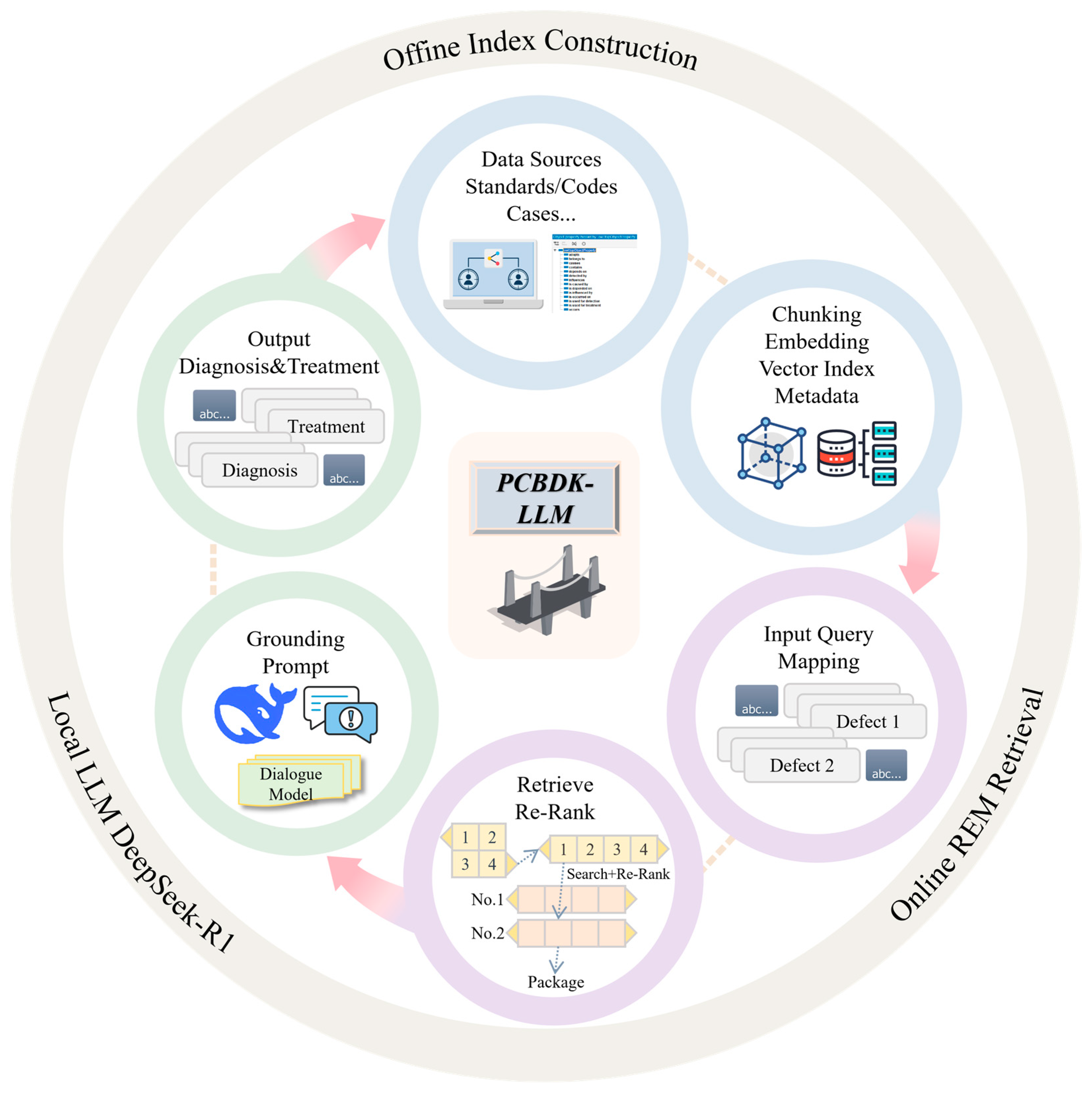
2. Framework of Prestressed Concrete Bridge Defects Knowledge Large Language Model
2.1. Overall Architecture and Data Flow
2.2. Knowledge Layer: Defect Knowledge Graph, Ontology, and Document Corpus
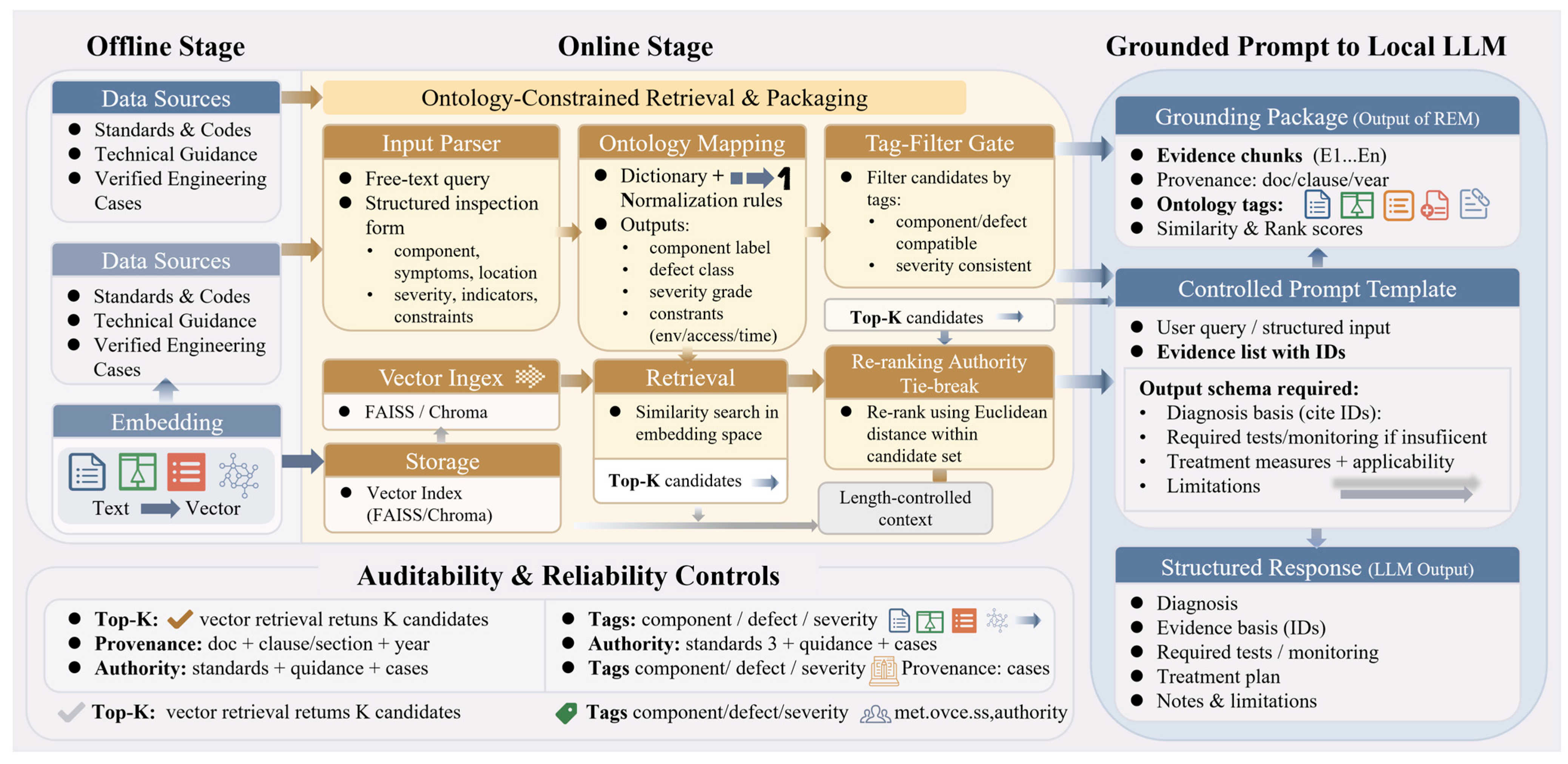
2.3. Retrieval and Grounding Layer: Ontology-Aware REM
2.4. Dialogue Layer and Local Deployment
2.5. Outputs, Traceability, and Practical Use
3. Knowledge Graph Construction for Structure Safety Risk Diagnosis and Control of Prestressed Concrete Bridges
3.1. Standard-Driven Knowledge Extraction and Text-Chunks Construction
3.2. Ontology-Based Formalization and Rule Constraints
4. Knowledge-Graph-Enhanced Large Language Model for Defect Diagnosis and Treatment of Prestressed Concrete Bridges
4.1. RAG Pipeline Design and Prompting Strategy
4.2. Ontology-Aware Retrieval Module (REM)
4.3. Integration with a Locally Deployed Dialogue Model
4.4. Auditability, Reliability Controls, and Failure Handling
5. Case Analysis
5.1. Construction of Bridge Defects Knowledge Graph
5.2. Implementation Details of REM
5.3. Real Case Analysis Based on PCBDK-LLM
- (1)
- LLM-only: The model receives only the case description and generates the diagnosis and treatment plan without any external evidence retrieval or post hoc rule filtering.
- (2)
- Generic RAG: Using only RAG and LLM to generate the diagnosis and treatment plan.
- (3)
- REM-only: This variant retains the RAG pipeline but replaces generic retrieval with a retrieval enhancement module (REM). REM applies rule- and metadata-aware filtering and reranking before evidence injection, e.g., restricting candidates by component/defect type/severity compatibility and prioritizing higher-authority documents (e.g., standards/guidelines) over lower-authority sources. Importantly, REM-only only changes how evidence is selected and ordered; it does not introduce additional reasoning constraints beyond the shared output format requirements.
- (4)
- PCBDK-LLM: The full method builds upon REM-enhanced evidence selection and further incorporates domain knowledge constraints and structured prompting to produce traceable, engineering-consistent outputs. Specifically, PCBDK-LLM enforces ontology-consistent terms (component-defect type alignment), activates severity-triggered safety actions when applicable, and requires evidence-grounded outputs (e.g., citing retrieved evidence identifiers) with structured fields for diagnosis, tests, and treatment actions. This variant reflects the complete proposed framework.
5.4. Discussion
6. Conclusions
Author Contributions
Funding
Data Availability Statement
Acknowledgments
Conflicts of Interest
References
- Brown, T.B.; Mann, B.; Ryder, N.; Subbiah, M.; Kaplan, J.D.; Dhariwal, P.; Neelakantan, A.; Shyam, P.; Sastry, G.; Askell, A.; et al. Language Models are Few-Shot Learners. In Advances in Neural Information Processing Systems 33 (NeurIPS 2020); Curran Associates: Red Hook, NY, USA, 2020; pp. 1877–1901. [Google Scholar]
- Ouyang, L.; Wu, J.; Jiang, X.; Almeida, D.; Wainwright, C.L.; Mishkin, P.; Zhang, C.; Agarwal, S.; Slama, K.; Ray, A.; et al. Training Language Models to Follow Instructions with Human Feedback. In Advances in Neural Information Processing Systems 35 (NeurIPS 2022); Curran Associates: Red Hook, NY, USA, 2022; pp. 27730–27744. [Google Scholar]
- Wei, J.; Wang, X.; Schuurmans, D.; Bosma, M.; Ichter, B.; Xia, F.; Chi, E.; Le, Q.V.; Zhou, D. Chain-of-Thought Prompting Elicits Reasoning in Large Language Models. arXiv 2022, arXiv:2201.11903. [Google Scholar] [CrossRef]
- Ji, Z.; Lee, N.; Frieske, R.; Yu, T.; Su, D.; Xu, Y.; Ishii, E.; Bang, Y.; Chen, D.; Dai, W.; et al. Survey of Hallucination in Natural Language Generation. ACM Comput. Surv. 2023, 55, 248. [Google Scholar] [CrossRef]
- Maynez, J.; Narayan, S.; Bohnet, B.; McDonald, R. On Faithfulness and Factuality in Abstractive Summarization. In Proceedings of the 58th Annual Meeting of the Association for Computational Linguistics (ACL), Online, 5–10 July 2020; pp. 1906–1919. [Google Scholar] [CrossRef]
- Manakul, P.; Liusie, A.; Gales, M.J.F. SelfCheckGPT: Zero-Resource Black-Box Hallucination Detection for Generative Large Language Models. In Proceedings of the 2023 Conference on Empirical Methods in Natural Language Processing (EMNLP), Singapore, 6–10 December 2023; pp. 9004–9017. [Google Scholar] [CrossRef]
- Lewis, P.; Perez, E.; Piktus, A.; Petroni, F.; Karpukhin, V.; Goyal, N.; Küttler, H.; Lewis, M.; Yih, W.-T.; Rocktäschel, T.; et al. Retrieval-Augmented Generation for Knowledge-Intensive NLP Tasks. In Advances in Neural Information Processing Systems 33 (NeurIPS 2020). arXiv 2020, arXiv:2005.11401. [Google Scholar] [CrossRef]
- Guu, K.; Lee, K.; Tung, Z.; Pasupat, P.; Chang, M.-W. REALM: Retrieval-Augmented Language Model Pre-Training. In Proceedings of the 37th International Conference on Machine Learning (ICML), PMLR 119, Vienna, Austria, 12–18 July 2020; pp. 3929–3938. [Google Scholar]
- Wang, X.; Wei, J.; Schuurmans, D.; Le, Q.; Chi, E.; Narang, S.; Chowdhery, A.; Zhou, D. Self-Consistency Improves Chain of Thought Reasoning in Language Models. arXiv 2022, arXiv:2203.11171. [Google Scholar] [CrossRef]
- Hogan, A.; Blomqvist, E.; Cochez, M.; D’Amato, C.; de Melo, G.; Gutierrez, C.; Kirrane, S.; Gayo, J.E.L.; Navigli, R.; Neumaier, S.; et al. Knowledge Graphs. ACM Comput. Surv. 2021, 54, 1–37. [Google Scholar] [CrossRef]
- Gruber, T.R. A Translation Approach to Portable Ontology Specifications. Knowl. Acquis. 1993, 5, 199–220. [Google Scholar] [CrossRef]
- W3C OWL Working Group. OWL 2 Web Ontology Language Document Overview (Second Edition). W3C Recommendation. 11 December 2012. Available online: https://www.w3.org/TR/owl2-overview/ (accessed on 29 January 2026).
- Ministry of Transport of the People’s Republic of China. Specifications for Maintenance of Highway Bridges and Culverts (JTG H11-2021); China Communications Press: Beijing, China, 2021. (In Chinese)
- Reimers, N.; Gurevych, I. Sentence-BERT: Sentence Embeddings Using Siamese BERT-Networks. In Proceedings of the 2019 Conference on Empirical Methods in Natural Language Processing and the 9th International Joint Conference on Natural Language Processing (EMNLP-IJCNLP), Hong Kong, China, 3–7 November 2019; pp. 3982–3992. [Google Scholar] [CrossRef]
- Karpukhin, V.; Oguz, B.; Min, S.; Lewis, P.; Wu, L.; Edunov, S.; Chen, D.; Yih, W.-T. Dense Passage Retrieval for Open-Domain Question Answering. In Proceedings of the 2020 Conference on Empirical Methods in Natural Language Processing (EMNLP), Punta Cana, Dominican Republic, 8–12 November 2020; pp. 6769–6781. [Google Scholar] [CrossRef]
- Johnson, J.; Douze, M.; Jégou, H. Billion-Scale Similarity Search with GPUs. IEEE Trans. Big Data 2021, 7, 535–547. [Google Scholar] [CrossRef]
- Zhang, T.; Kishore, V.; Wu, F.; Weinberger, K.Q.; Artzi, Y. BERTScore: Evaluating Text Generation with BERT. In Proceedings of the International Conference on Learning Representations (ICLR). arXiv 2019, arXiv:1904.09675. [Google Scholar] [CrossRef]
- BS 5400-9.1:1983; Steel, Concrete and Composite Bridges. Bridge Bearings. Code of Practice for Design of Bridge Bearings. BSI: London, UK, 1983.



| Diagnosis Item | Testing Tools | Operation Points | Code Basis |
|---|---|---|---|
| Crack Width and Length Measurement | Crack Width Gauge and Tape Measure | Measure at the widest part and both ends of the crack, record the crack direction and distribution area | JTG H11-2021 |
| Concrete Spalling and Reinforcement Exposure Inspection | Vernier Caliper and Camera | Measure spalling area, exposed reinforcement length and corrosion degree, take images for record | Article 5.4.2 of JTG H11-2021 |
| Anchor and Steel Strand Visual Inspection | Flashlight and Small Hammer | Inspect anchor deformation and rust, tap the anchor lightly with a small hammer to judge compactness | Article 5.4.5 of JTG H11-2021 |
| Defect Severity | Treatment Technology | Construction Points | Quality Control Standard |
|---|---|---|---|
| Mild Corrosion | Duct Grouting Repair | CP.1-Clean anchors and duct inlets | Grouting compactness ≥ 95%, steel strand corrosion stops developing |
| CP.2-Adopt vacuum-assisted grouting technology to inject high-performance cement grout | |||
| CP.3-Cure for ≥7 days | |||
| Moderate Corrosion | Local Steel Strand Repair and Grouting Reinforcement | CP.1-Chisel concrete in the corroded area to expose steel strands | Steel strand stress loss rate after repair ≤ 10% |
| CP.2-Wrap carbon fiber cloth after derusting | |||
| CP.3-Restore concrete protective layer and grout | |||
| Severe Corrosion | Steel Strand Replacement and External Prestressing Reinforcement | CP.1-Erect temporary supports | New steel strand stress meets design value, external strand tension control stress ± 5% |
| CP.2-Remove old steel strands, replace with new ones and tension | |||
| CP.3-Add external prestressing strands for auxiliary load-bearing |
| Core Concepts | Including Categories |
|---|---|
| Bridge Structural Components | Main beams, piers, abutments, bearings, deck pavement, expansion joints, guardrails, foundations, etc. |
| Defect Types | Cracks, spalling, corrosion, deformation, leakage, looseness, damage, blockage, etc. |
| Defect Causes | Material aging, overloading, environmental erosion, construction defects, insufficient maintenance, unreasonable design, natural disasters, etc. |
| Detection Methods | Visual inspection, ultrasonic testing, rebound testing, radar testing, strain gauge testing, infrared thermographic testing, penetration testing, etc. |
| Disposal Measures | Repair, reinforcement, replacement, cleaning and dredging, anti-corrosion treatment, monitoring and observation, etc. |
| Defect Levels | Slight, Moderate, Severe, Critical |
| Detection Equipment | Ultrasonic detector, rebound tester, radar detector, infrared thermal imager, strain gauge, etc. |
| Influencing Factors | Traffic volume, temperature change, humidity, geological conditions, service life, etc. |
| Case 01 Panlong Bridge | Content Provided to Models |
| Bridge type and layout | Prestressed concrete bridge with T-beams/box girders/hollow slabs; total length 1230 m; width 27.5 m. |
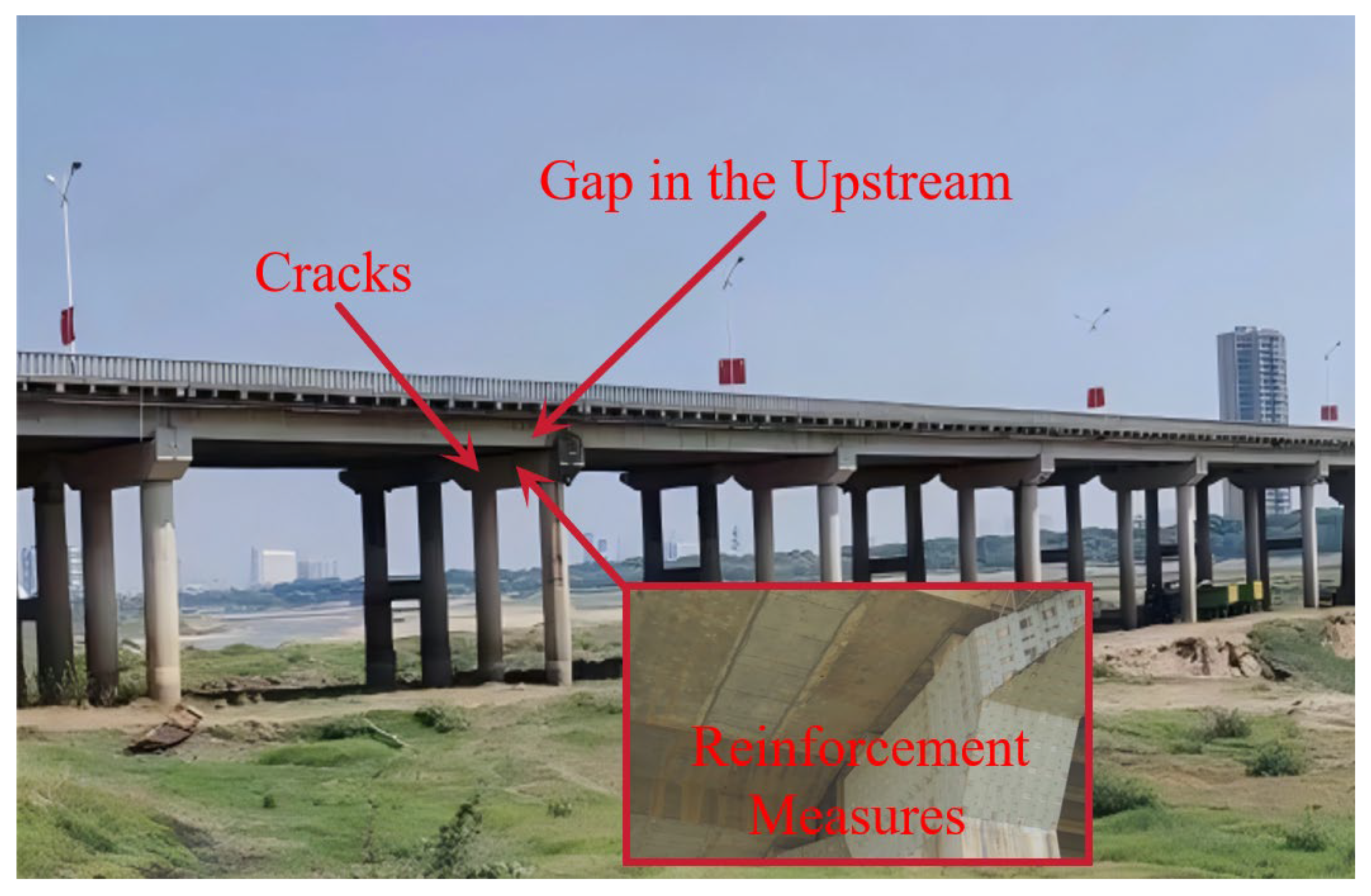
| Observed defect 1 | Overall downward movement of two beams and slabs; downstream expansion joint closed; upstream expansion joint gap about 12 cm. |
| Observed defect 2 | Longitudinal crack about 1 cm wide at the transition pier between variable-section box girder and prefabricated T-beam. |
| Project context | Bridge needs lifting and resetting; maintain traffic safety and restore structural alignment. |
| Brief output | defect diagnosis (likely causes) and a feasible treatment/rehabilitation plan with key construction steps. |
| Case 02 Varina-Enon Bridge Interstate 295 (I-295) | Content provided to models |
| Bridge type and layout | Two parallel 28-span post-tensioned bridges (constructed 1990). |
| Observed defect 1 | Voids in grouted tendons discovered using a borescope probing vent tubes/end caps; voids were attributed to bleeding/segregation of water-cement grout. |
| Observed defect 2 | Case-study summary reports ~45% of tendons had voids, and ~55% were vacuum grouted to fill voids; a tendon failure was identified during inspection (durability risk). |
| Project context | Durability-driven response: contracts awarded to grout voids (2003–2004), followed by emergency actions after a later tendon failure; access is constrained (tendon/duct inspection through vents/openings). |
| Brief output | Diagnosis of likely causes (grout bleed/segregation, venting/grouting practice), and a restoration plan emphasizing re-grouting/vacuum grouting, corrosion protection, and verification/acceptance testing (e.g., targeted openings/borescope checks, follow-up nondestructive evaluation (NDE)). |
| Case 03 Lee Roy Selmon Crosstown Expressway (SR 618) segmental bridges | Content provided to models |
| Bridge type and layout | Post-tensioned concrete segmental bridge structures on the State Road 618 (SR 618) corridor (controlled-access toll facility; corridor length reported as 14.168 miles). |
| Observed defect 1 | Epoxy grout “pourback” at anchorages experienced cracking and spalling (documented as a field problem on newly constructed segmental bridges). |
| Observed defect 2 | Cracked/spalled pourbacks increase risk of water ingress into anchorage protection details, raising tendon durability concerns if not promptly repaired. (Mechanism discussed in the pourback investigation context.) |
| Project context | Safety/constructability driven: anchorage protection is critical; repairs typically must be performed under traffic management constraints (urban elevated structures). |
| Brief output | Immediate safety measures + detailed assessment of anchorage/pourback condition, then repair strategy (remove unsound material, re-cast/repair mortar/pourback system), with strengthening options if needed (carbon fiber reinforced polymer (CFRP)/steel plating locally) and verification/monitoring steps. |
| Case 04 A689 River Eden Bridge (CNDR) | Content provided to models |
| Bridge type and layout | Approx. 158 m long; 4-girder composite steel deck supported on a central concrete pier and abutments; central pier has British Standard (BS5400) [18] pot bearings (3 free, 1 fixed). |
| Observed defect 1 | Bearings showed wear; inspection identified defects including over-rotation/misalignment, and exceeded transverse translation capacities. |
| Observed defect 2 | Additional issues around bearing region included cracking on bearing plinth beams and deformation/distortion of bearing components—consistent with abnormal movement demand and loss of proper bearing functionality. |
| Project context | Required a bearing replacement + bridge jacking scheme with temporary works and controlled movement monitoring; access constraints included site access preparation. |
| Brief output | Diagnosis of movement/bearing distress and a feasible plan emphasizing bearing replacement, jacking/temporary support scheme, staged traffic handling, and monitoring (lift control + post-replacement displacement checks). |
| Case 05 US 59 Bridges over Grand Lake (Southbound) | Content provided to models |
| Bridge type and layout | Post-tensioned concrete box girder, 25 spans, total bridge length 3043.8 ft (twin parallel structures; this case focuses on the companion structure). |
| Observed defect 1 | Expansion joint seals leaking at both abutments; debris noted on neoprene seal and a hole allowed water entry (and animal ingress) into the girder interior. |
| Observed defect 2 | Evidence of leakage-related distress included efflorescence along joints, leakage at segment joints, and contamination inside the box girder near expansion joints (durability concern for end-zone components). |
| Project context | Quick, traffic-sensitive maintenance: stop water ingress, improve joint performance, and prevent progressive end-zone deterioration while maintaining service. |
| Brief output | Diagnosis of leakage sources and a feasible plan emphasizing expansion joint repair/replacement, drainage/housekeeping improvements, end-zone concrete repair where needed, and protective sealing/coatings, with key construction steps. |
| Case 06 Dalton 194/093 Bridge | Content provided to models |
| Bridge type and layout | Small highway bridge (inspection-report case) with bituminous wearing surface over bridge deck; report documents geometry/condition details for maintenance planning. |
| Observed defect 1 | Wearing surface reported rutted with potholes and wide cracks (indicative of fatigue/alligator-type distress and rutting under traffic). |
| Observed defect 2 | Surface cracking/openings present pathways for water infiltration; inspection notes moisture/leakage indicators consistent with seepage-related deterioration risks. |
| Project context | Maintenance should minimize closures; phased work is preferred, with attention to whether waterproofing is needed and whether underlying deck condition requires intervention. |
| Brief output | Diagnosis (pavement distress mechanisms + infiltration risk) and plan emphasizing milling & overlay, waterproof layer, drainage detailing, and a check of deck condition (localized repairs if required) with staged traffic control. |
| Case 07 West Seattle High-Rise Bridge | Content provided to models |
| Bridge type and layout | Cantilevered segmental box-girder bridge rising ~140 ft, spanning 1340 ft across three spans (major urban link). |
| Observed defect 1 | Routine inspection identified cracking near post-tensioning regions; the case study notes significant cracking issues discovered during inspection. |
| Observed defect 2 | The case study explicitly references extensive diagonal cracking, consistent with web/shear-type crack patterns and the need to track progression (growth over time was a major concern). |
| Project context | Risk control became urgent (major traffic volumes; long-term cracking history and monitoring). Actions required detailed assessment and staged mitigation compatible with maintaining mobility where possible. |
| Brief output | Immediate risk control (e.g., restrictions/closures), structural assessment, shear strengthening options (e.g., CFRP U-wrap/steel), crack treatment (seal/inject as appropriate), and monitoring plan (sensors + inspection checkpoints). |
| Case 08 Channel #5 Bridge | Content provided to models |
| Bridge type and layout | Overseas Highway bridge group; Channel #5 is Florida Department of Transportation (FDOT) structure 900,098, built 1982, constructed as a precast segmental concrete box girder alternative. Reported bridge length 4580 ft. |
| Observed defect 1 | Coastal/chloride exposure environment: documented need for repairs to substructure components typical of long-term marine exposure (corrosion-driven concrete distress). |
| Observed defect 2 | FDOT project scope explicitly includes repairing columns underneath the bridge (consistent with chloride-related deterioration/spalling repair needs). |
| Project context | Active bridge repair project in Monroe County with lane-closure management; durability rehabilitation is prioritized under marine exposure conditions. |
| Brief output | Diagnosis (chloride ingress to corrosion to spalling) and a feasible plan: remove unsound concrete, rebar cleaning/passivation, patch repair, anti-chloride protective coating, and evaluation of cathodic protection + monitoring/inspection schedule. |
| BERTScore-F1/Case | LLM-Only (DeepSeek-R1) | Generic RAG | REM-Only | PCBDK-LLM |
|---|---|---|---|---|
| Case 01 | 62.5% | 85.1% | 89.3% | 93.5% |
| Case 02 | 60.9% | 83.8% | 88.1% | 92.6% |
| Case 03 | 64.0% | 86.5% | 90.2% | 94.2% |
| Case 04 | 61.8% | 84.9% | 89.0% | 93.3% |
| Case 05 | 63.2% | 85.4% | 89.7% | 93.8% |
| Case 06 | 59.7% | 82.9% | 87.6% | 92.0% |
| Case 07 | 65.1% | 87.1% | 90.8% | 94.6% |
| Case 08 | 62.1% | 84.3% | 88.7% | 93.0% |
| Average | 62.4% | 85.0% | 89.2% | 93.4% |
| Item | Setting |
|---|---|
| GPU | NVIDIA GeForce RTX 4060 |
| LLM (local) | DeepSeek-R1 (Ollama) |
| Embedding model | all-MiniLM-L6-v2 |
| Vector store | Chroma (local) |
| Decoding/generation parameters | Default settings (no additional tuning) |
| Timing protocol | End-to-end wall-clock time from query submission to final answer (includes retrieval + generation) |
| Temperature | 0.8 |
| Top-k | 40 |
| Repeat penalty | 1.1 |
| Num_ctx | 2048 |
| Max_new_tokens/num_predict | −1 |
Disclaimer/Publisher’s Note: The statements, opinions and data contained in all publications are solely those of the individual author(s) and contributor(s) and not of MDPI and/or the editor(s). MDPI and/or the editor(s) disclaim responsibility for any injury to people or property resulting from any ideas, methods, instructions or products referred to in the content. |
© 2026 by the authors. Licensee MDPI, Basel, Switzerland. This article is an open access article distributed under the terms and conditions of the Creative Commons Attribution (CC BY) license.
Share and Cite
Hu, C.; Sun, Z. Knowledge Graph-Based Structural Safety Risk Diagnosis and Control of Prestressed Concrete Bridges. Appl. Sci. 2026, 16, 2545. https://doi.org/10.3390/app16052545
Hu C, Sun Z. Knowledge Graph-Based Structural Safety Risk Diagnosis and Control of Prestressed Concrete Bridges. Applied Sciences. 2026; 16(5):2545. https://doi.org/10.3390/app16052545
Chicago/Turabian StyleHu, Chunyang, and Zhe Sun. 2026. "Knowledge Graph-Based Structural Safety Risk Diagnosis and Control of Prestressed Concrete Bridges" Applied Sciences 16, no. 5: 2545. https://doi.org/10.3390/app16052545
APA StyleHu, C., & Sun, Z. (2026). Knowledge Graph-Based Structural Safety Risk Diagnosis and Control of Prestressed Concrete Bridges. Applied Sciences, 16(5), 2545. https://doi.org/10.3390/app16052545