Article

Microhardness Enhancement in Polymer Composites via BaZrO3-Based Ceramic Reinforcement

1
Faculty of Technology and Metallurgy, University of Belgrade, 11000 Belgrade, Serbia
2
Center for Microelectronic Technologies, Institute of Chemistry, Technology and Metallurgy—National Institute of the Republic of Serbia, University of Belgrade, 11000 Belgrade, Serbia
3
Institute for Multidisciplinary Research, University of Belgrade, Kneza Višeslava 1, 11030 Belgrade, Serbia
4
Department of Physical Chemistry, “Vinča” Institute of Nuclear Sciences—National Institute of the Republic of Serbia, University of Belgrade, Mike Petrovića Alasa 12-14, P.O. Box 522, 11001 Belgrade, Serbia
*
Author to whom correspondence should be addressed.
Appl. Sci. 2026, 16(5), 2529; https://doi.org/10.3390/app16052529
Submission received: 15 February 2026 / Revised: 2 March 2026 / Accepted: 4 March 2026 / Published: 6 March 2026

Featured Application

The developed BaZrO3-Y2O3-SrTiO3-reinforced polyetherimide composites provide a mechanically improved and thermally stable platform for advanced dental materials. The significant increase in microhardness and glass transition temperature indicates improved dimensional stability under masticatory loading and thermal cycling. This oxide-based reinforcement strategy offers a promising alternative to conventional ceramic fillers for high-performance biomedical and engineering polymer systems.

Abstract

Defect-tolerant oxide ceramics offer an alternative reinforcement strategy for high-performance polymer composites beyond conventional silica- and zirconia-based systems. In this work, a novel BaZrO3-Y2O3-SrTiO3 (BZYS) ceramic hybrid was introduced as a reinforcing phase in a polyetherimide (PEI) matrix to evaluate its effect on interphase formation, thermal stability and mechanical performance. BZYS powders were prepared by ball milling and incorporated at 1 and 3 wt% into solution-cast PEI films. X-ray diffraction confirmed the preservation of the BaZrO3 perovskite structure after mechanical activation, with a slight lattice expansion, indicating partial ion incorporation and defect-mediated structural accommodation. SEM analysis revealed predominantly submicron agglomerates with homogeneous dispersion at low loading and controlled agglomeration at higher content. Differential scanning calorimetry demonstrated a systematic increase in glass transition temperature from 202.0 °C for neat PEI to 210.4 °C and 212.0 °C for 1 wt% and 3 wt% composites, respectively, evidencing restricted segmental mobility and interphase formation. Instrumented microindentation showed substantial hardness enhancement of 40% and 83% for 1 wt% and 3 wt% reinforcement, respectively (p < 0.05), with a strong linear dependence on filler content (R2 = 0.9845). The results demonstrate that chemically stable, strain-tolerant BZYS ceramics effectively promote interphase-mediated reinforcement in PEI, establishing a novel oxide-based pathway for mechanically enhanced dental composite materials design.

1. Introduction

Dental restorative materials have an important role in modern dentistry, yet current composite systems continue to face limitations that compromise their long-term performance. The mechanical properties of dental materials often fall short of the requirements for high-stress-bearing applications, particularly in posterior restorations where masticatory forces are substantial [1]. Therefore, advanced composite materials are becoming very valuable, as being capable of maintaining mechanical integrity, dimensional stability and biological compatibility under long-term service conditions [2,3]. Dental composites are typically composed of a polymeric matrix reinforced with inorganic fillers, where the filler phase plays a decisive role in governing hardness, stiffness, wear resistance and resistance to crack initiation [4]. Ceramic reinforcement has emerged as a promising strategy to enhance the mechanical and thermal properties of polymer-based dental materials [5]. The incorporation of ceramic nanoparticles into polymer matrices can significantly improve hardness, flexural strength, elastic modulus and thermal stability through multiple mechanisms, including load transfer from the compliant matrix to rigid ceramic inclusions, crack deflection and bridging and restriction of polymer chain mobility at the filler-matrix interface [6,7]. The effectiveness of ceramic reinforcement is highly dependent on filler loading, particle size, dispersion quality and interfacial bonding between the ceramic phase and polymer matrix [8,9].
Yttrium oxide (Y2O3) has demonstrated considerable promise as a reinforcing agent in polymer composites for dental and biomedical applications [10]. These improvements are attributed to the high stiffness of Y2O3 particles, which act as load-bearing inclusions and restrict polymer chain mobility, thereby enhancing both mechanical strength and dimensional stability [11]. Beyond mechanical reinforcement, Y2O3 nanoparticles have exhibited excellent biocompatibility and have been shown to enhance cell adhesion, proliferation, and angiogenic properties in tissue engineering scaffolds [12]. Yttria-stabilized zirconia (YSZ) has also shown promising biocompatibility, with 5 mol% YSZ coatings exhibiting hemolytic ratios below 5%, antimicrobial activity against common pathogens, and non-toxic cytocompatibility, suggesting suitability for dental and orthopedic implant applications [13]. Strontium titanate (SrTiO3) is a biocompatible perovskite proven as an efficient reinforcement for dental polymers [14,15]. Recent work on denture base materials reinforced with hybrid SrTiO3/Y2O3 nanoparticles demonstrated remarkable improvements, with 1 wt% loading increasing microhardness three times [16]. Barium zirconate (BaZrO3) represents another ceramic oxide with significant potential for polymer reinforcement, though its application in dental composites remains largely unexplored [17]. Its cubic perovskite structure is characterized by a rigid Zr–O framework capable of accommodating lattice distortions without phase transformation, making BaZrO3 structurally stable across a wide range of processing and service conditions [18,19]. Importantly, BaZrO3 exhibits low chemical reactivity and minimal susceptibility to moisture-induced degradation, properties that are highly desirable for dental applications [20,21]. In addition to its intrinsic stability, BaZrO3 displays a remarkable capacity to tolerate lattice strain and crystallographic defects without catastrophic loss of structural coherence [22]. Furthermore, it has been shown that the structure and functional properties of BaZrO3 could be modified with incorporation in polystyrene [23]. Research on polyimide/BaZrO3 nanocomposites has demonstrated that BaZrO3 nanoparticles can be homogeneously dispersed within polymer matrices and significantly enhance thermal properties [24]. Specifically, the incorporation of BaZrO3 nanoparticles at loadings of 5, 10 and 15 vol% resulted in increased glass transition temperature (Tg) and heat capacity compared to neat polyimide, indicating restriction of polymer chain mobility and enhanced thermal stability. The mechanism underlying this thermal property enhancement involves the formation of a rigid interphase region at the ceramic-polymer interface, where polymer chain segments experience restricted mobility due to physical and chemical interactions with the nanoparticle surface. While BaZrO3 has been investigated in high-temperature ceramic applications for its excellent chemical stability and low thermal conductivity, its potential as a reinforcing phase in biomedical polymer composites has received limited attention, representing a research gap [25].
Polyetherimide (PEI) is a high-performance thermoplastic polymer that offers several advantages over conventional dental resin matrices. PEI exhibits inherently high glass transition temperature, excellent mechanical properties, superior chemical resistance and the ability to withstand repeated sterilization cycles, properties that are highly desirable for biomedical applications [26,27]. It has been successfully employed in biomedical devices, including membrane filtration systems and implantable components, demonstrating good biocompatibility and processability [28]. Early in vitro and in vivo investigations demonstrated that PEI exhibits favorable biocompatibility profiles, including minimal inflammatory response and acceptable tissue integration when used as a membrane-forming polymer or scaffolds [29,30]. More recently, PEI has been proposed for additively manufactured orthopedic prosthetic components, where it demonstrated suitable cytocompatibility and mechanical compatibility with bone-mimetic environments [31]. The combination of PEI’s high-performance with ceramic oxide reinforcement presents an opportunity to develop dental composites with superior mechanical and thermal properties compared to conventional systems. Microhardness and glass transition temperature are critical properties for dental restorative materials, directly influencing clinical performance and longevity. Microhardness correlates strongly with wear resistance and the ability to withstand masticatory forces, which are essential for maintaining restoration integrity in the oral environment [32,33]. Materials with higher microhardness values exhibit superior resistance to surface degradation, scratching and abrasive wear from food particles and opposing dentition [34]. Glass transition temperature is equally important, as it defines the temperature range over which the polymer transitions from a rigid, glassy state to a more compliant, rubbery state. Dental materials with elevated Tg values maintain their mechanical properties and dimensional stability across the range of temperatures encountered in the oral cavity (typically 0–60 °C during consumption of cold and hot foods and beverages) [35]. Furthermore, higher Tg values indicate stronger intermolecular interactions and more restricted chain mobility, which translate to improved creep resistance and long-term dimensional stability under sustained occlusal loading [36]. The simultaneous enhancement of both microhardness and Tg through ceramic reinforcement represents a synergistic approach to improving the overall performance of dental composites.
The present work addresses a gap in the literature by investigating a novel dental composite system consisting of a polyetherimide matrix reinforced with BaZrO3-SrTiO3-Y2O3 (BZYS) ceramic hybrid oxides. Despite extensive research on BaZrO3, SrTiO3 and Y2O3 in electronic, structural and coating applications, their combined use as reinforcing ceramic fillers in dental polymer composites remains insufficiently explored. While previous studies have independently examined Y2O3 reinforcement in conventional dental polymers, no prior research has explored the combination of these two ceramic oxides in a PEI matrix for dental applications. By combining the complementary properties of BaZrO3, SrTiO3 and Y2O3 (mechanical reinforcement and thermal stability), combined with the inherent high-performance properties of PEI, this research aims to establish a new class of dental composites with superior mechanical and thermal properties for demanding clinical applications.

2. Materials and Methods

2.1. Preparation of Composite Samples

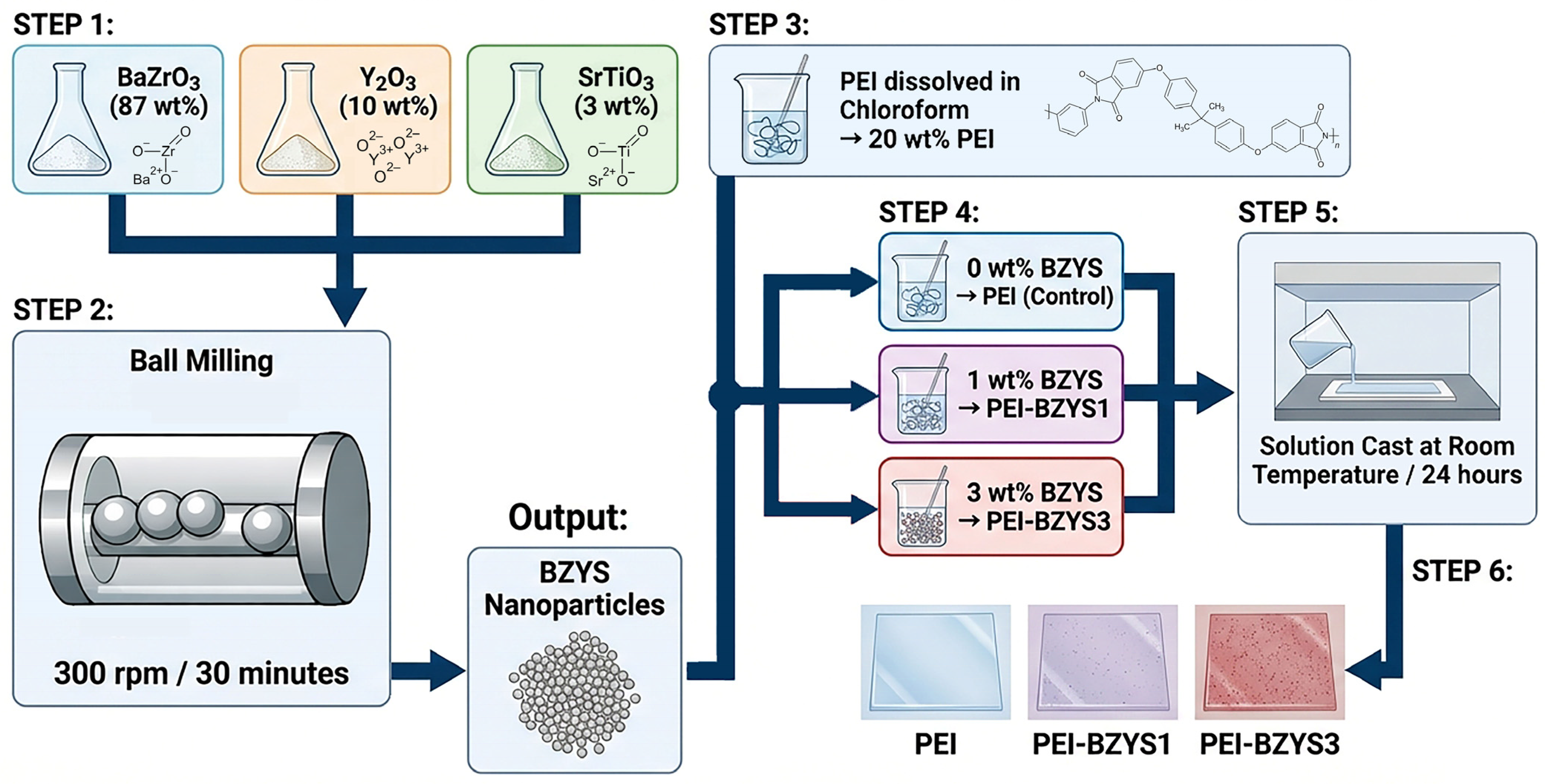
BaZrO3, SrTiO3 and Y2O3 were ball-milled at 300 rpm for 30 min. The weight percent ratio BaZrO3:Y2O3:SrTiO3 was 87:10:3. The composition was chosen after a series of preparations, based on desirable shape and size. For film preparation, 20 wt% of PEI in chloroform was solution cast and kept at room temperature for 24 h. BaZrO3-Y2O3-SrTiO3 (BZYS) nanoparticles were added in 1 and 3 wt%. Samples were denoted: PEI, PEI-BZYS1 and PEI-BZYS3. Preparation of composites is presented schematically in Figure 1.

2.2. Characterization of Particles and Composites

The morphology, particle size distribution, and dispersion of BaZrO3-Y2O3-SrTiO3 ceramic fillers within the polyetherimide (PEI) composites were examined using field emission scanning electron microscopy (FESEM) (Tescan Mira 3, Brno, Czech Republic) and FEI Scios 2. Quantitative image analysis of ceramic particle size was carried out using Image-Pro Plus 7.0 software (Rockville, MD, USA), based on three representative micrographs for each sample. The X-ray diffraction (XRD) was used for the identification of crystalline phases and the calculation of unit cell parameter and crystallite size. The XRD pattern was collected over the range 20° < 2θ < 80° on an Ital Structures APD2000 X-ray diffractometer using CuKα radiation (λ = 1.5418 Å) with the step size of 0.02° and the counting time of 1 s/step. Fourier transform infrared spectroscopy (FTIR) was employed to investigate possible structural and chemical changes in the ceramic fillers and composites following thermal treatment. Spectra were recorded using a Thermo Scientific Nicolet iS35 spectrometer (Waltham, MA, USA) in the wavenumber range of 4000–400 cm−1. Thermal properties of the PEI-based composites were evaluated by differential scanning calorimetry (DSC) using a TA Instruments Q10 calorimeter. Measurements were conducted at a heating rate of 10 °C min−1 under a nitrogen atmosphere with a flow rate of 50 mL min−1. The glass transition temperature (Tg) was determined from the midpoint of the inflection in the heat flow curve obtained during the first heating cycle. Microhardness measurements were carried out using an instrumented indentation method with a spherical indenter of 4 mm diameter. A load cell of 500 N was employed, with an indentation rate of 0.25 N s−1. The maximum load of 5 N was maintained for 20 s before unloading at the same rate, while force, time and indenter displacement were continuously recorded. For each sample, three independent indentations were performed at different locations. The hardness was determined according to the Oliver–Pharr analytical approach [37]. Statistical analysis of the mechanical testing results was conducted using one-way analysis of variance (ANOVA) in Origin 9 software (OriginLab, Northampton, MA, USA) to evaluate the effect of BaZrO3-Y2O3-SrTiO3 ceramic reinforcement on the properties of the PEI composites.

3. Results and Discussion

3.1. Morphology and Size Distribution of Ball-Milled BZYS Powders

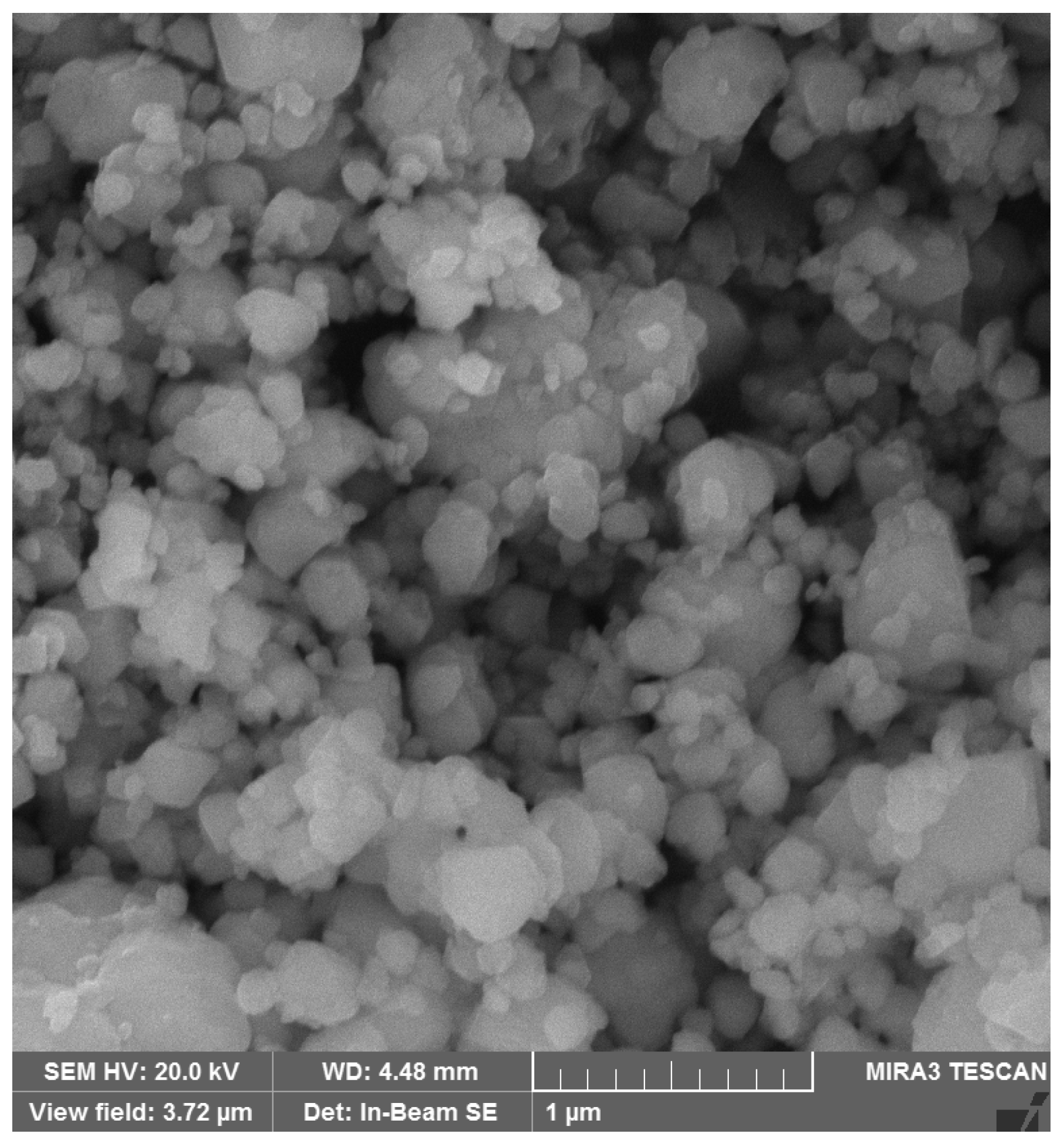
Quantitative image analysis of the ball-milled nanoparticles’ SEM micrographs (Figure 2) revealed a broad and right-skewed nanoparticle size distribution, indicating the coexistence of fine submicron particles and a limited number of larger secondary agglomerates. The diameter of the detected particles ranged from approximately 0.07 µm to 2.49 µm, with a median size of 0.17 µm and a mean value of 0.39 µm, reflecting the influence of occasional larger agglomerates on the average size. The relative frequency data (Table 1) show that the dominant fraction of agglomerates lies in the sub-0.5 µm range, accounting for approximately 67% of the total population. In particular, agglomerates smaller than 0.2 µm represent about 49% of all detected objects, confirming that ball milling effectively promotes fragmentation and refinement of particle assemblies. Furthermore, three-quarters of the agglomerates remain below the submicron scale.
In contrast, micron-scale secondary agglomerates (>1 µm) constitute a minor population (~19%), with only ~7% exceeding 1.5 µm. These larger features are attributed to partial cold welding and mechanical interlocking during milling. The presence of a small tail extending toward larger sizes is therefore consistent with mechanically induced agglomeration accompanying severe plastic deformation.
Overall, the agglomerate size distribution reflects a heterogeneous but predominantly fine morphology, characteristic of ball-milled ceramic powders, where intensive milling leads to crystallite refinement and submicron agglomeration while preserving a limited fraction of larger, loosely bound secondary clusters [38].

3.2. XRD Analysis of BaZrO3-Y2O3-SrTiO3 Nanoparticles

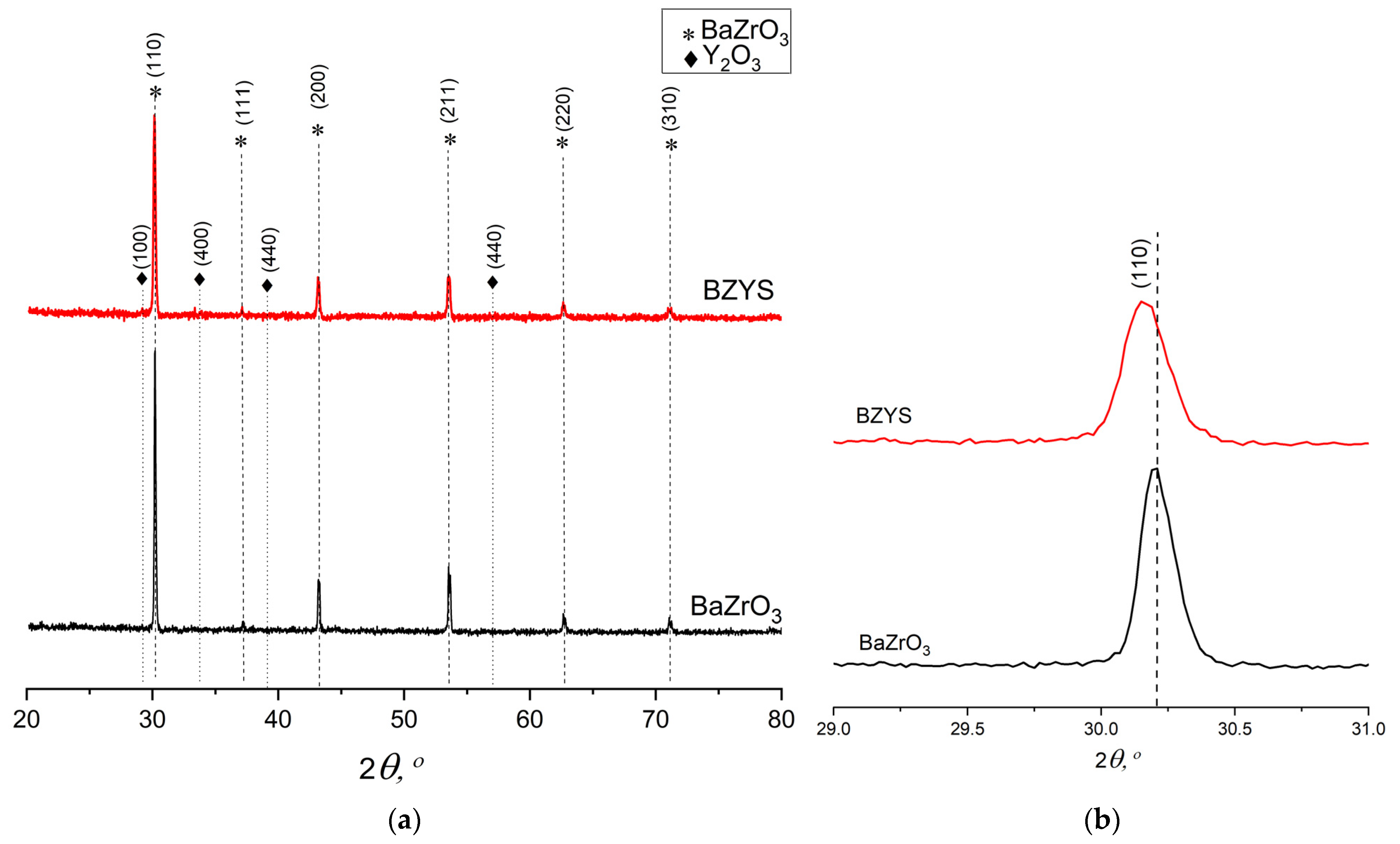
X-ray diffraction patterns of the commercial BaZrO3 powder and the mechanically activated BaZrO3-Y2O3-SrTiO3 mixture confirmed that the perovskite BaZrO3 phase remains structurally stable after ball milling at 300 rpm for 30 min (Figure 3). The dominant plane reflections (110), (111), (200), (211), (220) and (310) were observed at approximately 2θ ≈ 30°, 37°, 43°, 54°, 63° and 71° (Cu Kα), corresponding to the characteristic reflections of cubic BaZrO3, which agrees well with the PDF card number 06-0399 (a = 4.193, V = 73.7) [39]. The preservation of these reflections without the appearance of new dominant peaks indicates that the crystal structure of BaZrO3 is retained during mechanical activation.
Distinct diffraction peaks corresponding to crystalline cubic Y2O3 (2θ ≈ 29°, 33.8°, 48.5°, and 58°) were not detected within the instrumental detection limit, suggesting at least partial incorporation of Y3+ [5]. This indicates that a (Ba, Sr) (Zr, Ti, Y)O3 solid solution was probably formed. Sr2+ ions can occupy the places of Ba2+ ions in the lattice due to the similar size of the ionic radii of Ba2+ (1.61 Å, CN = 12) and Sr2+ (1.44 Å, CN = 12) ions. Additionally, Ti4+ (r = 0.605 Å, CN = 6) and Y3+ (r = 0.9 Å, CN = 6) can be incorporated into the BaZrO3 lattice on B site in the octahedral arrangement instead Zr4+ (r = 0.72 Å, CN = 6) [40]. The unit cell parameter was not determined from a single plane. Instead, it was calculated using software-assisted refinement of multiple BaZrO3 reflections, assuming cubic symmetry (space group Pm-3m). The refinement included the following reflections: (110), (111), (200), (211), (220) and (310), yielding unit cell parameter of a = 4.192(2) Å (V = 73.68(3) Å3) for the commercial BaZrO3 powder and a = 4.196(2) Å (V = 73.88(2) Å3) for the milled powder. The incorporation of Y causes a slight shift of (110) reflection of samples towards lower values of 2θ (Figure 3b), thus causing the slight increase in the BaZrO3 unit cell parameter and volume due to the partial incorporation of the Y3+ ions, with an ionic radius of 0.9 Å, on the Zr4+-sites (with a radius of 0.72 Å) [41]. The observed increase in lattice parameter (Δa ≈ 0.004 Å, ~0.1%) is consistent with this expectation. It is noteworthy that Sr2+ (1.44 Å vs. 1.61 Å for Ba2+) and Ti4+ (0.605 Å vs. 0.72 Å for Zr4+) would be expected to induce lattice contraction. The experimentally observed expansion, therefore, suggests that the effect of Y3+ substitution is dominant. The absence of detectable Y2O3 reflections suggests possible partial incorporation of Y3+ into the BaZrO3 lattice; however, the presence of nanoscale or poorly crystalline secondary phases below the detection limit of XRD cannot be excluded.
The average crystallite size was calculated using the Scherrer equation (Equation (1)) as implemented in the software package:
D = K × λ / ( β × cos Θ )
where
  • D represents the average crystallite size;
  • K = 0.9 (shape factor, assuming approximately spherical crystallites);
  • λ is the wavelength of Cu Kα radiation;
  • β is the full width at half maximum (FWHM) of the diffraction peak;
  • θ is the Bragg angle.
The calculation was performed for all clearly resolved BaZrO3 reflections, and the reported crystallite size represents the average value obtained from these reflections. The commercial BaZrO3 exhibited an average crystallite size of 78(3) nm, while the milled powder showed a decreased average crystallite size of 69(2) nm. It should be emphasized that Scherrer-derived values represent the coherent diffraction domain size and are influenced by both size- and strain-related peak broadening. Previous studies have shown that BaZrO3 maintains its cubic symmetry even after high-temperature treatments and chemical modification, highlighting its defect tolerance and chemical stability [42].
According to the analysis, the structural changes detected after milling are attributed to defect-induced distortion and limited cation substitution within the perovskite lattice, rather than the formation of a fully equilibrated, single-phase thermodynamic solid solution.

3.3. Filler Dispersion and Microstructure of PEI-BZYS Composites

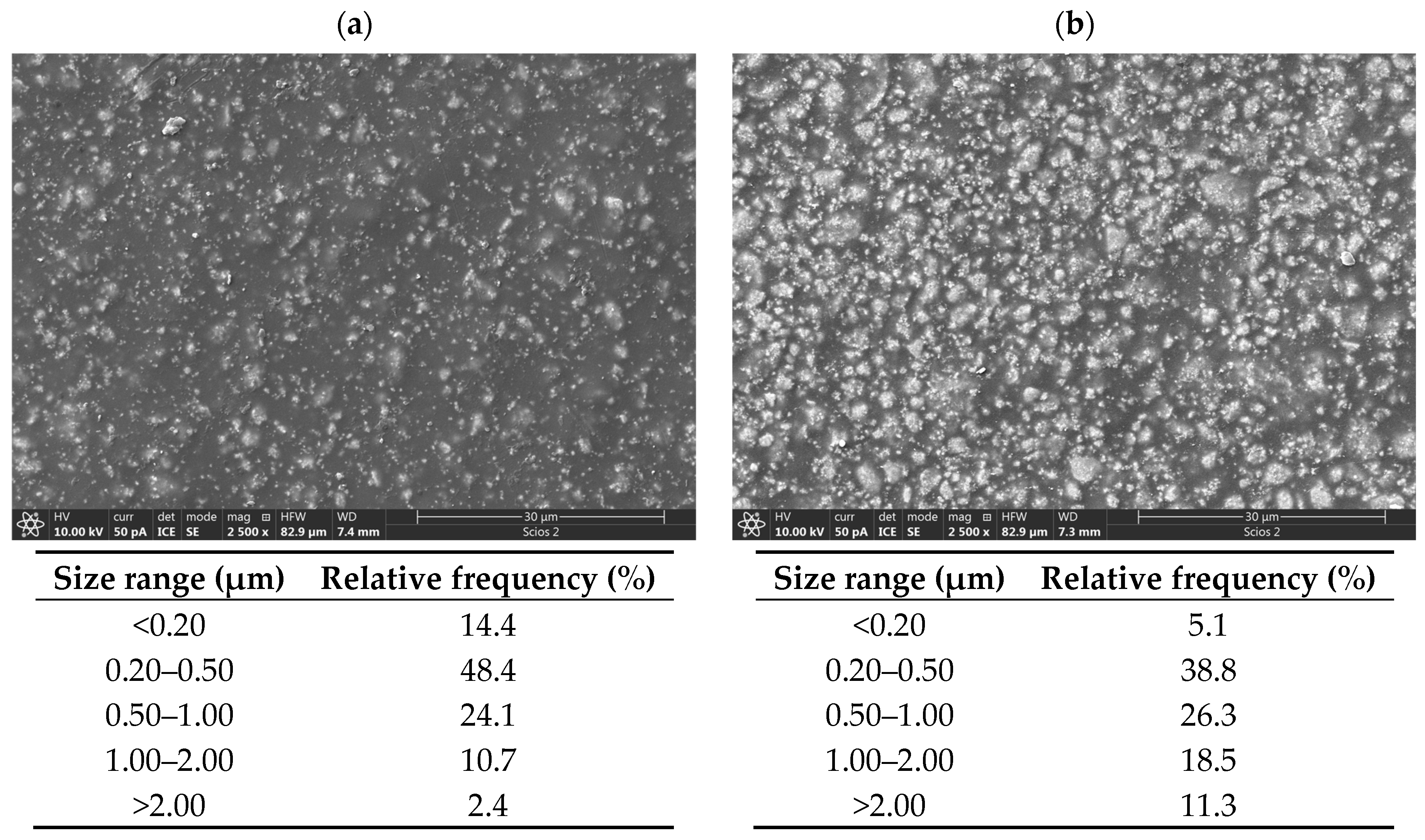
Following powder characterization, SEM analysis was conducted on surfaces of the PEI-BZYS composites to evaluate filler dispersion, interfacial interaction and microstructural homogeneity after solution casting (Figure 4). At 1 wt% loading (PEI–BZYS1), the microstructure exhibits a uniform spatial distribution of ceramic domains within the polymer matrix. Filler-rich regions are well separated and embedded within a continuous PEI phase, with no evidence of macroscopic phase segregation or percolating particle networks. The dispersed features are predominantly submicron in size, consistent with the initial powder morphology described in Section 3.1. The agglomerate size distribution is right-skewed, with a median diameter of 0.39 µm and only a small fraction of micron-scale agglomerates. The low proportion of particles exceeding 2 µm indicates that severe agglomeration of ceramics in PEI is effectively suppressed at this filler concentration. The observed morphology suggests that the processing route enables good particle wetting and spatial separation within the polymer matrix, while the limited presence of larger agglomerates likely arises from localized particle clustering rather than systematic phase separation [43].
The SEM image analysis of the PEI composite containing 3 wt% particles reveals a broader and more right-skewed particle size distribution compared to the 1 wt% system. While submicron particles remain dominant, the median diameter increases to 0.60 µm, and the upper quartile exceeds 1 µm, indicating a pronounced contribution from micron-scale agglomerates. The relative frequency data showed a rise in the presence of agglomerates larger than 1 µm, which is attributed to enhanced particle-particle interactions and partial agglomeration at higher filler loading. Nevertheless, the absence of large, continuous aggregates or network-like structures suggests that dispersion remains reasonably homogeneous at the microscale, with agglomeration occurring locally rather than through macroscopic phase separation. The absence of large voids or interfacial debonding further suggests adequate matrix–filler adhesion.

3.4. FTIR Analysis

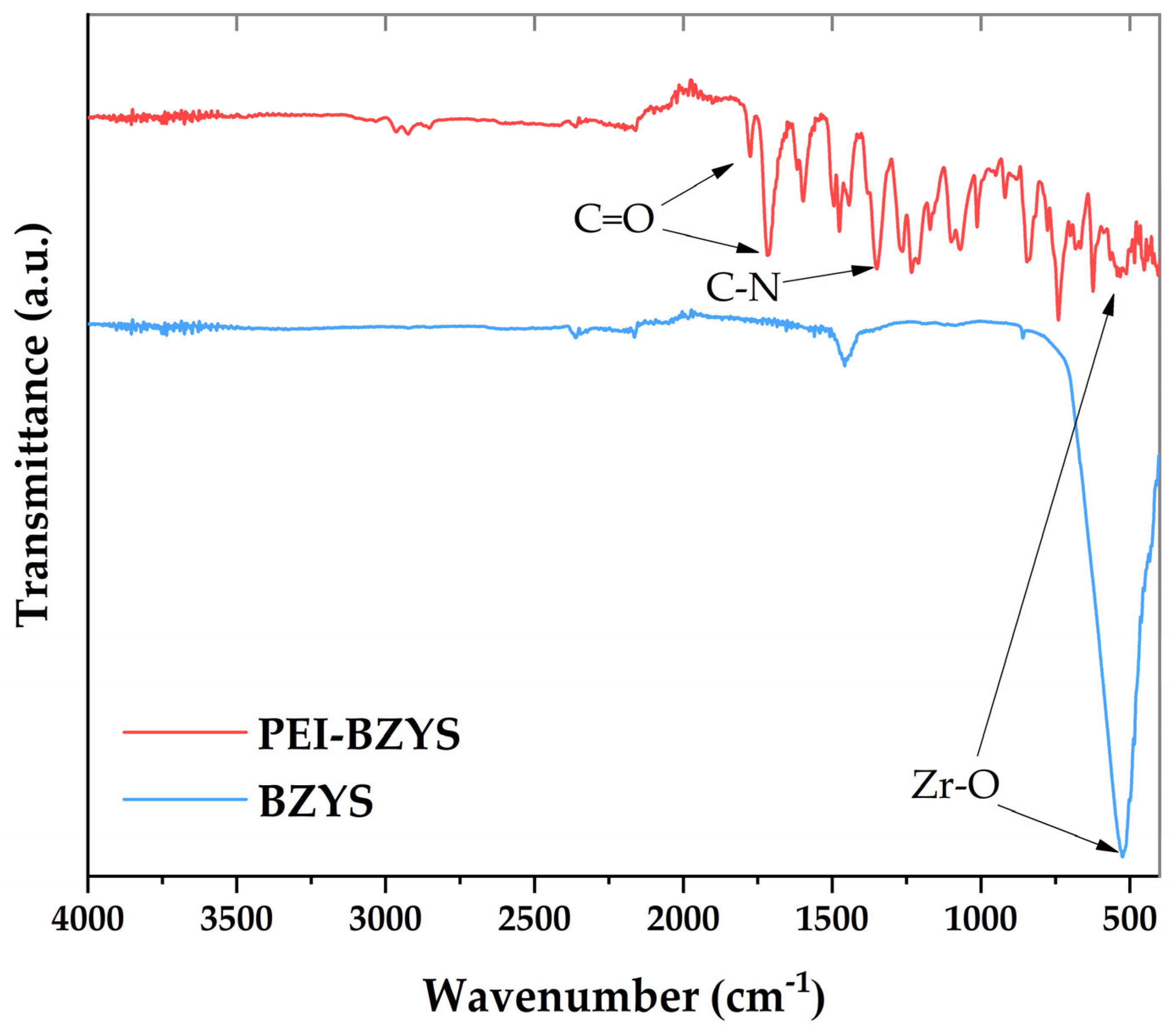
The FTIR spectrum of the PEI-BZYS3 composite (Figure 5) retains all characteristic absorption bands of polyetherimide, confirming that the incorporation of BaZrO3-Y2O3-SrTiO3 particles does not alter the chemical backbone of the polymer matrix. The strong imide carbonyl bands observed at approximately 1779 cm−1 and 1715 cm−1, corresponding to asymmetric and symmetric C=O stretching, respectively, are preserved in the composite, indicating the structural integrity of the PEI imide rings [44]. Additional PEI-related bands, including aromatic C=C stretching (~1597 cm−1), C–N stretching (~1350 cm−1), as well as ether C–O–C vibrations (~1232 cm−1), remain clearly visible [45]. In the low-wavenumber region, new absorption features appear in the composite spectrum that are absent in neat PEI and correspond to the ceramic reinforcement.
In the spectrum of BZYS3, the band observed at 1450 cm−1 corresponds to Ba–O, while the peak at 527 cm−1 is attributed to Zr–O and mixed metal–oxygen lattice vibrations, which are also present in the composite [40]. These bands confirm the successful incorporation of the ceramic phase into the polymer matrix. Importantly, no additional peaks or significant shifts in the PEI characteristic bands are detected, suggesting that the interaction between PEI and BZYS is predominantly physical rather than chemical in nature.

3.5. DSC Analysis

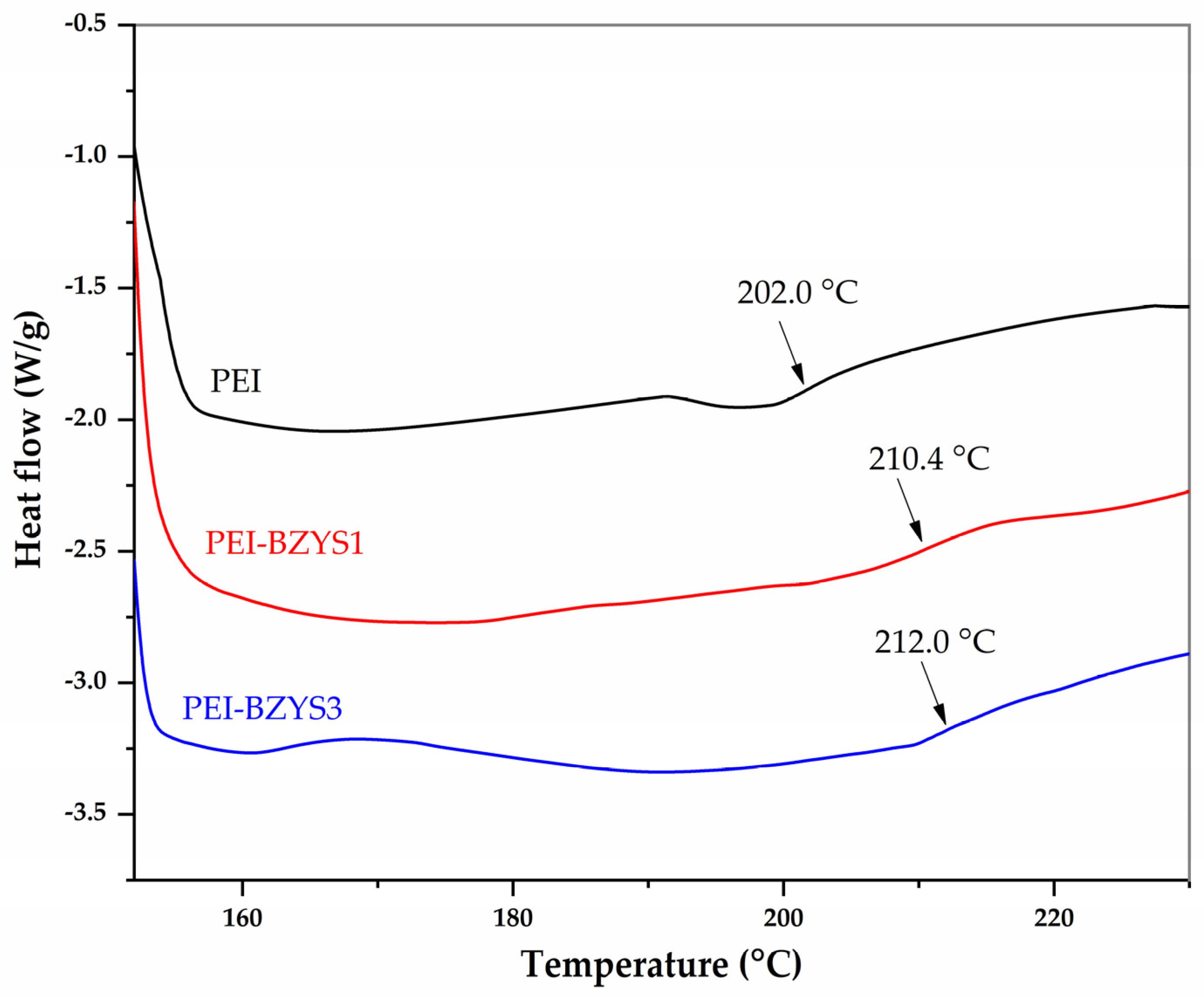
Differential scanning calorimetry (DSC) (Figure 6) revealed a clear glass-transition step for neat PEI and PEI/BaZrO3-Y2O3-SrTiO3 (BZYS) composites during the first heating cycle, with no distinct melting/crystallization peak in the investigated temperature range, confirming the predominantly amorphous nature of the matrix. The glass transition temperature (Tg), determined from the midpoint of the inflection, increased from 202.0 °C for neat PEI to 210.4 °C and 212.0 °C for composites containing 1 wt% and 3 wt% BZYS, respectively. The pronounced Tg shift at 1 wt% indicates that even low filler additions significantly restrict PEI segmental motion, likely due to polymer–particle interfacial interactions and the formation of an immobilized interphase that reduces free volume and hinders cooperative chain rearrangements. [46]. Increasing the loading from 1 wt% to 3 wt% produced only a marginal additional Tg rise, suggesting diminishing returns associated with partial saturation of the constrained-polymer fraction and/or reduced effective interfacial area at higher filler contents.

3.6. Microindentation Test

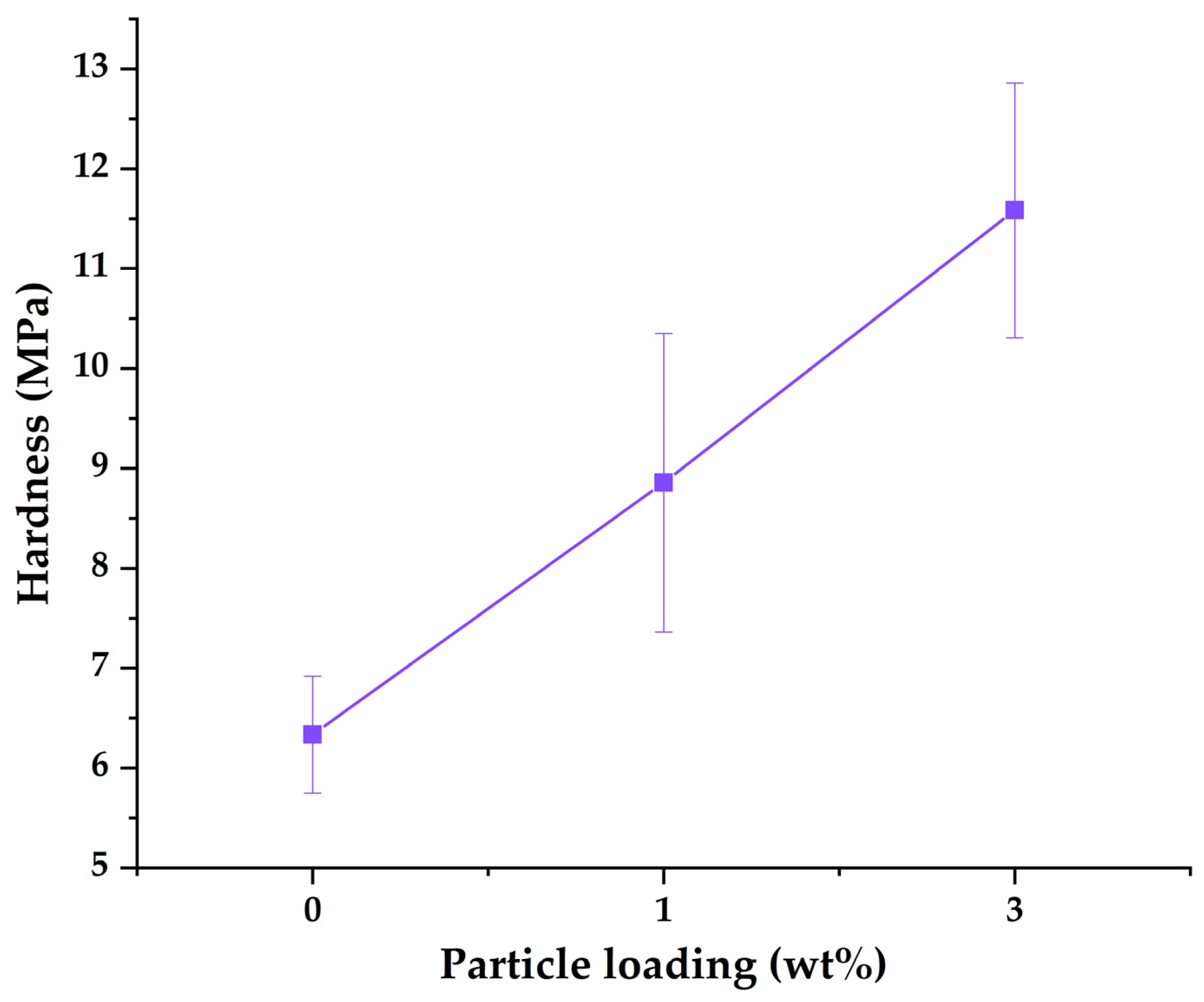
Microhardness testing results (Figure 7) demonstrate a pronounced strengthening effect induced by the incorporation of BaZrO3-Y2O3-SrTiO3 (BZYS) particles into the PEI matrix. Compared to neat PEI, the composite containing 1 wt% filler exhibited an increase in hardness of approximately 40%, while a further rise to 3 wt% resulted in an enhancement of about 83%, indicating a strong dependence of surface mechanical response on reinforcement loading [47]. This improvement can be directly correlated with the microstructural features revealed by SEM image analysis. At 1 wt% loading, particles are predominantly dispersed in the submicron range, providing effective reinforcement through localized restriction of polymer chain mobility and improved stress transfer at the particle-matrix interface. At 3 wt% loading, the highest microhardness values were achieved, which is consistent with the increased particle population and the higher contribution of submicron-to-micron-scale agglomerates observed in the SEM micrographs. The denser distribution of rigid ceramic domains enhances resistance to indenter penetration by increasing local constraint of the PEI matrix and promoting load sharing between the polymer and the reinforcing phase. Although a broader particle size distribution is observed at higher loading, the fraction of large agglomerates remains limited, indicating that the particle content value does not exceed the point at which severe aggregation or stress concentration would compromise load distribution.
The upward Tg shift and strong suppression of Tg-region enthalpic relaxation on first heating indicate reduced segmental mobility and diminished time-dependent rearrangement in the composites; combined with the intrinsic rigidity of BZYS ceramics, these effects limit indentation-induced chain flow and enhance load transfer, consistent with the measured hardness increases.
One-way ANOVA revealed statistically significant differences in hardness (p < 0.05) among the investigated compositions. Post hoc Tukey analysis demonstrated that the mean hardness values differ significantly between neat PEI and PEI-BZYS1, as well as between neat PEI and PEI-BZYS3 (p < 0.05), confirming the reinforcing effect of BaZrO3-Y2O3-SrTiO3 addition. The strong linear correlation between filler content and hardness, reflected by a high coefficient of determination (R2 = 0.9845), further indicates that reinforcement loading is a dominant factor governing the mechanical response of the composites within the investigated range. The observed microhardness enhancement arises from a synergistic combination of increased filler content, effective dispersion and controlled agglomeration, which together promote efficient stress transfer and restrict localized plastic deformation without inducing detrimental structural heterogeneity.
Although the present investigation was conducted using a PEI matrix, the reinforcing mechanism observed here may be conceptually extended to other polymer systems. In a conventional dental resin matrix based on poly(methyl methacrylate), the successful integration of perovskite SrTiO3-based particles was already achieved [48]. Similarly, in future research, reinforcement effects of perovskite BaZrO3-based hybrid oxides could be investigated within different dental formulations.

4. Conclusions

Novel BaZrO3-Y2O3-SrTiO3 (BZYS) ceramic nanoparticles were successfully incorporated into a polyetherimide matrix, producing structurally stable and mechanically reinforced composites. XRD analysis confirmed preservation of the BaZrO3 perovskite phase after mechanical activation, with a slight lattice expansion indicative of defect accommodation and ion incorporation, without phase degradation. SEM observations demonstrated predominantly nanoparticles and submicron agglomerates, as well as effective dispersion within the polymer matrix. Thermal analysis revealed a systematic increase in glass transition temperature, confirming restricted segmental mobility and the formation of a constrained polymer interphase. The most significant outcome was the pronounced microhardness enhancement, reaching 83% at 3 wt% reinforcement, with statistically significant differences compared to neat PEI. The strong linear relationship between filler content and hardness highlights efficient stress transfer and effective interfacial reinforcement. These findings establish BaZrO3-based hybrid oxide systems as viable alternatives to conventional ceramic fillers for high-performance polymer composites. Future work will focus on wear resistance, long-term aging stability and application in conventional resin-based dental composites, to further validate the relevance of this reinforcement strategy.

Author Contributions

Conceptualization, I.S. and V.R.; methodology, H.A.G.; validation, I.S. and V.R.; formal analysis, H.A.G., I.S., A.S., M.P., B.S. and D.B.S.; investigation, H.A.G.; writing—original draft preparation, H.A.G.; writing—review and editing, I.S., V.R., A.S., M.P., D.B.S. and B.S.; visualization, A.S.; supervision, I.S. and V.R.; funding acquisition, I.S. and V.R. All authors have read and agreed to the published version of the manuscript.

Funding

This work was financially supported by the Ministry of Science, Technological Development and Innovation of the Republic of Serbia (Grant Nos. 451-03-34/2026-03/200135, 451-03-33/2026-03/200017 and 451-03-136/2026-03/200026).

Institutional Review Board Statement

Not applicable.

Informed Consent Statement

Not applicable.

Data Availability Statement

The data presented in this study are available on request from the corresponding author. The data are not publicly available due to privacy reasons.

Conflicts of Interest

The authors declare no conflicts of interest. The funders had no role in the design of the study; in the collection, analyses, or interpretation of data; in the writing of the manuscript; or in the decision to publish the results.

References

  1. Cui, B.; Zhang, R.; Sun, F.; Ding, Q.; Lin, Y.; Zhang, L.; Nan, C. Mechanical and Biocompatible Properties of Polymer-Infiltrated-Ceramic-Network Materials for Dental Restoration. J. Adv. Ceram. 2020, 9, 123–128. [Google Scholar] [CrossRef]
  2. Simões, S. High-Performance Advanced Composites in Multifunctional Material Design: State of the Art, Challenges, and Future Directions. Materials 2024, 17, 5997. [Google Scholar] [CrossRef]
  3. Chelu, M.; Musuc, A.M. Advanced Biomedical Applications of Multifunctional Natural and Synthetic Biomaterials. Processes 2023, 11, 2696. [Google Scholar] [CrossRef]
  4. Aminoroaya, A.; Neisiany, R.E.; Khorasani, S.N.; Panahi, P.; Das, O.; Madry, H.; Cucchiarini, M.; Ramakrishna, S. A Review of Dental Composites: Challenges, Chemistry Aspects, Filler Influences, and Future Insights. Compos. Part B Eng. 2021, 216, 108852. [Google Scholar] [CrossRef]
  5. Elfakhri, F.; Alkahtani, R.; Li, C.; Khaliq, J. Influence of Filler Characteristics on the Performance of Dental Composites: A Comprehensive Review. Ceram. Int. 2022, 48, 27280–27294. [Google Scholar] [CrossRef]
  6. Chen, Y.; Sun, C.; Cao, J.; Wu, Y.; Cui, B.; Ma, J.; Wang, H. Mechanical Properties and In Vitro Biocompatibility of Hybrid Polymer-HA/BAG Ceramic Dental Materials. Polymers 2022, 14, 3774. [Google Scholar] [CrossRef]
  7. Chen, H.; Wei, S.; Wang, R.; Zhu, M. Improving the Physical–Mechanical Property of Dental Composites by Grafting Methacrylate-Polyhedral Oligomeric Silsesquioxane onto a Filler Surface. ACS Biomater. Sci. Eng. 2021, 7, 1428–1437. [Google Scholar] [CrossRef] [PubMed]
  8. Qi, K.; Hada, T.; Ren, X.; Iwaki, M.; Minakuchi, S.; Kanazawa, M. Effects of Different 3Y-TZP Nanoparticle Concentrations on Reinforcing Mechanical Properties of 3D-printed Resin Using Stereolithography Technology. J. Prosthodont. 2024, jopr.13995. [Google Scholar] [CrossRef]
  9. Wang, Y.; Xiao, S.; Lv, S.; Wang, X.; Wei, R.; Ma, Y. Mechanical and Antimicrobial Properties of Boron Nitride/Methacrylic Acid Quaternary Ammonium Composites Reinforced Dental Flowable Resins. ACS Biomater. Sci. Eng. 2024, 10, 1796–1807. [Google Scholar] [CrossRef] [PubMed]
  10. Khalil, B.I.; Gharkan, M.R.; Ali, A.H. Study of the Effects of Adding Yttrium Oxide Particles in Some Physical, Thermal, and Mechanical Properties of Heat-Curing Acrylic Resin. In Proceedings of the Technologies and Materials for Renewable Energy, Environment and Sustainability: TMREES18, Beirut, Lebanon, 1–3 February 2018; p. 030034. [Google Scholar]
  11. Ahmed, A.R.; Irhayyim, S.S.; Hammood, H.S. Effect of Yttrium Oxide Particles on the Mechanical Properties of Polymer Matrix Composite. IOP Conf. Ser. Mater. Sci. Eng. 2018, 454, 012036. [Google Scholar] [CrossRef]
  12. Augustine, R.; Dalvi, Y.B.; Yadu Nath, V.K.; Varghese, R.; Raghuveeran, V.; Hasan, A.; Thomas, S.; Sandhyarani, N. Yttrium Oxide Nanoparticle Loaded Scaffolds with Enhanced Cell Adhesion and Vascularization for Tissue Engineering Applications. Mater. Sci. Eng. C 2019, 103, 109801. [Google Scholar] [CrossRef]
  13. Rajendiran, A.; Uthirapathy, V. Thermal Barrier Coatings of YSZ Developed by Plasma Sprayed Technique and Its Effective Use in Orthopedic and Dental Application. J. Mater. Sci. Mater. Med. 2025, 36, 110. [Google Scholar] [CrossRef]
  14. Si, Y.; Liu, H.; Yu, H.; Jiang, X.; Sun, D. A Heterogeneous TiO2/SrTiO3 Coating on Titanium Alloy with Excellent Photocatalytic Antibacterial, Osteogenesis and Tribocorrosion Properties. Surf. Coat. Technol. 2022, 431, 128008. [Google Scholar] [CrossRef]
  15. Elhmali, H.T.; Stajcic, I.; Petrovic, M.; Jankovic, B.; Simovic, B.; Stajcic, A.; Radojevic, V. Mechanical Performance of Denture Acrylic Resin Modified with Poly(4-styrenesulfonic Acid-co-maleic Anhydride) Sodium Salt and Strontium Titanate. Polym. Compos. 2024, 45, 11404–11415. [Google Scholar] [CrossRef]
  16. Elhmali, H.T.; Radojevic, V.; Stajcic, A.; Petrovic, M.; Stojanovic, D.B.; Vlahovic, B.; Stajcic, I. Denture Base Poly(Methyl Methacrylate) Reinforced with SrTiO3/Y2O3: Structural, Morphological and Mechanical Analysis. Polym. Compos. 2025, 46, 8831–8840. [Google Scholar] [CrossRef]
  17. Lin, H.-N.; Chen, M.-S.; Chang, P.-J.; Lee, Y.-C.; Chen, C.-Y.; Chiou, Y.-J.; Lin, C.-K. Synthesis and Characterization of Sol–Gelled Barium Zirconate as Novel MTA Radiopacifiers. Materials 2024, 17, 3015. [Google Scholar] [CrossRef] [PubMed]
  18. Azad, A.-M.; Subramaniam, S.; Dung, T.W. On the Development of High Density Barium Metazirconate (BaZrO3) Ceramics. J. Alloys Compd. 2002, 334, 118–130. [Google Scholar] [CrossRef]
  19. Fransson, E.; Rosander, P.; Erhart, P.; Wahnström, G. Understanding Correlations in BaZrO3: Structure and Dynamics on the Nanoscale. Chem. Mater. 2024, 36, 514–523. [Google Scholar] [CrossRef]
  20. Yılmaz, E.E.; Koşma, E.B.; Figen, H.E.; Elibol, M.K. Physicochemical Characterization of Calcium-Doped Barium Zirconate Perovskites for Hydrogen-Induced Systems and Their Life Cycle Assessment. Int. J. Hydrogen Energy 2025, 143, 1267–1278. [Google Scholar] [CrossRef]
  21. Nayak, A.K.; Sasmal, A. Recent Advance on Fundamental Properties and Synthesis of Barium Zirconate for Proton Conducting Ceramic Fuel Cell. J. Clean. Prod. 2023, 386, 135827. [Google Scholar] [CrossRef]
  22. Knight, K.S. Low-Temperature Thermophysical and Crystallographic Properties of BaZrO3 Perovskite. J. Mater. Sci. 2020, 55, 6417–6428. [Google Scholar] [CrossRef]
  23. Savchyn, V.P.; Popov, A.I.; Aksimentyeva, O.I.; Klym, H.; Horbenko, Y.Y.; Serga, V.; Moskina, A.; Karbovnyk, I. Cathodoluminescence Characterization of Polystyrene-BaZrO3 Hybrid Composites. Low Temp. Phys. 2016, 42, 597–600. [Google Scholar] [CrossRef]
  24. Enhessari, M.; Shaterian, M.; Ozaee, K.; Karamali, E. Synthesis and Thermal Properties of Polyimide/BaZrO3 Novel Nanocomposites. Polym.-Plast. Technol. Eng. 2012, 51, 345–349. [Google Scholar] [CrossRef]
  25. Li, Y.; Qiao, Z.; Li, S.; Liu, F.; Tan, J. High-Strength and Low-Thermal Conductivity La-Doped BaZrO3-Based Composite Ceramic and Its Thermodynamic Stability Evaluation. Ceram. Int. 2024, 50, 18750–18757. [Google Scholar] [CrossRef]
  26. Kumar, S.; Rath, T.; Mahaling, R.N.; Reddy, C.S.; Das, C.K.; Pandey, K.N.; Srivastava, R.B.; Yadaw, S.B. Study on Mechanical, Morphological and Electrical Properties of Carbon Nanofiber/Polyetherimide Composites. Mater. Sci. Eng. B 2007, 141, 61–70. [Google Scholar] [CrossRef]
  27. Ahamad, A.; Kumar, P. Mechanical and Thermal Performance of PEEK/PEI Blend Matrix Reinforced with Surface Modified Halloysite Nanotubes. J. Thermoplast. Compos. Mater. 2023, 36, 657–672. [Google Scholar] [CrossRef]
  28. Radu, E.R.; Voicu, S.I.; Thakur, V.K. Polymeric Membranes for Biomedical Applications. Polymers 2023, 15, 619. [Google Scholar] [CrossRef] [PubMed]
  29. Tao, C.-T.; Young, T.-H. Polyetherimide Membrane Formation by the Cononsolvent System and Its Biocompatibility of MG63 Cell Line. J. Membr. Sci. 2006, 269, 66–74. [Google Scholar] [CrossRef]
  30. Haase, T.; Krost, A.; Sauter, T.; Kratz, K.; Peter, J.; Kamann, S.; Jung, F.; Lendlein, A.; Zohlnhöfer, D.; Rüder, C. In Vivo Biocompatibility Assessment of Poly (Ether Imide) Electrospun Scaffolds: In Vivo Biocompatibility Assessment of PEI Electrospun Scaffolds. J. Tissue Eng. Regen. Med. 2017, 11, 1034–1044. [Google Scholar] [CrossRef]
  31. Suffo, M.; López-Marín, C.; Revenga, C.; Andrés-Cano, P. Polyetherimide in 3D Printing: Pioneering Non-Metallic Solutions for Personalized Orthopedic and Traumatology Hip Prosthetics. Results Eng. 2024, 23, 102372. [Google Scholar] [CrossRef]
  32. Alshamrani, A.; Alhotan, A.; Kelly, E.; Ellakwa, A. Mechanical and Biocompatibility Properties of 3D-Printed Dental Resin Reinforced with Glass Silica and Zirconia Nanoparticles: In Vitro Study. Polymers 2023, 15, 2523. [Google Scholar] [CrossRef]
  33. Moriche, R.; Artigas-Arnaudas, J.; Chetwani, B.; Sánchez, M.; Campo, M.; Prolongo, M.G.; Rams, J.; Prolongo, S.G.; Ureña, A. Microhardness and Wear Behavior of Nanodiamond-reinforced Nanocomposites for Dental Applications. Polym. Compos. 2025, 46, 2292–2303. [Google Scholar] [CrossRef]
  34. Wu, Y.-R.; Chang, C.-W.; Ko, C.-L.; Wu, H.-Y.; Chen, W.-C. The Morphological Effect of Calcium Phosphates as Reinforcement in Methacrylate-Based Dental Composite Resins on Mechanical Strength through Thermal Cycling. Ceram. Int. 2017, 43, 14389–14394. [Google Scholar] [CrossRef]
  35. Shahkar, L.; Malek Khachatourian, A.; Nemati, A. Fabrication and Characterization of PMMA Denture Base Nanocomposite Reinforced with Hydroxyapatite and Multi-Walled Carbon Nanotubes. Diam. Relat. Mater. 2024, 147, 111377. [Google Scholar] [CrossRef]
  36. Sun, Z.; Guo, F.-L.; Li, Y.-Q.; Hu, J.-M.; Liu, Q.-X.; Mo, X.-L.; Huang, P.; Fu, S.-Y. Effects of Carbon Nanotube-Polydopamine Hybridization on the Mechanical Properties of Short Carbon Fiber/Polyetherimide Composites. Compos. Part B Eng. 2022, 236, 109848. [Google Scholar] [CrossRef]
  37. Taboun, A.; Jovanovic, M.; Petrovic, M.; Stajcic, I.; Pesic, I.; Stojanovic, D.B.; Radojevic, V. Citric Acid Cross-Linked Gelatin-Based Composites with Improved Microhardness. Polymers 2024, 16, 1077. [Google Scholar] [CrossRef]
  38. Reyes-Vallejo, O.; Sánchez-Albores, R.M.; Cano, F.J.; Garcia, J.C.; Torres-Ventura, H.H.; Adhikari, A. Nanomaterial Synthesis via Ball Milling: Tailoring Properties for Energy and Environmental Solutions. In Handbook of Nanomaterials and Nanocomposites for Energy and Environmental Applications; Kharissova, O.V., Torres-Martínez, L.M., Kharisov, B.I., Eds.; Springer Nature: Cham, Switzerland, 2026; pp. 1–33. ISBN 978-3-030-11155-7. [Google Scholar]
  39. Butt, S.H.; Rafique, M.S.; Bashir, S.; Mehmood, K.; Mahmood, A. Aliovalent Ho3+ Ion Doped BaZrO3 Thin Films; Structural, Optical and Photoluminescence Properties. Ceram. Int. 2019, 45, 5648–5652. [Google Scholar] [CrossRef]
  40. Shannon, R.D. Revised Effective Ionic Radii and Systematic Studies of Interatomic Distances in Halides and Chalcogenides. Acta Cryst. A 1976, 32, 751–767. [Google Scholar] [CrossRef]
  41. Arslanlar, Y.T.; Alajlani, Y.; Coban, M.B.; Kaynar, U.H.; Aydin, H.; Örücü, H.; Guinea, J.G.; Can, N. Structural and Thermal Insights into the Luminescent Behavior of Dy3+-Doped BaZrO3 with Alkali Metal Codopants under UV Radiation. Appl. Radiat. Isot. 2025, 218, 111698. [Google Scholar] [CrossRef] [PubMed]
  42. Yu-Meng, J.; Zhong-Xiang, S.; Jing, W.; Yu-Jia, Y. Preparation of Tm3+ Ion-Doped BaZrO3 Powder and Its Luminescence Performance Study. Chem. Phys. Lett. 2023, 817, 140411. [Google Scholar] [CrossRef]
  43. Kong, M.; Chen, G.; Xi, S.; Huang, Y.; Li, G. Morphology Mapping of Nanoparticle-Filled Immiscible Polymer Blends in Flow: The Existence of a Critical Ratio between Nanoparticle Concentration and Droplet Concentration. ACS Omega 2018, 3, 11550–11557. [Google Scholar] [CrossRef] [PubMed]
  44. Machatschek, R.; Heuchel, M.; Lendlein, A. Hydrolytic Stability of Polyetherimide Investigated in Ultrathin Films. J. Mater. Res. 2021, 36, 2987–2994. [Google Scholar] [CrossRef]
  45. Chen, B.-K.; Su, C.-T.; Tseng, M.-C.; Tsay, S.-Y. Preparation of Polyetherimide Nanocomposites with Improved Thermal, Mechanical and Dielectric Properties. Polym. Bull. 2006, 57, 671–681. [Google Scholar] [CrossRef]
  46. Kayginok, F.; Karabal, M.; Yıldız, A.; Cebeci, H. CNT Reinforced PEI and PEEK Nanocomposites: A Comparison on the Thermal and Rheological Properties. Polym. Test. 2024, 137, 108519. [Google Scholar] [CrossRef]
  47. Yadav, R.; Singh, M.; Shekhawat, D.; Lee, S.-Y.; Park, S.-J. The Role of Fillers to Enhance the Mechanical, Thermal, and Wear Characteristics of Polymer Composite Materials: A Review. Compos. Part A Appl. Sci. Manuf. 2023, 175, 107775. [Google Scholar] [CrossRef]
  48. Elhmali, H.T.; Stajcic, I.; Stajcic, A.; Pesic, I.; Jovanovic, M.; Petrovic, M.; Radojevic, V. Influence of Novel SrTiO3/MnO2 Hybrid Nanoparticles on Poly(Methyl Methacrylate) Thermal and Mechanical Behavior. Polymers 2024, 16, 278. [Google Scholar] [CrossRef]
Figure 1. Experimental procedure for processing of composite films.
Applsci 16 02529 g001
Figure 2. FESEM of BaZrO3-Y2O3-SrTiO3 nanoparticles.
Applsci 16 02529 g002
Figure 3. (a) XRD patterns of commercial BaZrO3 and prepared BaZrO3-Y2O3-SrTiO3 nanoparticles (*—represents peaks of BaZrO3, ◆—represents peaks of Y2O3). (b) Enlarged part of XRD patterns corresponding to the (110) reflection.
Applsci 16 02529 g003
Figure 4. Surface morphology and corresponding agglomerate size distribution of: (a) PEI-BZYS1, (b) PEI-BZYS3.
Applsci 16 02529 g004
Figure 5. FTIR spectra of BaZrO3-Y2O3-SrTiO3 (BZYS) particles and PEI-BZYS3 composite (3 wt% of BZYS).
Applsci 16 02529 g005
Figure 6. Thermal analysis curves for PEI and composite films with 1 wt% of BZYS (PEI-BZYS1) and 3 wt% (PEI-BZYS3).
Applsci 16 02529 g006
Figure 7. Hardness dependence on BZYS particle content in PEI-BZYS composites with 1 wt% and 3 wt% of BZYS.
Applsci 16 02529 g007
Table 1. Particle size distribution.
Size Range (µm)Relative Frequency (%)
<0.1018.6
0.10–0.2030.2
0.20–0.309.3
0.30–0.404.7
0.40–0.504.7
0.50–0.759.3
0.75–1.004.7
1.00–1.509.3
1.50–2.002.3
2.00–2.507.0
Disclaimer/Publisher’s Note: The statements, opinions and data contained in all publications are solely those of the individual author(s) and contributor(s) and not of MDPI and/or the editor(s). MDPI and/or the editor(s) disclaim responsibility for any injury to people or property resulting from any ideas, methods, instructions or products referred to in the content.