AI- and Ontology-Based Enhancements to FMEA for Advanced Systems Engineering: Current Developments and Future Directions


Abstract
1. Introduction
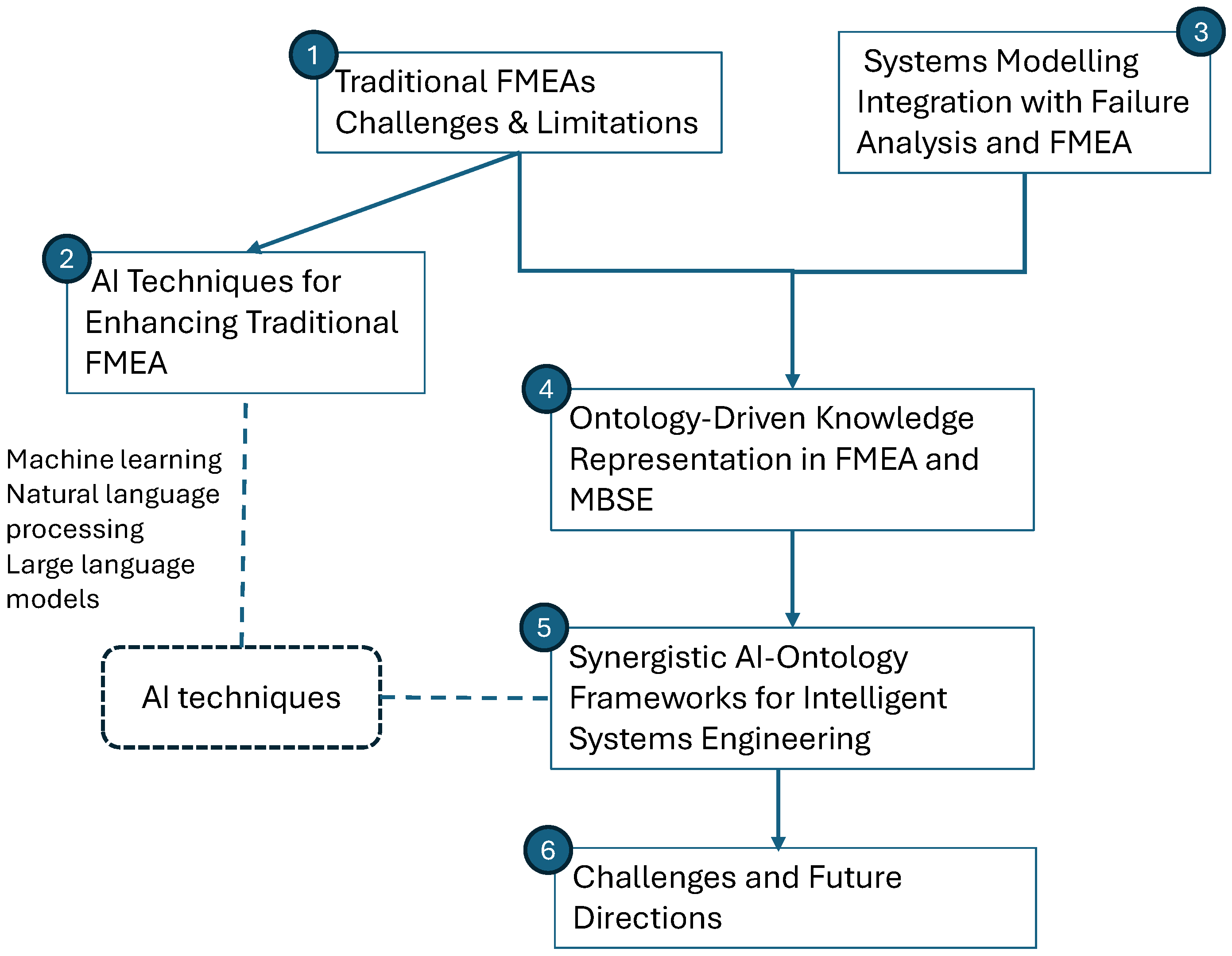
- How can AI- and ontology-based approaches transform traditional FMEA into an intelligent, explainable, and model-integrated process within systems engineering?
- 1.
- It critically analyses the limitations and evolution of conventional FMEA in managing system complexity and lifecycle integration;
- 2.
- It reviews advances in function modelling and the transition toward MBSE, highlighting their impact on traceability and risk management;
- 3.
- It synthesises the role of ontologies in formalising engineering knowledge to enable semantic reasoning and interoperability;
- 4.
- It evaluates how AI techniques, particularly ML, NLP, and LLMs, can augment and automate risk prediction, prioritisation, and system reasoning.
2. Foundations of FMEA-Based Systems Engineering
2.1. Overview of FMEA in Design and Reliability Engineering
2.2. Standards, Practices, Tools, and Limitations
2.3. Role of FMEA in System-Level Risk Management
2.4. Need for Evolution to Address Complexity, Traceability, and Adaptability Issues
3. Critical Review of Enhancement of FMEA with AI Techniques
3.1. AI Methods for Failure Prediction and Mode Classification
3.2. Machine Learning for Automated FMEA Prioritisation
3.3. Natural Language Processing for Analysing Failure Records and Maintenance Logs
3.4. Benefits and Challenges of AI Integration in FMEA
- 1.
- Early and Accurate Failure Detection: AI models such as Bayesian networks, decision trees, and LSTM neural networks enable predictive diagnostics by identifying patterns and anomalies in historical and real-time operational data.
- 2.
- Automated and Scalable Risk Prioritisation: Machine learning techniques automate the calculation of Severity, Occurrence, and Detection scores, reducing subjectivity and enabling consistent, scalable RPN generation.
- 3.
- Knowledge Extraction from Unstructured Data: Natural Language Processing facilitates the transformation of free-text maintenance logs and repair records into structured insights, enriching the FMEA process with operational knowledge that was previously difficult to access.
- 4.
- Reduced Expert Workload through Semi-supervised Learning: Active learning frameworks and AI-assisted annotation tools reduce reliance on expert input by combining human-in-the-loop strategies with machine-led generalisation, significantly reducing the amount of time and effort needed for model training.
- 5.
- Support for Real-time and Context-aware Diagnostics: AI systems can dynamically adapt to different use cases and environments, offering contextualised risk analysis that supports digital twin applications, PHM frameworks, and system health monitoring.
- 6.
- Enhanced Decision Support and Continuous Improvement: Integration of AI enables continuous updates and refinement of risk models, supporting a closed feedback loop between design, operation, and maintenance phases.
- Data Limitations and Quality Issues: Insufficient or noisy failure data, particularly in early-stage systems, limits the performance and generalisability of AI models.
- Semantic and Contextual Ambiguity: NLP models often underperform on domain-specific terminology, requiring additional training or knowledge integration to ensure reliable outputs.
- Lack of Explainability and Trust: Complex AI models may deliver accurate predictions but are often perceived as black boxes, complicating their acceptance in high-stakes engineering decisions.
- Domain and System Dependency: AI models must often be re-engineered for different industrial contexts, which limits plug-and-play applicability across diverse systems.
- Technical Integration Barriers: Embedding AI tools within existing FMEA workflows demands significant expertise, computational infrastructure, and organisational readiness.
4. Function Modelling and Model-Based Systems Engineering (MBSE)
4.1. Foundations of Function Modelling and Behaviour in Systems Engineering
4.2. FBS and Alternative Frameworks in Conceptual Design
4.3. From Document-Centric to Model-Based Systems Engineering
4.4. Integrating Function Modelling with Risk Analysis and FMEA
- Sierla et al. [135] introduced the Functional Failure Identification and Propagation (FFIP) framework for early hazard detection using limited design information. However, subsequent quantitative analysis (e.g., FTA, PRA) is still required.
- Mansoor et al. [136] proposed a backward failure propagation method to improve conceptual design robustness by tracing failure causes. Its abstract nature, however, limits fidelity without detailed models.
- Russomanno et al. [137] developed XFMEA, an expert system integrating functional failure reasoning, though challenges remain with regard to knowledge formalisation.
- Tumer and Stone[138] linked component functionality to failure modes via a matrix-based method, aiding design analysis but lacking coverage of non-functional aspects.
- Stone et al. [24] presented the Function–Failure Design Method (FFDM) to support FMEA-style analysis in conceptual design, though operational and maintenance considerations remain separate.
- High System Complexity: dealing with a large number of interconnected components and subsystems [2].
- Data Integration Challenges: integrating data from various sources (e.g., CAD, simulation, testing) into the FMEA process [81].
- Multidisciplinary Integration: coordinating efforts across different engineering disciplines (e.g., mechanical, electrical, software) [139].
- Managing Interfaces: effectively managing the interfaces between different subsystems and components [140].
5. Knowledge Representation Through Ontologies
5.1. Role of Ontologies in Representing System Knowledge (Functions, Failures, Behaviours)
5.2. Domain Ontologies, Upper Ontologies, and Knowledge Graphs
5.3. Ontology-Based Modelling of FMEA Artefacts and System Behaviour
5.4. Design, Validation, and Reuse of Engineering Ontologies
- NeOn supports collaborative, modular, and iterative development, suited for distributed projects.
- Methontology follows a traditional, phased approach ideal for centrally managed projects.
- DILIGENT facilitates decentralised, consensus-driven development, particularly useful in open, web-based environments.
5.5. Integration with MBSE Frameworks
6. AI–Ontology Synergy in Systems Engineering
6.1. Ontologies Powering Explainable AI for Engineering Decisions
6.2. Hybrid Approaches: Ontology-Informed Machine Learning and LLM Integration
6.3. Emerging Tools and Platforms
7. Challenges and Future Directions
7.1. Interoperability and Data Integration Across Engineering Domains
7.2. Scalability and Standardisation of Engineering Ontologies
7.3. Trust, Explainability, and Validation of AI-Enhanced FMEA
7.4. Need for Interdisciplinary Collaboration and Toolchain Development
7.5. Vision: Adaptive, Knowledge-Driven Engineering Platforms
8. Conclusions
Author Contributions
Funding
Data Availability Statement
Conflicts of Interest
References
- Syed, S. Planet 2050 and the Future of Manufacturing: Data-Driven Approaches to Sustainable Production in Large Vehicle Manufacturing Plants. J. Comput. Anal. Appl. 2024, 33, 799–808. [Google Scholar] [CrossRef] [Scilit]
- Younus, H.; Doikin, A.; Campean, F.; Kabir, S.; Abdullatif, A.; Delaux, D.; Bonnaud, P. An Extended Function-Behaviour-Structure Ontology to support FMEA within a System Engineering Context. Procedia CIRP 2024, 128, 644–649. [Google Scholar] [CrossRef] [Scilit]
- Korsunovs, A.; Doikin, A.; Campean, F.; Kabir, S.; Hernandez, E.M.; Taggart, D.; Parker, S.; Mills, G. Towards a model-based systems engineering approach for robotic manufacturing process modelling with automatic FMEA generation. Proc. Des. Soc. 2022, 2, 1905–1914. [Google Scholar] [CrossRef] [Scilit]
- Akundi, A.; Mondragon, O.; Ortiz, M.; Tseng, B.; Luna, S.; Lopez, V. Online Model-based Systems Engineering (MBSE) Bootcamp: A Report on Two Day Workforce Development Workshop. In Proceedings of the 2022 IEEE International Systems Conference (SysCon); IEEE: New York, NY, USA, 2022; pp. 1–6. [Google Scholar] [CrossRef] [Scilit]
- Baydaroğlu, Ö.; Yeşilköy, S.; Sermet, M.Y.; Demir, I. A comprehensive review of ontologies in the hydrology towards guiding next generation artificial intelligence applications. J. Environ. Inform. 2023, 42, 90–107. [Google Scholar] [CrossRef] [Scilit]
- Gope, P.; Gheraibia, Y.; Kabir, S.; Sikdar, B. A secure IoT-based modern healthcare system with fault-tolerant decision making process. IEEE J. Biomed. Health Inform. 2020, 25, 862–873. [Google Scholar] [CrossRef] [Scilit]
- Tsaneva, S.; Vasic, S.; Sabou, M. LLM-driven Ontology Evaluation: Verifying Ontology Restrictions with ChatGPT. Semant. Web ESWC Satell. Events 2024, 2024, 1–15. [Google Scholar]
- Ebeling, C.E. An Introduction to Reliability and Maintainability Engineering; Waveland Press: Long Grove, IL, USA, 2019. [Google Scholar]
- Albreem, M.A.; Sheikh, A.M.; Alsharif, M.H.; Jusoh, M.; Yasin, M.N.M. Green Internet of Things (GIoT): Applications, practices, awareness, and challenges. IEEE Access 2021, 9, 38833–38858. [Google Scholar] [CrossRef] [Scilit]
- Abdulhamid, A.; Kabir, S.; Ghafir, I.; Lei, C. An overview of safety and security analysis frameworks for the internet of things. Electronics 2023, 12, 3086. [Google Scholar] [CrossRef] [Scilit]
- Vyasa, V.; Xub, Z. Maintenance in automotive and aerospace applications—An overview. Int. J. Adv. Sci. Trans. 2024, 3, 349–361. [Google Scholar]
- Dakić, P.; Stupavskỳ, I.; Todorović, V. The effects of global market changes on automotive manufacturing and embedded software. Sustainability 2024, 16, 4926. [Google Scholar] [CrossRef] [Scilit]
- Liu, S.; Guo, C.; Al-Turjman, F.; Muhammad, K.; de Albuquerque, V.H.C. Reliability of response region: A novel mechanism in visual tracking by edge computing for IIoT environments. Mech. Syst. Signal Process. 2020, 138, 106537. [Google Scholar] [CrossRef] [Scilit]
- Kim, K.O.; Zuo, M.J. General model for the risk priority number in failure mode and effects analysis. Reliab. Eng. Syst. Saf. 2018, 169, 321–329. [Google Scholar] [CrossRef] [Scilit]
- Segismundo, A.; Augusto Cauchick Miguel, P. Failure mode and effects analysis (FMEA) in the context of risk management in new product development: A case study in an automotive company. Int. J. Qual. Reliab. Manag. 2008, 25, 899–912. [Google Scholar] [CrossRef] [Scilit]
- Battirola Filho, J.C.; Piechnicki, F.; Loures, E.d.F.R.; Santos, E.A.P. Process-aware FMEA framework for failure analysis in maintenance. J. Manuf. Technol. Manag. 2017, 28, 822–848. [Google Scholar] [CrossRef] [Scilit]
- de Andrade, J.M.; de M Leite, A.F.; Canciglieri, M.B.; Szejka, A.L.; Loures, E.d.F.; Canciglieri Junior, O. A multi-criteria approach for FMEA in product development in industry 4.0. In Transdisciplinary Engineering for Complex Socio-technical Systems–Real-Life Applications; IOS Press: Amsterdam, The Netherlands, 2020; pp. 311–320. [Google Scholar]
- Moreira, A.C.; Ferreira, L.M.D.; Silva, P. A case study on FMEA-based improvement for managing new product development risk. Int. J. Qual. Reliab. Manag. 2021, 38, 1130–1148. [Google Scholar] [CrossRef] [Scilit]
- Ionescu, N.; Ionescu, L.M.; Rachieru, N.; Mazare, A.G. A model for monitoring of the 8D and FMEA tools interdependence in the era of Industry 4.0. Int. J. Mod. Manuf. Technol. 2022, 14, 86–91. [Google Scholar] [CrossRef] [Scilit]
- Doğan, O.; Cebeci, U. A methodology for new product development by using QFD, FMEA and its application in metal plating industry. In Proceedings of the 16th Production Research Symposium, İstanbul, Turkey, 12–14 October 2016; pp. 1–22. [Google Scholar]
- Garcia Aguirre, P.A.; Perez-Dominguez, L.; Luviano-Cruz, D.; Solano Noriega, J.J.; Martinez Gomez, E.; Callejas-Cuervo, M. PFDA-FMEA, an integrated method improving FMEA assessment in product design. Appl. Sci. 2021, 11, 1406. [Google Scholar] [CrossRef] [Scilit]
- Pun, K.P.; Rotanson, J.; Cheung, C.W.; Chan, A.H. Application of fuzzy integrated FMEA with product lifetime consideration for new product development in flexible electronics industry. J. Ind. Eng. Manag. 2019, 12, 176–200. [Google Scholar] [CrossRef] [Scilit]
- Carlson, C.S. Understanding and applying the fundamentals of FMEAs. In Proceedings of the Annual Reliability and Maintainability Symposium; IEEE: New York, NY, USA, 2014; Volume 10, pp. 1–35. [Google Scholar]
- Stone, R.B.; Tumer, I.Y.; Van Wie, M. The function-failure design method. J. Mech. Des. 2005, 127, 397–407. [Google Scholar] [CrossRef] [Scilit]
- Amri, A.; Blundell, N.; Authen, S.; Betancourt, L.; Coyne, K.; Halverson, D.; Li, M.; Taylor, G.; Bjoerkman, K.; Brinkman, H.; et al. Failure Modes Taxonomy for Reliability Assessment of Digital Instrumentation and Control Systems for Probabilistic Risk Analysis-Failure Modes Taxonomy for Reliability Assessment of Digital I and C Systems for PRA; Technical Report; Organisation for Economic Co-Operation and Development: Paris, France, 2015. [Google Scholar]
- IEC 60812; Failure Modes and Effects Analysis (FMEA and FMECA). International Electrotechnical Commission: Geneva, Switzerland, 2018.
- SAE-J1739; Potential Failure Mode and Effects Analysis (FMEA) Including Design FMEA, Supplemental FMEA-MSR, and Process FMEA. SAE International: Warrendale, PA, USA, 2009. Available online: https://www.sae.org/standards/content/j1739_200901/ (accessed on 15 February 2025).
- IATF 16949:2016; Automotive Quality Management System Standard. International Automotive Task Force, 2016. Available online: https://www.iatfglobaloversight.org/ (accessed on 15 February 2025).
- Huang, J.; Xu, D.H.; Liu, H.C.; Song, M.S. A New Model for Failure Mode and Effect Analysis Integrating Linguistic Z-Numbers and Projection Method. IEEE Trans. Fuzzy Syst. 2021, 29, 530–538. [Google Scholar] [CrossRef]
- AIAG; VDA. Failure Mode and Effects Analysis-FMEA Handbook: Design FMEA, Process FMEA, Supplemental FMEA for Monitoring and System Response; Michigan, Automotive Industry Action Group: Southfield, MI, USA, 2019. [Google Scholar]
- Hezla, L.; Gurina, R.; Hezla, M.; Rezaeian, N.; Nohurov, M.; Aouati, S. The Role of Artificial Intelligence in Improving Failure Mode and Effects Analysis (FMEA) Efficiency in Construction Safety Management. In Proceedings of the International Conference on Artificial Intelligence and Virtual Reality; Springer: Singapore, 2023; pp. 397–411. [Google Scholar]
- Hodkiewicz, M.; Klüwer, J.W.; Woods, C.; Smoker, T.; Low, E. An ontology for reasoning over engineering textual data stored in FMEA spreadsheet tables. Comput. Ind. 2021, 131, 103496. [Google Scholar] [CrossRef] [Scilit]
- Razouk, H.; Liu, X.L.; Kern, R. Improving FMEA Comprehensibility via Common-Sense Knowledge Graph Completion Techniques. IEEE Access 2023, 11, 127974–127986. [Google Scholar] [CrossRef] [Scilit]
- Peeters, J.; Basten, R.J.; Tinga, T. Improving failure analysis efficiency by combining FTA and FMEA in a recursive manner. Reliab. Eng. Syst. Saf. 2018, 172, 36–44. [Google Scholar] [CrossRef] [Scilit]
- Kabir, S.; Papadopoulos, Y. A review of applications of fuzzy sets to safety and reliability engineering. Int. J. Approx. Reason. 2018, 100, 29–55. [Google Scholar] [CrossRef] [Scilit]
- Subriadi, A.P.; Najwa, N.F. The consistency analysis of failure mode and effect analysis (FMEA) in information technology risk assessment. Heliyon 2020, 6, e03161. [Google Scholar] [CrossRef] [Scilit]
- Joshi, G.; Joshi, H. FMEA and alternatives v/s enhanced risk assessment mechanism. Int. J. Comput. Appl. 2014, 93, 33–37. [Google Scholar] [CrossRef] [Scilit]
- Qian, H.H.; Liu, Z.J.; Xu, Y.B. Systematic maintenance and applications of Failure Modes and Effects Analysis (FMEA) in semiconductor manufacturing. In Proceedings of the China Semiconductor Technology International Conference (CSTIC); IEEE: New York, NY, USA, 2017; pp. 1–4. [Google Scholar]
- Punz, S.; Follmer, M.; Hehenberger, P.; Zeman, K. IFMEA–Integration Failure Mode and Effects Analysis. In Proceedings of the DS 68-9: Proceedings of the 18th International Conference on Engineering Design (ICED 11), Copenhagen, Denmark, 15–19 August 2011; pp. 1–10. [Google Scholar]
- Würtenberger, J.; Kloberdanz, H.; Lotz, J.; Von Ahsen, A. Application of the FMEA during the product development process–Dependencies between level of information and quality of result. Emergence 2014, 1, 10. [Google Scholar]
- Chanamool, N.; Naenna, T. Fuzzy FMEA application to improve decision-making process in an emergency department. Appl. Soft Comput. 2016, 43, 441–453. [Google Scholar] [CrossRef] [Scilit]
- Henshall, E.; Rutter, B.; Souch, D. Extending the role of interface analysis within a systems engineering approach to the design of robust and reliable automotive product. SAE Int. J. Mater. Manuf. 2015, 8, 322–335. [Google Scholar] [CrossRef] [Scilit]
- Lodgaard, E.; Pellegård, ∅.; Ringen, G.; Klokkehaug, J.A. Failure mode and effects analysis in combination with the problem solving A3. In Proceedings of the DS 68-9: Proceedings of the 18th International Conference on Engineering Design (ICED 11), Copenhagen, Denmark, 15–19 August 2011; pp. 71–79. [Google Scholar]
- Su, C.T.; Lin, H.C.; Teng, P.W.; Yang, T. Improving the reliability of electronic paper display using FMEA and Taguchi methods: A case study. Microelectron. Reliab. 2014, 54, 1369–1377. [Google Scholar] [CrossRef] [Scilit]
- Goktas, Y.; Hu, Y.; Yellamati, D.D. P-Diagram Driven Robust PFMEA Development. In Proceedings of the Annual Reliability and Maintainability Symposium (RAMS); IEEE: New York, NY, USA, 2024; pp. 1–7. [Google Scholar] [CrossRef] [Scilit]
- Lawrance, R.; Gorla, N.K.R. Test Case Design for the System Level Reliability Testing of a Complex Electro-Mechanical Product+. In Proceedings of the 2025 Annual Reliability and Maintainability Symposium (RAMS); IEEE: New York, NY, USA, 2025; pp. 1–6. [Google Scholar] [CrossRef] [Scilit]
- Barsalou, M. Investigation into a potential reduction of fmea efforts using action priority. Manag. Prod. Eng. Rev. 2022, 13, 59–71. [Google Scholar] [CrossRef] [Scilit]
- Eckhardt, J.; Vogelsang, A.; Fernández, D.M. Are “Non-functional” Requirements really Non-functional? An Investigation of Non-functional Requirements in Practice. In Proceedings of the IEEE/ACM 38th International Conference on Software Engineering (ICSE); IEEE: New York, NY, USA, 2016; pp. 832–842. [Google Scholar] [CrossRef] [Scilit]
- Vermaas, P.E. The coexistence of engineering meanings of function: Four responses and their methodological implications. AI EDAM 2013, 27, 191–202. [Google Scholar] [CrossRef] [Scilit]
- Spreafico, C.; Russo, D.; Rizzi, C. A state-of-the-art review of FMEA/FMECA including patents. Comput. Sci. Rev. 2017, 25, 19–28. [Google Scholar] [CrossRef] [Scilit]
- El Hassani, I.; Masrour, T.; Kourouma, N.; Motte, D.; Tavčar, J. Integrating large language models for improved failure mode and effects analysis (FMEA): A framework and case study. Proc. Des. Soc. 2024, 4, 2019–2028. [Google Scholar] [CrossRef] [Scilit]
- Sader, S.; Husti, I.; Daróczi, M. Enhancing failure mode and effects analysis using auto machine learning: A case study of the agricultural machinery industry. Processes 2020, 8, 224. [Google Scholar] [CrossRef] [Scilit]
- Amrutha, H.; Ajinkya, J. Application of failure modes and effects analysis (FMEA) in automated spot welding process of an automobile industry: A case study. J. Eng. Educ. Transform. 2021, 34, 281–289. [Google Scholar] [CrossRef] [Scilit]
- Jomthanachai, S.; Wong, W.P.; Lim, C.P. An Application of Data Envelopment Analysis and Machine Learning Approach to Risk Management. IEEE Access 2021, 9, 85978–85994. [Google Scholar] [CrossRef] [Scilit]
- Sun, L.; Peng, L.; Deng, G.; Chien, K. A novel FMEA tool application in semiconductor manufacture. In Proceedings of the China Semiconductor Technology International Conference (CSTIC); IEEE: New York, NY, USA, 2017; pp. 1–4. [Google Scholar] [CrossRef] [Scilit]
- Brahim, I.B.; Addouche, S.; Mhamedi, A.E.; Boujelbene, Y. Build a Bayesian Network from FMECA in the Production of Automotive Parts: Diagnosis and Prediction. IFAC-PapersOnLine 2019, 52, 2572–2577. [Google Scholar] [CrossRef] [Scilit]
- Prytz, R.; Nowaczyk, S.; Rögnvaldsson, T.; Byttner, S. Predicting the need for vehicle compressor repairs using maintenance records and logged vehicle data. Eng. Appl. Artif. Intell. 2015, 41, 139–150. [Google Scholar] [CrossRef] [Scilit]
- Li, J.; Chignell, M. FMEA-AI: AI fairness impact assessment using failure mode and effects analysis. AI Ethics 2022, 2, 837–850. [Google Scholar] [CrossRef] [Scilit]
- Spreafico, C.; Sutrisno, A. Artificial intelligence assisted social failure mode and effect analysis (FMEA) for sustainable product design. Sustainability 2023, 15, 8678. [Google Scholar] [CrossRef] [Scilit]
- Kabir, S.; Papadopoulos, Y. Applications of Bayesian networks and Petri nets in safety, reliability, and risk assessments: A review. Saf. Sci. 2019, 115, 154–175. [Google Scholar] [CrossRef] [Scilit]
- Yazdi, M.; Kabir, S.; Walker, M. Uncertainty handling in fault tree based risk assessment: State of the art and future perspectives. Process Saf. Environ. Prot. 2019, 131, 89–104. [Google Scholar] [CrossRef] [Scilit]
- Gheraibia, Y.; Kabir, S.; Aslansefat, K.; Sorokos, I.; Papadopoulos, Y. Safety + AI: A Novel Approach to Update Safety Models Using Artificial Intelligence. IEEE Access 2019, 7, 135855–135869. [Google Scholar] [CrossRef] [Scilit]
- Kabir, S.; Walker, M.; Papadopoulos, Y. Dynamic system safety analysis in HiP-HOPS with Petri Nets and Bayesian Networks. Saf. Sci. 2018, 105, 55–70. [Google Scholar] [CrossRef] [Scilit]
- Wang, H.; Zhao, Z.; Dai, Z.; Peng, Z.; Li, S. Using data mining and root cause analysis method for failure analysis in electronic components. In Proceedings of the IOP Conference Series: Materials Science and Engineering; IOP Publishing: Bristol, UK, 2021; Volume 1043, p. 022024. [Google Scholar]
- Feng, D.C.; Liu, Z.T.; Wang, X.D.; Jiang, Z.M.; Liang, S.X. Failure mode classification and bearing capacity prediction for reinforced concrete columns based on ensemble machine learning algorithm. Adv. Eng. Inform. 2020, 45, 101126. [Google Scholar] [CrossRef] [Scilit]
- Naderpour, H.; Mirrashid, M.; Parsa, P. Failure mode prediction of reinforced concrete columns using machine learning methods. Eng. Struct. 2021, 248, 113263. [Google Scholar] [CrossRef] [Scilit]
- Ding, Z.; Zheng, S.; Lei, C.; Jia, H.; Chen, Z.; Yu, B. Machine learning-based prediction for residual bearing capacity and failure modes of rectangular corroded RC columns. Ocean. Eng. 2023, 281, 114701. [Google Scholar] [CrossRef] [Scilit]
- Alvanpour, A.; Das, S.K.; Robinson, C.K.; Nasraoui, O.; Popa, D. Robot Failure Mode Prediction with Explainable Machine Learning. In Proceedings of the 2020 IEEE 16th International Conference on Automation Science and Engineering (CASE); IEEE: New York, NY, USA, 2020; pp. 61–66. [Google Scholar] [CrossRef] [Scilit]
- Li, Z.; Kristoffersen, E.; Li, J. Deep transfer learning for failure prediction across failure types. Comput. Ind. Eng. 2022, 172, 108521. [Google Scholar] [CrossRef] [Scilit]
- Rahman, N.H.A.; Hasikin, K.; Razak, N.A.A.; Al-Ani, A.K.; Anni, D.J.S.; Mohandas, P. Medical Device Failure Predictions Through AI-Driven Analysis of Multimodal Maintenance Records. IEEE Access 2023, 11, 93160–93179. [Google Scholar] [CrossRef] [Scilit]
- Grabill, N.; Wang, S.; Olayinka, H.A.; De Alwis, T.P.; Khalil, Y.F.; Zou, J. AI-augmented failure modes, effects, and criticality analysis (AI-FMECA) for industrial applications. Reliab. Eng. Syst. Saf. 2024, 250, 110308. [Google Scholar] [CrossRef] [Scilit]
- Rezaeian, N.; Gurina, R.; Saltykova, O.A.; Hezla, L.; Nohurov, M.; Reza Kashyzadeh, K. Novel GA-Based DNN Architecture for Identifying the Failure Mode with High Accuracy and Analyzing Its Effects on the System. Appl. Sci. 2024, 14, 3354. [Google Scholar] [CrossRef] [Scilit]
- Duan, C.; Zhu, M.; Wang, K. Reliability analysis of intelligent manufacturing systems based on improved fmea combined with machine learning. J. Intell. Fuzzy Syst. 2024, 46, 10375–10392. [Google Scholar] [CrossRef] [Scilit]
- Kadechkar, A.; Grigoryan, H. FMEA 2.0: Machine Learning Applications in Smart Microgrid Risk Assessment. In Proceedings of the 2024 12th International Conference on Smart Grid (icSmartGrid); IEEE: New York, NY, USA, 2024; pp. 629–635. [Google Scholar] [CrossRef] [Scilit]
- Naranjo, J.E.; Alban, J.S.; Balseca, M.S.; Bustamante Villagómez, D.F.; Mancheno Falconi, M.G.; Garcia, M.V. Enhancing Institutional Sustainability Through Process Optimization: A Hybrid Approach Using FMEA and Machine Learning. Sustainability 2025, 17, 1357. [Google Scholar] [CrossRef] [Scilit]
- El Hassani, I.; Masrour, T.; Kourouma, N.; Tavčar, J. AI-driven FMEA: Integration of large language models for faster and more accurate risk analysis. Des. Sci. 2025, 11, e10. [Google Scholar] [CrossRef] [Scilit]
- Xu, M. Enhancing FMEA with ChatGPT: Structured Outputs, Qualitative Evaluations, and AI-Human Hybrid FMEA. In Proceedings of the 2025 Annual Reliability and Maintainability Symposium (RAMS); IEEE: New York, NY, USA, 2025; pp. 1–6. [Google Scholar]
- Cho, S.W.; Lee, H.S.; Kang, J. A study on the common RPN model of Failure Mode Evaluation Analysis (FMEA) and its application for risk factor evaluation. J. Korean Soc. Qual. Manag. 2022, 50, 125–138. [Google Scholar]
- Stanojević, D.; Ćirović, V. Contribution to development of risk analysis methods by application of artificial intelligence techniques. Qual. Reliab. Eng. Int. 2020, 36, 2268–2284. [Google Scholar] [CrossRef] [Scilit]
- Na’amnh, S.; Salim, M.B.; Husti, I.; Daróczi, M. Using artificial neural network and fuzzy inference system based prediction to improve failure mode and effects analysis: A case study of the busbars production. Processes 2021, 9, 1444. [Google Scholar] [CrossRef] [Scilit]
- Filz, M.A.; Langner, J.E.B.; Herrmann, C.; Thiede, S. Data-driven failure mode and effect analysis (FMEA) to enhance maintenance planning. Comput. Ind. 2021, 129, 103451. [Google Scholar] [CrossRef] [Scilit]
- ul Hassan, F.; Nguyen, T.; Le, T.; Le, C. Automated prioritization of construction project requirements using machine learning and fuzzy Failure Mode and Effects Analysis (FMEA). Autom. Constr. 2023, 154, 105013. [Google Scholar] [CrossRef] [Scilit]
- Peddi, S.; Lanka, K.; Gopal, P. Modified FMEA using machine learning for food supply chain. Mater. Today Proc. 2023. [Google Scholar] [CrossRef] [Scilit]
- Boucerredj, L.; Benalia, N. A comparative study of machine learning classifiers for intelligent fault diagnosis of electric vehicles based on FMECA data. Adv. Mech. Eng. 2025, 17, 16878132251342413. [Google Scholar] [CrossRef] [Scilit]
- Song, W.; Zheng, J. A new approach to risk assessment in failure mode and effect analysis based on engineering textual data. Qual. Eng. 2024, 36, 805–823. [Google Scholar] [CrossRef] [Scilit]
- Bhardwaj, A.S.; Veeramani, D.; Zhou, S. Confidently extracting hierarchical taxonomy information from unstructured maintenance records of industrial equipment. Int. J. Prod. Res. 2023, 61, 8159–8178. [Google Scholar] [CrossRef] [Scilit]
- Kamil, M.Z.; Taleb-Berrouane, M.; Khan, F.; Amyotte, P.; Ahmed, S. Textual data transformations using natural language processing for risk assessment. Risk Anal. 2023, 43, 2033–2052. [Google Scholar] [CrossRef] [Scilit]
- Rajpathak, D.; De, S. A data- and ontology-driven text mining-based construction of reliability model to analyze and predict component failures. Knowl. Inf. Syst. 2016, 46, 87–113. [Google Scholar] [CrossRef] [Scilit]
- Wang, C.; Jiang, Q.; Tang, Y.; Zhu, B.; Xiang, Z.; Tang, J. Fault diagnosis of power dispatching based on alarm signal text mining. Electr. Power Autom. Equip. 2019, 39, 126–132. [Google Scholar]
- Wang, J.; Hu, J.; Li, P. Distributed System Log Anomaly Detection Method Based on LSTM Networks and Process State Inspection. Qual. Reliab. Eng. Int. 2025, 41, 2557–2566. [Google Scholar] [CrossRef] [Scilit]
- Payette, M.; Abdul-Nour, G.; Meango, T.J.M.; Diago, M.; Côté, A. Leveraging failure modes and effect analysis for technical language processing. Mach. Learn. Knowl. Extr. 2025, 7, 42. [Google Scholar] [CrossRef] [Scilit]
- de Aguiara, G.J.M.; Narcizoa, R.B.; de Souzaa, D.G.B.; Cardosoa, R.; Tammelaa, I.; Colombod, D.; Mezaa, E.M.; de Oliveira Chavesa, L.A.; Delespostea, J. An approach using SVD in Latent Semantic Analysis for Topic Modeling: Analyzing frequent failure scenarios in subsea blowout preventer systems. SSRN 2024, SSRN 4857889. [Google Scholar] [CrossRef] [Scilit]
- Meunier-Pion, J.; Liu, J.; Zeng, Z.; Barros, A. Assessing Product Reliability from Customer Reviews Through Natural Language Processing and Machine Learning. SSRN 2025, SSRN 5262702. [Google Scholar] [CrossRef] [Scilit]
- Kulkarni, A.; Terpenny, J.; Prabhu, V. Leveraging active learning for failure mode acquisition. Sensors 2023, 23, 2818. [Google Scholar] [CrossRef] [Scilit] [PubMed]
- Xia, Y.; Jazdi, N.; Weyrich, M. Enhance FMEA with Large Language Models for Assisted Risk Management in Technical Processes and Products. In Proceedings of the 2024 IEEE 29th International Conference on Emerging Technologies and Factory Automation (ETFA); IEEE: New York, NY, USA, 2024; pp. 1–4. [Google Scholar]
- INCOSE. INCOSE Systems Engineering Handbook; John Wiley & Sons: Hoboken, NJ, USA, 2023. [Google Scholar]
- Avizienis, A.; Laprie, J.C.; Randell, B.; Landwehr, C. Basic concepts and taxonomy of dependable and secure computing. IEEE Trans. Dependable Secur. Comput. 2004, 1, 11–33. [Google Scholar] [CrossRef] [Scilit]
- SEBoK. Guide to the Systems Engineering Body of Knowledge. 2024. Available online: https://sebokwiki.org/wiki/Guide_to_the_Systems_Engineering_Body_of_Knowledge_(SEBoK) (accessed on 3 February 2025).
- Tomiyama, T.; Beek, T.J.V.; Cabrera, A.A.A.; Komoto, H.; D’Amelio, V. Making function modeling practically usable. AI EDAM 2013, 27, 301–309. [Google Scholar] [CrossRef] [Scilit]
- Goel, A.K.; Rugaber, S.; Vattam, S. Structure, behavior, and function of complex systems: The structure, behavior, and function modeling language. AI EDAM 2009, 23, 23–35. [Google Scholar] [CrossRef] [Scilit]
- Gero, J.S. Design prototypes: A knowledge representation schema for design. AI Mag. 1990, 11, 26–36. [Google Scholar]
- Umeda, Y.; Tomiyama, T.; Yoshikawa, H. FBS modeling: Modeling scheme of function for conceptual design. In Proceedings of the 9th International Workshop on Qualitative Reasoning, Amsterdam, The Netherlands, 16–19 May 1995; pp. 271–278. [Google Scholar]
- Vermaas, P.E.; Dorst, K. On the conceptual framework of John Gero’s FBS-model and the prescriptive aims of design methodology. Des. Stud. 2007, 28, 133–157. [Google Scholar] [CrossRef] [Scilit]
- Galle, P. The ontology of Gero’s FBS model of designing. Des. Stud. 2009, 30, 321–339. [Google Scholar] [CrossRef] [Scilit]
- Fantoni, G.; Apreda, R.; Dell’Orletta, F.; Monge, M. Automatic extraction of function–behaviour–state information from patents. Adv. Eng. Inform. 2013, 27, 317–334. [Google Scholar] [CrossRef] [Scilit]
- Spreafico, C.; Fantoni, G.; Russo, D. FBS models: An attempt at reconciliation towards a common representation. In Proceedings of the International Conference on Engineering Design, Milan, Italy, 27–30 July 2015; pp. 1–10. [Google Scholar]
- Gardenfors, P. Conceptual Spaces: The Geometry of Thought; MIT Press: Cambridge, MA, USA, 2004. [Google Scholar]
- Tang, H.H.; Lee, Y.Y.; Gero, J.S. Comparing collaborative co-located and distributed design processes in digital and traditional sketching environments: A protocol study using the function–behaviour–structure coding scheme. Des. Stud. 2011, 32, 1–29. [Google Scholar] [CrossRef] [Scilit]
- Yu, R.; Gero, J.; Gu, N. Architects’ cognitive behaviour in parametric design. Int. J. Archit. Comput. 2015, 13, 83–101. [Google Scholar] [CrossRef] [Scilit]
- Boggero, L.; Ciampa, P.D.; Nagel, B. An MBSE architectural framework for the agile definition of system stakeholders, needs and requirements. In Proceedings of the AIAA Aviation 2021 Forum; American Institute of Aeronautics and Astronautics, Inc.: Reston, VA, USA, 2021; pp. 1–20. [Google Scholar]
- Gero, J.S.; Kannengiesser, U. The situated function–behaviour–structure framework. Des. Stud. 2004, 25, 373–391. [Google Scholar] [CrossRef] [Scilit]
- Gero, J.S.; Kannengiesser, U. An ontology of situated design teams. AI EDAM 2007, 21, 295–308. [Google Scholar] [CrossRef] [Scilit]
- Younus, H.; Campean, F.; Kabir, S.; Bonnaud, P.; Delaux, D. Integrated Systems Ontology (ISOnto): Integrating Engineering Design and Operational Feedback for Dependable Systems. Computers 2025, 14, 451. [Google Scholar] [CrossRef] [Scilit]
- Hamraz, B.; Caldwell, N.H.; Ridgman, T.W.; Clarkson, P.J. FBS Linkage ontology and technique to support engineering change management. Res. Eng. Des. 2015, 26, 3–35. [Google Scholar] [CrossRef] [Scilit]
- Umeda, Y.; Ishii, M.; Yoshioka, M.; Shimomura, Y.; Tomiyama, T. Supporting conceptual design based on the function-behavior-state modeler. Artif. Intell. Eng. Des. Anal. Manuf. 1996, 10, 275–288. [Google Scholar] [CrossRef] [Scilit]
- Umeda, Y.; Takeda, H.; Tomiyama, T.; Yoshikawa, H. Function, behaviour, and structure. Appl. Artif. Intell. Eng. V 1990, 1, 177–194. [Google Scholar]
- van Beek, T.J.; Erden, M.S.; Tomiyama, T. Modular design of mechatronic systems with function modeling. Mechatronics 2010, 20, 850–863. [Google Scholar] [CrossRef] [Scilit]
- Qian, L.; Gero, J.S. Function–behavior–structure paths and their role in analogy-based design. AI EDAM 1996, 10, 289–312. [Google Scholar] [CrossRef] [Scilit]
- Eisenbart, B.; Gericke, K. Function in Engineering. In The Routledge Handbook of the Philosophy of Engineering; Routledge: New York, NY, USA, 2020; pp. 245–262. [Google Scholar]
- Lu, J.; Wen, Y.; Liu, Q.; Gürdür, D.; Törngren, M. MBSE applicability analysis in Chinese industry. In Proceedings of the INCOSE International Symposium; Wiley Online Library: Hoboken, NJ, USA, 2018; Volume 28, pp. 1037–1051. [Google Scholar]
- Ma, J.; Wang, G.; Lu, J.; Vangheluwe, H.; Kiritsis, D.; Yan, Y. Systematic literature review of MBSE tool-chains. Appl. Sci. 2022, 12, 3431. [Google Scholar] [CrossRef] [Scilit]
- Albers, A.; Bursac, N.; Scherer, H.; Birk, C.; Powelske, J.; Muschik, S. Model-based systems engineering in modular design. Des. Sci. 2019, 5, e17. [Google Scholar] [CrossRef] [Scilit]
- Cameron, B.; Adsit, D.M. Model-Based Systems Engineering Uptake in Engineering Practice. IEEE Trans. Eng. Manag. 2020, 67, 152–162. [Google Scholar] [CrossRef] [Scilit]
- Kübler, K.; Scheifele, S.; Scheifele, C.; Riedel, O. Model-based systems engineering for machine tools and production systems (model-based production engineering). Procedia Manuf. 2018, 24, 216–221. [Google Scholar] [CrossRef] [Scilit]
- Mažeika, D.; Butleris, R. Integrating security requirements engineering into MBSE: Profile and guidelines. Secur. Commun. Netw. 2020, 2020, 5137625. [Google Scholar] [CrossRef] [Scilit]
- Bajaj, M.; Friedenthal, S.; Seidewitz, E. Systems modeling language (SysML v2) support for digital engineering. Insight 2022, 25, 19–24. [Google Scholar] [CrossRef] [Scilit]
- Girard, G.; Baeriswyl, I.; Hendriks, J.J.; Scherwey, R.; Müller, C.; Hönig, P.; Lunde, R. Model based safety analysis using SysML with automatic generation of FTA and FMEA artifacts. In Proceedings of the 30th European Safety and Reliability Conference and the 15th Probabilistic Safety Assessment and Management Conference; Research Publishing: Singapore, 2020; pp. 1–8. [Google Scholar]
- de Andrade Melani, A.H.; de Souza, G.F.M. Obtaining fault trees through SysML diagrams: A MBSE approach for reliability analysis. In Proceedings of the 2020 Annual Reliability and Maintainability Symposium (RAMS); IEEE: New York, NY, USA, 2020; pp. 1–5. [Google Scholar]
- Campean, F.; Henshall, E. Systems Engineering Design through Failure Mode Avoidance-an Automotive Industry Perspective. In Proceedings of the 1st International Conference in Through Life Engineering Services, Shrivenham, UK, 5–6 November 2012. [Google Scholar]
- Campean, F.; Henshall, E. A Function Failure Approach to Fault Tree Analysis for Automotive Systems; SAE International: Warrendale, PA, USA, 2008; pp. 287–297. [Google Scholar]
- Campean, F.; Henshall, E.; Brunson, D. Failure Mode Avoidance Paradigm in Automotive Engineering Design. In Proceedings of the International Congress on Automotive and Transport Engineering, Brasov, Romania, 27–29 October 2010; pp. 207–214. [Google Scholar]
- Campean, I.F.; Henshall, E.; Brunson, D.; Day, A.; McLellan, R.; Hartley, J. A structured approach for function analysis of complex automotive systems. SAE Int. J. Mater. Manuf. 2011, 4, 1255–1267. [Google Scholar] [CrossRef] [Scilit]
- Campean, I.F.; Henshall, E.J. The functional basis for failure mode avoidance in automotive systems engineering design. In DS 72: Modelling and Management of Engineering Processes-Concepts, Tools and Case Studies; Cambridge University Press: Cambridge, UK, 2012; pp. 1–16. [Google Scholar]
- Henshall, E.; Campean, F. Implementing Failure Mode Avoidance; Technical Report, SAE Technical Paper; SAE International: Warrendale, PA, USA, 2009. [Google Scholar]
- Sierla, S.; Tumer, I.; Papakonstantinou, N.; Koskinen, K.; Jensen, D. Early integration of safety to the mechatronic system design process by the functional failure identification and propagation framework. Mechatronics 2012, 22, 137–151. [Google Scholar] [CrossRef] [Scilit]
- Mansoor, A.; Diao, X.; Smidts, C. A method for backward failure propagation in conceptual system design. Nucl. Sci. Eng. 2023, 197, 2751–2777. [Google Scholar] [CrossRef] [Scilit]
- Russomanno, D.J.; Bonnell, R.D.; Bowles, J.B. Functional reasoning in a failure modes and effects analysis (FMEA) expert system. In Proceedings of the Annual Reliability and Maintainability Symposium 1993 Proceedings; IEEE: New York, NY, USA, 1993; pp. 339–347. [Google Scholar]
- Tumer, I.Y.; Stone, R.B. Mapping function to failure mode during component development. Res. Eng. Des. 2003, 14, 25–33. [Google Scholar] [CrossRef] [Scilit]
- Jiménez López, E.; Cuenca Jiménez, F.; Luna Sandoval, G.; Ochoa Estrella, F.J.; Maciel Monteón, M.A.; Muñoz, F.; Limón Leyva, P.A. Technical considerations for the conformation of specific competences in mechatronic engineers in the context of industry 4.0 and 5.0. Processes 2022, 10, 1445. [Google Scholar] [CrossRef] [Scilit]
- Henshall, E.; Campean, I.F.; Rutter, B. A systems approach to the development and use of FMEA in complex automotive applications. SAE Int. J. Mater. Manuf. 2014, 7, 280–290. [Google Scholar] [CrossRef] [Scilit]
- Olsina, L. Applicability of a Foundational Ontology to Semantically Enrich the Core and Domain Ontologies. In Proceedings of the KEOD; SCITEPRESS: Setúbal, Portugal, 2021; pp. 111–119. [Google Scholar]
- Pietra, C.; Lotto, R.D.; Bahshwan, R. Approaching healthy city ontology: First-level classes definition using BFO. Sustainability 2021, 13, 13844. [Google Scholar] [CrossRef] [Scilit]
- Alvarez-Coello, D.; Gómez, J.M. Ontology-Based Integration of Vehicle-Related Data. In Proceedings of the IEEE 15th International Conference on Semantic Computing (ICSC); IEEE: New York, NY, USA, 2021; pp. 437–442. [Google Scholar] [CrossRef] [Scilit]
- Uschold, M.; Gruninger, M. Ontologies: Principles, methods and applications. Knowl. Eng. Rev. 1996, 11, 93–136. [Google Scholar] [CrossRef] [Scilit]
- Dunbar, D.; Hagedorn, T.; Blackburn, M.; Dzielski, J.; Hespelt, S.; Kruse, B.; Verma, D.; Yu, Z. Driving digital engineering integration and interoperability through semantic integration of models with ontologies. Syst. Eng. 2023, 26, 365–378. [Google Scholar] [CrossRef] [Scilit]
- Liang, J.S. Study on an architecture of ontology-based task modeling and deduction for automotive troubleshooting service. Proc. Inst. Mech. Eng. Part D J. Automob. Eng. 2024, 238, 110–127. [Google Scholar] [CrossRef] [Scilit]
- Ebrahimipour, V.; Sheikhalishahi, M. Lexical Semantic Analysis to support Ontology Maintenance Modeling of FMEA. In Proceedings of the International Conference on Electrical, Computer, Communications and Mechatronics Engineering (ICECCME); IEEE: New York, NY, USA, 2021; pp. 1–6. [Google Scholar] [CrossRef] [Scilit]
- Silva, M.C.; Eugénio, P.; Faria, D.; Pesquita, C. Ontologies and knowledge graphs in oncology research. Cancers 2022, 14, 1906. [Google Scholar] [CrossRef] [Scilit]
- Peng, C.; Xia, F.; Naseriparsa, M.; Osborne, F. Knowledge graphs: Opportunities and challenges. Artif. Intell. Rev. 2023, 56, 13071–13102. [Google Scholar] [CrossRef] [Scilit]
- Abu-Salih, B.; Al-Qurishi, M.; Alweshah, M.; Al-Smadi, M.; Alfayez, R.; Saadeh, H. Healthcare knowledge graph construction: A systematic review of the state-of-the-art, open issues, and opportunities. J. Big Data 2023, 10, 81. [Google Scholar] [CrossRef] [Scilit]
- Zehra, S.; Mohsin, S.F.M.; Wasi, S.; Jami, S.I.; Siddiqui, M.S.; Syed, M.K.U.R.R. Financial knowledge graph based financial report query system. IEEE Access 2021, 9, 69766–69782. [Google Scholar] [CrossRef] [Scilit]
- Deng, F.; Hu, Q.; Meng, B.; Zhang, H. Research on Knowledge Recommendation Technology Based on Domain Knowledge Graph: A Case Study in Aerospace Engine Domain. In Proceedings of the 4th International Seminar on Artificial Intelligence, Networking and Information Technology (AINIT); IEEE: New York, NY, USA, 2023; pp. 238–242. [Google Scholar] [CrossRef] [Scilit]
- Pan, X.; Li, X.; Li, Q.; Hu, Z.; Bao, J. Evolving to multi-modal knowledge graphs for engineering design: State-of-the-art and future challenges. J. Eng. Des. 2024, 36, 1156–1195. [Google Scholar] [CrossRef] [Scilit]
- Mikos, W.L.; Ferreira, J.C.; Botura, P.E.; Freitas, L.S. A system for distributed sharing and reuse of design and manufacturing knowledge in the PFMEA domain using a description logics-based ontology. J. Manuf. Syst. 2011, 30, 133–143. [Google Scholar] [CrossRef] [Scilit]
- Lee, B.H. Using FMEA models and ontologies to build diagnostic models. AI EDAM 2001, 15, 281–293. [Google Scholar] [CrossRef] [Scilit]
- Lališ, A.; Bolčeková, S.; Štumbauer, O. Ontology-based reliability analysis of aircraft engine lubrication system. Transp. Res. Procedia 2020, 51, 37–45. [Google Scholar] [CrossRef] [Scilit]
- Nagy, L.; Ruppert, T.; Abonyi, J. Towards an Ontology-Based Fault Detection and Diagnosis Framework—A Semantic Approach. In Proceedings of the 9th International Conference on Control, Decision and Information Technologies (CoDIT); IEEE: New York, NY, USA, 2023; pp. 1267–1272. [Google Scholar] [CrossRef] [Scilit]
- Borgo, S.; Ferrario, R.; Gangemi, A.; Guarino, N.; Masolo, C.; Porello, D.; Sanfilippo, E.M.; Vieu, L. DOLCE: A descriptive ontology for linguistic and cognitive engineering1. Appl. Ontol. 2022, 17, 45–69. [Google Scholar] [CrossRef] [Scilit]
- Guo, Z.; Zhou, D.; Yu, D.; Zhou, Q.; Wu, H.; Hao, A. An ontology-based method for knowledge reuse in the design for maintenance of complex products. Comput. Ind. 2024, 161, 104124. [Google Scholar] [CrossRef] [Scilit]
- Suárez-Figueroa, M.C.; Gómez-Pérez, A.; Fernández-López, M. The NeOn methodology for ontology engineering. In Ontology Engineering in a Networked World; Springer: Berlin/Heidelberg, Germany, 2011; pp. 9–34. [Google Scholar]
- Poveda-Villalón, M.; Fernández-Izquierdo, A.; Fernández-López, M.; García-Castro, R. LOT: An industrial oriented ontology engineering framework. Eng. Appl. Artif. Intell. 2022, 111, 104755. [Google Scholar] [CrossRef] [Scilit]
- Pinto, H.S.; Staab, S.; Tempich, C. DILIGENT: Towards a fine-grained methodology for DIstributed, Loosely-controlled and evolvInG Engineering of oNTologies. In Proceedings of the ECAI; IOS Press: Amsterdam, The Netherlands, 2004; Volume 16, p. 393. [Google Scholar]
- Booshehri, M.; Emele, L.; Flügel, S.; Förster, H.; Frey, J.; Frey, U.; Glauer, M.; Hastings, J.; Hofmann, C.; Hoyer-Klick, C.; et al. Introducing the Open Energy Ontology: Enhancing data interpretation and interfacing in energy systems analysis. Energy AI 2021, 5, 100074. [Google Scholar] [CrossRef] [Scilit]
- McDaniel, M.; Storey, V.C. Evaluating domain ontologies: Clarification, classification, and challenges. ACM Comput. Surv. (CSUR) 2019, 52, 70. [Google Scholar] [CrossRef] [Scilit]
- Scioscia, F.; Bilenchi, I.; Ruta, M.; Gramegna, F.; Loconte, D. A multiplatform energy-aware OWL reasoner benchmarking framework. J. Web Semant. 2022, 72, 100694. [Google Scholar] [CrossRef] [Scilit]
- Padilla-Cuevas, J.; Reyes-Ortiz, J.A.; Bravo, M. Ontology-based context event representation, reasoning, and enhancing in academic environments. Future Internet 2021, 13, 151. [Google Scholar] [CrossRef] [Scilit]
- Glimm, B.; Horrocks, I.; Motik, B.; Stoilos, G.; Wang, Z. HermiT: An OWL 2 reasoner. J. Autom. Reason. 2014, 53, 245–269. [Google Scholar] [CrossRef] [Scilit]
- De Saqui-Sannes, P.; Vingerhoeds, R.A.; Garion, C.; Thirioux, X. A Taxonomy of MBSE Approaches by Languages, Tools and Methods. IEEE Access 2022, 10, 120936–120950. [Google Scholar] [CrossRef] [Scilit]
- Estefan, J.A.; Weilkiens, T. MBSE methodologies. In Handbook of Model-Based Systems Engineering; Springer: Cham, Switzerland, 2023; pp. 47–85. [Google Scholar]
- Dimassi, S.; Demoly, F.; Cruz, C.; Qi, H.J.; Kim, K.Y.; André, J.C.; Gomes, S. An ontology-based framework to formalize and represent 4D printing knowledge in design. Comput. Ind. 2021, 126, 103374. [Google Scholar] [CrossRef] [Scilit]
- Ghidalia, S.; Narsis, O.L.; Bertaux, A.; Nicolle, C. Combining machine learning and ontology: A systematic literature review. arXiv 2024, arXiv:2401.07744. [Google Scholar] [CrossRef] [Scilit]
- Brown, T.; Mann, B.; Ryder, N.; Subbiah, M.; Kaplan, J.D.; Dhariwal, P.; Neelakantan, A.; Shyam, P.; Sastry, G.; Askell, A.; et al. Language models are few-shot learners. Adv. Neural Inf. Process. Syst. 2020, 33, 1877–1901. [Google Scholar]
- Kommineni, V.K.; König-Ries, B.; Samuel, S. From human experts to machines: An LLM supported approach to ontology and knowledge graph construction. arXiv 2024, arXiv:2403.08345. [Google Scholar] [CrossRef] [Scilit]
- Allemang, D.; Sequeda, J. Increasing the LLM Accuracy for Question Answering: Ontologies to the Rescue! arXiv 2024, arXiv:2405.11706. [Google Scholar] [CrossRef] [Scilit]
- Kase, S.E.; Hung, C.P.; Krayzman, T.; Hare, J.Z.; Rinderspacher, B.C.; Su, S.M. The future of collaborative human-artificial intelligence decision-making for mission planning. Front. Psychol. 2022, 13, 850628. [Google Scholar] [CrossRef] [Scilit]
- Yau, K.L.A.; Lee, H.J.; Chong, Y.W.; Ling, M.H.; Syed, A.R.; Wu, C.; Goh, H.G. Augmented intelligence: Surveys of literature and expert opinion to understand relations between human intelligence and artificial intelligence. IEEE Access 2021, 9, 136744–136761. [Google Scholar] [CrossRef] [Scilit]
- Zhou, L.; Rudin, C.; Gombolay, M.; Spohrer, J.; Zhou, M.; Paul, S. From artificial intelligence (AI) to intelligence augmentation (IA): Design principles, potential risks, and emerging issues. AIS Trans. Hum.-Comput. Interact. 2023, 15, 111–135. [Google Scholar] [CrossRef] [Scilit]
- Hogan, A.; Blomqvist, E.; Cochez, M.; d’Amato, C.; Melo, G.D.; Gutierrez, C.; Kirrane, S.; Gayo, J.E.L.; Navigli, R.; Neumaier, S.; et al. Knowledge graphs. ACM Comput. Surv. (CSUR) 2021, 54, 71. [Google Scholar]
- Pan, J.Z.; Razniewski, S.; Kalo, J.C.; Singhania, S.; Chen, J.; Dietze, S.; Jabeen, H.; Omeliyanenko, J.; Zhang, W.; Lissandrini, M.; et al. Large language models and knowledge graphs: Opportunities and challenges. arXiv 2023, arXiv:2308.06374. [Google Scholar] [CrossRef] [Scilit]
- Yang, L.; Chen, H.; Li, Z.; Ding, X.; Wu, X. Chatgpt is not enough: Enhancing large language models with knowledge graphs for fact-aware language modeling. arXiv 2023, arXiv:2306.11489. [Google Scholar]
- Protégé. Class Expression Syntax. 2023. Available online: https://protegeproject.github.io/protege/class-expression-syntax/ (accessed on 3 July 2024).
- Musen, M.A. The protégé project: A look back and a look forward. AI Matters 2015, 1, 4–12. [Google Scholar] [CrossRef] [Scilit] [PubMed]
- Mohd Ali, M.; Yang, R.; Zhang, B.; Furini, F.; Rai, R.; Otte, J.N.; Smith, B. Enriching the functionally graded materials (FGM) ontology for digital manufacturing. Int. J. Prod. Res. 2021, 59, 5540–5557. [Google Scholar] [CrossRef] [Scilit]
- Lu, J.; Ma, J.; Zheng, X.; Wang, G.; Li, H.; Kiritsis, D. Design Ontology Supporting Model-Based Systems Engineering Formalisms. IEEE Syst. J. 2022, 16, 5465–5476. [Google Scholar] [CrossRef] [Scilit]
- Chen, J.; Chen, Y.; Hu, Z.; Lu, J.; Zheng, X.; Zhang, H.; Kiritsis, D. A semantic ontology-based approach to support model-based systems engineering design for an aircraft prognostic health management system. Front. Manuf. Technol. 2022, 2, 886518. [Google Scholar] [CrossRef] [Scilit]
- Nuñez, D.L.; Borsato, M. OntoProg: An ontology-based model for implementing Prognostics Health Management in mechanical machines. Adv. Eng. Inform. 2018, 38, 13–71. [Google Scholar] [CrossRef] [Scilit]
- Drobnjakovic, M.; Kulvatunyou, B.; Ameri, F.; Will, C.; Smith, B.; Jones, A. The Industrial Ontologies Foundry (IOF) Core Ontology. In Proceedings of the FOMI 2022: 12th International Workshop on Formal Ontologies Meet Industry, Tarbes, France, 12–15 September 2022; pp. 1–13. [Google Scholar]


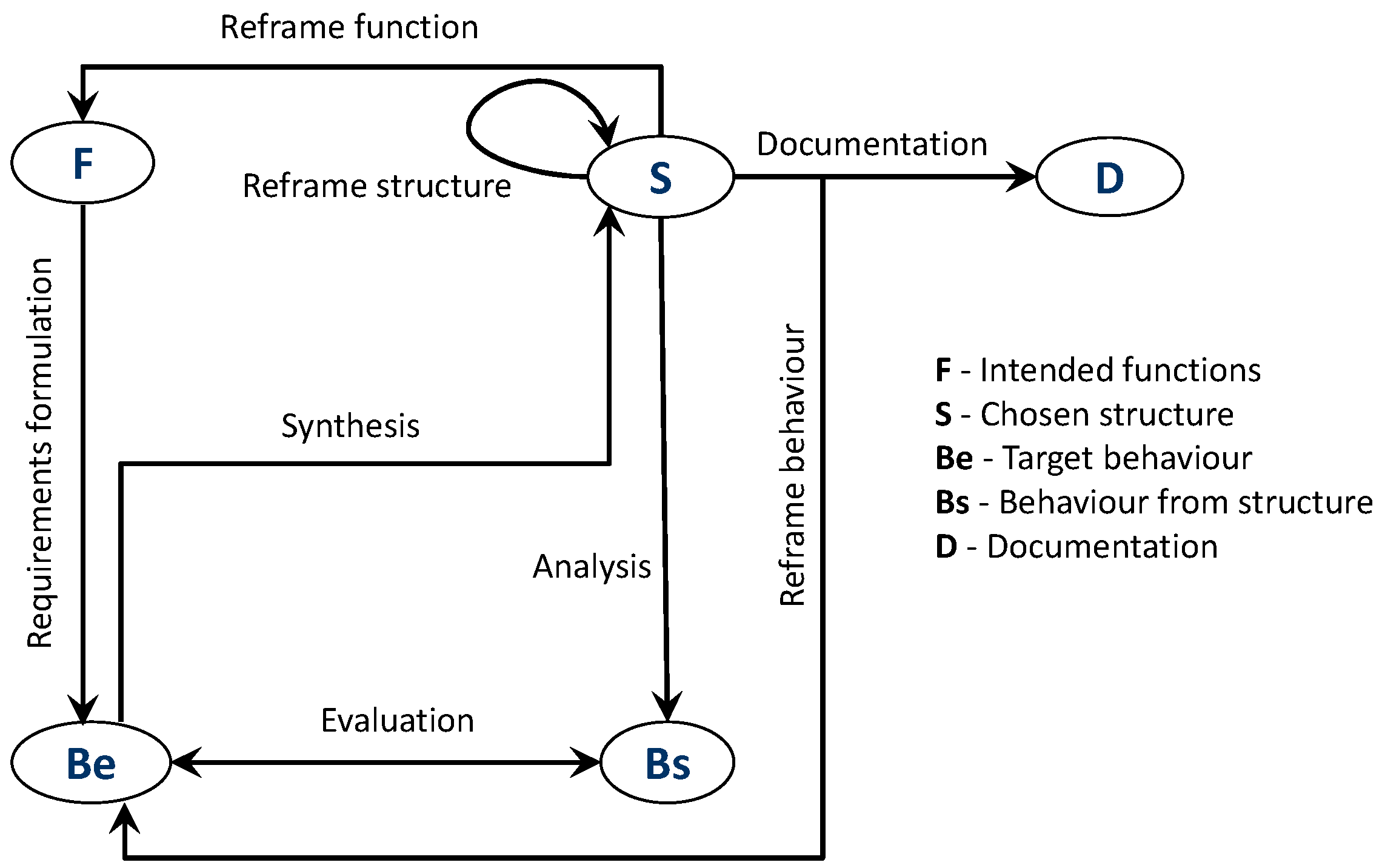
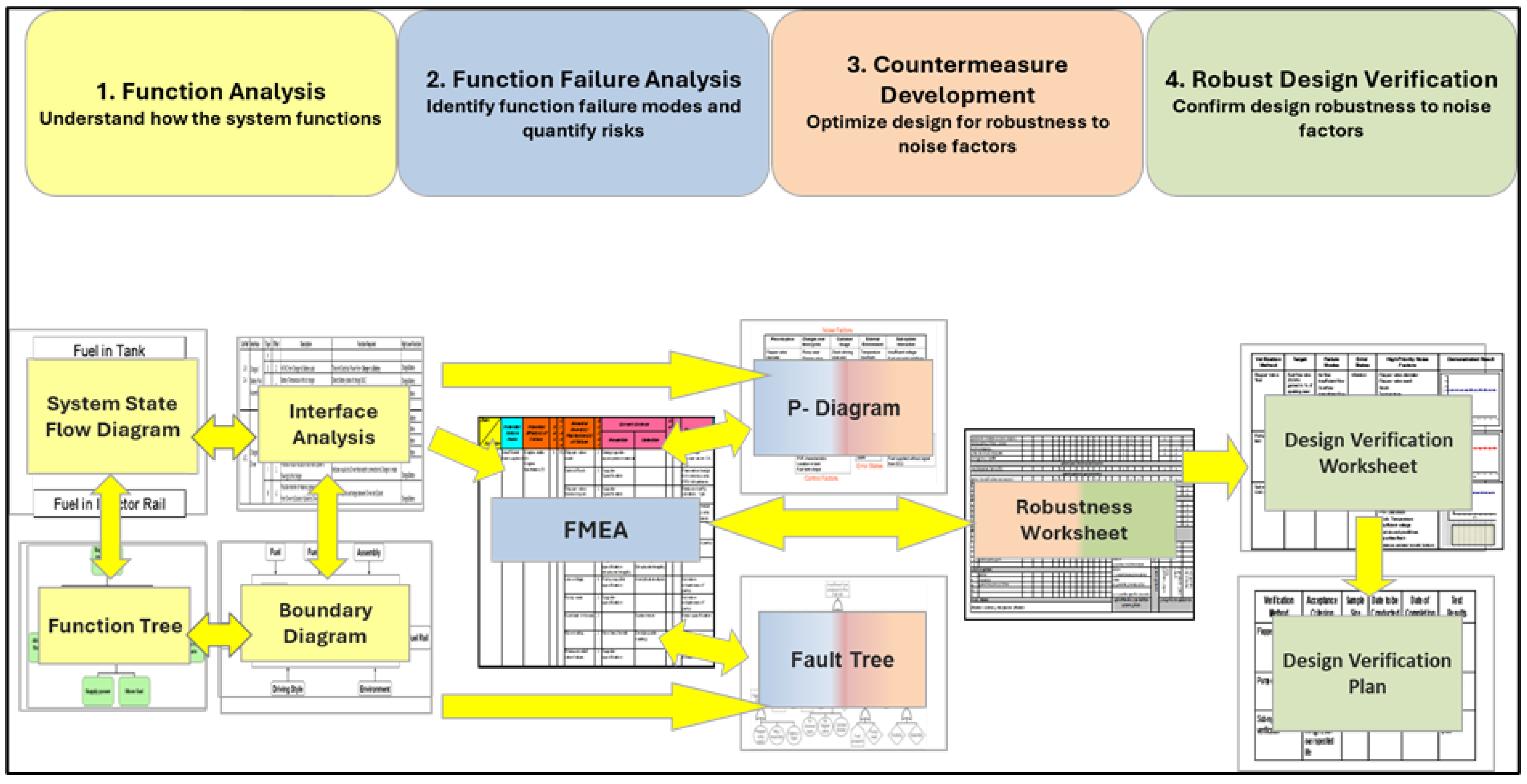



| AI Category | Representative Applications (as Cited) | Main Contribution to FMEA | Key Benefits | Key Limitations |
|---|---|---|---|---|
| Probabilistic & hybrid models | Bayesian Networks and Petri Nets; hybrid ML–fault trees; data-mining [60,62,64] | Model complex failure relations under uncertainty; real-time diagnostics | Handles aleatory and epistemic uncertainty; supports reasoning | Needs structured prior data and modelling effort |
| Machine learning & deep learning | AdaBoost, decision trees, SHAP-enhanced models, transfer learning, ensemble maintenance models [65,69,70] | Predict and classify failure modes; cross-domain transfer | High predictive accuracy; adaptable to diverse domains | Data-hungry; limited interpretability without SHAP or similar tools |
| Fuzzy logic & intelligent FMEA | Fuzzy-RPN and neural models [79,80] | Reduce subjectivity in severity–occurrence–detection scoring | Greater precision and decision consistency | Requires rule tuning; limited scalability |
| AutoML and data-driven prioritisation | AutoML RPN prediction, deep learning + GA optimisation, RF regressors [31,52,72] | Automate risk ranking and update of FMEA tables | Rapid, consistent scoring; reduced expert workload | Dependent on quality and volume of labelled data |
| NLP and text-mining approaches | Ontology-aided NER, LSA–SVD topic modelling, Transformer-based review analysis, active learning [88,92,93,94] | Extract failure information from unstructured logs and reports | Converts textual data into structured insights; speeds annotation | Domain jargon and ambiguity; needs expert validation |
| LLMs and generative AI | GPT-based frameworks for automated FMEA [76,77] | Generate failure modes, causes, and effects; assist risk matrix creation | Accelerate authoring; suggest new failure knowledge | Inconsistent SOD estimation; human-in-the-loop validation required |
| Author(s) | Definition of Behaviour | Key Points |
|---|---|---|
| [101] | Behaviour resulting from the realised structure, as opposed to the expected behaviour intended by the designer. | Distinguishes between expected (theoretical) and actual behaviour based on the realised structure. |
| [102] | Sequential state changes of an artefact over time. | Presents a temporal perspective, emphasising functions as human abstractions of behaviour. |
| [103] | Behaviour encompassing a subset of an artefact’s actions that contribute to its intended purpose. | Aligns functions more closely with expected behaviour due to their purpose-driven nature. |
| [104] | Physical dispositions of a structure enabling its use towards specific goals. | Describes function as serving a purpose, while behaviour encompasses all physical dispositions of the structure. |
| [105] | Physical phenomena driving state changes in a system, often described using natural language or equations. | Characterises behaviour as the physical processes governing a system’s evolution across various disciplines. |
| [106] | Behaviour influenced by the interaction between designers, users, and the artefact’s structure. | Highlights the subjective nature of behaviour perception based on interaction and interpretation. |
| [107] | Actions facilitated by objects to achieve specific purposes. | Emphasises the functional aspect of behaviour, focusing on achieving goals. |
| [108] | Expected and actual performances of the system resulting from the designed structure. | Introduces an encoding perspective, separating function, behaviour, and structure based on purpose and performance. |
| [109] | Behaviour resulting from evaluating the existing structure, as opposed to the expected behaviour based on designer speculations before the structure is realised. | Distinguishes between expected (Be) and actual (Bs) behaviour based on the structure’s evaluation. |
| Aspect | Structure–Behaviour– Function (SBF) | Function–Behaviour– State (FBSta) | Function–Behaviour– Structure (FBStr) |
|---|---|---|---|
| Key Publications | [100] | [115]; [116], [117] | [101]; [111]; [118] |
| Function Definition | Describes the role an element plays in a device’s operation; function linked to behaviour through a schema [100] | Abstracted from behaviour and typically described in “to do” form [116] | Defined as the teleological goal of the system, described in a verb-object form [111] |
| Function- Behaviour Relationship | One-to-one rational relation | Many-to-many subjective relation (designer’s choice) | Many-to-many subjective relation (designer’s choice) |
| Behaviour Definition | Internal behaviours, described as state transitions within a system | Output behaviours, represented as sequences of state transitions | Attributes derived from the system structure [111] |
| Behaviour- Structure (State) Relationship | Causal and objective, governed by physical laws | Many-to-many relationship; behaviour is governed by physical laws within different views | Many-to-many relationship; behaviour can be derived from structure using heuristics or physical laws |
| Structure (State) Definition | Defined by components, substances, and their relations | Defined by entities, attributes, and relations | Defined by elements, attributes, and their interconnections |
| Examples | Function: transfer angular momentum | Function: generate light | Function: control noise, enhance solar gain |
| Ontology Engineering Methodology | Key Characteristics | Ontology Reuse | Evaluation Focus |
|---|---|---|---|
| NeOn Methodology [160] | Scenario-based, supports collaborative and networked ontology engineering | Strong support for reuse, modularisation, and alignment | Iterative, use-case driven validation |
| Methontology [161] | Structured, waterfall-like phases from specification to maintenance | Encourages reuse, often within well-defined lifecycle stages | Emphasises completeness, clarity, and consistency |
| DILIGENT [162] | Designed for distributed, loosely controlled, and evolving settings using argumentation | Reuse via controlled adaptation and consensus- based evolution | Consensus-building and traceability through rhetorical argumentation |
| Scenario | Name | Description |
|---|---|---|
| 1 | From specification to implementation | Develop an ontology from scratch based on user requirements. |
| 2 | Reusing existing ontologies | Use previously built ontologies as they are, without modification. |
| 3 | Re-engineering non-ontological resources | Transform structured data (e.g., spreadsheets, databases) into ontologies. |
| 4 | Reusing and re-engineering | Combine ontology reuse with adaptation or extension to meet new needs. |
| 5 | Aligning ontologies | Map concepts and relationships between multiple ontologies. |
| 6 | Merging ontologies | Integrate multiple ontologies into a single, unified ontology. |
| 7 | Localising ontologies | Tailor ontologies for different languages, cultures, or technical standards. |
| 8 | Modularising ontologies | Break complex ontologies into independent, reusable modules. |
| 9 | Versioning ontologies | Manage updates and track changes across different ontology versions. |
| Approach | Description | Advantages | Challenges |
|---|---|---|---|
| Domain/Task Fit | Task-driven assessment focusing on an ontology’s relevance and suitability for specific domains. | Aligns evaluation with specific requirements of the domain or task, enhancing practical relevance. | Fitness is difficult to quantify, oversimplified matching may misrepresent domain complexity. |
| Class Examples | Error-checking methods designed to identify structural or logical issues within ontologies. | Possible to automate removal of many types of errors; error removal is straightforward with stringent requirements. | Difficult to assess urgency of each error; no guarantee of overall quality or task suitability post-cleanup. |
| Libraries | Repositories and curated collections providing domain-specific ontologies and services. | Offers domain expertise and additional functionality such as mappings, documentation, and recommender systems. | Inconsistencies arise from supporting multiple ontology languages, limited availability of general-purpose repositories. |
| Metric Based | Quantitative methods using numerical metrics to assess ontology attributes. | Metrics enable automated assessment and comparison of ontology quality across different models. | Requires empirical validation of applied metrics and relevance of assessed attributes. |
| Modularity | Techniques for decomposing large ontologies into smaller, reusable modules. | Specialised modules enhance focus; quality-assured modules can be reused in various contexts. | Extracting modules might degrade overall quality, risk of losing semantic coherence. |
Disclaimer/Publisher’s Note: The statements, opinions and data contained in all publications are solely those of the individual author(s) and contributor(s) and not of MDPI and/or the editor(s). MDPI and/or the editor(s) disclaim responsibility for any injury to people or property resulting from any ideas, methods, instructions or products referred to in the content. |
© 2026 by the authors. Licensee MDPI, Basel, Switzerland. This article is an open access article distributed under the terms and conditions of the Creative Commons Attribution (CC BY) license.
Share and Cite
Younus, H.; Kabir, S.; Campean, F.; Bonnaud, P.; Delaux, D. AI- and Ontology-Based Enhancements to FMEA for Advanced Systems Engineering: Current Developments and Future Directions. Appl. Sci. 2026, 16, 2464. https://doi.org/10.3390/app16052464
Younus H, Kabir S, Campean F, Bonnaud P, Delaux D. AI- and Ontology-Based Enhancements to FMEA for Advanced Systems Engineering: Current Developments and Future Directions. Applied Sciences. 2026; 16(5):2464. https://doi.org/10.3390/app16052464
Chicago/Turabian StyleYounus, Haytham, Sohag Kabir, Felician Campean, Pascal Bonnaud, and David Delaux. 2026. "AI- and Ontology-Based Enhancements to FMEA for Advanced Systems Engineering: Current Developments and Future Directions" Applied Sciences 16, no. 5: 2464. https://doi.org/10.3390/app16052464
APA StyleYounus, H., Kabir, S., Campean, F., Bonnaud, P., & Delaux, D. (2026). AI- and Ontology-Based Enhancements to FMEA for Advanced Systems Engineering: Current Developments and Future Directions. Applied Sciences, 16(5), 2464. https://doi.org/10.3390/app16052464