Review

AI-Driven Design of Sustainable Flame-Retardant Biodegradable Polymer Composites

by
Jinfeng Zhang
,
António Benjamim Mapossa
,
Yuxin Liu
and
Uttandaraman Sundararaj
*
Department of Chemical and Petroleum Engineering, University of Calgary, Calgary, AB T2N 1N4, Canada
*
Author to whom correspondence should be addressed.
Appl. Sci. 2026, 16(5), 2405; https://doi.org/10.3390/app16052405
Submission received: 29 January 2026 / Revised: 13 February 2026 / Accepted: 26 February 2026 / Published: 1 March 2026

Abstract

The growing demand for lightweight, high-performance, and fire-safe polymer materials has accelerated research into advanced flame-retardant composites. Traditional experimental approaches to designing sustainable flame-retardant biodegradable polymer composites still rely heavily on empirical formulation and iterative testing, which are time-consuming and costly, and they often struggle to capture the coupled effects of chemical composition, processing conditions, and material performance. Recent advances in artificial intelligence (AI) provide opportunities to address these challenges by learning formulation–structure–performance relationships from curated datasets and by translating materials chemistry and flame-retardant mechanisms into data-ready descriptors and targets. This review summarizes recent progress of AI-assisted approaches to design sustainable flame-retardant biodegradable polymer composites, emphasizing machine learning, deep learning, and active learning methods for predicting and optimizing key fire performance metrics, including limiting oxygen index and heat release-related parameters. Biodegradable-specific limitations, including narrow processing window, thermal degradation, and moisture sensitivity, are discussed in the content of descriptor selection and constraint-aware optimization, together with the role of interpretable/explainable models in supporting experimentally actionable guidance. Current challenges such as limited data availability, protocol variability, model transferability, and interpretability are highlighted, and emerging solutions, including data harmonization, standardized fire testing, and physics-informed models are outlined. AI-assisted strategies are expected to play a central role in accelerating efficient, sustainable, halogen-free, and performance-driven development of next-generation flame-retardant biodegradable polymer composites.

1. Introduction

Biodegradable polymer composites are increasingly needed to reduce the long-term environmental burden associated with petroleum-derived plastics, and sustainable flame-retardant materials are equally essential to ensure fire-safe performance without relying on halogenated or persistent chemicals [1,2,3,4,5,6]. The urgency of developing these new materials is underscored by growing environmental concerns over plastic accumulation and toxic flame-retardant residues, the demand for broader application of biodegradable polymers beyond packaging, and the tightening of international regulations governing fire safety and chemical sustainability [7,8]. Recent advances in sustainable flame retardants include phosphorus-containing bio-derived molecules [9,10,11], mineral-based systems [12], and multifunctional metal–organic frameworks [13,14,15,16] that provide char formation and smoke suppression while avoiding harmful emissions. Biodegradable polymer composites based on poly (lactic acid) (PLA), polyhydroxyalkanoates (PHAs), and starch-derived polymers have found several applications in packaging, consumer goods, agriculture, and biomedical devices, reflecting a rapidly expanding market [3,4,5,17]. The integration of sustainable flame retardants with biodegradable polymer composites is therefore a critical step toward materials that meet both safety and environmental performance targets, enabling the development of high-value products that comply with modern regulatory requirements and support global sustainability goals.
Despite progress in sustainable materials, the design of flame-retardant-based biodegradable polymer composites still relies on conventional “trial-and-error” strategy, which relies on the researcher’s insight, knowledge, and experience [18]. Even with guidance from existing theories and empirical data, this process depends on empirically selecting and combining different bio-based flame retardants and fillers to achieve acceptable fire performance. This method offers limited tunability, is resource-intensive and time-consuming, and often results in inconsistent product performance and missed opportunities for innovation. Only a small portion of the design space has been explored, making the discovery of promising candidates by experiments alone increasingly challenging. Although empirical studies can eventually produce workable formulations, they are neither efficient nor economical and generate substantial chemical wastes [19].
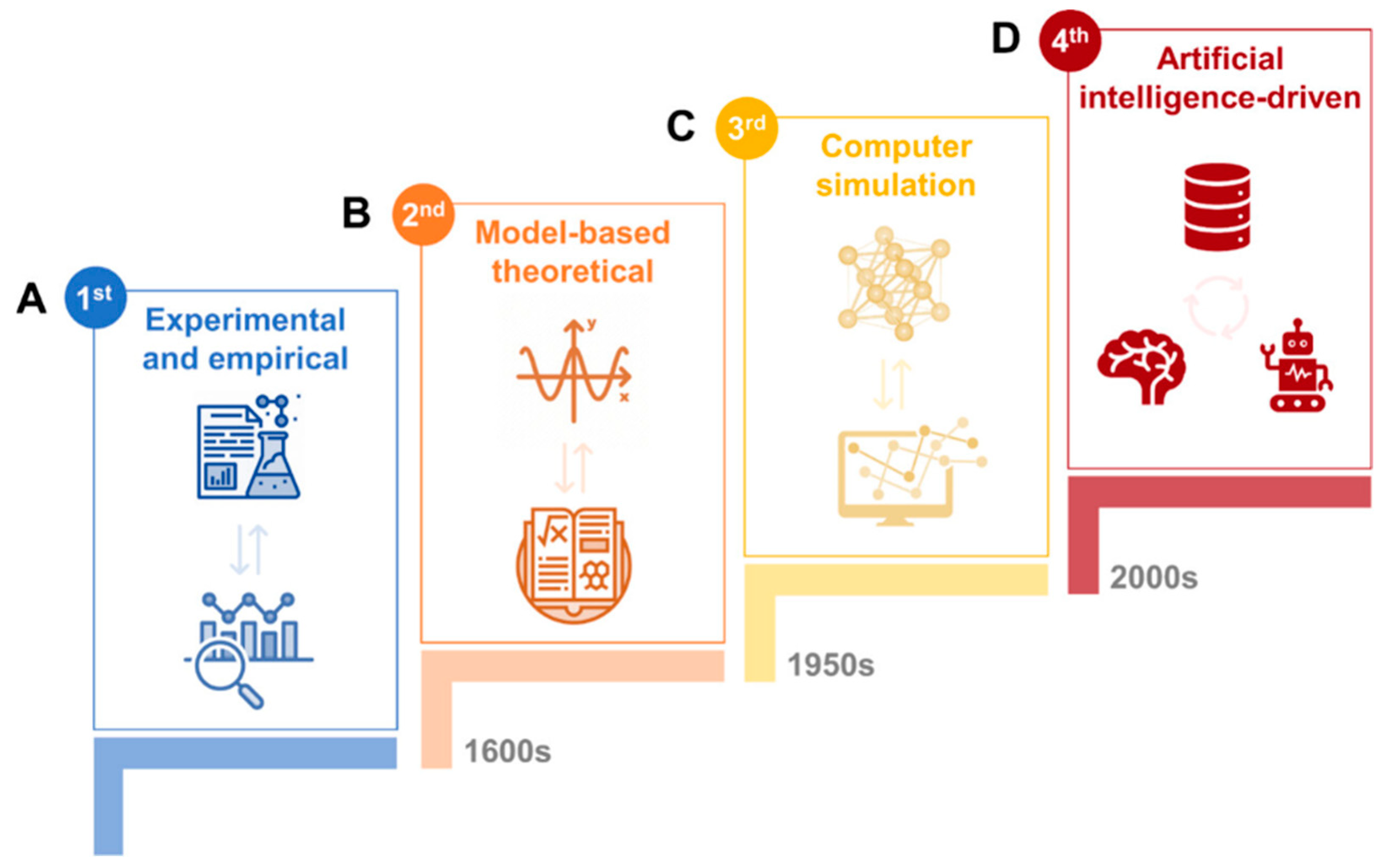
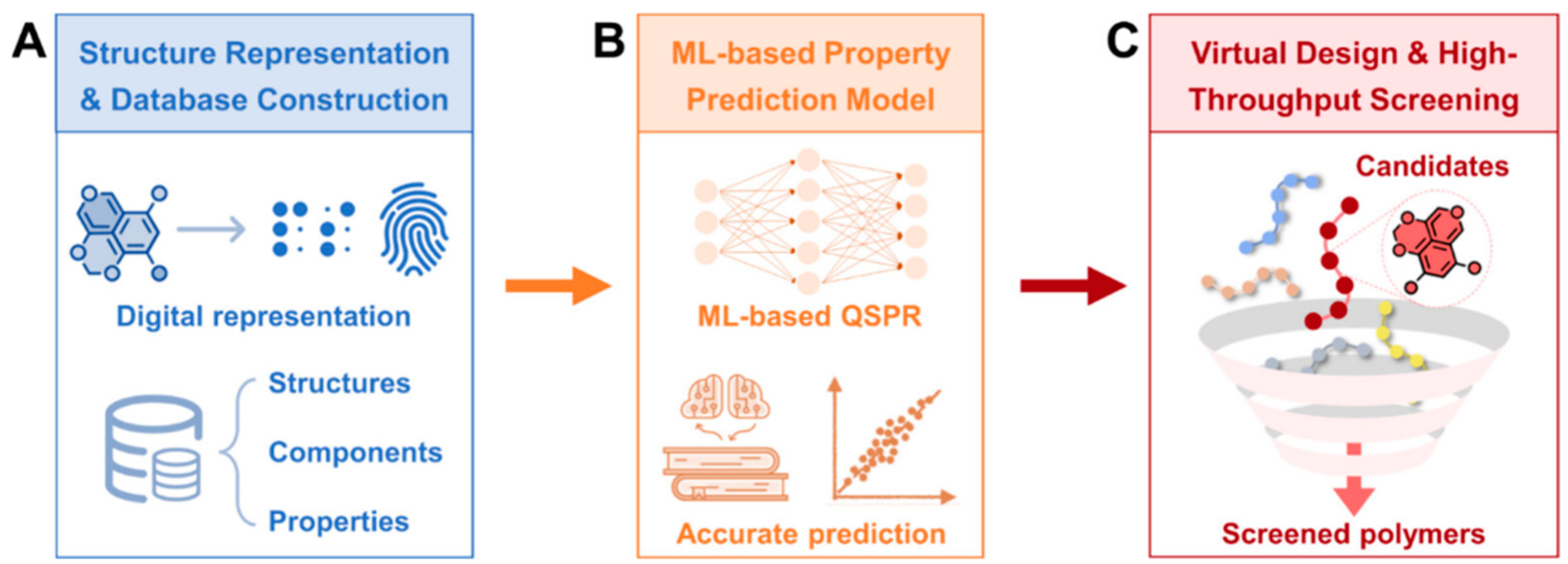
Even if we can satisfy flame retardancy requirements, designing biodegradable polymer composites that balance flame retardancy with mechanical performance is very challenging, given the vast design space, and conventional trial-and-error screening is costly and slow. To bridge this gap, the field is moving from empirical iteration toward discovery guided by data and computation, since the research paradigm in materials science has evolved from experimental science to theoretical science and then to computational science, as illustrated in Figure 1 [20]. Building on this trajectory, the integration of big data and artificial intelligence (AI), often described as the fourth scientific paradigm or the Fourth Industrial Revolution, is reshaping how materials are designed and optimized [21,22,23]. With unprecedented computational resources and novel algorithms now available, researchers can address large-scale design problems that were previously intractable.
AI is increasingly reshaping materials science by enabling rapid innovation. Through the integration of extensive materials datasets and sophisticated algorithmic strategies, AI supports the accelerated discovery and design of advanced materials [24,25,26,27,28,29,30,31,32,33,34,35,36]. Following notable advances in fields such as drug discovery, catalysis, and structural engineering, data-driven approaches are increasingly reshaping materials research [37,38,39]. In material design, AI integrates experimental data, molecular descriptors, and mechanistic features into predictive models that accelerate property optimization, identify promising formulations, and enable precise control over structure–property relationships [40,41]. This shift significantly improves efficiency, reduces development cost, and reshapes how new materials are conceptualized, screened, and validated.
Although AI-driven methods are becoming increasingly integrated into materials research, they still pose significant barriers that limit their use in effectively designing sustainable flame retardants for biodegradable polymer composites. One major challenge is the limited availability of high-quality, standardized fire performance datasets for biodegradable polymers, which restricts model accuracy and makes it difficult for algorithms to learn reliable structure–property relationships; for example, publicly available LOI or UL-94 data for PLA composites are sparse and inconsistent. A second challenge lies in the complex and often nonlinear interactions among bio-based flame retardants, polymer degradation pathways, and combustion chemistry, which can hinder the ability of AI models to capture mechanistic behavior; for instance, phosphorus-containing additives may behave differently in PHAs than in PLA due to distinct thermal degradation routes. A third challenge is the limited generalizability of current AI models, which are often trained on narrow chemical spaces and may not successfully predict performance for emerging green additives or multifunctional systems; examples include models that perform well for halogen-free formulations but fail when applied to mineral-based or MOF-derived flame retardants. Addressing these challenges is essential for unlocking the full potential of AI in guiding the development of the next generation of sustainable, fire-safe, and biodegradable polymer composites.
Building on these challenges, recent work on AI-assisted fire-safety materials shows how AI can provide a pathway to overcome them [42,43,44,45,46]. AI frameworks that couple high-throughput burning analysis, virtual combustion generators, and comprehensive flame-retardant material databases with AI models and feature-engineering can progressively enrich datasets and improve prediction quality. Such integrated frameworks link experimental tools, such as operando burning analyzers, with structure performance modeling to capture complex gas-phase and condensed-phase mechanisms and to quantify key metrics including LOI, heat release, and smoke production. In the context of sustainable flame retardants for biodegradable polymer composites, similar AI workflows can guide targeted experiments, rank candidate bio-based additives, and optimize formulations under multiple constraints such as flame retardancy, mechanical integrity, and environmental impact. By iterating between prediction and validation, AI accelerates discovery and supports rational, mechanism-informed design.
This review focuses on AI-driven design for sustainable flame-retardant biodegradable polymer composites, emphasizing how materials chemistry, flame-retardant mechanisms, and processing constraints can be encoded into data-ready descriptors and linked to fire-performance targets. Specifically, we highlight decision-oriented workflows for screening, optimization, and inverse design under real experimental constraints (e.g., thermal stability and moisture sensitivity of biopolymers). We further emphasize interpretable and explainable strategies that translate predictions into actionable formulation guidance for experimental researchers.

2. Overview of Sustainable Flame Retardants in Biodegradable Polymer Composites

The development of sustainable flame retardants in biodegradable polymer composites addresses both fire-safety and environmental challenges through targeted control of polymer combustion processes. Flame retardants are functional additives or reactive components designed to interfere with the thermal degradation, ignition, and flame propagation of polymers [47]. Commonly used flame retardants in polymer composites include halogenated systems such as brominated or chlorinated flame retardants, often used with antimony trioxide as a synergist, as well as non-halogenated alternatives such as phosphorus-based additives (e.g., ammonium polyphosphate), metal hydroxides (e.g., aluminum trihydroxide and magnesium hydroxide), nitrogen-containing synergists (e.g., melamine derivatives), boron-based additives (e.g., zinc borate), metal–organic frameworks (e.g., ZIF-8), and carbon-based additives such as expandable graphite and emerging bio-based phosphorus compounds [14,16,48,49,50,51,52,53,54]. Upon heat exposure, polymer matrices undergo bond scission and volatilization, generating combustible gases that sustain burning. Flame retardants mitigate these processes by altering degradation pathways and suppressing combustion in both the gas phase and the condensed phase [47].
In polymer composites, gas-phase mechanisms typically involve the release of active species that scavenge high-energy radicals such as H· and OH·, thereby interrupting chain-branching reactions in the flame and reducing heat release. Condensed-phase mechanisms promote dehydration, crosslinking, and carbonization of the polymer matrix, producing thermally stable char layers. These char structures act as physical barriers that reduce heat transmission, restrict the mass transport of volatile fuels, and limit oxygen diffusion to the underlying material [55].
Biodegradable matrices can reduce long-term plastic accumulation, while green flame retardants aim to replace traditional halogenated and persistent additives that raise toxicity and environmental concerns [56]. When properly integrated, these systems can enhance char formation, reduce heat release rates, and suppress flame spread while maintaining material sustainability. As a result, such composites are increasingly explored for applications where regulatory compliance, environmental responsibility, and fire performance requirements must be satisfied simultaneously.

2.1. Classes of Sustainable Flame-Retardant Additives

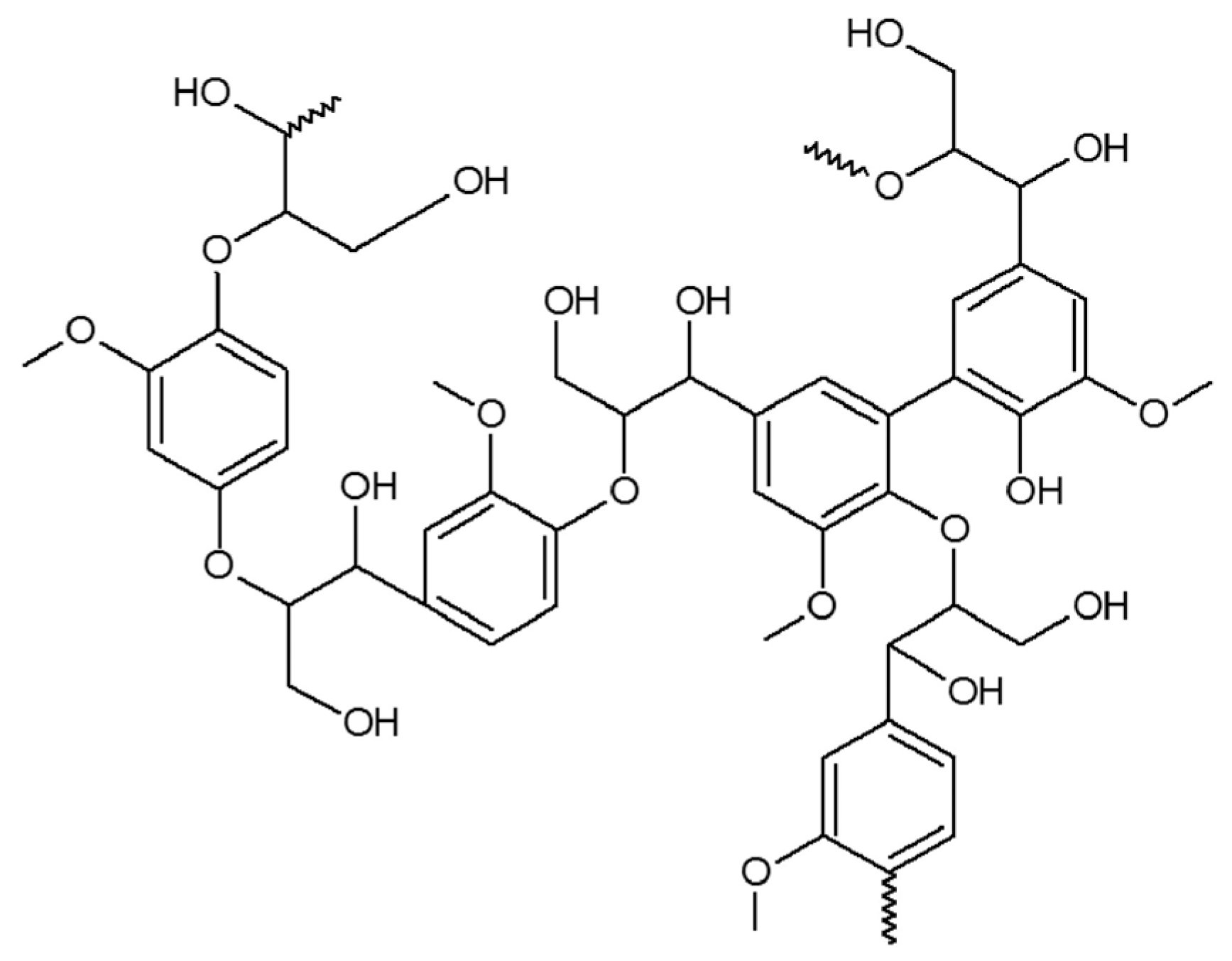
Sustainable flame retardants include bio-derived macromolecules, small molecules from biomass, and inorganic minerals obtained from abundant or low-toxicity sources [7]. Lignin is a bio-derived flame retardant [57,58]. Its aromatic, highly functionalized structure (Figure 2) promotes the formation of rigid char layers that insulate the underlying polymer and reduce heat release in the PLA composites. Therefore, lignin has been shown to increase char yield and improve LOI while partially maintaining mechanical performance [57,59,60]. However, lignin can only be used as a source of carbon in a system, and its flame-retardant efficiency is low when compared to other natural materials or other flame-retardant systems [57]. When combined with other biomass materials such as phytic acid, chitosan, and other flame retardants to form a synergistic effect, its performance is largely increased [57,60,61].
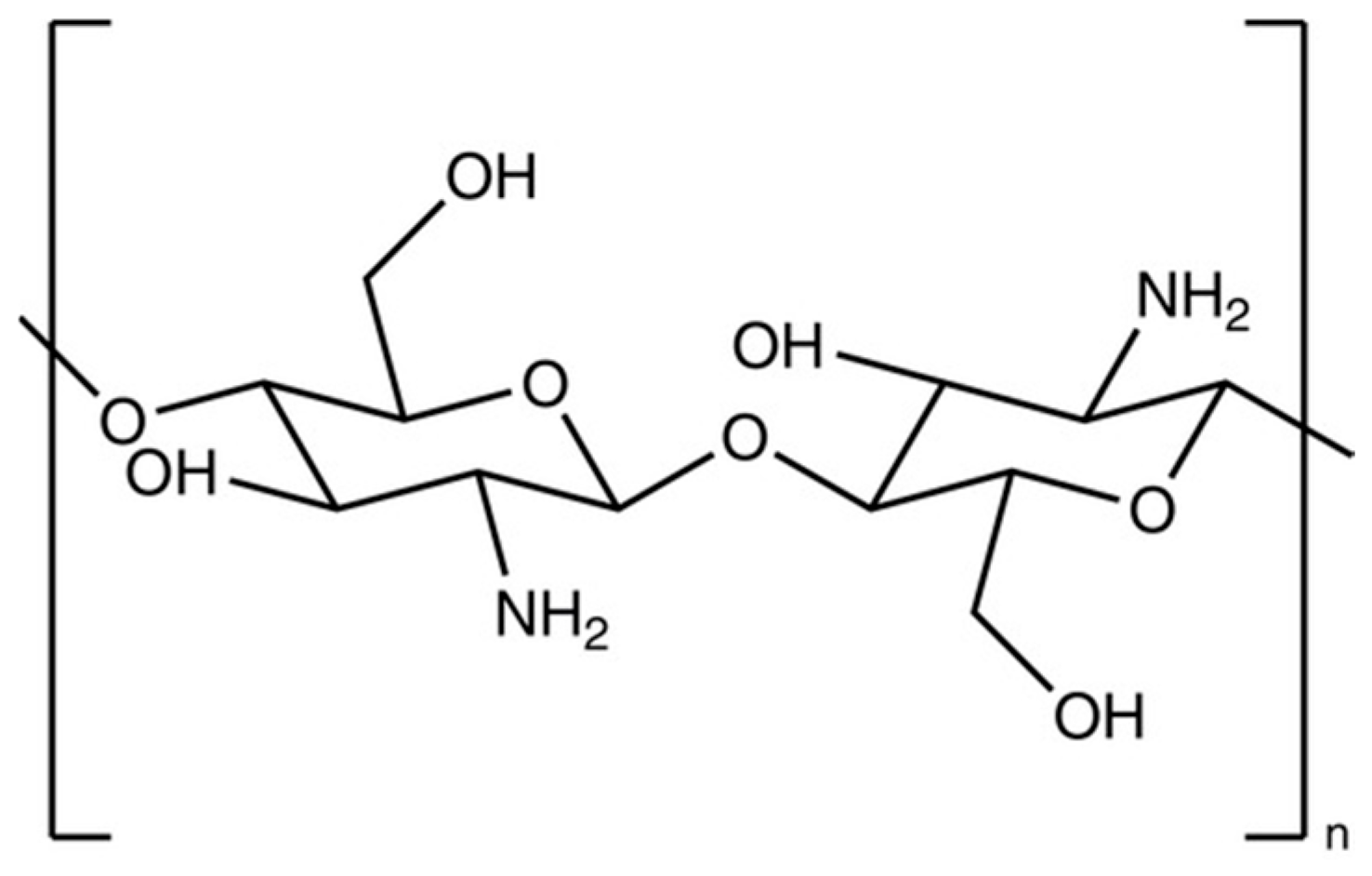
Chitosan is another sustainable flame-retardant additive, in which the nitrogen and oxygen-containing functionalities (Figure 3) contribute both to char promotion in the condensed phase and to the release of nonflammable gases [63,64]. When chitosan or its derivatives are incorporated into polymer matrices, they can lower peak heat release rate and enhance self-extinguishing behavior in cone calorimetry tests [65,66,67,68,69]. Chitosan has frequently been combined with other functional compounds, such as phytic acid, using a layer-by-layer assembly technique [70,71,72,73,74]. This strategy significantly enhances the environmental sustainability of flame-retardant systems. For example, the incorporation of 3 wt.% chitosan/phytic acid increased the LOI of PLA from 19.6% to 30.5% and enabled the composite to achieve a UL-94 V-0 rating with minimal melt dripping [74].
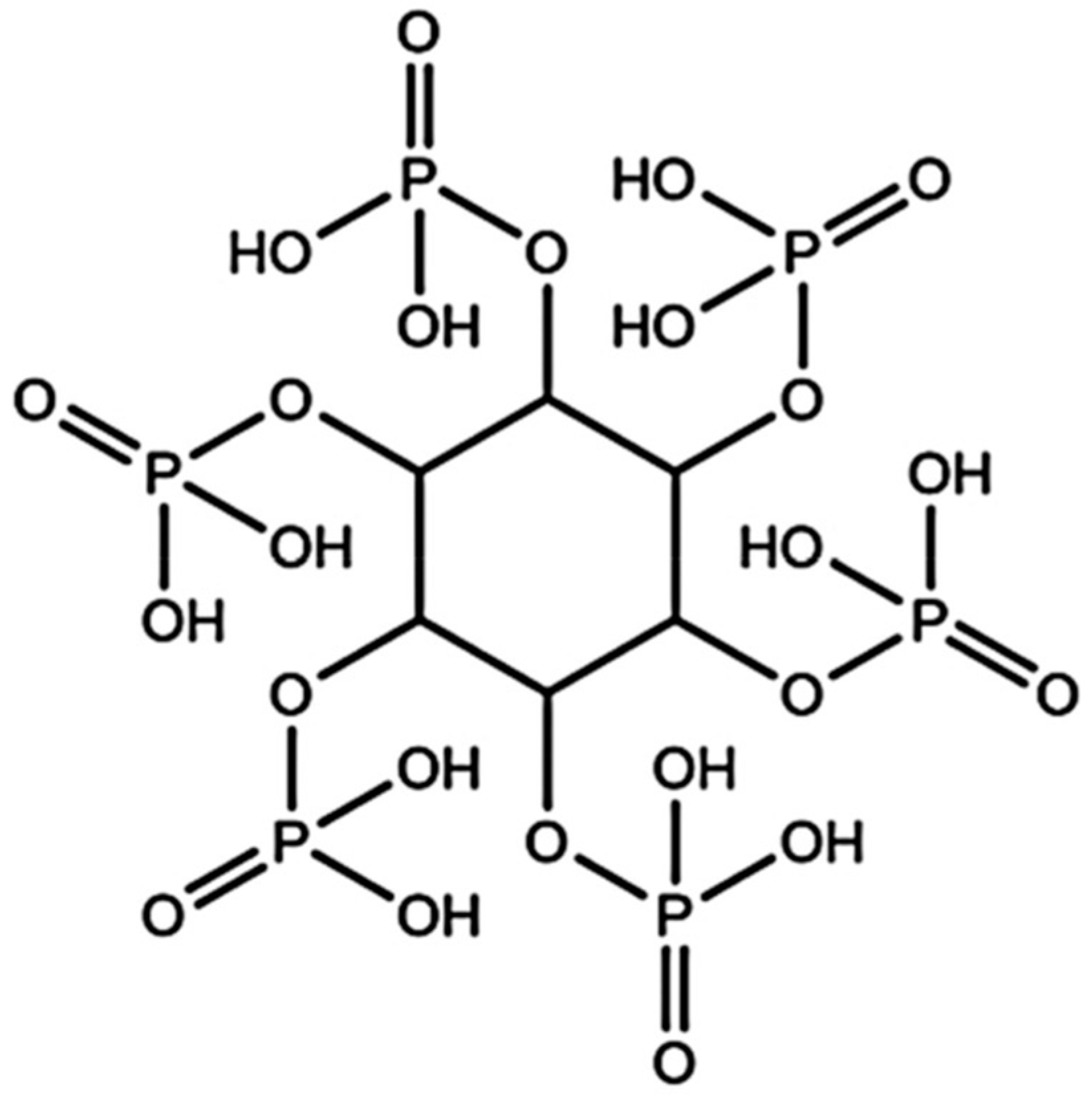
Phytic acid illustrates the role of plant-derived phosphorus-containing small molecules (Figure 4) as sustainable flame retardants [7,76]. In the gas phase, phytic acid can aid in substrate dehydration and releases phosphorus-containing radicals (e.g., HPO·, PO·, and HPO2·) that scavenge reactive species and interrupt the combustion chain reaction. In the condensed phase, its high phosphorus content and multiple phosphate groups facilitate the formation of stable, intumescent char structures, which inhibits heat and mass transfer and protects the substrate at elevated temperatures [60,76,77]. In various polymer systems, phytic acid-based formulations have been shown to raise LOI values to 25.7–43.7% and promote V-0 ratings in vertical burning tests by generating compact, protective residues [77,78,79,80,81].
Inorganic green flame retardants, such as magnesium hydroxide and halloysite nanotubes, complement bio-derived systems [82]. Magnesium hydroxide decomposes endothermically and releases water, which cools the matrix and dilutes combustible gases, while halloysite nanotubes can act as both a physical barrier and a carrier for other active species, and they have been reported to improve flame retardancy and smoke suppression in biopolymer composites [68,83,84,85,86].

2.2. Biodegradable Polymer Composite Systems

Biodegradable polymer composites are built on matrices such as PLA, PHAs, starch-based polymers, and cellulose derivatives, often reinforced with natural fibers or nanofillers [87]. PLA is a widely used bio-based polyester produced from renewable feedstocks such as cornstarch and sugarcane, and is being explored as a replacement for conventional engineering plastics [88]. It is widely used in additive manufacturing because it prints easily, exhibits good biocompatibility, and emits fewer hazardous compounds during processing, which supports safer work environments for medical and consumer applications [89,90]. When processed under suitable conditions, PLA can form complex geometries with smooth surfaces and sharp features, enabling design flexibility for sustainable product concepts. The properties of PLA can be tailored through nanocomposites, compatibilizers, plasticizers, and mineral- or carbon-based fillers, extending performance and function across commercial uses [91,92]. With continued advances in formulations and additive packages, the flammability behavior of PLA has improved, broadening its potential in more demanding engineering and consumer products. The integration of PLA and sustainable flame-retardant materials in sustainable structural engineering presents a promising path toward achieving environmentally responsible and resilient infrastructure. For example, when combined with natural fibers such as flax or hemp, PLA composites exhibit improved tensile properties, but the lignocellulosic character of the reinforcement further increases flammability, requiring effective flame-retardant strategies to enable use in interior, transport, or electronic applications [93].
PHAs are a family of microbial polyesters produced by bacterial fermentation that are both bio-based and biodegradable [94,95,96,97]. They are notable for biodegradation across many environments, including soil, aerobic, and anaerobic conditions [98]. PHAs are used or proposed for single-use items such as food packaging, tableware, plant pots, and mulch films that benefit from end-of-life biodegradation, though odor, cost, and additive considerations can constrain some food-contact applications [94]. During melt processing, PHB and PHBV are susceptible to chain-scission via β-elimination, which lowers molar mass and narrows the workable processing window [94]. To broaden use and meet safety requirements, the literature increasingly addresses thermal stability and flammability behavior of PHA-based composites and explores strategies drawn from the wider flame-retardant polymer field [77,99,100]. In practice, this has included the addition of fillers or flame-retardants to elevate thermal stability and reduce ignitability while maintaining degradation, with nanostructured clays and phosphorus–nitrogen chemistries cited as representative approaches in related polymer systems [98].
Starch-based composites represent another class that typically uses thermoplastic starch (TPS) produced by gelatinizing native starch with plasticizers, and then improving properties through blending or fillers [101]. TPS is attractive because starch is abundant, low-cost, and requires less process energy than PLA for bioplastic production, with one assessment reporting about 25.4 MJ/kg for starch plastics versus 57.0 MJ/kg for PLA [102]. Blends with compostable polyesters such as PLA, PCL, and PHB, often aided by compatibilizers like PVA or EVOH, raise toughness and processability and are already used in films, bags, and thermoformed articles [87,103,104,105]. Mineral- and bio-based fillers further tune performance: talc, calcium carbonate, barium sulfate, TiO2, mica, ZnO, clay, and cellulose reinforcements can increase stiffness and thermal stability while lowering water-vapor transmission when well-dispersed and well-bonded to the matrix [101]. Nanocellulose and starch nanoparticles provide notable modulus and barrier gains at low loadings, and TiO2 or rice-husk-derived nano-silica have improved thermomechanical behavior in TPS composites. Chemical modification complements these routes; oxidation and esterification reduce hydrophilicity and retrogradation, and citric-acid crosslinking at about 7.2 wt.% has been shown to reduce water-vapor permeability by more than 35% while increasing film density and strength [106]. Despite these advances, TPS remains moisture-sensitive with limited thermal stability, so current work emphasizes barrier-forming nanofillers and char-promoting additives to improve dimensional stability and mitigate ignitability while maintaining biodegradation performance [105,107,108].

2.3. Sustainable Approaches to Flame Retardancy in Biodegradable Polymers

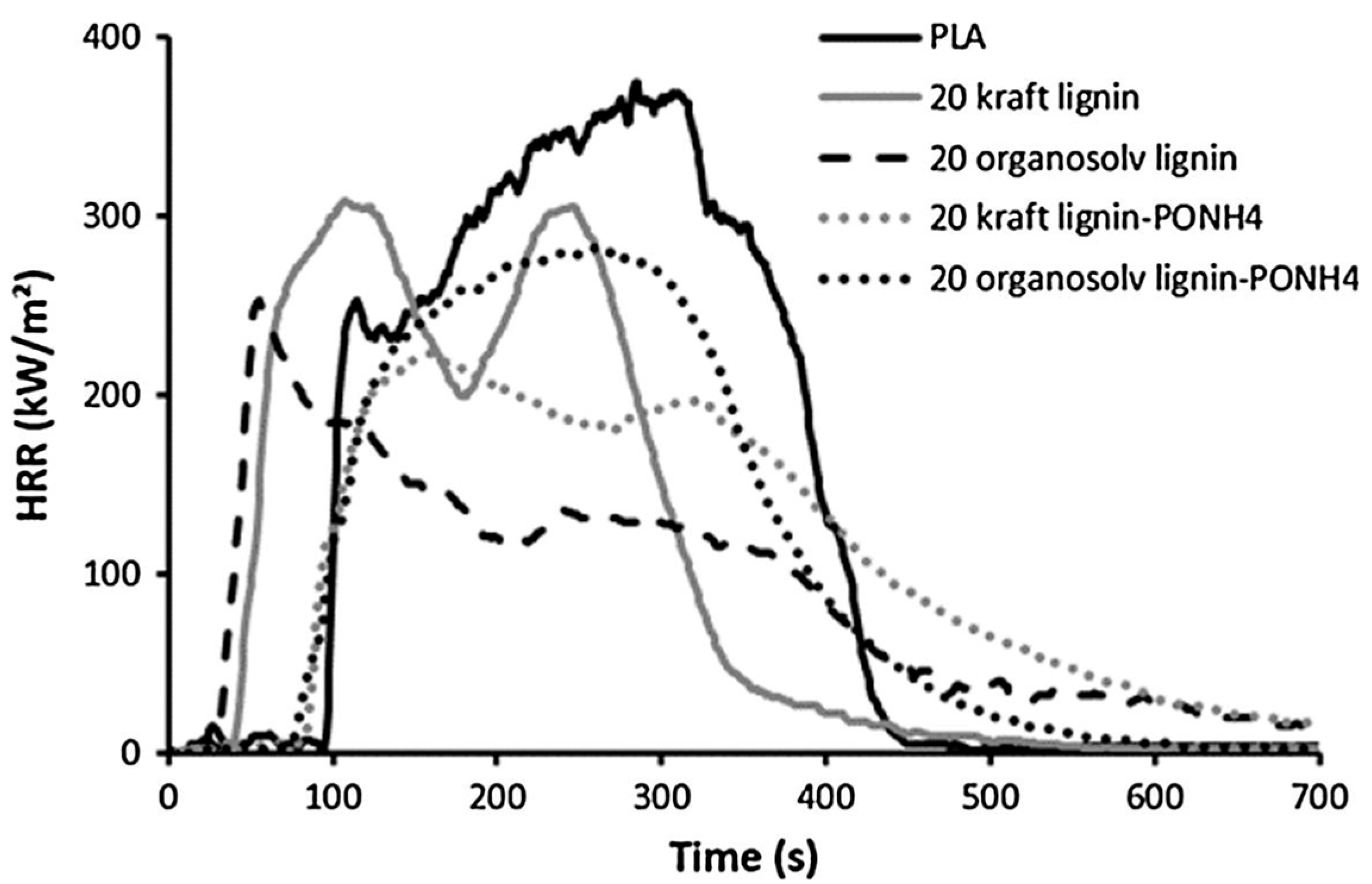
The integration of sustainable flame retardants into biodegradable matrices involves strategies such as melt blending, surface treatment of fibers, chemical grafting, and hybrid nanostructuring [7,55]. An example is the incorporation of lignin nanoparticles or modified lignin into PLA through melt compounding [109,110]. In these systems, lignin acts as a char promoter and can also serve as a reinforcing filler; studies report (Figure 5) decreased peak heat release rate and increased char yield; though at high loading levels, there may be reductions in tensile modulus and changes in melt flow, which must be managed through formulation.
Another example involves tannic acid as a multifunctional additive or coating [63,112]. Tannic acid-treated natural fibers in PLA or other bio-polyesters have shown enhanced thermal stability and reduced flame spread, as the polyphenolic structure facilitates crosslinking and char formation at the fiber–polymer interface [68].
Hybrid systems illustrate how bio-derived flame retardants can be combined with inorganic nanofillers [85,113]. For instance, halloysite nanotubes loaded with phytic acid have been dispersed in PLA to create composites that exhibit improved LOI to 24.2% and reduced 18% of peak heat release rate (pHRR) and 12% of total heat release (THR) [85]. In these materials, the surface-modified nanotubes improve dispersion and provide a physical barrier, while the bio-derived component enhances char formation, leading to more continuous and stable protective layers during combustion.
In another approach, layered double hydroxides have been combined with cellulose or starch-based flame-retardant additives in biodegradable matrices [7,114]. These hybrids show lower peak heat release rates and improved residue structure, demonstrating that synergistic interactions between inorganic layers and bio-derived species can yield more efficient sustainable flame-retardant systems.

2.4. Limitations and Technical Barriers in Current Sustainable Flame Retardants Biodegradable Composites

Despite promising advances, several limitations still constrain the broad employment of sustainable flame retardants in biodegradable polymer composites [63,82]. One common limitation is the high additive loading, which can be higher than 40 wt.% and is often required to achieve acceptable flame retardancy. For example, lignin or phytic acid-based systems may need relatively large weight fractions (i.e., 30 or 50 wt.%) to reach UL-94 V-0 classifications or substantial increases in LOI, which compromise mechanical performance and complicate processing by increasing melt viscosity or inducing brittleness [81,104]. Mineral-based green flame retardants like magnesium hydroxide or aluminum hydroxide, although environmentally benign, typically require high loadings (i.e., 40 wt.%) that may reduce the transparency or toughness of the composite [82]. Therefore, with the high loading of additives, these can compromise or sacrifice the mechanical properties of the biopolymer materials.
A second limitation involves the thermal and processing windows of biodegradable matrices such as PLA. Many biopolymers begin to degrade near their processing temperature, and some flame-retardants require higher activation temperatures or long residence times, leading to discoloration, molecular-weight reduction, or loss of mechanical properties when processing conditions are not carefully controlled [87].
Further limitations arise from variability and scale. Bio-derived flame retardants such as lignin or chitosan can vary in composition and molecular weight depending on their source and extraction method, which leads to batch-to-batch differences in performance and complicates quality control [7,63,82]. In addition, while laboratory-scale studies demonstrate good flame retardancy in model systems, industrial-scale manufacturing and long-term application data remain limited, particularly with respect to durability, weathering, and end-of-life behavior.
These factors together underscore the need for more efficient formulations, better understood structure performance relationships, and design strategies that can reconcile fire performance, mechanical integrity, biodegradability, and cost. Representative experimental results of PLA composites are summarized in Table 1.
Conventional development to address these limitations still relies largely on iterative trial-and-error screening of additive type, loading, and processing conditions, which becomes costly and time-consuming in such a high-dimensional, multi-objective design space. Moreover, the coupled effects of formulation chemistry, dispersion/processing history, and condensed-versus gas-phase mechanisms make it difficult to extract transferable structure–property–performance rules from isolated studies. AI-driven design provides a complementary route to accelerate discovery by learning formulation–structure–performance relationships from curated datasets, enabling data-efficient screening, multi-objective optimization, and inverse design toward targeted fire metrics (e.g., LOI and HRR-related measures) under practical constraints and targeted fire-performance metrics.

3. Integration of AI into Sustainable Flame-Retardant Design for Biodegradable Polymer Composites

Implementing AI-driven design in sustainable flame-retardant biodegradable polymer composites involves translating composite formulations and processing histories into structured descriptors and linking them to standardized fire-performance targets (e.g., LOI and HRR-related metrics) alongside mechanical and sustainability constraints. With this formulation–structure–performance framing established, the next step is to examine how these relationships are learned and validated in a materials-relevant manner, starting from the core AI technologies.

3.1. Overview of AI Technologies

AI has become an essential tool for accelerating materials discovery, particularly in fields where conventional trial-and-error approaches are inefficient or unable to manage expansive design spaces [41,43,116,117]. By identifying correlations between composition, structure, and properties that are difficult to capture through human intuition alone, AI provides actionable guidance for targeted experiments.
AI is a broad field spanning perception, reasoning, planning, and learning. Within it, machine learning comprises computational methods that learn patterns from data and make predictions or decisions without explicit rule-based programming [118]. Deep learning denotes multi-layer neural networks that learn hierarchical representations directly from raw images, spectra, or time series [119,120,121]. These approaches have accelerated discovery across chemistry, materials science, and engineering by providing rapid, data-driven surrogates for costly experiments and simulations, supported by community data infrastructures and models such as the Materials Project, general-purpose machine learning frameworks for inorganic property prediction, and crystal graph neural networks [30,32,119,122,123,124,125,126,127,128,129,130,131].
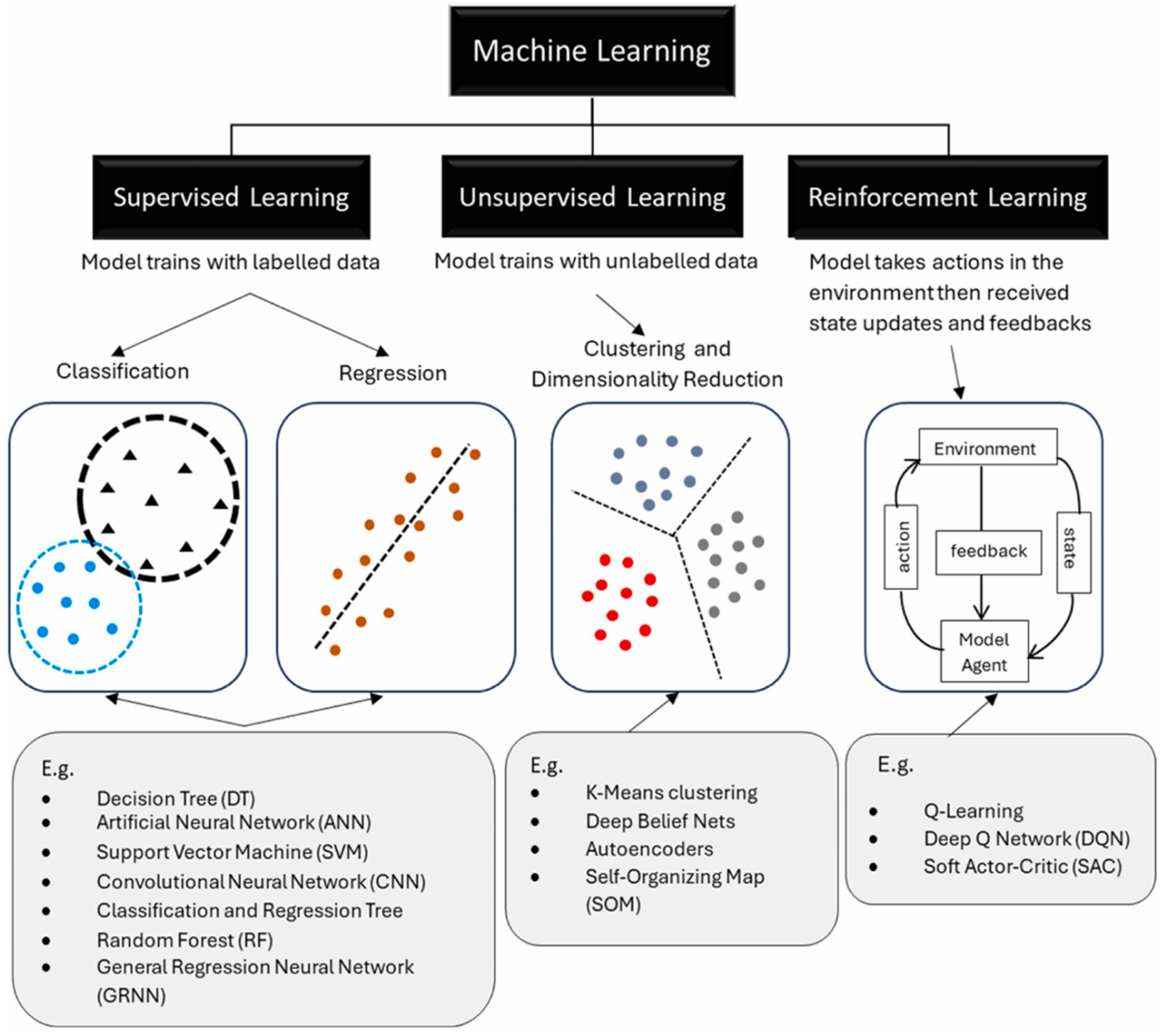
Machine learning approaches can be broadly divided into supervised, unsupervised, and reinforcement learning, as shown in Figure 6. Supervised learning uses labeled datasets to learn a mapping from inputs to target properties [132]. In the field of polymers and polymer-based composites, machine learning techniques have been increasingly applied to predict key material properties such as tensile strength, glass transition temperature, LOI, dielectric constant, and gas permeability, based on descriptors related to composition, molecular structure, and processing conditions [128,133,134,135,136]. Specifically for flame-retardant systems, various regression and classification algorithms, including decision trees, artificial neural networks (ANNs), support vector regression (SVR), ridge regression, random forest regression, gradient boosting, and XGBoost, have been employed to model LOI values and mechanical performance [45,137,138,139]. These data-driven models enable identification of the most influential input features and provide quantitative insights into how specific formulation parameters influence flame retardancy. By providing fast and reliable surrogate predictions, they support both single-objective and multi-objective optimization, guiding formulation strategies and processing conditions for targeted property enhancement.
Unsupervised learning is applied to uncover patterns and hidden structure in complex material datasets, particularly in cases where labeled data is sparse or unavailable. It is commonly used to group formulations based on their performance characteristics, reveal underlying structure in spectroscopic or thermal analysis data, identify anomalies within experimental or production records, and extract compact representations of morphological features that may be linked to failure mechanisms [141,142,143,144]. In the context of sustainable materials informatics, unsupervised learning plays a key role in identifying structural similarities among biodegradable polymers, uncovering hidden patterns within large molecular databases, and transforming high-dimensional descriptors into physically meaningful, low-dimensional representations. These capabilities are particularly valuable during the early stage of material exploration, where the goal is to map the diversity of candidate polymers before property labels are fully established. Such approaches are well-positioned to support future research aimed at classifying flame-retardant mechanisms or to identify groups of bio-based flame retardants that exhibit common condensed-phase behaviors. In both supervised and unsupervised workflows, deep learning offers unique advantages for interpreting imaging and signal-based data, which are prevalent in polymer characterization, including scanning electron microscopy images, micro-computed tomography volumes, and FTIR, Raman, DSC, or TGA traces [122,142,143].
Reinforcement learning treats materials discovery and processing as a sequential decision problem, in which an agent observes a state, selects an action such as choosing a formulation or a processing setpoint, and receives a reward that reflects measured performance and penalties for cost or safety [145,146,147]. In polymer composites, reinforcement learning can propose the next composition and cure or extrusion condition to improve the LOI and mechanical properties while respecting constraints on additive loading, toxicity, and manufacturability [148,149]. It is well-suited to closed-loop experimentation, in which models or simulators provide rapid rewards between physical tests, and to control tasks such as stabilizing viscosity and morphology during reactive processing [150,151,152]. Model-based variants improve sample efficiency by learning or leveraging surrogate process models, while policy regularization and uncertainty penalties reduce unsafe exploration. When combined with unsupervised mapping to define valid design domains and with supervised surrogates to furnish fast reward estimates, reinforcement learning provides a principled framework for multi-objective optimization [146,147].
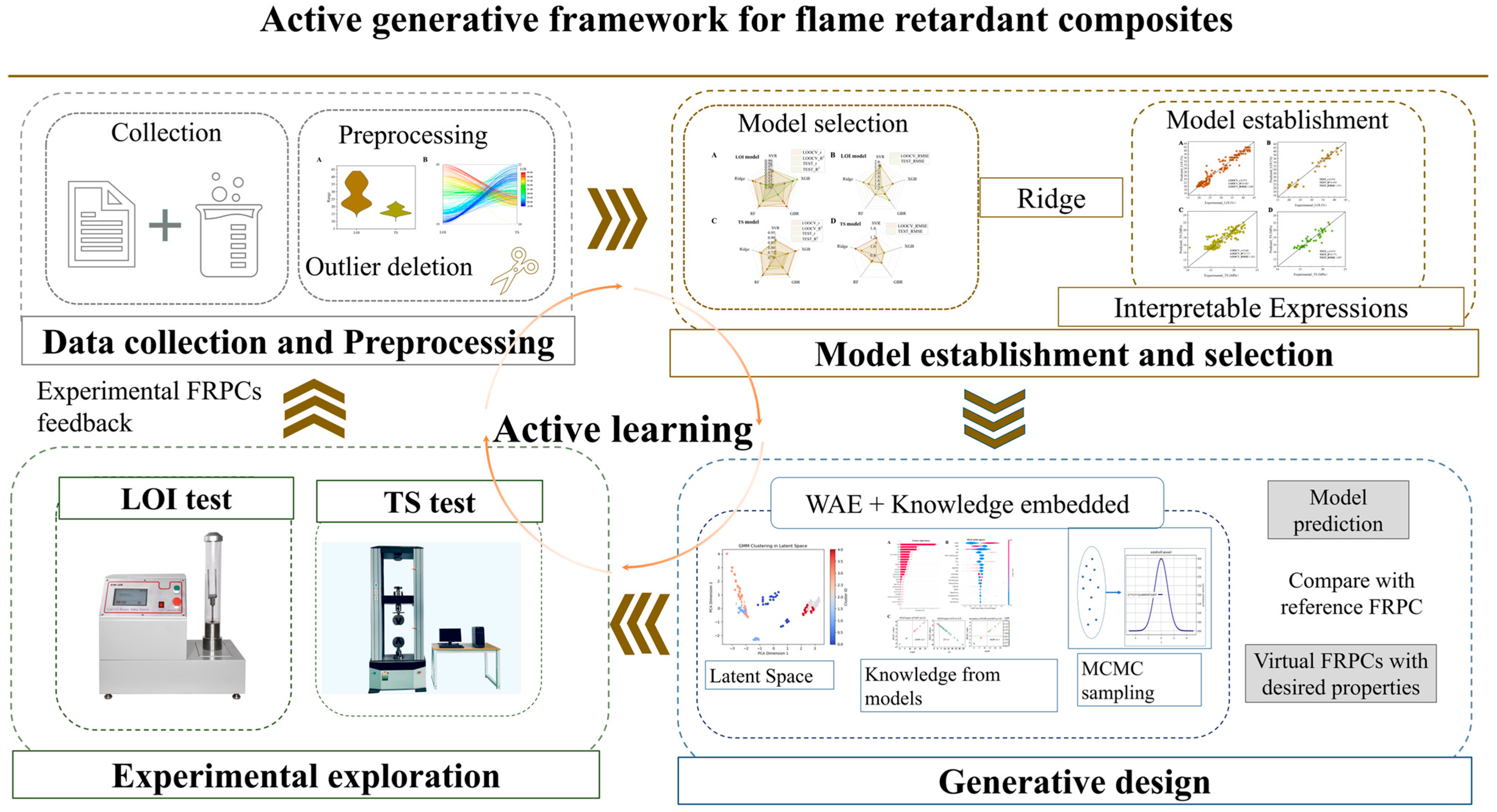
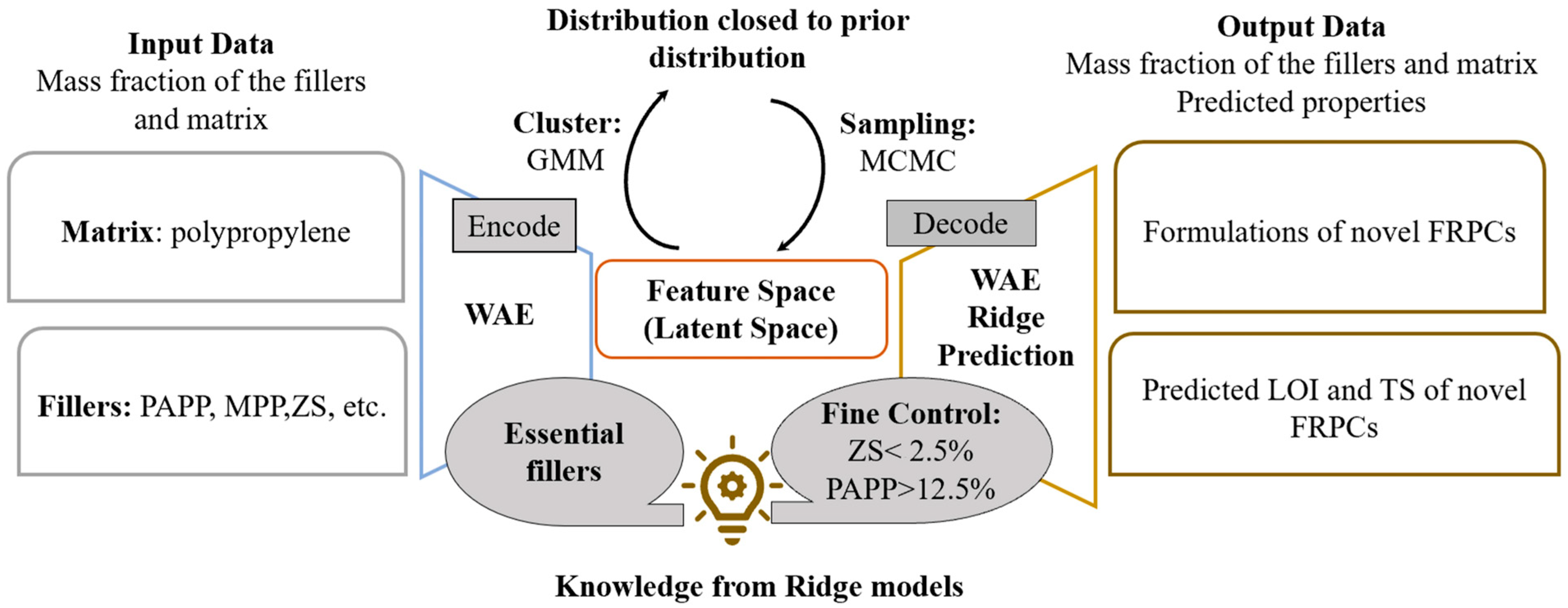
Active learning, a technique that is applied to supervised learning settings, addresses the practical constraint that labels may be expensive, slow, or hazardous to obtain [139]. In this paradigm, the model proposes the next experiments or simulations expected to be most informative, which enables efficient exploration of large design spaces with fewer trials [153,154]. As shown in Figure 7, active learning has been implemented in halogen-free flame-retardant polymer composites to efficiently identify formulations that balance high LOI with acceptable tensile strength [139]. This data-driven approach enables rapid screening of large compositional spaces with minimal experimental efforts. In doing so, it helps uncover mechanistic insights, such as the critical mass fraction thresholds of zinc stannate and piperazine pyrophosphate that are necessary to achieve effective flame-retardant performance.
A typical workflow shown in Figure 8 begins by assembling a curated dataset that correlates composition and processing conditions to microstructure and properties, with metadata for test methods, units, and sample geometries. Unsupervised analysis is initially employed to explore the design space by identifying patterns among candidate materials, reducing dimensionality, detecting anomalies, and guiding the selection of relevant descriptors. This process enhances understanding of the underlying structure of the dataset and informs downstream modeling decisions [122,128,136,141,144]. Supervised models are then trained as fast surrogates for key outputs, and uncertainty estimates guide model selection and validation [119]. Community-developed toolkits support the creation of features and the evaluation of models by simplifying the process of descriptor generation, enabling fair model comparison, and promoting reproducibility in performance benchmarking [136,155]. Active learning next selects the experiments that are the most informative, while generative models or Bayesian optimization search the design space subject for cost, sustainability, and manufacturability constraints [153,154,156]. Top candidates are validated experimentally, and results are fed back to refine the models.
AI can process large datasets containing polymer properties, chemical structures, and synthetic routes to discover biodegradable substrates, insulators, and conductors [117]. These models uncover patterns that are difficult to observe through traditional methods and can accelerate the development of transient electronics and bio-derived polymer systems. From the standpoint of sustainability and practical deployment, AI reduces experimental waste, shortens development cycles, and enables circular design. In polymer composites, these methods help balance multi-objective targets, such as fire performance, mechanical integrity, cost, and environmental metrics, while highlighting knowledge gaps where new experiments are most valuable. As computational resources and data infrastructures mature, AI is becoming integral to modern materials research and is a foundation for reproducible and scalable discovery.
Good practice emphasizes data quality, domain knowledge, and transparency. Features should reflect chemical intuition and physics where possible, including functional groups, coordination environments, Hansen parameters, filler chemistry, particle size and aspect ratio, surface treatment, thermal histories, and measures of morphology and crystallinity. Reporting should include uncertainty estimates, clear train–test splits, and checks for domain shift when moving to new chemistries or processing windows. Combining data-driven models with mechanistic theories such as cure kinetics, micromechanics, transport models, and physics-informed learning improves robustness and interpretability [157,158,159,160].

3.2. Overview and Operation of AI Models

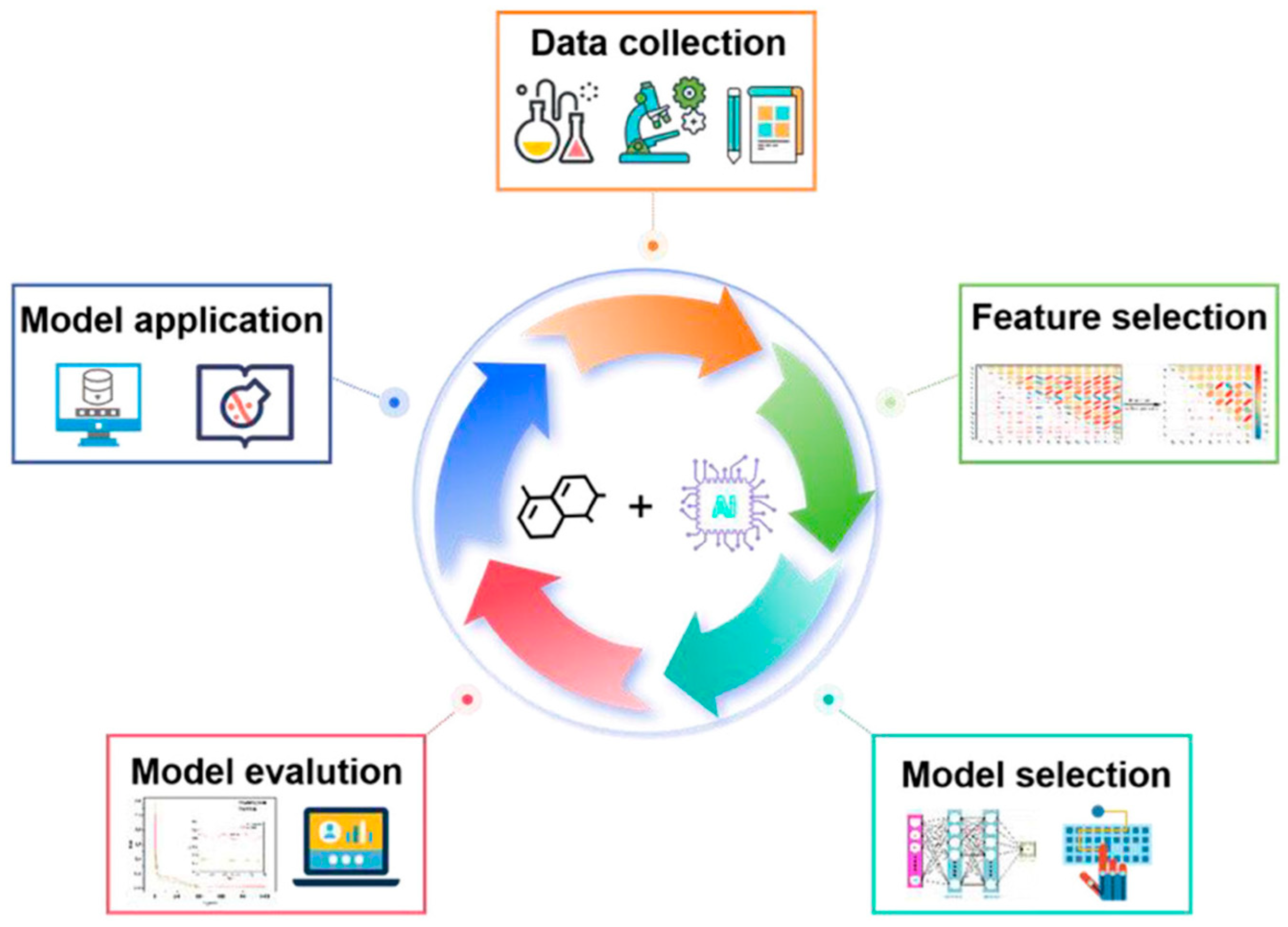
As illustrated in Figure 9, the application of AI in materials discovery and design typically follows a structured sequence of stages that together form an integrated workflow [40]. The process begins with data collection and preprocessing, where information is gathered from experimental results, databases, and literature sources. This data is then cleaned and standardized to reduce inconsistencies and prepare it for analysis. Following this, feature-engineering is performed to extract or construct descriptors that capture the essential characteristics of the materials, as these features play a critical role in determining model performance. In the next step, models are selected and trained by matching algorithms to the nature of the data and the objectives of the study. The training phase involves fitting the model to learn patterns and relationships present in the curated dataset. The final stage focuses on evaluation and optimization. Techniques such as cross-validation are employed to assess the model’s generalizability, and iterative tuning is used to improve robustness and predictive accuracy for unknown materials. When each of these stages is executed systematically, AI enables fast and reliable prediction of materials properties, ultimately accelerating the pace of materials design and discovery.
Building an AI model begins with a trustworthy materials dataset. Both input and output variables require clear definitions and consistent formatting to ensure model validity [161]. In the design of flame-retardant biodegradable polymer composites, high-quality data are obtained from experiments, the reported literature, and handbooks [139,162,163,164]. Datasets describing flame-retardant polymeric composites frequently contain filler mass fractions coupled with performance metrics such as LOI, tensile strength, specific optical density, or smoke release [137,165]. Data cleaning, normalization, and outlier detection enhance model reliability before regression or classification algorithms are applied. Typical preprocessing workflows, illustrated in Figure 10, include anomaly detection through isolation forest, one-class support vector machines, and local outlier factors, followed by standardization to ensure consistent scale. This workflow improves generalization and model interpretability.
Iterative or autonomous frameworks allow the model to function beyond static prediction [166,167,168]. In adaptive systems, the model is trained, optimized, and used to generate recommendations for new formulations [138]. Experiments on those formulations generate new data that are reintegrated into the model. Such iterative learning loops reduce the reliance on human intuition and accelerate movement toward optimal compositions. Chen et al. [138] developed an adaptive framework for flame-retardant composites demonstrated that combining linear and nonlinear models, including ANN and hybrid L-ANN algorithms, can improve accuracy for LOI predictions and enable the screening of promising flame retardants across diverse systems.
Data-driven multi-objective optimization offers another operational mode in which multiple performance targets are achieved simultaneously [137]. Specifically, decision trees and sparsifying operator-based methods can derive analytical expressions that capture interactions among fillers and identify tradeoffs between flame retardancy, mechanical strength, and smoke suppression. Although these methods have been used to optimize polypropylene composites containing metal hydroxides, tin-based compounds, and phosphorus–nitrogen flame retardants, they are also applicable to biodegradable polymer composites. Large-scale computational screening of tens of thousands of virtual compositions can be conducted prior to experimental validation, enabling efficient identification of promising candidate systems.

3.3. Explanation of Descriptors

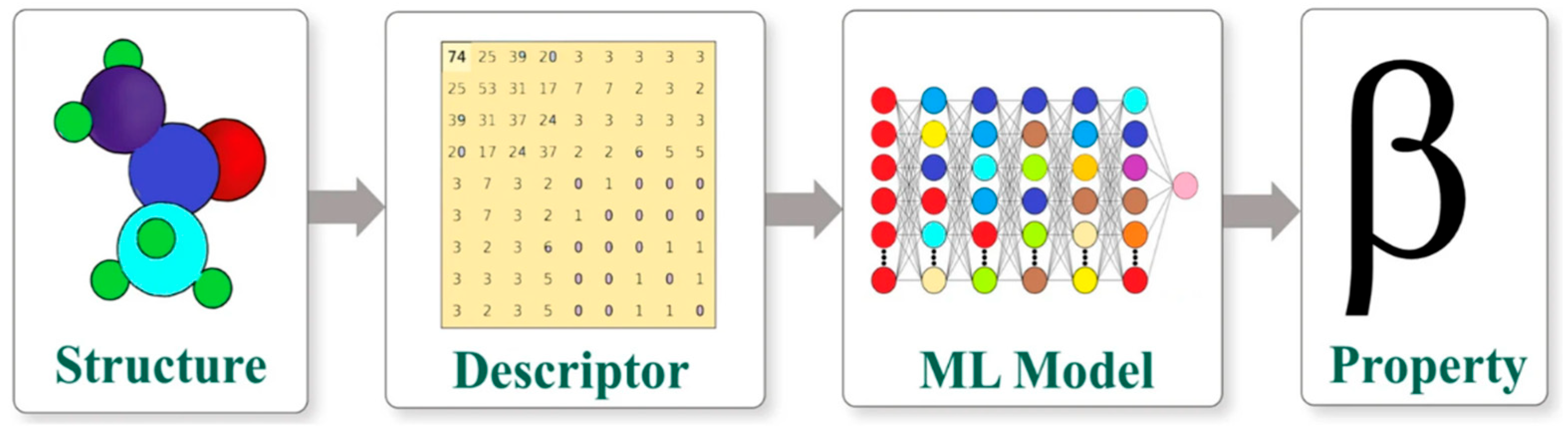
Descriptors serve as the foundational inputs to AI models in materials science, as they capture the essential information needed to relate material structure, composition, or processing to properties of interest. In a typical AI workflow, as illustrated in Figure 11, raw chemical structures, composite formulations, and processing conditions are first transformed into numerical representations that can be interpreted by learning algorithms. These numerical features, or descriptors, may originate directly from data attributes or be derived through mathematical transformations that generate new variables from existing ones. When these transformed descriptors show strong correlations with target outputs, they are retained as model inputs.
In atomistic modeling, descriptors are often constructed to reflect either the local atomic environment or the entire structural arrangement [169,170]. Global descriptors encode information about the full atomic configuration and are useful for predicting properties such as molecular energies, formation enthalpies, or electronic band gaps. On the other hand, local descriptors focus on the chemical environment around specific atoms, which is especially relevant for site-specific predictions.
Descriptors can be grouped into several categories based on their origin and role. Compositional descriptors represent the elemental makeup or weight fractions of the components in a material. Experimental descriptors include process-related variables such as synthesis temperature, applied pressure, reaction time, or measured thermochemical data like heat of combustion or reaction enthalpy. Topological descriptors, by contrast, relate to physical characteristics such as surface area, porosity, pore size, or volume, which are particularly important in porous or composite systems.
Constructing meaningful descriptors requires a deep understanding of both the underlying machine learning model and the scientific context in which it is applied [171]. The choice of descriptors must be carefully aligned with the specific problems being addressed, and identifying all relevant variables for a single model is often challenging. While the process is inherently problem-dependent, several general principles can guide effective descriptor design. First, descriptors must accurately represent the essential characteristics of the material system under investigation. Each descriptor should carry unique and relevant information, such as the material composition, structure, or intrinsic material properties that contribute to defining the identity and behavior of the material. Redundancy must be minimized to ensure that every data point remains distinguishable and contributes meaningfully to the model’s predictive capability. Second, it is important to limit the number of descriptors. In flame-retardant polymer composite modeling, descriptors frequently include the mass fraction of each filler, polymer matrix content, and structural representations of functional groups. These features capture how individual components interact in condensed and gas phases during combustion. An excessive number of descriptors can complicate model training, leading to overfitting [172] and a higher computational cost. To avoid this, a commonly accepted guideline is to limit the number of fitted variables to less than half the number of data points, thereby improving generalizability and predictive reliability [173]. This balance between descriptor richness and parsimony is central to building effective and interpretable models in materials informatics.
More advanced models incorporate descriptors of flame-retardant mechanisms. Wang et al. [174] developed an interpretable multivariate linear regression model to quantify the contribution of specific structural groups to LOI values by separating the effects of condensed-phase char formation and gas-phase radical quenching. The model employed the number of each functional group in the polymer repeating unit as key descriptors, enabling quantification of contributions from halogen, phosphorus, phosphorus–nitrogen, and aromatic structures. This approach provided mechanistic clarity by connecting each descriptor to its role in pyrolysis or flame inhibition.
Other frameworks employ higher-dimensional descriptors such as pyrolysis product distributions, chemical space mapping of volatiles, and encoded representations of polymer chains through SMILES (simplified molecular input line entry specification) strings [135,174,175]. These descriptors allow AI to capture complex behaviors such as polymer degradation, flame propagation, and interactions among fillers. In studies on biodegradable materials, AI systems have also used descriptors related to biodegradation kinetics, molecular weight, crystallinity, and hydrolysable bond densities, demonstrating the compatibility of descriptor-based learning with sustainable polymer design [117].
Beyond formulation chemistry, biodegradable polymers impose practical constraints that strongly influence both flame-retardant performance and manufacturability. To capture limitations such as low degradation temperature, moisture sensitivity/hydrolysis, and narrow processing windows, AI models can incorporate processing/stability variables as explicit inputs (e.g., melt temperature profile, residence time, drying conditions, moisture content, molecular weight/viscosity, and additive activation temperature). Including these descriptors reduces ‘hidden’ variability and enables models to learn when a candidate flame-retardant strategy is incompatible with processing constraints (e.g., thermal degradation, discoloration, or viscosity-induced poor dispersion). In optimization settings, these variables can be treated as hard constraints (feasible processing window) or penalty terms (e.g., predicted molecular-weight loss), allowing AI-guided screening to prioritize formulations that satisfy both fire-safety targets and processing robustness.

3.4. Evaluation of the Performance of AI Models

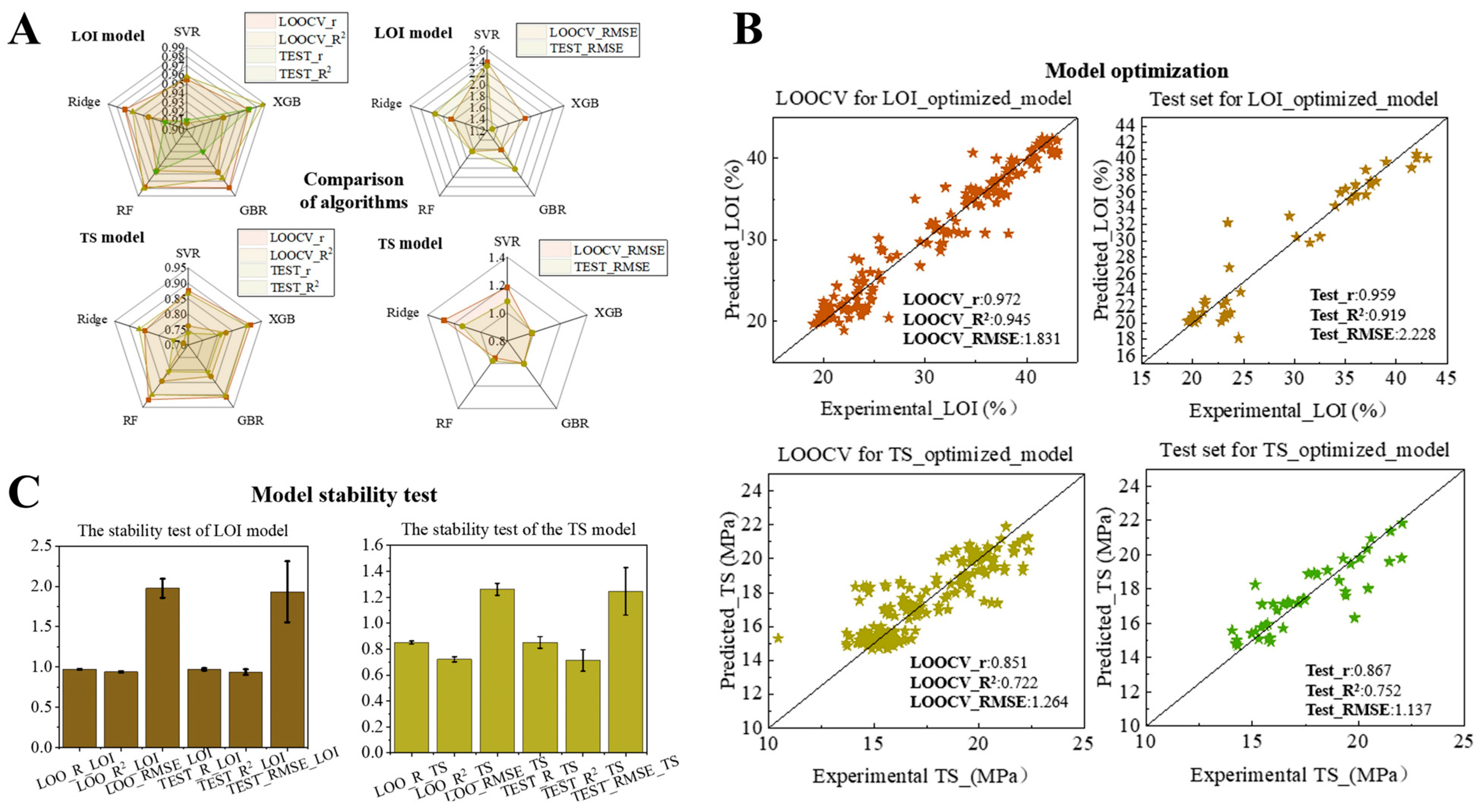
The performance of AI models developed for flame-retardant biodegradable polymer composites is typically evaluated using a combination of statistical and predictive metrics that assess accuracy, generalization ability, and interpretability [139]. Common evaluation tools include Pearson correlation coefficient (PCC), the coefficient of determination (R2), and error metrics such as the root mean squared error (RMSE) or mean square error (MSE) [126]. It is widely recommended to use R2 in conjunction with RMSE or MSE, as this pairing provides a more comprehensive assessment of predictive reliability [176,177]. A well-performing regression model is generally expected to exhibit an R2 value approaching 1.0 and an RMSE value close to 0 [177]. In the machine learning-assisted discovery of a new flame retardant for PLA, R2 and RMSE were used as metrics to evaluate model performance [115].
A critical indicator of model robustness is its ability to generalize, i.e., to make accurate predictions on previously unseen data. Generalization can be compromised by either underfitting or overfitting. Underfitting arises when the model is too simplistic or lacks sufficiently informative descriptors, resulting in poor performance on both training and test datasets. One strategy to address underfitting involves enriching the feature set by introducing additional descriptors, which may be derived through mathematical transformations of existing variables, especially if they are highly correlated with the output. In contrast, overfitting occurs when an AI model is overly complex and captures noise rather than underlying trends, leading to excellent performance on the training set but degraded prediction accuracy on the test set. A standard method for mitigating overfitting is to partition the dataset into separate subsets: typically, 67% to 80% of the data is allocated to training while the remainder is used for testing. If the model performs consistently across both subsets, its predictions are considered reliable. However, this train–test split approach is only effective when the dataset is sufficiently large. In cases where ample data is available, the dataset can be divided into three parts: training, validation, and test sets. The validation set is used to tune model hyperparameters, after which the model is retrained using the combined training and validation data. Further strategies to prevent overfitting include reducing the number of weakly informative descriptors and increasing the overall dataset size, both of which enhance the model’s ability to capture general trends while maintaining predictive performance.
Beyond the basic train-and-test approach, one widely used strategy for evaluating model performance on a smaller dataset is cross-validation [178]. In this method, the dataset is divided into k subsets, known as folds, of approximately equal size. The model is then trained and evaluated k times, each time using k-1 folds for training and the remaining fold for testing. This procedure, referred to as k-fold cross-validation, ensures that each data point is used for both training and validation, thereby reducing bias associated with random splits and improving the robustness of performance metrics. In the design of polypropylene-based flame-retardant composites, cross-validation can be employed alongside test set evaluation to rigorously assess model quality, especially after tuning model hyperparameters [179]. When properly applied, this dual-validation framework allows for the selection of models that not only deliver high predictive accuracy but also preserve interpretable relationships between the input features, such as flame-retardant loading or functional group structure, and the output properties like LOI or tensile strength. This balance between accuracy and interpretability is crucial for material design applications, where understanding the influence of formulation variables is as important as achieving strong predictive performance. This tradeoff is especially important for experimental adoption, where transparent structure–property relationships and actionable guidance can be as valuable as marginal gains in predictive accuracy. In this context, black-box models (e.g., deep neural networks and complex ensemble methods) can offer strong predictive power, whereas interpretable approaches provide clearer, human-readable links between formulation variables and fire-performance metrics, which can lower barriers for experimental uptake.
Interpretable models such as decision trees and multivariate linear regression provide transparent decision rules or explicit analytical expressions, allowing researchers to understand how structural features influence performance [174]. For instance, the SISSO method enabled the derivation of simple equations to approximate LOI across different flame-retardant systems, while an interpretable stacking model provided quantitative insight into gas-phase and condensed-phase contributions to flame retardancy [137,174,179,180]. These models achieved high predictive accuracy with training set performance near 90% and test accuracy above 80%, indicating their suitability for guiding flame-retardant design.
In more complex multi-objective optimization frameworks, performance evaluation also includes the success rate of recommended candidates. For example, in one dataset screening of over 40,000 virtual polypropylene composites, ten candidates were experimentally validated, and most were confirmed to exhibit excellent performance across flame retardancy, mechanical strength, and smoke release metrics [137]. This confirmation of predictive reliability demonstrates the practical effectiveness of model-based selection.

4. Case Studies: Employment of AI in Sustainable Flame-Retardant Design for Biodegradable Polymer Composites

AI has begun to transform the design of flame-retardant polymeric materials, offering new pathways for integrating sustainability, fire safety, and tunable performance [46,137,138,139,174,179,181]. Although most reported studies to date focus on conventional polymers such as polypropylene and epoxy systems, the principles, workflows, and model architectures developed in these works provide a transferable foundation for designing sustainable flame-retardant biodegradable polymer composites. As summarized in Table 2, the following sections provide an expanded examination of representative AI-driven approaches and illustrate how these methodologies can be adapted for biodegradable systems.

4.1. Active Learning-Driven Generative Design of Flame-Retardant Composites

An active learning-based generative framework was developed to design halogen-free flame-retardant polypropylene composites, providing a closed-loop example of AI-guided formulation optimization [139]. The workflow began with a seed dataset of flame-retardant polypropylene recipes, constructed a large virtual design space containing thousands of candidate compositions, and paired generative proposal models with machine learning predictors to rank candidates. In each cycle, the system selected virtual formulations for laboratory testing based on predicted performance and model uncertainty, incorporated the new measurements, and retrained to improve subsequent recommendations.
Across successive cycles, the model uncovered a clear compositional boundary that governs the tradeoff between improved limiting oxygen index and acceptable tensile strength (Figure 12). Zinc stannate was effective only below about 2.5% by mass, while piperazine pyrophosphate needed to exceed about 12.5% by mass to deliver reliable flame retardancy. The framework identified specific compositions meeting these criteria, and two were experimentally confirmed to show significantly enhanced flame retardancy with retained mechanical properties compared to the best reference in the initial dataset. This result illustrates how an AI-guided loop can navigate a complex formulation landscape more efficiently than conventional trial and error.
Although the study focused on polypropylene, the methodology translates directly to biodegradable matrices. Systems based on PLA or PHAs also require multi-additive formulations that balance char formation, mechanical integrity, and environmental compatibility. An analogous active learning loop could be constructed for bio-derived flame retardants such as lignin, phytic acid, chitosan derivatives, and mineral bio-friendly fillers. By proposing and testing only the most informative compositions, the approach would enable systematic exploration of formulation variables while reducing experimental cost and accommodating the processing sensitivity of biodegradable polymers.

4.2. Interpretable Machine Learning for Structuring Flame Retardancy Relationships

Interpretable machine learning models represent another important category of AI applications in flame-retardant design. In one study, an interpretable, quantifiable regression framework was developed to predict LOI while preserving mechanistic clarity [174,179]. This model employed structural descriptors that counted the number of functional groups in each repeating unit, including aromatic rings, heteroatoms, phosphorus-containing moieties, halogens, and nitrogen-rich structures. The resulting equations separated contributions from the condensed phase and the gas phase, enabling the quantification of how char formation and radical quenching individually influence flame retardancy.
The resulting relations showed high predictive accuracy for training and test sets and indicated that phosphorus-containing and aromatic structures predominantly enhance condensed-phase protection, while halogen and nitrogen functionalities contribute strongly to the gas phase.
This interpretable dual-phase model distinguished polymers that rely on char-forming condensed-phase mechanisms from those whose performance stems from gas-phase scavenging. The approach achieved high predictive accuracy, with test set performance exceeding 80%, and generated simple mathematical expressions connecting functional group density to LOI.
Such a model is directly relevant to biodegradable polymer composites. Several sustainable flame retardants, including lignin, tannic acid, and phytic acid, exert flame retardancy predominantly through condensed-phase pathways. Furthermore, bio-based polymers such as cellulose, starch, and PLA contain functional groups well-suited for descriptor-based modeling. An interpretable model built around these groups would enable quantitative evaluation of char-forming potential and allow rapid screening of structural modifications or additive combinations in biodegradable matrices.
From a practical adoption perspective, black-box models often deliver higher accuracy when large, diverse datasets are available, but they can be harder for experimental researchers to trust and act upon because the decision logic is not transparent [182]. In contrast, interpretable models (e.g., sparse linear regression, decision trees, and rule-based models) typically provide direct, human-readable relationships between formulation/structure descriptors and fire-performance metrics, enabling hypothesis generation, formulation screening, and mechanism-aware design even with smaller datasets. A pragmatic pathway is to use black-box models for prediction and optimization, while pairing them with post hoc explanations (e.g., feature importance/SHAP, partial dependence) and uncertainty estimates to translate predictions into actionable experimental guidance and to prioritize the next experiments [182,183,184]. For example, Lv et al. combined stacked ensemble learning with SHAP-based interpretation and Bayesian optimization to enable an inverse formulation design targeting LOI improvement, illustrating a practical workflow that balances predictive performance with experimentally actionable insights [185].

4.3. Adaptive Hybrid Modeling for Flame-Retardant Composite Optimization

An adaptive machine learning framework that combines linear models (Lasso and Ridge), nonlinear artificial neural networks (ANN), and a hybrid architecture L-ANN was developed to optimize flame-retardant composite performance, accelerating the discovery of high flame-retardant polymer composites [138]. The study assembled a dataset of flame-retardant polymer formulations and used an iterative workflow in which models were trained, used for prediction, and retrained as new experimental data became available. The workflow operates iteratively: The model is trained on experimental and literature data, screened against a broad range of formulations, and refined using newly acquired performance results. The hybrid L-ANN model (Table 3) exhibited superior accuracy in predicting LOI values compared with individual linear or nonlinear approaches and benefited from the integration of domain knowledge regarding composite formulation.
This adaptive workflow is well-suited to biodegradable systems where data are often sparse and multidimensional. Biopolymer composites commonly involve interplay between polymer crystallinity, fiber content, moisture sensitivity, and additive compatibility. An adaptive hybrid model can flexibly accommodate nonlinearities arising from these variables and guide the optimization of multi-component sustainable flame-retardant systems without exhaustive experimentation [45].

4.4. Multi-Objective Optimization of Flame-Retardant Performance and Material Properties

Flame-retardant design rarely requires optimization of a single property. Instead, materials must satisfy flame retardancy, mechanical integrity, smoke suppression, and optical or thermal characteristics simultaneously. Different from the above-mentioned research [138] focusing on performance/property separately, a data-driven multi-objective optimization strategy was developed and applied to screen flame-retardant polymeric composites, aiming to balance flame retardancy, mechanical properties, specific optical density, and smoke-related parameters [137]. In this study, machine learning regressors were trained on a dataset containing LOI, tensile strength (TS), specific optical density (Dsmax), and smoke release using Sure Independence Screening and Sparsifying Operator (SISSO) methods to evaluate tens of thousands of candidate formulations, and were then used to screen more than 40,000 virtual formulations. As a result, ten representative candidates were selected and synthesized, and experimental measurements showed close agreement with the model predictions for most compositions, confirming the capability of the approach to identify formulations that simultaneously satisfy multiple performance criteria.
Biodegradable composites present similar multi-objective design challenges. PLA- or starch-based systems often exhibit reductions in ductility when incorporating flame retardants, and natural fiber-reinforced systems may increase smoke production unless modified. A multi-objective machine learning framework, therefore, provides an efficient means of balancing the tradeoffs between sustainability, environmental compatibility, fire safety, and mechanical stability inherent in biodegradable composite design.

4.5. AI-Assisted Discovery of Sustainable and Biodegradable Polymer Materials

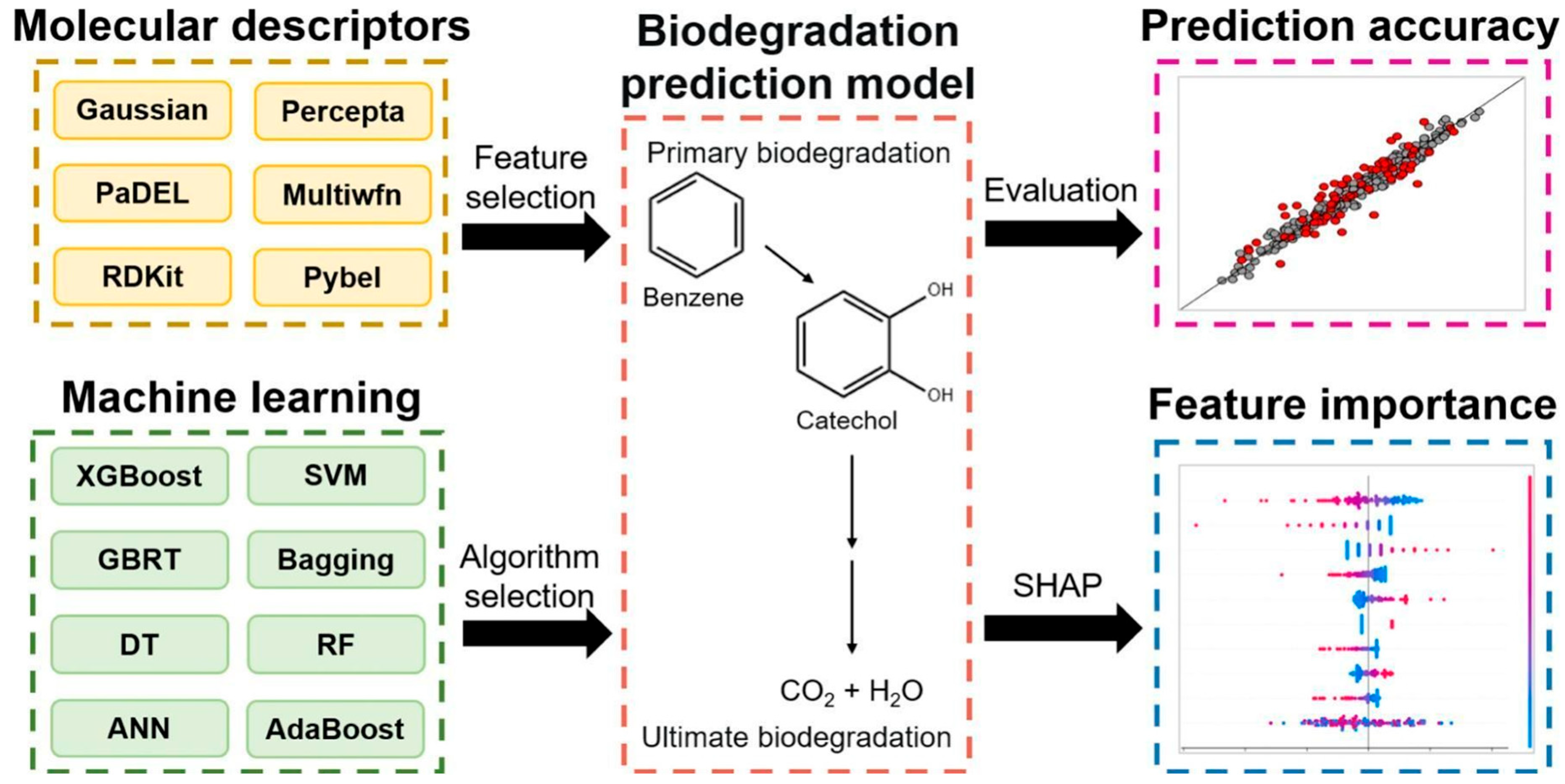
Beyond flame retardancy alone, AI has been employed to discover biodegradable polymers, substrates, and transient electronic materials whose design principles are transferable to sustainable flame-retardant composite research [117,134]. In one study, neural networks, ensemble learning methods, and generative algorithms (Figure 13) were used to correlate molecular structure with biodegradation kinetics, stability, and functional performance in biodegradable substrates and transient electronic materials [117]. These models successfully predicted degradation behavior and identified structural motifs that promote environmental compatibility, while iterative integration of experimental data improved the reliability of the predictions and guided the proposal of new candidate materials.
These AI techniques enabled the discovery of polymers with tailored degradation rates, optimized electronic properties, and enhanced environmental compatibility. Moreover, generative architecture expanded the searchable chemical space and proposed novel candidates that might not emerge from conventional design routes.
The ability to couple generative modeling with flame-retardant mechanisms holds particular promise. Bio-derived flame retardants often involve combinations of aromatic char promoters, phosphorus-rich molecules, and metal hydroxide-based suppressants. A generative system integrated with a flame-retardancy prediction model could explore combinations of structural features that enhance condensed-phase protection while maintaining biodegradability.

4.6. Deep Learning-Assisted Optimization of Bio-Based Flame-Retardant Architectures

Deep learning approaches have further expanded the capability of AI in sustainable flame-retardant composite design by capturing nonlinear relationships between additive content, combustion dynamics, and mechanical behavior [186]. In deep learning, a long short-term memory network (LSTM) can effectively capture and retain long-term dependencies because of its unique memory unit and gating mechanism (including input gate, forgetting gate, and output gate) [187]. This enables LSTM to process time-series data effectively. In waste wood lignocellulose composites treated with phytic acid and tannic acid, LSTM neural networks were successfully trained on heat release rate time-series data, achieving coefficients of determination between 0.94 and 0.99 for combustion prediction [186]. The mean absolute error for peak heat release rate prediction was reported to be below 5%, demonstrating strong reliability despite the inherent heterogeneity of biomass-derived materials. Experimentally validated formulations guided by deep learning optimization exhibited reductions in peak heat release rate of up to 67% and decreases in total heat release of approximately 45% compared with untreated composites. Concurrently, residual char yield at 700 °C increased from less than 15 wt.% in the untreated system to more than 32 wt.% after incorporation of bio-based flame retardants. These results demonstrate that temporal combustion behavior, rather than single scalar metrics alone, can be learned and optimized using deep learning models.
These quantitative improvements demonstrate that deep learning models can effectively guide the selection and loading of sustainable flame retardants while maintaining control over combustion dynamics in biodegradable polymer matrices [186]. This approach is especially valuable for biodegradable systems, where combustion behavior is strongly influenced by moisture content, hydrogen bonding networks, and heterogeneous biomass composition. By learning from time-dependent calorimetric data, deep learning models can identify optimal flame-retardant loading windows that simultaneously reduce peak heat release rate and smoke production while preserving structural integrity. Importantly, these models enable the high-value utilization of waste-derived biomass as functional flame-retardant components, aligning fire-safety enhancement with circular economic principles.

4.7. Data-Driven Formulation Space Exploration for Sustainable Flame Retardants

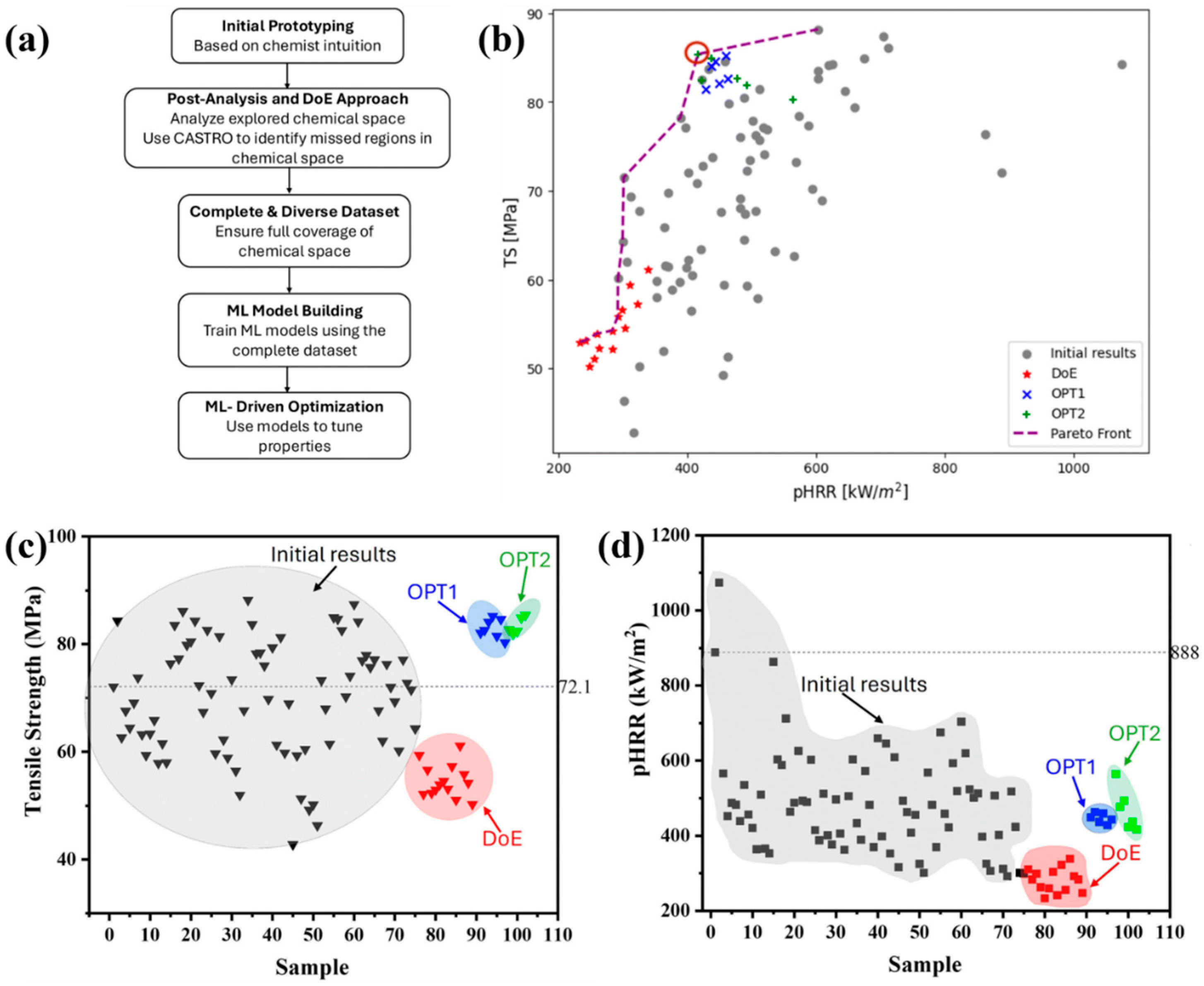
Beyond mechanism prediction, AI-guided formulation optimization frameworks have demonstrated the ability to efficiently navigate high-dimensional composition spaces that are impractical to explore experimentally. A data-driven workflow (Figure 14) integrating design of experiments, machine learning regression, and Bayesian optimization enabled the rapid identification of optimal bio-based flame-retardant polyamide composites in less than 50 experimental iterations, achieving up to 73.7% reduction in pHRR to neat polymer while simultaneously improving tensile strength by 12% to 18% [188]. This result indicates that flame retardancy enhancement did not compromise mechanical integrity. LOI values increased from approximately 21% for the unmodified polymer to values exceeding 32% for optimized bio-based formulations, while thermal stability was maintained above 400 °C. These results demonstrate that AI can reduce reliance on trial-and-error experimentation while accelerating the development of high-performance sustainable materials. Very recent work has also demonstrated machine learning-guided flame-retardant design in biodegradable matrices: Shen et al. employed a random forest model with feature selection to guide the development of a P-N flame retardant for PLA, achieving an LOI of 30.5% at low loading (3 wt.%) and a measurable reduction in pHRR (11.1%) [115].
For biodegradable polymer composites, such workflows are particularly advantageous because additive compatibility, processing sensitivity, and degradation behavior impose narrow formulation windows. AI-based optimization allows these constraints to be encoded directly into predictive models, enabling targeted exploration of compositions that satisfy flame retardancy, mechanical robustness, and environmental compatibility simultaneously. The demonstrated success of data-driven bio-based polyamide systems highlights the transferability of these methods to biodegradable matrices such as polylactic acid, polyhydroxyalkanoates, and starch-based composites [188].

4.8. Toward Predictive Fire-Safety Platforms for Biodegradable Polymers

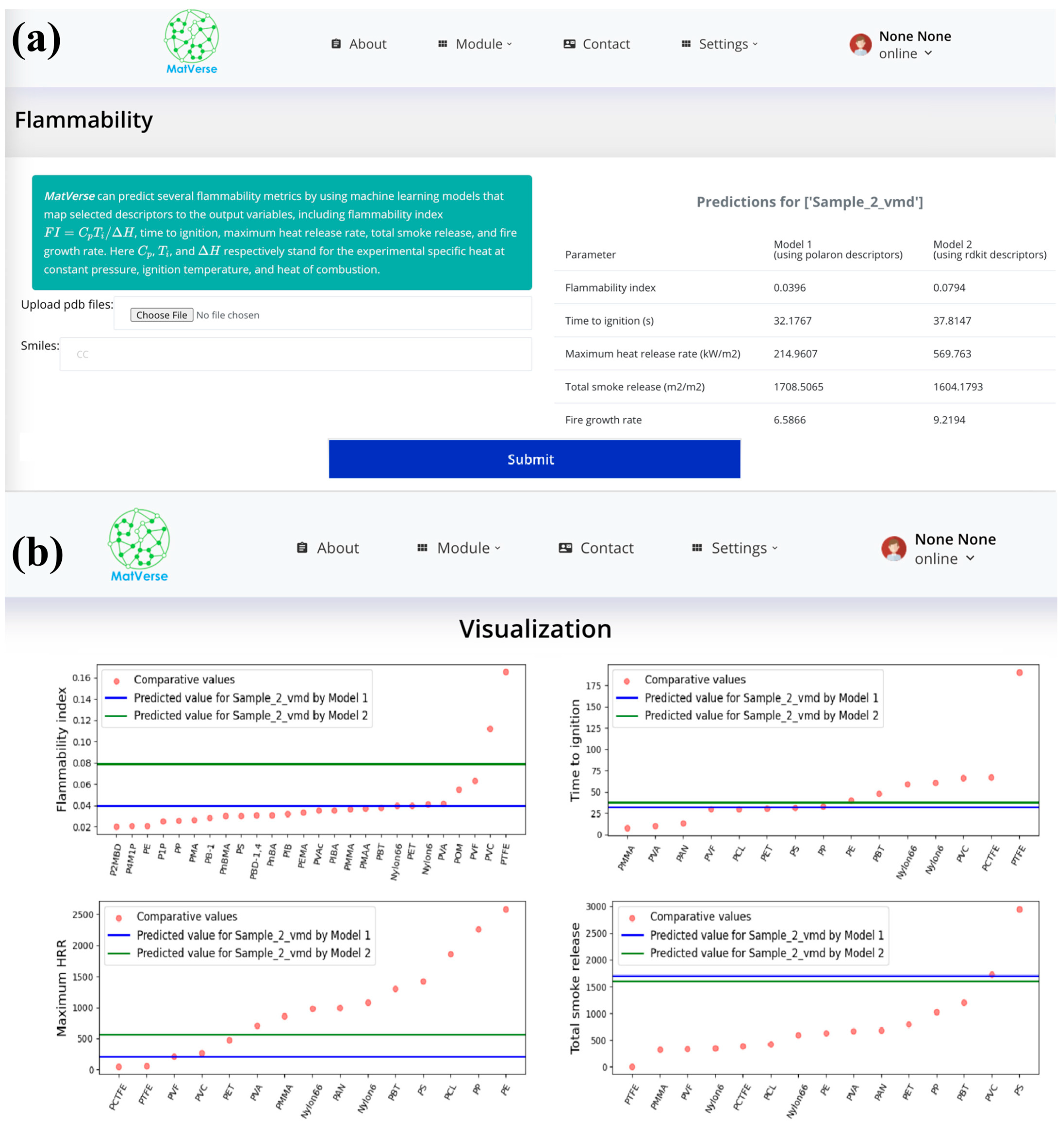
Most existing machine learning models developed for low-flammability polymer systems primarily focus on optimizing the composition and structure of flammable material composites. However, these models are typically implemented as standalone algorithms or code-based frameworks and often lack user-friendly interfaces that enable intuitive end-user interaction [189]. This limitation significantly restricts their practical applicability and broader adoption, particularly among non-specialist users without advanced expertise in data science or machine learning. Accordingly, machine learning platforms developed for polymer flammability prediction further illustrate the potential for scalable, accessible AI tools in sustainable flame-retardant design. By combining polymer structural descriptors with experimentally derived ignition temperature and heat of combustion data, LOI values and other parameters obtained by cone calorimetry can be predicted with encouraging accuracy despite limited datasets [189]. More importantly, a module integrated into the cloud-based MatVerse platform, POLYCOMPRED, provides a user-friendly, web-based interface, as shown in Figure 15, specifically for flammability prediction. Using combined experimental and synthetic datasets, classification accuracies of 80% to 85% were achieved for polymer flammability indices, while regression models yielded root mean square errors below 15% for peak heat release rate prediction. The introduction of synthetic data increased the effective dataset size by more than threefold, significantly improving prediction robustness for polymer classes with limited experimental fire testing data. Predicted reductions in peak heat release rate ranged from 30% to 60% across diverse polymer systems, including oxygen-rich and semi-crystalline materials relevant to biodegradable matrices. The use of synthetic data generation has been shown to alleviate data scarcity, which remains a critical challenge for biodegradable polymer systems where comprehensive fire testing data are sparse.
These platforms enable rapid screening of candidate biodegradable formulations prior to synthesis, reducing material waste and experimental burden. When coupled with sustainability-driven descriptors such as bio-carbon content, renewable feedstock fraction, or degradation behavior, such predictive tools could evolve into comprehensive decision-support systems for designing next-generation flame-retardant biodegradable composites that meet both regulatory fire-safety requirements and environmental performance targets [189].

5. Conclusions and Challenges in AI-Assisted Sustainable Flame-Retardant Design for Biodegradable Polymer Composites

Recent progress in the application of AI to the design of sustainable flame-retardant systems for biodegradable polymer composites has been systematically reviewed and analyzed, integrating both established studies and emerging data-driven methodologies. Collectively, the findings demonstrate that machine learning and deep learning tools can effectively capture structure–property–performance relationships governing flame retardancy, mechanical behavior, and thermal stability in bio-based and biodegradable polymer systems. Predictive models have achieved high accuracy for key fire-safety metrics such as LOI, peak heat release rate, and total heat release, confirming that AI-assisted design can effectively screen formulation and additive selection in sustainable polymer systems.
Interpretable machine learning models consistently identify phosphorus content, aromaticity, and heteroatom density as the most influential descriptors governing char formation and heat transfer suppression. These trends align with experimental observations in biodegradable systems incorporating bio-based flame retardants such as lignin, phytic acid, and tannic acid, where significant increases in char yield and reductions in heat release rate are observed without reliance on toxic gas-phase inhibitors.
Deep learning approaches further extend these insights by accurately describing time-dependent combustion behavior. Models trained on cone calorimetry heat release rate profiles reproduce experimental combustion dynamics with coefficients of determination approaching 0.99, even for heterogeneous lignocellulosic and waste-derived composites. These results confirm that AI is not limited to only static property prediction but can also guide mechanistically informed optimization of flame-retardant loading and formulation balance in biodegradable polymer matrices.
In addition, AI-guided formulation strategies demonstrate a clear reduction in experimental workload, while maintaining or improving material performance. Data-driven optimization frameworks have identified flame-retardant formulations achieving reductions in peak heat release rate exceeding 70%, accompanied by improvements in tensile strength and thermal stability, using fewer than 50 experimental trials. Such outcomes underscore the value of AI in navigating complex formulation spaces where fire performance, mechanical integrity, and sustainability constraints must be simultaneously satisfied.
Despite these advances, several challenges remain evident. Limited availability of standardized fire testing data for biodegradable polymers restricts model generalizability and cross-system transferability. Many datasets are fragmented across different testing protocols, additive chemistries, and polymer classes, complicating direct comparison and large-scale model training. Beyond increasing dataset size, data harmonization will be essential to improve model robustness and transferability [190]. Harmonization includes curating consistent metadata (e.g., polymer grade, additive chemistry, loading units, specimen thickness/density, and conditioning history), reporting processing history, and using unified definitions for fire metrics (e.g., pHRR) so that data from different studies can be combined without hidden bias. In addition, broader adoption and stricter reporting of standardized fire-testing protocols (ASTM/ISO; refs. [191,192,193] clearly stating heat flux, ignition method, ventilation, sample geometry, and replicates) would reduce inter-laboratory variability and label noise, enabling more reliable cross-study training and external validation [194,195]. Establishing community datasets with standardized templates (or ‘minimum reporting standards’) would further support benchmark tasks and accelerate closed-loop optimization. Furthermore, most current AI models prioritize fire performance metrics without explicitly incorporating biodegradation behavior, long-term aging, or environmental impact, which are essential considerations for sustainable polymer applications. Addressing these challenges will be critical for advancing AI-assisted flame-retardant design from proof-of-concept studies to practical implementation.

Future Perspectives

Building upon the combined findings of this review, several opportunities emerge for advancing AI-assisted sustainable flame-retardant design for biodegradable polymer composites. One important future direction is to develop sophisticated and integrated datasets that couple fire performance metrics with biodegradation behavior, life-cycle assessment indicators, and processing parameters. Such datasets would enable multi-objective machine learning models capable of optimizing fire safety and environmental performance simultaneously, rather than treating sustainability as a secondary constraint.
Further opportunities lie in the expansion of interpretable and physics-informed machine learning frameworks. Incorporating degradation kinetics, char evolution processes, and mass and heat transfer phenomena into model architectures would enhance predictive reliability while preserving mechanistic transparency. This approach is particularly relevant for biodegradable polymers, where thermal decomposition, moisture sensitivity, and microbial interactions strongly influence both flame retardancy and long-term material behavior.
The application of AI-guided design to waste-derived and circular feedstocks represents another promising avenue. As demonstrated by studies on lignocellulosic biomass and bio-based polyamides, AI can accelerate the valorization of low-value renewable resources into effective flame-retardant components. Extending these strategies to broader biodegradable polymer systems, including PLA, PHAs, and starch-based composites, could significantly expand the design space for sustainable fire-safe materials while supporting circular economy objectives. For PLA specifically, recent machine learning-guided work coupled LOI prediction with feature selection and experimental validation, enabling a low-loading flame-retardant design that increased LOI to 30.5% at 3 wt.% additive [115].
Lastly, future progress will depend on integrating AI-assisted formulation design with scalable manufacturing and regulatory frameworks. Coupling predictive models with processing simulations, real-time experimental feedback, and standardized fire testing protocols could enable closed-loop optimization platforms suitable for industrial translation. Moreover, adopting harmonized data-reporting templates (minimum metadata on formulation, processing history, specimen geometry/conditioning, and test settings) would enable cross-study data aggregation, external validation, and more transferable AI models. Recent perspective work on data-driven bioplastic design also highlights that harmonized process–structure–property datasets and standardized characterization/testing pipelines are key enablers for transferable, data-efficient models in bio-derived polymers [196]. Such developments position AI as a critical enabling tool for the rational design of biodegradable polymer composites that meet stringent fire-safety requirements while aligning with sustainability and environmental performance goals.

Author Contributions

J.Z.: Conceptualization, investigation, methodology, original draft preparation, formal analysis, review and editing of the manuscript, and validation of the findings. A.B.M.: Methodology, original draft preparation, reviewing and editing of the manuscript, and validation of the findings. Y.L.: Review and editing of the manuscript, and validation of the findings. U.S.: Review and editing of the manuscript, validation of the findings, supervision, funding acquisition, and project administration. All authors have read and agreed to the published version of the manuscript.

Funding

We also thank the Natural Sciences and Engineering Research Council of Canada (NSERC) Discovery (grant 04058/2020) for their support.

Data Availability Statement

No new data were created or analyzed in this study. Data sharing is not applicable to this article.

Acknowledgments

We thank the Centre for Advanced Polymers and Nanotechnology (CAPNA), Department of Chemical and Petroleum Engineering, University of Calgary, Canada, for the technical support.

Conflicts of Interest

The authors declare no conflicts of interest.

References

  1. Hull, T.R.; Law, R.J.; Bergman, Å. Chapter 4—Environmental Drivers for Replacement of Halogenated Flame Retardants. In Polymer Green Flame Retardants; Elsevier: Amsterdam, The Netherlands, 2014; pp. 119–179. [Google Scholar] [CrossRef]
  2. Karan, H.; Funk, C.; Grabert, M.; Oey, M.; Hankamer, B. Green Bioplastics as Part of a Circular Bioeconomy. Trends Plant Sci. 2019, 24, 237–249. [Google Scholar] [CrossRef] [PubMed]
  3. Auras, R.; Harte, B.; Selke, S. An Overview of Polylactides as Packaging Materials. Macromol. Biosci. 2004, 4, 835–864. [Google Scholar] [CrossRef] [PubMed]
  4. Philip, S.; Keshavarz, T.; Roy, I. Polyhydroxyalkanoates: Biodegradable polymers with a range of applications. J. Chem. Technol. Biotechnol. 2007, 82, 233–247. [Google Scholar] [CrossRef]
  5. Niaounakis, M. Biopolymers: Applications and Trends; William Andrew: Norwich, NY, USA, 2015. [Google Scholar] [CrossRef]
  6. Guo, C.; Guo, H. Progress in the Degradability of Biodegradable Film Materials for Packaging. Membranes 2022, 12, 500. [Google Scholar] [CrossRef]
  7. Chen, M.; Guo, Q.; Yuan, Y.; Li, A.; Lin, B.; Xiao, Y.; Xu, L.; Wang, W. Recent Advancements of Bio-Derived Flame Retardants for Polymeric Materials. Polymers 2025, 17, 249. [Google Scholar] [CrossRef]
  8. Mensah, R.A.; Shanmugam, V.; Narayanan, S.; Renner, J.S.; Babu, K.; Neisiany, R.E.; Försth, M.; Sas, G.; Das, O. A review of sustainable and environment-friendly flame retardants used in plastics. Polym. Test. 2022, 108, 107511. [Google Scholar] [CrossRef]
  9. Zhao, Z.; Prabhakar, M.N.; Zhang, Z.; Li, C.; Le, L.; Liu, M.; Yu, R. A Comprehensive Review of Phytic Acid as a Bio-Based Flame Retardant for Polymer Composites. J. Vinyl Addit. Technol. 2025, 1–20. [Google Scholar] [CrossRef]
  10. Zhang, Y.; Song, P.; Liu, Y. Sustainable Flame Retardants and Polymeric Materials. Front. Mater. 2021, 8, 778652. [Google Scholar] [CrossRef]
  11. Mokhena, T.C.; Sadiku, E.R.; Ray, S.S.; Mochane, M.J.; Matabola, K.P.; Motloung, M. Flame retardancy efficacy of phytic acid: An overview. J. Appl. Polym. Sci. 2022, 139, e52495. [Google Scholar] [CrossRef]
  12. Morgan, A.B.; Gilman, J.W. An overview of flame retardancy of polymeric materials: Application, technology, and future directions. Fire Mater. 2013, 37, 259–279. [Google Scholar] [CrossRef]
  13. Zhang, J.; Li, Z.; Qi, X.-L.; Wang, D.-Y. Recent progress on metal–organic framework and its derivatives as novel fire retardants to polymeric materials. Nano-Micro Lett. 2020, 12, 1–21. [Google Scholar] [CrossRef]
  14. Hou, B.; Pan, Y.T.; Song, P. Metal-organic frameworks as promising flame retardants for polymeric materials. Microstructures 2023, 3, 2023039. [Google Scholar] [CrossRef]
  15. Huang, G.; Pan, Y.-T.; Liu, L.; Song, P.; Yang, R. Metal-organic frameworks and their derivatives for sustainable flame-retardant polymeric materials. Adv. Nanocomposites 2025, 2, 1–14. [Google Scholar] [CrossRef]
  16. Sun, X.; Miao, W.; Pan, Y.-T.; Song, P.; Gaan, S.; Ibarra, L.H.; Yang, R. Metal-Organic Frameworks: A Solution for Greener Polymeric Materials with Low Fire Hazards. Adv. Sustain. Syst. 2025, 9, 2400768. [Google Scholar] [CrossRef]
  17. Averous, L.; Boquillon, N. Biocomposites based on plasticized starch: Thermal and mechanical behaviours. Carbohydr. Polym. 2004, 56, 111–122. [Google Scholar] [CrossRef]
  18. Zeng, M.; Du, Y.; Jiang, Q.; Kempf, N.; Wei, C.; Bimrose, M.V.; Tanvir, A.; Xu, H.; Chen, J.; Kirsch, D.J. High-throughput printing of combinatorial materials from aerosols. Nature 2023, 617, 292–298. [Google Scholar] [CrossRef]
  19. Feng, J.; Liu, L.; Zhang, Y.; Wang, Q.; Liang, H.; Wang, H.; Song, P. Rethinking the pathway to sustainable fire retardants. Exploration 2023, 3, 20220088. [Google Scholar] [CrossRef] [PubMed]
  20. Gao, L.; Lin, J.; Wang, L.; Du, L. Machine Learning-Assisted Design of Advanced Polymeric Materials. Acc. Mater. Res. 2024, 5, 571–584. [Google Scholar] [CrossRef]
  21. Olson, G.B. Computational design of hierarchically structured materials. Science 1997, 277, 1237–1242. [Google Scholar] [CrossRef]
  22. Kalidindi, S.R.; De Graef, M. Materials data science: Current status and future outlook. Annu. Rev. Mater. Res. 2015, 45, 171–193. [Google Scholar] [CrossRef]
  23. Agrawal, A.; Choudhary, A. Perspective: Materials informatics and big data: Realization of the “fourth paradigm” of science in materials science. APL Mater. 2016, 4, 053208. [Google Scholar] [CrossRef]
  24. Zeni, C.; Pinsler, R.; Zügner, D.; Fowler, A.; Horton, M.; Fu, X.; Wang, Z.; Shysheya, A.; Crabbé, J.; Ueda, S. A generative model for inorganic materials design. Nature 2025, 639, 624–632. [Google Scholar] [CrossRef]
  25. Yao, C.; Liu, S.; Liu, Z.; Huang, S.; Sun, T.; He, M.; Xiao, G.; Ouyang, H.; Tao, Y.; Qiao, Y. Deep learning-enhanced anti-noise triboelectric acoustic sensor for human-machine collaboration in noisy environments. Nat. Commun. 2025, 16, 4276. [Google Scholar] [CrossRef]
  26. Liu, T.; Zhang, M.; Li, Z.; Dou, H.; Zhang, W.; Yang, J.; Wu, P.; Li, D.; Mu, X. Machine learning-assisted wearable sensing systems for speech recognition and interaction. Nat. Commun. 2025, 16, 2363. [Google Scholar] [CrossRef] [PubMed]
  27. Luo, W.; Dai, F.; Liu, Y.; Wang, X.; Li, M. Pulse-driven MEMS gas sensor combined with machine learning for selective gas identification. Microsyst. Nanoeng. 2025, 11, 72. [Google Scholar] [CrossRef]
  28. De Chaumont, F.; Ey, E.; Torquet, N.; Lagache, T.; Dallongeville, S.; Imbert, A.; Legou, T.; Le Sourd, A.-M.; Faure, P.; Bourgeron, T. Real-time analysis of the behaviour of groups of mice via a depth-sensing camera and machine learning. Nat. Biomed. Eng. 2019, 3, 930–942. [Google Scholar] [CrossRef] [PubMed]
  29. Dananjaya, V.; Marimuthu, S.; Yang, R.; Grace, A.N.; Abeykoon, C. Synthesis, properties, applications, 3D printing and machine learning of graphene quantum dots in polymer nanocomposites. Prog. Mater. Sci. 2024, 144, 101282. [Google Scholar] [CrossRef]
  30. Liu, Y.; Zhang, D.; Tang, Y.; Zhang, Y.; Gong, X.; Xie, S.; Zheng, J. Machine learning-enabled repurposing and design of antifouling polymer brushes. Chem. Eng. J. 2021, 420, 129872. [Google Scholar] [CrossRef]
  31. Ye, S.; Meftahi, N.; Lyskov, I.; Tian, T.; Whitfield, R.; Kumar, S.; Christofferson, A.J.; Winkler, D.A.; Shih, C.-J.; Russo, S. Machine learning-assisted exploration of a versatile polymer platform with charge transfer-dependent full-color emission. Chem 2023, 9, 924–947. [Google Scholar] [CrossRef]
  32. Altintas, C.; Altundal, O.F.; Keskin, S.; Yildirim, R. Machine learning meets with metal organic frameworks for gas storage and separation. J. Chem. Inf. Model. 2021, 61, 2131–2146. [Google Scholar] [CrossRef]
  33. Chong, S.; Lee, S.; Kim, B.; Kim, J. Applications of machine learning in metal-organic frameworks. Coord. Chem. Rev. 2020, 423, 213487. [Google Scholar] [CrossRef]
  34. Zeng, Y.; Wang, J.; Li, F.; Liu, T.; Xu, A. AI-Accelerated Discovery of Electrocatalyst Materials. ACS Mater. Au 2026, 6, 72–89. [Google Scholar] [CrossRef] [PubMed]
  35. Dai, Y.; Chan, H.; Vriza, A.; Fan, J.; Kim, F.; Wang, Y.; Liu, W.; Shan, N.; Xu, J.; Weires, M.; et al. Adaptive AI decision interface for autonomous electronic material discovery. Nat. Chem. Eng. 2025, 2, 760–770. [Google Scholar] [CrossRef]
  36. Shajari, S.; Kuruvinashetti, K.; Komeili, A.; Sundararaj, U. The Emergence of AI-Based Wearable Sensors for Digital Health Technology: A Review. Sensors 2023, 23, 9498. [Google Scholar] [CrossRef] [PubMed]
  37. Blanco-Gonzalez, A.; Cabezon, A.; Seco-Gonzalez, A.; Conde-Torres, D.; Antelo-Riveiro, P.; Pineiro, A.; Garcia-Fandino, R. The role of AI in drug discovery: Challenges, opportunities, and strategies. Pharmaceuticals 2023, 16, 891. [Google Scholar] [CrossRef]
  38. Yu, Q.; Ma, N.; Leung, C.; Liu, H.; Ren, Y.; Wei, Z. AI in single-atom catalysts: A review of design and applications. J. Mater. Inform. 2025, 5, 9. [Google Scholar] [CrossRef]
  39. Salehi, H.; Burgueño, R. Emerging artificial intelligence methods in structural engineering. Eng. Struct. 2018, 171, 170–189. [Google Scholar] [CrossRef]
  40. Ma, L.; Li, W.; Yuan, J.; Zhu, J.; Wu, Y.; He, H.; Pan, X. Recent Advances in Machine Learning-Assisted Design and Development of Polymer Materials. Macromol. Rapid Commun. 2025, e00361. [Google Scholar] [CrossRef]
  41. Huo, Z.; Xie, X.; Tong, R. Machine Learning for Developing Sustainable Polymers. Chem.—A Eur. J. 2025, 31, e202500718. [Google Scholar] [CrossRef]
  42. Yakoubi, S. Sustainable revolution: AI-driven enhancements for composite polymer processing and optimization in intelligent food packaging. Food Bioprocess Technol. 2025, 18, 82–107. [Google Scholar] [CrossRef]
  43. Fu, T.; Wang, Y.-Z. Design and Development of Fire-Safety Materials in Artificial Intelligence Era. Acc. Mater. Res. 2025, 6, 544–549. [Google Scholar] [CrossRef]
  44. Tran, H.; Gurnani, R.; Kim, C.; Pilania, G.; Kwon, H.-K.; Lively, R.P.; Ramprasad, R. Design of functional and sustainable polymers assisted by artificial intelligence. Nat. Rev. Mater. 2024, 9, 866–886. [Google Scholar] [CrossRef]
  45. Jafari, P.; Zhang, R.; Huo, S.; Wang, Q.; Yong, J.; Hong, M.; Deo, R.; Wang, H.; Song, P. Machine learning for expediting next-generation of fire-retardant polymer composites. Compos. Commun. 2024, 45, 101806. [Google Scholar] [CrossRef]
  46. Zhang, Z.; Jiao, Z.; Shen, R.; Song, P.; Wang, Q. Accelerated Design of Flame Retardant Polymeric Nanocomposites via Machine Learning Prediction. ACS Appl. Eng. Mater. 2023, 1, 596–605. [Google Scholar] [CrossRef]
  47. Laoutid, F.; Bonnaud, L.; Alexandre, M.; Lopez-Cuesta, J.-M.; Dubois, P. New prospects in flame retardant polymer materials: From fundamentals to nanocomposites. Mater. Sci. Eng. R Rep. 2009, 63, 100–125. [Google Scholar] [CrossRef]
  48. Green, J. A review of phosphorus-containing flame retardants. J. Fire Sci. 1992, 10, 470–487. [Google Scholar] [CrossRef]
  49. Sang, B.; Li, Z.-w.; Li, X.-h.; Yu, L.-g.; Zhang, Z.-J. Graphene-based flame retardants: A review. J. Mater. Sci. 2016, 51, 8271–8295. [Google Scholar] [CrossRef]
  50. Huo, S.; Guo, Y.; Yang, Q.; Wang, H.; Song, P. Two-dimensional nanomaterials for flame-retardant polymer composites: A mini review. Adv. Nanocompos. 2024, 1, 240–247. [Google Scholar] [CrossRef]
  51. Mustafayeva, F.A.; Kakhramanov, N.T. Flame retardant effect of aluminum hydroxide in polymeric materials: A review. Изв. вузoв. Хим. и хим. технoл 2025, 68, 72–100. [Google Scholar] [CrossRef]
  52. De Wit, C.A. An overview of brominated flame retardants in the environment. Chemosphere 2002, 46, 583–624. [Google Scholar] [CrossRef] [PubMed]
  53. Weil, E.D.; Choudhary, V. Flame-retarding plastics and elastomers with melamine. J. Fire Sci. 1995, 13, 104–126. [Google Scholar] [CrossRef]
  54. Dogan, M.; Dogan, S.D.; Savas, L.A.; Ozcelik, G.; Tayfun, U. Flame retardant effect of boron compounds in polymeric materials. Compos. Part B Eng. 2021, 222, 109088. [Google Scholar] [CrossRef]
  55. Liu, B.-W.; Zhao, H.-B.; Wang, Y.-Z. Advanced Flame-Retardant Methods for Polymeric Materials. Adv. Mater. 2022, 34, 2107905. [Google Scholar] [CrossRef]
  56. Costes, L.; Laoutid, F.; Brohez, S.; Dubois, P. Bio-based flame retardants: When nature meets fire protection. Mater. Sci. Eng. R Rep. 2017, 117, 1–25. [Google Scholar] [CrossRef]
  57. Solihat, N.N.; Hidayat, A.F.; Taib, M.N.A.M.; Hussin, M.H.; Lee, S.H.; Ghani, M.A.A.; Edrus, S.S.O.A.; Vahabi, H.; Fatriasari, W. Recent developments in flame-retardant lignin-based biocomposite: Manufacturing, and characterization. J. Polym. Environ. 2022, 30, 4517–4537. [Google Scholar] [CrossRef]
  58. Yang, H.; Yu, B.; Xu, X.; Bourbigot, S.; Wang, H.; Song, P. Lignin-derived bio-based flame retardants toward high-performance sustainable polymeric materials. Green Chem. 2020, 22, 2129–2161. [Google Scholar] [CrossRef]
  59. Shi, K.; Liu, G.; Sun, H.; Weng, Y. Polylactic Acid/Lignin Composites: A Review. Polymers 2023, 15, 2807. [Google Scholar] [CrossRef]
  60. Costes, L.; Laoutid, F.; Brohez, S.; Delvosalle, C.; Dubois, P. Phytic acid–lignin combination: A simple and efficient route for enhancing thermal and flame retardant properties of polylactide. Eur. Polym. J. 2017, 94, 270–285. [Google Scholar] [CrossRef]
  61. Khodavandegar, S.; Fatehi, P. Phytic acid derivatized lignin as a thermally stable and flame retardant material. Green Chem. 2024, 26, 10070–10086. [Google Scholar] [CrossRef]
  62. Peijs, T.; Kirschbaum, R.; Lemstra, P.J. Chapter 5: A critical review of carbon fiber and related products from an industrial perspective. Adv. Ind. Eng. Polym. Res. 2022, 5, 90–106. [Google Scholar] [CrossRef]
  63. Xu, Y.-J.; Zhang, K.-T.; Wang, J.-R.; Wang, Y.-Z. Biopolymer-Based Flame Retardants and Flame-Retardant Materials. Adv. Mater. 2025, 37, 2414880. [Google Scholar] [CrossRef]
  64. Malucelli, G. Flame-Retardant Systems Based on Chitosan and Its Derivatives: State of the Art and Perspectives. Molecules 2020, 25, 4046. [Google Scholar] [CrossRef]
  65. Chen, C.; Gu, X.; Jin, X.; Sun, J.; Zhang, S. The effect of chitosan on the flammability and thermal stability of polylactic acid/ammonium polyphosphate biocomposites. Carbohydr. Polym. 2017, 157, 1586–1593. [Google Scholar] [CrossRef] [PubMed]
  66. Ma, X.; Wu, N.; Liu, P.; Cui, H. Fabrication of highly efficient phenylphosphorylated chitosan bio-based flame retardants for flammable PLA biomaterial. Carbohydr. Polym. 2022, 287, 119317. [Google Scholar] [CrossRef] [PubMed]
  67. Zhu, G.; Wang, J.; Gao, J.; Lin, X.; Zhu, Z. Simple preparation, big effect: Chitosan-based flame retardant towards simultaneous enhancement of flame retardancy, antibacterial, crystallization and mechanical properties of PLA. Int. J. Biol. Macromol. 2025, 303, 140668. [Google Scholar] [CrossRef]
  68. Jin, X.; Xiang, E.; Zhang, R.; Qin, D.; Jiang, M.; Jiang, Z. Halloysite nanotubes immobilized by chitosan/tannic acid complex as a green flame retardant for bamboo fiber/poly(lactic acid) composites. J. Appl. Polym. Sci. 2021, 138, 49621. [Google Scholar] [CrossRef]
  69. Li, W.; Zhang, L.; Chai, W.; Yin, N.; Semple, K.; Li, L.; Zhang, W.; Dai, C. Enhancement of Flame Retardancy and Mechanical Properties of Polylactic Acid with a Biodegradable Fire-Retardant Filler System Based on Bamboo Charcoal. Polymers 2021, 13, 2167. [Google Scholar] [CrossRef] [PubMed]
  70. Xiong, Z.; Zhang, Y.; Du, X.; Song, P.; Fang, Z. Green and scalable fabrication of core–shell biobased flame retardants for reducing flammability of polylactic acid. ACS Sustain. Chem. Eng. 2019, 7, 8954–8963. [Google Scholar] [CrossRef]
  71. Laufer, G.; Kirkland, C.; Cain, A.A.; Grunlan, J.C. Clay–Chitosan Nanobrick Walls: Completely Renewable Gas Barrier and Flame-Retardant Nanocoatings. ACS Appl. Mater. Interfaces 2012, 4, 1643–1649. [Google Scholar] [CrossRef]
  72. Zhang, Y.; Xiong, Z.; Ge, H.; Ni, L.; Zhang, T.; Huo, S.; Song, P.; Fang, Z. Core–Shell Bioderived Flame Retardants Based on Chitosan/Alginate Coated Ammonia Polyphosphate for Enhancing Flame Retardancy of Polylactic Acid. ACS Sustain. Chem. Eng. 2020, 8, 6402–6412. [Google Scholar] [CrossRef]
  73. Li, Y.; Qiu, S.; Sun, J.; Ren, Y.; Wang, S.; Wang, X.; Wang, W.; Li, H.; Fei, B.; Gu, X.; et al. A new strategy to prepare fully bio-based poly(lactic acid) composite with high flame retardancy, UV resistance, and rapid degradation in soil. Chem. Eng. J. 2022, 428, 131979. [Google Scholar] [CrossRef]
  74. Zhou, Y.; Tawiah, B.; Noor, N.; Zhang, Z.; Sun, J.; Yuen, R.K.K.; Fei, B. A facile and sustainable approach for simultaneously flame retarded, UV protective and reinforced poly(lactic acid) composites using fully bio-based complexing couples. Compos. Part B Eng. 2021, 215, 108833. [Google Scholar] [CrossRef]
  75. Bazargan, G.; Fischer, S.A.; Gunlycke, D. Effect of Structure and Hydration Level on Water Diffusion in Chitosan Membranes. Macromol. Theory Simul. 2021, 30, 2000064. [Google Scholar] [CrossRef]
  76. Liu, Y.; Zhang, A.; Cheng, Y.; Li, M.; Cui, Y.; Li, Z. Recent advances in biomass phytic acid flame retardants. Polym. Test. 2023, 124, 108100. [Google Scholar] [CrossRef]
  77. Zhang, Y.; Qi, G.; Xu, Y.; Zhang, X.; Yang, W.; Xu, P. Fully bio-based flame retardancy in polyhydroxyalkanoates: Sustainable engineering through phytic acid-derived additives. Int. J. Biol. Macromol. 2025, 319, 145480. [Google Scholar] [CrossRef]
  78. Pan, R.; Yu, E.; Wang, Y.; Liu, G.; Wei, Z. Phytic acid and melamine-modified microcrystalline cellulose as effective flame retardants in polylactic acid composites. Carbohydr. Polym. 2025, 368, 124087. [Google Scholar] [CrossRef]
  79. Zhang, M.; Wang, Y.; Huang, J.; Wang, D.; Li, T.; Wang, S.; Dong, W. Phytic acid–based flame retardant and its application to poly(lactic acid) composites. New J. Chem. 2023, 47, 19494–19503. [Google Scholar] [CrossRef]
  80. Wagner, J.; Dudziak, M.; Falkenhagen, J.; Rockel, D.; Reimann, H.-A.; Schartel, B. This is the way: An evidence based route to phytic-acid–based flame retardant poly(lactide acid). Polym. Degrad. Stab. 2025, 234, 111242. [Google Scholar] [CrossRef]
  81. Qiu, S.; Li, Y.; Qi, P.; Meng, D.; Sun, J.; Li, H.; Cui, Z.; Gu, X.; Zhang, S. Improving the flame retardancy and accelerating the degradation of poly (lactic acid) in soil by introducing fully bio-based additives. Int. J. Biol. Macromol. 2021, 193, 44–52. [Google Scholar] [CrossRef] [PubMed]
  82. Kundu, C.K.; Yu, R.; Fei, B. Green Flame Retardants for Sustainable Polymers with Promising Multi-Functionalities: A Next-Generation Approach. Adv. Sustain. Syst. 2025, 9, e00162. [Google Scholar] [CrossRef]
  83. Hajibeygi, M.; Darvishi, F. Inclusion of modified nano-magnesium hydroxide as an adjuvant flame retardant in the development of PLA/hydroxyapatite nanocomposites. Heliyon 2024, 10, e39529. [Google Scholar] [CrossRef] [PubMed]
  84. Li, C.; Ba, Z.; Wu, B.; Shi, X.; Liu, H.; Ma, L.; Wen, X.; Song, P. Bio-inspired construction of hydrophobic Mg(OH)2/Co-MOF/DOPO hybrids for simultaneously improving flame retardancy and mechanical properties of poly(L-lactic acid) composites. Chem. Eng. J. 2025, 504, 158853. [Google Scholar] [CrossRef]
  85. Feng, J.; Luo, W.; He, W.; Ai, X.; Song, P. Bio-derived phosphorous-nitrogen-silicon decorated halloysite nanotube towards enhancing flame retardant, UV-blocking and mechanical properties of poly(lactic acid). Polym. Degrad. Stab. 2023, 217, 110509. [Google Scholar] [CrossRef]
  86. Murariu, M.; Dechief, A.-L.; Paint, Y.; Peeterbroeck, S.; Bonnaud, L.; Dubois, P. Polylactide (PLA)—Halloysite Nanocomposites: Production, Morphology and Key-Properties. J. Polym. Environ. 2012, 20, 932–943. [Google Scholar] [CrossRef]
  87. Kovačević, Z.; Flinčec Grgac, S.; Bischof, S. Progress in Biodegradable Flame Retardant Nano-Biocomposites. Polymers 2021, 13, 741. [Google Scholar] [CrossRef]
  88. Nampoothiri, K.M.; Nair, N.R.; John, R.P. An overview of the recent developments in polylactide (PLA) research. Bioresour. Technol. 2010, 101, 8493–8501. [Google Scholar] [CrossRef]
  89. Pang, X.; Zhuang, X.; Tang, Z.; Chen, X. Polylactic acid (PLA): Research, development and industrialization. Biotechnol. J. 2010, 5, 1125–1136. [Google Scholar] [CrossRef]
  90. Tümer, E.H.; Erbil, H.Y. Extrusion-Based 3D Printing Applications of PLA Composites: A Review. Coatings 2021, 11, 390. [Google Scholar] [CrossRef]
  91. Zhang, L.; Li, Z.; Pan, Y.-T.; Yáñez, A.P.; Hu, S.; Zhang, X.-Q.; Wang, R.; Wang, D.-Y. Polydopamine induced natural fiber surface functionalization: A way towards flame retardancy of flax/poly(lactic acid) biocomposites. Compos. Part B Eng. 2018, 154, 56–63. [Google Scholar] [CrossRef]
  92. Alao, P.F.; Marrot, L.; Burnard, M.D.; Lavrič, G.; Saarna, M.; Kers, J. Impact of Alkali and silane treatment on hemp/PLA composites’ performance: From micro to macro scale. Polymers 2021, 13, 851. [Google Scholar] [CrossRef] [PubMed]
  93. Alao, P.F.; Press, R.; Ruponen, J.; Mikli, V.; Kers, J. Influence of Protic Ionic Liquid-Based Flame Retardant on the Flammability and Water Sorption of Alkalized Hemp Fiber-Reinforced PLA Composites. Polymers 2023, 15, 3661. [Google Scholar] [CrossRef]
  94. Mehrpouya, M.; Vahabi, H.; Barletta, M.; Laheurte, P.; Langlois, V. Additive manufacturing of polyhydroxyalkanoates (PHAs) biopolymers: Materials, printing techniques, and applications. Mater. Sci. Eng. C 2021, 127, 112216. [Google Scholar] [CrossRef]
  95. Zhou, L.; Zhang, Z.; Shi, C.; Scoti, M.; Barange, D.K.; Gowda, R.R.; Chen, E.Y.-X. Chemically circular, mechanically tough, and melt-processable polyhydroxyalkanoates. Science 2023, 380, 64–69. [Google Scholar] [CrossRef]
  96. Bedade, D.K.; Edson, C.B.; Gross, R.A. Emergent Approaches to Efficient and Sustainable Polyhydroxyalkanoate Production. Molecules 2021, 26, 3463. [Google Scholar] [CrossRef]
  97. Tan, D.; Wang, Y.; Tong, Y.; Chen, G.-Q. Grand Challenges for Industrializing Polyhydroxyalkanoates (PHAs). Trends Biotechnol. 2021, 39, 953–963. [Google Scholar] [CrossRef]
  98. Meereboer, K.W.; Misra, M.; Mohanty, A.K. Review of recent advances in the biodegradability of polyhydroxyalkanoate (PHA) bioplastics and their composites. Green Chem. 2020, 22, 5519–5558. [Google Scholar] [CrossRef]
  99. Sharma, V.; Sehgal, R.; Gupta, R. Polyhydroxyalkanoate (PHA): Properties and Modifications. Polymer 2021, 212, 123161. [Google Scholar] [CrossRef]
  100. Xu, P.; Qi, G.; Lv, D.; Niu, D.; Yang, W.; Bai, H.; Yan, X.; Zhao, X.; Ma, P. Enhanced flame retardancy and toughness of eco-friendly polyhydroxyalkanoate/bentonite composites based on in situ intercalation of PN-containing hyperbranched macromolecules. Int. J. Biol. Macromol. 2023, 232, 123345. [Google Scholar] [CrossRef] [PubMed]
  101. Agarwal, S.; Singhal, S.; Godiya, C.B.; Kumar, S. Prospects and Applications of Starch based Biopolymers. Int. J. Environ. Anal. Chem. 2023, 103, 6907–6926. [Google Scholar] [CrossRef]
  102. Gironi, F.; Piemonte, V. Bioplastics and Petroleum-based Plastics: Strengths and Weaknesses. Energy Sources Part A Recovery Util. Environ. Eff. 2011, 33, 1949–1959. [Google Scholar] [CrossRef]
  103. Oluwasina, O.O.; Akinyele, B.P.; Olusegun, S.J.; Oluwasina, O.O.; Mohallem, N.D. Evaluation of the effects of additives on the properties of starch-based bioplastic film. SN Appl. Sci. 2021, 3, 421. [Google Scholar] [CrossRef]
  104. Wang, D.; Wang, Y.; Li, T.; Zhang, S.; Ma, P.; Shi, D.; Chen, M.; Dong, W. A Bio-Based Flame-Retardant Starch Based On Phytic Acid. ACS Sustain. Chem. Eng. 2020, 8, 10265–10274. [Google Scholar] [CrossRef]
  105. Wang, S.; Zhang, P.; Li, Y.; Li, J.; Li, X.; Yang, J.; Ji, M.; Li, F.; Zhang, C. Recent advances and future challenges of the starch-based bio-composites for engineering applications. Carbohydr. Polym. 2023, 307, 120627. [Google Scholar] [CrossRef]
  106. Seligra, P.G.; Medina Jaramillo, C.; Famá, L.; Goyanes, S. Biodegradable and non-retrogradable eco-films based on starch–glycerol with citric acid as crosslinking agent. Carbohydr. Polym. 2016, 138, 66–74. [Google Scholar] [CrossRef]
  107. Wu, K.; Hu, Y.; Song, L.; Lu, H.; Wang, Z. Flame Retardancy and Thermal Degradation of Intumescent Flame Retardant Starch-Based Biodegradable Composites. Ind. Eng. Chem. Res. 2009, 48, 3150–3157. [Google Scholar] [CrossRef]
  108. Swain, S.K.; Patra, S.K.; Kisku, S.K. Study of thermal, oxygen-barrier, fire-retardant and biodegradable properties of starch bionanocomposites. Polym. Compos. 2014, 35, 1238–1243. [Google Scholar] [CrossRef]
  109. Yang, W.; Fortunati, E.; Dominici, F.; Kenny, J.M.; Puglia, D. Effect of processing conditions and lignin content on thermal, mechanical and degradative behavior of lignin nanoparticles/polylactic (acid) bionanocomposites prepared by melt extrusion and solvent casting. Eur. Polym. J. 2015, 71, 126–139. [Google Scholar] [CrossRef]
  110. Costes, L.; Laoutid, F.; Aguedo, M.; Richel, A.; Brohez, S.; Delvosalle, C.; Dubois, P. Phosphorus and nitrogen derivatization as efficient route for improvement of lignin flame retardant action in PLA. Eur. Polym. J. 2016, 84, 652–667. [Google Scholar] [CrossRef]
  111. Marturano, V.; Marotta, A.; Salazar, S.A.; Ambrogi, V.; Cerruti, P. Recent advances in bio-based functional additives for polymers. Prog. Mater. Sci. 2023, 139, 101186. [Google Scholar] [CrossRef]
  112. Wang, X.; Yang, G.; Guo, H. Tannic acid as biobased flame retardants: A review. J. Anal. Appl. Pyrolysis 2023, 174, 106111. [Google Scholar] [CrossRef]
  113. Zhang, R.; Xiao, X.; Tai, Q.; Huang, H.; Yang, J.; Hu, Y. Preparation of lignin–silica hybrids and its application in intumescent flame-retardant poly(lactic acid) system. High Perform. Polym. 2012, 24, 738–746. [Google Scholar] [CrossRef]
  114. Hou, R.; Liang, L.; Jin, Y.; Fan, W.; Yan, Y.; Wei, Z. Flame-Retardant Modification of Layered Double Hydroxides from Biomass Resources for Polylactic Acid. ACS Omega 2025, 10, 32348–32363. [Google Scholar] [CrossRef] [PubMed]
  115. Shen, L.; Chi, J.; Hao, M.; Zhao, Z.; Zhang, X.; Chen, D.; Zhou, R.; Bian, H.; Jiang, J. Ant colony algorithm guided synthesis of flame retardants for enhanced polylactic acid flame retardancy. Eur. Polym. J. 2025, 237, 114192. [Google Scholar] [CrossRef]
  116. Ge, W.; De Silva, R.; Fan, Y.; Sisson, S.A.; Stenzel, M.H. Machine learning in polymer research. Adv. Mater. 2025, 37, 2413695. [Google Scholar] [CrossRef]
  117. Motadayen, M.; Nehru, D.; Agarwala, S. Advancing Sustainability: Biodegradable Electronics and New Materials through AI and Machine Learning. Int. J. AI Mater. Des. 2024, 1, 1–20. [Google Scholar] [CrossRef]
  118. Henry, W.P.; Winston, P.H. Artificial Intelligence; Addison Wesley Longman Publishing Co., Inc.: Upper Saddle River, NJ, USA, 2004. [Google Scholar]
  119. Butler, K.T.; Davies, D.W.; Cartwright, H.; Isayev, O.; Walsh, A. Machine learning for molecular and materials science. Nature 2018, 559, 547–555. [Google Scholar] [CrossRef]
  120. Jordan, M.I.; Mitchell, T.M. Machine learning: Trends, perspectives, and prospects. Science 2015, 349, 255–260. [Google Scholar] [CrossRef] [PubMed]
  121. LeCun, Y.; Bengio, Y.; Hinton, G. Deep learning. Nature 2015, 521, 436–444. [Google Scholar] [CrossRef] [PubMed]
  122. Schmidt, J.; Marques, M.R.G.; Botti, S.; Marques, M.A.L. Recent advances and applications of machine learning in solid-state materials science. npj Comput. Mater. 2019, 5, 83. [Google Scholar] [CrossRef]
  123. Toyao, T.; Maeno, Z.; Takakusagi, S.; Kamachi, T.; Takigawa, I.; Shimizu, K.-I. Machine Learning for Catalysis Informatics: Recent Applications and Prospects. ACS Catal. 2020, 10, 2260–2297. [Google Scholar] [CrossRef]
  124. Gu, G.H.; Noh, J.; Kim, I.; Jung, Y. Machine learning for renewable energy materials. J. Mater. Chem. A 2019, 7, 17096–17117. [Google Scholar] [CrossRef]
  125. Chen, C.; Zuo, Y.; Ye, W.; Li, X.; Deng, Z.; Ong, S.P. A Critical Review of Machine Learning of Energy Materials. Adv. Energy Mater. 2020, 10, 1903242. [Google Scholar] [CrossRef]
  126. Nguyen, H.T.; Nguyen, K.T.Q.; Le, T.C.; Zhang, G. Review on the Use of Artificial Intelligence to Predict Fire Performance of Construction Materials and Their Flame Retardancy. Molecules 2021, 26, 1022. [Google Scholar] [CrossRef] [PubMed]
  127. Xu, P.; Chen, H.; Li, M.; Lu, W. New opportunity: Machine learning for polymer materials design and discovery. Adv. Theory Simul. 2022, 5, 2100565. [Google Scholar] [CrossRef]
  128. Ramprasad, R.; Batra, R.; Pilania, G.; Mannodi-Kanakkithodi, A.; Kim, C. Machine learning in materials informatics: Recent applications and prospects. npj Comput. Mater. 2017, 3, 54. [Google Scholar] [CrossRef]
  129. Jain, A.; Ong, S.P.; Hautier, G.; Chen, W.; Richards, W.D.; Dacek, S.; Cholia, S.; Gunter, D.; Skinner, D.; Ceder, G.; et al. Commentary: The Materials Project: A materials genome approach to accelerating materials innovation. APL Mater. 2013, 1, 011002. [Google Scholar] [CrossRef]
  130. Ward, L.; Agrawal, A.; Choudhary, A.; Wolverton, C. A general-purpose machine learning framework for predicting properties of inorganic materials. npj Comput. Mater. 2016, 2, 16028. [Google Scholar] [CrossRef]
  131. Xie, T.; Grossman, J.C. Crystal Graph Convolutional Neural Networks for an Accurate and Interpretable Prediction of Material Properties. Phys. Rev. Lett. 2018, 120, 145301. [Google Scholar] [CrossRef]
  132. Gupta, V.; Mishra, V.K.; Singhal, P.; Kumar, A. An Overview of Supervised Machine Learning Algorithm. In Proceedings of the 2022 11th International Conference on System Modeling & Advancement in Research Trends (SMART), Moradabad, India, 16–17 December 2022; pp. 87–92. [Google Scholar]
  133. Mannodi-Kanakkithodi, A.; Pilania, G.; Huan, T.D.; Lookman, T.; Ramprasad, R. Machine Learning Strategy for Accelerated Design of Polymer Dielectrics. Sci. Rep. 2016, 6, 20952. [Google Scholar] [CrossRef]
  134. Pai, S.M.; Shah, K.A.; Sunder, S.; Albuquerque, R.Q.; Brütting, C.; Ruckdäschel, H. Machine learning applied to the design and optimization of polymeric materials: A review. Next Mater. 2025, 7, 100449. [Google Scholar] [CrossRef]
  135. Kim, C.; Chandrasekaran, A.; Huan, T.D.; Das, D.; Ramprasad, R. Polymer Genome: A Data-Powered Polymer Informatics Platform for Property Predictions. J. Phys. Chem. C 2018, 122, 17575–17585. [Google Scholar] [CrossRef]
  136. Ward, L.; Dunn, A.; Faghaninia, A.; Zimmermann, N.E.R.; Bajaj, S.; Wang, Q.; Montoya, J.; Chen, J.; Bystrom, K.; Dylla, M.; et al. Matminer: An open source toolkit for materials data mining. Comput. Mater. Sci. 2018, 152, 60–69. [Google Scholar] [CrossRef]
  137. Chen, F.; Guo, Z.; Wang, J.; Ouyang, R.; Ma, D.; Gao, P.; Pan, F.; Ding, P. Accelerated feasible screening of flame-retardant polymeric composites using data-driven multi-objective optimization. Comput. Mater. Sci. 2023, 230, 112479. [Google Scholar] [CrossRef]
  138. Chen, F.; Weng, L.; Wang, J.; Wu, P.; Ma, D.; Pan, F.; Ding, P. An adaptive framework to accelerate optimization of high flame retardant composites using machine learning. Compos. Sci. Technol. 2023, 231, 109818. [Google Scholar] [CrossRef]
  139. Ma, W.; Li, L.; Zhang, Y.; Li, M.; Song, N.; Ding, P. Active learning-based generative design of halogen-free flame-retardant polymeric composites. J. Mater. Inform. 2025, 5, 35. [Google Scholar] [CrossRef]
  140. Ukwaththa, J.; Herath, S.; Meddage, D.P.P. A review of machine learning (ML) and explainable artificial intelligence (XAI) methods in additive manufacturing (3D Printing). Mater. Today Commun. 2024, 41, 110294. [Google Scholar] [CrossRef]
  141. Dike, H.U.; Zhou, Y.; Deveerasetty, K.K.; Wu, Q. Unsupervised Learning Based On Artificial Neural Network: A Review. In Proceedings of the 2018 IEEE International Conference on Cyborg and Bionic Systems (CBS), Shenzhen, China, 25–27 October 2018; pp. 322–327. [Google Scholar]
  142. DeCost, B.L.; Holm, E.A. A computer vision approach for automated analysis and classification of microstructural image data. Comput. Mater. Sci. 2015, 110, 126–133. [Google Scholar] [CrossRef]
  143. Cang, R.; Xu, Y.; Chen, S.; Liu, Y.; Jiao, Y.; Yi Ren, M. Microstructure representation and reconstruction of heterogeneous materials via deep belief network for computational material design. J. Mech. Des. 2017, 139, 071404. [Google Scholar] [CrossRef]
  144. Tshitoyan, V.; Dagdelen, J.; Weston, L.; Dunn, A.; Rong, Z.; Kononova, O.; Persson, K.A.; Ceder, G.; Jain, A. Unsupervised word embeddings capture latent knowledge from materials science literature. Nature 2019, 571, 95–98. [Google Scholar] [CrossRef] [PubMed]
  145. Zhou, Z.; Li, X.; Zare, R.N. Optimizing Chemical Reactions with Deep Reinforcement Learning. ACS Cent. Sci. 2017, 3, 1337–1344. [Google Scholar] [CrossRef]
  146. MacLeod, B.P.; Parlane, F.G.L.; Rupnow, C.C.; Dettelbach, K.E.; Elliott, M.S.; Morrissey, T.D.; Haley, T.H.; Proskurin, O.; Rooney, M.B.; Taherimakhsousi, N.; et al. A self-driving laboratory advances the Pareto front for material properties. Nat. Commun. 2022, 13, 995. [Google Scholar] [CrossRef]
  147. Tom, G.; Schmid, S.P.; Baird, S.G.; Cao, Y.; Darvish, K.; Hao, H.; Lo, S.; Pablo-García, S.; Rajaonson, E.M.; Skreta, M.; et al. Self-Driving Laboratories for Chemistry and Materials Science. Chem. Rev. 2024, 124, 9633–9732. [Google Scholar] [CrossRef] [PubMed]
  148. Ballard, N.; Farajzadehahary, K.; Hamzehlou, S.; Mori, U.; Asua, J.M. Reinforcement learning for the optimization and online control of emulsion polymerization reactors: Particle morphology. Comput. Chem. Eng. 2024, 187, 108739. [Google Scholar] [CrossRef]
  149. Ma, Y.; Zhu, W.; Benton, M.G.; Romagnoli, J. Continuous control of a polymerization system with deep reinforcement learning. J. Process Control 2019, 75, 40–47. [Google Scholar] [CrossRef]
  150. Yang, H.; Demkowicz, M.J. Reinforcement learning strategy for control of microstructure evolution in phase field models. Comput. Mater. Sci. 2024, 231, 112577. [Google Scholar] [CrossRef]
  151. Karpovich, C.; Pan, E.; Olivetti, E.A. Deep reinforcement learning for inverse inorganic materials design. npj Comput. Mater. 2024, 10, 287. [Google Scholar] [CrossRef]
  152. Dornheim, J.; Morand, L.; Zeitvogel, S.; Iraki, T.; Link, N.; Helm, D. Deep reinforcement learning methods for structure-guided processing path optimization. J. Intell. Manuf. 2022, 33, 333–352. [Google Scholar] [CrossRef]
  153. Lookman, T.; Balachandran, P.V.; Xue, D.; Yuan, R. Active learning in materials science with emphasis on adaptive sampling using uncertainties for targeted design. npj Comput. Mater. 2019, 5, 21. [Google Scholar] [CrossRef]
  154. Settles, B. Active Learning; Morgan & Claypool: San Rafael, CA, USA, 2012. [Google Scholar]
  155. Musil, F.; Willatt, M.J.; Langovoy, M.A.; Ceriotti, M. Fast and Accurate Uncertainty Estimation in Chemical Machine Learning. J. Chem. Theory Comput. 2019, 15, 906–915. [Google Scholar] [CrossRef]
  156. Frazier, P.I. A tutorial on Bayesian optimization. arXiv 2018, arXiv:1807.02811. [Google Scholar] [CrossRef]
  157. Karniadakis, G.E.; Kevrekidis, I.G.; Lu, L.; Perdikaris, P.; Wang, S.; Yang, L. Physics-informed machine learning. Nat. Rev. Phys. 2021, 3, 422–440. [Google Scholar] [CrossRef]
  158. Raissi, M.; Perdikaris, P.; Karniadakis, G.E. Physics-informed neural networks: A deep learning framework for solving forward and inverse problems involving nonlinear partial differential equations. J. Comput. Phys. 2019, 378, 686–707. [Google Scholar] [CrossRef]
  159. Jablonka, K.M.; Ongari, D.; Moosavi, S.M.; Smit, B. Big-Data Science in Porous Materials: Materials Genomics and Machine Learning. Chem. Rev. 2020, 120, 8066–8129. [Google Scholar] [CrossRef]
  160. Huang, B.; Von Lilienfeld, O.A. Communication: Understanding molecular representations in machine learning: The role of uniqueness and target similarity. J. Chem. Phys. 2016, 145, 161102. [Google Scholar] [CrossRef]
  161. Zhang, Y.; Ling, C. A strategy to apply machine learning to small datasets in materials science. npj Comput. Mater. 2018, 4, 25. [Google Scholar] [CrossRef]
  162. Wang, J.-F.; Sun, Y.-B.; Chen, Q.-T.; Ji, F.-F.; Song, Y.-Y.; Ruan, M.-Y.; Wang, Y. OpenPoly: A Polymer Database Empowering Benchmarking and Multi-property Predictions. Chin. J. Polym. Sci. 2025, 43, 1749–1760. [Google Scholar] [CrossRef]
  163. Kononova, O.; He, T.; Huo, H.; Trewartha, A.; Olivetti, E.A.; Ceder, G. Opportunities and challenges of text mining in materials research. iScience 2021, 24, 102155. [Google Scholar] [CrossRef]
  164. Himanen, L.; Geurts, A.; Foster, A.S.; Rinke, P. Data-Driven Materials Science: Status, Challenges, and Perspectives. Adv. Sci. 2019, 6, 1900808. [Google Scholar] [CrossRef]
  165. Xiao, J.; Hobson, J.; Ghosh, A.; Haranczyk, M.; Wang, D.-Y. Flame retardant properties of metal hydroxide-based polymer composites: A machine learning approach. Compos. Commun. 2023, 40, 101593. [Google Scholar] [CrossRef]
  166. Burger, B.; Maffettone, P.M.; Gusev, V.V.; Aitchison, C.M.; Bai, Y.; Wang, X.; Li, X.; Alston, B.M.; Li, B.; Clowes, R. A mobile robotic chemist. Nature 2020, 583, 237–241. [Google Scholar] [CrossRef]
  167. Epps, R.W.; Bowen, M.S.; Volk, A.A.; Abdel-Latif, K.; Han, S.; Reyes, K.G.; Amassian, A.; Abolhasani, M. Artificial chemist: An autonomous quantum dot synthesis bot. Adv. Mater. 2020, 32, 2001626. [Google Scholar] [CrossRef]
  168. Gongora, A.E.; Xu, B.; Perry, W.; Okoye, C.; Riley, P.; Reyes, K.G.; Morgan, E.F.; Brown, K.A. A Bayesian experimental autonomous researcher for mechanical design. Sci. Adv. 2020, 6, eaaz1708. [Google Scholar] [CrossRef]
  169. Uddin, M.H.; Mulla, M.H.; Abedin, T.; Manap, A.; Yap, B.K.; Rajamony, R.K.; Shahapurkar, K.; Khan, T.M.Y.; Soudagar, M.E.M.; Nur-E-Alam, M. Advances in natural fiber polymer and PLA composites through artificial intelligence and machine learning integration. J. Polym. Res. 2025, 32, 76. [Google Scholar] [CrossRef]
  170. Himanen, L.; Jäger, M.O.; Morooka, E.V.; Canova, F.F.; Ranawat, Y.S.; Gao, D.Z.; Rinke, P.; Foster, A.S. DScribe: Library of descriptors for machine learning in materials science. Comput. Phys. Commun. 2020, 247, 106949. [Google Scholar] [CrossRef]
  171. Faber, F.A.; Hutchison, L.; Huang, B.; Gilmer, J.; Schoenholz, S.S.; Dahl, G.E.; Vinyals, O.; Kearnes, S.; Riley, P.F.; Von Lilienfeld, O.A. Prediction errors of molecular machine learning models lower than hybrid DFT error. J. Chem. Theory Comput. 2017, 13, 5255–5264. [Google Scholar] [CrossRef]
  172. Hawkins, D.M. The problem of overfitting. J. Chem. Inf. Comput. Sci. 2004, 44, 1–12. [Google Scholar] [CrossRef]
  173. Le, T.; Epa, V.C.; Burden, F.R.; Winkler, D.A. Quantitative structure–property relationship modeling of diverse materials properties. Chem. Rev. 2012, 112, 2889–2919. [Google Scholar] [CrossRef] [PubMed]
  174. Wang, R.; Fu, T.; Yang, Y.-J.; Wang, X.-L.; Wang, Y.-Z. Deeper insights into flame retardancy of polymers by interpretable, quantifiable, yet accurate machine-learning model. Polym. Degrad. Stab. 2024, 230, 110981. [Google Scholar] [CrossRef]
  175. Guo, M.; Shou, W.; Makatura, L.; Erps, T.; Foshey, M.; Matusik, W. Polygrammar: Grammar for Digital Polymer Representation and Generation. Adv. Sci. 2022, 9, 2101864. [Google Scholar] [CrossRef] [PubMed]
  176. Golbraikh, A.; Tropsha, A. Beware of q2! J. Mol. Graph. Model. 2002, 20, 269–276. [Google Scholar] [CrossRef]
  177. Alexander, D.L.; Tropsha, A.; Winkler, D.A. Beware of R2: Simple, unambiguous assessment of the prediction accuracy of QSAR and QSPR models. J. Chem. Inf. Model. 2015, 55, 1316–1322. [Google Scholar] [CrossRef]
  178. Arlot, S.; Celisse, A. A survey of cross-validation procedures for model selection. Stat. Surv. 2010, 4, 40–79. [Google Scholar] [CrossRef]
  179. Chen, F.; Wang, J.; Guo, Z.; Jiang, F.; Ouyang, R.; Ding, P. Machine Learning and Structural Design to Optimize the Flame Retardancy of Polymer Nanocomposites with Graphene Oxide Hydrogen Bonded Zinc Hydroxystannate. ACS Appl. Mater. Interfaces 2021, 13, 53425–53438. [Google Scholar] [CrossRef]
  180. Ouyang, R.; Curtarolo, S.; Ahmetcik, E.; Scheffler, M.; Ghiringhelli, L.M. SISSO: A compressed-sensing method for identifying the best low-dimensional descriptor in an immensity of offered candidates. Phys. Rev. Mater. 2018, 2, 083802. [Google Scholar] [CrossRef]
  181. Chen, Z.; He, C.; Wang, K.; Rong, F.; Xiang, L.; Zuo, Z.; Wang, C.; Yang, X.; Guo, Y.; Jiang, J.; et al. Machine learning-driven molecular generation for accelerated screening of high-performance flame retardants in epoxy resin composites. Chem. Eng. J. 2025, 516, 163946. [Google Scholar] [CrossRef]
  182. Rudin, C. Stop explaining black box machine learning models for high stakes decisions and use interpretable models instead. Nat. Mach. Intell. 2019, 1, 206–215. [Google Scholar] [CrossRef] [PubMed]
  183. Lundberg, S.M.; Lee, S.-I. A unified approach to interpreting model predictions. In Proceedings of the 31st International Conference on Neural Information Processing Systems; Curran Associates Inc.: Long Beach, CA, USA, 2017; pp. 4768–4777. [Google Scholar]
  184. Lakshminarayanan, B.; Pritzel, A.; Blundell, C. Simple and scalable predictive uncertainty estimation using deep ensembles. In Proceedings of the 31st International Conference on Neural Information Processing Systems; Curran Associates Inc.: Long Beach, CA, USA, 2017; pp. 6405–6416. [Google Scholar]
  185. Lv, W.; Bi, H.; Fang, Y.; Lin, H.; Jiang, G.; Shen, Y. Accelerating the Design of Flame-Retardant Polypropylene Composites: An Approach Driven by Explainable Ensemble Machine Learning and Bayesian Optimization. Compos. Commun. 2026, 63, 102748. [Google Scholar] [CrossRef]
  186. Gu, K.; Zhang, X.; Dong, Z.; Chen, H.; Xu, M.; Sun, Z.; Han, S.; Zhang, J.; Yu, Y.; Hou, J. Deep learning-aided preparation and mechanism revaluation of waste wood lignocellulose-based flame-retardant composites. Int. J. Biol. Macromol. 2025, 306, 141690. [Google Scholar] [CrossRef]
  187. Graves, A. Long short-term memory. In Supervised Sequence Labelling with Recurrent Neural Networks; Springer: Berlin/Heidelberg, Germany, 2012; pp. 37–45. [Google Scholar] [CrossRef]
  188. Schenk, C.; Hobson, J.; Haranczyk, M.; Wang, D.-Y. Data-driven design and green preparation of bio-based flame retardant polyamide composites. J. Mater. Chem. A 2025, 13, 26228–26243. [Google Scholar] [CrossRef]
  189. Phan, D.N.; Morgan, A.B.; Poudel, L.; Bhowmik, R. A machine learning platform for polymer flammability prediction. arXiv 2025, 2504, 00223. [Google Scholar] [CrossRef]
  190. Cheng, C.; Messerschmidt, L.; Bravo, I.; Waldbauer, M.; Bhavikatti, R.; Schenk, C.; Grujic, V.; Model, T.; Kubinec, R.; Barceló, J. A General Primer for Data Harmonization. Sci. Data 2024, 11, 152. [Google Scholar] [CrossRef] [PubMed]
  191. ASTM Standard E1354-25; Standard Test Method for Heat and Visible Smoke Release Rates for Materials and Products Using an Oxygen Consumption Calorimeter. ASTM International: West Conshohocken, PA, USA, 2025. [CrossRef]
  192. ASTM Standard D2863-19; Standard Test Method for Measuring the Minimum Oxygen Concentration to Support Candle-like Combustion of Plastics (Oxygen Index). ASTM International: West Conshohocken, PA, USA, 2019. [CrossRef]
  193. ISO 5660-1: 2015; Reaction-to-Fire Tests—Heat Release, Smoke Production and Mass Loss Rate—Part 1: Heat Release Rate (Cone Calorimeter Method) and Smoke Production Rate (Dynamic Measurement). International Organization for Standardization: Geneva, Switzerland, 2015.
  194. Urbas, J. BDMC interlaboratory cone calorimeter test programme. Fire Mater. 2002, 26, 29–35. [Google Scholar] [CrossRef]
  195. Babrauskas, V. The Cone Calorimeter. In SFPE Handbook of Fire Protection Engineering; Springer: New York, NY, USA, 2016; pp. 952–980. [Google Scholar] [CrossRef]
  196. Roumeli, E.; Azidhak, S.; Costa, A.F.; Chen, A.; Saito, I.; Sun, Y.; Cate Brinson, L.; Rudin, C.; Schadler, L.S.; Sprenger, K. From biomatter to bioplastics: A perspective on modeling, structure, and data-driven design. MRS Bull. 2025, 50, 1376–1390. [Google Scholar] [CrossRef]
Figure 1. The four paradigms of science: (A) empirical, (B) theoretical, (C) computational simulation, and (D) artificial intelligence [20]. Copyright 2024, American Chemical Society.
Applsci 16 02405 g001
Figure 2. Chemical structure of lignin [62]. Copyright 2022, Elsevier.
Applsci 16 02405 g002
Figure 3. Chemical structure of chitosan [75]. Copyright 2021, Wiley.
Applsci 16 02405 g003
Figure 4. Chemical structure of phytic acid [11]. Copyright 2022, Wiley.
Applsci 16 02405 g004
Figure 5. Heat release rate (HRR) of PLA/modified lignin composites [111]. Copyright 2023, Elsevier.
Applsci 16 02405 g005
Figure 6. Commonly used machine learning techniques [140]. Copyright 2024, Elsevier.
Applsci 16 02405 g006
Figure 7. The design of active generative framework for halogen-free flame-retardant polymer composites [139]. Copyright 2025, OAE.
Applsci 16 02405 g007
Figure 8. Schematic diagram of a machine learning data-driven design workflow of (A) structure representation and database construction, (B) development of machine learning-based property prediction model, and (C) virtual design and high-throughput screen of candidates [20]. Copyright 2024, American Chemical Society.
Applsci 16 02405 g008
Figure 9. Experimental workflow for machine learning-assisted polymer material development [40]. Copyright 2025, Wiley.
Applsci 16 02405 g009
Figure 10. Exploring the virtual space for flame retardants using ridge models [139]. Copyright 2025, OAE.
Applsci 16 02405 g010
Figure 11. Schematic diagram illustrates how the descriptors are generated [169]. Copyright 2025, Springer.
Applsci 16 02405 g011
Figure 12. (A) Five algorithms in the first iteration for LOI and tensile strength (TS) models; (B) the functions between the experimental and predicted values of LOI and TS models; (C) the average results of 100 repetitions of random splitting in the first iteration for LOI and TS models [139]. Copyright 2025, OAE.
Applsci 16 02405 g012
Figure 13. Schematic diagram shows that various machine learning models were used to predict and understand biodegradation behavior [117]. Copyright 2024, ACCScience.
Applsci 16 02405 g013
Figure 14. (a) Schematic diagram shows data-driven workflow design, (b) evolution of points from data-driven workflow with the best compromise solution highlighted by red circle, (c) initial and optimized tensile strength results, and (d) initial and optimized peak HRR values [188]. Copyright 2025, Royal Society of Chemistry.
Applsci 16 02405 g014
Figure 15. POLYCOMPRED platform shows (a) predicted flammability and (b) visualization of flammability [189]. Copyright 2025, arXiv.
Applsci 16 02405 g015
Table 1. Summary of experimental flame-retardancy performance of sustainable flame retardants in PLA composites. ↓ means decrease and ↑ means increase.
Flame RetardantsLoading (wt.%)LOIUL-94Cone CalorimetryReferences
Chitosan/phytic acid330.5%V-0pHRR ↓19% (2.5 wt.%)
THR ↓37% (2.5 wt.%)
[74]
Glycidyl methacrylate phytate628%-pHRR ↑8%
THR ↓6.4%
[79]
Microcrystalline cellulose modified with phytic acid and melamine425.7%V-0pHRR ↓15.7%
THR ↓4.1%
[78]
Phytic acid-loaded halloysite nanotubes524.2%V-2pHRR ↓18%
THR ↓12%
[85]
L-citrulline-phytic acid1026.9%V-0pHRR ↓24.5%
THR ↓21.1%
[81]
PhytArg16.743.7%V-2pHRR ↓15%[80]
PhytMel16.738.2%V-2pHRR ↓50%[80]
PDAZ330.5%V-0-[115]
PDAZ631.2%V-0pHRR ↓11.1%
THR ↓18.9%
[115]
Table 2. Representative AI-guided flame-retardant polymer composite cases studied.
Case StudiedPolymer SystemsFlame-Retardant TypesAI MethodsKey Performance Metrics
Active learning-driven generative formulation designPP compositesHalogen-free flame retardants; synergists including zinc stannate and piperazine pyrophosphateClosed-loop active learning with machine learning predictors and uncertainty-based selectionSignificantly enhanced LOI while retaining tensile strength
Interpretable functional-group LOI modelGeneral polymer familiesStructure descriptors (aromatic, P-, N-, halogen groups) rather than one fixed flame retardantInterpretable regression/equation-based model separating gas vs condensed-phase contributionsTest set performance > 80% and explicit equations linking functional-group density to LOI
Adaptive hybrid surrogate for LOI predictionGeneral polymer compositesGeneric multi-component flame-retardant formulationsHybrid L-ANN trained/retrained iterativelyImproved LOI prediction accuracy vs individual linear/nonlinear models
Multi-objective virtual screening and experimental validationPP compositesVarious flame-retardant recipes (multi-objective: LOI + smoke + strength)SISSO-based machine learning regressors; high-throughput virtual screening; experimental validation10 candidates synthesized; most showed close agreement with predictions across LOI, tensile strength, and smoke-related metrics.
Data-driven design of experiment + machine learning + Bayesian optimization for sustainable flame retardantsBio-based polyamide compositesBio-based/sustainable flame-retardant formulationsDesign of experiment + machine learning regression + Bayesian optimizationUp to 73.7% reduction in pHRR; LOI increased from 21% to >32% for optimized formulations; tensile strength improved 12–18%.
Machine learning-guided molecular/structural flame-retardant design for PLAPLANovel N-P flame retardant + structure-activity emphasisRandom forest + ant colony optimization for feature/structure selection and synthesis guidanceLOI to 30.5% at 3 wt.%; pHRR is 11.1%; reported 48% improvement of fire performance index.
Explainable ensemble machine learning + inverse design for PPPP compositesMultiple flame-retardant typesStacked ensemble (ANN + XGBoost) + SHAP + Bayesian optimization inverse design28–34% LOI range demonstrated in target-LOI inverse formulation.
Table 3. Summary of statistical values of training and testing data of LOI regarding four models. Data adapted from [138].
ModelsPCCsMREMAER2
TrainingTestingTrainingTesting
Lasso0.91160.78376.42678.62652.39780.78
Ridge0.91160.76336.06608.40002.00740.79
ANN0.97870.78373.57337.22681.91820.90
L-ANN0.97870.90613.36006.04001.75090.93
Disclaimer/Publisher’s Note: The statements, opinions and data contained in all publications are solely those of the individual author(s) and contributor(s) and not of MDPI and/or the editor(s). MDPI and/or the editor(s) disclaim responsibility for any injury to people or property resulting from any ideas, methods, instructions or products referred to in the content.