Data-Availability-Aware Hybrid Storage Optimization in Permissioned Blockchains: A Multi-Objective Metaheuristic Approach

Abstract
1. Introduction
1.1. Motivation
1.2. Problem Statement
1.3. Related Works
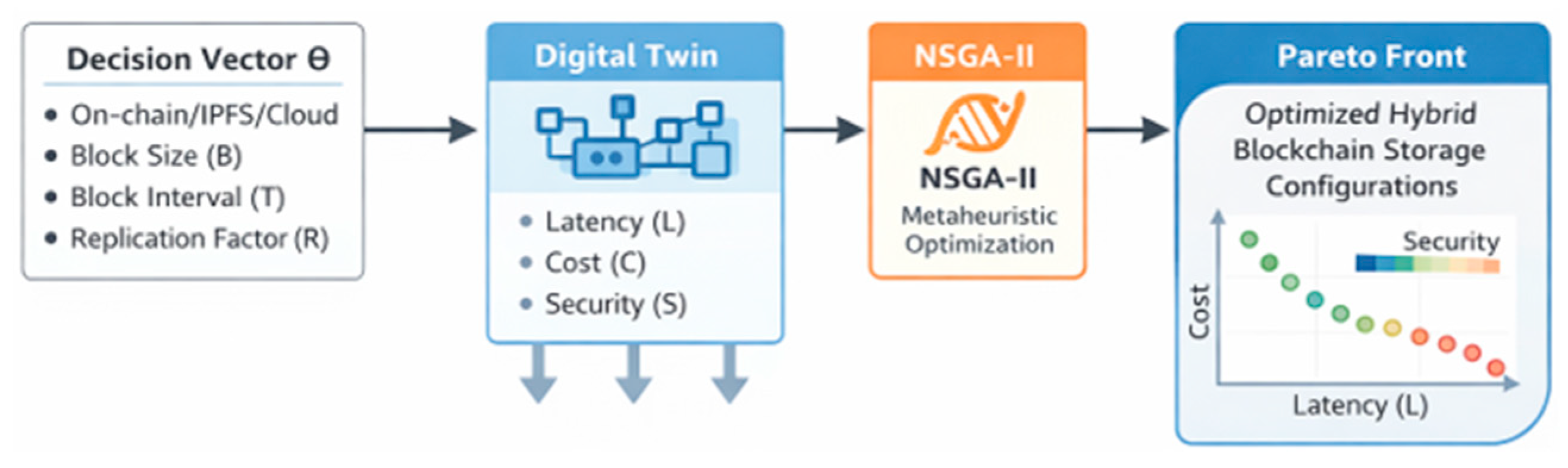
1.4. Proposed Approach
1.5. Rationale for Selecting NSGA-II
1.6. Contributions
- Data-availability-aware hybrid storage optimization: Hybrid on-chain, IPFS, and cloud data placement in permissioned blockchains is formulated as a unified multi-objective optimization problem that jointly considers data storage location, transaction execution mode, and blockchain network configuration parameters. Unlike existing approaches that address these design dimensions independently, the proposed formulation explicitly captures their coupled impact on latency, cost, and security. This addresses a modeling gap observed in prior literature, where hybrid storage is often evaluated under fixed or manually selected placement/execution assumptions rather than treated as an architecture-level decision variable within a single optimization model.
- Pareto-based decision support: A Pareto-based architectural decision-support mechanism is introduced to expose the fundamental trade-offs between latency, cost, and security in hybrid permissioned blockchains. By identifying diverse non-dominated configurations, the approach enables the selection of practically relevant operating regimes that align with application-specific performance and compliance requirements. In contrast to studies that report isolated best-case settings, the proposed decision-support view provides a regime-oriented interpretation of the Pareto region, enabling architects to select configurations based on explicit trade-offs and operational priorities rather than a single scalarized optimum.
- Digital-twin-based evaluation framework: A digital-twin-based evaluation framework is developed to approximate the performance, cost, and security behavior of a Fabric-class permissioned blockchain integrated with IPFS and cloud storage. This synthetic yet realistic environment enables controlled and reproducible optimization without requiring full-scale physical blockchain deployments. Unlike conventional one-off simulations, the digital twin is embedded as a structured evaluator that deterministically maps each candidate decision vector to objective estimates, thereby enabling repeatable Pareto-front generation and sensitivity analysis under consistent architectural assumptions.
- Architectural Sensitivity and Design-Space Interpretability: Beyond performance optimization, an architectural sensitivity analysis is provided to clarify how data placement decisions, execution modes, and fundamental blockchain configuration parameters jointly shape distinct operational regimes. By explicitly translating Pareto-optimal regions into a set of named architectural design patterns, the framework enhances the interpretability of multi-objective trade-offs and supports informed deployment decisions in permissioned blockchain systems.
1.7. Paper Organization
2. System Model and Security-Aware Hybrid Architecture
2.1. System Scope and Architectural Assumptions
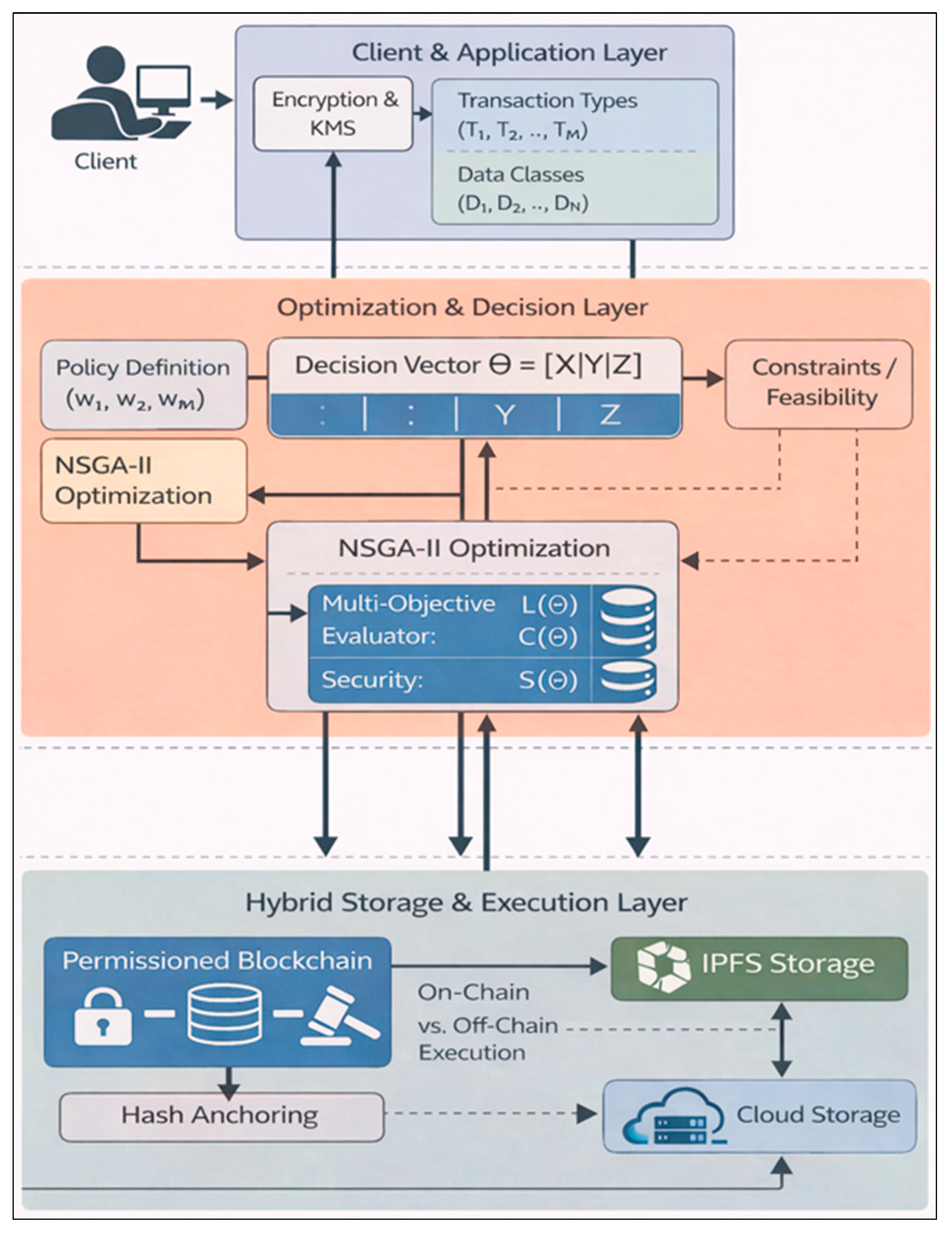
- On-chain ledger storage, which provides immutability and consensus-backed integrity.
- Off-chain decentralized storage (IPFS), which provides content-addressed, distributed data availability.
- Off-chain cloud storage, which provides low-latency, low-cost, and elastic storage capacity.
2.2. Security and Privacy Model
2.2.1. Integrity and Availability
2.2.2. Confidentiality and Access Control
- Data encryption keys are stored and managed in an organizational Key Management Service (KMS) or Hardware Security Module (HSM).
- Only key identifiers and access policies are recorded on-chain.
- Authorized participants obtain decryption keys through organizational policy enforcement, not through the storage layer.
2.2.3. Key Recovery and Loss Prevention
2.3. Decision Vector Representation
- (i)
- fully committed on-chain,
- (ii)
- cryptographically anchored on-chain with off-chain bulk storage in IPFS, or
- (iii)
- stored in cloud infrastructure with on-chain hash verification.
2.4. Objective Functions
- Latency (L(Θ)): Latency is defined as the time between transaction submission and commit confirmation in the blockchain network. To capture performance under varying conditions, latency is measured at the 95th percentile (p95) across different operational scenarios s ∈ Σ. Each scenario is weighted by its relative importance , as formulated in Equation (1).Here, Σ is the set of scenarios (e.g., normal load, peak hours, network congestion), is the weight of scenario s, and is the p95 latency observed for Θ in scenario s. The objective is to minimize .
- Cost (C(Θ)): The total cost combines the on-chain execution cost, off-chain IPFS cost, and off-chain cloud storage cost. Each component is calculated based on storage volume, bandwidth usage, and replication requirements, as formulated in Equation (2).Here, includes peer/orderer compute time, ledger storage size, and I/O usage, includes pin storage (gigabyte month) and bandwidth usage, and includes storage (GB·month), egress charges, and multi-availability-zone costs. The objective is to minimize C(Θ).
- Security Score (S(Θ)): The security score is a composite metric that evaluates the level of on-chain data integrity, replication robustness, and compliance with critical data storage policies. It is defined in Equation (3).Here, denotes the ratio of data classes anchored by on-chain hashes, represents the normalized replication factor (mapped from 1→0 to 3→1), corresponds to the fraction of small and high-critical data stored fully on-chain, and captures the estimated probability of data loss. The weighting coefficients w1, w2, w3, and w4 are policy-defined parameters reflecting organizational priorities and regulatory constraints rather than empirically optimized values, enabling the framework to adapt to diverse deployment contexts. This choice avoids overfitting the optimization process to a specific deployment scenario. The term implicitly accounts for both storage-layer failures and catastrophic key loss scenarios, assuming that key escrow and recovery mechanisms reduce but do not eliminate such risks. The objective is to maximize S(Θ). The security objective is defined as a weighted combination of integrity, replication, and critical-data protection factors. The meaning of each term and its role in the composite score are summarized in Table 1.
3. Multi-Objective Optimization Methodology
3.1. Rationale for Pareto-Based Optimization
3.2. Selection of NSGA-II
3.3. Chromosome Structure and Initialization
3.4. Genetic Operators
3.5. Constraint Handling and Repair
| Algorithm 1. NSGA-II-Based Optimization of Hybrid Blockchain Storage and Execution |
| Input: Population size P, generations Gmax, Npop—population size, Gmax—maximum number of generations, DT(Θ)—digital-twin evaluator returning (L(Θ), C(Θ), S(Θ)), Feasible(Θ)—constraint and repair function Output: Pareto-optimal set of configurations Θ* 1 Initialize population P0 with Npop feasible chromosomes Θ = [X | Y | Z] 2 Evaluate each Θ ∈ P0 using DT(Θ) → (L, C, S) 3 Perform non-dominated sorting and crowding-distance assignment 4 t ← 0 5 while t < Gmax do 6 Select parent population Pt from Pt using NSGA-II tournament selection 7 Apply crossover and mutation on Pt to generate offspring Qt 8 Apply Feasible(Θ) to repair invalid offspring 9 Evaluate each Θ ∈ Qt using DT(Θ) 10 Rt ← Pt ∪ Qt 11 Perform non-dominated sorting on Rt 12 Select the best Npop individuals based on Pareto rank and crowding distance 13 Set Pt+1 ← selected population 14 t ← t + 1 15 endwhile 16 return the final non-dominated Pareto front Θ* |
3.6. Convergence and Pareto Front Formation
4. Digital-Twin-Based Experimental Setup
4.1. Digital Twin and Synthetic Evaluation Framework
4.2. Mapping from Decision Vector to Performance Metrics

| Group | Parameter | Value |
|---|---|---|
| Latency | 40 | |
| Latency | 35, 45, 12, 8, 10, 6, 3 | |
| Cost | 0.30 | |
| Cost | 0.45, 0.55, 0.35, 0.25, 0.25 |
| Algorithm 2. Digital-Twin Evaluation of Blockchain Configurations |
| Input: Chromosome Θ = [X | Y | Z], X: data placement (N items), Y: execution mode (M items), Z: control parameters [B, T, R] Output: Objective vector (L(Θ), C(Θ), S(Θ)) 1 Initialize counters: ←0, ←0, ←0, ←0, ←0 2 for i = 1 to N do 3 if = ON_CHAIN then ←+1 4 else if = HASH_ANCHOR then ←+1 5 else if = IPFS then ←+1 6 else if = CLOUD then ←+1 7 endfor 8 for j = 1 to M do 9 if = 1 then ←+1 10 endfor 11 Calculate ratios: ←()/M, ←()/N, ←()/N, ←)/N, ←/N 12 Decode control parameters (B, T, R) from Z 13 Compute deterministic latency, cost, and security: 14 (Θ)←+ 15 16 (Θ)←SecurityScore(, , R) 17 Inject stochastic noise using Digital-Twin uncertainty:N),N), N) 18 Finalize objectives:(Θ)←+, , 19 return L(Θ), C(Θ), S(Θ) |
4.3. Baseline Configurations
- IPFS-only: All data classes are stored in IPFS with on-chain hash anchoring, while blockchain parameters are optimized.
- Cloud-only: All data is stored in cloud storage without decentralized replication, with only minimal on-chain anchoring.
- Hybrid (Proposed): Data placement, execution modes, and blockchain parameters are jointly optimized across on-chain, IPFS, and cloud layers.
4.4. Experimental Protocol
5. Results and Pareto-Based Performance Analysis
5.1. Optimization Behavior and Convergence
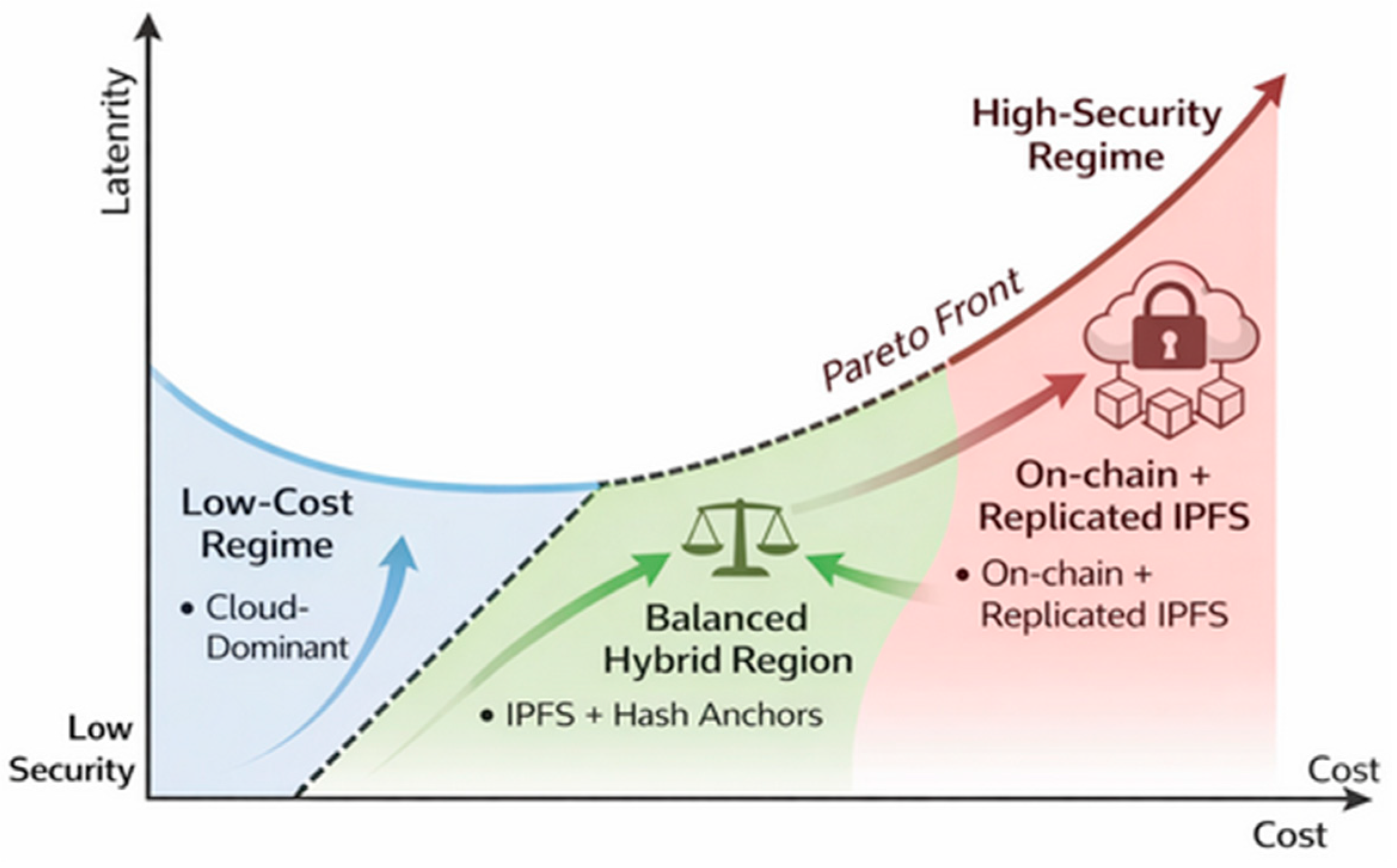
5.2. Pareto Front Structure
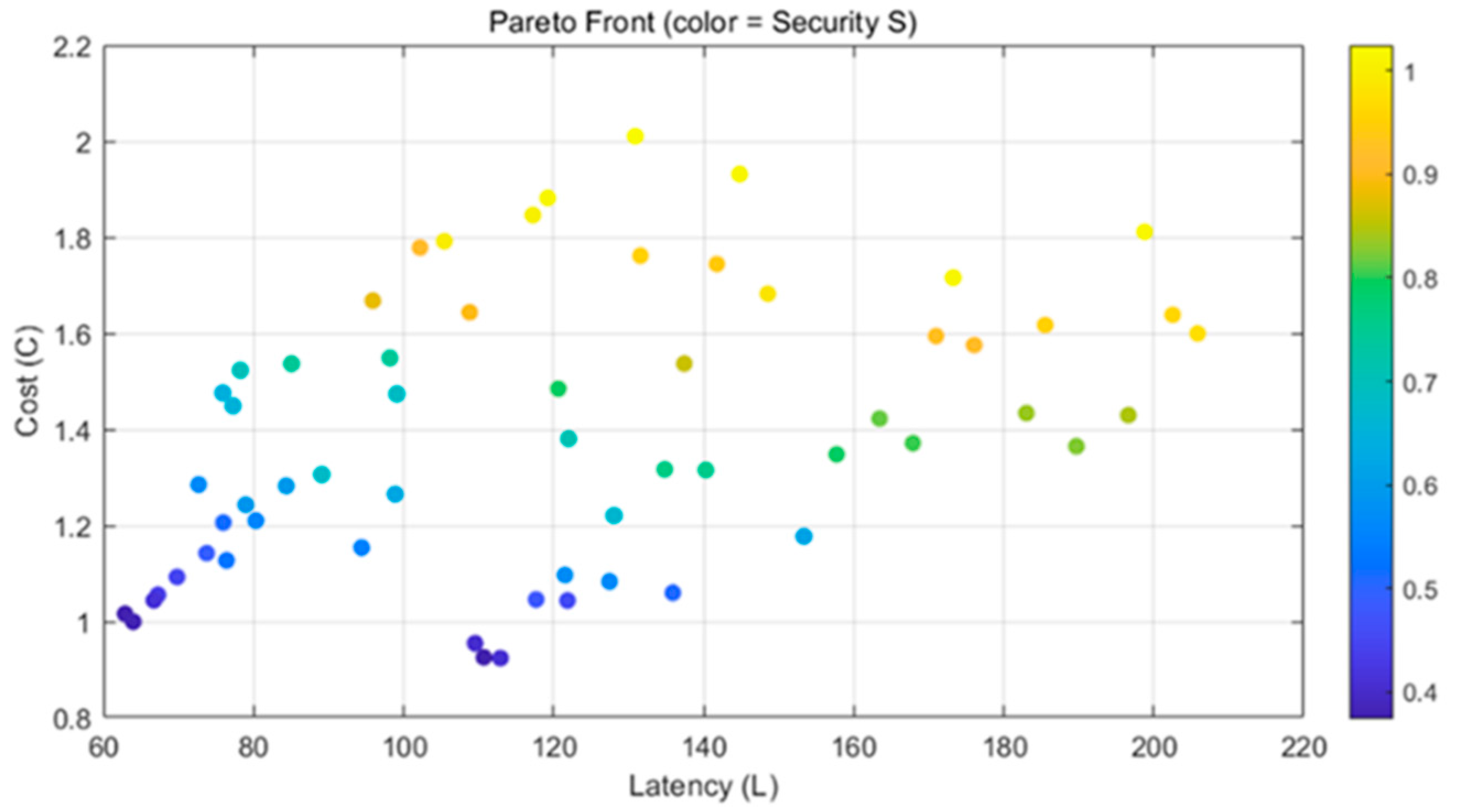
- Low-latency, low-cost region: These solutions primarily rely on cloud and IPFS storage with minimal on-chain execution. They achieve excellent performance and cost efficiency but exhibit reduced security due to limited cryptographic anchoring and replication.
- High-security region: These solutions store a large fraction of data fully on-chain or use hash-anchored IPFS with high replication. While they provide strong integrity and resilience, they incur higher latency and operational cost.
- Balanced hybrid region: The most practically relevant configurations lie between these extremes. They combine on-chain hash anchoring for critical data with IPFS or cloud storage for large payloads, together with moderate replication and optimized block parameters. These solutions achieve substantial reductions in latency and cost compared to fully on-chain designs while preserving strong security guarantees.
5.3. Representative Pareto-Optimal Configurations
5.4. Comparison with Baseline Strategies
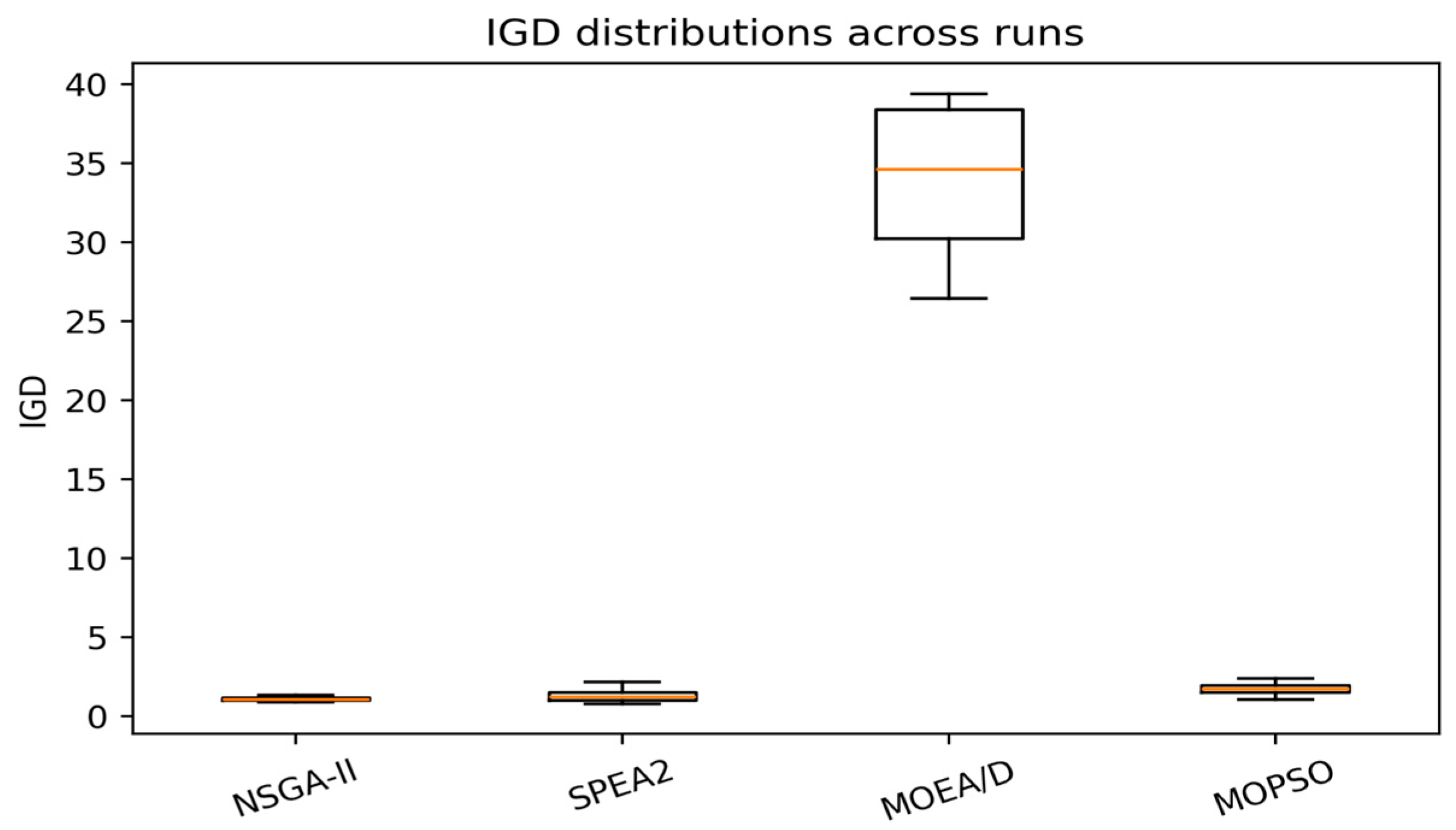
5.5. Baseline Comparison with Alternative Multi-Objective Optimizers
6. Discussion
6.1. Architectural Interpretation of the Pareto Front
6.2. Comparison with IPFS-Only and Cloud-Only Architectures
6.3. Data Availability, Integrity, and Replication Trade-Off
6.4. Implications for Permissioned Blockchain Design
6.5. Limitations and Practical Implications
7. Conclusions
Funding
Institutional Review Board Statement
Data Availability Statement
Acknowledgments
Conflicts of Interest
References
- Kumar, N.; Kumar, K.; Aeron, A.; Verre, F. Blockchain technology in supply chain management: Innovations, applications, and challenges. Telemat. Inform. Rep. 2025, 18, 100204. [Google Scholar] [CrossRef]
- Karaduman, Ö.; Gülhas, G. Blockchain-enabled supply chain management: A review of security, traceability, and data integrity amid the evolving systemic demand. Appl. Sci. 2025, 15, 5168. [Google Scholar] [CrossRef]
- Nandanwar, H.; Katarya, R. Privacy-preserving data sharing in blockchain-enabled iot healthcare management system. Comput. J. 2025, 68, 1657–1681. [Google Scholar] [CrossRef]
- Tariq, U.U.; Sabrina, F.; Rashid, M.M.; Gordon, S.; Lin, Y.; Wang, Z.; Azad, S. Blockchain-based secured data sharing in healthcare: A systematic literature review. IEEE Access 2025, 13, 45415–45435. [Google Scholar] [CrossRef]
- Zachariah, M.; Avanesh, N.M.; Raghupathi, K. Application of blockchain technology in disaster risk management. In The Role of Blockchain in Disaster Management; Academic Press: Cambridge, MA, USA, 2025; pp. 87–110. [Google Scholar]
- Rajagopal, M.; Ramkumar, S.; Thimmiaraja, J.; Gobinath, R.; Kumar, K.S. Blockchain-based model for disaster relief supply chain management. In The Role of Blockchain in Disaster Management; Academic Press: Cambridge, MA, USA, 2025; pp. 33–49. [Google Scholar]
- Wang, L.; Ma, Y.; Zhu, L.; Wang, X.; Cong, H.; Shi, T. Design of integrated energy market cloud service platform based on blockchain smart contract. Int. J. Electr. Power Energy Syst. 2022, 135, 107515. [Google Scholar] [CrossRef]
- Das, S.; Priyadarshini, R.; Mishra, M.; Barik, R.K. Leveraging towards access control, identity management, and data integrity verification mechanisms in blockchain-assisted cloud environments: A comparative study. J. Cybersecur. Priv. 2024, 4, 1018–1043. [Google Scholar] [CrossRef]
- Nasir, N.M.; Hassan, S.; Zaini, K.M. Securing permissioned blockchain-based systems: An analysis on the significance of consensus mechanisms. IEEE Access 2024, 12, 138211–138238. [Google Scholar] [CrossRef]
- Singh, S.K.; Kumar, S.; Garg, S.; Arora, S.; Sharma, S.K.; Arya, V.; Chui, K.T. Blockchain-based data security in smart cities: Ensuring data integrity and trustworthiness. In Digital Forensics and Cyber Crime Investigation; CRC Press: Boca Raton, FL, USA, 2024; pp. 17–41. [Google Scholar]
- Zhang, K.; Wang, X.; Yi, B.; Huang, M.; Qiu, L.; Guo, J. A Reliable distributed-cloud storage based on permissioned blockchain. IEEE Trans. Serv. Comput. 2025, 18, 1216–1231. [Google Scholar] [CrossRef]
- Chen, X.; Nguyen, K.; Sekiya, H. On the latency performance in private blockchain networks. IEEE Internet Things J. 2022, 9, 19246–19259. [Google Scholar] [CrossRef]
- Wai, K.S.S.; Thein, N.N.M. Optimized block size valuation by blockchain-based hyperledger fabric network. In International Conference on Genetic and Evolutionary Computing; Springer Nature: Singapore, 2024; pp. 506–515. [Google Scholar]
- Eren, H.; Karaduman, Ö.; Gençoğlu, M.T. Security challenges and performance trade-offs in on-chain and off-chain blockchain storage: A comprehensive review. Appl. Sci. 2025, 15, 3225. [Google Scholar] [CrossRef]
- Boughdiri, M.; Abdellatif, T.; Guegan, C.G. A Systematic literature review on blockchain storage scalability. IEEE Access 2025, 13, 102194–102219. [Google Scholar] [CrossRef]
- Kumar, S.; Bharti, A.K.; Amin, R. Decentralized secure storage of medical records using blockchain and IPFS: A comparative analysis with future directions. Secur. Priv. 2021, 4, e162. [Google Scholar] [CrossRef]
- Setiawan, S.; Madani, M.; Natalia, E.A.; Khairunnisa, N.; Vaher, K. Leveraging IPFS for secure, distributed blockchain data infrastructure and enhanced security. Blockchain Front. Technol. 2025, 5, 90–100. [Google Scholar] [CrossRef]
- Ismail, L.; Materwala, H.; Hennebelle, A. A scoping review of integrated blockchain-cloud (BcC) architecture for healthcare: Applications, challenges and solutions. Sensors 2021, 21, 3753. [Google Scholar] [CrossRef]
- Khanna, A.; Sah, A.; Bolshev, V.; Burgio, A.; Panchenko, V.; Jasiński, M. Blockchain–cloud integration: A survey. Sensors 2022, 22, 5238. [Google Scholar] [CrossRef]
- Liu, Q.; Peng, Y.; Xu, M.; Jiang, H.; Wu, J.; Wang, T.; Peng, T.; Wang, G. MPV: Enabling fine-grained query authentication in hybrid-storage blockchain. IEEE Trans. Knowl. Data Eng. 2024, 36, 3297–3311. [Google Scholar] [CrossRef]
- Lin, Q.; Gu, B.; Nawab, F. RollStore: Hybrid onchain-offchain data indexing for blockchain applications. IEEE Trans. Knowl. Data Eng. 2024, 36, 9176–9191. [Google Scholar] [CrossRef]
- Wang, X.; Li, H.; Yi, L.; Ning, Z.; Tao, X.; Guo, S.; Zhang, Y. A survey on off-chain networks: Frameworks, technologies, solutions and challenges. ACM Comput. Surv. 2025, 57, 1–35. [Google Scholar] [CrossRef]
- Vo, K.T.; Nguyen, H.T.; Nguyen-Hoang, T.A. An integrated decision-making framework for enhancing blockchain scalability and efficiency: Layer-2, off-chain storage, and smart contracts. IEEE Access 2025, 13, 138328–138351. [Google Scholar]
- Bathe, A.B.; Balvalli, A.V.; Kadam, A.R.; Paul, A.; Dharpawar, H.P.; Mahamuni, C.V. Improving scalability in smart grid energy trading using smart contracts and layer 2 blockchain solutions. In Proceedings of the IEEE 4th International Conference on Ubiquitous Computing and Intelligent Information Systems (ICUIS), Gobichettipalayam, India, 12–13 December 2024; IEEE: Piscataway, NJ, USA, 2024; pp. 1389–1400. [Google Scholar]
- Fernández-Iglesias, M.J.; Delgado von Eitzen, C.; Anido-Rifón, L. Efficient traceability systems with smart contracts: Balancing on-chain and off-chain data storage for enhanced scalability and privacy. Appl. Sci. 2024, 14, 11078. [Google Scholar] [CrossRef]
- Han, G.; Ma, Y.; Zhang, Z.; Wang, Y. A hybrid blockchain-based solution for secure sharing of electronic medical record data. PeerJ Comput. Sci. 2025, 11, e2653. [Google Scholar] [CrossRef]
- Lopez, L.J.R.; Millan Mayorga, D.; Martinez Poveda, L.H.; Amaya, A.F.C.; Rojas Reales, W. Hybrid architectures used in the protection of large healthcare records based on cloud and blockchain integration: A review. Computers 2024, 13, 152. [Google Scholar] [CrossRef]
- Luo, D.; Sun, G.; Fan, M.; Yu, H.; Niyato, D. Scalable storage optimization for blockchain-based cross-domain authentication in IoT. IEEE Trans. Netw. Serv. Manag. 2025, 22, 4719–4731. [Google Scholar]
- Zanbouri, K.; Darbandi, M.; Nassr, M.; Heidari, A.; Navimipour, N.J.; Yalcın, S. A GSO-based multi-objective technique for performance optimization of blockchain-based industrial Internet of things. Int. J. Commun. Syst. 2024, 37, e5886. [Google Scholar]
- Sachithanandam, V.; Jessintha, D.; Subramani, H.; Saipriya, V. Blockchain integrated multi-objective optimization for energy efficient and secure routing in dynamic wireless sensor networks. Sustain. Comput. Inform. Syst. 2025, 46, 101101. [Google Scholar] [CrossRef]
- Babu, R.M.; Satamraju, K.P.; Gangothri, B.N.; Malarkodi, B.; Suresh, C.V. A hybrid model using genetic algorithm for energy optimization in heterogeneous internet of blockchain things. Telecommun. Radio Eng. 2024, 83, 1–16. [Google Scholar] [CrossRef]
- Zhao, X.; Yang, Z.; Zheng, M.; Wang, Y.; Nan, Y.; Liu, J.; Gao, J. Chain model of blockchain and on-chain data storage method based on plant-grid coordination business system. Electr. Eng. 2025, 107, 10317–10333. [Google Scholar] [CrossRef]
- Kaur, M.; Gupta, S.; Kumar, D.; Raboaca, M.S.; Goyal, S.B.; Verma, C. Ipfs: An off-chain storage solution for blockchain. In Proceedings of International Conference on Recent Innovations in Computing: ICRIC 2022; Springer Nature: Singapore, 2023; pp. 513–525. [Google Scholar]
- Aldmour, M.; Aldmour, R.; Al-Zoubi, A.Y.; Sedky, M. Optimizing off-chain storage in blockchain of things systems: Implementing dockerized ipfs for enhanced efficiency. Int. J. Online Biomed. Eng. 2025, 21, 118–131. [Google Scholar] [CrossRef]
- Mukhedkar, M.; Kote, P.; Zonde, M.; Jadhav, O.; Bhasme, V.; Dawande, N.A. Advanced and secure data sharing scheme with blockchain and ipfs: A brief review. In Proceedings of the IEEE 15th International Conference on Computing Communication and Networking Technologies (ICCCNT), Kamand, India, 24–28 June 2024; IEEE: Piscataway, NJ, USA, 2024; pp. 1–5. [Google Scholar]
- Punia, A.; Gulia, P.; Gill, N.S. A systematic review on blockchain-based access control systems in cloud environment. J. Cloud Comput. 2024, 13, 146. [Google Scholar] [CrossRef]
- Rukhiran, M.; Boonsong, S.; Netinant, P. Sustainable optimizing performance and energy efficiency in proof of work blockchain: A multilinear regression approach. Sustainability 2024, 16, 1519. [Google Scholar] [CrossRef]
- Nartey, C.; Tchao, E.T.; Gadze, J.D.; Yeboah-Akowuah, B.; Nunoo-Mensah, H.; Welte, D.; Sikora, A. Blockchain-IoT peer device storage optimization using an advanced time-variant multi-objective particle swarm optimization algorithm. EURASIP J. Wirel. Commun. Netw. 2022, 2022, 5. [Google Scholar]
- Lakshmanan, M.; Mala, G.A.; Poorni, R.; Ilamurugan, G.; Sriramkumar, R.; Gnanavel, R. Blockchain for secure and efficient crowdfunding: An optimized particle swarm approach. In Proceedings of the IEEE 9th International Conference on Communication and Electronics Systems (ICCES), Coimbatore, India, 16–18 December 2024; IEEE: Piscataway, NJ, USA, 2024; pp. 848–854. [Google Scholar]
- Aydi, M.; Nouri, H.E.; Driss, O.B. Multi-objective task scheduling in fog-cloud environments: LS-NSGA-II optimization and blockchain integration for enhanced security and efficiency. In Proceedings of the IEEE 13th International Symposium on Digital Forensics and Security (ISDFS), Boston, MA, USA, 24–25 April 2025; IEEE: Piscataway, NJ, USA, 2025; pp. 1–6. [Google Scholar]
- Górski, T. AdapT: A reusable package for implementing smart contracts that process transactions of congruous types. Softw. Impacts 2024, 21, 100694. [Google Scholar] [CrossRef]
- Kim, J.; Cartagena, M.; Kim, S. Secure and transparent space exploration data management using a hybrid blockchain model. Appl. Sci. 2025, 15, 6060. [Google Scholar] [CrossRef]
- Imeri, A.; Roth, U.; Kourtis, M.A.; Oikonomakis, A.; Economopoulos, A.; Fogli, L.; Cadeddu, A.; Bianchini, A.; Iglesias, D.; Tavernier, W. Leveraging the DAO for edge-to-cloud data sharing and availability. Future Internet 2026, 18, 37. [Google Scholar]
- Jin, Y.; Huang, D.; Tian, C. On-chain/off-chain adaptive low-latency network communication technology with high security and regulatory compliance. Appl. Sci. 2025, 15, 8880. [Google Scholar]
- Karaduman, Ö.; Gülhas, G. A Blockchain-enabled architecture for secure and transparent distribution of disaster relief supplies. Systems 2026, 14, 171. [Google Scholar] [CrossRef]
- Hashim, A.; Rulaningtyas, R.; Chellappan, K. Optimizing security and latency in blockchain-based health data management: A hyperledger fabric approach with multi-objective optimization. J. Kejuruter. 2025, 37, 2469–2485. [Google Scholar]
- Karaduman, Ö. Towards integrated disaster management: A review of AI, blockchain, and digital twin technologies for smart resilience. Int. J. Innov. Eng. Appl. 2025, 9, 211–222. [Google Scholar] [CrossRef]



| Term | Meaning | Interpretation |
|---|---|---|
| Hash coverage | Fraction of data objects protected by on-chain cryptographic hashes | |
| Replication level | Normalized replication factor across IPFS and blockchain nodes | |
| Critical data protection | Fraction of critical data stored on-chain or hash-anchored | |
| Data loss probability | Estimated probability of off-chain data becoming unavailable or corrupted |
| Parameter | Description | Discrete Values |
|---|---|---|
| Data storage type | Storage location for each data class | On-chain, IPFS (hash-anchored), Cloud |
| Transaction execution | Execution mode for each transaction type | On-chain, Off-chain |
| Block size (B) | Maximum block payload | 0.5 MB, 1 MB, 2 MB, 4 MB |
| Block interval (T) | Block generation time | 0.5 s, 1 s, 2 s |
| Replication factor (R) | Number of ledger replicas | 1, 2, 3 |
| Chromosome (Bitstring) | Data Placement (X) | Proc. Exec. (Y) | Block Size | Block Time | Replication | L(Θ) | C(Θ) | S(Θ) |
|---|---|---|---|---|---|---|---|---|
| 10 11 00 01 01 10 | [Hash + IPFS, Full On-chain, Cloud, IPFS, IPFS, Hash + IPFS] | [1, 0, 0, 1] | 4.0 MB | 0.5 s | 2 | 128.53 | 1.245 | 0.872 |
| 00 00 01 01 00 00 | [Cloud, Cloud, IPFS, IPFS, Cloud, Cloud] | [0, 0, 0, 0] | 1.0 MB | 2.0 s | 1 | 89.21 | 0.945 | 0.412 |
| Solution | Latency | Cost | Security | Block Size (MB) | Block Interval (s) | Replication | Storage Strategy |
|---|---|---|---|---|---|---|---|
| P1 (Low-Cost) | Low | Very Low | Medium | 4 | 2.0 | 1 | Cloud + IPFS (hash-anchored) |
| P2 (Balanced) | Medium | Medium | High | 2 | 1.0 | 2 | IPFS + On-chain hashes |
| P3 (High-Security) | High | High | Very High | 1 | 0.5 | 3 | Critical data on-chain, others IPFS |
| P4 (Low-Latency) | Very Low | Medium | Medium | 4 | 0.5 | 2 | Cloud + On-chain hashes |
| P5 (Resilient) | Medium | High | Very High | 2 | 1.0 | 3 | IPFS replicated + On-chain anchoring |
| ID | L(Θ) | C(Θ) | S(Θ) | Block Size (MB) | Block Time (s) | Replication | On-Chain Data (%) | IPFS Data (%) | Cloud Data (%) | On-Chain Exec (%) |
|---|---|---|---|---|---|---|---|---|---|---|
| 1 | 130.89 | 2.01 | 1.03 | 4.0 | 0.5 | 3 | 70 | 25 | 5 | 75 |
| 2 | 112.92 | 0.92 | 0.41 | 4.0 | 2.0 | 1 | 10 | 20 | 70 | 10 |
| 3 | 110.71 | 0.93 | 0.37 | 4.0 | 2.0 | 1 | 15 | 15 | 70 | 10 |
| 4 | 205.84 | 1.60 | 0.97 | 4.0 | 2.0 | 2 | 60 | 30 | 10 | 60 |
| 5 | 62.88 | 1.02 | 0.38 | 4.0 | 0.5 | 1 | 20 | 30 | 50 | 20 |
| Algorithm | HV ↑ (Mean ± Std) | IGD ↓ (Mean ± Std) | |P| ↑ (Mean ± Std) | Best L ↓ (Mean ± Std) | Best C ↓ (Mean ± Std) | Best S ↑ (Mean ± Std) |
|---|---|---|---|---|---|---|
| NSGA-II | 229.979 ± 2.566 | 1.073 ± 0.120 | 60.00 ± 0.00 | 45.071 ± 0.427 | 0.719 ± 0.032 | 0.924 ± 0.008 |
| SPEA2 | 227.253 ± 3.193 | 1.337 ± 0.599 | 60.00 ± 0.00 | 46.281 ± 1.553 | 0.860 ± 0.047 | 0.910 ± 0.013 |
| MOPSO | 212.699 ± 3.526 | 1.851 ± 0.688 | 60.00 ± 0.00 | 47.227 ± 1.839 | 0.752 ± 0.022 | 0.908 ± 0.012 |
| MOEA/D | 119.872 ± 18.676 | 33.582 ± 5.142 | 53.47 ± 4.67 | 44.125 ± 0.315 | 1.016 ± 0.080 | 0.506 ± 0.048 |
| Regime | Data Placement Pattern | Blockchain Parameters | Latency–Cost Profile | Security Level | Typical Application Domains |
|---|---|---|---|---|---|
| Low-Cost Regime | Predominantly cloud storage with minimal on-chain hash anchoring | Large block size, long block interval, low replication (R = 1) | Very low latency, very low cost | Low to medium | IoT telemetry, archival systems, low-regulation environments |
| Balanced Hybrid Regime | IPFS and cloud storage with on-chain hash anchoring for critical data | Medium block size, moderate block interval, moderate replication (R = 2) | Moderate latency, moderate cost | High | Supply chains, logistics, industrial platforms |
| High-Security Regime | Critical data on-chain, remaining data on IPFS with hash anchoring | Small block size, short block interval, high replication (R = 3) | High latency, high cost | Very high | Healthcare, disaster response, legal and regulatory systems |
| Constraint/Priority | Recommended Regime | Storage Policy | Replication (R) | Block İnterval (T) | Notes |
|---|---|---|---|---|---|
| Strict compliance, auditability | High-security | Critical on-chain+hash-anchored IPFS | High (3) | Short (0.5–1 s) | Prefer on-chain exec for critical tx |
| Balanced ops cost+integrity | Balanced hybrid | Hash anchoring + IPFS/cloud split | Medium (2) | Medium (1 s) | Default enterprise setting |
| Minimum cost, archival/telemetry | Low-cost | Cloud-dominant + minimal anchoring | Low (1) | Longer (2 s) | Use anchoring for spot checks |
| Low latency interactive workloads | Balanced/Low-cost | Cloud for bulk + on-chain hashes | 1–2 | Short (0.5–1 s) | Tune block size upward |
| High availability under disruptions | High-security/Balanced | IPFS replicated + anchoring | 2–3 | Medium | Prioritize resilience over cost |
Disclaimer/Publisher’s Note: The statements, opinions and data contained in all publications are solely those of the individual author(s) and contributor(s) and not of MDPI and/or the editor(s). MDPI and/or the editor(s) disclaim responsibility for any injury to people or property resulting from any ideas, methods, instructions or products referred to in the content. |
© 2026 by the author. Licensee MDPI, Basel, Switzerland. This article is an open access article distributed under the terms and conditions of the Creative Commons Attribution (CC BY) license.
Share and Cite
Karaduman, Ö. Data-Availability-Aware Hybrid Storage Optimization in Permissioned Blockchains: A Multi-Objective Metaheuristic Approach. Appl. Sci. 2026, 16, 2299. https://doi.org/10.3390/app16052299
Karaduman Ö. Data-Availability-Aware Hybrid Storage Optimization in Permissioned Blockchains: A Multi-Objective Metaheuristic Approach. Applied Sciences. 2026; 16(5):2299. https://doi.org/10.3390/app16052299
Chicago/Turabian StyleKaraduman, Özgür. 2026. "Data-Availability-Aware Hybrid Storage Optimization in Permissioned Blockchains: A Multi-Objective Metaheuristic Approach" Applied Sciences 16, no. 5: 2299. https://doi.org/10.3390/app16052299
APA StyleKaraduman, Ö. (2026). Data-Availability-Aware Hybrid Storage Optimization in Permissioned Blockchains: A Multi-Objective Metaheuristic Approach. Applied Sciences, 16(5), 2299. https://doi.org/10.3390/app16052299