Review

Composite Geosynthetics for Climate-Resilient Slope Stability: A Comprehensive Review

by
Robi Sonkor Mozumder
*,
Siddhant Yadav
and
Md Jobair Bin Alam
Department of Civil and Environmental Engineering, Prairie View A&M University, Prairie View, TX 77446, USA
*
Author to whom correspondence should be addressed.
Appl. Sci. 2026, 16(5), 2276; https://doi.org/10.3390/app16052276
Submission received: 28 January 2026 / Revised: 19 February 2026 / Accepted: 23 February 2026 / Published: 26 February 2026
(This article belongs to the Special Issue Climate Change on Geomaterials)

Abstract

Climate-driven extremes in temperature and precipitation are increasingly threatening the stability and serviceability of slopes, embankments, levees, transportation corridors, and other earthen infrastructures founded on expansive and problematic soils. Conventional stabilization strategies, which often treat reinforcement and drainage as separate design elements, struggle to cope with cyclic wetting-drying, freeze-thaw, and prolonged rainfall events that drive desiccation cracking, loss of matric suction, elevated pore-water pressures, and progressive strength degradation. This paper presents a state-of-the-art review of geosynthetic-reinforced slopes with particular emphasis on geogrid geotextile composite systems and their performance under high-temperature, high-rainfall, and low-temperature environments. We first summarize the fundamentals of geosynthetic types, functions, and material properties, then examine how thermal and hydrological processes such as creep, oxidation, frost heave, infiltration, suction loss, and pore-pressure build-up govern the performance of geosynthetic-reinforced soil (GRS) systems. Next, we synthesize recent advances in composite geosynthetics that integrate reinforcement, filtration, separation, and drainage, highlighting laboratory studies, centrifuge modeling, numerical analyses, and field case histories for mechanically stabilized earth walls, pavements, railway embankments, levee systems, and rainfall-induced and expansive soil slopes. Across these applications, geogrid geotextile composites consistently improve hydraulic control, maintain effective stress, and enhance factors of safety under extreme climatic loading. The review concludes by identifying critical research gaps, including coupled thermo-hydro-mechanical characterization, performance-based design approaches, and climate-resilient guidelines for geosynthetic selection and detailing. These findings underscore the potential of composite geosynthetics to enable more sustainable and resilient slope and earthwork infrastructure in a changing climate.

1. Introduction

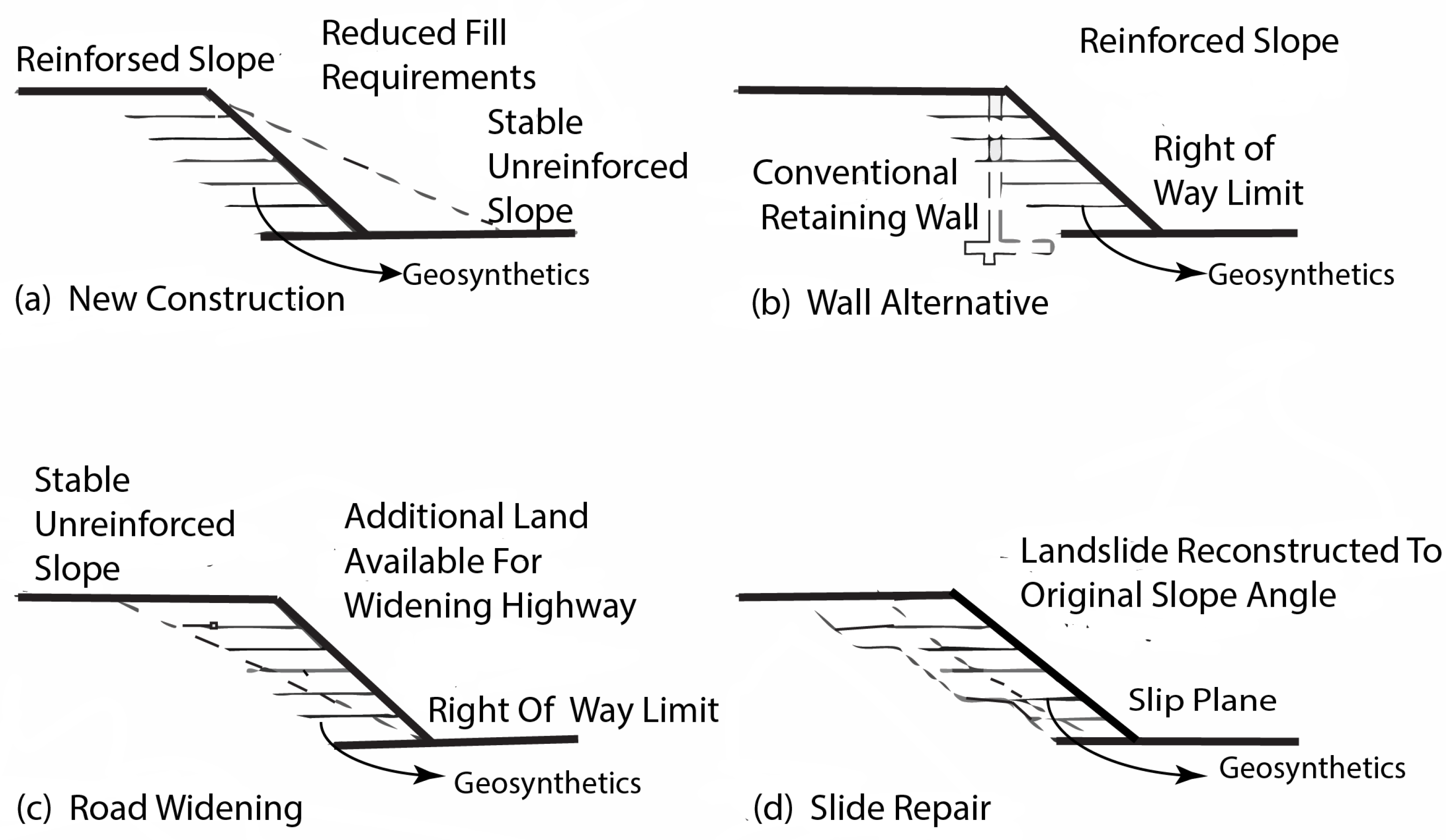
Slope stability is one of the most vital aspects of geotechnical engineering and a factor of great importance to the safety and durability of transportation infrastructures. Slope maintenance becomes more complex in areas that are frequently exposed to adverse climatic conditions like high temperatures, heavy rainfall, and low temperatures. Traditional slope stabilization methods work well under moderate conditions but often fail under extreme weather events. Sometimes, strengthening steep slopes with geosynthetics is necessary to effectively repair failures; in this case, the slide debris was reused with added geosynthetics instead of importing new soil, resulting in improved stability and reduced costs. Multiple layers of geosynthetic materials were used to keep the fill slope stable during restoration. Figure 1 demonstrates that this strategy is not limited to correcting broken slopes. It is presently utilized to create new embankment slopes, widen old ones, and serve as an alternative to retaining walls [1].
Due to their wide range of applications, geosynthetics are now frequently used in geotechnical and environmental engineering and have emerged as a promising solution to such challenges. This group includes many material classes such as geotextile, geogrids, geomembranes, geonet and others, which provide flexibility, structural strength, and long-term operation performance at the site. They are particularly suitable for applications in challenging environments where traditional materials may fail.
Reliability analysis focuses on soil uncertainty by treating it as a random variable, allowing engineers to quantify and evaluate the overall reliability of the slope. Many factors affect slope stability; however, rainfall infiltration has been identified as one of the major factors. During the process of infiltration, infiltration causes a change in the state of soil from unsaturated to saturated conditions. It causes a progressive reduction in the matric suction and a subsequent decrease in its shear strength, hence elevating the likelihood of slope failure. The study on rainfall suggests that slope reliability is influenced by peak intensity, overall intensity, duration, and patterns [2]. The influence of rainfall displays a delayed reaction during the rainfall process because infiltration takes time. Thus, higher rainfall periods place greater constraints on slope width, and a smaller width-to-height ratio is generally associated with a lower risk of slope failure.
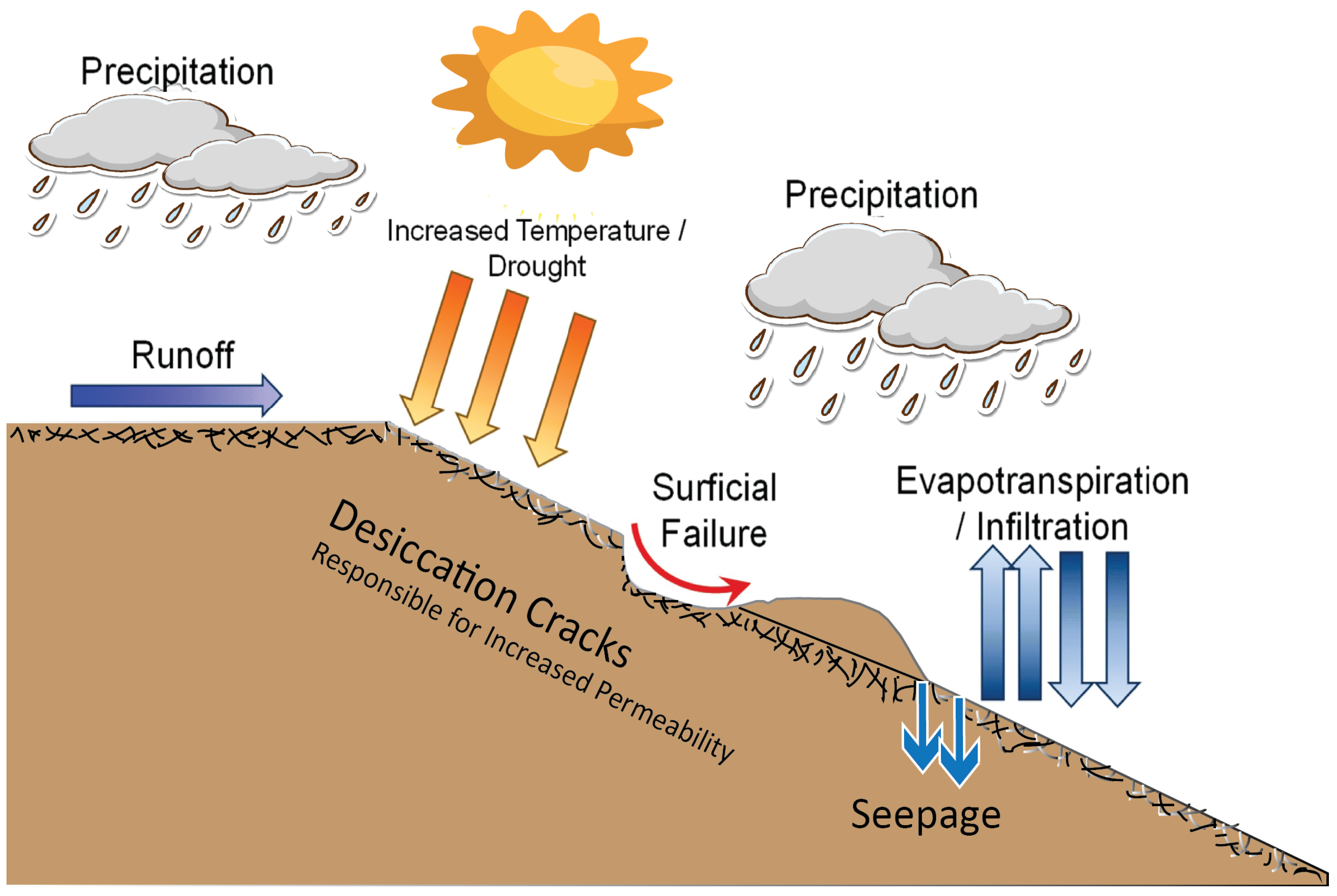
When soil uncertainties are combined with extreme climatic conditionssuch as high temperatures, heavy rainfall, and freezing temperaturesembankment slopes constructed on expansive soils become more vulnerable due to the soil’s inherent characteristics. This is due to the highly variable characteristics of expansive soils under changing climatic conditions. Expansive soil, which is rich in clay, expands when it absorbs moisture and contracts when it dries out. The primary deformation behavior of unsaturated soils, particularly expansive soils, is characterized by swelling and shrinking [3]. Swelling and shrinking cycles are linked to the wetting and drying of expansive soils, which usually happen in response to climatic cycles. Due to increased temperatures and evaporation, drying of the soil accelerates, leading to soil desiccation cracks on the slope embankment. Different studies suggest that the integrity of soil structure may be compromised by wet-dry and freeze-thaw cycles and unstable pore spaces resulting from these cycles [4,5]. This results in increased hydraulic conductivity in expansive soils [6]. These cycles also result in notable alterations in soil volume [7,8,9], and the mechanical strength measures show a significant decrease [10,11]. The volume change behavior of expansive soils, caused by changes in soil moisture in response to climatic cycles, can cause serious structural damage, leading to instability in buildings, roads, and their foundations [12]. These desiccated slopes on embankments will increase the probability of severe slope failures after heavy precipitation. Figure 2 illustrates the relationship between the environmental variables and expansive soil slope, as well as the subsequent creation of desiccation cracks caused by shrinkage-swelling, which subsequently leads to surficial slope failure.
In the last hundred years, there has been a gradual change in climatic conditions. Climate change is expected to significantly impact soil behavior and geotechnical structures due to altered hydrological cycles and extreme weather events [13]. Intense precipitation accelerates infiltration and wetting-front propagation, rapidly reduces matric suction in unsaturated soils, and promotes transient and perched pore-water pressures, which significantly decrease effective stress and shear strength. Simultaneously, temperature extremes and seasonal thermal cycling influence the long-term mechanical response of polymeric reinforcements through creep, oxidation, and stiffness degradation, while also affecting soil structure and hydraulic conductivity through shrink-swell and freeze-thaw processes. Consequently, slope stability is no longer governed solely by static loading conditions, but by strongly coupled climatic actions that operate across different spatial and temporal scales.
In this case, expansive soils pose particular risks to structures, with financial losses from improper design being substantial, especially as climate change intensifies moisture variations that govern expansive soil behavior [14]. It becomes very important to have effective means of soil management and engineering for the mitigation of such hazards. After understanding the effectiveness of geosynthetics in slope stability studies, geosynthetics research is expanding globally in many countries [15,16,17,18,19,20,21,22]. Many innovative geosynthetics are now available to address challenging geotechnical problems effectively [16,23,24,25,26,27,28,29,30]. These advancements provide enhanced solutions for various complex engineering issues.
Geogrid-geotextile composite geosynthetics, also known as geocomposites or hybrid geosynthetics, represent a significant advancement in slope stabilization technology. These materials combine the tensile reinforcement capabilities of geogrids with the filtration and drainage properties of geotextiles into a single integrated product [31]. The growing frequency of rainfall-triggered landslides worldwide has intensified research interest in these dual-function materials, particularly for their ability to simultaneously address both mechanical stability and moisture management in slope applications [32]. As discussed earlier, the fundamental challenge in slope stability lies in the detrimental effects of water infiltration, which increases pore water pressure and reduces soil strength, potentially leading to catastrophic failure [33].
Traditional approaches often require the separate installation of reinforcement and drainage systems, increasing construction complexity and costs. Composite geosynthetics offer an innovative solution by integrating these functions, enabling more efficient slope moisture control, structural reinforcement, and stability under extreme climates. Geosynthetics enhance slope resilience against extreme precipitation by providing internal reinforcement that offsets rising pore water pressures and seepage forces, specifically through “sparse-dense” layouts and improved drainage to prevent localized failures during rapid water drawdown [34,35,36,37]. Furthermore, they mitigate temperature-induced or seismic soil instability by acting as isolators and flexible reinforcement, maintaining load-bearing capacity and structural integrity even as environmental forces fluctuate in intensity [35,38,39]. While traditional scholarly researches focus primarily on static mechanical functions (e.g., reinforcement, filtration) under standard conditions, our review uniquely emphasizes the “dual-functionality” of bonded geogrid-geotextile and wicking composites under transient, extreme climatic flux. Its core novelty lies in synthesizing how these materials manage the hysteretic Soil-Water Characteristic Curve (SWCC) during rapid wetting-drying cycles to sustain interfacial shear strength, a topic rarely addressed in single-function research papers. Also, this review advances the discussion by explicitly addressing climate resilience as a dynamic, performance-based concept. Climate resilience is governed not only by strength enhancement but also by the ability of geosynthetic systems to maintain hydraulic efficiency, effective stress, and material integrity under extreme and evolving climatic conditions.
This review evaluates the current state-of-the-art review of the existing research on geosynthetic-reinforced slopes, with emphasis on their performance in extreme environments characterized by high temperature, high rainfall, and low temperature. By synthesizing the unique material properties of composite geosynthetics with successful real-world case studies, this work’s objective is to find critical research gaps and promote the integration of these materials into sustainable, resilient infrastructure. Central to this analysis is a move toward coupled thermo-hydro-mechanical (THM) characterization and performance-based design (PBD) frameworks, which serve as the basis for robust, climate-resilient guidelines for material selection and detailing. Ultimately, this paper aims to bridge the gap between theoretical modeling and practical application, ensuring that geotechnical designs achieve optimal stability and long-term durability in an increasingly unpredictable global climate.

2. Geosynthetics

Geosynthetics is a planar product manufactured from different types of polymers and utilized in cooperation with soil, rock, earth, or other geotechnical-related materials as a homogeneous part of a civil engineering structure [40]. Additionally, industries like mining and agriculture employ geosynthetics [41]. They are distinguished by the kind of polymer, the kind of yarn or fiber, the kind of geosynthetic, and the thickness or mass per unit area used in the fabrication. Geotextiles are one type of geosynthetic that are already being effectively used in various geotechnical engineering projects. Permeable fabrics known as geotextiles are combined with common materials used in geotechnical engineering projects, such as soil, rock, or earth. The market offers two varieties of geotextile: woven and non-woven textiles. The continuous and regular mannerly weaving of threads or yarns in two separate directions results in a woven geotextile. They are constructed according to regular patterns, and their apertures are unique and varied. The increased strength of geogrids, as opposed to other geotextiles, is attributed to their linked polymer structure, which resembles an open grid. Their main application is in soil reinforcement because geotextiles can withstand large tension loads with less deformation and less strain. It is noteworthy that notable variations in tensile strengths can occur amongst geosynthetic materials that are manufactured from the same basic polymer. One of the most important characteristics of geosynthetics is their flexibility, which helps to maintain good contact conditions and inhibit the concentration of fiber stress. Geosynthetics can also carry out hydraulic activities because of their fiber character. Because of this property, geosynthetics may guarantee a small filter diameter while maintaining a high void ratio or high permeability. Geosynthetics are more useful and effective when these elements are combined. Some geosynthetics may also become prone to environmental exposure to heat, toxins, and UV rays [42,43]. The polymers that are most prone to creep are polyethylene, polypropylene, and polyester. For polypropylene, a temperature rise considerably quickens creep [44]. When geosynthetics are used for such purposes to enhance the long-term performance along with sustainable durability for the structures related to soil, the feature of time-dependent elongation becomes very vital. Additionally, confinement can alter the creep characteristics of nonwoven geotextiles; yet, confinement has very little influence on woven geotextiles and geogrids [45].

2.1. Comparisons Between Biodegradable and Non-Biodegradable Geosynthetics

Geosynthetics have increasingly played an important role in the geo-environmental engineering field in recent decades. Geotextiles are planar materials, which are either woven or non-woven, and used in different applications such as soil reinforcement, turf reinforcement, erosion protection, separation, filtration, and drainage. Geotextiles can be biodegradable or non-biodegradable. The biodegradable geotextiles are obtained from natural fibers like jute, hemp, coir, cotton, sisal, kenaf, wool, straw, bamboo, and various kinds of biodegradable polymers [46]. On the other hand, non-biodegradable geotextiles are made from synthetic materials like polyester, polyethylene, and polypropylene [46]. With the advancement of technology, geotextiles have evolved into non-biodegradable materials. These non-biodegradable geotextiles are suitable for long-lasting and permanent applications because of their high strength and effective resistance to environmental conditions [47]. Despite their potential, fiber products from natural sources have not been widely researched for similar applications. The number of scholarly articles discussing the use of biodegradable geotextiles as a viable solution to geo-environmental engineering problems is still very small. Biodegradable materials have a reduced environmental footprint because they can degrade organically and spontaneously, which makes them more sustainable. A study looked at Poly (lactic acid) or PLA, which was a bio-based, biodegradable, and environmentally friendly polymer that produced encouraging tensile strength results and may eventually replace polypropylene and other synthetic materials in the manufacturing of geotextiles [48]. Another study comparing biodegradable (penduculata) and non-biodegradable (polypropylene) geotextile discovered that penduculata had substantial water absorbency, influencing run-off velocity at the commencement of rainfall, but polypropylene had no water absorbency. Despite the higher run-off velocity, polypropylene provided improved slope protection because of variations in the Percentage Open Area (POA) [49]. Natural fiber geotextiles, like those used in a successful airport rail link project in Manchester, UK, [49], demonstrate potential in geotechnical engineering. However, nowadays, non-biodegradable geosynthetics are commonly used in civil engineering projects because of their resiliency, which is lacking in biodegradable geosynthetics.

2.2. Categories of Geosynthetics

There are different types of geosynthetics available on the market, each with distinct properties that can be easily tested to choose the specific need for the intended use case in infrastructure. Table 1 serves as the “Technical Baseline,” providing the specific index properties of individual components (polypropylene geogrids, multifilament polyester geotextiles) that are the constituent parts of the composite systems. By understanding the “raw” material properties (e.g., secant modulus at 10% strain, puncture strength), one can better appreciate the synergistic performance gains achieved when these materials are bonded into a single geocomposite unit.
Typology of different geosynthetics:
Geotextile: Geotextile is a planar material that resembles a polymeric sheet, which has permeability characteristics. Geotextiles are further segmented based to how they are manufactured:
1.
Woven Geotextile: Geo-textiles are produced by interweaving two threads at 90 degrees.
2.
Non-Woven Geotextile: A non-woven geotextile is made of fibers stretched using a procedure known as needle punching.
3.
Knitted Geotextile: A knitted geotextile is created by connecting two particles with a knitting machine.
4.
Stitched Geotextile: Stitched geotextiles are those in which fibers and yarns are linked together through stitching or sewing.
Geogrid: Geogrid is a polymer-based planar product with an integrally connected structure at the corners and a net-like structure that has a higher tensile strength. Geogrid is essentially divided into two types according to elongation in a certain direction during the manufacturing process:
1.
Uniaxial Geogrid: Uniaxial geogrid is formed by stretching in a particular direction, allowing it to achieve a high tensile strength in that direction compared to other directions of elongation.
2.
Biaxial Geogrid: A polymer is stretched in both directions to create a biaxial geogrid, which has a comparable tensile strength in all directions.
Geo-net: Geo-nets are polymeric material networks with interlinked ribs that are oriented at differing angles to each other within a compact network. Main applications for geo-nets will be to assist in draining liquids from a given plane.
Geo-membrane: Geo-membranes are impermeable and planar materials that regulate fluid flow and serve as a barrier. They are made of low-permeability materials and the components are asphaltic and polymeric. They are used in slope stabilization to prevent water infiltration that could cause slope failure.
Geo-cell: A Geo-cell has permeable structure and form three-dimensional which are made of strips of polyester or polyethylene. This new material is applicable in many fields due to its unique features and multiple uses. Its design improves the stabilization of the soil, limits erosion, and offers support to loads, among many other functions.

3. Functions and Mechanisms of Geosynthetics

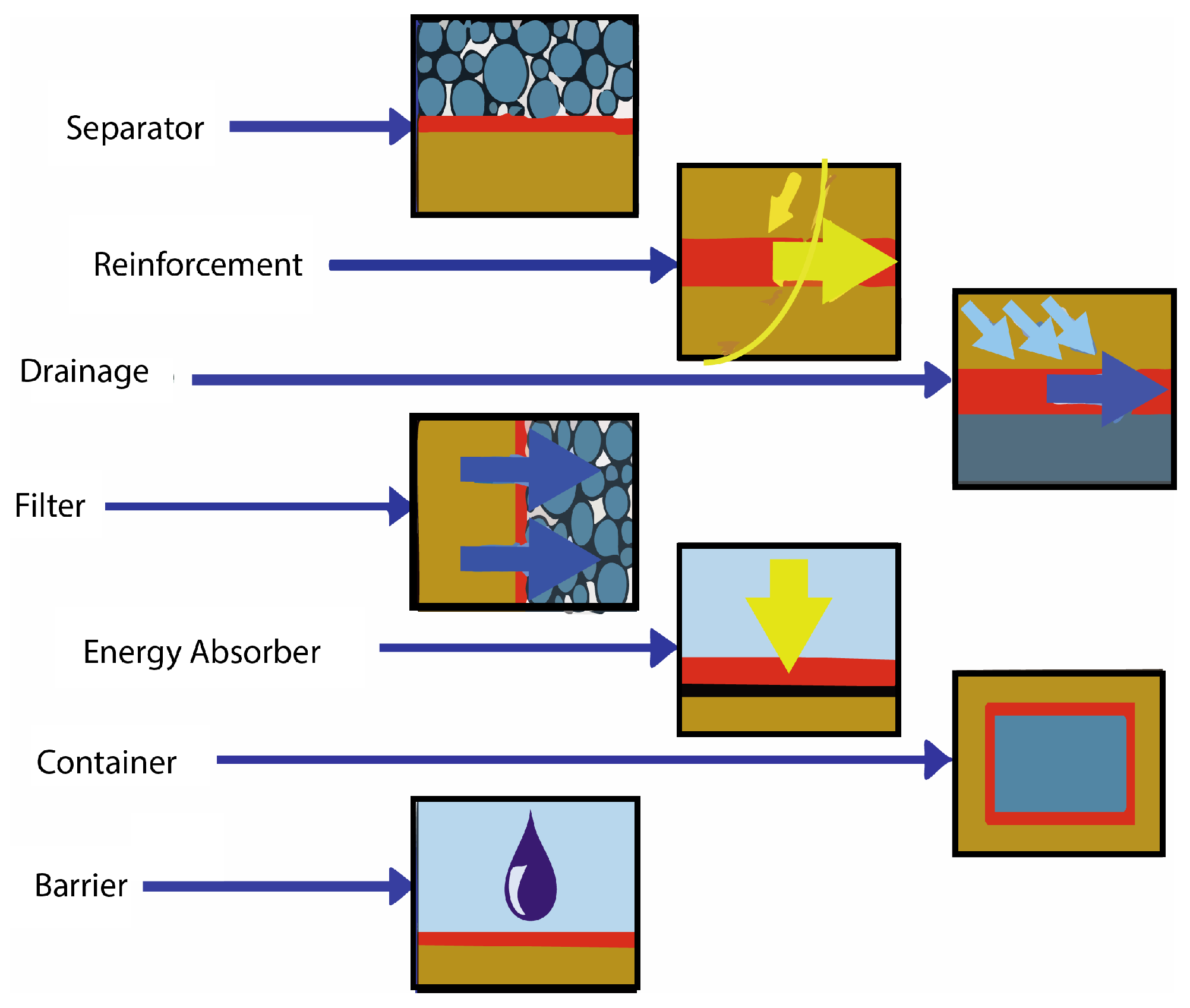
Geosynthetics can perform various functions within earthen structures. Before application, it is crucial to identify and describe these functions. Each function of a geosynthetic is unique and necessary to achieve the intended design purpose and desired results. Table 2 shows which engineering functions (separation, filtration, drainage, reinforcement, erosion protection, and barrier) are provided by different types of geosynthetics. In general, geotextiles and geocomposites perform multiple functions, while geogrids, geocells, and geofibers are mainly used for reinforcement, geonets for drainage, and geomembranes and geosynthetic clay liners primarily act as barrier systems. After verifying the function by standard testing of each geosynthetic combination, it is essential to understand these properties to ensure the most effective use of the geocomposite in any given project. The visual functions of geosynthetics are illustrated in Figure 3. This Figure 3 and Table 2 provide a comprehensive overview, showcasing their various applications and benefits in geotechnical engineering.

3.1. Drainage

Geosynthetics with their permeable nature, are instrumental in managing water flow in drainage systems. They allow water to move laterally, which is useful for diverting excess water from specific areas [51]. These days, geotextiles are widely used in many different drainage applications, including retaining walls, subgrade, and underground drainage systems [52,53]. The small pores on the geosynthetic’s surface enable this water movement. In systems like a French drain, geosynthetics act as a filter, preventing soil and debris from blocking the drain while allowing water to flow. Their structural stability ensures the water pathways remain open, even under pressure. Thus, geosynthetics contribute to the efficiency and longevity of drainage systems by managing water flow, preventing waterlogging, and maintaining structural integrity. Wicking Geotextiles are also used in the Subsurface drainage design and ability to provide superior lateral drainage ability [25,54].

3.2. Protection

Geosynthetics protect a material when it alleviates or distributing stresses and strains transmitted to the protected material. Geosynthetics serve a protective function in two key ways: surface protection and interface protection. The use of geosynthetics in pond spillways, river channels, banks, and slopes aids in decreasing soil erosion and stabilizing surrounding soil [55]. Surface protection involves the placement of a geosynthetic on the soil surface for protection from weather conditions and light traffic that might cause soil erosion and displacement. Interface protection involves placing a geosynthetic between two materials to distribute stresses that might cause damage. In both cases, geosynthetics increase the durability and efficiency of the structure, proving to be versatile in many applications of construction [56].
Figure 3. Primary Functions of Geosynthetics in Geotechnical Applications [57,58].
Applsci 16 02276 g003

3.3. Filtration

Geosynthetics function as filters allowing liquid to pass through and limit soil loss across the plane of the material over its lifetime of service [59,60,61,62]. This can be seen in three distinct scenarios: filtering particles suspended in a liquid, removing water from granular soil, and filtering associated with armor. In the first, geosynthetics stop fine particles in a liquid flow while letting water pass. In the second, geosynthetics prevent soil particle movement during water removal from soil, while allowing water to pass. In the third scenario, geosynthetics minimize soil particle movement and loss in the presence of wave action, while still allowing water to pass through. The flow dynamics differ in each case, with unidirectional and somewhat steady flow in water removal, and alternating, unsteady, and dynamic flow in the armor scenario. In engineering projects, geotextiles used in filtering also offer a separation function [41,63].

3.4. Separation

Geosynthetics play a crucial role in construction projects as separators. They act as a protective barrier between different materials, such as soil and gravel, in road construction. When geosynthetics are placed between particles of two different sizes, they help to preserve the distinct functions of both particle types [64]. This prevents the layers from mixing, which can compromise the strength and durability of the structure. For instance, without a geosynthetic, gravel could sink into the soil and soil could rise into the gravel, thereby weakening the road over time. By maintaining the distinctiveness of each layer, geosynthetics preserve the individual properties, hence contributing to the longevity and effectiveness of the whole structure. Another major function of geosynthetics is that they allow the passage of water, hence avoiding such possible complications as waterlogging or frost heave. Fundamentally, the role of geosynthetics is important as a separator to protect the structural integrity of construction projects. A very cost-effective solution, the placement of a geosynthetic separator provides extraordinary life-cycle cost savings of the roadway [65]. Among the various varieties of geosynthetics, woven geotextiles were mainly used for the function of separation. Design methods for the use of geosynthetics for the separation applications in the engineering projects are provided by [50,61,66].

3.5. Tensile Member

When geosynthetics are utilized as tensile members, they reinforce and stabilize soil. They transmit stresses horizontally and relieve strain on the underlying material, which aids in soil stability and reinforcement. So, geosynthetics help to enhance the soil tensile strength by reinforcing using geosynthetic composites [67]. Also, the researcher found that geosynthetics resist more tension forces without significant deformation [68]. They also increase the shear strength of the soil by improving the friction angle between soil particles, which is useful in slope stabilization and erosion control [18,69,70]. The performance of a geosynthetic as a tensile member can vary based on its type, material composition, and the application’s specific requirements.

4. Performance in High and Low-Temperature Environments

Temperature differences have a large influence on the mechanism of geosynthetic-reinforced slopes. In high-temperature environments, geosynthetic materials, particularly polypropylene, tend to suffer from creep, which is time-dependent deformation of materials under constant stress conditions. Temperature has a significant intensifying effect on this material property, which, in turn, affects the efficiency of geosynthetics in compromising the stability in geosynthetically reinforced slopes [44,71,72].
Thermal expansion and contraction could also create different strains between soil and geosynthetics [73]. In addition, higher temperatures tend to accelerate the oxidative degradation of geosynthetics due to higher oxygen diffusion in polyolefin chains, causing embrittlement of geosynthetics [74,75,76]. Antioxidants (AOs) and carbon black (CB) have been observed to greatly slow down the oxidation process of polyolefin geosynthetics, making them suitable for long-term applications in warm climatic conditions [1,77,78].
Thus, in low-temperature conditions, geosynthetics’ hardness and force of resistance to deformation tend to be optimized in most cases, which makes them more stable in landfill conditions [79,80]. Nonetheless, problems like low extensibility at failure and water entry into nonwoven geotextiles tend to affect soil-geosynthetic interaction processes during low-temperature conditions [79,80]. The occurrence of frost heaving, which is facilitated by water expansion in soil during low-temperature conditions, is assumed to negatively affect the function of geosynthetics in soil stabilization. Studies have demonstrated that geotextiles and geocomposites act effectively as capillary barriers, limiting water migration toward the freezing front and mitigating frost heave in cold regions [81,82,83]. New innovative geogrid-geotextile geocomposite, in this respect, has a combined beneficial effect in low-temperature as well as low-temperature zones owing to its high tensile rigidity, anti-creep, and thermal properties, in addition to geotextile-assisted filtration in soil. This composite system reduces thermal incompatibility between soil and geosynthetics, resists moisture accumulation, and promotes better mechanical interlocking, which makes significant contributions to ensuring embankment slope stability in harsh climatic conditions. Moreover, the drainage property of geotextile in this composite material contributes to excess heat dissipation, thus reducing temperature-related effects, such as temperature creep and oxidation, indirectly [71,72,81,83]. The geocomposite of geogrids and geotextile materials could thus be deemed an effective embankment geosynthetics solution in environments exposed to high temperature differences, strong heat, and also in those undergoing repetitive cycles of freeze actions [71]. However, results summarized here are mainly based on short-term laboratory or model-scale studies and do not fully capture long-term field degradation, creep, and oxidation under coupled thermo-hydro-mechanical conditions, which need to be evaluated for composite action in real slopes.

5. Hydrological Effects on Geosynthetic-Reinforced Soil (GRS) Structures

Hydrological factors, including mainly infiltration of rainfall, water retention, as well as pore pressure, have been playing an important role in GRS structure performance as well as stability [84]. High water infiltration contributes to an increase in soil moisture, reduction in matric suction, as well as an enhancement in pore water pressure, resulting in loss of effective stress as well as shear strength in the backfill material [84]. Cases of collapse in GRS structures have also been attributed, in most instances, to poor drainage as well as composite backfills characterized by a large amount of fine soils that present low permeability [85,86,87].
Study data reveal that about 60% of GRS structure failure cases are water-related, whereas close to all failing cases have been attributed to inadequate drainage schemes [85]. Rainstorms lead to soil surface degradation, exposure of reinforcing strips, as well as failure of soil-geosynthetic interaction for adequate loading transfer in GRSs. Furthermore, in low-permeability soils, an accumulation of water leads to an increased pore pressure, which further contributes to instability in the reinforced soil layer [88,89].
Current studies highlight the significance of hydraulic compatibility between reinforcement materials, as well as backfill soil, in GRS systems. A geotextile affects water flow rates and retention in GRS systems as it regulates values of suction force, as well as moisture diffusion [90,91]. The water retention capacity of geotextiles, explained by soil water characteristic curves (SWCCs), plays an important function in understanding water transmission rates in geotextiles during infiltration processes; higher retention rates, for instance, may result in higher susceptibility to instability [92,93].
For bridging the hydrological problems, geogrid/geotextile geocomposites have appeared as a better option than standalone geosynthetics. This composite material leverages the tension reinforcement property of geogrids, in addition to the filtration and drainage properties of geotextiles. While geogrid is responsible for interlocking as well as stress distribution, geotextile is responsible for lateral drainage of water as well as pore pressure dissipation in this composite material, which results in a marked decrease in stress due to rainfall because water is prevented from collecting at the rear of this structure.
Experiments as well as computational modeling have indicated that GRS systems reinforced by geocomposites of geogrids-geotextiles behave better in terms of deformation, pore pressure, and factor of safety during rainy conditions than those containing homogeneous materials [94,95]. The reason for this is that geocomposites possess the property of (i) facilitating easy drainage of infiltrated water, (ii) maintaining adequate suction in partially saturated regions, as well as (iii) providing good soil reinforcement interfacial bonding despite frequent wetting and drying cycles. For embankment slopes, the geocomposites of geogrid/geotextile, therefore, bring in a dual benefit of protection, which is resistant to sliding as well as to water, thus protecting against the chances of failure owing to rainfall. The combination of these geocomposites ensures efficient distribution of loading as well as pore pressure, resulting in safe embankments even in cases of heavy rainfall conditions. It is important to consider the findings of various hydrological studies that often rely on idealized soil profiles, controlled rainfall inputs, and limited monitoring periods. As a result, the long-term hydraulic performance of composite geosynthetics at field scale remains uncertain and must be verified before being applied in any infrastructure projects.

6. Emerging Geo-Composite

Composite geosynthetics, also known as geocomposites, involve combining more than one function of geosynthetics, including reinforcement, drainage, filtration, separation, protection, and barrier. They emerged from the need to address combined geotechnical processes such as rainfall-induced pore pressure and reductions in shear strength due to increased shear stress in soil fills. Traditional single-purpose geosynthetics generally prove ineffective under such complex boundary conditions. For example, roads constructed over weak subgrades require reinforcement to improve bearing capacity, separation to prevent aggregate intrusion, and drainage to dissipate excess pore water pressures. Similarly, retaining walls with efficient reinforcement may still experience instability due to inadequate hydrostatic pressure dissipation, as well as increased construction costs resulting from multiple geosynthetic layers. The principal advantage of geocomposites lies in their synergistic behavior, whereby the combined performance of individual components exceeds their isolated functions. Unlike single-function geosynthetics, geocomposites are engineered to address multiple interacting failure mechanisms concurrently, making them particularly effective for geotechnical systems exposed to climatic variability. Table 3 represents different types of geocomposites with their functions and applications. However, A geogrid-geotextile geocomposite is especially suitable for roadside embankment slope stabilization because it integrates mechanical reinforcement with hydraulic control in a single system. The geogrid provides tensile reinforcement and load transfer, increasing shear resistance and limiting lateral deformation, while the geotextile acts as a separator, filter, and drainage medium, preventing soil migration and enabling controlled dissipation of pore water pressures.
Under climatic stressors such as intense rainfall, prolonged wet periods, and cyclic wetting-drying, slope instability is governed by coupled processes including loss of effective stress, excess pore pressure, and internal erosion. Reinforcement-only systems may suffer hydraulic instability, while drainage-only solutions lack sufficient structural capacity. Geogrid-geotextile geocomposites address this interaction by maintaining reinforcement performance under saturated or near-saturated conditions while preserving hydraulic efficiency. Field applications in roadway engineering demonstrate that geogrid-geotextile composites enhance constructability, durability, and long-term performance, particularly in regions with variable precipitation and weak subgrade conditions. By integrating reinforcement, separation, filtration, and drainage within a single layer, these systems reduce installation complexity, limit interfaces prone to clogging or slippage, and improve overall system reliability.Although smart geocomposites provide valuable real-time monitoring, their function is largely limited to performance observation rather than failure prevention. In contrast, geogrid-geotextile geocomposites directly enhance mechanical stability and hydraulic resilience, which are critical for roadside embankment slopes under climatic variability.
Consequently, geogrid-geotextile geocomposites represent an optimal solution for resilient embankment slope stabilization. Their integrated functionality aligns with modern resilience-based geotechnical design principles by sustaining both strength and hydraulic performance. As climate change intensifies rainfall events and infiltration-driven slope failures, experimental and field evidence confirms that geocomposites improve slope stability, enhance embankment durability, and provide a sustainable alternative to conventional stabilization methods.

6.1. Material Properties and Characteristics of Geotextile Geogrid Composite

Geotextile-geogrid composites are advanced engineered materials specifically designed to leverage the distinct properties of their constituent parts, thereby achieving combined hydraulic and mechanical functions that a single material cannot. The hydraulic performance is mainly controlled by the geotextile component. Therefore, the geotextile should be selected based on the required specifications provided in Table 4, and any geotextile meeting these criteria can be used. These components vary in function from conventional geotextiles, which are widely used to provide essential filtration and separation between different soil layers, to advanced geotextiles. For cold regions, studies recommend “Frost-Heave Resistant Composite Systems” (specifically wicking geogrids) that function as a hydraulic cutoff, intercepting the upward migration of capillary water before it reaches the freezing front [80,142,143]. For high-rainfall regions, several studies emphasize “Drainage-Oriented Composite Materials” with high-transmissivity geotextiles to alleviate hydrostatic pressure behind structures [144,145]. In regions with high UV exposure and elevated temperatures, some research prioritizes composites manufactured with high concentrations of Carbon Black and specialized antioxidants to resist oxidative induction and creep [146,147,148], selection based on the geotextile properties and specified values in Table 4.
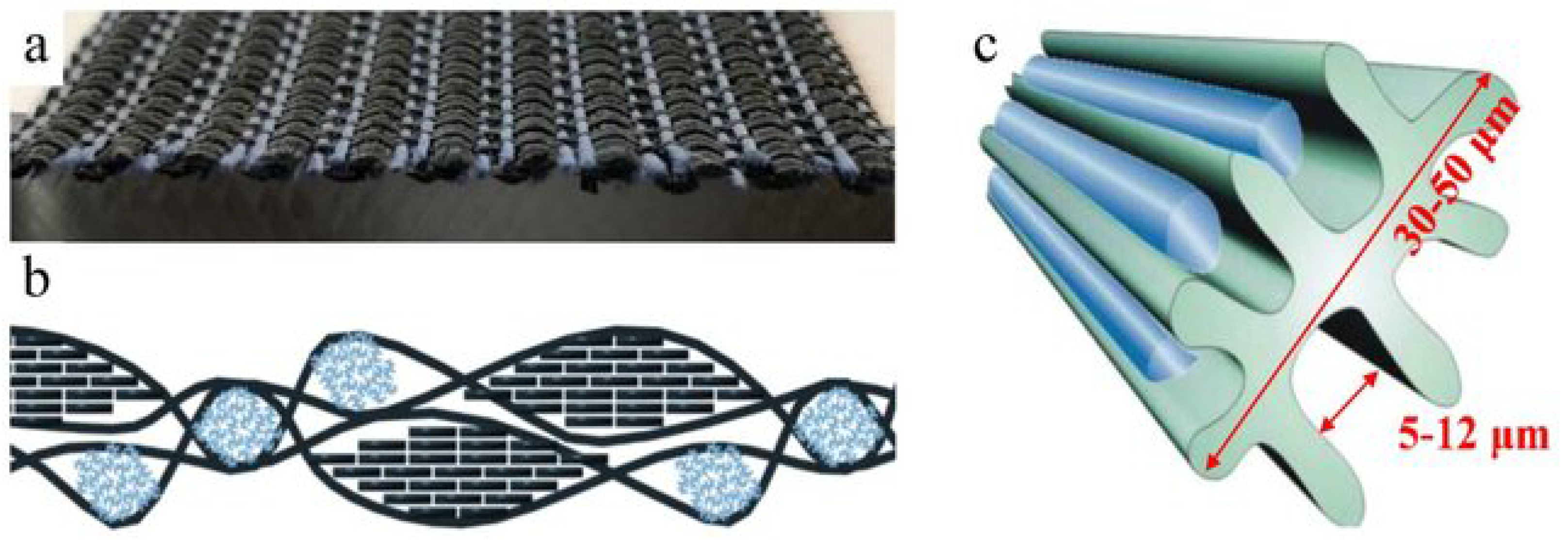
Innovative Wicking geotextile possesses specialized fiber structures engineered to actively transport both capillary and gravitational water, offering a proactive moisture management solution. As depicted in Figure 4, the wicking geotextile is composed of polyethylene yarns (black) for strengthening and particularly developed hydrophilic and hygroscopic nylon fibers (white) for water drainage. The weft yarn set in the cross-machine direction features larger cross-sectional areas, with wicking fibers placed parallel to these yarns at the top, middle, and bottom of the geotextile. This structure enables the geotextile to absorb water from both the soil above and below. Warp yarns, oriented in the machine direction, interweave with the weft yarns and wicking fibers to maintain the weaving pattern. The efficiency of this hydraulic behavior, particularly in unsaturated conditions, is quantitatively assessed through the development of geotextile water retention curves (GWRC), which are critical for accurate numerical modeling [103].
The mechanical function of the composite is supplied by the geogrid component, which typically consists of polymeric geogrids designed for tensile reinforcement and soil confinement. These elements are characterized by high tensile strength and stiffness, which contribute directly to the stability and load-bearing capacity of the geotechnical structure; however, their performance is often temperature-dependent, a factor that must be considered in design [150,151]. The efficacy of the entire composite system is not merely an aggregation of these individual properties. It is critically dependent on the interface characteristics, specifically the bond strength achieved between the geotextile and geogrid layers. This bond governs the efficiency of stress transfer from the soil to the reinforcement, ensuring the two components act as a single, cohesive unit [152,153].
Recent innovations have led to the development of composite systems where these components are bonded during manufacturing to integrate drainage and reinforcement functions seamlessly. These systems are engineered to address complex geotechnical challenges in a single product. For instance, WickGridTM systems represent a commercial application of this concept, combining high-stiffness geogrids with wicking geotextiles to provide simultaneous subgrade stabilization and moisture control [154,155]. Other common configurations include geocomposite drains, which are typically formed by sandwiching a geonet core between two layers of geotextile. This structure creates a high-capacity, in-plane flow path for water, protected from clogging by the filtering action of the geotextiles, and is a widely adopted solution for drainage applications [57,156].

6.2. Moisture Diversion Mechanisms for Geotextile Geogrid Composites

The operation of geotextile geogrid composites for moisture control relies on several hydraulic mechanisms that have been observed experimentally and in models. Mechanisms fall into three classescapillary control (barrier or wicking), in plane lateral drainage, and combined capillary barrier plus transport (geocomposite drain). Each mechanism alters the unsaturated hydraulic response above and across the interface, which can delay saturation, drain capillary water, or route infiltrating flow laterally downslope depending on design and material selection [157,158]. Column and physical-model tests document thresholds when geosynthetics begin to drain laterally (often only when pore pressures approach zero or positive) and when they instead act as capillary barriers that store water above the interface [159,160].

6.2.1. Mechanistic Details and Evidence

Capillary barrier effect
Conventional geotextiles often produce a capillary barrier that retains moisture in the overlying fine soil until near saturation, increasing local storage above the layer [158,159]. This has consequences for moisture accumulation if the geotextile cannot transport capillary water away.
Wicking transport
Wicking geotextiles use specialized fibers to transport capillary water away from the soil into the geotextile and then to an outlet; capillary-rise and column tests have quantified vertical influence zones and demonstrated drainage of both capillary and gravitational water [103,161,162].
In plane drainage (Geonet/Geocomposite)
Geonets or geonet-based geocomposites provide high in-plane transmissivity so infiltrated water is conveyed laterally, alleviating pore pressures; physical embankment models and numerical simulations show that increasing in plane permeability reduces pore pressures irrespective of geosynthetic type [156,163].
Combined composite action
Bonded geotextile geogrid systems (e.g., wicking fabric heat-bonded to a stiff geogrid) are intended to carry loads while simultaneously moving moisture laterally or vertically; tensile/structural behavior and hydraulic capacity must both be characterized [154,155].

6.2.2. Laboratory Characterization Methods

Common laboratory and characterization tests cited in the literature include capillary-rise tests and geotextile water retention curve measurements, soil geosynthetic column infiltration tests instrumented for pore pressure and moisture, and large-scale model/rainfall tests and centrifuge studies that observe slope and wall response under seepage [103,159,160,164]. The reported advantages of emerging geocomposites are primarily derived from laboratory characterization, small-scale physical models, and numerical simulations. As noted, uncertainties related to interface bonding, manufacturing variability, scale effects, and long-term durability under cyclic climatic loading remain insufficiently addressed, which restricts comprehensive performance-based design of these composite systems.

6.3. Solution for Tackling the Emerging Climatic Conditions for Slope Stability

The unique properties of the geotextile are foundational to the performance of advanced composite systems. By itself, the wicking geotextile acts as a capillary barrier across its plane, preventing vertical water infiltration. Its hydrophilic and hygroscopic fibers attract and retain water, enabling the material to efficiently drain excess moisture laterally (in-plane) under both saturated and unsaturated conditions. This function is governed by a precise mechanism: if the suction at the soil-geotextile interface exceeds the inter-yarn Air Entry Value (AEV), the geotextile acts as a barrier; if suction is lower than or equal to the AEV, it behaves as a permeable material. This feature has been advantageously used in the subsurface drainage of road embankments, with field tests and numerical simulations confirming its dual performance as a cross-plane capillary barrier and an in-plane drain.
However, for comprehensive slope protection, this hydraulic solution is optimally combined with mechanical reinforcement, leading to the geogrid geotextile composite. This composite system represents a superior solution to reduce moisture in slopes and prevent instability. In this configuration, the geogrid component provides essential tensile strength and soil confinement, directly resisting the shear forces that lead to structural failure. Simultaneously, the bonded wicking geotextile component actively removes water, reducing pore water pressure and maintaining the soil’s shear strength, which is critical after heavy precipitation or in extreme climatic conditions.
By addressing both the hydraulic (excess moisture) and mechanical (insufficient soil strength) causes of instability, the geogrid geotextile composite is uniquely equipped to reduce slope failure. Without sufficient, integrated drainage and reinforcement, saturated conditions can lead to severe slope failure. The composite’s ability to provide superior drainage while simultaneously reinforcing the soil mass effectively addresses these challenges. This dual-function system, therefore, enhances overall slope stability, ensuring the long-term durability of embankments, particularly in an era of rapidly changing climate patterns.

7. Synergistic Significance of Geogrid-Geotextile Composites

The case studies reviewed in this section were selected to capture representative slope stabilization scenarios subjected to climate-driven stressors, including prolonged rainfall, rapid infiltration, and cyclic wetting-drying conditions. Although the sites differ in geometry, soil composition, and climatic setting, a consistent performance trend emerges: slopes reinforced with geogrid-geotextile geocomposites exhibit reduced pore-water pressure accumulation, delayed saturation fronts, and improved factors of safety compared to systems relying on standalone reinforcement or drainage layers. These outcomes highlight a fundamental design principle-that the synergistic integration of tensile reinforcement and in-plane drainage within a single composite layer is critical for stabilizing slopes under transient hydrological loading. Collectively, the case studies demonstrate that geocomposites are not merely site-specific solutions but represent a scalable, performance-based strategy for climate-resilient slope design, particularly in environments prone to rainfall- induced instability.
Although application-oriented research indicates enhanced performance in composite geosynthetic systems, many reported projects lack systematic, long-term post-construction monitoring. The absence of consistent field-scale datasets and unified performance indicators hinders the quantitative validation of climate-resilient benefits across diverse soil types and site conditions. Consequently, while individual findings may not be universally applicable to every infrastructure type, these case studies remain essential for the holistic evaluation of geosynthetic composite systems, particularly regarding slope stability.

7.1. Mechanically Stabilized Earth (MSE) Walls

7.1.1. The Marginal Backfill Challenge

Mechanically Stabilized Earth (MSE) walls derive their internal stability from the frictional interaction between the soil and the geosynthetic reinforcement. Design guidelines have traditionally mandated the use of high-quality, free-draining granular backfill to ensure a high-friction interface and, critically, to prevent the buildup of pore water pressure. However, in many regions, such select fill is scarce and expensive. The use of locally available, fine-grained “marginal” backfills such as silts, clays, or lateritic soils is economically desirable. The primary risk of using these soils is their low hydraulic conductivity. During an infiltration event, such as heavy or prolonged rainfall, water entering the reinforced zone cannot drain freely. This leads to a rapid accumulation of positive pore water pressure, which is acutely destabilizing. The pore pressure reduces the effective stress within the soil mass, which in turn lowers the soil’s shear strength. Most critically, it compromises the soil-reinforcement interaction; the pullout resistance, which is directly proportional to the effective normal stress at the interface, is severely reduced, threatening the internal stability of the entire structure.
The geogrid-geotextile composite is engineered to solve this precise problem. It acts as a multifunctional inclusion that provides both mechanical reinforcement and hydraulic control. The geogrid component provides the primary tensile strength and interlock required to stabilize the soil mass. The bonded nonwoven geotextile component, engineered for high in-plane transmissivity, functions as a high-capacity lateral drain. This composite reinforcement is placed horizontally within the backfill. As water infiltrates from the surface, it percolates downward until it intercepts a composite layer. The geotextile element intercepts this water, preventing it from building up and establishing a perched water table or a zone of positive pore water pressure. The water is then efficiently channeled within the plane of the geotextile to a drainage outlet, such as a weep hole at the wall facing or a chimney drain. This drainage function ensures that the bulk of the backfill, and particularly the soil-reinforcement interface, remains in a drained or high-suction state, even during a significant rainfall event.

7.1.2. Case Study

A comparative study by Vibha and Divya (2021) [32] examined mechanically stabilized earth (MSE) walls constructed with marginal lateritic soil during a simulated 3-day monsoon rainfall event. The conventional geogrid wall (GR-W) experienced a catastrophic cascade of failures driven by water infiltration. As rainfall accumulated, the wall lost its pore water suction completely by day 2.176, causing pore water pressure to build up and weaken the soil’s effective stress. This deterioration triggered a dramatic drop in the Factor of Safety below 1.5 and resulted in a 3.2-fold increase in facing deformation. As the soil weakened and shed its load, the geogrid reinforcement was forced to carry stresses far exceeding its intended capacity, with tensile loads increasing significantly and pushing the material toward rupture.
In contrast, the composite geogrid wall (CGR-W) maintained stable performance throughout the entire rainfall event, preserving a Factor of Safety of 1.88 and experiencing negligible facing deformation. The critical difference lay in the geotextile component’s drainage function, which prevented pore water pressure buildup and maintained the soil’s effective stress and shear strength. By preserving soil structural integrity, the geogrid composite effectively disrupted the progressive failure cascade, enabling the soil mass to sustain self-weight stresses while imposing minimal additional demand on the reinforcement. This hydro-mechanical synergy between drainage and reinforcement functions demonstrates why composite geogrids provide genuine rainfall resilience and make marginal backfills a viable and safe engineering solution for reinforced soil structures.

7.2. Pavement Applications

A primary failure mechanism in flexible pavements is the loss of strength in the subgrade and aggregate base layers due to the presence of excess moisture. This moisture leads to a reduction in soil modulus, which accelerates distresses like rutting and fatigue cracking. Water can infiltrate from the surface (rainfall) or, more insidiously, migrate upward from the water table via capillary action, particularly in problematic expansive or frost-susceptible soils. Advanced geogrid-geotextile composites, particularly specialized wicking composites, are engineered to provide a multifunctional solution that combines mechanical stabilization with active hydraulic management.

7.2.1. Subgrade Protection and Moisture-Related Distress

To protect the subgrade, a composite material must perform several functions simultaneously. These materials often integrate high-strength polymer fibers or geogrids with specialized hydrophilic fibers (e.g., nylon) designed with micro-channels. This composite provides two primary functions:
Reinforcement and separation: The geogrid or high-strength polymer fiber component provides stabilization and reinforcement. It enhances the load-bearing capacity of the aggregate base by confining the aggregate and promoting interlock. The geotextile component provides separation, acting as a barrier that prevents the migration of fine-grained subgrade soils up into the open-graded base course, an action that would otherwise clog the base and reduce its drainage capacity and structural strength.
Active hydraulic management (wicking): This is the critical function for subgrade protection. This “wicking” composite performs two hydraulic roles. First, it acts as a capillary barrier, intercepting and blocking the upward capillary migration of water from the subgrade, which prevents the base course from becoming saturated from below. Second, it serves as a high-capacity lateral drain. The hydrophilic wicking fibers collect water (from surface infiltration or intercepted capillary rise) and transport it with high in-plane capacity to the pavement edge for discharge.

7.2.2. Frost Protection and Thaw-Weakening Mitigation

Frost heave and subsequent thaw-weakening are severe pavement distresses in cold regions. Frost heave occurs when three conditions are met: frost-susceptible soils, freezing temperatures penetrating the ground, and a source of water. Water is drawn via suction (capillary action) to the “freezing front,” where it accumulates and forms ice lenses, causing the pavement to heave. The “thaw-weakening” or “frost boil” that occurs in the spring is often more damaging. The ice lenses melt, releasing a massive amount of water into the soil, which becomes supersaturated and temporarily loses nearly all of its shear strength, leading to catastrophic pavement failure.
Hydraulic cutoff (wicking composites):This approach targets the water source component of the frost-heave triangle. A wicking geotextile composite is installed at the subgrade-base interface to function as a hydraulic cutoff and drainage layer. Its primary mechanism is to act as a capillary barrier. It intercepts the upward migration of water from the subgrade before that water can reach the freezing front and form ice lenses. The hydrophilic fibers then actively wick this intercepted water laterally to the shoulder drains, effectively starving the freezing front of water.
Thermal insulation: Thermal insulation of pavement using geogrid-embedded geotextile composites represents an advanced approach to preventing frost-heave damage in cold climates. This strategy operates by creating a high-performance thermal barrier beneath the pavement structure that insulates the subgrade soil from freezing temperatures. The composite system integrates geotextile layers with nano-silica aerogel or similar thermal insulators to form a “sandwich” configuration that blocks the penetration of cooling flows into the underlying soil. By maintaining the subgrade above freezing point, this approach eliminates the formation of ice lensesthe primary cause of frost-heave deformation and pavement failure.
The composite functions through thermal resistance rather than hydraulic drainage. When incorporated into the pavement structure, the geotextile-aerogel composite layer acts as an insulating medium that reflects and dissipates heat, preventing thermal energy from escaping downward into the soil. The geogrid component provides structural reinforcement to the composite system, ensuring it maintains dimensional stability and load-bearing capacity under pavement traffic stresses. The aerogel’s exceptional insulating properties create a thermal barrier that keeps the frost line above the critical subgrade layer, regardless of ambient temperature fluctuations. This thermally protected zone prevents water in the soil from freezing and expanding, thus eliminating the heave mechanism entirely. The system is particularly effective in regions with severe frost cycles and frost-susceptible soils, offering a passive, long-term solution that requires no active maintenance and integrates seamlessly into standard pavement construction practices.

7.2.3. Case Study

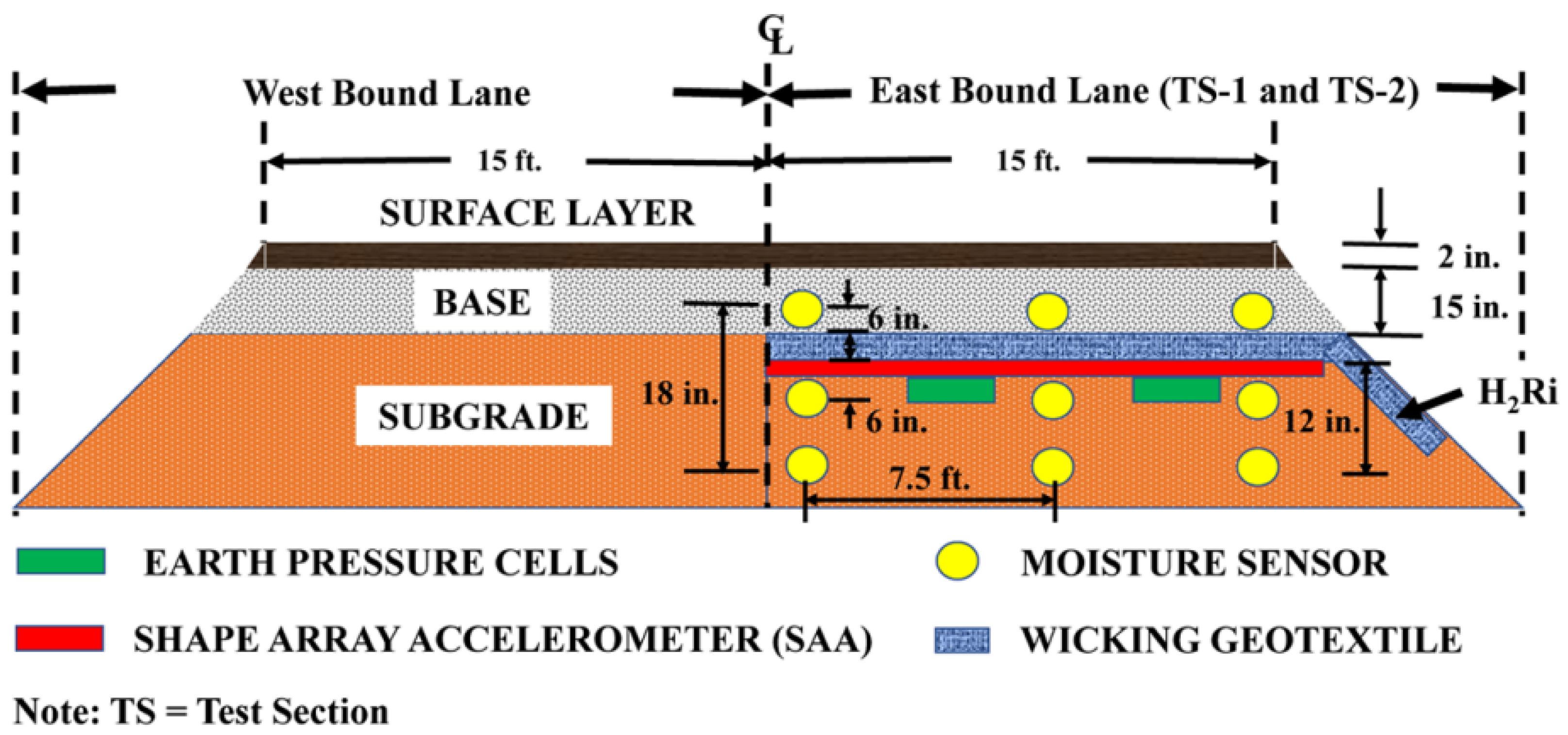
A field study by Biswas et al. (2021) [24] evaluated the performance of wicking geotextiles in flexible pavements constructed over expansive soils in North Texas, as illustrated in Figure 5. The study reported a critical finding: the wicking geotextile was able to actively remove moisture from the expansive subgrade soil to a depth of more than 0.3 m (300 mm) below the level of its installation. This active dewatering of the subgrade maintained its structural capacity (modulus) and, as a direct consequence, resulted in a measurable reduction in permanent deformations (rutting) in the instrumented road section. This provides definitive evidence linking the composite’s hydraulic function to improved mechanical performance of the pavement.
The case study for hydraulic cutoff on subgrade-base interface application is that of Zhang et al. (2014) [29], which investigated the use of wicking fabric to prevent frost boils on the Dalton Highway in Alaska. This area was notorious for severe frost-related damage. The study “verified the effectiveness of the wicking fabric to mitigate frost boils”. A subsequent long-term evaluation five years after installation confirmed the solution’s durability and sustained performance, showing it successfully continued to alleviate frost heave and thaw-weakening.
A recent case study by Nourmohamadi et al. (2022) [165] introduced a ’sandwich’ geocomposite system composed of geotextile soil nano silica aerogel geotextile layers (GSAL) for frost protection. The key innovation lies in the use of silica aerogel, an ultralow-thermal-conductivity material, which forms an insulating barrier within the pavement structure. Rather than draining moisture, this composite prevents the penetration of cold temperatures into frost-susceptible subgrades, thereby eliminating the conditions required for ice lens formation. This approach represents a thermal-based frost mitigation strategy, offering a targeted solution where preventing soil freezing is more practical than managing water migration. The case study confirms that integrating aerogel within the pavement system can effectively maintain subgrade temperatures above freezing, improving performance and reducing frost-heave-related damage in cold-region infrastructure.

7.3. Railway Embankment on Soft Subgrade

The geogrid embedded geotextile composite is a dual-function stabilization system that provides both mechanical reinforcement and hydraulic control. The geogrid delivers high tensile stiffness (typically >200–400 kN/m) to resist lateral spreading and increase the global Factor of Safety (FoS), while the geotextile offers high in-plane transmissivity (≈10−3 to 10−2 m2/s) to rapidly dissipate excess pore-water pressures. By simultaneously confining the foundation soil and preventing pore-pressure buildup, the system maintains shear strength under combined static embankment loading and repeated dynamic loading from high-speed trains. This makes the technique highly suitable for rail embankments on soft, saturated clays where conventional reinforcement alone would be insufficient.

Case Study

A five-year field trial in Singleton, New South Wales (NSW), Australia [166], used a geocomposite (GC-1) made of a biaxial geogrid bonded to a nonwoven geotextile. The reinforcement significantly improved track performance on soft alluvial clay by reducing deformation and enhancing stability. Quantitative monitoring revealed that the inclusion of geosynthetic reinforcement reduced the vertical deformation of the ballast by approximately 35% compared to unreinforced sections. Furthermore, the reinforcement significantly curtailed transient vertical movement under train loads, achieving a 40–65% reduction in transient displacement on soft subgrades. The study also assessed the long-term durability of the reinforcement, recording permanent transverse strains limited to between 0.1% and 1.0% after 6.8 million load cycles. These findings demonstrate the composite’s ability to maintain confinement and reduce the Ballast Breakage Index (BBI) by roughly 35%.
Another study [167] on DEM simulations and large-scale shear tests showed that geogrid reinforcement reduces high contact forces in ballast and improves particle interaction, resulting in greater shear stability and reduced deformation. The analysis indicated that reinforcement substantially reduced the maximum contact forces within the ballast assembly from 754 N in unreinforced sections to approximately 522–562 N in reinforced sections, thereby protecting individual aggregates from high-stress concentrations. This stress redistribution was facilitated by a notable increase in the coordination number (average contacts per particle), which rose from 3.5–6.2 in unreinforced ballast to 5.6–9.4 in the presence of triaxial geogrids. Additionally, the reinforcement reoriented the principal contact forces by up to 7 degrees toward the horizontal plane (reaching up to 21 degrees), enabling more effective absorption of shear loads and minimizing vertical dilation.

7.4. Hydraulic Stability Performance in Levee Systems

The geotextile-geogrid composite system provides a combined hydraulic and structural stabilization mechanism suitable for levees and flood-control embankments. In this configuration, the geotextile serves as a filter and high-capacity drainage layer (transmissivity on the order of 10−3–10−2 m2/s), preventing fine-soil migration while rapidly dissipating internal pore-water pressures. The geogrid contributes secondary mechanical reinforcement, providing tensile stiffness in the range of 100–300 kN/m to increase slope stability during stress-critical conditions such as rapid drawdown. This dual-function design is particularly valuable in hydraulic infrastructures, where the dominant failure modes, piping and rapid drawdown, are governed by changes in seepage gradients rather than direct structural loads.

Case Study

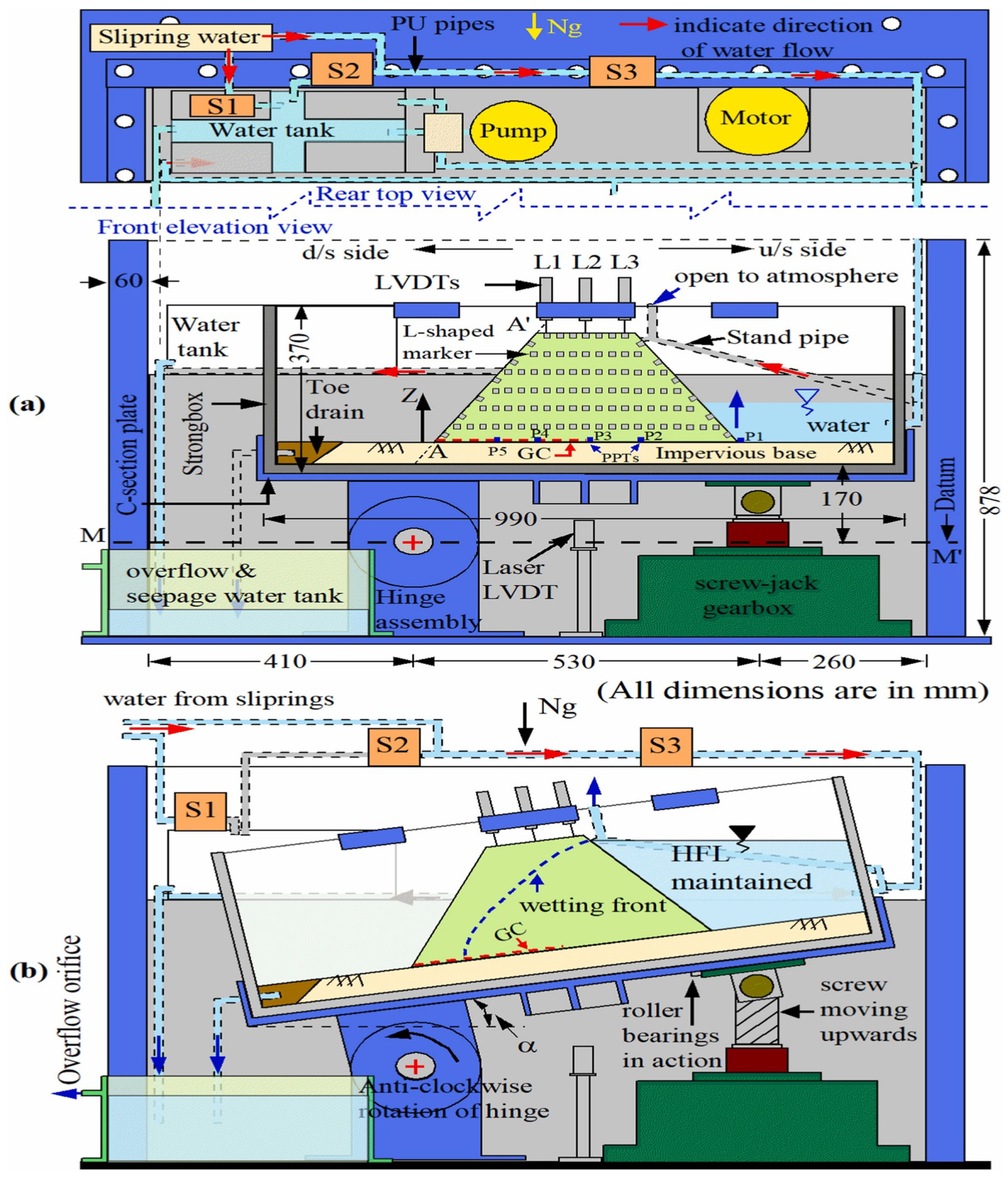
One study uses Sand-Sandwiched Geocomposite Chimney Drain (SSGC-CD) in a Levee/Dam System [168]. A centrifuge model test illustrated in Figure 6 evaluates a 7.2 m-high prototype levee section reinforced with a sand-sandwiched geogrid-geotextile geocomposite chimney drain (SSGC-CD) to assess its hydraulic stabilization performance under reservoir filling and pseudostatic seismic loading. The SSGC-CD consisted of a geocomposite layer vertically extended to 0.91H and horizontally to the mid-crest, encapsulated by 0.0208H thick sand cushions on both sides. During seepage loading, the system reached high flood level (HFL) by 4.8 days, maintaining an upstream water pressure of approximately 64.5 kPa while significantly reducing internal pore-water pressures. At the onset of tilting (at t s = 18 days), the recorded pore-water pressures were u PPT 2 = 53.2 kPa, u PPT 3 = 35 kPa, u PPT 4 = 13.3 kPa, and u PPT 5 = 6.7 kPa, demonstrating substantial reduction in hydraulic build-up and a lowered phreatic surface compared to non-sandwiched drainage systems.
Under inertial loading up to a maximum tilt of α = 18.3 , the SSGC-CD system exhibited the highest resilience among all tested configurations. The levee showed minimal deformation even after 45.2 days of combined seepage and seismic loading, with maximum crest settlement limited to only 0.067 m (less than 1% of the height) and downstream slope face movement remaining below 0.08 m. The yield acceleration occurred at α yield = 7.5 (corresponding to K H 0.13 ), indicating enhanced seismic resistance relative to conventional GC drains. The sand cushions played a critical role in maintaining transmissivity, preventing clogging, and sustaining drainage efficiency, which collectively reduced phreatic rise and delayed distress propagation. Overall, this case study highlights the synergistic hydraulic and mechanical advantages of sand-sandwiched geogrid-geotextile composites for improving levee stability under combined hydraulic and seismic demands.

7.5. Performance in Rainfall-Induced Slope Instability

The geogrid embedded geotextile composite provides both reinforcement and hydraulic protection, making it particularly effective in slopes affected by rainfall-induced failures. In this system, the geogrid contributes tensile stiffness (typically 100 300 kN / m ) to resist downslope movement, while the geotextile provides separation, filtration, and in-plane drainage (transmissivity on the order of 10 3 10 2 m 2 / s ). This hydraulic function prevents fines migration and preserves long-term permeability in the drainage layer, ensuring that pore-water pressures do not accumulate. The composite therefore maintains shear strength and slope stability over repeated wetting cycles-something traditional geogrid-only systems cannot reliably achieve over multiple rainfall seasons.

Case Study

A numerical study [32] using GeoStudio investigated the performance of a 10 m high steep slope ( 68 ) constructed with locally available marginal soil (lean clay), subjected to a rainfall intensity of 3.59 × 10⁻⁷ ms−1. The study compared an unreinforced slope (UR), a slope reinforced with geogrids only (RS-G), and a slope reinforced with composite geogrids (RS-CG) incorporating a nonwoven geotextile layer for drainage.
The synergy of reinforcement and drainage in the RS-CG model resulted in a 6-fold reduction in normalized pore water pressure compared to the unreinforced slope. While the Factor of Safety (FOS) for both the unreinforced and geogrid-only slopes dropped below 1.5 (indicating instability) during the rainfall event, the composite geogrid slope maintained a stable condition with an FOS > 1.5 throughout the duration. Furthermore, while the groundwater table rose significantly in the UR and RS-G models, it remained unchanged in the RS-CG model, demonstrating the composite’s effectiveness in keeping the reinforced section in an unsaturated state.
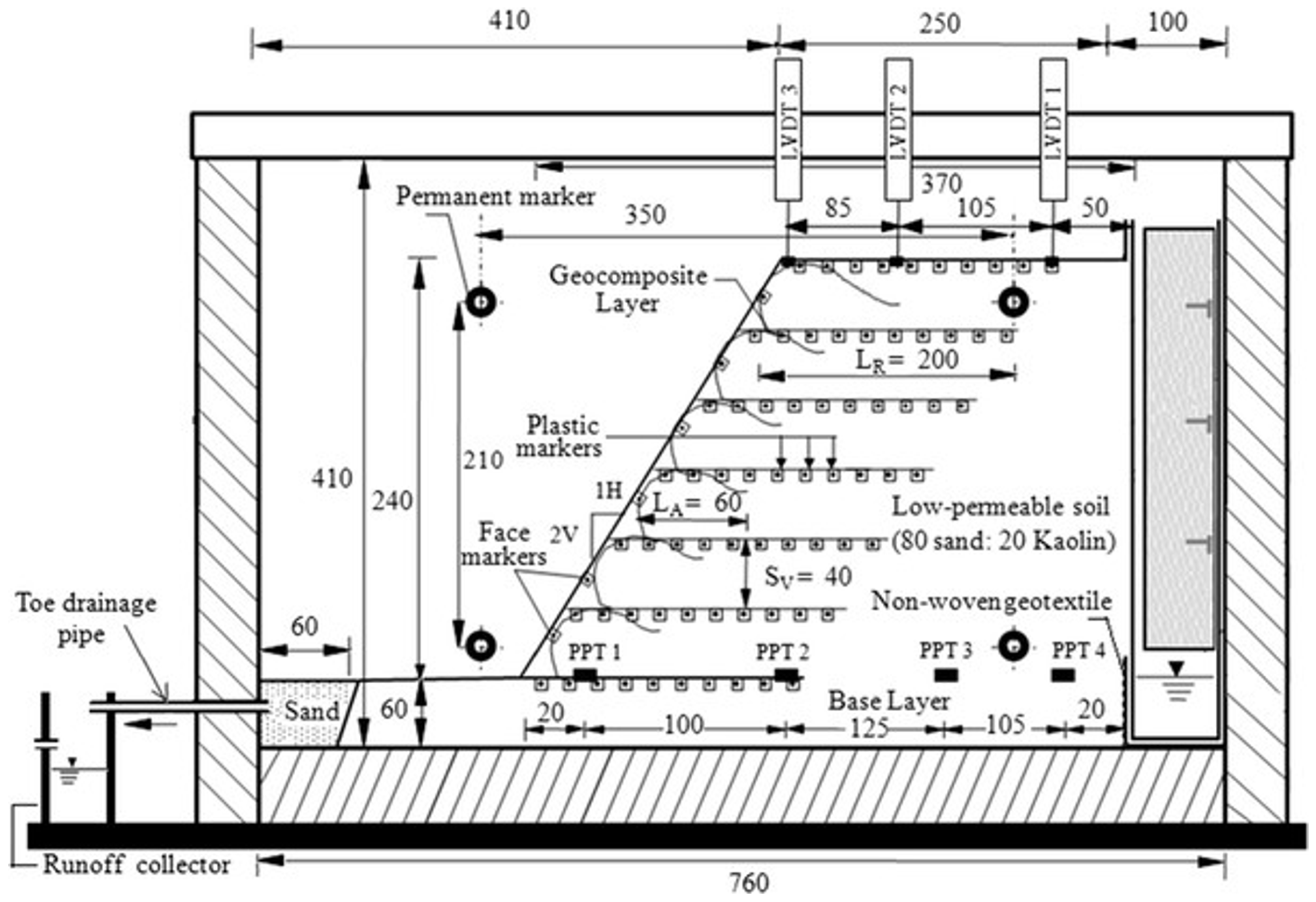
A physical modeling study [33] utilized a geotechnical centrifuge at 30 gravities ( N = 30 ) to simulate the behavior of a 7.2   m high prototype slope ( 2 V : 1 H ) made of low-permeability silty sand subjected to heavy rainfall (20 mmh−1). Figure 7 demonstrated the study that contrasted an unreinforced slope (Model T2) against a slope reinforced with a “G1N1” geocomposite, which integrated a woven geogrid for reinforcement and a non-woven geotextile for drainage.
The unreinforced slope suffered catastrophic deep-seated failure after 9.375 days of rainfall, whereas the geocomposite slope remained stable for the entire 23.5-day test duration. Quantitatively, the inclusion of the geocomposite reduced normalized pore water pressure values ( u / γ h ) by approximately 47% (from 0.514 in the unreinforced slope to 0.272 in the reinforced slope). Additionally, crest settlement was reduced by 93% compared to the unreinforced model, and the maximum peak strain recorded in the reinforcement layers was limited to just 8.01%, preventing the loss of matric suction that triggered failure in the control models.

7.6. Slope Built on Expansive Soil

Expansive soils are clay-rich, high-plasticity materials containing minerals like montmorillonite and illite [169,170,171,172]. Their primary challenge is significant volume changeswelling when wet and shrinking when drywhich is a key deformation behavior in unsaturated soils [3]. These continuous wetting-drying cycles cause substantial ground movement that can destabilize structures and slopes built upon them.
Climate change intensifies these issues by altering temperature and rainfall patterns [173]. Cycles of wetting-drying and freezing-thawing degrade the soil’s structural integrity and create unstable pore spaces [4,5], which leads to increased hydraulic conductivity [6,174,175], more significant volume changes [7,8,9], and a significant decline in mechanical strength [10,11,176]. Freeze-thaw cycles, in particular, can cause large-scale expansive soil slopes to creep downwards, increasing landslide risk [177]. Extreme weather, such as drought followed by excessive precipitation, is especially damaging to earthen structures [24,178,179,180] and can affect embankment slope protection [181].
Slope failure is often initiated when soil cracks, which are investigated in models simulating wet-dry cycles [182,183], facilitate rainwater infiltration. This infiltration increases pore water pressure and reduces the soil’s shear strength [184,185,186]. Key stability factors like permeability and water retention are significantly affected by these environmental conditions [173]. Continuous exposure to wetting-drying cycles can eventually cause clays to lose their shear strength completely [187]. While atmospheric variables influence the upper layers of soil slopes, the shifting water table affects the deeper layers [188]. In some cases, runoff creates pooling at the base of the slope, leading to substantial weakening and swelling [186].
Various rehabilitation methods are used to address the challenges of expansive soils [24,189,190,191,192], such as the montmorillonite-rich Eagle Ford Shale in North Central Texas [193]. Recent innovations include geocells, which can reduce vertical stresses [194], and new wicking geotextiles for moisture redistribution [24]. Nonwoven geotextile drains are also proposed to dissipate pore water pressure, but they can create a capillary barrier effect in unsaturated conditions, hindering water penetration until the soil above is nearly saturated. Clogging is also a concern, though it may not always negatively impact longitudinal permeability [195]. To address the capillary barrier effect, numerical models show that using sand cushions as an intermediate layer between the backfill and the geotextile allows for effective downward dissipation of pore water pressure, enhancing regional slope stability [196].
Geogrid geotextile geocomposites offer an effective solution due to their synergistic characteristics, combining the tensile reinforcement of the geogrid with the filtration and drainage functions of an innovative geotextile. This composite system is well-suited for this soil type, as it enhances slope stability, improves load distribution, and facilitates proper drainage. As a result, it helps reduce the effects of climatic stresses, such as heavy rainfall and moisture fluctuations, while maintaining the long-term structural integrity of the slope.

8. Performance and Sustainability Evaluation of Geogrid Geotextile Geocomposite

Evaluating the performance of geotextile geogrid composites for moisture diversion is a complex task, necessitating a combination of both hydraulic and mechanical testing protocols. This multi-faceted approach is essential because the materials must function simultaneously as drainage/barrier elements and structural components. Before evaluating the performance of the system, the following Table 5 summarizes how geocomposites counteract the physical factors that lead to slope instability.
The evaluation spans multiple scales, from small-scale laboratory column tests, which isolate specific properties, to large-scale physical models, centrifuge tests, and numerical simulations that assess system-level behavior. The literature provides a basis of both standardized and custom methodologies designed to quantify key parameters such as drainage capacity, capillary behavior (both wicking and barrier effects), tensile performance, and overall system effects, particularly under the critical conditions of transient infiltration [159,160,164].
Although composite geosynthetics have a higher initial material cost than single-function products, they reduce total project costs by 30–50% by enabling the use of locally available “marginal” backfill [197]. By avoiding the “Remove and Replace” method, which involves excavating hundreds of tons of local soil and importing select granular fill, engineers can significantly reduce transport costs and construction timelines. Furthermore, compared to soil nailing, noting that while soil nails are effective for steep excavations, geosynthetics reduce carbon footprints by minimizing natural construction material usage and improving long-term performance while reducing maintenance costs [198]. One study quantifies these benefits, finding that geosynthetic reinforcement accounts for only 5% of total CO2 emissions compared to 20% for steel reinforcement, while backfill transportation represents 45% of project emissions, making local material use crucial [199].

8.1. Recommended Testing Methodologies and Key Metrics

Column and capillary-rise tests
These index-style tests are fundamental for characterizing the intrinsic hydraulic properties of the geotextile component. They are used to quantify the geotextile-water retention curve (GWRC), which governs unsaturated behavior, as well as performance metrics like the vertical influence zone and the specific capillary drainage capacity of specialized wicking fabrics [103,161,162].
Soil geosynthetic infiltration columns
These tests represent a 1D system-level evaluation. By instrumenting the soil profile to monitor pore pressures and volumetric water content above and below the geosynthetic layer, researchers can precisely identify critical hydraulic thresholds. These include the point where the capillary barrier effect is overcome (breakthrough) and the subsequent onset of lateral drainage within the composite [159,160].
Large-scale model/rainfall and centrifuge tests
To validate system performance under more realistic conditions, large-scale physical models or centrifuge tests are employed. These methods reproduce representative slope or embankment geometry and are subjected to controlled rainfall events. Instrumentation allows for the observation of pore-pressure evolution, soil displacement, and potential failure modes, while also measuring the hydraulic efficiency via discharge volumes collected from the geocomposites [163,164,200].
Mechanical characterization
To confirm the structural integrity and reinforcement function, tensile tests are performed on the geogrid components and the bonded composite specimens. These tests are essential to assess design parameters such as stiffness, ultimate strength, and the bond behavior between layers. This characterization is often extended to include environmental variations, such as the effects of temperature and freeze-thaw cycles on mechanical performance [155,164].
Numerical coupled analyses
Computational modeling serves as a predictive tool for performance assessment and parametric study. These models typically involve coupling variably saturated flow analysis with mechanical deformation models (i.e., hydromechanical or THM models). They are used to predict transient processes like suction changes, the development of phreatic surfaces, and the resulting probability of stability, often incorporating stochastic parameter ranges to account for material uncertainty [156,201].

8.2. Key Performance Indicators

The overall efficacy of these composite systems is judged by a suite of performance indicators reported in the literature.
  • Hydraulic performance indicators: These are quantified by metrics such as the reduction in peak pore pressure, the delay or complete prevention of saturation in the overlying soil, the volume of retained suction, and the measured discharge volumes from the geocomposites [156,163,200].
  • Mechanical & stability indicators: Concurrently, mechanical improvements are demonstrated by the reduction in surface or facing displacements and, most critically, by calculated improvements in the factor of safety during and in the aftermath of severe infiltration or freeze-thaw cycles [156,200,202].

9. Challenges and Limitations

The literature identifies several limitations specific to geogrid-embedded geotextile composites. A primary challenge is that the geotextile component may still create capillary barriers that retain moisture, a problem that specialized wicking or high-transmissivity geocomposites aim to solve. A significant gap often exists between laboratory results and field performance, as small-scale tests struggle to replicate the complex soil-geogrid-geotextile interactions, soil heterogeneity, and variability during installation. Most critically, comprehensive design guidance for effectively and simultaneously integrating the hydraulic function (of the geotextile) with the mechanical reinforcement function (of the geogrid) remains incomplete. Long-term concerns are frequently cited, including the durability of the composite system, the potential for clogging of the geotextile layer, the reliability of the bond between the geogrid and geotextile, and the effects of marginal backfills.

9.1. Specific Challenges and Research Needs

Capillary barrier and hydraulic function. A significant challenge remains the hydraulic performance of the geotextile layer within the composite. This layer can still act as a capillary barrier, delaying lateral drainage until the surrounding soil is near-saturation. This risks an unintended increase in moisture storage directly above the composite, which can be detrimental even as the geogrid component provides reinforcement [158,159,203].
Scaling and field translation. Translating laboratory findings for geogrid-embedded geotextiles to field applications is a major hurdle. Small-scale lab columns and idealized models often fail to capture the complex, coupled behaviors of the composite system. Factors like soil heterogeneity, preferential flow paths, and installation damage (e.g., to the geotextile or the bond) can significantly alter the combined hydraulic-mechanical performance in the field in ways not predicted by lab models [160,164,203].
Design integration. The central challenge for these composites is the lack of codified practice to jointly size hydraulic transmissivity and tensile reinforcement. Design must account for the geogrid’s contribution (e.g., bond, spacing) and the geotextile’s hydraulic needs (e.g., outlet routing) in a unified manner. This integration is critical, as probabilistic analyses suggest that hydraulic parameters (like SWCC) strongly influence failure probabilities, even when these advanced composites are used for reinforcement [201].
Material durability and environmental sensitivity. The long-term durability of the entire composite system is a key concern. Environmental factors like temperature, freeze-thaw cycles, and chemical exposure can alter the properties of both components and their interface. For example, temperature changes can affect the geogrid’s tensile behavior and failure mode, while ice formation could simultaneously impede the geotextile’s hydraulic function and potentially damage the bond between the layers [155,203].
Clogging and maintenance. The long-term hydraulic performance of the composite is vulnerable to clogging. Field exposure to fine particle migration, biological growth, or salt accumulation can reduce the transmissivity of the geotextile layer over time. This is a critical failure-mode, as a clogged geotextile negates the composite’s drainage function, potentially leading to water buildup and compromising the very stability the geogrid was meant to ensure [203].

9.2. Future Research Directions

Future work should prioritize performance-based, climate-resilient design of geogrid-geotextile composites by closing the current gaps in hydraulic characterization, field validation, coupled modeling, and detailing standards. Building on the identified needs, improved GWRC characterization, long-term field monitoring, coupled seepage-stability modeling, quantified outlet/routing design, and standardized test procedures, the following directions are recommended:
  • Composite-specific unsaturated hydraulic characterization: Establish repeatable laboratory protocols to quantify the Geosynthetic Water Retention Curve (GWRC) for bonded systems and to define key thresholds such as capillary-barrier “breakthrough” and the onset of lateral drainage, which control wetting-response under extreme precipitation.
  • Standardized multi-scale performance testing under realistic climate sequences: Develop standardized procedures that evaluate the combined hydraulic-mechanical behavior under representative loading histories (e.g., prolonged rainfall, wetting-drying cycling, freeze-thaw), rather than isolated index tests. This should integrate pore-pressure/suction evolution, discharge capacity, and deformation/factor-of- safety outcomes.
  • Long-term field monitoring and field-to-lab translation: Implement long-duration instrumented field sections to quantify in-situ coupled performance and to validate lab-derived parameters, particularly considering heterogeneity, preferential flow, and installation damage that can shift real behavior away from idealized tests.
  • Coupled seepage-stability models that honor slope-specific composite layouts: Advance coupled modeling frameworks that explicitly represent the composite geometry and routing (location of drains, outlets, continuity), and that link transient suction/pore-pressure to stability metrics. The objective is to enable a design that jointly satisfies hydraulic and reinforcement demands.
  • Design integration and reliability-based guidance: Convert research outcomes into design tools that jointly size transmissivity and tensile reinforcement, including uncertainty quantification (e.g., SWCC/GWRC variability), given evidence that hydraulic parameters can strongly influence failure probability.
  • Durability, clogging, and maintenance in climate-stressed environments: Establish performance retention models that include temperature, freeze-thaw, chemical exposure, interface bond degradation, and clogging evolution, and translate these into inspection/maintenance provisions for long-term functionality.

10. Conclusions

Geotextiles and other geosynthetics have risen in prominence in geotechnical engineering over the last few decades, driven by growing global demand and their versatility in functions such as separation, filtration, drainage, reinforcement, barrier development, and mitigation of degradation. Manufactured primarily from polyolefin, polyester, or polyamide polymers (often enhanced with additives), these materials are increasingly being adopted for earth-structure applications; however, their performance under evolving environmental conditions introduces important design challenges.
In particular, climate-change-driven extremes in precipitation and temperature are intensifying the hydro-mechanical triggers of embankment and slope instability. Wetting-drying cycles promote swelling and shrinkage in expansive clays, with matric suction governing much of this response; elevated temperatures accelerate evaporation and drying, increasing the likelihood of desiccation cracking; and intense rainfall can rapidly reduce shear strength through suction loss and pore-pressure build-up, often leading to surficial failures on desiccated slopes after heavy precipitation. Accordingly, slope stability analysis and the broader body of experimental, numerical, and field evidence indicate that composite geosynthetic systems are most climate-resilient when reinforcement is integrated with hydraulic control rather than treated as a separate design component. Consistent with this observation, results from laboratory testing, centrifuge modeling, numerical simulations, and case histories, composite geosynthetics, particularly bonded geogrid-geotextile configurations and wicking-enabled geotextiles, show the strongest potential to preserve effective stress and stability under extreme climatic loading. Mechanistically, wicking geotextiles can act as a capillary barrier, limiting vertical water migration, while hydrophilic/hygroscopic fibers provide lateral drainage under both saturated and unsaturated conditions. When combined with geogrid reinforcement, this produces a coupled “drain-reinforce” response in which moisture redistribution and pore-pressure control complement tensile confinement and shear resistance, helping to suppress pore-pressure accumulation and sustain stable factors of safety compared with unreinforced or geogrid-only solutions.
Despite these advantages, long-term performance depends not only on tensile capacity but also on hydraulic durability and constructability, including potential capillary-barrier side effects (e.g., elevated moisture in adjacent layers and reduced composite stiffness), clogging susceptibility, installation damage, interface bonding reliability, and the current lack of unified procedures that jointly design for transmissivity and reinforcement. Moving forward, the most impactful pathway toward performance-based practice is to (i) establish composite-specific unsaturated hydraulic characterization, (ii) validate coupled seepage-stability predictions through long-term field monitoring, and (iii) standardize testing procedures that reflect realistic climate sequences. In conclusion, the synergistic significance of geogrid-geotextile composites (especially wicking-geotextile) offers a durable and targeted approach to infrastructure resilience, ensuring that geotechnical designs achieve optimal stability and long-term durability in regions facing emerging climatic stresses.

Author Contributions

Conceptualization, M.J.B.A. and R.S.M.; methodology, R.S.M. and M.J.B.A.; formal analysis, R.S.M. and M.J.B.A.; investigation, M.J.B.A., R.S.M. and S.Y.; resources, M.J.B.A., R.S.M. and S.Y.; writing—original draft preparation, R.S.M. and M.J.B.A.; writing—review and editing, M.J.B.A., R.S.M. and S.Y.; supervision, M.J.B.A. All authors have read and agreed to the published version of the manuscript.

Funding

This work was supported by the National Center for Infrastructure Transformation (NCIT) under Contract No. 69A3552344813. The authors also gratefully acknowledge partial financial support provided by the National Science Foundation (NSF) under Grant No. 2101081.

Institutional Review Board Statement

Not applicable.

Informed Consent Statement

Not applicable.

Data Availability Statement

Data is contained within the article.

Conflicts of Interest

The authors declare no conflicts of interest.

References

  1. Berg, R.R.; Christopher, B.R.; Samtani, N.C.; Associates, I.R.R.B. Design of Mechanically Stabilized Earth Walls and Reinforced Soil Slopes—Volume I; Federal Highway Administration: Washington, DC, USA, 2009.
  2. Hou, C.Q.; Xu, Q.; Li, Y.X.; Sun, Z.B. Reliability analysis of geosynthetic-reinforced slopes under rainfall infiltration. Geotext. Geomembr. 2024, 52, 156–165. [Google Scholar] [CrossRef]
  3. Fredlund, D.G. The 1999 R.M. Hardy Lecture: The implementation of unsaturated soil mechanics into geotechnical engineering. Can. Geotech. J. 2011, 37, 963–986. [Google Scholar] [CrossRef]
  4. Seiphoori, A.; Ferrari, A.; Laloui, L. Water retention behaviour and microstructural evolution of MX-80 bentonite during wetting and drying cycles. Géotechnique 2015, 64, 721–734. [Google Scholar] [CrossRef]
  5. Zhang, Z.; Ma, W.; Feng, W.; Xiao, D.; Hou, X. Reconstruction of Soil Particle Composition During Freeze-Thaw Cycling: A Review. Pedosphere 2016, 26, 167–179. [Google Scholar] [CrossRef]
  6. Malusis, M.A.; Yeom, S.; Evans, J.C. Hydraulic conductivity of model soil-bentonite backfills subjected to wet-dry cycling. Can. Geotech. J. 2011, 48, 1198–1211. [Google Scholar] [CrossRef]
  7. Liu, J.; Chang, D.; Yu, Q. Influence of freeze-thaw cycles on mechanical properties of a silty sand. Eng. Geol. 2016, 210, 23–32. [Google Scholar] [CrossRef]
  8. Luo, J.; Tang, L.; Ling, X.; Geng, L. Experimental and analytical investigation on frost heave characteristics of an unsaturated moderately expansive clay. Cold Reg. Sci. Technol. 2018, 155, 343–353. [Google Scholar] [CrossRef]
  9. Wang, S.; Yang, Z.J.; Yang, P. Structural change and volumetric shrinkage of clay due to freeze-thaw by 3D X-ray computed tomography. Cold Reg. Sci. Technol. 2017, 138, 108–116. [Google Scholar] [CrossRef]
  10. Tang, L.; Cong, S.; Geng, L.; Ling, X.; Gan, F. The effect of freeze-thaw cycling on the mechanical properties of expansive soils. Cold Reg. Sci. Technol. 2018, 145, 197–207. [Google Scholar] [CrossRef]
  11. Lu, Y.; Liu, S.; Alonso, E.; Wang, L.; Xu, L.; Li, Z. Volume changes and mechanical degradation of a compacted expansive soil under freeze-thaw cycles. Cold Reg. Sci. Technol. 2019, 157, 206–214. [Google Scholar] [CrossRef]
  12. Seyfi, S. Numerical Prediction of Expansive Soil Behavior in Changing Climate. Master’s Thesis, York University, Toronto, ON, Canada, 2022. [Google Scholar]
  13. Vahedifard, F.; Williams, J.M.; AghaKouchak, A. Geotechnical engineering in the face of climate change: Role of multi-physics processes in partially saturated soils. In Proceedings of the IFCEE 2018; American Society of Civil Engineers: Reston, VA, USA, 2018; pp. 353–364. [Google Scholar] [CrossRef]
  14. Karim, M.R.; Rahman, M.M.; Nguyen, H.B.K.; Kazmi, S.; Devkota, B.; Karim, R.; Rahman, M.; Bao, H.; Nguyen, K. Accounting for Expansive Soil Movement in Geotechnical Design-A State-of-the-Art Review. Sustainability 2022, 14, 15662. [Google Scholar] [CrossRef]
  15. Li, P.Y.; Dou, H.Q.; Nie, W.F. Stability Analysis of Geosynthetic-Reinforced Slopes Considering Multiple Potential Failure Mechanisms Based on the Upper Bound Theorem. Int. J. Geomech. 2024, 24, 04023286. [Google Scholar] [CrossRef]
  16. Zhang, P. Study on Slope Stability Analysis and Reinforcement Technology Based on Geosynthetics. Acad. J. Archit. Geotech. Eng. 2024, 6, 61–65. [Google Scholar] [CrossRef]
  17. Wang, Y.; Fu, H.; Wan, Y.; Yu, X. Reliability and parameter sensitivity analysis on geosynthetic-reinforced slope with considering spatially variability of soil properties. Constr. Build. Mater. 2022, 350, 128806. [Google Scholar] [CrossRef]
  18. Hassan, W.; Alshameri, B.; Nawaz, M.N.; Qamar, S.U. Experimental study on shear strength behavior and numerical study on geosynthetic-reinforced cohesive soil slope. Innov. Infrastruct. Solut. 2022, 7, 349. [Google Scholar] [CrossRef]
  19. Hesari, S.A.; Javankhoshdel, S.; Payan, M.; Chenari, R.J. Pseudo-static internal stability analysis of geosynthetic-reinforced earth slopes using horizontal slices method. Geomech. Geoengin. 2022, 17, 1417–1442. [Google Scholar] [CrossRef]
  20. Peng, M.; Sun, R.; Chen, J.F.; Rajesh, S.; Zhang, L.M.; Yu, S.B. System reliability analysis of geosynthetic reinforced soil slope considering local reinforcement failure. Comput. Geotech. 2020, 123, 103563. [Google Scholar] [CrossRef]
  21. Keskin, M.S.; Kezer, S. Stability of MSW Landfill Slopes Reinforced with Geogrids. Appl. Sci. 2022, 12, 11866. [Google Scholar] [CrossRef]
  22. Melo, M.T.; Palmeira, E.M.; Santos, E.C.; Luz, M.P.D. Geosynthetic performance against slope erosion caused by high intensity rainfall. Geosynth. Int. 2021, 28, 421–434. [Google Scholar] [CrossRef]
  23. Lin, C.; Zhang, X.; Galinmoghadam, J.; Guo, Y. Working mechanism of a new wicking geotextile in roadway applications: A numerical study. Geotext. Geomembr. 2022, 50, 323–336. [Google Scholar] [CrossRef]
  24. Biswas, N.; Puppala, A.J.; Khan, M.A.; Congress, S.S.C.; Banerjee, A.; Chakraborty, S. Evaluating the Performance of Wicking Geotextile in Providing Drainage for Flexible Pavements Built over Expansive Soils. Transp. Res. Rec. 2021, 2675, 208–221. [Google Scholar] [CrossRef]
  25. Lin, C.; Galinmoghadam, J.; Han, J.; Liu, J.; Zhang, X. Quantifying and Incorporating the Benefits of Wicking Geotextile into Pavement Design. J. Transp. Eng. Part B Pavements 2021, 147, 04021044. [Google Scholar] [CrossRef]
  26. Galinmoghadam, J.; Zhang, X. Use of Wicking Fabric to Reduce Pavement Pumping. In Proceedings of the Geo-Congress 2020; American Society of Civil Engineers: Reston, VA, USA, 2020; pp. 630–639. [Google Scholar] [CrossRef]
  27. Wang, F.; Han, J.; Zhang, X.; Guo, J. Laboratory tests to evaluate effectiveness of wicking geotextile in soil moisture reduction. Geotext. Geomembr. 2017, 45, 8–13. [Google Scholar] [CrossRef]
  28. Wu, H.; Yao, C.; Li, C.; Miao, M.; Zhong, Y.; Lu, Y.; Liu, T. Review of Application and Innovation of Geotextiles in Geotechnical Engineering. Materials 2020, 13, 1774. [Google Scholar] [CrossRef]
  29. Zhang, X.; Presler, W.; Li, L.; Jones, D.; Odgers, B. Use of Wicking Fabric to Help Prevent Frost Boils in Alaskan Pavements. J. Mater. Civ. Eng. 2014, 26, 728–740. [Google Scholar] [CrossRef]
  30. Mozumder, R.S.; Aggarwal, M.; Alam, M.J.B.; Rahman, N. Probabilistic analysis of soil moisture variability of engineered turf cover using high-frequency field monitoring. Geotechnics 2025, 5, 64. [Google Scholar] [CrossRef]
  31. von Maubeuge, K.P.; Tanner, T.; Hunter, E. Advantages of Firmly Bonded Nonwoven/Geogrid Composites in Roadway and Pavement Systems. In Proceedings of the Geo-Frontiers 2011; American Society of Civil Engineers: Reston, VA, USA, 2011; pp. 2917–2927. [Google Scholar] [CrossRef]
  32. Vibha, S.; Divya, P.V. Performance of Geosynthetic Reinforced Steep Soil Slopes at the Onset of Rainfall Infiltration. In Proceedings of the Indian Geotechnical Conference 2019; Lecture Notes in Civil Engineering LNCE; Springer: Singapore, 2021; Volume 137, pp. 167–176. [Google Scholar] [CrossRef]
  33. Bhattacherjee, D.; Viswanadham, B.V. Effect of Geocomposite Layers on Slope Stability Under Rainfall Condition. Indian Geotech. J. 2018, 48, 316–326. [Google Scholar] [CrossRef]
  34. Zhu, D.; Griffiths, D.; Fenton, G.A.; Huang, J. Probabilistic stability analyses of two-layer undrained slopes. Comput. Geotech. 2025, 182, 107178. [Google Scholar] [CrossRef]
  35. Hasheminezhad, A.; Ceylan, H.; Kim, S.; Tutumluer, E. Geosynthetics for resilient geotechnics: A review of applications and innovations. Transp. Geotech. 2025, 55, 101676. [Google Scholar] [CrossRef]
  36. Raju, J.; Ramesh, B. Performance assessment of geosynthetic reinforced soil slopes of different slope angles for sustainable construction. In AIP Conference Proceedings; AIP Publishing LLC: New York, NY, USA, 2025; Volume 3270, p. 020078. [Google Scholar] [CrossRef]
  37. Ji, W.; Zhang, F.; Jia, S.; Sun, Y.; Xiao, F. Stability Analysis of Geosynthetic Reinforced Soil Slopes Under Varying Groundwater Level and Rapid Drawdown Conditions. Transp. Infrastruct. Geotechnol. 2026, 13, 22. [Google Scholar] [CrossRef]
  38. Alielahi, H.; Derakhshan, A.; Kalhor, M. Efficacy Assessment of Geosynthetic Liners on Seismic Response Mitigation of Slopes. Transp. Infrastruct. Geotechnol. 2025, 12, 57. [Google Scholar] [CrossRef]
  39. Chen, X.; Zhou, Z.; Zhu, Y.; Pu, S.; Zhang, D.; Li, E. Evaluating seismic stability of reinforced soil slopes using the limit equilibrium method: Influence of geosynthetic strength indicators. Front. Phys. 2025, 12, 1526223. [Google Scholar] [CrossRef]
  40. Hsieh, C.W. Ongoing Geosynthetics Researches of GSI-Taiwan. In Geosynthetics Research and Development in Progress; American Society of Civil Engineers: Reston, VA, USA, 2005; pp. 1–7. [Google Scholar] [CrossRef]
  41. Shukla, S.K. An Introduction to Geosynthetic Engineering; CRC Press: Boca Raton, FL, USA, 2017. [Google Scholar]
  42. Berg, R.R.; Suits, L.D. Geosynthetics; Transportation in the New Millennium; Transportation Research Board: Washington, DC, USA, 2000. [Google Scholar]
  43. Kim, M.J.; Oh, T.H.; Han, S.S.; Joo, S.W.; Jeon, H.Y.; Chang, D.W. Preparation of poly(vinyl alcohol)/silver-zeolite composite hydrogels by UV-irradiation. Fibers Polym. 2014, 15, 101–107. [Google Scholar] [CrossRef]
  44. Müller-Rochholz, J.; Kirscher, R. Creep of geotextiles at different temperatures. In Proceedings of the Fourth International Conference on Geotextiles; AA Balkema: Rotterdam, The Netherlands, 1990; pp. 657–659. [Google Scholar]
  45. Becker, L.D. Creep of Geotextiles Confined in Experimental Fill; Federal University of Rio Grande do Sul: Porto Alegre, Brazil, 2001. [Google Scholar]
  46. Dąbrowska, J.; Kiersnowska, A.; Zięba, Z.; Trach, Y. Sustainability of Geosynthetics-Based Solutions. Environments 2023, 10, 64. [Google Scholar] [CrossRef]
  47. Shukla, S.K. Geosynthetics and Ground Engineering: Sustainability Considerations. Int. J. Geosynth. Ground Eng. 2021, 7, 17. [Google Scholar] [CrossRef]
  48. Cislaghi, A.; Sala, P.; Borgonovo, G.; Gandolfi, C.; Bischetti, G.B. Biodegradable geosynthetics for geotechnical and geo-environmental engineering. In Proceedings of the International Mid-Term Conference of the Italian Association of Agricultural Engineering; Springer: Berlin/Heidelberg, Germany, 2019; pp. 49–57. [Google Scholar] [CrossRef]
  49. Ogbobe, O.; Essien, K.S.; Adebayo, A. A Study of Biodegradable Geotextiles Used for Erosion Control. Geosynth. Int. 2015, 5, 545–553. [Google Scholar] [CrossRef]
  50. Holtz, R.D.; Christopher, B.R.; Berg, R.R. Geosynthetic Design And Construction Guidelines. Participant Notebook. Nhi Course No. 13213 (Revised April 1998); National Highway Institute: Washington DC, USA, 1998.
  51. Day, R.W. Geotechnical Engineer’s Portable Handbook; McGraw Hill: New York, NY, USA, 2000. [Google Scholar]
  52. Liu, C.; Xing, L.; Liu, H.; Quan, Z.; Fu, G.; Wu, J.; Lv, Z.; Zhu, C. Numerical Study of Bond Slip between Section Steel and Recycled Aggregate Concrete with Full Replacement Ratio. Appl. Sci. 2020, 10, 887. [Google Scholar] [CrossRef]
  53. McCartney, J.S.; Zornberg, J.G. Effects of infiltration and evaporation on geosynthetic capillary barrier performance. Can. Geotech. J. 2010, 47, 1201–1213. [Google Scholar] [CrossRef]
  54. Lin, C.; Zhang, X. A bio-wicking system to dehydrate road embankment. J. Clean. Prod. 2018, 196, 902–915. [Google Scholar] [CrossRef]
  55. Han, J.; Guo, J. Geosynthetics used to stabilize vegetated surfaces for environmental sustainability in civil engineering. Front. Struct. Civ. Eng. 2017, 11, 56–65. [Google Scholar] [CrossRef]
  56. Leshchinsky, D.; Kang, B.; Han, J.; Ling, H. Framework for Limit State Design of Geosynthetic-Reinforced Walls and Slopes. Transp. Infrastruct. Geotechnol. 2014, 1, 129–164. [Google Scholar] [CrossRef]
  57. Koerner, R.; Hwu, B. Geocomposite Drainage Systems: Highway Edge Drains And Retaining Wall Sheet Drains. Final Report; Technical report; Pennsylvania Department of Transportation: Harrisburg, PA, USA, 1989.
  58. Malik, P.; Mishra, S.K. A comprehensive review of soil strength improvement using geosynthetics. Mater. Today Proc. 2023; in press. [Google Scholar] [CrossRef]
  59. Palmeira, E.M.; Galvis, H.L.T. Evaluation of predictions of nonwoven geotextile pore size distribution under confinement. Geosynth. Int. 2018, 25, 230–241. [Google Scholar] [CrossRef]
  60. Koerner, R. Geotextiles: From Design to Applications; Woodhead Publishing: Cambridge, UK, 2016. [Google Scholar]
  61. Koerner, R.M. Designing with Geosynthetics; Xlibris Corporation: Bloomington, IN, USA, 2012; Volume 1. [Google Scholar]
  62. Palmeira, E.M.; Gardoni, M.G.; da Luz, D.W.B. Soil-geotextile filter interaction under high stress levels in the gradient ratio test. Geosynth. Int. 2015, 12, 162–175. [Google Scholar] [CrossRef]
  63. Lawson, C.F. Filter Criteria for Geotextiles: Relevance and Use. J. Geotech. Eng. Div. 1982, 108, 1300–1317. [Google Scholar] [CrossRef]
  64. Keller, G.R. Application of geosynthetics on low-volume roads. Transp. Geotech. 2016, 8, 119–131. [Google Scholar] [CrossRef]
  65. Zornberg, J.G. Functions and Applications of Geosynthetics In Roadways. Procedia Eng. 2017, 189, 298–306. [Google Scholar] [CrossRef]
  66. Holtz, R.; Christopher, B.; Berg, R. Geosynthetic Engineering; Bitech Publishers Ltd.: Richmond, BC, Canada, 1997; p. 452. [Google Scholar]
  67. Babu, G.L.S. An Introduction to Soil Reinforcement and Geosynthetics; Universities Press: Madison, CT, USA, 2006. [Google Scholar]
  68. Binal, A. The Effects of High Alkaline Fly Ash on Strength Behaviour of a Cohesive Soil. Adv. Mater. Sci. Eng. 2016, 2016, 3048716. [Google Scholar] [CrossRef]
  69. Anjos, R.; Carlos, D.M.; Gouveia, S.; Pinho-Lopes, M.; Powrie, W. Soil-Geosynthetic Interaction Under Triaxial Conditions: Shear Strength Increase and Influence of the Specimen Dimensions. Int. J. Geosynth. Ground Eng. 2023, 9, 83. [Google Scholar] [CrossRef]
  70. EL-Hanafy, A.M. Shear Strength Behavior for Reinforced Soil with Geosynthetic at Different Inclination Angles. JES J. Eng. Sci. 2024, 52, 1–16. [Google Scholar] [CrossRef]
  71. Kim, Y.J.; Kotwal, A.R.; Cho, B.Y.; Wilde, J.; You, B.H. Geosynthetic Reinforced Steep Slopes: Current Technology in the United States. Appl. Sci. 2019, 9, 2008. [Google Scholar] [CrossRef]
  72. Zhang, R.; Lan, T.; Zheng, J.L.; Gao, Q.F. Field performance of a geogrid-reinforced expansive soil slope: A case study. Bull. Eng. Geol. Environ. 2024, 83, 7. [Google Scholar] [CrossRef]
  73. Simonini, P.; Gottardi, G. The viscoplastic behaviour of a geogrid-reinforced model wall. Geosynth. Int. 2015, 10, 34–46. [Google Scholar] [CrossRef]
  74. Viebke, J.; Gedde, U.W. Antioxidant diffusion in polyethylene hot-water pipes. Polym. Eng. Sci. 1997, 37, 896–911. [Google Scholar] [CrossRef]
  75. Viebke, J.; Gedde, U.W. Assessment of lifetime of hot-water polyethylene pipes based on oxidation induction time data. Polym. Eng. Sci. 1998, 38, 1244–1250. [Google Scholar] [CrossRef]
  76. Zweifel, H. Stabilization of Polymeric Materials; Springer Science & Business Media: Norwell, MA, USA, 2012. [Google Scholar]
  77. Viebke, J.; Elble, E.; Ifwarson, M.; Gedde, U.W. Degradation of unstabilized medium-density polyethylene pipes in hot-water applications. Polym. Eng. Sci. 1994, 34, 1354–1361. [Google Scholar] [CrossRef]
  78. Gugumus, F. Effect of temperature on the lifetime of stabilized and unstabilized PP films. Polym. Degrad. Stab. 1999, 63, 41–52. [Google Scholar] [CrossRef]
  79. Jeon, H.Y.; Jeon, H.Y. Review of Long-Term Durable Creep Performance of Geosynthetics by Constitutive Equations of Reduction Factors. In Creep; InTechOpen: Rijeka, Croatia, 2017. [Google Scholar] [CrossRef]
  80. Han, J.; Jiang, Y. Use of geosynthetics for performance enhancement of earth structures in cold regions. Sci. Cold Arid Reg. 2013, 5, 517–529. [Google Scholar] [CrossRef]
  81. Henry, K.S.; Stormont, J.C.; Barna, L.; Solano, D. Geocomposite Capillary Barrier Drain for Limiting Moisture Changes in Pavement Subgrades and Base Courses; Innovations Deserving Exploratory Analysis Programs: Washington, DC, USA, 2002. [Google Scholar]
  82. Ghazavi, M.; Roustaei, M. Freeze-thaw performance of clayey soil reinforced with geotextile layer. Cold Reg. Sci. Technol. 2013, 89, 22–29. [Google Scholar] [CrossRef]
  83. Wang, D.; Wang, S.L.; Tighe, S.; Bhat, S.; Yin, S. Construction of Geosynthetic-Reinforced Pavements and Evaluation of Their Impacts. Appl. Sci. 2023, 13, 10327. [Google Scholar] [CrossRef]
  84. Vahedifard, F.; Tehrani, F.S.; Galavi, V.; Ragno, E.; AghaKouchak, A. Resilience of MSE Walls with Marginal Backfill under a Changing Climate: Quantitative Assessment for Extreme Precipitation Events. J. Geotech. Geoenviron. Eng. 2017, 143, 04017056. [Google Scholar] [CrossRef]
  85. Koerner, R.M.; Koerner, G.R. A data base, statistics and recommendations regarding 171 failed geosynthetic reinforced mechanically stabilized earth (MSE) walls. Geotext. Geomembr. 2013, 40, 20–27. [Google Scholar] [CrossRef]
  86. Kim, W.S.; Borden, R.H. Numerical Simulation of MSE Wall Behavior Induced by Surface-Water Infiltration. J. Geotech. Geoenviron. Eng. 2013, 139, 2110–2124. [Google Scholar] [CrossRef]
  87. Yang, K.H.; Thuo, J.N.; Chen, J.W.; Liu, C.N. Failure Investigation of a Multi-tier Geosynthietc-Reinforced Soil Slope with Marginal Backfill Subject to Heavy Rainfall. In Geotechnical Hazard Mitigations: Experiment, Theory and Practice—Proceedings of the 5th International Conference on Geotechnical Engineering for Disaster Mitigation and Rehabilitation; Airiti Press Inc.: Taipei, China, 2017; pp. 23–36. [Google Scholar] [CrossRef]
  88. Bhattacherjee, D.; Viswanadham, B.V. Numerical studies on the performance of hybrid-geosynthetic-reinforced soil slopes subjected to rainfall. Geosynth. Int. 2015, 22, 411–427. [Google Scholar] [CrossRef]
  89. Portelinha, F.H.; Zornberg, J.G. Effect of infiltration on the performance of an unsaturated geotextile-reinforced soil wall. Geotext. Geomembr. 2017, 45, 211–226. [Google Scholar] [CrossRef]
  90. Bouazza, A.; Freund, M.; Nahlawi, H. Water retention of nonwoven polyester geotextiles. Polym. Test. 2006, 25, 1038–1043. [Google Scholar] [CrossRef]
  91. Bathurst, R.J.; Siemens, G.; Ho, A.F. Experimental investigation of infiltration ponding in one-dimensional sand-geotextile columns. Geosynth. Int. 2015, 16, 158–172. [Google Scholar] [CrossRef]
  92. Knight, M.A.; Kotha, S.M. Measurement of Geotextile-Water Characteristic Curves Using a Controlled Outflow Capillary Pressure Cell. Geosynth. Int. 2015, 8, 271–282. [Google Scholar] [CrossRef]
  93. McCartney, J.S.; Zornberg, J.G. Hydraulic Interaction between Geosynthetic Drainage Layers and Unsaturated Low Plasticity Clay. In Proceedings of the GeoDenver 2007; American Society of Civil Engineers: Reston, VA, USA, 2007; pp. 1–10. [Google Scholar] [CrossRef]
  94. Yang, K.H.; Nguyen, T.S.; Li, Y.H.; Leshchinsky, B. Performance and design of reinforced slopes considering regional hydrological conditions. Geosynth. Int. 2019, 26, 451–473. [Google Scholar] [CrossRef]
  95. Portelinha, F.H.; Bueno, B.S.; Zornberg, J.G. Performance of nonwoven geotextile-reinforced walls under wetting conditions: Laboratory and field investigations. Geosynth. Int. 2015, 20, 90–104. [Google Scholar] [CrossRef]
  96. Zornberg, J.G.; Christopher, B.R. Chapter 37: Geosynthetics. The Handbook of Groundwater Engineering, 2nd ed.; Delleur, J.W., Ed.; CRC Press Taylor Francis Group: Boca Raton, FL, USA, 2007; Volume 2. [Google Scholar]
  97. Koerner, R.M.; Koerner, G.R. Lessons Learned Regarding Exit Strategies from Geosynthetic Drainage Composites. In Proceedings of the Geo-Congress 2019; American Society of Civil Engineers: Reston, VA, USA, 2019; pp. 364–375. [Google Scholar] [CrossRef]
  98. Ramsey, B.; Narejo, D. Using Woven and Heat-Bonded Geotextiles in Geonet Geocomposites. In Proceedings of the GeoFrontiers 2005; American Society of Civil Engineers: Reston, VA, USA, 2005; pp. 1–8. [Google Scholar] [CrossRef]
  99. Kim, S.H.; Choi, S.W.; Cho, S.H. New Concept of Reinforced Geonet Drainage; Korean Geosynthetics Society: Seoul, Republic of Korea, 2008; pp. 157–161. [Google Scholar]
  100. Eissa, A.; Alfaro, M.; Bartz, J.R.; Bassuoni, M.T.; Bhat, S. Soil-Reinforcement Interaction of a Geogrid-Geotextile Composite. Int. J. Geosynth. Ground Eng. 2023, 9, 85. [Google Scholar] [CrossRef]
  101. Adesokan, D.; Crutchlow, T. The use of a geogrid-geotextile geo-composite to improve soft soils for construction works at a facility expansion site in Western Canada. E3S Web Conf. 2024, 569, 24002. [Google Scholar] [CrossRef]
  102. Tiwari, N.; Satyam, N.; Puppala, A.J. Effect of Synthetic Geotextile on Stabilization of Expansive Subgrades: Experimental Study. J. Mater. Civ. Eng. 2021, 33, 04021273. [Google Scholar] [CrossRef]
  103. Jarjour, J.; Meguid, M.; Bhat, S. Water retention characterization of non-woven geotextiles: An application for wicking materials. E3S Web Conf. 2024, 569, 12003. [Google Scholar] [CrossRef]
  104. Mankodi, H. Geocomposite Manufactured from PP Nonwoven/HDPE Geonet. Adv. Mater. Res. 2013, 622–623, 1310–1313. [Google Scholar] [CrossRef]
  105. Liu, Z.; Shi, J.; Lin, H.; Zhang, Y.; Liu, Z.; Shi, J.; Lin, H.; Zhang, Y. Strength Characteristics of a Smooth HDPE Geomembrane/Nonwoven Geotextile Interface Based on a Novel Ring Shear Apparatus. Polymers 2023, 15, 2497. [Google Scholar] [CrossRef]
  106. Jeon, H.Y.; Kim, S.H.; Chung, Y.I.; Yoo, H.K.; Mlynarek, J. Assessments of long-term filtration performance of degradable prefabricated geotextile drains. Polym. Test. 2003, 22, 779–784. [Google Scholar] [CrossRef]
  107. Abdelaal, F.B.; Rowe, R.K.; Brachman, R.W. Brittle rupture of an aged HPDE geomembrane at local gravel indentations under simulated field conditions. Geosynth. Int. 2014, 21, 1–23. [Google Scholar] [CrossRef]
  108. Bacas, B.M.; Cañizal, J.; Konietzky, H. Shear strength behavior of geotextile/geomembrane interfaces. J. Rock Mech. Geotech. Eng. 2015, 7, 638–645. [Google Scholar] [CrossRef]
  109. Adeleke, D.; Kalumba, D.; Oriokot, J. Asperities effect on polypropylene & polyester geotextile-geomembrane interface shear behaviour. E3S Web Conf. 2019, 92, 13017. [Google Scholar] [CrossRef]
  110. Sobti, J.; Singh, S.K. Techno-economic analysis for barrier materials in landfills. Int. J. Geotech. Eng. 2017, 11, 467–478. [Google Scholar] [CrossRef]
  111. Jeon, H.Y. Geotextile composites having multiple functions. In Geotextiles: From Design to Applications; Woodhead Publishing: Cambridge, UK, 2016; pp. 413–425. [Google Scholar] [CrossRef]
  112. Heerten, G. Geosynthetic clay liner performance in geotechnical applications. In Clay Geosynthetic Barriers; CRC Press: Boca Raton, FL, USA, 2022; pp. 3–19. [Google Scholar]
  113. Gartung, E.; Koerner, R.M.; Zanzinger, H. Geosynthetic Clay Liners: Proceedings of the International Symposium, Nuremberg, Germany, 16–17 April 2002; CRC Press: Boca Raton, FL, USA, 2020. [Google Scholar]
  114. Herlin, B.; Maubeuge, K.V. Geosynthetic Clay Liners (GCLs). In Proceedings of the 4th International Pipeline Conference, Parts A; American Society of Mechanical Engineers: New York, NY, USA, 2002; pp. 211–216. [Google Scholar] [CrossRef]
  115. Keerthana, S.; Arnepalli, D.N. Hydraulic Performance of Polymer-Modified Bentonites for Development of Modern Geosynthetic Clay Liners: A Review. Int. J. Geosynth. Ground Eng. 2022, 8, 24. [Google Scholar] [CrossRef]
  116. Sukarno, D.H.; Aji, B.; Pramono, Y.; Jin, S.M.; Kim, D.W.; Kim, H.J.; Shankar, U.M. Comprehensive review of geosynthetic clay liner and compacted clay liner. IOP Conf. Ser. Mater. Sci. Eng. 2017, 263, 032026. [Google Scholar] [CrossRef]
  117. Kong, D.J.; Wu, H.N.; Chai, J.C.; Arulrajah, A. State-Of-The-Art Review of Geosynthetic Clay Liners. Sustainability 2017, 9, 2110. [Google Scholar] [CrossRef]
  118. Scalia, J.; Bohnhoff, G.L.; Shackelford, C.D.; Benson, C.H.; Sample-Lord, K.M.; Malusis, M.A.; Likos, W.J. Enhanced bentonites for containment of inorganic waste leachates by GCLs. Geosynth. Int. 2018, 25, 392–411. [Google Scholar] [CrossRef]
  119. Li, X.; Zhang, Y. Study on the effect of hydration on the shear strength of the interface between geosynthetic clay liner (GCL) and geomembrane. E3S Web Conf. 2020, 194, 05059. [Google Scholar] [CrossRef]
  120. Renken, K.; Mchaina, D.; Yanful, E. Geosynthetics research and applications in the mining and mineral processing environment. In Proceedings of the North American Geosynthetic Society (NAGS)-Geosynthetic Institute (GSI) Conference, Las Vegas, NV, USA, 14–16 December 2005; pp. 14–16. [Google Scholar]
  121. Dixon, J.; Bentley, S. Stability considerations in landfill lining design. Geol. Soc. London, Eng. Geol. Spec. Publ. 1996, 11, 153–157. [Google Scholar] [CrossRef]
  122. Huo, W.; Zhu, Z.; Hao, J.; Zhang, W.; Peng, Y. Experimental study and numerical simulation on effectiveness of different capillary barriers in silt low subgrade. Bull. Eng. Geol. Environ. 2022, 81, 246. [Google Scholar] [CrossRef]
  123. Blight, G.E. Failures during construction of a landfill lining: A case analysis. Waste Manag. Res. 2007, 25, 327–333. [Google Scholar] [CrossRef] [PubMed]
  124. Kief, O.; Toan, B.T.D. Neoweb® 3D Cellular Confinement System for Structural Pavement Reinforcement of Roads & Railways. In Proceedings of the Geotec Hanoi 2011; FECON Joint Stock Company: Hanoi, Vietnam, 2011. [Google Scholar]
  125. Sitharam, T.; Hegde, A.M.; Kolathayar, S. Geocells; Springer: Berlin/Heidelberg, Germany, 2020. [Google Scholar]
  126. Emersleben, A.; Meyer, N. Bearing capacity improvement of gravel base layers in road constructions using geocells. In Proceedings of the 12th International Conference of International Association for Computer Methods and Advances in Geomechanics (IACMAG’08); Curran Associates, Inc.: Nice, France, 2008; pp. 3538–3545. [Google Scholar]
  127. Latha, G.M.; Venkateswarlu, H.; Krishna, A. Geocell Anchor Cage for enhanced load support in soil structures. Constr. Build. Mater. 2024, 425, 135998. [Google Scholar] [CrossRef]
  128. Lee, J.; Kim, H.; Lim, H.R.; Kim, Y.S.; Hoang, T.T.T.; Choi, J.; Jeong, G.J.; Kim, H.; Herbert, R.; Soltis, I.; et al. Large-scale smart bioreactor with fully integrated wireless multivariate sensors and electronics for long-term in situ monitoring of stem cell culture. Sci. Adv. 2024, 10, eadk6714. [Google Scholar] [CrossRef] [PubMed]
  129. Song, G.; Song, X.; He, S.; Kong, D.; Zhang, S. Soil Reinforcement with Geocells and Vegetation for Ecological Mitigation of Shallow Slope Failure. Sustainability 2022, 14, 11911. [Google Scholar] [CrossRef]
  130. Li, V.C. Engineered Cementitious Composites (ECC) Material, Structural, and Durability Performance; CRC Press: Boca Raton, FL, USA, 2008. [Google Scholar]
  131. Prakash, B.; Tiwari, A.K.; Dash, S.R. Bridge Approach Settlement and its Mitigation Schemes: A Review. Transp. Res. Rec. 2024, 2678, 660–689. [Google Scholar] [CrossRef]
  132. Emara, M.; Salem, M.A.; Mohamed, H.A.; Shehab, H.A.; El-Zohairy, A. Shear Strengthening of Reinforced Concrete Beams Using Engineered Cementitious Composites and Carbon Fiber-Reinforced Polymer Sheets. Fibers 2023, 11, 98. [Google Scholar] [CrossRef]
  133. Jongvivatsakul, P.; Ramdit, T.; Ngo, T.P.; Likitlersuang, S. Experimental investigation on mechanical properties of geosynthetic cementitious composite mat (GCCM). Constr. Build. Mater. 2018, 166, 956–965. [Google Scholar] [CrossRef]
  134. Li, Z.; Zhao, Z.; Shi, H.; Li, J.; Zhao, C.; Wang, P. Experimental Study on PVA-MgO Composite Improvement of Sandy Soil. Materials 2022, 15, 5609. [Google Scholar] [CrossRef]
  135. Sariosseiri, F.; Razavi, M.; Carlson, K.; Ghazvinian, B. Stabilization of Soils with Portland Cement and CKD and Application of CKD on Slope Erosion Control. In Proceedings of the Geo-Frontiers 2011; American Society of Civil Engineers: Reston, VA, USA, 2011; pp. 778–787. [Google Scholar] [CrossRef]
  136. Ma, H.; Yi, C.; Wu, C. Review and outlook on durability of engineered cementitious composite (ECC). Constr. Build. Mater. 2021, 287, 122719. [Google Scholar] [CrossRef]
  137. Jamalpour, R.; Hossain, K.M. Torsion and Combined Torsion-Axial Load Behaviour of Concrete Filled Steel Tube Columns with and without ECC/CFRP Wrap. J. Earthq. Eng. 2024, 28, 3744–3773. [Google Scholar] [CrossRef]
  138. Zhou, Y.; Xi, B.; Sui, L.; Zheng, S.; Xing, F.; Li, L. Development of high strain-hardening lightweight engineered cementitious composites: Design and performance. Cem. Concr. Compos. 2019, 104, 103370. [Google Scholar] [CrossRef]
  139. Singh, M.; Saini, B.; Chalak, H.D. Performance and composition analysis of engineered cementitious composite (ECC)—A review. J. Build. Eng. 2019, 26, 100851. [Google Scholar] [CrossRef]
  140. Singh, S.B.; Munjal, P. Engineered cementitious composite and its applications. Mater. Today Proc. 2020, 32, 797–802. [Google Scholar] [CrossRef]
  141. Li, V.C. On Engineered Cementitious Composites (ECC) A Review of the Material and Its Applications. J. Adv. Concr. Technol. 2003, 1, 215–230. [Google Scholar] [CrossRef]
  142. Ferrara, M.; Trovato, F. The use of drainage geocomposites in cold regions. E3s Web Conf. 2024, 569, 02004. [Google Scholar] [CrossRef]
  143. Jiang, Y.; Alajlan, Z.; Zapata, C.; Yu, X. A Multiphysics Simulation of the Effects of Wicking Geotextile on Mitigating Frost Heave under Cold Region Pavement. Geosciences 2024, 14, 34. [Google Scholar] [CrossRef]
  144. Greer, D.J.; Sun, C. Stabilizing Embankments Using Geosynthetic Reinforcement; University of Kentucky Transportation Center: Lexington, KY, USA, 2025. [Google Scholar]
  145. Chinkulkijniwat, A.; Horpibulsuk, S.; Bui Van, D.; Udomchai, A.; Goodary, R.; Arulrajah, A. Influential factors affecting drainage design considerations for mechanical stabilised earth walls using geocomposites. Geosynth. Int. 2016, 24, 224–241. [Google Scholar] [CrossRef]
  146. Rowe, R.K.; Rimal, S. Depletion of antioxidants from a HDPE geomembrane in a composite liner. J. Geotech. Geoenviron. Eng. 2008, 134, 68–78. [Google Scholar] [CrossRef]
  147. Fu, H.; Ullah, S.; Tian, K. Depletion of Antioxidants in Tensioned HDPE Geomembranes Exposed to Synthetic MSW Leachate. J. Geotech. Geoenviron. Eng. 2026, 152, 04025179. [Google Scholar] [CrossRef]
  148. Setnescu, R.; Lungulescu, M.; Bara, A.; Caramitu, A.; Mitrea, S.; Marinescu, V.; CULICOV, O.A. Thermo-Oxidative Behavior of Carbon Black Composites for Self-Regulating Heaters. Adv. Eng. Forum 2019, 34, 66–80. [Google Scholar] [CrossRef]
  149. Lin, C.; Zhang, X. Laboratory drainage performance of a new geotextile with wicking fabric. J. Mater. Civ. Eng. 2018, 30, 04018293. [Google Scholar] [CrossRef]
  150. Desbrousses, R.L.; Meguid, M.A.; Bhat, S. Effect of temperature on the mechanical properties of two polymeric geogrid materials. Geosynth. Int. 2022, 29, 326–336. [Google Scholar] [CrossRef]
  151. Han, H.; Xiao, C.; Zhu, N.; Ding, L. Effect of temperature on geogrid-soil interface performance based on pullout test. Geosynth. Int. 2025, 32, 791–807. [Google Scholar] [CrossRef]
  152. Jarjour, J.; Meguid, M.A. Investigating the effect of temperature and water freezing on the response of geogrid composite. Geosynth. Int. 2024, 31, 670–679. [Google Scholar] [CrossRef]
  153. Derksen, J.; Fuentes, R.; Ziegler, M. Geogrid-soil interaction: Experimental analysis of factors influencing load transfer. Geosynth. Int. 2023, 30, 315–336. [Google Scholar] [CrossRef]
  154. Zaman, M.W.; Han, J.; Zhang, X. Technical Review of Development and Applications from Wicking Fabric to Wicking Geotextile. In Proceedings of the Geo-Congress 2022; American Society of Civil Engineers (ASCE): Reston, VA, USA, 2022; pp. 587–596. [Google Scholar] [CrossRef]
  155. Liu, J.; Lin, C.; Liu, M.; Bhat, S. Repeated load triaxial tests of WickGridTM stabilized base materials. E3S Web Conf. 2024, 569, 21006. [Google Scholar] [CrossRef]
  156. Bahador, M.; Evans, T.M.; Asce, A.M.; Gabr, M.A.; Asce, F. Modeling Effect of Geocomposite Drainage Layers on Moisture Distribution and Plastic Deformation of Road Sections. J. Geotech. Geoenviron. Eng. 2013, 139, 1407–1418. [Google Scholar] [CrossRef]
  157. Henry, K.S.; Stormont, J.C.; Holtz, R.D. Geosynthetic Capillary Barriers in Pavements. In Proceedings of the Performance Confirmation of Constructed Geotechnical Facilities; American Society of Civil Engineers: Reston, VA, USA, 2000; Volume 300, pp. 350–364. [Google Scholar] [CrossRef]
  158. Azevedo, M.; Zornberg, J. Parameters affecting the development of capillary barriers due to conventional geotextiles. E3S Web Conf. 2024, 569, 06003. [Google Scholar] [CrossRef]
  159. García-Aristizábal, E.F.; Vega-Posada, C.A.; Gallego-Hernández, A.N. Experimental study of water infiltration on an unsaturated soil-geosynthetic system. Rev. Fac. Ing. Univ. Antioq. 2016, 2016, 105–111. [Google Scholar] [CrossRef]
  160. Bathurst, R.J.; Ho, A.F.; Siemens, G. A Column Apparatus for Investigation of 1-D Unsaturated-Saturated Response of Sand-Geotextile Systems. Geotech. Test. J. 2007, 30, 433–441. [Google Scholar] [CrossRef]
  161. Bai, M.; Liu, Z.; Zhang, S.; Liu, F.; Lu, L.; Zhang, J. Experimental Study on the Effect of Fabric Parameter on Drainage Performance of Wicking Geotextile. Fibers Polym. 2021, 22, 2044–2051. [Google Scholar] [CrossRef]
  162. Bai, M.; Liu, Z.; Zhang, S.; Liu, F.; Lei, S. Drainage performance and capillary rise restraint effect of wicking geotextile. J. Cent. South Univ. 2021, 28, 3260–3267. [Google Scholar] [CrossRef]
  163. Özer, A.T.; Akay, O. Investigation of drainage function of geosynthetics for basal-reinforced embankments. Int. J. Phys. Model. Geotech. 2022, 22, 260–278. [Google Scholar] [CrossRef]
  164. Viswanadham, B. Centrifuge model studies on the performance of geosynthetic-reinforced soil structures. In Frontiers in Geotechnical Engineering; Springer: Berlin/Heidelberg, Germany, 2019; pp. 157–182. [Google Scholar] [CrossRef]
  165. Nourmohamadi, M.; Abtahi, S.M.; Hashemolhosseini, H.; Hejazi, S.M. Control of frost effects in susceptible soils using a novel sandwich geocomposite composed of geotextile-soil-nano silica aerogel-geotextile liners. Transp. Geotech. 2022, 33, 100718. [Google Scholar] [CrossRef]
  166. Nimbalkar, S.; Indraratna, B. Improved Performance of Ballasted Rail Track Using Geosynthetics and Rubber Shockmat. J. Geotech. Geoenviron. Eng. 2016, 142, 04016031. [Google Scholar] [CrossRef]
  167. Ngo, N.T.; Indraratna, B.; Rujikiatkamjorn, C. Stabilization of track substructure with geo-inclusions-experimental evidence and DEM simulation. Int. J. Rail Transp. 2017, 5, 63–86. [Google Scholar] [CrossRef]
  168. Kumar, P.; Viswanadham, B.V. Centrifuge model studies on the performance of earthen dams with geocomposite internal drain subjected to pseudostatic seismic loading. Soil Dyn. Earthq. Eng. 2023, 170, 107907. [Google Scholar] [CrossRef]
  169. Re, G. Clay Mineralogy, 2nd ed.; McGraw-Hill: New York, NY, USA, 1986. [Google Scholar]
  170. Guo, Z.; Zhao, Z. Numerical analysis of an expansive subgrade slope subjected to rainfall infiltration. Bull. Eng. Geol. Environ. 2021, 80, 5481–5491. [Google Scholar] [CrossRef]
  171. Khan, M.S.; Hossain, S.; Ahmed, A.; Faysal, M. Investigation of a shallow slope failure on expansive clay in Texas. Eng. Geol. 2017, 219, 118–129. [Google Scholar] [CrossRef]
  172. Villar, M.V.; Lloret, A. Influence of dry density and water content on the swelling of a compacted bentonite. Appl. Clay Sci. 2008, 39, 38–49. [Google Scholar] [CrossRef]
  173. Fredlund, D.G.; Rahardjo, H.; Fredlund, M.D. Unsaturated Soil Mechanics in Engineering Practice; John Wiley & Sons, Inc.: New York, NY, USA, 2012. [Google Scholar] [CrossRef]
  174. Konrad, J.M.; Samson, M. Hydraulic conductivity of kaolinite-silt mixtures subjected to closed-system freezing and thaw consolidation. Can. Geotech. J. 2011, 37, 857–869. [Google Scholar] [CrossRef]
  175. Albrecht, B.A.; Benson, C.H. Effect of Desiccation on Compacted Natural Clays. J. Geotech. Geoenviron. Eng. 2001, 127, 67–75. [Google Scholar] [CrossRef]
  176. Wang, T.; Liu, Y.; Yan, H.; Xu, L. An experimental study on the mechanical properties of silty soils under repeated freeze-thaw cycles. Cold Reg. Sci. Technol. 2015, 112, 51–65. [Google Scholar] [CrossRef]
  177. Yang, Z.; Lv, J.; Shi, W.; Jia, C.; Wang, C.; Hong, Y.; Ling, X. Experimental study of the freeze thaw characteristics of expansive soil slope models with different initial moisture contents. Sci. Rep. 2021, 11, 23177. [Google Scholar] [CrossRef]
  178. Banerjee, A.; Puppala, A.J.; Congress, S.S.; Chakraborty, S.; Pedarla, A. Recent Advancements in Predicting the Behaviour of Unsaturated and Expansive Soils. In Indian Geotechnical Conference 2019; series Lecture Notes in Civil Engineering LNCE; Springer: Singapore, 2021; Volume 140, pp. 1–21. [Google Scholar] [CrossRef]
  179. Kumar, P.; Banerjee, A.; Congress, S.S.C.; Puppala, A.J. Effect of Future Extreme Precipitation on Expansive Soil Embankments. In Proceedings of the IFCEE 2021; American Society of Civil Engineers: Reston, VA, USA, 2021; pp. 255–266. [Google Scholar] [CrossRef]
  180. Qi, S.; Vanapalli, S.K. Numerical study on expansive soil slope stability considering the cracks and coupling effects. In Proceedings of the 2015 Asia-Pacific Conference on Unsaturated Soils; CRC Press/Balkema: Leiden, The Netherlands, 2015. [Google Scholar]
  181. Ghosh, D.; Banerjee, A.; Puppala, A.J.; Kumar, P. Exploring the Influence of Climate Change on Earthen Embankments with Expansive Soil. Geosciences 2024, 14, 37. [Google Scholar] [CrossRef]
  182. Luo, Y.; Zhang, J.; Zhou, Z.; Shen, Z.; Chong, L.; Victor, C. Investigation and prediction of water infiltration process in cracked soils based on a full-scale model test. Geoderma 2021, 400, 115111. [Google Scholar] [CrossRef]
  183. Zhou, Z.; Zhang, J.; Ning, F.; Luo, Y.; Chong, L.; Sun, K. Large-Scale Test Model of the Progressive Deformation and Failure of Cracked Soil Slopes. J. Earth Sci. 2020, 31, 1097–1108. [Google Scholar] [CrossRef]
  184. Cho, S.E.; Lee, S.R. Evaluation of Surficial Stability for Homogeneous Slopes Considering Rainfall Characteristics. J. Geotech. Geoenviron. Eng. 2002, 128, 756–763. [Google Scholar] [CrossRef]
  185. Rahardjo, H.; Lim, T.T.; Chang, M.F.; Fredlund, D.G. Shear-strength characteristics of a residual soil. Can. Geotech. J. 1995, 32, 60–77. [Google Scholar] [CrossRef]
  186. Dai, Z.; Huang, K.; Chi, Z.; Chen, S. Model test study on the deformation and stability of rainfall-induced expansive soil slope with weak interlayer. Bull. Eng. Geol. Environ. 2024, 83, 76. [Google Scholar] [CrossRef]
  187. Saleh, A.; Wright, S.G. Shear Strength Correlations and Remedial Measure Guidelines for Long-Term Stability of Slopes Constructed of Highly Plastic Clay Soils; Technical report; Texas Department of Transportation: Austin, TX, USA, 1997. [Google Scholar]
  188. Alonso, E.E.; Gens, A.; Delahaye, C.H. Influence of rainfall on the deformation and stability of a slope in overconsolidated clays: A case study. Hydrogeol. J. 2003, 11, 174–192. [Google Scholar] [CrossRef]
  189. Puppala, A.J.; Banerjee, A.; Congress, S.S. Geosynthetics in geo-infrastructure applications. In Durability of Composite Systems; Woodhead Publishing: Cambridge, UK, 2020; pp. 289–312. [Google Scholar] [CrossRef]
  190. Caballero, S.; Acharya, R.; Banerjee, A.; Bheemasetti, T.V.; Puppala, A.; Patil, U. Sustainable Slope Stabilization Using Biopolymer-Reinforced Soil. In Proceedings of the Geo-Chicago 2016; American Society of Civil Engineers: Reston, VA, USA, 2016; pp. 116–126. [Google Scholar] [CrossRef]
  191. Samuel, R.; Puppala, A.J.; Banerjee, A.; Huang, O.; Radovic, M.; Chakraborty, S. Improvement of Strength and Volume-Change Properties of Expansive Clays with Geopolymer Treatment. Transp. Res. Rec. 2021, 2675, 308–320. [Google Scholar] [CrossRef]
  192. Acharya, R.; Pedarla, A.; Bheemasetti, T.V.; Puppala, A.J. Assessment of Guar Gum Biopolymer Treatment toward Mitigation of Desiccation Cracking on Slopes Built with Expansive Soils. Transp. Res. Rec. 2019, 2657, 78–88. [Google Scholar] [CrossRef]
  193. Puppala, A.J.; Punthutaecha, K.; Vanapalli, S.K. Soil-Water Characteristic Curves of Stabilized Expansive Soils. J. Geotech. Geoenviron. Eng. 2006, 132, 736–751. [Google Scholar] [CrossRef]
  194. Khan, M.A.; Biswas, N.; Banerjee, A.; Puppala, A.J. Performance of Geocell-Reinforced Recycled Asphalt Pavement (RAP) Bases in Flexible Pavements Built on Expansive Soils. In Proceedings of the Geo-Congress 2020; American Society of Civil Engineers: Reston, VA, USA, 2020; pp. 488–497. [Google Scholar] [CrossRef]
  195. Palmeira, E.M.; Gardoni, M.G. The Influence of Partial Clogging and Pressure on the Behaviour of Geotextiles in Drainage Systems. Geosynth. Int. 2015, 7, 403–431. [Google Scholar] [CrossRef]
  196. Thuo, J.N.; Yang, K.H.; Huang, C.C. Infiltration into unsaturated reinforced slopes with nonwoven geotextile drains sandwiched in sand layers. Geosynth. Int. 2015, 22, 457–474. [Google Scholar] [CrossRef]
  197. Trovato, F.; Jayakrishnan, P.V. Life cycle assessment and design methodology of sustainable grs structures using marginal fill and high performances draining geogrids. E3s Web Conf. 2025, 662, 05003. [Google Scholar] [CrossRef]
  198. Yoo, C. Geosynthetic solutions for sustainable transportation infrastructure development. Sustainability 2023, 15, 15772. [Google Scholar] [CrossRef]
  199. Grandclerc, A.; Joussellin, T. Technical solutions for reducing CO2 footprint in MSE wall constructions. In Geotechnical Engineering Challenges to Meet Current and Emerging Needs of Society; CRC Press: Boca Raton, FL, USA, 2024; pp. 2931–2934. [Google Scholar]
  200. Yoo, C.; Tabish, A.; Yang, J.W.; Abbas, Q.; Song, J.S. Effect of internal drainage on deformation behavior of GRS wall during rainfall. Geosynth. Int. 2022, 29, 137–150. [Google Scholar] [CrossRef]
  201. Showkat, R.; Babu, G.L.S. Reliability analysis of compacted embankment with geocomposite under infiltration. Geosynth. Int. 2024, 31, 455–468. [Google Scholar] [CrossRef]
  202. Yasuoka, T.; Ishikawa, T.; Luo, B.; Wu, Y.; Maruyama, K.; Ueno, C. Coupled Analysis on Frost-Heaving Depression Effect of Geosynthetics Drainage Material for Road Pavement. Lect. Notes Civ. Eng. 2022, 165, 509–520. [Google Scholar] [CrossRef]
  203. Bouazza, A. Experimental evaluation of salinity geosynthetics capillary barriers. Geosynth. Int. 2022, 29, 547–554. [Google Scholar] [CrossRef]
Figure 1. Geosynthetic reinforced steep slope applications [1].
Applsci 16 02276 g001
Figure 2. Schematic illustrating how climate-driven processes interact with slope conditions to influence surficial slope failure.
Applsci 16 02276 g002
Figure 4. Wicking fabric. (a) fabric photo, (b) schematics of fabric cross-section, (c) schematics of a single wicking yarn [26].
Applsci 16 02276 g004
Figure 5. Schematic of test sections for evaluating the drainage performance of wicking geotextile in flexible pavements [24].
Applsci 16 02276 g005
Figure 6. Schematic of the experimental setup illustrating (a) reservoir filling and (b) tilting at an angle [168].
Applsci 16 02276 g006
Figure 7. Illustration of the physical slope model with geocomposite layers used for slope stability analysis under rainfall conditions (all dimensions in mm) [33].
Applsci 16 02276 g007
Table 1. Geosynthetic types, properties, and test methods [50].
Geosynthetic TypeWeight
(G/M2)
Ultimate
Tensile
Strength
(kN/M)
Strain
at Ultimate
Tensile
Strength
(%)
Secant
Modulus at
10%
Strain
(KN/M)
Grab
Strength
(N)
Puncture
Strength
(N)
Burst
Strength
(kPa)
Tear
Strength
(N)
Equivalent
Darcy
Permeability
(M/S)
Monofilament Polypropylene
Geotextile
120–24016–7020–4070–260700–2300320–7002700–4800200–440 10 4 10 2
Silt Film Geotextile50–17012–4520–4050–26032–160080–6001400–4800200–1600 10 4 10 3
Fibrillated Tape and Multifilament
Polypropylene Geotextile
240–76035–21015–40175–700700–6200700–11004100–10,400440–1800 10 4 10 3
Multifilament Polyester Geotextile140–71025–35010–30175–10,500700–9000200–14003400–10,400360–2300 10 4 10 3
Polypropylene Geogrid140–2408–3510–2090–230n/an/an/an/a>10
High Density Polyethylene Geogrid240–7108–9010–2055–700n/an/an/an/a>10
Polyester Geogrid240–71035–1405–15350–2600n/an/an/an/a>10
Table 2. Functions of geosynthetics.
Type of GeosyntheticSeparationFiltrationDrainageReinforcementErosion ProtectionBarrier
Geotextile
Geogrid
Geonet
Geomembrane
Geosynthetic clay liner
Geocell
Geofiber
Geocomposite
Table 3. Geocomposite typologies and their integrated components, functions & applications.
Composite TypeComponent MaterialsIntegrated FunctionsPrimary ApplicationsKey References
Geotextile Geonet CompositeGeotextile (Filter) + Geonet/Polymer Core (Drainage)Filtration, Separation, DrainageRetaining wall drainage; landfill leachate collection; pavement edge drains; foundation drains; plaza decks and green roofs.[61,96,97,98,99]
Geotextile Geogrid CompositeGeotextile (Separator/Filter/Drainage) + Geogrid (Reinforcement)Reinforcement, Separation, Drainage, FiltrationRoadway base reinforcement over soft subgrades; subgrade stabilization; railroad ballast separation and reinforcement.[31,100,101,102,103,104]
Geotextile Geomembrane CompositeGeotextile (Protection/Friction) + Geomembrane (Barrier)Barrier, Protection, FrictionLandfill liners and covers; pond liners; canals; tunnels and underground structures (waterproofing).[105,106,107,108,109,110,111]
Geosynthetic Clay Liner (GCL)Geotextile(s) (Containment) + Bentonite Clay (Barrier)Barrier, Separation, ProtectionLandfill liners (primary or secondary); pond liners; mining applications; structural waterproofing.[112,113,114,115,116,117,118,119]
Geomembrane Geogrid CompositeGeogrid (Reinforcement) + Geomembrane (Barrier)Reinforcement, BarrierReinforcement of liner systems on steep slopes (e.g., landfills, reservoirs); high-stress containment applications.[61,120,121,122,123]
Smart Geocells with SensorsGeocells embedded with sensors enabling real-time monitoring and reinforcementReinforcement, erosion controlSlope stabilization; road and railway embankment monitoring; erosion control on riverbanks, shorelines, and landfills.[124,125,126,127,128,129]
Engineered Cementitious Composite (ECC) WrapsFiber-reinforced cementitious matrix bonded with mesh/geogrid and adhesivesReinforcement, sealing, erosion controlSlope and rock-face stabilization; erosion and surface protection; seepage and crack control.[130,131,132,133,134,135,136,137,138,139,140,141]
Table 4. Geotextile specifications [149].
PropertyTest MethodUnitAverage Roll ValueTested Value
Tensile modulus @ 2% Strain
(CD = Cross-machine Direction)ASTM D4595 (ASTM 2017a)kN/m657
PermittivityASTM D4491 (ASTM 2017b) s 1 0.24
Flow rateASTM D4491 (ASTM 2017b)L/min/m2611
Pore size (O50)ASTM D6767 (ASTM 2016b) μ m85
Pore size (O95)ASTM D6767 (ASTM 2016b) μ m195
Apparent opening size (AOS)ASTM D4751 (ASTM 2016a)mm0.43
Wet front movement (24 min)ASTM C1559 (ASTM 2015)in.6.0 (vertical direction)
Wet front movement (983 min) zero gradientASTM C1559 (ASTM 2015)in.73.3 (horizontal direction)
Table 5. Geocomposite Mechanisms for Enhancing Slope Stability.
Destabilizing FactorGeocomposite MechanismActionImpact on Soil MechanicsGoverning Design Parameter
Increased Pore Water Pressure ( u )High In-Plane Flow/TransmissivityIntercepts and rapidly conveys infiltrated water away from the potential failure plane.Prevents reduction in effective stress, maintains higher soil shear strength.Required Transmissivity
Loss of Matric SuctionRapid Drainage and DewateringRemoves water from the soil pores, preventing full saturation and preserving negative pore pressures.Maintains the “apparent cohesion” component of shear strength in unsaturated soils.Permittivity of Geotextile Filter
Development of Seepage ForcesHydraulic Gradient ControlProvides a low-resistance pathway for water, preventing the buildup of hydraulic head within the soil mass.Eliminates or drastically reduces the additional downslope forces exerted by flowing water.Transmissivity
Veneer Sliding FailureHigh Interface FrictionProvides sufficient shear resistance between the geocomposite surface and the overlying soil cover.Ensures the stability of the cover soil system on top of the drainage layer.Interface Friction Angle
Disclaimer/Publisher’s Note: The statements, opinions and data contained in all publications are solely those of the individual author(s) and contributor(s) and not of MDPI and/or the editor(s). MDPI and/or the editor(s) disclaim responsibility for any injury to people or property resulting from any ideas, methods, instructions or products referred to in the content.