1. Introduction
Dental implants have become a predictable and widely used treatment option for the rehabilitation of partially and fully edentulous patients. As implant therapy has become increasingly prevalent, the incidence of peri-implant diseases has risen accordingly, making long-term implant maintenance a major clinical concern [
1]. Peri-implant diseases are currently classified into peri-implant health, peri-implant mucositis, and peri-implantitis. According to the consensus report of the 2017 World Workshop on the Classification of Periodontal and Peri-Implant Diseases and Conditions, peri-implant mucositis is a plaque- associated inflammatory lesion confined to the peri-implant mucosa, whereas peri-implantitis is characterized by inflammation of the peri-implant tissues accompanied by progressive loss of supporting bone [
2]. Clinically, peri-implantitis is diagnosed based on the presence of bleeding and/or suppuration on probing, increased probing depth compared with previous examinations, and radiographic bone loss beyond initial remodeling.
Marginal bone loss around dental implants has traditionally been considered a key indicator of implant success and long-term stability [
3]. While biological factors such as plaque accumulation and host response play a crucial role, there is growing evidence that prosthetic and biomechanical factors also contribute to peri-implant bone remodeling.
Recent international consensus reports have emphasized the importance of prosthetic and technological factors, including restorative design, abutment configuration, and implant placement and loading protocols, in maintaining peri-implant tissue health [
4,
5]. These consensus documents highlight that prosthetic-related variables may influence stress distribution at the implant–bone interface and thereby affect marginal bone remodeling and the risk of peri-implant complications.
Among prosthetic factors, abutment angulation and the crown–implant ratio (CIR) have been proposed as potential determinants of peri-implant marginal bone loss.
Previous clinical and biomechanical studies have suggested that increased abutment angulation may result in unfavorable stress concentration at the crestal bone level [
6,
7], whereas the clinical relevance of an increased CIR remains controversial, particularly in clinical settings. In addition to mechanical and prosthetic-related factors, peri-implant bone remodeling is also influenced by complex biological processes at the bone–implant interface [
8]. Therefore, the aim of the present retrospective study was to evaluate peri-implant marginal bone loss over a two-year period and to investigate the influence of abutment angulation and CIR in posterior internal-connection implants.
2. Materials and Methods
2.1. Study Design and Ethical Approval
This retrospective cohort study was conducted in accordance with the Strengthening the Reporting of Observational Studies in Epidemiology (STROBE) guidelines. The study protocol was reviewed and approved by the Institutional Review Board of Kyungpook National University Dental Hospital (IRB No. KNUDH-2025-09-06-00) and was performed in accordance with the Declaration of Helsinki. Due to the retrospective nature of the study, informed consent was waived.
2.2. Study Population and Implant Characteristics
A total of 200 posterior internal-connection implants placed between January 2017 and December 2021 at Kyungpook National University Dental Hospital were retrospectively analyzed. The inclusion criteria were as follows:
- (1)
posterior implants placed in healed ridges,
- (2)
restoration with a single implant-supported crown,
- (3)
at least 24 months of functional loading, and
- (4)
availability of standardized radiographic records obtained at baseline, 6 months, 1 year, and 2 years after prosthetic loading.
Implant-supported fixed dental prostheses, splinted restorations, cantilevered prostheses, immediate implant placement, and implants placed with major simultaneous grafting procedures were excluded to eliminate the potential influence of stress-sharing effects and confounding surgical variables.
2.3. Implant and Prosthetic Components
Only internal-connection implant systems were included in this study. Commercially available implant systems were used, including Osstem Implant System (Osstem Implant Co., Busan, Republic of Korea), AnyOne Implant System (MegaGen, Daegu, Republic of Korea), and Luna Implant System (Shinhung Co., Seoul, Republic of Korea). All systems featured internal connection designs with moderately rough surfaces.
All implants were restored with custom abutments. Both screw-retained and cement-retained single crowns were included. Angulated abutments were used when necessary to compensate for non-ideal implant positioning resulting from anatomical limitations, such as alveolar ridge morphology or proximity to adjacent anatomical structures.
Although abutment angulation exceeding 30° is uncommon in single implant-supported crowns, such angulation was occasionally unavoidable in cases with compromised implant positioning, particularly in posterior regions.
2.4. Radiographic Measurements
Standardized periapical radiographs were obtained immediately after prosthesis delivery (baseline) and at 6 months, 1 year, and 2 years after functional loading using the paralleling technique with a digital sensor and a positioning device.
Radiographic measurements were performed using a dedicated image analysis system (INFINITT®, Infinitt Healthcare Co., Seoul, Republic of Korea). Calibration was conducted based on the known implant length to correct for radiographic magnification.
Peri-implant marginal bone level (MBL) was defined as the vertical distance from the implant platform to the most coronal bone-to-implant contact on both mesial and distal aspects. The mean of the two measurements was used for statistical analysis.
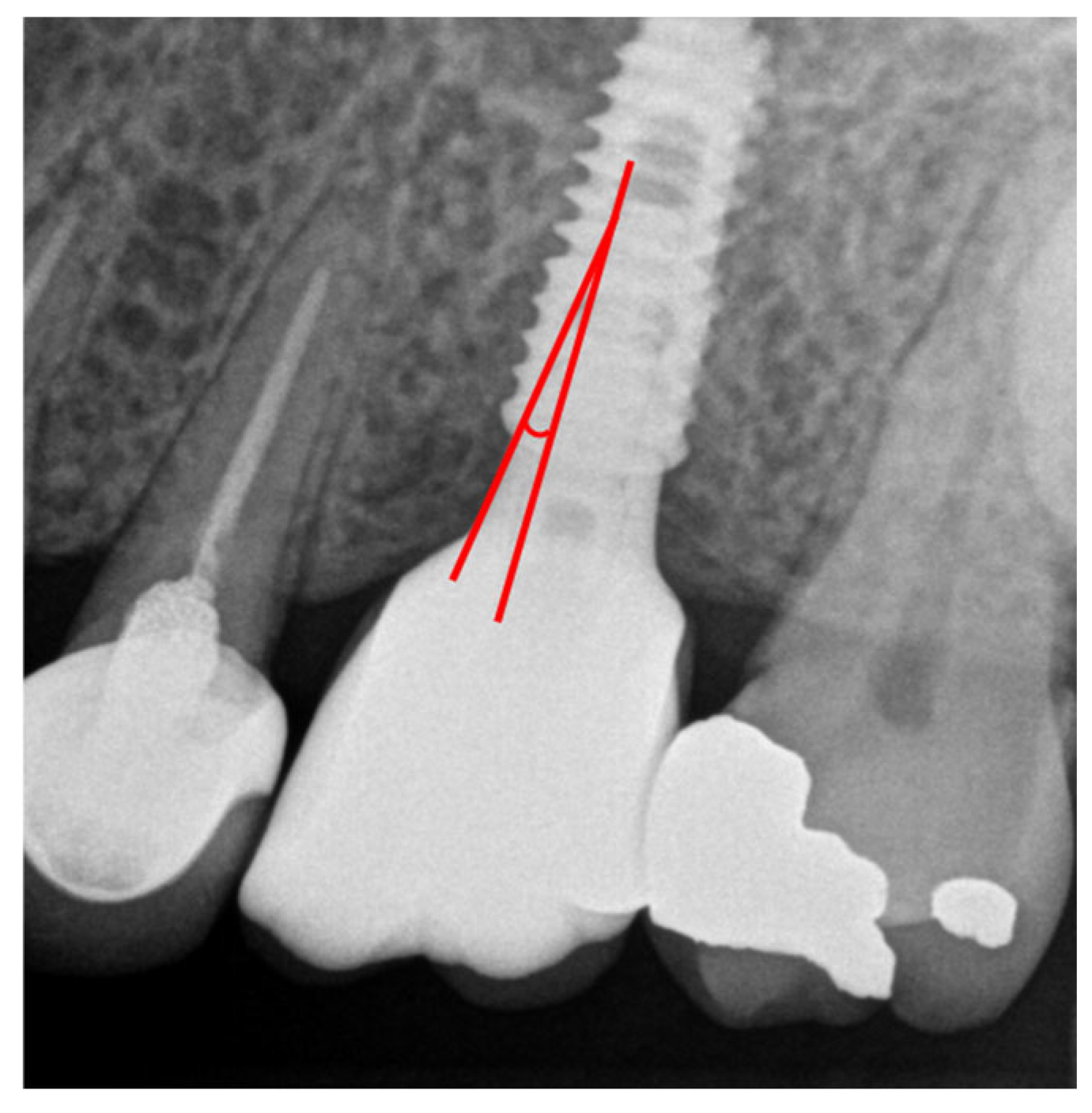
All measurements were independently performed by two calibrated periodontal trainees. If inter-examiner differences exceeded 0.5 mm, remeasurement was performed and a consensus value was obtained. Representative radiographic examples and measurement procedures are illustrated in
Figure 1.
2.5. Definition of Prosthetic Variables
Abutment angulation was defined as the angle formed between the long axis of the implant fixture and the axis of the abutment. Based on previous biomechanical and clinical studies reporting increased non-axial loading beyond this threshold, abutment angulation was dichotomized as <30° or ≥30°. This cutoff was selected to reflect biomechanical and clinical evidence demonstrating a marked increase in non-axial loading and crestal bone stress when abutment angulation exceeds approximately 30 degrees.
The crown–implant ratio (CIR) was calculated as the ratio of the prosthetic crown length (measured from the implant platform to the occlusal surface) to the implant fixture length. In accordance with commonly used reference values in previous clinical and systematic review studies, CIR was dichotomized as <1:1.5 or ≥1:1.5.
2.6. Clinical and Demographic Variables
Patient-related variables, including age, sex, smoking status, and history of diabetes mellitus, were retrieved from electronic medical records. Smoking status was classified as current smoker or non-smoker.
Diabetes mellitus was defined as a physician-diagnosed condition under active medical management. Only patients with controlled diabetes mellitus were included in the analysis.
Implant-related variables, including implant diameter, length, and anatomical location (maxilla or mandible), were also recorded.
2.7. Statistical Analysis
Statistical analyses were performed using standard statistical procedures. Continuous variables are presented as means ± standard deviations. Comparisons between groups were conducted using appropriate parametric or non-parametric tests based on data distribution. A mixed-effects model was applied to evaluate longitudinal changes in marginal bone loss over time and to assess the effects of abutment angulation and crown–implant ratio, including their interaction. Statistical significance was set at p < 0.05.
3. Results
3.1. Patient and Implant Characteristics
A total of 200 posterior internal-connection implants in 200 patients were analyzed. The mean age of the study population was 54.6 years (range: 32–78 years), with 102 males (51%) and 98 females (49%). Thirty-eight patients (19%) were diagnosed with diabetes mellitus, and 42 (21%) were current smokers at the time of implant placement. The mean implant diameter was 4.5 mm (range: 3.5–6.0 mm), and the mean implant length was 9.8 mm (range: 7.0–12.0 mm).
Implants were evenly distributed between the maxillary and mandibular posterior regions. All implants remained functional throughout the 2-year follow-up period, yielding a 100% cumulative survival rate.
3.2. Temporal Distribution of Peri-Implant Bone Loss
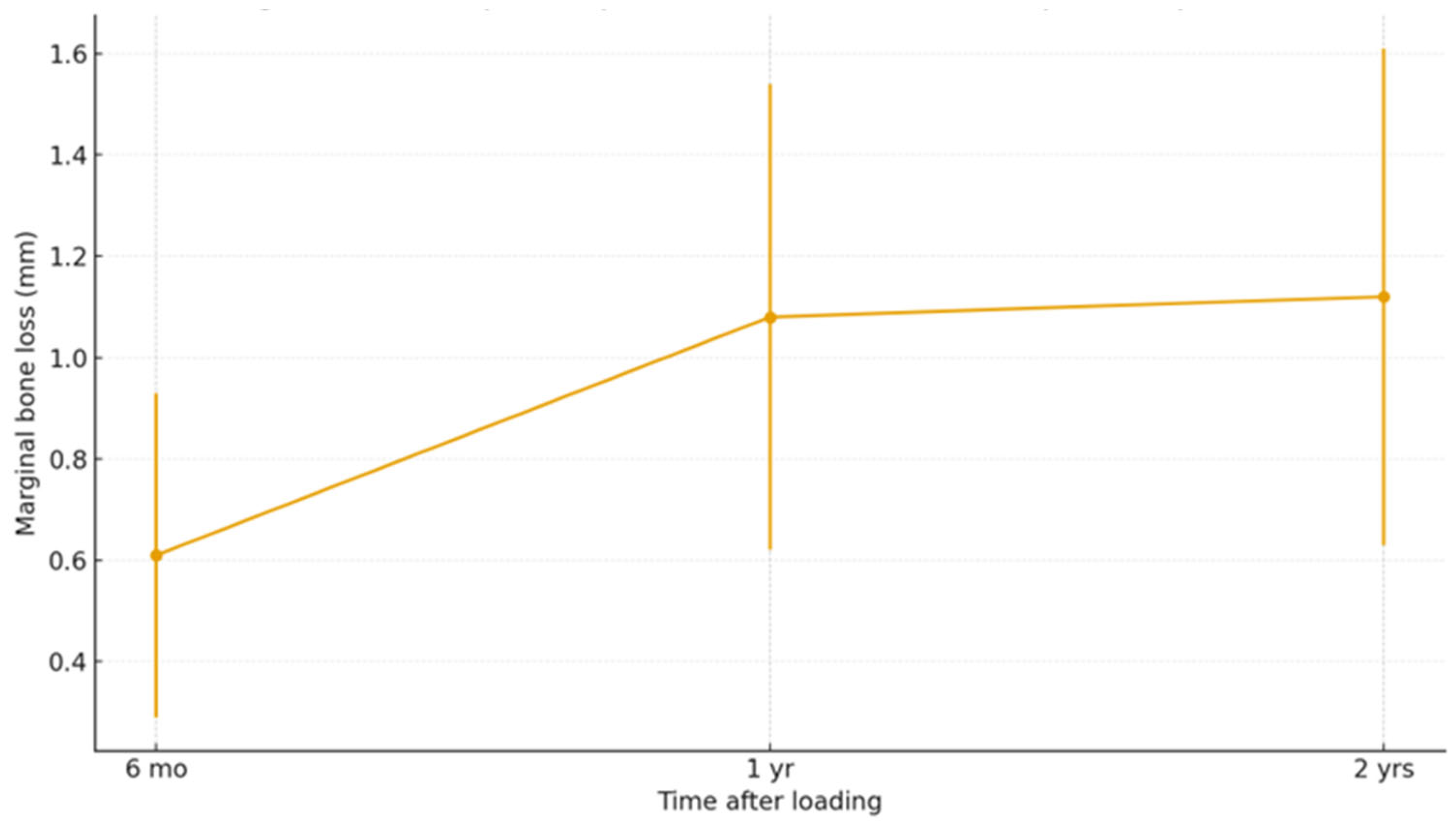
The temporal changes in peri-implant marginal bone loss (MBL) after prosthetic loading are summarized in
Figure 2.
Mean bone loss increased from 0.61 ± 0.32 mm at 6 months to 1.08 ± 0.46 mm at 1 year, but remained nearly unchanged at 1.12 ± 0.49 mm at 2 years, indicating a plateau pattern of bone remodeling.
Repeated-measures analysis confirmed a significant increase between 6 months and 1 year (p < 0.01), whereas no significant change occurred from 1 to 2 years (p = 0.42).
Overall, the majority of remodeling took place within the first year, followed by long-term stability in bone levels.
3.3. Bone Loss According to Abutment Angulation and Crown–Implant Ratio
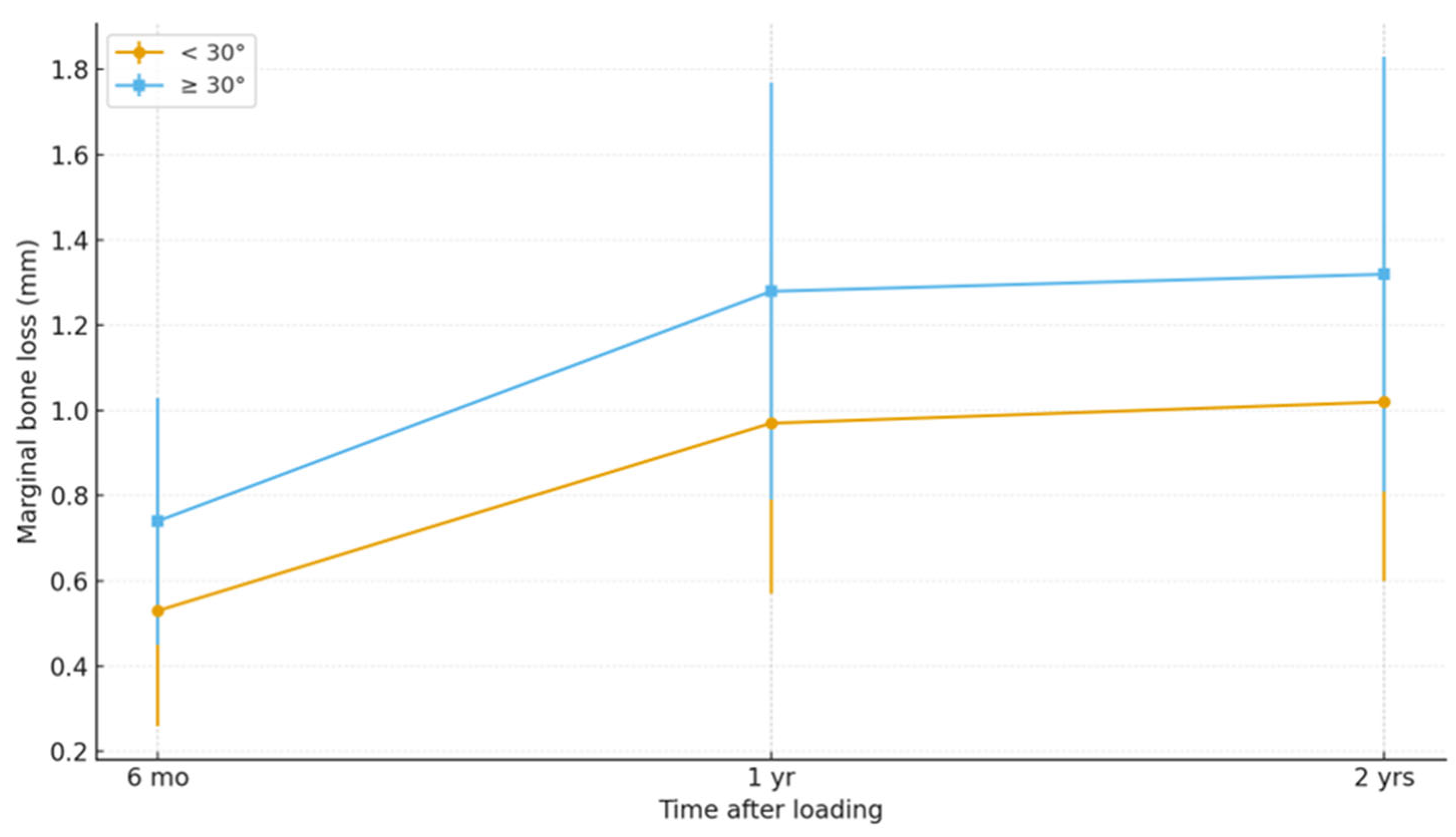
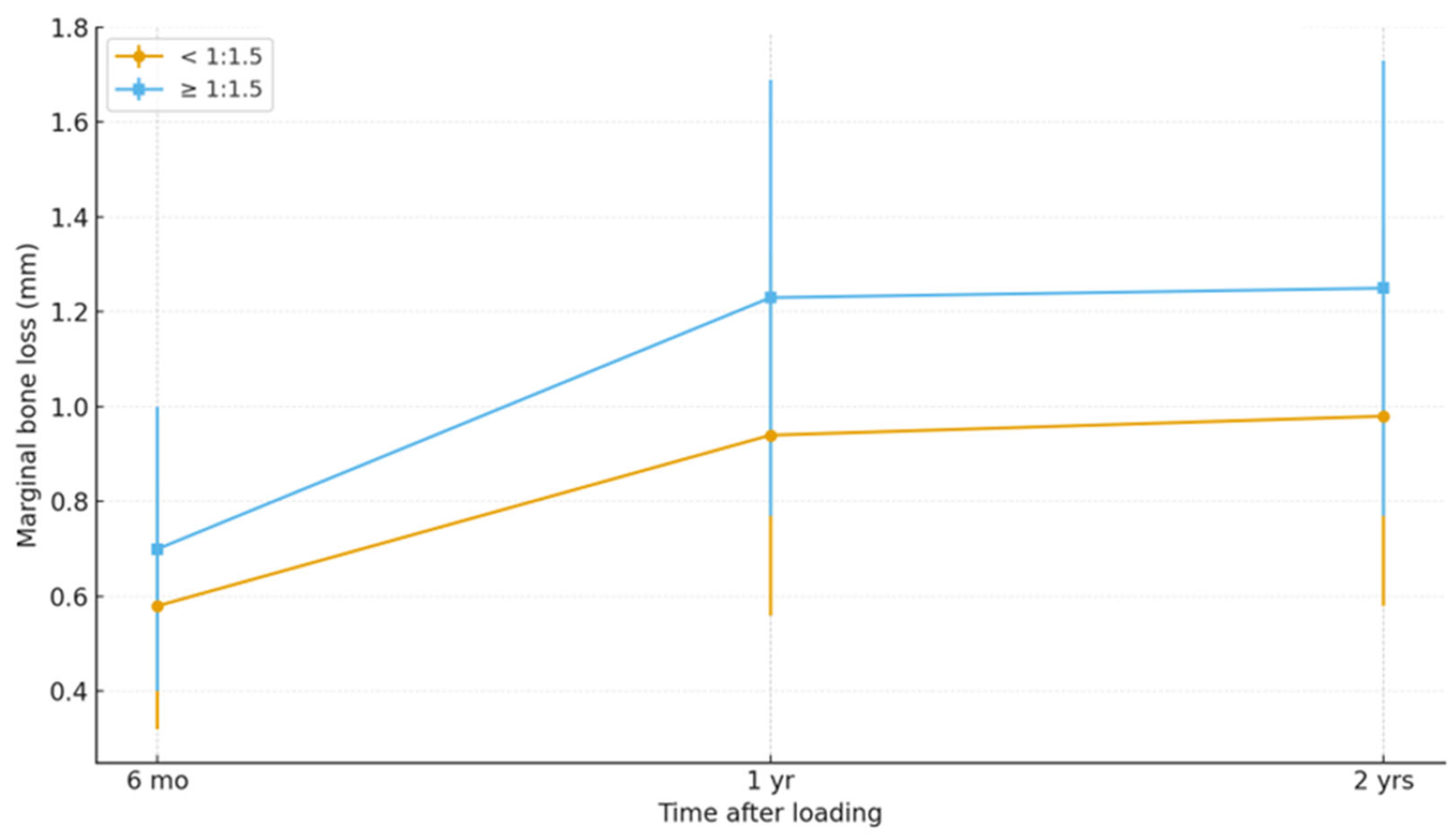
The influence of abutment angulation and crown–implant ratio (CIR) on bone loss progression is illustrated in
Figure 3 and
Figure 4. At all observation points, implants restored with abutment angulation ≥ 30° demonstrated greater mean bone loss than those with < 30°. The difference was statistically significant at 6 months (0.74 ± 0.29 mm vs. 0.53 ± 0.27 mm,
p = 0.021) and persisted at 1 year (1.28 ± 0.49 mm vs. 0.97 ± 0.40 mm,
p = 0.009). After 2 years, both groups showed stable bone levels, but the cumulative difference remained statistically significant at the two-year follow-up (
p = 0.037).
In contrast, CIR demonstrated only a transient and statistically non-significant effect. At 6 months, implants with CIR ≥ 1:1.5 showed slightly greater bone loss (0.70 ± 0.30 mm vs. 0.58 ± 0.26 mm, p = 0.09), but this difference disappeared by 1 year (1.23 ± 0.46 mm vs. 0.94 ± 0.38 mm, p = 0.27) and 2 years (1.25 ± 0.48 mm vs. 0.98 ± 0.40 mm, p = 0.34).
The combined analysis revealed no significant interaction between abutment angulation and CIR (p = 0.24).
3.4. Multivariate Regression Analysis
Multivariate linear mixed-effects regression identified abutment angulation ≥ 30° as an independent predictor of greater cumulative bone loss over the 2-year period, while CIR did not reach statistical significance (
Table 1). No significant interaction term was observed between abutment angulation and CIR (
p = 0.24). Smoking had no measurable effect (
p = 0.73), whereas diabetes showed a borderline association with greater bone loss (
p = 0.061).
4. Discussion
This two-year retrospective analysis demonstrated that most peri-implant bone loss occurred within the first year after prosthetic loading, followed by a plateau phase in which bone levels remained largely stable. Among the evaluated prosthetic parameters, abutment angulation ≥ 30° emerged as a significant predictor of greater marginal bone loss, whereas crown–implant ratio (CIR) showed no statistically significant influence on long-term peri-implant bone stability.
4.1. Temporal Pattern of Bone Remodeling
The temporal pattern observed in this study aligns with the widely accepted concept of early peri-implant bone remodeling. The majority of bone loss—approximately 1.0 mm—occurred within the first 12 months after functional loading, reflecting the biological adaptation of the crestal bone to occlusal loading and establishment of a steady-state bone level.
After this initial phase, bone loss slowed considerably, with a mean change of only 0.04 mm between 1 and 2 years, confirming that peri-implant bone levels stabilize once mechanical equilibrium is achieved at the bone–implant interface.
This plateau pattern corresponds with the success criteria proposed by Albrektsson et al. [
3], in which bone loss of ≤2 mm during the first two years is considered compatible with long-term implant success.
4.2. Influence of Abutment Angulation
These findings are in line with previous clinical and systematic evidence identifying increased abutment or emergence angles as important risk indicators for peri-implant marginal bone loss [
9,
10]. In the present study, abutment angulation ≥ 30° was associated with significantly greater marginal bone loss during the early functional period, suggesting that non-axial loading and stress concentration at the crestal bone–implant interface may accelerate early bone remodeling. This observation is consistent with prior biomechanical evidence indicating that increasing abutment angulation amplifies bending moments and peri-implant strain, particularly at the crestal bone level [
11].
In addition, recent biomechanical investigations published in Applied Sciences have demonstrated that angulated abutments induce higher stress concentrations around the implant neck compared with straight abutments, thereby providing a mechanistic explanation for the clinically observed increase in marginal bone loss [
12,
13]. Clinical retrospective data have similarly reported a tendency toward increased peri-implant bone loss when prosthetic designs involve unfavorable angulation or emergence profiles, further supporting the relevance of prosthetic geometry in peri-implant tissue stability [
6,
14,
15].
Clinically, although angulated abutments exceeding 30° are more frequently used in splinted restorations, they may also be unavoidable in single-crown cases due to anatomical limitations and prosthetically driven implant positioning, particularly in posterior regions. Therefore, minimizing abutment angulation through accurate three-dimensional implant placement should be prioritized whenever possible. When higher angulation is unavoidable, careful occlusal adjustment, control of cusp inclination, and strict supportive maintenance protocols may help mitigate the risk of early marginal bone loss.
4.3. Clinical Irrelevance of Crown–Implant Ratio
In contrast to some early biomechanical theories, our results showed that CIR did not significantly affect MBL, which is consistent with the systematic review by Ravidà et al. [
16]. This observation aligns with evidence indicating that an increased CIR alone does not necessarily compromise marginal bone stability when implants are appropriately placed and restored. In particular, long-term clinical data from short and extra-short implants—where higher CIR is inherently expected—have shown stable marginal bone levels over extended follow-up, suggesting that the mechanical disadvantage of an increased lever arm can be clinically compensated by appropriate implant selection, prosthetic design, and supportive care [
17]. Recent retrospective clinical evidence published in Applied Sciences further supports this concept, reporting no significant association between increased crown height or CIR and marginal bone loss in posterior implants when modern internal-connection systems and controlled prosthetic protocols are used [
12].
Taken together, CIR should not be interpreted as an isolated contraindication; instead, it should be assessed in combination with other biomechanical and patient-related factors.
4.4. Biological Risk Factors
Among systemic factors, smoking showed no significant relationship with peri-implant bone loss in the present cohort, which may reflect the relatively low proportion of smokers and the implementation of adequate supportive periodontal maintenance during the follow-up period. Although smoking is widely recognized as a major risk factor for peri-implant diseases, including peri-implantitis, based on systematic and clinical evidence [
18,
19], its effect on marginal bone loss did not reach statistical significance in this study.
Diabetes, however, demonstrated a borderline association with greater peri-implant bone loss, which is in line with previous clinical evidence identifying diabetes as a significant risk indicator for peri-implant disease and implant failure [
20]. Hyperglycemia has been associated with impaired bone turnover, delayed wound healing, and increased susceptibility to inflammatory tissue breakdown. These findings underscore the need for strict metabolic control and tailored recall intervals for diabetic patients receiving implant therapy. Although the effect did not reach statistical significance, this borderline association suggests that diabetic patients may require closer follow-up and maintenance due to their susceptibility to peri-implant bone remodeling.
4.5. Clinical Implications
The findings of this study have several practical implications.
First, clinicians should focus on minimizing abutment angulation during implant placement to reduce crestal stress and early bone remodeling.
Second, since most bone loss occurs within the first year, this period should be prioritized for close radiographic monitoring and occlusal adjustment.
Third, while CIR alone is not a major determinant of bone stability, excessive crown height should still be avoided whenever possible to prevent mechanical complications such as screw loosening or prosthetic fracture.
Finally, individualized maintenance protocols remain essential for patients with systemic risk factors such as diabetes.
4.6. Limitations and Future Directions
This study has several limitations. Its retrospective design and reliance on two-dimensional radiographs may have underestimated subtle three-dimensional bone changes. Furthermore, variables such as occlusal load, keratinized tissue width, and implant–abutment connection geometry were not fully controlled. The absence of a formal inter-examiner reliability index (e.g., intraclass correlation coefficient or kappa value) for radiographic measurements may also be considered a limitation. However, remeasurement was performed when discrepancies exceeded 0.5 mm, which helped minimize clinically relevant measurement variability. In addition, all radiographic measurements were performed on standardized periapical radiographs using implant-length–based calibration within a PACS environment, with independent assessments by two examiners, thereby enhancing measurement consistency and reproducibility.
Future studies employing cone-beam computed tomography, digital occlusal analysis, and longer follow-up periods may provide a more comprehensive understanding of how mechanical and biological factors interact to influence peri-implant bone stability.
5. Conclusions
Within the limitations of this two-year retrospective study, most peri-implant bone loss occurred during the first year after prosthetic loading, representing the biological remodeling phase of crestal bone adaptation. After this initial period, bone levels remained largely stable, indicating successful osseointegration and functional equilibrium.
Abutment angulation of 30° or greater was identified as a significant and persistent determinant of increased peri-implant bone loss, likely due to off-axis loading and stress concentration at the crestal region.
In contrast, the crown–implant ratio (CIR) showed no statistically significant influence on long-term bone stability. Although a slight, transient difference was observed at early follow-up, this effect diminished by one year and remained insignificant thereafter, suggesting that CIR alone does not compromise peri-implant bone maintenance in modern internal-connection systems.
No interaction was found between abutment angulation and CIR, indicating that each factor acts independently rather than synergistically.
Clinically, these findings highlight the importance of minimizing abutment angulation during implant placement and closely monitoring peri-implant bone levels during the first year after loading. When a high CIR is unavoidable, appropriate occlusal adjustment and prosthetic design can effectively compensate for potential biomechanical disadvantages, supporting long-term peri-implant stability.
Author Contributions
Conceptualization, Y.-J.H. and J.-M.L.; methodology, Y.-J.H.; formal analysis, Y.-J.H.; investigation, Y.-J.H.; data curation, Y.-J.H.; writing—original draft preparation, Y.-J.H.; writing—review and editing, Y.-G.K., S.-M.H., and J.-M.L.; supervision, J.-M.L. All authors have read and agreed to the published version of the manuscript.
Funding
This research received no external funding.
Institutional Review Board Statement
The study was conducted in accordance with the Declaration of Helsinki and approved by the Institutional Review Board of Kyungpook National University Dental Hospital (IRB No. KNUDH-2025-09-06-00).
Informed Consent Statement
Patient consent was waived due to the retrospective study design.
Data Availability Statement
Data are available on reasonable request from the corresponding author. Artificial intelligence tools were not used in the scientific preparation or critical review of this manuscript. Any AI-assisted tools were used solely for language editing and reference formatting under the full supervision and responsibility of the authors.
Conflicts of Interest
The authors declare no conflicts of interest.
References
- Derks, J.; Tomasi, C. Peri-implant health and disease. A systematic review of current epidemiology. J. Dent. Res. 2016, 95, 43–49. [Google Scholar] [CrossRef] [PubMed]
- Berglundh, T.; Armitage, G.; Araujo, M.G.; Avila-Ortiz, G.; Blanco, J.; Camargo, P.M.; Chen, S.; Cochran, D.; Derks, J.; Figuero, E.; et al. Peri-implant diseases and conditions: Consensus report of workgroup 4 of the 2017 World Workshop on the Classification of Periodontal and Peri-Implant Diseases and Conditions. J. Periodontol. 2018, 89, S313–S318. [Google Scholar] [CrossRef] [PubMed]
- Albrektsson, T.; Zarb, G.; Worthington, P.; Eriksson, A.R. The long-term efficacy of currently used dental implants: A review and proposed criteria of success. Int. J. Oral Maxillofac. Implant. 1986, 1, 11–25. [Google Scholar]
- Derksen, W.; Joda, T.; Chantler, J.; Fehmer, V.; Gallucci, G.O.; Gierthmuehlen, P.C.; Ioannidis, A.; Karasan, D.; Lanis, A.; Pala, K.; et al. Group 2 ITI Consensus Report: Technological developments in implant prosthetics. Clin. Oral Implant. Res. 2023, 34, 104–111. [Google Scholar] [CrossRef] [PubMed]
- Morton, D.; Wismeijer, D.; Chen, S.; Hamilton, A.; Wittneben, J.; Casentini, P.; Gonzaga, L.; Lazarin, R.; Martin, W.; Molinero-Mourelle, P.; et al. Group 5 ITI Consensus Report: Implant placement and loading protocols. Clin. Oral Implant. Res. 2023, 34, 349–356. [Google Scholar] [CrossRef] [PubMed]
- Katafuchi, M.; Weinstein, B.F.; Leroux, B.G.; Chen, Y.W.; Darveau, R.P. Restoration contour is a risk indicator for peri-implantitis: A cross-sectional radiographic analysis. J. Periodontol. 2018, 89, 225–232. [Google Scholar] [CrossRef] [PubMed]
- Kim, D.; Kim, K.; Ohe, J.Y.; Song, S.J.; Paek, J. Correlation between implant angulation and crestal bone changes: A 5-year retrospective study. J. Prosthet. Dent. 2025, 133, 162.e1–162.e7. [Google Scholar] [CrossRef] [PubMed]
- Kubiak-Miklešo, Z.; Kostrzębska, A.; Błaszczykszyn, A.; Pitułaj, A.; Dominak, M.; Gędrange, T.; Nawrot-Hadzik, I.; Małys, J.; Hadzik, J. Ionic Doping of Hydroxyapatite for Bone Regeneration: Advances in Structure and Properties over Two Decades—A Narrative Review. Appl. Sci. 2025, 15, 1108. [Google Scholar] [CrossRef]
- Soulami, S.; Slot, D.E.; van der Weijden, F. Implant-abutment emergence angle and profile in relation to peri-implantitis: A systematic review. Clin. Exp. Dent. Res. 2022, 8, 795–806. [Google Scholar] [CrossRef] [PubMed]
- Misch, J.; Abu-Reyal, S.; Lohana, D.; Mandil, O.; Saleh, M.H.A.; Li, J.; Wang, H.L.; Ravidà, A. Combined effect of abutment height and restoration emergence angle on peri-implant bone loss progression: A retrospective analysis. Clin. Oral Implant. Res. 2025, 36, 600–612. [Google Scholar] [CrossRef] [PubMed]
- Yi, Y.; Koo, K.T.; Schwarz, F.; Ben Amara, H.; Heo, S.J. Association of prosthetic features and peri-implantitis: A cross-sectional study. J. Clin. Periodontol. 2020, 47, 392–403. [Google Scholar] [CrossRef] [PubMed]
- Abdul Rahim, M.; Khan, K.; Chrcanovic, B.R. Influence of Crown–Implant Ratio and Implant Inclination on Marginal Bone Loss around Dental Implants Supporting Single Crowns in the Posterior Region: A Retrospective Clinical Study. J. Clin. Med. 2023, 12, 3219. [Google Scholar] [CrossRef] [PubMed]
- Tribst, J.P.M.; Özkara, N.; Blom, E.J.; Kleverlaan, C.J.; Ausiello, P.; Bruhnke, M.; Feilzer, A.J.; Dal Piva, A.M.d.O. The Effect of Implant–Abutment Contact Area on the Stress Generation of Bone-Level and Tissue-Level Implants. Appl. Sci. 2025, 15, 2744. [Google Scholar] [CrossRef]
- AlJasser, R.N.; AlSarhan, M.A.; Alotaibi, D.H.; AlOraini, S.; Ansari, A.S.; Habib, S.R.; Zafar, M.S. Analysis of prosthetic factors affecting peri-implant health: An in vivo retrospective, study. J. Multidiscip. Healthc. 2021, 14, 1183–1191. [Google Scholar] [CrossRef] [PubMed]
- Alla, I.; Scarano, A.; Sinjari, B.; Xhajanka, E.; Lorusso, F. Peri-Implant Bone Stability Around Tapered Implant Prosthetic Connection: A Systematic Review and Meta-Analysis Comparing Different Cone Morse and Conometric Implants Angle Contact and Coupling Interface Designs. Appl. Sci. 2025, 15, 1237. [Google Scholar] [CrossRef]
- Ravidà, A.; Barootchi, S.; Alkanderi, A.; Tavelli, L.; Suárez-López Del Amo, F. The effect of crown-to-implant ratio on the clinical outcomes of dental implants: A systematic review. Int. J. Oral Maxillofac. Implant. 2019, 34, 1121–1131. [Google Scholar] [CrossRef] [PubMed]
- Di Fiore, A.; Vigolo, P.; Sivolella, S.; Cavallin, F.; Katsoulis, J.; Monaco, C.; Stellini, E. Influence of crown-to-implant ratio on long-term marginal bone loss around short implants. Int. J. Oral Maxillofac. Implant. 2019, 34, 992–998. [Google Scholar] [CrossRef] [PubMed]
- Sgolastra, F.; Petrucci, A.; Severino, M.; Gatto, R.; Monaco, A. Smoking and the risk of peri-implantitis. A systematic review and meta-analysis. Clin. Oral Implant. Res. 2015, 26, e62–e67. [Google Scholar] [CrossRef] [PubMed]
- Casado, P.L.; Aguiar, T.; Fernandes Pinheiro, M.P.; Machado, A.; da Rosa Pinheiro, A. Smoking as a Risk Factor for the Development of Periimplant Diseases. Implant Dent. 2019, 28, 120–124. [Google Scholar] [CrossRef] [PubMed]
- Daubert, D.M.; Weinstein, B.F.; Bordin, S.; Leroux, B.G.; Flemming, T.F. Prevalence and predictive factors for peri-implant disease and implant failure: A cross-sectional analysis. J. Periodontol. 2015, 86, 337–347. [Google Scholar] [CrossRef] [PubMed]
| Disclaimer/Publisher’s Note: The statements, opinions and data contained in all publications are solely those of the individual author(s) and contributor(s) and not of MDPI and/or the editor(s). MDPI and/or the editor(s) disclaim responsibility for any injury to people or property resulting from any ideas, methods, instructions or products referred to in the content. |