Food Allergy in Companion Animals: Integrating Traditional Diagnostics with Emerging Approaches


Abstract
1. Introduction
2. Clinical Signs
3. Diagnosis
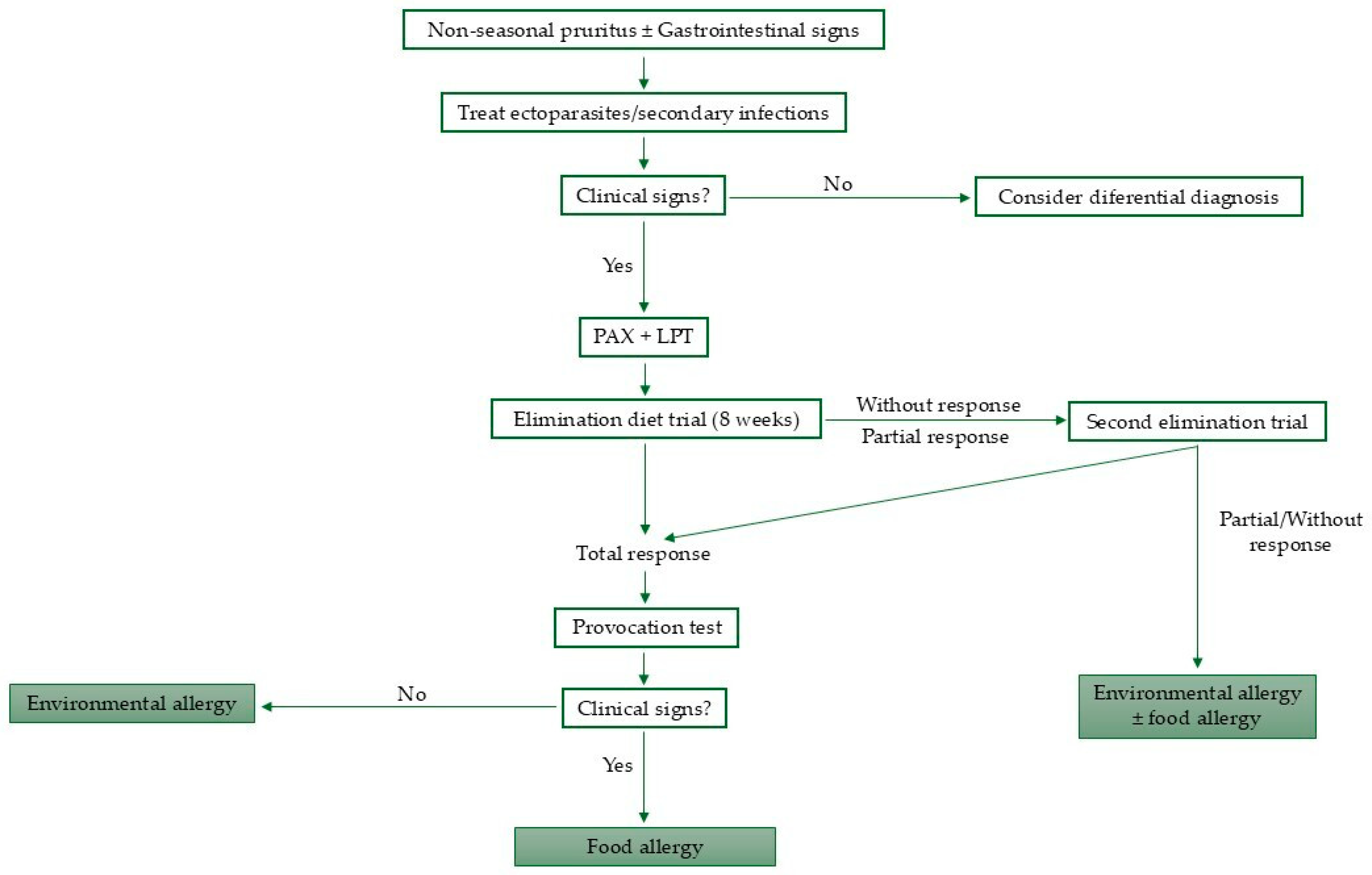
3.1. Elimination-Provocation Test
3.2. Other Diagnostic Tests
3.2.1. Adjunctive Tests
3.2.2. Emerging Tools
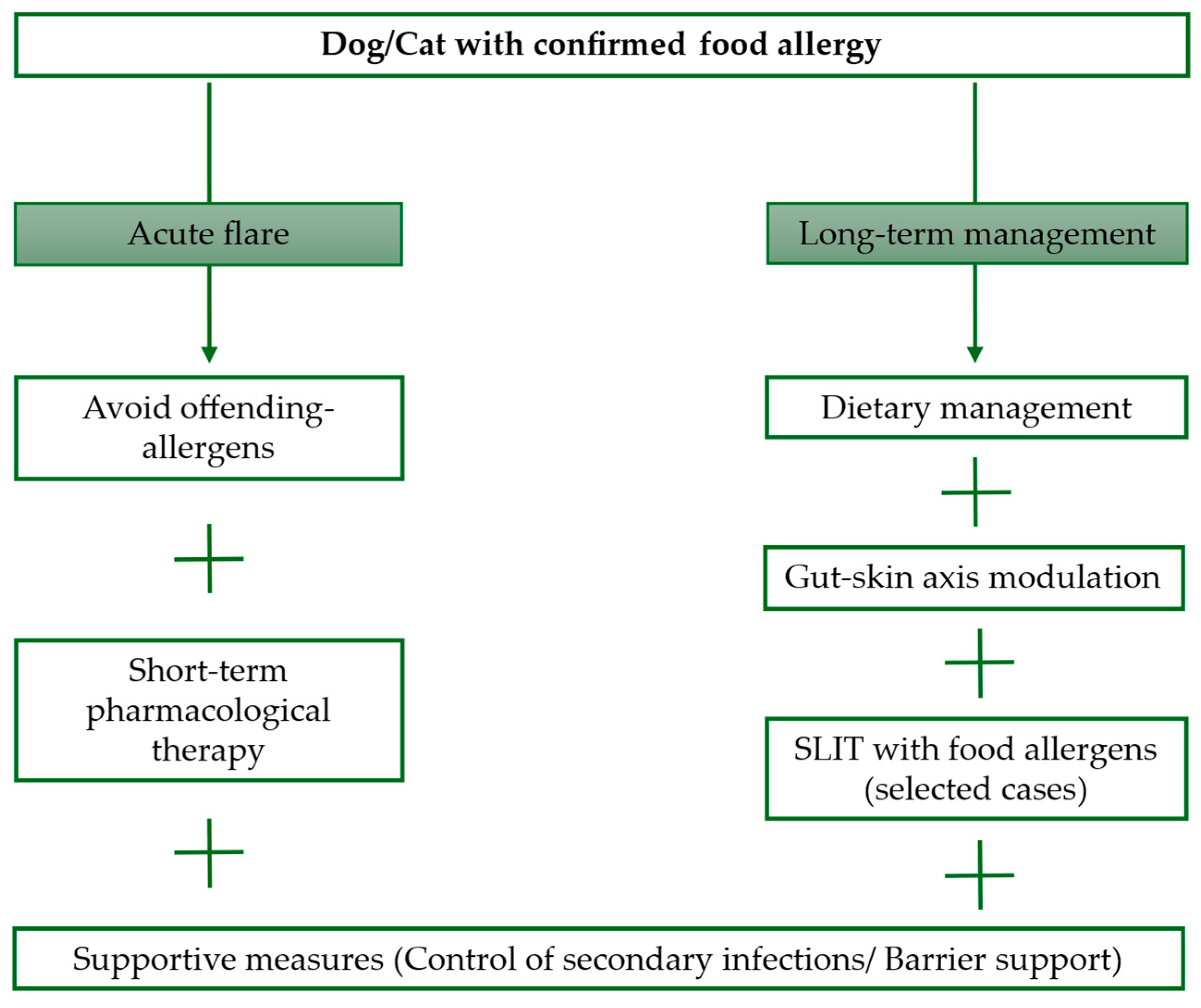
4. Therapeutic Approaches
4.1. Dietary Management
4.2. Pharmacological Therapy
4.3. Adjunctive Therapies
5. Conclusions
Author Contributions
Funding
Institutional Review Board Statement
Informed Consent Statement
Data Availability Statement
Acknowledgments
Conflicts of Interest
Abbreviations
| IgE | Immunoglobulin E |
| ELISA | Enzyme-Linked Immunosorbent Assay |
| IgG | Immunoglobulin G |
| OFC | Oral Food Challenges |
| LPT | Lymphocyte Proliferation Test |
| PBMCs | Peripheral Blood Mononuclear Cells |
| PAX | Pet Allergy Xplorer |
| PCR | Polymerase Chain Reaction |
| SLIT | Sublingual immunotherapy |
References
- Mueller, R.S.; Unterer, S. Adverse Food Reactions: Pathogenesis, Clinical Signs, Diagnosis and Alternatives to Elimination Diets. Vet. J. 2018, 236, 89–95. [Google Scholar] [CrossRef]
- Halliwell, R.; Pucheu-Haston, C.M.; Olivry, T.; Prost, C.; Jackson, H.; Banovic, F.; Nuttall, T.; Santoro, D.; Bizikova, P.; Mueller, R.S. Feline Allergic Diseases: Introduction and Proposed Nomenclature. Vet. Dermatol. 2021, 32, 8-e2. [Google Scholar] [CrossRef]
- Jackson, H.A. Food Allergy in Dogs and Cats; Current Perspectives on Etiology, Diagnosis, and Management. J. Am. Vet. Med. Assoc. 2023, 261, S23–S29. [Google Scholar] [CrossRef]
- Olivry, T.; Mueller, R. Critically Appraised Topic on Adverse Food Reactions of Companion Animals (3): Prevalence of Cutaneous Adverse Food Reactions in Dogs and Cats. BMC Vet. Res. 2017, 13, 51. [Google Scholar] [CrossRef]
- Olivry, T.; Mueller, R.S. Critically Appraised Topic on Adverse Food Reactions of Companion Animals (7): Signalment and Cutaneous Manifestations of Dogs and Cats with Adverse Food Reactions. BMC Vet. Res. 2019, 15, 140. [Google Scholar] [CrossRef]
- Carlotti, D.N.; Remy, I.; Prost, C. Food Allergy In Dogs And Cats. A Review and Report of 43 Cases. Vet. Dermatol. 1990, 1, 55–62. [Google Scholar] [CrossRef]
- Rosser, E.J. Food Allergy in the Cat: A Prospective Study of 13 Cats. In Advances in Veterinary Dermatology; Ihrke, P.J., Mason, I.S., White, S.D., Eds.; Pergamon Press: New York, NY, USA, 1993; Volume 2, pp. 33–39. [Google Scholar]
- Roudebush, P. Ingredients and Foods Associated with Adverse Reactions in Dogs and Cats. Vet. Dermatol. 2013, 24, 293–294. [Google Scholar] [CrossRef] [PubMed]
- Mueller, R.; Olivry, T.; Prélaud, P. Critically Appraised Topic on Adverse Food Reactions of Companion Animals (2): Common Food Allergen Sources in Dogs and Cats. BMC Vet. Res. 2016, 12, 9. [Google Scholar] [CrossRef] [PubMed]
- Łoś-Rycharska, E.; Gołębiewski, M.; Grzybowski, T.; Rogalla-Ładniak, U.; Krogulska, A. The Microbiome and Its Impact on Food Allergy and Atopic Dermatitis in Children. Postepy Dermatol. Alergol. 2020, 37, 641–650. [Google Scholar] [CrossRef]
- Fujimura, M.; Masuda, K.; Hayashiya, M.; Okayama, T. Flow Cytometric Analysis of Lymphocyte Proliferative Responses to Food Allergens in Dogs with Food Allergy. J. Vet. Med. Sci. 2011, 73, 1309–1317. [Google Scholar] [CrossRef] [PubMed]
- Gaschen, F.P.; Merchant, S.R. Adverse Food Reactions in Dogs and Cats. Vet. Clin. N. Am. Small Anim. Pract. 2011, 41, 361–379. [Google Scholar] [CrossRef] [PubMed]
- Bryan, J.; Frank, L.A. Food Allergy in the Cat: A Diagnosis by Elimination. J. Feline Med. Surg. 2010, 12, 861–866. [Google Scholar] [CrossRef]
- Picco, F.; Zini, E.; Nett, C.; Naegeli, C.; Bigler, B.; Rüfenacht, S.; Roosje, P.; Gutzwiller, M.E.R.; Wilhelm, S.; Pfister, J.; et al. A Prospective Study on Canine Atopic Dermatitis and Food-Induced Allergic Dermatitis in Switzerland. Vet. Dermatol. 2008, 19, 150–155. [Google Scholar] [CrossRef]
- Mueller, R.S.; Olivry, T. Critically Appraised Topic on Adverse Food Reactions of Companion Animals (6): Prevalence of Noncutaneous Manifestations of Adverse Food Reactions in Dogs and Cats. BMC Vet. Res. 2018, 14, 341. [Google Scholar] [CrossRef]
- Hobi, S.; Linek, M.; Marignac, G.; Olivry, T.; Beco, L.; Nett, C.; Fontaine, J.; Roosje, P.; Bergvall, K.; Belova, S.; et al. Clinical Characteristics and Causes of Pruritus in Cats: A Multicentre Study on Feline Hypersensitivity-Associated Dermatoses. Vet. Dermatol. 2011, 22, 406–413. [Google Scholar] [CrossRef]
- Olivry, T.; Mueller, R.; Prélaud, P. Critically Appraised Topic on Adverse Food Reactions of Companion Animals (1): Duration of Elimination Diets. BMC Vet. Res. 2015, 11, 225. [Google Scholar] [CrossRef]
- Miller, J.; Simpson, A.; Bloom, P.; Diesel, A.; Friedeck, A.; Paterson, T.; Wisecup, M.; Yu, C.-M. 2023 AAHA Management of Allergic Skin Diseases in Dogs and Cats Guidelines. J. Am. Anim. Hosp. Assoc. 2023, 59, 255–284. [Google Scholar] [CrossRef]
- Cesar, C.G.L.; Marchi, P.H.; Amaral, A.R.; Príncipe, L.D.A.; Carmo, A.A.D.; Zafalon, R.V.A.; Miyamoto, N.N.; Garcia, N.A.C.R.; Balieiro, J.C.D.C.; Vendramini, T.H.A. An Assessment of the Impact of Insect Meal in Dry Food on a Dog with a Food Allergy: A Case Report. Animals 2024, 14, 2859. [Google Scholar] [CrossRef]
- Jackson, H.A.; Dembele, V. Conducting a Successful Diet Trial for the Diagnosis of Food Allergy in Dogs and Cats. Vet. Dermatol. 2024, 35, 586–592. [Google Scholar] [CrossRef] [PubMed]
- Bexley, J.; Nuttall, T.J.; Hammerberg, B.; Halliwell, R.E. Co-Sensitization and Cross-Reactivity between Related and Unrelated Food Allergens in Dogs—A Serological Study. Vet. Dermatol. 2017, 28, 31-e7. [Google Scholar] [CrossRef] [PubMed]
- Olivry, T.; O’Malley, A.; Chruszcz, M. Evaluation of the Theoretical Risk of Cross-Reactivity among Recently Identified Food Allergens for Dogs. Vet. Dermatol. 2022, 33, 523–526. [Google Scholar] [CrossRef]
- Lesponne, I.; Naar, J.; Planchon, S.; Serchi, T.; Montano, M. DNA and Protein Analyses to Confirm the Absence of Cross-Contamination and Support the Clinical Reliability of Extensively Hydrolysed Diets for Adverse Food Reaction-Pets. Vet. Sci. 2018, 5, 63. [Google Scholar] [CrossRef] [PubMed]
- Lewis, T.; Moore, G.; Laporte, C.; Daristotle, L.; Frantz, N. Evaluation of Hydrolyzed Salmon and Hydrolyzed Poultry Feather Diets in Restrictive Diet Trials for Diagnosis of Food Allergies in Pruritic Dogs. Front. Vet. Sci. 2025, 12, 1560806. [Google Scholar] [CrossRef] [PubMed]
- Ricci, R.; Conficoni, D.; Morelli, G.; Losasso, C.; Alberghini, L.; Giaccone, V.; Ricci, A.; Andrighetto, I. Undeclared Animal Species in Dry and Wet Novel and Hydrolyzed Protein Diets for Dogs and Cats Detected by Microarray Analysis. BMC Vet. Res. 2018, 14, 209. [Google Scholar] [CrossRef]
- Masuda, K.; Sato, A.; Tanaka, A.; Kumagai, A. Hydrolyzed Diets May Stimulate Food-Reactive Lymphocytes in Dogs. J. Vet. Med. Sci. 2020, 82, 177–183. [Google Scholar] [CrossRef]
- Favrot, C.; Bizikova, P.; Fischer, N.; Rostaher, A.; Olivry, T. The Usefulness of Short-Course Prednisolone during the Initial Phase of an Elimination Diet Trial in Dogs with Food-Induced Atopic Dermatitis. Vet. Dermatol. 2019, 30, 498-e149. [Google Scholar] [CrossRef]
- Fischer, N.; Spielhofer, L.; Martini, F.; Rostaher, A.; Favrot, C. Sensitivity and Specificity of a Shortened Elimination Diet Protocol for the Diagnosis of Food-induced Atopic Dermatitis (FIAD). Vet. Dermatol. 2021, 32, 247-e65. [Google Scholar] [CrossRef]
- Olivry, T.; Mueller, R.S. Critically Appraised Topic on Adverse Food Reactions of Companion Animals (9): Time to Flare of Cutaneous Signs after a Dietary Challenge in Dogs and Cats with Food Allergies. BMC Vet. Res. 2020, 16, 158. [Google Scholar] [CrossRef] [PubMed]
- Shimakura, H.; Kawano, K. Results of Food Challenge in Dogs with Cutaneous Adverse Food Reactions. Vet. Dermatol. 2021, 32, 293-e80. [Google Scholar] [CrossRef]
- Fernandez-Lozano, C.; Mas-Fontao, A.; Auxilia, S.T.; Welters, M.; Olivrī, A.; Mueller, R.S.; Olivry, T. Evaluation of a Direct Lymphocyte Proliferation Test for the Diagnosis of Canine Food Allergies with Delayed Reactions after Oral Food Challenge. Vet. Dermatol. 2025, 36, 433–442. [Google Scholar] [CrossRef]
- Tinsley, J.; Griffin, C.; Sheinberg, G.; Griffin, J.; Cross, E.; Gagné, J.; Romero, A. An Open-Label Clinical Trial to Evaluate the Efficacy of an Elemental Diet for the Diagnosis of Adverse Food Reactions in Dogs. Vet. Dermatol. 2024, 35, 40–50. [Google Scholar] [CrossRef]
- Martins, L.M.; Campos, I.; Antunes, C.; Costa, A.; Valdevira, A.; Bento, O. Testes intradérmicos e imunodots podem ser úteis no diagnostico de alergia canina a carne—Intradermal testing and immunodot may be useful in diagnosing dog allergy to meat. Rev. Port. Imunoalergologia 2019, 27, 21–27. [Google Scholar] [CrossRef]
- Mueller, R.; Olivry, T. Critically Appraised Topic on Adverse Food Reactions of Companion Animals (4): Can We Diagnose Adverse Food Reactions in Dogs and Cats with in Vivo or in Vitro Tests? BMC Vet. Res. 2017, 13, 275. [Google Scholar] [CrossRef] [PubMed]
- Lam, A.T.H.; Johnson, L.N.; Heinze, C.R. Assessment of the Clinical Accuracy of Serum and Saliva Assays for Identification of Adverse Food Reaction in Dogs without Clinical Signs of Disease. J. Am. Vet. Med. Assoc. 2019, 255, 812–816. [Google Scholar] [CrossRef] [PubMed]
- Plantinga, E.; Leistra, M.H.G.; Sinke, J.; Vroom, M.W.; Savelkoul, H.; Hendriks, W.H. Measurement of Allergen-Specific IgG in Serum Is of Limited Value for the Management of Dogs Diagnosed with Cutaneous Adverse Food Reactions. Vet. J. 2017, 220, 111–116. [Google Scholar] [CrossRef]
- Johansen, C.; Mariani, C.; Mueller, R.S. Evaluation of Canine Adverse Food Reactions by Patch Testing with Single Proteins, Single Carbohydrates and Commercial Foods. Vet. Dermatol. 2017, 28, 473-e109. [Google Scholar] [CrossRef]
- Possebom, J.; Cruz, A.; Gmyterco, V.C.; de Farias, M.R. Combined Prick and Patch Tests for Diagnosis of Food Hypersensitivity in Dogs with Chronic Pruritus. Vet. Dermatol. 2022, 33, 124-e36. [Google Scholar] [CrossRef]
- Maina, E.; Matricoti, I.; Noli, C. An Assessment of a Western Blot Method for the Investigation of Canine Cutaneous Adverse Food Reactions. Vet. Dermatol. 2018, 29, 217-e78. [Google Scholar] [CrossRef]
- Favrot, C.; Linek, M.; Fontaine, J.; Beco, L.; Rostaher, A.; Fischer, N.; Couturier, N.; Jacquenet, S.; Bihain, B.E. Western Blot Analysis of Sera from Dogs with Suspected Food Allergy. Vet. Dermatol. 2017, 28, 189. [Google Scholar] [CrossRef]
- Suto, A.; Suto, Y.; Onohara, N.; Tomizawa, Y.; Yamamoto-Sugawara, Y.; Okayama, T.; Masuda, K. Food Allergens Inducing a Lymphocyte-Mediated Immunological Reaction in Canine Atopic-like Dermatitis. J. Vet. Med. Sci. 2015, 77, 251–254. [Google Scholar] [CrossRef]
- Olivry, T.; Fontao, A.; Aumayr, M.; Ivanovova, N.; Mitterer, G.; Harwanegg, C. Validation of a Multiplex Molecular Macroarray for the Determination of Allergen-Specific IgE Sensitizations in Dogs. Vet. Sci. 2024, 11, 482. [Google Scholar] [CrossRef]
- Olivry, T.; Mueller, R. Critically Appraised Topic on Adverse Food Reactions of Companion Animals (5): Discrepancies between Ingredients and Labeling in Commercial Pet Foods. BMC Vet. Res. 2018, 14, 24. [Google Scholar] [CrossRef]
- Pagani, E.; Soto Del Rio, M.D.L.D.; Dalmasso, A.; Bottero, M.T.; Schiavone, A.; Prola, L. Cross-Contamination in Canine and Feline Dietetic Limited-Antigen Wet Diets. BMC Vet. Res. 2018, 14, 283. [Google Scholar] [CrossRef]
- Maina, E.; Cox, E. A Double Blind, Randomized, Placebo Controlled Trial of the Efficacy, Quality of Life and Safety of Food Allergen-Specific Sublingual Immunotherapy in Client Owned Dogs with Adverse Food Reactions: A Small Pilot Study. Vet. Dermatol. 2016, 27, 361-e91. [Google Scholar] [CrossRef] [PubMed]
- Maina, E.; Pelst, M.; Hesta, M.; Cox, E. Food-Specific Sublingual Immunotherapy Is Well Tolerated and Safe in Healthy Dogs: A Blind, Randomized, Placebo-Controlled Study. BMC Vet. Res. 2017, 13, 25. [Google Scholar] [CrossRef]
- Lagoa, T.; Martins, L.; Queiroga, M.C. Microbiota Modulation as an Approach to Prevent the Use of Antimicrobials Associated with Canine Atopic Dermatitis. Biomedicines 2025, 13, 2372. [Google Scholar] [CrossRef] [PubMed]
- Noli, C.; Varina, A.; Barbieri, C.; Pirola, A.; Olivero, D. Analysis of Intestinal Microbiota and Metabolic Pathways before and after a 2-Month-Long Hydrolyzed Fish and Rice Starch Hypoallergenic Diet Trial in Pruritic Dogs. Vet. Sci. 2023, 10, 478. [Google Scholar] [CrossRef] [PubMed]



| Clinical Feature | Dogs | Cats |
|---|---|---|
| Most common cutaneous signs | Non-seasonal pruritus Erythema Papules Pododermatitis Otitis externa | Non-seasonal pruritus Skin reaction patterns (miliary dermatitis, head and neck pruritus, symmetrical self-induced alopecia, feline eosinophilic complex) |
| Skin lesions distribution | Face, ears, ventral abdomen, paws, perianal | Face, neck, ventral abdomen |
| Most common gastrointestinal signs | Vomiting Diarrhea | Vomiting Diarrhea |
| Less common signs | Abdominal discomfort Flatulence and borborygmi Frequent defecations Anaphylaxis Conjunctivitis Symmetrical lupoid onychomycosis Sneezing | Pododermatitis Otitis externa Conjunctivitis Salivating Flatulence Hyperactive behavior Respiratory signs |
| Therapeutic Category | Examples |
|---|---|
| Dietary management | Novel protein diet Hydrolyzed diet Home-cooked diet |
| Short-term pharmacological therapy | Oral/topical glucocorticoids Lokivetmab Janus-kinase inhibitors |
| Adjunctive therapies | SLIT with food allergens Gut–skin axis modulation (probiotics, prebiotics, postbiotics, fecal microbiota transplantation) |
Disclaimer/Publisher’s Note: The statements, opinions and data contained in all publications are solely those of the individual author(s) and contributor(s) and not of MDPI and/or the editor(s). MDPI and/or the editor(s) disclaim responsibility for any injury to people or property resulting from any ideas, methods, instructions or products referred to in the content. |
© 2026 by the authors. Licensee MDPI, Basel, Switzerland. This article is an open access article distributed under the terms and conditions of the Creative Commons Attribution (CC BY) license.
Share and Cite
Matias, D.; Martins, L. Food Allergy in Companion Animals: Integrating Traditional Diagnostics with Emerging Approaches. Appl. Sci. 2026, 16, 2169. https://doi.org/10.3390/app16052169
Matias D, Martins L. Food Allergy in Companion Animals: Integrating Traditional Diagnostics with Emerging Approaches. Applied Sciences. 2026; 16(5):2169. https://doi.org/10.3390/app16052169
Chicago/Turabian StyleMatias, Daniela, and Luís Martins. 2026. "Food Allergy in Companion Animals: Integrating Traditional Diagnostics with Emerging Approaches" Applied Sciences 16, no. 5: 2169. https://doi.org/10.3390/app16052169
APA StyleMatias, D., & Martins, L. (2026). Food Allergy in Companion Animals: Integrating Traditional Diagnostics with Emerging Approaches. Applied Sciences, 16(5), 2169. https://doi.org/10.3390/app16052169