1. Introduction
Increased fruit consumption is recommended by dietary guidelines worldwide. Several studies have shown that nutrient-rich berries have health benefits and are protective against various diseases; therefore, they are considered functional foods [
1,
2]. Among small fruits, it is essential to mention the most popular ones that cover a large part of the market, such as strawberry (
Fragaria ×
ananassa), raspberry (
Rubus idaeus), and blueberry (
Vaccinium corymbosum), as well as berries such as blackberry (
Rubus spp.), black raspberry (
Rubus occidentalis), cranberry (
Vaccinium subg.
Oxycoccus), and many others that can be consumed either fresh or in processed form.
They are unique not only in shape, colour, and flavour but also in their chemical composition. Berries boast remarkable concentrations of a wide range of phytochemicals, most of which are phenolic compounds that, when consumed, activate biochemical mechanisms that can counteract the development and progression of chronic diseases [
3,
4].
Within the broad group of small fruits, blueberry has gained particular attention due to its rapid expansion in cultivated areas, high market value, and well-documented health-promoting properties [
5].
Between 2010 and 2019, blueberry production and trade experienced significant global growth, driven by demand from healthier and more conscious consumers [
6]. The trend remained consistent in the subsequent years, with the European situation at 6123.7 kg ha
−1 in 2020, while 2022 saw an 11% increase. The most popular and widespread species of highbush blueberry (
Vaccinium corymbosum) belongs to the Ericaceae family [
7]. Among highbush blueberries, two main groups are recognized: northern highbush (NHB), mainly originating from the cooler regions of North America, and southern highbush (SHB). The transition from traditional NHB to SHB cultivars has been one of the most transformative developments in the industry. NHB varieties, long dominant in cooler northern climates, require many chilling hours to produce fruit. In contrast, SHB cultivars require little or no winter chilling, allowing growers to establish plantations in warmer regions, including in Peru, Mexico, Morocco, and parts of Africa and Asia. This has turned blueberries into a truly global crop, enabling counter-seasonal production and year-round supply to consumers in major markets like the U.S. and Europe.
The peculiar soil requirements have been the major limiting factor in the spread of this crop in areas with soils adapted to the common cultivars. In fact, cultivated blueberries require soils that tend to be acidic (pH 4.2–5.5), with high organic matter content, high drainage capacity, and no lime to ensure high vegetative performance [
8,
9,
10,
11]. According to a study conducted in China, soils with pH values exceeding 6.5 do not support ideal plant growth [
12]. Combined with the agronomic conditions, highbush blueberries thrive in specific climatic conditions, with cold winters guaranteeing high chilling hours and winter dormancy success; however, haze can damage the plant, especially during flowering, when a sudden temperature drop occurs [
9,
13]. These agronomic characteristics are key to understanding the origin of blueberries and their adaptation to cultivation in different regions worldwide.
The domestication of highbush blueberry (
Vaccinium corymbosum) began in the early 1900s in North America [
14]. The main production areas are located both in Canada and the United States [
15]—in the southeastern (Arkansas, Florida, Georgia, and North Carolina) and northern (Maine, Michigan, New Jersey, and Washington) regions. This wide geographic distribution is characterized by markedly different pedoclimatic conditions, which allow for a significant extension of the harvesting period across regions. Commercial production in these areas is largely supported by the presence of naturally acidic soils well suited to blueberry cultivation, with optimal pH values ranging between 3.5 and 5.5. These soils are typically sandy loam in texture and rich in organic matter. Where such soil conditions are not naturally present, as in parts of Arkansas, where soils tend to have higher pH values and low organic matter content, specific agronomic practices are commonly adopted [
14]. These include the use of heavy mulching to increase organic matter levels and improve soil structure and the application of elemental sulphur to reduce soil pH. The Pacific Northwest of the United States demonstrates how climate-driven soil formation determines the suitability of environments for highbush blueberry cultivation. High precipitation west of the Cascade Range promotes acidic, organic-rich soils ideal for
Vaccinium corymbosum, whereas drier conditions east of the range result in less suitable soils, which are frequently artificially acidified with sulphur and amended with organic matter [
16].
Taking into account the other hemisphere, blueberry production in South America was first introduced in Chile in the 1980s and subsequently in Argentina, in complementary production windows with North America [
17,
18]. In Chile, the country’s north–south extension results in diverse climatic zones and soil types, with chilling accumulation and soil acidity generally increasing from north to south [
19]. In Argentina, major production areas include Tucuman, characterized by a subtropical humid climate with low chilling accumulation and acidic soils with low organic matter content, typically improved through the incorporation of sugarcane residues. Additional production takes place in the Entrerios zone and Buenos Aires, where favourable soil conditions and a temperate, humid climate provide higher chilling accumulation, with risks associated with frost and hail events during spring.
According to the International Blueberry Organization (IBO) 2024 Report (
https://www.internationalblueberry.org/2024-report, accessed on 29 October 2025), emerging production zones—notably, Southern Europe, North Africa, Sub-Saharan Africa, and Asia (especially China)—have compensated for reduced output in traditional regions, demonstrating the industry’s resilience and adaptability. This diversification of sourcing also mitigates supply risks caused by climatic disruptions and supports more stable market prices.
In Asia, China began highbush blueberry production in 2000 according to Li & Yu (2009) [
20]. Production is mainly concentrated in northeastern regions such as Jilin, Liaoning, and Shandong provinces, characterized by sandy loam, acidic soil with variable organic content, and coastally influenced climates. Additional areas are located along the Yangtze River, where southern highbush cultivars are preferred due to their low chilling requirements. Another important region lies between Yunnan and Guizhou provinces, where mild climates and acidic soil prevail, with growing conditions strongly influenced by altitude.
In Europe,
Vaccinium corymbosum was unknown before the 20th century. Although several
Vaccinium species are native to the continent, such as
V. myrtillus,
V. uliginosum,
V. vitis-idaea, and
V. oxycoccos, these belong to different taxa. The growing interest in blueberry cultivation led to the introduction of the American highbush blueberry in the Netherlands in 1923, marking the beginning of its diffusion across Europe [
21]. Following its introduction, blueberry cultivation initially became established in regions according to the map presented by Naumann (1993) [
22], which focuses on central–western Europe, northern Germany, and the Netherlands, which are identified as areas particularly well suited to blueberry cultivation. These regions are characterized by favourable climatic conditions and by acidic soils. The predominant soil types in these areas are acidic, sandy soils and bogland with high organic matter content. Thus, in Eastern Europe, Poland is a key production area due to the widespread occurrence of acidic, sandy soils, despite the harsh climate that may limit plant growth [
23]. Masłowska & Liberacki, 2018 [
24] reported variability in yields linked to Polish climatic conditions in the initial production period of different highbush blueberry cultivars in soil (Duke, Patriot, Chandler, and Elliot). In Romania, blueberry orchards are mainly located in mountainous and submontane areas, where natural peatlands provide optimal soil conditions. Outside these areas, successful cultivation depends on soil modification practices, particularly pH reduction and organic matter enrichment, which can enable highbush blueberry production [
25].
Moving westward and southward across Europe, climatic and soil conditions gradually become less suitable for blueberry cultivation. In countries such as France, major constraints are often related to excessive rainfall, particularly during the flowering period. In other regions, soil-related limitations represent the main challenge. In Austria, for instance, soils are frequently under alkaline conditions. Similarly, in Italy, naturally favourable conditions are limited to specific areas, primarily confined to the northern regions, due to naturally acidic soils and cooler temperatures. Central Italy, as a climate zone, may have the potential for blueberry growth if it were not for the limitations imposed by pedological factors, as reported by Mazzoni et al., 2020 [
26]. An exhaustive overview of climatic parameters for main blueberry producers was proposed by Lobos and Hancock (2015) [
27].
The main focus of major blueberry breeding programs is on traits related to climatic tolerance and soil adaptability, aiming to enable cultivation under conditions outside the species’ natural requirements [
28]. At the same time, new breeding programs and proprietary genetics are reshaping the industry by improving berry quality, firmness, and flavour consistency. Retailers increasingly demand premium fruit, prompting investments in better post-harvest handling, yield efficiency, and machine-harvestable varieties. Overall, the growth of the blueberry market stems from a synergy between strong consumer demand for healthy, convenient fruits and technological advances that have expanded cultivation to new geographies. The spread of SHB cultivars has been the key enabler of this global diffusion, transforming blueberries from a niche northern crop into a year-round, worldwide industry.
To overcome the strict pedoclimatic requirements of blueberry, alternative production systems have been developed, especially in areas unsuitable for cultivation, including soilless pot cultivation [
29,
30] combined with precise fertigation management [
31]. Growing media are adequate substitutes for soil and are typically mixtures that can be tailored to meet crop needs, ranging from organic fibres to coarse materials that create ideal conditions for plants. Concepts such as root aeration, plant space, nutrient supply, water drainage, the absence of pathogens, and soil-related problems can be managed [
31,
32]. A soilless system succeeds when coupled with effective fertigation management, as such a system can impact not only the quality and quantity characteristics of blueberries but also their environmental and economic sustainability. Especially with respect to the latter, the effects of fertigation—the distribution fertilizer with irrigation water—are evident. This practice yields positive results in terms of crop yield and environmental impact, as it reduces waste [
33]. Many researchers have reported the efficiency of water and nutrient use through fertigation systems in various vegetable and fruit crops [
34,
35].
Optimal nutrient requirements may vary depending on the crop type, its vegetative stage, and surrounding environmental conditions. pH and electrical conductivity (EC) are the most important values to consider with respect to the effectiveness of nutrient absorption [
33,
34,
35,
36]. The former indicator provides information on the acidity or alkalinity of the fertigation solution. In contrast, electrical conductivity provides information on salinity by measuring all ions that conduct electricity in aqueous solutions. The greater the number of ions in the nutrient solution, the higher its electrical conductivity, which can cause toxic effects on plant metabolism. EC values are expressed in μS cm
−1 and depend directly on intrinsic factors related to the irrigation water—mainly the type of ions present [
36]. EC values exceeding 1.5 ds m
−1 (1500 μS/cm
−1) are associated with root injury, leaf damage, and decreased fruit production [
37]. Furthermore, it has been reported that
Vaccinium corymbosum cv. Biloxi exhibits sensitivity to elevated EC. Nutrient solutions exceeding 1.0 dS m
−1 reduce plant performance, while EC levels of 0.5 and 1.0 dS m
−1 were found to result in higher proportions of medium and large fruits [
38]. Fertilization strategies similar to those described by Pavlis (2004) [
39] were considered for treatment design, as the fertilization regime has been shown to affect both yield and fruit quality parameters in blueberry, Duke cv.
The highbush blueberry is a long-lived perennial crop well suited to acidic soils (pH 4.5–5.5). For this reason, selecting the correct acidified elements, together with an optimal and balanced distribution of water and fertilizers, allows for adequate growth conditions and an optimal final yield [
40].
In the present study, the ‘Duke’ highbush blueberry cultivar was evaluated under a soilless pot cultivation system with three different nutrient concentrations delivered through fertigation. Once the EC value of the irrigation water was set at 390 μS cm−1, the three EC values of the treatments (400, 500, and 600 μS cm−1) were defined in relation to the water, resulting in final EC values of 790, 890, and 990 μS cm−1, respectively. Herearfter, these treatments are referred to as T1 (790 EC), T2 (890 EC), and T3 (990 EC). The effects of these treatments on plant vegetative performance, yield, and fruit quality were evaluated during the vegetative and productive seasons.
2. Materials and Methods
2.1. Location
The experiment was conducted at the “Aso 48” farm in the municipality of Lapedona (Italy), at an altitude of 68 m above sea level, 43°05′09.8″ N 13°47′06.1″ E. According to the Köppen–Geiger climate classification, the area of Lapedona (central Italy) is characterized by a Csa climate, which denotes a temperate climate with dry, hot summers and mild, wet winters. It has been reported that the pH of the soil in the Marche region [
41,
42], where the farm is located, tends to have alkaline values (about 8.2) derived from calcareous sedimentary rocks [
43].
During the experiment, from March 2020 to September 2020, climatic conditions were monitored, with average temperature and precipitation recorded (
Table 1). The Montefiore dell’Aso weather station provided the data as part of the Agrometeorological Operational Centre of AMAP (Agenzia per l’Innovazione nel Settore Agroalimentare e della Pesca “Marche Agricoltura Pesca”).
2.2. Plant Material and Experimental Design
The blueberry planting occupied an area of 3600 m2, with 3 m spacing between rows and 1 m spacing between pots within each row. The pots used in the experiment had a diameter of 50 cm and a volume of 50 L and were filled with a substrate mixture (Vigorplant Srl, Fombio, Lodi, Italy) consisting mainly of blond peat, along with perlite and coconut fibre (in proportions of 3:1:1, respectively), characterized by a pH of 4.2.
Planting was done on 15 June 2019 with early ripening blueberries of the Northern Highbush ‘Duke’ variety from Fall Creek ® nursery, which is known for its high yields of uniformly large size and quality. Blueberry plants arrived at the location in a 2 L pot after acclimatization from in vitro conditions. Fruit harvest and analyses were performed in the following season, taking place in summer 2020—making this the first productive year. The 2 L pot contained a substrate mix produced by Vigor Plant Srl (Fombio, Lodi, Italy).
The adopted experimental design was a split-plot design (SPD), including three different fertigation treatments, each with 3 replications of 4 plants, for a total of 36 plants, with the planting system comprising 1200 plants.
2.3. Fertigation Scheme
The fertigation system was operated through an automated fertigation bench (BravoMix from SPAGNOL srl, Vidor, Treviso, Italy) controlled by a Spagnol Gravimatic scale that monitored the weight of six sample pots. The scale was zeroed when the pots were thoroughly watered. Then, irrigation was automatically triggered when the weight dropped by 2 kg from the zero value, indicating a reduction in water content, until a stable weight was reached (after approximately 25% of the drainage water had been absorbed). Since the whole system had a total area of 3600 m
2 and was planted at a spacing of 3 m × 1 m, resulting in ~1200 pots, during the entire growing season, each blueberry pot received approximately 661 L of nutrient solution (gross), of which about 529 L was actually absorbed by the plants (net). This corresponds to applications of 2205 m
3 ha
−1 (gross) and 1764 m
3 ha
−1 (net). The variable number of interventions enabled the plants to utilize water and nutrients effectively, minimizing waste (
Table 2). The nutrient solution was delivered close to the plants through drip lines (two per planting row) and distributed by pressure-compensated drippers, with four drippers per pot, each providing a flow rate of 2 L h
−1.
The nutrient solution was composed of irrigation water, to which water-soluble macro- and microelements were added. Macro elements including nitrogen, phosphorus, and potassium were administered through self-compensating drippers. The water, whose natural composition is shown in
Table 3, was initially acidified to a pH of 4.5 using sulfuric acid at a concentration of 50% (Brenntag SE, Essen, Germany), while the mother solution used in the fertigation system of the present study comprised a mixture of essential elements, including both macro- and micronutrients, as suggested by the Sant’Orsola Cooperative management (
Table 4). In addition to the fertilizers, a water-soluble microelement mix (Microsol 680) was present, including: Boron (B) 2.35%, Copper (Cu) 0.95%, Manganese (Mn) 16.10%, Molybdenum (Mo) 0.70%, and Zinc (Zn) 4.95%. Acidifying elements such as ammonium sulphate [
40,
44,
45] contributed to the balancing of the pH, since blueberry plants preferentially take up nitrogen in the ammonium form (NH
4+). On the contrary, the supply of nitrates may cause root injury and phytotoxic effects, resulting in reduced plant growth [
46].
The experiment involved the use of three treatments with three different EC values of the nutrient solution (400, 500, and 600 μS cm
−1) with respect to the EC of the irrigation water, which was 390 μS cm
−1, resulting in final EC values of 790, 890, and 990 μS cm
−1, respectively. Nutrients were automatically supplied in proportions adjusted for each treatment in order to achieve the desired EC level, thanks to the fertigation control unit. Considering the previously discussed sensitivity of blueberry to electrical conductivity (EC), the drainage EC was carefully managed to remain within a target range of ±300 μS cm
−1 around the EC of the applied nutrient solution. This approach accounts for the fact that drainage EC is influenced by several factors, including the plant’s physiological stage, environmental conditions, and variables affecting evapotranspiration. By adjusting the irrigation volume accordingly, EC fluctuations in the drainage solution were minimized, keeping it within the desired range throughout the cultivation period. The following table presents the applied treatments and their corresponding codes, which will be used throughout the article for identification purposes (
Table 5).
2.4. Vegetative Parameters
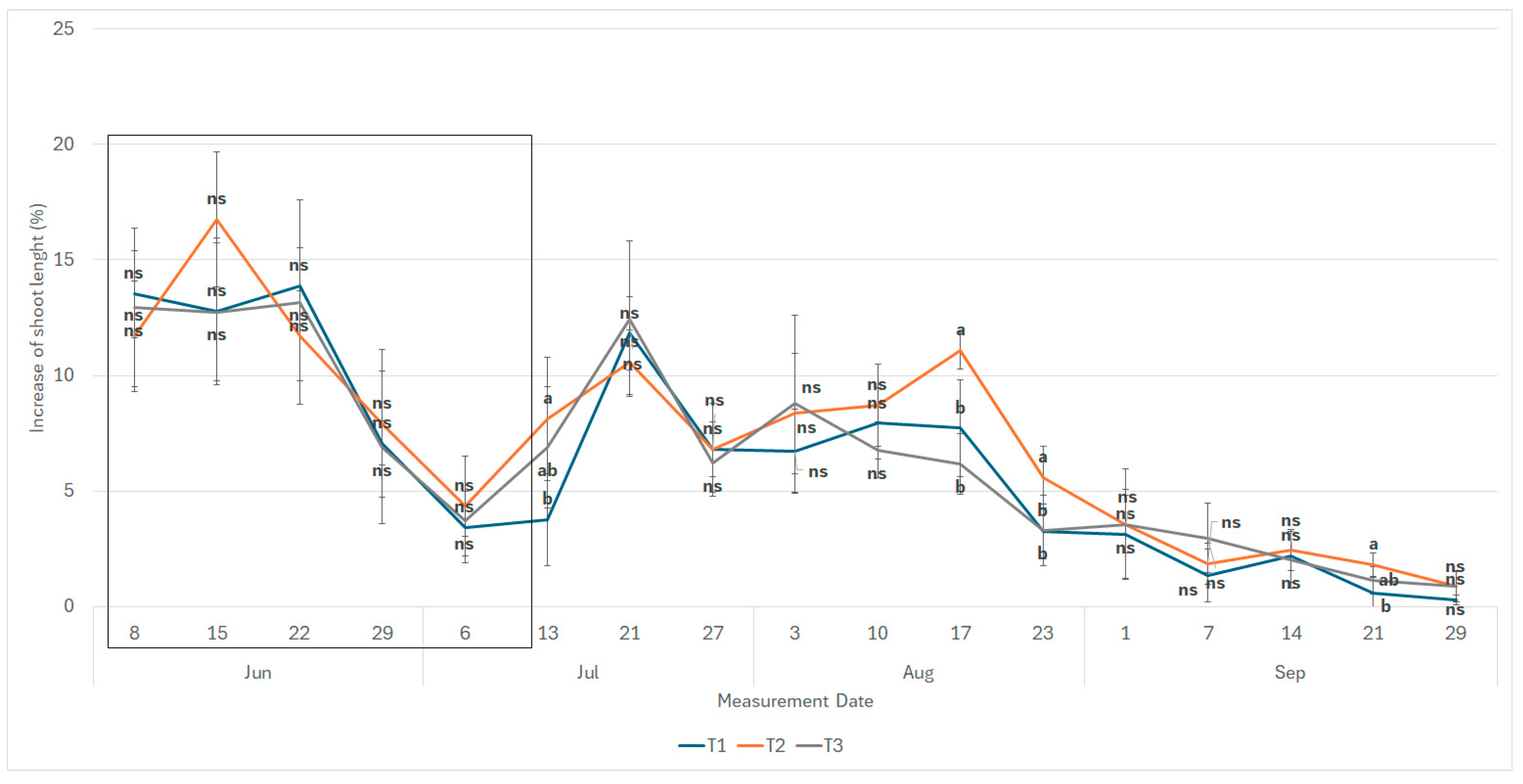
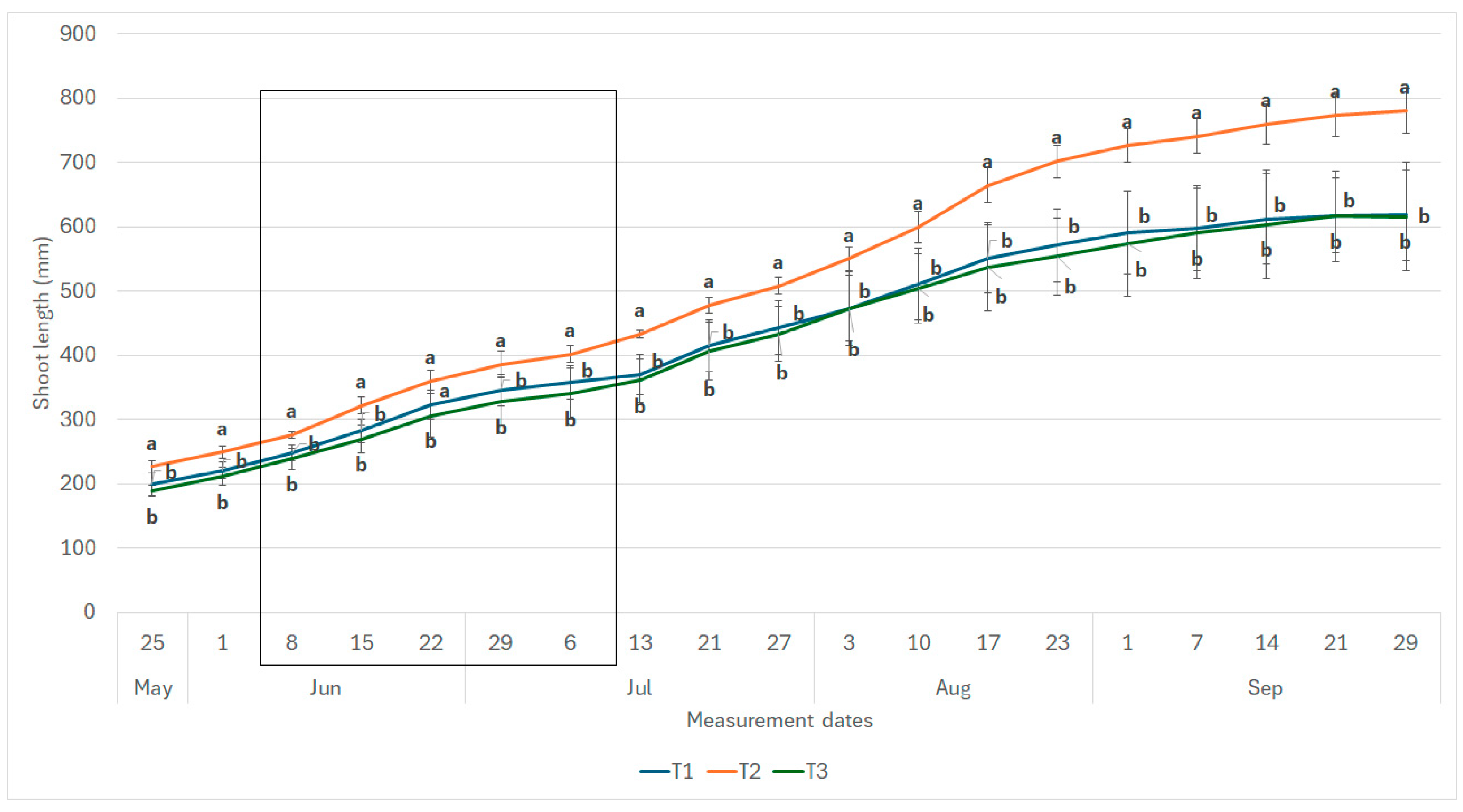
For all 36 plants, five primary shoots were identified, selected from the median dorsal portion of mixed branches, totalling 180 shoots. Weekly measurements of their length were taken using a measuring tape from May to September. In contrast, the total shoot count was recorded monthly. Towards the end of the experiment, in November, flower buds and woody shoots were counted on the plants, and development was followed throughout the season.
2.5. Plant Yield and Fruit Quality
Blueberry fruit harvests began on 8 June 2020 and ended on 13 July 2020. Within that period, the fruits were harvested once a week. The harvest involved manually picking berries at full ripeness, defined by an intense dark-blue colour homogeneously distributed across the berry skin. All fully ripe fruits were collected, including small fruits and those with minor external irregularities, to allow for harvest categorization; however, only fruits meeting quality standards were considered for final yield and quality assessments. For the purpose of treatment comparison, the yield data were averaged across all plots within each replicate, ensuring that each replicate contributed equally to the overall mean for the treatment.
To determine the average fruit yield per plant, all fruits of each plant were harvested, then weighed using an Orma BC balance (Sesto San Giovanni, Milan, Italy) with a precision of 0.01 g.
For the average fruit weight, 50 random fruits were collected from each plant on three different harvest dates (8, 15, and 29 June 2020), then weighed. The polar diameter and equatorial diameter of the same 50 fruits previously sampled for average weight were measured using a Mitutoyo CD-15CPX digital gauge (Lainate, Milan, Italy). The overall fruit dimension was calculated based on the volume of berries, approximated as a cylinder, and calculated according to the formula expressed as V = r2 × π × ℎ, where r is half the equatorial diameter and ℎ corresponds to the polar diameter. Once the fruits had been weighed, they were frozen before undergoing qualitative and nutritional analyses.
2.6. Qualitative Parameters
Fruit qualitative parameters were determined for each of the three harvests—namely, those of 8, 15, and 29 June 2020. The thawed blueberry samples were manually crushed, and the resulting juice was used to analyse soluble solids content (°Brix) using an Atago N1-E refractometer (Merlino, Lodi, Italy) and the titratable acidity, which was determined using an automatic HI-84532 titrator (HANNA Instruments, Villafranca, Padova, Italy) and expressed as a percentage (g 100 mL−1) of citric acid.
2.7. Nutritional Parameters
The nutritional analyses were conducted on homogeneous, healthy, frozen fruits, as described by Mazzoni et al. (2020) [
26]. The analysed parameters were: total antioxidant capacity, total anthocyanin content, and total polyphenol content. Before the analysis, a preliminary extraction of antioxidant compounds was performed. Each bulk of blueberry fruit samples was cut into small pieces, and 10 g of material was put in a glass flask. Meanwhile, an extraction solution was prepared, consisting of 80% ethanol, 20% water, and 1% extra acetic acid. The extraction solution with the sample was homogenized with an Ultraturrax T 25 instrument (IKA, Staufen, Germany) and stored for 48 h at 4 °C in a dark environment. At the end of the two days, the sample was centrifuged at 4 °C for 20 min at 2500 rpm to separate the solid phase from the supernatant. The supernatant was then collected and poured into 2 mL vials, and the samples were stored at −20 °C until the time of nutritional analysis.
The FRAP (Ferric Reducing Antioxidant Power) method measures the ferric-reducing power of antioxidants in a sample. This is a spectrophotometric analysis (Shimadzu UV-1800, Milan, Italy) in which absorbance is measured at 593 nm. Preliminary steps for spectrophotometric measurement consist of preparing the FRAP solution, which was obtained by mixing sodium acetate (300 mM, pH 3.6), TPTZ solution (10 mM in 40 mM HCl), and ferric chloride (20 mM) in a 10:1:1 ratio, respectively [
47]. The obtained results were compared to the two standard scales, expressed as μmoles of Trolox equivalents per gram of Fresh Weight (FW) or μmoles of reduced iron equivalents per g of Fresh Weight (FW). The calibration curves were prepared according to the absorbance readings of the following standards at 593 nm: Trolox curve at increasing concentrations expressed in μmoles (0, 25, 50, 75, 100, 250, and 500) and curve of ferric sulphate hexahydrate expressed in μmoles at increasing concentrations (0, 50, 100, 150, 200, and 500).
The following formula (1) was used to calculate the Total Antioxidant Capacity (TAC):
FRAP abs = (absorbance of the sample intercepts of the straight line)/angular coefficient of the standard Trolox line;
FD = dilution factor (1:30);
V = solvent extract volume;
P = weight of fruit sample;
1000 = conversion factor in kg.
For the determination of anthocyanins, the official method of differential pH was followed, in which the degree of staining of anthocyanins is closely linked to the pH conditions used for determination of their concentration. In this case, the structural transformation of anthocyanins was observed from a colourless to a coloured material at two different pH levels (1 and 4.5). A volume of 100 µL of extract was reacted with potassium chloride at pH 1 (1:20 ratio); for the reaction at pH 4.5, an additional 100 µL of sample was reacted with sodium acetate (1:20 ratio). The reading of anthocyanins was done by spectrophotometric analysis at 700 nm, and the concentration determined using the following formula (2):
mg CYA-3-GLU kg
−1 FW = total anthocyanin content expressed as mg cyanidine-3-glucoside kg
−1 fresh fruit;
A = absorbance;
MW = cyanidine-3-glucoside molecular weight = 433.2 [g mol−1];
F = dilution factor = 20;
d = cell pathlengths [cm];
ε = molar absorbance cia-3-glu = 15,600;
E = concentration of the sample [kg L−1 of the extracting agent];
1000 = conversion factor in mg.
Folin–Ciocalteu reagent is an aqueous mixture of phosphomolybdate and phosphosulphate used for the determination of polyphenols in blueberry, as evaluated by linear regression calculated according to the gallic acid calibration curve (external standard) at increasing concentrations. The reaction occurred when the samples were mixed with distilled water in a 1:20 ratio. The sample and 3.975 mL of water were added to a 5 mL Falcon tube; then, 0.5 mL of the diluted sample was reacted with 250 µL of the Folin–Ciocalteu reagent. After stirring, the solution was allowed to react for 3 min; then, 0.750 mL of a 20% w/w sodium bicarbonate solution was added. The calibration curve was constructed by linear regression of absorbance readings at 760 nm for gallic acid solutions at 0, 5, 10, 20, 30, 40, 50, and 60 mg L
−1. The total phenolic content (TPH) was calculated according to the following formula (3), where ΔA is the difference between the sample absorbance at 760 nm and the y-intercept of the linear regression line from the standard curve:
ΔA= sample/standard absorbance;
a = slope;
b = intercept;
F = dilution factor (20);
E = average sample weight [kg L−1 extracting agent].
2.8. Statistics
The statistical analysis was performed using the STATISTICA 7 software (StatSoft Inc., Tulsa, OK, USA). The data were subjected to analysis of variance (ANOVA) through comparison of averages, and the differences between the averages across the different test conditions (T1, T2, and T3) for all the considered parameters were separated using the Fisher’s LSD (Least Significant Difference) test with p < 0.05.
4. Discussion
In this study,
Vaccinium corymbosum cv. Duke, cultivated in a soilless system within the challenging alkaline soils of central Italy, demonstrated that fertigation with controlled nutrient concentrations can effectively mitigate natural pedoclimatic limitations. Our results consistently showed that the T2 treatment yielded the most balanced outcomes, with an electrical conductivity of 890 µS cm
−1, which is above the baseline of the irrigation water. Compared with soil-grown blueberry systems, the soilless cultivation adopted in this study showed a higher yield potential from the first production year onward. While Ehret et al. (2014) reported average yields of about 2 t ha
−1 for first-year plants under soil conditions [
48], yields in the present experiment reached over 2.7 t ha
−1 under the 890 EC treatment and approximately 2 t ha
−1 under 790 EC. The findings of the present study are also consistent with those reported by Cheon et al. (2019), who showed that increasing the nutrient supply does not necessarily lead to improved yield performance [
49]. In their study, higher yields were achieved by reducing the volume of the nutrient solution and increasing the frequency of application, likely due to enhanced nutrient uptake efficiency and greater plant utilization. The average fruit weight of Duke in the first production year observed in the present study was higher in all three treatments than that reported under Mediterranean hot-summer conditions [
26], a condition attributed to heat stress during fruit development.
Plants under this regime achieved the highest vegetative vigour, with longer shoots, more flowers and woody shoots, and the highest yield per plant.
The superior performance of the intermediate T2 treatment appears to derive from a delicate balance providing sufficient nitrogen and essential nutrients to fuel growth and shoot differentiation. This finding aligns closely with long-term nitrogen studies in highbush blueberries, indicating that moderate fertigation rates, especially when using ammonium sulphate as a nitrogen source, promote flower bud formation and fruit yield more effectively than excessive N application [
46,
48]. Research has shown that excessive nitrogen delivered via fertigation (e.g., 150–200% of the recommended rate) leads to salinity accumulation, reduced fruit yield, soil acidification, and diminished micronutrient availability [
50,
51].
Contrary to expectations, the highest nutrient concentration (T3) did not outperform the intermediate treatment. Although still well below the salinity threshold of approximately 1.5 dS m
−1 (1500 µS cm
−1) beyond which blueberry yields decline, the lack of further benefits in terms of vegetative and productive traits suggests that diminishing returns and early signs of irritative salinity may have begun to compromise root function and growth (industry guidelines recommend maintaining EC under 2.0 dS m
−1 and leachate EC monitoring) [
52].
Quality attributes of the fruit, including soluble solids, titratable acidity, total antioxidant capacity, and anthocyanin content, did not differ significantly among treatments. However, a subtle trend emerged: lower nutrient supply in the T1 treatment was associated with marginally higher fruit anthocyanin content and antioxidant capacity, perhaps reflecting enhanced secondary metabolite synthesis under mild nutrient limitation. Meanwhile, treatments with higher EC induced a significant increase in fruit total polyphenol accumulation, suggesting that nutrient availability influences fruit phenolic pathways in distinct ways [
53,
54,
55,
56].
These findings highlight the practical potential of soilless cultivation, combined with precision fertigation, in regions with alkaline soils with a mild–temperate climate. The T2 regime offers a scalable model that reconciles vigorous plant development with high yield and acceptable fruit quality. Implementing automated systems that monitor leachate EC and pH and using acidifying fertilizers such as ammonium sulphate to maintain substrate acidity within the 4.5–5.5 range are critical for maintaining optimal plant performance and nutrient uptake in soilless media [
52].
It is essential to acknowledge that our results reflect the first production year (2020) and the second vegetative season post planting. To validate the long-term appropriateness of this regime, further monitoring is essential through subsequent years. Prior long-term trials in British Columbia found that prolonged high nitrogen fertigation led to excessive EC, soil acidification, micronutrient deficiencies, and eventual yield decline, even when initial results seemed promising [
50,
51]. Moreover, emerging research on nitrification inhibitors (e.g., DCD and nitrapyrin) suggests the potential to enhance nitrogen use efficiency by slowing the conversion of ammonium to nitrate, thereby reducing leaching and maintaining nutrient availability during critical uptake periods. However, results remain variable and context-dependent in substrate systems [
46].
Given the industry’s increasing adoption of soilless systems in container and substrate-based blueberry production, particularly in high-value markets and areas with poor soil conditions, our findings contribute to the refinement of best management practices for this sector. Optimal fertigation planning should involve moderate nitrogen inputs via ammonium sulphate, precise EC targets (neither too low nor too high), and continuous monitoring of substrate chemistry. Future studies should also explore variations in nitrogen form and timing (split versus continuous application) and the potential integration of irrigation strategies such as deficit or pulsed watering to improve water and nutrient use efficiency, as previously investigated in precision agriculture research [
54,
57].
In essence, our investigation reveals that success in soilless blueberry cultivation in alkaline soil contexts hinges on moderation. The T2 fertigation treatment represents the “sweet spot” where vegetative growth, shoot formation, and yield intersect optimally. In contrast, lower EC compromises productivity, while higher EC fails to confer additional benefits and risks initiating stress. For growers with calcareous soils, deploying a soilless system with careful fertigation, emphasizing ammonium-based nitrogen, and monitoring EC and pH while maintaining moderate salinity is a promising approach to sustainable, high-quality blueberry production.




 ,
,