1. Introduction
Modal superposition is a classical approach in structural dynamics, where the displacement field of a structure is expressed as a linear combination of vibration modes [
1,
2,
3,
4]. This technique allows for significant computational efficiency compared to direct numerical integration and forms the basis of modal reconstruction, i.e., the estimation of full-field structural displacements from sparse measurement data [
5,
6].
In structural health monitoring (SHM) applications, modal reconstruction provides a framework to infer the complete deformation field from a limited set of measurement points, under the assumption that the system operates within the linear elastic regime [
7,
8]. Measured displacements at selected locations, together with the modal shapes obtained from a finite element (FE) model, can be used to compute the modal coordinates that quantify each mode’s contribution to the overall deformation. The full displacement field is then reconstructed through modal superposition [
9,
10,
11,
12,
13,
14,
15].
A critical aspect of modal reconstruction is the selection of vibration modes. Retaining too few modes can compromise reconstruction accuracy, while including unnecessary modes increases computational cost and may introduce numerical errors. Among various criteria [
16,
17,
18,
19,
20], the Internal Strain Potential Energy Criterion (ISPEC) [
21] identifies the most relevant modes based on their contribution to the internal strain energy. ISPEC can be applied using sparse measurements without requiring knowledge of the full-field deformation, making it particularly suitable for SHM applications where measurement accessibility is limited.
Although ISPEC provides a rigorous physics-based framework for mode selection, its purely analytical formulation is restricted to known deformation states [
22]. To overcome this limitation, supervised machine learning can be employed to extend ISPEC to previously unseen configurations. In this work, ISPEC is combined with a Random Forest classifier trained on synthetic deformation data generated from an FE model of a square plate. The classifier predicts the most relevant modes for new measurement signals, enabling real-time reconstruction of the full displacement field.
The Random Forest classifier is trained using static deformation snapshots generated by the finite element model. Each training sample consists of an eight-dimensional input vector containing the out-of-plane displacement values measured at the selected sensor locations for a single static deformation. The corresponding output is defined as a multi-label binary vector identifying the vibration modes retained according to the ISPEC criterion. This supervised learning formulation allows the classifier to infer, from sparse displacement measurements, the most relevant modal contributions for previously unseen deformation states.
Compared to purely data-driven, end-to-end black-box approaches, the proposed hybrid physics-informed framework offers several advantages. By explicitly embedding modal superposition and the ISPEC criterion, the method preserves physical interpretability of the reconstruction process and significantly reduces the dimensionality of the learning task. Moreover, the reliance on physics-based features allows effective training with a limited amount of synthetic data and improves generalization to loading conditions that differ from those observed during training. This is particularly relevant in SHM applications, where the nature, location, and temporal evolution of external loads are often unknown a priori, and the ability to reliably extrapolate beyond the training dataset is essential.
The proposed methodology is validated numerically by comparing reconstructed displacement fields with reference FE solutions. Reconstruction accuracy is assessed using instantaneous residuals, normalized root-mean-square error (NRMSE), and normalized cross-correlation. Results demonstrate that integrating ISPEC with machine learning provides an efficient and physically consistent strategy for full-field modal reconstruction under sparse sensing and real-time constraints [
23,
24,
25]. This numerical case study allows quantifying the accuracy and efficiency of the approach under controlled conditions, providing a reference framework for future applications in real SHM scenarios.
2. Modal Reconstruction as SHM Algorithm
Modal reconstruction, when applied as a structural health monitoring (SHM) algorithm, is valid when the system under observation, and consequently the structure or machine, operates within the elastic and linear regime. For cases in which linear elastic behaviour can be assumed, together with the assumption of small displacements, the displacement field of every point in the structure can be expressed as a linear combination of the modal displacement shapes. These shapes represent the eigenvectors of the free vibration problem, where the structure is assumed to oscillate freely under the effects of its own inertia and elasticity, while neglecting both damping and any external forcing.
By representing the structure as a set of discrete points, which in a finite element model correspond to a mesh of elements and nodes, the nodal displacements over time can be written as:
where:
is the nodal displacement vector as a function of time t,
is the matrix containing the modal shapes,
is the vector of modal coordinates as a function of time t.
Here, is a column vector whose length equals the product of the number of nodes and the number of degrees of freedom, has the same number of rows as and a number of columns equal to the number of retained modes, and is a column vector with as many rows as there are columns in . The computation of strongly depends on the columns of , that is, on which modes are retained in the modal reconstruction.
The concept underlying modal superposition for SHM is that, by placing a discrete number of measurement sensors in locations that do not interfere with the normal operation of the system and are accessible to the operator, it is possible to reconstruct the complete deformation field at all nodes. Assuming that
N measurements are available, each providing, for instance, the displacement signal
at the corresponding nodes for the components they can measure, and that the modal shapes are known at those points, the modal coordinates
can be computed by solving the linear system in (
1).
In overdetermined systems, where
N, defined as the sum of each sensor multiplied by the number of measured components, exceeds the number of retained modes (columns of
), the modal coordinates can be obtained using the method of Lagrange multipliers, yielding a minimum-norm solution:
As previously discussed, has a number of components equal to the number of retained modes and represents the weights of the linear combination. To recover the full displacement field at all nodes, it is sufficient to multiply by the modal shape matrix extended to the nodes and displacement components of interest.
3. Mode Selection and Machine Learning
The accuracy of the reconstructed displacement field, and consequently the reconstruction error, depends critically on the modes retained both in the decomposition of the measured signals and in the reconstruction process. While the Internal Strain Potential Energy Criterion (ISPEC) allows selecting the most significant modes based on the internal strain potential energy, its purely analytical formulation requires prior knowledge of the complete strain field at all nodes. As such, ISPEC is inherently limited to static deformations already known a priori and cannot be directly applied for real-time structural monitoring. To overcome this limitation, machine learning techniques can be employed to generalise mode selection to previously unseen deformation states.
3.1. Internal Strain Potential Energy Criterion (ISPEC)
ISPEC was originally developed to identify the most relevant modes for reconstructing static deformations. The formulation of the proposed criterion is based on the assumption of small deformations within the linear elastic regime. This assumption ensures the compatibility conditions between strain and displacement and excludes the presence of large displacements. As a consequence, the applicability of the criterion is limited to case studies that satisfy these hypotheses. Nevertheless, such conditions are met in a wide range of practical engineering applications, including properly constrained machine components not subjected to kinematic mechanisms and structural systems exhibiting negligible kinematic instability.
Under the assumption of negligible large displacements, modal superposition can, in general, be expressed in terms of strain fields. In this formulation, the same modal coordinates adopted for the displacement-based problem are retained, ensuring consistency between the strain and displacement representations within the linear elastic framework [
22]:
where
denotes the strain vector and
represents the matrix of the corresponding strain mode shapes.
The internal strain potential energy is defined as:
where
is the elastic constitutive matrix. Analytically, a complete evaluation of
requires that all nodes of the finite element model are considered, along with all associated strain components. Expanding the strain field in modal coordinates, the reconstructed internal strain potential energy is:
The relative contribution of each mode can be defined as:
This formulation, while rigorous, is limited to known static deformations.
3.2. Integration with Machine Learning
To extend ISPEC to dynamic or real-time applications, it is combined with supervised machine learning. A Random Forest classifier is trained on a dataset of static deformation states generated from the finite element model. Each training sample corresponds to a single deformation snapshot and is represented by a feature vector containing the out-of-plane displacement measurements at the eight sensor locations. No temporal information is included during training; each deformation is treated independently.
Prior to training, the measurement vector is normalised by dividing each component by the maximum absolute displacement among the sensors, resulting in values bounded in the interval . The same normalisation procedure is applied during inference on dynamic signals to ensure consistency between training and testing.
The output labels are defined as binary vectors identifying the vibration modes retained according to the ISPEC criterion. A total of 100 modes are considered. Modes whose relative contribution to the internal strain potential energy exceeds a threshold of 0.1% are selected, ensuring that at least 99.9% of the deformation energy is captured. If more than eight modes satisfy this condition, only the eight most energetic modes are retained, consistently with the number of available measurement points.
The classifier is implemented using the RandomForestClassifier from the scikit-learn library. The model consists of 100 decision trees, uses the Gini impurity criterion for node splitting, and adopts bootstrap aggregation. No explicit limit is imposed on the maximum tree depth; nodes are expanded until they are pure or contain fewer than two samples. At each split, a random subset of features equal to the square root of the total number of input features is considered. The minimum number of samples required to split an internal node is set to two, and the minimum number of samples at a leaf node is set to one. A fixed random seed is used to ensure reproducibility.
Once trained, the classifier is applied to dynamic measurements on a timestep-by-timestep basis. At each timestep, the instantaneous normalised sensor displacement vector is provided as input, and the classifier predicts the subset of relevant modes. These modes are then used to compute the modal coordinates via pseudoinverse-based inversion and to reconstruct the full displacement field through modal superposition.
3.3. Validation Metrics
The objective of the monitoring activity in the considered case study is to reconstruct the deflection of the vibrating square plate at all mesh nodes. In this context, the deflection, denoted as
, corresponds to the displacement component orthogonal to the plate plane. Let
and
denote the FE and reconstructed deflection components at the
i-th validation node, respectively. The reconstruction error at each time step is evaluated through the instantaneous residual:
Inspection of the residual time histories, together with the FE (measured) and reconstructed deflections, allows identification of systematic discrepancies, phase shifts, or transient deviations. Such visual comparison provides an initial indication of the reconstruction algorithm dynamic performance and highlights intervals of higher error magnitude.
For quantitative assessment, the root-mean-square error (RMSE) over a finite time interval
T is adopted [
26]:
where
N is the number of samples within the considered window. The RMSE provides a single-value measure of the overall discrepancy between the reconstructed and measured deflections.
To enable comparison across different nodes and deflection amplitudes, the RMSE is further normalised with respect to the full signal range, yielding the normalised RMSE (NRMSE):
The NRMSE expresses the error as a percentage of the measured deflection range, facilitating intuitive interpretation and inter-node comparison.
In addition to amplitude-based metrics, the similarity in waveform and phase between measured and reconstructed signals is evaluated using the normalised cross-correlation:
where
and
denote the mean values of the measured and reconstructed deflections, respectively. Values of
approaching unity indicate strong agreement in both amplitude and phase, providing a complementary perspective to the RMSE-based evaluation.
By combining inspection of residuals, RMSE and NRMSE evaluation, and normalised cross-correlation analysis, the proposed framework offers a comprehensive and robust approach to quantify the fidelity of the deflection reconstruction.
4. Finite Element Modeling: Geometry, Loading and Constraints
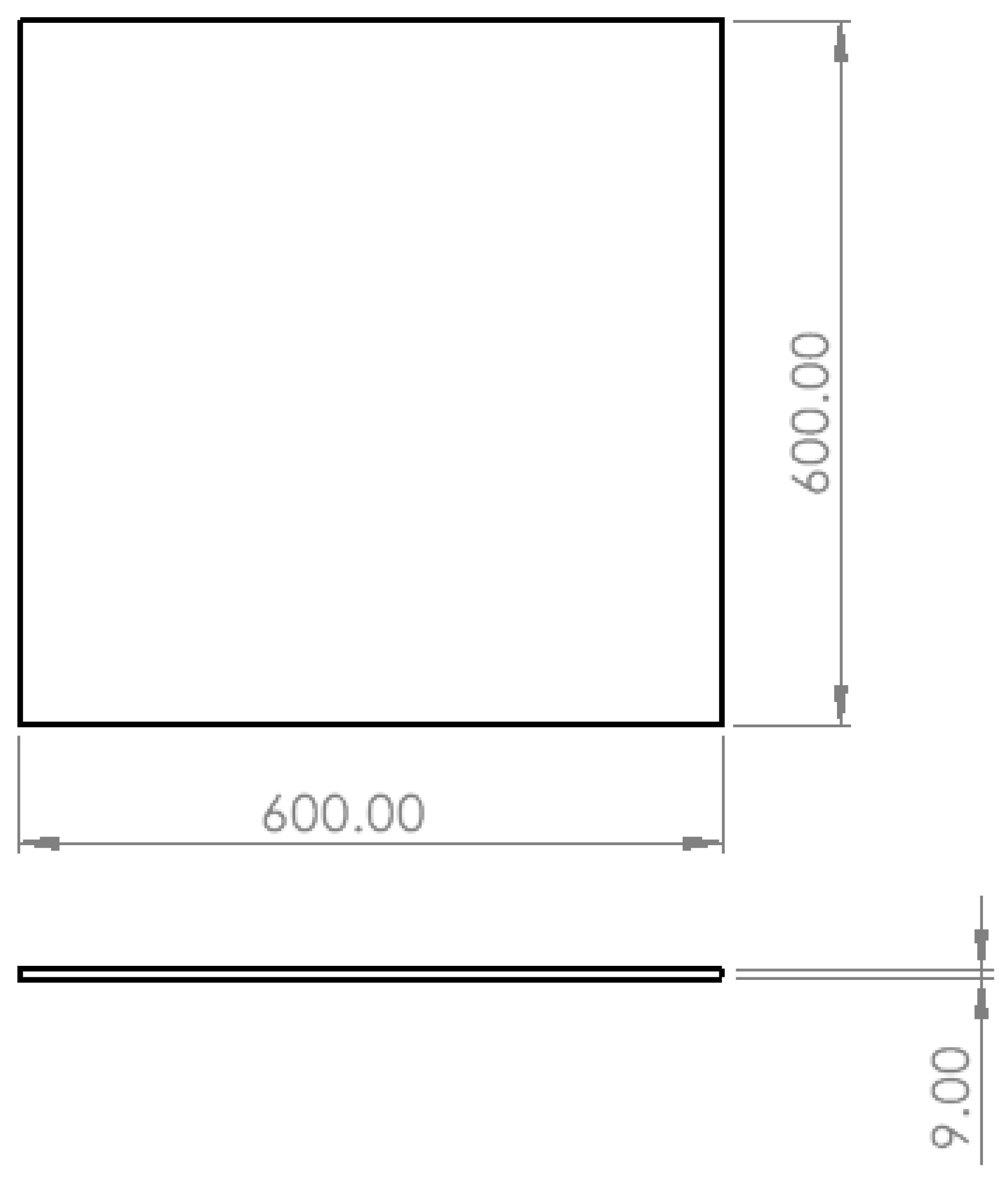
In order to generate the synthetic signal to be reconstructed through modal superposition combined with machine learning, a square plate geometry is considered, together with a database of deformation states used to train the supervised machine learning algorithm, the corresponding modal analysis, and the synthetic response signal selected for reconstruction. The plate has a side length of 600 mm and a thickness of 9 mm (
Figure 1).
The material is assumed to exhibit isotropic and homogeneous behavior. Accordingly, a constant Young modulus equal to 210 GPa is assigned in all spatial directions, together with a Poisson ratio equal to 0.3 and a mass density equal to 7500 kg/m3. These values are representative of a generic structural steel.
The finite element model is developed using the ANSYS software package (2020, ANSYS Inc., Canonsburg, PA, USA). The structure is discretized using linear solid elements of type SOLID185, adopting a homogeneous structural solid formulation with full integration [
27,
28].
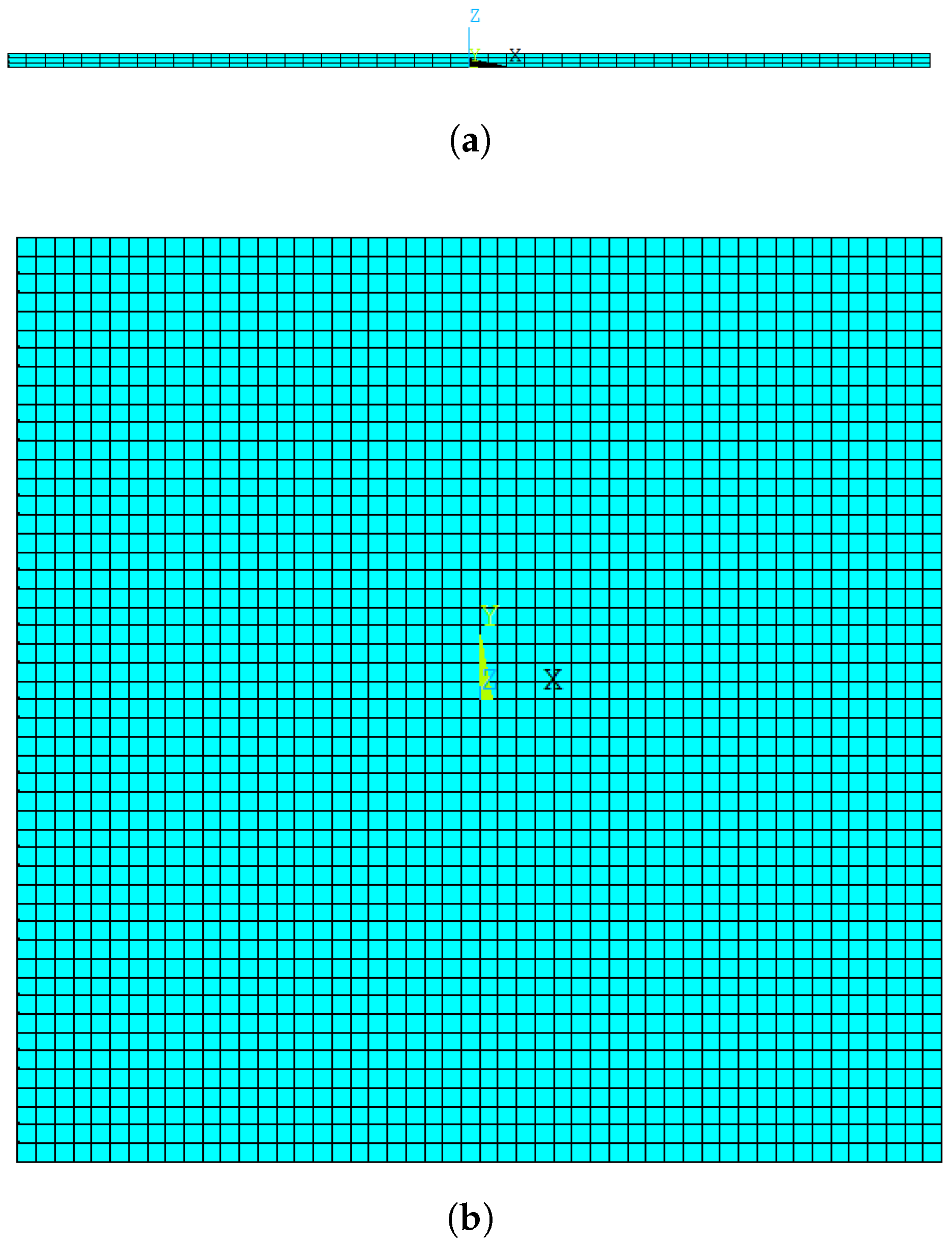
A mapped mesh is generated by means of the Ansys Parametric Design Language (APDL). The in-plane discretization is defined by a uniform element size equal to 12 mm along the sides of the square plate, while the thickness direction is discretized using an element size equal to 3 mm. This mesh configuration results in three linear solid elements along the thickness, ensuring an adequate representation of bending behavior in the plate, and yields a total of 7500 elements (
Figure 2).
4.1. Displacement Restraints and Measurement Node Selection
The plate is constrained at its center by restraining all degrees of freedom of the nodes on the bottom surface within a square region of side 20 mm located at the geometric centre of the plate. This modelling choice is intentionally adopted to promote complex deformation patterns within the interior region of the structure, which represents the primary area of interest for the reconstruction task. By introducing a localised central constraint, the dynamic response develops nontrivial spatial gradients and modal interactions away from the sensor locations, providing a challenging and representative test case for the proposed reconstruction methodology. This configuration allows the assessment of the capability of the ISPEC–machine learning approach to accurately reconstruct internal deformation fields from sparse measurements without relying on direct sensor information in the region of interest.
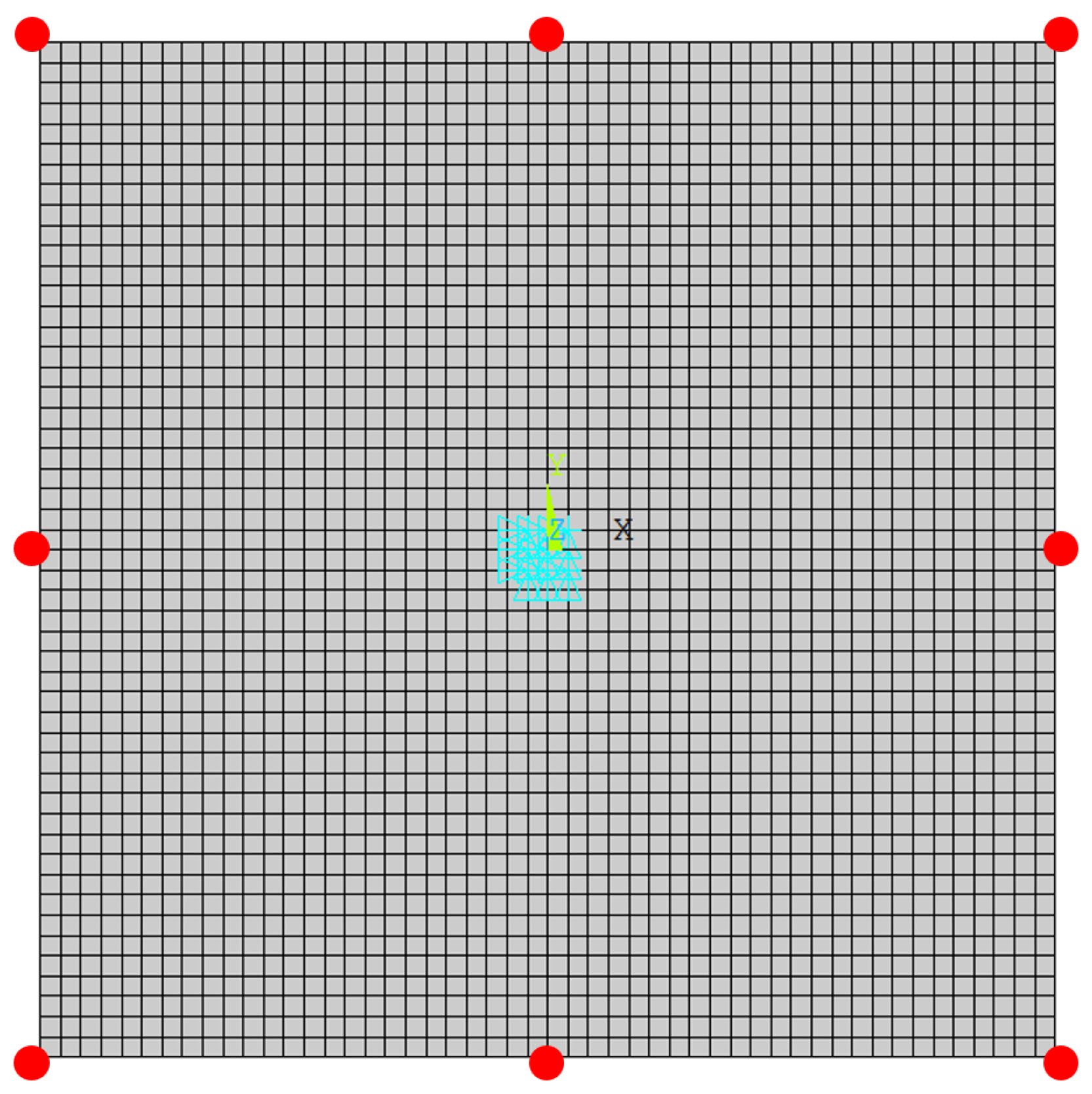
For the purpose of capturing plate deflections, eight measurement nodes are identified on the bottom surface of the plate. These nodes measure displacement orthogonal to the plate plane and are positioned at the four corners and at the midpoint of each side (
Figure 3).
4.2. Construction of the Deformation Database
To construct the deformation database, the square plate geometry with a central displacement restraint, as described in
Section 4.1, is considered. A static analysis is performed in which a vertical force (in the
z-direction, see
Figure 2) is applied sequentially to each node on the top surface of the plate. For each simulation, the force is applied to a single node, resulting in a total of 2601 simulation sets. The resulting deformation fields from each simulation are recorded and compiled into the database, which is subsequently used for supervised machine learning and modal reconstruction studies.
The choice of generating the training database from static single-point load cases is intentional and aimed at ensuring the generality of the proposed approach. These deformation states are not designed to replicate the specific dynamic loading conditions used in the verification phase, but rather to span a broad and diverse set of admissible structural responses. In practical structural health monitoring applications, the spatial distribution and temporal evolution of external loads are typically unknown a priori, particularly in the presence of exceptional or unforeseen loading scenarios. By training the classifier on a wide range of generic static deformation patterns, the model learns the underlying relationship between sparse displacement measurements and dominant modal contributions, without being tailored to a specific loading configuration.
4.3. Synthetic Signal
In order to generate the synthetic measurement signal for reconstruction and verification, a full structural transient analysis is performed. The transient is imposed by applying displacements to four nodes located at the vertices of a square defined by the coordinates
mm,
mm,
mm, and
mm. The harmonic deflection functions
applied at each node are defined as:
where
is the amplitude of the harmonic functions, set to 0.5 mm, and
is the angular frequency corresponding to 50 Hz.
This dynamic excitation configuration is deliberately different from the static single-point load cases used to construct the training database. The resulting transient response therefore represents a set of deformation states that are not encountered during training and can be regarded as unseen deformation states. This discrepancy between training and testing conditions is introduced to assess the generalisation capability of the proposed ISPEC–machine learning framework. The ability to accurately reconstruct the structural response under a multi-point harmonic excitation demonstrates that the method does not rely on prior knowledge of the actual load configuration, but instead exploits the modal characteristics of the structure and the physics-based ISPEC criterion to adaptively identify the relevant modes.
The load is maintained for 4 s, which corresponds to the monitoring period of the structure. The signal acquisition frequency is set to 1000 Hz, resulting in a total of 4000 timesteps for the measured deflection at each measurement node.
5. Results
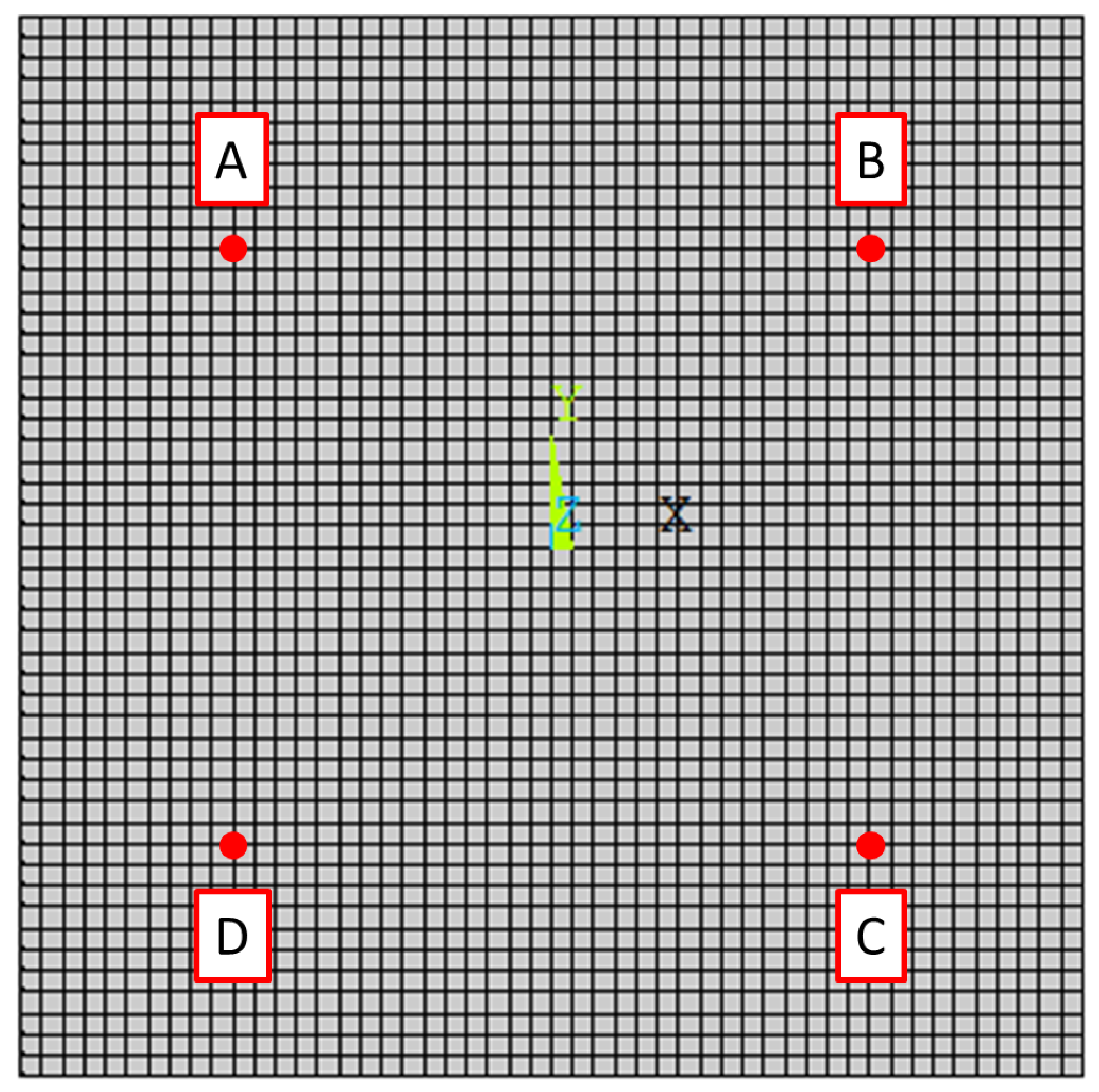
The reconstruction results obtained via modal superposition are presented considering up to 8 modes, which corresponds to the maximum number allowed by the available measurement points (8 sensors with a single degree of freedom each). A preliminary modal analysis of the plate was performed to assess the observability of the dynamic response. The first 8 modes cover a frequency range from 57.62 to 259.26 Hz, capturing the dominant dynamic behaviour under the 50 Hz harmonic excitation applied in the synthetic measurements. To provide a robust assessment of reconstruction accuracy, four verification nodes are selected, which do not coincide with measurement locations. These nodes are used to evaluate the instantaneous residuals between reconstructed and reference deflections. The reference signals are synthetic and obtained from a full transient finite element (FE) analysis. The locations of the verification nodes are highlighted in
Figure 4.
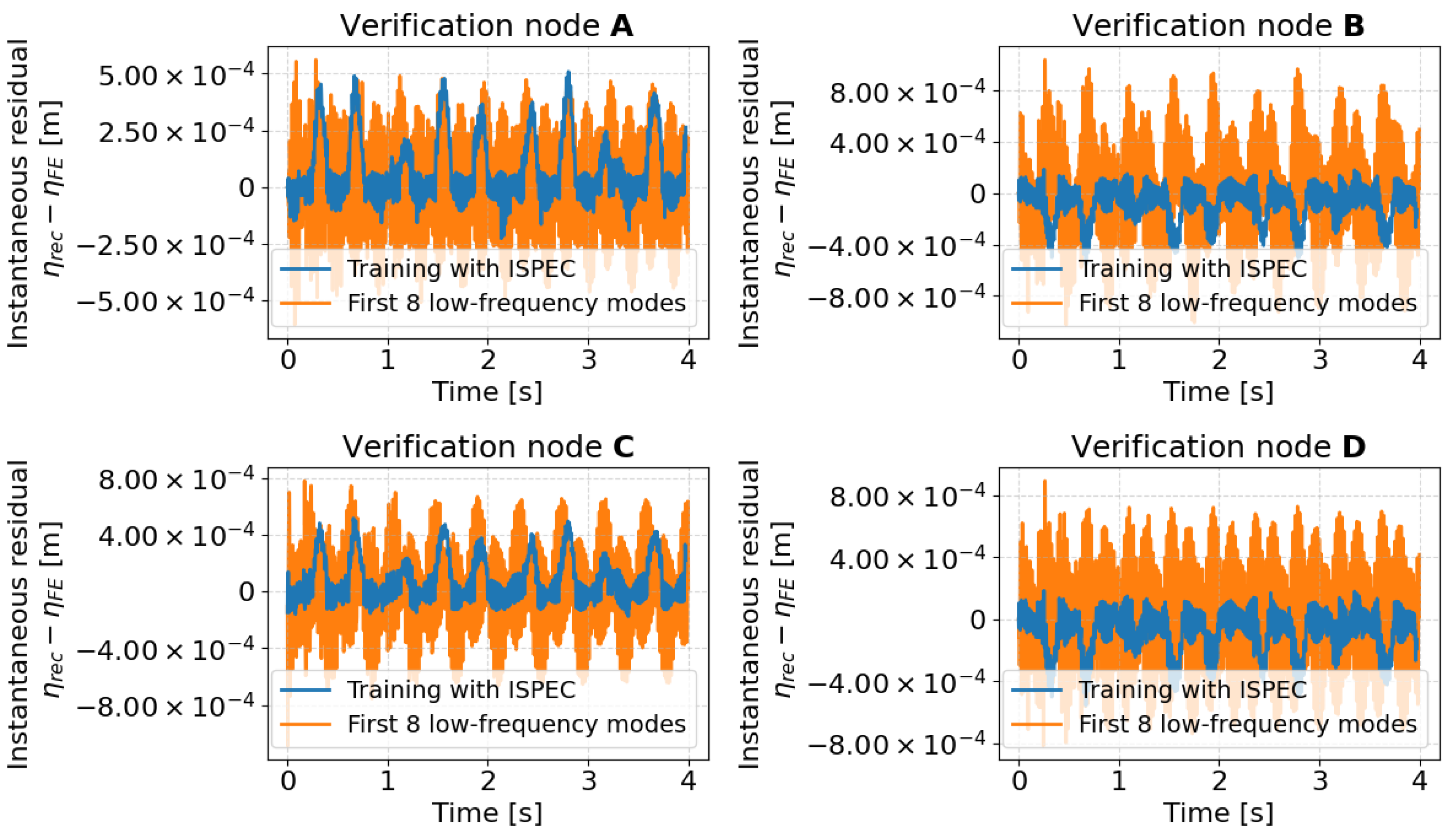
To evaluate the effectiveness of the proposed ISPEC–machine learning approach, a direct comparison is performed against a baseline reconstruction strategy based on retaining the first eight low-frequency modes. This baseline represents a common modal truncation approach when adaptive mode selection is not employed.
Figure 5 reports the instantaneous residuals at the four verification nodes for both reconstruction strategies.
The residuals associated with the ISPEC-trained classifier exhibit significantly smaller absolute values than those obtained with the first-eight-modes baseline. Both positive and negative peaks are observed, reflecting slight overestimation or underestimation of the absolute value of the reconstructed deflection relative to the FE reference. The systematic overestimation observed at the absolute peaks is primarily due to modal truncation and the limited sensor layout, which produces a conservative reconstruction. In contrast, the baseline approach produces residual peaks that are often comparable to the maximum absolute deflection values themselves, demonstrating that retaining only the first eight modes fails to capture higher-order contributions crucial for accurate reconstruction, particularly during peak dynamic response. These results quantitatively highlight the improved accuracy of the ISPEC-based adaptive mode selection.
Based on the superior residual performance of the ISPEC-trained classifier, subsequent analyses focus exclusively on this reconstruction.
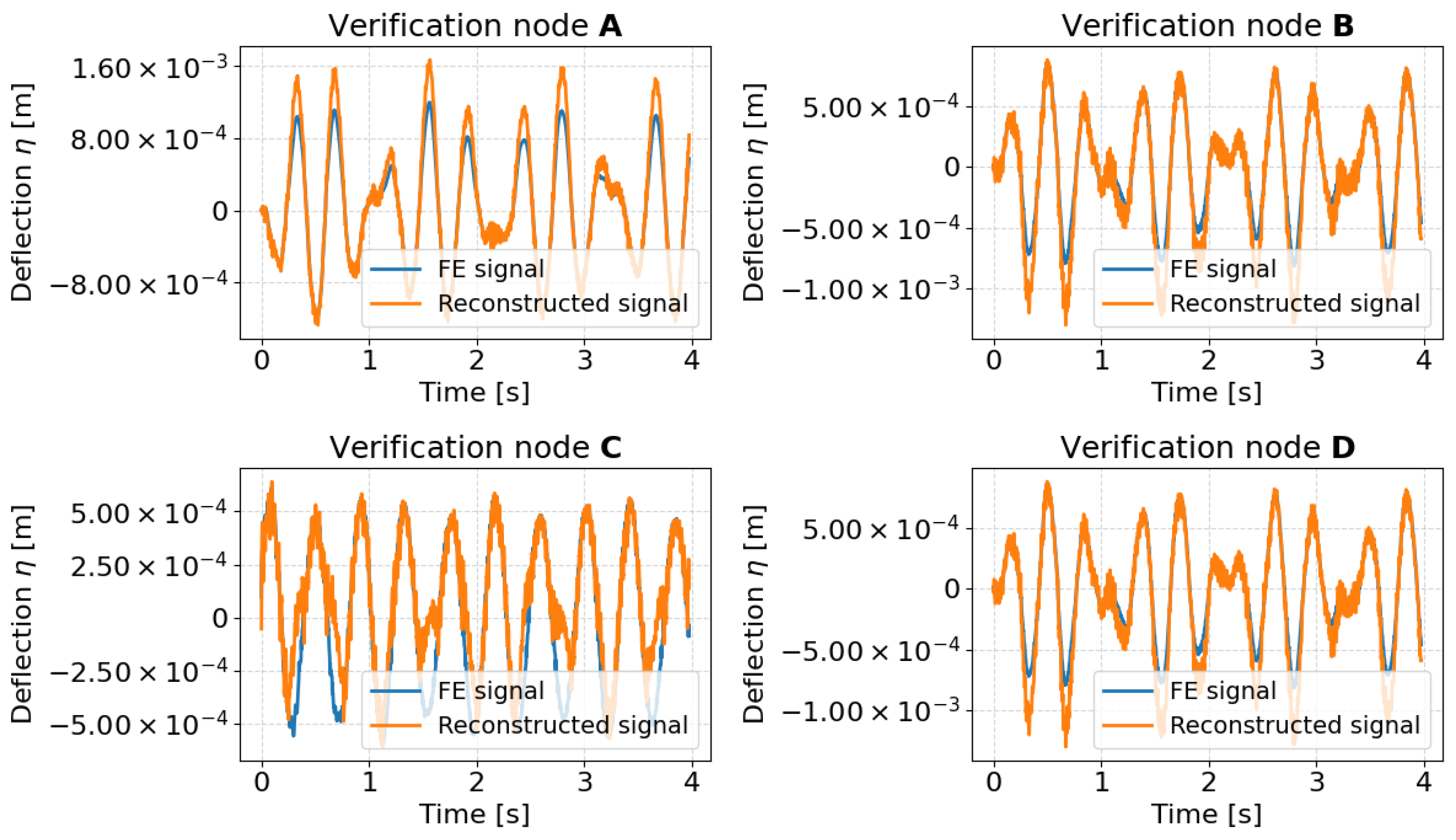
Figure 6 compares the FE and reconstructed deflections at the four verification nodes.
The reconstructed deflection signals closely follow the FE reference across the entire time history. Minor discrepancies occur at the instants of maximum and minimum deflection, with residuals exhibiting both positive and negative peaks. Considering absolute values, these discrepancies indicate a slight overestimation of the reconstructed deflections, reflecting a conservative yet accurate reconstruction across all verification nodes.
This behaviour is further quantified by the instantaneous residuals, which reach maximum absolute values during peak dynamic response. The predominantly smaller magnitude of these residuals compared to the baseline highlights the effectiveness of the ISPEC-trained classifier in capturing higher-order modal contributions that are neglected in the first-eight-modes approach.
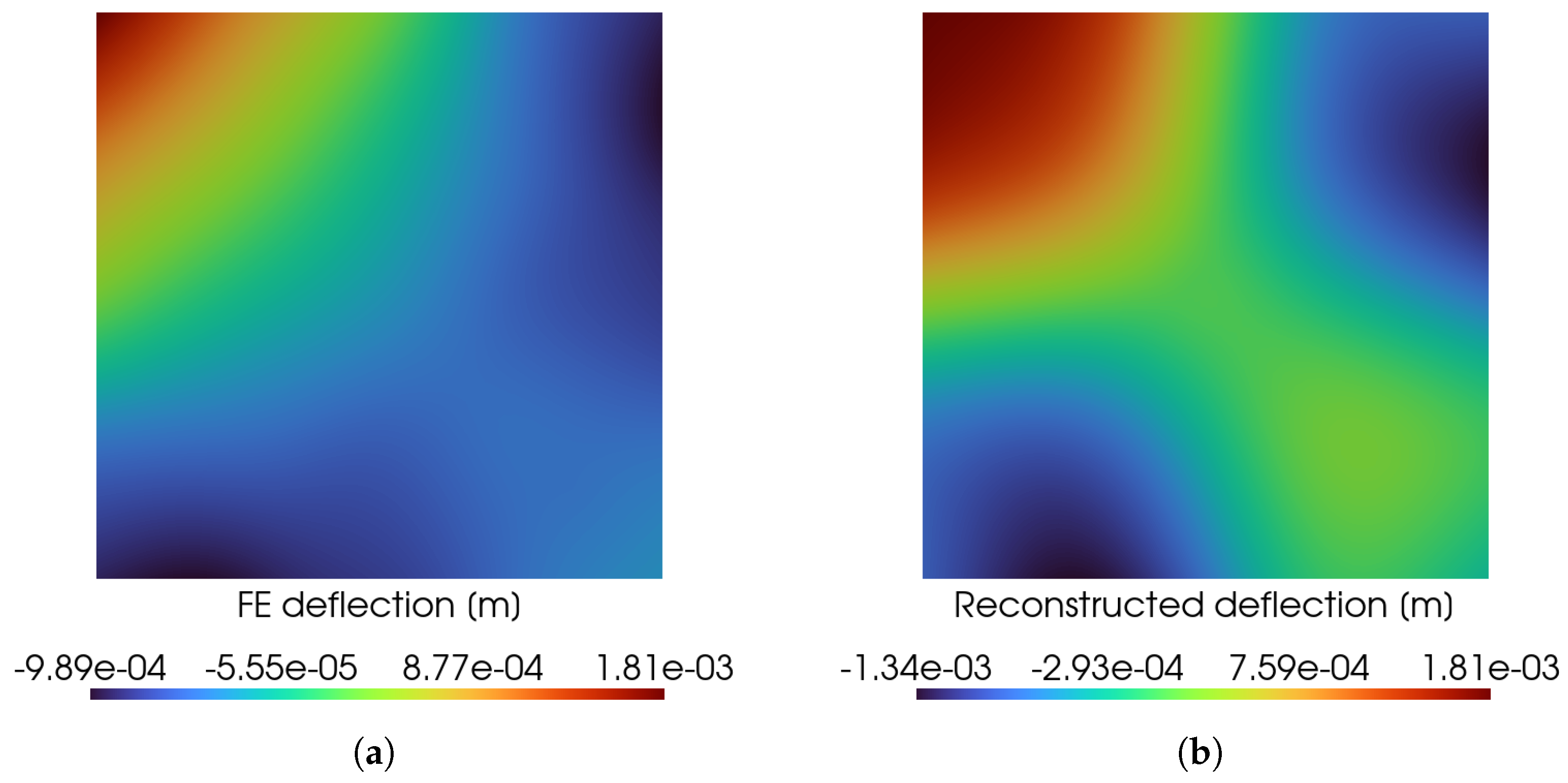
Considering the full plate at the time corresponding to the peak reconstructed deflection, both FE and reconstructed displacements are shown in
Figure 7. The overestimation is most evident along the diagonal nodes, while nodes corresponding to measurement locations (vertices and midpoints of the edges) show close agreement between reconstructed and FE deflections, as expected, since the reconstruction relies on modal inversion at these points.
The improved reconstruction accuracy enabled by adaptive mode selection is also reflected in the spatial distribution of the validation metrics.
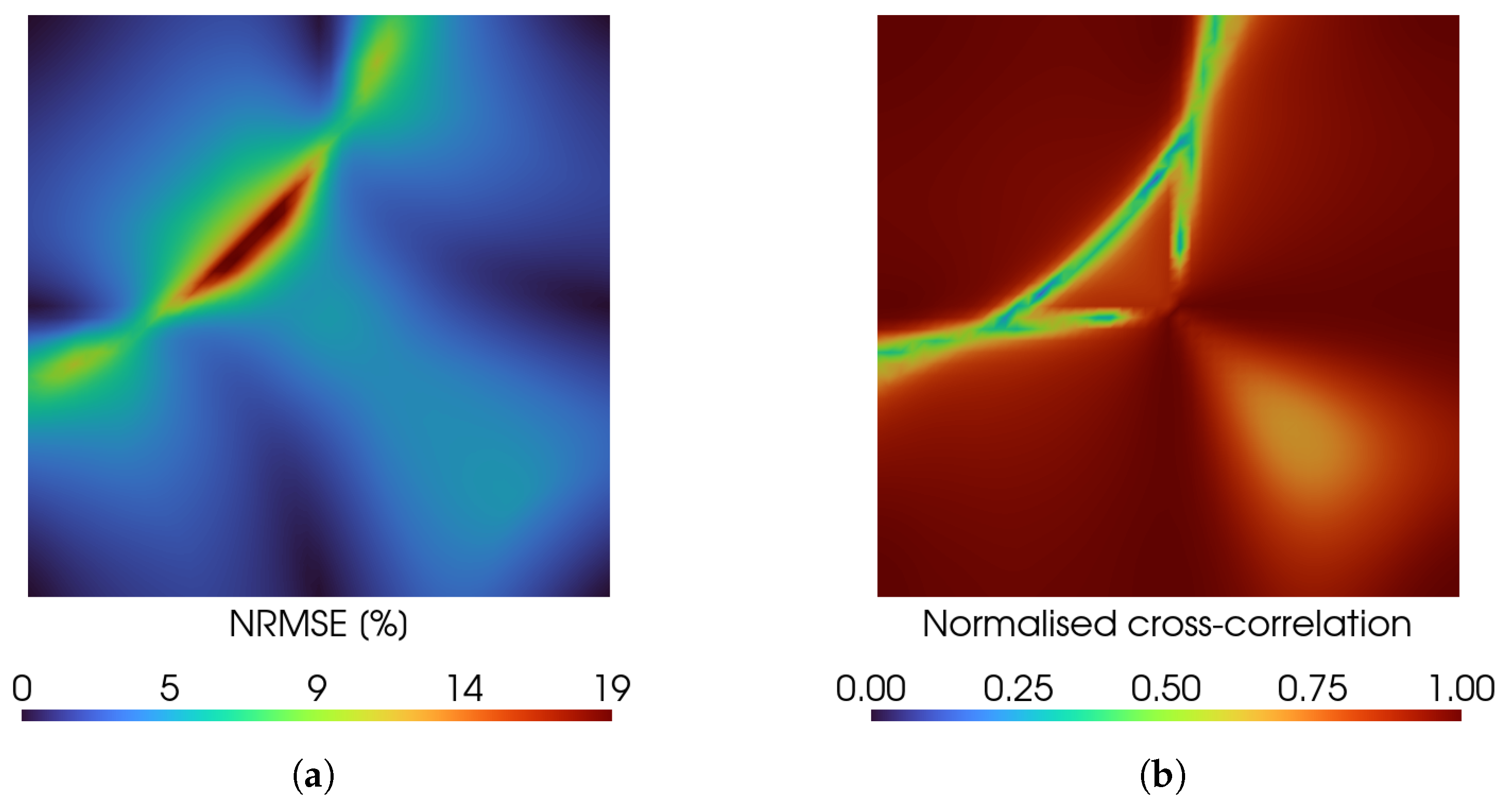
The NRMSE contours over the plate, shown in
Figure 8a, indicate low errors across most of the domain, typically ranging from 0% to 5%, except in localized regions exhibiting higher values. The normalized cross-correlation, shown in
Figure 8b, confirms strong agreement between FE and reconstructed signals, with values generally between 0.75 and 1. The regions of lower cross-correlation coincide with zones of higher NRMSE, highlighting areas where the reconstruction algorithm performs less accurately. These localized errors typically occur in regions farthest from the measurement nodes or along the plate diagonals, where modal inversion is less constrained by direct sensor information. An additional contributing factor is the nature of the applied loads: the synthetic transient signal is generated by harmonic displacements applied to four nodes at the vertices of a square, with amplitudes and phase relations producing complex deformation patterns that are more difficult to reconstruct accurately in areas distant from the excitation points. Furthermore, the truncation to a maximum of 8 retained modes due to the limited number of sensors also contributes to these local deviations. Despite these localized discrepancies, the overall reconstruction remains highly accurate.
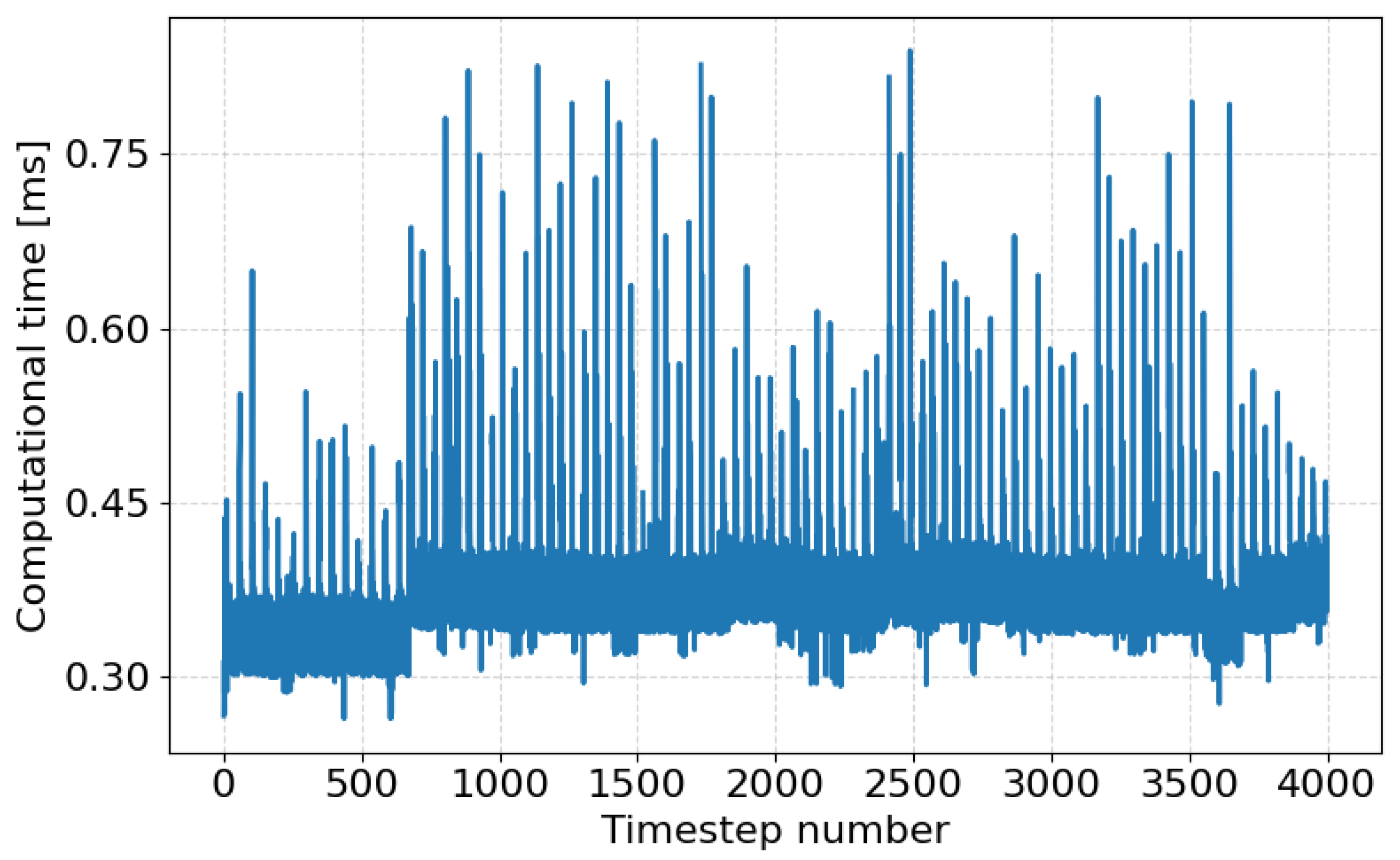
Finally, the computational efficiency of the modal reconstruction demonstrates its suitability for real-time structural health monitoring.
Figure 9 shows the computation time per timestep. Given a measurement sampling frequency of 1000 Hz (corresponding to 1 ms per timestep), all computations are completed within or very close to this timeframe, indicating that the reconstruction algorithm can track the signal variations in real time without delays.
6. Conclusions
This study has presented a modal reconstruction approach for structural health monitoring and assessed its performance on a vibrating square plate. The method relies on modal superposition combined with a mode selection strategy derived from the Internal Strain Potential Energy Criterion (ISPEC), extended to operational conditions through supervised machine learning. This formulation enables full-field deflection reconstruction from a limited number of displacement measurements.
The numerical results show a strong agreement between reconstructed and finite element deflections, both in the time domain at validation nodes and in spatial distributions across the structure. Low NRMSE values and high normalised cross-correlation confirm the accuracy of the reconstruction over most of the plate surface. A systematic overestimation at peak deflections is observed, mainly due to modal truncation and the sensor layout, indicating a conservative behaviour of the method, which can be advantageous in safety-oriented monitoring applications. More specifically, this behaviour originates from a combination of factors. Mode truncation limits the reconstruction to a reduced modal basis, up to eight modes dictated by the number of measurement nodes, so that higher-frequency contributions not retained in the model may induce slight overshoots in the reconstructed response. The adopted sensor layout, with measurement nodes located at the vertices and midpoints of the plate edges, leaves diagonal and interior regions less constrained and can produce localized deviations during peak deflections. In addition, the learning-based mode selection performed by the Random Forest classifier, although highly effective, may slightly overestimate the amplitude of certain modal contributions, particularly when multiple modes combine constructively at peak response.
By coupling ISPEC with a Random Forest classifier, the need for a priori knowledge of the complete strain field is removed, allowing adaptive mode selection for previously unseen deformation states. This data-driven extension preserves the physical consistency of the modal framework while enhancing its applicability under sparse sensing and real-time constraints.
Although the present study focuses on linear elastic behaviour, the proposed hybrid ISPEC–machine learning framework is expected to retain a certain degree of robustness in the presence of mild nonlinearities or localized stiffness degradation, as typically encountered in practical structural health monitoring scenarios. Since the reconstruction strategy is based on selecting the most relevant modes from a predefined modal basis, the method can still provide reliable results as long as the dominant deformation patterns remain reasonably consistent with those represented in the training dataset. However, in the presence of stronger nonlinear effects, the validity of modal superposition may be compromised, as the assumption of linearity underlying the reconstruction through a linear combination of modes no longer strictly holds. Future research will therefore address the extension of the proposed framework toward nonlinear structural behaviour and damage-evolving conditions.
The computational cost per timestep remains compatible with the acquisition frequency, demonstrating that the reconstruction can be performed without latency. Overall, the proposed approach represents an effective and computationally efficient solution for real-time displacement reconstruction in linear elastic structures, providing a solid basis for future developments toward experimental validation and damage-sensitive monitoring strategies.
Overall, the proposed approach shows significant potential for structural health monitoring and non-destructive monitoring of structures and machine components, offering an effective tool for continuous condition assessment, early detection of abnormal behaviour, and support to predictive maintenance strategies in engineering systems.