Accuracy and Clinical Relevance of Robot-Assisted Implant Surgery: An Umbrella Review

 , and
, and
Abstract
1. Introduction
2. Materials and Methods
2.1. Review Design and Reporting
2.2. Information Sources and Search Strategy
- implant/component placement (dental implants),
- navigation/robotics/digital guidance (static and dynamic computer-assisted navigation, surgical navigation, image-guided surgery, augmented reality, accelerometer-based/portable navigation, patient-specific instrumentation, robotic platforms), and
- review design filters (systematic review/meta-analysis).
2.3. Eligibility Criteria:
- Dental: implant placement in partially/fully edentulous jaws, including clinical and experimental accuracy settings (e.g., cadaveric/phantom/resin models) when synthesized within systematic reviews/meta-analyses.
- Robot-assisted platforms (semi-active/active guidance)
- Computer-assisted navigation (static guides; dynamic navigation)
- Augmented reality-guided navigation
- Accelerometer-/inertial sensor-based navigation (portable systems)
- Patient-specific instrumentation (PSI)
- Dental: entry/coronal deviation, apical deviation, angular deviation, global/platform deviation, and related 3D accuracy metrics.
2.4. Study Selection
2.5. Data Extraction and Management
- Bibliographic details (author, year, journal)
- Review characteristics (protocol registration, search dates/databases, eligibility criteria, synthesis approach)
- Number and design of included primary studies; sample size (implants/procedures/patients)
- Technology category (robotic, static, dynamic, AR, accelerometer/portable, PSI)
- Reference standards for accuracy (CBCT/CT, optical scanning, postoperative imaging, coordinate systems)
- Primary and secondary outcomes (accuracy metrics, time, complications, clinical endpoints)
- Subgroup analyses (jaw, flap/flapless, learning curve, device type, orthopedic approach)
- Authors stated limitations and conclusions
2.6. Methodological Quality Appraisal of Included Reviews
2.7. Overlap Management and Synthesis Approach
2.8. Patient and Public Involvement
3. Results
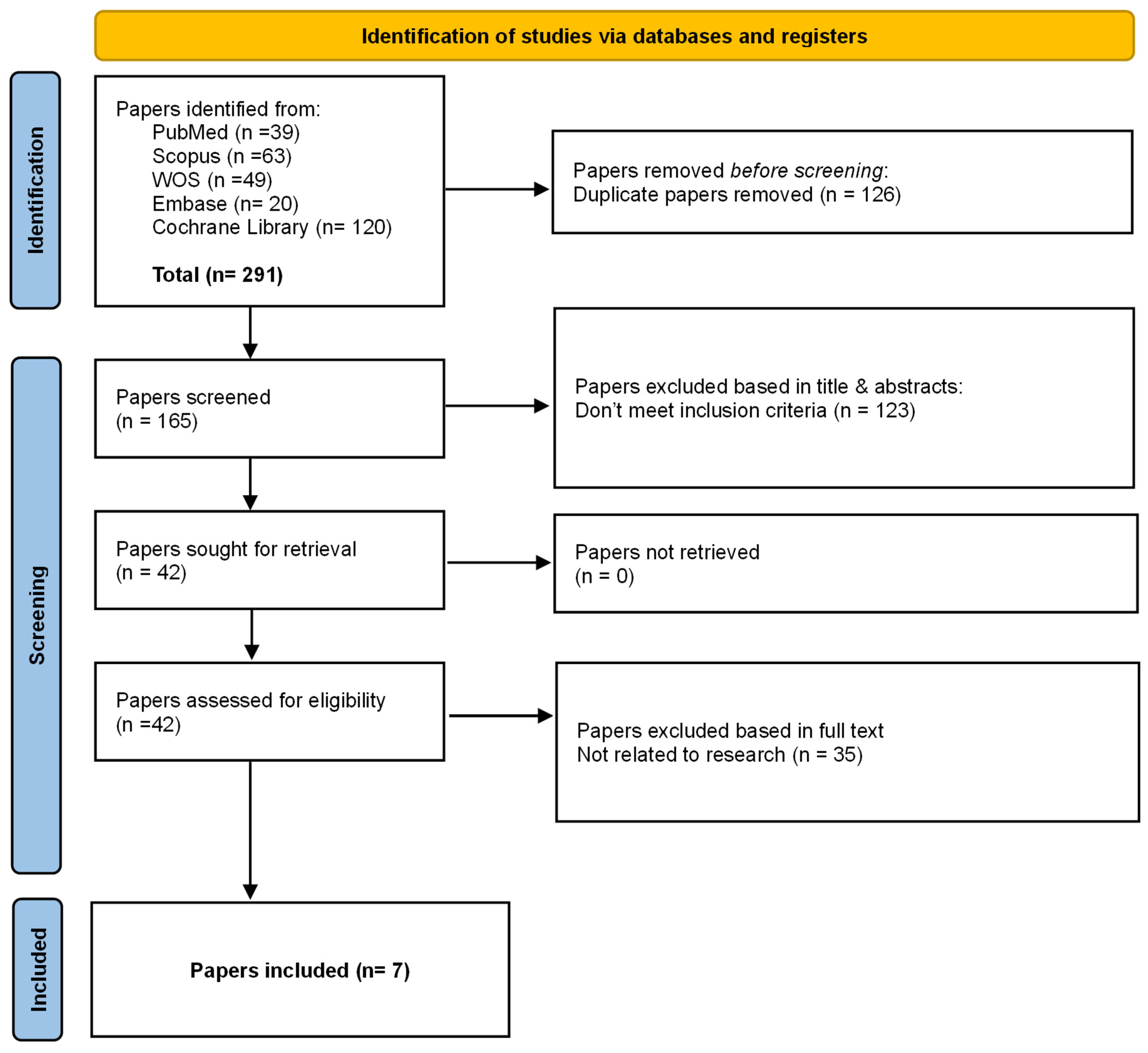
3.1. Selection of Included Studies
3.2. Characteristics of the Included Reviews
3.3. Accuracy Outcomes of Robot-Assisted Implant Surgery
3.4. Secondary Outcomes: Comparison with Non-Robotic Navigation Systems
3.4.1. Static and Dynamic Computer-Assisted Implant Surgery
3.4.2. Augmented Reality-Guided Implant Placement
3.4.3. Operative Efficiency and Safety
3.5. Methodological Quality (AMSTAR 2)
3.6. Certainty of Evidence (ConQual Assessment)
3.7. Overlap of Primary Studies
3.8. Summary of Key Findings
4. Discussion
5. Conclusions
Supplementary Materials
Author Contributions
Funding
Institutional Review Board Statement
Informed Consent Statement
Data Availability Statement
Acknowledgments
Conflicts of Interest
Abbreviations
| Abbreviation | Definition |
| RAIS | Robot-Assisted Implant Surgery |
| CAIS | Computer-Assisted Implant Surgery |
| sCAIS | Static Computer-Assisted Implant Surgery |
| dCAIS | Dynamic Computer-Assisted Implant Surgery |
| r-CAIS | Robotic Computer-Assisted Implant Surgery |
| ADIR | Autonomous Dental Implant Robotics |
| CBCT | Cone-Beam Computed Tomography |
| AR | Augmented Reality |
| PSI | Patient-Specific Instrumentation |
| PRISMA | Preferred Reporting Items for Systematic Reviews and Meta-Analyses |
| JBI | Joanna Briggs Institute |
| AMSTAR 2 | A Measurement Tool to Assess Systematic Reviews 2 |
| ConQual | Confidence in the Qualitative Synthesis of Evidence |
| CI | Confidence Interval |
| SMD | Standardized Mean Difference |
| CCA | Corrected Covered Area |
References
- Peitsinis, P.R.; Blouchou, A.; Chatzopoulos, G.S.; Vouros, I.D. Optimizing Implant Placement Timing and Loading Protocols for Successful Functional and Esthetic Outcomes: A Narrative Literature Review. J. Clin. Med. 2025, 14, 1442. [Google Scholar] [CrossRef] [PubMed]
- Nagni, M.; D’Orto, B.; De Cunto, R.; Cattoni, F.; Vinci, R. Implant-Prosthetic Rehabilitation with Immediately Loaded Post-Extractive Implants: Retrospective Clinical Cohort Study at 18-Month Follow-Up. Appl. Sci. 2025, 15, 6080. [Google Scholar] [CrossRef]
- Sabău, D.T.; Saitos, P.; Moca, R.T.; Juncar, R.I.; Juncar, M. Mechanical and Biological Complications Two Years After Full-Arch Implant-Supported Prosthetic Rehabilitation: A Retrospective Clinical Study. Clin. Pract. 2025, 15, 134. [Google Scholar] [CrossRef] [PubMed]
- Kafedzhieva, A.; Vlahova, A.; Chuchulska, B. Digital Technologies in Implantology: A Narrative Review. Bioengineering 2025, 12, 927. [Google Scholar] [CrossRef]
- Pisla, D.; Bulbucan, V.; Hedesiu, M.; Vaida, C.; Pusca, A.; Mocan, R.; Tucan, P.; Dinu, C.; Pisla, D. Accuracy of Navigation and Robot-Assisted Systems for Dental Implant Placement: A Systematic Review. Dent. J. 2025, 13, 537. [Google Scholar] [CrossRef]
- Tsokkou, S.; Konstantinidis, I.; Keramas, A.; Kiosis, G.; Skourtsidis, K.; Alexiou, D.; Keskesiadou, G.N.; Karachrysafi, S.; Papamitsou, T.; Chatzistefanou, I. Comparative Analysis of Fully Guided and Free-Hand Orthognathic Surgery: Advancements, Precision, and Clinical Outcomes. Dent. J. 2025, 13, 260. [Google Scholar] [CrossRef]
- Liu, C.; Liu, Y.; Xie, R.; Li, Z.; Bai, S.; Zhao, Y. The evolution of robotics: Research and application progress of dental implant robotic systems. Int. J. Oral Sci. 2024, 16, 28. [Google Scholar] [CrossRef]
- Perez, A.; Lombardi, T. Integration and Innovation in Digital Implantology—Part I: Capabilities and Limitations of Contemporary Workflows: A Narrative Review. Appl. Sci. 2025, 15, 12214. [Google Scholar] [CrossRef]
- Sadilina, S.; Vietor, K.; Doliveux, R.; Siu, A.; Chen, Z.; Al-Nawas, B.; Mattheos, N.; Pozzi, A. Beyond Accuracy: Clinical Outcomes of Computer Assisted Implant Surgery. Clin Exp. Dent. Res. 2025, 11, e70129. [Google Scholar] [CrossRef]
- Marquez Bautista, N.; Meniz-García, C.; López-Carriches, C.; Sánchez-Labrador, L.; Cortés-Bretón Brinkmann, J.; Madrigal Martínez-Pereda, C. Accuracy of Different Systems of Guided Implant Surgery and Methods for Quantification: A Systematic Review. Appl. Sci. 2024, 14, 11479. [Google Scholar] [CrossRef]
- Shusterman, A.; Nashef, R.; Tecco, S.; Mangano, C.; Mangano, F. Implant placement using mixed reality-based dynamic navigation: A proof of concept. J. Dent. 2024, 149, 105256. [Google Scholar] [CrossRef] [PubMed]
- Werny, J.G.; Frank, K.; Fan, S.; Sagheb, K.; Al-Nawas, B.; Narh, C.T.; Schiegnitz, E. Freehand vs. computer-aided implant surgery: A systematic review and meta-analysis—Part 1: Accuracy of planned and placed implant position. Int. J. Implant Dent. 2025, 11, 35. [Google Scholar] [CrossRef] [PubMed]
- Sarhan, M.M.; Ibrahim, E.A.; Ezzelarab, S.; Marei, M.K. Navigating the future of guided dental implantology: A scoping review. Int. J. Med. Robot. Comput. Assist. Surg. 2024, 20, e2627. [Google Scholar] [CrossRef] [PubMed]
- Pimkhaokham, A.; Jiaranuchart, S.; Kaboosaya, B.; Arunjaroeunsuk, S.; Subbalekha, K.; Mattheos, N. Can computer-assisted implant surgery improve clinical outcomes and reduce the frequency and intensity of complications in implant dentistry? A critical review. Periodontol 2000 2022, 90, 197–223. [Google Scholar] [CrossRef]
- Bahrami, R.; Pourhajibagher, M.; Nikparto, N.; Bahador, A. Robot-assisted dental implant surgery procedure: A literature review. J. Dent. Sci. 2024, 19, 1359–1368. [Google Scholar] [CrossRef]
- Tuygunov, N.; Mattheos, N.; Tsoi, J.; Ruzikulova, M.; Osathanon, T.; Samaranayake, L. Contemporary Applications of Robotic Systems in Dental Implantology: A Review. Int. Dent. J. 2026, 76, 109335. [Google Scholar] [CrossRef]
- Webb, M.M.; Bridges, P.; Aruparayil, N.; Chugh, C.; Beacon, T.; Singh, T.; Sawhney, S.S.; Bains, L.; Hall, R.; Jayne, D.; et al. The RAIS Device for Global Surgery: Using a Participatory Design Approach to Navigate the Translational Pathway to Clinical Use. IEEE J. Transl. Eng. Health Med. 2022, 10, 3700212. [Google Scholar] [CrossRef]
- James, J.R.; Kharat, A.; Chinnakutti, S.; Kamble, S.; Mandal, M.; Das, A. The Future of Dental Implants: A Narrative Review of Trends, Technologies, and Patient Considerations. Cureus 2025, 17, e90380. [Google Scholar] [CrossRef]
- Aghaloo, T.; Hadaya, D.; Schoenbaum, T.R.; Pratt, L.; Favagehi, M. Guided and Navigation Implant Surgery: A Systematic Review. Int. J. Oral Maxillofac. Implant. 2023, 38, 7–15. [Google Scholar] [CrossRef]
- Araujo-Corchado, E.; Pardal-Pelaez, B. Computer-Guided Surgery for Dental Implant Placement: A Systematic Review. Prosthesis 2022, 4, 540–553. [Google Scholar] [CrossRef]
- Gargallo-Albiol, J.; Barootchi, S.; Salomó-Coll, O.; Wang, H.L. Advantages and disadvantages of implant navigation surgery. A systematic review. Ann. Anat. 2019, 225, 1–10. [Google Scholar] [CrossRef] [PubMed]
- Banerjee, S.; Rana, M.M.; Akash, M.M.H.; Mridula, A.T.; Al-Mamoon, I.A.; Rahman, Q.B. Robotics, artificial intelligence, and computer vision in dental implant surgery: A systematic review of accuracy, efficiency, and future directions. J. Robot. Surg. 2026, 20, 42. [Google Scholar] [CrossRef] [PubMed]
- Banerjee, S.; Debnath, A.; Paul, P.; Banerjee, T.N. Comparison of accuracy in freehand versus computer-Assisted (dynamic and static) dental implant placement: A systematic review and meta-Analysis. J. Indian Prosthodont. Soc. 2025, 25, 22–29. [Google Scholar] [CrossRef] [PubMed]
- Bover-Ramos, F.; Viña-Almunia, J.; Cervera-Ballester, J.; Peñarrocha-Diago, M.; García-Mira, B. Accuracy of Implant Placement with Computer-Guided Surgery: A Systematic Review and Meta-Analysis Comparing Cadaver, Clinical, and In Vitro Studies. Int. J. Oral Maxillofac. Implant. 2018, 33, 101–115. [Google Scholar] [CrossRef]
- Page, M.J.; McKenzie, J.E.; Bossuyt, P.M.; Boutron, I.; Hoffmann, T.C.; Mulrow, C.D.; Shamseer, L.; Tetzlaff, J.M.; Akl, E.A.; Brennan, S.E.; et al. The PRISMA 2020 statement: An updated guideline for reporting systematic reviews. BMJ 2021, 372, n71. [Google Scholar] [CrossRef]
- Hilton, M. JBI Critical appraisal checklist for systematic reviews and research syntheses. J. Can. Health Libr. Assoc. 2024, 45, 180–183. [Google Scholar] [CrossRef]
- Ouzzani, M.; Hammady, H.; Fedorowicz, Z.; Elmagarmid, A. Rayyan—A web and mobile app for systematic reviews. Syst. Rev. 2016, 5, 210. [Google Scholar] [CrossRef]
- Shea, B.J.; Reeves, B.C.; Wells, G.; Thuku, M.; Hamel, C.; Moran, J.; Moher, D.; Tugwell, P.; Welch, V.; Kristjansson, E.; et al. AMSTAR 2: A critical appraisal tool for systematic reviews that include randomised or non-randomised studies of healthcare interventions, or both. BMJ 2017, 358, j4008. [Google Scholar] [CrossRef]
- Yang, J.; Li, H.N. Accuracy assessment of robot-assisted implant surgery in dentistry: A systematic review and meta-analysis. J. Prosthet. Dent. 2024, 132, 747.e1–747.e15. [Google Scholar] [CrossRef]
- Jain, S.; Sayed, M.E.; Ibraheem, W.I.; Ageeli, A.A.; Gandhi, S.; Jokhadar, H.F.; AlResayes, S.S.; Alqarni, H.; Alshehri, A.H.; Huthan, H.M.; et al. Accuracy Comparison between Robot-Assisted Dental Implant Placement and Static/Dynamic Computer-Assisted Implant Surgery: A Systematic Review and Meta-Analysis of In Vitro Studies. Medicina 2024, 60, 11. [Google Scholar] [CrossRef]
- Khan, M.; Javed, F.; Haji, Z.; Ghafoor, R. Comparison of the positional accuracy of robotic guided dental implant placement with static guided and dynamic navigation systems: A systematic review and meta-analysis. J. Prosthet. Dent. 2024, 132, 746.e1–746.e8. [Google Scholar] [CrossRef]
- Implants, D.; Ravipati, V.; Mathews, J.; Altuhafy, M.; Nagi, R.; Khan, J. Accuracy of Dental Implant Placement using Robotics. A Systematic Review of in vitro Studies. Eur. J. Prosthodont. Restor. Dent. 2024, 32, 287–300. [Google Scholar] [CrossRef]
- Pozzi, A.; Carosi, P.; Lorenzi, C.; Chow, J.; Wang, H.L.; Gallucci, G.O. In Vivo Accuracy of Autonomous Dental Implant Robotic Surgery: Systematic Review and Meta-analysis. Int. J. Oral Maxillofac. Implant. 2025, 40, 683–690. [Google Scholar] [CrossRef] [PubMed]
- Yu, X.B.; Tao, B.X.; Wang, F.; Wu, Y.Q. Accuracy assessment of dynamic navigation during implant placement: A systematic review and meta-analysis of clinical studies in the last 10 years. J. Dent. 2023, 135, 104567. [Google Scholar] [CrossRef] [PubMed]
- Khaohoen, A.; Powcharoen, W.; Yoda, N.; Rungsiyakull, C.; Rungsiyakull, P. Accuracy in dental implant placement: A systematic review and meta-analysis comparing computer-assisted (static, dynamic, robotics) and noncomputer-assisted (freehand, conventional guide) approaches. J. Prosthet. Dent. 2025, 134, 91.e1–91.e25. [Google Scholar] [CrossRef] [PubMed]
- Reiff, F.S.; Kroeger, A.; Roehling, S.; Reiff, C.; Kebschull, M. Accuracy of Freehand, Static, and Dynamic Computer-Assisted Implant Placement: A Systematic Review and Meta-Analysis. J. Periodontal Res. 2025. [Google Scholar] [CrossRef]
- Traboulsi-Garet, B.; Jorba-García, A.; Bara-Casaus, J.; Camps-Font, O.; Valmaseda-Castellón, E.; Figueiredo, R.; Sánchez-Garcés, M.À. Accuracy of freehand surgery, static and dynamic computer assisted surgery on zygomatic implant placement: A systematic review and meta-analyses. J. Cranio-Maxillofac. Surg. 2025, 53, 301–311. [Google Scholar] [CrossRef]
- Pozzi, A.; Polizzi, G.; Moy, P.K. Guided surgery with tooth-supported templates for single missing teeth: A critical review. Eur. J. Oral Implantol. 2016, 9, 135–153. [Google Scholar]
- Ramezanzade, S.; Keyhan, S.O.; Tuminelli, F.J.; Fallahi, H.R.; Yousefi, P.; Lopez-Lopez, J. Dynamic-Assisted Navigational System in Zygomatic Implant Surgery: A Qualitative and Quantitative Systematic Review of Current Clinical and Cadaver Studies. J. Oral Maxillofac. Surg. 2021, 79, 799–812. [Google Scholar] [CrossRef]
- Mehta, V.; Mathur, A.; Bhadania, M.; Patil, P.G. Accuracy assessment of robot-assisted dental implant surgery: An umbrella review of systematic reviews. J. Prosthet. Dent. 2025, 134, 1630.e1–1630.e12. [Google Scholar] [CrossRef]
- Tahmaseb, A.; Wismeijer, D.; Coucke, W.; Derksen, W. Computer technology applications in surgical implant dentistry: A systematic review. Int. J. Oral Maxillofac. Implant. 2014, 29, 25–42. [Google Scholar] [CrossRef] [PubMed]
- Tahmaseb, A.; Wu, V.; Wismeijer, D.; Coucke, W.; Evans, C. The accuracy of static computer-aided implant surgery: A systematic review and meta-analysis. Clin. Oral Implant. Res. 2018, 29, 416–435. [Google Scholar] [CrossRef] [PubMed]
- Jorba-García, A.; González-Barnadas, A.; Camps, O.; Figueiredo, R.; Valmaseda-Castellõn, E. Accuracy assessment of dynamic computer–aided implant placement: A systematic review and meta-analysis. Clin. Oral Investig. 2021, 25, 2479–2494. [Google Scholar] [CrossRef] [PubMed]
- Pellegrino, G.; Ferri, A.; Del Fabbro, M.; Prati, C.; Gandolfi, M.G.; Marchetti, C. Dynamic Navigation in Implant Dentistry: A Systematic Review and Meta-analysis. Int. J. Oral Maxillofac. Implant. 2021, 36, e121–e140. [Google Scholar] [CrossRef]
- Wei, S.M.; Zhu, Y.; Wei, J.X.; Zhang, C.N.; Shi, J.Y.; Lai, H.C. Accuracy of dynamic navigation in implant surgery: A systematic review and meta-analysis. Clin. Oral Implant. Res. 2021, 32, 383–393. [Google Scholar] [CrossRef]
- Wang, F.; Wang, Q.; Zhang, J. Role of Dynamic Navigation Systems in Enhancing the Accuracy of Implant Placement: A Systematic Review and Meta-Analysis of Clinical Studies. J. Oral Maxillofac. Surg. 2021, 79, 2061–2070. [Google Scholar] [CrossRef]
- Siqueira, R.; Chen, Z.; Galli, M.; Saleh, I.; Wang, H.L.; Chan, H.L. Does a fully digital workflow improve the accuracy of computer-assisted implant surgery in partially edentulous patients? A systematic review of clinical trials. Clin. Implant. Dent. Relat. Res. 2020, 22, 660–671. [Google Scholar] [CrossRef]
- Emery, R.W.; Merritt, S.A.; Lank, K.; Gibbs, J.D. Accuracy of Dynamic Navigation for Dental Implant Placement-Model-Based Evaluation. J. Oral Implantol. 2016, 42, 399–405. [Google Scholar] [CrossRef]
- Li, K.; Li, T.; Guo, G.; Liu, L.; Jiang, Z.; Ma, L.; Li, Y.; Jia, J. Dynamic Navigation vs. Static Navigation in Implant Placement: A Meta-Analysis. J. Dent. 2024, 151, 105395. [Google Scholar] [CrossRef]
- Schmidt, L.; Cree, I.; Campbell, F. Digital Tools to Support the Systematic Review Process: An Introduction. J. Eval. Clin. Pract. 2025, 31, e70100. [Google Scholar] [CrossRef]
- Su, X.; Zamora, D.C.; Froehlich, J.E. RAIS: Towards A Robotic Mapping and Assessment Tool for Indoor Accessibility Using Commodity Hardware. In Proceedings of the 26th International ACM SIGACCESS Conference on Computers and Accessibility, St. John’s, NL, Canada, 27–30 October 2024. Article 86. [Google Scholar]


| Navigation Modality | Included Review(s) | Accuracy Improvement vs. Freehand | Key Remarks |
|---|---|---|---|
| Robot-assisted implant surgery (RAIS) | Yang [29]; Pozzi [33]; Jain [30] | Yes—highest accuracy reported (sub-millimetric coronal and apical deviation; angular deviation often <2°) | Mechanical constraint minimizes operator-dependent error; reduced variability and fewer outliers; evidence still limited by number of clinical studies |
| Static computer-assisted implant surgery (sCAIS) | Yu [34]; Khaohoen [35]; Khan [31] | Yes—significant reduction in linear and angular deviation | High reproducibility; accuracy dependent on guide stability, manufacturing precision, and workflow execution |
| Dynamic navigation systems (dCAIS) | Yu [34]; Ravipati [32] | Yes—accuracy comparable to sCAIS when learning curve achieved | Real-time intraoperative feedback; accuracy influenced by operator experience and tracking calibration |
| Study Reference | Navigation Technology Evaluated | Review Design | Population/Context | Accuracy Assessment Method | Range of Reported Deviations | Main Accuracy Findings |
|---|---|---|---|---|---|---|
| Yang [29] | Robot-assisted implant surgery (RAIS) vs. static/dynamic CAIS and freehand | Systematic review & meta-analysis | Clinical and preclinical dental implant placement | CBCT-based coronal, apical and angular deviation | Clinical studies: Coronal: 0.6 ± NR mm (95% CI: 0.5–0.8) Apical: 0.7 ± NR mm (95% CI: 0.6–0.8) Angular: 1.6 ± NR° (95% CI: 1.1–2.0) In vitro studies: Coronal: 0.7 ± NR mm (95% CI: 0.6–0.8) Apical: 0.8 ± NR mm (95% CI: 0.6–1.0) Angular: 1.8 ± NR° (95% CI: 1.2–2.5) NR = not reported at pooled level * | RAIS showed significantly lower coronal, apical and angular deviations than static/dynamic CAIS and freehand. |
| Pozzi [33] | Robot-assisted implant surgery | Systematic review & meta-analysis | Clinical dental implant placement | CBCT deviation metrics | Platform: 0.60 mm (95% CI: 0.51–0.70) Apex: 0.63 mm (95% CI: 0.57–0.69) Angular: 1.42° (95% CI: 1.22–1.63) (Meta-analysis, random-effects model; implant-level pooling) ** | Robotic systems demonstrated the highest positioning accuracy and lowest variability among compared techniques, highlighting superior reproducibility despite cost and learning-curve considerations. |
| Jain [30] | RAIS vs. static and dynamic CAIS | Systematic review | Resin mandibular phantom models | CBCT-based deviation analysis | Coronal: ~0.4–1.0 mm Apical: ~0.6–1.2 mm Angular: ~1.2–3.0° *** | Robotic placement demonstrated superior intrinsic accuracy compared with static and dynamic CAIS, with significantly lower angular, coronal and apical deviations. |
| Yu [34] | Robotic implant surgery | Systematic review & meta-analysis | Clinical and preclinical implant placement | CBCT deviation metrics | Coronal: 0.71 mm (95% CI: 0.60–0.82) Apical: 0.83 mm (95% CI: 0.70–0.96) Angular: 1.94° (95% CI: 1.45–2.43) (Random-effects meta-analysis; pooled estimates) | Robotic systems showed higher accuracy than static guides and dynamic navigation, with consistent results across edentulism types. |
| Khaohoen [35] | Static, dynamic and robot-assisted CAIS (sCAIS, dCAIS, rCAIS) | Systematic review & meta-analysis | Clinical dental implant placement | CBCT angular and linear deviation | Coronal: ~0.5–1.0 mm (study-level means; pooled SD/CI not reported) Apical: ~0.6–1.3 mm (study-level means; pooled SD/CI not reported) Angular: ~1.5–3.2° (study-level means; pooled SD/CI not reported) **** | Robot-assisted surgery achieved the lowest deviations, outperforming static and dynamic CAIS. Fully guided protocols were more accurate than pilot-guided approaches. |
| Khan [31] | Robotic CAIS (r-CAIS) vs. static and dynamic CAIS | Systematic review & meta-analysis | Clinical patients and laboratory models | CBCT-based deviation outcomes | In vivo: Coronal: 0.73 ± 0.38 mm (95% CI: NR) Apical: 0.70 ± 0.39 mm (95% CI: NR) Angular: 2.20 ± 1.03° (95% CI: NR) In vitro: Coronal: 0.78 ± 0.50 mm (95% CI: NR) Apical: 0.92 ± 0.52 mm (95% CI: NR) Angular: 1.09 ± 0.49° (95% CI: NR) ***** | r-CAIS showed significantly lower deviations than dynamic CAIS. Evidence comparing r-CAIS with static CAIS was limited due to insufficient direct comparisons. |
| Ravipati [32] | Robot-assisted implant surgery with haptic and visual guidance (serial, parallel, hybrid robots) | Systematic review | Laboratory models | CBCT deviation metrics | Coronal: 0.72 ± 0.68 mm (95% CI: NR) Apical: 0.86 ± 0.92 mm (95% CI: NR) Angular: 1.47 ± 1.61° (95% CI: NR) ****** | Robotic systems were more accurate than static and dynamic CAIS; hybrid robots showed greater stability and precision. |
| Study Reference | Primary Outcome | Robotic/Navigation Characteristics | Direction of Effect | Secondary Outcomes |
|---|---|---|---|---|
| Yang [29] | Coronal, apical, and angular deviation | Robotic arm-guided implant placement with real-time tracking | Significant reduction in deviation vs. non-robotic techniques | Increased setup time; lack of long-term clinical outcomes |
| Pozzi [33] | Implant positioning accuracy | Mechanically constrained robotic guidance | Lowest variability and highest reproducibility | Learning curve and cost considerations highlighted |
| Jain [30] | Accuracy vs. guided surgery | Robotic vs. static/dynamic CAIS | Robotic superiority in precision | No consistent evidence of improved survival or complications |
| Yu [34] | Deviation metrics | Optical tracking (dynamic) vs. static guides | Similar accuracy ranges | Dynamic systems sensitive to operator experience |
| Ravipati [32] | Accuracy of implant placement (entry, exit, and angular deviation) | Robot-assisted implant surgery using CBCT-based virtual planning, optical/electromagnetic tracking, haptic and visual guidance; in vitro phantom and simulated models | Favorable to robotic systems vs. freehand, static guides, and dynamic CAIS (sub-millimetric linear deviations; mean angular deviation ≈ 1.47°) | Workflow variability; dependence on registration and calibration protocols; heterogeneity across robotic systems; evidence limited to in vitro settings |
| Navigation Modality | Clinical Context | Level of Evidence (Umbrella) | Recommendation |
|---|---|---|---|
| Robot-assisted implant surgery (RAIS) | Complex implant placement; proximity to critical anatomical structures; high-precision demand cases | Moderate | Conditional recommendation: superior accuracy demonstrated, but insufficient evidence of improved long-term clinical outcomes |
| Static computer-assisted implant surgery (sCAIS) | Routine and complex dental implant placement; prosthetically driven cases | Moderate–high | Strong recommendation: consistent accuracy improvement and clinical feasibility |
| Dynamic navigation systems (dCAIS) | Implant placement requires intraoperative flexibility or real-time adjustment | Moderate | Conditional recommendation: accuracy comparable to sCAIS when operator experience is adequate |
| Augmented reality (AR)-guided navigation | Experimental or early digital navigation applications; educational settings | Low–moderate | Conditional recommendation: promising accuracy gains, limited clinical validation |
| Freehand implant placement | Simple cases with sufficient anatomical safety margins | — | Reference standard: higher variability compared with guided approaches |
| Navigation Modality | Linear Deviation Reduction | Angular Precision | Outlier Reduction | Workflow Control | Overall Accuracy Gain |
|---|---|---|---|---|---|
| Robot-assisted implant surgery (RAIS) | ✓✓✓ | ✓✓✓ | ✓✓✓ | ✓✓ | ✓✓✓ |
| Static CAIS (sCAIS) | ✓✓✓ | ✓✓✓ | ✓✓ | ✓✓ | ✓✓✓ |
| Dynamic navigation (dCAIS) | ✓✓ | ✓✓✓ | ✓✓ | ✓✓✓ | ✓✓✓ |
| Augmented reality (AR) | ✓ | ✓ | ✓ | ✓✓ | ✓ |
| Freehand surgery | — | — | — | — | — |
| Study Reference | Protocol Registered | Comprehensive Search | Study Selection in Duplicate | Data Extraction in Duplicate | RoB Assessment | RoB Considered in Interpretation | Overall AMSTAR 2 Rating |
|---|---|---|---|---|---|---|---|
| Yang [29] | Yes | Yes | Yes | Yes | Yes | Partial | Moderate |
| Pozzi [33] | Yes | Yes | Yes | Yes | Yes | Yes | High |
| Jain [30] | No | Yes | Yes | Partial | Yes | Partial | Moderate |
| Yu [34] | No | Yes | Yes | Yes | Yes | Partial | Moderate |
| Khaohoen [35] | No | Partial | Yes | Yes | Partial | No | Low |
| Khan [31] | Yes | Yes | Yes | Yes | Yes | Yes | High |
| Ravipati [32] | No | Partial | Yes | Partial | Partial | No | Low |
| Outcome | Studies Contributing | Methodological Limitations | Consistency | Precision | Overall ConQual Confidence |
|---|---|---|---|---|---|
| Coronal deviation | Yang [29]; Pozzi [33]; Jain [30] | Minor | High | Moderate | Moderate–High |
| Apical deviation | Yang [29]; Pozzi [33]; Jain [30] | Minor | High | Moderate | Moderate–High |
| Angular deviation | Yang [29]; Pozzi [33] | Minor | High | Moderate | Moderate–High |
| Outlier reduction | Yang [29]; Pozzi [33] | Moderate | Moderate | Low–Moderate | Moderate |
| Clinical outcomes (survival, complications) | Jain [30]; Ravipati [32] | Major | Low | Low | Low |
| Review Reference | No. of Primary Studies | Unique Studies | Overlap with Other Reviews |
|---|---|---|---|
| Yang [29] | 23 | 14 | High |
| Pozzi [33] | 19 | 12 | High |
| Jain [30] | 15 | 10 | Moderate |
| Yu [34] | 18 | 11 | Moderate |
| Khaohoen [35] | 12 | 8 | Moderate |
| Khan [31] | 21 | 13 | High |
| Ravipati [32] | 10 | 7 | Low–Moderate |
Disclaimer/Publisher’s Note: The statements, opinions and data contained in all publications are solely those of the individual author(s) and contributor(s) and not of MDPI and/or the editor(s). MDPI and/or the editor(s) disclaim responsibility for any injury to people or property resulting from any ideas, methods, instructions or products referred to in the content. |
© 2026 by the authors. Licensee MDPI, Basel, Switzerland. This article is an open access article distributed under the terms and conditions of the Creative Commons Attribution (CC BY) license.
Share and Cite
Basualdo Allende, J.; Campos-Bijit, V.; Morales-Gómez, C.; Díaz, L.; Bersezio, C.; Fernández, E. Accuracy and Clinical Relevance of Robot-Assisted Implant Surgery: An Umbrella Review. Appl. Sci. 2026, 16, 2159. https://doi.org/10.3390/app16042159
Basualdo Allende J, Campos-Bijit V, Morales-Gómez C, Díaz L, Bersezio C, Fernández E. Accuracy and Clinical Relevance of Robot-Assisted Implant Surgery: An Umbrella Review. Applied Sciences. 2026; 16(4):2159. https://doi.org/10.3390/app16042159
Chicago/Turabian StyleBasualdo Allende, Javier, Vanessa Campos-Bijit, Constanza Morales-Gómez, Leonardo Díaz, Cristian Bersezio, and Eduardo Fernández. 2026. "Accuracy and Clinical Relevance of Robot-Assisted Implant Surgery: An Umbrella Review" Applied Sciences 16, no. 4: 2159. https://doi.org/10.3390/app16042159
APA StyleBasualdo Allende, J., Campos-Bijit, V., Morales-Gómez, C., Díaz, L., Bersezio, C., & Fernández, E. (2026). Accuracy and Clinical Relevance of Robot-Assisted Implant Surgery: An Umbrella Review. Applied Sciences, 16(4), 2159. https://doi.org/10.3390/app16042159