Abstract
Triply Periodic Minimal Surface (TPMS) sandwich structures are excellent lightweight load−bearing structures, yet existing 3D printing solutions focus on homogeneous TPMS lattices or their compressive behavior, lacking research on gradient−thickness TPMS core flexural performance. This study designs and fabricates three gradient TPMS core sandwich structures via SLM 3D printing, systematically investigating their bending performance, failure mechanisms and energy absorption through three−point bending tests and validated finite element models (deviation < 7.9%). We reveal the gradient coefficient’s regulatory effect on different TPMS topologies, propose a z−axis gradient−thickness design to synergistically optimize local stiffness and global lightweight, and establish accurate performance prediction models. Compared with conventional 3D−printed structures, the proposed gradient TPMS structures exhibit superior bending stiffness, peak load and energy absorption, with flexural performance flexibly tunable via gradient coefficients. This work fills key research gaps and provides a novel, efficient design approach for high−performance lightweight structures in aerospace and rail transportation.
1. Introduction
Sandwich structures, as lightweight and multifunctional composite systems, are widely utilized in aerospace [1], biomedicine [2], rail transportation [3], architectural engineering [4] and clothing [5], owing to their excellent mechanical performance, high design tunability, and superior weight efficiency.
A typical sandwich structure comprises two thin face sheets and a lightweight core, effectively combining the bending resistance of the face sheets with the shear resistance of the core [6]. While the fabrication of face sheets is relatively straightforward, the core configuration is more complex and plays a critical role in determining the overall mechanical performance. Conventional sandwich cores are primarily based on foam or honeycomb architectures. Foam cores, although simple to manufacture, exhibit limited shear strength and are susceptible to core shear failure under loading [7]. In contrast, honeycomb cores have been extensively validated to offer superior mechanical properties, including light−weightness [8,9], high specific strength [10], and excellent impact resistance and energy dissipation capabilities [11]. However, traditional honeycomb structures exhibit strong mechanical anisotropy, with significant differences between in−plane and out−of−plane performance [12]. Advances in additive manufacturing (AM) have unlocked unprecedented geometric versatility and flexibility in core configurations, enabling the fabrication of architected core topologies with enhanced mechanical performance.
TPMS represents a class of periodic implicit surfaces characterized by zero mean curvature, smooth geometry, and high porosity, defined directly by mathematical implicit functions. Analogous architectures are commonly found in nature, such as the wing scales of butterflies [13] and the exoskeletons of insects [14], highlighting their biomimetic significance and broad applicability in structural design. Owing to these attributes, TPMS−based architectures have been successfully employed in diverse domains, including shape memory alloys [15], energy−absorbing structures [16], heat transfer systems [17], and acoustic metamaterials [18]. Some researchers have observed a significant enhancement in the static and dynamic mechanical properties by introducing TPMS−based chamfers or connection points at the nodes of classical cubic lattices, a result that fully demonstrates the potential of TPMS in the design of structural mechanical properties [19].
TPMS architectures mitigate directional mechanical anisotropy inherent to conventional honeycomb structures, positioning them as superior alternatives for sandwich composite cores. For example, Peng et al. [20] employed AM techniques to integrate Primitive and Gyroid TPMS lattices into standard honeycomb cores and analyzed their mechanical behaviors via compression experiments and numerical simulations. The findings showed that both TPMS−based cores exhibited superior in−plane elastic moduli than conventional square honeycombs. Fashanu et al. [21] fabricated and mechanically characterized three types of core samples: homogeneous honeycomb, Gyroid TPMS, and Diamond TPMS. Under edgewise compression, the Gyroid core had a 7% higher ultimate compressive strength than honeycomb. Moreover, in impact loading tests, both Gyroid and Diamond TPMS cores presented superior energy dissipation capabilities, indicating the structural superiority of TPMS topologies under dynamic loading.
Despite these promising findings, prior research predominantly concentrated on homogeneous TPMS structures with uniform wall thickness and material distribution. Such designs limit structural tunability, which limits their adaptability to application−specific requirements. Based on this, the functionally graded design of TPMS gives a favorable solution. Functional gradient design methodologies encompass: (i) stepwise variation via modulating the geometric parameters of unit cells [22]; (ii) morphological variation through introducing distinct TPMS topologies in different regions [23]; and (iii) continuous gradient transitions continuously achieved by varying the unit cell thickness [24]. Fundamentally, functional grading entails the spatial modulation of mechanical property domains within a structure. This redistribution guides deformation modes during loading, which has a significant impact on the structure’s overall mechanical response. Zhang et al. [25] suggested a parametric design strategy for functionally graded structures (FGS) based on TPMS, enabling hierarchical control of unit cell size by tuning the Gyroid equation. Compression tests demonstrated that this strategy allowed flexible regulation of structural parameters, and the fabricated FGS exhibited mechanical performance comparable to that of natural bone tissue. Qiu et al. [26] developed one−dimensional, two−dimensional, and three−dimensional functionally graded structural systems by controlling the relative density. Experimental results showed that higher volume fractions combined with appropriately designed gradient distributions could significantly improve energy absorption efficiency. Song et al. [27] conducted compression tests on uniform and directionally graded Gyroid and Diamond TPMS cellular structures, and the results showed that the initial peak force of the functionally graded Diamond cellular structures designed along the compression direction was reduced by 32%. Lophisarn et al. [28] compared the energy absorption and deformation modes of square tubes filled with TPMS structures of uniform or functionally graded thickness through simulations. Their findings showed that introducing a thickness gradient along the height promoted progressive deformation, and functionally graded thickness greatly reduced local failure compared to uniform thickness.
Research on the failure modes of TPMS structures has attracted widespread academic attention: For instance, Peng et al. [29] combined three−point bending tests with numerical simulations to study sandwich structures with Primitive, Neovius, and IWP single−topology cores, finding the Neovius−core structure significantly outperforms the other two in flexural stiffness and strength, with failure dominated by core shear and supplemented by bottom plate damage; meanwhile, Saleh et al. [30] conducted comparative uniaxial compression studies on Primitive, Gyroid, and Diamond topologies, showing Diamond’s superiority in compressive modulus, strength, and specific energy absorption (SEA) alongside distinct deformation modes—layer−by−layer collapse for Primitive, buck−ling−induced crack propagation for Gyroid, and bending–torsion coupling for Diamond; additionally, Liu et al. [31] investigated multi−layer composite topology TPMS core sandwich structures, revealing inverted bell−shaped failure (downward compression) in the top layer, bell−shaped failure (upward compression) in the bottom layer, and overall layered cooperative deformation.
Nevertheless, to the authors’ knowledge, most previous studies have focused on the compressive properties of sandwich structures or the design and performance characteristics of homogeneous TPMS structures, and there remains a critical unresolved research gap in the systematic investigation into the bending properties, failure mechanisms and energy absorption characteristics of sandwich panels with gradient−thickness TPMS cores. Notably, there is a lack of clear understanding of the key details regarding how gradient coefficients modulate the bending behavior of different TPMS topologies, which is crucial for the practical design of such structural materials. Driven by the tremendous application potential of functionally graded TPMS structures and to address this critical knowledge gap, we designed and fabricated a series of novel lightweight sandwich structures with gradient−thickness TPMS cores covering three typical topologies via selective laser melting (SLM) 3D printing technology. We developed three−point bending finite element (FE) models for these gradient structures and comprehensively validated their accuracy and reliability through experimental tests, with an excellent agreement observed between the experimental and simulated results. Furthermore, we achieved local stiffness enhancement through the rational control of gradient coefficients. This work provides a scientifically grounded and feasible structural solution for high−performance passive protection and lightweight load−bearing applications, and also establishes a foundational framework for the rational design of FG−TPMS structures with optimized mechanical properties.
2. Structural Design and Bending Performance Indicators
2.1. Core Topological Structure and Geometric Characteristics
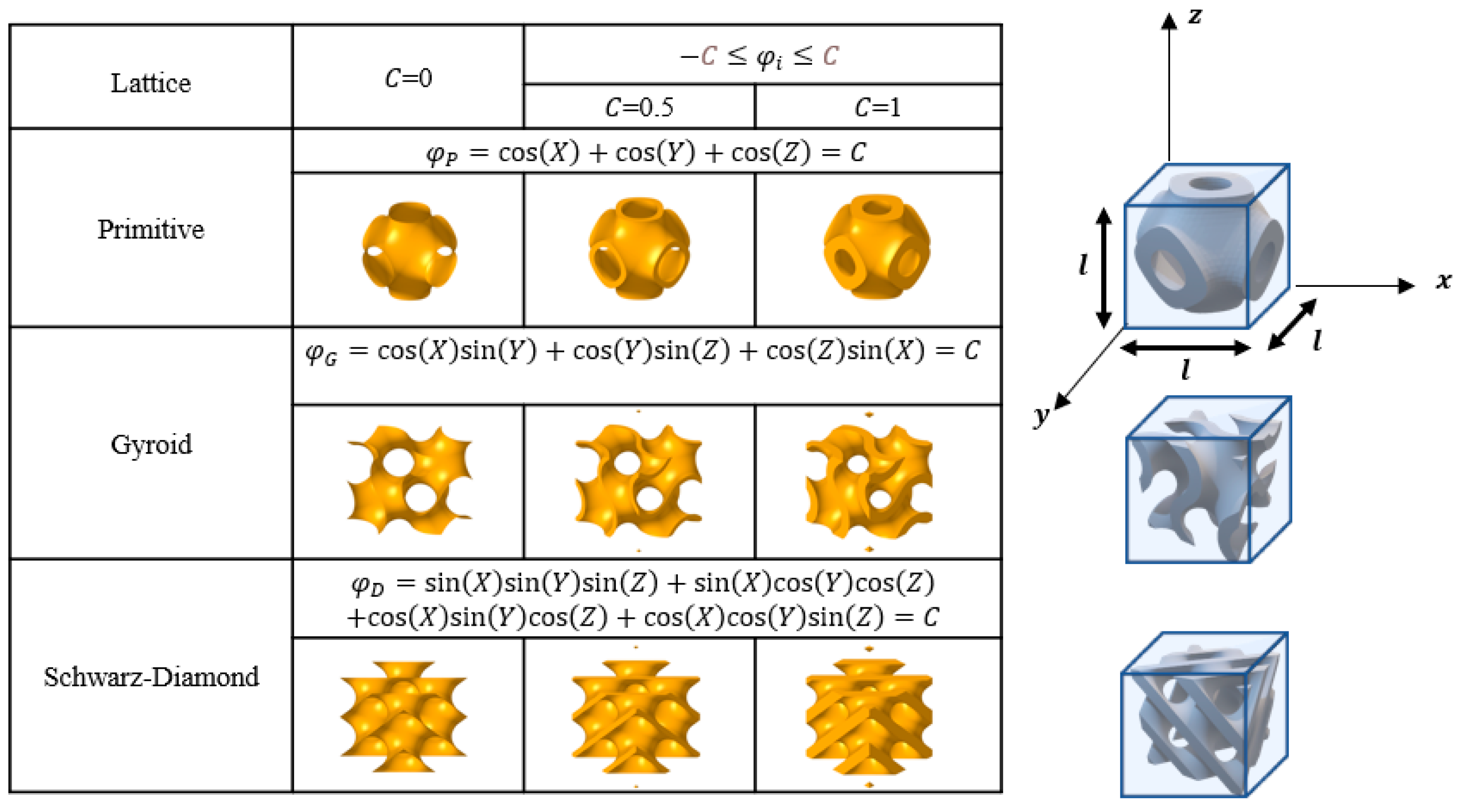
Mathematically, TPMS architectures can be defined through multiple approaches, including the parameter method, implicit function equation, and boundary method. Among these, the implicit function method is widely adopted in engineering modeling due to its intuitive implementation. To enhance modeling efficiency, an implicit level−set equation is employed to describe TPMS structures in this study, where is the offset constant. Previous studies have shown that shell−network TPMS lattices generally offer better mechanical performance than skeletal−based designs [32]. Accordingly, the TPMS units in this study are constructed as sheet−based lattices. The sheet−based structure is constructed by offsetting the TPMS isosurface by a defined thickness, ensuring that each unit cell exhibits high stiffness and strength.
As shown in Figure 1, three sheet−based TPMS lattices are presented: Primitive, Gyroid and Schwarz−Diamond. Where represents the implicit equation of TPMS, , and are constants related to cell size in the x, y, and z directions, respectively. This setting ensures that the period in each direction is exactly equal to the unit cell length . These structures exhibit different wall thicknesses at different values of . When , the structure corresponds to an isosurface in the Cartesian coordinate system; when , the structure refers to the solid region between the original isosurface offset by and along the normal direction.
Figure 1.
Sheet−based TPMS lattices under different values of C.
2.2. Gradient−Thickness Core Design Method
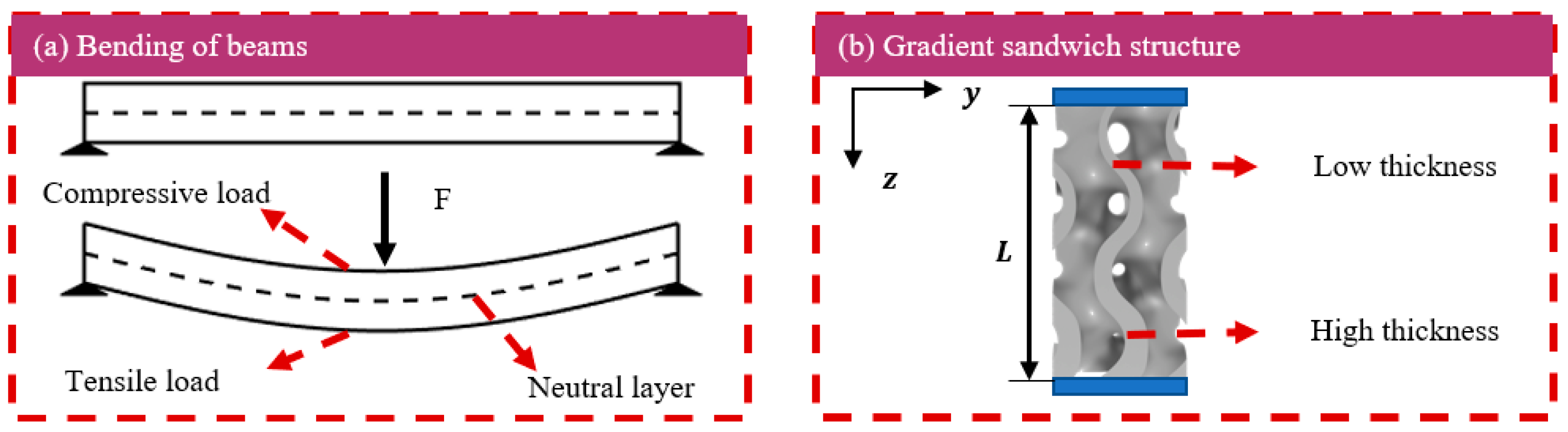
As shown in Figure 2, according to the neutral layer theory of beam bending, the upper region of the beam is subjected to compressive loads while the lower region bears tensile loads during the bending deformation process. Aiming at the mechanical characteristic that the tensile strength of brittle metallic materials is much lower than their compressive strength, designing the core into a gradient structure with a thinner upper region and a thicker lower region can effectively improve the local stiffness of the sandwich beam in a targeted manner.
Figure 2.
Inspiration for functionally graded design: (a) Three−point bending of simply supported beam. (b) Graded sandwich structure.
To achieve the spatial gradient distribution of wall thickness, this study introduces a gradient factor function, which is mainly used to adjust the global thickness of the core along the z−direction, as defined in Equation (1).
where represents the spatial coordinate in the vertical direction, is the gradient control coefficient (, and denotes the maximum structural dimension in that direction. When , the gradient factor reduces to unity, it corresponds to a homogeneous (non−graded) design. By substituting this factor into the offset parameter used in the implicit TPMS equation, with the downward direction defined as positive, the gradient offset constant that increases linearly from top to bottom can be expressed as Equation (2).
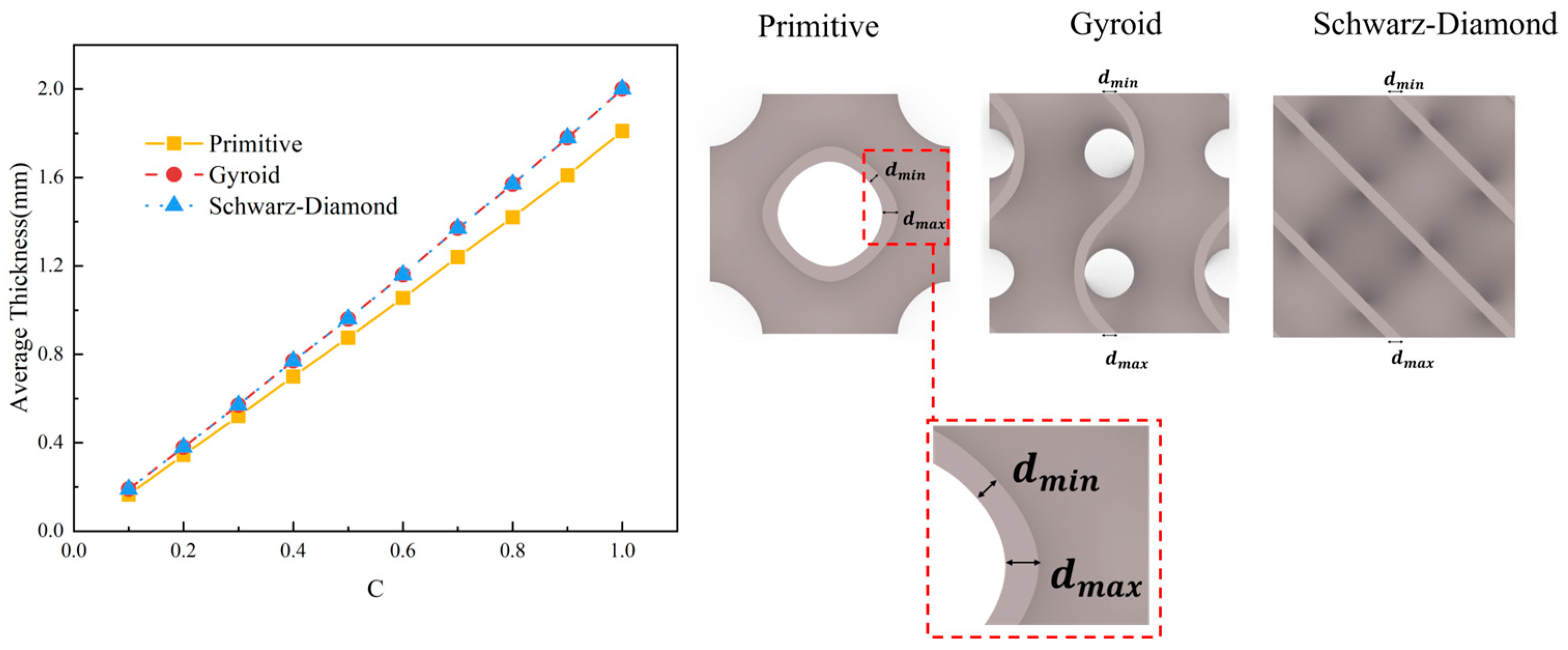
According to the research findings of Hong et al. [33], there is no definite quantitative relationship between parameter and wall thickness t due to the complexity of their topological relationship. However, the wall thickness t of the unit cell can be adjusted by changing . Figure 3 illustrates the quantitative relationship between the offset constant and average thickness, as well as the thickness relationships of three types of topological cells. The average thickness, regarded as the mean of the maximum and minimum thicknesses, is calculated according to Equation (3). It is worth noting that the maximum and minimum thicknesses of Gyroid and Schwarz−Diamond cells are equal because their topological structures exhibit continuity along the thickness normal direction.
Figure 3.
Calibration curves of offset constant and average thickness.
In order to convert the design concept of the core structure of the aforementioned functional gradient tire pressure monitoring system into a feasible three−dimensional printing manufacturing scheme, and to provide an accurate geometric model for the subsequent finite element mechanical analysis, the process of transforming from implicit function modeling to generating the core of the TPMS needs to be completed. This process can be realized on the Matlab R2023a platform, and the specific steps are as follows:
Firstly, based on the implicit function equations of each TPMS topology structure, a mathematical offset equation is constructed. As shown in Equation (4), the solution of this equation is , indicating the two spatial point sets after offset.
where is the implicit function equation, and is the gradient−dependent offset constant derived from Equation (2).
Next, extract the isosurfaces with a mean curvature of 0 via the isosurface function, and output the face matrices and vertex matrices for the two isosurfaces, as shown in Equation (5).
Among them, represents the face matrix and represents the vertex matrix.
Meanwhile, generate the capping matrices for the two offset isosurfaces via the isocaps function, as shown in Equation (6)
where and denote the face matrix and vertex matrix of the capping surfaces, respectively.
Merge the face and vertex matrices of the inner and outer offset surfaces with the capping matrices to form a complete closed cell matrix, as shown in Equation (7)
where and denote the face matrix and vertex matrix of the closed cell, respectively.
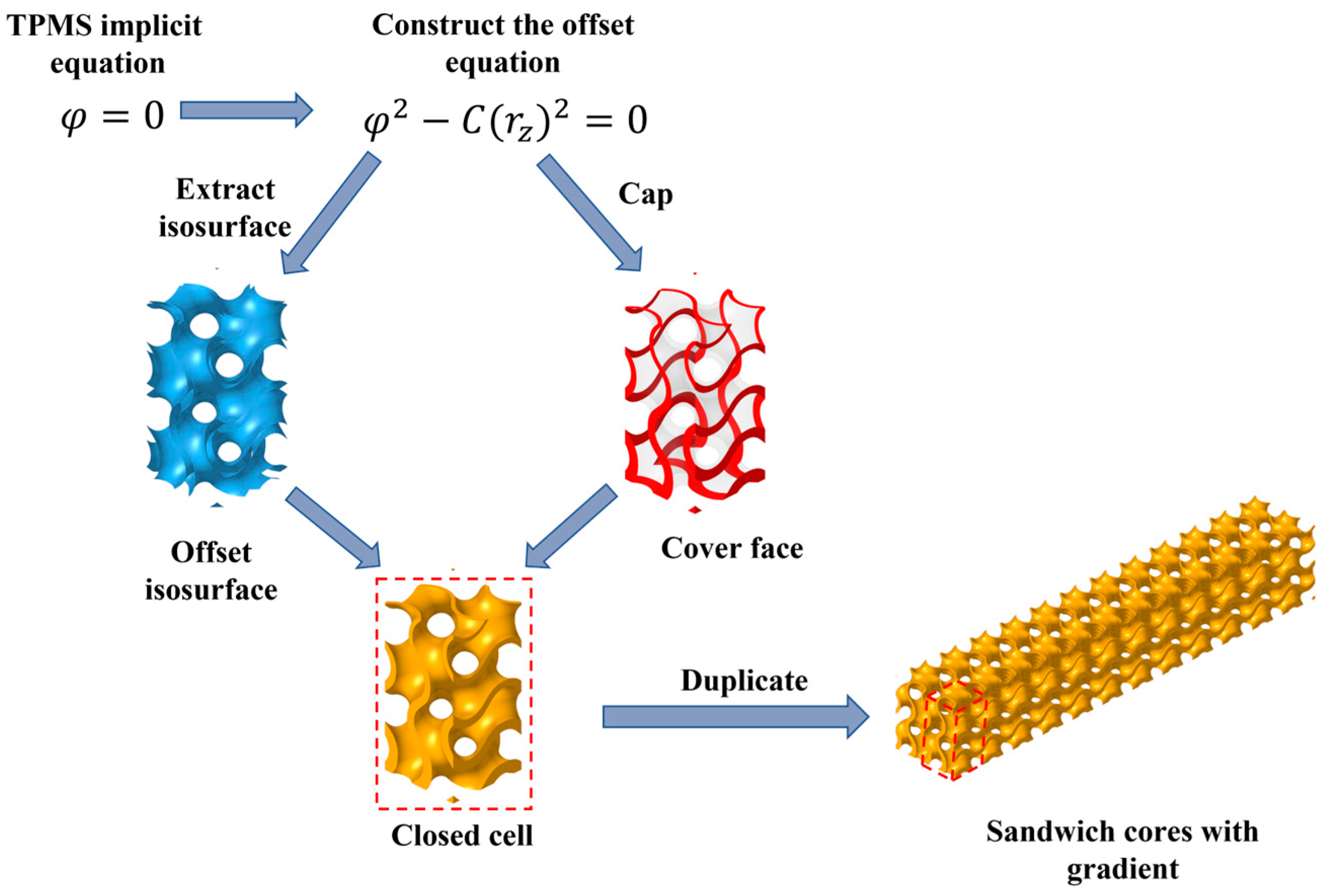
Finally, replicate and array the closed cells along the x and y directions to obtain the gradient−dependent TPMS core structure, with the formation process illustrated in Figure 4.
Figure 4.
Formation process of the thickness gradient TPMS cores.
2.3. Sandwich Structure Parameter Design and Model Construction
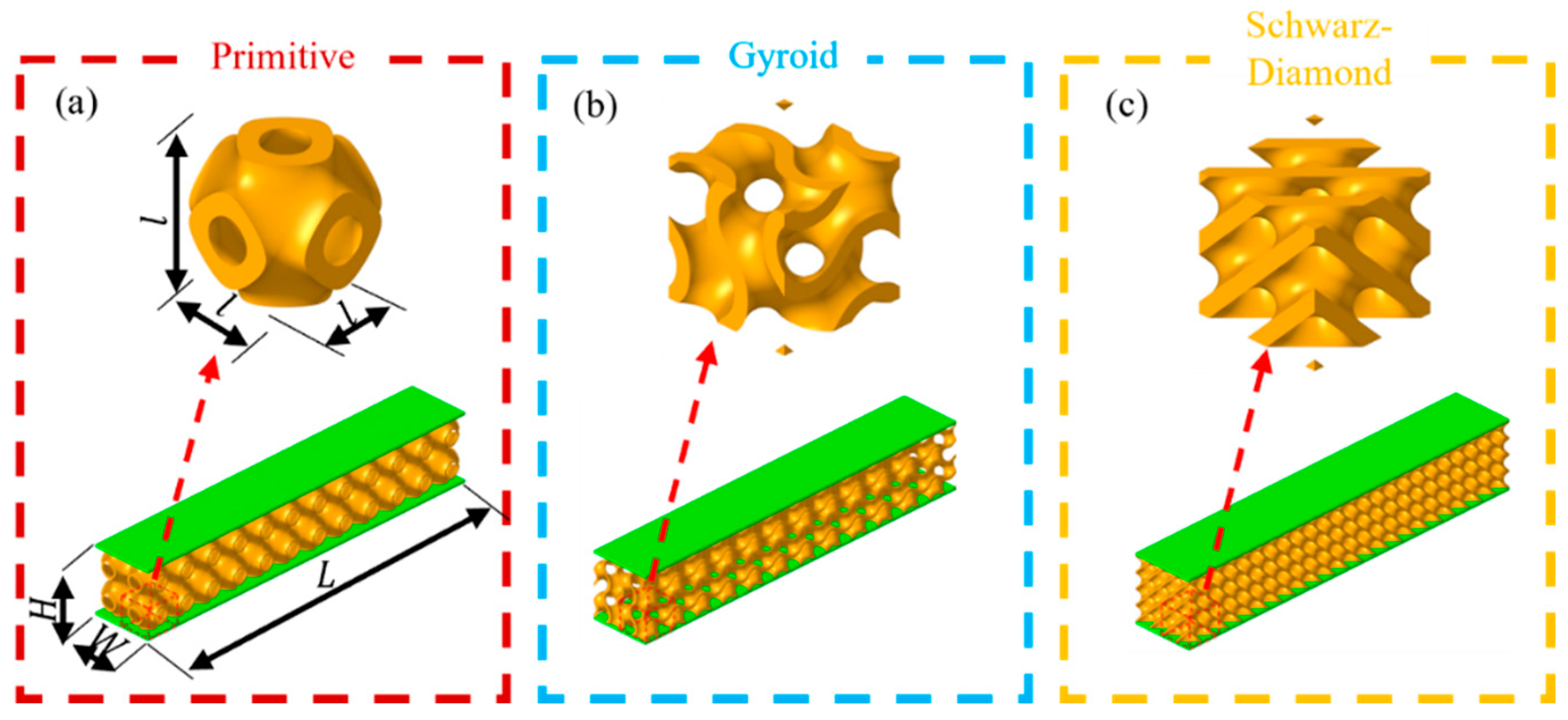
To clarify the functional mechanism of pore distribution on the bending performance of TPMS sandwich structures, this study designed a TPMS unit cell array with gradient pore distribution characteristics along the z−axis direction. The cross−sectional unit cells of this array were arranged in a 2 × 2 array pattern, with the side length of a single unit cell set to 12 mm; in view of the gradient variation characteristics of pore size along the z−axis direction, this structure was named single gradient sandwich structure (SGSS). A total of 12 unit cells were arranged along the x−axis (longitudinal direction), and upper and lower face sheets with a uniform thickness of 1 mm were configured synchronously. The final overall dimensions of the formed structure were 144 mm × 25 mm × 25 mm, and the specific structure is shown in Figure 5.
Figure 5.
Dimensions of TPMS sandwich structures: (a) Primitive sandwich; (b) Gyroid sandwich; (c) Schwarz−Diamond sandwich.
To accurately describe the pore distribution characteristics of the structure, two key parameters—relative density and porosity—are introduced. Among them, as a core intermediate parameter that correlates the topological structure with mechanical properties, the definition of relative density is given by Equation (8):
where is the volume of the TPMS solid, and is the volume of the enclosing cuboid.
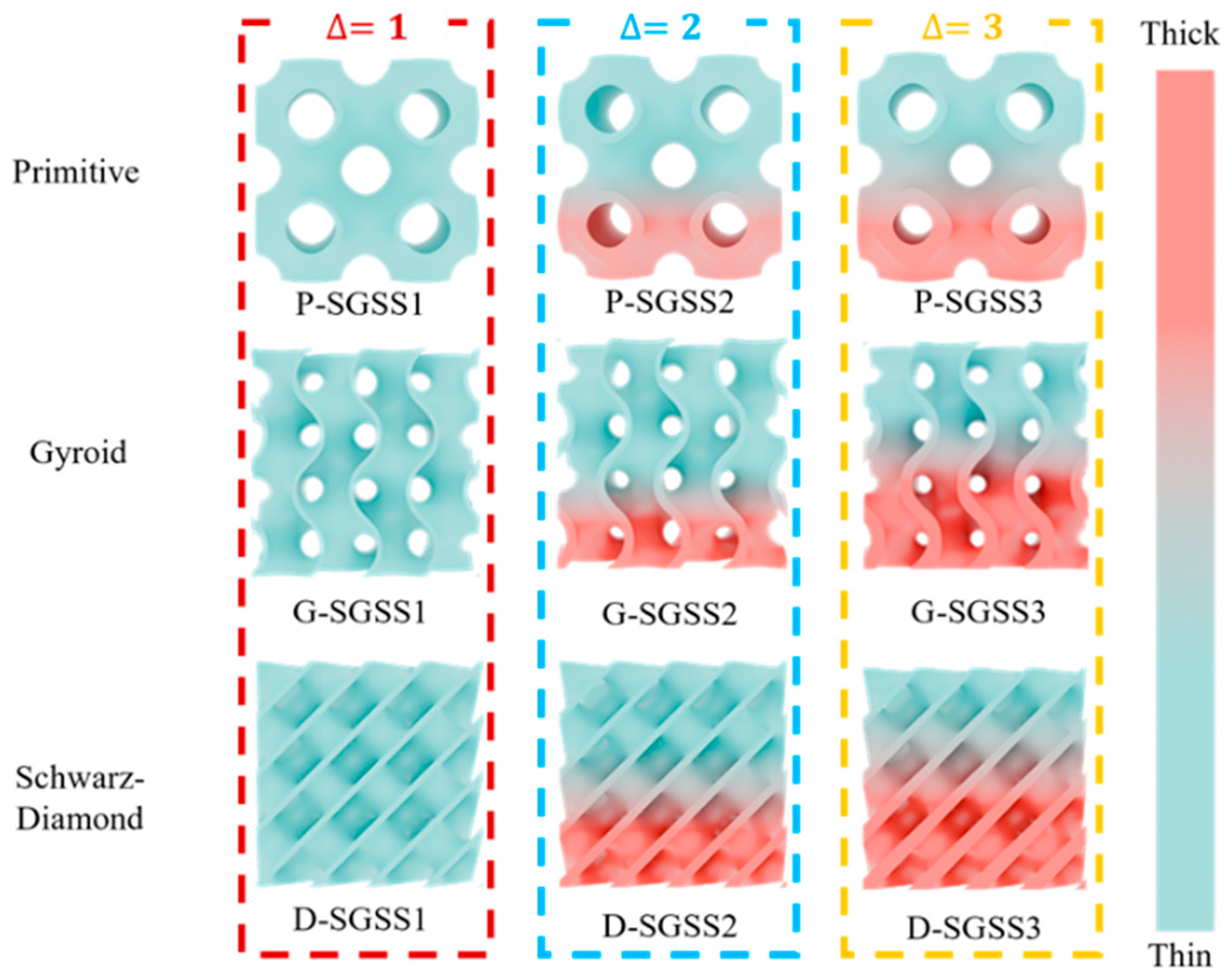
To investigate the effects of core topological type and gradient coefficient on the bending properties of TPMS sandwich structures, nine groups of control specimens were designed in this study, with specific parameters listed in Table 1. In the naming rule for each group of specimens, the first letter represents the core topological type, and the number corresponds to the equivalent gradient coefficient defined in Equation (9)—where a gradient coefficient of 1 corresponds to a homogeneous sandwich structure; the cross−sectional views of the core of each sandwich structure are shown in Figure 6.
Table 1.
Single gradient sandwich structure.
Figure 6.
Cross section of sandwich structure cores.
2.4. Bending Performance Indicators
In order to comprehensively evaluate the bending performance of graded TPMS sandwich structures, indicators such as bending stiffness, maximum load, and energy absorption are introduced to evaluate the bending performance of the structures.
- Bending stiffness
According to ASTM Standard C393 [34], for a mid−span loaded sandwich beam, the mid−span deflection can be calculated by Equation (10) when the face sheet shear effect is taken into consideration:
where is the applied load, is the span length, is the face sheet bending stiffness. For identical top and bottom face sheets, can be calculated by Equation (11). is the face sheet shear stiffness, which can be calculated by Equation (12):
where is the face sheet modulus, is the thickness of the sandwich beam, is the core thickness, is the width of the sandwich beam, and is the core shear modulus.
By combining Equations (10)–(12), the bending stiffness can be derived as Equation (13)
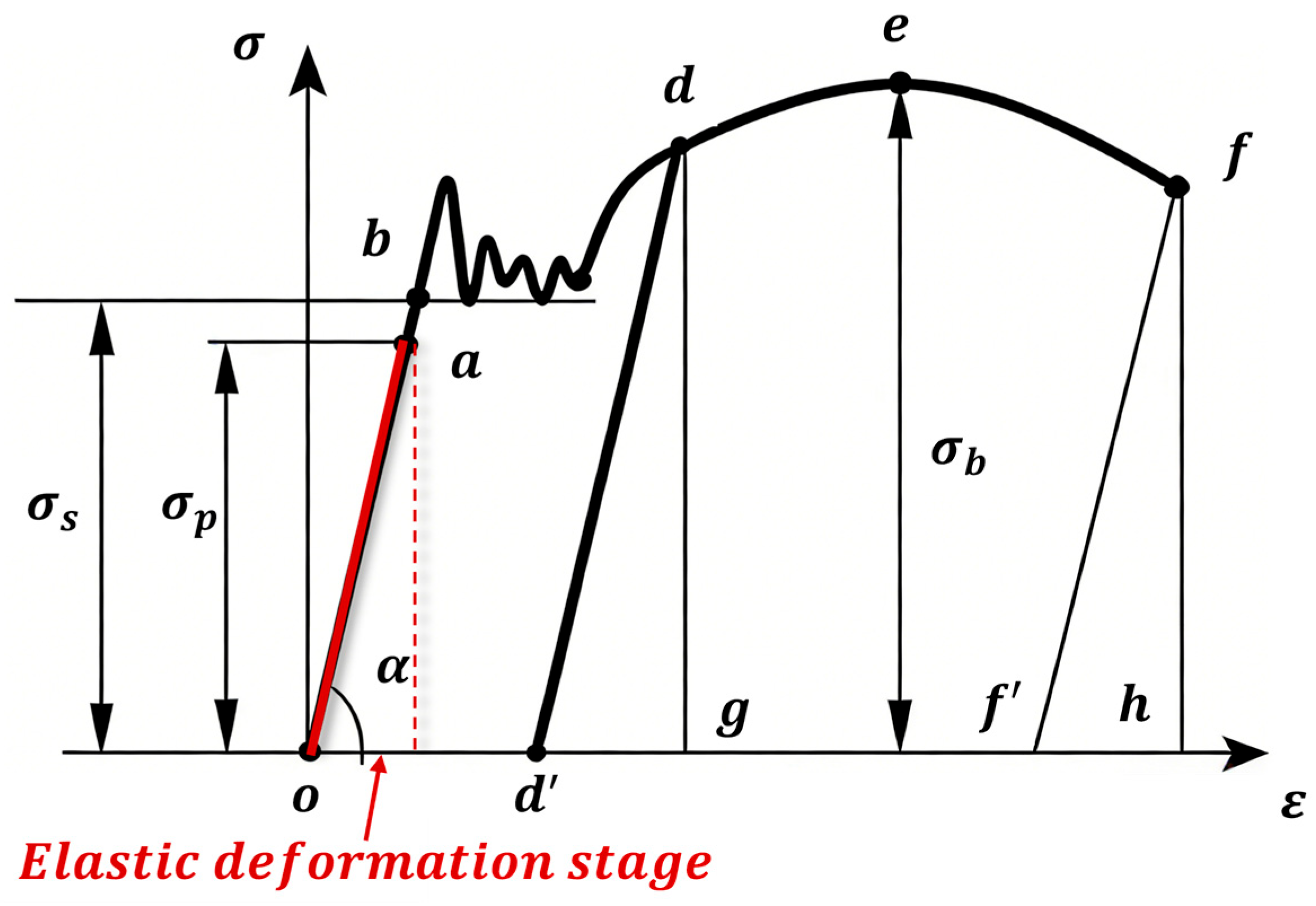
In this numerical solution, the core shear modulus is unknown. Researchers typically fit semi−empirical formulas using the Gibson–Ashby model for porous materials. Since this prediction formula requires fitting with extensive sample dataset, it is not considered in the present study. In the numerical simulation, the stiffness is defined as the slope of the elastic stage on the force–displacement curve, as shown in Equation (14) and Figure 7.
Figure 7.
Fitting interval of the elastic deformation stage.
Because of the differences in TPMS topologies, their masses are not equal even at the same gradient coefficient of 1. To distinguish between the density−driven effect and the topology−driven effect, the specific stiffness is thus introduced, whose definition is given by Equation (15).
where m denotes the mass of the sandwich structure.
- 2.
- Maximum load
Maximum load is the maximum peak force that a structure can withstand throughout the entire process from elastic deformation to final failure.
- 3.
- Energy absorption (EA)
Energy absorption refers to the total energy absorbed during deformation, which can be obtained by integrating the force–displacement curve, as expressed in Equation (16):
where represents the load in the three−point bending test, and represents the displacement at the mid−span loading point. In this study, the first 5 mm of deformation within the elastic stage was selected as the integration interval. In this stage, no damage occurs and the degree of deformation is minimal. It is suitable for analyzing the variation of energy [29].
3. Specimen Preparation and Experimental Testing
3.1. SLM Additive Manufacturing and Specimen Preparation
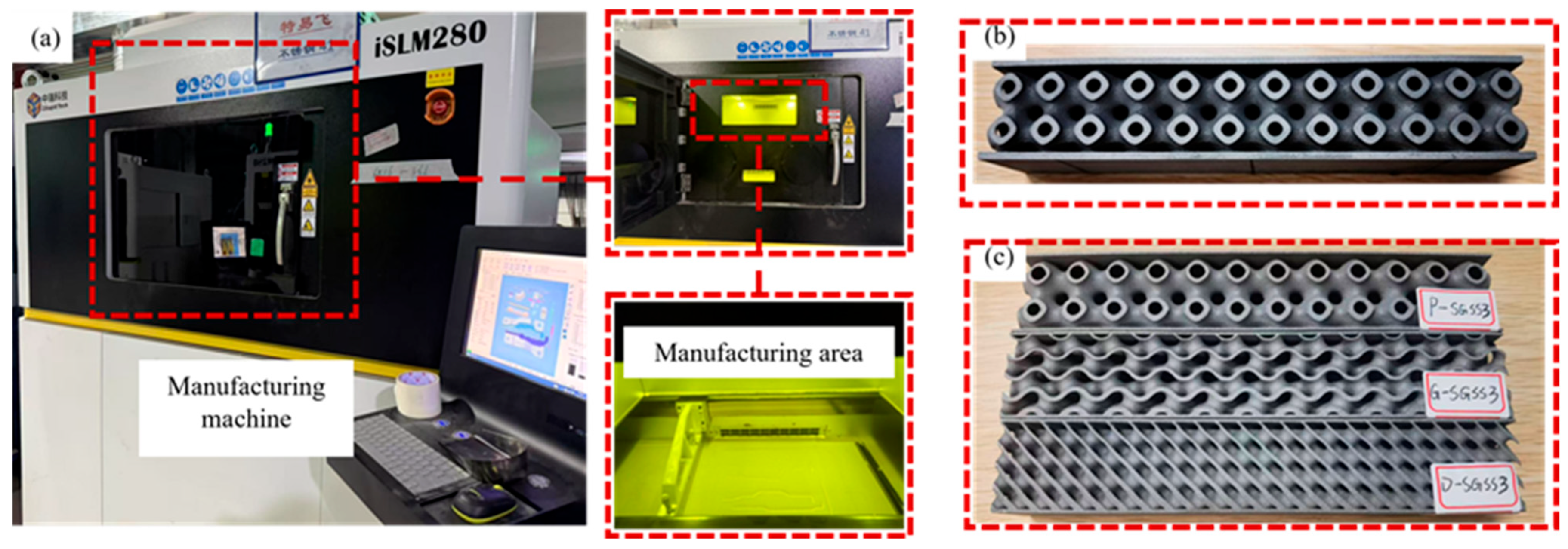
In this study, specimens were fabricated using selective laser melting (SLM) technology with 316L stainless steel powder as the feedstock. To achieve the geometric configurations of the target TPMS lattices, three−dimensional models were constructed in MATLAB and exported in the stereolithography (STL) format. The above STL files were processed via commercial slicing software to complete layer−wise scan path planning and process parameter configuration. The generated toolpath data were then transmitted to the control system of the ZRapID iSLM 280 printer(ZRapid Tech, Suzhou, China) for additive manufacturing forming. Figure 8 schematically illustrates this fabrication workflow, and Table 2 summarizes the key processing parameters used in the experiments. First, Primitive−type homogeneous bending specimens were fabricated, with a plate thickness of 2 mm and an initial unit cell thickness of 2 mm (see Figure 8b); this dimension is applicable to large bending behavior. Subsequently, three types of graded sandwich structure specimens with Primitive, Gyroid, and Schwarz−Diamond as the core layers were further fabricated (see Figure 8c), its dimensions are consistent with the design dimensions mentioned in Section 2.
Figure 8.
Manufacturing and specimens: (a) Manufacturing machine. (b) Primitive uniform specimen. (c) Gradient specimens.
Table 2.
SLM print parameters.
3.2. Material Quasi−Static Tensile Test
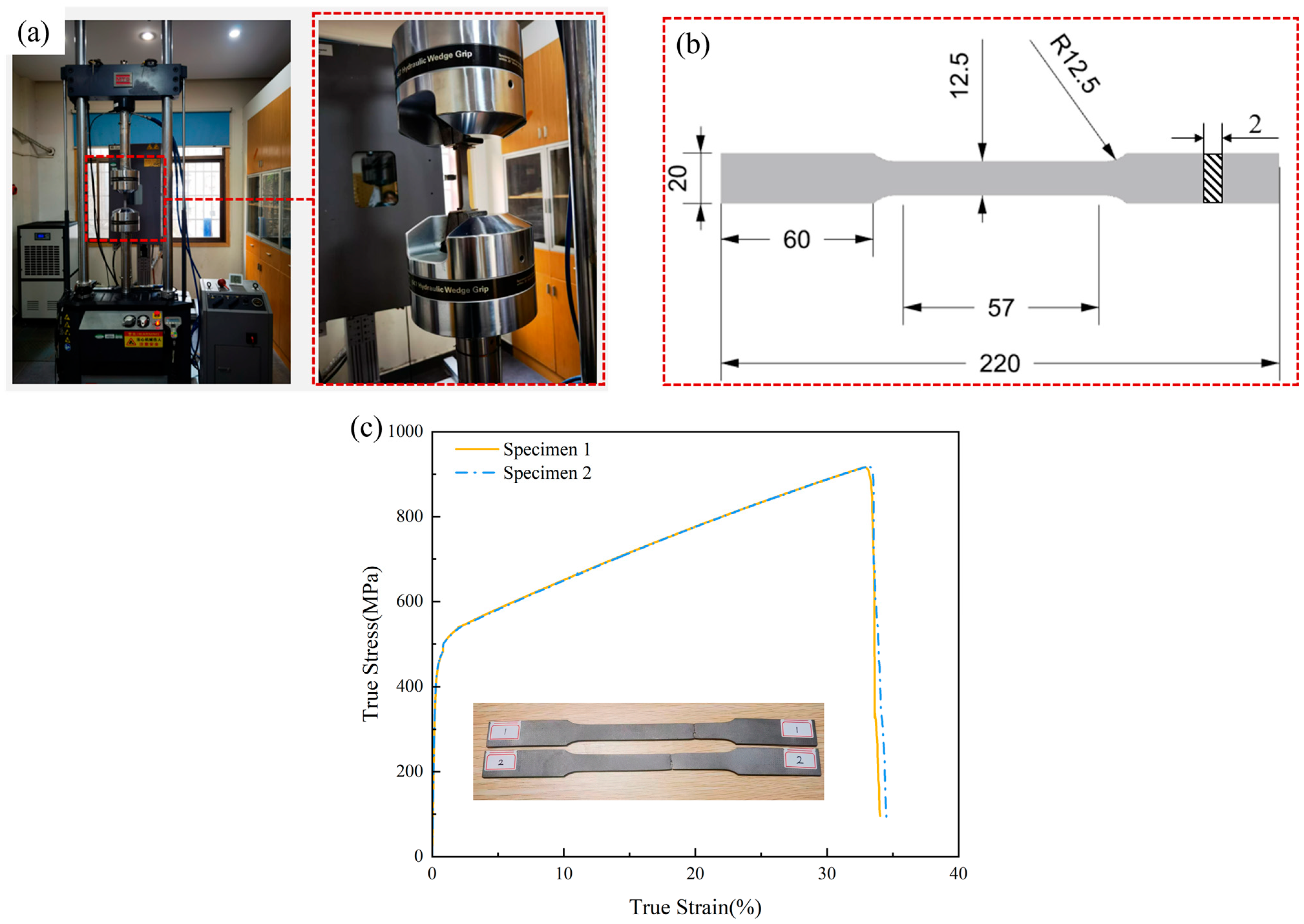
In order to assess the quasi−static mechanical characteristics of the 316L stainless steel, standard dog−bone tensile specimens were created and constructed in compliance with ASTM E8/E8M [35]. Figure 9b displays the specimens’ geometric measurements. To ensure that the measured properties are typical of the actual printed material, the tensile samples were created using the same SLM process parameters as those used for the TPMS lattice structures.
Figure 9.
Material tensile test: (a) MTS Landmark material testing machine. (b) Standard tensile test specimen. (c) True stress–strain curve of 316L.
After manufacturing, uniaxial tensile tests were conducted at room temperature with a loading rate of 2 mm/min using MTS Landmark universal testing equipment. The test was conducted with constant monitoring of the stress–strain response. Two replication experiments were performed for each type of specimen to minimize random error.
As seen in Figure 9c, the engineering stress–strain data from the tensile tests were transformed into real stress–strain curves using Equations (17) and (18). These curves were utilized to obtain the properties of the constitutive material. Specimens 1 and 2 were found to have comparable values for both elastic modulus and yield strength when the test results were compared. As a result, the representative actual stress–strain response of the 316L stainless steel used in this investigation was selected to be the average curve of these two samples. Table 3 presents a summary of the relevant mechanical performance parameters. These data represent the average of two quasi−static tensile tests for 3D−printed tensile specimens. They provide precise input information for the numerical simulation of the TPMS prism structure.
Table 3.
Mechanical parameters of stainless steel 316L.
3.3. Three−Point Bending Experiment
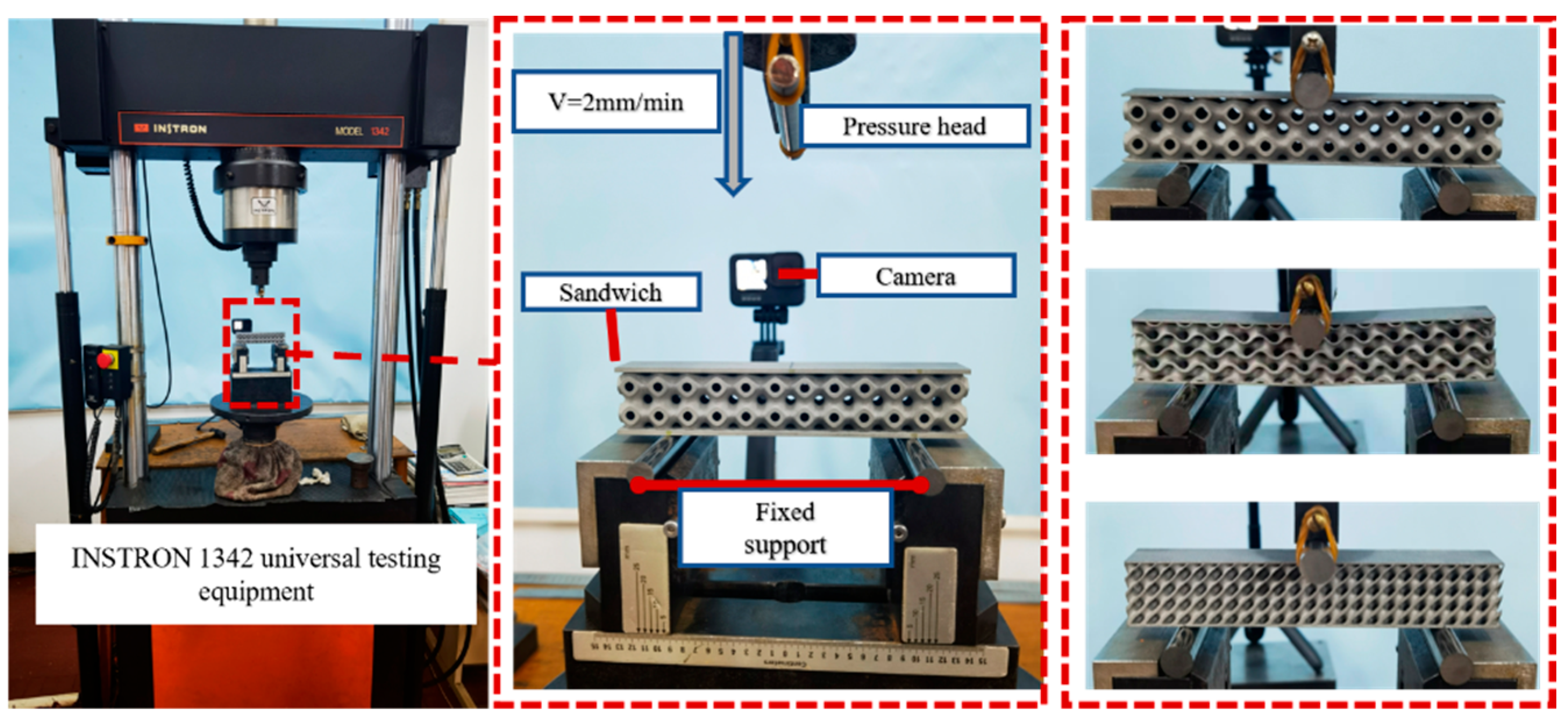
To evaluate the bending behavior of 3D−printed TPMS sandwich structures, this study conducted three−point bending tests in accordance with the ASTM C393 standard, which has been proven applicable for the testing of sandwich structures. The tests were performed on an Instron 1342 universal testing machine(Instron, MA, America) equipped with a 30 kN force sensor, where the printed specimens were loaded at a displacement rate of 2 mm/min until failure, and a preload of 1 N was applied prior to the tests. Considering the need to investigate the core shear strength of the sandwich structures, the test span was set to a sufficiently short dimension to ensure that the core failed due to shear loading before the face sheets fractured. Thus, the span was determined to be 100 mm in this study, a method that has been proven feasible by other researchers [29]. As shown in Figure 10, the load was applied through a central cylindrical roller with a diameter of 10 mm in the tests, and the specimens were supported underneath by two cylindrical rollers of the same diameter with a spacing of 100 mm between them.
Figure 10.
Three−point bending experiment.
4. Establishment and Verification of FE Model
4.1. Establishment of FE Model
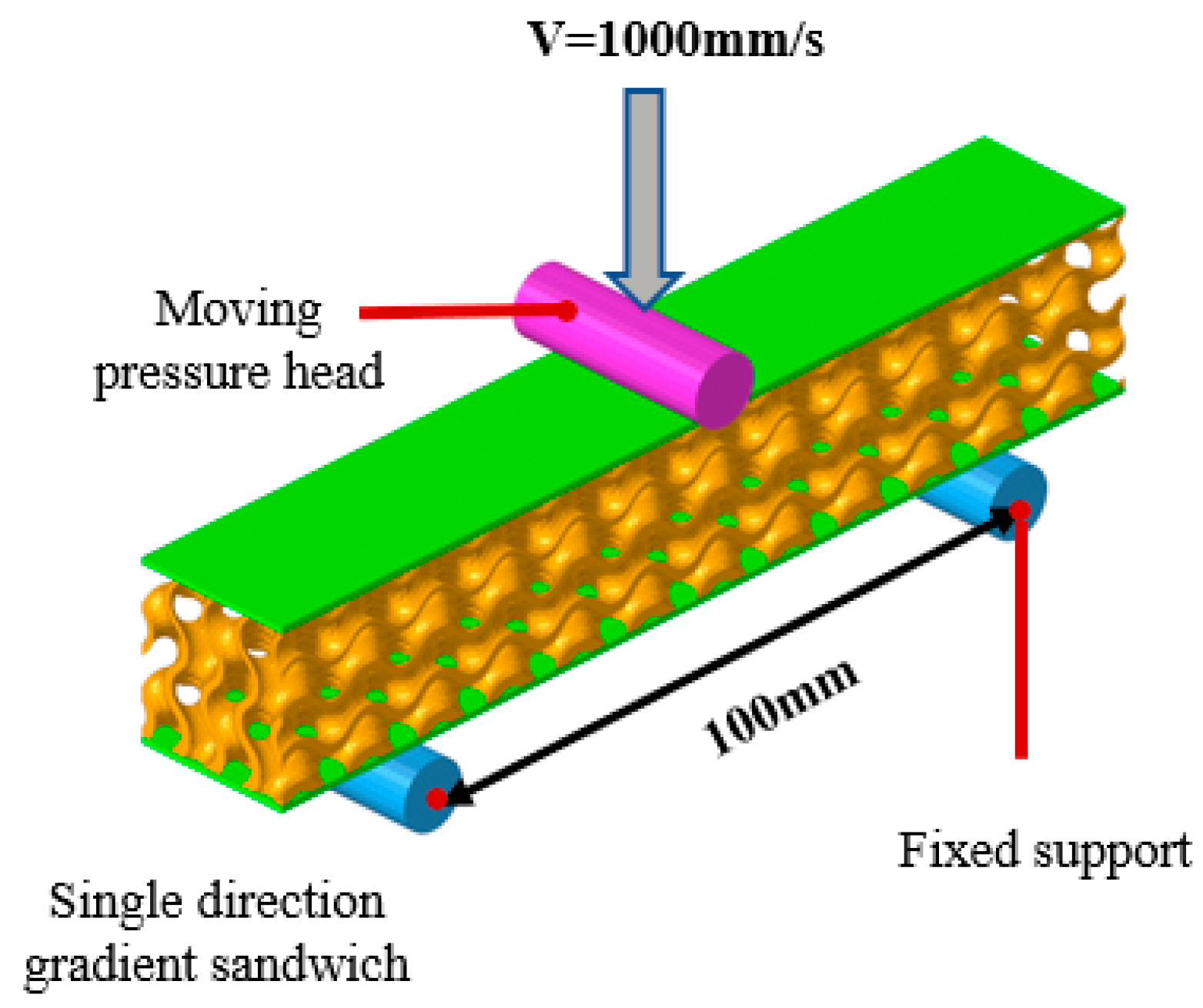
This section examined the bending response of graded TPMS sandwich structures under various loading rates using numerical simulations and experimental validation. The LS−DYNA explicit dynamics solver and HyperMesh for preprocessing were used. The TPMS core was given the MAT_24 material model (piecewise linear plasticity) in the finite element model, which accounts for elastic−plastic behavior. MAT_20 was used to model the loading indenter and supports as rigid bodies. Four−node tetrahedral elements (tet4) were used to discretize the TPMS core, while eight−node hexahedral elements (hex8) were used to mesh the face sheets, indenter, and supports. In order to precisely capture contact and sliding behavior, automatic surface−to−surface contact was defined between the structure and the indenter and supports. The TPMS core was connected to the face sheets via node−to−surface coupling. The coefficients of static and dynamic friction were established as 0.3 and 0.2, respectively. The indenter applied a 24 mm downward displacement at a constant speed at the mid−span of the upper face sheet, while the two support rollers were completely limited for boundary conditions. The finite element model is illustrated as Figure 11.
Figure 11.
FE model of TPMS sandwich structure.
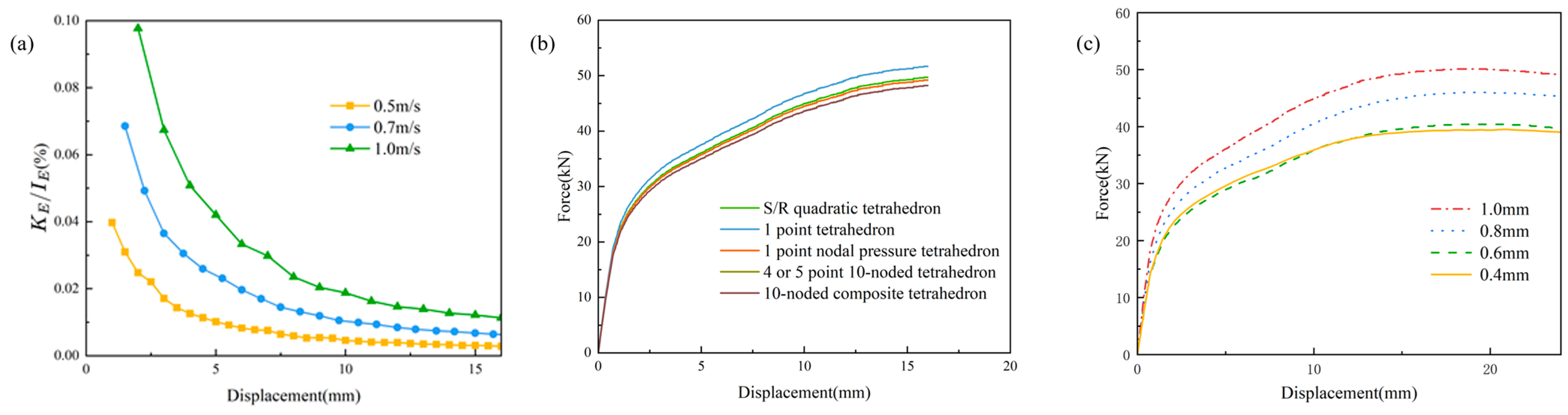
Figure 12a depicts the variation in the ratio of kinetic energy to internal energy of the sandwich structure with displacement under different loading velocities. With the adoption of mass scaling, the results demonstrate that the ratio remains below 0.1% throughout the entire bending process, which is far lower than the 5% threshold and exhibits no significant fluctuations. This fully verifies that the simulation results under an appropriately increased loading velocity are free from rate artifacts and conform to quasi−static characteristics. To improve computational efficiency, mass scaling was employed to set the minimum time step to −6 × 10⁻⁸ s, with the percentage of mass increase kept below 5%. A viscous damping coefficient of 15 was assigned to the contact interface to suppress oscillations at the contact surface. The Flanagan−Belytschko global hourglass control was adopted, which effectively inhibits the zero−energy mode and prevents hourglass distortion of the lattice structure. Finally, a loading velocity of 1 m/s was used in this study, a method that has been proven feasible [36].
Figure 12.
Loading velocity and mesh convergence analysis: (a) variation of kinetic energy to internal energy ratio; (b) comparison of different mesh element algorithms (1.0 mm mesh); (c) mesh convergence analysis.
To determine a suitable tetrahedral element algorithm, five commonly used tetrahedral element algorithms in LS−DYNA were selected for simulation analysis in this study; the force–displacement curves of each algorithm at a fixed mesh size of 1 mm are shown in Figure 12b. The 1 point tetrahedron yielded an overpredicted load value, which was caused by its excessive stiffness and volumetric locking. The 4/5−point 10−noded tetrahedron and 10−noded composite tetrahedron are high−precision tetrahedral element algorithms widely recognized in academia, yet they require an excessively long computation time. The S/R quadratic tetrahedron exhibited a performance between the above two types, which can strike a balance between computational accuracy and efficiency, with the deviation of its maximum predicted load being less than 3% relative to the two high−order algorithms. Thus, the S/R quadratic tetrahedron was selected as the tetrahedral element algorithm for the simulations in this study. For the hexahedral elements of components such as the indenter and supports, the full integration algorithm was adopted to prevent hourglassing.
To determine a suitable mesh resolution, a mesh convergence analysis was conducted in this study using four different element sizes (0.4 mm, 0.6 mm, 0.8 mm and 1.0 mm). Figure 12c presents the corresponding load–displacement curves obtained from simulations under a constant loading velocity of 1 m/s. The results show that for the same displacement, the simulated predicted load decreases continuously as the mesh size is refined from 1.0 mm to 0.4 mm. When the mesh size is further refined from 0.6 mm to 0.4 mm, the maximum load deviation between the two is less than 5%. Considering the balance between computational accuracy and computational cost, 0.6 mm was ultimately selected as the mesh size for all simulations in this study. The numbers of nodes and elements after finite element discretization for the nine designed working conditions are presented in Table 4.
Table 4.
Total number of nodes and elements in FE model.
4.2. Verification of FE Model
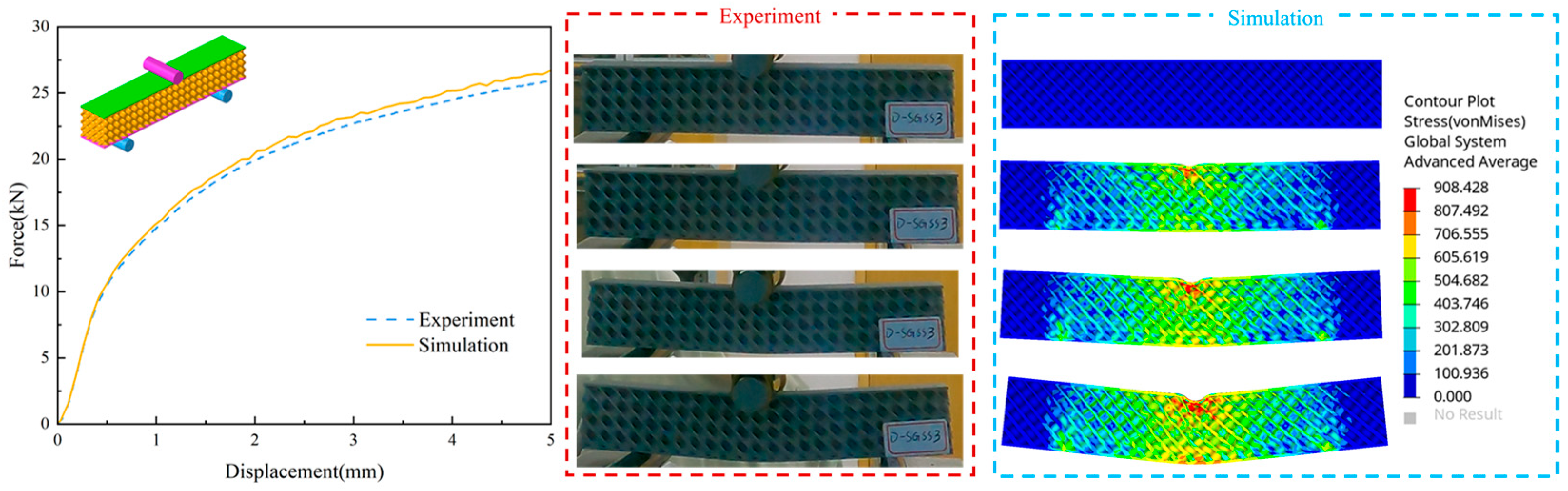
To evaluate the accuracy and dependability of the finite element model, a uniform Primitive sandwich structure was used for comparison. The three−point bending test was carried out on an INSTRON 1342 universal testing equipment(Instron, MA, America) in accordance with ASTM C393 [34]. The setup included a fixed span of 100 mm, with both the supports and indenter having a diameter of 10 mm.
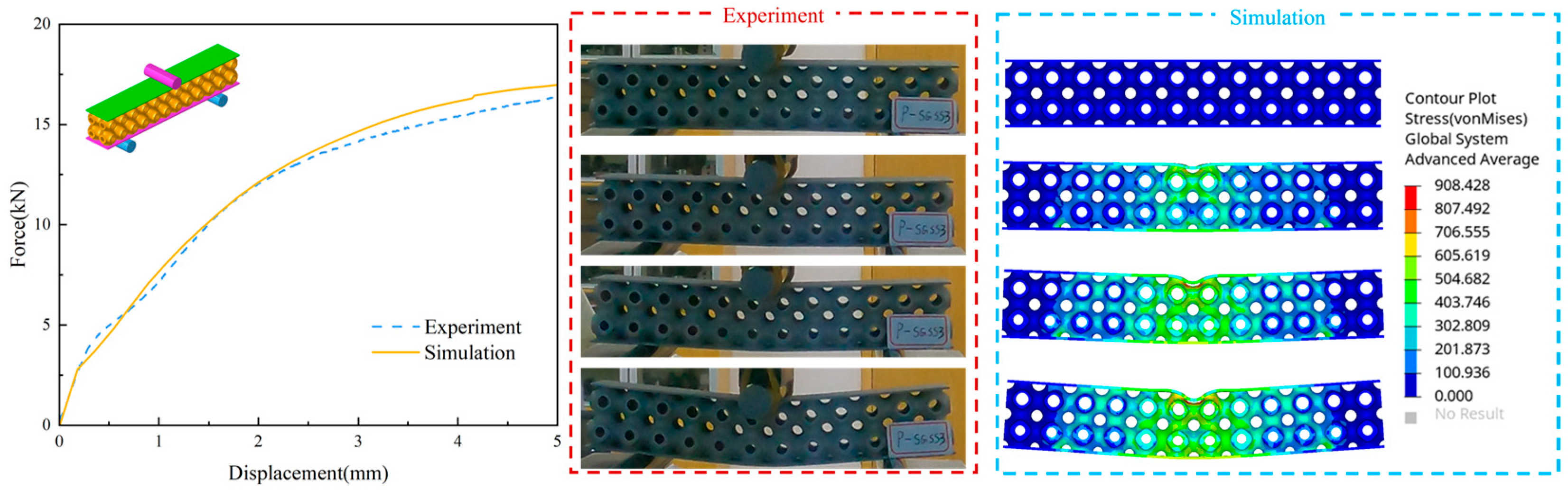
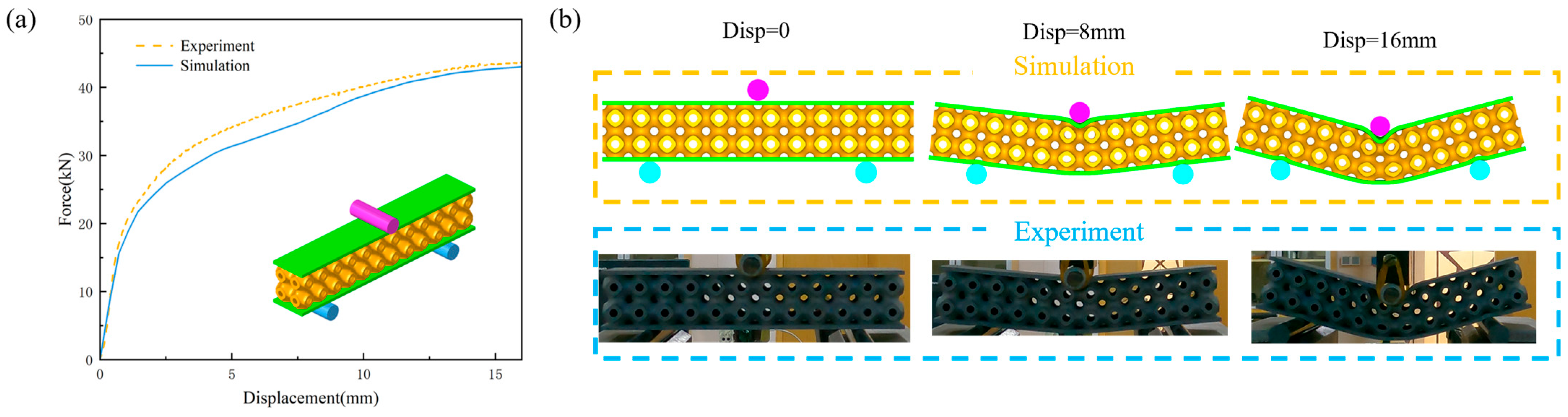
Figure 13a presents the load–displacement response of the structure. In the initial elastic regime, excellent agreement is observed between the experimental and simulated curves. As displacement increases, the simulation slightly underestimates the load compared to the experimental results; however, the maximum deviation remains within 7.9%, well under the acceptable threshold of 10%.
Figure 13.
Comparison of simulation experiments: (a) Force–displacement curve. (b) Deformation process of simulation and experiment.
As shown in Figure 13b, the bending deformation behavior captured by the simulation is highly consistent with that observed experimentally. Both reveal a similar hierarchical deformation pattern, with tensile deformation occurring in the lower TPMS cells and compressive deformation in the upper cells.
In conclusion, the constructed three−point bending FE model exhibits high prediction accuracy and resilience, making it suitable for further parametric investigations and performance evaluations.
5. Result and Discussion
5.1. Experimental Results of Different Topological Cores
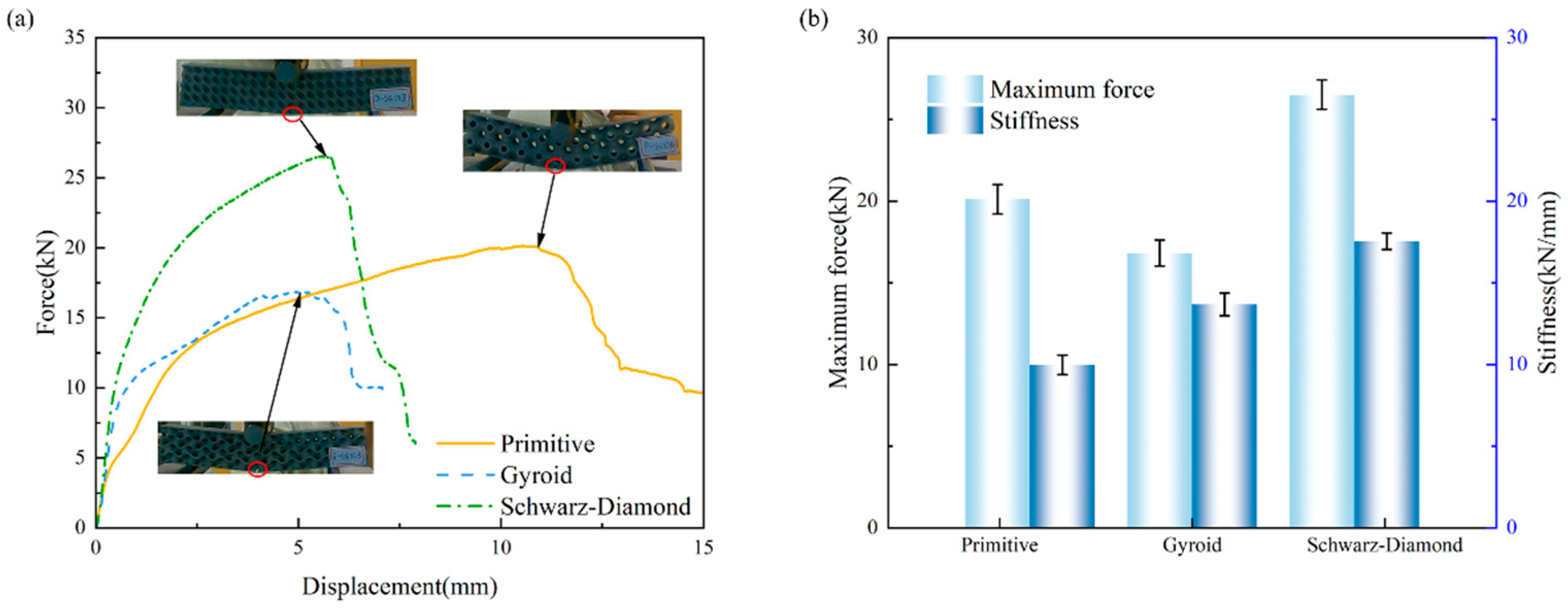
Figure 14 presents the load–displacement curves, peak forces, and flexural stiffness of 3D−printed TPMS sandwich structures with three topological cores: Primitive, Gyroid, and Schwarz−Diamond, obtained from three−point bending tests. Results indicate that the topological structure of the core has a significant influence on the flexural mechanical response of TPMS sandwich structures: under three−point bending conditions, the TPMS sandwich structure with a Schwarz−Diamond core exhibits slightly higher peak force and flexural strength than the other two topological configurations, and distinct differences in flexural stiffness are also observed among the three; in contrast, the TPMS sandwich structure with a Primitive core demonstrates significantly superior ductility compared to those with Gyroid and Schwarz−Diamond cores. This phenomenon has also been observed in the study by Peng et al. [29], which can be attributed to its unique topological characteristics and mechanical behavior mechanisms: during the bending process, the core units of the Primitive structure undergo predominantly progressive beam bending and buckling deformation, corresponding to a typical ductile failure mode that enables continuous energy absorption during deformation, whereas the Gyroid and Schwarz−Diamond cores are prone to brittle fracture of beams or global collapse of the core, leading to a rapid drop in load after failure and significantly limited ductility.
Figure 14.
Three−point bending test results of gradient sandwich structures: (a) force–displacement curves; (b) peak force and stiffness.
5.2. Comparison Between Numerical and Experimental Results
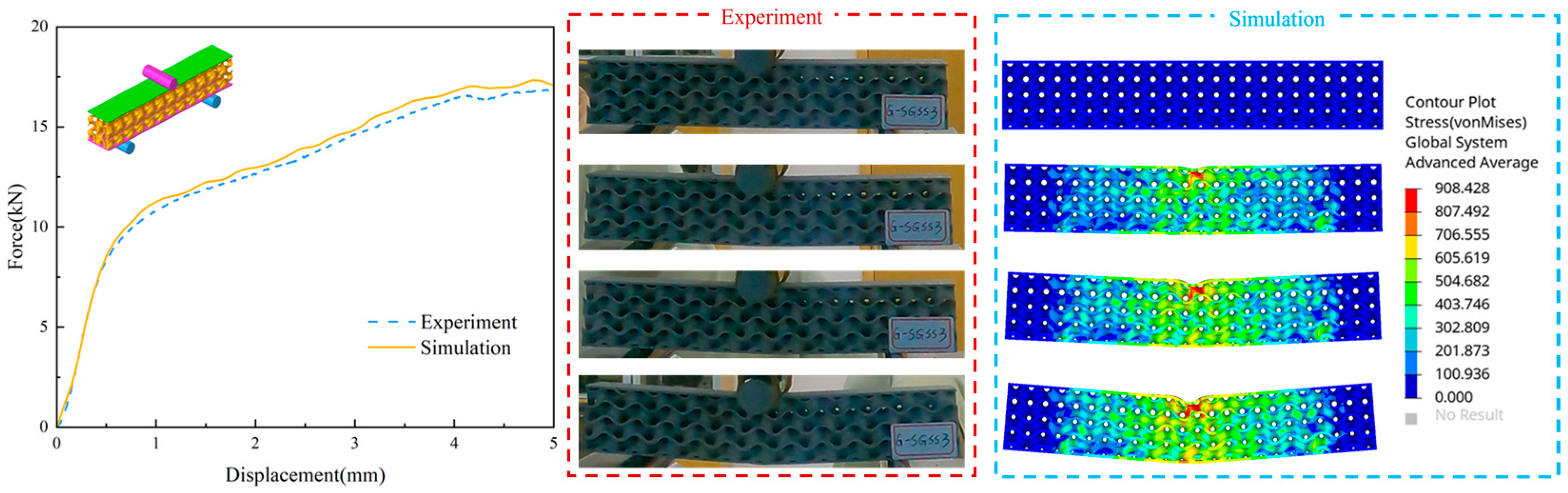
Figure 15 compares the load–displacement curves, deformation processes, and stress nephograms of Primitive core sandwich structures under three−point bending conditions, incorporating data from both experimental tests and numerical simulations. In terms of the load–displacement curves, the experimental and simulation results exhibit good overall agreement, with the simulation results slightly higher than the experimental values. Such discrepancies may be jointly attributed to specimen manufacturing defects, imperfect core–face bonding, friction uncertainty, boundary irregularities, and differences in simulation loading rates; the deformation processes of the two also show high consistency. Analysis of the simulated stress nephograms indicates that during the initial 5 mm deformation stage, the stress concentration of the Primitive core sandwich structure is mainly concentrated in the core of the upper loading area. This phenomenon is dominated by the interlaminar shear effect between cells, and the overall stress distribution of the structure is uniform without obvious signs of failure.
Figure 15.
Comparison between experimental and simulation results of three−point bending tests for Primitive core sandwich structures.
Figure 16 presents the load–displacement curves, deformation processes, and stress nephograms of Gyroid core sandwich structures under three−point bending conditions, with data derived from both experimental tests and numerical simulations. The load–displacement curves of the experiment and simulation show high consistency in the elastic stage, while in the plastic stage, the simulation load values are slightly higher than the experimental results. This deviation is mainly due to the higher loading speed set in the simulation compared to the actual experimental value. During the initial 5 mm displacement stage, the deformation processes of the two also maintain good consistency. In−depth analysis of the simulated stress nephograms reveals that: at the initial stage of loading, stress concentration first appears in the core of the upper loading area, and this concentrated area gradually expands with increasing displacement. This phenomenon is mainly caused by the interlaminar compression deformation effect; as the loading displacement continues to increase, a new stress concentration point gradually forms in the middle area of the lower sandwich panel, whose origin lies in the tensile effect borne by the bottom plate. Considering that the tensile strength of 316L stainless steel is relatively low, the bottom plate of the structure exhibits a significant tendency towards tensile fracture failure, which is consistent with the final bottom plate fracture observed in the experiment.
Figure 16.
Comparison between experimental and simulation results of three−point bending tests for Gyroid core sandwich structures.
Figure 17 shows the load–displacement curves, deformation processes, and stress nephograms of Schwarz−Diamond core sandwich structures under three−point bending conditions, including data obtained from experimental tests and numerical simulations. Similar to the trend observed for the Gyroid core sandwich structure, the load–displacement curves of the experiment and simulation are highly consistent in the elastic stage, while in the plastic stage, the simulation load values are slightly higher than the experimental results, and the deformation processes of the two also maintain high consistency. Interpretation of the simulated stress nephograms reveals that: at the initial stage of loading, stress concentration first emerges in the core of the upper loading area, and this concentrated area continuously expands with increasing loading displacement. This phenomenon is mainly induced by the interlaminar compression deformation effect; as the displacement further increases, a new stress concentration point gradually forms in the middle of the lower sandwich panel. This stress concentration originates from the tensile load borne by the bottom plate, which in turn makes the bottom plate more prone to tensile fracture failure—consistent with the final bottom plate fracture result in the experiment.
Figure 17.
Comparison between experimental and simulation results of three−point bending tests for Schwarz−Diamond core sandwich structures.
5.3. Influence of Gradient Coefficient on Bending Performance
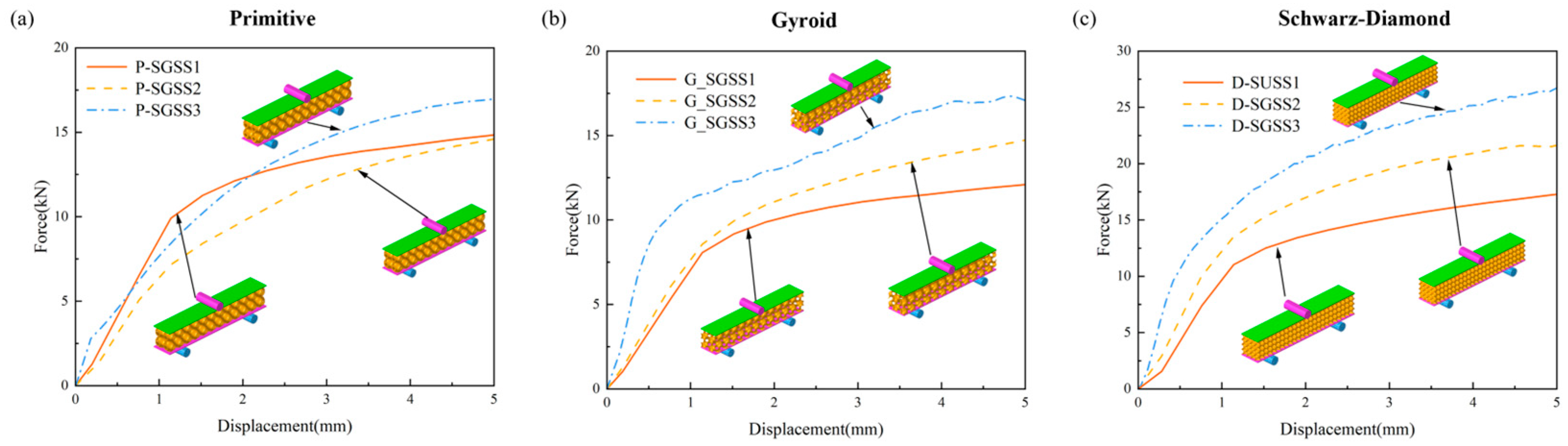
To investigate the influence of gradient design on the flexural mechanical properties of TPMS sandwich structures, this study conducted numerical simulation analyses on sandwich structures with three different gradient coefficients. Figure 18 presents the load–displacement response curves of gradient sandwich structures with three topological cores: Primitive, Gyroid, and Schwarz−Diamond. As indicated by the curves, in the initial elastic deformation stage, the flexural stiffness of the structure increases with the increase in the gradient coefficient. It is noteworthy that the Primitive core gradient sandwich structure exhibits a unique trend: the structure with a gradient coefficient of 1(P_SGSS1) has higher strength than that with a gradient coefficient of 2(P_SGSS2). This is attributed to the fact that the Primitive core adopts a single−continuous network topology, and its energy absorption depends on the synergistic plastic deformation of cells: the uniform structure with a gradient coefficient of 1(P_SGSS1) has consistent unit parameters, resulting in uniform stress distribution and synchronous plastic deformation of cells under bending, whereas the non−uniform structure with a gradient coefficient of 2(P_SGSS2), despite local thickening, has uneven core stiffness distribution. The thick−walled cells are difficult to undergo plastic deformation, while the thin−walled cells experience concentrated deformation, leading to a low proportion of effective plastic deformation cells and weak energy absorption capacity. In contrast, both the Gyroid and Schwarz−Diamond core gradient sandwich structures follow the rule that the higher the gradient coefficient, the higher the strength, among which the Schwarz−Diamond core gradient sandwich structure exhibits the optimal strength performance.
Figure 18.
Load–displacement curves under different gradients: (a) Primitive; (b) Gyroid; (c) Schwarz−Diamond.
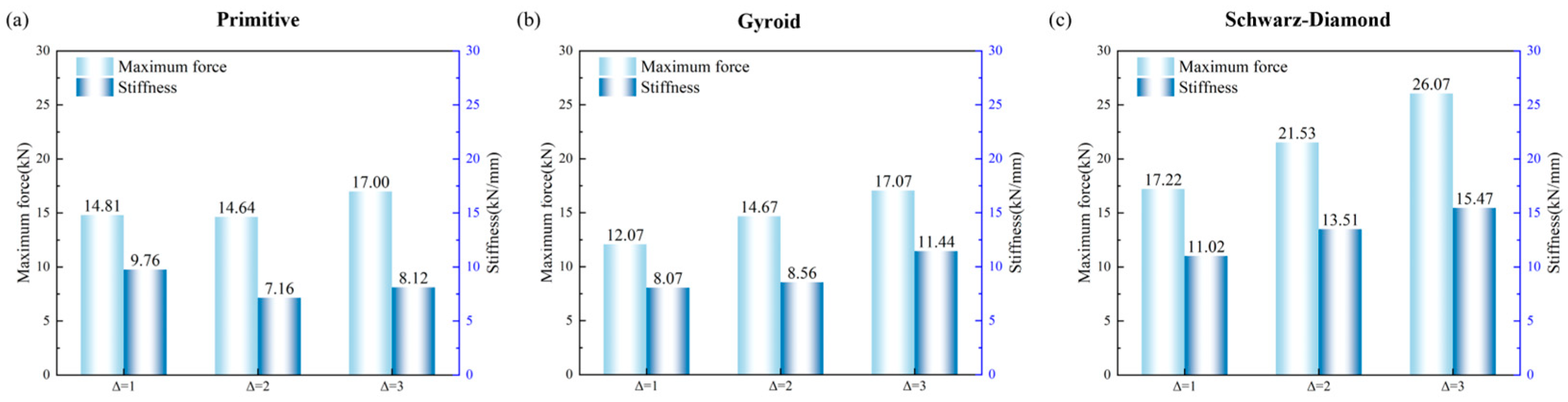
Further comparison of the peak forces and flexural stiffness of gradient sandwich structures with three topological cores (as shown in Figure 19) reveals distinct trends among different topological configurations. For the Primitive core gradient sandwich structure (Figure 19a), the peak forces of the structures with gradient coefficients of 1 and 2 are basically equivalent, while the structure with a gradient coefficient of 3(P_SGSS3) exhibits the highest peak force; in terms of flexural stiffness, the uniform structure with a gradient coefficient of 1 is slightly higher than the gradient structures with coefficients of 2(P_SGSS2) and 3(P_SGSS3). The core reason for this phenomenon lies in the fact that the Primitive core adopts a single−continuous network topology, and its stiffness depends on the synergistic load−bearing efficiency of the unit beams. In the uniform structure with a gradient coefficient of 1(P_SGSS1), the core units have consistent wall thicknesses and cross−sectional dimensions, resulting in uniform load transfer paths during the elastic stage and the strongest ability of the beams to synergistically resist deformation—thus achieving the highest flexural stiffness.
Figure 19.
Peak forces and flexural stiffness of TPMS sandwich structures under different gradient coefficients: (a) Primitive; (b) Gyroid; (c) Schwarz−Diamond.
Figure 19b,c present the peak forces and flexural stiffness of the Gyroid and Schwarz−Diamond gradient sandwich structures. For the Gyroid core gradient sandwich structure, both the peak force and flexural stiffness exhibit a significant increase with the increase in the gradient coefficient: compared with the uniform structure, the structure with a gradient coefficient of 3 achieves a peak force difference of 5 kN (accounting for 41.43% of the uniform structure) and a flexural stiffness difference of 3.37 kN/mm (accounting for 41.76% of the uniform structure). This consistent trend stems from the fact that both Gyroid and Schwarz−Diamond cores adopt a double−continuous network topology, featuring dense unit connections and high nodal stiffness. Their superior adaptability to gradient variations ensures that an increase in the gradient coefficient does not damage the core load−bearing network; instead, it optimizes stress transfer paths, thereby enhancing the ultimate load−bearing capacity and elastic deformation resistance of the structures.
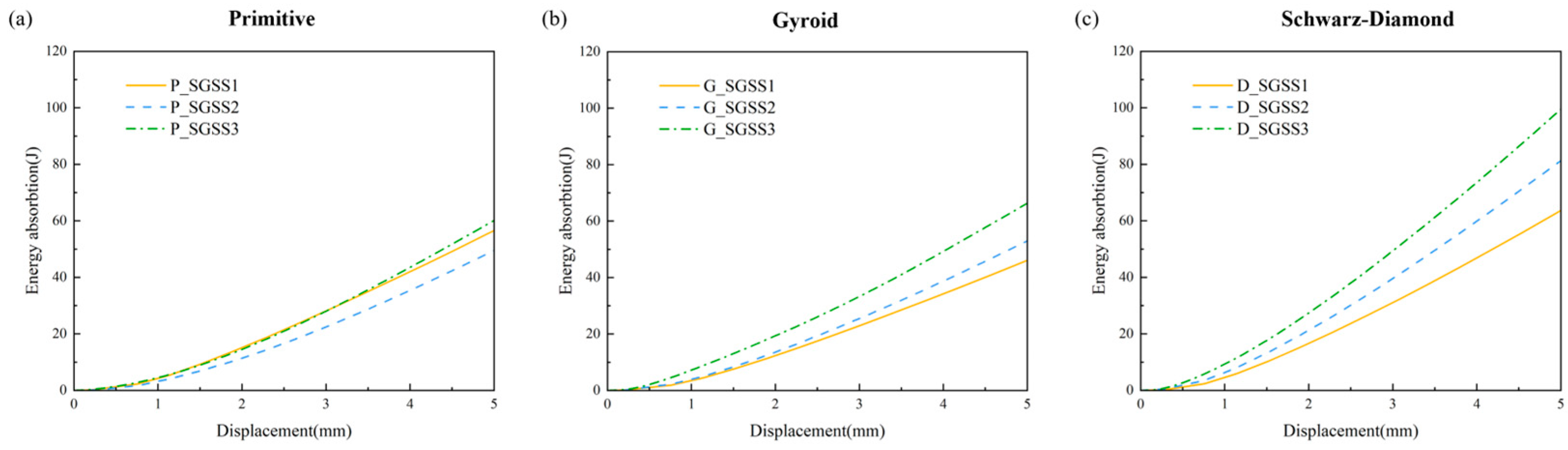
As shown in Figure 20, further analysis of the energy absorption characteristics reveals: for the Primitive core gradient sandwich structure, the energy absorption follows the trend: the highest for a gradient coefficient of 3, followed by the uniform structure (gradient coefficient of 1), and the lowest for a gradient coefficient of 2. This phenomenon is closely related to the single−continuous network characteristics of the Primitive topology and the differentiated regulation of plastic deformation accumulation and energy dissipation efficiency by gradient distribution. For the Gyroid core gradient sandwich structure, there is a significant positive correlation between energy absorption and the gradient coefficient—the higher the gradient coefficient, the higher the energy absorption. This rule holds true for the Schwarz−Diamond core gradient sandwich structure as well, with the latter exhibiting significantly higher energy absorption than the other two topological cores. This is because both Gyroid and Schwarz−Diamond adopt a double−continuous network topology; an increase in the gradient coefficient can improve the efficiency of plastic deformation accumulation by optimizing stress distribution. Moreover, under the same envelope volume, the Schwarz−Diamond core has a higher relative density and structural strength, enabling continuous energy dissipation through the synergistic deformation of more cells during the bending process, thus demonstrating superior energy absorption performance.
Figure 20.
Energy absorption–displacement curves of TPMS sandwich structures under different gradient coefficients: (a) Primitive; (b) Gyroid; (c) Schwarz−Diamond.
5.4. Sources of Performance Advantages of TPMS Structures
Firstly, regarding the local TPMS combined effect and the overall TPMS architecture, the former refers to the alleviating effect of the geometric characteristics of the TPMS smooth surface on the stress concentration at the beam nodes, which lays the foundation for enhancing the local bearing capacity. The latter represents the overall performance improvement brought about by the complete continuous and rodless discrete spatial topology structure of TPMS. Its core manifestations include all−round continuous load transmission, mechanical isotropy, and planar tension−bending collaborative bearing characteristics, which distinguishes it from the traditional cubic lattice discrete architecture and becomes its core feature.
From the perspective of comparing the intrinsic nature of the effects and the research design, Iandiorio et al. [19] realized the extrinsic introduction of the local joint effect by artificially introducing TPMS−type filets at the sharp discrete nodes of cubic lattices, which is a form of remedial optimization for the defects of traditional lattices. In their study, the discrete rod−like architecture of cubic lattices underwent no fundamental change, and their design was essentially a combination of the discrete architecture of traditional cubic lattices with the extrinsic local TPMS joint effect; the performance improvement relied on the local joint effect, which increased the specific strength of cubic lattices by 20% to 30%. In contrast, the functionally graded TPMS sandwich structure proposed in this study is a combination of a fully continuous global TPMS architecture and the intrinsic local TPMS joint effect. The stiffness of the Schwarz−Diamond sandwich structure is increased by over 35%, and this improvement is not achieved by any additional optimization method. Instead, the resulting performance enhancement stems from the global TPMS architecture effect and the synergistic effect between the global architecture and the local joint effect.
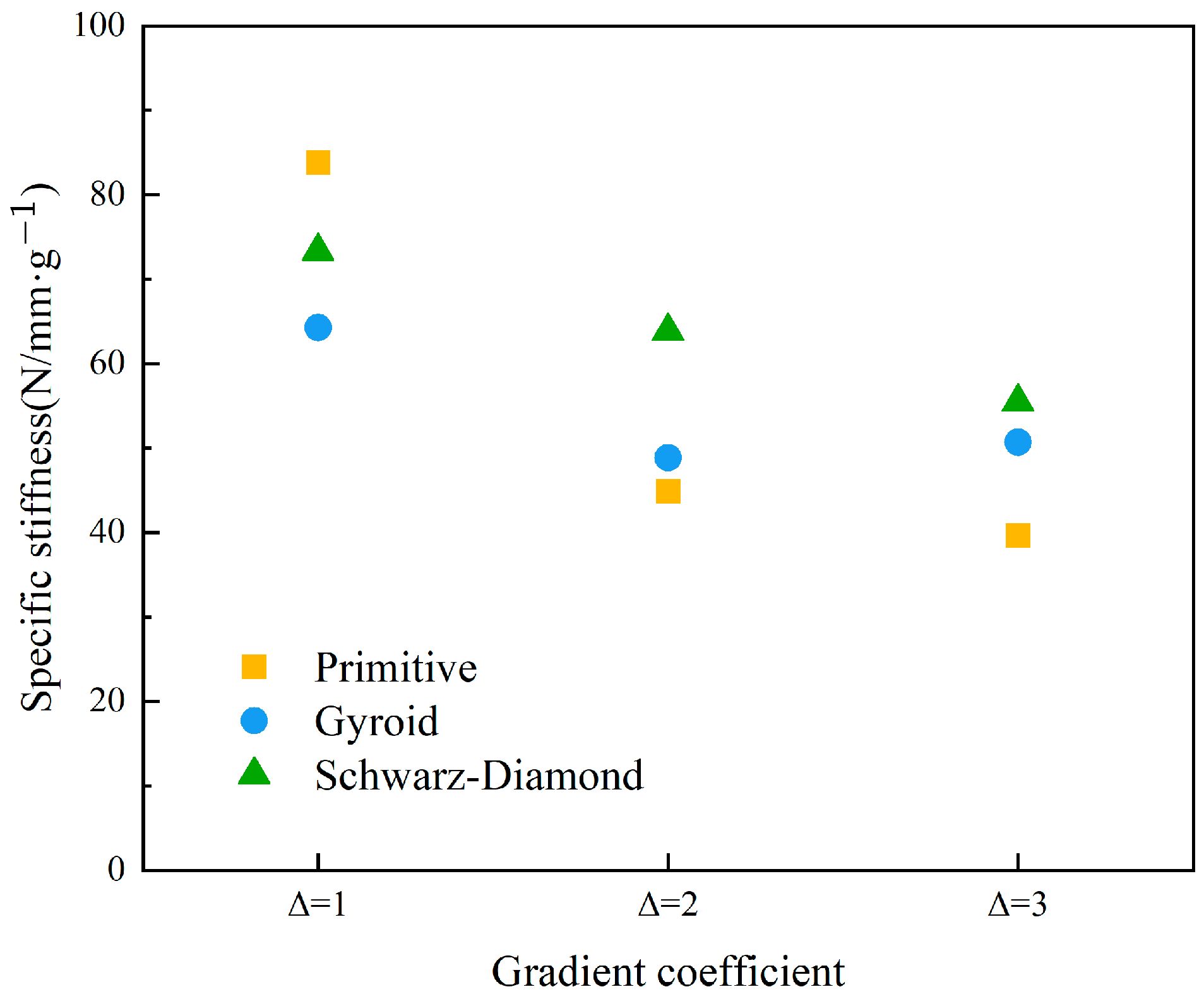
In addition, to distinguish between the density−driven effect and the topology−driven effect, the specific stiffness index was introduced in this study to analyze the mechanical properties of the sandwich structures. As shown in Figure 21, the Primitive topology exhibits the optimal specific stiffness under the gradient−free condition (∆ = 1); as the gradient coefficient increases, however, the Schwarz−Diamond topology becomes the top−performing one in terms of specific stiffness. This phenomenon is attributed to variations in topological structures and represents a typical topology−driven effect. Furthermore, the Schwarz−Diamond topology has the highest relative density among the three lattices, and thus the performance enhancement observed previously is a combined effect of the density−driven and topology−driven effects.
Figure 21.
Specific stiffness of sandwich structures under different topologies and gradient coefficients.
Meanwhile, the specific stiffness of sandwich structures with all topologies decreases as the gradient coefficient increases. This is because the utilization rate of bending deformation is relatively low, and the structural regions far from the loading zone undergo almost no deformation. The increase in the gradient coefficient introduces redundant mass in these regions, which ultimately leads to a reduction in the overall specific stiffness.
6. Conclusions
In this study, a novel class of the 3D−printed sandwich structure with functionally graded Triply Periodic Minimal Surface (TPMS) cores was investigated. Primitive, Gyroid, and Schwarz−Diamond sandwich structures were designed and 3D−printed via selective laser melting (SLM) technology. Three−point bending tests were conducted to compare their flexural properties. The key findings of this study are summarized as follows:
- The established three−point bending finite element model shows high agreement with the experimental results, with the deviation of the load–displacement curve less than 7.9%. It can also accurately capture the stress concentration areas and deformation evolution law, verifying the reliability of the model.
- Among the three TPMS core topological structures, the Schwarz−Diamond core sandwich structure achieves the optimal flexural peak force of 26.07 kN and flexural stiffness of 8.56 kN/mm, both higher than the Gyroid core with 21.53 kN in flexural peak force and 7.16 kN/mm in flexural stiffness and the Primitive core with 14.81 kN in flexural peak force and 8.07 kN/mm in flexural stiffness under the same test conditions. In contrast, the Primitive core structure demonstrates superior ductility, with its failure displacement increased by more than 30% compared with the Gyroid and Schwarz−Diamond core structures. This difference stems from the failure mechanisms dominated by topological characteristics.
- There are significant differences in the regulation laws of gradient coefficients on the flexural properties of TPMS sandwich structures with different topologies. For the Gyroid and Schwarz−Diamond double−continuous network topologies, with the increase in the gradient coefficient, the peak force, flexural stiffness, and energy absorption capacity of the structures all show a significant upward trend. In contrast, the Primitive single−continuous network topology exhibits a more complex response to the gradient coefficient, and the homogeneous structure possesses higher stiffness owing to its optimal synergistic load−bearing efficiency of units.
In conclusion, the design method and performance laws of functionally graded TPMS cores proposed in this study provide a theoretical basis and technical support for the optimal design of lightweight load−bearing structures in fields such as aerospace and rail transportation.
In future research, the gradient design dimension of the TPMS core can be further expanded from the unidirectional gradient adopted in this study to bidirectional and three−dimensional spatial gradients, so as to investigate the coupled regulation law of multi−dimensional gradients on the structural flexural performance. Research on the multi−parameter regulation of flexural performance can be conducted, and a quantitative prediction model established by integrating key parameters including unit cell size, relative density and gradient coefficient, thus achieving the precise design of structural performance.
Author Contributions
Conceptualization: S.Y.; Data curation: X.G.; Formal analysis: X.G.; Funding acquisition: S.Y.; Investigation: P.X.; Methodology: X.G.; Project administration: P.X.; Resources: S.Y.; Software: S.Y.; Supervision: P.X.; Validation: M.X., J.T., G.H. and M.T.; Visualization: M.X.; Writing—original draft: X.G.; Writing—review and editing: X.G. and M.T. All authors have read and agreed to the published version of the manuscript.
Funding
This research was funded by the National Key Research and Development Program of China (No. 2024YFB4303001) and the National Natural Science Foundation of China (No. U2568230). The financial supports are gratefully acknowledged.
Data Availability Statement
Data is contained within the article.
Acknowledgments
The authors have reviewed and edited the output and take full responsibility for the content of this publication.
Conflicts of Interest
The authors declare no conflicts of interest.
References
- Pierre, J.; Iervolino, F.; Farahani, R.D.; Piccirelli, N.; Lévesque, M.; Therriault, D. Material extrusion additive manufacturing of multifunctional sandwich panels with load−bearing and acoustic capabilities for aerospace applications. Addit. Manuf. 2022, 61, 103344. [Google Scholar] [CrossRef]
- Cao, X.; Sun, K.; Luo, J.; Chen, A.; Wan, Q.; Zhou, H.; Zhou, H.; Liu, Y.; Chen, X. Enhancing Osteogenesis and Mechanical Properties through Scaffold Design in 3D Printed Bone Substitutes. ACS Biomater. Sci. Eng. 2025, 11, 710–729. [Google Scholar] [CrossRef]
- Tang, J.; Zhou, Z.; Chen, H.; Wang, S.; Gutierrez, A.; Zhang, C.; Deng, J. Laminate design, optimization, and testing of an innovative carbon fiber−reinforced composite sandwich panel for high−speed train. Polym. Compos. 2021, 42, 5811–5829. [Google Scholar] [CrossRef]
- Zhou, X.; Chen, Y.; Abbas, M. Transient bending analysis of the graphene nanoplatelets reinforced sandwich concrete building structure validated by machine learning algorithm. Mech. Adv. Mater. Struct. 2025, 32, 260–281. [Google Scholar] [CrossRef]
- Rico-Baeza, G.; Pérez-Soto, G.I.; Morales-Hernández, L.A.; Cuan-Urquizo, E.; Camarillo-Gómez, K.A.J.A.S. Additively manufactured foot insoles using body−centered cubic (BCC) and triply periodic minimal surface (TPMS) cellular structures. Appl. Sci. 2023, 13, 12665. [Google Scholar] [CrossRef]
- Cantwell, W.J.; Scudamore, R.; Ratcliffe, J.; Davies, P. Interfacial fracture in sandwich laminates. Compos. Sci. Technol. 1999, 59, 2079–2085. [Google Scholar] [CrossRef]
- Mccormack, T.M.; Miller, R.E.; Kesler, O.; Gibson, L. Failure of sandwich beams with metallic foam cores. Int. J. Solids Struct. 2001, 38, 4901–4920. [Google Scholar] [CrossRef]
- Hong, H.; Hu, M.; Dai, L. Dynamic Mechanical Behavior of Hierarchical Resin Honeycomb by 3D Printing. Polymers 2020, 13, 19. [Google Scholar] [CrossRef]
- Li, Z.; Ma, J. Experimental study on mechanical properties of the sandwich composite structure reinforced by basalt fiber and nomex honeycomb. Mater. Corros. 2020, 13, 1870. [Google Scholar] [CrossRef]
- Khatri, N.R.; Egan, P. Energy Absorption of 3D Printed ABS and TPU Multimaterial Honeycomb Structures. 3D Print. Addit. Manuf. 2023, 11, 840–850. [Google Scholar] [CrossRef]
- Stoica, C.R.; Maier, R.; Istrate, A.M.; Bucaciuc, S.G.; Despa, A. Impact Behavior Analysis of 3−D Printed Honeycomb Structures. Mater. Plast. 2022, 59, 78–90. [Google Scholar] [CrossRef]
- Khatib, O.E.; Schiffer, A. The in−plane elastic−plastic response of hierarchical honeycombs with sandwich walls. Eur. J. Mech. A−Solids 2025, 112, 105648. [Google Scholar] [CrossRef]
- Gan, Z.; Turner, M.D.; Gu, M. Biomimetic gyroid nanostructures exceeding their natural origins. Sci. Adv. 2016, 2, e1600084. [Google Scholar] [CrossRef]
- Han, L.; Che, S. An Overview of Materials with Triply Periodic Minimal Surfaces and Related Geometry: From Biological Structures to Self-Assembled Systems. Adv. Mater. 2018, 30, 170578. [Google Scholar] [CrossRef] [PubMed]
- Sun, L.; Chen, K.; Geng, P.; Zhou, Y.; Wen, S.; Shi, Y. Mechanical and shape memory properties of NiTi triply periodic minimal surface structures fabricated by laser powder bed fusion. J. Manuf. Process. 2023, 101, 1091–1100. [Google Scholar] [CrossRef]
- Bian, Z.; Gong, Y.; Liu, H.; Zhang, J.; Zhao, L.; Hu, N. 3D−printing multiphase triply periodic minimal surfaces lattice: A novel hybrid design with excellent energy absorption and impact resistance. Thin−Walled Struct. 2025, 215, 113442. [Google Scholar] [CrossRef]
- Zhang, Y.; Peng, F.; Jia, H.; Zhao, Z.; Wang, P.; Duan, S.; Lei, H.; Transfer, M. Conformal geometric design and additive manufacturing for special−shaped TPMS heat exchangers. Int. J. Heat Fluid Flow 2025, 247, 127146. [Google Scholar] [CrossRef]
- Giorleo, L.; Basu, S.; Piana, E.J.A.M. Acoustic performances of Triply Periodic Minimal Surfaces fabricated by Additive Manufacturing: Effects of cell geometry, aspect ratio, and wall thickness. Addit. Manuf. 2025, 108, 104835. [Google Scholar] [CrossRef]
- Iandiorio, C.; Mattei, G.; Marotta, E.; Costanza, G.; Tata, M.E.; Salvini, P. The Beneficial Effect of a TPMS−Based Fillet Shape on the Mechanical Strength of Metal Cubic Lattice Structures. Materials 2024, 17, 1553. [Google Scholar] [CrossRef]
- Peng, C.; Marzocca, P.; Tran, P. Triply periodic minimal surfaces based honeycomb structures with tuneable mechanical responses. Virtual Phys. Prototyp. 2022, 18, 2125879. [Google Scholar] [CrossRef]
- Fashanu, O.; Rangapuram, M.; Abutunis, A.; Newkirk, J.; Chandrashekhara, K.; Misak, H.; Klenosky, D. Mechanical performance of sandwich composites with additively manufactured triply periodic minimal surface cellular structured core. J. Sandw. Struct. Mater. 2022, 24, 1133–1151. [Google Scholar] [CrossRef]
- Kosedag, E. Investigation of cell size influence on the crushing behavior of gyroid lattices fabricated via FDM. Mech. Adv. Mater. Struct. 2025, 1–10. [Google Scholar] [CrossRef]
- Pehlivan, F.; Karamanlı, İ.A.; Temiz, A.; Öztürk, F.H.; Karaca, M.M. Hierarchical cellular structures based on TPMS mimicking cancellous bone. J. Mech. Behav. Biomed. Mater. 2025, 168, 107037. [Google Scholar] [CrossRef]
- Wang, Z.; Zhou, J.; Lu, Y.; Li, D.; Yue, D.; Zhang, X.; Chen, B. Mechanical properties and energy absorption of CoCrNi functionally graded TPMS cellular structures. J. Mater. Res. Technol. JMRT 2025, 34, 2772–2787. [Google Scholar] [CrossRef]
- Zhang, X.-Y.; Yan, X.-C.; Fang, G.; Liu, M. Biomechanical influence of structural variation strategies on functionally graded scaffolds constructed with triply periodic minimal surface. Addit. Manuf. 2020, 32, 101015. [Google Scholar] [CrossRef]
- Qiu, N.; Zhang, J.; Li, C.; Shen, Y.; Fang, J. Mechanical properties of three−dimensional functionally graded triply periodic minimum surface structures. Int. J. Mech. Sci. 2023, 246, 108118. [Google Scholar] [CrossRef]
- Song, J.; Wang, M.; Li, D.; Zhang, J.J.A.S. Deformation and energy absorption performance of functionally graded TPMS structures fabricated by selective laser melting. Appl. Sci. 2024, 14, 2064. [Google Scholar] [CrossRef]
- Lophisarn, S.; Bunsri, P.; Jongpradist, P.; Kongwat, S. Optimization of novel functionally graded FRD−filled crash box for enhanced crashworthiness. Eur. J. Mech. A−Solids 2025, 112, 105616. [Google Scholar] [CrossRef]
- Peng, C.X.; Fox, K.; Qian, M.; Nguyen-Xuan, H.; Tran, P. 3D printed sandwich beams with bioinspired cores: Mechanical performance and modelling. Thin−Walled Struct. 2021, 161, 107471. [Google Scholar] [CrossRef]
- Saleh, M.; Anwar, S.; Al-Ahmari, A.M.; Alfaify, A. Compression Performance and Failure Analysis of 3D−Printed Carbon Fiber/PLA Composite TPMS Lattice Structures. Polymers 2022, 14, 4595. [Google Scholar] [CrossRef]
- Liu, E.Q.; Lv, Y.F.; Hao, X.; Wang, Y.; Xiao, G.S.; Lin, J.B. The mechanical behavior and deformation mode of multilayer composite structures based on triply periodic minimal surface elements. J. Thermoplast. Compos. Mater. 2025, 38, 2645–2669. [Google Scholar] [CrossRef]
- Zhu, H.M.; Wang, P.; Wei, D.; Si, J.F.; Wu, Y.Z. Energy absorption of diamond lattice cylindrical shells under axial compression loading. Thin−Walled Struct. 2022, 181, 110131. [Google Scholar] [CrossRef]
- Hong, Q.Y.; Antolin, P.; Elber, G.; Kim, M.S. Variable offsets and processing of implicit forms toward the adaptive synthesis and analysis of heterogeneous conforming microstructure. Comput. Graph. Forum 2024, 43, e15224. [Google Scholar] [CrossRef]
- ASTM C393−00; Standard Test Method for Flexural Properties of Sandwich Constructions. ASTM International: West Conshohocken, PA, USA, 2000. [CrossRef]
- ASTM E8/E8M−22; Standard Test Methods for Tension Testing of Metallic Materials. ASTM International: West Conshohocken, PA, USA, 2022. [CrossRef]
- Yin, H.F.; Meng, F.B.; Zhu, L.C.; Wen, G.L. Optimization design of a novel hybrid hierarchical cellular structure for crashworthiness. Compos. Struct. 2023, 303, 116335. [Google Scholar] [CrossRef]
Disclaimer/Publisher’s Note: The statements, opinions and data contained in all publications are solely those of the individual author(s) and contributor(s) and not of MDPI and/or the editor(s). MDPI and/or the editor(s) disclaim responsibility for any injury to people or property resulting from any ideas, methods, instructions or products referred to in the content. |
© 2026 by the authors. Licensee MDPI, Basel, Switzerland. This article is an open access article distributed under the terms and conditions of the Creative Commons Attribution (CC BY) license.