1. Introduction
Human endurance performance is influenced by several physiological factors, including ventilatory capacity and gas exchange efficiency, cardiovascular function, and skeletal muscle oxygen utilization [
1]. Ventilatory/metabolic responses during exercise refer to the coupled changes in minute ventilation (VE), oxygen uptake (VO
2), and carbon dioxide output (VCO
2), which indicate how ventilation adjusts to metabolic demand. These responses are commonly characterized in an incremental exercise test using the response patterns and peak values of VE, VO
2, and VCO
2 [
2]. Circadian rhythms may contribute to diurnal variation in these responses, which may partly explain time-of-day differences in endurance performance [
3,
4].
Circadian rhythms refer to the regular diurnal variation in physiological variables and are observed across a wide range of physiological indicators [
5]. Previous studies indicate that circadian rhythms can influence several types of exercise performance across the day [
3,
6]. For example, strength- and power-related performance appears to be influenced by circadian rhythms, and the overall pattern tends to favor higher values in the evening than in the morning [
7,
8]. However, whether circadian rhythms lead to diurnal variation in endurance performance and ventilatory/metabolic responses remains inconclusive, with inconsistent findings across published studies [
3,
9,
10,
11]. Previous studies have found higher VO
2max and related ventilatory and metabolic indices in the evening compared with the morning, together with improved endurance performance [
12,
13]. In contrast, other studies have found no advantage in relation to the evening over the morning for ventilatory/metabolic responses or endurance performance [
14,
15]. From a mechanistic perspective, peak expiratory flow is often highest in the evening, which may be related to lower airway resistance and enhanced respiratory muscle contractile function, thereby facilitating ventilatory function [
16]. Another study observed significant circadian variation in resting VO
2 and VCO
2, which may influence ventilatory/metabolic responses during exercise [
17]. In addition, core body temperature approaches its circadian peak in the evening [
18] and has been proposed to modulate metabolic enzyme activity and neuromuscular function, which may affect endurance performance [
19]. Several hormones also show diurnal variation, which may indirectly influence energy provision and fatigue during endurance exercise by altering the dynamic balance between catabolic and anabolic processes [
20]. Therefore, mechanisms related to circadian rhythms may favor higher endurance capacity in the evening.
However, whether circadian rhythms produce meaningful diurnal variation in ventilatory/metabolic responses and endurance performance during prolonged exercise remains to be further verified. The inconsistency across previous findings may be attributable to non-standardized testing protocols, small sample sizes, and external confounding factors. Therefore, it is necessary to assess ventilatory/metabolic responses and endurance performance in the morning and evening under highly standardized conditions, using a consistent laboratory testing protocol. Using a standardized maximal incremental cycling test in the laboratory and strict control of behavioral and environmental factors, this study examined whether circadian rhythms are associated with meaningful diurnal variation in ventilatory/metabolic responses and endurance performance.
Accordingly, the primary aim of this study was to examine how diurnal variation in ventilatory/metabolic responses during a maximal incremental cycling test is associated with endurance performance. We hypothesized that endurance performance would be significantly better in the evening than in the morning and that this advantage would be associated with higher peak ventilation and greater oxygen uptake efficiency.
2. Materials and Methods
2.1. Participants
The required sample size was determined a priori using G*Power 3.1 (Heinrich Heine University, Düsseldorf, Germany). The analysis indicated that a minimum of 27 participants was required. A total of 33 participants were recruited; 3 withdrew during the study, and 30 completed the full protocol and were included in the final analysis. Participants were eligible if they met all of the following criteria: (1) maintained a regular sleep–wake schedule for the preceding 6 months, with ≥8 h of sleep per night and habitual sleep timing between 22:00 and 07:00; (2) engaged in structured physical training for at least 1 year and performed ≥6 h·wk−1 of exercise; (3) possessed sufficient cognitive capacity to understand the study procedures and provide informed consent. Participants were excluded if they had the following: (1) any absolute or relative contraindications to the study protocol; (2) a history of major surgery or chronic cardiovascular or pulmonary disease; (3) a physical disability or inability to perform activities of daily living independently.
All 30 participants who completed the study were male students from Beijing Sport University. Their anthropometric characteristics were as follows (mean ± SD): age 23.5 ± 2.2 years, stature 178.4 ± 5.8 cm, and body mass 78.1 ± 9.4 kg. Anthropometric characteristics were recorded prior to the first test session. Participants’ training background (years of structured training and typical weekly training volume) was obtained via a standardized questionnaire. A regular sleep–wake schedule (≥8 h/night, habitual bedtime 22:00–07:00 for the preceding 6 months) was required to minimize inter-individual variability in circadian phase and to reduce potential confounding from acute or chronic sleep restriction. Compliance with pre-test instructions was verified using a standardized checklist upon arrival for each session (sleep duration and bedtime/wake time on the previous night, recent illness, and recent training), and participants confirmed abstinence from strenuous exercise and stimulants (e.g., caffeine) for at least 24 h before testing.
2.2. Design
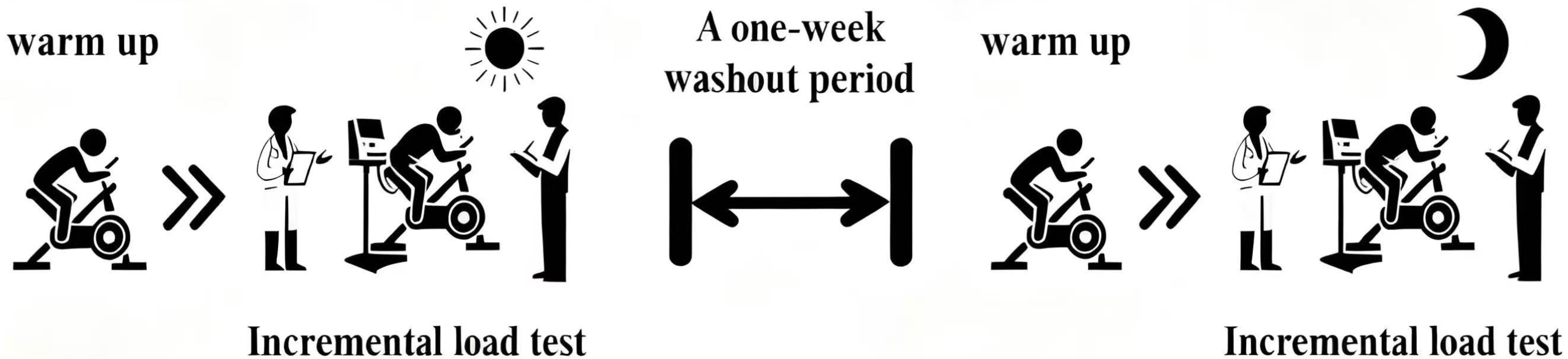
This study consisted of two testing sessions conducted between April and May 2025. Each participant completed one morning session (07:00–09:00) and one evening session (17:00–19:00) in a climate-controlled laboratory (ambient temperature 20–22 °C; relative humidity 40–60%). The order of the morning and evening sessions was counterbalanced across participants using a randomized allocation sequence to minimize potential order effects. Participants were instructed to avoid strenuous physical activity on the day of testing before arriving at the laboratory. Sleep timing/duration on the night before each trial and recent stimulant intake (e.g., caffeine) were self-reported using a standardized checklist; participants were instructed to replicate their habitual diet and to avoid alcohol and caffeine for at least 24 h before each session.
Before the experimental trials, participants performed a standardized 5 min warm-up on a cycle ergometer at 90 W (EC3000e P, ergoline GmbH, Bitz, Germany). The experimental protocol comprised an incremental load test on the same ergometer; ventilatory and metabolic variables were continuously recorded with a metabolic gas analyzer (Metalyzer 3B, CORTEX Biophysik GmbH, Leipzig, Germany), and time to exhaustion (TTE) was recorded. Two investigators were present at each session: one oversaw protocol adherence and participant safety, while the other was responsible for data recording.
To minimize confounding influences, a 1-week washout period separated the two sessions. During the washout period and throughout the study, participants were instructed to avoid high-intensity physical activity and to maintain regular sleep–wake schedules and habitual dietary patterns to stabilize circadian rhythms. The experimental workflow is illustrated in
Figure 1.
2.3. Maximal Incremental Cycling Test
Maximal oxygen uptake (VO2max) and related physiological variables were assessed using an incremental load protocol on a cycle ergometer. Testing began at an initial workload of 90 W; participants maintained this intensity for 1 min as an accommodation period. Thereafter, the workload was increased in a stepwise fashion at a rate of 20 W·min−1. During the test, participants were instructed to sustain a cadence of 60–70 rev·min−1 throughout each test until volitional exhaustion, defined as: (1) Respiratory exchange ratio ≥ 1.10; (2) The participant’s inability to maintain the target cadence of 60 rev·min−1 despite strong verbal encouragement; (3) During the maximal incremental cycling test, oxygen uptake no longer increased with further increments in workload and, after reaching a peak or plateau, began to decline.
A respiratory mask was worn for the duration of the trial, and continuous gas exchange data were collected using a metabolic gas analyzer (Metalyzer 3B, CORTEX Biophysik GmbH, Leipzig, Germany) and processed with MetaSoft software (Version 2.0, CORTEX Biophysik GmbH, Leipzig, Germany). Gas exchange variables were acquired breath-by-breath and subsequently exported as 15 s averaged values; these 15 s data were used for all analyses. Directly measured variables included oxygen uptake (VO2), minute ventilation (VE), respiratory rate (RR), and carbon dioxide production (VCO2). Peak values (e.g., VO2max, VE, and VCO2) were defined as the highest 15 s averaged value attained during the incremental test. Derived parameters calculated by the instrument’s internal algorithms included metabolic equivalents (METs), energy expenditure normalized to body mass (EE, kcal·day−1·kg−1; instrument-derived rate scaled to a 24 h equivalent), and the respiratory exchange ratio (RER).
The metabolic gas analyzer (Metalyzer 3B, CORTEX Biophysik GmbH, Leipzig, Germany) was calibrated according to the manufacturer’s instructions. Briefly, flow and volume calibrations were performed using a certified 3L calibration syringe, and gas analyzers were calibrated using a two-point procedure with ambient air and a certified reference gas prior to testing.
2.4. Statistical Analyses
All experimental data were recorded and managed using Microsoft Excel (version 2021; Microsoft Corp, Redmond, WA, USA) and subsequently imported into IBM SPSS Statistics (version 26; SPSS, IBM Corporation, Armonk, New York, NY, USA) for statistical analysis. Data are reported as mean ± SD. Normality of the distributions for morning and evening measurements, as well as for single session data, was assessed with the Shapiro–Wilk test. Nine variables, including TTE and VO2max, satisfied the criterion for normality (p > 0.05); therefore, paired-samples t-tests were used to compare morning versus evening values to test the primary hypothesis regarding time-of-day differences. Results are presented as the mean difference (evening–morning) with corresponding 95% confidence intervals (95% CI). All hypothesis tests were two-tailed, with the significance level set at α = 0.05. Effect sizes were calculated as Cohen’s dz for paired samples (mean difference divided by the standard deviation of the paired differences; equivalently, dz = t/) and interpreted as: |dz| < 0.2, negligible; 0.2 ≤ |dz| < 0.5, small; 0.5 ≤ |dz| < 0.8, moderate; |dz| ≥ 0.8, large. As a robustness check, Wilcoxon signed-rank tests were additionally performed for the same comparisons, and results were consistent unless otherwise stated.
4. Discussion
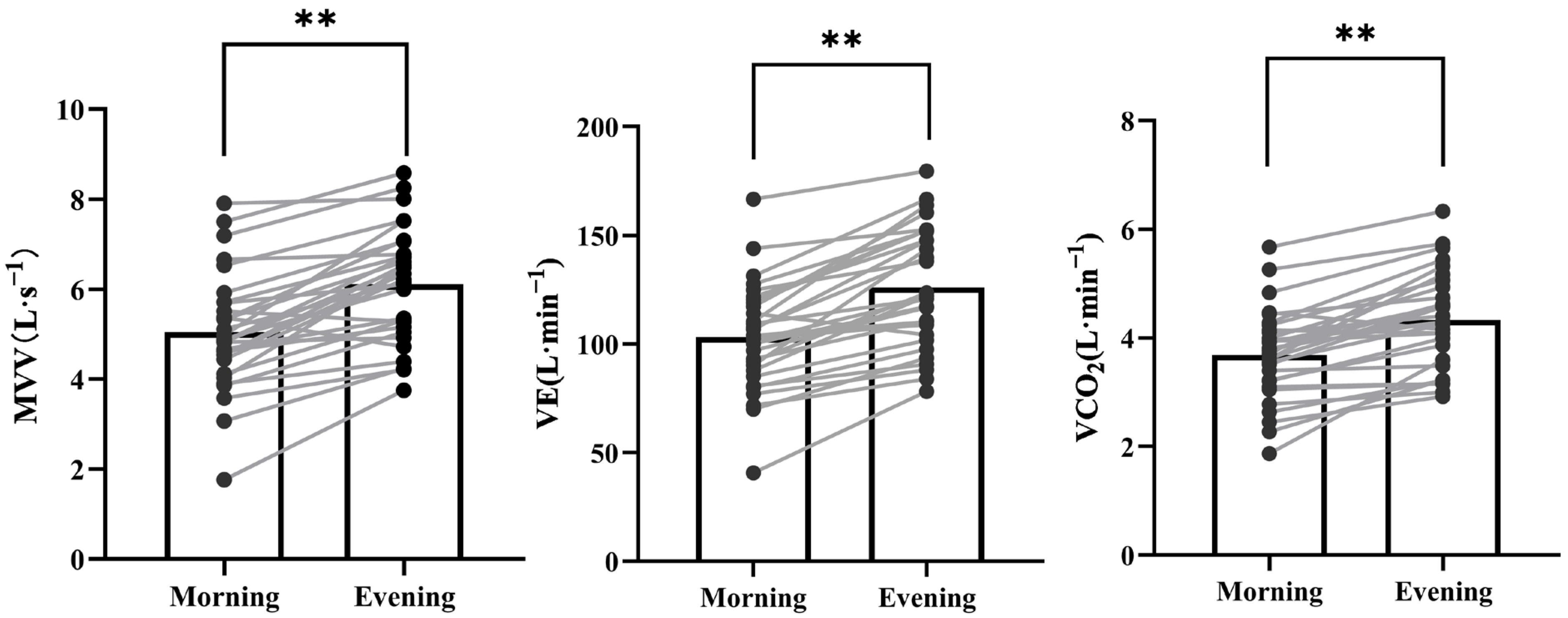
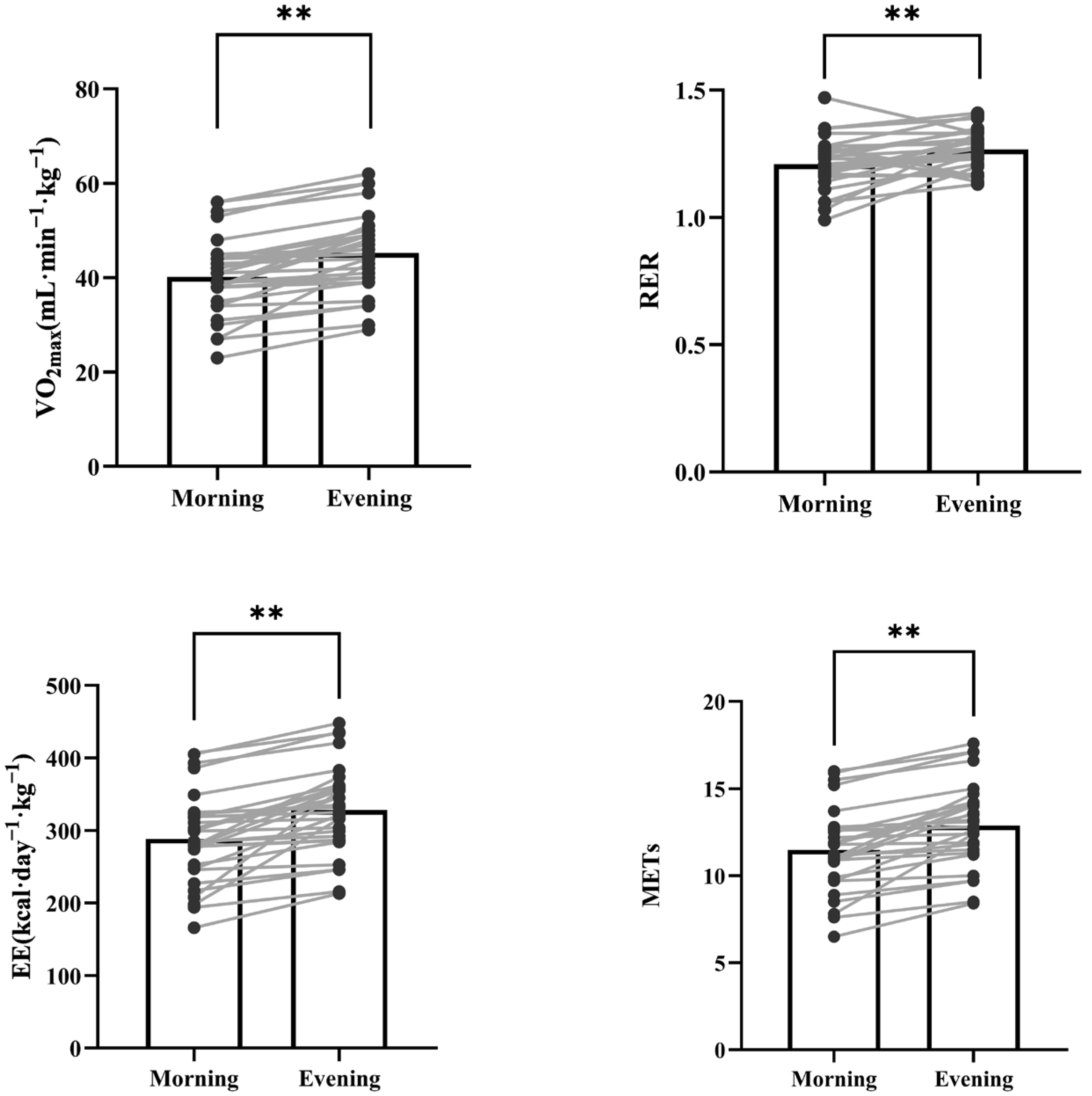
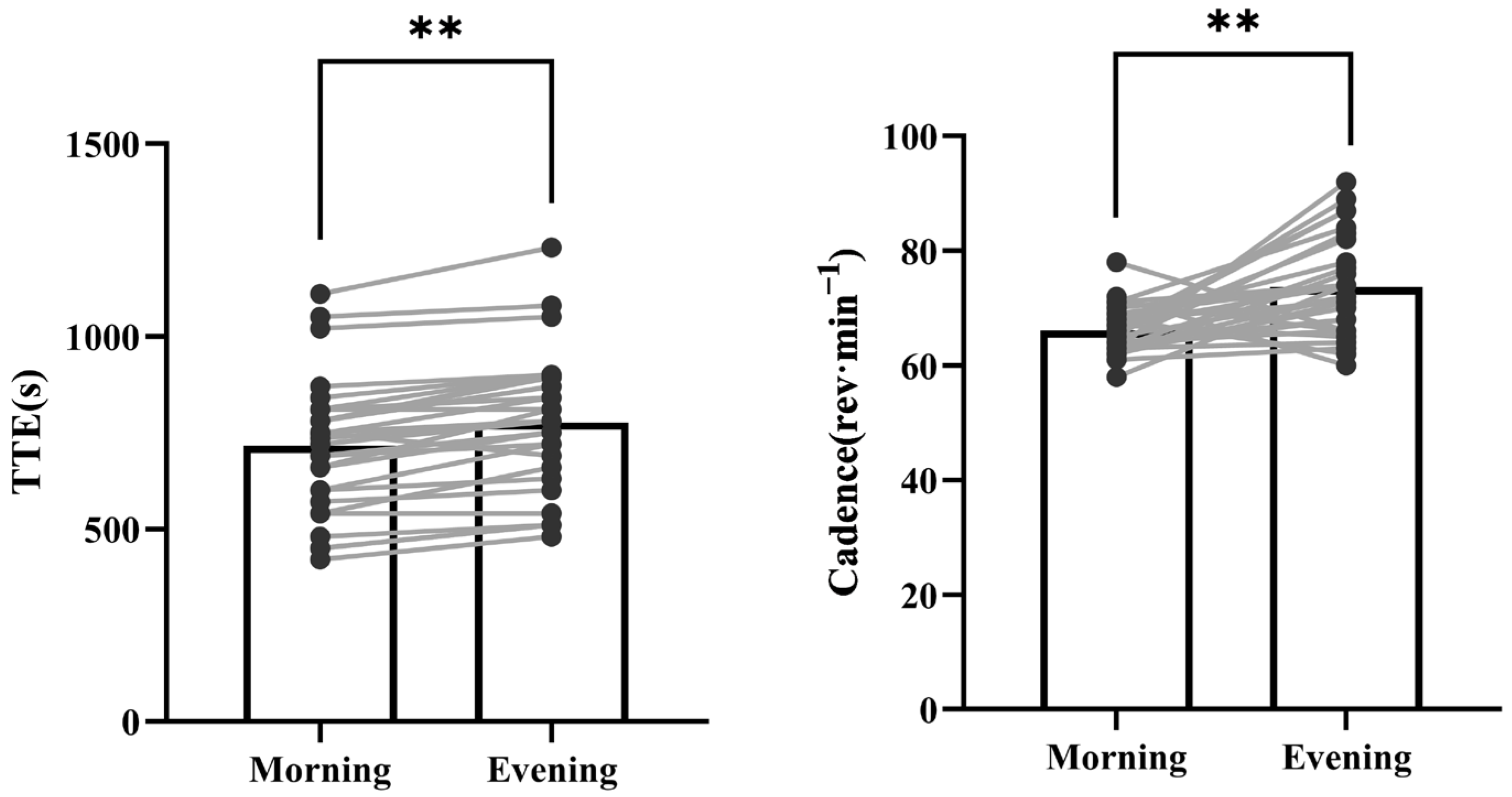
This study aimed to examine how diurnal variation in ventilatory/metabolic responses during a maximal incremental cycling test is associated with endurance performance. Consistent with our hypothesis, participants showed higher endurance performance (TTE) in the evening compared with morning, together with higher ventilatory/metabolic indices (e.g., VO2max, VE, VCO2).
In the present study, VE, maximal voluntary ventilation (MVV), VCO
2, as well as VO
2max, respiratory exchange ratio (RER), and energy expenditure (EE) were all significantly improved in the evening compared with the morning, indicating more favorable ventilatory/metabolic responses; this finding is consistent with most previous studies [
9,
12,
21]. In a 10 min moderate intensity cycling test, Brisswalter observed that oxygen uptake at 80% of the ventilatory threshold intensity was significantly greater in the evening compared with the morning [
22], which is in line with our results. The same study also found that during the warm-up phase, oxygen uptake and ventilation showed a small effect size increase in the evening compared with the morning, suggesting that the evening may be associated with a more prepared aerobic metabolic state. Unlike that study, we did not measure ventilatory/metabolic parameters during warm-up or before the test and instead focused on the differences between the two sessions in these indices during the test itself. In a constant-load cycling time-to-exhaustion test in 20 healthy men, Hill found significantly improved ventilatory/metabolic responses in the evening compared with the morning (RER, VO
2max, and VE) [
23], and our findings also support this pattern. However, our study used a maximal incremental cycling test, which may reduce the influence of workload selection and between-individual differences compared with constant-power protocols. The findings across studies have been inconsistent. For example, Bessot found no significant time-of-day effect on maximal oxygen uptake during an incremental test [
24], which may be related to differences in sample characteristics. In addition, chronotype may modify the magnitude of circadian influences on exercise performance [
25]; For instance, differences between “evening-type” and “morning-type” individuals may affect ventilatory/metabolic responses in the evening, evening-type individuals have been observed to show a significantly improvement in VO
2max in the evening than in the morning during an incremental maximal cycle ergometer tests [
26]; however, this significant difference was not observed in morning-type individuals. Our findings are consistent with this pattern, but we did not stratify participants by chronotype. Instead, we treated chronotype as a potential influencing factor, given that the direction of time-of-day effects on exercise performance may be similar across chronotypes [
7,
9,
27]. Overall, the literature has not reached a consistent conclusion on whether circadian rhythms influence ventilatory and metabolic function and endurance performance. Based on previous studies, the more favorable ventilatory/metabolic responses observed in the evening in our study may be related to circadian variation in body temperature [
6]. Core temperature typically peaks in the evening and may influence ventilatory and metabolic function during a maximal incremental cycling test by altering respiratory muscle function and overall physiological strain. In the present study, body temperature was not measured; therefore, the extent to which the enhanced ventilatory/metabolic responses are attributable to temperature remains to be verified in future studies.
We further observed a significant improvement in endurance performance in the evening compared with the morning, reflected by a longer time to exhaustion and a higher cadence. This is consistent with a previous study that compared 1000 m time-trial performance in recreational cyclists from morning to evening (e.g., 08:00 and 18:00) while measuring hormone and blood glucose levels at both times [
28]. The authors found that the improvement in evening performance was associated with a more favorable hormonal profile and metabolic milieu. Our results also support better endurance performance in the evening than in the morning; however, we did not measure hormones and therefore cannot directly evaluate whether the observed improvement is related to endocrine regulation. Nevertheless, we observed significant improvements in VE, VO
2max, and RER in the evening compared with the morning, and higher VE and VO
2max are generally considered to reflect an enhanced capacity for oxygen uptake and utilization [
29], the higher RER and EE may indicate a more active metabolic state. Taken together, these findings suggest more favorable ventilatory/metabolic function in the evening. Endurance performance reflects the integrated contributions of maximal aerobic capacity, cardiovascular function, and skeletal muscle oxidative capacity [
1]. Accordingly, the greater ventilatory/metabolic responses in the evening observed in the evening may be associated with the improvements in endurance performance. However, some studies have observed no significant differences in endurance performance or ventilatory/metabolic responses between the evening and the morning [
24], which is not consistent with our findings. Another study suggested that although ventilatory/metabolic responses were significantly improved in the evening, this improvement did not translate into an advantage in endurance performance [
26]. Overall, these discrepancies may be explained by differences in study protocols, outcome measures, or testing methods, participants’ training status and health characteristics, and inter-individual differences in chronotype [
5,
15,
24,
30].
Our findings highlight the practical relevance of circadian rhythms for public health promotion and sports training practice. The improvements in ventilatory/metabolic responses and endurance performance observed in the evening suggest that scheduling endurance training at this time of day may help enhance performance and training adaptations. From a public health perspective, performing endurance exercise in the evening may yield greater benefits for improving cardiorespiratory fitness. In addition, our results provide a basis for considering circadian factors in training load planning, with the goal of optimizing training benefits.
This study has several limitations. First, participants were limited to healthy men with regular exercise habits, and we did not stratify participants by chronotype. This may limit the generalizability of our findings to other populations, including women, sedentary individuals, elite athletes, and individuals with different chronotypes. Second, we did not measure heart rate, body temperature, or endocrine variables. Therefore, we could not assess whether circadian influences on ventilatory/metabolic function and performance were mediated by rhythmic changes in temperature or endocrine regulation, and this also limited mechanistic interpretation and discussion related to thermoregulatory and endocrine pathways. In addition, compliance with the instructions before testing (sleep and diet) was assessed only by self-report rather than objective monitoring, which may have introduced potential confounding. Future studies should include larger samples and more diverse participant groups, explicitly treating chronotype as a key variable, and measure indices such as body temperature, heart rate, and endocrine markers to more comprehensively clarify the mechanisms by which circadian rhythms influence exercise performance.