Review

The Effect of Physical Activity in Children with Autism Spectrum Disorders: A Systematic Review of Randomized Controlled Trials


1
Department of Medicine and Surgery, University of Parma, 43126 Parma, Italy
2
Department of Neuroscience, Biomedicine and Movement, University of Verona, 37124 Verona, Italy
*
Author to whom correspondence should be addressed.
Appl. Sci. 2026, 16(4), 2102; https://doi.org/10.3390/app16042102
Submission received: 22 December 2025 / Revised: 10 February 2026 / Accepted: 19 February 2026 / Published: 21 February 2026
(This article belongs to the Special Issue Sports, Exercise and Healthcare)

Abstract

Background: Children with Autism Spectrum Disorders (ASDs) are generally more sedentary than their typically developing (TD) peers, resulting in a negative impact on their physical and cognitive development. Moreover, children with ASD are less involved in physical activity and sports. This systematic review aimed to investigate the effectiveness of physical activity in children with ASD. Methods: As data sources, PubMed (NML), Web of Science—Core Collection (Clarivate), Web of Science—MedLine (Clarivate), and Scopus were searched for relevant studies, and the Preferred Reporting Items for Systematic Reviews and Meta-Analyses (PRISMA) was followed. The literature search was performed in March 2024, and a supplementary search was conducted in October 2024. Eligibility criteria: The included studies were randomized controlled trials (RCTs) evaluating the effect of physical activity in children with ASD. Results: Sixteen studies were included following the PRISMA guidelines, involving a total of 465 participants. Intervention varied by type (land-based vs. aquatic), duration (7 weeks–one year), frequency (2–4 sessions/week) and session length (25–60 min). Evidence shows that physical activity interventions can positively influence motor coordination, with 81.2% of studies reporting beneficial effects, particularly in balance, motor coordination and overall motor proficiency. Land-based physical activity interventions may be an effective strategy for children with ASD, primarily due to their feasibility and accessibility. Conclusion: Physical activity intervention can improve motor coordination in children with ASD, with land-based programs generally being more accessible and aquatic program offering additional sensory–motor benefits for children with greater impairments. The current systematic review highlights the benefits of implementing physical activity in children with ASD, including extracurricular and school-based programs, to significantly enhance their functional outcomes, well-being, and overall quality of life.

1. Introduction

Autism Spectrum Disorders (ASDs) are a heterogeneous set of neurodevelopmental disorders characterized by persistent deficits in social communication and social interaction in multiple contexts. Patterns of restricted repetitive behavior, interests, or activities have also been reported. Children with ASD present heterogeneous profiles, ranging from mild to severe impairments. The Diagnostic and Statistical Manual of Mental Disorders, Fifth Edition (DSM-V) classifies ASD into three levels of severity. Level 1, the lowest severity classification, refers to high-functioning patients and indicates that the individual requires support. Level 2 represents a moderate severity level, where individuals require substantial support. Level 3, classified as low-functioning, is the highest severity level and indicates that individuals need substantial support due to severe deficits in communication, behavior, social interaction, and daily living skills. In Italy, the estimated prevalence of ASD among children aged 7–9 years is 13.4 per 1000 (ranging from 11.3 to 16.0), with a higher prevalence in males than females [1]. Globally, the median prevalence is 100/10,000 (range: 1.09/10,000 to 436.0/10,000) [2]. Recent epidemiological data indicate a continued increase in ASD prevalence worldwide, highlighting the growing public health relevance of early identification and intervention strategies across developmental domains [3].
ASDs are primarily characterized by impairments in social communication, including poor social reciprocity and delays in verbal and nonverbal communication [4]. Moreover, motor impairment is considered a comorbid symptom that can affect 86.9% of children with a diagnosis of ASD [5]. Motor impairments in children with ASD include difficulties pertaining to fine and gross motor skills, coordination, balance and overall motor proficiency that can limit participation in daily activities. Motor impairment in ASD often emerges early in development and may precede or exacerbate social communicative disorders, suggesting a closer interplay between motor and social functioning [5,6,7]. For this reason, targeted interventions should be implemented to improve the functional abilities and overall quality of life of affected children [6]. Additionally, neurobiological evidence shows that children with ASD exhibit distinct neurobiological mechanisms, characterized by atypical synaptic pruning, reduced neuronal inhibition and altered brain connectivity [8]. Studies conducted in ASD animal models have shown that exercise interventions can regulate the structural plasticity of synapses, promote synaptic formation and improve cognitive flexibility [9,10]. Similarly, specific motor tests must also be developed and tailored to the peculiarity of the disorders and for inclusion into the diagnostic process to identify any deficits [4,11]. However, the integration of motor assessment into diagnostic routines and follow-up protocols remains inconsistent across clinical and research settings [11].
The World Health Organization recommends that children and adolescents aged 5 to 17 years, including those living with disabilities, engage in at least an average of 60 min per day of moderate to vigorous intensity physical activity throughout the week. This activity should primarily be aerobic training. Additionally, vigorous-intensity aerobic activities, along with those that strengthen muscles and bones, should be included at least three days a week. Additionally, it is strongly recommended that children and adolescents limit the amount of time spent being sedentary [12]. These recommendations are considered applicable to children with neurodevelopmental disorders. However, specific adaptations are required to account for individual functional limitations and behavioral profiles [6,13].
Despite these recommendations, children with ASD are generally more sedentary than their typically developing (TD) peers [14], with one in two failing to achieve the minimum recommended levels of physical activity, inducing a negative impact on physical and cognitive development [15]. Lower participation in structured and unstructured physical activities has been associated with reduced motor competence, increased risk of overweight, and fewer opportunities for social engagement in this population [15,16]. Regular and structured exercise enhances physical fitness, muscle strength, and endurance, contributing to overall bone health and flexibility [17]. These improvements are not only vital for children’s physical well-being but also play a crucial role in enhancing motor skills and coordination [18]. Growing evidence suggests that physical activity interventions may also positively influence cognitive functioning, behavioral regulation, and social interaction in children with ASD, although findings remain heterogeneous across studies [17,19]. As a result, children with ASD regularly engaging in exercise can experience better physical functioning and increased independence, empowering them to participate in everyday activities while having positive social interactions. By incorporating physical activity into their routines, children with ASD achieve improved health, autonomy, and quality of life [11].
There are currently no established guidelines for prescribing physical activity in children with ASD, due to the complexity and variability of the disorder [13]. Many individuals with ASD often participate in a variety of activities such as swimming, jogging, walking, cycling, weight training, martial arts, yoga, and dancing [20]. Recent reviews have emphasized that existing studies differ widely in terms of design and methodology of investigation (e.g., intervention type, duration, intensity, and outcome measures) limiting the comparability of results and the translation of evidence into practice [19,20,21].
Although several reviews have examined physical activity interventions in children with ASD, few have specifically focused on the different effects of various types of interventions (land-based versus aquatic programs) on well-defined motor outcomes, including balance, motor coordination and overall motor proficiency. Additionally, previous reviews often encompassed broad age ranges, which limits the applicability of their findings. This systematic review aims to fill these gaps by synthesizing evidence from studies focusing on children aged 6 to 11 years, which is a critical period of motor skills development in which structured physical activity may support the acquisition of fundamental motor skills. It reviews and synthesizes the available evidence on the effect of physical activity in children with ASD considering intervention characteristics. Furthermore, it compares the outcomes of land-based versus aquatic intervention to provide a comprehensive global perspective.

2. Materials and Methods

2.1. Protocol Registration

This systematic review has been officially registered in the International Prospective Register of Systematic Reviews (PROSPERO; CRD42025641388; January 2025).

2.2. Search Strategy

The literature search was performed in March 2024 across the PubMed, Scopus and Web of Science (Core Collection and MEDLINE) databases, and according to the Preferred Reporting Items for Systematic Reviews and Meta-analyses (PRISMA) guidelines. The following keywords and Boolean operators were used as search terms: (exercise OR sport* OR physical education OR physical activity) AND (autis* OR autism spectrum disorder*)*. The identified articles were screened and assessed for fit to eligibility criteria. The references of the selected articles were also considered. A supplementary search to identify new eligible articles was conducted in October 2024.

2.3. Study Selection and Eligibility Criteria

Studies assessing the impact of physical activity in children with ASD were considered eligible.
The following inclusion criteria were considered: (i) experimental study designs; (ii) studies involving children aged 6–11 years old; (iii) studies involving children diagnoed with Autism Spectrum Disorders (ASDs); (iv) studies exploring the effect of physical activity, including extracurricular structured exercise and sport programs and school-based physical education programs; (v) studies evaluating motor skills in children with ASD; (vi) articles the full text of which is available in English; and (vii) articles published between 2000 and 2024. Studies that did not meet the inclusion criteria were excluded, such as those involving participants with comorbidities (e.g., cardiovascular disease or osteoarthritis) or employing different intervention types (e.g., non-structured exercise or leisure activities).

2.4. Data Extraction

The data extraction process was conducted independently by two authors (FL and AG). Both authors screened the titles and abstracts independently. Then, full-text articles were assessed for eligibility by the same authors using predefined inclusion and exclusion criteria. Any disagreements during both screening stages were resolved by a third author (VP). A summary table is provided in the Supplementary Materials, including the aims, designs, and main findings of the included studies.

2.5. Risk of Bias Assessment

The quality and risk of bias of the included studies was assessed using the Physiotherapy Evidence Database scale (PEDro scale) [22]. This scale is used to rate the methodological quality of randomized controlled trials (RCTs) according to a list of 11 criteria. The first criterion rates whether the eligibility criteria for the RCT were specified. It is used to assess the external validity of the study, but not to calculate the PEDro score. The other ten criteria rate clear reporting of: random allocation of participants, concealed allocation of participants, similarity at baseline for the most important prognostic indicators, blinding of participants, blinding of therapists, blinding of assessors, follow-up of more than 85% of the randomized participants, intention-to-treat analysis, between-group statistical comparisons and variability measures for at least one outcome. These criteria are used to assess the internal validity of the study, and the last two criteria are also used to establish whether the study provided sufficient statistical information to make the results interpretable. A point is awarded for each satisfied criterion; otherwise, no point is awarded. Therefore, RCTs are rated between 1 and 10, with higher scores indicating higher methodological quality. The total score of each study was converted into a percentage, and the quality score was evaluated as follows: a score >80% for high-quality studies; 50–79% for moderate-quality score; <50% for low-quality studies. The methodological quality of the RCTs was assessed independently by two reviewers (FL and AG) and score disagreements were resolved by consensus.

3. Results

3.1. Study Selection

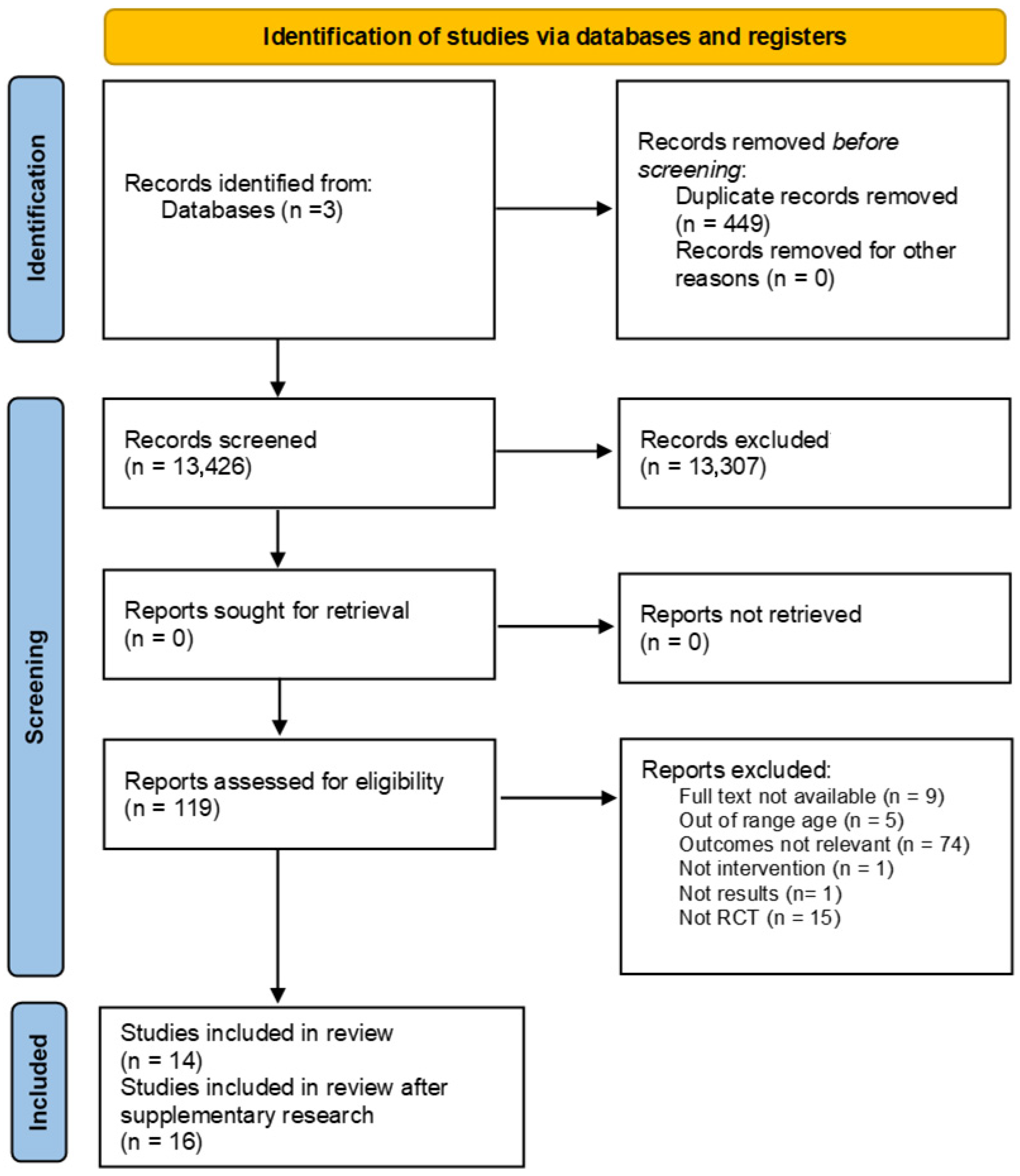
A total of 13,879 studies were identified, and 449 duplicates were removed. The titles and abstracts of the remaining 13,430 were screened, and 123 were eligible. After considering the eligibility criteria, 107 articles were excluded for multiple reasons, and a final number of 16 studies was included in the systematic review (Figure 1).

3.2. Studies’ Characteristics

The characteristics of the studies are reported in Table S1 of the Supplementary Materials (Supplementary Table S1). The publication dates of studies ranged between 2016 and 2024. Most of the included studies adopted randomized controlled trials (RCTs, n = 15) [23,24,25,26,27,28,29,30,31,32,33,34,35,36,37], and only one study adopted a crossover design (n = 1) [38].
The majority of the studies were conducted in Iran (n = 5) [24,25,26,27,35] and in the United States of America (n = 4) [29,31,36,37]. Two of the studies were conducted in Tunisia [23,33], and China [28], Slovakia [38], Korea [30], Turkey [32], and Italy [34] each contributed one study.
The included studies were published between 2016 and 2024, with the majority of studies published from 2022 onward [23,24,25,26,28,30,32,33,34,36,37,38].
The sample sizes of the included studies ranged from 14 to 108 participants. Fifteen studies included a sample size ≤50 [23,24,25,26,27,28,29,30,31,32,33,35,36,37], whilst one study included 108 participants [34].
Regarding gender, 11 studies evaluated both females and males [26,28,29,30,31,32,33,34,36,37,38]. Two studies evaluated only boys [24,27]. Three studies did not report gender stratification [23,25,35].
ASD diagnosis was reported in 12 studies using formal diagnostic criteria. Six studies used the Diagnostic and Statistical Manual of Mental Disorders, fourth or fifth edition (DSM-IV or DSM-V), considered the gold standard diagnostic tool [23,25,26,27,33,35]. Four studies used the Autism Diagnostic Observation Schedule, Second Edition (ADOS-2) [29,36,37,38]. Three studies utilized the ADOS-2 alongside the Autism Diagnostic Interview-Revised (ADI-R) [36,37,38]. One study used the Gilliam Autism Rating Scale, Second Edition (GARS-2) [24], and one used the Wechsler Intelligence Scale for Children—Fourth Edition (WISC-IV) [34]. The remaining four studies did not specify the tools used for autism diagnosis.
The severity of autism was assessed in six studies using different tools. Three studies used the Childhood Autism Rating Scale (CARS) [23,30,33]; one used the Aberrant Behavior Checklist (ABC) [28]; one used the Autism Spectrum Quotient: Children’s Version (AQ-C) [27]; and one used ADOS-2 [29]. The remaining 10 studies did not mention autism severity.
Additionally, five studies assessed the level of functioning or the baseline social communication skills of the involved children. Three studies measured the Intelligence Quotient (IQ) [26,29,33]. Two studies utilized the Vineland Adaptive Behavior Scale—Second Edition (VABS-II) [36,37], with one study also including the Social Communication Questionnaire (SCQ) [37], and another study incorporating the Social Responsiveness Scale (SRS) and the Developmental Coordination Disorders Questionnaire (DCDQ) [36]. The remaining 11 studies did not report the level of functioning or the baseline social communication skills of the children involved.

3.3. Intervention

The included studies evaluated both land-based and water-based physical activity interventions. Thirteen studies implemented a land-based physical activity intervention [23,24,26,27,28,29,30,31,34,35,36,37,38]. Three studies utilized the Sport, Play, and Active Recreation for Kids (SPARK) program, which includes exercises and free play to promote Fundamental Movement Skills (FMSs) [24,26,35]. In these studies, the comparison group did not engage in the SPARK program and maintained a normal routine. Two studies used different types of training programs—one focused on psychomotricity and the other on integrative autism therapy—both incorporating similar exercises, including fine and gross motor activities, sensory integration tasks, and cognitive games [23,30]. The first study had a comparison group that followed a normal routine, while the second study included a control group that received conventional autism therapy, which involved stability and mobility exercises. One study evaluated a school-based physical education program in comparison with a non-exercising control group [38]. Two studies combined music therapy with physical activity. One study compared this combination with a non-exercising control group [27]. The other study examined the effects of creative movement (i.e., musical/rhythm and yoga-based activities) in two different modalities: face-to-face and via ZOOM call [37]. One study employed a seated face-to-face play intervention aimed at improving fine motor coordination in comparison with a telehealth seated play intervention [36]. Two studies evaluated the effect of yoga training programs [28,29]. Ju et al. [28] compared the experimental group to a control group that did not receive the intervention, while Kaur et al. [29] compared the experimental group to healthy controls engaged in sedentary activities.
The remaining two studies focused on sports programs. One study evaluated a taekwondo training program [31], while another examined a football training program [34]; both compared results with a group that did not receive the intervention.
Only two studies analyzed water-based physical activity interventions [25,33]. One study assessed the effects of aquatic exercises using a response-oriented approach, highlighting motor skills and executive functions [25]. The other investigated the effectiveness of technical aquatic training and game-based aquatic training [33]. For both studies, the control groups did not receive any intervention program. Additionally, one study explored the impact of aquatic fitness exercises, in comparison with a basic movement exercise group that included balance, jumping, strength, and endurance training [32].
Intervention duration, frequency and session length varied across studies, and are reported in Table S2 of the Supplementary Materials (Supplementary Table S2). Total intervention duration ranged from seven weeks to almost one year, with session frequency ranging from two to four times per week and session length from 25 to 60 min. Due to the heterogeneity of the intervention protocols and inconsistent reporting of dosage parameters, a systematic dose–response analysis was not feasible.
Of the included studies, only seven studies reported dropout rates, which ranged from 0 to 6 children. Intervention adherence was inconsistently reported, with only a minority of studies (n = 4) [24,28,29,31] providing quantitative adherence data. No studies reported adverse events.

3.4. Motor Skill Outcomes

The most common tool used for the assessment of motor skills was the Bruininks–Oseretzky Test (BOT), in particular the BOT of Motor Proficiency (BOT-MP; n = 3), the BOT of Motor Proficiency, Second Edition (BOT-2; n = 3), the BOT of Motor Proficiency, Second Edition, Short Form (BOT-2-SF; n = 1).
Improvements in Bruininks–Oseretzky Test subscales emerged in five studies. Faraji et al. [25] demonstrated that a response-oriented approach using aquatic exercises significantly improved coordination, ball receiving and throwing skills, as well as both static and dynamic balance. Similarly, Imankhah et al. [27] revealed that music therapy and play therapy enhance motor coordination measured by the BOT-MP. Additionally, the SPARK program showed improvements in various BOT-MP subscales, including running speed, agility, balance, bilateral coordination, and strength [26,35]. Similarly, a 32-session school-based yoga intervention led to significant improvements in gross motor skills and bilateral coordination subtests [29].
In contrast, some studies indicated no significant improvement in BOT-2 scores after implementing a 16-session seated play intervention [36] or an 8-week creative movement intervention that incorporated musical and yoga-based activities [37]. Moreover, comparable results emerged using a different assessment tool, the Test of Gross Motor Development, Second Edition (TGMD-2) [37]. A school-based physical education program resulted in enhanced motor performance, particularly regarding locomotion and gross motor skills measured by the TGMD-2 [38]. Gross motor skills evaluated with TGMD-2 improved after technical aquatic and game-based aquatic training [33].
One study used the Movement Assessment Battery for Children, Second Edition (MABC-2), demonstrating an improvement in motor coordination after 24 sessions of yoga, which remained consistent after a one-month follow-up evaluation [28].
One study evaluated the effects of an aquatic exercise program compared with a land-based exercise program using several tests: the medicine ball throw, the sit and reach flexibility test, the vertical jump, and the standing long jump test [32]. After the aquatic exercise program, participants showed significant improvements in medicine ball throw, sit-and-reach test, standing long jump, and vertical jump. In contrast, the land exercise program group showed a significant improvement only in the sit-and-reach test.
A single study utilized a subtest from the Developmental Neuropsychological Assessment, Second Edition (NESPY-II) to assess sensory–motor functioning in children, without any effect following two years of integrated football training [34].
Postural control was evaluated in three studies [23,30,31]. One study employed a stabilometric platform to assess standing postural control of children under open- and closed-eye conditions after nine weeks of psychomotor training, demonstrating improvements in all postural parameters [23]. A dynamic and interactive platform (NeuroCom Balance Master) was used to measure static balance through a double- and single-leg stance test under four conditions: open and closed eyes on a firm and stable surface and on an unstable foam surface [31]. Additionally, functional balance was evaluated using the Step/Quick Turn (SQT) test. The children with ASD, engaged in a taekwondo program, demonstrated a reduction in sway velocity only in the single-leg stance test; specifically, during the left single-leg stance under the open-eyes condition and the right single-leg stance under the closed-eyes condition [31]. A further study evaluated postural control using two different scales: the Pediatric Balance Scale (PBS) and the Short Falls Efficacy Scale (sFES). The PBS assesses a child’s motor function-oriented balancing ability, while the sFES evaluates the subject’s fear of falling during daily activities. The children who participated in integrative autism therapy showed improvements in their PBS scores and a decrease in their sFES scores [30].
One study conducted a gait analysis using a 15 m walkway at a constant speed of approximately 0.9 m/s to determine whether children participating in the SPARK program reduced their peak ground reaction force amplitudes, loading rates, and peak pressure variables. The intervention group significantly decreased the peak pressure only at the medial heel region [24].

3.5. Risk of Bias Assessment

The quality assessments of the included studies are summarized in Table S3 (Supplementary Table S3). The overall quality scores were “high” (n = 1) [20], “moderate” (n = 10) [25,26,27,28,29,30,33,34,35,36,37], and “low” (n = 5) [23,31,32,34,38].
Eleven studies outlined eligibility criteria for participants, while the others lacked this information [24,29,34,37,38]. Randomization of the entire recruited group was not executed in four studies [29,31,34,38], while only two studies concealed allocations [24,28].
Nine studies reported baseline values; the other seven studies did not provide pre-intervention data [23,26,27,31,32,35,38].
A double-blind design was used in one study only [24]. Outcome assessors were blinded in three studies [26,29,30]. Therapists delivering the interventions were not blinded in any of the included studies.
In eight studies, the results of key outcomes were detected in over 85% of participants [24,25,27,29,30,31,35,37]. All the included studies adhered to the treatment or control conditions as allocated, utilizing an “intention to treat” approach. Only one study [38] lacked between-group statistical comparisons, and one study [29] did not provide point estimates for some outcomes.

4. Discussion

This systematic review analyzed the effects of physical activity in children with ASD.
The majority of the studies included both genders, even if ASD is more common in males. The gender differences that characterize ASD are due to biological and diagnostic factors. Regarding the biological factors, animal models have shown that female sex hormones also play a role in this process [39]. In fact, certain sex hormones appear to exert a neuroprotective effect and may help to correct specific abnormalities within the nervous system. This could partly explain why ASDs manifest differently in females compared to males, often leading to underdiagnosis in females [40]. Despite these differences, the included studies evaluated both genders, but did not explain differences in motor skills.
The most used tools for diagnostic criteria are DSM-IV or DSM-V, which are widely recognized as gold standard diagnostic tools for ASD, supported by psychometric and clinical evidence [4]. However, it is also important to consider other complementary diagnostic tools, such as the ADOS and ADI-R, for a complete and accurate assessment [41,42]. Regarding the severity of autism, the CARS was frequently utilized, but the specificity of this tool is not always optimal, and the literature suggests that CARS should be used in combination with other diagnostic tools [43]. Furthermore, for a comprehensive assessment of children, it is important to evaluate their ability to communicate and engage in physical activities. Most of the included studies measured the Intelligence Quotient (IQ), which evaluates cognitive function but not directly the capacity of children to communicate. Therefore, it should be used in combination with other specific tools for evaluating communication and socialization skills, such as VABS and SRS [44].
The included studies reported insufficient data about ASD severity and baseline functional level. Specifically, more than half of the studies (n = 10) failed to clearly specify participants’ ASD severities. This lack of reporting substantially limits the interpretation and generalizability of the findings. In fact, children with different levels of ASD severity may respond differently to physical activity intervention, in terms of both feasibility and the magnitude of motor improvements.
The assessment of motor skills was mainly conducted with the Bruininks–Oseretzky scale, which, due to the applicability of the various subscales, can easily be tailored to meet the needs of investigation methods. However, the application of other tools across studies demonstrates the lack of a gold standard measurement for assessing motor skills in children with ASD.
Regarding the intervention programs, the prevalence of land-based physical activities (15 out of 17 studies) compared to water-based physical activities (only 2) could be explained by the greater accessibility and feasibility of structuring land-based activities. Moreover, water is a difficult environment for children with ASD, and it can be harder to find an inclusive pool [33].
The durations of the interventions ranged from seven weeks to almost one year, with a mode of an eight-week protocol. The frequency of sessions was two to four times per week, and, in most cases, the duration of each session ranged from 45 to 60 min. Beginning with a 7-week land-based program, children with ASD can benefit from physical activity interventions twice a week, enhancing motor skills and coordination [27]. The lack of a formal dose–response analysis limits interpretation regarding how specific intervention characteristics may influence the outcomes. This limitation reflects both the wide variability in intervention designs and dosage parameters across the included studies.
Among the studies investigating land-based protocols, a combination of various interventions was administered (e.g., psychomotricity, SPARK, aerobic activities combined with strength training, music therapy, and integrative autism therapy). Two of these studies implemented an intervention that integrated music with physical activity [27,37]. The study by Imankhah et al. [23] showed an enhancement in motor coordination among children participating in music therapy. This improvement is likely due to the synchronization of body movements with rhythm, which can balance motor responses by influencing the nervous system and releasing either excitatory or inhibitory neurotransmitters, depending on the type of rhythm [45,46]. However, another study that incorporated music into the intervention did not report any significant differences between the two intervention groups, underlining the intervention’s effectiveness regardless of the delivery method [37]. Growing evidence supports the positive effects of music interventions to address multisystem disorders in individuals with ASD. The implementation of a school-based physical education program underlines the importance of potentiating exercises as part of physical education during curricular classes [38]. Finally, the studies involving yoga reported enhancements in motor and bilateral coordination, gross motor skills, and executive functioning [28,29]. These improvements are probably due to the potential role of yoga in directly influencing the core symptoms of ASD, or indirectly addressing comorbid conditions associated with ASD [47]. The available evidence supports the beneficial effects of physical activity interventions on motor coordination. This improvement in motor skills is likely due to activities that require learning skills, motor control, and social engagement, which positively enhance cortical, subcortical, and cerebellar function [35].
Both water- and land-based physical activity interventions revealed improvements in strength, endurance, flexibility, and anaerobic performance. Land-based programs typically emphasize task-specific motor skills and postural control that closely resembles daily activities, potentially facilitating transfer to real-world contexts. In contrast, aquatic interventions provide a unique sensory environment that may reduce postural demands and joint loading while enhancing proprioceptive and vestibular stimulation. Specifically, two studies involving water-based physical activity interventions showed improvements in motor proficiency [25,33]. The enhancements observed in these studies have previously been reported in the literature [48] and attributed to the reactive force generated by the resistance of the water [32]. Furthermore, the greater movement difficulties experienced by children with ASD could be compensated during the aquatic training exercise due to the buoyancy of water and its reduced gravitational effects [33]. Aquatic therapy can also result in a complex adaptation in the neuromuscular system, improving the transmission of neural impulses [10]. For this reason, aquatic interventions may be especially beneficial for children with more severe motor impairments and heightened sensory sensitivities, where the supportive properties of water can facilitate movement and engagement. On the other hand, isolation could occur in the water, and aquatic intervention can limit the development of social relationships with peers. There are no practical implications related to ASD severity and level of functioning, as it is necessary to tailor intervention type and intensity to individual children’s characteristics and contextual factors. Intervention selection should also consider resource availability, including access to a facility, trained instructors and financial constraints, to enhance feasibility, adherence and outcomes. Implementing both land-based and aquatic activities would be the most complementary solution.
From an implementation perspective, land-based interventions are generally more accessible and cost-effective, requiring fewer specialized facilities and lower operational costs. Aquatic interventions, while potentially advantageous for children with higher sensory sensitivities or lower motor competence, may involve higher costs, safety requirements and limited availability. These factors should be carefully considered when selecting intervention modalities in clinical and education settings.
Quantitative subgroup analysis by assessment tool or intervention type were considered a priori; however, the limited number of studies within each subgroup, combined with methodological heterogeneity, precluded statistically robust subgroup analysis.
The quality of the included studies was mainly rated as “moderate,” with only one study classified as high-quality. While most studies utilized a random allocation of participants, this allocation was not concealed. It should be considered that the PEDro scale is less sensitive to key domains of internal validity, such as random sequence and allocation concealment. Therefore, although the PEDro scale was selected due to its widespread use and practicality, the methodological quality findings should be interpreted with caution. Furthermore, only the highly evaluated study employed participant blinding. However, the therapists administering the intervention were not blinded due to the nature of the treatment [24]. A sensitivity analysis excluding low-quality studies was not conducted due to the small overall number of included studies and the risk of further compromising the interpretability of the findings.
Taken together, the results show the positive effects of various interventions on motor skills (81.2% of the included studies). These findings highlight the importance of children with ASD participating in school-based and extracurricular activities that include different types of activity and exercise. The positive effect of these activities can also be translated into a beneficial impact on their daily lives, enabling them to more easily perform tasks with greater confidence. Physical competence can also be enhanced while encouraging self-confidence and motivation in children with ASD.

Limitation

The quality of the included studies was primarily rated as “moderate,” which limits the findings of this systematic review, as only one study was deemed to be of high quality. Formal sensitivity analyses were not feasible, which was carefully considered when interpreting the findings, and the conclusion should be viewed with appropriate caution. Furthermore, a meta-analysis could not be performed due to substantial heterogeneity among studies, including differences in outcome measures, intervention types, duration, frequency, session length and assessment tools. Although a subset of studies used the BOT, differences in test versions, outcome domains and scoring procedures prevented meaningful quantitative pooling of results.
The interpretation of intervention feasibility and safety is limited by the inconsistent reporting of dropout rates, adherence and adverse events across the included studies.
Another significant limitation is the varying levels of autism, as it is a highly heterogeneous condition. Classifying these levels and evaluating their effects can be quite challenging. In addition to ASD severity and level of functioning, other key potential moderators, such as medication use and implementation fidelity, represent a limitation. These moderators were inconsistently reported across the included studies, precluding systematic analysis of their moderating effects on intervention outcomes. These factors may have influenced the observed results.
Variability in intervention delivery, therapist expertise and contextual factors further complicates comparison of the included studies.

5. Conclusions

This systematic review emphasizes the advantages of implementing physical activity in children with ASD. Across the studies reviewed, both land-based and water-based interventions showed significant improvements in motor proficiency, balance, and strength. The heterogeneity of ASD poses challenges in drawing definitive conclusions. Notably, the variety of exercise types, durations, and frequencies suggests a promising area for further investigation, particularly the development of personalized physical activity interventions tailored to the needs of children with ASD. Moreover, new motor tests could be developed to evaluate motor skills and could be tailored to the peculiarity of the disorders.
Integrating physical activity into the daily routines of children with ASD could significantly enhance their functional outcomes, well-being, and quality of life. Future studies should focus on addressing the methodological gaps identified in this review and explore the long-term effects of physical activity interventions on both motor skills and behavioral outcomes. From a practical perspective, intervention planning should consider ASD severity, level of functioning and contextual constraints, including the availability of trained personnel and facilities. Importantly, the limited representation of children with severe ASD highlights the need for more inclusive research designs and adaptable intervention models capable of addressing diverse needs. Overall, future studies should adopt rigorous reporting standards, examine key moderating variables and emphasize implementation fidelity to strengthen the evidence base and support equitable access to effective physical activity interventions across settings.
Additionally, specific motor skills evaluations should be developed and validated to detect impairments during diagnosis and measure improvements resulting from physical activity interventions.

Supplementary Materials

The following supporting information can be downloaded at: https://www.mdpi.com/article/10.3390/app16042102/s1, Table S1: Studies characteristics and main findings; Table S2: Quality assessment of the included studies, according to the Physiotherapy Evidence Database scale (PEDro scale); Table S3: Quality assessment of the included studies, according to the Physiotherapy Evidence Database scale (PEDro scale); Table S4: PRISMA 2020 Checklist [49].

Author Contributions

Conceptualization, F.L., V.P. and G.C.; methodology, F.L., V.P. and G.C.; literature search and data analysis F.L., A.G. and S.M.; writing—original draft preparation, F.L., A.G. and S.M.; writing—review and editing, V.P., A.G., S.M., C.C., E.M. and G.C.; supervision, G.C. and V.P. All authors have read and agreed to the published version of the manuscript.

Funding

This research received no external funding.

Institutional Review Board Statement

Not applicable.

Informed Consent Statement

Not applicable.

Data Availability Statement

Data are available on request from the corresponding author.

Conflicts of Interest

The authors declare no conflicts of interest.

Abbreviations

The following abbreviations are used in this manuscript:
ASDAutism Spectrum Disorder
TDTypically Developing
DSMDiagnostic and Statistical Manual of Mental Disorders
ADOSAutism Diagnostic Observation Schedule
ADI-RAutism Diagnostic Interview-Revised
GARSGilliam Autism Rating Scale, Second Edition
WISCWechsler Intelligence Scale for Children
CARSChildhood Autism Rating Scale
ABCAberrant Behavior Checklist
AQ-CAutism Spectrum Quotient: Children’s version
IQIntelligence Quotient
VABSVineland Adaptive Behavior Scale
SCQSocial Communication Questionnaire
SRSSocial Responsiveness Scale
DCDQDevelopmental Coordination Disorders Questionnaire
SPARKSport, Play, and Active Recreation for Kids
FMSFundamental Movement Skills
BOTBruininks–Oseretzky Test
TGMDTest of Gross Motor Development
MABCMovement Assessment Battery for Children
NESPYDevelopmental Neuropsychological Assessment
SQTStep/Quick Turn
PBSPediatric Balance Scale
sFESShort Falls Efficacy Scale

References

  1. Scattoni, M.L.; Fatta, L.M.; Micai, M.; Sali, M.E.; Bellomo, M.; Salvitti, T.; Fulceri, F.; Castellano, A.; Molteni, M.; Gambino, G.; et al. Autism Spectrum Disorder Prevalence in Italy: A Nationwide Study Promoted by the Ministry of Health. Child Adolesc. Psychiatry Ment. Health 2023, 17, 125. [Google Scholar] [CrossRef] [PubMed]
  2. Zeidan, J.; Fombonne, E.; Scorah, J.; Ibrahim, A.; Smith, E.; Maenner, M. Global prevalence of autism: A systematic review update. Autism Res. 2022, 15, 778–790. [Google Scholar] [CrossRef] [PubMed]
  3. Maenner, M.J.; Shaw, K.A.; Bakian, A.V.; Bilder, D.A.; Durkin, M.S.; Esler, A.; Furnier, S.M.; Hallas, L.; Hall-Lande, J.; Hudson, A.; et al. Prevalence and Characteristics of Autism Spectrum Disorder Among Children Aged 8 Years—Autism and Developmental Disabilities Monitoring Network, 11 Sites, United States, 2020. MMWR. Surveill. Summ. 2023, 72, 1–14. [Google Scholar] [CrossRef]
  4. American Psychiatric Association. Diagnostic and Statistical Manual of Mental Disorders, 5th ed.; American Psychiatric Association: Arlington, VA, USA, 2013. [Google Scholar]
  5. Bhat, A.N. Is Motor Impairment in Autism Spectrum Disorder Distinct from Developmental Coordination Disorder? A Report from the SPARK Study. Phys. Ther. 2020, 100, 633–644. [Google Scholar] [CrossRef]
  6. Srinivasan, S.M.; Pescatello, L.S.; Bhat, A.N. Current Perspectives on Physical Activity and Exercise Recommendations for Children and Adolescents With Autism Spectrum Disorders. Phys. Ther. 2014, 94, 875–889. [Google Scholar] [CrossRef]
  7. Fournier, K.A.; Hass, C.J.; Naik, S.K.; Lodha, N.; Cauraugh, J.H. Motor Coordination in Autism Spectrum Disorders: A Synthesis and Meta-Analysis. J. Autism Dev. Disord. 2010, 40, 1227–1240. [Google Scholar] [CrossRef]
  8. Lamanna, J.; Meldolesi, J. Autism Spectrum Disorder: Brain Areas Involved, Neurobiological Mechanisms, Diagnoses and Therapies. Int. J. Mol. Sci. 2024, 25, 2423. [Google Scholar] [CrossRef]
  9. Zong, W.; Lu, X.; Dong, G.; Zhang, L.; Li, K. Molecular mechanisms of exercise intervention in alleviating the symptoms of autism spectrum disorder: Targeting the structural alterations of synapse. Front. Psychiatry 2023, 14, 1096503. [Google Scholar] [CrossRef]
  10. Wang, C.; Zhang, Y.; Zhu, J.; Lin, Z. Progress in exercise interventions for autism spectrum disorder: Exploring underlying mechanisms. Front. Psychiatry 2026, 16, 1649005. [Google Scholar] [CrossRef] [PubMed]
  11. Bhat, A.N. Motor Impairment Increases in Children with Autism Spectrum Disorder as a Function of Social Communication, Cognitive and Functional Impairment, Repetitive Behavior Severity, and Comorbid Diagnoses: A SPARK Study Report. Autism Res. 2021, 14, 202–219. [Google Scholar] [CrossRef]
  12. Bull, F.C.; Al-Ansari, S.S.; Biddle, S.; Borodulin, K.; Buman, M.P.; Cardon, G.; Carty, C.; Chaput, J.-P.; Chastin, S.; Chou, R.; et al. World Health Organization 2020 Guidelines on Physical Activity and Sedentary Behaviour. Br. J. Sports Med. 2020, 54, 1451–1462. [Google Scholar] [CrossRef]
  13. Grosprêtre, S.; Ruffino, C.; Derguy, C.; Gueugneau, N. Sport and Autism: What Do We Know So Far? A Review. Sports Med. Open 2024, 10, 107. [Google Scholar] [CrossRef]
  14. McCoy, S.M.; Jakicic, J.M.; Gibbs, B.B. Comparison of Obesity, Physical Activity, and Sedentary Behaviors Between Adolescents With Autism Spectrum Disorders and Without. J. Autism Dev. Disord. 2016, 46, 2317–2326. [Google Scholar] [CrossRef] [PubMed]
  15. Thomas, S.; Barnett, L.M.; Papadopoulos, N.; Lander, N.; McGillivray, J.; Rinehart, N. How Do Physical Activity and Sedentary Behaviour Affect Motor Competence in Children with Autism Spectrum Disorder Compared to Typically Developing Children: A Pilot Study. J. Autism Dev. Disord. 2022, 52, 3443–3455. [Google Scholar] [CrossRef] [PubMed]
  16. Obrusnikova, I.; Cavalier, A.J. Perceived Barriers and Facilitators of Participation in After-School Physical Activity by Children with Autism Spectrum Disorders. J. Dev. Phys. Disabil. 2011, 23, 195–211. [Google Scholar] [CrossRef]
  17. Pan, C.-Y.; Chu, C.-H.; Tsai, C.-L.; Sung, M.-C.; Huang, C.-Y.; Ma, W.-Y. The Impacts of Physical Activity Intervention on Physical and Cognitive Outcomes in Children with Autism Spectrum Disorder. Autism 2017, 21, 190–202. [Google Scholar] [CrossRef]
  18. MacDonald, M.; Esposito, P.; Ulrich, D. The Physical Activity Patterns of Children with Autism. BMC Res. Notes 2011, 4, 422. [Google Scholar] [CrossRef]
  19. Bremer, E.; Crozier, M.; Lloyd, M. A Systematic Review of the Behavioural Outcomes Following Exercise Interventions for Children and Youth with Autism Spectrum Disorder. Autism 2016, 20, 899–915. [Google Scholar] [CrossRef]
  20. Vetri, L.; Roccella, M. On the Playing Field to Improve: A Goal for Autism. Medicina 2020, 56, 585. [Google Scholar] [CrossRef]
  21. Lang, R.; Koegel, L.K.; Ashbaugh, K.; Regester, A.; Ence, W.; Smith, W. Physical Exercise and Individuals with Autism Spectrum Disorders: A Systematic Review. Res. Autism Spectr. Disord. 2010, 4, 565–576. [Google Scholar] [CrossRef]
  22. Maher, C.G.; Sherrington, C.; Herbert, R.D.; Moseley, A.M.; Elkins, M. Reliability of the PEDro Scale for Rating Quality of Randomized Controlled Trials. Phys. Ther. 2003, 83, 713–721. [Google Scholar] [CrossRef] [PubMed]
  23. Ben Hassen, I.; Abid, R.; Ben Waer, F.; Masmoudi, L.; Sahli, S.; Driss, T.; Hammouda, O. Intervention Based on Psychomotor Rehabilitation in Children with Autism Spectrum Disorder ASD: Effect on Postural Control and Sensory Integration. Children 2023, 10, 1480. [Google Scholar] [CrossRef]
  24. Dehghani, M.; Jafarnezhadgero, A.A.; Darvishani, M.A.; Aali, S.; Granacher, U. Effects of an 8-Week Multimodal Exercise Program on Ground Reaction Forces and Plantar Pressure during Walking in Boys with Autism Spectrum Disorder. Trials 2023, 24, 170. [Google Scholar] [CrossRef] [PubMed]
  25. Faraji, S.; Najafabadi, M.G.; Zandi, H.G.; Shaw, I. Effect of Aquatic Therapy on Motor Skill and Executive Function in Children with Autism Spectrum Disorder. S. Afr. J. Res. Sport Phys. Educ. Recreat. 2023, 45, 17–27. [Google Scholar] [CrossRef]
  26. Hassani, F.; Shahrbanian, S.; Shahidi, S.H.; Sheikh, M. Playing Games Can Improve Physical Performance in Children with Autism. Int. J. Dev. Disabil. 2022, 68, 219–226. [Google Scholar] [CrossRef]
  27. Imankhah, F.; Hossein Khanzadeh, A.A.; Hasirchaman, A. The Effectiveness of Combined Music Therapy and Physical Activity on Motor Coordination in Children with Autism. Iran. Rehabil. J. 2018, 16, 405–412. [Google Scholar] [CrossRef]
  28. Ju, X.; Liu, H.; Xu, J.; Hu, B.; Jin, Y.; Lu, C. Effect of Yoga Intervention on Problem Behavior and Motor Coordination in Children with Autism. Behav. Sci. 2024, 14, 116. [Google Scholar] [CrossRef]
  29. Kaur, M.; Bhat, A. Creative Yoga Intervention Improves Motor and Imitation Skills of Children with Autism Spectrum Disorder. Phys. Ther. 2019, 99, 1520–1534. [Google Scholar] [CrossRef]
  30. Kim, Y.; Kim, M.; Park, C.; You, J.H. Effects of Integrative Autism Therapy on Multiple Physical, Sensory, Cognitive, and Social Integration Domains in Children and Adolescents with Autism Spectrum Disorder: A 4-Week Follow-Up Study. Children 2022, 9, 1971. [Google Scholar] [CrossRef]
  31. Kim, Y.; Todd, T.; Fujii, T.; Lim, J.-C.; Vrongistinos, K.; Jung, T. Effects of Taekwondo Intervention on Balance in Children with Autism Spectrum Disorder. J. Exerc. Rehabil. 2016, 12, 314–319. [Google Scholar] [CrossRef] [PubMed]
  32. Kurtoğlu, A.; Çar, B.; Konar, N.; Uzgur, K.; Baltacı, O. Investigation of the Effect Of Eight-Week Aqua Fitness Exercises on Some Strength Parameters and Body Composition with Autism Spectrum Disorder. Int. J. Disabil. Sports Health Sci. 2023, 6, 279–286. [Google Scholar] [CrossRef]
  33. Marzouki, H.; Soussi, B.; Selmi, O.; Hajji, Y.; Marsigliante, S.; Bouhlel, E.; Muscella, A.; Weiss, K.; Knechtle, B. Effects of Aquatic Training in Children with Autism Spectrum Disorder. Biology 2022, 11, 657. [Google Scholar] [CrossRef]
  34. Morsanuto, S.; Peluso Cassese, F.; Tafuri, F.; Tafuri, D. Outdoor Education, Integrated Soccer Activities, and Learning in Children with Autism Spectrum Disorder: A Project Aimed at Achieving the Sustainable Development Goals of the 2030 Agenda. Sustainability 2023, 15, 13456. [Google Scholar] [CrossRef]
  35. Najafabadi, M.G.; Sheikh, M.; Hemayattalab, R.; Memari, A.-H.; Aderyani, M.R.; Hafizi, S. The Effect of SPARK on Social and Motor Skills of Children with Autism. Pediatr. Neonatol. 2018, 59, 481–487. [Google Scholar] [CrossRef]
  36. Su, W.-C.; Cleffi, C.; Srinivasan, S.; Bhat, A. Telehealth Versus Face-to-Face Fine Motor and Social Communication Interventions for Children With Autism Spectrum Disorder: Efficacy, Fidelity, Acceptability, and Feasibility. Am. J. Occup. Ther. 2023, 77, 7706205130. [Google Scholar] [CrossRef] [PubMed]
  37. Su, W.-C.; Cleffi, C.; Srinivasan, S.; Bhat, A. A Pilot Study Comparing the Efficacy, Fidelity, Acceptability, and Feasibility of Telehealth and Face-to-Face Creative Movement Interventions in Children with Autism Spectrum Disorder. Telemed. Rep. 2024, 5, 67–77. [Google Scholar] [CrossRef] [PubMed]
  38. Kaplánová, A.; Šišková, N.; Grznárová, T.; Vanderka, M. Physical Education and Development of Locomotion and Gross Motor Skills of Children with Autism Spectrum Disorder. Sustainability 2022, 15, 28. [Google Scholar] [CrossRef]
  39. Barón-Mendoza, I.; Martínez-Marcial, M.; García-Juárez, M.; Mejía-Hernández, M.; Cortés-Sánchez, Y.; Zamora-Sánchez, C.J.; García-Rebollar, J.O.; Chavira-Ramírez, R.; Ordaz-Rosado, D.; Camacho-Arroyo, I.; et al. Disruptions in Reproductive Health, Sex Hormonal Profiles, and Hypothalamic Hormone Receptors Content in Females of the C58/J Mouse Model of Autism. Horm. Behav. 2024, 164, 105593. [Google Scholar] [CrossRef] [PubMed]
  40. Aiello, T.P.; Whitaker-Azmitia, P.M. Sexual Differentiation and the Neuroendocrine Hypothesis of Autism. Anat. Rec. 2011, 294, 1663–1670. [Google Scholar] [CrossRef] [PubMed]
  41. Santos, C.L.D.; Barreto, I.I.; Floriano, I.; Tristão, L.S.; Silvinato, A.; Bernardo, W.M. Screening and Diagnostic Tools for Autism Spectrum Disorder: Systematic Review and Meta-Analysis. Clinics 2024, 79, 100323. [Google Scholar] [CrossRef]
  42. Tsheringla, S.; Minju, K.A.; Russell, S.; Mammen, P.; Russell, P.S.S.; Nair, M.K.C. A Meta-Analysis of the Diagnostic Accuracy of Autism Diagnostic Observation Schedule Module-1 for Autism Spectrum Disorders. Indian J. Pediatr. 2014, 81, 187–192. [Google Scholar] [CrossRef]
  43. Moon, S.J.; Hwang, J.S.; Shin, A.L.; Kim, J.Y.; Bae, S.M.; Sheehy-Knight, J.; Kim, J.W. Accuracy of the Childhood Autism Rating Scale: A Systematic Review and Meta-analysis. Dev. Med. Child Neurol. 2019, 61, 1030–1038. [Google Scholar] [CrossRef] [PubMed]
  44. Charman, T.; Baird, G.; Simonoff, E.; Loucas, T.; Chandler, S.; Meldrum, D.; Pickles, A. Efficacy of Three Screening Instruments in the Identification of Autistic-Spectrum Disorders. Br. J. Psychiatry 2007, 191, 554–559. [Google Scholar] [CrossRef]
  45. Hardy, M.W.; LaGasse, A.B. Rhythm, Movement, and Autism: Using Rhythmic Rehabilitation Research as a Model for Autism. Front. Integr. Neurosci. 2013, 7, 19. [Google Scholar] [CrossRef]
  46. Bharathi, G.; Jayaramayya, K.; Balasubramanian, V.; Vellingiri, B. The Potential Role of Rhythmic Entrainment and Music Therapy Intervention for Individuals with Autism Spectrum Disorders. J. Exerc. Rehabil. 2019, 15, 180–186. [Google Scholar] [CrossRef]
  47. Gwynette, M.F.; Warren, N.J. Yoga as an Intervention for Patients with Autism Spectrum Disorder: A Review of the Evidence and Future Directions. Autism Open Access 2015, 5, 1–7. [Google Scholar] [CrossRef]
  48. Pan, C.-Y. Effects of Water Exercise Swimming Program on Aquatic Skills and Social Behaviors in Children with Autism Spectrum Disorders. Autism 2010, 14, 9–28. [Google Scholar] [CrossRef] [PubMed]
  49. Page, M.J.; McKenzie, J.E.; Bossuyt, P.M.; Boutron, I.; Hoffmann, T.C.; Mulrow, C.D.; Shamseer, L.; Tetzlaff, J.M.; Akl, E.A.; Brennan, S.E.; et al. The PRISMA 2020 statement: An updated guideline for reporting systematic reviews. BMJ 2021, 372, n71. [Google Scholar] [CrossRef] [PubMed]
Figure 1. Preferred Reporting Items for Systematic Reviews and Meta-analyses (PRISMA) flow diagram of articles selected and included in the systematic review.
Applsci 16 02102 g001
Disclaimer/Publisher’s Note: The statements, opinions and data contained in all publications are solely those of the individual author(s) and contributor(s) and not of MDPI and/or the editor(s). MDPI and/or the editor(s) disclaim responsibility for any injury to people or property resulting from any ideas, methods, instructions or products referred to in the content.