


Abstract
To address the current research gap where studies on the failure mechanisms of fissured tunnels mainly focus on single tunnels with insufficient research on double tunnels, and to provide a scientific basis for disaster prevention and control of the Jinan Tunnel on Jinan Ring Expressway, this study investigates the mechanical behavior and failure characteristics of tunnel structures containing fissure–hole composite systems using experimental tests and numerical simulations. The crack initiation, propagation, and coalescence mechanisms are systematically analyzed to provide engineering references for tunnel design and stability assessment. Sand-based 3D printing technology was used to fabricate double-tunnel models with prefabricated fissures of different inclination angles α. Uniaxial compression tests were conducted, and crack evolution was monitored using DIC technology. Meanwhile, numerical simulation verification was performed based on the parallel bond (PB) model of the Discrete Element Method (PFC). The results show that the mechanical response of sand-based 3D-printed models conforms to the brittle characteristics of engineering rock masses. For models without fissures, cracks are preferentially initiated at the top and bottom of the tunnels. For models with fissures, the peak strength is the highest when α = 30° and 60°, and the lowest when α = 45° and 90°. As the fissure inclination angle increases, the tensile stress concentration shifts from the top and bottom of the tunnels and the middle of the fissure to the two ends of the fissure. The numerical simulation results are consistent with the experimental results and can accurately reproduce crack evolution. This study verifies the effectiveness of combining sand-based 3D printing with discrete element simulation, providing a reference for fissure prevention and control as well as operation and maintenance optimization of similar double-tunnel projects.
1. Introduction
Tunnels serve as the core of major infrastructure such as national high-speed rail networks, cross-basin water diversion projects, and energy pipeline transportation. They are widely used in China’s national strategies like “Transportation Powerhouse” and “Water Conservancy Priority”. As key hubs for ensuring regional economic linkage and the allocation of livelihood resources [1,2], their structural safety directly affects the stability of the national infrastructure network and public safety [3]. However, tunnel projects often face complex geological conditions. Natural fissures or excavation-induced fissures are common. The crack propagation triggered by these fissures continuously weakens the strength of tunnel linings and the stability of surrounding rock: in mild cases, it causes water seepage and lining spalling, increasing operation and maintenance costs and affecting the normal operation of the project [4]; in severe cases, it leads to tunnel collapse and structural instability, which not only results in direct economic losses but also interrupts water supply for millions of people downstream and even endangers the lives of construction workers [5]. Experimental and numerical simulation studies on crack propagation in fissured tunnel models can accurately reveal the laws of crack evolution and quantify risk levels. They provide a scientific basis for engineering design optimization, construction risk prevention and control, and operation and maintenance monitoring. Thus, they are indispensable for avoiding major engineering disasters, ensuring the safety of national infrastructure, and reducing economic losses.
Research on the failure mechanism of fissured tunnels mainly focuses on three aspects: experiments, theory, and numerical simulation. Experimental research is a direct means to explore the failure mode of fissured tunnels. For example, Li et al. [6] investigated the propagation behavior of type I fissures outside tunnels under impact loading using drop hammer tests and clarified the interaction mechanism between external fissures and tunnels. Zhang et al. [7] conducted model tests with a similarity ratio of 1:40 to study the crack evolution of composite linings in permeable ribbed double-arch tunnels under asymmetric loading and void effects, revealing the corresponding failure characteristics. Gou et al. [8] examined the influence of ground fissures on metro shield tunnels crossing at right angles through large-scale tests and verified the failure mechanism using a three-dimensional model. Min et al. [9] performed model tests on cracked double-arch tunnel linings and identified three typical failure modes—local compression, shear, and compression–shear composite—demonstrating that fissures significantly reduce the flexural capacity of the lining and may induce different damage patterns at symmetric positions. Wang et al. [10] fabricated tunnel models with different hard–soft rock ratios and, by combining SHPB tests with DIC technology, investigated the fissure failure characteristics of layered composite rock tunnels under impact loading. Gao et al. [11] conducted model tests to study tunnel failure under strike-slip and oblique-slip fault movements, showing that circumferential bending cracks and inclined shear cracks commonly develop, and that double tunnels are mainly characterized by shear failure at the fault plane and bending failure at the hanging wall and footwall. However, existing studies on fissured tunnel failure mechanisms are still predominantly focused on single-tunnel models, whereas double-tunnel cases are more common in engineering practice and remain insufficiently investigated. In recent years, sand-based 3D printing technology has been increasingly adopted as an efficient method for preparing rock-like specimens with complex geometries and mechanical properties comparable to natural rock. Yu et al. [12] fabricated tunnel specimens with fissures of different inclination and azimuth angles using sand-based 3D printing and revealed the influence of fissure geometry and grouting on fracture characteristics through uniaxial compression tests combined with DIC. Wang et al. [13] employed sand-based 3D printing to produce tunnel specimens with portal-shaped cross-sections containing folded fissures and clarified the regulatory effect of fissure geometry on tunnel failure modes. Cheng et al. [14] proposed a cement-based binder jetting 3D printing method for preparing fissured rock analogs and demonstrated that optimized printing and curing conditions can effectively control geometric errors and achieve mechanical properties close to those of natural sandstone. Wang et al. [15] combined CT scanning with sand powder 3D printing to fabricate soft rock-like specimens with filled internal fissures; the study found that with the increase in fissure density, the peak strength index of the specimens decreases and the deformation characteristics decrease linearly, cracks propagate along the prefabricated path and loading direction, and the failure mode changes from diagonal shear to block shear; this method provides a new approach for the study of the mechanics of rock with complex filled fissures. Sun et al. [16] used sand powder 3D printing to produce rock-like specimens with single/double X-shaped fissures; in specimens with single X-shaped fissures, the inclination angle affects crack propagation (wing cracks are dominant, and anti-wing cracks appear with the change in inclination angle), and due to the interaction of double X-shaped fissures, a complex crack network is formed, and the stress–strain curve changes with the fissure configuration; this study deepens the understanding of the failure mechanism of X-shaped fissures. Zhang et al. [17] proposed an improved sand powder 3D printing method; using quartz sand and furan resin as base materials, high-strength and high-brittleness rock-like specimens were prepared after vacuum phenol resin impregnation and high-temperature baking post-treatment; their mechanical parameters are consistent with those of natural rock, and microscopically, the performance is improved due to the improvement of pores and the enhancement of particle bonding force; this method provides effective specimens for mechanical experiments on high-strength and high-brittleness rock. Therefore, in this study, sand-based 3D printing technology was used to fabricate double-tunnel models with fissures for corresponding experimental research.
The core of theoretical research is based on the cross principles of fracture mechanics, damage mechanics, and rock mechanics. By establishing stress intensity factor criteria or damage evolution equations, the entire process of fissure initiation, propagation, and penetration caused by stress concentration at the fissure tip is quantitatively analyzed—for example, linear elastic fracture mechanics is used to derive the critical stress threshold for fissure propagation, and damage variables are combined to describe the degradation law of rock mechanical properties caused by fissure development. Its significant advantage is that it can isolate complex interference factors at the engineering site, accurately reveal the internal mechanism of fissure failure, and systematically explore the influence weight of various factors through parametric analysis, thus providing theoretical support for the construction of constitutive models in subsequent numerical simulations and the design of physical experiment schemes. For example, Chen et al. [18] explained the mechanism of tunnel water inrush induced by stratum collapse based on catastrophe theory; taking the Shijingshan Tunnel as a case, the water inrush mode was determined to be stratum collapse type; a fluid–solid coupling model was established to analyze the evolution characteristics of surrounding rock plastic zone, deformation, and support force under different working conditions. Yan et al. [19] built a model using Flac 3D software (Version 5.0) to analyze the influence of intersection angles on the deformation and stress characteristics related to the failure of utility tunnel fissures. Wang et al. [20] proposed a nonlinear dual-parameter bond-based peridynamic (PD) concrete model for analyzing the initiation and propagation of tunnel lining fissures; by introducing a constitutive force function to describe the nonlinear relationship between bond tension and force vector in tangential deformation, the model can accurately simulate the lining crack propagation path under vault load and eccentric compression. Xu et al. [21] used 3D scanning, modeling, and printing technologies to fabricate rock-like specimens (RLSD) with rigid discontinuities of different inclinations and roughness, combined with uniaxial tests, DIC, AE, and SEM measurement methods, revealed the influence of inclination angle and joint roughness coefficient (JRC) on the strength, deformation, and failure mechanism of RLSD, and established an empirical estimation formula for uniaxial compressive strength, which provides a reference for the estimation of surrounding rock strength and disaster prevention and control in deep underground engineering. Liu et al. [22] studied the mechanical and fracture characteristics of rock-like specimens with inclined weak-filled rough joints (WFRJs) through uniaxial compression tests combined with acoustic emission (AE) and DIC measurement methods, analyzed the influence of JRC on peak stress, failure strain, etc., and the change in the proportion of crack types, established a mechanical model considering local roughness and overall structure, and verified it through ANSYS/LS-DYNA (Version 17.0), thus clarifying the action mechanism of WFRJs on specimen failure. Hu et al. [23] fabricated double-layer composite rock-like specimens with two parallel fissures, studied the influence of material combination and fissure inclination on the mechanical properties (strength, elastic modulus, etc.) and crack evolution of the specimens through uniaxial compression tests and DIC technology, defined the parameter R to characterize the strength relationship between the upper and lower layers, divided the failure modes into two categories, namely, penetration and non-penetration, and revealed the effect of the interlayer interface on crack connection. However, theoretical research also has obvious shortcomings: most models are based on the assumption of homogeneous and isotropic rock masses, which is quite different from the heterogeneity and bedding structure of rock masses in actual tunnel engineering.
Numerical simulation for studying the failure mechanism of tunnel fissures has significant advantages over theoretical research and physical experiments: it can not only break through the simplified assumptions such as homogeneity and isotropy in theoretical research, and accurately reproduce complex actual conditions in tunnel engineering such as heterogeneous rock masses and multi-field coupling, but also avoid the limitations of physical experiments, such as long cycle, high cost, difficulty in simulating extreme working conditions, and non-repeatability. At present, numerical simulation methods used for studying the failure mechanism of tunnel fissures are mainly divided into four categories. The first is the Finite Element Method (FEM), which has the advantages of mature theory and high calculation accuracy, and is suitable for the analysis of stress field and displacement field in the initial stage of crack propagation in continuous medium rock masses, and is closely connected with engineering design. Zhang et al. [24] took the comprehensive utility tunnel project at the Xi’an ground fissure as the prototype, established a three-dimensional numerical model of utility tunnel–ground fissure–stratum using the Finite Element Method (FEM), studied the mechanical response and deformation law of the utility tunnel under different relative positions, and analyzed the deformation mechanism combined with the elastic foundation beam theory. Wang et al. [25] took the shield tunnel of Xi’an Metro Line 8 crossing the ground fissure as the engineering background, adopted the method combining 1:20 shaking table test and FEM, built a three-dimensional model using Abaqus software (Version 6.1.4), and studied the dynamic response of the tunnel under near-field and far-field seismic actions. Wu et al. [26] used FEM (Finite Element Method) and the RHT constitutive model to simulate the failure process of the fissure–tunnel system under dynamic loads, and accurately reproduced the crack initiation, propagation path, and failure mode. Lin et al. [27] used FEM (Finite Element Method) to build a concurrent multi-scale model and embedded cohesive elements to simulate crack propagation; however, the Finite Element Method relies on mesh redivision when simulating crack propagation, and has low efficiency when facing complex multi-crack intersection and penetration, making it difficult to handle the block movement after rock mass discretization. The second is the Extended Finite Element Method (XFEM), which introduces enrichment functions and does not require mesh redivision, and can accurately simulate the initiation and propagation path of a single or a small number of fissures. For example, Du et al. [28] took the Fuchuan Tunnel of Lanzhou-Xinjiang High-speed Railway as the research object, studied the crack propagation law of the tunnel invert with initial damage under train dynamic loads through numerical simulation, and used XFEM (Extended Finite Element Method) and Abaqus software, combined with low-cycle fatigue analysis, to reveal the crack propagation law of the invert with initial damage. Du et al. [29] studied the crack propagation mechanism of the invert of large-section tunnels under floor heave through model tests and numerical simulation, and used the XFEM (Extended Finite Element Method) and Abaqus software, combined with the concrete damage plasticity constitutive model, to reveal the crack propagation law of the invert and the influence of structural parameters. Yang et al. [30] studied the crack evolution and structural response of shield tunnel segments with initial cracks under long-term train loads through Abaqus numerical simulation, and used XFEM (Extended Finite Element Method) combined with the modified Paris fatigue crack propagation criterion to reveal the crack evolution law. Wang et al. [31] proposed a semi-analytical method for calculating the internal force of tunnel linings with multiple longitudinal fissures and verified its effectiveness through XFEM numerical simulation; the study showed that the increase in fissure depth reduces the bending moment of adjacent lining sections and increases the bending moment of distal sections, and the more fissures there are, the easier it is to initiate new fissures; however, the Extended Finite Element Method has weak adaptability to multi-crack coupling propagation and large deformation failure, and its calculation accuracy is prone to decrease in discontinuous media (such as jointed rock masses). The third is the Smoothed Particle Hydrodynamics (SPH) method, which is not constrained by meshes and can efficiently simulate large crack deformation and dynamic failure (such as blasting-induced fissures and rapid crack propagation under impact loads). For example, Yu et al. [32] improved the momentum equation of Smoothed Particle Hydrodynamics (SPH) to build a numerical model; by introducing a failure coefficient and improving the kernel function to simulate the progressive failure process, the tunnel crack propagation law under different fissure parameters was accurately reproduced. Xia et al. [33] proposed the Kernel Broken Smoothed Particle Hydrodynamics (KBSPH) method; by improving the kernel function and introducing a complete failure flag, the crack propagation and deformation of layered rock units and tunnels (inclination angle 0–90°) were simulated. Zhang et al. [34] fabricated horseshoe-shaped tunnel specimens with different prefabricated fissures, conducted numerical simulation using the improved SPH method, and by improving the kernel function and failure criterion, accurately reproduced the crack propagation and mechanical response of tunnels under different fissure parameters. Hu et al. [35] fabricated central hole specimens with different fissure arrays, monitored crack propagation, and conducted numerical simulation using the improved SPH method; by optimizing the particle failure treatment, the interaction mechanism between fissure arrays and tunnels was revealed; however, particle interpolation is prone to numerical dissipation, resulting in low accuracy in describing the fine path of crack propagation. The fourth is the Discrete Element Method (DEM), which can simulate the block separation and movement caused by crack propagation in discrete rock masses (such as jointed and fragmented surrounding rock) and reproduce the macro-instability process such as tunnel collapse. For example, Ma et al. [36] aimed at the collapse case of a loess tunnel on Xi’an Metro Line 3 when crossing a ground fissure, analyzed the disaster-causing factors such as geology and construction, simulated the failure process using MatDEM software (Version 5.0) of the Discrete Element Method (DEM), and observed the stress chain phenomenon. Hu et al. [37] used PFC2D software (Version 5.0) of the Discrete Element Method (DEM) to conduct numerical simulation, built a parallel bond model, and after calibrating the mesoscopic parameters, jointly revealed the influence mechanism of ice-filled fissures on the tunnel failure process. Su et al. [38] took the Liangwangshan Tunnel as a case, analyzed the failure mechanism and treatment measures of tunnels in karst fissure strata, used the DEM (Discrete Element Method), built a model using UDEC software (Version 7.0), considered the influence of joints, and jointly revealed the influence of karst fissures on tunnel failure with on-site monitoring and laboratory tests. Li et al. [39] took the Qinghai Lehua Tunnel as a case, analyzed the collapse mechanism of double-pipe tunnels in weathered granite fault zones through Discrete Element Method (DEM) numerical simulation, built a model containing random fissure groups using MatDEM software, and reproduced the evolution process of surrounding rock collapse. Therefore, the Discrete Element Method was used in this study to simulate the degradation process of fissured tunnel models.
Although several studies have investigated the mechanical behavior of double tunnels, most of them focus on intact surrounding rock or simple fissure patterns. In contrast, the present study concentrates on fissure–hole composite structures with complex fissure configurations, which are common in practical tunnel engineering but remain insufficiently explored. Based on the shortcomings of previous studies, this study fabricated double-tunnel models with fissures using sand-based 3D printing technology and carried out model crack propagation tests under uniaxial compression. Based on the Discrete Element Method, the crack propagation law of fissured tunnel models was studied, and the failure mechanism of fissured tunnel models was discussed. The research results provide a certain reference for the prevention and control of tunnel collapse disasters.
2. Engineering Background
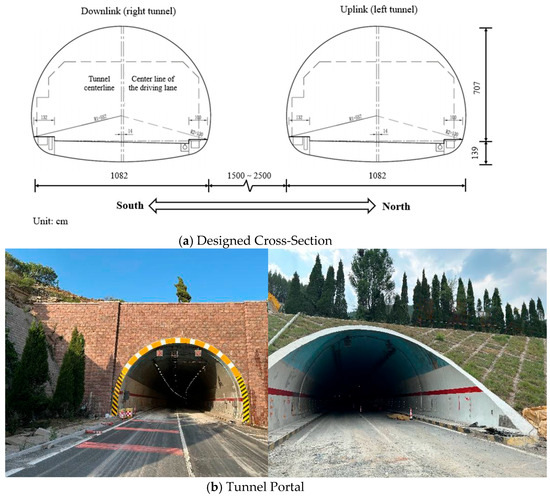
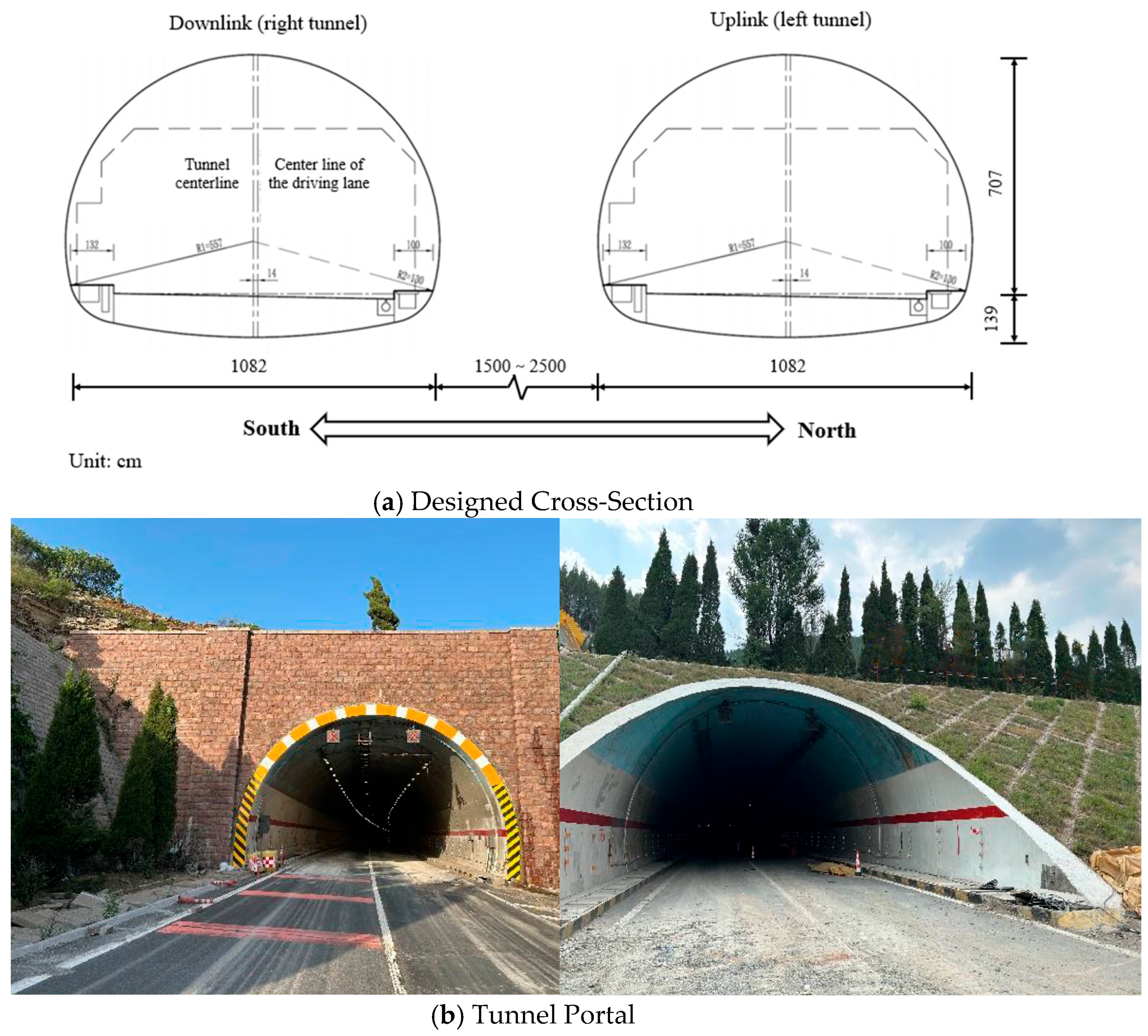
The research object of this study is the Jinan Tunnel on Jinan Ring Expressway in Shandong Province, as shown in Figure 1. This tunnel adopts a separate double-tunnel structure and is designed for four two-way lanes. The net width of a single tunnel is 10.82 m, and the net height is approximately 8.46 m. The designed cross-section of the tunnel and the actual tunnel portal (one of the two options) are shown in Figure 1. The tunnel was completed and put into operation in 2002, and has been in operation for about 23 years. The left line of the tunnel is from stake mark LK32+359 to LK33+506, with a total length of 1147 m. The right line is from stake mark RK32+348 to RK33+537, with a total length of 1189 m.
Figure 1.
Schematic diagram of operational tunnel cross-section and portal.
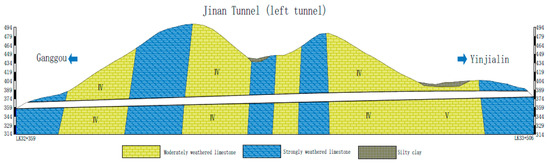
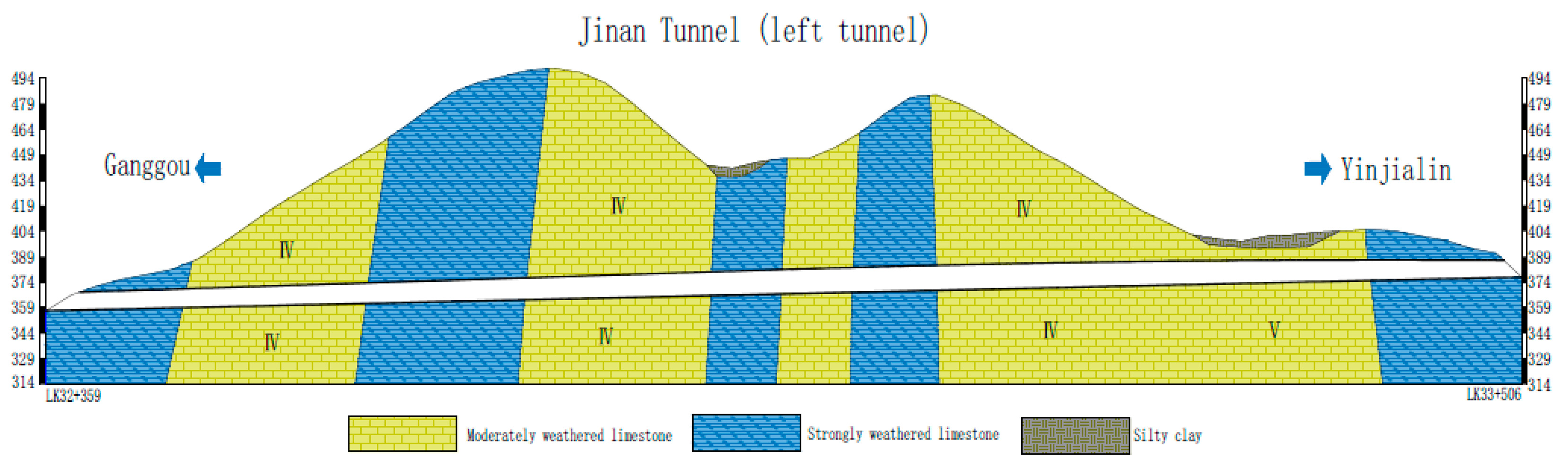
The tunnel passes through a stratum mainly composed of Middle Cambrian thick-bedded limestone, with local intercalation of weak interlayers such as thin-bedded argillaceous rocks and limestone bands. Long-term weathering-erosion and joint fissure development have led to a decrease in surrounding rock integrity. The overall engineering geological conditions are classified as Grade IV–V surrounding rock, as shown in Figure 2. After more than 20 years of operation, the tunnel has gradually exposed typical problems such as water seepage, cracks in lining concrete, and local voids and looseness. Among them, the surrounding rock of the tunnel has discontinuous areas such as fissures and voids, and the surrounding rock deterioration is serious.
Figure 2.
Schematic diagram of geological conditions and surrounding rock grade.
3. Specimen Preparation and Test Scheme
3.1. Specimen Preparation
To investigate the influence of fissure occurrence forms on double-tunnel engineering, sand-based 3D printing technology was used to fabricate double-tunnel models with prefabricated fissures. The sand-based 3D printing process is as follows:
- (1)
- The specimens were prepared using sand-based 3D printing technology. First, a three-dimensional digital model of the specimen was established using CATIA software (Version R2020), in which the overall geometry and dimensions of the specimen were determined. After the model was completed, it was imported into the 3D printing system, and the printing layer thickness was set for subsequent fabrication.
- (2)
- Fine sand was used as the aggregate, and furan resin was selected as the binder. The specimens were fabricated using a sand-based 3D printing system based on binder jetting technology. Commercial ceramic proppant sand was employed as the aggregate material, and furan resin was used as the binder. The ceramic sand exhibited good particle uniformity and high mechanical stability, which ensured consistent printing quality and adequate strength of the printed specimens after curing. A commercial sand 3D printer was used for specimen fabrication. The printing process was conducted in a layer-by-layer manner, in which a thin layer of ceramic sand was first uniformly spread over the printing platform, followed by selective spraying of furan resin along the predefined contours to bond the sand particles. The printing layer thickness was set in advance to achieve a balance between geometric resolution and printing efficiency. Key printing parameters, including layer thickness, binder saturation level, and printing speed, were kept constant for all specimens to ensure consistency and repeatability. After printing, the specimens were allowed to cure at room temperature, and excess loose sand was carefully removed to obtain specimens with well-defined fissures and tunnels.
- (3)
- After printing, the specimens were cured at room temperature to allow sufficient solidification of the resin. The excess unbonded sand was then carefully removed, making the prefabricated fissures and holes clearly visible. Finally, the specimen surfaces were cleaned, and random speckle patterns were applied to facilitate subsequent digital image correlation analysis.
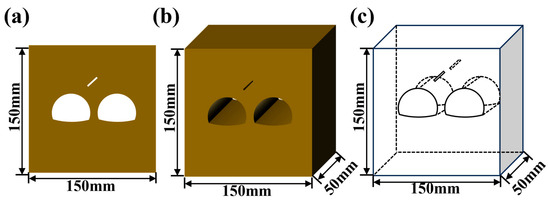
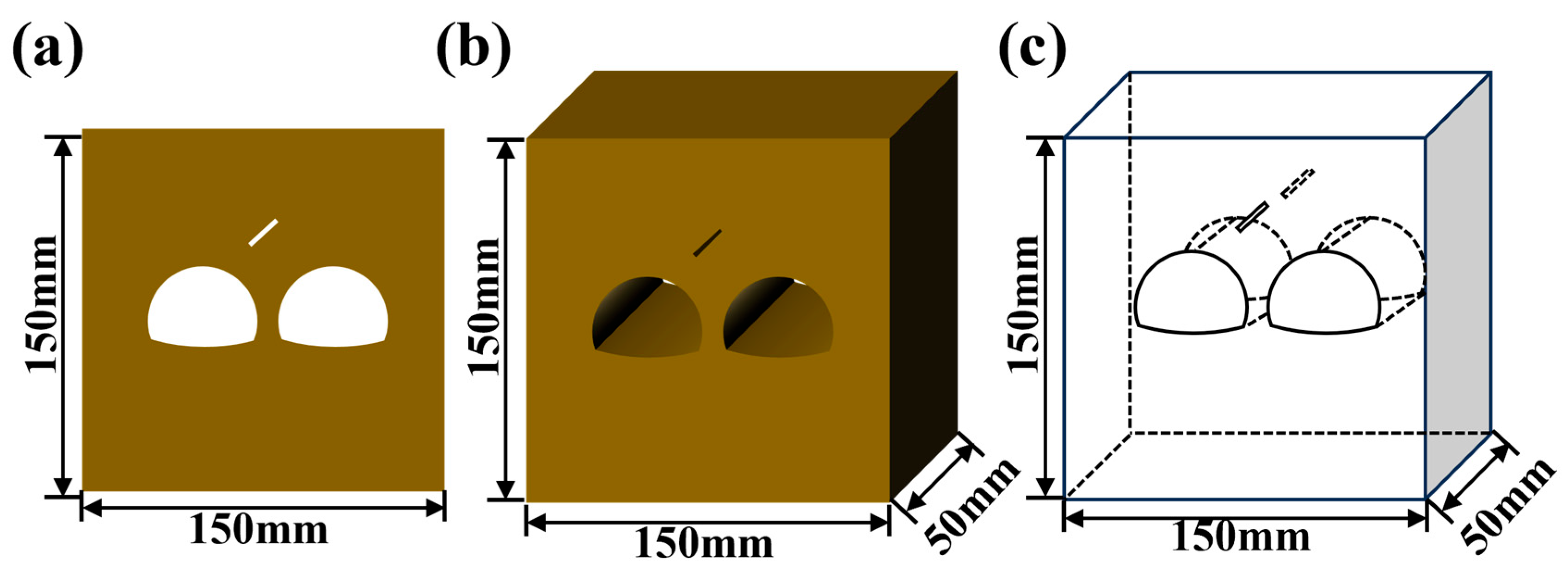
The size of the specimen is shown in Figure 3. The double tunnels were scaled down according to the actual engineering size. The model size is 150 mm × 150 mm. Two horseshoe-shaped tunnels were set inside the model. A prefabricated fissure was set above the two horseshoe-shaped tunnels, and its angle with the horizontal direction was defined as α. Specifically, the prefabricated fissure has a size of 20 mm × 2 mm × 50 mm. Two tunnels with different scales were designed in the specimens. The small tunnel has a width of 18.6 mm, a radius of 19.8 mm, and a thickness of 50 mm, while the large tunnel has a width of 30.6 mm, a radius of 32.7 mm, and a thickness of 50 mm.
Figure 3.
Specimen size. (a) Schematic geometry of specimen. (b) Three-dimensionally printed specimen model. (c) Transparent view of specimen.
3.2. Test Scheme
To investigate the influence of different prefabricated fissure inclination angles α on the crack propagation law of the double-tunnel model, two schemes were set: Scheme A, a double-tunnel scheme without prefabricated fissures, and Scheme B, a double-tunnel scheme with different prefabricated fissure inclination angles. The prefabricated fissure inclination angles α were set to 0°, 30°, 45°, 60° and 90° respectively. The specific test schemes are shown in Table 1.
Table 1.
Test schemes.
3.3. Test Equipment
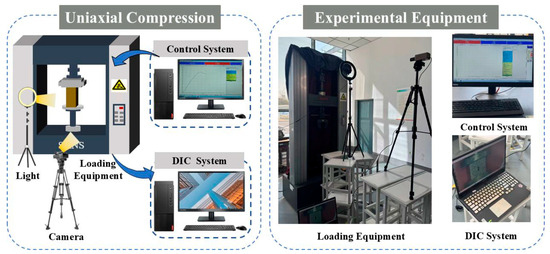
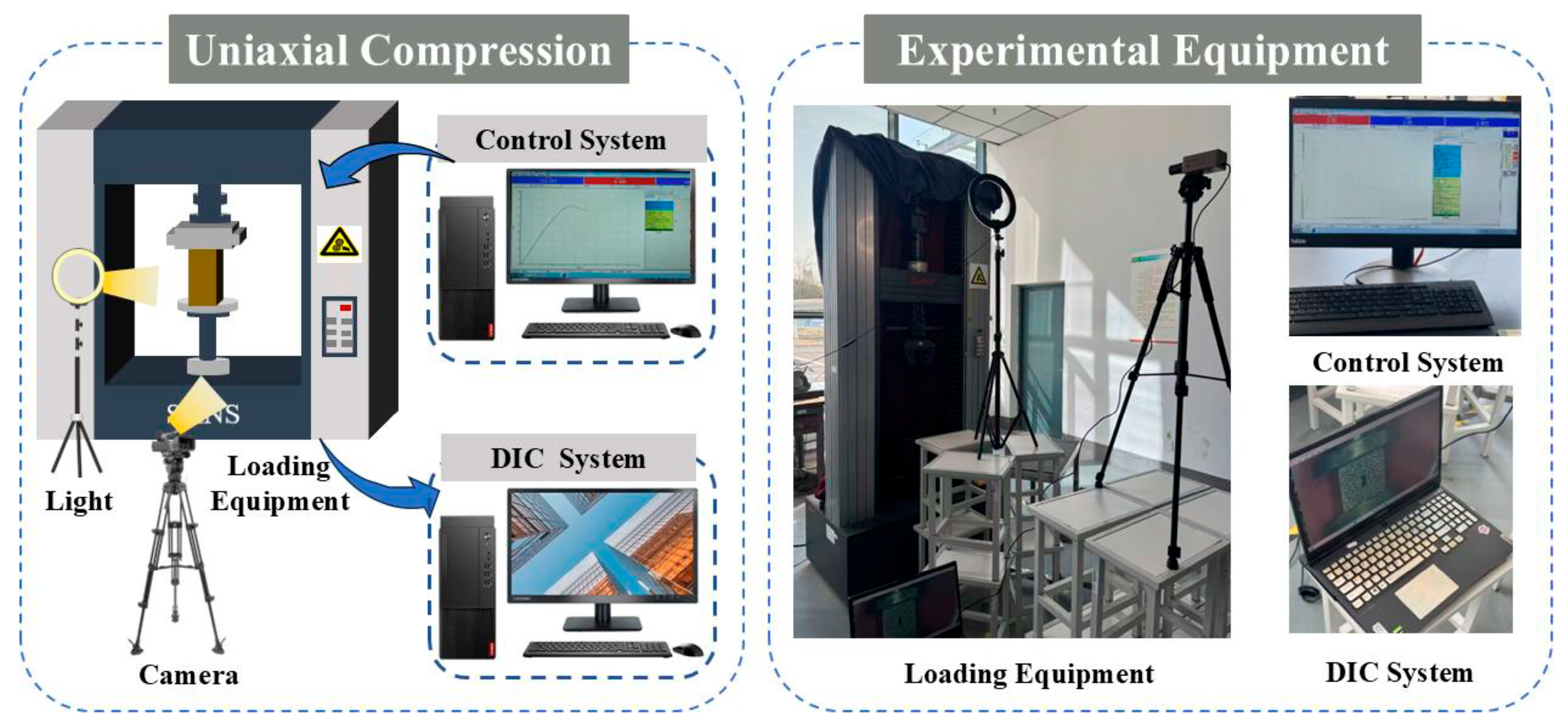
The test equipment and devices used in this study are shown in Figure 4. Prior to testing, random white speckles were sprayed on the specimen surface to enhance image contrast for digital image correlation analysis. Uniaxial compression tests were conducted using a universal testing machine (CMT5205, Shandong Wanchen Testing Machine Co., Ltd., Jinan, China), and the loading rate was set to 0.5 mm/min. The specimen was carefully positioned at the center of the loading platform to ensure uniform loading conditions. The experimental setup was based on a high-precision servo-controlled loading system, which was capable of accurately controlling both the applied load magnitude and loading rate. The servo system was connected to a computer and operated according to predefined loading programs, ensuring stable and repeatable loading conditions throughout the tests. Digital image correlation (DIC) was employed to monitor the surface deformation and crack evolution of the specimens during loading. A high-speed, high-definition industrial camera was used as the image acquisition device. The camera was mounted on a stable tripod and positioned perpendicular to the specimen surface to minimize optical distortion. Additional illumination was provided by adjustable aperture light sources to ensure uniform lighting conditions and stable image quality during the entire loading process. The camera was connected to a laptop computer, and the deformation process of the specimen was recorded continuously during loading. The captured video data were stored on an external hard drive to ensure sufficient storage capacity and data integrity. Subsequently, the recorded videos were processed using video analysis software to extract deformation images frame by frame. The extracted image sequences were then imported into the DIC analysis software GOM Correlate (Version 2022) for post-processing. Using the correlation algorithms implemented in the software, full-field displacement and strain distributions of the specimen surface were obtained. The loading system and the DIC system were synchronously operated, allowing the mechanical response and deformation evolution to be analyzed simultaneously. This integrated experimental system provided reliable support for investigating the fracture behavior of specimens containing prefabricated fissures.
Figure 4.
Uniaxial compression and test equipment.
3.4. DIC Principle
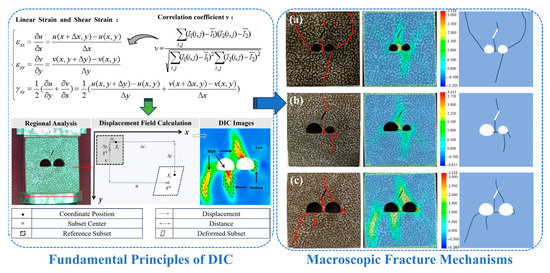
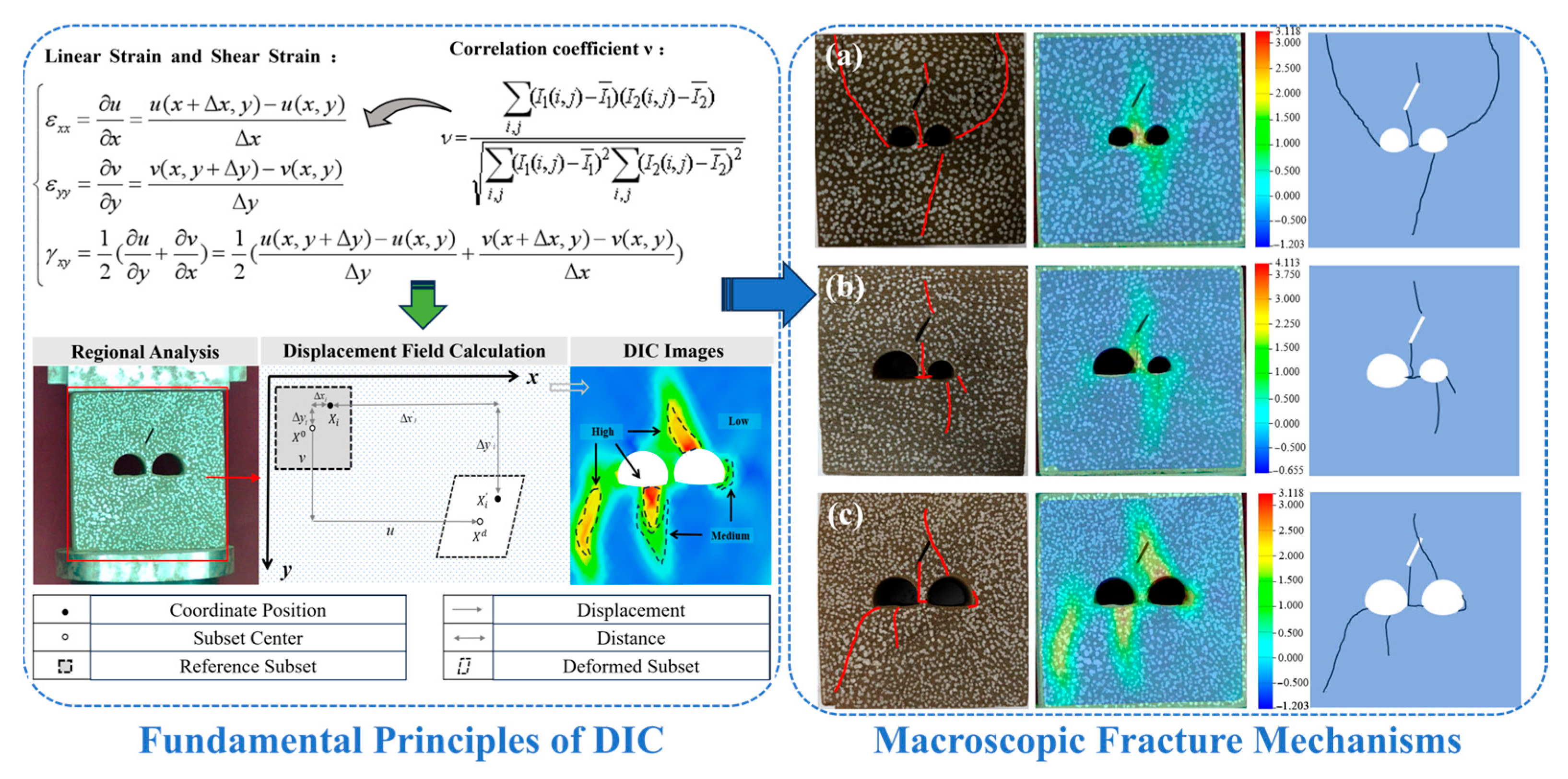
The principle of the digital image correlation (DIC) method is to obtain the displacement and strain information of the material by analyzing the image changes in the random speckle field on the surface of the measured material. First, random distributed speckles were prepared on the material surface as “feature markers” for displacement tracking. At different stages of material deformation under stress, speckle images were collected respectively. By calculating the correlation coefficient between pixel points, the speckle features before and after deformation were matched, so as to obtain the displacement field of each point. Let (x, y) denote the coordinates of a material point in the reference image, and (x′, y′) represent the coordinates of the corresponding point in the deformed image. The displacement components in the horizontal and vertical directions are defined as u(x, y) and v(x, y). In the subset-based DIC formulation, a square subset centered at the reference point (x0, y0) is selected for correlation analysis. The displacement and deformation within the subset are commonly approximated using a first-order shape function. The displacement gradients ∂u/∂x, ∂u/∂y, ∂v/∂x, and ∂v/∂y describe the local deformation of the material, including normal and shear strain components. Here, u and v represent the in-plane displacement components along the x- and y-directions, respectively. The subset size determines the spatial resolution and correlation accuracy of the DIC analysis, while the reference subset and deformed subset correspond to the image regions before and after deformation. Through correlation matching between the two subsets, the full-field displacement and strain distributions of the specimen surface can be obtained. Based on the differentiation of the displacement field, linear strains (normal strains along the x and y directions) and shear strains could be further derived. With the visualization of this strain information (such as color strain cloud maps), the strain distribution law of the material could be analyzed intuitively, thereby revealing the macroscopic fracture mechanisms such as crack initiation and propagation, and providing an accurate and intuitive experimental basis for the study of the mechanical behavior of materials (Figure 5).
Figure 5.
Introduction of DIC principle. (a) Two existing tunnels. (b) An old tunnel and a new tunnel. (c) Two new tunnels.
4. PFC Principle and Numerical Model
4.1. Parallel Bond Model
Numerical simulations were conducted using the Discrete Element Method implemented in the Particle Flow Code in two dimensions (PFC2D). PFC2D represents rock-like materials as an assembly of bonded particles and is particularly suitable for simulating crack initiation, propagation, and coalescence processes. Compared with continuum-based numerical methods, PFC2D can explicitly capture the discontinuous nature of rock fracture and naturally describe the progressive damage evolution induced by bond breakage [40,41]. Therefore, it is well suited for investigating the failure behavior of specimens containing prefabricated fissures and holes. Relevant applications of PFC2D in rock fracture analysis can be found in previous studies [42,43,44,45].
The parallel bond (PB) model in PFC was adopted. In the PB model, elastic cementitious materials with stiffness were introduced between two contact elements. It has two states: bonded and unbonded. When the external force on the bond exceeds the bearing capacity, the bond breaks and cracks are generated. This model can well demonstrate the crack propagation process of rock materials from the mesoscopic scale. The PB model is composed of linear bonds and parallel bonds, which can resist both forces and moments. The forces and moments borne by the PB model can be expressed as follows:
Among them, represents the linear force, is the damping force, is the parallel bond force, and is the parallel bond moment. With the application of external forces, the contact points move, and forces and moments begin to be generated inside the cementitious material. When the strength at any point exceeds the bond strength, the parallel bond breaks, and the model state degrades from bonded to unbonded [46]. At this point, only linear bonds remain, which can only bear the tension and friction between particles [47]. The particle contacts in the numerical model were simulated using a combination of the linear contact model and the parallel bond model. This modeling strategy was adopted to realistically represent the mechanical behavior of sand-based 3D-printed rock-like materials. The parallel bond model enables the transmission of both forces and moments between particles, which effectively simulates the tensile and shear resistance provided by the cementation material. After bond breakage, the contact naturally degrades into a frictional linear contact, allowing for a realistic representation of post-peak behavior, crack propagation, and coalescence processes in fissure–hole composite structures.
4.2. Calculation Model and Parameters
The size of the calculation model is consistent with that of the test model. The calculation parameters refer to the experience of previous numerical simulations, and the mesoscopic parameters used are shown in Table 2. The mesoscopic parameters adopted in Table 2 are defined based on the particle bonded model (PBM) implemented in PFC2D. In this model, the elastic modulus of particles (Emod) controls the normal and shear stiffness of particle contacts, while the bond elastic modulus (Pb_emod) governs the stiffness of the parallel bonds that represent cementation between particles. The bond tensile strength (Pb_ten) and bond cohesion (Pb_coh) determine the resistance of bonded contacts against tensile and shear failure, respectively, and their breakage is responsible for crack initiation and propagation in the numerical model. The bond friction angle (Pb_fa) defines the shear strength envelope of bonded contacts after bond breakage. For particle-scale properties, the particle density determines the inertial characteristics of the model. The minimum and maximum particle radii (Rmin and Rmax) control the particle size distribution, which influences the heterogeneity of the numerical specimen. The inter-particle friction coefficient (Fric) affects the post-failure sliding behavior between particles, while porosity reflects the initial void structure of the particle assembly. These parameters were calibrated to reproduce the macroscopic mechanical behavior observed in laboratory tests and were selected with reference to previous PFC-based studies on rock fracture and fissured specimens. To ensure the consistency between the numerical model and the experimental model, the geometric dimensions of the numerical specimens, including specimen size, hole diameter, hole spacing, and fissure geometry, were set identical to those of the experimental samples. Material parameters were calibrated to match the mechanical response of the sand-based 3D-printed material. Furthermore, the numerical results were systematically compared with experimental observations in terms of stress–strain behavior, crack initiation locations, crack propagation paths, and final failure modes. A good agreement was obtained, demonstrating the reliability of the numerical model.
Table 2.
Mesoscopic parameters.
4.3. Quantitative Analysis of Mechanical Parameters
To further quantify the mechanical behavior of specimens containing fissure–hole composite structures, additional mechanical parameters were introduced and analyzed, including elastic modulus, coefficient of variation, and comparative strength ratios. The elastic modulus was calculated from the linear portion of the stress–strain curves to characterize the deformation stiffness under different fissure configurations and ice-filling conditions. The coefficient of variation was employed to evaluate the dispersion of mechanical responses among specimens with identical geometric configurations, reflecting the sensitivity of mechanical behavior to fissure orientation and ice filling. In addition, comparative strength ratios were defined by normalizing the peak strength of fissured specimens with respect to that of intact specimens, allowing a clearer comparison of strength degradation induced by different fissure arrangements. The results indicate that both fissure configuration and ice-filling conditions have significant influences on elastic modulus and strength attenuation. Specimens with unfavorable fissure orientations exhibit lower stiffness and higher variability, while ice filling alters the stress redistribution process and crack propagation paths, leading to distinct quantitative differences in mechanical parameters. These quantitative analyses provide a more comprehensive and objective understanding of the mechanical response beyond peak strength alone.
5. Experimental and Numerical Simulation Results
5.1. Experimental Result Analysis
5.1.1. Crack Propagation Process
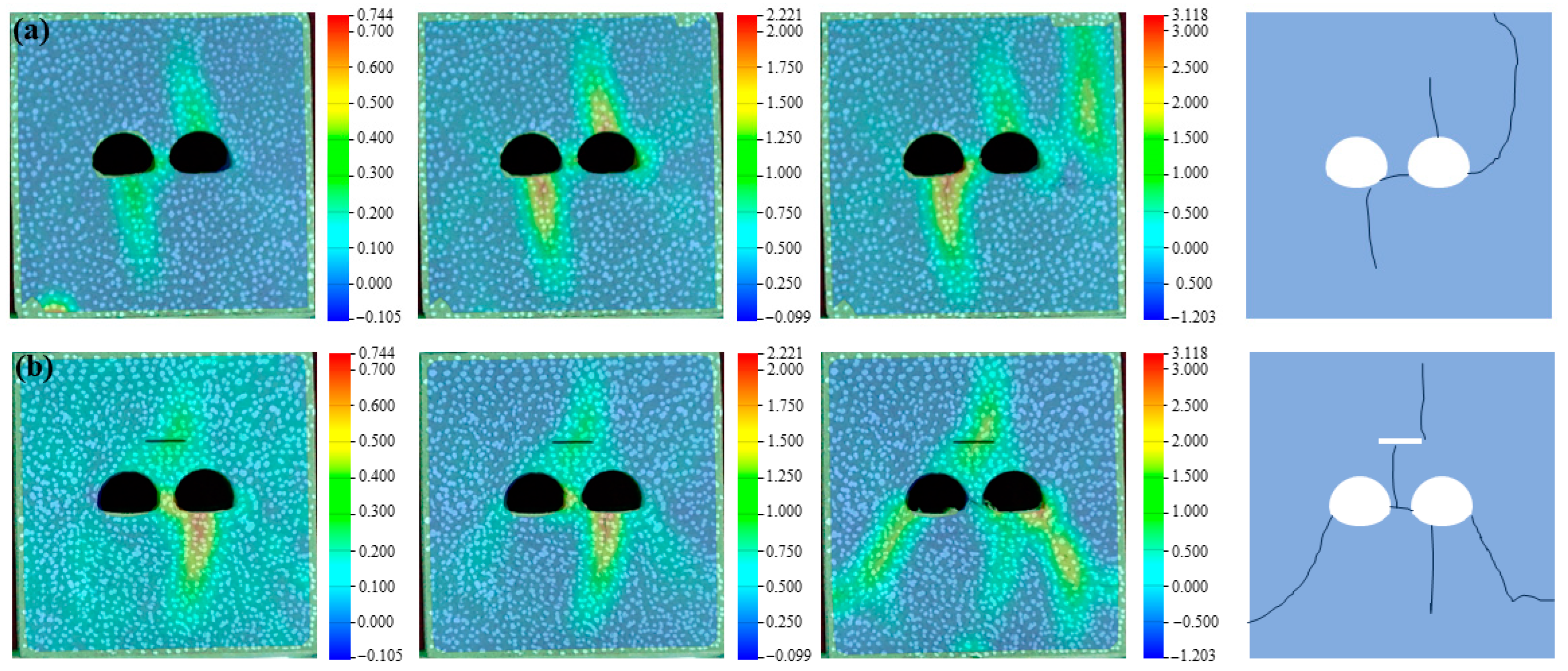
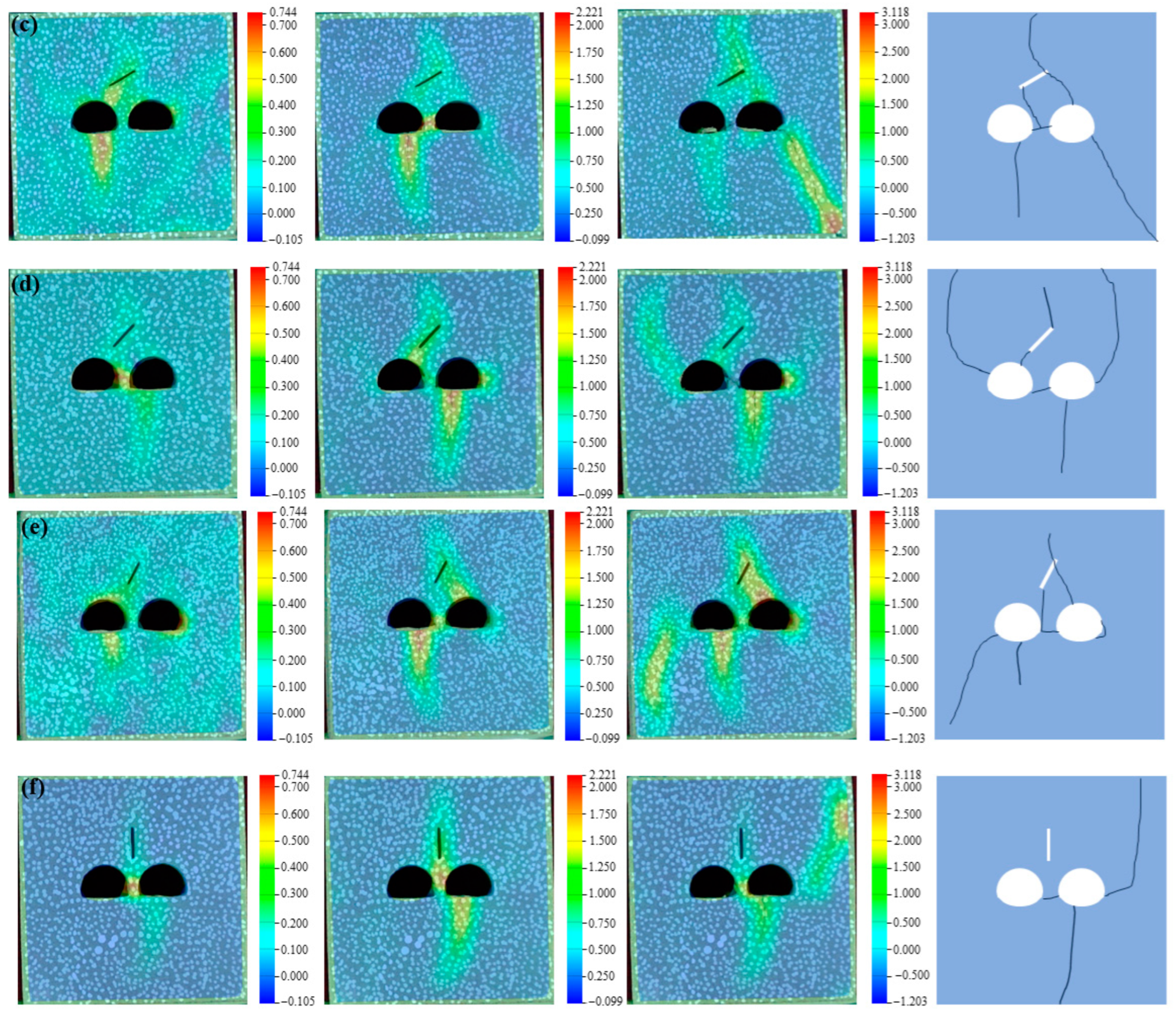
Figure 6 shows the crack propagation process of double-tunnel specimens under different schemes. It can be seen from the figure that for Scheme A (double-tunnel model without prefabricated fissures), cracks are first initiated at the lower part of the left tunnel and the upper part of the right tunnel. After extending for a certain distance along the loading direction, transverse cracks form and connect between the two tunnels. With continuous loading, a crack is generated on the right side of the right tunnel, propagates reversely to the top of the model, and finally causes the model to fail. For Scheme B1 (prefabricated fissure inclination angle α = 0°), vertical cracks are first initiated at the lower part of the right tunnel. These cracks extend downward along the loading direction. Subsequently, cracks connect between the two tunnels. A vertical crack is generated in the middle of the connected cracks, extends, and connects with the horizontal prefabricated fissure. Then, the crack propagates from the right end of the horizontal prefabricated fissure to the top of the model, leading to model failure. For Scheme B2 (prefabricated fissure inclination angle α = 30°), cracks are first initiated at the bottom of the left tunnel. After that, cracks connect between the two tunnels. With continuous loading, two “wing cracks” are generated at the two ends of the prefabricated fissure. Finally, the crack at the top of the right tunnel directly connects with the right end of the prefabricated fissure, and a crack is generated at the lower right part of the right tunnel and extends to the right end of the model, resulting in model failure. For Scheme B3 (prefabricated fissure inclination angle α = 45°), “wing cracks” are first generated at the two ends of the prefabricated fissure. The “wing crack” at the left end of the prefabricated fissure extends to the top of the left tunnel. Meanwhile, cracks connect between the left and right tunnels. Then, vertical cracks are generated at the bottom of the right tunnel. In the later stage of loading, two cracks are generated at the left end of the left tunnel and the right end of the right tunnel respectively, extend to the top of the model, and cause the model to fail. For Scheme B4 (prefabricated fissure inclination angle α = 60°), vertical cracks are first generated at the lower part of the left tunnel. After that, “wing cracks” are generated at the two ends of the prefabricated fissure. Subsequently, cracks connect between the two tunnels. Finally, a crack is generated at the left side of the left tunnel and extends to the lower left end of the model, leading to model failure. For Scheme B5 (prefabricated fissure inclination angle α = 90°), no crack propagation occurs at the prefabricated fissure. Cracks first connect between the two tunnels. Then, a vertical crack is generated at the bottom of the right tunnel. In the later stage of loading, a crack is generated at the right part of the right tunnel and extends to the top of the model, causing the model to fail.
Figure 6.
Crack propagation process of double-tunnel specimens under different schemes. (a) Scheme A; (b) Scheme B1; (c) Scheme B2; (d) Scheme B3; (e) Scheme B4; (f) Scheme B5.
5.1.2. Stress–Strain Curves
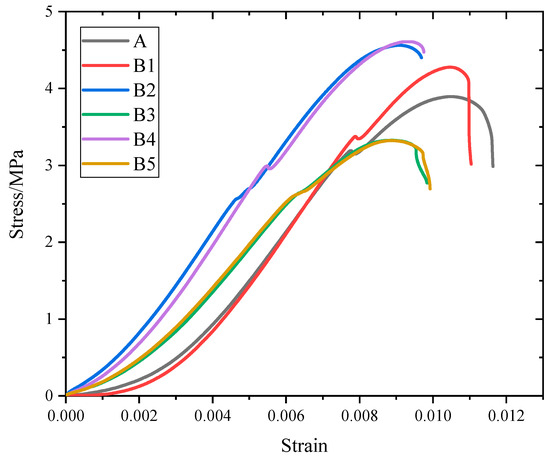
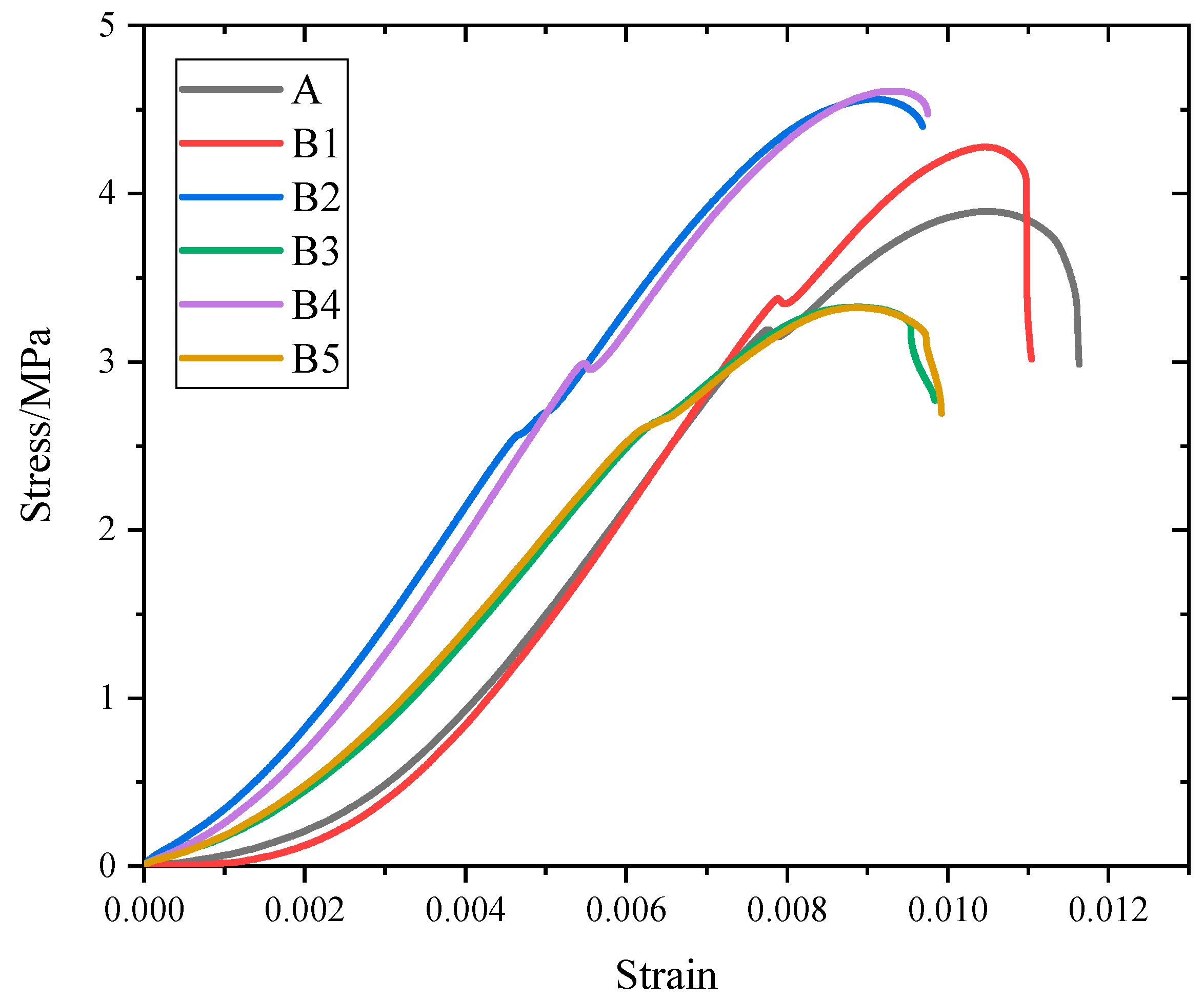
Figure 7 shows the stress–strain curves of specimens under different test schemes. The stress–strain responses of all test schemes show typical mechanical characteristics of brittle rock-like materials. To facilitate a quantitative comparison of local mechanical responses, several monitoring points were selected in Figure 6. The monitoring points were located in regions exhibiting representative stress concentration and crack interaction characteristics, including areas near fissure tips, around the tunnel boundary, and within relatively intact zones away from geometric discontinuities. This selection strategy was adopted to capture the differences in deformation and stress evolution induced by different fissure configurations. The mechanical responses recorded at these monitoring points reflect the local stiffness degradation and stress redistribution during loading. Therefore, the selected points provide meaningful insight into the progressive damage process and serve as representative locations for comparing the mechanical behavior under different structural conditions. The mechanical responses recorded at these monitoring points reflect the local stiffness degradation and stress redistribution during loading. Therefore, the selected points provide meaningful insight into the progressive damage process and serve as representative locations for comparing the mechanical behavior under different structural conditions. The curves can be clearly divided into four stages: compaction stage, elastic deformation stage, yield stage, and failure stage. (1) Compaction stage (initial stage of stress rise). In this stage, the stress is relatively low (usually 10–20% of the peak stress), and the curve shows a slightly upward convex trend. This is mainly due to the compaction of two types of “defects” inside the specimen: one is the tiny pores remaining in the sand-based 3D printing process (such as the gaps between sand particles that are not fully filled); the other is the initial closure of prefabricated fissures (only for Scheme B series with fissures). (2) Elastic deformation stage (after compaction and before yield). After the compaction stage, the stress and strain show a strictly linear relationship. The slope of the curve is stable (the slope corresponds to the elastic modulus of the specimen). In this stage, the specimen only undergoes elastic deformation, and no irreversible microcracks are initiated. (3) Yield stage (close to peak stress). When the stress reaches 80–90% of the peak stress, the curve deviates from the linear relationship and enters the yield stage. At this time, microcracks begin to appear inside the specimen (such as microcracks in the stress concentration area around the tunnel and secondary cracks at the tip of prefabricated fissures), and the stress growth rate slows down gradually. (4) Failure stage (after peak stress). After reaching the peak stress, the stress drops rapidly, and the curve shows a steep downward trend. This indicates that the specimen undergoes macroscopic failure (crack penetration and block separation), with obvious brittle failure characteristics.
Figure 7.
Experimental results of stress–strain curves.
For different prefabricated fissure schemes, the peak strength is lower when α = 45° (Scheme B3) and α = 90° (Scheme B5). For α = 45° (Scheme B3), during the loading process, strong shear stress concentration is prone to occur at the fissure tip, which promotes the rapid propagation of fissures along the shear stress direction. These fissures quickly connect with the microcracks initiated around the double tunnels (shear stress concentration areas at the upper and lower parts of the tunnels), forming a penetration path of “fissure–tunnel–secondary crack”. This leads to early failure of the specimen and a significant reduction in bearing capacity. For α = 90° (Scheme B5), the vertical fissure (parallel to the loading direction) closes due to axial pressure in the initial stage of loading. However, as the stress increases, strong “tensile stress concentration” (lateral tensile stress effect under uniaxial compression) occurs at the upper and lower tips of the fissure, inducing secondary cracks in the vertical direction. At the same time, this vertical fissure is easy to connect with the transverse cracks between the double tunnels (transverse tensile stress cracks are easily generated in the middle area of the double tunnels after loading), forming a penetration network of “longitudinal fissures + transverse cracks”, which accelerates the instability of the specimen. Therefore, the strength is relatively low. The peak strength is higher when α = 30° (Scheme B2) and α = 60° (Scheme B4). This is because the prefabricated fissures with these two inclination angles have an angle of 15–30° with the maximum shear stress plane (45°), so the degree of shear stress concentration at the fissure tip is significantly weaker than that when α = 45°. Meanwhile, the “non-parallelism” between the fissure direction and the loading direction (different from α = 90°) also avoids the direct effect of lateral tensile stress. During the loading process, the propagation of prefabricated fissures needs to overcome greater rock resistance, and the connection difficulty between secondary cracks and cracks around the tunnel is higher. Only when the load is increased to a higher level will macroscopic penetrating cracks form. Therefore, the specimen can bear a higher load before failure, showing higher strength.
5.2. Numerical Simulation Results
5.2.1. Crack Propagation Process
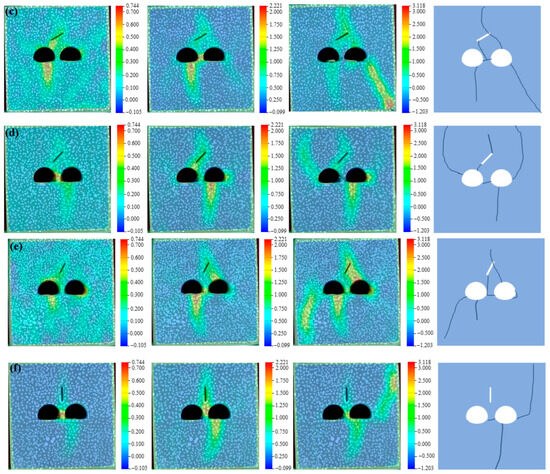
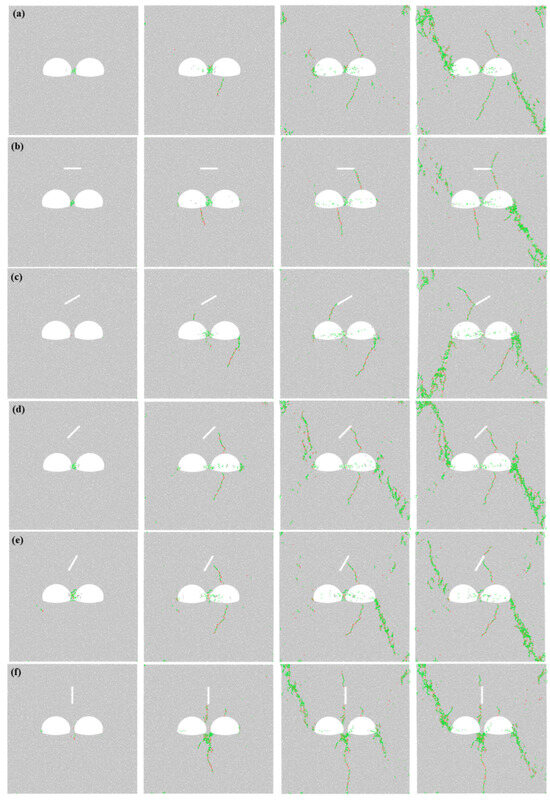
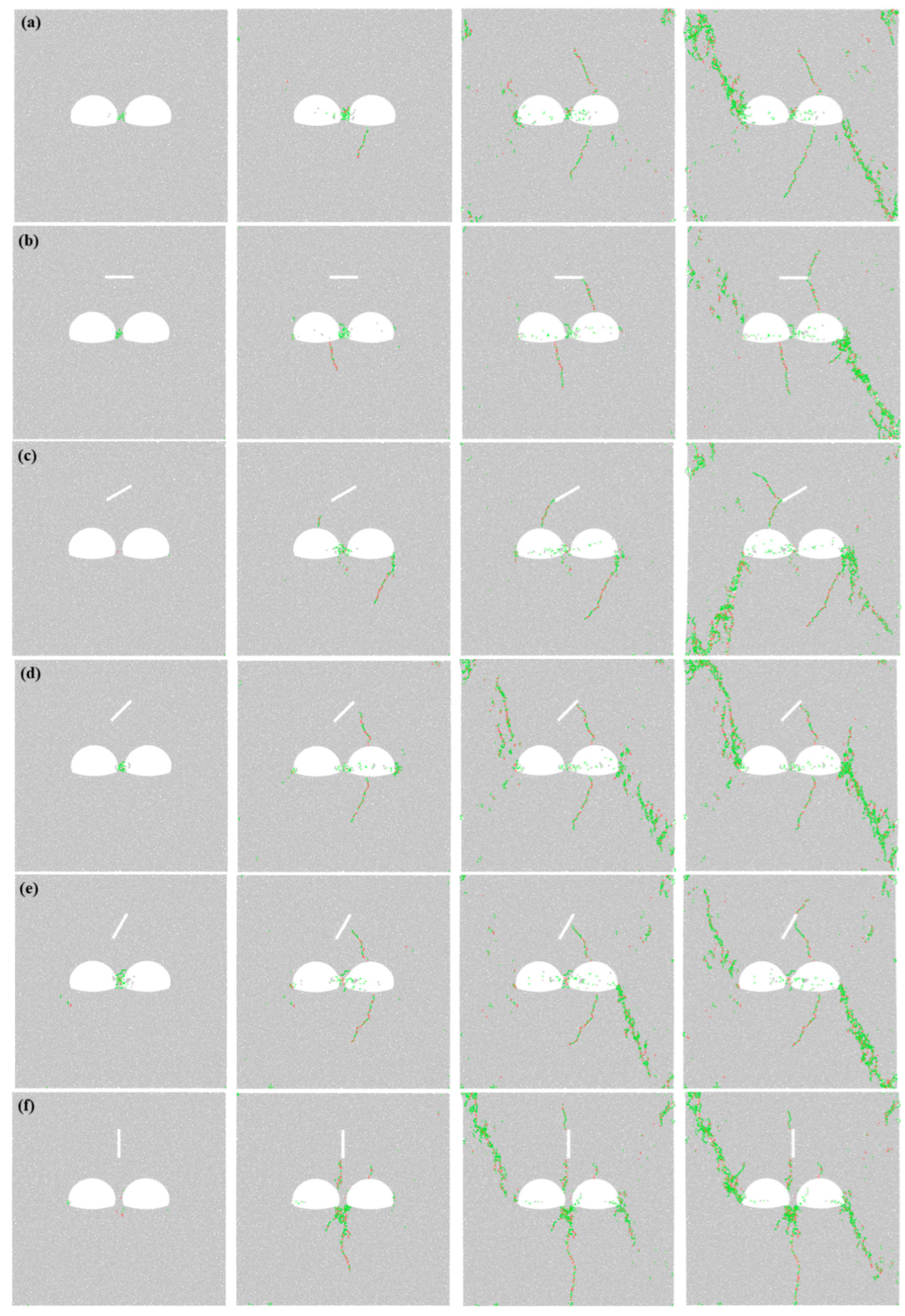
Figure 8 shows the numerical simulation results of crack propagation under different schemes. For Scheme A (double-tunnel model without prefabricated fissures), cracks first connect between the two tunnels. Then, two vertical cracks are generated at the top and bottom of the right tunnel. Finally, two cracks are generated at the left end of the left tunnel and the right end of the right tunnel, extending to the top and bottom of the model respectively, and causing the model to fail. For Scheme B1 (prefabricated fissure inclination angle α = 0°), in the initial stage of loading, cracks in the model are first initiated at the arch foot of the lower part of the left tunnel and the arch shoulder of the upper part of the right tunnel, and extend slowly in the vertical direction. With the progress of loading, the crack at the lower part of the left tunnel extends downward, and the crack at the upper part of the right tunnel extends upward. Finally, transverse cracks form and connect between the two tunnels. In the later stage of loading, a new crack is initiated at the right side of the right tunnel and penetrates obliquely downward to the bottom of the specimen, and at the same time, the transverse crack between the two tunnels further expands into a penetrating crack. Together, they form the macroscopic failure path of the specimen. For Scheme B2 (prefabricated fissure inclination angle α = 30°), in the initial stage of loading, cracks are first generated between the two tunnels. Then, a vertical crack is initiated at the right side of the right tunnel and extends along the loading direction. After that, a “wing crack” is generated at the left end of the prefabricated fissure, extends to the top of the left tunnel, and connects with the left tunnel. Finally, two large cracks are generated at the two ends of the left and right tunnels, extend to the bottom of the model, and cause the model to fail. For Scheme B3 (prefabricated fissure inclination angle α = 45°), in the initial stage of loading, cracks are first generated between the two tunnels. Then, two vertical cracks are generated at the top and bottom of the right tunnel. The vertical crack at the top of the tunnel extends and connects with the prefabricated fissure. Finally, two cracks are generated at the left end of the left tunnel and the right end of the right tunnel. One extends to the top of the model, and the other also extends to the top of the model, causing the model to fail. For Scheme B4 (prefabricated fissure inclination angle α = 60°), its crack propagation law is similar to that of Scheme B3. In the initial stage of loading, cracks are first generated between the two tunnels. Then, two vertical cracks are generated at the top and bottom of the right tunnel. The vertical crack at the top of the tunnel extends and connects with the prefabricated fissure. Finally, two cracks are generated at the left end of the left tunnel and the right end of the right tunnel. One extends to the top of the model, and the other also extends to the top of the model, causing the model to fail. For Scheme B5 (prefabricated fissure inclination angle α = 90°), cracks are also generated between the two tunnels. The difference is that a vertical crack is generated at the lower end of the vertical prefabricated fissure, extends to the left tunnel, and then further extends to the lower part of the model. In the later stage of loading, two large cracks are generated at the left end of the left tunnel and the right end of the right tunnel, extending to the top and bottom of the model respectively, and causing the model to fail.
Figure 8.
Numerical simulation results of crack propagation process of double-tunnel specimens under different calculation schemes. (a) Scheme A; (b) Scheme B1; (c) Scheme B2; (d) Scheme B3; (e) Scheme B4; (f) Scheme B5.
5.2.2. Stress–Strain Curves
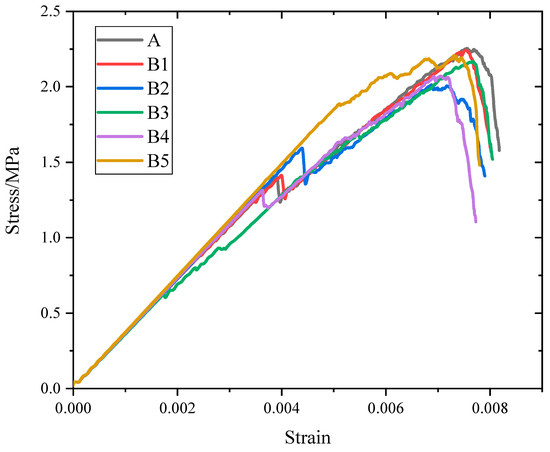
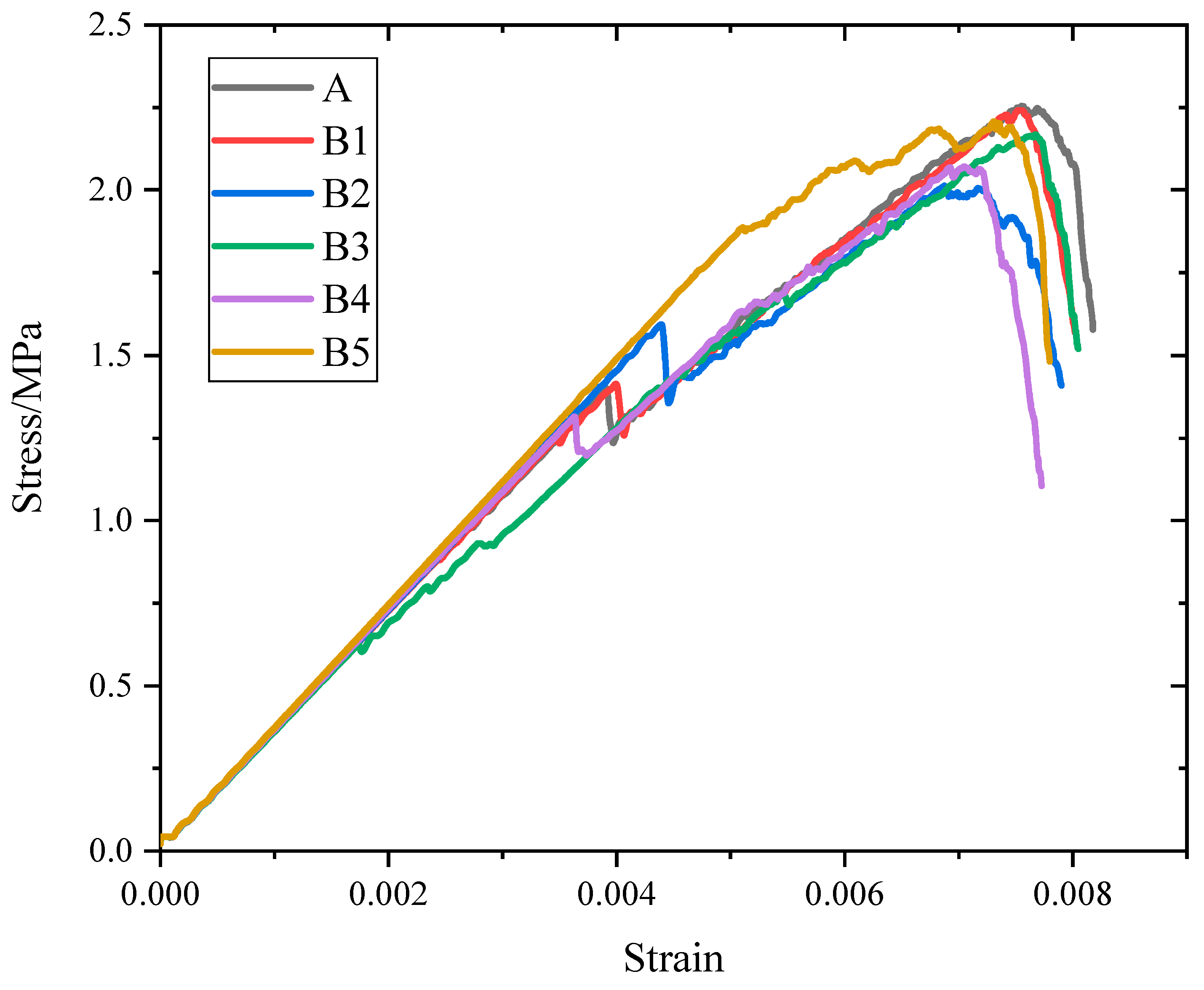
Figure 9 shows the stress–strain curves under different calculation schemes. It can be seen from the figure that the stress–strain curves of the numerical simulation also show similar characteristics to the experimental results, which are mainly divided into four stages: compaction stage, elastic deformation stage, yield stage, and failure stage.
Figure 9.
Numerical simulation results of stress–strain curves.
- (1)
- Compaction stage (initial stage of stress rise). In this stage, the stress range is about 8–15% of the peak stress, and the curve shows a gentle upward convex trend. Compared with the physical experiment, the compaction stage of the numerical simulation is shorter. The essence lies in the different physical meanings of “defect compaction” in the numerical model: the compaction in the experiment comes from the closure of sand particle gaps and prefabricated fissures, while the compaction in the numerical simulation is the adjustment of initial loose contact between particles.
- (2)
- Elastic deformation stage (after compaction and before yield). After the compaction stage, the stress and strain show a strictly linear relationship.
- (3)
- Yield stage (close to peak stress). When the stress reaches 75–85% of the peak stress, the curve deviates from the linear relationship and enters the yield stage. In the numerical simulation, this stage corresponds to the massive initiation and fracture of the parallel bonds in the PB model. With the increase in load, the particle bonds around the tunnel and at the tip of the prefabricated fissure first reach the strength threshold and begin to degrade from the bonded state to the unbonded state. Macroscopically, this is manifested as a slowdown in the stress growth rate, which corresponds to the phenomenon of “accumulation of microcrack initiation” in the experiment.
- (4)
- Failure stage (after peak stress). After reaching the peak stress, the curve shows a steep downward trend. In the numerical simulation, this stage is the large-scale fracture of parallel bonds and the separation of particle blocks. A large number of parallel bonds are completely degraded to the unbonded state, and only the friction between particles maintains the residual bearing capacity. Macroscopically, this is manifested as the loss of the overall bearing capacity of the specimen, which is consistent with the failure characteristics of “crack penetration and block separation” in the experiment.
Taking the peak stress of the numerical simulation curve as the strength evaluation index, the results are highly consistent with the physical experiment: among the schemes with prefabricated fissures, the strengths are significantly higher when α = 30° (Scheme B2) and α = 60° (Scheme B4), and significantly lower when α = 45° (Scheme B3) and α = 90° (Scheme B5). The numerical simulation further verifies the rationality of this law through mesoscopic mechanisms.
6. Discussion
6.1. Influence of Fissure Existence on Crack Initiation of Double-Tunnel Models
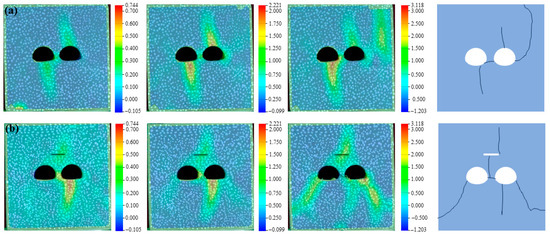
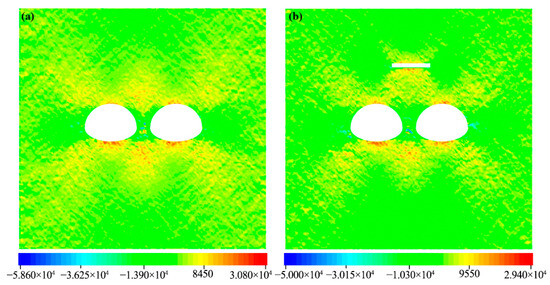
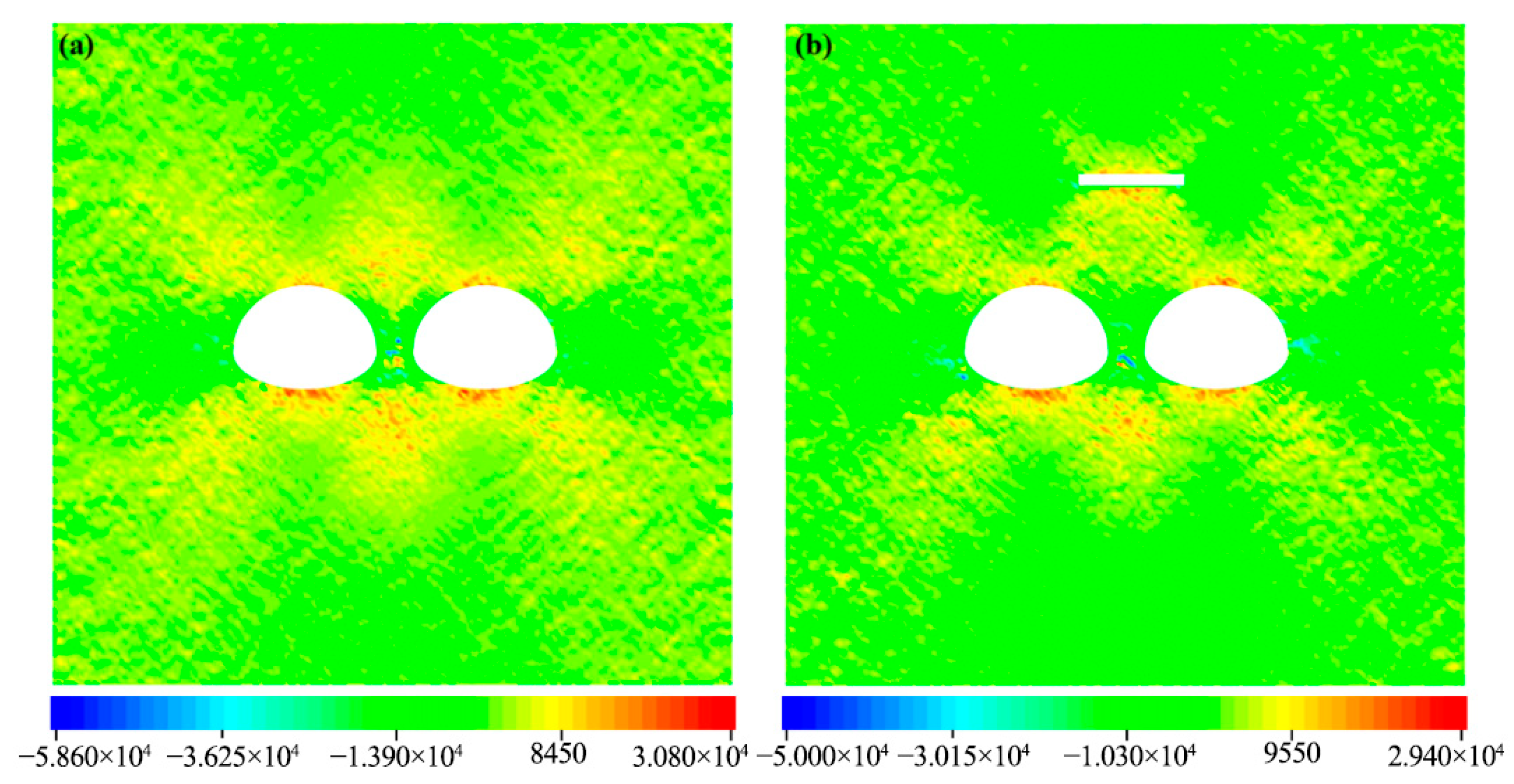
Figure 10 shows the maximum principal stress contour maps of Scheme A and Scheme B1. It can be seen from the figure that when comparing the presence and absence of prefabricated fissures, the tensile stress concentration area shows a “double-region superposition” feature when the model contains a horizontal prefabricated fissure with α = 0°. It not only retains the tensile stress concentration at the top and bottom of the double tunnels but also adds a new tensile stress concentration area in the middle of the prefabricated fissure, forming a “tunnel-fissure” dual-source tensile stress concentration system.
Figure 10.
Maximum principal stress nephrograms of Scheme A and Scheme B1. (a) Scheme A; (b) Scheme B1.
From the perspective of mechanical mechanism, the introduction of the horizontal prefabricated fissure breaks the “single-tunnel-dominant” pattern of stress distribution in the model. On one hand, the mechanism of tensile stress concentration at the top and bottom of the double tunnels is consistent with that in Scheme A, which is still the tensile effect caused by the deformation of surrounding rock. On the other hand, under uniaxial compression, the rock-like particles on both sides of the horizontal prefabricated fissure tend to “open” toward the fissure cavity under the action of vertical pressure. The constraints on both ends of the fissure by the rock mass are strong, while the constraint on the middle part is weak. This causes the tensile stress borne by the rock mass in the middle of the fissure to accumulate significantly, forming a new core area of tensile stress concentration.
This “double-region” tensile stress concentration directly leads to a more complex crack initiation position in Scheme B1: in addition to cracks initiating from the top and bottom of the double tunnels, the middle part of the prefabricated fissure also becomes a potential crack initiation point. The tensile stress concentration in the middle of the prefabricated fissure provides a stress-driven condition for cracks to propagate from the tunnels to the fissure.
6.2. Influence of Different Fissure Inclinations on Crack Initiation of Double-Tunnel Models
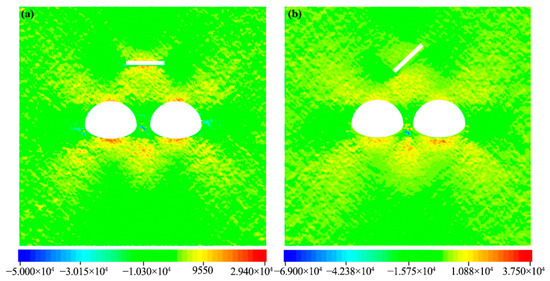
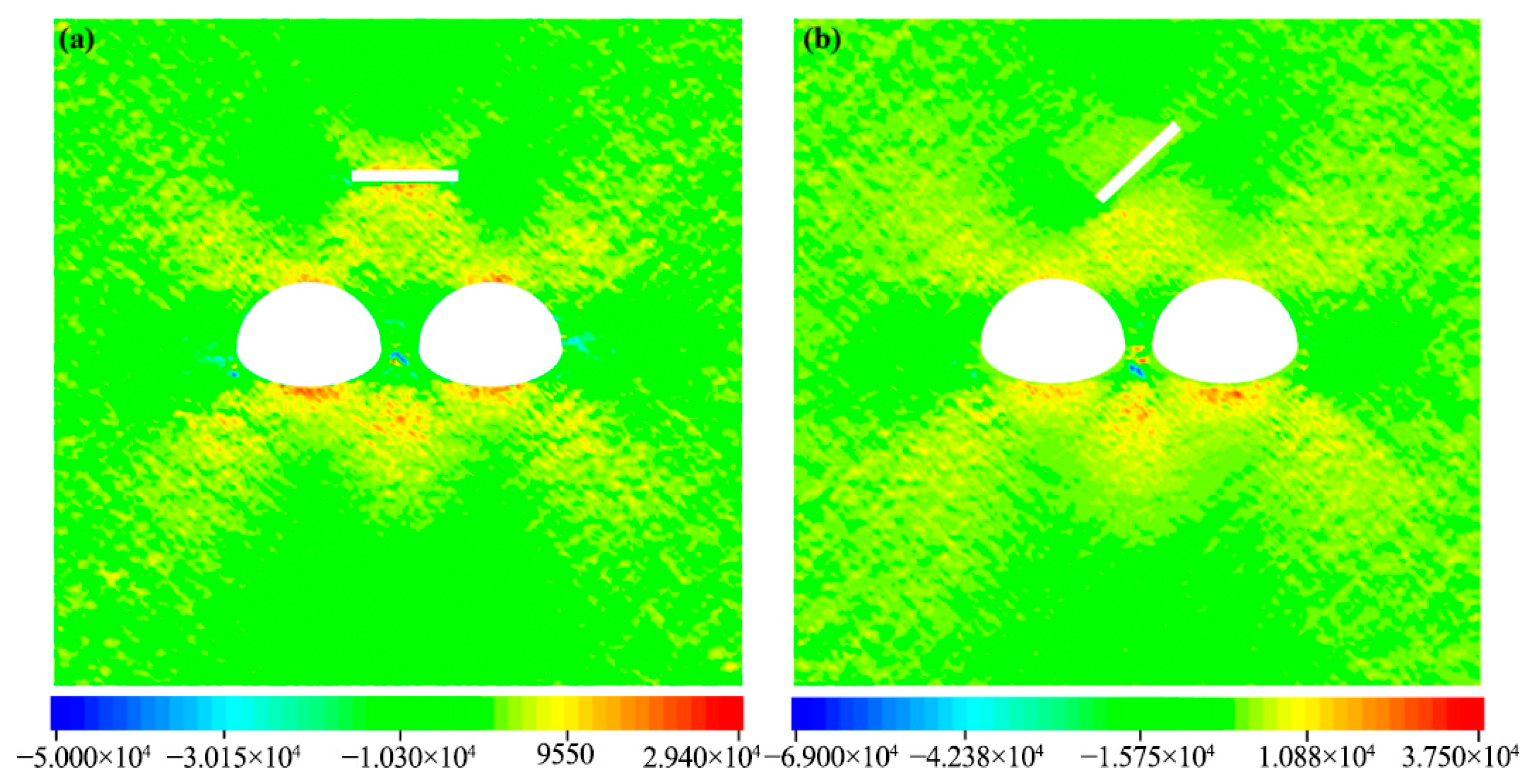
Figure 11 shows the maximum principal stress contour maps of Scheme B1 and Scheme B3. It can be seen from the figure that for the horizontal prefabricated fissure scheme (Scheme B1), tensile stress is concentrated in the middle of the prefabricated fissure and the top and bottom of the double tunnels. When the inclination angle of the prefabricated fissure increases (Scheme B3), the degree of tensile stress concentration at the top and bottom of the double tunnels weakens, while the degree of tensile stress concentration at both ends of the prefabricated fissure increases. Therefore, the crack propagation is dominated by the double tunnels initially and then by the combined action of the double tunnels and the prefabricated fissure.
Figure 11.
Maximum principal stress nephrograms of Scheme B1 and Scheme B3. (a) Scheme B1; (b) Scheme B3.
7. Conclusions
- (1)
- Sand-based 3D printing technology can accurately fabricate rock-like double-tunnel models with prefabricated fissures. Its mechanical response is highly consistent with the brittle characteristics of real rock, and it can effectively reproduce the entire process of crack initiation, propagation, and penetration in double-tunnel engineering. Uniaxial compression tests show that cracks in double-tunnel models without prefabricated fissures are preferentially initiated at the lower part of the left tunnel and the upper part of the right tunnel, and then connect between the tunnels. The crack initiation position of models with fissures is controlled by the fissure inclination angle. This technology has been verified to be reliable in the fabrication of complex tunnel models, providing an efficient model preparation scheme for subsequent similar tests.
- (2)
- The inclination angle of prefabricated fissures has a significant regulatory effect on the strength and crack initiation law of double-tunnel models: the peak strength of the model is the highest when α = 30° and α = 60°, because the fissures have a deviation from the maximum shear stress plane, resulting in weak stress concentration at the fissure tip, and the crack propagation needs to overcome greater rock resistance. The strength is the lowest when α = 45° and α = 90°; the former leads to intensified shear stress concentration due to the coincidence of the fissure with the shear stress plane, and the latter induces fissure propagation due to lateral tensile stress, both of which accelerate crack penetration.
- (3)
- The parallel bond (PB) model based on the Discrete Element Method (PFC) can accurately reproduce the stress–strain characteristics and crack evolution law of double-tunnel models. Through the mesoscopic process of bond fracture, this model reveals the transfer law of tensile stress concentration areas with the fissure inclination angle—when the inclination angle increases from 0° to 45°, the tensile stress concentration shifts from the top and bottom of the double tunnels and the middle of the fissure to the two ends of the fissure, providing a mesoscopic explanation for the macroscopic crack initiation mechanism.
- (4)
- The research results can provide a scientific basis for disaster prevention and control of similar double-tunnel projects such as the Jinan Tunnel on Jinan Ring Expressway: for the fissure development problem in operating tunnels, it is recommended to prioritize strengthening the support (such as grouting reinforcement) for the fissure areas with an inclination angle of 45–90° to reduce the risk of tunnel collapse induced by such fissures; at the same time, the combined method of sand-based 3D printing and discrete element simulation can be used to predict the tunnel instability mode under different fissure conditions and optimize the engineering operation and maintenance scheme. Future research will extend the present work by explicitly considering tunnel ovalization mechanisms under non-uniform stress conditions and dynamic loading. Tunnel ovalization may induce asymmetric stress redistribution around the tunnel boundary, which is expected to significantly influence fissure initiation, propagation direction, and crack coalescence behavior. In addition, the coupled effects of tunnel ovalization, fissure configuration, and ice-filling conditions will be investigated through combined experimental and numerical approaches to better represent complex geological environments. Moreover, future research will consider the effects of seismic loading, tunnel ovalization mechanisms, and multi-field coupling conditions to further clarify fissure propagation behavior in tunnel structures.
Author Contributions
Methodology, H.L., X.D. and L.M.; Software, B.W.; Validation, L.X., X.X., J.W. and L.S.; Formal Analysis, L.X., J.W. and L.M.; Investigation, X.D. and X.X.; Resources, W.Q.; Data Curation, H.L., H.Y., L.X., X.D., J.W., L.S., B.W. and L.M.; Writing—Original Draft, H.L. and H.Y.; Visualization, H.L., H.Y., X.X. and B.W.; Supervision, W.Q. All authors have read and agreed to the published version of the manuscript.
Funding
This work was supported by the National Key Research and Development Program of China (Grant No. 2024YFF0507904), the China University of Mining and Technology (CUMT) Open Sharing Fund for Large-scale Instruments and Equipment (Grant No. DYGX-2025-80), the Natural Science Foundation of Jiangsu Province (Grant No. BK20240942), the Natural Science Foundation of the Jiangsu Higher Education Institutions of China (Grant No. 24KJB130005), and the College Students’ Innovation and Entrepreneurship Training Program (JTSITP202507).
Data Availability Statement
The datasets used and analyzed during the current study available from the corresponding author on reasonable request.
Conflicts of Interest
Author Huaijian Li, Lanjing Xing, Xuewen Xiao and Linyun Sun were employed by the companies Shandong Hi-Speed Infrastructure Construction Co., Ltd. and Shandong Hi-Speed South Ring Expressway Co., Ltd. The remaining authors declare that the research was conducted in the absence of any commercial or financial relationships that could be construed as a potential conflict of interest.
Correction Statement
This article has been republished with a minor correction to the Funding statement. This change does not affect the scientific content of the article.
References
- Lv, B.; He, Z.-X.; Bao, X.-Y. Research on green design of major railway tunnel projects based on ‘‘environmental-social-technical’’ system. J. Clean. Prod. 2025, 517, 145579. [Google Scholar] [CrossRef] [Scilit]
- Zhou, T.-L.; Hu, B.-B.; He, T.; Li, S. Study on the anti-dislocation resilience of mountain tunnels crossing normal faults. Tunn. Undergr. Space Technol. Inc. Trenchless Technol. Res. 2025, 164, 106844. [Google Scholar] [CrossRef] [Scilit]
- Shao, Y.; Leem, J.; Kim, J.; Mehrishal, S.-A.; Yao, C.; Song, J.-J. Experimental insights into tunnel stability affected by offset distance from fully non-persistent structural planes with inclination using 3D-printed physical models. Tunn. Undergr. Space Technol. Inc. Trenchless Technol. Res. 2026, 168, 107237. [Google Scholar] [CrossRef] [Scilit]
- Dang, B.; Weng, X.-L.; Zhang, X.-Y.; Ye, F.; Li, X.-C. Failure mechanism and support pressure of tunnel face in Saturated sandy shield tunnel under variable seepage. Tunn. Undergr. Space Technol. Inc. Trenchless Technol. Res. 2026, 168, 107212. [Google Scholar] [CrossRef] [Scilit]
- Jiang, P.-W.; Zhang, Z.-H.; Huang, J.-K.; Zheng, H.; Wan, T. Three-Dimensional Stress-Free Assumption 3-DOF FE-LEM for Tunnel Face Stability. Comput. Geotech. 2026, 189, 107607. [Google Scholar] [CrossRef] [Scilit]
- Li, X.; Ying, P.; Yu, Y.; Zhu, Z.; Li, X.; Wang, F.; Gao, W.; Cui, L.; Nie, F. Investigating the propagation behavior of cracks outside tunnel under impact conditions. Structures 2025, 74, 108613. [Google Scholar] [CrossRef] [Scilit]
- Zhang, X.; Wang, H.; Fu, H.; Xu, Y. Experimental study on the cracking evolution mechanisms in composite lining of permeable ribbed double-arch tunnel influenced by voids behind tunnel lining. Eng. Fail. Anal. 2025, 182, 110040. [Google Scholar] [CrossRef] [Scilit]
- Gou, Y.; Huang, Q.; Liu, N.; Chen, D.; Peng, J. Influence of ground fissures on metro shield tunnels: Large-scale experiment and numerical analysis. J. Rock Mech. Geotech. Eng. 2025, 17, 1356–1377. [Google Scholar] [CrossRef] [Scilit]
- Min, B.; Zhang, X.; Zhang, C.; Su, H. Experimental and numerical study on the failure behavior of cracked double-arch tunnel linings. Eng. Fail. Anal. 2025, 181, 109954. [Google Scholar] [CrossRef] [Scilit]
- Wang, Y.; Rong, C.; Shi, H.; Li, Y.; Zhang, R. Experimental study on dynamic mechanical characteristics and failure features of surrounding rock in layered composite rock mass tunnels. Results Eng. 2025, 27, 107013. [Google Scholar] [CrossRef] [Scilit]
- Gao, J.; Wang, Q.; Ma, W.; Lu, J. Failure analysis and comparative study on tunnels under strike-slip fault and oblique-slip fault movements. Eng. Fail. Anal. 2024, 164, 108676. [Google Scholar] [CrossRef] [Scilit]
- Yu, S.; Li, Y.; Gao, Y.; Sun, G.; Liu, H. Investigating the crack propagation processes of grouted/ungrouted fissured tunnel specimens using 3D printing technology and SPH simulation method. Constr. Build. Mater. 2025, 500, 144213. [Google Scholar] [CrossRef] [Scilit]
- Wang, S.; Yu, S.; Hu, X.; Yang, B. Effects of folded fissure properties on tunnel model failure: Experiments and numerical simulations. Eng. Fract. Mech. 2024, 310, 110487. [Google Scholar] [CrossRef] [Scilit]
- Cheng, Z.; Zhang, Y.; Hu, T.; Li, Z.; Ma, G. Fractured rock analogs by binder jetting 3D printing using cement: Improvements in geometric similarity and mechanical performance. Addit. Manuf. 2025, 111, 104976. [Google Scholar] [CrossRef] [Scilit]
- Wang, X.; Jiang, L.; Li, Y.; Zhang, L.; Sainoki, A.; Mitri, H.S.; Yang, Y.; Peng, X. Experimental study on the mechanical behavior and failure characteristics of rock analogs with filled internal fractures: A new method by sand powder 3D printing. Constr. Build. Mater. 2024, 427, 136261. [Google Scholar] [CrossRef] [Scilit]
- Sun, Y.; Huang, W.; Gan, L.; Shen, Z.; Zhang, H.; Zhang, W. Insights into the X-shaped fissure propagation and interaction mechanisms of rock specimens: 3D printing experiments and DEM simulations. Case Stud. Constr. Mater. 2025, 22, e04742. [Google Scholar] [CrossRef] [Scilit]
- Zhang, K.; Zhang, K.; Ye, J.; Liu, X.; Fan, W. An improved sand 3D printing method for better reproduction of high-strength and high-brittleness rock mechanical properties is proposed. J. Mater. Res. Technol. 2023, 26, 5037–5054. [Google Scholar] [CrossRef] [Scilit]
- Chen, J.; Zhang, D.; Su, M.; Liu, X.; Mi, X. Analysis of tunnel water inrush accidents induced by stratum collapse models. Deep Resour. Eng. 2025, 2, 100186. [Google Scholar] [CrossRef] [Scilit]
- Yan, Y.; Huang, Q.; Xie, Y.; Qiu, J.; Han, Y.; Teng, H.; Liu, T. Failure analysis and deformation mechanism of segmented utility tunnels crossing ground fissure zones with different intersection angles. Eng. Fail. Anal. 2022, 139, 106456. [Google Scholar] [CrossRef] [Scilit]
- Wang, Y.; Xiong, Z.; Kou, L. Analysis of crack propagation in tunnel lining based on nonlinear dual-parameter bond-based peridynamics model. Structures 2025, 75, 108846. [Google Scholar] [CrossRef] [Scilit]
- Xu, H.; Zhang, Z.; Yan, J.; Jiang, Z.-P.; Zhao, L.-S.; Zhang, Y.-J. Study on mechanical properties and failure mechanism of hard rock with stiff discontinuities based on 3D printing. Eng. Fail. Anal. 2024, 161, 108225. [Google Scholar] [CrossRef] [Scilit]
- Liu, H.; Jing, H.; Xu, X.; Yin, Q.; Zhang, L. Study on mechanical and fracture characteristics of inclined weak-filled rough joint rock-like specimens. Theor. Appl. Fract. Mech. 2023, 125, 103660. [Google Scholar] [CrossRef] [Scilit]
- Hu, J.; Wen, G.; Lin, Q.; Cao, P.; Li, S. Mechanical properties and crack evolution of double-layer composite rock-like specimens with two parallel fissures under uniaxial compression. Theor. Appl. Fract. Mech. 2020, 108, 102610. [Google Scholar] [CrossRef] [Scilit]
- Zhang, C.; Li, X.; Pang, Y.; Xu, Y. Mechanical response and deformation mechanism of the utility tunnel crossing earth fissure. Structures 2024, 64, 106587. [Google Scholar] [CrossRef] [Scilit]
- Wang, Q.; Du, X.; Duan, J.; Li, N. Dynamic response of shield tunnels crossing ground fissures under near-field and far-field seismic excitations. Soil Dyn. Earthq. Eng. 2026, 200, 109867. [Google Scholar] [CrossRef] [Scilit]
- Wu, D.; Zhou, L.; Nie, F.; Dai, F.; Wang, M.; Liu, B. Experimental and numerical investigation on the failure behavior of far-field-crack-tunnel rock mass under dynamic loads. Tunn. Undergr. Space Technol. 2025, 156, 106225. [Google Scholar] [CrossRef] [Scilit]
- Lin, Z.; Feng, W.; Jin, K.; Chen, X.; Yang, H.; Hu, Y. Evolution of cracking damage and load-bearing performance of in-service tunnel linings with cracks. Theor. Appl. Fract. Mech. 2025, 138, 104897. [Google Scholar] [CrossRef] [Scilit]
- Du, M.; Su, J.; Wang, X.; Zhang, S.; Zhang, Y. Dynamic response and crack propagation law of tunnel invert with initial damage. Eng. Fail. Anal. 2021, 119, 104939. [Google Scholar] [CrossRef] [Scilit]
- Du, M.; Liu, X.; Wang, Y.; Huang, H.; Zhu, Z.; Zhang, Y.; Wang, X. Crack propagation mechanism of inverted arches in large cross-section tunnels. Eng. Fail. Anal. 2023, 152, 107514. [Google Scholar] [CrossRef] [Scilit]
- Yang, W.; Zhang, Y.; Zhou, Y.; Xu, Z.; Yao, C.; Yan, Q. Crack evolution and structural response of damaged shield tunnel segments under sustained train-induced loads. Tunn. Undergr. Space Technol. 2026, 169, 107268. [Google Scholar] [CrossRef] [Scilit]
- Wang, G.; Fang, Q.; Du, J.; Wang, J. Semi-analytical solution for internal forces of tunnel lining with multiple longitudinal cracks. J. Rock Mech. Geotech. Eng. 2023, 15, 2013–2024. [Google Scholar] [CrossRef] [Scilit]
- Yu, S.; Wang, J.; Gao, Y.; Sun, W.; Lu, J.; Liu, R.; Shi, Y. Effects of fissure properties on the tunnel damage evolutions: Insights from DIC-based 3D printing experiments and meshless numerical simulations. Tunn. Undergr. Space Technol. Inc. Trenchless Technol. Res. 2024, 149, 105817. [Google Scholar] [CrossRef] [Scilit]
- Xia, C.; Shi, Z.; Zheng, H.; Wu, X. Kernel broken smooth particle hydrodynamics method for crack propagation simulation applied in layered rock cells and tunnels. Undergr. Space 2023, 10, 55–75. [Google Scholar] [CrossRef] [Scilit]
- Zhang, W.; He, Y.; Yu, S.; Li, M.; Shi, D.; Zhang, H. Effects of fissure inclination and spacing on crack evolution and mechanical behavior of 3D-printed horseshoe tunnel models: Experiments and SPH simulations. Theor. Appl. Fract. Mech. 2025, 140, 105196. [Google Scholar] [CrossRef] [Scilit]
- Hu, X.; Huang, S.; Yu, S.; Li, Y.; Wang, X. Study on the interaction mechanisms between the fissure arrays and circular tunnels by physical experiment and meshless numerical method. Theor. Appl. Fract. Mech. 2025, 138, 104935. [Google Scholar] [CrossRef] [Scilit]
- Ma, E.; Lai, J.; Xu, S.; Shi, X.; Zhang, J.; Zhong, Y. Failure analysis and treatments of a loess tunnel being constructed in ground fissure area. Eng. Fail. Anal. 2022, 134, 106034. [Google Scholar] [CrossRef] [Scilit]
- Hu, X.; Yu, S.; Li, Y.; Liu, R.; Yu, J. Research on the influencing mechanisms of ice-filled fissures on the failure processes of tunnel specimens. Theor. Appl. Fract. Mech. 2025, 139, 105141. [Google Scholar] [CrossRef] [Scilit]
- Su, X.; Lai, J.; Ma, E.; Xu, J.; Qiu, J.; Wang, W. Failure mechanism analysis and treatment of tunnels built in karst fissure strata: A case study. Eng. Fail. Anal. 2025, 167, 109048. [Google Scholar] [CrossRef] [Scilit]
- Li, Z.; Lai, J.; Wang, M.; Qiu, J.; Zan, W. Collapse mechanism and treatments of a deep tunnel in the weathered granite fault zone. Tunn. Undergr. Space Technol. 2024, 152, 105891. [Google Scholar] [CrossRef] [Scilit]
- Tian, J.-J.; Li, T.-T.; Pei, X.-J.; Guo, J.; Wang, S.-D.; Sun, H.; Yang, P.-Z.; Huang, R.-Q. Experimental Study on Multistage Seismic Damage Process of Bedding Rock Slope: A Case Study of the Xinmo Landslide. J. Earth Sci. 2024, 35, 1594–1612. [Google Scholar] [CrossRef] [Scilit]
- Ma, L.; Qi, S.; Guo, S.; Huang, Q.; Hou, X. Investigation on the Deformation and Failure Patterns of Loess Cut Slope Based on the Unsaturated Triaxial Test in Yan’an, China. J. Earth Sci. 2024, 35, 235–247. [Google Scholar] [CrossRef] [Scilit]
- Yu, S.; Huang, S.; Li, Y.; Liang, Z. Insights into the frost cracking mechanisms of concrete by using the coupled thermo-hydro-mechanical-damage meshless method. Theor. Appl. Fract. Mech. 2025, 136, 104814. [Google Scholar] [CrossRef] [Scilit]
- Zheng, L.; Tang, H.; Wang, L.; Li, C.; Xiong, C.; Zou, Z.; Wang, C.; Zhu, L.; Zhang, Y. Long-Term in situ Monitoring of Anchoring System and Preliminary Analysis of Monitoring Data. J. Earth Sci. 2026, 24, 1–12. [Google Scholar] [CrossRef] [Scilit]
- Yu, S.; Ren, X.; Zhang, J. Modeling the rock frost cracking processes using an improved ice—Stress—Damage coupling method. Theor. Appl. Fract. Mech. 2024, 131, 104421. [Google Scholar] [CrossRef] [Scilit]
- Deng, C.; Li, Y.; Xiong, F.; Liu, H.; Li, X.; Zeng, Y. Detection of Rupture Damage Degree in Laminated Rubber Bearings Using a Piezoelectric-Based Active Sensing Method and Hybrid Machine Learning Algorithms. Struct. Control. Health Monit. 2025, 2025, 6694610. [Google Scholar] [CrossRef] [Scilit]
- Li, Y.; Han, T.; Zhao, M.; Han, J.; Zhao, R.; Xu, Z.; Cao, W.; Ma, M.; Zhang, C.; Luo, J. Modulating interfacial shear of nanoconfined hydration layer via surface charging. Nano Energy 2026, 148, 111692. [Google Scholar] [CrossRef] [Scilit]
- Zhang, J.; Chen, W.; Zhang, J. UAV-based quantitative crack measurement for bridges integrating four-point laser metric calibration and mamba segmentation. Autom. Constr. 2026, 182, 106774. [Google Scholar] [CrossRef] [Scilit]

Disclaimer/Publisher’s Note: The statements, opinions and data contained in all publications are solely those of the individual author(s) and contributor(s) and not of MDPI and/or the editor(s). MDPI and/or the editor(s) disclaim responsibility for any injury to people or property resulting from any ideas, methods, instructions or products referred to in the content. |
© 2026 by the authors. Licensee MDPI, Basel, Switzerland. This article is an open access article distributed under the terms and conditions of the Creative Commons Attribution (CC BY) license.