Article

New 3-(6-Bromo-2-oxo-1,3-benzoxazol-3(2H)-yl)propanoic Acid Derivatives: Synthesis and Biological Activity Against Bacterial Pathogens


by
Monika Bertašiūtė
1,
Jūratė Šiugždaitė
2,
Birutė Grybaitė
1,
Birutė Sapijanskaitė-Banevič
1,
Livija Tubytė
2,
Raimundas Lelešius
2,
Sergey Belyakov
3,
Mindaugas Marksa
4,
Andrejus Ževžikovas
4 and
Vytautas Mickevičius
1,*
1
Department of Organic Chemistry, Kaunas University of Technology, Radvilėnų Road 19, 50254 Kaunas, Lithuania
2
Department of Veterinary Pathobiology, Lithuanian University of Health Sciences, Tilžės Street 18, 47181 Kaunas, Lithuania
3
Laboratory of Physical Organic Chemistry, Latvian Institute of Organic Synthesis, Aizkraukles St. 21, LV-1006 Riga, Latvia
4
Department of Analytical and Toxicological Chemistry, Lithuanian University of Health Sciences, Sukilėlių pr. 13, 50162 Kaunas, Lithuania
*
Author to whom correspondence should be addressed.
Appl. Sci. 2026, 16(4), 2096; https://doi.org/10.3390/app16042096
Submission received: 7 January 2026 / Revised: 30 January 2026 / Accepted: 17 February 2026 / Published: 21 February 2026
(This article belongs to the Special Issue Research on Organic and Medicinal Chemistry, Second Edition)

Abstract

Continuing our work in the field of synthesis and research of amino acids, their derivatives, and cyclization products, in this work, we synthesized various 3-(6-bromo-2-oxo-1,3-benzoxazol-3(2H)-yl)propanoic acid derivatives and investigated their antimicrobial activity. A total of eighteen synthesized chemical compounds (No. 118), including several structural analogues (e.g., 3a, 3b, 4a4e, 8a8m, 9a9d), were evaluated for their antibacterial properties. The antibacterial activity was assessed using the Kirby–Bauer disk diffusion method, and inhibition zone diameters (mm) were measured against five representative bacterial strains: S. aureus, MRSA, B. subtilis, E. coli, and P. aeruginosa. The minimum inhibitory concentrations (MICs) and minimum bactericidal concentrations (MBCs) of the most active synthesized compounds were determined against representative Gram-positive and Gram-negative bacterial strains, including S. aureus, MRSA, B. subtilis, and E. coli. Overall, these results indicate that the tested compounds display selective antibacterial activity, mainly against Gram-positive bacteria, with compound 12 emerging as the most promising derivative in the series. The antibacterial activities of several synthesized compounds were systematically evaluated against S. aureus and MRSA over a 24 h incubation period, with optical density measured at ten time points. Bacterial growth was monitored spectrophotometrically at 600 nm (OD600) at 1, 2, 3, 4, 5, 6, 7, 8, 20, and 24 h, enabling a detailed assessment of growth kinetics and the temporal dynamics of inhibition. The effect of compound 11 on the growth kinetics of S. aureus was evaluated by quantifying viable bacterial counts (log10 CFU/mL) over a 6 h incubation period, and the results are presented in the time–kill curve. Compound 11 was selected for this experiment because it exhibited the most pronounced antibacterial activity against S. aureus in the disk diffusion assay. The cytotoxicity of compounds 9a, 11, 12, and 13 was evaluated at concentrations ranging from 125 to 1.95 µg/mL. The results showed a clear, concentration-dependent decrease in cytotoxicity for all tested compounds. The molecular structure of compound 3a was confirmed by a single-crystal X-ray diffraction.

1. Introduction

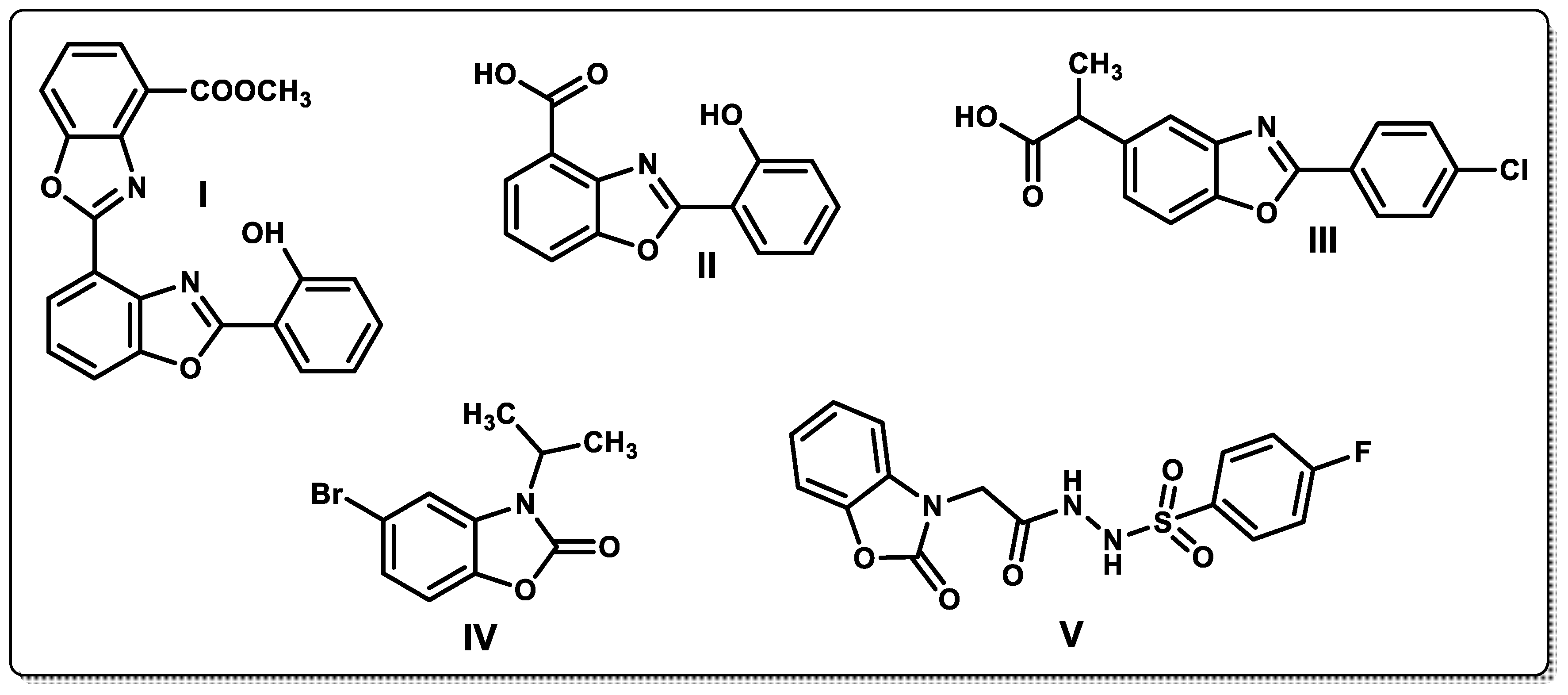
Benzoxazoles represent an important class of fused heterocycles, consisting of a benzene ring fused to an oxazole nucleus. Their compact, planar architecture, enriched with heteroatoms, enables multiple modes of molecular recognition, such as π–π stacking, hydrogen bonding, and metal coordination [1,2,3]. These properties, together with their occurrence in natural products such as UK-1 (I) and caboxamycin (II), have made benzoxazoles a privileged scaffold in medicinal chemistry [2,4] (Figure 1).
Over the past decades, benzoxazole derivatives have been reported to exhibit an impressive diversity of biological activities. They have demonstrated potent antibacterial effects against both Gram-positive and Gram-negative pathogens, including Staphylococcus aureus and Enterococcus species, and some compounds have emerged as promising leads against Mycobacterium species, including Mycobacterium tuberculosis [5,6,7,8,9,10,11,12,13,14]. For example, structure III is a nonsteroidal anti-inflammatory agent marketed as an antirheumatic drug [10]. Compound IV exhibits anticancer properties [14], and molecule V reduces paraoxonase-1 enzyme activity at very low concentrations [12]. In addition, benzoxazoles have displayed antiviral activity [15,16].
The search for new chemotypes with novel mechanisms of action [17]. Multidrug-resistant (MDR) pathogens, including methicillin-resistant Staphylococcus aureus (MRSA) and Pseudomonas aeruginosa, pose significant clinical challenges, resulting in increased morbidity, mortality, and healthcare costs. [18]. The alarming rise in resistance rates has outpaced the discovery of new antibiotic classes, emphasizing the need for innovative approaches to antimicrobial drug design [19].
Beyond their anti-infective properties, benzoxazoles are recognized for their anticancer potential. Numerous analogues induce apoptosis, inhibit poly(ADP-ribose) polymerase (PARP-2), modulate kinases such as VEGFR-2, or act as monoacylglycerol lipase (MAGL) inhibitors, resulting in cytotoxicity against a wide spectrum of cancer cell lines [20,21,22,23,24,25,26,27,28,29,30,31,32].
Other reported activities further underscore the pharmacological versatility of this scaffold. Benzoxazole derivatives have been investigated as anti-inflammatory and analgesic agents through enzyme inhibition pathways [32,33,34,35,36,37,38,39,40,41], while others display activity as allosteric modulators of metabolic enzymes and as antagonists of neurotransmitter receptors [42,43,44,45]. Promising leads have also been reported as antiparasitic agents, expanding the relevance of benzoxazoles beyond classical therapeutic areas [46].

2. Materials and Methods

2.1. General Information

Reagents and solvents were obtained from Sigma–Aldrich (St. Louis, MO, USA) and used without further purification. The reaction course and purity of the synthesized compounds were monitored by TLC using aluminium plates precoated with Silica gel with F254 nm (Merck KGaA, Darmstadt, Germany). Melting points were determined with a B-540 melting point analyzer (Büchi Corporation, New Castle, DE, USA) and were uncorrected. NMR spectra were recorded on a Bruker Avance III (400, 101 MHz) spectrometer (Bruker BioSpin AG, Fällanden, Switzerland). Chemical shifts were reported in (d) ppm relative to tetramethylsilane (TMS) with the residual solvent as internal reference (DMSO-d6, d = 2.50 ppm for 1H and d = 39.52 ppm for 13C). Data were reported as follows: chemical shift, multiplicity, coupling constant (Hz), integration, and assignment. IR spectra (ν, cm−1) were recorded on a PerkinElmer Frontier spectrometer (PerkinElmer Inc., Waltham, MA, USA) in a wave interval from 4000 to 560 cm−1, by pressing a small amount of sample against a diamond crystal plate (number of scans—6, resolution—4 cm−1), and data were processed using Spectrum software (version 10.03.03). Mass spectra were recorded on Ms. Agilent 6530A QTOF HPLC, Agilent 1260 II series (Agilent Technologies, Inc., Santa Clara, CA, USA). The C, H, and N elemental analysis was conducted on an Elemental Analyzer CE-440 (Exeter Analytical, Inc., Chelmsford, MA, USA). The results were found to be in good agreement (±0.3%) with the calculated values.
3-(6-bromo-2-oxobenzo[d]oxazol-3(2H)-yl)propanoic acid (2)
Carboxylic acid 1 [47] (18.65 g, 90 mmol) was dissolved in acetic acid (60 mL) at 70 °C. After cooling to room temperature, Br2 (9.3 mL, 180 mmol, dropwise) was added. The mixture was stirred for 4 h, sodium thiosulfate pentahydrate (0.5 g) was added under stirring, then diluted with 300 mL water, and the formed precipitate was filtered off and washed with hot water. The obtained acid 2 was purified by recrystallisation from propan-2-ol.
Light brown solid, yield 23.50 g (91%), m.p. 167–169 °C.
1H NMR (400 MHz, DMSO-d6), δ: 2.68 (t, J = 6.9 Hz, 2H, CH2), 4.00 (t, J = 7.0 Hz, 2H, N-CH2), 7.31 (d, J = 8.3 Hz, 1H, Harom), 7.40 (d, J = 8.4 Hz, 1H, Harom), 7.63 (s, 1H, Harom).
13C NMR (101 MHz, DMSO-d6), δ: 31.69 (CH2-CO), 38.05 (N–CH2), 111.01, 112.68, 113.24, 126.35, 130.35, 142.42 (Carom), 153.06 (C=O), 172.04 (COOH).
HRMS (ESI): m/z calcd. for C10H8BrNO4 309.0810; Found: 309.2500 [M + Na]+.
IR (KBr), ν, cm−1: 3424 (OH), 1769, 1700 (2x C=O).
6-bromo-3-(3-oxo-3-(p-tolyl)propyl)benzo[d]oxazol-2(3H)-one (3a)
A mixture of phosphorus pentoxide (5 g) and toluene (50 mL) was heated under reflux for 20 min, after which carboxylic acid 2 (1.43 g, 5 mmol) was added. Reflux was continued for 4 h. Upon completion, the reaction mixture was allowed to cool, and the liquid was decanted from the residue. The liquid was then concentrated under reduced pressure to approximately 1 mL and diluted with hexane (15 mL). The resulting mixture was left to stand at room temperature for 1 day and then at the temperature of 4 °C for 1 day. The formed precipitate was collected by filtration, washed with hexane, and dried. The obtained material 3a was purified by recrystallisation from a toluene (25 mL) and hexane (25 mL) mixture.
Pale-yellow solid, yield 0.40 g (30%), m.p. 132–134 °C.
1H NMR (400 MHz, DMSO-d6), δ: 2.36 (s, 3H, CH3), 3.51 (t, J = 6.9 Hz, 2H, CH2), 4.14 (t, J = 6.8 Hz, 2H, CH2), 7.31 (d, J = 7.9 Hz, 2H, Harom), 7.40 (t, J = 6.6 Hz, 2H, Harom), 7.63 (s, 1H, Harom), 7.84 (d, J = 7.8 Hz, 2H, Harom).
13C NMR (101 MHz, DMSO-d6), δ: 21.16 (CH3), 35.58 (CH2-C), 37.46 (N-CH2), 111.32, 112.79, 113.37, 126.50, 128.07, 129.26, 130.64, 133.69, 142.62, 143.88 (Carom), 153.26, 197.13 (2x C=O).
HRMS (ESI): m/z calcd. for C17H14BrNO3 360.0157; Found: 360.0679 [M + H]+.
IR (KBr), ν, cm−1 = 1762, 1668 (2x C=O).
6-bromo-3-(3-(3,4-dimethylphenyl)-3-oxopropyl)benzo[d]oxazol-2(3H)-one (3b)
A mixture of phosphorus pentoxide (2.5 g), o-xylene (25 mL) was heated under reflux for 20 min, after which carboxylic acid 2 (0.72 g, 2.5 mmol) was added. Reflux was continued for 4 h. Upon completion, the reaction mixture was allowed to cool, and the liquid was decanted from the residue. The liquid was then concentrated under reduced pressure to approximately 1 mL and diluted with hexane (15 mL). The resulting mixture was left to stand at room temperature for 1 day and then at a temperature of 4 °C for 1 day. The formed precipitate was collected by filtration, washed with hexane, and dried. The obtained material 3b was purified by recrystallisation from toluene (25 mL) and hexane (25 mL) mixture.
Pale-yellow solid, yield 0.21 g (23%), m.p. 136–138 °C.
1H NMR (400 MHz, DMSO-d6), δ: 2.25 (s, 3H, CH3), 2.27 (s, 3H, CH3), 3.50 (t, J = 6.8 Hz, 2H, CH2), 4.14 (t, J = 6.8 Hz, 2H, CH2), 7.26 (d, J = 7.9 Hz, 1H, Harom), 7.35–7.46 (m, 2H, Harom), 7.60–7.75 (m, 3H, Harom).
13C NMR (101 MHz, DMSO-d6), δ: 19.30, 19.61 (2x CH3), 35.61 (CH2-CO), 37.51 (N-CH2), 111.35, 112.80, 113.39, 125.63, 126.52, 128.95, 129.75, 130.65, 134.05, 136.76, 142.63, 142.72 (Carom), 153.27, 197.31 (2x C=O).
HRMS (ESI): m/z calcd. for C18H16BrNO3 374.0314; Found: 374.0802 [M + H]+.
IR (KBr), ν, cm−1 = 1759, 1668 (2x C=O).
General Procedure for Preparation of Benzimidazoles (4ad)
A mixture of carboxylic acid 2 (1.72 g, 6 mmol), the corresponding benzene-1,2-diamine (12 mmol), and 18% aqueous hydrochloric acid solution (25 mL) was heated at reflux for 72 h. Afterwards, it was cooled and neutralized with 5% Na2CO3 to pH 9. The formed precipitate was filtered off, washed with hot water, and recrystallized from propan-2-ol.
3-(2-(1H-benzo[d]imidazol-2-yl)ethyl)-6-bromobenzo[d]oxazol-2(3H)-one (4a)
Brown solid, yield 1.38 g (64%), m.p. 142–144 °C.
1H NMR (400 MHz, DMSO-d6), δ: 3.23 (d, J = 7.0 Hz, 2H, CH2), 4.26 (t, J = 6.7 Hz, 2H, CH2), 7.12 (s, 2H, Harom), 7.20 (d, J = 8.3 Hz, 1H, Harom), 7.33 (d, J = 8.3 Hz, 1H, Harom), 7.45 (s, 2H, Harom), 7.63 (s, 1H, Harom), 12.34 (s, 1H, NH).
13C NMR (101 MHz, DMSO-d6), δ: 26.85 (CH2-CO), 40.60 (N-CH2), 110.75, 112.94, 113.44, 126.45, 130.47 (Carom), 142.63 (CH2-C=N), 153.27 (C=O).
HRMS (ESI): m/z calcd. for C16H12BrN3O2 358.0113; Found: 358.0679 [M + H]+.
IR (KBr), ν, cm−1 = 2860 (NH), 1770, 1698 (2x C=O), 1615 (C=N).
6-bromo-3-(2-(5-methyl-1H-benzo[d]imidazol-2-yl)ethyl)benzo[d]oxazol-2(3H)-one (4b)
Brown solid, yield 1.30 g (58%), m.p. 98–100 °C.
1H NMR (400 MHz, DMSO-d6), δ: 2.37 (s, 3H, CH3), 3.20 (t, J = 7.1 Hz, 2H, CH2), 4.24 (t, J = 6.9 Hz, 2H, CH2), 6.93 (d, J = 8.1 Hz, 1H, Harom), 7.16–7.39 (m, 4H, Harom), 7.63 (s, 1H, Harom), 12.17 (s, 1H, NH).
13C NMR (101 MHz, DMSO-d6), δ: 21.70 (CH3), 26.83 (CH2-C), 40.62 (N-CH2), 110.73, 112.92, 113.42, 126.44, 130.47 (Carom), 142.61 (CH2-C=N), 153.24 (C=O).
HRMS (ESI): m/z calcd. for C17H14BrN3O2 372.0269; Found: 372.0835 [M + H]+.
IR (KBr), ν, cm−1 = 2958 (NH), 1738 (C=O), 1615 (C=N).
6-bromo-3-(2-(5-fluoro-1H-benzo[d]imidazol-2-yl)ethyl)benzo[d]oxazol-2(3H)-one (4c)
Brown solid, yield 2.12 g (94%), m.p. 217–219 °C.
1H NMR (400 MHz, DMSO-d6), δ: 2.71, 3.22 (2t, J = 6.9 Hz, 1.6H + 0.4H, CH2), 4.01, 4.25 (2t, J = 6.9 Hz, 1.6H + 0.4H), 6.93–6.99 (m, 0.4H, Harom), 7.18 (d, J = 8.3 Hz, 0.4H, Harom), 7.24–7.37 (m, 2.2H, Harom), 7.41 (d, J = 8.4 Hz, 2H, Harom), 7.63 (s, 1H, Harom), 12.45 (s, 1H, NH).
13C NMR (101 MHz, DMSO-d6), δ: 28.31 (CH2-C), 41.10 (N-CH2), 106.11, 109.28, 110.86, 115.83, 115.86, 122.01, 136.63, 145.43, 154.76, 157.08 (Carom), 159.40 (CH2-C=N), 173.44 (C=O).
Calcd for C16H11BrFN3O2, %: C, 51.09; H, 2.95; N, 11.17. Found, %: C 50.87; H 2.71; N 10.85.
IR (KBr), ν, cm−1 = 2931 (NH), 1717 (C=O).
6-bromo-3-(2-(5-chloro-1H-benzo[d]imidazol-2-yl)ethyl)benzo[d]oxazol-2(3H)-one (4d)
Brown solid, yield 2.12 g (90%), m.p. 180–182 °C.
1H NMR (400 MHz, DMSO-d6), δ: 3.09 (t, J = 7.0 Hz, 2H, CH2), 3.51 (t, J = 7.1 Hz, 2H, CH2), 6.53 (d, J = 8.2 Hz, 1H, Harom), 6.75–6.83 (m, 2H, Harom), 7.15 (d, J = 8.5 Hz, 1H, Harom), 7.49 (d, J = 8.5 Hz, 1H, Harom), 7.55 (s, 1H, Harom), 9.80 (s, 1H, NH).
13C NMR (101 MHz, DMSO-d6), δ: 28.27 (CH2-C), 41.04 (N-CH2), 106.12, 110.86, 115.86, 121.52, 121.98, 125.71, 136.60, 145.44 (Carom), 154.87 (CH2-C=N), 173.43 (C=O).
Calcd for C16H11BrClN3O2, %: C, 48.94; H, 2.82; N, 10.70. Found, %: C 48.69; H 2.57; N 10.52.
IR (KBr), ν, cm−1 = 3111 (NH), 1727 (C=O).
Methyl 3-(6-bromo-2-oxobenzo[d]oxazol-3(2H)-yl)propanoate (5)
A mixture of carboxylic acid 2 (11.44 g, 40 mmol), methanol (200 mL), and a catalytic amount of sulfuric acid (a few drops) was heated at reflux for 24 h, then evaporated at reduced pressure. The residue was poured with aqueous 5% sodium carbonate solution to a pH of 8 and stirred for 5 min. The formed precipitate was filtered off, washed with water, and dried. The ester 5 was recrystallized from methanol.
Bright light brown solid, yield 11.27 g (94%), m.p. 97–99 °C.
1H NMR (400 MHz, DMSO-d6), δ: 2.79 (t, J = 6.8 Hz, 2H, CH2), 3.56 (s, 3H, CH3), 4.04 (t, J = 6.8 Hz, 2H, CH2), 7.31 (d, J = 8.4 Hz, 1H, Harom), 7.38–7.45 (m, 1H, Harom), 7.64 (s, 1H, Harom).
13C NMR (101 MHz, DMSO-d6), δ: 31.35 (CH2-CO), 37.93 (N-CH2), 51.63 (CH3), 111.09, 112.91, 113.48, 126.55, 130.43, 142.60 (Carom), 153.21 (C=O), 171.04 (COOCH3).
HRMS (ESI): m/z calcd. for C11H10BrNO4 300.9793; Found: 300.0303 [M + H]+.
IR (KBr), ν, cm−1 = 1773, 1726 (2x C=O).
3-(6-bromo-2-oxobenzo[d]oxazol-3(2H)-yl)propanehydrazide (6)
Ester 5 (5.64 g, 19.8 mmol) was dissolved in propan-2-ol (50 mL), then hydrazine monohydrate (3 g, 60 mmol, dropwise) was added, and the mixture was refluxed for 24 h. The mixture was filtered, and the formed precipitate was filtered and washed with propan-2-ol and hexane. The crystals were recrystallised from a propan-2-ol (40 mL) and water (2 mL) mixture.
White solid, yield 4.96 g (83%), m.p. 168–170 °C.
1H NMR (400 MHz, DMSO-d6), δ: 2.50 (overlaps with DMSO-d6, 2H, CH2), 4.02 (t, J = 6.7 Hz, 2H, CH2), 4.17 (s, 2H, NH2), 7.23 (d, J = 8.3 Hz, 1H, Harom), 7.43 (d, J = 8.4 Hz, 1H, Harom), 7.64 (s, 1H, Harom), 9.11 (s, 1H, NH).
13C NMR (101 MHz, DMSO-d6), δ: 31.76 (CH2-CO), 39.00 (N-CH2), 111.29, 113.06, 113.61, 126.77, 130.77, 142.76 (Carom), 153.43, 169.03 (2x C=O).
HRMS (ESI): m/z calcd. for C10H10BrN3O3 300.9906; Found: 300.0434 [M + H]+.
IR (KBr), ν, cm−1 = 3315, 3066 (NH2, NH), 1747, 1632 (2x C=O).
3-(6-bromo-2-oxobenzo[d]oxazol-3(2H)-yl)-N-hydroxypropanamide (7)
The mixture of ester (0.30 g, 1 mmol) and NH2OH·HCl (0.20 g, 3 mmol) in water/methanol (1:1, 6 mL) at 0–5 °C, a solution of KOH (0.39 g, 7 mmol) in water (1 mL) was added dropwise under stirring. The reaction mixture was stirred at this temperature for 24 h, then acidified with conc. HCl to pH 5–6. The mixture with the forming precipitate was left in the fridge for the night. The resultant precipitate was collected by filtration and washed with water. The compound was recrystallized from propan-2-ol.
Light brown solid, yield 0.23 g (77%), m.p. 169–171 °C.
1H NMR (400 MHz, DMSO-d6), δ: 2.43 (overlaps with DMSO-d6, 2H, CH2), 4.00 (t, J = 6.7 Hz, 1H, CH2), 7.23 (d, J = 8.3 Hz, 1H, Harom), 7.41 (d, J = 8.5 Hz, 1H, Harom), 7.64 (s, 2H, Harom), 8.79 (s, 1H, NH), 10.48 (s, 1H, OH).
13C NMR (101 MHz, DMSO-d6), δ: 30.39 (CH2-C), 38.61 (N-CH2), 111.18, 112.84, 113.41, 126.56, 130.55, 142.57 (Carom), 153.20 (C=O), 166.26 (O=C-NH).
HRMS (ESI): m/z calcd. for C10H9BrN2O4 323.0960; Found: 323.0076 [M + Na]+.
IR (KBr), ν, cm−1 = 3278 (OH), 2777 (NH), 1748, 1666 (2x C=O).
General Procedure for Preparation of Hydrazones (813)
To a hot solution of hydrazide 6 (0.30 g, 1 mmol) in propan-2-ol (15 mL), the corresponding aromatic or heterocyclic aldehyde (1,3 mmol) was added, and the mixture was heated at reflux for 3 h and then cooled down. The precipitate was filtered off, washed with propan-2-ol, and dried. The obtained solid was recrystallized from the mixture of propan-2-ol (40 mL) and 1,4-dioxane (5 mL).
N’-benzylidene-3-(6-bromo-2-oxobenzo[d]oxazol-3(2H)-yl)propanehydrazide (8a)
White solid, yield 0.31 g (80%), m.p. 211–213 °C.
1H NMR (400 MHz, DMSO-d6), δ: Z/E 70/30 2.71 (t, J = 6.7 Hz, 0.6H, CH2), 3.09 (t, J = 6.8 Hz, 1.4H, CH2), 4.06–4.17 (m, 2H, CH2), 7.26–7.45 (m, 5H, Harom), 7.48–7.57 (m, 2H, Harom), 7.60–7.69 (m, 1H, Harom), 7.93 (s, 0.7H, CH=N), 8.09 (s, 0.3H, CH=N), 11.41 (s, 0.7H, NH), 11.48 (s, 0.3H, NH).
13C NMR (101 MHz, DMSO-d6), δ: 30.27, 32.14 (CH2-C), 38.20, 38.40 (N-CH2), 111.03, 111.19, 112.83, 112.86, 113.41, 113.44, 126.51, 126.67, 127.04, 128.71, 128.77, 129.77, 130.02, 130.59, 133.97, 134.13, 142.60, 143.32, 146.42, 153.24 (Carom), 166.00, 171.85 (2x C=O).
HRMS (ESI): m/z calcd. for C17H14BrN3O3 388.0219; Found: 388.0791 [M + H]+.
IR (KBr), ν, cm−1 = 2958 (NH), 1781, 1667 (2x C=O), 1610 (C=N).
3-(6-bromo-2-oxobenzo[d]oxazol-3(2H)-yl)-N’-(4-methylbenzylidene)propanehydrazide (8b)
Brown solid, yield 0.16 g (41%), m.p. 152–154 °C.
1H NMR (400 MHz, DMSO-d6), δ: Z/E 67/33 2.31 (s, 3H, CH3), 2.69 (t, J = 6.8 Hz, 0.67H, CH2), 3.07 (t, J = 6.8 Hz, 1.33H, CH2), 3.99 (t, J = 6.9 Hz, 0.33H, CH2), 4.05–4.16 (m, 1.67H, CH2), 7.15–7.36 (m, 3H, Harom), 7.37–7.47 (m, 2H, Harom), 7.51–7.57 (m, 1.33H, Harom), 7.60–7.67 (m, 0.67H, Harom), 7.89 (s, 0.67H, CH=N), 8.05 (s, 0.33H, CH=N), 11.41 (s, 1H, NH).
13C NMR (101 MHz, DMSO-d6), δ: 21.03 (CH3), 30.27 (CH2-C), 38.24 (N-CH2), 111.04, 112.84, 113.47, 126.63, 127.03, 129.33, 130.60, 131.28, 139.52, 142.60, 143.42, 146.50, 153.26 (Carom), 165.90, 171.75 (2x C=O).
HRMS (ESI): m/z calcd. for C18H16BrN3O3 402.0375; Found: 402.0897 [M + H]+.
IR (KBr), ν, cm−1 = 3028 (NH), 1763, 1654 (2x C=O), 1602 (C=N).
3-(6-bromo-2-oxobenzo[d]oxazol-3(2H)-yl)-N’-(4-hydroxybenzylidene)propanehydrazide (8c)
White solid, yield 0.29 g (71%), m.p. 205–207 °C.
1H NMR (400 MHz, DMSO-d6), δ: Z/E 67/33 2.66 (t, J = 6.6 Hz, 0.66 H, CH2), 3.04 (t, J = 6.7 Hz, 1.34H, CH2), 4.05–4.15 (m, 2H, CH2), 6.73–6.82 (m, 2H, Harom), 7.26–7.51 (m, 4H, Harom), 7.58 (s, 0.67H, Harom), 7.64 (s, 0.33H, Harom), 7.81 (s, 0.67H, CH=N), 7.96 (s, 0.33H, CH=N), 9.86 (s, 0.67H, OH), 9.90 (s, 0.33H, OH), 11.20 (s, 0.67H, NH), 11.26 (s, 0.33H, NH).
13C NMR (101 MHz, DMSO-d6), δ: 30.27, 32.14 (CH2-C), 38.22, 38.50 (N-CH2), 111.06, 112.86, 113.43, 115.60, 125.02, 126.52, 128.41, 130.60, 130.62, 142.62, 143.65, 146.74, 153.27, 159.15 (Carom), 165.58, 171.45 (2x C=O).
HRMS (ESI): m/z calcd. for C17H14BrN3O4 404.0168; Found: 404.0695 [M + H]+.
IR (KBr), ν, cm−1 = 3381 (OH) 2967 (NH), 1750, 1670 (2x C=O), 1615 (C=N).
3-(6-bromo-2-oxobenzo[d]oxazol-3(2H)-yl)-N’-(4-fluorobenzylidene)propanehydrazide (8d)
White solid, yield 0.35 g (85%), m.p. 218–220 °C.
1H NMR (400 MHz, DMSO-d6), δ: Z/E 68/32 2.70 (t, J = 6.7 Hz, 0.64H, CH2), 3.08 (t, J = 6.7 Hz, 1.36H, CH2), 4.05–4.16 (m, 2H, CH2), 7.16–7.37 (m, 3H, Harom), 7.39–7.46 (m, 1H, Harom), 7.52–7.60 (m, 2H, Harom), 7.64 (d, J = 2.3 Hz, 0.32H, Harom), 7.71 (m, 0.68H, Harom), 7.91 (s, 0.68H, CH=N), 8.08 (s, 0.32H, CH=N), 11.41 (s, 0.68H, Harom), 11.48 (s, 0.32H, Harom).
13C NMR (101 MHz, DMSO-d6), δ: 30.26, 32.13 (CH2-C), 38.23, 38.40 (N-CH2), 111.03, 112.82, 113.45, 115.79 (dd, J = 21.9, 8.7 Hz), 126.53, 129.01 (dd, J = 41.1, 8.5 Hz), 130.58, 142.15, 145.31, 153.25, 162.88 (d, J = 247.3 Hz), 164.11 (Carom), 166.02, 171.87 (2x C=O).
HRMS (ESI): m/z calcd. for C17H13BrFN3O3 406.0124; Found: 406.0655 [M + H]+.
IR (KBr), ν, cm−1 = 2960 (NH), 1759, 1665 (2x C=O), 1613 (C=N).
3-(6-bromo-2-oxobenzo[d]oxazol-3(2H)-yl)-N’-(4-chlorobenzylidene)propanehydrazide (8e)
White solid, yield 0.39 g (92%), m.p. 188–190 °C.
1H NMR (400 MHz, DMSO-d6), δ: Z/E 70/30 2.71 (t, J = 6.7 Hz, 0.6H, CH2), 3.08 (t, J = 6.7 Hz, 1,4H, CH2), 4.05–4.16 (m, 2H, CH2), 7.29 (d, J = 8.4 Hz, 0.3H, Harom), 7.34 (d, J = 8.3 Hz, 0.7H, Harom), 7.42 (d, J = 8.6 Hz, 2H + 0.3H, Harom), 7.48 (d, J = 8.6 Hz, 0.7H, Harom), 7.53 (d, J = 8.7 Hz, 2H, Harom), 7.58–7.71 (m, 1H, Harom), 7.90 (s, 0.7H, CH=N), 8.07 (s, 0.3H, CH=N), 11.46 (s, 0.7H, NH), 11.54 (s, 0.3H, NH).
13C NMR (101 MHz, DMSO-d6), δ: 30.25, 32.14 (CH2-C), 38.23, 38.39 (N-CH2), 111.05, 111.20, 112.83, 112.88, 113.43, 113.49, 126.55, 128.28, 128.69, 128.79, 128.88, 130.58, 132.91, 133.11, 134.20, 134.47, 142.02, 142.59, 145.13, 153.25 (Carom), 166.13, 171.97 (2x C=O).
HRMS (ESI): m/z calcd. for C17H13BrClN3O3 422.9829; Found: 422.0393 [M + H]+.
IR (KBr), ν, cm−1 = 2975 (NH), 1776, 1676 (2x C=O), 1609 (C=N).
3-(6-bromo-2-oxobenzo[d]oxazol-3(2H)-yl)-N’-(3-nitrobenzylidene)propanehydrazide (8f)
White solid, yield 0.32 g (74%), m.p. 219–221 °C.
1H NMR (400 MHz, DMSO-d6), δ: Z/E 66/34 2.74 (t, J = 6.7 Hz, 0.68H, CH2), 3.12 (t, J = 6.7 Hz, 1.32H, CH2), 4.07–4.17 (m, 2H, CH2), 7.26–7.45 (m, 2H, Harom), 7.50 (s, 0.66H, Harom), 7.65 (s, 1.34H, Harom), 7.96 (d, J = 7.8 Hz, 0.66H, Harom), 8.03 (s, 0.66H, Harom), 8.08 (d, J = 7.6 Hz, 0.34H, Harom), 8.17–8.25 (m, 1.34H, Harom), 8.32 (s, 0.66H, CH=N), 8.47 (s, 0.34H, CH=N), 11.64 (s, 0.66H, NH), 11.73 (s, 0.34H, NH).
13C NMR (101 MHz, DMSO-d6), δ: 30.26, 32.14 (CH2-C), 38.23, 38.34 (N-CH2), 111.0, 111.20, 112.75, 112.87, 113.42, 120.85, 121.04, 124.02, 124.23, 126.52, 130.27, 130.39, 130.58, 132.70, 135.80, 136.06, 141.09, 142.53, 142.60, 144.03, 148.13, 148.16, 153.25 (Carom), 166.46, 172.18 (2x C=O).
HRMS (ESI): m/z calcd. for C17H13BrN4O5 433.0069; Found: 433.0633 [M + H]+.
IR (KBr), ν, cm−1 = 3016 (NH), 1762, 1659 (2x C=O), 1613 (C=N).
3-(6-bromo-2-oxobenzo[d]oxazol-3(2H)-yl)-N’-(4-nitrobenzylidene)propanehydrazide (8g)
Pale-yellow solid, yield 0.37 g (85%), m.p. 204–206 °C.
1H NMR (400 MHz, DMSO-d6), δ: Z/E 70/30 2.75 (t, J = 6.6 Hz, 0.6H, CH2), 3.12 (t, J = 6.7 Hz, 1.4H, CH2), 4.07–4.18 (m, 2H, CH2), 7.29 (d, J = 8.4 Hz, 0.3H, Harom), 7.35 (d, J = 8.3 Hz, 0.7H, Harom), 7.38–7.46 (m, 1H, Harom), 7.51 (s, 0.7H, Harom), 7.62 (s, 0.3H, Harom), 7.74 (d, J = 8.3 Hz, 1.3H, Harom), 7.91 (d, J = 8.4 Hz, 0.6H, Harom), 8.00 (s, 0.7H, Harom), 8.19 (d, J = 7.8 Hz, 1.40H + 0.3H, Harom + CH=N), 8.25 (d, J = 8.4 Hz, 0.7H, CH=N), 11.71 (s, 0.7H, NH), 11.78 (s, 0.3H, NH).
13C NMR (101 MHz, DMSO-d6), δ: 30.27, 32.17 (CH2-C), 38.20, 38.29 (N-CH2), 111.06, 112.79, 113.51, 123.89, 126.57, 127.52, 130.55, 140.91, 142.54, 143.94, 147.56, 153.23 (Carom), 166.53, 172.34 (2x C=O).
HRMS (ESI): m/z calcd. for C17H13BrN4O5 433.0069; Found: 433.0613 [M + H]+.
IR (KBr), ν, cm−1 = 2955 (NH), 1781, 1671 (2x C=O), 1609 (C=N).
3-(6-bromo-2-oxobenzo[d]oxazol-3(2H)-yl)-N’-(2,4-dimethylbenzylidene)propanehydrazide (8h)
White solid, yield 0.43 g (97%), m.p. 201–203 °C.
1H NMR (400 MHz, DMSO-d6), δ: Z/E 67/33 2.64 (t, J = 6.7 Hz, 0.66H, CH2), 3.04 (t, J = 6.7 Hz, 1.34H, CH2), 3.77–3.84 (m, 6H, 2x OCH3), 4.05–4.14 (m, 2H, CH2), 6.50 (d, J = 8.7 Hz, 0.67H, Harom), 6.56–6.61 (m, 1.33H, Harom), 7.28 (d, J = 8.4 Hz, 0.33H, Harom), 7.32 (d, J = 8.3 Hz, 0.67H, Harom), 7.40–7.47 (m, 1H + 0.67H, Harom), 7.56 (d, J = 1.8 Hz, 0.67H, Harom), 7.64 (d, J = 2.3 Hz, 0.33H, Harom), 7.68 (d, J = 8.5 Hz, 0.33H, Harom), 8.15 (s, 0.67H, CH=N), 8.32 (s, 0.33H, CH=N), 11.21 (s, 0.67H, NH), 11.32 (s, 0.33H, NH).
13C NMR (101 MHz, DMSO-d6), δ: 30.33, 32.18 (CH2-C), 38.30, 38.51 (N-CH2), 55.41, 55.45, 55.73, 55.78 (2x OCH3), 98.10, 98.26, 106.33, 111.02, 111.20, 112.86, 113.46, 114.83, 126.24, 126.52, 126.61, 130.61, 139.10, 142.02, 142.61, 153.25, 158.87, 159.06, 162.14, 162.42 (Carom), 165.47, 171.47 (2x C=O).
HRMS (ESI): m/z calcd. for C19H18BrN3O5 448.0430; Found: 448.1001 [M + H]+.
IR (KBr), ν, cm−1 = 2964 (NH), 1792, 1662 (2x C=O), 1615 (C=N).
3-(6-bromo-2-oxobenzo[d]oxazol-3(2H)-yl)-N’-(3,4-dimethylbenzylidene)propanehydrazide (8i)
White solid, yield 0.31 g (70%), m.p. 191–193 °C.
1H NMR (400 MHz, DMSO-d6), δ: Z/E 64/36 2.69 (t, J = 6.7 Hz, 0.72H, CH2), 3.07 (t, J = 6.7 Hz, 1.28H, CH2), 3.78 (s, 6H, 2x OCH3), 4.01–4.17 (m, 2H, CH2), 6.90–7.05 (m, 2H, Harom), 7.13 (d, J = 8.3 Hz, 0.36H, Harom), 7.20 (s, 0.64H, Harom), 7.24 (s, 0.36H, Harom), 7.29 (d, J = 8.4 Hz, 0.64H, Harom), 7.37–7.45 (m, 1H, Harom), 7.54 (s, 0.64H, Harom), 7.63 (s, 0.36H, Harom), 7.81 (s, 0.64H, CH=N), 7.99 (s, 0.36H, CH=N), 11.27 (s, 0.64H, NH), 11.35 (s, 0.36H, NH).
13C NMR (101 MHz, DMSO-d6), δ: 30.32, 32.12 (CH2-C), 38.43, 38.48 (N-CH2), 55.43, 55.55 (2x OCH3), 108.20, 108.62, 110.96, 111.23, 111.41, 111.43, 112.82, 112.88, 113.40, 113.43, 120.87, 121.80, 126.50, 126.54, 126.71, 126.80, 130.60, 142.58, 142.61, 143.56, 146.67, 148.94, 149.01, 150.45, 150.70, 153.28 (Carom), 165.74, 171.66 (2x C=O).
HRMS (ESI): m/z calcd. for C19H18BrN3O5 448.0430; Found: 448.1005 [M + H]+.
IR (KBr), ν, cm−1 = 2960 (NH), 1791, 1667 (2x C=O), 1614 (C=N).
3-(6-bromo-2-oxobenzo[d]oxazol-3(2H)-yl)-N’-(2,3,4-trimethylbenzylidene)propanehydrazide (8j)
White solid, yield 0.24 g (50%), m.p. 216–218 °C.
1H NMR (400 MHz, DMSO-d6), δ: Z/E 66/34 2.66 (t, J = 6.7 Hz, 0.68H, CH2), 3.05 (t, J = 6.7 Hz, 1.32H, CH2), 3.72–3.86 (m, 9H, 3CH3), 4.04–4.16 (m, 2H, CH2), 6.79 (d, J = 8.8 Hz, 0.66H, Harom), 6.89 (d, J = 8.9 Hz, 0.34H, Harom), 7.21–7.35 (m, 1.66H, Harom), 7.42 (d, J = 8.2 Hz, 1H, Harom), 7.51 (d, J = 8.9 Hz, 0.34H, Harom), 7.54 (s, 0.66H, Harom), 7.64 (s, 0.34H, Harom), 8.09 (s, 0.66H, CH=N), 8.23 (s, 0.34H, CH=N), 11.26 (s, 0.66H, NH), 11.40 (s, 0.34H, NH).
13C NMR (101 MHz, DMSO-d6), δ: 30.33, 32.19 (CH2-C), 38.34 (N-CH2), 55.97, 60.49, 61.74 (3OCH3), 108.52, 111.02, 113.47, 120.16, 126.54, 130.60, 139.20, 141.47, 142.59, 152.37, 153.26, 154.87 (Carom), 165.65, 171.58 (2x C=O).
HRMS (ESI): m/z calcd. for C20H20BrN3O6 478.0535; Found: 478.1119 [M + H]+.
IR (KBr), ν, cm−1 = 2999 (NH), 1761 (2x C=O), 1639 (C=N).
N’-(3,5-bis(trifluoromethyl)benzylidene)-3-(6-bromo-2-oxobenzo[d]oxazol-3(2H)-yl)propanehydrazide (8k)
White solid, yield 0.51 g (97%), m.p. 221–223 °C.
1H NMR (400 MHz, DMSO), δ: Z/E 63/37 2.76 (t, J = 6.6 Hz, 0.74H, CH2), 3.14 (t, J = 6.6 Hz, 1.26H, CH2), 4.07–4.17 (m, 2H, CH2), 7.26–7.37 (m, 1.63H, Harom), 7.41 (d, J = 8.4 Hz, 0.37H, Harom), 7.49 (s, 0.63H, Harom), 7.62 (s, 0.37H, Harom), 8.03–8.12 (m, 1.74H, Harom), 8.24 (s, 1.26H + 0.37H, Harom + CH=N), 8.30 (s, 0.63H, CH=N), 11.75 (s, 0.63H, NH), 11.86 (s, 0.37H, NH).
13C NMR (101 MHz, DMSO-d6), δ: 30.21, 32.11 (CH2-C), 38.30 (N-CH2), 110.95, 111.21, 112.72, 112.86, 113.34, 113.42, 119.09, 121.81, 122.62, 122.89, 124.52, 126.45, 126.53, 126.90, 127.10, 127.24, 130.24, 130.58, 130.90, 131.06 (d, J = 33.0 Hz), 136.83, 137.11, 140.27, 142.50, 142.62, 143.06, 153.25 (Carom), 166.69, 172.38 (2X C=O).
HRMS (ESI): m/z calcd. for C19H12BrF6N3O3 524.9966; Found: 524.0537 [M + H]+.
IR (KBr), ν, cm−1 = 3026 (NH), 1760, 1655 (2x C=O), 1627 (C=N).
3-(6-bromo-2-oxobenzo[d]oxazol-3(2H)-yl)-N’-(4-(dimethylamino)benzylidene)propanehydrazide (8l)
White solid, yield 0.24 g (56%), m.p. 254–256 °C.
1H NMR (400 MHz, DMSO-d6), δ: Z/E 66/34 2.65 (t, J = 6.6 Hz, 0.68H, CH2), 2.95 (s, 6H, 2x CH3), 3.01–3.07 (m, 1.32H, CH2), 4.03–4.14 (m, 2H, CH2), 6.65 (d, 1.32H, Harom), 6.71 (d, J = 8.4 Hz, 0.68H, Harom), 7.28 (d, J = 8.4 Hz, 1.66H, Harom), 7.33 (d, J = 1.5 Hz, 0.68H, Harom), 7.38–7.48 (m, 1.66H, Harom), 7.56 (s, 0.66H, Harom), 7.63 (s, 0.34H, Harom), 7.77 (s, 0.66H, CH=N), 7.92 (s, 0.34H, CH=N), 11.10 (s, 0.66H, NH), 11.17 (s, 0.34H, NH).
13C NMR (101 MHz, DMSO-d6), δ: 30.30, 32.15 (CH2-C), 38.36 (N-CH2), 38.55, 39.78 (2x CH3), 111.01, 111.22, 111.69, 111.74, 112.87, 113.45, 121.35, 126.52, 127.93, 128.38, 130.63, 142.63, 144.18, 147.27, 151.24, 151.48, 153.27 (Carom), 165.31, 171.24 (2x C=O).
HRMS (ESI): m/z calcd. for C19H19BrN4O3 431.0641; Found: 431.122 [M + H]+.
IR (KBr), ν, cm−1 = 2902 (NH), 1765, 1662 (2x C=O), 1607 (C=N).
3-(6-bromo-2-oxobenzo[d]oxazol-3(2H)-yl)-N’-(4-(diethylamino)benzylidene)propanehydrazide (8m)
Pale-yellow solid, yield 0.40 g (88%), m.p. 216–218 °C.
1H NMR (400 MHz, DMSO-d6), δ: Z/E 66/34 1.09 (t, J = 7.0 Hz, 6H, 2x CH3), 2.65 (t, J = 6.8 Hz, 0.68H, CH2), 3.02 (t, J = 6.7 Hz, 1.32H, CH2), 3.31–3.39 (m, 4H, 2x CH2CH3), 4.03–4.16 (m, 2H, CH2), 6.60 (d, J = 8.4 Hz, 1.32H, Harom), 6.66 (d, J = 8.4 Hz, 0.68H, Harom), 7.22–7.37 (m, 2.34H, Harom), 7.43 (t, J = 8.4 Hz, 1.66H, Harom), 7.58 (s, 0.66H, Harom), 7.64 (s, 0.34H, Harom), 7.75 (s, 0.66H, CH=N), 7.90 (s, 0.34H, CH=N), 11.07 (s, 0.66H, NH), 11.12 (s, 0.34H, NH).
13C NMR (101 MHz, DMSO-d6), δ: 12.44 (2x CH3), 30.30, 32.14 (CH2-C), 38.33 (N-CH2), 43.71 (2x CH2CH3), 110.95, 111.21, 112.89, 113.41, 120.41, 126.52, 128.28, 128.72, 130.63, 142.63, 144.23, 147.31, 148.57, 153.24 (Carom), 165.20, 171.14 (2x C=O).
HRMS (ESI): m/z calcd. for C21H23BrN4O3 459.0954; Found: 459.1472 [M + H]+.
IR (KBr), ν, cm−1 = 2969 (NH), 1739, 1673 (2x C=O).
3-(6-bromo-2-oxobenzo[d]oxazol-3(2H)-yl)-N’-((5-nitrofuran-2-yl)methylene)propanehydrazide (9a)
Yellow solid, yield 0.40 g (95%), m.p. 213–215 °C.
1H NMR (400 MHz, DMSO-d6), δ: Z/E 64/36 2.75 (t, J = 6.7 Hz, 0.72H, CH2), 3.07 (t, J = 6.8 Hz, 1.28H, CH2), 4.07–4.15 (m, 2H, CH2), 7.14 (d, J = 3.9 Hz, 0.64H, Harom), 7.19 (d, J = 4.0 Hz, 0.36H, Harom), 7.29 (d, J = 8.4 Hz, 0.36H, Harom), 7.34 (d, J = 8.3 Hz, 0.64H, Harom), 7.38–7.45 (m, 1H, Harom), 7.58 (s, 0.64H, Harom), 7.63 (s, 0.36H, Harom), 7.75 (d, J = 3.9 Hz, 1H, Harom), 7.88 (s, 0.64H, CH=N), 8.05 (s, 0.36H, CH=N), 11.81 (s, 0.64H, NH), 11.86 (s, 0.36H, NH).
13C NMR (101 MHz, DMSO-d6), δ: 30.23, 32.22 (CH2-C), 37.95, 38.23 (N-CH2), 111.10, 111.18, 112.79, 112.89, 113.39, 113.45, 114.60, 114.69, 114.80, 115.41, 126.57, 130.54, 131.47, 134.39, 142.58, 142.61, 151.44, 153.26 (Carom), 166.73, 172.22 (2x C=O).
HRMS (ESI): m/z calcd. for C15H11BrN4O6 423.9862; Found: 423.0412 [M + H]+.
IR (KBr), ν, cm−1 = 3034 (NH), 1764, 1667 (2x C=O), 1611 (C=N).
3-(6-bromo-2-oxobenzo[d]oxazol-3(2H)-yl)-N’-(thiophen-2-ylmethylene)propanehydrazide (9b)
White solid, yield 0.39 g (99%), m.p. 205–207 °C.
1H NMR (400 MHz, DMSO-d6), δ: Z/E 58/42 2.68 (t, J = 6.7 Hz, 0.84H, CH2), 3.01 (t, J = 6.8 Hz, 1.16H, CH2), 4.04–4.14 (m, 2H, CH2), 7.05–7.14 (m, 1H, Harom), 7.25–7.46 (m, 3H, Harom), 7.56–7.66 (m, 2H, Harom), 8.12 (s, 0.58H, CH=N), 8.30 (s, 0.42H, CH=N), 11.38 (s, 0.58H, NH), 11.42 (s, 0.42H, NH).
13C NMR (101 MHz, DMSO-d6), δ: 30.11, 32.11 (CH2-C), 38.04, 38.38 (N-CH2), 111.06, 111.18, 112.85, 113.41, 126.51, 127.80, 127.84, 128.35, 128.86, 130.31, 130.58, 130.94, 138.51, 138.72, 138.88, 141.62, 142.59, 142.62, 153.23, 153.25 (Carom), 165.84, 171.40 (2x C=O).
HRMS (ESI): m/z calcd. for C15H12BrN3O3S 394.9783; Found: 394.0314 [M + H]+.
IR (KBr), ν, cm−1 = 2890 (NH), 1767, 1661 (2x C=O), 1613 (C=N).
3-(6-bromo-2-oxobenzo[d]oxazol-3(2H)-yl)-N’-((5-nitrothiophen-2-yl)methylene)propanehydrazide (9c)
Yellow solid, yield 0.43 g (99%), m.p. 250–252 °C.
1H NMR (400 MHz, DMSO-d6), δ: Z/E 70/30 δ 2.74 (t, J = 6.6 Hz, 0.6H, CH2), 3.04 (t, J = 6.6 Hz, 1.4H, CH2), 4.05–4.15 (m, 2H, CH2), 7.29 (d, J = 8.4 Hz, 0.3H, Harom), 7.34 (d, J = 8.3 Hz, 0.7H, Harom), 7.38–7.48 (m, 1.7H, Harom), 7.52 (d, J = 4.5 Hz, 0.3H, Harom), 7.56 (s, 0.7H, Harom), 7.63 (s, 0.3H, Harom), 8.06 (d, J = 4.3 Hz, 0.7H, Harom), 8.09 (s, 0.7H + 0.3H, Harom + CH=N), 8.35 (s, 0.3H, CH=N), 11.81, 11.84 (2s, 1H, NH).
13C NMR (101 MHz, DMSO-d6), δ: 30.07, 32.15 (CH2-C), 38.15 (N-CH2), 111.04, 113.52, 126.54, 130.42, 136.62, 139.98, 142.60, 146.35, 150.43, 153.22 (Carom), 166.62, 172.18 (2x C=O).
HRMS (ESI): m/z calcd. for C15H11BrN4O5S 439.9634; Found: 439.0181 [M + H]+.
IR (KBr), ν, cm−1 = 2990 (NH), 1781, 1655 (2x C=O), 1613 (C=N).
3-(6-bromo-2-oxobenzo[d]oxazol-3(2H)-yl)-N’-((5-bromothiophen-2-yl)methylene)propanehydrazide (9d)
Light brown solid, yield 0.42 g (89%), m.p. 216–218 °C.
1H NMR (400 MHz, DMSO-d6), δ: Z/E 60/40 2.68 (t, J = 6.6 Hz, 0.8H, CH2), 2.98 (t, J = 6.7 Hz, 1.2H, CH2), 4.00–4.13 (m, 2H, CH2), 7.15–7.34 (m, 3H, Harom), 7.41 (d, J = 8.8 Hz, 1H, Harom), 7.60 (d, J = 16.0 Hz, 1H, Harom), 8.01 (s, 0.6H, CH=N), 8.23 (s, 0.4H, CH=N), 11.45, 11.49 (2s, 1H, NH).
13C NMR (101 MHz, DMSO-d6), δ: 30.06, 32.11 (CH2-C), 38.11 (N-CH2), 111.03, 112.84, 113.45, 114.14, 114.63, 126.50, 130.77, 137.58, 140.64, 142.62, 153.21 (Carom), 166.00, 171.58 (2x C=O).
HRMS (ESI): m/z calcd. for C15H11Br2N3O3S 471.8888; Found: 471.9395 [M + H]+.
IR (KBr), ν, cm−1 = 3115 (NH), 1760, 1668 (2x C=O), 1614 (C=N).
3-(6-bromo-2-oxobenzo[d]oxazol-3(2H)-yl)-N’-(pyridin-4-ylmethylene)propanehydrazide (10)
Light brown solid, yield 0.37 g (94%), m.p. 205–207 °C.
1H NMR (400 MHz, DMSO-d6), δ: Z/E 72/28 2.74 (t, J = 6.6 Hz, 0.56H, CH2), 3.11 (t, J = 6.8 Hz, 1.44H, CH2), 4.05–4.22 (m, 2H, CH2), 7.29 (d, J = 8.4 Hz, 0.28H, Harom), 7.35 (d, J = 8.3 Hz, 0.72H, Harom), 7.39–7.50 (m, 2.44H, Harom), 7.56 (s, 0.72H, Harom), 7.59 (d, J = 5.1 Hz, 0.56H, Harom), 7.64 (s, 0.28H, Harom), 7.90 (s, 0.72H, Harom), 8.08 (s, 0.28H, Harom), 8.56 (d, J = 5.0 Hz, 1H + 0.44H, Harom + CH=N), 8.61 (d, J = 5.0 Hz, 0.56H, CH=N), 11.68 (s, 0.72H, NH), 11.75 (s, 0.28H, NH).
13C NMR (101 MHz, DMSO-d6), δ: 30.24, 32.14 (CH2-C), 38.17, 38.27 (N-CH2), 111.06, 111.19, 112.84, 112.88, 113.43, 113.48, 120.62, 120.97, 126.56, 130.57, 140.85, 141.09, 141.36, 142.59, 144.01, 150.12, 150.21, 153.24 (Carom), 166.51, 172.34 (2x C=O).
HRMS (ESI): m/z calcd. for C16H13BrN4O3 389.0171; Found: 389.0746 [M + H]+.
IR (KBr), ν, cm−1 = 2957 (NH), 1771, 1674 (2x C=O), 1600 (C=N).
3-(6-bromo-2-oxobenzo[d]oxazol-3(2H)-yl)-N’-(naphthalen-1-ylmethylene)propanehydrazide (11)
Pale-yellow solid, yield 0.43 g (99%), m.p. 192–194 °C.
1H NMR (400 MHz, DMSO-d6), δ: Z/E 67/33 2.76 (t, J = 6.7 Hz, 0.67H, CH2), 3.18 (t, J = 6.8 Hz, 1.33H, CH2), 4.09–4.21 (m, 2H, CH2), 7.29–7.47 (m, 2H, Harom), 7.49–7.68 (m, 4H, Harom), 7.77 (d, J = 7.2 Hz, 0.67H, Harom), 7.83 (d, J = 7.2 Hz, 0.33H, Harom), 7.99 (d, J = 7.8 Hz, 2H, Harom), 8.45 (d, J = 8.0 Hz, 0.67H, Harom), 8.67 (d, J = 12.8 Hz, 0.33 + 0.67H, Harom+ CH=N), 8.78 (d, J = 8.5 Hz, 0.33H, CH=N), 11.47 (s, 0.67H, NH), 11.58 (s, 0.33H, NH).
13C NMR (101 MHz, DMSO-d6), δ: 30.34, 32.17 (CH2-C), 38.18, 38.44 (N-CH2), 111.09, 111.20, 112.80, 112.88, 113.41, 123.29, 124.28, 125.50, 126.21, 126.28, 126.35, 126.48, 126.53, 127.24, 127.36, 128.12, 128.77, 128.84, 129.26, 129.36, 130.05, 130.08, 130.22, 130.55, 130.60, 133.44, 133.51, 142.58, 142.62, 142.65, 146.49, 153.27 (Carom), 166.03, 171.79 (2x C=O).
HRMS (ESI): m/z calcd. for C21H16BrN3O3 438.0375; Found: 438.0939 [M + H]+.
IR (KBr), ν, cm−1 = 2964 (NH), 1788, 1667 (2x C=O), 1619 (C=N).
3-(6-bromo-2-oxobenzo[d]oxazol-3(2H)-yl)-N’-((2-hydroxynaphthalen-1-yl)methylene)propanehydrazide (12)
White solid, yield 0.45 g (99%), m.p. 260–262 °C.
1H NMR (400 MHz, DMSO-d6), δ: Z/E 70/30 2.77 (t, J = 6.6 Hz, 1.4H, CH2), 3.15 (t, J = 6.7 Hz, 0.6H, CH2), 4.10–4.19 (m, 2H, CH2), 7.15–7.23 (m, 1H, Harom), 7.35–7.44 (m, 3H, Harom), 7.47–7.53 (m, 0.3H, Harom), 7.54–7.61 (m, 1H, Harom), 7.65 (s, 0.7H, Harom), 7.81–7.93 (m, 2H, Harom), 8.21 (d, J = 8.6 Hz, 0.7H, Harom), 8.53 (d, J = 8.6 Hz, 0.3H, Harom), 8.85 (s, 0.3H, CH=N), 9.07 (s, 0.7H, CH=N), 10.89 (s, 0.3H, OH), 11.42 (s, 0.3H, OH), 11.82 (s, 0.7H, NH), 12.43 (s, 0.7H, NH).
13C NMR (101 MHz, DMSO-d6), δ: 30.72, 31.93 (CH2-C), 38.36 (N-CH2), 108.48, 109.96, 111.15, 111.22, 112.81, 112.91, 113.38, 113.46, 118.17, 118.78, 120.95, 122.80, 123.44, 123.55, 126.48, 126.56, 127.79, 127.82, 128.10, 128.77, 128.94, 130.59, 130.65, 131.48, 132.37, 132.72, 142.64, 145.50, 153.30, 156.77, 157.80 (Carom), 165.69, 171.01 (2x C=O).
HRMS (ESI): m/z calcd. for C21H16BrN3O4 454.0324; Found: 454.0842 [M + H]+.
IR (KBr), ν, cm−1 = 3304 (OH), 3070 (NH), 1760, 1689 (2x C=O), 1622 (C=N).
3-(6-bromo-2-oxobenzo[d]oxazol-3(2H)-yl)-N’-(naphthalen-2-ylmethylene)propanehydrazide (13)
White solid, yield 0.32 g (72%), m.p. 214–216 °C.
1H NMR (400 MHz, DMSO-d6), δ: Z/E 68/32 2.74 (t, J = 6.7 Hz, 0.64H, CH2), 3.14 (t, J = 6.7 Hz, 1.36H, CH2), 4.08–4.22 (m, 2H, CH2), 7.31 (d, J = 8.4 Hz, 0.32H, Harom), 7.36 (d, J = 8.3 Hz, 0.68H, Harom), 7.40–7.46 (m, 1H, Harom), 7.50–7.59 (m, 2.68H, Harom), 7.64 (s, 0.32H, Harom), 7.74 (d, J = 8.6 Hz, 0.68H, Harom), 7.83–8.03 (m, 4H, Harom), 8.09 (s, 0.32H + 0.68H, Harom+ CH=N), 8.24 (s, 0.32H, CH=N), 11.53 (s, 1H, NH).
13C NMR (101 MHz, DMSO-d6), δ: 30.32, 32.18 (CH2-C), 38.23, 38.43 (N-CH2), 111.07, 111.22, 112.84, 112.87, 113.42, 113.48, 122.15, 122.65, 126.53, 126.73, 127.03, 127.11, 127.76, 128.26, 128.29, 128.36, 128.44, 128.51, 128.68, 130.62, 131.72, 131.90, 132.81, 133.56, 133.70, 142.61, 143.44, 146.39, 153.28 (Carom), 166.05, 171.89 (2x C=O).
HRMS (ESI): m/z calcd. for C21H16BrN3O3 438.0375; Found: 438.0947 [M + H]+.
IR (KBr), ν, cm−1 = 3280 (NH), 1748, 1679 (2x C=O), 1609 (C=N).
6-bromo-3-(3-(3,5-dimethyl-1H-pyrazol-1-yl)-3-oxopropyl)benzo[d]oxazol-2(3H)-one (14)
To a solution of hydrazide 6 (0.40 g, 1.3 mmol) in propan-2-ol (25 mL), pentane-2,4-dione (0.20 g, 2 mmol) and hydrochloric acid (3 drops) were added, and the mixture was refluxed for 18 h. The formed precipitate was filtered off, washed with propan-2-ol, and dried. The obtained solid was recrystallized from propan-2-ol.
White solid, yield 0.26 g (56%), m.p. 150–152 °C.
1H NMR (400 MHz, DMSO-d6), δ: 2.10 (s, 3H, CH3), 2.41 (s, 3H, CH3), 3.49 (t, J = 6.7 Hz, 2H, CH2), 4.16 (t, J = 6.7 Hz, 2H, CH2), 6.14 (s, 1H, Harom), 7.32 (d, J = 8.3 Hz, 1H, Harom), 7.42 (d, J = 8.3 Hz, 1H, Harom), 7.63 (s, 1H, Harom).
13C NMR (101 MHz, DMSO-d6), δ: 13.38, 13.99 (2x CH3), 32.93 (CH2-C), 37.73 (N-CH2), 110.97, 111.27, 112.81, 113.39, 126.48, 130.56, 142.63, 143.28, 151.67 (Carom), 153.24, 171.00 (2x C=O).
HRMS (ESI): m/z calcd. for C15H14BrN3O3 364.0219; Found: 364.0780 [M + H]+.
IR (KBr), ν, cm−1 = 1765, 1731 (2x C=O), 1611 (C=N).
3-(6-bromo-2-oxobenzo[d]oxazol-3(2H)-yl)-N-(2,5-dimethyl-1H-pyrrol-1-yl)propanamide (15)
To a solution of hydrazide 6 (0.40 g, 1.3 mmol) in propan-2-ol (25 mL), hexane-2,5-dione (0.45 g, 3,9 mmol) and acetic acid (0.5 mL) were added, and the mixture was refluxed for 18 h. The mixture was cooled down and left for 4 h to crystallize at 4 °C. The formed precipitate was filtered off, washed with propan-2-ol, and dried. The obtained solid was recrystallized from the mixture of propan-2-ol (35 mL) and 1,4-dioxane (15 mL).
White solid, yield 0.23 g (47%), m.p. 205–207 °C.
1H NMR (400 MHz, DMSO-d6), δ: 1.67–1.80 (m, 3H, CH3), 2.25–2.43 (m, 3H, CH3), 2.63–2.75 (m, 0.66H, CH2), 2.84–2.95 (t, J = 6.3 Hz, 1.34H, CH2), 3.98–4.12 (m, 2H, CH2), 7.19–7.30 and 7.36–7.44 and 7.56–7.68 (3m, 5H, Harom), 10.05 and 10.17 (2s, 1H, NH).
13C NMR (101 MHz, DMSO-d6), δ: 16.12, 16.28 (2CH3), 34.35 (CH2-C), 38.61 (N-CH2), 111.02, 111.27, 112.80, 113.36, 126.46, 130.59, 142.55, 152.61, 153.21, 156.95 (Carom), 165.95, 171.98 (2x C=O).
HRMS (ESI): m/z calcd. for C16H16BrN3O3 378.0375; Found: 378.0942 [M + H]+.
IR (KBr), ν, cm−1 = 3188 (NH), 1775, 1662 (2x C=O).
1-(3-(6-bromo-2-oxobenzo[d]oxazol-3(2H)-yl)propanamido)-5-oxopyrrolidine-3-carboxylic acid (16)
Hydrazide 6 (2 mmol, 0.62 g) was dissolved in water (10 mL) and then itaconic acid (3 mmol, 0.39 g) was added. The mixture was refluxed for 24 h. The formed precipitate was filtered and washed with hot water and dried. The compound 16 was purified by dissolution in 10% Na2CO3, filtration, and acidification of the filtrate with acetic acid to pH 5–6. The precipitated crystals were filtered and washed with water and hexane.
White solid, yield 0.77 g (93%), m.p. 203–205 °C.
1H NMR (400 MHz, DMSO-d6), δ: 2.40–2.47 (m, 1H, O=C-CH2-CHCOOH), 2.61 (m, 1H+2H, O=C-CH2-CHCOOH + NCH2CH2), 3.25 (t, J = 8.0 Hz, 1H, CHOOH), 3.45 (t, J = 7.4 Hz, 1H, N-CH2-CHOOH), 3.54 (t, J = 8.8 Hz, 1H, N-CH2-CHOOH), 4.03 (t, J = 6.9 Hz, 2H, NCH2CH2), 7.26 (d, J = 8.2 Hz, 1H, Harom), 7.40 (d, J = 8.3 Hz, 1H, Harom), 7.64 (s, 1H, Harom), 10.21 (s, 1H, NH), 12.65 (s, 1H, OH).
13C NMR (101 MHz, DMSO-d6), δ: 30.98, 31.17, 34.02, 38.30 (CH2-C, O=C-CH2-CHCOOH, N-CH2-CHCOOH), 49.35 (N-CH2), 111.15, 112.86, 113.46, 126.52, 130.47, 142.61 (Carom), 153.24, 168.47, 170.66, 173.99 (4x C=O).
HRMS (ESI): m/z calcd. for C15H14BrN3O6 412.0066; Found: 412.0618 [M + H]+.
IR (KBr), ν, cm−1 = 3203 (OH), 3010 (NH), 1760, 1696, 1683, 1615 (4x C=O).
6-bromo-3-(2-(5-thioxo-4,5-dihydro-1,3,4-oxadiazol-2-yl)ethyl)benzo[d]oxazol-2(3H)-one (17)
The mixture of methanol (20 mL) and KOH (15 mmol, 0.84 g) was stirred at 40 °C. After KOH dissolved CS2 (10 mmol, 0.77 g, dropwise) was added and the mixture was stirred at room temperature for 20 min. The solution of hydrazide was prepared by dissolving hydrazide (5 mmol, 1.50 g) in methanol (40 mL). The hydrazide solution (dropwise) was added to the primary solution and refluxed for 17 h. The mixture was cooled down, and hydrochloric acid was added dropwise until the pH reached 1. The residue was filtered off and washed with water. The obtained solid was recrystallized from the mixture of propan-2-ol (60 mL) and 1,4-dioxane (6 mL).
White solid, yield 1.06 g (62%), m.p. 205–207 °C.
1H NMR (400 MHz, DMSO-d6), δ: 3.18 (t, J = 6.6 Hz, 2H, CH2), 4.18 (t, J = 6.7 Hz, 2H, CH2), 7.33 (d, J = 8.4 Hz, 1H, Harom), 7.43 (d, J = 8.4, 1H, Harom), 7.67 (s, 1H, Harom), 14.34 (s, 1H, NH).
13C NMR (101 MHz, DMSO-d6), δ: 23.60 (CH2-C), 38.34 (N-CH2), 110.91, 113.07, 113.74, 126.64, 130.09, 142.58 (Carom), 153.24 (C=O), 161.31 (O-C=N), 177.78 (C=S).
HRMS (ESI): m/z calcd. for C11H8BrN3O3S 342.1670; Found: 342.0017 [M + H]+.
IR (KBr), ν, cm−1 = 3225 (NH), X 1632 (C=N), 1158 (C=S).
3-(6-bromo-2-oxobenzo[d]oxazol-3(2H)-yl)-N’-(3-oxoindolin-2-ylidene)propanehydrazide (18)
To a hot solution of hydrazide 6 (0.30 g, 1 mmol) in propan-2-ol (15 mL), isatine (0.19 g, 1,3 mmol) was added, and the mixture was heated at reflux for 3 h and then cooled down. The precipitate was filtered off, washed with propan-2-ol, and dried. The obtained solid was recrystallized from the mixture of propan-2-ol (40 mL) and 1,4-dioxane (5 mL).
Yellow solid, yield 0.35 g (80%), m.p. 221–223 °C.
1H NMR (400 MHz, DMSO-d6), δ: 3.01–3.28 (m, 2H, CH2), 4.14 (t, J = 7.0 Hz, 2H, CH2), 6.84–6.95 (m, 1H, Harom), 6.96–7.10 (m, 1H, Harom), 7.29–7.47 (m, 3H, Harom), 7.62 (s, 1H, Harom), 7.88–8.11 (m, 1H, Harom), 10.78 (s, 1H, NH), 11.23 (s, 1H, NH).
13C NMR (101 MHz, DMSO-d6), δ: 25.51 (CH2-C), 37.86 (N-CH2), 111.30, 112.85, 113.46, 115.16, 121.63, 126.04, 126.51, 130.52, 130.55, 131.58, 142.37, 142.62 (Carom), 143.75 (C=N), 153.25, 162.37, 164.51 (3C=O).
HRMS (ESI): m/z calcd. for C18H13BrN4O4 429.0120; Found: 429.0651 [M + H]+.
IR (KBr), ν, cm−1 = 3181, 3070 (2x NH), 1769, 1728, 1694 (3x C=O), 1602 (C=N).

2.2. Preparation of Bacterial Cultures

The bacterial strains used in this study were obtained from the American Type Culture Collection (ATCC) and included the Gram-positive cocci Staphylococcus aureus subsp. aureus (ATCC 9144) and methicillin-resistant S. aureus (MRSA, ATCC 43300), the Gram-positive spore-forming rod Bacillus subtilis (ATCC 6051), and the Gram-negative rods Escherichia coli (ATCC 8739) and Pseudomonas aeruginosa (ATCC 10145). All strains were cultured on tryptic soy agar (TSA; Liofilchem, Teramo, Italy) for 24 h at 37 °C prior to use in the disc agar diffusion assay, as well as for determination of minimal inhibitory concentration (MIC), minimal bactericidal concentration (MBC), growth curves, and time–kill assays. Several well-isolated colonies from each culture were suspended in sterile saline to achieve a turbidity equivalent to 0.5 McFarland units. Working suspensions at an approximate concentration of 6 log10 CFU/mL were prepared for antibacterial testing.

2.3. Disc Agar Diffusion Assay

Compounds were initially screened to exclude those lacking antibacterial activity and to identify bacterial strains resistant to the synthesized derivatives. Antibacterial activity was evaluated using the disc agar diffusion assay in accordance with the Clinical and Laboratory Standards Institute (CLSI) guidelines [48].
For the disc diffusion test, bacterial suspensions were prepared by selecting 3–5 colonies from 18–24 h tryptic soy agar TSA cultures. The suspensions were adjusted to a 0.5 McFarland standard, corresponding to approximately 1.5 × 10⁸ CFU/mL, and subsequently used for antibacterial testing [49].
Müller–Hinton agar (MHA) (Liofilchem, Roseto degli Abruzzi, Italy) plates were inoculated with the bacterial suspensions. Sterile 6 mm paper discs were impregnated with 5 µL of the tested compounds and placed on the inoculated agar surfaces. Plates were incubated at 37 °C for 24 h. Ciprofloxacin (KRKA, Novo Mesto, Slovenia) at a concentration of 10 µg/disc served as a positive control. All assays were performed in triplicate, and mean inhibition zone diameters with ± standard deviations (SD) were calculated.
Inhibition zones were measured using a digital caliper (Mitutoyo, Kawasaki, Japan). Compounds producing inhibition zones larger than 8 mm were considered active and were subsequently subjected to further antibacterial evaluation. These compounds were further assessed for their antibacterial potential by determining bacterial growth curves, performing time–kill assays, and conducting cytotoxicity testing.

2.4. Determination of MIC and MBC

The minimum inhibitory concentration (MIC) and minimum bactericidal concentration (MBC) were determined using the microdilution method described by Balouiri et al. (2016) [49]. Serial two-fold dilutions of the tested compounds were prepared in 96-well microplates, ranging from 1:2 to 1:128. Each well was inoculated with a bacterial suspension containing approximately 5 × 10⁴ CFU, previously diluted 1:150 in Müller–Hinton broth (MHB). Ciprofloxacin (KRKA, Slovenia) at a concentration of 0.45 µg/mL served as the positive antibacterial control. The Petri plates were incubated at 37 °C for 24 h. Following incubation, the MIC was defined as the lowest concentration of the compound that completely inhibited visible bacterial growth. To determine the MBC, aliquots from wells showing no visible growth were subcultured onto Mueller–Hinton agar (MHA) plates and incubated at 37 °C for 24 h. The MBC was defined as the lowest concentration producing a ≥99.9% reduction in viable bacterial count relative to the initial inoculum. All experiments were performed in triplicate.

2.5. Growth Curve Assay

The growth kinetics of Staphylococcus aureus subsp. aureus (ATCC 9144) and methicillin-resistant S. aureus (MRSA; ATCC 43300) in response to compounds 9a, 11, 12, and 13 were evaluated following the methodology described by [50], with slight modifications. A single colony from a tryptic soy agar (TSA; Liofilchem, Teramo, Italy) plate was inoculated into Mueller–Hinton broth (MHB; Liofilchem, Roseto degli Abruzzi, Italy) and incubated at 37 °C for 18 h with orbital shaking at 200 rpm. The overnight cultures were then diluted in fresh MHB to achieve an initial optical density at 600 nm (OD600) of 0.05.
Twofold serial dilutions of each test compound were prepared in MHB within the wells of a 96-well flat-bottom microplate (Thermo Fisher Scientific, Nunc, Rochester, NY, USA). An equal volume of bacterial inoculum was added to each well, resulting in final compound concentrations of 125, 62.5, 31.25, 15.6, 7.8, 3.9, and 1.95 µg/mL. Ciprofloxacin (KRKA, Slovenia) at 0.5 µg/mL served as the positive control antibiotic. Wells containing only bacterial inoculum and MHB were included as growth controls, while wells with MHB alone served as blanks for background correction.
The microplates were incubated at 37 °C for 24 h with orbital shaking at 200 rpm. Optical density (OD600) was measured at 1, 2, 3, 4, 5, 6, 7, 8, 20, and 24 h using a Multiskan™ FC Microplate Photometer (Thermo Fisher Scientific, SkanIt, Rocherster, NY, USA). All assays were performed in duplicate, and growth curves were generated by plotting OD600 values against time to assess the effects of each compound on bacterial growth dynamics [51].

2.6. Time—Kill Assay

For this study, a single compound and a single pathogen were selected based on the results of the disk diffusion assay. Time–kill kinetics were evaluated using the macrodilution method according to CLSI guidelines, as described previously [52]. Staphylococcus aureus (ATCC 9144) was cultured on TSA plates overnight at 37 °C. The following day, a single colony was inoculated into MHB and incubated for 16 h at 37 °C with orbital shaking at 200 rpm. The turbidity of the resulting culture was adjusted to 0.5 McFarland standard using phosphate-buffered saline (PBS).
The suspension was further diluted in MHB, and was added at a concentration corresponding to the previously determined MIC, resulting in a final volume of 10 mL and a bacterial concentration of approximately 1 × 10⁶ CFU/mL. A suspension containing S. aureus in MHB without compound 11 served as the growth control. Test tubes were incubated for 6 h at 37 °C with orbital shaking at 200 rpm.
At 0, 1, 2, 3, 4, 5, and 6 h, 50 µL aliquots were collected and serially diluted tenfold in MHB. From each dilution, 100 µL was spread onto Mueller–Hinton agar plates (Liofilchem, Italy) using a sterile spreader. Plates were incubated for 24 h at 37 °C, after which viable colonies were counted, and bacterial viability was expressed as log10 CFU/mL. All assays were performed in triplicate.

2.7. Cytotoxicity Assay

The cytotoxicity of compounds 9a, 11, 12, and 13 was evaluated on Vero cells (ATCC CCL-81) using the MTT assay [51]. Vero cells were seeded at a density of 1 × 10⁴ cells per well in 96-well plates (TPP, Trasadingen, Switzerland) and incubated in a humidified atmosphere containing 5% CO2 at 37 °C for 24 ± 1 h. Various concentrations of the compounds (125, 62.5, 31.25, 15.6, 7.8, 3.9, and 1.95 µg/mL) were prepared in DMEM containing 2% PBS and added to the wells. The plates were then incubated for 72 h. Each concentration was tested twice in quadruplicate.
After 72 h, cell morphology in each well was examined microscopically using an inverted optical microscope (DMiL, Leica, Wetzlar, Germany) equipped with a 3.1 MP camera (Optikam Pro 3, Optika, Ponteranica, Italy) at 10 × 10 magnification.
Subsequently, 10 µL of MTT reagent (5 mg/mL, Sigma-Aldrich, St. Louis, MO, USA) was added to each well, and the cells were incubated for 4 h at 37 °C. Following incubation, the medium was removed, and 100 µL of dimethyl sulfoxide (DMSO, Carl Roth, Karlsruhe, Germany) was added to each well. The plates were then shaken for 5 min, and the optical density of each well was measured using a microplate reader (Multiskan™ FC Microplate Photometer, Thermo Scientific SkanIt, Waltham, MA, USA).
The absorbance of the purple formazan product was recorded at 570 nm, which corresponds to the primary wavelength proportional to the number of viable cells. A reference wavelength of 620 nm was used to correct non-specific absorbance caused by the microplate or other components in the wells. The percentage of cell survival was subsequently calculated, followed by the construction of dose–response curves to determine the CC50 value, defined as the concentration causing 50% cell lysis and death. [53].
CC50 and MIC values were compared and used to calculate the therapeutic index of the compounds (CC50/MIC). Therapeutic index (TI) values were interpreted as follows: compounds with TI < 1 were considered unsafe, as their cytotoxic concentrations were lower than the effective antibacterial concentrations; TI values between 1 and 10 indicated limited therapeutic safety, whereas TI > 10 reflected good therapeutic safety (https://pmc.ncbi.nlm.nih.gov/articles/PMC4958397/ (accessed on 29 January 2026)).

2.8. Single-Crystal X-Ray Analysis

Diffraction data were collected at 150 K on a Rigaku, XtaLAB Synergy, Dualflex, HyPix diffractometer (Rigaku Corporation, Tokyo 196-8666, Japan) using monochromated Cu-Kα radiation (λ = 1.54184 Å). The crystal structure was solved using the heavy-atom method [54] and refined with the olex2.refine [55] refinement package using Levenberg–Marquardt minimisation. All nonhydrogen atoms were refined in anisotropical approximation. The hydrogen atoms were refined by the riding model with Uiso(H) = 1.2Ueq(C). Crystal data: a = 20.0070(3), b = 5.82366(9), c = 26.5802(4) Å, β = 101.220(1)°; V = 3037.78(8) Å3, Z = 8, μ = 3.798 mm−1, Dcalc = 1.5751 g·cm−3; space group is P21/n. The final R1 was 0.0937 (I > 2σ(I)) and wR2 was 0.2840 (all data). For further details, see the crystallographic data for this compound deposited at the Cambridge Crystallographic Data Centre. Deposition Number CCDC 2505139 contains the supplementary crystallographic data for this paper. These data are provided free of charge by the joint Cambridge Crystallographic Data Centre and Fachinformationszentrum Karlsruhe Access Structures service. (https://www.ccdc.cam.ac.uk/services/structures (accessed on 29 January 2026)).

3. Results

3.1. Chemistry

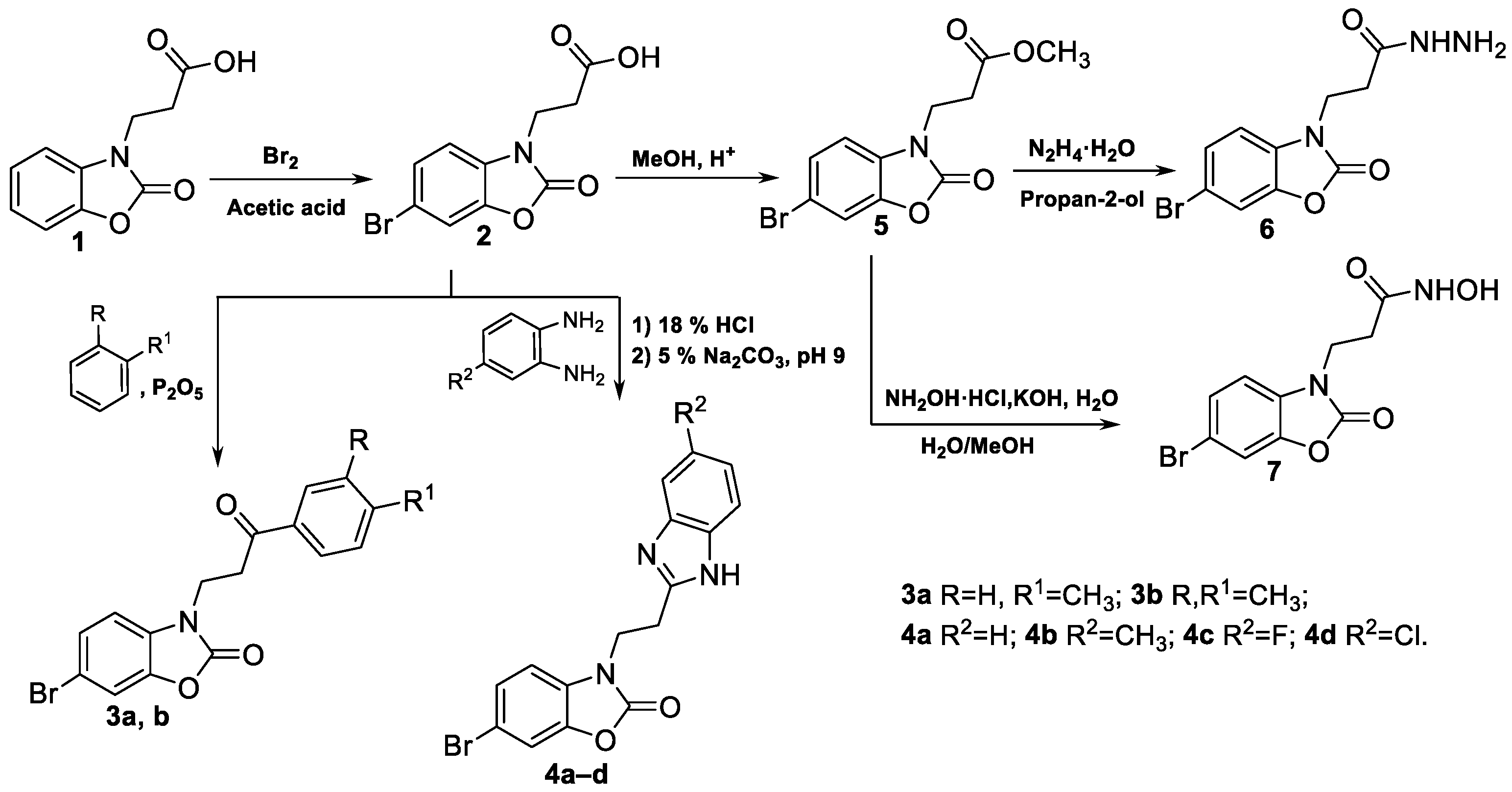
There has been growing interest in the synthesis and application of β-amino acids due to their occurrence in biologically active compounds, natural products, and significant derivatives. Both alicyclic and heterocyclic β-amino acids are key components in numerous natural and synthetic bioactive molecules [56,57]. Continuing our work in the field of synthesis and research of amino acids, their derivatives, and cyclization products, in this work, we synthesized various 3-(6-bromo-2-oxo-1,3-benzoxazol-3(2H)-yl)propanoic acid derivatives and investigated their antimicrobial activity. In our previous work [58], we synthesized a series of derivatives of compound 1 and investigated their antibacterial activity. In the present study, by introducing a bromo substituent into the benzoxazolinone ring, we aimed to enhance the antibacterial activity of related compounds. The initial acid 2 was obtained by bromination of carboxylic acid 1 (Scheme 1).
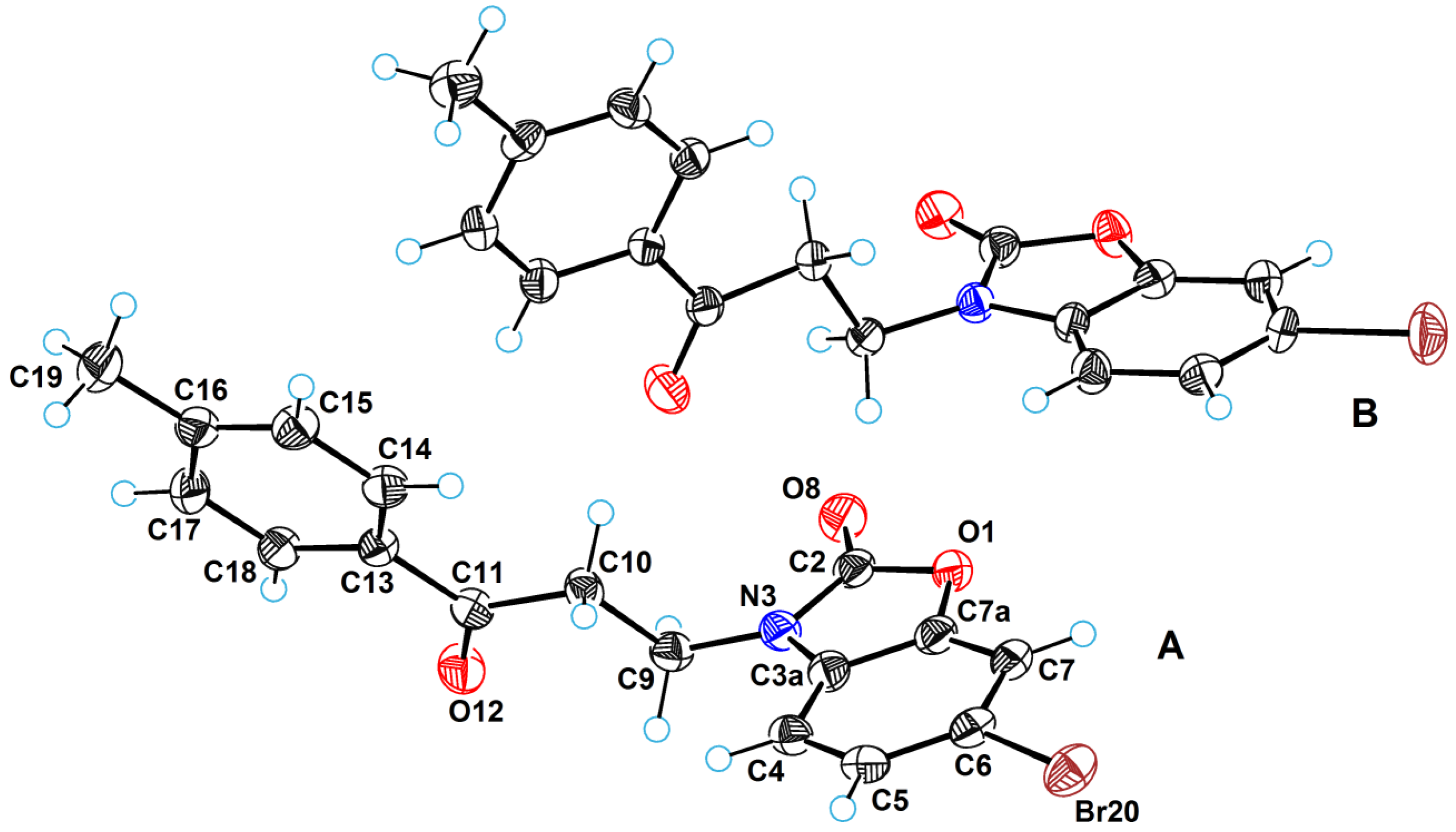
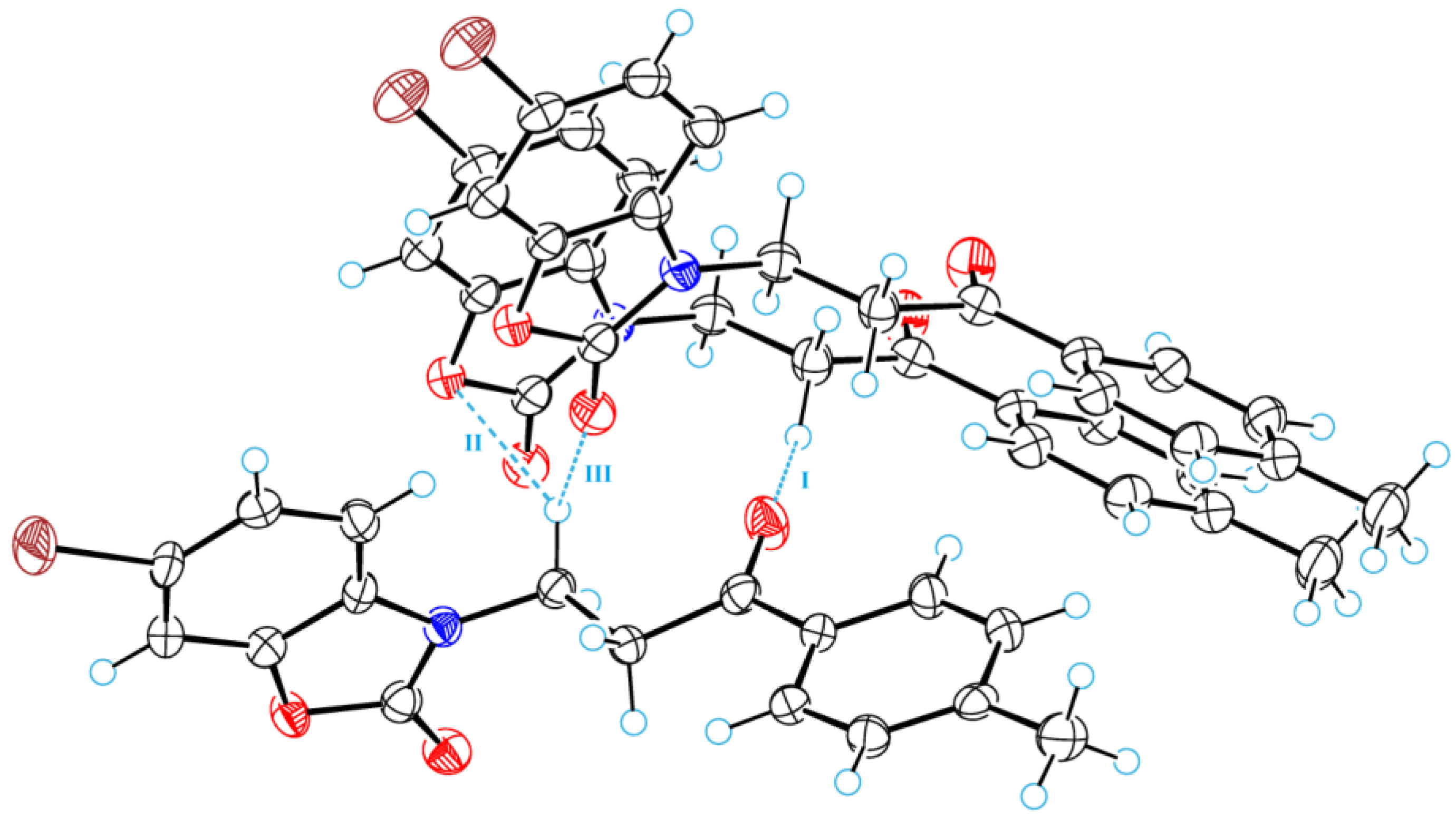
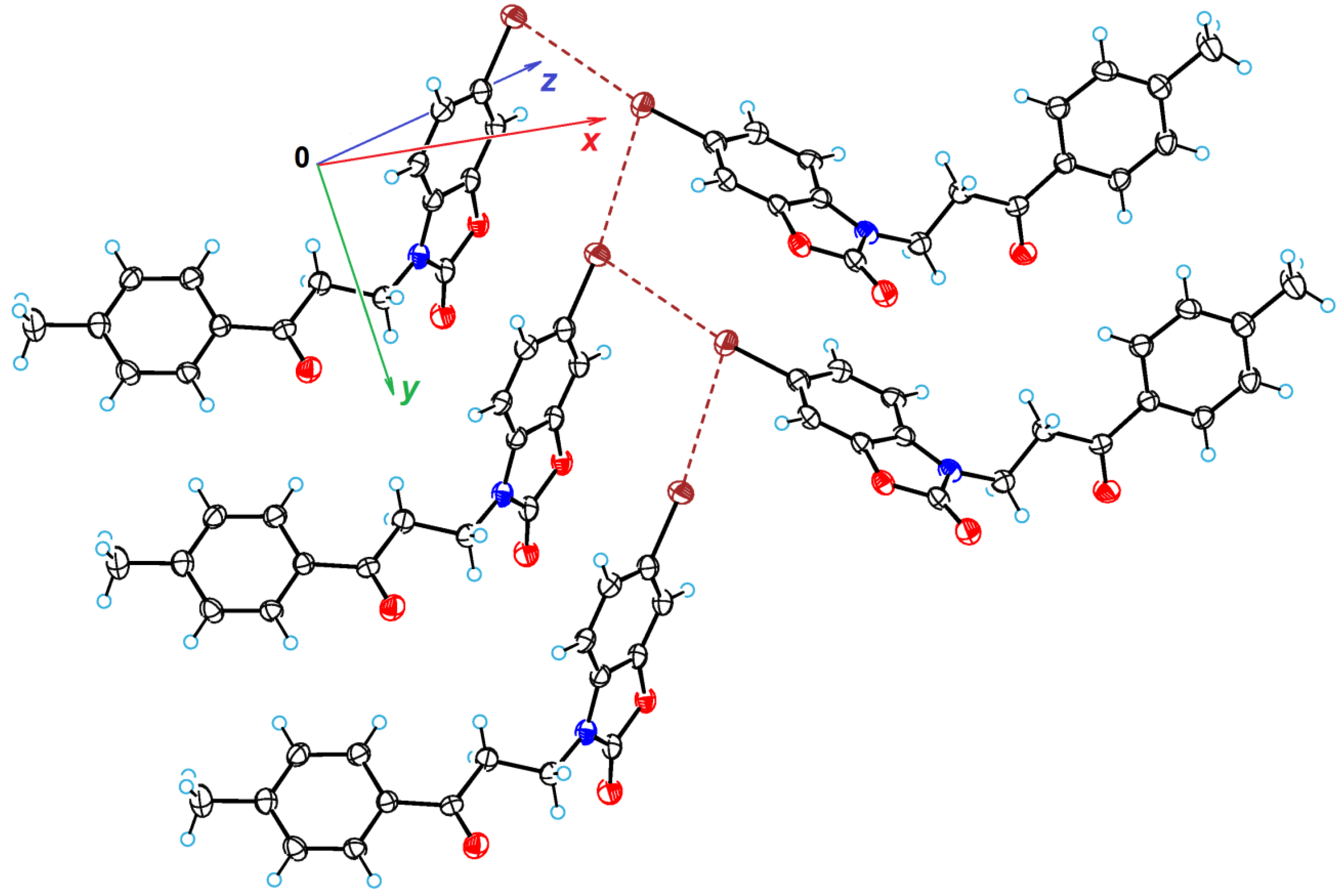
The resulting acid 2 was expected to be cyclized by boiling its solution in toluene or xylene in a mixture with phosphorus pentoxide. However, structural studies of the resulting compounds revealed that under these conditions, cyclization does not occur, but rather acylation of the aromatic ring occurs and compounds 3a, b are formed. Notably, these compounds were not the initially expected products. To determine their structures, X-ray diffraction analysis was performed, which unambiguously confirmed the identity of 6-bromo-3-(3-oxo-3-(p-tolyl)propyl)benzo[d]oxazol-2(3H)-one (3a). The structures of the compounds 3a and 3b were further confirmed by IR, 1H and 13C NMR spectroscopy, and mass spectrometry.
Benzimidazoles have garnered significant research attention due to their diverse therapeutic potentials [59]. Therefore, their exploration was undertaken in our study. The Phillips reaction of compound 2 with a corresponding benzene-1,2-diamines in 18% hydrochloric acid afforded the scheduled structures 4ae. The presence of the characteristic benzimidazole multiplets in the aromatic proton region and a broad characteristic singlets observed at 12.34 (4a), 12.17 (4b), 9.79 (4c) and 9.80 (4d) ppm confirmed the presence of the benzimidazole NH protons.
To obtain the target acid hydrazide 6, the conventional synthetic route, carboxylic acid → ester → hydrazide, was employed. Specifically, esterification of carboxylic acid 1 was carried out using methanol in the presence of catalytic sulfuric acid to afford ester 5, which subsequently underwent hydrazinolysis to yield acid hydrazide 6. The structures of the intermediate and final products 5 and 6 were confirmed by 1H and 13C NMR spectroscopy, IR spectroscopy, and mass spectrometry. The 1H NMR spectrum of compound 6 displayed two characteristic singlets at δ 9.11 and 4.17 ppm, corresponding to the protons of the CONHNH2 moiety. Three aromatic protons appeared in the range of δ 7.23–7.64 ppm. Additionally, two triplets attributed to the NCH2CH2 fragment of the alkyl chain were observed at δ 2.50 and 4.02 ppm, with coupling constants of J = 6.5 Hz and J = 6.7 Hz, respectively. The 13C NMR spectrum of compound 6 showed resonance signals consistent with the expected structure, further confirming the identity of the synthesized molecule.
In the next stage, hydroxamic acid 7 was synthesized by the interaction of ester 5 with hydroxylamine in a mixture of water and methanol 1:1 mixture at 0–5 °C according to the procedure described in [60]. In the 1H NMR spectrum of the synthesized hydroxamic acid, a distinct singlet for the NH proton was observed at 8.79 ppm, along with a singlet for the OH proton at 10.48 ppm.
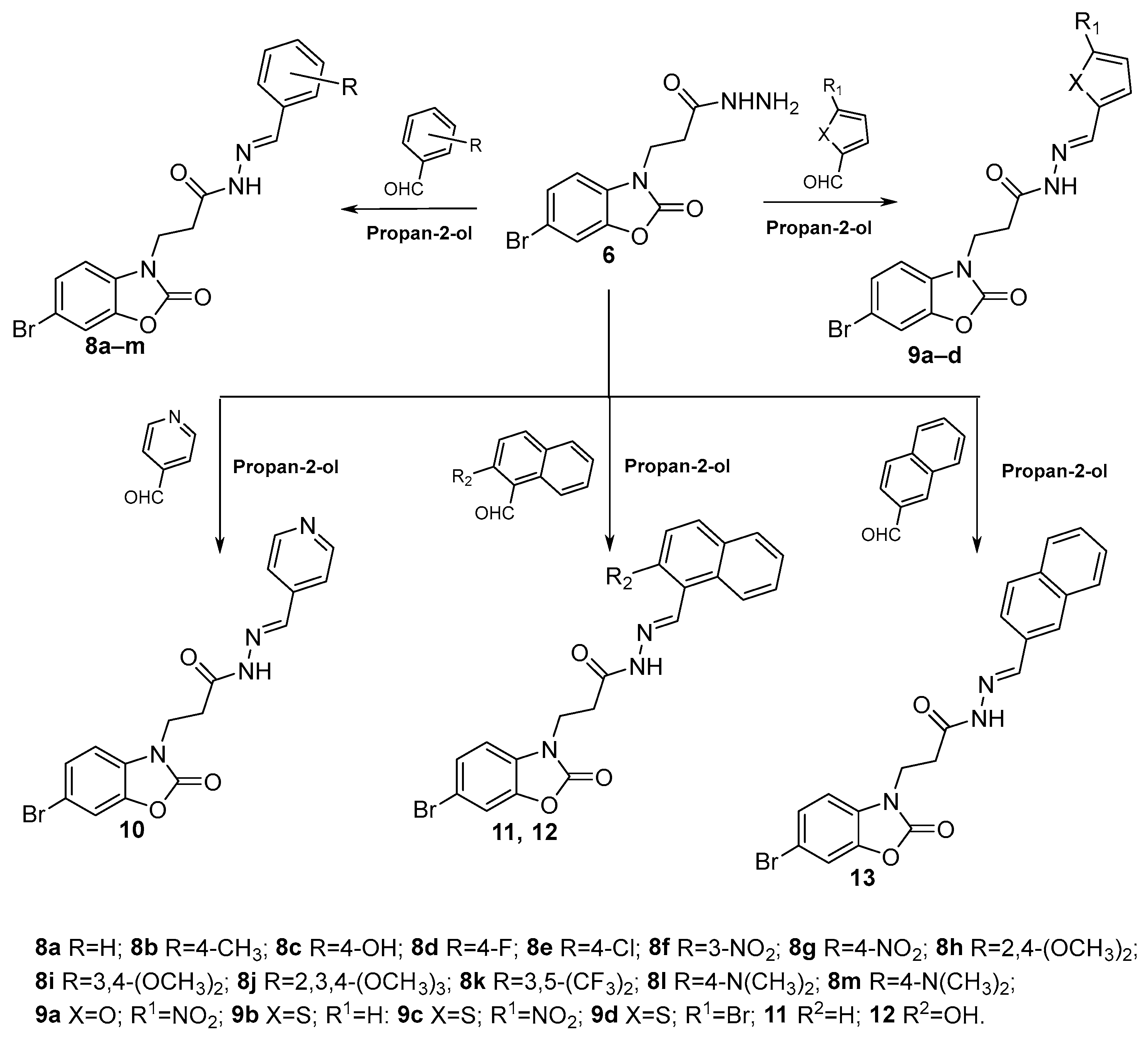
Numerous hydrazones have been reported, demonstrating a wide range of biological activities [61,62,63,64,65,66]. Therefore, continuing our work in this area, we synthesized a series of compounds of this class, 813. To introduce the hydrazone moiety, hydrazide 6 was reacted with various aromatic and heteroaromatic aldehydes in propan-2-ol under reflux (Scheme 2). The reactions were complete within 3 h, affording the corresponding hydrazones 813 in yields ranging from 50% to 99%.
NMR analysis revealed that hydrazones 813 exist in solution (DMSO-d6) as mixtures of E/Z rotamers. In all 1H NMR spectra (compounds 812, except 8b and 13, where CO-NH can be seen as singlets at 11.41 and 11.53 ppm, respectively), the resonances of the N=CH and CO–NH protons appeared as duplicate sets in the ranges 7.75–9.07 ppm and 11.07–11.82 ppm (OH), respectively. The intensity ratio of these signals varied between 0.58:0.42 and 0.72:0.28, depending on the molecular structure. In the 13C NMR spectra, the resonances of the N=CH and CO–NH carbons were observed within the expected intervals. This case of isomerism is described in more detail in the paper [58].
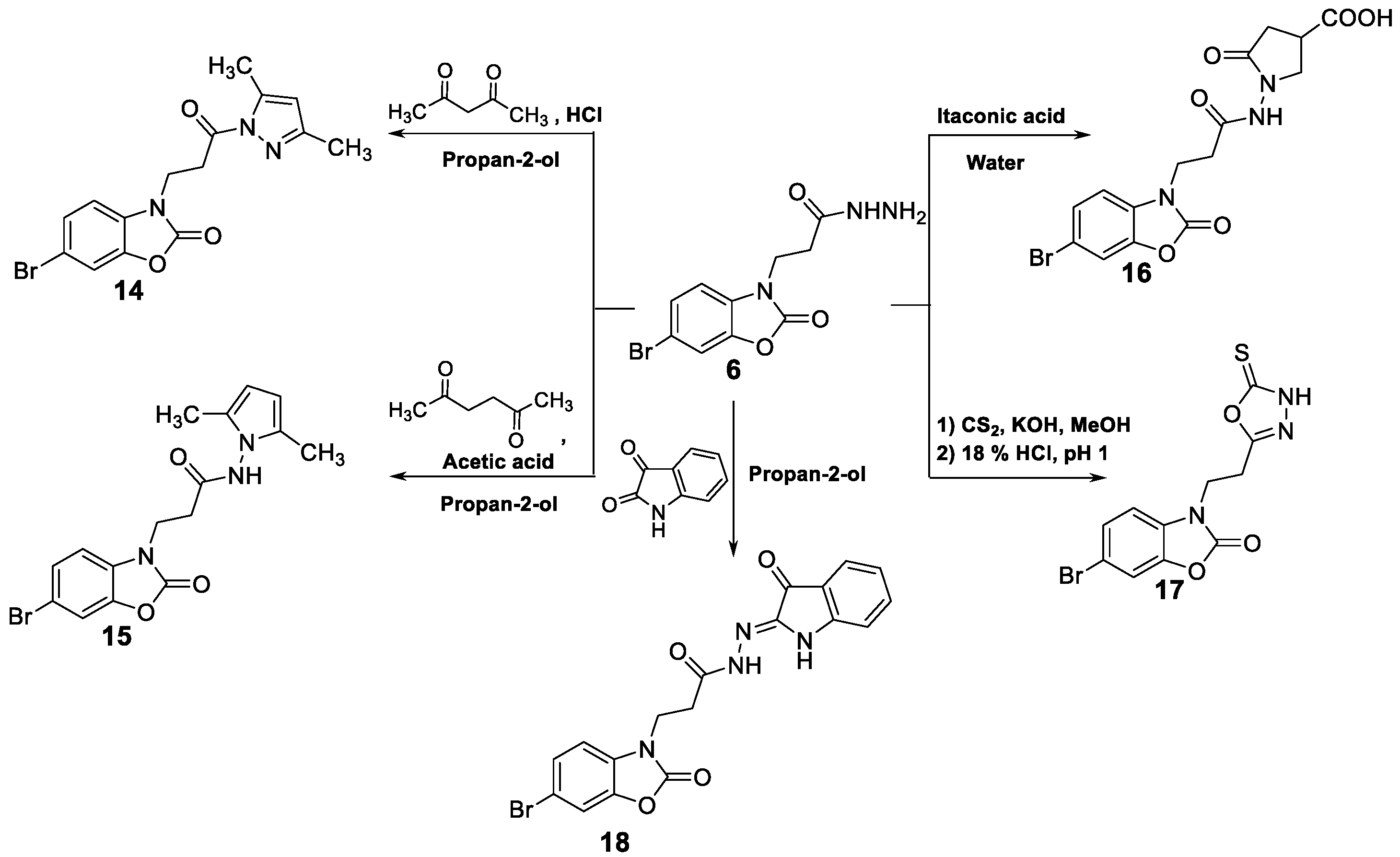
Heterocyclization of 3-(6-bromo-2-oxo-1,3-benzoxazol-3(2H)-yl)propanehydrazide (6) with diketones gave compounds containing benzoxazolinone-pyrazole (14) and benzoxazolinone-pyrrole (15) hybrids (Scheme 3). Condensation of acid hydrazide 6 with pentane-2,4-dione in refluxing propan-2-ol in the presence of a catalytic amount of hydrochloric acid yielded the pyrazole derivative 14 in 56% yield. In an analogous procedure, replacement of pentane-2,4-dione with hexane-2,5-dione and the use of catalytic acetic acid furnished the pyrrole derivative 15 in 46% yield. The characteristic NMR signals corresponding to 3,5-dimethylpyrazole and 2,5-dimethylpyrrole moieties were clearly observed, and all spectroscopic and HRMS data were fully consistent with the proposed structures. Investigation of the reaction of hydrazide 6 with itaconic acid has revealed that these primary amines form a compound containing a fragment of γ-amino acid, which undergoes cyclization to the five-membered pyrrolidone cycle 16 already during the reaction (Scheme 3).
Hydrazinocarbonyl compounds undergo reaction with sulphur disulphide in the presence of potassium hydroxide quite easily, and 6-bromo-3-(2-(5-thioxo-4,5-dihydro-1,3,4-oxadiazol-2-yl)ethyl)benzo[d]oxazol-2(3H)-one (17) was synthesized from acid hydrazide 6 according to the method described in the literature [58]. In this 1H NMR spectrum, besides the characteristic proton signals of aromatic and alkyl moieties, the singlet of the NH group proton at 14.34 is observed. 1H NMR analysis indicated that the compound exists exclusively in the thione form in DMSO-d6 solution, as evidenced by a characteristic singlet at 14.34 ppm corresponding to the NH proton. In the 13C NMR spectrum, resonances at 153.24 ppm (C=N), 161.31 ppm (C=O), and 177.78 ppm (C=S) confirmed the structural assignment.
Investigation of the reaction of hydrazide 6 with itaconic acid has revealed that these primary amines form a compound containing a fragment of γ-amino acid, which undergoes cyclization to the five-membered pyrrolidone cycle 16 already during the reaction (Scheme 3). At the end of the synthetic work, 3-(6-bromo-2-oxobenzo[d]oxazol-3(2H)-yl)-N’-(3-oxoindolin-2-ylidene)propanehydrazide (18) was synthesized via a condensation reaction between isatin and hydrazide 6, affording the product in 80% yield.

3.2. Evaluation of Antibacterial Activity by the Kirby–Bauer Method

A total of eighteen synthesized chemical compounds (No. 118), including several structural analogues (e.g., 3a, 3b, 4a4e, 8a8m, 9a9d), were evaluated for their antibacterial properties. The antibacterial activity was assessed using the Kirby–Bauer disk diffusion method, and inhibition zone diameters (mm) were measured against five representative bacterial strains: S. aureus, MRSA, B. subtilis, E. coli, and P. aeruginosa (described in the Supplementary Figure S122).
A considerable number of the synthesized compounds (No. 18, 9b9d, 10, and 1318) exhibited no detectable inhibitory activity against any of the tested bacterial strains. Since the disk diameter was 6 mm, this area was entirely covered; thus, any potential inhibition smaller than 6 mm could not be observed, making it impossible to determine whether minimal antibacterial effects were present. These findings suggest that most of the synthesized molecules either lack intrinsic antibacterial activity or were tested at concentrations below their effective inhibitory threshold. Only a few compounds demonstrated measurable antibacterial effects against specific bacterial strains (described in the Supplementary Table S1).
Compound 9a exhibited moderate antibacterial activity against the Gram-positive rod B. subtilis, with an inhibition zone of 12.87 ± 0.35 mm.
Compound 11 showed the highest potency, displaying pronounced inhibitory effects against the Gram-positive cocci S. aureus (14.57 ± 0.25 mm) and MRSA (12.14 ± 0.14 mm).
Compound 12 exhibited weak to moderate activity against S. aureus (9.42 ± 0.20 mm) and MRSA (9.00 ± 0.17 mm), while remaining inactive against B. subtilis and all Gram-negative bacteria.
Compound 13 demonstrated low inhibitory activity against E. coli (8.71 ± 0.27 mm) but showed no detectable effect on other tested strains. All other compounds, including the structurally diverse analogues (e.g., 8a8m), failed to produce measurable inhibition zones against any of the bacterial species tested. Comparison of bacterial susceptibility revealed a clear pattern of selective activity toward Gram-positive cocci. S. aureus and MRSA were susceptible to two compounds, whereas the Gram-positive spore-forming bacterium B. subtilis and the Gram-negative bacterium E. coli were each susceptible to one compound. P. aeruginosa exhibited no susceptibility to any of the tested compounds and was therefore excluded from further analysis. This high resistance is consistent with the characteristic structural and functional barriers of Gram-negative bacteria, such as the low permeability of the outer membrane and the presence of efficient efflux pump systems that prevent intracellular accumulation of antibacterial agents.
Ciprofloxacin was used as a positive control to validate the assay conditions. It exhibited strong and broad-spectrum antibacterial activity, producing inhibition zones of 36.00 ± 0.20 mm (S. aureus), 32.00 ± 0.27 mm (MRSA), 42.00 ± 0.53 mm (B. subtilis), 40.00 ± 0.61 mm (E. coli), and 26.00 ± 0.44 mm (P. aeruginosa). These results confirm the reliability of the experimental method and the suitability of the setup for accurately determining antibacterial efficacy.
Among all evaluated compounds, only four—9a, 11, 12, and 13—displayed measurable antibacterial activity in the Kirby–Bauer disk diffusion assay, predominantly against Gram-positive bacterial strains. Compound 11 demonstrated the greatest potency, effectively inhibiting both methicillin-sensitive and methicillin-resistant S. aureus. These results suggest that the tested compounds contain promising structural motifs for the development of new agents targeting Gram-positive pathogens.

3.3. MIC and MBC Evaluation

The minimum inhibitory concentrations (MICs) and minimum bactericidal concentrations (MBCs) of the most active synthesized compounds were determined against representative Gram-positive and Gram-negative bacterial strains, including S. aureus, MRSA, B. subtilis, and E. coli. Ciprofloxacin was used as a reference antibiotic control.
Against S. aureus, compound 11 exhibited a MIC value of 31.25 µg/mL and an MBC value of 62.5 µg/mL, while compound 12 showed a MIC of 31.25 µg/mL and an MBC of 125 µg/mL. These results indicate moderate antibacterial activity, with compound 11 displaying slightly stronger bactericidal potential than compound 12.
For MRSA, compound 11 demonstrated MIC and MBC values of 62.5 µg/mL, suggesting similar inhibitory and bactericidal thresholds. In contrast, compound 12 was more potent, with a MIC of 7.8 µg/mL and an MBC of 62.5 µg/mL, indicating relatively higher inhibitory activity but requiring a greater concentration for bactericidal action.
The reference antibiotic ciprofloxacin exhibited strong activity against both S. aureus and MRSA, with MIC/MBC values of 0.125/0.125 µg/mL and 0.25/0.5 µg/mL, respectively, thereby confirming the reliability of the assay conditions.
The spore-forming Gram-positive bacterium B. subtilis was tested against compound 9a, which exhibited strong inhibitory activity, with a MIC of 7.8 µg/mL and an MBC of 62.5 µg/mL, suggesting a pronounced bacteriostatic effect at low concentrations. In comparison, ciprofloxacin showed substantially higher potency, with MIC and MBC values of 0.06 µg/mL and 0.125 µg/mL, respectively.
The Gram-negative bacterium E. coli was susceptible only to compound 13, which showed relatively weak activity, with both MIC and MBC values of 250 µg/mL. This result indicates limited efficacy and suggests that compound 13 exerts minimal bacteriostatic and bactericidal effects against E. coli. In contrast, ciprofloxacin displayed high potency, with MIC and MBC values of 0.5 µg/mL, consistent with its known broad-spectrum activity.
Overall, the synthesized compounds exhibited selective antibacterial activity, primarily against Gram-positive bacteria. Compounds 11 and 12 were active against S. aureus and MRSA, compound 9a was effective against B. subtilis, and compound 13 showed weak activity against E. coli.
In general, the higher MIC and MBC values observed for the synthesized compounds compared with ciprofloxacin indicate moderate antibacterial potency. Nevertheless, their selectivity toward Gram-positive organisms, particularly methicillin-resistant S. aureus, suggests that these molecules may serve as promising lead structures for the development of new antibacterial agents targeting resistant staphylococcal infections.

3.4. Correlation Between Disk Diffusion and MIC/MBC

The antibacterial activities of compounds 9a, 11, 12, and 13 were evaluated against S. aureus, MRSA, B. subtilis, E. coli, and P. aeruginosa, using ciprofloxacin as a reference standard. The corresponding MIC, MBC, and MBC/MIC values are summarized in Table 1. As shown in the table, the synthesized compounds exhibited variable inhibitory effects, primarily against Gram-positive strains.
Compound 9a displayed activity exclusively against B. subtilis (MIC = 7.8 µg/mL, MBC = 62.5 µg/mL, MBC/MIC = 8), indicating a predominantly bacteriostatic mode of action.
Compound 11 demonstrated moderate activity against S. aureus and MRSA, with MIC values of 31.25 µg/mL and 62.5 µg/mL, respectively.
Compound 12 exhibited the most potent antibacterial effect, inhibiting S. aureus (MIC = 31.25 µg/mL) and MRSA (MIC = 7.8 µg/mL) with corresponding MBC/MIC ratios of 4 and 8, respectively, again suggesting a bacteriostatic effect. The higher susceptibility of MRSA to compound 12 is noteworthy and may reflect favorable structural interactions with bacterial targets associated with resistance mechanisms.
Compound 13 was active only against E. coli (MIC = MBC = 250 µg/mL, MBC/MIC = 1), demonstrating a bactericidal effect.
The reference antibiotic ciprofloxacin exhibited potent broad-spectrum activity (MIC = 0.06–0.5 µg/mL), thereby confirming the reliability and validity of the assay conditions.
Overall, these results indicate that the tested compounds display selective antibacterial activity, mainly against Gram-positive bacteria, with compound 12 emerging as the most promising derivative in the series.

3.5. Bacterial Growth Curve Analysis

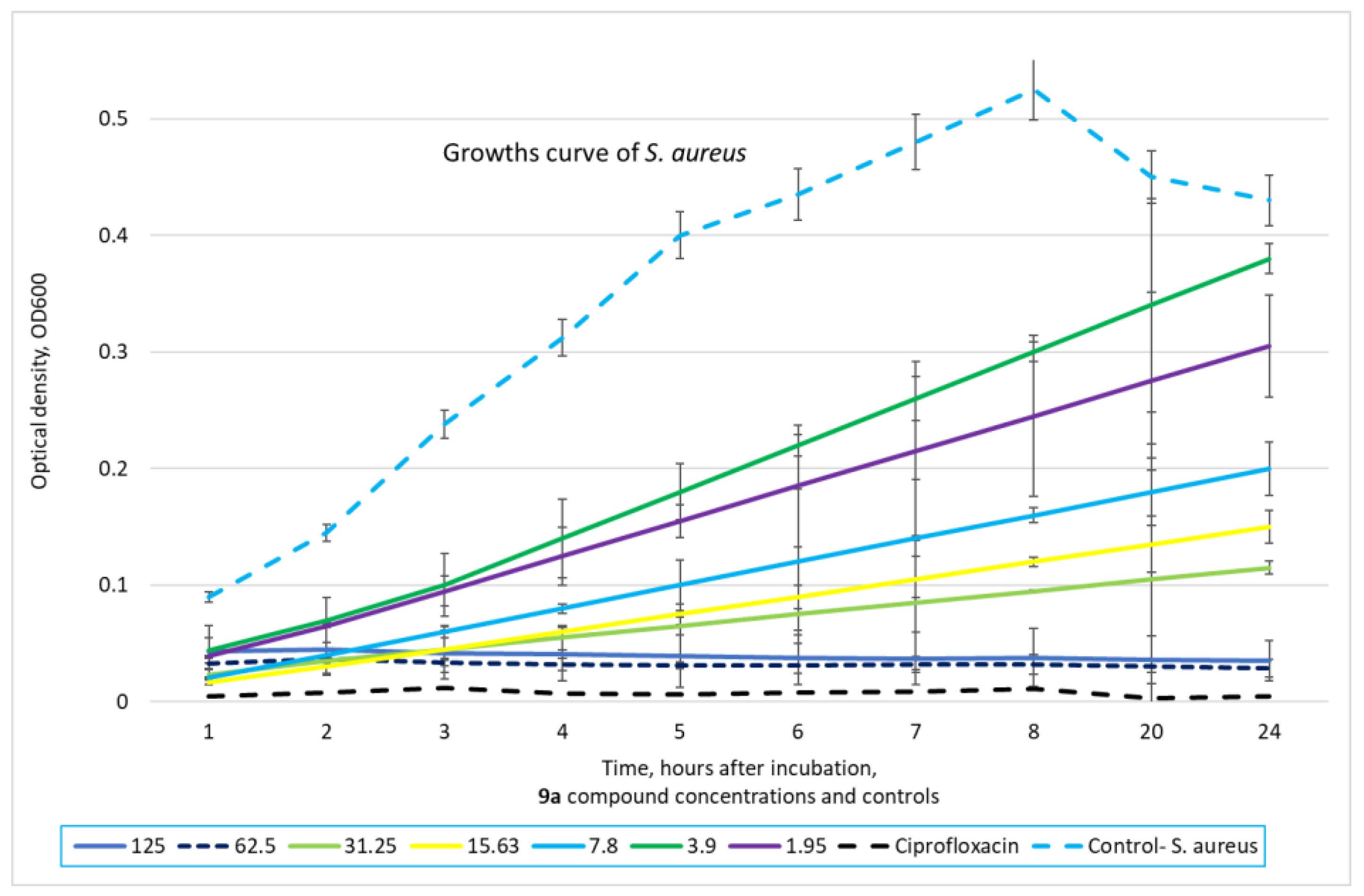
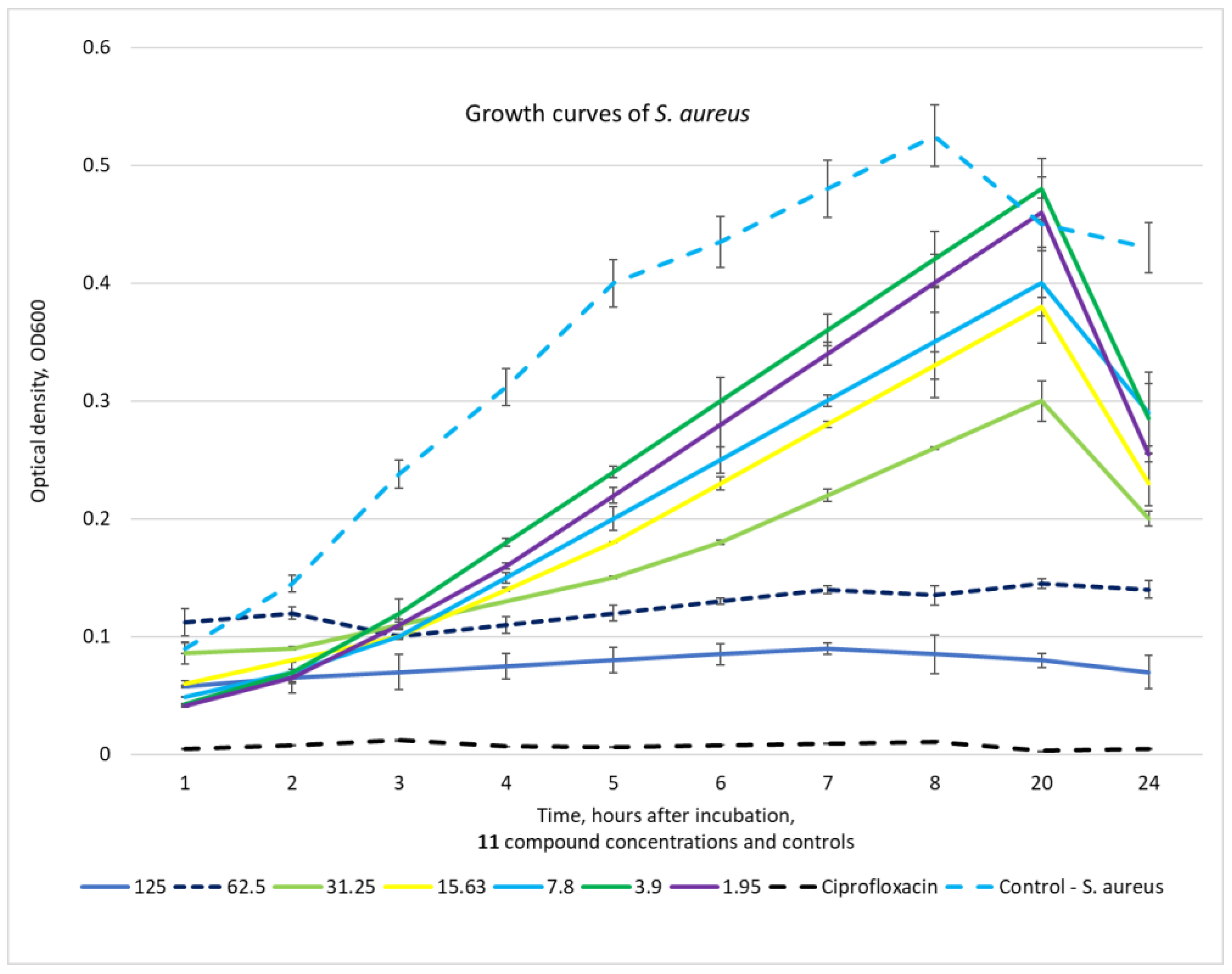
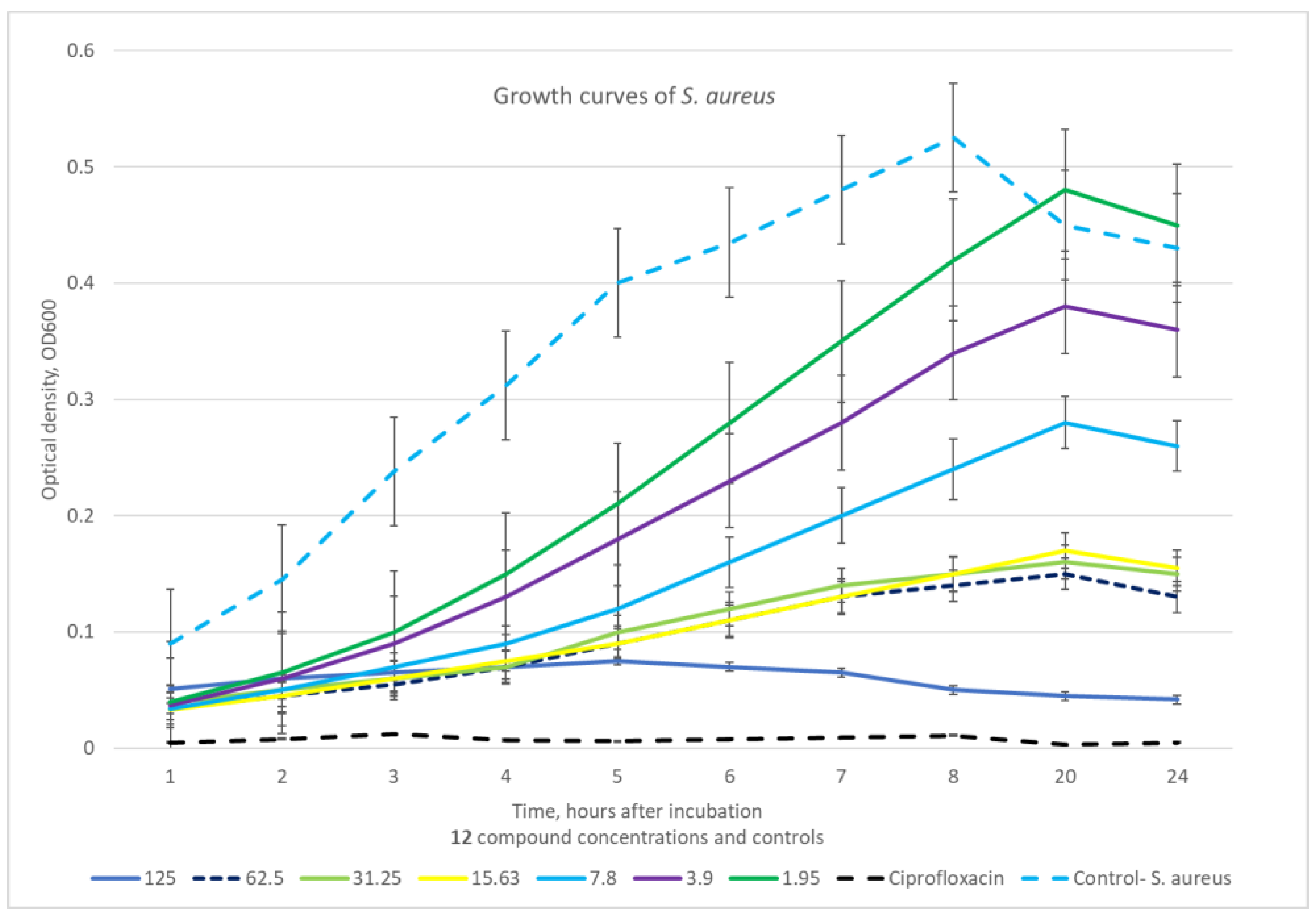
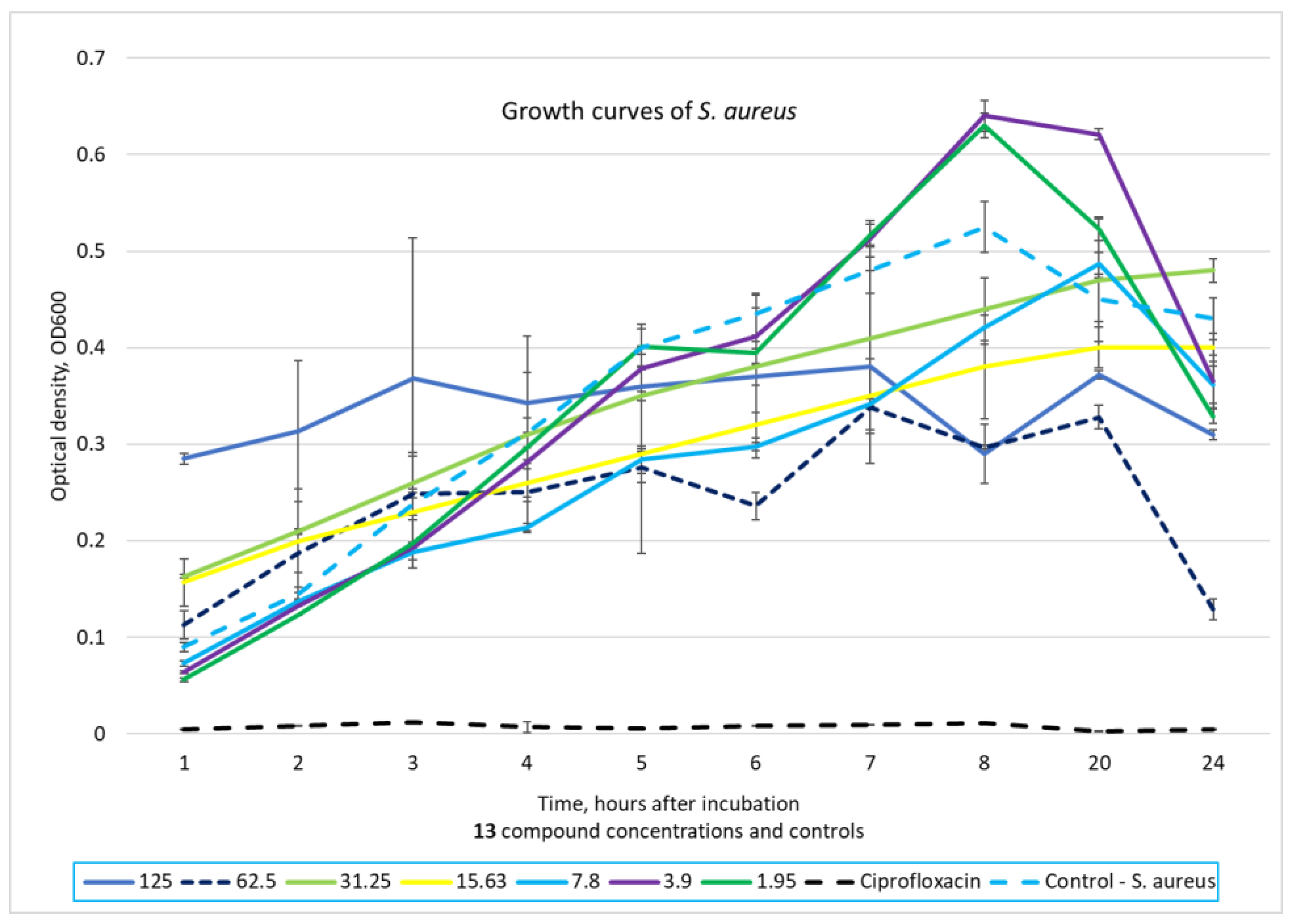
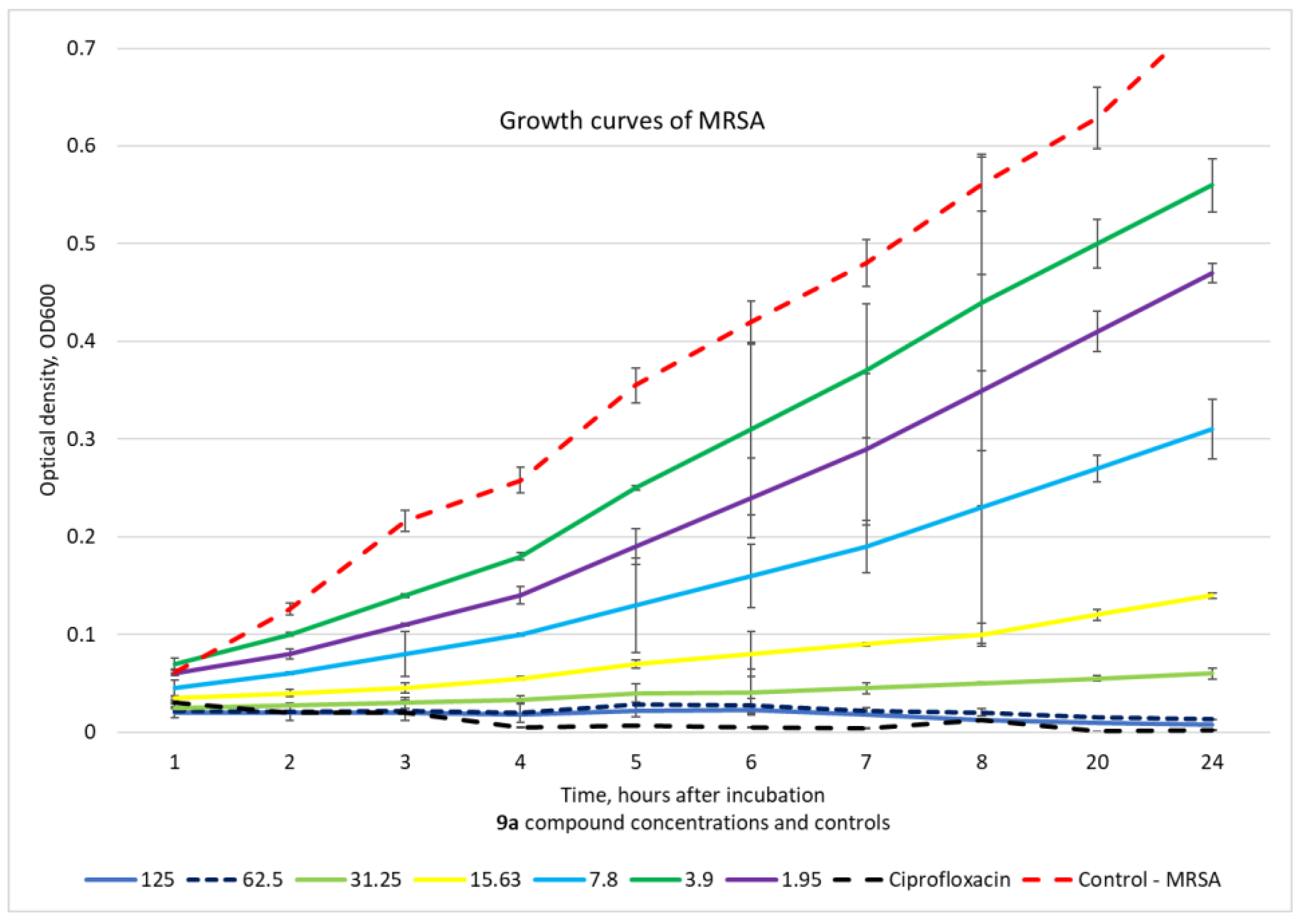
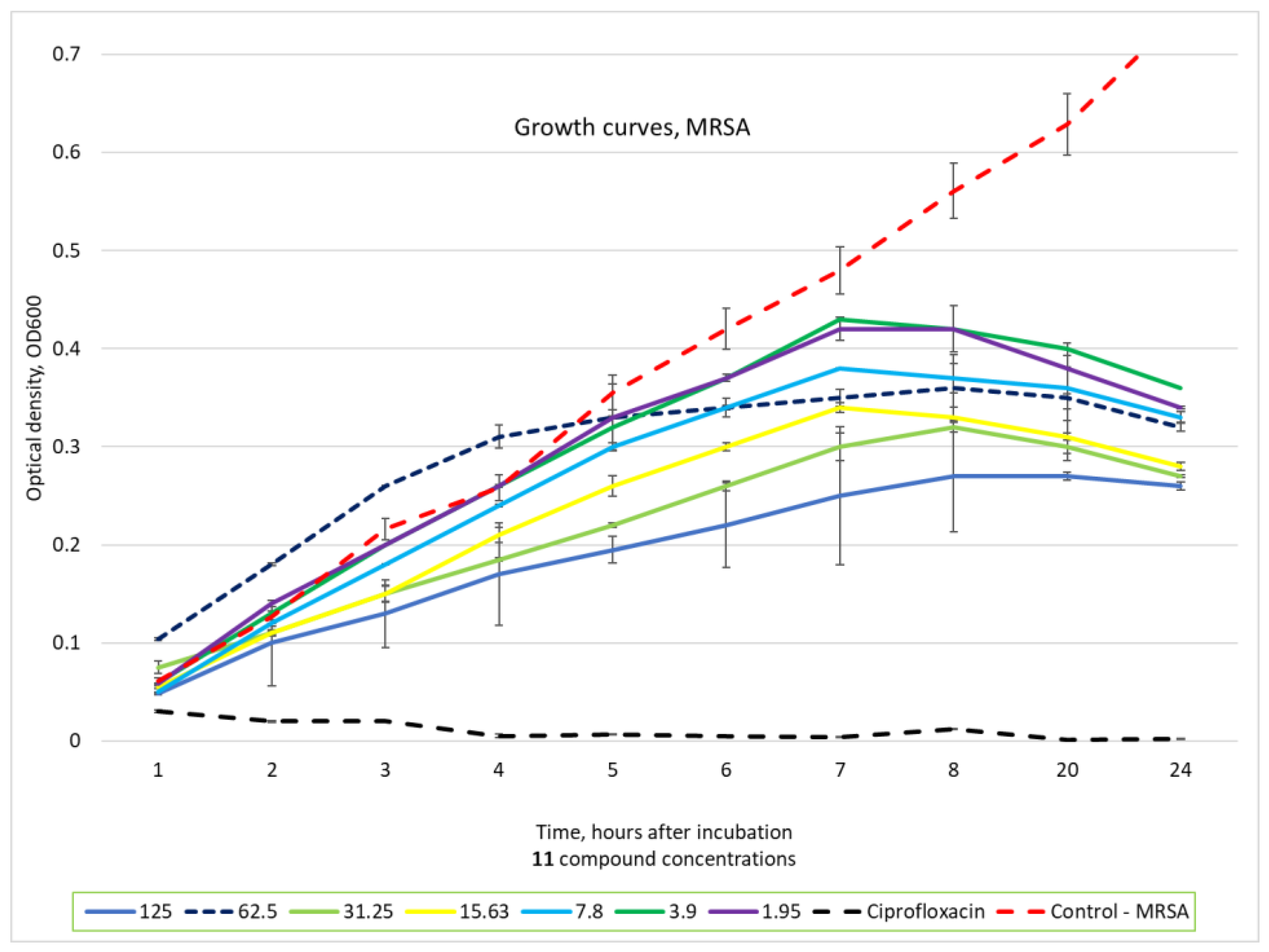
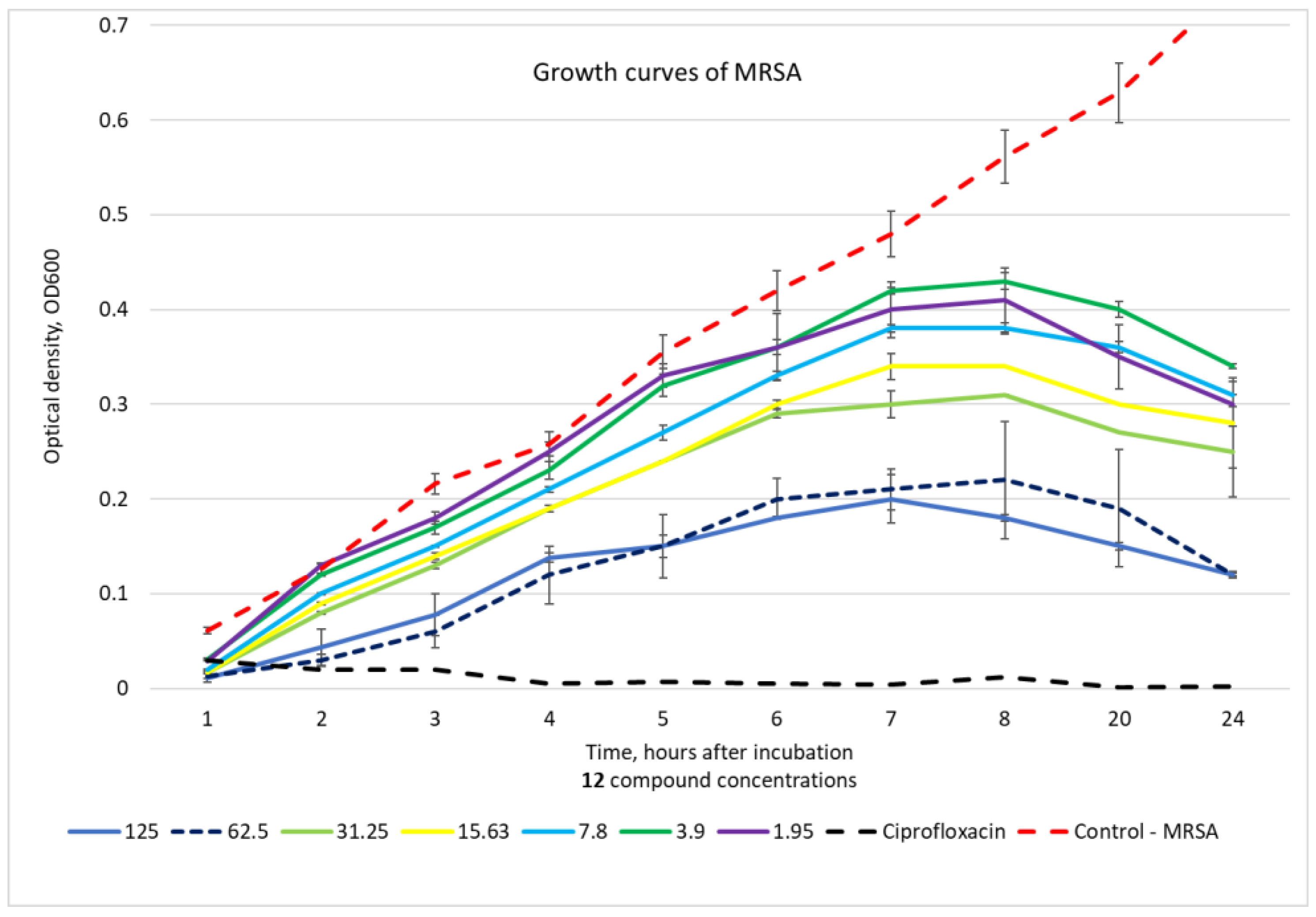
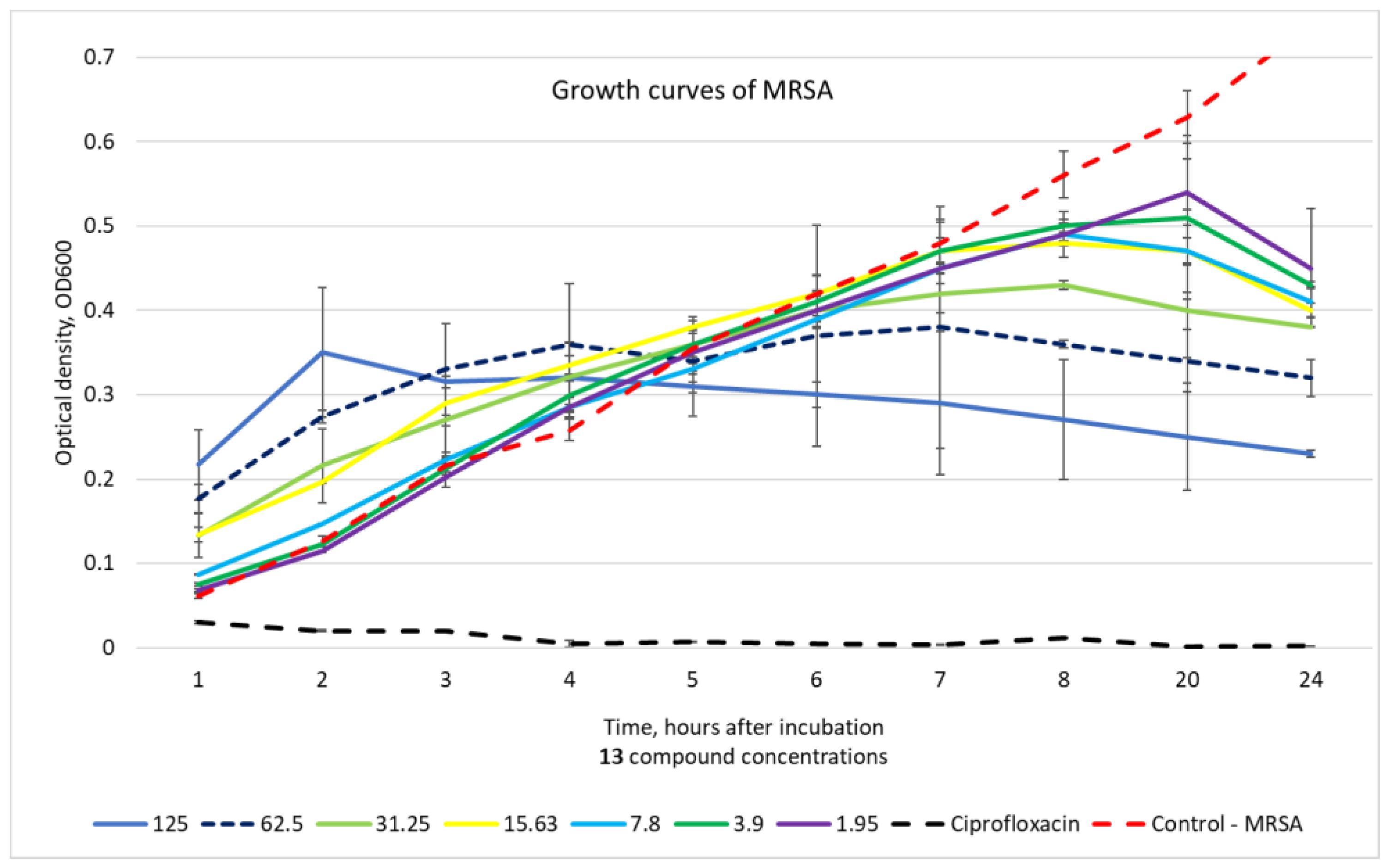
The antibacterial activities of several synthesized compounds were systematically evaluated against S. aureus and MRSA over a 24 h incubation period, with optical density measured at ten time points. Bacterial growth was monitored spectrophotometrically at 600 nm (OD600) at 1, 2, 3, 4, 5, 6, 7, 8, 20, and 24 h, enabling a detailed assessment of growth kinetics and the temporal dynamics of inhibition (Figure 2, Figure 3, Figure 4, Figure 5, Figure 6, Figure 7, Figure 8 and Figure 9). Ciprofloxacin was used as a positive control, while untreated bacterial cultures served as baseline growth references.
The compounds exhibited a clear dose-dependent antibacterial effect across all tested samples. At the highest concentration (125 µg/mL), bacterial proliferation was strongly suppressed for both S. aureus and MRSA. In the case of compound 13, elevated OD600 readings were observed, particularly at early time points, due to the compound’s inherent turbidity. Consequently, part of the measured optical density at high concentrations may reflect solution cloudiness rather than bacterial growth. Nevertheless, overall OD600 values remained substantially lower than those of untreated controls, confirming effective inhibition.
The time-dependent inhibition profile varied according to both compound concentration and bacterial strain. At 125 µg/mL, inhibition was apparent from the first hour and persisted throughout the 24 h, indicating sustained antibacterial activity. At 62.5 µg/mL, partial growth suppression was observed—OD600 values gradually increased over time but remained significantly below those of untreated cultures, suggesting slowed, though not completely halted, bacterial proliferation.
At intermediate concentrations (31.25–15.625 µg/mL), bacterial growth resumed progressively after 4–6 h, indicating that inhibitory effects at these levels were transient or limited. Notably, MRSA exhibited a slightly faster recovery compared with S. aureus, revealing strain-dependent differences in susceptibility. These findings emphasize that inhibitory effects at sub-maximal concentrations are temporary and that the timing of growth recovery is a critical parameter for assessing compound potency.
At the lowest concentrations (7.8–1.95 µg/mL), bacterial growth closely resembled that of untreated controls, with OD600 steadily increasing over the 24 h period. These results confirm that inhibition at such low concentrations was minimal and insufficient for effective bacterial suppression.
Comparison among the tested compounds revealed clear differences in potency. Certain compounds maintained low OD600 values across nearly all concentrations, indicating stronger and more sustained antibacterial activity, while others demonstrated only moderate inhibition, particularly against MRSA. Overall, the growth curves show that although several compounds were capable of delaying bacterial proliferation, their inhibitory effects diminished over time at intermediate and lower concentrations.

3.6. Time–Kill Kinetics Against Staphylococcus aureus

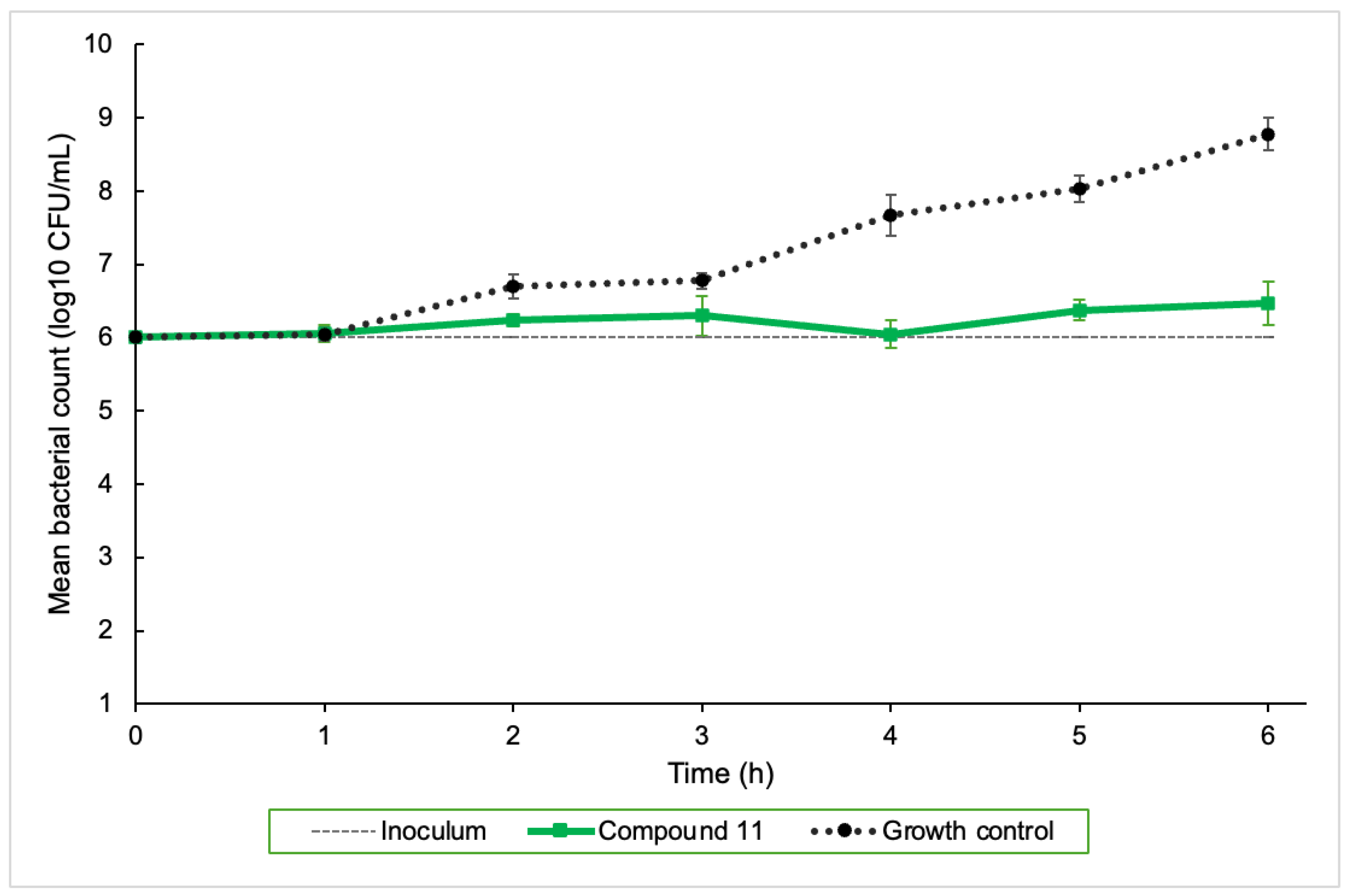
The effect of compound 11 on the growth kinetics of S. aureus was evaluated by quantifying viable bacterial counts (log10 CFU/mL) over a 6 h incubation period, and the results are presented in the time–kill curve (Figure 10). Compound 11 was selected for this experiment because it exhibited the most pronounced antibacterial activity against S. aureus in the disk diffusion assay.
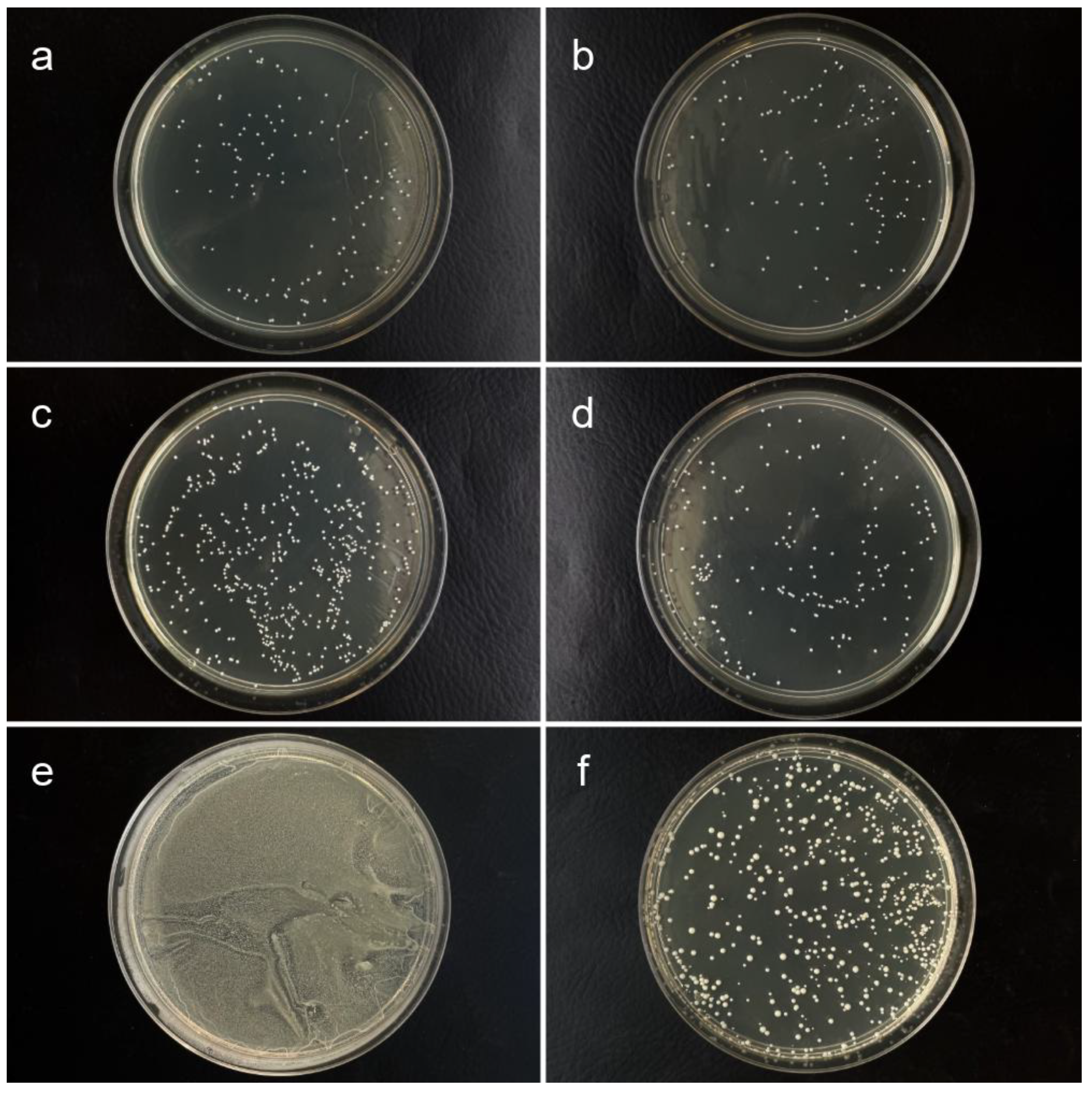
At baseline, both the untreated control and the compound 11–treated cultures had bacterial concentrations of 6.00 log10 CFU/mL (± 0.07 and ± 0.05, respectively). After 1 h, bacterial counts in both groups remained near the initial inoculum, with the control at 6.05 ± 0.09 log10 CFU/mL (Figure 11a) and the treated culture at 6.06 ± 0.12 log10 CFU/mL (Figure 11b). These data indicate that during the first hour, untreated S. aureus cells were in the adaptation or lag phase, and treatment with compound 11 at 31.25 µg/mL did not cause the death of a significant portion of the population.
By 2 h, divergence between the groups became apparent (p < 0.05): the control increased to 6.70 ± 0.17 log10 CFU/mL (Figure 11c), whereas the treated culture rose only slightly to 6.23 ± 0.08 log10 CFU/mL (Figure 11d), indicating the onset of growth inhibition.
After 3 h, both cultures exhibited limited growth, with bacterial counts of 6.78 ± 0.11 log10 CFU/mL in the control and 6.30 ± 0.27 log10 CFU/mL in the treated group, maintaining a consistent difference. The most pronounced separation occurred at 4 h: the control reached 7.67 ± 0.28 log10 CFU/mL, while the treated culture decreased to 6.05 ± 0.19 log10 CFU/mL, corresponding to a 1.62-log10 reduction relative to the control. These data clearly show that the control bacteria rapidly adapted and transitioned from the lag phase to the log phase within four hours, while the inhibitory effect of compound 11 persisted throughout the entire incubation period.
At 5 h, the control culture increased to 8.04 ± 0.18 log10 CFU/mL, compared with 6.37 ± 0.14 log10 CFU/mL in the treated group, and by 6 h, the control reached 8.78 ± 0.22 log10 CFU/mL (Figure 11e), meanwhile, the culture exposed to compound 11 reached only 6.47 ± 0.29 log10 CFU/mL (Figure 11f).
Quantitatively, the untreated control exhibited bacterial growth over the 6 h experiment (Δ = 2.78 log10 CFU/mL), corresponding to an approximately 600-fold increase in population size, a specific growth rate of 1.07 h−1, a relative growth rate of 190% h−1, and a generation time of approximately 39 min, with growth becoming evident after the initial adaptation phase. Treatment with compound 11 resulted in limited bacterial growth, with counts remaining near the initial inoculum and increasing by only 0.46 log10 CFU/mL over 6 h. This corresponds to a modest 2.9-fold population increase, a specific growth rate of 0.18 h−1, a relative growth rate of 19.3% h−1, and a generation time of approximately 3.9 h.
In summary, these results did not demonstrate that compound 11 at the tested concentration exhibited bactericidal activity under the experimental conditions. However, suppression of S. aureus proliferation was evident, resulting in a nearly stable bacterial population throughout the experiment, in contrast to the continuous and robust growth observed in the untreated control.

3.7. Cytotoxicity Evaluation

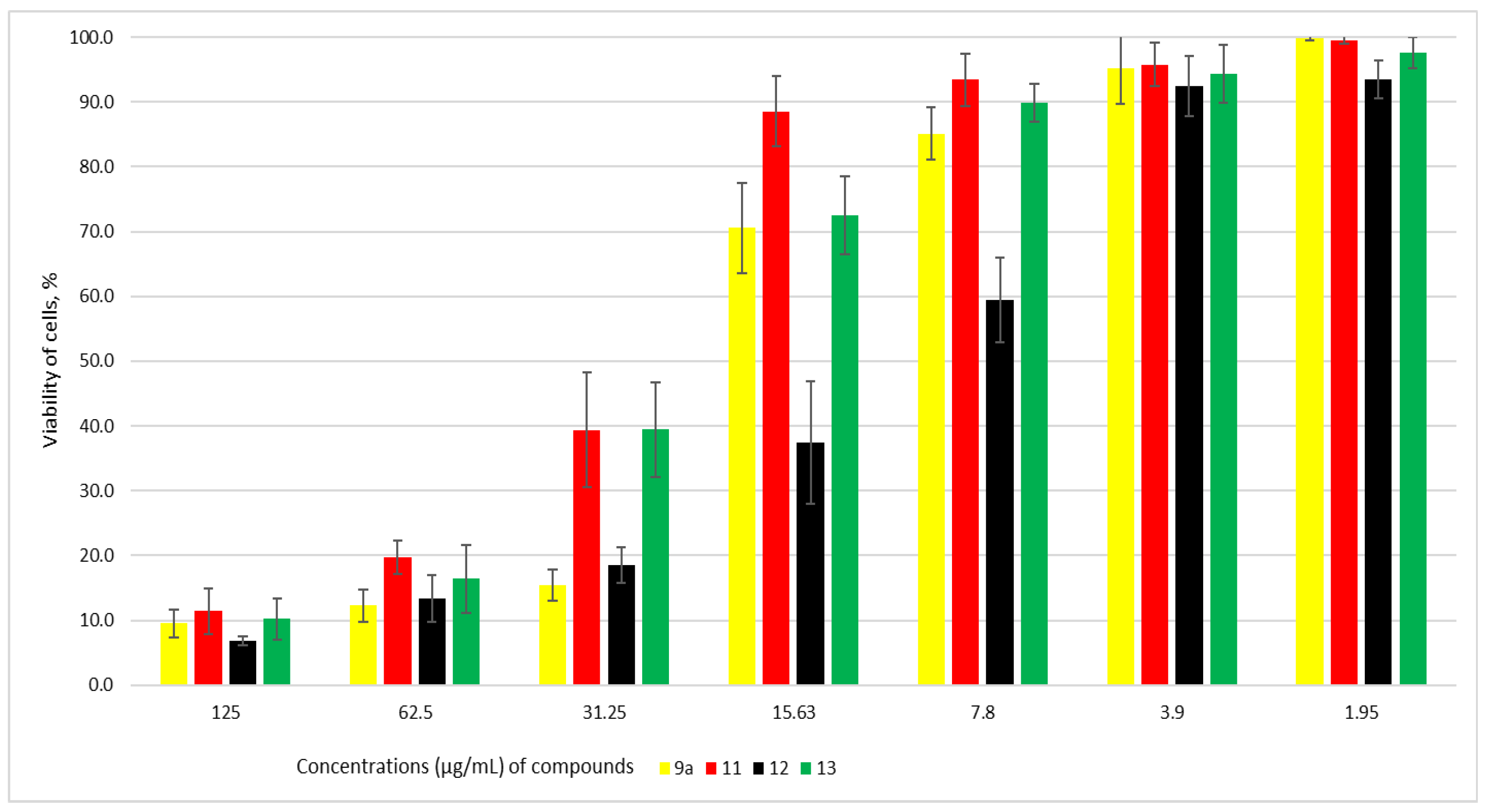
The cytotoxicity of compounds 9a, 11, 12, and 13 was evaluated at concentrations ranging from 125 to 1.95 µg/mL. The results showed a clear, concentration-dependent decrease in cytotoxicity for all tested compounds.
Vero cells exposed to compounds exhibited distinct morphological changes under microscopic observation (described in the Supplementary Figures S109–S121). The cells lost their typical elongated or polygonal shape and became rounded, shrunken, or irregularly shaped—many cells detached from the culture surface, creating gaps and discontinuities in the monolayer. The cytoplasm appeared granular or vacuolated, indicating intracellular damage. Overall, these changes resulted in a disrupted and sparsely populated cell layer, clearly indicating cytotoxic effects.
The MTT assay confirmed that the compounds 9a, 11, 12, and 13 exhibited cytotoxic effects on Vero cells at concentrations of 125, 62.5, and 31.25 µg/mL (Figure 12). At 15.6 and 7.8 µg/mL, only compound 12 remained cytotoxic. At the lowest concentrations tested (3.9 and 1.95 µg/mL), none of the compounds showed cytotoxicity.
The cytotoxicity of the tested chemical compounds (9a, 11, 12, and 13) was determined by measuring their CC50 values for subsequent analysis. Among them, compound 12 exhibited the highest cytotoxicity, with the lowest CC50 value of 11.7 µg/mL. Compound 9a showed moderate cytotoxicity (CC50 = 19.6 µg/mL), while compounds 13 and 11 were less cytotoxic, with CC50 values of 25.7 µg/mL and 29.7 µg/mL, respectively.
At the highest concentration (125 µg/mL), cell viability ranged from 6.8% to 11.4%, indicating strong cytotoxic effects. As the concentration decreased, cell viability increased markedly. For compound 9a, viability rose from 9.5% at 125 µg/mL to 99.8% at 1.95 µg/mL. Similar trends were observed for compounds 11 (from 11.4% to 99.6%), 12 (from 6.8% to 93.5%), and 13 (from 10.2% to 97.6%).
At concentrations below 7.8 µg/mL, all compounds showed minimal cytotoxicity, maintaining over 90% cell viability, suggesting good biocompatibility at lower doses (Figure 12). These results confirm that the cytotoxic effects of the tested compounds are dose-dependent, with negligible toxicity observed at low concentrations.
The therapeutic indices (TIs) of the tested compounds indicated varying degrees of therapeutic safety. Compound 9a exhibited a TI of 2.5 against B. subtilis, suggesting limited therapeutic safety. compound 11 showed TIs of 0.95 and 0.48 against S. aureus and MRSA, respectively, indicating insufficient therapeutic safety. Compound 12 had TIs of 0.37 and 1.5 for S. aureus and MRSA, respectively, reflecting lack of safety against S. aureus but limited safety against MRSA. Finally, compound 13 exhibited a TI of 0.1 against E. coli, demonstrating very poor therapeutic safety.

3.8. Crystallography

Crystal structure 3a is characterized by the fact that there are two independent molecules (A and B) in the asymmetric unit. Figure 13 shows an ORTEP view of the asymmetric unit with thermal ellipsoids and the atom-numbering scheme followed in the text. In both independent molecules, the ethane fragments (CH2CH2) with benzooxazolone and p-methylbenzoyl substituents are characterized by a fully staggered conformation. The torsion angles describing the molecular conformation are slightly different in these molecules (see Table 2).
The electronegativity of carbon atoms in the ethane fragments is increased due to their bonding with electron acceptor substituents. This leads to the formation of weak and moderate hydrogen bonds of the CH···O type in the crystal structure. Thus, the C10-H group (molecule A) forms an intermolecular hydrogen bond of length 3.19(1) Å with the oxygen atom O12 (molecule B). This bond is designated by the number I (see Figure 14), and given its length, the bond should be considered moderate (its other parameters are H···O = 2.46 Å, C-H···O = 133°). The C9-H group (molecule B) forms an intermolecular hydrogen bond (bond II in Figure 14) with the oxygen atom O1 (molecule A). The parameters of this bond are as follows C···O = 3.22(1) Å, H···O = 2.62 Å, C-H···O = 121°. This bond can also be considered as a CH···π-bond, since the length C···CS = 3.48 Å (H···CS = 2.73 Å, C-H··· CS = 134°, where CS is the centroid of the oxazole cycle). In addition, this C9-H group also forms a hydrogen bond (bond III in Figure 14) with the O8 atom of another A molecule. The parameters of the bond are following C···O = 3.36(1) Å, H···O = 2.71 Å, C-H···O = 125°. Thusly, the C9-H group participates in a bifurcated hydrogen bond with the O1 atom of the A molecule and the O8 atom of another A molecule. In the crystal structure, there are also other intermolecular hydrogen bonds, which should be considered very weak.
Halogen bonds Br···Br with a length of 3.668(7) Å were also detected in the crystal structure. Considering that the van der Waals radius of bromine is 1.95 Å [67], it can be concluded that these halogen bonds are quite strong. Through these bonds, molecular chains are formed from A molecules along the monoclinic axis (see Figure 15).

4. Conclusions

In this work, a series of new derivatives of 3-(6-bromobenzoxazolonyl-3)propanoic acid—methyl ester, hydrazide, hydroxamic acid, hydrazones with aromatic and heterocyclic fragments were synthesized. An attempt was made to cyclize 3-(6-bromobenzoxazolonyl-3)propanoic acid to the corresponding tricyclic compound with phosphorus pentoxide in aromatic solvents, but as X-ray structural analysis showed, under these conditions solvent acylation occurred with the formation of 6-bromo-3-(3-oxo-3-(p-tolyl)propyl)benzo[d]oxazol-2(3H)-one (3a) and 6-bromo-3-(3-(3,4-dimethylphenyl)-3-oxopropyl)benzo[d]oxazol-2(3H)-one (3b). The corresponding benzimidazole derivatives were obtained by condensation of 3-(6-bromobenzoxazolonyl-3)propanoic acid with o-phenylenediamines. Meanwhile, acid hydrazide with diketones formed dimethylpyrrole and dimethylpyrazole derivatives, and under the influence of carbon disulfide, followed by acidification of the intermediate compound with hydrochloric acid, a compound containing an oxothiadiazole ring was synthesized.
The synthesized compounds exhibited selective antibacterial activity predominantly against Gram-positive bacteria. Compounds 11 and 12 demonstrated the highest potency toward S. aureus, including MRSA strains, whereas compound 9a showed activity against B. subtilis. Compound 13 exerted only weak inhibition of E. coli, and none of the compounds were active against P. aeruginosa. This activity profile is consistent with established structural differences in bacterial cell envelopes, as Gram-negative species possess an outer membrane and multiple intrinsic resistance mechanisms that restrict antimicrobial penetration. Disk-diffusion assays, together with MIC and MBC determinations, provided a coherent antibacterial profile for all tested compounds. Compounds 11 and 12 exhibited moderate inhibitory and bactericidal activity, while 9a acted primarily as a bacteriostatic agent. Compound 13 demonstrated only limited bactericidal effects, in agreement with its minimal inhibition zones in disk-diffusion tests. The strong concordance between MIC/MBC values and disk-diffusion diameters supports the reliability and reproducibility of the methodologies employed. Dynamic growth-curve and time–kill analyses offered further mechanistic insight. The bacterial growth curve analysis can demonstrate the inhibitory effects of different compound concentrations and their duration on bacteria in real time. Growth curve analysis allows interpolation of bacterial concentration, as the relationship between optical density (OD600) and bacterial count remains linear only for a short period. During our study, bacterial numbers and medium turbidity (OD600) either remained stable or increased, depending on the antibacterial activity of the compounds or the concentrations used. However, OD600-based growth curve analysis does not reveal the percentages of bacterial subpopulations that died or failed to grow or divide, nor how the growth rate was affected, since it is unknown whether the increased turbidity reflects a higher or lower proportion of the initial cell population that survived. Therefore, to accurately assess bactericidal effects, MBC assays and time–kill curve data are necessary.
Compound 11 suppressed S. aureus proliferation in a clear dose- and time-dependent manner, showing sustained inhibition at higher concentrations. In contrast, MRSA cultures exhibited faster regrowth at sub-inhibitory concentrations, underscoring strain-specific kinetic responses and the importance of time-dependent assays for identifying potential tolerance or adaptive behaviour.
Comparison of the CC50 values of the compounds 9a, 11, 12, and 13 showed differences of up to threefold. The TIs values obtained for different bacterial species indicated the limited applicability of the tested compounds as standalone antibacterial agents. However, the observed growth suppression suggests that these compounds are worth further investigation as potential adjuvants in combination therapy, enabling dose reduction in conventional antibiotics. Therefore, further studies are warranted to better evaluate their synergistic potential, optimize effective concentrations, and assess their therapeutic relevance in more complex biological models.
Although the therapeutic index is low for systemic application, these compounds may still be suitable for topical or localized use, where higher local concentrations can be achieved with limited systemic exposure.
In conclusion, the tested compounds—particularly 11 and 12—showed selective antibacterial activity against Gram-positive bacteria, including resistant S. aureus strains. Results from disk-diffusion, MIC/MBC, growth-curve, and time–kill assays indicate that compound 11 consistently inhibited bacterial growth under the conditions tested, suggesting it may be a candidate for further investigation as a potential scaffold for future antibacterial development.
Future work should focus on structural optimization to enhance potency, especially against Gram-negative bacteria, clarification of mechanisms of action using molecular and biochemical approaches, and progression to in vivo evaluation to assess pharmacokinetics, efficacy, and safety [68,69].

Supplementary Materials

The following supporting information can be downloaded at: https://www.mdpi.com/article/10.3390/app16042096/s1.

Author Contributions

Conceptualization, J.Š. and V.M.; methodology, M.B. and J.Š.; software, S.B., M.M. and A.Ž.; validation, L.T., R.L. and B.S.-B.; formal analysis, M.B. and V.M.; investigation, M.B., J.Š., B.G. and V.M.; resources, B.G., B.S.-B., L.T.; data curation, J.Š. and V.M.; writing—original draft preparation, M.B. and J.Š.; writing—review and editing, M.B., B.G., B.S.-B. and V.M.; visualization, M.B. and V.M.; supervision, V.M. All authors have read and agreed to the published version of the manuscript.

Funding

This research received no external funding.

Data Availability Statement

The original contributions presented in this study are included in the Supplementary Materials. Further inquiries can be directed to the corresponding author.

Conflicts of Interest

The authors declare no conflicts of interest.

References

  1. Jackson, A.C.; Pinter, T.B.J.; Talley, D.C.; Baker-Agha, A.; Patel, D.; Smith, P.J.; Franz, K.J. Benzimidazole and Benzoxazole Zinc Chelators as Inhibitors of Metallo-β-Lactamase NDM-1. ChemMedChem 2021, 16, 654–661. [Google Scholar] [CrossRef]
  2. McKee, M.L.; Kerwin, S.M. Synthesis, metal ion binding, and biological evaluation of new anticancer 2-(2’-hydroxyphenyl)benzoxazole analogs of UK-1. Bioorganic Med. Chem. 2008, 16, 1775–1783. [Google Scholar] [CrossRef] [PubMed] [PubMed Central]
  3. Paderni, D.; Giorgi, L.; Voccia, M.; Formica, M.; Caporaso, L.; Macedi, E.; Fusi, V. A New Benzoxazole-Based Fluorescent Macrocyclic Chemosensor for Optical Detection of Zn2+ and Cd2+. Chemosensors 2022, 10, 188. [Google Scholar] [CrossRef]
  4. Hohmann, C.; Schneider, K.; Bruntner, C.; Irran, E.; Nicholson, G.; Bull, A.T.; Jones, A.L.; Brown, R.; Stach, J.E.M.; Goodfellow, M.; et al. Caboxamycin, a new antibiotic of the benzoxazole family produced by the deep-sea strain Streptomyces sp. NTK 937. J. Antibiot. 2009, 62, 99–104. [Google Scholar] [CrossRef] [PubMed]
  5. Cheerala, V.S.K.; Akhir, A.; Saxena, D.; Maitra, R.; Chopra, S.; Neelakantan, S.C.N. Discovery of benzoxazole–thiazolidinone hybrids as promising antibacterial agents against Staphylococcus aureus and Enterococcus species. RSC Med. Chem. 2023, 14, 1712–1721. [Google Scholar] [CrossRef]
  6. Ertan, T.; Yildiz, I.; Tekiner-Gülbaş, B.; Bolelli, K.; Temiz-Arpaçi, O.; Özkan, S.; Yalçın, I.; Aki, E. Synthesis, biological evaluation and 2D-QSAR analysis of benzoxazoles as antimicrobial agents. Eur. J. Med. Chem. 2009, 44, 501–510. [Google Scholar] [CrossRef]
  7. Tekiner-Gulbas, B.; Yildiz-Oren, I.; Temiz-Arpaci, O.; Yalcin, I.; Aki-Sener, E.; Altanlar, N. Synthesis and in vitro antimicrobial activity of new 2-[p-substituted-benzyl]-5-[substituted-carbonylamino]benzoxazoles. Eur. J. Med. Chem. 2007, 42, 1293–1299. [Google Scholar] [CrossRef]
  8. Klimešová, V.; Kocí, J.; Waisser, K.; Kaustová, J.; Möllmann, U. Preparation and in vitro evaluation of benzylsulfanyl benzoxazole derivatives as potential antituberculosis agents. Eur. J. Med. Chem. 2009, 44, 2286–2293. [Google Scholar] [CrossRef]
  9. Lu, X.; Hu, X.; Liu, Z.; Zhang, T.; Wang, R.; Wan, B.; Franzblau, S.G.; You, Q. Benzylsulfanyl benzo-heterocycle amides and hydrazones as new agents against drug-susceptible and resistant Mycobacterium tuberculosis. Med. Chem. Commun. 2017, 8, 1303–1310. [Google Scholar] [CrossRef]
  10. Guzow, K.; Mulkiewicz, E.; Obuchowski, M.; Wiczk, W. Biological activity of 3-(2-benzoxazol-5-yl)alanine derivatives. Amino Acids 2021, 53, 1257–1268. [Google Scholar] [CrossRef]
  11. Zhang, W.; Liu, J.; Macho, J.M.; Jiang, X.; Xie, D.; Jiang, F.; Liu, W.; Fu, L. Design, synthesis and antimicrobial evaluation of novel benzoxazole derivatives. Eur. J. Med. Chem. 2017, 126, 7–14. [Google Scholar] [CrossRef]
  12. Arslan, G.; Gökçe, B.; Muhammed, M.T.; Albayrak, Ö.; Önkol, T.; Özçelik, A.B. Synthesis, DFT Calculations, and Molecular Docking Study of Acetohydrazide-Based Sulfonamide Derivatives as Paraoxonase 1 Inhibitors. ChemistrySelect 2023, 8, e202204630. [Google Scholar] [CrossRef]
  13. Šlachtová, V.; Brulíková, L. Benzoxazole derivatives as promising antitubercular agents: A concise review. ChemistrySelect 2018, 3, 4653–4662. [Google Scholar] [CrossRef]
  14. Reddy, K.I.; Aruna, C.; Sudhakar Babu, K.; Vijayakumar, V.; Manisha, M.; Padma Sridevi, J.; Yogeeswari, P.; Sriram, D. General and efficient synthesis of benzoxazol-2(3H)-ones: Evolution of their anti-cancer and anti-mycobacterial activities. RSC Adv. 2014, 4, 59594–59602. [Google Scholar] [CrossRef]
  15. Zhou, Y.; Sun, Z.; Zhou, Q.; Zeng, W.; Zhang, M.; Feng, S.; Xue, W. Novel flavonol derivatives containing benzoxazole as potential antiviral agents: Design, synthesis, and biological evaluation. Mol. Divers. 2024, 28, 3919–3935. [Google Scholar] [CrossRef] [PubMed]
  16. Zhang, N.; Zeng, W.; Zhou, Q.; Sun, Z.; Meng, K.; Qin, Y.; Hu, Y.; Xue, W. Design, Synthesis, Antibacterial and Antiviral Evaluation of Chalcone Derivatives Containing Benzoxazole. Arab. J. Chem. 2024, 17, 105368. [Google Scholar] [CrossRef]
  17. Hou, Z.; Ling, L.; Wei, J.; Xu, B. Progress in the Prevalence, Classification and Drug Resistance Mechanisms of Methicillin-Resistant Staphylococcus aureus. Infect. Drug. Resist. 2023, 16, 3271–3292. [Google Scholar] [CrossRef] [PubMed]
  18. Sendra, E.; Fernández-Muñoz, A.; Zamorano, L.; Oliver, A.; Horcajada, J.P.; Juan, C.; Gómez-Zorrilla, S. Impact of multidrug resistance on the virulence and fitness of Pseudomonas aeruginosa: A microbiological and clinical perspective. Infection 2024, 52, 1235–1268. [Google Scholar] [CrossRef]
  19. Alasmaria, S.Z.; Makkawia, M.H.; Ahmad, I.; Hakamia, A.R.; Hakami, A.R.; El-Azab, A.S.; Abdel-Aziz, A.A.M.; Ghazwanic, M. Antibacterial evaluation of 2-(6-Chloro-2-p-tolylquinazolin-4-ylthio) acetonitrile against pathogenic bacterial isolates with special reference to biofilm formation inhibition adevindernd anti-adherence properties. J. King Saud Univ. –Sci. 2024, 36, 103316. [Google Scholar] [CrossRef]
  20. Kumar, D.; Jacob, M.R.; Reynolds, M.B.; Kerwin, S.M. Synthesis and evaluation of anticancer benzoxazoles and benzimidazoles related to UK-1. Bioorg. Med. Chem. 2002, 10, 3997–4004. [Google Scholar] [CrossRef]
  21. El-Ghobashy, N.M.; El-Sayed, S.M.; Shehata, I.A.; El-Ashmawy, M.B. Synthesis, biological evaluation, and molecular modeling studies of new benzoxazole derivatives as PARP-2 inhibitors targeting breast cancer. Sci. Rep. 2022, 12, 16246. [Google Scholar] [CrossRef]
  22. El-Helby, A.G.A.; Sakr, H.; Eissa, I.H.; Abulkhair, H.; Al-Karmalawy, A.A.; El-Adl, K. Benzoxazole/benzothiazole-derived VEGFR-2 inhibitors: Design, synthesis, molecular docking, and anticancer evaluations. Arch. Der Pharm. 2019, 352, 1900113. [Google Scholar] [CrossRef]
  23. Elkady, H.; Elwan, A.; El-Mahdy, H.A.; Doghish, A.S.; Ismail, A.; Taghour, M.S.; Elkaeed, E.B.; Eissa, I.H.; Dahab, M.A.; Mahdy, H.A.; et al. New benzoxazole derivatives as potential VEGFR-2 inhibitors and apoptosis inducers: Design, synthesis, anti-proliferative evaluation, flow-cytometric analysis, and in silico studies. J. Enzyme Inhib. Med. Chem. 2022, 37, 403–416. [Google Scholar] [CrossRef]
  24. Taghour, M.S.; Mahdy, H.A.; Gomaa, M.H.; Aglan, A.; Eldeib, M.G.; Elwan, A.; Dahab, M.A.; Elkaeed, E.B.; Alsfouk, A.A.; Khalifa, M.M.; et al. Benzoxazole derivatives as new VEGFR-2 inhibitors and apoptosis inducers. J. Enzyme Inhib. Med. Chem. 2022, 37, 2063–2077. [Google Scholar] [CrossRef] [PubMed]
  25. Elwan, A.; Abdallah, A.E.; Mahdy, H.A.; Dahab, M.A.; Taghour, M.S.; Elkaeed, E.B.; Mehany, A.B.M.; Nabeeh, A.; Adel, M.; Alsfouk, A.A.; et al. Modified benzoxazole-based VEGFR-2 inhibitors and apoptosis inducers: Design, synthesis, and anti-proliferative evaluation. Molecules 2022, 27, 5047. [Google Scholar] [CrossRef] [PubMed]
  26. Osmaniye, D.; Çelikateş, B.K.; Sağlık, B.N.; Levent, S.; Kaplancıklı, Z.A.; Çevik, U.A.; Çavuşoğlu, B.K.; Ilgın, S.; Özkay, Y. Synthesis of some new benzoxazole derivatives and investigation of their anticancer activities. Eur. J. Med. Chem. 2021, 210, 112979. [Google Scholar] [CrossRef] [PubMed]
  27. Rida, S.M.; Ashour, F.A.; El-Hawash, S.A.; ElSemary, M.M.; Badr, M.H.; Shalaby, M.A. Synthesis of some novel benzoxazole derivatives as anticancer, anti-HIV-1 and antimicrobial agents. Eur. J. Med. Chem. 2005, 40, 949–959. [Google Scholar] [CrossRef]
  28. Rzeska, A.; Malicka, J.; Guzow, K.; Szabelski, M.; Wiczk, W. New highly fluorescent amino-acid derivatives: Substituted 3-[2-(phenyl)benzoxazol-5-yl]-alanines: Synthesis and photophysical properties. J. Photochem. Photobiol. A: Chem. 2001, 146, 9–18. [Google Scholar] [CrossRef]
  29. Kuzu, B.; Hepokur, C.; Alagoz, M.A.; Burmaoglu, S.; Algul, O. Synthesis, biological evaluation and in silico studies of some 2-substituted benzoxazole derivatives as potential anticancer agents to breast cancer. ChemistrySelect 2022, 7, e202103559. [Google Scholar] [CrossRef]
  30. Aiello, S.; Wells, G.; Stone, E.L.; Kadri, H.; Bazzi, R.; Bell, D.R.; Stevens, M.F.G.; Matthews, C.S.; Bradshaw, T.D.; Westwell, A.D. Synthesis of fluorinated 2-aryl benzoxazoles and evaluation against breast cancer cell lines. J. Med. Chem. 2008, 51, 5135–5139. [Google Scholar] [CrossRef]
  31. Kovács, F.; Huliák, I.; Árva, H.; Kiricsi, M.; Erdős, D.; Kocsis, M.; Takács, G.; Balogh, G.T.; Frank, É. Medicinal-Chemistry-Driven Approach to 2-Substituted Benzoxazole–Estradiol Chimeras: Synthesis, Anticancer Activity, and Early ADME Profile. ChemMedChem 2023, 18, e202300352. [Google Scholar] [CrossRef]
  32. Afzal, O.; Altamimi, A.S.A.; Shahroz, M.M.; Sharma, H.K.; Riadi, Y.; Hassan, M.Q. Analgesic and anticancer activity of benzoxazole-clubbed 2-pyrrolidinones as novel inhibitors of monoacylglycerol lipase. Molecules 2021, 26, 2389. [Google Scholar] [CrossRef] [PubMed]
  33. Seth, K.; Garg, S.K.; Kumar, R.; Purohit, P.; Meena, V.S.; Goyal, R.; Banerjee, U.C.; Chakraborti, A.K. 2-(2-Arylphenyl)benzoxazole As a Novel Anti-Inflammatory Scaffold: Synthesis and Biological Evaluation. ACS Med. Chem. Lett. 2014, 5, 512–516. [Google Scholar] [CrossRef] [PubMed]
  34. Kaur, A.; Pathak, D.P.; Sharma, V.; Wakode, S. Synthesis, biological evaluation and docking study of a new series of di-substituted benzoxazole derivatives as selective COX-2 inhibitors and anti-inflammatory agents. Bioorg. Med. Chem. 2018, 26, 891–902. [Google Scholar] [CrossRef] [PubMed]
  35. Song, H.; Oh, S.-R.; Lee, H.-K.; Han, G.; Kim, J.-H.; Chang, H.W.; Doh, K.-E.; Rhee, H.-K.; Choo, H.-Y. Synthesis and evaluation of benzoxazole derivatives as 5-lipoxygenase inhibitors. Bioorg. Med. Chem. 2010, 18, 7580–7585. [Google Scholar] [CrossRef]
  36. Kablaoui, N.; Patel, S.; Shao, J.; Demian, D.; Hoffmaster, K.; Berlioz, F.; Vazquez, M.L.; Moore, W.M.; Nugent, R.A. Novel benzoxazole inhibitors of mPGES-1. Bioorg. Med. Chem. Lett. 2013, 23, 907–911. [Google Scholar] [CrossRef]
  37. Walker, D.P.; Arhancet, G.B.; Lu, H.-F.; Heasley, S.E.; Metz, S.; Kablaoui, N.M.; Franco, F.M.; Hanau, C.E.; Scholten, J.A.; Springer, J.R.; et al. Synthesis and biological evaluation of substituted benzoxazoles as inhibitors of mPGES-1: Use of a conformation-based hypothesis to facilitate compound design. Bioorg. Med. Chem. Lett. 2013, 23, 1120–1126. [Google Scholar] [CrossRef]
  38. Arhancet, G.B.; Walker, D.P.; Metz, S.; Fobian, Y.M.; Heasley, S.E.; Carter, J.S.; Springer, J.R.; Jones, D.E.; Hayes, M.J.; Shaffer, A.F.; et al. Discovery and SAR of PF-4693627, a potent, selective and orally bioavailable mPGES-1 inhibitor for the potential treatment of inflammation. Bioorg. Med. Chem. Lett. 2013, 23, 1114–1119. [Google Scholar] [CrossRef]
  39. Dunwell, D.W.; Evans, D.; Hicks, T.A. 2-Aryl-5-benzoxazolealkanoic acid derivatives with notable anti-inflammatory activity. J. Med. Chem. 1975, 18, 53–58. [Google Scholar] [CrossRef]
  40. Shakya, A.K.; Kaur, A.; Al-Najjar, B.O.; Naik, R.R. Molecular modeling, synthesis, characterization and pharmacological evaluation of benzo[d]oxazole derivatives as non-steroidal anti-inflammatory agents. Saudi Pharm. J. 2016, 24, 616–624. [Google Scholar] [CrossRef]
  41. Koeberle, A.; Werz, O. Design and development of microsomal prostaglandin E2 synthase-1 (mPGES-1) inhibitors as a new class of anti-inflammatory drugs. J. Med. Chem. 2016, 59, 1230–1249. [Google Scholar] [CrossRef] [PubMed]
  42. Geldern, T.W.; Lai, C.; Gum, R.J.; Daly, M.; Sun, C.; Fry, E.H.; Abad-Zapatero, C. Benzoxazole benzenesulfonamides are novel allosteric inhibitors of fructose-1,6-bisphosphatase with a distinct binding mode. Bioorg. Med. Chem. Lett. 2006, 16, 1807–1811. [Google Scholar] [CrossRef]
  43. Angeli, A.; Peat, T.S.; Bartolucci, G.; Nocentini, A.; Supuran, C.T.; Carta, F. Intramolecular oxidative deselenization of acylselenoureas: A facile synthesis of benzoxazole amides and carbonic anhydrase inhibitors. Org. Biomol. Chem. 2016, 14, 11353–11356. [Google Scholar] [CrossRef] [PubMed]
  44. Bononi, G.; Tonarini, G.; Poli, G.; Barravecchia, I.; Caligiuri, I.; Macchia, M.; Demontis, G.C.; Minutolo, F.; Rizzolio, F. Monoacylglycerol lipase (MAGL) inhibitors based on a diphenylsulfide-benzoylpiperidine scaffold: Design, synthesis and anticancer evaluation. Eur. J. Med. Chem. 2021, 223, 113679. [Google Scholar] [CrossRef]
  45. Yang, Z.; Fairfax, D.J.; Maeng, J.H.; Masih, L.; Usyatinsky, A.; Hassler, C.; Isaacson, S.; Fitzpatrick, K.; DeOrazio, R.J.; Chen, J.; et al. Discovery of 2-substituted benzoxazole carboxamides as 5-HT3 receptor antagonists. Bioorg. Med. Chem. Lett. 2010, 20, 6538–6541. [Google Scholar] [CrossRef]
  46. Satyendra, R.V.; Vishnumurthy, K.A.; Vagdevi, H.M.; Dhananjaya, B.L.; Shruthi, A. Synthesis, in vitro anthelmintic, and molecular docking studies of novel 5-nitro benzoxazole derivatives. Med. Chem. Res. 2015, 24, 1342–1350. [Google Scholar] [CrossRef]
  47. Mickevičius, V.; Baltrušis, R.; Beresnevičius, Z. Synthesis and cyclization of N-(2-hydroxyphenyl)-β-alanines and N-(2-benzylhydroxyphenyl)-β-alanines. Khim. Geterotsikl. Soedin. 1991, 4, 527–531. [Google Scholar]
  48. Clinical and Laboratory Standards Institute. Performance Standards for Antimicrobial Susceptibility Testing; 24th Informational Supplement; CLSI M100-S24; Clinical and Laboratory Standards Institute: Wayne, PA, USA, 2014. [Google Scholar]
  49. Balouiri, M.; Sadiki, M.; Ibnsouda, S.K. Methods for in Vitro Evaluating Antimicrobial Activity: A Review. J. Pharm. Anal. 2016, 6, 71–79. [Google Scholar] [CrossRef]
  50. Kurokawa, M.; Ying, B.W. Precise, High-throughput Analysis of Bacterial Growth. J Vis Exp. 2017, 19, 56197. [Google Scholar] [CrossRef]
  51. Toh, S.C.; Lihan, S.; Bunya, S.R.; Leong, S.S. In Vitro Antimicrobial Efficacy of Cassia alata (Linn.) Leaves, Stem, and Root Extracts against Cellulitis Causative Agent Staphylococcus aureus. BMC Complement. Med. Ther. 2023, 23, 85. [Google Scholar] [CrossRef]
  52. Adusei, E.B.A.; Adosraku, R.K.; Joppong-Kyekyeku, J.; Amengor, C.D.K.; Jibira, J. Resistance Modulation Action, Time-Kill Kinetics Assay, and Inhibition of Biofilm Formation Effects of Plumbagin from Plumbago zeylanica Linn. J. Trop. Med. 2019, 2019, 1–8. [Google Scholar] [CrossRef] [PubMed]
  53. Mosmann, T. Rapid Colorimetric Assay for Cellular Growth and Survival: Application to Proliferation and Cytotoxicity Assays. J. Immunol. Methods 1983, 65, 55–63. [Google Scholar] [CrossRef] [PubMed]
  54. Sheldrick, G.M. A short history of SHELX. Acta Cryst. 2008, A64, 112–122. [Google Scholar] [CrossRef] [PubMed]
  55. Bourhis, L.J.; Dolomanov, O.V.; Gildea, R.J.; Howard, J.A.K.; Puschmann, H. The anatomy of a comprehensive constrained, restrained refinement program for the modern computing environment—Olex2 dissected. Acta Cryst. 2015, A71, 59–75. [Google Scholar]
  56. Kiss, L.; Mándity, I.M.; Fülöp, F. Highly functionalized cyclic β-amino acid moieties as promising scaffolds in peptide research and drug design. Amino Acids 2017, 49, 1441–1455. [Google Scholar] [CrossRef]
  57. Riaz, N.; Rehman, F.; Ahmad, M. β-Amino Acids: Role in Human Biology and Medicinal Chemistry—A Review. Med. Chem. 2017, 7, 302–307. [Google Scholar]
  58. Šiugždaitė, J.; Lelešius, R.; Grybaitė, B.; Vaickelionienė, R.; Mickevičius, V. Synthesis and Biological Studies of New 2-Benzoxazolinone Derivatives as Antibacterial Agents. Appl. Sci. 2024, 14, 4783. [Google Scholar] [CrossRef]
  59. Yadav, G.; Ganguly, S. Structure activity relationship (SAR) study of benzimidazole scaffold for different biological activities: A mini-review. Eur. J. Med. Chem. 2015, 97, 419–443. [Google Scholar] [CrossRef]
  60. Jakubkiene, V.; Valiulis, G.E.; Schweipert, M.; Zubriene, A.; Matulis, D.; Meyer-Almes, F.-J.; Tumkevicius, S. Synthesis and HDAC inhibitory activity of pyrimidine-based hydroxamic acids. Beilstein J. Org. Chem. 2022, 18, 837–844. [Google Scholar] [CrossRef]
  61. Kavaliauskas, P.; Grybaitė, B.; Sapijanskaite-Banevič, B.; Petraitienė, R.; Grigalevičiūtė, R.; Garcia, A.; Naing, E.; Mickevičius, V.; Belyakov, S.; Petraitis, V. Synthesis of novel N-substituted β-amino acid derivatives bearing 2-hydroxyphenyl moieties as promising antimicrobial candidates targeting multidrug-resistant Gram-positive pathogens. PLoS ONE 2025, 20, e0311715. [Google Scholar] [CrossRef]
  62. Kavaliauskas, P.; Grybaitė, B.; Sapijanskaitė-Banevič, B.; Vaickelionienė, R.; Petraitis, V.; Petraitienė, R.; Naing, E.; Garcia, A.; Grigalevičiūtė, R.; Mickevičius, V. Synthesis of 3-((4-Hydroxyphenyl)amino)propanoic Acid Derivatives as Promising Scaffolds for the Development of Antimicrobial Candidates Targeting Multidrug-Resistant Bacterial and Fungal Pathogens. Antibiotics 2024, 13, 193. [Google Scholar] [CrossRef]
  63. Kavaliauskas, P.; Acevedo, W.; Mickevičiūtė, E.; Grigalevičiūtė, R.; Grybaitė, B.; Sapijanskaitė-Banevič, B.; Pranaitytė, G.; Petraitis, V.; Petraitienė, R.; Mickevičius, V. 3,3′-((3-Hydroxyphenyl)azanediyl)dipropionic Acid Derivatives as a Promising Scaffold Against Drug-Resistant Pathogens and Chemotherapy-Resistant Cancer. Pathogens 2025, 14, 484. [Google Scholar] [CrossRef]
  64. Yıldırım, M.; Ünver, H.; Necip, A.; Çimentepe, M. Design, synthesis, and biological evaluation of novel vanillin-derived hydrazone compounds with antimicrobial, anticancer, and enzyme inhibition activities, along with molecular structure and drug-likeness assessment. Biochem. Biophys. Res. Commun. 2025, 775, 152173. [Google Scholar] [CrossRef]
  65. Nurkenov, O.A.; Fazylov, S.D.; Satpaeva Ž, B.; Seilkhanov, T.M.; Turdybekov, D.M.; Mendibayeva, A.Ž.h.; Kabieva, S.K.; Šulgau, Z.T.; Kulakov, I.V. Synthesis, structure and biological activity of hydrazones derived from 2- and 4-hydroxybenzoic acid hydrazides. Chem. Data Collect. 2023, 48, 101089. [Google Scholar] [CrossRef]
  66. Adjissi, L.; Chafai, N.; Benbouguerra, K.; Kirouani, I.; Hellal, A.; Layaida, H.; Elkolli, M.; Bensouici, C.; Chafaa, S. New aromatic hydrazones: Synthesis, structural analysis, DFT study, biological activity, ADME-T properties and in silico evaluation of their inhibition of SAS-CoV-2 main protease. J. Mol. Struct. 2023, 1279, 134997. [Google Scholar] [CrossRef]
  67. Greenwood, N.N.; Earnshaw, A. Chemistry of the Elements; Butterworth–Heinemann: Oxford, UK, 1997; pp. 800–804. [Google Scholar]
  68. Didehdar, M.; Chegini, Z.; Tabaeian, S.P.; Razavi, S.; Shariati, A. Cinnamomum: The New Therapeutic Agents for Inhibition of Bacterial and Fungal Biofilm-Associated Infection. Front. Cell. Infect. Microbiol. 2022, 12, 930624. [Google Scholar] [CrossRef]
  69. Baker, S.J.; Payne, D.J.; Rappuoli, R.; De Gregorio, E. Technologies to Address Antimicrobial Resistance. Proc. Natl. Acad. Sci. USA 2018, 115, 12887–12895. [Google Scholar] [CrossRef]
Figure 1. Structures of biologically active benzoxazole derivatives.
Applsci 16 02096 g001
Scheme 1. Synthesis of compounds 17.
Applsci 16 02096 sch001
Scheme 2. Synthesis of hydrazones 813.
Applsci 16 02096 sch002
Scheme 3. Synthesis of biheterocyclic compounds 1418.
Applsci 16 02096 sch003
Figure 2. Effect of compound 9a on the growth of Staphylococcus aureus at concentrations ranging from 1.95 to 125 µg/mL. Bacterial growth was monitored by measuring optical density at 600 nm (OD600) at 1, 2, 3, 4, 5, 6, 7, 8, 20, and 24 h after incubation. Values represent mean ± SD (ν = 3).
Applsci 16 02096 g002
Figure 3. Effect of compound 11 on the growth of Staphylococcus aureus at concentrations ranging from 1.95 to 125 µg/mL. Bacterial growth was monitored by measuring optical density at 600 nm (OD600) at 1, 2, 3, 4, 5, 6, 7, 8, 20, and 24 h after incubation. Values represent mean ± SD (ν = 3).
Applsci 16 02096 g003
Figure 4. Effect of compound 12 on the growth of Staphylococcus aureus at concentrations ranging from 1.95 to 125 µg/mL. Bacterial growth was monitored by measuring optical density at 600 nm (OD600) at 1, 2, 3, 4, 5, 6, 7, 8, 20, and 24 h after incubation. Values represent mean ± SD (ν = 3).
Applsci 16 02096 g004
Figure 5. Effect of compound 13 on the growth of Staphylococcus aureus at concentrations ranging from 1.95 to 125 µg/mL. Bacterial growth was monitored by measuring optical density at 600 nm (OD600) at 1, 2, 3, 4, 5, 6, 7, 8, 20, and 24 h after incubation. Values represent mean ± SD (ν = 3).
Applsci 16 02096 g005
Figure 6. Effect of compound 9a on the growth of MRSA at concentrations ranging from 1.95 to 125 µg/mL. Bacterial growth was monitored by measuring optical density at 600 nm (OD600) at 1, 2, 3, 4, 5, 6, 7, 8, 20, and 24 h after incubation. Values represent mean ± SD (ν = 3).
Applsci 16 02096 g006
Figure 7. Effect of compound 11 on the growth of MRSA at concentrations ranging from 1.95 to 125 µg/mL. Bacterial growth was monitored by measuring optical density at 600 nm (OD600) at 1, 2, 3, 4, 5, 6, 7, 8, 20, and 24 h after incubation. Values represent mean ± SD (ν = 3).
Applsci 16 02096 g007
Figure 8. Effect of compound 12 on the growth of MRSA at concentrations ranging from 1.95 to 125 µg/mL. Bacterial growth was monitored by measuring optical density at 600 nm (OD600) at 1, 2, 3, 4, 5, 6, 7, 8, 20, and 24 h after incubation. Values represent mean ± SD (ν = 3).
Applsci 16 02096 g008
Figure 9. Effect of compound 13 on the growth of MRSA at concentrations ranging from 1.95 to 125 µg/mL. Bacterial growth was monitored by measuring optical density at 600 nm (OD600) at 1, 2, 3, 4, 5, 6, 7, 8, 20, and 24 h after incubation. Values represent mean ± SD (ν = 3).
Applsci 16 02096 g009
Figure 10. Time–kill kinetics of Staphylococcus aureus exposed to compound 11 at a concentration of 31.25 µg/mL. Mean bacterial counts (log10 CFU/mL) ± SD from three independent experiments are presented for the growth control (black circles, dotted line) and compound 11-treated cultures (green squares, solid line). The dashed gray line represents the mean inoculum at 0 h.
Applsci 16 02096 g010
Figure 11. Time–kill effect of compound 11 on Staphylococcus aureus growth at different time points. Panels (af) show growth control (a,c,e) and compound-11-treated (b,d,f) cultures at 1, 2, and 6 h, respectively, plated at a 1:103 dilution.
Applsci 16 02096 g011
Figure 12. Cell viability after treatment with compounds 9a, 11, 12, and 13 for 72 h on Vero cells. Control sample (untreated cells) = 100% viability. According to the guidelines in ISO 10993-5 (2009) a material concentration is considered non-cytotoxic when cell viability remains above 70%.
Applsci 16 02096 g012
Figure 13. ORTEP diagrams of the asymmetric unit for 3a with the labels of atoms and molecules.
Applsci 16 02096 g013
Figure 14. A fragment of molecular packing showing CH···O hydrogen bonds in the crystal structure of 3a.
Applsci 16 02096 g014
Figure 15. A halogen-bonded molecular chain in the crystal structure of 3a.
Applsci 16 02096 g015
Table 1. MIC, MBC, and MBC/MIC values of four compounds against different bacterial species.
Chemical CompoundsConcentrations (µg/mL)Bacterial Strains
S. aureusMRSAB. subtilisE. coliP. aeruginosa
9aMICNTNT7.8NTNT
MBCNTNT62.5NTNT
MBC/MICNTNT8NTNT
11MIC31.2562.5NTNTNT
MBC62.562.5NTNTNT
MBC/MICNTNTNTNTNT
12MIC31.257.8NTNTNT
MBC12562.5NTNTNT
MBC/MIC48NTNTNT
13MICNTNTNT250NT
MBCNTNTNT250NT
MBC/MICNTNTNT1NT
CiprofloxacinMIC0.1250.250.060.5NT
MBC0.1250.50.1250.5NT
Note: MRSA: Methicillin-resistant S. aureus, MIC: minimal inhibitory concentration, MBC: minimal bactericidal concentration, NT—not tested.
Table 2. Torsion angles characterizing the conformation of molecules in the crystal structure of 3a.
Angle Molecule A Molecule B
C2-N3-C9-C10 −108.6(8) −99.9(8)
N3-C9-C10-C11 176.7(8) −173.8(8)
C9-C10-C11-C13 −174.7(9) 175.6(9)
C10-C11-C13-C14 −9.1(9) −7.2(9)
Disclaimer/Publisher’s Note: The statements, opinions and data contained in all publications are solely those of the individual author(s) and contributor(s) and not of MDPI and/or the editor(s). MDPI and/or the editor(s) disclaim responsibility for any injury to people or property resulting from any ideas, methods, instructions or products referred to in the content.