Evaluating the Core-Based Stress Measurement in Mining Engineering—A Critical Review of the Diametrical Core Deformation Technique

Abstract
1. Introduction
2. Conventional In Situ Stress Measurement Techniques
3. Principles of Core-Based Stress Measurements
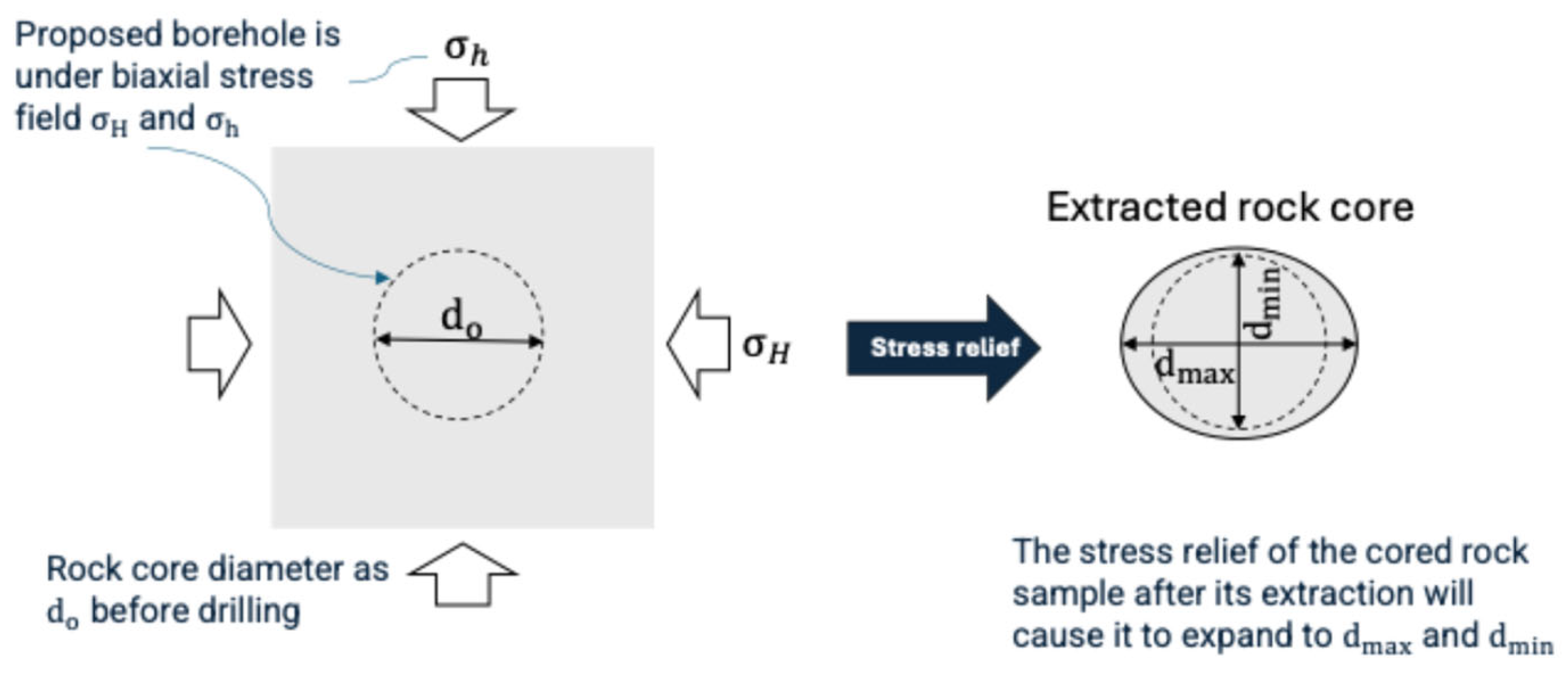
3.1. Fundamental Mechanisms of Stress Relief After Coring
3.2. Concepts of Core-Based Methods
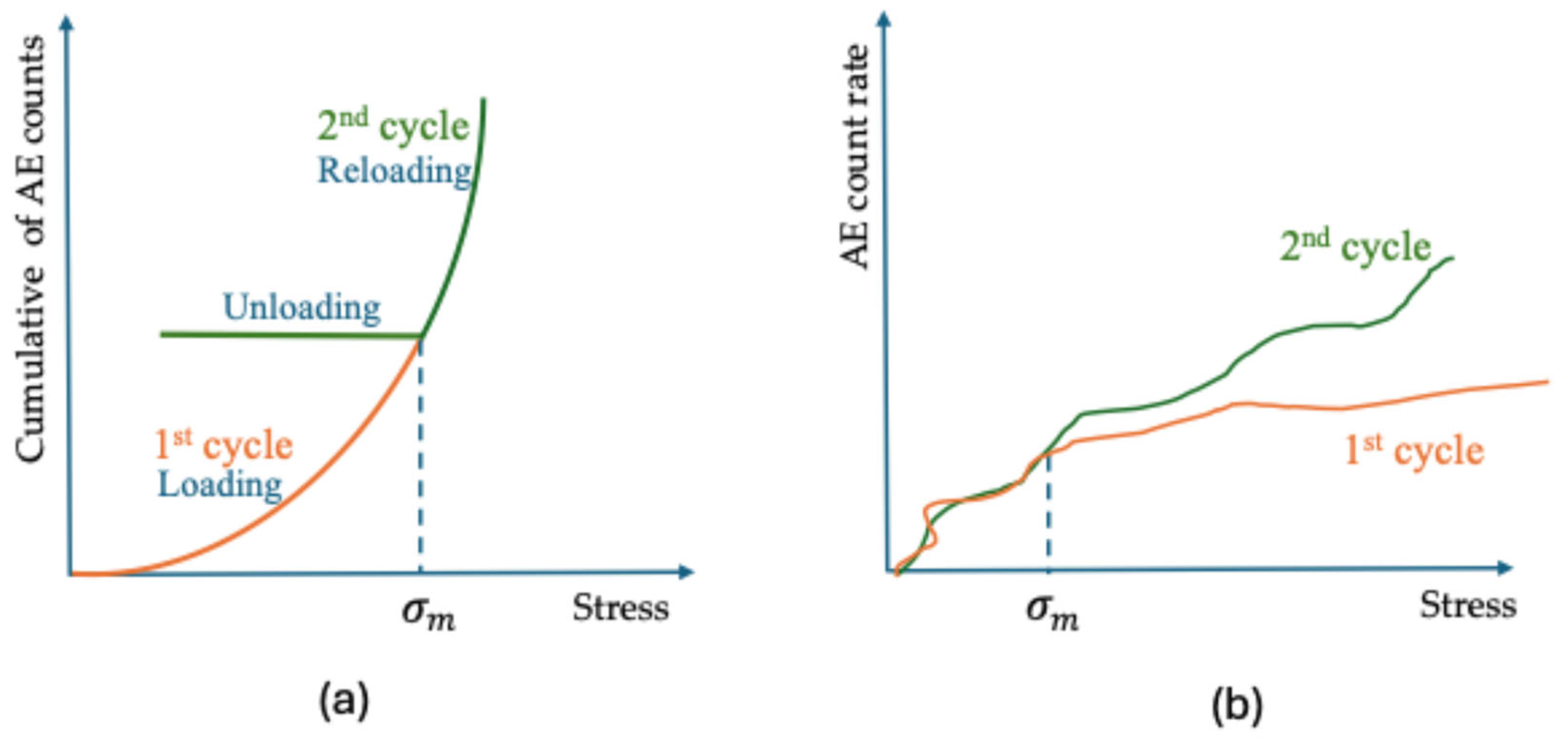
3.2.1. Kaiser Effect on the Rock Sample
3.2.2. Anelastic Strain Recovery (ASR)
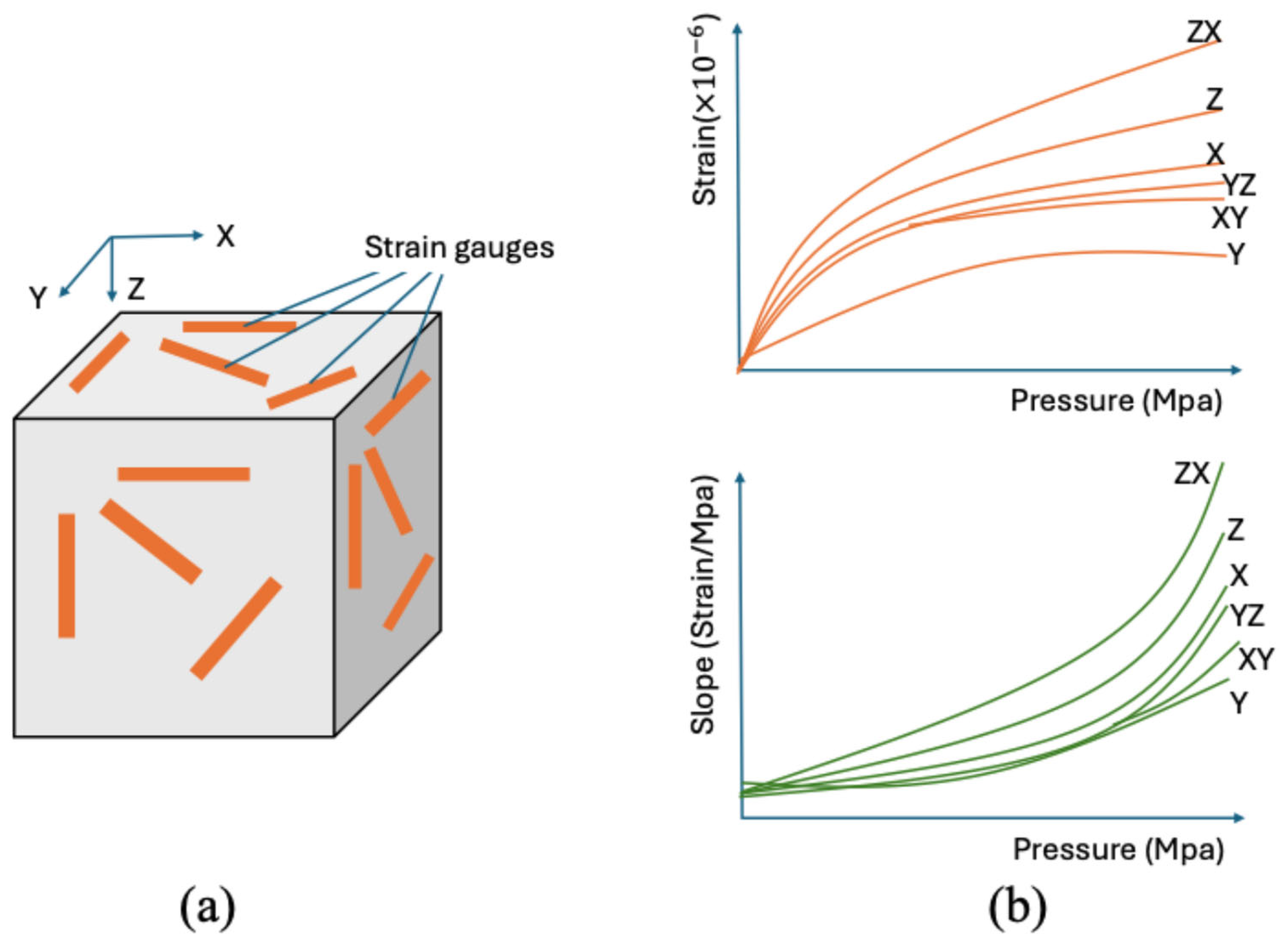
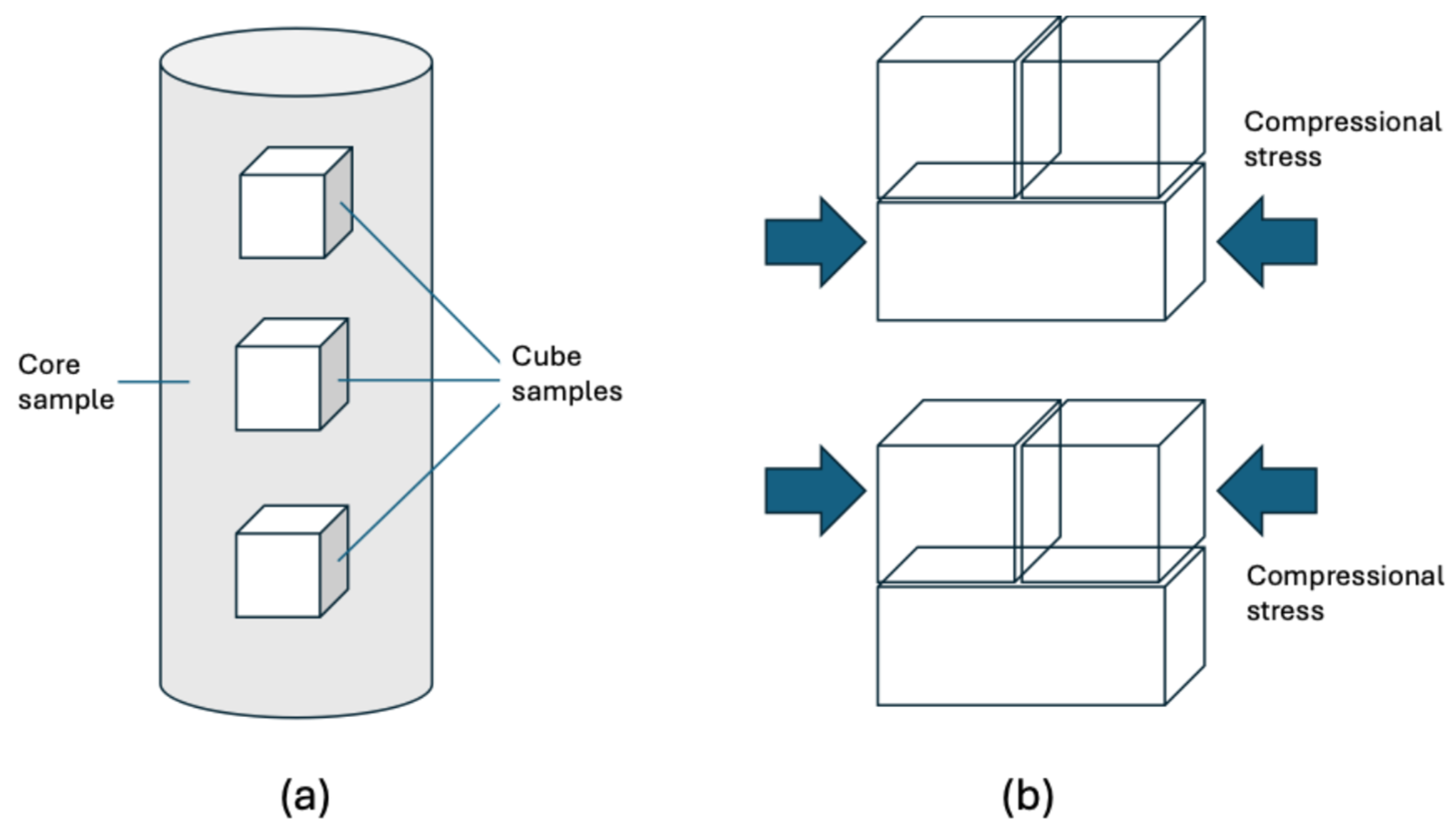
3.2.3. Differential Strain Curve Analysis (DSCA)
3.2.4. Deformation Rate Analysis (DRA)
3.2.5. Diametrical Core Deformation Analysis (DCDA)
4. Evolution and Classification of Diametrical Core Deformation Technique
4.1. Historical Development of DCDT
4.2. Classification by Measurement Principle and Instrumentation
4.2.1. Optical Micrometer Apparatus
4.2.2. Laser Micrometer System
4.2.3. X-Ray Computed Tomography (CT) Measurement
4.2.4. Coordinate and Optical Scanning Techniques
5. Laboratory Verification and Field Application
6. Comparative Assessment of Core-Based Stress Measurement Methods
6.1. Overview and Rationale
6.2. Evidence from Previous Research and Theoretical Foundations
6.3. Comparative Evaluation of Conventional Methods vs. Core-Based Methods
- Kaiser-effect–based methods have been used to estimate in situ stress magnitudes under uniaxial and confining pressure conditions, with accuracy influenced by lithology, loading rate, and stress path [73,74,75,76,77]. Recent studies integrating acoustic emission with deformation rate analysis and non-oriented core re-orientation have improved practical applicability, although these methods generally estimate only the previous maximum stress rather than the full in situ stress tensor [78].
- ASR quantifies time-dependent strain recovery immediately after coring and is widely used for regional stress orientation in sedimentary basins and crystalline rocks [22]. However, ASR is sensitive to temperature, time delay, and viscoelastic effects, which limit its applicability for accurate stress magnitude estimation [79,80,81,82,83,84].
- DCDA measures instantaneous diametral expansion following coring, allowing direct inversion of differential horizontal stress using the elastic modulus (E) and Poisson’s ratio (ν).
6.4. Challenges and Future Perspectives
7. Conclusions
- Non-destructive and cost-effective: uses standard oriented cores without requiring additional drilling or complex in situ instruments.
- High precision: achieves sub-micron deformation resolution capable of resolving stress differences below 1 MPa.
- Operational simplicity: can be conducted under controlled laboratory conditions with minimal logistical demand.
- Compatibility with other methods: easily integrated with ultrasonic mapping, CT imaging, and numerical modeling for full 3D stress interpretation.
- Strong field validation: demonstrated agreement with conventional overcoring and hydraulic fracturing across diverse geological and depth conditions.
Author Contributions
Funding
Data Availability Statement
Conflicts of Interest
References
- Leeman, E.R. The measurement of changes in rock stress due to mining. Mine Quarr. Eng. 1959, 25, 300–304. [Google Scholar]
- Zoback, M.D. Reservoir Geomechanics; Cambridge University Press: Cambridge, UK, 2010. [Google Scholar]
- Hadavimoghaddam, F.; Garavand, A.; Rozhenko, A.; Gortani, M.M.; Hemmati-Sarapardeh, A. Toward smart correlations for predicting in-situ stress: Application to evaluating subsurface energy structures. Geoenergy Sci. Eng. 2023, 231, 212292. [Google Scholar] [CrossRef]
- Hoek, E.; Kaiser, P.K.; Bawden, W.F. Support of Underground Excavations in Hard Rock; Balkema: Rotterdam, The Netherlands, 1995. [Google Scholar]
- Fairhurst, C.; Cook, N.G.W. The phenomenon of rock splitting parallel to the direction of maximum compression in the neighborhood of a surface. In Proceedings of the 1st Congress of the International Society of Rock Mechanics, Lisbon, Portugal, 25 September–1 October 1966; Laboratório Nacional de Engenharia Civil: Lisabon, Portugal, 1966; pp. 687–692. [Google Scholar]
- Kaiser, P.K.; Cai, M. Design of rock support systems under rockburst conditions. J. Rock Mech. Geotech. Eng. 2012, 4, 215–227. [Google Scholar] [CrossRef]
- He, M.C.; Xie, H.P.; Peng, S.P.; Jiang, Y.D. Study on rock mechanics in deep mining engineering. Chin. J. Rock Mech. Eng. 2005, 24, 2803–2813. [Google Scholar]
- Li, X.B.; Gong, F.Q.; Wang, S.F.; Li, D.Y.; Tao, M.; Zhou, J.; Huang, L.Q.; Ma, C.D.; Du, K.; Feng, F. Mechanical mechanism and dynamic criterion of rockburst under combined static and dynamic loading in deep hard rock mines. Chin. J. Rock. Mech. Eng. 2019, 38, 708–723. [Google Scholar] [CrossRef]
- Cai, M.F.; Qiao, L.; Yu, J.B. Problems on accuracy of hollow inclusion strain cells. Chin. J. Geotech. Eng. 1994, 16, 15–20. Available online: https://www.cgejournal.com/en/article/id/9813 (accessed on 23 January 2026).
- Amadei, B.; Stephansson, O. Rock Stress and Its Measurement; Chapman & Hall: London, UK, 1997. [Google Scholar]
- Stacey, T.R. A simple extension strain criterion for fracture of brittle rock. Int. J. Rock Mech. Min. Sci. Geomech. Abstr. 1981, 18, 469–474. [Google Scholar] [CrossRef]
- Lavrov, A. The Kaiser effect in rocks: A review. Int. J. Rock Mech. Min. Sci. 2003, 40, 151–171. [Google Scholar] [CrossRef]
- Miao, S.; Pan, P.-Z.; Konicek, P.; Yu, P.; Liu, K. Rock damage and fracturing induced by high static stress and slight dynamic disturbance based on acoustic emission and digital image correlation techniques. J. Rock Mech. Geotech. Eng. 2021, 13, 1002–1019. [Google Scholar] [CrossRef]
- Haimson, B.C.; Fairhurst, C. In-situ stress determination at great depth by means of hydraulic fracturing. In Proceedings of the 11th U.S. Symposium on Rock Mechanics (USRMS), Berkeley, CA, USA, 16–19 June 1969; pp. 1–11. [Google Scholar]
- Worotnicki, G.; Walton, R. Triaxial “hollow inclusion” gauges for determination of rock stress in situ. In Investigation of Stress in Rock—Advances in Stress Measurement: Proceedings of the International Symposium, Sydney, Australia, 11–13 August 1976; Supplement; Institution of Engineers: Barton, Australia, 1976; pp. 1–8. [Google Scholar]
- Ali, Z.; Karakus, M.; Nguyen, G.D.; Amrouch, K.; Chester, C. In-situ stress measurement using non-destructive and relief methods. In Proceedings of the 15th International ISRM Congress 2023 & 72nd Geomechanics Colloquium, Salzburg, Austria, 9–14 October 2023. [Google Scholar]
- Dight, P. Determination of in-situ stress from oriented core. In Measurement, Interpretation and Application: Proceedings of the International Symposium on In-Situ Stress, Trondheim, Norway, 19–21 June 2006; Taylor & Francis: Abingdon, UK; pp. 167–175.
- Dight, P.; Dyskin, A.; Wang, H.; Jeffcoat-Sacco, B.; Hsieh, A.; Akdag, S. Rock Properties to Predict Rockburst Vulnerability (Strainburst); MRIWA Project M0464 Report; MRIWA: Perth, Australia, 2022.
- Overcoring Methods for Stress Measurement. Available online: https://www.scribd.com/document/237461604/Overcoring-Methods (accessed on 23 January 2026).
- Lin, H.; Oh, J.; Masoumi, H.; Canbulat, I.; Zhang, C.; Dou, L. A review of in-situ stress measurement techniques. In Proceedings of the 2018 Coal Operators Conference; The University of Wollongong: Wollongong, Australia, 2018. [Google Scholar]
- Brady, B.H.G.; Brown, E.T. Pre-mining state of stress. In Rock Mechanics for Underground Mining, 3rd ed.; Springer: Dordrecht, The Netherlands, 2007; pp. 142–164. [Google Scholar]
- Li, P.; Liu, Y.; Cai, M.; Miao, S.; Li, Y.; Hu, Y.; Gorjian, M. The overcoring technique for precise measurement of in-situ rock stress at great depths: Challenges and solutions. Engineering 2025, 46, 9–15. [Google Scholar] [CrossRef]
- Amadei, B. In situ stress measurements in anisotropic rock. Int. J. Rock Mech. Min. Sci. Geomech. Abstr. 1984, 21, 327–338. [Google Scholar] [CrossRef]
- Guo, F.; Morgenstern, N.R.; Scott, J.D. Interpretation of hydraulic fracturing breakdown pressure. Int. J. Rock Mech. Min. Sci. Geomech. Abstr. 1993, 30, 617–626. [Google Scholar] [CrossRef]
- Soltanzadeh, M. A Primer on the Geomechanics Behind Fracturing Pressure Curves; PetroGem Inc.: Calgary, Canada, 2015; pp. 1–32. [Google Scholar]
- Jin, X.; Shah, S.N.; Roegiers, J.-C.; Hou, B. Breakdown pressure determination—A fracture mechanics approach. In Proceedings of the SPE Annual Technical Conference and Exhibition, New Orleans, LA, USA, 30 September–2 October 2013. [Google Scholar]
- Lee, M.Y.; Haimson, B.C. Statistical evaluation of hydraulic fracturing stress measurement parameters. Int. J. Rock Mech. Min. Sci. Geomech. Abstr. 1989, 26, 447–456. [Google Scholar] [CrossRef]
- Zoback, M.D.; Townend, J.; Grollimund, B. Steady-state failure equilibrium and deformation of intraplate lithosphere. Int. Geol. Rev. 2002, 44, 383–401. [Google Scholar] [CrossRef]
- Funato, A.; Ito, T. A new method of diametrical core deformation analysis for in-situ stress measurements. Int. J. Rock Mech. Min. Sci. 2017, 91, 112–118. [Google Scholar] [CrossRef]
- Haimson, B.; Chang, C. Brittle fracture in two crystalline rocks under true triaxial compressive stresses. In Petrophysical Properties of Crystalline Rocks; The Geological Society: London, UK, 2005; pp. 47–59. [Google Scholar]
- Nara, Y.; Kaneko, K. Sub-critical crack growth in anisotropic rock. Int. J. Rock Mech. Min. Sci. 2006, 43, 437–453. [Google Scholar] [CrossRef]
- Goodman, R.E. Subaudible noise during co34mpression of rocks. Geol. Soc. Am. Bull. 1963, 74, 487–490. [Google Scholar] [CrossRef]
- Yoshikawa, S.; Mogi, K. A new method for estimation of crustal stress from cored rock samples: Laboratory study in the case of uniaxial compression. Tectonophysics 1981, 74, 323–339. [Google Scholar] [CrossRef]
- Swolfs, H.S.; Brechtel, C.E. The direct measurement of long-term stress variations in rock. In Proceedings of the 18th U.S. Symposium on Rock Mechanics (USRMS), Golden, CO, USA, 22–24 June 1977; p. ARMA-77-0331. [Google Scholar]
- Strickland, F.G.; Ren, N.K. Predicting the in-situ stress for deep wells using differential strain curve analysis. In Proceedings of the SPE Unconventional Gas Recovery Symposium, Pittsburgh, PA, USA, 18–21 May 1980; p. SPE-8954-MS. [Google Scholar]
- Logan, J.M.; Teufel, L.W. The effect of normal stress on the real area of contact during frictional sliding in rocks. Pure Appl. Geophys. 1986, 124, 471–485. [Google Scholar] [CrossRef]
- Matsuki, K. Three-dimensional in-situ stress measurement with anelastic strain recovery of a rock core. In Proceedings of the 7th International Congress of Rock Mechanics, Aachen, Germany, 16–20 September 1991; Balkema: Rotterdam, The Netherlands, 1991; pp. 557–560. [Google Scholar]
- Teufel, L.W. Determination of in situ stress from partial anelastic strain recovery measurements of oriented cores from deep boreholes. In Modern In Situ Stress Measurement Methods: Proceedings of the 34th U.S. Symposium on Rock Mechanics; Lecture Notes of the Short Course; University of Wisconsin: Madison, WI, USA, 1993; 19p. [Google Scholar]
- Ljugggren, C.; Chang, Y.; Janson, T.; Christiansson, R. An overview of rock stress measurement. Int. J. Rock Mech. Min. Sci. 2003, 40, 975–989. [Google Scholar] [CrossRef]
- Brace, W.F.; Paulding, B.W.; Scholz, C. Dilatancy in the fracture of crystalline rocks. J. Geophys. Res. 1966, 71, 3939–3953. [Google Scholar] [CrossRef]
- Stevens, J.L.; Holcomb, D.J. A theoretical investigation of the sliding crack model of dilatancy. J. Geophys. Res. 1980, 85, 4383–4385. [Google Scholar] [CrossRef]
- Kuwahara, Y.; Yamamoto, K.; Hirasawa, T. An Experimental and Theoretical study of inelastic deformation of brittle rocks under cyclic uniaxial loading. Tohoku Geophys. J. 1990, 33, 1–21. [Google Scholar]
- Yamamoto, K.; Kuwahara, Y.; Kato, N.; Hirasawa, T. Deformation rate analysis: A new method for in-situ stress estimation from inelastic deformation of rock samples under uniaxial compression. Tohoku Geophys. J. 1990, 33, 127–147. [Google Scholar]
- Li, Y.; Mitri, H. Methodology for the estimation of mining face stresses using rock core diametrical deformation. Int. J. Rock Mech. Min. Sci. 2023, 161, 105300. [Google Scholar] [CrossRef]
- Ziegler, M.; Valley, B. Evaluation of the diametrical core deformation and discing analyses for in-situ stress estimation and application to the 4.9 km deep rock core from the Basel geothermal borehole, Switzerland. Rock Mech. Rock Eng. 2021, 54, 6511–6532. [Google Scholar] [CrossRef]
- Li, Y.; Chen, T.; Blake, T.; Mitri, H. Validation of diametrical core deformation technique for mining-induced stress estimation: A case study. Rock Mech. Rock Eng. 2023, 57, 7643–7652. [Google Scholar] [CrossRef]
- Li, Y.; Mitri, H. Determination of mining-induced stresses using diametral rock core deformations. Int. J. Coal Sci. Technol. 2022, 9, 1623–1637. [Google Scholar] [CrossRef]
- Meng, Q.; Shang, Y.; Chi, J.; Qi, S.; Hasan, M.; Yi, X. Evaluation of the Diametrical Core Deformation Analysis (DCDA) and fracture surface morphology for in-situ stress estimation. Rock Mech. Rock Eng. 2025, 58, 7363–7376. [Google Scholar] [CrossRef]
- Dargahizarandi, A.; Masoumi, H.; Hashemi, A.; Saha, B.; Roshan, H. Determination of 3D stress state using a novel integrated diametrical core deformation and ultrasonic analysis. Rock Mech. Rock Eng. 2025, 58, 4377–4401. [Google Scholar] [CrossRef]
- Kim, H.; Diaz, M.B.; Kim, J.Y.; Jung, Y.-B.; Kim, K.Y. Stress estimation through deep rock core diametrical deformation and joint roughness assessment using X-ray CT imaging. Sensors 2020, 20, 6802. [Google Scholar] [CrossRef] [PubMed]
- Li, Y.; Mitri, H.S. Practical methodology for evaluating mining front stability based on the diametrical core deformation technique. Minerals 2024, 14, 385. [Google Scholar] [CrossRef]
- Seto, M.; Utagawa, M.; Katsuyama, K.; Kiyama, T. In-situ stress determination using AE and DRA techniques. Int. J. Rock Mech. Min. Sci. 1998, 35, 458–459. [Google Scholar] [CrossRef]
- Villaescusa, E.; Seto, M.; Baird, G. Stress measurements from oriented core. Int. J. Rock Mech. Min. Sci. 2002, 39, 603–615. [Google Scholar] [CrossRef]
- Windsor, C.R.; Villaescusa, E.; Machuca, L. A comparison of rock stresses measured by WASM AE with results from other techniques that measure the complete rock stress tensor. In Rock Stress and Earthquakes—Proceedings of the 5th International Symposium on In-Situ Rock Stress; CRC Press: Boca Raton, FL, USA, 2009. [Google Scholar] [CrossRef]
- Lehtonen, A.; Cosgrove, J.; Hudson, J.; Johansson, E. An examination of in-situ rock stress estimation using the Kaiser effect. Eng. Geol. 2012, 124, 24–37. [Google Scholar] [CrossRef]
- Karakus, M.; Perez, S.; Goodchild, D. In-situ stress measurement from oriented sub-cores using the Kaiser effect. In Proceedings of the 24th International Mining Congress and Exhibition of Turkey, Antalya, Turkey, 14–17 April 2015; pp. 1–12. [Google Scholar]
- Bai, X.; Zhang, D.; Wang, H.; Li, S.; Rao, Z. A novel in situ stress measurement method based on acoustic emission Kaiser effect: A theoretical and experimental study. R. Soc. Open Sci. 2018, 5, 181263. [Google Scholar] [CrossRef]
- Dinmohammadpour, M.; Nikkhah, M.; Goshtasbi, K.; Ahangari, K. Application of the Kaiser effect in in-situ stress measurement in rocks. Rud.-Geološko-Naft. Zb. 2022, 37, 1–16. [Google Scholar] [CrossRef]
- Filimonov, Y.; Lavrov, A.; Shafarenko, Y.; Shkuratnik, V. Memory effects in rock salt under triaxial stress state and their use for stress measurement in a rock mass. Rock Mech. Rock Eng. 2001, 34, 275–291. [Google Scholar] [CrossRef]
- Lavrov, A.; Vervoort, A.; Wevers, M.; Napier, A.L. Experimental and numerical study of Kaiser effect in cyclic Brazilian tests with disk rotation. Int. J. Rock Mech. Min. Sci. 2002, 39, 287–302. [Google Scholar] [CrossRef]
- Chen, Y.; Irfan, M. Experimental study of Kaiser effect under cyclic compression and tension tests. Geomech. Eng. 2018, 14, 203–209. [Google Scholar] [CrossRef]
- Chen, Y.; Irfan, M.; Song, C. Verification of Kaiser effect in rocks under tensile stress. Int. J. Geomech. 2018, 18, 04018059. [Google Scholar] [CrossRef]
- Jin, Y.; Qi, Z.; Chen, M.; Zhang, G.; Xu, G. Time-sensitivity of the Kaiser effect of acoustic emission in limestone and its application to in-situ stress. Pet. Sci. 2009, 6, 176–180. [Google Scholar] [CrossRef]
- Fujii, Y.; Makasib, M.; Kodama, J.; Fukuda, D.; Goto, K.; Kumakura, S.; Kanaoka, M. Tangent modulus method—An original method to measure in-situ rock stress. Tunn. Undergr. Space Technol. 2018, 82, 148–155. [Google Scholar] [CrossRef]
- Stuart, W.D.; Tullis, T.E. Fault model for preseismic deformation at Parkfield, California. J. Geophys. Res. Solid Earth 1995, 100, 24079–24099. [Google Scholar] [CrossRef]
- Sakaguchi, K.; Iino, W.; Matsuki, K. Damage in a rock core caused by induced tensile stress and its relation to differential strain curve analysis. Int. J. Rock Mech. Min. Sci. 2002, 39, 367–380. [Google Scholar] [CrossRef]
- Hakala, M.; Hudson, J.A.; Christiansson, R. Quality control of overcoring stress measurement data. Int. J. Rock Mech. Min. Sci. 2003, 40, 1141–1159. [Google Scholar] [CrossRef]
- Li, Y.; Wang, Z.; Qiao, L.; Cai, M.F.; Li, Q.W. Development of CSIRO cell with instantaneous data logging, no-power connection, and twin temperature compensation techniques. Chin. J. Rock Mech. Eng. 2017, 36, 1479–1487. [Google Scholar]
- Thompson, A.G.; Villaescusa, E.; Windsor, C.R. Ground support terminology and classification: An update. Geotech. Geol. Eng. 2012, 30, 553–580. [Google Scholar] [CrossRef]
- Cornet, F.H.; Röckel, T. Vertical stress profiles and the significance of stress decoupling. Tectonophysics 2012, 581, 193–205. [Google Scholar] [CrossRef]
- Zhang, Y.; Song, C.; Cai, M.; Peng, H. Geostress measurements by hydraulic fracturing method at great depth of boreholes and numerical modeling predictions of stress field. Chin. J. Rock Mech. Eng. 2010, 29, 778–786. [Google Scholar]
- Avener, V.; Jackson, R.B.; Warner, N.; Darrah, T.H.; Kondash, A. A critical review of the risks to water resources from unconventional shale gas development and hydraulic fracturing in the United States. Environ. Sci. Technol. 2014, 48, 8334–8348. [Google Scholar] [CrossRef] [PubMed]
- Li, X.; Chen, J.; Ma, C.; Huang, L.; Li, C.; Zhang, J.; Zhao, Y. A novel in-situ stress measurement method incorporating non-oriented core ground re-orientation and acoustic emission: A case study of a deep borehole. Int. J. Rock Mech. Min. Sci. 2022, 152, 105079. [Google Scholar] [CrossRef]
- Chen, Q.; Zhu, B.; Hu, H. Experimental research on measurement of in-situ stress field by Kaiser effect. Chin. J. Rock Mech. Eng. 2006, 25, 1370–1376. [Google Scholar]
- Zhang, G.; Jin, Y.; Chen, M. Measurement of in-situ stresses by Kaiser effect under confining pressures. Chin. J. Rock Mech. Eng. 2002, 21, 360–363. Available online: https://rockmech.whrsm.ac.cn/EN/Y2002/V21/I03/360 (accessed on 23 January 2026).
- Zhang, Y.; Okere, C.J.; Su, G. Effect of loading rates on accurate in-situ stress determination in different lithologies via Kaiser effect. Arab. J. Geosci. 2021, 14, 1304. [Google Scholar] [CrossRef]
- Becker, D.; Cailleau, B.; Dahm, T.; Shapiro, S.; Kaiser, D. In situ AE records in cyclically loaded rock salt—The stress memory effect and spatio-temporal characteristics. In Proceedings of the EGU General Assembly 2009, Vienna, Australia, 19–24 April 2009. [Google Scholar]
- Seto, M.; Nag, D.; Vutukuri, V.S. In-situ rock stress measurement from rock cores using the acoustic emission method and deformation rate analysis. Geotech. Geol. Eng. 1999, 17, 241–266. [Google Scholar] [CrossRef]
- Teufel, L.W.; Warpinski, N.R. Determination of in-situ stress from anelastic strain recovery measurements of oriented core: Comparison to hydraulic fracture stress measurements. In Proceedings of the 25th U.S. Symposium on Rock Mechanics, Evanston, IL, USA, 25–27 June 1984; pp. 176–185. [Google Scholar]
- Lin, W.; Yeh, E.C.; Ito, H.; Hirono, T.; Soh, W.; Wang, C.Y.; Ma, K.F.; Hung, J.H.; Song, S.R. Preliminary Results of Stress Measurement Using Drill Cores of TCDP Hole-A: An Application of Anelastic Strain Recovery Method to Three-Dimensional In-Situ Stress Determination. Terr. Atmos. Ocean. Sci. 2007, 18, 379–393. [Google Scholar]
- Byrne, T.; Lin, W.; Tsutsumi, A.; Sakaguchi, A.; IODP Expedition Scientists. In situ stress determinations from anelastic strain recovery: Preliminary results. In AGU 2008 Fall Meeting Abstracts; American Geophysical Union: Washington, DC, USA, 2008; Abstract 2008. [Google Scholar]
- Sugimoto, T.; Ishitsuka, K.; Lin, W. Theoretical investigation on new analyzing procedure of anelastic strain recovery method for stress measurements based on Bayesian statistical modeling. Mater. Trans. 2021, 62, 1695–1702. [Google Scholar] [CrossRef]
- Sun, D.; Chen, Q.; Li, A.W.; Yang, Y. Anelastic strain recovery in-situ stress measurement method and its application prospect in underground mines. IOP Conf. Ser. Earth Environ. Sci. 2020, 570, 042021. [Google Scholar] [CrossRef]
- Cai, M.F. Principles and Techniques of In-Situ Stress Measurements; Science Press: Beijing, China, 1995. [Google Scholar]
- Kang, S.S.; Nakamura, N.; Obara, Y.; Sugawara, K. Rock stress interpretations based on calcite strain gauge and differential strain curve analysis. Eng. Geol. 2000, 58, 35–52. [Google Scholar] [CrossRef]
- Ren, N.K.; Roegiers, J. Differential strain curve analysis—A new method for determining the pre-existing in-situ stress state from rock core measurements. In Proceedings of the 5th ISRM Congress, Melbourne, Australia, 10–15 April 1983. [Google Scholar]
- Yamamoto, K. A theory of rock core-based methods for in-situ stress measurement. Earth Planets Space 2009, 61, 1143–1161. [Google Scholar] [CrossRef]
- Cho, A.; Xue, Z.; Takahashi, M. In-situ stress measurements in Tsukuba deep borehole. J. Jpn. Soc. Eng. Geol. 2000, 41, 41–47. [Google Scholar] [CrossRef]
- Matsuki, K.; Shimizu, T.; Okumura, K. Evaluation of microcracks in rock by differential strain curve analysis. Jpn. Sci. Technol. Inf. Aggregator Electron. 1995, 11, 607–615. [Google Scholar]
- Funato, A.; Ito, T. Diametrical Core Deformation Analysis (DCDA) Developed for In-situ Rock Stress Measurements. J. MMIJ 2013, 129, 577–584. [Google Scholar] [CrossRef][Green Version]
- Nayuki, T.; Ando, K.; Onishi, K.; Nishizaka, N.; Ishikawa, Y.; Ohno, Y. Comprehensive evaluation of the initial rock stress carried out as part of a 2000-m all-core borehole investigation. In Proceedings of the International Society of Offshore and Polar Engineers, Busan, Republic of Korea, 15–20 June 2014; pp. 1–8. [Google Scholar]
- Gao, G.; Li, Z.; Chang, C. Numerical simulation of diametrical core deformation and fracture induced by core drilling. Arab. J. Geosci. 2021, 15, 59. [Google Scholar] [CrossRef]




| Method | Measurement Principle | Key Instrumentation | Operational Complexity | Advantages | Limitations/Challenges |
|---|---|---|---|---|---|
| Overcoring | Stress relief measured via strain gauges in overcored rock | CSIRO HI-cell, USBM cell, SIGRA IST | High (multi-step field setup) | Direct, well-calibrated, long-established | Time-consuming, costly, and limited by borehole access |
| Hydraulic Fracturing (HF) | Induced fracture pressure vs. closure pressure defines stress | Downhole pressure transducer, fluid pump | High | Deep applicability, measures stress orientation | Assumes uniform stress field; possible over/under-pressurization |
| Kaiser Effect | Acoustic emission occurs only when reloaded stress exceeds the previous maximum (Kaiser effect) | AE sensors, pre-amplifiers, data acquisition system, UCS frame | Medium | Non-destructive, sensitive to prior maximum stress, useful for estimating σmax in intact cores | Only estimates the previous maximum stress, not the full in situ tensor |
| Anelastic Strain Recovery (ASR) | Time-dependent strain recovery after coring | Strain gauges, LVDTs | Medium | Non-destructive; captures 3D stresses | Sensitive to temperature, saturation, and delay after coring |
| Differential Strain Curve Analysis (DSCA) | Crack-closure under hydrostatic loading | Strain-gauge cubes, pressure cell | Medium | Simple setup; uses recovered cores | Assumes cracks solely due to stress relief; limited orientation data |
| Deformation Rate Analysis (DRA) | Inelastic strain rate change during cyclic loading | UCS frame, strain gauges | Medium | Low cost; captures stress history | Requires multiple specimens; empirical interpretation |
| Diametrical Core Deformation Analysis (DCDA) | Elastic diametral expansion after stress relief | Optical/Laser micrometer, CT, or CMM | Low | High precision, fast, non-destructive, uses standard cores | Sensitive to surface roughness, anisotropy, and coring damage |
Disclaimer/Publisher’s Note: The statements, opinions and data contained in all publications are solely those of the individual author(s) and contributor(s) and not of MDPI and/or the editor(s). MDPI and/or the editor(s) disclaim responsibility for any injury to people or property resulting from any ideas, methods, instructions or products referred to in the content. |
© 2026 by the authors. Licensee MDPI, Basel, Switzerland. This article is an open access article distributed under the terms and conditions of the Creative Commons Attribution (CC BY) license.
Share and Cite
Li, Y.; Zhou, B.; Mitri, H.S.; Shao, A. Evaluating the Core-Based Stress Measurement in Mining Engineering—A Critical Review of the Diametrical Core Deformation Technique. Appl. Sci. 2026, 16, 2092. https://doi.org/10.3390/app16042092
Li Y, Zhou B, Mitri HS, Shao A. Evaluating the Core-Based Stress Measurement in Mining Engineering—A Critical Review of the Diametrical Core Deformation Technique. Applied Sciences. 2026; 16(4):2092. https://doi.org/10.3390/app16042092
Chicago/Turabian StyleLi, Yizhuo, Baokun Zhou, Hani S. Mitri, and Anlin Shao. 2026. "Evaluating the Core-Based Stress Measurement in Mining Engineering—A Critical Review of the Diametrical Core Deformation Technique" Applied Sciences 16, no. 4: 2092. https://doi.org/10.3390/app16042092
APA StyleLi, Y., Zhou, B., Mitri, H. S., & Shao, A. (2026). Evaluating the Core-Based Stress Measurement in Mining Engineering—A Critical Review of the Diametrical Core Deformation Technique. Applied Sciences, 16(4), 2092. https://doi.org/10.3390/app16042092