Article

A Study on the Influence of Coal-Tunnel Angle and Construction Parameters on the Interaction Mechanism Between Surrounding Rock and Support in Coal-Crossing Tunnels


1
College of Civil Engineering, Xiangtan University, Xiangtan 411105, China
2
Hunan Province University Key Laboratory of Material Dynamics & Engineering Resilience, Xiangtan 411105, China
3
School of Transportation, Changsha University of Science and Technology, Changsha 410114, China
*
Author to whom correspondence should be addressed.
Appl. Sci. 2026, 16(4), 2090; https://doi.org/10.3390/app16042090
Submission received: 21 January 2026 / Revised: 16 February 2026 / Accepted: 18 February 2026 / Published: 20 February 2026
(This article belongs to the Section Civil Engineering)

Abstract

When a tunnel traverses an inclined coal seam, the coal-tunnel angle α of the seam significantly alters the stress distribution in the surrounding rock, its failure mode, and the loading conditions on the support structure. This study investigates the influence of coal-tunnel angle α on surrounding rock stability and support structure loads, with the No. 1 Meijiaxiang Tunnel on the Wengma Railway in Guizhou Province serving as the engineering case. An integrated approach combining laboratory tests, numerical simulations, and engineering verification is employed. Laboratory tests were conducted to determine the basic mechanical properties of the limestone and coal. A refined 3D finite element model was developed in MIDAS GTS NX to analyze the effects of coal-tunnel angle α (α = 30°, 45°, 60°, 75°, 90°) and different construction methods on surrounding rock deformation, plastic zone development, and the stress state of the initial support. The results indicate that the coal-tunnel angle α significantly influences tunnel stability. Both crown settlement and the plastic zone extent decrease notably as α increases. Among the construction methods, the reserved core soil method most effectively controls surrounding rock deformation, but induces greater stress concentration in the initial support. Furthermore, for the most unfavorable case (α = 30°), an optimization analysis of the cyclic advanced length for the reserved core soil method was conducted. It is shown that using an 8 m advanced length can effectively control settlement while significantly reducing support stress and bolt axial forces. With its integrated methodology and detailed parameter analysis, this study provides a valuable theoretical and practical reference for optimizing the design and ensuring the safe construction of similar tunnels traversing inclined coal seams in complex soft–hard interbedded strata.

1. Introduction

In recent years, the rapid development of transportation infrastructure in China has led to a growing number of tunnels traversing coal seams [1,2]. Compared to conventional rock masses, coal seams generally have lower strength and weaker bearing capacity, with significantly different mechanical properties. Excavation-induced unloading often causes excessive stress redistribution in the surrounding rock, which can lead to major deformation or instability and pose serious risks to construction safety [3,4]. Among the factors affecting tunnel stability in coal seams, the coal-tunnel angle α relative to the tunnel axis is a key geometric parameter, as it directly controls the stress transfer path, the development of the plastic zone, and the loading on the support structure. Research indicates that different coal-tunnel angle α values result in distinct stress distribution and deformation characteristics in the surrounding rock. For inclined (35–55°) and steeply inclined (55–90°) coal seams, the downward transfer of overlying seam weight readily induces high stress concentrations in the lower coal near the tunnel and at the lining contact zone [5,6]. Steeply inclined seams may also undergo bedding slip along the seam plane, weakening the coal–rock interface and further increasing the risk of surrounding rock instability [7,8]. Tunneling through such conditions typically requires more careful construction methods, higher-strength support materials, and more extensive reinforcement measures. Consequently, a systematic study of the stability of tunnel surrounding rock under different coal-tunnel angle α values and the corresponding optimization of construction techniques holds significant theoretical and engineering value for enhancing safety and risk management in coal-seam tunneling.
To address these challenges, extensive research has been conducted through theoretical analysis, physical model tests, and numerical simulation, focusing on factors such as coal-tunnel angle α [9,10], coal-seam morphology [11,12], and construction methods for traversal [13,14]. Theoretical analysis, through mechanical models and analytical methods, can reveal fundamental mechanisms and key factors affecting deformation, stress distribution, and gas diffusion during coal-seam tunneling. For instance, based on a case of a shallow-buried metro tunnel crossing a fracture zone, Wang et al. [15] analyzed the influence of fracture zones with different angles on tunnel stability using acoustic emission (AE) and digital image correlation methods, grounded in continuum and fracture mechanics models. Similarly, Chen et al. [16] analyzed the collapse mechanism of coal tunnels using the constitutive theory of rock mass and the interaction theory of surrounding rock support, and verified the effectiveness of the treatment measures through grouting and support reinforcement practices. From a broader perspective on progressive rock mass failure, Fraldi et al. [17] employed limit analysis to show that in a Hoek–Brown rock mass, initial failure at the tunnel crown does not lead to continuous block detachment. They attributed progressive instability primarily to deterioration mechanisms such as water softening and weathering. This finding is theoretically significant for understanding the strength degradation of weak interlayers (e.g., coal seams) in coal-bearing strata subjected to excavation unloading and groundwater effects.
In physical modeling, Huo et al. [18] conducted tests based on the Tabaiyi Tunnel crossing a coal–rock fracture zone, investigating the effectiveness of a novel NPR anchor cable frame active–passive support system in controlling major deformation of the tunnel. Fang et al. [19] demonstrated that larger coal-tunnel angle α values lead to increased bending moments and axial forces in the support structure, with noticeable pressure deflection observed in a 30°-inclined coal seam. Similarly, Peng et al. [20] utilized physical model tests to investigate how the angle, thickness, and distance of a coal seam affect the stability of unsupported tunnel excavation. Lu et al. [21] applied a three-dimensional physical similarity model to simulate mining in an inclined coal seam, revealing deformation patterns such as stress redistribution, overburden subsidence, and floor heave induced by mining activities.
Numerical simulation has become an indispensable and efficient research method due to its advantages in analytical precision, operational simplicity, scenario reproducibility, and cost-effectiveness. For instance, Ning et al. [22] utilized numerical simulation to investigate roadway deformation and failure based on the geological conditions and failure characteristics of the Nanyaotou Coal Mine in Shanxi. Further evidence from actual engineering underscores the critical role of rock mass softening in tunnel instability. Alija et al. [23] investigated an unexpected collapse during the construction of the Ampurdán Tunnel in Spain, attributed to the rapid weathering and softening of claystone upon water exposure. Finite element back-analysis revealed that the softened rock mass parameters were drastically reduced (cohesion to 12% and elastic modulus to 4% of their original values). Focusing on loess tunnels, Fan et al. [24] compared differences in the surrounding rock displacement and stress distribution among the CRD method, CD method, and the three-bench seven-step excavation method. Addressing the influence of twin tunnels and pre-support measures, Agbay et al. [25] combined field monitoring and numerical simulation to study the surface settlement law of the NATM section of the Eurasia Tunnel in Turkey. At the same time, experimental research on rock mass mechanical characteristics also provides basic support for numerical simulation. Thaweeboon et al. [26] conducted true triaxial tests on small-scale rock mass models with varying joint sets and frequencies under high confining pressure. Their results showed that joint frequency and orientation significantly influence strength and deformation modulus.
In summary, while significant research has been conducted on the safe traversal of coal seams by tunnels, several limitations persist. Existing studies often focus on specific geological conditions or a single construction method, lacking systematic comparison across multiple construction methods under complex coal-seam conditions. Additionally, rock mass parameters used in numerical simulations are frequently based on empirical values rather than experimental data. Additionally, current research has yet to comprehensively integrate key parameters such as coal-tunnel angle α, cyclic advanced length, and working platform length when investigating the interaction between coal seams and surrounding rock.
The study breaks through the limitations of previous approaches that rely on empirical parameters or single numerical simulations. Through the deep integration of laboratory mechanical tests, three-dimensional numerical simulation, and engineering verification, it replaces empirical values with measured rock mechanics parameters, ensuring the physical authenticity and engineering applicability of the numerical model. Based on this, a systematic multi-factor coupling analysis was conducted within the same framework, comprehensively revealing the nonlinear interactions of five coal-tunnel angles (30° to 90°) and three core construction methods on the evolution of the plastic zone in the surrounding rock and the stress characteristics of the support structure. The most unfavorable angle condition during crossing coal-bearing strata was identified. Under the most unfavorable conditions, the study innovatively carried out refined optimization of the cyclic advanced length. By comparing the deformation control efficiency and support stress response under five advanced-length schemes, it identified the optimal balance point that takes into account both construction efficiency and structural safety, achieving a closed loop from phenomenon identification to parameter decision-making. This systematic research pathway, including experimental calibration, multi-factor coupling analysis, and worst-case optimization, not only addresses the shortcomings of existing studies characterized by single parameters and fragmented conditions but also provides quantitative guidance with both theoretical rigor and practical applicability for similar crossing projects.

2. Project Overview

2.1. Tunnel Location

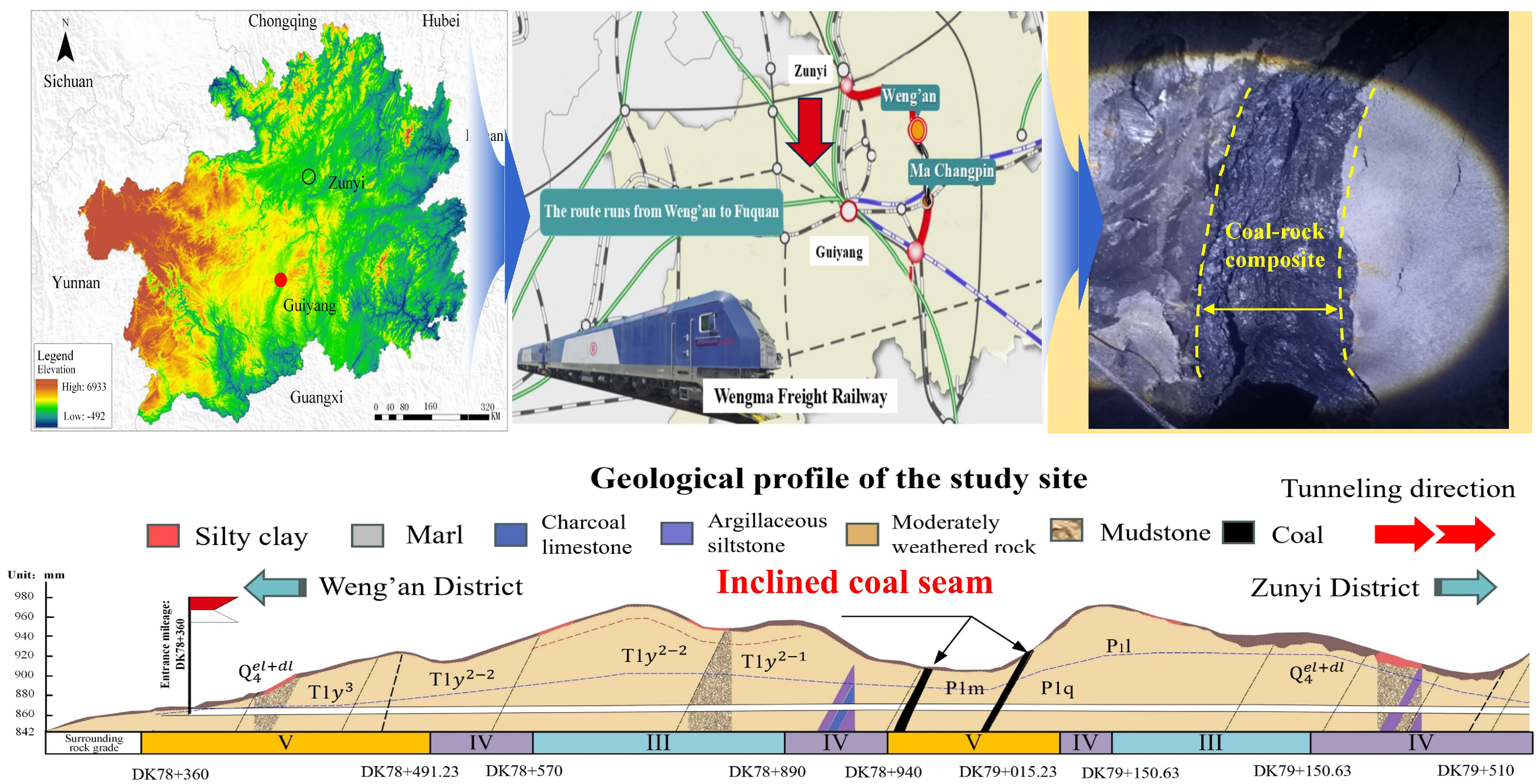
The No. 1 Meijiaxiang Tunnel is located in Zunyi City, Guizhou Province, China, in the north–central part of the Guizhou Plateau. The elevation of the tunnel area ranges from 839 m to 1013 m, characterized by significant topographic relief typical of medium–low mountain and localized hilly terrain within a mountain–basin landscape. With a total length of 2024 m and a maximum burial depth of approximately 140 m, the tunnel extends from chainage DK78+360 to DK80+384. The alignment passes through coal-bearing strata, leading to complex geological conditions. The surrounding rock generally exhibits poor stability and is classified as Grade V. The geographical location and geological profile along the tunnel route are shown in Figure 1.

2.2. Geological Characteristics and Major Issues

The geological conditions in the tunnel area are complex, with the surface cover layer mainly composed of silty clay, and the underlying bedrock mainly composed of limestone, dolomitic limestone, mudstone, carbonaceous clay rock, and coal seams. The rock mass is well-jointed and fractured, resulting in generally poor overall stability. Among these strata, coal seams are present in both the Upper Permian Longtan Formation and the Lower Permian Liangshan Formation. These coal seams primarily occur as interlayers and are mainly concentrated in the sections DK78+940–DK79+130 and DK80+280–DK80+384, with thicknesses ranging from approximately 8 to 10 m.
If tunneling continues in these sections, the significantly lower strength and self-supporting capacity of the coal seams compared to the surrounding rock may induce severe stress redistribution in the roof upon excavation unloading. This could lead to localized instability or even large-scale crown collapse, posing serious risks to construction safety [27]. To evaluate the impact of thick coal seams on tunnel stability, this study established a three-dimensional numerical model using MIDAS GTS NX. The model simulates surrounding rock deformation and the mechanical response of the support structure under various construction conditions, thereby providing a basis for support design and construction control.

3. Numerical Simulation of Tunnel Construction

3.1. Uniaxial and Triaxial Compression Tests

Accurate determination of rock mass parameters is essential for conducting refined numerical simulations in tunnel engineering. Current studies typically rely on field tests or empirical values from standard manuals to obtain these parameters [28,29]. However, such methods may lack the accuracy and project-specific relevance required in practical engineering applications.
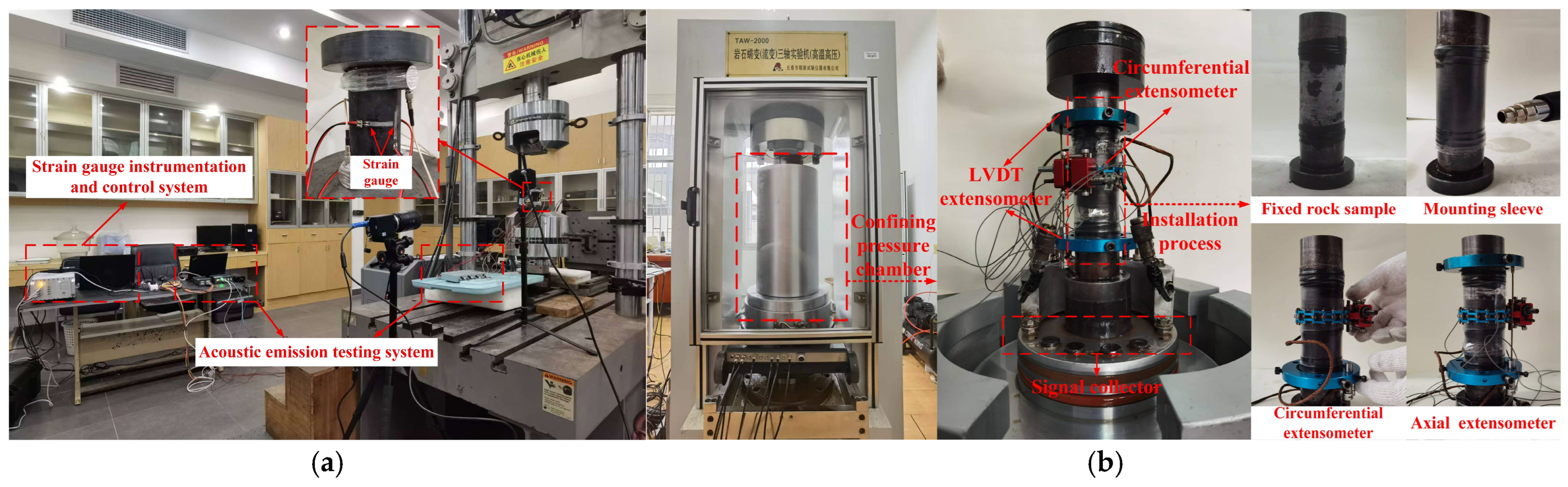
In order to determine the mechanical properties of the main surrounding rock types (limestone and coal) of the No. 1 Meijiaxiang Tunnel, standard cylindrical specimens (diameter 50 mm, height 100 mm) were prepared following the recommended methods of the International Society for Rock Mechanics (ISRM) [30]. For limestone and coal, four specimens each were prepared for uniaxial compression tests. Uniaxial compression and conventional triaxial compression tests were systematically conducted. Uniaxial tests were loaded at a constant displacement rate of 0.002 mm/s until specimen failure. For triaxial tests, four levels of confining pressure were applied: 5, 10, 15, and 20 MPa for limestone, and 3, 6, 9, and 12 MPa for coal. At each confining pressure level, three parallel specimens were tested for each rock type, resulting in a total of 12 triaxial test specimens per rock. This number of specimens follows common practice in rock mechanics testing, aiming to ensure the statistical reliability of the obtained strength parameters. These tests provided key parameters, including elastic modulus, Poisson’s ratio, internal friction angle, and cohesion. A schematic diagram of the mechanical property tests on the unit specimens is shown in Figure 2.
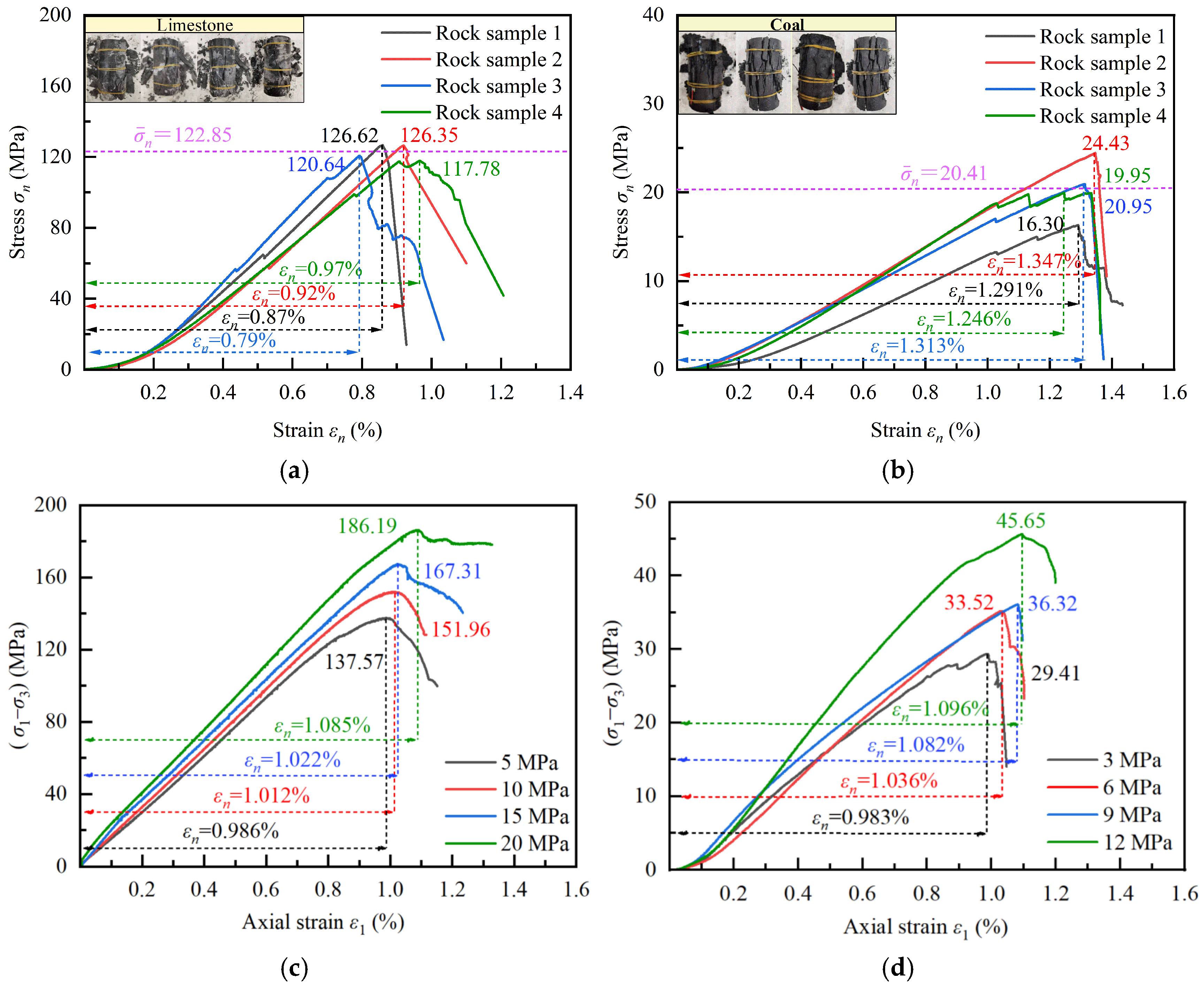
From the uniaxial compression stress–strain curves shown in Figure 3a,b, both limestone and coal exhibit a steep, linear increase in stress during the initial loading stage, indicating predominantly elastic behavior. Near the peak strength, a slight nonlinear segment appears, reflecting the initiation of internal microcrack propagation. After the peak, stress drops abruptly, demonstrating typical brittle failure. Calculation results show that based on the test results of four valid specimens, the average uniaxial compressive strength of limestone is 122.85 MPa, compared to only 20.41 MPa for coal. Thus, the strength of limestone is approximately 6.02 times that of coal.
The triaxial compression test results further reveal differences in the mechanical behavior of the two rock types. As shown in Figure 3c,d, the peak strength of both limestone and coal increases significantly with confining pressure. Under the lowest confining pressure (5 MPa for limestone, 3 MPa for coal), the peak strength of limestone is 137.57 MPa, compared to 29.41 MPa for coal. When the confining pressure is increased to its maximum (20 MPa for limestone, 12 MPa for coal), limestone reaches a peak strength of 186.19 MPa, while coal reaches 45.65 MPa, resulting in a strength ratio of about 4.08 times. The peak strength at each confining pressure is the average of the results from the three parallel specimens at that pressure. According to the experimental data, the average elastic modulus of limestone is 16.89 GPa with a Poisson’s ratio of 0.27; for coal, the average elastic modulus is 1.98 GPa with a Poisson’s ratio of 0.32.
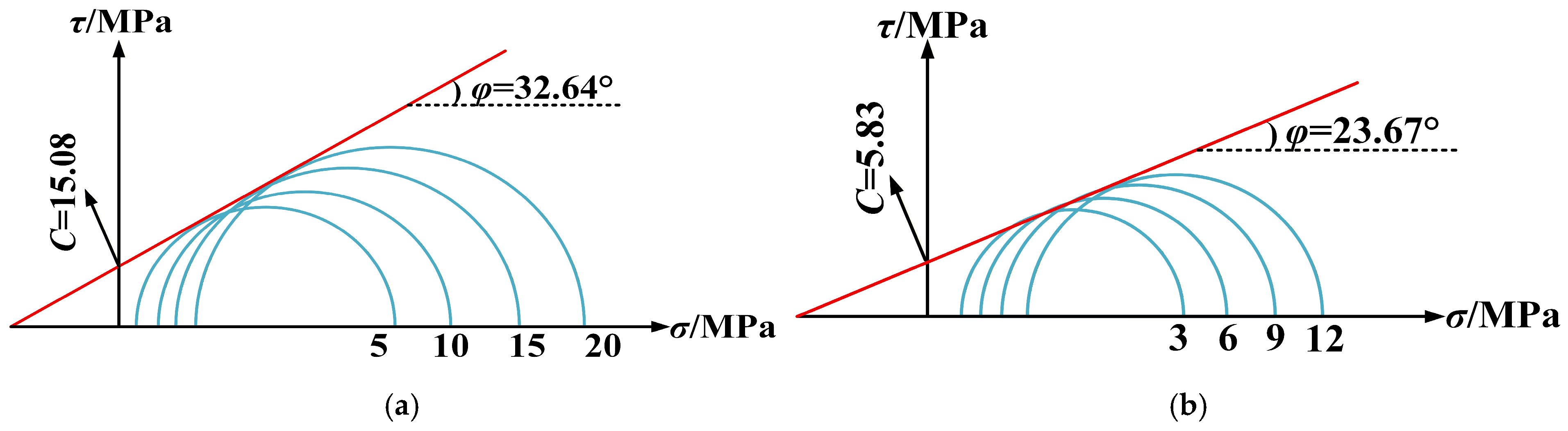
Based on the triaxial test results, Mohr stress circles were plotted with shear stress (τ) as the ordinate and normal stress (σ) as the abscissa, as shown in Figure 4a,b. Following the ISRM recommended method [30], the common tangent to the Mohr circles defines the Mohr–Coulomb strength envelope for both limestone and coal. The angle between this envelope and the abscissa corresponds to the internal friction angle (φ), which is 32.64° for limestone and 23.67° for coal. The intercept of the envelope on the ordinate represents cohesion (C), measured as 15.08 MPa for limestone and 5.83 MPa for coal. The importance of obtaining material parameters through systematic laboratory testing to enhance simulation fidelity is widely recognized not only in geotechnical engineering but also in other fields involving complex material behaviors. For instance, similar experimental approaches have been effectively employed to determine the physicochemical properties of crude oil for optimizing refining processes [31].

3.2. Numerical Model Establishment

3.2.1. Model Geometry

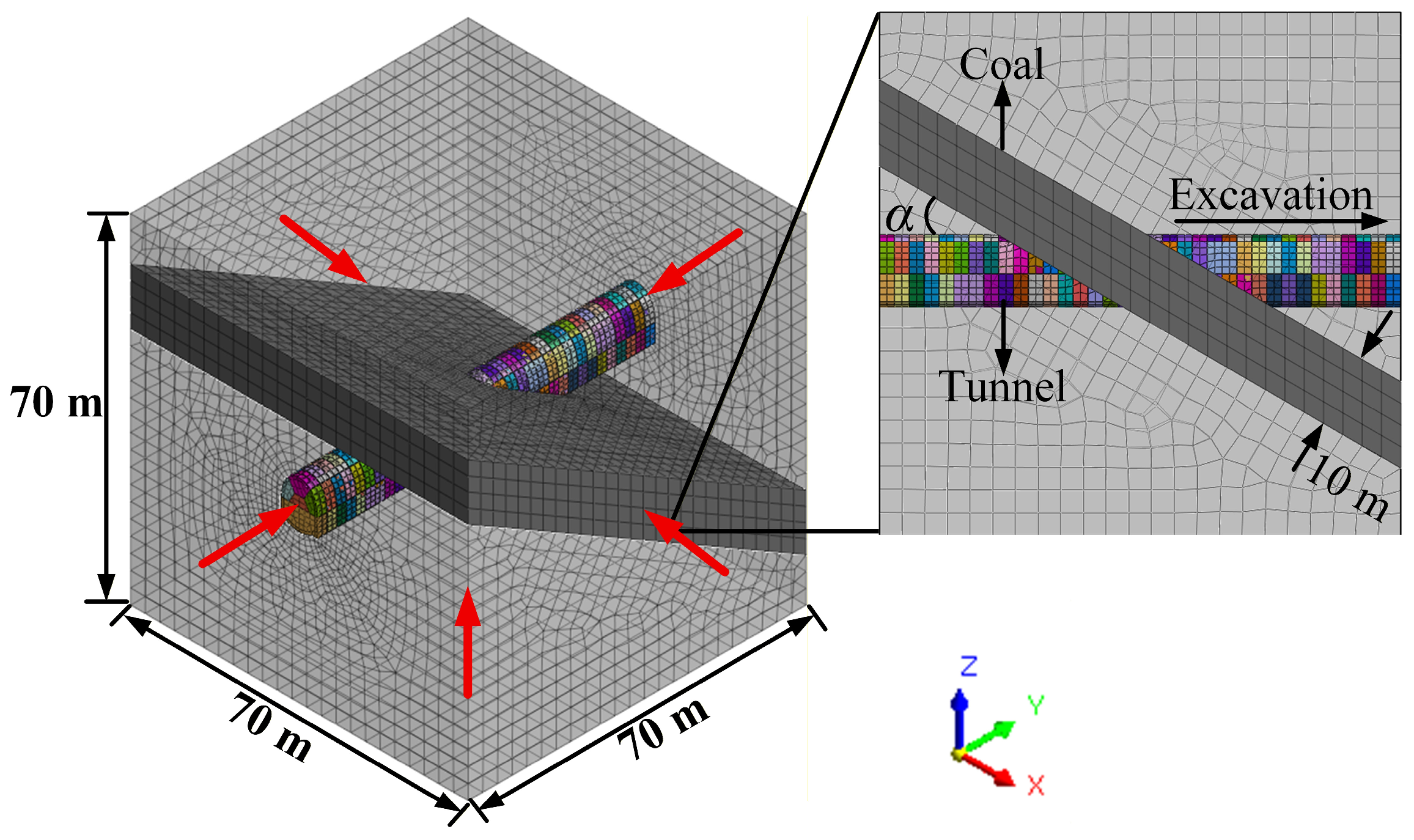
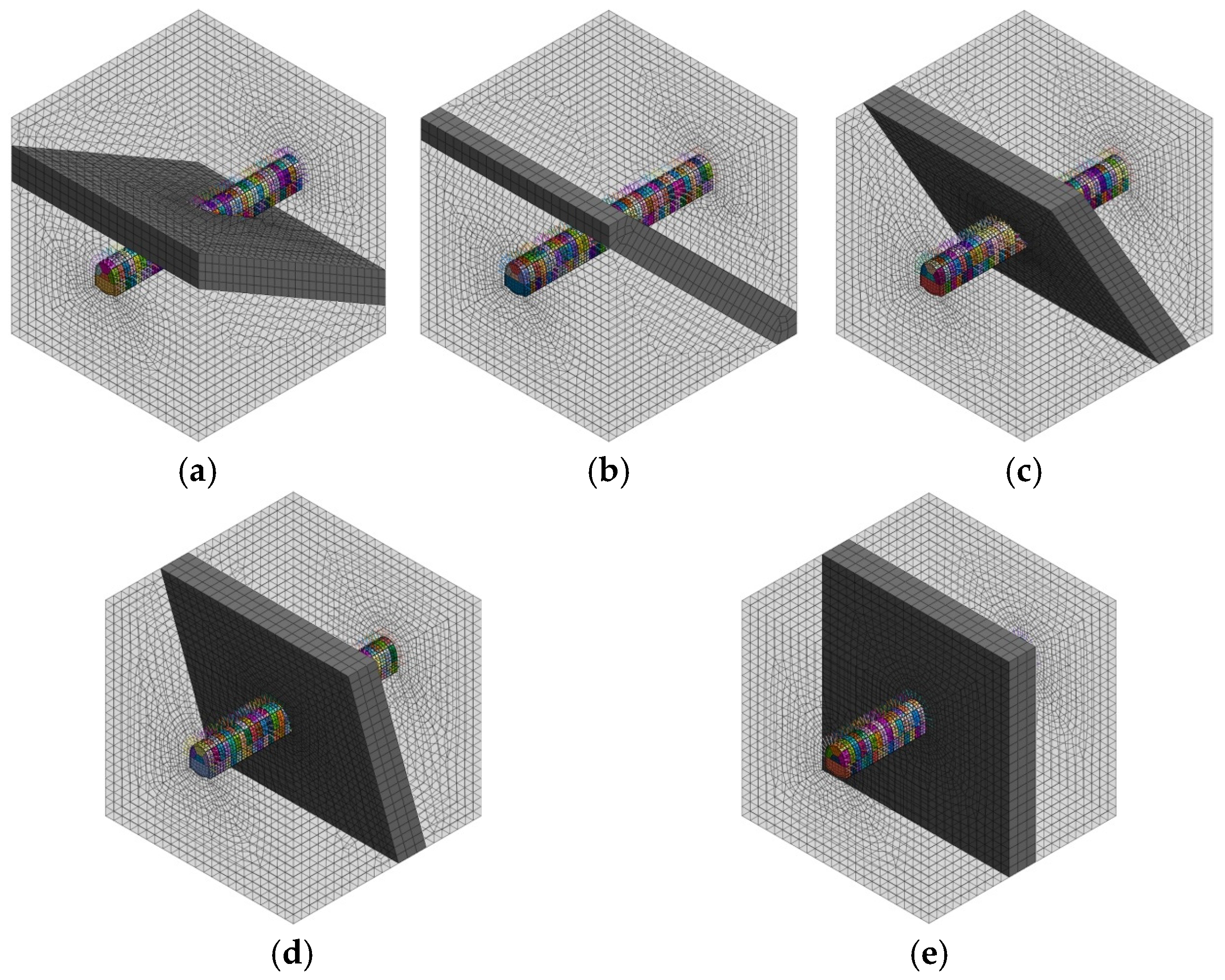
To thoroughly analyze the influence of coal-tunnel angle α on tunnel stability, the typical coal-bearing section DK78+940–DK79+010 of the No. 1 Meijiaxiang Tunnel was selected for three-dimensional numerical modeling. A finite element model with dimensions of 70 m × 70 m × 70 m (length × width × height) was established to balance computational efficiency and mitigate boundary effects by MIDAS GTS NX. A 10 m thick coal seam was positioned at the center of the model. The distance from the model’s lateral boundary to the tunnel center is 35 m, approximately 4.5 times the tunnel span, which complies with numerical analysis experience and effectively controls boundary effects. The cubic model balances accuracy with computational efficiency for multi-condition analysis and provides a unified, convenient geometric framework for varying coal-seam occurrences. Boundary conditions included fixed constraints in the X, Y, and Z directions on the bottom surface, Y-direction constraints on the front and rear surfaces, X-direction constraints on the left and right surfaces, and a free top surface to simulate the ground. The model geometry is shown in Figure 5. To systematically examine the effect of coal-tunnel angle α, defined as the angle between the tunnel axis and the coal-seam strike line, five typical cases were considered: α = 30°, 45°, 60°, 75°, and 90°. The corresponding spatial relationships between the coal seam and the tunnel for each case are illustrated in Figure 6.

3.2.2. Constitutive Models and Parameter Assignment

(1)
Selection of constitutive models
Based on the engineering geological conditions, the Mohr–Coulomb elastoplastic model was used to simulate the yielding and plastic flow behavior of the surrounding rock, including limestone and coal seams. The rock mass is discretized using 3D solid elements (tetrahedral–hexahedral hybrid mesh), with local refinement around the tunnel excavation boundary and coal seam. The coal and limestone share common nodes at the interface, without independent contact or interface elements. This treatment is consistent with the field condition (integrated contact, no weak interlayer) and ensures displacement continuity, which sufficiently supports the core objective of multi-condition comparative analysis.
The classic Mohr–Coulomb elastoplastic model is adopted in this study due to its widespread application in geotechnical engineering and the convenience of parameter calibration, which facilitates systematic trend comparisons under multi-parameter conditions. Since the primary objective of this study is to compare the relative trends between different coal-tunnel angles and construction methods, the homogeneous assumption provides a consistent benchmark, ensuring the validity of these comparisons. Furthermore, the model successfully reproduces the three-stage settlement law observed in field monitoring, indicating that the macroscopic deformation behavior is adequately captured.
But it is worth mentioning that the surrounding rock is simulated as a homogeneous continuum using the Mohr–Coulomb elastoplastic model, without explicitly considering discontinuities such as joints and fissures mentioned in the geological report. This simplification may underestimate local failure and anisotropic deformation, especially failure along weak bedding planes. It may also affect the accuracy of plastic zone prediction, especially the sliding failure along the coal seam at small intersection angles (such as α = 30 °)
For a refined analysis of failure mechanisms, advanced models that incorporate softening or anisotropy are recommended.
(2)
Selection of parameter assignment
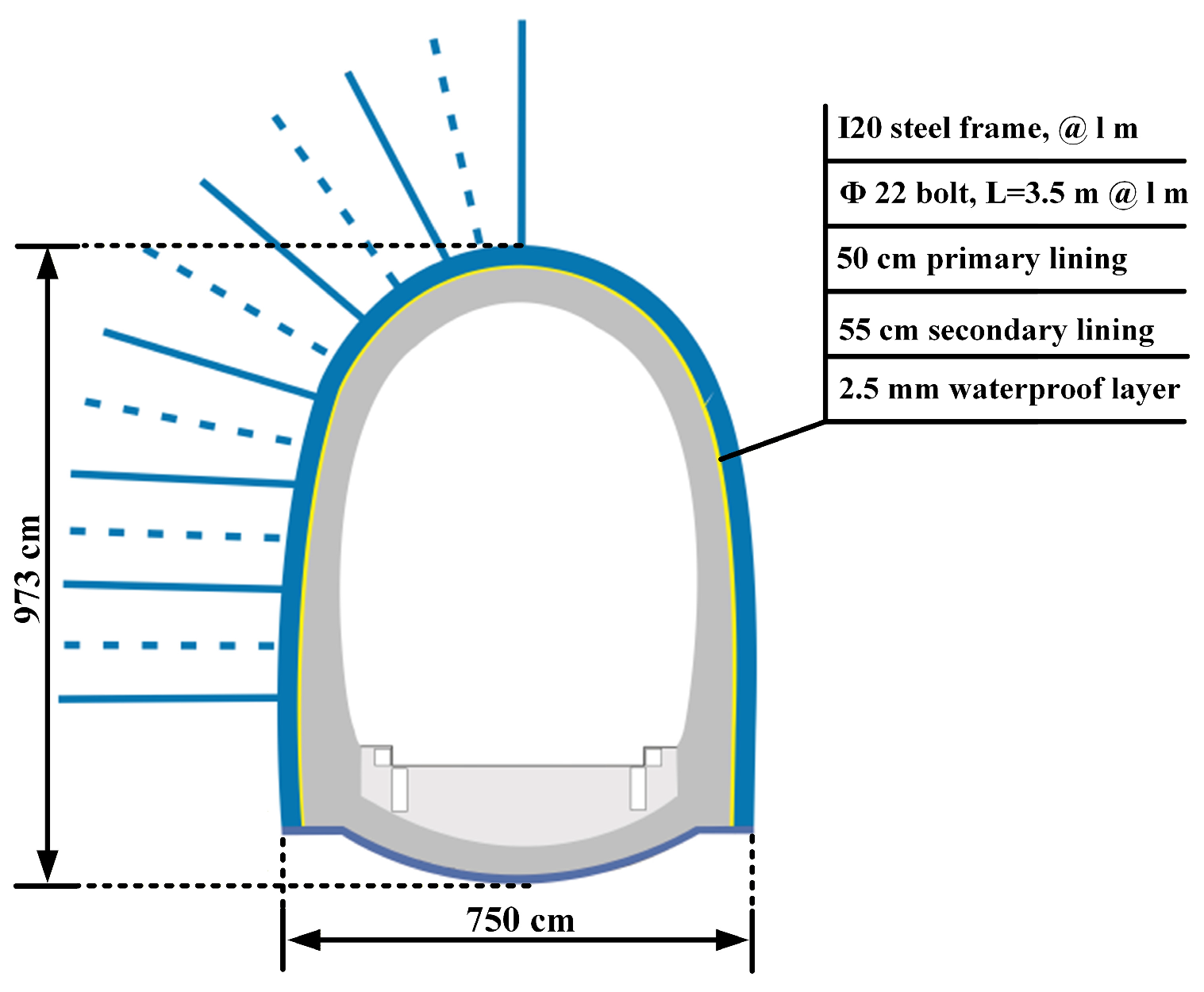
The composite tunnel lining comprises initial support, a waterproofing layer, and a secondary lining. The initial support is 50 cm thick C30 shotcrete, modeled using linear-elastic 2D shell elements, with the contribution of steel arches incorporated via equivalent bending stiffness. The secondary lining is 55 cm thick C35 cast-in-place concrete, simulated with 3D solid elements. Systematic rock bolts are modeled as 1D embedded truss elements to represent axial capacity. Bolt–rock interaction is governed by an “Embedded” constraint, which embeds bolt elements into the surrounding solid mesh and derives bolt strain from the displacement field of the host elements under perfect bonding assumption. This simplification is commonly adopted for fully grouted bolts and is adequate for the comparative assessment of overall mechanical responses across multiple working conditions in this study.
In the model, the interaction between the bolts and the surrounding rock (limestone and coal seam) is realized through the software’s ‘embedding’ function: the bolt elements are embedded into the surrounding rock solid element mesh. This method is equivalent to assuming a perfectly bonded state between the bolts and the rock mass. This simplification ignores potential bolt–grout interface slip or debonding that may occur under large deformation conditions. This simplification will lead to an underestimation of the deformation of the surrounding rock and an overestimation of the axial force contribution of the anchor rod in the calculation results. Nevertheless, this method is widely used in parametric studies of fully grouted bolts and is sufficient for comparing the overall mechanical response under different working conditions. The resulting bolt axial force distribution can exhibit physically plausible characteristics, supporting the reliability of the optimization conclusions. To enhance the model’s accuracy, future research could incorporate the use of nonlinear springs to connect anchor nodes and surrounding rock nodes. The constitutive relationship of a spring can be defined as a model of “elastic failure followed by plastic failure”, simulating the shear failure of a grout. The cross-sectional support structure is illustrated in Figure 7, and the mechanical parameters for all materials, summarized in Table 1, were derived from the laboratory tests described in Section 3.1.
Notably, the lateral pressure coefficient used in this study, K0 = 0.5, is at the lower limit of the empirical range (0.5–0.7) for such strata. For shallow-buried tunnels in weak surrounding rock, a lower K0 value implies assuming relatively weaker horizontal lateral constraint in the analysis. This choice leads to a conservative prediction of crown settlement, as weaker horizontal constraints allow greater vertical deformation. The simulated settlement values being slightly higher than the monitored values (Figure 9) are consistent with this safety-oriented design approach and do not affect the relative ranking of different angles or methods.
The initial in situ stress field is assumed to be self-weight dominated. Vertical stress is calculated from the overburden thickness and unit weight, and horizontal stress is derived using a lateral pressure coefficient of K0 = 0.5. This value is determined based on regional tectonic characteristics (negligible tectonic stress), theoretical Poisson’s ratio, and engineering experience.
This study employs intact rock parameters, which may overestimate surrounding rock stiffness and lead to underestimated deformation and plastic zone extent. The model assumes that the initial support is activated immediately after excavation with full stiffness. In actual engineering, there is a time lag between support installation and strength development, during which unsupported deformation occurs. This simplification may lead to an overestimation of support stresses, especially in the initial stage after excavation. However, since this assumption is applied consistently across all simulated conditions, it does not affect the comparative validity of the results. The good agreement between the simulated and monitored deformation time-history curves (Figure 9) further suggests that the impact of this simplification on the core conclusions is limited.

3.2.3. Construction Method and Parameters

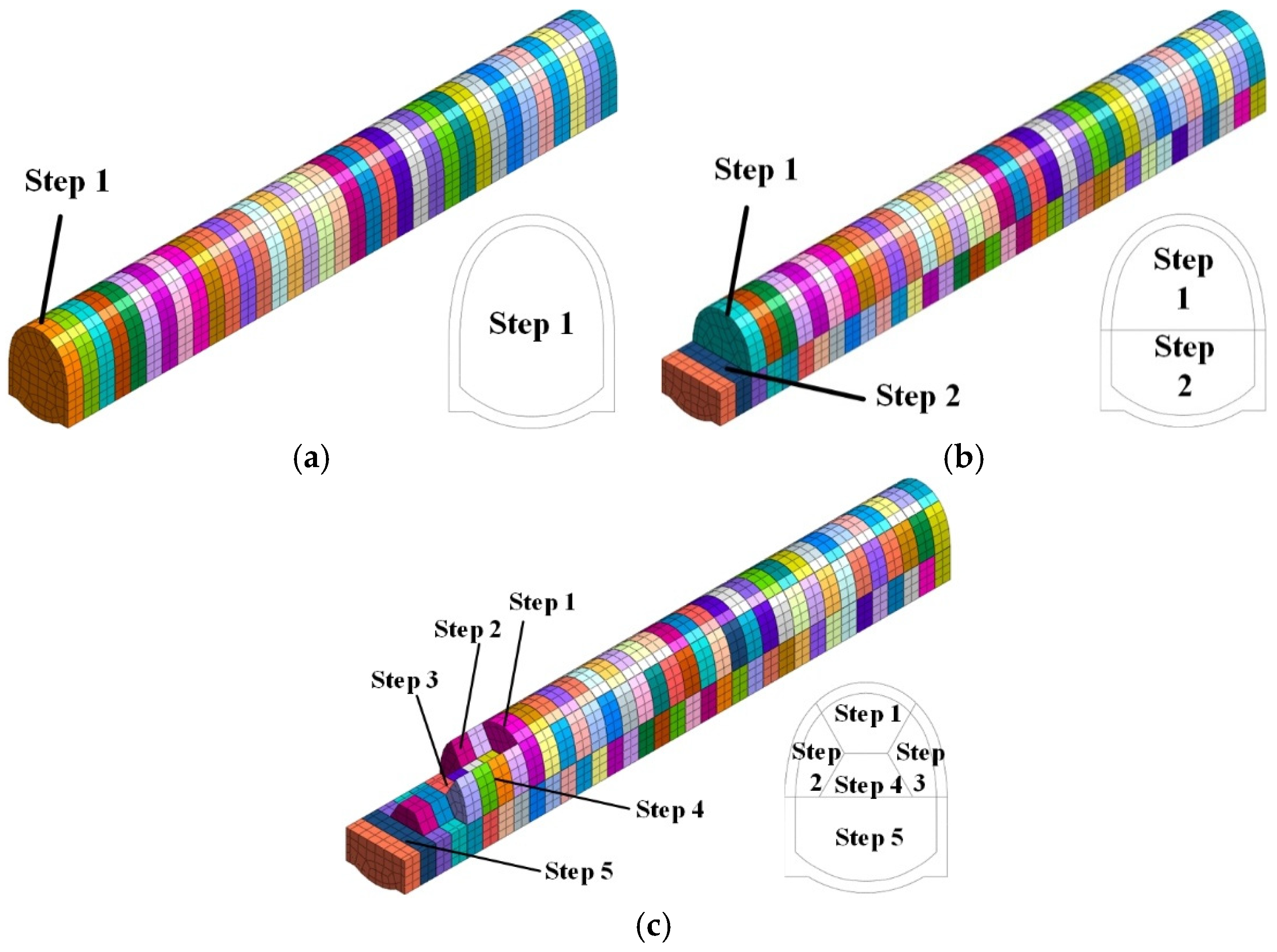
The tunnel has a horseshoe-shaped cross-section with a width of 7.5 m, a height of 9.73 m, and an excavated area of 67–70 m2, placing it in the medium-to-large section category. To balance excavation advance rate and surrounding rock stability in weak, inclined coal seams, three construction methods were selected for comparative analysis [32]: the full-face method, top-heading and bench method, and reserved core soil method (Figure 8). All methods adopt a consistent cyclic advanced length of 2 m to control excavation unloading per cycle. Initial support is installed 2 m (one step) behind the tunnel face, with each installation segment also 2 m in length, simulating realistic support delay. The secondary lining is installed 4 m (two steps) behind the initial support, also in 2 m segments. Although this lag distance is shorter than the actual 20~30 m requirement, the simplification ensures consistency across comparative conditions and has limited influence on the core conclusions.
In the numerical model, one calculation step corresponds to one complete excavation cycle (2 m advance). Time-step conversion and comparison with on-site monitoring time-history curves (Figure 9) show good agreement in settlement development patterns, timing of key stages, and final magnitudes, validating the model’s representation of the actual construction cycle. Combining the three construction methods with five coal-seam intersection angles (α = 30°, 45°, 60°, 75°, and 90°) yields 15 simulation conditions, summarized in Table 2.

3.2.4. Numerical Model Validation

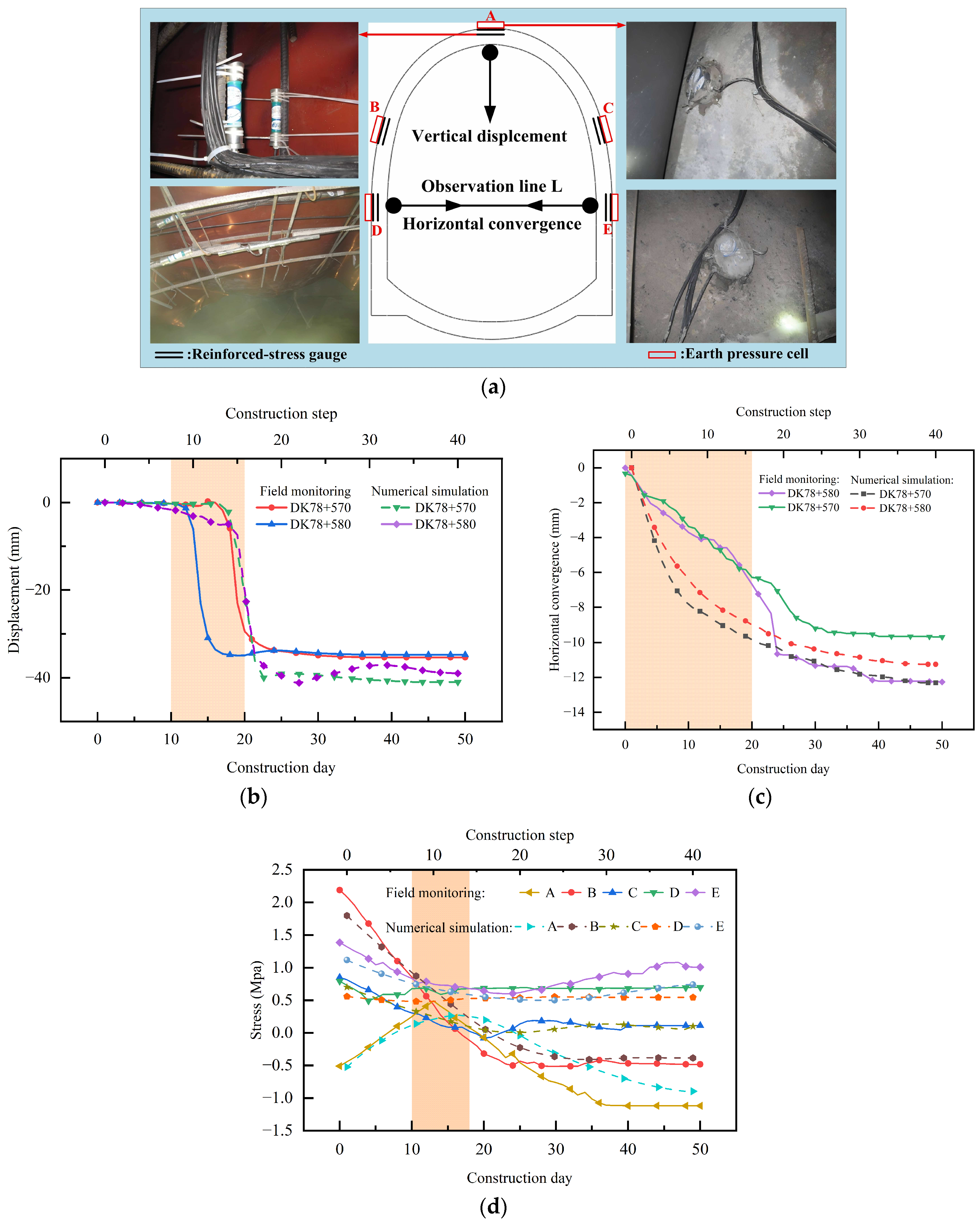
To enhance the credibility and engineering practicality of the model, this section compares the numerical simulation results with field-monitoring data to validate the model’s rationality. Figure 9a shows the schematic diagram of the field-monitoring point layout. Figure 9b and c are the comparative curves of crown settlement time history and arch waist horizontal convergence time history between numerical simulation and field monitoring, respectively. Figure 9d presents the comparative curves of lining stress between monitoring values and numerical simulation.
Figure 9. Comparison of field-monitoring data and numerical simulation results: (a) Schematic diagram of field-monitoring point layout; (b) comparative curves of crown settlement time history; (c) comparative curves of arch waist horizontal convergence time history; (d) time-history curve of lining stress.
Applsci 16 02090 g009
As can be seen from Figure 9b,c, the numerical simulation results and the field-monitoring data show good consistency in the temporal pattern of settlement development. Both exhibit the typical three-stage characteristic of “slow growth–sharp increase–gradual convergence,” indicating that the numerical model established in this paper can accurately capture the mechanical behavior of the entire process of stress release, deformation development, and stabilization of the surrounding rock during tunnel excavation.
However, despite consistent overall trends, certain deviations remain between simulated and monitored results. During the stage of maximum settlement rate, the simulated curve exhibits a steeper slope, indicating earlier settlement development and a slightly higher final value. At section DK78+570, simulated crown settlement is 40.99 mm versus 35.36 mm monitored (difference for 13.74%); at DK78+580, 41.15 mm versus 34.92 mm (difference for 15.14%). For arch waist horizontal convergence, differences are 13.94% at DK78+570 (11.26 mm vs. 9.69 mm) and 0.32% at DK78+580 (12.31 mm vs. 12.27 mm).
These discrepancies stem primarily from deliberate simplifications. To isolate the effects of coal-seam angle, construction method, and support parameters, the model excludes advance support measures (e.g., pipe roofing, advance grouting) used on site, enhancing clarity for comparative analysis. Additionally, the model assumes instantaneous activation of initial support at full stiffness upon excavation [33], whereas in practice, support installation and strength gain involve time lags during which unsupported deformation occurs. The Mohr–Coulomb model also omits creep and time-dependent behavior, further simplifying deformation timing.
Regarding lining stress (Figure 9d), the simulated distribution of maximum principal stress extremes aligns generally with monitored stress states, though simulated values are consistently 10–15% higher. This reflects a safety-oriented bias in the model’s stress assessment.
Nevertheless, the simulation results and monitoring data are in good agreement in terms of the core patterns of deformation development, temporal stages, and final magnitudes. The fact that the simulated settlement values are slightly larger than the measured values indicates that the model is somewhat conservative in deformation prediction, which provides the necessary safety margin for the parameter analysis and optimization conclusions derived from this model.

3.3. Results and Analysis

3.3.1. Surrounding Rock Deformation Analysis

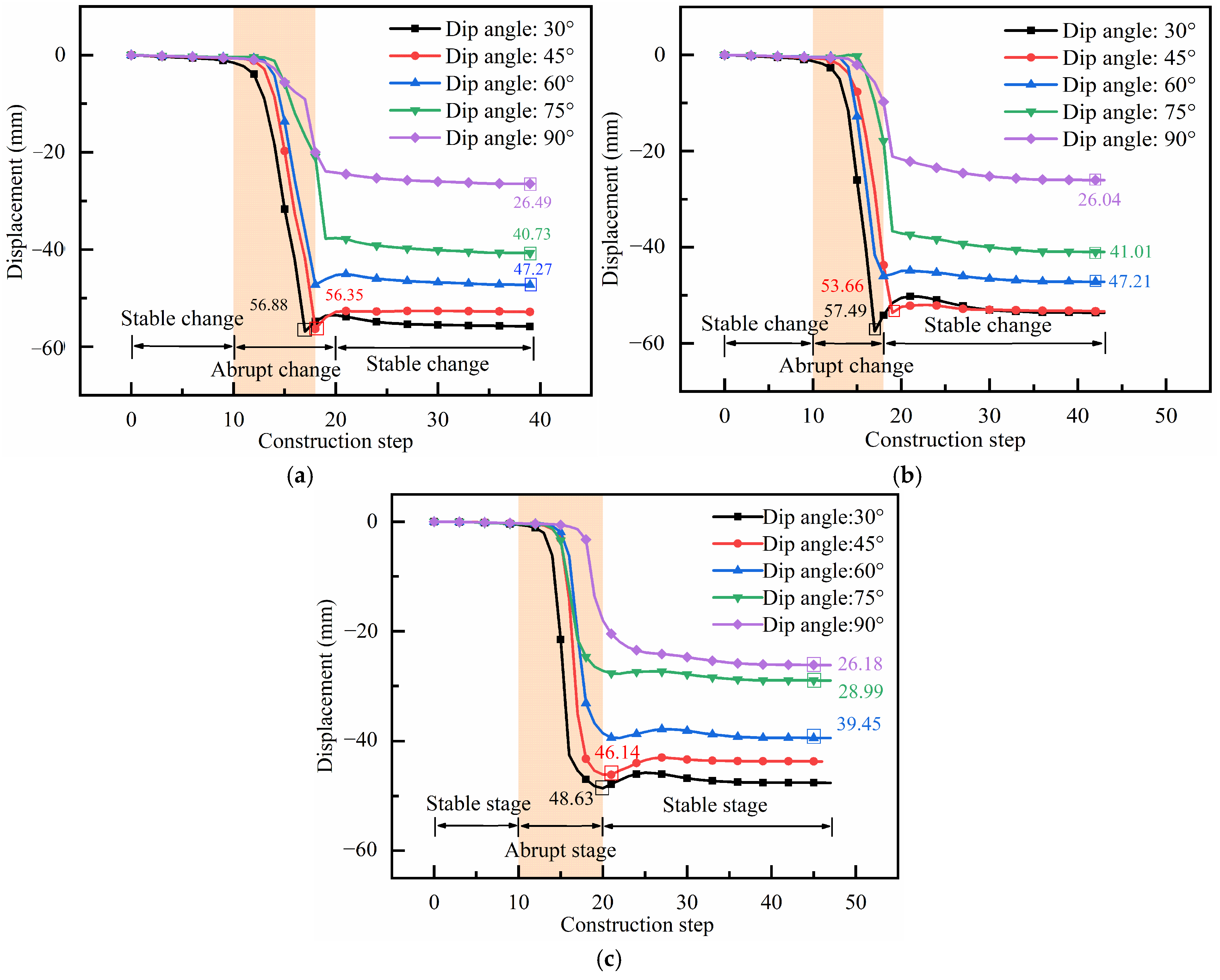
When a tunnel passes through coal-bearing strata, the considerable difference in mechanical properties between the coal seam and surrounding rock compromises rock mass integrity and alters the load transfer path of the tunnel structure. This leads to a substantially increased risk of deformation and instability in the surrounding rock. Among various deformation indicators, crown settlement is a key parameter for evaluating surrounding rock stability and predicting potential collapse. To examine the influence of coal-seam intersection angle on deformation behavior, a representative monitoring section (K79+035), where the tunnel crosses the coal seam at varying angles, was selected for detailed analysis. This section captures the spatial variation in the coal seam and its pronounced effect on surrounding rock deformation, and is also a key focus in the field-monitoring program. Measured crown settlement time-history curves for this section are presented in Figure 10. Figure 10a, b and c correspond to results from the full-face excavation method, the top-heading and bench method, and the reserved core soil method, respectively.
As shown in Figure 10a–c, the crown settlement curves at the monitoring section under various coal-tunnel angle α and excavation methods consistently exhibit a distinct three-stage evolution pattern. The first stage is the initial stable stage (Step 0 to Step 10, corresponding to excavation of 0–20 m). During this stage, the excavation face is far from the monitoring section, causing minimal disturbance to the surrounding rock. Settlement values remain below 5 mm and change steadily. The second stage is the rapid increase stage (Step 10 to Step 20, corresponding to excavation of 20–40 m). As excavation advances, the face approaches and eventually passes the monitoring section. Crown settlement increases sharply, reflected by a steep rise in the settlement curves. The maximum settlement for each scenario generally occurs within approximately 4 m of the monitoring section. The third stage is the convergence and stabilization stage (Step 20 to the last step, corresponding to excavation of 40–70 m). Once the excavation face moves away, stress release and adjustment in the surrounding rock are largely complete. The support structure gradually restrains further deformation, causing the settlement curve to flatten. Crown deformation then progressively stabilizes.
In addition, as shown in Figure 10, both the coal-seam coal-tunnel angle α and the construction method significantly affect crown settlement. As α increases from 30° to 90°, the maximum settlement values for the full-face method (Figure 10a), the top-heading and bench method (Figure 10b), and the reserved core soil method (Figure 10c) decrease from −56.98 mm, −57.49 mm, and −48.63 mm to −26.49 mm, −26.04 mm, and −26.18 mm, respectively. This trend can be explained by the interaction between excavation direction and coal-seam structure. At low α values, the tunnel advances nearly parallel to the coal-seam bedding planes, promoting the formation of continuous shear zones along these weak planes. This leads to concentrated stress release and extensive plastic zone development, significantly increasing settlement. In contrast, when α approaches 90°, the tunnel crosses the coal seam more directly, shortening the affected length and weakening the structural control of bedding on the surrounding rock. Stress transfer becomes more direct, which helps mobilize the self-supporting capacity of the rock mass and reduces settlement. These results indicate that larger coal-tunnel angle α are more favorable for controlling crown settlement.
A comparison of the three construction methods under the same coal-tunnel angle α reveals distinct settlement control performances. The full-face excavation method and the top-heading and bench method yield similar settlement results. In contrast, the reserved core soil method demonstrates significantly better control. For α values of 30°, 45°, 60°, and 75°, its maximum settlement is lower than that of the other two methods by 15.41%, 18.12%, 16.68%, and 30.99%, respectively, highlighting the advantage of its partial excavation approach in suppressing deformation. This improvement can be attributed to the stabilizing effect of the core soil on the tunnel face in the reserved core soil method. The core soil helps limit the relaxation of soil ahead of the face, thereby reducing overall deformation. Therefore, under identical α conditions, this method produces the smallest settlement values.
To verify the computational efficiency and accuracy of this model, a new model with smaller element sizes and a more complex mesh (approximately 40% increase in the number of elements) was established for comparison of calculation results. The relative difference in the final settlement value was 2.55%, far below the commonly used 5% convergence threshold in engineering analysis. This fully demonstrates that the baseline mesh adopted in the original study can achieve mesh-independent convergent solutions, and its calculation results are reliable.

3.3.2. Analysis of Plastic Zone in Surrounding Rock

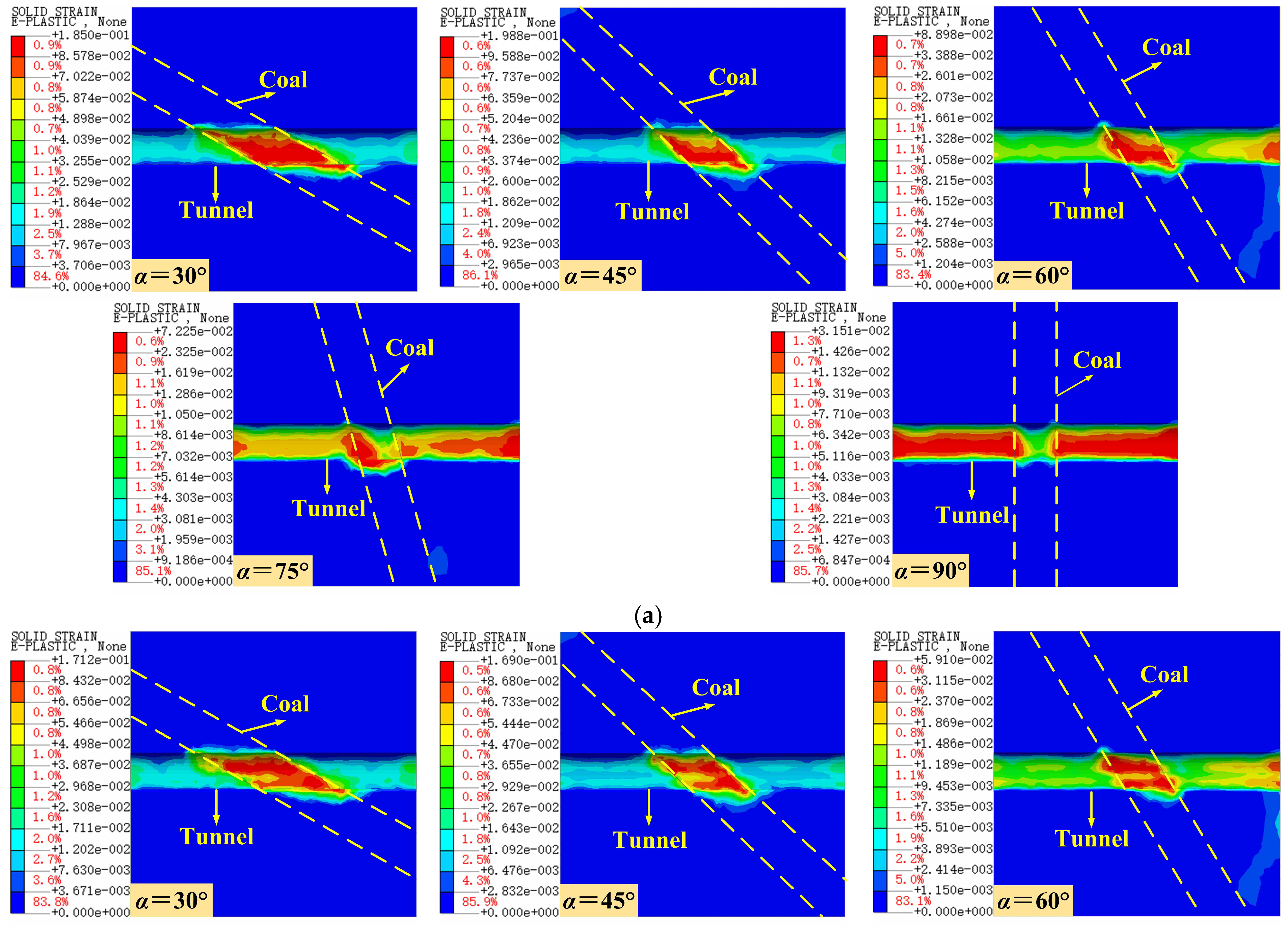
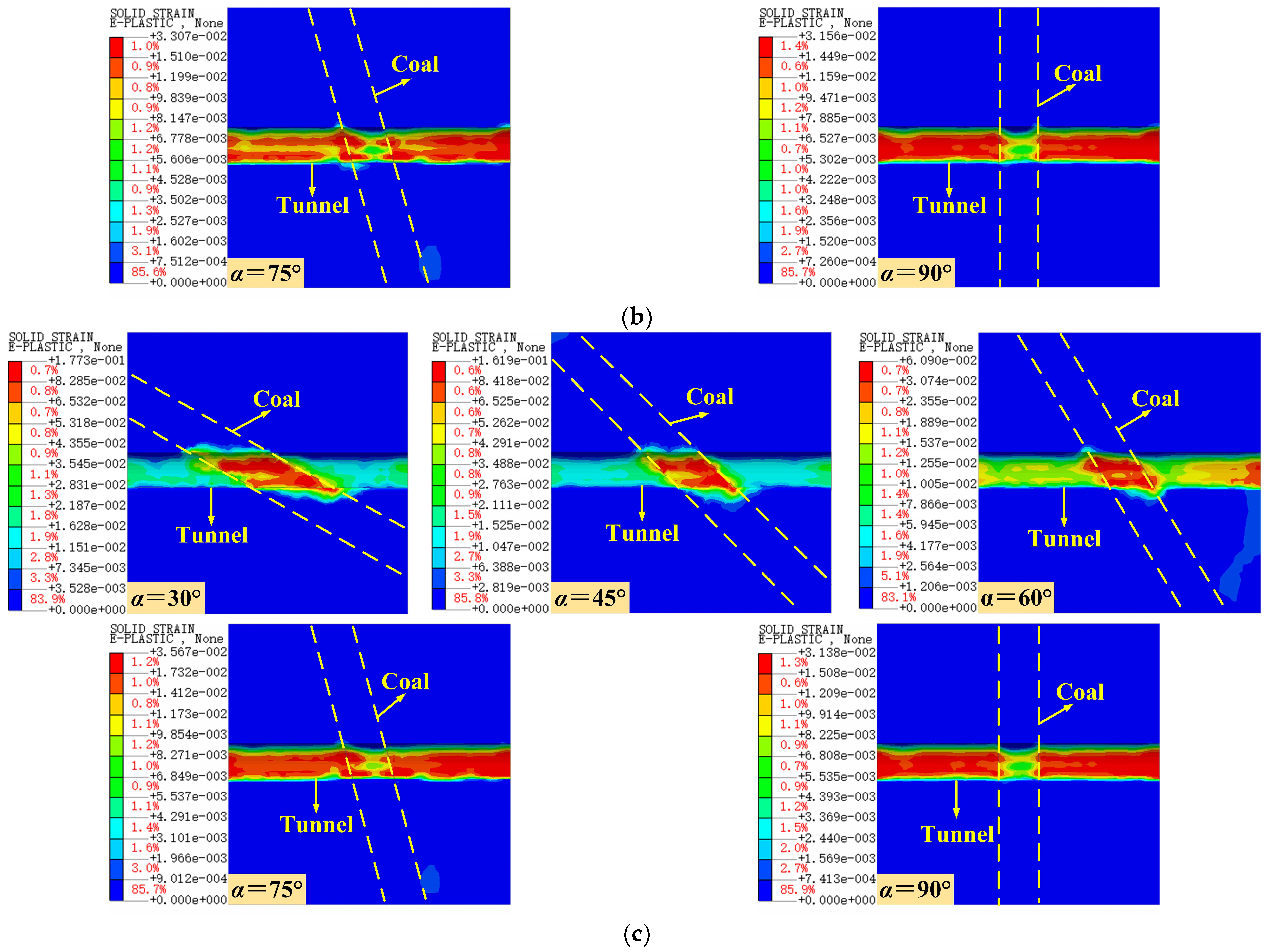
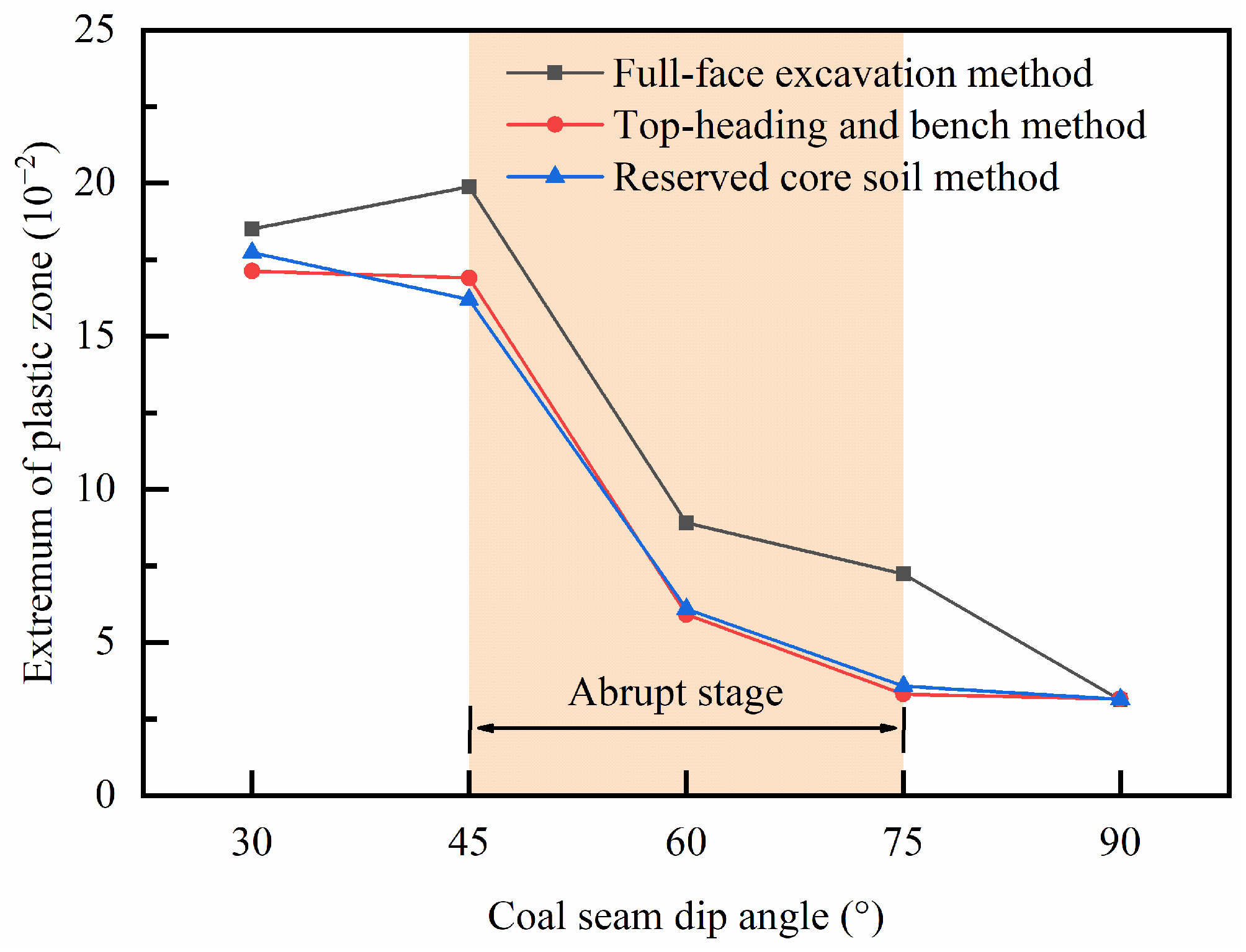
Beyond crown settlement, the development extent and morphology of the plastic zone in the surrounding rock directly affect the stress state of the support structure. Figure 11 presents cloud diagrams of plastic zone distribution along a vertical section through the tunnel axis. Figure 12 plots the extreme value curves of the plastic zone under three construction methods. It should be noted that the indicator used in this paper to assess the degree of plastic zone development is the equivalent plastic strain, a dimensionless quantity that characterizes the cumulative extent of plastic deformation.
Figure 11 illustrates that under small to medium coal-tunnel angle α values (α = 30°, 45°, 60°), the plastic zone develops extensively along the strike of the weaker coal seam, covering a large area. The most severe plastic deformation (red region) is concentrated where the coal seam intersects the tunnel. In contrast, at higher coal-tunnel angle α values (α = 75°, 90°), the extension of the plastic zone along the coal seam is notably restrained, and its overall range is significantly reduced. In particular, when α = 90°, the plastic zone essentially no longer propagates along the coal seam, and the degree of plastic development at the coal-tunnel intersection is the mildest across the excavation face, dominated by yellow and green regions.
Figure 12 indicates that the extreme value of the plastic zone decreases significantly as α increases. When α rises from 30° to 90°, the extreme values for the full-face, top-heading and bench, and reserved core soil methods drop from 18.50 × 10⁻², 17.12 × 10⁻², and 17.73 × 10⁻² to 3.15 × 10⁻², 3.16 × 10⁻², and 3.14 × 10⁻², respectively. The corresponding reduction rates are 82.97%, 81.54%, and 82.29%, respectively. The results indicate that smaller angles are more likely to cause severe stress concentration and plastic failure, posing a greater threat to surrounding rock stability.
Among construction methods, the top-heading and bench method and the reserved core soil method perform similarly in controlling plastic zone expansion, and both outperform the full-face method. For example, under the reserved core soil method, the plastic zone extreme values are reduced by 4.16%, 18.56%, 31.57%, 50.62%, and 0.32% relative to the full-face method at α = 30°, 45°, 60°, 75°, and 90°, respectively. This difference stems primarily from the abrupt stress redistribution induced by full-face excavation, which violently disturbs the initial stress state and triggers extensive plastic yielding. In contrast, staged excavation methods allow for gradual stress release, reducing large-scale unloading effects and thereby effectively limiting the extent of the plastic zone.

3.3.3. Stress Analysis of Initial Support

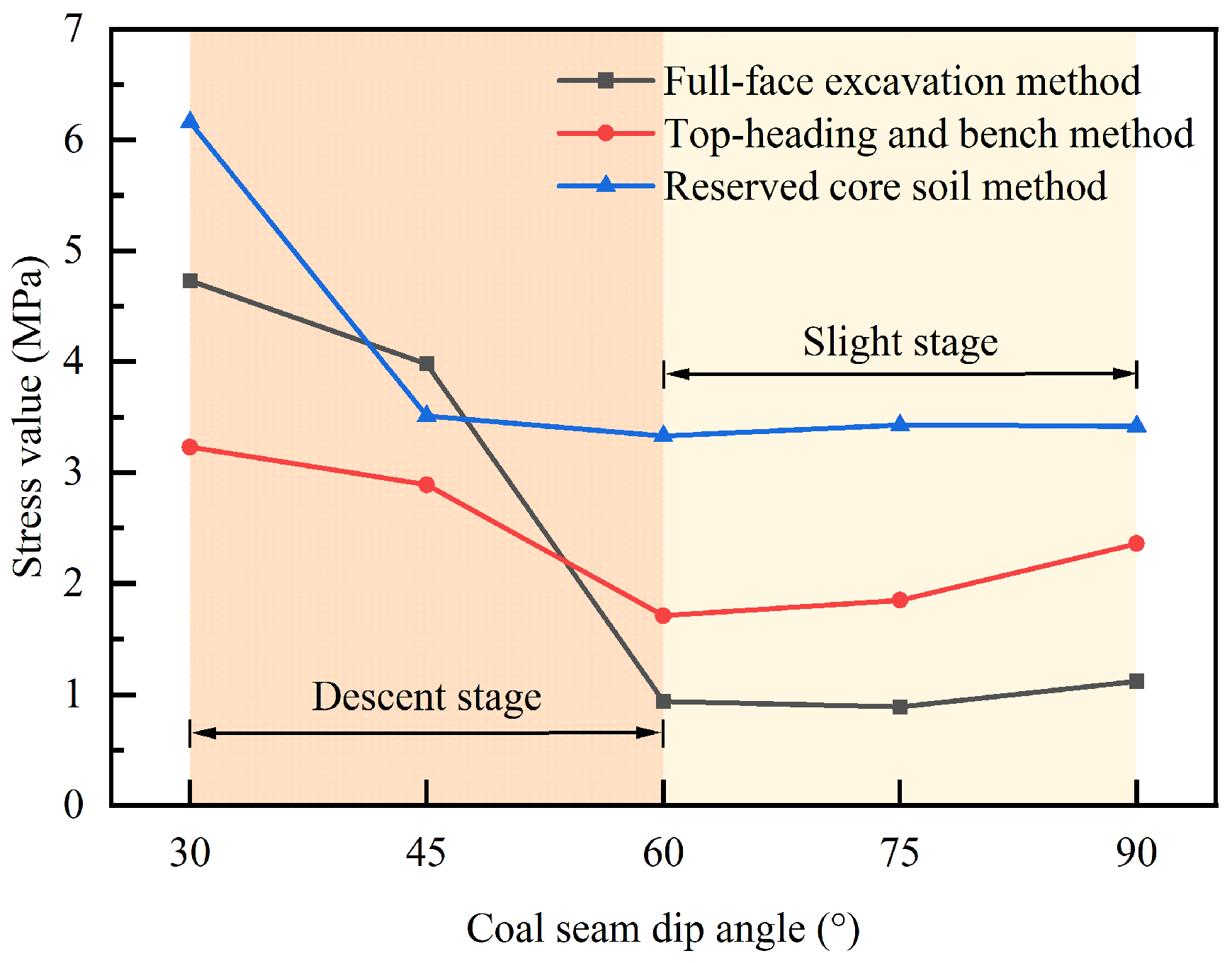
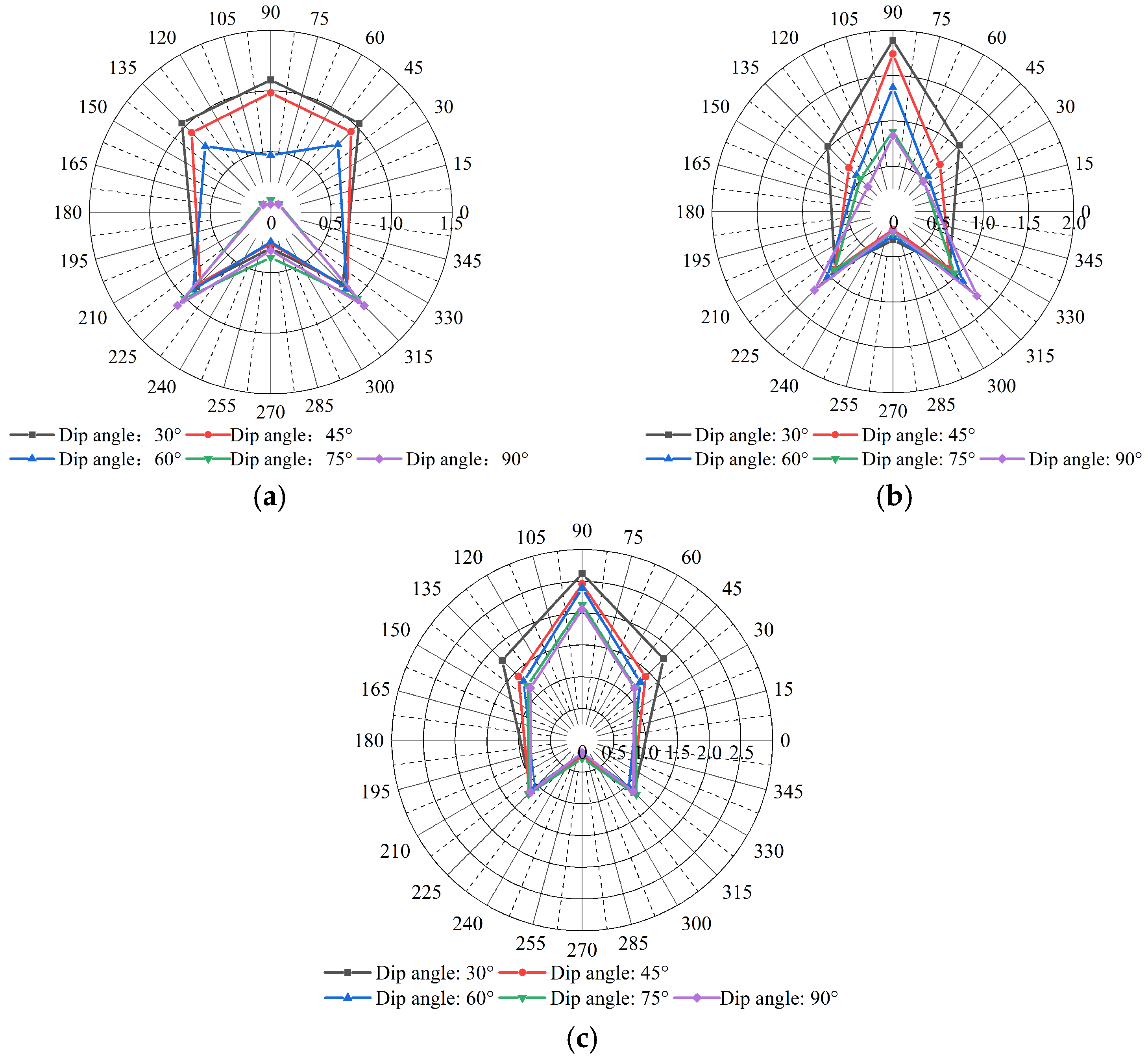
The stress state of the initial support, typically composed of shotcrete and steel arches, directly reflects the structural safety and support effectiveness of the tunnel. In practice, the first principal stress (σ1) is a key indicator for such assessment. Figure 13 presents the distribution of extreme σ1 values in the initial support under various working conditions. For a more detailed analysis of local stress characteristics, Figure 14 examines stress values extracted from six characteristic locations on the typical monitoring section (K79+035), including the crown, arch shoulders, arch feet, and invert.
Figure 13 reveals that the coal-tunnel angle α significantly affects the overall stress level in the initial support. Across all working conditions, the extreme values of the first principal stress (σ1) decrease sharply and then gradually converge as the coal-tunnel angle α increases. When α rises from 30° to 90°, the extreme σ1 values for the three construction methods decrease from 4.73 MPa, 3.23 MPa, and 6.16 MPa to 1.12 MPa, 2.36 MPa, and 3.42 MPa, corresponding to reductions of 76.32%, 26.93%, and 44.48%, respectively. Notably, distinct stress distribution patterns emerge among the construction methods. The reserved core soil method consistently produces higher stress extremes than the other two across all coal-tunnel angle α values. When α ≥ 60°, its stress values are approximately three times those of the full-face method. The results suggest that while the reserved core soil method effectively controls deformation, its construction features—such as staged excavation and progressive ring closure—tend to promote stress accumulation and superposition within the support system, resulting in localized stress concentrations.
Figure 14 shows that the response to changes in the coal-tunnel angle α varies across different tunnel locations. The crown and arch shoulders are the most sensitive, with stress decreasing significantly as α increases. As α rises from 30° to 90°, the maximum principal stress (σ1) at the crown decreases from 1.09, 1.89, and 2.62 MPa to 0.07, 0.84, and 2.06 MPa for the three construction methods, respectively. In contrast, stress at the arch feet exhibits an opposite trend, showing a moderate increase with larger α values. Stress changes at the invert are relatively mild and less influenced by α.
The mechanical origin of stress concentration in the reserved core soil method is clarified through quantitative analysis of stress redistribution patterns. Unlike full-face excavation, which releases stress abruptly but uniformly, the reserved core soil method alters the load transfer path via sequential excavation. During side drift excavation, the retained core temporarily sustains part of the overburden, limiting immediate crown settlement. However, upon core removal, the load is rapidly transferred to the initial support, concentrating at the crown and arch shoulders.
This delayed load transfer is quantitatively evidenced in Figure 13. For the most unfavorable coal-tunnel angle (α = 30°), the maximum principal stress (σ1) in the initial support reaches 6.16 MPa under the reserved core soil method, compared to 4.73 MPa and 3.23 MPa under the full-face and top-heading and bench methods, respectively. At monitoring section K79+035 (Figure 14c), crown σ1 under the reserved core soil method is 2.62 MPa—approximately 2.4 times that under full-face excavation (1.09 MPa). These results confirm that while the staged excavation of the reserved core soil method effectively controls deformation, it inherently induces higher local stresses due to secondary load redistribution upon core removal.
A comparative analysis of load transfer paths further clarifies these observations. Full-face excavation enables uniform stress redistribution through single-step unloading. The top-heading and bench method achieves stepwise but still relatively uniform load transfer. The reserved core soil method, however, follows a “pre-loading then delayed full loading” sequence: partial loading during side drift excavation, followed by full load transfer after core removal. This secondary redistribution concentrates stress at the crown and arch shoulders, explaining the observed local stress elevation. Therefore, while the reserved core soil method excels in deformation control, its staged excavation inherently induces stress concentration. Optimizing parameters like cyclic advanced length is thus necessary to improve the stress state while retaining deformation-control benefits.

4. Optimization Study of Construction Parameters

Based on the above analysis, the reserved core soil method demonstrates clear advantages in controlling weak surrounding rock deformation. Compared to the full-face method, it reduces maximum crown settlement and plastic zone extent by up to 30.99% and 50.62%, respectively, making it particularly suitable for thick coal seams with low strength and poor self-stability. However, this method also induces pronounced stress concentration in the initial support, where first principal stress extremes can reach 1.3 to 5.5 times those under full-face excavation. Therefore, optimizing the construction parameters of the reserved core soil method is necessary to improve the support stress state while retaining its deformation control benefits.
The cyclic advanced length is a critical parameter that influences excavation disturbance and stress release in the surrounding rock. This section examines the most unfavorable condition, where the coal-tunnel angle α is 30°. Five advanced-length schemes were established for the reserved core soil method with values of 2, 4, 6, 8, and 10 m. Through numerical simulation, the mechanical response of the surrounding rock and support structure is compared to determine a suitable advanced length.

4.1. Crown Settlement Analysis

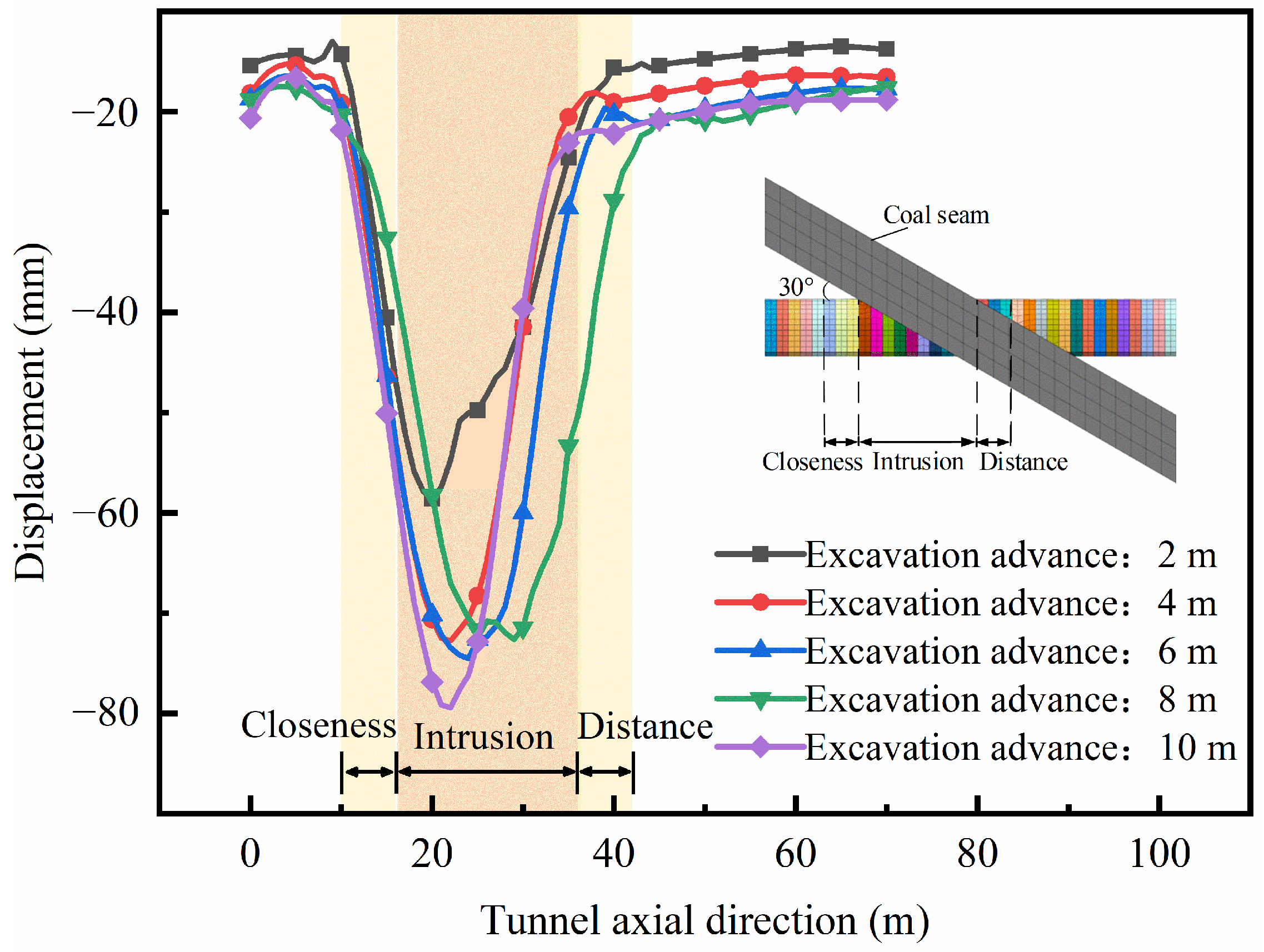
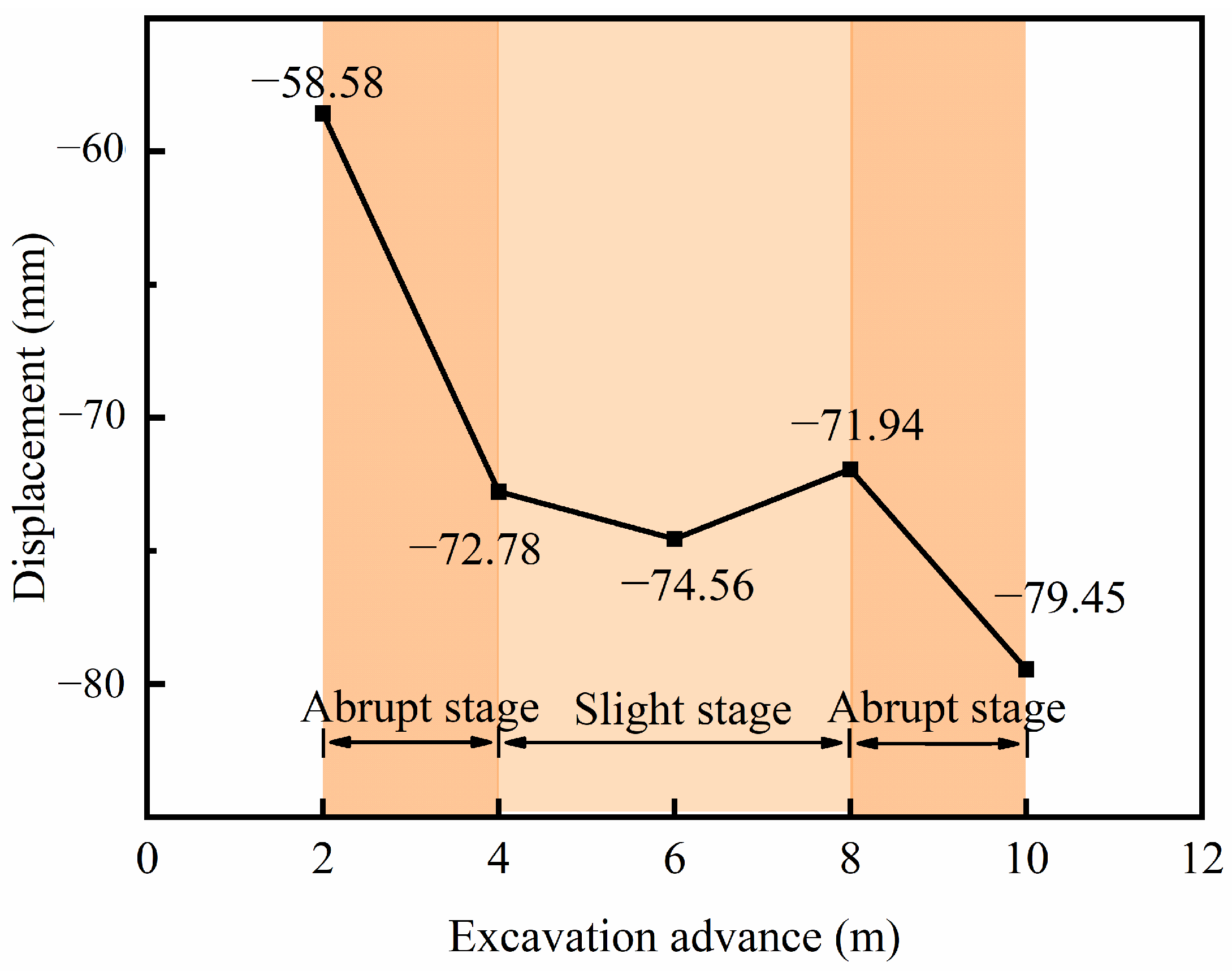
To investigate the control effect of the tunnel construction cyclic advanced length on surrounding rock deformation, the crown settlement patterns under different advanced-length schemes were analyzed. Figure 15 shows the crown settlement curves along the tunnel axis for the five advance schemes, and Figure 16 presents the corresponding extreme settlement values.
As shown in Figure 15, the crown settlement curves under the five advanced-length schemes follow a similar overall trend. Settlement develops gradually when the excavation face is far from the coal seam (0–10 m). Upon entering the coal-seam influence zone (10–36 m), settlement increases sharply, reaching its peak between 20 m and 30 m before gradually converging.
From the peak settlement value in Figure 16, it can be seen that the 2 m propulsion scheme produces the smallest settlement (58.58 mm). The maximum settlement values for the 4 m, 6 m, 8 m, and 10 m advance schemes are −72.78 mm, −74.56 mm, −71.94 mm, and −79.45 mm, respectively. In terms of controlling extreme settlement, the 8 m advance scheme yields the smallest increase (22.81%) among all alternatives to the 2 m baseline, and is notably lower than the 35.63% increase observed for the 10 m scheme.
Of particular note, during the critical construction phase when approaching and intruding into the coal seam (10–36 m), the settlement curve for the 8 m advance scheme exhibits the smallest absolute slope. This shows that, compared to shorter advanced lengths, the 8 m scheme better balances reduced single-cycle disturbance with sufficient space for stress adjustment in the surrounding rock. Compared to longer schemes such as 10 m, the 8 m advanced length exposes a smaller area per excavation cycle. This reduces disturbance intensity to the coal and rock mass ahead. It effectively limits excessive expansion of the plastic zone and suppresses the rapid development of deformation, thereby enhancing control and reducing safety risks during construction. It can be inferred that the 8 m advanced length could offer effective deformation control while maintaining a balanced trade-off between stability, construction efficiency, and operational safety.

4.2. Stress Analysis of Initial Support

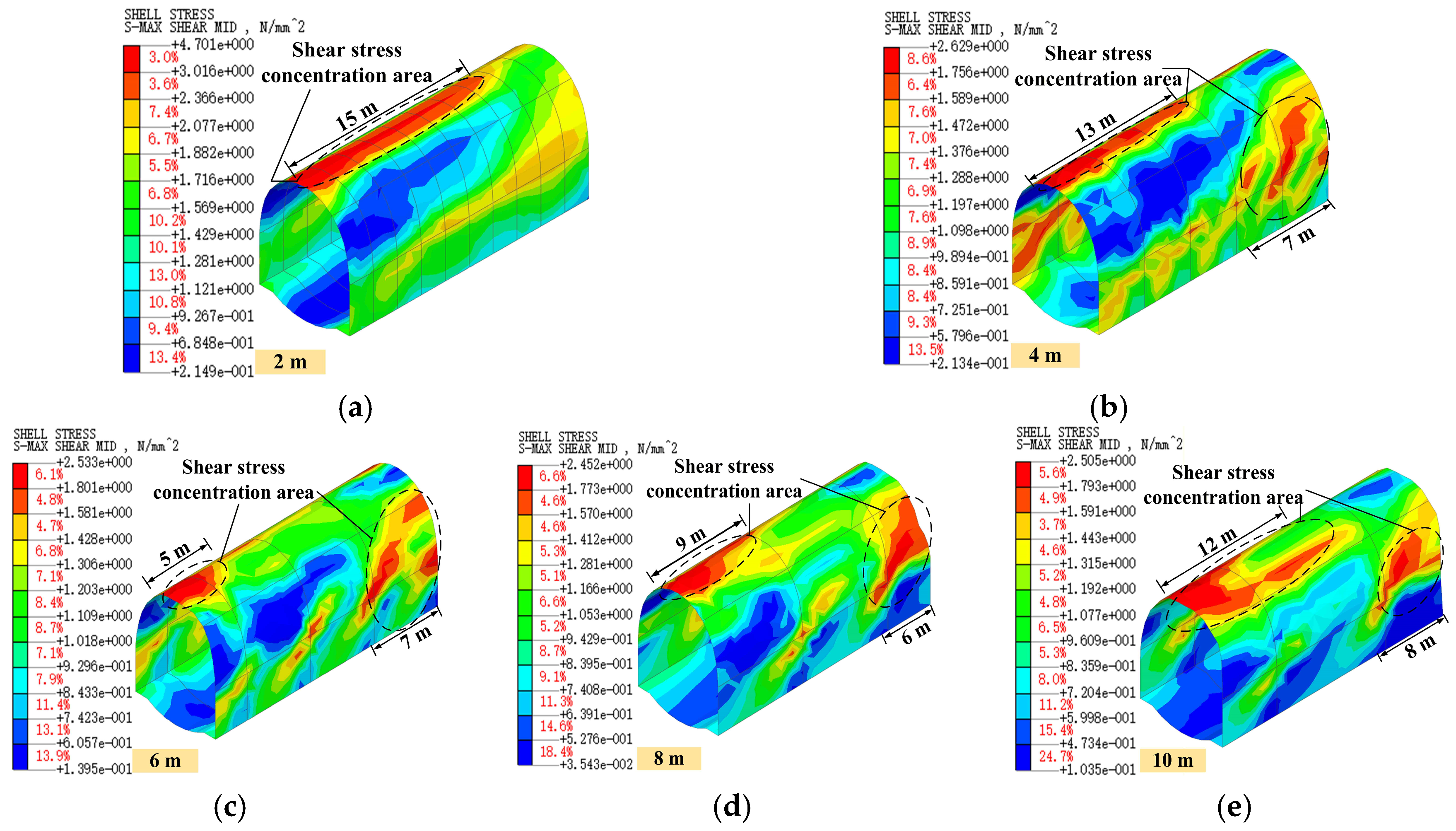
In tunnel engineering, diagonal cracks in initial support concrete are often related to excessive local shear stress. To evaluate the impact of different cyclic advanced lengths on the performance of the support within the interaction zone, this section presents cloud diagrams of the shear stress distribution in the initial support over a 20 m range (before and after the tunnel–coal-seam intersection segment), as shown in Figure 17. Figure 18 provides the corresponding statistical extreme stress values.
Figure 17 shows that all five advance schemes exhibit pronounced stress concentration (red areas) near the point where the tunnel first intrudes the coal seam. This results from the sharp stiffness contrast between the coal seam and surrounding rock, leading to abrupt stress release upon excavation unloading. Under the 2 m advance scheme (Figure 17a), the high-stress zone is relatively dispersed, with sustained stress concentration at the crown and arch waist, indicating that frequent, small-scale excavation causes repeated disturbance, prevents full stress redistribution, and maintains sustained high loading on the support. In the 4 m (Figure 17b) and 6 m (Figure 17c) schemes, the stress concentration area gradually converges, focusing mainly near the crown, with smoother colour transitions reflecting more integrated stress distribution. The 8 m advance scheme (Figure 17d) shows the most favourable stress pattern: the high-stress area is the smallest and locally confined to the crown and arch waist, and the stress cloud is dominated by yellow and green, suggesting relatively uniform distribution and effective cooperation between support and surrounding rock. By contrast, the 10 m scheme (Figure 17e) displays a larger stress concentration area than the 8 m scheme, indicating that excessive unloading in a single excavation cycle can induce renewed local stress accumulation.
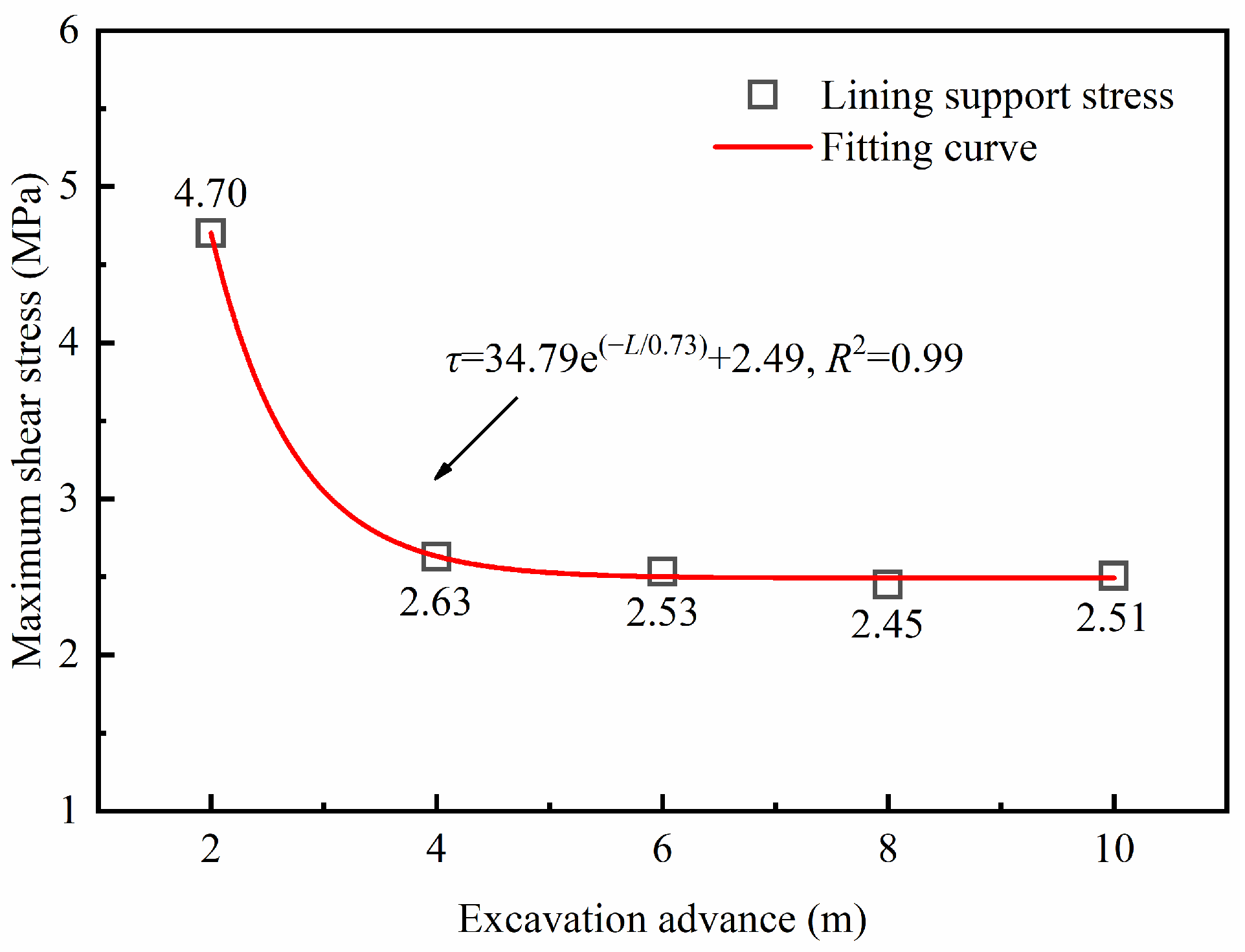
Figure 18 reveals that the 2 m advance scheme produces the highest value, at 4.70 MPa. As the advanced length increases, the extreme stress exhibits an overall declining trend, with values of 2.63, 2.53, 2.45, and 2.51 MPa for the 4 m, 6 m, 8 m, and 10 m schemes, respectively. These correspond to reductions of 44.04%, 46.17%, 47.87%, and 46.60% relative to the 2 m benchmark. The comparable scale of reduction indicates that increasing the excavation length beyond 2 m can rapidly improve the stress state of the surrounding rock and substantially mitigate adverse effects from frequent disturbances. The 8 m scheme performs best, achieving the lowest extreme stress of 2.45 MPa. Its stress contour (Figure 17d) also shows the most uniform distribution and the smallest high-stress zone, reflecting optimal support-rock interaction and a more rational structural force state under this condition. Based on nonlinear least-squares fitting, an empirical relationship between the maximum shear stress τ (MPa) in the initial support within the 20 m interaction zone and the cyclic advanced length L (m) was established, expressed as:
τ = 34.79 e ( L / 0.73 ) + 2.49
where τ is the maximum shear stress (MPa), and L is the cyclic advanced length (m). With a coefficient of determination (R2) of 0.99, the equation effectively models the variation in τ with L. The analysis indicates that, within the 2–10 m advance range, increasing the advanced length reduces peak shear stress in the support. However, beyond 8 m, the rate of reduction diminishes, and stress shows a slight rebound due to excessive excavation disturbance. Therefore, considering both support stress control and the optimization of the structural force state, the 8 m advance scheme is identified as the most suitable. It is worth noting that Equation (1) is a phenomenological descriptive formula valid within a specific framework. It provides a clear quantitative perspective for understanding the influence pattern of advanced length on support shear stress; however, its direct application to other engineering projects requires considerable caution.

4.3. Analysis of Bolt Axial Force

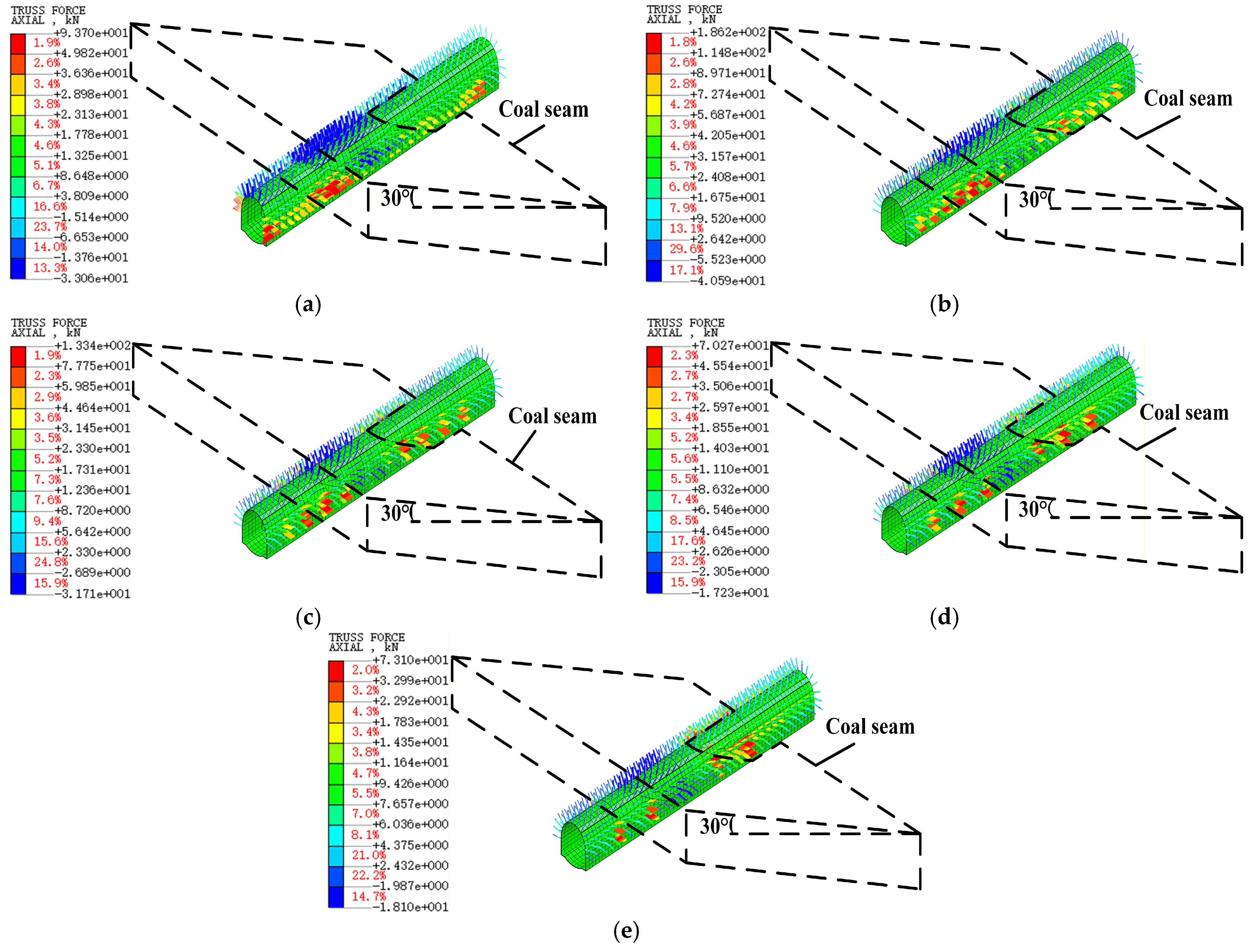
As an important active support component, the axial force distribution and magnitude of rock bolts directly reflect the interaction mechanism between the surrounding rock and the support structure, as well as the load transfer path. Figure 19 presents the distribution cloud diagrams of axial forces in the systematic rock bolts under five advanced-length conditions.
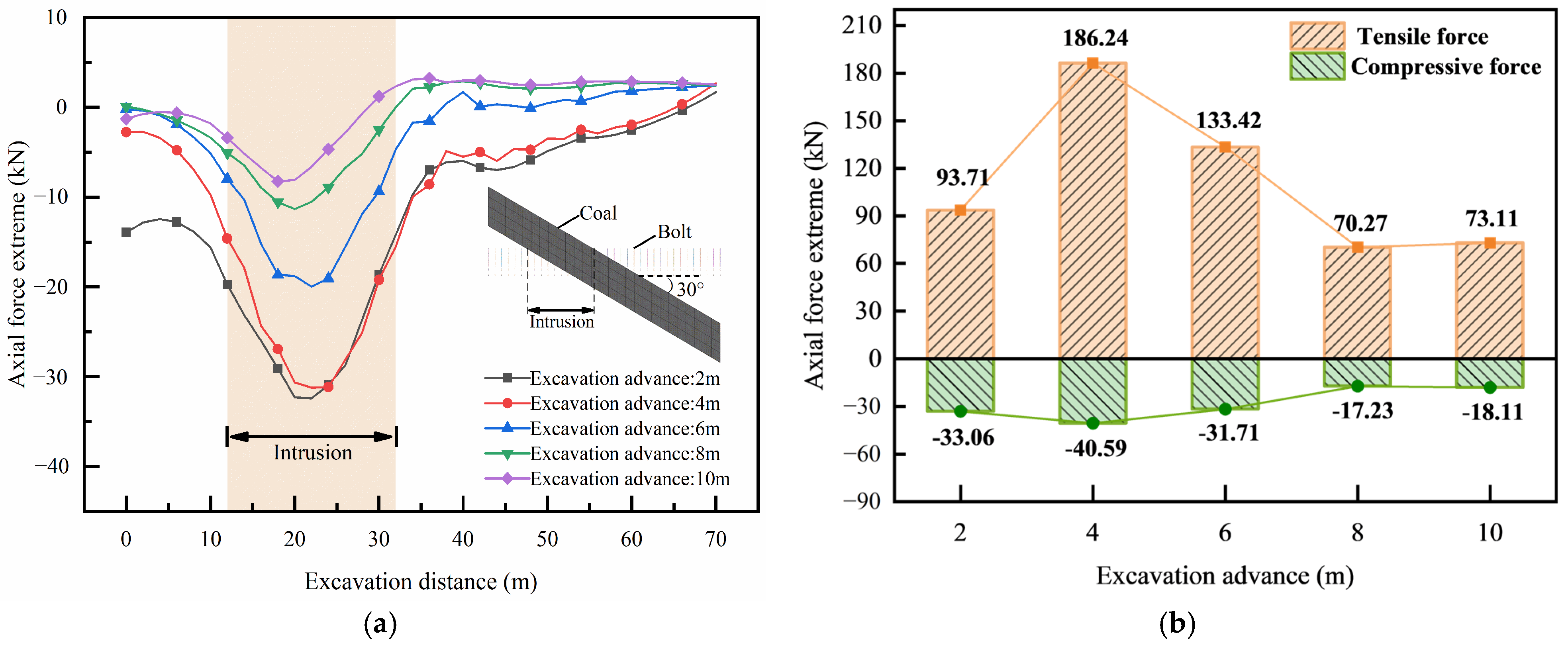
As shown in Figure 19, the axial forces in the tunnel bolts exhibit a characteristic spatial distribution of compression at the crown and tension at the arch waist. This pattern reflects the mechanical state and deformation mechanism of the surrounding rock in different zones as the tunnel passes through the coal seam, which can be explained in three distinct stages:
In the section far from the coal seam (0–12 m), although the tunnel face has not yet entered the coal seam, the presence of the overlying weak coal seam reduces the overall stiffness of the surrounding rock. Under construction disturbance, the rock exhibits a continuous subsidence tendency, leading to initial compressive forces in the bolts. These primarily restrain the overall subsidence of the overlying coal seam, manifesting as passive compression.
In the intrusion segment (12–32 m), the compressive forces at the crown intensify sharply. Due to its low strength, the coal seam cannot effectively transfer overlying pressure, resulting in severe subsidence of the coal mass. The anchored end of the bolts sinks with the coal, while the plate end is constrained by the steel ribs and shotcrete layer, generating significant axial compression along the bolt length.
After the tunnel passes through the coal seam and enters the stable segment (32–70 m), the excavation disturbance has ceased, stress redistribution is largely complete. The support structure has formed a collaborative bearing system with the relatively intact surrounding rock. Bolts in this segment transition to a tensile state, transferring stress from shallow rock to deeper stable strata through their anchoring effect, with axial forces gradually converging toward dynamic equilibrium.
However, despite the existence of these similar patterns, there are noticeable differences in bolt axial forces under different excavation advanced lengths. Figure 20a shows the variation curve of axial force in the crown bolts with the excavation progress. Figure 20b presents the extreme tensile and compressive axial forces for the entire systematic bolt array under different schemes.
Figure 20a shows that the cyclic advanced length significantly influences the magnitude and distribution uniformity of axial forces in the crown bolts. For small advanced lengths (2 m and 4 m), frequent excavation disturbance leads to a complex axial force distribution and relatively high compressive peaks in the coal-seam intrusion segment, measuring −32.41 kN and −31.22 kN, respectively. As the advanced length increases to 6, 8, and 10 m, the axial force distribution becomes more gradual, and the compressive peaks progressively decrease to −19.95, −10.56, and −8.25 kN, respectively. This trend indicates that increasing the cyclic advanced length allows for more complete, one-time stress release and redistribution in the surrounding rock, which in turn alleviates severe compression in the crown coal mass and systematically improves the stress state of the bolts.
From Figure 20b, regarding the extreme axial forces of the entire systematic bolt array, both tensile and compressive extremes are generally larger under small and medium advance schemes (2, 4, and 6 m). Notably, the 4 m excavation scheme performs the worst, with both tensile and compressive extremes reaching the maximum values among all conditions at 186.24 kN and −40.59 kN, respectively. In comparison, the 8 m advance scheme performs the best, with the smallest tensile and compressive extremes of 70.27 kN and −17.23 kN, respectively. Compared to the baseline 2 m scheme, these represent reductions of 25.01% and 47.88%, and compared to the worst-performing 4 m scheme, the reductions are as high as 62.27% and 57.55%. This further confirms that the 8 m advanced length has the optimal effect in controlling surrounding rock disturbance and promoting uniform load transfer, enabling the bolt system to work more efficiently and cooperatively.
In this optimization, crown settlement is adopted as the primary control indicator due to its direct relevance to tunnel safety. Each advanced-length scheme is first evaluated against an empirical threshold requiring settlement increase to remain below 25% relative to the 2 m baseline. The 10 m scheme, with a 35.63% increase, is therefore excluded. Among the three qualified schemes, the 8 m scheme yields the most favorable support shear stress and bolt axial force, and is thus identified as the optimal cyclic advanced length. For applications requiring more rigorous multi-criteria decision-making, future work may adopt methods such as Analytic Hierarchy Process or comprehensive evaluation models. The conclusion identifying 8 m as the optimal advanced length is derived from a balanced assessment of mechanical responses under simulated conditions. In practice, the successful implementation of this scheme depends on key technical and organizational measures, including advanced pre-support (e.g., grouting, pipe roofing) to maintain face stability, efficient support installation to ensure timely closure, and real-time monitoring with dynamic construction control. The final advanced length should therefore be validated and adapted based on site-specific geology, equipment capacity, and monitoring feedback.
This study systematically reveals the influence of coal–tunnel angle α and construction parameters through numerical simulation, though certain simplifications are acknowledged. The surrounding rock is modeled as a homogeneous continuum, without explicit representation of discontinuities such as jointing or fragmentation noted in the geological report. This may limit the model’s capacity to predict localized stress concentrations or anisotropic failure. Nevertheless, the elastoplastic framework captures macroscopic plastic zone development and overall instability trends. Future research may adopt jointed or discrete element models for finer characterization of fractured rock masses. The numerical analysis is grounded in laboratory-determined mechanical parameters and focuses on identifying systematic influence patterns of coal-seam geometry and construction method. Geotechnical parameters inherently exhibit spatial variability. Subsequent studies may build on this foundation by incorporating uncertainty in key parameters (e.g., coal strength, support stiffness) through sensitivity or probabilistic analyses, thereby assessing the robustness of the qualitative trends and optimization recommendations presented herein.
It should be noted that the optimization analysis in this study is based on a numerical model with certain simplifying assumptions (see Section 3.2.2). While the qualitative trends and relative comparisons are considered reliable, caution is warranted when interpreting absolute values of settlement, stress, and bolt force for practical applications. The identified optimal advanced length of 8 m provides a useful reference, but its implementation should be verified and adjusted based on site-specific geological conditions, construction equipment capabilities, and real-time monitoring feedback. Future research could enhance the reliability and generalizability of these recommendations by incorporating more advanced constitutive models that account for strain softening or anisotropy, as well as probabilistic analyses that consider parameter uncertainty.

5. Conclusions

Based on the engineering background of the No. 1 Meijiaxiang Tunnel on the Wengma Railway, this study adopts an integrated approach combining laboratory tests and numerical simulations. It systematically investigates the influence of coal-tunnel angle α and construction method on the stability of the surrounding rock and the mechanical behavior of support structures in tunnels traversing coal seams. Key construction parameters are also optimized. The main conclusions are as follows:
(1)
The coal-tunnel angle α exerts significant control over the stability of the tunnel surrounding rock. As the coal-tunnel angle α increases, both crown settlement and the extent of the plastic zone decrease markedly. When α increases from 30° to 90°, maximum crown settlement under the three construction methods is reduced by 46.16% to 54.71%, while the extent of the plastic zone decreases by over 81%. This demonstrates that larger coal-tunnel angle α provide more favorable conditions for tunnel stability.
(2)
Different construction methods exhibit distinct performance characteristics when tunneling through coal seams. The reserved core soil method demonstrates the greatest advantage in controlling surrounding rock deformation, reducing maximum crown settlement by up to 30.99%, while decreasing the extent of the plastic zone by up to 50.62%. However, this method also induces more pronounced stress concentration in the initial support, with its first principal stress extreme values reaching approximately 1.3 to 5.5 times those observed under the full-face excavation method.
(3)
For the reserved core soil method under the most unfavorable condition (α = 30°), the 8 m cycle advanced length was determined to be optimal after comparing five options ranging from 2 m to 10 m. This scheme achieves the best balance across three key indicators: crown settlement, maximum shear stress in the initial support, and bolt axial force. It thereby accomplishes the coordinated optimization of deformation control and structural safety.

Author Contributions

Z.C.: software, formal analysis, investigation, writing—original draft; C.C.: conceptualization, methodology, writing—review and editing, funding acquisition; X.Z.: writing—original draft, methodology, data curation, funding acquisition; K.Y.: visualization, data curation; J.L.: visualization, supervision, project administration; Z.L.: formal analysis, software; B.Y.: writing—original draft, funding acquisition. All authors have read and agreed to the published version of the manuscript.

Funding

The authors acknowledge financial support from the Hunan Provincial Department of Education Outstanding Youth Research Project under Grant No. 25B0159, and the Youth Science Project of Hunan Provincial Natural Science Foundation under Grant No. 2024JJ6429,and No. 2026JJ70085. Also, the authors appreciate financial support from Youth Student Project of Hunan Provincial Natural Science Foundation under Grant No. 2025JJ60888, and the College Student Innovation Training Program under Grant No. S202410530033, and No. 20251053007.

Data Availability Statement

All data, models, or codes that support the findings of this study are available from the corresponding author upon reasonable request.

Acknowledgments

The authors gratefully acknowledge the project department of the 10th section of the Wengma Railway North South Extension Line for providing relevant in-site information and monitoring data.

Conflicts of Interest

The authors declare no conflicts of interest.

References

  1. Cai, W.; Zhu, H.; Liang, W. Three-dimensional tunnel face extrusion and reinforcement effects of underground excavations in deep rock masses. Int. J. Rock Mech. Min. Sci. 2022, 150, 104999. [Google Scholar] [CrossRef]
  2. Wang, Z.; Yao, W.; Cai, Y.; Xu, B.; Fu, Y.; Wei, G. Analysis of ground surface settlement induced by the construction of a large-diameter shallow-buried twin-tunnel in soft ground. Tunn. Undergr. Space Technol. 2019, 83, 520–532. [Google Scholar] [CrossRef]
  3. Wang, K.; Fu, Q.; Xu, C.; Ai, Z.B.; Li, D.; Shu, L.Y. The strength characteristics and competitive failure mechanism of primary coal-rock combination considering interface damage quantity. Fuel 2023, 352, 129057. [Google Scholar] [CrossRef]
  4. Li, X.Y.; Zheng, J.Y.; Liu, J.P. Numerical Simulation of Borehole Parameters for Coal Seam Gas Pre-Drainage. Int. J. Heat Technol. 2021, 39, 1328–1334. [Google Scholar] [CrossRef]
  5. Ge, S.G.; Yuan, C.L.; Chang, Q.L. Study on Overburden Structure Characteristics and Induced Scour Mechanisms of Horizontal Sublevel Mining in Steep and Extra-Thick Coal Seams. Sustainability 2022, 14, 11980. [Google Scholar] [CrossRef]
  6. Chi, X.; Yang, K.; Wei, Z. Breaking and mining-induced stress evolution of overlying strata in the working face of a steeply dipping coal seam. Int. J. Coal Sci. Technol. 2021, 8, 614–625. [Google Scholar] [CrossRef]
  7. Han, H.; Hu, Z.; Liu, Y. Mining stress formation and distribution: Predictive model based on overburden key strata structure. Energy Sci. Eng. 2024, 12, 1551–1568. [Google Scholar] [CrossRef]
  8. Xiong, X.; Dai, J.; Chen, X. Analysis of Stress Asymmetric Distribution Law of Surrounding Rock of Roadway in Inclined Coal Seam: A Case Study of Shitanjing No. 2 Coal Seam. Adv. Civ. Eng. 2020, 2020, 8877172. [Google Scholar] [CrossRef]
  9. Yan, T.; Zhu, C.Q.; Li, Q.F.; Wu, H.; Peng, Y.J. Investigating fracture evolution mechanisms in thick coal seam mining under upper hard and lower soft overburden: A case study. Sci. Rep. 2025, 15, 11358. [Google Scholar] [CrossRef]
  10. Guo, M.C.; Li, D.; Liu, J.B.; Rong, Y.; Zhou, J.P. Numerical Analysis of Surrounding Rock Stability in Tunnel within Coal-Bearing Strata. J. Highw. Transp. Res. Dev. 2018, 14, 229–231. [Google Scholar]
  11. Lu, C.J.; Zhao, H.; Xu, J.P.; Bian, K. Deformation properties of rock strata based on angular displacement and its hydrogeological significance. Sci. Rep. 2025, 15, 6698. [Google Scholar] [CrossRef]
  12. Gao, L.; Zhan, X.Y.; Zhang, P.D.; Wen, Z.J.; Ma, Z.Q.; Kong, D.Z. Study on the Dip Angle Effect of Asymmetric Deformation and Failure of the Gob-Side Coal–Rock Roadway in Gently Inclined Coal Seam. Sustainability 2022, 14, 7299. [Google Scholar] [CrossRef]
  13. Peng, X.J.; Zhang, D.B.; Yin, H.D.; Li, Y.X. Optimization of Excavation Step Length for Shallow Buried Tunnels Using the Three-Bench Method Based on Unit Safety Factor. Sci. Technol. Eng. 2022, 22, 13973–13979. [Google Scholar]
  14. Zhang, T.; Wang, L.M. Study on Mechanical Properties of Different Excavation Methods for Shallow Buried Tunnels in Soft Strata. China Foreign Highw. 2018, 38, 205–209. [Google Scholar]
  15. Zhao, N.; Wen, Y.; Wang, L.G. Study on the influence of pore dip angle on acoustic emission characteristics of sandstone with composite defects. PLoS ONE 2025, 20, e0337723. [Google Scholar] [CrossRef]
  16. Chen, L.L.; Wang, Y.Q.; Ma, E.L.; Wang, Z.F. Failure analysis and countermeasures of highway tunnel crossing fault fracture zone in coal-bearing strata: A case study. Eng. Fail. Anal. 2022, 143, 106800. [Google Scholar] [CrossRef]
  17. Fraldi, M.; Guarracino, F. Limit analysis of progressive tunnel failure of tunnels in Hoek-Brown rock masses. Int. J. Rock Mech. Min. Sci. 2012, 50, 109–113. [Google Scholar] [CrossRef]
  18. Huo, S.S.; Tao, Z.G.; He, M.C.; Xu, C.; Wang, F.N.; Lv, Z.Y. Physical model test of NPR anchor cable-truss coupling support system for large deformation tunnel in fault fracture zone. Tunn. Undergr. Space Technol. 2024, 152, 105939. [Google Scholar] [CrossRef]
  19. Fang, Y.; Xu, C.; Cui, G.; Kenneally, B. Scale model test of highway tunnel construction underlying mined-out thin coal seam. Tunn. Undergr. Space Technol. 2016, 56, 105–116. [Google Scholar] [CrossRef]
  20. Peng, X.S.; Qi, L.L.; Wang, Z.F.; Zhou, X.Q.; Hua, C.L. Study on Overburden Movement Deformation and Roof Breakage Law of Under-Protective Steeply Inclined Coal Seam Mining. Sustainability 2022, 14, 10068. [Google Scholar] [CrossRef]
  21. Lu, J.; Jiang, C.; Jin, Z.; Wang, W.; Zhuang, W.; Yu, H. Three-dimensional physical model experiment of mining-induced deformation and failure characteristics of roof and floor in deep underground coal seams. Process Saf. Environ. Prot. 2021, 150, 400–415. [Google Scholar] [CrossRef]
  22. Ning, K.M.; Bai, J.B.; Yoo, C. Failure mechanism and control technology of deep soft-rock roadways: Numerical simulation and field study. Undergr. Space 2023, 12, 1–17. [Google Scholar] [CrossRef]
  23. Alija, S.; Torrijo, F.J.; Quinta-Ferreira, M. Study of the unexpected collapse of the Ampurdán tunnel (Spain) using a finite elements model. Bull. Eng. Geol. Environ. 2013, 72, 511–521. [Google Scholar] [CrossRef]
  24. Fan, C.T.; Liang, Q.G.; Fang, Z.Q.; Zhang, T.J.; Cao, X.P. Influence of Construction Method on Interaction of Surrounding Rock Structure of Loess Tunnel. Railw. Eng. Soc. 2023, 39, 81–87. [Google Scholar]
  25. Agbay, E.; Topal, T. Evalutaion of twin tunnel-induced surface ground deformation by empirical and numerical analyses (NATM part of Eurasia tunnel, Turkey). Tunn. Undergr. Space Technol. 2020, 105, 103634. [Google Scholar]
  26. Thaweeboon, S.; Dasri, R.; Sartaew, S.; Fuenkajorn, K. Strength and deformability of small-scale rock mass models under large confinements. Geotech. Geol. Eng. 2016, 34, 1109–1121. [Google Scholar] [CrossRef]
  27. Pu, S.; Yu, T.; Ye, L.; Liao, H.; Fang, Y.; Yao, Z.; Wang, J. Study on Instability Mechanism and Support Scheme of the Tunnel Face in Carbonaceous Phyllite Stratum under High Geo-Stress. Adv. Civ. Eng. 2022, 1, 3870227. [Google Scholar] [CrossRef]
  28. Kang, Y.S.; Liu, Q.S.; Xi, H.L.; Gong, G.Q. Improved compound support system for coal mine tunnels in densely faulted zones: A case study of China’s Huainan coal field. Eng. Geol. 2018, 240, 10–20. [Google Scholar] [CrossRef]
  29. Wang, Z.Q.; Chen, X.; Xue, X.H.; Zhang, L.; Zhu, W.K. Mechanical Parameter Inversion in Sandstone Diversion Tunnel and Stability Analysis during Operation Period. Civ. Eng. J. 2019, 5, 1917–1928. [Google Scholar] [CrossRef]
  30. Zhou, H.; Huang, P.; Di, S.J.; Wang, M.J. Simulation analysis and effect evaluation of excavation and support of underground cavern group. E3S Web Conf. 2020, 198, 02022. [Google Scholar] [CrossRef]
  31. Jin, Y.D.; Xu, R.C.; Li, R.Y.; Wang, S.W.; Yuan, G.X.; Li, H.J. Selection method of deformation measurement data in MTS rock compression tests. J. Eng. Geol. 2022, 30, 440–448. [Google Scholar]
  32. Miroshnichenko, D.; Chemerinskiy, M.; Bilushchak, H.; Pyshyev, S.; Rohovyi, Y.; Bogoyavlenska, O. Forecasting the characteristics of crude oil from the druzhelyubivske oil and gas condensate field. Min. Miner. Depos. 2025, 19, 81–90. [Google Scholar] [CrossRef]
  33. Zhou, G.N.; Yang, T.T.; Sun, Z.; Li, H.; Cheng, Y.; Song, Z.P. Investigation of Quantitative Evaluation Method and Engineering Application of Shallow Buried Tunnel Face Stability. Appl. Sci. 2022, 12, 6656. [Google Scholar] [CrossRef]
Figure 1. Tunnel location and geological conditions along the alignment.
Applsci 16 02090 g001
Figure 2. Schematic diagram of mechanical property tests on unit specimens: (a) Schematic of uniaxial compression test; (b) schematic of conventional triaxial compression test.
Applsci 16 02090 g002
Figure 3. Stress–strain curves of surrounding rock: (a) the stress–strain curve of uniaxial tests for limestone; (b) the stress−strain curve of uniaxial tests for coal; (c) the stress−strain curve of triaxial tests for limestone; (d) the stress–strain curve of triaxial tests for coal.
Applsci 16 02090 g003
Figure 4. Mohr stress circle of the sample: (a) limestone sample; (b) coal sample.
Applsci 16 02090 g004
Figure 5. Three-dimensional finite element model of tunnel and coal-seam spatial location.
Applsci 16 02090 g005
Figure 6. Schematic diagram of the spatial relationship between the coal seam and the tunnel at different angles: (a) α = 30°; (b) α = 45°; (c) α = 60°; (d) α = 75°; (e) α = 90°.
Applsci 16 02090 g006
Figure 7. Design of tunnel cross-section.
Applsci 16 02090 g007
Figure 8. Schematic diagram of the excavation sequences for the three construction methods: (a) full-face excavation method; (b) top-heading and bench method; (c) reserved core soil method.
Applsci 16 02090 g008
Figure 10. Crown settlement curves at the monitoring section for the three construction methods under different coal-tunnel angle α: (a) full-face excavation method; (b) top-heading and bench method; (c) reserved core soil method.
Applsci 16 02090 g010
Figure 11. Cloud diagrams of plastic zone distribution in the surrounding rock for the three construction methods under different coal-tunnel angle α: (a) full-face excavation method; (b) top-heading and bench method; (c) reserved core soil method.
Applsci 16 02090 g011aApplsci 16 02090 g011b
Figure 12. Maximum equivalent plastic strain in the surrounding rock for the three construction methods under different coal-tunnel angle α values.
Applsci 16 02090 g012
Figure 13. Extreme values of the first principal stress in the initial support for the three construction methods under different coal-tunnel angle α values.
Applsci 16 02090 g013
Figure 14. Stress values at characteristic locations on the monitoring section for the three construction methods under different coal-tunnel angle α: (a) full-face excavation method; (b) top-heading and bench method; (c) reserved core soil method.
Applsci 16 02090 g014
Figure 15. Crown settlement curves along the entire tunnel axis for different advanced lengths.
Applsci 16 02090 g015
Figure 16. Extreme values of crown settlement for different advanced lengths.
Applsci 16 02090 g016
Figure 17. Shear stress cloud diagrams of the initial support in the tunnel–coal-seam interaction zone for different advanced-length schemes: (a) 2 m; (b) 4 m; (c) 6 m; (d) 8 m; (e) 10 m.
Applsci 16 02090 g017
Figure 18. Extreme values of shear stress in the initial support for different advanced-length schemes.
Applsci 16 02090 g018
Figure 19. Axial force cloud diagrams of systematic rock bolts under different advanced-length schemes: (a) 2 m; (b) 4 m; (c) 6 m; (d) 8 m; (e) 10 m.
Applsci 16 02090 g019
Figure 20. Statistical analysis of systematic bolt axial forces under different advanced-length schemes: (a) Axial force variation curve of crown bolts; (b) Extreme axial force values of the tunnel systematic bolt array.
Applsci 16 02090 g020
Table 1. Mechanical parameters of materials.
MaterialElastic Modulus (GPa)Poisson’s
Ratio
Cohesive Force (MPa)Frictional Angle
(°)
Limestone16.890.2715.0832.64
Coal Seam1.980.325.8323.67
Initial
Support
28.000.20\\
Secondary Lining31.500.20\\
Systematic Bolts200.000.20\\
Table 2. Summary of model working conditions.
Condition No.Construction MethodCoal-Tunnel Angle α (°)
1–5Full-face excavation method30/45/60/75/90
6–10Top-heading and bench method30/45/60/75/90
11–15Reserved core soil method30/45/60/75/90
Disclaimer/Publisher’s Note: The statements, opinions and data contained in all publications are solely those of the individual author(s) and contributor(s) and not of MDPI and/or the editor(s). MDPI and/or the editor(s) disclaim responsibility for any injury to people or property resulting from any ideas, methods, instructions or products referred to in the content.