Article

CFD-Based Aerodynamic Shape Optimization and Comparative Aeroacoustics Source Analysis of Modified Leading-Edge Wavy-Wing Configurations for the NACA 0020 Airfoil


Aerospace Engineering Department, Faculty of Aeronautics and Astronautics, İskenderun Technical University, Hatay 31200, Türkiye
Appl. Sci. 2026, 16(4), 2078; https://doi.org/10.3390/app16042078
Submission received: 4 January 2026 / Revised: 13 February 2026 / Accepted: 18 February 2026 / Published: 20 February 2026

Abstract

The present numerical study simultaneously investigates the aerodynamic performance, shape optimization, and aeroacoustic characteristics of modified leading-edge wavy wings for the NACA 0020 airfoil. Unlike conventional passive flow-control approaches, the present study proposes a collaborative vortex–slot control strategy, where streamwise vortices induced by a wavy leading edge interact constructively with momentum injection from upper-surface slot channels. Flow field is analyzed at a Reynolds number of 290,000 and various angles of attack (AoA) utilizing Computational Fluid Dynamics (CFD). Three leading-edge wavy wing configurations, namely A3L11, A3L40 and A11L40, are examined and further modified by introducing streamwise slots near the leading edge on the upper surface of the wing. Three slot diameters (0.07c, 0.10c, and 0.13c) are examined at a constant draft angle of 7.5°, which represents the inclination of the slot relative to the wing surface. The numerical results are validated against experimental data available in the literature. The findings indicate that the A3L11 configuration with a 0.07c slot diameter, as well as the A11L40 configuration at high angles of attack, outperform the baseline wavy wing. This improvement is attributed to the slotting mechanism, which enhances surface suction and streamwise momentum, thereby improving boundary-layer behavior. An increase in aerodynamic efficiency, quantified by the lift-to-drag ratio, is observed at 20° AoA for all configurations. To further enhance performance, shape optimization is performed by optimizing the slot diameter and the distance between the chord line and the slot center using a Genetic Algorithm (GA), with the A11L40 configuration at 20° AoA identified as the optimal design. The optimized configuration yields an overall aerodynamic performance improvement of approximately 27.76% compared to the smooth wing, while broadband aeroacoustic source modeling indicates a relative reduction in predicted noise-source intensity relative to the baseline modified wing. The results are presented through combined quantitative metrics and qualitative flow analyses, demonstrating the potential applicability of the proposed optimization framework to low-Reynolds-number aerodynamic and aeroacoustic design problems, such as those encountered in small-scale air vehicles, bio-inspired wings, and noise-sensitive systems.

1. Introduction

Flow control is a crucial research area in aerodynamics, aiming to manipulate the flow field over air vehicles and improve their aerodynamic performance. Flow control techniques are generally classified into active flow control (AFC) and passive flow control (PFC). The PFC method is based on geometric or structural modifications of the surface, and its devices can operate without energy input, whereas the AFC technique requires additional energy sources. Among passive flow control strategies, the application of wavy or sinusoidal leading edges, inspired by the tubercles on humpback whale flippers, has attracted significant attention since it has the potential to suppress flow separation, delay stall, and enhance lift in both aerodynamic and hydrodynamic environments [1,2,3].
Early investigations demonstrated that sinusoidal leading edges generate streamwise vortices, which re-energize boundary layer flow and can delay flow separation. Experimental studies conducted in wind and water tunnels demonstrated that leading-edge tubercles can enhance lift performance and postpone stall when compared with baseline configurations [4,5,6,7]. Van Nierop et al. [8] found that the increase in amplitude of the tubercles improved stall characteristics and control, whereas wavelength had a negligible influence. Their lifting-line analysis additionally predicted the aerodynamic behavior of tubercle configurations in pre- and post-stall regimes. Subsequent experimental investigations confirmed that leading-edge tubercles delay stall and generate streamwise vortices, which enhance post-stall lift, although a slight reduction in pre-stall performance was observed [9,10]. These findings highlight the critical role of tubercle geometry in optimizing aerodynamic efficiency and advancing bio-inspired flow control.
Using commercial solvers such as STAR CCM+ and SolidWorks Flow Simulation, researchers have demonstrated that sinusoidal leading edges improve lift performance and maintain flow attachment at high angles of attack [11,12,13]. Numerical analyses also revealed that leading-edge protuberances can induce streamwise vortices that promote delayed flow separation [14,15].
A wide range of experimental studies on the wavy wing has further confirmed these aerodynamic enhancements. Significant lift enhancement and improved stall control for specific wavelength–amplitude combinations have been widely reported in the literature [16,17,18,19]. These studies consistently demonstrated that streamwise vortices generated by wavy leading edges effectively delay stall and enhance post-stall lift, particularly at high angles of attack. Investigations on finite-span and infinite-span wings further confirmed that leading-edge protuberances reshape flow separation, enhance post-stall performance, and reduce lift fluctuations [20,21].
More recently, the application of sinusoidal leading edges has been extended to advanced wing configurations. Numerical and experimental studies have shown that wavy leading edges can enhance post-stall lift while reducing lift fluctuations. The effectiveness of tubercles has been found to depend strongly on geometric parameters such as airfoil thickness, wavelength, amplitude, and angle of attack, particularly at low Reynolds numbers [22,23,24]. Combined configurations incorporating smart flaps, ground effects, and winglet designs have further demonstrated that sinusoidal geometries can offer performance advantages under specific flight conditions [25,26,27]. Experimental investigations also suggest that wavy leading edges enhance boundary-layer momentum exchange, potentially reducing unsteady aerodynamic loading and contributing to improved aeroacoustic performance [28,29].
The aeroacoustic characteristics of airfoils have been extensively studied due to their importance in aviation and wind energy applications. To improve aeroacoustic performance, some animals in the wild have been utilized, providing novel ideas for solving this engineering problem. Previous research has shown that wavy leading-edge modifications can simultaneously enhance aerodynamic performance and reduce noise emissions by disrupting coherent vortex structures and modifying pressure fluctuations [30,31,32,33]. Experimental and numerical investigations have identified optimal sinusoidal configurations that improve lift while reducing broadband noise [34,35,36]. Additional studies demonstrated that wavy leading edges influence trailing-edge bluntness noise while maintaining comparable aerodynamic performance [37,38].
Despite these advantages, excessive tubercle amplitude or wavelength may amplify local flow disturbances, reduce lift, and increase drag. Therefore, the geometric parameters of wavy wings must be carefully selected to achieve optimal aerodynamic performance. In this context, optimization techniques have been increasingly applied to the design of bio-inspired wings with leading-edge tubercles. Adjoint-based and multi-objective optimization studies have reported substantial improvements in aerodynamic efficiency, lift enhancement, and stall delay for optimized configurations [39,40,41].
To address data insufficiency and environmental uncertainty in complex engineering systems, algorithm optimization increasingly relies on data-driven strategies incorporating virtual sample generation and deep learning-based representation modeling. The integration of Monte Carlo sampling with autoencoder-driven optimization frameworks effectively enhances accuracy, stability, and generalization performance under non-ideal and uncontrolled operating conditions [42,43].
Despite the extensive body of work on wavy and tubercle leading edges, the reported aerodynamic benefits remain highly sensitive to geometric parameters, Reynolds number, and angle of attack, and are often accompanied by trade-offs in drag or pre-stall performance. While previous studies have shown that leading-edge waviness can delay stall, enhance post-stall lift, and in some cases reduce broadband noise, these effects have generally been investigated in isolation. Consequently, limited attention has been given to the combined interaction between waviness-induced streamwise vortices and additional passive momentum-enhancement mechanisms, as well as to their joint aerodynamic and aeroacoustic optimization.
Most studies have examined aerodynamic effects numerically and experimentally across various Reynolds numbers and angles of attack. However, systematic comparisons of numerical and experimental approaches for validating complex flow are still needed. While passive flow-control techniques such as leading-edge waviness have been extensively studied independently, their combined effects on slot-based momentum injection and broadband aeroacoustic source behavior remain largely unexplored. Existing work typically focuses on isolated drag reduction, lift enhancement, or reported noise reduction tends, without considering how vortex-induced mixing and slot-driven boundary-layer re-energization can act synergistically. This study addresses this gap by introducing a collaborative vortex–slot flow-control framework in which streamwise vortices generated by the wavy leading edge interact with slot-induced flow to modify near-wall momentum, suppress large-scale flow separation, and reduce broadband noise-source intensity indicators. A genetic-algorithm-based optimization of slot geometry is integrated with aeroacoustic source analysis, providing a unified view of aerodynamic and acoustic performance. This hybrid passive strategy offers an energy-efficient approach to improving aerodynamic efficiency while improving comparative broadband noise-source characteristics in low-Reynolds-number wing applications.

2. Materials and Methods

The numerical analysis in this study encompasses wing modeling, definition of the computational flow domain, mesh generation, and boundary conditions for the solution.

2.1. Design Geometry

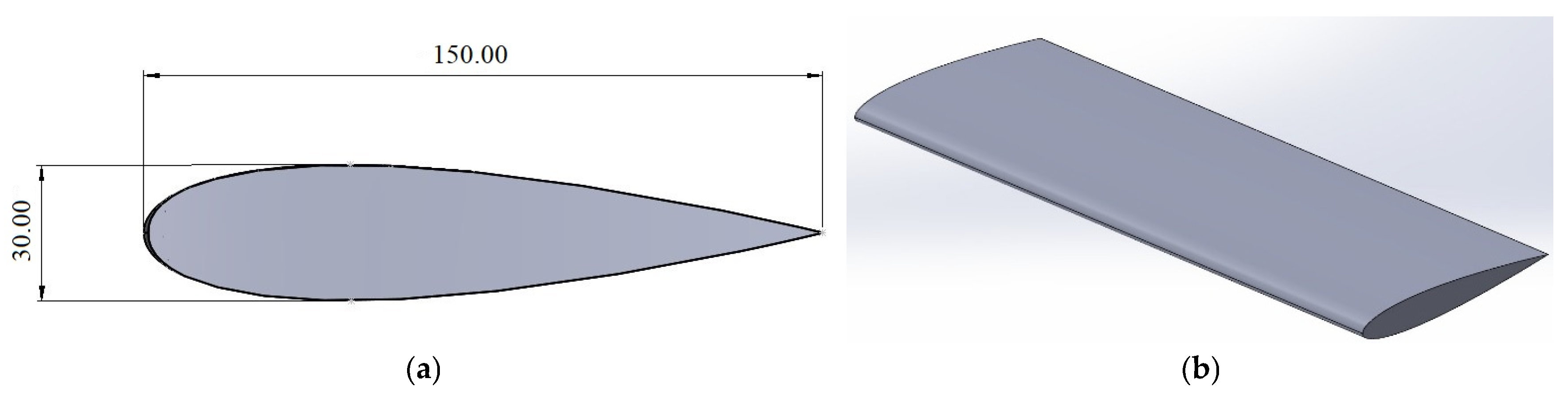
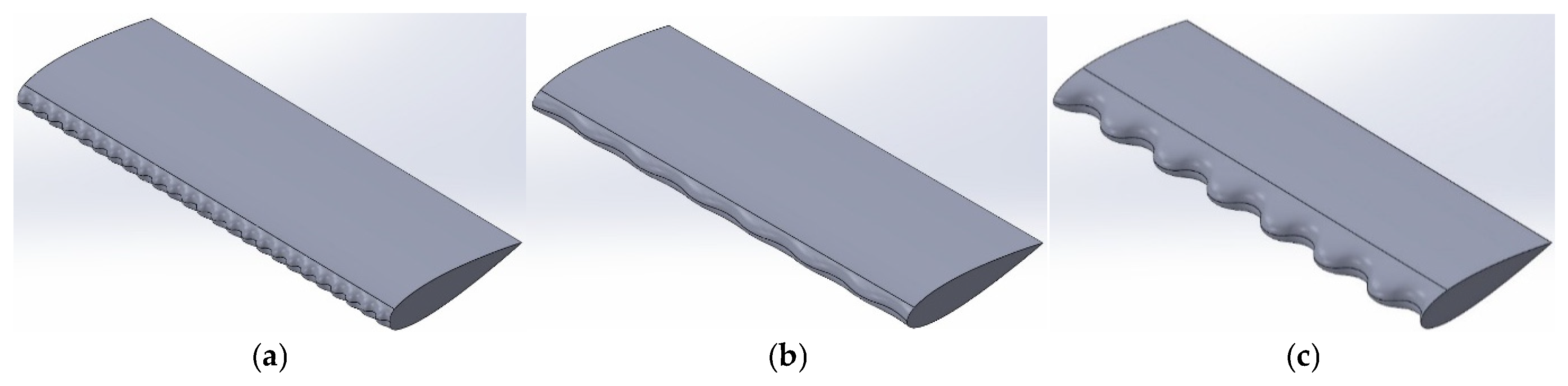
The NACA 0020 airfoil was designed using computer-aided design (CAD) software (SolidWorks 2023) with a chord length (c) of 150 mm and a span (z) of 300 mm, as illustrated in Figure 1. In addition, leading-edge wavy configurations were generated based on specified amplitude (A) and wavelength (λ) parameters. As shown in Figure 2, three wavy-wing cases were considered, A3L11 (A = 0.03c, λ = 0.11c), A3L40 (A = 0.03c, λ = 0.40c), and A11L40 (A = 0.11c, λ = 0.40c), following the reference study proposed by Paula [22].
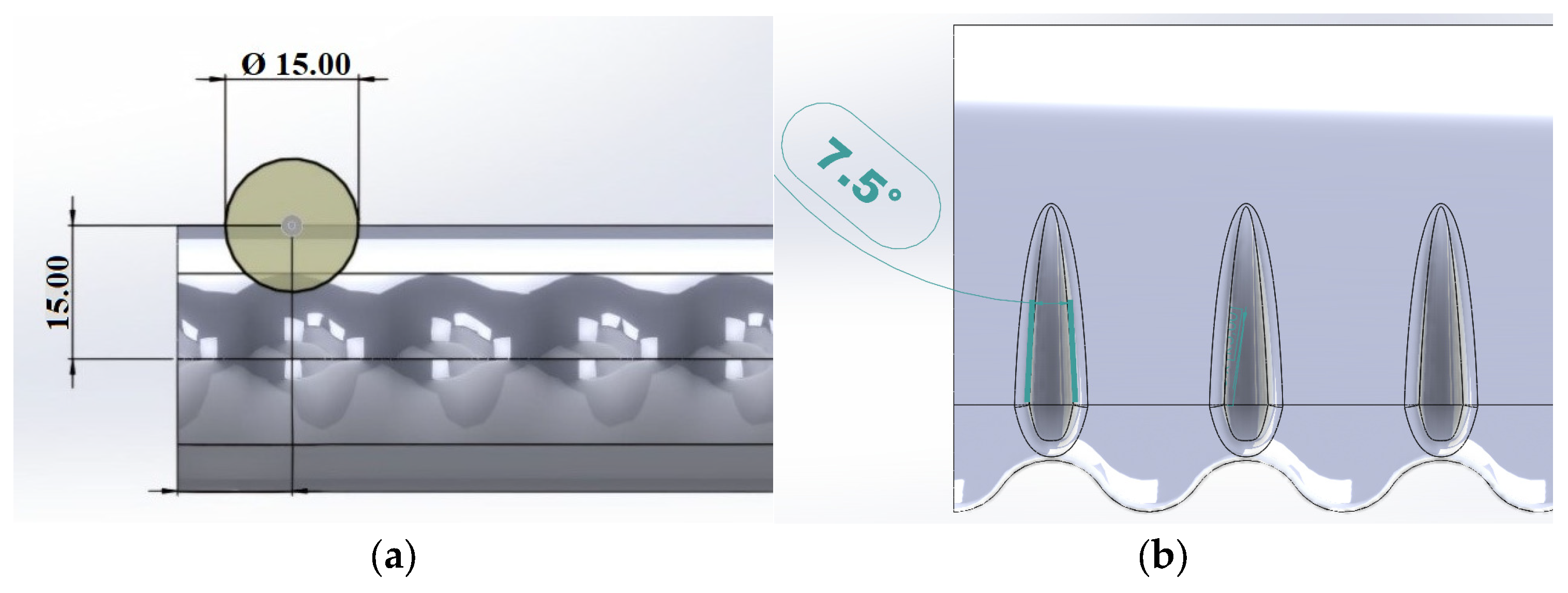
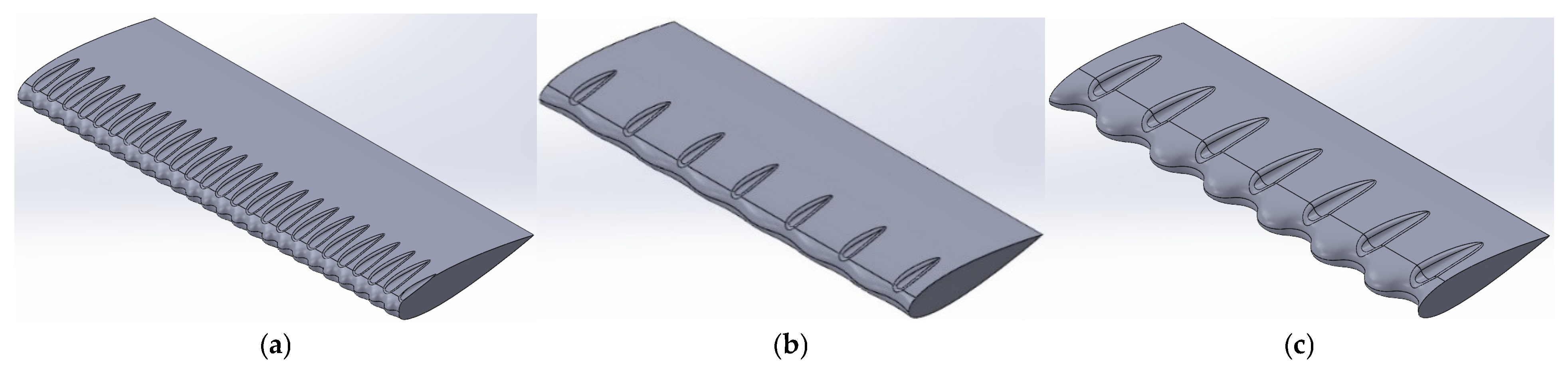
To investigate aerodynamic performance at various AoA, leading-edge wavy wings were modified by adding slots on the upper surface near the leading edge. The slot geometries were defined parametrically in this study based on geometric feasibility, manufacturing considerations, and preliminary numerical assessments, rather than adopting them from existing databases or prior studies. Three slot diameters—0.07c, 0.1c, and 0.13c—were tested for each configuration, with a fixed draft angle of 7.5° for all cases. The draft angle, shown schematically in Figure 3b, defines the inclination of the slot relative to the local wing surface and controls the orientation of the flow passing through it. Figure 3 summarizes the slotting parameters, and Figure 4 presents an isometric view of the modified wings with a 0.10c slot for all three configurations.

2.2. Mesh Generation and Boundary Conditions

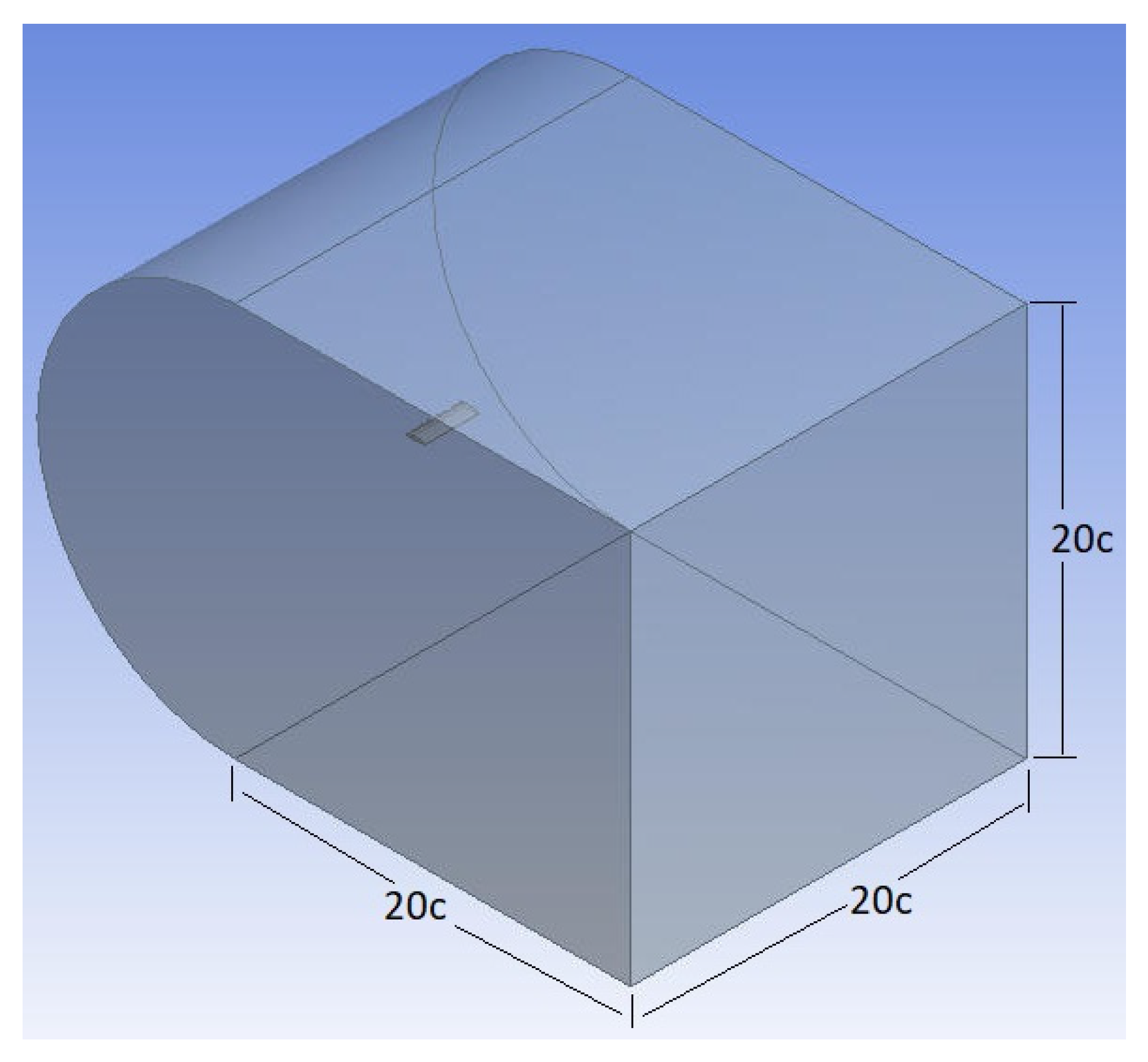
A C-shaped computational flow domain was generated for the solution, where the inlet and outlet were defined as a velocity inlet and a pressure outlet with a gauge pressure of zero, respectively. The remaining boundaries of the flow domain were defined as being symmetrical, and the wing was specified as a no-slip wall. The height and width of the flow domain were determined as 20c, and the distance from the trailing edge of the wing to the outlet was also 20c. Figure 5 shows the computational flow domain and its dimensions in terms of chord length.
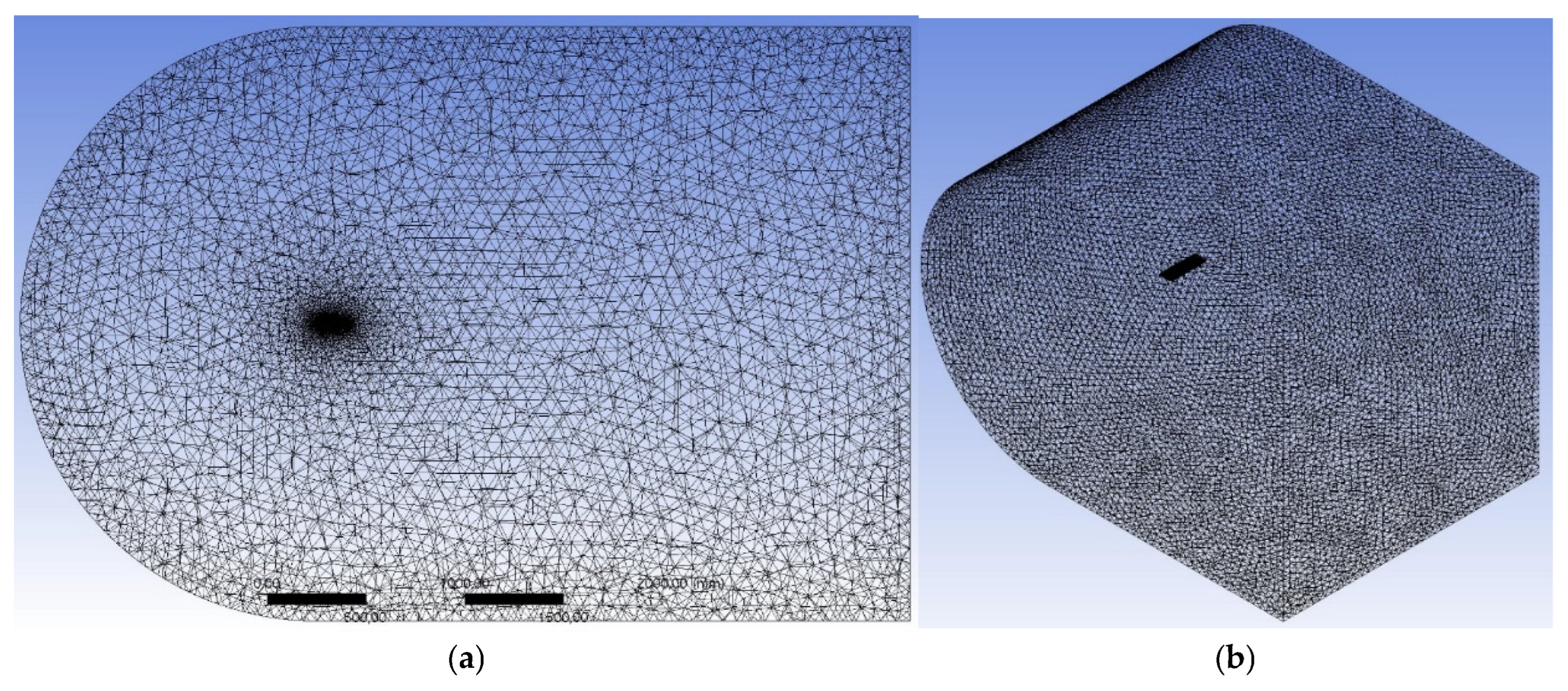
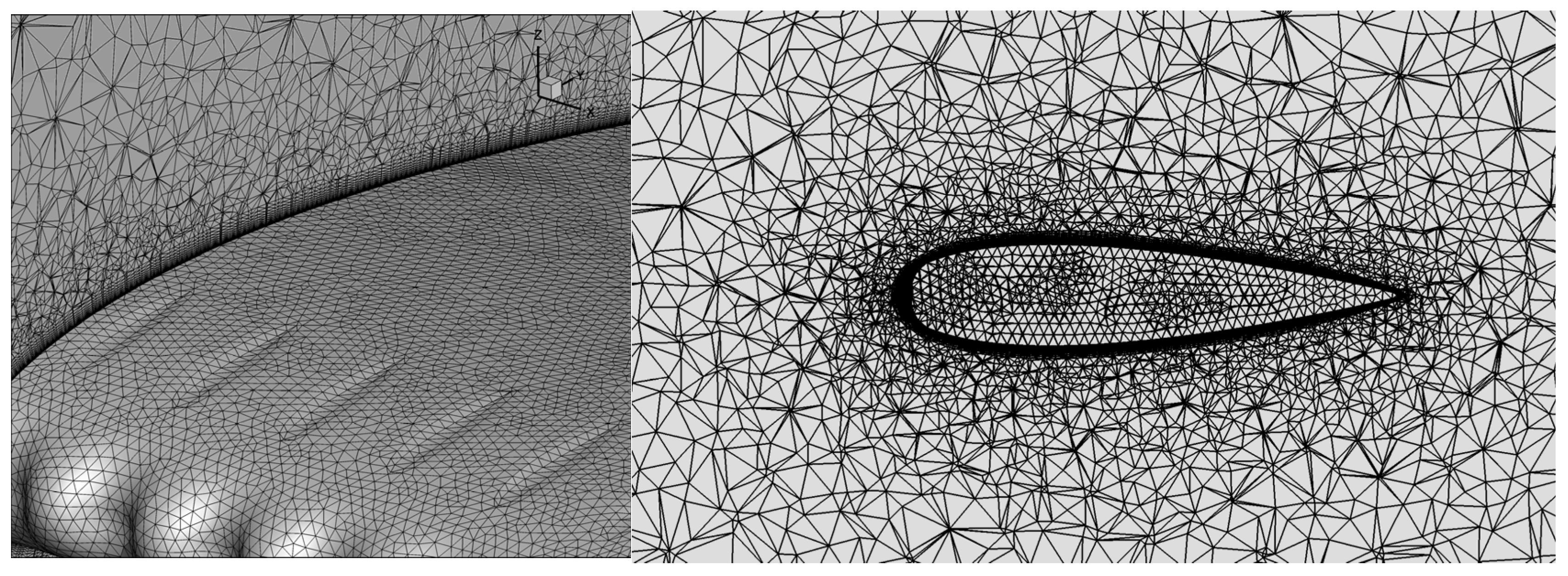
The meshing process was carried out using ANSYS Meshing (ANSYS 17.2) to discretize the computational flow domain. A structured hexahedral mesh was generated in the near-wall region of the wing to accurately resolve boundary-layer development and flow separation, while a tetrahedral mesh was employed in the remaining part of the flow domain. The near-wall mesh resolution was designed based on a target y+ value smaller than 1, consistent with the requirements of the SST k–ω turbulence model for resolving the viscous sublayer without wall functions, while local y+ values slightly above unity are generally considered acceptable. For the present Reynolds number (Re = 290,000), preliminary estimates of wall shear stress and friction velocity were used to determine the appropriate first-cell height. Accordingly, the first-layer height was set to 0.004 mm, and 15 inflation layers with a smooth growth ratio were applied to ensure accurate capture of boundary-layer behavior and flow separation. Additional face sizing was used to refine the mesh in regions of high flow gradients. The overall mesh topology and near-wall refinement are illustrated in Figure 6 and Figure 7.
For the slotted wing configurations, the mesh was locally refined around the slot regions to accurately capture the smaller geometric features. While the overall meshing strategy and near-wall resolution were consistent across all configurations, additional local refinement was required for the slotted wings. Grid convergence was evaluated based on aerodynamic performance metrics, and further refinement did not significantly affect the results.
As shown in Figure 4a, the small-scale slot features necessitated a finer mesh, with reduced face sizing and a first inflation layer height of 0.003 mm, to accurately resolve the flow field for slotted wing configurations.
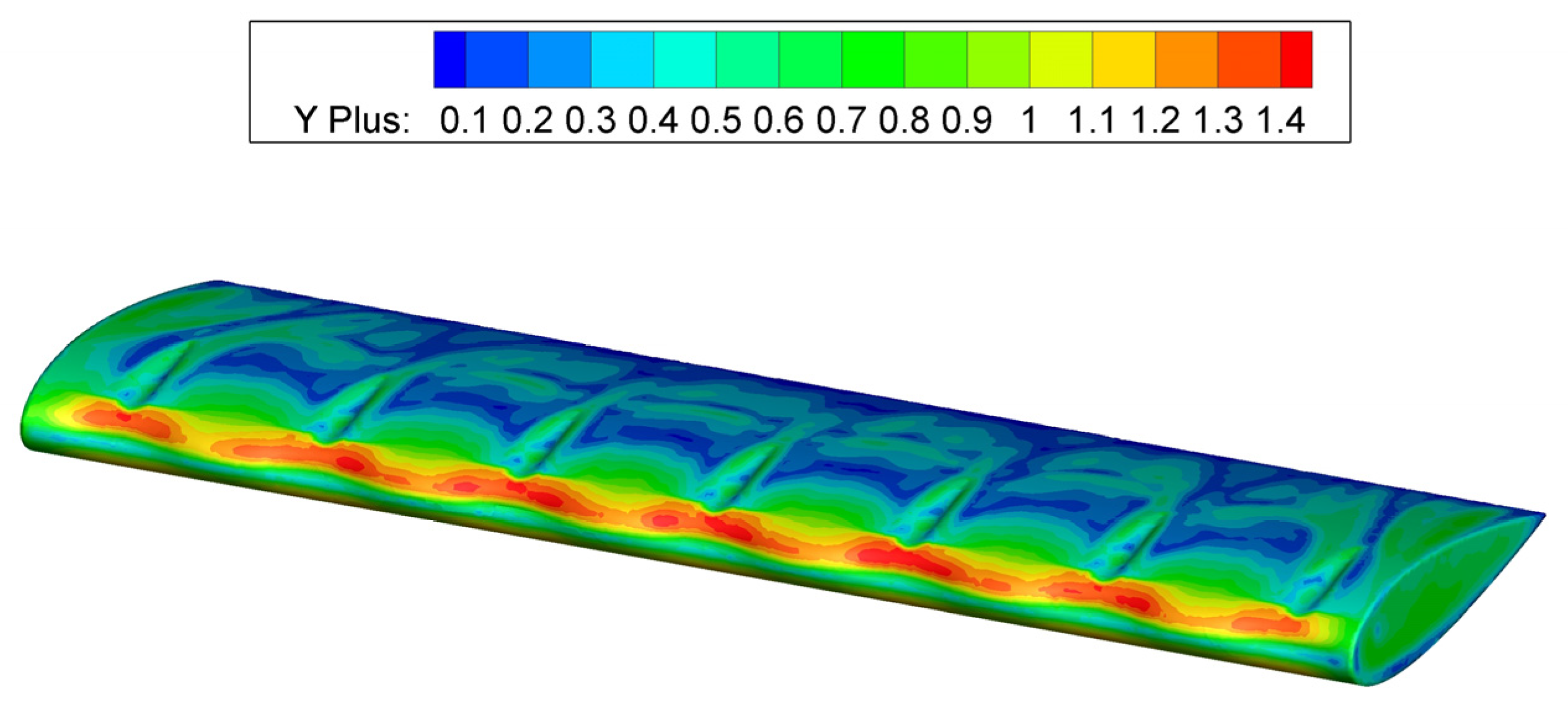
The non-dimensional parameter y+ value, which defines the distance from the wall to the first mesh cell in the boundary layer, directly affects solution accuracy and simulation results. To achieve the desired y+ value, inflation layers can be generated near walls, and mesh refinement can be applied to capture flow in the boundary layer. Therefore, determining the proper y+ value influences the accuracy of turbulence modeling and flow simulations. The resulting y+ contour is presented to verify that the intended near-wall resolution was achieved rather than to determine the mesh posteriori. Figure 8 shows the contour plot of the y+ distribution. As shown in the figure, the y+ values are smaller than 1 over the majority of the wing; however, they can exceed 1 in some regions, particularly near the leading edge.

2.3. Computational Model

Computational Fluid Dynamics (CFD) is a widely used numerical approach for solving the governing equations of fluid flow in engineering applications. In this study, the simulations were performed using ANSYS Fluent, which employs the Finite Volume Method (FVM) to discretize and solve the Reynolds-Averaged Navier–Stokes (RANS) equations. The RANS equations, derived from the Navier–Stokes equations, are commonly used in engineering analyses to model turbulent flows due to their computational efficiency and robustness [44]. The solutions were performed as three-dimensional (3-D), steady, viscous, and incompressible flow. The governing equations are given in Equations (1) and (2).
u x + v y + w z = 0
u u x + v u y + w u z = 1 ρ p x + ϑ 2 u x 2 + 2 u y 2 + 2 u z 2 + f
where p is the pressure, ρ is the density of the fluid, and u, v, w, are the velocities in x, y, z directions, respectively.
The turbulence model is used to simulate flow and observe the averaging effects of turbulence over the wing. Therefore, a turbulence model is incorporated into the RANS equations to accurately predict flow physics over the body. For this, various turbulence models have been improved to simulate the flow field for different bodies or geometries. In this study, the SST (Shear Stress Transport) k-ω turbulence model was employed, as it provides better results by accurately predicting flow separation in complex geometries. It is a hybrid two-equation turbulence model that combines the Standard k-ω and Standard k-ε model [45]. This turbulence model necessitates a fine mesh resolution, particularly in the near-wall region, which consequently increases the overall computational cost. The governing equations of the SST k-ω turbulence model are given in Equations (3) and (4).
k t + U j k x j = P k β * k ω + x j ν + σ k ν t k x j
ω t + U j ω x j = α P k ν t β ω 2 + x j ν + σ ω ν t ω x j + 2 1 F 1 σ ω 2 ω k x j ω x j
where k is the turbulent kinetic energy, ω is the specific dissipation rate, Pk is the production of turbulent kinetic energy, and β and β* are model constants for ω dissipation and k dissipation, respectively. α is a model constant for ω production, σk is turbulent Prandtl number for k, σω is the turbulent Prandtl number for ω, σω2 is second turbulent Prandtl number for ω (SST model), ѵt is eddy viscosity, F1 is the blending function, Uj is the mean velocity component, and xj is the spatial coordinate.
The solution was performed using a pressure-based solver with the Green–Gauss cell-based scheme, and the second-order upwind method was applied for all other spatial discretization parameters. Simulations were carried out under steady-state flow conditions, viscous and three-dimensional. A velocity inlet was selected at the inlet, and a pressure outlet with a gauge pressure of 0 Pa was set at the outlet. The wing surface was modeled as a no-slip wall to account for the effects of viscous flow. The convergence criterion was set to 10−5, and the computation run was to be finished when the variation in aerodynamic coefficients was negligibly small over the last 100 iterations.

2.4. Broadband Source Acoustic Analysis

Aeroacoustics is a branch that investigates sound generated by flow motion, particularly airflow interacting with the surface or wall of a body. Aerodynamic noise is often associated with flow irregularities, separation, and turbulence. These flow features are also typically linked to degraded aerodynamic performance through increased drag and loss of useful flow energy [46]. In this study, a CFD analysis was performed for steady-state flow, and the noise source power level was estimated based on the magnitude of the resulting turbulence, such as kinetic energy and dissipation rate. This methodology was proposed by Proudman [47]. The acoustic formula derivation, using Lighthill’s acoustic analogy [48], was performed to obtain the acoustic power for isotropic turbulence without a mean flow, following Proudman [47]. Although Lilley [49] extended the theory to account for retarded-time effects in unsteady turbulence, in the steady-state application, these effects are approximated using the mean turbulence quantities obtained from the CFD solution. The prediction using the steady-state broadband noise model is given by Equation (5).
P = C ρ 0 ε 2 α 0 5
where P is the acoustic source power density (W/m3), C is the calibration constant (dimensionless), ρ0 is the density (kg/m3), ε is the turbulent dissipation rate (m2/s3), and α0 is the speed of sound in the medium (m/s).
It should be noted that the Proudman broadband noise model employed in this study is used as a comparative aeroacoustic source indicator rather than an absolute far-field noise prediction tool. Noise mechanisms such as trailing-edge scattering, vortex shedding, and laminar–turbulent transition noise typically require unsteady flow simulations and advanced acoustic analogies, which are beyond the scope of the present steady-state optimization framework. The present approach focuses on evaluating relative changes in acoustic source strength under identical numerical conditions, enabling a consistent comparison among different geometric configurations.
It should further be emphasized that turbulence dissipation and the derived acoustic source metrics are more grid-sensitive than integrated aerodynamic quantities such as lift and drag coefficients. Accordingly, the reported acoustic source levels are not interpreted as mesh-independent absolute values, but as comparative indicators. All configurations were evaluated using the same meshing methodology, refinement strategy, and near-wall resolution targets, and only relative differences observed under these consistent numerical settings are discussed.

2.5. Mesh Sensitivity and Validation Analysis

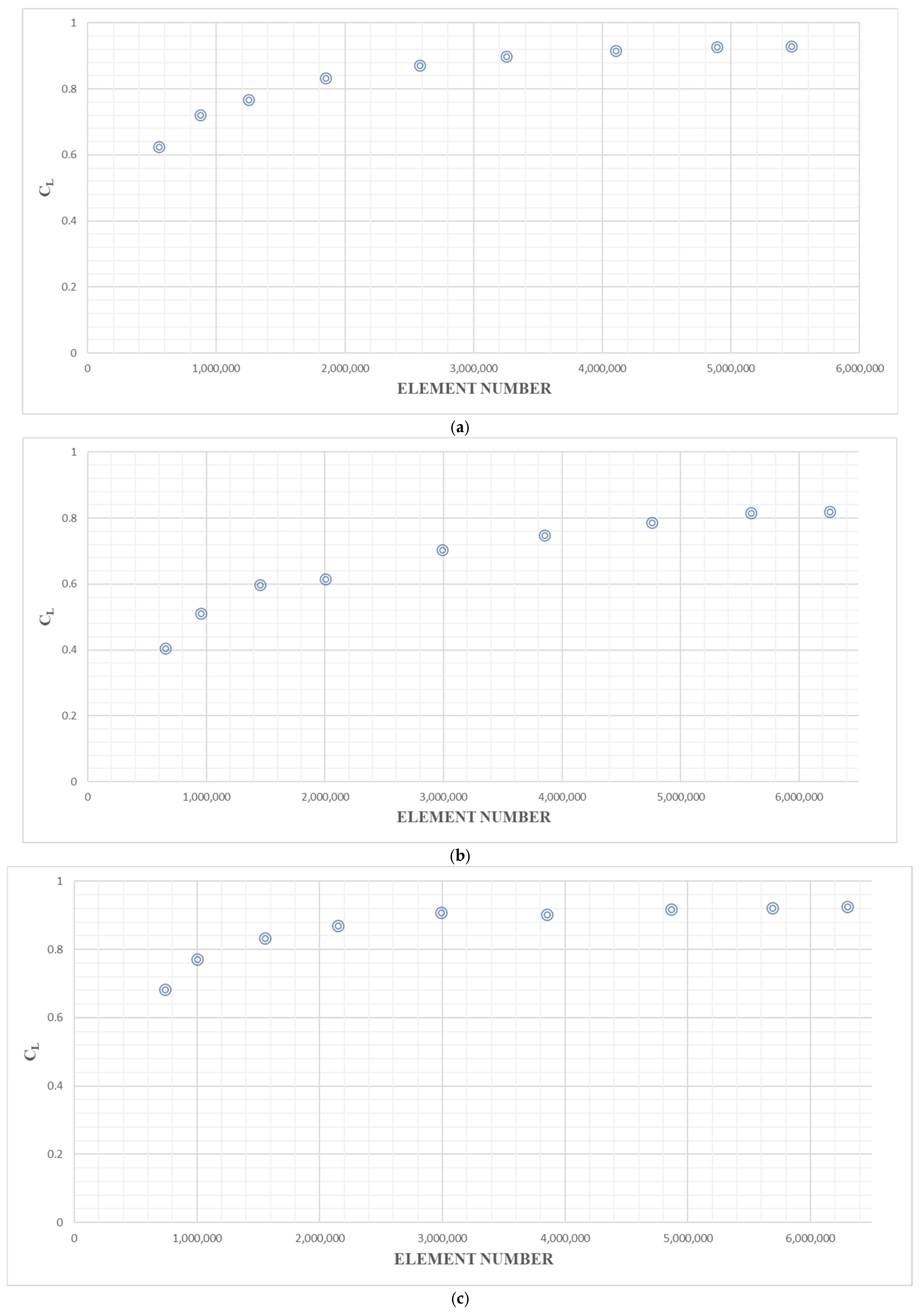
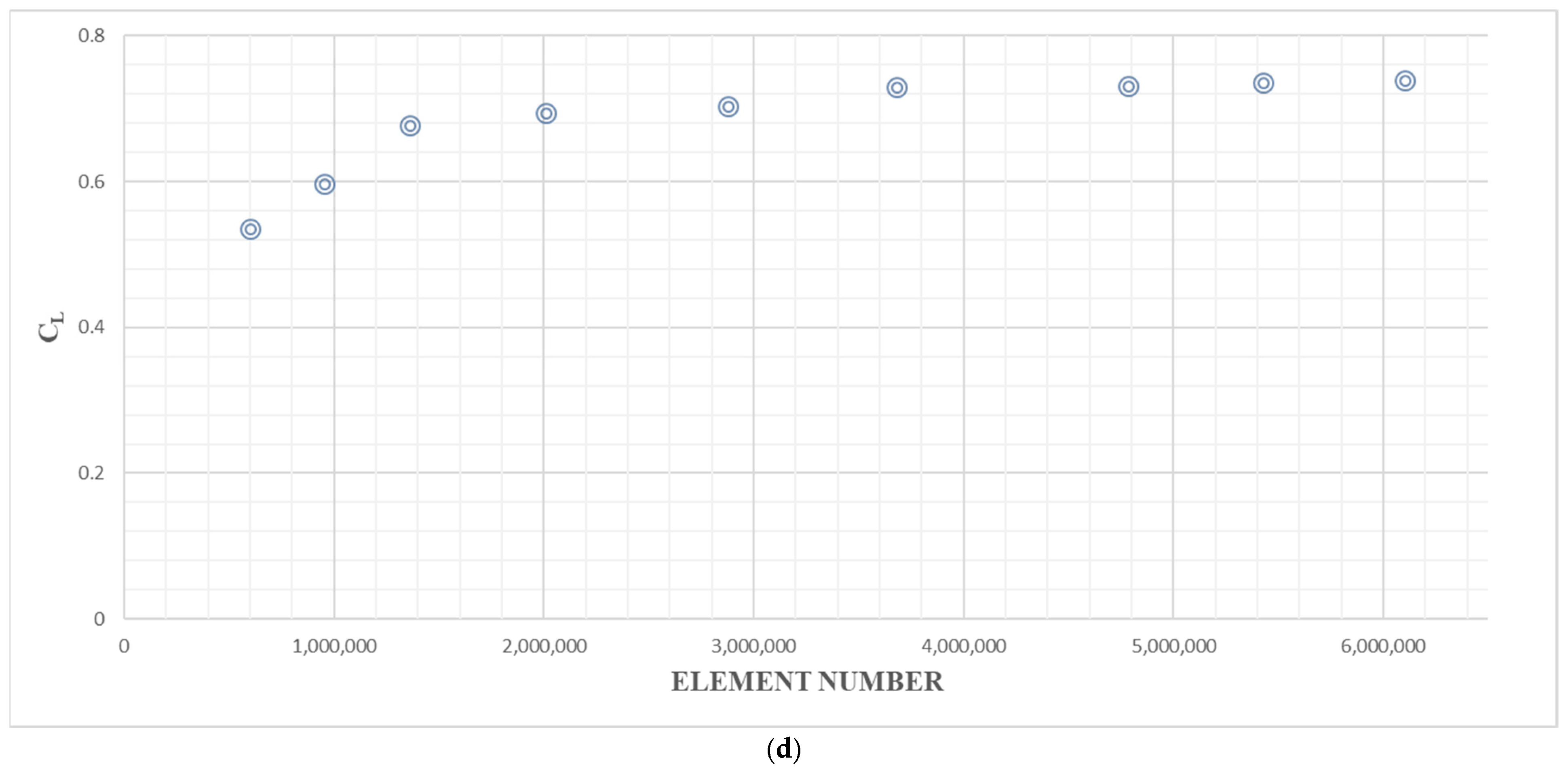
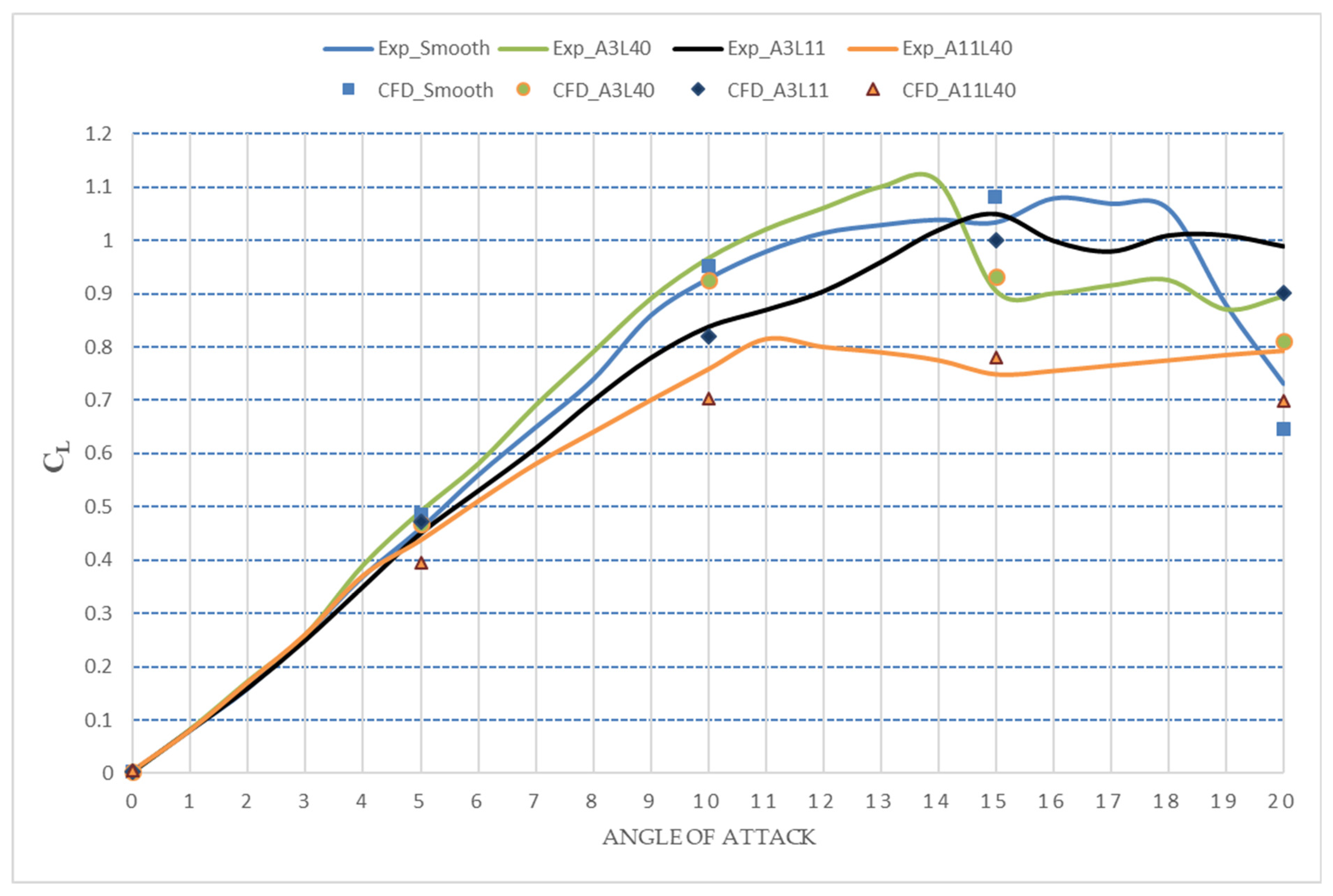
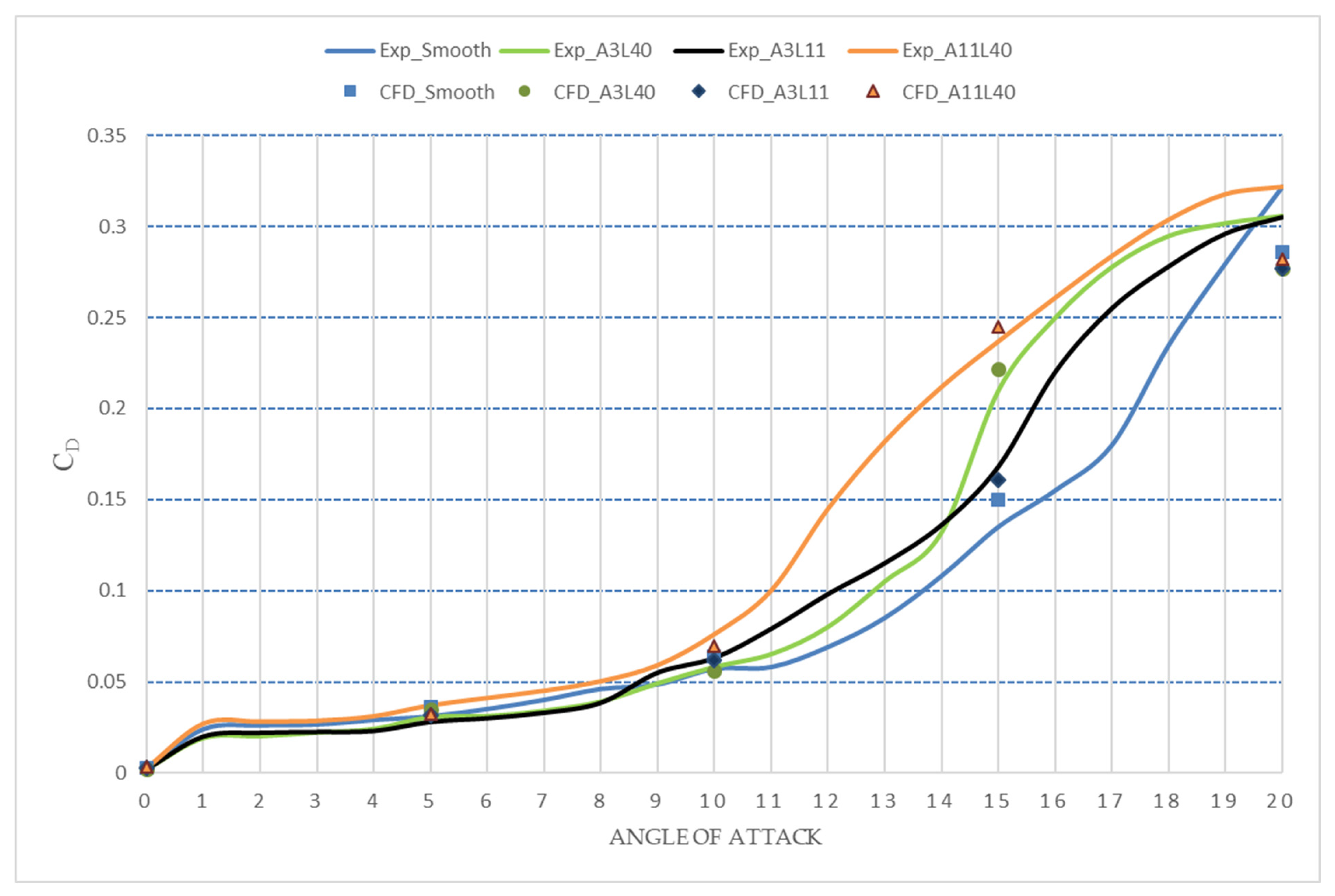
The mesh sensitivity is a process that indicates a sufficient number of mesh elements and ensures accurate results. In this study, four configurations—smooth, A3L11, A3L40, and A11L40—were analyzed, and a mesh sensitivity study was performed for each. The mesh sensitivity and validation for the lift coefficient (CL) are presented in Figure 9 at a Reynolds number of 290,000 and 10° AoA. The sufficient mesh element counts for the smooth, A3L11, A3L40, and A11L40 configurations were 3250456, 4770956, 3865785, and 3692855, respectively. Validation was performed by comparing numerical results with the experimental data reported by Paula [22], showing good agreement within acceptable limits. CFD simulations were conducted at selected angles of attack (5°, 10°, 15°, and 20°) to capture key pre-stall and post-stall flow regimes. These discrete CFD results were compared with the full experimental trends to evaluate the capability of the numerical framework in reproducing overall aerodynamic behavior. Figure 10 and Figure 11 present the validation of lift and drag coefficients by comparing the present CFD results with the experimental data reported by Paula [22].

3. Results and Discussion

3.1. Aerodynamic Flow Characteristics

The aerodynamic and aeroacoustic characteristics of the NACA0020 wing with A3L11, A3L40, and A11L40 leading-edge waviness configurations were systematically investigated at a Reynolds number of 290,000 and AoA of 10°, 15°, and 20°. The numerical results, including pressure contours and streamlines around the wing, are presented to observe the flow field and compare the aerodynamic performance among configurations. The wing configurations and their experimental results were adopted as reference data from Paula’s [22] study.
Figure 10 and Figure 11 show the lift and drag coefficients, respectively, obtained from the present CFD simulations in comparison with the full experimental data reported by Paula [22] for the smooth wing and the A3L11, A3L40, and A11L40 wavy leading-edge configurations over a wide range of AoA. As illustrated in Figure 10, the numerical results successfully reproduce the overall trends of the experimental lift curves across the pre-stall, stall, and post-stall regimes. Although minor discrepancies are observed near the stall onset, the relative lift behavior among the different configurations is well captured, enabling a clear comparison of their aerodynamic characteristics.
Figure 11 further demonstrates that drag predictions are more sensitive, particularly in the post-stall region where flow separation becomes dominant. While certain wavy-wing configurations exhibit lift enhancement at higher angles of attack, these improvements are not always accompanied by corresponding drag reductions. This observation highlights the nuanced aerodynamic behavior of wavy wings and emphasizes the importance of evaluating lift and drag simultaneously. Based on the validated lift and drag trends shown in Figure 10 and Figure 11, the lift-to-drag ratios presented in Table 1 provide a consistent and reliable basis for comparing different configurations and supporting the subsequent shape optimization process.
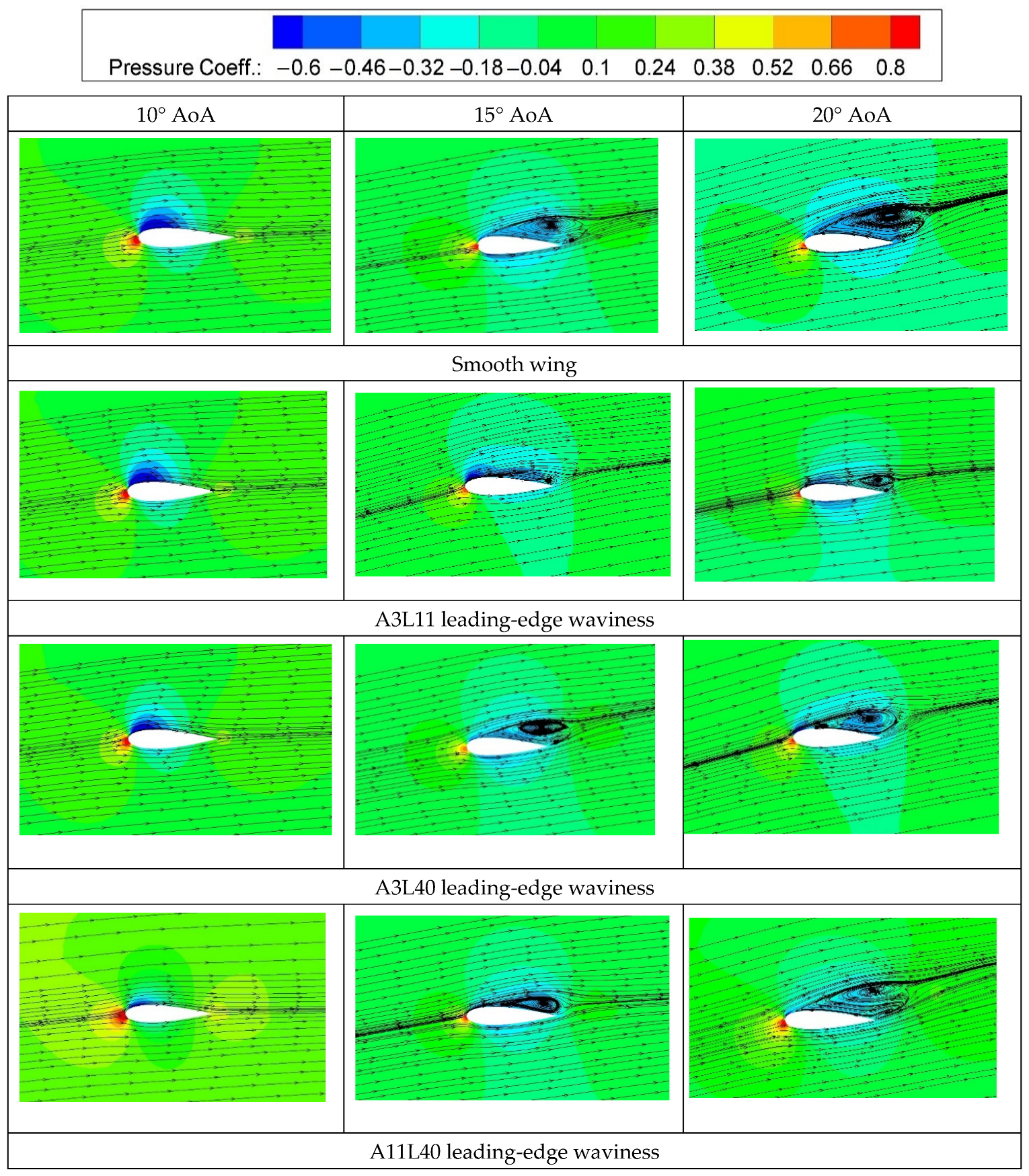
Paula’s [22] results indicated that at 10° AoA and Re = 290,000, the A3L11 and A3L40 wavy-wing configurations reduced drag, whereas the A11L40 configuration showed increased drag and a slight decrease in lift compared to the smooth wing. Numerical results revealed similar trends in pressure contours and streamlines, indicating good pre-stall flow and explaining the drag reduction for A3L40. The experimental study also showed that at 15° AoA, A3L40 performance was reduced due to post-stall conditions, while A3L11 maintained flow control and exhibited soft stall characteristics. The A11L40 configuration exhibited lower aerodynamic performance compared to the A3L11 configuration. At 20° AoA, A3L11 and, in some cases, A11L40 showed smoother post-stall behavior and higher flow attachment than the baseline, whereas A3L40 experienced full flow separation, and the smooth wing showed abrupt stall. The numerical analysis at 15° and 20° AoA was consistent with these experimental findings, demonstrating close agreement between numerical predictions and experimental data. Figure 12 presents pressure contours (Cp) and streamlines at a Reynolds number of 290,000 and AoA of 10°, 15°, and 20° for the smooth wing, A3L11, A3L40, and A11L40 configurations (z/c = 0.5).
To improve clarity in flow-field interpretation, key flow features are identified in pressure coefficient and streamline visualizations. Regions of attached flow are characterized by smooth streamlines following the airfoil contour and gradual pressure recovery, whereas separated flow regions exhibit reversed streamlines and low-pressure zones near the suction surface. Flow reattachment is indicated by streamlines reorganizing downstream of the separation point, accompanied by local pressure recovery. Leading-edge suction peaks, separation onset, and reattachment locations are qualitatively analyzed to facilitate consistent interpretation of aerodynamic behavior.
The leading-edge waviness fundamentally alters the flow topology. All three designs generate streamwise vortical structures originating from geometric undulations along the leading edge. These vortices act as a passive flow-control mechanism, re-energizing the boundary layer and locally enhancing momentum exchange. At 10° AoA, all configurations remain in the pre-stall regime. The smooth wing exhibits a pronounced leading-edge suction peak followed by a strong adverse pressure gradient, while A3L11 and A3L40 display locally enhanced suction at waviness crests and smoother pressure recovery, indicating improved boundary-layer stability. A11L40 shows a more complex pressure distribution due to stronger streamwise vortices, consistent with modest drag reduction at low AoA. At 15° AoA, the smooth wing experiences early leading-edge separation with rapid lift loss, whereas A3L11 maintains partial flow attachment and soft stall behavior. A3L40 shows locally modified separation patterns, but large-scale separation persists. Although A11L40 generates strong streamwise vortices, these only locally alter flow topology and cannot fully suppress separation at this angle. At 20° AoA, both A3L40 and A11L40 exhibit near-complete flow separation, similar to the smooth wing, while A3L11 shows relatively smoother flow and localized attachment.
Comparison among configurations revealed distinct performance influenced by wavelength and amplitude of the waviness. The A3L11 configuration, with smaller geometric variations, exhibited moderate vortex formation that provides partial improvement in boundary-layer stability. The A3L40 configuration, with a longer wavelength, generated more coherent and persistent vortices, which significantly alter the pressure gradients and streamline curvature. A11L40, with both larger amplitude and longer wavelength, produces the strongest flow-control effects; however, these only locally mitigate separation at high AoA without slot-induced momentum injection. Increasing the geometric scale of waviness amplifies passive aerodynamic benefits.
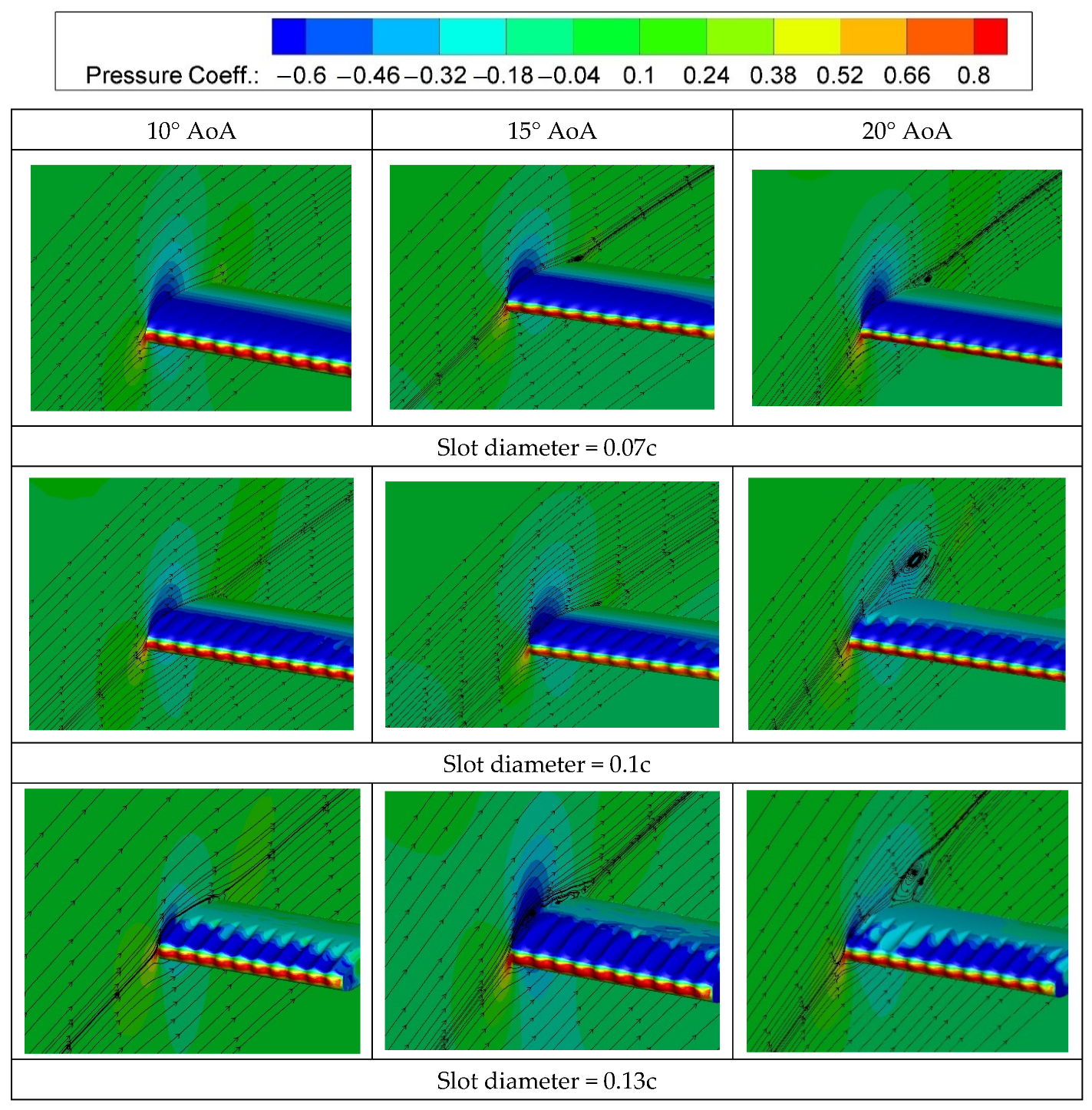
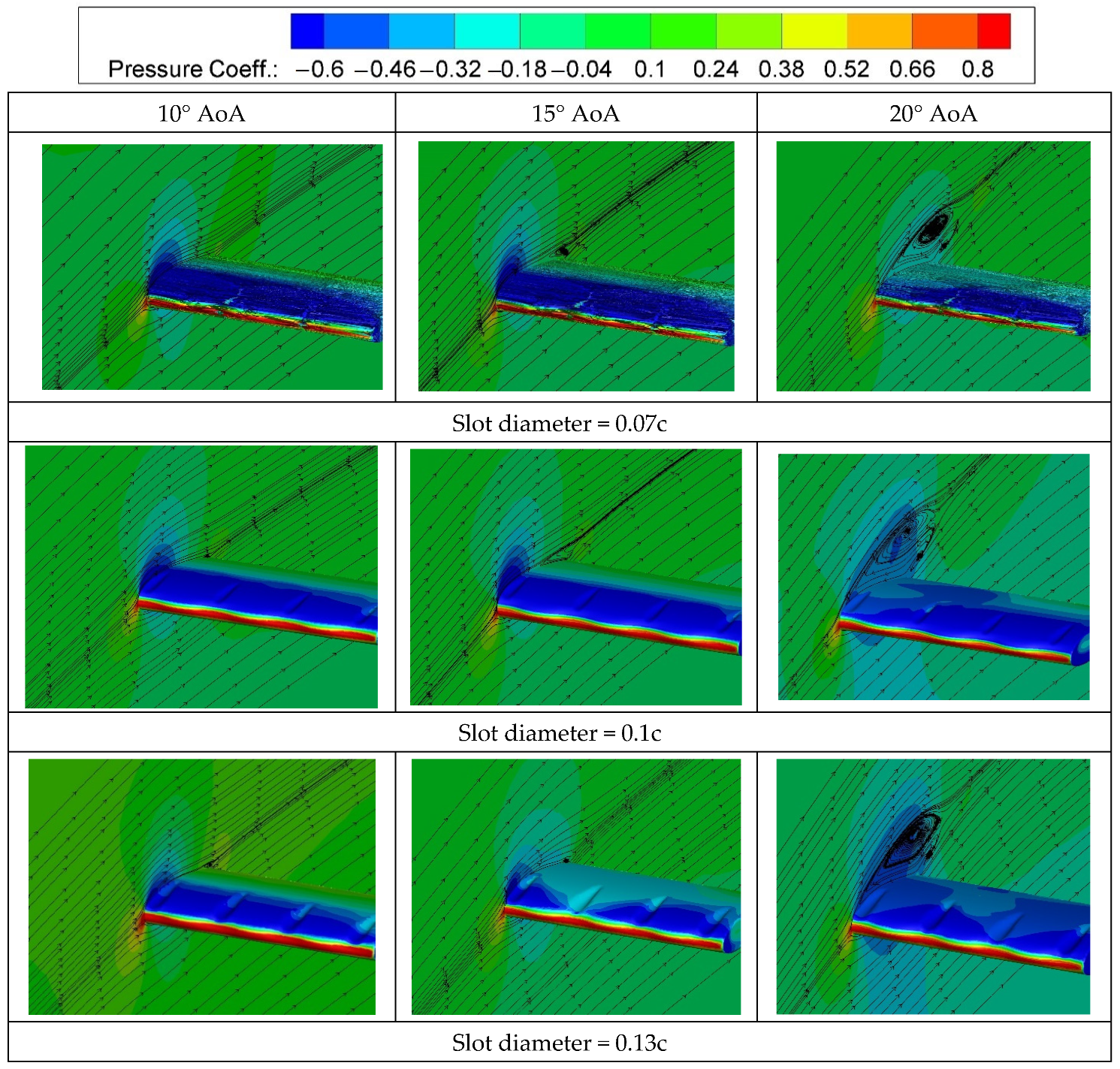
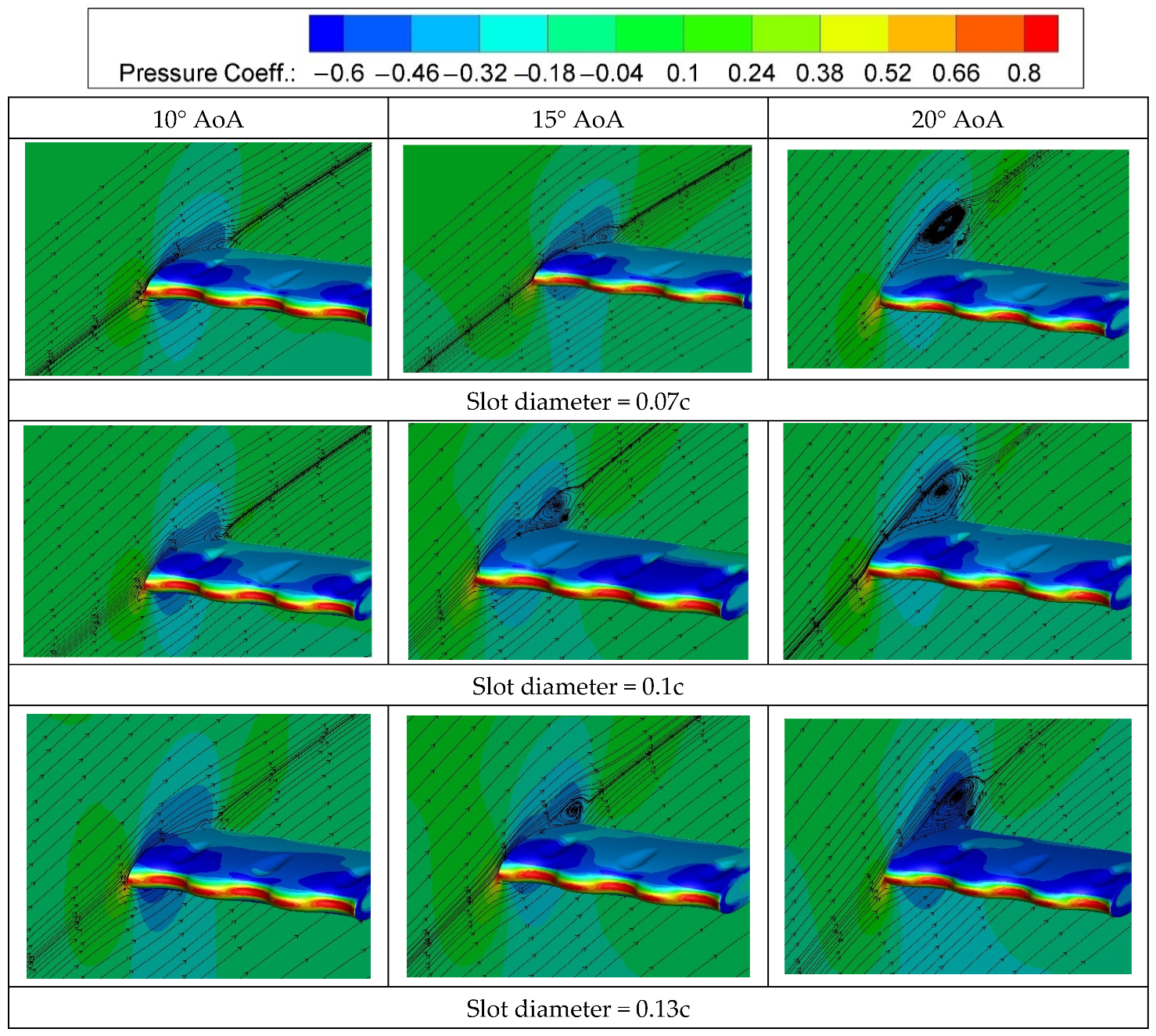
Figure 13, Figure 14 and Figure 15 illustrate the flow field of the modified NACA0020 wing with A3L11, A3L40, and A11L40 leading-edge waviness configurations, incorporating slot diameters of 0.07c, 0.10c, and 0.13c at Re = 290,000 and AoA = 10°, 15°, and 20°. Slots generally promote flow reattachment in post-stall conditions, with the magnitude of improvement strongly dependent on the waviness geometry. Among the configurations, A11L40 shows the most pronounced enhancement in flow attachment with increasing slot diameter. The interaction between slot-induced momentum and waviness-generated vortices creates a combined flow-control mechanism that improves boundary-layer stability in post-stall conditions.
The results showed that slot diameter affects the aerodynamic response. Although larger slot diameters generally improved post-stall aerodynamic performance, the results indicate that the optimal slot size is not universal and depends on both the waviness configuration and the angle of attack. In particular, while the A11L40 configuration benefited consistently from increased slot size, the A3L11 and A3L40 configurations exhibited non-monotonic variations in lift-to-drag ratio, highlighting the importance of configuration-specific optimization. At 20° AoA, for instance, the A11L40 with 0.13c slot diameter configuration demonstrated the coherent streamline development, with flow remaining attached over a significant chordwise region where the smooth wing exhibited strong detachment. These findings suggested a combined effect of waviness geometry and slot dimension, together influencing the spanwise and streamwise redistribution of momentum in the boundary layer. The CFD results for all configurations, with and without a slot, at Re = 290,000 and AoA of 10°, 15°, and 20°, are given in Table 1 to compare the lift-to-drag ratios (CL/CD) and the corresponding performance improvements.
Beyond the macroscopic observation of delayed flow separation, the slot channel modifies the near-wall flow physics by locally altering the boundary-layer velocity profile. The momentum injection through the slot increases the near-wall streamwise velocity, resulting in a fuller boundary-layer profile and enhanced resistance to adverse pressure gradients. This momentum redistribution suppresses low-momentum fluid accumulation near the wall and weakens the formation of large-scale separation bubbles.
Moreover, the interaction between the slot-induced flow and the streamwise vortices generated by the leading-edge waviness leads to a synergistic flow-control mechanism. The slot flow stabilizes and elongates the vortical structures along the chordwise direction, promoting more uniform momentum exchange and reducing turbulent energy dissipation. Consequently, regions with delayed separation are associated with reduced turbulent dissipation and improved flow organization, particularly near the leading-edge and mid-chord regions at high AoA.

3.2. Comparative Broadband Aeroacoustic Source Analysis

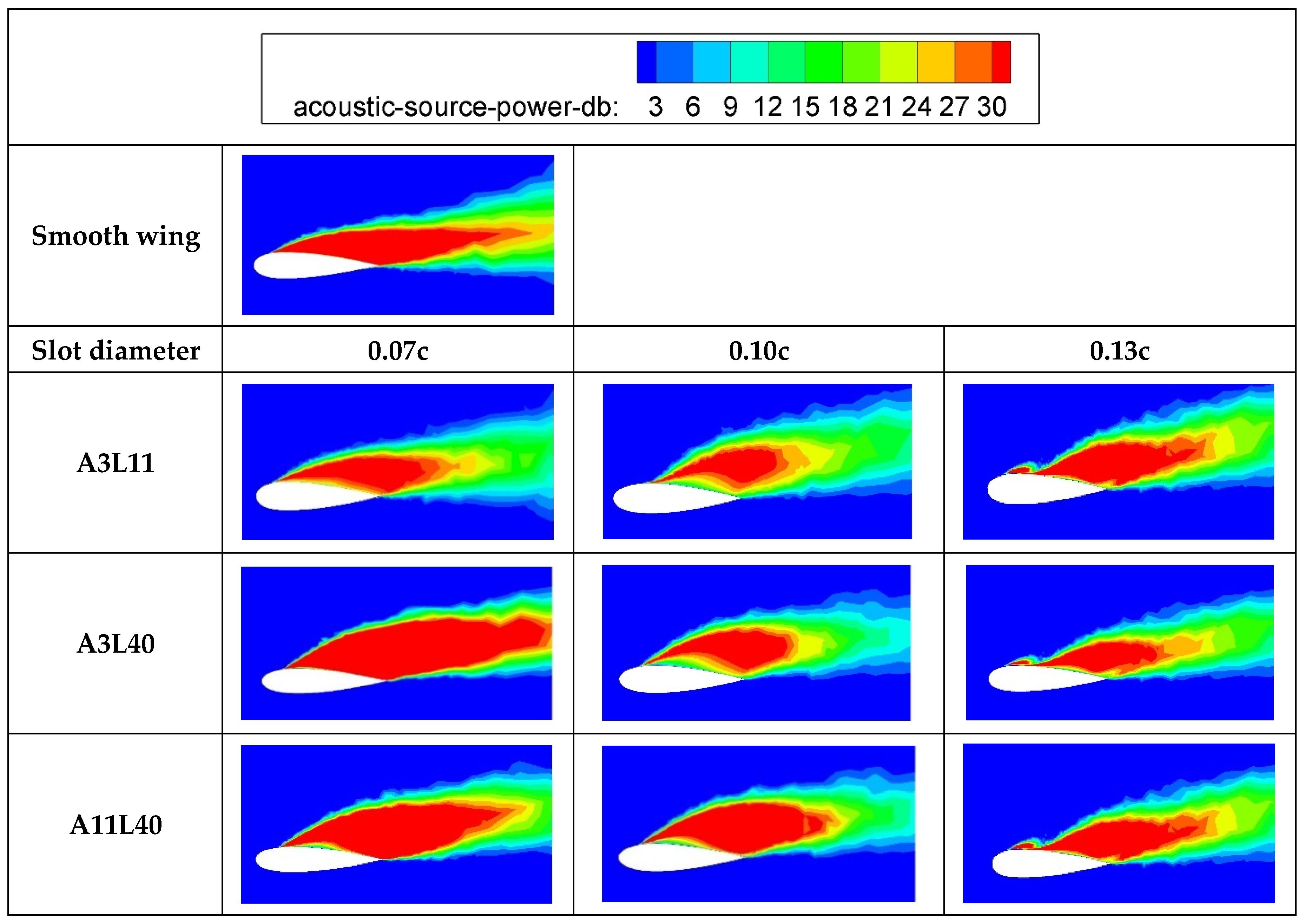
The aeroacoustic performance of the generated configurations was analyzed using acoustic-source power-level distributions. Figure 16 presents the acoustic source power level distributions for the modified NACA0020 wing with the A3L11, A3L40, and A11L40 leading-edge configurations at a Reynolds number of 290,000 and angles of attack of 20°, shown for slot positions at 0.07c, 0.10c, and 0.13c. The acoustic source power level contours represent relative broadband noise source distributions derived from the Proudman model. Although absolute sound pressure levels are not computed within the present steady-state framework, the normalized color scale enables a comparative assessment of noise-generating regions among different configurations. Regions of reduced acoustic source intensity indicate weakened turbulent structures and delayed flow separation; therefore, relative reductions in acoustic source power are used as indicators of noise mitigation effectiveness rather than absolute decibel-based metrics.
It should be noted that the broadband noise model used here is based on steady-state RANS turbulence quantities and is intended for comparative evaluation rather than absolute aeroacoustic prediction. The approach does not resolve unsteady acoustic wave propagation or far-field sound pressure levels but instead provides a relative indicator of broadband noise-source strength under identical numerical conditions.
The aeroacoustics analysis of the smooth wing revealed a pronounced increase in acoustic source power level within a highly localized region near the leading edge, which is consistent with the large-scale separation observed in the Cp distributions and streamline results. This behavior is characteristic of strong broadband noise generation dominated by coherent turbulent structures. The application of leading-edge waviness configurations significantly altered the distribution of acoustic sources. In the A3L11 configuration, increasing the slot diameter resulted in moderate reductions in peak acoustic source power levels, consistent with the limited improvements in flow attachment observed aerodynamically. The A3L40 configuration exhibited an intermediate response; while peak acoustic levels decreased at larger slot diameters, the acoustic field remained non-uniform due to persistent separated flow regions. The most significant aeroacoustic improvement was achieved with the A11L40 configuration. Increasing the slot diameter led to a marked reduction in peak acoustic source power levels together with a more uniformly distributed acoustic energy field, indicating a weakening of localized dominant noise sources. The acoustic source distributions closely correlated with the underlying flow structures, particularly the extent and stability of separated regions and associated vortex dynamics.
Overall, increasing the slot diameter altered the redistribution of aerodynamic forces and favorably influenced the aeroacoustic behavior. Larger slot sizes reduced the coherence of turbulent structures, resulting in lower peak acoustic source intensities and reduced localized broadband noise-source indicators. This suggests a beneficial coupling between passive flow control and broadband noise-source mitigation indicators. Similar findings have been reported in the literature, where passive flow control modifications such as leading-edge modifications have been applied, resulting in reported noise reduction trends, particularly under high-lift and separated flow conditions [50,51].
It is important to emphasize that broadband acoustic source metrics derived from turbulence quantities are inherently more mesh-sensitive than integrated aerodynamic coefficients. For this reason, the reported source levels are interpreted strictly on a relative comparative basis across configurations computed with identical grid strategies.
It should be noted that the acoustic source power density in this study was estimated using turbulence dissipation rates obtained from steady RANS simulations. While this approach does not capture unsteady turbulent fluctuations, it is suitable for identifying relative trends and comparative aeroacoustic improvements among different configurations rather than providing absolute noise predictions. For geometrically complex cases involving larger numbers of slots, locally refined meshes were employed to adequately resolve flow features. Comparable near-wall resolution and consistent meshing strategies were maintained across all simulations to minimize grid-related effects.
Despite the demonstrated aerodynamic and aeroacoustic benefits, the implementation of wavy and slotted wing geometries may introduce certain practical challenges. From a manufacturing perspective, these geometries are inherently more complex than conventional smooth wings, potentially leading to increased production costs and fabrication difficulty. Moreover, the inclusion of slots may raise structural integrity and maintenance considerations in operational aerospace applications. Nevertheless, ongoing advances in modern manufacturing technologies, particularly additive manufacturing, offer viable pathways to address these challenges. As such, passive flow control concepts based on leading-edge modifications are becoming increasingly feasible for practical implementation.

4. Optimization

Optimization is the process of maximizing or minimizing an objective function with respect to selected parameters under given constraints.

4.1. Objective Functions

The goal of an optimization problem can be expressed as a mathematical function, referred to as the objective function, which may be formulated as a minimization or maximization problem depending on the application [52]. In the present study, the optimization objective is to maximize the lift coefficient and simultaneously minimize the drag coefficient. Accordingly, the lift and drag coefficients of the wing are defined as the objective functions.

4.2. Design Variables and Constraints

The optimization problems may include some constraints or limitations, and the results of objective functions are determined under these constraints. Design parameters were first selected, and their upper and lower values were determined for specified problems. In the study, the slot diameter (Ds) and the distance between the slot center and the chord line (dsc) were determined as design parameters of modified leading-edge wavy wings. The lower boundary (LB), the upper boundary (UB), and the baseline of the selected design variables are presented in Table 2. In addition, the drag coefficient should be smaller than the baseline one, while the lift coefficient should be higher than the initial configuration. These constraints are given in the following inequalities, Equations (6) and (7).
C L , o p t C L ,   b a s e l i n e
C D ,   o p t C D ,   b a s e l i n e

4.3. Optimization Solutions

In the present study, a Genetic Algorithm (GA) that was described and explained by Goldberg [53] and Holland [54] was employed to identify optimal design configurations for enhanced aerodynamic performance due to its robustness and suitability for complex engineering optimization problems. The optimization process was carried out entirely within the ANSYS Workbench toolchain, utilizing its built-in Design Exploration and Genetic Algorithm capabilities directly coupled with the CFD solver.
A surrogate-based optimization framework was adopted to reduce the computational cost associated with direct CFD-based optimization. Design points were generated using the Design of Experiments (DoE) approach, specifically the Central Composite Design (CCD) method, which is widely used for constructing second-order (quadratic) response surfaces while minimizing the number of required simulations [55]. In this study, nine design points were generated for two input design variables, and the corresponding aerodynamic output responses were obtained from CFD simulations.
Based on these results, a response surface was constructed to approximate the relationship between the input design variables and the output parameters within the defined design space. The response surface does not directly provide exact optimal values; instead, it serves as a surrogate model that enables efficient exploration of the design space. A Kriging model with a Gaussian kernel function was employed due to its proven capability in accurately modeling nonlinear relationships with limited sample sizes and its effectiveness in aerodynamic shape optimization involving complex flow phenomena [56]. The Gaussian kernel ensures smooth interpolation between design points.
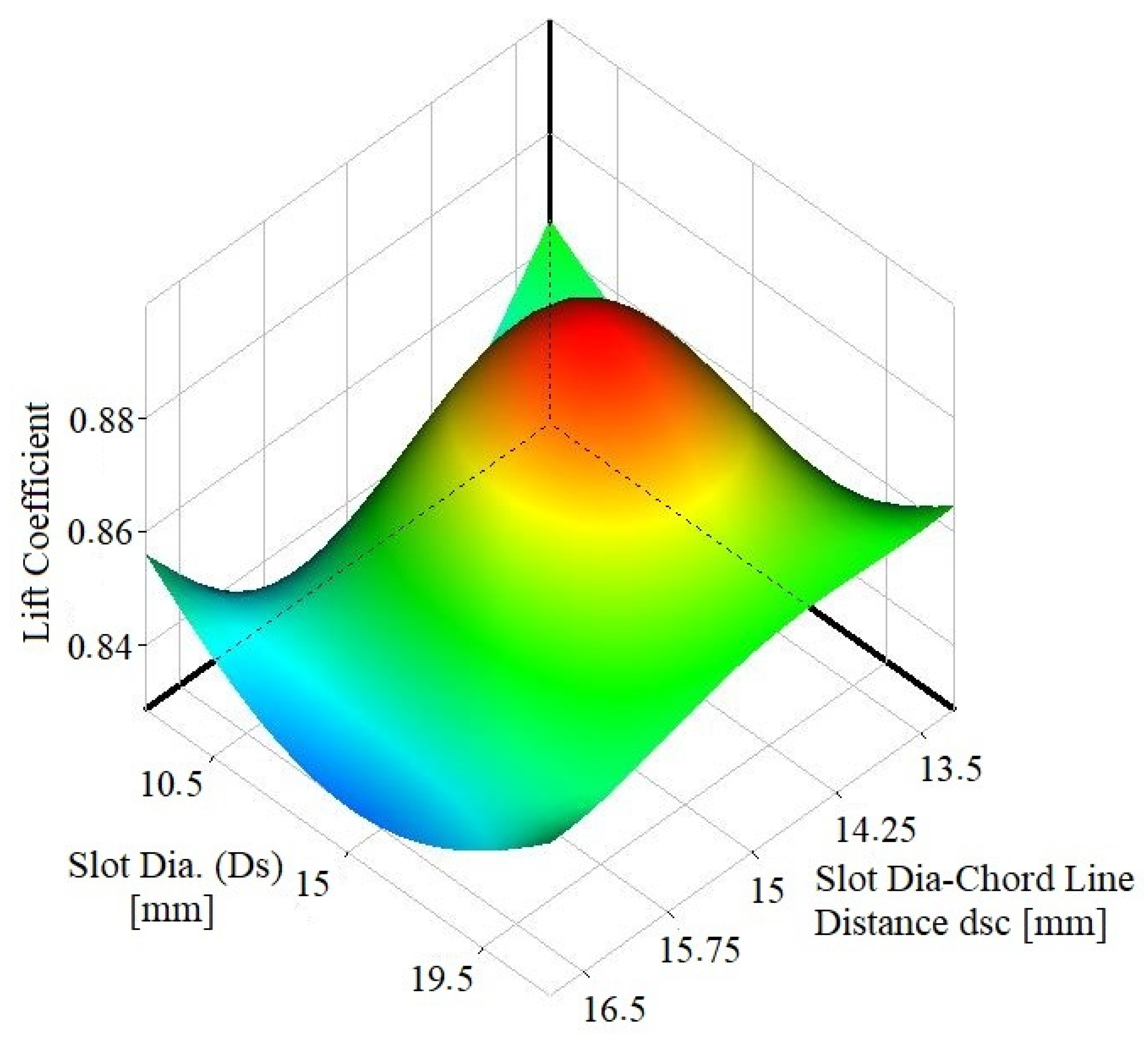
The response surface charts are presented in Figure 17 for lift coefficient versus Ds and dsc. Subsequently, the GA was applied to the surrogate-based response surfaces to identify optimal design variables while maintaining computational efficiency. The population size was set to 50, and the maximum number of generations was chosen as 100, which was sufficient to achieve stable convergence. A crossover probability of 0.8 and a mutation probability of 0.05 were adopted, consistent with commonly accepted values in aerodynamic optimization studies, to prevent premature convergence and preserve solution diversity.

4.4. Optimization Results

The optimization solutions were performed on the A11L40 leading edge waviness configuration at high AoA to improve aerodynamic performance. Following the optimization procedure, two optimal input design parameters and aerodynamic coefficients were determined using a Genetic algorithm. The resulting optimal values are reported in Table 3. The optimized wing geometry was subsequently reconstructed based on these parameters to validate the optimization results. The CFD simulations were then repeated for the optimized wing configuration. Table 4 represents the CFD results of smooth, modified, and optimized wing configurations, along with the corresponding improvements in the CL/CD ratio compared to the smooth wing.
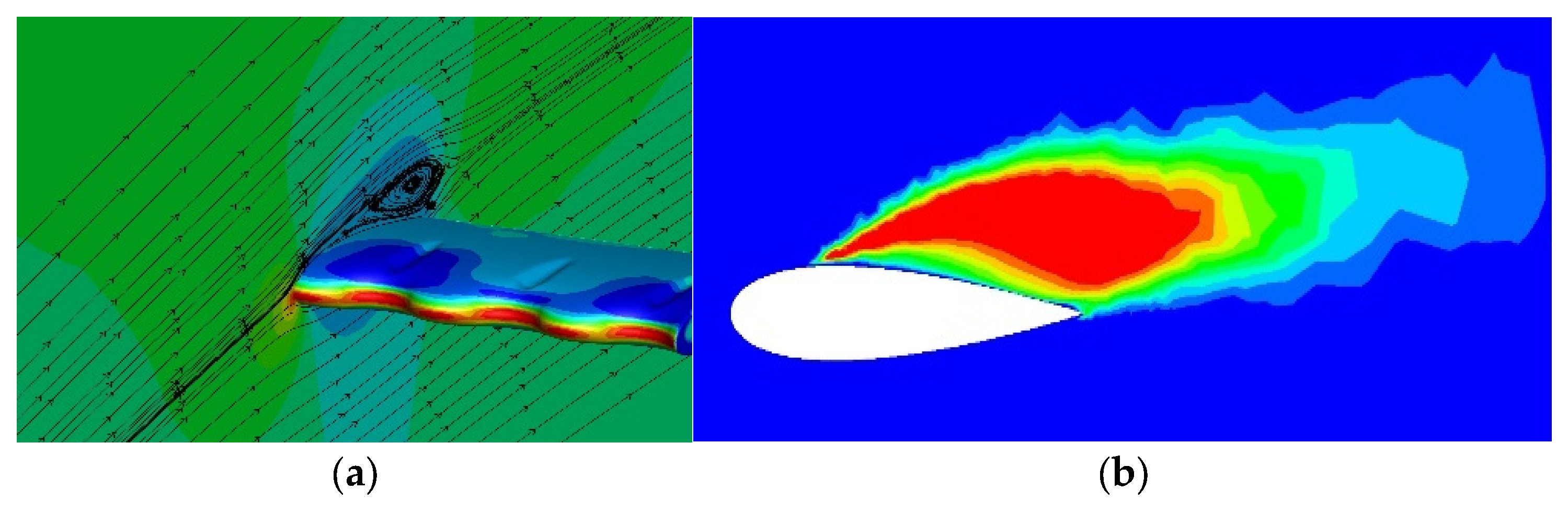
The modified wing was redrawn based on the optimum parameters obtained from the optimization process. The streamlines with pressure contours and the acoustic results are presented in Figure 18. It can be said that these results are consistent with the optimum aerodynamic coefficients obtained from the GA. In addition, the acoustic source power level was improved due to delayed flow separation and a reduction in the vortex size at the trailing edge.

5. Conclusions

In this study, the aerodynamic and aeroacoustic performance of a NACA0020 wing equipped with a leading-edge wavy geometry was numerically investigated at a Reynolds number of 290,000. Three distinct wavy leading-edge configurations incorporating multiple slot diameters on the upper surface were examined, and their performance was evaluated over a wide range of AoA. The numerical results showed good agreement with previously published experimental data [22], confirming the validity of the computational approach.
The findings demonstrate that the incorporation of leading-edge waviness, combined with appropriate slot diameter modification, can significantly enhance the aerodynamic performance of the NACA0020 wing, particularly at higher AoA where flow separation is dominant. The coupled interaction between geometric parameters, boundary-layer stability, and flow reattachment mechanisms resulted in delayed separation, reduced recirculation regions, and improved lift generation.
Among the investigated configurations, the A3L11 wavy wing with a 0.07c slot diameter exhibited locally superior aerodynamic performance compared to the baseline wavy wing. Furthermore, the results clearly indicated that slot diameter plays a critical role in determining the aerodynamic response across all configurations. Notably, the A11L40 configuration with a 0.10c slot diameter achieved the highest percentage improvement in lift-to-drag ratio relative to the other cases. However, the effectiveness of the slot implementation was strongly dependent on the waviness geometry and slot size. While increasing slot diameter generally promoted flow reattachment tendencies, the optimal slot size was not universal. The A11L40 configuration exhibited the most pronounced and consistent improvement in both aerodynamic performance and flow stability when combined with appropriately sized slots, whereas other configurations showed more limited or non-monotonic responses.
Overall, the aerodynamic analysis showed that the optimized wavy-wing configuration led to an improvement of approximately 27.76% in total aerodynamic performance. In addition to aerodynamic benefits, an aeroacoustic analysis was conducted for all configurations. The results indicated that leading-edge waviness modifies the broadband acoustic source characteristics of the wing, suggesting its potential for comparative noise-source reduction trends in noise-sensitive aviation applications. In this context, the A11L40 configuration emerged as the most effective design, offering a favorable balance between enhanced aerodynamic efficiency and reduced broadband noise-source intensity indicators.
In conclusion, this study provides valuable insight into the synergistic effects of leading-edge waviness and slot geometry as passive flow control mechanisms, indicating the feasibility of achieving concurrent aerodynamic improvement and comparative aeroacoustic source optimization through carefully tuned geometric modifications. The investigation was conducted at a Reynolds number of 290,000, representing a critical low-Reynolds-number regime relevant to small-scale and bio-inspired aerodynamic applications. Although limited to a single Reynolds number, the observed trends offer fundamental insight into the coupled aerodynamic and aeroacoustic behavior of slotted wavy wings and establish a foundation for the development of more efficient wing designs with improved broadband noise-source characteristics. Future work will extend the analysis to multiple Reynolds numbers and unsteady simulation frameworks to further assess the robustness and scalability of the proposed design strategy. In addition, experimental validation of the slotted wavy-wing configurations through controlled wind-tunnel testing is recommended as essential in the future to confirm the predicted aerodynamic and comparative broadband noise-source trends and to assess real-world implementation constraints.

Funding

This research received no external funding.

Data Availability Statement

The data presented in this study are available in the article. Further inquiries can be directed to the corresponding author.

Conflicts of Interest

The author declares no conflicts of interest.

References

  1. Fish, F.E.; Battle, J.M. Hydrodynamic design of the humpback whale flipper. J. Morphol. 1995, 225, 51–60. [Google Scholar] [CrossRef] [PubMed]
  2. Fish, F.E.; Lauder, G.V. Passive and active flow control by swimming fishes and mammals. Annu. Rev. Fluid Mech. 2006, 38, 193–224. [Google Scholar] [CrossRef]
  3. Fish, F.E.; Weber, P.W.; Murray, M.M.; Howle, L.E. The tubercles on humpback whales’ flippers: Application of bio-inspired technology. Integr. Comp. Biol. 2011, 51, 203–213. [Google Scholar] [CrossRef] [PubMed]
  4. Johari, H.; Henoch, C.; Custodio, D.; Levshin, A. Effects of leading-edge protuberances on airfoil performance. AIAA J. 2007, 45, 2634–2642. [Google Scholar] [CrossRef]
  5. Miklosovic, D.S.; Murray, M.M.; Howle, L.E. Experimental evaluation of sinusoidal leading edges. J. Aircr. 2007, 44, 1404–1408. [Google Scholar] [CrossRef]
  6. Stanway, M.J. Hydrodynamic Effects of Leading-Edge Tubercles on Control Surfaces and in Flapping Foil Propulsion. Ph.D. Thesis, Massachusetts Institute of Technology, Cambridge, MA, USA, 2008. [Google Scholar]
  7. Zverkov, O.; Zanin, B.; Kozlov, V. Aerodynamic characteristics of wings with wavy leading edges. Fluid Dyn. 2008, 46, 3149–3158. [Google Scholar]
  8. Van Nierop, E.A.; Alben, S.; Brenner, M.P. How bumps on whale flippers delay stall: An aerodynamic model. Phys. Rev. Lett. 2008, 100, 054502. [Google Scholar] [CrossRef]
  9. Hansen, K.L.; Kelso, R.M.; Dally, B.B. Performance variations of leading-edge tubercles for distinct airfoil profiles. AIAA J. 2011, 49, 185–194. [Google Scholar] [CrossRef]
  10. Hansen, K.L. Effect of Leading Edge Tubercles on Airfoil Performance. Ph.D. Thesis, University of Adelaide, Adelaide, Australia, 2012. [Google Scholar]
  11. Weber, P.W.; Howle, L.E.; Murray, M.M.; Miklosovic, D.S. Computational evaluation of the performance of lifting surfaces with leading-edge protuberances. J. Aircr. 2011, 48, 591–600. [Google Scholar] [CrossRef]
  12. Lohry, M.W.; Clifton, D.; Martinelli, L. Characterization and design of tubercle leading-edge wings. In Proceedings of the Seventh International Conference on Computational Fluid Dynamics (ICCFD7), Big Island, HI, USA, 9–13 July 2012. [Google Scholar]
  13. Dropkin, A.; Custodio, D.; Henoch, C.W.; Johari, H. Computational investigation of airfoils with leading-edge protuberances. J. Aircr. 2012, 49, 1345–1355. [Google Scholar] [CrossRef]
  14. Malipeddi, A.K.; Mahmoudnejad, N.; Hoffmann, K.A. Numerical analysis of effects of leading-edge protuberances on aircraft wing performance. J. Aircr. 2012, 49, 1336–1344. [Google Scholar] [CrossRef]
  15. Melo De Sousa, J.; Camara, J. Numerical study on the use of a sinusoidal leading edge for passive stall control at low Reynolds number. In 51st AIAA; AIAA: Reston, VA, USA, 2013; Volume 62. [Google Scholar]
  16. Guerreiro, J.L.E.; Sousa, J.M.M. Low-Reynolds-number effects in passive stall control using sinusoidal leading edges. AIAA J. 2012, 50, 461–469. [Google Scholar] [CrossRef]
  17. Zhang, M.M.; Wang, G.F.; Xu, J.Z. Aerodynamic control of low-Reynolds-number airfoil with leading-edge protuberances. AIAA J. 2013, 51, 1960–1971. [Google Scholar] [CrossRef]
  18. Rostamzadeh, N.; Hansen, K.L.; Kelso, R.M.; Dally, B.B. The formation mechanism and impact of streamwise vortices on NACA 0021 airfoil’s performance with undulating leading edge modification. Phys. Fluids 2014, 26, 107101. [Google Scholar] [CrossRef]
  19. Natarajan, K.; Sudhakar, S.; Paulpandian, S. Experimental studies on the effect of leading edge tubercles on laminar separation bubble. In 52nd Aerospace Sciences Meeting 2014; AIAA: Reston, VA, USA, 2014; Volume 1279. [Google Scholar]
  20. Custodio, D.; Henoch, C.W.; Johari, H. Aerodynamic characteristics of finite span wings with leading-edge protuberances. AIAA J. 2015, 53, 1878–1893. [Google Scholar] [CrossRef]
  21. Skillen, A.; Revell, A.; Pinelli, A.; Piomelli, U.; Favier, J. Flow over a wing with leading-edge undulations. AIAA J. 2015, 53, 464–472. [Google Scholar] [CrossRef]
  22. Paula, A.A.D. The Airfoil Thickness Effects on Wavy Leading Edge Phenomena at Low Reynolds Number Regime. Ph.D. Thesis, Universidade de São Paulo, São Paulo, Brazil, 2016. [Google Scholar][Green Version]
  23. Aftab, S.M.A.; Ahmad, K.A. CFD study on NACA 4415 airfoil implementing spherical and sinusoidal Tubercle Leading Edge. PLoS ONE 2017, 12, e0183456. [Google Scholar]
  24. Post, M.L.; Decker, R.; Sapell, A.R.; Hart, J.S. Effect of bio-inspired sinusoidal leading-edges on wings. Aerosp. Sci. Technol. 2018, 81, 128–140. [Google Scholar] [CrossRef]
  25. Mehraban, A.A.; Djavareshkian, M.H.; Sayegh, Y.; Forouzi Feshalami, B.; Azargoon, Y.; Zaree, A.H.; Hassanalian, M. Effects of smart flap on aerodynamic performance of sinusoidal leading-edge wings at low Reynolds numbers. Proc. Inst. Mech. Eng. Part G J. Aerosp. Eng. 2021, 235, 439–450. [Google Scholar] [CrossRef]
  26. Mehraban, A.; Djavareshkian, M.H. Experimental investigation of ground effects on aerodynamics of sinusoidal leading-edge wings. Proc. Inst. Mech. Eng. Part C J. Mech. Eng. Sci. 2021, 235, 3988–4001. [Google Scholar] [CrossRef]
  27. Naderinezhad, M.; Djavareshkian, M.H. Numerical study of the effect of winglet on the aerodynamic performance of sinusoidal and simple leading-edge wings. Aircr. Eng. Aerosp. Technol. 2023, 95, 512–524. [Google Scholar] [CrossRef]
  28. Du, H.; Jiang, H.; Yang, Z.; Xia, H.; Chen, S.; Wu, J. Experimental investigation of the effect of bio-inspired wavy leading-edges on aerodynamic performance and flow topologies of the airfoil. Aerospace 2024, 11, 194. [Google Scholar] [CrossRef]
  29. Gonzalez-DeGreiff, P.; Gomez-Rivera, W.; Bravo-Mosquera, P.D.; Cerón-Muñoz, H.D. Numerical and experimental analysis of the effect of wavy leading edge on stabilizer. Phy Fluids 2025, 37, 065128. [Google Scholar] [CrossRef]
  30. Hansen, K.; Kelso, R.; Doolan, C. Reduction of flow induced airfoil tonal noise using leading edge sinusoidal modifications. Acou. Aust. 2012, 40, 172–177. [Google Scholar]
  31. Clair, V.; Polacsek, C.; Le Garrec, T.; Reboul, G.; Gruber, M.; Joseph, P. Experimental and numerical investigation of turbulence-airfoil noise reduction using wavy edges. AIAA J. 2013, 51, 2695–2713. [Google Scholar] [CrossRef]
  32. Tong, F.; Qiao, W.; Chen, W.; Wei, R.; Wang, X. Numerical analysis of broadband noise reduction with wavy leading edge. Chin. J. Aeronaut. 2018, 31, 1489–1505. [Google Scholar] [CrossRef]
  33. Karthik, K.; Jeyakumar, S.; Sebastin, J.S. Optimization of wavy cylinder for aerodynamic drag and aeroacoustic sound reduction using computational fluid dynamics analysis. Proc. Ins. Mech. Eng. Part C J. Mech. Eng. Sci. 2021, 235, 1979–1991. [Google Scholar] [CrossRef]
  34. Kim, J.H.; Choi, K.S.; Lacagnina, G.; Chaitanya, P.; Joseph, P.; Hasheminejad, S.M.; Chong, T.P.; Shahab, M.F.; Omidyeganeh, M.; Pinelli, A. Aerodynamic and aeroacoustic optimization of leading-edge undulation of a NACA 65 (12)-10 airfoil. AIAA J. 2022, 60, 2342–2353. [Google Scholar] [CrossRef]
  35. Wang, H.; Liu, X. Numerical investigation of aerodynamic and acoustic characteristics of bionic airfoils inspired by bird wing. Proc. Inst. Mech. Eng. Part G J. Aerosp. Eng. 2019, 233, 4004–4016. [Google Scholar] [CrossRef]
  36. Li, D.; Wei, C. Numerical study on aerodynamic and aeroacoustic performances of bioinspired wings. Appl. Bionics. Biomech. 2023, 2023, 9930841. [Google Scholar] [CrossRef]
  37. Xing, Y.; Chen, W.; Wang, X.; Tong, F.; Qiao, W. Effect of wavy leading edges on airfoil trailing-edge bluntness noise. Aerospace 2023, 10, 353. [Google Scholar] [CrossRef]
  38. Güzey, H.; Aylı, U.E.; Kocak, E.; Aradag, S. Investigation of aerodynamic and aeroacoustic behavior of bio-inspired airfoils with numerical and experimental methods. Proc. Ins. Mech. Eng. Part C J. Mech. Eng. Sci. 2024, 238, 1265–1279. [Google Scholar] [CrossRef]
  39. Tang, H.; Lei, Y.; Li, X.; Gao, K.; Li, Y. Aerodynamic shape optimization of a wavy airfoil for ultra-low Reynolds number regime in gliding flight. Energies 2020, 13, 467. [Google Scholar] [CrossRef]
  40. Lu, Y.; Li, Z.; Chang, X.; Chuang, Z.; Xing, J. An aerodynamic optimization design study on the bio-inspired airfoil with leading-edge tubercles. Eng. Appl. Comput. Fluid Mech. 2021, 15, 292–312. [Google Scholar] [CrossRef]
  41. Rohmawati, I.; Arai, H.; Mutsuda, H.; Nakashima, T.; Mahmud, R. Optimizing Effect of Wavy Leading Edge (WLE) in Rectangular Wing and Taper Wing. J. Mech. Eng. Sci. Innov. 2021, 58, 1081–1093. [Google Scholar] [CrossRef]
  42. Sun, Z.; Yao, Q.; Jin, H.; Xu, Y.; Hang, W.; Chen, H.; Li, K.; Shi, L.; Gu, J.; Zhang, Q.; et al. A novel in-situ sensor calibration method for building thermal systems based on virtual samples and autoencoder. Energy 2024, 297, 131314. [Google Scholar] [CrossRef]
  43. Sun, Z.; Yao, Q.; Shi, L.; Jin, H.; Xu, Y.; Yang, P.; Xiao, H.; Chen, D.; Zhao, P.; Shen, X. Virtual sample diffusion generation method guided by large language model-generated knowledge for enhancing information completeness and zero-shot fault diagnosis in building thermal systems. J. Zhejiang Univ. Sci. A. 2025, 26, 895–916. [Google Scholar] [CrossRef]
  44. Versteeg, H.K.; Malalasekera, W. An Introduction to Computational Fluid Dynamics: The Finite Volume Method, 2nd ed.; Pearson Education Limited: Harlow, UK, 2007. [Google Scholar]
  45. Menter, F.R. Two-equation eddy-viscosity turbulence models for engineering applications. AIAA J. 1994, 32, 1598–1605. [Google Scholar] [CrossRef]
  46. Blake, W.K. Mechanics of Flow-Induced Sound and Vibration; Academic Press: Cambridge, MA, USA, 2017. [Google Scholar]
  47. Proudman, I. The generation of noise by isotropic turbulence. Proc. R. Soc. Lond. Ser. A Math. Phys. Sci. 1952, 214, 119–132. [Google Scholar] [CrossRef]
  48. Lighthill, M.J. On sound generated aerodynamically. I. General theory. Proc. R. Soc. Lond. Ser. A Math. Phys. Sci. 1952, 211, 564–587. [Google Scholar] [CrossRef]
  49. Lilley, G.M. The Radiated Noise from Isotropic Turbulence Revisited; ICASE Report No. ICASE-93-75; Institute for Computer Applications in Science and Engineering (ICASE): Hampton, VA, USA, 1993.
  50. Narayanan, S.; Chaitanya, P.; Haeri, S.; Joseph, P.; Kim, J.W.; Polacsek, C. Airfoil noise reductions through leading edge serrations. Phys. Fluids 2015, 27, 025109. [Google Scholar] [CrossRef]
  51. Lacagnina, G.; Chaitanya, P.; Kim, J.H.; Berk, T.; Joseph, P.; Choi, K.S.; Pinelli, A. Leading edge serrations for the reduction of aerofoil self-noise at low angle of attack, pre-stall and post-stall conditions. Int. J. Aeroacoust. 2021, 20, 130–156. [Google Scholar] [CrossRef]
  52. Bazaraa, M.S.; Sherali, H.D.; Shetty, C.M. Nonlinear Programming: Theory and Algorithms; Wiley: New York, NY, USA, 1993. [Google Scholar]
  53. Goldberg, D.E. Genetic Algorithms in Search, Optimization, and Machine Learning; Addison-Wesley: Reading, MA, USA, 1989. [Google Scholar]
  54. Holland, J.H. Adaptation in Natural and Artificial Systems: An Introductory Analysis with Applications to Biology, Control, and Artificial Intelligence; MIT Press: Cambridge, MA, USA, 1992. [Google Scholar]
  55. Myers, R.H.; Montgomery, D.C.; Anderson-Cook, C.M. Response Surface Methodology: Process and Product Optimization Using Designed Experiments; John Wiley & Sons: Hoboken, NJ, USA, 2016. [Google Scholar]
  56. Simpson, T.W. Comparison of Response Surface and Kriging Models in the Multidisciplinary Design of an Aerospike Nozzle; NASA/CR-1998-206935; NASA Langley Research Center: Hampton, VA, USA, 1998.
Figure 1. Design of the NACA 0020 airfoil. (a) Side view; (b) isometric view [dimensions in mm] (note that integer values are displayed in decimal format due to the automatic output of the visualization software).
Applsci 16 02078 g001
Figure 2. Design of the NACA 0020 leading-edge wavy wings: (a) A3L11, (b) A3L40, (c) A11L40.
Applsci 16 02078 g002
Figure 3. The view of modified leading-edge wavy wing design parameters: (a) front view; (b) isometric view (note that integer values are displayed in decimal format due to the automatic output of the visualization software.).
Applsci 16 02078 g003
Figure 4. The isometric view of the modified wing with a slot diameter of 0.10c: (a) A3L11, (b) A3L40, (c) A11L40.
Applsci 16 02078 g004
Figure 5. Computational flow domain and its dimensions.
Applsci 16 02078 g005
Figure 6. Mesh generation for computational fluid domain. (a) Side view; (b) isometric view.
Applsci 16 02078 g006
Figure 7. Mesh generation around the NACA 0020 wing.
Applsci 16 02078 g007
Figure 8. Contour plot of the y+ distribution over the NACA 0020 wing surface at Re = 290,000.
Applsci 16 02078 g008
Figure 9. Mesh sensitivity analysis of NACA 0020 airfoil for four configurations. (a) Smooth wing, (b) A3L11, (c) A3L40, (d) A11L40.
Applsci 16 02078 g009aApplsci 16 02078 g009b
Figure 10. Validation of lift coefficient for the NACA 0020 airfoil: comparison of CFD results with full experimental lift curves reported by Paula [22] for the smooth wing, A3L11, A3L40, and A11L40 leading-edge configurations at Re = 290,000.
Applsci 16 02078 g010
Figure 11. Validation of drag coefficient for the NACA 0020 airfoil: comparison of CFD results with full experimental drag curves reported by Paula [22] for the smooth wing, A3L11, A3L40, and A11L40 leading-edge configurations at Re = 290,000.
Applsci 16 02078 g011
Figure 12. The pressure coefficient (Cp) contours and streamlines for the NACA0020 wing at 290,000 Reynolds number and AoA of 10°, 15°, 20°, shown for the smooth wing and the A3L11, A3L40, and A11L40 configurations (z/c = 0.5).
Applsci 16 02078 g012
Figure 13. The pressure coefficient (Cp) contour and streamlines for the NACA0020 wing with the A3L11 leading-edge configuration at 290,000 Reynolds number and AoA of 10°, 15°, 20°. Slot diameters: 0.07c, 0.10c, and 0.13c.
Applsci 16 02078 g013
Figure 14. The pressure coefficient (Cp) contour and streamlines for the NACA0020 wing with the A3L40 leading-edge configuration at 290,000 Reynolds number and AoA of 10°, 15°, 20°. Slot diameters: 0.07c, 0.10c, and 0.13c.
Applsci 16 02078 g014
Figure 15. The pressure coefficient (Cp) contour and streamlines for the NACA0020 wing with the A11L40 leading-edge configuration at 290,000 Reynolds number and AoA of 10°, 15°, 20°. Slot diameters: 0.07c, 0.10c, and 0.13c.
Applsci 16 02078 g015
Figure 16. Acoustic source power level distributions for the NACA0020 wing with the A3L11, A3L40, A11L40 leading-edge and smooth wing configurations at 290,000 Reynolds number and AoA of 20°. Slot diameters: 0.07c, 0.10c, and 0.13c.
Applsci 16 02078 g016
Figure 17. Response surface chart (Lift coefficient versus Slot diameter and Distance between slot center and chord line).
Applsci 16 02078 g017
Figure 18. (a) The pressure coefficient contour and streamlines. (b) Acoustic source power level distributions for the modified and optimized NACA0020 wing with A11L40 leading-edge configuration at 290,000 Reynolds number and 20° AoA.
Applsci 16 02078 g018
Table 1. Comparison of CL/CD values for all configurations with and without a slot at Re=290,000 and AoA of 10°, 15°, and 20°.
A3L11 Wing Configuration
Slot DiameterCL/CD (10°)CL/CD (15°)CL/CD (20°)
Without slot13.266.173.25
0.07c13.246.994.18
0.10c13.257.083.33
0.13c13.226.783.78
A3L40 wing configuration
Slot DiameterCL/CD (10°)CL/CD (15°)CL/CD (20°)
Without slot16.564.202.93
0.07c16.425.393.11
0.10c16.395.473.05
0.13c16.065.583.36
A11L40 wing configuration
Slot DiameterCL/CD (10°)CL/CD (15°)CL/CD (20°)
Without slot10.083.192.48
0.07c10.463.982.82
0.10c10.793.782.92
0.13c11.073.932.88
Table 2. Design variables and their bounds for the optimization.
Design Variables (mm)Baseline ValuesLB ValuesUB Values
Slot diameter (Ds)0.10c0.07c0.13c
Distance between slot center and chord line (dsc)0.10c0.09c0.11c
Table 3. Optimum design variables.
Design Variables (mm)Optimal Results
Slot diameter (Ds)0.0827c
Distance between slot center and chord line (dsc)0.0952c
Table 4. CFD results of smooth, modified, and optimized wing configurations and comparison of their improvements relative to the smooth wing.
CLCDCL/CD Total Improvement %
Smooth wing0.710.33-
A11L40 wing0.790.3211.34
Modified wing with slot 0.10c dia.0.860.2924.79
Modified and Optimized wing0.870.2827.76
Disclaimer/Publisher’s Note: The statements, opinions and data contained in all publications are solely those of the individual author(s) and contributor(s) and not of MDPI and/or the editor(s). MDPI and/or the editor(s) disclaim responsibility for any injury to people or property resulting from any ideas, methods, instructions or products referred to in the content.