Article

4-O-Mono-Fructosyl Phlorizin-Enriched Fraction and Its Interaction with Carbohydrate Digestive Enzymes: In Vitro and In Silico Studies

by
Omar Ricardo Torres-González
1,
Javier Arrizon
2,
Azucena Herrera-González
3,
Clarita Olvera-Carranza
4,
Iván Moisés Sánchez-Hernández
1,
Eduardo Padilla-Camberos
1,* and
Angélica Sofía González-Garibay
1,*
1
Unidad de Biotecnología Médica y Farmacéutica, Centro de Investigación y Asistencia en Tecnología y Diseño del Estado de Jalisco A.C. (CIATEJ), Guadalajara 44270, Jalisco, Mexico
2
Unidad de Biotecnología Industrial, Centro de Investigación y Asistencia en Tecnología y Diseño del Estado de Jalisco A.C. (CIATEJ) Unidad Zapopan, Zapopan 45019, Jalisco, Mexico
3
Departamento de Ingeniería Química, Centro Universitario de Ciencias Exactas e Ingenierías, Universidad de Guadalajara, Guadalajara 44430, Jalisco, Mexico
4
Departamento de Ingeniería Celular y Biocatálisis, Instituto de Biotecnología, Universidad Nacional Autónoma de México, Cuernavaca 62210, Morelos, Mexico
*
Authors to whom correspondence should be addressed.
Appl. Sci. 2026, 16(4), 2072; https://doi.org/10.3390/app16042072
Submission received: 19 January 2026 / Revised: 16 February 2026 / Accepted: 19 February 2026 / Published: 20 February 2026
(This article belongs to the Special Issue Syntheses and Applications in Medicinal Chemistry)

Abstract

Diabetes mellitus represents a major global health challenge, which has generated ongoing interest in developing enzymatic strategies to modulate carbohydrate digestion. Phlorizin, a dihydrochalcone found predominantly in plants of the genus Malus, has been extensively investigated for its antidiabetic potential; however, its practical application is limited by its low water solubility. Enzymatic fructosylation represents an effective biocatalytic approach to overcome this limitation and modulate the functional properties of phenolic compounds. In this study, the inhibitory activity of an enzymatically fructosylated phlorizin-enriched fraction, containing 4-O-mono-fructosyl phlorizin (4PHF) as its main component, was evaluated against key carbohydrate-digesting enzymes using in vitro assays complemented by in silico molecular docking analyses. The 4PHF-enriched fraction showed potent inhibition of α-amylase in vitro, with an IC50 value of 2.69 µg/mL. However, no significant inhibition of α-glucosidase was observed within the analyzed concentration range, indicating a selective inhibitory profile. Molecular docking analyses supported the experimental findings, revealing favorable binding orientations and predicted affinities of 4PHF for α-amylase and α-glucosidase, stabilized primarily by hydrogen bond interactions. Overall, the combined in vitro and in silico results demonstrate that enzymatic fructosylation effectively reprograms the enzyme interaction profile of phlorizin, highlighting 4PHF as a structurally optimized modulator of carbohydrate-digesting enzymes, with potential relevance for applied research on enzyme inhibition related to metabolic diseases.

1. Introduction

Diabetes mellitus is one of the most prevalent metabolic disorders worldwide, impacting a large proportion of the population. The disease is defined by persistent hyperglycemia, which arises from impaired insulin secretion, reduced insulin sensitivity in peripheral tissues, or a combination of both mechanisms [1].
The global prevalence of diabetes mellitus among adults aged 20–79 years is currently estimated at 11.1%, corresponding to approximately 588.7 million individuals in 2024. Projections indicate an increase to 13% by 2050, with an estimated 852.5 million affected individuals [2].
Diabetes mellitus is classified into two main types: type 1 and type 2. Type 1 diabetes typically develops early in life and is caused by an autoimmune disorder in which immune cells attack the insulin-producing β cells of the pancreas. In contrast, type 2 diabetes mellitus (T2DM) usually manifests later in life and results from systemic dysfunctions in metabolc homeostasis. T2DM is a heterogeneous and complex condition, with both genetic predisposition and lifestyle factors serving as major contributors, thereby complicating effective treatment [3]. Notably, T2DM accounts for nearly 90% of all diabetes mellitus cases worldwide [2].
Hyperglycemia can be effectively managed by modulating key elements involved in glycemic regulation, including carbohydrate-hydrolyzing enzymes, glucose transporter proteins, and incretin-mediated signaling pathways. Carbohydrates (mainly starch) are primarily digested by two key enzymes—α-amylase and α-glucosidase—in the gastrointestinal tract, facilitating the release of glucose, which is then absorbed into the bloodstream and serves as the principal contributor to systemic blood glucose levels [4].
Initially, salivary α-amylase secreted by the salivary glands contributes to the partial digestion of approximately 5% of ingested carbohydrates. Then, in the small intestine, pancreatic α-amylase becomes the predominant enzyme responsible for further hydrolyzing complex carbohydrates into oligosaccharides. These intermediate products are subsequently cleaved by intestinal α-glucosidase located on the brush border membrane of enterocytes; this enzyme is responsible for the final hydrolysis of disaccharides and oligosaccharides into absorbable monosaccharides, primarily glucose. Notably, excessive intake of carbohydrates is associated with rapid postprandial elevations in blood glucose and insulin levels, contributing to metabolic dysregulation [5]. The inhibition of these mechanisms represents a key therapeutic strategy for regulating postprandial glycemia through various physiological pathways [5,6]. Inhibition of these enzymatic activities reduces glucose absorption, thereby attenuating postprandial glycemic spikes [6].
T2DM is currently regarded as a major public health concern and represents one of the most critical global health emergencies [7]. Acarbose, miglitol, and voglibose are the enzymatic inhibitors most frequently used in T2DM therapy; however, their efficacy remains a subject of debate, and they have unwanted side effects, including abdominal distension, flatulence, bloating, and the possibility of diarrhea. Furthermore, therapeutic failure in diabetic patients limits the long-term efficacy of current drug regimens. Consequently, a large pool of inhibitors is required to expand treatment options [8].
Phlorizin is a dihydrochalcone predominantly found in plants of the Malus genus and has been reported to exhibit a range of pharmacological activities [9]. However, its clinical application has been limited due to its poor aqueous solubility, low bioavailability, and susceptibility to enzymatic hydrolysis by β-glucosidase and lactase–phlorizin hydrolase [10]. In this context, biocatalysis represents a promising strategy, because enzymatic functionalization can enhance the structural properties and potentially improve the biological activity of pharmacologically relevant compounds such as phlorizin [11,12]. Previous in silico studies have demonstrated that the enzymatic fructosylation of phlorizin can enhance its effects on key therapeutic targets involved in T2DM pathogenesis, such as dipeptidyl peptidase-4 (DPP-4) and insulin receptor [13]. The novelty of this work lies in the enzymatic modification of phlorizin to enhance its inhibitory potential against key carbohydrate-digesting enzymes relevant to the management of type 2 diabetes mellitus (T2DM). The inhibitory activity of the resultant compound, 4-O-mono-fructosyl phlorizin (4PHF), against α-amylase and α-glucosidase was evaluated using integrated in vitro enzymatic assays and in silico molecular docking analysis.

2. Materials and Methods

All reagents were purchased from Sigma-Aldrich-Merck (Darmstadt, Germany), unless otherwise stated.

2.1. Enzymatic Synthesis and Purification of Phlorizin Fructosides

Phlorizin fructosides were synthesized according to Herrera-González et al. (2021), following optimization of the reaction conditions. Briefly, the reaction mixture contained 25 mM phlorizin and 500 mM sucrose dissolved in 50 mM acetate buffer (pH 5.8), supplemented with 1 mM CaCl2 to ensure optimal enzyme activity. The final reaction volume was 500 mL. The reaction was catalyzed with levansucrase (0.5 U/mL) from Paraburkholderia phymatum (KesL) at 37 °C under constant stirring for 24 h. At the end of the reaction, the mixture was lyophilized to concentrate the products [14].
Purification was performed as reported by Rycek et al. (2018) with modifications using a Flash Manager C-615 (BÜCHI Labortechnik, Flawil, Switzerland) (A/B pumping system) coupled to a FlashPure EcoFlex C18 column with a capacity of 20 g and a fraction collector unit C-660 (BÜCHI Labortechnik, Flawil, Switzerland). Flash chromatography was performed using water (A) and acetonitrile (B) as mobile phases. The elution program consisted of an isocratic step with 30% B for 30 min, followed by a linear gradient from 30% to 50% B for 15 min. The column was conditioned with water and acetonitrile before loading the sample. The lyophilized reaction product was reconstituted in 10 mL of a water/acetonitrile solution (70:30, v/v). The fractions were analyzed by thin-layer chromatography (TLC) on silica gel plates 60 RP-18 F254s (Merck, Darmstadt, Germany), using acetonitrile/water (9:1, v/v) as the mobile phase. UV detection (280–354 nm) and purified phlorizin served as analytical references [15].
Fractions identified as containing 4PHF were pooled, concentrated by rotary evaporation, and then lyophilized to obtain the purified product. The lyophilized fractions were reconstituted in water to remove residual sugars and subjected to a second purification cycle using a water–acetonitrile gradient. The sugar-free fractions, identified by TLC with orcinol reagent, were combined, evaporated, and lyophilized to yield approximately 1 g of 4PHF-enriched powder. A solution of the lyophilized sample was prepared in water to obtain a final concentration of 10 mg/L. and analyzed using a Waters Acquity HPLC-UV (Waters corporation, Mildford, MA, USA) system equipped with a Waters Nova-Pak C18 column (4 µm, 3.9 × 150 mm). Chromatographic separation was carried out using a binary gradient consisting of 0.05% formic acid in water (solvent A) and acetonitrile (solvent B), at a flow rate of 0.8 mL/min and a column temperature of 40 °C. HPLC-UV analysis was performed in triplicate. Residual phlorizin was identified by UV detection at 280 nm, and it was quantified using an external calibration curve (0.05–1.0 mM; R2 ≥ 0.99) prepared with a phlorizin standard. The conversion of phlorizin (%) was determined by calculating the difference between the initial and final concentrations of phlorizin [14].
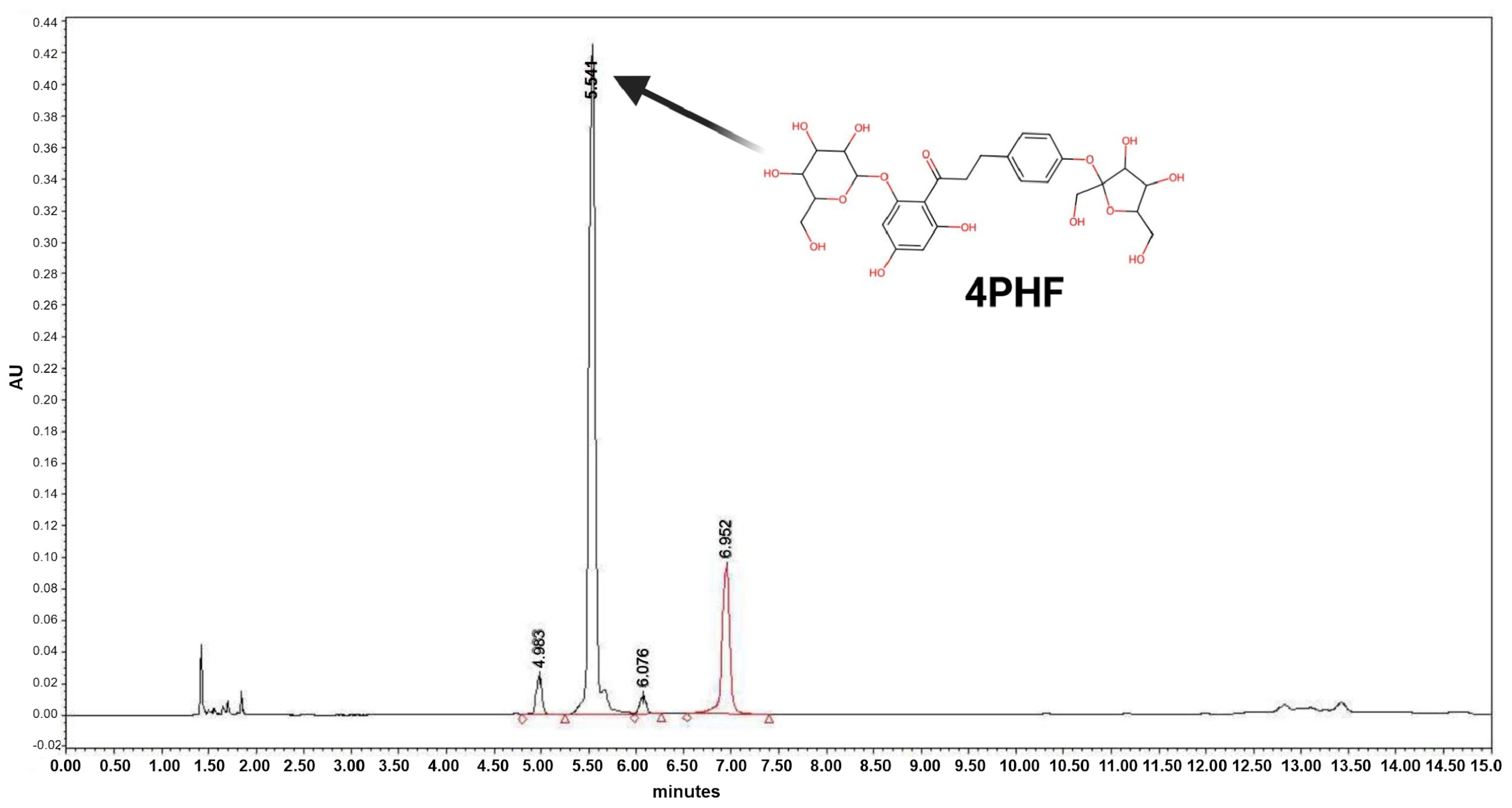
The major compound that showed a retention time of 5.541 min was isolated by Preparative HPLC and subsequently subjected to structural characterization by one- and two-dimensional nuclear magnetic resonance (NMR) spectroscopy (JEOL, Tokyo, Japan) [11]. The 13C NMR spectrum of 4PHF showed 25 carbon resonances, including two double-intensity signals at δ 122.8 and δ 130.0 ppm. Ten resonances in the δ 60–90 ppm region were attributed to the sugar fractions. The signals at δ 107.91 ppm and δ 102.04 ppm were assigned to the C-2′′′ of fructose and the C-1′′ of the glucose unit in phlorizin, respectively. Comparison with the 13C NMR spectrum of phlorizin revealed six additional resonances, confirming the presence of a mono-fructosyl substituent.

2.2. In Vitro Enzyme Inhibition

2.2.1. α-Amylase Inhibition

α-Amylase inhibition was assayed as previously reported [16], with modifications in the enzyme concentration, temperature, and incubation time, based on preliminary studies to standardize the method. First, 25 μL of α-amylase (1.25 U/mL) was mixed with 100 μL of phosphate-buffered saline (PBS, pH 6.9), and 50 μL of the 4PHF-enriched fraction, phlorizin (≥99% purity), or acarbose as positive control (2.5, 1.5, 0.625, 0.3125, or 0.156 μg/mL) in microtubes. A negative control containing PBS. All experiments were performed in triplicate. The reaction mixtures were maintained at 37 °C for 10 min under controlled heating conditions. Subsequently, 100 μL of a 1% starch solution was introduced into each tube and gently homogenized. The tubes were then incubated at 37 °C for an additional 10 min. Subsequently, 200 μL of 3,5-dinitrosalicylic acid (DNS) reagent was added to each reaction. The tubes were mixed and incubated in boiling water for 10 min to develop the color. After the incubation period, the reaction mixtures were allowed to cool to room temperature and subsequently diluted with 1 mL of distilled water. The absorbance values were recorded at 540 nm using a UV–Vis microplate reader (xMark™, Bio-Rad, Hercules, CA, USA). The inhibitory activity against α-amylase was calculated according to the equation shown below:
%   I n h i b i t i o n = 1 A b s     s a m p l e A b s   n e g a t i v e   c o n t r o l × 100
The resulting data were used to estimate the half-maximal inhibitory concentration (IC50).

2.2.2. α-Glucosidase Inhibition

The α-glucosidase inhibition assay was conducted with minor adaptations to the standardization of volume and wavelength, based on previously reported protocols [17,18]. Briefly, each well of a 96-well microplate contained 110 μL of phosphate-buffered saline (PBS, 0.1 M, pH 6.8); 20 μL of α-glucosidase solution (2 U/mL); and 20 μL of the 4PHF-enriched fraction, phlorizin (≥99% purity), or acarbose at different concentrations (2.5, 1.5, 0.625, 0.3125, and 0.156 μg/mL). The reaction mixtures were pre-incubated at 37 °C for 15 min. Subsequently, 50 μL of 4-nitrophenyl-α-D-glucopyranoside (0.1 M) was added to initiate the enzymatic reaction, followed by incubation at 37 °C for an additional 5 min. The absorbance was recorded at 405 nm using a UV–Vis microplate reader to determine the α-glucosidase inhibitory activity, calculated using the equation presented below:
%   I n h i b i t i o n = 1 A b s     s a m p l e A b s   n e g a t i v e   c o n t r o l × 100
The resulting data were used to estimate the IC50.

2.3. In Silico Analysis

2.3.1. Protein Selection and Preparation

The structures of α-amylase and α-glucosidase were obtained from PubChem (https://www.rcsb.org/, accessed on 22 May 2025); the IDs or accession numbers were 1OSE and 1UOK, respectively (Table 1). The protein structures were prepared using AutoDock Tools (version 1.5.7) by removing crystallographic water molecules, followed by the addition of nonpolar hydrogen atoms and assignment of Kollman charges [19]. After that they were converted to .pdbqt files in Autodock (version 4.2).

2.3.2. Molecular Docking Simulations

The structure of acarbose (CID:41774), used as the reference ligand, was obtained in .pdb format (https://pubchem.ncbi.nlm.nih.gov, accessed on 22 May 2025). The three-dimensional structure of 4PHF was considered as the ligand for docking simulations. Ligand preparation was carried out using AutoDock Tools (version 1.5.7), which included the assignment of Gasteiger partial charges, definition of rotatable bonds, merging of nonpolar hydrogen atoms, and conversion of the structures into .pdbqt format. Molecular docking calculations were subsequently conducted using AutoDock (version 4.2) [20].
Each docking simulation consisted of 100 runs with a population size of 150. During the search, the maximum translational step was set to 2.0 Å, and the torsional degrees of freedom (DoFs) were kept at their default settings (~5°). For each enzyme–ligand pair, the conformation with the lowest predicted binding free energy from the most populated cluster was selected for further analysis.
Interacting amino acid residues, bond types, and intermolecular distances (Å) were visualized using BIOVIA Discovery Studio 2021 Client (version 21.1) [20].

2.4. Statistical Analysis

All results are presented as mean ± standard error of the mean (SEM). Statistical evaluations were carried out using GraphPad Prism software (version 8.0.1). According to the data distribution, comparisons were performed using one-way analysis of variance (ANOVA) followed by Tukey’s multiple comparison test, or Friedman’s test in the case of non-parametric data. A p-value lower than 0.05 was considered indicative of statistical significance.

3. Results

3.1. Enzymatic Synthesis and Purification of 4PHF-Enriched Fraction

The purity profile of the phlorizin fructosides mixture used for the biological evaluation is presented in Figure 1. The chromatogram shows four main peaks: three corresponding to distinct phlorizin fructosides, with retention times of 4.983, 5.541, and 6.076 min, and a peak at 6.952 min attributed to residual phlorizin. Minor peaks of low intensity were also detected throughout the chromatogram, representing trace by-products or unreacted sugars; however, their relative abundances were negligible compared to those of the major components. Quantitative analysis indicated that the phlorizin fructosides mixture accounted for 80.7 ± 1.0% of the total chromatographic area, with 4PHF being the predominant fructoside (74.5 ± 0.49%). Residual phlorizin represented 19.3 ± 0.54% of the sample. The molecular structure of 4PHF was confirmed by NMR (Figure 1).

3.2. Inhibitory Effect of 4PHF-Enriched Fraction on α-Amylase and α-Glucosidase

In the present study, we evaluated the inhibitory activity of enzymatically synthesized phlorizin fructoside against α-amylase and α-glucosidase. Given the relevance of inhibiting these enzymes for glycemic control, we hypothesized that the 4PHF-enriched fraction could serve as an effective inhibitor.
α-Amylase inhibition is relevant because this enzyme plays a key role in both starch amylose, and its inhibition is a recognized strategy for the treatment of glucose metabolism-related disorders, such as T2DM [21].
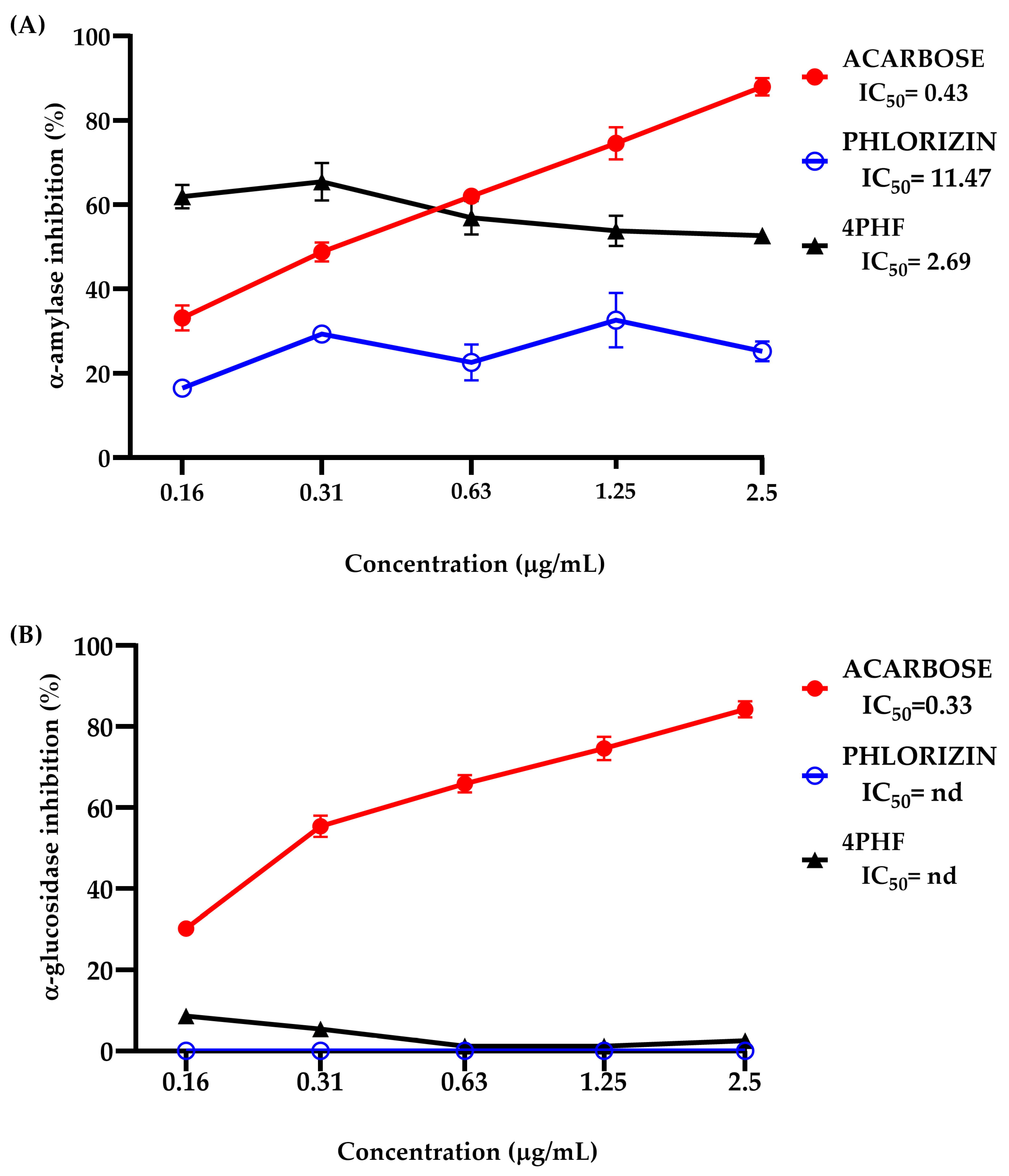
The in vitro assay of ɑ-amylase inhibition revealed that the 4PHF-enriched fraction inhibited α-amylase by ~60% (IC50 = 2.69 µg/mL) compared with ~80% in the acarbose control (IC50 = 0.43 µg/mL) at the evaluated concentrations. Phlorizin’s inhibitory activity was lower (IC50= 11.47 µg/mL) than that of the 4PHF-enriched fraction and acarbose (Figure 2A). α-Glucosidase inhibition by the 4PHF-enriched fraction and phlorizin was negligible when compared with that of acarbose (IC50 = 0.33 µg/mL) (Figure 2B).

3.3. Molecular Docking of 4PHF-Enriched Fraction on α-Amylase and α-Glucosidase

Molecular docking studies were conducted to assess the interaction potential of 4PHF in comparison with the reference antidiabetic drug acarbose toward two major carbohydrate-hydrolyzing enzymes, α-amylase and α-glucosidase.
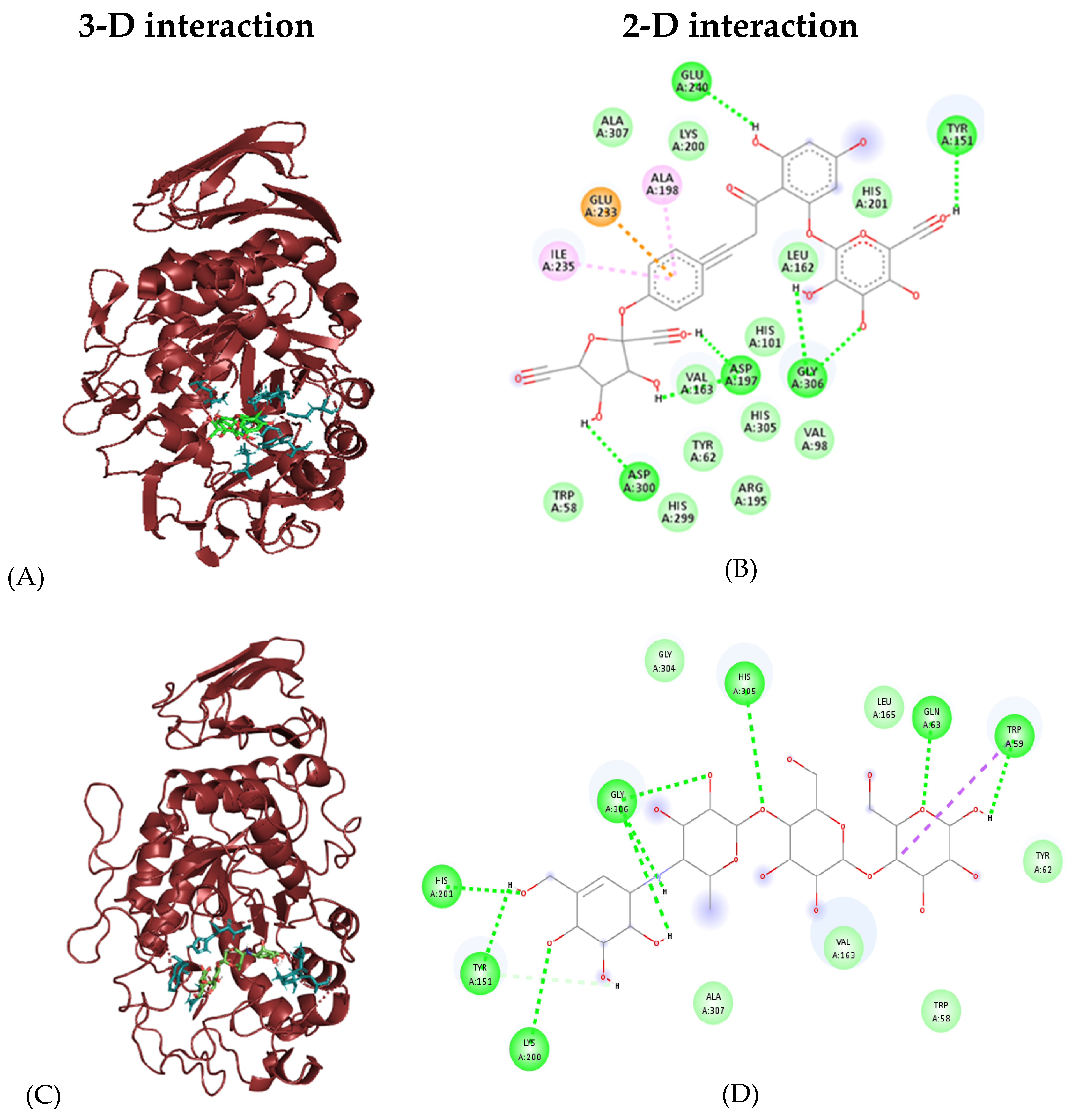
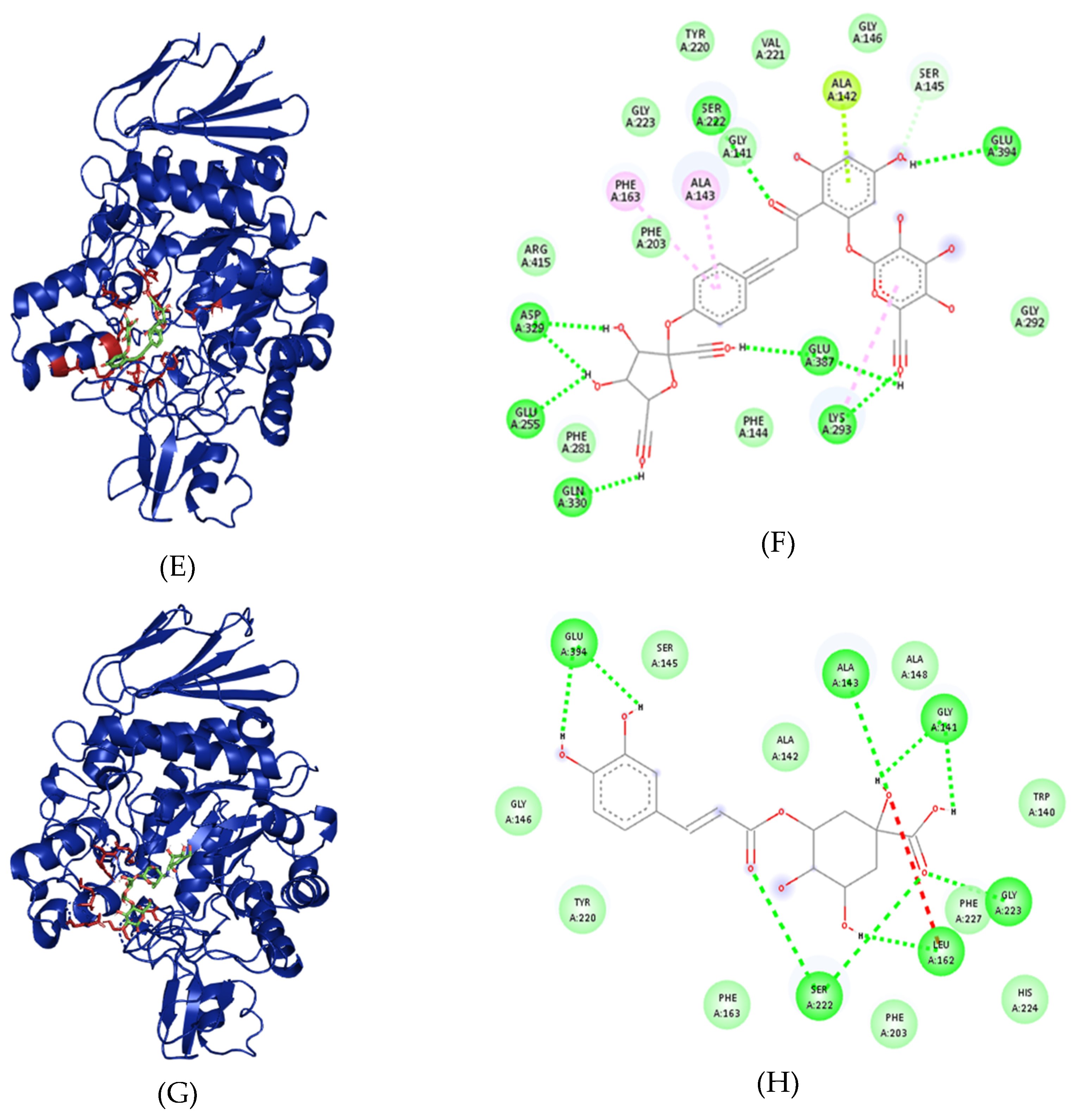
Molecular docking results of 4PHF acting as a ligand for α-amylase and α-glucosidase are presented in Table 1. For α-amylase, 4PHF exhibited a lower average binding energy (−5.89 kcal/mol) than that of acarbose (−4.69 kcal/mol). The interactions exhibiting the best pose for 4PHF with α-amylase and α-glucosidase are represented in Figure 3. The predicted hydrogen bonding between 4PHF and acarbose was the same in residues Gly 306 and Tyr 151 of α-amylase. Consistent with its known high affinity for α-amylase, acarbose established a higher number of hydrogen–bond interactions relative to 4PHF. The docking of 4PHF with α-amylase also showed the formation of π-anion alkyl bonds, while that of acarbose with α-amylase exhibited π-sigma and π-donor hydrogen bonds.
For α-glucosidase, 4PHF and acarbose exhibited binding energies of −6.20 kcal/mol and −4.75 kcal/mol, respectively. The analysis of hydrogen–bond formation showed that 4PHF established a higher number of hydrogen bonds with α-glucosidase (seven) compared to acarbose (five). In addition, the 4PHF–α-glucosidase complex displayed several types of interactions, including π–alkyl, π–lone pair, and carbon–hydrogen bonds. Acarbose also formed carbon–hydrogen bonds with α-glucosidase, although involving different amino acid residues. Notably, the amino acid residues Lys293 and Glu394 of α-glucosidase formed hydrogen bonds with both 4PHF and acarbose.

4. Discussion

This study provides the first evaluation of 4PHF—an enzymatically produced fructosylated derivative of phlorizin—as an inhibitor of key enzymes involved in carbohydrate digestion. Previous studies have shown that structural modifications of phenolic compounds, including glycosylation, hydroxylation, and methylation, can significantly alter their inhibitory potential [22]. Our results demonstrate that fructosylation modifies the biological profile of phlorizin, shifting its activity toward enhanced enzyme inhibition.
A previous study evaluated the inhibitory activity of various flavonoids against another enzyme relevant to T2DM, DPP-4. The authors reported that the introduction of additional functional groups altered the compounds’ biological activity. In the present work, the fructoside substituent may exert effects similar to those of glycoside substituents by introducing additional hydroxyl groups that enhance binding affinity to the target enzyme, as observed by Pan et al. (2022), who reported that modifications such as glycosylation, together with factors including the flavonoid aglycone structure, the type of glycoside, and the position of substitution, significantly influence biological activity [23]. Nevertheless, the effects of phlorizin fructosylation—such as in 4PHF—on other enzyme targets remain to be elucidated.
The fructosylation of phenolic compounds such as puerarin and coniferyl alcohol has previously been achieved using levansucrase from Gluconacetobacter diazotrophicus. Among the properties evaluated in the resulting fructosylated derivatives were their water solubility—which, in the case of fructosyl-β-(2 → 6)-puerarin, increased—and their antioxidant capacity, which was retained [24]. However, its biological activity was not evaluated. Similarly, several efforts have been directed toward modifying hydroquinone to generate the chalcone arbutin. Hydroquinone is a well-known antioxidant, and its fructosylation has also been achieved using Leuconostoc mesenteroides levansucrase. The resulting hydroquinone fructoside exhibited higher antioxidant activity compared with β-arbutin. In addition, its tyrosinase-inhibitory activity was evaluated in silico, yielding a higher tyrosinase inhibitor activity as compared with β-arbutin [25].
In our study, the in vitro and in silico results obtained for the 4PHF-enriched fraction were consistent, collectively demonstrating its inhibitory effect on α-amylase. The 4PHF-enriched fraction (74.5% by HPLC-UV) showed a clear inhibitory effect on α-amylase. The presence of an O-fructofuranosyl moiety may facilitate enzyme recognition by mimicking structural features of its natural substrates. In contrast, it is possible that increased steric hindrance may account for the weaker interaction observed with α-glucosidase. These factors have been considered by another study that evaluated phenolic α-glucosidase inhibition [26].
Another dihydrochalcone, trilobatin (phloretin-4′-O-β-D-glucoside), isolated from Lithocarpus polystachyus Rehd., exhibited strong α-glucosidase inhibitory activity (48.7%), comparable to acarbose (45.8%), but only moderate inhibition of α-amylase (21.2% vs. 42.6%). These findings indicate that trilobatin matches acarbose in α-glucosidase inhibition, while displaying substantially lower activity against α-amylase [27]. In this study, the dihydrochalcone phlorizin, used as a control, showed no detectable inhibitory activity against α-glucosidase.
A previous study by Liu et al. (2025) reported approximately 80% inhibition of α-glucosidase by sweet tea extracts, which are naturally rich in phlorizin. In that study, the main antioxidants in Lithocarpus litseifolius ranged from 200 to 300 mg/g dry weight for trilobatin, 60 to 150 mg/g dry weight for phlorizin, and 10 to 14 mg/g dry weight for both phloretin and quercetin [28]. These findings differ from our results, in which neither the phlorizin control nor 4PHF displayed α-glucosidase inhibitory activity. It is important to note, however, that our tested compound consisted primarily of 4PHF and, although it shares some structural similarity with trilobatin as a dihydrochalcone, sweet tea extracts contain a complex mixture of phenolic compounds that may act synergistically or contribute additively to the observed inhibition.
The 4PHF-enriched fraction inhibited α-amylase with an IC50 value of 2.69 µg/mL although it does not reach the value of acarbose. In contrast, 4PHF exhibited greater α-amylase inhibitory potency than phlorizin, with an IC50 value approximately four-fold lower than that of pure phlorizin, suggesting that fructosylation enhances α-amylase inhibitory activity. In the present work, the purity analysis by HPLC-UV showed a content of 74.5% for 4PHF; thus, the inhibitory properties mainly found for α-amylase in the in vitro study could be associated with this dominant molecule. The contribution of the remaining phlorizin to the α-amylase inhibitory activity of the 4PHF-enriched fraction appears to be limited, given that pure phlorizin exhibited a low inhibitory effect compared to that of the 4PHF fraction. These findings are in agreement with previous studies reporting only modest α-amylase inhibition by phlorizin [29]. However, whether it acts through competitive or non-competitive mechanisms remains to be determined.
Phlorizin is a natural glucoside of floretin; the hydrolysis of phlorizin’s O-glycosidic bond by intestinal glucosidases generates the aglycone phloretin, a well-known inhibitor of α-glucosidase [30]. Thus, it is possible that molecules such as 4PHF derived from phlorizin have antidiabetic properties.
Additionally, metabolic improvements were observed in an obese rat model following the administration of sweet tea leaf extract rich in phlorizin, 3-hydroxy-phlorizin, phloretin, quercetin and trilobatin. These effects included decreased serum lipid levels, attenuation of body-weight gain, reduced circulating leptin and insulin, and down-regulated expression of peroxisome proliferator-activated receptor gamma (PPARγ) and CCAAT enhancer-binding protein alpha (C/EBPα), which are involved in adipogenesis [31]. The antidiabetic properties of phlorizin were also investigated in a diabetic rat model. Zhang et al. evaluated various doses of this flavonoid (30–120 mg/kg) and observed significant reductions in fasting glucose and serum lipid levels, along with the preservation of pancreatic islet architecture and attenuation of hepatic lipid accumulation [32]. The reported benefits of compounds structurally related to 4PHF support its future evaluation in in vivo models.
The anti-diabetic effects of flavonoids have been explored, highlighting their in vitro effects [33]. However, the simultaneous in vitro and in silico evaluation of potential anti-diabetic agents is also relevant, particularly when structural modifications of the flavonoid structure are introduced. Previous studies have shown that such modifications can enhance physicochemical properties associated with improved biological activity and health-related outcomes [34,35].
In the present work, although the in silico analysis suggested that 4PHF could inhibit α-glucosidase, this effect was not confirmed in the in vitro experiments. The pharmacokinetics of 4PHF remain to be elucidated. In this study, in silico analyses indicated that 4PHF exhibited a slightly stronger predicted binding affinity for α-glucosidase than for α-amylase. Previous studies show that specific structural modifications in chalcones—such as prenylation, methoxylation, the introduction of hydroxyl groups, or changes in the conjugation of the aromatic system—are crucial for conferring inhibitory activity and enhancing affinity for α-amylase [35,36,37]. Therefore, it is not appropriate to assume that all chalcone derivatives will have similar effects, even if they share the same chemical core; the activity strongly depends on the nature, number, and position of the substituents. In this regard, 4PHF, the functionalized derivative of phlorizin, incorporates fructose residues attached to its backbone, which introduces a substantial increase in molecular polarity and conformational flexibility. This fructosylation can significantly alter the profile of interactions with carbohydrate-digesting enzymes by increasing the number of hydroxyl groups capable of forming hydrogen bonds and polar interactions with amino acid residues in the enzyme’s catalytic or peripheral regions, as suggested by in silico docking analyses [38]. Beyond direct binding interactions, the presence of the fructosyl moiety likely influences the spatial orientation and dynamic behavior of the molecule in the aqueous reaction medium, potentially favoring specific binding sites or stabilizing transient enzyme-inhibitor complexes [34]. In parallel, fructosylation can improve solubility and dispersion in water, reducing the aggregation effects commonly observed in hydrophobic phenolic compounds and thus increasing the effective concentration available for enzyme interaction [11,13].
In this study, the binding energy of acarbose was −4.69 kcal/mol against α-amylase, while a similar value was obtained for α-glucosidase (−4.75 kcal/mol). In comparison, a previous study reported stronger binding energies for acarbose against α-amylase (−7.017 kcal/mol) and similar in the case of α-glucosidase (−4.500 kcal/mol). The number of torsion angles in ligands such as acarbose is an important determinant of binding affinity, because increased conformational flexibility can influence docking outcomes [39]. It should be noted that different PDB structures were used for both enzymes, which may have influenced the docking results.
The structural modification introduced by fructosylation may alter the orientation of the phloretin backbone within the catalytic pocket, hindering productive interactions with residues essential for α-glucosidase activity. Conversely, a previous study showed that phlorizin acts as a competitive inhibitor (IC50 = 2.1 mg/mL) of this enzyme [40], supporting the idea that fructosylation can modify enzyme selectivity.
Evidence from phlorizin derivatives, such as dodecyl-acylated phlorizin, indicates that these modified compounds can suppress intestinal glucose transport and inhibit α-glucosidase activity better than pure phlorizin. The authors of that study reported that pure phlorizin exhibits high affinity for the catalytic site of α-glucosidase; however, it demonstrated unsatisfactory competitive inhibitory activity with an IC50 value of 0.97 mM [41]. These findings are consistent with the results of the present study, in which favorable in silico predictions for 4PHF were not confirmed by the in vitro assays. Moreover, fructosylation may protect the molecular structure from early hydrolysis, potentially extending its half-life and enabling additional biological activities, given that phlorizin is susceptible to cleavage by intestinal enzymes [42]. These findings underscore the need for in vivo studies. Although molecular docking predicted higher binding affinities between 4PHF and α-glucosidase compared to α-amylase, these predictions were not corroborated by in vitro inhibition assays. This discrepancy highlights the limitations of static in silico models in capturing the full complexity of enzyme-ligand interactions, particularly for enzymes with distinct active site architectures and dynamic catalytic mechanisms, and underscores the need for complementary kinetic and biophysical studies to better correlate computational predictions with experimental results [43].
Regarding the α-glucosidase inhibition of chalcones with chemical modifications, Seo and colleagues (2005) demonstrated that the introduction of sulfonamide groups generates a new type of strongly inhibitory chalcone due to additional polar interactions [44]. Similarly, Sun and colleagues (2017) showed that prenylation or geranylation significantly increases the inhibitory activity of chalcones by promoting hydrophobic interactions at the α-glucosidase active site [35]. In contrast, chalcones without these substituents, or with modifications that alter the orientation of functional groups, may exhibit low or no inhibitory activity [45,46].
In the present work, the results show that the fraction enriched with 4PHF practically did not inhibit α-glucosidase, especially compared to acarbose (IC50 = 0.33 µg/mL). Similarly, pure phlorizin exhibited negligible inhibitory activity against α-glucosidase, even at the highest concentration tested (2.5 µg/mL). This finding is consistent with previous reports describing phlorizin as a weak α-glucosidase inhibitor, with reported IC50 values of approximately 2.1 mg/mL [29,40].
The inhibitory activity of chalcones fundamentally depends on the substitution pattern [47]. Fructosylation, as carried out in 4PHF, can significantly alter the ligand-enzyme interaction by providing multiple hydroxyl groups that modify the orientation and flexibility of the compound. In some cases, this modification can reduce affinity rather than increase it, depending on access to the catalytic site [11,13].
The simultaneous inhibition of α-amylase and α-glucosidase has been considered an effective strategy for modulating the absorption of carbohydrates from the diet and thereby reducing postprandial blood glucose levels [47]. Physiologically, salivary and pancreatic α-amylase catalyze the hydrolysis of α-(1,4)-glucosidic bonds in polysaccharides such as starch, producing oligosaccharides which are subsequently converted into monosaccharides by α-glucosidase activity in the brush border of the jejunum. These monosaccharides are then absorbed into the bloodstream, leading to an increase in blood glucose levels [8]. Therefore, the ability of 4PHF to inhibit α-amylase, in contrast to phlorizin, suggests a distinct mechanism of action that could represent a therapeutic advantage by improving postprandial glucose control.
Interestingly, 4PHF inhibited α-amylase both in vitro (IC50 = 2.69 µg/mL) and in silico (−5.89 kcal/mol), despite the fact that phlorizin has been described as having negligible effects on porcine α-amylase [48]. Tian et al. (2021) systematically evaluated a flavonoid-enriched fraction and several flavonoids isolated from Rubus corchorifolius using multiple in vitro assays, including the inhibition of carbohydrate-digesting enzymes, as well as an in vivo model. These analyses demonstrated that both the flavonoid-enriched fraction and flavonoid glycosides, especially Compound 4, exhibited marked inhibitory activity in enzyme assays compared to the flavonoid aglycones and attenuated the postprandial increase in blood glucose levels in mice administered high-sucrose, high-maltose, or starch solutions [49]. Choudhary et al. (2021) evaluated the antidiabetic effects of a flavonoid fraction of the plant Chenopodium album L., reporting inhibition of α-amylase with an IC50 of approximately 122.18 µg/mL. Molecular docking analysis revealed a binding affinity of −9.3 kcal/mol, suggesting that the flavonoid fraction primarily exerts its antidiabetic activity through α-amylase inhibition [50]. Notably, in this study, the amylase inhibition by the 4PHF-enriched fraction presented a lower IC50 of 2.69 µg/mL.
Ribeiro et al. (2023) investigated the inhibitory activity of several flavonoids and phenolic acids against α-amylases and α-glucosidases using in vitro enzyme assays. The results demonstrated that multiple compounds exhibited measurable inhibitory effects on these carbohydrate-hydrolyzing enzymes, confirming their ability to interact directly with enzymatic targets involved in carbohydrate digestion. These findings reinforce the relevance of in vitro enzyme inhibition assays as a key tool for characterizing the functional potential and selectivity of phenolic compounds for digestive enzymes. In addition, starch and maltose tolerance tests were performed in male Swiss mice [51]. The effects of flavonoids and phenolic acids have been evaluated using combined in vitro and in vivo models [50,51]; however, the effects of 4PHF remain to be investigated in animal models.
Furthermore, recent in silico analyses have shown that fructosylated phenolic compounds generated by enzymatic biocatalysis can interact with other metabolic targets relevant to T2DM, such as DPP-4, insulin receptor (IR), insulin receptor substrate (IRS), PPAR-γ, and AMP-activated protein kinase (AMPK), often showing more favorable binding energies than standard drugs such as metformin or sitagliptin. The primary mechanism identified between the fructosylated phenolic compounds, and the protein targets was the formation of hydrogen bonds with polar amino acids such as serine, glutamine, glutamic acid, threonine, aspartic acid, and lysine. Furthermore, absorption, distribution, metabolism, elimination, and toxicity (ADMET) analyses revealed favorable pharmacokinetic properties, further supporting the therapeutic potential of fructosylated phenolic compounds [13]. This study presents the first evidence that the fructosylated phenolic compound 4PHF inhibits α-amylase.
Altogether, these findings highlight that the enzymatic modification of phenolic compounds, such as phlorizin, can reconfigure their biological activity, generating new molecular interactions and enzymatic inhibition profiles with potential therapeutic relevance for the treatment of T2DM.

Limitations and Future Perspectives

Future research should focus on a comprehensive kinetic characterization of 4PHF’s inhibitory activity against human α-amylase and α-glucosidase, including detailed analyses of enzyme–substrate interaction dynamics to elucidate the inhibition mechanism. Additional experiments employing higher enzyme concentrations are warranted to determine whether 4PHF exhibits inhibitory activity against α-glucosidase, as suggested by the in silico study.
Further exploration of structure–activity relationships, supported by advanced molecular modeling techniques and biophysical validation, would strengthen the mechanistic understanding derived from in silico analyses. Furthermore, expanding the evaluation of 4PHF to other molecular targets related to carbohydrate digestion and glucose handling at the biochemical level, such as digestive enzymes or transport-related proteins, could provide a broader functional context for its inhibitory profile. Likewise, incorporating well-established animal models of impaired glucose homeostasis would represent a valuable intermediate step in assessing the functional relevance, bioavailability, and systemic effects of 4PHF under physiologically complex conditions, thereby bridging the gap between in vitro findings and potential applied outcomes. Comparative in vitro studies with a broader panel of reference inhibitors or structurally related bioactive compounds would also help to better position 4PHF within the current landscape of enzyme modulators. Overall, the findings of this study highlight enzymatic fructosylation as an effective biocatalytic strategy for modulating the functional properties of phenolic compounds. The selective inhibition of α-amylase shown by 4PHF underscores its potential relevance for applied research focused on the development of enzyme modulators of carbohydrate digestion.

5. Conclusions

This study provides the first evidence that an enzymatically synthesized phlorizin derivative, 4PHF, exhibits selective inhibitory activity in vitro against carbohydrate-digesting enzymes. While 4PHF did not show significant inhibition of α-glucosidase within the analyzed concentration range, it achieved approximately 60% inhibition of α-amylase, revealing a distinct inhibitory profile compared to native phlorizin and the broader inhibitory activity of acarbose.
This selective enzyme inhibition suggests that fructosylation substantially modifies the interaction behavior of phlorizin, resulting in a distinct mode of modulation of carbohydrate-digesting enzymes. The relevance of this effect was supported by molecular compatibility analyses, which revealed a high predicted binding affinity between 4PHF and α-amylase, providing a structural justification for the experimentally observed inhibition. Overall, the combined in vitro and in silico findings demonstrate that enzymatic fructosylation is an effective biocatalytic strategy for reprogramming the functional properties of phenolic compounds. The selective inhibition of α-amylase shown by 4PHF highlights its potential relevance for applied research focused on the development of enzymatic modulators of carbohydrate digestion and supports its investigation as a structurally optimized lead compound.

Author Contributions

Conceptualization, E.P.-C. and J.A.; data curation, A.S.G.-G. and O.R.T.-G.; formal analysis, A.H.-G. and I.M.S.-H.; funding acquisition, E.P.-C. and J.A.; methodology, C.O.-C., A.S.G.-G. and O.R.T.-G.; writing—review and editing, A.S.G.-G. and E.P.-C. All authors have read and agreed to the published version of the manuscript.

Funding

This research was funded by the COECYTJAL project FODECIJAL 10233-2022. This research was supported by a doctoral scholarship granted to Omar Ricardo Torres-González (CVU 926677) by the Secretaría de Ciencia, Humanidades, Tecnología e Innovación (SECIHTI, Mexico), within the postgraduate program “Ciencias de la Innovación Biotecnológica” at Centro de Investigación y Asistencia en Tecnología y Diseño del Estado de Jalisco, A.C. (CIATEJ).

Data Availability Statement

The original contributions presented in this study are included in the article. Further inquiries can be directed to the corresponding authors.

Conflicts of Interest

The authors declare no conflicts of interest.

Abbreviations

The following abbreviations are used in this manuscript:
4PHF4-O-mono-fructosyl phlorizin
DNS3,5-dinitrosalicylic acid
HPLC-UVhigh-performance liquid chromatography
KesLParaburkholderia phymatum levansucrase
NMRnuclear magnetic resonance
PBSphosphate-buffered saline
PDAphotodiode array
PDBProtein Data Bank
SEMerror of the mean
TLCthin-layer chromatography
T2DMtype 2 diabetes mellitus

References

  1. Gupta, S.; Sharma, N.; Arora, S.; Verma, S. Diabetes: A review of its pathophysiology, and advanced methods of mitigation. Curr. Med. Res. Opin. 2024, 40, 773–780. [Google Scholar] [CrossRef]
  2. International Diabetes Federation. Diabetes Atlas, 11th ed.; International Diabetes Federation: Brussels, Belgium, 2025; Available online: https://diabetesatlas.org/media/uploads/sites/3/2025/04/IDF_Atlas_11th_Edition_2025-1.pdf (accessed on 19 September 2025).
  3. Demir, S.; Nawroth, P.P.; Herzig, S.; Ekim, U.B. Emerging Targets in Type 2 Diabetes and Diabetic Complications. Adv. Sci. 2021, 8, e2100275. [Google Scholar] [CrossRef]
  4. Kan, R.; Ren, P.; Wu, A.; Tang, Q.; Kong, B.; Xue, C. Identification and molecular docking study of sugarcane leaf-derived compounds as potent dipeptidyl peptidase IV, α-glucosidase, and α-amylase inhibitors. J. Sci. Food Agric. 2023, 103, 5388–5400. [Google Scholar] [CrossRef]
  5. Majeed, M.; Majeed, S.; Mundkur, L.; Nagabhushanam, K.; Arumugam, S.; Beede, K.; Ali, F. Standardized Emblica officinalis fruit extract inhibited the activities of α-amylase, α-glucosidase, and dipeptidyl peptidase-4 and displayed antioxidant potential. J. Sci. Food Agric. 2020, 100, 509–516. [Google Scholar] [CrossRef] [PubMed]
  6. Hussain, F.; Khan, Z.; Jan, M.S.; Ahmad, S.; Ahmad, A.; Rashid, U.; Ullah, F.; Ayaz, M.; Sadiq, A. Synthesis, in-vitro α-glucosidase inhibition, antioxidant, in-vivo antidiabetic and molecular docking studies of pyrrolidine-2,5-dione and thiazolidine-2,4-dione derivatives. Bioorg. Chem. 2019, 91, 103128. [Google Scholar] [CrossRef] [PubMed]
  7. Masky, B.; Adjia, H.; Miaffo, D.; Aboubakar, B.F.; Foyet, H.S.; Maguirgue, K.; Talla, E.R.; Kopodjing, A.; Bonabé, C.; Ntchapda, F. Antidiabetic activity of the aqueous extract of Erigeron floribundus leaves in streptozotocin-induced type 1 diabetes model in Wistar rats. Metab. Open 2024, 22, 100288. [Google Scholar] [CrossRef] [PubMed]
  8. Li, X.; Bai, Y.; Jin, Z.; Svensson, B. Food-derived non-phenolic α-amylase and α-glucosidase inhibitors for controlling starch digestion rate and guiding diabetes-friendly recipes. LWT 2022, 153, 112455. [Google Scholar] [CrossRef]
  9. Ni, T.; Zhang, S.; Rao, J.; Zhao, J.; Huang, H.; Liu, Y.; Ding, Y.; Liu, Y.; Ma, Y.; Zhang, S.; et al. Phlorizin, an important glucoside: Research progress on its biological activity and mechanism. Molecules 2024, 29, 741. [Google Scholar] [CrossRef]
  10. Tian, L.; Cao, J.; Zhao, T.; Liu, Y.; Khan, A.; Cheng, G. The bioavailability, extraction, biosynthesis and distribution of natural dihydrochalcone: Phloridzin. Int. J. Mol. Sci. 2021, 22, 962. [Google Scholar] [CrossRef]
  11. Herrera-González, A.; Núñez-López, G.; Morel, S.; Amaya-Delgado, L.; Sandoval, G.; Gschaedler, A.; Remaud-Simeon, M.; Arrizon, J. Functionalization of natural compounds by enzymatic fructosylation. Appl. Microbiol. Biotechnol. 2017, 101, 5223–5234. [Google Scholar] [CrossRef]
  12. Zhang, Q.; Wang, L.; Zhao, Y. An overview of Lithocarpus polystachyus, with dihydrochalcones as natural-derived bioactive compounds. Food Rev. Int. 2022, 39, 5934–5947. [Google Scholar] [CrossRef]
  13. Damián-Medina, K.; Herrera-González, A.; Figueroa-Yáñez, L.J.; Arrizon, J. Enzymatic fructosylation of phenolic compounds: A new alternative for the development of antidiabetic drugs. Molecules 2024, 29, 3072. [Google Scholar] [CrossRef] [PubMed]
  14. Herrera-González, A.; Núñez-López, G.; Núñez-Dallos, N.; Amaya-Delgado, L.; Sandoval, G.; Remaud-Simeon, M.; Morel, S.; Arrizon, J.; Hernández, L. Enzymatic synthesis of phlorizin fructosides. Enzym. Microb. Technol. 2021, 147, 109783. [Google Scholar] [CrossRef] [PubMed]
  15. Rycek, L.; Ticli, V.; Pyszkowski, J.; Latkolik, S.; Liu, X.; Atanasov, A.G.; Steinacher, T.; Bauer, R.; Schuster, D.; Dirsch, V.M.; et al. Stereoselective synthesis of the isomers of notoincisol A: Assigment of the absolute configuration and biological evaluation. J. Nat. Prod. 2018, 81, 2419–2428. [Google Scholar] [CrossRef] [PubMed]
  16. Jimenez-Garcia, S.N.; Garcia-Mier, L.; Ramirez-Gomez, X.S.; Aguirre-Becerra, H.; Escobar-Ortiz, A.; Contreras-Medina, L.M.; Garcia-Trejo, J.F.; Feregrino-Perez, A.A. Pitahaya peel: A by-product with great phytochemical potential, biological activity, and functional application. Molecules 2022, 27, 5339. [Google Scholar] [CrossRef]
  17. Lankatillake, C.; Luo, S.; Flavel, M.; Lenon, G.B.; Gill, H.; Huynh, T.; Dias, D.A. Screening natural product extracts for potential enzyme inhibitors: Protocols and standardisation of blanks in α-amylase, α-glucosidase and lipase assays. Plant Methods 2021, 17, 3. [Google Scholar] [CrossRef]
  18. Cano-Lou, J.; Millán-Laleona, A.; Candrea, R.; Les, F.; Pina, A.; Caprioli, G.; López, V. Apple peels as an edible source of phenolic bioactive compounds with antidiabetic and antiglycation properties. Food Funct. 2025, 16, 2947–2958. [Google Scholar] [CrossRef]
  19. Morris, G.M.; Huey, R.; Lindstrom, W.; Sanner, M.F.; Belew, R.K.; Goodsell, D.S.; Olson, A.J. AutoDock4 and AutoDockTools4: Automated docking with selective receptor flexibility. J. Comput. Chem. 2009, 30, 2785–2791. [Google Scholar] [CrossRef]
  20. González-Garibay, A.S.; Vallejo-Cardona, A.A.; Villarreal-Amézquita, A.A.; Sánchez-Hernández, I.M.; Torres-González, O.R.; Padilla-Camberos, E. The In Vitro Cytotoxic Potential of Biosynthesized Silver Nanoparticles in MIA PaCa-2 Cells Supported with an In Silico Study. Inorganics 2024, 12, 317. [Google Scholar] [CrossRef]
  21. Sales, P.M.; Souza, P.M.; Simeoni, L.A.; Silveira, D. α-Amylase inhibitors: A review of raw material and isolated compounds from plant sources. J. Pharm. Pharm. Sci. 2012, 15, 141–183. [Google Scholar] [CrossRef]
  22. Ćorković, I.; Gašo-Sokač, D.; Pichler, A.; Šimunović, J.; Kopjar, M. Dietary polyphenols as natural inhibitors of α-amylase and α-glucosidase. Life 2022, 12, 1692. [Google Scholar] [CrossRef] [PubMed]
  23. Pan, J.; Zhang, Q.; Zhang, C.; Yang, W.; Liu, H.; Lv, Z.; Liu, J.; Jiao, Z. Inhibition of dipeptidyl peptidase-4 by flavonoids: Structure–activity relationship, kinetics and interaction mechanism. Front. Nutr. 2022, 9, 892426. [Google Scholar] [CrossRef] [PubMed]
  24. Núñez-López, G.; Herrera-González, A.; Hernández, L.; Amaya-Delgado, L.; Sandoval, G.; Remaud-Simeon, M.; Morel, S.; Arrizon, J. Fructosylation of phenolic compounds by levansucrase from Gluconacetobacter diazotrophicus. Enzym. Microb. Technol. 2019, 122, 19–25. [Google Scholar] [CrossRef] [PubMed]
  25. Kang, J.; Kim, Y.M.; Kim, N.; Kim, D.W.; Nam, S.H.; Kim, D. Synthesis and characterization of hydroquinone fructoside using Leuconostoc mesenteroides levansucrase. Appl. Microbiol. Biotechnol. 2009, 83, 1009–1016. [Google Scholar] [CrossRef]
  26. Kopjar, M.; Ćorković, I.; Buljeta, I.; Šimunović, J.; Pichler, A. Fortification of pectin/blackberry hydrogels with apple fibers: Effect on phenolics, antioxidant activity and inhibition of α-glucosidase. Antioxidants 2022, 11, 1459. [Google Scholar] [CrossRef]
  27. Dong, H.Q.; Li, M.; Zhu, F.; Liu, F.L.; Huang, J.B. Inhibitory potential of trilobatin from Lithocarpus polystachyus Rehd against α-glucosidase and α-amylase linked to type 2 diabetes. Food Chem. 2012, 130, 261–266. [Google Scholar] [CrossRef]
  28. Liu, G.; Wang, L.; Wang, J.; Zheng, H.; Yang, S.; Zhou, Q.; Fu, L.; Cai, Z.; Zhang, S.; Wang, C.; et al. Temporal dynamics of bioactive compounds in sweet tea (Lithocarpus litseifolius (Hance) Chun): Linking harvest stages to flavor and health benefits. Food Res. Int. 2025, 218, 116918. [Google Scholar] [CrossRef]
  29. Li, D.; Sun, L.; Yang, Y.; Wang, Z.; Yang, X.; Zhao, T.; Guo, Y. Young apple polyphenols postpone starch digestion in vitro and in vivo. J. Funct. Foods 2019, 56, 127–135. [Google Scholar] [CrossRef]
  30. Han, L.; Fang, C.; Zhu, R.; Peng, Q.; Li, D.; Wang, M. Inhibitory effect of phloretin on α-glucosidase: Kinetics, interaction mechanism and molecular docking. Int. J. Biol. Macromol. 2017, 95, 520–527. [Google Scholar] [CrossRef]
  31. Zhou, C.J.; Huang, S.; Liu, J.Q.; Qiu, S.Q.; Xie, F.Y.; Song, H.P.; Li, Y.S.; Hou, S.Z.; Lai, X.P. Sweet tea leaves extract improves leptin resistance in diet-induced obese rats. J. Ethnopharmacol. 2013, 145, 386–392. [Google Scholar] [CrossRef]
  32. Zhang, W.; Chen, S.; Fu, H.; Shu, G.; Tang, H.; Zhao, X.; Lin, J. Hypoglycemic and hypolipidemic activities of phlorizin from Lithocarpus polystachyus Rehd in diabetic rats. Food Sci. Nutr. 2021, 9, 1989–1996. [Google Scholar] [CrossRef]
  33. Al-Ishaq, R.K.; Abotaleb, M.; Kubatka, P.; Kajo, K.; Büsselberg, D. Flavonoids and their anti-diabetic effects: Cellular mechanisms and effects to improve blood sugar levels. Biomolecules 2019, 9, 430. [Google Scholar] [CrossRef] [PubMed]
  34. Malbert, Y.; Moulis, C.; Brison, Y.; Morel, S.; André, I.; Remaud-Simeon, M. Engineering a branching sucrase for flavonoid glucoside diversification. Sci. Rep. 2018, 8, 15153. [Google Scholar] [CrossRef]
  35. Sun, H.; Wang, D.; Song, X.; Zhang, Y.; Ding, W.; Peng, X.; Zhang, X.; Li, Y.; Ma, Y.; Wang, R.; et al. Natural prenylchalconaringenins and prenylnaringenins as antidiabetic agents: α-glucosidase and α-amylase inhibition and in vivo antihyperglycemic and antihyperlipidemic effects. J. Agric. Food Chem. 2017, 65, 1574–1581. [Google Scholar] [CrossRef] [PubMed]
  36. Hu, Y.C.; Luo, Y.D.; Li, L.; Joshi, M.K.; Lu, Y.H. In vitro investigation of 2′,4′-dihydroxy-6′-methoxy-3′,5′-dimethylchalcone for glycemic control. J. Agric. Food Chem. 2012, 60, 10683–10688. [Google Scholar] [CrossRef] [PubMed]
  37. Najafian, M.; Ebrahim-Habibi, A.; Hezareh, N.; Yaghmaei, P.; Parivar, K.; Larijani, B. Trans-chalcone: A novel small-molecule inhibitor of mammalian α-amylase. Mol. Biol. Rep. 2011, 38, 1617–1620. [Google Scholar] [CrossRef]
  38. Hua, F.; Zhou, P.; Wu, H.Y.; Chu, G.X.; Xie, Z.W.; Bao, G.H. Inhibition of α-glucosidase and α-amylase by flavonoid glycosides from Lu’an GuaPian tea: Molecular docking and interaction mechanism. Food Funct. 2018, 9, 4173–4183. [Google Scholar] [CrossRef]
  39. Abdelli, I.; Benariba, N.; Adjdir, S.; Fekhikher, Z.; Daoud, I.; Terki, M.; Benramdane, H.; Ghalem, S. In silico evaluation of phenolic compounds as inhibitors of α-amylase and α-glucosidase. J. Biomol. Struct. Dyn. 2021, 39, 816–822. [Google Scholar] [CrossRef]
  40. Gong, T.; Yang, X.; Bai, F.; Li, D.; Zhao, T.; Zhang, J.; Sun, L.; Guo, Y. Young apple polyphenols as natural α-glucosidase inhibitors: In vitro and in silico studies. Bioorg. Chem. 2020, 96, 103625. [Google Scholar] [CrossRef]
  41. Xu, Z.; Hileuskaya, K.; Kraskouski, A.; Yang, Y.; Huang, Z.; Zhao, Z. Inhibition of α-glucosidase activity and intestinal glucose transport to assess the in vivo anti-hyperglycemic potential of dodecyl-acylated phlorizin and polydatin derivatives. Food Funct. 2024, 15, 4785–4804. [Google Scholar] [CrossRef]
  42. Kaeswurm, J.A.H.; Claasen, B.; Fischer, M.P.; Buchweitz, M. Interaction of structurally diverse phenolic compounds with porcine pancreatic α-amylase. J. Agric. Food Chem. 2019, 67, 11108–11118. [Google Scholar] [CrossRef]
  43. Lee, J.; Nguyen, C.H.; Mamitsuka, H. Más allá del acoplamiento rígido: Enfoques de aprendizaje profundo para interacciones proteína-ligando totalmente flexibles. Brief. Bioinform. 2025, 26, bbaf454. [Google Scholar] [CrossRef] [PubMed]
  44. Seo, W.D.; Kim, J.H.; Kang, J.E.; Ryu, H.W.; Curtis Long, M.J.; Lee, H.S.; Yang, M.S.; Park, K.H. Sulfonamide chalcone as a new class of α-glucosidase inhibitors. Bioorg. Med. Chem. Lett. 2005, 15, 5514–5516. [Google Scholar] [CrossRef] [PubMed]
  45. Ansari, F.L.; Umbreen, S.; Hussain, L.; Makhmoor, T.; Nawaz, S.A.; Lodhi, M.A.; Khan, S.N.; Shaheen, F.; Choudhary, M.I. Syntheses and biological activities of chalcone and 1,5-benzothiazepine derivatives: Promising new free-radical scavengers and esterase, urease, and α-glucosidase inhibitors. Chem. Biodivers. 2005, 2, 487–496. [Google Scholar] [CrossRef] [PubMed]
  46. Jabeen, F.; Oliferenko, P.V.; Oliferenko, A.A.; Pillai, G.G.; Ansari, F.L.; Hall, C.D.; Katritzky, A.R. Dual inhibition of α-glucosidase and butyrylcholinesterase studied by molecular field topology analysis. Eur. J. Med. Chem. 2014, 80, 228–242. [Google Scholar] [CrossRef]
  47. Rocha, S.; Sousa, A.; Ribeiro, D.; Correia, C.M.; Silva, V.L.M.; Santos, C.M.M.; Silva, A.M.S.; Araújo, A.N.; Fernandes, E.; Freitas, M. A study towards drug discovery for the management of type 2 diabetes mellitus through inhibition of the carbohydrate-hydrolyzing enzymes α-amylase and α-glucosidase by chalcone derivatives. Food Funct. 2019, 10, 5510–5520. [Google Scholar] [CrossRef]
  48. Sun, L.; Chen, W.; Meng, Y.; Yang, X.; Yuan, L.; Guo, Y. Interactions between polyphenols in thinned young apples and porcine pancreatic α-amylase: Inhibition, detailed kinetics and fluorescence quenching. Food Chem. 2016, 208, 51–60. [Google Scholar] [CrossRef]
  49. Tian, J.L.; Si, X.; Wang, Y.H.; Gong, E.S.; Xie, X.; Zhang, Y.; Li, B.; Shu, C. Bioactive flavonoids from Rubus corchorifolius inhibit α-glucosidase and α-amylase to improve postprandial hyperglycemia. Food Chem. 2021, 341, 128149. [Google Scholar] [CrossRef]
  50. Choudhary, N.; Prabhakar, P.; Khatik, G.; Chamakuri, S. Evaluation of acute toxicity and in vitro and in vivo antidiabetic potential of the flavonoid fraction of Chenopodium album. Pharmacogn. J. 2021, 13, 765–779. [Google Scholar] [CrossRef]
  51. Ribeiro-Tonsic, B.; Correa, V.; Garcia-Manieri, J.; Bracht, A. An in vivo approach to the reported effects of phenolic acids and flavonoids on the pancreatic α-amylase activity. Food Biosci. 2023, 51, 102357. [Google Scholar] [CrossRef]
Figure 1. HPLC-UV chromatogram of the enzymatically fructosylated phlorizin-enriched fraction containing 4 −O-mono −fructosyl phlorizin (4PHF) as the major component, retention time 5.541 min. The molecular structure of 4PHF was confirmed by NMR.
Applsci 16 02072 g001
Figure 2. Inhibitory activity of 4PHF-enriched fraction against carbohydrate-digesting enzymes. (A) α-Amylase inhibition (%) and half-maximal inhibitory concentration (IC50) values of the tested compounds. (B) α-Glucosidase inhibition (%) and IC50 values. Acarbose was used as the positive control; phlorizin was utilized as a reference control; 4PHF, 4-O-mono-fructosyl phlorizin-enriched fraction; nd, IC50 values could not be determined. Data are expressed as mean ± SEM of three independent experiments.
Applsci 16 02072 g002
Figure 3. Three and two-dimensional views of 4-O-mono-fructosyl phlorizin (4PHF) or acarbose bound with α-amylase and α-glucosidase. Interactions: (A) 3D of 4PHF and α-amylase, (B) 2D of 4PHF and α-amylase, (C) 3D of acarbose and α-amylase, (D) 2D of acarbose and α-amylase, (E) 3D of 4PHF and α-glucosidase, (F) 2D of 4PHF and α-glucosidase, (G) 3D of acarbose and α-glucosidase, and (H) 2D of acarbose and α-glucosidase.
Applsci 16 02072 g003aApplsci 16 02072 g003b
Table 1. Physicochemical characteristics of the interactions between 4-O-mono-fructosyl phlorizin (4PHF) and key enzymes involved in carbohydrate digestion, using acarbose as positive control.
ProteinLigandFree Energy of Binding (kcal/mol)Type of InteractionsAmino Acid Residue Interactions
α-amylase
(PDB: 1OSE)
4-O-mono-
fructosyl phlorizin
−5.89Hydrogen bondsTYR 151 [5.56], ASP 197 [3.94, 4.78], GLU 240 [5.26], ASP 300 [3.98], GLY 306 [3.15, 3.20].
π-anionGLU 233 [5.98].
AlkylALA 198 [5.10], ILE 235 [4.78].
Acarbose
(CID:41774)
−4.69Hydrogen bondsTRP59 [4.85], GLN 63 [4.39], TYR 151 [4.99], LYS 200 [3.97], HIS 201 [5.34], HIS 305 [4.08], GLY 306 [3.46, 2.58, 3.82].
π-sigmaTRP59 [3.73].
π-Donor Hydrogen BondTYR 151 [5.41].
α-glucosidase
(PDB: 1UOK)
4-O-mono-
fructosyl phlorizin
−6.2Hydrogen bondsSER 222 [3.42], GLU 255 [5.45], LYS 293 [4.23], ASP 329 [4.25, 4.50], GLN 330 [4.09], GLU 387 [5.25, 5], GLU 394 [5.96].
AlkylPHE 163 [5.09], ALA 143 [3.97].
-AlkilLYS 293 [5.82].
π-Lone PairALA 142 [5.37].
Carbon Hydrogen bondSER 145 [3.52].
Acarbose
(CID:41774)
−4.75Hydrogen bondsALA 143 [4.06], SER 145 [3.42, 4.13], LYS 293 [3.91], TRP 294 [5.13], GLU 394 [4.19].
Carbon Hydrogen bondGLU 387 [5.38].
Disclaimer/Publisher’s Note: The statements, opinions and data contained in all publications are solely those of the individual author(s) and contributor(s) and not of MDPI and/or the editor(s). MDPI and/or the editor(s) disclaim responsibility for any injury to people or property resulting from any ideas, methods, instructions or products referred to in the content.