Nanomaterials-Enabled Electrochemical Biosensors: From Enhanced Performance to Regulatory Readiness

 , , ,
, , ,  , , and
Abstract
1. Introduction
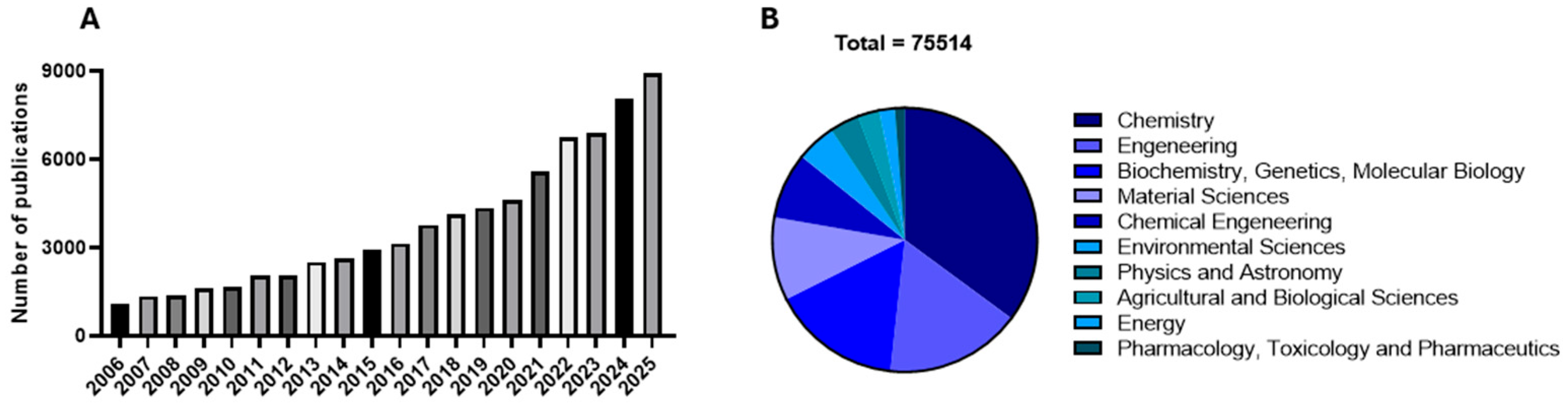
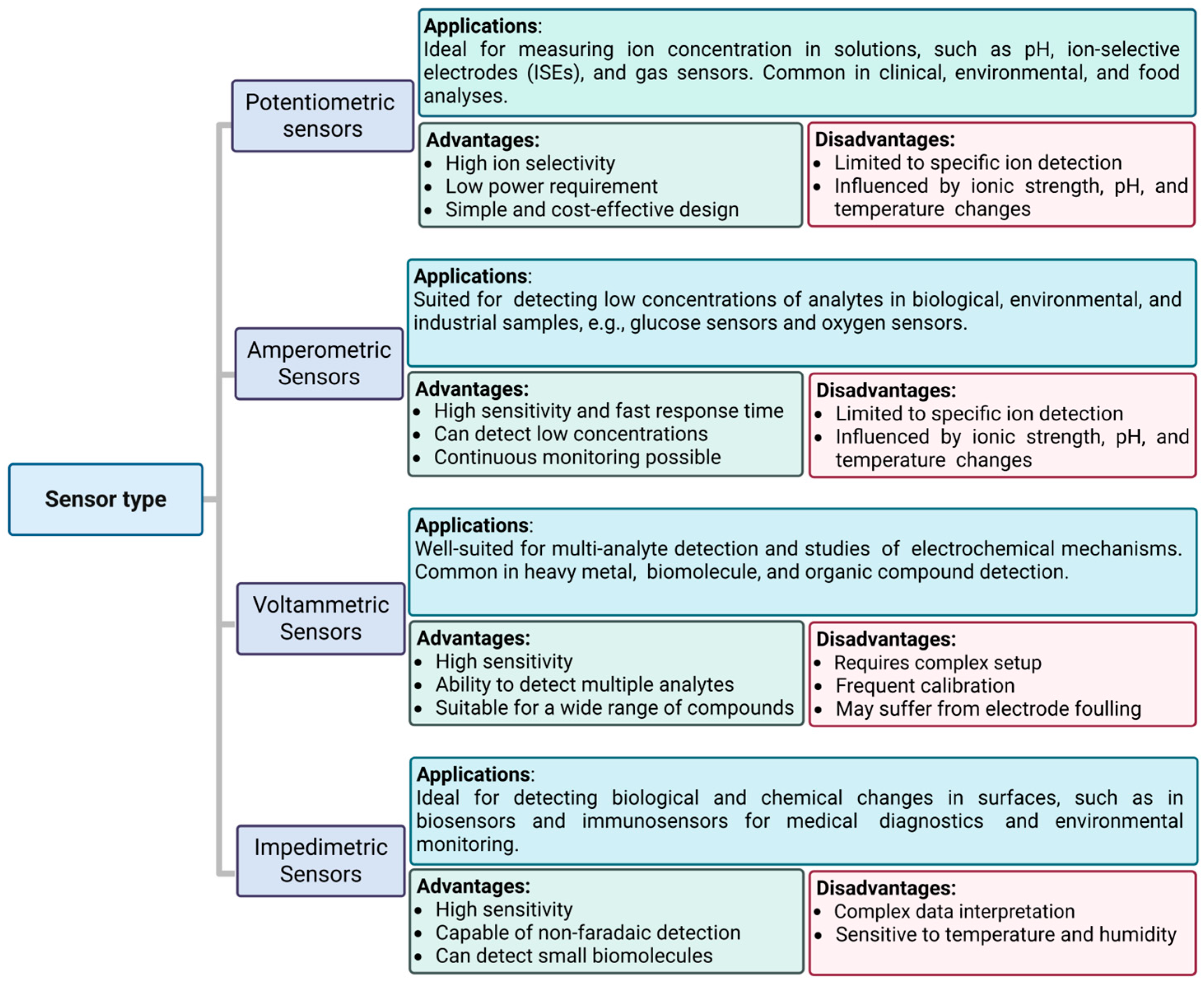
2. Electrochemical Biosensor and Nanomaterials
3. Nanomaterials for Electrochemical Biosensing Applications
3.1. Carbon Nanostructures and Graphene
3.2. Gold Nanoparticles
3.3. Iron-Based Magnetic Nanoparticles
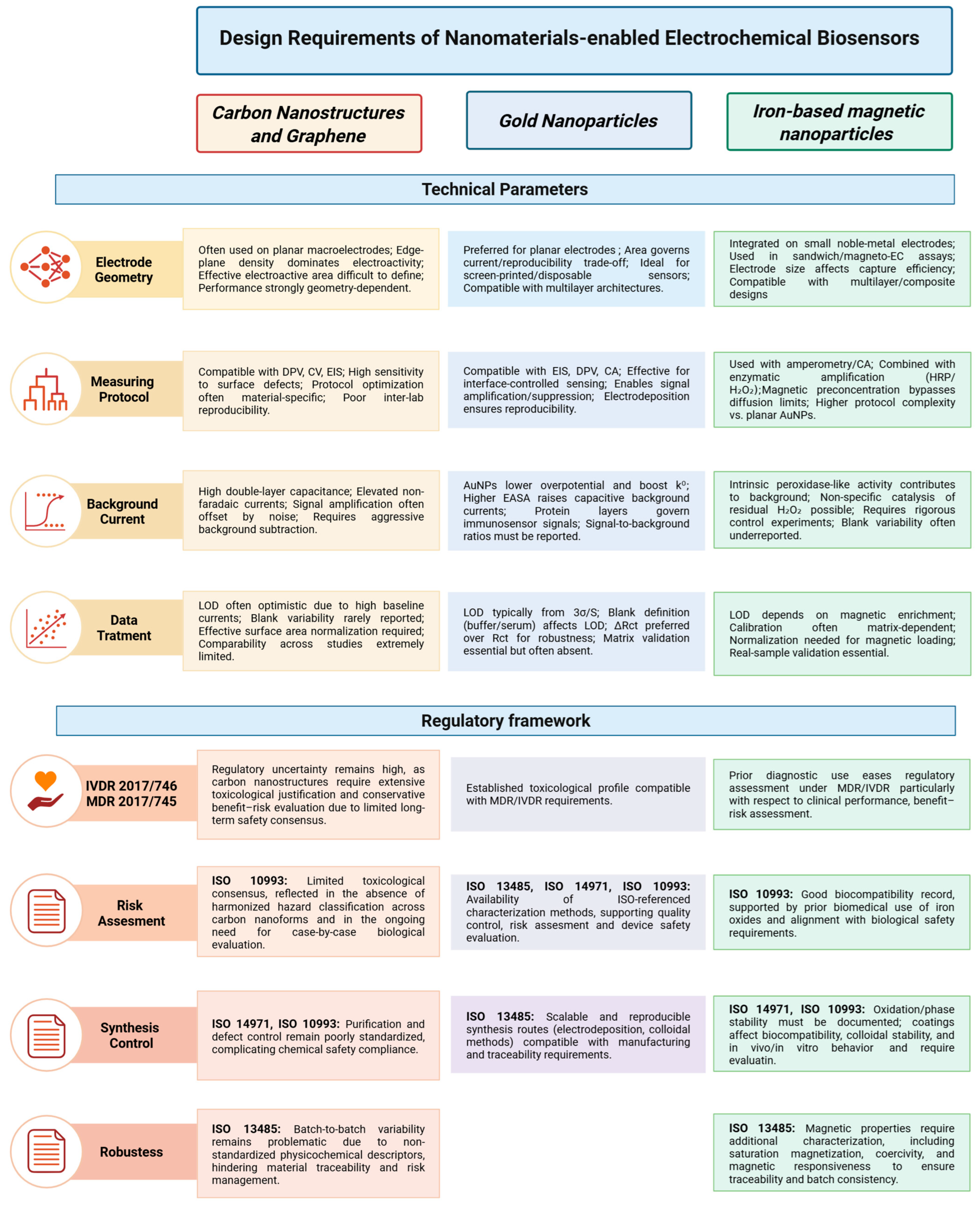
3.4. Critical Assessment of Analytical Performance Parameters in Nanomaterial-Based Electrochemical Biosensors
4. Integration of Nanomaterials in Electrochemical Biosensing Devices: Regulatory Frameworks
5. Conclusions
- Carbon nanostructures (CNTs, graphene) deliver outstanding electrochemical performance but suffer from batch-to-batch heterogeneity, complex purification, and limited toxicological consensus, restricting their use to applications where extreme sensitivity justifies regulatory complexity.
- AuNPs offer the most favorable regulatory profile owing to their often spherical morphology, controlled synthesis, extensive toxicological data, and compatibility with large-scale production, making them particularly suited for point-of-care diagnostics.
- Iron-based magnetic nanoparticles similarly benefit from strong biocompatibility records and straightforward functionalization, although their susceptibility to oxidation necessitates rigorous stability control.
- Emerging nanomaterials, including MXenes and hybrid nanocomposites and MOFs offer attractive compromises but incur increased characterization and documentation burdens, while diamond-based nanomaterials, despite exceptional stability and biocompatibility, remain limited by high production costs.
- Selecting nanomaterials with existing ISO references, applying validated characterization protocols to ensure traceability, comparability, and regulatory alignment.
- Conducting preliminary risk assessments even in proof-of-concept studies can substantially accelerate downstream regulatory approval and reduce redesign cycles.
- Adopting simplified and scalable sensor architectures, favoring one-pot syntheses, self-assembly, and screen-printing over multistep functionalization routes to improve reproducibility and manufacturability.
- Signal processing and pattern recognition: ML algorithms (support vector machines, random forests, neural networks) can extract relevant features from complex voltammetric, impedimetric, or chronoamperometric datasets, enabling discrimination of overlapping signals and real-time correction for drift, fouling, and environmental fluctuations, thereby improving operational stability without frequent recalibration.
- Predictive modeling for sensor optimization: AI-driven approaches can accelerate nanomaterial design by predicting structure-performance relationships (e.g., nanoparticle size vs. electrochemical activity) from limited experimental datasets, reducing trial-and-error iterations and guiding rational selection of surface chemistries and electrode architectures.
- Quality control and batch validation: Convolutional neural networks and anomaly detection algorithms applied to microscopy images (TEM, SEM) and spectroscopic data (Raman, XPS) can automate nanomaterial characterization, ensuring compliance with regulatory specifications and identifying out-of-specification batches with higher throughput and consistency than manual inspection.
- Clinical decision support: Integration of biosensor outputs with patient-specific metadata through ML models can enhance diagnostic accuracy, stratify risk, and enable personalized treatment recommendations—particularly valuable for continuous glucose monitoring, cardiac biomarker panels, and infectious disease point-of-care platforms.
Funding
Data Availability Statement
Conflicts of Interest
References
- Ronkainen, N.J.; Brian Halsall, H.; Heineman, W.R. Electrochemical Biosensors. Chem. Soc. Rev. 2010, 39, 1747–1763. [Google Scholar] [CrossRef]
- Hammond, J.L.; Formisano, N.; Estrela, P.; Carrara, S.; Tkac, J. Electrochemical Biosensors and Nanobiosensors. Essays Biochem. 2016, 60, 69–80. [Google Scholar] [CrossRef]
- Pohanka, M.; Skládal, P. Electrochemical Biosensors—Principles and Applications. J. Appl. Biomed. 2008, 6, 57–64. [Google Scholar] [CrossRef]
- Wang, K.; Lin, X.; Zhang, M.; Li, Y.; Luo, C.; Wu, J. Review of Electrochemical Biosensors for Food Safety Detection. Biosensors 2022, 12, 959. [Google Scholar] [CrossRef]
- Wu, J.; Liu, H.; Chen, W.; Ma, B.; Ju, H. Device Integration of Electrochemical Biosensors. Nat. Rev. Bioeng. 2023, 1, 346–360. [Google Scholar] [CrossRef] [PubMed]
- Abdulbari, H.A.; Basheer, E.A.M. Electrochemical Biosensors: Electrode Development, Materials, Design, and Fabrication. ChemBioEng Rev. 2017, 4, 92–105. [Google Scholar] [CrossRef]
- Sumitha, M.S.; Xavier, T.S. Recent Advances in Electrochemical Biosensors—A Brief Review. Hybrid Adv. 2023, 2, 100023. [Google Scholar] [CrossRef]
- Li, L.; Wang, T.; Zhong, Y.; Li, R.; Deng, W.; Xiao, X.; Xu, Y.; Zhang, J.; Hu, X.; Wang, Y. A Review of Nanomaterials for Biosensing Applications. J. Mater. Chem. B 2024, 12, 1168–1193. [Google Scholar] [CrossRef]
- Sharma, M.; Mahajan, P.; Alsubaie, A.S.; Khanna, V.; Chahal, S.; Thakur, A.; Yadav, A.; Arya, A.; Singh, A.; Singh, G. Next-Generation Nanomaterials-Based Biosensors: Real-Time Biosensing Devices for Detecting Emerging Environmental Pollutants. Mater. Today Sustain. 2025, 29, 101068. [Google Scholar] [CrossRef]
- Andronico, L.A.; Chen, L.; Mirasoli, M.; Guardigli, M.; Quintavalla, A.; Lombardo, M.; Trombini, C.; Chiu, D.T.; Roda, A. Thermochemiluminescent Semiconducting Polymer Dots as Sensitive Nanoprobes for Reagentless Immunoassay. Nanoscale 2018, 10, 14012–14021. [Google Scholar] [CrossRef] [PubMed]
- Di Fusco, M.; Quintavalla, A.; Lombardo, M.; Guardigli, M.; Mirasoli, M.; Trombini, C.; Roda, A. Organically Modified Silica Nanoparticles Doped with New Acridine-1,2-Dioxetane Analogues as Thermochemiluminescence Reagentless Labels for Ultrasensitive Immunoassays. Anal. Bioanal. Chem. 2015, 407, 1567–1576. [Google Scholar] [CrossRef] [PubMed]
- Roda, B.; Deo, S.K.; O’Connor, G.; Moraskie, M.; Giordani, S.; Marassi, V.; Roda, A.; Daunert, S. Shining Light on Biosensors: Chemiluminescence and Bioluminescence in Enabling Technologies. TrAC Trends Anal. Chem. 2024, 180, 117975. [Google Scholar] [CrossRef]
- Cho, I.-H.; Kim, D.H.; Park, S. Electrochemical Biosensors: Perspective on Functional Nanomaterials for on-Site Analysis. Biomater. Res. 2020, 24, 6. [Google Scholar] [CrossRef] [PubMed]
- Shellaiah, M. A Review on Biomedical, Biomolecular, and Environmental Monitoring Applications of Cysteamine Functionalized Nanomaterials. Micromachines 2025, 16, 1144. [Google Scholar] [CrossRef]
- Crapnell, R.D.; Banks, C.E. Electroanalytical Overview: Screen-Printed Electrochemical Sensing Platforms. ChemElectroChem 2024, 11, e202400370. [Google Scholar] [CrossRef]
- Pour, S.R.S.; Calabria, D.; Emamiamin, A.; Lazzarini, E.; Pace, A.; Guardigli, M.; Zangheri, M.; Mirasoli, M.; Pour, S.R.S.; Calabria, D.; et al. Electrochemical vs. Optical Biosensors for Point-of-Care Applications: A Critical Review. Chemosensors 2023, 11, 546. [Google Scholar] [CrossRef]
- Kim, J.; Jeong, J.; Ko, S.H. Electrochemical Biosensors for Point-of-Care Testing. Bio-Des. Manuf. 2024, 7, 548–565. [Google Scholar] [CrossRef]
- Gauglitz, G. Analytical Evaluation of Sensor Measurements. Anal. Bioanal. Chem. 2018, 410, 5–13. [Google Scholar] [CrossRef]
- Pandey, P.; Datta, M.; Malhotra, B.D. Prospects of Nanomaterials in Biosensors. Anal. Lett. 2008, 41, 159–209. [Google Scholar] [CrossRef]
- Holzinger, M.; Le Goff, A.; Cosnier, S. Nanomaterials for Biosensing Applications: A Review. Front. Chem. 2014, 2, 63. [Google Scholar] [CrossRef] [PubMed]
- Hasanzadeh, M.; Shadjou, N.; de la Guardia, M. Iron and Iron-Oxide Magnetic Nanoparticles as Signal-Amplification Elements in Electrochemical Biosensing. TrAC Trends Anal. Chem. 2015, 72, 1–9. [Google Scholar] [CrossRef]
- Khan, A.; DeVoe, E.; Andreescu, S. Carbon-Based Electrochemical Biosensors as Diagnostic Platforms for Connected Decentralized Healthcare. Sens. Diagn. 2023, 2, 529–558. [Google Scholar] [CrossRef]
- Ozbey, S.; Keles, G.; Kurbanoglu, S. Innovations in Graphene-Based Electrochemical Biosensors in Healthcare Applications. Microchim. Acta 2025, 192, 290. [Google Scholar] [CrossRef]
- Şak, B.; Sousa, H.B.A.; Prior, J.A.V.; Şak, B.; Sousa, H.B.A.; Prior, J.A.V. Carbon Nanomaterial-Based Electrochemical Biosensors for Alzheimer’s Disease Biomarkers: Progress, Challenges, and Future Perspectives. Biosensors 2025, 15, 684. [Google Scholar] [CrossRef]
- Silveira, C.M.; Baur, J.; Holzinger, M.; Moura, J.J.G.; Cosnier, S.; Almeida, M.G. Enhanced Direct Electron Transfer of a Multihemic Nitrite Reductase on Single-Walled Carbon Nanotube Modified Electrodes. Electroanalysis 2010, 22, 2973–2978. [Google Scholar] [CrossRef]
- Silveira, C.M.; Gomes, S.P.; Araújo, A.N.; Montenegro, M.C.B.S.M.; Todorovic, S.; Viana, A.S.; Silva, R.J.C.; Moura, J.J.G.; Almeida, M.G. An Efficient Non-Mediated Amperometric Biosensor for Nitrite Determination. Biosens. Bioelectron. 2010, 25, 2026–2032. [Google Scholar] [CrossRef] [PubMed]
- Xiao, Y.; Patolsky, F.; Katz, E.; Hainfeld, J.F.; Willner, I. “Plugging into Enzymes”: Nanowiring of Redox Enzymes by a Gold Nanoparticle. Science 2003, 299, 1877–1881. [Google Scholar] [CrossRef] [PubMed]
- Patolsky, F.; Weizmann, Y.; Willner, I. Long-Range Electrical Contacting of Redox Enzymes by SWCNT Connectors. Angew. Chem. Int. Ed. 2004, 43, 2113–2117. [Google Scholar] [CrossRef]
- Besteman, K.; Lee, J.-O.; Wiertz, F.G.M.; Heering, H.A.; Dekker, C. Enzyme-Coated Carbon Nanotubes as Single-Molecule Biosensors. Nano Lett. 2003, 3, 727–730. [Google Scholar] [CrossRef]
- Gazzato, L.; Frasconi, M. Carbon Nanotubes and Their Composites for Flexible Electrochemical Biosensors. Anal. Sens. 2025, 5, e202400038. [Google Scholar] [CrossRef]
- Velický, M.; Bradley, D.F.; Cooper, A.J.; Hill, E.W.; Kinloch, I.A.; Mishchenko, A.; Novoselov, K.S.; Patten, H.V.; Toth, P.S.; Valota, A.T.; et al. Electron Transfer Kinetics on Mono- and Multilayer Graphene. ACS Nano 2014, 8, 10089–10100. [Google Scholar] [CrossRef]
- Yang, W.; Ratinac, K.R.; Ringer, S.P.; Thordarson, P.; Gooding, J.J.; Braet, F. Carbon Nanomaterials in Biosensors: Should You Use Nanotubes or Graphene? Angew. Chem. Int. Ed. 2010, 49, 2114–2138. [Google Scholar] [CrossRef]
- Bonaccorso, F.; Lombardo, A.; Hasan, T.; Sun, Z.; Colombo, L.; Ferrari, A.C. Production and Processing of Graphene and 2d Crystals. Mater. Today 2012, 15, 564–589. [Google Scholar] [CrossRef]
- Guo, X. Surface Plasmon Resonance Based Biosensor Technique: A Review. J. Biophotonics 2012, 5, 483–501. [Google Scholar] [CrossRef]
- Tang, X.; Bansaruntip, S.; Nakayama, N.; Yenilmez, E.; Chang, Y.; Wang, Q. Carbon Nanotube DNA Sensor and Sensing Mechanism. Nano Lett. 2006, 6, 1632–1636. [Google Scholar] [CrossRef]
- Li, C.; Curreli, M.; Lin, H.; Lei, B.; Ishikawa, F.N.; Datar, R.; Cote, R.J.; Thompson, M.E.; Zhou, C. Complementary Detection of Prostate-Specific Antigen Using In2O3 Nanowires and Carbon Nanotubes. J. Am. Chem. Soc. 2005, 127, 12484–12485. [Google Scholar] [CrossRef]
- Gruner, G. Carbon Nanotube Transistors for Biosensing Applications. Anal. Bioanal. Chem. 2006, 384, 322–335. [Google Scholar] [CrossRef]
- Shao, Y.; Wang, J.; Wu, H.; Liu, J.; Aksay, I.A.; Lin, Y. Graphene Based Electrochemical Sensors and Biosensors: A Review. Electroanalysis 2010, 22, 1027–1036. [Google Scholar] [CrossRef]
- Kuila, T.; Bose, S.; Khanra, P.; Mishra, A.K.; Kim, N.H.; Lee, J.H. Recent Advances in Graphene-Based Biosensors. Biosens. Bioelectron. 2011, 26, 4637–4648. [Google Scholar] [CrossRef] [PubMed]
- Li, Y.; Schluesener, H.J.; Xu, S. Gold Nanoparticle-Based Biosensors. Gold Bull. 2010, 43, 29–41. [Google Scholar] [CrossRef]
- Xu, Q.; Mao, C.; Liu, N.-N.; Zhu, J.-J.; Sheng, J. Direct Electrochemistry of Horseradish Peroxidase Based on Biocompatible Carboxymethyl Chitosan–Gold Nanoparticle Nanocomposite. Biosens. Bioelectron. 2006, 22, 768–773. [Google Scholar] [CrossRef]
- Mena, M.L.; Yáñez-Sedeño, P.; Pingarrón, J.M. A Comparison of Different Strategies for the Construction of Amperometric Enzyme Biosensors Using Gold Nanoparticle-Modified Electrodes. Anal. Biochem. 2005, 336, 20–27. [Google Scholar] [CrossRef]
- Willner, B.; Katz, E.; Willner, I. Electrical Contacting of Redox Proteins by Nanotechnological Means. Curr. Opin. Biotechnol. 2006, 17, 589–596. [Google Scholar] [CrossRef] [PubMed]
- Pingarrón, J.M.; Yáñez-Sedeño, P.; González-Cortés, A. Gold Nanoparticle-Based Electrochemical Biosensors. Electrochim. Acta 2008, 53, 5848–5866. [Google Scholar] [CrossRef]
- Liu, Y.; Yang, Y.; Wang, G.; Wang, D.; Shao, P.-L.; Tang, J.; He, T.; Zheng, J.; Hu, R.; Liu, Y.; et al. Multiplexed Discrimination of SARS-CoV-2 Variants via Plasmonic-Enhanced Fluorescence in a Portable and Automated Device. Nat. Biomed. Eng. 2023, 7, 1636–1648. [Google Scholar] [CrossRef] [PubMed]
- Li, Z.; Zhai, L.; Zhang, Q.; Zhai, W.; Li, P.; Chen, B.; Chen, C.; Yao, Y.; Ge, Y.; Yang, H.; et al. 1T′-Transition Metal Dichalcogenide Monolayers Stabilized on 4H-Au Nanowires for Ultrasensitive SERS Detection. Nat. Mater. 2024, 23, 1355–1362. [Google Scholar] [CrossRef]
- Qaanei, M.; Taheri, R.A.; Eskandari, K. Electrochemical Aptasensor for Escherichia Coli O157:H7 Bacteria Detection Using a Nanocomposite of Reduced Graphene Oxide, Gold Nanoparticles and Polyvinyl Alcohol. Anal. Methods 2021, 13, 3101–3109. [Google Scholar] [CrossRef]
- Brazaca, L.C.; Imamura, A.H.; Gomes, N.O.; Almeida, M.B.; Scheidt, D.T.; Raymundo-Pereira, P.A.; Oliveira, O.N.; Janegitz, B.C.; Machado, S.A.S.; Carrilho, E. Electrochemical Immunosensors Using Electrodeposited Gold Nanostructures for Detecting the S Proteins from SARS-CoV and SARS-CoV-2. Anal. Bioanal. Chem. 2022, 414, 5507–5517. [Google Scholar] [CrossRef]
- Owino, J.H.O.; Arotiba, O.A.; Hendricks, N.; Songa, E.A.; Jahed, N.; Waryo, T.T.; Ngece, R.F.; Baker, P.G.L.; Iwuoha, E.I. Electrochemical Immunosensor Based on Polythionine/Gold Nanoparticles for the Determination of Aflatoxin B1. Sensors 2008, 8, 8262–8274. [Google Scholar] [CrossRef]
- Amouzadeh Tabrizi, M.; Acedo, P. An Electrochemical Immunosensor for the Determination of Procalcitonin Using the Gold-Graphene Interdigitated Electrode. Biosensors 2022, 12, 771. [Google Scholar] [CrossRef]
- Hemben, A.; Ashley, J.; Tothill, I.E. Development of an Immunosensor for PfHRP 2 as a Biomarker for Malaria Detection. Biosensors 2017, 7, 28. [Google Scholar] [CrossRef]
- Labib, M.; Zamay, A.S.; Kolovskaya, O.S.; Reshetneva, I.T.; Zamay, G.S.; Kibbee, R.J.; Sattar, S.A.; Zamay, T.N.; Berezovski, M.V. Aptamer-Based Impedimetric Sensor for Bacterial Typing. Anal. Chem. 2012, 84, 8114–8117. [Google Scholar] [CrossRef]
- Wang, S.; Cui, M.; Tang, H.; Zhang, M.; Zhang, Y. Gold Nanoparticles-Amplified Laccase-Based Electrochemical Biosensor Using Graphitized Carbon@boron Carbide as Electron Transfer Promoter. Microchem. J. 2024, 207, 111976. [Google Scholar] [CrossRef]
- Gaba, S.; Jain, U. Electrochemical Immunosensor Based on Screen-Printed Electrodes Modified with Gold Nanoparticles for Highly Sensitive Detection of TGF-α. Talanta Open 2025, 12, 100590. [Google Scholar] [CrossRef]
- Jaffrezic-Renault, N.; Martelet, C.; Chevolot, Y.; Cloarec, J.-P. Biosensors and Bio-Bar Code Assays Based on Biofunctionalized Magnetic Microbeads. Sensors 2007, 7, 589–614. [Google Scholar] [CrossRef]
- Hsing, I.-M.; Xu, Y.; Zhao, W. Micro- and Nano- Magnetic Particles for Applications in Biosensing. Electroanalysis 2007, 19, 755–768. [Google Scholar] [CrossRef]
- Stanciu, L.; Won, Y.-H.; Ganesana, M.; Andreescu, S. Magnetic Particle-Based Hybrid Platforms for Bioanalytical Sensors. Sensors 2009, 9, 2976–2999. [Google Scholar] [CrossRef] [PubMed]
- Yang, L.; Ren, X.; Tang, F.; Zhang, L. A Practical Glucose Biosensor Based on Fe3O4 Nanoparticles and Chitosan/Nafion Composite Film. Biosens. Bioelectron. 2009, 25, 889–895. [Google Scholar] [CrossRef]
- Zhuo, Y.; Yuan, P.-X.; Yuan, R.; Chai, Y.-Q.; Hong, C.-L. Bienzyme Functionalized Three-Layer Composite Magnetic Nanoparticles for Electrochemical Immunosensors. Biomaterials 2009, 30, 2284–2290. [Google Scholar] [CrossRef] [PubMed]
- Cui, J.; Dong, N.; Wang, M.; Jiang, Y.; Miao, P. Porous Magnetic Nanoparticles-Based Electrochemical Biosensor for Determination of Mercury in the Aquatic Environment. Part. Syst. Charact. 2020, 37, 2000074. [Google Scholar] [CrossRef]
- Zumpano, R.; Manghisi, M.; Polli, F.; D’Agostino, C.; Ietto, F.; Favero, G.; Mazzei, F. Label-Free Magnetic Nanoparticles-Based Electrochemical Immunosensor for Atrazine Detection. Anal. Bioanal. Chem. 2022, 414, 2055–2064. [Google Scholar] [CrossRef]
- Boubezari, I.; Bessueille, F.; Bonhomme, A.; Raimondi, G.; Zazoua, A.; Errachid, A.; Jaffrezic-Renault, N.; Boubezari, I.; Bessueille, F.; Bonhomme, A.; et al. Laccase-Based Biosensor Encapsulated in a Galactomannan-Chitosan Composite for the Evaluation of Phenolic Compounds. Biosensors 2020, 10, 70. [Google Scholar] [CrossRef]
- Hanoglu, S.B.; Man, E.; Harmanci, D.; Ruzgar, S.T.; Sanli, S.; Keles, N.A.; Ayden, A.; Tuna, B.G.; Duzgun, O.; Ozkan, O.F.; et al. Magnetic Nanoparticle-Based Electrochemical Sensing Platform Using Ferrocene-Labelled Peptide Nucleic Acid for the Early Diagnosis of Colorectal Cancer. Biosensors 2022, 12, 736. [Google Scholar] [CrossRef]
- Singampalli, K.L.; Neal-Harris, C.; Yee, C.; Lin, J.S.; Lillehoj, P.B. Highly Reusable Electrochemical Immunosensor for Ultrasensitive Protein Detection. Adv. Sens. Res. 2024, 3, 2400004. [Google Scholar] [CrossRef] [PubMed]
- Obeid, P.J.; Sari-Chmayssem, N.; Yammine, P.; Homsi, D.; El-Nakat, H.; Matar, Z.; Hamieh, S.; Koumeir, D.; Chmayssem, A. Designs and Materials of Electrodes for Electrochemical Sensors. ChemElectroChem 2025, 12, e202500230. [Google Scholar] [CrossRef]
- ISO/TR 13014:2012(En); Nanotechnologies—Guidance on Physico-Chemical Characterization of Engineered Nanoscale Materials for Toxicologic Assessment. ISO: Geneva, Switzerland, 2012. Available online: https://www.iso.org/obp/ui/en/#iso:std:iso:tr:13014:ed-1:v1:en (accessed on 17 October 2025).
- ISO 22412:2025(En); Particle Size Analysis—Dynamic Light Scattering (DLS). ISO: Geneva, Switzerland, 2025. Available online: https://www.iso.org/obp/ui/en/#iso:std:iso:22412:ed-3:v1:en (accessed on 17 October 2025).
- ISO 21363:2020(En); Nanotechnologies—Measurements of Particle Size and Shape Distributions by Transmission Electron Microscopy. ISO: Geneva, Switzerland, 2020. Available online: https://www.iso.org/obp/ui/en/#iso:std:iso:21363:ed-1:v1:en (accessed on 17 October 2025).
- ISO 17200:2020(En); Nanotechnologies—Nanoparticles in Powder Form—Characteristics and Measurements. ISO: Geneva, Switzerland, 2020. Available online: https://www.iso.org/obp/ui/en/#iso:std:iso:17200:ed-1:v1:en (accessed on 7 February 2026).
- ISO 17034:2016(En); General Requirements for the Competence of Reference Material Producers. ISO: Geneva, Switzerland, 2016. Available online: https://www.iso.org/obp/ui/en/#iso:std:iso:17034:ed-1:v1:en (accessed on 7 February 2026).
- ISO/TR 16197:2014(En); Nanotechnologies—Compilation and Description of Toxicological Screening Methods for Manufactured Nanomaterials. ISO: Geneva, Switzerland, 2014. Available online: https://www.iso.org/obp/ui/en/#iso:std:iso:tr:16197:ed-1:v1:en (accessed on 7 February 2026).
- ISO 10993-1:2018(En); Biological Evaluation of Medical Devices—Part 1: Evaluation and Testing Within a Risk Management Process. ISO: Geneva, Switzerland, 2018. Available online: https://www.iso.org/obp/ui/en/#iso:std:iso:10993:-1:ed-5:v1:en (accessed on 7 February 2026).
- ISO 10993-5:2009(En); Biological Evaluation of Medical Devices—Part 5: Tests for In Vitro Cytotoxicity. ISO: Geneva, Switzerland, 2009. Available online: https://www.iso.org/obp/ui/en/#iso:std:iso:10993:-5:ed-3:v1:en (accessed on 7 February 2026).
- ISO 10993-10:2021(En); Biological Evaluation of Medical Devices—Part 10: Tests for Irritation and Skin Sensitization. ISO: Geneva, Switzerland, 2021. Available online: https://www.iso.org/obp/ui/en/#iso:std:iso:10993:-10:ed-4:v1:en (accessed on 7 February 2026).
- EFSA Scientific Committee. Guidance on risk assessment of nanomaterials to be applied in the food and feed chain: Human and animal health. EFSA J. 2018, 16, 5327. [Google Scholar] [CrossRef]
- Implementation of the EFSA Scientific Committee guidance on nanomaterials in EFSA’s scientific assessments. EFSA Support. Publ. 2021, 18, 6790E.
- European Parliament and Council. Regulation (EU) 2017/745 on medical devices (Medical Device Regulation, MDR). Off. J. Eur. Union 2017, L 117, 1–175. [Google Scholar]
- European Parliament and Council. Regulation (EU) 2017/746 on in vitro diagnostic medical devices (In Vitro Diagnostic Regulation, IVDR). Off. J. Eur. Union 2017, L 117, 176–332. [Google Scholar]
- ISO 13485:2016(En); Medical Devices—Quality Management Systems—Requirements for Regulatory Purposes. ISO: Geneva, Switzerland, 2016. Available online: https://www.iso.org/obp/ui/en/#iso:std:iso:13485:ed-3:v1:en (accessed on 7 February 2026).
- ISO 14971:2019(En); Medical Devices—Application of Risk Management to Medical Devices. ISO: Geneva, Switzerland, 2019. Available online: https://www.iso.org/obp/ui/en/#iso:std:iso:14971:ed-3:v1:en (accessed on 7 February 2026).
- ISO/IEC 17025:2017(En); General Requirements for the Competence of Testing and Calibration Laboratories. ISO: Geneva, Switzerland, 2017. Available online: https://www.iso.org/obp/ui/en/#iso:std:iso-iec:17025:ed-3:v1:en (accessed on 7 February 2026).



| Target | Substrate | Electrochemical Method | LOD | Refs. |
|---|---|---|---|---|
| DNA (hybridization, FET format) | CNT-FET with receptor bound to Au electrodes via thioethers; recognition localized on the source/drain region | FET (conductance) | N.D. | [35] |
| Enzymes/Immunoassay on CNT-FET | Functionalized CNT channel (enzymes/antibodies) | FET (conductance) | N.D. | [36,37] |
| Biomarkers (graphene electrode) | rGO/GO or graphene electrodes on a conductive substrate | CV, DPV, Amperometry, EIS | N.D. | [38,39] |
| Target | Substrate | Electrochemical Method | LOD | Ref. |
|---|---|---|---|---|
| E. coli O157:H7 (aptasensor) | rGO–PVA/AuNP-modified GCE; anti-E. coli aptamer | DPV | 9.34 CFU/mL | [47] |
| SARS-CoV-2 spike (immunosensor) | SPCE with electrodeposited AuNP; anti-S antibody | EIS | 3.16 pmol/L | [48] |
| Aflatoxin B1 (immunosensor) | GCE/poly(thionine) with AuNP; anti-AFB1 | DPV | 0.07 ng/mL | [49] |
| Procalcitonin (immunosensor) | Laser-engraved graphene interdigitated electrode decorated with AuNP | EIS | 0.36 pg/mL | [50] |
| PfHRP2 malaria (immunosensor) | Screen-printed Au electrodes; AuNP-amplified Ab-HRP | Amperometry | 36 pg/mL | [51] |
| Salmonella (S. enteritidis) (aptasensor) | AuNP-modified SPCE; SELEX aptamer | EIS | 600 CFU/mL | [52] |
| Glucose (GOx wiring) | Au electrode with FAD-modified AuNP–reconstituted apo-GOx | CV—chronoamperometry | N.D. | [27] |
| Catechol (CC) | Lac/GC@B4C/AuNPs/NF (laccase immobilized on GC@B4C with electrodeposited AuNPs on nickel foam) | Chronoamperometry | 25 nM | [53] |
| TGF-α (cytokine, immunosensor) | Functionalized SPCE modified with low-dimensional Au nanomaterials | CV | 0.35 pg/mL | [54] |
| Target | Substrate | Electrochemical Method | LOD | Ref. |
|---|---|---|---|---|
| Glucose | Pt/GOD/Fe3O4 nanoparticles/chitosan (Cs)/Nafion-modified Pt electrode | Amperometry | 6 × 10⁻⁶ M | [58] |
| Carcinoembryonic antigen (CEA); α-Fetoprotein (AFP) | Gold electrode modified with chitosan–nanoAu hydrogel and anti-AFP and anti-CEA antibody; sandwich detection using (GOD + HRP)-Au–PB–Fe3O4-labeled secondary antibody | CV | 7 pg/mL | [59] |
| Na+ storage | Fe2O3 nanoparticles anchored on N-doped graphene (Fe2O3/N-graphene) electrode | CV | N.D. | [49] |
| CXCL9 (protein biomarker) | SPCE with cAb-MNPs and dually labeled AuNPs | Chronoamperometry | 27 pg/mL | [64] |
| Physicochemical Characterization of Nanomaterials | |
| Standard | Brief description |
| Guidance on physicochemical characterization of engineered nanomaterials, encompassing Critical Quality Attributes (CQAs). |
| Size determination of nanoparticles by Dynamic Light Scattering (DLS). |
| Size and morphology analysis of nanoparticles by Transmission Electron Microscopy (TEM). |
| Toxicological Screening and Risk Assessment | |
| Standard | Brief description |
| List and description of toxicological screening methods for nanomaterials. |
| Risk-based framework for biological evaluation of medical devices. |
| In vitro cytotoxicity testing for medical devices. |
| Irritation and sensitization testing for medical devices. |
| Regulatory Frameworks for Medical Devices and In Vitro Diagnostics | |
| Standard | Brief description |
| Regulation on medical devices, includes specific requirements for nanomaterials (Rule 19). |
| Regulation on in vitro diagnostic medical devices, requires analytical and clinical performance evaluation. |
| Quality Management, Risk Management, and Metrological Traceability | |
| Standard | Brief description |
| Quality management system for medical devices. |
| Risk management for medical devices. |
| Requirements for technical competence of testing and calibration laboratories. |
| Requirements for production of certified reference materials. |
Disclaimer/Publisher’s Note: The statements, opinions and data contained in all publications are solely those of the individual author(s) and contributor(s) and not of MDPI and/or the editor(s). MDPI and/or the editor(s) disclaim responsibility for any injury to people or property resulting from any ideas, methods, instructions or products referred to in the content. |
© 2026 by the authors. Licensee MDPI, Basel, Switzerland. This article is an open access article distributed under the terms and conditions of the Creative Commons Attribution (CC BY) license.
Share and Cite
Rondinini, V.; Giordani, S.; Dolci, L.S.; Placci, A.; Reschiglian, P.; Roda, B.; Roda, A.; Marassi, V.; Zattoni, A. Nanomaterials-Enabled Electrochemical Biosensors: From Enhanced Performance to Regulatory Readiness. Appl. Sci. 2026, 16, 2048. https://doi.org/10.3390/app16042048
Rondinini V, Giordani S, Dolci LS, Placci A, Reschiglian P, Roda B, Roda A, Marassi V, Zattoni A. Nanomaterials-Enabled Electrochemical Biosensors: From Enhanced Performance to Regulatory Readiness. Applied Sciences. 2026; 16(4):2048. https://doi.org/10.3390/app16042048
Chicago/Turabian StyleRondinini, Virginia, Stefano Giordani, Luisa Stella Dolci, Anna Placci, Pierluigi Reschiglian, Barbara Roda, Aldo Roda, Valentina Marassi, and Andrea Zattoni. 2026. "Nanomaterials-Enabled Electrochemical Biosensors: From Enhanced Performance to Regulatory Readiness" Applied Sciences 16, no. 4: 2048. https://doi.org/10.3390/app16042048
APA StyleRondinini, V., Giordani, S., Dolci, L. S., Placci, A., Reschiglian, P., Roda, B., Roda, A., Marassi, V., & Zattoni, A. (2026). Nanomaterials-Enabled Electrochemical Biosensors: From Enhanced Performance to Regulatory Readiness. Applied Sciences, 16(4), 2048. https://doi.org/10.3390/app16042048