1. Introduction
Terpinen-4-ol (TP4O) has been recognized as an important bioactive monoterpene alcohol. It has been identified as a major constituent of several essential oils, particularly
Melaleuca alternifolia (tea tree) oil [
1] and
Zingiber cassumunar (Plai) oil [
2], and has also been reported in other botanical sources, including
Origanum majorana [
3],
Juniperus sabina [
4], and
Cymbopogon martinii [
5]. TP4O demonstrates a broad spectrum of biological activities, including antimicrobial, anti-inflammatory, and antioxidant effects, as well as anti-tumorous, anticancer, antidiabetic, and cardiovascular protective activities. These properties have underpinned its widespread application in the pharmaceutical, cosmetic, and food industries [
1,
6,
7,
8].
TP4O has become a key quality marker in essential oils and related products owing to its therapeutic and industrial relevance. Regulatory specifications have therefore been established to control its content, including ISO 4730, which requires a minimum TP4O content of 30% in tea tree oil [
9], and the Thai Industrial Standard (TIS 1679–1998), which defines an acceptable range of 19.0–36.0% for pharmaceutical-grade Plai oil [
10]. At the same time, the scope of TP4O applications has continued to expand from traditional medicinal uses to high-value bioactive applications in cosmeceuticals, natural disinfectants, and food preservation systems [
11,
12]. Collectively, these regulatory and industrial developments underscore the growing demand for accurate, reliable, and SI-traceable analytical measurements of TP4O, which are essential for robust quality control and consumer safety.
The use of certified reference materials (CRMs) has become indispensable for achieving reliable and metrologically traceable results. CRMs, which are materials with sufficiently homogeneous and stable property values that are accompanied by a certificate providing the assigned value, associated uncertainty, and documented evidence of metrological traceability [
13,
14]; they play a central role in the measurement infrastructure by ensuring accuracy and comparability in chemical analysis. As such, they are essential tools for method validation, instrument calibration, and routine analytical quality assurance.
Despite their importance, commercially available TP4O materials are predominantly supplied as reference materials (RMs) rather than certified reference materials (CRMs). Although a limited number of high-purity TP4O CRMs with fully metrologically traceable certified values are commercially available, their availability remains limited, which constrains their applicability in high-accuracy measurements. Furthermore, reliance on imported RMs or CRMs may lead to extended procurement times due to international transportation and customs procedures. The development of a locally produced high-purity TP4O CRM will enhance measurement reliability, metrological traceability, and measurement readiness for laboratories in Thailand.
The development of high-purity organic CRMs requires reliable and metrologically traceable purity assessment. As the international authority for the SI system and global measurement comparability, the Bureau International des Poids et Mesures (BIPM) recommends analytical approaches such as the mass balance (MB) method and quantitative nuclear magnetic resonance (qNMR) spectroscopy [
15]. The combined use of MB and qNMR provides a robust analytical workflow that can be readily implemented in applied laboratories for purity assignment of volatile organic compounds [
15,
16,
17,
18].
The MB method is based on comprehensive impurity profiling, encompassing organic, inorganic, volatile, and non-volatile components, and typically employs a combination of analytical techniques, including gas chromatography (GC) for volatile organic compounds, high-performance liquid chromatography (HPLC) for non-volatile or less volatile organic components, Karl Fischer coulometry (KFT) for water content determination, and thermogravimetric analysis (TGA) for the assessment of volatile and non-volatile residues [
19,
20,
21,
22,
23,
24,
25]. Complementarily, qNMR has emerged as a primary ratio method for direct purity determination with inherent SI traceability through the use of certified internal standards [
20,
24,
26,
27,
28,
29,
30].
The combined application of MB and qNMR is particularly advantageous, as it enables comparison of independent analytical results and facilitates the identification of potential methodological biases, or so-called “dark uncertainties.” Although each approach has inherent limitations such as incomplete impurity identification in MB or spectral interferences in qNMR their concurrent use provides a more robust and reliable purity evaluation [
23,
31].
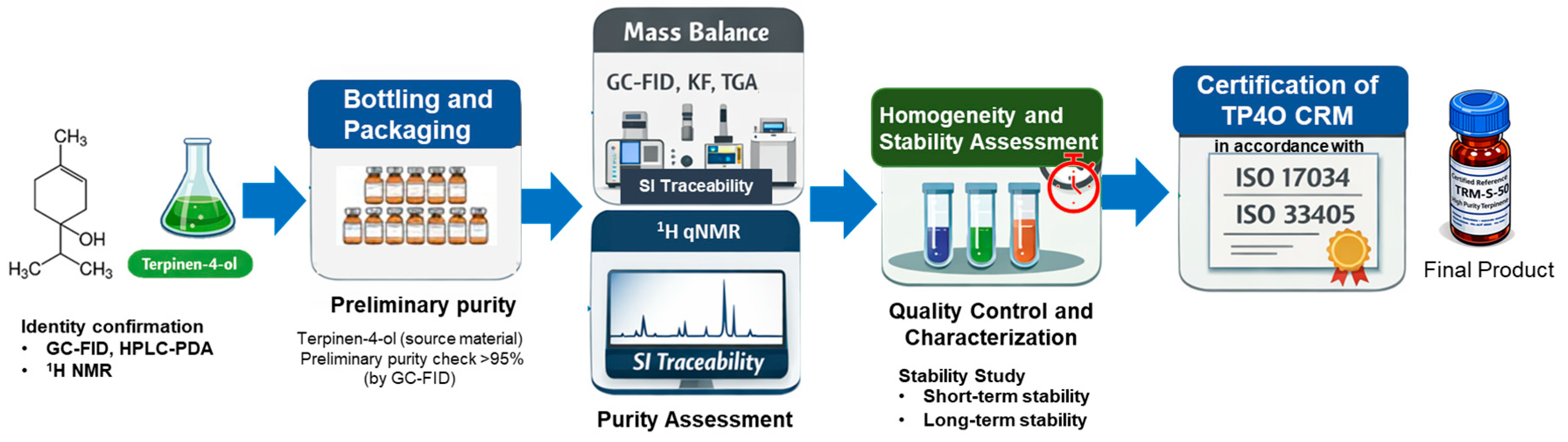
To address this need, the National Institute of Metrology (Thailand) (NIMT) developed a high-purity TP4O CRM in accordance with ISO 17034 [
32]. The purity assessment was performed using two independent and complementary approaches: an MB procedure based on gas chromatography with flame ionization detection (GC-FID), TGA, and KFT, and a primary-ratio
1H qNMR method employing a certified internal standard. Homogeneity, short-term stability, and long-term stability were evaluated in accordance with ISO 33405 [
33]. The uncertainty contributions from all relevant components were combined to establish the certified value and expanded uncertainty. The CRM developed in this study represents an important advancement in the metrological infrastructure for essential oil analysis, particularly in regions with limited access to SI-traceable TP4O reference standards. An overview of the TP4O CRM production process is shown in
Figure 1.
2. Materials and Methods
2.1. Chemicals and Materials
Pure TP4O with a minimum stated purity of >95% was purchased from a commercial batch and used as the starting material for the preparation of the CRM candidate; this starting material was not a certified reference material. In addition, a commercially available TP4O RM (Toronto Research Chemicals, Toronto, ON, Canada) was obtained and used solely for identity confirmation. The CRM of 4,4-dimethyl-4-silapentane-1-sulfonic acid-d6 (DSS-d6) was purchased from the National Metrology Institute of Japan (NMIJ, Tsukuba, Japan). Caffeine was obtained from Supelco (Bellefonte, PA, USA). Deuterated solvents, including methanol-d4 (MeOD) and chloroform-d1 (CDCl3), were purchased from Eurisotop (Saint-Aubin, France). NIST SRM 2890 water-saturated octanol was purchased from the National Institute of Standards and Technology (NIST, Gaithersburg, MD, USA). The Hydranal™ Coulomat AG reagent for Karl Fischer coulometric titration was purchased from Honeywell (Charlotte, NC, USA). Nitrogen (N2, ALPHAGAZ® 1 grade, ≥99.999% purity) and helium (He, ALPHAGAZ® 1 grade, ≥99.999% purity) were supplied by Air Liquide (Bangkok, Thailand). Chromatography-grade solvents-methanol and acetonitrile-were purchased from RCI Labscan (Bangkok, Thailand). Ultrapure water with a resistivity of 18.2 MΩ·cm was obtained using a Milli-Q system Millipore (MilliporeSigma, Burlington, MA, USA).
2.2. Instruments
GC-FID (Agilent 6890N) equipped with an HP-5MS capillary column (30 m × 0.25 mm i.d. × 0.25 μm film thickness) was supplied by Agilent Technologies (Santa Clara, CA, USA); KFT (852 Titrando system, Metrohm AG, Herisau, Switzerland); TGA (TGA/DSC1 instrument (Mettler-Toledo, Greifensee, Switzerland); NMR spectrometer (Bruker AVANCE NEO 500 MHz equipped with Prodigy cryoprobe, Bruker BioSpin GmbH, Rheinstetten, Germany); and high-performance liquid chromatography with photodiode array detection (HPLC-PDA; Vanquish system, Thermo Fisher Scientific, Waltham, MA, USA). Chromatographic separation was achieved using a Chromolith® High Resolution RP-18 (150 mm long, 4.6 mm i.d., Merck KGaA, Darmstadt, Germany). All samples were weighed using an analytical balance (XPE205, Mettler-Toledo, Greifensee, Switzerland) with a resolution of 0.00001 g and a valid metrological verification certificate.
2.3. Qualitative Characterization
The identity of the candidate TP4O CRM was confirmed via comparison with a commercially available TP4O RM using orthogonal chromatographic and spectrometric techniques. The application of independent analytical principles, including HPLC-PAD, GC-FID and 1H NMR spectroscopy, provides increased confidence in the identity assignment and minimizes method-specific bias, thereby establishing a reliable basis for subsequent quantitative purity assessment.
2.3.1. Sample Preparation
For chromatographic analyses, the candidate TP4O CRM and a commercial TP4O RM (approximately 10 mg each) were accurately weighed into separate glass vials and dissolved in 5 mL of methanol (MeOH) to ensure complete dissolution, yielding stock solutions with a concentration of approximately 2000 mg L−1. For GC-FID analysis, these stock solutions were used directly. For HPLC–PDA analysis, the stock solutions were further diluted with MeOH to obtain working solutions at a concentration of 1000 mg L−1.
For 1H NMR spectroscopy, approximately 5 mg of the candidate TP4O CRM was weighed into a glass vial and mixed with 0.6 mL MeOD for complete dissolution. The resulting solution was then transferred to a 5 mm NMR tube for characterization.
2.3.2. HPLC-PAD Conditions
A reversed-phase C18 column was selected due to its suitability for the separation of moderately polar monoterpene alcohols. An acetonitrile-water mobile phase operated under gradient elution was employed to achieve adequate chromatographic resolution across a wide polarity range. The Chromeleon™ software (version 7) was used for HPLC system control, data acquisition, and UV data analysis. The column temperature was maintained at 35 °C, and the injection volume was 10 μL. Elution was performed using water (A) and acetonitrile (B) as the mobile phase at a flow rate of 0.8 mL min
−1. The gradient program was as follows: 0–30 min, 10–90% B; 30–40 min, 90% B; 40–42 min, 90–10% B; and 42–45 min, 10% B. Detection was carried out at 205 nm. The analytical conditions were adapted from the certificate of analysis (CoA) of the TP4O RM (Dr. Ehrenstorfer, Germany) [
34,
35].
2.3.3. GC-FID Conditions
A non-polar stationary phase was selected to provide efficient separation of volatile organic components. GC-FID offers a chromatographic separation mechanism distinct from HPLC, thereby providing independent evidence for identity confirmation. Analysis was performed using the ChemStation software (Version B.01.03) for instrument control and data processing. Separations were carried out in split mode (split ratio of 1:38.8) on a non-polar HP-5MS capillary column (30 m × 0.25 mm i.d. × 0.25 µm film thickness). The oven temperature was set at 80 °C and held for 1 min, followed by a temperature ramp to 250 °C at 20 °C min
−1. The injector and detector temperatures were maintained at 250 °C and 300 °C, respectively. Helium was used as the carrier gas [
36].
2.3.4. 1H NMR Spectroscopy
1H NMR spectroscopy was employed as a complementary spectrometric technique to provide structural confirmation of the candidate TP4O CRM. This technique offers molecular-level information independent of chromatographic separation. 1H spectra were collected with a 30° pulse angle. The number of scans (NS) was set as 16 scans. The TopSpin software (version 3.1) was used for data processing.
2.4. Test of Homogeneity and Stability
2.4.1. Homogeneity Test
Homogeneity was assessed with GC-FID using ten randomly selected units from the production batch, with duplicate repeat measurements performed for each unit. Outliers were evaluated using the Cochran test, potential filling-order trends were examined using linear regression, and one-way ANOVA was performed to assessed between-bottle heterogeneity with an F-test in accordance with ISO 33405.
2.4.2. Stability Test
Short-term stability tests were was performed to assess the stability of every candidate material produced. Intermediate-term stability tests were conducted to assess the stability under exaggerated transport conditions and/or under transport and storage conditions until use for a CRM. The stability tests only considered the possible impact of temperature and time. The stability tests of the candidate TP4O CRM used a reference temperature of (−20 ± 2) °C and a test temperatures of 45 °C in the oven. Consequently, four selected sample units were transferred from storage at the reference temperature storage to be stored in the oven at 45 °C until the end of the study, which was one to two weeks from the commencement date. After two weeks, all samples were removed from the oven to be stored at the reference temperature or immediately analyzed under the reproducibility conditions. For each sample unit, three independent aliquots were prepared in separate vials and analyzed independently to provide triplicate analytical measurements.
The long-term stability of the candidate TP4O CRM was studied based on a classical design. The samples were stored at (−20 ± 2) °C for 6 months and analyzed at time intervals of 0, 1, 2, 3, and 6 months. At each time point, three independent aliquots prepared in separate vials from the selected unit were independently analyzed (n = 3). The mass fractions were then plotted against storage time. The slope of the regression line was statistically tested at a 95% confidence level for loss/increase due to storage conditions.
2.5. MB Quantitative Experiments
The MB method was employed for the purity assignment of the candidate TP4O CRM. This method determines the final mass fraction by accounting for the main component and all detectable classes of impurities. In this study, the MB method involved the individual quantification of organic purity, residual organic solvents, non-volatile/inorganic residues and water content. The final mass fraction was calculated according to Equation (2), as detailed in
Section 3.4.4. The analytical techniques used for each component are described in the following
Section 2.5.1,
Section 2.5.2 and
Section 2.5.3.
2.5.1. Determination of Organic Purity
The organic purity of the candidate TP4O CRM was determined via GC-FID using the peak area normalization method. The analysis employed the instrumental conditions previously described in
Section 2.3.2. Ten randomly selected sample units were analyzed in duplicate through repeated measurements. The mass fraction of TP4O was calculated based on the relative peak area of the main component against the total area of all detected organic peaks, assuming an equal response factor for all components [
21].
2.5.2. Determination of Residual Organic Solvents and Non-Volatile Residues
Residual organic matter and non-volatile residues were quantitatively determined via TGA. Three sample units were randomly selected from the production batch. Approximately 10 mg of TP4O from each selected unit was placed in an alumina pan and positioned in the TGA carousel. Before the samples were analyzed, an empty alumina pan was analyzed under identical conditions to establish the thermogravimetric baseline.
The TGA temperature program was initiated at 40 °C and increased to 120 °C at a heating rate of 30 °C min−1, followed by an isothermal hold for 10 min to assess mass loss attributable to volatile residues. Subsequently, the temperature was increased to 850 °C at the same heating rate to ensure complete removal of organic matter, including pyrolytic carbon, and the temperature was maintained for 20 min. The system was then cooled to 40 °C at a cooling rate of 40 °C min−1 and held at this temperature for 10 min. The remaining mass after the high-temperature treatment was recorded as the mass of non-volatile residues.
2.5.3. Water Determination
The water content was determined via KFT using a diaphragm electrode. The instrumental conditions were set as follows: a polarization current of 5 µA, an end-point voltage of 100 mV, and a minimum titration time of 30 s.
A CRM for water, NIST 2890, was accurately weighed and introduced into the titration cell to verify the accuracy of the method. Subsequently, approximately 20 mg of TP4O was precisely weighed and analyzed for water content. All measurements were performed in six independent replicates. A blank determination was conducted without sample introduction, and the blank value was subtracted from the measured results.
2.6. 1H qNMR Quantitative Experiments
A total of 10–30 mg of TP4O was accurately weighed and dissolved in MeOD to obtain a solution with a concentration of approximately 7–8 mg g−1. The stock solution of the internal standard (DSS-d6) was prepared by accurately dissolving approximately 15 mg of DSS-d6 in MeOD to obtain a solution with a concentration of approximately 3–4 mg g−1. For each experiment, three independent sample preparations were performed. Aliquots of 400 µL of the TP4O solution were accurately weighed and transferred into a clear vial, followed by the addition of a 170 µL aliquot of the internal standard stock solution. The total mass of the combined contents was then determined gravimetrically. The resulting masses of TP4O and DSS-d6 in each sample were approximately 2.5 mg and 0.55 mg, respectively. The mixture was subsequently homogenized via vortex mixing. The solution was then transferred into a 5 mm NMR tube (Schott®NMR sample tubes, Professional).
In parallel with the TP4O sample preparation, a quality control (QC) sample was also prepared to verify the accuracy of the analytical system, including the preparation of the stock solutions. In this study, a caffeine CRM was used as the QC sample. Approximately 5–6 mg of solid caffeine was accurately weighed, followed by the addition of a 600 μL aliquot of the DSS-d6 stock solution, which was also accurately weighed to ensure gravimetric traceability. The QC sample was independently prepared in duplicate.
The 90° pulse length was calibrated before acquisition to ensure uniform excitation across the spectral width. The number of scans (NS) was selected to achieve an adequate S/N ratio and was set to 32 scans. For the qNMR experiment of TP4O, the relaxation delay (D1) was set to 51 s. The longitudinal relaxation time (T1) was determined using the inversion recovery method and found to be approximately 10 s; therefore, the relaxation delay was set to at least five times T1 to ensure complete relaxation. The NMR probe temperature was maintained at 298 K. Data processing was performed using TopSpin 3.1. The purity of TP4O (PqNMR) determined via qNMR was calculated using Equation (3).
2.7. Estimation of Uncertainty
The main sources of uncertainty associated with the certified value of a CRM include homogeneity (uhom), short-term stability (usts), long-term stability (ults), and characterization (uchar). The characterization uncertainty was evaluated by combining the standard uncertainties from the mass balance method (uMB) and the qNMR method (uqNMR).
2.8. Statistical Analysis
Statistical analyses were performed using Microsoft Excel 2019 (Microsoft Corporation, Redmond, WA, USA). Homogeneity data were evaluated using one-way analysis of variance (ANOVA). Stability trends were assessed using linear regression analysis. Comparisons between the mass balance (MB) and qNMR results were conducted using a two-tailed Student’s t-test at the 95% confidence level. The number of replicates for each method is specified in the corresponding experimental sections.
Data acquisition and processing for chromatographic analyses were carried out using the Chromeleon™ software (version 7) for HPLC and the ChemStation software (version B.01.03) for GC-FID. NMR data acquisition and processing were performed using the TopSpin software (version 3.1, Bruker BioSpin GmbH, Rheinstetten, Germany), including Fourier transformation, phase correction, and signal integration for qNMR analysis.
3. Results
3.1. Qualitative Characterization Results
The identity of the candidate TP4O CRM was confirmed using complementary chromatographic and spectroscopic techniques to ensure that the material corresponded to the intended analyte before quantitative characterization. HPLC-PAD, GC-FID, and 1H NMR spectroscopy were employed as orthogonal methods to minimize the risk of misidentification and to ensure high selectivity.
The choice of these techniques was justified by their distinct separation and detection principles. HPLC–PDA analysis demonstrated that the candidate TP4O CRM and the commercial TP4O RM exhibited identical retention time (19.260 min) under identical chromatographic conditions; as shown in
Figure S1, both chromatograms display a single prominent peak with overlapping UV spectra, indicating chromatographic equivalence in the liquid phase. Consistent results were obtained with GC-FID analysis, as shown in
Figure S2a,b, where the candidate TP4O CRM and the commercial TP4O RM eluted at 5.413 and 5.422 min, respectively. The close agreement in retention behavior across the two chromatographic platforms confirms the chemical identity of the main component and validates the selectivity of the methods in differentiating it from potential co-eluting impurities with similar polarities or volatilities.
Structural confirmation was further achieved using
1H NMR spectroscopy, which served as the method for structural elucidation [
37]. The
1H NMR spectrum of the candidate CRM exhibited chemical shift positions and signal patterns fully consistent with those of the commercial TP4O RM and with reference spectra reported in the Spectral Database for Organic Compounds (SDBS) [
38]. Characteristic resonances corresponding to the olefinic proton, aliphatic methylene and methine protons, and isopropyl methyl groups were clearly observed, as presented in
Figure S3. Together, these orthogonal results confirm with high confidence that TP4O is the predominant component of the candidate CRM.
3.2. Homogeneity Assessment
TP4O is a viscous liquid; therefore, its homogeneity was therefore evaluated using the primary component as a suitable indicator in accordance with ISO 33405. Homogeneity was assessed via GC-FID analysis of randomly selected units (n = 10), with duplicate injections performed for each unit.
The results of the homogeneity assessment are summarized in
Table 1. Statistical evaluation of the bottling sequence using linear regression showed that the slope was not significantly different from zero at the 95% confidence level. As detailed in the trend analysis results in
Table S1, the calculated t-statistic for the slope (
= 0.00391) was substantially lower than the critical value (
= 2.306), indicating the absence of any systematic trend associated with the filling process.
In addition, between-bottle and within-bottle variabilities were evaluated via one-way analysis of variance (ANOVA). The mean square between bottles (
) and the mean square within bottles (
) were calculated as shown in Equation (1). The ANOVA results, detailed in
Table S2, yielded an
of 3.056 and an
of 9.532. The resulting calculated
F-value (0.32) was lower than the corresponding critical value (2.39) at the 95% confidence level, demonstrating that the observed variability between bottles was not statistically significant.
Based on these results, the candidate TP4O CRM is considered to be sufficiently homogeneous for certification purposes. The uncertainty contribution associated with homogeneity was subsequently incorporated into the overall uncertainty budget of the certified value.
3.3. Stability Test
Stability tests are essential for the development of high-purity CRMs, as they enable reference material producers (RMPs) to establish appropriate shipping conditions and estimate the shelf life of the material. Accordingly, the stability evaluation of the candidate CRM comprised two schemes: (i) short-term stability, which assessed the material’s stability under conditions relevant to transportation or short-term storage, and (ii) long-term stability, which evaluated the material’s shelf-life stability.
The short-term stability of the candidate TP4O CRM was evaluated under conditions simulating potential temperature excursions during transport and handling. Sealed CRM units were stored in the dark at 45 °C as a conservative worst-case scenario for volatile monoterpene alcohols, allowing for the assessment of temperature-induced volatilization and oxidative degradation in accordance with ISO 33405.
1H qNMR was employed to evaluate the stability of the candidate TP4O CRM, and the resulting data were assessed using a
t-test. The short-term stability results are summarized in
Table S3.
At 45 °C, the absolute value of the slope ( = 0.015) was lower than the product of t0.95, n−2 (12.706) and the corresponding standard uncertainty of the slope, s(b1) (0.003), indicating that no statistically significant trend was observed and that the material remained stable over the two-week study period.
Long-term stability was assessed in the same manner, and the results are presented in
Table 2. Although TP4O, a monoterpene alcohol, is known to be susceptible to oxidative and rearrangement reactions, reports in the literature indicate that its degradation pathways are strongly influenced by temperature and are markedly suppressed under frozen storage conditions due to reduced molecular mobility and limited oxygen diffusion. On this basis, a temperature of −20 °C was selected as the reference storage temperature for long-term stability and value assignment [
8,
39,
40].
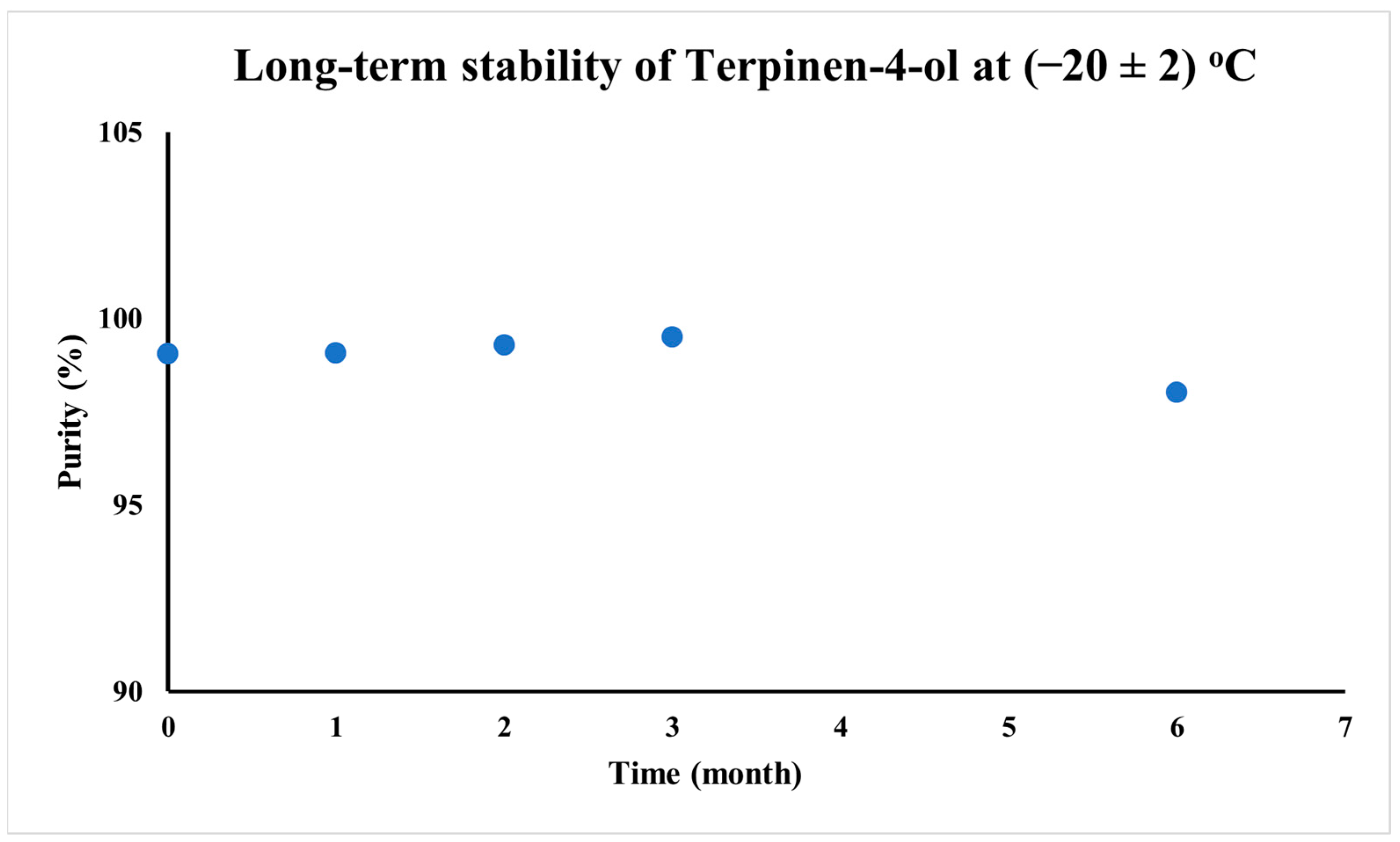
Based on the long-term stability results, under the specified storage condition of (−20 ± 2) °C, the candidate TP4O CRM was found to be stable for at least six months. Statistical evaluation showed that the absolute value of the slope (
b1) was lower than the product of
t0.95, n−2 and
s(
b1), indicating the absence of any statistically significant degradation trend, as illustrated in
Figure 2. Accordingly, the material was considered sufficiently stable to support the assigned property value. Long-term stability monitoring beyond six months is ongoing.
3.4. Quantitative Analysis Using the MB Method
The MB method, as an indirect purity measurement method, was implemented through a combination of several conventional instrumental techniques, including chromatographic analysis of organic compounds. TGA was performed to measure volatile and non-volatile residues, and KFT was applied to determine the water content [
21,
24].
3.4.1. Determination of Organic Components by GC–FID
For compounds amenable to GC-FID analysis, the detector response is approximately proportional to the number of combustible carbon atoms, rendering FID particularly suitable for the analysis of volatile organic compounds. Accordingly, compounds with similar carbon numbers and comparable hydrocarbon backbones are expected to exhibit similar response factors, consistent with the carbon equivalence principle. In the present study, this assumption was adopted because the detected impurities were predominantly monoterpene constituents (C10 compounds) with structures and functional groups closely related to terpinen-4-ol. Under these conditions, chromatographic peak areas can be reasonably converted into relative mass fractions for semi-quantitative comparison.
Nevertheless, this approach has inherent limitations, as the FID response is not strictly identical for compounds with different molecular sizes, degrees of oxidation, or functional group compositions, even at identical molar concentrations. However, in the present study, the individual impurities were detected at levels below 0.5%. At such low abundance, any potential deviation arising from differences in FID response factors is considered negligible when compared to the overall uncertainty associated with the characterization process. Consequently, any potential error introduced by the assumption of equal response factors is effectively encompassed within the combined measurement uncertainty [
23,
28,
41,
42].
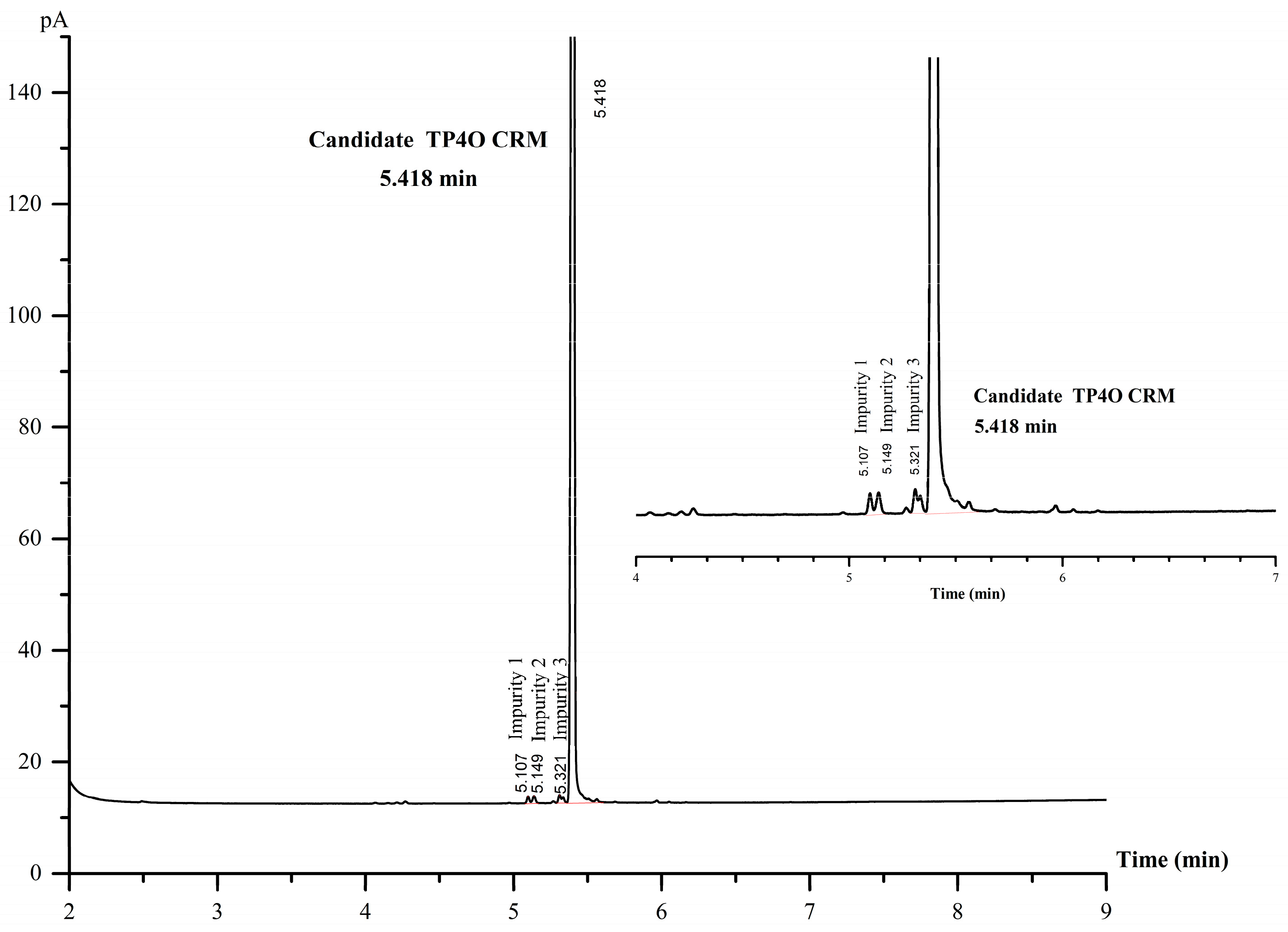
Considering the advantages described above, the main content of TP4O was determined in this study using the GC-FID technique. In a given analytical sequence, ten subsamples of the candidate reference material, randomly selected from the storage vessel, were analyzed in duplicate at a concentration of 2000 mg L
−1 to ensure sufficient signal response for all impurities. The resulting chromatogram is shown in
Figure 3, in which TP4O elutes as the dominant peak at 5.418 min, accompanied by three minor impurity peaks. Accordingly, the organic purity of TP4O determined by GC-FID via 98.95%.
3.4.2. Determination of Residual Organic Solvents and Non-Volatile Residues
The mass fractions of volatile impurities, such as residual organic solvents and/or water, can be assessed via TGA at elevated temperatures, while KFT is used for the direct determination of water content. The purity assessment is completed through high-temperature combustion or “ashing” of the sample above 600 °C to quantify the non-volatile residue, which is typically assumed to be composed of inorganic salts [
24,
41].
In this study, residual organic solvents and non-volatile residues in the candidate TP4O CRM were investigated using TGA. The TGA thermogram of candidate TP4O, as illustrated in
Figure S4, showed the onset of thermal decomposition at elevated temperatures, which precluded reliable integration of mass loss above 120 °C. Consequently, the mass fraction of volatile residues could not be directly quantified from the TGA data and was therefore evaluated indirectly based on the results obtained via
1H qNMR.
A comparison of the purity values derived from TGA and qNMR revealed no statistically significant difference between the two methods, indicating that residual organic solvents, if present, were below the detection limit of TGA. In addition, organic solvent impurities and volatile residues were assessed through careful inspection of the
1H-NMR spectrum, particularly in the aliphatic (0.5–3.0 ppm) and oxygenated (3.0–4.5 ppm) regions, where residual solvent signals are typically observed [
43]. No characteristic signals attributable to residual organic solvents were detected.
Accordingly, the mass fraction of residual organic solvents was found to be below the limit of quantification (LOQ) of 1.40 mg g−1; therefore, it was assigned a value of 0 mg g−1, with an associated standard uncertainty of 0.36 mg g−1.
Meanwhile, the mass fraction of non-volatile residue was directly determined using TGA and was found to be below the limit of quantification (LOQ) of 1.40 mg g−1. Therefore, it was also assigned a value of 0 mg g−1, with a standard uncertainty of 0.04 mg g−1.
The application of TGA for the quantification of residual organic solvents and non-volatile residues enables a comprehensive and metrologically consistent evaluation of the mass fractions of components other than TP4O, which is essential for the accurate calculation of purity using the MB method.
3.4.3. Water Content
Moisture is one of the impurities in reference materials. The water content of the candidate CRM was determined via KFT. The titration system was calibrated with a CRM for water, NIST 2890. The water content of TP4O, determined from six independent measurements, was found to be 5.41 mg g−1 with a standard uncertainty of 0.70 mg g−1. This value corresponds to approximately 0.54% (w/w) moisture, which is low and consistent with the hydrophobic nature of TP4O. This result indicates that only a trace amounts of water was present in the material, most likely originating from residual moisture introduced during material handling or from atmospheric exposure rather than from chemical degradation. To minimize further hygroscopic moisture uptake, the candidate CRM was dispensed into airtight screw-cap glass vials and further sealed with thermoplastic paraffin film (Parafilm M) as an additional barrier against atmospheric moisture. The sealed units were stored at −20 °C.
The water content and its associated uncertainty was treated as an independent impurity term in the MB calculation of TP4O purity, in accordance with ISO 33405.
3.4.4. Mass Fraction Determined Using the MB Method
The purity determination of a sample using the MB method [
15,
44] can be described with Equation (2), as follows:
where
wx is the purity of the sample expressed as a mass fraction (mg g
−1);
wH2O is the mass fraction of water in the sample (mg g
−1);
wNV is the mass fraction of non-volatile/inorganic residues in the sample (mg g
−1);
wOS is the mass fraction of residual organic solvent in the sample (mg g
−1); and
worg is the organic purity determined via GC-FID (mg g
−1).
Based on Equation (2), the purity of TP4O was determined using the MB method in accordance with ISO 33405 and the IUPAC technical report. A summary of the measurement results from the individual analytical methods used for the purity assessment of TP4O is provided in
Table 3. All quantities are expressed on a mass fraction basis. Using the impurity values summarized in
Table 3, the MB purity of TP4O was calculated to be 984.07 mg g
−1 (98.41%). The combined standard uncertainty of the MB purity was obtained by propagating the standard uncertainties of the individual impurity terms presented in
Table 3. Based on this model, the combined standard uncertainty of the TP4O purity was 0.90 mg g
−1 (0.09%), as calculated using Equation (9).
3.5. Quantitative Analysis Using 1H qNMR
The purity of TP4O was independently determined via quantitative
1H NMR (qNMR) [
28,
30,
45,
46,
47,
48] using an internal standard approach. The mass fraction of TP4O,
PqNMR, was calculated according to Equation (3):
where
Ix and
IStd represent the integrated signal area of TP4O and the internal standard, respectively;
NStd and
Nx denote the number of H in the integrated signal area of the standard and TP4O, respectively;
Mx and
MStd are molar masses of TP4O and internal standard, respectively;
mStd and
mx are the masses of the internal standard and TP4O in a determined sample, respectively; and
PStd is the purity of the standard.
3.5.1. Selection of IS and QC
The IS was required to be chemically inert, non-volatile, non-hygroscopic, and fully soluble in a deuterated solvent; it should also provide at least one well-resolved
1H signal free from overlap with TP4O, solvents, and impurities. High chemical purity and SI traceability are considered essential to minimize systematic bias [
45].
On this basis, DSS-d
6 was selected as the IS. DSS-d
6 provides a single intense singlet at δ ≈ 0.00 ppm that corresponds to nine equivalent protons [
23], located in a spectral region free from TP4O and impurity signals. DSS-d
6 was fully soluble in MeOD when dissolved with TP4O, producing a homogeneous solutions without solubility-related artifacts and with favorable relaxation behavior.
To verify the performance of the qNMR system, a caffeine CRM was analyzed in parallel as a QC material. Caffeine was chosen because it is fully soluble in MeOD and provides non-overlapping resonances relative to DSS-d
6. The measured purity of the QC material was compared with its certified value following ERM Application Note 1 [
49]. Satisfactory agreement was obtained, and therefore no correction factor was applied to the TP4O results.
3.5.2. Signal Integration and Spectral Treatment
Accurate integration is critical for qNMR. To minimize truncation effects, integration windows were set to 640 times the half-height linewidth of each resonance. Manual integration was applied to include the full signal envelopes and the associated
13C satellite peaks, ensuring complete capture of signal intensity and avoiding systematic underestimation [
45,
50].
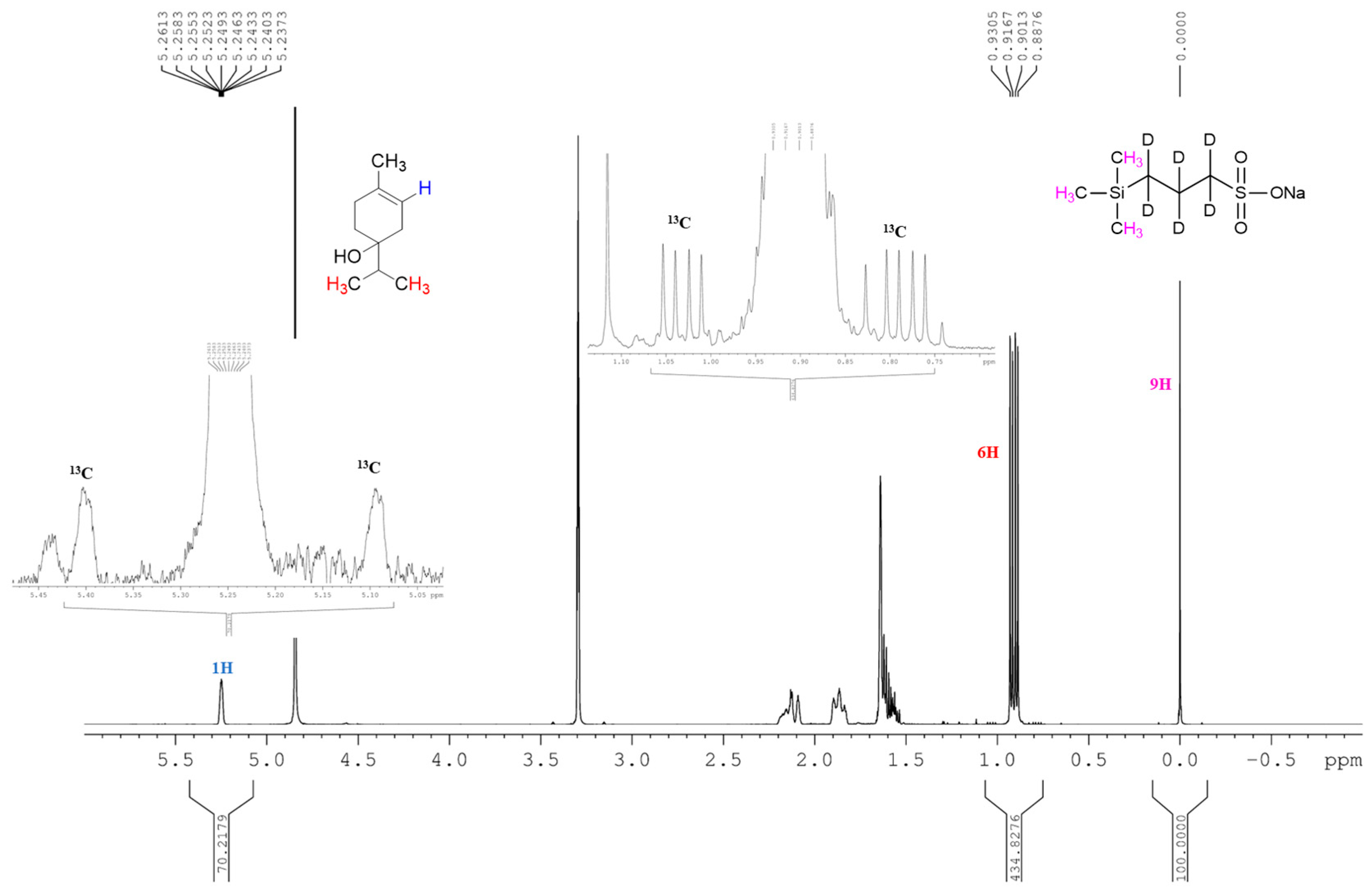
TP4O was quantified using two independent proton resonances: the vinylic proton at δ ≈ 5.2 ppm and the aliphatic signal at δ ≈ 0.9 ppm, while DSS-d
6 was quantified using its singlet at δ ≈ 0.00 ppm (
Figure 4). The 5.2 ppm signal of TP4O was free from detectable overlap with impurities. In contrast, the 0.9 ppm region contained contributions from minor impurities, which were corrected as described below.
3.5.3. Impurity Correction and Purity Calculation
The relative mole fractions of TP4O, determined from the GC–FID data, were used to correct the integrated NMR signal at the 0.9 ppm resonance prior to applying Equation (3), ensuring that only the TP4O contribution was used for purity calculation [
23,
41].
Two independent qNMR purity values were obtained from the 5.2 ppm and 0.9 ppm resonances, yielding 98.96% and 99.29%, respectively. These results were based on measurements performed on six randomly selected samples, each analyzed using three independently prepared test portions. The agreement between these values was evaluated using a Student’s t-test, which showed no statistically significant difference at the 95% confidence level. The final qNMR purity of TP4O was therefore assigned a value of 99.13% based on the mean of the two results.
3.6. Purity Determination
Quantitative
1H qNMR enables direct, SI-traceable purity determination based on absolute signal integration, providing universal proton detection without the need for compound-specific calibration standards. However, its applicability may be limited by signal overlap and matrix complexity [
15,
22,
51,
52].
In contrast, the MB approach determines purity indirectly by subtracting the mass fractions of all quantified impurities from unity. When supported by appropriate orthogonal analytical techniques addressing each impurity class, the MB method can achieve very low measurement uncertainty for high-purity organic compounds, whether volatile or non-volatile, and is therefore widely applied for certification of CRMs. Its main limitations are the extensive analytical effort required to identify and quantify all relevant impurity classes, together with the associated time and cost [
16,
22,
41].
For CRM production, the establishment of a reliable and metrologically sound certified value is essential [
32]. In this study, the purity of TP4O was therefore evaluated independently using both the MB and qNMR methods. The MB method yielded a purity of 98.41% with a combined standard uncertainty of 0.09%, while qNMR gave a purity of 99.13% with a combined standard uncertainty of 0.94%.
The two results were statistically compared using a two-tailed Student’s
t-test at the 95% confidence level. According to the comparison results summarized in
Table S4, although the MB method (98.41%) and qNMR (99.13%) provided different mean values, the
p-value was found to be greater than 0.05. This indicates that the difference between the two techniques is not statistically significant relative to their combined uncertainties, confirming that the results are metrologically consistent. The agreement between these two independent primary-ratio-based methods provides strong confirmation of the assigned purity.
Following ISO 33405, the certified value was obtained as the weighted mean of the two independent results, taking into account their associated standard uncertainties. The assigned purity of the candidate TP4O CRM was therefore 98.77%, with a combined standard uncertainty of 0.95%.
3.7. Uncertainty Estimation
According to the EURACHEM/CITAC Guide CG 4 Quantifying Uncertainty in Analytical Measurement [
14], The uncertainties of the candidate TP4O CRM mainly originate from three primary aspects: uncertainty from homogeneity test (
ubu), uncertainty from long-term stability (
ults) and short-term stability (
usts), and uncertainty from characterization (
uchar). Here,
uchar is estimated based on the combined standard uncertainties derived from the MB (
uMB) and qNMR (
uqNMR) methods. The combined standard uncertainty (
uCRM) can be calculated using Equation (4), and the expanded uncertainty
UCRM can be estimated as the product of
uCRM and the coverage factor
k at the confidence level of 95% (
k = 2), as shown in Equation (5) [
33].
The expanded uncertainty of the CRM,
UCRMwas calculated using a coverage factor
k = 2, corresponding to a confidence level of approximately 95%, as follows:
The associated uncertainties are listed in
Table 4.
3.7.1. Uncertainty of Homogeneity
The uncertainty associated with homogeneity (
ubu) was subsequently calculated using Equation (6), as follows:
where
ubu represents the uncertainty from inhomogeneity,
represents the mean square between bottles,
represents the mean square within bottles, and
represents the number of measurements. In this study, the estimated value of
ubu was 1.00%.
3.7.2. Uncertainty of Stability
The uncertainty of stability (
us) consists of uncertainties from short-term stability (
usts) and long-term stability (
ults), and can be calculated as follows, Equation (7):
where
us is the uncertainty associated with stability was estimated by the standard error of the slope from trend analysis,
sb1, multiplied by
tm1, the time interval between value assignment and the initial stability monitoring point, and
tcert, which is the period of validity of the certificate issued with the predicted change.
In this study, the assessment of stability under transport conditions showed that the standard error of the slope was 0.0030% per month. The time interval for the short-term stability study was two weeks. Therefore, the uncertainty due to stability was calculated to be 0.15%.
For the assessment of the long-term stability, the standard error of the slope was 0.11% per month, the tm1 was 6 months, and the tcert was obtained from the prediction shelf life. The shelf life of the candidate reference material was assessed solely from experimental stability results. As no significant degradation trend was observed and extrapolation beyond the experimental period was not justified, the predicted shelf life was conservatively assigned as zero. Therefore, the uncertainty due to stability was calculated as 0.63%.
3.7.3. Uncertainty of Characterization
In this study, the uncertainty of characterization was estimated by combining the purity uncertainties associated with the value assignment obtained from the MB and qNMR methods. The standard uncertainty of characterization (
uchar) was calculated as the square root of the sum of the squared purity uncertainties from both methods, as presented in Equation (8). By incorporating the combined standard uncertainties from the MB (0.09%) and qNMR (0.94%) methods, the resulting
was determined to be 0.95%. This approach ensures that the uncertainties from both independent primary methods are appropriately weighted in the final characterization value.
Uncertainty from the MB Method
The measurement uncertainty of the MB method was evaluated in accordance with the Eurachem guideline EURACHEM/CITAC Guide CG 4. The combined standard uncertainty was calculated using Equation (9):
where
represents the combined standard uncertainty of the MB method;
is the uncertainty associated with organic purity (0.031%);
and
are the uncertainties arising from volatile (0.036%) and non-volatile residues (0.004%), respectively; and
denotes the uncertainty associated with water content (0.069%). As summarized in
Table 3, these individual components reflect the primary sources of variation in purity assignment using the MB method. By applying the law of propagation of uncertainty as expressed in Equation (9), In this way, the standard uncertainty associated with the MB method was assessed as 0.09%.
Uncertainty from the qNMR Method
The measurement uncertainty associated with the qNMR method was evaluated in accordance with the principles described in the Eurachem guideline EURACHEM/CITAC Guide CG 4. A bottom-up approach was applied, in which all significant sources of uncertainty affecting the purity assignment were identified, quantified, and combined.
In qNMR analysis, the purity of the analyte (
PqNMR) is calculated based on the ratio of the integrated NMR signal of the analyte to that of an IS, taking into account the corresponding number of protons, molar masses, and weighed masses, as expressed in Equation (3). Therefore, the combined standard uncertainty of the qNMR method, (
uqNMR), was calculated by propagating the individual standard uncertainties associated with each input quantity, assuming independence between components, as expressed in Equation (10):
where
was the relative standard uncertainty of the quantitative peak area ratio;
is the relative standard uncertainty of molar mass of TP4O;
and
denote the relative standard uncertainty of TP4O and the IS used for qNMR analysis, respectively; and
is the relative standard uncertainty of the purity value of the IS.
According to Equation (10), the standard uncertainty associated with the purity assessment of the candidate TP4O CRM using the qNMR method was 0.94%, as detailed in
Table S5, the predominant contribution came from the signal intensity ratio (
Ix/Istd), which exhibited a relative standard uncertainty of 0.81%. This was followed by the mass ratio (
mstd/
mx) and the purity of the internal standard (
Pstd), which contributed 0.35% and 0.33%, respectively. This relatively high contribution from the signal ratio is typical in high-precision qNMR due to its inherent sensitivity to the signal-to-noise ratio (
S/N) and integration repeatability [
53,
54]. Despite optimizing the relaxation delay (
D1) and increasing the number of scans to ensure full relaxation, minor variations in baseline interpretation and phase correction remain the primary limiting factors for reducing the measurement uncertainty further [
15,
55].
3.7.4. Combined and Expanded Uncertainty of the TP4O CRM
The combined standard uncertainty (uCRM) can be obtained as the combination of uncertainties from homogeneity test, stability test, and characterization, which is calculated based on Equation (4).
To conclude, the standard uncertainty of the TP4O CRM was 1.52%. The expanded uncertainty (U) was calculated by multiplying the combined standard uncertainty (uc) by a coverage factor (k = 2), corresponding to a confidence level of 95%. Finally, the TP4O CRM was assigned a certified value of 98.77%, with an expanded uncertainty of 3.05%.
4. Discussion
The purity obtained using the MB method was slightly lower than that determined using the qNMR method—a finding that is consistent with the complementary nature of the two methods. The MB method is recognized as a primary method for purity assignment of organic CRMs, while qNMR provides an independent confirmatory value [
15,
41]. The MB method explicitly accounts for all detectable impurity classes, including water, residual solvents, and non-volatile residues, and therefore yields a conservative estimate of the TP4O mass fraction. In contrast, qNMR quantifies only NMR-visible components relative to a high-purity IS and is insensitive to non-protonated, non-volatile, or spectroscopically silent impurities, which can result in a marginally higher apparent purity. The larger combined uncertainty associated with qNMR compared to the MB result arises primarily from the greater number of multiplicative uncertainty contributors in the qNMR measurement model, including signal integration, baseline and phase correction, relaxation effects, weighing of both the analyte and IS, and the certified purity of the internal standard. These contributions propagate directly into the purity result according to Equation (3). By contrast, in the MB method, the dominant contributors—water content, residual organic solvents, and non-volatile residues—are determined using dedicated, highly selective methods with relatively small and independent uncertainties. As a result, the MB uncertainty is typically smaller and more robust for high-purity, low-volatility materials such as TP4O.
As discussed above, both the MB and qNMR methods may inherently exhibit methodological biases that are difficult to explicitly identify without comprehensive and in-depth analysis. For this reason, the certified purity of TP4O was derived from the integration of the two independent measurement results obtained using these complementary approaches. This strategy ensures a highly accurate, reliable, and metrologically robust purity value for TP4O, that is suitable for its intended use in purity assessment and reference material certification. The uncertainty associated with the certified value was evaluated conservatively in accordance with ISO 17034 and ISO 33405, with full propagation of contributions from material homogeneity, stability, impurity quantification, and measurement repeatability in line with ISO 33405. This approach ensures that the stated uncertainty reliably encompasses all relevant sources of variability and potential bias. The resulting TP4O CRM, characterized by high chemical purity, homogeneity, stability, and full SI traceability, is therefore fit for use as a calibration standard for chromatographic methods in quality control, regulatory testing, and metrological applications.
5. Conclusions
A high-purity TP4O CRM was successfully developed and fully characterized following the internationally accepted reference material production standard ISO 17034. To ensure high selectivity and to minimize the risk of misidentification, the identity of the material was verified using orthogonal chromatographic and spectroscopic techniques, including HPLC-PAD, GC-FID and 1H NMR. In all cases, identity confirmation was achieved through direct comparison with a commercial TP4O RM prior to purity assignment.
Purity determination was conducted using two independent approaches: the MB method, consisting of GC-FID, KFT, and TGA, and quantitative NMR using DSS-d6 as the IS. The two purity values (98.41 ± 0.09% for MB and 99.13 ± 0.94% for qNMR) showed excellent agreement (p > 0.05), confirming the reliability of the analytical scheme and the absence of undetected impurities.
Homogeneity assessment demonstrated an absence of between-unit variability. Both short-term and long-term stability tests confirmed the stability of the material when stored at (−20 ± 2) °C. The combined standard uncertainty was 1.52%, yielding an expanded uncertainty of 3.05% (k = 2). The final certified value assigned to the CRM was 98.77%.
This high-purity TP4O CRM, newly developed in Thailand, provides an SI-traceable purity standard for TP4O and is suitable for calibration, method validation, and quality assurance in analyses of chemical, cosmetic, and herbal products. The developed and characterized TP4O CRM could further support and facilitate enhanced measurement capabilities within the region, as well as beneficially contribute to metrological infrastructure for other related essential oil components.





 ,
,