Article

Deformation Detection of the Centroid Axes for Beams with Variable Cross-Sections Based on Point Cloud Data

1
Department of Geotechnical Engineering, College of Civil Engineering, Tongji University, Shanghai 200092, China
2
State Grid Shanghai Municipal Electric Power Company, Shanghai 200092, China
*
Author to whom correspondence should be addressed.
Appl. Sci. 2026, 16(4), 2008; https://doi.org/10.3390/app16042008
Submission received: 26 January 2026 / Revised: 12 February 2026 / Accepted: 16 February 2026 / Published: 18 February 2026
(This article belongs to the Section Civil Engineering)

Abstract

Accurate extraction of the centroid axes of beams with variable cross-sections is critical for infrastructure health monitoring. While 3D laser scanning provides dense point clouds, existing methods face challenges due to fixed slicing directions, sparse or incomplete boundaries, and inaccurate centroid calculations for concave sections. This study proposes a robust framework to overcome these issues. An improved k-d tree ordering algorithm enhances boundary extraction through starting point constraint strategy and dynamic isolated noise point removal mechanism. A ray casting-based boundary-constrained Delaunay triangulation centroid calculation algorithm accurately computes centroids for arbitrary shapes, including concave profiles. An innovative convex hull centroid-driven adaptive normal iterative slicing method dynamically adjusts orientation using historical centroid data, aligning with the local member axis to minimize errors in variable or deformed regions. Experimental validation shows the method outperforms traditional fixed-direction slicing in effectiveness, parameter sensitivity, and deformation robustness, achieving sub-millimeter accuracy. Applied to monitor ultra-high-performance concrete cantilever beams at the Shanghai Grand Opera House, it produced centroid axis data consistent with total station measurements (differences within ±1.2 mm), supporting phased deformation warnings and safety assessments. This work provides a systematic, high-precision solution for extracting geometric axes from complex structural point clouds.

1. Introduction

The accurate extraction of the centroid axes of structural members is of significant importance for deformation monitoring, safety assessment, and reverse engineering in buildings, bridges, and infrastructure [1,2,3,4]. Compared to traditional contact-based measurement methods, 3D laser scanning technology can efficiently and without contact acquire high-density point cloud data of complex structural surfaces, enabling refined geometric analysis [5,6,7]. For example, Zhang et al. [8] detected the inclination of distribution towers by extracting centroid axes from point cloud data. Zhang et al. [9] employed polynomial fitting to extract the tunnel axis from point cloud data and proposed a continuous slicing point cloud segmentation algorithm based on the tunnel axis, thereby calculating cross-sectional deformation through ellipse fitting. However, with the development of new materials and processes, increasingly beam-like members with complex and variable cross-sections, such as Ultra-High-Performance Concrete (UHPC) beams designed to address large-span cantilever challenges, are emerging in the construction of certain large-scale cultural venues. How to automatically, robustly, and accurately extract the centroid axes of such members with complex and variable cross-sections from discrete and irregular point clouds presents a series of challenges.
Point cloud slicing is fundamental for acquiring the cross-sectional geometric information of members and extracting their centroid axes. Early research predominantly employed methods that perform equally spaced sectioning along a preset global coordinate system (e.g., the design axis direction of the member) [10,11,12]. These approaches are simple and effective for regular, undeformed members. However, for deformed members or members with complex and variable cross-sections encountered in practical engineering, their local axial direction may deviate from the global orientation. To address this, Zhang et al. [13] proposed an adaptive decremental point cloud slicing strategy capable of dynamically adjusting the slice thickness, generating a large number of three-dimensional spatial points to achieve high-precision center axis curve fitting. Also, some scholars have proposed adaptive slicing methods based on local point cloud normal estimation. For example, principal component analysis (PCA) or random sample consensus (RANSAC) plane fitting is used to obtain the principal direction of local point clouds as the slicing normal [14,15]. While these methods can adapt to some extent to local cross-sectional variations, in areas with drastic shape changes or uneven point cloud distribution, normal estimation is susceptible to noise interference, leading to unstable slicing plane orientation. Furthermore, most existing adaptive slicing methods determine the direction of each slicing plane in isolation, lacking consideration for the continuity and consistency of orientation between adjacent slices. This can lead to unreasonable jitter or offset in the extracted continuous centroidal axis.
After obtaining the point cloud slice, calculating the cross-sectional centroid is necessary. For structures with regular geometric shapes, algorithms such as circle [16,17,18] or ellipse [19,20] fitting are typically used to indirectly obtain cross-sectional centroid information. However, these shape-fitting algorithms are not applicable for irregular, complex cross-sectional forms. For irregular arbitrary convex polygon cross-sections, the polygon centroid can be directly calculated, or a weighted centroid can be derived using convex hull triangulation [21,22,23]. However, for concave polygon cross-sections commonly encountered in engineering (e.g., steel sections or concrete members with openings or grooves), the convex hull method severely overestimates the cross-sectional area, causing significant centroid deviation. Delaunay triangulation [24,25] is a common method for creating an ordered structured mesh from discrete, unordered point clouds and can be used to calculate properties like area and centroid for arbitrary polygon cross-sections. However, directly applying Delaunay triangulation to the point set of a concave polygon generates external triangles in the concave regions that do not belong to the actual cross-section. Therefore, boundary constraints must be introduced. Existing Constrained Delaunay Triangulation algorithms typically require a complete, correct polygon boundary as input, which presupposes the extraction of a clear boundary contour from the slice point cloud. For high-density cross-sectional point clouds, Alpha Shapes [26,27] is a classic and effective algorithm for boundary extraction, and many scholars have developed numerous variant algorithms based on it [28,29]. Projecting 3D point clouds onto 2D grid images and then using mature image edge detection operators (e.g., Sobel [30], Canny [31,32]) is another common boundary extraction method. However, for sparse boundary point clouds caused by occlusion or scanning angle limitations, these methods tend to produce fragmented contours or fail to close. Methods based on nearest-neighbor ordering (e.g., using k-d tree [33]) provide an efficient idea for connecting sparse boundary points. However, standard nearest-neighbor ordering is sensitive to the starting point and, when point clouds have local missing or noisy isolated points, is highly prone to generating path short-circuits or detours, leading to boundary line self-intersection and extraction failure. How to design a robust boundary ordering algorithm that can adaptively handle point cloud missing and noise is one of the key problems currently faced.
To address the aforementioned issues, this paper proposes an improved k-d tree ordering boundary extraction algorithm, a boundary-constrained Delaunay triangulation centroid calculation algorithm, and a convex hull centroid-driven adaptive normal iterative point cloud slicing method, aiming to achieve high-precision and robust extraction of the centroid axes for beams with variable cross-sections. The main contributions of this paper are as follows:
  • Improved k-d tree ordering boundary extraction algorithm: For sparse boundary point clouds, an improved k-d tree ordering method is proposed for boundary extraction. By introducing a starting point constraint strategy based on convex hull analysis and a dynamic isolated noise point removal mechanism, it effectively solves the problems of erroneous boundary paths and self-intersection caused by point cloud missing and isolated noise points, enabling reliable reconstruction of closed polygons from incomplete boundary contours.
  • Boundary-constrained Delaunay triangulation centroid calculation algorithm: To accurately calculate the centroid of concave cross-sections, a ray casting-based boundary-constrained Delaunay triangulation algorithm is proposed. This method confines the triangulation within the valid cross-sectional boundary, excludes the influence of invalid triangles in concave regions by judging whether the centroids of triangulated triangles lie inside or outside the boundary polygon, and thus precisely calculates the centroid for cross-sections of any shape (convex or concave).
  • Convex hull centroid-driven adaptive normal iterative point cloud slicing method: For members with variable cross-sections and deformations, an adaptive slicing strategy is proposed. This method dynamically and iteratively updates the normal of subsequent slicing planes using the convex hull centroid obtained from historical slices, ensuring the slicing direction approximately follows the actual local axial direction of the member. This fundamentally reduces the cumulative centroid error caused by fixed slicing directions in areas of cross-sectional transition and exhibits good robustness to member deformation.
The structure of this paper is as follows: Section 2 details the improved k-d tree ordering boundary extraction and the boundary-constrained Delaunay triangulation centroid calculation algorithms. Section 3 elaborates on the principles and procedures of the convex hull centroid-driven adaptive normal iterative point cloud slicing method for centroid axis extraction, and validates its accuracy, parameter influence, and deformation robustness through experiments. Section 4 demonstrates the application and verification results of the method in a real-world engineering case. Finally, the conclusion is presented.

2. Centroid Extraction of Cross-Sectional Point Cloud

2.1. Improved k-d Tree Ordering Boundary Extraction Algorithm

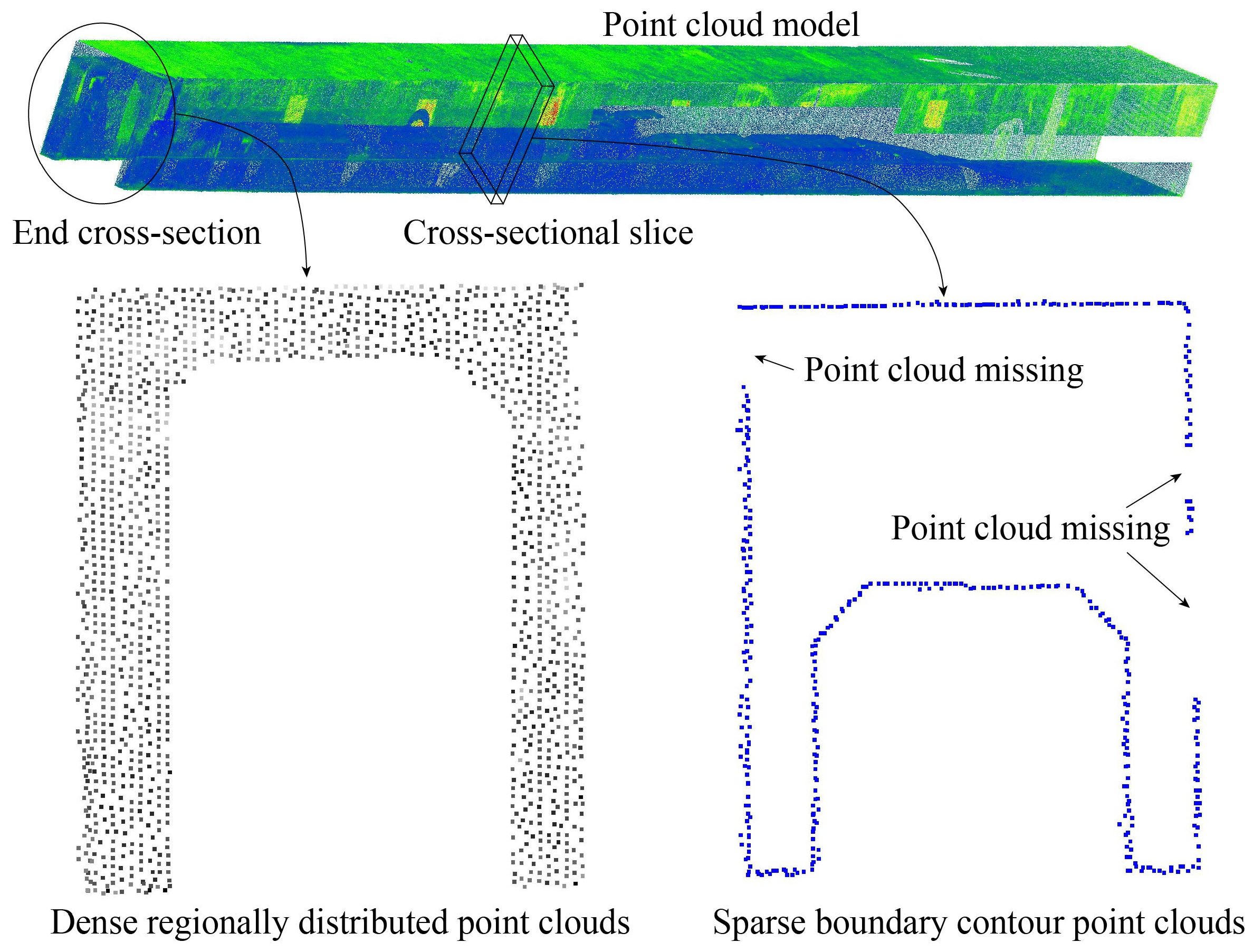
As shown in Figure 1, unlike the densely distributed point cloud, the point cloud of an internal cross-sectional slice contains no interior points—that is, each point in the slice lies on the boundary contour of the cross-section. Therefore, a k-d tree ordering method can be employed to sequentially arrange the sparse boundary contour points and connect them into a closed polygon, thereby extracting the geometric shape information of the cross-sectional boundary.
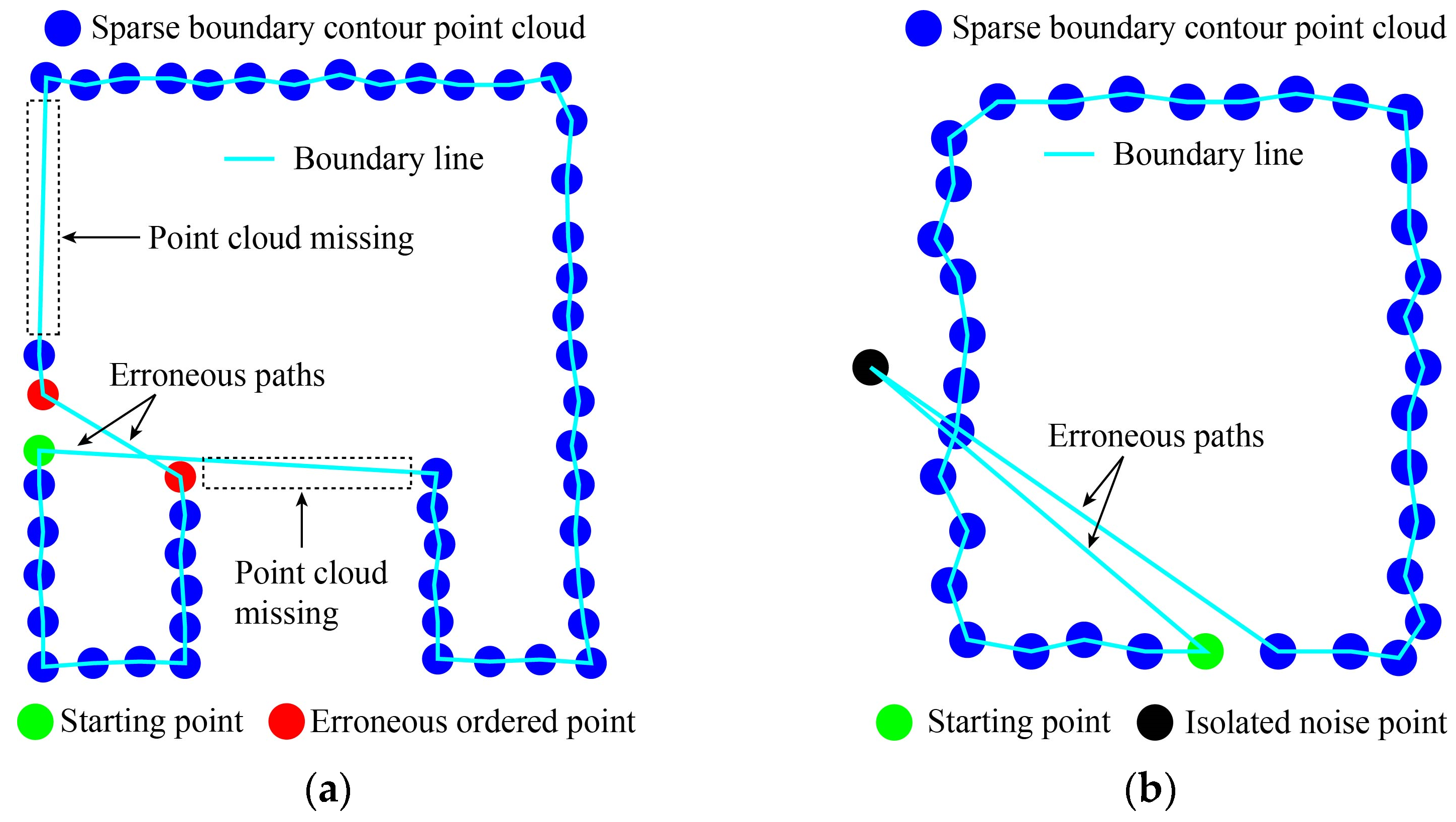
To process the sparse boundary contour point cloud using a k-d tree, a point is randomly selected as the starting point. Based on the nearest neighbor search of the k-d tree, the closest point to the starting point is found, and they are connected by a line. The starting point is then removed from the point cloud, and the current nearest neighbor point is updated as the new starting point. This step is iteratively repeated until all points are sequentially connected, and finally, by closing the sequence from the last point back to the first, a closed polygon boundary representing the sparse boundary contour point cloud can be obtained. Although this k-d tree ordering method can efficiently extract the boundary of sparse boundary contour point clouds, it may encounter unsolvable issues under certain circumstances: As shown in Figure 2a, if the sparse boundary contour point cloud has varying degrees of missing areas due to occlusion, an inappropriate choice of the starting point in the k-d tree ordering can cause the boundary path to fold back at the missing sections, generating erroneous paths and resulting in intersecting boundary lines; As shown in Figure 2b, if isolated noise points exist in the sparse boundary contour point cloud, when the k-d tree ordering approaches the vicinity of these isolated noise points, they may consistently fail to be recognized as the nearest neighbor due to their relatively large distance from normal boundary points in that local region. Consequently, they are likely to be skipped and not sequentially included, only to be processed at the end of the ordering, leading to erroneous paths and causing the boundary lines to intersect.
Therefore, considering the influence of point cloud missing and isolated noise points, an improved k-d tree ordering boundary extraction algorithm is proposed. The specific implementation process is as follows:
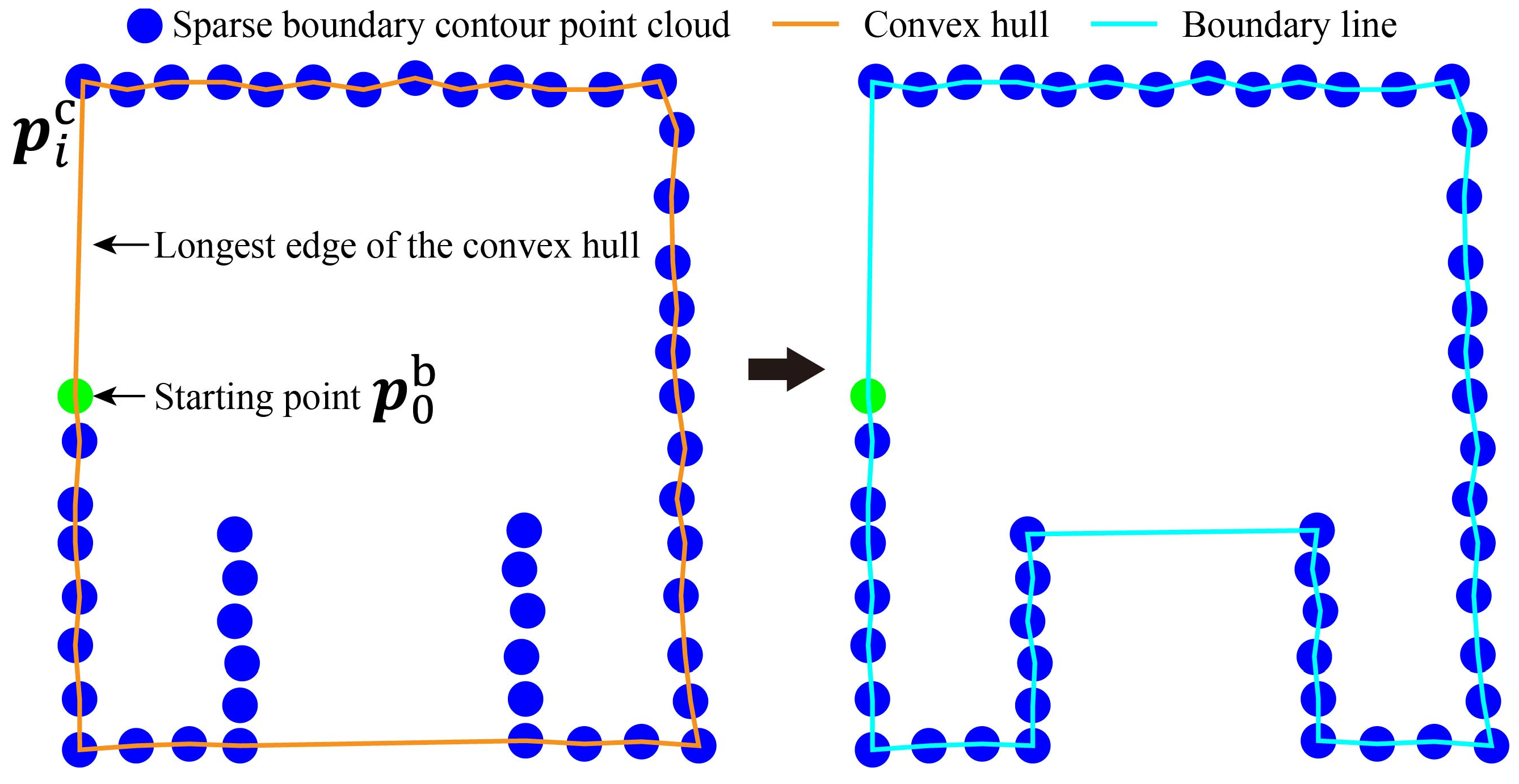
  • Constraint on the starting point for k-d tree ordering. As shown in Figure 3, to avoid boundary extraction errors caused by point cloud missing, the starting point for k-d tree ordering needs to be constrained to the location with the largest gap in the point cloud. The minimum convex set containing all sparse boundary contour point clouds P p c —that is, the convex hull of the point cloud—is calculated using Graham’s scan method [34]. The convex hull of the point cloud forms a convex polygon. Its edges are sorted in descending order based on their lengths. For each edge, one of its two endpoints p i c is randomly selected and stored in the starting point list L s following the edge sorting order. Since the location corresponding to the longest edge of the convex hull generally coincides with the area of the largest point cloud gap, the first point in L s is chosen as the starting point p 0 b for k-d tree ordering. An empty ordered boundary point list P b is created, and p 0 b is added to it. Then, p 0 b is removed from P p c .
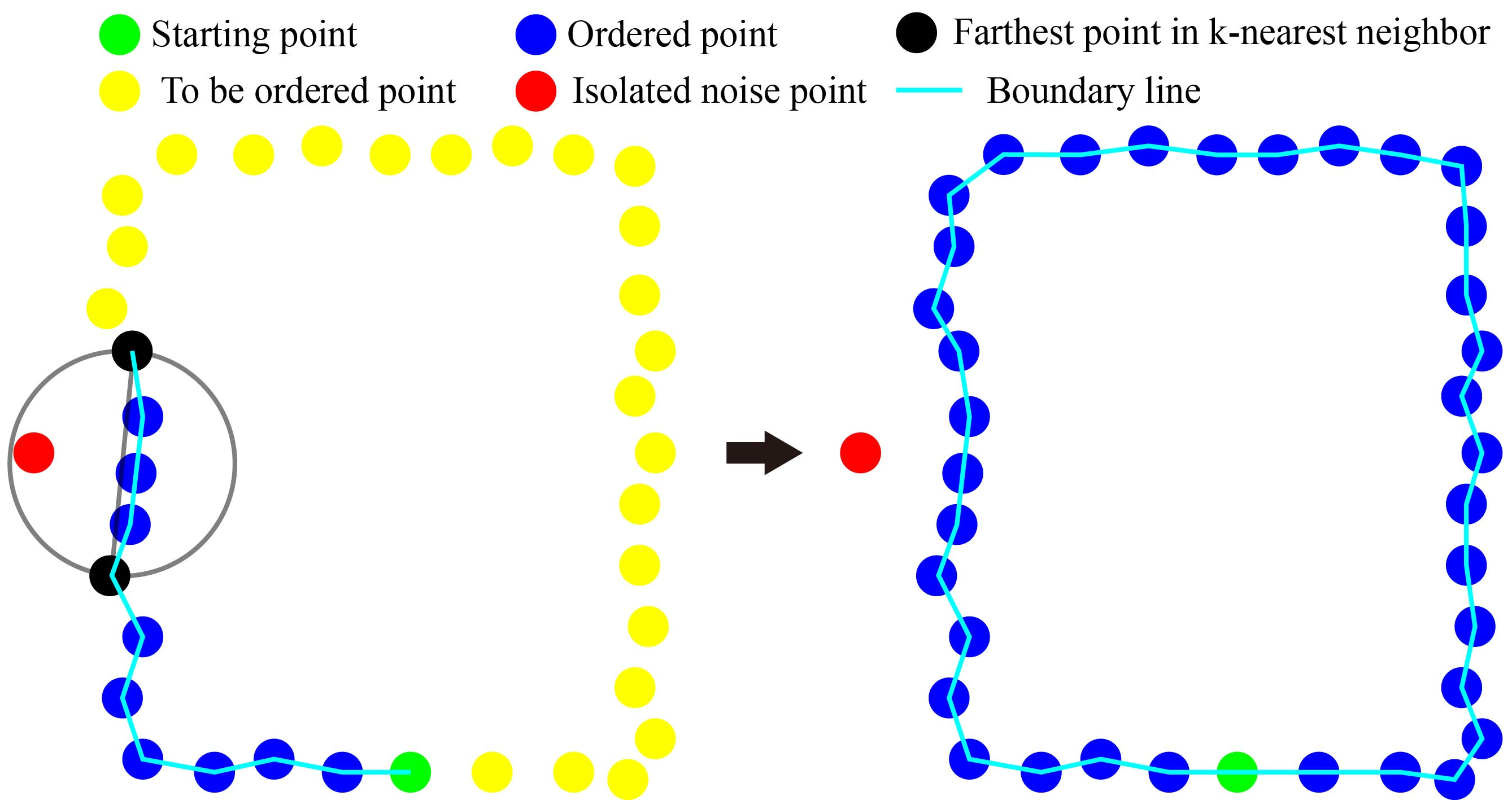
  • Removal of isolated noise points. The nearest neighbor p 0 n to p 0 b in P p c is found using k-d tree nearest neighbor search. p 0 n is added to P b and removed from P p c . p 0 n is then updated as the new starting point p 0 b . Next, to determine whether isolated noise points exist locally at the current sorting position, the last k ordered points in P b are used. As shown in Figure 4, a circle is drawn with the line connecting the two farthest points among these k ordered points as its diameter. If the number of ordered points n ( P b ) is less than k , the circle is drawn using the two farthest points among all ordered points. If any point in P p c lies within this circle, it is identified as an isolated point, excluded from the ordering, and removed from P p c .
  • Iterative loop. Step 2 is repeated until P p c becomes an empty set. Connecting the points in P b sequentially from the first to the last, and finally closing the loop between the last and first points, yields the boundary of the sparse boundary contour point cloud.
  • Boundary intersection check. If the extracted boundary of the sparse boundary contour point cloud has intersection points other than the endpoints of adjacent boundary segments, the boundary is considered invalid. In this case, the next point in the starting point list L s is selected as the new starting point p 0 b for k-d tree ordering. Steps 1, 2, 3, and 4 are repeated to reorder the points until a boundary is obtained that has no intersection points except at the endpoints of adjacent segments.
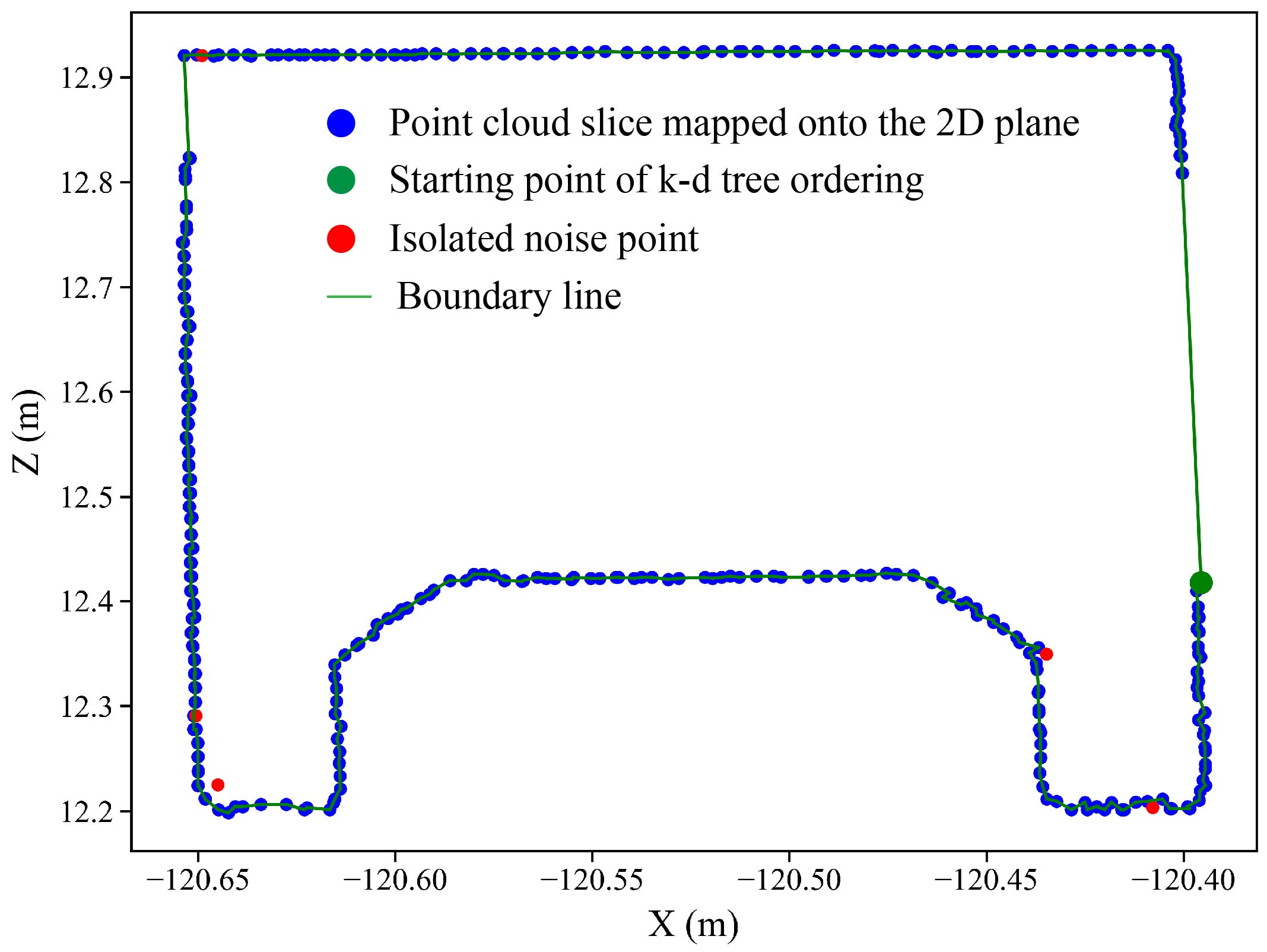
Based on the improved k-d tree ordering boundary extraction algorithm, cross-sectional boundary extraction can be performed on sparse boundary contour point clouds such as point cloud slices. As shown in Figure 5, the cross-sectional boundary extraction results of a point cloud slice mapped onto a two-dimensional plane effectively avoid the influence of point cloud missing and isolated noise points.
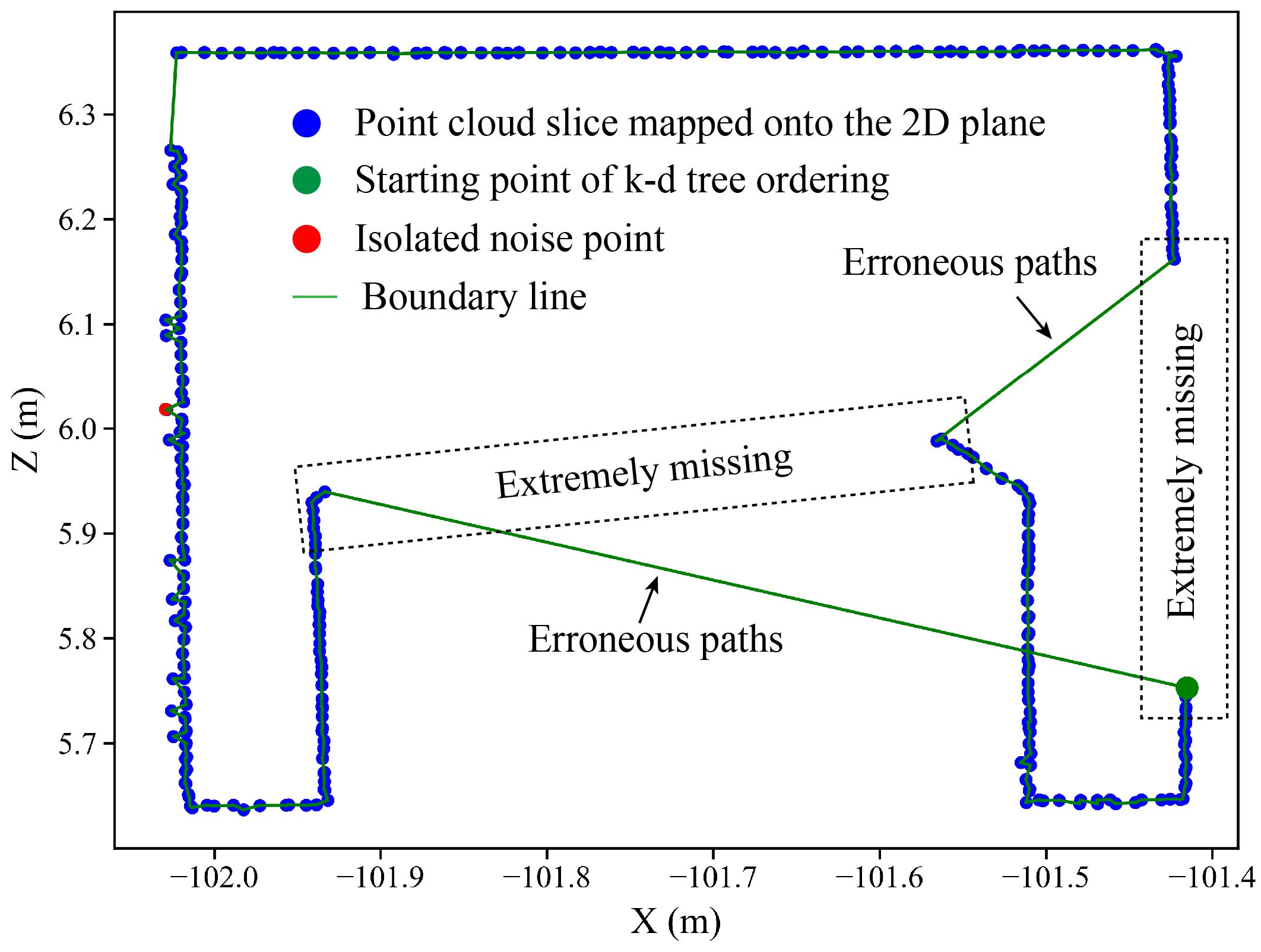
However, as shown in Figure 6, when the cross-sectional point cloud suffers from multiple extremely missing—meaning the point cloud is insufficient to accurately predict the complete cross-sectional geometry—the algorithm may generate erroneous boundary paths at these extremely missing regions. This limitation cannot be resolved by further refining the algorithm. Instead, attention should be paid during data acquisition to perform multi-angle scanning and present the point cloud as completely as possible, thereby fundamentally addressing such issues.

2.2. Boundary-Constrained Delaunay Triangulation Centroid Calculation Algorithm

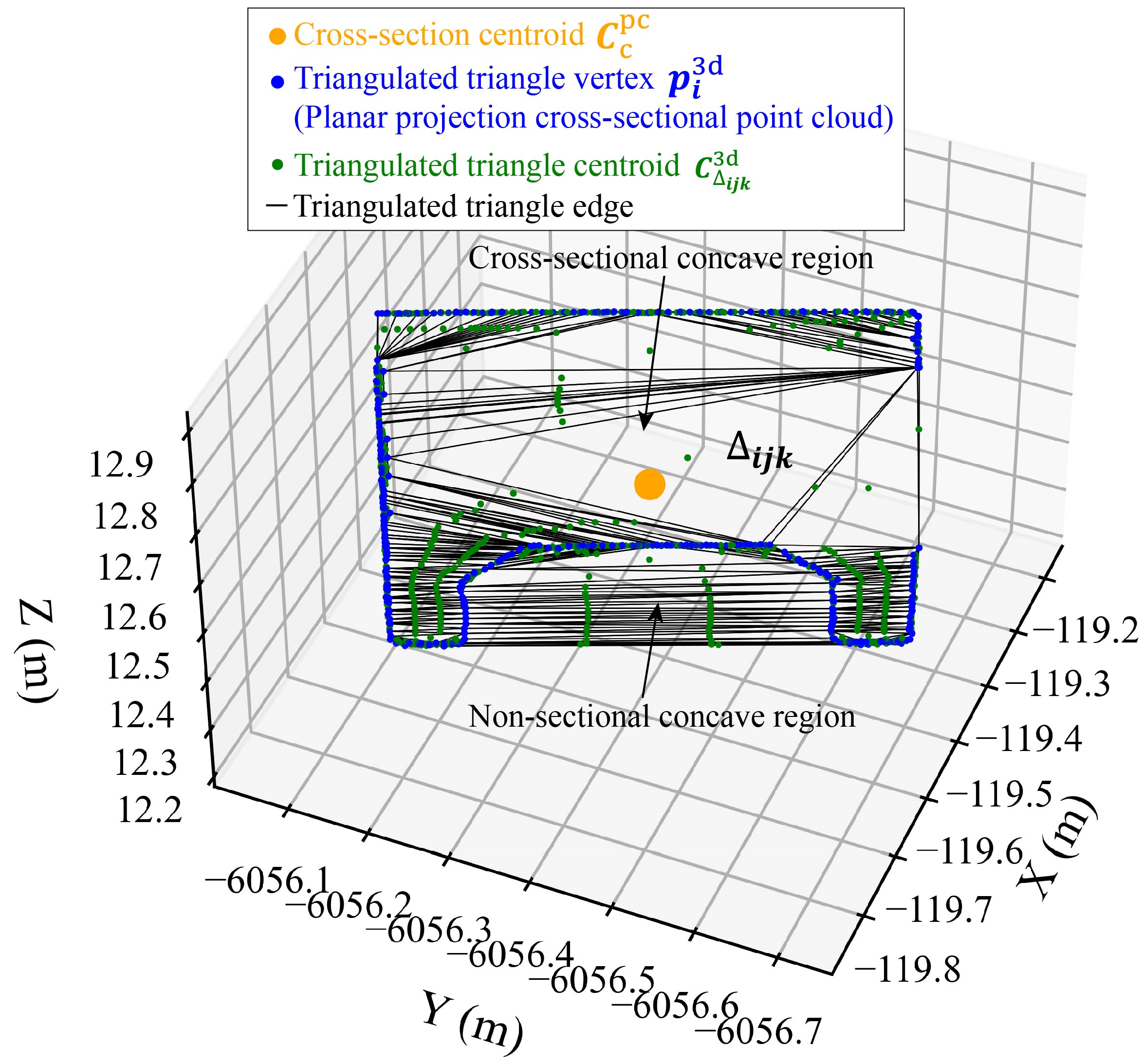
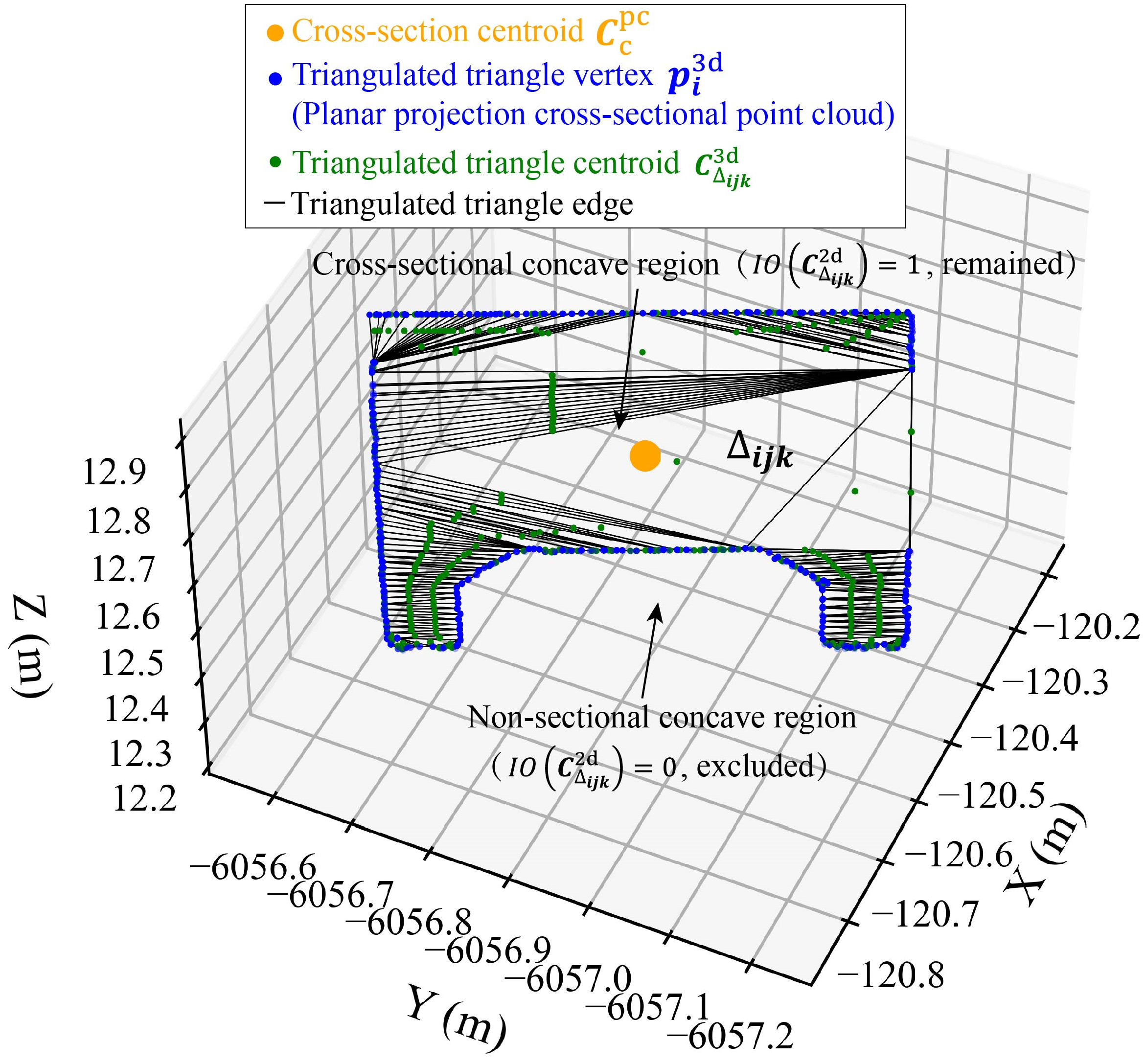
As shown in Figure 7, for a certain concave cross-sectional point cloud (projected onto the RANSAC fitting plane), Delaunay triangulation uses the planar projected points ( p i 3 d ) as the vertices of the triangles, dividing the entire convex hull region into numerous tightly connected, non-overlapping small triangles ( i j k ). The cross-section centroid ( C c p c ) can then be calculated by performing an area-weighted summation of these triangulated triangle centroids ( C i j k 3 d ). Consequently, the non-sectional concave regions will also be triangulated, and the calculated centroid will correspond to the center of the convex hull area of the cross-section. To obtain the centroid of the concave cross-section, it is necessary to exclude the Delaunay triangulation results from the non-sectional concave regions. Therefore, constraining the Delaunay triangulation area based on the concave boundary of the cross-section is essential.
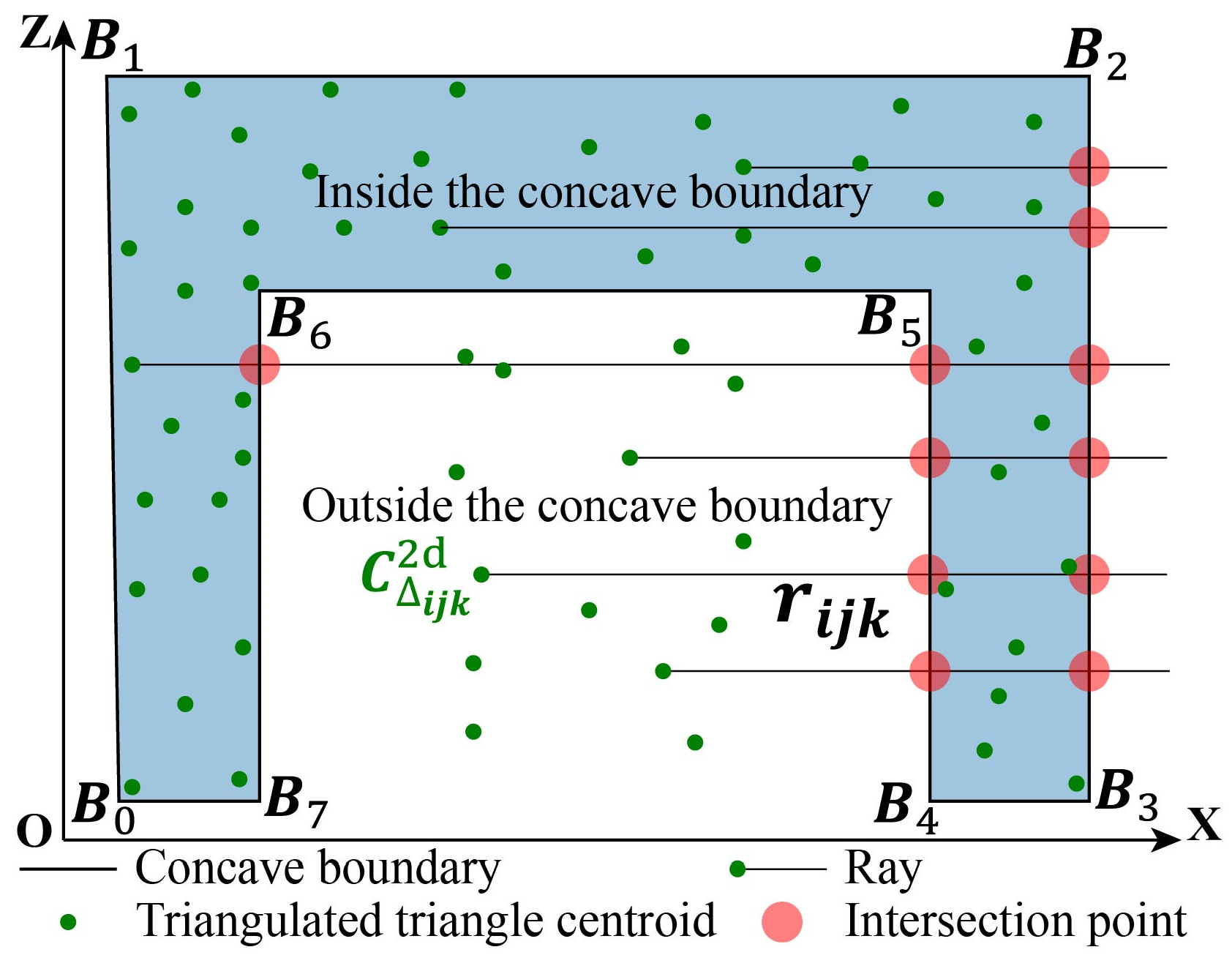
In this paper, the ray casting method is employed to determine whether the centroid of a triangulated triangle lies inside the concave boundary, thereby identifying the triangulated triangles in the non-sectional concave regions. As shown in Figure 8, this method essentially involves projecting a ray from the target point and calculating the number of intersections between the ray and the edges of the planar polygon to determine whether the target point is located inside the polygon.
The detailed implementation procedure of the boundary-constrained Delaunay triangulation centroid calculation algorithm based on the ray casting method is as follows:
  • Extract the concave boundary of the two-dimensional planar projection points from the cross-sectional slice point cloud using the improved k-d tree ordering boundary extraction algorithm, and perform Delaunay triangulation. The set of concave boundary segments is denoted as L B i B j ¯ (indicated by solid black line segments in Figure 8), and the set of centroids of the triangulated triangles is denoted as P C i j k 2 d (indicated by solid green points in Figure 8).
  • Select any point C i j k 2 d x i j k , z i j k from P C i j k 2 d . Starting from C i j k 2 d , construct a horizontal ray r i j k z = z i j k , x x i j k in the positive direction of the horizontal axis (the positive X-axis in Figure 8).
  • Select any boundary segment B i B j ¯ from L B i B j ¯ , with endpoint coordinates B i x i , z i and B j x j , z j . Determine whether condition A is satisfied: the point C i j k 2 d lies within the horizontal range defined by B i and B j , as given by Equation (1). If condition A is satisfied, then r i j k and B i B j ¯ do not intersect. Proceed directly to end the intersection check for B i B j ¯ . If condition A is not satisfied, the line l : z = z i j k must intersect B i B j ¯ . Then, determine whether condition B is satisfied: the intersection point of l and B i B j ¯ lies to the right of C i j k 2 d , as given by Equation (2). If condition B is satisfied, r i j k and B i B j ¯ intersect at one point. If condition B is not satisfied, r i j k and B i B j ¯ do not intersect. End the intersection check for B i B j ¯ .
    A : m i n z i , z j < z i j k m a x z i , z j
    B : x i j k z i j k z j x i x j z i z j + x j
  • Repeat Step 3 to traverse all other boundary segments in L B i B j ¯ and determine their intersections with C i j k 2 d . If the total number of intersections between C i j k 2 d and all boundary segments in L B i B j ¯ is odd, then C i j k 2 d lies inside the concave boundary. The centroid calculation coefficient I O C i j k 2 d in Equation (3) is set to 1. If the total number of intersections is even, then C i j k 2 d lies outside the concave boundary. The centroid calculation coefficient I O C i j k 2 d is set to 0.
    I O C i j k 2 d = 1 α β   m o d   2
  • Repeat Steps 2, 3, and 4 to traverse all other centroid points in P C i j k 2 d and determine their intersections with all boundary segments in L B i B j ¯ .
By performing boundary-constrained Delaunay triangulation centroid calculation based on the ray casting method on the two-dimensional planar projection points of the concave cross-section, and inversely mapping the triangulation results back to the three-dimensional projected point cloud, the influence of triangulation results from non-sectional concave regions can be excluded. As shown in Equation (4), the weighted coefficient of each triangulated triangle’s centroid is multiplied by the centroid calculation coefficient I O C i j k 2 d in addition to the original triangulated triangle area A i j k . This yields the centroid C c p c of the concave cross-section, as illustrated in Figure 9.
C c p c = I O C i j k 2 d A i j k C i j k 3 d I O C i j k 2 d A i j k

3. Deformation Detection of Member Centroid Axis

3.1. Point Cloud Slicing Requirement

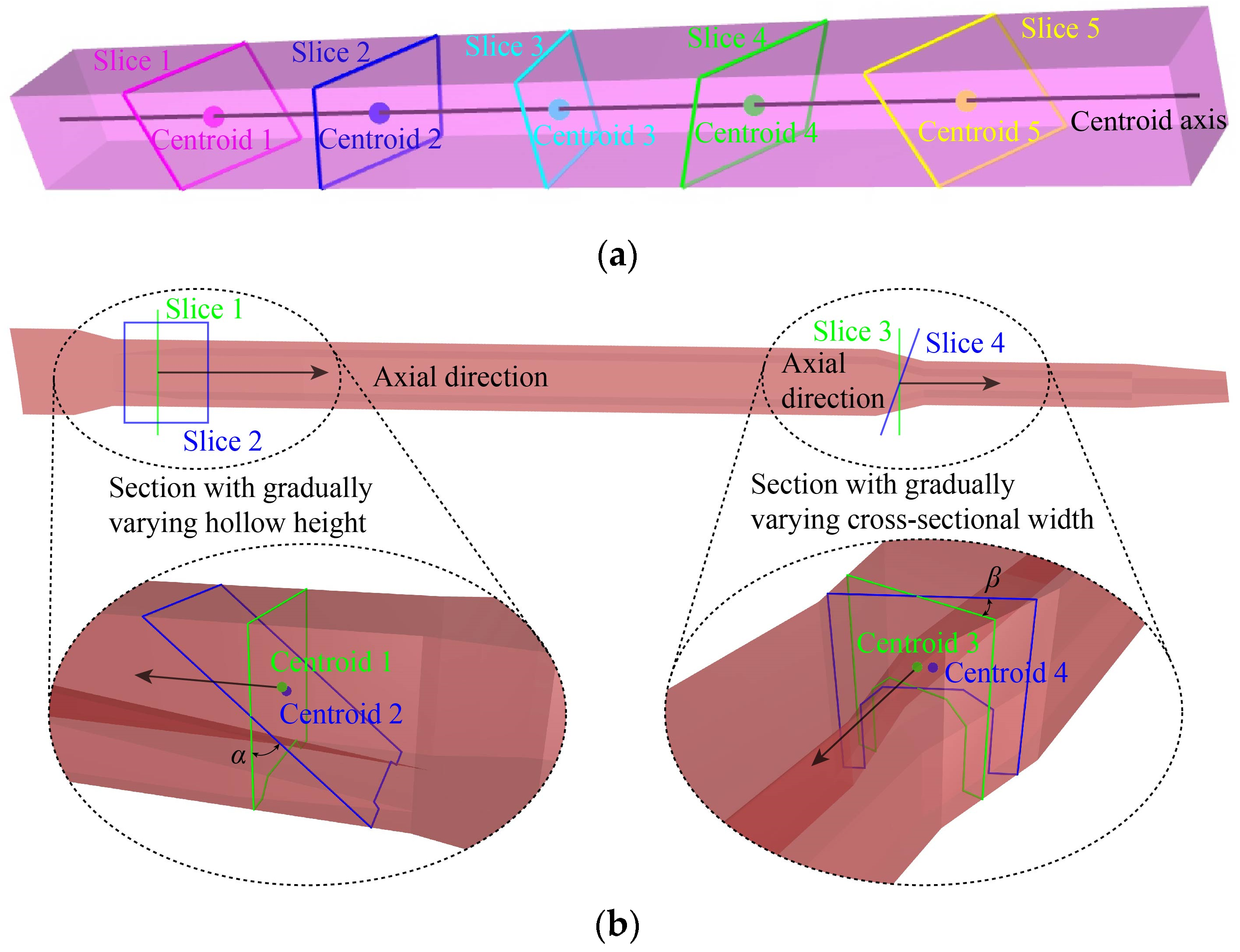
In this study, the deformation information of the centroidal axis of a structural member is characterized by a series of discrete cross-sectional centroid points. Therefore, it is necessary to perform continuous slicing of the member’s point cloud model to obtain multiple cross-sectional point clouds and extract their respective centroids. As shown in Figure 10a, for a typical beam-like member with constant cross-sections, regardless of the variation in slicing direction, the extracted cross-sectional centroid consistently lies on the member’s centroid axis. However, for complex beam-like members with variable cross-sections, differences in slicing direction at locations where the cross-sectional shape changes can significantly affect the extracted centroid results. For example, at the position where the hollow height of a cross-section gradually changes in a member with complex and variable cross-sections, as illustrated in Figure 10b, Slice 1 is aligned with the member’s axial direction, yielding an accurate cross-sectional centroid (Centroid 1). In contrast, if the slicing direction is tilted downward by an angle α , as in Slice 2, the resulting centroid (Centroid 2) may shift upward or downward away from the correct centroid axis due to variations in the hollow height at the bottom of the cross-section. Similarly, at the position where the cross-sectional width gradually varies, Slice 3 maintains alignment with the member’s axial direction, producing an accurate cross-sectional centroid (Centroid 3). However, if the slicing direction is tilted toward one side by an angle β , as in Slice 4, the resulting centroid (Centroid 4) may shift leftward or rightward away from the correct centroid axis due to changes in cross-sectional width. Therefore, for complex beam-like members with variable cross-sections, ensuring that the point cloud slicing direction consistently aligns with the member’s axial direction is both a sufficient and necessary condition to guarantee that the extracted cross-sectional centroids accurately lie on the member’s centroid axis.

3.2. Convex Hull Centroid-Driven Adaptive Normal Iterative Point Cloud Slicing Method

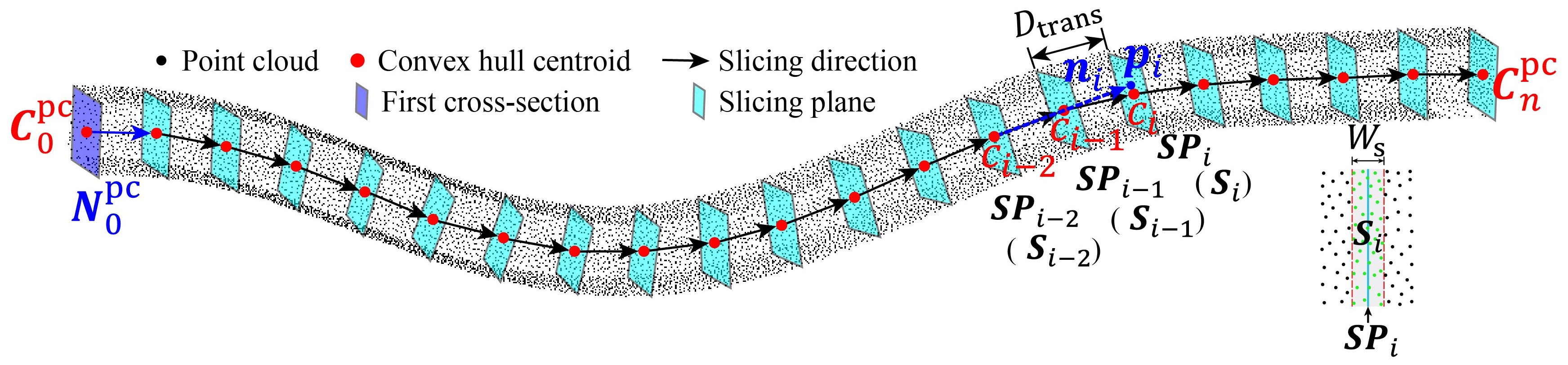
However, structural members may experience deformation under actual conditions, resulting in an unknown axial direction along their length. To address this, this paper proposes a convex hull centroid-driven adaptive normal iterative point cloud slicing method. Rather than maintaining a constant slicing direction, this method dynamically adjusts the slicing orientation throughout the cross-sectional centroid extraction process. This ensures that the slicing direction consistently approximates the actual axial direction of the member at each corresponding position, thereby closely aligning with the member’s true shape and guaranteeing that the extracted cross-sectional centroids accurately lie on the actual centroid axis. The schematic illustration of the convex hull centroid-driven adaptive normal iterative point cloud slicing method is shown in Figure 11. The execution steps are as follows:
  • Initialize the starting point and direction for point cloud slicing using the centroid C 0 p c and normal vector N 0 p c of the member’s first cross-section. The normal vector N 0 p c is obtained by applying RANSAC plane fitting to the point cloud of the first cross-section. The centroid C 0 p c is derived through boundary-constrained Delaunay triangulation centroid calculation.
  • Determine the normal vector n i of the new point cloud slicing plane S P i . For the second slicing plane onward, the normal vector n i is defined as the direction of the vector c i 2 c i 1 , which connects the convex hull centroids c i 2 and c i 1 obtained from the previous two slices S i 2 and S i 1 via Delaunay triangulation. For the second slice, the normal vector remains the initial direction.
  • Define a point p i on the new slicing plane S P i . Translate the convex hull centroid c i 1 from the previous slice along the normal vector n i by the slicing interval distance D t r a n s to obtain the point p i .
  • Construct the slicing plane S P i and extract the new point cloud slice S i . Form the slicing plane S P i using the point p i and normal vector n i . Extract points within half of the slice thickness W s on either side of S P i as the new point cloud slice S i . Compute the convex hull centroid c i of slice S i .
  • Iterate steps 2, 3 and 4 until the slicing plane exceeds the bounds of the member’s point cloud model. The iteration terminates when the condition p i C 0 p c C n p c C 0 p c is satisfied, where C n p c represents the centroid of the final cross-section.
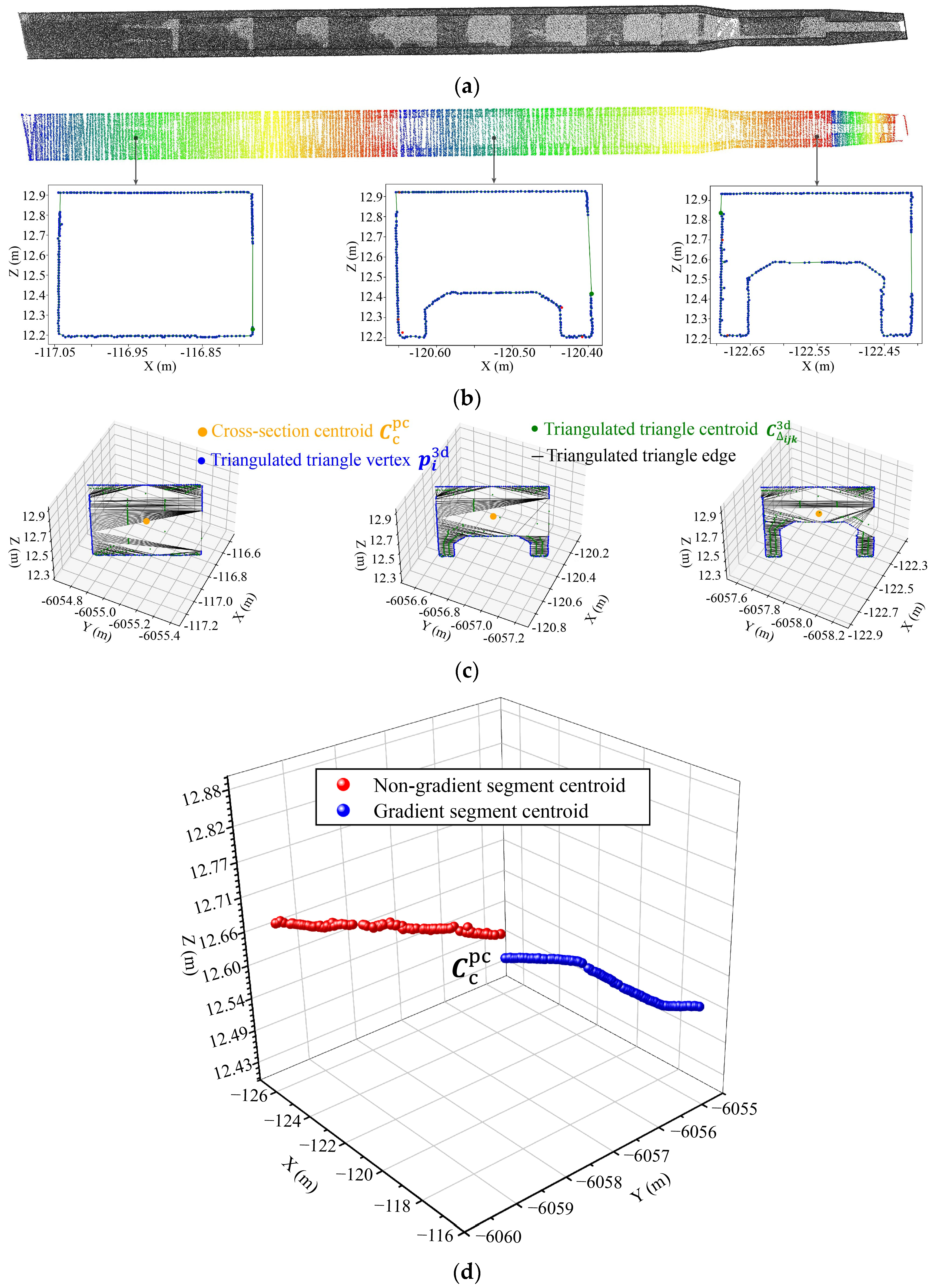
The above convex hull centroid-driven adaptive normal iterative point cloud slicing method dynamically updates the slicing direction by leveraging historical convex hull centroid vectors. The smaller the slicing interval distance is set, the more closely the slicing direction approximates the actual axial direction of the member, thereby enhancing robustness to actual structural deformations and avoiding cumulative errors in cross-sectional centroid extraction caused by a fixed slicing direction. As shown in Figure 12a,b, the convex hull centroid-driven adaptive normal iterative point cloud slicing method is applied to a certain beam-like member with variable cross-sections, and then the improved k-d tree ordering boundary extraction is conducted. By extracting the cross-sectional centroid C c p c of each slice using the boundary-constrained Delaunay triangulation centroid calculation algorithm (Figure 12c), the deformation of the member’s centroid axis can be accurately obtained (Figure 12d).

3.3. Experimental Validation of the Point Cloud Slicing Method

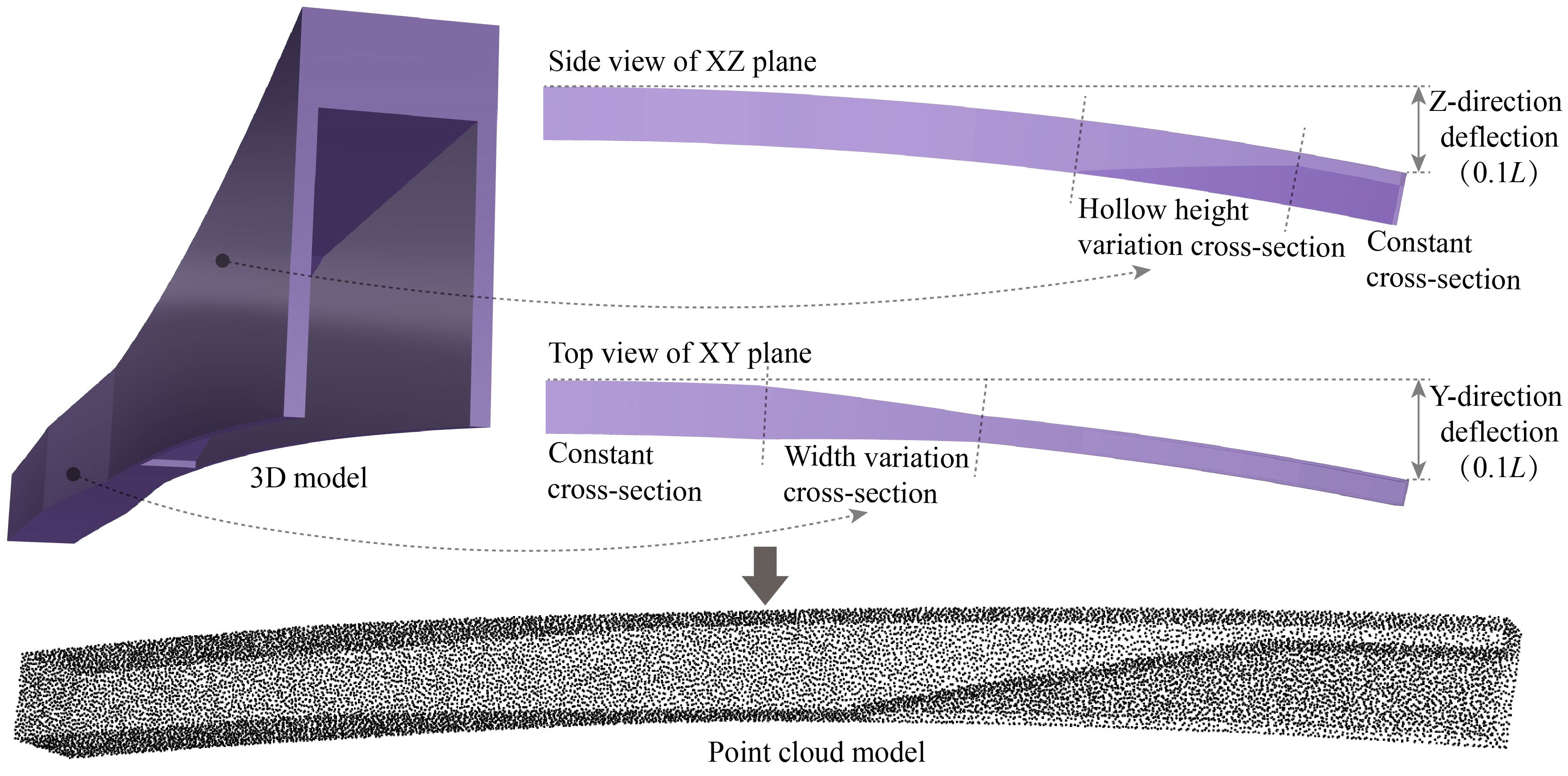
To validate the feasibility and accuracy of the convex hull centroid-driven adaptive normal iterative point cloud slicing method, this study designs a beam-like member with complex and variable cross-sections, as illustrated in Figure 13, incorporating both cross-sectional width variation and hollow height variation. The member has a standard length of L = 16   m . In the segment from 4 m to 8 m, the cross-sectional width linearly transitions from 1 m to 0.5 m. In the segment from 10 m to 14 m, the hollow height of the cross-section linearly increases from 0.05 m to 0.75 m. All other segments maintain a constant cross-section. A total of five deformation scenarios are applied to the member: 0.02 L deflection (Y-direction: 0.32 m, Z-direction: 0.32 m), 0.04 L deflection (Y-direction: 0.64 m, Z-direction: 0.64 m), 0.06 L deflection (Y-direction: 0.96 m, Z-direction: 0.96 m), 0.08 L deflection (Y-direction: 1.28 m, Z-direction: 1.28 m), 0.10 L deflection (Y-direction: 1.6 m, Z-direction: 1.6 m). Corresponding point clouds of the member are generated by sampling surface points from its 3D model under each deformation scenario. Figure 13 shows the point cloud for the 0.10 L deflection scenario.

3.3.1. Slicing Effectiveness

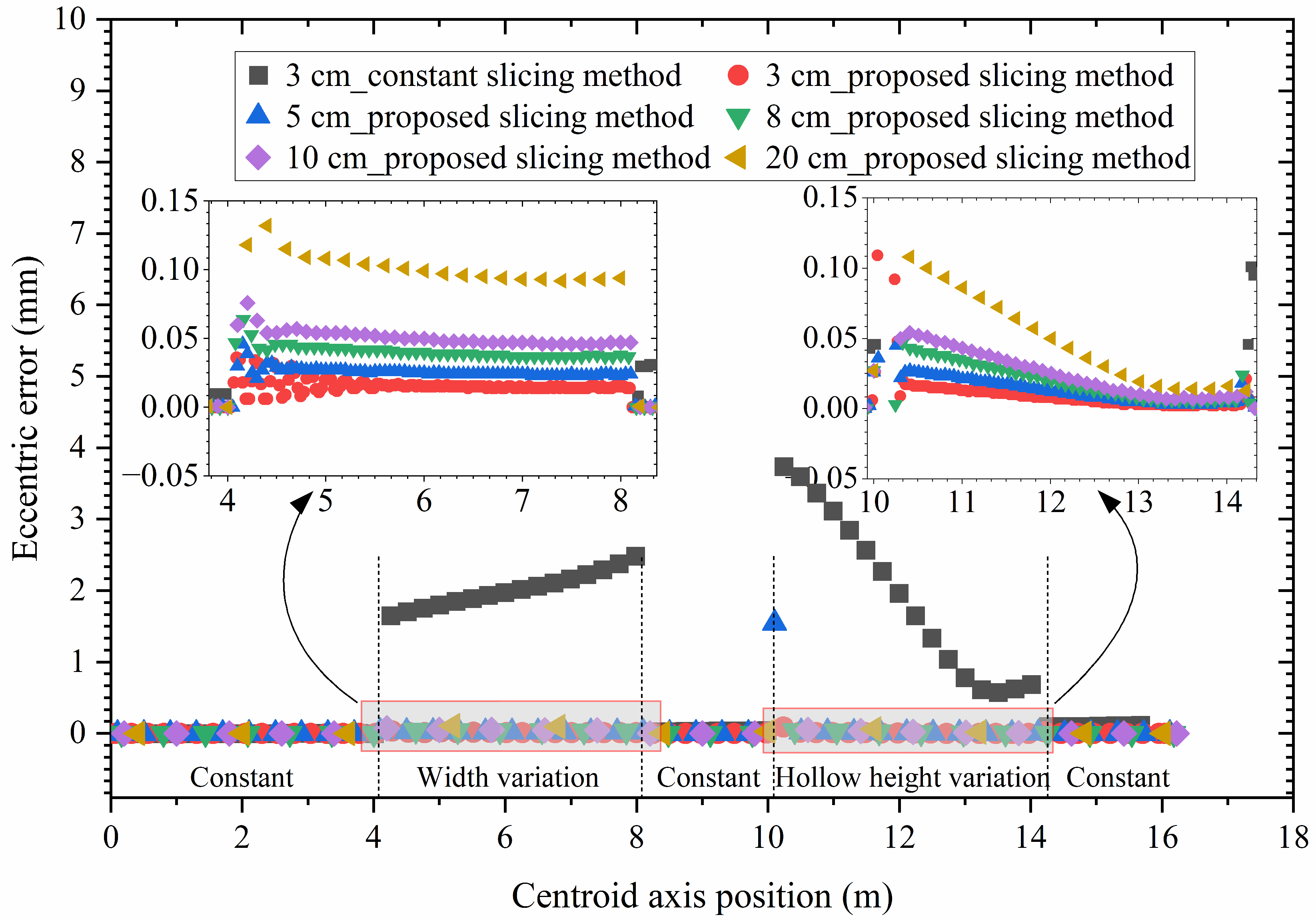
Conventional point cloud slicing typically involves extracting slices along a fixed direction, referred to as the constant slicing method. In this analysis, the constant slicing method is applied along the member’s standard axial direction (X-axis) with a slice interval distance of 3 cm and a slice thickness of 2 cm. To compare the effectiveness of the proposed convex hull centroid-driven adaptive normal iterative point cloud slicing method with the constant slicing method, the slice interval distance D t r a n s and thickness W s in the proposed method are also set to 3 cm and 2 cm. The point cloud of the member under the 0.10 L deflection scenario serves as the slicing target. The neighboring point number k is set as 7 when performing the improved k-d tree ordering boundary extraction. The slicing effectiveness is evaluated by measuring the eccentric error, defined as the minimum distance between the extracted cross-sectional centroid points and the member’s actual centroid axis.
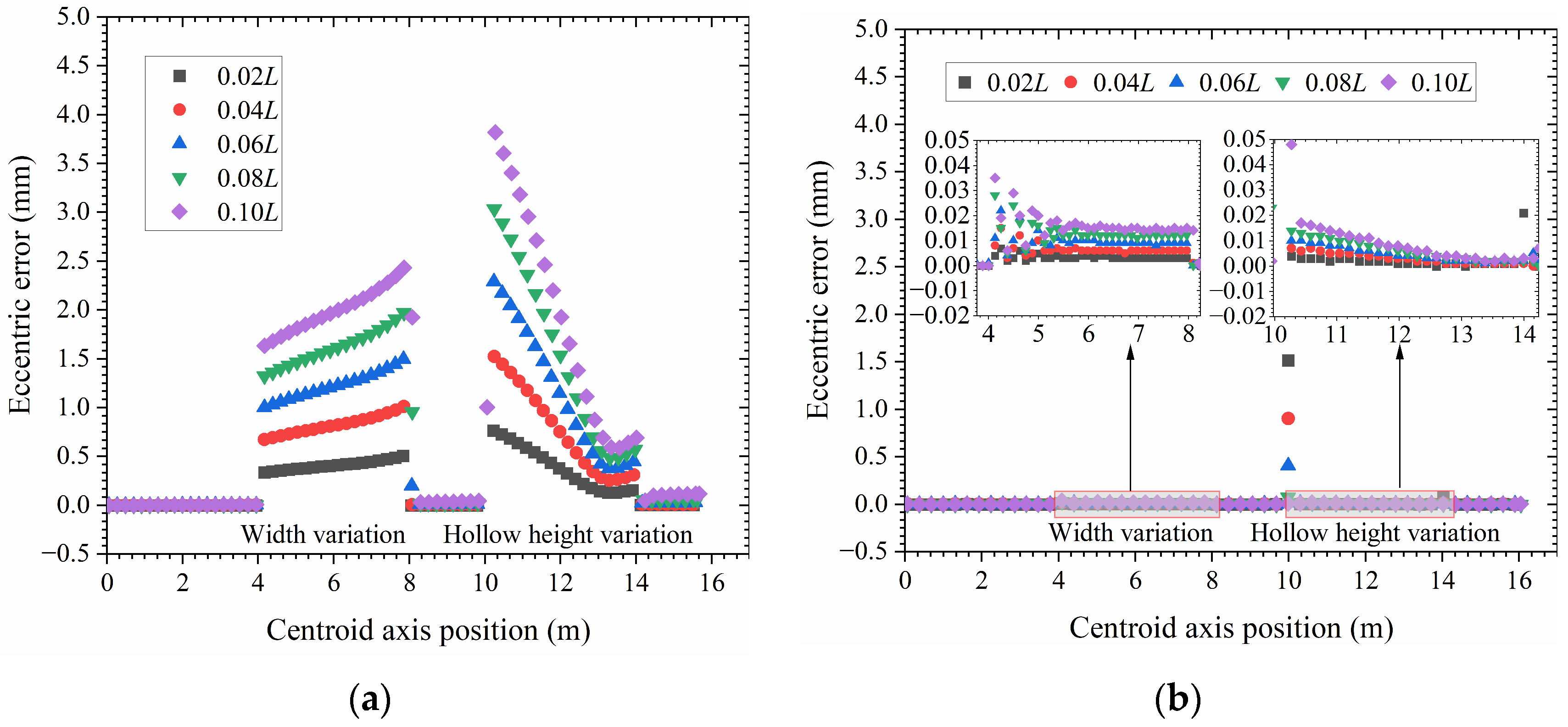
Figure 14 presents statistical results of the eccentric error along the centroid axis. The constant slicing method performs well in sections with a constant cross-section but exhibits significantly larger eccentric errors when extracting centroids in regions with gradually varying cross-sectional width or hollow height. In contrast, the proposed slicing method achieves very small eccentric errors across all sections—whether constant, width variation, or hollow height variation. The enlarged views in Figure 14 show that the eccentric error is relatively high only at the transition from constant to varying sections and then gradually decreases, particularly in the hollow height variation section. This behavior is a direct result of the proposed method’s ability to adaptively and iteratively update the slicing direction.
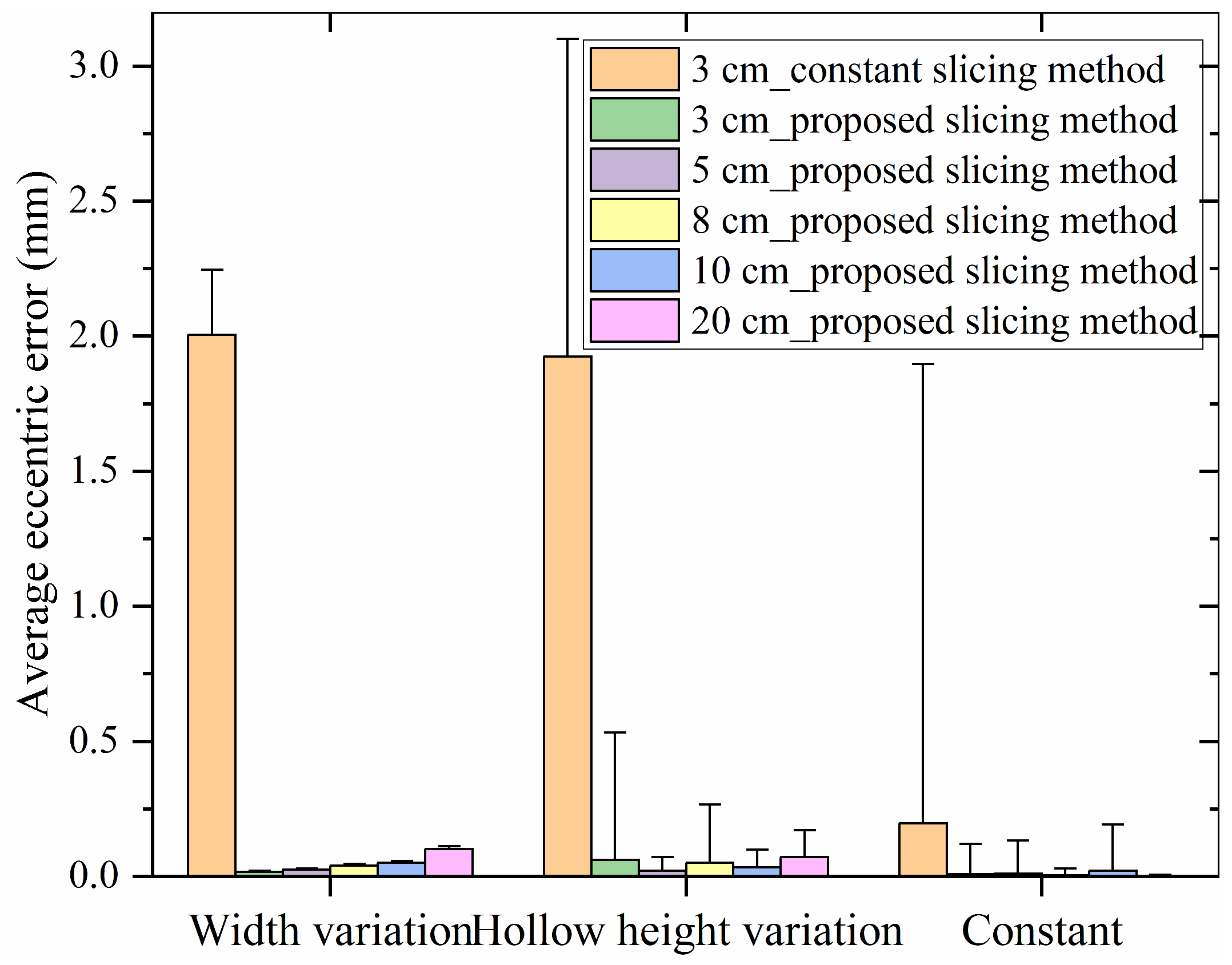
Further analysis in Figure 15 reveals that the constant slicing method yields an average eccentric error of 0.196 mm with a standard deviation of 1.701 mm in constant cross-section sections, while in width variation and hollow height variation sections, the average errors reach 2.004 mm and 1.925 mm, with standard deviations of 0.242 mm and 1.175 mm, respectively. In comparison, the proposed method maintains small errors across all segments: average eccentric errors of 0.016 mm, 0.062 mm, and 0.009 mm in constant, width variation, and hollow height variation sections, with standard deviations of 0.005 mm, 0.472 mm, and 0.111 mm, respectively. The proposed method reduces the average eccentric error by two orders of magnitude and the standard deviation by one order of magnitude compared to the constant slicing method. Therefore, the convex hull centroid-driven adaptive normal iterative point cloud slicing method significantly improves slicing effectiveness and theoretically enables submillimeter accuracy in centroid extraction.

3.3.2. Influence of Different Parameters

Using the point cloud of the member under the 0.10 L deflection scenario as the slicing target, it is evident from Figure 14 that the eccentric error of the proposed slicing method in the cross-section transition segments increases with the enlargement of the point cloud slice interval distance D t r a n s . From Figure 15, it is observed that the average eccentric error in the width variation section exhibits an almost linear positive correlation with D t r a n s , while the correlation between the average eccentric error in the hollow height variation section and D t r a n s is not pronounced. In summary, special attention should be paid to the setting of D t r a n s during practical point cloud slicing operations, and its value should be minimized as much as possible. However, due to the potential presence of noise or data missing in actual member point clouds—which may introduce errors during centroid extraction—an excessively small D t r a n s can amplify the disturbance of centroid extraction errors on the slicing direction. If centroid extraction errors are consistently significant, this may cause the slicing direction to reverse midway, thereby preventing the successful slicing of the entire member point cloud. Therefore, in practical slicing applications, D t r a n s should be configured according to specific conditions, with a recommended range of 0.03 m to 0.1 m.
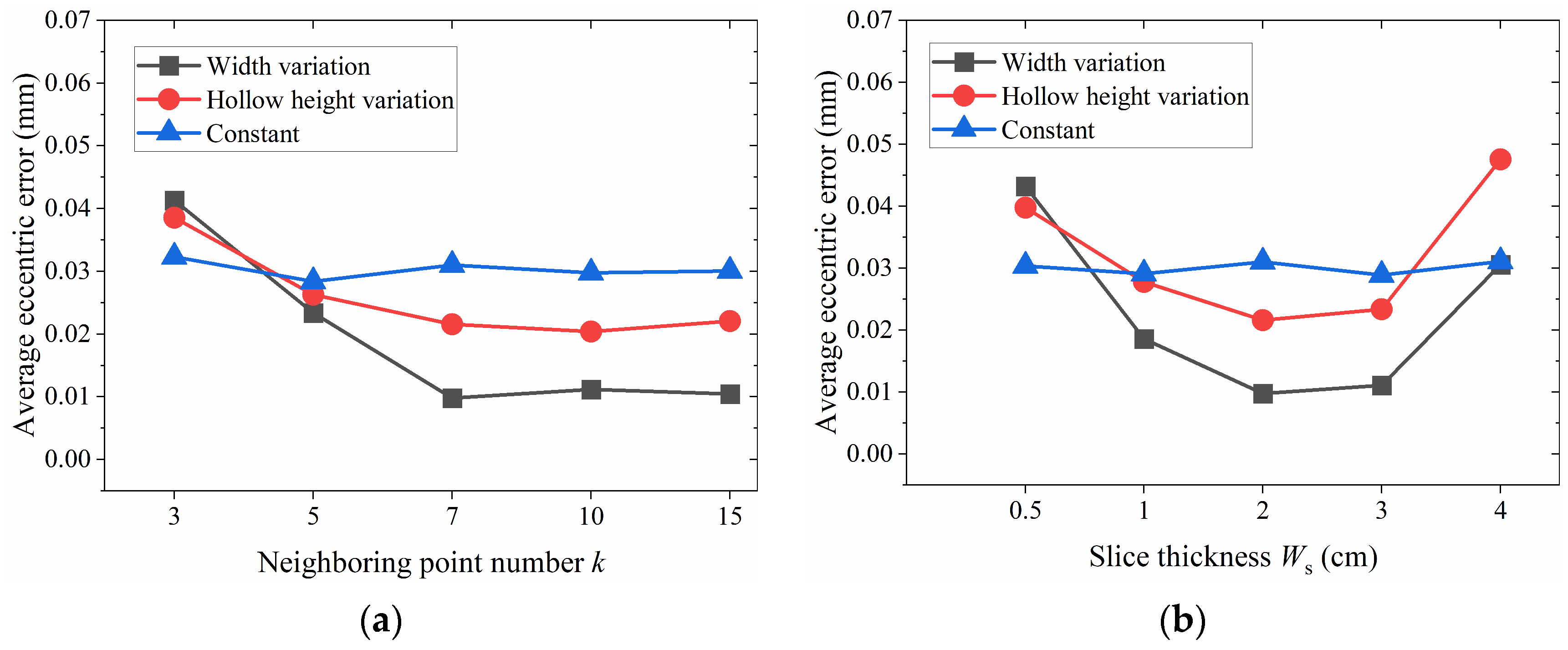
The neighboring point number k does not directly affect point cloud slicing, however, it influences the effectiveness of isolated noise point removal and boundary extraction, thereby indirectly impacting the accuracy of centroid axis extraction. As shown in Figure 16a, when k is set too small, the local judgment range narrows, leading to a lower recognition rate of isolated noise points and an increased error rate in boundary extraction, which results in a larger average eccentric error. Therefore, this paper recommends that the value of k should not be too small and should be no less than 7.
In this experiment, the spatial density d p c of the point cloud is approximately 1 cm. As shown in Figure 16b, when the slice thickness W s is too small ( d p c ), the point cloud slice fails to capture the complete cross-sectional geometry, reducing the accuracy of convex hull centroid extraction and increasing the average eccentric error of the centroid axis due to degraded slicing performance. Conversely, when W s is too large ( D t r a n s ), the spatial threshold range along the normal direction of the cross-section expands, which degrades the accuracy of RANSAC plane fitting and adversely affects the Delaunay triangulation results, thereby compromising slicing performance and increasing the average eccentric error of the centroid axis. Therefore, this paper recommends that W s should neither be too small nor too large, and its value should be selected within the range of 2 d p c to D t r a n s .
Based on the parameter influence experiment results, the recommended parameter value ranges are summarized in Table 1.

3.3.3. Deformation Robustness of the Slicing Method

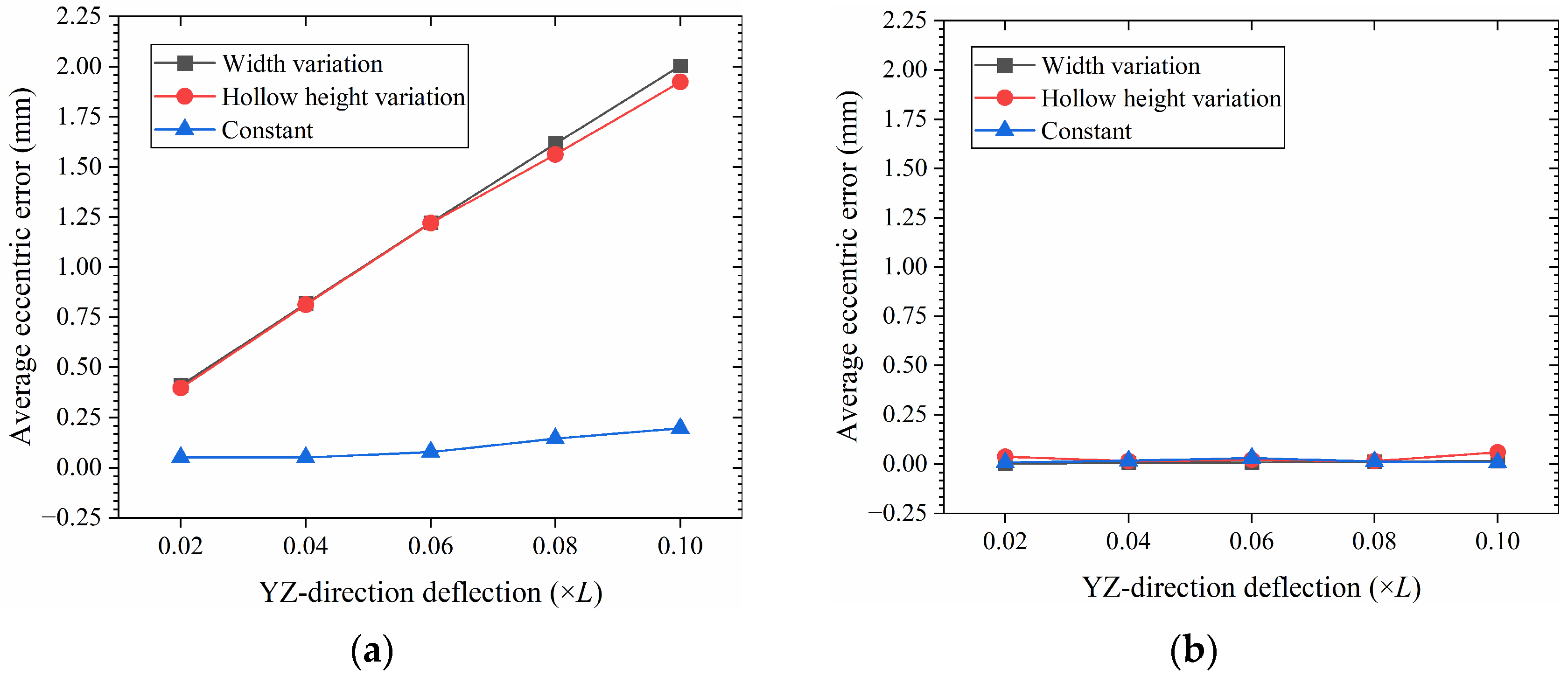
In practical applications, structural members may undergo varying degrees of deformation. Therefore, to investigate the deformation robustness of the point cloud slicing method, point clouds of the member under five deflection scenarios as the aforementioned working condition settings— 0.02 L , 0.04 L , 0.06 L , 0.08 L , and 0.10 L —are used as slicing targets. Figure 17 shows that in cross-section transition segments, the eccentric error of the constant slicing method increases significantly as the deflection deformation increases. In contrast, the increase in eccentric error for the proposed slicing method is substantially smaller with larger deformations. Figure 18 further demonstrates that in transition segments, the average eccentric error of the constant slicing method exhibits an approximately linear positive correlation with deformation magnitude, whereas the average eccentric error of the proposed slicing method remains nearly constant and unaffected by deformation. Thus, the convex hull centroid-driven adaptive normal iterative point cloud slicing method demonstrates excellent robustness to member deformation and can effectively adapt to differently deformed members without compromising slicing performance.

4. Case Study

4.1. Project Overview

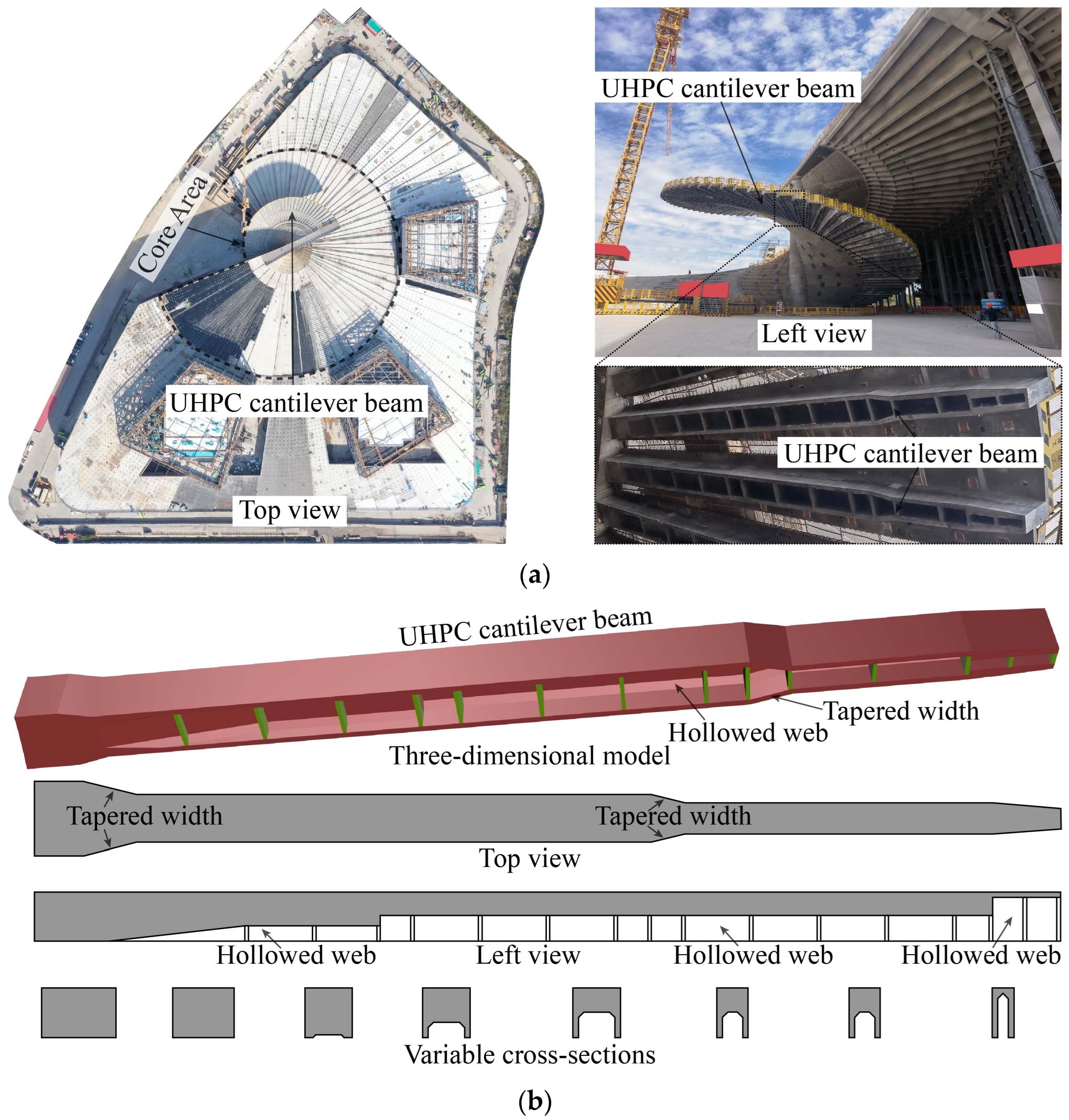
The core area of the Shanghai Grand Opera House features a roof structure inspired by the traditional Chinese “folding fan” form. The fan tail section comprises 62 precast ultra-high-performance concrete (UHPC) prestressed cantilever beam-slab structural components—UHPC cantilever beams, as illustrated in Figure 19a. These components are prefabricated off-site, transported to the construction site for installation, and after subsequent prestressing, the stair treads between adjacent UHPC cantilever beams are cast in place to integrate the fan tail into a cohesive whole. The shortest UHPC cantilever beam at the base measures approximately 10 m, while the longest one at the top extends to about 15 m. As a pioneering building material adopted on a large scale for the Shanghai Grand Opera House, UHPC cantilever beams possess a compressive strength of up to 165 MPa. Combined with slow-bonding prestressing technology, they effectively address the challenges of super-long cantilevers. To facilitate prestressing operations and reduce structural self-weight, the UHPC cantilever beams are designed with complex and variable cross-sections characterized by hollowed webs and tapered widths, as illustrated in Figure 19b. Given the extreme cantilever spans and intricate cross-sectional geometry, deformation detection of these UHPC cantilever beams requires particular attention.

4.2. Deformation Detection

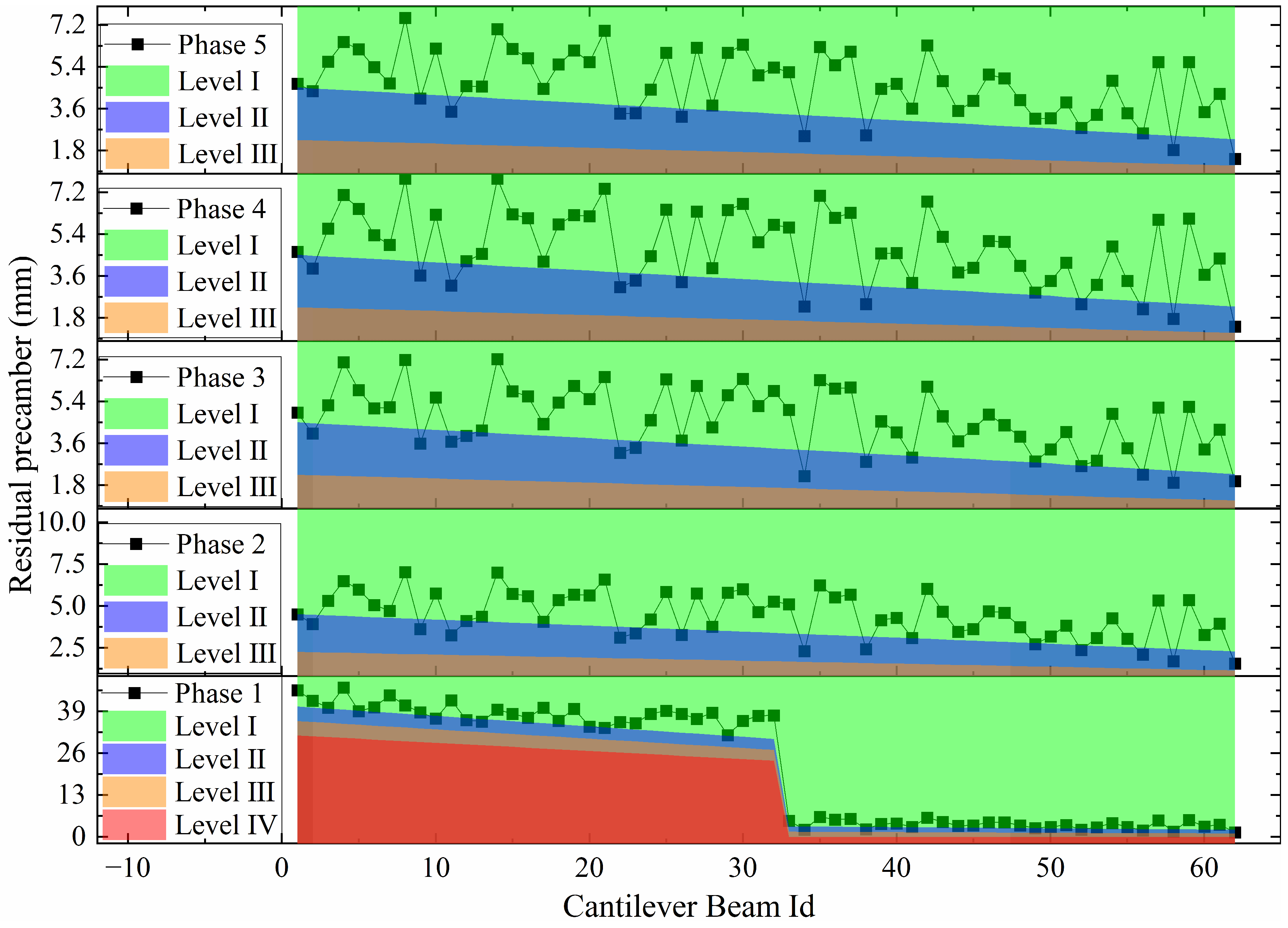
According to the Chinese Technical Code for Monitoring of Building and Bridge Structures (GB 50982-2014) [35], monitoring and early warning during construction should be based on safety control and quality control requirements. It is recommended to adopt a graded principle and, in combination with structural analysis results from the construction process, establish corresponding limit values and warning thresholds of different risk levels for monitored components. The UHPC cantilever beams vary in length (approximately 10–15 m), cross-sectional dimensions, and prestress distribution. Based on structural force analysis and calculated deflection results, the construction management authority determined a precamber range of 23.8–42.5 mm. The deformation warning values were simplified and scaled according to member length. Considering the phased removal of temporary steel supports beneath the beams, a four-stage deformation warning level criterion was established, as shown in Table 2. Within this deformation warning level framework: Level I Warning (Normal/Safe): Construction deformation is minimal, and structural behavior fully meets design expectations; Level II Warning (Attention/Controllable): Construction deformation is small, and structural behavior remains within the controllable range of design expectations; Level III Warning (Alert/Warning): Construction deformation is significant, and structural behavior approaches design limits, necessitating engineering interventions; Level IV Warning (Hazard/Alarm): Construction deformation exceeds limits and may compromise structural safety, requiring immediate emergency engineering measures.
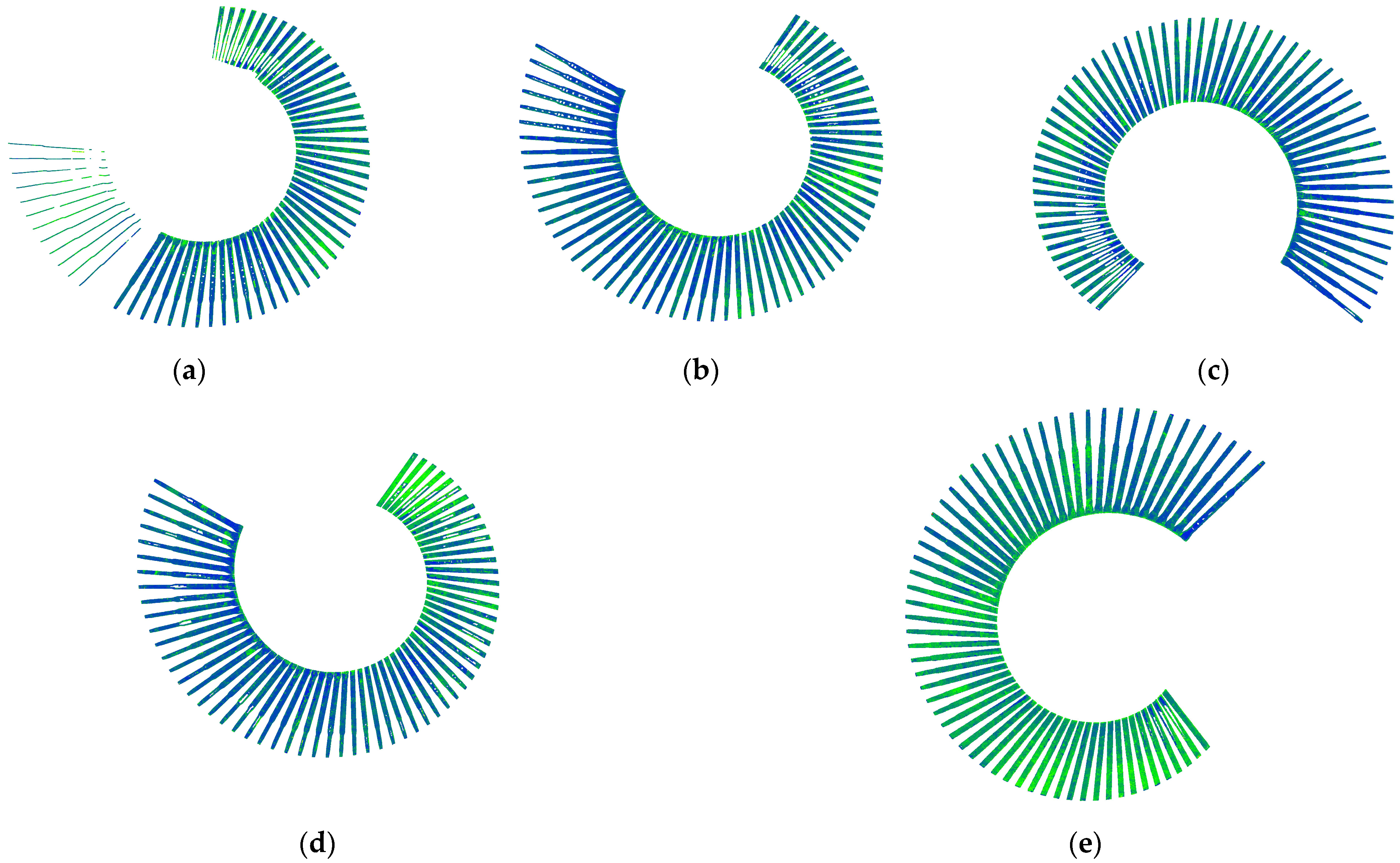
Using the Leica ScanStation P40 terrestrial 3D laser scanner, approximately 30 measurement stations were set up at the construction site, with fixed targets used for registration. Point cloud data of UHPC cantilever beams during five construction phases were collected, as shown in Figure 20. Using the convex hull centroid-driven adaptive normal iterative point cloud slicing method and boundary-constrained Delaunay triangulation centroid calculation algorithm, the deformation information of the centroid axes for all UHPC cantilever beams was extracted. All algorithms were executed on an Intel(R) Core(TM) i7-10700 CPU with 32.0 GB of RAM (produced by Intel Corporation in Santa Clara, CA, USA). For each construction phase, the total processing time of the algorithms was approximately 1 h for a point cloud of about 12 million points, achieving a processing efficiency of approximately 3 s per 10,000 points, which is applicable to large-scale point clouds and near-real-time monitoring scenarios. The maximum downward deflection detected across all construction phases is presented in Figure 21. In Construction Phase 1, the temporary steel supports beneath the top 32 UHPC cantilever beams had not yet been removed, and the beam precamber met the standard design requirements. For the bottom 30 UHPC cantilever beams, the temporary steel supports had been completely removed. The downward deflection induced by the self-weight of these beams offset most of the precamber, resulting in a residual precamber of approximately 5 mm, which fell within the Level I (Safe) or Level II (Controllable) warning range. In Construction Phases 2–5, all temporary steel supports beneath the UHPC cantilever beams were removed. Although the beam precamber fluctuated slightly due to construction disturbances across different phases, it consistently remained within a range of 1–8 mm, corresponding to either Level I (Safe) or Level II (Controllable) warning levels. The retained precamber in all UHPC cantilever beams provided a certain degree of structural safety redundancy for subsequent surface decoration works.
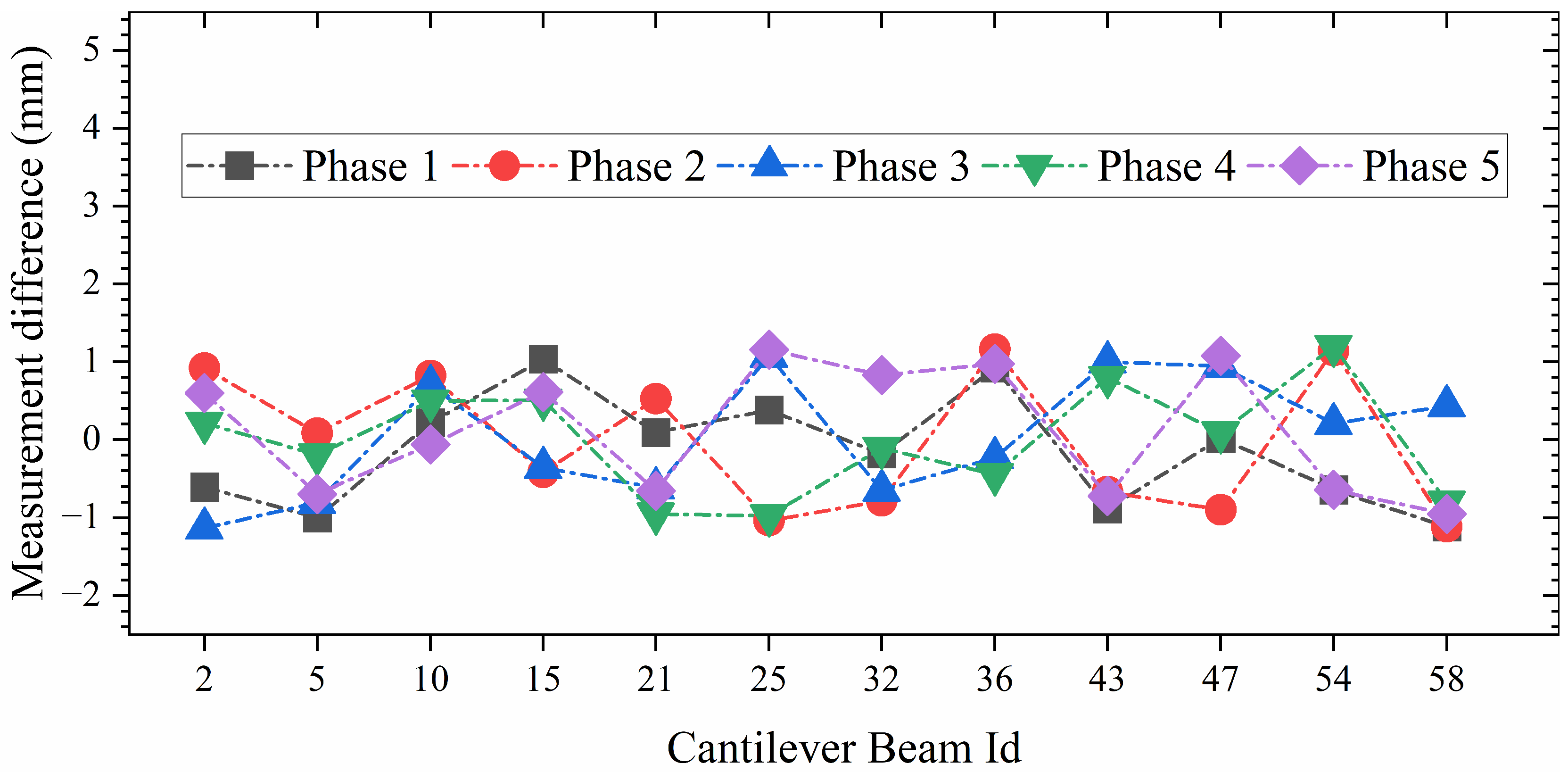
Additionally, using a Leica iCB70 total station with a 1” angular accuracy and a ranging accuracy of 1 mm + 1.5 ppm, on-site prismatic measurements were conducted on the downward deflection at the free ends of selected UHPC cantilever beams. As shown in Figure 22, the deformation detection results obtained using the proposed method deviated from the total station measurements by no more than ±1.2 mm. For the five construction phases, the average values of measurement differences are −0.15 mm, −0.02 mm, 0.05 mm, −0.01 mm, and 0.13 mm respectively. Thereby validating the millimeter-level high accuracy of the proposed deformation detection method.

5. Conclusions

To address the challenge of extracting deformation information of the centroid axes for beam-like members with complex and variable cross-sections from 3D point clouds, this study proposes an integrated methodology encompassing adaptive slicing, robust boundary extraction, and precise centroid calculation. Its effectiveness and high accuracy have been validated through experiments and an engineering case study. The main conclusions are as follows:
  • The improved k-d tree ordering boundary extraction algorithm exhibits strong robustness. The proposed start-point constraint and dynamic isolated noise point removal strategies effectively handle local point cloud missing caused by occlusion and isolated points arising from scanning noise. They reliably reconstruct sparse and incomplete boundary contour point clouds into correct closed polygons, laying a solid foundation for subsequent geometric computations.
  • The boundary-constrained Delaunay triangulation centroid calculation algorithm ensures accuracy for concave cross-sections. By integrating a boundary constraint mechanism based on ray casting, invalid triangular facets located in non-sectional concave regions are accurately identified and excluded. This enables precise centroid calculation for cross-sections of any complex shape—convex, concave, or containing holes—overcoming the inherent bias of traditional convex hull methods when applied to concave sections.
  • The convex hull centroid-driven adaptive normal iterative slicing method significantly improves the overall accuracy and adaptability of centroid axis extraction. This method iteratively updates the slicing direction using historical centroid information, allowing the slicing plane to adaptively conform to the actual local geometric orientation of the member. Experimental results show that compared to traditional fixed-direction slicing, this method reduces centroid extraction errors in cross-sectional transition regions by approximately two orders of magnitude. Furthermore, it demonstrates excellent robustness to member deformation, with its accuracy being minimally affected by increasing deformation magnitudes.
  • The integrated methodology is validated as effective in real-world engineering and achieves millimeter-level accuracy. In the deformation detection case study of the UHPC cantilever beams at the Shanghai Grand Opera House, the method successfully processed point clouds of beam-like members with complex and variable cross-sections featuring hollowed webs and tapered widths, obtaining centroid axis deformation results for all members across multiple construction phases. The results not only clearly reveal the deformation patterns of the structure before and after the removal of temporary supports, providing critical data for construction control, but also, through comparison with high-accuracy total station measurements, confirm that the method possesses absolute measurement accuracy at the millimeter level, meeting the stringent requirements of engineering deformation detection.
In summary, the methodology proposed in this paper systematically addresses key bottleneck issues in extracting deformation information of the centroid axis from point clouds, providing a powerful technical tool for the refined geometric inspection and deformation analysis of beam-like members with complex and variable cross-sections. Future work may explore deeper integration of this method with real-time structural performance diagnosis algorithms based on centroid axis deformation to further advance the level of intelligent inspection.

Author Contributions

Conceptualization, J.Z., Y.L. and X.X. (Xiongyao Xie); methodology, J.Z. and Y.L.; software, J.Z.; validation, J.Z. and Y.Z.; formal analysis, X.X. (Xiongyao Xie); investigation, J.Z.; resources, J.Z. and G.T.; data curation, J.Z., Y.Z., G.T. and X.X. (Xiaoming Xu); writing—original draft preparation, J.Z., Y.Z. and X.X. (Xiaoming Xu); writing—review and editing, Y.L., X.X. (Xiongyao Xie) and G.T.; visualization, J.Z.; supervision, Y.L. and X.X. (Xiaoming Xu); project administration, Y.Z. and X.X. (Xiongyao Xie); funding acquisition, X.X. (Xiongyao Xie) All authors have read and agreed to the published version of the manuscript.

Funding

This research was funded by Science and Technology Project of State Grid Corporation of China, grant number 5200-202417104A-1-1-ZN.

Institutional Review Board Statement

Not applicable.

Informed Consent Statement

Not applicable.

Data Availability Statement

The original contributions presented in the study are included in the article. Further inquiries can be directed to the corresponding author.

Conflicts of Interest

The authors declare no conflicts of interest.

Abbreviations

The following abbreviations are used in this manuscript:
UHPCUltra-high-performance concrete
PCAPrincipal component analysis
RANSACRandom sample consensus

References

  1. Shen, C.; Xia, Y.; Liu, Y.; Chen, J.; Shi, S.; Zhang, K.; Li, X. An independent axis method for cross-section extraction of shield tunnel based on point cloud. KSCE J. Civ. Eng. 2025, 29, 100008. [Google Scholar] [CrossRef]
  2. Lu, Z.; Gong, H.; Jin, Q.; Hu, Q.; Wang, S. A Transmission Tower Tilt State Assessment Approach Based on Dense Point Cloud from UAV-Based LiDAR. Remote Sens. 2022, 14, 408. [Google Scholar] [CrossRef]
  3. Pan, R.; Dan, D.; Li, Y. Identification of main cable shape of suspension bridge based on 3D point cloud. In Proceedings of the 12th International Conference on Bridge Maintenance, Safety and Management, IABMAS 2024, Copenhagen, Denmark, 24–28 June 2024; pp. 2520–2527. [Google Scholar]
  4. Liu, J.; Fu, L.; Cheng, G.; Li, D.; Zhou, J.; Cui, N.; Chen, Y.F. Automated BIM Reconstruction of Full-Scale Complex Tubular Engineering Structures Using Terrestrial Laser Scanning. Remote Sens. 2022, 14, 1659. [Google Scholar] [CrossRef]
  5. Feng, Y.; Feng, S.-J.; Zhang, X.-L.; Kong, Q.-Z.; Zhao, Y. Automatic deformation detection of metro tunnels via point cloud segmentation and geometric analysis. Autom. Constr. 2026, 181, 106657. [Google Scholar] [CrossRef]
  6. Lyu, Y.; Tong, J.; Zhang, J.; Yu, Z.; Tian, Y. Highly Accurate and Automated Point Cloud Registration for Full-Field Deformation Measurement and Construction Quality Inspection of a Steel-Concrete Composite Bridge Pier. IEEE Trans. Instrum. Meas. 2025, 74, 1014217. [Google Scholar] [CrossRef]
  7. Zou, J.; Xie, X.; Zhou, B.; Zhang, M.; Zhao, Y. A BIM-Construction Interaction Method for Construction Monitoring Based on Laser Scanning Point Cloud. Struct. Control Health Monit. 2025, 2025, 9918445. [Google Scholar] [CrossRef]
  8. Zhang, H.; Liu, Y.; Zhong, H.; Huang, Z.; Du, R.; Tang, Y.; Cao, Y.; Wang, Y. Multimodal Fusion Network for Power Tower Semantic Segmentation and Inclination Detection. IEEE Trans. Ind. Inf. 2025, 21, 7564–7574. [Google Scholar] [CrossRef]
  9. Zhang, Y.; Ren, X.; Zhang, J.; Ma, Z. A Method for Deformation Detection and Reconstruction of Shield Tunnel Based on Point Cloud. J. Constr. Eng. Manag. 2024, 150, 04024006. [Google Scholar] [CrossRef]
  10. Zhou, M.; Qin, Y.; Xie, Q.; Song, Q.; Lin, S.; Qin, L.; Zhou, Z.; Wu, G.; Yan, P. Tilt Monitoring of Super High-Rise Industrial Heritage Chimneys Based on LiDAR Point Clouds. Buildings 2025, 15, 3046. [Google Scholar] [CrossRef]
  11. Liu, H.; Cui, L. Analysis of vertical tank vertical deformation based on machine learning and point cloud data. In Proceedings of the MLPRAE 2024: The International Conference on Machine Learning, Pattern Recognition and Automation Engineering, New York, NY, USA, 7–9 August 2024; pp. 60–63. [Google Scholar]
  12. Cao, Z.; Chen, D.; Shi, Y.; Zhang, Z.; Jin, F.; Yun, T.; Xu, S.; Kang, Z.; Zhang, L. A Flexible Architecture for Extracting Metro Tunnel Cross Sections from Terrestrial Laser Scanning Point Clouds. Remote Sens. 2019, 11, 297. [Google Scholar] [CrossRef]
  13. Zhang, W.; Li, Y.; Huang, X.; Xiang, H.; Gao, J.; Zhang, F.; Niu, W. A Dual-Symmetry-Aware Method for Tilt Assessment on Chinese Ancient Pagodas: A Case Study on Yunyan Temple Pagoda. Trans. GIS 2026, 30, e70183. [Google Scholar] [CrossRef]
  14. Yang, L.; Cheng, J.C.P.; Wang, Q. Semi-automated generation of parametric BIM for steel structures based on terrestrial laser scanning data. Autom. Constr. 2020, 112, 103037. [Google Scholar] [CrossRef]
  15. Xue, T.; Zou, J.-C.; Huang, S. Complex Building Laser Measurement Modelling Based on Intelligently Computed 3D Point Cloud Data. J. Netw. Intell. 2024, 9, 1179–1195. [Google Scholar]
  16. Yi, C.; Lu, D.; Xie, Q.; Xu, J.; Wang, J. Tunnel Deformation Inspection via Global Spatial Axis Extraction from 3D Raw Point Cloud. Sensors 2020, 20, 6815. [Google Scholar] [CrossRef]
  17. Zhu, J.; Huang, Z.; Wang, D.; Liu, P.; Jiang, H.; Du, X. Automated Recognition and Measurement of Corrugated Pipes for Precast Box Girder Based on RGB-D Camera and Deep Learning. Sensors 2025, 25, 2641. [Google Scholar] [CrossRef]
  18. Xu, X.; Yang, H.; Neumann, I. A feature extraction method for deformation analysis of large-scale composite structures based on TLS measurement. Compos. Struct. 2018, 184, 591–596. [Google Scholar] [CrossRef]
  19. Camara, M.; Wang, L.; You, Z. Tunnel Cross-Section Deformation Monitoring Based on Mobile Laser Scanning Point Cloud. Sensors 2024, 24, 7192. [Google Scholar] [CrossRef]
  20. Weixing, W.; Weiwei, C.; Kevin, W.; Shuang, L. Extraction of tunnel center line and cross-sections on fractional calculus, 3D invariant moments and best-fit ellipse. Opt. Laser Technol. 2020, 128, 106220. [Google Scholar] [CrossRef]
  21. Smith, A.; Sarlo, R. Automated extraction of structural beam lines and connections from point clouds of steel buildings. Comput.-Aided Civ. Infrastruct. Eng. 2022, 37, 110–125. [Google Scholar] [CrossRef]
  22. Kyriazis, I.; Fudos, I.; Palios, L. Detecting features from sliced point clouds. In Proceedings of the 2nd International Conference on Computer Graphics Theory and Applications, GRAPP 2007, Barcelona, Spain, 8–11 March 2007; pp. 188–192. [Google Scholar]
  23. Yu, J.; Lv, D.; Tian, M.; Zhang, Y.; Lin, J.; Xu, F.; Shi, G. Automatic extraction of tunnel centerline and cross-sections from 3D point clouds. Eng. Res. Express 2022, 4, 015026. [Google Scholar] [CrossRef]
  24. Lei, P.; Chen, Z.; Tao, R.; Li, J.; Hao, Y. Boundary recognition of ship planar components from point clouds based on trimmed delaunay triangulation. Comput.-Aided Des. 2025, 178, 103808. [Google Scholar] [CrossRef]
  25. Boissonnat, J.-D. Geometric structures for three-dimensional shape representation. ACM Trans. Graph. 1984, 3, 266–286. [Google Scholar] [CrossRef]
  26. Dey, E.K. Roof Boundary Points Extraction from LiDAR Point Cloud Data Using Adaptive Neighbourhood-Based α-Shape Algorithm. IEEE Access 2025, 13, 163896–163906. [Google Scholar] [CrossRef]
  27. Dos Santos, R.C.; Galo, M.; Carrilho, A.C. Extraction of Building Roof Boundaries from LiDAR Data Using an Adaptive Alpha-Shape Algorithm. IEEE Geosci. Remote Sens. Lett. 2019, 16, 1289–1293. [Google Scholar] [CrossRef]
  28. Yunfan, L.; Guang, G.; Bo, C.; Liang, Z.; Yao, L. Building boundaries extaction from point clouds using dual-threshold Alpha Shapes. In Proceedings of the 2015 23rd International Conference on Geoinformatics, Wuhan, China, 19–21 June 2015; pp. 1–4. [Google Scholar]
  29. Fu, Y.; Zhu, Y. Adaptive threshold α-shapes algorithm for extracting boundary points of laser targets. In Proceedings of the Fifth International Conference on Digital Signal and Computer Communications (DSCC 2025), Changchun, China, 11–13 April 2025; p. 1365304. [Google Scholar]
  30. Wang, M.; Yang, G.; Zhang, X.; Lu, L. Research on Rapid Extraction Method of Building Boundary Based on LIDAR Point Cloud Data. In Proceedings of the Geo-Spatial Knowledge and Intelligence, Singapore, 18–20 November 2017; pp. 403–413. [Google Scholar]
  31. Zhu, J.; Yue, X.; Huang, J.; Huang, Z. Intelligent Point Cloud Edge Detection Method Based on Projection Transformation. Wirel. Commun. Mob. Comput. 2021, 2021, 2706462. [Google Scholar] [CrossRef]
  32. Wang, Y.; Ewert, D.; Schilberg, D.; Jeschke, S. Edge extraction by merging 3D point cloud and 2D image data. In Proceedings of the 2013 10th International Conference and Expo on Emerging Technologies for a Smarter World, CEWIT 2013, Melville, NY, USA, 21–22 October 2013. [Google Scholar]
  33. Zhao, W.; Zhang, D.; Li, D.; Zhang, Y.; Ling, Q. Optimized GICP registration algorithm based on principal component analysis for point cloud edge extraction. Meas. Control 2024, 57, 77–89. [Google Scholar] [CrossRef]
  34. Graham, R.L. An efficient algorith for determining the convex hull of a finite planar set. Inf. Process. Lett. 1972, 1, 132–133. [Google Scholar] [CrossRef]
  35. GB 50982-2014; Technical Code for Monitoring of Building and Bridge Structures. Ministry of Housing and Urban-Rural Development of the People’s Republic of China: Beijing, China, 2014.
Figure 1. Dense regionally distributed and sparse boundary contour point clouds.
Applsci 16 02008 g001
Figure 2. Challenges in boundary ordering for sparse contour point clouds: (a) point cloud missing; (b) isolated noise point.
Applsci 16 02008 g002
Figure 3. Constraint on the starting point for k-d tree ordering.
Applsci 16 02008 g003
Figure 4. Removal of isolated noise points.
Applsci 16 02008 g004
Figure 5. Cross-sectional boundary extraction results of a point cloud slice.
Applsci 16 02008 g005
Figure 6. Failure in cross-sectional boundary extraction results caused by multiple extremely missing.
Applsci 16 02008 g006
Figure 7. Delaunay triangulation of a concave cross-sectional point cloud.
Applsci 16 02008 g007
Figure 8. Principle of the ray casting method.
Applsci 16 02008 g008
Figure 9. Boundary-constrained Delaunay triangulation centroid calculation.
Applsci 16 02008 g009
Figure 10. Point cloud slicing requirement: (a) typical beam-like member with constant cross-sections; (b) complex beam-like members with variable cross-sections.
Applsci 16 02008 g010
Figure 11. Schematic diagram of the principle of point cloud slicing method.
Applsci 16 02008 g011
Figure 12. Deformation detection of member centroid axis: (a) point cloud model; (b) convex hull centroid-driven adaptive normal iterative point cloud slicing and improved k-d tree ordering boundary extraction; (c) boundary-constrained Delaunay triangulation centroid calculation; (d) centroid axis extraction result.
Applsci 16 02008 g012
Figure 13. 3D model and point cloud of a beam member with variable cross-sections and deflection deformations.
Applsci 16 02008 g013
Figure 14. Influence of different point cloud Slicing methods and slice intervals on eccentric errors of the centroid axis.
Applsci 16 02008 g014
Figure 15. Influence of different point cloud slicing methods and slice intervals on the average eccentric error of the centroid axis.
Applsci 16 02008 g015
Figure 16. Influence of different parameters on the average eccentric error of the centroid axis: (a) neighboring point number; (b) slice thickness.
Applsci 16 02008 g016
Figure 17. Effect of deformation magnitude on the eccentric error of the centroid axis for different point cloud slicing methods: (a) the constant slicing method; (b) the proposed slicing method.
Applsci 16 02008 g017
Figure 18. Effect of deformation magnitude on the average eccentric error of the centroid axis for different point cloud slicing methods: (a) the constant slicing method; (b) the proposed slicing method.
Applsci 16 02008 g018
Figure 19. Core area of Shanghai Grand Opera House: (a) structure; (b) UHPC cantilever beam.
Applsci 16 02008 g019
Figure 20. The point cloud data of UHPC cantilever beams: (a) Construction Phase 1; (b) Construction Phase 2; (c) Construction Phase 3; (d) Construction Phase 4; (e) Construction Phase 5.
Applsci 16 02008 g020
Figure 21. Deformation detection results of UHPC cantilever beams.
Applsci 16 02008 g021
Figure 22. Validation results of deformation detection accuracy.
Applsci 16 02008 g022
Table 1. Recommended parameter values.
ParametersValues
D t r a n s 0.03~0.1 m
k 7
W s 2 d p c ~ D t r a n s
Table 2. Four-stage deformation warning level criterion for UHPC cantilever beams.
Warning Level⓪ 1① 2
Level I d > 0.9 4 L 15  3 d > 0.1 4 L 15
Level II 0.9 4 L 15 d > 0.8 4 L 15 0.1 4 L 15 d > 0.05 4 L 15
Level III 0.8 4 L 15 d > 0.7 4 L 15 0.05 4 L 15 d > 0
Level IV 0.7 4 L 15 d 0 d
1 ⓪ indicates that the temporary support beneath the UHPC cantilever beam has not been removed. 2 ① indicates that the temporary support beneath the UHPC cantilever beam has been removed. 3  d represents the precamber of the UHPC cantilever beam (mm), and L represents the length of the UHPC cantilever beam (m).
Disclaimer/Publisher’s Note: The statements, opinions and data contained in all publications are solely those of the individual author(s) and contributor(s) and not of MDPI and/or the editor(s). MDPI and/or the editor(s) disclaim responsibility for any injury to people or property resulting from any ideas, methods, instructions or products referred to in the content.