


Abstract
Spherical particles that are neutrally buoyant in a square-duct flow are known to undergo cross-sectional motion due to inertial lift forces while being transported downstream. Far downstream, this lateral migration converges, and particles focus near the midpoints of the duct walls, as demonstrated by experiments, numerical simulations, and theoretical analyses. In contrast, numerical studies have predicted that relatively large particles at low Reynolds numbers can focus not near the wall midpoints but rather near the duct corners along the diagonals. In this study, we reproduce this diagonal focusing pattern numerically and confirm its occurrence experimentally. Numerical computations of the lift forces acting on a particle reveal the equilibrium points that appear within the cross-section and clarify their stability. Front-view observation experiments are conducted under corresponding parameter conditions, and the distributions of particle positions in the downstream cross-section are measured. Both numerical and experimental results confirm that particles indeed focus near the corners along the diagonals for specific parameter ranges. Furthermore, we show that this diagonal pattern transitions, with increasing Reynolds number, to a bistable focusing pattern in which focusing occurs on both the diagonals and the midlines, and finally to the standard midline-focused pattern. This sequence of transitions is explained by changes in the stability of the particle equilibrium points.
1. Introduction
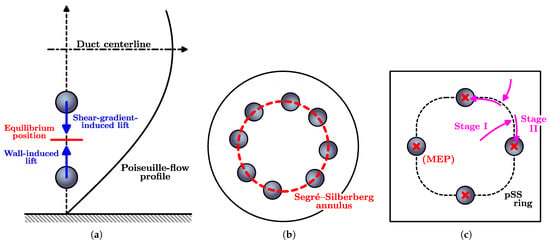
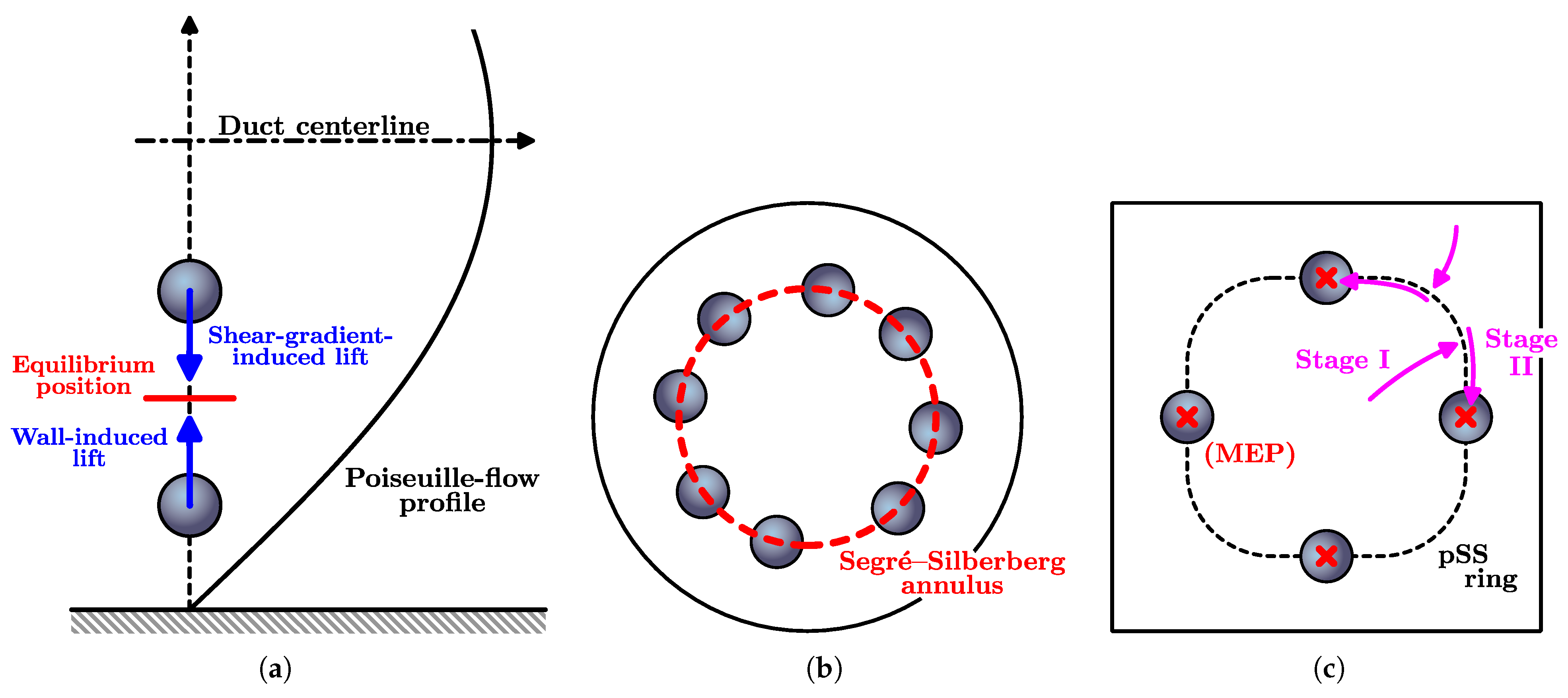
In a duct flow containing suspended spherical particles of relatively large size—specifically, with particle diameters exceeding approximately one-tenth of the duct width [1]—the particles not only move downstream with the surrounding flow but also exhibit cross-sectional motion that traverses the streamlines of the primary flow, even when they are neutrally buoyant. This phenomenon is known not to arise from particle–particle interactions, as it occurs even when the suspension is sufficiently dilute. The lateral motion of particles arises because they experience inertial lift forces exerted by the fluid. Two major types of the lift forces act on a particle suspended in a duct flow, as schematically shown in Figure 1a. As identified by Asmolov [2], one is the shear-gradient-induced lift, which acts dominantly when the particle is located apart from the duct wall and is directed toward the wall. The other is the wall-induced lift, which acts in the opposite direction when the particle is close to the wall. Because these two lift forces act in opposite directions, an equilibrium position can exist within the duct cross-section where they balance each other. A particle suspended in the flow migrates laterally while moving downstream and eventually reached this equilibrium position, after which it travels only in the streamwise direction. This particle-focusing phenomenon was first discovered in the 1960s by Segré and Silberberg [3] through experimental observations in circular pipe flow and has since been known as the Segré–Silberberg effect. In a circular pipe, neutrally buoyant spherical particles are known to focus, far downstream, at a specific radial position approximately 0.6 times the pipe radius, as shown in Figure 1b. In addition, it has been reported that, depending on the particle size and Reynolds number, particles may also focus at two distinct radial positions, with an inner and an outer annulus being observed depending on the conditions [4,5].
Figure 1.
Overview of particle focusing in internal flows. (a) Two inertial lift mechanisms: shear-gradient-induced lift force (toward the wall) and wall-induced lift (away from the wall). (b) Segré–Silberberg annulus in a circular pipe. (c) Two stage migration in a square duct: Stage I, radial migration to the pseudo Segré–Silberberg (pSS) ring; Stage II, azimuthal migration along the ring toward stable equilibrium points, such as midline equilibrium points (MEPs).
Di Carlo et al. [6] conducted experimental observations using microchannels and demonstrated that, in the case of rectangular cross-section, suspended particles focus at specific equilibrium points within the cross-section, as shown in Figure 1c. This behavior arises from the azimuthal motion of the particle caused by the lack of axisymmetry in the square cross-section. The particle first undergoes radial migration within the duct, as in the case of circular pipes, and reaches the annular position known as the pseudo Segré–Silberberg (pSS) ring [7] (the first stage of migration). Thereafter, it migrates azimuthally along this ring (the second stage), and eventually arrives at a specific point within the cross-section, at which it ceases its in-plane motion. Their findings suggest the feasibility of a technique that enables particle separation simply by flowing a suspension through a microchannel, without the need for external force. Such an approach is particularly advantageous for separating delicate biological samples that are easily damaged by strong external forces, such as those used in centrifugation, and is therefore expected to play an important role in the development of advanced biomedical technologies.
Extensive research has been conducted on the inertial focusing of particles suspended in rectangular duct flows. For example, when the duct cross-section is square and the particle size is approximately one-tenth of the duct width, four equilibrium focusing points appear near the centers of each side of the cross-section, midline equilibrium point (MEP), at relatively low Reynolds numbers (, where Re is defined using the mean velocity as the characteristic velocity) [6]. Di Carlo et al. [8] further calculated the inertial lift forces acting on spherical particles at various positions within the cross-section using finite element analysis and demonstrated that predicted equilibrium points correspond well with the experimentally observed focusing locations. Miura et al. [9] experimentally showed for the first time that, at higher Re (≈500), additional focusing points emerge along the diagonals of the cross-section, diagonal equilibrium point (DEP). Subsequently, Nakagawa et al. [10] performed a detailed analysis of the motion of a sphere suspended in a square-duct flow and confirmed that the particles focus on both the MEP and the DEP—that is, that the MEP–DEP focusing pattern (hereafter referred to as FP) is formed—while also elucidating the particle trajectories leading to these points. A detailed investigation of the transitions in particle focusing patterns revealed that an additional focusing point, termed the intermediate equilibrium point (IEP), exists between the MEP FP and the MEP–DEP FP, forming what is referred to as the MEP–IEP FP [11]. These pattern transitions were shown through numerical simulations to be attributable to changes in the stability of each equilibrium point and to the differences in the critical Reynolds numbers at which these stability changes occur [12].
The MEP FP observed at low Re has been studied in detail by Hood et al. [13]. They applied a perturbation expansion—based on the assumptions that the particle size is negligibly small (, B: the blockage ratio, defined as the ratio of the particle diameter to the duct width) but the channel Reynolds number is finite—to a three-dimensional duct flow and demonstrated the existence of the MEP FP in a semi-analytical manner. They reported that their predicted positions of the MEP compares well with experimental data by Di Carlo et al. [8] at corresponding to (where is defined using the maximum velocity as the characteristic velocity), especially for the blockage ratio up to .
In contrast, Prohm and Stark [14] reported, based on direct numerical simulations, that the MEP becomes unstable and the DEP becomes stable for relatively large particles () even at Reynolds numbers as low as 5–19 (). This suggests that the focusing points reported by Di Carlo et al. [8]—specifically those shown in their Figure 2—may correspond to the DEP, not the MEP, for large particles. However, to the best of the authors’ knowledge, no experimental evidence has yet been reported for the presence of the DEP for rigid particles in Newtonian fluids flowing through square-ducts at low Re.
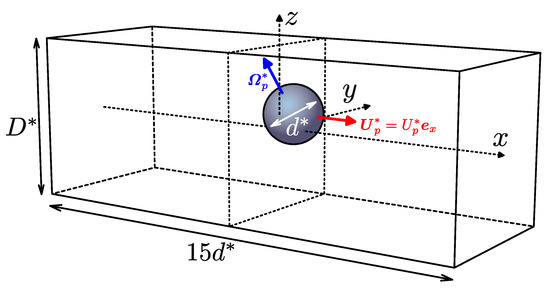
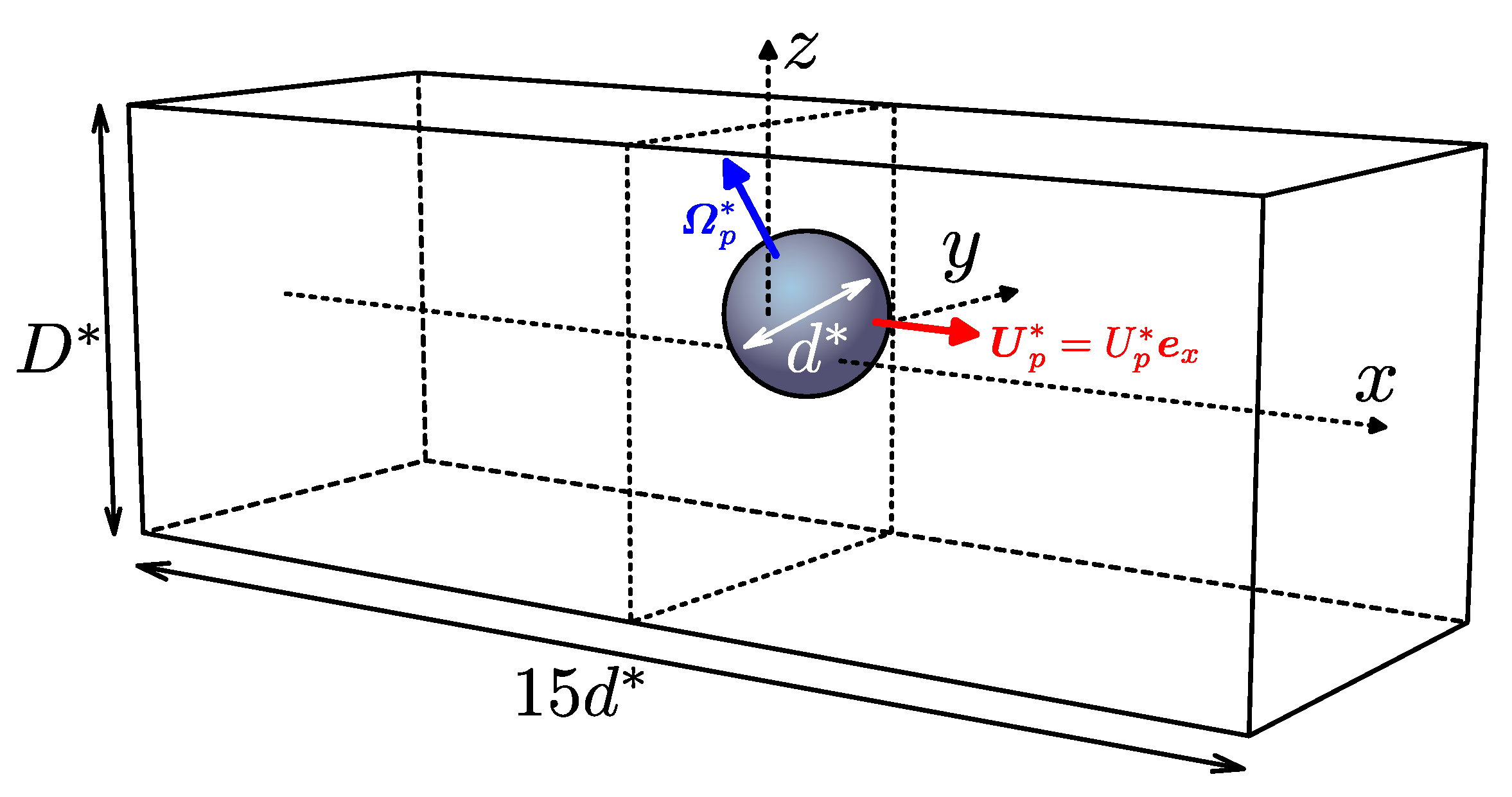
Figure 2.
Flow configuration. An asterisk (*) indicates dimensional quantities, while symbols without an asterisk represent nondimensional quantities.
As described above, a variety of experimental and numerical studies have reported that suspended particles focus in response to changes in cross-sectional geometry, particle size, and Reynolds number. On the other hand, certain focusing patterns have so far been predicted only numerically, and the current understanding remains insufficient for practical applications such as the design of particle separation devices. As a step toward filling this gap, the present study numerically reproduces and experimentally observes the DEP FP predicted by Prohm and Stark [14].
This paper is organized as follows. Section 2 describes the numerical method used to compute the lift force acting on the particle, as well as the experimental procedure for obtaining the particle cross-sectional positions in the duct flow. Section 3 presents the particle equilibrium points and their stability estimated from the computed lift-force fields, and shows the corresponding changes in the experimentally observed FPs for the same parameter sets. Section 4 interprets the results of the present study in the context of previous work. Section 5 summarizes the main findings of the study.
2. Materials and Methods
2.1. Calculation of Lateral Force Acting on a Sphere Flowing in Square-Duct Flow
To estimate the particle motion in dilute suspensions with negligible particle–particle interactions, we compute the forces acting on a single neutrally buoyant rigid spherical particle suspended in a square-duct flow and estimate its in-plane (-plane) motion from the cross-sectional components of the force (i.e., the lift or lateral forces). As illustrated in Figure 2, the duct width is denoted by and the particle diameter by . The duct walls are located at , and the primary flow is directed along the x-axis. Periodic boundary conditions are imposed at . The fluid in the duct is assumed to be an incompressible Newtonian fluid and therefore obeys the continuity and Navier–Stokes equations. The suspended particle follows Newton’s equation of motion; it is allowed to translate only in the streamwise direction, while its rotation is left free. The particle velocity and angular velocity are denoted as and , respectively.
The fluid–particle interactions are solved using the immersed boundary method [15]. The nondimensionalized governing equations are given as follows.
These equations are nondimensionalized using the mean flow velocity of the duct flow without the particle as the characteristic velocity, and the duct width as the characteristic length scale. Here, denotes the velocity field representing both the fluid velocity and the velocity inside the particle in a unified manner. The variable p represents the pressure field, and is the vector field describing the fluid–particle interaction force obtained by the immersed boundary method (see Ref. [15]). V denotes the volume of the computational domain, and is the position vector measured from the particle center. The dimensionless parameters are the Reynolds number Re and the blockage ratio B, defined respectively as
The space and time domains are discretized using a second-order central difference scheme and a fractional-step method. In all simulations, the spatial resolution is set to 20 grid points per particle diameter.
When a steady state is reached, the lift force acting on the particle is evaluated as
The assessment of the numerical error was described in detail elsewhere [12,16].
2.2. Experimental Observation of Particle Distributions in the Square-Duct Cross-Section
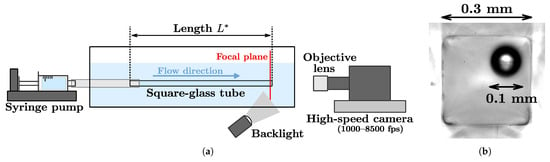
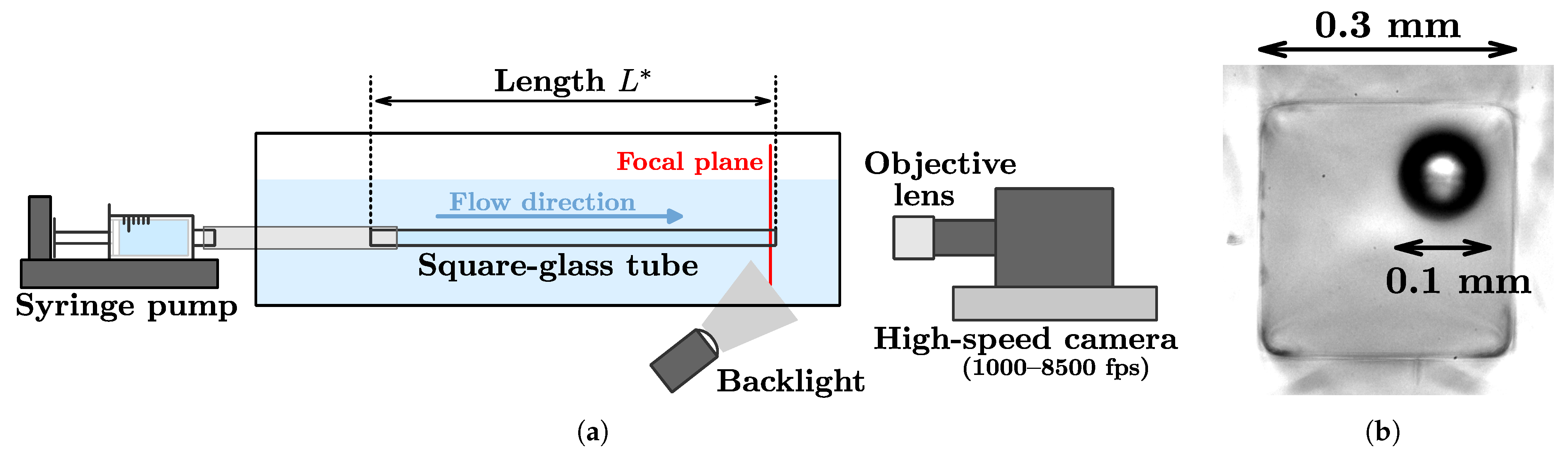
We perform front-view observations of spherical particles with the diameter that are neutrally buoyant and suspended in a square-duct flow, and analyze the cross-sectional positions at which the particles pass through a downstream observation plane. A schematic of the experimental setup is shown in Figure 3a. The particle suspension is prepared by mixing polystyrene spherical particles (Thermo Fisher Scientific, Waltham, MA, USA) of density with an aqueous glycerol solution adjusted to the same density. To neglect particle–particle interactions, the particle volume fraction in the suspension is kept dilute at approximately 0.02%.
Figure 3.
Experimental setup (a) and a representative particle image at (b).
The suspension is injected through a syringe into a glass tube (VitroCom, Mountain Lakes, NJ, USA) with a square cross-section of side length , using a syringe pump operating in positive-pressure mode. A high-speed camera (FASTCAM Mini AX100 and FASTCAM Nova S12, Photron, Tokyo, Japan) equipped with a long-working-distance objective lens is positioned perpendicular to the outlet cross-section of the duct. From images such as that shown in Figure 3b, captured as particles pass through the outlet, the particle center positions within the cross-section are analyzed using ImageJ version 1.54g (National Institutes of Health, Bethesda, MD, USA).
As combinations of particle diameter and duct size, we used and for , and and for . To capture a pseudo-streamwise development of the particle distribution for , we used different duct lengths, namely , 51 mm, and 300 mm. For , we adopted .
3. Results
3.1. Numerical Results
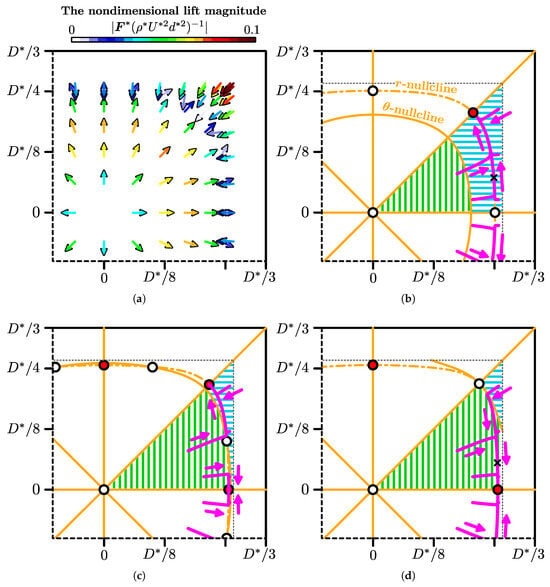
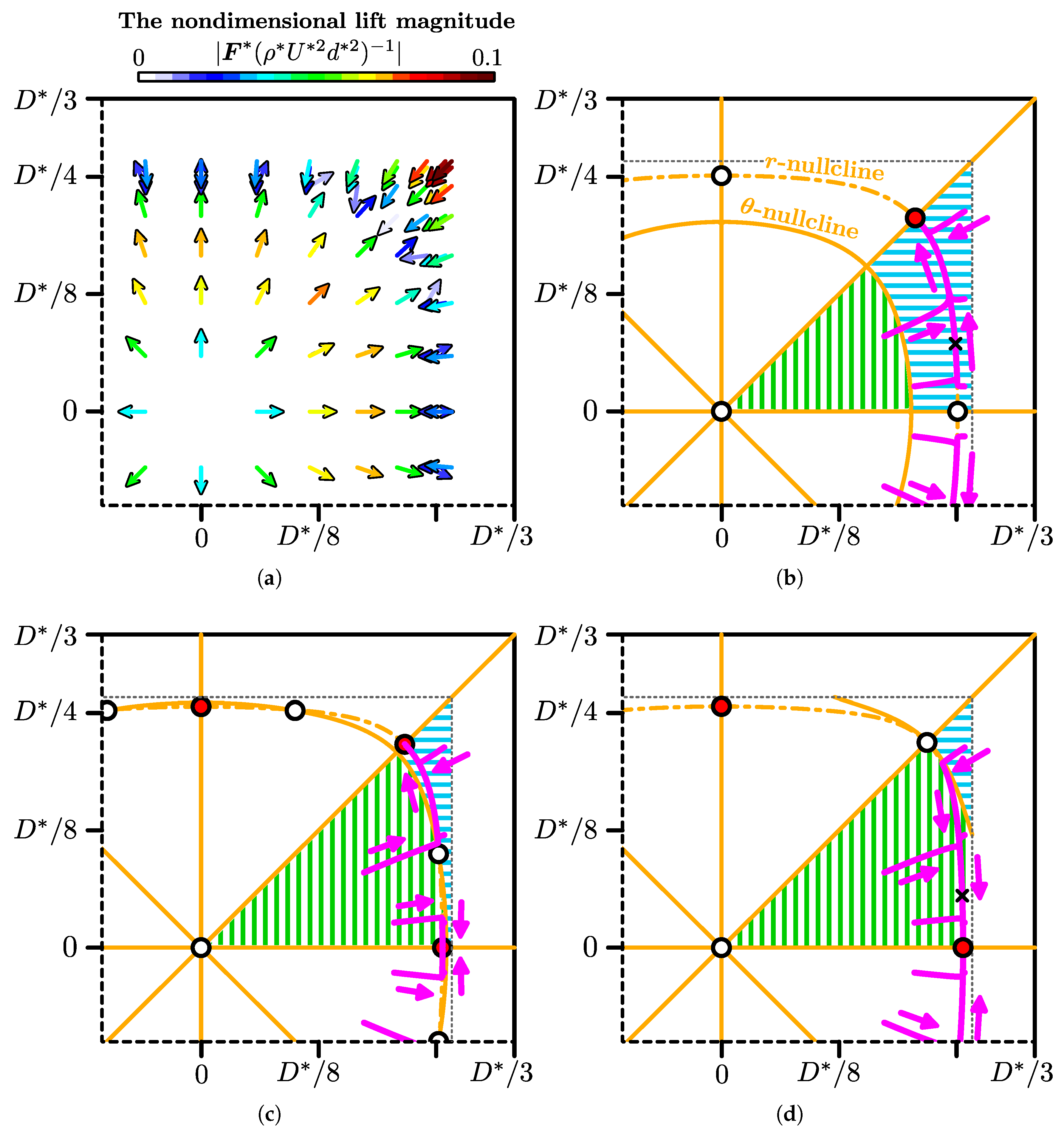
For the relatively large particle size of , we computed the lift forces generated at various positions within the duct cross-section by placing the particle at each location. Figure 4a shows the lift-force field obtained for , where the arrows indicate the lift direction and the color gradation represents its magnitude. Near the duct center, the lift forces are generally directed radially outward from the center. In contrast, in the vicinity of the duct walls, the lift forces are oriented inward toward the interior of the cross-section.
Figure 4.
Particle focusing patterns numerically obtained at . (a) Lift-force field (at ). Color-coded arrows: inertial lift forces. (b) DEP FP at . (c) MEP–DEP FP at . (d) MEP FP at . Dash–dot lines: r-nullcline. Solid lines: -nullcline. Magenta curves with arrows: representative particle trajectories. White/red circles: stable/unstable equilibrium points. In the green vertically striped region, . In the blue horizontally striped region, . Gray dotted lines in (b–d): boundary of the domain in which the lift forces were computed.
To estimate the particle focusing points from the lift-force field, we examined the contours on which the radial and azimuthal components of the lift force vanish. The lift force acting on the particle at various positions within the cross-section was interpolated using a Chebyshev-polynomial-based method, and the contour lines corresponding to and were then computed. Here, denotes the unit vector in the radial direction, and denotes the azimuthal unit vector defined with respect to the particle position. Details of the interpolation procedure can be found in Ref. [12]. The orange dash–dot lines and solid lines shown in Figure 4b–d correspond to these contours. The dash–dot line, representing the contour where the radial component becomes zero, is found to form a single closed curve within the duct cross-section. Here, we refer to this closed curve as the r-nullcline. Inside the r-nullcline, , whereas outside it, . The solid lines, corresponding to the contour where the azimuthal component becomes zero, lie along the diagonals of the cross-section and the y- and z-axes due to symmetry. In addition, similarly to the r-nullcline, another closed curve is identified, which we refer to as the θ-nullcline. Because the sign of in the regions enclosed by these solid lines is symmetric, we describe only the range . Here, is defined as the positive y-axis, and increases in the counterclockwise direction. The region is divided into two subregions by the -nullcline. In the region on the duct-center side, shown with green vertical stripes, is negative. In the region on the duct-wall side, shown with blue horizontal stripes, is positive.
At the intersections of the r-nullcline with the y- or z-axis, the diagonals, or -nullclines, the lift magnitude becomes zero, and these locations correspond to equilibrium points. By symmetry, the center of the duct cross-section is also an equilibrium point. Within the parameter range examined in this study, however, this equilibrium point is always unstable (and therefore never becomes a focusing point) and will hence be excluded from the following discussion. The stability of each equilibrium point was assessed by examining the particle trajectories (shown as magenta lines) obtained under the assumption that a particle moves within the cross-section following the local lift force, starting from positions near the equilibrium point. Equilibrium points at which the trajectories terminate (indicated by red circles) are stable and correspond to the focusing points. If a trajectory diverges from an equilibrium point and moves toward another one, the former is unstable (indicated by white circles).
The nullclines, equilibrium points, and trajectories for are shown in Figure 4b. The equilibrium points that appear within the cross-section consist of two types: the MEPs located along the y- and z-axes, and the DEPs on the diagonals. The particle trajectories first migrate radially toward the r-nullcline and subsequently move toward the DEPs. This is evident from the fact that the particle trajectories cross the region where (the horizontally striped region). Therefore, the MEPs are unstable, whereas the DEPs are stable. Thus, for and , the focusing pattern is the DEP FP.
Figure 4c shows the case of . In addition to the MEP and DEP, intermediate equilibrium points (IEPs) appear—for example, the one marked by a white circle at approximately —arising from the intersection of the r- and -nullclines. For , the particle trajectories cross the region where (the horizontally striped region) during the second stage of their motion and eventually reach the DEP. For , the trajectories pass through the region where (the vertically striped region) during the second stage and arrive at the MEP. Therefore, the MEPs and DEPs are stable, whereas the IEPs are unstable, indicating that the focusing pattern corresponds to the MEP–DEP FP.
Figure 4d shows the results for . The equilibrium points that appear within the cross-section are the MEPs and the DEPs. All trajectories cross, during the second stage of their motion, the region where (the vertically striped region). Consequently, the MEPs are stable and the DEPs are unstable, indicating that the focusing pattern at this Re is the MEP FP.
For , the focusing pattern transitions among the DEP FP, the MEP–DEP FP, and the MEP FP, depending on the Reynolds number. These transitions correspond to changes in the stability of the equilibrium points that arise from variations in the configuration of the r- and -nullclines. At low Re, the -nullcline lies inside the r-nullcline. While the r-nullcline does not change significantly with increasing Re, the -nullcline shifts outward and eventually crosses the r-nullcline. At intermediate Re, this crossing generates the IEP. As seen in Figure 4c, the - and r-nullclines first make contact on the y- (z-) axis. Thus, the IEP initially appears in the vicinity of the MEP and then moves toward the DEP as the -nullcline continues to shift. On the diagonal line as well, the -nullcline moves outward and overtakes the r-nullcline. Once the -nullcline lies entirely outside the r-nullcline, the IEP disappears.
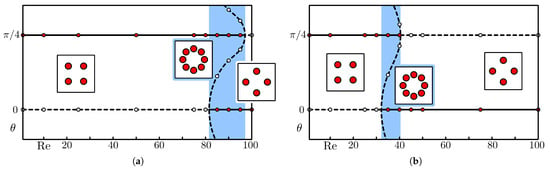
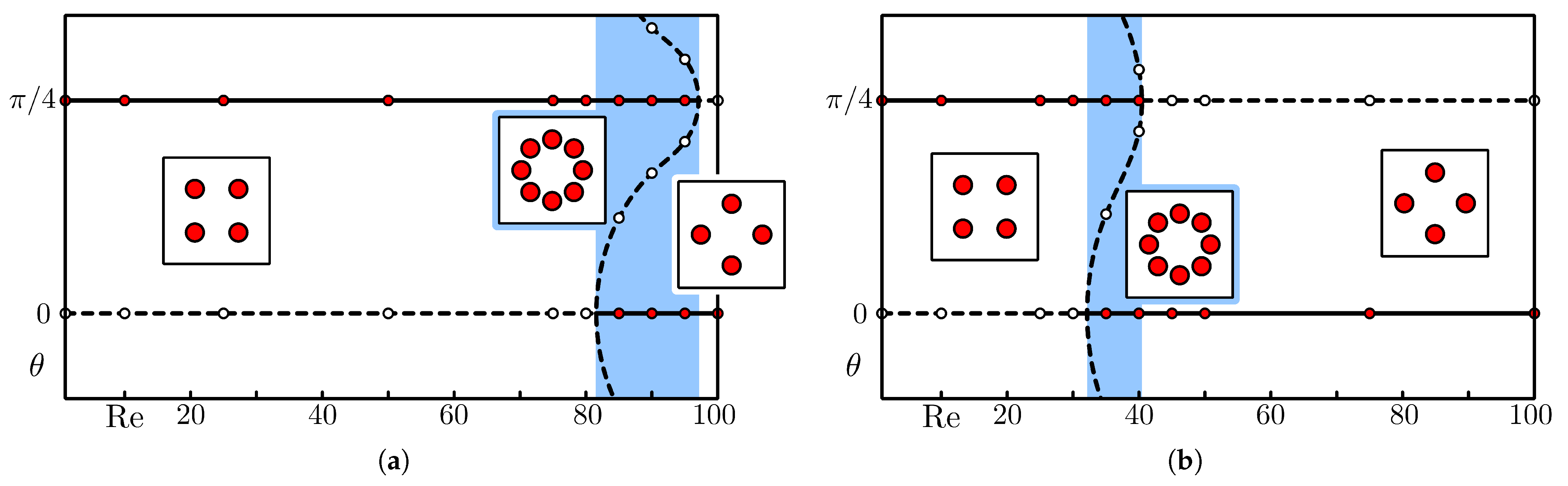
The pattern transitions for are summarized in Figure 5a from the viewpoint of bifurcations of the equilibrium points. For comparison, Figure 5b shows the results for the smaller blockage ratio . The horizontal axis represents the Reynolds number, and the vertical axis represents the angular position of the equilibrium point, with the range shown. Here, corresponds to the MEP, corresponds to the DEP, and points with represent the IEPs. Solid lines indicate stable branches, whereas dashed lines indicate unstable ones. For shown in Figure 5a, contact between the r- and -nullclines occurs along the y-axis at Re between 80 and 85. This contact generates IEPs on both positive- and negative- sides in the vicinity of the MEP, which can be interpreted as a subcritical pitchfork bifurcation. As Re increases further, the IEP that moves toward the DEP disappears at Re between 95 and 100, owing to the contact between the r- and -nullclines along the diagonal. This disappearance can also be regarded as a subcritical pitchfork bifurcation. Because the critical Reynolds number at which the MEP changes stability differs from that for the DEP, bistability between the MEP and DEP arises in the region shown in blue in Figure 5, leading to the formation of the MEP–DEP FP. For the slightly smaller blockage ratio shown in Figure 5b, the qualitative features of the pattern transitions remain the same as those for . However, the Reynolds-number range in which the MEP–DEP FP appears shifts to a lower band compared with the case of .
Figure 5.
Bifurcation diagrams of particle equilibrium points at (a) and (b). Solid/dashed lines: stable/unstable branches. The Re range shaded in blue represents the region in which the MEP–DEP FP forms.
3.2. Experimental Results
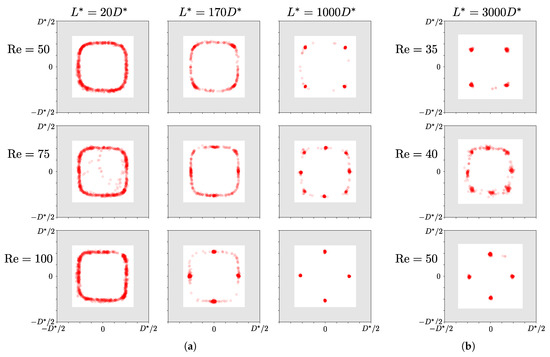
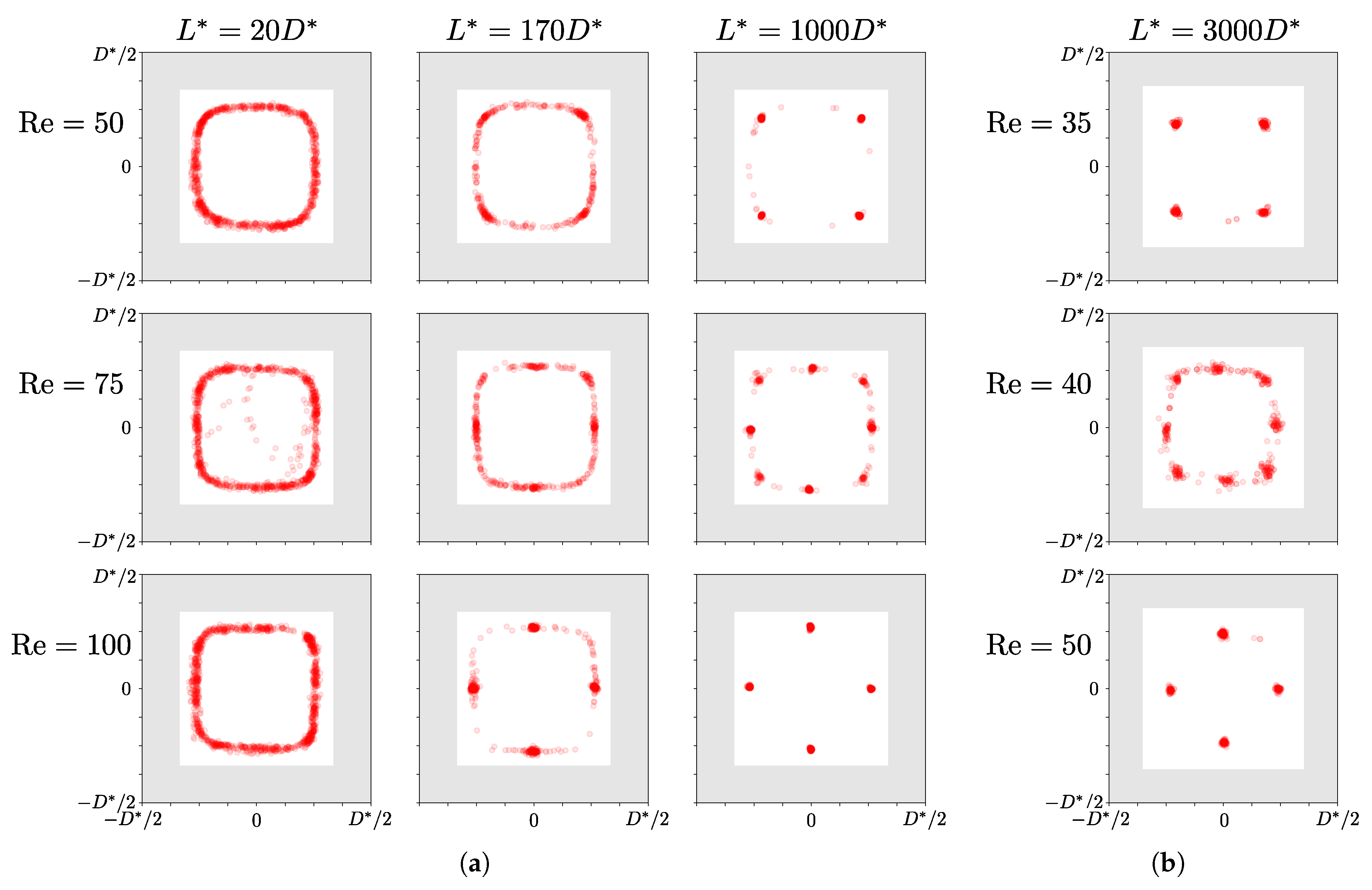
To verify whether the Reynolds-number-dependent pattern transitions predicted numerically for actually occur in practice, we conducted front-view observation experiments with and . Figure 6a shows the particle distributions observed on the duct cross-section and their evolution along the flow direction. Results are shown for ducts of lengths , , and , for . Semi-transparent red circles denote the center positions of particles that have passed through the cross-section. More than 300 particle samples were used to construct each distribution.
Figure 6.
(a) Evolution of particle distribution along the duct length. . , and 100. (b) Particle distributions corresponding DEP, MEP–DEP, and MEP FPs at and . The gray regions along each side of the cross-section represent the exclusion regions for the particle center position.
For all Reynolds numbers examined, the particle distributions observed at the outlet of the shortest duct () form an annulus. This is because the duct is so short that the particles pass through the outlet while still in the middle of the second stage of their trajectories, as described in the numerical results. At , the previously observed annular distribution begins to exhibit nonuniformity. Because the particle positions are plotted using semi-transparent markers, regions of higher color density correspond to locations where more particles have passed. For , particles preferentially pass near the DEP; for , near both the MEP and the DEP; and for , predominantly near the MEP. For the longest duct length, , the particles flowing through the duct are observed to pass through specific locations at the outlet. The observed patterns are the DEP FP for , the MEP–DEP FP for , and the MEP FP for . Figure 6b shows the particle distributions for ( and ), a slightly smaller blockage ratio than in Figure 6a. The duct length is , and results are presented for . As in Figure 6a, the DEP FP, the MEP–DEP FP, and the MEP FP appear sequentially as the Re increases. Furthermore, consistent with the numerical results shown in Figure 5, the Reynolds numbers at which the DEP and MEP–DEP FPs are observed become smaller as the blockage ratio decreases. Thus, the experimental observations clearly demonstrate the same sequence of pattern transitions as those obtained in the numerical simulations.
4. Discussion
The present study experimentally and numerically indicates that relatively large particles exhibit the DEP FP at low Re, and an increase in Re induces a shift to the DEP–MEP FP and then to the MEP FP. The Re range of the bistable pattern becomes higher with increasing blockage ratio. Prohm and Stark [14] performed a numerical analysis similar to that of the present study for at (). Their obtained focusing patterns are consistent with the present results: only the MEP FP for in this Re range, the DEP FP at () and the MEP FP at () for , and only the DEP FP for . However, they reported that the particles move either to the DEP or to the MEP, but that these two equilibrium points are never stable at the same time. Their simulations were conducted for four Reynolds numbers, , and 80. Taken together with the present results, this suggests that if simulations had been performed for at , the MEP–DEP FP might also have been obtained. In the present study, we focused on how the configuration of the r- and -nullclines changes the focusing patterns, with particular attention to how these nullclines intersect. Thus, the present study is unique in the finding of the bistable pattern as well as in providing experimental evidence of the DEP FP.
For smaller blockage ratio, the standard MEP FP is observed for . As the Reynolds number increases, however, the behavior becomes more complex, with stable IEPs and stable DEPs emerging [11,12]. The MEP FP observed at low Re has been reported in detail by Hood et al. [13]. Although their analysis covers blockage ratios up to , it does not capture the change in stability associated with the DEP. This implies that the DEP FP observed at low Re lies outside their regime where the blockage ratio is assumed to be negligibly small () while the Re remains finite, and therefore suggests that it may arise from some underlying effect associated with finite blockage ratio. However, even for large particles, the focusing pattern eventually becomes the MEP FP when the Reynolds number is sufficiently high (see Figure 5). This may be interpreted as the inertial effects overwhelming—or canceling out—the effects associated with blockage ratio.
As depicted in Figure 4, the emergence of the DEP FP and the subsequent pattern transitions originate from changes in the configuration of the nullclines. The regions of positive and negative that give rise to the -nullcline can be understood intuitively in terms of the shear-gradient-induced lift and the wall-induced lift. The origin of the region (the horizontally striped region in Figure 4) that appears near the duct wall is attributed to the wall-induced lift. If we assume that, near the wall in the region , the wall-induced lift acts along the shear of the square-duct Poiseuille flow (basic flow) and is directed away from the wall, then the force due to the wall-induced lift satisfies and . By the same reasoning, if the shear-gradient-induced lift near the duct center acts in the direction of the local shear and points outward, it is reasonable that a region where (the vertically striped region) appears on the duct-center side within .
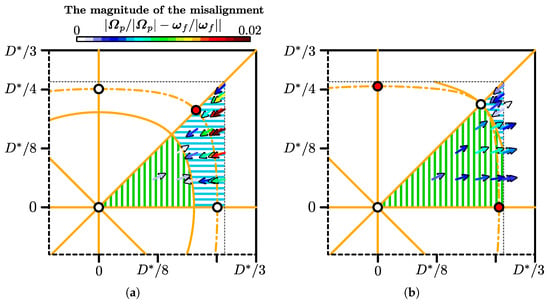
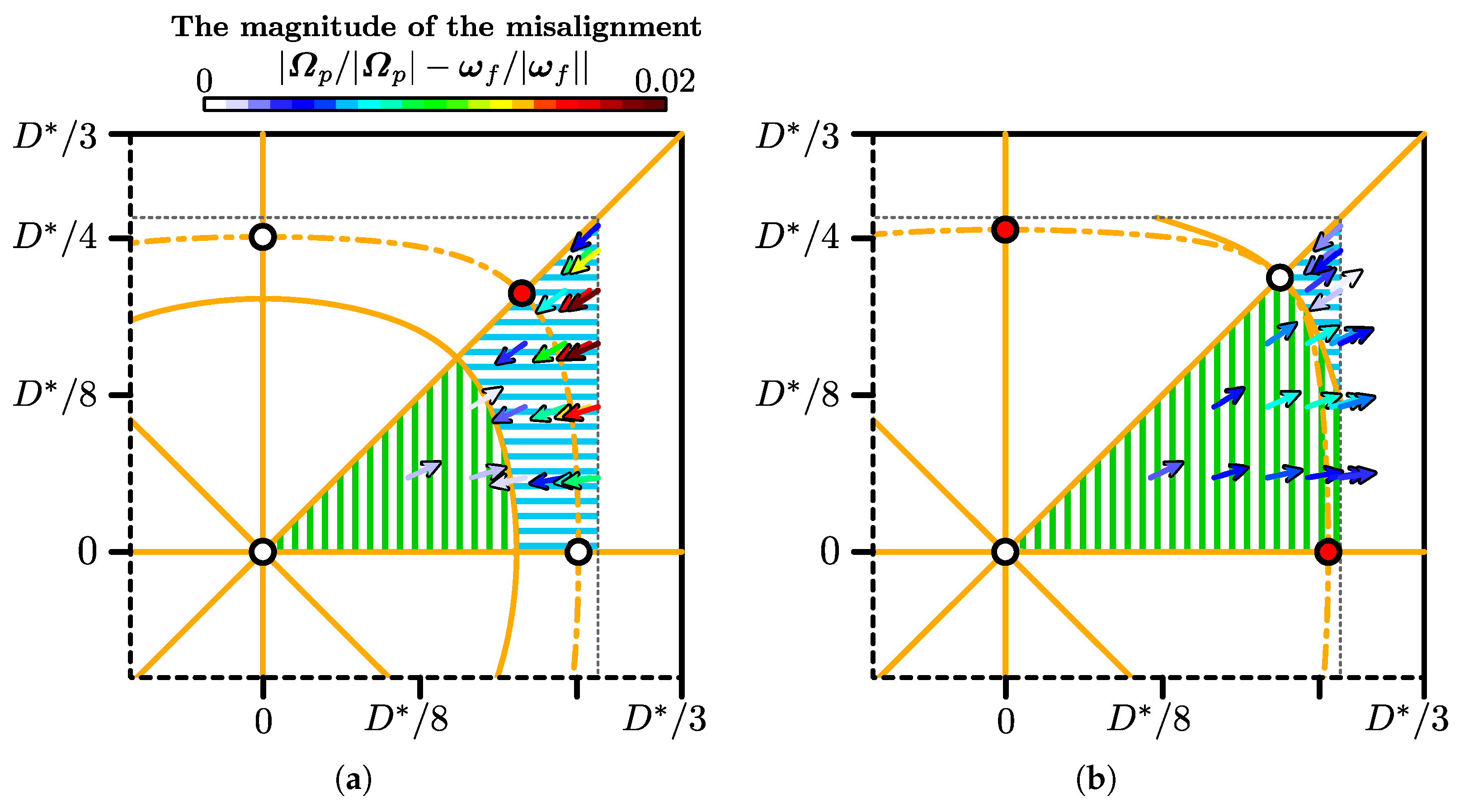
Within this simple interpretation, the r-nullcline and the -nullcline would coincide with each other. In fact, however, the -nullcline moves to the walls as Re increases, while the location of the r-nullcline is almost independent of Re as seen in Figure 4. The motion of the -nullcline due to the change of should play a crucial role in the equilibrium points. As a possible reason why the two nullclines adopt different configurations, we consider the misalignment between the particle’s rotation axis () and the direction of the local vorticity of the basic flow (). Such misalignment could cause lift forces like the Magnus force. Figure 7 illustrates a vector representing this misalignment: . It is seen that the particle’s rotation axis tilts toward the wall relative to the vorticity on the duct-center side, whereas it tilts toward the midline on the duct-wall side. Within the parameter range examined, the magnitude of this misalignment is at most approximately 0.02 (rad) for and about 0.008 (rad) for . For , where the misalignment is more pronounced, the particle’s rotation axis tilts toward the wall in the region where , while the opposite tendency is observed in the region where . For , compared with , the region where the rotation axis tilts toward the wall becomes broader, and the region with also appears to expand. However, near the -nullcline, cases are also observed in which the rotation axis tilts toward the wall even within the region where . This indicates that the sign of does not perfectly correlate with the direction of the rotation-axis misalignment. A detailed investigation of how such misalignment of the rotation axis in a simple shear flow affects the forces acting on a particle is therefore suggested as an important topic for future study.
Figure 7.
Misalignment between the particle’s rotation axis, , and the direction of the local vorticity, . (a) . (b) .
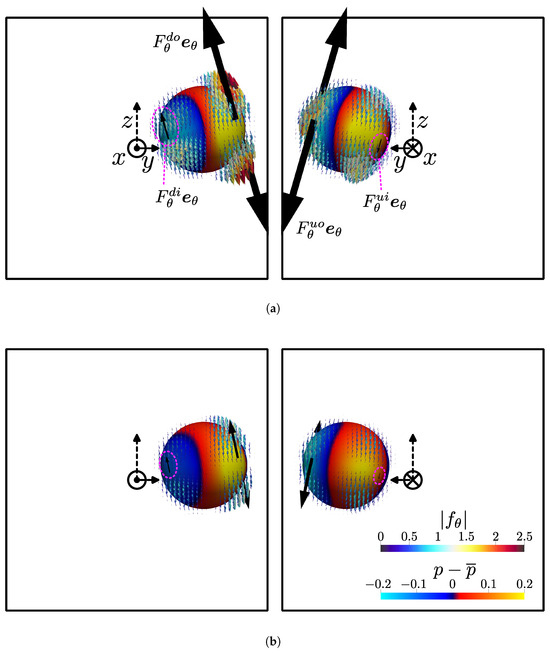
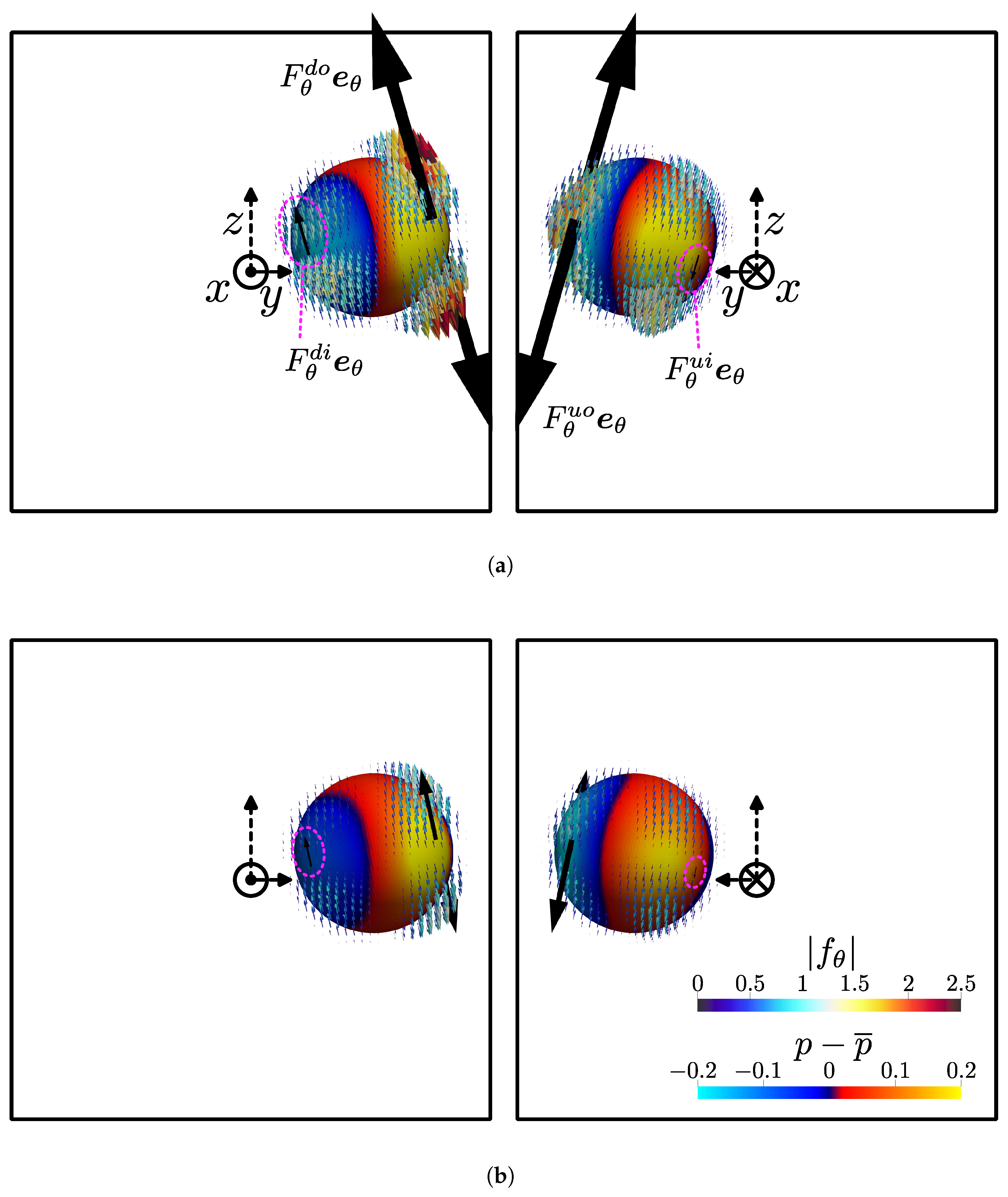
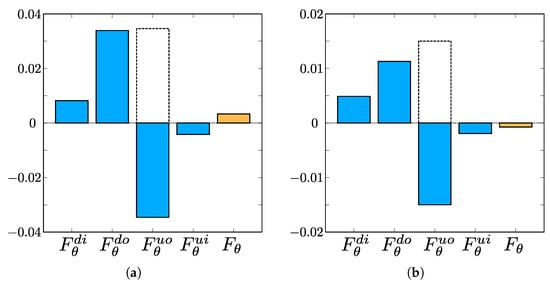
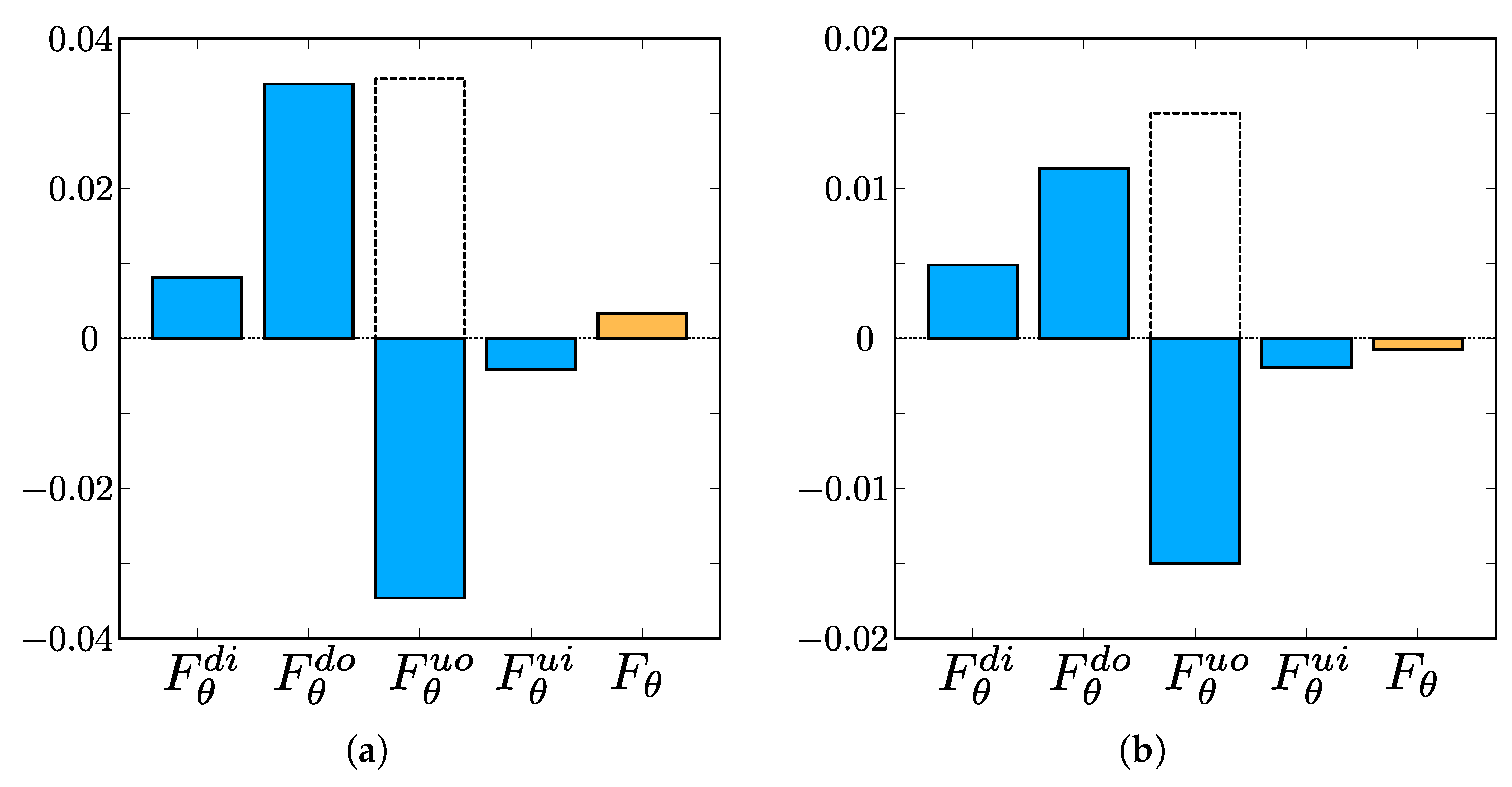
Finally, we attempt to interpret the forces acting on a particle during the second stage of its motion based on the local information in the vicinity of the particle. The forces acting on the particle were computed at the positions marked by crosses in Figure 4b,d. At these positions, for , whereas for . Figure 8 shows the fluid–particle interaction force, (small colored arrows), and the surface pressure field (colormap), computed using the immersed boundary method. Here, is defined as . The pressure field is defined as the pressure with the basic-flow pressure field subtracted. The black arrows represent the -components of the downstream inner (), downstream outer (), upstream outer () and upstream inner () integrals of the fluid–particle interaction force. Here, inner and outer are defined with respect to the plane normal to with its origin at the particle center: the side toward the duct center is referred to as the inner side, and the opposite side as the outer side. We define them as follows:
Figure 8.
For a particle located on the pseudo Segré–Silberberg ring (indicated by a cross in Figure 4b,d): the -component based on the particle position of the fluid–particle interaction force (), the surface pressure field (), and the contributions to (, , , and ). Here, denotes the unit vector orthogonal to the particle-position vector . denotes the pressure field of the basic flow. (a) . (b) .
In each panel of Figure 8, the left and right sides correspond to views from the downstream and upstream directions, respectively. Interestingly, although exhibits a clear sign difference between and , no obvious qualitative difference can be discerned from Figure 8a,b. The distributions of positive and negative regions in the surface pressure field, the sign changes of near the positive and negative pressure peaks, and the signs of , , , and all show similar trends, except for differences in magnitude.
A quantitative comparison of the integrated contributions is presented in Figure 9a,b. This quantification reveals that, for , the large values of and almost cancel each other out, so that the downstream inner contribution, , becomes dominant and yields a positive net . In contrast, at , the upstream outer contribution, , results in a negative net , because the downstream outer contribution is markedly reduced compared with the other contributions. We expect that a more precise evaluation of the stress distribution on the particle surface—using methods based on body-fitted unstructured grids, rather than the immersed boundary method, in which the solid–fluid interface is not sharply defined—will help elucidate the shift in the dominant contribution to from to .
Figure 9.
Components contributing to . (a) . (b) . Dashed boxes: .
5. Conclusions
We investigated the inertial focusing of relatively large neutrally buoyant spherical particles suspended in a square-duct flow through both numerical simulations and experiments. The DEP FP, which had been reported previously, was successfully reproduced numerically, and its actual occurrence was confirmed experimentally.
The DEP FP observed at for transitions through the MEP–DEP FP and eventually becomes the MEP FP, as the Reynolds number increases. Similar transition behavior is also observed for and . These pattern transitions can be understood in terms of changes in the configuration of the r- and the -nullclines: the -nullcline lies inside the r-nullcline in the DEP FP, the nullclines intersect in the MEP–DEP FP, and the -nullcline lies outside the r-nullcline in the MEP FP.
Interpreted from the perspective of bifurcations of particle equilibrium points, the appearance of the IEP corresponds to a subcritical pitchfork bifurcation associated with the change in stability from the DEP being stable to unstable. Likewise, the disappearance of the IEP corresponds to a subcritical pitchfork bifurcation associated with the change in stability from the MEP being unstable to stable.
Author Contributions
Conceptualization, H.Y., N.Y., T.A. and M.S.-S.; methodology, H.Y. and M.S.-S.; software, H.Y.; validation, H.Y. and M.S.-S.; formal analysis, H.Y.; investigation, H.Y., N.Y. and M.S.-S.; resources, M.S.-S.; data curation, H.Y.; writing—original draft preparation, H.Y.; writing—review and editing, H.Y., N.Y., T.A. and M.S.-S.; visualization, H.Y.; supervision, M.S.-S.; project administration, M.S.-S.; funding acquisition, M.S.-S. All authors have read and agreed to the published version of the manuscript.
Funding
This research was funded by JSPS KAKENHI Grant Number JP24K00809.
Institutional Review Board Statement
Not applicable.
Informed Consent Statement
Not applicable.
Data Availability Statement
The data presented in this study are available on request from the corresponding author.
Acknowledgments
The computation was carried out using the computer resource offered under the category of General Projects by Research Institute for Information Technology, Kyushu University. The authors thank Ryuya Miyara for his preliminary experiments on particle focusing at the blockage ratio of 0.3.
Conflicts of Interest
The authors declare no conflicts of interest.
Abbreviations
The following abbreviations are used in this manuscript:
| pSS | pseudo Segré–Silberberg |
| MEP | Midline equilibrium point |
| DEP | Diagonal equilibrium point |
| IEP | Intermediate equilibrium point |
| FP | Focusing pattern |
References
- Bhagat, A.A.S.; Kuntaegowdanahalli, S.S.; Papautsky, I. Inertial microfluidics for continuous particle filtration and extraction. Microfluid. Nanofluid. 2009, 7, 217–226. [Google Scholar] [CrossRef] [Scilit]
- Asmolov, E.S. The inertial lift on a spherical particle in a plane Poiseuille flow at large channel Reynolds number. J. Fluid Mech. 1999, 381, 63–87. [Google Scholar] [CrossRef] [Scilit]
- Segré, G.; Silberberg, A. Radial particle displacements in Poiseuille flow of suspensions. Nature 1961, 189, 209–210. [Google Scholar] [CrossRef] [Scilit]
- Matas, J.-P.; Morris, J.F.; Guazzelli, É. Inertial migration of rigid spherical particles in Poiseuille flow. J. Fluid Mech. 2004, 515, 171–195. [Google Scholar] [CrossRef] [Scilit]
- Nakayama, S.; Yamashita, H.; Yabu, T.; Itano, T.; Sugihara-Seki, M. Three regimes of inertial focusing for spherical particles suspended in circular tube flows. J. Fluid Mech. 2019, 871, 952–969. [Google Scholar] [CrossRef] [Scilit]
- Di Carlo, D.; Irimia, D.; Tompkins, R.G.; Toner, M. Continuous inertial focusing, ordering, and separation of particles in microchannels. Proc. Natl. Acad. Sci. USA 2007, 104, 18892–18897. [Google Scholar] [CrossRef] [Scilit] [PubMed]
- Choi, Y.-S.; Seo, K.-W.; Lee, S.-J. Lateral and cross-lateral focusing of spherical particles in a square microchannel. Lab Chip 2011, 11, 460–465. [Google Scholar] [CrossRef] [Scilit] [PubMed]
- Di Carlo, D.; Edd, J.F.; Humphry, K.J.; Stone, H.A.; Toner, M. Particle segregation and dynamics in confined flows. Phys. Rev. Lett. 2009, 102, 094503. [Google Scholar] [CrossRef] [Scilit] [PubMed]
- Miura, K.; Itano, T.; Sugihara-Seki, M. Inertial migration of neutrally buoyant spheres in a pressure-driven flow through square channels. J. Fluid Mech. 2014, 749, 320–330. [Google Scholar] [CrossRef] [Scilit]
- Nakagawa, N.; Yabu, T.; Otomo, R.; Kase, A.; Makino, M.; Itano, T.; Sugihara-Seki, M. Inertial migration of a spherical particle in laminar square channel flows from low to high Reynolds numbers. J. Fluid Mech. 2015, 779, 776–793. [Google Scholar] [CrossRef] [Scilit]
- Shichi, H.; Yamashita, H.; Seki, J.; Itano, T.; Sugihara-Seki, M. Inertial migration regimes of spherical particles suspended in square tube flows. Phys. Rev. Fluids 2017, 2, 044201. [Google Scholar] [CrossRef] [Scilit]
- Yamashita, H.; Itano, T.; Sugihara-Seki, M. Bifurcation phenomena on the inertial focusing of a neutrally buoyant spherical particle suspended in square duct flows. Phys. Rev. Fluids 2019, 4, 124307. [Google Scholar] [CrossRef] [Scilit]
- Hood, K.; Lee, S.; Roper, M. Inertial migration of a rigid sphere in three-dimensional Poiseuille flow. J. Fluid Mech. 2015, 765, 452–479. [Google Scholar] [CrossRef] [Scilit]
- Prohm, C.; Stark, H. Feedback control of inertial microfluidics using axial control forces. Lab Chip 2014, 14, 2115–2123. [Google Scholar] [CrossRef] [Scilit] [PubMed]
- Kajishima, T.; Takiguchi, S.; Hamasaki, H.; Miyake, Y. Turbulence structure of particle-laden flow in a vertical plane channel due to vortex shedding. JSME Int. J. Ser. B 2001, 44, 526–535. [Google Scholar] [CrossRef] [Scilit]
- Yamashita, H.; Akinaga, T.; Sugihara-Seki, M. Pattern transition on inertial focusing of neutrally buoyant particles suspended in rectangular duct flows. Micromachines 2021, 12, 1242. [Google Scholar] [CrossRef] [Scilit] [PubMed]
Disclaimer/Publisher’s Note: The statements, opinions and data contained in all publications are solely those of the individual author(s) and contributor(s) and not of MDPI and/or the editor(s). MDPI and/or the editor(s) disclaim responsibility for any injury to people or property resulting from any ideas, methods, instructions or products referred to in the content. |
© 2026 by the authors. Licensee MDPI, Basel, Switzerland. This article is an open access article distributed under the terms and conditions of the Creative Commons Attribution (CC BY) license.