Ontological Foundations for Deterministic Assurance Context Construction and Governed AI Reasoning


Abstract
1. Introduction
2. Background and Related Work
2.1. Security Assurance and Context Dependence
2.2. Ontologies, Context Modeling, and Incompleteness
2.3. Automation, AI Assistance, and Governance in Assurance
3. Conceptual Model for the Security Assurance Context Ontology
3.1. Motivation and Ontological Scope
3.2. Ontological Commitments Underlying the Security Assurance Context Ontology
3.2.1. Commitment to Explicit Scope and Boundary Representation
3.2.2. Commitment to Explicit Representation of Incompleteness
3.2.3. Commitment to Authority Differentiation Within the Ontology
3.2.4. Commitment to Determinism and Provenance as Ontological Properties
3.2.5. Implications for Ontology Structure
3.3. Core Ontological Structure of the Security Assurance Context Ontology
3.3.1. System-Centered Context Anchoring
3.3.2. Stakeholder and Concern Representation
3.3.3. Boundary and Assumption Modeling
3.3.4. Normative Context Representation
3.3.5. Uniform Treatment of Context Entities
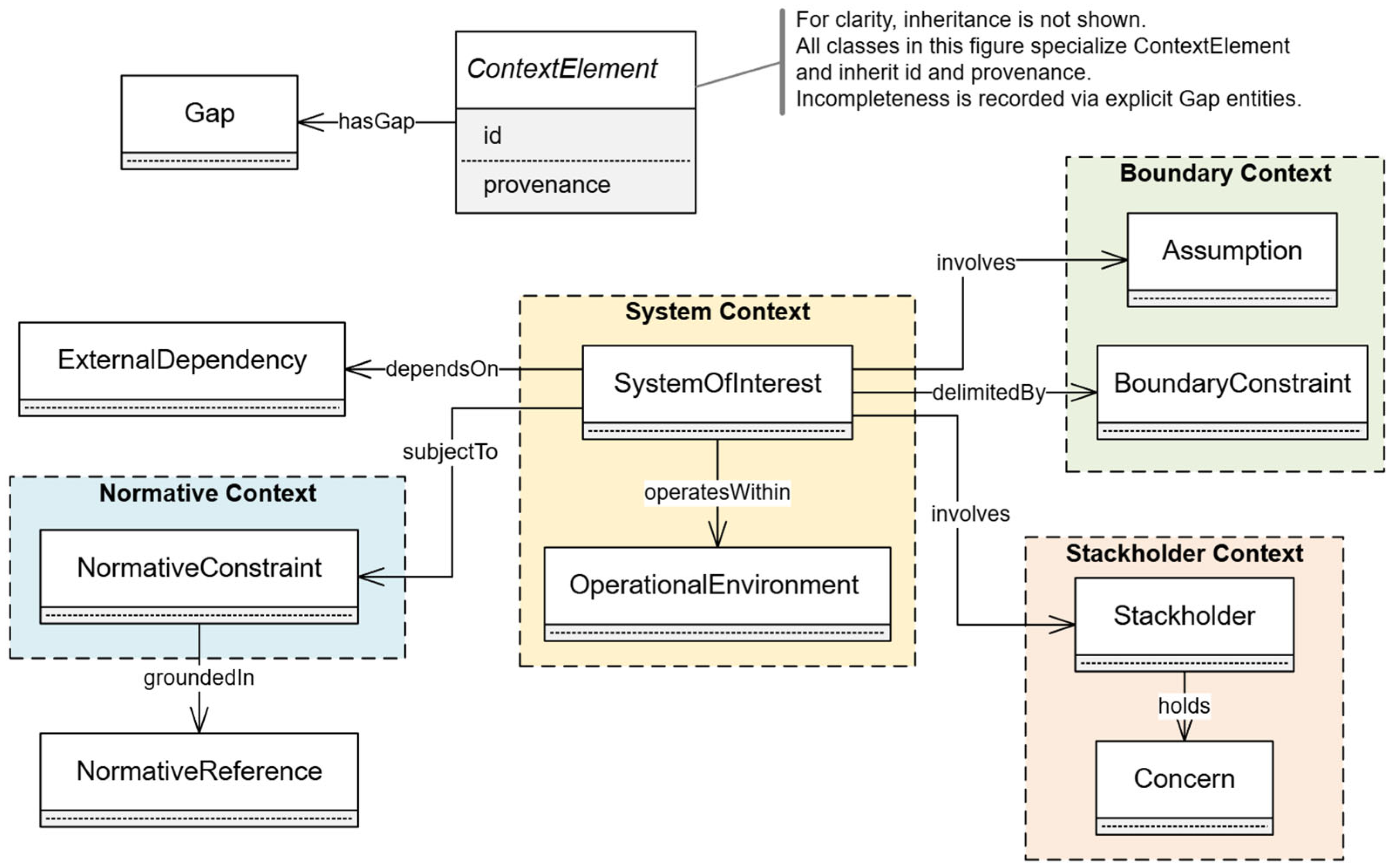
3.3.6. Conceptual Relationships Among Core Classes
3.3.7. Role of the Core Structure
3.4. Explicit Representation of Incompleteness in Assurance Context
- is a context element whose interpretation is subject to assurance reasoning;
- is a required property or relation of , as declared by the ontology schema or by applicable NormativeConstraints;
- identifies the declaration source in which the under specification arises, such as an input specification, reference binding, or validated decision record.
3.4.1. Ontological Role of Gaps
3.4.2. Conditions for Gap Introduction
3.4.3. Semantic Implications of Gaps
3.4.4. Persistence and Resolution of Gaps
3.4.5. Ontological Significance of Explicit Incompleteness
3.4.6. Illustrative Description of an Explicit Gap
3.5. Provenance and Authority Semantics for Governed Context Evolution
3.5.1. Provenance as an Explicit Ontological Property
3.5.2. Authority Classification of Context Elements
3.5.3. Governed Resolution of Incompleteness
3.5.4. Deterministic Evolution of Assurance Context
3.5.5. Summary of Governance Semantics
- Explicit representation of incompleteness via Gap entities.
- Provenance-based classification of context elements.
- Authority constraints that separate advisory analysis from authoritative context.
4. Ontology-Guided Context Construction and Governed Reasoning
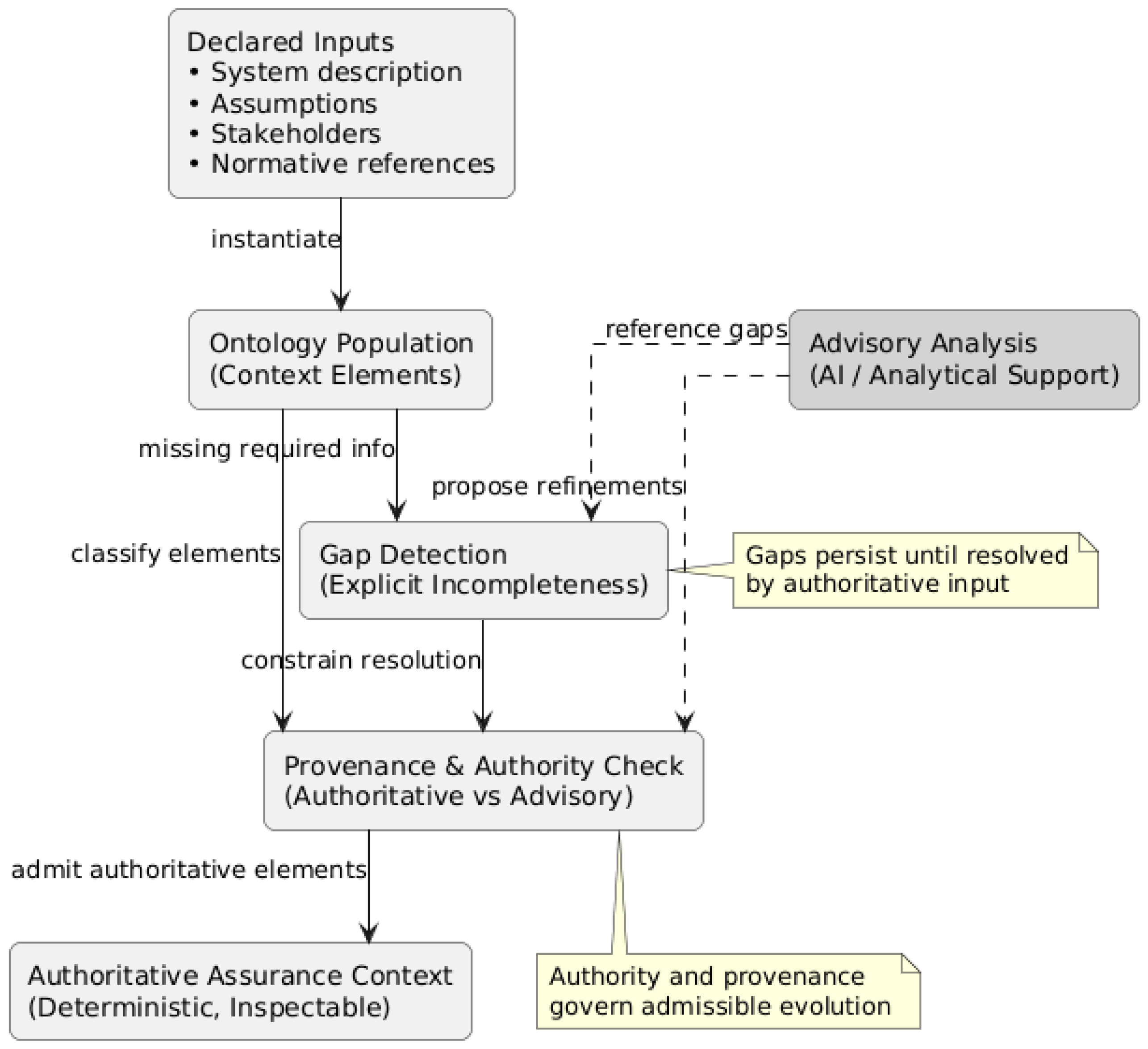
4.1. Overview of Ontology-Guided Context Construction
4.2. Handling Incompleteness and Authority During Context Construction
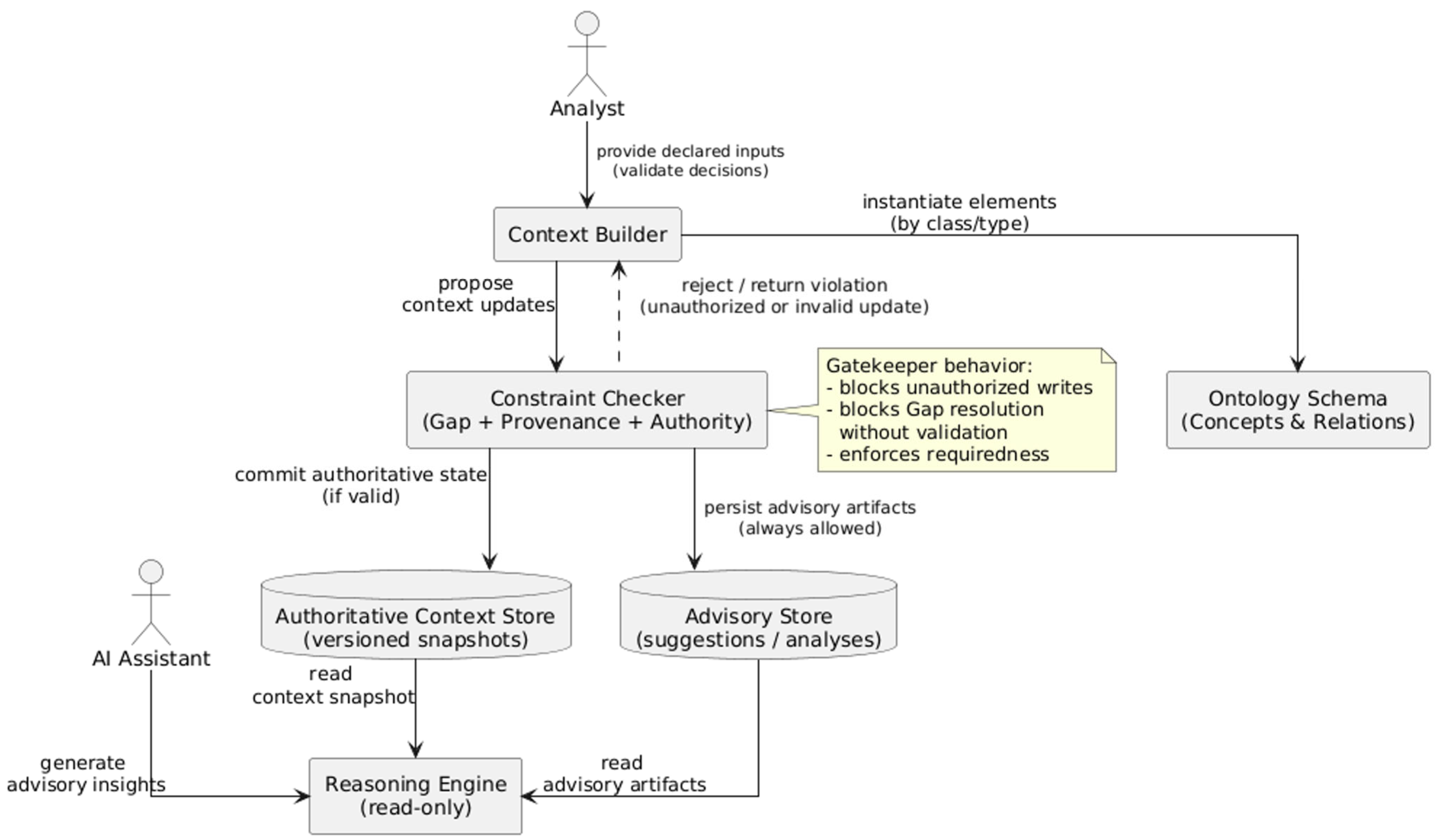
4.3. Governed Reasoning and Context Interpretation
4.4. Enforceable Constraints and Deterministic Realization
| Algorithm 1. Governed assurance context update |
| Precondition: the active Normative Profile and referenced Canonicalization Records are fixed by identifier/version and are treated as immutable inputs to the update. Input: Update Request r = {actor, provenance, changes, validation?, advisory?} Current authoritative context snapshot C Output: New authoritative snapshot C′, or rejection with reason 1. require r. provenance is present 2. require r. actor has a declared role 3. C′ ← begin Candidate State(C) //candidate state may be delta-based 4. for each proposed change c in r. changes do 5. if c. targets Authoritative Element() and not r. actor. is Authorized For(c) then 6. reject(“Unauthorized modification”) 7. apply Tentatively Within Checker(C′, c) 8. Req ← compute Required Properties(schema, active Normative Constraints, C′) 9. for each Context Element e in C′ do 10. for each property p in Req(e) do 11. if value(e, p) is missing then 12. ensure Gap(e, p, source = r. provenance) exists in C′ 13. for each Gap g in C′ where g. is Marked Resolved() do 14. require r. validation is present and r. validation. is Authoritative() 15. require r. binds Authoritative Value(g. target Element, g. missing Property) 16. commit Authoritative Snapshot(C′) //version++, immutable snapshot id 17. if r. advisory is present then 18. persist Advisory Artifact(r. advisory, references = linked Elements And Gaps(C′)) 19. return C′ |
5. Case Study: Practical Assurance Failure and Governed Resolution
5.1. Practical Assurance Failure Pattern
5.2. Scenario Definition and Declared Context
5.3. Baseline Outcome Under Conventional Assurance Practice
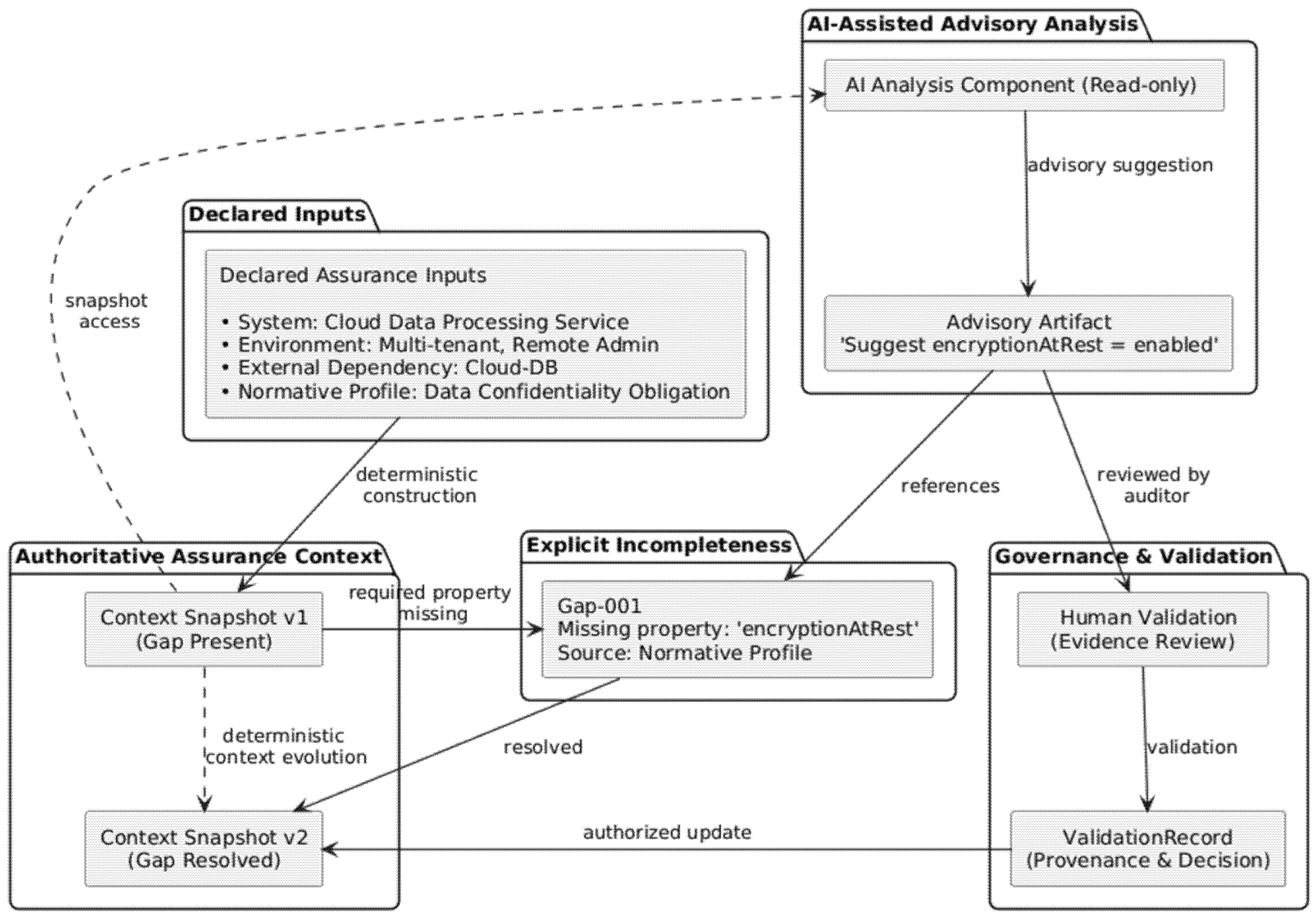
5.4. Deterministic Context Construction and Gap Detection with SACO
5.5. Advisory Reasoning and Controlled Resolution
5.6. Observable Outcome and Comparative Summary
6. Discussion and Implications
6.1. From Open-World Assumptions to a Monitored Assurance Context
6.2. Governing AI-Assisted Reasoning
6.3. Practical Realizability and Design Trade-Offs
6.4. Limitations
6.5. Future Work
7. Conclusions
Funding
Data Availability Statement
Acknowledgments
Conflicts of Interest
Abbreviation
| AI | Artificial Intelligence |
| GSN | Goal Structuring Notation |
| ISO | International Organization for Standardization |
| NIST | National Institute of Standards and Technology |
| OASIS | Organization for the Advancement of Structured Information Standards |
| SACO | Security Assurance Context Ontology |
| SOI | System of Interest |
References
- Wen, S.-F.; Katt, B. Exploring the role of assurance context in system security assurance evaluation: A conceptual model. Inf. Comput. Secur. 2024, 32, 159–178. [Google Scholar] [CrossRef]
- Spears, J.L.; Barki, H.; Barton, R.R. Theorizing the concept and role of assurance in information systems security. Inf. Manag. 2013, 50, 598–605. [Google Scholar] [CrossRef]
- ISO/IEC/IEEE 15026-1:2025; Systems and Software Engineering—Systems and Software Assurance Part 1: Vocabulary and Concepts. ISO: Geneva, Switzerland, 2025. Available online: https://www.iso.org/standard/89808.html (accessed on 10 January 2026).
- Ross, R.; McEvilley, M.; Oren, J. Systems Security Engineering: Considerations for a Multidisciplinary Approach in the Engineering of Trustworthy Secure Systems; National Institute of Standards and Technology: Gaithersburg, MD, USA, 2016.
- Safety-Critical Systems Club. Goal Structuring Notation Community Standard Version 3. 2021. Available online: https://scsc.uk/gsn-standard (accessed on 10 January 2026).
- McCormack, B.; Kitson, A.; Harvey, G.; Rycroft-Malone, J.; Titchen, A.; Seers, K. Getting evidence into practice: The meaning ofcontext’. J. Adv. Nurs. 2002, 38, 94–104. [Google Scholar] [CrossRef]
- Rushby, J. The Interpretation and Evaluation of Assurance Cases; Technical Report SRI-CSL-15-01; Computer Science Laboratory, SRI International: Menlo Park, CA, USA, 2015; Available online: https://www.csl.sri.com/users/rushby/papers/sri-csl-15-1-assurance-cases.pdf (accessed on 10 January 2026).
- Wei, R.; Jiang, Z.; Mei, H.; Barmpis, K.; Foster, S.; Kelly, T.; Zhuang, Y. Automated Model-Based Assurance Case Management Using Constrained Natural Language. IEEE Trans. Comput.-Aided Des. Integr. Circuits Syst. 2023, 43, 291–304. [Google Scholar] [CrossRef]
- Abiodun, O.I.; Alawida, M.; Omolara, A.E.; Alabdulatif, A. Data provenance for cloud forensic investigations, security, challenges, solutions and future perspectives: A survey. J. King Saud Univ.-Comput. Inf. Sci. 2022, 34, 10217–10245. [Google Scholar] [CrossRef]
- Werder, K.; Ramesh, B.; Zhang, R. Establishing data provenance for responsible artificial intelligence systems. ACM Trans. Manag. Inf. Syst. 2022, 13, 1–23. [Google Scholar] [CrossRef]
- Hillerström, F.; Solaki, A.; Dijk, J.; Steenstra, L.; van Vught, W. Knowledge management for autonomous systems in an open world. In Proceedings of the Autonomous Systems for Security and Defence II, Madrid, Spain, 15–19 September 2025; pp. 250–271. [Google Scholar]
- Koutsopoulos, G.; Perjons, E. Towards an approach for modeling organizational ignorance. In Proceedings of the PoEM Companion, Vienna, Austria, 28 November–1 December 2023. [Google Scholar]
- Kelly, T.; Weaver, R. The goal structuring notation–a safety argument notation. In Proceedings of the Dependable Systems and Networks 2004 Workshop on Assurance Cases, Florence, Italy, 1 July 2004. [Google Scholar]
- Mohamad, M.; Steghöfer, J.-P.; Scandariato, R. Security assurance cases—State of the art of an emerging approach. Empir. Softw. Eng. 2021, 26, 70. [Google Scholar] [CrossRef]
- Graydon, P.J. Towards a clearer understanding of context and its role in assurance argument confidence. In International Conference on Computer Safety, Reliability, and Security; Springer: Cham, Switzerland, 2014; pp. 139–154. [Google Scholar]
- McDermid, J.A. Nothing is certain but doubt and tests. arXiv 2014, arXiv:1404.6801. [Google Scholar] [CrossRef]
- Wen, S.-F.; Shukla, A.; Katt, B. Artificial intelligence for system security assurance: A systematic literature review. Int. J. Inf. Secur. 2025, 24, 43. [Google Scholar] [CrossRef]
- Deimling, F.; Fazzolari, M. Amoe: A tool to automatically extract and assess organizational evidence for continuous cloud audit. In IFIP Annual Conference on Data and Applications Security and Privacy; Springer: Cham, Switzerland, 2023; pp. 369–385. [Google Scholar]
- Hayrapetian, A.; Raje, R. Empirically analyzing and evaluating security features in software requirements. In Proceedings of the Proceedings of the 11th Innovations in Software Engineering Conference, Hyderabad, India, 9–11 February 2018; pp. 1–11. [Google Scholar]
- Wang, Z.; Lee, J.; Lin, S.; Sun, H. Rationalizing medical relation prediction from corpus-level statistics. arXiv 2020, arXiv:2005.00889. [Google Scholar] [CrossRef]
- Alansari, A.; Luqman, H. Large language models hallucination: A comprehensive survey. arXiv 2025, arXiv:2510.06265. [Google Scholar] [CrossRef]
- Zhang, Y.; Li, Y.; Cui, L.; Cai, D.; Liu, L.; Fu, T.; Huang, X.; Zhao, E.; Zhang, Y.; Chen, Y. Siren’s Song in the AI Ocean: A Survey on Hallucination in Large Language Models. Comput. Linguist. 2025, 51, 1373–1418. [Google Scholar] [CrossRef]
- Lin, X.; Ning, Y.; Zhang, J.; Dong, Y.; Liu, Y.; Wu, Y.; Qi, X.; Sun, N.; Shang, Y.; Wang, K. LLM-based Agents Suffer from Hallucinations: A Survey of Taxonomy, Methods, and Directions. arXiv 2025, arXiv:2509.18970. [Google Scholar] [CrossRef]
- Skitka, L.J.; Mosier, K.L.; Burdick, M. Does automation bias decision-making? Int. J. Hum.-Comput. Stud. 1999, 51, 991–1006. [Google Scholar] [CrossRef]
- Kücking, F.; Hübner, U.; Przysucha, M.; Hannemann, N.; Kutza, J.-O.; Moelleken, M.; Erfurt-Berge, C.; Dissemond, J.; Babitsch, B.; Busch, D. Automation bias in AI-decision support: Results from an empirical study. In German Medical Data Sciences 2024; IOS Press: Amsterdam, The Netherlands, 2024; pp. 298–304. [Google Scholar]
- Mikhaylova, D.; Turchi, T.; Cevolani, G.; Malizia, A. Bayesian reasoning for overcoming over-reliance in AI-assisted decision making. In Proceedings of the HAI-WS 2025: Workshops at the Fourth International Conference on Hybrid Human-Artificial Intelligence (HHAI), Pisa, Italy, 9–13 June 2025; pp. 477–486. [Google Scholar]
- Kabashkin, I. Cognitive Atrophy Paradox of AI–Human Interaction: From Cognitive Growth and Atrophy to Balance. Information 2025, 16, 1009. [Google Scholar] [CrossRef]
- Boinski, T.; Orlowski, P.; Szymanski, J.; Krawczyk, H. Security ontology construction and integration. In Proceedings of the International Conference on Knowledge Engineering and Ontology Development (KEOD 2011); SciTePress: Paris, France, 2011; pp. 369–374. [Google Scholar] [CrossRef]
- Souag, A.; Salinesi, C.; Mazo, R.; Comyn-Wattiau, I. A security ontology for security requirements elicitation. In International Symposium on Engineering Secure Software and Systems; Springer: Cham, Switzerland, 2015; pp. 157–177. [Google Scholar]
- Ramanauskaitė, S.; Shein, A.; Čenys, A.; Rastenis, J. Security ontology structure for formalization of security document knowledge. Electronics 2022, 11, 1103. [Google Scholar] [CrossRef]
- Adach, M.; Hänninen, K.; Lundqvist, K. Security ontologies: A systematic literature review. In International Conference on Enterprise Design, Operations, and Computing; Springer: Cham, Switzerland, 2022; pp. 36–53. [Google Scholar]
- Gómez-Romero, J.; Bobillo, F.; Delgado, M. Context Representation and Reasoning with Formal Ontologies. Act. Context Represent. 2011, 11, 04. [Google Scholar]
- Krötzsch, M.; Thost, V. Ontologies for knowledge graphs: Breaking the rules. In International Semantic Web Conference; Springer: Cham, Switzerland, 2016; pp. 376–392. [Google Scholar]
- Hepp, M. Possible ontologies: How reality constrains the development of relevant ontologies. IEEE Internet Comput. 2007, 11, 90–96. [Google Scholar] [CrossRef]
- Souza Neto, J.; Ferreira Neto, A.N. Metamodel of the IT governance framework COBIT. JISTEM-J. Inf. Syst. Technol. Manag. 2013, 10, 521–540. [Google Scholar] [CrossRef]
- Meyman, E. Versioned Meaning: How to Make Ontologies Audit-Stable. 2025. Available online: https://papers.ssrn.com/sol3/papers.cfm?abstract_id=5918182 (accessed on 10 January 2026).
- Ciccarese, P.; Soiland-Reyes, S.; Belhajjame, K.; Gray, A.J.; Goble, C.; Clark, T. PAV ontology: Provenance, authoring and versioning. J. Biomed. Semant. 2013, 4, 37. [Google Scholar] [CrossRef]
- Hinton, A. Understanding Context: Environment, Language, and Information Architecture; O’Reilly Media, Inc.: Sebastopol, CA, USA, 2014. [Google Scholar]
- Boguslav, M.R.; Salem, N.M.; White, E.K.; Sullivan, K.J.; Bada, M.; Hernandez, T.L.; Leach, S.M.; Hunter, L.E. Creating an ignorance-base: Exploring known unknowns in the scientific literature. J. Biomed. Inform. 2023, 143, 104405. [Google Scholar] [CrossRef] [PubMed]
- Boguslav, M.R. Revealing and Exploring the Literature’s Known Unknowns: Ignorance and How It Drives Science; University of Colorado Denver, Anschutz Medical Campus: Denver, CO, USA, 2023. [Google Scholar]
- Zou, J.; Stefanakos, I.; Shahbeigi Roudposhti, S.; Burton, S.; Calinescu, R.; CLEGG, K.D.; Rivett, R. Structural Causal World Models for Safety Assurance of AI-based Autonomy. In 41st ACM/SIGAPP Symposium on Applied Computing (SAC’26); ACM: New York, NY, USA, 2026. [Google Scholar]
- Bouchekir, R.; Cancimance, M.G. Enhancing Uncertainty Quantification for Runtime Safety Assurance Using Causal Risk Analysis and Operational Design Domain. arXiv 2025, arXiv:2507.03515. [Google Scholar] [CrossRef]
- Veale, T.; Hao, Y. A context-sensitive framework for lexical ontologies. Knowl. Eng. Rev. 2008, 23, 101–115. [Google Scholar] [CrossRef]
- Alsaig, A. Contelog: A Formal Declarative Framework for Contextual Knowledge Representation and Reasoning. Doctoral Dissertation, Concordia University, Montreal, Canada, 2022. [Google Scholar]
- Jin, H.; Zhang, T.; Ramamurthy, A.; Hamza, A.; Malinoski, M. Learning to Verify and Assure Cyber-Physical Systems. In Proceedings of the AIAA SCITECH 2024 Forum, Orlando, FL, USA, 8–12 January 2024; p. 1853. [Google Scholar]
- Galbas, R.; Nolte, M.; Eberle, U.; Hungar, H.; Mosebach, H.H.; Salem, N.F.; Schittenhelm, H.; Reich, J.; Kirschbaum, T.; Westhofen, L. VV Methods Safety Assurance Position Paper. 2024. Available online: https://www.researchgate.net/profile/Ulrich-Eberle/publication/382918990_VV_Methods_Safety_Assurance_Position_Paper/links/66b3515a2361f42f23ba489a/VV-Methods-Safety-Assurance-Position-Paper.pdf (accessed on 10 January 2026).
- Huang, L.; Yu, W.; Ma, W.; Zhong, W.; Feng, Z.; Wang, H.; Chen, Q.; Peng, W.; Feng, X.; Qin, B. A survey on hallucination in large language models: Principles, taxonomy, challenges, and open questions. ACM Trans. Inf. Syst. 2025, 43, 1–55. [Google Scholar] [CrossRef]
- Mănescu, D.C.; Mănescu, A.M. Artificial Intelligence in the Selection of Top-Performing Athletes for Team Sports: A Proof-of-Concept Predictive Modeling Study. Appl. Sci. 2025, 15, 9918. [Google Scholar] [CrossRef]
- Laux, J.; Ruschemeier, H. Automation Bias in the AI Act: On the Legal Implications of Attempting to De-Bias Human Oversight of AI. arXiv 2025, arXiv:2502.10036. [Google Scholar] [CrossRef]
- Sunyaev, A.; Benlian, A.; Pfeiffer, J.; Jussupow, E.; Thiebes, S.; Maedche, A.; Gawlitza, J. High-Risk Artificial Intelligence. Bus. Inf. Syst. Eng. 2025, 67, 981–994. [Google Scholar] [CrossRef]
- AI, N. Artificial Intelligence Risk Management Framework (AI RMF 1.0). 2023; p. 100-1. Available online: https://nvlpubs.nist.gov/nistpubs/ai/nist.ai.100-1.pdf (accessed on 10 January 2026).
- Kusche, I. Possible harms of artificial intelligence and the EU AI Act: Fundamental rights and risk. J. Risk Res. 2024, 27, 1–14. [Google Scholar] [CrossRef]
- Kulothungan, V. Using Blockchain Ledgers to Record AI Decisions in IoT. IoT 2025, 6, 37. [Google Scholar] [CrossRef]
- Xu, X.; Liu, H.; Tao, G.; Xuan, Z.; Zhang, X. Checkpointing and deterministic training for deep learning. In Proceedings of the 1st International Conference on AI Engineering: Software Engineering for AI, Pittsburgh, PA, USA, 16–17 May 2022; pp. 65–76. [Google Scholar]
- Samani, R.; Honan, B.; Reavis, J. CSA Guide to Cloud Computing: Implementing Cloud Privacy and Security; Syngress: Burlington, MA, USA, 2014. [Google Scholar]
- NIST SP 800-53; Security and Privacy Controls for Information Systems and Organizations. NIST: Montgomery County, MD, USA, 2020. Available online: https://csrc.nist.gov/pubs/sp/800/53/r5/upd1/final (accessed on 10 January 2026).
- ISO/IEC 27017:2015; Information technology—Security techniques—Code of Practice for Information Security Controls Based on ISO/IEC 27002 for cloud services. ISO: Geneva, Switzerland, 2015. Available online: https://www.iso.org/standard/43757.html (accessed on 10 January 2026).
- NIST SP 800-210; General Access Control Guidance for Cloud Systems. NIST: Montgomery County, MD, USA, 2020. Available online: https://csrc.nist.gov/pubs/sp/800/210/final (accessed on 10 January 2026).
- CSA. Cloud Controls Matrix and CAIQ v4.1. 2026. Available online: https://cloudsecurityalliance.org/artifacts/cloud-controls-matrix-v4-1 (accessed on 10 January 2026).
- ENISA. Cloud Computing Risk Assessment. Available online: https://www.enisa.europa.eu/publications/cloud-computing-risk-assessment (accessed on 10 January 2026).
- Moore, P.; Van Pham, H. On context and the open world assumption. In Proceedings of the 2015 IEEE 29th International Conference on Advanced Information Networking and Applications Workshops, Gwangju, Republic of Korea, 24–27 March 2015. [Google Scholar]



| Concept | Ontology Role | Context Dimension |
|---|---|---|
| SystemOfInterest | Anchors the assurance context to a specific system whose security properties are evaluated | System |
| OperationalEnvironment | Captures declared deployment and usage conditions that constrain interpretation of assurance | System |
| ExternalDependency | Represents systems or services relied upon by the System of Interest | System |
| Stakeholder | Represents an actor with a legitimate interest in the system’s security | Stakeholder |
| Concern | Captures a protection motivation or value associated with a stakeholder | Stakeholder |
| Assumption | Represents a declared premise about operation, trust, or environment | Boundary |
| BoundaryConstraint | Formalizes explicit inclusions or exclusions that delimit assurance scope | Boundary |
| NormativeReference | Identifies an external standard, regulation, or policy relevant to assurance | Normative |
| NormativeConstraint | Represents an obligation derived from a normative reference | Normative |
| Gap | Represents explicitly identified incompleteness or underspecification in assurance context | Cross-cutting |
| ContextElement | Abstract superclass enabling uniform treatment of provenance and evolution | Cross-cutting |
| Aspect | Role in the Ontology |
|---|---|
| Provenance | Identifies the origin of a context element |
| Authority | Determines whether a context element may influence assurance interpretation |
| Authoritative element | Context element grounded in declared or validated input |
| Advisory element | Context element providing analysis or suggestion without authority |
| Gap resolution | Requires introduction of new authoritative context |
| Context evolution | Governed by provenance and authority constraints |
| Situation During Construction | Ontology-Guided Handling | Effect on Assurance Context |
|---|---|---|
| Required property is available | Property instantiated directly | Context element is fully specified |
| Required property is missing | Explicit Gap entity created | Epistemic limitation is recorded |
| Analytical suggestion provided | Recorded as advisory artifact | Context remains unchanged |
| Validated new information provided | Introduced as authoritative element | Gap may be resolved |
| Attempted implicit completion | Disallowed by ontology | Context integrity preserved |
| Artifact | Description | Authority | Inspectable Evidence |
|---|---|---|---|
| Context snapshot | Immutable view of authoritative context at a point in time | Authoritative | Versioned context record |
| Gap record | Explicit marker of missing required information | Authoritative | Linked Gap entity |
| Advisory artifact | Reasoning output or candidate refinement | Advisory | Annotated reasoning record |
| Reference link | Association between advisory output and context elements | Advisory | Explicit dependency trace |
| Validation record | Human-approved resolution or update | Authoritative | Provenance-linked decision entry |
| Context Element | Declared Value |
|---|---|
| SystemOInterest | Cloud data processing service |
| OperationalEnvironment | Multi-tenant, remote administrative access |
| ExternalDependency | Cloud-DB |
| Normative obligation | Confidentiality of stored data |
| encryptionAtRest (Cloud-DB) | Not declared |
| Aspect | Observed Outcome |
|---|---|
| External dependency declared | Yes |
| Encryption-at-rest explicitly specified | No |
| Blocking condition for missing property | No |
| Confidentiality claim admissible | Yes |
| Evidence bound to specific deployment | Not required |
| Aspect | Observed Outcome |
|---|---|
| External dependency declared | Yes |
| Encryption-at-rest explicitly specified | No |
| Explicit Gap created | Yes (Gap-001) |
| Blocking condition for missing property | Yes |
| Confidentiality claim admissible | No |
| Aspect | Observed Outcome |
|---|---|
| Advisory suggestion produced | Yes |
| Advisory modifies authoritative context | No |
| Human validation required | Yes |
| Gap resolved without validation | No |
| New authoritative snapshot created | Yes |
| Stage | Conventional Practice | SACO |
|---|---|---|
| Declared inputs only | Confidentiality claim admissible | Confidentiality claim blocked |
| Missing dependency property | Tolerated implicitly | Explicit Gap created |
| AI advisory suggestion | May influence decision | Advisory only, no effect |
| Validation performed | Optional or informal | Required and recorded |
| Post-validation state | Confidentiality claim admissible | Confidentiality claim admissible |
Disclaimer/Publisher’s Note: The statements, opinions and data contained in all publications are solely those of the individual author(s) and contributor(s) and not of MDPI and/or the editor(s). MDPI and/or the editor(s) disclaim responsibility for any injury to people or property resulting from any ideas, methods, instructions or products referred to in the content. |
© 2026 by the author. Licensee MDPI, Basel, Switzerland. This article is an open access article distributed under the terms and conditions of the Creative Commons Attribution (CC BY) license.
Share and Cite
Wen, S.-F. Ontological Foundations for Deterministic Assurance Context Construction and Governed AI Reasoning. Appl. Sci. 2026, 16, 1984. https://doi.org/10.3390/app16041984
Wen S-F. Ontological Foundations for Deterministic Assurance Context Construction and Governed AI Reasoning. Applied Sciences. 2026; 16(4):1984. https://doi.org/10.3390/app16041984
Chicago/Turabian StyleWen, Shao-Fang. 2026. "Ontological Foundations for Deterministic Assurance Context Construction and Governed AI Reasoning" Applied Sciences 16, no. 4: 1984. https://doi.org/10.3390/app16041984
APA StyleWen, S.-F. (2026). Ontological Foundations for Deterministic Assurance Context Construction and Governed AI Reasoning. Applied Sciences, 16(4), 1984. https://doi.org/10.3390/app16041984